EP4089447A1 - Display protective film - Google Patents
Display protective film Download PDFInfo
- Publication number
- EP4089447A1 EP4089447A1 EP21738833.9A EP21738833A EP4089447A1 EP 4089447 A1 EP4089447 A1 EP 4089447A1 EP 21738833 A EP21738833 A EP 21738833A EP 4089447 A1 EP4089447 A1 EP 4089447A1
- Authority
- EP
- European Patent Office
- Prior art keywords
- unit
- display film
- mass
- fluoropolymer
- protective display
- Prior art date
- Legal status (The legal status is an assumption and is not a legal conclusion. Google has not performed a legal analysis and makes no representation as to the accuracy of the status listed.)
- Withdrawn
Links
Images

Classifications
-
- C—CHEMISTRY; METALLURGY
- C09—DYES; PAINTS; POLISHES; NATURAL RESINS; ADHESIVES; COMPOSITIONS NOT OTHERWISE PROVIDED FOR; APPLICATIONS OF MATERIALS NOT OTHERWISE PROVIDED FOR
- C09D—COATING COMPOSITIONS, e.g. PAINTS, VARNISHES OR LACQUERS; FILLING PASTES; CHEMICAL PAINT OR INK REMOVERS; INKS; CORRECTING FLUIDS; WOODSTAINS; PASTES OR SOLIDS FOR COLOURING OR PRINTING; USE OF MATERIALS THEREFOR
- C09D137/00—Coating compositions based on homopolymers or copolymers of compounds having one or more unsaturated aliphatic radicals, each having only one carbon-to-carbon double bond, and at least one being terminated by a heterocyclic ring containing oxygen; Coating compositions based on derivatives of such polymers
-
- C—CHEMISTRY; METALLURGY
- C09—DYES; PAINTS; POLISHES; NATURAL RESINS; ADHESIVES; COMPOSITIONS NOT OTHERWISE PROVIDED FOR; APPLICATIONS OF MATERIALS NOT OTHERWISE PROVIDED FOR
- C09D—COATING COMPOSITIONS, e.g. PAINTS, VARNISHES OR LACQUERS; FILLING PASTES; CHEMICAL PAINT OR INK REMOVERS; INKS; CORRECTING FLUIDS; WOODSTAINS; PASTES OR SOLIDS FOR COLOURING OR PRINTING; USE OF MATERIALS THEREFOR
- C09D127/00—Coating compositions based on homopolymers or copolymers of compounds having one or more unsaturated aliphatic radicals, each having only one carbon-to-carbon double bond, and at least one being terminated by a halogen; Coating compositions based on derivatives of such polymers
- C09D127/02—Coating compositions based on homopolymers or copolymers of compounds having one or more unsaturated aliphatic radicals, each having only one carbon-to-carbon double bond, and at least one being terminated by a halogen; Coating compositions based on derivatives of such polymers not modified by chemical after-treatment
- C09D127/12—Coating compositions based on homopolymers or copolymers of compounds having one or more unsaturated aliphatic radicals, each having only one carbon-to-carbon double bond, and at least one being terminated by a halogen; Coating compositions based on derivatives of such polymers not modified by chemical after-treatment containing fluorine atoms
-
- C—CHEMISTRY; METALLURGY
- C08—ORGANIC MACROMOLECULAR COMPOUNDS; THEIR PREPARATION OR CHEMICAL WORKING-UP; COMPOSITIONS BASED THEREON
- C08F—MACROMOLECULAR COMPOUNDS OBTAINED BY REACTIONS ONLY INVOLVING CARBON-TO-CARBON UNSATURATED BONDS
- C08F34/00—Homopolymers and copolymers of cyclic compounds having no unsaturated aliphatic radicals in a side chain and having one or more carbon-to-carbon double bonds in a heterocyclic ring
- C08F34/02—Homopolymers and copolymers of cyclic compounds having no unsaturated aliphatic radicals in a side chain and having one or more carbon-to-carbon double bonds in a heterocyclic ring in a ring containing oxygen
-
- C—CHEMISTRY; METALLURGY
- C08—ORGANIC MACROMOLECULAR COMPOUNDS; THEIR PREPARATION OR CHEMICAL WORKING-UP; COMPOSITIONS BASED THEREON
- C08F—MACROMOLECULAR COMPOUNDS OBTAINED BY REACTIONS ONLY INVOLVING CARBON-TO-CARBON UNSATURATED BONDS
- C08F116/00—Homopolymers of compounds having one or more unsaturated aliphatic radicals, each having only one carbon-to-carbon double bond, and at least one being terminated by an alcohol, ether, aldehydo, ketonic, acetal or ketal radical
- C08F116/38—Homopolymers of compounds having one or more unsaturated aliphatic radicals, each having only one carbon-to-carbon double bond, and at least one being terminated by an alcohol, ether, aldehydo, ketonic, acetal or ketal radical by a acetal or ketal radical
-
- C—CHEMISTRY; METALLURGY
- C08—ORGANIC MACROMOLECULAR COMPOUNDS; THEIR PREPARATION OR CHEMICAL WORKING-UP; COMPOSITIONS BASED THEREON
- C08F—MACROMOLECULAR COMPOUNDS OBTAINED BY REACTIONS ONLY INVOLVING CARBON-TO-CARBON UNSATURATED BONDS
- C08F124/00—Homopolymers of compounds having one or more unsaturated aliphatic radicals, each having only one carbon-to-carbon double bond, and at least one being terminated by a heterocyclic ring containing oxygen
-
- C—CHEMISTRY; METALLURGY
- C08—ORGANIC MACROMOLECULAR COMPOUNDS; THEIR PREPARATION OR CHEMICAL WORKING-UP; COMPOSITIONS BASED THEREON
- C08F—MACROMOLECULAR COMPOUNDS OBTAINED BY REACTIONS ONLY INVOLVING CARBON-TO-CARBON UNSATURATED BONDS
- C08F16/00—Homopolymers and copolymers of compounds having one or more unsaturated aliphatic radicals, each having only one carbon-to-carbon double bond, and at least one being terminated by an alcohol, ether, aldehydo, ketonic, acetal or ketal radical
- C08F16/38—Homopolymers and copolymers of compounds having one or more unsaturated aliphatic radicals, each having only one carbon-to-carbon double bond, and at least one being terminated by an alcohol, ether, aldehydo, ketonic, acetal or ketal radical by an acetal or ketal radical
-
- C—CHEMISTRY; METALLURGY
- C08—ORGANIC MACROMOLECULAR COMPOUNDS; THEIR PREPARATION OR CHEMICAL WORKING-UP; COMPOSITIONS BASED THEREON
- C08F—MACROMOLECULAR COMPOUNDS OBTAINED BY REACTIONS ONLY INVOLVING CARBON-TO-CARBON UNSATURATED BONDS
- C08F216/00—Copolymers of compounds having one or more unsaturated aliphatic radicals, each having only one carbon-to-carbon double bond, and at least one being terminated by an alcohol, ether, aldehydo, ketonic, acetal or ketal radical
- C08F216/38—Copolymers of compounds having one or more unsaturated aliphatic radicals, each having only one carbon-to-carbon double bond, and at least one being terminated by an alcohol, ether, aldehydo, ketonic, acetal or ketal radical by an acetal or ketal radical
-
- C—CHEMISTRY; METALLURGY
- C08—ORGANIC MACROMOLECULAR COMPOUNDS; THEIR PREPARATION OR CHEMICAL WORKING-UP; COMPOSITIONS BASED THEREON
- C08F—MACROMOLECULAR COMPOUNDS OBTAINED BY REACTIONS ONLY INVOLVING CARBON-TO-CARBON UNSATURATED BONDS
- C08F24/00—Homopolymers and copolymers of compounds having one or more unsaturated aliphatic radicals, each having only one carbon-to-carbon double bond, and at least one being terminated by a heterocyclic ring containing oxygen
-
- C—CHEMISTRY; METALLURGY
- C09—DYES; PAINTS; POLISHES; NATURAL RESINS; ADHESIVES; COMPOSITIONS NOT OTHERWISE PROVIDED FOR; APPLICATIONS OF MATERIALS NOT OTHERWISE PROVIDED FOR
- C09D—COATING COMPOSITIONS, e.g. PAINTS, VARNISHES OR LACQUERS; FILLING PASTES; CHEMICAL PAINT OR INK REMOVERS; INKS; CORRECTING FLUIDS; WOODSTAINS; PASTES OR SOLIDS FOR COLOURING OR PRINTING; USE OF MATERIALS THEREFOR
- C09D127/00—Coating compositions based on homopolymers or copolymers of compounds having one or more unsaturated aliphatic radicals, each having only one carbon-to-carbon double bond, and at least one being terminated by a halogen; Coating compositions based on derivatives of such polymers
- C09D127/02—Coating compositions based on homopolymers or copolymers of compounds having one or more unsaturated aliphatic radicals, each having only one carbon-to-carbon double bond, and at least one being terminated by a halogen; Coating compositions based on derivatives of such polymers not modified by chemical after-treatment
- C09D127/12—Coating compositions based on homopolymers or copolymers of compounds having one or more unsaturated aliphatic radicals, each having only one carbon-to-carbon double bond, and at least one being terminated by a halogen; Coating compositions based on derivatives of such polymers not modified by chemical after-treatment containing fluorine atoms
- C09D127/14—Homopolymers or copolymers of vinyl fluoride
-
- C—CHEMISTRY; METALLURGY
- C09—DYES; PAINTS; POLISHES; NATURAL RESINS; ADHESIVES; COMPOSITIONS NOT OTHERWISE PROVIDED FOR; APPLICATIONS OF MATERIALS NOT OTHERWISE PROVIDED FOR
- C09D—COATING COMPOSITIONS, e.g. PAINTS, VARNISHES OR LACQUERS; FILLING PASTES; CHEMICAL PAINT OR INK REMOVERS; INKS; CORRECTING FLUIDS; WOODSTAINS; PASTES OR SOLIDS FOR COLOURING OR PRINTING; USE OF MATERIALS THEREFOR
- C09D127/00—Coating compositions based on homopolymers or copolymers of compounds having one or more unsaturated aliphatic radicals, each having only one carbon-to-carbon double bond, and at least one being terminated by a halogen; Coating compositions based on derivatives of such polymers
- C09D127/02—Coating compositions based on homopolymers or copolymers of compounds having one or more unsaturated aliphatic radicals, each having only one carbon-to-carbon double bond, and at least one being terminated by a halogen; Coating compositions based on derivatives of such polymers not modified by chemical after-treatment
- C09D127/12—Coating compositions based on homopolymers or copolymers of compounds having one or more unsaturated aliphatic radicals, each having only one carbon-to-carbon double bond, and at least one being terminated by a halogen; Coating compositions based on derivatives of such polymers not modified by chemical after-treatment containing fluorine atoms
- C09D127/16—Homopolymers or copolymers of vinylidene fluoride
-
- C—CHEMISTRY; METALLURGY
- C09—DYES; PAINTS; POLISHES; NATURAL RESINS; ADHESIVES; COMPOSITIONS NOT OTHERWISE PROVIDED FOR; APPLICATIONS OF MATERIALS NOT OTHERWISE PROVIDED FOR
- C09D—COATING COMPOSITIONS, e.g. PAINTS, VARNISHES OR LACQUERS; FILLING PASTES; CHEMICAL PAINT OR INK REMOVERS; INKS; CORRECTING FLUIDS; WOODSTAINS; PASTES OR SOLIDS FOR COLOURING OR PRINTING; USE OF MATERIALS THEREFOR
- C09D129/00—Coating compositions based on homopolymers or copolymers of compounds having one or more unsaturated aliphatic radicals, each having only one carbon-to-carbon double bond, and at least one being terminated by an alcohol, ether, aldehydo, ketonic, acetal, or ketal radical; Coating compositions based on hydrolysed polymers of esters of unsaturated alcohols with saturated carboxylic acids; Coating compositions based on derivatives of such polymers
- C09D129/14—Homopolymers or copolymers of acetals or ketals obtained by polymerisation of unsaturated acetals or ketals or by after-treatment of polymers of unsaturated alcohols
-
- C—CHEMISTRY; METALLURGY
- C09—DYES; PAINTS; POLISHES; NATURAL RESINS; ADHESIVES; COMPOSITIONS NOT OTHERWISE PROVIDED FOR; APPLICATIONS OF MATERIALS NOT OTHERWISE PROVIDED FOR
- C09D—COATING COMPOSITIONS, e.g. PAINTS, VARNISHES OR LACQUERS; FILLING PASTES; CHEMICAL PAINT OR INK REMOVERS; INKS; CORRECTING FLUIDS; WOODSTAINS; PASTES OR SOLIDS FOR COLOURING OR PRINTING; USE OF MATERIALS THEREFOR
- C09D201/00—Coating compositions based on unspecified macromolecular compounds
- C09D201/02—Coating compositions based on unspecified macromolecular compounds characterised by the presence of specified groups, e.g. terminal or pendant functional groups
- C09D201/04—Coating compositions based on unspecified macromolecular compounds characterised by the presence of specified groups, e.g. terminal or pendant functional groups containing halogen atoms
-
- C—CHEMISTRY; METALLURGY
- C09—DYES; PAINTS; POLISHES; NATURAL RESINS; ADHESIVES; COMPOSITIONS NOT OTHERWISE PROVIDED FOR; APPLICATIONS OF MATERIALS NOT OTHERWISE PROVIDED FOR
- C09D—COATING COMPOSITIONS, e.g. PAINTS, VARNISHES OR LACQUERS; FILLING PASTES; CHEMICAL PAINT OR INK REMOVERS; INKS; CORRECTING FLUIDS; WOODSTAINS; PASTES OR SOLIDS FOR COLOURING OR PRINTING; USE OF MATERIALS THEREFOR
- C09D7/00—Features of coating compositions, not provided for in group C09D5/00; Processes for incorporating ingredients in coating compositions
- C09D7/20—Diluents or solvents
-
- G—PHYSICS
- G02—OPTICS
- G02B—OPTICAL ELEMENTS, SYSTEMS OR APPARATUS
- G02B1/00—Optical elements characterised by the material of which they are made; Optical coatings for optical elements
- G02B1/10—Optical coatings produced by application to, or surface treatment of, optical elements
- G02B1/11—Anti-reflection coatings
-
- G—PHYSICS
- G02—OPTICS
- G02B—OPTICAL ELEMENTS, SYSTEMS OR APPARATUS
- G02B1/00—Optical elements characterised by the material of which they are made; Optical coatings for optical elements
- G02B1/10—Optical coatings produced by application to, or surface treatment of, optical elements
- G02B1/11—Anti-reflection coatings
- G02B1/111—Anti-reflection coatings using layers comprising organic materials
-
- G—PHYSICS
- G02—OPTICS
- G02B—OPTICAL ELEMENTS, SYSTEMS OR APPARATUS
- G02B1/00—Optical elements characterised by the material of which they are made; Optical coatings for optical elements
- G02B1/10—Optical coatings produced by application to, or surface treatment of, optical elements
- G02B1/14—Protective coatings, e.g. hard coatings
-
- G—PHYSICS
- G09—EDUCATION; CRYPTOGRAPHY; DISPLAY; ADVERTISING; SEALS
- G09F—DISPLAYING; ADVERTISING; SIGNS; LABELS OR NAME-PLATES; SEALS
- G09F9/00—Indicating arrangements for variable information in which the information is built-up on a support by selection or combination of individual elements
-
- C—CHEMISTRY; METALLURGY
- C08—ORGANIC MACROMOLECULAR COMPOUNDS; THEIR PREPARATION OR CHEMICAL WORKING-UP; COMPOSITIONS BASED THEREON
- C08K—Use of inorganic or non-macromolecular organic substances as compounding ingredients
- C08K5/00—Use of organic ingredients
- C08K5/02—Halogenated hydrocarbons
Definitions
- the present disclosure relates to, for example, a protective display film, a display comprising the protective display film, and a coating agent for forming a protective display film.
- a protective display film is formed on a display for the purpose of protection, anti-reflection, etc.
- a fluoropolymer film (Patent Literature 1) is also considered to be a protective display film, an improvement in hardness and other physical properties is required.
- An object of the present disclosure is to provide a protective display film formed from a fluoropolymer with hardness. Another object of the present disclosure is to provide a coating agent for form a protective display film. Still another object of the present disclosure is to provide a display comprising a protective display film formed from a fluoropolymer.
- the present disclosure includes the following embodiments.
- a protective display film comprising a fluoropolymer, wherein
- the protective display film according to Item 2 wherein the fluoroolefin unit is at least one member selected from the group consisting of a fluorine-containing perhaloolefin unit, a vinylidene fluoride unit, a trifluoroethylene unit, a pentafluoropropylene unit, and a 1,1,1,2-tetrafluoro-2-propylene unit.
- the fluoroolefin unit is at least one member selected from the group consisting of a fluorine-containing perhaloolefin unit, a vinylidene fluoride unit, a trifluoroethylene unit, a pentafluoropropylene unit, and a 1,1,1,2-tetrafluoro-2-propylene unit.
- the fluorine-containing perhaloolefin unit is at least one member selected from the group consisting of a chlorotrifluoroethylene unit, a tetrafluoroethylene unit, a hexafluoropropylene unit, a perfluoro(methyl vinyl ether) unit, a perfluoro(ethyl vinyl ether) unit, a perfluoro(propyl vinyl ether) unit, a perfluoro(butyl vinyl ether) unit, and a perfluoro(2,2-dimethyl-1,3-dioxol) unit.
- the protective display film according to Item 2 wherein the fluoroolefin unit is at least one member selected from the group consisting of a chlorotrifluoroethylene unit, a tetrafluoroethylene unit, a hexafluoropropylene unit, a perfluoro(methyl vinyl ether) unit, and a perfluoro(propyl vinyl ether) unit.
- the fluoroolefin unit is at least one member selected from the group consisting of a chlorotrifluoroethylene unit, a tetrafluoroethylene unit, a hexafluoropropylene unit, a perfluoro(methyl vinyl ether) unit, and a perfluoro(propyl vinyl ether) unit.
- the protective display film according to any one of Items 1 to 5, having an average film thickness of 10 nm or more. Item 7.
- the protective display film according to any one of Items 1 to 6, having an indentation hardness of 250 N/mm 2 or more and 1000 N/mm 2 or less.
- the protective display film according to any one of Items 1 to 7, having an indentation elastic modulus of 2.5 GPa or more and 10 GPa or less.
- the protective display film according to any one of Items 1 to 8, having a total light transmittance of 90% or more. Item 10.
- the protective display film according to any one of Items 1 to 9, having a refractive index of 1.29 or more and 1.37 or less.
- the protective display film according to any one of Items 1 to 10, having an Abbe number of 80 or more and 100 or less.
- the protective display film according to any one of Items 1 to 11, having a water absorption at 24°C of 0.1% or less. Item 13.
- the protective display film according to any one of Items 1 to 12, wherein the fluoropolymer has a glass transition temperature of 110°C or higher.
- a display comprising the protective display film of any one of Items 1 to 13.
- aprotic solvent is at least one solvent selected from the group consisting of perfluoroaromatic compounds, perfluorotrialkylamines, perfluoroalkanes, hydrofluorocarbons, perfluorocyclic ethers, hydrofluoroethers, and olefin compounds containing at least one chlorine atom.
- the present disclosure is capable of providing a protective display film comprising a fluoropolymer with hardness.
- the present disclosure is capable of providing a coating agent for forming a protective display film.
- Fig. 1 is a chart showing the transmittance at each wavelength of the film tested in Example 1.
- room temperature can mean a temperature within the range of 10°C or higher and 40°C or lower.
- C n- C m (n and m are each a number) indicates that the number of carbon atoms is n or more and m or less, as would be commonly understood by a person skilled in the art.
- the expression “thickness” or simply “film thickness” with respect to a film means an average film thickness.
- the “average film thickness” is determined as follows.
- the average film thickness is the average value of a thickness measured 5 times with a micrometer.
- the average film thickness is calculated by measuring the thickness of the base material before film formation and the thickness of the base material after film formation 5 times each with a micrometer, and subtracting the average value of the thickness before film formation from the average value of the thickness after film formation.
- the film thickness obtained by measuring the line profile of the cut surface of a film to be measured with an atomic force microscope is defined as the average film thickness.
- the average film thickness is a value determined by the method described in a specific example of the present disclosure.
- molecular weight means mass average molecular weight.
- the mass average molecular weight is determined as follows.
- the mass average molecular weight is measured by using the following GPC analysis method. Specifically, the mass average molecular weight is a value determined by the method described in a specific example of the present disclosure.
- a polymer is dissolved in perfluorobenzene to prepare a 2 mass% polymer solution, and the polymer solution is passed through a membrane filter (0.22 ⁇ m) to obtain a sample solution.
- indentation hardness and “indentation elastic modulus” are determined as follows.
- the indentation hardness (H IT ; indentation hardness) of a sample is measured using an ENT-2100 ultra-fine hardness tester produced by Nanotec Corporation.
- the indentation elastic modulus is also measured at the same time. The test is performed by adjusting the indentation depth to be 1/10 or less of the thickness.
- the indentation hardness and indentation elastic modulus are values determined by the method described in a specific example of the present disclosure.
- total light transmittance and "haze” are determined as follows.
- the total light transmittance and haze are measured using an NDH 7000SPII haze meter (produced by Nippon Denshoku Industries Co., Ltd.) in accordance with JIS K7136 (haze value) and JIS K7361-1 (total light transmittance). A film with an average film thickness of 100 ⁇ m is used as the sample to be measured. Specifically, the total light transmittance and haze are values determined by the method described in a specific example of the present disclosure.
- the "transmittance" at each wavelength is determined as follows.
- the transmittance at a specific wavelength of a sample is measured using a Hitachi U-4100 spectrophotometer.
- a film with an average film thickness of 100 ⁇ m is used as the sample.
- An integrating sphere detector is used as the detector.
- the transmittance is a value determined by the method described in a specific example of the present disclosure.
- the "refractive index” is determined as follows.
- the refractive index of a sample at 23°C is measured with an Abbe refractive index meter (NAR-1T SOLID, produced by Atago Co., Ltd.).
- the wavelength is a wavelength approximate to D-line because of the use of the LED attached to the device.
- the refractive index is a value determined by the method described in a specific example of the present disclosure.
- the "Abbe rate" at each wavelength is determined as follows.
- the Abbe number of a sample at 23°C is measured with an Abbe refractive index meter (NAR-1T SOLID, produced by Atago Co., Ltd.). Specifically, the Abbe number is a value determined by the method described in specific examples of the present disclosure.
- the "reflectance" is determined as follows.
- An absolute specular reflector is attached to a Hitachi U-4100 spectrophotometer, and the reflectance at 550 nm at 5° is measured. Specifically, the reflectance is a value determined by the method described in a specific example of the present disclosure.
- the weight of a sample that has been thoroughly dried beforehand is measured and set as W0.
- the sample is then completely immersed in water at 24°C that is 100 times or greater than W0 by mass.
- the weight of the sample after 24 hours is measured and set as W24.
- the water absorption is a value determined by the method described in a specific example of the present disclosure.
- the weight of a sample that has been thoroughly dried beforehand is measured and set as W0, and then completely immersed in water at 60°C that is 100 times or greater than W0 by mass.
- the weight of the sample after 24 hours is measured and set as W24.
- the water absorption is a value determined by the method described in a specific example of the present disclosure.
- the "tensile elastic modulus” is determined as follows.
- a sample (length: 30 mm, width: 5 mm, thickness: 0.1 mm) is measured with a DVA220 dynamic viscoelasticity measurement device produced by IT Measurement Control Co., Ltd., under the conditions of a tensile mode, a grip width of 20 mm, a measurement temperature of 25°C to 150°C, a temperatureincreasing rate of 2°C/min, and a frequency of 1 Hz.
- the elastic modulus value at 25°C is defined as a tensile elastic modulus.
- the tensile elastic modulus is a value determined by the method described in a specific example of the present disclosure.
- the "tensile strength” is determined as follows.
- the tensile strength of a sample is measured using an AGS-100NX autograph produced by Shimadzu Corporation.
- the sample is cut into a dumbbell shape 5B as stated in JIS K 7162.
- the measurement is performed under the conditions of a chuck-to-chuck distance of 12 mm, a crosshead speed of 1 mm/min, and room temperature.
- the tensile strength is a value determined by the method described in a specific example of the present disclosure.
- thermo decomposition temperature is determined as follows.
- thermogravimetric-differential thermal analyzer Hitachi High-Tech Science Corporation; STA7200.
- the thermal decomposition temperature is a value determined by the method described in a specific example of the present disclosure.
- the "glass transition temperature” is determined as follows.
- the temperature is increased (first run), decreased, and then increased (second run) at 10°C/minute in the temperature range of 30°C or higher and 200°C or lower using a DSC (differential scanning calorimeter; Hitachi High-Tech Science Corporation, DSC7000); the midpoint of the endothermic curve in the second run is determined to be the glass transition temperature (°C).
- the glass transition temperature is a value determined by the method described in a specific example of the present disclosure.
- the temperature of a sample is increased from room temperature to 150°C (1st up), decreased to room temperature, and then increased to 150°C (2nd up) at 2°C/minute using a thermomechanical analyzer (TMA8310; produced by Rigaku Corporation).
- TMA8310 thermomechanical analyzer
- the average coefficient of linear expansion at 25°C or higher and 80°C or lower in the 2nd up is determined and defined as the coefficient of linear expansion.
- the coefficient of linear expansion is a value determined by the method described in a specific example of the present disclosure.
- alkyl examples include linear or branched C 1 -C 10 alkyl, such as methyl, ethyl, propyl, isopropyl, butyl, isobutyl, sec-butyl, tert-butyl, pentyl, isopentyl, neopentyl, hexyl, heptyl, octyl, nonyl, and decyl.
- fluoroalkyl is alkyl in which at least one hydrogen atom is replaced with a fluorine atom.
- fluoroalkyl can be linear or branched fluoroalkyl.
- the number of carbon atoms in "fluoroalkyl” can be, for example, 1 to 12, 1 to 6, 1 to 5, 1 to 4, 1 to 3, 6, 5, 4, 3, 2, or 1.
- the number of fluorine atoms in "fluoroalkyl” can be 1 or more (e.g., 1 to 3, 1 to 5, 1 to 9, 1 to 11, or 1 to the maximum substitutable number).
- Fluoroalkyl includes perfluoroalkyl.
- Perfluoroalkyl is alkyl in which all hydrogen atoms are replaced with fluorine atoms.
- perfluoroalkyl examples include trifluoromethyl (CF 3 -), pentafluoroethyl (C 2 F 5 -), heptafluoropropyl (CF 3 CF 2 CF 2 -), and heptafluoroisopropyl ((CF 3 ) 2 CF-).
- fluoroalkyl examples include monofluoromethyl, difluoromethyl, trifluoromethyl (CF 3 -), 2,2,2-trifluoroethyl (CF 3 CH 2 -), perfluoroethyl (C 2 F 5 -), tetrafluoropropyl (e.g., HCF 2 CF 2 CH 2 -), hexafluoropropyl (e.g., (CF 3 ) 2 CH-), perfluorobutyl (e.g., CF 3 CF 2 CF 2 -), octafluoropentyl (e.g., HCF 2 CF 2 CF 2 CH 2 -), perfluoropentyl (e.g., CF 3 CF 2 CF 2 CF 2 -), perfluorohexyl (e.g., CF 3 CF 2 CF 2 CF 2 CF 2 -), and the like.
- alkoxy can be a group represented by RO-, wherein R is alkyl (e.g., C 1 -C 10 alkyl).
- alkoxy examples include linear or branched C 1 -C 10 alkoxy, such as methoxy, ethoxy, propoxy, isopropoxy, butoxy, isobutoxy, sec-butoxy, tert-butoxy, pentyloxy, isopentyloxy, neopentyloxy, hexyloxy, heptyloxy, octyloxy, nonyloxy, and decyloxy.
- fluoroalkoxy is alkoxy in which at least one hydrogen atom is replaced with a fluorine atom.
- Fluoroalkoxy can be linear or branched fluoroalkoxy.
- the number of carbon atoms in "fluoroalkoxy" can be, for example, 1 to 12, 1 to 6, 1 to 5, 1 to 4, 1 to 3, 6, 5, 4, 3, 2, or 1.
- the number of fluorine atoms in "fluoroalkoxy" can be 1 or more (e.g., 1 to 3, 1 to 5, 1 to 9, 1 to 11, or 1 to the maximum substitutable number).
- Fluoroalkoxy includes perfluoroalkoxy.
- Perfluoroalkoxy is alkoxy in which all hydrogen atoms are replaced with fluorine atoms.
- perfluoroalkoxy examples include trifluoromethoxy (CF 3 O-), pentafluoroethoxy (C 2 F 5 O-), heptafluoropropoxy (CF 3 CF 2 CF 2 O-), and heptafluoroisopropoxy ((CF 3 ) 2 CFO-).
- fluoroalkoxy examples include monofluoromethoxy, difluoromethoxy, trifluoromethoxy, 2,2,2-trifluoroethoxy (CF 3 CH 2 O-), perfluoroethoxy (C 2 F 5 O-), tetrafluoropropyloxy (e.g.
- HCF 2 CF 2 CH 2 O- hexafluoropropyloxy (e.g., (CF 3 ) 2 CHO-), perfluorobutyloxy (e.g., CF 3 CF 2 CF 2 O-), octafluoropentyloxy (e.g., HCF 2 CF 2 CF 2 CH 2 O-), perfluoropentyloxy (e.g., CF 3 CF 2 CF 2 CF 2 O-), perfluorohexyloxy (e.g., CF 3 CF 2 CF 2 CF 2 CF 2 O-), and the like.
- hexafluoropropyloxy e.g., (CF 3 ) 2 CHO-
- perfluorobutyloxy e.g., CF 3 CF 2 CF 2 CF 2 O-
- octafluoropentyloxy e.g., HCF 2 CF 2 CF 2 CH 2 O-
- One embodiment of the present disclosure is a protective display film comprising a specific fluoropolymer.
- the protective display film has high hardness by comprising the fluoropolymer described above.
- the protective display film has high scratch resistance by comprising the fluoropolymer described above.
- the protective display film has low reflectance by comprising the fluoropolymer described above.
- the protective display film has high transparency by comprising the fluoropolymer described above.
- the protective display film has low water absorption by comprising the fluoropolymer described above.
- the fluoropolymer of the protective display film comprises, as a main component, a monomer unit represented by formula (1): wherein R 1 to R 4 are each independently a fluorine atom, a fluoroalkyl group, or a fluoroalkoxy group (this monomer unit may be referred to as "unit (1)" in the present specification).
- phrases such as “comprising a monomer unit as a main component” mean that the percentage of the specific monomer unit is 50 mol% or more based on the total monomer units in a polymer.
- Unit (1) as a monomer unit constituting the fluoropolymer may be used singly or in a combination of two or more.
- the percentage of unit (1) may be, for example, 70 mol% or more, preferably 80 mol% or more, more preferably 90 mol% or more, and particularly preferably 100 mol%, based on the total monomer units of the fluoropolymer.
- fluoroalkyl can be, for example, linear or branched C 1 -C 5 fluoroalkyl, linear or branched C 1 -C 4 fluoroalkyl, linear or branched C 1 -C 3 fluoroalkyl, or C 1 -C 2 fluoroalkyl.
- the linear or branched C 1 -C 5 fluoroalkyl is preferably linear or branched C 1 -C 5 perfluoroalkyl.
- the linear or branched C 1 -C 4 fluoroalkyl is preferably linear or branched C 1 -C 4 perfluoroalkyl.
- the linear or branched C 1 -C 3 fluoroalkyl is preferably linear or branched C 1 -C 3 perfluoroalkyl.
- the C 1 -C 2 fluoroalkyl group is preferably C 1 -C 2 perfluoroalkyl.
- fluoroalkoxy can be, for example, linear or branched C 1 -C 5 fluoroalkoxy, linear or branched C 1 -C 4 fluoroalkoxy, linear or branched C 1 -C 3 fluoroalkoxy, or C 1 -C 2 fluoroalkoxy.
- the linear or branched C 1 -C 5 fluoroalkoxy is preferably linear or branched C 1 -C 5 perfluoroalkoxy.
- the linear or branched C 1 -C 4 fluoroalkoxy is preferably linear or branched C 1 -C 4 perfluoroalkoxy.
- the linear or branched C 1 -C 3 fluoroalkoxy is preferably linear or branched C 1 -C 3 perfluoroalkoxy.
- the C 1 -C 2 fluoroalkoxy is preferably C 1 -C 2 perfluoroalkoxy.
- R 1 to R 4 can be each independently fluorine, linear or branched C 1 -C 5 fluoroalkyl, or linear or branched C 1 -C 5 fluoroalkoxy.
- R 1 to R 4 can be each independently fluorine, linear or branched C 1 -C 5 perfluoroalkyl, or linear or branched C 1 -C 5 perfluoroalkoxy.
- R 1 to R 4 can be each independently fluorine, linear or branched C 1 -C 4 fluoroalkyl, or linear or branched C 1 -C 4 fluoroalkoxy.
- R 1 to R 4 can be each independently fluorine, linear or branched C 1 -C 4 perfluoroalkyl, or linear or branched C 1 -C 4 perfluoroalkoxy.
- R 1 to R 4 can be each independently fluorine, linear or branched C 1 -C 3 fluoroalkyl, or linear or branched C 1 -C 3 fluoroalkoxy.
- R 1 to R 4 can be each independently fluorine, linear or branched C 1 -C 3 perfluoroalkyl, or linear or branched C 1 -C 3 perfluoroalkoxy.
- R 1 to R 4 can be each independently fluorine, C 1 -C 2 fluoroalkyl, or C 1 -C 2 fluoroalkoxy.
- R 1 to R 4 can be each independently fluorine, C 1 -C 2 perfluoroalkyl, or C 1 -C 2 perfluoroalkoxy.
- R 1 to R 4 can be each independently fluorine, trifluoromethyl, pentafluoroethyl, or trifluoromethoxy.
- At least one of R 1 to R 4 can be fluorine, and the other groups in R 1 to R 4 can be independently C 1 -C 2 perfluoroalkyl or C 1 -C 2 perfluoroalkoxy when two or more such other groups are present.
- At least two of R 1 to R 4 can be fluorine, and the other groups in R 1 to R 4 can be independently C 1 -C 2 perfluoroalkyl or C 1 -C 2 perfluoroalkoxy when two or more such other groups are present.
- At least three of R 1 to R 4 can be fluorine, and the other group in R 1 to R 4 can be C 1 -C 2 perfluoroalkyl or C 1 -C 2 perfluoroalkoxy.
- At least three of R 1 to R 4 can be fluorine atoms, and the other group in R 1 to R 4 can be C 1 -C 2 perfluoroalkyl.
- R 1 to R 4 can be all fluorine atoms.
- Unit (1) can be a monomer unit represented by the following formula (1-1) (this unit may be referred to as "unit (1-1)" in the present specification).
- R 1 is a fluorine atom, a fluoroalkyl group, or a fluoroalkoxy group.
- Unit (1-1) as a monomer unit constituting the fluoropolymer may be used singly or in a combination of two or more.
- R 1 can be fluorine, linear or branched C 1 -C 5 fluoroalkyl, or linear or branched C 1 -C 5 fluoroalkoxy.
- R 1 can be fluorine, linear or branched C 1 -C 5 perfluoroalkyl, or linear or branched C 1 -C 5 perfluoroalkoxy.
- R 1 can be fluorine, linear or branched C 1 -C 4 fluoroalkyl, or linear or branched C 1 -C 4 fluoroalkoxy.
- R 1 can be fluorine, linear or branched C 1 -C 4 perfluoroalkyl, or linear or branched C 1 -C 4 perfluoroalkoxy.
- R 1 can be fluorine, linear or branched C 1 -C 3 fluoroalkyl, or linear or branched C 1 -C 3 fluoroalkoxy.
- R 1 can be fluorine, linear or branched C 1 -C 3 perfluoroalkyl, or linear or branched C 1 -C 3 perfluoroalkoxy.
- R 1 can be fluorine, C 1 -C 2 fluoroalkyl, or C 1 -C 2 fluoroalkoxy.
- R 1 can be fluorine, C 1 -C 2 perfluoroalkyl, or C 1 -C 2 perfluoroalkoxy.
- R 1 can be fluorine, trifluoromethyl, pentafluoroethyl, or trifluoromethoxy.
- R 1 can be C 1 -C 2 perfluoroalkyl or C 1 -C 2 perfluoroalkoxy.
- R 1 can be C 1 -C 2 perfluoroalkyl.
- unit (1-1) examples include a monomer unit represented by the following formula (1-11) (this monomer unit may be referred to as "unit (1-11)" in the present specification).
- the fluoropolymer may comprise a fluoroolefin unit in addition to unit (1).
- the fluoroolefin unit may be used singly or in a combination of two or more.
- the percentage of the fluoroolefin unit can be 50 mol% or less, preferably 30 mol% or less, more preferably 20 mol% or less, even more preferably 10 mol% or less, and particularly preferably 0 mol%, based on the total monomer units.
- the fluoroolefin unit is a monomer unit that is formed after polymerization of a monomer containing fluorine and a carbon-carbon double bond.
- the atoms constituting the fluoroolefin unit may be only fluorine, halogen other than fluorine, carbon, hydrogen, and oxygen.
- the atoms constituting the fluoroolefin unit may be only fluorine, halogen other than fluorine, carbon, and hydrogen.
- the atoms constituting the fluoroolefin unit may be only fluorine, carbon, and hydrogen.
- the atoms constituting the fluoroolefin unit may be only fluorine and carbon.
- the fluoroolefin unit includes at least one unit selected from the group consisting of a fluorine-containing perhaloolefin unit, a vinylidene fluoride unit (-CH 2 -CF 2 -), a trifluoroethylene unit (-CFH-CF 2 -), a pentafluoropropylene unit (-CFH-CF(CF 3 )-, -CF 2 -CF(CHF 2 )-), a 1,1,1,2-tetrafluoro-2-propylene unit (-CH 2 -CF(CF 3 )-), and the like.
- a fluorine-containing perhaloolefin unit a vinylidene fluoride unit (-CH 2 -CF 2 -), a trifluoroethylene unit (-CFH-CF 2 -), a pentafluoropropylene unit (-CFH-CF(CF 3 )-, -CF 2 -CF(CHF 2 )-), a 1,1,1,2-te
- the fluorine-containing perhaloolefin unit is a monomer unit that is formed after polymerization of a monomer containing fluorine and a carbon-carbon double bond, and optionally halogen other than fluorine.
- the fluorine-containing perhaloolefin unit includes at least one member selected from the group consisting of a chlorotrifluoroethylene unit (-CFCl-CF 2 -), a tetrafluoroethylene unit (-CF 2 -CF 2 -), a hexafluoropropylene unit (-CF 2 -CF(CF 3 )-), a perfluoro (methyl vinyl ether) unit (-CF 2 -CF(OCF 3 )-), a perfluoro (ethyl vinyl ether) unit (-CF 2 -CF(OC 2 F 5 )-), perfluoro (propyl vinyl ether) unit (-CF 2 -CF(OCF 2 C 2 F 5 )-), perfluoro (butyl vinyl ether) unit (-CF 2 -CF(O(CF 2 ) 2 C 2 F 5 )-), and a perfluoro(2,2-dimethyl-1,3-dioxol) unit (-CF-CAF
- the fluoroolefin unit includes at least one member selected from the group consisting of a chlorotrifluoroethylene unit, a tetrafluoroethylene unit, a hexafluoropropylene unit, a perfluoro(methyl vinyl ether) unit, and a perfluoro(propyl vinyl ether) unit.
- the fluoropolymer may further contain one or more other monomer units in addition to unit (1) and the fluoroolefin unit. However, it is preferable to contain no other monomer units.
- the percentage of the other monomer units may be, for example, 0 mol% or more and 20 mol% or less, or 0 mol% or more and 10 mol% or less, based on the total monomer units.
- the fluoropolymer preferably has a glass transition temperature (Tg) of 110°C or higher, more preferably 110°C or higher and 300°C or lower, even more preferably 120°C or higher and 300°C or lower, and particularly preferably 125°C or higher and 200°C or lower.
- Tg glass transition temperature
- a glass transition temperature within these ranges is advantageous in terms of high bending durability of the protective display film in, for example, a flexible display comprising a protective display film.
- the fluoropolymer has a mass average molecular weight of, for example, 10,000 or more and 1,000,000 or less, preferably 30,000 or more and 500,000 or less, and more preferably 50,000 or more and 300,000 or less. A molecular weight within these ranges is advantageous in terms of durability.
- a fluoropolymer can be produced, for example, by polymerizing one or more monomers corresponding to one or more monomer units constituting the fluoropolymer by an appropriate polymerization method.
- a fluoropolymer can be produced by polymerizing one or more monomers corresponding to unit (1).
- a fluoropolymer can also be produced by polymerizing one or more monomers corresponding to unit (1), optionally with at least one monomer selected from the group consisting of fluoroolefins and other monomers.
- a monomer corresponding to unit (1) is a compound represented by formula (M1): wherein R 1 to R 4 are as defined above (this compound may be referred to as "monomer (M1)" in the present specification).
- a monomer corresponding to unit (1-1) is a compound represented by formula (M1-1): wherein R 1 is a fluorine atom, a fluoroalkyl group, or a fluoroalkoxy group (this compound may be referred to as "monomer (M1-1)" in the present specification).
- the monomer corresponding to unit (1-11) is a compound represented by formula (M1-11): (this compound may be referred to as "monomer (M1-11)" in the present specification).
- the fluoroolefins for use may be monomers corresponding to the fluoroolefin units mentioned above.
- the details regarding fluoroolefins would be able to be understood by a person skilled in the art from the description of the corresponding fluoroolefin units.
- the fluoroolefin may be at least one member selected from the group consisting of fluorine-containing perhaloolefins, vinylidene fluoride, trifluoroethylene, pentafluoropropylene, and 1,1,1,2-tetrafluoro-2-propylene.
- the fluoroolefin may be at least one member selected from the group consisting of chlorotrifluoroethylene, tetrafluoroethylene, hexafluoropropylene, perfluoro(methyl vinyl ether), and perfluoro(propyl vinyl ether).
- the fluorine-containing perhaloolefin may be at least one member selected from the group consisting of chlorotrifluoroethylene, tetrafluoroethylene, hexafluoropropylene, perfluoro(methyl vinyl ether), perfluoro(ethyl vinyl ether), perfluoro(propyl vinyl ether), perfluoro(butyl vinyl ether), and perfluoro(2,2-dimethyl-1,3-dioxol) .
- the other monomers for use may be monomers corresponding to the other monomer units mentioned above. Thus, the details regarding the other monomers would be able to be understood by a person skilled in the art from the description of the corresponding other monomer units.
- the polymerization method includes, for example, a method of using appropriate amounts of monomers corresponding to the monomer units that constitute the fluoropolymer, with the monomers being optionally dissolved or dispersed in a solvent (e.g., an aprotic solvent) and a polymerization initiator being optionally added, and performing polymerization (e.g., radical polymerization, bulk polymerization, solution polymerization, suspension polymerization, dispersion polymerization, or emulsion polymerization).
- a solvent e.g., an aprotic solvent
- polymerization initiator e.g., emulsion polymerization
- the polymerization method is preferably solution polymerization because solution polymerization can produce a high-concentration solution of the fluoropolymer and thereby achieve a high manufacturing yield, and is advantageous for the formation of a thick film and purification. Therefore, the fluoropolymer is preferably produced by solution polymerization.
- the fluoropolymer is more preferably produced by solution polymerization in which one or more monomers are polymerized in the presence of an aprotic solvent.
- the solvent for use in solution polymerization of the fluoropolymer is preferably an aprotic solvent.
- the amount of aprotic solvent for use in the production of the fluoropolymer is, for example, 80 mass% or less, less than 80 mass%, 75 mass% or less, 70 mass% or less, 35 mass% or more and 95 mass% or less, 35 mass% or more and 90 mass% or less, 35 mass% or more and 80 mass% or less, 35 mass% or more and 70 mass% or less, 35 mass% or more and less than 70 mass%, or 60 mass% or more and 80 mass% or less, based on the sum of the mass of the monomers and the mass of the solvent.
- the amount can be preferably 35 mass% or more and less than 80 mass%, more preferably 40 mass% or more and 75 mass% or less, and particularly preferably 50 mass% or more and 70 mass% or less.
- the aprotic solvent for use in the polymerization of fluoropolymers can be, for example, at least one member selected from the group consisting of perfluoroaromatic compounds, perfluorotrialkylamines, perfluoroalkanes, hydrofluorocarbons, perfluorocyclic ethers, hydrofluoroethers, and olefin compounds containing at least one chlorine atom.
- the perfluoroaromatic compound is, for example, a perfluoroaromatic compound optionally having one or more perfluoroalkyl groups.
- the aromatic ring of the perfluoroaromatic compound can be at least one ring selected from the group consisting of a benzene ring, a naphthalene ring, and an anthracene ring.
- the perfluoroaromatic compound can have one or more (e.g., one, two, or three) aromatic rings.
- the perfluoroalkyl group as a substituent is, for example, linear or branched, C 1 -C 6 , C 1 -C 5 , or C 1 -C 4 perfluoroalkyl, and preferably linear or branched C 1 -C 3 perfluoroalkyl.
- the number of substituents is, for example, one to four, preferably one to three, and more preferably one or two. When a plurality of substituents are present, the substituents may be the same or different.
- perfluoroaromatic compounds include perfluorobenzene, perfluorotoluene, perfluoroxylene, and perfluoronaphthalene.
- Preferred examples of perfluoroaromatic compounds include perfluorobenzene and perfluorotoluene.
- the perfluorotrialkylamine is, for example, an amine substituted with three linear or branched perfluoroalkyl groups.
- the number of carbon atoms of each perfluoroalkyl group is, for example, 1 to 10, preferably 1 to 5, and more preferably 1 to 4.
- the perfluoroalkyl groups can be the same or different, and are preferably the same.
- perfluorotrialkylamines include perfluorotrimethylamine, perfluorotriethylamine, perfluorotripropylamine, perfluorotriisopropylamine, perfluorotributylamine, perfluorotri-sec-butylamine, perfluorotri-tert-butylamine, perfluorotripentylamine, perfluorotriisopentylamine, and perfluorotrineopentylamine.
- perfluorotrialkylamines include perfluorotripropylamine and perfluorotributylamine.
- the perfluoroalkane is, for example, a linear, branched, or cyclic C 3 -C 12 (preferably C 3 -C 10 , more preferably C 3 -C 6 ) perfluoroalkane.
- perfluoroalkanes include perfluoropentane, perfluoro-2-methylpentane, perfluorohexane, perfluoro-2-methylhexane, perfluoroheptane, perfluorooctane, perfluorononane, perfluorodecane, perfluorocyclohexane, perfluoro(methylcyclohexane), perfluoro(dimethylcyclohexane) (e.g., perfluoro(1,3-dimethylcyclohexane)), and perfluorodecalin.
- perfluoroalkanes include perfluoropentane, perfluorohexane, perfluoroheptane, and perfluorooctane.
- the hydrofluorocarbon is, for example, a C 3 -C 8 hydrofluorocarbon.
- hydrofluorocarbons include CF 3 CH 2 CF 2 H, CF 3 CH 2 CF 2 CH 3 , CF 3 CHFCHFC 2 F 5 , 1,1,2,2,3,3,4-heptafluorocyclopentane, CF 3 CF 2 CF 2 CF 2 CH 2 CH 3 , CF 3 CF 2 CF 2 CF 2 CHF 2 , and CF 3 CF 2 CF 2 CF 2 CF 2 CF 2 CH 2 CH 3 .
- hydrofluorocarbons include CF 3 CH 2 CF 2 H and CF 3 CH 2 CF 2 CH 3 .
- the perfluorocyclic ether is, for example, a perfluorocyclic ether optionally having one or more perfluoroalkyl groups.
- the ring of the perfluorocyclic ether may be a 3- to 6-membered ring.
- the ring of the perfluorocyclic ether may have one or more oxygen atoms as a ring-constituting atom.
- the ring preferably has one or two oxygen atoms, and more preferably one oxygen atom.
- the perfluoroalkyl group as a substituent is, for example, linear or branched C 1 -C 6 , C 1 -C 5 , or C 1 -C 4 perfluoroalkyl.
- the perfluoroalkyl group is preferably linear or branched C 1 -C 3 perfluoroalkyl.
- the number of substituents is, for example, one to four, preferably one to three, and more preferably one or two. When a plurality of substituents are present, they may be the same or different.
- perfluorocyclic ethers examples include perfluorotetrahydrofuran, perfluoro-5-methyltetrahydrofuran, perfluoro-5-ethyltetrahydrofuran, perfluoro-5-propyltetrahydrofuran, perfluoro-5-butyltetrahydrofuran, and perfluorotetrahydropyran.
- perfluorocyclic ethers include perfluoro-5-ethyltetrahydrofuran and perfluoro-5-butyltetrahydrofuran.
- the hydrofluoroether is, for example, a fluorine-containing ether.
- the hydrofluoroether preferably has a global warming potential (GWP) of 400 or less, and more preferably 300 or less.
- GWP global warming potential
- hydrofluoroethers examples include CF 3 CF 2 CF 2 CF 2 OCH 3 , CF 3 CF 2 CF(CF 3 )OCH 3 , CF 3 CF(CF 3 )CF 2 OCH 3 , CF 3 CF 2 CF 2 CF 2 OC 2 H 5 , CF 3 CH 2 OCF 2 CHF 2 , C 2 F 5 CF(OCH 3 )C 3 F 7 , (CF 3 ) 2 CHOCH 3 , (CF 3 ) 2 CFOCH 3 , CHF 2 CF 2 OCH 2 CF 3 , CHF 2 CF 2 CH 2 OCF 2 CHF 2 , CF 3 CHFCF 2 OCH 3 , CF 3 CHFCF 2 OCF 3 , trifluoromethyl 1,2,2,2-tetrafluoroethyl ether (HFE-227me), difluoromethyl 1,1,2,2,2-pentafluoroethyl ether (HFE-227mc), trifluoromethyl 1,1,2,
- hydrofluoroethers include CF 3 CF 2 CF 2 CF 2 OCH 3 , CF 3 CF 2 CF 2 CF 2 OC 2 H 5 , CF 3 CH 2 OCF 2 CHF 2 , and C 2 F 5 CF(OCH 3 )C 3 F 7 .
- the hydrofluoroether is preferably a compound represented by the following formula (B1): R 21 -O-R 22 (B1), wherein R 21 is linear or branched perfluorobutyl and R 22 is methyl or ethyl.
- the olefin compound containing at least one chlorine atom is a C 2 -C 4 (preferably C 2 -C 3 ) olefin compound containing at least one chlorine atom in its structure.
- a compound in which at least one of the hydrogen atoms bonded to two carbon atoms constituting the carbon-carbon double bond in a C 2 -C 4 hydrocarbon is replaced with chlorine is preferred.
- the number of chlorine atoms is one to the maximum substitutable number.
- the number of chlorine atoms may be, for example, one, two, three, four, or five.
- the olefin compound containing at least one chlorine atom may contain at least one (e.g., one, two, three, four, or five) fluorine atom.
- a hydrofluoroether is preferable because it has less environmental impact during use and polymers can be dissolved at high concentrations in it.
- Preferred examples of polymerization initiators used in production of the fluoropolymer include di-n-propyl peroxydicarbonate, diisopropyl peroxydicarbonate, diisobutyryl peroxide, di( ⁇ -hydro-dodecafluoroheptanoyl)peroxide, di( ⁇ -hydro-hexadecafluorononanoyl)peroxide, ⁇ -hydro-dodecafluoroheptanoyl- ⁇ -hydro-hexadecafluorononanoyl-peroxide, benzoyl peroxide, tert-butyl peroxypivalate, tert-hexyl peroxypivalate, ammonium persulfate, sodium persulfate, and potassium persulfate.
- polymerization initiators include di-n-propyl peroxydicarbonate, diisopropyl peroxydicarbonate, diisobutyryl peroxide, di( ⁇ -hydro-dodecafluoroheptanoyl)peroxide, benzoyl peroxide, tert-butyl peroxypivalate, tert-hexyl peroxypivalate, and ammonium persulfate.
- the amount of the polymerization initiator for use in the polymerization reaction can be, for example, 0.0001 g or more and 0.05 g or less, preferably 0.0001 g or more and 0.01 g or less, and more preferably 0.0005 g or more and 0.008 g or less, per gram of all of the monomers subjected to the reaction.
- the temperature of the polymerization reaction can be, for example, -10°C or higher and 160°C or lower, preferably 0°C or higher and 160°C or lower, and more preferably 0°C or higher and 100°C or lower.
- the reaction time for the polymerization reaction is preferably 0.5 hours or more and 72 hours or less, more preferably 1 hour or more and 48 hours or less, and even more preferably 3 hours or more and 30 hours or less.
- the polymerization reaction can be performed in the presence or absence of an inert gas (e.g., nitrogen gas), and preferably in the presence of an inert gas.
- an inert gas e.g., nitrogen gas
- the polymerization reaction can be performed under reduced pressure, atmospheric pressure, or increased pressure.
- the polymerization reaction can be performed by adding one or more monomers to an aprotic solvent containing a polymerization initiator and subjecting it to polymerization conditions.
- the polymerization reaction can also be performed by adding a polymerization initiator to an aprotic solvent containing one or more monomers and subjecting it to polymerization conditions.
- the fluoropolymer produced by the polymerization reaction may be purified, if desired, by a conventional method, such as extraction, dissolution, concentration, filtration, precipitation, reprecipitation, dehydration, adsorption, or chromatography, or a combination of these methods.
- a solution of the fluoropolymer produced by the polymerization reaction, a dilute solution thereof, or a mixture of the solution with other optional components or the like may be dried or heated (e.g., 30°C or higher and 150°C or lower) to form a protective display film containing the fluoropolymer.
- the content of the fluoropolymer in the protective display film can be, for example, 50 mass% or more and 100 mass% or less, preferably 60 mass% or more and 100 mass% or less, more preferably 80 mass% or more and 100 mass% or less, and particularly preferably 90 mass% or more and 100 mass% or less, based on the total mass of the protective display film.
- the protective display film may comprise other components in addition to the fluoropolymer.
- Such other components may be known components according to the use of the protective display film, such as colorants, light-diffusing agents, various fillers (e.g., conductivity-imparting fillers), plasticizers, viscosity modifiers, flexibilizers, light-resistant stabilizers, reaction inhibitors, and adhesion promoters.
- the protective display film may comprise other components in appropriate amounts as long as the effects of the present disclosure are obtained.
- the content of the other components can be, for example, 0 mass% or more and 50 mass% or less, preferably 0 mass% or more and 40 mass% or less, more preferably 0 mass% or more and 20 mass% or less, and particularly preferably 0 mass% or more and 10 mass% or less, based on the total mass of the protective display film.
- the protective display film can be produced, for example, by drying or heating a liquid obtained by dissolving or dispersing the fluoropolymer in a solvent to thus remove the solvent from the liquid.
- the protective display film can be produced by removing the solvent from the coating agent of the present disclosure described below.
- the thickness of the protective display film can be appropriately selected according to the required function etc. of the film.
- the thickness can be, for example, 10 nm or more, 10 nm or more and 1000 ⁇ m or less, 30 nm or more and 500 ⁇ m or less, or 50 nm or more and 500 ⁇ m or less, and preferably 100 nm or more and 500 ⁇ m or less, more preferably 500 nm or more and 300 ⁇ m or less, even more preferably 800 nm or more and 200 ⁇ m or less, and particularly preferably 10 nm or more and 200 ⁇ m or less.
- An average film thickness within these ranges is advantageous in terms of durability.
- the protective display film which comprises the fluoropolymer, has high indentation hardness and thus has excellent scratch resistance.
- the indentation hardness of the protective display film can be, for example, 250 N/mm 2 or more and 1000 N/mm 2 or less, preferably 300 N/mm 2 or more and 800 N/mm 2 or less, and more preferably 350 N/mm 2 or more and 600 N.
- the indentation elastic modulus of the protective display film can be, for example, 2.5 GPa or more and 10 GPa or less, preferably 2.5 GPa or more and 8 GPa or less, and more preferably 2.5 GPa or more and 6 GPa or less.
- the protective display film can be used as an optical material.
- the total light transmittance of the protective display film can be, for example, 90% or more and 99% or less, preferably 92% or more and 99% or less, and more preferably 94% or more and 99%& or less.
- the protective display film can also be used as an optical material for ultraviolet light.
- the transmittance of the protective display film at 193 nm or more and 410 nm or less can be, for example, 60% or more and preferably 70% or more.
- the refractive index of the protective display film can be, for example, 1.25 or more and 1.4 or less, preferably 1.29 or more and 1.37 or less, and more preferably 1.3 or more and 1.36 or less.
- the Abbe number of the protective display film can be, for example, 80 or more and 100 or less, preferably 85 or more and 96 or less, and more preferably 87 or more and 94 or less.
- the water absorption (24°C) of the protective display film can be, for example, 0.1% or less, preferably 0.05% or less, and more preferably 0.01%.
- the protective display film has high hardness, excellent light permeability, etc. and is thus capable of protecting the display surface when provided on the surface of a display.
- One embodiment of the present disclosure is a display comprising the protective display film.
- the type of display is not limited as long as the protective display film is applicable.
- the display includes not only displays designed to display images, such as liquid crystal displays, plasma displays, organic EL displays, and projectors, but also displays designed to transfer information by displaying letters, numbers, etc.
- One embodiment of the present disclosure is a coating agent for forming a protective display film comprising a specific fluoropolymer.
- the coating agent may comprise a fluoropolymer and an aprotic solvent.
- the fluoropolymer in the coating agent may be the fluoropolymer described above for the protective display film. Therefore, the details of the fluoropolymer for the protective display film are applicable to the details of the fluoropolymer for the coating agent.
- the content of the fluoropolymer in the coating agent can be, for example, 5 mass% or more and 65 mass% or less, 10 mass% or more and 65 mass% or less, 20 mass% or more and 65 mass% or less, 30 mass% or more and 65 mass% or less, more than 30 mass% and 65 mass% or less, or 20 mass% or more and 40 mass% or less, based on the total mass of the coating agent.
- the content is preferably more than 20 mass% and 65 mass% or less, more preferably 25 mass% or more and 60 mass% or less, and particularly preferably 30 mass% or more and 50 mass% or less.
- the aprotic solvent in the coating agent may be the aprotic solvent described above for the protective display film. Therefore, the details of the aprotic solvent for the protective display film are applicable to the details of the aprotic solvent for the coating agent.
- the content of the aprotic solvent in the coating agent can be, for example, 35 mass% or more and 95 mass% or less, 35 mass% or more and 90 mass% or less, 35 mass% or more and 80 mass% or less, 35 mass% or more and 70 mass% or less, 35 mass% or more and less than 70 mass%, or 60 mass% or more and 80 mass% or less, based on the total mass of the coating agent.
- the content is preferably 35 mass% or more and less than 80 mass%, more preferably 40 mass% or more and 75 mass% or less, and particularly preferably 50 mass% or more and 70 mass% or less.
- the coating agent may comprise a polymerization initiator.
- the polymerization initiator for the coating agent may be the polymerization initiator described above for the protective display film. Therefore, the details of the polymerization initiator for the protective display film are applicable to the details of the polymerization initiator for the coating agent.
- the content of the polymerization initiator in the coating agent is, for example, 0.00001 mass% or more and 10 mass% or less, preferably 0.00005 mass% or more and 10 mass% or less, and more preferably 0.0001 mass% or more and 10 mass% or less, based on the total mass of the coating agent.
- the coating agent may comprise the fluoropolymer and an aprotic solvent, and optionally a polymerization initiator and optionally other components, in appropriate amounts.
- other components can include refractive index adjusters, various fillers (e.g., electrically conductive fillers), hardness-imparting agents, colorants, light-diffusing agents, plasticizers, viscosity modifiers, flexibilizers, light-resistant stabilizers, reaction inhibitors, and adhesion promoters.
- the content of the other components can be, for example, 0.01 mass% or more and 50 mass% or less, preferably 0.01 mass% or more and 30 mass% or less, more preferably 0.01 mass% or more and 20 mass% or less, based on the total mass of the coating agent.
- the coating agent can be produced by mixing the fluoropolymer and an aprotic solvent, optionally with a polymerization initiator and optionally with other components.
- the coating agent can be produced by mixing a polymerization reaction mixture obtained by the solution polymerization of fluoropolymer described above (this reaction mixture contains at least a fluoropolymer and an aprotic solvent) optionally with an aprotic solvent and/or other components.
- the coating agent preferably contains a polymerization reaction mixture obtained by solution polymerization.
- the content of the polymerization reaction mixture of solution polymerization can be appropriately selected according to the concentration of the fluoropolymer in the polymerization reaction mixture and the functions, thickness, etc. of the film to be produced.
- the content of the polymerization reaction mixture of solution polymerization in the coating agent can be, for example, 5 mass% or more and 100 mass% or less, preferably 20 mass% or more and 100 mass% or less, and more preferably 30 mass% or more and 100 mass% or less, based on the total mass of the coating agent.
- the coating agent comprising an aprotic solvent in which the fluoropolymer is dissolved or dispersed can form a film, for example, by applying the agent to a portion in which the formation of protective film is required by an appropriate method (e.g., spray coating, dip coating, bar coating, gravure coating, roll coating, ink jet, spin coating), and then removing the solvent by drying, heating, etc. After application of the coating agent, heating is preferably performed.
- the drying or heating temperature is, for example, 30°C or higher and 150°C or lower, and preferably 30°C or higher and 80°C or lower.
- a film can be formed by applying the coating agent of the present disclosure, followed by drying in a dryer at 80°C.
- a fluoropolymer film is formed by applying the coating agent of the present disclosure, one or more other components etc. that constitute a display can be formed on this film.
- a polymer was dissolved in perfluorobenzene to prepare a 2 mass% polymer solution, and the polymer solution was passed through a membrane filter (0.22 ⁇ m) to obtain a sample solution.
- the average film thickness was defined as the average value of a thickness measured 5 times with a micrometer.
- the average film thickness was calculated by measuring the thickness of the base material before film formation and the thickness of the base material after film formation (the sum of the film thickness and the base material thickness) 5 times each with a micrometer, and subtracting the average value of the thickness before film formation from the average value of the thickness after film formation.
- the indentation hardness (H IT ; indentation hardness) of the sample was measured using an ENT-2100 ultra-fine hardness tester produced by Nanotec Corporation.
- the indentation elastic modulus was also measured at the same time. The test was performed by adjusting the indentation depth to be 1/10 or less of the thickness.
- the total light transmittance and haze were measured using an NDH 7000SPII haze meter (produced by Nippon Denshoku Industries Co., Ltd.) in accordance with JIS K7136 (haze value) and JIS K7361-1 (total light transmittance).
- a film with an average film thickness of 100 ⁇ m was used as the sample to be measured.
- the sample was produced by coating a glass plate with a coating agent such that the thickness after drying was 100 ⁇ m, performing drying at 80°C for 4 hours, and peeling off the resulting dried film with an average film thickness of 100 ⁇ m from the glass plate.
- the transmittance at a specific wavelength of a sample (a film with an average film thickness of 100 ⁇ m) was measured using a Hitachi U-4100 spectrophotometer. An integrating sphere detector was used as the detector.
- the refractive index of a sample at 23°C was measured with an Abbe refractive index meter (NAR-1T SOLID, produced by Atago Co., Ltd.).
- the wavelength was a wavelength approximate to D-line because of the use of the LED attached to the device.
- the Abbe number of a sample at 23°C was measured with an Abbe refractive index meter (NAR-1T SOLID, produced by Atago Co., Ltd.).
- An absolute specular reflector was attached to a Hitachi U-4100 spectrophotometer, and the reflectance at 550 nm at 5° was measured.
- the weight of a sample that had been thoroughly dried beforehand was measured and set as W0, and then completely immersed in water at 60°C that was 100 times or greater than W0 by mass.
- the weight of the sample after 24 hours was measured and set as W24.
- a sample (length: 30 mm, width: 5 mm, thickness: 0.1 mm) was measured with a DVA220 dynamic viscoelasticity measurement device produced by IT Measurement Control Co., Ltd., under the conditions of a tensile mode, a grip width of 20 mm, a measurement temperature of 25°C to 150°C, a temperatureincreasing rate of 2°C/min, and a frequency of 1 Hz.
- the elastic modulus value at 25°C was defined as a tensile elastic modulus.
- the tensile strength of a film was measured using an AGS-100NX autograph produced by Shimadzu Corporation.
- the sample was cut to a dumbbell shape 5B as stated in JIS K7162.
- the measurement was performed under the conditions of a chuck-to-chuck distance of 12 mm, a crosshead speed of 1 mm/min, and room temperature.
- thermogravimetric-differential thermal analyzer Hitachi High-Tech Science Corporation; STA7200
- the temperature was increased (first run), decreased, and then increased (second run) at 10°C/minute in the temperature range of 30°C or higher and 200°C or lower using a DSC (differential scanning calorimeter; Hitachi High-Tech Science Corporation, DSC7000); the midpoint of the endothermic curve in the second run was determined to be the glass transition temperature (°C).
- DSC differential scanning calorimeter
- thermomechanical analyzer (TMA8310; produced by Rigaku Corporation) was set in a tensile mode with a chuck-to-chuck distance of 15 mm. A sample cut to a size of 5 mm in width and 20 mm in length was held with the chucks, and the temperature was increased from room temperature to 150°C (1st up), decreased to room temperature, and then increased to 150°C (2nd up) at 2°C/minute. The average coefficient of linear expansion at 25°C or higher and 80°C or lower in the 2nd up was determined and defined as the coefficient of linear expansion.
- the monomer (M1-11) (10 g), ethyl nonafluorobutyl ether (20 g) as a solvent, and the initiator solution (1) (0.041 g) were placed in a 50-mL glass container, and a polymerization reaction was then performed for 20 hours while the mixture was heated such that the internal temperature was 40°C, thereby producing a fluoropolymer (1-11) (9.0 g, Mw: 97533).
- the fluoropolymer in the polymerization reaction mixture was dissolved, and the concentration was 31 mass%.
- the weight of the polymer in the composition was measured by distilling off the unreacted starting material, the solvent, the initiator residue, and the impurities contained in a trace amount in the monomer by vacuum drying at 120°C after the completion of the polymerization reaction.
- Teflon (registered trademark) AF1600 (2.0 g, Mw: 229738), which is a commercially available fluoropolymer, was added to methyl nonafluorobutyl ether (8.0 g), and the mixture was stirred at room temperature for 2 days to prepare a uniformly dissolved solution.
- Teflon (registered trademark) AF1600 contains the monomer unit represented by the following formula (10) and the monomer unit represented by the following formula (20) in a ratio of 65:35 (molar ratio).
- the polymerization reaction mixture obtained in Preparation Example 1 was directly used as a coating agent, and a protective display film was produced as follows.
- a glass substrate was coated with the coating agent such that the thickness after drying was 100 ⁇ m, and drying was performed at 80°C for 4 hours to form a transparent film.
- the film was then peeled off from the glass plate, thereby obtaining a fluoropolymer (1-11) film with an average film thickness of 100 ⁇ m.
- Fig. 1 shows the transmittance at each wavelength.
- the obtained film had sufficient transmittance over the entire wavelength range and was thus confirmed to be suitable for use in protecting displays.
- the film had a very low refractive index and a very low reflectance, and was thus confirmed to be useful for anti-reflection for displays.
- the obtained film had high indentation hardness and high indentation elastic modulus, and thus exhibited high hardness. Therefore, the obtained film had high scratch resistance and was thus confirmed to be useful as a protective film.
- the obtained film had a low water absorption and was thus confirmed to achieve a reduction in the expansion due to water absorption and in change in the refractive index due to water absorption.
- the water absorption of general-purpose optical resin e.g., polymethyl methacrylate, is about 2%.
- Comparative Example 1 Film Formed from Teflon (Registered Trademark) AF1600
- a film was formed using the fluoropolymer solution obtained in Comparative Preparation Example 1 as a coating agent.
- a glass substrate was coated with the coating agent, and drying was performed at 80°C for 4 hours. The film was then peeled off from the glass plate, thereby obtaining a transparent film with an average film thickness of 50 ⁇ m.
- the indentation hardness and indentation elastic modulus of the obtained film were 145 N/mm 2 and 2 GPa, respectively, which were lower than the values of Example 1.
Landscapes
- Chemical & Material Sciences (AREA)
- Organic Chemistry (AREA)
- Physics & Mathematics (AREA)
- Engineering & Computer Science (AREA)
- Materials Engineering (AREA)
- Wood Science & Technology (AREA)
- Life Sciences & Earth Sciences (AREA)
- Health & Medical Sciences (AREA)
- Chemical Kinetics & Catalysis (AREA)
- Medicinal Chemistry (AREA)
- Polymers & Plastics (AREA)
- General Physics & Mathematics (AREA)
- Optics & Photonics (AREA)
- Theoretical Computer Science (AREA)
- Addition Polymer Or Copolymer, Post-Treatments, Or Chemical Modifications (AREA)
- Devices For Indicating Variable Information By Combining Individual Elements (AREA)
- Surface Treatment Of Optical Elements (AREA)
- Paints Or Removers (AREA)
- Laminated Bodies (AREA)
- Electrochromic Elements, Electrophoresis, Or Variable Reflection Or Absorption Elements (AREA)
Abstract

Description
- The present disclosure relates to, for example, a protective display film, a display comprising the protective display film, and a coating agent for forming a protective display film.
- A protective display film is formed on a display for the purpose of protection, anti-reflection, etc. Although a fluoropolymer film (Patent Literature 1) is also considered to be a protective display film, an improvement in hardness and other physical properties is required.
- PTL 1:
JP2002-038075A - An object of the present disclosure is to provide a protective display film formed from a fluoropolymer with hardness. Another object of the present disclosure is to provide a coating agent for form a protective display film. Still another object of the present disclosure is to provide a display comprising a protective display film formed from a fluoropolymer.
- The present disclosure includes the following embodiments.
- A protective display film comprising a fluoropolymer, wherein
- the fluoropolymer comprises, as a main component, a monomer unit represented by formula (1):
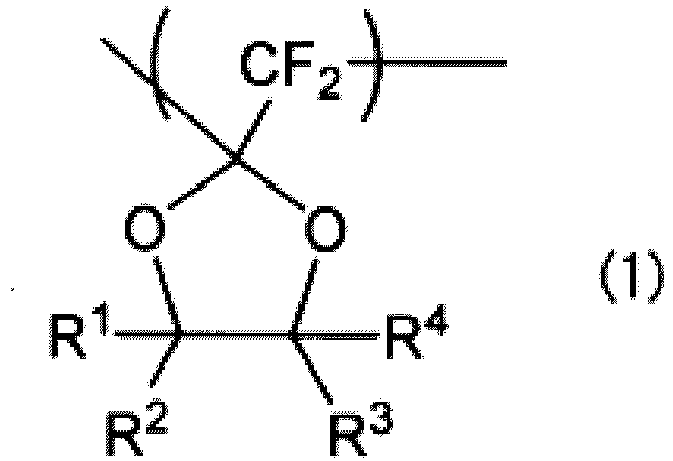
- wherein R1 to R4 are each independently a fluorine atom, a fluoroalkyl group, or a fluoroalkoxy group.
- The protective display film according to Item 1, wherein the fluoropolymer further comprises a fluoroolefin unit. Item 3.
- The protective display film according to Item 2, wherein the fluoroolefin unit is at least one member selected from the group consisting of a fluorine-containing perhaloolefin unit, a vinylidene fluoride unit, a trifluoroethylene unit, a pentafluoropropylene unit, and a 1,1,1,2-tetrafluoro-2-propylene unit.
- The protective display film according to Item 3, wherein the fluorine-containing perhaloolefin unit is at least one member selected from the group consisting of a chlorotrifluoroethylene unit, a tetrafluoroethylene unit, a hexafluoropropylene unit, a perfluoro(methyl vinyl ether) unit, a perfluoro(ethyl vinyl ether) unit, a perfluoro(propyl vinyl ether) unit, a perfluoro(butyl vinyl ether) unit, and a perfluoro(2,2-dimethyl-1,3-dioxol) unit.
- The protective display film according to Item 2, wherein the fluoroolefin unit is at least one member selected from the group consisting of a chlorotrifluoroethylene unit, a tetrafluoroethylene unit, a hexafluoropropylene unit, a perfluoro(methyl vinyl ether) unit, and a perfluoro(propyl vinyl ether) unit.
- The protective display film according to any one of Items 1 to 5, having an average film thickness of 10 nm or more. Item 7.
- The protective display film according to any one of Items 1 to 6, having an indentation hardness of 250 N/mm2 or more and 1000 N/mm2 or less.
- The protective display film according to any one of Items 1 to 7, having an indentation elastic modulus of 2.5 GPa or more and 10 GPa or less.
- The protective display film according to any one of Items 1 to 8, having a total light transmittance of 90% or more. Item 10.
- The protective display film according to any one of Items 1 to 9, having a refractive index of 1.29 or more and 1.37 or less.
- The protective display film according to any one of Items 1 to 10, having an Abbe number of 80 or more and 100 or less.
- The protective display film according to any one of Items 1 to 11, having a water absorption at 24°C of 0.1% or less. Item 13.
- The protective display film according to any one of Items 1 to 12, wherein the fluoropolymer has a glass transition temperature of 110°C or higher.
- A display comprising the protective display film of any one of Items 1 to 13.
- A coating agent for forming the protective display film of any one of Items 1 to 13, the coating agent comprising a fluoropolymer and an aprotic solvent,
- wherein
- the fluoropolymer comprises, as a main component, a monomer unit represented by formula (1):

- wherein R1 to R4 are each independently a fluorine atom, a fluoroalkyl group, or a fluoroalkoxy group.
- The coating agent according to Item 15, wherein the content of the fluoropolymer is 20 mass% or more and 65 mass% or less based on the total mass of the coating agent.
- The coating agent according to Item 15 or 16, wherein the aprotic solvent is at least one solvent selected from the group consisting of perfluoroaromatic compounds, perfluorotrialkylamines, perfluoroalkanes, hydrofluorocarbons, perfluorocyclic ethers, hydrofluoroethers, and olefin compounds containing at least one chlorine atom.
- The coating agent according to any one of Items 15 to 17, wherein the aprotic solvent is at least one hydrofluoroether.
- The present disclosure is capable of providing a protective display film comprising a fluoropolymer with hardness. The present disclosure is capable of providing a coating agent for forming a protective display film.
-
Fig. 1 is a chart showing the transmittance at each wavelength of the film tested in Example 1. - The above overview of the present disclosure is not intended to describe each of the disclosed embodiments or all of the implementations of the present disclosure.
- The following description of the present disclosure illustrates embodiments of examples in more detail.
- In several parts of the present disclosure, guidance is provided through examples, and these examples can be used in various combinations.
- In each case, the group of examples can function as a non-exclusive and representative group.
- All publications, patents, and patent applications cited herein are incorporated herein by reference in their entirety.
- Unless otherwise specified, the symbols and abbreviations in the present specification can be understood in the sense commonly used in the technical field to which the present disclosure pertains, according to the context of the present specification.
- In the present specification, the terms "comprise" and "contain" are used with the intention of including the terms "consisting essentially of" and "consisting of."
- Unless otherwise specified, the steps, treatments, or operations described in the present specification can be performed at room temperature. In the present specification, room temperature can mean a temperature within the range of 10°C or higher and 40°C or lower.
- In the present specification, the phrase "Cn-Cm" (n and m are each a number) indicates that the number of carbon atoms is n or more and m or less, as would be commonly understood by a person skilled in the art.
- In the present specification, the expression "thickness" or simply "film thickness" with respect to a film means an average film thickness. The "average film thickness" is determined as follows.
- The average film thickness is the average value of a thickness measured 5 times with a micrometer. When measuring the thickness of a film itself is difficult, such as when a film formed on a base material of a substrate etc. cannot be peeled off, the average film thickness is calculated by measuring the thickness of the base material before film formation and the thickness of the base material after film formation 5 times each with a micrometer, and subtracting the average value of the thickness before film formation from the average value of the thickness after film formation.
- When the measurement cannot be performed with a micrometer, the film thickness obtained by measuring the line profile of the cut surface of a film to be measured with an atomic force microscope (AFM) is defined as the average film thickness.
- Specifically, the average film thickness is a value determined by the method described in a specific example of the present disclosure.
- In the present specification, the simple expression "molecular weight" means mass average molecular weight. The mass average molecular weight is determined as follows.
- The mass average molecular weight is measured by using the following GPC analysis method. Specifically, the mass average molecular weight is a value determined by the method described in a specific example of the present disclosure.
- A polymer is dissolved in perfluorobenzene to prepare a 2 mass% polymer solution, and the polymer solution is passed through a membrane filter (0.22 µm) to obtain a sample solution.
-
- Standard sample for measurement of molecular weight: polymethyl methacrylate
- Detection method: RI (differential refractometer)
- In the present specification, the "indentation hardness" and "indentation elastic modulus" are determined as follows.
- The indentation hardness (HIT; indentation hardness) of a sample is measured using an ENT-2100 ultra-fine hardness tester produced by Nanotec Corporation. The indentation elastic modulus is also measured at the same time. The test is performed by adjusting the indentation depth to be 1/10 or less of the thickness. Specifically, the indentation hardness and indentation elastic modulus are values determined by the method described in a specific example of the present disclosure.
- In the present specification, the "total light transmittance" and "haze" are determined as follows.
- The total light transmittance and haze are measured using an NDH 7000SPII haze meter (produced by Nippon Denshoku Industries Co., Ltd.) in accordance with JIS K7136 (haze value) and JIS K7361-1 (total light transmittance). A film with an average film thickness of 100 µm is used as the sample to be measured. Specifically, the total light transmittance and haze are values determined by the method described in a specific example of the present disclosure.
- In the present specification, the "transmittance" at each wavelength is determined as follows.
- The transmittance at a specific wavelength of a sample is measured using a Hitachi U-4100 spectrophotometer. A film with an average film thickness of 100 µm is used as the sample. An integrating sphere detector is used as the detector. Specifically, the transmittance is a value determined by the method described in a specific example of the present disclosure.
- In the present specification, the "refractive index" is determined as follows.
- The refractive index of a sample at 23°C is measured with an Abbe refractive index meter (NAR-1T SOLID, produced by Atago Co., Ltd.). The wavelength is a wavelength approximate to D-line because of the use of the LED attached to the device. Specifically, the refractive index is a value determined by the method described in a specific example of the present disclosure.
- In the present specification, the "Abbe rate" at each wavelength is determined as follows.
- The Abbe number of a sample at 23°C is measured with an Abbe refractive index meter (NAR-1T SOLID, produced by Atago Co., Ltd.). Specifically, the Abbe number is a value determined by the method described in specific examples of the present disclosure.
- In the present specification, the "reflectance" is determined as follows.
- An absolute specular reflector is attached to a Hitachi U-4100 spectrophotometer, and the reflectance at 550 nm at 5° is measured. Specifically, the reflectance is a value determined by the method described in a specific example of the present disclosure.
- In the present specification, the "water absorption" is determined as follows.
- The weight of a sample that has been thoroughly dried beforehand is measured and set as W0. The sample is then completely immersed in water at 24°C that is 100 times or greater than W0 by mass. The weight of the sample after 24 hours is measured and set as W24. The water absorption is determined according to the following formula.

- Specifically, the water absorption is a value determined by the method described in a specific example of the present disclosure.
- The weight of a sample that has been thoroughly dried beforehand is measured and set as W0, and then completely immersed in water at 60°C that is 100 times or greater than W0 by mass. The weight of the sample after 24 hours is measured and set as W24. The water absorption is determined according to the following formula.

- Specifically, the water absorption is a value determined by the method described in a specific example of the present disclosure.
- In the present specification, the "tensile elastic modulus" is determined as follows.
- A sample (length: 30 mm, width: 5 mm, thickness: 0.1 mm) is measured with a DVA220 dynamic viscoelasticity measurement device produced by IT Measurement Control Co., Ltd., under the conditions of a tensile mode, a grip width of 20 mm, a measurement temperature of 25°C to 150°C, a temperatureincreasing rate of 2°C/min, and a frequency of 1 Hz. The elastic modulus value at 25°C is defined as a tensile elastic modulus. Specifically, the tensile elastic modulus is a value determined by the method described in a specific example of the present disclosure.
- In the present specification, the "tensile strength" is determined as follows.
- The tensile strength of a sample is measured using an AGS-100NX autograph produced by Shimadzu Corporation. The sample is cut into a dumbbell shape 5B as stated in JIS K 7162. The measurement is performed under the conditions of a chuck-to-chuck distance of 12 mm, a crosshead speed of 1 mm/min, and room temperature. Specifically, the tensile strength is a value determined by the method described in a specific example of the present disclosure.
- In the present specification, the "thermal decomposition temperature" is determined as follows.
- The temperatures at which the mass loss percentage of a sample becomes 0.1% and 5% are measured at a temperatureincreasing rate of 10°C/minute in an air atmosphere using a thermogravimetric-differential thermal analyzer (Hitachi High-Tech Science Corporation; STA7200). Specifically, the thermal decomposition temperature is a value determined by the method described in a specific example of the present disclosure.
- In the present specification, the "glass transition temperature" is determined as follows.
- The temperature is increased (first run), decreased, and then increased (second run) at 10°C/minute in the temperature range of 30°C or higher and 200°C or lower using a DSC (differential scanning calorimeter; Hitachi High-Tech Science Corporation, DSC7000); the midpoint of the endothermic curve in the second run is determined to be the glass transition temperature (°C). Specifically, the glass transition temperature is a value determined by the method described in a specific example of the present disclosure.
- In the present specification, the "coefficient of linear expansion" is determined as follows.
- The temperature of a sample is increased from room temperature to 150°C (1st up), decreased to room temperature, and then increased to 150°C (2nd up) at 2°C/minute using a thermomechanical analyzer (TMA8310; produced by Rigaku Corporation). The average coefficient of linear expansion at 25°C or higher and 80°C or lower in the 2nd up is determined and defined as the coefficient of linear expansion. Specifically, the coefficient of linear expansion is a value determined by the method described in a specific example of the present disclosure.
- In the present specification, unless otherwise specified, examples of "alkyl" include linear or branched C1-C10 alkyl, such as methyl, ethyl, propyl, isopropyl, butyl, isobutyl, sec-butyl, tert-butyl, pentyl, isopentyl, neopentyl, hexyl, heptyl, octyl, nonyl, and decyl.
- In the present specification, unless otherwise specified, "fluoroalkyl" is alkyl in which at least one hydrogen atom is replaced with a fluorine atom. "Fluoroalkyl" can be linear or branched fluoroalkyl.
- The number of carbon atoms in "fluoroalkyl" can be, for example, 1 to 12, 1 to 6, 1 to 5, 1 to 4, 1 to 3, 6, 5, 4, 3, 2, or 1.
- The number of fluorine atoms in "fluoroalkyl" can be 1 or more (e.g., 1 to 3, 1 to 5, 1 to 9, 1 to 11, or 1 to the maximum substitutable number).
- "Fluoroalkyl" includes perfluoroalkyl.
- "Perfluoroalkyl" is alkyl in which all hydrogen atoms are replaced with fluorine atoms.
- Examples of perfluoroalkyl include trifluoromethyl (CF3-), pentafluoroethyl (C2F5-), heptafluoropropyl (CF3CF2CF2-), and heptafluoroisopropyl ((CF3)2CF-).
- Specific examples of "fluoroalkyl" include monofluoromethyl, difluoromethyl, trifluoromethyl (CF3-), 2,2,2-trifluoroethyl (CF3CH2-), perfluoroethyl (C2F5-), tetrafluoropropyl (e.g., HCF2CF2CH2-), hexafluoropropyl (e.g., (CF3)2CH-), perfluorobutyl (e.g., CF3CF2CF2CF2-), octafluoropentyl (e.g., HCF2CF2CF2CF2CH2-), perfluoropentyl (e.g., CF3CF2CF2CF2CF2-), perfluorohexyl (e.g., CF3CF2CF2CF2CF2CF2-), and the like.
- In the present specification, unless otherwise specified, "alkoxy" can be a group represented by RO-, wherein R is alkyl (e.g., C1-C10 alkyl).
- Examples of "alkoxy" include linear or branched C1-C10 alkoxy, such as methoxy, ethoxy, propoxy, isopropoxy, butoxy, isobutoxy, sec-butoxy, tert-butoxy, pentyloxy, isopentyloxy, neopentyloxy, hexyloxy, heptyloxy, octyloxy, nonyloxy, and decyloxy.
- In the present specification, unless otherwise specified, "fluoroalkoxy" is alkoxy in which at least one hydrogen atom is replaced with a fluorine atom. "Fluoroalkoxy" can be linear or branched fluoroalkoxy.
- The number of carbon atoms in "fluoroalkoxy" can be, for example, 1 to 12, 1 to 6, 1 to 5, 1 to 4, 1 to 3, 6, 5, 4, 3, 2, or 1.
- The number of fluorine atoms in "fluoroalkoxy" can be 1 or more (e.g., 1 to 3, 1 to 5, 1 to 9, 1 to 11, or 1 to the maximum substitutable number).
- "Fluoroalkoxy" includes perfluoroalkoxy.
- "Perfluoroalkoxy" is alkoxy in which all hydrogen atoms are replaced with fluorine atoms.
- Examples of "perfluoroalkoxy" include trifluoromethoxy (CF3O-), pentafluoroethoxy (C2F5O-), heptafluoropropoxy (CF3CF2CF2O-), and heptafluoroisopropoxy ((CF3)2CFO-).
- Specific examples of "fluoroalkoxy" include monofluoromethoxy, difluoromethoxy, trifluoromethoxy, 2,2,2-trifluoroethoxy (CF3CH2O-), perfluoroethoxy (C2F5O-), tetrafluoropropyloxy (e.g. HCF2CF2CH2O-), hexafluoropropyloxy (e.g., (CF3)2CHO-), perfluorobutyloxy (e.g., CF3CF2CF2CF2O-), octafluoropentyloxy (e.g., HCF2CF2CF2CF2CH2O-), perfluoropentyloxy (e.g., CF3CF2CF2CF2CF2O-), perfluorohexyloxy (e.g., CF3CF2CF2CF2CF2CF2O-), and the like.
- One embodiment of the present disclosure is a protective display film comprising a specific fluoropolymer.
- The protective display film has high hardness by comprising the fluoropolymer described above.
- The protective display film has high scratch resistance by comprising the fluoropolymer described above.
- The protective display film has low reflectance by comprising the fluoropolymer described above.
- The protective display film has high transparency by comprising the fluoropolymer described above.
- The protective display film has low water absorption by comprising the fluoropolymer described above.
- The fluoropolymer of the protective display film comprises, as a main component, a monomer unit represented by formula (1):

- In the present specification, phrases such as "comprising a monomer unit as a main component" mean that the percentage of the specific monomer unit is 50 mol% or more based on the total monomer units in a polymer.
- Unit (1) as a monomer unit constituting the fluoropolymer may be used singly or in a combination of two or more.
- The percentage of unit (1) may be, for example, 70 mol% or more, preferably 80 mol% or more, more preferably 90 mol% or more, and particularly preferably 100 mol%, based on the total monomer units of the fluoropolymer.
- In each of R1 to R4, fluoroalkyl can be, for example, linear or branched C1-C5 fluoroalkyl, linear or branched C1-C4 fluoroalkyl, linear or branched C1-C3 fluoroalkyl, or C1-C2 fluoroalkyl.
- The linear or branched C1-C5 fluoroalkyl is preferably linear or branched C1-C5 perfluoroalkyl.
- The linear or branched C1-C4 fluoroalkyl is preferably linear or branched C1-C4 perfluoroalkyl.
- The linear or branched C1-C3 fluoroalkyl is preferably linear or branched C1-C3 perfluoroalkyl.
- The C1-C2 fluoroalkyl group is preferably C1-C2 perfluoroalkyl.
- In each of R1 to R4, fluoroalkoxy can be, for example, linear or branched C1-C5 fluoroalkoxy, linear or branched C1-C4 fluoroalkoxy, linear or branched C1-C3 fluoroalkoxy, or C1-C2 fluoroalkoxy.
- The linear or branched C1-C5 fluoroalkoxy is preferably linear or branched C1-C5 perfluoroalkoxy.
- The linear or branched C1-C4 fluoroalkoxy is preferably linear or branched C1-C4 perfluoroalkoxy.
- The linear or branched C1-C3 fluoroalkoxy is preferably linear or branched C1-C3 perfluoroalkoxy.
- The C1-C2 fluoroalkoxy is preferably C1-C2 perfluoroalkoxy.
- R1 to R4 can be each independently fluorine, linear or branched C1-C5 fluoroalkyl, or linear or branched C1-C5 fluoroalkoxy.
- R1 to R4 can be each independently fluorine, linear or branched C1-C5 perfluoroalkyl, or linear or branched C1-C5 perfluoroalkoxy.
- R1 to R4 can be each independently fluorine, linear or branched C1-C4 fluoroalkyl, or linear or branched C1-C4 fluoroalkoxy.
- R1 to R4 can be each independently fluorine, linear or branched C1-C4 perfluoroalkyl, or linear or branched C1-C4 perfluoroalkoxy.
- R1 to R4 can be each independently fluorine, linear or branched C1-C3 fluoroalkyl, or linear or branched C1-C3 fluoroalkoxy.
- R1 to R4 can be each independently fluorine, linear or branched C1-C3 perfluoroalkyl, or linear or branched C1-C3 perfluoroalkoxy.
- R1 to R4 can be each independently fluorine, C1-C2 fluoroalkyl, or C1-C2 fluoroalkoxy.
- R1 to R4 can be each independently fluorine, C1-C2 perfluoroalkyl, or C1-C2 perfluoroalkoxy.
- R1 to R4 can be each independently fluorine, trifluoromethyl, pentafluoroethyl, or trifluoromethoxy.
- At least one of R1 to R4 can be fluorine, and the other groups in R1 to R4 can be independently C1-C2 perfluoroalkyl or C1-C2 perfluoroalkoxy when two or more such other groups are present.
- At least two of R1 to R4 can be fluorine, and the other groups in R1 to R4 can be independently C1-C2 perfluoroalkyl or C1-C2 perfluoroalkoxy when two or more such other groups are present.
- At least three of R1 to R4 can be fluorine, and the other group in R1 to R4 can be C1-C2 perfluoroalkyl or C1-C2 perfluoroalkoxy.
- At least three of R1 to R4 can be fluorine atoms, and the other group in R1 to R4 can be C1-C2 perfluoroalkyl.
- R1 to R4 can be all fluorine atoms.
- Unit (1) can be a monomer unit represented by the following formula (1-1) (this unit may be referred to as "unit (1-1)" in the present specification).

- Unit (1-1) as a monomer unit constituting the fluoropolymer may be used singly or in a combination of two or more.
- In unit (1-1), R1 can be fluorine, linear or branched C1-C5 fluoroalkyl, or linear or branched C1-C5 fluoroalkoxy.
- In unit (1-1), R1 can be fluorine, linear or branched C1-C5 perfluoroalkyl, or linear or branched C1-C5 perfluoroalkoxy.
- In unit (1-1), R1 can be fluorine, linear or branched C1-C4 fluoroalkyl, or linear or branched C1-C4 fluoroalkoxy.
- In unit (1-1), R1 can be fluorine, linear or branched C1-C4 perfluoroalkyl, or linear or branched C1-C4 perfluoroalkoxy.
- In unit (1-1), R1 can be fluorine, linear or branched C1-C3 fluoroalkyl, or linear or branched C1-C3 fluoroalkoxy.
- In unit (1-1), R1 can be fluorine, linear or branched C1-C3 perfluoroalkyl, or linear or branched C1-C3 perfluoroalkoxy.
- In unit (1-1), R1 can be fluorine, C1-C2 fluoroalkyl, or C1-C2 fluoroalkoxy.
- In unit (1-1), R1 can be fluorine, C1-C2 perfluoroalkyl, or C1-C2 perfluoroalkoxy.
- In unit (1-1), R1 can be fluorine, trifluoromethyl, pentafluoroethyl, or trifluoromethoxy.
- In unit (1-1), R1 can be C1-C2 perfluoroalkyl or C1-C2 perfluoroalkoxy.
- In unit (1-1), R1 can be C1-C2 perfluoroalkyl.
- Preferred examples of unit (1-1) include a monomer unit represented by the following formula (1-11) (this monomer unit may be referred to as "unit (1-11)" in the present specification).

- The fluoropolymer may comprise a fluoroolefin unit in addition to unit (1).
- The fluoroolefin unit may be used singly or in a combination of two or more.
- The percentage of the fluoroolefin unit can be 50 mol% or less, preferably 30 mol% or less, more preferably 20 mol% or less, even more preferably 10 mol% or less, and particularly preferably 0 mol%, based on the total monomer units.
- The fluoroolefin unit is a monomer unit that is formed after polymerization of a monomer containing fluorine and a carbon-carbon double bond.
- The atoms constituting the fluoroolefin unit may be only fluorine, halogen other than fluorine, carbon, hydrogen, and oxygen.
- The atoms constituting the fluoroolefin unit may be only fluorine, halogen other than fluorine, carbon, and hydrogen.
- The atoms constituting the fluoroolefin unit may be only fluorine, carbon, and hydrogen.
- The atoms constituting the fluoroolefin unit may be only fluorine and carbon.
- The fluoroolefin unit includes at least one unit selected from the group consisting of a fluorine-containing perhaloolefin unit, a vinylidene fluoride unit (-CH2-CF2-), a trifluoroethylene unit (-CFH-CF2-), a pentafluoropropylene unit (-CFH-CF(CF3)-, -CF2-CF(CHF2)-), a 1,1,1,2-tetrafluoro-2-propylene unit (-CH2-CF(CF3)-), and the like.
- The fluorine-containing perhaloolefin unit is a monomer unit that is formed after polymerization of a monomer containing fluorine and a carbon-carbon double bond, and optionally halogen other than fluorine.
- The fluorine-containing perhaloolefin unit includes at least one member selected from the group consisting of a chlorotrifluoroethylene unit (-CFCl-CF2-), a tetrafluoroethylene unit (-CF2-CF2-), a hexafluoropropylene unit (-CF2-CF(CF3)-), a perfluoro (methyl vinyl ether) unit (-CF2-CF(OCF3)-), a perfluoro (ethyl vinyl ether) unit (-CF2-CF(OC2F5)-), perfluoro (propyl vinyl ether) unit (-CF2-CF(OCF2C2F5)-), perfluoro (butyl vinyl ether) unit (-CF2-CF(O(CF2)2C2F5)-), and a perfluoro(2,2-dimethyl-1,3-dioxol) unit (-CF-CAF- (wherein A represents a perfluorodioxolane ring formed with the adjacent carbon atom shown in the formula, with two trifluoromethyl bonded to the carbon atom at position 2 of the dioxolane ring).
- The fluoroolefin unit includes at least one member selected from the group consisting of a chlorotrifluoroethylene unit, a tetrafluoroethylene unit, a hexafluoropropylene unit, a perfluoro(methyl vinyl ether) unit, and a perfluoro(propyl vinyl ether) unit.
- The fluoropolymer may further contain one or more other monomer units in addition to unit (1) and the fluoroolefin unit. However, it is preferable to contain no other monomer units.
- The other monomer units include CH2=CHRf (wherein Rf represents a C1-C10 fluoroalkyl group) units, alkyl vinyl ether units (e.g., a cyclohexyl vinyl ether unit, ethyl vinyl ether unit, butyl vinyl ether unit, and methyl vinyl ether unit), alkenyl vinyl ether units (e.g., a polyoxyethylene allyl ether unit and ethyl allyl ether unit), organosilicon compound units having a reactive α,β-unsaturated group (e.g., a vinyltrimethoxysilane unit, vinyltriethoxysilane unit, and a vinyltris(methoxyethoxy)silane unit), acrylic ester units (e.g., a methyl acrylate unit and ethyl acrylate unit), methacrylic ester units (e.g., a methyl methacrylate unit and ethyl methacrylate unit), vinyl ester units (e.g., a vinyl acetate unit, vinyl benzoate unit, and a VeoVA (vinyl ester produced by Shell plc) unit), and the like.
- The percentage of the other monomer units may be, for example, 0 mol% or more and 20 mol% or less, or 0 mol% or more and 10 mol% or less, based on the total monomer units.
- The fluoropolymer preferably has a glass transition temperature (Tg) of 110°C or higher, more preferably 110°C or higher and 300°C or lower, even more preferably 120°C or higher and 300°C or lower, and particularly preferably 125°C or higher and 200°C or lower. A glass transition temperature within these ranges is advantageous in terms of high bending durability of the protective display film in, for example, a flexible display comprising a protective display film.
- The fluoropolymer has a mass average molecular weight of, for example, 10,000 or more and 1,000,000 or less, preferably 30,000 or more and 500,000 or less, and more preferably 50,000 or more and 300,000 or less. A molecular weight within these ranges is advantageous in terms of durability.
- A fluoropolymer can be produced, for example, by polymerizing one or more monomers corresponding to one or more monomer units constituting the fluoropolymer by an appropriate polymerization method. For example, a fluoropolymer can be produced by polymerizing one or more monomers corresponding to unit (1).
- A fluoropolymer can also be produced by polymerizing one or more monomers corresponding to unit (1), optionally with at least one monomer selected from the group consisting of fluoroolefins and other monomers.
- A person skilled in the art would be able to understand monomers corresponding to the monomer units constituting a fluoropolymer. For example, a monomer corresponding to unit (1) is a compound represented by formula (M1):

- For example, a monomer corresponding to unit (1-1) is a compound represented by formula (M1-1):

- For example, the monomer corresponding to unit (1-11) is a compound represented by formula (M1-11):
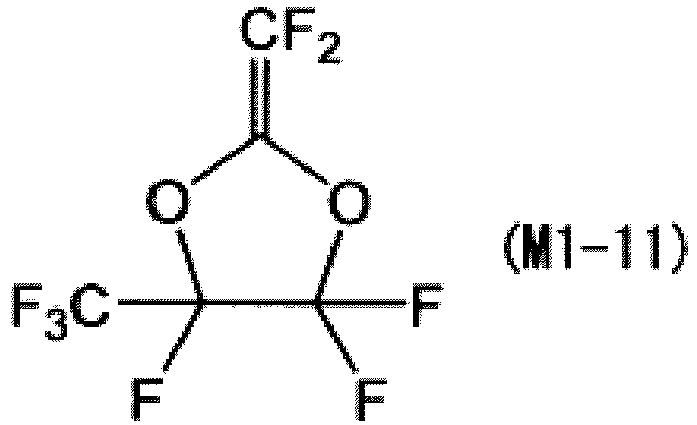
- The fluoroolefins for use may be monomers corresponding to the fluoroolefin units mentioned above. For example, the monomers corresponding to the tetrafluoroethylene unit, hexafluoropropylene unit, and vinylidene fluoride unit are tetrafluoroethylene (CF2=CF2), hexafluoropropylene (CF3CF=CF2), and vinylidene fluoride (CH2=CF2), respectively. Thus, the details regarding fluoroolefins would be able to be understood by a person skilled in the art from the description of the corresponding fluoroolefin units.
- For example, the fluoroolefin may be at least one member selected from the group consisting of fluorine-containing perhaloolefins, vinylidene fluoride, trifluoroethylene, pentafluoropropylene, and 1,1,1,2-tetrafluoro-2-propylene. Preferably, the fluoroolefin may be at least one member selected from the group consisting of chlorotrifluoroethylene, tetrafluoroethylene, hexafluoropropylene, perfluoro(methyl vinyl ether), and perfluoro(propyl vinyl ether).
- The fluorine-containing perhaloolefin may be at least one member selected from the group consisting of chlorotrifluoroethylene, tetrafluoroethylene, hexafluoropropylene, perfluoro(methyl vinyl ether), perfluoro(ethyl vinyl ether), perfluoro(propyl vinyl ether), perfluoro(butyl vinyl ether), and perfluoro(2,2-dimethyl-1,3-dioxol) .
- The other monomers for use may be monomers corresponding to the other monomer units mentioned above. Thus, the details regarding the other monomers would be able to be understood by a person skilled in the art from the description of the corresponding other monomer units.
- The polymerization method includes, for example, a method of using appropriate amounts of monomers corresponding to the monomer units that constitute the fluoropolymer, with the monomers being optionally dissolved or dispersed in a solvent (e.g., an aprotic solvent) and a polymerization initiator being optionally added, and performing polymerization (e.g., radical polymerization, bulk polymerization, solution polymerization, suspension polymerization, dispersion polymerization, or emulsion polymerization).
- The polymerization method is preferably solution polymerization because solution polymerization can produce a high-concentration solution of the fluoropolymer and thereby achieve a high manufacturing yield, and is advantageous for the formation of a thick film and purification. Therefore, the fluoropolymer is preferably produced by solution polymerization. The fluoropolymer is more preferably produced by solution polymerization in which one or more monomers are polymerized in the presence of an aprotic solvent.
- The solvent for use in solution polymerization of the fluoropolymer is preferably an aprotic solvent. The amount of aprotic solvent for use in the production of the fluoropolymer is, for example, 80 mass% or less, less than 80 mass%, 75 mass% or less, 70 mass% or less, 35 mass% or more and 95 mass% or less, 35 mass% or more and 90 mass% or less, 35 mass% or more and 80 mass% or less, 35 mass% or more and 70 mass% or less, 35 mass% or more and less than 70 mass%, or 60 mass% or more and 80 mass% or less, based on the sum of the mass of the monomers and the mass of the solvent. The amount can be preferably 35 mass% or more and less than 80 mass%, more preferably 40 mass% or more and 75 mass% or less, and particularly preferably 50 mass% or more and 70 mass% or less.
- The aprotic solvent for use in the polymerization of fluoropolymers can be, for example, at least one member selected from the group consisting of perfluoroaromatic compounds, perfluorotrialkylamines, perfluoroalkanes, hydrofluorocarbons, perfluorocyclic ethers, hydrofluoroethers, and olefin compounds containing at least one chlorine atom.
- The perfluoroaromatic compound is, for example, a perfluoroaromatic compound optionally having one or more perfluoroalkyl groups. The aromatic ring of the perfluoroaromatic compound can be at least one ring selected from the group consisting of a benzene ring, a naphthalene ring, and an anthracene ring. The perfluoroaromatic compound can have one or more (e.g., one, two, or three) aromatic rings.
- The perfluoroalkyl group as a substituent is, for example, linear or branched, C1-C6, C1-C5, or C1-C4 perfluoroalkyl, and preferably linear or branched C1-C3 perfluoroalkyl.
- The number of substituents is, for example, one to four, preferably one to three, and more preferably one or two. When a plurality of substituents are present, the substituents may be the same or different.
- Examples of perfluoroaromatic compounds include perfluorobenzene, perfluorotoluene, perfluoroxylene, and perfluoronaphthalene.
- Preferred examples of perfluoroaromatic compounds include perfluorobenzene and perfluorotoluene.
- The perfluorotrialkylamine is, for example, an amine substituted with three linear or branched perfluoroalkyl groups. The number of carbon atoms of each perfluoroalkyl group is, for example, 1 to 10, preferably 1 to 5, and more preferably 1 to 4. The perfluoroalkyl groups can be the same or different, and are preferably the same.
- Examples of perfluorotrialkylamines include perfluorotrimethylamine, perfluorotriethylamine, perfluorotripropylamine, perfluorotriisopropylamine, perfluorotributylamine, perfluorotri-sec-butylamine, perfluorotri-tert-butylamine, perfluorotripentylamine, perfluorotriisopentylamine, and perfluorotrineopentylamine.
- Preferred examples of perfluorotrialkylamines include perfluorotripropylamine and perfluorotributylamine.
- The perfluoroalkane is, for example, a linear, branched, or cyclic C3-C12 (preferably C3-C10, more preferably C3-C6) perfluoroalkane.
- Examples of perfluoroalkanes include perfluoropentane, perfluoro-2-methylpentane, perfluorohexane, perfluoro-2-methylhexane, perfluoroheptane, perfluorooctane, perfluorononane, perfluorodecane, perfluorocyclohexane, perfluoro(methylcyclohexane), perfluoro(dimethylcyclohexane) (e.g., perfluoro(1,3-dimethylcyclohexane)), and perfluorodecalin.
- Preferred examples of perfluoroalkanes include perfluoropentane, perfluorohexane, perfluoroheptane, and perfluorooctane.
- The hydrofluorocarbon is, for example, a C3-C8 hydrofluorocarbon. Examples of hydrofluorocarbons include CF3CH2CF2H, CF3CH2CF2CH3, CF3CHFCHFC2F5, 1,1,2,2,3,3,4-heptafluorocyclopentane, CF3CF2CF2CF2CH2CH3, CF3CF2CF2CF2CF2CHF2, and CF3CF2CF2CF2CF2CF2CH2CH3.
- Preferred examples of hydrofluorocarbons include CF3CH2CF2H and CF3CH2CF2CH3.
- The perfluorocyclic ether is, for example, a perfluorocyclic ether optionally having one or more perfluoroalkyl groups. The ring of the perfluorocyclic ether may be a 3- to 6-membered ring. The ring of the perfluorocyclic ether may have one or more oxygen atoms as a ring-constituting atom. The ring preferably has one or two oxygen atoms, and more preferably one oxygen atom.
- The perfluoroalkyl group as a substituent is, for example, linear or branched C1-C6, C1-C5, or C1-C4 perfluoroalkyl. The perfluoroalkyl group is preferably linear or branched C1-C3 perfluoroalkyl.
- The number of substituents is, for example, one to four, preferably one to three, and more preferably one or two. When a plurality of substituents are present, they may be the same or different.
- Examples of perfluorocyclic ethers include perfluorotetrahydrofuran, perfluoro-5-methyltetrahydrofuran, perfluoro-5-ethyltetrahydrofuran, perfluoro-5-propyltetrahydrofuran, perfluoro-5-butyltetrahydrofuran, and perfluorotetrahydropyran.
- Preferred examples of perfluorocyclic ethers include perfluoro-5-ethyltetrahydrofuran and perfluoro-5-butyltetrahydrofuran.
- The hydrofluoroether is, for example, a fluorine-containing ether.
- The hydrofluoroether preferably has a global warming potential (GWP) of 400 or less, and more preferably 300 or less.
- Examples of hydrofluoroethers include CF3CF2CF2CF2OCH3, CF3CF2CF(CF3)OCH3, CF3CF(CF3)CF2OCH3, CF3CF2CF2CF2OC2H5, CF3CH2OCF2CHF2, C2F5CF(OCH3)C3F7, (CF3)2CHOCH3, (CF3)2CFOCH3, CHF2CF2OCH2CF3, CHF2CF2CH2OCF2CHF2, CF3CHFCF2OCH3, CF3CHFCF2OCF3, trifluoromethyl 1,2,2,2-tetrafluoroethyl ether (HFE-227me), difluoromethyl 1,1,2,2,2-pentafluoroethyl ether (HFE-227mc), trifluoromethyl 1,1,2,2-tetrafluoroethyl ether (HFE-227pc), difluoromethyl 2,2,2-trifluoroethyl ether (HFE-245mf), 2,2-difluoroethyltrifluoromethyl ether (HFE-245pf), 1,1,2,3,3,3-hexafluoropropylmethyl ether (CF3CHFCF2 OCH3), 1,1,2,2-tetrafluoroethyl 2,2,2-trifluoroethyl ether (CHF2CF2OCH2CF3), and 1,1,1,3,3,3-hexafluoro-2-methoxypropane (CF3)2CHOCH3).
- Preferred examples of hydrofluoroethers include CF3CF2CF2CF2OCH3, CF3CF2CF2CF2OC2H5, CF3CH2OCF2CHF2, and C2F5CF(OCH3)C3F7.
- The hydrofluoroether is preferably a compound represented by the following formula (B1):
R21-O-R22 (B1),
wherein R21 is linear or branched perfluorobutyl and R22 is methyl or ethyl. - The olefin compound containing at least one chlorine atom is a C2-C4 (preferably C2-C3) olefin compound containing at least one chlorine atom in its structure. The olefin compound containing at least one chlorine atom is a compound in which at least one of the hydrogen atoms bonded to the carbon atoms in a C2-C4 hydrocarbon having one or two (preferably one) carbon-carbon double bonds (C=C) is replaced with chlorine. A compound in which at least one of the hydrogen atoms bonded to two carbon atoms constituting the carbon-carbon double bond in a C2-C4 hydrocarbon is replaced with chlorine is preferred.
- The number of chlorine atoms is one to the maximum substitutable number. The number of chlorine atoms may be, for example, one, two, three, four, or five.
- The olefin compound containing at least one chlorine atom may contain at least one (e.g., one, two, three, four, or five) fluorine atom.
- Examples of olefin compounds containing at least one chlorine atom include CH2=CHCl, CHCl=CHCl, CCl2=CHCl, CCl2=CCl2, CF3CH=CHCl, CHF2CF=CHCl, CFH2CF=CHCl, CF3CCl=CFCl, CF2HCl=CFCl, and CFH2Cl=CFCl.
- Preferred examples of olefin compounds containing at least one chlorine atom include CHCl=CHCl, CHF2CF=CHCl, CF3CH=CHCl, and CF3CCl=CFCl.
- As the aprotic solvent, a hydrofluoroether is preferable because it has less environmental impact during use and polymers can be dissolved at high concentrations in it.
- Preferred examples of polymerization initiators used in production of the fluoropolymer include di-n-propyl peroxydicarbonate, diisopropyl peroxydicarbonate, diisobutyryl peroxide, di(ω-hydro-dodecafluoroheptanoyl)peroxide, di(ω-hydro-hexadecafluorononanoyl)peroxide, ω-hydro-dodecafluoroheptanoyl-ω-hydro-hexadecafluorononanoyl-peroxide, benzoyl peroxide, tert-butyl peroxypivalate, tert-hexyl peroxypivalate, ammonium persulfate, sodium persulfate, and potassium persulfate.
- Particularly preferred examples of polymerization initiators include di-n-propyl peroxydicarbonate, diisopropyl peroxydicarbonate, diisobutyryl peroxide, di(ω-hydro-dodecafluoroheptanoyl)peroxide, benzoyl peroxide, tert-butyl peroxypivalate, tert-hexyl peroxypivalate, and ammonium persulfate.
- The amount of the polymerization initiator for use in the polymerization reaction can be, for example, 0.0001 g or more and 0.05 g or less, preferably 0.0001 g or more and 0.01 g or less, and more preferably 0.0005 g or more and 0.008 g or less, per gram of all of the monomers subjected to the reaction.
- The temperature of the polymerization reaction can be, for example, -10°C or higher and 160°C or lower, preferably 0°C or higher and 160°C or lower, and more preferably 0°C or higher and 100°C or lower.
- The reaction time for the polymerization reaction is preferably 0.5 hours or more and 72 hours or less, more preferably 1 hour or more and 48 hours or less, and even more preferably 3 hours or more and 30 hours or less.
- The polymerization reaction can be performed in the presence or absence of an inert gas (e.g., nitrogen gas), and preferably in the presence of an inert gas.
- The polymerization reaction can be performed under reduced pressure, atmospheric pressure, or increased pressure.
- The polymerization reaction can be performed by adding one or more monomers to an aprotic solvent containing a polymerization initiator and subjecting it to polymerization conditions. The polymerization reaction can also be performed by adding a polymerization initiator to an aprotic solvent containing one or more monomers and subjecting it to polymerization conditions.
- The fluoropolymer produced by the polymerization reaction may be purified, if desired, by a conventional method, such as extraction, dissolution, concentration, filtration, precipitation, reprecipitation, dehydration, adsorption, or chromatography, or a combination of these methods. Alternatively, a solution of the fluoropolymer produced by the polymerization reaction, a dilute solution thereof, or a mixture of the solution with other optional components or the like may be dried or heated (e.g., 30°C or higher and 150°C or lower) to form a protective display film containing the fluoropolymer.
- The content of the fluoropolymer in the protective display film can be, for example, 50 mass% or more and 100 mass% or less, preferably 60 mass% or more and 100 mass% or less, more preferably 80 mass% or more and 100 mass% or less, and particularly preferably 90 mass% or more and 100 mass% or less, based on the total mass of the protective display film.
- The protective display film may comprise other components in addition to the fluoropolymer. Such other components may be known components according to the use of the protective display film, such as colorants, light-diffusing agents, various fillers (e.g., conductivity-imparting fillers), plasticizers, viscosity modifiers, flexibilizers, light-resistant stabilizers, reaction inhibitors, and adhesion promoters.
- The protective display film may comprise other components in appropriate amounts as long as the effects of the present disclosure are obtained. The content of the other components can be, for example, 0 mass% or more and 50 mass% or less, preferably 0 mass% or more and 40 mass% or less, more preferably 0 mass% or more and 20 mass% or less, and particularly preferably 0 mass% or more and 10 mass% or less, based on the total mass of the protective display film.
- The protective display film can be produced, for example, by drying or heating a liquid obtained by dissolving or dispersing the fluoropolymer in a solvent to thus remove the solvent from the liquid. Preferably, the protective display film can be produced by removing the solvent from the coating agent of the present disclosure described below.
- The thickness of the protective display film can be appropriately selected according to the required function etc. of the film. The thickness can be, for example, 10 nm or more, 10 nm or more and 1000 µm or less, 30 nm or more and 500 µm or less, or 50 nm or more and 500 µm or less, and preferably 100 nm or more and 500 µm or less, more preferably 500 nm or more and 300 µm or less, even more preferably 800 nm or more and 200 µm or less, and particularly preferably 10 nm or more and 200 µm or less. An average film thickness within these ranges is advantageous in terms of durability.
- The protective display film, which comprises the fluoropolymer, has high indentation hardness and thus has excellent scratch resistance. The indentation hardness of the protective display film can be, for example, 250 N/mm2 or more and 1000 N/mm2 or less, preferably 300 N/mm2 or more and 800 N/mm2 or less, and more preferably 350 N/mm2 or more and 600 N.
- The indentation elastic modulus of the protective display film can be, for example, 2.5 GPa or more and 10 GPa or less, preferably 2.5 GPa or more and 8 GPa or less, and more preferably 2.5 GPa or more and 6 GPa or less.
- Since the fluoropolymer has high permeability, the protective display film can be used as an optical material. The total light transmittance of the protective display film can be, for example, 90% or more and 99% or less, preferably 92% or more and 99% or less, and more preferably 94% or more and 99%& or less.
- Since the fluoropolymer also has high ultraviolet transmittance, the protective display film can also be used as an optical material for ultraviolet light. The transmittance of the protective display film at 193 nm or more and 410 nm or less can be, for example, 60% or more and preferably 70% or more.
- The refractive index of the protective display film can be, for example, 1.25 or more and 1.4 or less, preferably 1.29 or more and 1.37 or less, and more preferably 1.3 or more and 1.36 or less.
- The Abbe number of the protective display film can be, for example, 80 or more and 100 or less, preferably 85 or more and 96 or less, and more preferably 87 or more and 94 or less.
- The water absorption (24°C) of the protective display film can be, for example, 0.1% or less, preferably 0.05% or less, and more preferably 0.01%.
- The protective display film has high hardness, excellent light permeability, etc. and is thus capable of protecting the display surface when provided on the surface of a display.
- One embodiment of the present disclosure is a display comprising the protective display film. The type of display is not limited as long as the protective display film is applicable. The display includes not only displays designed to display images, such as liquid crystal displays, plasma displays, organic EL displays, and projectors, but also displays designed to transfer information by displaying letters, numbers, etc.
- The details of the protective display film for displays are as described above.
- One embodiment of the present disclosure is a coating agent for forming a protective display film comprising a specific fluoropolymer.
- The coating agent may comprise a fluoropolymer and an aprotic solvent.
- The fluoropolymer in the coating agent may be the fluoropolymer described above for the protective display film. Therefore, the details of the fluoropolymer for the protective display film are applicable to the details of the fluoropolymer for the coating agent.
- The content of the fluoropolymer in the coating agent can be, for example, 5 mass% or more and 65 mass% or less, 10 mass% or more and 65 mass% or less, 20 mass% or more and 65 mass% or less, 30 mass% or more and 65 mass% or less, more than 30 mass% and 65 mass% or less, or 20 mass% or more and 40 mass% or less, based on the total mass of the coating agent. The content is preferably more than 20 mass% and 65 mass% or less, more preferably 25 mass% or more and 60 mass% or less, and particularly preferably 30 mass% or more and 50 mass% or less.
- The aprotic solvent in the coating agent may be the aprotic solvent described above for the protective display film. Therefore, the details of the aprotic solvent for the protective display film are applicable to the details of the aprotic solvent for the coating agent.
- The content of the aprotic solvent in the coating agent can be, for example, 35 mass% or more and 95 mass% or less, 35 mass% or more and 90 mass% or less, 35 mass% or more and 80 mass% or less, 35 mass% or more and 70 mass% or less, 35 mass% or more and less than 70 mass%, or 60 mass% or more and 80 mass% or less, based on the total mass of the coating agent. The content is preferably 35 mass% or more and less than 80 mass%, more preferably 40 mass% or more and 75 mass% or less, and particularly preferably 50 mass% or more and 70 mass% or less.
- The coating agent may comprise a polymerization initiator. The polymerization initiator for the coating agent may be the polymerization initiator described above for the protective display film. Therefore, the details of the polymerization initiator for the protective display film are applicable to the details of the polymerization initiator for the coating agent.
- The content of the polymerization initiator in the coating agent is, for example, 0.00001 mass% or more and 10 mass% or less, preferably 0.00005 mass% or more and 10 mass% or less, and more preferably 0.0001 mass% or more and 10 mass% or less, based on the total mass of the coating agent.
- The coating agent may comprise the fluoropolymer and an aprotic solvent, and optionally a polymerization initiator and optionally other components, in appropriate amounts. Examples of other components can include refractive index adjusters, various fillers (e.g., electrically conductive fillers), hardness-imparting agents, colorants, light-diffusing agents, plasticizers, viscosity modifiers, flexibilizers, light-resistant stabilizers, reaction inhibitors, and adhesion promoters. The content of the other components can be, for example, 0.01 mass% or more and 50 mass% or less, preferably 0.01 mass% or more and 30 mass% or less, more preferably 0.01 mass% or more and 20 mass% or less, based on the total mass of the coating agent.
- The coating agent can be produced by mixing the fluoropolymer and an aprotic solvent, optionally with a polymerization initiator and optionally with other components.
- The coating agent can be produced by mixing a polymerization reaction mixture obtained by the solution polymerization of fluoropolymer described above (this reaction mixture contains at least a fluoropolymer and an aprotic solvent) optionally with an aprotic solvent and/or other components.
- When solution polymerization is performed, the fluoropolymer concentration or the amount of fluoropolymer dissolved in the polymerization reaction mixture can be increased, and the step of isolating the fluoropolymer from the polymerization reaction mixture can be omitted. For this reason, the coating agent preferably contains a polymerization reaction mixture obtained by solution polymerization.
- In the coating agent, the content of the polymerization reaction mixture of solution polymerization can be appropriately selected according to the concentration of the fluoropolymer in the polymerization reaction mixture and the functions, thickness, etc. of the film to be produced. The content of the polymerization reaction mixture of solution polymerization in the coating agent can be, for example, 5 mass% or more and 100 mass% or less, preferably 20 mass% or more and 100 mass% or less, and more preferably 30 mass% or more and 100 mass% or less, based on the total mass of the coating agent.
- The coating agent comprising an aprotic solvent in which the fluoropolymer is dissolved or dispersed can form a film, for example, by applying the agent to a portion in which the formation of protective film is required by an appropriate method (e.g., spray coating, dip coating, bar coating, gravure coating, roll coating, ink jet, spin coating), and then removing the solvent by drying, heating, etc. After application of the coating agent, heating is preferably performed. The drying or heating temperature is, for example, 30°C or higher and 150°C or lower, and preferably 30°C or higher and 80°C or lower.
- For example, a film can be formed by applying the coating agent of the present disclosure, followed by drying in a dryer at 80°C. Alternatively, after a fluoropolymer film is formed by applying the coating agent of the present disclosure, one or more other components etc. that constitute a display can be formed on this film.
- Although embodiments are described above, it can be understood that various modifications in form and details may be made without departing from the spirit and scope of the claims.
- An embodiment of the present disclosure is described in more detail below with Examples; however, the present disclosure is not limited to these.
- The symbols and abbreviations in the Examples are used with the following meanings.
- Initiator solution (1): a methanol solution containing 50 mass% di-n-propyl peroxydicarbonate (10-hour half-life temperature: 40°C)
- Fluoropolymer (1-11): a polymer composed of unit (1-11)
- Mw: mass average molecular weight
- A polymer was dissolved in perfluorobenzene to prepare a 2 mass% polymer solution, and the polymer solution was passed through a membrane filter (0.22 µm) to obtain a sample solution.
-
- Standard sample for measurement of molecular weight: polymethyl methacrylate
- Detection method: RI (differential refractometer)
- Whether the polymer was dissolved in the liquid was determined as follows.
- Each of the prepared liquids was visually observed, and when no undissolved polymer was observed and the entire liquid flowed uniformly at room temperature, it was determined that the polymer was dissolved.
- The average film thickness was defined as the average value of a thickness measured 5 times with a micrometer. When measuring the thickness of a film itself was difficult, such as when a film formed on a base material of a substrate etc. could not be peeled off, the average film thickness was calculated by measuring the thickness of the base material before film formation and the thickness of the base material after film formation (the sum of the film thickness and the base material thickness) 5 times each with a micrometer, and subtracting the average value of the thickness before film formation from the average value of the thickness after film formation.
- The indentation hardness (HIT; indentation hardness) of the sample was measured using an ENT-2100 ultra-fine hardness tester produced by Nanotec Corporation. The indentation elastic modulus was also measured at the same time. The test was performed by adjusting the indentation depth to be 1/10 or less of the thickness.
- The total light transmittance and haze were measured using an NDH 7000SPII haze meter (produced by Nippon Denshoku Industries Co., Ltd.) in accordance with JIS K7136 (haze value) and JIS K7361-1 (total light transmittance). A film with an average film thickness of 100 µm was used as the sample to be measured. The sample was produced by coating a glass plate with a coating agent such that the thickness after drying was 100 µm, performing drying at 80°C for 4 hours, and peeling off the resulting dried film with an average film thickness of 100 µm from the glass plate.
- The transmittance at a specific wavelength of a sample (a film with an average film thickness of 100 µm) was measured using a Hitachi U-4100 spectrophotometer. An integrating sphere detector was used as the detector.
- The refractive index of a sample at 23°C was measured with an Abbe refractive index meter (NAR-1T SOLID, produced by Atago Co., Ltd.). The wavelength was a wavelength approximate to D-line because of the use of the LED attached to the device.
- The Abbe number of a sample at 23°C was measured with an Abbe refractive index meter (NAR-1T SOLID, produced by Atago Co., Ltd.).
- An absolute specular reflector was attached to a Hitachi U-4100 spectrophotometer, and the reflectance at 550 nm at 5° was measured.
- The weight of a sample that had been thoroughly dried beforehand was measured and set as W0. The sample was then completely immersed in water at 24°C that was 100 times or greater than W0 by mass. The weight of the sample after 24 hours was measured and set as W24. The water absorption was determined according to the following formula.

- The weight of a sample that had been thoroughly dried beforehand was measured and set as W0, and then completely immersed in water at 60°C that was 100 times or greater than W0 by mass. The weight of the sample after 24 hours was measured and set as W24. The water absorption was determined according to the following formula.

- A sample (length: 30 mm, width: 5 mm, thickness: 0.1 mm) was measured with a DVA220 dynamic viscoelasticity measurement device produced by IT Measurement Control Co., Ltd., under the conditions of a tensile mode, a grip width of 20 mm, a measurement temperature of 25°C to 150°C, a temperatureincreasing rate of 2°C/min, and a frequency of 1 Hz. The elastic modulus value at 25°C was defined as a tensile elastic modulus.
- The tensile strength of a film was measured using an AGS-100NX autograph produced by Shimadzu Corporation. The sample was cut to a dumbbell shape 5B as stated in JIS K7162. The measurement was performed under the conditions of a chuck-to-chuck distance of 12 mm, a crosshead speed of 1 mm/min, and room temperature.
- The temperatures at which the mass loss percentage of a sample became 0.1% and 5% were measured at a temperatureincreasing rate of 10°C/minute in an air atmosphere using a thermogravimetric-differential thermal analyzer (Hitachi High-Tech Science Corporation; STA7200).
- The temperature was increased (first run), decreased, and then increased (second run) at 10°C/minute in the temperature range of 30°C or higher and 200°C or lower using a DSC (differential scanning calorimeter; Hitachi High-Tech Science Corporation, DSC7000); the midpoint of the endothermic curve in the second run was determined to be the glass transition temperature (°C).
- A thermomechanical analyzer (TMA8310; produced by Rigaku Corporation) was set in a tensile mode with a chuck-to-chuck distance of 15 mm. A sample cut to a size of 5 mm in width and 20 mm in length was held with the chucks, and the temperature was increased from room temperature to 150°C (1st up), decreased to room temperature, and then increased to 150°C (2nd up) at 2°C/minute. The average coefficient of linear expansion at 25°C or higher and 80°C or lower in the 2nd up was determined and defined as the coefficient of linear expansion.
- The monomer (M1-11) (10 g), ethyl nonafluorobutyl ether (20 g) as a solvent, and the initiator solution (1) (0.041 g) were placed in a 50-mL glass container, and a polymerization reaction was then performed for 20 hours while the mixture was heated such that the internal temperature was 40°C, thereby producing a fluoropolymer (1-11) (9.0 g, Mw: 97533). The fluoropolymer in the polymerization reaction mixture was dissolved, and the concentration was 31 mass%.
- The weight of the polymer in the composition was measured by distilling off the unreacted starting material, the solvent, the initiator residue, and the impurities contained in a trace amount in the monomer by vacuum drying at 120°C after the completion of the polymerization reaction.
- Teflon (registered trademark) AF1600 (2.0 g, Mw: 229738), which is a commercially available fluoropolymer, was added to methyl nonafluorobutyl ether (8.0 g), and the mixture was stirred at room temperature for 2 days to prepare a uniformly dissolved solution.
- Teflon (registered trademark) AF1600 contains the monomer unit represented by the following formula (10) and the monomer unit represented by the following formula (20) in a ratio of 65:35 (molar ratio).

- The polymerization reaction mixture obtained in Preparation Example 1 was directly used as a coating agent, and a protective display film was produced as follows.
- A glass substrate was coated with the coating agent such that the thickness after drying was 100 µm, and drying was performed at 80°C for 4 hours to form a transparent film. The film was then peeled off from the glass plate, thereby obtaining a fluoropolymer (1-11) film with an average film thickness of 100 µm.
- The optical properties of the obtained film were measured. The results are shown below. Further,
Fig. 1 shows the transmittance at each wavelength. - Total light transmittance: 96%
- Haze: 0.34%
- Transmittance (193 nm): 74.4%
- Transmittance (550 nm): 94.6%
- Refractive index: 1.335
- Abbe number: 91
- Reflectance (550 nm): 0.62%
- The obtained film had sufficient transmittance over the entire wavelength range and was thus confirmed to be suitable for use in protecting displays. In addition, the film had a very low refractive index and a very low reflectance, and was thus confirmed to be useful for anti-reflection for displays.
- The following items of the obtained film were also measured. The results are shown below.
- Indentation hardness: 420 N/mm2
- Indentation elastic modulus: 3.3 GPa
- Water absorption (24°C): 0.00%
- Water absorption (60°C): 0.09%
- Tensile elastic modulus: 3.1 GPa
- Tensile strength: 20.9 MPa
- Thermal decomposition temperature (0.1%): 294.5°C
- Thermal decomposition temperature (5%): 439.4°C
- Glass transition temperature: 129°C
- Coefficient of linear expansion: 80 ppm
- The obtained film had high indentation hardness and high indentation elastic modulus, and thus exhibited high hardness. Therefore, the obtained film had high scratch resistance and was thus confirmed to be useful as a protective film.
- The obtained film had a low water absorption and was thus confirmed to achieve a reduction in the expansion due to water absorption and in change in the refractive index due to water absorption. The water absorption of general-purpose optical resin, e.g., polymethyl methacrylate, is about 2%.
- A film was formed using the fluoropolymer solution obtained in Comparative Preparation Example 1 as a coating agent. A glass substrate was coated with the coating agent, and drying was performed at 80°C for 4 hours. The film was then peeled off from the glass plate, thereby obtaining a transparent film with an average film thickness of 50 µm. The indentation hardness and indentation elastic modulus of the obtained film were 145 N/mm2 and 2 GPa, respectively, which were lower than the values of Example 1.
Claims (18)
- A protective display film comprising a fluoropolymer,whereinthe fluoropolymer comprises, as a main component, a monomer unit represented by formula (1):
 wherein R1 to R4 are each independently a fluorine atom, a fluoroalkyl group, or a fluoroalkoxy group.
 - The protective display film according to claim 1,
wherein the fluoropolymer further comprises a fluoroolefin unit. - The protective display film according to claim 2,
wherein the fluoroolefin unit is at least one member selected from the group consisting of a fluorine-containing perhaloolefin unit, a vinylidene fluoride unit, a trifluoroethylene unit, a pentafluoropropylene unit, and a 1,1,1,2-tetrafluoro-2-propylene unit. - The protective display film according to claim 3,
wherein the fluorine-containing perhaloolefin unit is at least one member selected from the group consisting of a chlorotrifluoroethylene unit, a tetrafluoroethylene unit, a hexafluoropropylene unit, a perfluoro(methyl vinyl ether) unit, a perfluoro(ethyl vinyl ether) unit, a perfluoro(propyl vinyl ether) unit, a perfluoro(butyl vinyl ether) unit, and a perfluoro(2,2-dimethyl-1,3-dioxol) unit. - The protective display film according to claim 2,
wherein the fluoroolefin unit is at least one member selected from the group consisting of a chlorotrifluoroethylene unit, a tetrafluoroethylene unit, a hexafluoropropylene unit, a perfluoro(methyl vinyl ether) unit, and a perfluoro(propyl vinyl ether) unit. - The protective display film according to any one of claims 1 to 5, having an average film thickness of 10 nm or more.
- The protective display film according to any one of claims 1 to 6, having an indentation hardness of 250 N/mm2 or more and 1000 N/mm2 or less.
- The protective display film according to any one of claims 1 to 7, having an indentation elastic modulus of 2.5 GPa or more and 10 GPa or less.
- The protective display film according to any one of claims 1 to 8, having a total light transmittance of 90% or more.
- The protective display film according to any one of claims 1 to 9, having a refractive index of 1.29 or more and 1.37 or less.
- The protective display film according to any one of claims 1 to 10, having an Abbe number of 80 or more and 100 or less.
- The protective display film according to any one of claims 1 to 11, having a water absorption at 24°C of 0.1% or less.
- The protective display film according to any one of claims 1 to 12, wherein the fluoropolymer has a glass transition temperature of 110°C or higher.
- A display comprising the protective display film of any one of claims 1 to 13.
- A coating agent for forming the protective display film of any one of claims 1 to 13, the coating agent comprising a fluoropolymer and an aprotic solvent,whereinthe fluoropolymer comprises, as a main component, a monomer unit represented by formula (1):
 wherein R1 to R4 are each independently a fluorine atom, a fluoroalkyl group, or a fluoroalkoxy group.
 - The coating agent according to claim 15, wherein the content of the fluoropolymer is 20 mass% or more and 65 mass% or less based on the total mass of the coating agent.
- The coating agent according to claim 15 or 16, wherein the aprotic solvent is at least one solvent selected from the group consisting of perfluoroaromatic compounds, perfluorotrialkylamines, perfluoroalkanes, hydrofluorocarbons, perfluorocyclic ethers, hydrofluoroethers, and olefin compounds containing at least one chlorine atom.
- The coating agent according to any one of claims 15 to 17, wherein the aprotic solvent is at least one hydrofluoroether.
Applications Claiming Priority (2)
| Application Number | Priority Date | Filing Date | Title |
|---|---|---|---|
| JP2020001642 | 2020-01-08 | ||
| PCT/JP2021/000254 WO2021141061A1 (en) | 2020-01-08 | 2021-01-06 | Display protective film |
Publications (2)
| Publication Number | Publication Date |
|---|---|
| EP4089447A1 true EP4089447A1 (en) | 2022-11-16 |
| EP4089447A4 EP4089447A4 (en) | 2024-01-24 |
Family
ID=76788085
Family Applications (1)
| Application Number | Title | Priority Date | Filing Date |
|---|---|---|---|
| EP21738833.9A Withdrawn EP4089447A4 (en) | 2020-01-08 | 2021-01-06 | ADVERTISING PROTECTIVE FILM |
Country Status (7)
| Country | Link |
|---|---|
| US (1) | US20220332860A1 (en) |
| EP (1) | EP4089447A4 (en) |
| JP (2) | JP7326358B2 (en) |
| KR (1) | KR102836905B1 (en) |
| CN (1) | CN114981689A (en) |
| TW (1) | TWI889741B (en) |
| WO (1) | WO2021141061A1 (en) |
Cited By (2)
| Publication number | Priority date | Publication date | Assignee | Title |
|---|---|---|---|---|
| EP4056369A4 (en) * | 2019-11-05 | 2023-12-20 | Daikin Industries, Ltd. | Film and substrate having surface covered with same |
| EP4056370A4 (en) * | 2019-11-05 | 2024-04-24 | Daikin Industries, Ltd. | ANTENNA COVER BASE MATERIAL |
Family Cites Families (29)
| Publication number | Priority date | Publication date | Assignee | Title |
|---|---|---|---|---|
| US3308107A (en) * | 1965-04-30 | 1967-03-07 | Du Pont | Perfluoro(2-methylene-4-methyl-1, 3-dioxolane) and polymers thereof |
| US3450716A (en) * | 1966-05-26 | 1969-06-17 | Du Pont | Perfluoro-4-oxo-2,5-dimethyl-2-fluorocarbonyl-1,3-dioxolane |
| US4429143A (en) * | 1981-09-28 | 1984-01-31 | E. I. Du Pont De Nemours & Co. | Cyclic monomers derived from trifluoropyruvate esters |
| TW406091B (en) * | 1997-12-18 | 2000-09-21 | Asahi Glass Co Ltd | Fluorine-containing polymer composition and process for forming a thin film thereof |
| JP4513942B2 (en) * | 1998-07-17 | 2010-07-28 | ダイキン工業株式会社 | Fluorine-based surface treatment composition |
| JP4682394B2 (en) * | 2000-04-26 | 2011-05-11 | 旭硝子株式会社 | Optical resin composition and use thereof |
| JP2002038075A (en) | 2000-07-11 | 2002-02-06 | Three M Innovative Properties Co | Coating composition for part of optical apparatus or part of electrical apparatus and coating method |
| DE60224554T2 (en) * | 2001-10-30 | 2009-01-08 | Asahi Glass Co., Ltd. | FLUOROSULFONYL COMPOUNDS AND METHOD FOR PRODUCING DIRECTLY DERIVED COMPOUNDS |
| JP2004059763A (en) * | 2002-07-30 | 2004-02-26 | Asahi Glass Co Ltd | Method for producing fluoropolymer |
| RU2006118782A (en) * | 2003-10-31 | 2007-12-10 | Асахи Гласс Компани, Лимитед (Jp) | NEW Fluorinated Compounds and Fluoropolymer |
| US7582714B2 (en) * | 2003-12-01 | 2009-09-01 | Japan Science And Technology Agency | Fluorinated polymers, method for producing the fluorinated compounds and polymers |
| EP1724291A4 (en) * | 2004-03-08 | 2008-06-18 | Asahi Glass Co Ltd | VULCANIZABLE COMPOSITION AND METHOD FOR MANUFACTURING FLUOR VULCANIS CHEMICAL |
| JP2008040262A (en) * | 2006-08-08 | 2008-02-21 | Daikin Ind Ltd | Curable composition for antireflection film formation |
| JP5332617B2 (en) * | 2006-12-08 | 2013-11-06 | ダイキン工業株式会社 | Method for recovering fluoromonomer |
| WO2008133088A1 (en) * | 2007-04-20 | 2008-11-06 | Asahi Glass Company, Limited | Fluorine-containing polymer thin film and method for producing the same |
| EP2256761A4 (en) * | 2008-02-22 | 2011-08-31 | Asahi Glass Co Ltd | ELECTRET AND DEVICE FOR ELECTROSTATIC INDUCTION CONVERSION |
| JP5556665B2 (en) * | 2008-11-13 | 2014-07-23 | ダイキン工業株式会社 | Fluoropolymer, curable resin composition and antireflection film comprising the fluoropolymer |
| JP5195372B2 (en) * | 2008-12-08 | 2013-05-08 | 旭硝子株式会社 | Substrate having a fluoropolymer thin film and method for producing the same |
| JP5627491B2 (en) * | 2011-02-02 | 2014-11-19 | 株式会社豊田中央研究所 | Solid polymer electrolyte membrane and method for producing the same |
| WO2012133543A1 (en) * | 2011-03-30 | 2012-10-04 | ダイキン工業株式会社 | Curable resin composition and cured product |
| WO2012133548A1 (en) * | 2011-03-30 | 2012-10-04 | ダイキン工業株式会社 | Curable resin composition and cured product |
| JP2014067609A (en) * | 2012-09-26 | 2014-04-17 | Nitto Denko Corp | Proton conductive electrolyte membrane, method for manufacturing the same, and membrane/electrode assembly and fuel cell using them |
| JP2016164899A (en) * | 2013-07-05 | 2016-09-08 | 旭硝子株式会社 | Method for manufacturing organic transistor element |
| WO2018066527A1 (en) * | 2016-10-05 | 2018-04-12 | 旭硝子株式会社 | Composition containing fluorinated polymer, and method for producing substrate having fluorinated polymer film coated thereon |
| WO2019131290A1 (en) * | 2017-12-25 | 2019-07-04 | Agc株式会社 | Manufacturing method for substrate with metal pattern |
| KR101991438B1 (en) * | 2019-01-03 | 2019-06-20 | 김민호 | Fluoropolymer coating compositions and coated articles using the same |
| CN114641529B (en) * | 2019-11-01 | 2024-05-24 | 大金工业株式会社 | Method for producing fluorinated polymer and composition thereof |
| EP4056369A4 (en) * | 2019-11-05 | 2023-12-20 | Daikin Industries, Ltd. | Film and substrate having surface covered with same |
| EP4056370A4 (en) * | 2019-11-05 | 2024-04-24 | Daikin Industries, Ltd. | ANTENNA COVER BASE MATERIAL |
-
2021
- 2021-01-06 EP EP21738833.9A patent/EP4089447A4/en not_active Withdrawn
- 2021-01-06 JP JP2021000988A patent/JP7326358B2/en active Active
- 2021-01-06 KR KR1020227026706A patent/KR102836905B1/en active Active
- 2021-01-06 CN CN202180009982.9A patent/CN114981689A/en active Pending
- 2021-01-06 WO PCT/JP2021/000254 patent/WO2021141061A1/en not_active Ceased
- 2021-01-08 TW TW110100739A patent/TWI889741B/en active
-
2022
- 2022-07-06 US US17/858,381 patent/US20220332860A1/en active Pending
- 2022-07-12 JP JP2022111800A patent/JP2022159273A/en active Pending
Cited By (3)
| Publication number | Priority date | Publication date | Assignee | Title |
|---|---|---|---|---|
| EP4056369A4 (en) * | 2019-11-05 | 2023-12-20 | Daikin Industries, Ltd. | Film and substrate having surface covered with same |
| EP4056370A4 (en) * | 2019-11-05 | 2024-04-24 | Daikin Industries, Ltd. | ANTENNA COVER BASE MATERIAL |
| US12378432B2 (en) | 2019-11-05 | 2025-08-05 | Daikin Industries, Ltd. | Film and substrate having surface covered with same |
Also Published As
| Publication number | Publication date |
|---|---|
| EP4089447A4 (en) | 2024-01-24 |
| CN114981689A (en) | 2022-08-30 |
| KR102836905B1 (en) | 2025-07-23 |
| KR20220123289A (en) | 2022-09-06 |
| JP2021110951A (en) | 2021-08-02 |
| TW202140697A (en) | 2021-11-01 |
| US20220332860A1 (en) | 2022-10-20 |
| TWI889741B (en) | 2025-07-11 |
| WO2021141061A1 (en) | 2021-07-15 |
| JP2022159273A (en) | 2022-10-17 |
| JP7326358B2 (en) | 2023-08-15 |
Similar Documents
| Publication | Publication Date | Title |
|---|---|---|
| EP4089153A1 (en) | Coating composition containing fluorine polymer | |
| US20220332860A1 (en) | Display protective film | |
| EP4056369A1 (en) | Film and substrate having surface covered with same | |
| JP7196208B2 (en) | insulating film or dielectric film | |
| US20220355586A1 (en) | Layered product | |
| EP4056370A1 (en) | Antenna cover base material | |
| EP4089123A1 (en) | Encapsulation resin | |
| EP4089121A1 (en) | Electret material and induction conversion element | |
| EP4410850B1 (en) | Copolymer and molded article | |
| JP2024114357A (en) | Fluororesins for forming cell culture substrates, biochips or tubes | |
| CN114746454A (en) | Method for producing optical resin composition and optical resin composition |
Legal Events
| Date | Code | Title | Description |
|---|---|---|---|
| STAA | Information on the status of an ep patent application or granted ep patent |
Free format text: STATUS: THE INTERNATIONAL PUBLICATION HAS BEEN MADE |
|
| PUAI | Public reference made under article 153(3) epc to a published international application that has entered the european phase |
Free format text: ORIGINAL CODE: 0009012 |
|
| STAA | Information on the status of an ep patent application or granted ep patent |
Free format text: STATUS: REQUEST FOR EXAMINATION WAS MADE |
|
| 17P | Request for examination filed |
Effective date: 20220801 |
|
| AK | Designated contracting states |
Kind code of ref document: A1 Designated state(s): AL AT BE BG CH CY CZ DE DK EE ES FI FR GB GR HR HU IE IS IT LI LT LU LV MC MK MT NL NO PL PT RO RS SE SI SK SM TR |
|
| RAP3 | Party data changed (applicant data changed or rights of an application transferred) |
Owner name: DAIKIN INDUSTRIES, LTD. |
|
| DAV | Request for validation of the european patent (deleted) | ||
| DAX | Request for extension of the european patent (deleted) | ||
| P01 | Opt-out of the competence of the unified patent court (upc) registered |
Effective date: 20230525 |
|
| A4 | Supplementary search report drawn up and despatched |
Effective date: 20231222 |
|
| RIC1 | Information provided on ipc code assigned before grant |
Ipc: G02B 1/111 20150101ALN20231218BHEP Ipc: C09D 137/00 20060101ALI20231218BHEP Ipc: C09D 129/14 20060101ALI20231218BHEP Ipc: C08F 224/00 20060101ALI20231218BHEP Ipc: C08F 124/00 20060101ALI20231218BHEP Ipc: C08F 216/38 20060101ALI20231218BHEP Ipc: C08F 116/38 20060101ALI20231218BHEP Ipc: C08F 16/38 20060101ALI20231218BHEP Ipc: C09D 7/20 20180101ALI20231218BHEP Ipc: C08F 24/00 20060101ALI20231218BHEP Ipc: G02B 1/14 20150101AFI20231218BHEP |
|
| STAA | Information on the status of an ep patent application or granted ep patent |
Free format text: STATUS: EXAMINATION IS IN PROGRESS |
|
| 17Q | First examination report despatched |
Effective date: 20250403 |
|
| STAA | Information on the status of an ep patent application or granted ep patent |
Free format text: STATUS: THE APPLICATION HAS BEEN WITHDRAWN |
|
| 18W | Application withdrawn |
Effective date: 20250715 |