EP4088974A1 - Load carrier - Google Patents
Load carrier Download PDFInfo
- Publication number
- EP4088974A1 EP4088974A1 EP21176694.4A EP21176694A EP4088974A1 EP 4088974 A1 EP4088974 A1 EP 4088974A1 EP 21176694 A EP21176694 A EP 21176694A EP 4088974 A1 EP4088974 A1 EP 4088974A1
- Authority
- EP
- European Patent Office
- Prior art keywords
- frame
- sliding
- load carrier
- basic frame
- profile
- Prior art date
- Legal status (The legal status is an assumption and is not a legal conclusion. Google has not performed a legal analysis and makes no representation as to the accuracy of the status listed.)
- Granted
Links
Images





Classifications
-
- B—PERFORMING OPERATIONS; TRANSPORTING
- B60—VEHICLES IN GENERAL
- B60R—VEHICLES, VEHICLE FITTINGS, OR VEHICLE PARTS, NOT OTHERWISE PROVIDED FOR
- B60R9/00—Supplementary fittings on vehicle exterior for carrying loads, e.g. luggage, sports gear or the like
- B60R9/06—Supplementary fittings on vehicle exterior for carrying loads, e.g. luggage, sports gear or the like at vehicle front or rear
-
- B—PERFORMING OPERATIONS; TRANSPORTING
- B60—VEHICLES IN GENERAL
- B60R—VEHICLES, VEHICLE FITTINGS, OR VEHICLE PARTS, NOT OTHERWISE PROVIDED FOR
- B60R9/00—Supplementary fittings on vehicle exterior for carrying loads, e.g. luggage, sports gear or the like
- B60R9/08—Supplementary fittings on vehicle exterior for carrying loads, e.g. luggage, sports gear or the like specially adapted for sports gear
- B60R9/10—Supplementary fittings on vehicle exterior for carrying loads, e.g. luggage, sports gear or the like specially adapted for sports gear for cycles
Definitions
- the present invention relates to a load carrier, in particular a load carrier for bicycles and/or luggage, for attachment to the rear side of vehicle, with a basic structure having a basic frame and a coupling device for attachment to a vehicle arranged at a front end of the basic frame, and a sliding frame for receiving a load, in particular for receiving bicycles or a luggage box, wherein the sliding frame is translationally moveable relative to the basic frame between a retracted front position and an extended rear position.
- Load carriers for fastening to the rear end of a vehicle, in particular a motor vehicle such as a car, are often used for transporting bicycles and/or additional luggage exceeding the capacity of the luggage compartment of the car.
- this type of load carrier comprises a coupling device at its front end region which is normally designed so that the load carrier can be fastened to the ball of a conventional trailer coupling.
- load carriers for transporting bicycles comprise a carrier frame to which profile rails for receiving the wheels of bicycles are fastened. These profile rails are normally arranged transversely to the direction of travel and substantially horizontally, and comprise fastening means for fixing the bicycles to the profile rail.
- Other load carriers exist as luggage carries, wherein the carrier frame carries a luggage box, in which luggage, for example suitcases, can be stored.
- EP 2 457 777 B1 suggests a load carrier with a basic frame and a sliding frame unit comprising a sliding frame for receiving a load, in particular for receiving bicycles.
- the sliding frame further carries a license plate holder and two rear light units arranged on both sides of the license plate holder.
- the sliding frame unit is movable relative to the basic frame between a retracted front position, in which the sliding frame is aligned with the basic frame, and an extended rear position, in which it is possible to open the luggage compartment lid of the vehicle.
- the sliding frame In order to bring the sliding frame unit into the extended rear position, the sliding frame is moved linearly backwards and tilted backwards relative to the basic frame, meaning that the movement of the sliding frame relative to the basic frame has two degrees of freedom.
- the sliding frame is moved translationally backwards and pivoted backwards in order to bring the load out of the movement range of the luggage compartment lid of the vehicle.
- a load carrier of the type mentioned above in that at least one intermediate sliding element is arranged between the basic frame and the sliding frame in such a way that the intermediate sliding element is slidingly moveable relative to the basic frame and the sliding frame is slidingly moveable relative to the intermediate sliding element so that the sliding frame is telescopically displaceable relative to the basic frame.
- the invention is based on the consideration to provide an intermediate sliding element by means of which a telescopical displacement of the sliding frame relative to the basic frame can be effected. Accordingly, the movement range of the sliding frame relative to the basic frame is extended compared to an arrangement wherein the sliding frame is directly held on the basic frame. Due to this further extension of the sliding frame relative to the basic frame, the load carrier according to the invention can be used for vehicles having a luggage compartment lid with a large movement range. In other words, the bicycles or the luggage box provided on the sliding frame can be positioned in the extended rear position of the sliding frame so far away from the vehicle that they do not interfere with the luggage compartment lid of a vehicle when the latter is opened or closed.
- the load carrier according to the invention is in particular suitable for vans having a double rear door pivoting about a vertical pivot axis as the relatively long sliding distance achieved by means of the intermediate sliding element allows to bring the sliding frame out of the movement range of such a double rear door.
- the displacement distance of the sliding frame relative to the basic frame between its retracted front position and its extended rear position is at least 60 cm.
- the sliding frame is movable relative to the basic frame by a distance of at least 60 cm. Such a displacement distance allows to bring the sliding frame and a load arranged thereon out of the movement range of luggage compartment lids or rear doors of vehicles.
- the displacement distance of the sliding frame relative to the basic frame between its retracted front position and its extended rear position is at least 1.1 times the longitudinal extension of the load carrier, when the sliding frame is in its retracted front position. Accordingly, it is provided that the displacement path of the sliding frame relative to the basic frame is in total longer than the entire extension of the load carrier in its longitudinal direction, i.e. from its front end to its rear end when the sliding frame is in its retracted front position. Such a long displacement path is presently achieved by means of the intermediate sliding element.
- each intermediate sliding element comprises an engagement contour on its side facing towards the basic frame and the basic frame has a corresponding complementary counter contour, wherein the engagement contour engages behind the counter contour such that the intermediate sliding element is slidingly moveable relative to the basic frame in a longitudinal direction, but fixed transversely to the longitudinal direction in a form-fit manner.
- a form-fit connection between the intermediate sliding element and the basic frame is realized in order to ensure that the intermediate sliding element is slidingly held on the basic frame such that only a translational movement in one direction of the intermediate sliding element relative to the basic frame is possible.
- the engagement contour and the counter contour each may comprise two L-shaped protrusions, which are arranged such that the L-shaped protrusions of the engagement contour engage behind the L-shaped protrusions of the counter contour.
- the L-shaped protrusions of the engagement contour and/or of the counter contour are arranged mirror-symmetrically in particular with respect to a longitudinal center plain of the intermediate sliding element.
- Each L-shaped protrusion may comprise a first L-leg, which faces towards the other element, and a second L-leg which extends transversely, in particular perpendicularly to the first L-leg.
- the L-shaped protrusions of the engagement contour and/or the counter contous may be formed such that the first L-legs of a contour extend parallel to each other, whereas the second L-legs face towards each other or face away from each other.
- the second L-legs of the engagement contour may face away from each other and the second L-legs of the counter contour may face towards each other so that the L-shaped protrusions engage behind each other so that a form-fit connection between the basic frame and the intermediate sliding element is realized.
- the sliding frame may comprise assigned to each intermediate sliding element an engagement profile on its side facing towards the intermediate sliding element and the intermediate sliding element may have a corresponding complementary counter profile, wherein the engagement profile engages behind the counter profile such that the sliding frame is slidably moveable relative to the intermediate sliding element in an longitudinal direction, but fixed transversely to the longitudinal direction in a form-fit manner.
- the engagement profile and the counter profile each comprise two L- shaped projections, which are arranged such that the L-shaped projections of the engagement profile engage behind the L-shaped projections of the counter profile.
- the L-shaped projections of the engagement profile and/or of the counter profile may be arranged in a mirror symmetrical manner with respect to a longitudinal center plane of the intermediate sliding element.
- the engagement profile and the counter profile may be formed similarly or even identically to the engagement contour and the counter contour. Accordingly, the engagement profile may have the same cross-section as the engagement contour and/or the counter profile may have the same cross section as the counter contour.
- the engagement contour and/or the counter contour and/or the engagement profile and/or the counter profile may be provided with a coating.
- a coating can reduce the friction and therefore reduce the force that is necessary to move the sliding frame relative to the basic frame.
- Such a coating may also be corrosion resistant and/or may cover the entire contour/profile or a part thereof.
- the load carrier may comprise two intermediate sliding elements spaced apart from each other and extending parallel to each other.
- the intermediate sliding element may be spaced apart from each other laterally.
- the sliding frame can comprise two engagement profiles and the basic frame can comprise two counter contours being arranged parallel to each other.
- the basic frame has a C-shaped structure open towards the rear side, wherein a central C-leg extends transversely to a longitudinal direction of the load carrier and two C-legs extend parallel to each other towards the rear side of the load carrier.
- the C-shaped structure may be formed by at least one bent round tube, which is welded at its central C-leg to the coupling device, in particular to a housing of the coupling device.
- Such a round tube with a circular cross-section is more resistant against bending so that a smooth sliding of the sliding frame relative to the basic frame can be ensured.
- the C-shaped structure may comprise two bent tubes which are welded together in the middle of the central C-leg and/or are welded to the coupling device, in particular to a housing of the coupling device.
- the counter contour of the basic frame may be formed by an attachment profile, which is plugged onto the basic frame, in particular onto a leg of the basic frame. Accordingly, the counter contour may be formed by a separate piece, which is plucked onto the basic frame.
- This attachment profile may be an extruded aluminium profile or may be made of made plastic.
- the sliding frame may comprise assigned to each intermediate sliding element one sliding profile, which has the engagement profile on its side facing towards the intermediate sliding element and is formed by an extruded aluminium profile.
- the intermediate sliding element may be formed by an extruded hollow profile, in particular an aluminium profile. In this way, an easy manufacturing is possible.
- the sliding frame may be arranged above the basic frame so that the sliding frame is arranged above the intermediate sliding element and the intermediate sliding element is arranged above the basic frame.
- the basic frame and the intermediate sliding elements are arranged such that do not protrude above the top of the coupling device.
- the intermediate sliding elements and the basic frame are arranged vertically below the top surface of the coupling device when the load carrier is connected to the trailer hitch of a vehicle. In this way, it is ensured that the intermediate sliding element and the basic frame do not interfere with a luggage compartment lid or a rear door of a vehicle.
- a locking device may be provided by means of which the sliding frame can be locked relative to the basic frame.
- one locking device may be assigned to each intermediate sliding element. Accordingly, if the load carrier comprises two intermediate sliding elements, which are spaced apart from each other and extend parallel, one locking device may be provided at each telescopic sliding guide.
- the locking device may comprise at least one locking bolt that is held at the basic frame or the sliding frame so as to be movable between a blocked position and a release position, the locking bolt being pre-loaded in the direction of the blocked position, wherein a mechanism is provided which is automatically activated as the locking bolt is being transferred from the blocked position into the release position and which holds the locking bolt in the release position, so that the sliding frame can be freely displaced with respect to the basic frame, and which, when the sliding frame is being moved into the retracted front position, automatically releases the locking bolt either shortly before or upon reaching the retracted front position, so that the locking bolt is moved into the blocked position and locking takes place.
- the locking device comprises a recess which is provided in the other one of the sliding frame and the basic frame and into which an end area of the locking bolt engages when it is in the blocked position, whereby a reliable securing of the sliding frame on the basic frame can be achieved.
- a holding element that has a holding section which automatically engages with a projection provided at the locking bolt, when the locking bolt is transferred from the blocked position into the release position.
- the projection preferably is formed by a retaining ring that encloses the locking bolt and is fixed thereto.
- the holding element furthermore is preferably held at the one of the sliding frame and the basic frame so as to be moveable between a holding position and a free-running position, in particular so as to be pivotable about a pivot axis, and particularly preferably is pre-loaded in the direction of the holding position.
- a spring element assigned to the holding element can be provided for preloading the holding element in the direction of the holding position.
- this can in particular be a torsion spring.
- the same may apply alternatively or additionally to the locking bolt which is pre-loaded in the direction of the blocked position and to which a spring element can be assigned alternatively or additionally, for example a compression spring or coil spring through which the locking bolt extends.
- a further preferred embodiment is characterized in that the holding element has a step- or hook-shaped holding section, wherein, when the locking bolt is in the release position and the holding element is in the holding position, particularly preferably a bottom side of the projection provided at the locking bolt rests on a top side of the step- or hook-shaped holding section.
- This arrangement has proven to be particularly advantageous for holding the locking bolt securely in the release position by means of the holding element. It is further preferable if the arrangement is such that, in the holding position, the top side of the step- or hook-shaped holding section is aligned so as to be at least substantially orthogonal to the locking axis along which the locking bolt is movable between the locking position and the release position as it is held at the one sliding element.
- the holding element has a tapered section, which preferably tapers into the direction of the other of the sliding frame and the basic frame.
- the arrangement is then preferably realized in such a manner that the projection provided at the locking bolt is engaged with and moved along the tapered section when the locking bolt is transferred from the blocked position into the release position and the holding element is pressed from the holding position into the free-running position.
- the tapered section can for example be at least substantially V-shaped.
- the holding element has an arcuate section or a section with an arcuate outside contour with which the projection provided at the locking bolt engages or is engaged if it is moved from the locking position into the release position, wherein the arcuate section is preferably designed in such a manner and the arrangement is realized in such a manner that the projection provided at the locking bolt is moved along the arcuate section or outer contour, and the holding element is in a particular appropriate manner pressed from the holding position into the free-running position when the locking bolt is transferred from the blocked position into the release position.
- the arcuate outside contour can form one side of the tapered section.
- the locking bolt and/or the holding element can be held so as to be movable at an insert element inserted into the sliding frame or the basic frame.
- the insert element can for example be inserted into a reception area that is provided in the one of the sliding frame and the basic frame and can be attached with fixation means, such as for example screws.
- fixation means such as for example screws.
- an insert element is provided, it is preferably formed as an at least substantially cuboid hollow body.
- the insert element has two aligned bore holes through which the locking bolt extends.
- the aligned bore holes are in particular provided in two facing walls of the insert element.
- the insert element and the locking bolt are preferably dimensioned and arranged in such a manner that the locking bolt extends through both aligned holes in the blocked position as well as in the release position.
- a releasing element is provided that is held at the other of the sliding frame and the basic frame so as to be movable between a retracted position and a projecting position.
- the releasing element is preferably pre-loaded in the direction of the projecting position, and in particular has a ramp-shaped end area which preferably rises in a ramp-shaped manner in the direction of the extended end position and engages with an end area of the holding element when the sliding frame is brought from a retracted position into the extended end position, or vice versa.
- the end area of the holding element engages with the ramp-shaped end area of the releasing element shortly before or upon reaching the retracted end position.
- the releasing element is preferably one spring element by means of which the releasing element is pre-loaded in the direction of the projecting position.
- the spring element can be a compression spring or a coil spring through which a holding pin for the releasing element extends.
- the arrangement is preferably such that, when the sliding frame is brought into the extended rear position, the engaging end area of the holding element is moved in the ascending direction across the ramp-shaped end area of the releasing element and presses the releasing element into the retracted position, and/or that, when the sliding frame is brought into the retracted front position, the engaging end area of the holding element abuts against the higher side of the ramp-shaped end section and is thus moved from the holding position into the free-running position, whereby the locking bolt is automatically released.
- a pre-loaded releasing element with a ramp-shaped end area makes it possible that, when the sliding frame is moved from the first retracted end position into the second extended end position, the holding element can pass the releasing element without significant resistance, but that its position is changed in the event of a movement in the other direction when it is engaged, in concrete terms is moved from the holding position into the free-running position, whereby the locking bolt is released and automatic locking is achieved.
- the sliding path of the sliding frame relative to the basic frame is restricted by at least one end position stop at least in the extended end position, preferably being restricted by end position stops in both end positions.
- the end position stops may be formed by stop blocks, which are fixed to the basic frame, the intermediate sliding element and/or the sliding frame, in particular screwed thereto.
- the load carrier may comprise a functional device, which is moveably held at the basic frame, in particular at a rear end section of the basic frame, between a working position, in which the functional device extends at least partially into the movement range of the sliding frame, and a clearance position, in which the functional device is moved out of the movement range of the sliding frame allowing to move the sliding frame into its rear extended position.
- a functional device for example a unit comprising a license plate holder and two rear light units, which is not mounted at the sliding frame. Instead, the functional device is mounted at the basic frame. In this way, it is possible to design the sliding frame in a weight-optimized manner.
- the functional device by mounting the functional device at the basic frame instead of the sliding frame, it is not necessary to provide exposed supply means, for example cables, for supplying the functional device with energy, in particular electrical energy, as the functional device is not moved together with the sliding frame relative to the basic frame.
- exposed supply means for example cables
- exposed cable sections can be avoided as the cable remains at the same place and does not need to be extended.
- the functional device When the load carrier is mounted to a vehicle and the sliding frame is in its front retracted position, the functional device extends into the movement range of the sliding frame.
- the functional device can be positioned behind the sliding frame, when the sliding frame is in its retracted front position. In this situation, the functional device would block the sliding frame. Therefore, it is provided that the functional device can be moved out of the movement range of the sliding frame, thus releasing the sliding frame and allowing a movement into its extended rear position.
- the functional device and the sliding frame are coupled such that the functional device is automatically moved into its clearance position, when the sliding frame is moved out of the retracted front position in the direction of its extended rear position, and the functional device is automatically moved into its working position, when the sliding frame is moved into the front transport position.
- a kinematic coupling between the sliding frame and the functional device is realized such that no independent actuation of the sliding frame and the functional device are necessary but it is sufficient that the sliding frame is moved between the front position and the rear position automatically bringing the functional device out of the movement range of the sliding frame.
- the operator only has to move the sliding frame linearly backwards into its extended rear position or to the front into its retracted front position, and this linear movement is translated into a movement of the functional device due to the kinematic coupling.
- the functional device is pivotably held at the basic frame between its working position and its clearance position about a pivot axis.
- a pivot axis can in particular extend transversely, preferably perpendicularly to the longitudinal direction of the load carrier.
- the functional device can be tilted out of the movement range of the sliding frame in order to allow the sliding frame to be moved into its rear position.
- the load carrier comprises at least one, in particular two support elements, each support element being fixedly connected to the functional device and pivotably connected to the basic frame.
- Such support elements form intermediate elements between the functional device and the basic frame working as a lever arm increasing the travel path of the functional device.
- the support element(s) are directly connected to the basic frame and to the functional device.
- the pivotable connection of the support elements to the basic frame can be realized by a pivot pin protruding from the basic frame and engaging into a corresponding hole of the support element.
- a pivot pin can also have a threaded zone and can in particular be formed as a screw.
- each support element comprises a pivot pin, which protrudes and extends into a corresponding hole formed in the basic frame.
- each support element has an oblong hole into which a corresponding guide bolt fixedly attached to the basic frame extends.
- the guide bolt extending into the oblong hole defines the limits of this angular range by coming into contact with the ends of the oblong hole.
- the guide bolt can be fixed to the basic frame, in particular screwed or welded thereto.
- each guide bolt extends parallel to the pivot axis of the support element(s).
- the oblong hole of at least one, in particular of each support element has a curved shape extending along a circle about the pivot axis.
- the oblong hole of at least one, in particular of each support element is formed such that the guide bolt reaches one end of the oblong hole when the functional device is in its release position.
- one end of the oblong hole defines the release position of the functional device and limits the movability in this direction. Accordingly, when the guide bolt reaches this end of the oblong hole, the functional device is out of the movement range of the sliding frame.
- each support element comprises two arms, wherein one supporting arm extends from the pivot axis to the functional device and is fixedly connected, in particular screwed, thereto, and wherein the other coupling arm extends from the pivot axis in the direction of the sliding frame.
- the support element may have two arms which have different functions.
- the first supporting arm has the function to support the functional device and to connect this functional device with the basic frame.
- a second arm extending in the direction of the sliding frame realizes the coupling between the translational movement of the sliding frame and the pivoting movement of the support element and the functional device.
- the angle between the supporting arm and the coupling arm may be in the range between 70° and 110° and is preferably about 90°.
- the sliding frame may comprise at least one pusher dog element, in particular in the form of a pusher dog pin, assigned to a corresponding support element and formed such that it releases the functional device and the support element(s) allowing them to move into their release position, when the sliding frame is moved out of its transport position, and such that it applies a momentum about the pivot axis by pushing against the coupling arm of the support element in order to bring the functional device into its working position, when the sliding frame is moved into its retracted front position.
- a pusher dog element in particular in the form of a pusher dog pin
- the coupling between the translational movement of the sliding frame and the pivoting movement of the support element(s) and the functional device is realized by a pusher dog mechanism.
- the pusher dog element bearing against the coupling arm of the at least one support element releases this coupling arm allowing the functional device to move out of the movement range of the sliding frame.
- the clearance position of the functional device is determined by the guide bolt being in contact with the end of the oblong hole formed in the support element.
- the pusher dog element pushes against this contact surface of the coupling arm of the support element applying a momentum such that the functional device is brought into its working position.
- the functional device is held in its working position by the contact of the pusher dog element with the coupling arm of the support element.
- the functional device projects to the rear side from the basic frame and from the pivot axis such that the functional device is moved into its clearance position by gravity force when the pusher dog element releases the functional device and the corresponding support element.
- the functional device is tilted downwardly by the gravity force when such a movement is possible due to the movement of the pusher dog element backwards.
- Such a movement based on gravity force is advantageous as no other elements applying a momentum on the support elements and the functional device is necessary and a risk of a malfunctioning is significantly decreased.
- the basic frame has a C-shaped structure open to the rear side.
- the load carrier comprises exactly two support elements, wherein each C-leg of the basic frame holds one support element in a pivotable manner at its rear end section, wherein the support elements are in particular arranged at the inner sides of the C-legs.
- Such a fixation of the functional device and the support elements at two laterally spaced apart C-legs allows a stable construction of the load carrier and a stable and reliable fixation of the functional device at the basic frame.
- the support elements being arranged at the inner sides of the C-legs are advantageous as the risk of damaging by external forces is minimized.
- the functional device may comprise a basic carrier element and two rear light units, each of which is held at the basic carrier element and each of which can be pivoted about a pivot axis relative to the basic carrier element between a use position, in which the rear light units are folded out and project in the transverse direction from the basic carrier element, and a transport position in which the rear light units are folded in behind the basic carrier element.
- holding members may be provided at the basic carrier element.
- bearing means are provided for pivotably bearing the rear light units.
- the bearing of the rear light units at the holding members may be formed as a sliding bearing. Such a sliding bearing allows an easy design with only a few components, wherein a small resistance by friction is ensured when the rear light units are pivoted.
- the holding members have a C-shaped basic shape, wherein the respective rear light unit is pivotably arranged between the C-legs.
- the rear light units can be gripped from both sides, in particular from an upper and a lower side in order to allow an easy and safe bearing and a stable fixation at the holding members.
- the connecting webs of the holding members face to each other.
- the C-shaped holding members are transversely open to opposite directions.
- the C-legs are directed obliquely backwards and transversely outwards.
- the bearing means may comprise hinge pins which engage in corresponding bearing bores.
- these hinge pins can be provided at the rear lights units extending into corresponding bearing bores of the holding members, in particular in their C-legs.
- the hinge pins are provided and fixed to the holding members, in particular their C-legs and extend into the rear light units.
- the hinge pins are designed as screws. In this way, an easy manufacturing and assembly of the rear load carrier is possible.
- the rear light units may each have a basic body, in particular a one-piece basic body.
- a basic body forming the outer contour of the rear lights units allows a robust design and protects the electric components inside against mechanical influences, water and dust.
- a leak-proof design is ensured and the risk of unintended intrusions is minimized.
- the basic body of the rear light units may each carry two projections which protrude between the C-legs of the holding members. Such protrusions allow a weight-effective design of the rear light units and lead to a free space between these projections, which facilitates the assembly of the rear load carrier.
- the bearing means comprise two hinge pins which are oriented coaxially to one another, are each arranged at one of the projections and engage in corresponding bearing bores in the C-legs of the holding members.
- each rear light unit may have two bearing areas, namely an upper bearing area and a lower bearing area.
- a hinge pin protrudes upwardly from this projection and engages into a bearing bore in the upper C-leg of the corresponding holding member.
- a hinge pin protrudes from the bottom projection and engages downwardly into a corresponding bearing bore in the lower C-leg of the holding member.
- the use position and the transport position of the rear light units are offset relative to one another by a pivoting angle of at least 160°, in particular of at least 170°, preferably of 180°.
- a locking mechanism may be assigned to each rear light unit, said locking mechanism being designed to lock the rear light unit in its transport position and in its use position. By locking the rear light unit in its transport position and in its use position, the rear light units are safely positioned and operating errors can be avoided.
- the locking mechanism comprises an engagement element which is displaceable along the pivot axis of the respective rear light unit between an enabling position, in which the rear light units are freely pivotable and a locking position, in which the rear light units are locked relative to the base body.
- This embodiment is based on the consideration to provide an engagement element that, in one position, locks the rear light units relative to the base body, in particular relative to the corresponding holding member, and, in a second position, releases the rear light unit so that it can be pivoted freely by the operator.
- the engagement element is coupled in a rotationally fixed manner to the respective rear light unit. Accordingly, the engagement element cannot rotate relative to the rear light unit.
- at least one guiding recess in particular a plurality of guiding recesses may be formed in the engagement element. These guiding recesses may extend from one end surface, in particular a bottom end surface, of the engagement element into the latter, which means that the guiding recesses are open towards one end face of the engagement element.
- the engagement element may comprise in total three guiding recesses distributed uniformly over the circumference of an inner surface of the engagement element, in particular to a central opening. These guiding recesses are preferably in engagement with corresponding guiding protrusions formed in the rear light unit.
- the engagement element may be arranged in a recess of the respective rear light unit, said recess being open towards the corresponding holding member. Accordingly, the engagement element is provided in the rear light unit.
- the holding members have a C-shaped basic shape with outwardly pointing C-legs and the recess is open towards and upper C-leg of the holding member.
- the locking mechanism is preferably arranged in an area of the rear load carrier upwardly open and, therefore, is easily accessible for the operator from above.
- a guide groove open towards the corresponding holding member and extending in an annular manner around the pivot axis may be formed in the recess, in which guide groove a corresponding guide projection of the engagement element engages.
- An annular projection engaging into a corresponding guide groove presents a simple and effective way to guide the engagement element in the corresponding rear light unit and minimizes the risk of canting.
- the engagement element may have an engaging contour which is or can be brought into positive engagement with a corresponding counter-contour on the holding member in its locking position. Accordingly, a form-fit connection between a contour formed at the engagement element and a corresponding counter-contour formed in the corresponding holding member, in particular in a C-leg, preferable in an upper C-leg of the holding member may be used to lock the rear light unit in its transport position and in its use position.
- the engaging contour may comprise two engagement grooves, which extend rectilinearly and radially to the pivot axis and, in particular, lie opposite to one another with respect to the pivot axis.
- the engagement grooves may have a rectangular cross-section and may have a radially outwardly from the pivot axis increasing groove depth, in particular a linearly increasing groove depth.
- the corresponding counter-contour formed on the holding member preferably has a shape complementary to the engagement contour.
- Such engagement grooves are easy to manufacture and allow a safe and reliable engagement and, thus, locking with a corresponding counter-contour.
- the engagement element is furthermore centered with regard to the holding member when a corresponding counter-contour having protrusions with an increasing height is formed at the holding member.
- Grooves and a corresponding counter-contour extending rectilinearly radially to the pivot axis and lying opposite to one another ensure an offset of 180° of the rear light units between the use position and the transport position.
- the engagement element is pretensioned in the direction of its locking position. Accordingly, the operator must intentionally bring the engagement element out of its locking position, when the rear light unit should be pivoted.
- a spring element in particular a helical compression spring, may be arranged in the guide groove of the rear light unit, wherein said spring element is supported against the base of the guide groove and the guide projection of the engagement element.
- the spring element which pretensions the engagement element in the direction of its locking position, is completely surrounded by the engagement element and the rear light unit and, therefore, protected against the intrusion of dust and other contamination.
- the engagement elements may have a central through-opening, which is penetrated by a hinge pin.
- the corresponding hinge pin which is necessary for the bearing of the rear light units at the holding members, may penetrate through the engagement element and, accordingly, also guide the engagement element.
- the locking mechanism may further comprise an actuating element which is movable and interacts with the engagement element in such a way that the actuating element is movable between a detent position, in which the engagement element can move into its locking position, and an actuating position, in which the engagement element is in its enabling position.
- an actuating element allows the operator to bring the engagement element intentionally out of its locking position, thus releasing the rear light unit.
- the actuating element is movably arranged at the corresponding holding member.
- the holding members may have a C-shaped basic shape with outwardly pointing C-legs and the actuating element is arranged at an upper C-leg of the holding member. In this way, the actuating element is accessible from the outside, in particular from above, for the operator allowing an easy handling.
- the actuating element may be designed as a push button. Hence, the operator only must push, in particular from above, on the actuating element in order to bring the engagement element into its enabling position, thus releasing the rear light units and allowing to pivot them.
- the actuating element may be connected in an axially fixed manner to a hinge pin. In this way, the hinge pin moves together with the actuating element.
- the fixation in an axially fixed manner can, for example, be realized by screwing the actuating element on a thread provided at the hinge pin and/or by a force-fit or form-fit press connection.
- the actuating element may have an annular bearing groove which is formed concentrically to the pivot axis, wherein said bearing groove is open towards the rear light unit and a corresponding bearing projection of the holding member engages into this bearing groove.
- annular bearing groove as well as a, in particular, annular bearing projection is easy to manufacture and ensures that the actuating element cannot cant relative to the holding member.
- the actuating element may comprise a contact surface facing the rear light unit, which contact surface rests flat against the engagement element or can be brought into contact with the engagement element.
- This design is based on the consideration that the actuating element, which may in particular be formed as a push button, is pressed against the pretension of the engagement element in order to bring the engagement element out of its locking position.
- the engagement element is free to move back into its locking position as soon as the rear light unit is positioned in such a way that the engaging contour comes - in its transport or in its use position - into engagement with the corresponding counter-contour, which is preferably formed at the holding member.
- the transverse carrier element may carry a license plate holder.
- the license plate holder is arranged transversely between the holding members and the rear light units, when the rear light unites are in their use position.
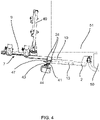
- FIGS 1 to 4 show a load carrier 1 for bicycles according to the invention.
- the load carrier 1 comprises a basic frame 2, which is shown in detail in figure 9 .
- This basic frame 2 is formed by two bent tubes 2a, 2b having a circular cross-section.
- the tubes 2a, 2b form a C-shaped structure of the basic frame 2 open to the rear side.
- This structure has a central C-leg 3a extending transversely to a longitudinal direction L and two C-legs 3b, which extend parallel to each other towards the rear side.
- a coupling device 4 for attachment to a vehicle is arranged at a front end of the basic frame 2.
- the coupling device 4 is formed such that it can engage in a force-fit manner around the ball of a trailer coupling of a vehicle.
- the coupling device 4 comprises a lever 5 for manual operation and a housing 6 including a coupling mechanism.
- the housing 6 is welded to the central C-leg 3a of the basic frame 2, presently to each of the bent tubes 2a, 2b.
- the load carrier 1 further comprises a sliding frame 7 for receiving bicycles.
- the sliding frame 7 comprises two carrier parts 8a, 8b which are designed as profile rails and extend substantially in the transverse direction. They are arranged offset to one another in the longitudinal direction L and are screwed to two sliding profiles 9. These sliding profiles 9 are arranged parallel to each other and are translationally moveable relative to the basic frame 2 between a retracted front position shown in figures 1 and 2 and an extended rear position shown in figures 3 and 4 .
- an intermediate sliding element 10 is arranged between each sliding profile 9 and the corresponding C-leg 3b, which is positioned below the sliding profiles 9.
- the intermediate sliding elements 10 are slidingly moveable relative to the basic frame 2 and the sliding profiles 9 are slidingly moveable relative to the intermediate sliding elements 10, so that the sliding frame 7 is telescopically displaceable relative to the basic frame 2.
- the intermediate sliding elements 10 and the basic frame 2 are arranged such that they do not protrude above the top of the housing 6 of the coupling device 4 in order to not interfere with a rear door of a van.
- the displacement distance of the sliding frame 7 relative to the basic frame 2 between its retracted front position and its extended rear position is presently at least 60 cm.
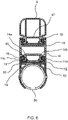
- the intermediate sliding elements 10 comprise an engagement contour 11 on their side facing towards the basic frame 2, which has a corresponding complementary counter contour 12.
- Each counter contour 12 is formed by an attachment profile 13 which is plugged onto the C-legs 3b of the basic frame 2 and is formed by an extruded aluminium profile.
- the engagement contour 11 and the counter contour 12 each comprise two L-shaped protrusions 14, which are arranged such that the L-shaped protrusions 14a, 14b of the engagement contour 11 engage behind the L-shaped protrusions 14c, 14d of the counter contour 12.
- the L-shaped protrusions of the engagement contour and the L-shaped protrusions 14c, 14d of the counter contour 12 are arranged mirror symmetrically with respect to a longitudinal center plane of the intermediate sliding elements 10.
- the L-shaped protrusions 14a, 14b of the engagement contour 11 and the L-shaped protrusions 14c, 14d of the counter contour 12 each comprise one first L-leg 15, wherein both first L-legs 15 of the engagement contour and both first L-legs 15 of the counter contour extend parallel to each other respectively.
- second L-legs 16 are provided which extend perpendicularly to the corresponding first L-leg 15.
- the second L-legs 16 are arranged such that they face away from each other, whereas the second L-legs 16 of the corresponding counter contour 12 face towards each other so that the L-shaped protrusions 14a, 14b of the engagement contour 11 engaged behind the L-shaped protrusions 14c, 14d of the counter contour 12.
- the intermediate sliding element 10 is slidingly movable relative to the basic frame 2 in the longitudinal direction L, but fixed transversely to the longitudinal direction L in a form-fit manner.
- each sliding profile 9 On its bottom side facing towards the intermediate sliding element 10, each sliding profile 9 comprises an engagement profile 17.
- the intermediate sliding elements 10 have on their upper side a complementary counter profile 18, so that the engagement profile 17 engages behind the counter profile 18 such that the sliding frame 7 is slidingly movable relative to the intermediate sliding element 10 in the longitudinal direction L, but fixed transversely to the longitudinal direction L in a form-fit manner.
- the engagement profile 17 and the counter profile 18 are formed identically to the counter contour 12 and the engagement contour 11.
- the engagement profile 17 and the counter profile 18 each comprise two L-shaped projections 19a, 19b, 19c, 19d, which are arranged such the L-shaped projections 19, 19b of the engagement profile 17 engaged behind the L-shaped projections 19c, 19d of the counter profile 18.
- stop blocks 20 are screwed to the intermediate sliding element 10, the sliding profiles 9 and the attachment profile 13, so that the movement of the sliding frame 7 relative to the basic frame 2 is limited between the retracted front position and the extended rear position.
- the stop blocks 20a and 20b are fixed to the basic frame 2 and interact with the stop block 20c fixed to the intermediate sliding element 10 so that the movement of the intermediate sliding element 10 with respect to the basic frame 2 is limited by the stop blocks coming into contact.
- stop blocks 20d and 20e fixed at the top of the intermediate sliding element 10 interact with the stop block 20f fixed to the sliding frame 7, so that the sliding path of the sliding frame 7 relative to the intermediate sliding element 10 is defined by the stop block 20f getting into contact with the stop block 20d and 20e.
- the stop block 20a abuts against stop block 20c and stop block 20d abuts against stop block 20f, when the sliding frame 2 is in its retracted front position.
- stop block 20b abuts against stop block 20c and stop block 20e abuts against stop block 20f.
- Stop block 20g arranged at the rear end of the intermediate sliding element 10, backwards of stop block 20e works as an additional safety mechanism.
- a locking device 21 is assigned to each sliding profile 9.
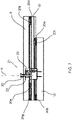
- Each of the two locking devices 21 comprises a locking bolt 22 that is held at the sliding profile so as to be movable between a blocked position and a release position.
- the locking bolt 22 is mounted at the sliding profile so as to be movable along a locking axis X, wherein it extends through two aligned bores that are provided in an insert element 23 that is fixed to the sliding profile 9 by means of two screws 24.
- the two aligned bores are provided at the facing walls of the insert element 23. Their inner circumference is adjusted to the outer circumference of the locking bolt 22 with play, so that it can slide along the locking axis X through the bores.
- Figure 7 shows the locking bolt 21 in the blocked position.
- the locking bolt 22 is pre-loaded in the direction of the blocked position by means of a coil spring 25 that can in particular be seen in the enlarged rendering of Figure 8 .
- a ring 26 enclosing the same is affixed, which in the blocked position rests at the top side of the lower wall of the insert element 23, so that the locking bolt 22 cannot be moved further downwards.
- a movement upwards is also restricted by the ring 26 and the coil spring 25.
- a handle 27 is fixated, which facilitates a convenient release of the locking by a user.
- the locking bolt 22 meshes into a locking recess 28 that is provided at the basic frame 2 in the form of a through bore, whereby it is avoided that the sliding profile 9 can be displaced against the basic frame 2.
- a mechanism which is automatically activated as the locking bolt 22 of the respective locking device 21 is transferred by a user from the blocked position into the release position, holding the locking bolt 22 in the release position, so that the sliding frame 7 can be freely displaced against the basic frame 2, and which, when the sliding frame 7 is moved from a completely or partially extended position into the retracted front position, automatically releases the locking bolt 22 shortly before or upon reaching the retracted front position, so that the locking bolt 22 is moved into the blocked position, and the respective sliding profile 9 is automatically locked.
- the mechanism comprises a holding element 29 that is held at the insert element 23 in a movable manner.
- it is held at the insert element 23 so as to be pivotable about a pivot axis, which extends perpendicular to the drawing plane, between a holding position and a free-running position, and is pre-loaded in the direction of the holding position by means of a torsion spring 30.
- the holding element 29 has a tapered section 29a which tapers into the direction of the basic frame 2 and on one side has an arcuate outer contour, a step- or hook-shaped holding section 29b as well as an end section 29c that projects downwards from the insert element 23.
- the insert element 23 has an opening through which the end section 29c of the holding element 29 can project in the downwards direction.
- the tapered section 29a of the holding element 29 is designed in such a manner and the arrangement is realized in such a manner that the ring 26 attached at the locking bolt 22 is engaged with the tapered section 29a and is moved along the arcuate outer contour of the section 29a when the locking bolt 22 is moved by a user from the locking position into the release position, and as a result of this the holding element 29 is pressed and pivoted from the holding position in the direction of the free-running position.
- the mechanism further comprises a releasing element 31 that is held at the basic frame 2 so as to be movable between a retracted position and a projecting position.
- the releasing element 31 is shown in the retracted position.
- the releasing element 31 is pre-loaded in the direction of the projecting position by means of a coil spring 32. It has a ramp-shaped end area 31a that rises in a ramp-shaped manner in the direction of the extended end position and engages with the end area 29c of the holding element 29 when the sliding frame 7 is brought from the retracted front into the extended rear position or vice versa, wherein the end area 29c of the holding element 29 engages with the ramp-shaped end area 31a of the releasing element 31 shortly before reaching the retracted end position.
- the ramp-shaped end area 31a projects in the direction of the sliding profile 9 to beyond the edge of the basic frame 2.
- the releasing element 31 On the bottom side, the releasing element 31 has a bore hole, which cannot be seen in Figures, and is plugged onto a holding pin 33 that is fixated at the basic frame 2.
- the coil spring 32 extends about the holding pin 33 for preloading the releasing element 31 in the projecting position.
- the arrangement is realized in such a manner that, when the sliding frame 7 is brought into the extended rear position, the engaging end area 29c of the holding element 29 is moved in the rising direction over the ramp-shaped end area 31a of the releasing element 31 (right to left in the Figures), and the holding element 29 presses the releasing element 31 in the retracted position. But if by contrast the sliding frame 7 is brought (back) to the retracted front position, the engaging end area 29c of the holding element 29 abuts the higher side of the ramp-shaped end section 31 a and in this way is moved from the holding position into the free-running position, whereby the locking bolt 22 is automatically released and the respective sliding frame 7 is automatically locked.
- the load carrier 1 further comprises a functional device 34, which is movably held at the rear end of the basic frame 2.
- the functional device 34 comprises a basic carrier element 35 carrying a license plate holder and holding members 36 arranged on both lateral ends of the basic carrier element 35.
- a rear light unit 37 is arranged on both sides basic carrier element 35.
- Each rear light unit 37 is held at the holding member 36 and can be pivoted about a pivot axis relative to the holding member 36 between a use position shown in the figures, in which the rear light unit 37 are folded out and project in the transverse direction from the holding member 36, and a transport position, in which the rear light unit 37 are folded in behind the basic carrier element 35.
- each rear light unit 37 has a one-piece basic body 38, which carries two projections 39 - an upper projection 39a and a lower projection 39b - spaced vertically apart from each other and protruding between corresopnding C-legs 40 formed at the holding member 36 having an upper C-leg 40a and a lower C-leg 40b, which are both directed obliquely backwards and transversely outwards, as shown in figure 1 and 2 for example.
- a locking mechanism is assigned to each rear light unit 37 and designed in such a way that the rear light unit 37 can be locked in its transport position and in its use position.
- the locking mechanism is arranged at the upper projection 39a of the rear light unit 37 and the upper C-leg 40a.
- the functional device 34 is pivotably movable between a working position, in which the functional device 34 extends partially into the movement range of the sliding frame 7, and a clearance position, in which the functional device 34 is moved out of the movement range of the sliding frame 7, about a pivot axis Y.
- the functional device 34 is held at the basic frame 2 by means of two support elements 41, each of which is pivotably connected to the rear end section of the C-legs 3a, 3b of the basic frame 2 on their inner side.
- each C-leg 3a, 3b carries a pivot pin 42 formed as a screw extending into corresponding holes formed in the support elements 41.
- each support element 41 is fixedly connected to the functional device 34.
- each support element 42 comprises a supporting arm 43 extending from the pivot axis Y to the functional device 34.
- the supporting arms 43 of the support elements 41 have a U-shaped recess 44 receiving the holding member 36 of the functional device 34.
- the basic carrier element 34 is screwed to the supporting arms 43 of the support elements 41.
- each support element 41 has an oblong hole 45, into which a corresponding guide bolt 46 fixedly attached to the basic frame 2 extends.
- the oblong holes 45 of the support elements 41 have a curved shape extending along a circle about the pivot axis Y.
- the ends of the oblong holes 45 define the limits of the pivot movement of the support elements 41 and the functional device 34.
- the support elements 41 each comprise a coupling arm 47 extending from the pivot axis Y in the direction of the sliding frame 7.
- the angle between the supporting arm 43 and the coupling arm 47 is about 90°.
- the sliding frame 7 comprises at each sliding profile 9 one pusher dog pin 48 assigned to a corresponding support element 41.
- the pusher dog pins 48 are formed such that they release the functional device 34 and the support elements 41 allowing them to move in their clearance position, when the sliding frame 7 is moved out of its retracted front position.
- the pusher dog pins 48 apply a momentum about the pivot axis Y by pushing against the coupling arm 47 of the support elements 41 in order to bring the functional device 34 into its working position, against the gravity force applying a momentum on the support elements 41 and the functional device 34 in the direction of their clearance position.
- the functional device 34 and the sliding frame 7 are coupled such that the functional device 34 is automatically moved into its clearance position, when the sliding frame 7 is moved out of the retracted front position in the direction of its extended rear position and the functional device 34 is automatically moved into its working position, when the sliding frame 7 is moved into the retracted front position.
- the load carrier 1 further comprises a yoke 49, which is pivotably held at the front ends of the sliding profiles 9.
- This yoke 49 can be moved between a horizontal position, in which the yoke 49 lies on the sliding profiles 9 and a vertical position, in which the yoke 49 can be used to fix a load, for example a bicycle to the load carrier 1, as it is shown in figures 1 to 4 .
- the yoke 49 carries two bike frame holders 49a (shown in figures 1 and 2 ), which serve to connect the frame of a bike to the yoke 49 in order to achieve a safe fixation of a bike on the load carrier 1.
- FIGs 10 and 11 show the use of the load carrier 1 according to the invention.
- the load carrier 1 is fixed to the trailer hitch of a vehicle 50, the rear end section of which is shown.
- the luggage compartment is shown, which has two luggage compartment doors 51 that are pivotable about a vertically extending pivot axis Z.
- the luggage compartment doors 51 are closed and the sliding frame 7 of the load carrier 1, which is equipped with two bicycles 52, is in its retracted front position.
- the displacement path of the sliding frame 7 relative to the basic frame 2 is extended compared to an arrangement whereby the sliding frame 7 is directly held at the basic frame 2 so that even large luggage compartment doors 51 as shown in figures 10 and 11 can be opened without the need to dismount the load carrier 1 from the trailer hitch of the vehicle or to dismount the bicycles 52 from the carrier parts 8a, b. Furthermore, no vertical movement of the load, presently the bicycles 52, is necessary which means that the displacement of the sliding frame 7 relative to the basic frame 2 is possible manually without a significant amount of force.
Landscapes
- Engineering & Computer Science (AREA)
- Mechanical Engineering (AREA)
- Fittings On The Vehicle Exterior For Carrying Loads, And Devices For Holding Or Mounting Articles (AREA)
Abstract
Description
- The present invention relates to a load carrier, in particular a load carrier for bicycles and/or luggage, for attachment to the rear side of vehicle, with a basic structure having a basic frame and a coupling device for attachment to a vehicle arranged at a front end of the basic frame, and a sliding frame for receiving a load, in particular for receiving bicycles or a luggage box, wherein the sliding frame is translationally moveable relative to the basic frame between a retracted front position and an extended rear position.
- Load carriers for fastening to the rear end of a vehicle, in particular a motor vehicle such as a car, are often used for transporting bicycles and/or additional luggage exceeding the capacity of the luggage compartment of the car. Generally, this type of load carrier comprises a coupling device at its front end region which is normally designed so that the load carrier can be fastened to the ball of a conventional trailer coupling. Furthermore, such load carriers for transporting bicycles comprise a carrier frame to which profile rails for receiving the wheels of bicycles are fastened. These profile rails are normally arranged transversely to the direction of travel and substantially horizontally, and comprise fastening means for fixing the bicycles to the profile rail. Other load carriers exist as luggage carries, wherein the carrier frame carries a luggage box, in which luggage, for example suitcases, can be stored.
- At such load carriers, it is sometimes considered as disadvantageous that - when mounted to the rear end of a vehicle and provided with bicycles and/or a luggage box - it is difficult or even impossible to have access to the luggage compartment of the vehicle. If, for example, on a longer journey someone would like to take belongings out of the luggage compartment during a break, the load carrier must be disconnected from the trailer coupling and - in most cases - the bicycles must be removed or the luggage must be taken out of the luggage box in order to allow to open the luggage compartment lid.
- To avoid this problem and to allow an easy access to the luggage compartment of the vehicle,
EP 2 457 777 B1 - The sliding frame unit is movable relative to the basic frame between a retracted front position, in which the sliding frame is aligned with the basic frame, and an extended rear position, in which it is possible to open the luggage compartment lid of the vehicle. In order to bring the sliding frame unit into the extended rear position, the sliding frame is moved linearly backwards and tilted backwards relative to the basic frame, meaning that the movement of the sliding frame relative to the basic frame has two degrees of freedom. In concrete terms, the sliding frame is moved translationally backwards and pivoted backwards in order to bring the load out of the movement range of the luggage compartment lid of the vehicle.
- Even if such a load carrier has proven its worth in principle, it is sometimes considered as disadvantageous that the kinematics allowing two degrees of freedom is complicated and that the extended rear position of the sliding frame is not sufficiently far away from the retracted front position so that it is not possible to open luggage compartment lids having a large movement range. Such a large movement range is in particular given when double rear doors are provided at a van.
- Therefore, it is an object of the present invention to provide an alternative load carrier, which allows an easy access to the luggage compartment, when mounted, and which is suitable also for luggage compartment lids of vehicles having a large movement range.
- This object is solved by a load carrier of the type mentioned above in that at least one intermediate sliding element is arranged between the basic frame and the sliding frame in such a way that the intermediate sliding element is slidingly moveable relative to the basic frame and the sliding frame is slidingly moveable relative to the intermediate sliding element so that the sliding frame is telescopically displaceable relative to the basic frame.
- The invention is based on the consideration to provide an intermediate sliding element by means of which a telescopical displacement of the sliding frame relative to the basic frame can be effected. Accordingly, the movement range of the sliding frame relative to the basic frame is extended compared to an arrangement wherein the sliding frame is directly held on the basic frame. Due to this further extension of the sliding frame relative to the basic frame, the load carrier according to the invention can be used for vehicles having a luggage compartment lid with a large movement range. In other words, the bicycles or the luggage box provided on the sliding frame can be positioned in the extended rear position of the sliding frame so far away from the vehicle that they do not interfere with the luggage compartment lid of a vehicle when the latter is opened or closed. The load carrier according to the invention is in particular suitable for vans having a double rear door pivoting about a vertical pivot axis as the relatively long sliding distance achieved by means of the intermediate sliding element allows to bring the sliding frame out of the movement range of such a double rear door.
- According to a preferred embodiment of the invention, the displacement distance of the sliding frame relative to the basic frame between its retracted front position and its extended rear position is at least 60 cm. In other words, the sliding frame is movable relative to the basic frame by a distance of at least 60 cm. Such a displacement distance allows to bring the sliding frame and a load arranged thereon out of the movement range of luggage compartment lids or rear doors of vehicles.
- Preferably, the displacement distance of the sliding frame relative to the basic frame between its retracted front position and its extended rear position is at least 1.1 times the longitudinal extension of the load carrier, when the sliding frame is in its retracted front position. Accordingly, it is provided that the displacement path of the sliding frame relative to the basic frame is in total longer than the entire extension of the load carrier in its longitudinal direction, i.e. from its front end to its rear end when the sliding frame is in its retracted front position. Such a long displacement path is presently achieved by means of the intermediate sliding element.
- According to a preferred embodiment of the invention, each intermediate sliding element comprises an engagement contour on its side facing towards the basic frame and the basic frame has a corresponding complementary counter contour, wherein the engagement contour engages behind the counter contour such that the intermediate sliding element is slidingly moveable relative to the basic frame in a longitudinal direction, but fixed transversely to the longitudinal direction in a form-fit manner. In other words, a form-fit connection between the intermediate sliding element and the basic frame is realized in order to ensure that the intermediate sliding element is slidingly held on the basic frame such that only a translational movement in one direction of the intermediate sliding element relative to the basic frame is possible.
- In concrete terms, the engagement contour and the counter contour each may comprise two L-shaped protrusions, which are arranged such that the L-shaped protrusions of the engagement contour engage behind the L-shaped protrusions of the counter contour. Preferably, the L-shaped protrusions of the engagement contour and/or of the counter contour are arranged mirror-symmetrically in particular with respect to a longitudinal center plain of the intermediate sliding element. Each L-shaped protrusion may comprise a first L-leg, which faces towards the other element, and a second L-leg which extends transversely, in particular perpendicularly to the first L-leg. The L-shaped protrusions of the engagement contour and/or the counter contous may be formed such that the first L-legs of a contour extend parallel to each other, whereas the second L-legs face towards each other or face away from each other. For example, the second L-legs of the engagement contour may face away from each other and the second L-legs of the counter contour may face towards each other so that the L-shaped protrusions engage behind each other so that a form-fit connection between the basic frame and the intermediate sliding element is realized.
- The sliding frame may comprise assigned to each intermediate sliding element an engagement profile on its side facing towards the intermediate sliding element and the intermediate sliding element may have a corresponding complementary counter profile, wherein the engagement profile engages behind the counter profile such that the sliding frame is slidably moveable relative to the intermediate sliding element in an longitudinal direction, but fixed transversely to the longitudinal direction in a form-fit manner.
- In concrete terms, the engagement profile and the counter profile each comprise two L- shaped projections, which are arranged such that the L-shaped projections of the engagement profile engage behind the L-shaped projections of the counter profile. Furthermore, the L-shaped projections of the engagement profile and/or of the counter profile may be arranged in a mirror symmetrical manner with respect to a longitudinal center plane of the intermediate sliding element. The engagement profile and the counter profile may be formed similarly or even identically to the engagement contour and the counter contour. Accordingly, the engagement profile may have the same cross-section as the engagement contour and/or the counter profile may have the same cross section as the counter contour.
- According to a preferred embodiment of the invention, the engagement contour and/or the counter contour and/or the engagement profile and/or the counter profile may be provided with a coating. Such a coating can reduce the friction and therefore reduce the force that is necessary to move the sliding frame relative to the basic frame. Such a coating may also be corrosion resistant and/or may cover the entire contour/profile or a part thereof.
- In order to ensure a robust and safe movement of the sliding frame relative to the basic frame, the load carrier may comprise two intermediate sliding elements spaced apart from each other and extending parallel to each other. In particular, the intermediate sliding element may be spaced apart from each other laterally. Such a double telescopical connection between the basic frame and a sliding frame is resistant against torsion momentums so that a stable design can be achieved. Accordingly, the sliding frame can comprise two engagement profiles and the basic frame can comprise two counter contours being arranged parallel to each other.
- Preferably, the basic frame has a C-shaped structure open towards the rear side, wherein a central C-leg extends transversely to a longitudinal direction of the load carrier and two C-legs extend parallel to each other towards the rear side of the load carrier. In concrete terms, the C-shaped structure may be formed by at least one bent round tube, which is welded at its central C-leg to the coupling device, in particular to a housing of the coupling device. Such a round tube with a circular cross-section is more resistant against bending so that a smooth sliding of the sliding frame relative to the basic frame can be ensured. In particular, the C-shaped structure may comprise two bent tubes which are welded together in the middle of the central C-leg and/or are welded to the coupling device, in particular to a housing of the coupling device.
- The counter contour of the basic frame may be formed by an attachment profile, which is plugged onto the basic frame, in particular onto a leg of the basic frame. Accordingly, the counter contour may be formed by a separate piece, which is plucked onto the basic frame. This attachment profile may be an extruded aluminium profile or may be made of made plastic.
- The sliding frame may comprise assigned to each intermediate sliding element one sliding profile, which has the engagement profile on its side facing towards the intermediate sliding element and is formed by an extruded aluminium profile.
- The intermediate sliding element may be formed by an extruded hollow profile, in particular an aluminium profile. In this way, an easy manufacturing is possible.
- The sliding frame may be arranged above the basic frame so that the sliding frame is arranged above the intermediate sliding element and the intermediate sliding element is arranged above the basic frame.
- Preferably, the basic frame and the intermediate sliding elements are arranged such that do not protrude above the top of the coupling device. In other words, the intermediate sliding elements and the basic frame are arranged vertically below the top surface of the coupling device when the load carrier is connected to the trailer hitch of a vehicle. In this way, it is ensured that the intermediate sliding element and the basic frame do not interfere with a luggage compartment lid or a rear door of a vehicle.
- In order to avoid an unintentional movement of the sliding frame out of its retracted front position, a locking device may be provided by means of which the sliding frame can be locked relative to the basic frame. Preferably, one locking device may be assigned to each intermediate sliding element. Accordingly, if the load carrier comprises two intermediate sliding elements, which are spaced apart from each other and extend parallel, one locking device may be provided at each telescopic sliding guide.
- The locking device may comprise at least one locking bolt that is held at the basic frame or the sliding frame so as to be movable between a blocked position and a release position, the locking bolt being pre-loaded in the direction of the blocked position, wherein a mechanism is provided which is automatically activated as the locking bolt is being transferred from the blocked position into the release position and which holds the locking bolt in the release position, so that the sliding frame can be freely displaced with respect to the basic frame, and which, when the sliding frame is being moved into the retracted front position, automatically releases the locking bolt either shortly before or upon reaching the retracted front position, so that the locking bolt is moved into the blocked position and locking takes place.
- In an expedient design, the locking device comprises a recess which is provided in the other one of the sliding frame and the basic frame and into which an end area of the locking bolt engages when it is in the blocked position, whereby a reliable securing of the sliding frame on the basic frame can be achieved.
- According to a particularly preferred embodiment, a holding element is provided that has a holding section which automatically engages with a projection provided at the locking bolt, when the locking bolt is transferred from the blocked position into the release position. The projection preferably is formed by a retaining ring that encloses the locking bolt and is fixed thereto. The holding element furthermore is preferably held at the one of the sliding frame and the basic frame so as to be moveable between a holding position and a free-running position, in particular so as to be pivotable about a pivot axis, and particularly preferably is pre-loaded in the direction of the holding position.
- A spring element assigned to the holding element can be provided for preloading the holding element in the direction of the holding position. In the case that the holding element is held so as to be pivotable about a pivot axis, this can in particular be a torsion spring. The same may apply alternatively or additionally to the locking bolt which is pre-loaded in the direction of the blocked position and to which a spring element can be assigned alternatively or additionally, for example a compression spring or coil spring through which the locking bolt extends.
- A further preferred embodiment is characterized in that the holding element has a step- or hook-shaped holding section, wherein, when the locking bolt is in the release position and the holding element is in the holding position, particularly preferably a bottom side of the projection provided at the locking bolt rests on a top side of the step- or hook-shaped holding section. This arrangement has proven to be particularly advantageous for holding the locking bolt securely in the release position by means of the holding element. It is further preferable if the arrangement is such that, in the holding position, the top side of the step- or hook-shaped holding section is aligned so as to be at least substantially orthogonal to the locking axis along which the locking bolt is movable between the locking position and the release position as it is held at the one sliding element.
- In a further preferred embodiment, the holding element has a tapered section, which preferably tapers into the direction of the other of the sliding frame and the basic frame. The arrangement is then preferably realized in such a manner that the projection provided at the locking bolt is engaged with and moved along the tapered section when the locking bolt is transferred from the blocked position into the release position and the holding element is pressed from the holding position into the free-running position. The tapered section can for example be at least substantially V-shaped. It can further be that the holding element has an arcuate section or a section with an arcuate outside contour with which the projection provided at the locking bolt engages or is engaged if it is moved from the locking position into the release position, wherein the arcuate section is preferably designed in such a manner and the arrangement is realized in such a manner that the projection provided at the locking bolt is moved along the arcuate section or outer contour, and the holding element is in a particular appropriate manner pressed from the holding position into the free-running position when the locking bolt is transferred from the blocked position into the release position. The arcuate outside contour can form one side of the tapered section.
- Further, the locking bolt and/or the holding element can be held so as to be movable at an insert element inserted into the sliding frame or the basic frame. The insert element can for example be inserted into a reception area that is provided in the one of the sliding frame and the basic frame and can be attached with fixation means, such as for example screws. If an insert element is provided, it is preferably formed as an at least substantially cuboid hollow body. Alternatively or additionally, the insert element has two aligned bore holes through which the locking bolt extends. The aligned bore holes are in particular provided in two facing walls of the insert element. Further, the insert element and the locking bolt are preferably dimensioned and arranged in such a manner that the locking bolt extends through both aligned holes in the blocked position as well as in the release position.
- In a further embodiment of the load carrier according to the invention a releasing element is provided that is held at the other of the sliding frame and the basic frame so as to be movable between a retracted position and a projecting position. The releasing element is preferably pre-loaded in the direction of the projecting position, and in particular has a ramp-shaped end area which preferably rises in a ramp-shaped manner in the direction of the extended end position and engages with an end area of the holding element when the sliding frame is brought from a retracted position into the extended end position, or vice versa. Particularly preferably, the end area of the holding element engages with the ramp-shaped end area of the releasing element shortly before or upon reaching the retracted end position. Alternatively or additionally, it can be provided that in the projecting position the ramp-shaped end area of the releasing element protrudes in the direction of the one of the sliding frame and the basic frame to beyond an edge of the other of the sliding frame and the basic frame.
- Assigned to the releasing element is preferably one spring element by means of which the releasing element is pre-loaded in the direction of the projecting position. The spring element can be a compression spring or a coil spring through which a holding pin for the releasing element extends.
- The arrangement is preferably such that, when the sliding frame is brought into the extended rear position, the engaging end area of the holding element is moved in the ascending direction across the ramp-shaped end area of the releasing element and presses the releasing element into the retracted position, and/or that, when the sliding frame is brought into the retracted front position, the engaging end area of the holding element abuts against the higher side of the ramp-shaped end section and is thus moved from the holding position into the free-running position, whereby the locking bolt is automatically released.
- A pre-loaded releasing element with a ramp-shaped end area makes it possible that, when the sliding frame is moved from the first retracted end position into the second extended end position, the holding element can pass the releasing element without significant resistance, but that its position is changed in the event of a movement in the other direction when it is engaged, in concrete terms is moved from the holding position into the free-running position, whereby the locking bolt is released and automatic locking is achieved.
- In a further particularly expedient embodiment, the sliding path of the sliding frame relative to the basic frame is restricted by at least one end position stop at least in the extended end position, preferably being restricted by end position stops in both end positions. For example, the end position stops may be formed by stop blocks, which are fixed to the basic frame, the intermediate sliding element and/or the sliding frame, in particular screwed thereto.
- The load carrier may comprise a functional device, which is moveably held at the basic frame, in particular at a rear end section of the basic frame, between a working position, in which the functional device extends at least partially into the movement range of the sliding frame, and a clearance position, in which the functional device is moved out of the movement range of the sliding frame allowing to move the sliding frame into its rear extended position. This embodiment is based on the consideration to provide a functional device, for example a unit comprising a license plate holder and two rear light units, which is not mounted at the sliding frame. Instead, the functional device is mounted at the basic frame. In this way, it is possible to design the sliding frame in a weight-optimized manner.
- Furthermore, by mounting the functional device at the basic frame instead of the sliding frame, it is not necessary to provide exposed supply means, for example cables, for supplying the functional device with energy, in particular electrical energy, as the functional device is not moved together with the sliding frame relative to the basic frame. In other words, if the functional device comprises rear light units, exposed cable sections can be avoided as the cable remains at the same place and does not need to be extended.
- When the load carrier is mounted to a vehicle and the sliding frame is in its front retracted position, the functional device extends into the movement range of the sliding frame. In particular, the functional device can be positioned behind the sliding frame, when the sliding frame is in its retracted front position. In this situation, the functional device would block the sliding frame. Therefore, it is provided that the functional device can be moved out of the movement range of the sliding frame, thus releasing the sliding frame and allowing a movement into its extended rear position.
- According to a preferred embodiment of the invention, the functional device and the sliding frame are coupled such that the functional device is automatically moved into its clearance position, when the sliding frame is moved out of the retracted front position in the direction of its extended rear position, and the functional device is automatically moved into its working position, when the sliding frame is moved into the front transport position. Accordingly, a kinematic coupling between the sliding frame and the functional device is realized such that no independent actuation of the sliding frame and the functional device are necessary but it is sufficient that the sliding frame is moved between the front position and the rear position automatically bringing the functional device out of the movement range of the sliding frame. In other words, the operator only has to move the sliding frame linearly backwards into its extended rear position or to the front into its retracted front position, and this linear movement is translated into a movement of the functional device due to the kinematic coupling.
- Preferably, the functional device is pivotably held at the basic frame between its working position and its clearance position about a pivot axis. Such a pivot axis can in particular extend transversely, preferably perpendicularly to the longitudinal direction of the load carrier. In other words, the functional device can be tilted out of the movement range of the sliding frame in order to allow the sliding frame to be moved into its rear position.
- It may be provided that the load carrier comprises at least one, in particular two support elements, each support element being fixedly connected to the functional device and pivotably connected to the basic frame. Such support elements form intermediate elements between the functional device and the basic frame working as a lever arm increasing the travel path of the functional device. In other words, the support element(s) are directly connected to the basic frame and to the functional device. In concrete terms, the pivotable connection of the support elements to the basic frame can be realized by a pivot pin protruding from the basic frame and engaging into a corresponding hole of the support element. Such a pivot pin can also have a threaded zone and can in particular be formed as a screw. In this way, the support element(s) can be fixed in the longitudinal direction of the pivot pin at the basic frame and an unintentional movement of the support element in this direction is avoided. It is also conceivable that at least one, in particular each support element comprises a pivot pin, which protrudes and extends into a corresponding hole formed in the basic frame.
- In order to limit the movability of the support element and the functional device relative to the basic frame, at least one, in particular each support element has an oblong hole into which a corresponding guide bolt fixedly attached to the basic frame extends. By means of such an oblong hole the movability of the support element can be limited to a defined angular range. The guide bolt extending into the oblong hole defines the limits of this angular range by coming into contact with the ends of the oblong hole. The guide bolt can be fixed to the basic frame, in particular screwed or welded thereto. Preferably, each guide bolt extends parallel to the pivot axis of the support element(s).
- In a further elaboration of this embodiment, the oblong hole of at least one, in particular of each support element has a curved shape extending along a circle about the pivot axis. Preferably, the oblong hole of at least one, in particular of each support element is formed such that the guide bolt reaches one end of the oblong hole when the functional device is in its release position. In other words, one end of the oblong hole defines the release position of the functional device and limits the movability in this direction. Accordingly, when the guide bolt reaches this end of the oblong hole, the functional device is out of the movement range of the sliding frame.
- According to a preferred embodiment, at least one, in particular each support element comprises two arms, wherein one supporting arm extends from the pivot axis to the functional device and is fixedly connected, in particular screwed, thereto, and wherein the other coupling arm extends from the pivot axis in the direction of the sliding frame. In other words, the support element may have two arms which have different functions. The first supporting arm has the function to support the functional device and to connect this functional device with the basic frame. A second arm extending in the direction of the sliding frame realizes the coupling between the translational movement of the sliding frame and the pivoting movement of the support element and the functional device. The angle between the supporting arm and the coupling arm may be in the range between 70° and 110° and is preferably about 90°.
- The sliding frame may comprise at least one pusher dog element, in particular in the form of a pusher dog pin, assigned to a corresponding support element and formed such that it releases the functional device and the support element(s) allowing them to move into their release position, when the sliding frame is moved out of its transport position, and such that it applies a momentum about the pivot axis by pushing against the coupling arm of the support element in order to bring the functional device into its working position, when the sliding frame is moved into its retracted front position.
- Accordingly, the coupling between the translational movement of the sliding frame and the pivoting movement of the support element(s) and the functional device is realized by a pusher dog mechanism. When the sliding frame is moved from its retracted front position into its extended rear position, the pusher dog element bearing against the coupling arm of the at least one support element releases this coupling arm allowing the functional device to move out of the movement range of the sliding frame. The clearance position of the functional device is determined by the guide bolt being in contact with the end of the oblong hole formed in the support element. When the sliding frame is moved from the extended rear position into its retracted front position the pusher dog element comes into contact with a corresponding contact surface formed at the coupling arm of the support element. The pusher dog element pushes against this contact surface of the coupling arm of the support element applying a momentum such that the functional device is brought into its working position. When the sliding frame has reached its front transport position, the functional device is held in its working position by the contact of the pusher dog element with the coupling arm of the support element.
- According to preferred embodiment of the invention, the functional device projects to the rear side from the basic frame and from the pivot axis such that the functional device is moved into its clearance position by gravity force when the pusher dog element releases the functional device and the corresponding support element. Hence, the functional device is tilted downwardly by the gravity force when such a movement is possible due to the movement of the pusher dog element backwards. Such a movement based on gravity force is advantageous as no other elements applying a momentum on the support elements and the functional device is necessary and a risk of a malfunctioning is significantly decreased.
- Preferably, the basic frame has a C-shaped structure open to the rear side. It may be provided that the load carrier comprises exactly two support elements, wherein each C-leg of the basic frame holds one support element in a pivotable manner at its rear end section, wherein the support elements are in particular arranged at the inner sides of the C-legs. Such a fixation of the functional device and the support elements at two laterally spaced apart C-legs allows a stable construction of the load carrier and a stable and reliable fixation of the functional device at the basic frame. The support elements being arranged at the inner sides of the C-legs are advantageous as the risk of damaging by external forces is minimized.
- The functional device may comprise a basic carrier element and two rear light units, each of which is held at the basic carrier element and each of which can be pivoted about a pivot axis relative to the basic carrier element between a use position, in which the rear light units are folded out and project in the transverse direction from the basic carrier element, and a transport position in which the rear light units are folded in behind the basic carrier element. In order to hold the rear light units, holding members may be provided at the basic carrier element.
- Preferably, bearing means are provided for pivotably bearing the rear light units. The bearing of the rear light units at the holding members may be formed as a sliding bearing. Such a sliding bearing allows an easy design with only a few components, wherein a small resistance by friction is ensured when the rear light units are pivoted.
- According to a further embodiment of the invention, the holding members have a C-shaped basic shape, wherein the respective rear light unit is pivotably arranged between the C-legs. By means of such a C-shaped design of the holding members, the rear light units can be gripped from both sides, in particular from an upper and a lower side in order to allow an easy and safe bearing and a stable fixation at the holding members. Preferably, the connecting webs of the holding members face to each other. Accordingly, the C-shaped holding members are transversely open to opposite directions. Preferably, the C-legs are directed obliquely backwards and transversely outwards.
- In concrete terms, the bearing means may comprise hinge pins which engage in corresponding bearing bores. Basically, these hinge pins can be provided at the rear lights units extending into corresponding bearing bores of the holding members, in particular in their C-legs. Principally, it is also conceivable that the hinge pins are provided and fixed to the holding members, in particular their C-legs and extend into the rear light units.
- According to a preferred embodiment, the hinge pins are designed as screws. In this way, an easy manufacturing and assembly of the rear load carrier is possible.
- The rear light units may each have a basic body, in particular a one-piece basic body. A basic body forming the outer contour of the rear lights units allows a robust design and protects the electric components inside against mechanical influences, water and dust. By means of a one-piece basic body, a leak-proof design is ensured and the risk of unintended intrusions is minimized.
- The basic body of the rear light units may each carry two projections which protrude between the C-legs of the holding members. Such protrusions allow a weight-effective design of the rear light units and lead to a free space between these projections, which facilitates the assembly of the rear load carrier.
- In a further elaboration of this embodiment, the bearing means comprise two hinge pins which are oriented coaxially to one another, are each arranged at one of the projections and engage in corresponding bearing bores in the C-legs of the holding members. In other words, each rear light unit may have two bearing areas, namely an upper bearing area and a lower bearing area. In the upper bearing area, a hinge pin protrudes upwardly from this projection and engages into a bearing bore in the upper C-leg of the corresponding holding member. In the lower bearing area, a hinge pin protrudes from the bottom projection and engages downwardly into a corresponding bearing bore in the lower C-leg of the holding member. In this way, a two-point-bearing is realized and, due to the free space between the projections, an easy accessibility is given as well as the assembly is facilitated.
- Preferably, the use position and the transport position of the rear light units are offset relative to one another by a pivoting angle of at least 160°, in particular of at least 170°, preferably of 180°.
- A locking mechanism may be assigned to each rear light unit, said locking mechanism being designed to lock the rear light unit in its transport position and in its use position. By locking the rear light unit in its transport position and in its use position, the rear light units are safely positioned and operating errors can be avoided.
- Preferably, the locking mechanism comprises an engagement element which is displaceable along the pivot axis of the respective rear light unit between an enabling position, in which the rear light units are freely pivotable and a locking position, in which the rear light units are locked relative to the base body. This embodiment is based on the consideration to provide an engagement element that, in one position, locks the rear light units relative to the base body, in particular relative to the corresponding holding member, and, in a second position, releases the rear light unit so that it can be pivoted freely by the operator.
- In a further elaboration of this embodiment, the engagement element is coupled in a rotationally fixed manner to the respective rear light unit. Accordingly, the engagement element cannot rotate relative to the rear light unit. In order to realize the rotationally fixed coupling of the engagement element relative to the respective rear light unit, at least one guiding recess, in particular a plurality of guiding recesses may be formed in the engagement element. These guiding recesses may extend from one end surface, in particular a bottom end surface, of the engagement element into the latter, which means that the guiding recesses are open towards one end face of the engagement element. In particular, the engagement element may comprise in total three guiding recesses distributed uniformly over the circumference of an inner surface of the engagement element, in particular to a central opening. These guiding recesses are preferably in engagement with corresponding guiding protrusions formed in the rear light unit.
- The engagement element may be arranged in a recess of the respective rear light unit, said recess being open towards the corresponding holding member. Accordingly, the engagement element is provided in the rear light unit. Preferably, the holding members have a C-shaped basic shape with outwardly pointing C-legs and the recess is open towards and upper C-leg of the holding member. By arranging the engagement element in a recess open towards an upper C-leg, the locking mechanism is preferably arranged in an area of the rear load carrier upwardly open and, therefore, is easily accessible for the operator from above.
- Furthermore, a guide groove open towards the corresponding holding member and extending in an annular manner around the pivot axis may be formed in the recess, in which guide groove a corresponding guide projection of the engagement element engages. An annular projection engaging into a corresponding guide groove presents a simple and effective way to guide the engagement element in the corresponding rear light unit and minimizes the risk of canting.
- In an end face directed towards the corresponding holding member, the engagement element may have an engaging contour which is or can be brought into positive engagement with a corresponding counter-contour on the holding member in its locking position. Accordingly, a form-fit connection between a contour formed at the engagement element and a corresponding counter-contour formed in the corresponding holding member, in particular in a C-leg, preferable in an upper C-leg of the holding member may be used to lock the rear light unit in its transport position and in its use position.
- In concrete terms, the engaging contour may comprise two engagement grooves, which extend rectilinearly and radially to the pivot axis and, in particular, lie opposite to one another with respect to the pivot axis. The engagement grooves may have a rectangular cross-section and may have a radially outwardly from the pivot axis increasing groove depth, in particular a linearly increasing groove depth. The corresponding counter-contour formed on the holding member preferably has a shape complementary to the engagement contour. Such engagement grooves are easy to manufacture and allow a safe and reliable engagement and, thus, locking with a corresponding counter-contour. By means of a linearly increasing groove depth, the engagement element is furthermore centered with regard to the holding member when a corresponding counter-contour having protrusions with an increasing height is formed at the holding member. Grooves and a corresponding counter-contour extending rectilinearly radially to the pivot axis and lying opposite to one another ensure an offset of 180° of the rear light units between the use position and the transport position.
- According to a preferred embodiment, the engagement element is pretensioned in the direction of its locking position. Accordingly, the operator must intentionally bring the engagement element out of its locking position, when the rear light unit should be pivoted.
- In order to realize the pretensioning of the engagement element, a spring element, in particular a helical compression spring, may be arranged in the guide groove of the rear light unit, wherein said spring element is supported against the base of the guide groove and the guide projection of the engagement element. In this way, the spring element, which pretensions the engagement element in the direction of its locking position, is completely surrounded by the engagement element and the rear light unit and, therefore, protected against the intrusion of dust and other contamination.
- The engagement elements may have a central through-opening, which is penetrated by a hinge pin. In other words, the corresponding hinge pin, which is necessary for the bearing of the rear light units at the holding members, may penetrate through the engagement element and, accordingly, also guide the engagement element.
- The locking mechanism may further comprise an actuating element which is movable and interacts with the engagement element in such a way that the actuating element is movable between a detent position, in which the engagement element can move into its locking position, and an actuating position, in which the engagement element is in its enabling position. Such an actuating element allows the operator to bring the engagement element intentionally out of its locking position, thus releasing the rear light unit.
- According to a preferred embodiment of the invention, the actuating element is movably arranged at the corresponding holding member. Preferably, the holding members may have a C-shaped basic shape with outwardly pointing C-legs and the actuating element is arranged at an upper C-leg of the holding member. In this way, the actuating element is accessible from the outside, in particular from above, for the operator allowing an easy handling.
- In concrete terms, the actuating element may be designed as a push button. Hence, the operator only must push, in particular from above, on the actuating element in order to bring the engagement element into its enabling position, thus releasing the rear light units and allowing to pivot them.
- The actuating element may be connected in an axially fixed manner to a hinge pin. In this way, the hinge pin moves together with the actuating element. The fixation in an axially fixed manner can, for example, be realized by screwing the actuating element on a thread provided at the hinge pin and/or by a force-fit or form-fit press connection.
- In a manner generally known per se, the actuating element may have an annular bearing groove which is formed concentrically to the pivot axis, wherein said bearing groove is open towards the rear light unit and a corresponding bearing projection of the holding member engages into this bearing groove. Such an annular bearing groove as well as a, in particular, annular bearing projection is easy to manufacture and ensures that the actuating element cannot cant relative to the holding member.
- In order to realize the interaction between the actuating element and the engagement element, the actuating element may comprise a contact surface facing the rear light unit, which contact surface rests flat against the engagement element or can be brought into contact with the engagement element. This design is based on the consideration that the actuating element, which may in particular be formed as a push button, is pressed against the pretension of the engagement element in order to bring the engagement element out of its locking position. When the operator stops to push on the actuating element, the engagement element is free to move back into its locking position as soon as the rear light unit is positioned in such a way that the engaging contour comes - in its transport or in its use position - into engagement with the corresponding counter-contour, which is preferably formed at the holding member.
- The transverse carrier element may carry a license plate holder. In this way, the license plate holder is arranged transversely between the holding members and the rear light units, when the rear light unites are in their use position.
- With regard to the embodiment of the invention, references also made to the sub-claims and to the following description of an exemplary embodiment with reference to the attached drawings. In the drawing shows:
- Figure 1
- a rear load carrier according to the invention in a perspective view, wherein the sliding frame is in the retracted front position;
- Figure 2
- the rear load carrier of
figure 1 in another perspective view; - Figure 3
- the rear load carrier of
figure 1 , wherein the sliding frame is in the extended rear position, in a perspective view; - Figure 4
- the rear load carrier of
figure 3 in a side view; - Figure 5
- the basic frame, the intermediate sliding element and the sliding frame of the rear load carrier of
figure 1 in a side view; - Figure 6
- the sliding frame, the intermediate sliding element and the basic frame of the rear load carrier of
figure 1 in a cross-sectional view; - Figure 7
- the basic frame, the intermediate sliding element and the sliding frame with the locking device of the load carrier of
figure 1 in a side view; - Figure 8
- a locking device of the rear load carrier shown in
figure 1 ; - Figure 9
- the basic frame and the coupling device of the load carrier shown in
figure 1 ; - Figure 10
- a rear section of a vehicle with the load carrier of
figure 1 , wherein the compartment lid of the vehicle is closed; and - Figure 11
- the arrangement of
figure 9 , wherein the luggage compartment lid of the vehicle is opened. -
Figures 1 to 4 show aload carrier 1 for bicycles according to the invention. Theload carrier 1 comprises abasic frame 2, which is shown in detail infigure 9 . Thisbasic frame 2 is formed by twobent tubes tubes basic frame 2 open to the rear side. This structure has a central C-leg 3a extending transversely to a longitudinal direction L and two C-legs 3b, which extend parallel to each other towards the rear side. - At a front end of the
basic frame 2, acoupling device 4 for attachment to a vehicle is arranged. In concrete terms, thecoupling device 4 is formed such that it can engage in a force-fit manner around the ball of a trailer coupling of a vehicle. Thecoupling device 4 comprises alever 5 for manual operation and ahousing 6 including a coupling mechanism. Thehousing 6 is welded to the central C-leg 3a of thebasic frame 2, presently to each of thebent tubes - The
load carrier 1 further comprises a slidingframe 7 for receiving bicycles. In concrete terms, the slidingframe 7 comprises twocarrier parts profiles 9. These slidingprofiles 9 are arranged parallel to each other and are translationally moveable relative to thebasic frame 2 between a retracted front position shown infigures 1 and2 and an extended rear position shown infigures 3 and4 . - Between each sliding
profile 9 and the corresponding C-leg 3b, which is positioned below the slidingprofiles 9, an intermediate slidingelement 10 is arranged. The intermediate slidingelements 10 are slidingly moveable relative to thebasic frame 2 and the slidingprofiles 9 are slidingly moveable relative to the intermediate slidingelements 10, so that the slidingframe 7 is telescopically displaceable relative to thebasic frame 2. The intermediate slidingelements 10 and thebasic frame 2 are arranged such that they do not protrude above the top of thehousing 6 of thecoupling device 4 in order to not interfere with a rear door of a van. The displacement distance of the slidingframe 7 relative to thebasic frame 2 between its retracted front position and its extended rear position is presently at least 60 cm. - In order to realize this telescopically displacement, the intermediate sliding
elements 10 comprise an engagement contour 11 on their side facing towards thebasic frame 2, which has a correspondingcomplementary counter contour 12. Eachcounter contour 12 is formed by anattachment profile 13 which is plugged onto the C-legs 3b of thebasic frame 2 and is formed by an extruded aluminium profile. - The engagement contour 11 and the
counter contour 12 each comprise two L-shaped protrusions 14, which are arranged such that the L-shapedprotrusions protrusions counter contour 12. In concrete terms, as it is visible onfigure 6 , the L-shaped protrusions of the engagement contour and the L-shapedprotrusions counter contour 12 are arranged mirror symmetrically with respect to a longitudinal center plane of the intermediate slidingelements 10. The L-shapedprotrusions protrusions counter contour 12 each comprise one first L-leg 15, wherein both first L-legs 15 of the engagement contour and both first L-legs 15 of the counter contour extend parallel to each other respectively. At the free end of the first L-legs, second L-legs 16 are provided which extend perpendicularly to the corresponding first L-leg 15. At the engagement contour 11, the second L-legs 16 are arranged such that they face away from each other, whereas the second L-legs 16 of thecorresponding counter contour 12 face towards each other so that the L-shapedprotrusions protrusions counter contour 12. In this way, the intermediate slidingelement 10 is slidingly movable relative to thebasic frame 2 in the longitudinal direction L, but fixed transversely to the longitudinal direction L in a form-fit manner. - On its bottom side facing towards the intermediate sliding
element 10, each slidingprofile 9 comprises anengagement profile 17. The intermediate slidingelements 10 have on their upper side acomplementary counter profile 18, so that theengagement profile 17 engages behind thecounter profile 18 such that the slidingframe 7 is slidingly movable relative to the intermediate slidingelement 10 in the longitudinal direction L, but fixed transversely to the longitudinal direction L in a form-fit manner. - The
engagement profile 17 and thecounter profile 18 are formed identically to thecounter contour 12 and the engagement contour 11. In concrete terms, theengagement profile 17 and thecounter profile 18 each comprise two L-shaped projections 19a, 19b, 19c, 19d, which are arranged such the L-shapedprojections 19, 19b of theengagement profile 17 engaged behind the L-shaped projections 19c, 19d of thecounter profile 18. - As it is visible in
figure 5 , the sliding paths of the slidingprofiles 9 relative to the intermediate slidingelements 10 and the sliding paths of the intermediate slidingelemenst 10 relative to thebasic frame 2 are restricted by several end position stops formed as stop blocks 20. These stop blocks are screwed to the intermediate slidingelement 10, the slidingprofiles 9 and theattachment profile 13, so that the movement of the slidingframe 7 relative to thebasic frame 2 is limited between the retracted front position and the extended rear position. As it is visible inFigure 5 , the stop blocks 20a and 20b are fixed to thebasic frame 2 and interact with thestop block 20c fixed to the intermediate slidingelement 10 so that the movement of the intermediate slidingelement 10 with respect to thebasic frame 2 is limited by the stop blocks coming into contact. In the same manner, the stop blocks 20d and 20e fixed at the top of the intermediate slidingelement 10 interact with thestop block 20f fixed to the slidingframe 7, so that the sliding path of the slidingframe 7 relative to the intermediate slidingelement 10 is defined by thestop block 20f getting into contact with thestop block stop block 20a abuts againststop block 20c and stopblock 20d abuts againststop block 20f, when the slidingframe 2 is in its retracted front position. When the slidingframe 2 is in its extended rear position, as shown inFigure 5 , stopblock 20b abuts againststop block 20c and stopblock 20e abuts againststop block 20f. Stopblock 20g arranged at the rear end of the intermediate slidingelement 10, backwards ofstop block 20e, works as an additional safety mechanism. - A locking
device 21 is assigned to each slidingprofile 9. Each of the twolocking devices 21 comprises a lockingbolt 22 that is held at the sliding profile so as to be movable between a blocked position and a release position. In concrete terms, the lockingbolt 22 is mounted at the sliding profile so as to be movable along a locking axis X, wherein it extends through two aligned bores that are provided in aninsert element 23 that is fixed to the slidingprofile 9 by means of twoscrews 24. As it can be seen inFigures 7 and8 , the two aligned bores are provided at the facing walls of theinsert element 23. Their inner circumference is adjusted to the outer circumference of the lockingbolt 22 with play, so that it can slide along the locking axis X through the bores.Figure 7 shows the lockingbolt 21 in the blocked position. The lockingbolt 22 is pre-loaded in the direction of the blocked position by means of acoil spring 25 that can in particular be seen in the enlarged rendering ofFigure 8 . At the lockingbolt 22, aring 26 enclosing the same is affixed, which in the blocked position rests at the top side of the lower wall of theinsert element 23, so that the lockingbolt 22 cannot be moved further downwards. A movement upwards is also restricted by thering 26 and thecoil spring 25. - At the free end of the locking
bolts 22 that point upwards in the Figures ahandle 27 is fixated, which facilitates a convenient release of the locking by a user. - In the blocked position, the locking
bolt 22 meshes into a lockingrecess 28 that is provided at thebasic frame 2 in the form of a through bore, whereby it is avoided that the slidingprofile 9 can be displaced against thebasic frame 2. - What is further provided is a mechanism which is automatically activated as the locking
bolt 22 of therespective locking device 21 is transferred by a user from the blocked position into the release position, holding the lockingbolt 22 in the release position, so that the slidingframe 7 can be freely displaced against thebasic frame 2, and which, when the slidingframe 7 is moved from a completely or partially extended position into the retracted front position, automatically releases the lockingbolt 22 shortly before or upon reaching the retracted front position, so that the lockingbolt 22 is moved into the blocked position, and the respective slidingprofile 9 is automatically locked. - The mechanism comprises a holding
element 29 that is held at theinsert element 23 in a movable manner. In concrete terms, it is held at theinsert element 23 so as to be pivotable about a pivot axis, which extends perpendicular to the drawing plane, between a holding position and a free-running position, and is pre-loaded in the direction of the holding position by means of atorsion spring 30. - The holding
element 29 has a taperedsection 29a which tapers into the direction of thebasic frame 2 and on one side has an arcuate outer contour, a step- or hook-shapedholding section 29b as well as anend section 29c that projects downwards from theinsert element 23. In the lower wall, theinsert element 23 has an opening through which theend section 29c of the holdingelement 29 can project in the downwards direction. - The tapered
section 29a of the holdingelement 29 is designed in such a manner and the arrangement is realized in such a manner that thering 26 attached at the lockingbolt 22 is engaged with the taperedsection 29a and is moved along the arcuate outer contour of thesection 29a when the lockingbolt 22 is moved by a user from the locking position into the release position, and as a result of this the holdingelement 29 is pressed and pivoted from the holding position in the direction of the free-running position. - The mechanism further comprises a releasing
element 31 that is held at thebasic frame 2 so as to be movable between a retracted position and a projecting position. InFigure 8 , the releasingelement 31 is shown in the retracted position. The releasingelement 31 is pre-loaded in the direction of the projecting position by means of acoil spring 32. It has a ramp-shapedend area 31a that rises in a ramp-shaped manner in the direction of the extended end position and engages with theend area 29c of the holdingelement 29 when the slidingframe 7 is brought from the retracted front into the extended rear position or vice versa, wherein theend area 29c of the holdingelement 29 engages with the ramp-shapedend area 31a of the releasingelement 31 shortly before reaching the retracted end position. In the projecting position, the ramp-shapedend area 31a projects in the direction of the slidingprofile 9 to beyond the edge of thebasic frame 2. - On the bottom side, the releasing
element 31 has a bore hole, which cannot be seen in Figures, and is plugged onto a holdingpin 33 that is fixated at thebasic frame 2. Thecoil spring 32 extends about the holdingpin 33 for preloading the releasingelement 31 in the projecting position. - Here, the arrangement is realized in such a manner that, when the sliding
frame 7 is brought into the extended rear position, theengaging end area 29c of the holdingelement 29 is moved in the rising direction over the ramp-shapedend area 31a of the releasing element 31 (right to left in the Figures), and the holdingelement 29 presses the releasingelement 31 in the retracted position. But if by contrast the slidingframe 7 is brought (back) to the retracted front position, theengaging end area 29c of the holdingelement 29 abuts the higher side of the ramp-shapedend section 31 a and in this way is moved from the holding position into the free-running position, whereby the lockingbolt 22 is automatically released and the respective slidingframe 7 is automatically locked. - The
load carrier 1 further comprises afunctional device 34, which is movably held at the rear end of thebasic frame 2. Thefunctional device 34 comprises abasic carrier element 35 carrying a license plate holder and holdingmembers 36 arranged on both lateral ends of thebasic carrier element 35. Furthermore, arear light unit 37 is arranged on both sidesbasic carrier element 35. Eachrear light unit 37 is held at the holdingmember 36 and can be pivoted about a pivot axis relative to the holdingmember 36 between a use position shown in the figures, in which therear light unit 37 are folded out and project in the transverse direction from the holdingmember 36, and a transport position, in which therear light unit 37 are folded in behind thebasic carrier element 35. - In concrete terms, each
rear light unit 37 has a one-piecebasic body 38, which carries two projections 39 - anupper projection 39a and alower projection 39b - spaced vertically apart from each other and protruding between corresopnding C-legs 40 formed at the holdingmember 36 having an upper C-leg 40a and a lower C-leg 40b, which are both directed obliquely backwards and transversely outwards, as shown infigure 1 and2 for example. - A locking mechanism is assigned to each
rear light unit 37 and designed in such a way that therear light unit 37 can be locked in its transport position and in its use position. In concrete terms, the locking mechanism is arranged at theupper projection 39a of therear light unit 37 and the upper C-leg 40a. - The
functional device 34 is pivotably movable between a working position, in which thefunctional device 34 extends partially into the movement range of the slidingframe 7, and a clearance position, in which thefunctional device 34 is moved out of the movement range of the slidingframe 7, about a pivot axis Y. For this purpose, thefunctional device 34 is held at thebasic frame 2 by means of twosupport elements 41, each of which is pivotably connected to the rear end section of the C-legs basic frame 2 on their inner side. In concrete terms, each C-leg pivot pin 42 formed as a screw extending into corresponding holes formed in thesupport elements 41. - Each
support element 41 is fixedly connected to thefunctional device 34. In concrete terms, eachsupport element 42 comprises a supportingarm 43 extending from the pivot axis Y to thefunctional device 34. At their ends, the supportingarms 43 of thesupport elements 41 have aU-shaped recess 44 receiving the holdingmember 36 of thefunctional device 34. Thebasic carrier element 34 is screwed to the supportingarms 43 of thesupport elements 41. - In order to limit the pivot movement of the
support elements 41 and of thefunctional device 34, eachsupport element 41 has anoblong hole 45, into which acorresponding guide bolt 46 fixedly attached to thebasic frame 2 extends. The oblong holes 45 of thesupport elements 41 have a curved shape extending along a circle about the pivot axis Y. The ends of theoblong holes 45 define the limits of the pivot movement of thesupport elements 41 and thefunctional device 34. When thefunctional device 34 is in its clearance position, theguide bolts 46 reach one end of the oblong holes 45. - The
support elements 41 each comprise acoupling arm 47 extending from the pivot axis Y in the direction of the slidingframe 7. The angle between the supportingarm 43 and thecoupling arm 47 is about 90°. The slidingframe 7 comprises at each slidingprofile 9 onepusher dog pin 48 assigned to acorresponding support element 41. The pusher dog pins 48 are formed such that they release thefunctional device 34 and thesupport elements 41 allowing them to move in their clearance position, when the slidingframe 7 is moved out of its retracted front position. When the slidingframe 7 is moved into its retracted front position, the pusher dog pins 48 apply a momentum about the pivot axis Y by pushing against thecoupling arm 47 of thesupport elements 41 in order to bring thefunctional device 34 into its working position, against the gravity force applying a momentum on thesupport elements 41 and thefunctional device 34 in the direction of their clearance position. In this way, thefunctional device 34 and the slidingframe 7 are coupled such that thefunctional device 34 is automatically moved into its clearance position, when the slidingframe 7 is moved out of the retracted front position in the direction of its extended rear position and thefunctional device 34 is automatically moved into its working position, when the slidingframe 7 is moved into the retracted front position. - The
load carrier 1 further comprises ayoke 49, which is pivotably held at the front ends of the sliding profiles 9. Thisyoke 49 can be moved between a horizontal position, in which theyoke 49 lies on the slidingprofiles 9 and a vertical position, in which theyoke 49 can be used to fix a load, for example a bicycle to theload carrier 1, as it is shown infigures 1 to 4 . Theyoke 49 carries twobike frame holders 49a (shown infigures 1 and2 ), which serve to connect the frame of a bike to theyoke 49 in order to achieve a safe fixation of a bike on theload carrier 1. -
Figures 10 and11 show the use of theload carrier 1 according to the invention. By means of thecoupling device 4, theload carrier 1 is fixed to the trailer hitch of avehicle 50, the rear end section of which is shown. Onfigures 10 and11 , the luggage compartment is shown, which has twoluggage compartment doors 51 that are pivotable about a vertically extending pivot axis Z. Infigure 10 , theluggage compartment doors 51 are closed and the slidingframe 7 of theload carrier 1, which is equipped with twobicycles 52, is in its retracted front position. - If someone needs access to the luggage compartment and wants to open the
luggage compartment doors 51, he can pull both lockingbolts 22 into their release position in order to allow a movement of the slidingframe 7 relative to thebasic frame 2. By bulling the slidingframe 7, in concrete terms the slidingprofiles 9 via the intermediate slidingelements 10 relative to thebasic frame 2, it is possible to bring the slidingframe 7 into its extended rear position, as shown infigure 11 . Due to the intermediate slidingelement 10, the displacement path of the slidingframe 7 relative to thebasic frame 2 is extended compared to an arrangement whereby the slidingframe 7 is directly held at thebasic frame 2 so that even largeluggage compartment doors 51 as shown infigures 10 and11 can be opened without the need to dismount theload carrier 1 from the trailer hitch of the vehicle or to dismount thebicycles 52 from thecarrier parts 8a, b. Furthermore, no vertical movement of the load, presently thebicycles 52, is necessary which means that the displacement of the slidingframe 7 relative to thebasic frame 2 is possible manually without a significant amount of force. -
- 1
- load carrier
- 2
- basic frame
- 2a, 2b
- bent tube
- 3a, b
- C-leg
- 4
- coupling device
- 5
- lever
- 6
- housing
- 7
- sliding frame
- 8a, 8b
- carrier part
- 9
- sliding profile
- 10
- intermediate sliding element
- 11
- engagement contour
- 12
- counter contour
- 13
- attachment profile
- 14a, 14b, 14c, 14d
- L-shaped protrusion
- 15
- first L-leg
- 16
- second L-leg
- 17
- engagement profile
- 18
- counter profile
- 19
- L-shaped projection
- 20a - g
- stop block
- 21
- locking device
- 22
- locking bolt
- 23
- insert element
- 24
- screw
- 25
- coil spring
- 26
- ring
- 27
- handle
- 28
- locking recess
- 29
- holding element
- 29a
- tapered section
- 29b
- holding section
- 29c
- end section
- 30
- torsion spring
- 31
- releasing element
- 31a
- end area
- 32
- coil spring
- 33
- holding pin
- 34
- functional device
- 35
- basic carrier element
- 36
- holding member
- 37
- rear light unit
- 38
- basic body
- 39a, 39b
- projection
- 40a, 40b
- C-leg
- 41
- support element
- 42
- pivot pin
- 43
- supporting arm
- 44
- recess
- 45
- oblong hole
- 46
- guide bolt
- 47
- coupling arm
- 48
- pusher dog pin
- 49
- yoke
- 49a
- bike frame holder
- 50
- vehicle
- 51
- door
- 52
- bicycle
- L
- longitudinal direction
- X
- locking axis
- Y
- pivot axis
- Z
- pivot axis
Claims (15)
- Load carrier (1), in particular a load carrier (1) for bicycles (52) and/or luggage, for attachment to the rear side of a vehicle (50), with
a basic structure having a basic frame (2) and a coupling device (4) for attachment to a vehicle arranged at a front end of the basic frame (2), and
a sliding frame (7) for receiving a load, in particular for receiving bicycles or a luggage box, wherein the sliding frame (7) is translationally moveable relative to the basic frame (2) between a retracted front position and an extended rear position,
characterized in that at least one intermediate sliding element (10) is arranged between the basic frame (2) and the sliding frame (7) in such a way that the intermediate sliding element (10) is slidingly moveable relative to the basic frame and the sliding frame (7) is slidingly moveable relative to the intermediate sliding element (10) so that the sliding frame (7) is telescopically displaceable relative to the basic frame (2). - Load carrier (1) according to claim 1, characterized in that the displacement distance of the sliding frame (7) relative to the basic frame (2) between its retracted front position and its extended rear position is at least 60 cm, and/or
in that the displacement distance of the sliding frame (7) relative to the basic frame (2) between its retracted front position and its extended rear position is at least 1.1 times the longitudinal extension of the load carrier, when the sliding frame (7) is in its retracted front position. - Load carrier (1) according to any of the preceding claims, characterized in that each intermediate sliding element (10) comprises an engagement contour (11) on its side facing towards the basic frame (2) and the basic frame (2) has a corresponding complementary counter contour (12), wherein the engagement contour (11) engages behind the counter contour (12) such that the intermediate sliding element (10) is slidingly movable relative to the basic frame (2) in a longitudinal direction, but fixed transversely to the longitudinal direction in a form-fit manner, wherein, in particular, the engagement contour (11) and the counter contour (12) each comprise two L-shaped protrusions (14a, 14b; 14c, 14d), which are arranged such that the L-shaped protrusions (14a, 14b) of the engagement contour (11) engage behind the L-shaped protrusions of the counter contour (14c, 14d), wherein, preferably, the L-shaped protrusions (14a, 14b; 14c, 14d) of the engagement contour (11) and/ or of the counter contour (12) are arranged mirror- symmetrically in particular with respect to a longitudinal center plane of the intermediate sliding element (10).
- Load carrier (1) according to any of the preceding claims, characterized in that the sliding frame (7) comprises assigned to each intermediate sliding element (10) an engagement profile (17) on its side facing towards the intermediate sliding element (10) and the intermediate sliding element (10) has a corresponding complementary counter profile (18), wherein the engagement profile (17) engages behind the counter profile (18) such that the sliding frame (7) is slidably movable relative to the intermediate sliding element (10) in a longitudinal direction, but fixed transversely to the longitudinal direction in a form-fit manner, wherein, in particular, the engagement profile (17) and the counter profile (18) each comprise two L-shaped projections (19), which are arranged such that the L-shaped projections (19) of the engagement profile (17) engage behind the L-shaped projections (19) of the counter profile, wherein, preferably, the L-shaped projections (19) of the engagement profile (17) and/ or of the counter profile (18) are arranged in a mirror symmetrical manner with respect to a longitudinal center plane of the intermediate sliding element (10).
- Load carrier (1) according to any of claims 3 or 4, characterized in that the engagement contour (11) and/or the counter contour (12) and/or the engagement profile (17) and/or the counter profile are provided with a coating.
- Load carrier (1) according to any of the preceding claims, characterized in that the load carrier (1) comprises two intermediate sliding elements (10) spaced apart from each other and extending parallel to each other.
- Load carrier (1) according to any of the preceding claims, characterized in that the basic frame (2) has a C-shaped structure open towards the rear side, wherein a central C-leg (3a) extends transversely to a longitudinal direction (L) of the load carrier (1) and two C-legs (3b) extend parallel to each other towards the rear side of the load carrier (1), wherein, in particular, the C-shaped structure is formed by at least one bent round tube, which is welded at its central C-leg (3a) to the coupling device (4), preferably to a housing (6) of the coupling device (4).
- Load carrier (1) according to claim 7 and claim 3, characterized in that the counter contour (12) of the basic frame is formed by an attachment profile (13), which is plugged onto a C-leg (3b) of the basic frame (2), wherein, in particular, the attachment profile (13) is an extruded aluminium profile.
- Load carrier (1) according to any of the preceding claims, characterized in that the intermediate sliding element (10) is formed by an extruded hollow profile, in particular an aluminium profile, and/or
in that the sliding frame (7) comprises assigned to each intermediate sliding element (10) one sliding profile (9), which has the engagement profile on its side facing towards the intermediate sliding element (10) and is in particular formed by an extruded aluminium profile, and/or
in that the sliding frame (7) is arranged above the basic frame (2) so that the sliding frame (7) is arranged above the intermediate sliding element (10) and the intermediate sliding element (10) is arranged above the basic frame (2), and/or
in that the basic frame (2) and the intermediate sliding element (s) (10) are arranged such that they do not protrude above the top of the coupling device (4), and/or
in that the movement of the sliding frame (7) relative to the basic frame (2) is restricted by at least one end position stop at least in the extended rear position, preferably restricted by end position stops in both end positions. - Load carrier (1) according to any of the preceding claims, characterized in that a locking device (21) is provided by means of which the sliding frame (7) can be locked at least in the retracted front position.
- Load carrier (1) according to claim 10, characterized in that the locking device (21) comprises at least one locking bolt (22) that is held at the basic frame (2) or the sliding frame (7) so as to be moveable between a blocked position and a release position, wherein the locking bolt (22) is pre-loaded in the direction of the blocked position, wherein a mechanism is provided, which is automatically activated as the locking bolt (22) is being transferred from the blocked position into the release position and which holds the locking bolt (22) in the release position, so that the sliding frame (7) can be freely displaced with respect to the basic frame (2), and which, when the sliding frame (7) is being moved into the retracted front position, automatically releases locking bolt (22) either shortly before or upon reaching the retracted front position, so that the locking bolt (22) is moved into the blocking position and locking takes place.
- Load carrier (1) according to claim 11, characterized in that the locking device (21) comprises a recess which is provided in the other one of the sliding frame (7) or the basic frame (2) and into which an end rear area of the locking bolt (22) engages when it is in the blocked position.
- Load carrier (1) according to claim 11 or 12, characterized in that a holding element (29) is provided that has a holding section which automatically engages with a projection provided at the locking bolt (22), when the locking bolt (22) is transferred from the blocked position into the release position, wherein the projection preferably is formed by a retaining ring that encloses the locking bolt (22), and/or the holding element (29) is held at the one frame so as to be moveable between a holding position and a free-running position, in particular so as to be pivotable about a pivot axis, and particularly preferably is pre-loaded in the direction of the holding position.
- Load carrier (1) according to claim 13, characterized in that the holding element has a step- or hook-shaped holding section, wherein, when the locking bolt (22) is in the release position and the holding element (29) is in the holding position, particularly preferably a bottom side of the projection provided at the locking bolt (22) rests on a top side of the holding section, and/or in that the holding element (29) has a tapered section (29a), which preferably tapers in the direction of the other frame, wherein the arrangement preferably is realized in such a manner that the projection provided at the locking bolt (22) is engaged with and moved along the tapered section (29a), when the locking bolt (22) is transferred from the blocked position into the release position.
- Load carrier (1) according to any of claims 10 to 14, characterized in that one locking device (21) is assigned to each intermediate sliding element (10).
Applications Claiming Priority (1)
| Application Number | Priority Date | Filing Date | Title |
|---|---|---|---|
| CN202110515812.XA CN115339390A (en) | 2021-05-12 | 2021-05-12 | Bearing frame |
Publications (2)
| Publication Number | Publication Date |
|---|---|
| EP4088974A1 true EP4088974A1 (en) | 2022-11-16 |
| EP4088974B1 EP4088974B1 (en) | 2023-03-22 |
Family
ID=83594604
Family Applications (1)
| Application Number | Title | Priority Date | Filing Date |
|---|---|---|---|
| EP21176694.4A Active EP4088974B1 (en) | 2021-05-12 | 2021-05-28 | Load carrier |
Country Status (2)
| Country | Link |
|---|---|
| EP (1) | EP4088974B1 (en) |
| CN (1) | CN115339390A (en) |
Citations (7)
| Publication number | Priority date | Publication date | Assignee | Title |
|---|---|---|---|---|
| US5586702A (en) * | 1995-04-12 | 1996-12-24 | Sadler; William R. | Vehicle cargo carrier |
| FR2769880A1 (en) * | 1997-10-17 | 1999-04-23 | Bernard Robert | Bicycle transporter for rear of vehicle |
| US6152341A (en) * | 1998-08-28 | 2000-11-28 | Outdoor Innovations, Inc. | Vehicle hitch mounted cargo carrier |
| DE10257903A1 (en) * | 2002-12-11 | 2004-06-24 | Webasto Vehicle Systems International Gmbh | Retractable load carrier for rear end of automobile fitting into reception space together with additional components used with load carrier in its working position |
| EP2338739A1 (en) * | 2009-12-24 | 2011-06-29 | WESTFALIA - Automotive GmbH | Sliding load carrier with an electric circuit |
| EP2457777B1 (en) | 2010-11-30 | 2013-12-11 | WESTFALIA - Automotive GmbH | Load holder with a powered load bearing section |
| US20150321620A1 (en) * | 2009-10-12 | 2015-11-12 | GM Global Technology Operations LLC | Load carrier for a motor vehicle |
-
2021
- 2021-05-12 CN CN202110515812.XA patent/CN115339390A/en active Pending
- 2021-05-28 EP EP21176694.4A patent/EP4088974B1/en active Active
Patent Citations (7)
| Publication number | Priority date | Publication date | Assignee | Title |
|---|---|---|---|---|
| US5586702A (en) * | 1995-04-12 | 1996-12-24 | Sadler; William R. | Vehicle cargo carrier |
| FR2769880A1 (en) * | 1997-10-17 | 1999-04-23 | Bernard Robert | Bicycle transporter for rear of vehicle |
| US6152341A (en) * | 1998-08-28 | 2000-11-28 | Outdoor Innovations, Inc. | Vehicle hitch mounted cargo carrier |
| DE10257903A1 (en) * | 2002-12-11 | 2004-06-24 | Webasto Vehicle Systems International Gmbh | Retractable load carrier for rear end of automobile fitting into reception space together with additional components used with load carrier in its working position |
| US20150321620A1 (en) * | 2009-10-12 | 2015-11-12 | GM Global Technology Operations LLC | Load carrier for a motor vehicle |
| EP2338739A1 (en) * | 2009-12-24 | 2011-06-29 | WESTFALIA - Automotive GmbH | Sliding load carrier with an electric circuit |
| EP2457777B1 (en) | 2010-11-30 | 2013-12-11 | WESTFALIA - Automotive GmbH | Load holder with a powered load bearing section |
Also Published As
| Publication number | Publication date |
|---|---|
| CN115339390A (en) | 2022-11-15 |
| EP4088974B1 (en) | 2023-03-22 |
Similar Documents
| Publication | Publication Date | Title |
|---|---|---|
| US12589698B2 (en) | Triple sliding | |
| US12054124B2 (en) | Load carrier | |
| CN1939771B (en) | Extendible load carrier for vehicles, especially for passenger automobiles | |
| JP5330501B2 (en) | Cargo management system for pickup truck | |
| US20110068598A1 (en) | Sliding console with lock assembly | |
| US9333891B2 (en) | Receiving device for at least one bottle or cup container in a vehicle interior | |
| CN105587191B (en) | Axis latch system | |
| US20230398946A1 (en) | Rear load carrier, clamping device and system | |
| EP3915841B1 (en) | Load carrier | |
| CN114364574A (en) | Supporting leg of bearing part | |
| EP4088974B1 (en) | Load carrier | |
| US12227250B1 (en) | Locking wall-mounted bicycle racks | |
| CN214117874U (en) | Car sliding door and car | |
| EP3936388B1 (en) | Rear load carrier | |
| RU2008100222A (en) | EMERGENCY OPENING DEVICE FOR UPPER LUGGAGE RACK WITH A LOWERED LID | |
| RU2717607C2 (en) | Bicycle fastening system for cargo area of motor vehicle (embodiments) and motor vehicle comprising such system (embodiments) | |
| EP3446923B1 (en) | Bike carrier | |
| US5704524A (en) | Latch actuator for automoblie article carriers | |
| US10267071B2 (en) | Tailgate for a vehicle | |
| EP3967555B1 (en) | Load carrier | |
| KR100704477B1 (en) | Load floor latch | |
| US20220126975A1 (en) | Ejection system for an emergency exit of a vehicle |
Legal Events
| Date | Code | Title | Description |
|---|---|---|---|
| STAA | Information on the status of an ep patent application or granted ep patent |
Free format text: STATUS: EXAMINATION IS IN PROGRESS |
|
| PUAI | Public reference made under article 153(3) epc to a published international application that has entered the european phase |
Free format text: ORIGINAL CODE: 0009012 |
|
| 17P | Request for examination filed |
Effective date: 20211022 |
|
| AK | Designated contracting states |
Kind code of ref document: A1 Designated state(s): AL AT BE BG CH CY CZ DE DK EE ES FI FR GB GR HR HU IE IS IT LI LT LU LV MC MK MT NL NO PL PT RO RS SE SI SK SM TR |
|
| GRAP | Despatch of communication of intention to grant a patent |
Free format text: ORIGINAL CODE: EPIDOSNIGR1 |
|
| STAA | Information on the status of an ep patent application or granted ep patent |
Free format text: STATUS: GRANT OF PATENT IS INTENDED |
|
| INTG | Intention to grant announced |
Effective date: 20221201 |
|
| GRAS | Grant fee paid |
Free format text: ORIGINAL CODE: EPIDOSNIGR3 |
|
| GRAA | (expected) grant |
Free format text: ORIGINAL CODE: 0009210 |
|
| STAA | Information on the status of an ep patent application or granted ep patent |
Free format text: STATUS: THE PATENT HAS BEEN GRANTED |
|
| AK | Designated contracting states |
Kind code of ref document: B1 Designated state(s): AL AT BE BG CH CY CZ DE DK EE ES FI FR GB GR HR HU IE IS IT LI LT LU LV MC MK MT NL NO PL PT RO RS SE SI SK SM TR |
|
| REG | Reference to a national code |
Ref country code: GB Ref legal event code: FG4D |
|
| REG | Reference to a national code |
Ref country code: CH Ref legal event code: EP |
|
| REG | Reference to a national code |
Ref country code: NL Ref legal event code: FP Ref country code: IE Ref legal event code: FG4D |
|
| REG | Reference to a national code |
Ref country code: DE Ref legal event code: R096 Ref document number: 602021001670 Country of ref document: DE |
|
| REG | Reference to a national code |
Ref country code: AT Ref legal event code: REF Ref document number: 1555126 Country of ref document: AT Kind code of ref document: T Effective date: 20230415 |
|
| P01 | Opt-out of the competence of the unified patent court (upc) registered |
Effective date: 20230403 |
|
| P02 | Opt-out of the competence of the unified patent court (upc) changed |
Effective date: 20230519 |
|
| REG | Reference to a national code |
Ref country code: LT Ref legal event code: MG9D |
|
| PG25 | Lapsed in a contracting state [announced via postgrant information from national office to epo] |
Ref country code: RS Free format text: LAPSE BECAUSE OF FAILURE TO SUBMIT A TRANSLATION OF THE DESCRIPTION OR TO PAY THE FEE WITHIN THE PRESCRIBED TIME-LIMIT Effective date: 20230322 Ref country code: NO Free format text: LAPSE BECAUSE OF FAILURE TO SUBMIT A TRANSLATION OF THE DESCRIPTION OR TO PAY THE FEE WITHIN THE PRESCRIBED TIME-LIMIT Effective date: 20230622 Ref country code: LV Free format text: LAPSE BECAUSE OF FAILURE TO SUBMIT A TRANSLATION OF THE DESCRIPTION OR TO PAY THE FEE WITHIN THE PRESCRIBED TIME-LIMIT Effective date: 20230322 Ref country code: LT Free format text: LAPSE BECAUSE OF FAILURE TO SUBMIT A TRANSLATION OF THE DESCRIPTION OR TO PAY THE FEE WITHIN THE PRESCRIBED TIME-LIMIT Effective date: 20230322 Ref country code: HR Free format text: LAPSE BECAUSE OF FAILURE TO SUBMIT A TRANSLATION OF THE DESCRIPTION OR TO PAY THE FEE WITHIN THE PRESCRIBED TIME-LIMIT Effective date: 20230322 |
|
| REG | Reference to a national code |
Ref country code: AT Ref legal event code: MK05 Ref document number: 1555126 Country of ref document: AT Kind code of ref document: T Effective date: 20230322 |
|
| PG25 | Lapsed in a contracting state [announced via postgrant information from national office to epo] |
Ref country code: SE Free format text: LAPSE BECAUSE OF FAILURE TO SUBMIT A TRANSLATION OF THE DESCRIPTION OR TO PAY THE FEE WITHIN THE PRESCRIBED TIME-LIMIT Effective date: 20230322 Ref country code: GR Free format text: LAPSE BECAUSE OF FAILURE TO SUBMIT A TRANSLATION OF THE DESCRIPTION OR TO PAY THE FEE WITHIN THE PRESCRIBED TIME-LIMIT Effective date: 20230623 Ref country code: FI Free format text: LAPSE BECAUSE OF FAILURE TO SUBMIT A TRANSLATION OF THE DESCRIPTION OR TO PAY THE FEE WITHIN THE PRESCRIBED TIME-LIMIT Effective date: 20230322 |
|
| PG25 | Lapsed in a contracting state [announced via postgrant information from national office to epo] |
Ref country code: SM Free format text: LAPSE BECAUSE OF FAILURE TO SUBMIT A TRANSLATION OF THE DESCRIPTION OR TO PAY THE FEE WITHIN THE PRESCRIBED TIME-LIMIT Effective date: 20230322 Ref country code: RO Free format text: LAPSE BECAUSE OF FAILURE TO SUBMIT A TRANSLATION OF THE DESCRIPTION OR TO PAY THE FEE WITHIN THE PRESCRIBED TIME-LIMIT Effective date: 20230322 Ref country code: PT Free format text: LAPSE BECAUSE OF FAILURE TO SUBMIT A TRANSLATION OF THE DESCRIPTION OR TO PAY THE FEE WITHIN THE PRESCRIBED TIME-LIMIT Effective date: 20230724 Ref country code: ES Free format text: LAPSE BECAUSE OF FAILURE TO SUBMIT A TRANSLATION OF THE DESCRIPTION OR TO PAY THE FEE WITHIN THE PRESCRIBED TIME-LIMIT Effective date: 20230322 Ref country code: EE Free format text: LAPSE BECAUSE OF FAILURE TO SUBMIT A TRANSLATION OF THE DESCRIPTION OR TO PAY THE FEE WITHIN THE PRESCRIBED TIME-LIMIT Effective date: 20230322 Ref country code: AT Free format text: LAPSE BECAUSE OF FAILURE TO SUBMIT A TRANSLATION OF THE DESCRIPTION OR TO PAY THE FEE WITHIN THE PRESCRIBED TIME-LIMIT Effective date: 20230322 |
|
| PG25 | Lapsed in a contracting state [announced via postgrant information from national office to epo] |
Ref country code: SK Free format text: LAPSE BECAUSE OF FAILURE TO SUBMIT A TRANSLATION OF THE DESCRIPTION OR TO PAY THE FEE WITHIN THE PRESCRIBED TIME-LIMIT Effective date: 20230322 Ref country code: PL Free format text: LAPSE BECAUSE OF FAILURE TO SUBMIT A TRANSLATION OF THE DESCRIPTION OR TO PAY THE FEE WITHIN THE PRESCRIBED TIME-LIMIT Effective date: 20230322 Ref country code: IS Free format text: LAPSE BECAUSE OF FAILURE TO SUBMIT A TRANSLATION OF THE DESCRIPTION OR TO PAY THE FEE WITHIN THE PRESCRIBED TIME-LIMIT Effective date: 20230722 |
|
| REG | Reference to a national code |
Ref country code: DE Ref legal event code: R097 Ref document number: 602021001670 Country of ref document: DE |
|
| PLBE | No opposition filed within time limit |
Free format text: ORIGINAL CODE: 0009261 |
|
| STAA | Information on the status of an ep patent application or granted ep patent |
Free format text: STATUS: NO OPPOSITION FILED WITHIN TIME LIMIT |
|
| PG25 | Lapsed in a contracting state [announced via postgrant information from national office to epo] |
Ref country code: SI Free format text: LAPSE BECAUSE OF FAILURE TO SUBMIT A TRANSLATION OF THE DESCRIPTION OR TO PAY THE FEE WITHIN THE PRESCRIBED TIME-LIMIT Effective date: 20230322 Ref country code: DK Free format text: LAPSE BECAUSE OF FAILURE TO SUBMIT A TRANSLATION OF THE DESCRIPTION OR TO PAY THE FEE WITHIN THE PRESCRIBED TIME-LIMIT Effective date: 20230322 Ref country code: CZ Free format text: LAPSE BECAUSE OF FAILURE TO SUBMIT A TRANSLATION OF THE DESCRIPTION OR TO PAY THE FEE WITHIN THE PRESCRIBED TIME-LIMIT Effective date: 20230322 |
|
| 26N | No opposition filed |
Effective date: 20240102 |
|
| REG | Reference to a national code |
Ref country code: IE Ref legal event code: MM4A |
|
| PG25 | Lapsed in a contracting state [announced via postgrant information from national office to epo] |
Ref country code: IE Free format text: LAPSE BECAUSE OF NON-PAYMENT OF DUE FEES Effective date: 20230528 |
|
| PG25 | Lapsed in a contracting state [announced via postgrant information from national office to epo] |
Ref country code: IE Free format text: LAPSE BECAUSE OF NON-PAYMENT OF DUE FEES Effective date: 20230528 |
|
| PG25 | Lapsed in a contracting state [announced via postgrant information from national office to epo] |
Ref country code: IT Free format text: LAPSE BECAUSE OF FAILURE TO SUBMIT A TRANSLATION OF THE DESCRIPTION OR TO PAY THE FEE WITHIN THE PRESCRIBED TIME-LIMIT Effective date: 20230322 |
|
| PG25 | Lapsed in a contracting state [announced via postgrant information from national office to epo] |
Ref country code: BG Free format text: LAPSE BECAUSE OF FAILURE TO SUBMIT A TRANSLATION OF THE DESCRIPTION OR TO PAY THE FEE WITHIN THE PRESCRIBED TIME-LIMIT Effective date: 20230322 |
|
| PG25 | Lapsed in a contracting state [announced via postgrant information from national office to epo] |
Ref country code: BG Free format text: LAPSE BECAUSE OF FAILURE TO SUBMIT A TRANSLATION OF THE DESCRIPTION OR TO PAY THE FEE WITHIN THE PRESCRIBED TIME-LIMIT Effective date: 20230322 |
|
| PGFP | Annual fee paid to national office [announced via postgrant information from national office to epo] |
Ref country code: MC Payment date: 20250331 Year of fee payment: 5 |
|
| PGFP | Annual fee paid to national office [announced via postgrant information from national office to epo] |
Ref country code: FR Payment date: 20250327 Year of fee payment: 5 |
|
| PGFP | Annual fee paid to national office [announced via postgrant information from national office to epo] |
Ref country code: NL Payment date: 20250508 Year of fee payment: 5 |
|
| PGFP | Annual fee paid to national office [announced via postgrant information from national office to epo] |
Ref country code: DE Payment date: 20250326 Year of fee payment: 5 |
|
| PGFP | Annual fee paid to national office [announced via postgrant information from national office to epo] |
Ref country code: LU Payment date: 20250520 Year of fee payment: 5 |
|
| PGFP | Annual fee paid to national office [announced via postgrant information from national office to epo] |
Ref country code: CH Payment date: 20250601 Year of fee payment: 5 |
|
| PG25 | Lapsed in a contracting state [announced via postgrant information from national office to epo] |
Ref country code: CY Free format text: LAPSE BECAUSE OF FAILURE TO SUBMIT A TRANSLATION OF THE DESCRIPTION OR TO PAY THE FEE WITHIN THE PRESCRIBED TIME-LIMIT; INVALID AB INITIO Effective date: 20210528 |
|
| PG25 | Lapsed in a contracting state [announced via postgrant information from national office to epo] |
Ref country code: HU Free format text: LAPSE BECAUSE OF FAILURE TO SUBMIT A TRANSLATION OF THE DESCRIPTION OR TO PAY THE FEE WITHIN THE PRESCRIBED TIME-LIMIT; INVALID AB INITIO Effective date: 20210528 |
|
| PG25 | Lapsed in a contracting state [announced via postgrant information from national office to epo] |
Ref country code: TR Free format text: LAPSE BECAUSE OF FAILURE TO SUBMIT A TRANSLATION OF THE DESCRIPTION OR TO PAY THE FEE WITHIN THE PRESCRIBED TIME-LIMIT Effective date: 20230322 |
|
| PGFP | Annual fee paid to national office [announced via postgrant information from national office to epo] |
Ref country code: GB Payment date: 20260310 Year of fee payment: 6 |
|
| PGFP | Annual fee paid to national office [announced via postgrant information from national office to epo] |
Ref country code: BE Payment date: 20260310 Year of fee payment: 6 |