EP4084779B1 - Compositions of 1-(4-bromo-5-(1-ethyl-7-(methylamino)-2-oxo-1,2-dihydro-1,6-naphthyridin-3-yl)-2-fluorophenyl)-3-phenylurea - Google Patents
Compositions of 1-(4-bromo-5-(1-ethyl-7-(methylamino)-2-oxo-1,2-dihydro-1,6-naphthyridin-3-yl)-2-fluorophenyl)-3-phenylurea Download PDFInfo
- Publication number
- EP4084779B1 EP4084779B1 EP20848921.1A EP20848921A EP4084779B1 EP 4084779 B1 EP4084779 B1 EP 4084779B1 EP 20848921 A EP20848921 A EP 20848921A EP 4084779 B1 EP4084779 B1 EP 4084779B1
- Authority
- EP
- European Patent Office
- Prior art keywords
- formula
- compound
- weight
- less
- solid dispersion
- Prior art date
- Legal status (The legal status is an assumption and is not a legal conclusion. Google has not performed a legal analysis and makes no representation as to the accuracy of the status listed.)
- Active
Links
Classifications
-
- A—HUMAN NECESSITIES
- A61—MEDICAL OR VETERINARY SCIENCE; HYGIENE
- A61K—PREPARATIONS FOR MEDICAL, DENTAL OR TOILETRY PURPOSES
- A61K31/00—Medicinal preparations containing organic active ingredients
- A61K31/33—Heterocyclic compounds
- A61K31/395—Heterocyclic compounds having nitrogen as a ring hetero atom, e.g. guanethidine or rifamycins
- A61K31/435—Heterocyclic compounds having nitrogen as a ring hetero atom, e.g. guanethidine or rifamycins having six-membered rings with one nitrogen as the only ring hetero atom
- A61K31/4353—Heterocyclic compounds having nitrogen as a ring hetero atom, e.g. guanethidine or rifamycins having six-membered rings with one nitrogen as the only ring hetero atom ortho- or peri-condensed with heterocyclic ring systems
- A61K31/4375—Heterocyclic compounds having nitrogen as a ring hetero atom, e.g. guanethidine or rifamycins having six-membered rings with one nitrogen as the only ring hetero atom ortho- or peri-condensed with heterocyclic ring systems the heterocyclic ring system containing a six-membered ring having nitrogen as a ring heteroatom, e.g. quinolizines, naphthyridines, berberine, vincamine
-
- A—HUMAN NECESSITIES
- A61—MEDICAL OR VETERINARY SCIENCE; HYGIENE
- A61K—PREPARATIONS FOR MEDICAL, DENTAL OR TOILETRY PURPOSES
- A61K31/00—Medicinal preparations containing organic active ingredients
- A61K31/33—Heterocyclic compounds
- A61K31/395—Heterocyclic compounds having nitrogen as a ring hetero atom, e.g. guanethidine or rifamycins
- A61K31/435—Heterocyclic compounds having nitrogen as a ring hetero atom, e.g. guanethidine or rifamycins having six-membered rings with one nitrogen as the only ring hetero atom
- A61K31/4353—Heterocyclic compounds having nitrogen as a ring hetero atom, e.g. guanethidine or rifamycins having six-membered rings with one nitrogen as the only ring hetero atom ortho- or peri-condensed with heterocyclic ring systems
- A61K31/437—Heterocyclic compounds having nitrogen as a ring hetero atom, e.g. guanethidine or rifamycins having six-membered rings with one nitrogen as the only ring hetero atom ortho- or peri-condensed with heterocyclic ring systems the heterocyclic ring system containing a five-membered ring having nitrogen as a ring hetero atom, e.g. indolizine, beta-carboline
-
- A—HUMAN NECESSITIES
- A61—MEDICAL OR VETERINARY SCIENCE; HYGIENE
- A61K—PREPARATIONS FOR MEDICAL, DENTAL OR TOILETRY PURPOSES
- A61K47/00—Medicinal preparations characterised by the non-active ingredients used, e.g. carriers or inert additives; Targeting or modifying agents chemically bound to the active ingredient
- A61K47/06—Organic compounds, e.g. natural or synthetic hydrocarbons, polyolefins, mineral oil, petrolatum or ozokerite
- A61K47/16—Organic compounds, e.g. natural or synthetic hydrocarbons, polyolefins, mineral oil, petrolatum or ozokerite containing nitrogen, e.g. nitro-, nitroso-, azo-compounds, nitriles, cyanates
- A61K47/18—Amines; Amides; Ureas; Quaternary ammonium compounds; Amino acids; Oligopeptides having up to five amino acids
-
- A—HUMAN NECESSITIES
- A61—MEDICAL OR VETERINARY SCIENCE; HYGIENE
- A61K—PREPARATIONS FOR MEDICAL, DENTAL OR TOILETRY PURPOSES
- A61K47/00—Medicinal preparations characterised by the non-active ingredients used, e.g. carriers or inert additives; Targeting or modifying agents chemically bound to the active ingredient
- A61K47/30—Macromolecular organic or inorganic compounds, e.g. inorganic polyphosphates
- A61K47/36—Polysaccharides; Derivatives thereof, e.g. gums, starch, alginate, dextrin, hyaluronic acid, chitosan, inulin, agar or pectin
- A61K47/38—Cellulose; Derivatives thereof
-
- A—HUMAN NECESSITIES
- A61—MEDICAL OR VETERINARY SCIENCE; HYGIENE
- A61K—PREPARATIONS FOR MEDICAL, DENTAL OR TOILETRY PURPOSES
- A61K9/00—Medicinal preparations characterised by special physical form
- A61K9/0012—Galenical forms characterised by the site of application
- A61K9/0053—Mouth and digestive tract, i.e. intraoral and peroral administration
-
- A—HUMAN NECESSITIES
- A61—MEDICAL OR VETERINARY SCIENCE; HYGIENE
- A61K—PREPARATIONS FOR MEDICAL, DENTAL OR TOILETRY PURPOSES
- A61K9/00—Medicinal preparations characterised by special physical form
- A61K9/10—Dispersions; Emulsions
-
- A—HUMAN NECESSITIES
- A61—MEDICAL OR VETERINARY SCIENCE; HYGIENE
- A61K—PREPARATIONS FOR MEDICAL, DENTAL OR TOILETRY PURPOSES
- A61K9/00—Medicinal preparations characterised by special physical form
- A61K9/14—Particulate form, e.g. powders, Processes for size reducing of pure drugs or the resulting products, Pure drug nanoparticles
- A61K9/141—Intimate drug-carrier mixtures characterised by the carrier, e.g. ordered mixtures, adsorbates, solid solutions, eutectica, co-dried, co-solubilised, co-kneaded, co-milled, co-ground products, co-precipitates, co-evaporates, co-extrudates, co-melts; Drug nanoparticles with adsorbed surface modifiers
- A61K9/146—Intimate drug-carrier mixtures characterised by the carrier, e.g. ordered mixtures, adsorbates, solid solutions, eutectica, co-dried, co-solubilised, co-kneaded, co-milled, co-ground products, co-precipitates, co-evaporates, co-extrudates, co-melts; Drug nanoparticles with adsorbed surface modifiers with organic macromolecular compounds
-
- A—HUMAN NECESSITIES
- A61—MEDICAL OR VETERINARY SCIENCE; HYGIENE
- A61K—PREPARATIONS FOR MEDICAL, DENTAL OR TOILETRY PURPOSES
- A61K9/00—Medicinal preparations characterised by special physical form
- A61K9/14—Particulate form, e.g. powders, Processes for size reducing of pure drugs or the resulting products, Pure drug nanoparticles
- A61K9/16—Agglomerates; Granulates; Microbeadlets ; Microspheres; Pellets; Solid products obtained by spray drying, spray freeze drying, spray congealing,(multiple) emulsion solvent evaporation or extraction
- A61K9/1605—Excipients; Inactive ingredients
- A61K9/1617—Organic compounds, e.g. phospholipids, fats
- A61K9/1623—Sugars or sugar alcohols, e.g. lactose; Derivatives thereof; Homeopathic globules
-
- A—HUMAN NECESSITIES
- A61—MEDICAL OR VETERINARY SCIENCE; HYGIENE
- A61K—PREPARATIONS FOR MEDICAL, DENTAL OR TOILETRY PURPOSES
- A61K9/00—Medicinal preparations characterised by special physical form
- A61K9/14—Particulate form, e.g. powders, Processes for size reducing of pure drugs or the resulting products, Pure drug nanoparticles
- A61K9/16—Agglomerates; Granulates; Microbeadlets ; Microspheres; Pellets; Solid products obtained by spray drying, spray freeze drying, spray congealing,(multiple) emulsion solvent evaporation or extraction
- A61K9/1605—Excipients; Inactive ingredients
- A61K9/1629—Organic macromolecular compounds
- A61K9/1635—Organic macromolecular compounds obtained by reactions only involving carbon-to-carbon unsaturated bonds, e.g. polyvinyl pyrrolidone, poly(meth)acrylates
-
- A—HUMAN NECESSITIES
- A61—MEDICAL OR VETERINARY SCIENCE; HYGIENE
- A61K—PREPARATIONS FOR MEDICAL, DENTAL OR TOILETRY PURPOSES
- A61K9/00—Medicinal preparations characterised by special physical form
- A61K9/14—Particulate form, e.g. powders, Processes for size reducing of pure drugs or the resulting products, Pure drug nanoparticles
- A61K9/16—Agglomerates; Granulates; Microbeadlets ; Microspheres; Pellets; Solid products obtained by spray drying, spray freeze drying, spray congealing,(multiple) emulsion solvent evaporation or extraction
- A61K9/1605—Excipients; Inactive ingredients
- A61K9/1629—Organic macromolecular compounds
- A61K9/1652—Polysaccharides, e.g. alginate, cellulose derivatives; Cyclodextrin
-
- A—HUMAN NECESSITIES
- A61—MEDICAL OR VETERINARY SCIENCE; HYGIENE
- A61K—PREPARATIONS FOR MEDICAL, DENTAL OR TOILETRY PURPOSES
- A61K9/00—Medicinal preparations characterised by special physical form
- A61K9/14—Particulate form, e.g. powders, Processes for size reducing of pure drugs or the resulting products, Pure drug nanoparticles
- A61K9/16—Agglomerates; Granulates; Microbeadlets ; Microspheres; Pellets; Solid products obtained by spray drying, spray freeze drying, spray congealing,(multiple) emulsion solvent evaporation or extraction
- A61K9/1682—Processes
-
- A—HUMAN NECESSITIES
- A61—MEDICAL OR VETERINARY SCIENCE; HYGIENE
- A61K—PREPARATIONS FOR MEDICAL, DENTAL OR TOILETRY PURPOSES
- A61K9/00—Medicinal preparations characterised by special physical form
- A61K9/20—Pills, tablets, discs, rods
- A61K9/2004—Excipients; Inactive ingredients
- A61K9/2009—Inorganic compounds
-
- A—HUMAN NECESSITIES
- A61—MEDICAL OR VETERINARY SCIENCE; HYGIENE
- A61K—PREPARATIONS FOR MEDICAL, DENTAL OR TOILETRY PURPOSES
- A61K9/00—Medicinal preparations characterised by special physical form
- A61K9/20—Pills, tablets, discs, rods
- A61K9/2004—Excipients; Inactive ingredients
- A61K9/2013—Organic compounds, e.g. phospholipids, fats
- A61K9/2018—Sugars, or sugar alcohols, e.g. lactose, mannitol; Derivatives thereof, e.g. polysorbates
-
- A—HUMAN NECESSITIES
- A61—MEDICAL OR VETERINARY SCIENCE; HYGIENE
- A61K—PREPARATIONS FOR MEDICAL, DENTAL OR TOILETRY PURPOSES
- A61K9/00—Medicinal preparations characterised by special physical form
- A61K9/20—Pills, tablets, discs, rods
- A61K9/2004—Excipients; Inactive ingredients
- A61K9/2022—Organic macromolecular compounds
- A61K9/2027—Organic macromolecular compounds obtained by reactions only involving carbon-to-carbon unsaturated bonds, e.g. polyvinyl pyrrolidone, poly(meth)acrylates
-
- A—HUMAN NECESSITIES
- A61—MEDICAL OR VETERINARY SCIENCE; HYGIENE
- A61K—PREPARATIONS FOR MEDICAL, DENTAL OR TOILETRY PURPOSES
- A61K9/00—Medicinal preparations characterised by special physical form
- A61K9/20—Pills, tablets, discs, rods
- A61K9/2004—Excipients; Inactive ingredients
- A61K9/2022—Organic macromolecular compounds
- A61K9/205—Polysaccharides, e.g. alginate, gums; Cyclodextrin
- A61K9/2054—Cellulose; Cellulose derivatives, e.g. hydroxypropyl methylcellulose
-
- A—HUMAN NECESSITIES
- A61—MEDICAL OR VETERINARY SCIENCE; HYGIENE
- A61P—SPECIFIC THERAPEUTIC ACTIVITY OF CHEMICAL COMPOUNDS OR MEDICINAL PREPARATIONS
- A61P35/00—Antineoplastic agents
-
- A—HUMAN NECESSITIES
- A61—MEDICAL OR VETERINARY SCIENCE; HYGIENE
- A61P—SPECIFIC THERAPEUTIC ACTIVITY OF CHEMICAL COMPOUNDS OR MEDICINAL PREPARATIONS
- A61P35/00—Antineoplastic agents
- A61P35/02—Antineoplastic agents specific for leukemia
-
- C—CHEMISTRY; METALLURGY
- C07—ORGANIC CHEMISTRY
- C07D—HETEROCYCLIC COMPOUNDS
- C07D471/00—Heterocyclic compounds containing nitrogen atoms as the only ring hetero atoms in the condensed system, at least one ring being a six-membered ring with one nitrogen atom, not provided for by groups C07D451/00 - C07D463/00
- C07D471/02—Heterocyclic compounds containing nitrogen atoms as the only ring hetero atoms in the condensed system, at least one ring being a six-membered ring with one nitrogen atom, not provided for by groups C07D451/00 - C07D463/00 in which the condensed system contains two hetero rings
- C07D471/04—Ortho-condensed systems
Definitions
- c-KIT also known as KIT, CD117, and stem cell factor receptor
- KIT a transmembrane tyrosine kinase protein that acts as a type-III receptor.
- the c-KIT proto-oncogene located on chromosome 4q 11-21, encodes the c-KIT receptor, whose ligand is the stem cell factor (SCF), steel factor, kit ligand, and mast cell growth factor.
- SCF stem cell factor
- the receptor has tyrosine-protein kinase activity and binding of the ligand SCF leads to the autophosphorylation of c-KIT and its association with substrates such as phosphatidylinositol 3-kinase (PI3K).
- PI3K phosphatidylinositol 3-kinase
- Tyrosine phosphorylation by protein tyrosine kinases is of particular importance in cellular signaling and can mediate signals for major cellular processes, such as proliferation, survival, differentiation, apoptosis, attachment, invasiveness and migration.
- Defects in c-KIT are a cause of piebaldism, an autosomal dominant genetic developmental abnormality of pigmentation characterized by congenital patches of white skin and hair that lack melanocytes.
- Gain-of-function mutations of the c-KIT gene and the expression of constitutively phosphorylated c-KIT are found in most gastrointestinal stromal tumors (GIST) and mastocytosis.
- c-KIT defects have also been associated with testicular tumors including germ cell tumors (GCT) and testicular germ cell tumors (TGCT). C-KIT mutations also have been associated with a subset of cutaneous or acral melanoma.
- PDGFR ⁇ amplification is common in pediatric and adult high- grade astrocytomas and identified a poor prognostic group in IDH1 mutant glioblastoma. PDGFR ⁇ amplification was frequent in pediatric (29.3%) and adult (20.9%) tumors. PDGFR ⁇ amplification was reported to increase with grade and in particular to be associated with a less favorable prognosis in IDH1 mutant de novo GBMs.
- the PDGFR ⁇ locus in PDGFR ⁇ -amplified gliomas has been demonstrated to present a PDGFR ⁇ exon 8,9 intragenic deletion rearrangement.
- This intragenic deletion was common, being present in 40% of the glioblastoma multiformes (GBMs) presenting with PDGFR ⁇ amplification.
- GBMs glioblastoma multiformes
- Tumors with this rearrangement displayed histologic features of oligodendroglioma, and the PDGFR ⁇ exon 8,9 intragenic deletion showed constitutively elevated tyrosine kinase activity.
- the FIP1L1-PDGFRA fusion protein is oncogenic in a subset of patients with hypereosinophilic syndrome.
- FIP1L1- PDGFR ⁇ fusion has also been identified in eosinophilia-associated acute myeloid leukemia and lymphoblastic T-cell lymphoma.
- Such a broad-spectrum c-KIT inhibitor, and formulations thereof, would be of high therapeutic value in the treatment of refractory GIST patients and those suffering from other disorders.
- oral formulations that provide significantly stable products to patients Mutations, deletions, rearrangements, and amplification of the PDGFR ⁇ gene are linked to a number of solid and hematological cancers. Given the complex function of the PDGRF ⁇ gene and the potential utility for PDGFR ⁇ inhibitors in the treatment of various solid and hematological cancers, there is a need for oral formulations of inhibitors with good therapeutic properties.
- US 8461179 B1 discloses the synthesis of the compound of Formula (I) and its formulation for oral administration.
- compositions comprising a compound of Formula (I) with the purity and safety aspects to be considered for pharmaceutical preparations.
- a compound of Formula (I) as described herein has the following structure:
- the present invention provides a solid dispersion comprising the compound represented by Formula (I) and a pharmaceutically acceptable polymer, which is hydroxypropyl methyl cellulose acetate succinate, wherein the solid dispersion comprises one or more anilinic substances each in an amount equal to or less than about 3.0% by weight based on the weight of the compound of Formula (I) present in the solid dispersion. All embodiments mentioned herein which are not directed to compositions comprising said solid dispersion are not part of the claimed subject-matter.
- compositions comprising a compound of Formula (I): and one or more pharmaceutically acceptable carriers, excipients or diluents, wherein the pharmaceutical composition comprises one or more anilinic substances, each in an amount equal to or less than 3.0% by weight based on the weight of the compound of Formula (I).
- compositions comprising a compound of Formula (I): and one or more pharmaceutically acceptable carriers, excipients or diluents, wherein the pharmaceutical composition comprises one or more anilinic substances and a compound represented by Formula (III): each in an amount equal to or less than 3.0% by weight based on the weight of the compound of Formula (I).
- the solid dispersion comprising a compound of Formula (I) and a polymer, wherein the pharmaceutical composition comprises one or more anilinic substances, each in an amount equal to or less than 3.0% by weight based on the weight of the compound of Formula (I).
- a pharmaceutical composition comprising the compound of Formula (I) and a pharmaceutically acceptable carrier, wherein the composition has less than 3% w/w of each of: 3-(5-amino-2-bromo-4-fluorophenyl)-1-ethyl-7-(methylamino)-1,6-naphthyridin-2(1H)-one (the compound of Formula (II)), a compound represented by Formula (III): aniline and diphenyl urea.
- a substantially purified compound represented by Formula (I) having less than about 3.0% by weight of an impurity selected from the group consisting of the compound of Formula (II), aniline, and combinations thereof.
- the compound comprises less than 0.5% of the impurity.
- a substantially purified compound represented by Formula (I) having less than about 3.0% by weight of an impurity selected from the group consisting of the compound of Formula (II), the compound of Formula (III), and combinations thereof.
- the compound comprises less than 0.5% of the impurity.
- Described herein, in an embodiment, is a pharmaceutical composition comprising the of Formula (I) and one or more pharmaceutically acceptable carriers, excipients or diluents, wherein the pharmaceutical composition has less than about 0.05% of diphenyl urea as detected by HPLC.
- a pharmaceutical composition comprising: a) a solid dispersion comprising: an amorphous form of a compound represented by Formula (I) and a pharmaceutically acceptable polymer; and b) one or more pharmaceutically acceptable carriers; wherein diphenyl urea is present in amount equal to or less than about 0.5% by weight based on the total weight of the composition.
- each anilinic substance is present in an amount equal to or less than about 5.0% by weight based on the weight of the compound of Formula (I). In some embodiments, each anilinic substance is present in an amount equal to or less than about 4.0% by weight based on the weight of the compound of Formula (I). In some embodiments, each anilinic substance is present in an amount equal to or less than about 2.0% by weight based on the weight of the compound of Formula (I). In some embodiments, each anilinic substance is present in an amount equal to or less than about 1.0% by weight based on the weight of the compound of Formula (I). In some embodiments, each anilinic substance is present in an amount equal to or less than about 0.7% by weight based on the weight of the compound of Formula (I).
- each anilinic substance is present in an amount equal to or less than about 0.5% by weight based on the weight of the compound of Formula (I). In some embodiments, each anilinic substance is present in an amount equal to or less than about 0.3% by weight based on the weight of the compound of Formula (I).
- the disclosure provides a pharmaceutical composition
- a pharmaceutical composition comprising: (a) an intragranular blend comprising: (i) about 33% by weight of a solid dispersion based on the total weight of the composition, the solid dispersion comprising a compound represented by Formula (I) and hydroxypropyl methyl cellulose acetate succinate, wherein the solid dispersion comprises about 25% by weight of the compound represented by Formula (I) based on the total weight of the solid dispersion; (ii) about 30% by weight of microcrystalline cellulose based on the total amount of the of the composition; (iii) about 30% by weight of lactose monohydrate based on the total amount of the of the composition; (iv) about 5% by weight of crospovidone based on the total amount of the of the composition; (v) about 0.5% by weight of silicon dioxide based on the total amount of the of the composition; and (vi) about 0.5% by weight of magnesium stearate based on the total amount of the of the composition; and (b) an extra
- a pharmaceutical composition comprising: (a) an intragranular blend comprising: (i) about 200 mg of a solid dispersion comprising a compound represented by Formula (I), wherein the pharmaceutical composition comprisesone or more anilinic substance, each in an amount equal to or less than 3% by weight based on the weight of the compound of Formula (I) and hydroxypropyl methyl cellulose acetate succinate, wherein the solid dispersion comprises about 50 mg of the compound represented by Formula (I); (ii) about 179 mg of microcrystalline cellulose; (iii) about 179 mg of lactose monohydrate; (iv) about 30 mg of crospovidone; (v) about 3 mg of silicon dioxide; and (vi) about 3 mg of magnesium stearate; and (b) an extragranular blend comprising: (i) about 3 mg of silicon dioxide; and (ii) about 3 mg of magnesium stearate.
- an intragranular blend comprising: (i) about 200 mg of a solid dispersion comprising a compound represented by
- each anilinic substance is present in an amount equal to or less than about 5.0% by weight based on the weight of the compound of Formula (I). In some embodiments, each anilinic substance is present in an amount equal to or less than about 4.0% by weight based on the weight of the compound of Formula (I). In some embodiments, each anilinic substance is present in an amount equal to or less than about 2.0% by weight based on the weight of the compound of Formula (I). In some embodiments, each anilinic substance is present in an amount equal to or less than about 1.0% by weight based on the weight of the compound of Formula (I). In some embodiments, each anilinic substance is present in an amount equal to or less than about 0.7% by weight based on the weight of the compound of Formula (I).
- each anilinic substance is present in an amount equal to or less than about 0.5% by weight based on the weight of the compound of Formula (I). In some embodiments, each anilinic substance is present in an amount equal to or less than about 0.3% by weight based on the weight of the compound of Formula (I).
- a tablet providing about 50 mg of a compound represented by Formula (I), wherein the tablet comprises one or more anilinic substance impurities, each in an amount equal to or less than 3% by weight based on the weight of the compound of Formula (I), wherein the tablet comprises: (a) an intragranular blend comprising: (i) about 195 mg to about 205 mg of a solid dispersion that comprises about 50 mg of the compound and hydroxypropyl methyl cellulose acetate succinate; (ii) about 177 mg to about 181 mg of microcrystalline cellulose; (iii) about 177 mg to about 181 mg of lactose monohydrate; and (iv) about 28 mg to about 32 mg of crospovidone; and (b) an extragranular blend comprising: (i) about 2 mg to about 4 mg of silicon dioxide; and (ii) about 2 mg to about 4 mg of magnesium stearate.
- an intragranular blend comprising: (i) about 195 mg to about 205 mg of a solid dispersion that
- each anilinic substance is present in an amount equal to or less than about 5.0% by weight based on the weight of the compound of Formula (I). In some embodiments, each anilinic substance is present in an amount equal to or less than about 4.0% by weight based on the weight of the compound of Formula (I). In some embodiments, each anilinic substance is present in an amount equal to or less than about 2.0% by weight based on the weight of the compound of Formula (I). In some embodiments, each anilinic substance is present in an amount equal to or less than about 1.0% by weight based on the weight of the compound of Formula (I). In some embodiments, each anilinic substance is present in an amount equal to or less than about 0.7% by weight based on the weight of the compound of Formula (I).
- each anilinic substance is present in an amount equal to or less than about 0.5% by weight based on the weight of the compound of Formula (I). In some embodiments, each anilinic substance is present in an amount equal to or less than about 0.3% by weight based on the weight of the compound of Formula (I).
- melanoma is cutaneous melanoma or noncutaneous melanaoma. In some embodiments, melanoma is cutaneous melanoma. In some embodiments, cutaneous melanoma is superficial spreading melanoma, nodular melanoma, acral-lentiginous melanoma, or amelanotic and desmoplastic melanoma. In some embodiments, melanoma is noncutaneous (non-skin) melanoma. In some embodiments, noncutaneous melanoma is ocular melanoma or mucosal melanoma.
- a disease selected from the group consisting of gastrointestinal stromal tumors (GIST), NF-1-deficient gastrointestinal stromal tumors, succinate dehydrogenase (SDH)-deficient gastrointestinal stromal tumors, KIT driven gastrointestinal stromal tumors, PDGFRA driven gastrointestinal stromal tumors, melanoma, acute myeloid leukemia, germ cell tumors of the seminoma or dysgerminoma, mastocytosis, mast cell leukemia, lung adenocarcinoma, squamous cell lung cancer, glioblastoma, glioma, pediatric glioma, astrocytomas, sarcomas, malignant peripheral nerve sheath sarcoma, intimal sarcomas, hypereosinophilic syndrome, idiopathic hypereosinophilic syndrome, chronic eosinophilic leukemia, eos
- GIST gastrointestinal stromal tumors
- GIST gastrointestinal stromal tumors
- KIT driven gastrointestinal stromal tumors a disease selected from the group consisting of gastrointestinal stromal tumors (GIST), KIT driven gastrointestinal stromal tumors, PDGFRA driven gastrointestinal stromal tumors, lung cancer, glioblastoma, a glioma, malignant peripheral nerve sheath sarcoma, and hypereosinophilic syndrome in a patient in need thereof, comprising administering to the patient a therapeutically effective amount of a composition described herein.
- KIT driven germ cell tumor e.g., testicular germ cell
- KIT driven skin cancer e.g., KIT driven skin cancer
- KIT driven renal cell carcinoma e.g., KIT driven renal cell carcinoma
- provided herein is a method for treating diseases driven by KIT mutations or PDGFRA mutations in a patient in need thereof, comprising administering to the patient a therapeutically effective amount of a composition or one or more tablets described herein. In some embodiments, provided herein is a method for treating diseases driven by KIT mutations and PDGFRA mutations in a patient in need thereof, comprising administering to the patient a therapeutically effective amount of a composition or one or more tablets described herein.
- provided herein is a method for treating diseases driven by KIT mutations or PDGFRA mutations, comprising passenger PDGFRB mutations in a patient in need thereof, comprising administering to the patient a therapeutically effective amount of a composition or one or more tablets described herein.
- a method for treating a disease selected from the group consisting of gastrointestinal stromal tumors (GIST), KIT driven gastrointestinal stromal tumors, PDGFRA driven gastrointestinal stromal tumors, melanoma (e.g., KIT driven melanoma or PGDFRA driven melanoma or PGDFR driven melanoma), acute myeloid leukemia, germ cell tumors of the seminoma or dysgerminoma, mastocytosis, mast cell leukemia, lung adenocarcinoma, squamous cell lung cancer, glioblastoma, glioma, pediatric glioma, astrocytomas, sarcomas, malignant peripheral nerve sheath sarcoma, intimal sarcomas, hypereosinophilic syndrome, idiopathic hypereosinophilic syndrome, chronic eosinophilic leukemia, eosinophili
- GIST gastrointestinal strom
- the melanoma is cutaneous melanoma or noncutaneous melanaoma. In some embodiments, the melanoma is cutaneous melanoma. In some embodiments, the cutaneous melanoma is superficial spreading melanoma, nodular melanoma, acral-lentiginous melanoma, or amelanotic and desmoplastic melanoma. In some embodiments, the melanoma is noncutaneous (non-skin) melanoma. In some embodiments, the noncutaneous melanoma is ocular melanoma or mucosal melanoma.
- the disease is caused by the kinase activity of c-KIT and/or PDGFRA, and/or oncogenic forms thereof.
- the disease is selected from the group consisting of KIT driven germ cell tumor (e.g., testicular germ cell), KIT driven skin cancer (e.g., KIT driven cutaneous squamous cell carcinoma, KIT driven Merkel cell carcinoma, uveal melanoma, non-melanoma skin cancer), or KIT driven renal cell carcinoma (e.g., renal cell carcinoma, chromophobe renal cell carcinoma).
- the disease is selected from the group consisting of penile cancer, PDGFRA driven penile cancer, prostate cancer, PDGFRA driven prostate cancer, PDGFRA driven non-melanoma skin cancer, PDGFRA driven glioma, PDGFRA driven sarcoma, PDGFRA driven glioblastoma, or PDGFRA driven pancreatic cancer.
- the disease comprising a PDGFRB mutation is selected from the group consisting of vaginal cancer, prostate cancer, penile cancer, non-melanoma skin cancer, melanoma, or breast sarcoma.
- a composition or tablets described herein for the preparation of a medicament for the treatment of a disease selected from the group consisting of gastrointestinal stromal tumors (GIST), KIT driven gastrointestinal stromal tumors, PDGFRA driven gastrointestinal stromal tumors, melanoma, acute myeloid leukemia, germ cell tumors of the seminoma or dysgerminoma, mastocytosis, mast cell leukemia, lung adenocarcinoma, squamous cell lung cancer, glioblastoma, glioma, pediatric glioma, astrocytomas, sarcomas, malignant peripheral nerve sheath sarcoma, intimal sarcomas, hypereosinophilic syndrome, idiopathic hypereosinophilic syndrome, chronic eosinophilic leukemia, eosinophilia-associated acute myeloid leukemia, lymphoblastic T
- a process for the preparation of the solid dispersion comprising a compound of Formula (I) e.g., a solid dispersion described herein comprising: (a) mixing the compound of Formula (I), a solvent, the polymer and water to obtain a suspension; (b) optionally agitating and/or mixing the suspension while maintaining a temperature of about 10 to about 25 °C; (c) heating the suspension to dissolve the suspended particles prior to introduction into a spray-dryer; and (d) spray-drying the suspension to obtain a spray-dried dispersion; (e) drying the spray-dried dispersion; thereby obtaining the solid dispersion.
- a solid dispersion comprising a compound of Formula (I) e.g., a solid dispersion described herein, is produced by said process.
- excipient refers to a substance that may be beneficial to include in a composition with an active agent.
- excipient includes inert substances as well as functional excipients that may result in beneficial properties of the composition.
- exemplary excipients include but are not limited to polymers, glidants, sugars, lubricant, salts, buffers, fats, fillers, disintegrating agents, binders, surfactants, high surface area substrates, flavorants, carriers, matrix materials, and so forth.
- an anilinic substance may be Impurity A.
- an anilinic substance may be Impurity B.
- anilinic substances As used herein, the terms “Anilinic substances,” “anilinic substance impurity,” “anilinic substance impurities” are alone or together and may include but are not limited to 3-(5-amino-2-bromo-4-fluorophenyl)-1-ethyl-7-(methylamino)-1,6-naphthyridin-2(1H)-one (compound of Formula (II)) or aniline.
- anilinic impurities As used herein, the terms “Anilinic impurities,” “anilinic impurity,” “anilinic substance impurity,” “anilinic substance impurities” are alone or together and may include but are not limited to 3-(5-amino-2-bromo-4-fluorophenyl)-1-ethyl-7-(methylamino)-1,6-naphthyridin-2(1H)-one (compound of Formula (II)) or aniline.
- the terms "Individual,” “patient,” or “subject” are used interchangeably and include any animal, including mammals, preferably mice, rats, other rodents, rabbits, dogs, cats, swine, cattle, sheep, horses, or primates, and most preferably humans.
- the compounds described herein can be administered to a mammal, such as a human, but can also be administered to other mammals such as an animal in need of veterinary treatment, e.g., domestic animals (e.g., dogs, cats, and the like), farm animals (e.g., cows, sheep, pigs, horses, and the like) and laboratory animals (e.g., rats, mice, guinea pigs, and the like).
- the terms “Pharmaceutically acceptable” or “pharmacologically acceptable” includes molecular entities and compositions that do not produce an adverse, allergic or other untoward reaction when administered to an animal, or a human, as appropriate.
- preparations should meet sterility, pyrogenicity, and general safety and purity standards as required by FDA Office of Biologics standards.
- composition refers to a composition comprising at least one compound as disclosed herein formulated together with one or more pharmaceutically acceptable carriers, excipients or diluents.
- treating includes any effect, e.g., lessening, reducing, modulating, or eliminating, that results in the improvement of the condition, disease, disorder and the like.
- active agent means a drug, medicament, pharmaceutical, therapeutic agent, for example, a compound of Formula (I) as described herein.
- anilinic substances are considered impurities in the compositions, pharmaceutical compositions, and solid dispersions as described herein.
- concentration of the impurities in the composition, pharmaceutical composition or solid dispersions described herein depend on the concentration of the compound of Formula (I).
- concentration of anilinic substances in the composition, pharmaceutical composition or solid dispersion of the inventions described herein would be expected in some embodiments, each anilinic substance is present in an amount equal to or less than about 5.0% by weight based on the weight of the compound of Formula (I) present in the composition, pharmaceutical composition or solid dispersion as described herein.
- the compound of Formula (I), solvent, polymer and water are combined, and the mixture is agitated and mixed to a suspension.
- the solvent, water and polymer are combined and agitated prior to the addition of the compound of Formula (I).
- the solvent and water are combined and agitated prior to the addition of the polymer and the compound of Formula (I).
- the solvent and water are combined and agitated followed by addition of the polymer, followed by addition of the compound of Formula (I).
- the solvent:water ratio may be about 95:5, followed by the addition and dissolution of the polymer. In some embodiments, the solvent water ratio may be about 90:10, followed by the addition and dissolution of the polymer. In some embodiments, the solvent:water ratio may be about 85:15, followed by the addition and dissolution of the polymer. In some embodiments, the solvent water ratio may be about 80:20, followed by the addition and dissolution of the polymer. In some embodiments, the solvent water ratio may be about 75:25, followed by the addition and dissolution of the polymer. In some embodiments, the solvent water ratio may be about 70:30, followed by the addition and dissolution of the polymer.
- the solvent water ratio may be about 65:35, followed by the addition and dissolution of the polymer. In some embodiments, the solvent:water ratio may be about 60:40, followed by the addition and dissolution of the polymer. In some embodiments, the solvent water ratio may be about 55:45, followed by the addition and dissolution of the polymer. In some embodiments, the solvent water ratio may be about 50:50, followed by the addition and dissolution of the polymer.
- the solvent is an organic compound in which the active agent and polymer are mutually soluble.
- the solvent is an alcohol, ketone, ether, ester, halogenated alkane, amide, sulfone, acid, or a nitro compound.
- the solvent is methanol, ethanol, n-propanol, iso-propanol, or butanol.
- the solvent is acetone, methyl ethyl ketone (MEK), or methyl isobutyl ketone (MIBK).
- the solvent is methyl acetate, ethyl acetate, or propyl acetate.
- the solvent is diethylether, tetrahydrofuran (THF), 2-methyl THF, 2,5-dimethyl THF, or 2,2,5,5-tetramethyl THF.
- the solvent is acetonitrile, methylene chloride, toluene, 1,1,1-trichloroethane, dimethyl acetamide (DMA), nitromethane, acetic acid, or dimethylsulfoxide (DMSO).
- DMA dimethyl acetamide
- DMSO dimethylsulfoxide
- Mixtures of solvent and water are suitable as long as the polymer and the Compound of Formula (I) are sufficiently soluble to make the spray-drying process practicable.
- the water: solvent mixture is water:acetone.
- the water: solvent mixture is water:THF. In some embodiments, the water: solvent mixture is water:methanol. In some embodiments, the water: solvent mixture is water:ethanol. In some embodiments, the water:solvent mixture is water:methyl ethyl ketone. In some embodiments, the water: solvent mixture is water:ethyl acetate. In some embodiments, the water:solvent mixture is water:methylene chloride. In some embodiments, mixtures of solvents are suitable as long as the polymer and the Compound of Formula (I) are sufficiently soluble to make the spray-drying process practicable. In some embodiments, the solvent: solvent mixture is is methanol: ethyl acetate. In some embodiments, the solvent: solvent mixture ethanol: ethyl acetate. In some embodiments, the solvent solvent mixture is methanol: dichloromethane. In some embodiments, the solvent: solvent mixture ethanol: dichloromethane.
- the temperature range for the agitating and mixing of the final suspension is about 0-25 °C. In some embodiments, the temperature range for the agitating and mixing of the final suspension is about 5-25 °C. In some embodiments, the temperature range for the agitating and mixing of the final suspension is about 10-25 °C. In some embodiments, the temperature range for the agitating and mixing of the final suspension is about 15-25 °C. In some embodiments, the temperature range for the agitating and mixing of the final suspension is about 15-24 °C. In some embodiments, the temperature range for the agitating and mixing of the final suspension is about 15-23 °C. In some embodiments, the temperature range for the agitating and mixing of the final suspension is about 15-22 °C.
- the temperature range for the agitating and mixing of the final suspension is about 15-21 °C. In some embodiments, the temperature range for the agitating and mixing of the final suspension is about 15-20 °C. In some embodiments, the temperature range for the agitating and mixing of the final suspension is about 17-25 °C. In some embodiments, the temperature range for the agitating and mixing of the final suspension is about 17-24 °C. In some embodiments, the temperature range for the agitating and mixing of the final suspension is about 17-23 °C. In some embodiments, the temperature range for the agitating and mixing of the final suspension is about 17-22 °C. In some embodiments, the temperature range for the agitating and mixing of the final suspension is about 17-21 °C.
- the temperature range for the agitating and mixing of the final suspension is about 17-20 °C. In some embodiments, the temperature range for the agitating and mixing of the final suspension is about 18-25 °C. In some embodiments, the temperature range for the agitating and mixing of the final suspension is about 18-24 °C. In some embodiments, the temperature range for the agitating and mixing of the final suspension is about 18-23 °C. In some embodiments, the temperature range for the agitating and mixing of the final suspension is about 18-22 °C. In some embodiments, the temperature range for the agitating and mixing of the final suspension is about 18-21 °C. In some embodiments, the temperature range for the agitating and mixing of the final suspension is about 18-20 °C
- the suspension flow rate through the inline heat exchanger operating range may be at about 30-50 kg/hr. In some embodiments, the suspension flow rate is about 35-45 kg/hr. In some embodiments, the suspension flow rate is about 35-40 kg/hr. In some embodiments, the suspension flow rate is about 40-45 kg/hr. In some embodiments, the suspension flow rate is about 42-48 kg/hr. In some embodiments, the suspension flow rate is about 45-50 kg/hr. In some embodiments, the suspension flow rate through the inline heat exchanger operating range may be at about 50-100 kg/hr. In some embodiments, the suspension flow rate is about 50-90 kg/hr. In some embodiments, the suspension flow rate is about 50-80 kg/hr. In some embodiments, the suspension flow rate is about 50-70 kg/hr. In some embodiments, the suspension flow rate is about 50-60 kg/hr.
- the solution temperature near or at the nozzle of the spray dryer may be at about 110-130 °C, preferably about 115-125 °C, most preferably about 116 °C, about 117 °C, about 118 °C, about 119 °C, about 120 °C, about 121 °C, about 122 °C, about 123 °C, about 124 °C, about 125 °C.
- the solution temperature near or at the nozzle of the spray dryer may be at about 15-25 °C. In some embodiments, the solution temperature near or at the nozzle of the spray dryer may be at about 20-25 °C.
- the solution temperature near or at the nozzle of the spray dryer may be at about 10-100 °C. In some embodiments, the solution temperature near or at the nozzle of the spray dryer may be at about 20-90 °C. In some embodiments, the solution temperature near or at the nozzle of the spray dryer may be at about 20-80 °C. In some embodiments, the solution temperature near or at the nozzle of the spray dryer may be at about 20-70 °C. In some embodiments, the solution temperature near or at the nozzle of the spray dryer may be at about 20-60 °C. In some embodiments, the solution temperature near or at the nozzle of the spray dryer may be at about 20-50 °C. In some embodiments, the solution temperature near or at the nozzle of the spray dryer may be at about 20-40 °C. In some embodiments, the solution temperature near or at the nozzle of the spray dryer may be at about 20-30 °C.
- the spray drying nozzle sheath gas pressure may be at about 50-100 psig. In some embodiments, the spry dryer bulk drying gas flow rate may be about 400-500 kg/hr. In some embodiments, the spray dryer chamber outlet temperature may be about 45-75 °C. In some embodiments, the spray dryer condenser temperature may be about -5 to about -20 °C.
- the spray dried intermediate undergoes an optional secondary spray drying in an agitated vacuum dryer.
- the drying temperature may be at about 30-60 °C, preferably about 35-55 °C, most preferably about 40-50 °C.
- the drying duration time may not be less than about 3 hours, preferably not less than about 6 hours, not less than about 7 hours, not less than about 8 hours, not less than about 9 hours.
- the chamber pressure may be about 30-60 mbar, preferably about 35-55 mbar, most preferably about 40-50 mbar.
- the polymer may be ionic. In some embodiments, the polymer may be non-ionic. In some embodiments, the pharmaceutically acceptable polymer is selected from the group consisting of: polyvinyl pyrrolidone, polyethyleneoxide, polyethylene glycol, poly(vinyl pyrrolidone-co-vinyl acetate), polyoxyethylene-polyoxypropylene block copolymers, graft copolymers comprised of polyethylene glycol, polyvinyl caprolactam and polyvinyl acetate, polymethacrylates, polyoxyethylene alkyl ethers, polyoxyethylene castor oils, polycaprolactam, polylactic acid, polyglycolic acid, poly(lactic-glycolic)acid, lipids, cellulose, pullulan, dextran, maltodextrin, hyaluronic acid, polysialic acid, chondroitin sulfate, heparin, fucoidan, pentosan polysul
- the pharmaceutically acceptable polymer is selected from the group consisting of polyvinyl pyrrolidone, polyethyleneoxide, polyethylene glycol, poly(vinyl pyrrolidone-co-vinyl acetate), polyoxyethylene-polyoxypropylene block copolymers, graft copolymers comprised of polyethylene glycol, polyvinyl caprolactam and polyvinyl acetate, polymethacrylates, polyoxyethylene alkyl ethers, polyoxyethylene castor oils, polycaprolactam, polylactic acid, polyglycolic acid, poly(lactic-glycolic)acid, lipids, cellulose, pullulan, dextran, maltodextrin, hyaluronic acid, polysialic acid, chondroitin sulfate, heparin, fucoidan, pentosan polysulfate, spirulan, hydroxypropyl methyl cellulose acetate succinate, hydroxypropyl
- the impurity can be identified in a sample based on its position in the chromatogram, where the position in the chromatogram is measured in minutes between the injection of the sample in a column and elution of the impurity through the detector.
- the position in the chromatogram is known as the retention time and the ratio between the retention times is known as the relative retention time.
- the anilinic impurities each together or separately are present in an amount equal to or less than about 5% by weight based on the weight of the compound of Formula (I). In some embodiments, the anilinic impurities each together or separately are present in an amount equal to or less than about 4% by weight based on the weight of the compound of Formula (I). In some embodiments, the anilinic impurities each together or separately are present in an amount equal to or less than about 3% by weight based on the weight of the compound of Formula (I). In some embodiments, the anilinic impurities each together or separately are present in an amount equal to or less than about 2% by weight based on the weight of the compound of Formula (I).
- the anilinic impurities each together or separately are present in an amount equal to or less than about 1% by weight based on the weight of the compound of Formula (I). In some embodiments, the anilinic impurities each together or separately are present in an amount equal to or less than about 0.75% by weight based on the weight of the compound of Formula (I). In some embodiments, the anilinic impurities each together or separately are present in an amount equal to or less than about 1% by weight based on the weight of the compound of Formula (I). In some embodiments, the anilinic impurities each together or separately are present in an amount equal to or less than about 0.75% by weight based on the weight of the compound of Formula (I).
- the anilinic impurities each together or separately are present in an amount equal to or less than about 0.70% by weight based on the weight of the compound of Formula (I). In some embodiments, the anilinic impurities each together or separately are present in an amount equal to or less than about 0.65% by weight based on the weight of the compound of Formula (I). In some embodiments, the anilinic impurities each together or separately are present in an amount equal to or less than about 0.60% by weight based on the weight of the compound of Formula (I). In some embodiments, the anilinic impurities each together or separately are present in an amount equal to or less than about 0.55% by weight based on the weight of the compound of Formula (I).
- the anilinic impurities each together or separately are present in an amount equal to or less than about 0.50% by weight based on the weight of the compound of Formula (I) . In some embodiments, the anilinic impurities each together or separately are present in an amount equal to or less than about 0.45% by weight based on the weight of the compound of Formula (I). In some embodiments, the anilinic impurities each together or separately are present in an amount equal to or less than about 0.40% by weight based on the weight of the compound of Formula (I). In some embodiments, the anilinic impurities each together or separately are present in an amount equal to or less than about 0.35% by weight based on the weight of the compound of Formula (I).
- the anilinic impurities each together or separately are present in an amount equal to or less than about 0.30% by weight based on the weight of the compound of Formula (I). In some embodiments, the anilinic impurities each together or separately are present in an amount equal to or less than about 0.25% by weight based on the weight of the compound of Formula (I). In some embodiments, the anilinic impurities each together or separately are present in an amount equal to or less than about 0.20% by weight based on the weight of the compound of Formula (I). In some embodiments, the anilinic impurities each together or separately are present in an amount equal to or less than about 0.15% by weight based on the weight of the compound of Formula (I).
- the anilinic impurities each together or separately are present in an amount equal to or less than about 0.1% by weight based on the weight of the compound of Formula (I).
- the anilinic impurities are represented by one or more anilinic impurities selected from 3-(5-amino-2-bromo-4-fluorophenyl)-1-ethyl-7-(methylamino)-1,6-naphthyridin-2(1H)-one, aniline, and a combination thereof.
- the diphenyl urea impurity is present in an amount equal to or less than about 0.30% by weight based on the weight of the compound of Formula (I) which means from about 0.0001% to a maximum of about 0.30%. In some embodiments, the diphenyl urea impurity is present in an amount equal to or less than about 0.20% by weight based on the weight of the compound of Formula (I) which means from about 0.0001% to a maximum of about 0.20%. In some embodiments, the diphenyl urea impurity is present in an amount equal to or less than about 0.10% by weight based on the weight of the compound of Formula (I) which means from about 0.0001% to a maximum of about 0.10%.
- the diphenyl urea impurity is present in an amount equal to or less than about 0.03% by weight based on the weight of the compound of Formula (I) which means from about 0.0001% to a maximum of about 0.03%. In some embodiments, the diphenyl urea impurity is present in an amount equal to or less than about 0.02% by weight based on the weight of the compound of Formula (I) which means from about 0.0001% to a maximum of about 0.02%. In some embodiments, the diphenyl urea impurity is present in an amount equal to or less than about 0.01% by weight based on the weight of the compound of Formula (I) which means from about 0.0001% to a maximum of about 0.01%.
- a pharmaceutical composition comprising compound of Formula (I) having purity by HPLC of greater than about 95%.
- the purity by HPLC is greater than about 96%.
- the purity by HPLC is greater than about 97%.
- the purity by HPLC is greater than about 98%.
- the purity by HPLC is greater than about 99%.
- the purity by HPLC is greater than about 99.5%.
- the purity by HPLC is greater than about 99.8%.
- the purity by HPLC is greater than about 99.9%.
- the purity by HPLC is greater than about 90%.
- the purity by HPLC is greater than about 92%.
- the purity by HPLC is greater than about 94%.
- the active agent and one or more polymers are dissolved in a common solvent.
- “Common” here means that the solvent, which can be a mixture of compounds, will dissolve both the active agent and the polymer(s).
- the solvent is rapidly removed by evaporation in the spray-drying apparatus, resulting in the formation of a substantially homogeneous solid dispersion.
- the active agent is dispersed as homogeneously as possible throughout the polymer and can be thought of as a solid solution of active agent dispersed in the polymer(s).
- spray-drying is used conventionally and broadly refers to processes involving breaking up liquid mixtures into small droplets (atomization) and rapidly removing solvent from the mixture in a spray-drying apparatus where there is a strong driving force for evaporation of solvent from the droplets.
- Spray-drying processes and spray-drying equipment are described generally in Perry's Chemical Engineers' Handbook, pages 20-54 to 20-57 (Sixth Edition 1984 ). More details on spray-drying processes and equipment are reviewed by Marshall, "Atomization and Spray-Drying," 50 Chem. Eng. Prog. Monogr. Series 2 (1954 ), and Masters, Spray Drying Handbook (Fourth Edition 1985 ).
- the drying gas may be virtually any gas, but to minimize the risk of fire or explosions due to ignition of flammable vapors, and to minimize undesirable oxidation of the active agent, concentration-enhancing polymer, or other materials in the dispersion, an inert gas such as nitrogen, nitrogen-enriched air, or argon is utilized.
- an inert gas such as nitrogen, nitrogen-enriched air, or argon is utilized.
- the temperature of the drying gas at the gas inlet of apparatus is typically from about 60 °C to about 300 °C.
- the temperature of the product particles, drying gas, and evaporated solvent at the outlet or distal end of collection cone typically ranges from about 0 °C. to about 100 °C.
- Solvents suitable for spray-drying process can be any organic compound in which the active agent and polymer are mutually soluble.
- the solvent should have relatively low toxicity and be removed from the dispersion to a level that is acceptable according to The International Committee on Harmonization (ICH) guidelines. Removal of solvent to this level may require a subsequent processing step such as tray-drying or secondary drying.
- the solvent is an alcohol, ketone, ether, ester, halogenated alkane, amide, sulfone, acid, or a nitro compound.
- the solvent is methanol, ethanol, n-propanol, iso-propanol, or butanol.
- the solvent is acetone, methyl ethyl ketone (MEK), or methyl isobutyl ketone (MIBK).
- the solvent is methyl acetate, ethyl acetate, or propylacetate.
- the solvent is diethylether, tetrahydrofuran (THF), 2-methyl THF, 2,5-dimethyl THF, or 2,2,5,5-tetramethyl THF.
- the solvent is acetonitrile, methylene chloride, toluene, 1,1,1-trichloroethane, dimethyl acetamide (DMA), nitromethane, acetic acid, or dimethylsulfoxide (DMSO).
- Mixtures of solvent and water are suitable as long as the polymer and the compound of Formula (I) are sufficiently soluble to make the spray-drying process practicable.
- the water: solvent mixture is water:acetone.
- the water: solvent mixture is water:THF.
- the water:solvent mixture is water:methanol.
- the water:solvent mixture is water:ethanol.
- the water:solvent mixture is water:methyl ethyl ketone. In some embodiments, the water: solvent mixture is water:ethyl acetate. In some embodiments, the water:solvent mixture is water:methylene chloride. In some embodiments, mixtures of solvents are suitable as long as the polymer and the Compound of Formula (I) are sufficiently soluble to make the spray-drying process practicable.
- the solvent: solvent mixture is methanol:ethylacetate. In some embodiments, the solvent: solvent mixture ethanol: ethyl acetate. In some embodiments, the solvent solvent mixture is methanol: dichloromethane. In some embodiments, the solvent:solvent mixture ethanol: dichloromethane.
- the solvent content of the dispersion as it leaves the spray-drying chamber is less than about 3 wt %. In some embodiments, the solvent content of the dispersion as it leaves the spray-drying chamber is less than about 2 wt %. In some embodiments, the solvent content of the dispersion as it leaves the spray-drying chamber is less than about 1 wt %. In some embodiments, the acetone content of the dispersion as it leaves the spray-drying chamber is less than about 0.5 wt %. In some embodiments, the acetone content of the dispersion as it leaves the spray-drying chamber is less than about 0.3 wt %. In some embodiments, the acetone content of the dispersion as it leaves the spray-drying chamber is less than about 0.1 wt. A subsequent processing step, such as tray-drying, may be used to remove the solvent to this level.
- compositions or pharmaceutical compositions can be in a form such as a tablet, capsule, pill, powder, liquids, suspensions, emulsions, granules, sustained release formulations, solution, and suspension.
- the pharmaceutical composition may be in an oral formulation suitable for single administration of precise dosages.
- the compound of Formula (I) as described herein may be formed into a finished dosage form.
- the finished dosage form comprises one of more of a liquid, solid or semisolid dosage forms depending on the route of administration.
- the excipients employed in the pharmaceutical compositions can impart good powder flow and compression characteristics to the material being compressed. Desirable characteristics of excipients can include high-compressibilities as to allow for strong tablets to be made at low compression forces; good powder flow properties that can improve the powder flow of other excipients in the composition; and cohesiveness, for example to prevent a tablet from crumbling during processing, shipping, and handling. Such properties are imparted to these excipients through pretreatment steps, such as dry granulation (e.g., by roller compaction, slugging), wet granulation, spray drying spheronization (e.g., spray dried dispersion, solid nanodispersions) or crystallization (e.g., salt forms) of a pharmaceutical composition.
- pretreatment steps such as dry granulation (e.g., by roller compaction, slugging), wet granulation, spray drying spheronization (e.g., spray dried dispersion, solid nanodispersions) or crystallization (e.
- excipients which give physical characteristics to a finished tablet are coloring and flavoring agents (e.g., in the case of chewable tablets). Examples of excipients are described, for example, in the Handbook of Pharmaceutical Excipients (5th edition), edited by Raymond C. Rowe, Paul J. Sheskey, and Sian C. Owen; Publisher: Pharmaceutical Press .
- compositions can also comprise a pharmaceutically acceptable polymer.
- the pharmaceutically acceptable polymers may be ionic or non-ionic.
- Exemplary pharmaceutically acceptable polymers include polyvinyl pyrrolidone, polyethyleneoxide, polyethylene glycol, poly(vinyl pyrrolidone-co-vinyl acetate), polyoxyethylene-polyoxypropylene block copolymers, graft copolymers comprised of polyethylene glycol, polyvinyl caprolactam and polyvinyl acetate, polymethacrylates, polyoxyethylene alkyl ethers, polyoxyethylene castor oils, polycaprolactam, polylactic acid, polyglycolic acid, poly(lactic-glycolic)acid, lipids, cellulose, pullulan, dextran, maltodextrin, hyaluronic acid, polysialic acid, chondroitin sulfate, heparin, fucoidan, pentosan polysulfate, s
- the pharmaceutically acceptable polymers is selected from the group consisting of polyvinyl pyrrolidone, polyethyleneoxide, polyethylene glycol, poly(vinyl pyrrolidone-co-vinyl acetate), polyoxyethylene-polyoxypropylene block copolymers, graft copolymers comprised of polyethylene glycol, polyvinyl caprolactam and polyvinyl acetate, polymethacrylates, polyoxyethylene alkyl ethers, polyoxyethylene castor oils, polycaprolactam, polylactic acid, polyglycolic acid, poly(lactic-glycolic)acid, lipids, cellulose, pullulan, dextran, maltodextrin, hyaluronic acid, polysialic acid, chondroitin sulfate, heparin, fucoidan, pentosan polysulfate, spirulan, hydroxypropyl methyl cellulose acetate succinate, hydroxypropyl
- the pharmaceutical composition provided herein can contain one or more fillers, which are added, for example, to increase the bulk weight of the blend resulting in a practical size for compression.
- Fillers that may be used include one or more of calcium salts such as calcium phosphate dibasic and sugars such as lactose, sucrose, dextrose, microcrystalline cellulose, mannitol, and maltodextrin.
- Examples of pharmaceutically acceptable fillers and pharmaceutically acceptable diluents include, but are not limited to, confectioner's sugar, compressible sugar, dextrates, dextrin, dextrose, lactose, mannitol, microcrystalline cellulose, powdered cellulose, sorbitol, sucrose and talc.
- the pharmaceutical composition can also include a lubricant.
- lubricant as used herein is typically added to prevent the tableting materials from sticking to punches, minimize friction during tablet compression, and to allow for removal of the compressed tablet from the die.
- examples of lubricants include, but are not limited to, colloidal silica, magnesium trisilicate, talc, magnesium carbonate, magnesium oxide, glycerylbehaptate, polyethylene glycol, ethylene oxide polymers (e.g., Carowax), sodium lauryl sulfate, magnesium stearate, aluminum stearate, calcium stearate, sodium stearyl fumarate, stearic acid, magnesium lauryl stearate, and mixtures of magnesium stearate with sodium lauryl sulfate.
- Exemplary lubricants include calcium stearate, magnesium stearate and sodium stearyl fumarate.
- the lubricant is magnesium stearate.
- the pharmaceutical composition provided herein can also contain a glidant.
- glidant as used herein is a substance added to a powder that can improve its flowability, such as by reducing inter-particle friction.
- exemplary glidants include but are not limited to colloidal silicas, colloidal silicon dioxide, fumed silica, CAB-O-SIL ® M-5P, AEROSIL ® , talc, Syloid ® , starch, and magnesium aluminum silicates.
- the glidant is silicon dioxide. It should be noted that excipients may serve multiple functions.
- the lubricant for example magnesium stearate, may also function as a glidant.
- a disintegrant may be present in an amount necessary to expedite dissolution (e.g., increase the rate of tablet disintegration).
- disintegrant refers to an excipient which can oppose the physical forces of particle bonding in a tablet or capsule when the oral formulation is placed in an aqueous environment.
- Disintegrants include starch derivatives and salts of carboxymethylcellulose.
- disintegrants examples include, but are not limited to, starches, e.g., sodium starch glycolate, pregelatinized starch; clays; celluloses; alginates; gums; cross-linked polymers, e.g., cross-linked polyvinyl pyrrolidone (e.g., polyplasdoneTM, polyvinyl polypyrrolidone, crospovidone,), cross-linked calcium carboxymethylcellulose and cross-linked sodium carboxymethylcellulose (sodium croscarmellose); and soy polysaccharides.
- the disintegrant is crospovidone (e.g, PVP-XL).
- a pharmaceutical composition comprising a compound represented by Formula (I) and one or more pharmaceutically acceptable carriers, excipients or diluents, wherein the pharmaceutical composition comprises one or more anilinic substances each in an amount equal to or less than about 3.0% by weight based on the weight of the compound of Formula (I).
- the one or more anilinic substances is the compound of Formula (II) and is present in the composition in an amount of less than about 1 % by weight based on the weight of the compound of Formula (I).
- the one or more anilinic substances is the compound of Formula (II) and is present in the composition in an amount of less than about 0.1 % by weight to about 0.5% by weight based on the weight of the compound of Formula (I). In some embodiments, the one or more anilinic substances is the compound of Formula (II) and is present in the composition in an amount of less than about 0.01 % by weight to about 0.1% by weight based on the weight of the compound of Formula (I).
- the composition comprises less than about 1 % (w/w) of 3-(5-amino-2-bromo-4-fluorophenyl)-1-ethyl-7-(methylamino)-1,6-naphthyridin-2(1H)-one. In some embodiments, the composition comprises about 0.1 % (w/w) to about 0.5% (w/w) of 3-(5-amino-2-bromo-4-fluorophenyl)-1-ethyl-7-(methylamino)-1,6-naphthyridin-2(1H)-one.
- the composition comprises about 0.01 % (w/w) to about 0.1% (w/w) of 3-(5-amino-2-bromo-4-fluorophenyl)-1-ethyl-7-(methylamino)-1,6-naphthyridin-2(1H)-one.
- the composition further comprises less than 10% by weight of a compound represented by Formula (III): based on the weight of the compound of Formula (I).
- the composition further comprises less than 3% by weight of a compound represented by Formula (III): based on the weight of the compound of Formula (I).
- the composition further comprises less than 1% by weight of a compound represented by Formula (III): based on the weight of the compound of Formula (I).
- the composition further comprises less than about 0.1 % by weight to about 0.5% by weight of a compound represented by Formula (III): based on the weight of the compound of Formula (I).
- the composition further comprises about 0.01 % by weight to about 0.1% by weight of a compound represented by Formula (III): based on the weight of the compound of Formula (I).
- described herein is a pharmaceutical composition comprising a compound represented by Formula (I) and one or more pharmaceutically acceptable carriers, excipients or diluents, wherein the pharmaceutical composition comprises less than about 5% by weight of a compound represented by Formula (III) based on the weight of the compound of Formula (I). In some embodiments, described herein is a pharmaceutical composition comprising a compound represented by Formula (I) and one or more pharmaceutically acceptable carriers, excipients or diluents, wherein the pharmaceutical composition comprises less than about 3% by weight of a compound represented by Formula (III) based on the weight of the compound of Formula (I).
- described herein is a pharmaceutical composition comprising a compound represented by Formula (I) and one or more pharmaceutically acceptable carriers, excipients or diluents, wherein the pharmaceutical composition comprises less than about 1% by weight of a compound represented by Formula (III) based on the weight of the compound of Formula (I). In some embodiments, described herein is a pharmaceutical composition comprising a compound represented by Formula (I) and one or more pharmaceutically acceptable carriers, excipients or diluents, wherein the pharmaceutical composition comprises less than about 0.1% by weight of a compound represented by Formula (III) based on the weight of the compound of Formula (I).
- a pharmaceutical composition comprising a compound represented by Formula (I) and one or more pharmaceutically acceptable carriers, excipients or diluents, wherein the pharmaceutical composition comprises less than about 0.01% by weight of a compound represented by Formula (III) based on the weight of the compound of Formula (I).
- a pharmaceutical composition comprising the compound of Formula (I) and one or more pharmaceutically acceptable carriers, excipients or diluents, wherein the pharmaceutical composition comprises one or more anilinic substances and a compound represented by Formula (III): each in an amount equal to or less than 3.0% by weight based on the weight of the compound of Formula (I).
- the composition has equal to or less than about 0.5% by weight one or more anilinic substances based on the weight of the compound of Formula (I). In some embodiments, the composition equal to or less than about 0.3% by weight anilinic substances based on the weight of the compound of Formula (I). In some embodiments, the one or more anilinic substances is selected from the group consisting of a compound represented by Formula (II): aniline, and a combination thereof. In some embodiments, the one or more anilinic substances is a compound represented by Formula (II): and is present in the composition in an amount of less than about 1 % by weight based on the weight of the compound of Formula (I).
- the one or more anilinic substances is a compound represented by Formula (II): and is present in the composition in an amount of less than about 0.1 % by weight to about 0.5% by weight based on the weight of the compound of Formula (I). In some embodiments, the one or more anilinic substances is a compound represented by Formula (II): and is present in the composition in an amount of less than about 0.01 % by weight to about 0.1% by weight based on the weight of the compound of Formula (I). In some embodiments, the compound of Formula (III) is present in the composition in an amount of less than about 1% by weight based on the weight of the compound of Formula (I).
- the compound of Formula (III) is present in the composition in an amount of less than about 0.1 % by weight to about 0.5% by weight by weight based on the weight of the compound of Formula (I). In some embodiments, the compound of Formula (III) is present in the composition in an amount of less than about 0.01 % by weight to about 0.1 % by weight by weight based on the weight of the compound of Formula (I).
- a solid dispersion comprising a compound represented by Formula (I) and one or more pharmaceutically acceptable carriers, excipients or diluents, wherein the solid dispersion comprises one or more anilinic substances each in an amount equal to or less than about 3.0% by weight based on the weight of the compound of Formula (I).
- the one or more anilinic substances is the compound of Formula (II) and is present in the composition in an amount of less than about 1 % by weight based on the weight of the compound of Formula (I).
- the one or more anilinic substances is the compound of Formula (II) and is present in the composition in an amount of less than about 0.1 % by weight to about 0.5% by weight based on the weight of the compound of Formula (I). In some embodiments, the one or more anilinic substances is the compound of Formula (II) and is present in the composition in an amount of less than about 0.01 % by weight to about 0.1% by weight based on the weight of the compound of Formula (I).
- the solid dispersion comprises about 0.01 % (w/w) to about 0.1% (w/w) of 3-(5-amino-2-bromo-4-fluorophenyl)-1-ethyl-7-(methylamino)-1,6-naphthyridin-2(1H)-one (the compound of Formula (II).
- the solid dispersion further comprises less than 3% by weight of a compound represented by Formula (III): based on the weight of the compound of Formula (I).
- the solid dispersion comprises less than 1% by weight of a compound represented by Formula (III): based on the weight of the compound of Formula (I).
- the solid dispersion comprises less than about 0.1 % by weight to about 0.5% by weight of a compound represented by Formula (III): based on the weight of the compound of Formula (I).
- a solid dispersion comprising a polymer and a compound represented by Formula (I) and a pharmaceutically acceptable polymer, wherein the solid dispersion comprises one or more anilinic substance, each in an amount equal to or less than about 0.50% by weight based on the weight of the compound of Formula (I).
- the one or more anilinic substances is the compound of Formula (II) and is present in the composition in an amount of less than about 0.1 % based on the weight of the compound of Formula (I).
- the one or more anilinic substances is the compound of Formula (II) and is present in the composition in an amount of less than about 0.01 % by weight to about 0.1% by weight based on the weight of the compound of Formula (I).
- the solid dispersion comprises about 0.1 % (w/w) to about 0.5% (w/w) of 3-(5-amino-2-bromo-4-fluorophenyl)-1-ethyl-7-(methylamino)-1,6-naphthyridin-2(1H)-one (the compound of Formula (II).
- the solid dispersion comprises about 0.01 % (w/w) to about 0.1% (w/w) of 3-(5-amino-2-bromo-4-fluorophenyl)-1-ethyl-7-(methylamino)-1,6-naphthyridin-2(1H)-one (the compound of Formula (II)).
- the solid dispersion further comprises less than about 0.1 % by weight to about 0.5% by weight of a compound represented by Formula (III): based on the weight of the compound of Formula (I).
- the solid dispersion further comprises about 0.01 % by weight to about 0.1% by weight of a compound represented by Formula (III): based on the weight of the compound of Formula (I).
- the solid dispersion comprises from about 10% to about 50%, or from about 10% to about 30%, or from about 20% to about 30%, by weight of the compound represented by Formula (I) based on the total weight of the solid dispersion.
- the pharmaceutical compositions may comprise about 25% by weight of the compound represented by Formula (I) based on the total weight of the solid dispersion.
- the solid dispersion provided herein comprises, a pharmaceutically acceptable polymer selected from the group consisting of polyvinyl pyrrolidone, polyethyleneoxide, polyethylene glycol, poly(vinyl pyrrolidone-co-vinyl acetate), polyoxyethylene-polyoxypropylene block copolymers, graft copolymers comprised of polyethylene glycol, polyvinyl caprolactam and polyvinyl acetate, polymethacrylates, polyoxyethylene alkyl ethers, polyoxyethylene castor oils, polycaprolactam, polylactic acid, polyglycolic acid, poly(lactic-glycolic)acid, lipids, cellulose, pullulan, dextran, maltodextrin, hyaluronic acid, polysialic acid, chondroitin sulfate, heparin, fucoidan, pentosan polysulfate, spirulan, hydroxypropyl methyl cellulose acetate succinate,
- the solid dispersion provided herein comprises, in some embodiments, a pharmaceutically acceptable polymer selected from the group consisting of polyvinyl pyrrolidone, polyethyleneoxide, polyethylene glycol, poly(vinyl pyrrolidone-co-vinyl acetate), polyoxyethylene-polyoxypropylene block copolymers, graft copolymers comprised of polyethylene glycol, polyvinyl caprolactam and polyvinyl acetate, polymethacrylates, polyoxyethylene alkyl ethers, polyoxyethylene castor oils, polycaprolactam, polylactic acid, polyglycolic acid, poly(lactic-glycolic)acid, lipids, cellulose, pullulan, dextran, maltodextrin, hyaluronic acid, polysialic acid, chondroitin sulfate, heparin, fucoidan, pentosan polysulfate, spirulan, hydroxypropyl methyl cellulose
- the solid dispersion comprises the compound represented by Formula (I) and the pharmaceutically acceptable polymer in a ratio from about 40:60 to about 10:90 or from about 30:70 to about 20:80. In some embodiments, the compound represented by Formula (I) and the pharmaceutically acceptable polymer may be in a ratio of about 25:75.
- compositions comprising: (a) an intragranular blend comprising: (i) a solid spray-dried dispersion comprising a compound represented by Formula (I), and a pharmaceutically acceptable polymer; (ii) one or more fillers; (iii) a disintegrant; (iv) a glidant; and (v) a lubricant; and (b) an extragranular blend comprising: (i) a glidant; and (ii) a lubricant.
- an intragranular blend comprising: (i) a solid spray-dried dispersion comprising a compound represented by Formula (I), and a pharmaceutically acceptable polymer; (ii) one or more fillers; (iii) a disintegrant; (iv) a glidant; and (v) a lubricant; and (b) an extragranular blend comprising: (i) a glidant; and (ii) a lubricant.
- the blend of the internal and extragranular blends is in a ratio of from about 90:10 to about 99.5:0.5.
- the blend of the internal and extragranular blends may be in a ratio of about 99: 1.
- the solid dispersion of the intragranular blend comprises from about 10% to about 50%, or from about 10% to about 30%, or from about 20% to about 30% by weight of the compound represented by Formula (I) based on the total weight of the solid spray-dried dispersion. In some embodiments, the solid spray-dried dispersion may comprise about 25% by weight of the compound represented by Formula (I) based on the total weight of the solid spray-dried dispersion.
- the pharmaceutical composition comprises a pharmaceutically acceptable polymer selected from the group consisting of polyvinyl pyrrolidone, polyethyleneoxide, polyethylene glycol, poly(vinyl pyrrolidone-co-vinyl acetate), polyoxyethylene-polyoxypropylene block copolymers, graft copolymers comprised of polyethylene glycol, polyvinyl caprolactam and polyvinyl acetate, polymethacrylates, polyoxyethylene alkyl ethers, polyoxyethylene castor oils, polycaprolactam, polylactic acid, polyglycolic acid, poly(lactic-glycolic)acid, lipids, cellulose, pullulan, dextran, maltodextrin, hyaluronic acid, polysialic acid, chondroitin sulfate, heparin, fucoidan, pentosan polysulfate, spirulan, hydroxypropyl methyl cellulose acetate succinate, hydroxy
- the pharmaceutical composition comprises a pharmaceutically acceptable polymer selected from the group consisting of polyvinyl pyrrolidone, polyethyleneoxide, polyethylene glycol, poly(vinyl pyrrolidone-co-vinyl acetate), polyoxyethylene-polyoxypropylene block copolymers, graft copolymers comprised of polyethylene glycol, polyvinyl caprolactam and polyvinyl acetate, polymethacrylates, polyoxyethylene alkyl ethers, polyoxyethylene castor oils, polycaprolactam, polylactic acid, polyglycolic acid, poly(lactic-glycolic)acid, lipids, cellulose, pullulan, dextran, maltodextrin, hyaluronic acid, polysialic acid, chondroitin sulfate, heparin, fucoidan, pentosan polysulfate, spirulan, hydroxypropyl methyl cellulose acetate succinate, hydroxy
- the pharmaceutical composition comprises the compound represented by Formula (I) and the pharmaceutically acceptable polymer in a ratio from about 40:60 to about 10:90, or from about 30:70 to about 20:80. In some embodiments, the compound represented by Formula (I) and the pharmaceutically acceptable polymer may be in a ratio of about 25:75.
- the intragranular blend of the pharmaceutical composition comprises one or more fillers, wherein the total amount of the one or more fillers is from about 40% to about 80% by weight based on the total weight of the pharmaceutical composition.
- One or more fillers are lactose, maltodextrin, mannitol, microcrystalline cellulose, pregelatinized starch, sucrose esters, or hydrates thereof.
- the intragranular blend comprises two fillers. When the intragranular blend comprises two fillers, each filler may independently be present in an amount from about 20% to about 40%, e.g., about 33%, by weight based on the total weight of the pharmaceutical composition.
- one filler may be microcrystalline cellulose and the other filler may be lactose monohydrate.
- the intragranular blend of the pharmaceutical composition comprises from about 1% to about 10% by weight, e.g., about 5%, of the disintegrant based on the total weight of the pharmaceutical composition.
- the disintegrant is crospovidone, croscarmellose sodium, sodium starch glycolate, microcrystalline cellulose, or pregelatinized starch.
- the disintegrant in the intragranular blend may be crospovidone.
- the glidant of the intragranular blend is present in an amount from about 0.1% to about 1%, e.g., about 0.5%, based on the total weight of the pharmaceutical composition.
- the glidant of the intragranular blend may be silicon dioxide.
- the glidant of the extragranular blend is present in an amount from about 0.1% to about 1%, e.g., about 0.5%, based on the total weight of the pharmaceutical composition.
- the glidant of the extragranular blend may be silicon dioxide.
- the lubricant of the intragranular blend is present in an amount from about 0.1% to about 1%, e.g., about 0.5%, based on the total weight of the pharmaceutical composition.
- the lubricant of the intragranular blend is magnesium stearate, calcium stearate, glyceryl monostearate, hydrogenated castor oil, sodium lauryl sulfate, sodium stearyl fumarate, stearic acid, zinc stearate, talc, microcrystalline cellulose, or sucrose esters.
- the lubricant of the intragranular blend may be magnesium stearate.
- the lubricant of the extragranular blend is present in an amount from about 0.1% to about 1%, e.g., about 0.5%, based on the total weight of the pharmaceutical composition.
- the lubricant of the extragranular blend is magnesium stearate, calcium stearate, glyceryl monostearate, hydrogenated castor oil, sodium lauryl sulfate, sodium stearyl fumarate, stearic acid, zinc stearate, talc, microcrystalline cellulose, or sucrose esters.
- the lubricant of the extragranular blend may be magnesium stearate.
- the composition comprises less than or equal to about 10 % by weight of one or more anilinic substances based on the weight of the compound of Formula (I). In some embodiments, the composition comprises less than or equal to about 7 % by weight of one or more anilinic substances based on the weight of the compound of Formula (I). In some embodiments, the composition comprises less than or equal to about 5 % by weight of one or more anilinic substances based on the weight of the compound of Formula (I). In some embodiments, the composition comprises less than or equal to about 3 % by weight of one or more anilinic substances based on the weight of the compound of Formula (I).
- the composition comprises less than about 10 % by weight of 3-(5-amino-2-bromo-4-fluorophenyl)-1-ethyl-7-(methylamino)-1,6-naphthyridin-2(1H)-one (the compound of Formula (II)) based on the weight of the compound of Formula (I). In some embodiments, the composition comprises less than about 7 % by weight of 3-(5-amino-2-bromo-4-fluorophenyl)-1-ethyl-7-(methylamino)-1,6-naphthyridin-2(1H)-one (the compound of Formula (II)) based on the weight of the compound of Formula (I).
- the composition comprises less than about 5 % by weight of 3-(5-amino-2-bromo-4-fluorophenyl)-1 -ethyl-7-(methylamino)-1,6-naphthyridin-2(1H)-one (the compound of Formula (II)) based on the weight of the compound of Formula (I). In some embodiments, the composition comprises less than about 3 % by weight of 3-(5-amino-2-bromo-4-fluorophenyl)-1-ethyl-7-(methylamino)-1,6-naphthyridin-2(1H)-one (the compound of Formula (II)) based on the weight of the compound of Formula (I).
- the composition comprises less than about 2 % by weight of 3-(5-amino-2-bromo-4-fluorophenyl)-1-ethyl-7-(methylamino)-1,6-naphthyridin-2(1H)-one (the compound of Formula (II)) based on the weight of the compound of Formula (I). In some embodiments, the composition comprises less than about 1 % by weight of 3-(5-amino-2-bromo-4-fluorophenyl)-1-ethyl-7-(methylamino)-1,6-naphthyridin-2(1H)-one (the compound of Formula (II)) based on the weight of the compound of Formula (I).
- the composition comprises about 0.1 % by weight to about 0.5% by weight of 3-(5-amino-2-bromo-4-fluorophenyl)-1 -ethyl-7-(methylamino)-1,6-naphthyridin-2(1H)-one (the compound of Formula (II)) based on the weight of the compound of Formula (I).
- the composition comprises about 0.01 % by weight to about 0.1% by weight of 3-(5-amino-2-bromo-4-fluorophenyl)-1 -ethyl-7-(methylamino)-1,6-naphthyridin-2(1H)-one (the compound of Formula (II) based on the weight of the compound of Formula (I).
- the composition comprises less than 5% by weight of a compound represented by Formula (III): based on the weight of the compound of Formula (I).
- the composition comprises less than 3% by weight of a compound represented by Formula (III): based on the weight of the compound of Formula (I).
- the composition comprises less than 1% by weight of a compound represented by Formula (III): based on the weight of the compound of Formula (I).
- the composition comprises less than about 0.1 % by weight to about 0.5% by weight of a compound represented by Formula (III): based on the weight of the compound of Formula (I).
- the composition comprises about 0.01 % by weight to about 0.1% by weight of a compound represented by Formula (III): based on the weight of the compound of Formula (I).
- a pharmaceutical composition comprising: (a) an intragranular blend comprising: (i) about 33% by weight of a solid spray-dried dispersion based on the total weight of the pharmaceutical composition, the solid spray-dried dispersion comprising a compound represented by Formula (I) having a purity by HPLC of greater than 95% and hydroxypropyl methyl cellulose acetate succinate, wherein the solid spray-dried dispersion comprises about 25% by weight of the compound represented by Formula (I) based on the total weight of the solid spray-dried dispersion; (ii) about 30% by weight of microcrystalline cellulose based on the total amount of the of the pharmaceutical composition; (iii) about 30% by weight of lactose monohydrate based on the total amount of the of the pharmaceutical composition; (iv) about 5% by weight of crospovidone based on the total amount of the of the pharmaceutical composition; (v) about 0.5% by weight of silicon dioxide based on the total amount of the of the pharmaceutical composition; and
- a pharmaceutical composition comprising: (a) an intragranular blend comprising: (i) about 200 mg of a solid spray-dried dispersion comprising a compound represented by Formula (I) and hydroxypropyl methyl cellulose acetate succinate, wherein the solid spray-dried dispersion comprises about 50 mg of the compound represented by Formula (I); (ii) about 179 mg of microcrystalline cellulose; (iii) about 179 mg of lactose monohydrate; (iv) about 30 mg of crospovidone; (v) about 3 mg of silicon dioxide; and (vi) about 3 mg of magnesium stearate; and (b) an extragranular blend comprising: (i) about 3 mg of silicon dioxide; and (ii) about 3 mg of magnesium stearate.
- a pharmaceutical composition comprising: a) a solid dispersion comprising: a compound represented by Formula (I) or pharmaceutically acceptable salt thereof, and a pharmaceutically acceptable polymer; and b) one or more pharmaceutically acceptable carriers, wherein no single anilinic substance is present in an amount equal to or less than about 3.0% by weight.
- the anilinic substance is present in amount equal to or less than about 0.5% by weight based on the total weight of the compound of Formula (I) present in the composition.
- the anilinic substance is present in an amount equal to or less than about 0.3% by weight based on the total weight of the compound of Formula (I) present in the composition.
- the anilinic substance is one of: the compound of Formula (II) aniline, or a combination thereof.
- the compound is present in the solid dispersion as a free base in substantially amorphous form.
- composition comprising: a) a solid dispersion comprising: an amorphous form of a compound represented by Formula (I) and a pharmaceutically acceptable polymer; and b) one or more pharmaceutically acceptable carriers; wherein each of: a compound represented by Formula (II): aniline and diphenyl urea are present in amount equal to or less than about 1.5% by weight based on the total weight of the composition.
- a pharmaceutical composition comprising: a) a solid dispersion comprising: an amorphous form of a compound represented by Formula (I) and a pharmaceutically acceptable polymer; and b) one or more pharmaceutically acceptable carriers; wherein diphenyl urea is present in amount equal to or less than about 0.5% by weight based on the total weight of the composition.
- a pharmaceutically acceptable composition for a 50 mg single dosage unit of a compound represented by: comprising: an intragranular blend, wherein the intragranular blend comprises: a solid dispersion having 50 mg of the compound wherein the compound is present in amorphous form, hydroxypropyl methyl cellulose acetate succinate; a bulking agent and/or filler; and a lubricant and/or a glidant; and an extragranular blend comprising a glidant and/or a lubricant; wherein diphenyl urea is present in amount equal to or less than about 0.5% by weight based on the total weight of the composition.
- the polymer is hydroxypropyl methyl cellulose acetate succinate.
- the bulking agent is microcrystalline cellulose.
- the filler is lactose or a hydrate thereof.
- the composition is in the form of a tablet.
- the composition comprises less than 10% by weight of a compound represented by Formula (III): based on the weight of the compound of Formula (I).
- the composition comprises less than 7% by weight of a compound represented by Formula (III): based on the weight of the compound of Formula (I).
- the composition comprises less than 5% by weight of a compound represented by Formula (III): based on the weight of the compound of Formula (I).
- the composition comprises less than 3% by weight of a compound represented by Formula (III): based on the weight of the compound of Formula (I).
- the composition comprises less than 1% by weight of a compound represented by Formula (III): based on the weight of the compound of Formula (I).
- the composition comprises less than about 0.1 % by weight to about 0.5% by weight of a compound represented by Formula (III): based on the weight of the compound of Formula (I).
- the composition comprises about 0.01 % by weight to about 0.1% by weight of a compound represented by Formula (III): based on the weight of the compound of Formula (I).
- compositions may also be provided as tablets.
- Tablets may be uncoated, film, or sugar coated bisected, embossed, plain, layered, or sustained-release. They can be made in a variety of sizes, shapes, and colors. Tablets may be swallowed, chewed, or dissolved in the buccal cavity or beneath the tongue.
- a tablet providing about 50 mg of a compound represented by Formula (I), wherein the tablet comprises: (a) an intragranular blend comprising: (i) about 195 mg to about 205 mg of a solid spray-dried dispersion that comprises about 50 mg of the compound and hydroxypropyl methyl cellulose acetate succinate; (ii) about 177 mg to about 181 mg of microcrystalline cellulose; (iii) about 177 mg to about 181 mg of lactose monohydrate; and (iv) about 28 mg to about 32 mg of crospovidone; and (b) an extragranular blend comprising: (i) about 2 mg to about 4 mg of silicon dioxide; and (ii) about 2 mg to about 4 mg of magnesium stearate.
- an intragranular blend comprising: (i) about 195 mg to about 205 mg of a solid spray-dried dispersion that comprises about 50 mg of the compound and hydroxypropyl methyl cellulose acetate succinate; (ii) about 177 mg to about 18
- the tablet further comprises at least one of: magnesium stearate, crospovidone and silicon dioxide.
- the tablet comprises less than or equal to about 10 % by weight of one or more anilinic substances based on the weight of the compound of Formula (I). In some embodiments, the tablet comprises less than or equal to about 7 % by weight of one or more anilinic substances based on the weight of the compound of Formula (I). In some embodiments, the tablet comprises less than or equal to about 5 % by weight of one or more anilinic substances based on the weight of the compound of Formula (I). In some embodiments, the tablet comprises less than or equal to about 3 % by weight of one or more anilinic substances based on the weight of the compound of Formula (I).
- the tablet comprises less than about 10 % by weight of 3-(5-amino-2-bromo-4-fluorophenyl)-1-ethyl-7-(methylamino)-1,6-naphthyridin-2(1H)-one (the compound of Formula (II)) based on the weight of the compound of Formula (I). In some embodiments, the tablet comprises less than about 7 % by weight of 3-(5-amino-2-bromo-4-fluorophenyl)-1-ethyl-7-(methylamino)-1,6-naphthyridin-2(1H)-one (the compound of Formula (II)) based on the weight of the compound of Formula (I).
- the tablet comprises less than about 5 % by weight of 3-(5-amino-2-bromo-4-fluorophenyl)-1-ethyl-7-(methylamino)-1,6-naphthyridin-2(1H)-one (the compound of Formula (II)) based on the weight of the compound of Formula (I). In some embodiments, the tablet comprises less than about 3 % by weight of 3-(5-amino-2-bromo-4-fluorophenyl)-1-ethyl-7-(methylamino)-1,6-naphthyridin-2(1H)-one (the compound of Formula (II)) based on the weight of the compound of Formula (I).
- the tablet comprises less than about 2 % by weight of 3-(5-amino-2-bromo-4-fluorophenyl)-1 -ethyl-7-(methyl amino)-1,6-naphthyridin-2(1H)-one (the compound of Formula (II)) based on the weight of the compound of Formula (I). In some embodiments, the tablet comprises less than about 1 % by weight of 3-(5-amino-2-bromo-4-fluorophenyl)-1-ethyl-7-(methylamino)-1,6-naphthyridin-2(1H)-one (the compound of Formula (II)) based on the weight of the compound of Formula (I).
- the tablet comprises about 0.1 % by weight to about 0.5% by weight of 3-(5-amino-2-bromo-4-fluorophenyl)-1-ethyl-7-(methylamino)-1,6-naphthyridin-2(1H)-one (the compound of Formula (II)) based on the weight of the compound of Formula (I).
- the tablet comprises about 0.01 % by weight to about 0.1% by weight of 3-(5-amino-2-bromo-4-fluorophenyl)-1-ethyl-7-(methylamino)-1,6-naphthyridin-2(1H)-one (the compound of Formula (II) based on the weight of the compound of Formula (I).
- the tablet comprises less than 10% by weight of a compound represented by Formula (III): based on the weight of the compound of Formula (I).
- the tablet comprises less than 7% by weight of a compound represented by Formula (III): based on the weight of the compound of Formula (I).
- the tablet comprises less than 5% by weight of a compound represented by Formula (III): based on the weight of the compound of Formula (I).
- the tablet comprises less than 3% by weight of a compound represented by Formula (III): based on the weight of the compound of Formula (I).
- the tablet comprises less than 1% by weight of a compound represented by Formula (III): based on the weight of the compound of Formula (I).
- the tablet comprises less than about 0.1 % by weight to about 0.5% by weight of a compound represented by Formula (III): based on the weight of the compound of Formula (I).
- the tablet comprises about 0.01 % by weight to about 0.1% by weight of a compound represented by Formula (III): based on the weight of the compound of Formula (I).
- a pharmaceutical composition comprising a compound of Formula (I) and one or more pharmaceutically acceptable carriers, excipients or diluents, wherein the pharmaceutical composition comprises one or more anilinic substances each present in an amount equal to or less than about 3.0% by weight based on the weight of the compound of Formula (I) as described herein is a broad-spectrum inhibitor of c-KIT.
- disorders that can be treated be the compound of Formula (I) include, but are not limited to: gastrointestinal stromal tumors (GIST), NF-1-deficient gastrointestinal stromal tumors, succinate dehydrogenase (SDH)-deficient gastrointestinal stromal tumors, KIT driven gastrointestinal stromal tumors, PDGFRA driven gastrointestinal stromal tumors, melanoma, acute myeloid leukemia, germ cell tumors of the seminoma or dysgerminoma, mastocytosis, mast cell leukemia, lung adenocarcinoma, squamous cell lung cancer, glioblastoma, glioma, pediatric glioma, astrocytomas, sarcomas, malignant peripheral nerve sheath sarcoma, intimal sarcomas, hypereosinophilic syndrome, idiopathic hypereosinophilic syndrome, chronic eosinophilic leukemia, eosinophili
- a disease selected from the group consisting of gastrointestinal stromal tumors (GIST), KIT driven gastrointestinal stromal tumors, PDGFRA driven gastrointestinal stromal tumors, melanoma, acute myeloid leukemia, germ cell tumors of the seminoma or dysgerminoma, mastocytosis, mast cell leukemia, lung adenocarcinoma, squamous cell lung cancer, glioblastoma, glioma, pediatric glioma, astrocytomas, sarcomas, malignant peripheral nerve sheath sarcoma, intimal sarcomas, hypereosinophilic syndrome, idiopathic hypereosinophilic syndrome, chronic eosinophilic leukemia, eosinophilia-associated acute myeloid leukemia, lymphoblastic T-cell lymphoma, and non-small cell lung cancer in
- the disease is gastrointestinal stromal tumors (GIST).
- KIT driven germ cell tumor e.g., testicular germ cell
- KIT driven skin cancer e.g., KIT driven skin cancer
- KIT driven renal cell carcinoma e.g., KIT driven renal cell carcinoma
- provided herein is a method for treating diseases driven by KIT mutations or PDGFRA mutations in a patient in need thereof, comprising administering to the patient a therapeutically effective amount of a composition or one or more tablets described herein.
- a method for treating diseases driven by KIT mutations and PDGFRA mutations in a patient in need thereof comprising administering to the patient a therapeutically effective amount of a composition or one or more tablets described herein.
- provided herein is a method for treating diseases driven by KIT mutations or PDGFRA mutations, comprising passenger PDGFRB mutations in a patient in need thereof, comprising administering to the patient a therapeutically effective amount of a composition described herein.
- a method for treating a disease selected from the group consisting of gastrointestinal stromal tumors (GIST), KIT driven gastrointestinal stromal tumors, PDGFRA driven gastrointestinal stromal tumors, melanoma (e.g., KIT driven melanoma or PGDFRA driven melanoma or PGDFR driven melanoma), acute myeloid leukemia, germ cell tumors of the seminoma or dysgerminoma, mastocytosis, mast cell leukemia, lung adenocarcinoma, squamous cell lung cancer, glioblastoma, glioma, pediatric glioma, astrocytomas, sarcomas, malignant peripheral nerve sheath sarcoma, intimal sarcomas, hypereosinophilic syndrome, idiopathic hypereosinophilic syndrome, chronic eosinophilic leukemia, eosinophili
- GIST gastrointestinal strom
- the melanoma is cutaneous melanoma or noncutaneous melanaoma. In some embodiments, the melanoma is cutaneous melanoma. In some embodiments, the cutaneous melanoma is superficial spreading melanoma, nodular melanoma, acral-lentiginous melanoma, or amelanotic and desmoplastic melanoma. In some embodiments, the melanoma is noncutaneous (non-skin) melanoma. In some embodiments, the noncutaneous melanoma is ocular melanoma or mucosal melanoma.
- the disease is caused by the kinase activity of c-KIT and/or PDGFRA, and/or oncogenic forms thereof.
- the disease is selected from the group consisting of KIT driven germ cell tumor (e.g., testicular germ cell), KIT driven skin cancer (e.g., KIT driven cutaneous squamous cell carcinoma, KIT driven Merkel cell carcinoma, uveal melanoma, non-melanoma skin cancer), or KIT driven renal cell carcinoma (e.g., renal cell carcinoma, chromophobe renal cell carcinoma).
- the disease is selected from the group consisting of penile cancer, PDGFRA driven penile cancer, prostate cancer, PDGFRA driven prostate cancer, PDGFRA driven non-melanoma skin cancer, PDGFRA driven glioma, PDGFRA driven sarcoma, PDGFRA driven glioblastoma, or PDGFRA driven pancreatic cancer.
- the disease comprising a PDGFRB mutation is selected from the group consisting of vaginal cancer, prostate cancer, penile cancer, non-melanoma skin cancer, melanoma, or breast sarcoma.
- a composition described herein for the preparation of a medicament for the treatment of a disease selected from the group consisting of gastrointestinal stromal tumors (GIST), KIT driven gastrointestinal stromal tumors, PDGFRA driven gastrointestinal stromal tumors, melanoma, acute myeloid leukemia, germ cell tumors of the seminoma or dysgerminoma, mastocytosis, mast cell leukemia, lung adenocarcinoma, squamous cell lung cancer, glioblastoma, glioma, pediatric glioma, astrocytomas, sarcomas, malignant peripheral nerve sheath sarcoma, intimal sarcomas, hypereosinophilic syndrome, idiopathic hypereosinophilic syndrome, chronic eosinophilic leukemia, eosinophilia-associated acute myeloid leukemia, lymphoblastic T-cell
- the preparation of a medicament for the treatment of a disease selected from the group consisting of gastrointestinal stromal tumors (GIST), KIT driven gastrointestinal stromal tumors, PDGFRA driven gastrointestinal stromal tumors, lung cancer, glioblastoma, a glioma, malignant peripheral nerve sheath sarcoma, and hypereosinophilic syndrome.
- GIST gastrointestinal stromal tumors
- KIT driven gastrointestinal stromal tumors KIT driven gastrointestinal stromal tumors
- PDGFRA driven gastrointestinal stromal tumors a disease selected from the group consisting of gastrointestinal stromal tumors (GIST), KIT driven gastrointestinal stromal tumors, PDGFRA driven gastrointestinal stromal tumors, lung cancer, glioblastoma, a glioma, malignant peripheral nerve sheath sarcoma, and hypereosinophilic syndrome.
- a disease selected from the group consisting of gastrointestinal stromal tumors (GIST), KIT driven gastrointestinal stromal tumors, PDGFRA driven gastrointestinal stromal tumors, melanoma (e.g., cutaneous melanoma, noncutaneous melanoma, KIT driven melanoma or PGDFRA driven melanoma), acute myeloid leukemia, germ cell tumors of the seminoma or dysgerminoma, mastocytosis, mast cell leukemia, lung adenocarcinoma, squamous cell lung cancer, glioblastoma, glioma, pediatric glioma, astrocytomas, sarcomas, malignant peripheral nerve sheath sarcoma, intimal sarcomas, hypereosinophilic syndrome, idiopathic hypereosinophilic syndrome, chronic eosinophilic leukemia,
- GIST gastrointestinal stromal tumors
- the disease is caused by the kinase activity of: c-KIT and/or PDGFRA, and/or oncogenic forms thereof.
- the disease is gastrointestinal stromal tumors (GIST).
- the disease is KIT driven gastrointestinal stromal tumors.
- the disease is PDGFRA driven gastrointestinal stromal tumors.
- the disease is lung cancer.
- the disease is glioblastoma.
- the disease is a glioma.
- the disease is malignant peripheral nerve sheath sarcoma.
- the disease is a hypereosinophilic syndrome.
- a method of treating or preventing a PDGFR kinase-mediated tumor growth of tumor progression comprising administering to a patient in need thereof a therapeutically effective amount of the pharmaceutical composition comprising a compound of Formula (I) and one or more pharmaceutically acceptable carriers, excipients or diluents, wherein the pharmaceutical composition comprises one or more anilinic substances each present in an amount equal to or less than about 3.0% by weight based on the weight of the compound of Formula (I).
- the tumor growth or tumor progression is caused by PDGFR ⁇ kinase overexpression, oncogenic PDGFR ⁇ missense mutations, oncogenic deletion PDGFR ⁇ mutations, oncogenic PDGFR ⁇ gene rearrangements leading to PDGFR ⁇ fusion proteins, PDGFR ⁇ intragenic in-frame deletions, and/or oncogenic PDGFR ⁇ gene amplification.
- a pharmaceutical composition comprising a compound of Formula (I) and one or more pharmaceutically acceptable carriers, excipients or diluents, wherein the pharmaceutical composition comprises one or more anilinic substances each present in an amount equal to or less than about 3.0% by weight based on the weight of the compound of Formula (I) is administered to a cancer patient wherein the cancer is PDGFRA driven gastrointestinal stromal tumors, lung adenocarcinoma, squamous cell lung cancer, glioblastoma, glioma, pediatric glioma, astrocytomas, sarcomas, gastrointestinal stromal tumors, malignant peripheral nerve sheath sarcoma, intimal sarcomas, hypereosinophilic syndrome, idiopathic hypereosinophilic syndrome, chronic eosinophilic leukemia, eosinophilia-associated acute myeloid leukemia, or lymphoblastic T-cell lymphoma
- the disease is PDGFRA driven gastrointestinal stromal tumors (GIST).
- the disease is lung cancer.
- the disease is glioblastoma.
- the disease is a glioma.
- the disease is malignant peripheral nerve sheath sarcoma.
- the disease is a hypereosinophilic syndrome.
- a pharmaceutical composition comprising a compound of Formula (I) and one or more pharmaceutically acceptable carriers, excipients or diluents, wherein the pharmaceutical composition comprises one or more anilinic substances each present in an amount equal to or less than about 3.0% by weight based on the weight of the compound of Formula (I) is administered as a single agent or in combination with other cancer targeted therapeutic agents, cancer-targeted biologicals, immune checkpoint inhibitors, or chemotherapeutic agents.
- the methods of treatment described herein comprise administering a composition of the compound of Formula (I) described herein, to a subject in need thereof prior to surgery (as a neoadjuvant therapy). In some embodiments, the methods of treatment described herein comprise administering a composition of the compound of Formula (I) described herein, to a subject in need thereof after to surgery (as an adjuvant therapy).
- a solid dispersion comprising a compound of Formula (I) and a pharmaceutically acceptable polymer, wherein the pharmaceutical composition comprises one or more anilinic substances each present in an amount equal to or less than about 3.0% by weight based on the weight of the compound of Formula (I) as described herein is a broad-spectrum inhibitor of c-KIT.
- a disease selected from the group consisting of gastrointestinal stromal tumors (GIST), KIT driven gastrointestinal stromal tumors, PDGFRA driven gastrointestinal stromal tumors, melanoma (e.g., cutaneous melanoma, noncutaneous melanoma, KIT driven melanoma or PGDFRA driven melanoma), acute myeloid leukemia, germ cell tumors of the seminoma or dysgerminoma, mastocytosis, mast cell leukemia, lung adenocarcinoma, squamous cell lung cancer, glioblastoma, glioma, pediatric glioma, astrocytomas, sarcomas, malignant peripheral nerve sheath sarcoma, intimal sarcomas, hypereosinophilic syndrome, idiopathic hypereosinophilic syndrome, chronic eosinophilic leukemia,
- GIST gastrointestinal stromal tumors
- the disease is caused by the kinase activity of c-KIT and/or PDGFRA, and/or oncogenic forms thereof.
- the disease is gastrointestinal stromal tumors (GIST).
- the disease is KIT driven gastrointestinal stromal tumors.
- the disease is PDGFRA driven gastrointestinal stromal tumors.
- the disease is lung cancer.
- the disease is glioblastoma.
- the disease is a glioma.
- the disease is malignant peripheral nerve sheath sarcoma.
- the disease is a hypereosinophilic syndrome.
- a method of treating or preventing a PDGFR kinase-mediated tumor growth of tumor progression comprising administering to a patient in need thereof a therapeutically effective amount of a solid dispersion comprising a compound of Formula (I) and a pharmaceutically acceptable polymer, wherein the pharmaceutical composition comprises one or more anilinic substances each present in an amount equal to or less than about 3.0% by weight based on the weight of the compound of Formula (I).
- the tumor growth or tumor progression is caused by PDGFR ⁇ kinase overexpression, oncogenic PDGFR ⁇ missense mutations, oncogenic deletion PDGFR ⁇ mutations, oncogenic PDGFR ⁇ gene rearrangements leading to PDGFR ⁇ fusion proteins, PDGFR ⁇ intragenic in-frame deletions, and/or oncogenic PDGFR ⁇ gene amplification.
- a solid dispersion comprising a compound of Formula (I) and a pharmaceutically acceptable polymer, wherein the pharmaceutical composition comprises one or more anilinic substances each present in an amount equal to or less than about 3.0% by weight based on the weight of the compound of Formula (I) is administered to a cancer patient wherein the cancer is PDGFRA driven gastrointestinal stromal tumors, lung adenocarcinoma, squamous cell lung cancer, glioblastoma, glioma, pediatric glioma, astrocytomas, sarcomas, gastrointestinal stromal tumors, malignant peripheral nerve sheath sarcoma, intimal sarcomas, hypereosinophilic syndrome, idiopathic hypereosinophilic syndrome, chronic eosinophilic leukemia, eosinophilia-associated acute myeloid leukemia, or lymphoblastic T-cell lymphoma.
- the cancer is PDGFRA driven gastrointestinal
- the disease is PDGFRA driven gastrointestinal stromal tumors (GIST).
- the disease is lung cancer.
- the disease is glioblastoma.
- the disease is a glioma.
- the disease is malignant peripheral nerve sheath sarcoma.
- the disease is a hypereosinophilic syndrome.
- a solid dispersion comprising a compound of Formula (I) and a pharmaceutically acceptable polymer, wherein the pharmaceutical composition comprises one or more anilinic substances each present in an amount equal to or less than about 3.0% by weight based on the weight of the compound of Formula (I) is administered as a single agent or in combination with other cancer targeted therapeutic agents, cancer-targeted biologicals, immune checkpoint inhibitors, or chemotherapeutic agents.
- a solid dispersion comprising a compound of Formula (I) and a pharmaceutically acceptable polymer, having a purity by HPLC of greater than about 95% as described herein is a broad-spectrum inhibitor of c-KIT.
- a disease selected from the group consisting of gastrointestinal stromal tumors (GIST), KIT driven gastrointestinal stromal tumors, PDGFRA driven gastrointestinal stromal tumors, melanoma (e.g., cutaneous melanoma, noncutaneous melanoma, KIT driven melanoma or PGDFRA driven melanoma), acute myeloid leukemia, germ cell tumors of the seminoma or dysgerminoma, mastocytosis, mast cell leukemia, lung adenocarcinoma, squamous cell lung cancer, glioblastoma, glioma, pediatric glioma, astrocytomas, sarcomas, malignant peripheral stromal tumors (GIST), KIT
- the disease is caused by the kinase activity of: c-KIT and/or PDGFRA, and/or oncogenic forms thereof.
- the disease is gastrointestinal stromal tumors (GIST).
- the disease is KIT driven gastrointestinal stromal tumors.
- the disease is PDGFRA driven gastrointestinal stromal tumors.
- the disease is lung cancer.
- the disease is glioblastoma.
- the disease is a glioma.
- the disease is malignant peripheral nerve sheath sarcoma.
- the disease is a hypereosinophilic syndrome.
- a method of treating or preventing a PDGFR kinase-mediated tumor growth of tumor progression comprising administering to a patient in need thereof a therapeutically effective amount of a solid dispersion comprising a compound of Formula (I) and a pharmaceutically acceptable polymer, having a purity by HPLC of greater than about 95%.
- the tumor growth or tumor progression is caused by PDGFR ⁇ kinase overexpression, oncogenic PDGFR ⁇ missense mutations, oncogenic deletion PDGFR ⁇ mutations, oncogenic PDGFR ⁇ gene rearrangements leading to PDGFR ⁇ fusion proteins, PDGFR ⁇ intragenic in-frame deletions, and/or oncogenic PDGFR ⁇ gene amplification.
- a solid dispersion comprising a compound of Formula (I) and a pharmaceutically acceptable polymer, having a purity by HPLC of greater than about 95% is administered to a cancer patient wherein the cancer is PDGFRA driven gastrointestinal stromal tumors, lung adenocarcinoma, squamous cell lung cancer, glioblastoma, glioma, pediatric glioma, astrocytomas, sarcomas, gastrointestinal stromal tumors, malignant peripheral nerve sheath sarcoma, intimal sarcomas, hypereosinophilic syndrome, idiopathic hypereosinophilic syndrome, chronic eosinophilic leukemia, eosinophilia-associated acute myeloid leukemia, or lymphoblastic T-cell lymphoma.
- the cancer is PDGFRA driven gastrointestinal stromal tumors, lung adenocarcinoma, squamous cell lung cancer, glioblast
- the disease is PDGFRA driven gastrointestinal stromal tumors (GIST).
- the disease is lung cancer.
- the disease is glioblastoma.
- the disease is a glioma.
- the disease is malignant peripheral nerve sheath sarcoma.
- the disease is a hypereosinophilic syndrome.
- a solid dispersion comprising a compound of Formula (I) and a pharmaceutically acceptable polymer, having a purity by HPLC of greater than about 95% is administered as a single agent or in combination with other cancer targeted therapeutic agents, cancer-targeted biologicals, immune checkpoint inhibitors, or chemotherapeutic agents.
- a compound of Formula (I), wherein the compound comprises one or more anilinic substances each present in an amount equal to or less than about 3.0% by weight based on the weight of the compound of Formula (I) as described herein is a broad-spectrum inhibitor of c-KIT.
- a disease selected from the group consisting of gastrointestinal stromal tumors (GIST), KIT driven gastrointestinal stromal tumors, PDGFRA driven gastrointestinal stromal tumors, melanoma (e.g., cutaneous melanoma, noncutaneous melanoma, KIT driven melanoma or PGDFRA driven melanoma), acute myeloid leukemia, germ cell tumors of the seminoma or dysgerminoma, mastocytosis, mast cell leukemia, lung adenocarcinoma, squamous cell lung cancer, glioblastoma, glioma, pediatric glioma, astrocytomas, sarcomas, malignant peripheral nerve sheath sarcoma, intimal sarcomas, hypereosinophilic syndrome, idiopathic hypereosinophilic syndrome, chronic eosinophilic leukemia,
- GIST gastrointestinal stromal tumors
- the disease is caused by the kinase activity of: c-KIT and/or PDGFRA, and/or oncogenic forms thereof.
- the disease is gastrointestinal stromal tumors (GIST).
- the disease is KIT driven gastrointestinal stromal tumors.
- the disease is PDGFRA driven gastrointestinal stromal tumors.
- the disease is lung cancer.
- the disease is glioblastoma.
- the disease is a glioma.
- the disease is malignant peripheral nerve sheath sarcoma.
- the disease is a hypereosinophilic syndrome.
- a method of treating or preventing a PDGFR kinase-mediated tumor growth of tumor progression comprising administering to a patient in need thereof a therapeutically effective amount of a compound of Formula (I), wherein the compound comprises one or more anilinic substances each present in an amount equal to or less than about 3.0% by weight based on the weight of the compound of Formula (I).
- the tumor growth or tumor progression is caused by PDGFR ⁇ kinase overexpression, oncogenic PDGFR ⁇ missense mutations, oncogenic deletion PDGFR ⁇ mutations, oncogenic PDGFR ⁇ gene rearrangements leading to PDGFR ⁇ fusion proteins, PDGFR ⁇ intragenic in-frame deletions, and/or oncogenic PDGFR ⁇ gene amplification.
- a compound of Formula (I), wherein the compound comprises one or more anilinic substances each present in an amount equal to or less than about 3.0% by weight based on the weight of the compound of Formula (I) is administered to a cancer patient wherein the cancer is PDGFRA driven gastrointestinal stromal tumors, lung adenocarcinoma, squamous cell lung cancer, glioblastoma, glioma, pediatric glioma, astrocytomas, sarcomas, gastrointestinal stromal tumors, malignant peripheral nerve sheath sarcoma, intimal sarcomas, hypereosinophilic syndrome, idiopathic hypereosinophilic syndrome, chronic eosinophilic leukemia, eosinophilia-associated acute myeloid leukemia, or lymphoblastic T-cell lymphoma.
- the cancer is PDGFRA driven gastrointestinal stromal tumors, lung adenocarcinoma, squa
- the disease is PDGFRA driven gastrointestinal stromal tumors (GIST).
- the disease is lung cancer.
- the disease is glioblastoma.
- the disease is a glioma.
- the disease is malignant peripheral nerve sheath sarcoma.
- the disease is a hypereosinophilic syndrome.
- a compound of Formula (I), wherein the compound comprises one or more anilinic substances each present in an amount equal to or less than about 3.0% by weight based on the weight of the compound of Formula (I) is administered as a single agent or in combination with other cancer targeted therapeutic agents, cancer-targeted biologicals, immune checkpoint inhibitors, or chemotherapeutic agents.
- a pharmaceutical composition comprising a compound of Formula (I) and one or more pharmaceutically acceptable carriers, excipients or diluents, wherein the pharmaceutical composition comprises one or more anilinic substances each present in an amount equal to or less than about 3.0% by weight based on the weight of the compound of Formula (I) as described herein is used in the preparation of a medicament for the treatment of a disease selected from the group consisting of gastrointestinal stromal tumors (GIST), KIT driven gastrointestinal stromal tumors, PDGFRA driven gastrointestinal stromal tumors, melanoma (e.g., cutaneous melanoma, noncutaneous melanoma, KIT driven melanoma or PGDFRA driven melanoma), acute myeloid leukemia, germ cell tumors of the seminoma or dysgerminoma, mastocytosis, mast cell leukemia, lung adenocarcinoma, squamous cell lung cancer, glioblastoma,
- GIST
- the disease is caused by the kinase activity of: c-KIT and/or PDGFRA, and/or oncogenic forms thereof.
- the disease is gastrointestinal stromal tumors (GIST).
- the disease is KIT driven gastrointestinal stromal tumors.
- the disease is PDGFRA driven gastrointestinal stromal tumors.
- the disease is lung cancer.
- the disease is glioblastoma.
- the disease is a glioma.
- the disease is malignant peripheral nerve sheath sarcoma.
- the disease is a hypereosinophilic syndrome.
- a pharmaceutical composition comprising a compound of Formula (I) and one or more pharmaceutically acceptable carriers, excipients or diluents, wherein the pharmaceutical composition comprises one or more anilinic substances each present in an amount equal to or less than about 3.0% by weight based on the weight of the compound of Formula (I) is used in the preparation of a medicament for treating or preventing a PDGFR kinase-mediated tumor growth of tumor.
- the tumor growth or tumor progression is caused by PDGFR ⁇ kinase overexpression, oncogenic PDGFR ⁇ missense mutations, oncogenic deletion PDGFR ⁇ mutations, oncogenic PDGFR ⁇ gene rearrangements leading to PDGFR ⁇ fusion proteins, PDGFR ⁇ intragenic in-frame deletions, and/or oncogenic PDGFR ⁇ gene amplification.
- a pharmaceutical composition comprising a compound of Formula (I) and one or more pharmaceutically acceptable carriers, excipients or diluents, wherein the pharmaceutical composition comprises one or more anilinic substances each present in an amount equal to or less than about 3.0% by weight based on the weight of the compound of Formula (I) is used in the preparation of a medicament for the treatment of a disease wherein the disease is PDGFRA driven gastrointestinal stromal tumors, lung adenocarcinoma, squamous cell lung cancer, glioblastoma, glioma, pediatric glioma, astrocytomas, sarcomas, gastrointestinal stromal tumors, malignant peripheral nerve sheath sarcoma, intimal sarcomas, hypereosinophilic syndrome, idiopathic hypereosinophilic syndrome, chronic eosinophilic leukemia, eosinophilia-associated acute myeloid leukemia, or lympho
- the disease is PDGFRA driven gastrointestinal stromal tumors (GIST).
- the disease is lung cancer.
- the disease is glioblastoma.
- the disease is a glioma.
- the disease is malignant peripheral nerve sheath sarcoma.
- the disease is a hypereosinophilic syndrome.
- a solid dispersion comprising a compound of Formula (I) and a pharmaceutically acceptable polymer, wherein the solid dispersion comprises one or more anilinic substances each present in an amount equal to or less than about 3.0% by weight based on the weight of the compound of Formula (I) as described herein is used in the preparation of a medicament for the treatment of a disease selected from the group consisting of gastrointestinal stromal tumors (GIST), KIT driven gastrointestinal stromal tumors, PDGFRA driven gastrointestinal stromal tumors, melanoma (e.g., cutaneous melanoma, noncutaneous melanoma, KIT driven melanoma or PGDFRA driven melanoma), acute myeloid leukemia, germ cell tumors of the seminoma or dysgerminoma, mastocytosis, mast cell leukemia, lung adenocarcinoma, squamous cell lung cancer, glioblastoma, glioma, pediatric gli
- GIST
- the disease is caused by the kinase activity of: c-KIT and/or PDGFRA, and/or oncogenic forms thereof.
- the disease is gastrointestinal stromal tumors (GIST).
- the disease is KIT driven gastrointestinal stromal tumors.
- the disease is PDGFRA driven gastrointestinal stromal tumors.
- the disease is lung cancer.
- the disease is glioblastoma.
- the disease is a glioma.
- the disease is malignant peripheral nerve sheath sarcoma.
- the disease is a hypereosinophilic syndrome.
- a solid dispersion comprising a compound of Formula (I) and a pharmaceutically acceptable polymer, wherein the solid dispersion comprises one or more anilinic substances each present in an amount equal to or less than about 3.0% by weight based on the weight of the compound of Formula (I) is used in the preparation of a medicament for treating or preventing a PDGFR kinase-mediated tumor growth of tumor.
- the tumor growth or tumor progression is caused by PDGFR ⁇ kinase overexpression, oncogenic PDGFR ⁇ missense mutations, oncogenic deletion PDGFR ⁇ mutations, oncogenic PDGFR ⁇ gene rearrangements leading to PDGFR ⁇ fusion proteins, PDGFR ⁇ intragenic in-frame deletions, and/or oncogenic PDGFR ⁇ gene amplification.
- a solid dispersion comprising a compound of Formula (I) and a pharmaceutically acceptable polymer, wherein the solid dispersion comprises one or more anilinic substances each present in an amount equal to or less than about 3.0% by weight based on the weight of the compound of Formula (I) is used in the preparation of a medicament for the treatment of a disease wherein the disease is PDGFRA driven gastrointestinal stromal tumors, lung adenocarcinoma, squamous cell lung cancer, glioblastoma, glioma, pediatric glioma, astrocytomas, sarcomas, gastrointestinal stromal tumors, malignant peripheral nerve sheath sarcoma, intimal sarcomas, hypereosinophilic syndrome, idiopathic hypereosinophilic syndrome, chronic eosinophilic leukemia, eosinophilia-associated acute myeloid leukemia, or lymphoblastic T-cell lymphom
- the disease is PDGFRA driven gastrointestinal stromal tumors (GIST).
- the disease is lung cancer.
- the disease is glioblastoma.
- the disease is a glioma.
- the disease is malignant peripheral nerve sheath sarcoma.
- the disease is a hypereosinophilic syndrome.
- a solid dispersion comprising a compound of Formula (I) and a pharmaceutically acceptable polymer, having a purity by HPLC of greater than about 95% is used in the preparation of a medicament for the treatment of a disease selected from the group consisting of gastrointestinal stromal tumors (GIST), KIT driven gastrointestinal stromal tumors, PDGFRA driven gastrointestinal stromal tumors, melanoma (e.g., cutaneous melanoma, noncutaneous melanoma, KIT driven melanoma or PGDFRA driven melanoma), acute myeloid leukemia, germ cell tumors of the seminoma or dysgerminoma, mastocytosis, mast cell leukemia, lung adenocarcinoma, squamous cell lung cancer, glioblastoma, glioma, pediatric glioma, astrocytomas, sarcomas, malignant peripheral nerve sheath sarcoma, intimal
- GIST
- the disease is caused by the kinase activity of: c-KIT and/or PDGFRA, and/or oncogenic forms thereof.
- the disease is gastrointestinal stromal tumors (GIST).
- the disease is KIT driven gastrointestinal stromal tumors.
- the disease is PDGFRA driven gastrointestinal stromal tumors.
- the disease is lung cancer.
- the disease is glioblastoma.
- the disease is a glioma.
- the disease is malignant peripheral nerve sheath sarcoma.
- the disease is a hypereosinophilic syndrome.
- a solid dispersion comprising a compound of Formula (I) and a pharmaceutically acceptable polymer, having a purity by HPLC of greater than about 95% is used in the preparation of a medicament for treating or preventing a PDGFR kinase-mediated tumor growth of tumor.
- the tumor growth or tumor progression is caused by PDGFR ⁇ kinase overexpression, oncogenic PDGFR ⁇ missense mutations, oncogenic deletion PDGFR ⁇ mutations, oncogenic PDGFR ⁇ gene rearrangements leading to PDGFR ⁇ fusion proteins, PDGFR ⁇ intragenic in-frame deletions, and/or oncogenic PDGFR ⁇ gene amplification.
- a solid dispersion comprising a compound of Formula (I) and a pharmaceutically acceptable polymer, having a purity by HPLC of greater than about 95% is used in the preparation of a medicament for the treatment of a disease wherein the disease is PDGFRA driven gastrointestinal stromal tumors, lung adenocarcinoma, squamous cell lung cancer, glioblastoma, glioma, pediatric glioma, astrocytomas, sarcomas, gastrointestinal stromal tumors, malignant peripheral nerve sheath sarcoma, intimal sarcomas, hypereosinophilic syndrome, idiopathic hypereosinophilic syndrome, chronic eosinophilic leukemia, eosinophilia-associated acute myeloid leukemia, or lymphoblastic T-cell lymphoma.
- the disease is PDGFRA driven gastrointestinal stromal tumors, lung adenocarcinoma, squam
- the disease is PDGFRA driven gastrointestinal stromal tumors (GIST).
- the disease is lung cancer.
- the disease is glioblastoma.
- the disease is a glioma.
- the disease is malignant peripheral nerve sheath sarcoma.
- the disease is a hypereosinophilic syndrome.
- each anilinic substance is present in an amount equal to or less than about 5.0% by weight based on the weight of the compound of Formula (I). In some embodiments, each anilinic substance is present in an amount equal to or less than about 4.0% by weight based on the weight of the compound of Formula (I). In some embodiments, each anilinic substance is present in an amount equal to or less than about 2.0% by weight based on the weight of the compound of Formula (I). In some embodiments, each anilinic substance is present in an amount equal to or less than about 1.0% by weight based on the weight of the compound of Formula (I). In some embodiments, each anilinic substance is present in an amount equal to or less than about 0.7% by weight based on the weight of the compound of Formula (I).
- each anilinic substance is present in an amount equal to or less than about 0.5% by weight based on the weight of the compound of Formula (I). In some embodiments, each anilinic substance is present in an amount equal to or less than about 0.3% by weight based on the weight of the compound of Formula (I).
- the diphenyl urea impurity is present in an amount equal to or less than about 0.30% by weight based on the weight of the compound of Formula (I) which means from about 0.0001% to a maximum of about 0.30%. In some embodiments, the diphenyl urea impurity is present in an amount equal to or less than about 0.20% by weight based on the weight of the compound of Formula (I) which means from about 0.0001% to a maximum of about 0.20%. In some embodiments, the diphenyl urea impurity is present in an amount equal to or less than about 0.10% by weight based on the weight of the compound of Formula (I) which means from about 0.0001% to a maximum of about 0.10%.
- the diphenyl urea impurity is present in an amount equal to or less than about 0.075% by weight based on the weight of the compound of Formula (I) which means from about 0.0001% to a maximum of about 0.075%. In some embodiments, the diphenyl urea impurity is present in an amount equal to or less than about 0.05% by weight based on the weight of the compound of Formula (I) which means from about 0.0001% to a maximum of about 0.05%. In some embodiments, the diphenyl urea impurity is present in an amount equal to or less than about 0.04% by weight based on the weight of the compound of Formula (I) which means from about 0.0001% to a maximum of about 0.04%.
- the diphenyl urea impurity is present in an amount equal to or less than about 0.03% by weight based on the weight of the compound of Formula (I) which means from about 0.0001% to a maximum of about 0.03%. In some embodiments, the diphenyl urea impurity is present in an amount equal to or less than about 0.02% by weight based on the weight of the compound of Formula (I) which means from about 0.0001% to a maximum of about 0.02%. In some embodiments, the diphenyl urea impurity is present in an amount equal to or less than about 0.01% by weight based on the weight of the compound of Formula (I) which means from about 0.0001% to a maximum of about 0.01%.
- compositions described herein may be administered to patients (animals and humans) in need of such treatment in dosages that will provide optimal pharmaceutical efficacy. It will be appreciated that the dose required for use in any particular application will vary from patient to patient, not only with the particular compound or composition selected, but also with the route of administration, the nature of the condition being treated, the age and condition of the patient, concurrent medication or special diets then being followed by the patient, and other factors which those skilled in the art will recognize, with the appropriate dosage ultimately being at the discretion of the attendant physician.
- Treatment can be continued for as long or as short a period as desired.
- the compositions may be administered on a regimen of, for example, one to four or more times per day.
- a suitable treatment period can be, for example, at least about one week, at least about two weeks, at least about one month, at least about six months, at least about 1 year, or indefinitely.
- a treatment period can terminate when a desired result is achieved.
- the present disclosure describes combination therapies that involve the administration of the compound of Formula (I) or a pharmaceutically acceptable salt thereof, or a composition comprising the compound of Formula (I) or a pharmaceutically acceptable salt thereof described herein, and one or more therapeutic agents.
- the combination therapies described herein can be used by themselves, or in further combination with one or more additional therapeutic agents (e.g., one or more additional therapeutic agents described below).
- the compound of Formula (I) or a pharmaceutically acceptable salt thereof, or a composition comprising the compound of Formula (I) or a pharmaceutically acceptable salt thereof described herein can be administered together with a cancer targeted therapeutic agent, a cancer-targeted biological, an immune checkpoint inhibitor, or a chemotherapeutic agent.
- the therapeutic agents can be administered together with or sequentially with another therapeutic agent described herein in a combination therapy.
- Combination therapy can be achieved by administering two or more therapeutic agents, each of which is formulated and administered separately.
- a composition comprising the compound of Formula (I) or a pharmaceutically acceptable salt thereof described herein is administered in a separate formulation than a formulation comprising the one or more additional therapeutic agents, e.g., one more additional therapeutic agents described herein.
- combination therapy can be achieved by administering two or more therapeutic agents in a single formulation.
- combination therapy can be administered simultaneously, they need not be.
- administration of a first agent (or combination of agents) can precede administration of a second agent (or combination of agents) by minutes, hours, days, or weeks.
- the two or more agents can be administered within minutes of each other or within 1, 2, 3, 6, 9, 12, 15, 18, or 24 hours of each other or within 1, 2, 3, 4, 5, 6, 7, 8, 9, 10, 12, 14 days of each other or within 2, 3, 4, 5, 6, 7, 8, 9, or weeks of each other. In some cases even longer intervals are possible. While in many cases it is desirable that the two or more agents used in a combination therapy be present in within the patient's body at the same time, this need not be so.
- Combination therapy can also include two or more administrations of one or more of the agents used in the combination using different sequencing of the component agents. For example, if agent X and agent Y are used in a combination, one could administer them sequentially in any combination one or more times, e.g., in the order X-Y-X, X-X-Y, Y-X-Y, Y-Y-X, X-X-Y-Y, etc.
- the additional therapeutic agent that may be administered according to the present disclosure include, but are not limited to, cytotoxic agents, cisplatin, doxorubicin, etoposide, irinotecan, topotecan, paclitaxel, docetaxel, the epothilones, tamoxifen, 5-fluorouracil, methotrexate, temozolomide, cyclophosphamide, lonafarib, tipifarnib, 4-((5-((4-(3-chlorophenyl)-3-oxopiperazin-1-yl)methyl)-1H-imidazol-1-yl)methyl)benzonitrile hydrochloride, (R)-1-((1H-imidazol-5-yl)methyl)-3-benzyl-4-(thiophen-2-ylsulfonyl)-2,3,4,5-tetrahydro-1H-benzo diazepine-7-carbonitrile
- the additional therapeutic agent that can be administered may include, without limitation, an AKT inhibitor, alkylating agent, all-trans retinoic acid, antiandrogen, azacitidine, BCL2 inhibitor, BCL-XI, inhibitor, BCR-ABL inhibitor, BTK inhibitor, BTK/LCK/LYN inhibitor, CDK1/2/4/6/7/9 inhibitor, CDK4/6 inhibitor, CDK9 inhibitor, CBP/p300 inhibitor, EGFR inhibitor, endothelin receptor antagonist, RAF inhibitor, MEK inhibitor, ERK inhibitor, farnesyltransferase inhibitor, FLT3 inhibitor, glucocorticoid receptor agonist, HDM2 inhibitor, histone deacetylase inhibitor, IKK ⁇ inhibitor, immunomodulatory drug (IMiD), ingenol, ITK inhibitor, JAK1/JAK2/JAK3/TYK2 inhibitor, MTOR inhibitor, PI3 kinase inhibitor, dual PI3 kinase/MTOR inhibitor, proteasome inhibitor, protein kinas
- the additional therapeutic agent is an immunomodulatory agent selected from the group consisting of CTLA4 inhibitors such as, but not limited to ipilimumab and tremelimumab; PD1 inhibitors such as, but not limited to pembrolizumab, and nivolumab; PDL1 inhibitors such as, but not limited to atezolizumab (formerly MPDL3280A), durvalumab (formerly MEDI4736), avelumab, PDR001; 4 1BB or 4 1BB ligand inhibitors such as, but not limited to urelumab and PF-05082566; OX40 ligand agonists such as, but not limited to MEDI6469; GITR agents such as, but not limited to TRX518; CD27 inhibitors such as, but not limited to varlilumab; TNFRSF25 or TL1A inhibitors; CD40 agonists such as, but not limited to CP-870893; HVEM or
- the additional therapeutic agent is a chemotherapeutic agent selected from the group consisting of chemotherapeutic agents including but not limited to anti-tubulin agents (paclitaxel, paclitaxel protein-bound particles for injectable suspension such as nab-paclitaxel, eribulin, docetaxel, ixabepilone, vincristine), vinorelbine, DNA-alkylating agents (including cisplatin, carboplatin, oxaliplatin, cyclophosphamide, ifosfamide, temozolomide), DNA intercalating agents (including doxorubicin, pegylated liposomal doxorubicin, daunorubicin, idarubicin, and epirubicin), 5-fluorouracil, capecitabine, cytarabine, decitabine, 5-aza cytadine, gemcitabine and methotrexate.
- chemotherapeutic agents including but not limited to anti
- the additional therapeutic agent is selected from the group consisting of paclitaxel, paclitaxel protein-bound particles for injectable suspension, eribulin, docetaxel, ixabepilone, vincristine, vinorelbine, cisplatin, carboplatin, oxaliplatin, cyclophosphamide, ifosfamide, temozolomide, doxorubicin, pegylated liposomal doxorubicin, daunorubicin, idarubicin, epirubicin, 5-fluorouracil, capecitabine, cytarabine, decitabine, 5-azacytadine, gemcitabine, methotrexate, erlotinib, gefitinib, lapatinib, everolimus, temsirolimus, LY2835219, LEE011, PD 0332991, crizotinib, cabozantinib,
- the additional therapeutic agent is a kinase inhibitor selected from the group consisting of erlotinib, gefitinib, lapatanib, everolimus, temsirolimus, LY2835219, LEE011, PD 0332991, crizotinib, cabozantinib, sunitinib, pazopanib, sorafenib, regorafenib, axitinib, dasatinib, imatinib, nilotinib, vemurafenib, dabrafenib, trametinib, idelalisib, and quizartinib.
- a kinase inhibitor selected from the group consisting of erlotinib, gefitinib, lapatanib, everolimus, temsirolimus, LY2835219, LEE011, PD 0332991, crizotinib, cabozantin
- the additional therapeutic agent is an anti-PD1 therapeutic.
- anti-PD1 therapeutics that may be administered in combination with the compound of Formula (I) or pharmaceutically acceptable salt thereof or a composition comprising the compound of Formula (I) or pharmaceutically acceptable salt thereof described herein include, but are not limited to, nivolumab, pidilizumab, cemiplimab , tislelizumab, AMP-224, AMP-514, and pembrolizumab.
- the additional therapeutic agent is selected from the group consisting of immunomodulatory agents including but not limited to anti-PD-L1 therapeutics including atezolizumab, durvalumab, BMS-936559, and avelumab, anti-TIM3 therapeutics including TSR-022 and MBG453, anti-LAG3 therapeutics including relatlimab, LAG525, and TSR-033, CD40 agonist therapeutics including SGN-40, CP-870,893 and RO7009789, anti-CD47 therapeutics including Hu5F9-G4, anti-CD20 therapeutics, anti-CD38 therapeutics, and other immunomodulatory therapeutics including thalidomide, lenalidomide, pomalidomide, prednisone, and dexamethasone.
- the additional therapeutic agent is avelumab.
- the additional therapeutic agent is a chemotherapeutic agent selected from the group consisting of anti-tubulin agents (e.g., paclitaxel, paclitaxel protein-bound particles for injectable suspension, eribulin, abraxane, docetaxel, ixabepilone, taxiterem, vincristine or vinorelbine), LHRH antagonists including but not limited to leuprolide, goserelin, triptorelin, or histrelin, anti-androgen agents including but not limited to abiraterone, flutamide, bicalutamide, nilutamide, cyproterone acetate, enzalutamide, and apalutamide, , anti-estrogen agents including but not limited to tamoxifen, fulvestrant, anastrozole, letrozole, and exemestane, DNA-alkylating agents (including cisplatin, carboplatin, oxaliplatin), DNA-al
- the additional therapeutic agent is selected from the group consisting of targeted therapeutics including kinase inhibitors erlotinib, gefitinib, lapatanib, everolimus, temsirolimus, abemaciclib, LEE011, palbociclib, crizotinib, cabozantinib, sunitinib, pazopanib, sorafenib, regorafenib, axitinib, dasatinib, imatinib, nilotinib, vemurafenib, dabrafenib, trametinib, cobimetinib, binimetinib, idelalisib, quizartinib, avapritinib, BLU-667, BLU-263, Loxo 292, larotrectinib, and quizartinib, anti-estrogen agents including but not limited to tamoxifen, fulvest
- the additional therapeutic agent is selected from the group consisting of an inhibitor of the TIE2 immunokinase including rebastinib or ARRY-614.
- the additional therapeutic agent is selected from the group consisting of an inhibitor of the TIE2 immunokinase including rebastinib or ARRY-614, and an anti-PD1 therapeutic.
- the additional therapeutic agent is selected from the group consisting of anti-angiogenic agents including AMG386, bevacizumab and aflibercept, and antibody-drug-conjugates (ADCs) including brentuximab vedotin, trastuzumab emtansine, and ADCs containing a payload such as a derivative of camptothecin, a pyrrolobenzodiazepine dimer (PBD), an indolinobenzodiazepine dimer (IGN), DM1, DM4, MMAE, or MMAF.
- ADCs antibody-drug-conjugates
- a payload such as a derivative of camptothecin, a pyrrolobenzodiazepine dimer (PBD), an indolinobenzodiazepine dimer (IGN), DM1, DM4, MMAE, or MMAF.
- the additional therapeutic agent is selected from a luteinizing hormone-releasing hormone (LHRH) analog, including goserelin and leuprolide.
- LHRH luteinizing hormone-releasing hormone
- the additional therapeutic agent is selected from the group consisting of selected from the group consisting of everolimus, trabectedin, abraxane, TLK 286, AV-299, DN-101, pazopanib, GSK690693, RTA 744, ON 0910.Na, AZD 6244 (ARRY-142886), AMN-107, TKI-258, GSK461364, AZD 1152, enzastaurin, vandetanib, ARQ-197, MK-0457, MLN8054, PHA-739358, R-763, AT-9263, pemetrexed, erlotinib, dasatanib, nilotinib, decatanib, panitumumab, amrubicin, oregovomab, Lep-etu, nolatrexed, azd2171, batabulin, of atumtunab, zanolimumab, edotecarin,
- the additional therapeutic agent is an HSP90 inhibitor (e.g., AT13387). In some embodiments, the additional therapeutic agent is cyclophosphamide. In some embodiments, the additional therapeutic agent is an AKT inhibitor (e.g., perifosine). In some embodiments, the additional therapeutic agent is a BCR-ABL inhibitor (e.g., nilotinib). In some embodiments, the additional therapeutic agent is an mTOR inhibitor (e.g., RAD001). In some embodiments, the additional therapeutic agent is an FGFR inhibitor (e.g., erdafitinib, KO947, or BGJ398). In some embodiments, the additional therapeutic agent is an anti-PDL1 therapeutic.
- HSP90 inhibitor e.g., AT13387
- the additional therapeutic agent is cyclophosphamide.
- the additional therapeutic agent is an AKT inhibitor (e.g., perifosine).
- the additional therapeutic agent is a BCR-ABL inhibitor (e.
- the additional therapeutic agent is a Bcl2 inhibitor (e.g., venetoclax).
- the additional therapeutic agent is an autophagy inhibitor (e.g., hydroxychloroquine).
- the additional therapeutic agent is a MET inhibitor.
- HPMCAS-HG refers to hydroxymethylpropyl cellulose acetate succinate (high PH solubility grade);
- SDD spray-dried dispersion;
- PVP-XL crosslinked polyvinylpyrrolidone.
- Compound 1 refers to the compound of Formula (I) described herein.
- Compound 2 refers to the compound 3-(5-amino-2-bromo-4-fluorophenyl)-1-ethyl-7-(methylamino)-1,6-naphthyridin-2(1H)-one, which has the structure:
- percentages amounts of the compound of Formula (I) in the solid dispersions described below indicate weight percentages of the compound of Formula (I) with respect to the total weight of the solid dispersion.
- the "w/w suspension fraction” is the fraction of a component, as a weight percentage, of the suspension used to prepare the spray-dried dispersion based on the amount of Compound 1 in the suspension.
- Example 1 Preparation of a Spray-Dried Dispersion Comprising Compound 1 and HPMCAS-HG.
- HPMCAS-HG is added to a purified water and acetone solution and mixed to ensure dissolution of the polymer.
- Compound 1 is added to the solution, and the suspension is mixed at a temperature of 15-25 °C. The mixing remains on for the remainder of spray drying process.
- Startup/shutdown solvent preparation and use Purified water and acetone are mixed. The startup and shutdown solvent are sprayed at the beginning and end of the spray drying cycle.
- the suspension is passed through an inline heat exchanger (flow rate of 38-51 kg/hr) which heats the suspension to a temperature range of 112-124 °C to dissolve the suspended particles prior to spray drying.
- the solution is then spray dried in a pharmaceutical spray dryer (PSD-2 or equivalent) equipped with a capillary nozzle assisted with nitrogen sheath gas pressure of 65-85 psig using 400-500 kg/hr bulk drying gas, 50-70°C chamber outlet temperature and -10 °C condenser temperature.
- PSD-2 or equivalent equipped with a capillary nozzle assisted with nitrogen sheath gas pressure of 65-85 psig using 400-500 kg/hr bulk drying gas, 50-70°C chamber outlet temperature and -10 °C condenser temperature.
- the partially wet spray-dried intermediate resulting from the preparation described above is dried to provide an SDD comprising Compound 1 and HPMCAS-HG using agitated vacuum dryer at temperature range of 40-50 °C and chamber pressure of 40-50 mbar.
- Example 2 Preparation of a Spray-Dried Dispersion Comprising Compound 1 and HPMCAS-HG.
- Solution preparation Compound 1 is added to a purified water and THF solution and mixed to ensure dissolution of the compound.
- HPMCAS-HG is added to the solution and mixed at ambient temperature until the polymer dissolves.
- Startup / shutdown solvent preparation and use Purified water and THF are mixed. The startup and shutdown solvent are sprayed at the beginning and end of the spray drying cycle.
- Spray Drying The solution is then spray dried in a pharmaceutical spray dryer at 175-205 g/min spray rate using 1550-2150 g/min bulk drying gas flow rate and 40-50 °C chamber outlet temperature.
Landscapes
- Health & Medical Sciences (AREA)
- Chemical & Material Sciences (AREA)
- Life Sciences & Earth Sciences (AREA)
- Veterinary Medicine (AREA)
- Public Health (AREA)
- General Health & Medical Sciences (AREA)
- Animal Behavior & Ethology (AREA)
- Medicinal Chemistry (AREA)
- Pharmacology & Pharmacy (AREA)
- Epidemiology (AREA)
- Engineering & Computer Science (AREA)
- Bioinformatics & Cheminformatics (AREA)
- Organic Chemistry (AREA)
- Molecular Biology (AREA)
- Biophysics (AREA)
- General Chemical & Material Sciences (AREA)
- Chemical Kinetics & Catalysis (AREA)
- Inorganic Chemistry (AREA)
- Nuclear Medicine, Radiotherapy & Molecular Imaging (AREA)
- Nutrition Science (AREA)
- Physiology (AREA)
- Dispersion Chemistry (AREA)
- Hematology (AREA)
- Oil, Petroleum & Natural Gas (AREA)
- Proteomics, Peptides & Aminoacids (AREA)
- Oncology (AREA)
- Pharmaceuticals Containing Other Organic And Inorganic Compounds (AREA)
- Medicinal Preparation (AREA)
- Nitrogen Condensed Heterocyclic Rings (AREA)
Description
- This application claims priority to
U.S.S.N. 62/955,073 filed December 30, 2019 U.S.S.N. 62/955,062 filed December 30, 2019 U.S.S.N. 62/968,695 filed January 31, 2020 U.S.S.N. 62/968,724 filed January 31, 2020 - c-KIT (also known as KIT, CD117, and stem cell factor receptor) is a 145 kDa transmembrane tyrosine kinase protein that acts as a type-III receptor. The c-KIT proto-oncogene, located on chromosome 4q 11-21, encodes the c-KIT receptor, whose ligand is the stem cell factor (SCF), steel factor, kit ligand, and mast cell growth factor. The receptor has tyrosine-protein kinase activity and binding of the ligand SCF leads to the autophosphorylation of c-KIT and its association with substrates such as phosphatidylinositol 3-kinase (PI3K). Tyrosine phosphorylation by protein tyrosine kinases is of particular importance in cellular signaling and can mediate signals for major cellular processes, such as proliferation, survival, differentiation, apoptosis, attachment, invasiveness and migration. Defects in c-KIT are a cause of piebaldism, an autosomal dominant genetic developmental abnormality of pigmentation characterized by congenital patches of white skin and hair that lack melanocytes. Gain-of-function mutations of the c-KIT gene and the expression of constitutively phosphorylated c-KIT are found in most gastrointestinal stromal tumors (GIST) and mastocytosis. Further, almost all gonadal seminomas/dysgerminomas exhibit c-KIT membranous staining, and several reports have clarified that some (10-25%) have a c-KIT gene mutation. c-KIT defects have also been associated with testicular tumors including germ cell tumors (GCT) and testicular germ cell tumors (TGCT). C-KIT mutations also have been associated with a subset of cutaneous or acral melanoma.
- Oncogenic genomic alterations of PDGFRα kinase or overexpression of PDGFRα kinase have been shown to be causative of human cancers. Missense mutations of PDGFRα kinase have been shown to be causative of a subset of GISTs. PDGFRα mutations are oncogenic drivers in approximately 8-10% of GISTs. The predominant PDGFRα mutation is exon 18 D842V, although other exon 18 mutations including D846Y, N848K, and Y849K, and exon 18 insertion-deletion mutations (INDELs) including RD841-842KI, DI842-843-IM, and HDSN845-848P have also been reported. Furthermore, rare mutations in PDGFRα exons 12 and 14 have also been reported. The PDGFRα exon 18 deletion mutations ΔD842-H845 and ΔI843-D846 have been reported in GIST. Amplification or mutations of PDGRFα have been described in human tissues of malignant peripheral nerve sheath tumors (MPNST). Amplification of PDGFRα has been described in multiple skin lesions of undifferentiated pleomorphic sarcoma and in intimal sarcoma. Amplification of PDGFRα has been linked to a subset of lung cancer patients. 4q12, containing the PDGFRα gene locus, is amplified in 3-7% of lung adenocarcinomas and 8-10% of lung squamous cell carcinomas. PDGFRα amplification is common in pediatric and adult high- grade astrocytomas and identified a poor prognostic group in IDH1 mutant glioblastoma. PDGFRα amplification was frequent in pediatric (29.3%) and adult (20.9%) tumors. PDGFRα amplification was reported to increase with grade and in particular to be associated with a less favorable prognosis in IDH1 mutant de novo GBMs. The PDGFRα locus in PDGFRα-amplified gliomas has been demonstrated to present a PDGFRα exon 8,9 intragenic deletion rearrangement. This intragenic deletion was common, being present in 40% of the glioblastoma multiformes (GBMs) presenting with PDGFRα amplification. Tumors with this rearrangement displayed histologic features of oligodendroglioma, and the PDGFRα exon 8,9 intragenic deletion showed constitutively elevated tyrosine kinase activity. The FIP1L1-PDGFRA fusion protein is oncogenic in a subset of patients with hypereosinophilic syndrome. FIP1L1- PDGFRα fusion has also been identified in eosinophilia-associated acute myeloid leukemia and lymphoblastic T-cell lymphoma.
- Such a broad-spectrum c-KIT inhibitor, and formulations thereof, would be of high therapeutic value in the treatment of refractory GIST patients and those suffering from other disorders. There is a need for oral formulations that provide significantly stable products to patients Mutations, deletions, rearrangements, and amplification of the PDGFRα gene are linked to a number of solid and hematological cancers. Given the complex function of the PDGRFα gene and the potential utility for PDGFRα inhibitors in the treatment of various solid and hematological cancers, there is a need for oral formulations of inhibitors with good therapeutic properties.
-
US 8461179 B1 discloses the synthesis of the compound of Formula (I) and its formulation for oral administration. - Provided herein, in part, are compositions comprising a compound of Formula (I) with the purity and safety aspects to be considered for pharmaceutical preparations. A compound of Formula (I) as described herein has the following structure:

- The present invention provides a solid dispersion comprising the compound represented by Formula (I) and a pharmaceutically acceptable polymer, which is hydroxypropyl methyl cellulose acetate succinate, wherein the solid dispersion comprises one or more anilinic substances each in an amount equal to or less than about 3.0% by weight based on the weight of the compound of Formula (I) present in the solid dispersion. All embodiments mentioned herein which are not directed to compositions comprising said solid dispersion are not part of the claimed subject-matter.
- Provided herein, in part, are pharmaceutical compositions comprising a compound of Formula (I):

- Provided herein, in part, are pharmaceutical compositions comprising a compound of Formula (I):


- In some embodiments, provided herein is the solid dispersion comprising a compound of Formula (I) and a polymer, wherein the pharmaceutical composition comprises one or more anilinic substances, each in an amount equal to or less than 3.0% by weight based on the weight of the compound of Formula (I).
- In some embodiments, provided herein is a pharmaceutical composition comprising the compound of Formula (I) and a pharmaceutically acceptable carrier, wherein the composition has less than 3% w/w of each of: 3-(5-amino-2-bromo-4-fluorophenyl)-1-ethyl-7-(methylamino)-1,6-naphthyridin-2(1H)-one (the compound of Formula (II)), aniline and diphenyl urea.
- In an embodiment, provided herein is a pharmaceutical composition comprising the compound of Formula (I) and a pharmaceutically acceptable carrier, wherein the composition has less than 3% w/w of each of: 3-(5-amino-2-bromo-4-fluorophenyl)-1-ethyl-7-(methylamino)-1,6-naphthyridin-2(1H)-one (the compound of Formula (II)), a compound represented by Formula (III):

- In an embodiment, described herein is a substantially purified compound represented by Formula (I) having less than about 3.0% by weight of an impurity selected from the group consisting of the compound of Formula (II), aniline, and combinations thereof. In some embodiments, the compound comprises less than 0.5% of the impurity.
- In an embodiment, described herein is a substantially purified compound represented by Formula (I) having less than about 3.0% by weight of an impurity selected from the group consisting of the compound of Formula (II), the compound of Formula (III), and combinations thereof. In some embodiments, the compound comprises less than 0.5% of the impurity.
- In an embodiment, described herein is a high purity compound represented by the compound of Formula (I) having less than about 3.0% of anilinic substance impurities. In some embodiments, the compound comprises less than 0.5% of each of one or more anilinic substances.
- In another embodiment, provided herein is a high purity compound represented by the compound of Formula (I) having less than about 0.05% of a diphenyl urea impurity.
- Described herein, in an embodiment, is a pharmaceutical composition comprising the of Formula (I) and one or more pharmaceutically acceptable carriers, excipients or diluents, wherein the pharmaceutical composition has less than about 0.05% of diphenyl urea.
- Described herein, in an embodiment, is a pharmaceutical composition comprising the of Formula (I) and one or more pharmaceutically acceptable carriers, excipients or diluents, wherein the pharmaceutical composition has less than about 0.05% of diphenyl urea as detected by HPLC.
- Described herein, in an embodiment, is a pharmaceutical composition comprising: a) a solid dispersion comprising: a compound represented by Formula (I) or pharmaceutically acceptable salt thereof,

- Described herein, in an embodiment, pharmaceutical composition comprising: a) a solid dispersion comprising: an amorphous form of a compound represented by Formula (I)


- Described herein, in an embodiment, is a pharmaceutical composition comprising: a) a solid dispersion comprising: an amorphous form of a compound represented by Formula (I)

- Described herein, in an embodiment, is a pharmaceutically acceptable composition for a 50 mg single dosage unit of a compound represented by:

- Described herein, in an embodiment, is a pharmaceutically acceptable composition for orally delivering to a patient 50 mg of a compound represented by:

- Described herein, in an embodiment, is a pharmaceutically acceptable composition for orally delivering 50 mg of a compound represented by:

a solid dispersion having 50 mg of the compound wherein the compound is present in amorphous form, and a polymer; about 25-45% by weight of a bulking agent based on the total amount of the pharmaceutical composition; about 25-45% by weight of a filler based on the total amount of the pharmaceutical composition; and a glidant and/or a lubricant; wherein the composition has not more than about 1.5% (w/w) of 3-(5-amino-2-bromo-4-fluorophenyl)-1-ethyl-7-(methylamino)-1,6-naphthyridin-2(1H)-one, when exposed to 60% relative humidity at 25 °C for 1 month, 3 months or 6 months. - Described herein, in an embodiment, is a pharmaceutically acceptable tablet having 50 mg of a compound represented by:
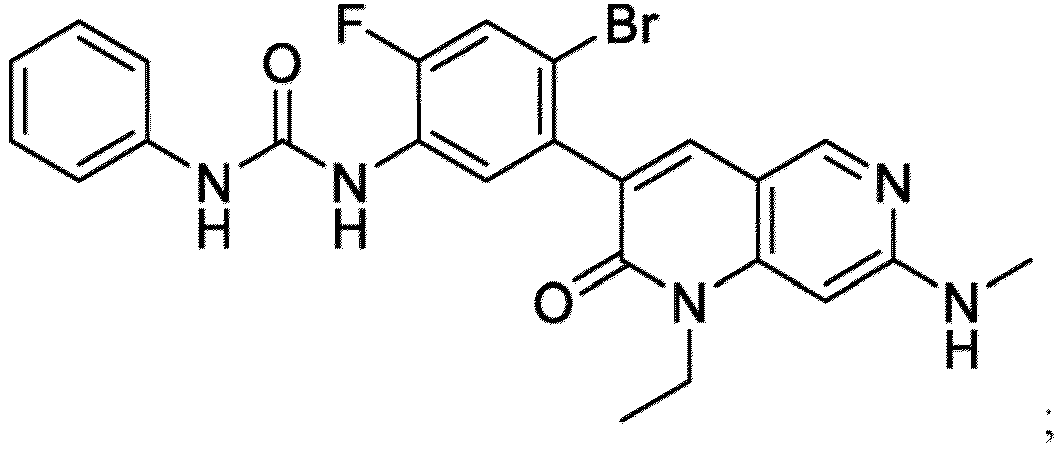
- In an embodiment, provided herein is a pharmaceutical composition comprising: (a) an intragranular blend comprising: (i) a solid dispersion comprising a compound represented by Formula (I), wherein the pharmaceutical composition is comprises one or more anilinic substance, each in an amount equal to or less than 3% by weight based on the weight of the compound of Formula (I), and a pharmaceutically acceptable polymer; (ii) one or more fillers; (iii) a disintegrant; (iv) a glidant; and (v) a lubricant; and (b) an extragranular blend comprising: (i) a glidant; and (ii) a lubricant. In some embodiments, each anilinic substance is present in an amount equal to or less than about 5.0% by weight based on the weight of the compound of Formula (I). In some embodiments, each anilinic substance is present in an amount equal to or less than about 4.0% by weight based on the weight of the compound of Formula (I). In some embodiments, each anilinic substance is present in an amount equal to or less than about 2.0% by weight based on the weight of the compound of Formula (I). In some embodiments, each anilinic substance is present in an amount equal to or less than about 1.0% by weight based on the weight of the compound of Formula (I). In some embodiments, each anilinic substance is present in an amount equal to or less than about 0.7% by weight based on the weight of the compound of Formula (I). In some embodiments, each anilinic substance is present in an amount equal to or less than about 0.5% by weight based on the weight of the compound of Formula (I). In some embodiments, each anilinic substance is present in an amount equal to or less than about 0.3% by weight based on the weight of the compound of Formula (I).
- In an embodiment, the disclosure provides a pharmaceutical composition comprising: (a) an intragranular blend comprising: (i) about 33% by weight of a solid dispersion based on the total weight of the composition, the solid dispersion comprising a compound represented by Formula (I) and hydroxypropyl methyl cellulose acetate succinate, wherein the solid dispersion comprises about 25% by weight of the compound represented by Formula (I) based on the total weight of the solid dispersion; (ii) about 30% by weight of microcrystalline cellulose based on the total amount of the of the composition; (iii) about 30% by weight of lactose monohydrate based on the total amount of the of the composition; (iv) about 5% by weight of crospovidone based on the total amount of the of the composition; (v) about 0.5% by weight of silicon dioxide based on the total amount of the of the composition; and (vi) about 0.5% by weight of magnesium stearate based on the total amount of the of the composition; and (b) an extragranular blend comprising: (i) about 0.5% by weight of silicon dioxide based on the total amount of the of the composition; and (ii) about 0.5% by weight of magnesium stearate based on the total amount of the composition.
- In an embodiment, provided herein is a pharmaceutical composition comprising: (a) an intragranular blend comprising: (i) about 200 mg of a solid dispersion comprising a compound represented by Formula (I), wherein the pharmaceutical composition comprisesone or more anilinic substance, each in an amount equal to or less than 3% by weight based on the weight of the compound of Formula (I) and hydroxypropyl methyl cellulose acetate succinate, wherein the solid dispersion comprises about 50 mg of the compound represented by Formula (I); (ii) about 179 mg of microcrystalline cellulose; (iii) about 179 mg of lactose monohydrate; (iv) about 30 mg of crospovidone; (v) about 3 mg of silicon dioxide; and (vi) about 3 mg of magnesium stearate; and (b) an extragranular blend comprising: (i) about 3 mg of silicon dioxide; and (ii) about 3 mg of magnesium stearate. In some embodiments, each anilinic substance is present in an amount equal to or less than about 5.0% by weight based on the weight of the compound of Formula (I). In some embodiments, each anilinic substance is present in an amount equal to or less than about 4.0% by weight based on the weight of the compound of Formula (I). In some embodiments, each anilinic substance is present in an amount equal to or less than about 2.0% by weight based on the weight of the compound of Formula (I). In some embodiments, each anilinic substance is present in an amount equal to or less than about 1.0% by weight based on the weight of the compound of Formula (I). In some embodiments, each anilinic substance is present in an amount equal to or less than about 0.7% by weight based on the weight of the compound of Formula (I). In some embodiments, each anilinic substance is present in an amount equal to or less than about 0.5% by weight based on the weight of the compound of Formula (I). In some embodiments, each anilinic substance is present in an amount equal to or less than about 0.3% by weight based on the weight of the compound of Formula (I).
- In an embodiment, provided herein is a tablet providing about 50 mg of a compound represented by Formula (I), wherein the tablet comprises one or more anilinic substance impurities, each in an amount equal to or less than 3% by weight based on the weight of the compound of Formula (I), wherein the tablet comprises: (a) an intragranular blend comprising: (i) about 195 mg to about 205 mg of a solid dispersion that comprises about 50 mg of the compound and hydroxypropyl methyl cellulose acetate succinate; (ii) about 177 mg to about 181 mg of microcrystalline cellulose; (iii) about 177 mg to about 181 mg of lactose monohydrate; and (iv) about 28 mg to about 32 mg of crospovidone; and (b) an extragranular blend comprising: (i) about 2 mg to about 4 mg of silicon dioxide; and (ii) about 2 mg to about 4 mg of magnesium stearate. In some embodiments, each anilinic substance is present in an amount equal to or less than about 5.0% by weight based on the weight of the compound of Formula (I). In some embodiments, each anilinic substance is present in an amount equal to or less than about 4.0% by weight based on the weight of the compound of Formula (I). In some embodiments, each anilinic substance is present in an amount equal to or less than about 2.0% by weight based on the weight of the compound of Formula (I). In some embodiments, each anilinic substance is present in an amount equal to or less than about 1.0% by weight based on the weight of the compound of Formula (I). In some embodiments, each anilinic substance is present in an amount equal to or less than about 0.7% by weight based on the weight of the compound of Formula (I). In some embodiments, each anilinic substance is present in an amount equal to or less than about 0.5% by weight based on the weight of the compound of Formula (I). In some embodiments, each anilinic substance is present in an amount equal to or less than about 0.3% by weight based on the weight of the compound of Formula (I).
- Throughout the description, methods of treatment are to be understood as a composition for use in such methods.
- In an embodiment, provided herein are methods for treating a disease caused by the kinase activity of c-KIT or PDGFRA, and oncogenic forms thereof, wherein the disease is gastrointestinal stromal tumors (GIST), KIT driven gastrointestinal stromal tumors, PDGFRA driven gastrointestinal stromal tumors, melanoma (e.g., cutaneous melanoma, noncutaneous melanoma, KIT driven melanoma or PGDFRA driven melanoma), acute myeloid leukemia, germ cell tumors of the seminoma or dysgerminoma, mastocytosis, mast cell leukemia, lung adenocarcinoma, squamous cell lung cancer, glioblastoma, glioma, pediatric glioma, astrocytomas, sarcomas, malignant peripheral nerve sheath sarcoma, intimal sarcomas, hypereosinophilic syndrome, idiopathic hypereosinophilic syndrome, chronic eosinophilic leukemia, eosinophilia-associated acute myeloid leukemia, lymphoblastic T-cell lymphoma, or non-small cell lung cancer. In some embodiments, melanoma is cutaneous melanoma or noncutaneous melanaoma. In some embodiments, melanoma is cutaneous melanoma. In some embodiments, cutaneous melanoma is superficial spreading melanoma, nodular melanoma, acral-lentiginous melanoma, or amelanotic and desmoplastic melanoma. In some embodiments, melanoma is noncutaneous (non-skin) melanoma. In some embodiments, noncutaneous melanoma is ocular melanoma or mucosal melanoma.
- Also provided herein, in another embodiment, is a method of treating a disease selected from the group consisting of gastrointestinal stromal tumors (GIST), NF-1-deficient gastrointestinal stromal tumors, succinate dehydrogenase (SDH)-deficient gastrointestinal stromal tumors, KIT driven gastrointestinal stromal tumors, PDGFRA driven gastrointestinal stromal tumors, melanoma, acute myeloid leukemia, germ cell tumors of the seminoma or dysgerminoma, mastocytosis, mast cell leukemia, lung adenocarcinoma, squamous cell lung cancer, glioblastoma, glioma, pediatric glioma, astrocytomas, sarcomas, malignant peripheral nerve sheath sarcoma, intimal sarcomas, hypereosinophilic syndrome, idiopathic hypereosinophilic syndrome, chronic eosinophilic leukemia, eosinophilia-associated acute myeloid leukemia, lymphoblastic T-cell lymphoma, and non-small cell lung cancer in a patient in need thereof, comprising administering to the patient a therapeutically effective amount of a composition described herein.
- Also provided herein, in another embodiment, is a method of treating a disease selected from the group consisting of gastrointestinal stromal tumors (GIST), KIT driven gastrointestinal stromal tumors, PDGFRA driven gastrointestinal stromal tumors, lung cancer, glioblastoma, a glioma, malignant peripheral nerve sheath sarcoma, and hypereosinophilic syndrome in a patient in need thereof, comprising administering to the patient a therapeutically effective amount of a composition described herein.
- Also provided herein, in another embodiment, is a method of treating a disease selected from the group consisting of KIT driven germ cell tumor (e.g., testicular germ cell), KIT driven skin cancer, or KIT driven renal cell carcinoma in a patient in need thereof, comprising administering to the patient a therapeutically effective amount of a composition described herein.
- Also provided herein, in another embodiment, is a method of treating a disease selected from the group consisting of penile cancer, PDGFRA driven penile cancer, prostate cancer, PDGFRA driven prostate cancer, PDGFRA driven non-melanoma skin cancer, PDGFRA driven glioma, PDGFRA driven sarcoma, PDGFRA driven glioblastoma, or PDGFRA driven pancreatic cancer in a patient in need thereof, comprising administering to the patient a therapeutically effective amount of a composition or one or more tablets described herein.
- Also provided herein, in another embodiment, is a method of treating a disease comprising a PDGFRB mutation selected from the group consisting of vaginal cancer, prostate cancer, penile cancer, non-melanoma skin cancer, melanoma, or breast sarcoma in a patient in need thereof, comprising administering to the patient a therapeutically effective amount of a composition described herein.
- In some embodiments, provided herein is a method for treating diseases driven by KIT mutations or PDGFRA mutations in a patient in need thereof, comprising administering to the patient a therapeutically effective amount of a composition or one or more tablets described herein. In some embodiments, provided herein is a method for treating diseases driven by KIT mutations and PDGFRA mutations in a patient in need thereof, comprising administering to the patient a therapeutically effective amount of a composition or one or more tablets described herein. In some embodiments, provided herein is a method for treating diseases driven by KIT mutations or PDGFRA mutations, comprising passenger PDGFRB mutations in a patient in need thereof, comprising administering to the patient a therapeutically effective amount of a composition or one or more tablets described herein. In some embodiments, provided herein is a method for treating a disease selected from the group consisting of gastrointestinal stromal tumors (GIST), KIT driven gastrointestinal stromal tumors, PDGFRA driven gastrointestinal stromal tumors, melanoma (e.g., KIT driven melanoma or PGDFRA driven melanoma or PGDFR driven melanoma), acute myeloid leukemia, germ cell tumors of the seminoma or dysgerminoma, mastocytosis, mast cell leukemia, lung adenocarcinoma, squamous cell lung cancer, glioblastoma, glioma, pediatric glioma, astrocytomas, sarcomas, malignant peripheral nerve sheath sarcoma, intimal sarcomas, hypereosinophilic syndrome, idiopathic hypereosinophilic syndrome, chronic eosinophilic leukemia, eosinophilia-associated acute myeloid leukemia, lymphoblastic T-cell lymphoma, and non-small cell lung cancer in a patient in need thereof, comprising administering to the patient a therapeutically effective amount of a composition or one or more tablets described herein. In some embodiments, the melanoma is cutaneous melanoma or noncutaneous melanaoma. In some embodiments, the melanoma is cutaneous melanoma. In some embodiments, the cutaneous melanoma is superficial spreading melanoma, nodular melanoma, acral-lentiginous melanoma, or amelanotic and desmoplastic melanoma. In some embodiments, the melanoma is noncutaneous (non-skin) melanoma. In some embodiments, the noncutaneous melanoma is ocular melanoma or mucosal melanoma. In some embodiments, the disease is caused by the kinase activity of c-KIT and/or PDGFRA, and/or oncogenic forms thereof. In some embodiments, the disease is selected from the group consisting of KIT driven germ cell tumor (e.g., testicular germ cell), KIT driven skin cancer (e.g., KIT driven cutaneous squamous cell carcinoma, KIT driven Merkel cell carcinoma, uveal melanoma, non-melanoma skin cancer), or KIT driven renal cell carcinoma (e.g., renal cell carcinoma, chromophobe renal cell carcinoma). In some embodiments, the disease is selected from the group consisting of penile cancer, PDGFRA driven penile cancer, prostate cancer, PDGFRA driven prostate cancer, PDGFRA driven non-melanoma skin cancer, PDGFRA driven glioma, PDGFRA driven sarcoma, PDGFRA driven glioblastoma, or PDGFRA driven pancreatic cancer. In some embodiments, the disease comprising a PDGFRB mutation is selected from the group consisting of vaginal cancer, prostate cancer, penile cancer, non-melanoma skin cancer, melanoma, or breast sarcoma.
- Also provided herein, in another embodiment, is a use of a composition or tablets described herein for the preparation of a medicament for the treatment of a disease selected from the group consisting of gastrointestinal stromal tumors (GIST), KIT driven gastrointestinal stromal tumors, PDGFRA driven gastrointestinal stromal tumors, melanoma, acute myeloid leukemia, germ cell tumors of the seminoma or dysgerminoma, mastocytosis, mast cell leukemia, lung adenocarcinoma, squamous cell lung cancer, glioblastoma, glioma, pediatric glioma, astrocytomas, sarcomas, malignant peripheral nerve sheath sarcoma, intimal sarcomas, hypereosinophilic syndrome, idiopathic hypereosinophilic syndrome, chronic eosinophilic leukemia, eosinophilia-associated acute myeloid leukemia, lymphoblastic T-cell lymphoma, and non-small cell lung cancer.
- In another embodiment, described herein is a process for the preparation of the solid dispersion comprising a compound of Formula (I)


- The features and other details of the disclosure will now be more particularly described. Certain terms employed in the specification, examples and appended claims are collected here. These definitions should be read in light of the remainder of the disclosure and as understood by a person of skill in the art. Unless defined otherwise, all technical and scientific terms used herein have the same meaning as commonly understood by a person of ordinary skill in the art.
- As used herein, the term "excipient" refers to a substance that may be beneficial to include in a composition with an active agent. The term "excipient" includes inert substances as well as functional excipients that may result in beneficial properties of the composition. Exemplary excipients include but are not limited to polymers, glidants, sugars, lubricant, salts, buffers, fats, fillers, disintegrating agents, binders, surfactants, high surface area substrates, flavorants, carriers, matrix materials, and so forth.
- As used herein, the terms "Anilinic impurity A," "Impurity A," and Compound 2 each refer to the compound 3-(5-amino-2-bromo-4-fluorophenyl)-1-ethyl-7-(methylamino)-1,6-naphthyridin-2(1H)-one, the structure of which is the compound of Formula (II):

- As used herein, the terms "Anilinic impurity B," "Impurity B" refer to aniline. In some embodiments, an anilinic substance may be Impurity B.
- As used herein, the terms "Anilinic substances," "anilinic substance impurity," "anilinic substance impurities" are alone or together and may include but are not limited to 3-(5-amino-2-bromo-4-fluorophenyl)-1-ethyl-7-(methylamino)-1,6-naphthyridin-2(1H)-one (compound of Formula (II)) or aniline.
- As used herein, the terms "Anilinic impurities," "anilinic impurity," "anilinic substance impurity," "anilinic substance impurities" are alone or together and may include but are not limited to 3-(5-amino-2-bromo-4-fluorophenyl)-1-ethyl-7-(methylamino)-1,6-naphthyridin-2(1H)-one (compound of Formula (II)) or aniline.
- As used herein, the terms "Individual," "patient," or "subject" are used interchangeably and include any animal, including mammals, preferably mice, rats, other rodents, rabbits, dogs, cats, swine, cattle, sheep, horses, or primates, and most preferably humans. The compounds described herein can be administered to a mammal, such as a human, but can also be administered to other mammals such as an animal in need of veterinary treatment, e.g., domestic animals (e.g., dogs, cats, and the like), farm animals (e.g., cows, sheep, pigs, horses, and the like) and laboratory animals (e.g., rats, mice, guinea pigs, and the like).
- As used herein, the terms "Pharmaceutically acceptable" or "pharmacologically acceptable" includes molecular entities and compositions that do not produce an adverse, allergic or other untoward reaction when administered to an animal, or a human, as appropriate. For human administration, preparations should meet sterility, pyrogenicity, and general safety and purity standards as required by FDA Office of Biologics standards.
- As used herein, the term "pharmaceutically acceptable carrier" or "pharmaceutically acceptable excipient" as used herein refers to any and all solvents, dispersion media, coatings, isotonic and absorption delaying agents, and the like, that are compatible with pharmaceutical administration. The use of such media and agents for pharmaceutically active substances is well known in the art. The compositions may also contain other active compounds providing supplemental, additional, or enhanced therapeutic functions.
- As used herein, the term "pharmaceutical composition" as used herein refers to a composition comprising at least one compound as disclosed herein formulated together with one or more pharmaceutically acceptable carriers, excipients or diluents.
- As used herein, the term "therapeutically effective amount" means the amount of the subject compound that will elicit the biological or medical response of a tissue, system or animal, (e.g., mammal or human) that is being sought by the researcher, veterinarian, medical doctor or other clinician. The compounds described herein are administered in therapeutically effective amounts to treat a disorder.
- As used herein, the term "treating" includes any effect, e.g., lessening, reducing, modulating, or eliminating, that results in the improvement of the condition, disease, disorder and the like.
- As used herein, the term "active agent" means a drug, medicament, pharmaceutical, therapeutic agent, for example, a compound of Formula (I) as described herein.
- As used herein, the term "oral formulation" as used herein, refers to a composition or medium used to administer a compound as disclosed herein (e.g., a compound of Formula (I) to a subject in need thereof by oral administration. Typically, an oral formulation is administered via the mouth, however, "oral formulation" as used herein is intended to cover any substance which is administered to a subject and is absorbed across a membrane, e.g., a mucosal membrane, of the gastrointestinal tract, including, e.g., the mouth, esophagus, stomach, small intestine, large intestine, and colon. In one embodiment, the oral formulation is a solid oral formulation. In one embodiment, the oral formulation is a solid oral formulation administered to a subject in need thereof via the mouth.
- A "combination therapy" is a treatment that includes the administration of two or more therapeutic agents, e.g., a compound of Formula I and a MAPKAP pathway inhibitor, to a patient. The two or more therapeutic agents may be delivered at the same time, e.g., in separate pharmaceutical compositions or in the same pharmaceutical composition, or they may be delivered at different times. For example, they may be delivered concurrently or during overlapping time periods, and/or one therapeutic agent may be delivered before or after the other therapeutic agent(s). Treatment with a combination therapy optionally includes treatment with either single agent, preceded or followed by a period of concurrent treatment with both agents. However, it is contemplated that during some time period, effective amounts of the two or more therapeutic agents are present within the patient.
- All ranges recited herein include the endpoints, including those that recite a range "between" two values. Term "substantially" and "about" is to be construed as modifying a term or value such that it is not an absolute. This includes, at very least, the degree of expected experimental error, technique error and instrument error for a given technique used to measure a value.
- In one aspect, provided herein, is a process of preparing a composition comprising a compound of Formula (I)

- (a) weighing and dispensing the compound of Formula (I), a solvent, polymer and water;
- (b) charging and suspending the compound of Formula (I);
- (c) optionally agitating and mixing the final suspension while maintaining a temperature of about 10-25 °C; and
- (d) passing the resulting suspension through an in-line heat exchanger to dissolve the suspended particles prior to introduction into the spray dryer; and
- (e) optionally drying the spray dried compound of Formula (I).
- (f) In another embodiment, described herein is a process for the preparation of the solid dispersion comprising a compound of Formula (I)


- For purposes described herein, one of ordinary skill in the art would understand that anilinic substances are considered impurities in the compositions, pharmaceutical compositions, and solid dispersions as described herein. The concentration of the impurities in the composition, pharmaceutical composition or solid dispersions described herein depend on the concentration of the compound of Formula (I). For example, the concentration of anilinic substances in the composition, pharmaceutical composition or solid dispersion of the inventions described herein would be expected in some embodiments, each anilinic substance is present in an amount equal to or less than about 5.0% by weight based on the weight of the compound of Formula (I) present in the composition, pharmaceutical composition or solid dispersion as described herein. In some embodiments, each anilinic substance is present in an amount equal to or less than about 4.0% by weight based on the weight of the compound of Formula (I). In some embodiments, each anilinic substance is present in an amount equal to or less than about 2.0% by weight based on the weight of the compound of Formula (I). In some embodiments, each anilinic substance is present in an amount equal to or less than about 1.0% by weight based on the weight of the compound of Formula (I). In some embodiments, each anilinic substance is present in an amount equal to or less than about 0.7% by weight based on the weight of the compound of Formula (I). In some embodiments, each anilinic substance is present in an amount equal to or less than about 0.5% by weight based on the weight of the compound of Formula (I). In some embodiments, each anilinic substance is present in an amount equal to or less than about 0.3% by weight based on the weight of the compound of Formula (I).
- In some embodiments, the compound of Formula (I), solvent, polymer and water are combined, and the mixture is agitated and mixed to a suspension. In some embodiments, the solvent, water and polymer are combined and agitated prior to the addition of the compound of Formula (I). In some embodiments, the solvent and water are combined and agitated prior to the addition of the polymer and the compound of Formula (I). In some embodiments, the solvent and water are combined and agitated followed by addition of the polymer, followed by addition of the compound of Formula (I).
- In some embodiments, the solvent:water ratio may be about 95:5, followed by the addition and dissolution of the polymer. In some embodiments, the solvent water ratio may be about 90:10, followed by the addition and dissolution of the polymer. In some embodiments, the solvent:water ratio may be about 85:15, followed by the addition and dissolution of the polymer. In some embodiments, the solvent water ratio may be about 80:20, followed by the addition and dissolution of the polymer. In some embodiments, the solvent water ratio may be about 75:25, followed by the addition and dissolution of the polymer. In some embodiments, the solvent water ratio may be about 70:30, followed by the addition and dissolution of the polymer. In some embodiments, the solvent water ratio may be about 65:35, followed by the addition and dissolution of the polymer. In some embodiments, the solvent:water ratio may be about 60:40, followed by the addition and dissolution of the polymer. In some embodiments, the solvent water ratio may be about 55:45, followed by the addition and dissolution of the polymer. In some embodiments, the solvent water ratio may be about 50:50, followed by the addition and dissolution of the polymer.
- In some embodiments, the solvent is an organic compound in which the active agent and polymer are mutually soluble. In some embodiments, the solvent is an alcohol, ketone, ether, ester, halogenated alkane, amide, sulfone, acid, or a nitro compound. In some embodiments, the solvent is methanol, ethanol, n-propanol, iso-propanol, or butanol. In some embodiments, the solvent is acetone, methyl ethyl ketone (MEK), or methyl isobutyl ketone (MIBK). In some embodiments, the solvent is methyl acetate, ethyl acetate, or propyl acetate. In some embodiments, the solvent is diethylether, tetrahydrofuran (THF), 2-methyl THF, 2,5-dimethyl THF, or 2,2,5,5-tetramethyl THF. In some embodiments, the solvent is acetonitrile, methylene chloride, toluene, 1,1,1-trichloroethane, dimethyl acetamide (DMA), nitromethane, acetic acid, or dimethylsulfoxide (DMSO). Mixtures of solvent and water are suitable as long as the polymer and the Compound of Formula (I) are sufficiently soluble to make the spray-drying process practicable. In some embodiments, the water: solvent mixture is water:acetone. In some embodiments, the water: solvent mixture is water:THF. In some embodiments, the water: solvent mixture is water:methanol. In some embodiments, the water: solvent mixture is water:ethanol. In some embodiments, the water:solvent mixture is water:methyl ethyl ketone. In some embodiments, the water: solvent mixture is water:ethyl acetate. In some embodiments, the water:solvent mixture is water:methylene chloride. In some embodiments, mixtures of solvents are suitable as long as the polymer and the Compound of Formula (I) are sufficiently soluble to make the spray-drying process practicable. In some embodiments, the solvent: solvent mixture is is methanol: ethyl acetate. In some embodiments, the solvent: solvent mixture ethanol: ethyl acetate. In some embodiments, the solvent solvent mixture is methanol: dichloromethane. In some embodiments, the solvent: solvent mixture ethanol: dichloromethane.
- In some embodiments, the temperature range for the agitating and mixing of the final suspension is about 0-25 °C. In some embodiments, the temperature range for the agitating and mixing of the final suspension is about 5-25 °C. In some embodiments, the temperature range for the agitating and mixing of the final suspension is about 10-25 °C. In some embodiments, the temperature range for the agitating and mixing of the final suspension is about 15-25 °C. In some embodiments, the temperature range for the agitating and mixing of the final suspension is about 15-24 °C. In some embodiments, the temperature range for the agitating and mixing of the final suspension is about 15-23 °C. In some embodiments, the temperature range for the agitating and mixing of the final suspension is about 15-22 °C. In some embodiments, the temperature range for the agitating and mixing of the final suspension is about 15-21 °C. In some embodiments, the temperature range for the agitating and mixing of the final suspension is about 15-20 °C. In some embodiments, the temperature range for the agitating and mixing of the final suspension is about 17-25 °C. In some embodiments, the temperature range for the agitating and mixing of the final suspension is about 17-24 °C. In some embodiments, the temperature range for the agitating and mixing of the final suspension is about 17-23 °C. In some embodiments, the temperature range for the agitating and mixing of the final suspension is about 17-22 °C. In some embodiments, the temperature range for the agitating and mixing of the final suspension is about 17-21 °C. In some embodiments, the temperature range for the agitating and mixing of the final suspension is about 17-20 °C. In some embodiments, the temperature range for the agitating and mixing of the final suspension is about 18-25 °C. In some embodiments, the temperature range for the agitating and mixing of the final suspension is about 18-24 °C. In some embodiments, the temperature range for the agitating and mixing of the final suspension is about 18-23 °C. In some embodiments, the temperature range for the agitating and mixing of the final suspension is about 18-22 °C. In some embodiments, the temperature range for the agitating and mixing of the final suspension is about 18-21 °C. In some embodiments, the temperature range for the agitating and mixing of the final suspension is about 18-20 °C
- In some embodiments, the suspension flow rate through the inline heat exchanger operating range may be at about 5-100 kg/hr. In some embodiments, the suspension flow rate through the inline heat exchanger operating range may be at about 5-30 kg/hr. In some embodiments, the suspension flow rate through the inline heat exchanger operating range may be at about 5-25 kg/hr. In some embodiments, the suspension flow rate through the inline heat exchanger operating range may be at about 5-20 kg/hr. In some embodiments, the suspension flow rate through the inline heat exchanger operating range may be at about 5-15 kg/hr. In some embodiments, the suspension flow rate through the inline heat exchanger operating range may be at about 5-10 kg/hr. In some embodiments, the suspension flow rate through the inline heat exchanger operating range may be at about 30-50 kg/hr. In some embodiments, the suspension flow rate is about 35-45 kg/hr. In some embodiments, the suspension flow rate is about 35-40 kg/hr. In some embodiments, the suspension flow rate is about 40-45 kg/hr. In some embodiments, the suspension flow rate is about 42-48 kg/hr. In some embodiments, the suspension flow rate is about 45-50 kg/hr. In some embodiments, the suspension flow rate through the inline heat exchanger operating range may be at about 50-100 kg/hr. In some embodiments, the suspension flow rate is about 50-90 kg/hr. In some embodiments, the suspension flow rate is about 50-80 kg/hr. In some embodiments, the suspension flow rate is about 50-70 kg/hr. In some embodiments, the suspension flow rate is about 50-60 kg/hr.
- In some embodiments, the solution temperature near or at the nozzle of the spray dryer may be at about 110-130 °C, preferably about 115-125 °C, most preferably about 116 °C, about 117 °C, about 118 °C, about 119 °C, about 120 °C, about 121 °C, about 122 °C, about 123 °C, about 124 °C, about 125 °C. In some embodiments, the solution temperature near or at the nozzle of the spray dryer may be at about 15-25 °C. In some embodiments, the solution temperature near or at the nozzle of the spray dryer may be at about 20-25 °C. In some embodiments, the solution temperature near or at the nozzle of the spray dryer may be at about 10-100 °C. In some embodiments, the solution temperature near or at the nozzle of the spray dryer may be at about 20-90 °C. In some embodiments, the solution temperature near or at the nozzle of the spray dryer may be at about 20-80 °C. In some embodiments, the solution temperature near or at the nozzle of the spray dryer may be at about 20-70 °C. In some embodiments, the solution temperature near or at the nozzle of the spray dryer may be at about 20-60 °C. In some embodiments, the solution temperature near or at the nozzle of the spray dryer may be at about 20-50 °C. In some embodiments, the solution temperature near or at the nozzle of the spray dryer may be at about 20-40 °C. In some embodiments, the solution temperature near or at the nozzle of the spray dryer may be at about 20-30 °C.
- In some embodiments, the spray drying nozzle sheath gas pressure may be at about 50-100 psig. In some embodiments, the spry dryer bulk drying gas flow rate may be about 400-500 kg/hr. In some embodiments, the spray dryer chamber outlet temperature may be about 45-75 °C. In some embodiments, the spray dryer condenser temperature may be about -5 to about -20 °C.
- After completion of the spray drying, the spray dried intermediate undergoes an optional secondary spray drying in an agitated vacuum dryer. In some embodiments, the drying temperature may be at about 30-60 °C, preferably about 35-55 °C, most preferably about 40-50 °C. In some embodiments, the drying duration time may not be less than about 3 hours, preferably not less than about 6 hours, not less than about 7 hours, not less than about 8 hours, not less than about 9 hours. In some embodiments, the chamber pressure may be about 30-60 mbar, preferably about 35-55 mbar, most preferably about 40-50 mbar.
- In some embodiments, the polymer may be ionic. In some embodiments, the polymer may be non-ionic. In some embodiments, the pharmaceutically acceptable polymer is selected from the group consisting of: polyvinyl pyrrolidone, polyethyleneoxide, polyethylene glycol, poly(vinyl pyrrolidone-co-vinyl acetate), polyoxyethylene-polyoxypropylene block copolymers, graft copolymers comprised of polyethylene glycol, polyvinyl caprolactam and polyvinyl acetate, polymethacrylates, polyoxyethylene alkyl ethers, polyoxyethylene castor oils, polycaprolactam, polylactic acid, polyglycolic acid, poly(lactic-glycolic)acid, lipids, cellulose, pullulan, dextran, maltodextrin, hyaluronic acid, polysialic acid, chondroitin sulfate, heparin, fucoidan, pentosan polysulfate, spirulan, hydroxypropyl methyl cellulose acetate succinate, hydroxypropyl methyl cellulose propionate succinate, hydroxypropyl methyl cellulose phthalate, cellulose acetate phthalate, cellulose acetate trimellitate, methyl cellulose acetate phthalate, hydroxypropyl cellulose acetate phthalate, cellulose acetate terephthalate, cellulose acetate isophthalate, carboxymethyl ethylcellulose, hydroxypropyl methylcellulose, hydroxypropyl methylcellulose acetate phthalate, hydroxypropyl methylcellulose propionate phthalate, hydroxypropyl methylcellulose acetate trimellitate, hydroxypropyl methylcellulose propionate trimellitate, cellulose acetate succinate, methyl cellulose acetate succinate, dextran, dextran acetate, dextran propionate, dextran succinate, dextran acetate propionate, dextran acetate succinate, dextran propionate succinate, dextran acetate propionate succinate, poly(methacrylic acid-co-methyl methacrylate) 1:1, poly(methacrylic acid-co-methyl methacrylate) 1:2, poly(methacrylic acid-co-ethyl acrylate) 1: 1, hydroxyethyl cellulose, methyl cellulose and hydroxy propyl cellulose, poly methacrylic acid-ethyl acrylate, poly methacrylic acid-methyl methacrylate, poly methyl methacrylate-ethyl acrylate, poly trimethylammonioethyl methacrylate chloride-methyl methacrylate-ethyl acrylate and poly(butylmethacrylate-co-(2-dimethylaminoethyl)methacrylate-co-methyl methacrylate), and mixtures thereof. In some embodiments, the pharmaceutically acceptable polymer is selected from the group consisting of polyvinyl pyrrolidone, polyethyleneoxide, polyethylene glycol, poly(vinyl pyrrolidone-co-vinyl acetate), polyoxyethylene-polyoxypropylene block copolymers, graft copolymers comprised of polyethylene glycol, polyvinyl caprolactam and polyvinyl acetate, polymethacrylates, polyoxyethylene alkyl ethers, polyoxyethylene castor oils, polycaprolactam, polylactic acid, polyglycolic acid, poly(lactic-glycolic)acid, lipids, cellulose, pullulan, dextran, maltodextrin, hyaluronic acid, polysialic acid, chondroitin sulfate, heparin, fucoidan, pentosan polysulfate, spirulan, hydroxypropyl methyl cellulose acetate succinate, hydroxypropyl methyl cellulose propionate succinate, hydroxypropyl methyl cellulose phthalate, cellulose acetate phthalate, cellulose acetate trimellitate, methyl cellulose acetate phthalate, hydroxypropyl cellulose acetate phthalate, cellulose acetate terephthalate, cellulose acetate isophthalate, carboxymethyl ethylcellulose, hydroxypropyl methylcellulose, hydroxypropyl methylcellulose acetate phthalate, hydroxypropyl methylcellulose propionate phthalate, hydroxypropyl methylcellulose acetate trimellitate, hydroxypropyl methylcellulose propionate trimellitate, cellulose acetate succinate, methyl cellulose acetate succinate, dextran, dextran acetate, dextran propionate, dextran succinate, dextran acetate propionate, dextran acetate succinate, dextran propionate succinate, dextran acetate propionate succinate, poly(methacrylic acid-co-methyl methacrylate) 1:1, poly(methacrylic acid-co-methyl methacrylate) 1:2, poly(methacrylic acid-co-ethyl acrylate) 1: 1, and mixtures thereof. In some embodiments, the polymer is hydroxypropyl methyl cellulose, hydroxypropyl cellulose, carboxymethyl ethyl cellulose, hydroxypropyl methyl cellulose acetate succinate, hydroxypropyl methyl cellulose phthalate, cellulose acetate phthalate, cellulose acetate trimellitate, polyvinyl alcohols that have at least a portion of their repeat units in hydrolyzed form, polyvinyl pyrrolidone, poloxamers, or blends thereof. According to the invention, the pharmaceutically acceptable polymer is hydroxypropyl methyl cellulose acetate succinate.
- In some embodiment, the resulting composition comprising the compound of Formula (I) comprises one or more anilinic substance, each in an amount equal to or less than 3.0% by weight based on the weight of the compound of Formula (I). Other impurities, which may include diphenyl urea are equal to or less than 0.3% by weight based on the weight of Formula (I).
- The purity of the Compound of Formula (I) may be analyzed, generally by methods such as high-performance liquid chromatography (HPLC), gas chromatography (GC) or thin layer chromatography (TLC), to determine whether the impurities are present at levels suitable for pharmaceutical use. Generally, impurities are identified spectroscopically and provide a chromatographic peak on a chromatogram or as a spot on a TLC panel.
- Once a peak position has been associated with a particular impurity, the impurity can be identified in a sample based on its position in the chromatogram, where the position in the chromatogram is measured in minutes between the injection of the sample in a column and elution of the impurity through the detector. The position in the chromatogram is known as the retention time and the ratio between the retention times is known as the relative retention time.
- A relatively pure compound may be used as a reference standard. A reference standard is similar to a reference marker, except that the latter can be used not only for detecting impurities, but also for quantifying the amount of impurities present in the sample.
- In some embodiments, the anilinic impurities each together or separately are present in an amount equal to or less than about 5% by weight based on the weight of the compound of Formula (I). In some embodiments, the anilinic impurities each together or separately are present in an amount equal to or less than about 4% by weight based on the weight of the compound of Formula (I). In some embodiments, the anilinic impurities each together or separately are present in an amount equal to or less than about 3% by weight based on the weight of the compound of Formula (I). In some embodiments, the anilinic impurities each together or separately are present in an amount equal to or less than about 2% by weight based on the weight of the compound of Formula (I). In some embodiments, the anilinic impurities each together or separately are present in an amount equal to or less than about 1% by weight based on the weight of the compound of Formula (I). In some embodiments, the anilinic impurities each together or separately are present in an amount equal to or less than about 0.75% by weight based on the weight of the compound of Formula (I). In some embodiments, the anilinic impurities each together or separately are present in an amount equal to or less than about 1% by weight based on the weight of the compound of Formula (I). In some embodiments, the anilinic impurities each together or separately are present in an amount equal to or less than about 0.75% by weight based on the weight of the compound of Formula (I). In some embodiments, the anilinic impurities each together or separately are present in an amount equal to or less than about 0.70% by weight based on the weight of the compound of Formula (I). In some embodiments, the anilinic impurities each together or separately are present in an amount equal to or less than about 0.65% by weight based on the weight of the compound of Formula (I). In some embodiments, the anilinic impurities each together or separately are present in an amount equal to or less than about 0.60% by weight based on the weight of the compound of Formula (I). In some embodiments, the anilinic impurities each together or separately are present in an amount equal to or less than about 0.55% by weight based on the weight of the compound of Formula (I). In some embodiments, the anilinic impurities each together or separately are present in an amount equal to or less than about 0.50% by weight based on the weight of the compound of Formula (I) . In some embodiments, the anilinic impurities each together or separately are present in an amount equal to or less than about 0.45% by weight based on the weight of the compound of Formula (I). In some embodiments, the anilinic impurities each together or separately are present in an amount equal to or less than about 0.40% by weight based on the weight of the compound of Formula (I). In some embodiments, the anilinic impurities each together or separately are present in an amount equal to or less than about 0.35% by weight based on the weight of the compound of Formula (I). In some embodiments, the anilinic impurities each together or separately are present in an amount equal to or less than about 0.30% by weight based on the weight of the compound of Formula (I). In some embodiments, the anilinic impurities each together or separately are present in an amount equal to or less than about 0.25% by weight based on the weight of the compound of Formula (I). In some embodiments, the anilinic impurities each together or separately are present in an amount equal to or less than about 0.20% by weight based on the weight of the compound of Formula (I). In some embodiments, the anilinic impurities each together or separately are present in an amount equal to or less than about 0.15% by weight based on the weight of the compound of Formula (I). In some embodiments, the anilinic impurities each together or separately are present in an amount equal to or less than about 0.1% by weight based on the weight of the compound of Formula (I). In some embodiments the anilinic impurities are represented by one or more anilinic impurities selected from 3-(5-amino-2-bromo-4-fluorophenyl)-1-ethyl-7-(methylamino)-1,6-naphthyridin-2(1H)-one, aniline, and a combination thereof.
- In some embodiments, the diphenyl urea impurity is present in an amount equal to or less than about 0.30% by weight based on the weight of the compound of Formula (I) which means from about 0.0001% to a maximum of about 0.30%. In some embodiments, the diphenyl urea impurity is present in an amount equal to or less than about 0.20% by weight based on the weight of the compound of Formula (I) which means from about 0.0001% to a maximum of about 0.20%. In some embodiments, the diphenyl urea impurity is present in an amount equal to or less than about 0.10% by weight based on the weight of the compound of Formula (I) which means from about 0.0001% to a maximum of about 0.10%. In some embodiments, the diphenyl urea impurity is present in an amount equal to or less than about 0.075% by weight based on the weight of the compound of Formula (I) which means from about 0.0001% to a maximum of about 0.075%. In some embodiments, the diphenyl urea impurity is present in an amount equal to or less than about 0.05% by weight based on the weight of the compound of Formula (I) which means from about 0.0001% to a maximum of about 0.05%. In some embodiments, the diphenyl urea impurity is present in an amount equal to or less than about 0.04% by weight based on the weight of the compound of Formula (I) which means from about 0.0001% to a maximum of about 0.04%. In some embodiments, the diphenyl urea impurity is present in an amount equal to or less than about 0.03% by weight based on the weight of the compound of Formula (I) which means from about 0.0001% to a maximum of about 0.03%. In some embodiments, the diphenyl urea impurity is present in an amount equal to or less than about 0.02% by weight based on the weight of the compound of Formula (I) which means from about 0.0001% to a maximum of about 0.02%. In some embodiments, the diphenyl urea impurity is present in an amount equal to or less than about 0.01% by weight based on the weight of the compound of Formula (I) which means from about 0.0001% to a maximum of about 0.01%.
- In another general aspect, provided herein is a pharmaceutical composition comprising compound of Formula (I) having purity by HPLC of greater than about 95%. In some embodiments, the purity by HPLC is greater than about 96%. In some embodiments, the purity by HPLC is greater than about 97%. In some embodiments, the purity by HPLC is greater than about 98%. In some embodiments, the purity by HPLC is greater than about 99%. In some embodiments, the purity by HPLC is greater than about 99.5%. In some embodiments, the purity by HPLC is greater than about 99.8%. In some embodiments, the purity by HPLC is greater than about 99.9%. In some embodiments, the purity by HPLC is greater than about 90%. In some embodiments, the purity by HPLC is greater than about 92%. In some embodiments, the purity by HPLC is greater than about 94%.
- Dispersions of the active agent and pharmaceutically acceptable polymer as described herein may be made by a spray-drying process. As used herein, the term "spray-dried dispersion" or "spray-dried powdered dispersion" means a product of a spray-drying process wherein the product comprises a dispersion of at least one active agent and at least one excipient, such as a polymer.
- In the spray-drying process, the active agent and one or more polymers are dissolved in a common solvent. "Common" here means that the solvent, which can be a mixture of compounds, will dissolve both the active agent and the polymer(s). After both active agent and polymer have been dissolved, the solvent is rapidly removed by evaporation in the spray-drying apparatus, resulting in the formation of a substantially homogeneous solid dispersion. In such dispersions, the active agent is dispersed as homogeneously as possible throughout the polymer and can be thought of as a solid solution of active agent dispersed in the polymer(s).
- The solvent is removed by the spray-drying process. The term "spray-drying" is used conventionally and broadly refers to processes involving breaking up liquid mixtures into small droplets (atomization) and rapidly removing solvent from the mixture in a spray-drying apparatus where there is a strong driving force for evaporation of solvent from the droplets. Spray-drying processes and spray-drying equipment are described generally in Perry's Chemical Engineers' Handbook, pages 20-54 to 20-57 (Sixth Edition 1984). More details on spray-drying processes and equipment are reviewed by Marshall, "Atomization and Spray-Drying," 50 Chem. Eng. Prog. Monogr. Series 2 (1954), and Masters, Spray Drying Handbook (Fourth Edition 1985). Further, additional process and spray-drying techniques and equipment are described generally in
US 8.343.550 andUS 7,780,988 . The strong driving force for solvent evaporation is generally provided by maintaining the partial pressure of solvent in the spray-drying apparatus well below the vapor pressure of the solvent at the temperature of the drying droplets. This is accomplished by (1) maintaining the pressure in the spray-drying apparatus at a partial vacuum (e.g., 0.01 to 0.50 atm); or (2) mixing the liquid droplets with a warm drying gas; or (3) both (1) and (2). In addition, a portion of the heat required for evaporation of solvent may be provided by heating the spray solution. - The drying gas may be virtually any gas, but to minimize the risk of fire or explosions due to ignition of flammable vapors, and to minimize undesirable oxidation of the active agent, concentration-enhancing polymer, or other materials in the dispersion, an inert gas such as nitrogen, nitrogen-enriched air, or argon is utilized. The temperature of the drying gas at the gas inlet of apparatus is typically from about 60 °C to about 300 °C. The temperature of the product particles, drying gas, and evaporated solvent at the outlet or distal end of collection cone typically ranges from about 0 °C. to about 100 °C.
- Solvents suitable for spray-drying process can be any organic compound in which the active agent and polymer are mutually soluble. The solvent should have relatively low toxicity and be removed from the dispersion to a level that is acceptable according to The International Committee on Harmonization (ICH) guidelines. Removal of solvent to this level may require a subsequent processing step such as tray-drying or secondary drying. In some embodiments, the solvent is an alcohol, ketone, ether, ester, halogenated alkane, amide, sulfone, acid, or a nitro compound. In some embodiments, the solvent is methanol, ethanol, n-propanol, iso-propanol, or butanol. In some embodiments, the solvent is acetone, methyl ethyl ketone (MEK), or methyl isobutyl ketone (MIBK). In some embodiments, the solvent is methyl acetate, ethyl acetate, or propylacetate. In some embodiments, the solvent is diethylether, tetrahydrofuran (THF), 2-methyl THF, 2,5-dimethyl THF, or 2,2,5,5-tetramethyl THF. In some embodiments, the solvent is acetonitrile, methylene chloride, toluene, 1,1,1-trichloroethane, dimethyl acetamide (DMA), nitromethane, acetic acid, or dimethylsulfoxide (DMSO). Mixtures of solvent and water are suitable as long as the polymer and the compound of Formula (I) are sufficiently soluble to make the spray-drying process practicable. In some embodiments, the water: solvent mixture is water:acetone. In some embodiments, the water: solvent mixture is water:THF. In some embodiments, the water:solvent mixture is water:methanol. In some embodiments, the water:solvent mixture is water:ethanol. In some embodiments, the water:solvent mixture is water:methyl ethyl ketone. In some embodiments, the water: solvent mixture is water:ethyl acetate. In some embodiments, the water:solvent mixture is water:methylene chloride. In some embodiments, mixtures of solvents are suitable as long as the polymer and the Compound of Formula (I) are sufficiently soluble to make the spray-drying process practicable. In some embodiments, the solvent: solvent mixture is methanol:ethylacetate. In some embodiments, the solvent: solvent mixture ethanol: ethyl acetate. In some embodiments, the solvent solvent mixture is methanol: dichloromethane. In some embodiments, the solvent:solvent mixture ethanol: dichloromethane.
- The composition of the solvent-bearing feed will depend on the desired ratio of active agent-to-polymer in the dispersion and the solubility of the active agent and polymer in the solvent. Generally, it is desirable to use as high a combined active agent and polymer concentration in the solvent-bearing feed as possible, provided the active agent and polymer are dissolved in the solvent at the temperature range of the process, to reduce the total amount of solvent that must be removed to form the solid amorphous dispersion. In some embodiments, the solvent-bearing feed has a combined active agent and polymer concentration of at least about 0.01 wt % to at least about 20 wt %. In some embodiments, the solvent-bearing feed has a combined active agent and polymer concentration of at least about 0.01 wt %. In some embodiments, the solvent-bearing feed has a combined active agent and polymer concentration of at least about 0.1 wt %. In some embodiments, the solvent-bearing feed has a combined active agent and polymer concentration of at least about 0.5 wt %. In some embodiments, the solvent-bearing feed has a combined active agent and polymer concentration of at least about 1.0 wt %. In some embodiments, the solvent-bearing feed has a combined active agent and polymer concentration of at least about 2.0 wt %. In some embodiments, the solvent-bearing feed has a combined active agent and polymer concentration of at least about 3.0 wt %. In some embodiments, the solvent-bearing feed has a combined active agent and polymer concentration of at least about 4.0 wt %. In some embodiments, the solvent-bearing feed has a combined active agent and polymer concentration of at least about 5.0 wt %. In some embodiments, the solvent-bearing feed has a combined active agent and polymer concentration of at least about 6.0 wt %. In some embodiments, the solvent-bearing feed has a combined active agent and polymer concentration of at least about 7.0 wt %. In some embodiments, the solvent-bearing feed has a combined active agent and polymer concentration of at least about 8.0 wt %. In some embodiments, the solvent-bearing feed has a combined active agent and polymer concentration of at least about 9.0 wt %. In some embodiments, the solvent-bearing feed has a combined active agent and polymer concentration of at least about 10.0 wt %.
- The average residence time of particles in the drying chamber should be at least 10 seconds, preferably at least 20 seconds. Typically, following solidification, the powder formed stays in the spray-drying chamber for about 5 to 60 seconds, causing further evaporation of solvent. The final solvent content of the solid dispersion as it exits the dryer should be low, since this reduces the mobility of active agent molecules in the dispersion, thereby improving its stability. Generally, the solvent content of the dispersion as it leaves the spray-drying chamber should be less than about 10 wt %. In some embodiments, the solvent content of the dispersion as it leaves the spray-drying chamber is less than about 9 wt%. In some embodiments, the solvent content of the dispersion as it leaves the spray-drying chamber is less than about 8 wt %. In some embodiments, the solvent content of the dispersion as it leaves the spray-drying chamber is less than about 7 wt %. In some embodiments, the solvent content of the dispersion as it leaves the spray-drying chamber is less than about 6 wt %. In some embodiments, the solvent content of the dispersion as it leaves the spray-drying chamber is less than about 5 wt %. In some embodiments, the solvent content of the dispersion as it leaves the spray-drying chamber is less than about 4 wt %. In some embodiments, the solvent content of the dispersion as it leaves the spray-drying chamber is less than about 3 wt %. In some embodiments, the solvent content of the dispersion as it leaves the spray-drying chamber is less than about 2 wt %. In some embodiments, the solvent content of the dispersion as it leaves the spray-drying chamber is less than about 1 wt %. In some embodiments, the acetone content of the dispersion as it leaves the spray-drying chamber is less than about 0.5 wt %. In some embodiments, the acetone content of the dispersion as it leaves the spray-drying chamber is less than about 0.3 wt %. In some embodiments, the acetone content of the dispersion as it leaves the spray-drying chamber is less than about 0.1 wt. A subsequent processing step, such as tray-drying, may be used to remove the solvent to this level.
- Such compositions or pharmaceutical compositions, for example, can be in a form such as a tablet, capsule, pill, powder, liquids, suspensions, emulsions, granules, sustained release formulations, solution, and suspension. The pharmaceutical composition may be in an oral formulation suitable for single administration of precise dosages.
- The compound of Formula (I) as described herein may be formed into a finished dosage form. The finished dosage form comprises one of more of a liquid, solid or semisolid dosage forms depending on the route of administration.
- The excipients employed in the pharmaceutical compositions can impart good powder flow and compression characteristics to the material being compressed. Desirable characteristics of excipients can include high-compressibilities as to allow for strong tablets to be made at low compression forces; good powder flow properties that can improve the powder flow of other excipients in the composition; and cohesiveness, for example to prevent a tablet from crumbling during processing, shipping, and handling. Such properties are imparted to these excipients through pretreatment steps, such as dry granulation (e.g., by roller compaction, slugging), wet granulation, spray drying spheronization (e.g., spray dried dispersion, solid nanodispersions) or crystallization (e.g., salt forms) of a pharmaceutical composition. They may be classified according to the role that they play in the final tablet. Other excipients which give physical characteristics to a finished tablet are coloring and flavoring agents (e.g., in the case of chewable tablets). Examples of excipients are described, for example, in the Handbook of Pharmaceutical Excipients (5th edition), edited by Raymond C. Rowe, Paul J. Sheskey, and Sian C. Owen; Publisher: Pharmaceutical Press.
- As described herein, pharmaceutical compositions can also comprise a pharmaceutically acceptable polymer. The pharmaceutically acceptable polymers may be ionic or non-ionic. Exemplary pharmaceutically acceptable polymers include polyvinyl pyrrolidone, polyethyleneoxide, polyethylene glycol, poly(vinyl pyrrolidone-co-vinyl acetate), polyoxyethylene-polyoxypropylene block copolymers, graft copolymers comprised of polyethylene glycol, polyvinyl caprolactam and polyvinyl acetate, polymethacrylates, polyoxyethylene alkyl ethers, polyoxyethylene castor oils, polycaprolactam, polylactic acid, polyglycolic acid, poly(lactic-glycolic)acid, lipids, cellulose, pullulan, dextran, maltodextrin, hyaluronic acid, polysialic acid, chondroitin sulfate, heparin, fucoidan, pentosan polysulfate, spirulan, hydroxypropyl methyl cellulose acetate succinate, hydroxypropyl methyl cellulose propionate succinate, hydroxypropyl methyl cellulose phthalate, cellulose acetate phthalate, cellulose acetate trimellitate, methyl cellulose acetate phthalate, hydroxypropyl cellulose acetate phthalate, cellulose acetate terephthalate, cellulose acetate isophthalate, carboxymethyl ethylcellulose, hydroxypropyl methylcellulose, hydroxypropyl methylcellulose acetate phthalate, hydroxypropyl methylcellulose propionate phthalate, hydroxypropyl methylcellulose acetate trimellitate, hydroxypropyl methylcellulose propionate trimellitate, cellulose acetate succinate, methyl cellulose acetate succinate, dextran, dextran acetate, dextran propionate, dextran succinate, dextran acetate propionate, dextran acetate succinate, dextran propionate succinate, dextran acetate propionate succinate, poly(methacrylic acid-co-methyl methacrylate) 1:1, poly(methacrylic acid-co-methyl methacrylate) 1:2, poly(methacrylic acid-co-ethyl acrylate) 1: 1, hydroxyethyl cellulose, methyl cellulose and hydroxy propyl cellulose, poly methacrylic acid-ethyl acrylate, poly methacrylic acid-methyl methacrylate, poly methyl methacrylate-ethyl acrylate, poly trimethylammonioethyl methacrylate chloride-methyl methacrylate-ethyl acrylate and poly(butylmethacrylate-co-(2-dimethylaminoethyl)methacrylate-co-methyl methacrylate), or mixtures thereof. In some embodiments, the pharmaceutically acceptable polymers is selected from the group consisting of polyvinyl pyrrolidone, polyethyleneoxide, polyethylene glycol, poly(vinyl pyrrolidone-co-vinyl acetate), polyoxyethylene-polyoxypropylene block copolymers, graft copolymers comprised of polyethylene glycol, polyvinyl caprolactam and polyvinyl acetate, polymethacrylates, polyoxyethylene alkyl ethers, polyoxyethylene castor oils, polycaprolactam, polylactic acid, polyglycolic acid, poly(lactic-glycolic)acid, lipids, cellulose, pullulan, dextran, maltodextrin, hyaluronic acid, polysialic acid, chondroitin sulfate, heparin, fucoidan, pentosan polysulfate, spirulan, hydroxypropyl methyl cellulose acetate succinate, hydroxypropyl methyl cellulose propionate succinate, hydroxypropyl methyl cellulose phthalate, cellulose acetate phthalate, cellulose acetate trimellitate, methyl cellulose acetate phthalate, hydroxypropyl cellulose acetate phthalate, cellulose acetate terephthalate, cellulose acetate isophthalate, carboxymethyl ethylcellulose, hydroxypropyl methylcellulose, hydroxypropyl methylcellulose acetate phthalate, hydroxypropyl methylcellulose propionate phthalate, hydroxypropyl methylcellulose acetate trimellitate, hydroxypropyl methylcellulose propionate trimellitate, cellulose acetate succinate, methyl cellulose acetate succinate, dextran, dextran acetate, dextran propionate, dextran succinate, dextran acetate propionate, dextran acetate succinate, dextran propionate succinate, dextran acetate propionate succinate, poly(methacrylic acid-co-methyl methacrylate) 1:1, poly(methacrylic acid-co-methyl methacrylate) 1:2, poly(methacrylic acid-co-ethyl acrylate) 1: 1, and mixtures thereof. In some embodiments, the pharmaceutically acceptable polymer is hydroxypropyl methyl cellulose acetate succinate.
- The pharmaceutical composition provided herein can contain one or more fillers, which are added, for example, to increase the bulk weight of the blend resulting in a practical size for compression. Fillers that may be used include one or more of calcium salts such as calcium phosphate dibasic and sugars such as lactose, sucrose, dextrose, microcrystalline cellulose, mannitol, and maltodextrin. Examples of pharmaceutically acceptable fillers and pharmaceutically acceptable diluents include, but are not limited to, confectioner's sugar, compressible sugar, dextrates, dextrin, dextrose, lactose, mannitol, microcrystalline cellulose, powdered cellulose, sorbitol, sucrose and talc. In some embodiments, the filler is microcrystalline cellulose, which can be manufactured by the controlled hydrolysis of alpha-cellulose. Suitable microcrystalline cellulose will have an average particle size of from about 20 nm to about 200 nm. Suitable microcrystalline cellulose includes Avicel PH 101, Avicel PH 102, Avicel PH 103, Avicel PH 105 and Avicel PH 200, e.g., manufactured by FMC Corporation. In some embodiments, the filler is lactose.
- The pharmaceutical composition can also include a lubricant. The term "lubricant" as used herein is typically added to prevent the tableting materials from sticking to punches, minimize friction during tablet compression, and to allow for removal of the compressed tablet from the die. Examples of lubricants include, but are not limited to, colloidal silica, magnesium trisilicate, talc, magnesium carbonate, magnesium oxide, glycerylbehaptate, polyethylene glycol, ethylene oxide polymers (e.g., Carowax), sodium lauryl sulfate, magnesium stearate, aluminum stearate, calcium stearate, sodium stearyl fumarate, stearic acid, magnesium lauryl stearate, and mixtures of magnesium stearate with sodium lauryl sulfate. Exemplary lubricants include calcium stearate, magnesium stearate and sodium stearyl fumarate. In some embodiments, the lubricant is magnesium stearate.
- The pharmaceutical composition provided herein can also contain a glidant. The term "glidant" as used herein is a substance added to a powder that can improve its flowability, such as by reducing inter-particle friction. Exemplary glidants include but are not limited to colloidal silicas, colloidal silicon dioxide, fumed silica, CAB-O-SIL® M-5P, AEROSIL®, talc, Syloid®, starch, and magnesium aluminum silicates. In some embodiments, the glidant is silicon dioxide. It should be noted that excipients may serve multiple functions. In some embodiments, the lubricant, for example magnesium stearate, may also function as a glidant.
- A disintegrant may be present in an amount necessary to expedite dissolution (e.g., increase the rate of tablet disintegration). The term "disintegrant" as used herein refers to an excipient which can oppose the physical forces of particle bonding in a tablet or capsule when the oral formulation is placed in an aqueous environment. Disintegrants include starch derivatives and salts of carboxymethylcellulose. Examples of pharmaceutically acceptable disintegrants include, but are not limited to, starches, e.g., sodium starch glycolate, pregelatinized starch; clays; celluloses; alginates; gums; cross-linked polymers, e.g., cross-linked polyvinyl pyrrolidone (e.g., polyplasdoneTM, polyvinyl polypyrrolidone, crospovidone,), cross-linked calcium carboxymethylcellulose and cross-linked sodium carboxymethylcellulose (sodium croscarmellose); and soy polysaccharides. In some embodiments, the disintegrant is crospovidone (e.g, PVP-XL).
- In some embodiments, described herein is a pharmaceutical composition comprising a compound represented by Formula (I) and one or more pharmaceutically acceptable carriers, excipients or diluents, wherein the pharmaceutical composition comprises one or more anilinic substances each in an amount equal to or less than about 3.0% by weight based on the weight of the compound of Formula (I). In some embodiments, the one or more anilinic substances is the compound of Formula (II) and is present in the composition in an amount of less than about 1 % by weight based on the weight of the compound of Formula (I). In some embodiments, the one or more anilinic substances is the compound of Formula (II) and is present in the composition in an amount of less than about 0.1 % by weight to about 0.5% by weight based on the weight of the compound of Formula (I). In some embodiments, the one or more anilinic substances is the compound of Formula (II) and is present in the composition in an amount of less than about 0.01 % by weight to about 0.1% by weight based on the weight of the compound of Formula (I). In some embodiments, the composition comprises less than about 1 % (w/w) of 3-(5-amino-2-bromo-4-fluorophenyl)-1-ethyl-7-(methylamino)-1,6-naphthyridin-2(1H)-one. In some embodiments, the composition comprises about 0.1 % (w/w) to about 0.5% (w/w) of 3-(5-amino-2-bromo-4-fluorophenyl)-1-ethyl-7-(methylamino)-1,6-naphthyridin-2(1H)-one. In some embodiments, the composition comprises about 0.01 % (w/w) to about 0.1% (w/w) of 3-(5-amino-2-bromo-4-fluorophenyl)-1-ethyl-7-(methylamino)-1,6-naphthyridin-2(1H)-one.
- In some embodiments, the composition further comprises less than 10% by weight of a compound represented by Formula (III):

- In some embodiments, the composition further comprises less than 3% by weight of a compound represented by Formula (III):

- In some embodiments, the composition further comprises less than 1% by weight of a compound represented by Formula (III):

- In some embodiments, the composition further comprises less than about 0.1 % by weight to about 0.5% by weight of a compound represented by Formula (III):

- In some embodiments, the composition further comprises about 0.01 % by weight to about 0.1% by weight of a compound represented by Formula (III):
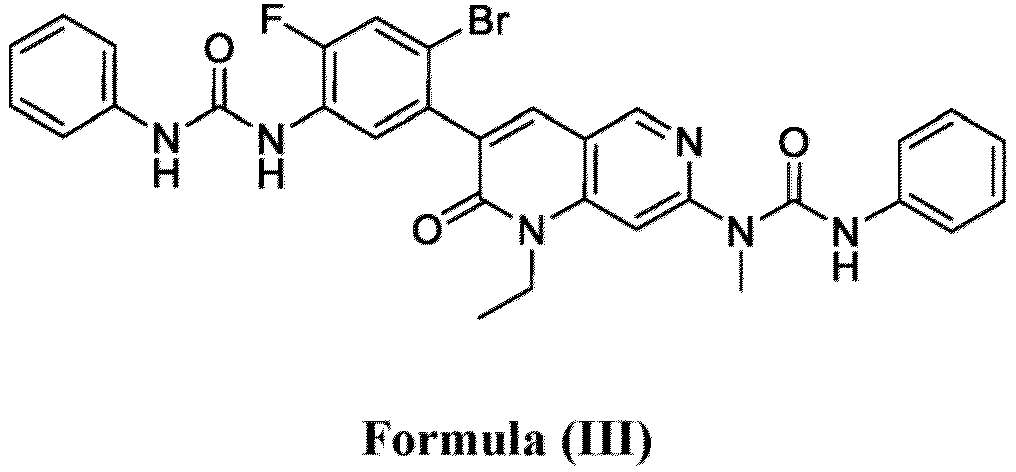
- In some embodiments, described herein is a pharmaceutical composition comprising a compound represented by Formula (I) and one or more pharmaceutically acceptable carriers, excipients or diluents, wherein the pharmaceutical composition comprises less than about 10% by weight of a compound represented by Formula (III) based on the weight of the compound of Formula (I). In some embodiments, described herein is a pharmaceutical composition comprising a compound represented by Formula (I) and one or more pharmaceutically acceptable carriers, excipients or diluents, wherein the pharmaceutical composition comprises less than about 7% by weight of a compound represented by Formula (III) based on the weight of the compound of Formula (I). In some embodiments, described herein is a pharmaceutical composition comprising a compound represented by Formula (I) and one or more pharmaceutically acceptable carriers, excipients or diluents, wherein the pharmaceutical composition comprises less than about 5% by weight of a compound represented by Formula (III) based on the weight of the compound of Formula (I). In some embodiments, described herein is a pharmaceutical composition comprising a compound represented by Formula (I) and one or more pharmaceutically acceptable carriers, excipients or diluents, wherein the pharmaceutical composition comprises less than about 3% by weight of a compound represented by Formula (III) based on the weight of the compound of Formula (I). In some embodiments, described herein is a pharmaceutical composition comprising a compound represented by Formula (I) and one or more pharmaceutically acceptable carriers, excipients or diluents, wherein the pharmaceutical composition comprises less than about 1% by weight of a compound represented by Formula (III) based on the weight of the compound of Formula (I). In some embodiments, described herein is a pharmaceutical composition comprising a compound represented by Formula (I) and one or more pharmaceutically acceptable carriers, excipients or diluents, wherein the pharmaceutical composition comprises less than about 0.1% by weight of a compound represented by Formula (III) based on the weight of the compound of Formula (I). In some embodiments, described herein is a pharmaceutical composition comprising a compound represented by Formula (I) and one or more pharmaceutically acceptable carriers, excipients or diluents, wherein the pharmaceutical composition comprises less than about 0.01% by weight of a compound represented by Formula (III) based on the weight of the compound of Formula (I).
- In another embodiment, described herein is a pharmaceutical composition comprising the compound of Formula (I) and one or more pharmaceutically acceptable carriers, excipients or diluents, wherein the pharmaceutical composition comprises one or more anilinic substances and a compound represented by Formula (III):

- In some embodiments, the composition has equal to or less than about 0.5% by weight one or more anilinic substances based on the weight of the compound of Formula (I). In some embodiments, the composition equal to or less than about 0.3% by weight anilinic substances based on the weight of the compound of Formula (I). In some embodiments, the one or more anilinic substances is selected from the group consisting of a compound represented by Formula (II):


- In some embodiments, described herein is a solid dispersion comprising a compound represented by Formula (I) and one or more pharmaceutically acceptable carriers, excipients or diluents, wherein the solid dispersion comprises one or more anilinic substances each in an amount equal to or less than about 3.0% by weight based on the weight of the compound of Formula (I). In some embodiments, the one or more anilinic substances is the compound of Formula (II) and is present in the composition in an amount of less than about 1 % by weight based on the weight of the compound of Formula (I). In some embodiments, the one or more anilinic substances is the compound of Formula (II) and is present in the composition in an amount of less than about 0.1 % by weight to about 0.5% by weight based on the weight of the compound of Formula (I). In some embodiments, the one or more anilinic substances is the compound of Formula (II) and is present in the composition in an amount of less than about 0.01 % by weight to about 0.1% by weight based on the weight of the compound of Formula (I). In some embodiments, the solid dispersion comprises less than about 1 % (w/w) of 3-(5-amino-2-bromo-4-fluorophenyl)-1-ethyl-7-(methylamino)-1,6-naphthyridin-2(1H)-one (the compound of Formula (II). In some embodiments, the solid dispersion comprises about 0.1 % (w/w) to about 0.5% (w/w) of 3-(5-amino-2-bromo-4-fluorophenyl)-1-ethyl-7-(methylamino)-1,6-naphthyridin-2(1H)-one (the compound of Formula (II). In some embodiments, the solid dispersion comprises about 0.01 % (w/w) to about 0.1% (w/w) of 3-(5-amino-2-bromo-4-fluorophenyl)-1-ethyl-7-(methylamino)-1,6-naphthyridin-2(1H)-one (the compound of Formula (II).
- In some embodiments, the solid dispersion further comprises less than 10% by weight of a compound represented by Formula (III):

- In some embodiments, the solid dispersion further comprises less than 3% by weight of a compound represented by Formula (III):

- In some embodiments, the solid dispersion comprises less than 1% by weight of a compound represented by Formula (III):

- In some embodiments, the solid dispersion comprises less than about 0.1 % by weight to about 0.5% by weight of a compound represented by Formula (III):

- In some embodiments, the solid dispersion comprises about 0.01 % by weight to about 0.1% by weight of a compound represented by Formula (III):

- In some embodiments, described herein is a solid dispersion comprising a polymer and a compound represented by Formula (I) and a pharmaceutically acceptable polymer, wherein the solid dispersion comprises one or more anilinic substance, each in an amount equal to or less than about 0.50% by weight based on the weight of the compound of Formula (I). In some embodiments, the one or more anilinic substances is the compound of Formula (II) and is present in the composition in an amount of less than about 0.1 % based on the weight of the compound of Formula (I). In some embodiments, the one or more anilinic substances is the compound of Formula (II) and is present in the composition in an amount of less than about 0.01 % by weight to about 0.1% by weight based on the weight of the compound of Formula (I). In some embodiments, the solid dispersion comprises about 0.1 % (w/w) to about 0.5% (w/w) of 3-(5-amino-2-bromo-4-fluorophenyl)-1-ethyl-7-(methylamino)-1,6-naphthyridin-2(1H)-one (the compound of Formula (II). In some embodiments, the solid dispersion comprises about 0.01 % (w/w) to about 0.1% (w/w) of 3-(5-amino-2-bromo-4-fluorophenyl)-1-ethyl-7-(methylamino)-1,6-naphthyridin-2(1H)-one (the compound of Formula (II)).
- In some embodiments, the solid dispersion further comprises less than about 0.1 % by weight to about 0.5% by weight of a compound represented by Formula (III):

- In some embodiments, the solid dispersion further comprises about 0.01 % by weight to about 0.1% by weight of a compound represented by Formula (III):

- In some embodiments, the solid dispersion comprises from about 10% to about 50%, or from about 10% to about 30%, or from about 20% to about 30%, by weight of the compound represented by Formula (I) based on the total weight of the solid dispersion. In some embodiments, the pharmaceutical compositions may comprise about 25% by weight of the compound represented by Formula (I) based on the total weight of the solid dispersion.
- The solid dispersion provided herein comprises, a pharmaceutically acceptable polymer selected from the group consisting of polyvinyl pyrrolidone, polyethyleneoxide, polyethylene glycol, poly(vinyl pyrrolidone-co-vinyl acetate), polyoxyethylene-polyoxypropylene block copolymers, graft copolymers comprised of polyethylene glycol, polyvinyl caprolactam and polyvinyl acetate, polymethacrylates, polyoxyethylene alkyl ethers, polyoxyethylene castor oils, polycaprolactam, polylactic acid, polyglycolic acid, poly(lactic-glycolic)acid, lipids, cellulose, pullulan, dextran, maltodextrin, hyaluronic acid, polysialic acid, chondroitin sulfate, heparin, fucoidan, pentosan polysulfate, spirulan, hydroxypropyl methyl cellulose acetate succinate, hydroxypropyl methyl cellulose propionate succinate, hydroxypropyl methyl cellulose phthalate, cellulose acetate phthalate, cellulose acetate trimellitate, methyl cellulose acetate phthalate, hydroxypropyl cellulose acetate phthalate, cellulose acetate terephthalate, cellulose acetate isophthalate, carboxymethyl ethylcellulose, hydroxypropyl methylcellulose, hydroxypropyl methylcellulose acetate phthalate, hydroxypropyl methylcellulose propionate phthalate, hydroxypropyl methylcellulose acetate trimellitate, hydroxypropyl methylcellulose propionate trimellitate, cellulose acetate succinate, methyl cellulose acetate succinate, dextran, dextran acetate, dextran propionate, dextran succinate, dextran acetate propionate, dextran acetate succinate, dextran propionate succinate, dextran acetate propionate succinate, poly(methacrylic acid-co-methyl methacrylate) 1:1, poly(methacrylic acid-co-methyl methacrylate) 1:2, poly(methacrylic acid-co-ethyl acrylate) 1: 1, hydroxyethyl cellulose, methyl cellulose and hydroxy propyl cellulose, poly methacrylic acid-ethyl acrylate, poly methacrylic acid-methyl methacrylate, poly methyl methacrylate-ethyl acrylate, poly trimethylammonioethyl methacrylate chloride-methyl methacrylate-ethyl acrylate and poly(butylmethacrylate-co-(2-dimethylaminoethyl)methacrylate-co-methyl methacrylate), and mixtures thereof. The solid dispersion provided herein comprises, in some embodiments, a pharmaceutically acceptable polymer selected from the group consisting of polyvinyl pyrrolidone, polyethyleneoxide, polyethylene glycol, poly(vinyl pyrrolidone-co-vinyl acetate), polyoxyethylene-polyoxypropylene block copolymers, graft copolymers comprised of polyethylene glycol, polyvinyl caprolactam and polyvinyl acetate, polymethacrylates, polyoxyethylene alkyl ethers, polyoxyethylene castor oils, polycaprolactam, polylactic acid, polyglycolic acid, poly(lactic-glycolic)acid, lipids, cellulose, pullulan, dextran, maltodextrin, hyaluronic acid, polysialic acid, chondroitin sulfate, heparin, fucoidan, pentosan polysulfate, spirulan, hydroxypropyl methyl cellulose acetate succinate, hydroxypropyl methyl cellulose propionate succinate, hydroxypropyl methyl cellulose phthalate, cellulose acetate phthalate, cellulose acetate trimellitate, methyl cellulose acetate phthalate, hydroxypropyl cellulose acetate phthalate, cellulose acetate terephthalate, cellulose acetate isophthalate, carboxymethyl ethylcellulose, hydroxypropyl methylcellulose, hydroxypropyl methylcellulose acetate phthalate, hydroxypropyl methylcellulose propionate phthalate, hydroxypropyl methylcellulose acetate trimellitate, hydroxypropyl methylcellulose propionate trimellitate, cellulose acetate succinate, methyl cellulose acetate succinate, dextran, dextran acetate, dextran propionate, dextran succinate, dextran acetate propionate, dextran acetate succinate, dextran propionate succinate, dextran acetate propionate succinate, poly(methacrylic acid-co-methyl methacrylate) 1:1, poly(methacrylic acid-co-methyl methacrylate) 1:2, poly(methacrylic acid-co-ethyl acrylate) 1:1, and mixtures thereof. According to the invention, the pharmaceutically acceptable polymer in the formulation provided herein is hydroxypropyl methyl cellulose acetate succinate.
- In some embodiments, the solid dispersion comprises the compound represented by Formula (I) and the pharmaceutically acceptable polymer in a ratio from about 40:60 to about 10:90 or from about 30:70 to about 20:80. In some embodiments, the compound represented by Formula (I) and the pharmaceutically acceptable polymer may be in a ratio of about 25:75.
- Also provided herein is a pharmaceutical composition comprising: (a) an intragranular blend comprising: (i) a solid spray-dried dispersion comprising a compound represented by Formula (I), and a pharmaceutically acceptable polymer; (ii) one or more fillers; (iii) a disintegrant; (iv) a glidant; and (v) a lubricant; and (b) an extragranular blend comprising: (i) a glidant; and (ii) a lubricant.
- In some embodiments, the blend of the internal and extragranular blends is in a ratio of from about 90:10 to about 99.5:0.5. For example, the blend of the internal and extragranular blends may be in a ratio of about 99: 1.
- In some embodiments, the solid dispersion of the intragranular blend comprises from about 10% to about 50%, or from about 10% to about 30%, or from about 20% to about 30% by weight of the compound represented by Formula (I) based on the total weight of the solid spray-dried dispersion. In some embodiments, the solid spray-dried dispersion may comprise about 25% by weight of the compound represented by Formula (I) based on the total weight of the solid spray-dried dispersion.
- In some embodiments, the pharmaceutical composition comprises a pharmaceutically acceptable polymer selected from the group consisting of polyvinyl pyrrolidone, polyethyleneoxide, polyethylene glycol, poly(vinyl pyrrolidone-co-vinyl acetate), polyoxyethylene-polyoxypropylene block copolymers, graft copolymers comprised of polyethylene glycol, polyvinyl caprolactam and polyvinyl acetate, polymethacrylates, polyoxyethylene alkyl ethers, polyoxyethylene castor oils, polycaprolactam, polylactic acid, polyglycolic acid, poly(lactic-glycolic)acid, lipids, cellulose, pullulan, dextran, maltodextrin, hyaluronic acid, polysialic acid, chondroitin sulfate, heparin, fucoidan, pentosan polysulfate, spirulan, hydroxypropyl methyl cellulose acetate succinate, hydroxypropyl methyl cellulose propionate succinate, hydroxypropyl methyl cellulose phthalate, cellulose acetate phthalate, cellulose acetate trimellitate, methyl cellulose acetate phthalate, hydroxypropyl cellulose acetate phthalate, cellulose acetate terephthalate, cellulose acetate isophthalate, carboxymethyl ethylcellulose, hydroxypropyl methylcellulose, hydroxypropyl methylcellulose acetate phthalate, hydroxypropyl methylcellulose propionate phthalate, hydroxypropyl methylcellulose acetate trimellitate, hydroxypropyl methylcellulose propionate trimellitate, cellulose acetate succinate, methyl cellulose acetate succinate, dextran, dextran acetate, dextran propionate, dextran succinate, dextran acetate propionate, dextran acetate succinate, dextran propionate succinate, dextran acetate propionate succinate, poly(methacrylic acid-co-methyl methacrylate) 1:1, poly(methacrylic acid-co-methyl methacrylate) 1:2, poly(methacrylic acid-co-ethyl acrylate) 1: 1, hydroxyethyl cellulose, methyl cellulose and hydroxy propyl cellulose, poly methacrylic acid-ethyl acrylate, poly methacrylic acid-methyl methacrylate, poly methyl methacrylate-ethyl acrylate, poly trimethylammonioethyl methacrylate chloride-methyl methacrylate-ethyl acrylate and poly(butylmethacrylate-co-(2-dimethylaminoethyl)methacrylate-co-methyl methacrylate), and mixtures thereof. In some embodiments, the pharmaceutical composition comprises a pharmaceutically acceptable polymer selected from the group consisting of polyvinyl pyrrolidone, polyethyleneoxide, polyethylene glycol, poly(vinyl pyrrolidone-co-vinyl acetate), polyoxyethylene-polyoxypropylene block copolymers, graft copolymers comprised of polyethylene glycol, polyvinyl caprolactam and polyvinyl acetate, polymethacrylates, polyoxyethylene alkyl ethers, polyoxyethylene castor oils, polycaprolactam, polylactic acid, polyglycolic acid, poly(lactic-glycolic)acid, lipids, cellulose, pullulan, dextran, maltodextrin, hyaluronic acid, polysialic acid, chondroitin sulfate, heparin, fucoidan, pentosan polysulfate, spirulan, hydroxypropyl methyl cellulose acetate succinate, hydroxypropyl methyl cellulose propionate succinate, hydroxypropyl methyl cellulose phthalate, cellulose acetate phthalate, cellulose acetate trimellitate, methyl cellulose acetate phthalate, hydroxypropyl cellulose acetate phthalate, cellulose acetate terephthalate, cellulose acetate isophthalate, carboxymethyl ethylcellulose, hydroxypropyl methylcellulose, hydroxypropyl methylcellulose acetate phthalate, hydroxypropyl methylcellulose propionate phthalate, hydroxypropyl methylcellulose acetate trimellitate, hydroxypropyl methylcellulose propionate trimellitate, cellulose acetate succinate, methyl cellulose acetate succinate, dextran, dextran acetate, dextran propionate, dextran succinate, dextran acetate propionate, dextran acetate succinate, dextran propionate succinate, dextran acetate propionate succinate, poly(methacrylic acid-co-methyl methacrylate) 1:1, poly(methacrylic acid-co-methyl methacrylate) 1:2, poly(methacrylic acid-co-ethyl acrylate) 1:1, and mixtures thereof. For example, the pharmaceutically acceptable polymer is hydroxypropyl methyl cellulose acetate succinate.
- In some embodiments, the pharmaceutical composition comprises the compound represented by Formula (I) and the pharmaceutically acceptable polymer in a ratio from about 40:60 to about 10:90, or from about 30:70 to about 20:80. In some embodiments, the compound represented by Formula (I) and the pharmaceutically acceptable polymer may be in a ratio of about 25:75.
- In some embodiments, the intragranular blend of the pharmaceutical composition comprises one or more fillers, wherein the total amount of the one or more fillers is from about 40% to about 80% by weight based on the total weight of the pharmaceutical composition. One or more fillers are lactose, maltodextrin, mannitol, microcrystalline cellulose, pregelatinized starch, sucrose esters, or hydrates thereof. In some embodiments, the intragranular blend comprises two fillers. When the intragranular blend comprises two fillers, each filler may independently be present in an amount from about 20% to about 40%, e.g., about 33%, by weight based on the total weight of the pharmaceutical composition. In some embodiments, one filler may be microcrystalline cellulose and the other filler may be lactose monohydrate.
- In some embodiments, the intragranular blend of the pharmaceutical composition comprises from about 1% to about 10% by weight, e.g., about 5%, of the disintegrant based on the total weight of the pharmaceutical composition. The disintegrant is crospovidone, croscarmellose sodium, sodium starch glycolate, microcrystalline cellulose, or pregelatinized starch. In some embodiments, the disintegrant in the intragranular blend may be crospovidone.
- In some embodiments, the glidant of the intragranular blend is present in an amount from about 0.1% to about 1%, e.g., about 0.5%, based on the total weight of the pharmaceutical composition. For example, the glidant of the intragranular blend may be silicon dioxide.
- In some embodiments, the glidant of the extragranular blend is present in an amount from about 0.1% to about 1%, e.g., about 0.5%, based on the total weight of the pharmaceutical composition. In some embodiments, the glidant of the extragranular blend may be silicon dioxide.
- In some embodiments, the lubricant of the intragranular blend is present in an amount from about 0.1% to about 1%, e.g., about 0.5%, based on the total weight of the pharmaceutical composition. In some embodiments, the lubricant of the intragranular blend is magnesium stearate, calcium stearate, glyceryl monostearate, hydrogenated castor oil, sodium lauryl sulfate, sodium stearyl fumarate, stearic acid, zinc stearate, talc, microcrystalline cellulose, or sucrose esters. For example, the lubricant of the intragranular blend may be magnesium stearate.
- In some embodiments, the lubricant of the extragranular blend is present in an amount from about 0.1% to about 1%, e.g., about 0.5%, based on the total weight of the pharmaceutical composition. In some embodiments, the lubricant of the extragranular blend is magnesium stearate, calcium stearate, glyceryl monostearate, hydrogenated castor oil, sodium lauryl sulfate, sodium stearyl fumarate, stearic acid, zinc stearate, talc, microcrystalline cellulose, or sucrose esters. As an example, the lubricant of the extragranular blend may be magnesium stearate.
- In some embodiments, the composition comprises less than or equal to about 10 % by weight of one or more anilinic substances based on the weight of the compound of Formula (I). In some embodiments, the composition comprises less than or equal to about 7 % by weight of one or more anilinic substances based on the weight of the compound of Formula (I). In some embodiments, the composition comprises less than or equal to about 5 % by weight of one or more anilinic substances based on the weight of the compound of Formula (I). In some embodiments, the composition comprises less than or equal to about 3 % by weight of one or more anilinic substances based on the weight of the compound of Formula (I). In some embodiments, the composition comprises less than about 10 % by weight of 3-(5-amino-2-bromo-4-fluorophenyl)-1-ethyl-7-(methylamino)-1,6-naphthyridin-2(1H)-one (the compound of Formula (II)) based on the weight of the compound of Formula (I). In some embodiments, the composition comprises less than about 7 % by weight of 3-(5-amino-2-bromo-4-fluorophenyl)-1-ethyl-7-(methylamino)-1,6-naphthyridin-2(1H)-one (the compound of Formula (II)) based on the weight of the compound of Formula (I). In some embodiments, the composition comprises less than about 5 % by weight of 3-(5-amino-2-bromo-4-fluorophenyl)-1 -ethyl-7-(methylamino)-1,6-naphthyridin-2(1H)-one (the compound of Formula (II)) based on the weight of the compound of Formula (I). In some embodiments, the composition comprises less than about 3 % by weight of 3-(5-amino-2-bromo-4-fluorophenyl)-1-ethyl-7-(methylamino)-1,6-naphthyridin-2(1H)-one (the compound of Formula (II)) based on the weight of the compound of Formula (I). In some embodiments, the composition comprises less than about 2 % by weight of 3-(5-amino-2-bromo-4-fluorophenyl)-1-ethyl-7-(methylamino)-1,6-naphthyridin-2(1H)-one (the compound of Formula (II)) based on the weight of the compound of Formula (I). In some embodiments, the composition comprises less than about 1 % by weight of 3-(5-amino-2-bromo-4-fluorophenyl)-1-ethyl-7-(methylamino)-1,6-naphthyridin-2(1H)-one (the compound of Formula (II)) based on the weight of the compound of Formula (I). In some embodiments, the composition comprises about 0.1 % by weight to about 0.5% by weight of 3-(5-amino-2-bromo-4-fluorophenyl)-1 -ethyl-7-(methylamino)-1,6-naphthyridin-2(1H)-one (the compound of Formula (II)) based on the weight of the compound of Formula (I). In some embodiments, the composition comprises about 0.01 % by weight to about 0.1% by weight of 3-(5-amino-2-bromo-4-fluorophenyl)-1 -ethyl-7-(methylamino)-1,6-naphthyridin-2(1H)-one (the compound of Formula (II) based on the weight of the compound of Formula (I).
- In some embodiments, the composition comprises less than 10% by weight of a compound represented by Formula (III):

- In some embodiments, the composition comprises less than 7% by weight of a compound represented by Formula (III):

- In some embodiments, the composition comprises less than 5% by weight of a compound represented by Formula (III):

- In some embodiments, the composition comprises less than 3% by weight of a compound represented by Formula (III):

- In some embodiments, the composition comprises less than 1% by weight of a compound represented by Formula (III):

- In some embodiments, the composition comprises less than about 0.1 % by weight to about 0.5% by weight of a compound represented by Formula (III):

- In some embodiments, the composition comprises about 0.01 % by weight to about 0.1% by weight of a compound represented by Formula (III):

- In some embodiments, provided herein is a pharmaceutical composition comprising: (a) an intragranular blend comprising: (i) about 33% by weight of a solid spray-dried dispersion based on the total weight of the pharmaceutical composition, the solid spray-dried dispersion comprising a compound represented by Formula (I) having a purity by HPLC of greater than 95% and hydroxypropyl methyl cellulose acetate succinate, wherein the solid spray-dried dispersion comprises about 25% by weight of the compound represented by Formula (I) based on the total weight of the solid spray-dried dispersion; (ii) about 30% by weight of microcrystalline cellulose based on the total amount of the of the pharmaceutical composition; (iii) about 30% by weight of lactose monohydrate based on the total amount of the of the pharmaceutical composition; (iv) about 5% by weight of crospovidone based on the total amount of the of the pharmaceutical composition; (v) about 0.5% by weight of silicon dioxide based on the total amount of the of the pharmaceutical composition; and (vi) about 0.5% by weight of magnesium stearate based on the total amount of the of the pharmaceutical composition; and (b) an extragranular blend comprising: (i) about 0.5% by weight of silicon dioxide based on the total amount of the of the pharmaceutical composition; and (ii) about 0.5% by weight of magnesium stearate based on the total amount of the of the pharmaceutical composition.
- In some embodiments, provided herein is a pharmaceutical composition comprising: (a) an intragranular blend comprising: (i) about 200 mg of a solid spray-dried dispersion comprising a compound represented by Formula (I) and hydroxypropyl methyl cellulose acetate succinate, wherein the solid spray-dried dispersion comprises about 50 mg of the compound represented by Formula (I); (ii) about 179 mg of microcrystalline cellulose; (iii) about 179 mg of lactose monohydrate; (iv) about 30 mg of crospovidone; (v) about 3 mg of silicon dioxide; and (vi) about 3 mg of magnesium stearate; and (b) an extragranular blend comprising: (i) about 3 mg of silicon dioxide; and (ii) about 3 mg of magnesium stearate.
- Described herein, in an embodiment, is a pharmaceutical composition comprising: a) a solid dispersion comprising: a compound represented by Formula (I) or pharmaceutically acceptable salt thereof,

- In some embodiments, the anilinic substance is present in amount equal to or less than about 0.5% by weight based on the total weight of the compound of Formula (I) present in the composition.
- In some embodiments, the anilinic substance is present in an amount equal to or less than about 0.3% by weight based on the total weight of the compound of Formula (I) present in the composition.
- In some embodiments, the anilinic substance is one of: the compound of Formula (II)

- In some embodiments, the compound is present in the solid dispersion as a free base in substantially amorphous form.
- Described herein, in an embodiment, pharmaceutical composition comprising: a) a solid dispersion comprising: an amorphous form of a compound represented by Formula (I)


- Described herein, in an embodiment, is a pharmaceutical composition comprising: a) a solid dispersion comprising: an amorphous form of a compound represented by Formula (I)

- Described herein, in an embodiment, is a pharmaceutically acceptable composition for a 50 mg single dosage unit of a compound represented by:

- Described herein, in an embodiment, is a pharmaceutically acceptable composition for orally delivering to a patient 50 mg of a compound represented by:
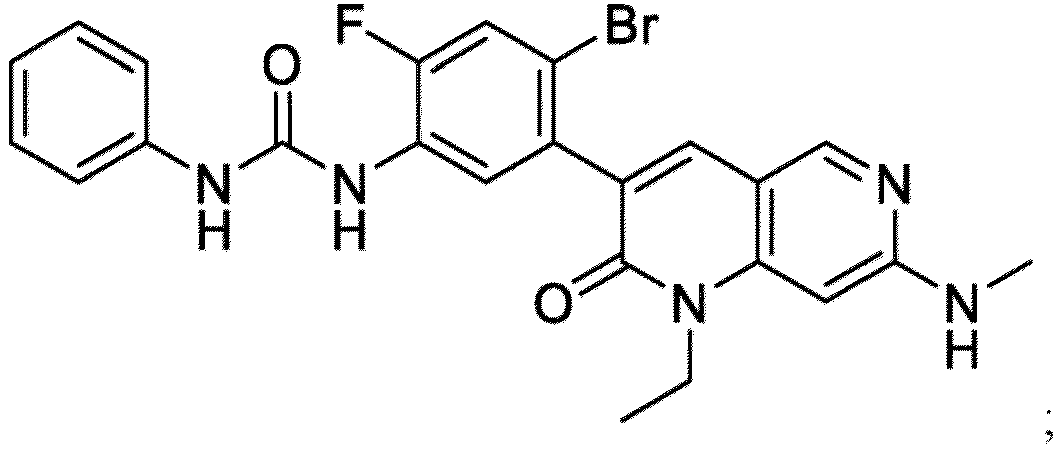
- Described herein, in an embodiment, is a pharmaceutically acceptable composition for orally delivering 50 mg of a compound represented by:

a solid dispersion having 50 mg of the compound wherein the compound is present in amorphous form, and a polymer; about 25-45% by weight of a bulking agent based on the total amount of the pharmaceutical composition; about 25-45% by weight of a filler based on the total amount of the pharmaceutical composition; and a glidant and/or a lubricant; wherein the composition has not more than about 1.5% (w/w) of 3-(5-amino-2-bromo-4-fluorophenyl)-1-ethyl-7-(methylamino)-1,6-naphthyridin-2(1H)-one, when exposed to 60% relative humidity at 25 °C for 1 month, 3 months or 6 months. - In some embodiments, the polymer is hydroxypropyl methyl cellulose acetate succinate.
- In some embodiments, the bulking agent is microcrystalline cellulose.
- In some embodiments, the filler is lactose or a hydrate thereof.
- In some embodiments, the composition is in the form of a tablet.
- In some embodiments, the composition comprises less than 10% by weight of a compound represented by Formula (III):

- In some embodiments, the composition comprises less than 7% by weight of a compound represented by Formula (III):

- In some embodiments, the composition comprises less than 5% by weight of a compound represented by Formula (III):

- In some embodiments, the composition comprises less than 3% by weight of a compound represented by Formula (III):

- In some embodiments, the composition comprises less than 1% by weight of a compound represented by Formula (III):

- In some embodiments, the composition comprises less than about 0.1 % by weight to about 0.5% by weight of a compound represented by Formula (III):

- In some embodiments, the composition comprises about 0.01 % by weight to about 0.1% by weight of a compound represented by Formula (III):

- The pharmaceutical compositions may also be provided as tablets. Tablets may be uncoated, film, or sugar coated bisected, embossed, plain, layered, or sustained-release. They can be made in a variety of sizes, shapes, and colors. Tablets may be swallowed, chewed, or dissolved in the buccal cavity or beneath the tongue.
- In some embodiments, provided herein is a tablet providing about 50 mg of a compound represented by Formula (I), wherein the tablet comprises: (a) an intragranular blend comprising: (i) about 195 mg to about 205 mg of a solid spray-dried dispersion that comprises about 50 mg of the compound and hydroxypropyl methyl cellulose acetate succinate; (ii) about 177 mg to about 181 mg of microcrystalline cellulose; (iii) about 177 mg to about 181 mg of lactose monohydrate; and (iv) about 28 mg to about 32 mg of crospovidone; and (b) an extragranular blend comprising: (i) about 2 mg to about 4 mg of silicon dioxide; and (ii) about 2 mg to about 4 mg of magnesium stearate.
- Described herein, in an embodiment, is a pharmaceutically acceptable tablet having 50 mg of a compound represented by:

- In some embodiments, the tablet comprises less than or equal to about 10 % by weight of one or more anilinic substances based on the weight of the compound of Formula (I). In some embodiments, the tablet comprises less than or equal to about 7 % by weight of one or more anilinic substances based on the weight of the compound of Formula (I). In some embodiments, the tablet comprises less than or equal to about 5 % by weight of one or more anilinic substances based on the weight of the compound of Formula (I). In some embodiments, the tablet comprises less than or equal to about 3 % by weight of one or more anilinic substances based on the weight of the compound of Formula (I). In some embodiments, the tablet comprises less than about 10 % by weight of 3-(5-amino-2-bromo-4-fluorophenyl)-1-ethyl-7-(methylamino)-1,6-naphthyridin-2(1H)-one (the compound of Formula (II)) based on the weight of the compound of Formula (I). In some embodiments, the tablet comprises less than about 7 % by weight of 3-(5-amino-2-bromo-4-fluorophenyl)-1-ethyl-7-(methylamino)-1,6-naphthyridin-2(1H)-one (the compound of Formula (II)) based on the weight of the compound of Formula (I). In some embodiments, the tablet comprises less than about 5 % by weight of 3-(5-amino-2-bromo-4-fluorophenyl)-1-ethyl-7-(methylamino)-1,6-naphthyridin-2(1H)-one (the compound of Formula (II)) based on the weight of the compound of Formula (I). In some embodiments, the tablet comprises less than about 3 % by weight of 3-(5-amino-2-bromo-4-fluorophenyl)-1-ethyl-7-(methylamino)-1,6-naphthyridin-2(1H)-one (the compound of Formula (II)) based on the weight of the compound of Formula (I). In some embodiments, the tablet comprises less than about 2 % by weight of 3-(5-amino-2-bromo-4-fluorophenyl)-1 -ethyl-7-(methyl amino)-1,6-naphthyridin-2(1H)-one (the compound of Formula (II)) based on the weight of the compound of Formula (I). In some embodiments, the tablet comprises less than about 1 % by weight of 3-(5-amino-2-bromo-4-fluorophenyl)-1-ethyl-7-(methylamino)-1,6-naphthyridin-2(1H)-one (the compound of Formula (II)) based on the weight of the compound of Formula (I). In some embodiments, the tablet comprises about 0.1 % by weight to about 0.5% by weight of 3-(5-amino-2-bromo-4-fluorophenyl)-1-ethyl-7-(methylamino)-1,6-naphthyridin-2(1H)-one (the compound of Formula (II)) based on the weight of the compound of Formula (I). In some embodiments, the tablet comprises about 0.01 % by weight to about 0.1% by weight of 3-(5-amino-2-bromo-4-fluorophenyl)-1-ethyl-7-(methylamino)-1,6-naphthyridin-2(1H)-one (the compound of Formula (II) based on the weight of the compound of Formula (I).
- In some embodiments, the tablet comprises less than 10% by weight of a compound represented by Formula (III):

- In some embodiments, the tablet comprises less than 7% by weight of a compound represented by Formula (III):

- In some embodiments, the tablet comprises less than 5% by weight of a compound represented by Formula (III):

- In some embodiments, the tablet comprises less than 3% by weight of a compound represented by Formula (III):
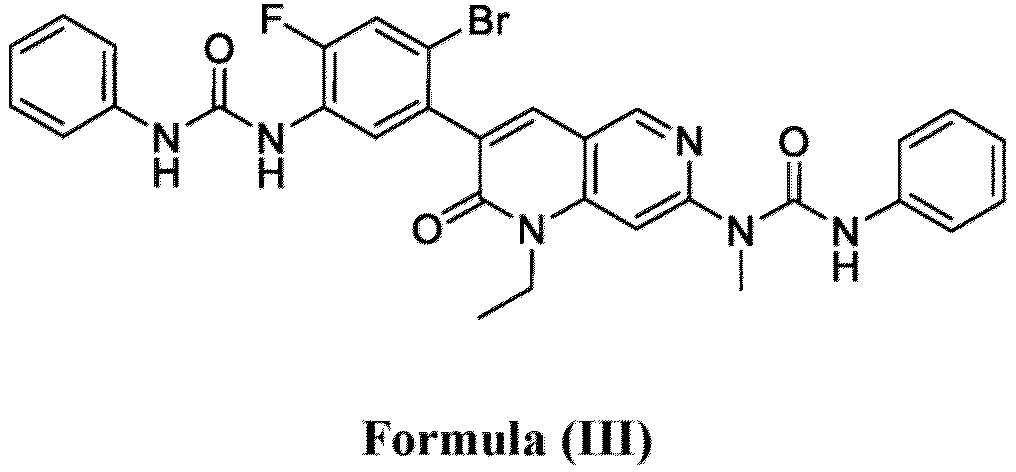
- In some embodiments, the tablet comprises less than 1% by weight of a compound represented by Formula (III):

- In some embodiments, the tablet comprises less than about 0.1 % by weight to about 0.5% by weight of a compound represented by Formula (III):

- In some embodiments, the tablet comprises about 0.01 % by weight to about 0.1% by weight of a compound represented by Formula (III):

- A pharmaceutical composition comprising a compound of Formula (I) and one or more pharmaceutically acceptable carriers, excipients or diluents, wherein the pharmaceutical composition comprises one or more anilinic substances each present in an amount equal to or less than about 3.0% by weight based on the weight of the compound of Formula (I) as described herein is a broad-spectrum inhibitor of c-KIT.
- Disorders that can be treated be the compound of Formula (I) include, but are not limited to: gastrointestinal stromal tumors (GIST), NF-1-deficient gastrointestinal stromal tumors, succinate dehydrogenase (SDH)-deficient gastrointestinal stromal tumors, KIT driven gastrointestinal stromal tumors, PDGFRA driven gastrointestinal stromal tumors, melanoma, acute myeloid leukemia, germ cell tumors of the seminoma or dysgerminoma, mastocytosis, mast cell leukemia, lung adenocarcinoma, squamous cell lung cancer, glioblastoma, glioma, pediatric glioma, astrocytomas, sarcomas, malignant peripheral nerve sheath sarcoma, intimal sarcomas, hypereosinophilic syndrome, idiopathic hypereosinophilic syndrome, chronic eosinophilic leukemia, eosinophilia-associated acute myeloid leukemia, lymphoblastic T-cell lymphoma, non-small cell lung cancer, lung cancer, glioblastoma, a glioma, malignant peripheral nerve sheath sarcoma, hypereosinophilic syndrome, KIT driven germ cell tumor (e.g., testicular germ cell), KIT driven skin cancer, KIT driven renal cell carcinoma, penile cancer, PDGFRA driven penile cancer, prostate cancer, PDGFRA driven prostate cancer, PDGFRA driven non-melanoma skin cancer, PDGFRA driven glioma, PDGFRA driven sarcoma, PDGFRA driven glioblastoma, PDGFRA driven pancreatic cancer, or a disease vaginal cancer, prostate cancer, penile cancer, non-melanoma skin cancer, melanoma, or breast sarcoma (e.g., a vaginal cancer, prostate cancer, penile cancer, non-melanoma skin cancer, melanoma, or breast sarcoma comprising a PDGFRB mutation).
- Accordingly, provided herein, in another embodiment, is a method of treating a disease selected from the group consisting of gastrointestinal stromal tumors (GIST), KIT driven gastrointestinal stromal tumors, PDGFRA driven gastrointestinal stromal tumors, melanoma, acute myeloid leukemia, germ cell tumors of the seminoma or dysgerminoma, mastocytosis, mast cell leukemia, lung adenocarcinoma, squamous cell lung cancer, glioblastoma, glioma, pediatric glioma, astrocytomas, sarcomas, malignant peripheral nerve sheath sarcoma, intimal sarcomas, hypereosinophilic syndrome, idiopathic hypereosinophilic syndrome, chronic eosinophilic leukemia, eosinophilia-associated acute myeloid leukemia, lymphoblastic T-cell lymphoma, and non-small cell lung cancer in a patient in need thereof, comprising administering to the patient a therapeutically effective amount of a composition described herein.
- Also provided herein, in another embodiment, is a method of treating a disease selected from the group consisting of gastrointestinal stromal tumors (GIST), KIT driven gastrointestinal stromal tumors, PDGFRA driven gastrointestinal stromal tumors, lung cancer, glioblastoma, a glioma, malignant peripheral nerve sheath sarcoma, and hypereosinophilic syndrome in a patient in need thereof, comprising administering to the patient a therapeutically effective amount of a composition described herein. In some embodiments, the disease is gastrointestinal stromal tumors (GIST).
- Also provided herein, in another embodiment, is a method of treating a disease selected from the group consisting of KIT driven germ cell tumor (e.g., testicular germ cell), KIT driven skin cancer, or KIT driven renal cell carcinoma in a patient in need thereof, comprising administering to the patient a therapeutically effective amount of a composition described herein.
- Also provided herein, in another embodiment, is a method of treating a disease selected from the group consisting of penile cancer, PDGFRA driven penile cancer, prostate cancer, PDGFRA driven prostate cancer, PDGFRA driven non-melanoma skin cancer, PDGFRA driven glioma, PDGFRA driven sarcoma, PDGFRA driven glioblastoma, or PDGFRA driven pancreatic cancer in a patient in need thereof, comprising administering to the patient a therapeutically effective amount of a composition described herein.
- Also provided herein, in another embodiment, is a method of treating a disease comprising a PDGFRB mutation selected from the group consisting of vaginal cancer, prostate cancer, penile cancer, non-melanoma skin cancer, melanoma, or breast sarcoma in a patient in need thereof, comprising administering to the patient a therapeutically effective amount of a composition described herein.
- In some embodiments, provided herein is a method for treating diseases driven by KIT mutations or PDGFRA mutations in a patient in need thereof, comprising administering to the patient a therapeutically effective amount of a composition or one or more tablets described herein. In some embodiments, provided herein is a method for treating diseases driven by KIT mutations and PDGFRA mutations in a patient in need thereof, comprising administering to the patient a therapeutically effective amount of a composition or one or more tablets described herein. In some embodiments, provided herein is a method for treating diseases driven by KIT mutations or PDGFRA mutations, comprising passenger PDGFRB mutations in a patient in need thereof, comprising administering to the patient a therapeutically effective amount of a composition described herein.
- In some embodiments, provided herein is a method for treating a disease selected from the group consisting of gastrointestinal stromal tumors (GIST), KIT driven gastrointestinal stromal tumors, PDGFRA driven gastrointestinal stromal tumors, melanoma (e.g., KIT driven melanoma or PGDFRA driven melanoma or PGDFR driven melanoma), acute myeloid leukemia, germ cell tumors of the seminoma or dysgerminoma, mastocytosis, mast cell leukemia, lung adenocarcinoma, squamous cell lung cancer, glioblastoma, glioma, pediatric glioma, astrocytomas, sarcomas, malignant peripheral nerve sheath sarcoma, intimal sarcomas, hypereosinophilic syndrome, idiopathic hypereosinophilic syndrome, chronic eosinophilic leukemia, eosinophilia-associated acute myeloid leukemia, lymphoblastic T-cell lymphoma, and non-small cell lung cancer in a patient in need thereof, comprising administering to the patient a therapeutically effective amount of a composition or one or more tablets described herein. In some embodiments, the melanoma is cutaneous melanoma or noncutaneous melanaoma. In some embodiments, the melanoma is cutaneous melanoma. In some embodiments, the cutaneous melanoma is superficial spreading melanoma, nodular melanoma, acral-lentiginous melanoma, or amelanotic and desmoplastic melanoma. In some embodiments, the melanoma is noncutaneous (non-skin) melanoma. In some embodiments, the noncutaneous melanoma is ocular melanoma or mucosal melanoma. In some embodiments, the disease is caused by the kinase activity of c-KIT and/or PDGFRA, and/or oncogenic forms thereof. In some embodiments, the disease is selected from the group consisting of KIT driven germ cell tumor (e.g., testicular germ cell), KIT driven skin cancer (e.g., KIT driven cutaneous squamous cell carcinoma, KIT driven Merkel cell carcinoma, uveal melanoma, non-melanoma skin cancer), or KIT driven renal cell carcinoma (e.g., renal cell carcinoma, chromophobe renal cell carcinoma). In some embodiments, the disease is selected from the group consisting of penile cancer, PDGFRA driven penile cancer, prostate cancer, PDGFRA driven prostate cancer, PDGFRA driven non-melanoma skin cancer, PDGFRA driven glioma, PDGFRA driven sarcoma, PDGFRA driven glioblastoma, or PDGFRA driven pancreatic cancer. In some embodiments, the disease comprising a PDGFRB mutation is selected from the group consisting of vaginal cancer, prostate cancer, penile cancer, non-melanoma skin cancer, melanoma, or breast sarcoma.
- Also provided herein, in another embodiment, is a use of a composition described herein for the preparation of a medicament for the treatment of a disease selected from the group consisting of gastrointestinal stromal tumors (GIST), KIT driven gastrointestinal stromal tumors, PDGFRA driven gastrointestinal stromal tumors, melanoma, acute myeloid leukemia, germ cell tumors of the seminoma or dysgerminoma, mastocytosis, mast cell leukemia, lung adenocarcinoma, squamous cell lung cancer, glioblastoma, glioma, pediatric glioma, astrocytomas, sarcomas, malignant peripheral nerve sheath sarcoma, intimal sarcomas, hypereosinophilic syndrome, idiopathic hypereosinophilic syndrome, chronic eosinophilic leukemia, eosinophilia-associated acute myeloid leukemia, lymphoblastic T-cell lymphoma, and non-small cell lung cancer. In some embodiments, the preparation of a medicament for the treatment of a disease selected from the group consisting of gastrointestinal stromal tumors (GIST), KIT driven gastrointestinal stromal tumors, PDGFRA driven gastrointestinal stromal tumors, lung cancer, glioblastoma, a glioma, malignant peripheral nerve sheath sarcoma, and hypereosinophilic syndrome.
- In some embodiments, provided herein is a method of treating a disease selected from the group consisting of gastrointestinal stromal tumors (GIST), KIT driven gastrointestinal stromal tumors, PDGFRA driven gastrointestinal stromal tumors, melanoma (e.g., cutaneous melanoma, noncutaneous melanoma, KIT driven melanoma or PGDFRA driven melanoma), acute myeloid leukemia, germ cell tumors of the seminoma or dysgerminoma, mastocytosis, mast cell leukemia, lung adenocarcinoma, squamous cell lung cancer, glioblastoma, glioma, pediatric glioma, astrocytomas, sarcomas, malignant peripheral nerve sheath sarcoma, intimal sarcomas, hypereosinophilic syndrome, idiopathic hypereosinophilic syndrome, chronic eosinophilic leukemia, eosinophilia-associated acute myeloid leukemia, lymphoblastic T-cell lymphoma, and non-small cell lung cancer, comprising administering to a patient in need thereof a therapeutically effective amount of a pharmaceutical composition comprising a compound of Formula (I) and one or more pharmaceutically acceptable carriers, excipients or diluents, wherein the pharmaceutical composition comprises one or more anilinic substances each present in an amount equal to or less than about 3.0% by weight based on the weight of the compound of Formula (I). In some embodiments, the disease is caused by the kinase activity of: c-KIT and/or PDGFRA, and/or oncogenic forms thereof. In some embodiments, the disease is gastrointestinal stromal tumors (GIST). In some embodiments, the disease is KIT driven gastrointestinal stromal tumors. In some embodiments, the disease is PDGFRA driven gastrointestinal stromal tumors. In some embodiments, the disease is lung cancer. In some embodiments, the disease is glioblastoma. In some embodiments, the disease is a glioma. In some embodiments, the disease is malignant peripheral nerve sheath sarcoma. In some embodiments, the disease is a hypereosinophilic syndrome. In some embodiments, provided herein, is a method of treating or preventing a PDGFR kinase-mediated tumor growth of tumor progression comprising administering to a patient in need thereof a therapeutically effective amount of the pharmaceutical composition comprising a compound of Formula (I) and one or more pharmaceutically acceptable carriers, excipients or diluents, wherein the pharmaceutical composition comprises one or more anilinic substances each present in an amount equal to or less than about 3.0% by weight based on the weight of the compound of Formula (I). In some embodiments, the tumor growth or tumor progression is caused by PDGFRα kinase overexpression, oncogenic PDGFRα missense mutations, oncogenic deletion PDGFRα mutations, oncogenic PDGFRα gene rearrangements leading to PDGFRα fusion proteins, PDGFRα intragenic in-frame deletions, and/or oncogenic PDGFRα gene amplification. In some embodiments, a pharmaceutical composition comprising a compound of Formula (I) and one or more pharmaceutically acceptable carriers, excipients or diluents, wherein the pharmaceutical composition comprises one or more anilinic substances each present in an amount equal to or less than about 3.0% by weight based on the weight of the compound of Formula (I) is administered to a cancer patient wherein the cancer is PDGFRA driven gastrointestinal stromal tumors, lung adenocarcinoma, squamous cell lung cancer, glioblastoma, glioma, pediatric glioma, astrocytomas, sarcomas, gastrointestinal stromal tumors, malignant peripheral nerve sheath sarcoma, intimal sarcomas, hypereosinophilic syndrome, idiopathic hypereosinophilic syndrome, chronic eosinophilic leukemia, eosinophilia-associated acute myeloid leukemia, or lymphoblastic T-cell lymphoma. In some embodiments, the disease is PDGFRA driven gastrointestinal stromal tumors (GIST). In some embodiments, the disease is lung cancer. In some embodiments, the disease is glioblastoma. In some embodiments, the disease is a glioma. In some embodiments, the disease is malignant peripheral nerve sheath sarcoma. In some embodiments, the disease is a hypereosinophilic syndrome. In some embodiments, a pharmaceutical composition comprising a compound of Formula (I) and one or more pharmaceutically acceptable carriers, excipients or diluents, wherein the pharmaceutical composition comprises one or more anilinic substances each present in an amount equal to or less than about 3.0% by weight based on the weight of the compound of Formula (I) is administered as a single agent or in combination with other cancer targeted therapeutic agents, cancer-targeted biologicals, immune checkpoint inhibitors, or chemotherapeutic agents.
- In some embodiments, the methods of treatment described herein comprise administering a composition of the compound of Formula (I) described herein, to a subject in need thereof prior to surgery (as a neoadjuvant therapy). In some embodiments, the methods of treatment described herein comprise administering a composition of the compound of Formula (I) described herein, to a subject in need thereof after to surgery (as an adjuvant therapy).
- A solid dispersion comprising a compound of Formula (I) and a pharmaceutically acceptable polymer, wherein the pharmaceutical composition comprises one or more anilinic substances each present in an amount equal to or less than about 3.0% by weight based on the weight of the compound of Formula (I) as described herein is a broad-spectrum inhibitor of c-KIT. In some embodiments, provided herein is a method of treating a disease selected from the group consisting of gastrointestinal stromal tumors (GIST), KIT driven gastrointestinal stromal tumors, PDGFRA driven gastrointestinal stromal tumors, melanoma (e.g., cutaneous melanoma, noncutaneous melanoma, KIT driven melanoma or PGDFRA driven melanoma), acute myeloid leukemia, germ cell tumors of the seminoma or dysgerminoma, mastocytosis, mast cell leukemia, lung adenocarcinoma, squamous cell lung cancer, glioblastoma, glioma, pediatric glioma, astrocytomas, sarcomas, malignant peripheral nerve sheath sarcoma, intimal sarcomas, hypereosinophilic syndrome, idiopathic hypereosinophilic syndrome, chronic eosinophilic leukemia, eosinophilia-associated acute myeloid leukemia, lymphoblastic T-cell lymphoma, and non-small cell lung cancer, comprising administering to a patient in need thereof a therapeutically effective amount of the solid dispersion comprising a compound of Formula (I) and a pharmaceutically acceptable polymer, wherein the pharmaceutical composition comprises one or more anilinic substances each present in an amount equal to or less than about 3.0% by weight based on the weight of the compound of Formula (I). In some embodiments, the disease is caused by the kinase activity of c-KIT and/or PDGFRA, and/or oncogenic forms thereof. In some embodiments, the disease is gastrointestinal stromal tumors (GIST). In some embodiments, the disease is KIT driven gastrointestinal stromal tumors. In some embodiments, the disease is PDGFRA driven gastrointestinal stromal tumors. In some embodiments, the disease is lung cancer. In some embodiments, the disease is glioblastoma. In some embodiments, the disease is a glioma. In some embodiments, the disease is malignant peripheral nerve sheath sarcoma. In some embodiments, the disease is a hypereosinophilic syndrome. In some embodiments, provided herein, is a method of treating or preventing a PDGFR kinase-mediated tumor growth of tumor progression comprising administering to a patient in need thereof a therapeutically effective amount of a solid dispersion comprising a compound of Formula (I) and a pharmaceutically acceptable polymer, wherein the pharmaceutical composition comprises one or more anilinic substances each present in an amount equal to or less than about 3.0% by weight based on the weight of the compound of Formula (I). In some embodiments, the tumor growth or tumor progression is caused by PDGFRα kinase overexpression, oncogenic PDGFRα missense mutations, oncogenic deletion PDGFRα mutations, oncogenic PDGFRα gene rearrangements leading to PDGFRα fusion proteins, PDGFRα intragenic in-frame deletions, and/or oncogenic PDGFRα gene amplification. In some embodiments, a solid dispersion comprising a compound of Formula (I) and a pharmaceutically acceptable polymer, wherein the pharmaceutical composition comprises one or more anilinic substances each present in an amount equal to or less than about 3.0% by weight based on the weight of the compound of Formula (I) is administered to a cancer patient wherein the cancer is PDGFRA driven gastrointestinal stromal tumors, lung adenocarcinoma, squamous cell lung cancer, glioblastoma, glioma, pediatric glioma, astrocytomas, sarcomas, gastrointestinal stromal tumors, malignant peripheral nerve sheath sarcoma, intimal sarcomas, hypereosinophilic syndrome, idiopathic hypereosinophilic syndrome, chronic eosinophilic leukemia, eosinophilia-associated acute myeloid leukemia, or lymphoblastic T-cell lymphoma. In some embodiments, the disease is PDGFRA driven gastrointestinal stromal tumors (GIST). In some embodiments, the disease is lung cancer. In some embodiments, the disease is glioblastoma. In some embodiments, the disease is a glioma. In some embodiments, the disease is malignant peripheral nerve sheath sarcoma. In some embodiments, the disease is a hypereosinophilic syndrome. In some embodiments, a solid dispersion comprising a compound of Formula (I) and a pharmaceutically acceptable polymer, wherein the pharmaceutical composition comprises one or more anilinic substances each present in an amount equal to or less than about 3.0% by weight based on the weight of the compound of Formula (I) is administered as a single agent or in combination with other cancer targeted therapeutic agents, cancer-targeted biologicals, immune checkpoint inhibitors, or chemotherapeutic agents.
- A solid dispersion comprising a compound of Formula (I) and a pharmaceutically acceptable polymer, having a purity by HPLC of greater than about 95% as described herein is a broad-spectrum inhibitor of c-KIT. In some embodiments, provided herein is a method of treating a disease selected from the group consisting of gastrointestinal stromal tumors (GIST), KIT driven gastrointestinal stromal tumors, PDGFRA driven gastrointestinal stromal tumors, melanoma (e.g., cutaneous melanoma, noncutaneous melanoma, KIT driven melanoma or PGDFRA driven melanoma), acute myeloid leukemia, germ cell tumors of the seminoma or dysgerminoma, mastocytosis, mast cell leukemia, lung adenocarcinoma, squamous cell lung cancer, glioblastoma, glioma, pediatric glioma, astrocytomas, sarcomas, malignant peripheral nerve sheath sarcoma, intimal sarcomas, hypereosinophilic syndrome, idiopathic hypereosinophilic syndrome, chronic eosinophilic leukemia, eosinophilia-associated acute myeloid leukemia, lymphoblastic T-cell lymphoma, and non-small cell lung cancer, comprising administering to a patient in need thereof a therapeutically effective amount of a solid dispersion comprising a compound of Formula (I) and a pharmaceutically acceptable polymer, having a purity by HPLC of greater than about 95%. In some embodiments, the disease is caused by the kinase activity of: c-KIT and/or PDGFRA, and/or oncogenic forms thereof. In some embodiments, the disease is gastrointestinal stromal tumors (GIST). In some embodiments, the disease is KIT driven gastrointestinal stromal tumors. In some embodiments, the disease is PDGFRA driven gastrointestinal stromal tumors. In some embodiments, the disease is lung cancer. In some embodiments, the disease is glioblastoma. In some embodiments, the disease is a glioma. In some embodiments, the disease is malignant peripheral nerve sheath sarcoma. In some embodiments, the disease is a hypereosinophilic syndrome. In some embodiments, provided herein, is a method of treating or preventing a PDGFR kinase-mediated tumor growth of tumor progression comprising administering to a patient in need thereof a therapeutically effective amount of a solid dispersion comprising a compound of Formula (I) and a pharmaceutically acceptable polymer, having a purity by HPLC of greater than about 95%. In some embodiments, the tumor growth or tumor progression is caused by PDGFRα kinase overexpression, oncogenic PDGFRα missense mutations, oncogenic deletion PDGFRα mutations, oncogenic PDGFRα gene rearrangements leading to PDGFRα fusion proteins, PDGFRα intragenic in-frame deletions, and/or oncogenic PDGFRα gene amplification. In some embodiments, a solid dispersion comprising a compound of Formula (I) and a pharmaceutically acceptable polymer, having a purity by HPLC of greater than about 95% is administered to a cancer patient wherein the cancer is PDGFRA driven gastrointestinal stromal tumors, lung adenocarcinoma, squamous cell lung cancer, glioblastoma, glioma, pediatric glioma, astrocytomas, sarcomas, gastrointestinal stromal tumors, malignant peripheral nerve sheath sarcoma, intimal sarcomas, hypereosinophilic syndrome, idiopathic hypereosinophilic syndrome, chronic eosinophilic leukemia, eosinophilia-associated acute myeloid leukemia, or lymphoblastic T-cell lymphoma. In some embodiments, the disease is PDGFRA driven gastrointestinal stromal tumors (GIST). In some embodiments, the disease is lung cancer. In some embodiments, the disease is glioblastoma. In some embodiments, the disease is a glioma. In some embodiments, the disease is malignant peripheral nerve sheath sarcoma. In some embodiments, the disease is a hypereosinophilic syndrome. In some embodiments, a solid dispersion comprising a compound of Formula (I) and a pharmaceutically acceptable polymer, having a purity by HPLC of greater than about 95% is administered as a single agent or in combination with other cancer targeted therapeutic agents, cancer-targeted biologicals, immune checkpoint inhibitors, or chemotherapeutic agents.
- A compound of Formula (I), wherein the compound comprises one or more anilinic substances each present in an amount equal to or less than about 3.0% by weight based on the weight of the compound of Formula (I) as described herein is a broad-spectrum inhibitor of c-KIT. In some embodiments, provided herein is a method of treating a disease selected from the group consisting of gastrointestinal stromal tumors (GIST), KIT driven gastrointestinal stromal tumors, PDGFRA driven gastrointestinal stromal tumors, melanoma (e.g., cutaneous melanoma, noncutaneous melanoma, KIT driven melanoma or PGDFRA driven melanoma), acute myeloid leukemia, germ cell tumors of the seminoma or dysgerminoma, mastocytosis, mast cell leukemia, lung adenocarcinoma, squamous cell lung cancer, glioblastoma, glioma, pediatric glioma, astrocytomas, sarcomas, malignant peripheral nerve sheath sarcoma, intimal sarcomas, hypereosinophilic syndrome, idiopathic hypereosinophilic syndrome, chronic eosinophilic leukemia, eosinophilia-associated acute myeloid leukemia, lymphoblastic T-cell lymphoma, and non-small cell lung cancer, comprising administering to a patient in need thereof a therapeutically effective amount of a compound of Formula (I), wherein the compound comprises one or more anilinic substances each present in an amount equal to or less than about 3.0% by weight based on the weight of the compound of Formula (I). In some embodiments, the disease is caused by the kinase activity of: c-KIT and/or PDGFRA, and/or oncogenic forms thereof. In some embodiments, the disease is gastrointestinal stromal tumors (GIST). In some embodiments, the disease is KIT driven gastrointestinal stromal tumors. In some embodiments, the disease is PDGFRA driven gastrointestinal stromal tumors. In some embodiments, the disease is lung cancer. In some embodiments, the disease is glioblastoma. In some embodiments, the disease is a glioma. In some embodiments, the disease is malignant peripheral nerve sheath sarcoma. In some embodiments, the disease is a hypereosinophilic syndrome. In some embodiments, provided herein, is a method of treating or preventing a PDGFR kinase-mediated tumor growth of tumor progression comprising administering to a patient in need thereof a therapeutically effective amount of a compound of Formula (I), wherein the compound comprises one or more anilinic substances each present in an amount equal to or less than about 3.0% by weight based on the weight of the compound of Formula (I). In some embodiments, the tumor growth or tumor progression is caused by PDGFRα kinase overexpression, oncogenic PDGFRα missense mutations, oncogenic deletion PDGFRα mutations, oncogenic PDGFRα gene rearrangements leading to PDGFRα fusion proteins, PDGFRα intragenic in-frame deletions, and/or oncogenic PDGFRα gene amplification. In some embodiments, a compound of Formula (I), wherein the compound comprises one or more anilinic substances each present in an amount equal to or less than about 3.0% by weight based on the weight of the compound of Formula (I) is administered to a cancer patient wherein the cancer is PDGFRA driven gastrointestinal stromal tumors, lung adenocarcinoma, squamous cell lung cancer, glioblastoma, glioma, pediatric glioma, astrocytomas, sarcomas, gastrointestinal stromal tumors, malignant peripheral nerve sheath sarcoma, intimal sarcomas, hypereosinophilic syndrome, idiopathic hypereosinophilic syndrome, chronic eosinophilic leukemia, eosinophilia-associated acute myeloid leukemia, or lymphoblastic T-cell lymphoma. In some embodiments, the disease is PDGFRA driven gastrointestinal stromal tumors (GIST). In some embodiments, the disease is lung cancer. In some embodiments, the disease is glioblastoma. In some embodiments, the disease is a glioma. In some embodiments, the disease is malignant peripheral nerve sheath sarcoma. In some embodiments, the disease is a hypereosinophilic syndrome. In some embodiments, a compound of Formula (I), wherein the compound comprises one or more anilinic substances each present in an amount equal to or less than about 3.0% by weight based on the weight of the compound of Formula (I) is administered as a single agent or in combination with other cancer targeted therapeutic agents, cancer-targeted biologicals, immune checkpoint inhibitors, or chemotherapeutic agents.
- In some embodiments, a pharmaceutical composition comprising a compound of Formula (I) and one or more pharmaceutically acceptable carriers, excipients or diluents, wherein the pharmaceutical composition comprises one or more anilinic substances each present in an amount equal to or less than about 3.0% by weight based on the weight of the compound of Formula (I) as described herein is used in the preparation of a medicament for the treatment of a disease selected from the group consisting of gastrointestinal stromal tumors (GIST), KIT driven gastrointestinal stromal tumors, PDGFRA driven gastrointestinal stromal tumors, melanoma (e.g., cutaneous melanoma, noncutaneous melanoma, KIT driven melanoma or PGDFRA driven melanoma), acute myeloid leukemia, germ cell tumors of the seminoma or dysgerminoma, mastocytosis, mast cell leukemia, lung adenocarcinoma, squamous cell lung cancer, glioblastoma, glioma, pediatric glioma, astrocytomas, sarcomas, malignant peripheral nerve sheath sarcoma, intimal sarcomas, hypereosinophilic syndrome, idiopathic hypereosinophilic syndrome, chronic eosinophilic leukemia, eosinophilia-associated acute myeloid leukemia, lymphoblastic T-cell lymphoma, and non-small cell lung cancer. In some embodiments, the disease is caused by the kinase activity of: c-KIT and/or PDGFRA, and/or oncogenic forms thereof. In some embodiments, the disease is gastrointestinal stromal tumors (GIST). In some embodiments, the disease is KIT driven gastrointestinal stromal tumors. In some embodiments, the disease is PDGFRA driven gastrointestinal stromal tumors. In some embodiments, the disease is lung cancer. In some embodiments, the disease is glioblastoma. In some embodiments, the disease is a glioma. In some embodiments, the disease is malignant peripheral nerve sheath sarcoma. In some embodiments, the disease is a hypereosinophilic syndrome. In some embodiments, a pharmaceutical composition comprising a compound of Formula (I) and one or more pharmaceutically acceptable carriers, excipients or diluents, wherein the pharmaceutical composition comprises one or more anilinic substances each present in an amount equal to or less than about 3.0% by weight based on the weight of the compound of Formula (I) is used in the preparation of a medicament for treating or preventing a PDGFR kinase-mediated tumor growth of tumor. In some embodiments, the tumor growth or tumor progression is caused by PDGFRα kinase overexpression, oncogenic PDGFRα missense mutations, oncogenic deletion PDGFRα mutations, oncogenic PDGFRα gene rearrangements leading to PDGFRα fusion proteins, PDGFRα intragenic in-frame deletions, and/or oncogenic PDGFRα gene amplification. In some embodiments, a pharmaceutical composition comprising a compound of Formula (I) and one or more pharmaceutically acceptable carriers, excipients or diluents, wherein the pharmaceutical composition comprises one or more anilinic substances each present in an amount equal to or less than about 3.0% by weight based on the weight of the compound of Formula (I) is used in the preparation of a medicament for the treatment of a disease wherein the disease is PDGFRA driven gastrointestinal stromal tumors, lung adenocarcinoma, squamous cell lung cancer, glioblastoma, glioma, pediatric glioma, astrocytomas, sarcomas, gastrointestinal stromal tumors, malignant peripheral nerve sheath sarcoma, intimal sarcomas, hypereosinophilic syndrome, idiopathic hypereosinophilic syndrome, chronic eosinophilic leukemia, eosinophilia-associated acute myeloid leukemia, or lymphoblastic T-cell lymphoma. In some embodiments, the disease is PDGFRA driven gastrointestinal stromal tumors (GIST). In some embodiments, the disease is lung cancer. In some embodiments, the disease is glioblastoma. In some embodiments, the disease is a glioma. In some embodiments, the disease is malignant peripheral nerve sheath sarcoma. In some embodiments, the disease is a hypereosinophilic syndrome.
- In some embodiments, a solid dispersion comprising a compound of Formula (I) and a pharmaceutically acceptable polymer, wherein the solid dispersion comprises one or more anilinic substances each present in an amount equal to or less than about 3.0% by weight based on the weight of the compound of Formula (I) as described herein is used in the preparation of a medicament for the treatment of a disease selected from the group consisting of gastrointestinal stromal tumors (GIST), KIT driven gastrointestinal stromal tumors, PDGFRA driven gastrointestinal stromal tumors, melanoma (e.g., cutaneous melanoma, noncutaneous melanoma, KIT driven melanoma or PGDFRA driven melanoma), acute myeloid leukemia, germ cell tumors of the seminoma or dysgerminoma, mastocytosis, mast cell leukemia, lung adenocarcinoma, squamous cell lung cancer, glioblastoma, glioma, pediatric glioma, astrocytomas, sarcomas, malignant peripheral nerve sheath sarcoma, intimal sarcomas, hypereosinophilic syndrome, idiopathic hypereosinophilic syndrome, chronic eosinophilic leukemia, eosinophilia-associated acute myeloid leukemia, lymphoblastic T-cell lymphoma, and non-small cell lung cancer. In some embodiments, the disease is caused by the kinase activity of: c-KIT and/or PDGFRA, and/or oncogenic forms thereof. In some embodiments, the disease is gastrointestinal stromal tumors (GIST). In some embodiments, the disease is KIT driven gastrointestinal stromal tumors. In some embodiments, the disease is PDGFRA driven gastrointestinal stromal tumors. In some embodiments, the disease is lung cancer. In some embodiments, the disease is glioblastoma. In some embodiments, the disease is a glioma. In some embodiments, the disease is malignant peripheral nerve sheath sarcoma. In some embodiments, the disease is a hypereosinophilic syndrome. In some embodiments, a solid dispersion comprising a compound of Formula (I) and a pharmaceutically acceptable polymer, wherein the solid dispersion comprises one or more anilinic substances each present in an amount equal to or less than about 3.0% by weight based on the weight of the compound of Formula (I) is used in the preparation of a medicament for treating or preventing a PDGFR kinase-mediated tumor growth of tumor. In some embodiments, the tumor growth or tumor progression is caused by PDGFRα kinase overexpression, oncogenic PDGFRα missense mutations, oncogenic deletion PDGFRα mutations, oncogenic PDGFRα gene rearrangements leading to PDGFRα fusion proteins, PDGFRα intragenic in-frame deletions, and/or oncogenic PDGFRα gene amplification. In some embodiments, a solid dispersion comprising a compound of Formula (I) and a pharmaceutically acceptable polymer, wherein the solid dispersion comprises one or more anilinic substances each present in an amount equal to or less than about 3.0% by weight based on the weight of the compound of Formula (I) is used in the preparation of a medicament for the treatment of a disease wherein the disease is PDGFRA driven gastrointestinal stromal tumors, lung adenocarcinoma, squamous cell lung cancer, glioblastoma, glioma, pediatric glioma, astrocytomas, sarcomas, gastrointestinal stromal tumors, malignant peripheral nerve sheath sarcoma, intimal sarcomas, hypereosinophilic syndrome, idiopathic hypereosinophilic syndrome, chronic eosinophilic leukemia, eosinophilia-associated acute myeloid leukemia, or lymphoblastic T-cell lymphoma. In some embodiments, the disease is PDGFRA driven gastrointestinal stromal tumors (GIST). In some embodiments, the disease is lung cancer. In some embodiments, the disease is glioblastoma. In some embodiments, the disease is a glioma. In some embodiments, the disease is malignant peripheral nerve sheath sarcoma. In some embodiments, the disease is a hypereosinophilic syndrome.
- In some embodiments, a solid dispersion comprising a compound of Formula (I) and a pharmaceutically acceptable polymer, having a purity by HPLC of greater than about 95% is used in the preparation of a medicament for the treatment of a disease selected from the group consisting of gastrointestinal stromal tumors (GIST), KIT driven gastrointestinal stromal tumors, PDGFRA driven gastrointestinal stromal tumors, melanoma (e.g., cutaneous melanoma, noncutaneous melanoma, KIT driven melanoma or PGDFRA driven melanoma), acute myeloid leukemia, germ cell tumors of the seminoma or dysgerminoma, mastocytosis, mast cell leukemia, lung adenocarcinoma, squamous cell lung cancer, glioblastoma, glioma, pediatric glioma, astrocytomas, sarcomas, malignant peripheral nerve sheath sarcoma, intimal sarcomas, hypereosinophilic syndrome, idiopathic hypereosinophilic syndrome, chronic eosinophilic leukemia, eosinophilia-associated acute myeloid leukemia, lymphoblastic T-cell lymphoma, and non-small cell lung cancer. In some embodiments, the disease is caused by the kinase activity of: c-KIT and/or PDGFRA, and/or oncogenic forms thereof. In some embodiments, the disease is gastrointestinal stromal tumors (GIST). In some embodiments, the disease is KIT driven gastrointestinal stromal tumors. In some embodiments, the disease is PDGFRA driven gastrointestinal stromal tumors. In some embodiments, the disease is lung cancer. In some embodiments, the disease is glioblastoma. In some embodiments, the disease is a glioma. In some embodiments, the disease is malignant peripheral nerve sheath sarcoma. In some embodiments, the disease is a hypereosinophilic syndrome. In some embodiments, a solid dispersion comprising a compound of Formula (I) and a pharmaceutically acceptable polymer, having a purity by HPLC of greater than about 95% is used in the preparation of a medicament for treating or preventing a PDGFR kinase-mediated tumor growth of tumor. In some embodiments, the tumor growth or tumor progression is caused by PDGFRα kinase overexpression, oncogenic PDGFRα missense mutations, oncogenic deletion PDGFRα mutations, oncogenic PDGFRα gene rearrangements leading to PDGFRα fusion proteins, PDGFRα intragenic in-frame deletions, and/or oncogenic PDGFRα gene amplification. In some embodiments, a solid dispersion comprising a compound of Formula (I) and a pharmaceutically acceptable polymer, having a purity by HPLC of greater than about 95% is used in the preparation of a medicament for the treatment of a disease wherein the disease is PDGFRA driven gastrointestinal stromal tumors, lung adenocarcinoma, squamous cell lung cancer, glioblastoma, glioma, pediatric glioma, astrocytomas, sarcomas, gastrointestinal stromal tumors, malignant peripheral nerve sheath sarcoma, intimal sarcomas, hypereosinophilic syndrome, idiopathic hypereosinophilic syndrome, chronic eosinophilic leukemia, eosinophilia-associated acute myeloid leukemia, or lymphoblastic T-cell lymphoma. In some embodiments, the disease is PDGFRA driven gastrointestinal stromal tumors (GIST). In some embodiments, the disease is lung cancer. In some embodiments, the disease is glioblastoma. In some embodiments, the disease is a glioma. In some embodiments, the disease is malignant peripheral nerve sheath sarcoma. In some embodiments, the disease is a hypereosinophilic syndrome.
- In some embodiments, each anilinic substance is present in an amount equal to or less than about 5.0% by weight based on the weight of the compound of Formula (I). In some embodiments, each anilinic substance is present in an amount equal to or less than about 4.0% by weight based on the weight of the compound of Formula (I). In some embodiments, each anilinic substance is present in an amount equal to or less than about 2.0% by weight based on the weight of the compound of Formula (I). In some embodiments, each anilinic substance is present in an amount equal to or less than about 1.0% by weight based on the weight of the compound of Formula (I). In some embodiments, each anilinic substance is present in an amount equal to or less than about 0.7% by weight based on the weight of the compound of Formula (I). In some embodiments, each anilinic substance is present in an amount equal to or less than about 0.5% by weight based on the weight of the compound of Formula (I). In some embodiments, each anilinic substance is present in an amount equal to or less than about 0.3% by weight based on the weight of the compound of Formula (I).
- In some embodiments, the diphenyl urea impurity is present in an amount equal to or less than about 0.30% by weight based on the weight of the compound of Formula (I) which means from about 0.0001% to a maximum of about 0.30%. In some embodiments, the diphenyl urea impurity is present in an amount equal to or less than about 0.20% by weight based on the weight of the compound of Formula (I) which means from about 0.0001% to a maximum of about 0.20%. In some embodiments, the diphenyl urea impurity is present in an amount equal to or less than about 0.10% by weight based on the weight of the compound of Formula (I) which means from about 0.0001% to a maximum of about 0.10%. In some embodiments, the diphenyl urea impurity is present in an amount equal to or less than about 0.075% by weight based on the weight of the compound of Formula (I) which means from about 0.0001% to a maximum of about 0.075%. In some embodiments, the diphenyl urea impurity is present in an amount equal to or less than about 0.05% by weight based on the weight of the compound of Formula (I) which means from about 0.0001% to a maximum of about 0.05%. In some embodiments, the diphenyl urea impurity is present in an amount equal to or less than about 0.04% by weight based on the weight of the compound of Formula (I) which means from about 0.0001% to a maximum of about 0.04%. In some embodiments, the diphenyl urea impurity is present in an amount equal to or less than about 0.03% by weight based on the weight of the compound of Formula (I) which means from about 0.0001% to a maximum of about 0.03%. In some embodiments, the diphenyl urea impurity is present in an amount equal to or less than about 0.02% by weight based on the weight of the compound of Formula (I) which means from about 0.0001% to a maximum of about 0.02%. In some embodiments, the diphenyl urea impurity is present in an amount equal to or less than about 0.01% by weight based on the weight of the compound of Formula (I) which means from about 0.0001% to a maximum of about 0.01%.
- The pharmaceutical compositions described herein may be administered to patients (animals and humans) in need of such treatment in dosages that will provide optimal pharmaceutical efficacy. It will be appreciated that the dose required for use in any particular application will vary from patient to patient, not only with the particular compound or composition selected, but also with the route of administration, the nature of the condition being treated, the age and condition of the patient, concurrent medication or special diets then being followed by the patient, and other factors which those skilled in the art will recognize, with the appropriate dosage ultimately being at the discretion of the attendant physician.
- Treatment can be continued for as long or as short a period as desired. The compositions may be administered on a regimen of, for example, one to four or more times per day. A suitable treatment period can be, for example, at least about one week, at least about two weeks, at least about one month, at least about six months, at least about 1 year, or indefinitely. A treatment period can terminate when a desired result is achieved.
- The present disclosure describes combination therapies that involve the administration of the compound of Formula (I) or a pharmaceutically acceptable salt thereof, or a composition comprising the compound of Formula (I) or a pharmaceutically acceptable salt thereof described herein, and one or more therapeutic agents. The combination therapies described herein can be used by themselves, or in further combination with one or more additional therapeutic agents (e.g., one or more additional therapeutic agents described below). For example, the compound of Formula (I) or a pharmaceutically acceptable salt thereof, or a composition comprising the compound of Formula (I) or a pharmaceutically acceptable salt thereof described herein can be administered together with a cancer targeted therapeutic agent, a cancer-targeted biological, an immune checkpoint inhibitor, or a chemotherapeutic agent. The therapeutic agents can be administered together with or sequentially with another therapeutic agent described herein in a combination therapy.
- Combination therapy can be achieved by administering two or more therapeutic agents, each of which is formulated and administered separately. In one embodiment, a composition comprising the compound of Formula (I) or a pharmaceutically acceptable salt thereof described herein is administered in a separate formulation than a formulation comprising the one or more additional therapeutic agents, e.g., one more additional therapeutic agents described herein. Alternatively, combination therapy can be achieved by administering two or more therapeutic agents in a single formulation.
- Other combinations are also encompassed by combination therapy. While the two or more agents in the combination therapy can be administered simultaneously, they need not be. For example, administration of a first agent (or combination of agents) can precede administration of a second agent (or combination of agents) by minutes, hours, days, or weeks. Thus, the two or more agents can be administered within minutes of each other or within 1, 2, 3, 6, 9, 12, 15, 18, or 24 hours of each other or within 1, 2, 3, 4, 5, 6, 7, 8, 9, 10, 12, 14 days of each other or within 2, 3, 4, 5, 6, 7, 8, 9, or weeks of each other. In some cases even longer intervals are possible. While in many cases it is desirable that the two or more agents used in a combination therapy be present in within the patient's body at the same time, this need not be so.
- Combination therapy can also include two or more administrations of one or more of the agents used in the combination using different sequencing of the component agents. For example, if agent X and agent Y are used in a combination, one could administer them sequentially in any combination one or more times, e.g., in the order X-Y-X, X-X-Y, Y-X-Y, Y-Y-X, X-X-Y-Y, etc.
- In some embodiments, the additional therapeutic agent that may be administered according to the present disclosure include, but are not limited to, cytotoxic agents, cisplatin, doxorubicin, etoposide, irinotecan, topotecan, paclitaxel, docetaxel, the epothilones, tamoxifen, 5-fluorouracil, methotrexate, temozolomide, cyclophosphamide, lonafarib, tipifarnib, 4-((5-((4-(3-chlorophenyl)-3-oxopiperazin-1-yl)methyl)-1H-imidazol-1-yl)methyl)benzonitrile hydrochloride, (R)-1-((1H-imidazol-5-yl)methyl)-3-benzyl-4-(thiophen-2-ylsulfonyl)-2,3,4,5-tetrahydro-1H-benzo diazepine-7-carbonitrile, cetuximab, imatinib, interferon alfa-2b, pegylated interferon alfa-2b, aromatase combinations, gemcitabine, uracil mustard, chlormethine, ifosfamide, melphalan, chlorambucil, pipobroman, triethylenemelamine, triethylenethiophosphoramine, busulfan, carmustine, lomustine, streptozocin, dacarbazine, floxuridine, cytarabine, 6-mercaptopurine, 6-thioguanine, fludarabine phosphate, leucovorin, oxaliplatin, pentostatine, vinblastine, vincristine, vindesine, bleomycin, dactinomycin, daunorubicin, epirubicin, idarubicin, mithramycin, deoxycoformycin, mitomycin-C, L-asparaginase, teniposide 17α-ethinyl estradiol, diethylstilbestrol, testosterone, prednisone, fluoxymesterone, dromostanolone propionate, testolactone, megestrol acetate, methylprednisolone, methyltestosterone, prednisolone, triamcinolone, chlorotrianisene, 17α-hydroxyprogesterone, aminoglutethimide, estramustine, medroxyprogesterone acetate, leuprolide acetate, flutamide, toremifene citrate, goserelin acetate, carboplatin, hydroxyurea, amsacrine, procarbazine, mitotane, mitoxantrone, levamisole, vinorelbine, anastrazole, letrozole, capecitabine, raloxifene, droloxafine, hexamethylmelamine, bevacizumab, trastuzumab, tositumomab, bortezomib, ibritumomab tiuxetan, arsenic trioxide, porfimer sodium, cetuximab, thioTEPA, altretamine, fulvestrant, exemestane, rituximab, alemtuzumab, dexamethasone, bicalutamide, chlorambucil, and valrubicin.
- In some embodiments, the additional therapeutic agent that can be administered may include, without limitation, an AKT inhibitor, alkylating agent, all-trans retinoic acid, antiandrogen, azacitidine, BCL2 inhibitor, BCL-XI, inhibitor, BCR-ABL inhibitor, BTK inhibitor, BTK/LCK/LYN inhibitor, CDK1/2/4/6/7/9 inhibitor, CDK4/6 inhibitor, CDK9 inhibitor, CBP/p300 inhibitor, EGFR inhibitor, endothelin receptor antagonist, RAF inhibitor, MEK inhibitor, ERK inhibitor, farnesyltransferase inhibitor, FLT3 inhibitor, glucocorticoid receptor agonist, HDM2 inhibitor, histone deacetylase inhibitor, IKKβ inhibitor, immunomodulatory drug (IMiD), ingenol, ITK inhibitor, JAK1/JAK2/JAK3/TYK2 inhibitor, MTOR inhibitor, PI3 kinase inhibitor, dual PI3 kinase/MTOR inhibitor, proteasome inhibitor, protein kinase C agonist, SUV39H1 inhibitor, TRAIL, VEGFR2 inhibitor, Wnt/β-catenin signaling inhibitor, decitabine, and anti-CD20 monoclonal antibody.
- In some embodiments, the additional therapeutic agent is an immunomodulatory agent selected from the group consisting of CTLA4 inhibitors such as, but not limited to ipilimumab and tremelimumab; PD1 inhibitors such as, but not limited to pembrolizumab, and nivolumab; PDL1 inhibitors such as, but not limited to atezolizumab (formerly MPDL3280A), durvalumab (formerly MEDI4736), avelumab, PDR001; 4 1BB or 4 1BB ligand inhibitors such as, but not limited to urelumab and PF-05082566; OX40 ligand agonists such as, but not limited to MEDI6469; GITR agents such as, but not limited to TRX518; CD27 inhibitors such as, but not limited to varlilumab; TNFRSF25 or TL1A inhibitors; CD40 agonists such as, but not limited to CP-870893; HVEM or LIGHT or LTA or BTLA or CD160 inhibitors; LAG3 inhibitors such as, but not limited to BMS-986016; TIM3 inhibitors; Siglecs inhibitors; ICOS or ICOS ligand agonists; B7 H3 inhibitors such as, but not limited to MGA271; B7 H4 inhibitors; VISTA inhibitors; HHLA2 or TMIGD2 inhibitors; inhibitors of Butyrophilins, including BTNL2 inhibitors; CD244 or CD48 inhibitors; inhibitors of TIGIT and PVR family members; KIRs inhibitors such as, but not limited to lirilumab; inhibitors of ILTs and LIRs; NKG2D and NKG2A inhibitors such as, but not limited to IPH2201; inhibitors of MICA and MICB; CD244 inhibitors; CSF1R inhibitors such as, but not limited to emactuzumab, cabiralizumab, pexidartinib, ARRY382, BLZ945; IDO inhibitors such as, but not limited to INCB024360; thalidomide, lenalidomide, TGFβ inhibitors such as, but not limited to galunisertib; adenosine or CD39 or CD73 inhibitors; CXCR4 or CXCL12 inhibitors such as, but not limited to ulocuplumab and (3S,6S,9S,12R,17R,20S,23S,26S,29S,34aS)-N-((S)-1-amino-5-guanidino-1-oxopentan-2-yl)-26,29-bis(4-aminobutyl)-17-((S)-2-((S)-2-((S)-2-(4-fluorobenzamido)-5-guanidinopentanamido)-5-guanidinopentanamido)-3-(naphthalen-2-yl)propanamido)-6-(3-guanidinopropyl)-3,20-bis(4-hydroxybenzyl)-1,4,7,10,18,21,24,27,30-nonaoxo-9,23-bis(3-ureidopropyl)triacontahydro-1H,16H-pyrrolo[2,1-p][1,2]dithia[5,8,11,14,17,20,23,26,29]nonaazacyclodotriacontine-12-carboxamide BKT140; phosphatidylserine inhibitors such as, but not limited to bavituximab; SIRPA or CD47 inhibitors such as, but not limited to CC-90002; VEGF inhibitors such as, but not limited to bevacizumab; and neuropilin inhibitors such as, but not limited to MNRP1685A.
- In some embodiments, the additional therapeutic agent is a chemotherapeutic agent selected from the group consisting of chemotherapeutic agents including but not limited to anti-tubulin agents (paclitaxel, paclitaxel protein-bound particles for injectable suspension such as nab-paclitaxel, eribulin, docetaxel, ixabepilone, vincristine), vinorelbine, DNA-alkylating agents (including cisplatin, carboplatin, oxaliplatin, cyclophosphamide, ifosfamide, temozolomide), DNA intercalating agents (including doxorubicin, pegylated liposomal doxorubicin, daunorubicin, idarubicin, and epirubicin), 5-fluorouracil, capecitabine, cytarabine, decitabine, 5-aza cytadine, gemcitabine and methotrexate.
- In some embodiments, the additional therapeutic agent is selected from the group consisting of paclitaxel, paclitaxel protein-bound particles for injectable suspension, eribulin, docetaxel, ixabepilone, vincristine, vinorelbine, cisplatin, carboplatin, oxaliplatin, cyclophosphamide, ifosfamide, temozolomide, doxorubicin, pegylated liposomal doxorubicin, daunorubicin, idarubicin, epirubicin, 5-fluorouracil, capecitabine, cytarabine, decitabine, 5-azacytadine, gemcitabine, methotrexate, erlotinib, gefitinib, lapatinib, everolimus, temsirolimus, LY2835219, LEE011, PD 0332991, crizotinib, cabozantinib, sunitinib, pazopanib, sorafenib, regorafenib, axitinib, dasatinib, imatinib, nilotinib, vemurafenib, dabrafenib, trametinib, idelasib, quizartinib, tamoxifen, fulvestrant, anastrozole, letrozole, exemestane, abiraterone acetate, enzalutamide, nilutamide, bicalutamide, flutamide, cyproterone acetate, prednisone, dexamethasone, irinotecan, camptothecin, topotecan, etoposide, etoposide phosphate, mitoxantrone, vorinostat, romidepsin, panobinostat, valproic acid, belinostat, DZNep 5-aza-2'-deoxycytidine, bortezomib, carfilzomib, thalidomide, lenalidomide, pomalidomide, trastuzumab, pertuzumab, cetuximab, panitumumab, ipilimumab, labrolizumab, nivolumab, MPDL3280A, bevacizumab, aflibercept, brentuximab vedotin, ado-trastuzumab emtansine, radiotherapy, and sipuleucel T.
- In some embodiments, the additional therapeutic agent is a kinase inhibitor selected from the group consisting of erlotinib, gefitinib, lapatanib, everolimus, temsirolimus, LY2835219, LEE011, PD 0332991, crizotinib, cabozantinib, sunitinib, pazopanib, sorafenib, regorafenib, axitinib, dasatinib, imatinib, nilotinib, vemurafenib, dabrafenib, trametinib, idelalisib, and quizartinib.
- In some embodiments, the additional therapeutic agent is an anti-PD1 therapeutic. Examples of anti-PD1 therapeutics that may be administered in combination with the compound of Formula (I) or pharmaceutically acceptable salt thereof or a composition comprising the compound of Formula (I) or pharmaceutically acceptable salt thereof described herein include, but are not limited to, nivolumab, pidilizumab, cemiplimab , tislelizumab, AMP-224, AMP-514, and pembrolizumab.
- In some embodiments, the additional therapeutic agent is selected from the group consisting of immunomodulatory agents including but not limited to anti-PD-L1 therapeutics including atezolizumab, durvalumab, BMS-936559, and avelumab, anti-TIM3 therapeutics including TSR-022 and MBG453, anti-LAG3 therapeutics including relatlimab, LAG525, and TSR-033, CD40 agonist therapeutics including SGN-40, CP-870,893 and RO7009789, anti-CD47 therapeutics including Hu5F9-G4, anti-CD20 therapeutics, anti-CD38 therapeutics, and other immunomodulatory therapeutics including thalidomide, lenalidomide, pomalidomide, prednisone, and dexamethasone. In some embodiments, the additional therapeutic agent is avelumab.
- In some embodiments, the additional therapeutic agent is a chemotherapeutic agent selected from the group consisting of anti-tubulin agents (e.g., paclitaxel, paclitaxel protein-bound particles for injectable suspension, eribulin, abraxane, docetaxel, ixabepilone, taxiterem, vincristine or vinorelbine), LHRH antagonists including but not limited to leuprolide, goserelin, triptorelin, or histrelin, anti-androgen agents including but not limited to abiraterone, flutamide, bicalutamide, nilutamide, cyproterone acetate, enzalutamide, and apalutamide, , anti-estrogen agents including but not limited to tamoxifen, fulvestrant, anastrozole, letrozole, and exemestane, DNA-alkylating agents (including cisplatin, carboplatin, oxaliplatin, cyclophosphamide, ifosfamide, and temozolomide), DNA intercalating agents (including doxorubicin, pegylated liposomal doxorubicin, daunorubicin, idarubicin, and epirubicin), 5-fluorouracil, capecitabine, cytarabine, decitabine, 5-aza cytadine, gemcitabine methotrexate, bortezomib, and carfilzomib.
- In some embodiments, the additional therapeutic agent is selected from the group consisting of targeted therapeutics including kinase inhibitors erlotinib, gefitinib, lapatanib, everolimus, temsirolimus, abemaciclib, LEE011, palbociclib, crizotinib, cabozantinib, sunitinib, pazopanib, sorafenib, regorafenib, axitinib, dasatinib, imatinib, nilotinib, vemurafenib, dabrafenib, trametinib, cobimetinib, binimetinib, idelalisib, quizartinib, avapritinib, BLU-667, BLU-263, Loxo 292, larotrectinib, and quizartinib, anti-estrogen agents including but not limited to tamoxifen, fulvestrant, anastrozole, letrozole, and exemestane, anti-androgen agents including but not limited to abiraterone acetate, enzalutamide, nilutamide, bicalutamide, flutamide, cyproterone acetate, steroid agents including but not limited to prednisone and dexamethasone, PARP inhibitors including but not limited to neraparib, olaparib, and rucaparib, topoisomerase I inhibitors including but not limited to irinotecan, camptothecin, and topotecan, topoisomerase II inhibitors including but not limited to etoposide, etoposide phosphate, and mitoxantrone, Histone Deacetylase (HDAC) inhibitors including but not limited to vorinostat, romidepsin, panobinostat, valproic acid, and belinostat, DNA methylation inhibitors including but not limited to DZNep and 5-aza-2'-deoxycytidine, proteasome inhibitors including but not limited to bortezomib and carfilzomib, thalidomide, lenalidomide, pomalidomide, biological agents including but not limited to trastuzumab, ado-trastuzumab, pertuzumab, cetuximab, panitumumab, ipilimumab, tremelimumab, vaccines including but not limited to sipuleucel-T, and radiotherapy.
- In some embodiments, the additional therapeutic agent is selected from the group consisting of an inhibitor of the TIE2 immunokinase including rebastinib or ARRY-614.
- In some embodiments, the additional therapeutic agent is selected from the group consisting of an inhibitor of the TIE2 immunokinase including rebastinib or ARRY-614, and an anti-PD1 therapeutic.
- In some embodiments, the additional therapeutic agent is selected from the group consisting of anti-angiogenic agents including AMG386, bevacizumab and aflibercept, and antibody-drug-conjugates (ADCs) including brentuximab vedotin, trastuzumab emtansine, and ADCs containing a payload such as a derivative of camptothecin, a pyrrolobenzodiazepine dimer (PBD), an indolinobenzodiazepine dimer (IGN), DM1, DM4, MMAE, or MMAF.
- In some embodiments, the additional therapeutic agent is selected from a luteinizing hormone-releasing hormone (LHRH) analog, including goserelin and leuprolide.
- In some embodiments, the additional therapeutic agent is selected from the group consisting of selected from the group consisting of everolimus, trabectedin, abraxane, TLK 286, AV-299, DN-101, pazopanib, GSK690693, RTA 744, ON 0910.Na, AZD 6244 (ARRY-142886), AMN-107, TKI-258, GSK461364, AZD 1152, enzastaurin, vandetanib, ARQ-197, MK-0457, MLN8054, PHA-739358, R-763, AT-9263, pemetrexed, erlotinib, dasatanib, nilotinib, decatanib, panitumumab, amrubicin, oregovomab, Lep-etu, nolatrexed, azd2171, batabulin, of atumtunab, zanolimumab, edotecarin, tetrandrine, rubitecan, tesmilifene, oblimersen, ticilimumab, ipilimumab, gossypol, Bio 111, 131-I-TM-601, ALT-110, BIO 140, CC 8490, cilengitide, gimatecan, IL13-PE38QQR, INO 1001, IPdR1 KRX-0402, lucanthone, LY 317615, neuradiab, vitespan, Rta 744, Sdx 102, talampanel, atrasentan, Xr 311, romidepsin, ADS-100380, sunitinib, 5-fluorouracil, vorinostat, etoposide, gemcitabine, doxorubicin, irinotecan, liposomal doxorubicin, 5'-deoxy-5-fluorouridine, vincristine, temozolomide, ZK-304709, seliciclib; PD0325901, AZD-6244, capecitabine, L-Glutamic acid, N-[4-[2-(2-amino-4,7-dihydro-4-oxo-1H-pyrrolo[2,3-d]pyrimidin-5-yl)- ethyl]benzoyl]-, disodium salt, heptahydrate, camptothecin, PEG-labeled irinotecan, tamoxifen, toremifene citrate, anastrazole, exemestane, letrozole, DES(diethylstilbestrol), estradiol, estrogen, conjugated estrogen, bevacizumab, IMC-1C11, CHIR-258,); 3-[5-(methylsulfonylpiperadinemethyl)-indolylj-quinolone, vatalanib, AG-013736, AVE-0005, the acetate salt of [D-Ser(Bu t) 6, Azgly 10] (pyro-Glu-His-Trp-Ser-Tyr-D-Ser(Bu t)-Leu-Arg-Pro-Azgly-NH2 acetate [C59H84N18Oi4-(C2H4O2)x where x=1 to 2.4], goserelin acetate, leuprolide acetate, triptorelin pamoate, medroxyprogesterone acetate, hydroxyprogesterone caproate, megestrol acetate, raloxifene, bicalutamide, flutanide, nilutamide, megestrol acetate, CP-724714; TAK-165, HKI-272, erlotinib, lapatanib, canertinib, ABX-EGF antibody, erbitux, EKB-569, PKI-166, GW-572016, lonafamib, BMS-214662, tipifarnib; amifostine, NVP-LAQ824, suberoyl analide hydroxamic acid, valproic acid, trichostatin A, FK-228, SU11248, sorafenib, KRN951, aminoglutethimide, arnsacrine, anagrelide, L-asparaginase, Bacillus Calmette-Guerin (BCG) vaccine, bleomycin, buserelin, busulfan, carboplatin, carmustine, chlorambucil, cisplatin, cladribine, clodronate, cyproterone, cytarabine, dacarbazine, dactinomycin, daunorubicin, diethylstilbestrol, epirubicin, fludarabine, fludrocortisone, fluoxymesterone, flutamide, gemcitabine, gleevac, hydroxyurea, idarubicin, ifosfamide, imatinib, leuprolide, levamisole, lomustine, mechlorethamine, melphalan, 6-mercaptopurine, mesna, methotrexate, mitomycin, mitotane, mitoxantrone, nilutamide, octreotide, oxaliplatin, pamidronate, pentostatin, plicamycin, porfimer, procarbazine, raltitrexed, rituximab, streptozocin, teniposide, testosterone, thalidomide, thioguanine, thiotepa, tretinoin, vindesine, 13-cis-retinoic acid, phenylalanine mustard, uracil mustard, estramustine, altretamine, floxuridine, 5-deooxyuridine, cytosine arabinoside, 6-mecaptopurine, deoxycoformycin, calcitriol, valrubicin, mithramycin, vinblastine, vinorelbine, topotecan, razoxin, marimastat, COL-3, neovastat, BMS-275291, squalamine, endostatin, SU5416, SU6668, EMD121974, interleukin-12, IM862, angiostatin, vitaxin, droloxifene, idoxyfene, spironolactone, finasteride, cimitidine, trastuzumab, denileukin diftitox, gefitinib, bortezimib, irinotecan, topotecan, doxorubicin, docetaxel, vinorelbine, bevacizumab (monoclonal antibody) and erbitux, cremophor-free paclitaxel, epithilone B, BMS-247550, BMS-310705, droloxifene, 4-hydroxytamoxifen, pipendoxifene, ERA-923, arzoxifene, fulvestrant, acolbifene, lasofoxifene, idoxifene, TSE-424, HMR-3339, ZK186619, PTK787/ZK 222584, VX-745, PD 184352, rapamycin, 40-O-(2-hydroxyethyl)-rapamycin, temsirolimus, AP-23573, RAD001, ABT-578, BC-210, LY294002, LY292223, LY292696, LY293684, LY293646, wortmannin, ZM336372, L-779,450, PEG-filgrastim, darbepoetin, erythropoietin, granulocyte colony-stimulating factor, zolendronate, prednisone, cetuximab, granulocyte macrophage colony-stimulating factor, histrelin, pegylated interferon alfa-2a, interferon alfa-2a, pegylated interferon alfa-2b, interferon alfa-2b, azacitidine, PEG-L-asparaginase, lenalidomide, gemtuzumab, hydrocortisone, interleukin-11, dexrazoxane, alemtuzumab, all-transretinoic acid, ketoconazole, interleukin-2, megestrol, immune globulin, nitrogen mustard, methylprednisolone, ibritgumomab tiuxetan, androgens, decitabine, hexamethylmelamine, bexarotene, tositumomab, arsenic trioxide, cortisone, editronate, mitotane, cyclosporine, liposomal daunorubicin, Edwina-asparaginase, strontium 89, casopitant, netupitant, an NK-1 receptor antagonists, palonosetron, aprepitant, diphenhydramine, hydroxyzine, metoclopramide, lorazepam, alprazolam, haloperidol, droperidol, dronabinol, dexamethasone, methylprednisolone, prochlorperazine, granisetron, ondansetron, dolasetron, tropisetron, pegfilgrastim, erythropoietin, epoetin alfa and darbepoetin alfa, ipilumumab, vemurafenib, and mixtures thereof.
- In some embodiments, the additional therapeutic agent is an HSP90 inhibitor (e.g., AT13387). In some embodiments, the additional therapeutic agent is cyclophosphamide. In some embodiments, the additional therapeutic agent is an AKT inhibitor (e.g., perifosine). In some embodiments, the additional therapeutic agent is a BCR-ABL inhibitor (e.g., nilotinib). In some embodiments, the additional therapeutic agent is an mTOR inhibitor (e.g., RAD001). In some embodiments, the additional therapeutic agent is an FGFR inhibitor (e.g., erdafitinib, KO947, or BGJ398). In some embodiments, the additional therapeutic agent is an anti-PDL1 therapeutic. In some embodiments, the additional therapeutic agent is a Bcl2 inhibitor (e.g., venetoclax). In some embodiments, the additional therapeutic agent is an autophagy inhibitor (e.g., hydroxychloroquine). In some embodiments, the additional therapeutic agent is a MET inhibitor.
- The present disclosure is not to be limited in scope by the specific embodiments disclosed in the examples which are intended as illustrations of a few aspects of the disclosure and any embodiments that are functionally equivalent are within the scope of this disclosure. Indeed, various modifications in addition to those shown and described herein will become apparent to those skilled in the art and are intended to fall within the scope of the appended claims.
- In the Examples provided below, the following abbreviations are used: "HPMCAS-HG" refers to hydroxymethylpropyl cellulose acetate succinate (high PH solubility grade); "SDD" refers to spray-dried dispersion; and "PVP-XL" refers to crosslinked polyvinylpyrrolidone. "Compound 1" refers to the compound of Formula (I) described herein. "Compound 2" refers to the compound 3-(5-amino-2-bromo-4-fluorophenyl)-1-ethyl-7-(methylamino)-1,6-naphthyridin-2(1H)-one, which has the structure:

- Unless otherwise stated, percentages amounts of the compound of Formula (I) in the solid dispersions described below indicate weight percentages of the compound of Formula (I) with respect to the total weight of the solid dispersion.
- As used below in Example 1, the "w/w suspension fraction" is the fraction of a component, as a weight percentage, of the suspension used to prepare the spray-dried dispersion based on the amount of Compound 1 in the suspension.
- Suspension preparation. HPMCAS-HG is added to a purified water and acetone solution and mixed to ensure dissolution of the polymer. Compound 1 is added to the solution, and the suspension is mixed at a temperature of 15-25 °C. The mixing remains on for the remainder of spray drying process.
- Startup/shutdown solvent preparation and use. Purified water and acetone are mixed. The startup and shutdown solvent are sprayed at the beginning and end of the spray drying cycle.
- Spray Drying. The suspension is passed through an inline heat exchanger (flow rate of 38-51 kg/hr) which heats the suspension to a temperature range of 112-124 °C to dissolve the suspended particles prior to spray drying. The solution is then spray dried in a pharmaceutical spray dryer (PSD-2 or equivalent) equipped with a capillary nozzle assisted with nitrogen sheath gas pressure of 65-85 psig using 400-500 kg/hr bulk drying gas, 50-70°C chamber outlet temperature and -10 °C condenser temperature.
- Secondary drying. The partially wet spray-dried intermediate resulting from the preparation described above is dried to provide an SDD comprising Compound 1 and HPMCAS-HG using agitated vacuum dryer at temperature range of 40-50 °C and chamber pressure of 40-50 mbar.
-
Equipment HPLC system Suitable RP-HPLC equipped with a photodiode array UV detector and data system. Column Zorbax Bonus RP, 4.6 × 150 mm, 3.5 µm (Agilent) equipped with HPLC column filter (0.5 µm), or equivalent -
Parameter Value Column temperature 40°C Autosampler temperature 20°C Flow rate 1.0 mL/min Injection volume 3 µL Detection UV at 240 nm Spectra collection 200 - 400 nm Acquisition run time 20 minutes Mobile phase Mobile Phase A: purified water Mobile Phase B: acetonitrile Seal and needle wash THF:HPLC-grade water:FA, 75:25:0.1 (v/v/v) Diluent THF:purified water:FA, 75:25:0.1 (v/v/v) Gradient Minutes % Mobile Phase A % Mobile Phase B 0 80 20 6.0 20 80 16.0 0 100 16.1 80 20 20.0 80 20 Post analysis column wash Post analysis column wash shall be performed in accordance with testing site procedure Abbreviations: FA: formic acid; THF: tetrahydrofuran; UV: ultraviolet; v: volume. -
Attribute Impurities Lot 1 made by the process of example 1 Lot 2 made by the process of example 1 Lot 3 made by the process of example 1 Lot 4 made by the process of example 1 Related Substances (% w/w with respect to the weight of Compound 1) Impurity A 0.14% 0.13% 0.16% 0.15% Impurity B < 0.05% < 0.05% < 0.05% < 0.05% Diphenyl urea < 0.05% < 0.05% < 0.05% < 0.05% - Solution preparation. Compound 1 is added to a purified water and THF solution and mixed to ensure dissolution of the compound. HPMCAS-HG is added to the solution and mixed at ambient temperature until the polymer dissolves. Startup/shutdown solvent preparation and use. Purified water and THF are mixed. The startup and shutdown solvent are sprayed at the beginning and end of the spray drying cycle.
- Spray Drying. The solution is then spray dried in a pharmaceutical spray dryer at 175-205 g/min spray rate using 1550-2150 g/min bulk drying gas flow rate and 40-50 °C chamber outlet temperature.
- Secondary drying. The partially wet spray-dried intermediate resulting from the preparation described above is dried to provide an SDD comprising Compound 1 and HPMCAS-HG using tray dryer at temperature range of 15-45 °C.
- Purity studies on samples (Lot 1, Lot 2, Lot 3, and Lot 4) of a solid dispersion of the compound of Formula (I) were conducted using HPLC. Each lot was prepared according to the process outlined in Example 1. Results of the study are shown in Table 1 below.
Table 1: Purity by HPLC for a solid dispersion of the compound of Formula (I). Lot Number Lot 1 Lot 2 Lot 3 Lot 4 Appearance White powder White powder White powder White powder Identification (HPLC) Rep 1: 100.0% Rep 1: 100.0% Rep 1: 100.0% Rep 1: 100.0% Rep 2: 99.9% Rep 2: 100.0% Rep 2: 100.0% Rep 2: 100.0% Compound 1 Assay (% w/w) 24.8 24.9 24.9 24.9 Compound 2 (% w/w with respect to the weight of Compound 1) 0.14 0.13 0.13 0.13 Legend: LOD: Levels of Detection Solid Dispersions. - 3-(5-amino-2-bromo-4-fluorophenyl)-1-ethyl-7-(methylamino)-1,6-naphthyridin-2(1H)-one (40 g), phenyl isocyanate (30 g, 2.7 equiv.), pyridine (3 eq) and methanesulfonic acid (1 eq) were combined in a solvent comprised of 1-methyl-2-pyrrolidinone (10 vol) and tetrahydrofuran (5 vol). The mixture was stirred at 50 °C for 7 days with occasional addition of additional 0.1 - 0.2 eq of phenyl isocyanate (0.1-0.2 eq) to obtain crude 1-(3-(2-bromo-4-fluoro-5-(3-phenylureido)phenyl)- 1 -ethyl -2-oxo- 1,2-dihydro-1,6-naphthyridin-7-yl)-1-methyl-3-phenylurea wet cake. The crude wetcake was crystallized from 1-methyl-2-pyrrolidinone (4 vol) and methanol (8 vol) to obtain 57 g of 1-(3-(2-bromo-4-fluoro-5-(3-phenylureido)phenyl)-1-ethyl-2-oxo-1,2-dihydro-1,6-naphthyridin-7-yl)-1-methyl-3-phenylurea. MS m/z: 629 (M+1). 1H NMR (400 MHz, DMSO-d6): δ 11.44 (s, 1 H), 9.12 (s, 1 H), 8.84 (s, 1 H), 8.74 (s, 1 H), 8.29 and 8.27 (d, 1 H), 8.02 (s, 1 H), 7.72 and 7.70 (d, 1 H), 7.59 and 7.57 (d, 2 H), 7.45 and 7.43 (d, 2 H), 7.34-7.26 (m, 4 H), 7.24 (s, 1 H), 7.06-6.97 (m, 2 H), 4.35-4.28 (m, 2 H), 3.53 (s, 3 H), 1.27-1.23 (t, 3 H).
Claims (10)
- A solid dispersion comprising the compound represented by Formula (I)

- The solid dispersion of claim 1, wherein the one or more anilinic substances is aniline.
- The solid dispersion of claim 1, wherein the one or more anilinic substances is a compound represented by Formula (II):

- The solid dispersion of any one of claims 1-3, further comprising less than about 10% by weight of a compound represented by Formula (III):

- A pharmaceutical composition comprising the solid dispersion of any one of claims 1 to 4 and one or more pharmaceutically acceptable carriers, excipients or diluents.
- A composition as defined in claim 5 for use in a method of treating a disease selected from the group consisting of gastrointestinal stromal tumors (GIST), NF-1-deficient gastrointestinal stromal tumors, succinate dehydrogenase (SDH)-deficient gastrointestinal stromal tumors, KIT driven gastrointestinal stromal tumors, PDGFRA driven gastrointestinal stromal tumors, melanoma, acute myeloid leukemia, germ cell tumors of the seminoma or dysgerminoma, mastocytosis, mast cell leukemia, lung adenocarcinoma, squamous cell lung cancer, glioblastoma, glioma, pediatric glioma, astrocytomas, sarcomas, malignant peripheral nerve sheath sarcoma, intimal sarcomas, hypereosinophilic syndrome, idiopathic hypereosinophilic syndrome, chronic eosinophilic leukemia, eosinophilia-associated acute myeloid leukemia, lymphoblastic T-cell lymphoma, and non-small cell lung cancer in a patient in need thereof, comprising administering to a patient a therapeutically effective amount of the composition.
- The composition for the use of claim 6, wherein the disease is gastrointestinal stromal tumors (GIST).
- A process for the preparation of the solid dispersion as defined in any one of claims 1 to 4, the process comprising:(a) mixing the compound of Formula (I), a solvent, the polymer and water to obtain a suspension;(b) optionally agitating and/or mixing the suspension while maintaining a temperature of about 10 to about 25 °C;(c) heating the suspension to dissolve the suspended particles prior to introduction into a spray-dryer; and(d) spray-drying the suspension to obtain a spray-dried dispersion;(e) drying the spray-dried dispersion; thereby obtaining the solid dispersion.
- The process of claim 8, wherein heating comprises passing the suspension through an in-line heat exchanger.
- A solid dispersion comprising a compound of Formula (I)

Priority Applications (5)
| Application Number | Priority Date | Filing Date | Title |
|---|---|---|---|
| SI202030516T SI4084779T1 (en) | 2019-12-30 | 2020-12-30 | Compositions of 1-(4-bromo-5-(1-ethyl-7-(methylamino)-2-oxo-1,2-dihydro-1,6-naphthyridin-3-yl)-2-fluorophenyl)-3-phenylurea |
| SM20240484T SMT202400484T1 (en) | 2019-12-30 | 2020-12-30 | COMPOSITIONS OF 1-(4-BROMO-5-(1-ETHYL-7-(METHYLAMINO)-2-OXO-1,2-DIHYDRO-1,6-NAPHTHYRIDIN-3-YL)-2-FLUOROPHENYL)-3-PHENYLUREA |
| EP24205056.5A EP4501931A3 (en) | 2019-12-30 | 2020-12-30 | Compositions of 1-(4-bromo-5-(1-ethyl-7-(methylamino)-2-oxo-1,2-dihydro-1,6-naphthyridin-3-yl)-2-fluoropheyl)-3-phenylurea |
| RS20241405A RS66335B1 (en) | 2019-12-30 | 2020-12-30 | Compositions of 1-(4-bromo-5-(1-ethyl-7-(methylamino)-2-oxo-1,2-dihydro-1,6-naphthyridin-3-yl)-2-fluorophenyl)-3-phenylurea |
| HRP20241699TT HRP20241699T1 (en) | 2019-12-30 | 2020-12-30 | COMPOSITIONS 1-(4-BROMO-5-(1-ETHYL-7-(METHYLAMINO)-2-OXO-1,2-DIHYDRO-1,6-NAPHTHYRIDIN-3-YL)-2-FLUOROPHENYL)-3-PHENYLUREA |
Applications Claiming Priority (5)
| Application Number | Priority Date | Filing Date | Title |
|---|---|---|---|
| US201962955062P | 2019-12-30 | 2019-12-30 | |
| US201962955073P | 2019-12-30 | 2019-12-30 | |
| US202062968695P | 2020-01-31 | 2020-01-31 | |
| US202062968724P | 2020-01-31 | 2020-01-31 | |
| PCT/US2020/067560 WO2021138485A1 (en) | 2019-12-30 | 2020-12-30 | Compositions of 1-(4-bromo-5-(1-ethyl-7-(methylamino)-2-oxo-1,2-dihydro-1,6-naphthyridin-3-yl)-2-fluorophenyl)-3-phenylurea |
Related Child Applications (1)
| Application Number | Title | Priority Date | Filing Date |
|---|---|---|---|
| EP24205056.5A Division EP4501931A3 (en) | 2019-12-30 | 2020-12-30 | Compositions of 1-(4-bromo-5-(1-ethyl-7-(methylamino)-2-oxo-1,2-dihydro-1,6-naphthyridin-3-yl)-2-fluoropheyl)-3-phenylurea |
Publications (2)
| Publication Number | Publication Date |
|---|---|
| EP4084779A1 EP4084779A1 (en) | 2022-11-09 |
| EP4084779B1 true EP4084779B1 (en) | 2024-10-09 |
Family
ID=76547086
Family Applications (2)
| Application Number | Title | Priority Date | Filing Date |
|---|---|---|---|
| EP20848921.1A Active EP4084779B1 (en) | 2019-12-30 | 2020-12-30 | Compositions of 1-(4-bromo-5-(1-ethyl-7-(methylamino)-2-oxo-1,2-dihydro-1,6-naphthyridin-3-yl)-2-fluorophenyl)-3-phenylurea |
| EP24205056.5A Pending EP4501931A3 (en) | 2019-12-30 | 2020-12-30 | Compositions of 1-(4-bromo-5-(1-ethyl-7-(methylamino)-2-oxo-1,2-dihydro-1,6-naphthyridin-3-yl)-2-fluoropheyl)-3-phenylurea |
Family Applications After (1)
| Application Number | Title | Priority Date | Filing Date |
|---|---|---|---|
| EP24205056.5A Pending EP4501931A3 (en) | 2019-12-30 | 2020-12-30 | Compositions of 1-(4-bromo-5-(1-ethyl-7-(methylamino)-2-oxo-1,2-dihydro-1,6-naphthyridin-3-yl)-2-fluoropheyl)-3-phenylurea |
Country Status (17)
| Country | Link |
|---|---|
| US (17) | US11395818B2 (en) |
| EP (2) | EP4084779B1 (en) |
| JP (2) | JP7534416B2 (en) |
| KR (2) | KR102800493B1 (en) |
| CN (4) | CN118948773A (en) |
| AU (3) | AU2020417282B2 (en) |
| DK (1) | DK4084779T3 (en) |
| ES (1) | ES2991414T3 (en) |
| FI (1) | FI4084779T3 (en) |
| HR (1) | HRP20241699T1 (en) |
| IL (1) | IL293864A (en) |
| LT (1) | LT4084779T (en) |
| MX (1) | MX2022008097A (en) |
| PL (1) | PL4084779T3 (en) |
| RS (1) | RS66335B1 (en) |
| SI (1) | SI4084779T1 (en) |
| SM (1) | SMT202400484T1 (en) |
Families Citing this family (12)
| Publication number | Priority date | Publication date | Assignee | Title |
|---|---|---|---|---|
| EP3746059B1 (en) | 2018-01-31 | 2026-03-04 | Deciphera Pharmaceuticals, LLC | Combination therapy for the treatment of gastrointestinal stromal tumors |
| AU2019216351B2 (en) | 2018-01-31 | 2024-07-25 | Deciphera Pharmaceuticals, Llc | Combination therapy for the treatment of mastocytosis |
| WO2020185812A1 (en) | 2019-03-11 | 2020-09-17 | Teva Pharmaceuticals International Gmbh | Solid state forms of ripretinib |
| TWI878335B (en) | 2019-08-12 | 2025-04-01 | 美商迪賽孚爾製藥有限公司 | Methods of treating gastrointestinal stromal tumors |
| FI4013412T3 (en) | 2019-08-12 | 2026-03-24 | Deciphera Pharmaceuticals Llc | Ripretinib for treating gastrointestinal stromal tumors |
| AU2020419197B2 (en) | 2019-12-30 | 2023-08-31 | Deciphera Pharmaceuticals, Llc | Amorphous kinase inhibitor formulations and methods of use thereof |
| PL4084779T3 (en) | 2019-12-30 | 2025-02-24 | Deciphera Pharmaceuticals, Llc | 1-(4-BROMO-5-(1-ETHYL-7-(METHYLAMINE)-2-OXO-1,2-DIHYDRO-1,6-NAPHTHYRIDIN-3-YL)-2-FLUOROPHENYL)-3-PHENYLUREA COMPOSITIONS |
| JP2023549540A (en) | 2020-11-18 | 2023-11-27 | デシフェラ・ファーマシューティカルズ,エルエルシー | GCN2 and PERK Kinase Inhibitors and Methods of Their Use |
| PE20250609A1 (en) | 2021-12-03 | 2025-02-26 | Deciphera Pharmaceuticals Llc | GCN2 and PERK kinase inhibitors and methods of using them |
| US12319655B2 (en) | 2021-12-09 | 2025-06-03 | Deciphera Pharmaceuticals, Llc | RAF kinase inhibitors and methods of use thereof |
| CN115060835B (en) * | 2022-06-10 | 2023-07-14 | 江西川奇药业有限公司 | A kind of detection method of clopidogrel intermediate and impurity |
| US11779572B1 (en) | 2022-09-02 | 2023-10-10 | Deciphera Pharmaceuticals, Llc | Methods of treating gastrointestinal stromal tumors |
Citations (2)
| Publication number | Priority date | Publication date | Assignee | Title |
|---|---|---|---|---|
| WO2016111725A1 (en) | 2015-01-06 | 2016-07-14 | Procaps SAS | Dosage form incorporating an amorphous dgug solid solution |
| EP2858646B1 (en) | 2012-06-07 | 2017-12-20 | Deciphera Pharmaceuticals, LLC | Dihydronaphthyridines and related compounds useful as kinase inhibitors for the treatment of proliferative diseases |
Family Cites Families (306)
| Publication number | Priority date | Publication date | Assignee | Title |
|---|---|---|---|---|
| DE1115350B (en) | 1959-04-17 | 1961-10-19 | Siemens Ag | Circuit breaker, in particular line circuit breaker, with a drive mechanism consisting of a knee joint for the switching element |
| GB971307A (en) | 1961-03-02 | 1964-09-30 | Wellcome Found | 5-anilinopyrimidines |
| GB1127875A (en) | 1967-03-23 | 1968-09-18 | Parke Davis & Co | 4-(5-nitro-2-furyl) thiazolyl hydantoins and hydrouracils |
| US3949002A (en) | 1970-11-13 | 1976-04-06 | Imperial Chemical Industries Limited | Process for producing sulfone containing thiophenols |
| US3818024A (en) | 1972-02-16 | 1974-06-18 | Velsicol Chemical Corp | Benzothiazol substituted thiadiazolidines |
| CH565887A5 (en) | 1972-08-22 | 1975-08-29 | Ciba Geigy Ag | |
| US3939122A (en) | 1973-04-11 | 1976-02-17 | Bayer Aktiengesellschaft | Process for the preparation of compounds which contain hydantoin rings |
| FR2337554A1 (en) | 1976-01-08 | 1977-08-05 | Buzas Andre | (1)-Substd. (2)-phenyl-(4)-butyl-pyrazolidine dione salts - analgesics and antiinflammatories with little ulcerogenic action |
| JPS5915247B2 (en) | 1976-09-14 | 1984-04-09 | 古河電気工業株式会社 | Fixed position stopping method for moving objects using electric power control |
| US4093624A (en) | 1977-01-31 | 1978-06-06 | Icn Pharmaceuticals, Inc. | 1,2,4-Thiadiazolidine-3,5-dione |
| FR2396549A2 (en) | 1977-07-06 | 1979-02-02 | Buzas Andre | Antiinflammatory pyrazolidine-di:one cpds. - with reduced ulcerogenic activity |
| US4256758A (en) | 1979-06-11 | 1981-03-17 | Merck & Co., Inc. | 4-Substituted-3-hydroxy-3-pyrroline-2,5-dione inhibitors of glycolic acid oxidase |
| US4298743A (en) | 1979-09-11 | 1981-11-03 | Merck & Co., Inc. | 4-(Substituted phenyl thiazolyl)-3-hydroxy-3-pyrroline-2,5-diones |
| US4296237A (en) | 1979-09-11 | 1981-10-20 | Merck & Co., Inc. | 4-(Pyridyl, piperazinyl and thiazolyl substituted thiazolyl)-3-hydroxy-3-pyrroline-2,5-diones |
| US4432992A (en) | 1979-11-05 | 1984-02-21 | Merck & Co., Inc. | 4-[5(and 4)-Substituted-2-thienyl]-3-hydroxy-3-pyrroline-2,5-dione inhibitors of glycolic acid oxidase |
| US4366189A (en) | 1979-12-21 | 1982-12-28 | Ciba-Geigy Corporation | 4-Heterocyclyl-4'-vinylstilbenes |
| JPS59177557A (en) | 1983-03-28 | 1984-10-08 | Fuji Photo Film Co Ltd | Silver halide color photosensitive material |
| DE3406329A1 (en) | 1984-02-22 | 1985-08-22 | Merck Patent Gmbh, 6100 Darmstadt | PYRIDONE |
| US4816454A (en) | 1984-09-21 | 1989-03-28 | Cassella Aktiengesellschaft | 4,5-dihydro-3(2H)-pyridazinones and their pharmacological use |
| US5514691A (en) | 1993-05-20 | 1996-05-07 | Immunopharmaceutics, Inc. | N-(4-halo-isoxazolyl)-sulfonamides and derivatives thereof that modulate the activity of endothelin |
| US5103014A (en) | 1987-09-30 | 1992-04-07 | American Home Products Corporation | Certain 3,3'-[[[(2-phenyl-4-thiazolyl)methoxy]phenyl]methylene]dithiobis-propanoic acid derivatives |
| AU606808B2 (en) | 1988-06-29 | 1991-02-14 | Otsuka Pharmaceutical Factory, Inc. | Arylcarboxamide substituted by alkylphosphonates, process for preparing the same and a pharmaceutical composition containing the same |
| FR2662162B1 (en) | 1990-05-18 | 1995-01-20 | Adir | NOVEL DERIVATIVES OF AMINO PIPERIDINE, AMINO PYRROLIDINE AND AMINO PERHYDROAZEPINE, PROCESSES FOR THEIR PREPARATION AND THE PHARMACEUTICAL COMPOSITIONS CONTAINING THEM. |
| GB9012936D0 (en) | 1990-06-11 | 1990-08-01 | Fujisawa Pharmaceutical Co | Thiophene derivatives,processes for preparation thereof and pharmaceutical composition comprising the same |
| US5254715A (en) | 1990-11-07 | 1993-10-19 | Warner-Lambert Company | Aminosulfonyl carbamates |
| US5319099A (en) | 1991-01-21 | 1994-06-07 | Shionogi Seiyaku Kabushiki Kaisha | 3-benzylidene-1-carbamoyl-2-pyrrolidone compounds useful as antiinflammatory agents |
| US5162360A (en) | 1991-06-24 | 1992-11-10 | Warner-Lambert Company | 2-heteroatom containing urea and thiourea ACAT inhibitors |
| GB9816837D0 (en) | 1998-08-04 | 1998-09-30 | Zeneca Ltd | Amide derivatives |
| GB9125515D0 (en) | 1991-11-29 | 1992-01-29 | Merck Sharp & Dohme | Therapeutic agents |
| US5658924A (en) | 1992-12-01 | 1997-08-19 | The Green Cross Corporation | 1,8-naphthyridin-2-one derivative and use thereof |
| DE4302702A1 (en) | 1993-02-01 | 1994-08-04 | Bayer Ag | Arylaminosulfonylureas |
| WO1994021617A1 (en) | 1993-03-19 | 1994-09-29 | Dowelanco | A process for preparing halogenated isothiazoles |
| CA2159344A1 (en) | 1993-03-30 | 1994-10-13 | Minoru Moriwaki | Cell adhesion inhibitor and thienotriazolodiazepine compound |
| WO1994024095A1 (en) | 1993-04-16 | 1994-10-27 | Abbott Laboratories | Immunosuppressive agents |
| CA2123728A1 (en) | 1993-05-21 | 1994-11-22 | Noriyoshi Sueda | Urea derivatives and their use as acat inhibitors |
| US5905080A (en) | 1993-08-20 | 1999-05-18 | Smithkline Beecham, P.L.C. | Amide and urea derivatives as 5HT1D receptor antagonists |
| DE4337847A1 (en) | 1993-11-05 | 1995-05-11 | Bayer Ag | Substituted phenylaminosulphonylureas |
| EP0733048A1 (en) | 1993-12-07 | 1996-09-25 | Smithkline Beecham Plc | Heterocyclic biphenylylamides useful as 5ht1d antagonists |
| DE4343831A1 (en) | 1993-12-22 | 1995-06-29 | Magyar Tudomanyos Akademia | New N-substd. N-acyloxy:methyl-N'-sulphonyl-urea cpds |
| FR2715155B1 (en) | 1994-01-19 | 1996-07-26 | Mayoly Spindler | Monoamine oxidase B inhibitors and methods of preparing them. |
| DE4414840A1 (en) | 1994-04-28 | 1995-11-02 | Bayer Ag | Substituted phenylaminosulfonylureas |
| CA2192928C (en) | 1994-06-15 | 2010-10-26 | Hidenori Ogawa | Benzoheterocyclic derivatives |
| FI972194A7 (en) | 1994-11-24 | 1997-05-22 | Basilea Pharmaceutica Ag | New benzylpyrimidines |
| US5494925A (en) | 1994-12-02 | 1996-02-27 | Sterling Winthrop Inc. | 2-heterocyclyloxymethyl and 2-heterocyclylthiomethyl-1,2,5-thiadiazolidin-3-one 1,1-dioxides and compositions and method of use thereof |
| FI972583A7 (en) | 1994-12-22 | 1997-08-19 | Smithkline Beecham Plc | Tetracyclic spiro compounds, process for their preparation and use as 5HT1D receptor antagonists |
| FI973205L (en) | 1995-02-02 | 1997-10-01 | Smithkline Beecham Plc | Indole derivatives as 5-HT receptor antagonists |
| DE69629413T2 (en) | 1995-04-24 | 2004-04-01 | Semiconductor Energy Laboratory Co., Ltd., Atsugi | Liquid crystal compound and liquid crystal composition containing it |
| US6123964A (en) | 1995-10-27 | 2000-09-26 | Merck & Co., Inc. | Wet granulation formulation of a growth hormone secretagogue |
| JPH09221476A (en) | 1995-12-15 | 1997-08-26 | Otsuka Pharmaceut Co Ltd | Medicinal composition |
| GB9605945D0 (en) | 1996-03-21 | 1996-05-22 | Smithkline Beecham Plc | Novel compounds |
| GB9607219D0 (en) | 1996-04-04 | 1996-06-12 | Smithkline Beecham Plc | Novel compounds |
| CZ298463B6 (en) | 1996-04-23 | 2007-10-10 | Vertex Pharmaceuticals Incorporated | Urea derivatives intended for use as IMPDH enzyme inhibitors and pharmaceutical compositions in which the derivatives are comprised |
| US6147088A (en) | 1996-05-20 | 2000-11-14 | Merck & Co., Inc. | Antagonists of gonadotropin releasing hormone |
| JP4073489B2 (en) | 1996-05-24 | 2008-04-09 | ニューロサーチ・アクティーゼルスカブ | PHENYL DERIVATIVE HAVING ACID GROUP, PROCESS FOR PRODUCING THE SAME, AND METHOD FOR USING THE SAME AS CHLORIDE CHANNEL BLOCKING AGENT |
| GB9623833D0 (en) | 1996-11-16 | 1997-01-08 | Zeneca Ltd | Chemical compound |
| US6020357A (en) | 1996-12-23 | 2000-02-01 | Dupont Pharmaceuticals Company | Nitrogen containing heteroaromatics as factor Xa inhibitors |
| DE69810527T2 (en) | 1997-03-27 | 2004-11-04 | Great Lakes Chemical (Europe) Gmbh | 2- (2'-hydroxphenyl) benzotriazoles and their use as light stabilizers for organic polymers |
| US6187799B1 (en) | 1997-05-23 | 2001-02-13 | Onyx Pharmaceuticals | Inhibition of raf kinase activity using aryl ureas |
| AU7585498A (en) | 1997-05-23 | 1998-12-11 | Bayer Corporation | Inhibition of p38 kinase activity by aryl ureas |
| US6235786B1 (en) | 1997-08-06 | 2001-05-22 | Abbott Laboratories | Reverse hydroxamate inhibitors of matrix metalloproteinases |
| US6294573B1 (en) | 1997-08-06 | 2001-09-25 | Abbott Laboratories | Reverse hydroxamate inhibitors of matrix metalloproteinases |
| CN1271279A (en) | 1997-09-23 | 2000-10-25 | 普尼卡有限公司 | Amide derivatives for the treatment of diseases mediated by cytokines |
| IT1295933B1 (en) | 1997-10-30 | 1999-05-28 | Great Lakes Chemical Italia | 2- (2'-HYDROXYPHENYL) BENZOTHRIAZOLS AND PROCEDURE FOR THEIR PREPARATION |
| US6080763A (en) | 1997-11-03 | 2000-06-27 | Boehringer Ingelheim Pharmaceuticals, Inc. | Aromatic heterocyclic compounds and their use as anti-inflammatory agents |
| ES2154253T3 (en) | 1997-12-22 | 2012-01-27 | Bayer Healthcare Llc | INHIBITION OF THE ACTIVITY OF P38 CINASA USING REPLACED HETEROCYCLIC UREAS. |
| SK285371B6 (en) | 1997-12-22 | 2006-12-07 | Bayer Corporation | Aryl and heteroaryl substituted heterocyclic ureas, their use and pharmaceutical composition containing thereof |
| WO1999032110A1 (en) | 1997-12-22 | 1999-07-01 | Bayer Corporation | INHIBITION OF p38 KINASE ACTIVITY USING ARYL AND HETEROARYL SUBSTITUTED HETEROCYCLIC UREAS |
| US7517880B2 (en) | 1997-12-22 | 2009-04-14 | Bayer Pharmaceuticals Corporation | Inhibition of p38 kinase using symmetrical and unsymmetrical diphenyl ureas |
| US20070244120A1 (en) | 2000-08-18 | 2007-10-18 | Jacques Dumas | Inhibition of raf kinase using substituted heterocyclic ureas |
| US7329670B1 (en) | 1997-12-22 | 2008-02-12 | Bayer Pharmaceuticals Corporation | Inhibition of RAF kinase using aryl and heteroaryl substituted heterocyclic ureas |
| US20080300281A1 (en) | 1997-12-22 | 2008-12-04 | Jacques Dumas | Inhibition of p38 Kinase Activity Using Aryl and Heteroaryl Substituted Heterocyclic Ureas |
| HUP0101704A3 (en) | 1997-12-22 | 2002-12-28 | Bayer Corp Pittsburgh | Kinease substituted heterocyclic ureas with raf inhibition activity and pharmaceutical compositions containing them |
| NZ333399A (en) | 1997-12-24 | 2000-05-26 | Sankyo Co | Cyclooxygenase-2 inhibitors (COX-2) for the prevention and treatment of tumors, cachexia and tumor-metastasis |
| SI0928790T1 (en) | 1998-01-02 | 2003-06-30 | F. Hoffmann-La Roche Ag | Thiazole derivatives |
| JPH11209350A (en) | 1998-01-26 | 1999-08-03 | Eisai Co Ltd | Nitrogen-containing heterocyclic derivative and medicine containing the same |
| ES2189079T3 (en) | 1998-04-24 | 2003-07-01 | Leuven K U Res & Dev | IMMUNOSUPPRESSING EFFECTS OF XANTINA DERIVATIVES 8-SUBSTITUTED. |
| ES2232137T3 (en) | 1998-05-15 | 2005-05-16 | Astrazeneca Ab | BENZAMIDE DERIVATIVES FOR THE TREATMENT OF DISEASES MEDIATED BY CYTOKINES. |
| US6197599B1 (en) | 1998-07-30 | 2001-03-06 | Guorong Chin | Method to detect proteins |
| EP1101759A4 (en) | 1998-07-31 | 2001-12-12 | Nippon Soda Co | Phenylazole compounds, process for producing the same and drugs for hyperlipemia |
| ES2211172T3 (en) | 1998-09-25 | 2004-07-01 | Astrazeneca Ab | DERIVATIVES OF BENZAMIDA AND ITS USE AS INHIBITORS OF CYTOKINES. |
| JP2002527419A (en) | 1998-10-08 | 2002-08-27 | スミスクライン・ビーチャム・パブリック・リミテッド・カンパニー | Pyrrole-2,5-diones as GSK-3 inhibitors |
| GB9823873D0 (en) | 1998-10-30 | 1998-12-30 | Pharmacia & Upjohn Spa | 2-ureido-thiazole derivatives,process for their preparation,and their use as antitumour agents |
| US8124630B2 (en) | 1999-01-13 | 2012-02-28 | Bayer Healthcare Llc | ω-carboxyaryl substituted diphenyl ureas as raf kinase inhibitors |
| CA2359244C (en) | 1999-01-13 | 2013-10-08 | Bayer Healthcare Llc | .omega.-carboxy aryl substituted diphenyl ureas as p38 kinase inhibitors |
| EP1140840B1 (en) | 1999-01-13 | 2006-03-22 | Bayer Pharmaceuticals Corp. | -g(v)-carboxyaryl substituted diphenyl ureas as raf kinase inhibitors |
| US7928239B2 (en) | 1999-01-13 | 2011-04-19 | Bayer Healthcare Llc | Inhibition of RAF kinase using quinolyl, isoquinolyl or pyridyl ureas |
| UA73492C2 (en) | 1999-01-19 | 2005-08-15 | Aromatic heterocyclic compounds as antiinflammatory agents | |
| HUP0202248A3 (en) | 1999-03-12 | 2006-06-28 | Boehringer Ingelheim Pharma | Compounds useful as anti-inflammatory agents |
| JP2000275886A (en) | 1999-03-23 | 2000-10-06 | Konica Corp | Electrophotographic photoreceptor and process cartridge and image forming device using the same |
| US6548529B1 (en) | 1999-04-05 | 2003-04-15 | Bristol-Myers Squibb Company | Heterocyclic containing biphenyl aP2 inhibitors and method |
| US6410254B1 (en) | 1999-05-18 | 2002-06-25 | Cytokinetics | Compositions and assays utilizing ADP or phosphate for detecting protein modulators |
| EP1185512A2 (en) | 1999-05-24 | 2002-03-13 | Cor Therapeutics, Inc. | INHIBITORS OF FACTOR Xa |
| JP3972163B2 (en) | 1999-06-18 | 2007-09-05 | 株式会社大塚製薬工場 | Phosphonic acid diester derivatives |
| HK1045507A1 (en) | 1999-08-12 | 2002-11-29 | Vertex Pharmaceuticals Incorporated | Inhibitors of c-jun n-terminal kinases (jnk) and other protein kinases |
| AR035016A1 (en) | 1999-08-25 | 2004-04-14 | Takeda Chemical Industries Ltd | COMPOSITION OF AZOL PROMOTER OF PRODUCTION / SECRETION OF NEUROTROFINE, COMPOSITE PRODROGA OF THE SAME, PHARMACEUTICAL COMPOSITION THAT INCLUDES IT AND USE OF THE SAME TO PREPARE THIS LAST. |
| US7071199B1 (en) | 1999-09-17 | 2006-07-04 | Abbott Gmbh & Cco. Kg | Kinase inhibitors as therapeutic agents |
| US6525046B1 (en) | 2000-01-18 | 2003-02-25 | Boehringer Ingelheim Pharmaceuticals, Inc. | Aromatic heterocyclic compounds as antiinflammatory agents |
| US6906063B2 (en) | 2000-02-04 | 2005-06-14 | Portola Pharmaceuticals, Inc. | Platelet ADP receptor inhibitors |
| GB0008264D0 (en) | 2000-04-04 | 2000-05-24 | Smithkline Beecham Plc | Novel method and compounds |
| US6500628B1 (en) | 2000-05-25 | 2002-12-31 | Millennium Pharmaceuticals, Inc. | Nucleic acid molecules encoding human kinase and phosphatase homologues and uses therefor |
| CA2411495A1 (en) | 2000-06-14 | 2001-12-20 | Warner-Lambert Company | 1,2,4-trisubstituted benzenes as inhibitors of 15-lipoxygenase |
| WO2002000647A1 (en) | 2000-06-23 | 2002-01-03 | Bristol-Myers Squibb Pharma Company | Heteroaryl-phenyl substituted factor xa inhibitors |
| EP1310494B1 (en) | 2000-08-11 | 2012-01-25 | Nippon Chemiphar Co., Ltd. | PPAR (delta) ACTIVATORS |
| US20020173507A1 (en) | 2000-08-15 | 2002-11-21 | Vincent Santora | Urea compounds and methods of uses |
| US6645990B2 (en) | 2000-08-15 | 2003-11-11 | Amgen Inc. | Thiazolyl urea compounds and methods of uses |
| AU2002214626A1 (en) | 2000-09-29 | 2002-04-08 | Cor Therapeutics, Inc. | Quaternary amines and related inhibitors of factor xa |
| RU2003112691A (en) | 2000-10-05 | 2004-09-20 | Фудзисава Фармасьютикал Ко.,Лтд. (Jp) | BENZAMIDE COMPOUNDS AS ACO SECRETION INHIBITORS |
| JP2004530648A (en) | 2000-10-19 | 2004-10-07 | スミスクライン・ビーチャム・コーポレイション | Use of p38 inhibitors for the treatment of inflammation-promoted cough |
| SK287335B6 (en) | 2000-10-27 | 2010-07-07 | Novartis Ag | Use of 4-(4-methylpiperazin-1-ylmethyl)-N-[4-methyl-3-(4-pyridin- 3-yl)pyrimidin-2-ylamino)phenyl]-benzamide for the preparation of pharmaceutical compositions for the treatment of gastrointestinal stromal tumours |
| US7235576B1 (en) | 2001-01-12 | 2007-06-26 | Bayer Pharmaceuticals Corporation | Omega-carboxyaryl substituted diphenyl ureas as raf kinase inhibitors |
| JP2002226464A (en) | 2001-01-30 | 2002-08-14 | Sumitomo Pharmaceut Co Ltd | Triaryl analogs and uses thereof |
| WO2002066442A1 (en) | 2001-02-15 | 2002-08-29 | Boehringer Ingelheim Pharmaceuticals, Inc. | Process for synthesis of heteroaryl-substituted urea compounds useful as antiinflammatory agents |
| US20030165873A1 (en) | 2001-03-02 | 2003-09-04 | Come Jon H. | Three hybrid assay system |
| US20050054617A1 (en) | 2001-06-29 | 2005-03-10 | Alain Moussy | Use of potent, selective and non toxic c-kit inhibitors for treating mastocytosis |
| EP1408950B1 (en) | 2001-07-11 | 2007-04-25 | Boehringer Ingelheim Pharmaceuticals Inc. | Methods of treating cytokine mediated diseases |
| EP1281399A3 (en) | 2001-08-01 | 2004-02-11 | Warner-Lambert Company | Dual inhibitors of wax ester and cholesteryl ester synthesis for inhibiting sebum production |
| US7211575B2 (en) | 2001-09-13 | 2007-05-01 | Boehringer Ingelheim Pharmaceuticals, Inc. | Methods of treating cytokine mediated diseases |
| AU2002351196A1 (en) | 2001-12-03 | 2003-06-17 | Bayer Pharmaceuticals Corporation | Aryl urea compounds in combination with other cytostatic or cytotoxic agents for treating human cancers |
| IL162533A0 (en) | 2001-12-19 | 2005-11-20 | Atherogenics Inc | Chalcone derivatives and their use to treat diseases |
| AU2003207961A1 (en) | 2002-01-16 | 2003-07-30 | Ramot At Tel Aviv University Ltd. | Compositions and their use for enhancing and inhibiting fertilization |
| JP2005523260A (en) | 2002-02-01 | 2005-08-04 | ファイザー・プロダクツ・インク | Method for producing homogeneous spray-dried solid amorphous drug dispersion using pressure nozzle |
| KR100664822B1 (en) | 2002-02-01 | 2007-01-04 | 화이자 프로덕츠 인코포레이티드 | Process for preparing homogeneous spray-dried solid amorphous drug dispersions using a modified spray-drying apparatus |
| EP2324825A1 (en) | 2002-02-11 | 2011-05-25 | Bayer Healthcare LLC | Aryl ureas with angiogenesis inhibiting activity |
| WO2003068223A1 (en) | 2002-02-11 | 2003-08-21 | Bayer Corporation | Aryl ureas with raf kinase and angiogenesis inhibiting activity |
| US20030216396A1 (en) | 2002-02-11 | 2003-11-20 | Bayer Corporation | Pyridine, quinoline, and isoquinoline N-oxides as kinase inhibitors |
| US7041669B2 (en) | 2002-02-25 | 2006-05-09 | Boehringer Ingelheim Pharmaceuticals, Inc. | 1,4-benzofused urea compounds useful in treating cytokine mediated diseases |
| RU2004129285A (en) | 2002-02-28 | 2005-10-27 | Ф.Хоффманн-Ля Рош Аг (Ch) | THIAZOLE DERIVATIVES AS NPY RECEPTOR ANTAGONISTS |
| US6995144B2 (en) | 2002-03-14 | 2006-02-07 | Eisai Co., Ltd. | Nitrogen containing heterocyclic compounds and medicines containing the same |
| US20030225089A1 (en) | 2002-04-10 | 2003-12-04 | Boehringer Ingelheim Pharma Gmbh & Co. Kg | Pharmaceutical compositions based on anticholinergics and p38 kinase inhibitors |
| AU2003246927A1 (en) | 2002-07-03 | 2004-01-23 | Astex Technology Limited | 3-`(hetero) arylmethoxy ! pyridines and their analogues as p38 map kinase inhibitors |
| US20040138216A1 (en) | 2002-12-23 | 2004-07-15 | Boehringer Ingelheim Pharma Gmbh & Co. Kg | Process for the preparation of an essentially pure polymorph of an n-pyrazolyl-n'-naphthyl-urea |
| US7144911B2 (en) | 2002-12-31 | 2006-12-05 | Deciphera Pharmaceuticals Llc | Anti-inflammatory medicaments |
| US7202257B2 (en) | 2003-12-24 | 2007-04-10 | Deciphera Pharmaceuticals, Llc | Anti-inflammatory medicaments |
| US20040171075A1 (en) | 2002-12-31 | 2004-09-02 | Flynn Daniel L | Modulation of protein functionalities |
| WO2005024755A2 (en) | 2002-12-31 | 2005-03-17 | Deciphera Pharmaceuticals, Llc. | Medicaments for the treatment of neurodegenerative disorders or diabetes |
| US20080045531A1 (en) | 2002-12-31 | 2008-02-21 | Flynn Daniel L | Anti-inflammatory medicaments |
| US7279576B2 (en) | 2002-12-31 | 2007-10-09 | Deciphera Pharmaceuticals, Llc | Anti-cancer medicaments |
| CA2516627A1 (en) | 2003-02-28 | 2004-09-16 | Bayer Pharmaceuticals Corporation | Substituted pyridine derivatives useful in the treatment of cancer and other disorders |
| UY28213A1 (en) | 2003-02-28 | 2004-09-30 | Bayer Pharmaceuticals Corp | NEW CYANOPIRIDINE DERIVATIVES USEFUL IN THE TREATMENT OF CANCER AND OTHER DISORDERS. |
| CN1839126A (en) | 2003-02-28 | 2006-09-27 | 拜耳制药公司 | New cyanopyridine derivatives for the treatment of cancer and other disorders |
| US20050014753A1 (en) | 2003-04-04 | 2005-01-20 | Irm Llc | Novel compounds and compositions as protein kinase inhibitors |
| WO2004113352A1 (en) | 2003-06-19 | 2004-12-29 | Amedis Pharmaceuticals Ltd. | Silylated heterocyclylurea derivatives as cytokine-inhibitors |
| WO2005002673A1 (en) | 2003-07-03 | 2005-01-13 | Astex Therapeutics Limited | Raf kinase inhibitors |
| EP1558582B1 (en) | 2003-07-22 | 2005-12-21 | Arena Pharmaceuticals, Inc. | Diaryl and arylheteroaryl urea derivatives as modulators of the 5-ht2a serotonin receptor useful for the prophylaxis and treatment of disorders related thereto |
| CL2004001884A1 (en) | 2003-08-04 | 2005-06-03 | Pfizer Prod Inc | DRYING PROCEDURE FOR SPRAYING FOR THE FORMATION OF SOLID DISPERSIONS AMORPHES OF A PHARMACO AND POLYMERS. |
| JP4758349B2 (en) | 2003-10-08 | 2011-08-24 | アイアールエム・リミテッド・ライアビリティ・カンパニー | Compounds and compositions as protein kinase inhibitors |
| US20050267182A1 (en) | 2003-11-13 | 2005-12-01 | Ambit Biosciences Corporation | Urea derivatives as FLT-3 modulators |
| US20070191336A1 (en) | 2003-12-24 | 2007-08-16 | Flynn Daniel L | Anti-inflammatory medicaments |
| US20080220497A1 (en) | 2003-12-24 | 2008-09-11 | Flynn Daniel L | Modulation of protein functionalities |
| CN1926114B (en) | 2004-03-23 | 2011-08-24 | 艾尼纳制药公司 | Process for the preparation of substituted N-aryl-N'-'3-(1H-pyrazol-5-yl)phenylureas and intermediates thereof |
| JP2007535565A (en) | 2004-04-30 | 2007-12-06 | バイエル ファーマシューティカルス コーポレーション | Substituted pyrazolyl urea derivatives useful for the treatment of cancer |
| WO2006014325A2 (en) | 2004-07-02 | 2006-02-09 | Exelixis, Inc. | C-met modulators and method of use |
| JP2008509982A (en) | 2004-08-16 | 2008-04-03 | プロシディオン・リミテッド | Aryl urea derivatives |
| KR20200019263A (en) | 2004-09-02 | 2020-02-21 | 제넨테크, 인크. | Pyridyl inhibitors of hedgehog signalling |
| US20070054916A1 (en) | 2004-10-01 | 2007-03-08 | Amgen Inc. | Aryl nitrogen-containing bicyclic compounds and methods of use |
| AU2005293839B2 (en) | 2004-10-13 | 2012-08-23 | Merck Patent Gmbh | Heterocyclic substituted bisarylurea derivatives as kinase inhibitors |
| WO2006046552A1 (en) | 2004-10-27 | 2006-05-04 | Toyama Chemical Co., Ltd. | Novel nitrogenous heterocyclic compounds and salts thereof |
| GT200500321A (en) | 2004-11-09 | 2006-09-04 | COMPOUNDS AND COMPOSITIONS AS INHIBITORS OF PROTEIN KINASE. | |
| JP2008523072A (en) | 2004-12-07 | 2008-07-03 | ルーカス ファーマシューティカルズ, インコーポレイテッド | Inhibitors of protein kinases |
| WO2006071940A2 (en) | 2004-12-23 | 2006-07-06 | Deciphera Pharmaceuticals, Llc | Enzyme modulators and treatments |
| JP2008525502A (en) | 2004-12-23 | 2008-07-17 | デシファラ ファーマスーティカルズ, エルエルシー | Anti-inflammatory drug |
| GB0500435D0 (en) | 2005-01-10 | 2005-02-16 | Novartis Ag | Organic compounds |
| US7622583B2 (en) | 2005-01-14 | 2009-11-24 | Chemocentryx, Inc. | Heteroaryl sulfonamides and CCR2 |
| CN101160127A (en) | 2005-01-19 | 2008-04-09 | 艾尼纳制药公司 | Diaryl and arylheteroaryl urea derivatives as 5-HT2A serotonin receptor modulators for the prevention or treatment of progressive multifocal leukoencephalopathy |
| AR052886A1 (en) | 2005-01-26 | 2007-04-11 | Arena Pharm Inc | PROCEDURES TO PREPARE PHENYLPIRAZOL REPLACED UREAS AND TO OBTAIN YOUR SYNTHESIS INTERMEDIARIES |
| WO2006079921A2 (en) | 2005-01-28 | 2006-08-03 | Pfizer Products Inc. | Drying of drug-containing particles |
| WO2006099075A2 (en) | 2005-03-10 | 2006-09-21 | Cgi Pharmaceuticals, Inc. | Certain substituted amides, method of making, and method of use thereof |
| DE102005015253A1 (en) | 2005-04-04 | 2006-10-05 | Merck Patent Gmbh | New pyrazole derivatives are tyrosine kinase inhibitors useful to treat e.g. solid tumors, diabetic retinopathy, age-related macular degeneration or inflammatory disease, osteoarthritis and rickets |
| BRPI0617548A2 (en) | 2005-10-13 | 2017-10-03 | Devgen Nv | KINASE INHIBITORS |
| US20110195110A1 (en) | 2005-12-01 | 2011-08-11 | Roger Smith | Urea compounds useful in the treatment of cancer |
| TW200804349A (en) | 2005-12-23 | 2008-01-16 | Kalypsys Inc | Novel substituted pyrimidinyloxy ureas as inhibitors of protein kinases |
| JP2009522363A (en) | 2006-01-04 | 2009-06-11 | ローカス ファーマシューティカルズ、インク. | Protein kinase inhibitors |
| EP2004631A1 (en) | 2006-04-12 | 2008-12-24 | Merck Patent GmbH | N-oxides of heterocyclic substituted bisarylureas for treating kinase-mediated diseases |
| CA2649994A1 (en) | 2006-04-26 | 2007-11-08 | Cancer Research Technology Limited | Imidazo[4,5-b]pyridin-2-one and oxazolo[4,5-b]pyridin-2-one compounds and analogs thereof as cancer therapeutic compounds |
| MX2008014618A (en) | 2006-05-15 | 2008-11-28 | Irm Llc | Compositions and methods for fgf receptor kinases inhibitors. |
| US20080064717A1 (en) | 2006-05-19 | 2008-03-13 | Rajesh Iyengar | Inhibitors of diacylglycerol O-acyltransferase type 1 enzyme |
| JP2010502751A (en) | 2006-09-11 | 2010-01-28 | シージーアイ ファーマシューティカルズ,インコーポレイティド | Kinase inhibitors and methods of using and identifying kinase inhibitors |
| US8188113B2 (en) | 2006-09-14 | 2012-05-29 | Deciphera Pharmaceuticals, Inc. | Dihydropyridopyrimidinyl, dihydronaphthyidinyl and related compounds useful as kinase inhibitors for the treatment of proliferative diseases |
| CN101553232A (en) | 2006-09-14 | 2009-10-07 | 迪赛孚尔制药有限公司 | Kinase inhibitors useful for the treatment of proliferative diseases |
| US7897762B2 (en) | 2006-09-14 | 2011-03-01 | Deciphera Pharmaceuticals, Llc | Kinase inhibitors useful for the treatment of proliferative diseases |
| US7790756B2 (en) | 2006-10-11 | 2010-09-07 | Deciphera Pharmaceuticals, Llc | Kinase inhibitors useful for the treatment of myleoproliferative diseases and other proliferative diseases |
| US20120225057A1 (en) | 2006-10-11 | 2012-09-06 | Deciphera Pharmaceuticals, Llc | Methods and compositions for the treatment of myeloproliferative diseases and other proliferative diseases |
| CN101528744A (en) | 2006-10-20 | 2009-09-09 | Irm责任有限公司 | Compositions and methods for modulating C-KIT and PDGFR receptors |
| US20080248487A1 (en) | 2007-04-09 | 2008-10-09 | Flynn Daniel L | Modulation of protein functionalities |
| US20080248548A1 (en) | 2007-04-09 | 2008-10-09 | Flynn Daniel L | Modulation of protein functionalities |
| EA020022B1 (en) | 2007-04-10 | 2014-08-29 | Экселиксис, Инк. | Methods of treating cancer using pyridopyrimidinone inhibitors of pi3k alpha |
| US20110189167A1 (en) | 2007-04-20 | 2011-08-04 | Flynn Daniel L | Methods and Compositions for the Treatment of Myeloproliferative Diseases and other Proliferative Diseases |
| CA2684950A1 (en) | 2007-04-20 | 2008-10-30 | Deciphera Pharmaceuticals, Llc | Kinase inhibitors useful for the treatment of myleoproliferative diseases and other proliferative diseases |
| BRPI0816320A2 (en) | 2007-09-04 | 2015-03-24 | Biolipox Ab | Compound, pharmaceutical formulation, use of a compound, method of treating a disease, combination product, and processes for the preparation of a compound, a pharmaceutical formulation, and a combination product |
| US8389567B2 (en) | 2007-12-12 | 2013-03-05 | Calcimedica, Inc. | Compounds that modulate intracellular calcium |
| ATE551342T1 (en) | 2008-02-22 | 2012-04-15 | Irm Llc | HETEROCYCLIC COMPOUNDS AND COMPOSITIONS AS C-KIT AND PDGFR KINASE INHIBITORS |
| WO2009109035A1 (en) | 2008-03-05 | 2009-09-11 | Methylgene Inc. | Inhibitors of protein tyrosine kinase activity |
| JP5335476B2 (en) | 2008-03-14 | 2013-11-06 | ローム アンド ハース カンパニー | Soybean powder slurry and method for providing the same |
| US20090281089A1 (en) | 2008-04-11 | 2009-11-12 | Genentech, Inc. | Pyridyl inhibitors of hedgehog signalling |
| US20110071197A1 (en) | 2008-04-16 | 2011-03-24 | Peter Nilsson | Bis-aryl compounds for use as medicaments |
| US20110112193A1 (en) | 2008-05-14 | 2011-05-12 | Peter Nilsson | Bis-aryl compounds for use as medicaments |
| CN102164604A (en) | 2008-07-24 | 2011-08-24 | 百时美施贵宝公司 | Fused heterocyclic compounds useful as kinase modulators |
| CN102256493A (en) | 2008-10-29 | 2011-11-23 | 迪赛孚尔制药有限公司 | Cyclopropane amides and analogs exhibiting anti-cancer and anti-proliferative activities |
| WO2010111132A2 (en) | 2009-03-27 | 2010-09-30 | Bend Research, Inc. | Spray-drying process |
| US8669289B2 (en) | 2009-04-24 | 2014-03-11 | The Jackson Laboratory | Methods and compositions relating to hematologic malignancies |
| EP2432779A1 (en) | 2009-05-22 | 2012-03-28 | Exelixis, Inc. | Benzoxazepines based p13k/mt0r inhibitors against proliferative diseases |
| US8394858B2 (en) | 2009-12-03 | 2013-03-12 | Novartis Ag | Cyclohexane derivatives and uses thereof |
| US20110237563A1 (en) | 2010-03-23 | 2011-09-29 | Dominique Costantini | Fast dissolving drug delivery systems |
| US20130023587A1 (en) | 2010-04-01 | 2013-01-24 | Duke University | Compositions and methods for the treatment of cancer |
| DK2563362T3 (en) | 2010-04-29 | 2014-06-23 | Deciphera Pharmaceuticals Llc | Cyclopropyl dicarboxamides and analogues thereof exhibiting anticancer and antiproliferative activity |
| US8569319B2 (en) | 2010-04-29 | 2013-10-29 | Deciphera Pharmaceuticals, LLS | Pyridone amides and analogs exhibiting anti-cancer and anti-proliferative activities |
| WO2011150198A1 (en) | 2010-05-27 | 2011-12-01 | Ambit Biosciences Corporation | Azolyl urea compounds and methods of use thereof |
| US20130225581A1 (en) | 2010-07-16 | 2013-08-29 | Kyowa Hakko Kirin Co., Ltd | Nitrogen-containing aromatic heterocyclic derivative |
| WO2012035131A1 (en) | 2010-09-16 | 2012-03-22 | University Of Zurich | Treatment of abl overexpressing b-cell lymphoma |
| EP2618924A1 (en) | 2010-09-24 | 2013-07-31 | Bend Research, Inc. | High-temperature spray drying process and apparatus |
| US20140147415A1 (en) | 2010-11-05 | 2014-05-29 | Ab Science | Treatment of mastocytosis with masitinib |
| AU2011332867A1 (en) | 2010-11-24 | 2013-06-20 | Exelixis, Inc. | BENZOXAZEPINES AS INHIBITORS OF PI3K/mTOR AND METHODS OF THEIR USE AND MANUFACTURE |
| SG10201600077RA (en) | 2011-01-11 | 2016-02-26 | Glaxosmithkline Llc | Combination |
| US20140296248A1 (en) | 2011-04-04 | 2014-10-02 | Stichting het Nederlands Kanker Instiuut-Antoni van Leeuwenhoek ziekenhuis | Methods and compositions for predicting resistance to anticancer treatment |
| CN102731385A (en) | 2011-04-08 | 2012-10-17 | 湖南有色凯铂生物药业有限公司 | 3-chloro-N-methyl-2-picolinamide compound and 3-methoxyl-N-methyl-2-picolinamide compound and use thereof as anticancer medicament |
| JP6158180B2 (en) | 2011-07-29 | 2017-07-05 | メディベイション プロステイト セラピューティクス, インコーポレイテッド | Breast cancer treatment |
| WO2013036232A2 (en) | 2011-09-08 | 2013-03-14 | Deciphera Pharmaceuticals, Llc | Methods and compositions for the treatment of myeloproliferative diseases and other proliferative diseases |
| US20130071403A1 (en) | 2011-09-20 | 2013-03-21 | Vical Incorporated | Synergistic anti-tumor efficacy using alloantigen combination immunotherapy |
| DK2765990T3 (en) | 2011-10-14 | 2017-11-13 | Array Biopharma Inc | dispersion of solids |
| MX2014006126A (en) | 2011-11-22 | 2015-03-19 | Deciphera Pharmaceuticals Llc | Pyridone amides and analogs exhibiting anti-cancer and anti-proliferative activities. |
| KR101338510B1 (en) | 2011-12-09 | 2013-12-11 | 포항공과대학교 산학협력단 | Pharmaceutical composition for preventing or treating hepatitis, liver cirrhosis, or liver cnacer comprising aminoquinolone derivatives |
| JP5915247B2 (en) | 2012-02-23 | 2016-05-11 | 日本精機株式会社 | Display device |
| US9187474B2 (en) | 2012-03-07 | 2015-11-17 | Deciphera Pharmaceuticals, Llc | Raf inhibitor compounds |
| AR090151A1 (en) | 2012-03-07 | 2014-10-22 | Lilly Co Eli | RAF INHIBITING COMPOUNDS |
| KR102317166B1 (en) | 2012-03-23 | 2021-10-26 | 어레이 바이오파마 인크. | Treatment of brain cancer |
| US9254288B2 (en) | 2012-05-07 | 2016-02-09 | The Translational Genomics Research Institute | Susceptibility of tumors to tyrosine kinase inhibitors and treatment thereof |
| US9801851B2 (en) | 2012-05-23 | 2017-10-31 | St. Jude Children's Research Hospital | Methods and compositions for the treatment of BCR-ABL positive lymphoblastic leukemias |
| US8461179B1 (en) | 2012-06-07 | 2013-06-11 | Deciphera Pharmaceuticals, Llc | Dihydronaphthyridines and related compounds useful as kinase inhibitors for the treatment of proliferative diseases |
| CA2879431A1 (en) | 2012-07-17 | 2014-01-23 | Washington University | Anti-mucus drugs and uses therefor |
| JP2015530378A (en) | 2012-08-29 | 2015-10-15 | メルク パテント ゲゼルシャフト ミット ベシュレンクテル ハフツングMerck Patent Gesellschaft mit beschraenkter Haftung | DDR2 inhibitors for the treatment of osteoarthritis |
| US20150218652A1 (en) | 2012-08-31 | 2015-08-06 | The Regents Of The Unversity Of Colorado, A Body Corporate | Methods for diagnosis and treatment of cancer |
| MX2015002954A (en) | 2012-09-10 | 2015-06-05 | Hoffmann La Roche | 6-amino acid heteroaryldihydropyrimidines for the treatment and prophylaxis of hepatitis b virus infection. |
| WO2014040242A1 (en) | 2012-09-12 | 2014-03-20 | 湖南有色凯铂生物药业有限公司 | 3-chloro- and 3-methoxy-n-methyl-2-pyridine carboxamide compound and application thereof as anticancer medicament |
| CN103664787B (en) | 2012-09-17 | 2015-09-09 | 南京圣和药业股份有限公司 | Alkynes heteroaromatic ring compounds and application thereof |
| KR102149483B1 (en) | 2012-10-04 | 2020-08-28 | 에이비 사이언스 | Use of masitinib for treatment of cancer in patient subpopulations identified using predictor factors |
| US20150275306A1 (en) | 2012-10-10 | 2015-10-01 | Stichting Het Nederlands Kanker Instituut Antoni van Leeuwenhoek Ziekenhuis | Methods and means for predicting resistance to anti-cancer treatment |
| FR3000492B1 (en) | 2012-12-28 | 2015-09-11 | Oribase Pharma | NOVEL AZAINDOLE DERIVATIVES AS MULTIKINASE INHIBITORS |
| FR3000493A1 (en) | 2012-12-28 | 2014-07-04 | Oribase Pharma | NEW INHIBITORS OF PROTEIN KINASES |
| WO2014160183A1 (en) | 2013-03-13 | 2014-10-02 | The United States Of America,As Represented By The Secretary,Department Of Health And Human Services | Methods for modulating chemotherapeutic cytotoxicity |
| CN104045642B (en) | 2013-03-14 | 2016-08-24 | 上海医药工业研究院 | Containing pyrimidine or the fused ring compound of pyridine and the application as antitumor drug thereof |
| US9309224B2 (en) | 2013-03-15 | 2016-04-12 | Deciphera Pharmaceuticals, Llc. | N-acyl-N′-(pyridin-2-yl) ureas and analogs exhibiting anti-cancer and anti-proliferative activities |
| WO2014145023A1 (en) | 2013-03-15 | 2014-09-18 | Deciphera Pharmaceuticals, Llc | 1,2,4-triazol-5-ones and analogs exhibiting anti-cancer and anti-proliferative activities |
| US9012635B2 (en) | 2013-03-15 | 2015-04-21 | Deciphera Pharmaceuticals, Llc | Pyridone amides and analogs exhibiting anti-cancer and anti-proliferative activities |
| EP2968286B1 (en) | 2013-03-15 | 2017-09-13 | Deciphera Pharmaceuticals, LLC | 2-aminopyrimidin-6-ones and analogs exhibiting anti-cancer and anti-proliferative activities |
| WO2014145015A2 (en) | 2013-03-15 | 2014-09-18 | Deciphera Pharmaceuticals, Llc | Imidazolidinones and analogs exhibiting anti-cancer and anti-proliferative activities |
| CN110563700A (en) | 2013-03-15 | 2019-12-13 | 德西费拉制药有限责任公司 | N-acyl-N' - (pyridin-2-yl) ureas and analogs exhibiting anti-cancer and anti-proliferative activity |
| WO2014182643A2 (en) | 2013-05-07 | 2014-11-13 | Inhibikase Therapeutics, Inc. | Methods for treating hcv infection |
| FR3008979B1 (en) | 2013-07-23 | 2015-07-24 | Servier Lab | NOVEL PHOSPHATE DERIVATIVES, PROCESS FOR THEIR PREPARATION AND PHARMACEUTICAL COMPOSITIONS CONTAINING THEM |
| WO2015051252A1 (en) | 2013-10-03 | 2015-04-09 | Duke University | Compositions and methods for treating cancer with jak2 activity |
| WO2015069217A1 (en) | 2013-11-05 | 2015-05-14 | Baylor College Of Medicine | Src kinase inhibition as treatment for lympangioleiomyomatosis and tuberous sclerosis |
| US9457019B2 (en) | 2013-11-07 | 2016-10-04 | Deciphera Pharmaceuticals, Llc | Methods for inhibiting tie-2 kinase useful in the treatment of cancer |
| EP3065549A4 (en) | 2013-11-07 | 2017-05-24 | Deciphera Pharmaceuticals, LLC | Methods for inhibiting tie2 kinase useful in the treatment of cancer |
| JPWO2015076213A1 (en) | 2013-11-22 | 2017-03-16 | 国立研究開発法人国立成育医療研究センター | Novel chimeric gene ATF7IP-PDGFRB for acute lymphoblastic leukemia |
| WO2015092423A1 (en) | 2013-12-20 | 2015-06-25 | Respivert Limited | Urea derivatives useful as kinase inhibitors |
| WO2015106292A1 (en) | 2014-01-13 | 2015-07-16 | Coferon, Inc. | Bcr-abl tyrosine-kinase ligands capable of dimerizing in an aqueous solution, and methods of using same |
| WO2015106294A1 (en) | 2014-01-13 | 2015-07-16 | Coferon,Inc. | Bivalent bcr-abl tyrosine kinase ligands, and methods of using same |
| EP3142679A4 (en) | 2014-03-25 | 2017-10-11 | University of Utah Research Foundation | Peptide inhibitors of bcr-abl oligomerization |
| WO2015184443A1 (en) | 2014-05-30 | 2015-12-03 | The Regents Of The University Of Colorado | Activating ntrk1 gene fusions predictive of kinase inhibitor therapy |
| US9545407B2 (en) | 2014-08-07 | 2017-01-17 | Pharmacyclics Llc | Formulations of a bruton's tyrosine kinase inhibitor |
| WO2016025621A1 (en) | 2014-08-13 | 2016-02-18 | Celgene Avilomics Research, Inc. | Methods of treatment using an erk inhibitor |
| CN105461699B (en) | 2014-09-25 | 2019-07-09 | 广东东阳光药业有限公司 | Substituted heterocyclic compound and its application method and purposes |
| US20160101090A1 (en) | 2014-10-14 | 2016-04-14 | Deciphera Pharmaceuticals, Llc | Inhibition of trk kinase mediated tumor growth and disease progression |
| WO2016061231A1 (en) | 2014-10-14 | 2016-04-21 | Deciphera Pharmaceuticals, Llc | Inhibition of tumor cell interactions with the microenvironment resulting in a reduction in tumor growth and disease progression |
| US20170360791A1 (en) * | 2014-12-04 | 2017-12-21 | Astex Pharmaceuticals, Inc. | Pharmaceutical compositions for increasing the bioavailability of poorly soluble drugs |
| US20160166679A1 (en) | 2014-12-12 | 2016-06-16 | Purdue Research Foundation | Method of treatment using folate conjugates and tyrosine kinase inhibitors |
| EP3034092A1 (en) | 2014-12-17 | 2016-06-22 | Université de Lausanne | Adoptive immunotherapy for treating cancer |
| WO2016103223A1 (en) | 2014-12-23 | 2016-06-30 | Fratagene Therapeutics Ltd. | Methods of treating friedreich's ataxia using src inhibitors |
| EP3246046A4 (en) | 2015-01-13 | 2018-12-05 | Kyoto University | Agent for preventing and/or treating amyotrophic lateral sclerosis |
| US9637488B2 (en) | 2015-01-29 | 2017-05-02 | Fuqiang Ruan | Heterocyclic compounds as inhibitors of class I PI3KS |
| WO2016135046A1 (en) | 2015-02-24 | 2016-09-01 | Academisch Medisch Centrum | Inhibitors of raf1, mst1, and pkl1 for use in the treatment of a retrovirus |
| WO2016154524A1 (en) | 2015-03-26 | 2016-09-29 | Emory University | Carbonic anhydrase inhibitors and uses related thereto |
| AU2016270321B2 (en) | 2015-05-29 | 2020-09-10 | Ignyta, Inc. | Compositions and methods for treating patients with RTK mutant cells |
| EP3120851A1 (en) | 2015-07-21 | 2017-01-25 | Pangaea Biotech S.L. | 4-amino-6-(2,6-dichlorophenyl)-8-methyl-2-(phenylamino)-pyrido[2,3-d]pyrimidin-7(8h)-one for treatment of solid cancers |
| US20190008859A1 (en) | 2015-08-21 | 2019-01-10 | Acerta Pharma B.V. | Therapeutic Combinations of a MEK Inhibitor and a BTK Inhibitor |
| WO2017042944A1 (en) | 2015-09-10 | 2017-03-16 | 国立大学法人山梨大学 | Therapeutic agent or treatment method for philadelphia chromosome-positive (ph+) acute lymphocytic leukemia (all) |
| AU2016349781A1 (en) | 2015-11-02 | 2018-05-10 | Yale University | Proteolysis targeting chimera compounds and methods of preparing and using same |
| EP3397963A4 (en) | 2015-12-29 | 2019-11-27 | Board of Regents, The University of Texas System | INHIBITION OF P38 MAPK FOR THE TREATMENT OF CANCER |
| WO2017146795A1 (en) | 2016-02-26 | 2017-08-31 | Agios Pharmaceuticals, Inc. | Idh1 inhibitors for the treatment of haematological malignancies and solid tumours |
| BR112018069515A2 (en) * | 2016-03-25 | 2019-04-16 | Ab Science | use of masitinib to treat a subpopulation of patients with amyotrophic lateral sclerosis |
| US20190298720A1 (en) | 2016-06-09 | 2019-10-03 | Bioxcel Corporation | Use of src family kinase inhibitor in ribosomal disorder |
| WO2018005737A1 (en) | 2016-06-29 | 2018-01-04 | The General Hospital Corporation | Renal clearable organic nanocarriers |
| ES2912105T3 (en) | 2016-09-13 | 2022-05-24 | Kyowa Kirin Co Ltd | Medicinal composition comprising tivozanib. |
| TW201822764A (en) | 2016-09-14 | 2018-07-01 | 美商基利科學股份有限公司 | Syk inhibitors |
| WO2018053190A1 (en) | 2016-09-14 | 2018-03-22 | Gilead Sciences, Inc. | Syk inhibitors |
| JP7098615B2 (en) | 2016-12-05 | 2022-07-11 | フェイト セラピューティクス,インコーポレイテッド | Compositions and Methods for Immune Cell Regulation in Adoptive Cell Transfer |
| CN106822128A (en) | 2017-02-24 | 2017-06-13 | 南华大学附属第医院 | The new opplication of tyrosine kinase inhibitor DCC 2036 |
| WO2018195450A1 (en) | 2017-04-21 | 2018-10-25 | Epizyme, Inc. | Combination therapies with ehmt2 inhibitors |
| KR102794891B1 (en) * | 2017-05-30 | 2025-04-15 | 데시페라 파마슈티칼스, 엘엘씨 | Use of 1-[4-bromo-5-[1-ethyl-7-(methylamino)-2-oxo-1,2-dihydro-1,6-naphthyridin-3-yl]-2-fluorophenyl]-3-phenylurea and analogs for the treatment of cancers associated with genetic abnormalities in platelet derived growth factor receptor alpha |
| US11802875B2 (en) | 2017-05-30 | 2023-10-31 | Albert Einstein College Of Medicine | Method for treating neoadjuvant chemotherapy-induced metastasis |
| TWI803530B (en) | 2017-10-27 | 2023-06-01 | 美商普雷辛肯公司 | Formulations of a compound modulating kinases |
| EP3746059B1 (en) | 2018-01-31 | 2026-03-04 | Deciphera Pharmaceuticals, LLC | Combination therapy for the treatment of gastrointestinal stromal tumors |
| AU2019216351B2 (en) | 2018-01-31 | 2024-07-25 | Deciphera Pharmaceuticals, Llc | Combination therapy for the treatment of mastocytosis |
| CN108379591B (en) | 2018-04-03 | 2022-03-29 | 深圳大学 | Synthesis of immune agonist targeting compound and application thereof |
| KR20210119411A (en) | 2018-12-28 | 2021-10-05 | 데시페라 파마슈티칼스, 엘엘씨. | CSF1R inhibitors for use in cancer treatment |
| JP7227468B2 (en) | 2019-01-28 | 2023-02-22 | キヤノンマーケティングジャパン株式会社 | Program, information processing system and its control method device and program processing method |
| WO2020185812A1 (en) | 2019-03-11 | 2020-09-17 | Teva Pharmaceuticals International Gmbh | Solid state forms of ripretinib |
| EP3966207B1 (en) | 2019-05-10 | 2023-11-01 | Deciphera Pharmaceuticals, LLC | Phenylaminopyrimidine amide autophagy inhibitors and methods of use thereof |
| EP3966206B1 (en) | 2019-05-10 | 2023-08-09 | Deciphera Pharmaceuticals, LLC | Heteroarylaminopyrimidine amide autophagy inhibitors and methods of use thereof |
| JP7626722B2 (en) | 2019-06-17 | 2025-02-04 | デシフェラ・ファーマシューティカルズ,エルエルシー | AMINOPYRIMIDINE AMIDE AUTOPHAGY INHIBITORS AND METHODS OF USE THEREOF - Patent application |
| FI4013412T3 (en) | 2019-08-12 | 2026-03-24 | Deciphera Pharmaceuticals Llc | Ripretinib for treating gastrointestinal stromal tumors |
| TWI878335B (en) | 2019-08-12 | 2025-04-01 | 美商迪賽孚爾製藥有限公司 | Methods of treating gastrointestinal stromal tumors |
| AU2020419197B2 (en) | 2019-12-30 | 2023-08-31 | Deciphera Pharmaceuticals, Llc | Amorphous kinase inhibitor formulations and methods of use thereof |
| WO2021138483A1 (en) | 2019-12-30 | 2021-07-08 | Deciphera Pharmaceuticals, Llc | Amorphous kinase inhibitor formulations and methods of use thereof |
| PL4084779T3 (en) | 2019-12-30 | 2025-02-24 | Deciphera Pharmaceuticals, Llc | 1-(4-BROMO-5-(1-ETHYL-7-(METHYLAMINE)-2-OXO-1,2-DIHYDRO-1,6-NAPHTHYRIDIN-3-YL)-2-FLUOROPHENYL)-3-PHENYLUREA COMPOSITIONS |
| CN114902895B (en) | 2022-04-06 | 2023-12-12 | 安徽科技学院 | Energy recovery type greenhouse based on vegetable planting |
| US11779572B1 (en) | 2022-09-02 | 2023-10-10 | Deciphera Pharmaceuticals, Llc | Methods of treating gastrointestinal stromal tumors |
-
2020
- 2020-12-30 PL PL20848921.1T patent/PL4084779T3/en unknown
- 2020-12-30 RS RS20241405A patent/RS66335B1/en unknown
- 2020-12-30 ES ES20848921T patent/ES2991414T3/en active Active
- 2020-12-30 KR KR1020227026087A patent/KR102800493B1/en active Active
- 2020-12-30 EP EP20848921.1A patent/EP4084779B1/en active Active
- 2020-12-30 CN CN202411022316.0A patent/CN118948773A/en active Pending
- 2020-12-30 HR HRP20241699TT patent/HRP20241699T1/en unknown
- 2020-12-30 FI FIEP20848921.1T patent/FI4084779T3/en active
- 2020-12-30 JP JP2022540357A patent/JP7534416B2/en active Active
- 2020-12-30 AU AU2020417282A patent/AU2020417282B2/en active Active
- 2020-12-30 LT LTEPPCT/US2020/067560T patent/LT4084779T/en unknown
- 2020-12-30 DK DK20848921.1T patent/DK4084779T3/en active
- 2020-12-30 CN CN202411022310.3A patent/CN118948772A/en active Pending
- 2020-12-30 SI SI202030516T patent/SI4084779T1/en unknown
- 2020-12-30 MX MX2022008097A patent/MX2022008097A/en unknown
- 2020-12-30 IL IL293864A patent/IL293864A/en unknown
- 2020-12-30 KR KR1020257013129A patent/KR20250057151A/en active Pending
- 2020-12-30 CN CN202080097726.5A patent/CN115243681B/en active Active
- 2020-12-30 CN CN202411022322.6A patent/CN118948774A/en active Pending
- 2020-12-30 EP EP24205056.5A patent/EP4501931A3/en active Pending
- 2020-12-30 SM SM20240484T patent/SMT202400484T1/en unknown
-
2021
- 2021-02-19 US US17/180,241 patent/US11395818B2/en active Active
-
2022
- 2022-05-03 US US17/735,820 patent/US11612591B2/en active Active
- 2022-12-30 US US18/148,766 patent/US11896585B2/en active Active
-
2023
- 2023-03-06 US US18/178,789 patent/US11793795B2/en active Active
- 2023-08-11 US US18/448,309 patent/US11850240B1/en active Active
- 2023-08-11 US US18/448,347 patent/US11844788B1/en active Active
- 2023-08-11 US US18/448,333 patent/US11850241B1/en active Active
- 2023-08-11 US US18/448,312 patent/US11903933B2/en active Active
- 2023-10-06 AU AU2023241368A patent/AU2023241368B2/en active Active
- 2023-10-19 US US18/490,188 patent/US11911370B1/en active Active
- 2023-10-19 US US18/490,197 patent/US11918564B1/en active Active
- 2023-11-22 US US18/518,100 patent/US11969415B1/en active Active
- 2023-11-22 US US18/518,110 patent/US12023328B2/en active Active
- 2023-11-22 US US18/518,093 patent/US12064422B2/en active Active
-
2024
- 2024-04-22 JP JP2024068878A patent/JP2024097009A/en active Pending
- 2024-06-28 US US18/758,007 patent/US12318374B2/en active Active
- 2024-08-06 US US18/795,731 patent/US12213968B2/en active Active
- 2024-08-06 US US18/795,711 patent/US12226406B2/en active Active
- 2024-08-06 US US18/795,683 patent/US12213967B2/en active Active
- 2024-11-06 AU AU2024259742A patent/AU2024259742A1/en active Pending
Patent Citations (2)
| Publication number | Priority date | Publication date | Assignee | Title |
|---|---|---|---|---|
| EP2858646B1 (en) | 2012-06-07 | 2017-12-20 | Deciphera Pharmaceuticals, LLC | Dihydronaphthyridines and related compounds useful as kinase inhibitors for the treatment of proliferative diseases |
| WO2016111725A1 (en) | 2015-01-06 | 2016-07-14 | Procaps SAS | Dosage form incorporating an amorphous dgug solid solution |
Non-Patent Citations (10)
| Title |
|---|
| B. D. SMITH: "Ripretinib (DCC-2618) Is a Switch Control Kinase Inhibitor of a Broad Spectrum of Oncogenic and Drug-Resistant KIT and PDGFRA Variants", CANCER CELL, vol. 35, 13 May 2019 (2019-05-13), XP055738739, DOI: 10.1016/j.ccell.2019.04.006 |
| D5A - WILLIAMS III, R.O.: "Formulating Poorly Water-Soluble Drugs", 2012, SPRINGER, ISBN: 978-1-4614-1143-7, article JUSTIN R. HUGHEY AND ROBERT O. WILLIAMS III: "3 Solid-State Techniques for Improving Solubility", pages: 95 - 131, XP009556890, DOI: 10.1007/978-1-4614-1144-4 |
| D5B - WILLIAMS III , R.O.: "Formulating Poorly Water-Soluble Drugs", 2012, SPRINGER, ISBN: 978-1-4614-1143-7, article NAVNIT SHAH, HARPREET SANDHU, DUK SOON CHOI, OSKAR KALB, SUSANNE PAGE, AND NICOLE WYTTENBACH: "8 Structured Development Approach for Amorphous Systems..", pages: 267 - 310, XP009556891, DOI: 10.1007/978-1-4614-1144-4 |
| DALLAS B. WARREN: "Using polymeric precipitation inhibitors to improve the absorption of poorly water-soluble drugs: A mechanistic basis for utility", JOURNAL OF DRUG TARGETING, vol. 18, no. 10, 1 December 2010 (2010-12-01), pages 704 - 731, XP008152135, ISSN: 1061-186x, DOI: 10.3109/1061186X.2010.525652 |
| DWAYNE T. FRIESEN, RAVI SHANKER, MARSHALL CREW, DANIEL T. SMITHEY, W. J. CURATOLO, J. A. S. NIGHTINGALE: "Hydroxypropyl Methylcellulose Acetate Succinate-Based Spray-Dried Dispersions: An Overview", MOLECULAR PHARMACEUTICS, AMERICAN CHEMICAL SOCIETY, vol. 5, no. 6, 1 December 2008 (2008-12-01), pages 1003 - 1019, XP055056966, ISSN: 15438384, DOI: 10.1021/mp8000793 |
| J.M. MILLER: "A Win-Win Solution in Oral Delivery of Lipophilic Drugs: Supersaturation via Amorphous Solid Dispersions Increases Apparent Solubility without Sacrifice of Intestinal Membrane Permeability", MOL. PHARMACEUTICS, vol. 9, 2012, XP055812634, DOI: 10.1021/mp300104s |
| KONNO, H. ; HANDA, T. ; ALONZO, D.E. ; TAYLOR, L.S.: "Effect of polymer type on the dissolution profile of amorphous solid dispersions containing felodipine", EUROPEAN JOURNAL OF PHARMACEUTICS AND BIOPHARMACEUTICS, ELSEVIER SCIENCE PUBLISHERS B.V., AMSTERDAM., NL, vol. 70, no. 2, 1 October 2008 (2008-10-01), NL , pages 493 - 499, XP025470891, ISSN: 0939-6411, DOI: 10.1016/j.ejpb.2008.05.023 |
| NEMUNAITIS JOHN, BAUER SEBASTIAN, BLAY JEAN-YVES, CHOUCAIR KHALIL, GELDERBLOM HANS, GEORGE SUZANNE, SCHÖFFSKI PATRICK, MEHREN MARG: "Intrigue: Phase III Study of Ripretinib Versus Sunitinib in Advanced Gastrointestinal Stromal Tumor After Imatinib", FUTURE ONCOLOGY, FUTURE MEDICINE LTD., LONDON, GB, vol. 16, no. 1, 31 January 2020 (2020-01-31), GB , pages 4251 - 4264, XP093202201, ISSN: 1479-6694, DOI: 10.2217/fon-2019-0633 |
| TANNO FUMIÉ; NISHIYAMA YUICHI; KOKUBO HIROYASU; OBARA SAKAÉ: "Evaluation of hypromellose acetate succinate (HPMCAS) as a carrier in solid dispersions.", JOURNAL DRUG DEVELOPMENT AND INDUSTRIAL PHARMACY, NEW YORK, NY, US, vol. 30, no. 1, 1 January 2004 (2004-01-01), US , pages 9 - 17, XP009124621, ISSN: 0363-9045, DOI: 10.1081/DDC-120027506 |
| WILLIAMS III, R.O.: "Formulating Poorly Water-Soluble Drugs", 3 December 2011, SPRINGER, article DAVE A. MILLER; MARCO GIL : " Chapter 10 Spray-Drying Technology", pages: 363 - 442, XP009556892, DOI: 10.1007/978-1-4614-1144-4_10 |
Also Published As
Similar Documents
| Publication | Publication Date | Title |
|---|---|---|
| US11911370B1 (en) | Compositions of 1-(4-bromo-5-(1-ethyl-7-(methylamino)-2-oxo-1,2-dihydro-1,6-naphthyridin-3-yl)-2-fluoropheyl)-3-phenylurea | |
| EP4084778B1 (en) | Amorphous kinase inhibitor formulations and methods of use thereof | |
| WO2021138485A1 (en) | Compositions of 1-(4-bromo-5-(1-ethyl-7-(methylamino)-2-oxo-1,2-dihydro-1,6-naphthyridin-3-yl)-2-fluorophenyl)-3-phenylurea | |
| CA3163051C (en) | Compositions of 1-(4-bromo-5-(1-ethyl-7-(methylamino)-2-oxo-1,2-dihydro-1,6-naphthyridin-3-yl)-2-fluorophenyl)-3-phenylurea | |
| HK40123064A (en) | Compositions of 1-(4-bromo-5-(1-ethyl-7-(methylamino)-2-oxo-1,2-dihydro-1,6-naphthyridin-3-yl)-2-fluoropheyl)-3-phenylurea | |
| HK40078894A (en) | Compositions of 1-(4-bromo-5-(1-ethyl-7-(methylamino)-2-oxo-1,2-dihydro-1,6-naphthyridin-3-yl)-2-fluorophenyl)-3-phenylurea | |
| HK40078894B (en) | Compositions of 1-(4-bromo-5-(1-ethyl-7-(methylamino)-2-oxo-1,2-dihydro-1,6-naphthyridin-3-yl)-2-fluorophenyl)-3-phenylurea |
Legal Events
| Date | Code | Title | Description |
|---|---|---|---|
| REG | Reference to a national code |
Ref country code: HR Ref legal event code: TUEP Ref document number: P20241699T Country of ref document: HR |
|
| STAA | Information on the status of an ep patent application or granted ep patent |
Free format text: STATUS: UNKNOWN |
|
| STAA | Information on the status of an ep patent application or granted ep patent |
Free format text: STATUS: THE INTERNATIONAL PUBLICATION HAS BEEN MADE |
|
| PUAI | Public reference made under article 153(3) epc to a published international application that has entered the european phase |
Free format text: ORIGINAL CODE: 0009012 |
|
| STAA | Information on the status of an ep patent application or granted ep patent |
Free format text: STATUS: REQUEST FOR EXAMINATION WAS MADE |
|
| 17P | Request for examination filed |
Effective date: 20220726 |
|
| AK | Designated contracting states |
Kind code of ref document: A1 Designated state(s): AL AT BE BG CH CY CZ DE DK EE ES FI FR GB GR HR HU IE IS IT LI LT LU LV MC MK MT NL NO PL PT RO RS SE SI SK SM TR |
|
| DAV | Request for validation of the european patent (deleted) | ||
| DAX | Request for extension of the european patent (deleted) | ||
| REG | Reference to a national code |
Ref country code: HK Ref legal event code: DE Ref document number: 40078894 Country of ref document: HK |
|
| STAA | Information on the status of an ep patent application or granted ep patent |
Free format text: STATUS: EXAMINATION IS IN PROGRESS |
|
| 17Q | First examination report despatched |
Effective date: 20230526 |
|
| P01 | Opt-out of the competence of the unified patent court (upc) registered |
Effective date: 20230526 |
|
| REG | Reference to a national code |
Ref country code: DE Ref country code: DE Ref legal event code: R079 Ref document number: 602020039275 Country of ref document: DE Free format text: PREVIOUS MAIN CLASS: A61K0009160000 Ipc: A61K0009140000 |
|
| RIC1 | Information provided on ipc code assigned before grant |
Ipc: C07D 471/04 20060101ALI20231012BHEP Ipc: A61K 31/4375 20060101ALI20231012BHEP Ipc: A61P 35/00 20060101ALI20231012BHEP Ipc: A61K 47/38 20060101ALI20231012BHEP Ipc: A61K 9/20 20060101ALI20231012BHEP Ipc: A61K 9/16 20060101ALI20231012BHEP Ipc: A61K 9/14 20060101AFI20231012BHEP |
|
| GRAP | Despatch of communication of intention to grant a patent |
Free format text: ORIGINAL CODE: EPIDOSNIGR1 |
|
| STAA | Information on the status of an ep patent application or granted ep patent |
Free format text: STATUS: GRANT OF PATENT IS INTENDED |
|
| INTG | Intention to grant announced |
Effective date: 20231122 |
|
| GRAJ | Information related to disapproval of communication of intention to grant by the applicant or resumption of examination proceedings by the epo deleted |
Free format text: ORIGINAL CODE: EPIDOSDIGR1 |
|
| STAA | Information on the status of an ep patent application or granted ep patent |
Free format text: STATUS: EXAMINATION IS IN PROGRESS |
|
| INTC | Intention to grant announced (deleted) | ||
| GRAP | Despatch of communication of intention to grant a patent |
Free format text: ORIGINAL CODE: EPIDOSNIGR1 |
|
| STAA | Information on the status of an ep patent application or granted ep patent |
Free format text: STATUS: GRANT OF PATENT IS INTENDED |
|
| INTG | Intention to grant announced |
Effective date: 20240502 |
|
| GRAS | Grant fee paid |
Free format text: ORIGINAL CODE: EPIDOSNIGR3 |
|
| GRAA | (expected) grant |
Free format text: ORIGINAL CODE: 0009210 |
|
| STAA | Information on the status of an ep patent application or granted ep patent |
Free format text: STATUS: THE PATENT HAS BEEN GRANTED |
|
| AK | Designated contracting states |
Kind code of ref document: B1 Designated state(s): AL AT BE BG CH CY CZ DE DK EE ES FI FR GB GR HR HU IE IS IT LI LT LU LV MC MK MT NL NO PL PT RO RS SE SI SK SM TR |
|
| REG | Reference to a national code |
Ref country code: CH Ref legal event code: EP |
|
| REG | Reference to a national code |
Ref country code: DE Ref legal event code: R096 Ref document number: 602020039275 Country of ref document: DE |
|
| REG | Reference to a national code |
Ref country code: PT Ref legal event code: SC4A Ref document number: 4084779 Country of ref document: PT Date of ref document: 20241106 Kind code of ref document: T Free format text: AVAILABILITY OF NATIONAL TRANSLATION Effective date: 20241030 Ref country code: IE Ref legal event code: FG4D |
|
| REG | Reference to a national code |
Ref country code: ES Ref legal event code: FG2A Ref document number: 2991414 Country of ref document: ES Kind code of ref document: T3 Effective date: 20241203 |
|
| REG | Reference to a national code |
Ref country code: FI Ref legal event code: FGE Ref country code: DK Ref legal event code: T3 Effective date: 20241212 Ref country code: EE Ref legal event code: FG4A Ref document number: E024642 Country of ref document: EE Effective date: 20241102 |
|
| REG | Reference to a national code |
Ref country code: NL Ref legal event code: FP |
|
| REG | Reference to a national code |
Ref country code: SE Ref legal event code: TRGR |
|
| REG | Reference to a national code |
Ref country code: SK Ref legal event code: T3 Ref document number: E 45498 Country of ref document: SK Ref country code: GR Ref legal event code: EP Ref document number: 20240402871 Country of ref document: GR Effective date: 20250120 |
|
| REG | Reference to a national code |
Ref country code: HR Ref legal event code: ODRP Ref document number: P20241699T Country of ref document: HR Payment date: 20241216 Year of fee payment: 5 |
|
| REG | Reference to a national code |
Ref country code: HR Ref legal event code: T1PR Ref document number: P20241699 Country of ref document: HR |
|
| REG | Reference to a national code |
Ref country code: DE Ref legal event code: R026 Ref document number: 602020039275 Country of ref document: DE Ref country code: HU Ref legal event code: AG4A Ref document number: E070151 Country of ref document: HU |
|
| PLBI | Opposition filed |
Free format text: ORIGINAL CODE: 0009260 |
|
| PLAB | Opposition data, opponent's data or that of the opponent's representative modified |
Free format text: ORIGINAL CODE: 0009299OPPO |
|
| 26 | Opposition filed |
Opponent name: ALFRED E. TIEFENBACHER (GMBH & CO. KG) Effective date: 20250528 |
|
| R26 | Opposition filed (corrected) |
Opponent name: ALFRED E. TIEFENBACHER (GMBH & CO. KG) Effective date: 20250528 |
|
| PLAX | Notice of opposition and request to file observation + time limit sent |
Free format text: ORIGINAL CODE: EPIDOSNOBS2 |
|
| REG | Reference to a national code |
Ref country code: AT Ref legal event code: UEP Ref document number: 1729817 Country of ref document: AT Kind code of ref document: T Effective date: 20241009 |
|
| PLBB | Reply of patent proprietor to notice(s) of opposition received |
Free format text: ORIGINAL CODE: EPIDOSNOBS3 |
|
| REG | Reference to a national code |
Ref country code: CH Ref legal event code: U11 Free format text: ST27 STATUS EVENT CODE: U-0-0-U10-U11 (AS PROVIDED BY THE NATIONAL OFFICE) Effective date: 20260101 |
|
| PGFP | Annual fee paid to national office [announced via postgrant information from national office to epo] |
Ref country code: IS Payment date: 20251219 Year of fee payment: 6 |
|
| PGFP | Annual fee paid to national office [announced via postgrant information from national office to epo] |
Ref country code: LT Payment date: 20251202 Year of fee payment: 6 Ref country code: GB Payment date: 20251229 Year of fee payment: 6 |
|
| PGFP | Annual fee paid to national office [announced via postgrant information from national office to epo] |
Ref country code: NO Payment date: 20251231 Year of fee payment: 6 Ref country code: MC Payment date: 20251204 Year of fee payment: 6 |
|
| PGFP | Annual fee paid to national office [announced via postgrant information from national office to epo] |
Ref country code: SM Payment date: 20251209 Year of fee payment: 6 Ref country code: MK Payment date: 20251203 Year of fee payment: 6 Ref country code: PT Payment date: 20251211 Year of fee payment: 6 Ref country code: AT Payment date: 20251230 Year of fee payment: 6 |
|
| PGFP | Annual fee paid to national office [announced via postgrant information from national office to epo] |
Ref country code: IT Payment date: 20251219 Year of fee payment: 6 Ref country code: FI Payment date: 20251226 Year of fee payment: 6 Ref country code: DK Payment date: 20251226 Year of fee payment: 6 |
|
| PGFP | Annual fee paid to national office [announced via postgrant information from national office to epo] |
Ref country code: LU Payment date: 20251229 Year of fee payment: 6 Ref country code: HR Payment date: 20251205 Year of fee payment: 6 Ref country code: HU Payment date: 20251205 Year of fee payment: 6 Ref country code: FR Payment date: 20251226 Year of fee payment: 6 Ref country code: NL Payment date: 20251226 Year of fee payment: 6 |
|
| PGFP | Annual fee paid to national office [announced via postgrant information from national office to epo] |
Ref country code: AL Payment date: 20251215 Year of fee payment: 6 Ref country code: TR Payment date: 20251216 Year of fee payment: 6 Ref country code: GR Payment date: 20251230 Year of fee payment: 6 Ref country code: BE Payment date: 20251229 Year of fee payment: 6 |
|
| REG | Reference to a national code |
Ref country code: HR Ref legal event code: ODRP Ref document number: P20241699 Country of ref document: HR Payment date: 20251205 Year of fee payment: 6 |
|
| PGFP | Annual fee paid to national office [announced via postgrant information from national office to epo] |
Ref country code: SE Payment date: 20251227 Year of fee payment: 6 |
|
| PGFP | Annual fee paid to national office [announced via postgrant information from national office to epo] |
Ref country code: CZ Payment date: 20251208 Year of fee payment: 6 Ref country code: IE Payment date: 20251229 Year of fee payment: 6 |
|
| PGFP | Annual fee paid to national office [announced via postgrant information from national office to epo] |
Ref country code: MT Payment date: 20251202 Year of fee payment: 6 Ref country code: LV Payment date: 20251202 Year of fee payment: 6 |
|
| PGFP | Annual fee paid to national office [announced via postgrant information from national office to epo] |
Ref country code: PL Payment date: 20251209 Year of fee payment: 6 Ref country code: BG Payment date: 20251210 Year of fee payment: 6 |
|
| PGFP | Annual fee paid to national office [announced via postgrant information from national office to epo] |
Ref country code: EE Payment date: 20251203 Year of fee payment: 6 |
|
| PGFP | Annual fee paid to national office [announced via postgrant information from national office to epo] |
Ref country code: SK Payment date: 20251203 Year of fee payment: 6 Ref country code: RO Payment date: 20251205 Year of fee payment: 6 |
|
| PGFP | Annual fee paid to national office [announced via postgrant information from national office to epo] |
Ref country code: RS Payment date: 20251202 Year of fee payment: 6 |
|
| PGFP | Annual fee paid to national office [announced via postgrant information from national office to epo] |
Ref country code: SI Payment date: 20251201 Year of fee payment: 6 |
|
| PGFP | Annual fee paid to national office [announced via postgrant information from national office to epo] |
Ref country code: ES Payment date: 20260102 Year of fee payment: 6 |
|
| PGFP | Annual fee paid to national office [announced via postgrant information from national office to epo] |
Ref country code: DE Payment date: 20251229 Year of fee payment: 6 |
|
| PGFP | Annual fee paid to national office [announced via postgrant information from national office to epo] |
Ref country code: CH Payment date: 20260101 Year of fee payment: 6 |
|
| PGFP | Annual fee paid to national office [announced via postgrant information from national office to epo] |
Ref country code: CY Payment date: 20251211 Year of fee payment: 6 |