EP4084680B1 - Hypotensionsvorhersage mit merkmaltransformation für einstellbare hypotensionsschwelle - Google Patents
Hypotensionsvorhersage mit merkmaltransformation für einstellbare hypotensionsschwelle Download PDFInfo
- Publication number
- EP4084680B1 EP4084680B1 EP21709522.3A EP21709522A EP4084680B1 EP 4084680 B1 EP4084680 B1 EP 4084680B1 EP 21709522 A EP21709522 A EP 21709522A EP 4084680 B1 EP4084680 B1 EP 4084680B1
- Authority
- EP
- European Patent Office
- Prior art keywords
- hypotension
- parameters
- hemodynamic
- patient
- profiling
- Prior art date
- Legal status (The legal status is an assumption and is not a legal conclusion. Google has not performed a legal analysis and makes no representation as to the accuracy of the status listed.)
- Active
Links
Images




Classifications
-
- A—HUMAN NECESSITIES
- A61—MEDICAL OR VETERINARY SCIENCE; HYGIENE
- A61B—DIAGNOSIS; SURGERY; IDENTIFICATION
- A61B5/00—Measuring for diagnostic purposes; Identification of persons
- A61B5/02—Detecting, measuring or recording for evaluating the cardiovascular system, e.g. pulse, heart rate, blood pressure or blood flow
- A61B5/021—Measuring pressure in heart or blood vessels
- A61B5/02108—Measuring pressure in heart or blood vessels from analysis of pulse wave characteristics
-
- A—HUMAN NECESSITIES
- A61—MEDICAL OR VETERINARY SCIENCE; HYGIENE
- A61B—DIAGNOSIS; SURGERY; IDENTIFICATION
- A61B5/00—Measuring for diagnostic purposes; Identification of persons
- A61B5/72—Signal processing specially adapted for physiological signals or for diagnostic purposes
- A61B5/7271—Specific aspects of physiological measurement analysis
- A61B5/7275—Determining trends in physiological measurement data; Predicting development of a medical condition based on physiological measurements, e.g. determining a risk factor
-
- A—HUMAN NECESSITIES
- A61—MEDICAL OR VETERINARY SCIENCE; HYGIENE
- A61B—DIAGNOSIS; SURGERY; IDENTIFICATION
- A61B2505/00—Evaluating, monitoring or diagnosing in the context of a particular type of medical care
- A61B2505/03—Intensive care
-
- A—HUMAN NECESSITIES
- A61—MEDICAL OR VETERINARY SCIENCE; HYGIENE
- A61B—DIAGNOSIS; SURGERY; IDENTIFICATION
- A61B2505/00—Evaluating, monitoring or diagnosing in the context of a particular type of medical care
- A61B2505/05—Surgical care
-
- A—HUMAN NECESSITIES
- A61—MEDICAL OR VETERINARY SCIENCE; HYGIENE
- A61B—DIAGNOSIS; SURGERY; IDENTIFICATION
- A61B5/00—Measuring for diagnostic purposes; Identification of persons
- A61B5/02—Detecting, measuring or recording for evaluating the cardiovascular system, e.g. pulse, heart rate, blood pressure or blood flow
- A61B5/021—Measuring pressure in heart or blood vessels
- A61B5/0215—Measuring pressure in heart or blood vessels by means inserted into the body
Definitions
- the present disclosure relates generally to arterial blood pressure monitoring, and more specifically to prediction of hypotension with an adjustable hypotension threshold.
- hypotension or low blood pressure
- ICU intensive care unit
- hypotension in surgical patients or critically ill patients is a serious medical condition.
- hypotension during surgery is associated with increased mortality and organ injury.
- Even short durations of extreme hypotension during surgery are associated with acute kidney injury and myocardial injury.
- in-hospital mortality may be nearly doubled for patients experiencing hypotension after emergency intubation.
- hypotension if not corrected, can impair organ perfusion, resulting in irreversible ischemic damage, neurological deficit, cardiomyopathy, and renal impairment.
- hypotension can be a symptom of one or more other serious underlying medical conditions.
- underlying conditions for which hypotension may serve as an acute symptom include sepsis, myocardial infarction, cardiac arrhythmia, pulmonary embolism, hemorrhage, dehydration, anaphylaxis, acute reaction to medication, hypovolemia, insufficient cardiac output, and vasodilatory shock. Due to its association with such a variety of serious medical conditions, hypotension is relatively common, and is often seen as one of the first signs of patient deterioration in the OR and ICU.
- a method for monitoring of arterial pressure of a patient and providing a warning to medical personnel of a predicted future hypotension event of the patient includes receiving, by a hemodynamic monitor, sensed hemodynamic data representative of an arterial pressure waveform of the patient. The method further includes performing, by the hemodynamic monitor, waveform analysis of the hemodynamic data to determine a plurality of hypotension profiling parameters predictive of a future hypotension event for the patient, and generating, by the hemodynamic monitor, a set of transformed hypotension profiling parameters.
- Each transformed hypotension profiling parameter is a function of a corresponding one of the plurality of hypotension profiling parameters at a standard mean arterial pressure (MAP) threshold for hypotension, a mean of the corresponding one of the plurality of hypotension profiling parameters at the standard MAP threshold for hypotension, a standard deviation of the corresponding one of the plurality of hypotension profiling parameters at the standard MAP threshold, a mean of the corresponding one of the plurality of hypotension profiling parameters at an adjusted MAP threshold for hypotension, and a standard deviation of the corresponding one of the plurality of hypotension profiling parameters at the adjusted MAP threshold for hypotension.
- MAP mean arterial pressure
- the method further includes determining, by the hemodynamic monitor based on the set of transformed hypotension profiling parameters, a risk score representing a probability of the future hypotension event for the patient, and invoking, by the hemodynamic monitor, a sensory alarm to produce a sensory signal in response to the risk score satisfying a predetermined risk criterion.
- a system for monitoring of arterial pressure of a patient and providing a warning to medical personnel of a predicted future hypotension event includes a hemodynamic sensor, a system memory, a user interface, and a hardware processor.
- the hemodynamic sensor produces hemodynamic data representative of an arterial pressure waveform of the patient.
- the system memory stores hypotension prediction software code including a predictive weighting module.
- the user interface includes a sensory alarm that provides a sensory signal to warn the medical personnel of the predicted future hypotension event prior to the patient entering a hypotensive state.
- the hardware processor is configured to execute the hypotension prediction software code to perform waveform analysis of the hemodynamic data to determine a plurality of hypotension profiling parameters predictive of a future hypotension event for the patient, and to generate a set of transformed hypotension profiling parameters.
- Each transformed hypotension profiling parameter is a function of a corresponding one of the plurality of hypotension profiling parameters at a standard mean arterial pressure (MAP) threshold for hypotension, a mean of the corresponding one of the plurality of hypotension profiling parameters at the standard MAP threshold for hypotension, a standard deviation of the corresponding one of the plurality of hypotension profiling parameters at the standard MAP threshold, a mean of the corresponding one of the plurality of hypotension profiling parameters at an adjusted MAP threshold for hypotension, and a standard deviation of the corresponding one of the plurality of hypotension profiling parameters at the adjusted MAP threshold for hypotension.
- MAP mean arterial pressure
- the hardware processor is further configured to execute the hypotension prediction software code to determine, based on the set of transformed hypotension profiling parameters, a risk score representing a probability of the future hypotension event for the patient, and invoke the sensory alarm of the user interface in response to the risk score satisfying a predetermined risk criterion.
- a hemodynamic monitoring system implements a predictive risk model that produces a risk score representing a probability of a future hypotension event for a patient.
- the risk score is determined based on hypotension profiling parameters that are predictive of the future hypotension event.
- Risk coefficients that implement the weighting are selected based on a standard (or defined) mean arterial pressure (MAP) threshold for hypotension, such as a pressure of 65 millimeters of Mercury (mmHg) or other defined pressure threshold.
- MAP mean arterial pressure
- mmHg millimeters of Mercury
- the selection of risk coefficients and/or hypotension profiling parameters can be accomplished via training (e.g., offline training) of the predictive risk model using machine learning or other techniques to minimize a cost function representing the error of the predictive risk model output to the true value of training subsets that define hypotension according to the standard MAP threshold for hypotension.
- the hemodynamic monitoring system can utilize an adjustable MAP threshold for hypotension to represent a modified hypotension pressure threshold.
- the hemodynamic monitoring system Rather than modify the predictive risk model (via retraining or otherwise) to accommodate the adjustable (e.g., user defined or otherwise adjusted) MAP threshold, the hemodynamic monitoring system generates a set of transformed hypotension profiling parameters.
- Each transformed hypotension profiling parameter is a function of the hypotension profiling parameters, and mean and standard deviation values of the hypotension profiling parameters at the standard MAP threshold for hypotension and at the adjusted MAP threshold.
- the hemodynamic monitoring system adjusts the hypotension profiling parameters (or features) extracted from the hemodynamic data to accommodate the adjusted MAP threshold for hypotension.
- a risk score representing the probability of a future hypotension event for the patient is determined based on the set of transformed hypotension profiling parameters.
- a hemodynamic monitoring system implementing techniques of this disclosure can utilize an adjustable pressure threshold for hypotension without requiring retraining or other modifications to the predictive risk model, thereby enabling real-time updates to the hypotension threshold during operation in, e.g., an operating room (OR), an intensive care unit (ICU), or other patient care environment.
- the system can provide a risk score representing a probability of future hypotension of the patient to enable timely and effective intervention while also taking advantage of the training and/or experience of medical personnel that could warrant the use of a modified hypotension threshold, thereby increasing usability of the system by the medical personnel for patient care.
- FIG. 1 is a perspective view of hemodynamic monitor 10 that determines a risk score representing a probability of a future hypotension event for a patient.
- hemodynamic monitor 10 includes display 12 that, in the example of FIG. 1 , presents a graphical user interface including control elements (e.g., graphical control elements) that enable user interaction with hemodynamic monitor 10.
- Hemodynamic monitor 10 can also include a plurality of input and/or output (I/O) connectors configured for wired connection (e.g., electrical and/or communicative connection) with one or more peripheral components, such as one or more hemodynamic sensors, as is further described below.
- I/O connectors 14 While the example of FIG.
- hemodynamic monitor 10 can include fewer than five I/O connectors or greater than five I/O connectors. In yet other examples, hemodynamic monitor 10 may not include I/O connectors 14, but rather may communicate wirelessly with various peripheral devices.
- hemodynamic monitor 10 includes one or more processors and computer-readable memory that stores hypotension prediction software code which is executable to produce a risk score representing a probability of a future hypotension event for a patient.
- hemodynamic monitor 10 can receive sensed hemodynamic data representative of an arterial pressure waveform of the patient, such as via one or more hemodynamic sensors connected to hemodynamic monitor 10 via I/O connectors 14.
- Hemodynamic monitor 10 executes the hypotension prediction software code to obtain, using the received hemodynamic data, multiple hypotension profiling parameters (e.g., features), which can include one or more vital sign parameters characterizing vital sign data of the patient, as well as differential and combinatorial parameters derived from the one or more vital sign parameters, as is further described below.
- hypotension profiling parameters e.g., features
- hemodynamic monitor 10 can further utilize an adjusted MAP threshold for hypotension, the adjusted MAP threshold representing a deviation from the standard MAP threshold from which the coefficients utilized by the hypotension prediction software code are determined.
- hemodynamic monitor 10 can present graphical control elements (e.g., at a graphical user interface presented at display 12) that enable user input of an adjusted MAP threshold for hypotension, though inputs received via physical controls (e.g., buttons, knobs, or other physical input controls) are possible.
- hemodynamic monitor 10 can present a graphical user interface at display 12.
- Display 12 can be a liquid crystal display (LCD), a light-emitting diode (LED) display, an organic light-emitting diode (OLED) display, or other display device suitable for providing information to users in graphical form.
- display 12 can be a touch-sensitive and/or presence-sensitive display device configured to receive user input in the form of gestures, such as touch gestures, scroll gestures, zoom gestures, swipe gestures, or other gesture input.
- Hemodynamic monitor 10 presents control elements that enable user input of an adjusted MAP threshold, such as an absolute pressure (e.g., a MAP threshold value), a deviation value (e.g., a deviation from the standard MAP threshold), or other indication of an adjusted MAP threshold that can be, in some examples, user defined, such as by medical personnel.
- an adjusted MAP threshold such as an absolute pressure (e.g., a MAP threshold value), a deviation value (e.g., a deviation from the standard MAP threshold), or other indication of an adjusted MAP threshold that can be, in some examples, user defined, such as by medical personnel.
- each transformed hypotension profiling parameters is a function of a corresponding one of the plurality of hypotension profiling parameters at a standard mean arterial pressure (MAP) threshold for hypotension, a mean of the corresponding one of the plurality of hypotension profiling parameters at the standard MAP threshold for hypotension, a standard deviation of the corresponding one of the plurality of hypotension profiling parameters at the standard MAP threshold, a mean of the corresponding one of the plurality of hypotension profiling parameters at an adjusted MAP threshold for hypotension, and a standard deviation of the corresponding one of the plurality of hypotension profiling parameters at the adjusted MAP threshold for hypotension.
- MAP mean arterial pressure
- Hemodynamic monitor 10 executes the hypotension prediction software code to apply a plurality of risk coefficients to the set of transformed hypotension profiling parameters to produce a weighted combination resulting in the risk score that represents the probability of a future hypotension event for the patient.
- the plurality of risk coefficients can be determined based on the standard MAP threshold, such as 65 mmHg, or other defined pressure threshold.
- hemodynamic monitor 10 executes the hypotension prediction software code to determine the risk score by applying the risk coefficients that were determined based on the standard MAP threshold to the set of transformed hypotension profiling parameters, thereby enabling dynamic adaptation of the model to an adjusted MAP threshold that may be based on training and expertise of medical personnel.
- FIG. 2 is a perspective view of hemodynamic sensor 16 that can be attached to a patient for sensing hemodynamic data representative of arterial pressure of the patient.
- Hemodynamic sensor 16, illustrated in FIG. 2 is one example of a minimally invasive hemodynamic sensor that can be attached to the patient via, e.g., a radial arterial catheter inserted into an arm of the patient. In other examples, hemodynamic sensor 16 can attached to the patient via a femoral arterial catheter inserted into a leg of the patient.
- hemodynamic sensor 16 includes housing 18, fluid input port 20, catheter-side fluid port 22, and I/O cable 24.
- Fluid input port 20 is configured to be connected via tubing or other hydraulic connection to a fluid source, such as a saline bag or other fluid input source.
- Catheter-side fluid port 22 is configured to be connected via tubing or other hydraulic connection to a catheter (e.g., a radial arterial catheter or a femoral arterial catheter) that is inserted into an arm of the patient (i.e., a radial arterial catheter) or a leg of the patient (i.e., a femoral arterial catheter).
- a catheter e.g., a radial arterial catheter or a femoral arterial catheter
- I/O cable 24 is configured to connect to hemodynamic monitor 10 via, e.g., one or more of I/O connectors 14 ( FIG. 1 ).
- Housing 18 of hemodynamic sensor 16 encloses one or more pressure transducers, communication circuitry, processing circuity, and corresponding electronic components to sense fluid pressure corresponding to arterial pressure of the patient that is transmitted to hemodynamic monitor 10 ( FIG. 1 ) via I/O cable 24.
- a column of fluid e.g., saline solution
- a fluid source e.g., a saline bag
- hemodynamic sensor 16 translates the sensed pressure of the fluid column to an electrical signal via the pressure transducers and outputs the corresponding electrical signal to hemodynamic monitor 10 ( FIG. 1 ) via I/O cable 24.
- Hemodynamic sensor 16 therefore transmits analog sensor data (or a digital representation of the analog sensor data) to hemodynamic monitor 10 ( FIG. 1 ) that is representative of substantially continuous beat-to-beat monitoring of the arterial pressure of the patient.
- FIG. 3 is a perspective view of hemodynamic sensor 26 for sensing hemodynamic data representative of arterial pressure of a patient.
- Hemodynamic sensor 26, illustrated in FIG. 3 is one example of a non-invasive hemodynamic sensor that can be attached to the patient via one or more finger cuffs to sense data representative of arterial pressure of the patient.
- hemodynamic sensor 26 includes inflatable finger cuff 28 and heart reference sensor 30.
- Inflatable finger cuff 28 includes an inflatable blood pressure bladder configured to inflate and deflate as controlled by a pressure controller (not illustrated) that is pneumatically connected to inflatable finger cuff 28.
- Inflatable finger cuff 28 also includes an optical (e.g., infrared) transmitter and an optical receiver that are electrically connected to heart reference sensor 30 to measure the changing volume of the arteries in the finger.
- an optical e.g., infrared
- the pressure controller continually adjusts pressure within the finger cuff to maintain a constant volume of the arteries in the finger (i.e., the unloaded volume of the arteries) as measured by heart reference sensor 30 via the optical transmitter and optical receiver of inflatable finger cuff 28.
- the pressure applied by the pressure controller to continuously maintain the unloaded volume is representative of the blood pressure in the finger, and is communicated by the pressure controller to heart reference sensor 30.
- Heart reference sensor 30 translates the pressure signal representative of the blood pressure in the finger to hemodynamic data representative of the arterial pressure waveform of the patient, which is transmitted to hemodynamic monitor 10 ( FIG. 1 ) via, e.g., I/O connectors 14 ( FIG. 1 ). Accordingly, hemodynamic sensor 26 transmits sensor data that is representative of substantially continuous beat-to-beat monitoring of the arterial pressure of the patient.
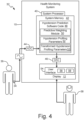
- FIG. 4 is a block diagram of hemodynamic monitoring system 32 that determines a risk score representing a probability of a future hypotension event based on a set of transformed hypotension profiling parameters.
- hemodynamic monitoring system 32 includes hemodynamic monitor 10 and hemodynamic sensor 34.
- Hemodynamic monitoring system 32 can be implemented within a patient care environment, such as an ICU, an OR, or other patient care environment. As illustrated in FIG. 4 , the patient care environment can include patient 36 and healthcare worker 38 trained to utilize hemodynamic monitoring system 32.
- Hemodynamic monitor 10 can be, e.g., an integrated hardware unit including system processor 40, system memory 42, display 12, analog-to-digital (ADC) converter 44, and digital-to-analog (DAC) converter 46.
- ADC analog-to-digital
- DAC digital-to-analog
- any one or more components and/or described functionality of hemodynamic monitor 10 can be distributed among multiple hardware units.
- display 12 can be a separate display device that is remote from and operatively coupled with hemodynamic monitor 10.
- hemodynamic monitor 10 can include any combination of devices and components that are electrically, communicatively, or otherwise operatively connected to perform functionality attributed herein to hemodynamic monitor 10.
- system memory 42 stores hypotension prediction software code 48.
- Hypotension prediction software code 48 includes predictive weighting module 50, hypotension profiling parameters 52, and transformed hypotension profiling parameters 53.
- Display 12 provides user interface 54, which includes control elements 56 that enable user interaction with hemodynamic monitor 10 and/or other components of hemodynamic monitoring system 32.
- User interface 54 as illustrated in FIG. 4 , also provides sensory alarm 58 to provide warning to medical personnel of a predicted future hypotension event of patient 36, as is further described below.
- Hemodynamic sensor 34 can be attached to patient 36 to sense hemodynamic data representative of an arterial pressure waveform of patient 36. Hemodynamic sensor 34 is operatively connected to hemodynamic monitor 10 (e.g., electrically and/or communicatively connected via wired or wireless connection, or both) to provide the sensed hemodynamic data to hemodynamic monitor 10. In some examples, hemodynamic sensor 34 provides the hemodynamic data representative of the arterial pressure waveform of patient 36 to hemodynamic monitor 10 as an analog signal, which is converted by ADC 44 to digital hemodynamic data representative of the arterial pressure waveform. In other examples, hemodynamic sensor 34 can provide the sensed hemodynamic data to hemodynamic monitor 10 in digital form, in which case hemodynamic monitor 10 may not include or utilize ADC 44. In yet other examples, hemodynamic sensor 34 can provide the hemodynamic data representative of the arterial pressure waveform of patient 36 to hemodynamic monitor 10 as an analog signal, which is analyzed in its analog form by hemodynamic monitor 10.
- hemodynamic monitor 10 e.g., electrically and/or communicatively connected via wired or wireless connection,
- Hemodynamic sensor 34 can be a non-invasive or minimally invasive sensor attached to patient 36.
- hemodynamic sensor 34 can take the form of minimally invasive hemodynamic sensor 16 ( FIG. 2 ), non-invasive hemodynamic sensor 26 ( FIG. 3 ), or other minimally invasive or non-invasive hemodynamic sensor.
- hemodynamic sensor 34 can be attached non-invasively at an extremity of patient 36, such as a wrist, an arm, a finger, an ankle, a toe, or other extremity of patient 36.
- hemodynamic sensor 34 can take the form of a small, lightweight, and comfortable hemodynamic sensor suitable for extended wear by patient 36 to provide substantially continuous beat-to-beat monitoring of the arterial pressure of patient 36 over an extended period of time, such as minutes or hours.
- hemodynamic sensor 34 can be configured to sense an arterial pressure of patient 36 in a minimally invasive manner.
- hemodynamic sensor 34 can be attached to patient 36 via a radial arterial catheter inserted into an arm of patient 36.
- hemodynamic sensor 34 can be attached to patient 36 via a femoral arterial catheter inserted into a leg of patient 36.
- Such minimally invasive techniques can similarly enable hemodynamic sensor 34 to provide substantially continuous beat-to-beat monitoring of the arterial pressure of patient 36 over an extended period of time, such as minutes or hours.
- System processor 40 is configured to execute hypotension prediction software code 48, which implements predictive weighting module 50 utilizing hypotension profiling parameters 52 and transformed hypotension profiling parameters 53 to produce a risk score representing a probability of a future hypotension event for patient 36.
- Examples of system processor 40 can include any one or more of a microprocessor, a controller, a digital signal processor (DSP), an application specific integrated circuit (ASIC), a field-programmable gate array (FPGA), or other equivalent discrete or integrated logic circuitry.
- System memory 42 can be configured to store information within hemodynamic monitor 10 during operation.
- System memory 42 in some examples, is described as computer-readable storage media.
- a computer-readable storage medium can include a non-transitory medium.
- the term "non-transitory" can indicate that the storage medium is not embodied in a carrier wave or a propagated signal.
- a non-transitory storage medium can store data that can, over time, change (e.g., in RAM or cache).
- System memory 42 can include volatile and non-volatile computer-readable memories. Examples of volatile memories can include random access memories (RAM), dynamic random access memories (DRAM), static random access memories (SRAM), and other forms of volatile memories. Examples of non-volatile memories can include, e.g., magnetic hard discs, optical discs, flash memories, or forms of electrically programmable memories (EPROM) or electrically erasable and programmable (EEPROM) memories.
- RAM random access memories
- DRAM dynamic random access memories
- SRAM static
- Display 12 can be a liquid crystal display (LCD), a light-emitting diode (LED) display, an organic light-emitting diode (OLED) display, or other display device suitable for providing information to users in graphical form.
- User interface 54 can include graphical and/or physical control elements that enable user input to interact with hemodynamic monitor 10 and/or other components of hemodynamic monitoring system 32.
- user interface 54 can take the form of a graphical user interface (GUI) that presents graphical control elements presented at, e.g., a touch-sensitive and/or presence sensitive display screen of display 12.
- GUI graphical user interface
- user input can be received in the form of gesture input, such as touch gestures, scroll gestures, zoom gestures, or other gesture input.
- user interface 54 can take the form of and/or include physical control elements, such as a physical buttons, keys, knobs, or other physical control elements configured to receive user input to interact with components of hemodynamic monitoring system 32.
- hemodynamic sensor 34 senses hemodynamic data representative of an arterial pressure waveform of patient 36.
- Hemodynamic sensor 34 provides the hemodynamic data (e.g., as analog sensor data), to hemodynamic monitor 10.
- ADC 44 converts the analog hemodynamic data to digital hemodynamic data representative of the arterial pressure waveform of the patient.
- System processor 40 executes hypotension prediction software code 48 to determine, using the received hemodynamic data, a risk score representing a probability of a future hypotension event for patient 36. For instance, system processor 40 can execute hypotension prediction software code 48 to obtain, using the received hemodynamic data, multiple hypotension profiling parameters 52. Hypotension profiling parameters 52 can include one or more vital sign parameters characterizing vital sign data of patient 36, as well as differential and combinatorial parameters derived from the one or more vital sign parameters, as is further described below. As is further described below, system processor 40 further executes hypotension prediction software code 48 to generate the set of transformed hypotension profiling parameters 53 based on an adjusted MAP threshold for hypotension.
- Predictive weighting module 50 of hypotension prediction software code 48 determines a risk score corresponding to the probability of a future hypotension event for patient 36 based on a weighted combination of transformed hypotension profiling parameters 53. That is, predictive weighting module 50 applies a plurality of risk coefficients stored at system memory 42 to transformed hypotension profiling parameters 53 to produce the weighted combination resulting in the risk score.
- the risk coefficients can be determined via training operations (e.g., offline training) using machine learning or other techniques to minimize a cost function that represents the error of the risk score to the true value of training subsets (e.g., aggregations of data from multiple patients) that define hypotension according to a standard MAP threshold for hypotension. That is, risk coefficients utilized by predictive weighting module 50 can be selected via training operations to minimize the error of the predictive risk score determined by hypotension prediction software code 48 as predictive of a future hypotension event using hypotension profiling parameters 52.
- training operations e.g., offline training
- machine learning or other techniques to minimize a cost function that represents the error of the risk score to the true value of training subsets (e.g., aggregations of data from multiple patients) that define hypotension according to a standard MAP threshold for hypotension. That is, risk coefficients utilized by predictive weighting module 50 can be selected via training operations to minimize the error of the predictive risk score determined by hypotension prediction software code 48 as predictive of a future hypotension event using hypotension profil
- the error of the predictive risk score to predict future hypotension events can be evaluated with respect to positive and negative training data subsets that define the occurrence of hypotension with respect to a standard (e.g., defined) MAP threshold, such as 65 mmHg or other pressure thresholds.
- a standard e.g., defined
- hemodynamic monitor 10 can receive an adjusted MAP threshold for hypotension, such as a user defined MAP threshold via control elements 56 of user interface 54.
- the adjusted MAP threshold can represent a deviation from the standard MAP threshold by which risk coefficients utilized by predictive weighting module 50 are determined.
- the adjusted MAP threshold provided by, e.g., healthcare worker 38 can take the form of an absolute pressure (e.g., a MAP threshold value), a deviation value (e.g., a deviation from the standard MAP threshold), or other indication of an adjusted MAP threshold.
- Hypotension prediction software code 48 in response to receiving the adjusted MAP threshold, generates the set of transformed hypotension profiling parameters 53 using hypotension profiling parameters 52.
- each transformed hypotension profiling parameter of transformed hypotension profiling parameters 53 can be a function of a corresponding one of hypotension profiling parameters 52 (i.e., corresponding to a standard MAP threshold for hypotension), a mean of the corresponding one of hypotension profiling parameters 52 at the standard MAP threshold for hypotension, a standard deviation of the corresponding one of hypotension profiling parameters 52 at the standard MAP threshold, a mean of the corresponding one of hypotension profiling parameters 52 at the adjusted MAP threshold for hypotension, and a standard deviation of the corresponding one of hypotension profiling parameters 52 at the adjusted MAP threshold for hypotension.
- System processor 40 executes hypotension prediction software code 48 to determine the predictive risk score as a weighted combination of transformed hypotension profiling parameters 53 using the risk coefficients that were determined based on the standard MAP threshold.
- hypotension prediction software code 48 dynamically adapts to determine the risk score using transformed hypotension profiling parameters 53 without requiring retraining or other modifications to the prediction model to identify new coefficients.
- System processor 40 further executes hypotension prediction software code 48 to invoke sensory alarm 58 via user interface 54 in response to determining that the risk score satisfies predetermined risk criteria, as is further described below.
- hypotension prediction software code 48 can invoke sensory alarm 58 to warn of a hypotension event predicted to occur, e.g., one to five minutes in the future, or up to approximately thirty minutes in the future.
- Sensory alarm 58 can be implemented as one or more of a visual alarm, an audible alarm, a haptic alarm, or other type of sensory alarm.
- sensory alarm 58 can be invoked as any combination of flashing and/or colored graphics shown by use interface 54 on display 12, display of the risk score via user interface 54 on display 12, a warning sound such as a siren or repeated tone, and a haptic alarm configured to cause hemodynamic monitor 10 to vibrate or otherwise deliver a physical impulse perceptible to healthcare worker 38 or other user.
- hemodynamic monitor 10 provides a warning to medical personnel of a predicted future hypotension event of patient 36, thereby enabling timely and effective intervention to prevent the predicted future hypotension event. Moreover, rather than require retraining of the predictive risk model to determine new risk coefficients based on an adjusted MAP threshold, hemodynamic monitor 10, implementing techniques of this disclosure, generates a set of transformed hypotension profiling parameters (or features) that are used to determine the risk score via application of the unmodified risk coefficients.
- hemodynamic monitor 10 enables real-time updates by medical personnel to the MAP threshold defining hypotension, thereby increasing the usability of hemodynamic monitor 10 via dynamic adaptation to, e.g., user defined changes that may be based on training and expertise of attending medical personnel to predict a future hypotension event for patient 36.
- FIG. 5 is a graph illustrating an example trace of arterial pressure waveform 60 corresponding to hemodynamic data sensed by hemodynamic sensor 34 and received by hemodynamic monitor 10.
- hemodynamic waveform 60 e.g., represented via digital hemodynamic data
- FIG. 5 illustrates example indicia 62, 64, 66, and 68, corresponding respectively to the start of a heart beat (indicium 62), the maximum systolic pressure marking the end of systolic rise (indicium 64), the presence of the dicrotic notch marking the end of systolic decay (indicium 66), and the diastole of the heartbeat (indicium 68) of patient 36.
- FIG. 5 Also shown in FIG. 5 is example slope "m" of adjusted arterial pressure waveform 60, though it should be understood that slope "m” is merely representative of multiple slopes that may be determined at multiple locations along arterial pressure waveform 60.
- Additional indicia predictive of future hypotension for patient 36 can be extracted from hemodynamic waveform 60 by hypotension prediction software code 48 based on behavior of hemodynamic waveform 60 in various intervals, such as in the interval from the maximum systolic pressure at indicium 64 to the diastole at indicium 66, as well as the interval from the start of the heartbeat at indicium 62 to the diastole at indicium 66.
- the behavior of arterial pressure waveform 60 during intervals: 1) systolic rise 62-64, 2) systolic decay 64-66, 3) systolic phase 62-66, 4) diastolic phase 66-68, 5) interval 64-68, and 6) heartbeat interval 62-68 can be determined by hypotension prediction software code 48 by determining the area under the curve of hemodynamic waveform 60 and the standard deviation of hemodynamic waveform 60 in each of intervals 1-6. The respective areas and standard deviations determined for intervals 1-6 can serve as additional indicia predictive of future hypotension for patient 36.
- FIG. 6 is a flow diagram illustrating example operations to generate a set of transformed hypotension profiling parameters and determine a risk score representing a probability of a future hypotension event using the set of transformed hypotension profiling parameters. For purposes of clarity and ease of discussion, the example operations are described below within the context of hemodynamic monitoring system 32 of FIG. 4 .
- An adjusted MAP threshold for hypotension is received by hemodynamic monitor 10 (Step 70).
- hemodynamic monitor 10 can receive an adjusted MAP threshold for hypotension provided by, e.g., healthcare worker 38 via control elements 56 of user interface 54.
- Hemodynamic monitor 10 receives sensed hemodynamic data representative of an arterial pressure waveform of patient 36 (Step 72).
- hemodynamic monitor 10 can receive an analog hemodynamic sensor signal representative of an arterial pressure waveform of patient 36 from hemodynamic sensor 34.
- Hemodynamic monitor 10 performs waveform analysis of the hemodynamic data to determine a plurality of hypotension profiling parameters predictive of a future hypotension event for patient 36 (Step 74).
- hemodynamic monitor 10 can execute hypotension prediction software code 48 to perform waveform analysis of the hemodynamic data to obtain hypotension profiling parameters 52 that are predictive of future hypotension in patient 36.
- Hypotension profiling parameters 52 can include one or more of vital sign parameters characterizing vital sign data of patient 36, differential parameters derived from the vital sign parameters, and combinatorial parameters representing combinations of one or more of the vital sign parameters and differential parameters.
- Vital sign parameters characterizing vital sign data can include, e.g., stroke volume, heart rate, respiration, cardiac contractility, mean arterial pressure, baroreflex sensitivity measures, hemodynamic complexity measures, frequency domain hemodynamic features, or other vital sign parameters.
- Baroreflex sensitivity measures quantify the relationship between complementary physiological processes. For example, a decrease in blood pressure in a healthy patient is typically compensated by an increase in heart rate and/or an increase in peripheral resistance.
- the baroreflex sensitivity measures that may be included in the one or more vital sign parameters characterizing vital sign data correspond to the degree to which patient 36 is responding appropriately to normal physiological variations.
- Hemodynamic complexity measures quantify the amount of regularity in cardiac measurements over time, as well as the entropy, e.g., the unpredictability of fluctuations in cardiac measurements over time. For instance, unpredictable cardiac fluctuations are a normal phenomenon associated with health. Very low entropy, i.e., a high degree of regularity in cardiac measurements over time and the substantial absence of unpredictable fluctuations, can be a significant warning sign of an impending hypotension event. Frequency domain hemodynamic features quantify various measures of cardiac performance as a function of frequency rather than time.
- Hypotension predication software code 48 can further determine differential parameters based on the one or more vital sign parameters characterizing vital sign data of patient 36. Hypotension prediction software code 48 can derive the differential parameters from the one or more vital sign parameters by determining variations of the one or more vital sign parameters with respect to time, with respect to frequency, or with respect to other parameters from among the one or more vital sign parameters. As a result, each of one or more vital sign parameters can give rise to one, two, or several differential parameters included among hypotension profiling parameters 52.
- the differential parameter stroke volume variation can be derived based on changes in the parameter stroke volume (SV) as a function of time and/or as a function of sampling frequency.
- changes in mean arterial pressure ⁇ MAP
- changes in MAP with respect to time can be derived by subtracting the average of the MAP over the past five minutes, ten minutes, or other time durations, from the current value of the MAP.
- Hypotension prediction software code 48 can generate combinatorial parameters included in hypotension profiling parameters 52 using the one or more vital sign parameters and the derived differential parameters.
- the combinatorial parameters can be generated using the one or more vital sign parameters and the differential parameters by generating a power combination of a subset of the one or more vital sign parameters and the differential parameters.
- each of the combinatorial parameters can be generated as a power combination of three parameters, which can be randomly or purposefully selected, from among the one or more vital sign parameters characterizing vital sign data and/or the differential parameters.
- Each of the three parameters selected from among the one or more vital sign parameters and/or the differential parameters can be raised to an exponential power, and can be multiplied with or added to the other two parameters analogously raised to an exponential power.
- the exponential power to which each of the three parameters selected from the one or more vital sign parameters and/or the differential parameters is raised can be, but need not be, the same exponential power.
- generation of the combinatorial parameters can be performed using a predetermined and limited integer range of exponential powers.
- the exponential powers used to generate the combinatorial parameters can be integer powers selected from among negative two, negative one, zero, one, and two (-2, -1, 0, 1, 2).
- Equation 1 above can be applied to substantially all possible power combinations of the one or more vital sign parameters, the differential parameters, and the one or more vital sign parameters with the differential parameters, subject to the predetermined constraints described above (i.e., the value of n being any integer greater than two, and each of a, b, and c being selected from the group consisting of -2, -1, 0, 1, and 2).
- Hypotension profiling parameters 52 include one or more vital sign parameters characterizing vital sign data, the differential parameters, and the combinatorial parameters. Examples of hypotension profiling parameters 52 can include, but are not limited to, various combinations of one or more of the following parameters v 1 , v 2 ... v 19 , where:
- hypotension prediction software code 48 determines hypotension profiling parameters 52 by identifying one or more vital sign parameters characterizing vital sign data based on the hemodynamic data, obtaining the differential parameters based on one or more vital sign parameters, and generating the combinatorial parameters using one or more of vital sign parameters and the differential parameters.
- Hemodynamic monitor 10 generates a set of transformed hypotension profiling parameters (Step 76). For instance, hemodynamic monitor 10 can execute hypotension prediction software code 48 to determine transformed hypotension profiling parameters 53.
- Each of transformed hypotension profiling parameters 53 can be a function of a corresponding one of hypotension profiling parameters 52 at the standard MAP threshold for hypotension (e.g., 65 mmHg or other defined pressure threshold), a mean of the corresponding one of hypotension profiling parameters 52 at the standard MAP threshold, a standard deviation of the corresponding one of hypotension profiling parameters 52 at the standard MAP threshold, a mean of the corresponding one of hypotension profiling parameters 52 at the adjusted MAP threshold for hypotension, and a standard deviation of the corresponding one of the hypotension profiling parameters 52 at the adjusted MAP threshold for hypotension.
- the standard MAP threshold for hypotension e.g. 65 mmHg or other defined pressure threshold
- mean of the corresponding one of hypotension profiling parameters 52 at the standard MAP threshold e.g.,
- hemodynamic monitor 10 can execute hypotension prediction software code 48 to determine, according to Equation 2 above, transformed hypotension profiling parameters 53, which can be represented as the set v 1 ⁇ , v 2 ⁇ , ... v 19 ⁇ .
- Each of transformed hypotension profiling parameters 53 i.e., each of the set v 1 ⁇ , v 2 ⁇ , ... v 19 ⁇ ) represents a transformed one of hypotension profiling parameters 52 adapted for the new MAP threshold for hypotension.
- a risk score representing a probability of a future hypotension event for patient 36 is determined based on transformed hypotension profiling parameters 53 (Step 78).
- system processor 40 can execute hypotension prediction software code 48 to cause predictive weighting module 50 to determine the risk score as a weighted combination of transformed hypotension profiling parameters 53.
- Predictive weighting module 50 can determine the weighted combination of transformed hypotension profiling parameters 53 by applying a plurality of risk coefficients to transformed hypotension profiling parameters 53, which include the vital sign parameters characterizing vital sign data of patient 36, the differential parameters derived from the vital sign parameters, and the combinatorial parameters.
- the plurality of risk coefficients applied by predictive weighting module 50 can be determined (e.g., via offline training) with respect to the standard MAP threshold for hypotension.
- hypotension prediction software code 48 determines the risk score based on transformed hypotension profiling parameters 53, which are derived from hemodynamic data sensed by hemodynamic sensor attached to patient 36, it should be noted that hypotension prediction software code 48 determines the risk score for patient 36 without direct comparison to hypotension in other patients and without direct reference to a hypotension database that may store information regarding hypotension in patients other than patient 36.
- the risk score R can be expressed as a fraction, as represented by Equation 3 above. In other examples, the risk score can be converted to a percentage risk score between zero percent and one hundred percent.
- Hemodynamic monitor 10 invokes a sensory alarm in response to the risk score satisfying a predetermined risk criterion (Step 80).
- hypotension prediction software code 48 can invoke sensory alarm 58 of user interface 54 in response to determining that the risk score R determined according to Equation 3 above satisfies a predetermined risk criterion.
- the output of hypotension prediction software code 48 can be processed using DAC 46 to convert digital signals into analog signals for presentation via user interface 54 at display 12.
- the predetermined risk criterion can be based on the value of the risk score, on the trend of the risk score over a time interval, or both. For instance, where the risk score is expressed as a percentage between zero and one hundred, hypotension prediction software code 48 can invoke sensory alarm 58 (e.g., immediately) in response to determining that the risk score exceeds a first predetermined threshold, such as eighty-five percent. In some examples, hypotension prediction software code 48 can invoke sensory alarm 58 in response to determining that the risk score satisfies a second predetermined threshold over the entirety of a first predetermined time period. In such examples, the second predetermined threshold can be lower than the first predetermined threshold.
- hypotension prediction software code 48 can invoke sensory alarm 58, e.g., immediately, in response to determining that the risk score exceeds the first predetermined threshold (e.g., eighty-five percent). Hypotension prediction software code 48 can also invoke sensory alarm 58 in response to determining that the risk score exceeds a second predetermined threshold (e.g., eighty percent) that is less than the first predetermined threshold for the first predetermined time period (e.g., ten to thirty seconds) during which the risk score is continuously greater than the second predetermined threshold (eighty percent) and less than the first predetermined threshold (e.g., eighty five percent).
- a second predetermined threshold e.g., eighty percent
- hypotension prediction software code 48 can invoke sensory alarm 58 in response to determining that the risk score is greater than a third predetermined threshold that is less than the second predetermined threshold for a second predetermined time period (e.g., one or more minutes). In yet other examples, hypotension prediction software code 48 can invoke sensory alarm 58 in response to determining that the risk score exceeds a fourth predetermined threshold (e.g., seventy-five percent) a threshold number of times (e.g., two times, three times, or other numbers of times) over a third predetermined time period (e.g., one minute, two minutes, or other time periods).
- a fourth predetermined threshold e.g., seventy-five percent
- a threshold number of times e.g., two times, three times, or other numbers of times
- a third predetermined time period e.g., one minute, two minutes, or other time periods.
- hemodynamic monitor 10 can identify, using hypotension prediction software code 48, a most probable cause of a predicted future hypotension event of patient 36. For example, based on identified indicia, hypotension prediction software code 48 can identify poor vascular tone, low blood volume, reduced cardiac contractility, or other most probable causes of a predicted future hypotension event of patient 36.
- hemodynamic monitor 10 can recommend a medical intervention for preventing the predicted future hypotension event of patient 36, such as by identifying a recommended medical intervention corresponding to the identified most probable cause of the predicted future hypotension event for patient 36. For instance, with respect to a most probable cause of poor vascular tone, hemodynamic monitor 10 can recommend a medical intervention of administration of a vasoconstrictor. With respect to a most probable cause of low blood volume, for example, hemodynamic monitor 10 can recommend a medical intervention of administration of saline or whole blood.
- hemodynamic monitor 10 implementing techniques of this disclosure provides a risk score predictive of a future hypotension event for patient 36, thereby enabling timely and effective intervention to prevent the hypotension event prior to patient 36 entering a hypotensive state.
- the techniques described herein increase usability of hemodynamic monitoring system 32 to accommodate, e.g., the training and experience of medical personnel.
Landscapes
- Health & Medical Sciences (AREA)
- Life Sciences & Earth Sciences (AREA)
- Engineering & Computer Science (AREA)
- Molecular Biology (AREA)
- Animal Behavior & Ethology (AREA)
- Physiology (AREA)
- Biophysics (AREA)
- Pathology (AREA)
- Veterinary Medicine (AREA)
- Biomedical Technology (AREA)
- Heart & Thoracic Surgery (AREA)
- Medical Informatics (AREA)
- Cardiology (AREA)
- Surgery (AREA)
- Physics & Mathematics (AREA)
- General Health & Medical Sciences (AREA)
- Public Health (AREA)
- Vascular Medicine (AREA)
- Artificial Intelligence (AREA)
- Computer Vision & Pattern Recognition (AREA)
- Psychiatry (AREA)
- Signal Processing (AREA)
- Measuring Pulse, Heart Rate, Blood Pressure Or Blood Flow (AREA)
- Measuring And Recording Apparatus For Diagnosis (AREA)
Claims (15)
- Verfahren zum Überwachen von arteriellem Druck eines Patienten und zum Bereitstellen einer Warnung an medizinisches Personal in Bezug auf ein vorhergesagtes zukünftiges Hypotonieereignis des Patienten, das Verfahren umfassend:Empfangen, durch einen Hämodynamikmonitor, eines angepassten Schwellenwerts für den mittleren arteriellen Blutdruck (mean arterial pressure - MAP) in Bezug auf Hypotonie;Empfangen, durch den Hämodynamikmonitor, von erfassten Hämodynamikdaten, die einer Wellenform des arteriellen Drucks des Patienten entsprechen;Durchführen, durch den Hämodynamikmonitor, einer Wellenformanalyse der Hämodynamikdaten, um eine Vielzahl von Hypotonieprofilierungsparametern zu bestimmen, die ein zukünftiges Hypotonieereignis für den Patienten vorhersagen;Erzeugen, durch den Hämodynamikmonitor, eines Satzes von umgewandelten Hypotonieprofilierungsparametern, wobei jeder Hypotonieprofilierungsparameter eine Funktion eines entsprechenden einen der Vielzahl von Hypotonieprofilierungsparametern an einem Standardschwellenwert für mittleren arteriellen Druck (MAP) für Hypotonie ist, eines Mittelwerts des entsprechenden einen der Vielzahl von Hypotonieprofilierungsparametern am Standard-MAP-Schwellenwert für Hypotonie, einer Standardabweichung des entsprechenden einen der Vielzahl von Hypotonieprofilierungsparametern am Standard-MAP-Schwellenwert, eines Mittelwerts des entsprechenden einen der Vielzahl von Hypotonieprofilierungsparametern am angepassten MAP-Schwellenwert für Hypotonie sowie einer Standardabweichung des entsprechenden einen der Vielzahl von Hypotonieprofilierungsparametern am angepassten MAP-Schwellenwert für Hypotonie;Bestimmen, durch den Hämodynamikmonitor, auf Grundlage des Satzes von umgewandelten Hypotonieprofilierungsparametern, einer Risikobewertung, die einer Wahrscheinlichkeit des zukünftigen Hypotonieereignisses für den Patienten entspricht; undAufrufen, durch den Hämodynamikmonitor, eines Sensoralarms, um ein Sensorsignal als Reaktion darauf zu erzeugen, dass die Risikobewertung ein vorbestimmtes Risikokriterium erfüllt.
- Verfahren nach Anspruch 1,wobei das Erzeugen des Satzes von umgewandelten Hypotonieprofilierungsparametern das Umwandeln von dem der Vielzahl von Hypotonieprofilierungsparametern gemäß der folgenden Gleichung umfasst:
 wobei vkθ einer aus dem Satz des umgewandelten Satzes von Hypotonieprofilierungsparametern ist, die mit dem entsprechenden einen der Vielzahl von Hypotonieprofilierungsparametern verknüpft sind;wobei σkθ die Standardabweichung des entsprechenden einen der Vielzahl von Hypotonieprofilierungsparameter am angepassten MAP-Schwellenwert für Hypotonie ist;wobei σk die Standardabweichung des entsprechenden einen der Vielzahl von Hypotonieprofilierungsparametern am Standard-MAP-Schwellenwert für Hypotonie ist;wobei vk der entsprechende eine der Vielzahl von Hypotonieprofilierungsparametern am Standard-MAP-Schwellenwert für Hypotonie ist;wobei µkθ der Mittelwert des entsprechenden einen der Vielzahl von Hypotonieprofilierungsparametern am angepassten MAP-Schwellenwert für Hypotonie ist; und wobei µk der Mittelwert des entsprechenden einen der Vielzahl von Hypotonieprofilierungsparametern am Standard-MAP-Schwellenwert für Hypotonie ist.
 - Verfahren nach Anspruch 1 oder 2,
wobei das Bestimmen der Risikobewertung, die der Wahrscheinlichkeit des zukünftigen Hypotonieereignisses für den Patienten entspricht, das Anwenden einer Vielzahl von Risikokoeffizenten auf den Satz von umgewandelten Hypotonieprofilierungsparametern umfasst, um die Risikobewertung zu bestimmen. - Verfahren nach Anspruch 3,
wobei die Vielzahl von Risikokoeffizenten auf der Grundlage des Standard-MAP-Schwellenwerts bestimmt wird. - Verfahren nach einem der vorhergehenden Ansprüche, wobei das Durchführen der Wellenformanalyse der Hämodynamikdaten, um die Vielzahl von Hypotonieprofilierungsparametern zu bestimmen, die das zukünftige Hypotonieereignis für den Patienten vorhersagen, umfasst:Durchführen der Wellenformanalyse der Hämodynamikdaten, um Vitalzeichenparameter aus den Hämodynamikdaten zu erhalten;Ableiten von Differentialparametern auf der Grundlage von einem oder mehreren der Vitalzeichenparameter; undErzeugen von kombinatorischen Parametern unter Einsatz von einem oder mehreren der Vitalzeichenparameter und/oder einem oder mehreren der Differentialparameter; wobei die Vielzahl von Hypotonieprofilierungsparametern einen oder mehrere der Vitalzeichenparameter, der Differentialparameter und der kombinatorischen Parameter einschließt.
- Verfahren nach Anspruch 5,
wobei die Vitalzeichenparameter eines oder mehrere von Schlagvolumen, Herzfrequenz, Atmung und Herzkontraktibilität einschließen. - Verfahren nach Anspruch 5 oder 6,
wobei das Ableiten der Differentialparameter auf der Grundlage von einem oder mehreren der Vitalzeichenparameter das Ableiten der Differentialparameter derart umfasst, dass sie Variationen an einem oder mehreren der Vitalzeichenparameter darstellen, in Bezug auf Zeit, in Bezug auf Frequenz oder in Bezug auf andere Vitalzeichenparameter. - Verfahren nach einem der Ansprüche 5 bis 7,
wobei das Erzeugen der kombinatorischen Parameter das Erzeugen der kombinatorischen Parameter als eine Kombination aus Vitalzeichenparametern oder als eine Kombination aus Differentialparametern oder als eine Kombination aus mindestens einem Vitalzeichenparameter und mindestens einem Differentialparameter umfasst. - System zum Überwachen von arteriellem Druck eines Patienten und zum Bereitstellen einer Warnung an medizinisches Personal in Bezug auf ein vorhergesagtes zukünftiges Hypotonieereignis des Patienten, das System umfassend:einen Hämodynamiksensor, der Hämodynamikdaten erzeugt, die einer Wellenform des arteriellen Drucks des Patienten entsprechen;einen Systemspeicher, in dem Hypotonievorhersagesoftwarecode gespeichert ist, einschließlich eines Vorhersagegewichtungsmoduls;eine Benutzerschnittstelle, einschließlich eines Sensoralarms, welcher ein Sensorsignal bereitstellt, um das medizinische Personal vor dem vorhergesagten zukünftigen Hypotonieereignis zu warnen, bevor der Patient in einen Hypotoniestatus übergeht, und Kontrollelemente, dazu konfiguriert, eine Benutzereingabe eines angepassten MAP-Schwellenwerts für Hypotonie zu ermöglichen; undeinen Hardwareprozessor, dazu konfiguriert, den Hypotonievorhersagesoftwarecode auszuführen, zum:Durchführen einer Wellenformanalyse der Hämodynamikdaten, um eine Vielzahl von Hypotonieprofilierungsparametern zu bestimmen, die ein zukünftiges Hypotonieereignis für den Patienten vorhersagen;Erzeugen eines Satzes von umgewandelten Hypotonieprofilierungsparametern, wobei jeder Hypotonieprofilierungsparameter eine Funktion eines entsprechenden einen der Vielzahl von Hypotonieprofilierungsparametern an einem Standardschwellenwert für mittleren arteriellen Druck (MAP) für Hypotonie ist, eines Mittelwerts des entsprechenden einen der Vielzahl von Hypotonieprofilierungsparametern am Standard-MAP-Schwellenwert für Hypotonie, einer Standardabweichung des entsprechenden einen der Vielzahl von Hypotonieprofilierungsparametern am Standard-MAP-Schwellenwert, eines Mittelwerts des entsprechenden einen der Vielzahl von Hypotonieprofilierungsparametern am angepassten MAP-Schwellenwert für Hypotonie sowie einer Standardabweichung des entsprechenden einen der Vielzahl von Hypotonieprofilierungsparametern am angepassten MAP-Schwellenwert für Hypotonie;Bestimmen, auf Grundlage des Satzes von umgewandelten Hypotonieprofilierungsparametern, einer Risikobewertung, die einer Wahrscheinlichkeit des zukünftigen Hypotonieereignisses für den Patienten entspricht; undAufrufen des Sensoralarms der Benutzerschnittstelle als Reaktion darauf, dass die Risikobewertung ein vorbestimmtes Risikokriterium erfüllt.
- System nach Anspruch 9,wobei der Hardwareprozessor dazu konfiguriert ist, den Satz von umgewandelten Hypotonieprofilierungsparametern gemäß der folgenden Gleichung zu erzeugen:
 wobei vkθ einer aus dem Satz des umgewandelten Satzes von Hypotonieprofilierungsparametern ist, die mit dem entsprechenden einen der Vielzahl von Hypotonieprofilierungsparametern verknüpft sind;wobei σkθ die Standardabweichung des entsprechenden einen der Vielzahl von Hypotonieprofilierungsparameter am angepassten MAP-Schwellenwert für Hypotonie ist;wobei σk die Standardabweichung des entsprechenden einen der Vielzahl von Hypotonieprofilierungsparametern am Standard-MAP-Schwellenwert für Hypotonie ist;wobei vk der entsprechende eine der Vielzahl von Hypotonieprofilierungsparametern am Standard-MAP-Schwellenwert für Hypotonie ist;wobei µkθ der Mittelwert des entsprechenden einen der Vielzahl von Hypotonieprofilierungsparametern am angepassten MAP-Schwellenwert für Hypotonie ist; und wobei µk der Mittelwert des entsprechenden einen der Vielzahl von Hypotonieprofilierungsparametern am Standard-MAP-Schwellenwert für Hypotonie ist.
 - System nach Anspruch 9 oder 10,wobei der Hardwareprozessor dazu konfiguriert ist, den Hypotonievorhersagesoftwarecode auszuführen, um die Risikobewertung zu bestimmen, die der Wahrscheinlichkeit des zukünftigen Hypotonieereignisses für den Patienten entspricht, indem er unter Einsatz des Vorhersagegewichtungsmoduls eine Vielzahl von Risikokoeffizienten auf die Vielzahl von Hypotonieprofilierungsparametern anwendet, um die Risikobewertung zu bestimmen,optional wobei die Vielzahl von Risikokoeffizenten auf der Grundlage des Standard-MAP-Schwellenwerts bestimmt wird.
- System nach einem der Ansprüche 9 bis 11,
wobei der Hardwareprozessor dazu konfiguriert ist, den Hypotonievorhersagesoftwarecode auszuführen, um die Vielzahl von Hypotonieprofilierungsparametern zu bestimmen, die das zukünftige Hypotonieereignis für den Patienten vorhersagen, indem er den Hypotonievorhersagesoftwarecode ausführt zum:Durchführen der Wellenformanalyse der Hämodynamikdaten, um Vitalzeichenparameter aus den Hämodynamikdaten zu erhalten;Ableiten von Differentialparametern auf der Grundlage von einem oder mehreren der Vitalzeichenparameter; undErzeugen von kombinatorischen Parametern unter Einsatz von einem oder mehreren der Vitalzeichenparameter und/oder einem oder mehreren der Differentialparameter; wobei die Vielzahl von Hypotonieprofilierungsparametern einen oder mehrere der Vitalzeichenparameter, der Differentialparameter und der kombinatorischen Parameter einschließt. - System nach Anspruch 12,
wobei die Vitalzeichenparameter eines oder mehrere von Schlagvolumen, Herzfrequenz, Atmung und Herzkontraktibilität einschließen. - System nach Anspruch 12 oder 13,
wobei der Hardwareprozessor, dazu konfiguriert ist, den Hypotonievorhersagesoftwarecode auszuführen, zum:a) Ableiten der Differentialparameter auf der Grundlage von einem oder mehreren der Vitalzeichenparameter durch Ableiten der Differentialparameter derart, dass sie Variationen an einem oder mehreren der Vitalzeichenparameter darstellen, in Bezug auf Zeit, in Bezug auf Frequenz oder in Bezug auf andere Vitalzeichenparameter; oderb) Erzeugen der kombinatorischen Parameter durch Erzeugen der kombinatorischen Parameter als eine Kombination aus Vitalzeichenparametern oder als eine Kombination aus Differentialparametern oder als eine Kombination aus mindestens einem Vitalzeichenparameter und mindestens einem Differentialparameter. - System nach einem der Ansprüche 9 bis 14,
wobei der Hämodynamiksensor:a) ein nichtinvasiver Hämodynamiksensor ist, der an einer Extremität
des Patienten befestigt werden kann;b) ein minimalinvasiver Hämodynamiksensor auf Arterienkatheterbasis ist; oderc) die Hämodynamikdaten als analoges Hämodynamiksensorsignal erzeugt, das der Wellenform des arteriellen Drucks des Patienten entspricht, optional ferner umfassend:
einen Analog-Digital-Wandler, der das analoge Hämodynamiksensorsignal in digitale Hämodynamikdaten umwandelt, die der Wellenform des arteriellen Drucks des Patienten entsprechen.
Applications Claiming Priority (2)
| Application Number | Priority Date | Filing Date | Title |
|---|---|---|---|
| US202062981198P | 2020-02-25 | 2020-02-25 | |
| PCT/US2021/016246 WO2021173311A1 (en) | 2020-02-25 | 2021-02-02 | Hypotension prediction with feature transformation for adjustable hypotension threshold |
Publications (2)
| Publication Number | Publication Date |
|---|---|
| EP4084680A1 EP4084680A1 (de) | 2022-11-09 |
| EP4084680B1 true EP4084680B1 (de) | 2023-11-22 |
Family
ID=74853719
Family Applications (1)
| Application Number | Title | Priority Date | Filing Date |
|---|---|---|---|
| EP21709522.3A Active EP4084680B1 (de) | 2020-02-25 | 2021-02-02 | Hypotensionsvorhersage mit merkmaltransformation für einstellbare hypotensionsschwelle |
Country Status (6)
| Country | Link |
|---|---|
| US (1) | US20220400965A1 (de) |
| EP (1) | EP4084680B1 (de) |
| JP (1) | JP7642666B2 (de) |
| CN (1) | CN115175606B (de) |
| CA (1) | CA3170136A1 (de) |
| WO (1) | WO2021173311A1 (de) |
Families Citing this family (5)
| Publication number | Priority date | Publication date | Assignee | Title |
|---|---|---|---|---|
| US10751004B2 (en) | 2016-07-08 | 2020-08-25 | Edwards Lifesciences Corporation | Predictive weighting of hypotension profiling parameters |
| US12144645B2 (en) | 2020-02-24 | 2024-11-19 | Edwards Lifesciences Corporation | Therapy scoring for hemodynamic conditions |
| US11831688B2 (en) * | 2021-06-18 | 2023-11-28 | Capital One Services, Llc | Systems and methods for network security |
| WO2023154313A1 (en) * | 2022-02-11 | 2023-08-17 | Edwards Lifesciences Corporation | Detecting and differentiating nociception events from hemodynamic drug administration events |
| CN119207807A (zh) * | 2024-11-29 | 2024-12-27 | 四川大学华西医院 | 一种术中个体化血压管理方法及系统 |
Family Cites Families (7)
| Publication number | Priority date | Publication date | Assignee | Title |
|---|---|---|---|---|
| US20040186528A1 (en) * | 2003-03-20 | 2004-09-23 | Medtronic, Inc. | Subcutaneous implantable medical devices with anti-microbial agents for chronic release |
| US8478403B2 (en) * | 2011-02-23 | 2013-07-02 | Pacesetter, Inc. | Implantable systems and methods for use therewith for monitoring and modifying arterial blood pressure without requiring an intravascular pressure transducer |
| US9622709B2 (en) * | 2012-10-12 | 2017-04-18 | The Cleveland Clinic Foundation | Monitoring severity and duration of aberrant physiological parameters during a procedure |
| WO2016007577A1 (en) * | 2014-07-08 | 2016-01-14 | The Regents Of The University Of Michigan | System for providing continuous systolic blood pressure measurement to maintain permissive hypotension |
| US10751004B2 (en) * | 2016-07-08 | 2020-08-25 | Edwards Lifesciences Corporation | Predictive weighting of hypotension profiling parameters |
| US20180025290A1 (en) * | 2016-07-22 | 2018-01-25 | Edwards Lifesciences Corporation | Predictive risk model optimization |
| US11540734B2 (en) * | 2018-08-27 | 2023-01-03 | Verily Life Sciences Llc | Apparatus for noninvasive measurement of a heart performance metric |
-
2021
- 2021-02-02 EP EP21709522.3A patent/EP4084680B1/de active Active
- 2021-02-02 CN CN202180016719.2A patent/CN115175606B/zh active Active
- 2021-02-02 CA CA3170136A patent/CA3170136A1/en active Pending
- 2021-02-02 WO PCT/US2021/016246 patent/WO2021173311A1/en not_active Ceased
- 2021-02-02 JP JP2022550982A patent/JP7642666B2/ja active Active
-
2022
- 2022-08-24 US US17/821,886 patent/US20220400965A1/en active Pending
Also Published As
| Publication number | Publication date |
|---|---|
| CA3170136A1 (en) | 2021-09-02 |
| WO2021173311A1 (en) | 2021-09-02 |
| US20220400965A1 (en) | 2022-12-22 |
| EP4084680A1 (de) | 2022-11-09 |
| JP7642666B2 (ja) | 2025-03-10 |
| CN115175606A (zh) | 2022-10-11 |
| JP2023515151A (ja) | 2023-04-12 |
| CN115175606B (zh) | 2026-01-09 |
Similar Documents
| Publication | Publication Date | Title |
|---|---|---|
| EP4084680B1 (de) | Hypotensionsvorhersage mit merkmaltransformation für einstellbare hypotensionsschwelle | |
| EP4084681B1 (de) | Hypotonieprognose mit einstellbarer hypotonieschwelle | |
| US20240415468A1 (en) | Predictive weighting of hypotension profiling parameters | |
| US20250143637A1 (en) | Therapy scoring for hemodynamic conditions | |
| US20230380697A1 (en) | Hemodynamic sensor-based system for automated prediction of a post-induction hypotensive event | |
| US20180020989A1 (en) | Mean arterial pressure (map) derived prediction of future hypotension | |
| HK40084029B (en) | Hypotension prediction with feature transformation for adjustable hypotension threshold | |
| HK40084029A (en) | Hypotension prediction with feature transformation for adjustable hypotension threshold | |
| HK40081774A (en) | Hypotension prediction with adjustable hypotension threshold | |
| HK40081773A (en) | Hypotension prediction with feature transformation for adjustable hypotension threshold | |
| CA3212493A1 (en) | Hemodynamic monitor with nociception prediction and detection |
Legal Events
| Date | Code | Title | Description |
|---|---|---|---|
| STAA | Information on the status of an ep patent application or granted ep patent |
Free format text: STATUS: UNKNOWN |
|
| STAA | Information on the status of an ep patent application or granted ep patent |
Free format text: STATUS: THE INTERNATIONAL PUBLICATION HAS BEEN MADE |
|
| PUAI | Public reference made under article 153(3) epc to a published international application that has entered the european phase |
Free format text: ORIGINAL CODE: 0009012 |
|
| STAA | Information on the status of an ep patent application or granted ep patent |
Free format text: STATUS: REQUEST FOR EXAMINATION WAS MADE |
|
| 17P | Request for examination filed |
Effective date: 20220804 |
|
| AK | Designated contracting states |
Kind code of ref document: A1 Designated state(s): AL AT BE BG CH CY CZ DE DK EE ES FI FR GB GR HR HU IE IS IT LI LT LU LV MC MK MT NL NO PL PT RO RS SE SI SK SM TR |
|
| DAV | Request for validation of the european patent (deleted) | ||
| DAX | Request for extension of the european patent (deleted) | ||
| GRAP | Despatch of communication of intention to grant a patent |
Free format text: ORIGINAL CODE: EPIDOSNIGR1 |
|
| STAA | Information on the status of an ep patent application or granted ep patent |
Free format text: STATUS: GRANT OF PATENT IS INTENDED |
|
| INTG | Intention to grant announced |
Effective date: 20230607 |
|
| REG | Reference to a national code |
Ref country code: HK Ref legal event code: DE Ref document number: 40084029 Country of ref document: HK |
|
| P01 | Opt-out of the competence of the unified patent court (upc) registered |
Effective date: 20230529 |
|
| GRAS | Grant fee paid |
Free format text: ORIGINAL CODE: EPIDOSNIGR3 |
|
| GRAA | (expected) grant |
Free format text: ORIGINAL CODE: 0009210 |
|
| STAA | Information on the status of an ep patent application or granted ep patent |
Free format text: STATUS: THE PATENT HAS BEEN GRANTED |
|
| AK | Designated contracting states |
Kind code of ref document: B1 Designated state(s): AL AT BE BG CH CY CZ DE DK EE ES FI FR GB GR HR HU IE IS IT LI LT LU LV MC MK MT NL NO PL PT RO RS SE SI SK SM TR |
|
| REG | Reference to a national code |
Ref country code: GB Ref legal event code: FG4D |
|
| REG | Reference to a national code |
Ref country code: CH Ref legal event code: EP |
|
| REG | Reference to a national code |
Ref country code: DE Ref legal event code: R096 Ref document number: 602021007083 Country of ref document: DE |
|
| REG | Reference to a national code |
Ref country code: IE Ref legal event code: FG4D |
|
| REG | Reference to a national code |
Ref country code: NL Ref legal event code: FP |
|
| REG | Reference to a national code |
Ref country code: LT Ref legal event code: MG9D |
|
| PG25 | Lapsed in a contracting state [announced via postgrant information from national office to epo] |
Ref country code: GR Free format text: LAPSE BECAUSE OF FAILURE TO SUBMIT A TRANSLATION OF THE DESCRIPTION OR TO PAY THE FEE WITHIN THE PRESCRIBED TIME-LIMIT Effective date: 20240223 |
|
| PG25 | Lapsed in a contracting state [announced via postgrant information from national office to epo] |
Ref country code: IS Free format text: LAPSE BECAUSE OF FAILURE TO SUBMIT A TRANSLATION OF THE DESCRIPTION OR TO PAY THE FEE WITHIN THE PRESCRIBED TIME-LIMIT Effective date: 20240322 |
|
| PG25 | Lapsed in a contracting state [announced via postgrant information from national office to epo] |
Ref country code: LT Free format text: LAPSE BECAUSE OF FAILURE TO SUBMIT A TRANSLATION OF THE DESCRIPTION OR TO PAY THE FEE WITHIN THE PRESCRIBED TIME-LIMIT Effective date: 20231122 |
|
| REG | Reference to a national code |
Ref country code: AT Ref legal event code: MK05 Ref document number: 1633088 Country of ref document: AT Kind code of ref document: T Effective date: 20231122 |
|
| PG25 | Lapsed in a contracting state [announced via postgrant information from national office to epo] |
Ref country code: AT Free format text: LAPSE BECAUSE OF FAILURE TO SUBMIT A TRANSLATION OF THE DESCRIPTION OR TO PAY THE FEE WITHIN THE PRESCRIBED TIME-LIMIT Effective date: 20231122 |
|
| PG25 | Lapsed in a contracting state [announced via postgrant information from national office to epo] |
Ref country code: ES Free format text: LAPSE BECAUSE OF FAILURE TO SUBMIT A TRANSLATION OF THE DESCRIPTION OR TO PAY THE FEE WITHIN THE PRESCRIBED TIME-LIMIT Effective date: 20231122 |
|
| PG25 | Lapsed in a contracting state [announced via postgrant information from national office to epo] |
Ref country code: LT Free format text: LAPSE BECAUSE OF FAILURE TO SUBMIT A TRANSLATION OF THE DESCRIPTION OR TO PAY THE FEE WITHIN THE PRESCRIBED TIME-LIMIT Effective date: 20231122 Ref country code: IS Free format text: LAPSE BECAUSE OF FAILURE TO SUBMIT A TRANSLATION OF THE DESCRIPTION OR TO PAY THE FEE WITHIN THE PRESCRIBED TIME-LIMIT Effective date: 20240322 Ref country code: GR Free format text: LAPSE BECAUSE OF FAILURE TO SUBMIT A TRANSLATION OF THE DESCRIPTION OR TO PAY THE FEE WITHIN THE PRESCRIBED TIME-LIMIT Effective date: 20240223 Ref country code: ES Free format text: LAPSE BECAUSE OF FAILURE TO SUBMIT A TRANSLATION OF THE DESCRIPTION OR TO PAY THE FEE WITHIN THE PRESCRIBED TIME-LIMIT Effective date: 20231122 Ref country code: BG Free format text: LAPSE BECAUSE OF FAILURE TO SUBMIT A TRANSLATION OF THE DESCRIPTION OR TO PAY THE FEE WITHIN THE PRESCRIBED TIME-LIMIT Effective date: 20240222 Ref country code: AT Free format text: LAPSE BECAUSE OF FAILURE TO SUBMIT A TRANSLATION OF THE DESCRIPTION OR TO PAY THE FEE WITHIN THE PRESCRIBED TIME-LIMIT Effective date: 20231122 Ref country code: PT Free format text: LAPSE BECAUSE OF FAILURE TO SUBMIT A TRANSLATION OF THE DESCRIPTION OR TO PAY THE FEE WITHIN THE PRESCRIBED TIME-LIMIT Effective date: 20240322 |
|
| PG25 | Lapsed in a contracting state [announced via postgrant information from national office to epo] |
Ref country code: SE Free format text: LAPSE BECAUSE OF FAILURE TO SUBMIT A TRANSLATION OF THE DESCRIPTION OR TO PAY THE FEE WITHIN THE PRESCRIBED TIME-LIMIT Effective date: 20231122 Ref country code: RS Free format text: LAPSE BECAUSE OF FAILURE TO SUBMIT A TRANSLATION OF THE DESCRIPTION OR TO PAY THE FEE WITHIN THE PRESCRIBED TIME-LIMIT Effective date: 20231122 Ref country code: PL Free format text: LAPSE BECAUSE OF FAILURE TO SUBMIT A TRANSLATION OF THE DESCRIPTION OR TO PAY THE FEE WITHIN THE PRESCRIBED TIME-LIMIT Effective date: 20231122 Ref country code: NO Free format text: LAPSE BECAUSE OF FAILURE TO SUBMIT A TRANSLATION OF THE DESCRIPTION OR TO PAY THE FEE WITHIN THE PRESCRIBED TIME-LIMIT Effective date: 20240222 Ref country code: LV Free format text: LAPSE BECAUSE OF FAILURE TO SUBMIT A TRANSLATION OF THE DESCRIPTION OR TO PAY THE FEE WITHIN THE PRESCRIBED TIME-LIMIT Effective date: 20231122 Ref country code: HR Free format text: LAPSE BECAUSE OF FAILURE TO SUBMIT A TRANSLATION OF THE DESCRIPTION OR TO PAY THE FEE WITHIN THE PRESCRIBED TIME-LIMIT Effective date: 20231122 |
|
| PG25 | Lapsed in a contracting state [announced via postgrant information from national office to epo] |
Ref country code: DK Free format text: LAPSE BECAUSE OF FAILURE TO SUBMIT A TRANSLATION OF THE DESCRIPTION OR TO PAY THE FEE WITHIN THE PRESCRIBED TIME-LIMIT Effective date: 20231122 |
|
| PG25 | Lapsed in a contracting state [announced via postgrant information from national office to epo] |
Ref country code: CZ Free format text: LAPSE BECAUSE OF FAILURE TO SUBMIT A TRANSLATION OF THE DESCRIPTION OR TO PAY THE FEE WITHIN THE PRESCRIBED TIME-LIMIT Effective date: 20231122 |
|
| PG25 | Lapsed in a contracting state [announced via postgrant information from national office to epo] |
Ref country code: SK Free format text: LAPSE BECAUSE OF FAILURE TO SUBMIT A TRANSLATION OF THE DESCRIPTION OR TO PAY THE FEE WITHIN THE PRESCRIBED TIME-LIMIT Effective date: 20231122 |
|
| PG25 | Lapsed in a contracting state [announced via postgrant information from national office to epo] |
Ref country code: SM Free format text: LAPSE BECAUSE OF FAILURE TO SUBMIT A TRANSLATION OF THE DESCRIPTION OR TO PAY THE FEE WITHIN THE PRESCRIBED TIME-LIMIT Effective date: 20231122 Ref country code: SK Free format text: LAPSE BECAUSE OF FAILURE TO SUBMIT A TRANSLATION OF THE DESCRIPTION OR TO PAY THE FEE WITHIN THE PRESCRIBED TIME-LIMIT Effective date: 20231122 Ref country code: RO Free format text: LAPSE BECAUSE OF FAILURE TO SUBMIT A TRANSLATION OF THE DESCRIPTION OR TO PAY THE FEE WITHIN THE PRESCRIBED TIME-LIMIT Effective date: 20231122 Ref country code: IT Free format text: LAPSE BECAUSE OF FAILURE TO SUBMIT A TRANSLATION OF THE DESCRIPTION OR TO PAY THE FEE WITHIN THE PRESCRIBED TIME-LIMIT Effective date: 20231122 Ref country code: EE Free format text: LAPSE BECAUSE OF FAILURE TO SUBMIT A TRANSLATION OF THE DESCRIPTION OR TO PAY THE FEE WITHIN THE PRESCRIBED TIME-LIMIT Effective date: 20231122 Ref country code: DK Free format text: LAPSE BECAUSE OF FAILURE TO SUBMIT A TRANSLATION OF THE DESCRIPTION OR TO PAY THE FEE WITHIN THE PRESCRIBED TIME-LIMIT Effective date: 20231122 Ref country code: CZ Free format text: LAPSE BECAUSE OF FAILURE TO SUBMIT A TRANSLATION OF THE DESCRIPTION OR TO PAY THE FEE WITHIN THE PRESCRIBED TIME-LIMIT Effective date: 20231122 |
|
| REG | Reference to a national code |
Ref country code: DE Ref legal event code: R097 Ref document number: 602021007083 Country of ref document: DE |
|
| PLBE | No opposition filed within time limit |
Free format text: ORIGINAL CODE: 0009261 |
|
| STAA | Information on the status of an ep patent application or granted ep patent |
Free format text: STATUS: NO OPPOSITION FILED WITHIN TIME LIMIT |
|
| PG25 | Lapsed in a contracting state [announced via postgrant information from national office to epo] |
Ref country code: MC Free format text: LAPSE BECAUSE OF FAILURE TO SUBMIT A TRANSLATION OF THE DESCRIPTION OR TO PAY THE FEE WITHIN THE PRESCRIBED TIME-LIMIT Effective date: 20231122 |
|
| REG | Reference to a national code |
Ref country code: CH Ref legal event code: PL |
|
| PG25 | Lapsed in a contracting state [announced via postgrant information from national office to epo] |
Ref country code: LU Free format text: LAPSE BECAUSE OF NON-PAYMENT OF DUE FEES Effective date: 20240202 |
|
| PG25 | Lapsed in a contracting state [announced via postgrant information from national office to epo] |
Ref country code: CH Free format text: LAPSE BECAUSE OF NON-PAYMENT OF DUE FEES Effective date: 20240229 |
|
| PG25 | Lapsed in a contracting state [announced via postgrant information from national office to epo] |
Ref country code: SI Free format text: LAPSE BECAUSE OF FAILURE TO SUBMIT A TRANSLATION OF THE DESCRIPTION OR TO PAY THE FEE WITHIN THE PRESCRIBED TIME-LIMIT Effective date: 20231122 |
|
| 26N | No opposition filed |
Effective date: 20240823 |
|
| PG25 | Lapsed in a contracting state [announced via postgrant information from national office to epo] |
Ref country code: SI Free format text: LAPSE BECAUSE OF FAILURE TO SUBMIT A TRANSLATION OF THE DESCRIPTION OR TO PAY THE FEE WITHIN THE PRESCRIBED TIME-LIMIT Effective date: 20231122 Ref country code: LU Free format text: LAPSE BECAUSE OF NON-PAYMENT OF DUE FEES Effective date: 20240202 Ref country code: CH Free format text: LAPSE BECAUSE OF NON-PAYMENT OF DUE FEES Effective date: 20240229 |
|
| REG | Reference to a national code |
Ref country code: BE Ref legal event code: MM Effective date: 20240229 |
|
| PG25 | Lapsed in a contracting state [announced via postgrant information from national office to epo] |
Ref country code: BE Free format text: LAPSE BECAUSE OF NON-PAYMENT OF DUE FEES Effective date: 20240229 |
|
| PG25 | Lapsed in a contracting state [announced via postgrant information from national office to epo] |
Ref country code: IE Free format text: LAPSE BECAUSE OF NON-PAYMENT OF DUE FEES Effective date: 20240202 |
|
| PG25 | Lapsed in a contracting state [announced via postgrant information from national office to epo] |
Ref country code: IE Free format text: LAPSE BECAUSE OF NON-PAYMENT OF DUE FEES Effective date: 20240202 Ref country code: BE Free format text: LAPSE BECAUSE OF NON-PAYMENT OF DUE FEES Effective date: 20240229 |
|
| PG25 | Lapsed in a contracting state [announced via postgrant information from national office to epo] |
Ref country code: CY Free format text: LAPSE BECAUSE OF FAILURE TO SUBMIT A TRANSLATION OF THE DESCRIPTION OR TO PAY THE FEE WITHIN THE PRESCRIBED TIME-LIMIT; INVALID AB INITIO Effective date: 20210202 |
|
| PG25 | Lapsed in a contracting state [announced via postgrant information from national office to epo] |
Ref country code: HU Free format text: LAPSE BECAUSE OF FAILURE TO SUBMIT A TRANSLATION OF THE DESCRIPTION OR TO PAY THE FEE WITHIN THE PRESCRIBED TIME-LIMIT; INVALID AB INITIO Effective date: 20210202 |
|
| PG25 | Lapsed in a contracting state [announced via postgrant information from national office to epo] |
Ref country code: FI Free format text: LAPSE BECAUSE OF FAILURE TO SUBMIT A TRANSLATION OF THE DESCRIPTION OR TO PAY THE FEE WITHIN THE PRESCRIBED TIME-LIMIT Effective date: 20231122 |
|
| PG25 | Lapsed in a contracting state [announced via postgrant information from national office to epo] |
Ref country code: TR Free format text: LAPSE BECAUSE OF FAILURE TO SUBMIT A TRANSLATION OF THE DESCRIPTION OR TO PAY THE FEE WITHIN THE PRESCRIBED TIME-LIMIT Effective date: 20231122 |
|
| PGFP | Annual fee paid to national office [announced via postgrant information from national office to epo] |
Ref country code: NL Payment date: 20260121 Year of fee payment: 6 |
|
| PGFP | Annual fee paid to national office [announced via postgrant information from national office to epo] |
Ref country code: GB Payment date: 20260122 Year of fee payment: 6 |
|
| PGFP | Annual fee paid to national office [announced via postgrant information from national office to epo] |
Ref country code: DE Payment date: 20260121 Year of fee payment: 6 |
|
| PGFP | Annual fee paid to national office [announced via postgrant information from national office to epo] |
Ref country code: FR Payment date: 20260121 Year of fee payment: 6 |