EP4082979A1 - Inorganic fibers, inorganic fiber product, method for manufacturing inorganic fiber product, composition for manufacturing inorganic fibers, method for manufacturing inorganic fibers - Google Patents
Inorganic fibers, inorganic fiber product, method for manufacturing inorganic fiber product, composition for manufacturing inorganic fibers, method for manufacturing inorganic fibers Download PDFInfo
- Publication number
- EP4082979A1 EP4082979A1 EP20906975.6A EP20906975A EP4082979A1 EP 4082979 A1 EP4082979 A1 EP 4082979A1 EP 20906975 A EP20906975 A EP 20906975A EP 4082979 A1 EP4082979 A1 EP 4082979A1
- Authority
- EP
- European Patent Office
- Prior art keywords
- mass
- inorganic fiber
- manufacturing
- composition
- alkali metal
- Prior art date
- Legal status (The legal status is an assumption and is not a legal conclusion. Google has not performed a legal analysis and makes no representation as to the accuracy of the status listed.)
- Pending
Links
Images




Classifications
-
- C—CHEMISTRY; METALLURGY
- C03—GLASS; MINERAL OR SLAG WOOL
- C03C—CHEMICAL COMPOSITION OF GLASSES, GLAZES OR VITREOUS ENAMELS; SURFACE TREATMENT OF GLASS; SURFACE TREATMENT OF FIBRES OR FILAMENTS MADE FROM GLASS, MINERALS OR SLAGS; JOINING GLASS TO GLASS OR OTHER MATERIALS
- C03C13/00—Fibre or filament compositions
-
- D—TEXTILES; PAPER
- D01—NATURAL OR MAN-MADE THREADS OR FIBRES; SPINNING
- D01F—CHEMICAL FEATURES IN THE MANUFACTURE OF ARTIFICIAL FILAMENTS, THREADS, FIBRES, BRISTLES OR RIBBONS; APPARATUS SPECIALLY ADAPTED FOR THE MANUFACTURE OF CARBON FILAMENTS
- D01F9/00—Artificial filaments or the like of other substances; Manufacture thereof; Apparatus specially adapted for the manufacture of carbon filaments
- D01F9/08—Artificial filaments or the like of other substances; Manufacture thereof; Apparatus specially adapted for the manufacture of carbon filaments of inorganic material
-
- C—CHEMISTRY; METALLURGY
- C03—GLASS; MINERAL OR SLAG WOOL
- C03C—CHEMICAL COMPOSITION OF GLASSES, GLAZES OR VITREOUS ENAMELS; SURFACE TREATMENT OF GLASS; SURFACE TREATMENT OF FIBRES OR FILAMENTS MADE FROM GLASS, MINERALS OR SLAGS; JOINING GLASS TO GLASS OR OTHER MATERIALS
- C03C13/00—Fibre or filament compositions
- C03C13/06—Mineral fibres, e.g. slag wool, mineral wool, rock wool
-
- C—CHEMISTRY; METALLURGY
- C03—GLASS; MINERAL OR SLAG WOOL
- C03C—CHEMICAL COMPOSITION OF GLASSES, GLAZES OR VITREOUS ENAMELS; SURFACE TREATMENT OF GLASS; SURFACE TREATMENT OF FIBRES OR FILAMENTS MADE FROM GLASS, MINERALS OR SLAGS; JOINING GLASS TO GLASS OR OTHER MATERIALS
- C03C3/00—Glass compositions
- C03C3/04—Glass compositions containing silica
- C03C3/062—Glass compositions containing silica with less than 40% silica by weight
-
- C—CHEMISTRY; METALLURGY
- C03—GLASS; MINERAL OR SLAG WOOL
- C03C—CHEMICAL COMPOSITION OF GLASSES, GLAZES OR VITREOUS ENAMELS; SURFACE TREATMENT OF GLASS; SURFACE TREATMENT OF FIBRES OR FILAMENTS MADE FROM GLASS, MINERALS OR SLAGS; JOINING GLASS TO GLASS OR OTHER MATERIALS
- C03C3/00—Glass compositions
- C03C3/04—Glass compositions containing silica
- C03C3/076—Glass compositions containing silica with 40% to 90% silica, by weight
- C03C3/083—Glass compositions containing silica with 40% to 90% silica, by weight containing aluminium oxide or an iron compound
- C03C3/085—Glass compositions containing silica with 40% to 90% silica, by weight containing aluminium oxide or an iron compound containing an oxide of a divalent metal
- C03C3/087—Glass compositions containing silica with 40% to 90% silica, by weight containing aluminium oxide or an iron compound containing an oxide of a divalent metal containing calcium oxide, e.g. common sheet or container glass
-
- C—CHEMISTRY; METALLURGY
- C03—GLASS; MINERAL OR SLAG WOOL
- C03C—CHEMICAL COMPOSITION OF GLASSES, GLAZES OR VITREOUS ENAMELS; SURFACE TREATMENT OF GLASS; SURFACE TREATMENT OF FIBRES OR FILAMENTS MADE FROM GLASS, MINERALS OR SLAGS; JOINING GLASS TO GLASS OR OTHER MATERIALS
- C03C3/00—Glass compositions
- C03C3/04—Glass compositions containing silica
- C03C3/076—Glass compositions containing silica with 40% to 90% silica, by weight
- C03C3/095—Glass compositions containing silica with 40% to 90% silica, by weight containing rare earths
-
- C—CHEMISTRY; METALLURGY
- C03—GLASS; MINERAL OR SLAG WOOL
- C03C—CHEMICAL COMPOSITION OF GLASSES, GLAZES OR VITREOUS ENAMELS; SURFACE TREATMENT OF GLASS; SURFACE TREATMENT OF FIBRES OR FILAMENTS MADE FROM GLASS, MINERALS OR SLAGS; JOINING GLASS TO GLASS OR OTHER MATERIALS
- C03C3/00—Glass compositions
- C03C3/04—Glass compositions containing silica
- C03C3/076—Glass compositions containing silica with 40% to 90% silica, by weight
- C03C3/097—Glass compositions containing silica with 40% to 90% silica, by weight containing phosphorus, niobium or tantalum
Definitions
- the present invention relates to an inorganic fiber, an inorganic fiber product, a method of manufacturing an inorganic fiber product, a composition for manufacturing an inorganic fiber, and a method of manufacturing an inorganic fiber.
- Inorganic fibers represented by rock wool and glass wool have been used in various industries such as steel, petroleum, chemicals, electricity, automobiles, building materials, and aerospace for various usages such as refractory materials, heat insulating materials, and sealing materials, and are indispensable materials.
- slag-based rock wool blended with steel slag is fiberized and manufactured as follows. Specifically, natural stones such as silica stone, silica sand, and basalt are added to steel slag as a component adjusting agent, the resultant mixture is melted in a cupola or an electric furnace, and the melt is allowed to flow out from the bottom of the furnace.
- the melt is fiberized by a spinning method in which the melt is brought into contact with a high-speed rotating body, or a blowing method in which the melt is fiberized by compressed air.
- rock wool in the related art has higher heat resistance indicated by a heating shrinkage rate in comparison to typical glass wool, the rock wool is melted at approximately 800°C. Therefore, in the rock wool in the related art, a ratio of iron oxide in a fiber is increased by increasing a blending ratio of basalt containing iron oxide, converter slag, or the like, thereby improving heat resistance (refer to PATENT LITERATURE 1 and PATENT LITERATURE 2).
- PATENT LITERATURE 3 discloses rock wool having high heat resistance even though the content of iron oxide is small.
- the rock wool contains 35% by mass to 45% by mass of SiO 2 , 10% by mass to 15% by mass of Al 2 O 3 , 20% by mass to 35% by mass of CaO, 10% by mass to 25% by mass of MgO, and FeO and Fe 2 O 3 in a total content of 2% by mass to 10% by mass.
- a molar ratio of divalent Fe atoms to the sum of divalent Fe atoms and trivalent Fe atoms is set to 0.8 or greater.
- the present inventors also found that there is a new problem of deterioration of productivity or limitation of a selectable raw material even in the case of adding a compound of transition metals other than Fe from the viewpoint of improving heat resistance of an inorganic fiber such as rock wool.
- a search was made to find a method of improving heat resistance of an inorganic fiber by an approach different from the use of the compound of transition metals.
- the invention has been made in consideration of the problem, and an object thereof is to provide an inorganic fiber in which heat resistance is high, an option of a raw material is wide, and productivity is high, an inorganic fiber product, a method of manufacturing an inorganic fiber product, a composition for manufacturing an inorganic fiber, and a method of manufacturing an inorganic fiber.
- the present inventors have made a thorough investigation. As a result, they newly found that when a total amount A (% by mass) of alkali metal oxides and a weight S (% by mass) of a sulfur oxide expressed by SO 3 are set within a predetermined range, an inorganic fiber having high heat resistance is obtained, and they accomplished the invention.
- the inorganic fiber contains at least one kind of alkali metal compound selected from the group consisting of Na, K, and Li, and a sulfur compound.
- a total amount A (% by mass) of alkali metal oxides expressed by Na 2 O, K 2 O, and Li 2 O and a weight S (% by mass) of a sulfur oxide expressed by SO 3 in terms of oxides satisfy the following Expression (1) or (2). Accordingly, the above-described problem is solved.
- the inorganic fiber may further contain 0.1% by mass to 5% by mass of transition metal compound.
- the transition metal compound may be at least one kind of compound selected from the group consisting of Fe, Mn, Cu, Ni, Co, Zr, V, Nb, Mo, W, and Y.
- the inorganic fiber may have a composition containing:
- the inorganic fiber may be at least one or more kinds selected from the group consisting of rock wool, stone wool, slag wool, mineral wool, glass wool, and mineral glass wool.
- the above-described inorganic fiber is included, and thus the above-described problem is solved.
- the inorganic fiber product may be a heat insulating material or a refractory material.
- the method includes molding the inorganic fiber, and thus the above-described problem is solved.
- the composition contains at least one kind of alkali metal compound selected from the group consisting of Na, K, and Li, and a sulfur compound.
- a total amount A (% by mass) of alkali metal oxides expressed by Na 2 O, K 2 O, and Li 2 O and a weight S (% by mass) of a sulfur oxide expressed by SO 3 in terms of oxides satisfy the following Expression (1) or (2). Accordingly, the above-described problem is solved.
- the method includes melting the composition for manufacturing an inorganic fiber and making the resultant melt into a fiber to obtain an inorganic fiber, and thus the above-described problem is solved.
- an inorganic fiber in which heat resistance is high, an option of a raw material is wide, and productivity is high, an inorganic fiber product, a method of manufacturing an inorganic fiber product, a composition for manufacturing an inorganic fiber, and a method of manufacturing an inorganic fiber.
- This embodiment relates to an inorganic fiber, an inorganic fiber product, a method of manufacturing an inorganic fiber product, a composition for manufacturing an inorganic fiber, and a method of manufacturing an inorganic fiber.
- ⁇ % by mass to ⁇ % by mass represents equal to or greater than ⁇ % by mass and equal to or less than ⁇ % by mass.
- each component is noted in terms of an oxide, and can be measured by fluorescent X-ray analysis (XRF).
- XRF fluorescent X-ray analysis
- each component may not be contained as an oxide (SO 3 , Fe 2 O 3 , or Na 2 O), and respective components may be contained in a type of a compound such as a sulfide (FeS, Na 2 S) and a sulfate (FeSO 4 or Na 2 SO 4 ).
- An inorganic fiber (ore fiber) of this embodiment is a fiber-shaped material that is mainly manufactured from various natural ores such as silica and andesite, raw materials such as clay, slag, and glass, or materials obtained by crushing the raw materials.
- the inorganic fiber include at least one or more kinds selected from the group consisting of rock wool, stone wool, slag wool, mineral wool, glass wool, and mineral glass wool.
- the rock wool or the slag wool is preferable from the viewpoint of heat resistance.
- the composition for manufacturing an inorganic fiber is a composition that becomes a raw material when manufacturing the inorganic fiber, and a state thereof is not particularly limited, and examples thereof include a state in which respective components exist as a mixed solidified material, a state in which respective components are melted, a state in which respective components exist as a powder, and the like.
- the inorganic fiber and the composition for manufacturing an inorganic fiber of this embodiment contain at least one kind of alkali metal compound selected from the group consisting of Na, K, and Li, and a sulfur compound, and contain at least one kind of alkali metal compound selected from the group consisting of Na, K, and Li, and a sulfur compound, and a total amount A (% by mass) of alkali metal oxides expressed by Na 2 O, K 2 O, and Li 2 O and a weight S (% by mass) of a sulfur oxide expressed by SO 3 in terms of oxides satisfy the following Expression (1) or (1'), or (2) or (2').
- S ⁇ ⁇ 0.38 A + 2.4 A ⁇ 5 % by mass S ⁇ 0.5 A ⁇ 5 % by mass S > ⁇ 0.38 A + 2.4 A ⁇ 5 % by mass S > 0.5 A ⁇ 5 % by mass
- the inorganic fiber and the composition for manufacturing an inorganic fiber preferably satisfy the following Expression (3) or (3') or (4) or (4').
- Expression (3) or (3') or (4) or (4') S ⁇ ⁇ 0.33 A + 2.8 A ⁇ 7 % by mass S ⁇ 0.5 A ⁇ 7 % by mass S > ⁇ 0.33 A + 2.8 A ⁇ 7 % by mass S > 0.5 A ⁇ 7 % by mass
- the inorganic fiber and the composition for manufacturing an inorganic fiber more preferably satisfy the following Expression (5) or (5') or (6) or (6').
- Expression (5) or (5') or (6) or (6') S ⁇ ⁇ 0.36 A + 3.4 A ⁇ 8 % by mass S ⁇ 0.5 A ⁇ 8 % by mass S > ⁇ 0.36 A + 3.4 A ⁇ 8 % by mass S > 0.5 A ⁇ 8 % by mass
- a lower limit value of the weight S (% by mass) of the sulfur oxide expressed by SO 3 in terms of an oxide is 0.5% by mass, preferably 1% by mass, and more preferably 2% by mass, and an upper limit value thereof may be 5% by mass.
- an effect of improving heat resistance is not exhibited.
- the weight S (% by mass) of the sulfur oxide is greater than 5% by mass, there is a possibility that crystallization is likely to occur and embrittlement may occur.
- a lower limit value of the total amount A (% by mass) of alkali metal oxides expressed by Na 2 O, K 2 O, and Li 2 O in terms of an oxide is 1% by mass, preferably 2% by mass, and more preferably 3% by mass, and an upper limit value thereof may be 13% by mass.
- the total amount A (% by mass) of the alkali metal oxides is less than 2% by mass, the effect of improving heat resistance is slightly inferior, and when the total amount A is less than 1% by mass, the effect of improving heat resistance is not exhibited.
- the total amount A (% by mass) of the alkali metal oxides is greater than 13% by mass, there is a possibility that crystallization is likely to occur and embrittlement may occur.
- the inorganic fiber and the composition for manufacturing an inorganic fiber according to this embodiment may contain a transition metal compound. Since the transition metal compound is combined with a sulfur compound to generate a crystal nucleus as in the alkali metal compounds such as Na, the transition metal compound can function as a component that improves heat resistance of the inorganic fiber.
- the content T (% by mass) of the transition metal compound plays an important role for the heat resistance of the inorganic fiber as in the alkali metal oxides.
- the present inventors found that a similar behavior as illustrated in FIG. 4 is obtained even when the horizontal axis in a relational diagram of the total amount A (% by mass) of the alkali metal oxides and the weight S (% by mass) of the sulfur oxide as illustrated in FIG. 1 is set as the total amount A (% by mass) of the alkali metal oxides + the content T (% by mass) of the transition metal compound.
- the present inventors found that in Expressions (1) to (6), the total amount A (% by mass) of the alkali metal oxides may be substituted with the total amount A (% by mass) of the alkali metal oxides + the content T (% by mass) of the transition metal compound.
- a lower limit value of the content T (% by mass) of the transition metal compound is 0.1% by mass or greater from the viewpoint of the heat resistance, preferably 1.0% by mass or greater, and more preferably 1.5% by mass or greater.
- an upper limit value of the content T (% by mass) of the transition metal compound is 5% by mass or less from the viewpoint of productivity, preferably 4% by mass or less, more preferably 3% by mass or less, and still more preferably 2% by mass or less.
- the transition metal compound is at least one kind of compound selected from the group consisting of Fe, Mn, Cu, Ni, Co, Zr, V, Nb, Mo, W, and Y.
- Compounds of Fe, Mn, Cu, Ni, Co, Zr, V, Nb, Mo, W, and Y react with sulfur to form a sulfide (FeS, MnS, CuS, NiS, CoS, or the like) or sulfate (FeSO 4 , MnSO 4 , CuSO 4 , NiSO 4 , CoSO 4 , or the like) in a process of manufacturing the inorganic fiber or in use such as heating after being manufactured.
- a molar basicity P is expressed by a molar ratio (mol% (CaO + MgO) /mol% (SiO 2 + Al 2 O 3 )) of the sum of CaO and MgO to the sum of SiO 2 and Al 2 O 3 .
- the molar basicity P is obtained by dividing the sum (mol%) of CaO and MgO by the sum (mol%) of SiO 2 and Al 2 O 3 .
- the molar basicity P is a ratio between SiO 2 and Al 2 O 3 which form a glass skeleton of the inorganic fiber, and CaO and MgO which divide the skeleton of the inorganic fiber, and is an index of safety of the skeleton of the inorganic fiber.
- the molar basicity P is 0.4 to 2.0, preferably 0.5 to 1.7, and more preferably 1.0 to 1.4 or 1.0 to 1.5.
- the molar basicity P When the molar basicity P is low, viscosity of the composition for manufacturing an inorganic fiber becomes excessively high, and thus the composition is not appropriately melted. As a result, there is a possibility that productivity may deteriorate. Note that, when the molar basicity P is high, there is a possibility that crystallization is likely to occur and embrittlement may occur, and thus the molar basicity P is preferably set within the above-described numerical range.
- the inorganic fiber and the composition for manufacturing an inorganic fiber have the following composition, but there is no limitation to the composition.
- the crystallization peak temperature is a temperature when components which constitute an inorganic fiber are crystallized, and can be obtained from a value of an exothermic peak at the time of temperature rising, for example, by a differential thermal analyzer (DTA) or differential scanning calorimetry (DSC).
- DTA differential thermal analyzer
- DSC differential scanning calorimetry
- the crystallization peak temperature can be defined as an exothermic peak temperature when being heated up to 1000°C at a temperature rising rate of 20°C/minute by using the differential thermal analyzer (DTA).
- a softening and deforming temperature (softening point) is set to be higher than the crystallization peak temperature. That is, since microcrystals exist before the inorganic fiber is softened and deformed due to heating, softening does not proceed, and curvature and fusion of fibers do not occur even when being exposed to a high temperature.
- the softening point is a temperature at which the inorganic fiber and the composition for manufacturing an inorganic fiber start to be significantly softened and deformed, and can be measured and obtained, for example, by a method defined in JIS R 3103-1: 2001.
- a heating shrinkage rate of the composition for manufacturing an inorganic fiber according to this embodiment is 14% or less after heating at 1110°C, preferably 12% or less, more preferably 11% or less, and still more preferably 10% or less.
- a surface tension acts on a fiber surface of an inorganic fiber to reduce the surface as much as possible.
- the fiber is softened and enters a deformation possible state, the fiber is thickened or deformed due to an influence of the surface tension.
- the fiber is finally melted.
- Heat resistance of an inorganic fiber and an inorganic fiber heat-insulating material becomes more excellent as a temperature at which a fiber shape is not changed and a shape as a heat insulating material having voids between fibers can be maintained is higher.
- the inorganic fiber is amorphous in a non-heated state.
- amorphous is a state in which atoms do not have a regular arrangement like a crystal
- crystalline is a stable structure in which atoms constituting a substance have spatial regularity, and are three-dimensionally periodically arranged with adjacent atoms.
- Amorphous glass is softened and deformed when being heated from room temperature.
- a state of glass having a special composition which is called crystallized glass, begins to vary from amorphous to crystalline before reaching a softening and deforming temperature, and thus the glass varies into an agglomerate of microcrystals without being softened and deformed.
- the present inventors have focused on importance of whether or not a crystalline state exists before being softened and deformed. Specifically, in the inorganic fiber of this embodiment, the present inventors found that when the total amount A (% by mass) of the alkali metal oxides expressed by Na 2 O, K 2 O, and Li 2 O and the weight S (% by mass) of the sulfur oxide expressed by SO 3 are within the above-described predetermined ranges, softening does not proceed due to existence of microcrystals before being softened and deformed due to heating, and even when being exposed to a high temperature of 1100°C or higher, curvature and fusion of the fiber does not occur.
- Expression (1) represents that the heat resistance is exhibited when sulfur and alkali metal oxides exist in a constant amount or greater, and it is assumed that a substance with which sulfur and an alkali metal can be combined acts as a crystal nucleus and crystallization occurs.
- Expression (2) represents that when an alkali metal oxide exists in a constant amount or greater, the heat resistance is exhibited even at a position at which the amount of sulfur is low.
- an inorganic fiber In a method of manufacturing an inorganic fiber according to this embodiment, a known method that has been used in manufacturing of an inorganic fiber in the related art can be used except that the composition (inorganic fiber raw material) for manufacturing an inorganic fiber which has the same composition as the above-described composition of the inorganic fiber.
- the method of manufacturing an inorganic fiber according to this embodiment is characterized in that the composition for manufacturing an inorganic fiber is melted (melting process) and the resultant melt is fiberized (fiberization process) to obtain an inorganic fiber. More specifically, in the method of manufacturing an inorganic fiber according to the invention, the composition for manufacturing an inorganic fiber is melted in a cupola, an electric furnace, or the like, and the resultant melt is fiberized by spinning, blowing, or the like to obtain an inorganic fiber.
- a selection range of a raw material is wider in comparison to the cupola in which it is necessary to put a lump-shaped raw material, and thus the electric furnace is suitable.
- blowing is not performed, and thus a sulfur component is likely to be contained in the inorganic fiber.
- the cupola blows air into the raw material by using coke as a heat source and a reducing agent.
- the cupola is provided with a desulfurization device.
- the inorganic fiber according to this embodiment is collected in a cotton collection chamber, and is defiberized and granulated into granular cotton in correspondence with a use.
- a binder is added to the inorganic fiber and is hardened in a curing furnace, the resultant inorganic fiber is adjusted to have predetermined density and thickness, and is processed into an inorganic fiber product (molded product, secondary product) having a board shape, a mat shape, a felt shape, a blanket shape, a strip shape, a tubular shape, or the like.
- inorganic fiber products can be obtained from the inorganic fiber according to this embodiment.
- shaped products such as bulks, blankets, blocks, ropes, yarns, woven products, inorganic fibers coated with a surfactant, shotless bulks from which shots (non-fiberized objects) are reduced or removed, boards manufactured by using a solvent such as water, molds, paper, felts, and wet felts impregnated with colloidal silica are obtained.
- shaped products after processing the shaped products with collide or the like are obtained.
- amorphous materials masstics, casters, coating materials, and the like
- structures in which the shaped products, the amorphous products, and various heat-generating bodies are combined are also obtained.
- Examples of specific uses of the inorganic fiber according to this embodiment include refractory coating materials for protecting steel frames or the like, heat insulating materials for various buildings, cover materials for various pipes, joint materials in heat treatment devices and furnaces such as an industrial furnace and an incinerator, joint materials for filling a gap in refractory tiles, heat insulating bricks, iron skins, refractory mortar, and the like, sealing materials, packing materials, cushioning materials, heat insulating materials, refractory materials, fireproof materials, heat reserving materials, protective materials, covering materials, filtering materials, filter materials, insulating materials, filling materials, repair materials, heat-resistant materials, non-combustible materials, soundproof materials, sound-absorbing materials, frictional materials (for example, additives for brake pads), rolls for transporting glass plates and steel plates, automobile catalyst carrier holding materials, various fiber reinforced composite materials (for example, reinforcing fibers for fiber reinforced cement, fiber reinforced plastic, and the like, reinforcing fibers for heat-resistant materials and refractory
- Reagents were mixed (total: 60 to 65 g) in compositions shown in the following Table 1 and Table 2. At this time, graphite (2 to 3 g) was added. The mixed reagents were put into a crucible, and were heated and melted in an electric furnace at 1500°C. A temperature was raised up to 1500°C and the temperature was retained for 15 to 30 minutes, and then the resultant melt was poured into water to be rapidly cooled and vitrified. Glass obtained through rapid cooling was pulverized with a mortar and a ball mill, and uniaxial press molding was performed by applying a load of 3 to 4 kN to prepare a pellet, that is, a composition (size: ⁇ 7 mm ⁇ 17 mm) for manufacturing an inorganic fiber.
- Result of Test 1 are shown in Table 1, Table 2, and FIG. 1 to FIG. 3 .
- the molar basicity P of samples in examples was 1.0 to 1.5.
- results of Li 2 O are included in Table 1. Since Li is an element that cannot be measured with fluorescent X-rays, the amount of Li was measured by the following method. A sample was dissolved in a mixed acid that was obtained by mixing sulfuric acid and hydrofluoric acid at a ratio of 5:2 and was heated, and then a masking treatment was performed with a boric acid solution. The resultant solution was diluted at an appropriate ratio and was subjected to inductively coupled plasma (ICP) analysis to quantify the amount of Li.
- ICP inductively coupled plasma
- FIG. 1 is a graph obtained by plotting the total amount A (% by mass) of alkali metal oxides of each sample in the horizontal axis, and the weight S (% by mass) of a sulfuric acid compound expressed by SO 3 in the vertical axis.
- An upper drawing in FIG. 1 is a graph obtained by extracting samples in which a heating shrinkage rate at 1110°C is 14% or less among respective samples.
- a lower drawing in FIG. 1 is a graph obtained by extracting samples melted at 1110°C.
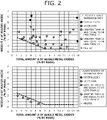
- An upper drawing in FIG. 2 is a graph obtained by extracting samples in which the heating shrinkage rate at 1110°C is 12% or less among respective samples.
- a lower drawing in FIG. 2 is a graph obtained by extracting samples in which the heating shrinkage rate at 1110°C is greater than 12% and equal to or less than 14%.
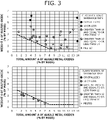
- An upper drawing in FIG. 3 is a graph obtained by extracting samples in which the heating shrinkage rate at 1110°C is 10% or less among respective samples.
- a lower drawing in FIG. 3 is a graph obtained by extracting samples in which the heating shrinkage rate at 1110°C is greater than 10% and equal to or less than 12%.
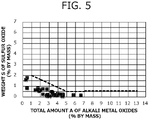
- FIG. 5 illustrates a graph obtained by plotting the total amount A (% by mass) of alkali metal oxides in the horizontal axis and the weight S (% by mass) of sulfur oxide expressed by SO 3 in the vertical axis with respect to existing inorganic fibers. Any of the existing inorganic fibers did not pertain to the ranges defined by Expressions (1) and (2).
- the amount of sulfur is small when the amount of alkali metals is large, and the amount of alkali metals is small when the amount of sulfur is large. This is caused by a raw material composition.
- the amount of alkali metals is large in the case of using a large amount of natural minerals, and the amount of sulfur is typically small in the natural minerals.
- the amount of sulfur is large when using a large amount of slag, and the amount of alkali metals is small in the slag.
- alkali metals and sulfur are treated as impurities in the case of manufacturing rock wool, and there is no technical idea of simultaneously increasing both alkali metals and sulfur.
- the present inventors newly found that when simultaneously increasing both alkali metal and sulfur, the heat resistance is significantly improved due to the above-described reason as a heat resistance exhibition mechanism.
- the heat resistance exhibition mechanism cannot be easily conceived from the technical idea in the related art.
- the crystallization peak temperature of samples was obtained by an exothermic peak temperature when being heated up to 1000°C at a temperature rising rate of 20°C/minute by using the differential thermal analyzer (DTA).
- DTA differential thermal analyzer
- Crystallization peak temperatures of the samples were 810°C (Example 12), 847°C (Example 18), and 902°C (Example 36). Results of Test 4 are illustrated in FIG. 6 and FIG. 7 .
- FIG. 6 is a graph obtained by plotting the total amount A of alkali metal oxides in the respective samples (the weight S of the sulfur oxide expressed by SO 3 is 2.3% by mass to 2.6% by mass) in Test 1 in the horizontal axis and the crystallization peak temperature in the vertical axis. As illustrated in FIG. 6 , it could be seen that the higher the total amount A of the alkali metal oxides is, the lower the crystallization peak temperature is and crystallization is promoted.
- FIG. 7 is a graph obtained by plotting the crystallization peak temperature of the respective samples in Test 4 in the horizontal axis and the heating shrinkage rate at 1110°C in the vertical axis. As illustrated in FIG. 7 , it could be seen that the lower the crystallization peak temperature is, the lower the heating shrinkage rate is and the further the heat resistance is improved.
- melt viscosity was measured. Measurement was performed by using a typical ball pull-up type viscometer, a platinum ball connected to a platinum wire was submerged in the melt maintained at a constant temperature, and viscosity was obtained from a load when pulling up the platinum ball at a predetermined speed.
- Results of Test 5 are shown in the following Table 5. In any sample, there was a temperature range of approximately 150°C to 200°C until measurement of viscosity became difficult. In addition, the higher the total amount A of alkali metal oxides is, the further the temperature range until measurement of the viscosity became difficult tends to broaden.
- Example Example 18 Example 23 Example 21
- Example 74 Example 82 Total amount of alkali metal oxides 4.2 5.2 8.2 10.7 3.6 1500°C 8.7 9.3 7.3 9.6 8.7 1450°C 9.4 9.6 7.4 10.2 9.7 1425°C 9.6 11.2 11.1 1400°C 10.4 13.8 8.9 11.2 11.8 1375°C 11.1 13.7 12.9 16.2 1350°C 69.0 15.7 10.4 14.2 115.8 1325°C Measurement was difficult 23.8 14.9 42.5 Measurement was difficult 1300°C Measurement was difficult 23.6 Measurement was difficult 1275°C Measurement was difficult
- Viscosity when a raw material is melted is an index that greatly affects manufacturability of the inorganic fiber.
- a raw material is melted in a cupola or an electric furnace, and a melt maintained at approximately 1500°C is allowed to flow out from the bottom of the furnace, and is fiberized by a spinning method or a blowing method.
- the melt is stretched in a fiberization process, but the melt is cooled down in the process. That is, for satisfactory fiberization, it is preferable that an increase in viscosity in accordance with a decrease in a temperature of the melt is gradual.
- the total amount A (% by mass) of the alkali metal oxides and the weight S (% by mass) of the sulfur oxide expressed by SO 3 affect the heat resistance of rock wool, respectively.
- the total amount A (% by mass) of the alkali metal oxides and the weight S (% by mass) of the sulfur oxide expressed by SO 3 are within the above-described predetermined ranges, microcrystals exist before being softened and deformed due to heating, softening does not proceed and curvature and fusion of the fiber do not occur even when being exposed to a high temperature of 1100°C or higher.
- compositions shown in Table 6 natural stones such as basalt, and various raw materials such as slag, silica, and soda ash were poured into an electric furnace or cupola, and the raw materials were melted by a similar method as in a method of manufacturing a typical fiber. Then, the melted raw materials were allowed to flow out from the bottom of the furnace and were fiberized by a spinning method. A binder adhered to the fiber, and an inorganic fiber molded body (volume density: 0.08 to 0.12 g/cm 3 ) was obtained by allowing the fiber to pass through a curing furnace.
- evaluation results for a fiber molded body tends to match the results of the above-described composition for manufacturing an inorganic fiber. That is, it could be confirmed that the relationship between the heat resistance and the composition is established not only in the composition for an inorganic fiber but also in the inorganic fiber, and thus it is considered that probability is extremely high.
- FIG. 9 is obtained by plotting examples relating to the inorganic fiber in a graph of examples relating to the composition for an inorganic fiber.
- FIG. 9 it can be determined that examples surrounded by a broken line have approximately the same composition, and the composition and the shrinkage rate are described in the following Table 7.
- FIG. 10 illustrates a relationship between shrinkage rates, and it could be confirmed that the composition for an inorganic fiber and the inorganic fiber have a high correlation. Accordingly, the heat resistance of the composition for an inorganic fiber is an index showing the heat resistance of the inorganic fiber.
Landscapes
- Chemical & Material Sciences (AREA)
- Life Sciences & Earth Sciences (AREA)
- General Chemical & Material Sciences (AREA)
- Engineering & Computer Science (AREA)
- Chemical Kinetics & Catalysis (AREA)
- Geochemistry & Mineralogy (AREA)
- Materials Engineering (AREA)
- Organic Chemistry (AREA)
- General Life Sciences & Earth Sciences (AREA)
- Ceramic Engineering (AREA)
- Textile Engineering (AREA)
- Glass Compositions (AREA)
- Inorganic Fibers (AREA)
Abstract


Description
- The present invention relates to an inorganic fiber, an inorganic fiber product, a method of manufacturing an inorganic fiber product, a composition for manufacturing an inorganic fiber, and a method of manufacturing an inorganic fiber.
- Inorganic fibers represented by rock wool and glass wool have been used in various industries such as steel, petroleum, chemicals, electricity, automobiles, building materials, and aerospace for various usages such as refractory materials, heat insulating materials, and sealing materials, and are indispensable materials.
- In the related art, slag-based rock wool blended with steel slag is fiberized and manufactured as follows. Specifically, natural stones such as silica stone, silica sand, and basalt are added to steel slag as a component adjusting agent, the resultant mixture is melted in a cupola or an electric furnace, and the melt is allowed to flow out from the bottom of the furnace. The melt is fiberized by a spinning method in which the melt is brought into contact with a high-speed rotating body, or a blowing method in which the melt is fiberized by compressed air.
- Although the rock wool in the related art has higher heat resistance indicated by a heating shrinkage rate in comparison to typical glass wool, the rock wool is melted at approximately 800°C. Therefore, in the rock wool in the related art, a ratio of iron oxide in a fiber is increased by increasing a blending ratio of basalt containing iron oxide, converter slag, or the like, thereby improving heat resistance (refer to
PATENT LITERATURE 1 and PATENT LITERATURE 2). - However, since iron oxide in a rock wool raw material is partially reduced in melting, metallic iron is deposited on the bottom of a melting furnace. Therefore, when the amount of iron increases in the rock wool raw material, the frequency of a work of periodically extracting the metallic iron increases. Due to this, time productivity of the rock wool is lowered, and thus it is necessary to significantly lower the blending ratio of iron oxide in the rock wool raw material from the viewpoint of production.
- From the viewpoint,
PATENT LITERATURE 3 discloses rock wool having high heat resistance even though the content of iron oxide is small. The rock wool contains 35% by mass to 45% by mass of SiO2, 10% by mass to 15% by mass of Al2O3, 20% by mass to 35% by mass of CaO, 10% by mass to 25% by mass of MgO, and FeO and Fe2O3 in a total content of 2% by mass to 10% by mass. A molar ratio of divalent Fe atoms to the sum of divalent Fe atoms and trivalent Fe atoms is set to 0.8 or greater. -
- PATENT LITERATURE 1:
JP H6-45472 B - PATENT LITERATURE 2:
JP H6-65617 B - PATENT LITERATURE 3:
WO 2012/176799 A - In the rock wool described in
PATENT LITERATURE 3, it is necessary to adjust the molar ratio of divalent Fe and trivalent Fe within a predetermined range, and thus a selectable raw material is limited. Accordingly, with regard to an inorganic fiber such as rock wool, it is desired to have high heat resistance even though the content of oxide iron is small, and it is desired to further raise productivity while expanding the option of a raw material. - In addition, the present inventors also found that there is a new problem of deterioration of productivity or limitation of a selectable raw material even in the case of adding a compound of transition metals other than Fe from the viewpoint of improving heat resistance of an inorganic fiber such as rock wool. Here, a search was made to find a method of improving heat resistance of an inorganic fiber by an approach different from the use of the compound of transition metals.
- The invention has been made in consideration of the problem, and an object thereof is to provide an inorganic fiber in which heat resistance is high, an option of a raw material is wide, and productivity is high, an inorganic fiber product, a method of manufacturing an inorganic fiber product, a composition for manufacturing an inorganic fiber, and a method of manufacturing an inorganic fiber.
- The present inventors have made a thorough investigation. As a result, they newly found that when a total amount A (% by mass) of alkali metal oxides and a weight S (% by mass) of a sulfur oxide expressed by SO3 are set within a predetermined range, an inorganic fiber having high heat resistance is obtained, and they accomplished the invention.
- According to an inorganic fiber according to the invention, the inorganic fiber contains at least one kind of alkali metal compound selected from the group consisting of Na, K, and Li, and a sulfur compound. A total amount A (% by mass) of alkali metal oxides expressed by Na2O, K2O, and Li2O and a weight S (% by mass) of a sulfur oxide expressed by SO3 in terms of oxides satisfy the following Expression (1) or (2). Accordingly, the above-described problem is solved.


- At this time, the inorganic fiber may further contain 0.1% by mass to 5% by mass of transition metal compound.
- At this time, the transition metal compound may be at least one kind of compound selected from the group consisting of Fe, Mn, Cu, Ni, Co, Zr, V, Nb, Mo, W, and Y.
- At this time, the inorganic fiber may have a composition containing:
- 25% by mass to 45% by mass of SiO2;
- 5% by mass to 25% by mass of Al2O3;
- 15% by mass to 50% by mass of CaO;
- 3% by mass to 20% by mass of MgO;
- 0.1% by mass to 5% by mass of transition metal compound;
- 0.5% by mass to 5% by mass of SO3; and
- 1% by mass to 13% by mass of Na2O, K2O, and Li2O.
- At this time, the inorganic fiber may be at least one or more kinds selected from the group consisting of rock wool, stone wool, slag wool, mineral wool, glass wool, and mineral glass wool.
- According to an inorganic fiber product according to the invention, the above-described inorganic fiber is included, and thus the above-described problem is solved.
- At this time, the inorganic fiber product may be a heat insulating material or a refractory material.
- According to a method of manufacturing an inorganic fiber product according to the invention, the method includes molding the inorganic fiber, and thus the above-described problem is solved.
- According to a composition for manufacturing an inorganic fiber according to the invention, the composition contains at least one kind of alkali metal compound selected from the group consisting of Na, K, and Li, and a sulfur compound. A total amount A (% by mass) of alkali metal oxides expressed by Na2O, K2O, and Li2O and a weight S (% by mass) of a sulfur oxide expressed by SO3 in terms of oxides satisfy the following Expression (1) or (2). Accordingly, the above-described problem is solved.


- According to a method of manufacturing an inorganic fiber according to the invention, the method includes melting the composition for manufacturing an inorganic fiber and making the resultant melt into a fiber to obtain an inorganic fiber, and thus the above-described problem is solved.
- According to the invention, it is possible to provide an inorganic fiber in which heat resistance is high, an option of a raw material is wide, and productivity is high, an inorganic fiber product, a method of manufacturing an inorganic fiber product, a composition for manufacturing an inorganic fiber, and a method of manufacturing an inorganic fiber.
-
-
FIG. 1 is a graph obtained by extracting samples in which a heating shrinkage rate at 1110°C is 14% or less (upper drawing) and samples melted at 1110°C (lower drawing) among respective samples inTest 1, and by plotting a total amount A (% by mass) of alkali metal oxides in the horizontal axis, and a weight S (% by mass) of a sulfur oxide expressed by SO3 in the vertical axis. -
FIG. 2 is a graph obtained by extracting samples in which a heating shrinkage rate at 1110°C is 12% or less (upper drawing) and samples in which the heating shrinkage rate is greater than 12% and equal to or less than 14% (lower drawing) among respective samples inTest 1, and by plotting a total amount A (% by mass) of alkali metal oxides in the horizontal axis, and a weight S (% by mass) of a sulfur oxide expressed by SO3 in the vertical axis. -
FIG. 3 is a graph obtained by extracting samples in which a heating shrinkage rate at 1110°C is 10% or less (upper drawing) and samples in which the heating shrinkage rate is greater than 10% and equal to or less than 12% (lower drawing) among respective samples inTest 1, and by plotting a total amount A (% by mass) of alkali metal oxides in the horizontal axis, and a weight S (% by mass) of a sulfur oxide expressed by SO3 in the vertical axis. -
FIG. 4 is a graph obtained by extracting samples in which a heating shrinkage rate at 1110°C is 14% or less (upper drawing) and samples melted at 1110°C (lower drawing) among respective samples inTest 2, and by plotting a total amount A (% by mass) of alkali metal oxides + the content T (% by mass) of a transition metal compound in the horizontal axis, and a weight S (% by mass) of a sulfur oxide expressed by SO3 in the vertical axis. -
FIG. 5 is a graph obtained by plotting a total amount A (% by mass) of alkali metal oxides in the horizontal axis and a weight S (% by mass) of a sulfur oxide expressed by SO3 in the vertical axis with respect to an existing inorganic fiber. -
FIG. 6 is a graph obtained by extracting samples in which the weight S of the sulfur oxide expressed by SO3 is 2.3% by mass to 2.6% by mass among the respective samples inTest 1, and by plotting the total amount A of the alkali metal oxides in the horizontal axis and a crystallization peak temperature in the vertical axis. -
FIG. 7 is a graph obtained by plotting a crystallization peak temperature of respective samples inTest 4 in the horizontal axis and a heating shrinkage rate at 1110°C in the vertical axis. -
FIG. 8 is a graph obtained by plotting a total amount A (% by mass) of alkali metal oxides + the content T (% by mass) of a transition metal compound in the horizontal axis, and a weight S (% by mass) of a sulfur oxide expressed by SO3 in the vertical axis with respect to respective inorganic fiber samples inTest 6. -
FIG. 9 is a graph obtained by plotting examples relating to an inorganic fiber in a graph of examples relating to a composition for an inorganic fiber. -
FIG. 10 is a graph obtained by comparing shrinkage rate with each other for examples of a composition for inorganic fibers having approximately the same composition and inorganic fibers. - Hereinafter, an embodiment (hereinafter, referred to as this embodiment) of the invention will be described with reference to
FIG. 1 to FIG. 10 . This embodiment relates to an inorganic fiber, an inorganic fiber product, a method of manufacturing an inorganic fiber product, a composition for manufacturing an inorganic fiber, and a method of manufacturing an inorganic fiber. - In this specification, ○% by mass to △% by mass represents equal to or greater than ○% by mass and equal to or less than △% by mass.
- In this specification, the content of each component is noted in terms of an oxide, and can be measured by fluorescent X-ray analysis (XRF). Here, even though the content of each component is noted in terms of an oxide, it is not necessary for each of the component to be contained as an oxide. For example, each component (S, Fe, or Na) may not be contained as an oxide (SO3, Fe2O3, or Na2O), and respective components may be contained in a type of a compound such as a sulfide (FeS, Na2S) and a sulfate (FeSO4 or Na2SO4).
- An inorganic fiber (ore fiber) of this embodiment is a fiber-shaped material that is mainly manufactured from various natural ores such as silica and andesite, raw materials such as clay, slag, and glass, or materials obtained by crushing the raw materials. Examples of the inorganic fiber include at least one or more kinds selected from the group consisting of rock wool, stone wool, slag wool, mineral wool, glass wool, and mineral glass wool. As the inorganic fiber of this embodiment, the rock wool or the slag wool is preferable from the viewpoint of heat resistance.
- Here, the composition for manufacturing an inorganic fiber is a composition that becomes a raw material when manufacturing the inorganic fiber, and a state thereof is not particularly limited, and examples thereof include a state in which respective components exist as a mixed solidified material, a state in which respective components are melted, a state in which respective components exist as a powder, and the like.
- The inorganic fiber and the composition for manufacturing an inorganic fiber of this embodiment contain at least one kind of alkali metal compound selected from the group consisting of Na, K, and Li, and a sulfur compound, and contain at least one kind of alkali metal compound selected from the group consisting of Na, K, and Li, and a sulfur compound, and a total amount A (% by mass) of alkali metal oxides expressed by Na2O, K2O, and Li2O and a weight S (% by mass) of a sulfur oxide expressed by SO3 in terms of oxides satisfy the following Expression (1) or (1'), or (2) or (2').


- In addition, the inorganic fiber and the composition for manufacturing an inorganic fiber preferably satisfy the following Expression (3) or (3') or (4) or (4').


- In addition, the inorganic fiber and the composition for manufacturing an inorganic fiber more preferably satisfy the following Expression (5) or (5') or (6) or (6').


- A lower limit value of the weight S (% by mass) of the sulfur oxide expressed by SO3 in terms of an oxide is 0.5% by mass, preferably 1% by mass, and more preferably 2% by mass, and an upper limit value thereof may be 5% by mass. When the weight S (% by mass) of the sulfur oxide is less than 0.5% by mass, an effect of improving heat resistance is not exhibited. In addition, when the weight S (% by mass) of the sulfur oxide is greater than 5% by mass, there is a possibility that crystallization is likely to occur and embrittlement may occur.
- A lower limit value of the total amount A (% by mass) of alkali metal oxides expressed by Na2O, K2O, and Li2O in terms of an oxide is 1% by mass, preferably 2% by mass, and more preferably 3% by mass, and an upper limit value thereof may be 13% by mass. When the total amount A (% by mass) of the alkali metal oxides is less than 2% by mass, the effect of improving heat resistance is slightly inferior, and when the total amount A is less than 1% by mass, the effect of improving heat resistance is not exhibited. When the total amount A (% by mass) of the alkali metal oxides is greater than 13% by mass, there is a possibility that crystallization is likely to occur and embrittlement may occur.
- The inorganic fiber and the composition for manufacturing an inorganic fiber according to this embodiment may contain a transition metal compound. Since the transition metal compound is combined with a sulfur compound to generate a crystal nucleus as in the alkali metal compounds such as Na, the transition metal compound can function as a component that improves heat resistance of the inorganic fiber.
- Accordingly, the content T (% by mass) of the transition metal compound plays an important role for the heat resistance of the inorganic fiber as in the alkali metal oxides. Actually, the present inventors found that a similar behavior as illustrated in
FIG. 4 is obtained even when the horizontal axis in a relational diagram of the total amount A (% by mass) of the alkali metal oxides and the weight S (% by mass) of the sulfur oxide as illustrated inFIG. 1 is set as the total amount A (% by mass) of the alkali metal oxides + the content T (% by mass) of the transition metal compound. - That is, the present inventors found that in Expressions (1) to (6), the total amount A (% by mass) of the alkali metal oxides may be substituted with the total amount A (% by mass) of the alkali metal oxides + the content T (% by mass) of the transition metal compound.
- In the inorganic fiber and the composition for manufacturing an inorganic fiber of this embodiment, when the sum of components contained in the inorganic fiber is set as 100% by mass, a lower limit value of the content T (% by mass) of the transition metal compound is 0.1% by mass or greater from the viewpoint of the heat resistance, preferably 1.0% by mass or greater, and more preferably 1.5% by mass or greater.
- Here, since the transition metal compound in a raw material is partially reduced in melting and is deposited as a metal on the bottom of a melting furnace, it is preferable to suppress the amount of the transition metal compound to be low. Specifically, an upper limit value of the content T (% by mass) of the transition metal compound is 5% by mass or less from the viewpoint of productivity, preferably 4% by mass or less, more preferably 3% by mass or less, and still more preferably 2% by mass or less.
- In the inorganic fiber and the composition for manufacturing an inorganic fiber of this embodiment, the transition metal compound is at least one kind of compound selected from the group consisting of Fe, Mn, Cu, Ni, Co, Zr, V, Nb, Mo, W, and Y. Compounds of Fe, Mn, Cu, Ni, Co, Zr, V, Nb, Mo, W, and Y react with sulfur to form a sulfide (FeS, MnS, CuS, NiS, CoS, or the like) or sulfate (FeSO4, MnSO4, CuSO4, NiSO4, CoSO4, or the like) in a process of manufacturing the inorganic fiber or in use such as heating after being manufactured.
- A molar basicity P is expressed by a molar ratio (mol% (CaO + MgO) /mol% (SiO2 + Al2O3)) of the sum of CaO and MgO to the sum of SiO2 and Al2O3. Specifically, when a total molar ratio of components contained in rock wool is set as 100 mol%, the molar basicity P is obtained by dividing the sum (mol%) of CaO and MgO by the sum (mol%) of SiO2 and Al2O3.
- The molar basicity P is a ratio between SiO2 and Al2O3 which form a glass skeleton of the inorganic fiber, and CaO and MgO which divide the skeleton of the inorganic fiber, and is an index of safety of the skeleton of the inorganic fiber. In rock wool of this embodiment, the molar basicity P is 0.4 to 2.0, preferably 0.5 to 1.7, and more preferably 1.0 to 1.4 or 1.0 to 1.5.
- When the molar basicity P is low, viscosity of the composition for manufacturing an inorganic fiber becomes excessively high, and thus the composition is not appropriately melted. As a result, there is a possibility that productivity may deteriorate. Note that, when the molar basicity P is high, there is a possibility that crystallization is likely to occur and embrittlement may occur, and thus the molar basicity P is preferably set within the above-described numerical range.
- For example, the inorganic fiber and the composition for manufacturing an inorganic fiber have the following composition, but there is no limitation to the composition.
- SiO2: 25% by mass to 45% by mass, and preferably 25% by mass to 40% by mass
- Al2O3: 5% by mass to 25% by mass, and preferably 10% by mass to 20% by mass
- CaO: 15% by mass to 50% by mass, and preferably 30% by mass to 45% by mass
- MgO: 3% by mass to 20% by mass, and preferably 5% by mass to 10% by mass
- Transition metal compound: 0.1% by mass to 5% by mass, and preferably 1% by mass to 3% by mass
- SO3: 0.5% by mass to 5% by mass, preferably 1% by mass to 3% by mass, and more preferably 2% by mass to 3% by mass
- Na2O + K2O + Li2O: 1% by mass to 13% by mass, preferably 2% by mass to 13% by mass, and more preferably 3% by mass to 13% by mass
- In the inorganic fiber and the composition for manufacturing an inorganic fiber according to this embodiment, as illustrated in examples to be described later, when the content of an alkali metal increases, a crystallization peak temperature is lowered, and when the crystallization peak temperature is lowered, the heat resistance is improved. Accordingly, results supporting the technical idea of the invention are obtained. Here, the crystallization peak temperature is a temperature when components which constitute an inorganic fiber are crystallized, and can be obtained from a value of an exothermic peak at the time of temperature rising, for example, by a differential thermal analyzer (DTA) or differential scanning calorimetry (DSC). In this embodiment, for example, the crystallization peak temperature can be defined as an exothermic peak temperature when being heated up to 1000°C at a temperature rising rate of 20°C/minute by using the differential thermal analyzer (DTA).
- In the inorganic fiber and the composition for manufacturing an inorganic fiber according to this embodiment, a softening and deforming temperature (softening point) is set to be higher than the crystallization peak temperature. That is, since microcrystals exist before the inorganic fiber is softened and deformed due to heating, softening does not proceed, and curvature and fusion of fibers do not occur even when being exposed to a high temperature.
- Here, the softening point is a temperature at which the inorganic fiber and the composition for manufacturing an inorganic fiber start to be significantly softened and deformed, and can be measured and obtained, for example, by a method defined in JIS R 3103-1: 2001.
- When being measured by a method described in examples, a heating shrinkage rate of the composition for manufacturing an inorganic fiber according to this embodiment is 14% or less after heating at 1110°C, preferably 12% or less, more preferably 11% or less, and still more preferably 10% or less.
- A surface tension acts on a fiber surface of an inorganic fiber to reduce the surface as much as possible. When the fiber is softened and enters a deformation possible state, the fiber is thickened or deformed due to an influence of the surface tension. In addition, when softening of the fiber proceeds, fiber intersections are fused, and the fiber is finally melted. Heat resistance of an inorganic fiber and an inorganic fiber heat-insulating material becomes more excellent as a temperature at which a fiber shape is not changed and a shape as a heat insulating material having voids between fibers can be maintained is higher.
- The inorganic fiber is amorphous in a non-heated state. Here, amorphous is a state in which atoms do not have a regular arrangement like a crystal, and crystalline is a stable structure in which atoms constituting a substance have spatial regularity, and are three-dimensionally periodically arranged with adjacent atoms.
- Amorphous glass is softened and deformed when being heated from room temperature. However, a state of glass having a special composition, which is called crystallized glass, begins to vary from amorphous to crystalline before reaching a softening and deforming temperature, and thus the glass varies into an agglomerate of microcrystals without being softened and deformed.
- Accordingly, with regard to curvature and fusion of an inorganic fiber, the present inventors have focused on importance of whether or not a crystalline state exists before being softened and deformed. Specifically, in the inorganic fiber of this embodiment, the present inventors found that when the total amount A (% by mass) of the alkali metal oxides expressed by Na2O, K2O, and Li2O and the weight S (% by mass) of the sulfur oxide expressed by SO3 are within the above-described predetermined ranges, softening does not proceed due to existence of microcrystals before being softened and deformed due to heating, and even when being exposed to a high temperature of 1100°C or higher, curvature and fusion of the fiber does not occur.
- The relational expression is expressed by Expression (1) or (1'), or (2) or (2'). Expression (1) represents that the heat resistance is exhibited when sulfur and alkali metal oxides exist in a constant amount or greater, and it is assumed that a substance with which sulfur and an alkali metal can be combined acts as a crystal nucleus and crystallization occurs. Expression (2) represents that when an alkali metal oxide exists in a constant amount or greater, the heat resistance is exhibited even at a position at which the amount of sulfur is low.
- It is easily assumed that when the total amount of sulfur and an alkali metal increases, a contact probability between these increases, the amount of crystal nuclei generated increases, and as a result, the heat resistance is enhanced. As a result of thorough examination, a preferable range and more preferable range can be found.
- That is, as the preferable range, a range expressed by Expression (3) or (3'), or (4) or (4') was found. In addition, as the more preferable range, a range expressed by Expression (5) or (5'), or (6) or (6') was found.
- In a method of manufacturing an inorganic fiber according to this embodiment, a known method that has been used in manufacturing of an inorganic fiber in the related art can be used except that the composition (inorganic fiber raw material) for manufacturing an inorganic fiber which has the same composition as the above-described composition of the inorganic fiber.
- The method of manufacturing an inorganic fiber according to this embodiment is characterized in that the composition for manufacturing an inorganic fiber is melted (melting process) and the resultant melt is fiberized (fiberization process) to obtain an inorganic fiber. More specifically, in the method of manufacturing an inorganic fiber according to the invention, the composition for manufacturing an inorganic fiber is melted in a cupola, an electric furnace, or the like, and the resultant melt is fiberized by spinning, blowing, or the like to obtain an inorganic fiber.
- In the case of performing manufacturing of the inorganic fiber by using the electric furnace, a selection range of a raw material is wider in comparison to the cupola in which it is necessary to put a lump-shaped raw material, and thus the electric furnace is suitable. In the case of using the electric furnace, blowing is not performed, and thus a sulfur component is likely to be contained in the inorganic fiber. In addition, the cupola blows air into the raw material by using coke as a heat source and a reducing agent. From the viewpoint of environment protection, the cupola is provided with a desulfurization device. In the method of manufacturing an inorganic fiber according to this embodiment, since the transition metal compound and sulfur coexist in the inorganic fiber, a sulfur component is suppressed from being emitted into an environment.
- The inorganic fiber according to this embodiment is collected in a cotton collection chamber, and is defiberized and granulated into granular cotton in correspondence with a use. Alternatively, a binder is added to the inorganic fiber and is hardened in a curing furnace, the resultant inorganic fiber is adjusted to have predetermined density and thickness, and is processed into an inorganic fiber product (molded product, secondary product) having a board shape, a mat shape, a felt shape, a blanket shape, a strip shape, a tubular shape, or the like.
- Various kinds of inorganic fiber products (secondary products) can be obtained from the inorganic fiber according to this embodiment. For example, shaped products such as bulks, blankets, blocks, ropes, yarns, woven products, inorganic fibers coated with a surfactant, shotless bulks from which shots (non-fiberized objects) are reduced or removed, boards manufactured by using a solvent such as water, molds, paper, felts, and wet felts impregnated with colloidal silica are obtained. In addition, shaped products after processing the shaped products with collide or the like are obtained. In addition, amorphous materials (mastics, casters, coating materials, and the like) manufactured by using a solvent such as water are also obtained. In addition, structures in which the shaped products, the amorphous products, and various heat-generating bodies are combined are also obtained.
- Examples of specific uses of the inorganic fiber according to this embodiment include refractory coating materials for protecting steel frames or the like, heat insulating materials for various buildings, cover materials for various pipes, joint materials in heat treatment devices and furnaces such as an industrial furnace and an incinerator, joint materials for filling a gap in refractory tiles, heat insulating bricks, iron skins, refractory mortar, and the like, sealing materials, packing materials, cushioning materials, heat insulating materials, refractory materials, fireproof materials, heat reserving materials, protective materials, covering materials, filtering materials, filter materials, insulating materials, filling materials, repair materials, heat-resistant materials, non-combustible materials, soundproof materials, sound-absorbing materials, frictional materials (for example, additives for brake pads), rolls for transporting glass plates and steel plates, automobile catalyst carrier holding materials, various fiber reinforced composite materials (for example, reinforcing fibers for fiber reinforced cement, fiber reinforced plastic, and the like, reinforcing fibers for heat-resistant materials and refractory materials, reinforcing fibers for adhesives and coating materials), and the like.
- Hereinafter, the invention will be described in detail on the basis of specific examples, but the invention is not limited thereto.
- Reagents were mixed (total: 60 to 65 g) in compositions shown in the following Table 1 and Table 2. At this time, graphite (2 to 3 g) was added. The mixed reagents were put into a crucible, and were heated and melted in an electric furnace at 1500°C. A temperature was raised up to 1500°C and the temperature was retained for 15 to 30 minutes, and then the resultant melt was poured into water to be rapidly cooled and vitrified. Glass obtained through rapid cooling was pulverized with a mortar and a ball mill, and uniaxial press molding was performed by applying a load of 3 to 4 kN to prepare a pellet, that is, a composition (size: φ7 mm × 17 mm) for manufacturing an inorganic fiber.
- As evaluation for heat resistance, a heating shrinkage rate of a sample was measured. Specifically, a sample was placed in an electric furnace, and was heated up to 1110°C in accordance with a temperature rising rate simulating a heating curve of ISO834. A diameter of each sample was measured before and after heating, and the shrinkage rate was measured by the dimensional change. Specifically, calculation was performed with an expression of a heating shrinkage rate (%) = (sample diameter before heating - sample diameter after heating)/sample diameter before heating × 100.
- In the following discussion, in the case of performing heating under the above-described heating conditions, when the shrinkage rate can be appropriately measured without melting of a sample pellet, this is determined as existence of heat resistance.
- Result of
Test 1 are shown in Table 1, Table 2, andFIG. 1 to FIG. 3 . Note that, the molar basicity P of samples in examples was 1.0 to 1.5. Note that, results of Li2O are included in Table 1. Since Li is an element that cannot be measured with fluorescent X-rays, the amount of Li was measured by the following method. A sample was dissolved in a mixed acid that was obtained by mixing sulfuric acid and hydrofluoric acid at a ratio of 5:2 and was heated, and then a masking treatment was performed with a boric acid solution. The resultant solution was diluted at an appropriate ratio and was subjected to inductively coupled plasma (ICP) analysis to quantify the amount of Li.[Table 1] Composition (% by mass) Physical properties SiO2 Al2O3 CaO MgO Fe2O3 Na2O K2O Li2O TiO2 SO3 MnO Total amount of alkali metal oxides Shrinkage rate (%) Example 1 30.6 12.1 40.6 7.7 0.1 4.8 0.2 - 0.9 2.6 0.3 5.1 2.7 Example 2 31.3 10.9 42.2 8.2 0.1 3.5 0.2 - 0.8 2.3 0.3 3.8 2.8 Example 3 31.5 13.8 40.0 8.1 0.5 2.2 0.2 - 0.8 2.6 0.3 2.4 3.0 Example 4 29.7 14.5 36.4 6.5 0.1 10.2 0.2 - 0.9 1.3 0.3 10.4 3.0 Example 5 29.2 16.0 33.4 6.8 0.1 11.1 0.2 - 0.8 2.1 0.3 11.3 3.1 Example 6 28.0 19.6 32.4 6.4 0.1 11.4 0.2 - 0.8 0.9 0.3 11.6 3.3 Example 7 33.2 12.2 37.8 7.2 0.1 4.2 0.3 - 0.9 3.8 0.2 4.5 3.4 Example 8 30.2 15.6 34.9 7.0 0.1 10.0 0.2 - 0.9 0.7 0.3 10.2 3.5 Example 9 28.4 15.5 32.6 6.7 0.1 12.0 0.2 - 0.8 3.4 0.3 12.2 4.3 Example 10 29.6 10.4 35.5 6.4 0.1 12.7 0.2 - 0.9 3.9 0.3 12.9 4.5 Example 11 29.6 12.1 36.8 6.4 0.1 10.1 0.2 - 0.8 3.5 0.3 10.3 4.5 Example 12 32.5 12.9 38.1 7.0 0.1 5.5 0.3 - 0.7 2.6 0.3 5.8 4.8 Example 13 29.2 15.5 33.8 6.9 0.1 9.9 0.2 - 1.0 3.0 0.3 10.2 4.9 Example 14 31.4 12.4 36.6 7.1 0.1 8.5 0.2 - 0.8 2.6 0.3 8.8 4.9 Example 15 31.4 14.2 36.2 7.0 0.1 8.4 0.2 - 0.7 1.4 0.3 8.7 5.0 Example 16 31.4 13.2 36.9 7.1 0.1 7.1 0.2 - 0.9 2.8 0.3 7.3 5.6 Example 17 31.8 14.6 37.2 7.0 0.8 4.7 0.3 - 0.8 2.6 0.3 4.9 5.6 Example 18 33.2 12.8 38.6 7.5 0.1 3.9 0.2 - 0.8 2.5 0.3 4.2 6.4 Example 19 32.2 13.6 36.8 7.2 0.0 6.8 0.2 - 0.8 2.0 0.3 7.0 6.8 Example 20 28.7 18.6 35.8 6.2 0.1 9.0 0.2 - 0.7 0.4 0.3 9.2 8.3 Example 21 31.8 14.4 36.7 7.0 0.1 8.0 0.2 - 0.8 0.7 0.3 8.2 8.3 Example 22 32.5 13.3 37.6 7.0 0.1 6.9 0.2 - 0.8 1.3 0.3 7.1 8.3 Example 23 33.0 13.3 38.1 7.5 0.1 5.0 0.2 - 0.7 1.8 0.3 5.2 9.6 Example 24 30.3 14.5 39.0 7.3 0.6 0.2 4.2 - 0.7 2.8 0.3 4.4 3.5 Example 25 39.4 14.5 33.7 6.6 0.1 2.1 0.3 - 0.9 2.1 0.3 2.4 10.6 Example 26 33.2 13.2 38.1 7.6 0.1 5.3 0.2 - 0.8 1.2 0.3 5.5 10.8 Example 27 32.4 13.8 37.8 7.3 0.1 6.7 0.2 - 0.8 0.7 0.3 6.9 11.6 Example 28 37.8 13.5 38.2 5.0 0.1 1.6 0.3 - 0.8 2.3 0.3 1.9 12.0 Example 29 33.2 12.8 39.1 7.4 0.1 5.4 0.2 - 0.9 0.6 0.3 5.6 12.2 Example 30 33.2 14.2 37.8 7.3 0.1 5.3 0.2 - 0.8 0.6 0.6 5.5 12.2 Example 31 34.7 12.6 40.3 7.2 0.0 2.0 0.2 - 0.8 1.7 0.4 2.2 13.6 Example 32 32.8 12.3 41.0 7.5 0.1 3.7 0.3 - 1.0 1.0 0.4 4.0 13.9 Example 33 32.8 11.8 38.2 7.4 0.1 3.7 0.3 - 1.0 4.4 0.3 3.9 3.3 Example 34 32.1 12.5 42.2 7.3 0.1 1.1 0.3 - 0.7 3.5 0.3 1.4 5.3 Example 35 39.1 14.3 35.6 6.4 0.1 0.9 0.3 - 0.8 2.1 0.3 1.2 13.7 Example 36 34.2 13.6 39.8 7.0 0.0 2.0 0.3 - 0.8 2.3 0.3 2.2 10.2 Example 37 29.9 17.1 39.6 7.3 0.1 0.2 0.2 2.9 0.9 1.5 0.3 3.3 13.3 Example 38 31.0 13.2 40.0 8.3 0.2 0.2 0.3 4.0 0.8 1.5 0.3 4.5 11.9 [Table 2] Composition (% by mass) Physical properties SiO2 Al2O3 CaO MgO Fe2O3 Na2O K2O TiO2 SO3 MnO Total amount of alkali metal oxides Shrinkage rate (%) Comparative Example 1 33.3 13.5 41.3 7.7 0.1 1.9 0.3 1.1 0.5 0.3 2.2 Melted Comparative Example 2 30.1 14.3 41.3 7.4 0.9 4.8 0.3 0.8 0.0 0.0 5.1 Melted Comparative Example 3 40.1 14.5 34.0 4.7 2.4 1.4 1.0 0.7 0.6 0.0 2.4 Melted Comparative Example 4 40.0 16.1 33.8 4.6 1.3 1.2 1.1 0.8 0.7 0.3 2.3 Melted Comparative Example 5 41.9 11.9 38.0 5.4 0.1 0.0 0.3 0.5 1.6 0.2 0.3 Melted Comparative Example 6 30.1 14.3 40.5 7.8 0.8 0.3 5.4 0.9 0.0 0.0 5.6 Melted Comparative Example 7 28.7 14.6 33.5 6.3 0.1 13.6 0.2 0.9 1.9 0.3 13.8 Crystallized Comparative Example 8 31.5 11.8 37.6 7.5 0.0 3.8 0.3 1.0 6.3 0.3 4.0 Crystallized Comparative Example 9 29.7 7.4 36.3 5.7 0.1 13.5 0.2 0.7 5.9 0.3 13.8 Crystallized Comparative Example 10 32.0 12.5 37.6 7.2 0.1 3.6 0.2 0.9 5.5 0.3 3.8 Crystallized Comparative Example 11 40.0 12.2 38.4 3.8 1.2 1.0 1.3 0.6 1.4 0.2 2.3 Melted -
FIG. 1 is a graph obtained by plotting the total amount A (% by mass) of alkali metal oxides of each sample in the horizontal axis, and the weight S (% by mass) of a sulfuric acid compound expressed by SO3 in the vertical axis. An upper drawing inFIG. 1 is a graph obtained by extracting samples in which a heating shrinkage rate at 1110°C is 14% or less among respective samples. In addition, a lower drawing inFIG. 1 is a graph obtained by extracting samples melted at 1110°C. - As indicated by a broken line in
FIG. 1 , in samples having excellent heat resistance (the shrinkage rate at 1110°C is 14% or less), A and S satisfied the following Expression (1) or (2).

- When considering plotting of comparative examples (melted or crystallized), it could be seen that the lower limit of the total amount A (% by mass) of alkali metal oxides was 1.0% by mass, the upper limit thereof was 13% by mass, the lower limit of the weight S (% by mass) of the sulfur oxide expressed by SO3 was 0.5% by mass, and the upper limit thereof was 5% by mass.
- An upper drawing in
FIG. 2 is a graph obtained by extracting samples in which the heating shrinkage rate at 1110°C is 12% or less among respective samples. In addition, a lower drawing inFIG. 2 is a graph obtained by extracting samples in which the heating shrinkage rate at 1110°C is greater than 12% and equal to or less than 14%. - As indicated by a broken line in
FIG. 2 , in samples having more excellent heat resistance (the heating shrinkage rate at 1110°C is 12% or less), A and S satisfied the following Expression (3) or (4).

- An upper drawing in
FIG. 3 is a graph obtained by extracting samples in which the heating shrinkage rate at 1110°C is 10% or less among respective samples. In addition, a lower drawing inFIG. 3 is a graph obtained by extracting samples in which the heating shrinkage rate at 1110°C is greater than 10% and equal to or less than 12%. - As indicated by a broken line in
FIG. 3 , in samples having more excellent heat resistance (the heating shrinkage rate at 1110°C is 10% or less), A and S satisfied the following Expression (5) or (6).

- Samples were prepared in a similar manner as in the above-described procedure except that reagents were mixed in compositions shown in Table 3 and Table 4, and evaluation of the heat resistance was performed by a similar method. Results are shown in Table 3, Table 4, and
FIG. 4 . Note that, the molar basicity P of the samples in examples was 1.0 to 1.4.[Table 3] Composition (% by mass) Physical properties SiO2 Al2O3 CaO MgO Fe2O3 Na2O K2O TiO2 SO3 MnO Total amount of alkali metal oxides Alkali + transition metal Shrinkage rate (%) Example 39 30.5 12.5 37.8 7.1 1.1 7.6 0.2 0.9 1.9 0.3 7.9 9.2 6.2 Example 40 29.7 14.9 38.3 7.5 1.4 4.4 0.2 0.7 2.5 0.3 4.6 6.4 2.8 Example 41 32.8 13.2 37.1 7.2 1.4 4.0 0.3 1.2 2.3 0.4 4.3 6.1 4.3 Example 42 30.5 13.7 40.2 7.5 1.5 2.9 0.2 0.9 2.3 0.3 3.1 4.9 2.6 Example 43 30.4 16.8 36.0 7.2 1.7 5.9 0.3 1.0 0.5 0.3 6.2 8.1 9.7 Example 44 32.0 14.4 39.0 6.9 1.9 2.0 0.3 1.0 2.1 0.3 2.3 4.6 9.0 Example 45 30.2 18.6 34.9 6.9 2.0 5.3 0.3 0.8 0.6 0.3 5.6 7.9 9.7 Example 46 30.4 17.2 35.2 7.0 2.0 5.5 0.3 0.9 1.3 0.3 5.7 8.1 5.5 Example 47 35.1 9.9 36.7 7.0 2.1 5.8 0.3 0.9 1.9 0.3 6.1 8.5 7.3 Example 48 30.2 14.2 41.1 7.5 2.2 2.1 0.3 1.0 1.1 0.3 2.4 4.9 6.3 Example 49 25.7 20.1 34.0 6.4 2.4 8.7 0.2 0.7 1.4 0.3 8.9 11.6 4.5 Example 50 29.9 18.4 34.5 6.9 2.5 5.6 0.2 0.7 1.0 0.3 5.8 8.6 7.9 Example 51 29.3 18.8 33.9 6.9 2.7 5.6 0.3 0.9 1.5 0.3 5.8 8.8 4.7 Example 52 32.7 16.5 34.2 6.5 2.7 4.8 0.3 0.8 1.1 0.3 5.1 8.1 9.8 Example 53 30.2 17.3 35.5 6.9 3.1 3.8 0.3 0.9 1.5 0.4 4.1 7.6 4.8 Example 54 27.6 14.4 36.3 7.0 3.7 8.2 0.2 0.7 1.5 0.3 8.4 12.4 5.1 Example 55 29.6 17.1 34.1 6.9 4.7 5.7 0.3 0.8 0.5 0.3 6.0 11.0 7.1 Example 56 37.3 15.7 37.6 3.6 1.5 1.3 1.0 0.7 1.2 0.2 2.2 3.9 12.2 Example 57 32.6 14.5 38.4 7.1 0.1 4.6 0.2 0.8 0.6 1.0 4.8 5.9 8.3 Example 58 32.4 14.2 37.2 7.2 0.2 5.6 0.2 0.9 0.6 1.5 5.8 7.5 6.1 Example 59 32.3 15.3 37.6 7.1 0.2 3.7 0.2 0.8 0.6 2.0 3.9 6.2 5.5 Example 60 31.4 14.4 36.9 6.7 0.3 5.3 0.2 0.9 1.7 2.1 5.5 7.9 7.8 Example 61 31.7 12.0 39.7 7.5 0.2 3.8 0.3 0.8 1.7 2.3 4.1 6.5 6.7 Example 62 32.0 13.9 37.5 7.0 0.3 5.2 0.2 0.6 0.6 2.8 5.4 8.4 6.0 Example 63 31.6 13.4 40.3 7.3 0.3 1.8 0.3 1.0 1.5 2.4 2.1 4.9 11.5 Example 64 32.7 13.6 39.6 7.3 0.3 1.6 0.3 0.9 0.5 3.3 1.9 5.4 1.25 Comparative Example 12 30.9 18.4 37.2 7.4 2.5 2.1 0.3 0.7 0.1 0.3 2.3 5.2 Melted Comparative Example 13 27.9 21.7 36.2 6.5 2.4 3.7 0.3 0.9 0.1 0.3 4.0 6.8 Melted Comparative Example 14 32.5 13.9 40.3 7.5 0.2 1.8 0.2 0.8 0.5 2.2 2.1 4.4 Melted [Table 4] Composition (% by mass) SiO2 Al2O3 CaO MgO Fe2O3 Na2O K2O Li2O TiO2 SO3 MnO Example 65 28.7 21.4 28.5 12.5 0.1 1.9 0.3 0.0 0.9 2.2 0.0 Example 66 30.9 13.2 41.8 7.3 0.0 1.8 0.3 0.0 1.0 2.6 0.0 Example 67 31.1 13.3 39.9 8.0 0.1 2.1 0.3 0.0 0.9 2.3 0.2 Example 68 29.7 11.4 40.3 7.9 0.1 2.1 0.3 0.0 0.9 2.1 0.3 Example 69 29.7 13.8 39.2 7.5 0.1 1.6 0.3 0.0 0.8 1.9 0.2 Example 70 43.8 7.7 19.3 19.4 0.1 1.8 0.3 0.0 0.7 2.3 0.3 Example 71 29.8 12.1 43.9 5.5 0.1 2.0 0.3 0.0 0.8 1.9 0.3 Example 72 31.0 13.4 41.1 8.2 0.1 1.8 0.3 0.0 0.9 1.6 0.3 Example 73 30.5 12.0 39.5 7.6 0.1 1.9 0.3 0.0 0.8 2.3 0.0 Composition (% by mass) Physical properties CuO NiO CoO ZrO2 V2O5 Nb2O5 MoO2 WO2 Y2O3 Total amount of alkali metal oxides Alkali + transition metal Shrinkage rate (%) Example 65 3.3 - - - - - - - - 2.2 5.6 3.2 Example 66 - 1.1 - - - - - - - 2.1 3.2 6.7 Example 67 - - 1.6 - - - - - - 2.4 4.3 9.4 Example 68 - - - 4.8 - - - - - 2.4 7.5 7.6 Example 69 - - - - 4.7 - - - - 1.9 7.0 6.9 Example 70 - - - - - 4.3 - - - 2.0 6.7 7.8 Example 71 - - - - - - 3.3 - - 2.3 6.0 5.2 Example 72 - - - - - - - 1.2 - 2.1 3.7 10.6 Example 73 - - - - - - - - 4.9 2.2 7.2 5.3 - As illustrated in
FIG. 4 , even in the case of plotting the total amount A (% by mass) of alkali metal oxides + the content T (% by mass) of a transition metal compound in the horizontal axis, a similar behavior as in the results inFIG. 1 was obtained. That is, in Expressions (1) to (6), it could be seen that the total amount A (% by mass) of the alkali metal oxides may be substituted with the total amount A (% by mass) of the alkali metal oxides + the content T (% by mass) of the transition metal compound. -
FIG. 5 illustrates a graph obtained by plotting the total amount A (% by mass) of alkali metal oxides in the horizontal axis and the weight S (% by mass) of sulfur oxide expressed by SO3 in the vertical axis with respect to existing inorganic fibers. Any of the existing inorganic fibers did not pertain to the ranges defined by Expressions (1) and (2). - In a composition of typical existing inorganic fiber (for example, rock wool, rock wool, stone wool, slag wool, mineral wool, glass wool, and mineral glass wool), as illustrated in
FIG. 5 , the amount of sulfur is small when the amount of alkali metals is large, and the amount of alkali metals is small when the amount of sulfur is large. This is caused by a raw material composition. The amount of alkali metals is large in the case of using a large amount of natural minerals, and the amount of sulfur is typically small in the natural minerals. In addition, the amount of sulfur is large when using a large amount of slag, and the amount of alkali metals is small in the slag. That is, alkali metals and sulfur are treated as impurities in the case of manufacturing rock wool, and there is no technical idea of simultaneously increasing both alkali metals and sulfur. The present inventors newly found that when simultaneously increasing both alkali metal and sulfur, the heat resistance is significantly improved due to the above-described reason as a heat resistance exhibition mechanism. The heat resistance exhibition mechanism cannot be easily conceived from the technical idea in the related art. - Measurement was performed with respect to Example 12, Example 18, and Example 36 among the samples in
Test 1. - The crystallization peak temperature of samples was obtained by an exothermic peak temperature when being heated up to 1000°C at a temperature rising rate of 20°C/minute by using the differential thermal analyzer (DTA).
- Crystallization peak temperatures of the samples were 810°C (Example 12), 847°C (Example 18), and 902°C (Example 36). Results of
Test 4 are illustrated inFIG. 6 andFIG. 7 . -
FIG. 6 is a graph obtained by plotting the total amount A of alkali metal oxides in the respective samples (the weight S of the sulfur oxide expressed by SO3 is 2.3% by mass to 2.6% by mass) inTest 1 in the horizontal axis and the crystallization peak temperature in the vertical axis. As illustrated inFIG. 6 , it could be seen that the higher the total amount A of the alkali metal oxides is, the lower the crystallization peak temperature is and crystallization is promoted. -
FIG. 7 is a graph obtained by plotting the crystallization peak temperature of the respective samples inTest 4 in the horizontal axis and the heating shrinkage rate at 1110°C in the vertical axis. As illustrated inFIG. 7 , it could be seen that the lower the crystallization peak temperature is, the lower the heating shrinkage rate is and the further the heat resistance is improved. - With respect to samples (Example 82, Example 18, Example 23, Example 21, and Example 74, respectively) in which the total amount A of alkali metal oxides is 3.6, 4.2, 5.2, 8.2, and 10.7, melt viscosity was measured. Measurement was performed by using a typical ball pull-up type viscometer, a platinum ball connected to a platinum wire was submerged in the melt maintained at a constant temperature, and viscosity was obtained from a load when pulling up the platinum ball at a predetermined speed.
- Results of
Test 5 are shown in the following Table 5. In any sample, there was a temperature range of approximately 150°C to 200°C until measurement of viscosity became difficult. In addition, the higher the total amount A of alkali metal oxides is, the further the temperature range until measurement of the viscosity became difficult tends to broaden.[Table 5] Example Example 18 Example 23 Example 21 Example 74 Example 82 Total amount of alkali metal oxides 4.2 5.2 8.2 10.7 3.6 1500°C 8.7 9.3 7.3 9.6 8.7 1450°C 9.4 9.6 7.4 10.2 9.7 1425°C 9.6 11.2 11.1 1400°C 10.4 13.8 8.9 11.2 11.8 1375°C 11.1 13.7 12.9 16.2 1350°C 69.0 15.7 10.4 14.2 115.8 1325°C Measurement was difficult 23.8 14.9 42.5 Measurement was difficult 1300°C Measurement was difficult 23.6 Measurement was difficult 1275°C Measurement was difficult - Viscosity when a raw material is melted is an index that greatly affects manufacturability of the inorganic fiber. When manufacturing the inorganic fiber, a raw material is melted in a cupola or an electric furnace, and a melt maintained at approximately 1500°C is allowed to flow out from the bottom of the furnace, and is fiberized by a spinning method or a blowing method. The melt is stretched in a fiberization process, but the melt is cooled down in the process. That is, for satisfactory fiberization, it is preferable that an increase in viscosity in accordance with a decrease in a temperature of the melt is gradual. Accordingly, from the results of
Test 5, it could be seen that when the total amount A of alkali metal oxides is at least within a range of 3.6 to 10.7 (3.6 ≤ A ≤ 10.7), the inorganic fiber can be fiberized in a satisfactory manner. This is also supported by the following fact. In Example 82 in which the total amount of the alkali metal oxides is 3.6 and Example 74 in which the total amount is 10.7, when actually manufacturing a fiber, it could be confirmed that fiberization is satisfactory. - From the above-described results, it was newly found that the total amount A (% by mass) of the alkali metal oxides and the weight S (% by mass) of the sulfur oxide expressed by SO3 affect the heat resistance of rock wool, respectively. Specifically, in rock wool and a composition for manufacturing rock wool, when the total amount A (% by mass) of the alkali metal oxides and the weight S (% by mass) of the sulfur oxide expressed by SO3 are within the above-described predetermined ranges, microcrystals exist before being softened and deformed due to heating, softening does not proceed and curvature and fusion of the fiber do not occur even when being exposed to a high temperature of 1100°C or higher.
- Hereinafter, with regard to the composition for an inorganic fiber, described so far, based on the specific examples, an inorganic fiber was actually manufactured, and heat resistance was measured. The relationship illustrated in
FIG. 1 to FIG. 3 was verified by an actual fiber. Note that, the invention is not limited thereto. - In compositions shown in Table 6, natural stones such as basalt, and various raw materials such as slag, silica, and soda ash were poured into an electric furnace or cupola, and the raw materials were melted by a similar method as in a method of manufacturing a typical fiber. Then, the melted raw materials were allowed to flow out from the bottom of the furnace and were fiberized by a spinning method. A binder adhered to the fiber, and an inorganic fiber molded body (volume density: 0.08 to 0.12 g/cm3) was obtained by allowing the fiber to pass through a curing furnace.
- As an evaluation for the heat resistance, a heating shrinkage rate of the fiber molded body was measured. Specifically, a molded body sample cut to 50 mm × 50 mm was placed in an electric furnace, and the sample was heated up to 1110°C in accordance with a temperature rising rate simulating a heating curve of ISO834. Lengths of the sample in a vertical direction and a horizontal direction were measured before and after heating, and the shrinkage rate was measured by the dimensional change. Specifically, calculation was performed with an expression of a heating shrinkage rate (%) = (sample length before heating - sample length after heating)/sample length before heating × 100. Note that, a shrinkage rate shown in Table 6 is an average value of a shrinkage rate in the vertical direction and a shrinkage rate in the horizontal direction.
- Results of the above-described test are shown in Table 6, and
FIG. 8 . Note that, the molar basicity P in examples was 1.2 to 1.4.[Table 6] Composition (% by mass) Physical properties SiO2 Al2O3 CaO MgO Fe2O3 Na2O K2O TiO2 SO3 MnO Total amount of alkali metal oxides Alkali + transition metal Shrinkage rate (%) Example 74 30.7 12.6 37.6 5.3 0.4 10.4 0.4 0.7 1.7 0.2 10.7 11.3 3.1 Example 75 30.3 12.9 38.7 5.4 0.4 9.4 0.4 0.7 1.6 0.2 9.7 10.3 5.5 Example 76 31.2 13.0 39.1 5.7 0.4 7.6 0.3 0.7 1.6 0.2 7.9 8.5 9.3 Example 77 32.5 13.5 39.0 5.9 0.3 5.9 0.3 0.7 1.6 0.2 6.2 6.7 9.8 Example 78 30.8 13.0 43.3 5.2 0.1 4.5 0.2 0.8 1.8 0.3 4.7 5.1 9.6 Example 79 30.9 13.1 38.5 5.4 0.3 9.1 0.3 0.7 1.5 0.2 9.3 9.8 4.7 Example 80 31.5 13.5 38.4 5.4 0.3 8.2 0.3 0.7 1.5 0.2 8.5 9.0 8.1 Example 81 30.9 13.0 42.0 5.5 0.2 5.7 0.3 0.5 1.5 0.2 5.9 6.3 8.7 Example 82 31.5 13.4 43.1 5.6 0.2 3.3 0.3 0.7 1.6 0.2 3.6 4.0 11.5 Comparative Example 15 45.6 10.0 35.0 2.3 1.9 1.7 2.2 0.6 0.3 0.1 3.8 5.8 Melted Comparative Example 16 40.7 14.5 35.3 4.3 1.2 1.1 1.0 0.9 0.7 0.2 2.1 3.5 Melted Comparative Example 17 41.3 11.1 39.1 5.3 0.1 0.3 0.3 0.8 1.4 0.1 0.6 0.8 Melted - As illustrated in
FIG. 8 , in the case of plotting the total amount A (% by mass) of alkali metal oxides + the content T (% by mass) of a transition metal compound in the horizontal axis, a similar behavior as in the results of the above-described composition for an inorganic fiber as illustrated inFIG. 4 was obtained. - Note that, a broken line in the drawing is obtained by substituting a portion of A in Expressions (1) or (2) with A+T.


- As illustrated in
FIG. 8 , it could be confirmed that evaluation results for a fiber molded body tends to match the results of the above-described composition for manufacturing an inorganic fiber. That is, it could be confirmed that the relationship between the heat resistance and the composition is established not only in the composition for an inorganic fiber but also in the inorganic fiber, and thus it is considered that probability is extremely high. - Examples having approximately the same composition were compared with each other so as to confirm whether there is a correlation between the composition (pellet) for an inorganic fiber and the shrinkage rate of the inorganic fiber.
FIG. 9 is obtained by plotting examples relating to the inorganic fiber in a graph of examples relating to the composition for an inorganic fiber. - In
FIG. 9 , it can be determined that examples surrounded by a broken line have approximately the same composition, and the composition and the shrinkage rate are described in the following Table 7.FIG. 10 illustrates a relationship between shrinkage rates, and it could be confirmed that the composition for an inorganic fiber and the inorganic fiber have a high correlation. Accordingly, the heat resistance of the composition for an inorganic fiber is an index showing the heat resistance of the inorganic fiber.
Claims (10)
- An inorganic fiber, containing:at least one kind of alkali metal compound selected from the group consisting of Na, K, and Li, and a sulfur compound,wherein a total amount A (% by mass) of alkali metal oxides expressed by Na2O, K2O, and Li2O and a weight S (% by mass) of a sulfur oxide expressed by SO3 in terms of oxides satisfy the following Expression (1) or (2).


- The inorganic fiber according to claim 1, further containing:
0.1% by mass to 5% by mass of transition metal compound. - The inorganic fiber according to claim 2,
wherein the transition metal compound is at least one kind of compound selected from the group consisting of Fe, Mn, Cu, Ni, Co, Zr, V, Nb, Mo, W, and Y. - The inorganic fiber according to any one of claims 1 to 3, the inorganic fiber having a composition containing:25% by mass to 45% by mass of SiO2;5% by mass to 25% by mass of Al2O3;15% by mass to 50% by mass of CaO;3% by mass to 20% by mass of MgO;0.1% by mass to 5% by mass of transition metal compound;0.5% by mass to 5% by mass of SO3; and1% by mass to 13% by mass of Na2O, K2O, and Li2O.
- The inorganic fiber according to any one of claims 1 to 4,
wherein the inorganic fiber is at least one or more kinds selected from the group consisting of rock wool, stone wool, slag wool, mineral wool, glass wool, and mineral glass wool. - An inorganic fiber product, comprising:
the inorganic fiber according to any one of claims 1 to 5. - The inorganic fiber product according to claim 6,
wherein the inorganic fiber product is a heat insulating material or a refractory material. - A method of manufacturing an inorganic fiber product, comprising:
molding the inorganic fiber according to any one of claims 1 to 5. - A composition for manufacturing an inorganic fiber, containing:at least one kind of alkali metal compound selected from the group consisting of Na, K, and Li, and a sulfur compound,wherein a total amount A (% by mass) of alkali metal oxides expressed by Na2O, K2O, and Li2O and a weight S (% by mass) of a sulfur oxide expressed by SO3 in terms of oxides satisfy the following Expression (1) or (2).


- A method of manufacturing an inorganic fiber, comprising:melting the composition for manufacturing an inorganic fiber according to claim 9; andmaking the resultant melt into a fiber to obtain an inorganic fiber.
Applications Claiming Priority (2)
| Application Number | Priority Date | Filing Date | Title |
|---|---|---|---|
| JP2019238724 | 2019-12-27 | ||
| PCT/JP2020/047597 WO2021132120A1 (en) | 2019-12-27 | 2020-12-21 | Inorganic fibers, inorganic fiber product, method for manufacturing inorganic fiber product, composition for manufacturing inorganic fibers, method for manufacturing inorganic fibers |
Publications (2)
| Publication Number | Publication Date |
|---|---|
| EP4082979A1 true EP4082979A1 (en) | 2022-11-02 |
| EP4082979A4 EP4082979A4 (en) | 2023-01-18 |
Family
ID=76574705
Family Applications (1)
| Application Number | Title | Priority Date | Filing Date |
|---|---|---|---|
| EP20906975.6A Pending EP4082979A4 (en) | 2019-12-27 | 2020-12-21 | INORGANIC FIBERS, INORGANIC FIBER PRODUCT, METHOD FOR MAKING AN INORGANIC FIBER PRODUCT, COMPOSITION FOR MAKING AN INORGANIC FIBER, AND METHOD FOR MAKING AN INORGANIC FIBER |
Country Status (6)
| Country | Link |
|---|---|
| EP (1) | EP4082979A4 (en) |
| JP (1) | JP7324868B2 (en) |
| KR (1) | KR102688850B1 (en) |
| CN (1) | CN114929637B (en) |
| MY (1) | MY205018A (en) |
| WO (1) | WO2021132120A1 (en) |
Family Cites Families (17)
| Publication number | Priority date | Publication date | Assignee | Title |
|---|---|---|---|---|
| DE2954306C2 (en) * | 1978-12-08 | 1987-10-29 | Spafi - Societe Anonyme De Participations Financieres Et Industrielles, Courbevoie, Fr | |
| JPH0585771A (en) * | 1991-03-29 | 1993-04-06 | Nippon Electric Glass Co Ltd | Composition for hollow glass sphere |
| US5292690A (en) * | 1991-03-29 | 1994-03-08 | Nippon Electric Glass Company, Ltd. | Glass composition for glass bubbles with increased compressive strength |
| JP2762850B2 (en) | 1992-07-23 | 1998-06-04 | 日本電気株式会社 | Semiconductor integrated circuit |
| JP3178100B2 (en) | 1992-08-18 | 2001-06-18 | 三菱マテリアル株式会社 | Powder production equipment |
| JPH06293533A (en) * | 1993-04-05 | 1994-10-21 | Nippon Electric Glass Co Ltd | Composition for hollow glass sphere and hollow glass sphere produced by using same |
| JPH0873238A (en) * | 1994-09-07 | 1996-03-19 | Nippon Electric Glass Co Ltd | Composition for hollow glass sphere and hollow glass sphere produced by using this |
| US5523264A (en) * | 1995-03-31 | 1996-06-04 | Owens-Corning Fiberglas Technology, Inc. | Glass compositions and fibers therefrom |
| US5658836A (en) * | 1995-12-04 | 1997-08-19 | Owens-Corning Fiberglas Technology, Inc. | Mineral fibers and their compositions |
| US6358871B1 (en) * | 1999-03-23 | 2002-03-19 | Evanite Fiber Corporation | Low-boron glass fibers and glass compositions for making the same |
| ES2212962T3 (en) * | 1999-04-30 | 2004-08-16 | Ursa International Gmbh | BIOSOLUBLE COMPOSITION OF GLASS FIBERS FOR THE PRODUCTION OF GLASS WOOL AND SIMILAR. |
| US20050263925A1 (en) * | 2004-05-27 | 2005-12-01 | Heseltine Robert W | Fire-resistant gypsum |
| DE102007026029B4 (en) * | 2007-06-04 | 2017-01-26 | Schott Ag | Mixture containing fluorescent dye and adhesive for the fluorescent dye, method of preparation and use |
| US20090178439A1 (en) * | 2008-01-10 | 2009-07-16 | Jon Frederick Bauer | Method of making a glass product |
| JP5158916B2 (en) | 2011-06-21 | 2013-03-06 | ニチアス株式会社 | Rock wool, manufacturing method thereof, and inorganic fiber felt |
| KR20190072103A (en) * | 2017-12-15 | 2019-06-25 | 한국세라믹기술원 | A manufacturing method for AR-glass fibers using the coal Waste and manufacturing for AR-glass fibers |
| JP6724896B2 (en) * | 2017-12-28 | 2020-07-15 | 日本電気硝子株式会社 | Glass manufacturing method |
-
2020
- 2020-12-21 JP JP2021567425A patent/JP7324868B2/en active Active
- 2020-12-21 EP EP20906975.6A patent/EP4082979A4/en active Pending
- 2020-12-21 CN CN202080089912.4A patent/CN114929637B/en active Active
- 2020-12-21 KR KR1020227021805A patent/KR102688850B1/en active Active
- 2020-12-21 WO PCT/JP2020/047597 patent/WO2021132120A1/en not_active Ceased
- 2020-12-21 MY MYPI2022002671A patent/MY205018A/en unknown
Also Published As
| Publication number | Publication date |
|---|---|
| JP7324868B2 (en) | 2023-08-10 |
| JPWO2021132120A1 (en) | 2021-07-01 |
| EP4082979A4 (en) | 2023-01-18 |
| KR20220109424A (en) | 2022-08-04 |
| KR102688850B1 (en) | 2024-07-29 |
| WO2021132120A1 (en) | 2021-07-01 |
| CN114929637A (en) | 2022-08-19 |
| MY205018A (en) | 2024-09-27 |
| CN114929637B (en) | 2024-05-10 |
Similar Documents
| Publication | Publication Date | Title |
|---|---|---|
| Boccaccini et al. | Glass-ceramics from filter dusts from waste incinerators | |
| CA2265572C (en) | Process for making mineral wool fibers and fibers made according to such process | |
| Romero et al. | Preparation and properties of high iron oxide content glasses obtained from industrial wastes | |
| CN105753330A (en) | Alkali-resistant glass fiber composition, alkali-resistant glass fiber and preparation method thereof | |
| Liu et al. | Network structure evolution and properties of CaO–MgO–Al2O3–SiO2 glass-ceramics from BaO-bearing blast furnace slag | |
| JP7277541B2 (en) | insulation | |
| WO2012012259A1 (en) | Foam glass having a low coefficient of thermal expansion and related methods | |
| Farouk et al. | Optimization of microstructure of basalt-based fibers intended for improved thermal and acoustic insulations | |
| EP4097057B1 (en) | Method for making man-made vitreous fibres | |
| CN105800943A (en) | Glass fiber composition with red mud and blast furnace slag as raw materials, alkali-resistant glass fiber and preparation method for alkali-resistant glass fiber | |
| Peng et al. | Nano-crystal glass-ceramics obtained by crystallization of vitrified coal fly ash | |
| EP4005987A1 (en) | Inorganic fiber, inorganic fiber product, method for producing inorganic fiber product, composition for producing inorganic fiber, and method for producing inorganic fiber | |
| CN109160743B (en) | A kind of high-strength refractory rock wool and preparation method thereof | |
| KR102657995B1 (en) | Wires reinforced concrete composition containing amorphous metal | |
| Li et al. | Effect of content of Al2O3 and MgO on crystallization of blast furnace slag during fiber formation | |
| EP4097055B1 (en) | Method for making man-made vitreous fibres | |
| KR102688850B1 (en) | Inorganic fiber, inorganic fiber product, method for producing inorganic fiber product, composition for producing inorganic fiber, and method for producing inorganic fiber | |
| Karamanov et al. | Sintering Behavior and Properties of Iron‐Rich Glass‐Ceramics | |
| KR102849121B1 (en) | Glass fiber using the steelmaking slag and manufacturing method of the glass fiber | |
| JPH0645472B2 (en) | Method for producing inorganic fiber having excellent heat resistance, alkali resistance, and low pH property | |
| JP2001279534A (en) | Fiber composition mainly containing coal ash and method for producing the same | |
| Cedillo-Gonzalez et al. | METALLURGICAL WASTE VALORIZATION FOR FABRICATING GLASS-CERAMICS MATERIALS. | |
| Zhou et al. | The Effect of Cooling Behavior on the Production of Mineral Wool Using Boron Containing Ferronickel Slag | |
| Modiga et al. | The effect of titanium slag on the properties of glass-ceramic composites from South African coal fly ash | |
| EA045803B1 (en) | METHOD FOR MANUFACTURING ARTIFICIAL GLASSY FIBERS |
Legal Events
| Date | Code | Title | Description |
|---|---|---|---|
| STAA | Information on the status of an ep patent application or granted ep patent |
Free format text: STATUS: THE INTERNATIONAL PUBLICATION HAS BEEN MADE |
|
| PUAI | Public reference made under article 153(3) epc to a published international application that has entered the european phase |
Free format text: ORIGINAL CODE: 0009012 |
|
| STAA | Information on the status of an ep patent application or granted ep patent |
Free format text: STATUS: REQUEST FOR EXAMINATION WAS MADE |
|
| 17P | Request for examination filed |
Effective date: 20220721 |
|
| AK | Designated contracting states |
Kind code of ref document: A1 Designated state(s): AL AT BE BG CH CY CZ DE DK EE ES FI FR GB GR HR HU IE IS IT LI LT LU LV MC MK MT NL NO PL PT RO RS SE SI SK SM TR |
|
| A4 | Supplementary search report drawn up and despatched |
Effective date: 20221220 |
|
| RIC1 | Information provided on ipc code assigned before grant |
Ipc: C03C 3/062 20060101ALI20221214BHEP Ipc: C03C 3/097 20060101ALI20221214BHEP Ipc: C03C 3/095 20060101ALI20221214BHEP Ipc: C03C 3/087 20060101ALI20221214BHEP Ipc: D01F 9/08 20060101ALI20221214BHEP Ipc: C03C 13/06 20060101ALI20221214BHEP Ipc: C03C 13/02 20060101ALI20221214BHEP Ipc: C03C 13/00 20060101AFI20221214BHEP |
|
| DAV | Request for validation of the european patent (deleted) | ||
| DAX | Request for extension of the european patent (deleted) |