EP4080694B1 - Aircraft laser contrail reduction apparatus and system - Google Patents
Aircraft laser contrail reduction apparatus and system Download PDFInfo
- Publication number
- EP4080694B1 EP4080694B1 EP22166018.6A EP22166018A EP4080694B1 EP 4080694 B1 EP4080694 B1 EP 4080694B1 EP 22166018 A EP22166018 A EP 22166018A EP 4080694 B1 EP4080694 B1 EP 4080694B1
- Authority
- EP
- European Patent Office
- Prior art keywords
- contrail
- aircraft
- laser
- contrails
- formation
- Prior art date
- Legal status (The legal status is an assumption and is not a legal conclusion. Google has not performed a legal analysis and makes no representation as to the accuracy of the status listed.)
- Active
Links
Images




Classifications
-
- B—PERFORMING OPERATIONS; TRANSPORTING
- B64—AIRCRAFT; AVIATION; COSMONAUTICS
- B64D—EQUIPMENT FOR FITTING IN OR TO AIRCRAFT; FLIGHT SUITS; PARACHUTES; ARRANGEMENT OR MOUNTING OF POWER PLANTS OR PROPULSION TRANSMISSIONS IN AIRCRAFT
- B64D33/00—Arrangement in aircraft of power plant parts or auxiliaries not otherwise provided for
- B64D33/04—Arrangement in aircraft of power plant parts or auxiliaries not otherwise provided for of exhaust outlets or jet pipes
-
- B—PERFORMING OPERATIONS; TRANSPORTING
- B64—AIRCRAFT; AVIATION; COSMONAUTICS
- B64D—EQUIPMENT FOR FITTING IN OR TO AIRCRAFT; FLIGHT SUITS; PARACHUTES; ARRANGEMENT OR MOUNTING OF POWER PLANTS OR PROPULSION TRANSMISSIONS IN AIRCRAFT
- B64D15/00—De-icing or preventing icing on exterior surfaces of aircraft
- B64D15/12—De-icing or preventing icing on exterior surfaces of aircraft by electric heating
-
- B—PERFORMING OPERATIONS; TRANSPORTING
- B64—AIRCRAFT; AVIATION; COSMONAUTICS
- B64D—EQUIPMENT FOR FITTING IN OR TO AIRCRAFT; FLIGHT SUITS; PARACHUTES; ARRANGEMENT OR MOUNTING OF POWER PLANTS OR PROPULSION TRANSMISSIONS IN AIRCRAFT
- B64D15/00—De-icing or preventing icing on exterior surfaces of aircraft
- B64D15/20—Means for detecting icing or initiating de-icing
-
- B—PERFORMING OPERATIONS; TRANSPORTING
- B64—AIRCRAFT; AVIATION; COSMONAUTICS
- B64D—EQUIPMENT FOR FITTING IN OR TO AIRCRAFT; FLIGHT SUITS; PARACHUTES; ARRANGEMENT OR MOUNTING OF POWER PLANTS OR PROPULSION TRANSMISSIONS IN AIRCRAFT
- B64D47/00—Equipment not otherwise provided for
- B64D47/02—Arrangements or adaptations of signal or lighting devices
-
- F—MECHANICAL ENGINEERING; LIGHTING; HEATING; WEAPONS; BLASTING
- F02—COMBUSTION ENGINES; HOT-GAS OR COMBUSTION-PRODUCT ENGINE PLANTS
- F02C—GAS-TURBINE PLANTS; AIR INTAKES FOR JET-PROPULSION PLANTS; CONTROLLING FUEL SUPPLY IN AIR-BREATHING JET-PROPULSION PLANTS
- F02C9/00—Controlling gas-turbine plants; Controlling fuel supply in air- breathing jet-propulsion plants
- F02C9/26—Control of fuel supply
- F02C9/28—Regulating systems responsive to plant or ambient parameters, e.g. temperature, pressure, rotor speed
-
- F—MECHANICAL ENGINEERING; LIGHTING; HEATING; WEAPONS; BLASTING
- F05—INDEXING SCHEMES RELATING TO ENGINES OR PUMPS IN VARIOUS SUBCLASSES OF CLASSES F01-F04
- F05D—INDEXING SCHEME FOR ASPECTS RELATING TO NON-POSITIVE-DISPLACEMENT MACHINES OR ENGINES, GAS-TURBINES OR JET-PROPULSION PLANTS
- F05D2220/00—Application
- F05D2220/30—Application in turbines
- F05D2220/32—Application in turbines in gas turbines
- F05D2220/323—Application in turbines in gas turbines for aircraft propulsion, e.g. jet engines
-
- F—MECHANICAL ENGINEERING; LIGHTING; HEATING; WEAPONS; BLASTING
- F05—INDEXING SCHEMES RELATING TO ENGINES OR PUMPS IN VARIOUS SUBCLASSES OF CLASSES F01-F04
- F05D—INDEXING SCHEME FOR ASPECTS RELATING TO NON-POSITIVE-DISPLACEMENT MACHINES OR ENGINES, GAS-TURBINES OR JET-PROPULSION PLANTS
- F05D2270/00—Control
- F05D2270/01—Purpose of the control system
- F05D2270/08—Purpose of the control system to produce clean exhaust gases
- F05D2270/081—Purpose of the control system to produce clean exhaust gases with as little smoke as possible
-
- F—MECHANICAL ENGINEERING; LIGHTING; HEATING; WEAPONS; BLASTING
- F05—INDEXING SCHEMES RELATING TO ENGINES OR PUMPS IN VARIOUS SUBCLASSES OF CLASSES F01-F04
- F05D—INDEXING SCHEME FOR ASPECTS RELATING TO NON-POSITIVE-DISPLACEMENT MACHINES OR ENGINES, GAS-TURBINES OR JET-PROPULSION PLANTS
- F05D2270/00—Control
- F05D2270/30—Control parameters, e.g. input parameters
- F05D2270/311—Air humidity
-
- F—MECHANICAL ENGINEERING; LIGHTING; HEATING; WEAPONS; BLASTING
- F05—INDEXING SCHEMES RELATING TO ENGINES OR PUMPS IN VARIOUS SUBCLASSES OF CLASSES F01-F04
- F05D—INDEXING SCHEME FOR ASPECTS RELATING TO NON-POSITIVE-DISPLACEMENT MACHINES OR ENGINES, GAS-TURBINES OR JET-PROPULSION PLANTS
- F05D2270/00—Control
- F05D2270/30—Control parameters, e.g. input parameters
- F05D2270/313—Air temperature
Definitions
- a method, system and computer program product are provided in accordance with example embodiments described herein for reducing or eliminating contrails formed by an aircraft as it travels through the sky, and more particularly, to disrupting formation of contrails and altering the electromagnetic properties of already-formed contrails through use of one or more lasers.
- Aircraft travel has become a conventional means of travel and is no longer accessible only to the well-heeled. With the widespread accessibility of air travel comes the increasing number of aircraft and flights available from thousands of airports throughout the world. A common form of air travel is on planes that use jet engines and fly at altitudes above 7620 meters (25,000 feet). At some altitudes and environmental conditions, condensation trails (also referred to herein as "contrails”) may form.
- Contrails can be produced by aircraft as they fly at relatively high altitudes, such as above 9144 meters (30,000 feet). Contrails are typically linearly formed clouds formed of ice particles that form in the wake of aircraft. Contrails are formed through two primary formation processes, both of which are byproducts of aircraft travel. The first formation process is through pressure changes that result from the aircraft traveling through the atmosphere. Aircraft wings function by providing lift due to pressure differences imparted by the shape of the wing as it passes through the air. Air pressure changes through wingtip vortices or the air over the entire wing can cause low pressure regions to form behind the wings. Low pressure regions trailing aircraft structures such as wings can cause droplets of water to condense from the atmosphere.
- Contrails may also be formed through water vapor produced in aircraft engine exhaust as a byproduct of combustion. The water vapor exiting the jet engine can freeze and form contrails of linear clouds trailing the aircraft engines. There is a desire for a system and method to reduce or eliminate contrails formed by an aircraft.
- Document US 5 285 256 A states contrail detection aft of an aircraft is provided by a rear-looking ranging system carried by the aircraft.
- a randomly modulated laser beam is directed into a detection volume aft of the aircraft for scatter back toward a detector on the aircraft.
- Bistatic mounting of a laser and a telescope of the detector preclude sensing of the scattered beam forward of the detection volume.
- Processing of the detected scattered beam includes cross correlation and analysis to indicate the formation of the contrail aft of the aircraft.
- Document US 2010/132330 A1 states a method of operating an aircraft, and the aircraft itself, comprising a gas turbine engine that exhausts a plume of gases in use, the aircraft is comprises an electromagnetic radiation generator and a waveguide to direct electromagnetic radiation at the exhaust plume to avoid the formation of contrails.
- Document US 2013/206912 A1 states a method of reducing the amount of water in a region of air including: forming seed ice crystals; dispensing the seed ice crystals towards the region of air; allowing water in the region of air to freeze or deposit onto the seed ice crystals; and allowing the resulting ice crystals to move from the region of air so as to reduce the amount of water in the region of air.
- An ice crystal seeding assembly arranged to reduce the amount of water in a region of air, the seeding assembly includes an ice crystal seeder and dispensing means, the dispensing means being arranged to dispense seeded ice crystals towards the region of air so that water in the region of air freezes or deposits onto the seed ice crystals and that the resulting ice crystals move from the region of air.
- Document GB 2 524 773 A states a vapor trail mitigation system for a combustion engine having a photon emitter configured to impart energy into an exhaust flow from the engine so as to reduce or suppress condensation or ice nucleation sites in the exhaust flow prior to mixing with ambient air.
- the photon emitter may be configured to modify sulphur containing molecules in the exhaust flow prior to mixing with ambient air.
- the photon emitter may be configured to heat or eliminate at least some soot particles in the exhaust flow.
- the photon emitter may be arranged to emit photons of visible or ultraviolet light.
- the photon emitter may be mounted to an aft portion of the engine to irradiate the exhaust flow as it passes through the engine exhaust.
- the photon emitter may be arranged to focus emitted photons into a jet portion of the exhaust flow.
- There may be a sensor for detecting a condition indicative of contrail formation, and a controller for selective operation of the photon emitter in dependence upon a signal output from the sensor.
- a method, apparatus, and system are provided for reducing or eliminating contrails formed by an aircraft as it travels through the sky, and more particularly, to disrupting formation of contrails and altering the electromagnetic properties of already-formed contrails through use of one or more lasers.
- Examples provided herein include a system for reducing or eliminating contrails behind an aircraft, the system including: a controller; and a laser source, where the controller is configured to, in response to receiving an indication of at least one of contrail formation or conditions determined to be conducive to contrail formation, cause the laser source to emit one or more laser beams toward a location behind the aircraft where contrails form under conditions conducive to contrail formation.
- the one or more laser beams comprise a first laser beam and a second laser beam, wherein the first laser beam is configured to ionize particles of a contrail, and the second laser beam is configured to heat particles of the contrail.
- the laser source is directed toward a location behind the aircraft where contrails form under conditions conducive to contrail formation.
- conditions determined by the controller to be conducive to contrail formation include a temperature below a predefined temperature threshold and an altitude above a predefined altitude threshold.
- the controller of some examples is configured to cause the laser source to activate in response to conditions determined by the controller to be conducive to persistent contrail formation.
- the laser source of some examples includes a bank of fiber lasers, where fiber lasers of the bank of fiber lasers are positioned to direct laser beams in a direction aft of a wing of the aircraft.
- Examples provided herein include a method for reducing or eliminating contrails behind an aircraft including: receiving an indication of at least one of contrail formation or conditions determined to be conducive to contrail formation; activating at least one laser source in response to receiving the indication so as to direct at least one laser beam toward a location at which contrails form aft of a wing of the aircraft; and reducing or eliminating contrails in response to activating the at least one laser source.
- the one or more laser beams comprise a first laser beam and a second laser beam, wherein the first laser beam is configured to ionize particles of a contrail, and the second laser beam is configured to heat particles of the contrail.
- Examples optionally include determining conditions proximate the wing of the aircraft conducive to contrail formation and activating the at least one laser source in response to determining conditions proximate the wing of the aircraft conducive to contrail formation.
- Determining conditions proximate the wing of the aircraft conducive to contrail formation includes determining conditions proximate the wing of the aircraft conducive to persistent contrail formation.
- Conditions proximate the wing of the aircraft conducive to contrail formation include, in some examples, a temperature below a predefined temperature threshold and an altitude above a predefined altitude threshold.
- Examples provided herein provide an apparatus and system for reducing or eliminating contrails formed by an aircraft as it travels through the sky, and more particularly, to disrupting formation of contrails and altering the electromagnetic properties of already-formed contrails through use of one or more lasers.
- a system 100 is provided to reduce or eliminate contrails.
- the system includes a controller 102, which may be configured in various manners and, as such, may be embodied as a circuit board, a control module, a computer, a computer workstation, a server or the like.
- the controller of an example includes or is otherwise associated with processing circuitry 132, memory 134, and optionally a user interface 136 and a communication interface 138 for performing the various functions herein described.
- the processing circuitry 132 may, for example, be embodied as various means including one or more microprocessors, one or more coprocessors, one or more multi-core processors, one or more controllers, one or more computers, various other processing elements including integrated circuits such as, for example, an ASIC (application specific integrated circuit) or FPGA (field programmable gate array), or some combination thereof.
- the processing circuitry 132 is configured to execute instructions stored in the memory 134 or otherwise accessible to the processing circuitry. These instructions, when executed by the processing circuitry 132, may cause the controller 102 and, in turn, the system 100 to perform one or more of the functionalities described herein.
- the controller 102 may comprise an entity capable of performing operations according to an example embodiment of the present disclosure while configured accordingly.
- the processing circuitry 132 when the processing circuitry 132 is embodied as an ASIC, FPGA or the like, the processing circuitry and, correspondingly, the controller 102 may comprise specifically configured hardware for conducting one or more operations described herein.
- the controller 102 when the controller 102 is embodied as an executor of instructions, such as may be stored in the memory 134 the instructions may specifically configure the processing circuitry and, in turn, the controller 102 to perform one or more algorithms and operations described herein.
- the memory 134 may include, for example, volatile and/or non-volatile memory.
- the memory 134 may comprise, for example, a hard disk, random access memory, cache memory, flash memory, circuitry configured to store information, or some combination thereof.
- the memory 134 may comprise any non-transitory computer readable storage medium.
- the memory 134 may be configured to store information, data, applications, instructions, or the like for enabling the controller 102 to carry out various functions in accordance with examples of the present disclosure.
- the memory 134 may be configured to store program instructions for execution by the processing circuitry 132.
- the user interface 136 may be in communication with the processing circuitry 132 and the memory 134 to receive user input and/or to provide an audible, visual, mechanical, or other output to a user.
- the user interface 136 may include, for example, a user interface by which an operator can manually activate contrail reduction and elimination mechanisms as described herein.
- Other examples of the user interface 136 include a keyboard, a mouse, a joystick, a microphone and/or other input/output mechanisms.
- the communication interface 138 may be in communication with the processing circuitry 132 and the memory 134 and may be configured to receive and/or transmit data.
- the communication interface 138 may include, for example, one or more antennas and supporting hardware and/or software for enabling communications with a wireless communication network. Additionally or alternatively, the communication interface 138 may include the circuitry for interacting with the antenna(s) to cause transmission of signals via the antenna(s) or to handle receipt of signals received via the antenna(s). In some environments, the communication interface 138 may alternatively or also support wired communication.
- Computing device 140 may be embodied by any number of devices such as mobile computing devices (e.g., laptop computers, tablet computers, mobile or smart phones, etc.) or may be fixed computing devices such as a desktop computer, workstation, aircraft computing device (e.g., one or more aircraft system computing devices) or the like.
- the computing device 140 may be configured to provide information or external control to the controller 102 for reducing or eliminating contrails as described herein.
- the controller 102 autonomously or under control of the computing device 140, can control devices such as a laser source 192 or the like to reduce or eliminate contrails.
- the computing device 140 may be co-located with the controller 102 or may be remote from the controller.
- the computing device 140 may be carried on an aircraft including the controller 102, whereby a user of the computing device 140 may be able to provide instruction to the computing device which in-turn provides the instruction to the controller 102 to control the devices such as the laser source 192 relative to contrail reduction and elimination.
- the system of an example includes one or more sensors 142 that may provide data or information to facilitate control of the laser source 192.
- the sensors 142 may sense environmental conditions including temperature, pressure, or the like such that the sensors or the controller 102 can determine if conditions are conducive to contrail formation.
- the controller 102 may process the sensor data from sensors 142 to determine when contrail formation is likely, or the controller 102 may receive an indication that contrail formation is likely.
- the sensors may include optical sensors that determine visually when contrails are being formed or may receive feedback in the form of scattered light from a contrail to establish that contrails are being formed.
- Contrails can be produced by aircraft as they fly at relatively high altitudes, such as above 9144 meters (30,000 feet). Contrails are typically linearly formed clouds formed of ice particles that form in the wake of aircraft. Contrails are formed through two primary formation processes, both of which are byproducts of aircraft travel. The first formation process is through pressure changes that result from the aircraft traveling through the atmosphere. Aircraft wings function by providing lift due to pressure differences imparted by the shape of the wing as it passes through the air. Air pressure changes through wingtip vortices or the air over the entire wing can cause low pressure regions to form behind the wings. Low pressure regions trailing aircraft structures such as wings can cause droplets of water to condense from the atmosphere.
- These droplets may freeze due to the cold temperatures at altitude and form contrails of linear clouds trailing the aircraft wings. Contrails may also be formed through water vapor produced in aircraft engine exhaust as a byproduct of combustion. The water vapor exiting the jet engine can freeze and form contrails of linear clouds trailing the aircraft engines.
- FIG. 2 illustrates an example process of contrail formation where atmospheric air enters the jet engine 180 along arrow 182.
- the exhaust exits the jet engine including aerosol particles on the order of 10 nanometers in size as shown at a first phase 184 of contrail formation. This occurs in approximately the first tenth of a second after the exhaust leaves the jet engine.
- the aerosol particles form water droplets of about 100 nanometers in size as shown at a second phase 186 of contrail formation.
- FIG 3 illustrates the aerosol particles of the first phase 184 exiting the jet engine 180.
- a pulsed laser shown as laser cone 190 emanating from laser source 192 is directed along the path of the exhaust to disrupt the formation of the water droplets. This disruption largely prevents the particles activating into water droplets (shown as second phase 186 in Figure 2 ) which interrupts and stops the formation of contrails. Should some droplets of water still form, the pulsed laser cone 190 warms the water droplet to prevent freezing of the water droplets, or if freezing has already occurred or begun, the pulsed laser of laser cone 190 melts the frozen crystal thereby breaking up the potential formation of the contrail.
- certain examples employ a laser to change the electromagnetic properties of the contrail such that it reflects more sunlight and/or is more transparent to infrared radiation, for example a wavelength of 10 um.
- the laser may not alter the diameter and length of the contrail, the electromagnetic properties of the contrail are changed.
- This can be accomplished by using the pulsed laser to break the ice crystals into small fragments that are less effective at reflecting thermal radiation (i.e. more transparent), which in some examples is centered at a wavelength of about 10 um (10 micrometers).
- Raleigh scattering and Mie scattering relate to the phenomenon of scattering of radiation based on particle size, where scattering decreases as particle size decreases. If water and ice particles are kept to 100 nm (100 nanometers) or less, whether they are precluded from forming into ice or fragmented, the ability of these particles to reflect the 10um wavelength of thermal radiation would be drastically reduced
- contrails can also form from low pressure zones proximate the trailing edges of wings or near wingtips.
- Pulsed lasers such as the pulsed laser of laser cone 190 of Figure 3
- the formation process from a low pressure zone is similar, such that disruption using the laser has the same net effect of stopping the contrail from forming.
- examples are described above with a single laser, examples can employ multiple lasers at different wavelengths. For instance, two lasers operating at two different wavelengths could function with one laser to ionize the particles and the other laser to heat, melt, or fragment the contrail particles.
- the laser used to ionize the particles have a shorter wavelength than the wavelength of the laser used to heat or melt the contrail particles due to ionization energies being relatively larger than the rotational and vibrational transition energies of molecules.
- one laser functions as a catalyst.
- one laser beam can be pulsed, while the other is a continuous wave.
- the lasers could be pulsed at different frequencies.
- An example of a high power pulsed laser (50 J) is a Nd 3+ : (Neodymium) glass laser at 1053 nm.
- Examples of continuous wave laser types that may be employed include: 1) a CO 2 (Carbon Dioxide) gas laser at 10.6 um since this laser is powerful, efficient (10%), and has a wavelength that is heavily absorbed in water and ice, 2) the Yb 3+ : (Ytterbium) silica fiber laser at 1075 nm since this laser too is efficient (20%) and powerful with an output of > 1.5 kW, and 3) a Er 3+ : (Erbium) silica fiber laser at 1550 nm.
- multiple lasers could be employed for each contrail to provide sufficient power to the contrails, particularly with the Er 3+ : silica fiber laser as it only outputs about 100 Watts.
- FIG. 4 illustrates an example implementation of a multiple-laser configuration where the lasers employed are fiber lasers that conduct laser beams through the fibers to be emitted from locations remote from the laser source. As laser technology improves over time, these lasers will become higher power and more energy efficient.
- the properties of contrails formed by an aircraft may differ based on variables such as the aircraft speed, altitude, humidity, temperature, etc. Further, properties of the contrail may be determined by examples described herein, such as by measuring reflectivity of a contrail, formation position of the contrail, contrail density, or the like.
- the system 100 of examples may use one or more sensors (e.g., sensor(s) 142 of Figure 1 ) to detect various properties of the aircraft, the environment, and the contrails formed. Sensors may include LiDAR (Light Distancing and Ranging), radar, ultrasonic sensors, thermal imaging sensors, image sensors, or the like.
- LiDAR Light Distancing and Ranging
- Examples described herein may determine, based on real-time environmental data, aircraft data, and/or detected properties of a formed contrail, an optimal laser wavelength, power, pulse width, and position at which the laser intersects the contrail to provide the most effective and efficient contrail reduction. Examples may employ a non-deterministic design approach such as the Taguchi method to establish the most efficient contrail reduction strategy employing available lasers and positioning elements that can direct the lasers.
- a bank of lasers 191 (including a plurality of laser sources, such as laser source 192) can be housed within a wing 193 of an aircraft with fibers 195a-c routed to locations 197a-c best suited for contrail reduction and elimination of a contrail 187.
- These positions include routing the fibers 195a-c to locations 197a-c on a jet engine 180 such that they can be directed aft of the jet engine to form overlapping laser beams 196a-c in the location where a contrail would generally form.
- fiber 195a is routed to location 197a forming laser beam 196a
- fiber 195b is routed to location 197b forming laser beam 196b
- fiber 195c is routed to location 197c forming laser beam 196c.
- the bank of lasers 191 may include the lasers described above, or any laser suitable to perform the functions described herein.
- the lasers positioned around the exit of the jet engine 180 may operate at different frequencies as described above. Such an example includes, for instance, a laser cone emanating from location 197a having a first wavelength and a laser cone emanating from location 197b having a second wavelength, where the second wavelength is different from the first wavelength.
- lasers are be used to disrupt the formation of contrails and to eliminate contrails formed or forming.
- Examples can optionally modify a contrail to render the contrail less effective at reflecting infrared electromagnetic waves.
- Examples can modify the electromagnetic properties of a contrail to affect the infrared wave interference or infrared reflective properties or scattering properties of a contrail.
- the ice crystals formed during contrail formation scatter light and radiation.
- the type of scattering that is most prevalent from the particles is largely dependent upon the size of the particles.
- Mie scattering of light is prominent with particles of larger size, such as ice crystals or dust, while Rayleigh scattering is more prominent with smaller particles since Rayleigh scattering favors short wavelengths.
- the larger particle size formed during contrail formation such as ice crystals formed at the third phase 188 of Figure 2 , results in a higher proportion of Mie scattering from the contrails.
- An infrared emission having a wavelength of about 10 microns would result in a high proportion of Mie scattering through a contrail.
- Pulsed lasers may be employed as a pulsed laser has a relatively high energy density relative to a continuous wave (CW) laser.
- CW laser continuous wave
- a CW laser that encounters an ice crystal causes the ice crystal to increase in temperature; however, the ice crystal will begin to emit its own infrared signature.
- a pulsed laser encountering an ice crystal does not provide sufficient time for the ice crystal to emit its own infrared signature such that more energy is consumed by the ice crystal, warming the ice crystal and melting or sublimating the ice crystal to reduce its size or eliminate the ice crystal, and therefore the reducing the scattering.
- Mie scattering is polarization dependent, such that elongated ice crystals may respond to a laser based on whether the polarization aligns with the ice crystal.
- Ice crystals forming in the atmosphere at substantial speed behind a jet engine may form in an elongated manner due to the wind speed, such that polarization of a laser used to disrupt crystal formation or to heat formed ice crystals may be important. Ice crystals may form or become oriented with an anisotropic effect such that they have a preferred alignment.
- This anisotropic effect may be capitalized on through the use of a polarized laser that is of an optimal polarization for causing ice crystals formed along the preferential alignment or the determined alignment of the ice crystals to better absorb the energy from the polarized laser, thereby rendering the laser more efficient in reducing the size of the ice crystals.
- the absorption, by an ice crystal or water droplet, of energy from a laser occurs when the frequency of an infrared photon matches a molecular bond frequency (i.e., resonant frequency).
- the photon is absorbed by the bond which results in the promotion of the bond electron to an excited state.
- the result is: a weakening of the bond during the excitation period, the potential for a new bond to form during the electron's excited state, or during relaxation, the electron releases a phonon which raises the temperature of the molecule and its surrounding molecules (i.e., molecular vibrations) which raises the temperature of the ice crystal or water droplet, which results in disruption of formation of an ice crystal or reduction in size of a formed ice crystal.
- the lasers described herein such as the laser that produces the laser cone 190 of Figure 3 , directed to the location of a contrail or where a contrail forms, reduce or eliminate the contrail through disruption of the ice crystal formation process and/or melting of ice crystals already formed.
- the interaction length is the length of the overlap between a laser beam (e.g., laser cone 190) with the contrail.
- the laser beam is configured to intercept water droplets and/or ice crystals along the interaction length for contrail reduction or elimination as described herein.
- Figure 4 illustrates an interaction length between where the laser beams 196a-c begins to interact with the contrail 187 at position 170 until the beam ceases to interact with the contrail at position 172 due to a distance being too great for the laser beams 196a-c to be effective.
- the interaction length is between position 170 and position 172 in the illustration of Figure 4 .
- Other example interaction lengths are possible as well.
- the interaction length of a laser beam corresponds to where the laser beam begins to interact with the contrail 187 until the point where the laser beam and contrail 187 diverge.
- the interaction length of laser beam 196a can correspond to where the laser beam 196a begins to interact with the contrail 187 at position 170 until where the laser beam 196a and contrail 187 diverge.
- Figures 3 and 4 illustrate a configuration where laser beams are emitted from a position near the exhaust exit of a jet engine.
- laser beams 196-c impinge upon the location where contrails form at different angles, so as to reach the contrail at different distances from the exhaust of the jet engine 180 and/or to interact with the contrail at different portions or zones of the contrail.
- Figure 5 illustrates an example in which a first laser beam 196a is emitted from a first location 197a at a first angle with respect to an axis 181 extending through the jet engine 180.
- the first laser beam 196a reaches the axis 181 along which the contrail 187 forms at a short distance (e.g. 6,01 meters (20 feet)) behind the jet engine 180.
- a second laser beam 196b is emitted from a second location 197b at a second angle with respect to the axis 181 through the jet engine 180.
- the second laser beam reaches the axis 181 at a relatively longer distance (e.g., 12,02 meters (40 feet)) behind the jet engine 180.
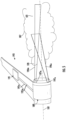
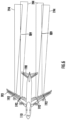
- Figure 6 illustrates an aircraft 110 including a plurality of laser sources 192, with each laser source producing a laser beam 194 forming a laser cone aft of the aircraft 110 to a location 189 where contrails form and configured to break up contrail formation by disrupting the contrail formation process, thereby precluding the formation of contrails. While the illustrated example of Figure 6 may be implemented to reduce and/or eliminate contrails formed from jet engine exhaust or from low pressure zones, lasers of some examples are positioned in various positions on an aircraft to accomplish this goal.
- a laser source or bank of lasers 191 with fibers 195a-c may be implemented in a position proximate a wing tip, lasers or a bank of lasers 191 with fibers 195a-c may be implemented in a position as depicted in Figure 4 with lasers emitted from one or more locations on a jet engine.
- the laser or bank of lasers may be implemented on a tail 198 of an aircraft which place the laser sources downstream of the initiation of the contrails and at a position where they are further into development.
- Examples benefit from lasers or laser sources positioned proximate where contrails form from on an aircraft 110 as the absorption coefficient of the laser beam may be low, directing the laser beam parallel to the formation path of the contrail such that the interaction length or overlap between the laser beam path and the contrail formation path is large, compensating for low absorption.
- This configuration can improve the efficiency of the laser beam functionality through a lower power consumption than would be required if the overlap between the laser beam path and the contrail formation path is lower.
- the laser beams 194 are steerable or can be aimed at different locations. In an example, steering or adjusting the laser beams allows for selectively controlling which portion or zone of the contrail with which the laser beams interact.
- the laser beams can be dynamically swept to cover a larger area.
- a cone of the laser beam 194 of an example is narrower than a contrail.
- the cone of the laser beam 194 is swept dynamically to cover the location 189 behind the aircraft 110 where contrails form.
- the laser beams are steerable to dynamically move an aim of the laser beam responsive to an indication of a location where contrails have formed.
- Figure 7 illustrates the laser beams 194 steered in directions not parallel to a path of flight of the aircraft 110.
- the laser beams 194 of the illustrated example are steered and sweep a path behind an aircraft where it may improve the reduction or elimination of contrails or contrail formation.
- a laser beam 196a can be positioned to impinge upon the forming contrail 187 where the aerosol particles exit the jet engine 180 at first phase (e.g., first phase 184 of Figure 2 , such as at around 6,01 meters (20 feet) from the jet engine 180) to disrupt formation of water droplets (e.g., second phase 186 of Figure 2 ), while a second laser beam 196b can be positioned to impinge upon the forming contrail where ice crystals are formed (e.g., third phase 188 of Figure 2 , such as at 12,02 meters to 18,03 meters (40 to 60 feet) from the jet engine 180) to melt and reduce the size of the ice crystals.
- Positioning a laser to interact with the length of the contrail has the potential to reduce the effectiveness of the laser beam once it reaches the position at
- examples selectively choose, such as by controller 102, when to operate the lasers based on when conditions are conducive to contrail formation or when contrail formation is confirmed. For example, if contrail formation occurs only above a predefined altitude threshold (e.g., 9144 meters (30,000 feet)) and below a predefined temperature threshold (e.g., - 34,44°C (-30°F)), the lasers or laser sources are controlled (e.g., via controller 102) to operate only under these conditions.
- the controller 102 of examples is configured to cause the laser source to activate in response to receiving an indication of at least one of contrail formation or conditions determined to be conducive to contrail formation.
- the indication is sensor data received from sensor(s) 142 that that the controller determines is associated with conditions that are conducive to contrail formation.
- the controller 102 is configured to cause the laser source to activate in response to conditions determined by the controller to be conducive to contrail formation.
- an image sensor positioned to capture an image of where contrails would normally form is configured to be used to confirm when contrails are present, and the controller of such embodiments is configured to only operate the laser sources once contrail formation is confirmed.
- the laser beam of an example embodiment is periodically pulsed and scattered light can be measured, such as by sensors 142, to determine contrail formation and density.
- the laser source 192 is turned on at full power or at a power level sufficient to reduce or eliminate the contrail as described above to bring down the scattered light measured by the sensors 142.
- Contrails may be persistent or may rapidly dissipate. If humidity is low in the atmosphere, a contrail may be short-lived (e.g., less than 10 minutes). Ice particles from the contrails will evaporate into the surrounding atmosphere. If humidity is relatively high, conditions may be conducive to persistent contrail formation such that contrails may be persistent with persistent ice crystal formation and extend for miles in length while spreading hundreds of yards in width and height. Persistent contrails include contrails that form and remain visible for 30 minutes or more. An example embodiment described herein monitors conditions beyond temperature and altitude to include humidity such that a distinction can be made between whether conditions suggest rapidly dissipating contrails or persistent contrails. If conditions indicate rapidly dissipating contrails, contrail mitigation through use of the lasers may be avoided.
- contrail mitigation methods are employed using lasers to disrupt the contrail formation process to reduce or eliminate contrail formation.
- conditions suggest contrail persistence may be of intermediate duration (e.g., 5 minutes to 30 minutes)
- use of contrail mitigation techniques described herein will be determined based on other factors, such as energy requirements weighed against the benefits of the contrail mitigation.
- embodiments provided herein may reduce or eliminate contrails from other aircraft, or reduce or eliminate ice crystals formed in the atmosphere from other sources.
- Ice crystals may form in the atmosphere from a variety of sources and may be dispersed over wide areas in some circumstances. For instance, ice crystals may form naturally in the atmosphere due to natural atmospheric conditions (e.g., pressure, temperature, humidity, aerosol content, etc.). These ice crystals scatter light and infrared waves through Mie scattering as described above. It may be desirable to reduce the presence of these ice crystals in the atmosphere, and example embodiments provided herein can accomplish this, such as through the use of system 100 of Figure 1 .
- an aircraft may encounter contrails formed by another aircraft, and reduce the contrails to reduce their scattering properties.
- An aircraft may fly parallel to the existing contrails and may have lasers that are angled or steerable to interact with the existing contrails.
- An aircraft including such a system for reducing or eliminating ice crystals in the atmosphere may use sensors, as described above, to detect the presence of ice crystals, such as in an existing contrail, using backscatter or other techniques.
- the system of some embodiments uses the detection to identify a location of the existing contrail, such as through the use of LiDAR, and to guide a laser based on the detected location of the existing contrail.
- Embodiments employ the system for reducing or eliminating the ice crystals in response to a density of the ice crystals being above a predetermined density. This is determined, for example, based on the amount of scattering of light determined by a sensor.
- An example of a predetermined density includes at least 75% of light scattering, which may be established by a sensor (e.g., sensors 142) projecting light onto the ice crystals and measuring the feedback in the form of scattered light.
- an aircraft may encounter ice crystals formed by other means.
- nuclear power plants may generate steam that can billow into the atmosphere where the water droplets can freeze and become a source of Mie scattering.
- An aircraft flying near such emissions may be routed through the ice crystals for purposes of reducing or eliminating the ice crystals, thereby reducing the resultant Mie Scattering.
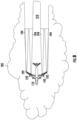
- Figure 8 illustrates such an example embodiment where an aircraft 110 flies through an ice crystal cloud 205 and uses laser cones 194 produced from laser sources 192 to reduce or eliminate the ice crystals in the form of a dissipation trail (also referred to herein as a "distrail") 210.
- the laser sources 192 of some embodiments are manually enabled to produce the laser cones 194, or the laser sources 192 of certain embodiments are enabled based on detection of the ice crystal cloud 205, such as through detection means described above.
- While aircraft of example embodiments are configured to eliminate ice crystal clouds and contrails as they encounter them, embodiments optionally route aircraft to or through specific locations where such ice crystal clouds or contrails are present or prevalent.
- a nuclear power station is known to produce ice crystal plumes in the atmosphere under conducive conditions, an aircraft may be routed through the area where such plumes are known to likely exist on a path to the destination of the aircraft.
- aircraft employing systems for reducing or eliminating contrails may be routed over such solar farms to reduce or eliminate contrails or clouds of ice crystals formed over or near such solar farms to maximize efficiency of those solar farms.
- an aircraft of an example embodiment is mission-specific for reducing or eliminating contrails and clouds of ice crystals. Such an aircraft may seek out contrails and clouds of ice crystals, detecting them through the detection mechanisms described above.
- Embodiments provided herein establish whether it is prudent to perform contrail and ice crystal reduction based on the context of the contrail or ice crystals present. For example, if there exists a 100 meters thick layer of ice crystals over a solar farm, it may be determined that reduction or elimination will be insufficient and is not warranted. However, if the layer of ice crystals over a solar farm is only five meters thick, it may merit use of the system described herein to reduce or eliminate the ice crystals and reduce the degree of scattering.
- a thickness or size of a cloud layer of ice crystals is ten meters thick, and the scattering of infrared energy in the cloud occurs primarily within the first one meter of thickness, an attempt to reduce or eliminate the cloud of ice crystals may not be efficient.
- a thickness of a cloud of ice crystals is ten meters thick, and the scattering of infrared energy in the cloud primarily occurs over the first nine meters of thickness, reduction or elimination of the ice crystals of the cloud may be worthwhile as it may reduce the scattering effect of the cloud.
- FIGS 9 and 10 illustrates flowcharts of a methods according to an example embodiments of the present disclosure. It will be understood that each block of the flowcharts, and combinations of blocks in the flowchart, may be implemented by various means, such as hardware, firmware, processor, circuitry, computing device, and/or other devices associated with execution of software including one or more computer program instructions. For example, one or more of the procedures described above are embodied by computer program instructions in certain embodiments. In this regard, the computer program instructions which embody the procedures described above are stored by the memory 134 of a controller 102 of a system 100 employing an embodiment of the present disclosure and executed by the processing circuitry 132 of the system 100.
- any such computer program instructions may be loaded onto a computer or other programmable apparatus (e.g., hardware) to produce a machine, such that the resulting computer or other programmable apparatus implements the functions specified in the flowchart blocks.
- These computer program instructions are optionally stored in a computer-readable memory that directs a computer or other programmable apparatus to function in a particular manner, such that the instructions stored in the computer-readable memory produce an article of manufacture the execution of which implements the function specified in the flowchart blocks.
- the computer program instructions of certain embodiments are loaded onto a computer or other programmable apparatus to cause a series of operations to be performed on the computer or other programmable apparatus to produce a computer-implemented process such that the instructions which execute on the computer or other programmable apparatus provide operations for implementing the functions specified in the flowchart blocks.
- a method for disrupting formation of contrails 187 and altering the electromagnetic properties of already-formed contrails through use of one or more laser sources 192 is shown.
- an indication is received of at least one of contrail formation or conditions determined to be conducive to contrail formation.
- At least one laser source 192 is activated in response to receiving the indication so as to direct at least one laser beam 196 toward a location at which contrails form aft of a wing 193 of the aircraft 110 as shown at 310.
- the contrails are reduced or eliminated in response to activating the at least one laser source 192 as shown at 320.
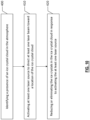
- Figure 10 illustrates a method for reducing or eliminating ice crystals in an atmosphere.
- the depicted method includes identifying a presence of an ice crystal cloud in the atmosphere at 400.
- At least one laser source 192 is activated at 410 to direct at least one laser beam 196 toward a location of the ice crystal cloud 205.
- the ice crystals in the ice crystal cloud 205 are reduced or eliminated in response to activating the at least one laser source 192 as shown at 420.
- blocks of the flowcharts support combinations of means for performing the specified functions and combinations of operations for performing the specified functions for performing the specified functions of communicating a message from an aircraft.
- one or more blocks of the flowcharts, and combinations of blocks in the flowcharts can be implemented by special purpose hardware-based computer systems which perform the specified functions, or combinations of special purpose hardware and computer instructions.
- one or more blocks of the flowcharts and combinations of blocks in the flowcharts can be performed by an apparatus for communicating a message from an aircraft including processing circuitry and at least one non-transitory memory including computer program code instructions.
- the computer program code instructions of an example embodiment are configured to, when executed, perform the specified functions and combinations of operations illustrated in the blocks of the flowcharts.
- certain ones of the operations above are modified or further amplified. Furthermore, in some embodiments, additional optional operations are included. Modifications, additions, or amplifications to the operations above may be performed in any order and in any combination within the scope of the appended claims.
- the controller 102 is integrated into the control systems of the aircraft while one or more laser sources 192 are positioned on a wing 193 or on a jet engine 180 of an aircraft.
- a bank of lasers such as the bank of lasers 191 of Figure 4 is optionally installed remotely from locations (e.g., locations 197a-c) such that there is flexibility in the location of installation of laser sources and controllers in a retrofit system of example embodiments.
Landscapes
- Engineering & Computer Science (AREA)
- Aviation & Aerospace Engineering (AREA)
- Chemical & Material Sciences (AREA)
- Combustion & Propulsion (AREA)
- Mechanical Engineering (AREA)
- General Engineering & Computer Science (AREA)
- Lasers (AREA)
Description
- A method, system and computer program product are provided in accordance with example embodiments described herein for reducing or eliminating contrails formed by an aircraft as it travels through the sky, and more particularly, to disrupting formation of contrails and altering the electromagnetic properties of already-formed contrails through use of one or more lasers.
- Aircraft travel has become a conventional means of travel and is no longer accessible only to the well-heeled. With the widespread accessibility of air travel comes the increasing number of aircraft and flights available from thousands of airports throughout the world. A common form of air travel is on planes that use jet engines and fly at altitudes above 7620 meters (25,000 feet). At some altitudes and environmental conditions, condensation trails (also referred to herein as "contrails") may form.
- Contrails can be produced by aircraft as they fly at relatively high altitudes, such as above 9144 meters (30,000 feet). Contrails are typically linearly formed clouds formed of ice particles that form in the wake of aircraft. Contrails are formed through two primary formation processes, both of which are byproducts of aircraft travel. The first formation process is through pressure changes that result from the aircraft traveling through the atmosphere. Aircraft wings function by providing lift due to pressure differences imparted by the shape of the wing as it passes through the air. Air pressure changes through wingtip vortices or the air over the entire wing can cause low pressure regions to form behind the wings. Low pressure regions trailing aircraft structures such as wings can cause droplets of water to condense from the atmosphere. These droplets may freeze due to the cold temperatures at altitude and form contrails of linear clouds trailing the aircraft wings. Contrails may also be formed through water vapor produced in aircraft engine exhaust as a byproduct of combustion. The water vapor exiting the jet engine can freeze and form contrails of linear clouds trailing the aircraft engines. There is a desire for a system and method to reduce or eliminate contrails formed by an aircraft.
- Document
US 5 285 256 A , according to its abstract, states contrail detection aft of an aircraft is provided by a rear-looking ranging system carried by the aircraft. A randomly modulated laser beam is directed into a detection volume aft of the aircraft for scatter back toward a detector on the aircraft. Bistatic mounting of a laser and a telescope of the detector preclude sensing of the scattered beam forward of the detection volume. Processing of the detected scattered beam includes cross correlation and analysis to indicate the formation of the contrail aft of the aircraft. - Document
US 2010/132330 A1 , according to its abstract, states a method of operating an aircraft, and the aircraft itself, comprising a gas turbine engine that exhausts a plume of gases in use, the aircraft is comprises an electromagnetic radiation generator and a waveguide to direct electromagnetic radiation at the exhaust plume to avoid the formation of contrails. - Document
US 2013/206912 A1 , according to its abstract, states a method of reducing the amount of water in a region of air including: forming seed ice crystals; dispensing the seed ice crystals towards the region of air; allowing water in the region of air to freeze or deposit onto the seed ice crystals; and allowing the resulting ice crystals to move from the region of air so as to reduce the amount of water in the region of air. An ice crystal seeding assembly arranged to reduce the amount of water in a region of air, the seeding assembly includes an ice crystal seeder and dispensing means, the dispensing means being arranged to dispense seeded ice crystals towards the region of air so that water in the region of air freezes or deposits onto the seed ice crystals and that the resulting ice crystals move from the region of air. - Document
GB 2 524 773 A - A method, apparatus, and system are provided for reducing or eliminating contrails formed by an aircraft as it travels through the sky, and more particularly, to disrupting formation of contrails and altering the electromagnetic properties of already-formed contrails through use of one or more lasers.
- Examples provided herein include a system for reducing or eliminating contrails behind an aircraft, the system including: a controller; and a laser source, where the controller is configured to, in response to receiving an indication of at least one of contrail formation or conditions determined to be conducive to contrail formation, cause the laser source to emit one or more laser beams toward a location behind the aircraft where contrails form under conditions conducive to contrail formation. The one or more laser beams comprise a first laser beam and a second laser beam, wherein the first laser beam is configured to ionize particles of a contrail, and the second laser beam is configured to heat particles of the contrail. The laser source is directed toward a location behind the aircraft where contrails form under conditions conducive to contrail formation. According to some examples, conditions determined by the controller to be conducive to contrail formation include a temperature below a predefined temperature threshold and an altitude above a predefined altitude threshold. The controller of some examples is configured to cause the laser source to activate in response to conditions determined by the controller to be conducive to persistent contrail formation. The laser source of some examples includes a bank of fiber lasers, where fiber lasers of the bank of fiber lasers are positioned to direct laser beams in a direction aft of a wing of the aircraft.
- Examples provided herein include a method for reducing or eliminating contrails behind an aircraft including: receiving an indication of at least one of contrail formation or conditions determined to be conducive to contrail formation; activating at least one laser source in response to receiving the indication so as to direct at least one laser beam toward a location at which contrails form aft of a wing of the aircraft; and reducing or eliminating contrails in response to activating the at least one laser source. The one or more laser beams comprise a first laser beam and a second laser beam, wherein the first laser beam is configured to ionize particles of a contrail, and the second laser beam is configured to heat particles of the contrail. Examples optionally include determining conditions proximate the wing of the aircraft conducive to contrail formation and activating the at least one laser source in response to determining conditions proximate the wing of the aircraft conducive to contrail formation. Determining conditions proximate the wing of the aircraft conducive to contrail formation, in some examples, includes determining conditions proximate the wing of the aircraft conducive to persistent contrail formation. Conditions proximate the wing of the aircraft conducive to contrail formation include, in some examples, a temperature below a predefined temperature threshold and an altitude above a predefined altitude threshold.
- Having thus described certain examples of the present disclosure in general terms, reference will hereinafter be made to the accompanying drawings which are not necessarily drawn to scale, and wherein:
-
Figure 1 illustrates a system for reducing or eliminating contrails according to an example of the present disclosure; -
Figure 2 depicts phases of contrail formation according to an example of the present disclosure; -
Figure 3 illustrates a laser beam interacting with the formation of a contrail according to an example of the present disclosure; -
Figure 4 illustrates an arrangement of a bank of lasers positioned around a jet engine of an aircraft according to an example of the present disclosure; -
Figure 5 illustrates an example in which a first laser beam is emitted from a first location at a first angle with respect to an axis through the jet engine while a second laser beam is emitted from a second location at a second angle with respect to the axis through the jet engine; -
Figure 6 illustrates a plurality of laser beams emanating from positions along wings of an aircraft according to example of the present disclosure; -
Figure 7 illustrates the plurality of laser beams emanating from positions along wings of an aircraft as inFigure 6 where the laser beams are steered to dynamically adjust the direction of the laser beams; -
Figure 8 illustrates a plurality of laser beams emanating from positions along wings of an aircraft forming distrails according to an example of the present disclosure; -
Figure 9 illustrates a flowchart of a method for reducing or eliminating contrails according to an example of the present disclosure; and -
Figure 10 illustrates a flowchart of a method for reducing or eliminating ice crystals in an ice crystal cloud according to an example of the present disclosure. - The present disclosure now will be described more fully hereinafter with reference to the accompanying drawings, in which some, but not all aspects are shown. Indeed, the disclosure may be embodied in many different forms and should not be construed as limited to the aspects set forth herein. Rather, these aspects are provided so that this disclosure will satisfy applicable legal requirements. Like numbers refer to like elements throughout.
- As air travel beomes more accessible and the number of aircraft and available flights increases, air traffic commensurately increases. Further, shipping of goods by plane has become widely available and cost effective such that cargo aircraft further adds to air traffic. With the majority of air travel and air cargo flying on jet aircraft at altitudes above 7620 meters (25,000 feet), the likelihood and prevalence of contrail formation increase. In some circumstances or environments, a reduction or elimination of contrails may be desirable. Examples provided herein provide an apparatus and system for reducing or eliminating contrails formed by an aircraft as it travels through the sky, and more particularly, to disrupting formation of contrails and altering the electromagnetic properties of already-formed contrails through use of one or more lasers.
-
Figure 1 , asystem 100 is provided to reduce or eliminate contrails. As shown, the system includes acontroller 102, which may be configured in various manners and, as such, may be embodied as a circuit board, a control module, a computer, a computer workstation, a server or the like. Regardless of the manner in which thecontroller 102 is embodied, the controller of an example includes or is otherwise associated withprocessing circuitry 132,memory 134, and optionally auser interface 136 and acommunication interface 138 for performing the various functions herein described. Theprocessing circuitry 132 may, for example, be embodied as various means including one or more microprocessors, one or more coprocessors, one or more multi-core processors, one or more controllers, one or more computers, various other processing elements including integrated circuits such as, for example, an ASIC (application specific integrated circuit) or FPGA (field programmable gate array), or some combination thereof. In some examples, theprocessing circuitry 132 is configured to execute instructions stored in thememory 134 or otherwise accessible to the processing circuitry. These instructions, when executed by theprocessing circuitry 132, may cause thecontroller 102 and, in turn, thesystem 100 to perform one or more of the functionalities described herein. As such, thecontroller 102 may comprise an entity capable of performing operations according to an example embodiment of the present disclosure while configured accordingly. Thus, for example, when theprocessing circuitry 132 is embodied as an ASIC, FPGA or the like, the processing circuitry and, correspondingly, thecontroller 102 may comprise specifically configured hardware for conducting one or more operations described herein. Alternatively, as another example, when thecontroller 102 is embodied as an executor of instructions, such as may be stored in thememory 134 the instructions may specifically configure the processing circuitry and, in turn, thecontroller 102 to perform one or more algorithms and operations described herein. - The
memory 134 may include, for example, volatile and/or non-volatile memory. Thememory 134 may comprise, for example, a hard disk, random access memory, cache memory, flash memory, circuitry configured to store information, or some combination thereof. In this regard, thememory 134 may comprise any non-transitory computer readable storage medium. Thememory 134 may be configured to store information, data, applications, instructions, or the like for enabling thecontroller 102 to carry out various functions in accordance with examples of the present disclosure. For example, thememory 134 may be configured to store program instructions for execution by theprocessing circuitry 132. - The
user interface 136 may be in communication with theprocessing circuitry 132 and thememory 134 to receive user input and/or to provide an audible, visual, mechanical, or other output to a user. As such, theuser interface 136 may include, for example, a user interface by which an operator can manually activate contrail reduction and elimination mechanisms as described herein. Other examples of theuser interface 136 include a keyboard, a mouse, a joystick, a microphone and/or other input/output mechanisms. - The
communication interface 138 may be in communication with theprocessing circuitry 132 and thememory 134 and may be configured to receive and/or transmit data. Thecommunication interface 138 may include, for example, one or more antennas and supporting hardware and/or software for enabling communications with a wireless communication network. Additionally or alternatively, thecommunication interface 138 may include the circuitry for interacting with the antenna(s) to cause transmission of signals via the antenna(s) or to handle receipt of signals received via the antenna(s). In some environments, thecommunication interface 138 may alternatively or also support wired communication. -
Computing device 140 may be embodied by any number of devices such as mobile computing devices (e.g., laptop computers, tablet computers, mobile or smart phones, etc.) or may be fixed computing devices such as a desktop computer, workstation, aircraft computing device (e.g., one or more aircraft system computing devices) or the like. Thecomputing device 140 may be configured to provide information or external control to thecontroller 102 for reducing or eliminating contrails as described herein. Thecontroller 102, autonomously or under control of thecomputing device 140, can control devices such as alaser source 192 or the like to reduce or eliminate contrails. Thecomputing device 140 may be co-located with thecontroller 102 or may be remote from the controller. Further, thecomputing device 140 may be carried on an aircraft including thecontroller 102, whereby a user of thecomputing device 140 may be able to provide instruction to the computing device which in-turn provides the instruction to thecontroller 102 to control the devices such as thelaser source 192 relative to contrail reduction and elimination. - The system of an example includes one or
more sensors 142 that may provide data or information to facilitate control of thelaser source 192. For example, thesensors 142 may sense environmental conditions including temperature, pressure, or the like such that the sensors or thecontroller 102 can determine if conditions are conducive to contrail formation. Thecontroller 102 may process the sensor data fromsensors 142 to determine when contrail formation is likely, or thecontroller 102 may receive an indication that contrail formation is likely. The sensors may include optical sensors that determine visually when contrails are being formed or may receive feedback in the form of scattered light from a contrail to establish that contrails are being formed. - Contrails can be produced by aircraft as they fly at relatively high altitudes, such as above 9144 meters (30,000 feet). Contrails are typically linearly formed clouds formed of ice particles that form in the wake of aircraft. Contrails are formed through two primary formation processes, both of which are byproducts of aircraft travel. The first formation process is through pressure changes that result from the aircraft traveling through the atmosphere. Aircraft wings function by providing lift due to pressure differences imparted by the shape of the wing as it passes through the air. Air pressure changes through wingtip vortices or the air over the entire wing can cause low pressure regions to form behind the wings. Low pressure regions trailing aircraft structures such as wings can cause droplets of water to condense from the atmosphere. These droplets may freeze due to the cold temperatures at altitude and form contrails of linear clouds trailing the aircraft wings. Contrails may also be formed through water vapor produced in aircraft engine exhaust as a byproduct of combustion. The water vapor exiting the jet engine can freeze and form contrails of linear clouds trailing the aircraft engines.
-
Figure 2 illustrates an example process of contrail formation where atmospheric air enters thejet engine 180 alongarrow 182. The exhaust exits the jet engine including aerosol particles on the order of 10 nanometers in size as shown at afirst phase 184 of contrail formation. This occurs in approximately the first tenth of a second after the exhaust leaves the jet engine. In the next second or so, the aerosol particles form water droplets of about 100 nanometers in size as shown at asecond phase 186 of contrail formation. Due to the temperatures at altitudes, particularly the cold temperatures found above 9144 meters (30,000 feet) of altitude, the water droplets freeze over the following ten seconds or so as shown at athird phase 188 of contrail formation forming ice crystals of around 1000 nanometers that collectively form the contrails. Examples described herein disrupt this process to reduce or preclude the formation of the ice crystals, which reduces or precludes the formation of the contrails. -
Figure 3 illustrates the aerosol particles of thefirst phase 184 exiting thejet engine 180. However, a pulsed laser shown aslaser cone 190 emanating fromlaser source 192 is directed along the path of the exhaust to disrupt the formation of the water droplets. This disruption largely prevents the particles activating into water droplets (shown assecond phase 186 inFigure 2 ) which interrupts and stops the formation of contrails. Should some droplets of water still form, thepulsed laser cone 190 warms the water droplet to prevent freezing of the water droplets, or if freezing has already occurred or begun, the pulsed laser oflaser cone 190 melts the frozen crystal thereby breaking up the potential formation of the contrail. Beyond warming of ice crystals using a laser, certain examples employ a laser to change the electromagnetic properties of the contrail such that it reflects more sunlight and/or is more transparent to infrared radiation, for example a wavelength of 10 um. In other words, although the laser may not alter the diameter and length of the contrail, the electromagnetic properties of the contrail are changed. This can be accomplished by using the pulsed laser to break the ice crystals into small fragments that are less effective at reflecting thermal radiation (i.e. more transparent), which in some examples is centered at a wavelength of about 10 um (10 micrometers). Raleigh scattering and Mie scattering relate to the phenomenon of scattering of radiation based on particle size, where scattering decreases as particle size decreases. If water and ice particles are kept to 100 nm (100 nanometers) or less, whether they are precluded from forming into ice or fragmented, the ability of these particles to reflect the 10um wavelength of thermal radiation would be drastically reduced - As detailed above, contrails can also form from low pressure zones proximate the trailing edges of wings or near wingtips. Pulsed lasers, such as the pulsed laser of
laser cone 190 ofFigure 3 , can disrupt the formation of ice crystals in the same manner as used for disrupting contrail formation from the exhaust. The formation process from a low pressure zone is similar, such that disruption using the laser has the same net effect of stopping the contrail from forming. While examples are described above with a single laser, examples can employ multiple lasers at different wavelengths. For instance, two lasers operating at two different wavelengths could function with one laser to ionize the particles and the other laser to heat, melt, or fragment the contrail particles. The laser used to ionize the particles have a shorter wavelength than the wavelength of the laser used to heat or melt the contrail particles due to ionization energies being relatively larger than the rotational and vibrational transition energies of molecules. In this manner, one laser functions as a catalyst. Further, one laser beam can be pulsed, while the other is a continuous wave. Optionally, the lasers could be pulsed at different frequencies. An example of a high power pulsed laser (50 J) is a Nd3+: (Neodymium) glass laser at 1053 nm. Examples of continuous wave laser types that may be employed include: 1) a CO2 (Carbon Dioxide) gas laser at 10.6 um since this laser is powerful, efficient (10%), and has a wavelength that is heavily absorbed in water and ice, 2) the Yb3+: (Ytterbium) silica fiber laser at 1075 nm since this laser too is efficient (20%) and powerful with an output of > 1.5 kW, and 3) a Er3+: (Erbium) silica fiber laser at 1550 nm. In any of these cases, multiple lasers could be employed for each contrail to provide sufficient power to the contrails, particularly with the Er3+: silica fiber laser as it only outputs about 100 Watts. However, configuring these fiber lasers is feasible given that they are fiber lasers.Figure 4 illustrates an example implementation of a multiple-laser configuration where the lasers employed are fiber lasers that conduct laser beams through the fibers to be emitted from locations remote from the laser source. As laser technology improves over time, these lasers will become higher power and more energy efficient. - The properties of contrails formed by an aircraft may differ based on variables such as the aircraft speed, altitude, humidity, temperature, etc. Further, properties of the contrail may be determined by examples described herein, such as by measuring reflectivity of a contrail, formation position of the contrail, contrail density, or the like. The
system 100 of examples may use one or more sensors (e.g., sensor(s) 142 ofFigure 1 ) to detect various properties of the aircraft, the environment, and the contrails formed. Sensors may include LiDAR (Light Distancing and Ranging), radar, ultrasonic sensors, thermal imaging sensors, image sensors, or the like. Examples described herein may determine, based on real-time environmental data, aircraft data, and/or detected properties of a formed contrail, an optimal laser wavelength, power, pulse width, and position at which the laser intersects the contrail to provide the most effective and efficient contrail reduction. Examples may employ a non-deterministic design approach such as the Taguchi method to establish the most efficient contrail reduction strategy employing available lasers and positioning elements that can direct the lasers. - As shown in
Figure 4 , a bank of lasers 191 (including a plurality of laser sources, such as laser source 192) can be housed within awing 193 of an aircraft withfibers 195a-c routed tolocations 197a-c best suited for contrail reduction and elimination of acontrail 187. These positions include routing thefibers 195a-c tolocations 197a-c on ajet engine 180 such that they can be directed aft of the jet engine to form overlappinglaser beams 196a-c in the location where a contrail would generally form. In particular,fiber 195a is routed tolocation 197a forminglaser beam 196a,fiber 195b is routed tolocation 197b forminglaser beam 196b, andfiber 195c is routed tolocation 197c forminglaser beam 196c. The bank oflasers 191 may include the lasers described above, or any laser suitable to perform the functions described herein. The lasers positioned around the exit of thejet engine 180 may operate at different frequencies as described above. Such an example includes, for instance, a laser cone emanating fromlocation 197a having a first wavelength and a laser cone emanating fromlocation 197b having a second wavelength, where the second wavelength is different from the first wavelength. - As described above, lasers are be used to disrupt the formation of contrails and to eliminate contrails formed or forming. Examples can optionally modify a contrail to render the contrail less effective at reflecting infrared electromagnetic waves. Examples can modify the electromagnetic properties of a contrail to affect the infrared wave interference or infrared reflective properties or scattering properties of a contrail.
- The ice crystals formed during contrail formation scatter light and radiation. The type of scattering that is most prevalent from the particles is largely dependent upon the size of the particles. Mie scattering of light is prominent with particles of larger size, such as ice crystals or dust, while Rayleigh scattering is more prominent with smaller particles since Rayleigh scattering favors short wavelengths. The larger particle size formed during contrail formation, such as ice crystals formed at the
third phase 188 ofFigure 2 , results in a higher proportion of Mie scattering from the contrails. An infrared emission having a wavelength of about 10 microns would result in a high proportion of Mie scattering through a contrail. Because of the relationship between a particle size and the wavelengths that the particle will scatter is inversely proportional, reducing the scattering is possible through either increasing the wavelength of the radiation impinging upon the particle, or reducing the particle size. Since the radiation wavelengths passing through the atmosphere are not controllable, it is desirable to reduce the particle size of particles in a contrail to reduce overall scattering from the contrail, and particularly the Mie scattering of a contrail. - Examples provided herein use lasers to reduce the particle sizes of particles in a contrail and to disrupt the formation of larger particles in order to reduce the scattering ability of contrails which reduces both their visibility and their effect on scattering atmospheric radiation. Pulsed lasers may be employed as a pulsed laser has a relatively high energy density relative to a continuous wave (CW) laser. A CW laser that encounters an ice crystal causes the ice crystal to increase in temperature; however, the ice crystal will begin to emit its own infrared signature. Conversely, a pulsed laser encountering an ice crystal does not provide sufficient time for the ice crystal to emit its own infrared signature such that more energy is consumed by the ice crystal, warming the ice crystal and melting or sublimating the ice crystal to reduce its size or eliminate the ice crystal, and therefore the reducing the scattering.
- Mie scattering is polarization dependent, such that elongated ice crystals may respond to a laser based on whether the polarization aligns with the ice crystal. Ice crystals forming in the atmosphere at substantial speed behind a jet engine may form in an elongated manner due to the wind speed, such that polarization of a laser used to disrupt crystal formation or to heat formed ice crystals may be important. Ice crystals may form or become oriented with an anisotropic effect such that they have a preferred alignment. This anisotropic effect may be capitalized on through the use of a polarized laser that is of an optimal polarization for causing ice crystals formed along the preferential alignment or the determined alignment of the ice crystals to better absorb the energy from the polarized laser, thereby rendering the laser more efficient in reducing the size of the ice crystals.
- The absorption, by an ice crystal or water droplet, of energy from a laser occurs when the frequency of an infrared photon matches a molecular bond frequency (i.e., resonant frequency). The photon is absorbed by the bond which results in the promotion of the bond electron to an excited state. The result is: a weakening of the bond during the excitation period, the potential for a new bond to form during the electron's excited state, or during relaxation, the electron releases a phonon which raises the temperature of the molecule and its surrounding molecules (i.e., molecular vibrations) which raises the temperature of the ice crystal or water droplet, which results in disruption of formation of an ice crystal or reduction in size of a formed ice crystal. The lasers described herein, such as the laser that produces the
laser cone 190 ofFigure 3 , directed to the location of a contrail or where a contrail forms, reduce or eliminate the contrail through disruption of the ice crystal formation process and/or melting of ice crystals already formed. - In order to maximize the effect of the lasers on the contrails, it is desirable to have a significant interaction length with the contrail, where the interaction length is the length of the overlap between a laser beam (e.g., laser cone 190) with the contrail. The laser beam is configured to intercept water droplets and/or ice crystals along the interaction length for contrail reduction or elimination as described herein.
Figure 4 illustrates an interaction length between where thelaser beams 196a-c begins to interact with thecontrail 187 atposition 170 until the beam ceases to interact with the contrail atposition 172 due to a distance being too great for thelaser beams 196a-c to be effective. The interaction length is betweenposition 170 andposition 172 in the illustration ofFigure 4 . Other example interaction lengths are possible as well. For instance, in an example, the interaction length of a laser beam corresponds to where the laser beam begins to interact with thecontrail 187 until the point where the laser beam andcontrail 187 diverge. In such an example, the interaction length oflaser beam 196a can correspond to where thelaser beam 196a begins to interact with thecontrail 187 atposition 170 until where thelaser beam 196a andcontrail 187 diverge. To maximize the interaction length, it is desirable to position a laser proximate to where the contrail is formed. In the case of contrails formed from the exhaust from a jet engine, positioning one or more lasers at an exit of the jet engine or around the exit of the jet engine will provide the greatest interaction length.Figures 3 and4 illustrate a configuration where laser beams are emitted from a position near the exhaust exit of a jet engine. As shown inFigure 4 , the bank oflasers 191 housed within thewing 193 withfibers 195a-c routed tolocations 197a-c, respectively, around thejet engine 180 from which thelaser beams 196a-c are emitted. - According to some examples, laser beams 196-c impinge upon the location where contrails form at different angles, so as to reach the contrail at different distances from the exhaust of the
jet engine 180 and/or to interact with the contrail at different portions or zones of the contrail.Figure 5 illustrates an example in which afirst laser beam 196a is emitted from afirst location 197a at a first angle with respect to anaxis 181 extending through thejet engine 180. In this illustrated example, thefirst laser beam 196a reaches theaxis 181 along which thecontrail 187 forms at a short distance (e.g. 6,01 meters (20 feet)) behind thejet engine 180. Conversely, asecond laser beam 196b is emitted from asecond location 197b at a second angle with respect to theaxis 181 through thejet engine 180. In this illustrated example, the second laser beam reaches theaxis 181 at a relatively longer distance (e.g., 12,02 meters (40 feet)) behind thejet engine 180. These two differing angles of impingement of the two laser beams can be used to interact with thecontrail 187 at different positions where the contrail formation is in different phases as shown inFigure 2 . -
Figure 6 illustrates anaircraft 110 including a plurality oflaser sources 192, with each laser source producing alaser beam 194 forming a laser cone aft of theaircraft 110 to alocation 189 where contrails form and configured to break up contrail formation by disrupting the contrail formation process, thereby precluding the formation of contrails. While the illustrated example ofFigure 6 may be implemented to reduce and/or eliminate contrails formed from jet engine exhaust or from low pressure zones, lasers of some examples are positioned in various positions on an aircraft to accomplish this goal. For example, a laser source or bank oflasers 191 withfibers 195a-c may be implemented in a position proximate a wing tip, lasers or a bank oflasers 191 withfibers 195a-c may be implemented in a position as depicted inFigure 4 with lasers emitted from one or more locations on a jet engine. Optionally, the laser or bank of lasers may be implemented on atail 198 of an aircraft which place the laser sources downstream of the initiation of the contrails and at a position where they are further into development. Examples benefit from lasers or laser sources positioned proximate where contrails form from on anaircraft 110 as the absorption coefficient of the laser beam may be low, directing the laser beam parallel to the formation path of the contrail such that the interaction length or overlap between the laser beam path and the contrail formation path is large, compensating for low absorption. This configuration can improve the efficiency of the laser beam functionality through a lower power consumption than would be required if the overlap between the laser beam path and the contrail formation path is lower. Optionally, thelaser beams 194 are steerable or can be aimed at different locations. In an example, steering or adjusting the laser beams allows for selectively controlling which portion or zone of the contrail with which the laser beams interact. For instance, within examples, the laser beams can be dynamically swept to cover a larger area. For example, a cone of thelaser beam 194 of an example is narrower than a contrail. In such a case, the cone of thelaser beam 194 is swept dynamically to cover thelocation 189 behind theaircraft 110 where contrails form. Within examples, the laser beams are steerable to dynamically move an aim of the laser beam responsive to an indication of a location where contrails have formed.Figure 7 illustrates thelaser beams 194 steered in directions not parallel to a path of flight of theaircraft 110. Thelaser beams 194 of the illustrated example are steered and sweep a path behind an aircraft where it may improve the reduction or elimination of contrails or contrail formation. - While a long interaction length increases the interaction between the laser beam and the contrail, certain examples employ lasers positioned such that the beams from these lasers impinge upon the formed contrails at specific positions. Referring back to
Figure 4 , alaser beam 196a can be positioned to impinge upon the formingcontrail 187 where the aerosol particles exit thejet engine 180 at first phase (e.g.,first phase 184 ofFigure 2 , such as at around 6,01 meters (20 feet) from the jet engine 180) to disrupt formation of water droplets (e.g.,second phase 186 ofFigure 2 ), while asecond laser beam 196b can be positioned to impinge upon the forming contrail where ice crystals are formed (e.g.,third phase 188 ofFigure 2 , such as at 12,02 meters to 18,03 meters (40 to 60 feet) from the jet engine 180) to melt and reduce the size of the ice crystals. Positioning a laser to interact with the length of the contrail has the potential to reduce the effectiveness of the laser beam once it reaches the position at which ice crystals are forming. - As the method for reducing or eliminating contrails as described above requires energy to power the lasers, examples selectively choose, such as by
controller 102, when to operate the lasers based on when conditions are conducive to contrail formation or when contrail formation is confirmed. For example, if contrail formation occurs only above a predefined altitude threshold (e.g., 9144 meters (30,000 feet)) and below a predefined temperature threshold (e.g., - 34,44°C (-30°F)), the lasers or laser sources are controlled (e.g., via controller 102) to operate only under these conditions. Thecontroller 102 of examples is configured to cause the laser source to activate in response to receiving an indication of at least one of contrail formation or conditions determined to be conducive to contrail formation. In an example, the indication is sensor data received from sensor(s) 142 that that the controller determines is associated with conditions that are conducive to contrail formation. In an example, thecontroller 102 is configured to cause the laser source to activate in response to conditions determined by the controller to be conducive to contrail formation. According to some embodiments, an image sensor positioned to capture an image of where contrails would normally form is configured to be used to confirm when contrails are present, and the controller of such embodiments is configured to only operate the laser sources once contrail formation is confirmed. Further, the laser beam of an example embodiment is periodically pulsed and scattered light can be measured, such as bysensors 142, to determine contrail formation and density. If the scattered light measured by a sensor reaches a particular threshold, a contrail is confirmed, and thelaser source 192 is turned on at full power or at a power level sufficient to reduce or eliminate the contrail as described above to bring down the scattered light measured by thesensors 142. - Contrails may be persistent or may rapidly dissipate. If humidity is low in the atmosphere, a contrail may be short-lived (e.g., less than 10 minutes). Ice particles from the contrails will evaporate into the surrounding atmosphere. If humidity is relatively high, conditions may be conducive to persistent contrail formation such that contrails may be persistent with persistent ice crystal formation and extend for miles in length while spreading hundreds of yards in width and height. Persistent contrails include contrails that form and remain visible for 30 minutes or more. An example embodiment described herein monitors conditions beyond temperature and altitude to include humidity such that a distinction can be made between whether conditions suggest rapidly dissipating contrails or persistent contrails. If conditions indicate rapidly dissipating contrails, contrail mitigation through use of the lasers may be avoided. If conditions indicate that contrails will be persistent, contrail mitigation methods are employed using lasers to disrupt the contrail formation process to reduce or eliminate contrail formation. Optionally, if conditions suggest contrail persistence may be of intermediate duration (e.g., 5 minutes to 30 minutes), use of contrail mitigation techniques described herein will be determined based on other factors, such as energy requirements weighed against the benefits of the contrail mitigation.
- While the aforementioned embodiments provide a system for an aircraft for reducing or eliminating contrails from the same aircraft, embodiments provided herein may reduce or eliminate contrails from other aircraft, or reduce or eliminate ice crystals formed in the atmosphere from other sources. Ice crystals may form in the atmosphere from a variety of sources and may be dispersed over wide areas in some circumstances. For instance, ice crystals may form naturally in the atmosphere due to natural atmospheric conditions (e.g., pressure, temperature, humidity, aerosol content, etc.). These ice crystals scatter light and infrared waves through Mie scattering as described above. It may be desirable to reduce the presence of these ice crystals in the atmosphere, and example embodiments provided herein can accomplish this, such as through the use of
system 100 ofFigure 1 . - According to one embodiment, an aircraft may encounter contrails formed by another aircraft, and reduce the contrails to reduce their scattering properties. An aircraft may fly parallel to the existing contrails and may have lasers that are angled or steerable to interact with the existing contrails. An aircraft including such a system for reducing or eliminating ice crystals in the atmosphere may use sensors, as described above, to detect the presence of ice crystals, such as in an existing contrail, using backscatter or other techniques. The system of some embodiments uses the detection to identify a location of the existing contrail, such as through the use of LiDAR, and to guide a laser based on the detected location of the existing contrail. Embodiments employ the system for reducing or eliminating the ice crystals in response to a density of the ice crystals being above a predetermined density. This is determined, for example, based on the amount of scattering of light determined by a sensor. An example of a predetermined density includes at least 75% of light scattering, which may be established by a sensor (e.g., sensors 142) projecting light onto the ice crystals and measuring the feedback in the form of scattered light.
- According to some embodiments, an aircraft may encounter ice crystals formed by other means. For instance, nuclear power plants may generate steam that can billow into the atmosphere where the water droplets can freeze and become a source of Mie scattering. An aircraft flying near such emissions may be routed through the ice crystals for purposes of reducing or eliminating the ice crystals, thereby reducing the resultant Mie Scattering.
Figure 8 illustrates such an example embodiment where anaircraft 110 flies through anice crystal cloud 205 and useslaser cones 194 produced fromlaser sources 192 to reduce or eliminate the ice crystals in the form of a dissipation trail (also referred to herein as a "distrail") 210. Thelaser sources 192 of some embodiments are manually enabled to produce thelaser cones 194, or thelaser sources 192 of certain embodiments are enabled based on detection of theice crystal cloud 205, such as through detection means described above. - While aircraft of example embodiments are configured to eliminate ice crystal clouds and contrails as they encounter them, embodiments optionally route aircraft to or through specific locations where such ice crystal clouds or contrails are present or prevalent. With reference to the example above, if a nuclear power station is known to produce ice crystal plumes in the atmosphere under conducive conditions, an aircraft may be routed through the area where such plumes are known to likely exist on a path to the destination of the aircraft. Similarly, as it is important for solar energy to reach solar cells of a solar farm for producing energy, aircraft employing systems for reducing or eliminating contrails may be routed over such solar farms to reduce or eliminate contrails or clouds of ice crystals formed over or near such solar farms to maximize efficiency of those solar farms. Optionally, an aircraft of an example embodiment is mission-specific for reducing or eliminating contrails and clouds of ice crystals. Such an aircraft may seek out contrails and clouds of ice crystals, detecting them through the detection mechanisms described above.
- Embodiments provided herein establish whether it is prudent to perform contrail and ice crystal reduction based on the context of the contrail or ice crystals present. For example, if there exists a 100 meters thick layer of ice crystals over a solar farm, it may be determined that reduction or elimination will be insufficient and is not warranted. However, if the layer of ice crystals over a solar farm is only five meters thick, it may merit use of the system described herein to reduce or eliminate the ice crystals and reduce the degree of scattering. Similarly, if the thickness or size of a cloud layer of ice crystals is ten meters thick, and the scattering of infrared energy in the cloud occurs primarily within the first one meter of thickness, an attempt to reduce or eliminate the cloud of ice crystals may not be efficient. However, if a thickness of a cloud of ice crystals is ten meters thick, and the scattering of infrared energy in the cloud primarily occurs over the first nine meters of thickness, reduction or elimination of the ice crystals of the cloud may be worthwhile as it may reduce the scattering effect of the cloud.
-
Figures 9 and10 illustrates flowcharts of a methods according to an example embodiments of the present disclosure. It will be understood that each block of the flowcharts, and combinations of blocks in the flowchart, may be implemented by various means, such as hardware, firmware, processor, circuitry, computing device, and/or other devices associated with execution of software including one or more computer program instructions. For example, one or more of the procedures described above are embodied by computer program instructions in certain embodiments. In this regard, the computer program instructions which embody the procedures described above are stored by thememory 134 of acontroller 102 of asystem 100 employing an embodiment of the present disclosure and executed by theprocessing circuitry 132 of thesystem 100. As will be appreciated, any such computer program instructions may be loaded onto a computer or other programmable apparatus (e.g., hardware) to produce a machine, such that the resulting computer or other programmable apparatus implements the functions specified in the flowchart blocks. These computer program instructions are optionally stored in a computer-readable memory that directs a computer or other programmable apparatus to function in a particular manner, such that the instructions stored in the computer-readable memory produce an article of manufacture the execution of which implements the function specified in the flowchart blocks. The computer program instructions of certain embodiments are loaded onto a computer or other programmable apparatus to cause a series of operations to be performed on the computer or other programmable apparatus to produce a computer-implemented process such that the instructions which execute on the computer or other programmable apparatus provide operations for implementing the functions specified in the flowchart blocks. - As shown in
Figure 9 , a method for disrupting formation ofcontrails 187 and altering the electromagnetic properties of already-formed contrails through use of one ormore laser sources 192 is shown. As shown at 300, an indication is received of at least one of contrail formation or conditions determined to be conducive to contrail formation. At least onelaser source 192 is activated in response to receiving the indication so as to direct at least one laser beam 196 toward a location at which contrails form aft of awing 193 of theaircraft 110 as shown at 310. The contrails are reduced or eliminated in response to activating the at least onelaser source 192 as shown at 320. -
Figure 10 illustrates a method for reducing or eliminating ice crystals in an atmosphere. - The depicted method includes identifying a presence of an ice crystal cloud in the atmosphere at 400. At least one
laser source 192 is activated at 410 to direct at least one laser beam 196 toward a location of theice crystal cloud 205. The ice crystals in theice crystal cloud 205 are reduced or eliminated in response to activating the at least onelaser source 192 as shown at 420. - Accordingly, blocks of the flowcharts support combinations of means for performing the specified functions and combinations of operations for performing the specified functions for performing the specified functions of communicating a message from an aircraft. It will also be understood that one or more blocks of the flowcharts, and combinations of blocks in the flowcharts, can be implemented by special purpose hardware-based computer systems which perform the specified functions, or combinations of special purpose hardware and computer instructions. For example, one or more blocks of the flowcharts and combinations of blocks in the flowcharts can be performed by an apparatus for communicating a message from an aircraft including processing circuitry and at least one non-transitory memory including computer program code instructions. The computer program code instructions of an example embodiment are configured to, when executed, perform the specified functions and combinations of operations illustrated in the blocks of the flowcharts.
- In some embodiments, certain ones of the operations above are modified or further amplified. Furthermore, in some embodiments, additional optional operations are included. Modifications, additions, or amplifications to the operations above may be performed in any order and in any combination within the scope of the appended claims.
- While the
system 100 of example embodiments are integrated into anaircraft 110 when the aircraft is manufactured, certain embodiments are retrofitted onto existing aircraft. In an example retrofit embodiment, thecontroller 102 is integrated into the control systems of the aircraft while one ormore laser sources 192 are positioned on awing 193 or on ajet engine 180 of an aircraft. A bank of lasers, such as the bank oflasers 191 ofFigure 4 is optionally installed remotely from locations (e.g.,locations 197a-c) such that there is flexibility in the location of installation of laser sources and controllers in a retrofit system of example embodiments. - Many modifications and other embodiments of the present disclosure set forth herein will come to mind to one skilled in the art having the benefit of the teachings presented in the foregoing descriptions and the associated drawings. Therefore, it is to be understood that the present application is not to be limited to the specific embodiments disclosed and that modifications and other embodiments are intended to be included within the scope of the appended claims. Moreover, although the foregoing descriptions and the associated drawings describe example embodiments in the context of certain example combinations of elements and/or functions, it should be appreciated that different combinations of elements and/or functions may be provided by alternative embodiments without departing from the scope of the appended claims. In this regard, for example, different combinations of elements and/or functions than those explicitly described above are also contemplated as may be set forth in some of the appended claims. Although specific terms are employed herein, they are used in a generic and descriptive sense only and not for purposes of limitation.
Claims (15)
- A system for reducing or eliminating contrails behind an aircraft (110), the system comprising:a controller (102); anda laser source (192), wherein the controller is configured to, in response to receiving an indication of at least one of contrail formation or conditions determined to be conducive to contrail formation, cause the laser source to emit one or more laser beams (196) toward a location (189) behind the aircraft where contrails form under conditions conducive to contrail formation, wherein the one or more laser beams (196) comprise a first laser beam (196a) and a second laser beam (196b), wherein the first laser beam (196a) is configured to ionize particles of a contrail, and the second laser beam (196b) is configured to heat particles of the contrail.
- The system of claim 1, wherein the laser source (192) is directed toward a location (189) behind the aircraft (110) where contrails (187) form under conditions conducive to contrail formation.
- The system of any of claims 1 to 2, wherein conditions determined by the controller (102) to be conducive to contrail formation comprise an environmental condition including a temperature below a predefined temperature threshold and comprise an altitude above a predefined altitude threshold.
- The system of any of claims 1 to 3, wherein the controller (102) is configured to cause the laser source (192) to activate in response to conditions determined by the controller (102) to be conducive to persistent contrail formation.
- The system of any of claims 1 to 4, wherein the laser source comprises a bank of fiber lasers (191), wherein fiber lasers of the bank of fiber lasers are positioned to direct laser beams (196) in a direction aft of a wing (193) of the aircraft (110).
- The system of any of claims 1 to 5, wherein the laser source comprises a bank of fiber lasers (191), wherein the one or more laser beams (196) emitted from the laser source (192) are conducted through one or more fibers (195) to one or more locations (197) proximate an exhaust exit of a jet engine (180).
- The system of any of claims 1 to 6, wherein the one or more laser beams (196) are steerable to dynamically move an aim of the one or more laser beams in response to an indication of a location (189) where contrails have formed.
- The system of any of claims 1 to 7, wherein the first laser beam (196a) and the second laser beam (196b) overlap.
- The system of claim 8, wherein the first laser beam (196a) intersects a formed contrail at a first distance aft of a jet engine (180) of the aircraft (110), and the second laser beam (196b) intersects the formed contrail at a second distance aft of the jet engine (180) of the aircraft (110), different than the first distance.
- A method for reducing or eliminating contrails behind an aircraft (110) comprising:receiving an indication of at least one of contrail formation or conditions determined to be conducive to contrail formation;activating at least one laser source (192) in response to receiving the indication so as to direct at least one laser beam (196) toward a location (189) at which contrails form aft of a wing (193) of the aircraft (110), wherein the one or more laser beams (196) comprise a first laser beam (196a) and a second laser beam (196b), wherein the first laser beam (196a) is configured to ionize particles of a contrail, and the second laser beam (196b) is configured to heat particles of the contrail; andreducing or eliminating contrails in response to activating the at least one laser source (192).
- The method of claim 10, further comprising:determining conditions proximate the wing (193) of the aircraft (110) conducive to contrail formation; andactivating the at least one laser source (192) in response to determining conditions proximate the wing (193) of the aircraft (110) conducive to contrail formation.
- The method of claim 11, wherein determining conditions proximate the wing (193) of the aircraft (110) conducive to contrail formation comprises determining conditions proximate the wing (193) of the aircraft (110) conducive to persistent contrail formation.
- The method of claim 11, wherein the conditions proximate the wing (193) of the aircraft (110) conducive to contrail formation comprise a temperature below a predefined temperature threshold and an altitude above a predefined altitude threshold.
- The method of any of claims 10 to 13, wherein the at least one laser source (192) comprises a bank of fiber lasers (191), wherein positioning the at least one laser source (192) such that at least one beam (196) from the at least one laser source (192) is directed to the location (189) at which contrails form aft of the wing (193) of the aircraft comprises positioning at least one fiber laser of the bank of fiber lasers (191) to direct the at least one beam (196) along a path of exhaust from a jet engine (180) of the aircraft.
- The method of any of claims 10 to 14, wherein reducing or eliminating the contrails in response to activating the at least one laser source (192) comprises at least one of:heating water droplets or ice crystals in the location (189) at which contrails form aft of the wing (193) of the aircraft (110); orfragmenting water droplets or ice crystals in the location (189) at which contrails form aft of the wing (193) of the aircraft (110).
Applications Claiming Priority (1)
| Application Number | Priority Date | Filing Date | Title |
|---|---|---|---|
| US202163201216P | 2021-04-19 | 2021-04-19 |
Publications (2)
| Publication Number | Publication Date |
|---|---|
| EP4080694A1 EP4080694A1 (en) | 2022-10-26 |
| EP4080694B1 true EP4080694B1 (en) | 2024-08-07 |
Family
ID=81346462
Family Applications (1)
| Application Number | Title | Priority Date | Filing Date |
|---|---|---|---|
| EP22166018.6A Active EP4080694B1 (en) | 2021-04-19 | 2022-03-31 | Aircraft laser contrail reduction apparatus and system |
Country Status (2)
| Country | Link |
|---|---|
| US (1) | US12202617B2 (en) |
| EP (1) | EP4080694B1 (en) |
Families Citing this family (3)
| Publication number | Priority date | Publication date | Assignee | Title |
|---|---|---|---|---|
| US12202617B2 (en) | 2021-04-19 | 2025-01-21 | The Boeing Company | Aircraft laser contrail reduction apparatus and system |
| EP4329218B1 (en) * | 2022-08-22 | 2026-04-15 | Airbus S.A.S. | Method for polarization compensation and free-space optical communication system for aircraft |
| US12546684B2 (en) * | 2023-07-27 | 2026-02-10 | Rosemount Aerospace Inc. | Contrail detection channel for a laser air data system |
Family Cites Families (29)
| Publication number | Priority date | Publication date | Assignee | Title |
|---|---|---|---|---|
| FR561860A (en) | 1923-02-06 | 1923-10-30 | Marchand | Aerial typewriter |
| BE434853A (en) | 1939-06-13 | 1939-07-08 | Alfred Voelkle | Mode of production in space of signs formed by vapors or smoke released from an airplane |
| US3517505A (en) * | 1962-11-13 | 1970-06-30 | Us Air Force | Method and apparatus for suppressing contrails |
| US3289409A (en) * | 1964-07-13 | 1966-12-06 | Phillips Petroleum Co | Hiding condensation trails from high altitude aircraft |
| US3600948A (en) * | 1970-03-13 | 1971-08-24 | Carl T Luce | Fluid pressure-actuated transducer and aircraft altitude monitoring instrument embodying same |
| US4122618A (en) | 1977-05-31 | 1978-10-31 | Gay Gerald A | Skywriting apparatus |
| US4561201A (en) | 1984-08-03 | 1985-12-31 | Sanborn George A | Method and apparatus for sky typing |
| US5005355A (en) * | 1988-08-24 | 1991-04-09 | Scipar, Inc. | Method of suppressing formation of contrails and solution therefor |
| US5285256A (en) * | 1992-07-28 | 1994-02-08 | Ophir Corporation | Rear-looking apparatus and method for detecting contrails |
| US6935566B1 (en) | 1997-02-03 | 2005-08-30 | Symbol Technologies, Inc. | Portable instrument for electro-optically reading indicia and for projecting a bit-mapped image |
| US5269288A (en) * | 1993-06-02 | 1993-12-14 | Stirbl Robert C | Method and apparatus for generating atmospheric solar energy concentrator |
| US5546183A (en) * | 1994-10-12 | 1996-08-13 | Northrop Grumman Corporation | Lidar droplet size monitor for in-flight measurement of aircraft engine exhaust contrails, droplets and aerosols |
| US5992065A (en) | 1997-01-24 | 1999-11-30 | Arthur H. Bond | Aerial message system |
| US7082706B1 (en) | 2001-06-05 | 2006-08-01 | Skytypers, Inc. | Systems and methods for creating aerial messages |
| US7710643B2 (en) | 2007-01-31 | 2010-05-04 | Alion Science And Technology Corporation | Apparatus for and method of delivering visual image into air |
| GB0710153D0 (en) * | 2007-05-26 | 2007-07-04 | Rolls Royce Plc | Method and apparatus for suppressing aeroengine contrails |
| DE102008028067A1 (en) | 2008-06-12 | 2009-12-17 | Bufe, Christiane | Spraying banner for use in e.g. aircraft to represent advertising message in air for traffic control, has valve flaps, where medium is released by synchronized opening of flaps to form small clouds representing messages in matrix |
| US9311539B1 (en) | 2009-12-09 | 2016-04-12 | The Boeing Company | Aircraft contrail detection |
| US8406465B1 (en) | 2009-12-09 | 2013-03-26 | The Boeing Company | Aircraft contrail detection |
| US9298161B2 (en) * | 2011-09-12 | 2016-03-29 | Jeffrey Max Belicofski | Arrayed coherent wavefront expansion device for pulsed reflection holography |
| US8833701B2 (en) * | 2012-02-10 | 2014-09-16 | Rolls-Royce Plc | Moisture dispersion |
| US9038453B2 (en) * | 2013-05-07 | 2015-05-26 | The Boeing Company | Methods and apparatus to determine aircraft flight conditions |
| GB2524773A (en) * | 2014-04-02 | 2015-10-07 | Rolls Royce Plc | Engine vapour trail mitigation system |
| US20160267825A1 (en) | 2015-03-11 | 2016-09-15 | Michael Wayne Stewart | System for creating aerial designs and messages |
| CN110300707A (en) | 2017-02-16 | 2019-10-01 | 本杰明·沙伊德勒 | A device for projecting the outer surface of an aircraft |
| US20190152159A1 (en) * | 2017-11-17 | 2019-05-23 | Branson Ultrasonics Corporation | Upconversion In Fiber Or Dummy Part For Simultaneous Laser Plastics Welding |
| US10902759B1 (en) | 2020-01-21 | 2021-01-26 | The Boeing Company | Method, apparatus, and system for producing indicia in the sky |
| US11250742B2 (en) | 2020-01-21 | 2022-02-15 | The Boeing Company | Aircraft skywriting method, apparatus, and system |
| US12202617B2 (en) | 2021-04-19 | 2025-01-21 | The Boeing Company | Aircraft laser contrail reduction apparatus and system |
-
2022
- 2022-03-08 US US17/653,995 patent/US12202617B2/en active Active
- 2022-03-31 EP EP22166018.6A patent/EP4080694B1/en active Active
Also Published As
| Publication number | Publication date |
|---|---|
| US12202617B2 (en) | 2025-01-21 |
| US20220332430A1 (en) | 2022-10-20 |
| EP4080694A1 (en) | 2022-10-26 |
Similar Documents
| Publication | Publication Date | Title |
|---|---|---|
| EP4080694B1 (en) | Aircraft laser contrail reduction apparatus and system | |
| US5198607A (en) | Laser anti-missle defense system | |
| EP2828687B1 (en) | Multiple directional lidar system | |
| US3818700A (en) | Ram jet powered by a laser beam | |
| US8827211B2 (en) | Laser-based flow modification to remotely control air vehicle flight path | |
| FR2887327A1 (en) | METHOD FOR THE PROTECTION OF ANTIMISSIL VEHICLES AND DEVICE FOR IMPLEMENTING THE SAME | |
| US4817495A (en) | Defense system for discriminating between objects in space | |
| US20240021849A1 (en) | Aircraft fluid release system | |
| US12505753B2 (en) | Laser beam based flight path clearing system | |
| US12372335B2 (en) | Plasma burst application system and method | |
| EP4152046B1 (en) | Multi-fiber optical sensor for light aircraft | |
| EP3767306B1 (en) | Method and system for collecting air data using a laser-induced plasma channel | |
| US20260036680A1 (en) | Variable Scan Parameter Based Laser Sensor System | |
| Salhi et al. | An array-based laser radar for UAV detection | |
| KR102120902B1 (en) | Apparatus for removing fog | |
| US7292318B2 (en) | System and method for generating thrust at remote objects | |
| US20170315233A1 (en) | Long-range cloud conditions detector | |
| Wendisch et al. | ArctiC amplification: climate relevant atmospheric and SurfaCe processes, and feedback mechanisms:(AC) 3 | |
| RU2857752C1 (en) | Method for spatial combining of electromagnetic radiations of coherent sources | |
| JP2001288723A (en) | Defogging apparatus | |
| Franssen et al. | Femtosecond lasers for countermeasure applications | |
| RU2795336C1 (en) | Method for controlling the formation of frost and ice on the working surface of a heat pump evaporator | |
| GB2524773A (en) | Engine vapour trail mitigation system | |
| US20250298126A1 (en) | Classification of absorbing targets by a lidar system | |
| Qingdong et al. | Research on Design of New Low Frequency Broadband Electromagnetic Stealth Structure |
Legal Events
| Date | Code | Title | Description |
|---|---|---|---|
| PUAI | Public reference made under article 153(3) epc to a published international application that has entered the european phase |
Free format text: ORIGINAL CODE: 0009012 |
|
| STAA | Information on the status of an ep patent application or granted ep patent |
Free format text: STATUS: THE APPLICATION HAS BEEN PUBLISHED |
|
| AK | Designated contracting states |
Kind code of ref document: A1 Designated state(s): AL AT BE BG CH CY CZ DE DK EE ES FI FR GB GR HR HU IE IS IT LI LT LU LV MC MK MT NL NO PL PT RO RS SE SI SK SM TR |
|
| RAP3 | Party data changed (applicant data changed or rights of an application transferred) |
Owner name: THE BOEING COMPANY |
|
| STAA | Information on the status of an ep patent application or granted ep patent |
Free format text: STATUS: REQUEST FOR EXAMINATION WAS MADE |
|
| 17P | Request for examination filed |
Effective date: 20230417 |
|
| RBV | Designated contracting states (corrected) |
Designated state(s): AL AT BE BG CH CY CZ DE DK EE ES FI FR GB GR HR HU IE IS IT LI LT LU LV MC MK MT NL NO PL PT RO RS SE SI SK SM TR |
|
| GRAP | Despatch of communication of intention to grant a patent |
Free format text: ORIGINAL CODE: EPIDOSNIGR1 |
|
| STAA | Information on the status of an ep patent application or granted ep patent |
Free format text: STATUS: GRANT OF PATENT IS INTENDED |
|
| INTG | Intention to grant announced |
Effective date: 20240402 |
|
| GRAS | Grant fee paid |
Free format text: ORIGINAL CODE: EPIDOSNIGR3 |
|
| GRAA | (expected) grant |
Free format text: ORIGINAL CODE: 0009210 |
|
| STAA | Information on the status of an ep patent application or granted ep patent |
Free format text: STATUS: THE PATENT HAS BEEN GRANTED |
|
| P01 | Opt-out of the competence of the unified patent court (upc) registered |
Free format text: CASE NUMBER: APP_35816/2024 Effective date: 20240614 |
|
| AK | Designated contracting states |
Kind code of ref document: B1 Designated state(s): AL AT BE BG CH CY CZ DE DK EE ES FI FR GB GR HR HU IE IS IT LI LT LU LV MC MK MT NL NO PL PT RO RS SE SI SK SM TR |
|
| REG | Reference to a national code |
Ref country code: GB Ref legal event code: FG4D |
|
| REG | Reference to a national code |
Ref country code: CH Ref legal event code: EP |
|
| REG | Reference to a national code |
Ref country code: DE Ref legal event code: R096 Ref document number: 602022005067 Country of ref document: DE |
|
| REG | Reference to a national code |
Ref country code: IE Ref legal event code: FG4D |
|
| REG | Reference to a national code |
Ref country code: LT Ref legal event code: MG9D |
|
| REG | Reference to a national code |
Ref country code: NL Ref legal event code: MP Effective date: 20240807 |
|
| PG25 | Lapsed in a contracting state [announced via postgrant information from national office to epo] |
Ref country code: NO Free format text: LAPSE BECAUSE OF FAILURE TO SUBMIT A TRANSLATION OF THE DESCRIPTION OR TO PAY THE FEE WITHIN THE PRESCRIBED TIME-LIMIT Effective date: 20241107 |
|
| REG | Reference to a national code |
Ref country code: AT Ref legal event code: MK05 Ref document number: 1711996 Country of ref document: AT Kind code of ref document: T Effective date: 20240807 |
|
| PG25 | Lapsed in a contracting state [announced via postgrant information from national office to epo] |
Ref country code: NL Free format text: LAPSE BECAUSE OF FAILURE TO SUBMIT A TRANSLATION OF THE DESCRIPTION OR TO PAY THE FEE WITHIN THE PRESCRIBED TIME-LIMIT Effective date: 20240807 Ref country code: FI Free format text: LAPSE BECAUSE OF FAILURE TO SUBMIT A TRANSLATION OF THE DESCRIPTION OR TO PAY THE FEE WITHIN THE PRESCRIBED TIME-LIMIT Effective date: 20240807 Ref country code: PL Free format text: LAPSE BECAUSE OF FAILURE TO SUBMIT A TRANSLATION OF THE DESCRIPTION OR TO PAY THE FEE WITHIN THE PRESCRIBED TIME-LIMIT Effective date: 20240807 Ref country code: GR Free format text: LAPSE BECAUSE OF FAILURE TO SUBMIT A TRANSLATION OF THE DESCRIPTION OR TO PAY THE FEE WITHIN THE PRESCRIBED TIME-LIMIT Effective date: 20241108 Ref country code: PT Free format text: LAPSE BECAUSE OF FAILURE TO SUBMIT A TRANSLATION OF THE DESCRIPTION OR TO PAY THE FEE WITHIN THE PRESCRIBED TIME-LIMIT Effective date: 20241209 |
|
| PG25 | Lapsed in a contracting state [announced via postgrant information from national office to epo] |
Ref country code: BG Free format text: LAPSE BECAUSE OF FAILURE TO SUBMIT A TRANSLATION OF THE DESCRIPTION OR TO PAY THE FEE WITHIN THE PRESCRIBED TIME-LIMIT Effective date: 20240807 |
|
| PG25 | Lapsed in a contracting state [announced via postgrant information from national office to epo] |
Ref country code: LV Free format text: LAPSE BECAUSE OF FAILURE TO SUBMIT A TRANSLATION OF THE DESCRIPTION OR TO PAY THE FEE WITHIN THE PRESCRIBED TIME-LIMIT Effective date: 20240807 |
|
| PG25 | Lapsed in a contracting state [announced via postgrant information from national office to epo] |
Ref country code: IS Free format text: LAPSE BECAUSE OF FAILURE TO SUBMIT A TRANSLATION OF THE DESCRIPTION OR TO PAY THE FEE WITHIN THE PRESCRIBED TIME-LIMIT Effective date: 20241207 Ref country code: AT Free format text: LAPSE BECAUSE OF FAILURE TO SUBMIT A TRANSLATION OF THE DESCRIPTION OR TO PAY THE FEE WITHIN THE PRESCRIBED TIME-LIMIT Effective date: 20240807 |
|
| PG25 | Lapsed in a contracting state [announced via postgrant information from national office to epo] |
Ref country code: HR Free format text: LAPSE BECAUSE OF FAILURE TO SUBMIT A TRANSLATION OF THE DESCRIPTION OR TO PAY THE FEE WITHIN THE PRESCRIBED TIME-LIMIT Effective date: 20240807 |
|
| PG25 | Lapsed in a contracting state [announced via postgrant information from national office to epo] |
Ref country code: RS Free format text: LAPSE BECAUSE OF FAILURE TO SUBMIT A TRANSLATION OF THE DESCRIPTION OR TO PAY THE FEE WITHIN THE PRESCRIBED TIME-LIMIT Effective date: 20241107 Ref country code: ES Free format text: LAPSE BECAUSE OF FAILURE TO SUBMIT A TRANSLATION OF THE DESCRIPTION OR TO PAY THE FEE WITHIN THE PRESCRIBED TIME-LIMIT Effective date: 20240807 |
|
| PG25 | Lapsed in a contracting state [announced via postgrant information from national office to epo] |
Ref country code: RS Free format text: LAPSE BECAUSE OF FAILURE TO SUBMIT A TRANSLATION OF THE DESCRIPTION OR TO PAY THE FEE WITHIN THE PRESCRIBED TIME-LIMIT Effective date: 20241107 Ref country code: PT Free format text: LAPSE BECAUSE OF FAILURE TO SUBMIT A TRANSLATION OF THE DESCRIPTION OR TO PAY THE FEE WITHIN THE PRESCRIBED TIME-LIMIT Effective date: 20241209 Ref country code: PL Free format text: LAPSE BECAUSE OF FAILURE TO SUBMIT A TRANSLATION OF THE DESCRIPTION OR TO PAY THE FEE WITHIN THE PRESCRIBED TIME-LIMIT Effective date: 20240807 Ref country code: NO Free format text: LAPSE BECAUSE OF FAILURE TO SUBMIT A TRANSLATION OF THE DESCRIPTION OR TO PAY THE FEE WITHIN THE PRESCRIBED TIME-LIMIT Effective date: 20241107 Ref country code: NL Free format text: LAPSE BECAUSE OF FAILURE TO SUBMIT A TRANSLATION OF THE DESCRIPTION OR TO PAY THE FEE WITHIN THE PRESCRIBED TIME-LIMIT Effective date: 20240807 Ref country code: LV Free format text: LAPSE BECAUSE OF FAILURE TO SUBMIT A TRANSLATION OF THE DESCRIPTION OR TO PAY THE FEE WITHIN THE PRESCRIBED TIME-LIMIT Effective date: 20240807 Ref country code: IS Free format text: LAPSE BECAUSE OF FAILURE TO SUBMIT A TRANSLATION OF THE DESCRIPTION OR TO PAY THE FEE WITHIN THE PRESCRIBED TIME-LIMIT Effective date: 20241207 Ref country code: HR Free format text: LAPSE BECAUSE OF FAILURE TO SUBMIT A TRANSLATION OF THE DESCRIPTION OR TO PAY THE FEE WITHIN THE PRESCRIBED TIME-LIMIT Effective date: 20240807 Ref country code: GR Free format text: LAPSE BECAUSE OF FAILURE TO SUBMIT A TRANSLATION OF THE DESCRIPTION OR TO PAY THE FEE WITHIN THE PRESCRIBED TIME-LIMIT Effective date: 20241108 Ref country code: FI Free format text: LAPSE BECAUSE OF FAILURE TO SUBMIT A TRANSLATION OF THE DESCRIPTION OR TO PAY THE FEE WITHIN THE PRESCRIBED TIME-LIMIT Effective date: 20240807 Ref country code: ES Free format text: LAPSE BECAUSE OF FAILURE TO SUBMIT A TRANSLATION OF THE DESCRIPTION OR TO PAY THE FEE WITHIN THE PRESCRIBED TIME-LIMIT Effective date: 20240807 Ref country code: BG Free format text: LAPSE BECAUSE OF FAILURE TO SUBMIT A TRANSLATION OF THE DESCRIPTION OR TO PAY THE FEE WITHIN THE PRESCRIBED TIME-LIMIT Effective date: 20240807 Ref country code: AT Free format text: LAPSE BECAUSE OF FAILURE TO SUBMIT A TRANSLATION OF THE DESCRIPTION OR TO PAY THE FEE WITHIN THE PRESCRIBED TIME-LIMIT Effective date: 20240807 |
|
| PG25 | Lapsed in a contracting state [announced via postgrant information from national office to epo] |
Ref country code: DK Free format text: LAPSE BECAUSE OF FAILURE TO SUBMIT A TRANSLATION OF THE DESCRIPTION OR TO PAY THE FEE WITHIN THE PRESCRIBED TIME-LIMIT Effective date: 20240807 Ref country code: SM Free format text: LAPSE BECAUSE OF FAILURE TO SUBMIT A TRANSLATION OF THE DESCRIPTION OR TO PAY THE FEE WITHIN THE PRESCRIBED TIME-LIMIT Effective date: 20240807 |
|
| PG25 | Lapsed in a contracting state [announced via postgrant information from national office to epo] |
Ref country code: EE Free format text: LAPSE BECAUSE OF FAILURE TO SUBMIT A TRANSLATION OF THE DESCRIPTION OR TO PAY THE FEE WITHIN THE PRESCRIBED TIME-LIMIT Effective date: 20240807 |
|
| PG25 | Lapsed in a contracting state [announced via postgrant information from national office to epo] |
Ref country code: CZ Free format text: LAPSE BECAUSE OF FAILURE TO SUBMIT A TRANSLATION OF THE DESCRIPTION OR TO PAY THE FEE WITHIN THE PRESCRIBED TIME-LIMIT Effective date: 20240807 |
|
| PG25 | Lapsed in a contracting state [announced via postgrant information from national office to epo] |
Ref country code: SK Free format text: LAPSE BECAUSE OF FAILURE TO SUBMIT A TRANSLATION OF THE DESCRIPTION OR TO PAY THE FEE WITHIN THE PRESCRIBED TIME-LIMIT Effective date: 20240807 |
|
| REG | Reference to a national code |
Ref country code: DE Ref legal event code: R097 Ref document number: 602022005067 Country of ref document: DE |
|
| PLBE | No opposition filed within time limit |
Free format text: ORIGINAL CODE: 0009261 |
|
| STAA | Information on the status of an ep patent application or granted ep patent |
Free format text: STATUS: NO OPPOSITION FILED WITHIN TIME LIMIT |
|
| 26N | No opposition filed |
Effective date: 20250508 |
|
| PG25 | Lapsed in a contracting state [announced via postgrant information from national office to epo] |
Ref country code: SE Free format text: LAPSE BECAUSE OF FAILURE TO SUBMIT A TRANSLATION OF THE DESCRIPTION OR TO PAY THE FEE WITHIN THE PRESCRIBED TIME-LIMIT Effective date: 20240807 |
|
| PG25 | Lapsed in a contracting state [announced via postgrant information from national office to epo] |
Ref country code: MC Free format text: LAPSE BECAUSE OF FAILURE TO SUBMIT A TRANSLATION OF THE DESCRIPTION OR TO PAY THE FEE WITHIN THE PRESCRIBED TIME-LIMIT Effective date: 20240807 |
|
| REG | Reference to a national code |
Ref country code: CH Ref legal event code: H13 Free format text: ST27 STATUS EVENT CODE: U-0-0-H10-H13 (AS PROVIDED BY THE NATIONAL OFFICE) Effective date: 20251023 |
|
| PG25 | Lapsed in a contracting state [announced via postgrant information from national office to epo] |
Ref country code: LU Free format text: LAPSE BECAUSE OF NON-PAYMENT OF DUE FEES Effective date: 20250331 |
|
| REG | Reference to a national code |
Ref country code: BE Ref legal event code: MM Effective date: 20250331 |
|
| PG25 | Lapsed in a contracting state [announced via postgrant information from national office to epo] |
Ref country code: BE Free format text: LAPSE BECAUSE OF NON-PAYMENT OF DUE FEES Effective date: 20250331 |
|
| PG25 | Lapsed in a contracting state [announced via postgrant information from national office to epo] |
Ref country code: CH Free format text: LAPSE BECAUSE OF NON-PAYMENT OF DUE FEES Effective date: 20250331 |
|
| PG25 | Lapsed in a contracting state [announced via postgrant information from national office to epo] |
Ref country code: IE Free format text: LAPSE BECAUSE OF NON-PAYMENT OF DUE FEES Effective date: 20250331 |
|
| PG25 | Lapsed in a contracting state [announced via postgrant information from national office to epo] |
Ref country code: IT Free format text: LAPSE BECAUSE OF FAILURE TO SUBMIT A TRANSLATION OF THE DESCRIPTION OR TO PAY THE FEE WITHIN THE PRESCRIBED TIME-LIMIT Effective date: 20240807 |
|
| PGFP | Annual fee paid to national office [announced via postgrant information from national office to epo] |
Ref country code: GB Payment date: 20260327 Year of fee payment: 5 |
|
| PGFP | Annual fee paid to national office [announced via postgrant information from national office to epo] |
Ref country code: DE Payment date: 20260327 Year of fee payment: 5 |
|
| PG25 | Lapsed in a contracting state [announced via postgrant information from national office to epo] |
Ref country code: RO Free format text: LAPSE BECAUSE OF FAILURE TO SUBMIT A TRANSLATION OF THE DESCRIPTION OR TO PAY THE FEE WITHIN THE PRESCRIBED TIME-LIMIT Effective date: 20240807 |
|
| PGFP | Annual fee paid to national office [announced via postgrant information from national office to epo] |
Ref country code: FR Payment date: 20260325 Year of fee payment: 5 |