EP4080148A1 - Vertical-type baking apparatus of positive electrode material for secondary battery - Google Patents
Vertical-type baking apparatus of positive electrode material for secondary battery Download PDFInfo
- Publication number
- EP4080148A1 EP4080148A1 EP20903136.8A EP20903136A EP4080148A1 EP 4080148 A1 EP4080148 A1 EP 4080148A1 EP 20903136 A EP20903136 A EP 20903136A EP 4080148 A1 EP4080148 A1 EP 4080148A1
- Authority
- EP
- European Patent Office
- Prior art keywords
- space
- firing
- vertical
- temperature
- positive electrode
- Prior art date
- Legal status (The legal status is an assumption and is not a legal conclusion. Google has not performed a legal analysis and makes no representation as to the accuracy of the status listed.)
- Pending
Links
Images



Classifications
-
- F—MECHANICAL ENGINEERING; LIGHTING; HEATING; WEAPONS; BLASTING
- F27—FURNACES; KILNS; OVENS; RETORTS
- F27B—FURNACES, KILNS, OVENS OR RETORTS IN GENERAL; OPEN SINTERING OR LIKE APPARATUS
- F27B9/00—Furnaces through which the charge is moved mechanically, e.g. of tunnel type; Similar furnaces in which the charge moves by gravity
- F27B9/14—Furnaces through which the charge is moved mechanically, e.g. of tunnel type; Similar furnaces in which the charge moves by gravity characterised by the path of the charge during treatment; characterised by the means by which the charge is moved during treatment
- F27B9/142—Furnaces through which the charge is moved mechanically, e.g. of tunnel type; Similar furnaces in which the charge moves by gravity characterised by the path of the charge during treatment; characterised by the means by which the charge is moved during treatment the charge moving along a vertical axis
-
- F—MECHANICAL ENGINEERING; LIGHTING; HEATING; WEAPONS; BLASTING
- F27—FURNACES; KILNS; OVENS; RETORTS
- F27B—FURNACES, KILNS, OVENS OR RETORTS IN GENERAL; OPEN SINTERING OR LIKE APPARATUS
- F27B9/00—Furnaces through which the charge is moved mechanically, e.g. of tunnel type; Similar furnaces in which the charge moves by gravity
- F27B9/14—Furnaces through which the charge is moved mechanically, e.g. of tunnel type; Similar furnaces in which the charge moves by gravity characterised by the path of the charge during treatment; characterised by the means by which the charge is moved during treatment
- F27B9/20—Furnaces through which the charge is moved mechanically, e.g. of tunnel type; Similar furnaces in which the charge moves by gravity characterised by the path of the charge during treatment; characterised by the means by which the charge is moved during treatment the charge moving in a substantially straight path
- F27B9/26—Furnaces through which the charge is moved mechanically, e.g. of tunnel type; Similar furnaces in which the charge moves by gravity characterised by the path of the charge during treatment; characterised by the means by which the charge is moved during treatment the charge moving in a substantially straight path on or in trucks, sleds, or containers
-
- F—MECHANICAL ENGINEERING; LIGHTING; HEATING; WEAPONS; BLASTING
- F27—FURNACES; KILNS; OVENS; RETORTS
- F27B—FURNACES, KILNS, OVENS OR RETORTS IN GENERAL; OPEN SINTERING OR LIKE APPARATUS
- F27B1/00—Shaft or like vertical or substantially vertical furnaces
- F27B1/005—Shaft or like vertical or substantially vertical furnaces wherein no smelting of the charge occurs, e.g. calcining or sintering furnaces
-
- F—MECHANICAL ENGINEERING; LIGHTING; HEATING; WEAPONS; BLASTING
- F27—FURNACES; KILNS; OVENS; RETORTS
- F27B—FURNACES, KILNS, OVENS OR RETORTS IN GENERAL; OPEN SINTERING OR LIKE APPARATUS
- F27B1/00—Shaft or like vertical or substantially vertical furnaces
- F27B1/08—Shaft or like vertical or substantially vertical furnaces heated otherwise than by solid fuel mixed with charge
-
- F—MECHANICAL ENGINEERING; LIGHTING; HEATING; WEAPONS; BLASTING
- F27—FURNACES; KILNS; OVENS; RETORTS
- F27B—FURNACES, KILNS, OVENS OR RETORTS IN GENERAL; OPEN SINTERING OR LIKE APPARATUS
- F27B9/00—Furnaces through which the charge is moved mechanically, e.g. of tunnel type; Similar furnaces in which the charge moves by gravity
- F27B9/30—Details, accessories or equipment specially adapted for furnaces of these types
-
- F—MECHANICAL ENGINEERING; LIGHTING; HEATING; WEAPONS; BLASTING
- F27—FURNACES; KILNS; OVENS; RETORTS
- F27B—FURNACES, KILNS, OVENS OR RETORTS IN GENERAL; OPEN SINTERING OR LIKE APPARATUS
- F27B9/00—Furnaces through which the charge is moved mechanically, e.g. of tunnel type; Similar furnaces in which the charge moves by gravity
- F27B9/30—Details, accessories or equipment specially adapted for furnaces of these types
- F27B9/3005—Details, accessories or equipment specially adapted for furnaces of these types arrangements for circulating gases
- F27B9/3011—Details, accessories or equipment specially adapted for furnaces of these types arrangements for circulating gases arrangements for circulating gases transversally
-
- F—MECHANICAL ENGINEERING; LIGHTING; HEATING; WEAPONS; BLASTING
- F27—FURNACES; KILNS; OVENS; RETORTS
- F27B—FURNACES, KILNS, OVENS OR RETORTS IN GENERAL; OPEN SINTERING OR LIKE APPARATUS
- F27B9/00—Furnaces through which the charge is moved mechanically, e.g. of tunnel type; Similar furnaces in which the charge moves by gravity
- F27B9/30—Details, accessories or equipment specially adapted for furnaces of these types
- F27B9/32—Casings
- F27B9/34—Arrangements of linings
-
- F—MECHANICAL ENGINEERING; LIGHTING; HEATING; WEAPONS; BLASTING
- F27—FURNACES; KILNS; OVENS; RETORTS
- F27B—FURNACES, KILNS, OVENS OR RETORTS IN GENERAL; OPEN SINTERING OR LIKE APPARATUS
- F27B9/00—Furnaces through which the charge is moved mechanically, e.g. of tunnel type; Similar furnaces in which the charge moves by gravity
- F27B9/30—Details, accessories or equipment specially adapted for furnaces of these types
- F27B9/36—Arrangements of heating devices
-
- F—MECHANICAL ENGINEERING; LIGHTING; HEATING; WEAPONS; BLASTING
- F27—FURNACES; KILNS; OVENS; RETORTS
- F27B—FURNACES, KILNS, OVENS OR RETORTS IN GENERAL; OPEN SINTERING OR LIKE APPARATUS
- F27B9/00—Furnaces through which the charge is moved mechanically, e.g. of tunnel type; Similar furnaces in which the charge moves by gravity
- F27B9/30—Details, accessories or equipment specially adapted for furnaces of these types
- F27B9/38—Arrangements of devices for charging
-
- F—MECHANICAL ENGINEERING; LIGHTING; HEATING; WEAPONS; BLASTING
- F27—FURNACES; KILNS; OVENS; RETORTS
- F27D—DETAILS OR ACCESSORIES OF FURNACES, KILNS, OVENS OR RETORTS, IN SO FAR AS THEY ARE OF KINDS OCCURRING IN MORE THAN ONE KIND OF FURNACE
- F27D3/00—Charging; Discharging; Manipulation of charge
- F27D3/12—Travelling or movable supports or containers for the charge
-
- F—MECHANICAL ENGINEERING; LIGHTING; HEATING; WEAPONS; BLASTING
- F27—FURNACES; KILNS; OVENS; RETORTS
- F27B—FURNACES, KILNS, OVENS OR RETORTS IN GENERAL; OPEN SINTERING OR LIKE APPARATUS
- F27B9/00—Furnaces through which the charge is moved mechanically, e.g. of tunnel type; Similar furnaces in which the charge moves by gravity
- F27B9/12—Furnaces through which the charge is moved mechanically, e.g. of tunnel type; Similar furnaces in which the charge moves by gravity with special arrangements for preheating or cooling the charge
- F27B2009/124—Cooling
-
- F—MECHANICAL ENGINEERING; LIGHTING; HEATING; WEAPONS; BLASTING
- F27—FURNACES; KILNS; OVENS; RETORTS
- F27B—FURNACES, KILNS, OVENS OR RETORTS IN GENERAL; OPEN SINTERING OR LIKE APPARATUS
- F27B9/00—Furnaces through which the charge is moved mechanically, e.g. of tunnel type; Similar furnaces in which the charge moves by gravity
- F27B9/30—Details, accessories or equipment specially adapted for furnaces of these types
- F27B9/3005—Details, accessories or equipment specially adapted for furnaces of these types arrangements for circulating gases
- F27B9/3011—Details, accessories or equipment specially adapted for furnaces of these types arrangements for circulating gases arrangements for circulating gases transversally
- F27B2009/3016—Details, accessories or equipment specially adapted for furnaces of these types arrangements for circulating gases arrangements for circulating gases transversally with arrangements to circulate gases through the charge
-
- F—MECHANICAL ENGINEERING; LIGHTING; HEATING; WEAPONS; BLASTING
- F27—FURNACES; KILNS; OVENS; RETORTS
- F27B—FURNACES, KILNS, OVENS OR RETORTS IN GENERAL; OPEN SINTERING OR LIKE APPARATUS
- F27B9/00—Furnaces through which the charge is moved mechanically, e.g. of tunnel type; Similar furnaces in which the charge moves by gravity
- F27B9/30—Details, accessories or equipment specially adapted for furnaces of these types
- F27B9/38—Arrangements of devices for charging
- F27B2009/382—Charging
-
- Y—GENERAL TAGGING OF NEW TECHNOLOGICAL DEVELOPMENTS; GENERAL TAGGING OF CROSS-SECTIONAL TECHNOLOGIES SPANNING OVER SEVERAL SECTIONS OF THE IPC; TECHNICAL SUBJECTS COVERED BY FORMER USPC CROSS-REFERENCE ART COLLECTIONS [XRACs] AND DIGESTS
- Y02—TECHNOLOGIES OR APPLICATIONS FOR MITIGATION OR ADAPTATION AGAINST CLIMATE CHANGE
- Y02E—REDUCTION OF GREENHOUSE GAS [GHG] EMISSIONS, RELATED TO ENERGY GENERATION, TRANSMISSION OR DISTRIBUTION
- Y02E60/00—Enabling technologies; Technologies with a potential or indirect contribution to GHG emissions mitigation
- Y02E60/10—Energy storage using batteries
Definitions
- the present disclosure relates to a vertical-type firing apparatus of a positive electrode material for a secondary battery.
- a firing apparatus of a positive electrode material for a secondary battery is an apparatus for firing a sagger accommodating the positive electrode material at a temperature of 400°C to 1100°C according to characteristics of the material in a firing furnace.
- a conventional firing apparatus of a positive electrode material for a secondary battery discharged the water vapor and the carbon dioxide gas generated from the positive electrode material accommodated in the sagger to the outside of the sagger, and for a firing reaction, supplied gases such as oxygen and air to a lower portion, an upper portion, and side surfaces of a firing space in which the sagger moving in one direction is positioned.
- the cross-section of a window of the sagger through which gas flows into the sagger from the outside of the sagger is very small compared to the cross-section of the firing space in which the sagger is positioned, causing a problem in that only a very small amount of the total flow rate of gas passing through the cross-section of the firing space flows into the sagger.
- An exemplary embodiment of the present invention has been made in an effort to provide a vertical-type firing apparatus of a positive electrode material for a secondary battery, having advantages of improving the discharge of carbon dioxide gas generated from the positive electrode material for the secondary battery and improving the firing reaction of the positive electrode material for the secondary battery by increasing the flow rate of gas supplied to the positive electrode material for the secondary battery.
- An exemplary embodiment of the present invention provides a vertical-type firing apparatus for a positive electrode material for a secondary battery for firing the positive electrode material for the secondary battery by moving the positive electrode material in a vertical direction
- the vertical-type firing apparatus including a vertical-type firing furnace comprising an exhaust part positioned in an upper portion and through which internal gas is exhausted, an air supply part positioned in a lower portion and through which external gas is supplied, and a firing space positioned between the exhaust part and the air supply part and extending in the vertical direction, and a heater configured to heat the firing space in the vertical-type firing furnace, wherein the positive electrode material for the secondary battery is put into the exhaust part and discharged from the air supply part through the firing space, the firing space comprises a temperature-raising space communicating with the exhaust part, a cooling space communicating with the air supply part, and the temperature-maintaining space communicating with the temperature-raising space and the cooling space between the temperature-raising space and the cooling space, and temperature of the temperature-maintaining space is higher than temperature of the temperature-raising space
- the heater may heat only the temperature-maintaining space.
- the vertical-type firing furnace may further include a rectangular pillar-shaped heat insulating material forming the air supply part, the exhaust part, and the firing space, and the heater may be positioned inside the rectangular pillar-shaped heat insulating material to correspond to the temperature-maintaining space.
- the positive electrode material for the secondary battery may be accommodated in a plurality of saggers stacked in the vertical direction in the firing space, and the vertical-type firing apparatus may further include an input part adjacent to the exhaust part and configured to put a first sagger positioned on the uppermost layer among the plurality of saggers into the exhaust part, and a discharge part adjacent to the air supply part and configured to discharge a second sagger positioned on the lowermost layer among the plurality of saggers from the air supply part.
- the input part may include a first roller configured to transfer the first sagger to the discharge part, and a first pusher configured to push the first sagger on the first roller to the exhaust part
- the discharge part may include a stopper configured to support a third sagger positioned on the second sagger among the plurality of saggers in the firing space, a supporter configured to support the second sagger discharged from the air supply part, a second roller adjacent to the supporter, and a second pusher configured to push the second sagger on the supporter onto the second roller.
- the vertical-type firing furnace may further include a cylinder-type heat insulating material forming the air supply part, the exhaust part, and the firing space, and an inner wall facing the firing space in the cylinder-type heat insulating material, and the heater is positioned inside the inner wall to correspond to the temperature-maintaining space.
- the positive electrode material for the secondary battery may come into contact with the inner wall in the firing space.
- a diameter of the firing space may be greater than the diameter of the exhaust part and the diameter of the air supply part.
- the positive electrode material for the secondary battery may be in the form of granules or briquettes.
- a vertical-type firing apparatus of a positive electrode material for a secondary battery which improves the discharge of carbon dioxide gas generated from the positive electrode material for the secondary battery and improves the firing reaction of the positive electrode material for the secondary battery by increasing the flow rate of gas supplied to the positive electrode material for the secondary battery.
- FIGS. 1 to 3 a vertical-type firing apparatus of a positive electrode material for a secondary battery according to an exemplary embodiment will be described with reference to FIGS. 1 to 3 .
- FIG. 1 is a drawing illustrating the vertical-type firing apparatus of the positive electrode material for the secondary battery according to an exemplary embodiment.
- the vertical-type firing apparatus of the positive electrode material for the secondary battery heats a plurality of saggers SA accommodating a positive electrode material CM for a secondary battery in the form of granules or briquettes while moving the saggers SA in a vertical direction in a firing space 130 in a vertical-type firing furnace 100, so as to fire the positive electrode material CM for the secondary battery accommodated in the plurality of saggers SA by moving the positive electrode material CM in a vertical direction.
- a through-type slit SL through which gas GA moving from a lower portion to an upper portion of the firing space 130 passes is formed on the bottoms of the plurality of saggers SA.
- the plurality of saggers SA are stacked in multiple layers and move in the vertical direction in the firing space 130 of the vertical-type firing furnace 100. While not limited thereto, one sagger SA may be moved as a single layer in the vertical direction in the firing space 130 of the vertical-type firing furnace 100.
- the vertical-type firing apparatus of the positive electrode material for the secondary battery includes a temperature-raising section A1, a temperature-maintaining section A2, and a cooling section A3.
- the temperature-raising section A1 is a section in which the temperature is raised to a predetermined temperature (for example, 400°C to 1100°C) according to characteristics of the positive electrode material CM for the secondary battery accommodated in the plurality of saggers SA.
- the temperature-maintaining section A2 is a section for maintaining the predetermined temperature.
- the cooling section A3 is a section cooled from the predetermined temperature.
- the vertical-type firing apparatus of the positive electrode material for the secondary battery includes the vertical-type firing furnace 100, a heater 200, an input part 300, and a discharge part 400.
- the vertical-type firing furnace 100 includes an exhaust part 110, an air supply part 120, the firing space 130, and a rectangular pillar-shaped heat insulating material 140.
- the exhaust part 110 is positioned at the upper portion of the vertical-type firing furnace 100 and the internal gas GA located in the firing space 130 inside the vertical-type firing furnace 100 is exhausted to the outside through the exhaust part 110.
- the positive electrode material CM for the secondary battery accommodated in the plurality of saggers SA is put into the firing space 130 through the exhaust part 110.
- the internal gas GA exhausted from the firing space 130 through the exhaust part 110 may further include carbon dioxide gas and water vapor discharged from the positive electrode material CM for the secondary battery accommodated in the plurality of saggers SA in addition to the air and oxygen gas supplied to the firing space 130 through the air supply part 120, but is not limited thereto.
- the air supply part 120 is positioned at the lower portion of the vertical-type firing furnace 100, and external gas GA is supplied to the firing space 130 in the vertical-type firing furnace 100 through the air supply part 120.
- the positive electrode material CM for the secondary battery accommodated in the plurality of saggers SA is discharged from the firing space 130 through the air supply part 120.
- the positive electrode material CM for the secondary battery is put into the exhaust part 110 and discharged through the air supply part 120 by passing through the firing space 130.
- the external gas GA is put into the air supply part 120 and discharged through the exhaust part 110 by passing through the firing space 130.
- the external gas GA supplied to the firing space 130 through the air supply part 120 may include air and oxygen gas, but is not limited thereto.
- the firing space 130 communicates with the exhaust part 110 and the air supply part 120 between the exhaust part 110 and the air supply part 120.
- the firing space 130 extends in a vertical direction between the exhaust part 110 and the air supply part 120.
- the firing space 130 is a space in which the plurality of saggers SA accommodating the positive electrode material CM for the secondary battery are moved in the vertical direction, and includes the temperature-raising space S1, the temperature-maintaining space S2, and the cooling space S3 sequentially communicating from the upper portion to the lower portion in the vertical direction.
- the temperature-raising space S1 is adjacent to the exhaust part 110 to communicate with the exhaust part 110.
- the temperature-maintaining space S2 communicates with the temperature-raising space S1 and the cooling space S3 between the temperature-raising space S1 and the cooling space S3.
- the temperature of the temperature-maintaining space S2 is higher than the temperature of the temperature-raising space S1 and the temperature of the cooling space S3.
- the cooling space S3 is adjacent to the air supply part 120 to communicate with the air supply part 120.
- the plurality of saggers SA accommodating the positive electrode material CM for the secondary battery are stacked in a vertical direction to be moved in the vertical direction.
- the plurality of saggers SA move from the upper portion to the lower portion of the firing space 130, and the gas moves from the lower portion to the upper portion of the firing space 130.
- the positive electrode material CM for the secondary battery accommodated in the plurality of saggers SA sequentially moves though the temperature-raising space S1, the temperature-maintaining space S2, and the cooling space S3 in a vertical direction in the firing space 130
- the gas GA sequentially moves through the cooling space S3, the temperature-maintaining space S2, and the temperature-raising space S1 in a vertical direction in the firing space 130.
- the rectangular pillar-shaped heat insulating material 140 forms the air supply part 120, the exhaust part 110, and the firing space 130.
- the exhaust part 110 is formed at the upper portion of the rectangular pillar-shaped heat insulating material 140
- the air supply part 120 is formed at the lower portion of the rectangular pillar-shaped heat insulating material 140
- the firing space 130 is formed inside the rectangular pillar-shaped heat insulating material 140.
- the rectangular pillar-shaped heat insulating material 140 has a rectangular pillar shape, but not limited thereto. It may also have a cylinder shape or a polygonal pillar shape.
- the heater 200 heats the firing space 130 of the vertical-type firing furnace 100.
- the heater 200 may be positioned to correspond to the temperature-maintaining space S2 to heat only the temperature-maintaining space S2, but is not limited thereto.
- the heater 200 is positioned inside the rectangular pillar-shaped heat insulating material 140 corresponding to the temperature-maintaining space S2.
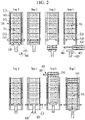
- FIG. 2 shows drawings illustrating that the saggers accommodating the positive electrode material for the secondary battery are put into and discharged from the vertical-type firing apparatus of the positive electrode material for the secondary battery according to an exemplary embodiment shown in FIG. 1 .
- the input part 300 is adjacent to the exhaust part 110, and a first sagger SA1 positioned on the uppermost layer among the plurality of saggers SA is put into the exhaust part 110.
- the input part 300 includes a first roller 310 and a first pusher 320.
- the first roller 310 is adjacent to the exhaust part 110 and transfers the first sagger SA1 to the exhaust part 110.
- the first pusher 320 pushes the first sagger SA1 positioned on the first roller 310 to the exhaust part 110.
- the input part 300 is not limited to the above-described structure, and may have various structures in that the first sagger SA1 positioned on the uppermost layer among the plurality of saggers SA is put into the exhaust part 110.
- the discharge part 400 is adjacent to the air supply part 120 to discharge a second sagger SA2 positioned on the lowest layer among the plurality of saggers SA from the air supply part 120.
- the discharge part 400 includes a stopper 410, a supporter 420, a second roller 430, and a second pusher 440.
- the stopper 410 supports a third sagger SA3 positioned on the second sagger SA2 among the plurality of saggers SA in the firing space 130.
- the stopper 410 may be mounted in the firing space 130 of the vertical-type firing furnace 100, but is not limited thereto.
- the supporter 420 supports the second sagger SA2 discharged from the air supply part 120.
- the second roller 430 is adjacent to the supporter 420 to transfer the second sagger SA2 transferred by the second pusher 440 to the outside.
- the second pusher 440 pushes the second sagger SA2 on the supporter 420 onto the second roller 430.
- the discharge part 400 is not limited to the above-described structure, and may have various structures for discharging the second sagger SA2 positioned on the lowest layer among the plurality of saggers SA from the air supply part 120.
- FIG. 3 shows a drawing and graphs for describing an effect of the vertical-type firing apparatus of the positive electrode material for the secondary battery according to an exemplary embodiment.
- A) of FIG. 3 is a drawing illustrating the vertical-type firing furnace in the vertical-type firing apparatus of the positive electrode material for the secondary battery according to an exemplary embodiment.
- B) of FIG. 3 is a graph showing the temperature according to the vertical height of the firing space of the vertical-type firing furnace, wherein the x-axis represents the temperature, and the y-axis represents the vertical height of the firing space of the vertical-type firing furnace.
- C of FIG.
- 3 is a graph showing the temperature and carbon dioxide concentration according to the vertical height of the firing space of the vertical-type firing furnace, wherein the x-axis represents the temperature and carbon dioxide concentration, and the y-axis represents the vertical height of the firing space of the vertical-type firing furnace.
- the positive electrode material CM for the secondary battery in the vertical-type firing furnace 100 is charged, in the form of granules, in the plurality of saggers SA stacked in the vertical direction in the firing space 130 and moves from the upper portion to the lower portion of the firing space 130.
- the gas GA supplied through the air supply part 120 of the vertical-type firing furnace 100 moves from the lower portion to the upper portion of the firing space 130 to be exhausted from the exhaust part 110.
- the process of firing the positive electrode material CM for the secondary battery accommodated in the plurality of saggers (SA) is completed only with very low flow rate of gas.
- Such reduction in gas supply leads not only to reduction in gas cost but also reduction in energy cost for heating the gas.
- carbon dioxide gas generated in the positive electrode material CM for the secondary battery is easily discharged from the sagger SA.
- the temperature of the temperature-raising space S1 may further be increased compared to the temperature-maintaining space S2 due to heat transfer inside the firing space 130 by the gas GA moving from the lower portion to the upper portion of the firing space 130 (temperature distribution only when internal heat transfer is considered).
- a heat balance is generated in the firing space 130 by the positive electrode material CM for the secondary battery moving from the upper portion to the lower portion of the firing space 130 in the opposite direction to the moving direction of the gas GA, so as to form a temperature profile similar to the predetermined temperature in the firing space 130 (temperature distribution only when the transfer of the positive electrode material is considered).
- a vertical-type firing apparatus of a positive electrode material for a secondary battery which improves discharge of carbon dioxide gas generated from the positive electrode material for the secondary battery and also improves firing reaction of the positive electrode material for the secondary battery by increasing the flow rate of gas supplied to the positive electrode material for the secondary battery.
- a vertical-type firing apparatus of a positive electrode material for a secondary battery which fires the positive electrode material for the secondary battery with improved firing quality.
- a vertical-type firing apparatus of a positive electrode material for a secondary battery which brings an increase in the charging amount of the positive electrode material for the secondary battery fired in a firing space as well as an increase in the firing productivity due to reduction in the firing time while the firing cost is reduced.
- FIGS. 4 and 5 a vertical-type firing apparatus of a positive electrode material for a secondary battery according to another exemplary embodiment will be described with reference to FIGS. 4 and 5 .
- parts different from the vertical-type firing apparatus of the positive electrode material for the secondary battery according to the above-described exemplary embodiment will be described.
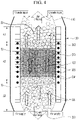
- FIG. 4 is a drawing illustrating the vertical-type firing apparatus of the positive electrode material for the secondary battery according to another exemplary embodiment.
- the vertical-type firing apparatus of the positive electrode material for the secondary battery moves the positive electrode material CM for the secondary battery in the form of granules or briquettes in the firing space 130 of the vertical-type firing furnace 100 in the vertical direction to fire the positive electrode material CM.
- the positive electrode material CM for the secondary battery comes in contact with the vertical-type firing furnace 100.
- the vertical-type firing apparatus of the positive electrode material for the secondary battery includes a temperature-raising section A1, a temperature-maintaining section A2, and a cooling section A3.
- the temperature-raising section A1 is a section in which the temperature is raised to a predetermined temperature (for example, 400°C to 1100°C) based on the characteristics of the positive electrode material CM for the secondary battery moving in the vertical direction in the firing space 130.
- the temperature-maintaining section A2 is a section for maintaining the predetermined temperature.
- the cooling section A3 is a section cooled from the predetermined temperature.
- the vertical-type firing apparatus of the positive electrode material for the secondary battery includes the vertical-type firing furnace 100 and the heater 200.
- the vertical-type firing furnace 100 includes the exhaust part 110, the air supply part 120, the firing space 130, a cylinder-type heat insulating material 160, and an inner wall 170.
- the exhaust part 110 is positioned at the upper portion of the vertical-type firing furnace 100, and the internal gas GA present in the firing space 130 in the vertical-type firing furnace 100 is discharged through the exhaust part 110.
- the positive electrode material CM for the secondary battery is put into the firing space 130 through the exhaust part 110.
- the internal gas GA exhausted from the firing space 130 through the exhaust part 110 may further include carbon dioxide gas and water vapor discharged from the positive electrode material CM for the secondary battery in addition to air and oxygen gas supplied to the firing space 130 through the air supply part 120, but is not limited thereto.
- the air supply part 120 is positioned at the lower portion of the vertical-type firing furnace 100, and the external gas GA is supplied to the firing space 130 in the vertical-type firing furnace 100 through the air supply part 120.
- the positive electrode material CM for the secondary battery is discharged from the firing space 130 through the air supply part 120.
- the positive electrode material CM for the secondary battery is put into the exhaust part 110 to be discharged to the air supply part 120 by passing through the firing space 130.
- the external gas GA is put into the air supply part 120 to be discharged to the exhaust part 110 by passing through the firing space 130.
- the external gas GA supplied to the firing space 130 through the air supply part 120 may include air and oxygen gas, but is not limited thereto.
- the firing space 130 communicates with the exhaust part 110 and the air supply part 120 between the exhaust part 110 and the air supply part 120.
- the firing space 130 extends in a vertical direction between the exhaust part 110 and the air supply part 120.
- the firing space 130 is a space in which the positive electrode material CM for the secondary battery is moved in a vertical direction, and includes the temperature-raising space S1, the temperature-maintaining space S2, and the cooling space S3 sequentially communicating from the upper portion to the lower portion in the vertical direction.
- the temperature-raising space S1 is adjacent to the exhaust part 110 to communicate with the exhaust part 110.
- the temperature-maintaining space S2 communicates with the temperature-raising space S1 and the cooling space S3 between the temperature-raising space S1 and the cooling space S3.
- the temperature of the temperature-maintaining space S2 is higher than the temperature of the temperature-raising space S1 and the temperature of the cooling space S3.
- the cooling space S3 is adjacent to the air supply part 120 to communicate with the air supply part 120.
- the positive electrode material CM for the secondary battery moves in a vertical direction.
- the positive electrode material CM for the secondary battery moves from the upper portion to the lower portion of the firing space 130, and the gas GA moves from the lower portion to the upper portion of the firing space 130.
- the positive electrode material CM for the secondary battery moves through the temperature-raising space S1, the temperature-maintaining space S2, and the cooling space S3 sequentially in the vertical direction in the firing space 130, and the gas GA moves through the cooling space S3, the temperature-maintaining space S2, the temperature-raising space S1 sequentially in the vertical direction in the firing space 130.
- the cylinder-type heat insulating material 160 forms the air supply part 120, the exhaust part 110, and the firing space 130.
- the exhaust part 110 is formed at the upper portion of the cylinder-type heat insulating material 160
- the air supply part 120 is formed at the lower portion of the cylinder-type heat insulating material 160
- the firing space 130 is formed in the cylinder-type heat insulating material 160.
- the diameter of the firing space 130 is greater than the diameter of the exhaust part 110 and the diameter of the air supply part 120.
- the cylinder-type heat insulating material 160 has a cylindrical shape, but is not limited thereto and may have a polygonal pillar shape.
- the inner wall 170 faces the firing space 130 in the cylinder-type heat insulating material 160.
- the inner wall 170 is exposed to the firing space 130.
- the inner wall 170 may be in contact with the positive electrode material CM for the secondary battery, and a surface-treatment layer such as fluorine coating may be formed on a surface of the inner wall 170 in contact with the positive electrode material CM for the secondary battery.
- the inner wall 170 is positioned between the cylinder-type heat insulating material 160 and the firing space 130, and prevents contamination of the positive electrode material CM for the secondary battery due to interference between the cylinder-type heat insulating material 160 and the positive electrode material CM for the secondary battery in the firing space 130.
- the heater 200 heats the firing space 130 of the vertical-type firing furnace 100.
- the heater 200 may heat only the temperature-maintaining space S2 corresponding to the temperature-maintaining space S2, but is not limited thereto.
- the heater 200 is positioned inside the inner wall 170 corresponding to the temperature-maintaining space S2.
- FIG. 5 is a drawing and a graph for describing the effect of the vertical-type firing apparatus of the positive electrode material for the secondary battery according to another exemplary embodiment.
- A) of FIG. 5 is a drawing illustrating a vertical-type firing furnace of the vertical-type firing apparatus of the positive electrode material for the secondary battery according to another exemplary embodiment.
- B) of FIG. 5 is a graph showing the temperature and carbon dioxide concentration according to the vertical height of the firing space of the vertical-type firing furnace, wherein the x-axis represents the temperature and carbon dioxide concentration, and the y-axis represents the vertical height of the firing space of the vertical-type firing furnace.
- the positive electrode material CM for the secondary battery in the vertical-type firing furnace 100 is charged into the firing space 130 in the form of granules or briquettes in a vertical direction and moves from the upper portion to the lower portion of the firing space 130.
- the gas GA supplied through the air supply part 120 of the vertical-type firing furnace 100 moves from the lower portion to the upper portion of the firing space 130 to be discharged to the exhaust part 110.
- the temperature of the temperature-raising space S1 may further be increased compared to the temperature-maintaining space S2 due to heat transfer in the firing space 130 by the gas GA moving from the lower portion to the upper portion of the firing space 130.
- a heat balance is generated in the firing space 130 by the positive electrode material CM for the secondary battery moving from the upper portion to the lower portion of the firing space 130 in a direction opposite to the moving direction of the gas GA, thereby forming a temperature profile similar to the predetermined temperature in the firing space 130.
- a vertical-type firing apparatus of a positive electrode material for a secondary battery which improves discharge of carbon dioxide gas generated from the positive electrode material for the secondary battery and improves firing reaction of the positive electrode material for the secondary battery by simplifying the supply of the external gas and exhaust of the internal gas in the vertical direction and also simplifying input of an external positive electrode material for the secondary battery and discharge of the internal positive electrode material for the secondary battery in the vertical direction while increasing the flow rate of gas supplied to the positive electrode material for the secondary battery.
- a vertical-type firing apparatus of a positive electrode material for a secondary battery which fires the positive electrode material for the secondary battery with improved firing quality.
- a vertical-type firing apparatus of a positive electrode material for a secondary battery in which the firing productivity is increased and the firing cost is reduced due to an increase in a charging amount of the positive electrode material for the secondary battery fired in the firing space and reduction in firing time.
- Exhaust part 110 Air supply part 120, Firing space 130, Vertical-type firing furnace 100, Heater 200, Temperature-raising space S1, Cooling space S3, Temperature-maintaining space S2.
Landscapes
- Engineering & Computer Science (AREA)
- Mechanical Engineering (AREA)
- General Engineering & Computer Science (AREA)
- Battery Electrode And Active Subsutance (AREA)
- Vertical, Hearth, Or Arc Furnaces (AREA)
- Tunnel Furnaces (AREA)
- Waste-Gas Treatment And Other Accessory Devices For Furnaces (AREA)
- Furnace Details (AREA)
Abstract
Description
- The present disclosure relates to a vertical-type firing apparatus of a positive electrode material for a secondary battery.
- In general, a firing apparatus of a positive electrode material for a secondary battery is an apparatus for firing a sagger accommodating the positive electrode material at a temperature of 400°C to 1100°C according to characteristics of the material in a firing furnace.
- In a firing process of the positive electrode material for the secondary battery using the firing apparatus, water vapor and carbon dioxide gas are generated from the positive electrode material accommodated in the sagger. The carbon dioxide gas has a greater molecular weight than oxygen or air used to control the atmosphere of the firing furnace, and thus is difficult to be discharged to the outside of the sagger. There is a problem in that the carbon dioxide gas remaining inside the sagger causes a chemical reaction with lithium oxide on the surface of a positive electrode active material fired from the positive electrode material, resulting in generation of lithium carbonate.
- A conventional firing apparatus of a positive electrode material for a secondary battery discharged the water vapor and the carbon dioxide gas generated from the positive electrode material accommodated in the sagger to the outside of the sagger, and for a firing reaction, supplied gases such as oxygen and air to a lower portion, an upper portion, and side surfaces of a firing space in which the sagger moving in one direction is positioned.
- However, in the conventional firing apparatus of the positive electrode material for the secondary battery, the cross-section of a window of the sagger through which gas flows into the sagger from the outside of the sagger is very small compared to the cross-section of the firing space in which the sagger is positioned, causing a problem in that only a very small amount of the total flow rate of gas passing through the cross-section of the firing space flows into the sagger.
- An exemplary embodiment of the present invention has been made in an effort to provide a vertical-type firing apparatus of a positive electrode material for a secondary battery, having advantages of improving the discharge of carbon dioxide gas generated from the positive electrode material for the secondary battery and improving the firing reaction of the positive electrode material for the secondary battery by increasing the flow rate of gas supplied to the positive electrode material for the secondary battery.
- An exemplary embodiment of the present invention provides a vertical-type firing apparatus for a positive electrode material for a secondary battery for firing the positive electrode material for the secondary battery by moving the positive electrode material in a vertical direction, the vertical-type firing apparatus including a vertical-type firing furnace comprising an exhaust part positioned in an upper portion and through which internal gas is exhausted, an air supply part positioned in a lower portion and through which external gas is supplied, and a firing space positioned between the exhaust part and the air supply part and extending in the vertical direction, and a heater configured to heat the firing space in the vertical-type firing furnace, wherein the positive electrode material for the secondary battery is put into the exhaust part and discharged from the air supply part through the firing space, the firing space comprises a temperature-raising space communicating with the exhaust part, a cooling space communicating with the air supply part, and the temperature-maintaining space communicating with the temperature-raising space and the cooling space between the temperature-raising space and the cooling space, and temperature of the temperature-maintaining space is higher than temperature of the temperature-raising space and temperature of the cooling space.
- The heater may heat only the temperature-maintaining space.
- The vertical-type firing furnace may further include a rectangular pillar-shaped heat insulating material forming the air supply part, the exhaust part, and the firing space, and the heater may be positioned inside the rectangular pillar-shaped heat insulating material to correspond to the temperature-maintaining space.
- The positive electrode material for the secondary battery may be accommodated in a plurality of saggers stacked in the vertical direction in the firing space, and the vertical-type firing apparatus may further include an input part adjacent to the exhaust part and configured to put a first sagger positioned on the uppermost layer among the plurality of saggers into the exhaust part, and a discharge part adjacent to the air supply part and configured to discharge a second sagger positioned on the lowermost layer among the plurality of saggers from the air supply part.
- The input part may include a first roller configured to transfer the first sagger to the discharge part, and a first pusher configured to push the first sagger on the first roller to the exhaust part, and the discharge part may include a stopper configured to support a third sagger positioned on the second sagger among the plurality of saggers in the firing space, a supporter configured to support the second sagger discharged from the air supply part, a second roller adjacent to the supporter, and a second pusher configured to push the second sagger on the supporter onto the second roller.
- The vertical-type firing furnace may further include a cylinder-type heat insulating material forming the air supply part, the exhaust part, and the firing space, and an inner wall facing the firing space in the cylinder-type heat insulating material, and the heater is positioned inside the inner wall to correspond to the temperature-maintaining space.
- The positive electrode material for the secondary battery may come into contact with the inner wall in the firing space.
- A diameter of the firing space may be greater than the diameter of the exhaust part and the diameter of the air supply part.
- The positive electrode material for the secondary battery may be in the form of granules or briquettes.
- According to an exemplary embodiment, there is provided a vertical-type firing apparatus of a positive electrode material for a secondary battery, which improves the discharge of carbon dioxide gas generated from the positive electrode material for the secondary battery and improves the firing reaction of the positive electrode material for the secondary battery by increasing the flow rate of gas supplied to the positive electrode material for the secondary battery.
-
-
FIG. 1 is a drawing illustrating a vertical-type firing apparatus of a positive electrode material for a secondary battery according to an exemplary embodiment. -
FIG. 2 shows drawings illustrating that saggers accommodating the positive electrode material for the secondary battery are put into and discharged from the vertical-type firing apparatus of the positive electrode material for the secondary battery according to an exemplary embodiment shown inFIG. 1 . -
FIG. 3 shows a drawing and graphs illustrating an effect of a vertical-type firing apparatus of a positive electrode material for a secondary battery according to an exemplary embodiment. -
FIG. 4 is a drawing illustrating a vertical-type firing apparatus of a positive electrode material for a secondary battery according to another exemplary embodiment. -
FIG. 5 shows a drawing and a graph illustrating an effect of a vertical-type firing apparatus of a positive electrode material for a secondary battery according to another exemplary embodiment. - Hereinafter, with reference to the accompanying drawings, exemplary embodiments of the present invention will be described in detail so that a person of an ordinary skill in the art to which the present invention pertains can easily implement the same. The present invention may be embodied in several different forms and is not limited to exemplary embodiments described herein.
- In order to clearly explain the present invention, parts irrelevant to the description are omitted, and the same reference numerals are assigned to the same or similar constituent elements throughout the specification.
- In addition, unless explicitly described to the contrary, the word "comprise" and variations such as "comprises" or "comprising" will be understood to imply the inclusion of stated elements but not the exclusion of any other elements.
- Hereinafter, a vertical-type firing apparatus of a positive electrode material for a secondary battery according to an exemplary embodiment will be described with reference to
FIGS. 1 to 3 . -
FIG. 1 is a drawing illustrating the vertical-type firing apparatus of the positive electrode material for the secondary battery according to an exemplary embodiment. - Referring to
FIG. 1 , the vertical-type firing apparatus of the positive electrode material for the secondary battery according to an exemplary embodiment heats a plurality of saggers SA accommodating a positive electrode material CM for a secondary battery in the form of granules or briquettes while moving the saggers SA in a vertical direction in afiring space 130 in a vertical-type firing furnace 100, so as to fire the positive electrode material CM for the secondary battery accommodated in the plurality of saggers SA by moving the positive electrode material CM in a vertical direction. A through-type slit SL through which gas GA moving from a lower portion to an upper portion of thefiring space 130 passes is formed on the bottoms of the plurality of saggers SA. - In an exemplary embodiment, the plurality of saggers SA are stacked in multiple layers and move in the vertical direction in the
firing space 130 of the vertical-type firing furnace 100. While not limited thereto, one sagger SA may be moved as a single layer in the vertical direction in thefiring space 130 of the vertical-type firing furnace 100. - The vertical-type firing apparatus of the positive electrode material for the secondary battery includes a temperature-raising section A1, a temperature-maintaining section A2, and a cooling section A3.
- The temperature-raising section A1 is a section in which the temperature is raised to a predetermined temperature (for example, 400°C to 1100°C) according to characteristics of the positive electrode material CM for the secondary battery accommodated in the plurality of saggers SA.
- The temperature-maintaining section A2 is a section for maintaining the predetermined temperature.
- The cooling section A3 is a section cooled from the predetermined temperature.
- The vertical-type firing apparatus of the positive electrode material for the secondary battery includes the vertical-
type firing furnace 100, aheater 200, aninput part 300, and adischarge part 400. - The vertical-
type firing furnace 100 includes anexhaust part 110, anair supply part 120, thefiring space 130, and a rectangular pillar-shapedheat insulating material 140. - The
exhaust part 110 is positioned at the upper portion of the vertical-type firing furnace 100 and the internal gas GA located in thefiring space 130 inside the vertical-type firing furnace 100 is exhausted to the outside through theexhaust part 110. - The positive electrode material CM for the secondary battery accommodated in the plurality of saggers SA is put into the
firing space 130 through theexhaust part 110. The internal gas GA exhausted from thefiring space 130 through theexhaust part 110 may further include carbon dioxide gas and water vapor discharged from the positive electrode material CM for the secondary battery accommodated in the plurality of saggers SA in addition to the air and oxygen gas supplied to thefiring space 130 through theair supply part 120, but is not limited thereto. - The
air supply part 120 is positioned at the lower portion of the vertical-type firing furnace 100, and external gas GA is supplied to thefiring space 130 in the vertical-type firing furnace 100 through theair supply part 120. The positive electrode material CM for the secondary battery accommodated in the plurality of saggers SA is discharged from thefiring space 130 through theair supply part 120. The positive electrode material CM for the secondary battery is put into theexhaust part 110 and discharged through theair supply part 120 by passing through thefiring space 130. The external gas GA is put into theair supply part 120 and discharged through theexhaust part 110 by passing through thefiring space 130. The external gas GA supplied to thefiring space 130 through theair supply part 120 may include air and oxygen gas, but is not limited thereto. - The
firing space 130 communicates with theexhaust part 110 and theair supply part 120 between theexhaust part 110 and theair supply part 120. Thefiring space 130 extends in a vertical direction between theexhaust part 110 and theair supply part 120. Thefiring space 130 is a space in which the plurality of saggers SA accommodating the positive electrode material CM for the secondary battery are moved in the vertical direction, and includes the temperature-raising space S1, the temperature-maintaining space S2, and the cooling space S3 sequentially communicating from the upper portion to the lower portion in the vertical direction. - The temperature-raising space S1 is adjacent to the
exhaust part 110 to communicate with theexhaust part 110. - The temperature-maintaining space S2 communicates with the temperature-raising space S1 and the cooling space S3 between the temperature-raising space S1 and the cooling space S3.
- The temperature of the temperature-maintaining space S2 is higher than the temperature of the temperature-raising space S1 and the temperature of the cooling space S3.
- The cooling space S3 is adjacent to the
air supply part 120 to communicate with theair supply part 120. - In the
firing space 130, the plurality of saggers SA accommodating the positive electrode material CM for the secondary battery are stacked in a vertical direction to be moved in the vertical direction. In thefiring space 130, the plurality of saggers SA move from the upper portion to the lower portion of thefiring space 130, and the gas moves from the lower portion to the upper portion of thefiring space 130. In other words, the positive electrode material CM for the secondary battery accommodated in the plurality of saggers SA sequentially moves though the temperature-raising space S1, the temperature-maintaining space S2, and the cooling space S3 in a vertical direction in thefiring space 130, and the gas GA sequentially moves through the cooling space S3, the temperature-maintaining space S2, and the temperature-raising space S1 in a vertical direction in thefiring space 130. - The rectangular pillar-shaped
heat insulating material 140 forms theair supply part 120, theexhaust part 110, and thefiring space 130. Theexhaust part 110 is formed at the upper portion of the rectangular pillar-shapedheat insulating material 140, theair supply part 120 is formed at the lower portion of the rectangular pillar-shapedheat insulating material 140, and thefiring space 130 is formed inside the rectangular pillar-shapedheat insulating material 140. The rectangular pillar-shapedheat insulating material 140 has a rectangular pillar shape, but not limited thereto. It may also have a cylinder shape or a polygonal pillar shape. - The
heater 200 heats the firingspace 130 of the vertical-type firing furnace 100. Theheater 200 may be positioned to correspond to the temperature-maintaining space S2 to heat only the temperature-maintaining space S2, but is not limited thereto. Theheater 200 is positioned inside the rectangular pillar-shapedheat insulating material 140 corresponding to the temperature-maintaining space S2. -
FIG. 2 shows drawings illustrating that the saggers accommodating the positive electrode material for the secondary battery are put into and discharged from the vertical-type firing apparatus of the positive electrode material for the secondary battery according to an exemplary embodiment shown inFIG. 1 . - Referring to
FIGS. 1 and2 , theinput part 300 is adjacent to theexhaust part 110, and a first sagger SA1 positioned on the uppermost layer among the plurality of saggers SA is put into theexhaust part 110. - The
input part 300 includes a first roller 310 and afirst pusher 320. - The first roller 310 is adjacent to the
exhaust part 110 and transfers the first sagger SA1 to theexhaust part 110. - The
first pusher 320 pushes the first sagger SA1 positioned on the first roller 310 to theexhaust part 110. - The
input part 300 is not limited to the above-described structure, and may have various structures in that the first sagger SA1 positioned on the uppermost layer among the plurality of saggers SA is put into theexhaust part 110. - The
discharge part 400 is adjacent to theair supply part 120 to discharge a second sagger SA2 positioned on the lowest layer among the plurality of saggers SA from theair supply part 120. - The
discharge part 400 includes astopper 410, asupporter 420, asecond roller 430, and asecond pusher 440. - The
stopper 410 supports a third sagger SA3 positioned on the second sagger SA2 among the plurality of saggers SA in the firingspace 130. Thestopper 410 may be mounted in the firingspace 130 of the vertical-type firing furnace 100, but is not limited thereto. - The
supporter 420 supports the second sagger SA2 discharged from theair supply part 120. - The
second roller 430 is adjacent to thesupporter 420 to transfer the second sagger SA2 transferred by thesecond pusher 440 to the outside. - The
second pusher 440 pushes the second sagger SA2 on thesupporter 420 onto thesecond roller 430. - The
discharge part 400 is not limited to the above-described structure, and may have various structures for discharging the second sagger SA2 positioned on the lowest layer among the plurality of saggers SA from theair supply part 120. -
FIG. 3 shows a drawing and graphs for describing an effect of the vertical-type firing apparatus of the positive electrode material for the secondary battery according to an exemplary embodiment. (A) ofFIG. 3 is a drawing illustrating the vertical-type firing furnace in the vertical-type firing apparatus of the positive electrode material for the secondary battery according to an exemplary embodiment. (B) ofFIG. 3 is a graph showing the temperature according to the vertical height of the firing space of the vertical-type firing furnace, wherein the x-axis represents the temperature, and the y-axis represents the vertical height of the firing space of the vertical-type firing furnace. (C) ofFIG. 3 is a graph showing the temperature and carbon dioxide concentration according to the vertical height of the firing space of the vertical-type firing furnace, wherein the x-axis represents the temperature and carbon dioxide concentration, and the y-axis represents the vertical height of the firing space of the vertical-type firing furnace. - Referring to (A) of
FIG. 3 , the positive electrode material CM for the secondary battery in the vertical-type firing furnace 100 is charged, in the form of granules, in the plurality of saggers SA stacked in the vertical direction in the firingspace 130 and moves from the upper portion to the lower portion of the firingspace 130. The gas GA supplied through theair supply part 120 of the vertical-type firing furnace 100 moves from the lower portion to the upper portion of the firingspace 130 to be exhausted from theexhaust part 110. Since the gas GA moving from the lower portion to the upper portion of the firingspace 130 moves in an almost closed form through the through-type slit SL formed on the bottom of the plurality of saggers SA, the process of firing the positive electrode material CM for the secondary battery accommodated in the plurality of saggers (SA) is completed only with very low flow rate of gas. Such reduction in gas supply leads not only to reduction in gas cost but also reduction in energy cost for heating the gas. In addition, since most of the gas GA supplied to the firingspace 130 passes around the positive electrode material CM for the secondary battery, carbon dioxide gas generated in the positive electrode material CM for the secondary battery is easily discharged from the sagger SA. Thus, it is favorable to control the firing reaction, thereby ultimately bringing improvement in the firing quality of the positive electrode material CM for the secondary battery. In addition, due to the favorable environment for the firing reaction, derived are the effects such as an increase in the charging amount of the positive electrode material CM for the secondary battery accommodated inside the sagger (SA) and reduction in firing time, thereby reducing firing cost due to the increase in firing productivity. - Referring to (A) and (B) of
FIG. 3 , even if theheater 200 heats only the temperature-maintaining space S2 in the firingspace 130 corresponding to the temperature-maintaining space S2, the temperature of the temperature-raising space S1 may further be increased compared to the temperature-maintaining space S2 due to heat transfer inside the firingspace 130 by the gas GA moving from the lower portion to the upper portion of the firing space 130 (temperature distribution only when internal heat transfer is considered). However, a heat balance is generated in the firingspace 130 by the positive electrode material CM for the secondary battery moving from the upper portion to the lower portion of the firingspace 130 in the opposite direction to the moving direction of the gas GA, so as to form a temperature profile similar to the predetermined temperature in the firing space 130 (temperature distribution only when the transfer of the positive electrode material is considered). - Referring to (A), (B), and (C) of
FIG. 3 , due to the temperature profile similar to the predetermined temperature formed in the firingspace 130, most of the carbon dioxide gas is generated from the positive electrode material CM for the secondary battery in the temperature-raising space S1 positioned at the upper portion of the firingspace 130, and the carbon dioxide gas is easily discharged to the upper portion of the firingspace 130. - In other words, there is provided a vertical-type firing apparatus of a positive electrode material for a secondary battery, which improves discharge of carbon dioxide gas generated from the positive electrode material for the secondary battery and also improves firing reaction of the positive electrode material for the secondary battery by increasing the flow rate of gas supplied to the positive electrode material for the secondary battery.
- In addition, there is provided a vertical-type firing apparatus of a positive electrode material for a secondary battery, which fires the positive electrode material for the secondary battery with improved firing quality.
- In addition, there is provided a vertical-type firing apparatus of a positive electrode material for a secondary battery, which brings an increase in the charging amount of the positive electrode material for the secondary battery fired in a firing space as well as an increase in the firing productivity due to reduction in the firing time while the firing cost is reduced.
- Hereinafter, a vertical-type firing apparatus of a positive electrode material for a secondary battery according to another exemplary embodiment will be described with reference to
FIGS. 4 and5 . Hereinafter, parts different from the vertical-type firing apparatus of the positive electrode material for the secondary battery according to the above-described exemplary embodiment will be described. -
FIG. 4 is a drawing illustrating the vertical-type firing apparatus of the positive electrode material for the secondary battery according to another exemplary embodiment. - Referring to
FIG. 4 , the vertical-type firing apparatus of the positive electrode material for the secondary battery according to another exemplary embodiment moves the positive electrode material CM for the secondary battery in the form of granules or briquettes in the firingspace 130 of the vertical-type firing furnace 100 in the vertical direction to fire the positive electrode material CM. The positive electrode material CM for the secondary battery comes in contact with the vertical-type firing furnace 100. - The vertical-type firing apparatus of the positive electrode material for the secondary battery includes a temperature-raising section A1, a temperature-maintaining section A2, and a cooling section A3.
- The temperature-raising section A1 is a section in which the temperature is raised to a predetermined temperature (for example, 400°C to 1100°C) based on the characteristics of the positive electrode material CM for the secondary battery moving in the vertical direction in the firing
space 130. - The temperature-maintaining section A2 is a section for maintaining the predetermined temperature.
- The cooling section A3 is a section cooled from the predetermined temperature.
- The vertical-type firing apparatus of the positive electrode material for the secondary battery includes the vertical-
type firing furnace 100 and theheater 200. - The vertical-
type firing furnace 100 includes theexhaust part 110, theair supply part 120, the firingspace 130, a cylinder-typeheat insulating material 160, and aninner wall 170. - The
exhaust part 110 is positioned at the upper portion of the vertical-type firing furnace 100, and the internal gas GA present in the firingspace 130 in the vertical-type firing furnace 100 is discharged through theexhaust part 110. The positive electrode material CM for the secondary battery is put into the firingspace 130 through theexhaust part 110. The internal gas GA exhausted from the firingspace 130 through theexhaust part 110 may further include carbon dioxide gas and water vapor discharged from the positive electrode material CM for the secondary battery in addition to air and oxygen gas supplied to the firingspace 130 through theair supply part 120, but is not limited thereto. - The
air supply part 120 is positioned at the lower portion of the vertical-type firing furnace 100, and the external gas GA is supplied to the firingspace 130 in the vertical-type firing furnace 100 through theair supply part 120. - The positive electrode material CM for the secondary battery is discharged from the firing
space 130 through theair supply part 120. The positive electrode material CM for the secondary battery is put into theexhaust part 110 to be discharged to theair supply part 120 by passing through the firingspace 130. The external gas GA is put into theair supply part 120 to be discharged to theexhaust part 110 by passing through the firingspace 130. The external gas GA supplied to the firingspace 130 through theair supply part 120 may include air and oxygen gas, but is not limited thereto. - The firing
space 130 communicates with theexhaust part 110 and theair supply part 120 between theexhaust part 110 and theair supply part 120. The firingspace 130 extends in a vertical direction between theexhaust part 110 and theair supply part 120. The firingspace 130 is a space in which the positive electrode material CM for the secondary battery is moved in a vertical direction, and includes the temperature-raising space S1, the temperature-maintaining space S2, and the cooling space S3 sequentially communicating from the upper portion to the lower portion in the vertical direction. - The temperature-raising space S1 is adjacent to the
exhaust part 110 to communicate with theexhaust part 110. - The temperature-maintaining space S2 communicates with the temperature-raising space S1 and the cooling space S3 between the temperature-raising space S1 and the cooling space S3.
- The temperature of the temperature-maintaining space S2 is higher than the temperature of the temperature-raising space S1 and the temperature of the cooling space S3.
- The cooling space S3 is adjacent to the
air supply part 120 to communicate with theair supply part 120. - In the
firing space 130, the positive electrode material CM for the secondary battery moves in a vertical direction. In thefiring space 130, the positive electrode material CM for the secondary battery moves from the upper portion to the lower portion of the firingspace 130, and the gas GA moves from the lower portion to the upper portion of the firingspace 130. In other words, the positive electrode material CM for the secondary battery moves through the temperature-raising space S1, the temperature-maintaining space S2, and the cooling space S3 sequentially in the vertical direction in the firingspace 130, and the gas GA moves through the cooling space S3, the temperature-maintaining space S2, the temperature-raising space S1 sequentially in the vertical direction in the firingspace 130. - The cylinder-type
heat insulating material 160 forms theair supply part 120, theexhaust part 110, and the firingspace 130. Theexhaust part 110 is formed at the upper portion of the cylinder-typeheat insulating material 160, theair supply part 120 is formed at the lower portion of the cylinder-typeheat insulating material 160, and the firingspace 130 is formed in the cylinder-typeheat insulating material 160. The diameter of the firingspace 130 is greater than the diameter of theexhaust part 110 and the diameter of theair supply part 120. Since the diameter of the firingspace 130 is greater than the diameter of theexhaust part 110 and the diameter of theair supply part 120, the positive electrode material CM for the secondary battery put into theexhaust part 110 is dispersed in a large area in the firingspace 130, so that carbon dioxide gas discharged from the positive electrode material CM for the secondary battery is easily discharged to theexhaust part 110 by the gas GA moving from the lower portion to the upper portion of the firingspace 130. The cylinder-typeheat insulating material 160 has a cylindrical shape, but is not limited thereto and may have a polygonal pillar shape. - The
inner wall 170 faces the firingspace 130 in the cylinder-typeheat insulating material 160. Theinner wall 170 is exposed to the firingspace 130. Theinner wall 170 may be in contact with the positive electrode material CM for the secondary battery, and a surface-treatment layer such as fluorine coating may be formed on a surface of theinner wall 170 in contact with the positive electrode material CM for the secondary battery. Theinner wall 170 is positioned between the cylinder-typeheat insulating material 160 and the firingspace 130, and prevents contamination of the positive electrode material CM for the secondary battery due to interference between the cylinder-typeheat insulating material 160 and the positive electrode material CM for the secondary battery in the firingspace 130. - The
heater 200 heats the firingspace 130 of the vertical-type firing furnace 100. Theheater 200 may heat only the temperature-maintaining space S2 corresponding to the temperature-maintaining space S2, but is not limited thereto. Theheater 200 is positioned inside theinner wall 170 corresponding to the temperature-maintaining space S2. -
FIG. 5 is a drawing and a graph for describing the effect of the vertical-type firing apparatus of the positive electrode material for the secondary battery according to another exemplary embodiment. (A) ofFIG. 5 is a drawing illustrating a vertical-type firing furnace of the vertical-type firing apparatus of the positive electrode material for the secondary battery according to another exemplary embodiment. (B) ofFIG. 5 is a graph showing the temperature and carbon dioxide concentration according to the vertical height of the firing space of the vertical-type firing furnace, wherein the x-axis represents the temperature and carbon dioxide concentration, and the y-axis represents the vertical height of the firing space of the vertical-type firing furnace. - Referring to (A) of
FIG. 5 , the positive electrode material CM for the secondary battery in the vertical-type firing furnace 100 is charged into the firingspace 130 in the form of granules or briquettes in a vertical direction and moves from the upper portion to the lower portion of the firingspace 130. The gas GA supplied through theair supply part 120 of the vertical-type firing furnace 100 moves from the lower portion to the upper portion of the firingspace 130 to be discharged to theexhaust part 110. Since all the total flow rate of the gas GA moving from the lower portion to the upper portion of the firingspace 130 come in contact with the positive electrode material CM for the secondary battery moving from the upper portion to the lower portion of the firingspace 130, the process of firing the positive electrode material CM for the secondary battery is completed only with a very small flow rate of gas. Such reduction in the gas supply reduces not only the gas cost but also the energy cost for heating the gas. In addition, since all the total flow rate of the gas GA supplied to the firingspace 130 passes around the positive electrode material CM for the secondary battery, carbon dioxide gas generated from the positive electrode material CM for the secondary battery is easily discharged through theexhaust part 110. Thus, it is easy to control the firing reaction, thereby ultimately improving the firing quality of the positive electrode material CM for the secondary battery. In addition, due to the environment favorable for the firing reaction, derived are the effects such as an increase in the charging amount of the positive electrode material CM for the secondary battery and the reduction in the firing time, thereby reducing the firing cost due to an increase in the firing productivity. - Referring to (A) and (B) of
FIG. 5 , even if the heater heats only the temperature-maintaining space S2 in the firingspace 130 corresponding to the temperature- maintaining space S2, the temperature of the temperature-raising space S1 may further be increased compared to the temperature-maintaining space S2 due to heat transfer in the firingspace 130 by the gas GA moving from the lower portion to the upper portion of the firingspace 130. However, a heat balance is generated in the firingspace 130 by the positive electrode material CM for the secondary battery moving from the upper portion to the lower portion of the firingspace 130 in a direction opposite to the moving direction of the gas GA, thereby forming a temperature profile similar to the predetermined temperature in the firingspace 130. Due to the formation of the temperature profile similar to the predetermined temperature in the firingspace 130, most of the carbon dioxide gas is generated from the positive electrode material CM for the secondary battery in the temperature-raising space S1 positioned at the upper portion of the firingspace 130, and the carbon dioxide gas is easily discharged to the upper portion of the firingspace 130. - In other words, there is provided a vertical-type firing apparatus of a positive electrode material for a secondary battery, which improves discharge of carbon dioxide gas generated from the positive electrode material for the secondary battery and improves firing reaction of the positive electrode material for the secondary battery by simplifying the supply of the external gas and exhaust of the internal gas in the vertical direction and also simplifying input of an external positive electrode material for the secondary battery and discharge of the internal positive electrode material for the secondary battery in the vertical direction while increasing the flow rate of gas supplied to the positive electrode material for the secondary battery.
- In addition, there is provided a vertical-type firing apparatus of a positive electrode material for a secondary battery, which fires the positive electrode material for the secondary battery with improved firing quality.
- In addition, there is provided a vertical-type firing apparatus of a positive electrode material for a secondary battery, in which the firing productivity is increased and the firing cost is reduced due to an increase in a charging amount of the positive electrode material for the secondary battery fired in the firing space and reduction in firing time.
- While this invention has been described in connection with what is presently considered to be practical exemplary embodiments, it is to be understood that the invention is not limited to the disclosed embodiments. On the contrary, it is intended to cover various modifications and equivalent arrangements included within the scope of the appended claims.
-
Exhaust part 110,Air supply part 120,Firing space 130, Vertical-type firing furnace 100,Heater 200, Temperature-raising space S1, Cooling space S3, Temperature-maintaining space S2.
Claims (9)
- A vertical-type firing apparatus for a positive electrode material for a secondary battery for firing the positive electrode material for the secondary battery by moving the positive electrode material in a vertical direction, the vertical-type firing apparatus comprising:a vertical-type firing furnace comprising an exhaust part positioned in an upper portion and through which internal gas is exhausted, an air supply part positioned in a lower portion and through which external gas is supplied, and a firing space positioned between the exhaust part and the air supply part and extending in the vertical direction; anda heater configured to heat the firing space in the vertical-type firing furnace,wherein the positive electrode material for the secondary battery is put into the exhaust part and discharged from the air supply part through the firing space,the firing space comprises a temperature-raising space communicating with the exhaust part, a cooling space communicating with the air supply part, and the temperature-maintaining space communicating with the temperature-raising space and the cooling space between the temperature-raising space and the cooling space, andtemperature of the temperature-maintaining space is higher than the temperature of the temperature-raising space and the temperature of the cooling space.
- The vertical-type firing apparatus of claim 1, wherein:
the heater heats only the temperature-maintaining space. - The vertical-type firing apparatus of claim 1, wherein:the vertical-type firing furnace further comprises a rectangular pillar-shaped heat insulating material forming the air supply part, the exhaust part, and the firing space, andthe heater is positioned inside the rectangular pillar-shaped heat insulating material to correspond to the temperature-maintaining space.
- The vertical-type firing apparatus of claim 1, wherein:
the positive electrode material for the secondary battery is accommodated in a plurality of saggers stacked in the vertical direction in the firing space, and the vertical-type firing apparatus further comprises:an input part adjacent to the exhaust part and configured to put a first sagger positioned on the uppermost layer among the plurality of saggers into the exhaust part; anda discharge part adjacent to the air supply part and configured to discharge a second sagger positioned on the lowermost layer among the plurality of saggers from the air supply part. - The vertical-type firing apparatus of claim 4, wherein:
the input part comprises:a first roller configured to transfer the first sagger to the discharge part; anda first pusher configured to push the first sagger on the first roller to the exhaust part, andthe discharge part comprises:a stopper configured to support a third sagger positioned on the second sagger among the plurality of saggers in the firing space;a supporter configured to support the second sagger discharged from the air supply part;a second roller adjacent to the supporter; anda second pusher configured to push the second sagger on the supporter onto the second roller. - The vertical-type firing apparatus of claim 1, wherein:
the vertical-type firing furnace further comprises:a cylinder-type heat insulating material forming the air supply part, the exhaust part, and the firing space; andan inner wall facing the firing space in the cylinder-type heat insulating material, andthe heater is positioned inside the inner wall to correspond to the temperature-maintaining space. - The vertical-type firing apparatus of claim 6, wherein:
the positive electrode material for the secondary battery comes into contact with the inner wall in the firing space. - The vertical-type firing apparatus of claim 6, wherein:
a diameter of the firing space is greater than the diameter of the exhaust part and the diameter of the air supply part. - The vertical-type firing apparatus of claim 1, wherein:
the positive electrode material for the secondary battery is in the form of granules or briquettes.
Applications Claiming Priority (2)
| Application Number | Priority Date | Filing Date | Title |
|---|---|---|---|
| KR1020190171874A KR102368361B1 (en) | 2019-12-20 | 2019-12-20 | Vertical type apparatus for firing cathode material of secondary battery |
| PCT/KR2020/017411 WO2021125628A1 (en) | 2019-12-20 | 2020-12-01 | Vertical-type baking apparatus of positive electrode material for secondary battery |
Publications (2)
| Publication Number | Publication Date |
|---|---|
| EP4080148A1 true EP4080148A1 (en) | 2022-10-26 |
| EP4080148A4 EP4080148A4 (en) | 2024-01-24 |
Family
ID=76476778
Family Applications (1)
| Application Number | Title | Priority Date | Filing Date |
|---|---|---|---|
| EP20903136.8A Pending EP4080148A4 (en) | 2019-12-20 | 2020-12-01 | VERTICAL TYPE COOKING APPLIANCE OF POSITIVE ELECTRODE MATERIAL FOR SECONDARY BATTERY |
Country Status (6)
| Country | Link |
|---|---|
| US (1) | US12546536B2 (en) |
| EP (1) | EP4080148A4 (en) |
| JP (1) | JP7546057B2 (en) |
| KR (1) | KR102368361B1 (en) |
| CN (1) | CN114829860B (en) |
| WO (1) | WO2021125628A1 (en) |
Families Citing this family (13)
| Publication number | Priority date | Publication date | Assignee | Title |
|---|---|---|---|---|
| KR102368361B1 (en) | 2019-12-20 | 2022-02-25 | 주식회사 포스코 | Vertical type apparatus for firing cathode material of secondary battery |
| CN113701495B (en) * | 2021-08-26 | 2024-02-23 | 江苏润鸿高温窑具有限公司 | Method for designing low-expansion strong alkaline corrosion resistant material for inner cavity of gas flame-proof roller kiln |
| KR20230088556A (en) * | 2021-12-10 | 2023-06-20 | 포스코홀딩스 주식회사 | Apparatus for firing cathode material of secondary battery |
| US20250336913A1 (en) * | 2022-08-31 | 2025-10-30 | Lg Energy Solution, Ltd. | Positive Electrode and Electrochemical Device Including the Same |
| EP4589725A1 (en) * | 2022-09-16 | 2025-07-23 | RD Solution Co., Ltd. | Vertical recycling device for waste battery |
| WO2024058604A1 (en) * | 2022-09-16 | 2024-03-21 | 주식회사 알디솔루션 | Apparatus for vertical recycling of waste batteries |
| KR102551693B1 (en) * | 2022-09-16 | 2023-07-05 | 주식회사 알디솔루션 | Waste battery recycling device |
| KR102549213B1 (en) * | 2022-09-16 | 2023-06-30 | 주식회사 알디솔루션 | Waste battery vertical recycling apparatus |
| WO2024058600A1 (en) * | 2022-09-16 | 2024-03-21 | 주식회사 알디솔루션 | Apparatus for vertical recycling apparatus of waste batteries |
| KR102588154B1 (en) * | 2023-03-21 | 2023-10-12 | 주식회사 알디솔루션 | Apparatus and method for heat treatment reaction control for recycling waste lithium-ion batteries by dry method |
| KR102806303B1 (en) * | 2023-03-27 | 2025-05-14 | 주식회사 원준 | heat treatment apparauts and exhaust assembly |
| WO2025154848A1 (en) * | 2024-01-17 | 2025-07-24 | (주)포스코퓨처엠 | Furnace for synthesizing graphite |
| WO2025154850A1 (en) * | 2024-01-17 | 2025-07-24 | (주)포스코퓨처엠 | Furnace for synthesizing graphite |
Family Cites Families (23)
| Publication number | Priority date | Publication date | Assignee | Title |
|---|---|---|---|---|
| US2591259A (en) * | 1946-09-26 | 1952-04-01 | Selas Corp Of America | Billet heating furnace |
| JPH01121681A (en) | 1987-11-02 | 1989-05-15 | Mitsubishi Petrochem Co Ltd | Vertical cylindrical heat treatment furnace |
| JPH04193767A (en) | 1990-11-27 | 1992-07-13 | Murata Mfg Co Ltd | Case for heat treatment |
| JPH0519897U (en) | 1991-08-21 | 1993-03-12 | 東海高熱工業株式会社 | Precision control elevator furnace |
| US5406582A (en) | 1993-08-03 | 1995-04-11 | Du Plessis; Cornelius | Apparatus and process for activation and reactivation of carbon by electrical resistance heating in the presence of steam |
| KR0170050B1 (en) | 1995-07-26 | 1999-02-18 | 다쯔 지사끼 | Vertical furnace |
| JPH0979762A (en) | 1995-09-14 | 1997-03-28 | Murata Mfg Co Ltd | Vertical baking furnace |
| US6066290A (en) * | 1996-07-26 | 2000-05-23 | The Pennsylvania State Research Foundation | Method and apparatus for transporting green work pieces through a microwave sintering system |
| JP3575582B2 (en) | 1996-09-12 | 2004-10-13 | 同和鉱業株式会社 | Positive active material for non-aqueous secondary battery and method for producing the same |
| JPH10170157A (en) * | 1996-12-11 | 1998-06-26 | Kobe Steel Ltd | Firing method and apparatus |
| JPH10238953A (en) | 1997-02-26 | 1998-09-11 | Ngk Insulators Ltd | Vertical moving furnace |
| KR100358504B1 (en) | 2000-04-26 | 2002-10-30 | 정구일 | Vertical Burning Furnace |
| US6407368B1 (en) * | 2001-07-12 | 2002-06-18 | Taiwan Semiconductor Manufacturing Co., Ltd. | System for maintaining a flat zone temperature profile in LP vertical furnace |
| JP4067080B2 (en) * | 2002-04-01 | 2008-03-26 | 株式会社ノリタケカンパニーリミテド | Bowl |
| WO2004038074A1 (en) | 2002-10-28 | 2004-05-06 | Bussan Nanotech Reserch Institute Inc. | Method and apparatus for heat treatment of powder of fine carbon fiber |
| JP5376631B2 (en) * | 2008-11-20 | 2013-12-25 | 日本碍子株式会社 | Vertical firing furnace for powder firing |
| KR200468934Y1 (en) | 2013-04-24 | 2013-09-10 | 이철휘 | Multistage stackable sagger of box type |
| CN203758234U (en) | 2014-03-04 | 2014-08-06 | 烟台北方微波技术有限公司 | Push plate type microwave calciner for alumina powder |
| KR101890311B1 (en) | 2015-09-23 | 2018-09-28 | (주)클린솔루션 | Manufacturing method of heat increasing and component controlling briquette used in steel manufacturing process |
| JP7356786B2 (en) * | 2017-09-13 | 2023-10-05 | 住友化学株式会社 | Method for producing positive electrode active material for lithium secondary battery |
| JP7069666B2 (en) | 2017-11-30 | 2022-05-18 | 住友金属鉱山株式会社 | Method for manufacturing lithium nickel composite oxide and method for manufacturing non-aqueous electrolyte secondary battery |
| KR101987940B1 (en) * | 2017-12-26 | 2019-06-11 | 주식회사 포스코 | Vertical firing furnace for secondary battery anode material having separated space |
| KR102368361B1 (en) | 2019-12-20 | 2022-02-25 | 주식회사 포스코 | Vertical type apparatus for firing cathode material of secondary battery |
-
2019
- 2019-12-20 KR KR1020190171874A patent/KR102368361B1/en active Active
-
2020
- 2020-12-01 WO PCT/KR2020/017411 patent/WO2021125628A1/en not_active Ceased
- 2020-12-01 CN CN202080088841.6A patent/CN114829860B/en active Active
- 2020-12-01 JP JP2022538298A patent/JP7546057B2/en active Active
- 2020-12-01 US US17/787,814 patent/US12546536B2/en active Active
- 2020-12-01 EP EP20903136.8A patent/EP4080148A4/en active Pending
Also Published As
| Publication number | Publication date |
|---|---|
| WO2021125628A1 (en) | 2021-06-24 |
| JP7546057B2 (en) | 2024-09-05 |
| CN114829860B (en) | 2024-05-03 |
| KR20210079758A (en) | 2021-06-30 |
| KR102368361B1 (en) | 2022-02-25 |
| JP2023507818A (en) | 2023-02-27 |
| US12546536B2 (en) | 2026-02-10 |
| US20230053769A1 (en) | 2023-02-23 |
| CN114829860A (en) | 2022-07-29 |
| EP4080148A4 (en) | 2024-01-24 |
Similar Documents
| Publication | Publication Date | Title |
|---|---|---|
| US12546536B2 (en) | Vertical-type baking apparatus of positive electrode material for secondary battery | |
| JP2024500415A (en) | Vertical cathode material firing equipment for secondary batteries | |
| JP7340701B2 (en) | Secondary battery cathode material firing equipment | |
| US7998428B2 (en) | Apparatus for producing trichlorosilane | |
| KR101987940B1 (en) | Vertical firing furnace for secondary battery anode material having separated space | |
| KR102753192B1 (en) | Electrode material firing device | |
| EP2291878A2 (en) | Solid oxide fuel cell systems | |
| EP4446681A1 (en) | Apparatus for firing cathode material of secondary battery | |
| CN108588684A (en) | Increase the PECVD reacting furnaces and its control method of heat source in a kind of stove newly | |
| JP6732427B2 (en) | Sintered body manufacturing apparatus, sintered body manufacturing method, fuel cell stack manufacturing method, and fuel cell cartridge manufacturing method | |
| JP5455607B2 (en) | Solid oxide fuel cell and method of operating the same | |
| CN110790270A (en) | Novel carbonization process for graphite negative electrode material | |
| KR20210152897A (en) | Electrode material firing device | |
| KR20260018477A (en) | Apparatus for firing cathode material of secondary battery | |
| JP7662256B1 (en) | Metal-air battery | |
| KR102764379B1 (en) | Heat treatment apparatus for fabricating active material for secondary battery | |
| KR20230075307A (en) | Firing container and firing method of material using same | |
| JP2008258280A (en) | Heating device | |
| KR20240178576A (en) | Fireproof material for lithium secondary battery sintering furnace and including the same | |
| KR20240076490A (en) | Heat treatment apparatus for fabricating active material for secondary battery | |
| JPH02256169A (en) | Fuel cell | |
| KR20250168809A (en) | Resistant saggar with added insulation | |
| KR20240178577A (en) | Sintering furnace for electrode material | |
| WO2015037877A1 (en) | Surface treatment apparatus and surface treatment method | |
| KR20220084860A (en) | Heat Treatment Furnace with Improved Temperature Distribution |
Legal Events
| Date | Code | Title | Description |
|---|---|---|---|
| STAA | Information on the status of an ep patent application or granted ep patent |
Free format text: STATUS: THE INTERNATIONAL PUBLICATION HAS BEEN MADE |
|
| PUAI | Public reference made under article 153(3) epc to a published international application that has entered the european phase |
Free format text: ORIGINAL CODE: 0009012 |
|
| STAA | Information on the status of an ep patent application or granted ep patent |
Free format text: STATUS: REQUEST FOR EXAMINATION WAS MADE |
|
| 17P | Request for examination filed |
Effective date: 20220707 |
|
| AK | Designated contracting states |
Kind code of ref document: A1 Designated state(s): AL AT BE BG CH CY CZ DE DK EE ES FI FR GB GR HR HU IE IS IT LI LT LU LV MC MK MT NL NO PL PT RO RS SE SI SK SM TR |
|
| DAV | Request for validation of the european patent (deleted) | ||
| DAX | Request for extension of the european patent (deleted) | ||
| A4 | Supplementary search report drawn up and despatched |
Effective date: 20231221 |
|
| RIC1 | Information provided on ipc code assigned before grant |
Ipc: F27D 3/12 20060101ALI20231215BHEP Ipc: F27B 1/08 20060101ALI20231215BHEP Ipc: F27B 1/00 20060101ALI20231215BHEP Ipc: F27B 9/38 20060101ALI20231215BHEP Ipc: F27B 9/36 20060101ALI20231215BHEP Ipc: F27B 9/30 20060101ALI20231215BHEP Ipc: F27B 9/26 20060101AFI20231215BHEP |