EP4079928A2 - Aluminum alloy-plated steel sheet having excellent workability and corrosion resistance and method for manufacturing same - Google Patents
Aluminum alloy-plated steel sheet having excellent workability and corrosion resistance and method for manufacturing same Download PDFInfo
- Publication number
- EP4079928A2 EP4079928A2 EP20903719.1A EP20903719A EP4079928A2 EP 4079928 A2 EP4079928 A2 EP 4079928A2 EP 20903719 A EP20903719 A EP 20903719A EP 4079928 A2 EP4079928 A2 EP 4079928A2
- Authority
- EP
- European Patent Office
- Prior art keywords
- steel sheet
- alloy
- aluminum
- plated
- plated layer
- Prior art date
- Legal status (The legal status is an assumption and is not a legal conclusion. Google has not performed a legal analysis and makes no representation as to the accuracy of the status listed.)
- Pending
Links
Images


Classifications
-
- C—CHEMISTRY; METALLURGY
- C23—COATING METALLIC MATERIAL; COATING MATERIAL WITH METALLIC MATERIAL; CHEMICAL SURFACE TREATMENT; DIFFUSION TREATMENT OF METALLIC MATERIAL; COATING BY VACUUM EVAPORATION, BY SPUTTERING, BY ION IMPLANTATION OR BY CHEMICAL VAPOUR DEPOSITION, IN GENERAL; INHIBITING CORROSION OF METALLIC MATERIAL OR INCRUSTATION IN GENERAL
- C23C—COATING METALLIC MATERIAL; COATING MATERIAL WITH METALLIC MATERIAL; SURFACE TREATMENT OF METALLIC MATERIAL BY DIFFUSION INTO THE SURFACE, BY CHEMICAL CONVERSION OR SUBSTITUTION; COATING BY VACUUM EVAPORATION, BY SPUTTERING, BY ION IMPLANTATION OR BY CHEMICAL VAPOUR DEPOSITION, IN GENERAL
- C23C2/00—Hot-dipping or immersion processes for applying the coating material in the molten state without affecting the shape; Apparatus therefor
- C23C2/02—Pretreatment of the material to be coated, e.g. for coating on selected surface areas
-
- C—CHEMISTRY; METALLURGY
- C23—COATING METALLIC MATERIAL; COATING MATERIAL WITH METALLIC MATERIAL; CHEMICAL SURFACE TREATMENT; DIFFUSION TREATMENT OF METALLIC MATERIAL; COATING BY VACUUM EVAPORATION, BY SPUTTERING, BY ION IMPLANTATION OR BY CHEMICAL VAPOUR DEPOSITION, IN GENERAL; INHIBITING CORROSION OF METALLIC MATERIAL OR INCRUSTATION IN GENERAL
- C23C—COATING METALLIC MATERIAL; COATING MATERIAL WITH METALLIC MATERIAL; SURFACE TREATMENT OF METALLIC MATERIAL BY DIFFUSION INTO THE SURFACE, BY CHEMICAL CONVERSION OR SUBSTITUTION; COATING BY VACUUM EVAPORATION, BY SPUTTERING, BY ION IMPLANTATION OR BY CHEMICAL VAPOUR DEPOSITION, IN GENERAL
- C23C2/00—Hot-dipping or immersion processes for applying the coating material in the molten state without affecting the shape; Apparatus therefor
- C23C2/26—After-treatment
- C23C2/28—Thermal after-treatment, e.g. treatment in oil bath
- C23C2/29—Cooling or quenching
-
- B—PERFORMING OPERATIONS; TRANSPORTING
- B32—LAYERED PRODUCTS
- B32B—LAYERED PRODUCTS, i.e. PRODUCTS BUILT-UP OF STRATA OF FLAT OR NON-FLAT, e.g. CELLULAR OR HONEYCOMB, FORM
- B32B15/00—Layered products comprising a layer of metal
- B32B15/01—Layered products comprising a layer of metal all layers being exclusively metallic
- B32B15/012—Layered products comprising a layer of metal all layers being exclusively metallic one layer being formed of an iron alloy or steel, another layer being formed of aluminium or an aluminium alloy
-
- C—CHEMISTRY; METALLURGY
- C22—METALLURGY; FERROUS OR NON-FERROUS ALLOYS; TREATMENT OF ALLOYS OR NON-FERROUS METALS
- C22C—ALLOYS
- C22C21/00—Alloys based on aluminium
- C22C21/10—Alloys based on aluminium with zinc as the next major constituent
-
- C—CHEMISTRY; METALLURGY
- C22—METALLURGY; FERROUS OR NON-FERROUS ALLOYS; TREATMENT OF ALLOYS OR NON-FERROUS METALS
- C22C—ALLOYS
- C22C38/00—Ferrous alloys, e.g. steel alloys
- C22C38/002—Ferrous alloys, e.g. steel alloys containing In, Mg, or other elements not provided for in one single group C22C38/001 - C22C38/60
-
- C—CHEMISTRY; METALLURGY
- C22—METALLURGY; FERROUS OR NON-FERROUS ALLOYS; TREATMENT OF ALLOYS OR NON-FERROUS METALS
- C22C—ALLOYS
- C22C38/00—Ferrous alloys, e.g. steel alloys
- C22C38/02—Ferrous alloys, e.g. steel alloys containing silicon
-
- C—CHEMISTRY; METALLURGY
- C22—METALLURGY; FERROUS OR NON-FERROUS ALLOYS; TREATMENT OF ALLOYS OR NON-FERROUS METALS
- C22C—ALLOYS
- C22C38/00—Ferrous alloys, e.g. steel alloys
- C22C38/06—Ferrous alloys, e.g. steel alloys containing aluminium
-
- C—CHEMISTRY; METALLURGY
- C22—METALLURGY; FERROUS OR NON-FERROUS ALLOYS; TREATMENT OF ALLOYS OR NON-FERROUS METALS
- C22C—ALLOYS
- C22C38/00—Ferrous alloys, e.g. steel alloys
- C22C38/16—Ferrous alloys, e.g. steel alloys containing copper
-
- C—CHEMISTRY; METALLURGY
- C22—METALLURGY; FERROUS OR NON-FERROUS ALLOYS; TREATMENT OF ALLOYS OR NON-FERROUS METALS
- C22C—ALLOYS
- C22C38/00—Ferrous alloys, e.g. steel alloys
- C22C38/18—Ferrous alloys, e.g. steel alloys containing chromium
- C22C38/22—Ferrous alloys, e.g. steel alloys containing chromium with molybdenum or tungsten
-
- C—CHEMISTRY; METALLURGY
- C22—METALLURGY; FERROUS OR NON-FERROUS ALLOYS; TREATMENT OF ALLOYS OR NON-FERROUS METALS
- C22C—ALLOYS
- C22C38/00—Ferrous alloys, e.g. steel alloys
- C22C38/18—Ferrous alloys, e.g. steel alloys containing chromium
- C22C38/28—Ferrous alloys, e.g. steel alloys containing chromium with titanium or zirconium
-
- C—CHEMISTRY; METALLURGY
- C22—METALLURGY; FERROUS OR NON-FERROUS ALLOYS; TREATMENT OF ALLOYS OR NON-FERROUS METALS
- C22C—ALLOYS
- C22C38/00—Ferrous alloys, e.g. steel alloys
- C22C38/18—Ferrous alloys, e.g. steel alloys containing chromium
- C22C38/40—Ferrous alloys, e.g. steel alloys containing chromium with nickel
- C22C38/44—Ferrous alloys, e.g. steel alloys containing chromium with nickel with molybdenum or tungsten
-
- C—CHEMISTRY; METALLURGY
- C23—COATING METALLIC MATERIAL; COATING MATERIAL WITH METALLIC MATERIAL; CHEMICAL SURFACE TREATMENT; DIFFUSION TREATMENT OF METALLIC MATERIAL; COATING BY VACUUM EVAPORATION, BY SPUTTERING, BY ION IMPLANTATION OR BY CHEMICAL VAPOUR DEPOSITION, IN GENERAL; INHIBITING CORROSION OF METALLIC MATERIAL OR INCRUSTATION IN GENERAL
- C23C—COATING METALLIC MATERIAL; COATING MATERIAL WITH METALLIC MATERIAL; SURFACE TREATMENT OF METALLIC MATERIAL BY DIFFUSION INTO THE SURFACE, BY CHEMICAL CONVERSION OR SUBSTITUTION; COATING BY VACUUM EVAPORATION, BY SPUTTERING, BY ION IMPLANTATION OR BY CHEMICAL VAPOUR DEPOSITION, IN GENERAL
- C23C2/00—Hot-dipping or immersion processes for applying the coating material in the molten state without affecting the shape; Apparatus therefor
- C23C2/04—Hot-dipping or immersion processes for applying the coating material in the molten state without affecting the shape; Apparatus therefor characterised by the coating material
- C23C2/12—Aluminium or alloys based thereon
-
- C—CHEMISTRY; METALLURGY
- C23—COATING METALLIC MATERIAL; COATING MATERIAL WITH METALLIC MATERIAL; CHEMICAL SURFACE TREATMENT; DIFFUSION TREATMENT OF METALLIC MATERIAL; COATING BY VACUUM EVAPORATION, BY SPUTTERING, BY ION IMPLANTATION OR BY CHEMICAL VAPOUR DEPOSITION, IN GENERAL; INHIBITING CORROSION OF METALLIC MATERIAL OR INCRUSTATION IN GENERAL
- C23C—COATING METALLIC MATERIAL; COATING MATERIAL WITH METALLIC MATERIAL; SURFACE TREATMENT OF METALLIC MATERIAL BY DIFFUSION INTO THE SURFACE, BY CHEMICAL CONVERSION OR SUBSTITUTION; COATING BY VACUUM EVAPORATION, BY SPUTTERING, BY ION IMPLANTATION OR BY CHEMICAL VAPOUR DEPOSITION, IN GENERAL
- C23C2/00—Hot-dipping or immersion processes for applying the coating material in the molten state without affecting the shape; Apparatus therefor
- C23C2/26—After-treatment
- C23C2/261—After-treatment in a gas atmosphere, e.g. inert or reducing atmosphere
-
- C—CHEMISTRY; METALLURGY
- C23—COATING METALLIC MATERIAL; COATING MATERIAL WITH METALLIC MATERIAL; CHEMICAL SURFACE TREATMENT; DIFFUSION TREATMENT OF METALLIC MATERIAL; COATING BY VACUUM EVAPORATION, BY SPUTTERING, BY ION IMPLANTATION OR BY CHEMICAL VAPOUR DEPOSITION, IN GENERAL; INHIBITING CORROSION OF METALLIC MATERIAL OR INCRUSTATION IN GENERAL
- C23C—COATING METALLIC MATERIAL; COATING MATERIAL WITH METALLIC MATERIAL; SURFACE TREATMENT OF METALLIC MATERIAL BY DIFFUSION INTO THE SURFACE, BY CHEMICAL CONVERSION OR SUBSTITUTION; COATING BY VACUUM EVAPORATION, BY SPUTTERING, BY ION IMPLANTATION OR BY CHEMICAL VAPOUR DEPOSITION, IN GENERAL
- C23C2/00—Hot-dipping or immersion processes for applying the coating material in the molten state without affecting the shape; Apparatus therefor
- C23C2/26—After-treatment
- C23C2/28—Thermal after-treatment, e.g. treatment in oil bath
-
- C—CHEMISTRY; METALLURGY
- C23—COATING METALLIC MATERIAL; COATING MATERIAL WITH METALLIC MATERIAL; CHEMICAL SURFACE TREATMENT; DIFFUSION TREATMENT OF METALLIC MATERIAL; COATING BY VACUUM EVAPORATION, BY SPUTTERING, BY ION IMPLANTATION OR BY CHEMICAL VAPOUR DEPOSITION, IN GENERAL; INHIBITING CORROSION OF METALLIC MATERIAL OR INCRUSTATION IN GENERAL
- C23C—COATING METALLIC MATERIAL; COATING MATERIAL WITH METALLIC MATERIAL; SURFACE TREATMENT OF METALLIC MATERIAL BY DIFFUSION INTO THE SURFACE, BY CHEMICAL CONVERSION OR SUBSTITUTION; COATING BY VACUUM EVAPORATION, BY SPUTTERING, BY ION IMPLANTATION OR BY CHEMICAL VAPOUR DEPOSITION, IN GENERAL
- C23C2/00—Hot-dipping or immersion processes for applying the coating material in the molten state without affecting the shape; Apparatus therefor
- C23C2/34—Hot-dipping or immersion processes for applying the coating material in the molten state without affecting the shape; Apparatus therefor characterised by the shape of the material to be treated
- C23C2/36—Elongated material
- C23C2/40—Plates; Strips
-
- C—CHEMISTRY; METALLURGY
- C23—COATING METALLIC MATERIAL; COATING MATERIAL WITH METALLIC MATERIAL; CHEMICAL SURFACE TREATMENT; DIFFUSION TREATMENT OF METALLIC MATERIAL; COATING BY VACUUM EVAPORATION, BY SPUTTERING, BY ION IMPLANTATION OR BY CHEMICAL VAPOUR DEPOSITION, IN GENERAL; INHIBITING CORROSION OF METALLIC MATERIAL OR INCRUSTATION IN GENERAL
- C23C—COATING METALLIC MATERIAL; COATING MATERIAL WITH METALLIC MATERIAL; SURFACE TREATMENT OF METALLIC MATERIAL BY DIFFUSION INTO THE SURFACE, BY CHEMICAL CONVERSION OR SUBSTITUTION; COATING BY VACUUM EVAPORATION, BY SPUTTERING, BY ION IMPLANTATION OR BY CHEMICAL VAPOUR DEPOSITION, IN GENERAL
- C23C28/00—Coating for obtaining at least two superposed coatings either by methods not provided for in a single one of groups C23C2/00 - C23C26/00 or by combinations of methods provided for in subclasses C23C and C25C or C25D
- C23C28/30—Coatings combining at least one metallic layer and at least one inorganic non-metallic layer
- C23C28/32—Coatings combining at least one metallic layer and at least one inorganic non-metallic layer including at least one pure metallic layer
- C23C28/321—Coatings combining at least one metallic layer and at least one inorganic non-metallic layer including at least one pure metallic layer with at least one metal alloy layer
-
- C—CHEMISTRY; METALLURGY
- C23—COATING METALLIC MATERIAL; COATING MATERIAL WITH METALLIC MATERIAL; CHEMICAL SURFACE TREATMENT; DIFFUSION TREATMENT OF METALLIC MATERIAL; COATING BY VACUUM EVAPORATION, BY SPUTTERING, BY ION IMPLANTATION OR BY CHEMICAL VAPOUR DEPOSITION, IN GENERAL; INHIBITING CORROSION OF METALLIC MATERIAL OR INCRUSTATION IN GENERAL
- C23C—COATING METALLIC MATERIAL; COATING MATERIAL WITH METALLIC MATERIAL; SURFACE TREATMENT OF METALLIC MATERIAL BY DIFFUSION INTO THE SURFACE, BY CHEMICAL CONVERSION OR SUBSTITUTION; COATING BY VACUUM EVAPORATION, BY SPUTTERING, BY ION IMPLANTATION OR BY CHEMICAL VAPOUR DEPOSITION, IN GENERAL
- C23C28/00—Coating for obtaining at least two superposed coatings either by methods not provided for in a single one of groups C23C2/00 - C23C26/00 or by combinations of methods provided for in subclasses C23C and C25C or C25D
- C23C28/30—Coatings combining at least one metallic layer and at least one inorganic non-metallic layer
- C23C28/34—Coatings combining at least one metallic layer and at least one inorganic non-metallic layer including at least one inorganic non-metallic material layer, e.g. metal carbide, nitride, boride, silicide layer and their mixtures, enamels, phosphates and sulphates
- C23C28/345—Coatings combining at least one metallic layer and at least one inorganic non-metallic layer including at least one inorganic non-metallic material layer, e.g. metal carbide, nitride, boride, silicide layer and their mixtures, enamels, phosphates and sulphates with at least one oxide layer
-
- C—CHEMISTRY; METALLURGY
- C23—COATING METALLIC MATERIAL; COATING MATERIAL WITH METALLIC MATERIAL; CHEMICAL SURFACE TREATMENT; DIFFUSION TREATMENT OF METALLIC MATERIAL; COATING BY VACUUM EVAPORATION, BY SPUTTERING, BY ION IMPLANTATION OR BY CHEMICAL VAPOUR DEPOSITION, IN GENERAL; INHIBITING CORROSION OF METALLIC MATERIAL OR INCRUSTATION IN GENERAL
- C23C—COATING METALLIC MATERIAL; COATING MATERIAL WITH METALLIC MATERIAL; SURFACE TREATMENT OF METALLIC MATERIAL BY DIFFUSION INTO THE SURFACE, BY CHEMICAL CONVERSION OR SUBSTITUTION; COATING BY VACUUM EVAPORATION, BY SPUTTERING, BY ION IMPLANTATION OR BY CHEMICAL VAPOUR DEPOSITION, IN GENERAL
- C23C30/00—Coating with metallic material characterised only by the composition of the metallic material, i.e. not characterised by the coating process
-
- C—CHEMISTRY; METALLURGY
- C23—COATING METALLIC MATERIAL; COATING MATERIAL WITH METALLIC MATERIAL; CHEMICAL SURFACE TREATMENT; DIFFUSION TREATMENT OF METALLIC MATERIAL; COATING BY VACUUM EVAPORATION, BY SPUTTERING, BY ION IMPLANTATION OR BY CHEMICAL VAPOUR DEPOSITION, IN GENERAL; INHIBITING CORROSION OF METALLIC MATERIAL OR INCRUSTATION IN GENERAL
- C23C—COATING METALLIC MATERIAL; COATING MATERIAL WITH METALLIC MATERIAL; SURFACE TREATMENT OF METALLIC MATERIAL BY DIFFUSION INTO THE SURFACE, BY CHEMICAL CONVERSION OR SUBSTITUTION; COATING BY VACUUM EVAPORATION, BY SPUTTERING, BY ION IMPLANTATION OR BY CHEMICAL VAPOUR DEPOSITION, IN GENERAL
- C23C8/00—Solid state diffusion of only non-metal elements into metallic material surfaces; Chemical surface treatment of metallic material by reaction of the surface with a reactive gas, leaving reaction products of surface material in the coating, e.g. conversion coatings, passivation of metals
- C23C8/06—Solid state diffusion of only non-metal elements into metallic material surfaces; Chemical surface treatment of metallic material by reaction of the surface with a reactive gas, leaving reaction products of surface material in the coating, e.g. conversion coatings, passivation of metals using gases
- C23C8/08—Solid state diffusion of only non-metal elements into metallic material surfaces; Chemical surface treatment of metallic material by reaction of the surface with a reactive gas, leaving reaction products of surface material in the coating, e.g. conversion coatings, passivation of metals using gases only one element being applied
- C23C8/10—Oxidising
Definitions
- the present disclosure relates to an aluminum alloy-plated steel sheet having excellent workability and corrosion resistance and a method for manufacturing the same.
- an aluminum (Al)-plated steel sheet or a zinc (Zn) -plated steel sheet has been used for hot forming, but there is a problem in that microcracks may be generated or corrosion resistance may be deteriorated due to an alloy phase formed during heat treatment.
- a plated layer may be liquefied during the hot forming and the liquefied plated layer may be fused to a roll, and thus, the temperature may not be rapidly increased to 900°C, resulting in deterioration of productivity.
- corrosion resistance after processing may be problematic.
- an aluminum alloy-plated steel sheet obtained by setting a content of Si in a plating bath to be 4% or less and alloying a plated layer at an alloying temperature of 700°C for an alloying time of 20 seconds is disclosed in the related art.
- Patent Document 1 Korean Patent Laid-open Publication No. 1997-0043250
- An aspect of the present disclosure is to provide an aluminum alloy-plated steel sheet that prevents microcracks generated during hot forming and has excellent seizure resistance and corrosion resistance, and a method for manufacturing the same.
- an aluminum alloy-plated steel sheet includes:
- a hot-formed member obtained by subjecting the aluminum alloy-plated steel sheet to hot press forming.
- an aluminum alloy-plated steel sheet that prevents microcracks generated during hot forming and has excellent seizure resistance and corrosion resistance may be provided.
- the present inventors have found that the above-described problems of the related art may be solved by controlling a composition of an alloy-plated layer and interfacial roughness between the alloy-plated layer and a base steel sheet, thereby completing the present disclosure.
- an aluminum alloy-plated steel sheet that may implement alloying of the plated layer in a relatively short time of 20 seconds or shorter, and has excellent seizure resistance and corrosion resistance and excellent adhesion of the plated layer.
- an aluminum alloy-plated steel sheet including:
- the aluminum alloy-plated steel sheet according to an aspect of the present disclosure may include a base steel sheet and an alloy-plated layer formed on the base steel sheet, and the alloy-plated layer may be formed on one or both surfaces of the base steel sheet.
- the alloy-plated layer may have a composition that contains, by wt%, 30 to 50% of Fe, 1 to 20% of Zn, 0.1 to 1.5% of Si, and a balance of Al and unavoidable impurities.
- the alloy-plated layer may optionally further contain 3% or less (including 0%) of Mn, and more preferably 2% or less (including 0%) of Mn.
- a content of Zn in the alloy-plated layer is preferably 1 to 20%.
- the content of Zn in the alloy-plated layer is less than 1%, the effect of the corrosion resistance is not obtained, and when the content of Zn in the alloy-plated layer exceeds 20%, plating adhesion is deteriorated.
- a content of Si in the alloy-plated layer is controlled to 0.1 to 1.5%.
- the content of Si in the alloy-plated layer is less than 0.1%, the interfacial roughness between the alloy-plated layer and the base steel sheet is too large, which is problematic for securing the adhesion of the plated layer.
- the content of Si in the alloy-plated layer exceeds 1.5%, it is not preferable because diffusion of Fe into the base iron may be suppressed by solid dissolution of Si in an Fe-Al alloy phase and an alloying temperature may thus be increased.
- the alloy-plated layer may optionally further contain Mn because after the base steel sheet is dipped and plated in an aluminum plating bath, Mn, which is a component contained in the base steel sheet, is introduced into the plated layer by alloy heat treatment.
- Mn which is a component contained in the base steel sheet
- the alloy-plated layer of the aluminum alloy-plated steel sheet may further contain 2% or less of Mn.
- An upper limit of the content of Mn is preferably 2% or less in terms of securing the plating adhesion.
- Mn is an element substituting Fe in formation of the Al-Fe alloy phase and plays a role in improving adhesion to the base iron.
- the Al-Fe alloy phase is formed into a dense Al-Fe (Mn) phase, which may delay the alloying.
- Mn Al-Fe
- the content of Mn in the alloy-plated layer may be 0%, a lower limit thereof is not specifically limited.
- the component such as Fe contained in the base steel sheet is diffused by the alloy treatment described above. Therefore, a content of Fe in the alloy-plated layer is preferably 30 to 50% and more preferably 36 to 48% in terms of wt%.
- a content of Fe in the alloy-plated layer is preferably 30 to 50% and more preferably 36 to 48% in terms of wt%.
- a content of Al in the alloy-plated layer is preferably 40 to 60% in terms of achieving the object of the present disclosure, and is more preferably 40.5 to 53.9%.
- the content of Al in the alloy-plated layer is 40% or more, an Fe-Al alloy phase having a high melting point is formed, such that seizure and generation of microcracks are suppressed.
- the content of Al in the alloy-plated layer is 60% or more, the melting point is decreased due to formation of an Al-based alloy phase, resulting in deterioration of the seizure resistance during heat treatment.
- a thickness of the alloy-plated layer may be 5 to 25 ⁇ m.
- the thickness of the alloy-plated layer is preferably 5 to 25 ⁇ m and more preferably 5 to 20 ⁇ m.
- the alloy-plated layer Fe (or Mn) contained in the base steel sheet is diffused into an aluminum-plated layer in which contents of Al and Zn are high by the alloy treatment after the plating during the manufacturing process described above.
- an alloy-plated layer mainly formed of an intermetallic compound of Fe and Al may be formed.
- examples of an alloy phase of the Fe-Al intermetallic compound mainly constituting the alloy-plated layer include Fe 3 Al, Fe 2 Al 5 , and FeAl 3 , and the elements such as Zn, Mn, and Si may be solid-dissolved in the alloy-plated layer.
- the single alloy-plated layer may contain 80% or more of an Fe 2 Al 5 alloy phase, and more preferably contain 90% or more of an Fe 2 Al 5 alloy phase, in terms of phase fraction.
- the single alloy-plated layer may be formed of an alloy phase in which Zn, Mn, and/or Si, and the like are solid-dissolved based on Fe 2 Al 5 (that is, 80% or more in terms of phase fraction) .
- the interfacial roughness between the alloy-plated layer and the base steel sheet may be 2.5 ⁇ m or less and may be more preferably 0.03 to 2.5 ⁇ m. Therefore, a preferred adhesion of the plated layer may be secured.
- the interfacial roughness (Ra) refers to an average value obtained by arithmetically calculating degrees of deviation in displacement of an interface formed between the alloy-plated layer and the base steel sheet from the profile central line as shown in the following Equation 1. Therefore, the interfacial roughness mathematically corresponds to a height (amplitude) of a rectangle having an area equal to the sum of areas of all peaks and valleys of a roughness curve.
- the interfacial roughness (Ra) may be measured by capturing an image of a cross section of the aluminum alloy-plated steel sheet in a thickness direction (refers to a direction perpendicular to a rolling direction) with a scanning electron microscope (SEM) and observing the interface between the alloy-plated layer and the base steel sheet.
- Ra 1 l ⁇ 0 l Z x dx
- Ra represents the surface roughness between the alloy-plated layer and the base steel sheet
- l represents the entire length of an interface line to be measured
- Z (x) is a function representing a change in position of the interface line according to a length direction of the x-axis.
- the above-described base steel sheet included in the plated steel sheet is a steel sheet for hot press forming, and is not particularly limited as long as it is used for hot press forming.
- a steel sheet containing 1 to 10% of Mn may be used as the base steel sheet.
- a base steel sheet having a composition that contains, by wt%, 0.05 to 0.3% of C, 0.1 to 1.5% of Si, 0.5 to 8% of Mn, 50 ppm or less of B, and a balance of Fe and unavoidable impurities may be used as the base steel sheet.
- an aluminum alloy-plated steel sheet that may prevent seizure of the plated layer to be attached to a press die or a roll, which is generated during the hot forming, and may have excellent corrosion resistance and excellent adhesion of the plated layer.
- an example of a method for manufacturing an aluminum alloy-plated steel sheet used for hot press forming according to an aspect of the present disclosure will be described.
- the following method for manufacturing an aluminum alloy-plated steel sheet for hot press forming is merely one example, and the aluminum alloy-plated steel sheet for hot press forming of the present disclosure does not necessarily have to be manufactured by the present manufacturing method.
- a method for manufacturing an aluminum alloy-plated steel sheet used for hot press forming including:
- a base steel sheet is prepared to manufacture an aluminum alloy-plated steel sheet.
- the same description may apply to the base steel sheet.
- the aluminum alloy-plated steel sheet according to an aspect of the present disclosure may be obtained by subjecting a surface of the base steel sheet to hot-dip aluminum plating using an aluminum plating bath that contains, by wt%, 3 to 30% of Zn, 0.1 to 1.5% of Si, and a balance of Al and unavoidable impurities, and performing on-line alloy treatment in which cooling is performed continuously after the plating process and then heat treatment is immediately performed.
- the plating may be performed by dipping the base steel sheet in a hot-dip aluminum plating bath, and the composition of the plating bath may contain 3 to 30% of Zn, 0.1 to 1.5% of Si, and a balance of Al and unavoidable impurities, and more preferably, may contain 5 to 30% of Zn, 0.1 to 1.5% of Si, and a balance of Al and unavoidable impurities.
- the hot-dip aluminum plating bath may contain 5% or more and 30% or less of Zn, 0.1% or more and less than 0.5% of Si, and a balance of Al and unavoidable impurities.
- the aluminum plating bath may further contain an additional element in a range in which the object of the present disclosure is not impaired.
- the aluminum plating bath contains, by wt%, 3 to 30% of Zn to be added.
- a content of Zn exceeds 30%, dust and the like are generated due to a large amount of ash generated in the plating bath, which causes deterioration of workability.
- the content of Zn is less than 3%, a melting point of the plating bath is not significantly decreased, and Zn is evaporated during alloying, such that Zn does not remain in the plated layer and the corrosion resistance is not improved.
- a lower limit of the content of Zn is preferably 5%, and an upper limit of the content of Zn is more preferably 20%.
- the aluminum plating bath contains, by wt%, 0.1 to 1.5% of Si to be added.
- a content of Si in the aluminum plating bath is less than 0.1%, the interfacial roughness between the alloy-plated layer and the base steel sheet is too large, and thus, the effect of improving the plating adhesion is not obtained.
- the content of Si in the aluminum plating bath exceeds 1.5%, the diffusion of Fe into the base iron is suppressed due to solid dissolution of Si in the Fe-Al alloy phase, resulting in an increase in alloying temperature.
- the temperature of the plating bath is managed to a temperature higher than the melting point (Tb) of the plating bath by about 20 to 50°C (that is, controlled to a range of Tb + 20°C to Tb + 50°C).
- Tb melting point
- Tb + 20°C or higher a deposition amount of plating may be controlled due to fluidity of the plating bath, and when the temperature of the plating bath is controlled to Tb + 50°C or lower, corrosion of a structure in the plating bath may be prevented.
- a plating weight (deposition amount on the plated layer per surface) in the plating may be 20 to 100 g/m 2 per surface and may be controlled by dipping the base steel sheet in the hot-dip aluminum plating bath and applying an air wiping process.
- the plating weight in the plating is 20 g/m 2 or more per surface, the effect of the corrosion resistance may be exhibited, and when the plating weight in the plating is 100 g/m 2 or less per surface, the plated layer may be entirely alloyed.
- cooling may be performed by supplying air heated to 200 to 300°C to the aluminum-plated steel sheet after the aluminum plating to form an oxide film on a surface of the aluminum-plated steel sheet.
- the cooling is important in the present disclosure in that it is a means for forming a uniform alloy layer. That is, when performing cooling, air heated to 200 to 300°C is supplied to the aluminum-plated steel sheet to expose the aluminum-plated steel sheet to the air, such that an oxide film (aluminum oxide film: AlO x ) is formed on the surface of the aluminum-plated steel sheet.
- an oxide film may be formed on the surface of the aluminum-plated steel sheet at a thickness of 10% or more (more preferably 10% or more and 20% or less) of the entire thickness of the hot-dip aluminum-plated layer.
- the oxide film is formed at the thickness of 10% or more, such that volatilization of Zn contained in the plated layer may be prevented during the alloy treatment. Therefore, excellent seizure resistance and corrosion resistance and excellent adhesion of the plated layer may be secured.
- on-line alloy treatment in which heat treatment is immediately performed continuously after the cooling described above may be performed.
- Fe and/or Mn in the base steel sheet is diffused into the aluminum-plated layer by such alloy heat treatment, such that the plated layer may be alloyed.
- an alloy heat treatment temperature may be in a range of 650 to 750°C, and a maintaining time may be 1 to 20 seconds.
- the on-line alloy treatment refers to a process of performing heat treatment by increasing the temperature after the hot-dip aluminum plating.
- the heat treatment for alloying is started before the plated layer is cooled and hardened after the hot-dip aluminum plating, and thus, the alloying may be performed in a short time.
- the alloy heat treatment temperature may be in a range of 650 to 750°C.
- the alloy heat treatment temperature is based on a temperature of the surface of the steel sheet to be subjected to heat treatment, and when the heat treatment temperature is lower than 650°C, the plated layer may be insufficiently alloyed.
- the heat treatment temperature is higher than 750°C, the plated layer is excessively alloyed, and thus, the adhesion is deteriorated and cooling of the alloyed steel sheet is not easily performed. Therefore, the plated layer falls off to a top roll and the plated layer is attached to the roll.
- the maintaining time during the alloy heat treatment may be in a range of 1 to 20 seconds.
- the maintaining time during the alloy heat treatment refers to a time during which the heating temperature (including a deviation of ⁇ 10°C) is maintained in the steel sheet.
- the maintaining time is 1 second or longer, the alloying may be sufficient, and when the maintaining time is 20 seconds or shorter, productivity may be secured.
- a lower limit of the maintaining time during the alloy heat treatment may be 2 seconds, and more preferably, may be 5 seconds.
- an upper limit of the maintaining time during the alloy heat treatment may be 15 seconds, and more preferably, may be 10 seconds.
- the diffusion of Fe is suppressed by containing Si in the related art, such that the alloying is not performed in a short time of 20 seconds or shorter.
- the composition of the plating bath and the conditions during the alloy heat treatment are controlled, such that the alloying may be performed in a relatively short time of 20 seconds or shorter.
- the method for manufacturing an aluminum alloy-plated steel sheet according to an aspect of the present disclosure may further include, after the alloy treatment, performing cooling.
- the cooling may be performed to 300°C or lower at an average cooling rate of 5 to 50°C/s based on the temperature of the surface of the steel sheet.
- the cooling may be air cooling or mist cooling, and according to an aspect of the present disclosure, the cooling may be most preferably mist cooling.
- the cooling may be performed using the existing hot-dip plating line in on-line without additional facilities.
- the cooling may be performed for 5 to 20 seconds, and when the cooling time is set to 10 seconds or longer, the cooling effect may be sufficiently exhibited.
- the content of Fe in the alloy-plated layer may be represented by the following Relational Expression 1, and the heat treatment temperature and the contents of Zn and Si in the plating bath during the alloying are controlled to appropriate ranges, such that excellent seizure resistance and corrosion resistance and/or adhesion of the plated layer may be easily exhibited.
- [T] represents the alloy heat treatment temperature (°C)
- [wt%Zn] represents the content of Zn wt% in the plating bath
- [wt%Si] represents the content of Si wt% in the plating bath
- [wt%Fe] represents the content of Fe wt% in the alloy-plated layer.
- a hot-formed member obtained by subjecting the aluminum alloy-plated steel sheet to hot press forming.
- the plated steel sheet may be heated in a temperature range of 800 to 950°C for 3 to 10 minutes, and then, the plated steel sheet may be subjected to hot forming into a desired shape using a press, but the present disclosure is not limited thereto.
- composition of a base steel sheet of the hot press-formed member may be the same as the composition of the base steel sheet described above.
- the base steel sheet was subjected to heat treatment in a furnace maintained in a reducing atmosphere at an annealing temperature of 800°C for an annealing time of 50 seconds, and then, the base steel sheet was dipped in a plating bath under the composition of the plating bath and the temperature conditions of the plating bath shown in Table 2, thereby performing aluminum plating.
- the dipping temperature was maintained at the same temperature of the plating bath, and the temperature of the plating bath was maintained at a temperature that was collectively increased by 40°C with respect to a melting point of each plating component system.
- the plating weight was constantly maintained at 60 g/m 2 per surface using air wiping.
- the content of each component in the alloy-plated layer and the thickness of the alloy-plated layer were measured.
- the results are shown in Table 3.
- the component in the alloy-plated layer was measured by a wet method using inductively coupled plasma spectroscopy (ICP), and the thickness was measured by observing a cross section of the alloy-plated layer with an electron microscope.
- interfacial roughness (Ra) was measured by capturing an image of the cross section of the aluminum alloy-plated steel sheet in a thickness direction (refers to a direction perpendicular to a rolling direction) with a scanning electron microscope (SEM) and observing the interface between the alloy-plated layer and the base steel sheet.
- the result of phase analysis of the alloy-plated layer formed by Inventive Example 1 using X-ray diffraction (XRD) is shown in Table 3. It was confirmed that the alloy-plated layer was formed of 80% or more of an alloy phase based on an Fe 2 Al 5 or FeAl 3 alloy phase in terms of phase fraction (that is, the alloy-plated layer was formed of 80 wt% or more of Fe 2 Al 5 and FeAl 3 as alloy phases in terms of total phase fraction).
- the manufactured plated steel sheet was heated under a condition of 900°C for 5 minutes to evaluate physical properties of the plating, and then, whether or not the alloy-plated layer was fused to a die was visually observed.
- the evaluation was performed based on the following criteria.
- the plated steel sheet was subjected to a salt spray test and then was left for 720 hours. Thereafter, a corrosion product formed on the surface was removed, and then, a maximum depth of the corrosion product formed on the surface was measured.
- the plated layer was subjected to a 60° bending test after alloying, a tape was attached to the inside of the bending portion, the tape was peeled off, a width of the plated layer attached to the tape was measured, and plating adhesion was evaluated based on the following criteria.
- the time required for the alloying was measured, and productivity was evaluated based on the following criteria.
- FIG. 1 the photograph obtained by observing the cross section of the aluminum alloy-plated steel sheet manufactured by Comparative Example 4 with a scanning electron microscope (SEM) is illustrated in FIG. 1 .
- SEM scanning electron microscope
- FIG. 2 the photograph obtained by observing the cross section of the aluminum alloy-plated steel sheet manufactured by Inventive Example 1 with a scanning electron microscope is illustrated in FIG. 2 .
- the interfacial roughness between the alloy-plated layer and the base steel sheet was 2.5 ⁇ m or less, and all the seizure resistance, the corrosion resistance, and the plating adhesion were excellent.
Landscapes
- Chemical & Material Sciences (AREA)
- Engineering & Computer Science (AREA)
- Materials Engineering (AREA)
- Mechanical Engineering (AREA)
- Metallurgy (AREA)
- Organic Chemistry (AREA)
- Chemical Kinetics & Catalysis (AREA)
- Physics & Mathematics (AREA)
- Oil, Petroleum & Natural Gas (AREA)
- Thermal Sciences (AREA)
- Inorganic Chemistry (AREA)
- Coating With Molten Metal (AREA)
- Heat Treatment Of Articles (AREA)
Abstract
Description
- The present disclosure relates to an aluminum alloy-plated steel sheet having excellent workability and corrosion resistance and a method for manufacturing the same.
- In the related art, an aluminum (Al)-plated steel sheet or a zinc (Zn) -plated steel sheet has been used for hot forming, but there is a problem in that microcracks may be generated or corrosion resistance may be deteriorated due to an alloy phase formed during heat treatment. In addition, a plated layer may be liquefied during the hot forming and the liquefied plated layer may be fused to a roll, and thus, the temperature may not be rapidly increased to 900°C, resulting in deterioration of productivity. In addition, in the case of the aluminum-plated steel sheet, since there is no sacrificial corrosion resistance of aluminum, corrosion resistance after processing may be problematic.
- In order to improve corrosion resistance and hot formability, an aluminum alloy-plated steel sheet obtained by setting a content of Si in a plating bath to be 4% or less and alloying a plated layer at an alloying temperature of 700°C for an alloying time of 20 seconds is disclosed in the related art.
- However, since a long alloying time of 20 seconds is required under the above conditions, it is difficult to perform an alloying treatment in an actual line, and strong cooling is required after alloying. In addition, as the content of Si is decreased, the temperature of the plating bath is about 700°C, which is significantly high. Thus, durability of a structure such as a sink roll dipped in the plating bath may be remarkably deteriorated.
- (Patent Document 1)
Korean Patent Laid-open Publication No. 1997-0043250 - An aspect of the present disclosure is to provide an aluminum alloy-plated steel sheet that prevents microcracks generated during hot forming and has excellent seizure resistance and corrosion resistance, and a method for manufacturing the same.
- An object of the present disclosure is not limited to the above description. Those skilled in the art to which the present disclosure pertains will have no difficulties in understanding additional objects of the present disclosure from the general contents of the specification of the present disclosure.
- According to an aspect of the present disclosure, an aluminum alloy-plated steel sheet includes:
- a base steel sheet; and
- an alloy-plated layer formed on the base steel sheet,
- wherein the alloy-plated layer contains, by wt%, 30 to 50% of Fe, 1 to 20% of Zn, 0.1 to 1.5% of Si, and a balance of Al and unavoidable impurities, and
- interfacial roughness between the alloy-plated layer and the base steel sheet is 2.5 µm or less.
- According to another aspect of the present disclosure,
- a method for manufacturing an aluminum alloy-plated steel sheet used for hot press forming includes:
- preparing a base steel sheet;
- dipping the base steel sheet in an aluminum plating bath that contains, by wt%, 3 to 30% of Zn, 0.1 to 1.5% of Si, and a balance of Al and unavoidable impurities to obtain an aluminum-plated steel sheet;
- performing cooling by supplying air heated to 200 to 300°C to the aluminum-plated steel sheet after the aluminum plating to form an oxide film on a surface of the aluminum-plated steel sheet; and
- obtaining an aluminum alloy-plated steel sheet by on-line alloying in which heat treatment is performed continuously by maintaining the aluminum-plated steel sheet in a heating temperature range of 650 to 750°C for 1 to 20 seconds after the cooling.
- According to still another aspect of the present disclosure, there is provided a hot-formed member obtained by subjecting the aluminum alloy-plated steel sheet to hot press forming.
- As set forth above, according to the present disclosure, an aluminum alloy-plated steel sheet that prevents microcracks generated during hot forming and has excellent seizure resistance and corrosion resistance may be provided.
-
-
FIG. 1 is a photograph obtained by observing a cross section of an aluminum alloy-plated steel sheet manufactured by Comparative Example 4 with a scanning electron microscope (SEM). -
FIG. 2 is a photograph obtained by observing a cross section of an aluminum alloy-plated steel sheet manufactured by Inventive Example 1 with a scanning electron microscope (SEM). -
FIG. 3 illustrates a result of phase analysis of an alloy-plated layer formed by Inventive Example 1 using X-ray diffraction (XRD). [34] - Hereinafter, the present disclosure will be described in detail. First, an aluminum alloy-plated steel sheet according to an aspect of the present disclosure will be described in detail.
- In the related art, a large amount of Si is added to an aluminum plating bath to form a dense Fe-Al-Si alloy phase in a plated layer, such that diffusion of base iron into the plated layer is suppressed. Therefore, a high alloying temperature and a long alloying time are required.
- In order to solve this problem, there has been an attempt to perform on-line alloying by limiting a content of Si to a range of 0.5 to 4%. However, an Al-Fe alloy phase is quickly formed and a melting point of the plated layer is increased, as the content of Si is decreased. The diffusion of Fe of the base iron into the plated layer is suppressed due to this. Thus, it is difficult to perform alloying in on-line.
- Therefore, as a result of examining examples for solving the above-described problems of the related art, the present inventors have found that the above-described problems of the related art may be solved by controlling a composition of an alloy-plated layer and interfacial roughness between the alloy-plated layer and a base steel sheet, thereby completing the present disclosure.
- Therefore, according to the present disclosure, it is possible to effectively provide an aluminum alloy-plated steel sheet that may implement alloying of the plated layer in a relatively short time of 20 seconds or shorter, and has excellent seizure resistance and corrosion resistance and excellent adhesion of the plated layer.
- That is, according to an aspect of the present disclosure, there is provided an aluminum alloy-plated steel sheet including:
- a base steel sheet; and
- an alloy-plated layer formed on the base steel sheet,
- wherein the alloy-plated layer contains, by wt%, 30 to 50% of Fe, 1 to 20% of Zn, 0.1 to 1.5% of Si, and a balance of A1 and unavoidable impurities, and
- interfacial roughness between the alloy-plated layer and the base steel sheet is 2.5 µm or less.
- The aluminum alloy-plated steel sheet according to an aspect of the present disclosure may include a base steel sheet and an alloy-plated layer formed on the base steel sheet, and the alloy-plated layer may be formed on one or both surfaces of the base steel sheet.
- According to an aspect of the present disclosure, the alloy-plated layer may have a composition that contains, by wt%, 30 to 50% of Fe, 1 to 20% of Zn, 0.1 to 1.5% of Si, and a balance of Al and unavoidable impurities. In this case, the alloy-plated layer may optionally further contain 3% or less (including 0%) of Mn, and more preferably 2% or less (including 0%) of Mn.
- According to an aspect of the present disclosure, in the alloy-plated layer, Zn plays an important role in improving the adhesion of the alloy-plated layer after alloy treatment, as well as improving seizure resistance and corrosion resistance of the plated steel sheet. Therefore, a content of Zn in the alloy-plated layer is preferably 1 to 20%. When the content of Zn in the alloy-plated layer is less than 1%, the effect of the corrosion resistance is not obtained, and when the content of Zn in the alloy-plated layer exceeds 20%, plating adhesion is deteriorated.
- In addition, a content of Si in the alloy-plated layer is controlled to 0.1 to 1.5%. When the content of Si in the alloy-plated layer is less than 0.1%, the interfacial roughness between the alloy-plated layer and the base steel sheet is too large, which is problematic for securing the adhesion of the plated layer. When the content of Si in the alloy-plated layer exceeds 1.5%, it is not preferable because diffusion of Fe into the base iron may be suppressed by solid dissolution of Si in an Fe-Al alloy phase and an alloying temperature may thus be increased.
- In addition, according to an aspect of the present disclosure, the alloy-plated layer may optionally further contain Mn because after the base steel sheet is dipped and plated in an aluminum plating bath, Mn, which is a component contained in the base steel sheet, is introduced into the plated layer by alloy heat treatment. As the result of such diffusion, the alloy-plated layer of the aluminum alloy-plated steel sheet may further contain 2% or less of Mn. An upper limit of the content of Mn is preferably 2% or less in terms of securing the plating adhesion. Mn is an element substituting Fe in formation of the Al-Fe alloy phase and plays a role in improving adhesion to the base iron. However, when the content of Mn is 2% or more, the Al-Fe alloy phase is formed into a dense Al-Fe (Mn) phase, which may delay the alloying. In addition, since the content of Mn in the alloy-plated layer may be 0%, a lower limit thereof is not specifically limited.
- In addition, according to an aspect of the present disclosure, the component such as Fe contained in the base steel sheet is diffused by the alloy treatment described above. Therefore, a content of Fe in the alloy-plated layer is preferably 30 to 50% and more preferably 36 to 48% in terms of wt%. When the composition described above is satisfied, the seizure resistance and the corrosion resistance desired in the present disclosure may be secured, and the adhesion of the plated layer may be secured.
- In addition, according to an aspect of the present disclosure, a content of Al in the alloy-plated layer is preferably 40 to 60% in terms of achieving the object of the present disclosure, and is more preferably 40.5 to 53.9%. When the content of Al in the alloy-plated layer is 40% or more, an Fe-Al alloy phase having a high melting point is formed, such that seizure and generation of microcracks are suppressed. When the content of Al in the alloy-plated layer is 60% or more, the melting point is decreased due to formation of an Al-based alloy phase, resulting in deterioration of the seizure resistance during heat treatment.
- In addition, according to an aspect of the present disclosure, a thickness of the alloy-plated layer may be 5 to 25 µm. When the thickness of the alloy-plated layer is 5 µm or more, the corrosion resistance may be secured, and when the thickness of the alloy-plated layer is 25 µm less, weldability may be secured. Therefore, in the present disclosure, the thickness of the alloy-plated layer is preferably 5 to 25 µm and more preferably 5 to 20 µm.
- Meanwhile, according to an aspect of the present disclosure, as for the alloy-plated layer, Fe (or Mn) contained in the base steel sheet is diffused into an aluminum-plated layer in which contents of Al and Zn are high by the alloy treatment after the plating during the manufacturing process described above. As a result, an alloy-plated layer mainly formed of an intermetallic compound of Fe and Al may be formed.
- Although not particularly limited thereto, examples of an alloy phase of the Fe-Al intermetallic compound mainly constituting the alloy-plated layer include Fe3Al, Fe2Al5, and FeAl3, and the elements such as Zn, Mn, and Si may be solid-dissolved in the alloy-plated layer.
- In particular, according to an aspect of the present disclosure, the single alloy-plated layer may contain 80% or more of an Fe2Al5 alloy phase, and more preferably contain 90% or more of an Fe2Al5 alloy phase, in terms of phase fraction. In addition, according to an aspect of the present disclosure, the single alloy-plated layer may be formed of an alloy phase in which Zn, Mn, and/or Si, and the like are solid-dissolved based on Fe2Al5 (that is, 80% or more in terms of phase fraction) .
- In addition, according to an aspect of the present disclosure, the interfacial roughness between the alloy-plated layer and the base steel sheet may be 2.5 µm or less and may be more preferably 0.03 to 2.5 µm. Therefore, a preferred adhesion of the plated layer may be secured. Meanwhile, in the present specification, the interfacial roughness (Ra) refers to an average value obtained by arithmetically calculating degrees of deviation in displacement of an interface formed between the alloy-plated layer and the base steel sheet from the profile central line as shown in the following Equation 1. Therefore, the interfacial roughness mathematically corresponds to a height (amplitude) of a rectangle having an area equal to the sum of areas of all peaks and valleys of a roughness curve. In this case, the interfacial roughness (Ra) may be measured by capturing an image of a cross section of the aluminum alloy-plated steel sheet in a thickness direction (refers to a direction perpendicular to a rolling direction) with a scanning electron microscope (SEM) and observing the interface between the alloy-plated layer and the base steel sheet.

- (In Equation 1, Ra represents the surface roughness between the alloy-plated layer and the base steel sheet, l represents the entire length of an interface line to be measured, and Z (x) is a function representing a change in position of the interface line according to a length direction of the x-axis.)
- According to an aspect of the present disclosure, the above-described base steel sheet included in the plated steel sheet is a steel sheet for hot press forming, and is not particularly limited as long as it is used for hot press forming. However, as a non-limiting example, a steel sheet containing 1 to 10% of Mn may be used as the base steel sheet. Alternatively, a base steel sheet having a composition that contains, by wt%, 0.05 to 0.3% of C, 0.1 to 1.5% of Si, 0.5 to 8% of Mn, 50 ppm or less of B, and a balance of Fe and unavoidable impurities may be used as the base steel sheet.
- That is, according to the present disclosure, it is possible to provide an aluminum alloy-plated steel sheet that may prevent seizure of the plated layer to be attached to a press die or a roll, which is generated during the hot forming, and may have excellent corrosion resistance and excellent adhesion of the plated layer.
- Hereinafter, an example of a method for manufacturing an aluminum alloy-plated steel sheet used for hot press forming according to an aspect of the present disclosure will be described. However, the following method for manufacturing an aluminum alloy-plated steel sheet for hot press forming is merely one example, and the aluminum alloy-plated steel sheet for hot press forming of the present disclosure does not necessarily have to be manufactured by the present manufacturing method.
- According to another aspect of the present disclosure,
there is provided a method for manufacturing an aluminum alloy-plated steel sheet used for hot press forming, the method including: - preparing a base steel sheet;
- dipping the base steel sheet in an aluminum plating bath that contains, by wt%, 3 to 30% of Zn, 0.1 to 1.5% of Si, and a balance of Al and unavoidable impurities to obtain an aluminum-plated steel sheet;
- performing cooling by supplying air heated to 200 to 300°C to the aluminum-plated steel sheet after the aluminum plating to form an oxide film on a surface of the aluminum-plated steel sheet; and
- obtaining an aluminum alloy-plated steel sheet by on-line alloying in which heat treatment is performed continuously after the cooling while maintaining the aluminum-plated steel sheet in a heating temperature range of 650 to 750°C for 1 to 20 seconds.
- First, a base steel sheet is prepared to manufacture an aluminum alloy-plated steel sheet. The same description may apply to the base steel sheet.
- Next, the aluminum alloy-plated steel sheet according to an aspect of the present disclosure may be obtained by subjecting a surface of the base steel sheet to hot-dip aluminum plating using an aluminum plating bath that contains, by wt%, 3 to 30% of Zn, 0.1 to 1.5% of Si, and a balance of Al and unavoidable impurities, and performing on-line alloy treatment in which cooling is performed continuously after the plating process and then heat treatment is immediately performed.
- Specifically, the plating may be performed by dipping the base steel sheet in a hot-dip aluminum plating bath, and the composition of the plating bath may contain 3 to 30% of Zn, 0.1 to 1.5% of Si, and a balance of Al and unavoidable impurities, and more preferably, may contain 5 to 30% of Zn, 0.1 to 1.5% of Si, and a balance of Al and unavoidable impurities. Alternatively, the hot-dip aluminum plating bath may contain 5% or more and 30% or less of Zn, 0.1% or more and less than 0.5% of Si, and a balance of Al and unavoidable impurities.
- In addition, according to an aspect of the present disclosure, the aluminum plating bath may further contain an additional element in a range in which the object of the present disclosure is not impaired.
- According to an aspect of the present disclosure, it is preferable that the aluminum plating bath contains, by wt%, 3 to 30% of Zn to be added. When a content of Zn exceeds 30%, dust and the like are generated due to a large amount of ash generated in the plating bath, which causes deterioration of workability. In addition, when the content of Zn is less than 3%, a melting point of the plating bath is not significantly decreased, and Zn is evaporated during alloying, such that Zn does not remain in the plated layer and the corrosion resistance is not improved. However, in order to maximize the effect of the present disclosure, a lower limit of the content of Zn is preferably 5%, and an upper limit of the content of Zn is more preferably 20%.
- In addition, according to an aspect of the present disclosure, it is preferable that the aluminum plating bath contains, by wt%, 0.1 to 1.5% of Si to be added. When a content of Si in the aluminum plating bath is less than 0.1%, the interfacial roughness between the alloy-plated layer and the base steel sheet is too large, and thus, the effect of improving the plating adhesion is not obtained. When the content of Si in the aluminum plating bath exceeds 1.5%, the diffusion of Fe into the base iron is suppressed due to solid dissolution of Si in the Fe-Al alloy phase, resulting in an increase in alloying temperature.
- Meanwhile, according to an aspect of the present disclosure, it is preferable that the temperature of the plating bath is managed to a temperature higher than the melting point (Tb) of the plating bath by about 20 to 50°C (that is, controlled to a range of Tb + 20°C to Tb + 50°C). When the temperature of the plating bath is controlled to Tb + 20°C or higher, a deposition amount of plating may be controlled due to fluidity of the plating bath, and when the temperature of the plating bath is controlled to Tb + 50°C or lower, corrosion of a structure in the plating bath may be prevented.
- In addition, according to an aspect of the present disclosure, a plating weight (deposition amount on the plated layer per surface) in the plating may be 20 to 100 g/m2 per surface and may be controlled by dipping the base steel sheet in the hot-dip aluminum plating bath and applying an air wiping process. When the plating weight in the plating is 20 g/m2 or more per surface, the effect of the corrosion resistance may be exhibited, and when the plating weight in the plating is 100 g/m2 or less per surface, the plated layer may be entirely alloyed.
- Subsequently, cooling may be performed by supplying air heated to 200 to 300°C to the aluminum-plated steel sheet after the aluminum plating to form an oxide film on a surface of the aluminum-plated steel sheet. The cooling is important in the present disclosure in that it is a means for forming a uniform alloy layer. That is, when performing cooling, air heated to 200 to 300°C is supplied to the aluminum-plated steel sheet to expose the aluminum-plated steel sheet to the air, such that an oxide film (aluminum oxide film: AlOx) is formed on the surface of the aluminum-plated steel sheet.
- According to an aspect of the present disclosure, as described above, before alloy treatment, an oxide film may be formed on the surface of the aluminum-plated steel sheet at a thickness of 10% or more (more preferably 10% or more and 20% or less) of the entire thickness of the hot-dip aluminum-plated layer. As described above, the oxide film is formed at the thickness of 10% or more, such that volatilization of Zn contained in the plated layer may be prevented during the alloy treatment. Therefore, excellent seizure resistance and corrosion resistance and excellent adhesion of the plated layer may be secured.
- Next, on-line alloy treatment in which heat treatment is immediately performed continuously after the cooling described above may be performed. Fe and/or Mn in the base steel sheet is diffused into the aluminum-plated layer by such alloy heat treatment, such that the plated layer may be alloyed.
- Specifically, in the present disclosure, an alloy heat treatment temperature may be in a range of 650 to 750°C, and a maintaining time may be 1 to 20 seconds. In the present disclosure, the on-line alloy treatment refers to a process of performing heat treatment by increasing the temperature after the hot-dip aluminum plating. In the on-line alloy heat treatment method according to the present disclosure, the heat treatment for alloying is started before the plated layer is cooled and hardened after the hot-dip aluminum plating, and thus, the alloying may be performed in a short time. In a plated-layer component system of an aluminum-plated steel sheet known in the related art, sufficient alloying is not completed in a short time because an alloying rate is slow, and thus, it is difficult to apply the on-line alloying method in which heat treatment is performed immediately after the plating. However, in the present disclosure, the composition, manufacturing conditions, and the like of the plating bath that affect the alloying rate are controlled, such that the aluminum-plated layer may be alloyed in spite of a relatively short heat treatment time of 1 to 20 seconds.
- According to an aspect of the present disclosure, the alloy heat treatment temperature may be in a range of 650 to 750°C. The alloy heat treatment temperature is based on a temperature of the surface of the steel sheet to be subjected to heat treatment, and when the heat treatment temperature is lower than 650°C, the plated layer may be insufficiently alloyed. On the other hand, when the heat treatment temperature is higher than 750°C, the plated layer is excessively alloyed, and thus, the adhesion is deteriorated and cooling of the alloyed steel sheet is not easily performed. Therefore, the plated layer falls off to a top roll and the plated layer is attached to the roll.
- In addition, according to an aspect of the present disclosure, the maintaining time during the alloy heat treatment may be in a range of 1 to 20 seconds. In the present disclosure, the maintaining time during the alloy heat treatment refers to a time during which the heating temperature (including a deviation of ± 10°C) is maintained in the steel sheet. When the maintaining time is 1 second or longer, the alloying may be sufficient, and when the maintaining time is 20 seconds or shorter, productivity may be secured.
- According to an aspect of the present disclosure, in order to further improve the effect of the present disclosure, a lower limit of the maintaining time during the alloy heat treatment may be 2 seconds, and more preferably, may be 5 seconds. Similarly, an upper limit of the maintaining time during the alloy heat treatment may be 15 seconds, and more preferably, may be 10 seconds.
- As described above, the diffusion of Fe is suppressed by containing Si in the related art, such that the alloying is not performed in a short time of 20 seconds or shorter. On the other hand, according to the present disclosure, the composition of the plating bath and the conditions during the alloy heat treatment are controlled, such that the alloying may be performed in a relatively short time of 20 seconds or shorter.
- Meanwhile, the method for manufacturing an aluminum alloy-plated steel sheet according to an aspect of the present disclosure may further include, after the alloy treatment, performing cooling.
- According to an aspect of the present disclosure, the cooling may be performed to 300°C or lower at an average cooling rate of 5 to 50°C/s based on the temperature of the surface of the steel sheet. Meanwhile, the cooling may be air cooling or mist cooling, and according to an aspect of the present disclosure, the cooling may be most preferably mist cooling.
- Meanwhile, according to an aspect of the present disclosure, more preferably, when the average cooling rate is set to 10 to 30°C/s, the cooling may be performed using the existing hot-dip plating line in on-line without additional facilities. In addition, according to an aspect of the present disclosure, the cooling may be performed for 5 to 20 seconds, and when the cooling time is set to 10 seconds or longer, the cooling effect may be sufficiently exhibited.
- Meanwhile, according to an aspect of the present disclosure, in the plated steel sheet manufactured by the present disclosure, the content of Fe in the alloy-plated layer may be represented by the following Relational Expression 1, and the heat treatment temperature and the contents of Zn and Si in the plating bath during the alloying are controlled to appropriate ranges, such that excellent seizure resistance and corrosion resistance and/or adhesion of the plated layer may be easily exhibited.
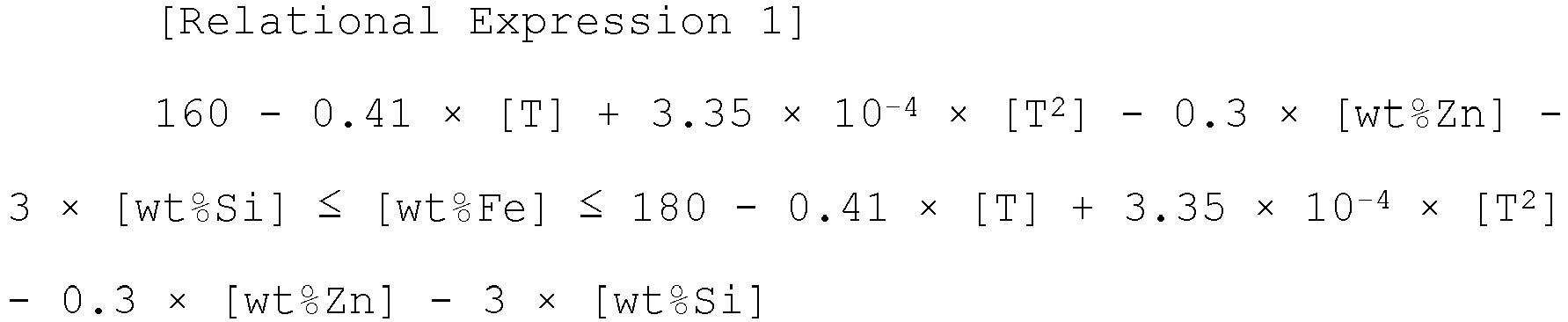
- [In Relational Expression 1, [T] represents the alloy heat treatment temperature (°C), [wt%Zn] represents the content of Zn wt% in the plating bath, [wt%Si] represents the content of Si wt% in the plating bath, and [wt%Fe] represents the content of Fe wt% in the alloy-plated layer.]
- In addition, according to still another aspect of the present disclosure, there is provided a hot-formed member obtained by subjecting the aluminum alloy-plated steel sheet to hot press forming.
- Methods generally used in the art may be used in the hot press forming. For example, the plated steel sheet may be heated in a temperature range of 800 to 950°C for 3 to 10 minutes, and then, the plated steel sheet may be subjected to hot forming into a desired shape using a press, but the present disclosure is not limited thereto.
- In addition, a composition of a base steel sheet of the hot press-formed member may be the same as the composition of the base steel sheet described above.
- Hereinafter, the present disclosure will be described in more detail with reference to Examples. However, the following Examples are provided to illustrate and describe the present disclosure in detail, but are not intended to limit the scope of the present disclosure. This is because the scope of the present disclosure is determined by contents disclosed in the claims and contents reasonably inferred therefrom.
- First, after a cold-rolled steel sheet for hot press forming having the composition shown in Table 1 and a thickness of 1.2 mm was prepared as a base steel sheet, the base steel sheet was dipped and ultrasonically cleaned to remove substances such as rolling oil present on a surface.
[Table 1] Element C Si Mn Ti B Fe Content (%) 0.22% 0.25% Mn: 1.3% 0.03% 25 ppm bal - Thereafter, the base steel sheet was subjected to heat treatment in a furnace maintained in a reducing atmosphere at an annealing temperature of 800°C for an annealing time of 50 seconds, and then, the base steel sheet was dipped in a plating bath under the composition of the plating bath and the temperature conditions of the plating bath shown in Table 2, thereby performing aluminum plating. When the base steel sheet was dipped in the plating bath, the dipping temperature was maintained at the same temperature of the plating bath, and the temperature of the plating bath was maintained at a temperature that was collectively increased by 40°C with respect to a melting point of each plating component system. In order for comparison of alloying, the plating weight was constantly maintained at 60 g/m2 per surface using air wiping.
- Subsequently, cooling was performed by supplying air heated to 200 to 300°C to the aluminum-plated steel sheet to form an oxide film on a surface of the aluminum-plated steel sheet at a thickness of 10% or more based on the entire thickness of the hot-dip aluminum-plated layer under control. Thereafter, alloy heat treatment was performed under the alloy heat treatment conditions shown in Table 2, and then, the steel sheet was cooled by air cooling to 300°C or lower based on the temperature of the surface of the steel sheet, thereby manufacturing an aluminum alloy-plated steel sheet.
[Table 2] Remarks Composition of plating bath [wt%] Alloying temperature [°C] Alloying maintaining time [second] Al Zn Si Comparative Example 1 100 0 0 750 15 Comparative Example 2 bal. 0 1 770 20 Comparative Example 3 bal. 0 9 820 35 Comparative Example 4 bal. 3 0 740 15 Comparative Example 5 bal. 5 0 630 20 Inventive Example 1 bal. 5 0.1 650 5 Inventive Example 2 bal. 5 0.5 680 10 Inventive Example 3 bal. 5 1.5 750 12 Comparative Example 6 bal. 5 0.5 780 35 Comparative bal. 5 0.7 750 35 Example 7 Comparative Example 8 bal. 20 0.5 630 35 Inventive Example 4 bal. 20 0.1 650 5 Inventive Example 5 bal. 20 0.5 680 3 Comparative Example 9 bal. 20 2 780 20 Comparative Example 10 bal. 20 3 750 25 Comparative Example 11 bal. 30 1.5 630 30 Inventive Example 6 bal. 30 0.1 650 5 Inventive Example 7 bal. 30 1.5 680 3 Comparative Example 12 bal. 32 1 650 30 - Meanwhile, in the aluminum alloy-plated steel sheet manufactured by the method described above, the content of each component in the alloy-plated layer and the thickness of the alloy-plated layer were measured. The results are shown in Table 3. The component in the alloy-plated layer was measured by a wet method using inductively coupled plasma spectroscopy (ICP), and the thickness was measured by observing a cross section of the alloy-plated layer with an electron microscope. In addition, interfacial roughness (Ra) was measured by capturing an image of the cross section of the aluminum alloy-plated steel sheet in a thickness direction (refers to a direction perpendicular to a rolling direction) with a scanning electron microscope (SEM) and observing the interface between the alloy-plated layer and the base steel sheet.
- In addition, the result of phase analysis of the alloy-plated layer formed by Inventive Example 1 using X-ray diffraction (XRD) is shown in Table 3. It was confirmed that the alloy-plated layer was formed of 80% or more of an alloy phase based on an Fe2Al5 or FeAl3 alloy phase in terms of phase fraction (that is, the alloy-plated layer was formed of 80 wt% or more of Fe2Al5 and FeAl3 as alloy phases in terms of total phase fraction).
- In addition, in order to evaluate properties of the aluminum alloy-plated steel sheet, seizure resistance, corrosion resistance, plating adhesion, and productivity were evaluated by the following methods. The evaluation results are shown in Table 3.
- The manufactured plated steel sheet was heated under a condition of 900°C for 5 minutes to evaluate physical properties of the plating, and then, whether or not the alloy-plated layer was fused to a die was visually observed. The evaluation was performed based on the following criteria.
- ∘: No seizure
- x: Occurrence of adsorption on die due to hot-dip of plated layer
- The plated steel sheet was subjected to a salt spray test and then was left for 720 hours. Thereafter, a corrosion product formed on the surface was removed, and then, a maximum depth of the corrosion product formed on the surface was measured.
- Corrosion Resistance: After the salt spray test was performed for 720 hours, the corrosion product formed on the surface was removed, the depth of the corrosion product formed by the corrosion was measured, and a case where the depth was equal to or less than the standard (70 µm) as described below was expressed as good.
- ∘: 70 µm or less
- x: More than 70 µm
- The plated layer was subjected to a 60° bending test after alloying, a tape was attached to the inside of the bending portion, the tape was peeled off, a width of the plated layer attached to the tape was measured, and plating adhesion was evaluated based on the following criteria.
- ∘: 4 mm or less
- x: More than 4 mm
- The time required for the alloying was measured, and productivity was evaluated based on the following criteria.
- ⊚: Shorter than 15 seconds
- ∘: 15 seconds or longer and 20 seconds or shorter
- x: Longer than 20 seconds
- As shown in Table 3, in the cases of Inventive Examples 1 to 7 in which the composition of the plated layer and the manufacturing conditions that were defined in the present disclosure were satisfied, all the seizure resistance, the corrosion resistance, and the plating adhesion were excellent, and thus, seizure of the plated layer to a press die or a roll caused during the heat forming or generation of microcracks was prevented.
- On the other hand, in the cases of Comparative Examples 1 to 12 in which the content of Zn in the plating bath that was defined in the present disclosure was not satisfied or the manufacturing conditions were not satisfied, one or more properties of the seizure resistance, the corrosion resistance, and the plating adhesion were not excellent, and thus, the problems such as the seizure of the plated layer to the press die or the roll caused during the heat forming and the generation of the microcracks were caused.
- In particular, the photograph obtained by observing the cross section of the aluminum alloy-plated steel sheet manufactured by Comparative Example 4 with a scanning electron microscope (SEM) is illustrated in
FIG. 1 . In this case, the interfacial roughness between the alloy-plated layer and the base steel sheet was more than 2.5 µm, and the corrosion resistance and the plating adhesion were not excellent. - Meanwhile, the photograph obtained by observing the cross section of the aluminum alloy-plated steel sheet manufactured by Inventive Example 1 with a scanning electron microscope is illustrated in
FIG. 2 . In this case, the interfacial roughness between the alloy-plated layer and the base steel sheet was 2.5 µm or less, and all the seizure resistance, the corrosion resistance, and the plating adhesion were excellent.
| Remarks | Component of alloy-plated layer (wt%) | Interfacial roughness (Ra) [µm] | Thickness of alloy-plated layer [µm] | Seizure resistance | Corrosion resistance | Plating adhesion | Productivity | ||||
| Al | Zn | Si | Fe | Zn | |||||||
| Comparative Example 1 | bal. | 0 | 0 | 25 | 4 | 3.2 | 5 | X | X | X | ∘ |
| Comparative Example 2 | bal. | 0 | 1 | 41 | 3 | 2.4 | 5 | ∘ | X | X | ∘ |
| Comparative Example 3 | bal. | 0 | 9 | 50 | 1 | 0.4 | 10 | ∘ | X | ∘ | X |
| Comparative Example 4 | bal. | 1 | 0 | 45 | 4 | 3.2 | 5 | ∘ | X | X | ∘ |
| Comparative Example 5 | bal. | 2 | 0 | 15 | 2 | 3.2 | 20 | X | ∘ | ∘ | ∘ |
| Inventive Example 1 | bal. | 2 | 0.1 | 43 | 1 | 2.5 | 5 | ∘ | ∘ | ∘ | ⊚ |
| Inventive Example 2 | bal. | 1.5 | 0.5 | 44 | 0.5 | 2.1 | 15 | ∘ | ∘ | ∘ | ⊚ |
| Inventive Example 3 | bal. | 1.5 | 1.5 | 48 | 2 | 1.2 | 15 | ∘ | ∘ | ∘ | ⊚ |
| Comparative Example 6 | bal. | 1.5 | 0.5 | 48 | 2.2 | 2.1 | 30 | ∘ | ∘ | X | X |
| Comparative Example 7 | bal. | 1 | 0.7 | 46 | 2 | 1.4 | 30 | ∘ | ∘ | X | X |
| Comparative Example 8 | bal. | 17 | 0.5 | 25 | 1.5 | 2.1 | 30 | X | ∘ | ∘ | X |
| Inventive Example 4 | bal. | 15 | 0.1 | 39 | 1 | 2.5 | 15 | ∘ | ∘ | ∘ | ⊚ |
| Inventive Example 5 | bal. | 12 | 0.5 | 39 | 3 | 2.1 | 20 | ∘ | ∘ | ∘ | ⊚ |
| Comparative Example 9 | bal. | 12 | 2 | 40 | 3.5 | 1.0 | 20 | ∘ | ∘ | X | ∘ |
| Ctrrparative Example 10 | bal. | 10 | 3 | 41 | 2 | 0.9 | 20 | ∘ | ∘ | X | X |
| Ctrrparative Example 11 | bal. | 23 | 1.5 | 35 | 1 | 1.2 | 20 | X | ∘ | ∘ | X |
| Inventive Example 6 | bal. | 17 | 0.1 | 36 | 1.5 | 2.5 | 15 | ∘ | ∘ | ∘ | ⊚ |
| Inventive Example 7 | bal. | 20 | 1.5 | 36 | 2 | 1.2 | 20 | ∘ | ∘ | ∘ | ⊚ |
| Comparative Example 12 | Bal. | 23 | 1 | 35 | 1 | 2.4 | 20 | ∘ | ∘ | X | X |
Claims (13)
- An aluminum alloy-plated steel sheet comprising:a base steel sheet; andan alloy-plated layer formed on the base steel sheet,wherein the alloy-plated layer contains, by wt%, 30 to 50% of Fe, 1 to 20% of Zn, 0.1 to 1.5% of Si, and a balance of Al and unavoidable impurities, andinterfacial roughness between the alloy-plated layer and the base steel sheet is 2.5 µm or less.
- The aluminum alloy-plated steel sheet of claim 1, wherein a thickness of the alloy-plated layer is 5 to 25 µm.
- The aluminum alloy-plated steel sheet of claim 1, wherein the alloy-plated layer contains 80% or more of an Fe2Al5 alloy phase in terms of phase fraction.
- The aluminum alloy-plated steel sheet of claim 1, wherein a content of Al in the alloy-plated layer is 40.5 to 53.9% in terms of wt%.
- The aluminum alloy-plated steel sheet of claim 1, wherein the base steel sheet contains, by wt%, 0.05 to 0.3% of C, 0.1 to 1.5% of Si, 0.5 to 8% of Mn, 50 ppm or less of B, and a balance of Fe and unavoidable impurities.
- The aluminum alloy-plated steel sheet of claim 1, wherein a content of Si in the alloy-plated layer is 0.1 to 0.5% in terms of wt%.
- A method for manufacturing an aluminum alloy-plated steel sheet used for hot press forming, the method comprising:preparing a base steel sheet;dipping the base steel sheet in an aluminum plating bath that contains, by wt%, 3 to 30% of Zn, 0.1 to 1.5% of Si, and a balance of Al and unavoidable impurities to obtain an aluminum-plated steel sheet;performing cooling by supplying air heated to 200 to 300°C to the aluminum-plated steel sheet after the aluminum plating to form an oxide film on a surface of the aluminum-plated steel sheet; andobtaining an aluminum alloy-plated steel sheet by on-line alloying in which heat treatment is performed continuously by maintaining the aluminum-plated steel sheet in a heating temperature range of 650 to 750°C for 1 to 20 seconds after the cooling.
- The method of claim 7, further comprising, after the alloy treatment, performing cooling.
- The method of claim 7, wherein a plating weight in the plating is in a range of 20 to 100 g/m2 per surface.
- The method of claim 8, wherein the cooling after the alloy treatment is air cooling.
- The method of claim 7, wherein the oxide film is formed on the surface of the aluminum-plated steel sheet at a thickness of 10% or more of the entire thickness of a hot-dip aluminum-plated layer.
- The method of claim 7, wherein an alloying temperature is controlled to satisfy the following Relational Expression 1:

- A hot-formed member obtained by subjecting the aluminum alloy-plated steel sheet of claim 1 to hot press forming.
Applications Claiming Priority (2)
| Application Number | Priority Date | Filing Date | Title |
|---|---|---|---|
| KR1020190172332A KR102311502B1 (en) | 2019-12-20 | 2019-12-20 | Aluminium alloy plate steel sheet having excellent formability and corrosion resistance and method for manufacturing the same |
| PCT/KR2020/018688 WO2021125887A2 (en) | 2019-12-20 | 2020-12-18 | Aluminum alloy-plated steel sheet having excellent workability and corrosion resistance and method for manufacturing same |
Publications (2)
| Publication Number | Publication Date |
|---|---|
| EP4079928A2 true EP4079928A2 (en) | 2022-10-26 |
| EP4079928A4 EP4079928A4 (en) | 2022-12-07 |
Family
ID=76478480
Family Applications (1)
| Application Number | Title | Priority Date | Filing Date |
|---|---|---|---|
| EP20903719.1A Pending EP4079928A4 (en) | 2019-12-20 | 2020-12-18 | STEEL SHEET COATED WITH A DEPOSIT OF ALUMINUM ALLOY HAVING EXCELLENT WORKABILITY AND EXCELLENT CORROSION RESISTANCE, AND METHOD OF MANUFACTURING THEREOF |
Country Status (7)
| Country | Link |
|---|---|
| US (2) | US12152305B2 (en) |
| EP (1) | EP4079928A4 (en) |
| JP (1) | JP7321370B2 (en) |
| KR (1) | KR102311502B1 (en) |
| CN (1) | CN114829666B (en) |
| MX (1) | MX2022004454A (en) |
| WO (1) | WO2021125887A2 (en) |
Families Citing this family (2)
| Publication number | Priority date | Publication date | Assignee | Title |
|---|---|---|---|---|
| US20260071305A1 (en) * | 2022-06-21 | 2026-03-12 | Aisin Corporation | Steel treatment method and electrical steel sheet |
| WO2025095010A1 (en) * | 2023-11-01 | 2025-05-08 | 日本製鉄株式会社 | Plated steel sheet |
Family Cites Families (21)
| Publication number | Priority date | Publication date | Assignee | Title |
|---|---|---|---|---|
| JP2924492B2 (en) * | 1992-09-21 | 1999-07-26 | 住友金属工業株式会社 | Al alloy plated metal sheet with excellent end face corrosion resistance and its manufacturing method |
| JP3486003B2 (en) * | 1995-04-10 | 2004-01-13 | 日本パーカライジング株式会社 | High adhesion coating method and plating bath for molten Al-Zn-Si alloy and molten Al-Si alloy by flux method |
| JPH0987859A (en) | 1995-09-22 | 1997-03-31 | Nippon Steel Corp | Manufacturing method of hot-dip aluminum-plated steel sheet with excellent workability |
| KR100256370B1 (en) | 1995-12-29 | 2000-05-15 | 이구택 | Manufacturing method of molten aluminum plated steel sheet with excellent workability and surface appearance |
| JP3572944B2 (en) | 1998-05-30 | 2004-10-06 | Jfeスチール株式会社 | Method for producing hot-dip Al-Zn-based alloy-plated steel sheet having excellent crack resistance and corrosion resistance |
| JP3367456B2 (en) | 1999-03-24 | 2003-01-14 | 住友金属工業株式会社 | Method for producing hot-dip coated steel sheet with spangle pattern |
| JP2003306757A (en) | 2002-04-18 | 2003-10-31 | Jfe Steel Kk | Hot-dip Al-Zn alloy plated steel sheet and method for producing the same |
| JP5505132B2 (en) * | 2010-06-30 | 2014-05-28 | 新日鐵住金株式会社 | Al-Zn alloy plated steel with excellent weldability |
| JP5991379B2 (en) | 2013-03-25 | 2016-09-14 | Jfeスチール株式会社 | Al-Zn plated steel sheet |
| MY174906A (en) | 2013-05-07 | 2020-05-21 | Nippon Steel Corp | Al-based alloy plated steel material having excellent post-coating corrosion resistance |
| KR20150073034A (en) | 2013-12-20 | 2015-06-30 | 주식회사 포스코 | Anti-corrosion cold-rolled steel sheet having excellent anti-blackening property and manufacturing method thereof |
| WO2017017483A1 (en) | 2015-07-30 | 2017-02-02 | Arcelormittal | Steel sheet coated with a metallic coating based on aluminum |
| KR102075182B1 (en) | 2015-12-24 | 2020-02-10 | 주식회사 포스코 | Hot dip zinc alloy plated high strength steel material having excellent plating property and method for manufacturing same |
| KR101839253B1 (en) | 2016-12-23 | 2018-03-15 | 주식회사 포스코 | Aluminum alloy plated steel sheet having excellent processed part corrosion resistance |
| KR102297297B1 (en) | 2016-12-23 | 2021-09-03 | 주식회사 포스코 | Aluminium based coated steel having excellent corrosion reistance, aluminium alloyed coated steel by using the steel, and method for manufacturing thereof |
| KR101858863B1 (en) | 2016-12-23 | 2018-05-17 | 주식회사 포스코 | Hot dip aluminum alloy plated steel material having excellent corrosion resistance and workability |
| CA3051515A1 (en) | 2017-02-28 | 2018-09-07 | Tata Steel Ijmuiden B.V. | Method for producing a steel strip with an aluminium alloy coating layer |
| JP6939393B2 (en) * | 2017-10-18 | 2021-09-22 | 日本製鉄株式会社 | Al plated steel pipe parts |
| CN111511942B (en) | 2017-12-05 | 2021-12-28 | 日本制铁株式会社 | Aluminum-plated steel sheet, method for producing aluminum-plated steel sheet, and method for producing automobile component |
| KR102010084B1 (en) | 2017-12-26 | 2019-08-12 | 주식회사 포스코 | Steel sheet plated with fe-al alloy having improved resistance against hydrogen delayed fracture, manufacturing method thereof and hot press formed part manufactured therefrom |
| KR102010082B1 (en) | 2017-12-26 | 2019-08-12 | 주식회사 포스코 | Steel sheet plated with fe-al alloy for hot press forming, manufacturing method thereof and hot press formed part manufactured therefrom |
-
2019
- 2019-12-20 KR KR1020190172332A patent/KR102311502B1/en active Active
-
2020
- 2020-12-18 US US17/766,335 patent/US12152305B2/en active Active
- 2020-12-18 CN CN202080088975.8A patent/CN114829666B/en active Active
- 2020-12-18 EP EP20903719.1A patent/EP4079928A4/en active Pending
- 2020-12-18 JP JP2022521589A patent/JP7321370B2/en active Active
- 2020-12-18 WO PCT/KR2020/018688 patent/WO2021125887A2/en not_active Ceased
- 2020-12-18 MX MX2022004454A patent/MX2022004454A/en unknown
-
2024
- 2024-10-17 US US18/918,969 patent/US20250034692A1/en active Pending
Also Published As
| Publication number | Publication date |
|---|---|
| US12152305B2 (en) | 2024-11-26 |
| CN114829666A (en) | 2022-07-29 |
| EP4079928A4 (en) | 2022-12-07 |
| CN114829666B (en) | 2023-11-24 |
| JP7321370B2 (en) | 2023-08-04 |
| KR102311502B1 (en) | 2021-10-13 |
| WO2021125887A3 (en) | 2021-08-05 |
| JP2022551899A (en) | 2022-12-14 |
| KR20210080002A (en) | 2021-06-30 |
| WO2021125887A2 (en) | 2021-06-24 |
| US20250034692A1 (en) | 2025-01-30 |
| US20240052495A1 (en) | 2024-02-15 |
| MX2022004454A (en) | 2022-05-03 |
Similar Documents
| Publication | Publication Date | Title |
|---|---|---|
| EP3733922B1 (en) | Plating steel sheet for hot press forming and forming member using same | |
| EP2695963B1 (en) | Hot stamp-molded high-strength component having excellent corrosion resistance after coating | |
| KR102031465B1 (en) | Zinc alloy coated steel having excellent corrosion resistance after forming, and method for manufacturing the same | |
| KR102301116B1 (en) | Method for producing a steel component having a metal coating protecting it against corrosion, and steel component | |
| US20250034692A1 (en) | Aluminum alloy-plated steel sheet having excellent workability and corrosion resistance and method for manufacturing same | |
| EP2395128A1 (en) | Galvannealed steel sheet and process for production thereof | |
| JP4987510B2 (en) | Alloyed hot-dip galvanized steel sheet with excellent paint sharpness and press formability and method for producing the same | |
| TW201434617A (en) | Hot-dip galvanized steel sheet | |
| EP3178960B1 (en) | High-strength hot-dip-galvanized steel sheet | |
| CN106574328B (en) | Aluminum alloy plate | |
| EP4079927A2 (en) | Aluminum-based alloy-plated steel sheet having excellent workability and corrosion resistance, and manufacturing method therefor | |
| EP3396006B1 (en) | Microcrack-reduced, hot press-formed article, and method for manufacturing same | |
| EP4079926A2 (en) | Aluminum alloy-plated steel sheet having excellent workability and corrosion resistance and method for manufacturing same | |
| TWI588293B (en) | Hot stamp molded article | |
| JP4720618B2 (en) | Alloyed hot-dip galvanized steel sheet and method for producing the same | |
| JP2000017366A (en) | Aluminum alloy material excellent in chemical convertibility |
Legal Events
| Date | Code | Title | Description |
|---|---|---|---|
| STAA | Information on the status of an ep patent application or granted ep patent |
Free format text: STATUS: THE INTERNATIONAL PUBLICATION HAS BEEN MADE |
|
| PUAI | Public reference made under article 153(3) epc to a published international application that has entered the european phase |
Free format text: ORIGINAL CODE: 0009012 |
|
| STAA | Information on the status of an ep patent application or granted ep patent |
Free format text: STATUS: REQUEST FOR EXAMINATION WAS MADE |
|
| 17P | Request for examination filed |
Effective date: 20220720 |
|
| AK | Designated contracting states |
Kind code of ref document: A2 Designated state(s): AL AT BE BG CH CY CZ DE DK EE ES FI FR GB GR HR HU IE IS IT LI LT LU LV MC MK MT NL NO PL PT RO RS SE SI SK SM TR |
|
| A4 | Supplementary search report drawn up and despatched |
Effective date: 20221107 |
|
| RIC1 | Information provided on ipc code assigned before grant |
Ipc: C23C 2/26 20060101ALI20221101BHEP Ipc: C22C 21/10 20060101ALI20221101BHEP Ipc: C23C 2/02 20060101ALI20221101BHEP Ipc: C23C 8/10 20060101ALI20221101BHEP Ipc: C23C 28/00 20060101ALI20221101BHEP Ipc: C23C 2/40 20060101ALI20221101BHEP Ipc: C23C 2/12 20060101ALI20221101BHEP Ipc: C23C 2/28 20060101AFI20221101BHEP |
|
| DAV | Request for validation of the european patent (deleted) | ||
| DAX | Request for extension of the european patent (deleted) |