EP4079044B1 - Verfahren und vorrichtung zur leitweglenkung und zur erzeugung einer leitweglenkungstabelle - Google Patents
Verfahren und vorrichtung zur leitweglenkung und zur erzeugung einer leitweglenkungstabelle Download PDFInfo
- Publication number
- EP4079044B1 EP4079044B1 EP20821322.3A EP20821322A EP4079044B1 EP 4079044 B1 EP4079044 B1 EP 4079044B1 EP 20821322 A EP20821322 A EP 20821322A EP 4079044 B1 EP4079044 B1 EP 4079044B1
- Authority
- EP
- European Patent Office
- Prior art keywords
- mobile device
- chirps
- chirp
- mobile
- routing table
- Prior art date
- Legal status (The legal status is an assumption and is not a legal conclusion. Google has not performed a legal analysis and makes no representation as to the accuracy of the status listed.)
- Active
Links
Images


Classifications
-
- H—ELECTRICITY
- H04—ELECTRIC COMMUNICATION TECHNIQUE
- H04W—WIRELESS COMMUNICATION NETWORKS
- H04W40/00—Communication routing or communication path finding
- H04W40/24—Connectivity information management, e.g. connectivity discovery or connectivity update
- H04W40/246—Connectivity information discovery
-
- H—ELECTRICITY
- H04—ELECTRIC COMMUNICATION TECHNIQUE
- H04W—WIRELESS COMMUNICATION NETWORKS
- H04W40/00—Communication routing or communication path finding
- H04W40/02—Communication route or path selection, e.g. power-based or shortest path routing
- H04W40/20—Communication route or path selection, e.g. power-based or shortest path routing based on geographic position or location
-
- H—ELECTRICITY
- H04—ELECTRIC COMMUNICATION TECHNIQUE
- H04W—WIRELESS COMMUNICATION NETWORKS
- H04W40/00—Communication routing or communication path finding
- H04W40/24—Connectivity information management, e.g. connectivity discovery or connectivity update
- H04W40/244—Connectivity information management, e.g. connectivity discovery or connectivity update using a network of reference devices, e.g. beaconing
-
- H—ELECTRICITY
- H04—ELECTRIC COMMUNICATION TECHNIQUE
- H04W—WIRELESS COMMUNICATION NETWORKS
- H04W84/00—Network topologies
- H04W84/18—Self-organising networks, e.g. ad-hoc networks or sensor networks
Definitions
- the present invention relates to a method and device for generating a data routing table in a vehicle Ad-Hoc Network (VANET or MANET), to provide communications within a group of vehicles within range of each other and between the vehicles and fixed equipment within range, usually called road equipment.
- VANET vehicle Ad-Hoc Network
- a VANET can be used to support the development of Intelligent Transportation Systems (ITS).
- ITS Intelligent Transportation Systems
- VANETs Many applications are proposed for VANETs such as early warning and accident prevention, best routes to the destination, congestion relief, traffic jam prevention, Internet access, autonomous vehicles, and peer-to-peer applications.
- the design and implementation of protocols, applications, and systems for VANETs require considering these distinctive features, especially the high mobility of vehicles, the rapid change of topology, and the intended path for message transfer.
- this type of communication network also needs to consider several factors, such as the quality requirement, especially for the transmission of alert messages.
- VANET networks are intended to ensure the exchange of messages between vehicles moving in close proximity to each other and also between vehicles and fixed stations, also called roadside equipment, located in the immediate vicinity.
- Each vehicle or fixed station is equipped with radio communication means and constitutes a node in the network.
- Vehicles are equipped with a variety of sensors and constantly exchange simple alerts and/or messages containing information such as their position, speed, the state of the vehicle and/or its driver, which allow drivers or vehicles, when autonomous, to react quickly to abnormal and potentially dangerous situations such as the occurrence of an accident, traffic jams or the presence of adverse weather conditions.
- Data routing is an operation aimed at transmitting data from a source node to a destination node through intermediate nodes in the most efficient way possible, particularly in terms of latency and bandwidth consumed.
- routing tables for data relaying and routing must therefore be continuously and optimally adapted to ensure that data can be exchanged continuously.
- the patent application EP2887722 discloses a terminal configured to operate in a television white space environment.
- the patent application EP2811796 discloses a method of managing communication in a wireless mesh network comprising a plurality of wireless nodes.
- VANET networks do not allow such continuous adaptation.
- An object of the present invention is to provide a method and a device for generating a data routing table in an Ad-Hoc network which adapts continuously and optimally to ensure that data can be exchanged between nodes.
- routing tables from simplified signaling signals emitted by the devices of the Ad-Hoc network.
- the processing of these signals, the construction of routing tables from them and their broadcast to all the mobile devices of the network is carried out by the management device. This results in better exploitation of the spectral resource and, correlatively, a significant reduction in the level of interference generated at the scale of the ad-Hoc network.
- the management device is a fixed terminal or a mobile device stationary or moving at low speed.
- the routing table identifies each link between a pair of mobile devices through which the transmission of data from the first to the second mobile device of the pair is possible and/or the transmission of data from the second to the first mobile device is possible.
- the reception of the routing table by the mobile devices gives them immediate knowledge of the possibilities of establishing a direct radio link between mobile devices located one hop away from the transmitting mobile device and the latter.
- the propagation of urgent messages is thereby facilitated.
- the routing table identifies triplets of mobile devices which allow the transfer of data from the first mobile device to a third mobile device via the second mobile device.
- each chirp is a signal modulated in frequency around a central frequency.
- each chirp emitted by a mobile device comprises information identifying mobile devices that emit chirps received by the mobile device and the routing table is determined from the information identifying mobile devices that emit chirps received by the mobile device.
- the routing table is determined from the radio environment of the pair of mobile devices of each link.
- the census of the possibilities of establishing a radio link (direct or relayed) during the construction of the routing table is made easier.
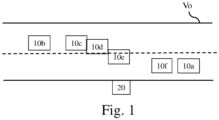
- FIG. 1 is an example of a track section in which vehicles 10 communicate via an Ad-Hoc network in a track Vo in which a manager device 20 and mobile devices such as vehicles 10a to 10f communicate via the Ad-Hoc network.
- the management device 20 is responsible for developing and distributing routing tables to the vehicles 10a to 10f.
- Fig. 1 only a section of track is shown for the sake of simplification but in reality the management device 20 manages all communications in a given geographical area.
- the management device 20 is for example a fixed node, such as a roadside device or, failing that, a stationary or low-speed mobile node located near a road intersection and having calculation means of similar capacity to that of a fixed node.
- the management device 20 collects signaling packets sent by the mobile devices, determines, for each mobile device having sent the packet, the geographical position of the mobile device as a function of the packet, develops, from the determined positions, a routing table describing the routing possibilities within the network constituted by the mobile devices and periodically broadcasts at least part of the routing table developed.
- the mobile devices or nodes 10 periodically generate signals that do not carry binary information.
- These signals hereinafter called chirps, intrinsically include information relating to their position in the geographical area managed by the management device 20 or even of another management device neighboring the management device.
- the management device performs a one-to-one correspondence f between the geographical area managed by the management device and the chirp.
- the geographical area managed by the management device 20 is subdivided into a radio block which will be described with reference to the Fig. 3 .
- Fig. 2 is a one-to-one representation between the geographic area managed by the manager device and a chirp received by the manager device to determine the position of a mobile device.
- a map of the geographical area managed by management devices is shown in Fig. 2 . It represents a set of roads.
- the geographic area is a plane whose abscissa axis X and ordinate axis Y define the positions in the geographic area.
- An electric radio block is associated with the geographic area managed by the management device 20.
- the electric block is a plane whose abscissa axis ⁇ and ordinate axis ⁇ define a time interval and a frequency on which a chirp is defined which is for example in the form of a complex exponential.
- the radio tile is divided into meshes in the geographic area.
- the radio tile partitions the geographic area into a plurality of meshes as shown in Fig. 3 .
- Fig. 3 is an example of a radio pad used by the packet manager device in the geographic area managed by the manager device.
- the geographical space is partitioned into a plurality of meshes, for example in the form of parallelograms.
- Each mesh is assigned an integer between 0 and 3 such that two adjacent meshes are always associated with two different integers.
- Each integer is associated with a set of N different and not necessarily mutually orthogonal chirps.
- the chirps forming a given set share common characteristics such as an instantaneous frequency that increases linearly in time, a common frequency excursion.
- each mobile device in a mesh with which a given integer is associated is assigned a chirp from the set of chirps associated with the integer.
- a time interval and a frequency as represented in Fig. 2 are associated.
- each mesh can be divided into N sub-meshes, where N is equal to the number of chirps in the chirp set associated with the mesh.
- Each sub-mesh is allocated a chirp that is different from the other chirps allocated to the other sub-meshes.
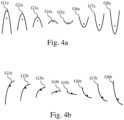
- Fig. 4a represents a set of chirps allocated for meshes with the number 0 associated with it.
- a set of eight chirps denoted G1a to G8a is represented.
- Each chirp is associated with a point representing its center of gravity.
- the center of gravity of the chirp is used to indicate the geographic position of the mobile device 10. It materializes the one-to-one correspondence between a point in space-time-frequency, for example the barycenter of the continuum of time-frequency points defining the chirp and the geographic point associated with the position of the mobile device.
- the center of gravity may be part of the continuum of points defining the shape of the chirp (this is the case, for example, when the shape of the chirp is linear). It is necessary to define a focal point relative to the chirp indicating the position of the vehicle once the chirp has been detected by correlation with a local replica of said chirp.
- Each chirp has a given frequency excursion ⁇ f which can vary among chirps in the ensemble and a time excursion ⁇ t which is constant for all chirps in the ensemble.
- Fig. 4b represents a set of chirps allocated for meshes with the number 1 associated with it.
- a set of eight chirps denoted G1b to G8b is represented.
- Each chirp is associated with a point representing its center of gravity.
- Each chirp has a given frequency excursion ⁇ f that can vary among the chirps in the set and a constant time excursion ⁇ t for all chirps in the set.
- Fig. 4c represents a set of chirps allocated for meshes with the number 2 associated with it.
- a set of eight chirps denoted G1c to G8c is represented.
- Each chirp is associated with a point representing its center of gravity.
- Each chirp has a given frequency excursion ⁇ f which can vary among chirps in the ensemble and a time excursion ⁇ t which is constant for all chirps in the ensemble.
- Fig. 4d represents a set of chirps allocated for meshes with the number 3 associated with it.
- a set of eight chirps denoted G1d to G8d is represented.
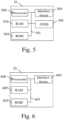
- Fig. 5 represents an exemplary architecture of a mobile device according to the present invention.
- the processor 500 is capable of executing instructions loaded into the volatile memory 503 from the non-volatile memory 502, from an external memory (not shown), from a storage medium, such as an SD card or the like, or from a communications network.
- the processor 500 is capable of reading instructions from the volatile memory 503 and executing them.
- These instructions form a computer program that causes the processor 500 to implement all or part of the method described in relation to the Fig. 7 .
- All or part of the process described in relation to the Fig. 7 can be implemented in software by executing a set of instructions by a programmable machine, such as a DSP ( Digital Signal Processor ) or a microcontroller, or be implemented in hardware by a dedicated machine or component, such as an FPGA ( Field-Programmable Gate Array ) or an ASIC ( Application-Specific Chip ). Integrated Circuit in English or Application Specific Integrated Circuit in French).
- a programmable machine such as a DSP ( Digital Signal Processor ) or a microcontroller
- a dedicated machine or component such as an FPGA ( Field-Programmable Gate Array ) or an ASIC ( Application-Specific Chip ).
- a dedicated machine or component such as an FPGA ( Field-Programmable Gate Array ) or an ASIC ( Application-Specific Chip ).
- FIG. 6 represents an exemplary architecture of a management device according to the present invention.
- the processor 600 is capable of executing instructions loaded into the volatile memory 603 from the non-volatile memory 602, from an external memory (not shown), from a storage medium, such as an SD card or the like, or from a communications network.
- the processor 600 is capable of reading instructions from the volatile memory 603 and executing them.
- These instructions form a computer program that causes the processor 600 to implement all or part of the method described in relation to the Figs. 8 And 9 .
- Figs. 8 And 9 can be implemented in software by executing a set of instructions by a programmable machine, such as a DSP ( Digital Signal Processor ) or a microcontroller, or be implemented in hardware by a dedicated machine or component, such as an FPGA (Field- Programmable Gate Array ) or an ASIC ( Application-Specific Integrated Circuit ) .
- a programmable machine such as a DSP ( Digital Signal Processor ) or a microcontroller
- FPGA Field- Programmable Gate Array
- ASIC Application-Specific Integrated Circuit
- This algorithm is executed by each mobile device when the mobile device is not identified by a manager device.
- step E70 the mobile device controls the generation of a signaling message.
- the signaling message is transferred via the network interface 504.
- the signaling message is for example composed of a preamble and data.
- the preamble is for example formed by the juxtaposition of a pure sinusoid and a predetermined sequence.
- the data includes at least a unique identifier of the mobile device and the geographic coordinates of the mobile device determined by the GNSS 505 satellite positioning system.
- the signaling message is, for example, transferred periodically on a radio channel dedicated to signaling until the mobile device receives a message from the management device in response.
- the mobile device 10 stores the radio block and includes a table comprising, for each sub-mesh of the radio block used by the packet management device, the time interval and the frequency of the mesh.
- the mobile device 10 transfers the signaling message in the time slot and frequency of the sub-mesh in which the mobile device is located without using the signaling radio channel.
- the signaling message is transferred so as to make the junction point between the pure sinusoid and the predetermined sequence coincide in the time and frequency interval with the geographical position of the mobile device 10 so as to acquire the frequency and time synchronizations and to indicate the initial position of the mobile device.
- step E71 the mobile device 10 checks, via the network interface 504, whether a message is received in response to the signaling message. If so, the mobile device proceeds to step E72. If not, the mobile device returns to step E70.
- step E72 the mobile device reads in the received message, information identifying a tweet by the set of tweets associated with the mesh in which it is located.
- the information identifying the tweet is the number associated with the mesh and the identifier of the tweet in the set of tweets associated with the mesh.
- the tweet is then transmitted periodically by the mobile device 10, for example every 50 ms.
- a chirp is a signal that is frequency modulated around a central frequency.
- the pair (central time, central frequency) is the "center of gravity" or barycenter of the continuum of points defining the chirp of interest.
- This continuum of points is included in the space of dimensions ⁇ t ⁇ ⁇ f, and its center of gravity coincides exactly with the geographical position of the mobile device in the mesh according to the one-to-one correspondence law mentioned earlier in the text.
- Chirps in the same set are a priori not mutually orthogonal.
- the orthogonality property is not a requirement even if it can be advantageous in some cases (the discrimination of chirps located in the same portion of the time-frequency space can be facilitated).
- the generated chirps can be made pairwise orthogonal by means of the Gram-Schmidt orthogonalization process.
- f n t 2 n ⁇ 1 N ⁇ 1 F MEAN + 1 ⁇ 2 n ⁇ 1 N ⁇ 1 F LOWER + ⁇ f 1 2 + 4 t ⁇ T MEAN ⁇ t 3
- F MEAN F LOWER + F UPPER 2
- T MEAN T LOWER + T UPPER 2
- information representative of the vicinity of the mobile device 10 is added.
- this information is inserted in hollow and includes the chirps emitted by the neighboring mobile devices which are received by the mobile device 10.
- the term "sparsity" refers to the fact that information is revealed by calculating a scalar product between the received signal of interest and the local replicas of the signals sought. Indeed, the chirp is modified so as to make it orthogonal to one or more particular signals representing one or more pieces of information. Orthogonality is ideally revealed by a zero or near-zero scalar product (in the presence of a high signal-to-noise ratio). When manifested, orthogonality reveals information. Mathematically, to insert information in a hollow, the chirp is projected onto the vector subspace orthogonal to the subspace generated by the signal(s) that one wishes to insert in a hollow in the chirp signal.
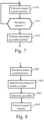
- Fig. 8 represents an example of an algorithm executed by a manager device according to the present invention.
- This algorithm is executed periodically by the manager device, for example every 50 ms.
- step E80 the manager device detects the reception of a signaling message by the network interface 604.
- the signaling message consists, for example, of a preamble and data.
- the preamble is formed, for example, by the juxtaposition of a pure sinusoid and a predetermined sequence.
- the data includes at least a unique identifier of the mobile device that sent the message and the geographic coordinates of the mobile device.
- the management device 20 identifies the mobile device having sent the message as well as the mesh or sub-mesh in which the mobile device is located.
- the identification of the sub-mesh is for example carried out from the geographic coordinates of the mobile device.
- the manager device 20 selects, from among all the tweets associated with the mesh in which the mobile device is located, a tweet that has not been allocated to another mobile device. For example, the manager device 20 selects the tweet associated with the sub-mesh in which the mobile device 10 is located.
- the manager device 20 controls the transfer of a message comprising the identifier of the mobile device for which the message is intended as well as information identifying the selected tweet.
- the information identifying the tweet is the number associated with the mesh and the identifier of the tweet in the set of tweets associated with the mesh.
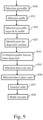
- Fig. 9 represents an example of an algorithm executed by a manager device according to the present invention.
- This algorithm is executed periodically, for example every 50 ms.
- step E90 the management device 20 detects the reception of a plurality of chirps during a time window for example equal to 50 ms.
- chirp detection is performed using a set of correlators.
- the management device 20 selects a mesh.
- the management device 20 selects, from among the chirps received, the chirps which correspond to those associated with the mesh as well as the chirps which correspond to the chirps of the neighboring sub-meshes of the selected mesh.
- the manager device 20 identifies the mobile devices to which the received chirps have been allocated. Indeed, the manager device knows how the sub-mesh division was carried out and to which sub-meshes the chirps have been allocated.
- step E94 the management device 20 evaluates the quality of the radio communication between the different identified mobile devices.
- the management device 20 evaluates the possibility of the existence of a radio link between each possible pair of mobile devices 10.
- the evaluation is for example carried out from a quality indicator describing the radio environment of the pair of mobile devices considered.
- the environment is based on the type of terrain (urban, suburban, rural) in which the mobile devices are located 10.
- the evaluation is performed from information identifying mobile devices that emit chirps received by the mobile device.
- the information is for example chirps embedded in the chirps emitted by the mobile devices.
- Embedded chirps are detected by performing a dot product between the chirp emitted by the mobile device and chirps likely to be emitted by surrounding mobile devices and comparing the result of the dot product to a threshold.
- the management device 20 selects each radio link between a pair of mobile devices that has a quality index greater than a predetermined threshold.
- Each of the selected links is stored in a first part of a table.
- Each line of the first part of the table comprises the identifier of each mobile device of the pair of mobile devices and a status of the link.
- the status of the link is representative of the possibility of transmitting data from the first to the second mobile device of the pair and/or of the possibility of transmitting data from the second to the first mobile device.
- the manager device 20 forms, from the first part of the table, triplets of mobile devices which allow the transfer of data from a first mobile device to a third mobile device via a second mobile device.
- Each triplet is stored in a second part of the table.
- Each line of the second part of the table comprises the identifier of each mobile device of the triplet.
- the manager device controls the broadcasting of the table formed via the network interface 604.
- the mobile device selects another mesh at step E98 if necessary and returns to step E91.
Landscapes
- Engineering & Computer Science (AREA)
- Computer Networks & Wireless Communication (AREA)
- Signal Processing (AREA)
- Mobile Radio Communication Systems (AREA)
- Data Exchanges In Wide-Area Networks (AREA)
Claims (7)
- Verfahren zur Erzeugung einer Routing-Tabelle von Daten in einem Kommunikationsnetz zwischen in Fahrzeugen enthaltenen mobilen Vorrichtungen, wobei das Kommunikationsnetz eine Verwaltungsvorrichtung aufweist, die ein geographisches Gebiet verwaltet, in dem die mobilen Vorrichtungen sich bewegen, dadurch gekennzeichnet, dass das Gebiet in Maschen aufgeteilt ist, jeder Masche eine Einheit von Chirps zugeordnet ist, jeder Chirp ein um eine zentrale Frequenz frequenzmoduliertes Signal ist, wobei die jeder Masche zugeordnete Einheit von Chirps sich von den Einheiten von Chirps unterscheidet, die den Maschen zugeordnet sind, die eine gemeinsame Grenze mit der Masche haben, das geographische Gebiet einer Zeit-Frequenz-Ebene zugeordnet ist, und dass das Verfahren die von der Verwaltungsvorrichtung ausgeführten Schritte aufweist:- Empfang eines Signalisierungspakets von jeder mobilen Vorrichtung, das die mobile Vorrichtung identifiziert und eine Lokalisierung der mobilen Vorrichtung erlaubt,- Bestimmung der Masche, in der sich jede mobile Vorrichtung befindet, und Zuweisung eines Chirps zu jeder mobilen Vorrichtung abhängig von der identifizierten Masche,- Empfang (E90) des zugewiesenen Chirps von jeder mobilen Vorrichtung,- Bestimmung (E95, E96), ausgehend von den empfangenen Chirps, der Routing-Tabelle, die die Routingmöglichkeiten innerhalb des Kommunikationsnetzes beschreibt, und Verbreitung (E97) der Routing-Tabelle an die mobilen Vorrichtungen.
- Verfahren nach Anspruch 1, dadurch gekennzeichnet, dass die Verwaltungsvorrichtung ein ortsfester Anschluss oder eine stillstehende oder sich mit geringer Geschwindigkeit bewegende mobile Vorrichtung ist.
- Verfahren nach Anspruch 1 oder 2, dadurch gekennzeichnet, dass die Routing-Tabelle jede Verbindung zwischen einem Paar von mobilen Vorrichtungen identifiziert, über die die Übertragung von Daten von der ersten zur zweiten mobilen Vorrichtung des Paars möglich ist und/oder die Übertragung von Daten von der zweiten zur ersten mobilen Vorrichtung möglich ist.
- Verfahren nach Anspruch 3, dadurch gekennzeichnet, dass die Routing-Tabelle Triplets von mobilen Vorrichtungen identifiziert, die die Übertragung von Daten von der ersten mobilen Vorrichtung zu einer dritten mobilen Vorrichtung über die zweite mobile Vorrichtung erlauben.
- Verfahren nach einem der Ansprüche 1 bis 4, dadurch gekennzeichnet, dass jeder von einer mobilen Vorrichtung gesendete Chirp Informationen aufweist, die mobile Vorrichtungen identifizieren, die von der mobilen Vorrichtung empfangene Chirps senden, und dass die Routing-Tabelle ausgehend von den Informationen bestimmt wird, die mobile Vorrichtungen identifizieren, die von der mobilen Vorrichtung empfangene Chirps senden.
- Verfahren nach einem der Ansprüche 3 bis 5, dadurch gekennzeichnet, dass die Routing-Tabelle ausgehend von der Funkumgebung des Paars von mobilen Vorrichtungen jeder Verbindung bestimmt wird.
- Vorrichtung zur Erzeugung einer Routing-Tabelle von Daten in einem Kommunikationsnetz zwischen in Fahrzeugen enthaltenen mobilen Vorrichtungen, wobei das Kommunikationsnetz eine Verwaltungsvorrichtung aufweist, die ein geographisches Gebiet verwaltet, in dem die mobilen Vorrichtungen sich bewegen, dadurch gekennzeichnet, dass das Gebiet in Maschen aufgeteilt ist, jeder Maschine eine Einheit von Chirps zugeordnet ist, jeder Chirp ein um eine zentrale Frequenz frequenzmoduliertes Signal ist, wobei die jeder Masche zugeordnete Einheit von Chirps sich von den Einheiten von Chirps unterscheidet, die den Maschen zugeordnet sind, die eine gemeinsame Grenze mit der Masche haben, das geographische Gebiet einer Zeit-Frequenz-Ebene zugeordnet ist, und dass die Vorrichtung zur Erzeugung der Tabelle in der Verwaltungsvorrichtung enthalten ist und aufweist:- Einrichtungen zum Empfang eines Signalisierungspakets von jeder mobilen Vorrichtung, das die mobile Vorrichtung identifiziert und eine Lokalisierung der mobilen Vorrichtung erlaubt,- Einrichtungen zur Bestimmung der Masche, in der sich jede mobile Vorrichtung befindet, und Zuweisung eines Chirps zu jeder mobilen Vorrichtung abhängig von der identifizierten Masche,- Einrichtungen zum Empfang des zugewiesenen Chirps von jeder mobilen Vorrichtung,- Einrichtungen zur Bestimmung, ausgehend von den empfangenen Chirps, der Routing-Tabelle, die die Routingmöglichkeiten innerhalb des Kommunikationsnetzes beschreibt, und Verbreitung der Routing-Tabelle an die mobilen Vorrichtungen.
Applications Claiming Priority (2)
| Application Number | Priority Date | Filing Date | Title |
|---|---|---|---|
| FR1915274A FR3105699B1 (fr) | 2019-12-20 | 2019-12-20 | Procédé et dispositif de routage et de génération d’une table de routage |
| PCT/EP2020/086524 WO2021122818A1 (fr) | 2019-12-20 | 2020-12-16 | Procede et dispositif de routage et de generation d'une table de routage |
Publications (2)
| Publication Number | Publication Date |
|---|---|
| EP4079044A1 EP4079044A1 (de) | 2022-10-26 |
| EP4079044B1 true EP4079044B1 (de) | 2025-01-29 |
Family
ID=70008780
Family Applications (1)
| Application Number | Title | Priority Date | Filing Date |
|---|---|---|---|
| EP20821322.3A Active EP4079044B1 (de) | 2019-12-20 | 2020-12-16 | Verfahren und vorrichtung zur leitweglenkung und zur erzeugung einer leitweglenkungstabelle |
Country Status (3)
| Country | Link |
|---|---|
| EP (1) | EP4079044B1 (de) |
| FR (1) | FR3105699B1 (de) |
| WO (1) | WO2021122818A1 (de) |
Family Cites Families (2)
| Publication number | Priority date | Publication date | Assignee | Title |
|---|---|---|---|---|
| JP2014039195A (ja) * | 2012-08-17 | 2014-02-27 | National Institute Of Information & Communication Technology | 通信装置、通信制御方法、データベース、データベース制御方法 |
| EP2811796A1 (de) * | 2013-06-07 | 2014-12-10 | Stichting Vu-Vumuc | Positionsbasiertes Rundfunkprotokoll und Zeitschlitzplan für ein drahtloses Mesh-Netzwerk |
-
2019
- 2019-12-20 FR FR1915274A patent/FR3105699B1/fr active Active
-
2020
- 2020-12-16 WO PCT/EP2020/086524 patent/WO2021122818A1/fr not_active Ceased
- 2020-12-16 EP EP20821322.3A patent/EP4079044B1/de active Active
Also Published As
| Publication number | Publication date |
|---|---|
| FR3105699A1 (fr) | 2021-06-25 |
| EP4079044A1 (de) | 2022-10-26 |
| WO2021122818A8 (fr) | 2021-09-10 |
| WO2021122818A1 (fr) | 2021-06-24 |
| FR3105699B1 (fr) | 2021-11-26 |
Similar Documents
| Publication | Publication Date | Title |
|---|---|---|
| Xu et al. | Internet of vehicles in big data era | |
| Keertikumar et al. | Evolution of IoT in smart vehicles: An overview | |
| Wang et al. | On the performance of non-terrestrial networks to support the internet of things | |
| Khezri et al. | A review on highway routing protocols in vehicular ad hoc networks | |
| Vegni et al. | Forwarder smart selection protocol for limitation of broadcast storm problem | |
| KR20160045746A (ko) | 차량 대 사물 네트워크에서 중계될 데이터 패킷의 필터링 | |
| EP2201814B1 (de) | Verfahren zur rundsendung von datenpaketen in einem netzwerk aus mobilen knoten und entsprechendes endgerät | |
| CN118355680A (zh) | 优化由无线设备进行的侧链路同步信号的传输 | |
| Bradai et al. | ViCoV: Efficient video streaming for cognitive radio VANET | |
| Kannadhasan et al. | System model of VANET using optimization-based efficient routing algorithm | |
| EP4079044B1 (de) | Verfahren und vorrichtung zur leitweglenkung und zur erzeugung einer leitweglenkungstabelle | |
| Curiel-Ramirez et al. | A simulation approach of the internet of intelligent vehicles for closed routes in urban environments | |
| Sondi et al. | Performance evaluation of vehicle-to-vehicle communications for a collective perception application in vehicular ad hoc networks | |
| EP2854467B1 (de) | System und Verfahren zum Aufteilen der verteilten Kapazität in einem Ad-hoc-Netz | |
| Berlin et al. | Direction based Hazard Routing Protocol (DHRP) for disseminating road hazard information using road side infrastructures in VANETs | |
| Nyati et al. | V2X spectrum allocation for emergency communication using cognitive radio transmission | |
| Bür et al. | Evaluation of selective broadcast algorithms for safety applications in vehicular ad hoc networks | |
| Naranjo et al. | Highway test of V2V mesh communications over WSN | |
| Naja et al. | Toward a new broadcasting protocol to disseminate safety messages in VANET | |
| Trivedi et al. | A survey of lower layer technologies for vehicle-to-vehicle communication | |
| Soua | Vehicular ad hoc networks: dissemination, data collection and routing: models and algorithms | |
| Bujari et al. | Broadcasting messages in the Internet of vehicles | |
| Khan et al. | Recovering VANET safety messages in transmission holes | |
| Cruz | Visible light communication control in a platoon vehicle environment | |
| Polydoros | An integrated physical/link-access layer model of packet radio architectures |
Legal Events
| Date | Code | Title | Description |
|---|---|---|---|
| STAA | Information on the status of an ep patent application or granted ep patent |
Free format text: STATUS: UNKNOWN |
|
| STAA | Information on the status of an ep patent application or granted ep patent |
Free format text: STATUS: THE INTERNATIONAL PUBLICATION HAS BEEN MADE |
|
| PUAI | Public reference made under article 153(3) epc to a published international application that has entered the european phase |
Free format text: ORIGINAL CODE: 0009012 |
|
| STAA | Information on the status of an ep patent application or granted ep patent |
Free format text: STATUS: REQUEST FOR EXAMINATION WAS MADE |
|
| 17P | Request for examination filed |
Effective date: 20220617 |
|
| AK | Designated contracting states |
Kind code of ref document: A1 Designated state(s): AL AT BE BG CH CY CZ DE DK EE ES FI FR GB GR HR HU IE IS IT LI LT LU LV MC MK MT NL NO PL PT RO RS SE SI SK SM TR |
|
| DAV | Request for validation of the european patent (deleted) | ||
| DAX | Request for extension of the european patent (deleted) | ||
| GRAP | Despatch of communication of intention to grant a patent |
Free format text: ORIGINAL CODE: EPIDOSNIGR1 |
|
| STAA | Information on the status of an ep patent application or granted ep patent |
Free format text: STATUS: GRANT OF PATENT IS INTENDED |
|
| INTG | Intention to grant announced |
Effective date: 20240822 |
|
| GRAS | Grant fee paid |
Free format text: ORIGINAL CODE: EPIDOSNIGR3 |
|
| GRAA | (expected) grant |
Free format text: ORIGINAL CODE: 0009210 |
|
| STAA | Information on the status of an ep patent application or granted ep patent |
Free format text: STATUS: THE PATENT HAS BEEN GRANTED |
|
| AK | Designated contracting states |
Kind code of ref document: B1 Designated state(s): AL AT BE BG CH CY CZ DE DK EE ES FI FR GB GR HR HU IE IS IT LI LT LU LV MC MK MT NL NO PL PT RO RS SE SI SK SM TR |
|
| REG | Reference to a national code |
Ref country code: GB Ref legal event code: FG4D Free format text: NOT ENGLISH |
|
| REG | Reference to a national code |
Ref country code: CH Ref legal event code: EP |
|
| REG | Reference to a national code |
Ref country code: DE Ref legal event code: R096 Ref document number: 602020045572 Country of ref document: DE |
|
| REG | Reference to a national code |
Ref country code: IE Ref legal event code: FG4D Free format text: LANGUAGE OF EP DOCUMENT: FRENCH |
|
| REG | Reference to a national code |
Ref country code: NL Ref legal event code: MP Effective date: 20250129 |
|
| PG25 | Lapsed in a contracting state [announced via postgrant information from national office to epo] |
Ref country code: NL Free format text: LAPSE BECAUSE OF FAILURE TO SUBMIT A TRANSLATION OF THE DESCRIPTION OR TO PAY THE FEE WITHIN THE PRESCRIBED TIME-LIMIT Effective date: 20250129 |
|
| PG25 | Lapsed in a contracting state [announced via postgrant information from national office to epo] |
Ref country code: RS Free format text: LAPSE BECAUSE OF FAILURE TO SUBMIT A TRANSLATION OF THE DESCRIPTION OR TO PAY THE FEE WITHIN THE PRESCRIBED TIME-LIMIT Effective date: 20250429 |
|
| PG25 | Lapsed in a contracting state [announced via postgrant information from national office to epo] |
Ref country code: FI Free format text: LAPSE BECAUSE OF FAILURE TO SUBMIT A TRANSLATION OF THE DESCRIPTION OR TO PAY THE FEE WITHIN THE PRESCRIBED TIME-LIMIT Effective date: 20250129 |
|
| PG25 | Lapsed in a contracting state [announced via postgrant information from national office to epo] |
Ref country code: PL Free format text: LAPSE BECAUSE OF FAILURE TO SUBMIT A TRANSLATION OF THE DESCRIPTION OR TO PAY THE FEE WITHIN THE PRESCRIBED TIME-LIMIT Effective date: 20250129 |
|
| PG25 | Lapsed in a contracting state [announced via postgrant information from national office to epo] |
Ref country code: ES Free format text: LAPSE BECAUSE OF FAILURE TO SUBMIT A TRANSLATION OF THE DESCRIPTION OR TO PAY THE FEE WITHIN THE PRESCRIBED TIME-LIMIT Effective date: 20250129 |
|
| REG | Reference to a national code |
Ref country code: LT Ref legal event code: MG9D |
|
| PG25 | Lapsed in a contracting state [announced via postgrant information from national office to epo] |
Ref country code: IS Free format text: LAPSE BECAUSE OF FAILURE TO SUBMIT A TRANSLATION OF THE DESCRIPTION OR TO PAY THE FEE WITHIN THE PRESCRIBED TIME-LIMIT Effective date: 20250529 Ref country code: NO Free format text: LAPSE BECAUSE OF FAILURE TO SUBMIT A TRANSLATION OF THE DESCRIPTION OR TO PAY THE FEE WITHIN THE PRESCRIBED TIME-LIMIT Effective date: 20250429 |
|
| REG | Reference to a national code |
Ref country code: AT Ref legal event code: MK05 Ref document number: 1764638 Country of ref document: AT Kind code of ref document: T Effective date: 20250129 |
|
| PG25 | Lapsed in a contracting state [announced via postgrant information from national office to epo] |
Ref country code: HR Free format text: LAPSE BECAUSE OF FAILURE TO SUBMIT A TRANSLATION OF THE DESCRIPTION OR TO PAY THE FEE WITHIN THE PRESCRIBED TIME-LIMIT Effective date: 20250129 |
|
| PG25 | Lapsed in a contracting state [announced via postgrant information from national office to epo] |
Ref country code: LV Free format text: LAPSE BECAUSE OF FAILURE TO SUBMIT A TRANSLATION OF THE DESCRIPTION OR TO PAY THE FEE WITHIN THE PRESCRIBED TIME-LIMIT Effective date: 20250129 Ref country code: PT Free format text: LAPSE BECAUSE OF FAILURE TO SUBMIT A TRANSLATION OF THE DESCRIPTION OR TO PAY THE FEE WITHIN THE PRESCRIBED TIME-LIMIT Effective date: 20250529 |
|
| PG25 | Lapsed in a contracting state [announced via postgrant information from national office to epo] |
Ref country code: GR Free format text: LAPSE BECAUSE OF FAILURE TO SUBMIT A TRANSLATION OF THE DESCRIPTION OR TO PAY THE FEE WITHIN THE PRESCRIBED TIME-LIMIT Effective date: 20250430 Ref country code: BG Free format text: LAPSE BECAUSE OF FAILURE TO SUBMIT A TRANSLATION OF THE DESCRIPTION OR TO PAY THE FEE WITHIN THE PRESCRIBED TIME-LIMIT Effective date: 20250129 |
|
| PG25 | Lapsed in a contracting state [announced via postgrant information from national office to epo] |
Ref country code: AT Free format text: LAPSE BECAUSE OF FAILURE TO SUBMIT A TRANSLATION OF THE DESCRIPTION OR TO PAY THE FEE WITHIN THE PRESCRIBED TIME-LIMIT Effective date: 20250129 |
|
| PG25 | Lapsed in a contracting state [announced via postgrant information from national office to epo] |
Ref country code: SE Free format text: LAPSE BECAUSE OF FAILURE TO SUBMIT A TRANSLATION OF THE DESCRIPTION OR TO PAY THE FEE WITHIN THE PRESCRIBED TIME-LIMIT Effective date: 20250129 |
|
| PG25 | Lapsed in a contracting state [announced via postgrant information from national office to epo] |
Ref country code: SM Free format text: LAPSE BECAUSE OF FAILURE TO SUBMIT A TRANSLATION OF THE DESCRIPTION OR TO PAY THE FEE WITHIN THE PRESCRIBED TIME-LIMIT Effective date: 20250129 |
|
| PG25 | Lapsed in a contracting state [announced via postgrant information from national office to epo] |
Ref country code: DK Free format text: LAPSE BECAUSE OF FAILURE TO SUBMIT A TRANSLATION OF THE DESCRIPTION OR TO PAY THE FEE WITHIN THE PRESCRIBED TIME-LIMIT Effective date: 20250129 |
|
| PG25 | Lapsed in a contracting state [announced via postgrant information from national office to epo] |
Ref country code: IT Free format text: LAPSE BECAUSE OF FAILURE TO SUBMIT A TRANSLATION OF THE DESCRIPTION OR TO PAY THE FEE WITHIN THE PRESCRIBED TIME-LIMIT Effective date: 20250129 |
|
| PG25 | Lapsed in a contracting state [announced via postgrant information from national office to epo] |
Ref country code: CZ Free format text: LAPSE BECAUSE OF FAILURE TO SUBMIT A TRANSLATION OF THE DESCRIPTION OR TO PAY THE FEE WITHIN THE PRESCRIBED TIME-LIMIT Effective date: 20250129 Ref country code: EE Free format text: LAPSE BECAUSE OF FAILURE TO SUBMIT A TRANSLATION OF THE DESCRIPTION OR TO PAY THE FEE WITHIN THE PRESCRIBED TIME-LIMIT Effective date: 20250129 |
|
| PG25 | Lapsed in a contracting state [announced via postgrant information from national office to epo] |
Ref country code: RO Free format text: LAPSE BECAUSE OF FAILURE TO SUBMIT A TRANSLATION OF THE DESCRIPTION OR TO PAY THE FEE WITHIN THE PRESCRIBED TIME-LIMIT Effective date: 20250129 |
|
| PG25 | Lapsed in a contracting state [announced via postgrant information from national office to epo] |
Ref country code: SK Free format text: LAPSE BECAUSE OF FAILURE TO SUBMIT A TRANSLATION OF THE DESCRIPTION OR TO PAY THE FEE WITHIN THE PRESCRIBED TIME-LIMIT Effective date: 20250129 |
|
| REG | Reference to a national code |
Ref country code: DE Ref legal event code: R097 Ref document number: 602020045572 Country of ref document: DE |
|
| PLBE | No opposition filed within time limit |
Free format text: ORIGINAL CODE: 0009261 |
|
| STAA | Information on the status of an ep patent application or granted ep patent |
Free format text: STATUS: NO OPPOSITION FILED WITHIN TIME LIMIT |
|
| 26N | No opposition filed |
Effective date: 20251030 |
|
| PGFP | Annual fee paid to national office [announced via postgrant information from national office to epo] |
Ref country code: GB Payment date: 20251229 Year of fee payment: 6 |
|
| PGFP | Annual fee paid to national office [announced via postgrant information from national office to epo] |
Ref country code: FR Payment date: 20251222 Year of fee payment: 6 |