EP4077899B1 - Gasturbine, verfahren zum betreiben einer gasturbine sowie verfahren zur veränderung einer gasturbine - Google Patents
Gasturbine, verfahren zum betreiben einer gasturbine sowie verfahren zur veränderung einer gasturbine Download PDFInfo
- Publication number
- EP4077899B1 EP4077899B1 EP21704411.4A EP21704411A EP4077899B1 EP 4077899 B1 EP4077899 B1 EP 4077899B1 EP 21704411 A EP21704411 A EP 21704411A EP 4077899 B1 EP4077899 B1 EP 4077899B1
- Authority
- EP
- European Patent Office
- Prior art keywords
- gas turbine
- nozzles
- air
- cooling device
- grid
- Prior art date
- Legal status (The legal status is an assumption and is not a legal conclusion. Google has not performed a legal analysis and makes no representation as to the accuracy of the status listed.)
- Active
Links
Images


Classifications
-
- F—MECHANICAL ENGINEERING; LIGHTING; HEATING; WEAPONS; BLASTING
- F02—COMBUSTION ENGINES; HOT-GAS OR COMBUSTION-PRODUCT ENGINE PLANTS
- F02C—GAS-TURBINE PLANTS; AIR INTAKES FOR JET-PROPULSION PLANTS; CONTROLLING FUEL SUPPLY IN AIR-BREATHING JET-PROPULSION PLANTS
- F02C7/00—Features, components parts, details or accessories, not provided for in, or of interest apart form groups F02C1/00 - F02C6/00; Air intakes for jet-propulsion plants
- F02C7/04—Air intakes for gas-turbine plants or jet-propulsion plants
- F02C7/05—Air intakes for gas-turbine plants or jet-propulsion plants having provisions for obviating the penetration of damaging objects or particles
- F02C7/055—Air intakes for gas-turbine plants or jet-propulsion plants having provisions for obviating the penetration of damaging objects or particles with intake grids, screens or guards
-
- F—MECHANICAL ENGINEERING; LIGHTING; HEATING; WEAPONS; BLASTING
- F02—COMBUSTION ENGINES; HOT-GAS OR COMBUSTION-PRODUCT ENGINE PLANTS
- F02C—GAS-TURBINE PLANTS; AIR INTAKES FOR JET-PROPULSION PLANTS; CONTROLLING FUEL SUPPLY IN AIR-BREATHING JET-PROPULSION PLANTS
- F02C3/00—Gas-turbine plants characterised by the use of combustion products as the working fluid
- F02C3/20—Gas-turbine plants characterised by the use of combustion products as the working fluid using a special fuel, oxidant, or dilution fluid to generate the combustion products
- F02C3/30—Adding water, steam or other fluids for influencing combustion, e.g. to obtain cleaner exhaust gases
- F02C3/305—Increasing the power, speed, torque or efficiency of a gas turbine or the thrust of a turbojet engine by injecting or adding water, steam or other fluids
-
- F—MECHANICAL ENGINEERING; LIGHTING; HEATING; WEAPONS; BLASTING
- F02—COMBUSTION ENGINES; HOT-GAS OR COMBUSTION-PRODUCT ENGINE PLANTS
- F02C—GAS-TURBINE PLANTS; AIR INTAKES FOR JET-PROPULSION PLANTS; CONTROLLING FUEL SUPPLY IN AIR-BREATHING JET-PROPULSION PLANTS
- F02C7/00—Features, components parts, details or accessories, not provided for in, or of interest apart form groups F02C1/00 - F02C6/00; Air intakes for jet-propulsion plants
- F02C7/04—Air intakes for gas-turbine plants or jet-propulsion plants
- F02C7/05—Air intakes for gas-turbine plants or jet-propulsion plants having provisions for obviating the penetration of damaging objects or particles
- F02C7/052—Air intakes for gas-turbine plants or jet-propulsion plants having provisions for obviating the penetration of damaging objects or particles with dust-separation devices
-
- F—MECHANICAL ENGINEERING; LIGHTING; HEATING; WEAPONS; BLASTING
- F02—COMBUSTION ENGINES; HOT-GAS OR COMBUSTION-PRODUCT ENGINE PLANTS
- F02C—GAS-TURBINE PLANTS; AIR INTAKES FOR JET-PROPULSION PLANTS; CONTROLLING FUEL SUPPLY IN AIR-BREATHING JET-PROPULSION PLANTS
- F02C7/00—Features, components parts, details or accessories, not provided for in, or of interest apart form groups F02C1/00 - F02C6/00; Air intakes for jet-propulsion plants
- F02C7/12—Cooling of plants
- F02C7/14—Cooling of plants of fluids in the plant, e.g. lubricant or fuel
- F02C7/141—Cooling of plants of fluids in the plant, e.g. lubricant or fuel of working fluid
- F02C7/143—Cooling of plants of fluids in the plant, e.g. lubricant or fuel of working fluid before or between the compressor stages
- F02C7/1435—Cooling of plants of fluids in the plant, e.g. lubricant or fuel of working fluid before or between the compressor stages by water injection
-
- F—MECHANICAL ENGINEERING; LIGHTING; HEATING; WEAPONS; BLASTING
- F05—INDEXING SCHEMES RELATING TO ENGINES OR PUMPS IN VARIOUS SUBCLASSES OF CLASSES F01-F04
- F05D—INDEXING SCHEME FOR ASPECTS RELATING TO NON-POSITIVE-DISPLACEMENT MACHINES OR ENGINES, GAS-TURBINES OR JET-PROPULSION PLANTS
- F05D2230/00—Manufacture
- F05D2230/80—Repairing, retrofitting or upgrading methods
-
- F—MECHANICAL ENGINEERING; LIGHTING; HEATING; WEAPONS; BLASTING
- F05—INDEXING SCHEMES RELATING TO ENGINES OR PUMPS IN VARIOUS SUBCLASSES OF CLASSES F01-F04
- F05D—INDEXING SCHEME FOR ASPECTS RELATING TO NON-POSITIVE-DISPLACEMENT MACHINES OR ENGINES, GAS-TURBINES OR JET-PROPULSION PLANTS
- F05D2260/00—Function
- F05D2260/20—Heat transfer, e.g. cooling
- F05D2260/212—Heat transfer, e.g. cooling by water injection
Definitions
- the invention relates to a gas turbine with a cooling device and further methods.
- Gas turbines draw in air and compress it in the compressor to feed the compressed air for combustion.
- the air is drawn in from the surroundings through an intake casing.
- the current technology involves spraying water into the intake housing after the filter to increase performance.
- the evaporation of the water being drawn in causes cooling and thus an increase in the volume-specific mass (density) of the intake air. This leads to greater combustion efficiency due to the increased oxygen mass flow and thus to an increase in the power of the gas turbine.
- the advantage of the invention lies in the fact that the cooling device is located outside of a filter housing. This makes it possible to achieve a performance increase of up to 17% by activating the cooling system at the touch of a button, depending on the air intake temperature.
- the cooling device can also be used with normal, clean water, i.e. drinking water, which does not need to be specially treated for use with the cooling device.
- the cooling device or cooling process can also be operated in combination with the "wet compression” principle of the gas turbine.
- cooling device can be used for gas turbines from various manufacturers.
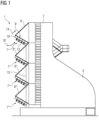
- Figure 1 shows schematically a cooling device 1 with an intake housing 4 for air.
- the intake housing 4 is connected to a filter housing 2.
- the cooling device 1 is arranged in front of the filter housing 2, as is particularly the case for a gas turbine 100 ( Fig. 6 ) is used.
- the filter housing 2 has air filters as known from the prior art.
- the cooling device 1 consists in particular of several modules 7', 7", ..., but can also have only one module 7'.
- the modules 7', 7" are constructed as follows: In the longitudinal cross-section, the module 7', ... is particularly triangular in shape.
- the module 7', 7" has an upper cover 8', 8'', 8′′′, ..., which is connected at one end to the filter housing 2 and extends downwards (foundation) at an angle ⁇ 90° to the vertical.
- a flat inflow area 9' is arranged, which in turn is connected to the filter housing 2 and thus forms the triangular shape.
- nozzles 13 are provided as the outermost nozzles, which are distributed in particular over the inflow area 9" ( Fig. 3, 4 ).
- a water supply 10 supplies water to the nozzles 13.
- the water supply 10 may also supply other modules (7" 7′′′, ).
- the modules 7', 7", ... are preferably arranged one above the other.
- a grid 19' is provided after several nozzles 13 in the inflow direction 16 of the air from outside into the filter housing 2.
- the nozzles 13 spray finely distributed water onto the grille 19, while the air flows past the nozzles 13 and through the grille 19'.
- the grid 19' as for example in Figure 5 is preferably made of polypropylene (PP) and preferably has a cross-diagonal and vertical grid structure so that no drops form and are carried into the intake tract.
- PP polypropylene
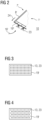
- Figure 2 shows a modified cooling device 1'.
- the air that is sucked in flows in direction 16 opposite to the outflow direction 24 of the water from the nozzles 23 into and through the grille 19' and then into the intake housing 4 via the filter area 2.
- the cooling device In desert regions and locations with high dust levels, the cooling device also cleans the intake air and increases filter service life as a result of the dust particles being washed out by the injected water.
- Figure 3 and Figure 4 show how the nozzles 13, 23 are distributed over the surface.
- the nozzles 13, 23 can be arranged in rows vertically and horizontally and have the same distance to each other to the right or left and to the top or bottom ( Fig. 3 ).
- the nozzles 13, 23 can also be arranged offset from one another ( Fig. 4 ).
- the Figure 6 shows, by way of example, a gas turbine 100 in a longitudinal section, for which the invention can be used.
- the gas turbine 100 has inside a rotor 103 with a shaft 101, which is rotatably mounted about a rotation axis 102 and is also referred to as a turbine rotor.
- an intake housing 4 104, a compressor 105, a combustion chamber 110, for example a toroidal one, in particular an annular combustion chamber, with several coaxially arranged burners 107, a turbine 108 and the exhaust housing 109.
- a combustion chamber 110 for example a toroidal one, in particular an annular combustion chamber, with several coaxially arranged burners 107, a turbine 108 and the exhaust housing 109.
- the annular combustion chamber 110 communicates with an annular hot gas duct 111, for example.
- An annular hot gas duct 111 for example.
- turbine stages 112 connected in series form the turbine 108.
- Each turbine stage 112 is formed, for example, from two blade rings. Viewed in the flow direction of a working medium 113, a row of guide vanes 115 is followed in the hot gas duct 111 by a row 125 formed from rotor blades 120.
- the guide vanes 130 are attached to an inner housing 138 of a stator 143, whereas the rotor blades 120 of a row 125 are attached to the rotor 103, for example by means of a turbine disk 133.
- a generator or a working machine (not shown) is coupled to the rotor 103.
- air 135 is sucked in by the compressor 105 through the intake casing 104 and compressed.
- the compressed air provided at the turbine end of the compressor 105 is fed to the burners 107 and mixed there with a fuel.
- the mixture is then combusted in the combustion chamber 110 to form the working medium 113.
- the working medium 113 flows along the hot gas duct 111 past the guide vanes 130 and the rotor blades 120.
- the working medium 113 expands, transmitting momentum, so that the rotor blades 120 drive the rotor 103 and this drives the working machine coupled to it.
- the components exposed to the hot working medium 113 are subject to thermal loads during operation of the gas turbine 100.
- the guide vanes 130 and rotor blades 120 of the first turbine stage 112, as seen in the flow direction of the working medium 113, are subjected to the greatest thermal loads, along with the heat shield elements lining the annular combustion chamber 110.
- substrates of the components can have a directional structure, i.e. they are single-crystalline (SX structure) or have only longitudinally oriented grains (DS structure).
- SX structure single-crystalline
- DS structure longitudinally oriented grains
- iron-, nickel- or cobalt-based superalloys are used as materials for the components, in particular for the turbine blades 120, 130 and components of the combustion chamber 110.
- the blades 120, 130 can have coatings against corrosion (MCrAlX; M is at least one element from the group iron (Fe), cobalt (Co), nickel (Ni), X is an active element and stands for yttrium (Y) and/or silicon, scandium (Sc) and/or at least one element of the rare earths or hafnium).
- M is at least one element from the group iron (Fe), cobalt (Co), nickel (Ni)
- X is an active element and stands for yttrium (Y) and/or silicon, scandium (Sc) and/or at least one element of the rare earths or hafnium).
- a thermal insulation layer may be present on the MCrAlX, and may consist, for example, of ZrO 2 , Y 2 O 3 -ZrO 2 , ie it is not, partially or completely stabilized by yttrium oxide and/or calcium oxide and/or magnesium oxide.
- the guide vane 130 has a guide vane root (not shown here) facing the inner casing 138 of the turbine 108 and a guide vane tip opposite the guide vane root.
- the guide vane tip faces the rotor 103 and is secured to a mounting ring 140 of the stator 143.
Landscapes
- Engineering & Computer Science (AREA)
- Chemical & Material Sciences (AREA)
- Combustion & Propulsion (AREA)
- Mechanical Engineering (AREA)
- General Engineering & Computer Science (AREA)
- Turbine Rotor Nozzle Sealing (AREA)
Description
- Die Erfindung betrifft eine Gasturbine mit Kühlvorrichtung und weitere Verfahren.
- Gasturbinen saugen Luft an und verdichten diese im Kompressor, um diese komprimierte Luft einer Verbrennung zuzuführen. Die Luft wird über ein Ansauggehäuse von der Umgebung angesaugt.
- Gasturbinen mit einer Kühlvorrichtung nach dem Stand der Technik sind aus den Dokumenten
US 2008/098891 undUS 2004/163536 bekannt. - Zur Erhöhung der Leistung wird im Stand der Technik innerhalb des Ansauggehäuses nach dem Filter Wasser eingesprüht, um die Leistung zu erhöhen.
- Dies ist aufwändig und insbesondere schwierig nachzurüsten, falls die Wassereindüsung anfangs nicht vorgesehen war.
- Es ist daher Aufgabe der Erfindung oben genanntes Problem zu lösen.
- Die Aufgabe wird gelöst durch eine Gasturbine nach Anspruch 1 und Verfahren nach Anspruch 7 und 10.
- In den Unteransprüchen sind weitere vorteilhafte Maßnahmen aufgelistet, die beliebig miteinander kombiniert werden können, um weitere Vorteile zu erzielen.
- Es zeigen
- Figur 1
- schematisch die Anordnung der Erfindung mit einem Teil des Ansauggehäuses,
- Figuren 2 bis 5
- weitere Ausführungen der Erfindung,
- Figur 6
- eine Gasturbine.
- Durch die Verdampfung des Wassers, das angesaugt wird, kommt es zur Kühlung und damit zu einer Erhöhung der volumenspezifischen Masse (Dichte) der Ansaugluft. Dies führt aufgrund des gestiegenen Sauerstoffmassenstroms zu einer größeren Verbrennungsleistung und damit zu einem Anstieg der Leistung der Gasturbine.
- Der Vorteil der Erfindung liegt darin, dass die Kühlvorrichtung außerhalb eines Filterhauses angeordnet wird bzw. ist. Somit gibt es die Möglichkeit, über die Zuschaltung der Kühlung mit einem Knopfdruck eine bis zu 17%ige Leistungssteigerung zu erzielen in Abhängigkeit von der Luftansaugtemperatur.
- Mittels der Kühlvorrichtung kann auch normales, sauberes Wasser, also Trinkwasser verwendet werden, das nicht speziell für den Gebrauch der Kühlvorrichtung aufbereitet werden muss.
- Die Kühlvorrichtung bzw. das Verfahren zur Kühlung kann auch mit dem "Wet compression"-Prinzip (Nassverdichtung) der Gasturbine kombiniert betrieben werden.
- Außerdem kann die Kühlvorrichtung für Gasturbinen verschiedener Hersteller verwendet werden.
- Die Figuren und Beschreibung stellen nur Ausführungsbeispiele der Erfindung dar.
-
Figur 1 zeigt schematisch eine Kühlvorrichtung 1 mit einem Ansauggehäuse 4 für Luft. - An ein Filtergehäuse 2 schließt sich das Ansauggehäuse 4 an. Die Kühlvorrichtung 1 ist vor dem Filtergehäuse 2, wie es insbesondere für eine Gasturbine 100 (
Fig. 6 ) verwendet wird, angeordnet. - Das Filtergehäuse 2 weist Luftfilter auf, wie es aus dem Stand der Technik bekannt ist.
- Die Kühlvorrichtung 1 besteht insbesondere aus mehreren Modulen 7', 7", ..., kann aber auch nur ein Modul 7' aufweisen.
- Die Module 7', 7" sind insbesondere wie folgt aufgebaut:
Im Längsquerschnitt ist das Modul 7', ... insbesondere dreieckförmig ausgebildet. - Das Modul 7', 7" weist eine obere Abdeckung 8', 8'', 8‴, ... auf, die an einem Ende mit dem Filtergehäuse 2 verbunden ist und sich unter einem Winkel <90° zur Vertikalen nach unten (Fundament) erstreckt.
- An das andere Ende der oberen Abdeckung 8', 8", ... ist ein flächiger Einströmbereich 9' angeordnet, der wiederum mit dem Filtergehäuse 2 verbunden ist und so die Dreiecksform bildet.
- Umgebungsluft strömt über den Einströmbereich 9' ein.
- Dies ist aus dem Stand der Technik bekannt.
- Im Einströmbereich 9' sind jedoch erfindungsgemäß als äußerstes mehrere Düsen 13 vorhanden, die insbesondere flächig über den Einströmbereich 9" verteilt sind (
Fig. 3, 4 ). - Eine Wasserversorgung 10 versorgt die Düsen 13 mit Wasser. Die Wasserversorgung 10 versorgt ggfs. auch andere Module 7" 7‴, ....
- Die Module 7', 7", ... sind vorzugsweise übereinander angeordnet.
- In Einströmrichtung 16 der Luft von außen in das Filtergehäuse 2 ist nach mehreren Düsen 13 erfindungsgemäß ein Gitter 19' vorhanden.
- Die Düsen 13 spritzen fein verteilt Wasser auf das Gitter 19, währenddessen die Luft an den Düsen 13 vorbei und durch das Gitter 19' strömt.
- Dadurch werden oben beschriebene Effekte und Vorteile erreicht.
- Das Gitter 19' wie z.B. in
Figur 5 ist vorzugsweise aus Polypropylen (PP) aufgebaut und weist vorzugsweise eine kreuzdiagonale und vertikale Gitter Struktur auf, so dass sich keine Tropfen bilden und in den Ansaugtrakt mitgerissen werden. -
Figur 2 zeigt eine modifizierte Kühlvorrichtung 1'. - In
Figur 1 ist die Sprührichtung des Wassers aus den Düsen 13 in Einströmrichtung 14 gegeben. DieFigur 2 zeigt jedoch eine Anordnung, bei der Düsen 23 im Vergleich zuFigur 1 quasi umgedreht sind und entgegen der Einströmrichtung 16, also in Richtung 24, das Wasser sprühen. - Somit strömt die Luft, die angesaugt wird, in Richtung 16 entgegen der Ausströmrichtung 24 des Wassers aus den Düsen 23 in und durch das Gitter 19' und dann ins Ansauggehäuse 4 über den Filterbereich 2.
- Die Anordnung gemäß
Figur 1 oder2 ist, wie leicht ersichtlich, bei Neuanlagen direkt installierbar, aber auch nachrüstbar. Dies kann während des Betriebs einer vorhandenen Gasturbine erfolgen ohne längere Abstellung des Betriebs. - In Wüstenregionen und Aufstellorten mit hoher Staubbelastung führt die Kühlvorrichtung auch zu einer Reinigung der Ansaugluft und Erhöhung der Filterstandzeit infolge der Auswaschung der Staubpartikel durch das eingespritzte Wasser.
-
Figur 3 und Figur 4 zeigen, wie die Düsen 13, 23 flächig verteilt sind. - Die Düsen 13, 23 können in Reihen senkrecht und waagerecht verlaufen und haben nach rechts bzw. links und nach unten bzw. oben den gleichen Abstand zueinander (
Fig. 3 ). - Die Düsen 13, 23 können auch versetzt zueinander angeordnet sein (
Fig. 4 ). - Die
Figur 6 zeigt beispielhaft eine Gasturbine 100 in einem Längsteilschnitt, für die 100 die Erfindung benutzt werden kann. - Die Gasturbine 100 weist im Inneren einen um eine Rotationsachse 102 drehgelagerten Rotor 103 mit einer Welle 101 auf, der auch als Turbinenläufer bezeichnet wird.
- Entlang des Rotors 103 folgen aufeinander ein Ansauggehäuse 4, 104, ein Verdichter 105, eine beispielsweise torusartige Brennkammer 110, insbesondere Ringbrennkammer, mit mehreren koaxial angeordneten Brennern 107, eine Turbine 108 und das Abgasgehäuse 109.
- Die Ringbrennkammer 110 kommuniziert mit einem beispielsweise ringförmigen Heißgaskanal 111. Dort bilden beispielsweise vier hintereinander geschaltete Turbinenstufen 112 die Turbine 108.
- Jede Turbinenstufe 112 ist beispielsweise aus zwei Schaufelringen gebildet. In Strömungsrichtung eines Arbeitsmediums 113 gesehen folgt im Heißgaskanal 111 einer Leitschaufelreihe 115 eine aus Laufschaufeln 120 gebildete Reihe 125.
- Die Leitschaufeln 130 sind dabei an einem Innengehäuse 138 eines Stators 143 befestigt, wohingegen die Laufschaufeln 120 einer Reihe 125 beispielsweise mittels einer Turbinenscheibe 133 am Rotor 103 angebracht sind.
- An dem Rotor 103 angekoppelt ist ein Generator oder eine Arbeitsmaschine (nicht dargestellt).
- Während des Betriebes der Gasturbine 100 wird vom Verdichter 105 durch das Ansauggehäuse 104 Luft 135 angesaugt und verdichtet. Die am turbinenseitigen Ende des Verdichters 105 bereitgestellte verdichtete Luft wird zu den Brennern 107 geführt und dort mit einem Brennmittel vermischt. Das Gemisch wird dann unter Bildung des Arbeitsmediums 113 in der Brennkammer 110 verbrannt. Von dort aus strömt das Arbeitsmedium 113 entlang des Heißgaskanals 111 vorbei an den Leitschaufeln 130 und den Laufschaufeln 120. An den Laufschaufeln 120 entspannt sich das Arbeitsmedium 113 impulsübertragend, so dass die Laufschaufeln 120 den Rotor 103 antreiben und dieser die an ihn angekoppelte Arbeitsmaschine.
- Die dem heißen Arbeitsmedium 113 ausgesetzten Bauteile unterliegen während des Betriebes der Gasturbine 100 thermischen Belastungen. Die Leitschaufeln 130 und Laufschaufeln 120 der in Strömungsrichtung des Arbeitsmediums 113 gesehen ersten Turbinenstufe 112 werden neben den die Ringbrennkammer 110 auskleidenden Hitzeschildelementen am meisten thermisch belastet.
- Um den dort herrschenden Temperaturen standzuhalten, können diese mittels eines Kühlmittels gekühlt werden.
- Ebenso können Substrate der Bauteile eine gerichtete Struktur aufweisen, d.h. sie sind einkristallin (SX-Struktur) oder weisen nur längs gerichtete Körner auf (DS-Struktur).
- Als Material für die Bauteile, insbesondere für die Turbinenschaufel 120, 130 und Bauteile der Brennkammer 110 werden beispielsweise eisen-, nickel- oder kobaltbasierte Superlegierungen verwendet.
- Ebenso können die Schaufeln 120, 130 Beschichtungen gegen Korrosion (MCrAlX; M ist zumindest ein Element der Gruppe Eisen (Fe), Kobalt (Co), Nickel (Ni), X ist ein Aktivelement und steht für Yttrium (Y) und/oder Silizium, Scandium (Sc) und/oder zumindest ein Element der Seltenen Erden bzw. Hafnium).
- Auf der MCrAlX kann noch eine Wärmedämmschicht vorhanden sein, und besteht beispielsweise aus ZrO2, Y2O3-ZrO2, d.h. sie ist nicht, teilweise oder vollständig stabilisiert durch Yttriumoxid und/oder Kalziumoxid und/oder Magnesiumoxid.
- Die Leitschaufel 130 weist einen dem Innengehäuse 138 der Turbine 108 zugewandten Leitschaufelfuß (hier nicht dargestellt) und einen dem Leitschaufelfuß gegenüberliegenden Leitschaufelkopf auf. Der Leitschaufelkopf ist dem Rotor 103 zugewandt und an einem Befestigungsring 140 des Stators 143 festgelegt.
Claims (10)
- Gasturbine (100),die ein Filtergehäuse (2) mit Luftfiltern aufweist, sowie aufweisend eine Kühlvorrichtung (1) zur Kühlung der Ansaugluft eines Ansauggehäuses (4),wobei die Kühlvorrichtung (1, 1') zumindest aufweist:mehrere Düsen (13, 23) undein Gitter (19'),die zusammen in einem Modul (7') angeordnet sind,eine Wasserversorgung (10) für die Düsen (13, 23),wobei in einer geplanten Einströmrichtung (16) von Luft die Düsen (13, 23) strömungstechnisch gesehen zuerst angeordnet sind,wobei die Düsen (13, 23) in einer Ausspritzrichtung (14, 24) Wasser fein ausspritzen können unddann in Einströmrichtung (16') das Gitter (19', ...) angeordnet istdadurch gekennzeichnet, dass die Kühlvorrichtung (1) vor dem Filtergehäuse (2) angeordnet ist.
- Gasturbine nach Anspruch 1,bei der Düsen (13) vorhanden sind,die in der Einströmrichtung (16') der Luft in das Modul (7', ...) in einer ersten Ausspritzrichtung (14) Wasser ausspritzen können.
- Gasturbine nach Anspruch 1 oder 2,bei der Düsen (23) vorhanden sind,die entgegen der Einströmrichtung (16') der Luft in das Modul (7', ...) in einer zweiten Ausspritzrichtung (24) Wasser ausspritzen können.
- Gasturbine nach einem oder mehreren der Ansprüche 1, 2 oder 3, wobei die Kühlvorrichtung aus mehreren Modulen (7', 7", ...) die jeweils mehrere Düsen und ein Gitter umfassen, insbesondere übereinander, aufgebaut ist.
- Gasturbine nach einem oder mehreren der Ansprüche 1, 2, 3 oder 4,
bei der mehrere Düsen (13, 23) flächig über das Gitter (19') verteilt sind. - Gasturbine nach einem oder mehreren der Ansprüche 1, 2, 3, 4 oder 5,bei dem das dreidimensionale Gitter (19') eine Tröpfchenbildung verhindert undinsbesondere eine kreuzdiagonale und vertikale Struktur aufweist.
- Verfahren zum Betreiben einer Gasturbine (100),nach Anspruch 1 bis 6,bei dem Düsen (13, 23) verwendet werden,die Wasser verspritzen,währenddessen Luft in Anströmrichtung (16) durch ein Gitter (19') strömt
- Verfahren nach Anspruch 7,
bei dem eine Nassverdichtung beim Betreiben der Gasturbine (100) verwendet wird. - Verfahren nach Anspruch 7 oder 8
bei dem Leitungswasser durch die Düsen (13, 23) verspritzt wird. - Verfahren zur Veränderung einer Gasturbine,
bei der eine Kühlvorrichtung (1) nachträglich eingebaut wird, um eine Gasturbine nach einem oder mehreren der Ansprüche 1, 2, 3, 4, 5 oder 6 zu erhalten.
Applications Claiming Priority (2)
| Application Number | Priority Date | Filing Date | Title |
|---|---|---|---|
| DE102020202414.6A DE102020202414A1 (de) | 2020-02-25 | 2020-02-25 | Kühlvorrichtung, Verfahren zur Kühlung, Gasturbine, Verfahren zum Betreiben einer Gasturbine sowie Verfahren zur Veränderung einer Gasturbine |
| PCT/EP2021/051471 WO2021170318A1 (de) | 2020-02-25 | 2021-01-22 | Kühlvorrichtung, verfahren zur kühlung, gasturbine, verfahren zum betreiben einer gasturbine sowie verfahren zur veränderung einer gasturbine |
Publications (2)
| Publication Number | Publication Date |
|---|---|
| EP4077899A1 EP4077899A1 (de) | 2022-10-26 |
| EP4077899B1 true EP4077899B1 (de) | 2025-06-11 |
Family
ID=74586974
Family Applications (1)
| Application Number | Title | Priority Date | Filing Date |
|---|---|---|---|
| EP21704411.4A Active EP4077899B1 (de) | 2020-02-25 | 2021-01-22 | Gasturbine, verfahren zum betreiben einer gasturbine sowie verfahren zur veränderung einer gasturbine |
Country Status (3)
| Country | Link |
|---|---|
| EP (1) | EP4077899B1 (de) |
| DE (1) | DE102020202414A1 (de) |
| WO (1) | WO2021170318A1 (de) |
Family Cites Families (5)
| Publication number | Priority date | Publication date | Assignee | Title |
|---|---|---|---|---|
| US5463873A (en) * | 1993-12-06 | 1995-11-07 | Cool Fog Systems, Inc. | Method and apparatus for evaporative cooling of air leading to a gas turbine engine |
| US20010054354A1 (en) * | 2000-06-21 | 2001-12-27 | Baudat Ned P. | Direct turbine air chiller/scrubber system |
| US7998249B2 (en) | 2006-10-25 | 2011-08-16 | General Electric Company | Inlet air chilling and filtration systems and methods for a gas turbine |
| US20080098891A1 (en) * | 2006-10-25 | 2008-05-01 | General Electric Company | Turbine inlet air treatment apparatus |
| US8163072B2 (en) | 2009-04-20 | 2012-04-24 | General Electric Company | Filter washing system for gas turbine engines |
-
2020
- 2020-02-25 DE DE102020202414.6A patent/DE102020202414A1/de not_active Withdrawn
-
2021
- 2021-01-22 EP EP21704411.4A patent/EP4077899B1/de active Active
- 2021-01-22 WO PCT/EP2021/051471 patent/WO2021170318A1/de not_active Ceased
Also Published As
| Publication number | Publication date |
|---|---|
| EP4077899A1 (de) | 2022-10-26 |
| DE102020202414A1 (de) | 2021-08-26 |
| WO2021170318A1 (de) | 2021-09-02 |
Similar Documents
| Publication | Publication Date | Title |
|---|---|---|
| EP1974071B1 (de) | Im strömungskanal einer strömungsmaschine anzuordnendes bauteil und spritzverfahren zum erzeugen einer beschichtung | |
| EP1711690B1 (de) | Gasturbine, insbesondere flugtriebwerk | |
| DE102007038858A1 (de) | Filmgekühlte, mit Nuten ausgebildete Wand und Verfahren zum Herstellen derselben | |
| CH697810A2 (de) | Gasturbinensystem für den Betrieb bei niedrigen Lasten bei Einhaltung der Emissionsgrenzwerte. | |
| DE102014115479A1 (de) | Gasturbineneinlasssystem und zugehöriges Verfahren zur Kühlung von Gasturbinenansaugluft | |
| DE102010036888A1 (de) | System zur Aufbereitung des in eine Turbomaschine eintretenden Luftstroms | |
| WO2009118235A2 (de) | Leitschaufel für eine gasturbine | |
| EP4538422A2 (de) | Verfahren zur herstellung und wiederherstellung von keramischen wärmedämmschichten in gasturbinen | |
| CH705323A1 (de) | Verfahren zum Einspritzen von Wasser in einen mehrstufigen Axialverdichter einer Gasturbine. | |
| WO2014033220A1 (de) | Kühlverfahren zum betreiben einer gasturbine | |
| EP1510653B1 (de) | Gekühlte Turbinenschaufel | |
| EP2882939B1 (de) | Verfahren zur aufbereitung einer gasturbinenschaufel sowie verwendung einer gasturbine mit derartiger schaufel | |
| WO2010089183A1 (de) | Turbinenbauteil mit leicht entfernbarer schutzschicht, satz von turbinenbauteilen, eine turbine und ein verfahren zum schützen eines turbinenbauteils | |
| WO2013068159A1 (de) | Herstellungsverfahren eines schichtsystems | |
| EP4077899B1 (de) | Gasturbine, verfahren zum betreiben einer gasturbine sowie verfahren zur veränderung einer gasturbine | |
| EP2373824A1 (de) | Verfahren zum beschichten eines bauteils mit filmkühllöchern, und bauteil | |
| DE4237664A1 (de) | Verfahren zum Betrieb eines Turboverdichters | |
| EP2712395B1 (de) | Verdichterschaufel mit düse | |
| EP2752559A1 (de) | Verfahren zur Reinigung eines Rotors einer Gasturbine innerhalb eines Gehäuses | |
| EP1816316B1 (de) | Bauteilreparaturverfahren | |
| WO2008049460A1 (de) | Verfahren zur einstellung der oberflächenrauhigkeit bei niedertemperaturbeschichtungsverfahren und bauteil | |
| CH710507B1 (de) | Einspritzsystem für Brennstoff und Trägergas. | |
| EP3947915A1 (de) | Verfahren zur durchführung von servicemassnahmen an einer energieumwandlungsanlage und energieumwandlungsanlage | |
| EP1806430A1 (de) | Keramische Schicht mit hoher Porosität, Verwendung dieser Schicht sowie ein Bauteil mit dieser Schicht | |
| DE102006010863B4 (de) | Turbomaschine, insbesondere Verdichter |
Legal Events
| Date | Code | Title | Description |
|---|---|---|---|
| STAA | Information on the status of an ep patent application or granted ep patent |
Free format text: STATUS: UNKNOWN |
|
| STAA | Information on the status of an ep patent application or granted ep patent |
Free format text: STATUS: THE INTERNATIONAL PUBLICATION HAS BEEN MADE |
|
| PUAI | Public reference made under article 153(3) epc to a published international application that has entered the european phase |
Free format text: ORIGINAL CODE: 0009012 |
|
| STAA | Information on the status of an ep patent application or granted ep patent |
Free format text: STATUS: REQUEST FOR EXAMINATION WAS MADE |
|
| 17P | Request for examination filed |
Effective date: 20220721 |
|
| AK | Designated contracting states |
Kind code of ref document: A1 Designated state(s): AL AT BE BG CH CY CZ DE DK EE ES FI FR GB GR HR HU IE IS IT LI LT LU LV MC MK MT NL NO PL PT RO RS SE SI SK SM TR |
|
| DAV | Request for validation of the european patent (deleted) | ||
| DAX | Request for extension of the european patent (deleted) | ||
| STAA | Information on the status of an ep patent application or granted ep patent |
Free format text: STATUS: EXAMINATION IS IN PROGRESS |
|
| 17Q | First examination report despatched |
Effective date: 20240412 |
|
| GRAP | Despatch of communication of intention to grant a patent |
Free format text: ORIGINAL CODE: EPIDOSNIGR1 |
|
| STAA | Information on the status of an ep patent application or granted ep patent |
Free format text: STATUS: GRANT OF PATENT IS INTENDED |
|
| INTG | Intention to grant announced |
Effective date: 20250123 |
|
| GRAS | Grant fee paid |
Free format text: ORIGINAL CODE: EPIDOSNIGR3 |
|
| GRAA | (expected) grant |
Free format text: ORIGINAL CODE: 0009210 |
|
| STAA | Information on the status of an ep patent application or granted ep patent |
Free format text: STATUS: THE PATENT HAS BEEN GRANTED |
|
| AK | Designated contracting states |
Kind code of ref document: B1 Designated state(s): AL AT BE BG CH CY CZ DE DK EE ES FI FR GB GR HR HU IE IS IT LI LT LU LV MC MK MT NL NO PL PT RO RS SE SI SK SM TR |
|
| REG | Reference to a national code |
Ref country code: GB Ref legal event code: FG4D Free format text: NOT ENGLISH |
|
| REG | Reference to a national code |
Ref country code: CH Ref legal event code: EP |
|
| REG | Reference to a national code |
Ref country code: DE Ref legal event code: R096 Ref document number: 502021007704 Country of ref document: DE |
|
| REG | Reference to a national code |
Ref country code: IE Ref legal event code: FG4D Free format text: LANGUAGE OF EP DOCUMENT: GERMAN |
|
| PG25 | Lapsed in a contracting state [announced via postgrant information from national office to epo] |
Ref country code: ES Free format text: LAPSE BECAUSE OF FAILURE TO SUBMIT A TRANSLATION OF THE DESCRIPTION OR TO PAY THE FEE WITHIN THE PRESCRIBED TIME-LIMIT Effective date: 20250611 Ref country code: FI Free format text: LAPSE BECAUSE OF FAILURE TO SUBMIT A TRANSLATION OF THE DESCRIPTION OR TO PAY THE FEE WITHIN THE PRESCRIBED TIME-LIMIT Effective date: 20250611 |
|
| REG | Reference to a national code |
Ref country code: LT Ref legal event code: MG9D |
|
| PG25 | Lapsed in a contracting state [announced via postgrant information from national office to epo] |
Ref country code: GR Free format text: LAPSE BECAUSE OF FAILURE TO SUBMIT A TRANSLATION OF THE DESCRIPTION OR TO PAY THE FEE WITHIN THE PRESCRIBED TIME-LIMIT Effective date: 20250912 Ref country code: NO Free format text: LAPSE BECAUSE OF FAILURE TO SUBMIT A TRANSLATION OF THE DESCRIPTION OR TO PAY THE FEE WITHIN THE PRESCRIBED TIME-LIMIT Effective date: 20250911 |
|
| REG | Reference to a national code |
Ref country code: NL Ref legal event code: MP Effective date: 20250611 |
|
| PG25 | Lapsed in a contracting state [announced via postgrant information from national office to epo] |
Ref country code: BG Free format text: LAPSE BECAUSE OF FAILURE TO SUBMIT A TRANSLATION OF THE DESCRIPTION OR TO PAY THE FEE WITHIN THE PRESCRIBED TIME-LIMIT Effective date: 20250611 |
|
| PG25 | Lapsed in a contracting state [announced via postgrant information from national office to epo] |
Ref country code: HR Free format text: LAPSE BECAUSE OF FAILURE TO SUBMIT A TRANSLATION OF THE DESCRIPTION OR TO PAY THE FEE WITHIN THE PRESCRIBED TIME-LIMIT Effective date: 20250611 |
|
| PG25 | Lapsed in a contracting state [announced via postgrant information from national office to epo] |
Ref country code: RS Free format text: LAPSE BECAUSE OF FAILURE TO SUBMIT A TRANSLATION OF THE DESCRIPTION OR TO PAY THE FEE WITHIN THE PRESCRIBED TIME-LIMIT Effective date: 20250911 |
|
| PG25 | Lapsed in a contracting state [announced via postgrant information from national office to epo] |
Ref country code: LV Free format text: LAPSE BECAUSE OF FAILURE TO SUBMIT A TRANSLATION OF THE DESCRIPTION OR TO PAY THE FEE WITHIN THE PRESCRIBED TIME-LIMIT Effective date: 20250611 |
|
| PG25 | Lapsed in a contracting state [announced via postgrant information from national office to epo] |
Ref country code: NL Free format text: LAPSE BECAUSE OF FAILURE TO SUBMIT A TRANSLATION OF THE DESCRIPTION OR TO PAY THE FEE WITHIN THE PRESCRIBED TIME-LIMIT Effective date: 20250611 |
|
| PG25 | Lapsed in a contracting state [announced via postgrant information from national office to epo] |
Ref country code: PT Free format text: LAPSE BECAUSE OF FAILURE TO SUBMIT A TRANSLATION OF THE DESCRIPTION OR TO PAY THE FEE WITHIN THE PRESCRIBED TIME-LIMIT Effective date: 20251013 |
|
| PG25 | Lapsed in a contracting state [announced via postgrant information from national office to epo] |
Ref country code: IS Free format text: LAPSE BECAUSE OF FAILURE TO SUBMIT A TRANSLATION OF THE DESCRIPTION OR TO PAY THE FEE WITHIN THE PRESCRIBED TIME-LIMIT Effective date: 20251011 |
|
| PG25 | Lapsed in a contracting state [announced via postgrant information from national office to epo] |
Ref country code: SM Free format text: LAPSE BECAUSE OF FAILURE TO SUBMIT A TRANSLATION OF THE DESCRIPTION OR TO PAY THE FEE WITHIN THE PRESCRIBED TIME-LIMIT Effective date: 20250611 |
|
| PG25 | Lapsed in a contracting state [announced via postgrant information from national office to epo] |
Ref country code: CZ Free format text: LAPSE BECAUSE OF FAILURE TO SUBMIT A TRANSLATION OF THE DESCRIPTION OR TO PAY THE FEE WITHIN THE PRESCRIBED TIME-LIMIT Effective date: 20250611 |
|
| PG25 | Lapsed in a contracting state [announced via postgrant information from national office to epo] |
Ref country code: PL Free format text: LAPSE BECAUSE OF FAILURE TO SUBMIT A TRANSLATION OF THE DESCRIPTION OR TO PAY THE FEE WITHIN THE PRESCRIBED TIME-LIMIT Effective date: 20250611 |
|
| PG25 | Lapsed in a contracting state [announced via postgrant information from national office to epo] |
Ref country code: EE Free format text: LAPSE BECAUSE OF FAILURE TO SUBMIT A TRANSLATION OF THE DESCRIPTION OR TO PAY THE FEE WITHIN THE PRESCRIBED TIME-LIMIT Effective date: 20250611 |
|
| PG25 | Lapsed in a contracting state [announced via postgrant information from national office to epo] |
Ref country code: SK Free format text: LAPSE BECAUSE OF FAILURE TO SUBMIT A TRANSLATION OF THE DESCRIPTION OR TO PAY THE FEE WITHIN THE PRESCRIBED TIME-LIMIT Effective date: 20250611 |
|
| REG | Reference to a national code |
Ref country code: DE Ref legal event code: R097 Ref document number: 502021007704 Country of ref document: DE |
|
| PG25 | Lapsed in a contracting state [announced via postgrant information from national office to epo] |
Ref country code: DK Free format text: LAPSE BECAUSE OF FAILURE TO SUBMIT A TRANSLATION OF THE DESCRIPTION OR TO PAY THE FEE WITHIN THE PRESCRIBED TIME-LIMIT Effective date: 20250611 |
|
| PGFP | Annual fee paid to national office [announced via postgrant information from national office to epo] |
Ref country code: DE Payment date: 20260127 Year of fee payment: 6 |
|
| PGFP | Annual fee paid to national office [announced via postgrant information from national office to epo] |
Ref country code: IT Payment date: 20260123 Year of fee payment: 6 |
|
| PLBE | No opposition filed within time limit |
Free format text: ORIGINAL CODE: 0009261 |
|
| STAA | Information on the status of an ep patent application or granted ep patent |
Free format text: STATUS: NO OPPOSITION FILED WITHIN TIME LIMIT |
|
| PGFP | Annual fee paid to national office [announced via postgrant information from national office to epo] |
Ref country code: TR Payment date: 20260106 Year of fee payment: 6 |
|
| REG | Reference to a national code |
Ref country code: CH Ref legal event code: L10 Free format text: ST27 STATUS EVENT CODE: U-0-0-L10-L00 (AS PROVIDED BY THE NATIONAL OFFICE) Effective date: 20260423 |