EP4077065B1 - Airbag; airbag assembly and method for assembling an airbag assembly - Google Patents
Airbag; airbag assembly and method for assembling an airbag assembly Download PDFInfo
- Publication number
- EP4077065B1 EP4077065B1 EP20839244.9A EP20839244A EP4077065B1 EP 4077065 B1 EP4077065 B1 EP 4077065B1 EP 20839244 A EP20839244 A EP 20839244A EP 4077065 B1 EP4077065 B1 EP 4077065B1
- Authority
- EP
- European Patent Office
- Prior art keywords
- inflator
- airbag
- flange
- outer skin
- airbag assembly
- Prior art date
- Legal status (The legal status is an assumption and is not a legal conclusion. Google has not performed a legal analysis and makes no representation as to the accuracy of the status listed.)
- Active
Links
Images




Classifications
-
- B—PERFORMING OPERATIONS; TRANSPORTING
- B60—VEHICLES IN GENERAL
- B60R—VEHICLES, VEHICLE FITTINGS, OR VEHICLE PARTS, NOT OTHERWISE PROVIDED FOR
- B60R21/00—Arrangements or fittings on vehicles for protecting or preventing injuries to occupants or pedestrians in case of accidents or other traffic risks
- B60R21/02—Occupant safety arrangements or fittings, e.g. crash pads
- B60R21/16—Inflatable occupant restraints or confinements designed to inflate upon impact or impending impact, e.g. air bags
- B60R21/20—Arrangements for storing inflatable members in their non-use or deflated condition; Arrangement or mounting of air bag modules or components
- B60R21/217—Inflation fluid source retainers, e.g. reaction canisters; Connection of bags, covers, diffusers or inflation fluid sources therewith or together
-
- B—PERFORMING OPERATIONS; TRANSPORTING
- B60—VEHICLES IN GENERAL
- B60R—VEHICLES, VEHICLE FITTINGS, OR VEHICLE PARTS, NOT OTHERWISE PROVIDED FOR
- B60R21/00—Arrangements or fittings on vehicles for protecting or preventing injuries to occupants or pedestrians in case of accidents or other traffic risks
- B60R21/02—Occupant safety arrangements or fittings, e.g. crash pads
- B60R21/16—Inflatable occupant restraints or confinements designed to inflate upon impact or impending impact, e.g. air bags
- B60R21/20—Arrangements for storing inflatable members in their non-use or deflated condition; Arrangement or mounting of air bag modules or components
- B60R21/203—Arrangements for storing inflatable members in their non-use or deflated condition; Arrangement or mounting of air bag modules or components in steering wheels or steering columns
-
- B—PERFORMING OPERATIONS; TRANSPORTING
- B60—VEHICLES IN GENERAL
- B60R—VEHICLES, VEHICLE FITTINGS, OR VEHICLE PARTS, NOT OTHERWISE PROVIDED FOR
- B60R21/00—Arrangements or fittings on vehicles for protecting or preventing injuries to occupants or pedestrians in case of accidents or other traffic risks
- B60R21/02—Occupant safety arrangements or fittings, e.g. crash pads
- B60R21/16—Inflatable occupant restraints or confinements designed to inflate upon impact or impending impact, e.g. air bags
- B60R21/23—Inflatable members
- B60R21/231—Inflatable members characterised by their shape, construction or spatial configuration
- B60R21/2334—Expansion control features
-
- B—PERFORMING OPERATIONS; TRANSPORTING
- B60—VEHICLES IN GENERAL
- B60R—VEHICLES, VEHICLE FITTINGS, OR VEHICLE PARTS, NOT OTHERWISE PROVIDED FOR
- B60R21/00—Arrangements or fittings on vehicles for protecting or preventing injuries to occupants or pedestrians in case of accidents or other traffic risks
- B60R21/02—Occupant safety arrangements or fittings, e.g. crash pads
- B60R21/16—Inflatable occupant restraints or confinements designed to inflate upon impact or impending impact, e.g. air bags
- B60R21/20—Arrangements for storing inflatable members in their non-use or deflated condition; Arrangement or mounting of air bag modules or components
- B60R21/217—Inflation fluid source retainers, e.g. reaction canisters; Connection of bags, covers, diffusers or inflation fluid sources therewith or together
- B60R2021/2172—Inflation fluid source retainers, e.g. reaction canisters; Connection of bags, covers, diffusers or inflation fluid sources therewith or together the cover being connected to the surrounding part and to the module, e.g. floating mounts
-
- B—PERFORMING OPERATIONS; TRANSPORTING
- B60—VEHICLES IN GENERAL
- B60R—VEHICLES, VEHICLE FITTINGS, OR VEHICLE PARTS, NOT OTHERWISE PROVIDED FOR
- B60R21/00—Arrangements or fittings on vehicles for protecting or preventing injuries to occupants or pedestrians in case of accidents or other traffic risks
- B60R21/02—Occupant safety arrangements or fittings, e.g. crash pads
- B60R21/16—Inflatable occupant restraints or confinements designed to inflate upon impact or impending impact, e.g. air bags
- B60R21/23—Inflatable members
- B60R21/235—Inflatable members characterised by their material
- B60R2021/23533—Inflatable members characterised by their material characterised by the manufacturing process
Definitions
- the invention relates to an airbag assembly according to claim 1 and to a method for assembling this airbag assembly according to claim 12.
- the invention described herein relates in the first place to frontal airbags, especially to driver airbags being located inside a steering wheel of a vehicle, but is not limited to the same. But, when the prior art is described now reference is only made to driver airbags and driver airbag assemblies.
- Such a driver airbag assembly always comprises an airbag having an outer skin and an inflator assembly, wherein the outer skin of the airbag and the inflator assembly are connected to one another.
- This airbag assembly is usually connected to an accommodation structure having a housing but this is not of interest in this application, so only the structure of the airbag and the structure of an airbag assembly comprising such an airbag and an inflator assembly are discussed here.
- the outer skin of such an airbag is most often comprised of a bottom layer and a top layer such that the bottom layer of the deployed airbag is supported by the steering wheel and the top layer is the impact layer facing the driver. Since the outer skin of the airbag is basically closed, it of course has an inner side and an outer side.
- the inflator assembly most often comprises an inflator with an inflator body, and a flange extending from this inflator body.
- the inflator body extends into the airbag, such that a first section of the inflator body is located inside the outer skin and a second section of the inflator body is located outside the outer skin.
- the outer skin namely the bottom layer, comprises an inflator attachment region with an opening structure for the inflator.
- this structure is simply a hole conforming to a cross section of the inflator body (which is usually a circle).
- the flange is located inside the outer skin and studs extend from this flange through attachment holes in the outer skin near the hole for the inflator, such that the airbag is attached to the inflator assembly via these studs.
- the inflator which is usually a pyrotechnic gas generator
- the inflator is attached to the airbag just before the whole airbag module is assembled, such that there is no need to safely store the airbag assembly for further assembly steps.
- the opening structure in such a way that it comprises at least two basically radially extending cut-outs, so that the attachment region has at least two flap sections being separated by the cut-outs.
- the flaps are used to attach the airbag to a flange that is located outside the airbag.
- DE 43 17 740 A1 shows an opening structure with flaps.
- the flaps are used as reinforcement layers.
- EP 1 186 484 A2 shows a steering wheel with an airbag assembly comprising an airbag with an outer skin and an inflator assembly.
- the inflator assembly comprises an inflator body and a flange being attached to the inflator body and is completely located inside the outer skin of the airbag.
- US 2009/096191 A1 shows a frontal airbag module comprising a housing, an airbag having an outer skin and an inflator assembly with an inflator body and a flange.
- the flange is located outside the housing and the inflator body extends through a hole in the housing into the outer skin of the airbag.
- a knee airbag assembly which comprises an airbag having an outer skin and a flangeless inflator assembly.
- An opening structure for the inflator is provided in an inflator attachment region of the outer skin, which comprises basically radially extending cut-outs, so that the attachment region has flap sections being separated by the cut-outs.
- the inflator has an inflator body having a generated surface and this inflator body extends through the opening structure such that a first section of the inflator body is located inside the outer skin and a second section of the inflator body is located outside the outer skin.
- the flap sections lie against the generated surface of the second section of the inflator body and are clamped to the same by means of a hose clamp.
- the basic idea of the invention is to provide the inflator and the flange that is attached to this inflator when the airbag assembly is completely assembled in two separate parts, such that it is possible to first attach or pre-assemble the flange to the outer skin of the airbag and then attach the inflator to the flange.
- the flange is located on the inner side of the outer skin such that the inflator must be moved through the opening structure of the outer skin during the assembly process.
- the opening structure could be in form of a hole that is simply large enough, but in this case the airbag would lose too much gas when inflated.
- the opening structure comprises at least two basically radially extending cut-outs, especially slits, so that the attachment region has at least two flap sections being separated by those cut-outs.
- These flap sections can be pulled apart from one another in radial direction such that the opening structure is enlarged during the assembly of the inflator to the flange.
- an automatic handling apparatus can be used and for this it is preferred that each flap section comprises a handling means, preferably in form of a handling hole.
- the flap sections lie against the generated surface of the second section of the inflator body and sufficient gas tightness is achieved.
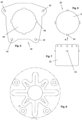
- Figure 1 shows an outer skin 10 of an airbag in a plan view from "the bottom”.
- Figure 4 shows a detail of Figure 1 , namely the inflator attachment region 11.
- This inflator attachment region 11 has attachment holes 20, for studs that extend from a flange (the flange will be described later).
- a portion of a seam 19 extends around the inflator attachment region and the attachment holes 20.
- the inflator attachment region 11 is at least partially multiple layered in order to make this attachment region sturdy enough.
- An opening structure 12 is provided inside the inflator attachment region 11.
- This opening structure 12 comprises a central hole 18 and four slits 14 extending from this central hole 18 in radial directions. These slits 14 are located onto two straight lines which are perpendicular to one another, wherein the intersection of those two lines define the center of the central hole 18. Such symmetry is preferred, but not strictly mandatory.
- the four slits 14 define four flap sections 16 extending from the central hole 18. Each of those flap sections 16 comprises a handling hole 17 which has a teardrop shape. A section of the seam 19 extends around the slits 14 and the handling holes 17. As is shown it is preferred that one continuous seam 19 is provided because this makes the production efficient, but in principle it would also be possible to provide distinct seams.
- Figures 2 and 5 show a flange 40.
- Four studs 42 are arranged on the flange 40 in a pattern that conforms to the pattern of the attachment holes 20.
- the studs 42 can be looked at as belonging to the flange or as being attached to the flange.
- the flange 40 has a central hole 44 and since in the embodiment shown, an inflator body 32, which will be described later, and the flange 40 are connected to one another by means of a bayonet coupling, recesses 46 extend from the central hole 44.
- the flange 40 (except the studs) is usually a flat part of stamped metal.
- Figures 6 and 7 show an inflator 30 with an inflator body 32, which is basically in form of a cylinder. Attachment protrusions 34 extend from the inflator body 32 as parts of the just mentioned bayonet coupling.
- the flange 40 is located on the inner side of the outer skin in such a way that the studs 42 extend through the attachment holes 20. Additional mounting means between the flange 40 and the outer skin 10 can be provided if desired.
- the flange 40 could be glued to the inner side of the outer skin.
- the flange can be inserted into the outer skin through the opening structure 12.
- Figure 9 shows the situation in which the flange is located inside the outer skin of the airbag and the studs 42 extend through the attachment holes 20.
- the central hole 44 of the flange 40 is located behind the opening structure 12 of the inflator attachment region 11.
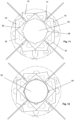
- four hooks 50 are schematically shown, each of those hooks 50 being assigned for engaging into one of the handling holes 17.
- Figure 9 shows those hooks 50 in a radially outward position.
- Figure 10 shows the same as Figure 9 after the hooks 50 have been moved radially inward, then towards the outer skin of the airbag and again a little radially outward, such that the hook sections of the hooks extend around the inner edge 18a of central hole 18 and into the handling holes 17.
- the inflator body 32 can be inserted into the central hole 44 of the flange 40 and turned, such that the bayonet coupling is closed (please see Figures 12 and 13 ).
- a bayonet coupling between the inflator 30 and the flange 40 is a preferred embodiment but that other kinds of attachments between inflator 30 and flange 40 can also be provided.
- Figure 16 shows a second embodiment of the inflator attachment region 11.
- the main difference to the first embodiment is that only two slits 14 and thus only two flap sections 16 are provided.
- the slits 14 end in additional cut-outs 15 because otherwise the flap sections could not be pulled outwardly. This additional cut-outs can be covered by the flange, such that a sufficient gas-tightness can be reached.
- handling holes 17 are slit-shaped, but it is to be noted that the shape of the handling holes is a matter of choice.
Landscapes
- Engineering & Computer Science (AREA)
- Mechanical Engineering (AREA)
- Air Bags (AREA)
Description
- The invention relates to an airbag assembly according to claim 1 and to a method for assembling this airbag assembly according to
claim 12. - The invention described herein relates in the first place to frontal airbags, especially to driver airbags being located inside a steering wheel of a vehicle, but is not limited to the same. But, when the prior art is described now reference is only made to driver airbags and driver airbag assemblies.
- Such a driver airbag assembly always comprises an airbag having an outer skin and an inflator assembly, wherein the outer skin of the airbag and the inflator assembly are connected to one another. This airbag assembly is usually connected to an accommodation structure having a housing but this is not of interest in this application, so only the structure of the airbag and the structure of an airbag assembly comprising such an airbag and an inflator assembly are discussed here. The outer skin of such an airbag is most often comprised of a bottom layer and a top layer such that the bottom layer of the deployed airbag is supported by the steering wheel and the top layer is the impact layer facing the driver. Since the outer skin of the airbag is basically closed, it of course has an inner side and an outer side.
- The inflator assembly most often comprises an inflator with an inflator body, and a flange extending from this inflator body. Often, the inflator body extends into the airbag, such that a first section of the inflator body is located inside the outer skin and a second section of the inflator body is located outside the outer skin. For this reason, the outer skin, namely the bottom layer, comprises an inflator attachment region with an opening structure for the inflator. Commonly, this structure is simply a hole conforming to a cross section of the inflator body (which is usually a circle). Often, the flange is located inside the outer skin and studs extend from this flange through attachment holes in the outer skin near the hole for the inflator, such that the airbag is attached to the inflator assembly via these studs. For safety reasons it is usually preferred that the inflator (which is usually a pyrotechnic gas generator) is attached to the airbag just before the whole airbag module is assembled, such that there is no need to safely store the airbag assembly for further assembly steps.
- For example from generic
US 5 642 900 A it is known to shape the opening structure in such a way that it comprises at least two basically radially extending cut-outs, so that the attachment region has at least two flap sections being separated by the cut-outs. The flaps are used to attach the airbag to a flange that is located outside the airbag. - Also
DE 43 17 740 A1 shows an opening structure with flaps. Here, the flaps are used as reinforcement layers. -
EP 1 186 484 A2 shows a steering wheel with an airbag assembly comprising an airbag with an outer skin and an inflator assembly. The inflator assembly comprises an inflator body and a flange being attached to the inflator body and is completely located inside the outer skin of the airbag. -
US 2009/096191 A1 shows a frontal airbag module comprising a housing, an airbag having an outer skin and an inflator assembly with an inflator body and a flange. The flange is located outside the housing and the inflator body extends through a hole in the housing into the outer skin of the airbag. - From generic
US 2010/0201106 A1 a knee airbag assembly is known which comprises an airbag having an outer skin and a flangeless inflator assembly. An opening structure for the inflator is provided in an inflator attachment region of the outer skin, which comprises basically radially extending cut-outs, so that the attachment region has flap sections being separated by the cut-outs. The inflator has an inflator body having a generated surface and this inflator body extends through the opening structure such that a first section of the inflator body is located inside the outer skin and a second section of the inflator body is located outside the outer skin. The flap sections lie against the generated surface of the second section of the inflator body and are clamped to the same by means of a hose clamp. - Starting from this prior art it is an object of the invention to provide an airbag and an airbag assembly with such an airbag that can easily be assembled with a high degree of automatisation.
- This task is solved by an airbag assembly with the features of claim 1. A method for assembling this airbag assembly is defined in
claim 12. - The basic idea of the invention is to provide the inflator and the flange that is attached to this inflator when the airbag assembly is completely assembled in two separate parts, such that it is possible to first attach or pre-assemble the flange to the outer skin of the airbag and then attach the inflator to the flange. The flange is located on the inner side of the outer skin such that the inflator must be moved through the opening structure of the outer skin during the assembly process. In principle the opening structure could be in form of a hole that is simply large enough, but in this case the airbag would lose too much gas when inflated. So, according to the invention, the opening structure comprises at least two basically radially extending cut-outs, especially slits, so that the attachment region has at least two flap sections being separated by those cut-outs. These flap sections can be pulled apart from one another in radial direction such that the opening structure is enlarged during the assembly of the inflator to the flange. For this "pulling outward process" an automatic handling apparatus can be used and for this it is preferred that each flap section comprises a handling means, preferably in form of a handling hole.
- When the assembly is completed, the flap sections lie against the generated surface of the second section of the inflator body and sufficient gas tightness is achieved.
- The invention will now be described by means of a preferred embodiment in view of the figures. The figures show:
- Figure 1
- a plan view onto the bottom layer of an outer skin of an airbag,
- Figure 2
- a flange,
- Figure 3
- an inflator in a plan view from the bottom,
- Figure 4
- the inflator attachment region of the outer skin shown in
Figure 1 , - Figure 5
- the flange of
Figure 2 in an enlarged representation in the same scale as the inflator attachment region ofFigure 4 , - Figure 6
- the inflator of
Figure 4 in a scale according toFigures 4 and5 , - Figure 7
- a side view onto the inflator of
Figure 6 from the direction R, - Figure 8
- again the inflator attachment region of
Figure 4 but without reference signs, - Figure 9
- the inflator attachment region of
Figure 8 with the flange ofFigure 5 placed inside the outer skin such that it is shown in broken lines, and four hooks of a handling machine, - Figure 10
- what is shown in
Figure 9 after the hooks have engaged into the handling holes of the flap sections of the outer skin, - Figure 11
- what is shown in
Figure 10 after the flap sections have been pulled outwardly by means of the hooks, such that a part of the flange can be seen, - Figure 12
- what is shown in
Figure 11 and the inflator body being arranged in the central hole of the flange, - Figure 13
- what is shown in
Figure 12 after the inflator body has been locked to the flange by means of a rotational movement, - Figure 14
- a sectional view taken along plane A-A in
Figure 13 , - Figure 15
- what is shown in
Figure 14 after the hooks have been removed, and - Figure 16
- another embodiment of an attachment region.
-
Figure 1 shows anouter skin 10 of an airbag in a plan view from "the bottom".Figure 4 shows a detail ofFigure 1 , namely theinflator attachment region 11. Thisinflator attachment region 11 has attachment holes 20, for studs that extend from a flange (the flange will be described later). In this embodiment, a portion of aseam 19 extends around the inflator attachment region and the attachment holes 20. Often, theinflator attachment region 11 is at least partially multiple layered in order to make this attachment region sturdy enough. An openingstructure 12 is provided inside theinflator attachment region 11. This openingstructure 12 comprises acentral hole 18 and fourslits 14 extending from thiscentral hole 18 in radial directions. Theseslits 14 are located onto two straight lines which are perpendicular to one another, wherein the intersection of those two lines define the center of thecentral hole 18. Such symmetry is preferred, but not strictly mandatory. - The four
slits 14 define fourflap sections 16 extending from thecentral hole 18. Each of thoseflap sections 16 comprises ahandling hole 17 which has a teardrop shape. A section of theseam 19 extends around theslits 14 and the handling holes 17. As is shown it is preferred that onecontinuous seam 19 is provided because this makes the production efficient, but in principle it would also be possible to provide distinct seams. -
Figures 2 and5 show aflange 40. Fourstuds 42 are arranged on theflange 40 in a pattern that conforms to the pattern of the attachment holes 20. Thestuds 42 can be looked at as belonging to the flange or as being attached to the flange. - The
flange 40 has acentral hole 44 and since in the embodiment shown, aninflator body 32, which will be described later, and theflange 40 are connected to one another by means of a bayonet coupling, recesses 46 extend from thecentral hole 44. The flange 40 (except the studs) is usually a flat part of stamped metal. -
Figures 6 and 7 show an inflator 30 with aninflator body 32, which is basically in form of a cylinder.Attachment protrusions 34 extend from theinflator body 32 as parts of the just mentioned bayonet coupling. - In a first assembly step the
flange 40 is located on the inner side of the outer skin in such a way that thestuds 42 extend through the attachment holes 20. Additional mounting means between theflange 40 and theouter skin 10 can be provided if desired. For example, theflange 40 could be glued to the inner side of the outer skin. The flange can be inserted into the outer skin through the openingstructure 12. Alternatively it is possible to first attach theflange 40 to the bottom layer of the outer skin of the airbag before sewing the top layer to the bottom layer. -
Figure 9 shows the situation in which the flange is located inside the outer skin of the airbag and thestuds 42 extend through the attachment holes 20. One can see that thecentral hole 44 of theflange 40 is located behind the openingstructure 12 of theinflator attachment region 11. Additionally inFigure 9 fourhooks 50 are schematically shown, each of thosehooks 50 being assigned for engaging into one of the handling holes 17.Figure 9 shows thosehooks 50 in a radially outward position. -
Figure 10 shows the same asFigure 9 after thehooks 50 have been moved radially inward, then towards the outer skin of the airbag and again a little radially outward, such that the hook sections of the hooks extend around theinner edge 18a ofcentral hole 18 and into the handling holes 17. - In this state, the
hooks 50 are again moved radially outwards such that theflap sections 16 open until thecentral hole 44 with itsrecesses 46 is no longer covered by theouter skin 10. This is shown inFigure 11 . - Now, the
inflator body 32 can be inserted into thecentral hole 44 of theflange 40 and turned, such that the bayonet coupling is closed (please seeFigures 12 and13 ). Here it should be noted that a bayonet coupling between the inflator 30 and theflange 40 is a preferred embodiment but that other kinds of attachments betweeninflator 30 andflange 40 can also be provided. - Now, the
hooks 50 are disengaged from theflap sections 16, such that they bent back until they abut against the generated surface of the inflator body 32 (Figure 15 ). The assembly process of the airbag assembly is finished now. -
Figure 16 shows a second embodiment of theinflator attachment region 11. The main difference to the first embodiment is that only twoslits 14 and thus only twoflap sections 16 are provided. Theslits 14 end in additional cut-outs 15 because otherwise the flap sections could not be pulled outwardly. This additional cut-outs can be covered by the flange, such that a sufficient gas-tightness can be reached. - The other difference to the first embodiment is, that the handling holes 17 are slit-shaped, but it is to be noted that the shape of the handling holes is a matter of choice.
- One sees that a simple assembly method is provided that can be completely automated and which allows a very late attachment of the inflator.
-
- 10
- outer skin of airbag
- 10a
- inner side
- 10b
- outer side
- 11
- inflator attachment region
- 12
- opening structure
- 14
- slit
- 15
- additional cut-out
- 16
- flap section
- 17
- handling hole
- 18
- central hole
- 18a
- inner edge
- 19
- seam
- 19a
- section of seam surrounding the opening structure
- 20
- attachment hole
- 30
- inflator
- 32
- inflator body
- 34
- attachment protrusion for bayonet coupling
- 40
- flange
- 42
- studs
- 44
- central hole
- 46
- recess for bayonet coupling
- 50
- hook
Claims (12)
- Airbag assembly comprising an airbag and an inflator assembly,wherein the airbag comprises an outer skin having an inner side and an outer side,wherein an opening structure (12) for the inflator is provided in an inflator attachment region (11) of the outer skin, said opening structure (12) comprising at least two basically radially extending cut-outs, so that the attachment region has at least two flap sections (16) being separated by the cut-outs,wherein the inflator assembly has an inflator (30) with an inflator body (32) having a generated surface, said inflator body (32) extending through the opening structure such that a first section of the inflator body is located inside the outer skin (10), and a second section of the inflator body (32) is located outside the outer skin (10), andwherein at least parts of the flap sections (16) lie against the generated surface of the second section of the inflator body (32),characterized in thatthe inflator assembly further comprises a flange (40) being located on the inner side (10a) of the outer skin (10), and in that the inflator (30) is attached to the flange (40).
- Airbag assembly according to claim 1, characterized in that three cut-outs are provided, so that the attachment region comprises three flap sections (16).
- Airbag assembly according to claim 1, characterized in that four cut-outs are provided, so that the attachment region comprises four flap sections (16).
- Airbag assembly according to one of the preceding claims, characterized in that the cut-outs are slits (14), wherein it is preferred that each slit defines a straight line and therein it is further preferred that all straight lines have a common central point.
- Airbag assembly according to one of the preceding claims, characterized in that the inflator attachment region further comprises attachment holes (20) outside the opening structure (12).
- Airbag assembly according to one of the preceding claims, characterized in that a handling means is provided in each flap section (16).
- Airbag assembly according to claim 6, characterized in that the handling means are handling holes (17).
- Airbag assembly according to one of the preceding claims, characterized that the opening structure further comprises a central hole (18) from which the cut-outs extend.
- Airbag assembly according to one of the preceding claims, characterized in that the opening structure (12) is at least partially, preferably completely surrounded by a seam or a section of a seam (19a).
- Airbag assembly according to any one of the preceding claims, characterized in that the flange has a central hole (44).
- Airbag assembly according to claim 10 as long as referring to claim 5, characterized in that studs (42) extend from the flange (40) through the attachment holes (20).
- Method for assembling the airbag assembly of claim 10 or claim 11, comprising the following steps:providing a sub-assembly comprising the outer skin (10) and the flange (40) being located on the inner side (10a) of the outer skin (10),providing the inflator (30),pulling the flap sections (16) apart from one another from the outside, such that an insertion opening is generated or enlarged,pushing a part of the inflator body (32) through the insertion opening, and attaching the inflator body (32) to the flange (40).
Applications Claiming Priority (2)
| Application Number | Priority Date | Filing Date | Title |
|---|---|---|---|
| DE102019135132.4A DE102019135132A1 (en) | 2019-12-19 | 2019-12-19 | Airbag, airbag assembly and method for assembling an airbag assembly |
| PCT/EP2020/086338 WO2021122685A1 (en) | 2019-12-19 | 2020-12-16 | Airbag; airbag assembly and method for assembling an airbag assembly |
Publications (2)
| Publication Number | Publication Date |
|---|---|
| EP4077065A1 EP4077065A1 (en) | 2022-10-26 |
| EP4077065B1 true EP4077065B1 (en) | 2025-03-12 |
Family
ID=74181088
Family Applications (1)
| Application Number | Title | Priority Date | Filing Date |
|---|---|---|---|
| EP20839244.9A Active EP4077065B1 (en) | 2019-12-19 | 2020-12-16 | Airbag; airbag assembly and method for assembling an airbag assembly |
Country Status (6)
| Country | Link |
|---|---|
| US (1) | US11872950B2 (en) |
| EP (1) | EP4077065B1 (en) |
| KR (1) | KR102916013B1 (en) |
| CN (1) | CN114746312A (en) |
| DE (1) | DE102019135132A1 (en) |
| WO (1) | WO2021122685A1 (en) |
Citations (2)
| Publication number | Priority date | Publication date | Assignee | Title |
|---|---|---|---|---|
| US20090096191A1 (en) * | 2007-10-15 | 2009-04-16 | Autoliv Asp, Inc. | High strength airbag attachment for use with flanged inflators |
| US20100201106A1 (en) * | 2009-02-11 | 2010-08-12 | Tk Holdings Inc. | Knee airbag |
Family Cites Families (9)
| Publication number | Priority date | Publication date | Assignee | Title |
|---|---|---|---|---|
| US5226671A (en) * | 1991-10-17 | 1993-07-13 | Trw Inc. | Air bag structure and method of forming |
| JP3279643B2 (en) * | 1992-05-27 | 2002-04-30 | オートリブ デベロップメント アクテボラゲット | Airbag |
| US5642900A (en) * | 1995-10-31 | 1997-07-01 | General Motors Corporation | Air bag attachment to module |
| US5678848A (en) * | 1996-01-17 | 1997-10-21 | Morton International, Inc. | Air bag module with combined assembly and mounting hardware |
| DE19905025C2 (en) * | 1999-01-28 | 2003-11-13 | Takata Petri Ag | airbag module |
| DE29910711U1 (en) * | 1999-06-18 | 1999-10-28 | TRW Automotive Safety Systems GmbH & Co.KG, 63743 Aschaffenburg | Unit for an airbag module and airbag module |
| US6726242B2 (en) * | 2002-04-27 | 2004-04-27 | Tk Holdings, Inc. | Integral airbag exhaust vent |
| US6877765B2 (en) * | 2002-09-11 | 2005-04-12 | Autoliv Asp, Inc. | Load path control for inflatable airbag |
| KR20130045059A (en) * | 2011-10-25 | 2013-05-03 | 아우토리브 디벨롭먼트 아베 | Airbag for vehicle |
-
2019
- 2019-12-19 DE DE102019135132.4A patent/DE102019135132A1/en active Pending
-
2020
- 2020-12-16 KR KR1020227024253A patent/KR102916013B1/en active Active
- 2020-12-16 CN CN202080081836.2A patent/CN114746312A/en active Pending
- 2020-12-16 US US17/757,333 patent/US11872950B2/en active Active
- 2020-12-16 WO PCT/EP2020/086338 patent/WO2021122685A1/en not_active Ceased
- 2020-12-16 EP EP20839244.9A patent/EP4077065B1/en active Active
Patent Citations (2)
| Publication number | Priority date | Publication date | Assignee | Title |
|---|---|---|---|---|
| US20090096191A1 (en) * | 2007-10-15 | 2009-04-16 | Autoliv Asp, Inc. | High strength airbag attachment for use with flanged inflators |
| US20100201106A1 (en) * | 2009-02-11 | 2010-08-12 | Tk Holdings Inc. | Knee airbag |
Also Published As
| Publication number | Publication date |
|---|---|
| US20230022081A1 (en) | 2023-01-26 |
| DE102019135132A1 (en) | 2021-06-24 |
| WO2021122685A1 (en) | 2021-06-24 |
| KR20220110307A (en) | 2022-08-05 |
| US11872950B2 (en) | 2024-01-16 |
| CN114746312A (en) | 2022-07-12 |
| EP4077065A1 (en) | 2022-10-26 |
| BR112022010324A2 (en) | 2022-08-16 |
| KR102916013B1 (en) | 2026-01-20 |
Similar Documents
| Publication | Publication Date | Title |
|---|---|---|
| US10899309B2 (en) | Airbag | |
| US5253892A (en) | Air bag | |
| KR100445311B1 (en) | Driver side airbag module | |
| EP0447030B1 (en) | Air bag module construction and assembly technique | |
| US8196954B2 (en) | Passenger seat air-bag module | |
| US20130234423A1 (en) | Airbag apparatus | |
| JP6726543B2 (en) | Airbag | |
| WO2018228831A1 (en) | Side airbag module and vehicle seat | |
| EP2492154B1 (en) | Airbag | |
| EP2197711B1 (en) | High strength airbag attachment for use with flanged inflators | |
| EP4077065B1 (en) | Airbag; airbag assembly and method for assembling an airbag assembly | |
| EP1679237B1 (en) | Airbag and airbag apparatus | |
| JP4471005B2 (en) | Airbag device for vehicle | |
| EP2450241B1 (en) | Flangeless inflators and methods of making such inflators for use with inflatable airbag cushions | |
| EP0785111A2 (en) | Air bag module with combined assembly and mounting hardware | |
| JP2011116227A (en) | Packing cloth and airbag device | |
| US12515607B2 (en) | Airbag for a vehicle occupant restraint system, method for the production thereof and airbag module and vehicle steering wheel with an airbag of this type | |
| JP3428099B2 (en) | Manufacturing method of airbag for vehicle | |
| CN111746456A (en) | Steering wheel airbag | |
| KR102546930B1 (en) | Airbag cover for vehicle | |
| US6056315A (en) | Airbag | |
| BR112022010324B1 (en) | AIRBAG, AIRBAG ASSEMBLY AND METHOD FOR ASSEMBLING AN AIRBAG ASSEMBLY | |
| KR200387313Y1 (en) | Air bag housing assembly for vehicles | |
| JP6782611B2 (en) | Airbag device | |
| KR20240148121A (en) | Air bag cover |
Legal Events
| Date | Code | Title | Description |
|---|---|---|---|
| STAA | Information on the status of an ep patent application or granted ep patent |
Free format text: STATUS: UNKNOWN |
|
| STAA | Information on the status of an ep patent application or granted ep patent |
Free format text: STATUS: THE INTERNATIONAL PUBLICATION HAS BEEN MADE |
|
| PUAI | Public reference made under article 153(3) epc to a published international application that has entered the european phase |
Free format text: ORIGINAL CODE: 0009012 |
|
| STAA | Information on the status of an ep patent application or granted ep patent |
Free format text: STATUS: REQUEST FOR EXAMINATION WAS MADE |
|
| 17P | Request for examination filed |
Effective date: 20220705 |
|
| AK | Designated contracting states |
Kind code of ref document: A1 Designated state(s): AL AT BE BG CH CY CZ DE DK EE ES FI FR GB GR HR HU IE IS IT LI LT LU LV MC MK MT NL NO PL PT RO RS SE SI SK SM TR |
|
| DAV | Request for validation of the european patent (deleted) | ||
| DAX | Request for extension of the european patent (deleted) | ||
| STAA | Information on the status of an ep patent application or granted ep patent |
Free format text: STATUS: EXAMINATION IS IN PROGRESS |
|
| 17Q | First examination report despatched |
Effective date: 20230419 |
|
| GRAP | Despatch of communication of intention to grant a patent |
Free format text: ORIGINAL CODE: EPIDOSNIGR1 |
|
| STAA | Information on the status of an ep patent application or granted ep patent |
Free format text: STATUS: GRANT OF PATENT IS INTENDED |
|
| INTG | Intention to grant announced |
Effective date: 20240610 |
|
| GRAJ | Information related to disapproval of communication of intention to grant by the applicant or resumption of examination proceedings by the epo deleted |
Free format text: ORIGINAL CODE: EPIDOSDIGR1 |
|
| STAA | Information on the status of an ep patent application or granted ep patent |
Free format text: STATUS: EXAMINATION IS IN PROGRESS |
|
| GRAP | Despatch of communication of intention to grant a patent |
Free format text: ORIGINAL CODE: EPIDOSNIGR1 |
|
| STAA | Information on the status of an ep patent application or granted ep patent |
Free format text: STATUS: GRANT OF PATENT IS INTENDED |
|
| INTC | Intention to grant announced (deleted) | ||
| INTG | Intention to grant announced |
Effective date: 20241004 |
|
| GRAS | Grant fee paid |
Free format text: ORIGINAL CODE: EPIDOSNIGR3 |
|
| GRAA | (expected) grant |
Free format text: ORIGINAL CODE: 0009210 |
|
| STAA | Information on the status of an ep patent application or granted ep patent |
Free format text: STATUS: THE PATENT HAS BEEN GRANTED |
|
| AK | Designated contracting states |
Kind code of ref document: B1 Designated state(s): AL AT BE BG CH CY CZ DE DK EE ES FI FR GB GR HR HU IE IS IT LI LT LU LV MC MK MT NL NO PL PT RO RS SE SI SK SM TR |
|
| REG | Reference to a national code |
Ref country code: GB Ref legal event code: FG4D |
|
| REG | Reference to a national code |
Ref country code: CH Ref legal event code: EP |
|
| REG | Reference to a national code |
Ref country code: DE Ref legal event code: R096 Ref document number: 602020047688 Country of ref document: DE |
|
| REG | Reference to a national code |
Ref country code: IE Ref legal event code: FG4D |
|
| PG25 | Lapsed in a contracting state [announced via postgrant information from national office to epo] |
Ref country code: RS Free format text: LAPSE BECAUSE OF FAILURE TO SUBMIT A TRANSLATION OF THE DESCRIPTION OR TO PAY THE FEE WITHIN THE PRESCRIBED TIME-LIMIT Effective date: 20250612 |
|
| PG25 | Lapsed in a contracting state [announced via postgrant information from national office to epo] |
Ref country code: FI Free format text: LAPSE BECAUSE OF FAILURE TO SUBMIT A TRANSLATION OF THE DESCRIPTION OR TO PAY THE FEE WITHIN THE PRESCRIBED TIME-LIMIT Effective date: 20250312 |
|
| PG25 | Lapsed in a contracting state [announced via postgrant information from national office to epo] |
Ref country code: ES Free format text: LAPSE BECAUSE OF FAILURE TO SUBMIT A TRANSLATION OF THE DESCRIPTION OR TO PAY THE FEE WITHIN THE PRESCRIBED TIME-LIMIT Effective date: 20250312 |
|
| REG | Reference to a national code |
Ref country code: LT Ref legal event code: MG9D |
|
| PG25 | Lapsed in a contracting state [announced via postgrant information from national office to epo] |
Ref country code: NO Free format text: LAPSE BECAUSE OF FAILURE TO SUBMIT A TRANSLATION OF THE DESCRIPTION OR TO PAY THE FEE WITHIN THE PRESCRIBED TIME-LIMIT Effective date: 20250612 |
|
| PG25 | Lapsed in a contracting state [announced via postgrant information from national office to epo] |
Ref country code: HR Free format text: LAPSE BECAUSE OF FAILURE TO SUBMIT A TRANSLATION OF THE DESCRIPTION OR TO PAY THE FEE WITHIN THE PRESCRIBED TIME-LIMIT Effective date: 20250312 |
|
| REG | Reference to a national code |
Ref country code: NL Ref legal event code: MP Effective date: 20250312 |
|
| PG25 | Lapsed in a contracting state [announced via postgrant information from national office to epo] |
Ref country code: LV Free format text: LAPSE BECAUSE OF FAILURE TO SUBMIT A TRANSLATION OF THE DESCRIPTION OR TO PAY THE FEE WITHIN THE PRESCRIBED TIME-LIMIT Effective date: 20250312 |
|
| PG25 | Lapsed in a contracting state [announced via postgrant information from national office to epo] |
Ref country code: GR Free format text: LAPSE BECAUSE OF FAILURE TO SUBMIT A TRANSLATION OF THE DESCRIPTION OR TO PAY THE FEE WITHIN THE PRESCRIBED TIME-LIMIT Effective date: 20250613 Ref country code: BG Free format text: LAPSE BECAUSE OF FAILURE TO SUBMIT A TRANSLATION OF THE DESCRIPTION OR TO PAY THE FEE WITHIN THE PRESCRIBED TIME-LIMIT Effective date: 20250312 |
|
| REG | Reference to a national code |
Ref country code: AT Ref legal event code: MK05 Ref document number: 1774779 Country of ref document: AT Kind code of ref document: T Effective date: 20250312 |
|
| PG25 | Lapsed in a contracting state [announced via postgrant information from national office to epo] |
Ref country code: NL Free format text: LAPSE BECAUSE OF FAILURE TO SUBMIT A TRANSLATION OF THE DESCRIPTION OR TO PAY THE FEE WITHIN THE PRESCRIBED TIME-LIMIT Effective date: 20250312 |
|
| PG25 | Lapsed in a contracting state [announced via postgrant information from national office to epo] |
Ref country code: SE Free format text: LAPSE BECAUSE OF FAILURE TO SUBMIT A TRANSLATION OF THE DESCRIPTION OR TO PAY THE FEE WITHIN THE PRESCRIBED TIME-LIMIT Effective date: 20250312 |
|
| PG25 | Lapsed in a contracting state [announced via postgrant information from national office to epo] |
Ref country code: SM Free format text: LAPSE BECAUSE OF FAILURE TO SUBMIT A TRANSLATION OF THE DESCRIPTION OR TO PAY THE FEE WITHIN THE PRESCRIBED TIME-LIMIT Effective date: 20250312 |
|
| PG25 | Lapsed in a contracting state [announced via postgrant information from national office to epo] |
Ref country code: PT Free format text: LAPSE BECAUSE OF FAILURE TO SUBMIT A TRANSLATION OF THE DESCRIPTION OR TO PAY THE FEE WITHIN THE PRESCRIBED TIME-LIMIT Effective date: 20250714 |
|
| PG25 | Lapsed in a contracting state [announced via postgrant information from national office to epo] |
Ref country code: IT Free format text: LAPSE BECAUSE OF FAILURE TO SUBMIT A TRANSLATION OF THE DESCRIPTION OR TO PAY THE FEE WITHIN THE PRESCRIBED TIME-LIMIT Effective date: 20250312 Ref country code: PL Free format text: LAPSE BECAUSE OF FAILURE TO SUBMIT A TRANSLATION OF THE DESCRIPTION OR TO PAY THE FEE WITHIN THE PRESCRIBED TIME-LIMIT Effective date: 20250312 |
|
| PG25 | Lapsed in a contracting state [announced via postgrant information from national office to epo] |
Ref country code: AT Free format text: LAPSE BECAUSE OF FAILURE TO SUBMIT A TRANSLATION OF THE DESCRIPTION OR TO PAY THE FEE WITHIN THE PRESCRIBED TIME-LIMIT Effective date: 20250312 |
|
| PG25 | Lapsed in a contracting state [announced via postgrant information from national office to epo] |
Ref country code: CZ Free format text: LAPSE BECAUSE OF FAILURE TO SUBMIT A TRANSLATION OF THE DESCRIPTION OR TO PAY THE FEE WITHIN THE PRESCRIBED TIME-LIMIT Effective date: 20250312 Ref country code: EE Free format text: LAPSE BECAUSE OF FAILURE TO SUBMIT A TRANSLATION OF THE DESCRIPTION OR TO PAY THE FEE WITHIN THE PRESCRIBED TIME-LIMIT Effective date: 20250312 |
|
| PG25 | Lapsed in a contracting state [announced via postgrant information from national office to epo] |
Ref country code: RO Free format text: LAPSE BECAUSE OF FAILURE TO SUBMIT A TRANSLATION OF THE DESCRIPTION OR TO PAY THE FEE WITHIN THE PRESCRIBED TIME-LIMIT Effective date: 20250312 |
|
| PG25 | Lapsed in a contracting state [announced via postgrant information from national office to epo] |
Ref country code: SK Free format text: LAPSE BECAUSE OF FAILURE TO SUBMIT A TRANSLATION OF THE DESCRIPTION OR TO PAY THE FEE WITHIN THE PRESCRIBED TIME-LIMIT Effective date: 20250312 |
|
| PG25 | Lapsed in a contracting state [announced via postgrant information from national office to epo] |
Ref country code: IS Free format text: LAPSE BECAUSE OF FAILURE TO SUBMIT A TRANSLATION OF THE DESCRIPTION OR TO PAY THE FEE WITHIN THE PRESCRIBED TIME-LIMIT Effective date: 20250712 |
|
| REG | Reference to a national code |
Ref country code: DE Ref legal event code: R097 Ref document number: 602020047688 Country of ref document: DE |
|
| PGFP | Annual fee paid to national office [announced via postgrant information from national office to epo] |
Ref country code: GB Payment date: 20251223 Year of fee payment: 6 |
|
| PG25 | Lapsed in a contracting state [announced via postgrant information from national office to epo] |
Ref country code: DK Free format text: LAPSE BECAUSE OF FAILURE TO SUBMIT A TRANSLATION OF THE DESCRIPTION OR TO PAY THE FEE WITHIN THE PRESCRIBED TIME-LIMIT Effective date: 20250312 |
|
| PGFP | Annual fee paid to national office [announced via postgrant information from national office to epo] |
Ref country code: FR Payment date: 20251223 Year of fee payment: 6 |
|
| PLBE | No opposition filed within time limit |
Free format text: ORIGINAL CODE: 0009261 |
|
| STAA | Information on the status of an ep patent application or granted ep patent |
Free format text: STATUS: NO OPPOSITION FILED WITHIN TIME LIMIT |
|
| REG | Reference to a national code |
Ref country code: CH Ref legal event code: L10 Free format text: ST27 STATUS EVENT CODE: U-0-0-L10-L00 (AS PROVIDED BY THE NATIONAL OFFICE) Effective date: 20260121 |
|
| 26N | No opposition filed |
Effective date: 20251215 |
|
| PGFP | Annual fee paid to national office [announced via postgrant information from national office to epo] |
Ref country code: DE Payment date: 20251229 Year of fee payment: 6 |