EP4076174B1 - Automatisierter und objektiver symptomschweregradwert - Google Patents
Automatisierter und objektiver symptomschweregradwert Download PDFInfo
- Publication number
- EP4076174B1 EP4076174B1 EP20820404.0A EP20820404A EP4076174B1 EP 4076174 B1 EP4076174 B1 EP 4076174B1 EP 20820404 A EP20820404 A EP 20820404A EP 4076174 B1 EP4076174 B1 EP 4076174B1
- Authority
- EP
- European Patent Office
- Prior art keywords
- patient
- user interface
- acoustic signal
- severity
- analyzing
- Prior art date
- Legal status (The legal status is an assumption and is not a legal conclusion. Google has not performed a legal analysis and makes no representation as to the accuracy of the status listed.)
- Active
Links
Images



Classifications
-
- A—HUMAN NECESSITIES
- A61—MEDICAL OR VETERINARY SCIENCE; HYGIENE
- A61B—DIAGNOSIS; SURGERY; IDENTIFICATION
- A61B5/00—Measuring for diagnostic purposes; Identification of persons
- A61B5/08—Measuring devices for evaluating the respiratory organs
- A61B5/0816—Measuring devices for examining respiratory frequency
-
- A—HUMAN NECESSITIES
- A61—MEDICAL OR VETERINARY SCIENCE; HYGIENE
- A61B—DIAGNOSIS; SURGERY; IDENTIFICATION
- A61B5/00—Measuring for diagnostic purposes; Identification of persons
- A61B5/48—Other medical applications
- A61B5/4803—Speech analysis specially adapted for diagnostic purposes
-
- A—HUMAN NECESSITIES
- A61—MEDICAL OR VETERINARY SCIENCE; HYGIENE
- A61B—DIAGNOSIS; SURGERY; IDENTIFICATION
- A61B5/00—Measuring for diagnostic purposes; Identification of persons
- A61B5/0002—Remote monitoring of patients using telemetry, e.g. transmission of vital signals via a communication network
- A61B5/0015—Remote monitoring of patients using telemetry, e.g. transmission of vital signals via a communication network characterised by features of the telemetry system
- A61B5/0022—Monitoring a patient using a global network, e.g. telephone networks, internet
-
- A—HUMAN NECESSITIES
- A61—MEDICAL OR VETERINARY SCIENCE; HYGIENE
- A61B—DIAGNOSIS; SURGERY; IDENTIFICATION
- A61B5/00—Measuring for diagnostic purposes; Identification of persons
- A61B5/08—Measuring devices for evaluating the respiratory organs
-
- A—HUMAN NECESSITIES
- A61—MEDICAL OR VETERINARY SCIENCE; HYGIENE
- A61B—DIAGNOSIS; SURGERY; IDENTIFICATION
- A61B5/00—Measuring for diagnostic purposes; Identification of persons
- A61B5/08—Measuring devices for evaluating the respiratory organs
- A61B5/0803—Recording apparatus specially adapted therefor
-
- A—HUMAN NECESSITIES
- A61—MEDICAL OR VETERINARY SCIENCE; HYGIENE
- A61B—DIAGNOSIS; SURGERY; IDENTIFICATION
- A61B5/00—Measuring for diagnostic purposes; Identification of persons
- A61B5/08—Measuring devices for evaluating the respiratory organs
- A61B5/0823—Detecting or evaluating cough events
-
- A—HUMAN NECESSITIES
- A61—MEDICAL OR VETERINARY SCIENCE; HYGIENE
- A61B—DIAGNOSIS; SURGERY; IDENTIFICATION
- A61B5/00—Measuring for diagnostic purposes; Identification of persons
- A61B5/68—Arrangements of detecting, measuring or recording means, e.g. sensors, in relation to patient
- A61B5/6887—Arrangements of detecting, measuring or recording means, e.g. sensors, in relation to patient mounted on external non-worn devices, e.g. non-medical devices
- A61B5/6898—Portable consumer electronic devices, e.g. music players, telephones, tablet computers
-
- A—HUMAN NECESSITIES
- A61—MEDICAL OR VETERINARY SCIENCE; HYGIENE
- A61B—DIAGNOSIS; SURGERY; IDENTIFICATION
- A61B5/00—Measuring for diagnostic purposes; Identification of persons
- A61B5/74—Details of notification to user or communication with user or patient; User input means
- A61B5/7405—Details of notification to user or communication with user or patient; User input means using sound
- A61B5/741—Details of notification to user or communication with user or patient; User input means using sound using synthesised speech
-
- A—HUMAN NECESSITIES
- A61—MEDICAL OR VETERINARY SCIENCE; HYGIENE
- A61B—DIAGNOSIS; SURGERY; IDENTIFICATION
- A61B5/00—Measuring for diagnostic purposes; Identification of persons
- A61B5/74—Details of notification to user or communication with user or patient; User input means
- A61B5/7475—User input or interface means, e.g. keyboard, pointing device, joystick
-
- A—HUMAN NECESSITIES
- A61—MEDICAL OR VETERINARY SCIENCE; HYGIENE
- A61B—DIAGNOSIS; SURGERY; IDENTIFICATION
- A61B2562/00—Details of sensors; Constructional details of sensor housings or probes; Accessories for sensors
- A61B2562/02—Details of sensors specially adapted for in-vivo measurements
- A61B2562/0219—Inertial sensors, e.g. accelerometers, gyroscopes, tilt switches
-
- A—HUMAN NECESSITIES
- A61—MEDICAL OR VETERINARY SCIENCE; HYGIENE
- A61B—DIAGNOSIS; SURGERY; IDENTIFICATION
- A61B2562/00—Details of sensors; Constructional details of sensor housings or probes; Accessories for sensors
- A61B2562/02—Details of sensors specially adapted for in-vivo measurements
- A61B2562/0233—Special features of optical sensors or probes classified in A61B5/00
-
- A—HUMAN NECESSITIES
- A61—MEDICAL OR VETERINARY SCIENCE; HYGIENE
- A61B—DIAGNOSIS; SURGERY; IDENTIFICATION
- A61B5/00—Measuring for diagnostic purposes; Identification of persons
- A61B5/48—Other medical applications
- A61B5/4842—Monitoring progression or stage of a disease
-
- A—HUMAN NECESSITIES
- A61—MEDICAL OR VETERINARY SCIENCE; HYGIENE
- A61B—DIAGNOSIS; SURGERY; IDENTIFICATION
- A61B5/00—Measuring for diagnostic purposes; Identification of persons
- A61B5/72—Signal processing specially adapted for physiological signals or for diagnostic purposes
- A61B5/7271—Specific aspects of physiological measurement analysis
- A61B5/7275—Determining trends in physiological measurement data; Predicting development of a medical condition based on physiological measurements, e.g. determining a risk factor
-
- A—HUMAN NECESSITIES
- A61—MEDICAL OR VETERINARY SCIENCE; HYGIENE
- A61B—DIAGNOSIS; SURGERY; IDENTIFICATION
- A61B7/00—Instruments for auscultation
- A61B7/003—Detecting lung or respiration noise
Definitions
- the present invention relates to a system for determining a severity of a respiratory disease of a patient.
- a daily phone call can be part of the telehealth monitoring of the patients. During this call, patients are typically asked to answer a questionnaire about their symptoms. The responses to these questions can then be used to generate a symptom severity score, which permits the health status of the patient to be evaluated and a risk of exacerbation to be determined. Compliance in answering these questions can often be low, which leads to missing or incomplete data and a calculation of the symptom severity score with a high error probability. In addition, patients may provide inaccurate or unreliable information when responding to the questionnaire, which can further increase the error probability of the symptom severity score.
- US2018296092A1 discloses a system and method for monitoring and determining a medical condition of a user, via a communication device of the user.
- the system comprises a memory and a processor, the processor may be configured to receive an audio signal related to a user's speech, and determine a progress of a disease of the user based on comparing the audio signal to a reference audio signal.
- Further systems for monitoring pulmonary diseases are known from US-2015/216448-A1 , US-2019/200937-A1 , WO-2018/102821-A1 , US-2019/080803-A1 , and US-2014/276228-A1 .
- the described embodiments similarly pertain to the system for determining a severity of a respiratory disease of a patient, and the method for determining a severity of a respiratory disease of a patient. Synergistic effects may arise from different combinations of the embodiments although they might not be described in detail.
- a system for determining a severity of a respiratory disease of a patient comprises a user interface, wherein the user interface is configured for providing an instruction for reciting a phrase to the patient and wherein the user interface is configured for providing an instruction for performing a physical action to the patient.
- the system further comprises a receiving device configured for receiving an acoustic signal of the patient, and a measurement unit configured for detecting a movement of the patient.
- the system further comprises an analyzing device, wherein the analyzing device is configured for analyzing the received acoustic signal with respect to the severity of the respiratory disease, wherein the analyzing device is configured for analyzing the detected movement of the patient with respect to the physical action instructed by the user interface and wherein the analyzing device is configured for providing a result of the analysis of the received acoustic signal, which is indicative for the severity of the respiratory disease of the patient.
- the analyzing device is configured for determining whether the movement of the patient corresponds to the physical action instructed by the user interface, and the user interface is configured for instructing the patient to recite the phrase in case the detected movement of the patient corresponds to the physical action instructed by the user interface and/or the user interface is configured for repeating the instruction to the patient in case the detected movement of the patient does not correspond to the physical action instructed by the user interface.
- the system can determine a severity or a degree of a disease of the patient, which is related to the respiratory system of the patient. Respiratory disease often influence for example the voice or the breathing of the patient and thus can be acoustically detected by analyzing sounds generated by the patient.
- the system as according to this aspect of the invention comprises an interface, which is used for providing instructions to the patient.
- This interface can be for example an optic or an acoustic interface, like a screen where the patient can read instructions, or a loudspeaker or headphones providing spoken instructions to the user.
- These instructions can prompt the patient to recite a phrase, which may be a multi-syllabic sentence. This sentence can comprise several different phonetic sounds, which are suitable to detect the respiratory disease as they are influenced by the respiratory disease.
- a receiving device detects the acoustic signal of the patient.
- the receiving device can be a microphone, which records the voice and related sounds of the patient.
- An analyzing device analyzes the received acoustic signal with respect to the severity of the respiratory disease.
- a result of the analysis is provided, which is a measure for the severity or the degree of the respiratory disease of the patient.
- the severity can be indicated by providing a score, or by providing a trend of the disease.
- the result can be provided via the interface to the patient.
- the result can also be stored or transmitted to a care person or a physician.
- the symptom severity of the patient can be objectively assessed without requiring explicit patient input related to a questionnaire.
- the interface can be configured for providing an instruction to the patient for performing a physical action.
- This action can be a particular movement or a sequence of movements, which can also be performed repeatedly. The number of repetitions can depend on the physical condition of the patient, like age, sex, disease severity or past measurements/checks of the disease severity.
- the physical action can be suitable to accelerate the breathing of the patient, which may facilitate the analysis of the acoustic signal with respect to the respiratory disease of the patient.
- the system comprises in this embodiment of the invention a measurement unit, which detects a movement of the patient.
- the analyzing device is configured for analyzing the detected movement of the patient with respect to the physical action. The analyzing device can compare the detected movement with the physical action and detect whether the movement corresponds to the physical action instructing the user.
- a template matching algorithm can be performed for comparing the detected movement of the patient with the physical action.
- the analyzing device can compare the detected movement of the patient with the physical action instructed by the user interface. In this embodiment of the invention, the analyzing device can determine whether the patient performs the physical action obediently and correctly.
- the user interface can instruct the patient to recite the phrase. Otherwise, if the analyzing device cannot detect a movement of the patient corresponding to the physical action, the user interface can repeat the instruction to the patient to perform the physical action. This can be repeated several times. Alternatively, the patient can be informed by the user interface about the importance of performing the physical action, as this is necessary for a correct and reliable result of the analysis of the severity of the respiratory disease of the patient.
- a chatbot can be provided for communication with the patient.
- a care person of the patient or a physician can be informed by the system about the patient not being able or willing to perform the physical action.
- the chatbot can also be used for data verification, for example to confirm the mood/well-being state of the patient, or by using the chatbot to interact with the patient to acquire more mood/well-being data.
- an interactive chatbot may adapt its interaction with the patient based on the detected mood/well-being state to support the acquisition of additional reliable data. For example, if the patient is in an unhappy mood the chatbot can say motivational phrases to encourage the patient
- the respiratory disease is chronic obstructive pulmonary disease.
- the respiratory disease can be chronic obstructive pulmonary disease (COPD).
- COPD chronic obstructive pulmonary disease
- the system according to this embodiment of the invention can be configured for detection other respiratory diseases, like for example asthma.
- the received acoustic signal of the patient is the voice of the patient
- the analyzing device is configured for analyzing the received acoustic signal with respect to the recited phrase instructed by the user interface.
- the received acoustic signal of the patient is in this embodiment of the invention the voice of the patient reciting the phrase.
- the analyzing device can analyze the acoustic signal and decide whether the patient recited the phrase as instructed by the user interface. Thus, it can be ensured that a reliable and correct analysis of the acoustic signal with respect to the respiratory disease can be performed, as this analysis can be best performed if the patient recites the phrase as instructed.
- sounds not directly related to the voice of the patient can be detected and analyzed, like for example breathing or coughing.
- words or phrases said by the patient, which are not related to the instructed phrase can be analyzed by the analyzing device.
- the analyzing device is configured for analyzing the received acoustic signal of the patient with respect to at least one of: breathing, shortness of breath, wheezing, breathing pitch, frequency of coughs, mood, well-being, voice pitch, flu or infection status, voice timbre, voice amplitude, and combinations thereof, therefrom deriving the severity of the respiratory disease of the patient.
- determining the severity of the respiratory disease of the patient several parameters can be taking into account by the analyzing device. Which parameter or which combination of parameters is used by the analyzing device to determine the severity of the respiratory disease can depend on the disease to be detected or classified.
- the analyzing device is configured for analyzing the received acoustic signal with respect to the severity of the respiratory disease based on a comparison of the received acoustic signal with data derived from a plurality of patients.
- the received acoustic signal of the patient is in this embodiment of the invention compared with data received from a plurality of patients.
- the plurality of patients can suffer from the respiratory disease, and they can have different severities of the disease.
- the diseases of the plurality of patients can be classified by a physician, thereby providing a score of the severity.
- the severity of the patient can be classified according to a similarity of the received acoustic signal with data of patients with a similar severity.
- an artificial intelligence module can be used for determining the severity of the disease.
- the artificial intelligence module can be trained with data sets of a plurality of patients, which comprises acoustic signals of the plurality of the patients with a respective severity score.
- the system is a communication device, like, for example, a telephone, a smartphone, a tablet, a smart watch, or smart glasses.
- the system can be a communication device with an appropriate application installed on it.
- the screen or the speakers can be used as user interface, whereas the microphone can be used as receiving device for receiving the acoustic signal of the patient.
- An inertial measurement unit of the communication device can be used as measurement unit for detecting the movement of the patient and the analyzing device can be the processor of the communication device.
- the communication device can establish a connection via a data connection or a voice connection to instruct the patient via the internet or via a telephone call.
- the received acoustic signal and/or the measured movement can be transmitted via the connection and can be analyzed by a server as analyzing device.
- the measurement unit comprises an inertial measurement unit comprising an accelerometer, a gyroscope, and/or a barometric sensor.
- the measurement unit is configured for detecting a movement of the patient. This can be achieved by an inertial measurement unit.
- the inertial measurement unit can comprise one or more accelerometers and or a gyroscope.
- a barometric sensor can be used to detect a movement of the patient, as relative changes of the height of the barometric sensor and therefore the patient can be determined.
- the measurement unit comprises a camera.
- a camera can record a video or a sequence of images of the patient. By analyzing this video or the images of the camera, a movement of the patient can be determined.
- the camera may be used in addition to the inertial measurement unit to increase the reliability of detecting incorrect or false movement of the patient in situations in which the signal of the inertial measurement unit is artifacted, for example, due to coughing or talking during the movement, or environmental noise.
- the data from the camera may be processed to provide additional objective parameters about the patient's current health status.
- the video data may be processed to confirm the patient's mood /well-being status to improve the assessment based only on voice pitch.
- Assessment of mood/well-being status from imaging data can be performed using facial expression classifiers, such as the Nearest Neighbor classifier, Neural Networks, SVM, Bayesian Networks, AdaBoost classifier, and multi-level Hidden Markov Models.
- the physical action instructed by the user interface can be a sit-to-stand test, a forced expiratory maneuver, a timed get up and go movement, and/or a Valsalva maneuver.
- the physical action to be performed by the patient can be an action, which stresses the patient and increases the heart rate and the breathing frequency, like for example a sit-to-stand test or a get up and go movement.
- the physical action can be a movement or a maneuver of the patient's respiratory system like a forced expiratory maneuver or a Valsalva maneuver.
- a method for determining a physical condition of a patient comprises the steps of providing an instruction for reciting a phrase to the patient, receiving an acoustic signal of the patient, analyzing the received acoustic signal with respect to the severity of the respiratory disease, and providing a result of the analysis of the received acoustic signal, which is indicative for the physical condition of the patient.
- the method determines a physical condition of a patient.
- an instruction for reciting a phrase is provided to the patient.
- an acoustic signal of the patient is received, which can be the voice of the patient and/or other sounds created by the patient.
- the received acoustic signal is analyzed with respect to the severity of the respiratory disease of the patient.
- a result of the analysis of the received acoustic signal is provided, which is indicative for the physical condition of the patient.
- the method further comprises the steps of providing an instruction for performing a physical action to the patient, detecting a movement of the patient, and analyzing the detected movement of the patient with respect to the physical action.
- the method further comprises steps of providing an instruction for performing a physical action to the patient and detecting a movement of the patient, which is followed by the steps of analyzing the detected movement of the patient with respect to the physical action, determining whether the movement of the patient corresponds to the physical action, repeating the instruction to the patient in case the detected movement of the patient does not correspond to the physical action, providing an instruction for reciting a phrase to the patient in case the detected movement of the patient corresponds to the physical action.
- These steps are preferably performed before the first step of providing an instruction for reciting a phrase to the patient is performed.
- it can be assured that the patient is only instructed to recite the phrase after having performed the physical action.
- the method is automatically performed by a system for determining a severity of a respiratory disease of a patient.
- the method can be performed by a communication device like a smartphone with or without network connection. There is no need for a human operator like a physician to perform any steps of the method.
- a computer program element which, when executed on a processing unit, instructs the processing unit to perform the method according to any of the preceding embodiments.
- the computer program element can be performed on one or more processing units, which are instructed to perform the method for determining a physical condition of a patient.
- a processing unit configured for executing the computer program element according to the preceding embodiment.
- the processing unit can be, for example, a processor of a communication device like a telephone, a smartphone, a tablet, a smart watch or smart glasses.
- the processing unit can also be distributed over one or more different devices, such that a part of the computer program element can be executed on the communication device, and another part for example on a server.
- the invention relates to a system and a method for determining a severity of a respiratory disease of a patient.
- the patient is instructed by a system to recite a phrase.
- the system receives the phrase recited by the patient as acoustic signal and analyzes the acoustic signal with respect to a severity of a respiratory disease. The result of the analysis is provided, which is indicative for the severity of the respiratory disease of the patient.
- Fig. 1 shows a schematic set-up of a system 100 for determining a severity of a respiratory disease of a patient 140 according to a first embodiment of the invention.
- a user interface 110 instructs the patient 140 to recite a phrase 151.
- An acoustic signal 161 of the patient 140 which can be the voice of the patient 140 reciting the phrase 151 is received by the receiving device 120.
- An analyzing device 130 analyzes the acoustic signal with respect to a respiratory disease of the patient.
- a result 170 of the analysis is provided.
- the result 170 can be provided to the patient 140 and/or to a care person or physician of the patient 140.
- a processing unit 200 can be communicationally connected to the user interface 110, the receiving device 120 and the analyzing device 130.
- Fig. 2 shows a schematic set-up of a system 100 for determining a severity of a respiratory disease of a patient 140 according to a second embodiment of the invention.
- the user interface 110 is configured to provide an instruction to the patient 140 to perform a physical action 152, and to provide an instruction to the patient to recite a phrase 151.
- the patient 140 can perform a movement 162, which can correspond to the physical action 152.
- a measurement unit 180 is configured for detecting the movement 162 of the patient 140.
- the measurement unit 180 can comprise an inertial measurement unit 181 and/or a camera 182.
- An acoustic signal 161 of the patient 140 which can be the voice of the patient 140 reciting the phrase 151 is received by the receiving device 120.
- the analyzing device 130 analyses the detected movement 162 with respect to the instructed physical action 152.
- the analyzing device 130 analyses the acoustic signal 161 with respect to a respiratory disease of the patient 140.
- the analysis of the acoustic signal 161 may only be performed in case the detected movement 162 corresponds to the instructed physical action 152.
- a result 170 of the analysis is provided.
- the result can be provided to the patient 140 and/or to a care person or physician of the patient 140.
- a processing unit 200 can be communicationally connected to the user interface 110, the receiving device 120, the measurement unit 180, and the analyzing device 130.
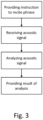
- Fig. 3 shows a block diagram of a method for determining a severity of a respiratory disease of a patient 140.
- the method comprises a first step of providing an instruction for reciting a phrase 151 to the patient 140. This step is followed by the second step of receiving an acoustic signal 161 of the patient 140.
- the third step comprises analyzing the received acoustic signal 161 with respect to the severity of the respiratory disease.
- the fourth step comprises providing a result of the analysis of the received acoustic signal 161, which is indicative for the severity of the respiratory disease of the patient 140.
- Fig. 4 shows a block diagram of a method for determining a severity of a respiratory disease of a patient 140 according to an embodiment of the invention.
- This embodiment of the invention comprises compared to the method shown in Fig. 3 three additional steps, which can be preferably performed before the first step. However, also a different order of the steps can be possible. These three additional steps are providing an instruction for performing a physical action 152 to the patient 140, detecting a movement 162 of the patient 140, and analyzing the detected movement 162 of the patient 140 with respect to the physical action 152.
Landscapes
- Health & Medical Sciences (AREA)
- Life Sciences & Earth Sciences (AREA)
- Engineering & Computer Science (AREA)
- Molecular Biology (AREA)
- Animal Behavior & Ethology (AREA)
- Biophysics (AREA)
- Pathology (AREA)
- Biomedical Technology (AREA)
- Heart & Thoracic Surgery (AREA)
- Medical Informatics (AREA)
- Veterinary Medicine (AREA)
- Surgery (AREA)
- Physics & Mathematics (AREA)
- General Health & Medical Sciences (AREA)
- Public Health (AREA)
- Pulmonology (AREA)
- Physiology (AREA)
- Computer Networks & Wireless Communication (AREA)
- Audiology, Speech & Language Pathology (AREA)
- Multimedia (AREA)
- Measurement Of The Respiration, Hearing Ability, Form, And Blood Characteristics Of Living Organisms (AREA)
Claims (8)
- System (100) zum Bestimmen eines Schweregrads einer Atemwegserkrankung eines Patienten (140), wobei das System (100) umfasst:eine Benutzeroberfläche (110);wobei die Benutzeroberfläche (110) dazu konfiguriert ist, dem Patienten (140) eine Anweisung zum Aufsagen eines Satzes (151) bereitzustellen, und wobei die Benutzeroberfläche (110) dazu konfiguriert ist, dem Patienten (140) eine Anweisung zum Durchführen einer physischen Aktion (152) bereitzustellen;eine Empfangsvorrichtung (120), die zum Empfangen eines akustischen Signals (161) des Patienten (140) konfiguriert ist; eine Messeinheit (180), die zum Erfassen einer Bewegung (162) des Patienten (140) konfiguriert ist;eine Analysevorrichtung (130),wobei die Analysevorrichtung (130) zum Analysieren des empfangenen akustischen Signals (161) hinsichtlich des Schweregrads der Atemwegserkrankung konfiguriert ist, und wobei die Analysevorrichtung (130) zum Analysieren der erfassten Bewegung (162) des Patienten hinsichtlich der von der Benutzeroberfläche (110) angewiesenen physischen Aktion (152) konfiguriert ist, undwobei die Analysevorrichtung (130) dazu konfiguriert ist, ein Ergebnis (170) der Analyse des empfangenen akustischen Signals (161), das den Schweregrad der Atemwegserkrankung des Patienten (140) angibt, bereitzustellen,dadurch gekennzeichnet, dassdie Analysevorrichtung (130) weiter dazu konfiguriert ist zu bestimmen, ob die Bewegung (162) des Patienten (140) der von der Benutzeroberfläche (110) angewiesenen physischen Aktion (152) entspricht,die Benutzeroberfläche (110) dazu konfiguriert ist, den Patienten (140) anzuweisen, den Satz (151) aufzusagen, falls die erfasste Bewegung (162) des Patienten der von der Benutzeroberfläche (110) angewiesenen physischen Aktion (152) entspricht, und/oderdie Benutzeroberfläche (110) dazu konfiguriert ist, die Anweisung an den Patienten (140) zu wiederholen, falls die erfasste Bewegung (162) des Patienten (140) nicht der von der Benutzeroberfläche (110) angewiesenen physischen Aktion (152) entspricht.
- System (100) nach Anspruch 1,
wobei die Atemwegserkrankung eine chronisch obstruktive Lungenerkrankung ist. - System (100) nach einem der vorstehenden Ansprüche,wobei das empfangene akustische Signal (161) des Patienten (140) die Stimme des Patienten ist, undwobei die Analysevorrichtung (130) zum Analysieren des empfangenen akustischen Signals (161) hinsichtlich des von der Benutzeroberfläche (110) angewiesenen aufgesagten Satzes (151) konfiguriert ist.
- System (100) nach einem der vorstehenden Ansprüche,
wobei die Analysevorrichtung (130) zum Analysieren des empfangenen akustischen Signals (161) des Patienten (140) hinsichtlich mindestens eines von: Atmung, Kurzatmigkeit, Keuchen, Atemhöhe, Hustenhäufigkeit, Stimmung, Wohlbefinden, Stimmlage, Grippe- oder Infektionsstatus, Stimmfarbe, Stimmintensität und Kombinationen davon, und zum Ableiten des Schweregrads der Atemwegserkrankung des Patienten (140) daraus konfiguriert ist. - System (100) nach einem der vorstehenden Ansprüche,
wobei die Analysevorrichtung (130) zum Analysieren des empfangenen akustischen Signals (161) hinsichtlich des Schweregrads der Atemwegserkrankung basierend auf einem Vergleich des empfangenen akustischen Signals (161) mit Daten, die von einer Vielzahl von Patienten abgeleitet sind, konfiguriert ist. - System (100) nach einem der vorstehenden Ansprüche,
wobei das System (100) eine Kommunikationsvorrichtung ist, wie beispielsweise ein Telefon, ein Smartphone, ein Tablet, eine Smartwatch oder eine Smartbrille. - System (100) nach einem der vorstehenden Ansprüche,
wobei die Messeinheit (180) eine Trägheitsmesseinheit (181) umfasst, die einen Beschleunigungsmesser, ein Gyroskop und/oder einen barometrischen Sensor umfasst, und/oder wobei die Messeinheit (180) eine Kamera (182) umfasst. - System (100) nach einem der vorstehenden Ansprüche,
wobei die von der Benutzeroberfläche (110) angewiesene physische Aktion (152) ein Sitz-Steh-Test, ein forciertes Ausatemmanöver, eine zeitgesteuerte Aufsteh- und Gehbewegung und/oder ein Valsalva-Manöver ist.
Applications Claiming Priority (2)
| Application Number | Priority Date | Filing Date | Title |
|---|---|---|---|
| EP19217874.7A EP3838137A1 (de) | 2019-12-19 | 2019-12-19 | Automatisierter und objektiver symptomschweregradwert |
| PCT/EP2020/085147 WO2021122178A1 (en) | 2019-12-19 | 2020-12-09 | Automated and objective symptom severity score |
Publications (2)
| Publication Number | Publication Date |
|---|---|
| EP4076174A1 EP4076174A1 (de) | 2022-10-26 |
| EP4076174B1 true EP4076174B1 (de) | 2024-11-13 |
Family
ID=68965809
Family Applications (2)
| Application Number | Title | Priority Date | Filing Date |
|---|---|---|---|
| EP19217874.7A Withdrawn EP3838137A1 (de) | 2019-12-19 | 2019-12-19 | Automatisierter und objektiver symptomschweregradwert |
| EP20820404.0A Active EP4076174B1 (de) | 2019-12-19 | 2020-12-09 | Automatisierter und objektiver symptomschweregradwert |
Family Applications Before (1)
| Application Number | Title | Priority Date | Filing Date |
|---|---|---|---|
| EP19217874.7A Withdrawn EP3838137A1 (de) | 2019-12-19 | 2019-12-19 | Automatisierter und objektiver symptomschweregradwert |
Country Status (5)
| Country | Link |
|---|---|
| US (1) | US12383159B2 (de) |
| EP (2) | EP3838137A1 (de) |
| JP (1) | JP7183483B1 (de) |
| CN (1) | CN114828743A (de) |
| WO (1) | WO2021122178A1 (de) |
Families Citing this family (4)
| Publication number | Priority date | Publication date | Assignee | Title |
|---|---|---|---|---|
| US12076161B2 (en) * | 2019-12-25 | 2024-09-03 | Koninklijke Philips N.V. | Unobtrusive symptoms monitoring for allergic asthma patients |
| GB2607561B (en) * | 2021-04-08 | 2023-07-19 | Miicare Ltd | Mobility analysis |
| US11704078B2 (en) * | 2021-08-19 | 2023-07-18 | Toshiba Tec Kabushiki Kaisha | System and method for tracking physical characteristics of multifunction peripheral users to determine device user satisfaction |
| CN115919286B (zh) * | 2022-11-12 | 2024-02-02 | 上海爱渡医疗科技有限公司 | 一种疾病数据采集分析方法及采集分析系统 |
Family Cites Families (20)
| Publication number | Priority date | Publication date | Assignee | Title |
|---|---|---|---|---|
| US6968375B1 (en) | 1997-03-28 | 2005-11-22 | Health Hero Network, Inc. | Networked system for interactive communication and remote monitoring of individuals |
| US8758262B2 (en) | 2009-11-25 | 2014-06-24 | University Of Rochester | Respiratory disease monitoring system |
| RU2630596C2 (ru) | 2011-03-30 | 2017-09-12 | Конинклейке Филипс Н.В. | Бесконтактная система скрининга нарушений сна |
| JP6067693B2 (ja) | 2011-06-28 | 2017-01-25 | コーニンクレッカ フィリップス エヌ ヴェKoninklijke Philips N.V. | 座位から立位への移行検出 |
| US10182787B2 (en) * | 2011-10-20 | 2019-01-22 | Koninklijke Philips N.V. | System and method for characterizing an upper airway using speech characteristics |
| KR20150139817A (ko) * | 2012-09-05 | 2015-12-14 | 카운팅앱 메디컬 엘티디. | 폐용량 및 스태미너 측정 시스템 및 방법 |
| US9833189B2 (en) * | 2012-12-17 | 2017-12-05 | Koninklijke Philips N.V. | Sleep apnea diagnosis system and method of generating information using non-obtrusive audio analysis |
| RU2571897C2 (ru) | 2014-04-11 | 2015-12-27 | Государственное бюджетное образовательное учреждение высшего профессионального образования "Тихоокеанский государственный медицинский университет" Министерства здравоохранения Российской Федерации (ГБОУ ВПО ТГМУ Минздрава России) | Способ определения метода обследования пациентов с хронической обструктивной болезнью легких (хобл) |
| WO2016093927A2 (en) * | 2014-12-08 | 2016-06-16 | University Of Washington | Systems and methods of identifying motion of a subject |
| EP3337388B1 (de) * | 2015-08-17 | 2022-09-28 | ResMed Sensor Technologies Limited | Screener für schlafbezogene atmungsstörungen |
| US10796805B2 (en) * | 2015-10-08 | 2020-10-06 | Cordio Medical Ltd. | Assessment of a pulmonary condition by speech analysis |
| WO2017068582A1 (en) * | 2015-10-20 | 2017-04-27 | Healthymize Ltd | System and method for monitoring and determining a medical condition of a user |
| EP3200188A1 (de) | 2016-01-27 | 2017-08-02 | Telefonica Digital España, S.L.U. | Computerimplementierte verfahren zur beurteilung einer krankheit durch sprachanalyse und computerprogramme dafür |
| US12478285B2 (en) | 2016-08-02 | 2025-11-25 | Medtronic, Inc. | Accelerometer signal change as a measure of patient functional status |
| WO2018036896A1 (en) * | 2016-08-23 | 2018-03-01 | Koninklijke Philips N.V. | Device, system and method for detection of an asthma attack or asthma of a subject |
| US11484283B2 (en) * | 2016-12-02 | 2022-11-01 | Children's National Medical Center | Apparatus and method for identification of wheezing in ausculated lung sounds |
| US20180206775A1 (en) | 2017-01-23 | 2018-07-26 | The Johns Hopkins University | Measuring medication response using wearables for parkinson's disease |
| CN107622797B (zh) * | 2017-09-26 | 2020-07-28 | 李涵之 | 一种基于声音的身体状况确定系统及方法 |
| US20190371460A1 (en) * | 2018-04-26 | 2019-12-05 | Respivar LLV | Detection and Display of Respiratory Rate Variability, Mechanical Ventilation Machine Learning, and Double Booking of Clinic Slots, System, Method, and Computer Program Product |
| CN109498228B (zh) * | 2018-11-06 | 2021-03-30 | 林枫 | 基于咳嗽音反馈的肺康复治疗装置 |
-
2019
- 2019-12-19 EP EP19217874.7A patent/EP3838137A1/de not_active Withdrawn
-
2020
- 2020-12-09 EP EP20820404.0A patent/EP4076174B1/de active Active
- 2020-12-09 CN CN202080088525.9A patent/CN114828743A/zh active Pending
- 2020-12-09 JP JP2022532701A patent/JP7183483B1/ja active Active
- 2020-12-09 WO PCT/EP2020/085147 patent/WO2021122178A1/en not_active Ceased
- 2020-12-16 US US17/123,913 patent/US12383159B2/en active Active
Also Published As
| Publication number | Publication date |
|---|---|
| US20210186370A1 (en) | 2021-06-24 |
| WO2021122178A1 (en) | 2021-06-24 |
| JP2022550217A (ja) | 2022-11-30 |
| EP3838137A1 (de) | 2021-06-23 |
| CN114828743A (zh) | 2022-07-29 |
| JP7183483B1 (ja) | 2022-12-05 |
| EP4076174A1 (de) | 2022-10-26 |
| US12383159B2 (en) | 2025-08-12 |
Similar Documents
| Publication | Publication Date | Title |
|---|---|---|
| EP4076174B1 (de) | Automatisierter und objektiver symptomschweregradwert | |
| CN111315302B (zh) | 认知功能评估装置、认知功能评估系统、认知功能评估方法及程序记录介质 | |
| US20260069161A1 (en) | Managing respiratory conditions based on sounds of the respiratory system | |
| CN108135485B (zh) | 通过语音分析评估肺部病症 | |
| JP6263308B1 (ja) | 認知症診断装置、認知症診断方法、及び認知症診断プログラム | |
| CN103561652B (zh) | 用于辅助患者的方法和系统 | |
| CN102985007B (zh) | 健康装置监视装置 | |
| US11826161B2 (en) | Cognitive function evaluation device, cognitive function evaluation system, cognitive function evaluation method, and non-transitory computer-readable storage medium | |
| JP6312014B1 (ja) | 認知機能評価装置、認知機能評価システム、認知機能評価方法及びプログラム | |
| JP7390268B2 (ja) | 認知機能予測装置、認知機能予測方法、プログラム及びシステム | |
| JP2012059107A (ja) | 感情推定装置、感情推定方法およびプログラム | |
| JP6729923B1 (ja) | 難聴判定装置、難聴判定システム、コンピュータプログラム及び認知機能レベル補正方法 | |
| EP4017351A1 (de) | Verfahren und vorrichtung zur verarbeitung von asthmapatientenhusten zur anwendung einer entsprechenden therapie | |
| JP4631464B2 (ja) | 体調判定装置およびそのプログラム | |
| JP2019051129A (ja) | 嚥下機能解析システム及びプログラム | |
| KR102406560B1 (ko) | 인공지능 기반 대상자의 치매 검사 정확도 향상을 위한 아웃바운드 콜 처리 방법, 장치 및 시스템 | |
| JP2025531647A (ja) | 認知能力評価装置、モバイル端末及び発話取得装置 | |
| WO2021151188A1 (en) | Tool for assisting individuals experiencing auditory hallucinations to differentiate between hallucinations and ambient sounds | |
| WO2025072267A1 (en) | System for detecting otitis media acoustically | |
| ElSaid et al. | Smart System to Enhance Medical Examinations Data Analysis for University Students. | |
| KR20250102236A (ko) | 검이경 청진기를 이용한 비대면 인공지능 진료시스템 및 이를 이용한 인공지능 진료방법 | |
| CN121032740A (zh) | 多模态自适应英语口语训练方法、系统、设备及介质 |
Legal Events
| Date | Code | Title | Description |
|---|---|---|---|
| STAA | Information on the status of an ep patent application or granted ep patent |
Free format text: STATUS: UNKNOWN |
|
| STAA | Information on the status of an ep patent application or granted ep patent |
Free format text: STATUS: THE INTERNATIONAL PUBLICATION HAS BEEN MADE |
|
| PUAI | Public reference made under article 153(3) epc to a published international application that has entered the european phase |
Free format text: ORIGINAL CODE: 0009012 |
|
| STAA | Information on the status of an ep patent application or granted ep patent |
Free format text: STATUS: REQUEST FOR EXAMINATION WAS MADE |
|
| 17P | Request for examination filed |
Effective date: 20220719 |
|
| AK | Designated contracting states |
Kind code of ref document: A1 Designated state(s): AL AT BE BG CH CY CZ DE DK EE ES FI FR GB GR HR HU IE IS IT LI LT LU LV MC MK MT NL NO PL PT RO RS SE SI SK SM TR |
|
| DAV | Request for validation of the european patent (deleted) | ||
| DAX | Request for extension of the european patent (deleted) | ||
| GRAP | Despatch of communication of intention to grant a patent |
Free format text: ORIGINAL CODE: EPIDOSNIGR1 |
|
| STAA | Information on the status of an ep patent application or granted ep patent |
Free format text: STATUS: GRANT OF PATENT IS INTENDED |
|
| INTG | Intention to grant announced |
Effective date: 20240619 |
|
| RIN1 | Information on inventor provided before grant (corrected) |
Inventor name: SAINI, PRIVENDER KAUR Inventor name: DELLIMORE, KIRAN HAMILTON J. |
|
| GRAS | Grant fee paid |
Free format text: ORIGINAL CODE: EPIDOSNIGR3 |
|
| GRAA | (expected) grant |
Free format text: ORIGINAL CODE: 0009210 |
|
| STAA | Information on the status of an ep patent application or granted ep patent |
Free format text: STATUS: THE PATENT HAS BEEN GRANTED |
|
| AK | Designated contracting states |
Kind code of ref document: B1 Designated state(s): AL AT BE BG CH CY CZ DE DK EE ES FI FR GB GR HR HU IE IS IT LI LT LU LV MC MK MT NL NO PL PT RO RS SE SI SK SM TR |
|
| REG | Reference to a national code |
Ref country code: GB Ref legal event code: FG4D |
|
| REG | Reference to a national code |
Ref country code: CH Ref legal event code: EP |
|
| REG | Reference to a national code |
Ref country code: IE Ref legal event code: FG4D |
|
| REG | Reference to a national code |
Ref country code: DE Ref legal event code: R096 Ref document number: 602020041409 Country of ref document: DE |
|
| REG | Reference to a national code |
Ref country code: LT Ref legal event code: MG9D |
|
| REG | Reference to a national code |
Ref country code: NL Ref legal event code: MP Effective date: 20241113 |
|
| PG25 | Lapsed in a contracting state [announced via postgrant information from national office to epo] |
Ref country code: HR Free format text: LAPSE BECAUSE OF FAILURE TO SUBMIT A TRANSLATION OF THE DESCRIPTION OR TO PAY THE FEE WITHIN THE PRESCRIBED TIME-LIMIT Effective date: 20241113 Ref country code: IS Free format text: LAPSE BECAUSE OF FAILURE TO SUBMIT A TRANSLATION OF THE DESCRIPTION OR TO PAY THE FEE WITHIN THE PRESCRIBED TIME-LIMIT Effective date: 20250313 Ref country code: PT Free format text: LAPSE BECAUSE OF FAILURE TO SUBMIT A TRANSLATION OF THE DESCRIPTION OR TO PAY THE FEE WITHIN THE PRESCRIBED TIME-LIMIT Effective date: 20250313 |
|
| PG25 | Lapsed in a contracting state [announced via postgrant information from national office to epo] |
Ref country code: FI Free format text: LAPSE BECAUSE OF FAILURE TO SUBMIT A TRANSLATION OF THE DESCRIPTION OR TO PAY THE FEE WITHIN THE PRESCRIBED TIME-LIMIT Effective date: 20241113 Ref country code: NL Free format text: LAPSE BECAUSE OF FAILURE TO SUBMIT A TRANSLATION OF THE DESCRIPTION OR TO PAY THE FEE WITHIN THE PRESCRIBED TIME-LIMIT Effective date: 20241113 |
|
| REG | Reference to a national code |
Ref country code: AT Ref legal event code: MK05 Ref document number: 1740996 Country of ref document: AT Kind code of ref document: T Effective date: 20241113 |
|
| PG25 | Lapsed in a contracting state [announced via postgrant information from national office to epo] |
Ref country code: BG Free format text: LAPSE BECAUSE OF FAILURE TO SUBMIT A TRANSLATION OF THE DESCRIPTION OR TO PAY THE FEE WITHIN THE PRESCRIBED TIME-LIMIT Effective date: 20241113 |
|
| PG25 | Lapsed in a contracting state [announced via postgrant information from national office to epo] |
Ref country code: ES Free format text: LAPSE BECAUSE OF FAILURE TO SUBMIT A TRANSLATION OF THE DESCRIPTION OR TO PAY THE FEE WITHIN THE PRESCRIBED TIME-LIMIT Effective date: 20241113 |
|
| PG25 | Lapsed in a contracting state [announced via postgrant information from national office to epo] |
Ref country code: NO Free format text: LAPSE BECAUSE OF FAILURE TO SUBMIT A TRANSLATION OF THE DESCRIPTION OR TO PAY THE FEE WITHIN THE PRESCRIBED TIME-LIMIT Effective date: 20250213 |
|
| PG25 | Lapsed in a contracting state [announced via postgrant information from national office to epo] |
Ref country code: GR Free format text: LAPSE BECAUSE OF FAILURE TO SUBMIT A TRANSLATION OF THE DESCRIPTION OR TO PAY THE FEE WITHIN THE PRESCRIBED TIME-LIMIT Effective date: 20250214 Ref country code: LV Free format text: LAPSE BECAUSE OF FAILURE TO SUBMIT A TRANSLATION OF THE DESCRIPTION OR TO PAY THE FEE WITHIN THE PRESCRIBED TIME-LIMIT Effective date: 20241113 Ref country code: AT Free format text: LAPSE BECAUSE OF FAILURE TO SUBMIT A TRANSLATION OF THE DESCRIPTION OR TO PAY THE FEE WITHIN THE PRESCRIBED TIME-LIMIT Effective date: 20241113 |
|
| PG25 | Lapsed in a contracting state [announced via postgrant information from national office to epo] |
Ref country code: PL Free format text: LAPSE BECAUSE OF FAILURE TO SUBMIT A TRANSLATION OF THE DESCRIPTION OR TO PAY THE FEE WITHIN THE PRESCRIBED TIME-LIMIT Effective date: 20241113 |
|
| PG25 | Lapsed in a contracting state [announced via postgrant information from national office to epo] |
Ref country code: RS Free format text: LAPSE BECAUSE OF FAILURE TO SUBMIT A TRANSLATION OF THE DESCRIPTION OR TO PAY THE FEE WITHIN THE PRESCRIBED TIME-LIMIT Effective date: 20250213 |
|
| PG25 | Lapsed in a contracting state [announced via postgrant information from national office to epo] |
Ref country code: SM Free format text: LAPSE BECAUSE OF FAILURE TO SUBMIT A TRANSLATION OF THE DESCRIPTION OR TO PAY THE FEE WITHIN THE PRESCRIBED TIME-LIMIT Effective date: 20241113 |
|
| PG25 | Lapsed in a contracting state [announced via postgrant information from national office to epo] |
Ref country code: DK Free format text: LAPSE BECAUSE OF FAILURE TO SUBMIT A TRANSLATION OF THE DESCRIPTION OR TO PAY THE FEE WITHIN THE PRESCRIBED TIME-LIMIT Effective date: 20241113 |
|
| PG25 | Lapsed in a contracting state [announced via postgrant information from national office to epo] |
Ref country code: EE Free format text: LAPSE BECAUSE OF FAILURE TO SUBMIT A TRANSLATION OF THE DESCRIPTION OR TO PAY THE FEE WITHIN THE PRESCRIBED TIME-LIMIT Effective date: 20241113 |
|
| PG25 | Lapsed in a contracting state [announced via postgrant information from national office to epo] |
Ref country code: RO Free format text: LAPSE BECAUSE OF FAILURE TO SUBMIT A TRANSLATION OF THE DESCRIPTION OR TO PAY THE FEE WITHIN THE PRESCRIBED TIME-LIMIT Effective date: 20241113 |
|
| PG25 | Lapsed in a contracting state [announced via postgrant information from national office to epo] |
Ref country code: SK Free format text: LAPSE BECAUSE OF FAILURE TO SUBMIT A TRANSLATION OF THE DESCRIPTION OR TO PAY THE FEE WITHIN THE PRESCRIBED TIME-LIMIT Effective date: 20241113 |
|
| PG25 | Lapsed in a contracting state [announced via postgrant information from national office to epo] |
Ref country code: CZ Free format text: LAPSE BECAUSE OF FAILURE TO SUBMIT A TRANSLATION OF THE DESCRIPTION OR TO PAY THE FEE WITHIN THE PRESCRIBED TIME-LIMIT Effective date: 20241113 |
|
| PG25 | Lapsed in a contracting state [announced via postgrant information from national office to epo] |
Ref country code: IT Free format text: LAPSE BECAUSE OF FAILURE TO SUBMIT A TRANSLATION OF THE DESCRIPTION OR TO PAY THE FEE WITHIN THE PRESCRIBED TIME-LIMIT Effective date: 20241113 |
|
| REG | Reference to a national code |
Ref country code: CH Ref legal event code: PL |
|
| REG | Reference to a national code |
Ref country code: DE Ref legal event code: R097 Ref document number: 602020041409 Country of ref document: DE |
|
| PG25 | Lapsed in a contracting state [announced via postgrant information from national office to epo] |
Ref country code: LU Free format text: LAPSE BECAUSE OF NON-PAYMENT OF DUE FEES Effective date: 20241209 |
|
| PG25 | Lapsed in a contracting state [announced via postgrant information from national office to epo] |
Ref country code: SE Free format text: LAPSE BECAUSE OF FAILURE TO SUBMIT A TRANSLATION OF THE DESCRIPTION OR TO PAY THE FEE WITHIN THE PRESCRIBED TIME-LIMIT Effective date: 20241113 |
|
| PG25 | Lapsed in a contracting state [announced via postgrant information from national office to epo] |
Ref country code: MC Free format text: LAPSE BECAUSE OF FAILURE TO SUBMIT A TRANSLATION OF THE DESCRIPTION OR TO PAY THE FEE WITHIN THE PRESCRIBED TIME-LIMIT Effective date: 20241113 |
|
| PLBE | No opposition filed within time limit |
Free format text: ORIGINAL CODE: 0009261 |
|
| STAA | Information on the status of an ep patent application or granted ep patent |
Free format text: STATUS: NO OPPOSITION FILED WITHIN TIME LIMIT |
|
| REG | Reference to a national code |
Ref country code: BE Ref legal event code: MM Effective date: 20241231 |
|
| PG25 | Lapsed in a contracting state [announced via postgrant information from national office to epo] |
Ref country code: BE Free format text: LAPSE BECAUSE OF NON-PAYMENT OF DUE FEES Effective date: 20241231 |
|
| PG25 | Lapsed in a contracting state [announced via postgrant information from national office to epo] |
Ref country code: CH Free format text: LAPSE BECAUSE OF NON-PAYMENT OF DUE FEES Effective date: 20241231 |
|
| 26N | No opposition filed |
Effective date: 20250814 |
|
| PG25 | Lapsed in a contracting state [announced via postgrant information from national office to epo] |
Ref country code: IE Free format text: LAPSE BECAUSE OF NON-PAYMENT OF DUE FEES Effective date: 20241209 |
|
| PGFP | Annual fee paid to national office [announced via postgrant information from national office to epo] |
Ref country code: GB Payment date: 20251223 Year of fee payment: 6 |
|
| PGFP | Annual fee paid to national office [announced via postgrant information from national office to epo] |
Ref country code: FR Payment date: 20251222 Year of fee payment: 6 |
|
| PGFP | Annual fee paid to national office [announced via postgrant information from national office to epo] |
Ref country code: DE Payment date: 20251229 Year of fee payment: 6 |