EP4075798B1 - Verfahren und vorrichtung zur intra-chroma-codierung in der bild- und videocodierung - Google Patents
Verfahren und vorrichtung zur intra-chroma-codierung in der bild- und videocodierung Download PDFInfo
- Publication number
- EP4075798B1 EP4075798B1 EP22177480.5A EP22177480A EP4075798B1 EP 4075798 B1 EP4075798 B1 EP 4075798B1 EP 22177480 A EP22177480 A EP 22177480A EP 4075798 B1 EP4075798 B1 EP 4075798B1
- Authority
- EP
- European Patent Office
- Prior art keywords
- mode
- intra
- block
- luma
- amvr
- Prior art date
- Legal status (The legal status is an assumption and is not a legal conclusion. Google has not performed a legal analysis and makes no representation as to the accuracy of the status listed.)
- Active
Links
Images



Classifications
-
- H—ELECTRICITY
- H04—ELECTRIC COMMUNICATION TECHNIQUE
- H04N—PICTORIAL COMMUNICATION, e.g. TELEVISION
- H04N19/00—Methods or arrangements for coding, decoding, compressing or decompressing digital video signals
- H04N19/10—Methods or arrangements for coding, decoding, compressing or decompressing digital video signals using adaptive coding
- H04N19/102—Methods or arrangements for coding, decoding, compressing or decompressing digital video signals using adaptive coding characterised by the element, parameter or selection affected or controlled by the adaptive coding
- H04N19/103—Selection of coding mode or of prediction mode
- H04N19/105—Selection of the reference unit for prediction within a chosen coding or prediction mode, e.g. adaptive choice of position and number of pixels used for prediction
-
- H—ELECTRICITY
- H04—ELECTRIC COMMUNICATION TECHNIQUE
- H04N—PICTORIAL COMMUNICATION, e.g. TELEVISION
- H04N19/00—Methods or arrangements for coding, decoding, compressing or decompressing digital video signals
- H04N19/10—Methods or arrangements for coding, decoding, compressing or decompressing digital video signals using adaptive coding
- H04N19/102—Methods or arrangements for coding, decoding, compressing or decompressing digital video signals using adaptive coding characterised by the element, parameter or selection affected or controlled by the adaptive coding
- H04N19/103—Selection of coding mode or of prediction mode
- H04N19/11—Selection of coding mode or of prediction mode among a plurality of spatial predictive coding modes
-
- H—ELECTRICITY
- H04—ELECTRIC COMMUNICATION TECHNIQUE
- H04N—PICTORIAL COMMUNICATION, e.g. TELEVISION
- H04N19/00—Methods or arrangements for coding, decoding, compressing or decompressing digital video signals
- H04N19/10—Methods or arrangements for coding, decoding, compressing or decompressing digital video signals using adaptive coding
- H04N19/134—Methods or arrangements for coding, decoding, compressing or decompressing digital video signals using adaptive coding characterised by the element, parameter or criterion affecting or controlling the adaptive coding
- H04N19/157—Assigned coding mode, i.e. the coding mode being predefined or preselected to be further used for selection of another element or parameter
- H04N19/159—Prediction type, e.g. intra-frame, inter-frame or bidirectional frame prediction
-
- H—ELECTRICITY
- H04—ELECTRIC COMMUNICATION TECHNIQUE
- H04N—PICTORIAL COMMUNICATION, e.g. TELEVISION
- H04N19/00—Methods or arrangements for coding, decoding, compressing or decompressing digital video signals
- H04N19/10—Methods or arrangements for coding, decoding, compressing or decompressing digital video signals using adaptive coding
- H04N19/134—Methods or arrangements for coding, decoding, compressing or decompressing digital video signals using adaptive coding characterised by the element, parameter or criterion affecting or controlling the adaptive coding
- H04N19/167—Position within a video image, e.g. region of interest [ROI]
-
- H—ELECTRICITY
- H04—ELECTRIC COMMUNICATION TECHNIQUE
- H04N—PICTORIAL COMMUNICATION, e.g. TELEVISION
- H04N19/00—Methods or arrangements for coding, decoding, compressing or decompressing digital video signals
- H04N19/10—Methods or arrangements for coding, decoding, compressing or decompressing digital video signals using adaptive coding
- H04N19/169—Methods or arrangements for coding, decoding, compressing or decompressing digital video signals using adaptive coding characterised by the coding unit, i.e. the structural portion or semantic portion of the video signal being the object or the subject of the adaptive coding
- H04N19/17—Methods or arrangements for coding, decoding, compressing or decompressing digital video signals using adaptive coding characterised by the coding unit, i.e. the structural portion or semantic portion of the video signal being the object or the subject of the adaptive coding the unit being an image region, e.g. an object
- H04N19/176—Methods or arrangements for coding, decoding, compressing or decompressing digital video signals using adaptive coding characterised by the coding unit, i.e. the structural portion or semantic portion of the video signal being the object or the subject of the adaptive coding the unit being an image region, e.g. an object the region being a block, e.g. a macroblock
-
- H—ELECTRICITY
- H04—ELECTRIC COMMUNICATION TECHNIQUE
- H04N—PICTORIAL COMMUNICATION, e.g. TELEVISION
- H04N19/00—Methods or arrangements for coding, decoding, compressing or decompressing digital video signals
- H04N19/10—Methods or arrangements for coding, decoding, compressing or decompressing digital video signals using adaptive coding
- H04N19/169—Methods or arrangements for coding, decoding, compressing or decompressing digital video signals using adaptive coding characterised by the coding unit, i.e. the structural portion or semantic portion of the video signal being the object or the subject of the adaptive coding
- H04N19/186—Methods or arrangements for coding, decoding, compressing or decompressing digital video signals using adaptive coding characterised by the coding unit, i.e. the structural portion or semantic portion of the video signal being the object or the subject of the adaptive coding the unit being a colour or a chrominance component
-
- H—ELECTRICITY
- H04—ELECTRIC COMMUNICATION TECHNIQUE
- H04N—PICTORIAL COMMUNICATION, e.g. TELEVISION
- H04N19/00—Methods or arrangements for coding, decoding, compressing or decompressing digital video signals
- H04N19/50—Methods or arrangements for coding, decoding, compressing or decompressing digital video signals using predictive coding
- H04N19/593—Methods or arrangements for coding, decoding, compressing or decompressing digital video signals using predictive coding involving spatial prediction techniques
Definitions
- the present invention relates to Intra coding in image and video coding.
- the present invention discloses Intra prediction mode derivation for the Intra derived-mode (DM) coded chroma component of color images or color video to improve the coding efficiency.
- DM derived-mode
- the High Efficiency Video Coding (HEVC) standard is developed under the joint video project of the ITU-T Video Coding Experts Group (VCEG) and the ISO/IEC Moving Picture Experts Group (MPEG) standardization organizations, and is especially with partnership known as the Joint Collaborative Team on Video Coding (JCT-VC).
- HEVC High Efficiency Video Coding
- one slice is partitioned into multiple coding tree units (CTU).
- CTU coding tree units
- SPS sequence parameter set
- the allowed CTU size can be 8x8, 16x16, 32x32, or 64x64.
- the CTUs within the slice are processed according to a raster scan order.
- the CTU is further partitioned into multiple coding units (CU) to adapt to various local characteristics.
- a quadtree denoted as the coding tree, is used to partition the CTU into multiple CUs.
- CTU size be MxM, where M is one of the values of 64, 32, or 16.
- the CTU can be a single CU (i.e., no splitting) or can be split into four smaller units of equal sizes (i.e., M/2xM/2 each), which correspond to the nodes of the coding tree. If units are leaf nodes of the coding tree, the units become CUs. Otherwise, the quadtree splitting process can be iterated until the size for a node reaches a minimum allowed CU size as specified in the SPS (Sequence Parameter Set).
- each CU can be partitioned into one or more prediction units (PU). Coupled with the CU, the PU works as a basic representative block for sharing the prediction information. Inside each PU, the same prediction process is applied and the relevant information is transmitted to the decoder on a PU basis.
- a CU can be split into one, two or four PUs according to the PU splitting type.
- HEVC defines eight shapes for splitting a CU into PU, including 2Nx2N, 2NxN, Nx2N, NxN, 2NxnU, 2NxnD, nLx2N and nRx2N partition types. Unlike the CU, the PU may only be split once according to HEVC.
- the partitions shown in the second row correspond to asymmetric partitions, where the two partitioned parts have different sizes.
- the HEVC coding comprises Inter prediction and Intra prediction.
- Intra prediction the generation of Intra prediction includes three parts: Intra smoothing filter, Intra prediction, and Intra gradient filter.
- a smoothing operation is applied to the reference samples as a pre-processing step before calculating the prediction.
- This smoothing operation corresponds to applying an FIR-filter with filter weights[1,2,1] >>2, with low-pass characteristics to the samples belonging to the left column and the above row of the current TU (transform unit).
- the Intra prediction of each TU is produced with the reconstructed samples of neighboring TUs.
- the samples involved in Intra smoothing are indicated in Fig.
- the Intra prediction of current block is derived from neighboring reference samples with a certain Intra prediction mode, and the Intra prediction mode is selected from DC mode, planar mode, and 33 directional modes by encoder and signaled in the bitstream.
- the Intra prediction mode is DC, horizontal or vertical mode, Intra gradient filter is further applied to the samples at the left and top boundaries of the current TU.
- Intra prediction modes are considered as most probable modes (MPM) for predicting the Intra prediction mode in current prediction block.
- MPM most probable modes
- the Intra prediction modes used in the left prediction block and in the above prediction block can be used as candidates of the MPM set.
- the Intra prediction modes in two neighboring blocks are identical and both directional, or only one of the two neighboring blocks is available and coded in Intra prediction and at the same time this Intra prediction mode is directional, two neighboring directions immediately next to this direction is also used in MPM.
- DC mode and Planar mode are also considered in MPM set to fill the available spot in the MPM, especially if the above or top neighboring blocks are not available or not coded in Intra prediction, or the Intra prediction modes in neighboring blocks are not directional. If the Intra prediction mode for current prediction block is one of the modes in the MPM set, 1 or 2 bins is used to signal which one it is. Otherwise, it is not the same as any entry in the MPM set, it will be coded as a non-MPM mode. There are all-together 32 such non-MPM modes and a (5-bit) fixed length coding method is applied to signal this mode. The 33 directions are illustrated in Fig.2 .
- Fig.2 there are all together 33 directional modes, i.e., H, H+1, ..., H+8, H-1, ..., H-7, V, V+1, ..., V+8, V-1, ..., V-8.
- This system can be expanded to a general case, where horizontal and vertical modes are represented as H and V modes.
- k can be range from ⁇ 1 to ⁇ 16.
- Intra gradient filter is to utilize the gradient information along the Intra prediction direction to improve the quality of Intra prediction.
- the left column/the above row neighboring samples can locate their corresponding references along the Intra prediction direction from the above row/the left column.
- the gradient calculated with the neighboring samples can be used to improve the Intra prediction.
- An example for the vertical directional mode is illustrated in Fig. 4A , where P ij denotes the predictor at row i and column j.
- AL represents the reconstructed sample at the left-above corner of the current block
- L i represents the reconstructed sample in the left column of the current block.
- P' ij is used as the final predictor.
- ⁇ is a fraction from 0 to 1 and is selected according to the direction of Intra prediction and j.
- the Intra gradient filter can be applied for all directional modes, i.e., v+1, ..., v+8 and h+1, ..., h+8 in HEVC. However, only when the Intra prediction mode is DC, horizontal or vertical mode, Intra gradient filter is used. If the Intra prediction is DC mode, the samples at the first row and first column are filtered by Intra gradient filter. If the Intra prediction is horizontal mode, then the samples at the first row are filtered by Intra gradient filter. If the Intra prediction is vertical mode, then the samples at the first column are further filtered by Intra gradient filter.
- Intra prediction modes i.e. v+1, ..., v+8 and h+1, ..., h+8
- a weighted sum of the reconstructed samples of the above row and the reconstructed samples from the left column along the direction is used as the Intra predictor.
- Pij from the neighboring samples of above row has a corresponding reference sample Fij in the left column along the prediction direction. If Fij is not located at the integer pixel position, it can be generated by interpolating integer pixels in the left column.
- the prediction error is further processed by transform and quantization and encoded by entropy coding.
- the quantized coefficients are divided into multiple 4x4 coefficient groups, first.
- the coding order of different coefficient groups and scan order of coefficients in one coefficient group is selected according to Intra prediction mode and transform size. If the transform size is smaller than or equal to 8x8, Intra-mode-dependent scan will be used for the coding order of different coefficient groups and scan order of coefficients in one coefficient group. Otherwise, diagonal scan is used for the coding order of different coefficient groups and scan order of coefficients in one coefficient group.
- Fig. 6 illustrates an example of multiple parameter Intra prediction (MPI) process, where an input block is processed by Arbitrary Directional Intra (ADI) 610 followed by MPI 620.
- MPI multiple parameter Intra prediction
- ADI Arbitrary Directional Intra
- JVET-C-0061 In the contribution JVET-C-0061 (X. Xiu, etc., "Decoder-side Intra mode derivation", JVET-C0061, May, 2016), interpolation for Intra prediction using the planar mode is disclosed.
- the sample at bottom-right corner current prediction block is either signaled or estimated using linear average of corresponding left reference sample and above reference sample).
- samples in the right most column and bottom row are bi-linearly interpolated using the top/bottom-right sample combination and the left/bottom-right sample combination (810) as shown in Fig. 8 .
- the remaining pixels in the prediction block are predicted using similar bi-linear interpolation (820), as is shown in Fig. 8 .
- a quadtree plus binary tree (QTBT) block partitioning structure is disclosed.
- QTBT a coding tree block (CTB) is firstly partitioned by a quadtree structure.
- the quadtree leaf nodes are further partitioned by a binary tree structure.
- the binary tree leaf nodes namely coding blocks (CBs), are used for prediction and transform without any further partitioning.
- the luma and chroma CTBs in one coding tree unit (CTU) share the same QTBT structure.
- the luma CTB is partitioned into CBs by a QTBT structure, and two chroma CTBs are partitioned into chroma CBs by another QTBT structure.
- a CTU (or CTB for I slice), which is the root node of a quadtree, is firstly partitioned by a quadtree, where the quadtree splitting of one node can be iterated until the node reaches the minimum allowed quadtree leaf node size (MinQTSize). If the quadtree leaf node size is not larger than the maximum allowed binary tree root node size (MaxBTSize), it can be further partitioned by a binary tree. The binary tree splitting of one node can be iterated until the node reaches the minimum allowed binary tree leaf node size (MinBTSize) or the maximum allowed binary tree depth (MaxBTDepth).
- the binary tree leaf node namely CU (or CB for I slice), will be used for prediction (e.g. Intra-picture or inter-picture prediction) and transform without any further partitioning.
- There are two splitting types in the binary tree splitting symmetric horizontal splitting and symmetric vertical splitting.
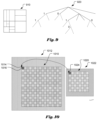
- Block partitioning 910 and corresponding QTBT structure 920 of Fig. 9 illustrates an example of block partitioning by using QTBT.
- the solid lines indicate quadtree splitting and dotted lines indicate binary tree splitting.
- each splitting (i.e., non-leaf) node of the binary tree one flag is signaled to indicate which splitting type (i.e., horizontal or vertical) is used, where 0 indicates horizontal splitting and 1 indicates vertical splitting.
- the quadtree splitting there is no need to indicate the splitting type since it always splits a block horizontally and vertically into 4 sub-blocks of equal size.
- JVET joint video exploration team
- JEM joint exploration model
- HM reference software
- the CU will use the top left chroma pixel to find the corresponding luma pixel. Accordingly, the Intra mode of the luma block containing that luma pixel is used as the chroma Intra mode.
- Fig. 10 illustrates an example of the derived mode (DM) for a chroma block.
- block 1020 is a chroma block partitioned from a chroma CTB 1022.
- Block 1010 is a corresponding luma block area within a luma CTB 1012.
- Black pixel 1014 indicates the upper-left corner pixel of the corresponding luma block area. Since the luma and chroma components may use separate block partitions, there may be no co-located luma block e.g. a luma coding block) for a give chroma block (e.g. a chroma coding block).
- the luma Intra mode used by the upper-left minimum CU of the corresponding luma CU area is used as the Intra mode of the associated chroma CU.
- the upper-left minimum CU may not be Intra mode coded and the chroma DM Intra prediction cannot be used. Therefore, the DM coded chroma block may not have a valid luma Intra mode to use.
- ZHANG LET AL "Multiple Direct Modes for chroma intra coding",4.
- I slices i.e. fully Intra coded slices
- One of the goals of the present invention is intended to solve this issue.
- a method and apparatus for video coding chroma derived-mode Intra prediction are disclosed. According to one method, if derived-mode (DM) Intra prediction is selected for a current chroma block, a corresponding luma block area is determined by locating a first upper-left pixel address of the corresponding luma block area corresponding to a second upper-left pixel address of the current chroma block, wherein the corresponding luma block area corresponds to a same area as the current chroma block in the current color image; one or more candidate luma coding modes are determined from a sub-block set consisting of one
- a current chroma Intra mode for the current chroma block is derived based on information comprising said one or more candidate luma coding modes; and Intra-prediction encoding or decoding is applied to the current chroma block using the current chroma Intra mode derived.
- the current chroma block may correspond to one chroma coding unit (CU) and the corresponding luma block area corresponds to one luma coding unit (CU). Each sub-block of the corresponding luma block area may correspond to one smallest luma coding unit (CU).
- the step of determining one or more candidate luma coding modes comprises checking one or more luma coding modes associated with n sub-blocks of the sub-block set one by one until a checked luma coding mode is Intra angular mode, DC mode or planar mode and using the checked luma coding mode as the current chroma Intra mode, where n is a positive integer.
- the n sub-blocks of the sub-block set can be checked one by one according to a selected order.
- the step of determining one or more candidate luma coding modes comprises selecting a default Intra mode as the current chroma Intra mode.
- the default Intra mode can be signaled at Sequence Parameter Set (SPS), or Picture Parameter Set (PPS), or slice header.
- SPS Sequence Parameter Set
- PPS Picture Parameter Set
- the default Intra mode may correspond to planar mode, DC mode, vertical mode or horizontal mode.
- the default Intra mode may also be derived from one or more candidate chroma Intra modes associated with one or more candidate neighboring chroma blocks of the current chroma block.
- the candidate neighboring chroma blocks of the current chroma block consists of neighboring chroma blocks located at above left (AL), above (A), above right (AR), left (L) or below left (BL) of the current chroma block.
- a most frequently used mode among the candidate chroma Intra modes can be selected as the current chroma Intra mode.
- the derived-mode (DM) Intra prediction can be considered as unavailable to the current chroma Intra mode if none of the luma coding modes associated with the n sub-blocks of the sub-block set is the Intra angular mode, DC mode or planar mode.
- the sub-block set consists of four corner sub-blocks located at a top left (TL) corner, a top right (TR) corner, a bottom left (BL) corner and bottom right (BR) corner.
- the sub-block set consists of four middle sub-blocks located adjacent to a middle position of the corresponding luma block area, and the four middle sub-blocks consist of an upper left middle sub-block (M1), an upper right middle sub-block (M2), a lower left middle sub-block (M3) and a lower right middle sub-block (M4).
- the sub-block set consists of four corner sub-blocks and four middle sub-blocks of the corresponding luma block area.
- a chroma CU may use DM mode (derived mode from the corresponding luma component) by copying the Intra mode of a corresponding luma CU.
- DM mode derived mode from the corresponding luma component
- the corresponding luma block is non-Intra coded, such as IBC mode, palette mode, Inter mode or a mode rather than DC, planar or angular mode. Therefore, this would leave the chroma Intra mode undefined. Accordingly, various methods to overcome this issue are disclosed in the present invention.
- a chroma DM mode is specified when the corresponding luma block is non-Intra coded.
- the non-Intra mode refers to any mode other than an angular mode, DC mode or planar mode. Accordingly, the present invention is able to handle the case that chroma plane and luma plane are coded separately and have different block partitioning structures, and the corresponding luma block of the chroma block may be non-Intra coded, such as IBC mode, palette mode, PCM mode, Inter mode, etc.
- a corresponding luma block area for the chroma block will be identified first based on the top-left chroma pixel address.
- the meaning of the "corresponding luma block area” has been described in the background section of the present disclosure.
- This luma block address will be treated as the start of a luma block.
- the width of this luma block is 2 ⁇ width_chroma and the height of this luma CU is 2x height_chroma, where width_chroma is the width and height chroma is the height of the current chroma.
- the corresponding luma block area is twice as wide and twice as high as the chroma block when the video color format is 420.
- the width of this luma block is 2 ⁇ width_chroma and the height of this luma block is equal to height_chroma.
- the corresponding luma block area is twice as wide and has the same height as the chroma block when the video color format is 422.
- the width of this luma block is equal to width_chroma and the height of this luma block is equal to height_chroma.
- the corresponding luma block area has the same width and height as the chroma block when the video color format is 444.
- luma block area e.g. luma CU/PU/TU
- there are four corner luma minimum blocks including the top left minimum luma block (TL), top right minimum luma block (TR), bottom left minimum luma block (BL) and bottom right minimum luma block (BR).
- the minimum block or smallest block is also referred as a sub-block in this disclosure.
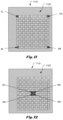
- Fig. 11 illustrates an example of four luma minimum blocks in the four corners, where block 1110 corresponds to a luma CTB and block 1120 corresponds to a luma CU, PU or TU area.
- M1, M2, M3 and M4 There are four middle minimum blocks (i.e., sub-blocks) as indicated by M1, M2, M3 and M4 as shown in Fig. 12 .
- the upper left middle minimum block is designated as M1
- the upper right minimum block is designated as M2
- the lower left minimum block is designated as M3
- the lower right minimum block is designated as M4.
- N minimum blocks for each row and K minimum blocks for each column for the corresponding luma block where N and K are determined according to:
- Ml is the minimum block that has a distance of (N/2 -1) minimum blocks from the CB above boundary, and a distance of (M/2 - 1) minimum blocks from the CB left boundary.
- M2 is the minimum block that has a distance of N/2 minimum blocks from the CB above boundary, and a distance of (M/2 - 1) minimum blocks from the CB left boundary.
- M3 is the minimum block that has a distance of (N/2 -1) minimum blocks from the CB above boundary, and a distance of M/2 minimum blocks from the CB left boundary.
- M4 is the minimum block that has a distance of N/2 minimum block from the CB above boundary, and a distance of M/2 minimum block from the CB left boundary.
- the encoder and decoder will check n positions among the 8 positions (i.e., TL, TR, BL, BR, M1, M2, M3, M4), where n can be 1, 2, 3, 4, 5, 6, 7, 8. After n is decided, the encoder and decoder can choose any n positions from those eight positions. For example, if n is 4, the encoder, the decoder can choose the four positions corresponding to TL, TR, BL and BR. Alternatively, the encoder and decoder can choose the four positions corresponding to M1, M2, M3 and M4. The encoder and decoder can check these n positions one by one until one of them is Intra angular mode, DC mode or planar mode coded.
- n positions among the 8 positions i.e., TL, TR, BL, BR, M1, M2, M3, M4
- n can be 1, 2, 3, 4, 5, 6, 7, 8.
- the encoder and decoder can choose any n positions from those eight positions. For example, if n
- a default Intra mode is padded for this chroma block according to an embodiment of the present invention.
- the default Intra mode can be specified as described in a later part of this disclosure.
- the order of selecting these n modes can have many variants.
- the encoder and decoder will check TL, TR, BL, BR, M1, M2, M3, M4 positions one by one until one of them is Intra angular mode, DC mode, or planar mode coded.
- the Intra mode of the corresponding luma block will be used to for the chroma block. If none of them is Intra angular mode, DC mode, or planar mode coded, a default Intra mode will be used for the chroma block.
- the default Intra mode will be described in a later part of this disclosure. Note that the check order of these blocks can have many variants.
- the encoder and decoder can check TL, M1, M2, M3, M4, TR, BL and BR positions in order.
- the encoder and decoder can check M4, TL, TR, BL, BR, M3, M2 and M1 positions in order.
- the encoder and decoder when the chroma Intra mode is DM mode, the encoder and decoder will check TL, M2, M3, M4 positions one by one until one of them is Intra angular mode, DC mode or planar mode coded.
- the Intra mode of the corresponding block will be used for the chroma block. If none of them is Intra angular mode, DC mode or planar mode coded, a default Intra mode will be used for the chroma block.
- the default Intra mode will be described in a later part of this disclosure. Note that the check order of these blocks can have many variants.
- the encoder and decoder can check TL, M4, M2, M3 positions in order.
- the encoder and decoder can check M4, TL, M3 M2 positions in order.
- the encoder and decoder when the chroma Intra mode is DM mode, the encoder and decoder will check TL, TR, BL, BR and M4 positions one by one until one of them is Intra angular mode, DC mode, or planar mode coded.
- the Intra mode of the corresponding block will be used for the chroma block. If none of them is Intra angular mode, DC mode, or planar mode coded, a default Intra mode will be used for he chroma block.
- the default Intra mode will be described in a later part of this disclosure. Note that the check order of these blocks can have many variants.
- the encoder and decoder will check n positions among the eight positions (i.e., TL, TR, BL, BR, M1, M2, M3, M4), where n can be 1, 2, 3, 4, 5, 6, 7 or 8. After n is decided, the encoder and decoder can choose any n positions from those eight positions. For example, if n is 4, the encoder and decoder can choose the four positions corresponding to TL, TR, BL and BR. Alternatively, the encoder and decoder can choose the four positions corresponding to M1, M2, M3 and M4. The encoder and decoder can check all these n positions one by one.
- the encoder and decoder can choose the most frequently used luma Intra mode for the chroma block coded in DM mode. When none of these positions is Intra angular mode, DC mode, or planar mode coded, a default Intra mode is padded for this chroma block. The default Intra mode will be described in a later part of this disclosure. The order of these n modes can have many variants.
- the encoder and decoder will check n positions among the eight positions (i.e., TL, TR, BL, BR, M1, M2, M3, M4), n can be 1, 2, 3, 4, 5, 6, 7 or 8. After n is decided, the encoder and decoder can choose any n positions from those eight positions. For example, if n is 4, the encoder and decoder can choose the four positions corresponding to TL, TR, BL and BR. Alternatively, the encoder and decoder can choose the four positions corresponding to M1, M2, M3 and M4.
- the encoder and decoder can choose these n modes one by one until one of them is Intra angular mode, DC mode, or planar mode coded. If none of these positions is Intra angular mode, DC mode, or planar mode coded, the DM mode is treated ass unavailable for the current chroma block.
- the chroma Intra mode list can be shortened by 1, and the corresponding code word will be changed. The order of these n modes can have many variants.
- the encoder and decoder will check n positions among the eight positions (i.e., TL, TR, BL, BR, M1, M2, M3, M4), n can be 1, 2, 3, 4, 5, 6, 7 or 8. After n is decided, the encoder and decoder can choose any n positions from those eight positions. For example, when n is 4, the encoder and decoder can choose the four positions corresponding to TL, TR, BL and BR. Alternatively, the encoder and decoder can choose the four positions corresponding to M1, M2, M3 and M4. The encoder and decoder can check these n positions one by one.
- the encoder and decoder can choose the Intra angular mode, DC mode, or planar mode that is used most frequently as the luma Intra mode for the chroma block coded in DM mode. If none of these positions is Intra angular mode, DC mode, or planar mode coded, the DM mode is treated as unavailable for the current chroma block.
- the chroma Intra mode list can be shortened by 1, and the corresponding code word will be changed.
- the default mode can be a pre-defined Intra mode.
- This Intra mode can be hard coded for the encoder and decoder.
- This Intra mode can also be signaled at Sequence Parameter Set (SPS), or Picture Parameter Set (PPS), or slice header.
- SPS Sequence Parameter Set
- PPS Picture Parameter Set
- the default mode can be derived for each chroma block from its neighboring blocks
- the chroma block can check the Intra mode of neighboring blocks located at above left (AL), above (A), above right (AR), left (L) or below left (BL) of the current block and find the most frequently used one as the Intra mode for current block.
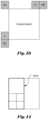
- An example of the neighboring blocks of the current block is shown in Fig. 13 .
- the first available Intra angular mode, DC mode or planar mode from neighboring blocks is used as the Intra mode for current block.
- the ordering of candidate neighboring blocks can be different; some examples are listed as follows:
- the order of L and A can be swapped or the order of AR and BL can be swapped.
- the same order of neighboring locations in inter mode motion vector predictor candidate list can be used.
- the same order of neighboring locations in inter mode merge candidate list can be used.
- AMVR Adaptive motion vector resolution
- VCEG-AZ07 Chen, et al., "Further improvements to HMKTA-1.0", ITU-T VCEG, document: VCEG-AZ07, 19-26 June 2015, Warsaw, Tru ).
- MVD Motion Vector Difference
- the MVD resolution is controlled at coding unit (CU) level and an integer MVD resolution flag is conditionally signaled for each CU that has at least one non-zero MVD components.
- the default quarter-pel MV resolution is used for all PUs belonging to the CU. Otherwise (i.e., the integer MV resolution flag being true for a CU), all PUs coded with AMVP (advanced motion vector prediction) mode belonging to the CU use integer MV resolution, while the PUs coded with merge mode still use quarter-pel MV resolution.
- the AMVP candidate list is filled with integer MV by rounding quarter-pel MVs to integer-pel MVs.
- Method 1 Modify the signaling of AMVR for Binary tree in QTBT structure.
- the current invention proposes to signal the AMVR_signal_BT_flag at a certain BT depth (e.g. MIN_BT_DEPTH_SIGNAL_AMVR) when the binary partition is used.
- the sub-blocks of that binary partition share the same AMVR flag from the parent binary partition.
- the binary block with a depth greater than MIN_BT_DEPTH_SIGNAL_AMVR shares the AMVR flag at MIN_BT_DEPTH_SIGNAL_AMVR.
- the binary block with a depth smaller than MIN_BT_DEPTH_SIGNAL_AMVR signals its own AMVR flag.
- the MIN_BT_DEPTH_SIGNAL_AMVR is smaller than or equal to MaxBTSize. It can be 0, 1, 2, 3, ...,MaxBTSize.
- the MIN_BT_DEPTH_SIGNAL_AMVR can be defined in the encoder and decoder macro or signaled at SPS, PPS or slice header.
- MIN_BT_DEPTH_SIGNAL_AMVR corresponds to BT depth 0, which means a leaf of the QT and the sub-blocks are binary partition.
- the MIN_BT_DEPTH_SIGNAL_AMVR corresponds to BT depth 1, which means the first layer of binary partition. Therefore, when the current block is quad-tree partitioned, the flag will always be signaled. It is illustrated in Fig. 14 , where the AMVR flag is signaled when the BT depth is smaller than 1.
- the dashed-lines block 1410 is the BT with BT depth equal to 1, so that the AMVR flag will be signaled for this level.
- the BT depth is smaller than 1, the MV resolution is indicated by the AMVR flag at BT depth 1. In other words, the AMVR flag is only signaled for the CU without partition.
- an AMVR_signal_BT_flag is signaled at a certain BT depth (e.g. MIN_BT_DEPTH_SIGNAL_AMVR) when it is binary partitioned.
- a certain BT depth e.g. MIN_BT_DEPTH_SIGNAL_AMVR
- the AMVR_signal_BT_flag at the MIN_BT_DEPTH_SIGNAL_AMVR is 0, all the sub-blocks use integer MV resolution.
- the AMVR_signal_BT_flag at the MIN_BT_DEPTH_SIGNAL_AMVR is 1, all the sub-blocks use quarter-pel MV resolution.
- the AMVR_signal_BT_flag at the MIN_BT_DEPTH_SIGNAL_AMVR is 2, all the sub-blocks will signal its own AMVR flag.
- the AMVR_signa_BT_flag can use fixed-length binarization, variable length binarization, Exp-Golomb-k binarization or truncated binarization.
- Table 2 shows an example of Exp-Golomb-k code word, where k is equal to 0.
- AMVR_signal_BT_flag value binarization meaning 0 0 All the sub tree using integer MV resolution 1 10 All the sub tree using quarter-pel MV resolution 2 11 All the sub tree using its own AMVR flag Note that the code words assignment can be changed.
- N contexts can be used, where N can be 1, 2, 3,..., MAX_INT.
- MIN_BT_DEPTH_SIGNAL_AMVR can be smaller than or equal to MaxBTSize. It can be 0, 1, 2, 3,... ,MaxBTSize.
- the MIN_BT_DEPTH_SIGNAL_AMVR can be defined in the encoder and decoder macro or signaled at SPS, PPS or slice header.
- the MIN_BT_DEPTH_SIGNAL_AMVR corresponds to BT depth 0, which means a leaf of the QT and the sub-blocks are binary partitioned.
- the MIN_BT_DEPTH_SIGNAL_AMVR corresponds to BT depth 1, which means the first layer of binary partitioned. Therefore, when the current block is quadtree partitioned, the flag will always be signaled.
- AMVR_signal_BT_flag meaning 0 All the sub tree using its own AMVR flag 1 All the sub tree using quarter-pel MV resolution Note that the code word can be swapped.
- N contexts can be used, where N can be 1, 2, 3, ..., MAX_INT.
- the MIN_BT_DEPTH_SIGNAL_AMVR is smaller than or equal to MaxBTSize. It can be 0, 1, 2, 3, ...,MaxBTSize.
- the MIN_BT_DEPTH_SIGNAL_AMVR can be defined in the encoder and decoder macro or signaled at SPS, PPS or slice header.
- the MIN_BT_DEPTH_SIGNAL_AMVR corresponds to BT depth 1, which means the first layer of Binary partition. Therefore, when the current block is quadtree partitioned, the flag will always be signaled.
- an AMVR_signal_BT_flag is signaled at a certain BT depth (e.g. MIN_BT_DEPTH_SIGNAL_AMVR ) when it is binary partitioned.
- a certain BT depth e.g. MIN_BT_DEPTH_SIGNAL_AMVR
- the AMVR_signal_BT_flag at the MIN_BT_DEPTH_SIGNAL_AMVR is 0, all the sub-blocks signal its own AMVR flag.
- the AMVR_signal_BT_flag at the MIN_BT_DEPTH_SIGNAL_AMVR is 1, all the sub-blocks use integer pel MV resolution.
- AMVR_signal_BT_flag meaning 0 All the sub tree using its own AMVR flag 1 All the sub tree using integer-pel MV resolution Note that the code word can be swapped.
- N contexts can be used, where N can be 1, 2, 3, ..., MAX_INT.
- the MIN_BT_DEPTH_SIGNAL_AMVR is smaller than or equal to MaxBTSize. It can be 0, 1, 2, 3, ...,MaxBTSize.
- the MIN_BT_DEPTH_SIGNAL_AMVR can be defined in the encoder and decoder macro or signaled at SPS, PPS or slice header.
- the MIN_BT_DEPTH_SIGNAL_AMVR corresponds to BT depth 0, which means a leaf of the QT and the sub-blocks are Binary partitioned.
- the MIN_BT_DEPTH_SIGNAL_AMVR corresponds to BT depth 1, which means the first layer of binary partitioned. Therefore, when the current block is quadtree partitioned, the flag will always be signaled.
- Method 2 Modify the signaling of AMVR for quadtree in QTBT structure
- an AMVR_signal_QT_flag is signalled at a certain QT depth (e.g. MIN_QT_DEPTH_SIGNAL_AMVR ) when it is binary partitioned.
- a certain QT depth e.g. MIN_QT_DEPTH_SIGNAL_AMVR
- the AMVR_signal_QT_flag at the MIN_QT_DEPTH_SIGNAL_AMVR is 0, all the sub-blocks use integer MV resolution.
- the AMVR_signal_QT_flag at the MIN_QT_DEPTH_SIGNAL_AMVR is 1, all the sub-blocks use quarter-pel MV resolution.
- AMVR_signal_QT_flag When the AMVR_signal_QT_flag at the MIN_QT_DEPTH_SIGNAL_AMVR is 2, all the sub-blocks will signal its own AMVR flag.
- Table 5 illustrates an example of Exp-Golomb-k, where k is equal to 0. Table 5.
- AMVR_signal_QT_flag value binarization meaning 0 0 All the sub tree using integer MV resolution 1 10 All the sub tree using quarter-pel MV resolution 2 11 All the sub tree using its own AMVR flag Note that the code words assignment can be changed.
- N contexts can be used, where N can be 1, 2, 3,..., MAX_INT.
- the MIN_QT_DEPTH_SIGNAL_AMVR is smaller than or equal to MaxQTSize. It can be 0, 1, 2, 3,...,MaxQTSize.
- the MIN_QT_DEPTH_SIGNAL_AMVR can be defined in the encoder and decoder macro or signaled at SPS, PPS or slice header.
- an AMVR_signal_QT_flag is signaled at a certain QT depth (e. g. MIN_QT_DEPTH_SIGNAL_AMVR ) when it is binary partitioned.
- a certain QT depth e. g. MIN_QT_DEPTH_SIGNAL_AMVR
- the AMVR_signal_QT_flag at the MIN_QT_DEPTH_SIGNAL_AMVR is 0, all the sub-blocks use integer MV resolution.
- the AMVR_signal_QT_flag at the MIN_QT_DEPTH_SIGNAL_AMVR is 1, all the sub-blocks use quarter-pel MV resolution.
- Table 6 shows an example of Exp-Golomb-k, where k is equal to 0. Table 6.
- the MIN_QT_DEPTH_SIGNAL_AMVR is smaller than or equal to MaxQTSize. It can be 0, 1, 2, 3, ...,MaxQTSize.
- the MIN_QT_DEPTH_SIGNAL_AMVR can be defined in the encoder and decoder macro or signaled at SPS, PPS or slice header.
- an AMVR_signal_QT_flag is signaled at a certain QT depth (e. g. MIN_QT_DEPTH_SIGNAL_AMVR ) when it is binary partitioned.
- a certain QT depth e. g. MIN_QT_DEPTH_SIGNAL_AMVR
- all the sub-blocks signal its own AMVR flag.
- the AMVR_signal_QT_flag at the MIN_QT_DEPTH_SIGNAL_AMVR is 1, all the sub-blocks use quarter-pel MV resolution.
- Table 7 shown an example of Exp-Golomb-k, where k is equal to 0. Table 7.
- the MIN_QT_DEPTH_SIGNAL_AMVR is smaller than or equal to MaxQTSize. It can be 0, 1, 2, 3, ...,MaxQTSize.
- the MIN_QT_DEPTH_SIGNAL_AMVR can be defined in the encoder and decoder macro or signaled at SPS, PPS or slice header.
- an AMVR_signal_QT_flag is signaled at a certain QT depth (e. g. MIN_QT_DEPTH_SIGNAL_AMVR ) when it is binary partitioned.
- a certain QT depth e. g. MIN_QT_DEPTH_SIGNAL_AMVR
- the AMVR_signal_QT_flag at the MIN_QT_DEPTH_SIGNAL_AMVR is 0, all the sub-blocks use integer MV resolution.
- the AMVR_signal_QT_flag at the MIN_QT_DEPTH_SIGNAL_AMVR is 1, all the sub-blocks signal its own AMVR flag.
- Table 8 illustrates an example of Exp-Golomb-k, where k is equal to 0. Table 8.
- AMVR_signal_QT_flag value meaning 0 All the sub tree using integer MV resolution 1 All the sub tree using its own AMVR flag Note that the code words can be swapped.
- N contexts can be used, where N can be 1, 2, 3, ..., MAX_INT.
- the MIN_QT_DEPTH_SIGNAL_AMVR is smaller than or equal to MaxQTSize. It can be 0, 1, 2, 3, ...,MaxQTSize.
- the MIN_QT_DEPTH_SIGNAL_AMVR can be defined in the encoder and decoder macro or signaled at SPS, PPS or slice header.
- the inventions disclosed above can be incorporated into various video encoding or decoding systems in various forms.
- the inventions can be implemented using hardware-based approaches, such as dedicated integrated circuits (IC), field programmable logic array (FPGA), digital signal processor (DSP), central processing unit (CPU), etc.
- the inventions can also be implemented using software codes or firmware codes executable on a computer, laptop or mobile device such as smart phones.
- the software codes or firmware codes can be executable on a mixed-type platform such as a CPU with dedicated processors (e.g. video coding engine or co-processor).
- Fig. 15 illustrates a flowchart of an exemplary coding system for derived-mode Intra prediction of chroma block according to an embodiment of the present invention.
- input data associated with a current chroma block in a current color image are received in step 1510.
- Whether the derived-mode (DM) Intra prediction is selected for the current chroma block is checked in step 1520. If the resulted is "yes" (i.e., the current chroma block being a DM-coded block), steps 1530 through 1560 are performed. Otherwise (i.e., the "no" path), steps 1530 through 1560 are skipped.
- DM derived-mode
- a corresponding luma block area is determined by locating a first upper-left pixel address of the corresponding luma block area corresponding to a second upper-left pixel address of the current chroma block, wherein the corresponding luma block area corresponds to a same area as the current chroma block in the current color image.
- one or more candidate luma coding modes are determined from a sub-block set consisting of one or more sub-blocks of the corresponding luma block area, and wherein if the sub-block set consists of only one sub-block, the sub-block set excludes a corner sub-block located at a top left (TL) corner of the corresponding luma block area.
- a current chroma Intra mode is derived for the current chroma block based on information comprising said one or more candidate luma coding modes.
- Intra-prediction encoding or decoding is applied to the current chroma block using the current chroma Intra mode derived.
Landscapes
- Engineering & Computer Science (AREA)
- Multimedia (AREA)
- Signal Processing (AREA)
- Compression Or Coding Systems Of Tv Signals (AREA)
Claims (8)
- Verfahren einer Video-Codierung oder -Decodierung, das jeweils von einem Video-Codierungssystem oder ein Video-Decodierungssystem verwendet wird, wobei das Verfahren umfasst:Empfangen von Eingangsdaten, die mit einem aktuellen Chrominanzblock (1020) in einem aktuellen Farbbild verknüpft sind;wenn in einem Intra-Derived-Modus, DM, ein aktueller Chrominanz-Intra-Modus für den aktuellen Chrominanzblock (1020) hergeleitet wird:Bestimmen eines korrespondierenden Luminanz-Codierungsmodus durch Auffinden mindestens einer vordefinierten Pixeladresse (TL, TR, BL, BR, M1, M2, M3, M4) innerhalb eines korrespondierenden Luminanzblockbereichs (1010, 1120) basierend auf einer Adresse eines oberen linken Pixels (1024) des aktuellen Chrominanzblocks (1020) und durch Verwenden eines Luminanz-Codierungsmodus an einer der mindestens einen vordefinierten Pixeladressen innerhalb des korrespondierenden Luminanzblockbereichs (1010, 1120) als den korrespondierenden Luminanz-Codierungsmodus, wobei sich eine Adresse eines oberen linken Pixels (1014) des korrespondierenden Luminanzblockbereichs (1010, 1120) auf eine gleiche Position wie die Adresse des oberen linken Pixels (1024) des aktuellen Chrominanzblocks (1020) bezieht; undAnwenden einer Intra-Prädiktion-Codierung oder -Decodierung auf den aktuellen Chrominanzblock (1020) unter Verwendung des aktuellen Chrominanz-Intra-Modus, hergeleitet durch:Bestimmen, ob der Luminanz-Codierungsmodus Palettenmodus oder Intra-Block-Copy-, IBC-, Modus oder ein Codierungsmodus ist, der nicht einen Intra-Angular-Modus, DC-Modus oder Planarmodus verwendet; undSpezifizieren eines Vorgabe-Intra-Modus als den aktuellen Chrominanz-Intra-Modus, wenn der Luminanz-Codierungsmodus Palettenmodus oder IBC-Modus oder ein Codierungsmodus ist, der nicht einen Intra-Angular-Modus, DC-Modus oder Planarmodus verwendet.
- Verfahren gemäß Anspruch 1, wobei Luminanz- und Chrominanzkomponenten, die mit dem korrespondierenden Luminanzblockbereich (1010, 1120) und dem aktuellen Chrominanzblock (1020) verknüpft sind, getrennte Blockpartitionen verwenden.
- Verfahren gemäß Anspruch 1 oder 2, wobei eine der mindestens einen vordefinierten Pixeladresse (M4) des korrespondierenden Luminanzblockbereichs (1010, 1120) einen Abstand von einer halben Höhe des korrespondierenden Luminanzblockbereichs (1010, 1120) in Luminanzabtastwerten von einer oberen Grenze des korrespondierenden Luminanzblockbereichs (1010, 1120) und einen Abstand von einer halben Breite des korrespondierenden Luminanzblockbereichs (1010, 1120) in Luminanzabtastwerten von einer linken Grenze des korrespondierenden Luminanzblockbereichs (1010, 1120) aufweist.
- Verfahren gemäß einem der Ansprüche 1 bis 3, wobei der Vorgabe-Intra-Modus als ein DC-Modus vordefiniert ist.
- Vorrichtung für eine Video-Codierung oder -Decodierung, die jeweils von einem Video-Codierungssystem oder einem Video-Decodierungssystem verwendet wird, wobei die Vorrichtung eine oder mehrere Elektronikschaltungen oder Prozessoren aufweist, die eingerichtet sind zum:Empfangen von Eingangsdaten, die mit einem aktuellen Chrominanzblock (1020) in einem aktuellen Farbbild verknüpft sind;wenn in einem Intra-Derived-Modus, DM, ein aktueller Chrominanz-Intra-Modus für den aktuellen Chrominanzblock (1020) hergeleitet wird:Bestimmen eines korrespondierenden Luminanz-Codierungsmodus durch Auffinden mindestens einer vordefinierten Pixeladresse (TL, TR, BL, BR, M1, M2, M3, M4) innerhalb eines korrespondierenden Luminanzblockbereichs (1010, 1120) basierend auf einer Adresse eines oberen linken Pixels des aktuellen Chrominanzblocks (1020) und durch Verwenden eines Luminanz-Codierungsmodus an einer der mindestens einen vordefinierten Pixeladressen innerhalb des korrespondierenden Luminanzblockbereichs (1010, 1120) als den korrespondierenden Luminanz-Codierungsmodus, wobei sich eine Adresse eines oberen linken Pixels (1014) des korrespondierenden Luminanzblockbereichs (1010, 1120) auf eine gleiche Position wie die Adresse des oberen linken Pixels (1024) des aktuellen Chrominanzblocks (1020) bezieht; undAnwenden einer Intra-Prädiktion-Codierung oder -Decodierung auf den aktuellen Chrominanzblock (1020) unter Verwendung des aktuellen Chrominanz-Intra-Modus, hergeleitet durch:Bestimmen, ob der Luminanz-Codierungsmodus Palettenmodus oder Intra-Block-Copy-, IBC-, Modus oder ein Codierungsmodus ist, der nicht einen Intra-Angular-Modus, DC-Modus oder Planarmodus verwendet; undSpezifizieren eines Vorgabe-Intra-Modus als den aktuellen Chrominanz-Intra-Modus, wenn der Luminanz-Codierungsmodus Palettenmodus oder IBC-Modus oder ein Codierungsmodus ist, der nicht einen Intra-Angular-Modus, DC-Modus oder Planarmodus verwendet.
- Vorrichtung gemäß Anspruch 5, wobei Luminanz- und Chrominanzkomponenten, die mit dem korrespondierenden Luminanzblockbereich (1010, 1120) und dem aktuellen Chrominanzblock (1020) verknüpft sind, getrennte Blockpartitionen verwenden.
- Vorrichtung gemäß Anspruch 5 oder 6, wobei eine der mindestens einen vordefinierten Pixeladresse (M4) des korrespondierenden Luminanzblockbereichs (1010, 1120) einen Abstand von einer halben Höhe des korrespondierenden Luminanzblockbereichs (1010, 1120) in Luminanzabtastwerten von einer oberen Grenze des korrespondierenden Luminanzblockbereichs (1010, 1120) und einen Abstand von einer halben Breite des korrespondierenden Luminanzblockbereichs (1010, 1120) in Luminanzabtastwerten von einer linken Grenze des korrespondierenden Luminanzblockbereichs (1010, 1120) aufweist.
- Vorrichtung gemäß einem der Ansprüche 5 bis 7, wobei der Vorgabe-Intra-Modus als ein DC-Modus vordefiniert ist.
Applications Claiming Priority (4)
| Application Number | Priority Date | Filing Date | Title |
|---|---|---|---|
| US201662403735P | 2016-10-04 | 2016-10-04 | |
| US201662420659P | 2016-11-11 | 2016-11-11 | |
| EP17857829.0A EP3516869B1 (de) | 2016-10-04 | 2017-09-28 | Verfahren und vorrichtung zur intra-chroma-codierung in der bild- und videocodierung |
| PCT/CN2017/103851 WO2018064948A1 (en) | 2016-10-04 | 2017-09-28 | Method and apparatus for intra chroma coding in image and video coding |
Related Parent Applications (1)
| Application Number | Title | Priority Date | Filing Date |
|---|---|---|---|
| EP17857829.0A Division EP3516869B1 (de) | 2016-10-04 | 2017-09-28 | Verfahren und vorrichtung zur intra-chroma-codierung in der bild- und videocodierung |
Publications (2)
| Publication Number | Publication Date |
|---|---|
| EP4075798A1 EP4075798A1 (de) | 2022-10-19 |
| EP4075798B1 true EP4075798B1 (de) | 2024-09-11 |
Family
ID=61830792
Family Applications (2)
| Application Number | Title | Priority Date | Filing Date |
|---|---|---|---|
| EP22177480.5A Active EP4075798B1 (de) | 2016-10-04 | 2017-09-28 | Verfahren und vorrichtung zur intra-chroma-codierung in der bild- und videocodierung |
| EP17857829.0A Active EP3516869B1 (de) | 2016-10-04 | 2017-09-28 | Verfahren und vorrichtung zur intra-chroma-codierung in der bild- und videocodierung |
Family Applications After (1)
| Application Number | Title | Priority Date | Filing Date |
|---|---|---|---|
| EP17857829.0A Active EP3516869B1 (de) | 2016-10-04 | 2017-09-28 | Verfahren und vorrichtung zur intra-chroma-codierung in der bild- und videocodierung |
Country Status (5)
| Country | Link |
|---|---|
| US (1) | US12289456B2 (de) |
| EP (2) | EP4075798B1 (de) |
| CN (1) | CN109792516B (de) |
| TW (1) | TWI650003B (de) |
| WO (1) | WO2018064948A1 (de) |
Families Citing this family (72)
| Publication number | Priority date | Publication date | Assignee | Title |
|---|---|---|---|---|
| EP3410722A1 (de) * | 2017-05-31 | 2018-12-05 | Thomson Licensing | Verfahren und vorrichtung zur bidirektionalen intraprädiktion mit geringer komplexität in der videocodierung und -decodierung |
| US20190110052A1 (en) * | 2017-10-06 | 2019-04-11 | Futurewei Technologies, Inc. | Bidirectional intra prediction |
| US11909961B2 (en) * | 2017-11-22 | 2024-02-20 | Intellectual Discovery Co., Ltd. | Image encoding/decoding method and apparatus, and recording medium for storing bitstream that involves performing intra prediction using constructed reference sample |
| US11483555B2 (en) * | 2018-01-11 | 2022-10-25 | Telefonaktiebolaget Lm Ericsson (Publ) | Multiple boundary filtering |
| TWI723430B (zh) | 2018-06-19 | 2021-04-01 | 大陸商北京字節跳動網絡技術有限公司 | 不同精度的多個候選 |
| US20210144402A1 (en) | 2018-06-21 | 2021-05-13 | Kt Corporation | Video signal processing method and device |
| CN118945328A (zh) | 2018-06-27 | 2024-11-12 | 株式会社Kt | 对图像进行解码和编码的方法以及用于发送压缩视频数据的设备 |
| US11509889B2 (en) | 2018-06-27 | 2022-11-22 | Kt Corporation | Method and apparatus for processing video signal |
| UA128429C2 (uk) | 2018-07-12 | 2024-07-10 | Хуавей Текнолоджиз Ко., Лтд. | Розбивка граничних блоків у кодуванні відео |
| KR102490854B1 (ko) | 2018-07-13 | 2023-01-26 | 엘지전자 주식회사 | 영상 코딩 시스템에서 어파인 움직임 예측에 기반한 영상 디코딩 방법 및 장치 |
| CN117294852A (zh) | 2018-07-15 | 2023-12-26 | 北京字节跳动网络技术有限公司 | 跨分量编解码顺序导出 |
| GB2590844B (en) | 2018-08-17 | 2023-05-03 | Beijing Bytedance Network Tech Co Ltd | Simplified cross component prediction |
| KR102712746B1 (ko) | 2018-08-24 | 2024-10-02 | 삼성전자주식회사 | 비디오 복호화 방법 및 장치, 비디오 부호화 방법 및 장치 |
| WO2020048465A1 (en) | 2018-09-03 | 2020-03-12 | Huawei Technologies Co., Ltd. | A video encoder, a video decoder and corresponding methods |
| AU2019334017B2 (en) * | 2018-09-03 | 2023-01-12 | Huawei Technologies Co., Ltd. | Relation between partition constraint elements |
| WO2020049538A1 (en) | 2018-09-08 | 2020-03-12 | Beijing Bytedance Network Technology Co., Ltd. | Calculating motion vector predictors |
| CN112771872B (zh) | 2018-09-11 | 2024-08-23 | 有限公司B1影像技术研究所 | 使用帧间预测的图像编码/解码方法和装置 |
| TWI824006B (zh) | 2018-09-12 | 2023-12-01 | 大陸商北京字節跳動網絡技術有限公司 | 交叉分量線性建模中的下採樣 |
| JP7212150B2 (ja) | 2018-09-19 | 2023-01-24 | 北京字節跳動網絡技術有限公司 | 適応動きベクトル解像度によるアフィンモードへの構文の使用 |
| KR102577071B1 (ko) * | 2018-09-19 | 2023-09-08 | 후아웨이 테크놀러지 컴퍼니 리미티드 | 가장 가능성 있는 인트라 모드를 예측하는 방법 및 장치 |
| WO2020056779A1 (en) * | 2018-09-22 | 2020-03-26 | Hangzhou Hikvision Digital Technology Co., Ltd | Adaptive construction of most probable modes candidate list for video data encoding and decoding |
| EP3709644A1 (de) * | 2019-03-12 | 2020-09-16 | Ateme | Verfahren zur bildverarbeitung und vorrichtung zur implementierung davon |
| CN117221531A (zh) * | 2018-10-09 | 2023-12-12 | Lg 电子株式会社 | 使用mpm列表的基于帧内预测的图像编译方法及其设备 |
| KR20240024335A (ko) | 2018-11-22 | 2024-02-23 | 베이징 바이트댄스 네트워크 테크놀로지 컴퍼니, 리미티드 | 서브 블록 기반 인터 예측을 위한 조정 방법 |
| CN111294590A (zh) * | 2018-12-06 | 2020-06-16 | 华为技术有限公司 | 用于多假设编码的加权预测方法及装置 |
| CN113228636B (zh) | 2018-12-12 | 2024-07-26 | 数码士有限公司 | 使用当前图片参考的视频信号处理方法和设备 |
| WO2020131583A1 (en) * | 2018-12-21 | 2020-06-25 | Beijing Dajia Internet Information Technology Co., Ltd. | Methods and apparatus of video coding for deriving affine motion vectors for chroma components |
| CN109862353B (zh) * | 2018-12-29 | 2022-11-22 | 浙江大华技术股份有限公司 | 色度块预测模式获取方法、装置、编解码器及存储装置 |
| WO2020135206A1 (en) | 2018-12-29 | 2020-07-02 | Zhejiang Dahua Technology Co., Ltd. | Systems and methods for intra prediction |
| CN118118659A (zh) | 2019-01-31 | 2024-05-31 | 北京字节跳动网络技术有限公司 | 记录仿射模式自适应运动矢量分辨率的上下文 |
| CN113366851B (zh) | 2019-01-31 | 2025-10-21 | 北京字节跳动网络技术有限公司 | 对称运动矢量差编解码模式的快速算法 |
| CN113454992B (zh) * | 2019-02-19 | 2024-08-16 | 数码士有限公司 | 基于帧内预测的视频信号处理方法和设备 |
| US10778972B1 (en) | 2019-02-27 | 2020-09-15 | Google Llc | Adaptive filter intra prediction modes in image/video compression |
| CN113574875B (zh) * | 2019-03-11 | 2025-03-28 | 韩国电子通信研究院 | 对图像进行编码/解码的方法和发送比特流的方法 |
| JP7410168B2 (ja) * | 2019-03-14 | 2024-01-09 | エルジー エレクトロニクス インコーポレイティド | イントラ予測を行う画像符号化/復号方法、装置、およびビットストリームを伝送する方法 |
| SG11202110939TA (en) | 2019-04-12 | 2021-11-29 | Beijing Bytedance Network Technology Co Ltd | Most probable mode list construction for matrix-based intra prediction |
| WO2020211807A1 (en) | 2019-04-16 | 2020-10-22 | Beijing Bytedance Network Technology Co., Ltd. | Matrix derivation in intra coding mode |
| US11350083B2 (en) * | 2019-04-19 | 2022-05-31 | Qualcomm Incorporated | Intra block copy merging data syntax for video coding |
| WO2020219733A1 (en) | 2019-04-24 | 2020-10-29 | Bytedance Inc. | Quantized residual differential pulse code modulation representation of coded video |
| KR20210148321A (ko) * | 2019-04-27 | 2021-12-07 | 주식회사 윌러스표준기술연구소 | 인트라 예측 기반 비디오 신호 처리 방법 및 장치 |
| WO2020221373A1 (en) | 2019-05-01 | 2020-11-05 | Beijing Bytedance Network Technology Co., Ltd. | Matrix-based intra prediction using filtering |
| CN113728647B (zh) | 2019-05-01 | 2023-09-05 | 北京字节跳动网络技术有限公司 | 基于矩阵的帧内预测的上下文编码 |
| KR102707777B1 (ko) | 2019-05-01 | 2024-09-20 | 바이트댄스 아이엔씨 | 양자화된 잔차 차동 펄스 코드 변조 코딩을 사용하는 인트라 코딩된 비디오 |
| JP7288084B2 (ja) | 2019-05-02 | 2023-06-06 | バイトダンス インコーポレイテッド | 変換スキップモードにおける信号通知 |
| CN113785306B (zh) | 2019-05-02 | 2024-06-14 | 字节跳动有限公司 | 基于编解码树结构类型的编解码模式 |
| CN114424534B (zh) * | 2019-05-10 | 2025-09-23 | 寰发股份有限公司 | 视频编码的色度直接模式产生方法和装置 |
| CA3131289C (en) * | 2019-05-16 | 2023-12-12 | Huawei Technologies Co., Ltd. | An encoder, a decoder and corresponding methods using ibc dedicated buffer and default value refreshing for luma and chroma component |
| KR102698314B1 (ko) | 2019-05-22 | 2024-08-26 | 베이징 바이트댄스 네트워크 테크놀로지 컴퍼니, 리미티드 | 업샘플링을 이용한 행렬 기반 인트라 예측 |
| EP3954125A4 (de) | 2019-05-31 | 2022-06-22 | ByteDance Inc. | Palettenmodus mit intrablockkopievorhersage |
| EP3959876A4 (de) | 2019-05-31 | 2022-06-29 | Beijing Bytedance Network Technology Co., Ltd. | Eingeschränktes upsampling-verfahren in matrixbasierter intraprädiktion |
| CN117241014A (zh) | 2019-06-05 | 2023-12-15 | 华为技术有限公司 | Mpm列表构建方法、色度块的帧内预测模式获取方法及装置 |
| JP2022534320A (ja) | 2019-06-05 | 2022-07-28 | 北京字節跳動網絡技術有限公司 | マトリクスベースイントラ予測のためのコンテキスト決定 |
| US11509931B2 (en) * | 2019-06-07 | 2022-11-22 | Tencent America LLC | Method and apparatus for video coding |
| CN113841404B (zh) * | 2019-06-18 | 2024-07-05 | 韩国电子通信研究院 | 视频编码/解码方法和设备以及存储比特流的记录介质 |
| CN112135128B (zh) * | 2019-06-24 | 2024-07-05 | 华为技术有限公司 | 图像预测方法、编码树节点划分方法及其装置 |
| JP7328373B2 (ja) * | 2019-06-28 | 2023-08-16 | バイトダンス インコーポレイテッド | スクリーンコンテンツ符号化におけるクロマイントラモードの導出 |
| EP3970369A4 (de) | 2019-06-28 | 2022-07-20 | ByteDance Inc. | Techniken zur modifizierung von quantisierungsparametern in transform-skip-modus |
| JP7379655B2 (ja) * | 2019-07-19 | 2023-11-14 | ウィルス インスティテュート オブ スタンダーズ アンド テクノロジー インコーポレイティド | ビデオ信号処理方法及び装置 |
| CN114208167B (zh) * | 2019-08-06 | 2025-07-08 | 寰发股份有限公司 | 具有帧内预测模式映射的视频数据的编码或解码方法和装置 |
| CN115767089A (zh) | 2019-08-14 | 2023-03-07 | Lg电子株式会社 | 图像编解码方法、发送比特流的方法和记录介质 |
| CN114710679B9 (zh) | 2019-08-15 | 2023-07-04 | 北京达佳互联信息技术有限公司 | 视频编解码中的小色度块大小限制 |
| AU2020335790B2 (en) | 2019-08-23 | 2023-05-18 | Huawei Technologies Co., Ltd. | An encoder, a decoder and corresponding methods for performing chroma deblocking for blocks which use joint chroma coding |
| MX2022002188A (es) | 2019-09-02 | 2022-03-11 | Beijing Bytedance Network Tech Co Ltd | Determinacion de modo de codificacion basada en formato de color. |
| EP4014486A4 (de) * | 2019-09-20 | 2023-03-01 | Beijing Bytedance Network Technology Co., Ltd. | Luma-mapping mit chromaskalierung |
| KR102649584B1 (ko) | 2019-09-21 | 2024-03-21 | 베이징 바이트댄스 네트워크 테크놀로지 컴퍼니, 리미티드 | 크로마 인트라 모드에 기초한 크기 제한 |
| WO2021052507A1 (en) * | 2019-09-22 | 2021-03-25 | Beijing Bytedance Network Technology Co., Ltd. | Sub-picture coding and decoding of video |
| CN117579823A (zh) | 2019-10-28 | 2024-02-20 | 北京字节跳动网络技术有限公司 | 基于颜色分量的语法信令通知和解析 |
| CN120658884A (zh) | 2019-10-29 | 2025-09-16 | Lg电子株式会社 | 图像解码设备、图像编码设备和图像数据发送设备 |
| CN118175335A (zh) * | 2019-10-29 | 2024-06-11 | Lg电子株式会社 | 图像解码和编码方法、发送数据的方法及存储介质 |
| CN115362681B (zh) | 2020-04-10 | 2025-02-25 | 抖音视界有限公司 | 视频编解码中的变换跳过块的最小允许量化 |
| US11736708B2 (en) * | 2020-12-16 | 2023-08-22 | Tencent America LLC | Method and apparatus for video coding |
| WO2025061062A1 (en) * | 2023-09-18 | 2025-03-27 | Douyin Vision Co., Ltd. | Method, apparatus, and medium for video processing |
Family Cites Families (10)
| Publication number | Priority date | Publication date | Assignee | Title |
|---|---|---|---|---|
| CN100461867C (zh) * | 2004-12-02 | 2009-02-11 | 中国科学院计算技术研究所 | 一种帧内图像预测编码方法 |
| US9288500B2 (en) * | 2011-05-12 | 2016-03-15 | Texas Instruments Incorporated | Luma-based chroma intra-prediction for video coding |
| WO2012171463A1 (en) | 2011-06-17 | 2012-12-20 | Mediatek Inc. | Method and apparatus for coding of intra prediction mode |
| BR112013033707A2 (pt) | 2011-06-28 | 2017-06-27 | Samsung Electronics Co Ltd | método e aparelho de predição para componente de croma de imagem usando componente de luma de imagem |
| JP2014525176A (ja) * | 2011-07-12 | 2014-09-25 | インテル コーポレイション | 輝度に基づく色度イントラ予測 |
| CN103918269B (zh) * | 2012-01-04 | 2017-08-01 | 联发科技(新加坡)私人有限公司 | 色度帧内预测方法及装置 |
| WO2013102293A1 (en) * | 2012-01-04 | 2013-07-11 | Mediatek Singapore Pte. Ltd. | Improvements of luma-based chroma intra prediction |
| CN103220508B (zh) * | 2012-01-20 | 2014-06-11 | 华为技术有限公司 | 编解码方法和装置 |
| US10368107B2 (en) * | 2016-08-15 | 2019-07-30 | Qualcomm Incorporated | Intra video coding using a decoupled tree structure |
| US10812796B2 (en) * | 2016-09-30 | 2020-10-20 | Lg Electronics Inc. | Image decoding method and apparatus in image coding system |
-
2017
- 2017-09-28 EP EP22177480.5A patent/EP4075798B1/de active Active
- 2017-09-28 WO PCT/CN2017/103851 patent/WO2018064948A1/en not_active Ceased
- 2017-09-28 CN CN201780059798.9A patent/CN109792516B/zh active Active
- 2017-09-28 US US16/338,514 patent/US12289456B2/en active Active
- 2017-09-28 EP EP17857829.0A patent/EP3516869B1/de active Active
- 2017-09-29 TW TW106133627A patent/TWI650003B/zh active
Also Published As
| Publication number | Publication date |
|---|---|
| TW201818719A (zh) | 2018-05-16 |
| US12289456B2 (en) | 2025-04-29 |
| EP3516869A4 (de) | 2020-05-06 |
| EP4075798A1 (de) | 2022-10-19 |
| TWI650003B (zh) | 2019-02-01 |
| WO2018064948A1 (en) | 2018-04-12 |
| CN109792516A (zh) | 2019-05-21 |
| EP3516869B1 (de) | 2022-06-08 |
| US20200045322A1 (en) | 2020-02-06 |
| EP3516869A1 (de) | 2019-07-31 |
| CN109792516B (zh) | 2021-05-25 |
Similar Documents
| Publication | Publication Date | Title |
|---|---|---|
| EP4075798B1 (de) | Verfahren und vorrichtung zur intra-chroma-codierung in der bild- und videocodierung | |
| KR102722396B1 (ko) | 영상 부호화/복호화 방법 및 이를 위한 기록 매체 | |
| KR102699171B1 (ko) | 영상 부호화/복호화 방법 및 이를 위한 기록 매체 | |
| KR102873696B1 (ko) | 영상 부호화/복호화 방법, 장치 및 비트스트림을 저장한 기록 매체 | |
| KR102681156B1 (ko) | 영상 부호화/복호화 방법 | |
| CN115379213B (zh) | 视频编码系统中对具有分割约束的视频图像进行编码或解码的视频处理方法和装置 | |
| US20220109837A1 (en) | Image decoding method and apparatus according to block division structure in image coding system | |
| KR20240037911A (ko) | 영상 부호화/복호화 방법 및 장치 | |
| KR20240035966A (ko) | 영상 부호화/복호화 방법, 장치 및 비트스트림을 저장한 기록 매체 | |
| EP4604526A2 (de) | Verfahren und vorrichtung zur verarbeitung eines videosignals | |
| EP3343926A1 (de) | Verfahren und vorrichtung zur verarbeitung eines videosignals | |
| AU2024201491B2 (en) | Image decoding method and apparatus relying on intra prediction in image coding system | |
| EP3930325A1 (de) | Verfahren zur dekodierung von videodaten | |
| KR20210065063A (ko) | 영상 부호화/복호화 방법, 장치 및 비트스트림을 저장한 기록 매체 | |
| KR20180129863A (ko) | 영상 코딩 시스템에서 영상 디코딩 방법 및 장치 | |
| EP3989577A1 (de) | Verfahren und vorrichtung zur videocodierung/-decodierung und aufzeichnungsmedium zur speicherung eines bitstroms | |
| WO2024131778A1 (en) | Intra prediction with region-based derivation | |
| KR20220043913A (ko) | 머신 비전을 위한 영상 부호화/복호화를 위한 방법, 장치 및 기록 매체 | |
| EP4496308A1 (de) | Verfahren und vorrichtung zur bildkodierung/-dekodierung |
Legal Events
| Date | Code | Title | Description |
|---|---|---|---|
| PUAI | Public reference made under article 153(3) epc to a published international application that has entered the european phase |
Free format text: ORIGINAL CODE: 0009012 |
|
| STAA | Information on the status of an ep patent application or granted ep patent |
Free format text: STATUS: THE APPLICATION HAS BEEN PUBLISHED |
|
| AC | Divisional application: reference to earlier application |
Ref document number: 3516869 Country of ref document: EP Kind code of ref document: P |
|
| AK | Designated contracting states |
Kind code of ref document: A1 Designated state(s): AL AT BE BG CH CY CZ DE DK EE ES FI FR GB GR HR HU IE IS IT LI LT LU LV MC MK MT NL NO PL PT RO RS SE SI SK SM TR |
|
| STAA | Information on the status of an ep patent application or granted ep patent |
Free format text: STATUS: REQUEST FOR EXAMINATION WAS MADE |
|
| 17P | Request for examination filed |
Effective date: 20230329 |
|
| RBV | Designated contracting states (corrected) |
Designated state(s): AL AT BE BG CH CY CZ DE DK EE ES FI FR GB GR HR HU IE IS IT LI LT LU LV MC MK MT NL NO PL PT RO RS SE SI SK SM TR |
|
| P01 | Opt-out of the competence of the unified patent court (upc) registered |
Effective date: 20230627 |
|
| GRAP | Despatch of communication of intention to grant a patent |
Free format text: ORIGINAL CODE: EPIDOSNIGR1 |
|
| STAA | Information on the status of an ep patent application or granted ep patent |
Free format text: STATUS: GRANT OF PATENT IS INTENDED |
|
| INTG | Intention to grant announced |
Effective date: 20240604 |
|
| GRAS | Grant fee paid |
Free format text: ORIGINAL CODE: EPIDOSNIGR3 |
|
| GRAA | (expected) grant |
Free format text: ORIGINAL CODE: 0009210 |
|
| STAA | Information on the status of an ep patent application or granted ep patent |
Free format text: STATUS: THE PATENT HAS BEEN GRANTED |
|
| AC | Divisional application: reference to earlier application |
Ref document number: 3516869 Country of ref document: EP Kind code of ref document: P |
|
| AK | Designated contracting states |
Kind code of ref document: B1 Designated state(s): AL AT BE BG CH CY CZ DE DK EE ES FI FR GB GR HR HU IE IS IT LI LT LU LV MC MK MT NL NO PL PT RO RS SE SI SK SM TR |
|
| REG | Reference to a national code |
Ref country code: GB Ref legal event code: FG4D |
|
| REG | Reference to a national code |
Ref country code: CH Ref legal event code: EP |
|
| REG | Reference to a national code |
Ref country code: DE Ref legal event code: R096 Ref document number: 602017084877 Country of ref document: DE |
|
| REG | Reference to a national code |
Ref country code: IE Ref legal event code: FG4D |
|
| REG | Reference to a national code |
Ref country code: LT Ref legal event code: MG9D |
|
| PG25 | Lapsed in a contracting state [announced via postgrant information from national office to epo] |
Ref country code: NO Free format text: LAPSE BECAUSE OF FAILURE TO SUBMIT A TRANSLATION OF THE DESCRIPTION OR TO PAY THE FEE WITHIN THE PRESCRIBED TIME-LIMIT Effective date: 20241211 |
|
| REG | Reference to a national code |
Ref country code: NL Ref legal event code: MP Effective date: 20240911 |
|
| PG25 | Lapsed in a contracting state [announced via postgrant information from national office to epo] |
Ref country code: GR Free format text: LAPSE BECAUSE OF FAILURE TO SUBMIT A TRANSLATION OF THE DESCRIPTION OR TO PAY THE FEE WITHIN THE PRESCRIBED TIME-LIMIT Effective date: 20241212 Ref country code: FI Free format text: LAPSE BECAUSE OF FAILURE TO SUBMIT A TRANSLATION OF THE DESCRIPTION OR TO PAY THE FEE WITHIN THE PRESCRIBED TIME-LIMIT Effective date: 20240911 |
|
| PG25 | Lapsed in a contracting state [announced via postgrant information from national office to epo] |
Ref country code: BG Free format text: LAPSE BECAUSE OF FAILURE TO SUBMIT A TRANSLATION OF THE DESCRIPTION OR TO PAY THE FEE WITHIN THE PRESCRIBED TIME-LIMIT Effective date: 20240911 |
|
| PG25 | Lapsed in a contracting state [announced via postgrant information from national office to epo] |
Ref country code: LV Free format text: LAPSE BECAUSE OF FAILURE TO SUBMIT A TRANSLATION OF THE DESCRIPTION OR TO PAY THE FEE WITHIN THE PRESCRIBED TIME-LIMIT Effective date: 20240911 |
|
| PG25 | Lapsed in a contracting state [announced via postgrant information from national office to epo] |
Ref country code: HR Free format text: LAPSE BECAUSE OF FAILURE TO SUBMIT A TRANSLATION OF THE DESCRIPTION OR TO PAY THE FEE WITHIN THE PRESCRIBED TIME-LIMIT Effective date: 20240911 |
|
| PG25 | Lapsed in a contracting state [announced via postgrant information from national office to epo] |
Ref country code: ES Free format text: LAPSE BECAUSE OF FAILURE TO SUBMIT A TRANSLATION OF THE DESCRIPTION OR TO PAY THE FEE WITHIN THE PRESCRIBED TIME-LIMIT Effective date: 20240911 Ref country code: RS Free format text: LAPSE BECAUSE OF FAILURE TO SUBMIT A TRANSLATION OF THE DESCRIPTION OR TO PAY THE FEE WITHIN THE PRESCRIBED TIME-LIMIT Effective date: 20241211 |
|
| PG25 | Lapsed in a contracting state [announced via postgrant information from national office to epo] |
Ref country code: RS Free format text: LAPSE BECAUSE OF FAILURE TO SUBMIT A TRANSLATION OF THE DESCRIPTION OR TO PAY THE FEE WITHIN THE PRESCRIBED TIME-LIMIT Effective date: 20241211 Ref country code: NO Free format text: LAPSE BECAUSE OF FAILURE TO SUBMIT A TRANSLATION OF THE DESCRIPTION OR TO PAY THE FEE WITHIN THE PRESCRIBED TIME-LIMIT Effective date: 20241211 Ref country code: LV Free format text: LAPSE BECAUSE OF FAILURE TO SUBMIT A TRANSLATION OF THE DESCRIPTION OR TO PAY THE FEE WITHIN THE PRESCRIBED TIME-LIMIT Effective date: 20240911 Ref country code: HR Free format text: LAPSE BECAUSE OF FAILURE TO SUBMIT A TRANSLATION OF THE DESCRIPTION OR TO PAY THE FEE WITHIN THE PRESCRIBED TIME-LIMIT Effective date: 20240911 Ref country code: GR Free format text: LAPSE BECAUSE OF FAILURE TO SUBMIT A TRANSLATION OF THE DESCRIPTION OR TO PAY THE FEE WITHIN THE PRESCRIBED TIME-LIMIT Effective date: 20241212 Ref country code: FI Free format text: LAPSE BECAUSE OF FAILURE TO SUBMIT A TRANSLATION OF THE DESCRIPTION OR TO PAY THE FEE WITHIN THE PRESCRIBED TIME-LIMIT Effective date: 20240911 Ref country code: ES Free format text: LAPSE BECAUSE OF FAILURE TO SUBMIT A TRANSLATION OF THE DESCRIPTION OR TO PAY THE FEE WITHIN THE PRESCRIBED TIME-LIMIT Effective date: 20240911 Ref country code: BG Free format text: LAPSE BECAUSE OF FAILURE TO SUBMIT A TRANSLATION OF THE DESCRIPTION OR TO PAY THE FEE WITHIN THE PRESCRIBED TIME-LIMIT Effective date: 20240911 |
|
| REG | Reference to a national code |
Ref country code: AT Ref legal event code: MK05 Ref document number: 1723712 Country of ref document: AT Kind code of ref document: T Effective date: 20240911 |
|
| PG25 | Lapsed in a contracting state [announced via postgrant information from national office to epo] |
Ref country code: NL Free format text: LAPSE BECAUSE OF FAILURE TO SUBMIT A TRANSLATION OF THE DESCRIPTION OR TO PAY THE FEE WITHIN THE PRESCRIBED TIME-LIMIT Effective date: 20240911 |
|
| PG25 | Lapsed in a contracting state [announced via postgrant information from national office to epo] |
Ref country code: IS Free format text: LAPSE BECAUSE OF FAILURE TO SUBMIT A TRANSLATION OF THE DESCRIPTION OR TO PAY THE FEE WITHIN THE PRESCRIBED TIME-LIMIT Effective date: 20250111 Ref country code: PT Free format text: LAPSE BECAUSE OF FAILURE TO SUBMIT A TRANSLATION OF THE DESCRIPTION OR TO PAY THE FEE WITHIN THE PRESCRIBED TIME-LIMIT Effective date: 20250113 |
|
| PG25 | Lapsed in a contracting state [announced via postgrant information from national office to epo] |
Ref country code: RO Free format text: LAPSE BECAUSE OF FAILURE TO SUBMIT A TRANSLATION OF THE DESCRIPTION OR TO PAY THE FEE WITHIN THE PRESCRIBED TIME-LIMIT Effective date: 20240911 Ref country code: SM Free format text: LAPSE BECAUSE OF FAILURE TO SUBMIT A TRANSLATION OF THE DESCRIPTION OR TO PAY THE FEE WITHIN THE PRESCRIBED TIME-LIMIT Effective date: 20240911 |
|
| PG25 | Lapsed in a contracting state [announced via postgrant information from national office to epo] |
Ref country code: EE Free format text: LAPSE BECAUSE OF FAILURE TO SUBMIT A TRANSLATION OF THE DESCRIPTION OR TO PAY THE FEE WITHIN THE PRESCRIBED TIME-LIMIT Effective date: 20240911 Ref country code: AT Free format text: LAPSE BECAUSE OF FAILURE TO SUBMIT A TRANSLATION OF THE DESCRIPTION OR TO PAY THE FEE WITHIN THE PRESCRIBED TIME-LIMIT Effective date: 20240911 |
|
| PG25 | Lapsed in a contracting state [announced via postgrant information from national office to epo] |
Ref country code: PL Free format text: LAPSE BECAUSE OF FAILURE TO SUBMIT A TRANSLATION OF THE DESCRIPTION OR TO PAY THE FEE WITHIN THE PRESCRIBED TIME-LIMIT Effective date: 20240911 Ref country code: CZ Free format text: LAPSE BECAUSE OF FAILURE TO SUBMIT A TRANSLATION OF THE DESCRIPTION OR TO PAY THE FEE WITHIN THE PRESCRIBED TIME-LIMIT Effective date: 20240911 |
|
| PG25 | Lapsed in a contracting state [announced via postgrant information from national office to epo] |
Ref country code: SK Free format text: LAPSE BECAUSE OF FAILURE TO SUBMIT A TRANSLATION OF THE DESCRIPTION OR TO PAY THE FEE WITHIN THE PRESCRIBED TIME-LIMIT Effective date: 20240911 Ref country code: IT Free format text: LAPSE BECAUSE OF FAILURE TO SUBMIT A TRANSLATION OF THE DESCRIPTION OR TO PAY THE FEE WITHIN THE PRESCRIBED TIME-LIMIT Effective date: 20240911 |
|
| REG | Reference to a national code |
Ref country code: CH Ref legal event code: PL |
|
| PG25 | Lapsed in a contracting state [announced via postgrant information from national office to epo] |
Ref country code: LU Free format text: LAPSE BECAUSE OF NON-PAYMENT OF DUE FEES Effective date: 20240928 |
|
| REG | Reference to a national code |
Ref country code: DE Ref legal event code: R097 Ref document number: 602017084877 Country of ref document: DE |
|
| PG25 | Lapsed in a contracting state [announced via postgrant information from national office to epo] |
Ref country code: MC Free format text: LAPSE BECAUSE OF FAILURE TO SUBMIT A TRANSLATION OF THE DESCRIPTION OR TO PAY THE FEE WITHIN THE PRESCRIBED TIME-LIMIT Effective date: 20240911 |
|
| PG25 | Lapsed in a contracting state [announced via postgrant information from national office to epo] |
Ref country code: DK Free format text: LAPSE BECAUSE OF FAILURE TO SUBMIT A TRANSLATION OF THE DESCRIPTION OR TO PAY THE FEE WITHIN THE PRESCRIBED TIME-LIMIT Effective date: 20240911 |
|
| REG | Reference to a national code |
Ref country code: BE Ref legal event code: MM Effective date: 20240930 |
|
| PG25 | Lapsed in a contracting state [announced via postgrant information from national office to epo] |
Ref country code: BE Free format text: LAPSE BECAUSE OF NON-PAYMENT OF DUE FEES Effective date: 20240930 |
|
| PLBE | No opposition filed within time limit |
Free format text: ORIGINAL CODE: 0009261 |
|
| STAA | Information on the status of an ep patent application or granted ep patent |
Free format text: STATUS: NO OPPOSITION FILED WITHIN TIME LIMIT |
|
| PG25 | Lapsed in a contracting state [announced via postgrant information from national office to epo] |
Ref country code: CH Free format text: LAPSE BECAUSE OF NON-PAYMENT OF DUE FEES Effective date: 20240930 |
|
| PG25 | Lapsed in a contracting state [announced via postgrant information from national office to epo] |
Ref country code: IE Free format text: LAPSE BECAUSE OF NON-PAYMENT OF DUE FEES Effective date: 20240928 |
|
| 26N | No opposition filed |
Effective date: 20250612 |
|
| PG25 | Lapsed in a contracting state [announced via postgrant information from national office to epo] |
Ref country code: SE Free format text: LAPSE BECAUSE OF FAILURE TO SUBMIT A TRANSLATION OF THE DESCRIPTION OR TO PAY THE FEE WITHIN THE PRESCRIBED TIME-LIMIT Effective date: 20240911 |
|
| PGFP | Annual fee paid to national office [announced via postgrant information from national office to epo] |
Ref country code: DE Payment date: 20250702 Year of fee payment: 9 |
|
| PGFP | Annual fee paid to national office [announced via postgrant information from national office to epo] |
Ref country code: GB Payment date: 20250703 Year of fee payment: 9 |
|
| PGFP | Annual fee paid to national office [announced via postgrant information from national office to epo] |
Ref country code: FR Payment date: 20250808 Year of fee payment: 9 |
|
| PG25 | Lapsed in a contracting state [announced via postgrant information from national office to epo] |
Ref country code: CY Free format text: LAPSE BECAUSE OF FAILURE TO SUBMIT A TRANSLATION OF THE DESCRIPTION OR TO PAY THE FEE WITHIN THE PRESCRIBED TIME-LIMIT; INVALID AB INITIO Effective date: 20170928 |