EP4075385B1 - Verfahren und system zur anonymisierung von gesichtsbildern - Google Patents
Verfahren und system zur anonymisierung von gesichtsbildern Download PDFInfo
- Publication number
- EP4075385B1 EP4075385B1 EP21168284.4A EP21168284A EP4075385B1 EP 4075385 B1 EP4075385 B1 EP 4075385B1 EP 21168284 A EP21168284 A EP 21168284A EP 4075385 B1 EP4075385 B1 EP 4075385B1
- Authority
- EP
- European Patent Office
- Prior art keywords
- skin
- facial
- facial image
- image
- areas
- Prior art date
- Legal status (The legal status is an assumption and is not a legal conclusion. Google has not performed a legal analysis and makes no representation as to the accuracy of the status listed.)
- Active
Links
Images


Classifications
-
- G—PHYSICS
- G06—COMPUTING OR CALCULATING; COUNTING
- G06T—IMAGE DATA PROCESSING OR GENERATION, IN GENERAL
- G06T11/00—2D [Two Dimensional] image generation
- G06T11/60—Editing figures and text; Combining figures or text
-
- G—PHYSICS
- G06—COMPUTING OR CALCULATING; COUNTING
- G06V—IMAGE OR VIDEO RECOGNITION OR UNDERSTANDING
- G06V10/00—Arrangements for image or video recognition or understanding
- G06V10/40—Extraction of image or video features
- G06V10/46—Descriptors for shape, contour or point-related descriptors, e.g. scale invariant feature transform [SIFT] or bags of words [BoW]; Salient regional features
- G06V10/462—Salient features, e.g. scale invariant feature transforms [SIFT]
-
- G—PHYSICS
- G06—COMPUTING OR CALCULATING; COUNTING
- G06N—COMPUTING ARRANGEMENTS BASED ON SPECIFIC COMPUTATIONAL MODELS
- G06N3/00—Computing arrangements based on biological models
- G06N3/02—Neural networks
- G06N3/08—Learning methods
- G06N3/088—Non-supervised learning, e.g. competitive learning
-
- G—PHYSICS
- G06—COMPUTING OR CALCULATING; COUNTING
- G06T—IMAGE DATA PROCESSING OR GENERATION, IN GENERAL
- G06T3/00—Geometric image transformations in the plane of the image
- G06T3/40—Scaling of whole images or parts thereof, e.g. expanding or contracting
- G06T3/4046—Scaling of whole images or parts thereof, e.g. expanding or contracting using neural networks
-
- G—PHYSICS
- G06—COMPUTING OR CALCULATING; COUNTING
- G06T—IMAGE DATA PROCESSING OR GENERATION, IN GENERAL
- G06T9/00—Image coding
- G06T9/002—Image coding using neural networks
-
- G—PHYSICS
- G06—COMPUTING OR CALCULATING; COUNTING
- G06V—IMAGE OR VIDEO RECOGNITION OR UNDERSTANDING
- G06V10/00—Arrangements for image or video recognition or understanding
- G06V10/10—Image acquisition
- G06V10/12—Details of acquisition arrangements; Constructional details thereof
- G06V10/14—Optical characteristics of the device performing the acquisition or on the illumination arrangements
- G06V10/141—Control of illumination
-
- G—PHYSICS
- G06—COMPUTING OR CALCULATING; COUNTING
- G06V—IMAGE OR VIDEO RECOGNITION OR UNDERSTANDING
- G06V10/00—Arrangements for image or video recognition or understanding
- G06V10/20—Image preprocessing
- G06V10/22—Image preprocessing by selection of a specific region containing or referencing a pattern; Locating or processing of specific regions to guide the detection or recognition
-
- G—PHYSICS
- G06—COMPUTING OR CALCULATING; COUNTING
- G06V—IMAGE OR VIDEO RECOGNITION OR UNDERSTANDING
- G06V40/00—Recognition of biometric, human-related or animal-related patterns in image or video data
- G06V40/10—Human or animal bodies, e.g. vehicle occupants or pedestrians; Body parts, e.g. hands
- G06V40/16—Human faces, e.g. facial parts, sketches or expressions
- G06V40/161—Detection; Localisation; Normalisation
Definitions
- the present disclosure relates to computer vision and machine-learning algorithm based facial image processing and facial skin analysis, and more specifically relates to method and system for anonymizing a facial image.
- image features that have adverse effects on facial skin parameters and biomarkers assessment are image background and face features that are not related to skin, which cause biases for both human expert evaluators and neural network algorithms.
- a human can use grey hair color unconsciously when evaluating facial wrinkles and algorithms can use the grey hair feature or background during the training process to predict wrinkles score and will thus discriminate against the study participant.
- the known computer vision algorithms used for facial image processing make other mistakes when evaluating skin.
- neural network based algorithms confuse a single hair with wrinkles because of their geometric similarity.
- facial image processing techniques widely used in areas like security, movement tracking, identification do not accurately mask skin for further skin analysis and do not eliminate the effect of background that can have an impact on the face assessment. Further, the known facial image processing techniques may tend to generate anonymized images that have information which is not related to skin and not relevant for skin assessment, such as information associated with eyebrows, lashes, nostrils, hairs, and the like. Presence of the irrelevant non-skin information in the image increases an image size and makes abundant storage resources a considerable requirement for researchers working with big datasets.
- Some of the existing facial image processing techniques provide methodology for blurring, pixelization of face images to anonymize them, however such techniques cannot be applied for facial skin research purposes as they cause loss of skin pixels located closely to blurred or pixelated regions that contain significant information about facial skin features. If the blurred or pixelization zone becomes smaller, allowing skin analysis, the method ceases to be an anonymization method.
- a publication "AnonymousNet: Natural Face Deldentification with Measurable Privacy” describes a solution, which allows to anonymize a photo by applying a neural network to replace the face with another generated face.
- a GAN technology is used to provide photorealistic faces with changed facial features: eye's, skin, gender, texture etc.
- the disclosed approach allows to anonymize the person in the photo, but it does not allow to examine the resulting photo for skin condition either by machine methods or by the use of expert opinion.
- the present disclosure seeks to provide a method and system for anonymizing a facial image that eliminates errors in facial image recognition for facial skin and facial biomarkers analysis.
- An aim of the present disclosure is to provide a solution that overcomes at least partially the problems encountered in prior art.
- the present disclosure provides a computer-implemented method for anonymizing a facial image, the method comprises detecting one or more sets of facial keypoints in the facial image for determining one or more areas comprising skin-pixels and one or more areas comprising pixels related to non-skin information; calculating parameters of the facial image and standardizing the facial image; preparing a masked facial image by separating the determined one or more areas comprising skin-pixels and one or more areas comprising pixels related to non-skin information; generating a synthetic image comprising photo-realistic skin patterns by synthesizing a skin pattern background to fill the separated one or more areas comprising pixels related to non-skin information of the facial image; and obtaining an anonymized facial image by concatenating the masked facial image with the generated synthetic image comprising photo-realistic skin patterns for filling the separated one or more areas comprising pixels related to non-skin information.
- an embodiment of the present disclosure provides a system for anonymizing a facial image, the system comprising a memory and a processor configured to perform the method for anonymizing a facial image, wherein the memory is configured to store a set of modules for anonymizing the facial image; the processor is configured to execute the set of modules, wherein the set of modules comprises: detection module configured to detect one or more sets of facial keypoints in the facial image for determining one or more areas comprising skin -pixels and one or more areas comprising pixels related to non-skin information; a standardization module configured to calculate parameters of the facial image and standardize the facial image; a segmentation module configured to separate from the facial image one or more areas comprising non-skin pixels for preparing a masked facial image; a skin pattern generation module configured to generate the synthetic image with photo-realistic skin patterns by synthesizing a skin pattern background to fill the separated one or more areas comprising pixels related to non-skin information of the facial image; and an anonymization module configured to concatenate the synthetic image comprising
- an embodiment of the present disclosure provides a computer program for anonymizing a facial image comprising instructions adapted to perform the method according to the present disclosure, when the computer program is executed by the system comprising the processor.
- Embodiments of the present disclosure provide an efficient technique for anonymizing a facial image that eliminates irrelevant pixels that do not correspond to skin like hairs, eyebrows, deep shadows, lashes, nostrils and other non-skin defects such as non-skin texture and color covering part of face, light glares and tattoos that facilitates conducting an unbiased assessment of facial skin, while minimizing errors in skin assessment and enabling both human evaluators and algorithms to focus solely on skin features.
- the disclosure provides a computer implemented method, a system and a computer program to eliminate errors in facial image recognition for facial skin and facial biomarkers analysis and to obtain a fully anonymized image of the human face, with preservation of all areas of the face, which possess important markers for the evaluation of the patient's face skin condition and facial biomarkers.
- the embodiments of the present disclosure can be utilized during the studies in human volunteers using imaging methods and clinical methods by using computer vision algorithms to pre-process images of human face for subsequent analysis by computer vision methods, particularly neural-network based or for clinical evaluation by human experts using visual clinical signs.
- the embodiments of the present disclosure allow to minimize and eliminate errors in skin assessment and allows both human evaluators and algorithms to focus solely on skin features.
- the embodiments of the present disclosure enable to eliminate in facial image analysis the irrelevant pixels that do not correspond to skin like hairs, eyebrows, deep shadows that facilitates conducting an unbiased assessment of facial skin, i.e., broken and irrelevant pixels of the areas of the facial skin image that do not correspond to the skin.
- the embodiments allow anonymisation of the facial image to establish high data privacy standards.
- the embodiments of the present disclosure enable transformation of the facial image into a light-weighted format to save computer memory during processing and required storage.
- the embodiments of the present disclosure can be used to conduct subsequent facial image analysis by human experts or using computer vision algorithms and automated systems for image analysis. Additionally, the embodiments of the present disclosure enable clinical specialists to effectively use photographic patient data, monitor patient progress and visually compare the results by facilitating creation of a guided data collection and standardization. Further, the embodiments of the present disclosure enable patients and other users to easily provide the necessary data, relying on clear guidelines and artificial intelligence (AI) based standardization algorithms, such that the standardized collected data can be further analyzed by AI-based diagnostic software tools with relevant medical device certification.
- AI artificial intelligence
- the embodiments of the present disclosure can be utilized during the studies in human volunteers using imaging methods and clinical methods.
- the embodiments of the present disclosure enable facial imaging methods to allow conducting of high-throughput studies and introduces a standard approach and thus less variability in results and high-level reproducibility.
- the present disclosure provides a computer-implemented method for anonymizing a facial image, the method comprises detecting one or more sets of facial keypoints in the facial image for determining one or more areas comprising skin-pixels and one or more areas comprising pixels related to non-skin information; calculating parameters of the facial image and; standardizing the facial image; preparing a masked facial image by separating the determined one or more areas comprising skin-pixels and one or more areas comprising pixels related to non-skin information; generating a synthetic image comprising photo-realistic skin patterns by synthesizing a skin pattern background to fill the separated one or more areas comprising pixels related to non-skin information of the facial image; and obtaining an anonymized facial image by concatenating the masked facial image with the generated synthetic image comprising photo-realistic skin patterns for filling the separated one or more areas comprising pixels related to non-skin information.
- an embodiment of the present disclosure provides a system for anonymizing a facial image, the system comprising a memory and a processor configured to perform the method for anonymizing a facial image, wherein the memory is configured to store a set of modules for anonymizing the facial image; the processor is configured to execute the set of modules, wherein the set of modules comprises: detection module configured to detect one or more sets of facial keypoints in the facial image for determining one or more areas comprising skin -pixels and one or more areas comprising pixels related to non-skin information; a standardization module configured to calculate parameters of the facial image and standardize the facial image; a segmentation module configured to separate from the facial image one or more areas comprising non-skin pixels for preparing a masked facial image; a skin pattern generation module configured to generate the synthetic image with photo-realistic skin patterns by synthesizing a skin pattern background to fill the separated one or more areas comprising pixels related to non-skin information of the facial image; and an anonymization module configured to concatenate the synthetic image comprising
- an embodiment of the present disclosure provides a computer program for anonymizing a facial image comprising instructions adapted to perform the method according to the present disclosure, when the computer program is executed by the system comprising the processor.
- the method comprises detecting one or more sets of facial keypoints in the facial image for determining one or more areas comprising skin-pixels and one or more areas comprising pixels related to non-skin information.
- the facial image used as an input may be in or converted to e.g., a standard RGB, LAB or HSV color representation.
- the RGB color representation is preferred as it is recognizable by both computer vision algorithms and humans.
- the term "facial keypoints" refers to a general term that defines a set of 3D or 2D points with coordinates for a face detection task, that could be optionally united to facial features-related groups (e.g., "right eye contour", or "jaw line”).
- facial keypoints may be synonymous with terms such as facial landmarks, dense mesh, facial mesh, 3D mesh, 3D mask, and the like.
- the facial keypoints enable localization of a plurality of facial regions including eyebrows, eyes, mouth, nose and the like including determining a position of the face in the facial image, and by using facial keypoints, further determining areas and pixels considered as irrelevant (i.e., broken pixels, irrelevant pixels) for further facial skin analysis.
- the system is configured to detect one or more sets of facial keypoints by a double detector based. This enables to localize the facial keypoints and corresponding key facial regions more accurately.
- detecting the one or more sets of facial keypoints is performed by using one or more pre-trained neural network models and one or more three-dimensional facial alignment models.
- deep-learning based algorithms are applied to detect facial keypoints in an input image.
- the one or more pre-trained neural network models are trained to work with laboratory photographs and photographs containing one face in it.
- the one or more pre-trained neural network models may include, for example a Dlib face recognition technology, which allows the identification of at least 68 facial keypoints, localization of the facial region under the face and pulls the facial keypoints from the localized area.
- Such localization of the area of interest on the facial image is most optimal in accuracy and computational time, which allows detecting one or more sets of facial keypoints in the facial image for further processing in the best way without loss in accuracy or inference time.
- the one or more three-dimensional facial alignment models e.g., a Dense Mesh's automatic facial alignment as a more detailed facial recognition model, enables to localize more than 400 facial keypoints on a three- dimension (3D) mask and for a 3D image.
- a 3D cascade regression is used, in which facial features are the same in all poses.
- Such double detector combination of one or more pre-trained neural network models and one or more three-dimensional facial alignment models enables to improve the accuracy of the analysis of facial image. I.e., Using other facial recognition technologies or on detector facial recognition results in the loss of accuracy and increased inference time and thus strongly reduces the quality of further steps of the present method.
- the system is further configured to perform the method step of calculating parameters of the facial image and standardizing the facial image.
- the standardization of the facial image is important for next steps of the method and necessary to enable human evaluators and neural network algorithms to perform the facial image analysis and make recommendations of cosmetics products and dermatology drugs.
- the standardization enables to improve the stability of further evaluation steps, eliminate the negative effects of the facial images, especially to improve illumination estimation and correction of self-made photos of subjects and to correct the color shift, which affects the perception of the skin parameters for human and algorithmic validation.
- standardizing the facial images comprises at least one of: correcting a color distribution and a tone, correcting an illumination, cropping surrounding area of a face in the facial image, correcting a rotation of the face in the facial image, correcting a position of the face relative to the facial image, and correcting a resolution of the facial image.
- Correcting the color distribution and the tone is necessary for evaluating color dependencies of the cheek and forehead regions to separate the skin pixels and irrelevant pixels.
- Correcting the illumination is based on the eye whites regions which are detected with color clustering algorithm in the region of detected eye's or from the color palette. Illumination affects the classification of skin tone.
- correcting the illumination enables to classify the skin tone more precisely and improve the stability of the further evaluation steps, the analysis and comparing the facial images.
- Cropping the surrounding area of the face in the facial image speeds up processing and allows to avoid the appearance of unnecessary information about the background of the facial image outside the area of interest, particularly background or estimate an angle and perform correction.
- geometric angles in space relative to the photograph can be determined based on the triangulation by meaningful face area position.
- Correcting the rotation enables to eliminate the negative effect of head rotation turns and to center the face in the facial image.
- Correcting the position of the face relative to the facial image comprises aligning the face in the center with respect to face angles to perform even position of the face relative to the facial image. Correcting the resolution of the facial image enables to improve the analysis and comparing the facial images.
- standardizing the facial image comprising representation of a face and non-skin information comprises surrounding an area of the face in the facial image by cropping to obtain a cropped facial image.
- An angle of orientation of the face in the facial image is estimated and correction is performed to obtain a corrected rotation of the face in the facial image.
- the facial image, wherein the rotation of the face is corrected is aligned to be in the centre to obtain a correction of a position of the face relative to the facial image.
- Coordinates of the facial keypoints are used to ensure the face is geometrically aligned, such that the head rotation and inclines are automatically estimated and corrected, the face position is centred in the facial image and finally the background non-skin information is eliminated to obtain the standardized image.
- standardizing the facial images further comprises correcting illumination, which is performed by detecting with a color clustering algorithm a color area in at least one detected facial keypoints, applying from a color palette or applying from a laboratory color chip.
- the illumination correction is applied for non-laboratory made photos.
- the illumination correction is applied based on the eye white regions that are detected using a color clustering algorithm in the region of a detected eye or by detecting a color area using a color clustering algorithm in at least one detected facial keypoint.
- the illumination correction is applied from a color palette or applying from a laboratory color chip.
- the color palette is produced to the full match of the tap (eye whites or laboratory color chip) with the highlighted color, to the one of interest.
- the color distribution and illumination correction have an impact on the perception of respondent skin parameters for human and algorithmic validation.
- the position of the face is corrected relative to the facial image.
- a linearity of the model modifies whole image colors in a laboratory color-space, using a least square method in the area of interest which allows simulations of neutral lightning conditions.
- color standardization is important for next steps of the method and necessarily for human or algorithmic skin validation since shadows or glares on images can dramatically influence the process of further skin evaluation and make recommendation systems irrelevant.
- one or more facial features coordinates are used to ensure the face is geometrically aligned.
- the system is further configured to perform the method step of preparing a masked facial image by separating the determined one or more areas comprising skin-pixels and one or more areas comprising pixels related to non-skin information.
- the image pixels are divided to areas comprising skin-pixels and areas comprising pixels related to non-skin information, i.e., irrelevant non-skin pixels.
- the detected one or more sets of facial keypoints allow better to localize areas of interest and select all regions which will in the next step of the method be marked with skin separators models.
- the masked facial image of skin pixels is built.
- the masked facial image defines areas of interest for further steps, wherein only skin areas of facial image will be represented and processed for next steps.
- the mask facial image is a binary image stating, which pixels should be taken from the original facial image for further analysis.
- the obtained skin mask is applied to the standardized image to remove from it all areas comprising pixels related to non-skin information.
- separating one or more areas comprising skin-pixels and one or more areas comprising pixels related to non-skin information is performed by at least one of: evaluation of color dependencies and distributions in image or by a convolutional neural network configured to segment skin pixels.
- the separation of areas comprising skin-pixels and areas comprising pixels related to on-skin information is based on the color dependencies and distributions of the face regions of one or more areas comprising skin-pixels (e.g., a cheek, a forehead, a nose, chins, an eye area) or based on predictions of a pre-trained convolutional neural network to segment skin pixels and non-skin pixels.
- the mean colors of the face regions of one or more areas comprising skin-pixels are analyzed in LAB color space and HSV (hue, saturation, value) color space to find unique patterns for the subject color scheme of the skin.
- the convolutional neural networks are trained by segmentation models, which allows to separate all irrelevant pixels, which correspond to non-skin related areas, e.g., hairs, eyebrows, deep shadows and other non-skin defects, and produce skin mask, and fully anonymize the person image.
- segmentation models which allows to separate all irrelevant pixels, which correspond to non-skin related areas, e.g., hairs, eyebrows, deep shadows and other non-skin defects, and produce skin mask, and fully anonymize the person image.
- segmentation constructed only on facial landmarks it does not allow to separate non-skin pixels, such as hairs or eyebrows. The presence of these patterns in the future will lead to the bias in skin evaluation.
- the one or more convolutional neural network models are trained on one or more phenotype datasets comprising images representing skin areas.
- the convolutional neural network models are configured to separate accurately the areas comprising skin-pixels and areas comprising pixels related to non-skin information on input facial image in at least two classes.
- the convolutional neural networks are trained on the dataset comprising a wide range of human phenotypes including diverse races, hair colors, age groups to avoid bias in final application.
- separating one or more areas comprising skin-pixels and one or more areas comprising pixels related to non-skin information is performed by using a segmentation constructed on the detected one or more sets of facial keypoints, morphology segmentation or Gabor filtering-based segmentation.
- Skin and not skin pixel classification can be determined based only on facial landmarks points, but this way it is not guaranteed that all not skin pixel's will be removed.
- the segmentation constructed on the detected one or more sets of facial keypoints, morphology segmentation or Gabor filtering-based segmentation enable thus to guarantee more precise and acceptable precision.
- the system is further configured to perform the method step of generating a synthetic image comprising photo-realistic skin patterns by synthesizing a skin pattern background to fill the separated one or more areas comprising pixels related to non-skin information of the facial image.
- the masked facial image obtained by separating one or more areas comprising skin-pixels and one or more areas comprising pixels related to non-skin information is fed to the pre-trained neural network, which is configured to generate the photo-realistic skin patterns corresponding to the image based on variations in a latent space of the network.
- pre-trained neural network which allows to generate photorealistic skin patterns.
- Generating the synthetic image comprising photo-realistic skin patterns is performed by synthesizing the skin pattern background to fill the separated one or more areas comprising pixels related to non-skin information of the initial facial image.
- generating the photo-realistic skin patterns comprises performing skin image compression to a latent space representation by one or more neural networks or dimension reduction computational methods. These methods enable more effective skin image compression.
- latent space refers to a mapping of the original picture in the space of its presentation for the further generation network.
- the latent space may include skin pattern information and other information, which is not related to skin patterns (e.g., image resolution or other details that are not related to the skin).
- the neural networks include, but are not limited to, autoencoders, variational encoders, generative adversarial networks (GAN) and their combinations.
- dimension reduction computational methods include, but are not limited to, component analysis methods such as principal component analysis (PCA), independent component analysis (ICA) or image matrix factorization methods.
- PCA principal component analysis
- ICA independent component analysis
- image matrix factorization methods While using GAN for generating the photo realistic skin patterns, a diverse training dataset is used with a wide range of human phenotypes to avoid biasing in application for generating a variety of resulting pictures.
- performing skin image compression to a latent space representation further comprises performing a search for photo-realistic skin pattern-related dimensions by one or more neural networks or by a computational method selected from a group of unsupervised machine learning methods comprising clusterization comprising clusterization, unsupervised neural networks, principal component analysis, independent component analysis, and singular value decomposition. These methods enable to determine in the latent space the skin related information for generating the photo-realistic skin patterns.
- generating the synthetic image of photo-realistic skin patterns is performed by using one or more inpainting algorithms selected from a group comprising a skin pattern generator and a solid background color selection.
- the one or more inpainting algorithms enable to reduce the computational time.
- the system is further configured to perform the method step of obtaining an anonymized facial image by concatenating the masked facial image with the generated synthetic image comprising photo-realistic skin patterns for filling the separated one or more areas comprising pixels related to non-skin information.
- Concatenating comprises combining masked facial image with the synthetic image by one or more computational methods for filling one or more areas on the masked facial image comprising pixels related to non-skin information with generated photo-realistic skin patterns from the synthetic image.
- Concatenating the masked facial image with generated photo-realistic skin patterns enables to obtain fully anonymized facial image prepared for further processing (e.g., evaluation, analysis, validations).
- concatenating further comprises edge-effect reduction between areas from the masked facial image and areas from the synthetic image on anonymized facial image by one or more computational methods.
- the edge-effect reduction is performed using computer vision methods such as blurring the borders of two images, for a soft transition border, averaging the characteristics of images in the bonding zone in frequency decomposition domain (for the modifications in frequency domain such as Fourier transformations can be used), Laplace pyramids, wavelet transformations, filtering, and the like.
- the photo-realistic skin patterns which fill the separated one or more areas comprising pixels related to non-skin information in the image are sampled to create background picture texture with initial size.
- a frequency domain equalization algorithm can be used as a computational method to process the corners of the masked facial image, where the skin part of face is concatenated with the generated skin patterns and smoothly change frequency response of skin pattern to softly cover sharp concatenation points.
- the algorithm allows modification of sample images to smoothly cover patterns of reference.
- the resulting image is an anonymized facial skin atlas presenting a completely anonymized and standardized facial image.
- skin pattern generators may be replaced with other inpainting algorithms or with solid background color selection. This way the computational timing is shorter, but has a disadvantage in the way of further algorithmic analysis. All corners in the field of interest from masked facial image have a lot of nonlinearity in the way of future validation. Solid background will produce a lot of corner defect's which negatively affect the perception of skin image.
- the present disclosure provides a system for anonymizing a facial image.
- the anonymization of the facial image eliminates irrelevant pixels that do not correspond to skin like hairs, eyebrows, deep shadows that facilitates conducting an unbiased assessment of facial skin.
- facial images have unique facial geometry and features, it may be possible that some hairs can cover the forehead and interfere with further processing.
- the system of the present disclosure enables minimization and elimination of errors in skin assessment and allows both human evaluators and algorithms to focus solely on skin features.
- the system of the present disclosure allows anonymisation of the facial image to establish high data privacy standards.
- the system of the present disclosure transforms the facial image into a light-weighted format to save computer memory during processing and required storage.
- the system of the present disclosure can be used to conduct subsequent facial image analysis by human experts or using computer vision algorithms and automated systems for image analysis.
- the system of the present disclosure enables clinical specialists to effectively use photographic patient data, monitor patient progress and visually compare the results by facilitating creation of a guided data collection and standardization.
- the system of the present disclosure enables patients to easily provide the necessary data, relying on clear guidelines and artificial intelligence (AI) based standardization algorithms, such that the standardized collected data can be further analyzed by AI-based diagnostic software tools with relevant medical device certification.
- AI artificial intelligence
- the system of the present disclosure can be utilized during the studies in human volunteers using imaging methods and clinical methods.
- the system of the present disclosure enables imaging methods to allow conducting of high-throughput studies and introduce a standard approach and thus less variability in results and high level or reproducibility.
- the system for anonymizing a facial image comprises a memory and a processor configured to perform the method according to the preset disclosure.
- the memory is configured to store a set of modules for anonymizing the facial image and the processor is configured to execute the set of modules, wherein the set of modules comprises a detection module, a standardization module, a segmentation module, a skin pattern generation module, and an anonymization module.
- the detection module is configured to detect one or more sets of facial keypoints in the facial image.
- the standardization module is configured to standardize the facial image.
- the segmentation module is configured to separate from the facial image one or more areas comprising non-skin pixels for preparing a masked facial image.
- the skin pattern generation module is configured to generate the synthetic image with photo-realistic skin patterns.
- the anonymization module is configured to concatenate the synthetic image with the masked image for filling the pixels related to non-skin information.
- the embodiments of the system for anonymizing facial images can be implemented as a web-based system which allows users to conduct anonymized analysis of study subjects by preparing the initial facial image to standardized anonymized view.
- the system comprises a data collection tool, which allows collection photos of various areas of dermatological concerns, such as hands, face, body skin images. Upload of the photos to the system is enabled from a user device (e.g., a smartphone, a desktop computer, a tablet, portable dermoscan).
- Image standardization is carried out by using a user interface of the system, as well as using computer vision algorithms.
- the user interface is configured to provide to the user guidelines how to take the photo.
- the system according to the embodiments of the present disclosure is configured automatically to evaluate the quality of the image taken.
- the system comprises an extension configured to perform live data collection with live feedback on the quality of the images.
- the system is configured to calculate algorithmically such parameters as the level of illumination, image resolution, the position of the face or hands, and the color distribution. As soon as the image is received in the system, the system is configured to issue a detailed report on the photo quality.
- the system further comprises one or more application programming interfaces configured to execute collection of facial images to be analyzed; execute analysis of the anonymized facial images.
- the system is configured to receive raw skin images (e.g., facial, hand or other skin images) and to process the received images according to the embodiments of the present disclosure.
- the system comprises two application programming interfaces (API) connected to the processor, i.e., a first API configured to execute collection of facial images to be analyzed and a second API configured to execute analysis of the anonymized facial images, and provide the executed analysis to the user device.
- API application programming interfaces
- the first API configured to execute collection of facial images to be analyzed enables to connect the computing devices of service providers (e.g., doctors, dermatological clinics and specialists, telemedicine service providers, research organizations, etc.) to the system for data collection.
- the data collected in the system by the first API may include e.g., non-standardized consumer's data (e.g., skin images and metadata).
- the second API configured to execute analysis of the anonymized facial images enables based on the data collection and analysis to provide via user devices to the users (e.g.
- the system can be called both in conjunction with the user interface and further internal validation, or by calling of implementation using the one or more application programming interfaces (API).
- API application programming interfaces
- Algorithmic post-processing of the resulting photos applied to align the light level and colour balance (e.g., by eye white correction).
- Standardized facial images are collected through a dedicated endpoint and are shown in web-based dashboards for the users. Collected standardized images enable clinicians to track patient dynamics more accurately, analyze and compare data and finally to unify clinical trials.
- the API enable the system to be applied e.g., to the work of dermatological specialists in order to monitor the condition of patients, compare and analyze data obtained from patients; to the decentralized clinical trials to generate equally standardized data; to the remote monitoring of patients, when patients can independently upload the standard image data with the help of quality AI algorithms.
- the present disclosure further provides a computer program for anonymizing a facial image comprising instructions adapted to perform the method according to the present disclosure, when the computer program is executed by the system comprising the processor.
- the disclosed embodiments of the method, system and computer program enable to obtain fully anonymized facial images of a consumer facial skin, which can be transferred for further machine or human face validation.
- Anonymity and unbiased diversity are one of the main goals in the field of consumers application projects. Especially when the target hits the medical and cosmetic field. Both areas of interest require a large set of commitments in security and quality in technical solutions to be robust. Robustness and precision of this validation will be conditioned by the absence of all regions that are not insignificant for the analysis.
- the present method, system and computer program enables to solve these problems for e.g., anonymisation for telemedicine services, for consumer and perceived beauty studies in the cosmetics field, for clinical trials and studies in the medical field, for cosmetics product recommendations for end consumers (e.g., anonymisation, skin metrics assessment).
- the embodiments of the present disclosure enable to evaluate the safety and effectiveness of products on parameters including but not limited to wrinkles, firmness, skin irritation, and hyperpigmentation; to ensure data privacy when storing and processing anonymized facial photos of participants or patients; to overcome illumination, resolution, presence of noise and misfocus problems and to reduce loss of skin pixels in the facial images.
- FIG. 1A depicts a schematic illustration of a system 100 for anonymizing a facial image in accordance with an embodiment of the present disclosure.
- the system 100 comprises a memory 102 and a processor 104.
- the memory 102 is configured to store a set of modules for anonymizing the facial image.
- the processor 104 is configured to execute the set of modules for anonymizing the facial image.
- the set of modules comprises a detection module 106, a standardization module 108, a segmentation module 110, a skin pattern generation module 112, and an anonymization module 114.
- the detection module 106 is configured to detect one or more sets of facial keypoints in the facial image.
- the standardization module 108 is configured to standardize the facial image.
- the segmentation module 110 is configured to separate from the facial image one or more areas comprising non-skin pixels for preparing a masked facial image.
- the skin pattern generation module 112 is configured to generate the synthetic image with photo-realistic skin patterns.
- the anonymization module 114 is configured to concatenate the synthetic with the masked image for filling the related to non-skin information.
- FIG. 1B depicts a schematic illustration of a system 100 for anonymizing a facial image in an alternative embodiment, wherein the system 100 two application programming interfaces (API) connected to the processor, i.e., a first API 122 configured to execute collection of facial images 132 to be analyzed and a second API 124 configured to execute analysis of the anonymized facial images 134, and provide the executed analysis to the user device 142.
- API application programming interfaces
- FIG. 2A and FIG. 2B illustrate an exemplary input facial images for generating an anonymized facial image using the method and system of the present disclosure, in accordance with an embodiment.
- FIG. 2A depicts a non-standardized facial image 204 of person 202 collected with a photography device.
- FIG. 2B depicts a facial image 204 of person 206 collected with specific equipment that fix head positions and illumination setup.
- FIG. 3A and FIG. 3B illustrate detecting one or more facial keypoints in the facial image of the person, in accordance with an embodiment.
- FIG. 3A depicts the facial keypoints marked using dotted marking 302 in the facial image 304 of the person.
- FIG. 3B depicts a view of a facial image collected with specific equipment that fix head positions and illumination setup 306 depicting the facial keypoints marked using dotted marking 308.
- the facial keypoints enable localization of a plurality of facial regions including eyebrows, eyes, mouth, and nose as depicted in FIG 3A and FIG. 3B .
- the one or more sets of facial keypoints are detected using one or more pre-trained neural network models and one or more three-dimensional facial alignment models.
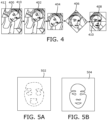
- FIG. 4 depicts standardizing a facial image 400 comprising representation of a face 410 and non-skin information 412, in accordance with an embodiment.
- a surrounding area of a face 402 in the facial image 400 is cropped to obtain a cropped facial image 404.
- An angle of orientation of the face 402 in the facial image 400 is estimated and correction is performed to obtain a corrected rotation of the face in the facial image 406.
- the facial image, wherein the rotation of the face is corrected 406 is aligned to be in the centre to obtain a correction of a position of the face relative to the facial image 408. As depicted in FIG.
- coordinates of the facial keypoints 410 are used to ensure the face is geometrically aligned, such that the head rotation and inclines are automatically estimated and corrected, the face position is centred in the facial image and finally the background non-skin information is eliminated to obtain the standardized image 406.
- FIG. 5A and FIG. 5B depict preparing a masked facial image by separating one or more areas comprising skin-pixels and one or more areas comprising pixels related to non-skin information, in accordance with an embodiment.
- a mask is applied to a standardized image to build a mask of skin pixels 502 and one or more areas comprising skin-pixels and one or more areas comprises pixels related to non-skin information are separated.
- the separation is performed by at least one of: evaluation of color dependencies and distributions and facial keypoints-based areas definition in image or by a convolutional neural network configured to segment skin pixels and a masked facial image 504 is obtained as an end result.
- the separation of one or more areas comprising skin-pixels and one or more areas comprises pixels related to non-skin information allows to separate all irrelevant pixels, which correspond to hairs, eyebrows, deep shadows and other non-skin defects.
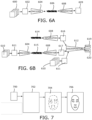
- FIG. 6A depicts a systematic process flow diagram illustrating generating a synthetic image comprising photo-realistic skin patterns, in accordance with an embodiment and process of its training.
- a real skin crop 602 from among a plurality of skin crops 600 is fed into an encoder 604 for generating an encoded crop representation 606 in a latent space.
- the encoded crop 606 is fed into a generator 608 for generating a reconstructed skin crop 609.
- FIG. 6B an example of the training process: A real skin crop 611 from among a plurality of skin crops 610 processed by encoding network 604 to generate skin representation 615.
- Generator 608 processed random noise vectors 614 and latent skin representation 615 to obtain the images 616 random generated skin image and a reconstructed skin crop 617.
- Discriminator network 612 comprising images 616, 617 and a real skin crop 611 from subset 610 to divide then into group 619 every non real skin crop's included reconstructed 617 and randomly generated 616 and group of real skin crop's 620 included all subset from 610.
- FIG. 7 depicts a systematic process flow diagram of generating an anonymized skin atlas from photo realistic skin patterns, in accordance with an embodiment.
- the skin crops 700 comprising photo realistic skin patterns are subjected to sampling to generate a skin pattern 702 with an initial photo shape.
- the skin pattern 702 is subjected to frequency domain equalisation transform 704 to go through the corners of the skin mask, where the skin part of face is concatenated with the generated skin patterns and smoothly change frequency response of skin pattern to softly cover sharp concatenation points to generate an anonymized facial skin atlas 706.
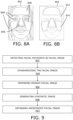
- FIG. 8A and FIG. 8B depict exemplary standardized facial images converted into anonymized facial images using the method and system of the present disclosure, in accordance with an embodiment.
- an exemplary standardized facial image 802 comprising areas comprising skin-pixels 806 (i.e., forehead, nose, cheeks) and areas comprising pixels related to non-skin information 808 (i.e., eyebrows, eyes, hair) is converted into an anonymized facial image 804 shown in FIG. 8B , wherein areas comprising skin-pixels 806 and areas comprising pixels related to non-skin information 808 of the standardized facial image 802 are separated.
- a masked facial image 812 is concatenated with synthetic photo-realistic skin patterns 810.
- FIG. 9A illustrates a flowchart listing steps involved in a method for anonymizing a facial image, in accordance with an embodiment of the present disclosure.
- one or more sets of facial keypoints are detected in the facial image.
- the facial image is standardized.
- a masked facial image is prepared by separating one or more areas comprising skin-pixels and one or more areas comprising pixels related to non-skin information.
- a synthetic image comprising photo-realistic skin patterns is generated.
- an anonymized facial image is obtained by concatenating the masked facial image with generated photo-realistic skin patterns.
Landscapes
- Engineering & Computer Science (AREA)
- Physics & Mathematics (AREA)
- Theoretical Computer Science (AREA)
- General Physics & Mathematics (AREA)
- Multimedia (AREA)
- Artificial Intelligence (AREA)
- Evolutionary Computation (AREA)
- Health & Medical Sciences (AREA)
- General Health & Medical Sciences (AREA)
- Data Mining & Analysis (AREA)
- General Engineering & Computer Science (AREA)
- Computational Linguistics (AREA)
- Biomedical Technology (AREA)
- Life Sciences & Earth Sciences (AREA)
- Molecular Biology (AREA)
- Computing Systems (AREA)
- Biophysics (AREA)
- Mathematical Physics (AREA)
- Software Systems (AREA)
- Oral & Maxillofacial Surgery (AREA)
- Human Computer Interaction (AREA)
- Computer Vision & Pattern Recognition (AREA)
- Image Analysis (AREA)
- Image Processing (AREA)
Claims (15)
- Computerimplementiertes Verfahren zum Anonymisieren eines Gesichtsbildes (204), wobei das Verfahren umfasst:- Erkennen eines oder mehrerer Sätze von Gesichtsschlüsselpunkten (302, 308, 410) im Gesichtsbild (304, 802) zum Bestimmen eines oder mehrerer Bereiche, die Hautpixel (806) umfassen, und eines oder mehrerer Bereiche, die Pixel umfassen, die sich auf Nichthaut-Informationen (808) beziehen;- Berechnen von Parametern des Gesichtsbildes (304, 802) und Standardisieren des Gesichtsbildes;- Erstellen eines maskierten Gesichtsbildes (504, 812) durch Trennen des bestimmten einen oder der bestimmten mehreren Bereiche, die Hautpixel (806) umfassen, und des einen oder der mehreren Bereiche, die Pixel umfassen, die sich nicht auf Nichthaut-Informationen (808) beziehen, und gekennzeichnet durch:- Erzeugen eines synthetischen Bildes, das fotorealistische Hautmuster umfasst, durch Synthetisieren eines Hautmusterhintergrunds, um den getrennten einen oder die getrennten mehrere Bereiche zu füllen, die Pixel umfassen, die sich auf Nichthaut-Informationen (808) des Gesichtsbildes beziehen; und- Erhalten eines anonymisierten Gesichtsbildes (804) durch Verketten des maskierten Gesichtsbildes (504, 812) mit dem erzeugten synthetischen Bild, das fotorealistische Hautmuster umfasst, zum Füllen des getrennten einen oder der getrennten mehreren Bereiche, die Pixel umfassen, die sich auf Nichthaut-Informationen (808) beziehen.
- Verfahren nach Anspruch 1, wobei Erkennen des einen oder der mehreren Sätze von Gesichtsschlüsselpunkten (302, 308, 410) unter Verwendung eines oder mehrerer vorab trainierter neuronaler Netzwerkmodelle und eines oder mehrerer dreidimensionaler Gesichtsausrichtungsmodelle durchgeführt wird.
- Verfahren nach Anspruch 1 oder 2, wobei Standardisieren der Gesichtsbilder mindestens eines umfasst aus: Korrigieren einer Farbverteilung und eines Tons, Korrigieren einer Beleuchtung, Zuschneiden des umgebenden Bereichs eines Gesichts (402) im Gesichtsbild (400), Korrigieren einer Drehung des Gesichts im Gesichtsbild, Korrigieren einer Position des Gesichts relativ zum Gesichtsbild, Korrigieren einer Auflösung des Gesichtsbildes.
- Verfahren nach Anspruch 1 oder 2, wobei Standardisieren der Gesichtsbilder weiter Korrigieren der Beleuchtung umfasst, was durch Erkennen eines Farbbereichs in mindestens einem erkannten Gesichtsschlüsselpunkt (302, 308, 410) mit einem Farbclusteralgorithmus durchgeführt wird, wobei die Farbe aus einer Farbpalette übernommen wird oder von einem Laborfarbchip übernommen wird.
- Verfahren nach einem der vorstehenden Ansprüche, wobei Trennen eines oder mehrerer Bereiche, die Hautpixel (806) umfassen, und eines oder mehrerer Bereiche, die Pixel umfassen, die sich auf Nichthaut-Informationen (808) beziehen, durch mindestens eines durchgeführt wird aus: Auswertung von Farbabhängigkeiten und - verteilungen im Bild oder durch ein Convolutional Neural Network, das zum Segmentieren von Hautpixeln konfiguriert ist.
- Verfahren nach Anspruch 5, wobei das eine oder die mehreren Convolutional-Neural-Network-Modelle anhand eines oder mehrerer Phänotyp-Datensätze trainiert werden, die Bilder umfassen, die Hautbereiche darstellen.
- Verfahren nach einem der vorstehenden Ansprüche, wobei Trennen durch Verwendung einer Segmentierung, die auf dem erkannten einen oder den erkannten mehreren Sätzen von Gesichtsschlüsselpunkten (302, 308, 410) aufgebaut ist, durch Morphologie-Segmentierung oder durch auf Gabor-Filterung basierende Segmentierung durchgeführt wird.
- Verfahren nach Anspruch 1, wobei Erzeugen der fotorealistischen Hautmuster das Durchführen einer Hautbildkomprimierung zu einer latenten Raumdarstellung durch ein oder mehrere neuronale Netzwerke oder Rechenverfahren zur Dimensionsreduzierung umfasst.
- Verfahren nach Anspruch 8, wobei Durchführen einer Hautbildkomprimierung zu einer latenten Raumdarstellung weiter Durchführen einer Suche nach fotorealistischen hautmusterbezogenen Dimensionen durch ein oder mehrere neuronale Netzwerke oder durch ein Rechenverfahren umfasst, das aus einer Gruppe von unüberwachten maschinellen Lernverfahren ausgewählt ist, die Clusterung, unüberwachte neuronale Netzwerke, Hauptkomponentenanalyse, Analyse unabhängiger Komponenten und Singulärwertzerlegung umfasst.
- Verfahren nach einem der vorstehenden Ansprüche, wobei Erzeugen des synthetischen Bildes fotorealistischer Hautmuster durch Verwendung eines oder mehrerer Inpainting-Algorithmen durchgeführt wird, die aus einer Gruppe ausgewählt sind, die einen Hautmustergenerator und eine Auswahl einer festen Hintergrundfarbe umfasst.
- Verfahren nach Anspruch 1, wobei Verketten Kombinieren eines maskierten Gesichtsbildes (504, 812) mit dem synthetischen Bild durch ein oder mehrere Rechenverfahren zum Füllen eines oder mehrerer Bereiche auf dem maskierten Gesichtsbild (504, 812), die Pixel umfassen, die sich auf Nichthaut-Informationen beziehen, mit erzeugten fotorealistischen Hautmustern aus einem synthetischen Bild umfasst.
- Verfahren nach Anspruch 11, wobei Verketten weiter eine Kanteneffektreduzierung zwischen Bereichen aus dem maskierten Gesichtsbild (504, 812) und Bereichen aus dem synthetischen Bild auf dem anonymisierten Gesichtsbild (804) durch ein oder mehrere Rechenverfahren umfasst.
- System (100) zum Anonymisieren eines Gesichtsbildes, wobei das System einen Speicher (102) und einen Prozessor (104) umfasst, der konfiguriert ist, um das Verfahren nach einem der Ansprüche 1-12 durchzuführen, wobei- der Speicher (102) konfiguriert ist, um einen Satz von Modulen zum Anonymisieren des Gesichtsbildes zu speichern;- der Prozessor (104) konfiguriert ist, um den Satz von Modulen auszuführen, wobei der Satz von Modulen umfasst:- ein Erkennungsmodul (106), das konfiguriert ist, um einen oder mehrere Sätze von Gesichtsschlüsselpunkten (302, 308, 410) im Gesichtsbild zu erkennen, um den einen oder die mehreren Bereiche, die Hautpixel (806) umfassen, und einen oder mehrere Bereiche, die Pixel umfassen, die sich auf Nichthaut-Informationen (808) beziehen, zu bestimmen;- ein Standardisierungsmodul (108), das konfiguriert ist, um Parameter des Gesichtsbildes zu berechnen und das Gesichtsbild zu standardisieren;- ein Segmentierungsmodul (110), das konfiguriert ist, um aus dem Gesichtsbild den bestimmten einen oder die bestimmten mehreren Bereiche, die Nichthaut-Pixel umfassen, zu trennen, um ein maskiertes Gesichtsbild (504, 812) vorzubereiten, und gekennzeichnet durch:- ein Hautmustererzeugungsmodul (112), das konfiguriert ist, um das synthetische Bild mit fotorealistischen Hautmustern zu erzeugen, indem es einen Hautmusterhintergrund synthetisiert, um den getrennten einen oder die getrennten mehreren Bereiche zu füllen, die Pixel umfassen, die sich auf Nichthaut-Informationen (808) des Gesichtsbildes beziehen; und- ein Anonymisierungsmodul (114), das konfiguriert ist, um das synthetische Bild, das fotorealistische Hautmuster umfasst, mit dem maskierten Gesichtsbild (504, 812) zu verketten, um den getrennten einen oder die getrennten mehreren Bereiche zu füllen, die Pixel umfassen, die sich auf Nichthaut-Informationen (808) beziehen.
- System nach Anspruch 13, wobei das System weiter eine oder mehrere Anwendungsprogrammierschnittstellen umfasst, die zum Ausführen einer Sammlung zu analysierender Gesichtsbilder; zum Ausführen einer Analyse der anonymisierten Gesichtsbilder (804) konfiguriert sind.
- Computerprogramm zum Anonymisieren eines Gesichtsbildes, das Anweisungen umfasst, die dazu angepasst sind, das Verfahren nach einem der Ansprüche 1-12 durchführen, wenn das Computerprogramm von dem System ausgeführt wird, das den Prozessor umfasst.
Priority Applications (4)
| Application Number | Priority Date | Filing Date | Title |
|---|---|---|---|
| ES21168284T ES3034281T3 (en) | 2021-04-14 | 2021-04-14 | Method and system for anonymizing facial images |
| EP21168284.4A EP4075385B1 (de) | 2021-04-14 | 2021-04-14 | Verfahren und system zur anonymisierung von gesichtsbildern |
| US17/477,397 US12039768B2 (en) | 2021-04-14 | 2021-09-16 | Method and system for anonymizing facial images |
| US18/743,093 US20240331344A1 (en) | 2021-04-14 | 2024-06-13 | Method and system for anonymizing facial images |
Applications Claiming Priority (1)
| Application Number | Priority Date | Filing Date | Title |
|---|---|---|---|
| EP21168284.4A EP4075385B1 (de) | 2021-04-14 | 2021-04-14 | Verfahren und system zur anonymisierung von gesichtsbildern |
Publications (3)
| Publication Number | Publication Date |
|---|---|
| EP4075385A1 EP4075385A1 (de) | 2022-10-19 |
| EP4075385B1 true EP4075385B1 (de) | 2025-06-11 |
| EP4075385C0 EP4075385C0 (de) | 2025-06-11 |
Family
ID=75529827
Family Applications (1)
| Application Number | Title | Priority Date | Filing Date |
|---|---|---|---|
| EP21168284.4A Active EP4075385B1 (de) | 2021-04-14 | 2021-04-14 | Verfahren und system zur anonymisierung von gesichtsbildern |
Country Status (3)
| Country | Link |
|---|---|
| US (2) | US12039768B2 (de) |
| EP (1) | EP4075385B1 (de) |
| ES (1) | ES3034281T3 (de) |
Families Citing this family (4)
| Publication number | Priority date | Publication date | Assignee | Title |
|---|---|---|---|---|
| EP4358025A4 (de) * | 2021-10-22 | 2024-11-06 | Samsung Electronics Co., Ltd. | Elektronische vorrichtung für echtzeitsystem zur menschlichen detektion und verfolgung sowie steuerungsverfahren dafür |
| KR20230134226A (ko) * | 2022-03-14 | 2023-09-21 | 한국과학기술원 | 염색된 모발 이미지 시각화 방법 및 시스템 |
| US11967003B2 (en) * | 2022-05-21 | 2024-04-23 | Kyocera Document Solutions Inc. | Adaptive color selection |
| CN119808160B (zh) * | 2025-03-07 | 2025-05-16 | 中国人民解放军国防科技大学 | 针对人物图像数据的多选择全身匿名化方法、装置及设备 |
Family Cites Families (4)
| Publication number | Priority date | Publication date | Assignee | Title |
|---|---|---|---|---|
| US8218862B2 (en) * | 2008-02-01 | 2012-07-10 | Canfield Scientific, Incorporated | Automatic mask design and registration and feature detection for computer-aided skin analysis |
| EP3451209B1 (de) * | 2017-08-31 | 2020-08-12 | Nokia Technologies Oy | Vorrichtung und verfahren zur anonymiierung von bildinhalt |
| CN114502061B (zh) * | 2018-12-04 | 2024-05-28 | 巴黎欧莱雅 | 使用深度学习的基于图像的自动皮肤诊断 |
| JP7341310B2 (ja) * | 2019-07-10 | 2023-09-08 | ジャン・ルオウェイ | 皮膚分析のための画像処理、皮膚分析を視覚化するためのシステム及び方法 |
-
2021
- 2021-04-14 ES ES21168284T patent/ES3034281T3/es active Active
- 2021-04-14 EP EP21168284.4A patent/EP4075385B1/de active Active
- 2021-09-16 US US17/477,397 patent/US12039768B2/en active Active
-
2024
- 2024-06-13 US US18/743,093 patent/US20240331344A1/en active Pending
Also Published As
| Publication number | Publication date |
|---|---|
| US12039768B2 (en) | 2024-07-16 |
| US20220335252A1 (en) | 2022-10-20 |
| US20240331344A1 (en) | 2024-10-03 |
| EP4075385A1 (de) | 2022-10-19 |
| EP4075385C0 (de) | 2025-06-11 |
| ES3034281T3 (en) | 2025-08-14 |
Similar Documents
| Publication | Publication Date | Title |
|---|---|---|
| EP4075385B1 (de) | Verfahren und system zur anonymisierung von gesichtsbildern | |
| KR102339915B1 (ko) | 셀피를 촬영하도록 사용자를 안내하기 위한 시스템 및 방법 | |
| US11775056B2 (en) | System and method using machine learning for iris tracking, measurement, and simulation | |
| Dibeklioğlu et al. | Combining facial dynamics with appearance for age estimation | |
| CN111539912B (zh) | 基于人脸结构定位的健康指标评估方法、设备和存储介质 | |
| KR101683712B1 (ko) | 트레이스 변환을 이용한 홍채 및 눈 인식 시스템 | |
| Ferrara et al. | Face image conformance to iso/icao standards in machine readable travel documents | |
| KR102356465B1 (ko) | 사용자 얼굴 피부 분석 방법 및 서버 | |
| CN117788407A (zh) | 基于人工神经网络的青光眼图像特征提取的训练方法 | |
| Vrânceanu et al. | Gaze direction estimation by component separation for recognition of eye accessing cues | |
| CN120164246B (zh) | 一种基于跨年龄特征下的人脸识别方法及系统 | |
| Merkle et al. | State of the art of quality assessment of facial images | |
| US20240265533A1 (en) | Computer-based body part analysis methods and systems | |
| CN117036330A (zh) | 基于视觉识别的心理状态检测方法、系统、介质及设备 | |
| US12475737B2 (en) | Image analysis system for forensic facial comparison | |
| Shah | Automatic Analysis and Recognition of Facial Expressions Invariant to Illumination | |
| Varghaei et al. | Automated Assessment of Aesthetic Outcomes in Facial Plastic Surgery | |
| CN118120023A (zh) | 基于利用深度学习的图像分析的皮肤诊断系统以及方法 | |
| Kaymak | Real-time appearance-based gaze tracking. | |
| Cash | Using Domain-Specific Information in Image Processing Applied Mathematics Scientific Computing (AMSC) | |
| Bandrabur et al. | Automatic robust localization of eye related landmarks | |
| Basnet | Automated Quality Assessment of Printed Objects Using Subjective and Objective Methods Based on Imaging and Machine Learning Techniques | |
| Sawhney et al. | High detection ratio for face and smile detection by enhanced adaboost | |
| Mayer et al. | Learning displacement experts from multi-band images for face model fitting | |
| HK40017783B (en) | System and method for guiding a user to take a selfie |
Legal Events
| Date | Code | Title | Description |
|---|---|---|---|
| PUAI | Public reference made under article 153(3) epc to a published international application that has entered the european phase |
Free format text: ORIGINAL CODE: 0009012 |
|
| STAA | Information on the status of an ep patent application or granted ep patent |
Free format text: STATUS: REQUEST FOR EXAMINATION WAS MADE |
|
| 17P | Request for examination filed |
Effective date: 20220530 |
|
| AK | Designated contracting states |
Kind code of ref document: A1 Designated state(s): AL AT BE BG CH CY CZ DE DK EE ES FI FR GB GR HR HU IE IS IT LI LT LU LV MC MK MT NL NO PL PT RO RS SE SI SK SM TR |
|
| GRAP | Despatch of communication of intention to grant a patent |
Free format text: ORIGINAL CODE: EPIDOSNIGR1 |
|
| STAA | Information on the status of an ep patent application or granted ep patent |
Free format text: STATUS: GRANT OF PATENT IS INTENDED |
|
| INTG | Intention to grant announced |
Effective date: 20241115 |
|
| RAP3 | Party data changed (applicant data changed or rights of an application transferred) |
Owner name: HAUTAI OUE |
|
| GRAJ | Information related to disapproval of communication of intention to grant by the applicant or resumption of examination proceedings by the epo deleted |
Free format text: ORIGINAL CODE: EPIDOSDIGR1 |
|
| STAA | Information on the status of an ep patent application or granted ep patent |
Free format text: STATUS: REQUEST FOR EXAMINATION WAS MADE |
|
| GRAP | Despatch of communication of intention to grant a patent |
Free format text: ORIGINAL CODE: EPIDOSNIGR1 |
|
| STAA | Information on the status of an ep patent application or granted ep patent |
Free format text: STATUS: GRANT OF PATENT IS INTENDED |
|
| INTC | Intention to grant announced (deleted) | ||
| INTG | Intention to grant announced |
Effective date: 20250319 |
|
| GRAS | Grant fee paid |
Free format text: ORIGINAL CODE: EPIDOSNIGR3 |
|
| GRAA | (expected) grant |
Free format text: ORIGINAL CODE: 0009210 |
|
| STAA | Information on the status of an ep patent application or granted ep patent |
Free format text: STATUS: THE PATENT HAS BEEN GRANTED |
|
| AK | Designated contracting states |
Kind code of ref document: B1 Designated state(s): AL AT BE BG CH CY CZ DE DK EE ES FI FR GB GR HR HU IE IS IT LI LT LU LV MC MK MT NL NO PL PT RO RS SE SI SK SM TR |
|
| REG | Reference to a national code |
Ref country code: GB Ref legal event code: FG4D |
|
| REG | Reference to a national code |
Ref country code: CH Ref legal event code: EP |
|
| REG | Reference to a national code |
Ref country code: DE Ref legal event code: R096 Ref document number: 602021032003 Country of ref document: DE |
|
| REG | Reference to a national code |
Ref country code: IE Ref legal event code: FG4D |
|
| U01 | Request for unitary effect filed |
Effective date: 20250627 |
|
| U07 | Unitary effect registered |
Designated state(s): AT BE BG DE DK EE FI FR IT LT LU LV MT NL PT RO SE SI Effective date: 20250704 |
|
| REG | Reference to a national code |
Ref country code: ES Ref legal event code: FG2A Ref document number: 3034281 Country of ref document: ES Kind code of ref document: T3 Effective date: 20250814 |
|
| PG25 | Lapsed in a contracting state [announced via postgrant information from national office to epo] |
Ref country code: NO Free format text: LAPSE BECAUSE OF FAILURE TO SUBMIT A TRANSLATION OF THE DESCRIPTION OR TO PAY THE FEE WITHIN THE PRESCRIBED TIME-LIMIT Effective date: 20250911 Ref country code: GR Free format text: LAPSE BECAUSE OF FAILURE TO SUBMIT A TRANSLATION OF THE DESCRIPTION OR TO PAY THE FEE WITHIN THE PRESCRIBED TIME-LIMIT Effective date: 20250912 |
|
| PG25 | Lapsed in a contracting state [announced via postgrant information from national office to epo] |
Ref country code: HR Free format text: LAPSE BECAUSE OF FAILURE TO SUBMIT A TRANSLATION OF THE DESCRIPTION OR TO PAY THE FEE WITHIN THE PRESCRIBED TIME-LIMIT Effective date: 20250611 |
|
| PG25 | Lapsed in a contracting state [announced via postgrant information from national office to epo] |
Ref country code: RS Free format text: LAPSE BECAUSE OF FAILURE TO SUBMIT A TRANSLATION OF THE DESCRIPTION OR TO PAY THE FEE WITHIN THE PRESCRIBED TIME-LIMIT Effective date: 20250911 |