EP4075382B1 - Verfahren zum trainieren eines neuronalen netzes zur bereitstellung der sucherpunkte von objekten unter verwendung von paaren von bildern unter verschiedenen gesichtspunkten - Google Patents
Verfahren zum trainieren eines neuronalen netzes zur bereitstellung der sucherpunkte von objekten unter verwendung von paaren von bildern unter verschiedenen gesichtspunkten Download PDFInfo
- Publication number
- EP4075382B1 EP4075382B1 EP21167942.8A EP21167942A EP4075382B1 EP 4075382 B1 EP4075382 B1 EP 4075382B1 EP 21167942 A EP21167942 A EP 21167942A EP 4075382 B1 EP4075382 B1 EP 4075382B1
- Authority
- EP
- European Patent Office
- Prior art keywords
- neural network
- image
- viewpoint
- training
- images
- Prior art date
- Legal status (The legal status is an assumption and is not a legal conclusion. Google has not performed a legal analysis and makes no representation as to the accuracy of the status listed.)
- Active
Links
Images


Classifications
-
- G—PHYSICS
- G06—COMPUTING OR CALCULATING; COUNTING
- G06T—IMAGE DATA PROCESSING OR GENERATION, IN GENERAL
- G06T3/00—Geometric image transformations in the plane of the image
- G06T3/14—Transformations for image registration, e.g. adjusting or mapping for alignment of images
- G06T3/147—Transformations for image registration, e.g. adjusting or mapping for alignment of images using affine transformations
-
- G—PHYSICS
- G06—COMPUTING OR CALCULATING; COUNTING
- G06T—IMAGE DATA PROCESSING OR GENERATION, IN GENERAL
- G06T7/00—Image analysis
- G06T7/70—Determining position or orientation of objects or cameras
-
- G—PHYSICS
- G06—COMPUTING OR CALCULATING; COUNTING
- G06N—COMPUTING ARRANGEMENTS BASED ON SPECIFIC COMPUTATIONAL MODELS
- G06N3/00—Computing arrangements based on biological models
- G06N3/02—Neural networks
- G06N3/04—Architecture, e.g. interconnection topology
- G06N3/045—Combinations of networks
-
- G—PHYSICS
- G06—COMPUTING OR CALCULATING; COUNTING
- G06N—COMPUTING ARRANGEMENTS BASED ON SPECIFIC COMPUTATIONAL MODELS
- G06N3/00—Computing arrangements based on biological models
- G06N3/02—Neural networks
- G06N3/04—Architecture, e.g. interconnection topology
- G06N3/045—Combinations of networks
- G06N3/0455—Auto-encoder networks; Encoder-decoder networks
-
- G—PHYSICS
- G06—COMPUTING OR CALCULATING; COUNTING
- G06N—COMPUTING ARRANGEMENTS BASED ON SPECIFIC COMPUTATIONAL MODELS
- G06N3/00—Computing arrangements based on biological models
- G06N3/02—Neural networks
- G06N3/04—Architecture, e.g. interconnection topology
- G06N3/0464—Convolutional networks [CNN, ConvNet]
-
- G—PHYSICS
- G06—COMPUTING OR CALCULATING; COUNTING
- G06N—COMPUTING ARRANGEMENTS BASED ON SPECIFIC COMPUTATIONAL MODELS
- G06N3/00—Computing arrangements based on biological models
- G06N3/02—Neural networks
- G06N3/04—Architecture, e.g. interconnection topology
- G06N3/0475—Generative networks
-
- G—PHYSICS
- G06—COMPUTING OR CALCULATING; COUNTING
- G06N—COMPUTING ARRANGEMENTS BASED ON SPECIFIC COMPUTATIONAL MODELS
- G06N3/00—Computing arrangements based on biological models
- G06N3/02—Neural networks
- G06N3/08—Learning methods
- G06N3/0895—Weakly supervised learning, e.g. semi-supervised or self-supervised learning
-
- G—PHYSICS
- G06—COMPUTING OR CALCULATING; COUNTING
- G06T—IMAGE DATA PROCESSING OR GENERATION, IN GENERAL
- G06T15/00—Three-dimensional [3D] image rendering
- G06T15/06—Ray-tracing
-
- G—PHYSICS
- G06—COMPUTING OR CALCULATING; COUNTING
- G06T—IMAGE DATA PROCESSING OR GENERATION, IN GENERAL
- G06T2207/00—Indexing scheme for image analysis or image enhancement
- G06T2207/20—Special algorithmic details
- G06T2207/20081—Training; Learning
-
- G—PHYSICS
- G06—COMPUTING OR CALCULATING; COUNTING
- G06T—IMAGE DATA PROCESSING OR GENERATION, IN GENERAL
- G06T2207/00—Indexing scheme for image analysis or image enhancement
- G06T2207/20—Special algorithmic details
- G06T2207/20084—Artificial neural networks [ANN]
-
- G—PHYSICS
- G06—COMPUTING OR CALCULATING; COUNTING
- G06T—IMAGE DATA PROCESSING OR GENERATION, IN GENERAL
- G06T2207/00—Indexing scheme for image analysis or image enhancement
- G06T2207/30—Subject of image; Context of image processing
- G06T2207/30248—Vehicle exterior or interior
- G06T2207/30252—Vehicle exterior; Vicinity of vehicle
Definitions
- the present disclosure is related to the field of data processing using neural networks, for example image processing using neural networks. More precisely, the present disclosure relates to neural networks able to detect viewpoints of objects visible on images.
- 6D pose is an expression well known to the person skilled in the art which designates the combination of the three-dimensional position and of the three-dimensional orientation of an object. Obtaining the 6D pose is particularly useful in the field of robotics wherein objects are detected and manipulated. It is also useful to determine the orientation of an object in a driving scene to as to allow autonomous or partially autonomous driving.
- the viewpoint of an object visible on an image is one such information relative to the 6D pose which is desirable.
- the viewpoint can be defined as the azimuth, the elevation, and the in-plane rotation of an object relative to the camera used to acquire the image.
- Neural networks have also been used to determine automatically the viewpoint of an object visible on an image.
- Object viewpoint estimation is one of the key components required to enable autonomous systems to understand the 3D world.
- Known methods in controlled environments have been observed to be successful to detect the viewpoints of objects. These known methods benefit from modern learnable representations and have been shown to help other vision tasks such as object detection and 3D reconstruction, and have been used in various applications.
- artificial neural networks neural networks hereinafter have been used to detect viewpoints.
- a training phase of the neural network has to be performed.
- This training phase is usually performed using a labelled set of training images.
- labelled what is meant is that the viewpoint of an object of interest is provided for each image of the set of training images; the provided viewpoint is called the ground truth.
- Training then consists in inputting the images from the training set to the neural network, comparing the output of the neural network with the corresponding ground truth, and adapting the parameters of the neural network on the basis of this comparison (for example using the well-known stochastic gradient method).
- the above methods can be designated as supervised methods. These have been extensively studied, with applications in the fields of robotics or autonomous driving. These methods can successfully deliver 3D bounding boxes surrounding detected objects.
- 3D-aware representations There also exist methods which learn representations that are aware of the underlying 3D structure of objects from images (“3D-aware representations”). It has been proposed to disentangle the pose of an object from its appearance, with or without pose supervision (see for example document “ Interpretable transformations with encoder-decoder networks” (Daniel E Worrall, Stephan J Garbin, Daniyar Turmukhambetov, and Gabriel J Brostow. In Proceedings of the IEEE International Conference on Computer Vision, pages 5726-5735, 2017 ) or document “ Deep Convolutional Inverse Graphics Network” (Tejas D Kulkarni, William F Whitney, Pushmeet Kohli, and Josh Tenenbaum. In Advances in neural information processing systems, pages 2539-2547, 2015 ). Various solutions have been proposed. However, these still require 3D annotations in order to learn meaningful embedding. In fact, 3D rotations have been observed to cause drastic appearance changes that are too complex for networks to learn without annotations.
- the present disclosure overcomes one or more deficiencies of the prior art by proposing a method (for example performed by a computer system) for training a first neural network to detect the viewpoint of an object visible on an image, centered (i.e. centered in this image), and belonging to a given category of object when this image is inputted to the first neural network, comprising:
- the first neural network is configured to deliver a plurality of viewpoint hypothesis, and the viewpoint hypothesis associated with the smallest distance is used for adapting said parameters.
- the objects are centered.
- the images can the result of a cropping of another image on which the object has been detected and surrounded by a bounding box. This bounding box may also have been placed manually.
- the synthetic images will show objects centered as they will try, through the training, to reproduce first images.
- the portion of the first image can be the result of applying a segmentation mask on the first image, wherein the segmentation mask, when applied, only keeps pixels of the object. This allows obtaining synthetic images with no background and a training which does not take the background of the first image into account. Determining the viewpoint will not be affected by the presence of a background once the training is complete.
- the entire first image can be used when minimizing the distance.
- This alternative can be used when the images of the dataset have been rendered from CAD images. Determining the viewpoint of objects placed at the center of an image having a background may still be achievable in this case.
- the first neural network operates on images centered on objects, for example images outputted by an object detector which places bounding boxes surrounding detected objects (the images may be cropped according to the bounding box).
- the method therefore proposes a fully unsupervised training method.
- the dataset (which may also be referred to as a training dataset) can be an unlabeled dataset.
- the viewpoints of the objects visible on the images from this dataset are not known.
- Training of the first neural network can however be performed under the condition that each pair of images shows the same object (for the pair, different pairs can show different objects) but under different viewpoints.
- the viewpoint detection is accurate, then the image outputted by the third neural network will be as close as possible to the original first image.
- the training will then strive to reduce the distance between the two images.
- the first, the second, and the third neural network output random information, and subsequent iterations of training will force the output of the first neural network to be a viewpoint, the output of the second neural network to include appearance information, and the output of the third neural network to be an image as explained above.
- the person skilled in the art will be able to select the dimensions of the layers of each of these so as to accommodate a viewpoint, appearance information (the size should be large enough to include the shape, the color, etc.), and an image of the same size as the images of the training dataset.
- the first neural network is the actual neural network which will be used at testing time (to detect the viewpoints of objects), but that the two other neural networks (the second and the third neural networks) are to be used during the training phase as well as trained during the training phase.
- This method may be implemented on a computing system, for example to perform the training automatically.
- viewpoint means viewpoint with respect to the camera used to acquire the image on which the object is visible.
- the category of an object can be referred to as the type or the class of an object, in a manner which is usually done by the person skilled in the art in the field of object detection or semantic segmentation.
- the category can be selected in a list of categories of objects typically present in a scene observed on a street.
- the categories can be chosen in the list comprising car, pedestrian, cyclist, bus, truck, etc. Categories may also be defined more precisely (for example, for cars, it is possible to consider sedans, compact cars, etc.).
- the object in the above method is a car and a pair of images will include two different images of the same car seen under different viewing angles.
- the images inputted to the first neural network are centered on the object for which the viewpoint is to be determined. These images can be outputted by an object detector in a preliminary step of the method (this is also true for images of the training dataset).
- Jointly training the neural networks can be performed iteratively.
- each iteration can comprise inputting a first image of a pair to the first neural network and the second image of this pair to the second neural network, and calculating said distance.
- the stochastic gradient descent may be used or any other suitable training algorithm or variant of the stochastic gradient descent.
- the stochastic gradient descent can be used to adapt the parameters of the first neural network, the second neural network, and the third neural network in a manner known in itself. These parameters are, for example the weights of these neural networks.
- Minimizing the distance comprises calculating a loss to be minimized, and, for example, back-propagating this loss through the first neural network, the second neural network, and the third neural network.
- the first neural network has to be able to receive images having a given resolution as input with a depth of 3 (if it receives RGB images), and it also has to output a representation of a viewpoint (for example at least three numbers for representing the viewpoint (azimuth, elevation, in-plane rotation), or the coordinate of a point on a unit sphere), and this corresponds to given numbers of neurons for the first layer and for the final layer of this first neural network.
- a viewpoint for example at least three numbers for representing the viewpoint (azimuth, elevation, in-plane rotation), or the coordinate of a point on a unit sphere
- the second neural network has to be able to receive images having a given resolution as input with a depth of 3 (if it receives RGB images). It also has to be able to output appearance information of an object visible on the image, and this corresponds to given numbers of neurons for the first layer of the second neural network and the final layer of the second neural network.
- the dimensions of this appearance information can be found in a calibration step.
- the appearance information should contain enough information so that an image of the object can be elaborated under any viewpoint. If the object is a car, the appearance information should contain enough information so that the shape and the color of the car can be included.
- the appearance information can be in a coded form. This could be the case if the second neural network has the structure of an encoder which could be used in an auto-encoder configured to process images. In an auto-encoder, the output of the encoder contains enough information in a coded manner to retrieve the original image.
- the third neural network if configured to deliver images, for examples images having the same resolution as the images inputted to the first and second neural network. This indicates the number of neurons of the final layer of this third neural network.
- This third neural network may also be configured to be able to receive, at any point in its structure, appearance information and a viewpoint.
- the person skilled in the art will also know how to determine the distance between two images, for example the distance between the output of the third neural network and the second image.
- the above method may be able to determine automatically the viewpoints of objects from the given category, or objects from a plurality of categories.
- the images used in the above method only show one object of this plurality of category per image.
- a known difficulty in the field of viewpoint estimation is how to deal with symmetrical objects, and known methods often produce results which can be erroneous (at + or - ⁇ for the azimuth). It has been observed that having a first neural network able to deliver multiple hypotheses can overcome this difficulty. Back propagating gradients using the best hypothesis will then train the first neural network to produce better hypothesis.
- the distance is defined using the perceptual loss.
- the first neural network is further configured to be able to deliver an indicator configured to be able to indicate the best hypothesis.
- the weights of the first neural networks which participate to elaborating this indicator will be adapted during the training.
- the first neural network is further trained so as to deliver this indicator.
- the indicator allows using the neural network during the testing phase on symmetrical objects.
- the viewpoint designated by the indicator should be the viewpoint to be considered as the output of the first neural network during the testing phase.
- the third neural network uses object conditional generating process to use appearance information as input and/or to use the viewpoint as input.
- the object conditional generating process can be the one of document " Arbitrary style transfer in real-time with adaptive instance normalization" (Xun Huang and Serge Belongie. In Proceedings of the IEEE International Conference on Computer Vision, pages 1501-1510, 2017 ), in other words, it can be based on adaptive instance normalization (also called “AdaIN” by the person skilled in the art).
- Object conditional generating processes has been observed to ensure that the appearance of the object is in fact taken into account by the third neural network when it elaborates an image. Other methods (for example using a decoder from an auto-encoder) may ignore the contribution of the appearance, by not correctly factorizing the appearance. Because object conditional generating processes can adapt the generation process (i.e. of the image) at different scales, the possibility to ignore the appearance is mitigated.
- the viewpoint can be used in a later stage of the image generation process so as to ensure that it is taken into account to generate the image and so as to avoid a situation where the viewpoint information is overlooked.
- the third neural network is configured to further receive a generic code as input, and comprises a plurality of consecutive 3D convolutional layers configures to receive the generic code as input, wherein the output of each 3D convolutional layer is configured to be transformed by a given affine transformation using the appearance information used as input to the third neural network as a parameter so as to obtain a transformed output, and wherein the third neural network comprises a rendering module configured to receive as input the transformed output of the final 3D convolutional layer and the viewpoint used as input to the third neural network.
- the transformed output can be a volume, and this is a result of using 3D convolutional layers.
- the generic code can be, for example, a code chosen randomly (for example a random 1D vector having a size chosen empirically).
- the generic code will be affected meaning as it will encode an average object in a canonical pose.
- the generic code should be fixed during the entire training phase.
- the consecutive 3D convolutional layers can have a resolution which increases after each application of an affine transformation.
- the affine transformations implement the object conditional generative process.
- the viewpoint is taken into account in the final rendering step. This ensures that the back-propagation of gradients propagate to the first neural network, and guarantees that viewpoint errors cannot be compensated by convolutional layers.
- the rendering module includes a rotation module configured to perform a rotation on the transformed output received by the rendering module in accordance with the viewpoint used as input to the third neural network, and configured to output a rotated output,
- the above defined rendering module enforces geometric consistency during the generation process (the operation of the third neural network), between the above mentioned volume (the transformed output) and the final elaborated image.
- the ray-tracing module is configured to:
- the method further includes an additional training comprising at least:
- This specific embodiment ensures that the viewpoint is indeed taken into account during the training, and prevents correlations between images from having an impact.
- This embodiment uses the fact that the above method can generate images from random views, and improves the training of the first neural network is the training dataset is limited.
- This training can be iterative, and the iterations can be performed after the joint training has been performed or in a parallel manner.
- the invention further provides a neural network trained by the method as defined above as a first neural network.
- This neural network may be stored on an electronic support, for example in a non-volatile memory.
- the invention also provides a system for training a first neural network to detect the viewpoint of an object visible and centered on an image and belonging to a given category of object when this image is inputted to the first neural network, comprising:
- the first neural network is configured to deliver a plurality of viewpoint hypothesis, and the viewpoint hypothesis associated with the smallest distance is used for adapting said parameters.
- This system may be configured to perform any embodiment of the above defined method.
- the invention also provides a system as defined above as being the first one from the above training method, stored on a support, and a camera.
- the invention also provides a vehicle including this system.
- the steps of the method are determined by computer program instructions.
- the invention is also directed to a computer program for executing the steps of a method as described above when this program is executed by a computer.
- This program can use any programming language and take the form of source code, object code or a code intermediate between source code and object code, such as a partially compiled form, or any other desirable form.
- the invention is also directed to a computer-readable information medium containing instructions of a computer program as described above.
- the information medium can be any entity or device capable of storing the program.
- the medium can include storage means such as a ROM, for example a CD ROM or a microelectronic circuit ROM, or magnetic storage means, for example a diskette (floppy disk) or a hard disk.
- the information medium can be an integrated circuit in which the program is incorporated, the circuit being adapted to execute the method in question or to be used in its execution.
- the viewpoint of an object can be defined as the combination of the azimuth angle of the object with respect to a camera, the elevation of the object, and the in-plane rotation of the object (Euler angles).
- the viewpoint may also be defined as a rotation matrix R ⁇ SO 3 .
- Figure 1 is a schematic representation of a method for training a neural network so that this neural network can detect the viewpoint of objects visible on images which are inputted to this neural network.
- this neural network (as well as the corresponding function implemented by this neural network) is designated as f v .
- f v the first neural network.
- f v operates on the image space I to output viewpoints in the pose/viewpoints space V: f v : I ⁇ V. This operation is for objects having a given category of objects. Thus, f v performs the operation of object detection but outputs the viewpoint of the detected object.
- f a is configured to be able to receive an image as input and to output appearance information a of the object visible on an image processed by f a , while f v outputs viewpoints v .
- appearance information can include color, 3D shape, the texture, etc. Also, the appearance information can be presented in a coded form.
- a third neural network f d is provided.
- the third neural network is configured to be able to reconstruct a synthetic image I showing an object, given the viewpoint v of this object (which should be the viewpoint under which the object should be seen on the reconstructed image) and the appearance a of this object (the object should have an appearance which corresponds to a on the reconstructed image).
- the three neural networks f v , f a , and f d have parameters (or weights) respectively denoted ⁇ v , ⁇ a , and ⁇ d . These parameters will be adapted during the training with the goal of ensuring that f v delivers an accurate viewpoint estimation, without using annotated images indicating the viewpoint of objects.
- (I i ,I' i ) designates a pair of images of index i in the dataset T comprising N pairs of images.
- a pair of images ( I i ,I' i ) both I i and I' i show a same object (for example the same car) but under different viewpoints, respectively v i and v' i .
- the objects are centered in the images( I i , I' i ), and these images may have a background or no background (for example they only show the object).
- the images (I i ,I'i) can be obtained using an object detector on frames of a video showing the object under different viewpoint (in this case they have a background), or they can be generated from a CAD model (in this case they may not have a background).
- the present method proposes to jointly train the first neural network f v , the second neural network f a , and the third neural network f d by adapting the parameters of the first neural network, the second neural network, and the third neural network so as to minimize the distance between:
- f v can have a structure comprising 7 convolutional layers interleaved with batch normalization and ReLU activation functions.
- f v can be configured to receive RGB images having a resolution of 64x64.
- the invention is however not limited to this structure and this resolution, and the person skilled in the art will be able to elaborate other neural network structures for f v .
- f v is configured to output a viewpoint v ⁇ S 2 , i.e. a point on a unit sphere. Each point on the sphere can be uniquely mapped to a viewpoint.
- the viewpoint v is preferably expressed as a rotation matrix in the training stage, so as to be usable by the third neural network f d as will be explained hereinafter.
- a viewpoint expressed as a rotation matrix an orthogonalization operation is performed on the output of f v .
- a vector u is arbitrarily chosen as representing the upwards direction
- the module which performs the steps to obtain R can be learnable (differentiable), and it is also possible to learn u jointly with v.
- first neural network f v configured to output only one viewpoint estimation
- first neural network f v configured to output a plurality of viewpoint estimations.
- the main the main pitfall of unsupervised viewpoint estimation is the collapse of predictions caused by symmetries.
- most systems work fine on heavily simplified objects, like a cube with each face colored differently, real world objects tend to have at least one if not many symmetric viewpoint pairs.
- Two viewpoints v , v ' are considered to form a symmetric pair v ⁇ v' if the image produced by observing the object from v is close to that produced by observing it from v'.
- f m v denotes the m-th hypothesis and M is the total number of hypothesis (for example equal to 3). It should be noted that gradients should only be propagated through the output of f v of index m so as to separate symmetric hypotheses.
- This indicator may be referred to as a student output.
- f a can have a structure comprising 7 convolutional layers interleaved with batch normalization and ReLU activation functions.
- f a can be configured to receive RGB images having a resolution of 64x64.
- the invention is however not limited to this structure and this resolution, and the person skilled in the art will be able to elaborate other neural network structures for f a .
- an auto-encoder structure has been observed to offer no guarantee that the appearance and the viewpoint, when inputted to the decoder, are correctly factorized.
- the viewpoint v' of the object on image I ' can be included in a ', which means that a change in v' could induce changes in the appearance of the reconstruction.
- the network could even ignore v and reconstruct I by memorizing the ( I , I ') pairs.
- an object conditional process here based on adaptative instance normalization (as described in document " Arbitrary style transfer in real-time with adaptive instance normalization ") is used. While this approach has been initially used for style transfer, this approach is also popular in GANs due to its ability to adapt the generation process at different scales.
- a random static code z ⁇ R m (m is selected empirically, for example set at 1024 - preferably, m > n so that the network cannot encode everything in the output of f a , thus needing to rely on z to encode the global information about the object category) s defined so as to form the main input of f d .
- z can be randomly picked from a normal distribution of 1D vectors and aims at encoding the average object from the dataset at the end of the training phase, and remains constant/fixed in the entire training phase.
- the purpose of z is to encode an average object in a canonical pose after the training.
- z is inputted to f d , and more precisely to a first 3D convolutional layer, the output of this layer is transformed by an affine transformation which uses a ' as parameter for the transformation (this step is designated on figure 1 as AdaIN).
- AdaIN this step is designated on figure 1 as AdaIN.
- a plurality of such 3D convolutional layers followed by an affine transformation is implemented (and also by a ReLU). By way of example, 7 such 3D convolutional layers and transformations are used, and the resolutions of these 3D convolutional layers increases one after the other.
- the viewpoint v obtained from f v has not yet been used by f d .
- a transformed output is obtained. This transformed output is then used in a rendering module which receives as input the transformed output and the viewpoint v obtained from f v .
- the transformed output can have, for example, a pluridimensionnal structure able to store the RGB values, an occupancy grid, and spatial coordinates (X, Y, and Z).
- the transformed output can be a tensor.
- the transformed output which defines a volume V
- the matrix R defined above as parameter is rotated using the matrix R defined above as parameter, to obtain a rotated output.
- a new volume is then obtained by resampling the data along the rotated axis.
- this perspective application can comprise a dilatation of close points in the volume and a contraction of the distant points of the volume.
- a pseudo ray-tracing module is then used so as to project the volume on a 2D plane.
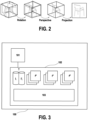
- Figure 2 shows graphically the operation of the rendering module.
- Parts of the object will be subject to self-occlusion, which allows using a pseudo ray-tracing module to compute which parts will appear in the final reconstruction, ensuring a proper geometric consistency.
- the volume V obtained after the rotation and the perspective application has four channels, the first three represent the RGB components and the fourth one is the occupancy map, containing information about the shape of the object.
- the value of each cell is interpreted as the probability of the object occupying the corresponding spatial location.
- To compute the projection where each light ray is likely to stop should be estimated. Since the perspective is already accounted for, all the rays are parallel, leaving only the depth of each stopping point to be computed. It should be noted that it is not necessary to compute a path for each light ray: this path is embedded in the shape of the volume. All light paths can be computed simultaneously using parallel operations.
- a strong failure mode of the present method comprises using the volume V as a canvas and "painting" the object in different poses on the sides. This can cause errors in the shape of the object, because there is no knowledge of which pixels belong to the object.
- a reparametrization of the occupancy grid is performed.
- Q Q' + S where S is a three dimensional Gaussian distribution centered on V.
- learning Q' comprises learning a residual over S , that is deforming S to match the shape of the observed object. This sets a prior for the shape and position of the object, while discouraging the network from using voxels that are away from the center.
- setting the supervision in image space i.e. comparing to pixel values instead of a mere segmentation mask
- Additional parameters may be added to the rendering process such as the distance between object and camera, implemented by a scaling factor, or lighting, implemented by another rotation and ray-tracing operation to illuminate parts of the object.
- the training can be performed by batches of 64 samples, and optimization can be performed using the Adam optimizer (see document " Adam: A method for stochastic optimization” (Diederik P Kingma and Jimmy Ba. arXiv preprint arXiv:1412.6980, 2014 .)).
- Figure 3 shows a system 100 for training the above defined first neural network f v .
- This system comprises a processor 101 and has the structure of a computer system.
- It also comprises a nonvolatile memory on which the three neural networks f v , f a , and f d are stored, as well as the training dataset T.
- Computer program instructions 103 for performing the training are also stored in the nonvolatile memory.
- the computer program instructions 103 and the processor 101 form a training module configured to jointly train the first neural network, the second neural network, and the third neural network by adapting the parameters of the first neural network, the second neural network, and the third neural network so as to minimize the distance between:
- Figure 4 is a schematic representation of a vehicle 200, here a car, equipped with a system 201 for determining the viewpoints of objects visible on images acquired by a camera 202 of the vehicle.
- the system 201 comprises a processor 203 and a non-volatile memory 204 in which the neural network f v is stored after the training as defined above has been performed.
- the above-described training allows obtaining neural networks which have been observed to perform better at detecting viewpoints than neural networks simply trained using a labelled set of training images (supervised training).
Landscapes
- Engineering & Computer Science (AREA)
- Physics & Mathematics (AREA)
- Theoretical Computer Science (AREA)
- General Physics & Mathematics (AREA)
- General Health & Medical Sciences (AREA)
- General Engineering & Computer Science (AREA)
- Biophysics (AREA)
- Computational Linguistics (AREA)
- Data Mining & Analysis (AREA)
- Evolutionary Computation (AREA)
- Artificial Intelligence (AREA)
- Molecular Biology (AREA)
- Computing Systems (AREA)
- Biomedical Technology (AREA)
- Life Sciences & Earth Sciences (AREA)
- Mathematical Physics (AREA)
- Software Systems (AREA)
- Health & Medical Sciences (AREA)
- Computer Vision & Pattern Recognition (AREA)
- Computer Graphics (AREA)
- Image Analysis (AREA)
Claims (13)
- Verfahren zum Trainieren eines ersten neuronalen Netzes (fv ), um den Blickwinkel eines zentrierten Objekts zu erfassen, das auf einem Bild zu sehen ist, und das zu einer gegebenen Objektkategorie gehört, wenn dieses Bild in das erste neuronale Netz eingegeben wird, umfassend:Bereitstellen eines Datensatzes (T) von Bildpaaren (Ii, I'i ), jedes Bildpaar umfassend ein erstes Bild, auf dem ein zu der Kategorie gehörendes Objekt unter einem ersten Blickwinkel (v) zu sehen und zentriert ist, und ein zweites Bild, auf dem dasselbe Objekt unter einem zweiten Blickwinkel (v), der sich von dem ersten Blickwinkel unterscheidet, zu sehen und zentriert ist,Bereitstellen eines zweiten neuronalen Netzes (f a), das konfiguriert ist, um in der Lage zu sein, Erscheinungsbildinformationen (a) eines Objekts zu liefern, das auf einem Bild zu sehen ist und zu der Kategorie gehört, wenn dieses Bild in das zweite neuronale Netz eingegeben wird,Bereitstellen eines dritten neuronalen Netzes (fd), das konfiguriert ist, um in der Lage zu sein, ein synthetisches Bild eines Objekts der Kategorie zu liefern, wenn Erscheinungsbildinformationen eines Objekts und ein Blickwinkel in das dritte neuronale Netz eingegeben werden,gemeinsames Trainieren des ersten neuronalen Netzes, des zweiten neuronalen Netzes und des dritten neuronalen Netzes durch Anpassen der Parameter des ersten neuronalen Netzes, des zweiten neuronalen Netzes und des dritten neuronalen Netzes, um den Abstand zu minimieren zwischen:mindestens einem Abschnitt des ersten Bilds (I) eines Bildpaars aus dem Datensatz von Bildpaaren, wobei dieser Abschnitt das Objekt zeigt, das auf dem Bild zu sehen ist, undeinem synthetischen Bild (fd (fa (I'),fv (I)), das von dem dritten neuronalen Netz geliefert wird, das als Eingeben einen Blickwinkel, der durch Eingabe des ersten Bilds in das erste neuronale Netz geliefert wird, und Erscheinungsbildinformationen, die durch Eingeben des zweiten Bilds des Paars in das zweite neuronale Netz geliefert werden, erhält,dadurch gekennzeichnet, dass das erste neuronale Netz konfiguriert ist, um eine Vielzahl von Blickwinkelhypothesen liefert, wobei die mit dem geringsten Abstand assoziierte Blickwinkelhypothese zum Anpassen der Parameter verwendet wird.
- Verfahren nach Anspruch 1, wobei der Abstand unter Verwendung des Wahrnehmungsverlustes definiert wird.
- Verfahren nach Anspruch 1, wobei das erste neuronale Netz ferner konfiguriert ist, um in der Lage zu sein, einen Indikator zu liefern, der konfiguriert ist, um in der Lage zu sein, die beste Hypothese anzugeben.
- Verfahren nach einem der Ansprüche 1 bis 3, wobei das dritte neuronale Netz einen objektbedingten Erzeugungsprozess verwendet, um Erscheinungsbildinformationen als Eingabe zu verwenden und/oder um den Blickpunkt als Eingabe zu verwenden, und konfiguriert ist, um ferner einen generischen Code als Eingabe zu erhalten, und eine Vielzahl von aufeinanderfolgenden 3D-Faltungsschichten umfasst, die konfiguriert sind, um den generischen Code als Eingabe zu erhalten, wobei die Ausgabe jeder 3D-Faltungsschicht konfiguriert ist, um durch eine gegebene affine Transformation transformiert zu werden, unter Verwendung der Erscheinungsbildinformationen, die als Eingabe in das dritte neuronale Netz verwendet werden, als Parameter, um eine transformierte Ausgabe zu erlangen,wobei das dritte neuronale Netz ein Rendering-Modul umfasst, das konfiguriert ist, um als Eingabe die transformierte Ausgabe der endgültigen 3D-Faltungsschicht und den als Eingabe in das dritte neuronale Netz verwendeten Blickwinkel zu erhalten,wobei die affine Transformation den objektbedingten Erzeugungsprozess implementiert.
- Verfahren nach Anspruch 4, wobei das Rendering-Modul ein Rotationsmodul beinhaltet, das konfiguriert ist, um eine Drehung an der transformierten Ausgabe durchzuführen, die von dem Rendering-Modul in Übereinstimmung mit dem Blickwinkel erhalten wird, der als Eingabe für das dritte neuronale Netz verwendet wird, und konfiguriert ist, um eine gedrehte Ausgabe auszugeben,ein Perspektivenmodul, das konfiguriert ist, um eine Perspektive auf die gedrehte Ausgabe anzuwenden, undein Strahlverfolgungsmodul, das konfiguriert ist, um das von dem dritten neuronalen Netz ausgegebene Bild zu erstellen und die gedrehte Ausgabe zu verwenden, auf die eine Perspektive angewendet wurde.
- Verfahren nach Anspruch 5, wobei das Strahlverfolgungsmodul zu Folgendem konfiguriert ist:Erstellen einer Wahrscheinlichkeitskarte, die die Wahrscheinlichkeit angibt, dass ein Strahl eines Pixels in einer Tiefe stoppt,Erlangen einer Belegungskarte aus der Wahrscheinlichkeitskarte,Erstellen des Bilds aus der Belegungskarte und der gedrehten Ausgabe, auf die eine Perspektive angewendet wurde.
- Verfahren nach einem der Ansprüche 1 bis 6, wobei das Verfahren ferner ein zusätzliches Training beinhaltet, das mindestens Folgendes umfasst:Bestimmen eines zufälligen Blickwinkels,Auswählen eines zufälligen Bilds aus dem Datensatz,Eingeben des zufälligen Bilds in das zweite neuronale Netz, um Erscheinungsbildinformationen zu erlangen,Liefern eines zusätzlichen synthetischen Bilds durch Eingeben des zufälligen Blickwinkels und der Erscheinungsbildinformationen des zufälligen Bilds in das dritte neuronale Netz, undMinimieren des Abstands zwischen dem zufälligen Blickwinkel und der Ausgabe des ersten neuronalen Netzes, wenn das zusätzliche synthetische Bild in das erste neuronale Netz eingegeben wird.
- Neuronales Netz, das durch das Verfahren nach einem der Ansprüche 1 bis 7 als erstes neuronales Netz trainiert wird.
- System zum Trainieren eines ersten neuronalen Netzes, um den Blickwinkel eines Objekts zu erfassen, das auf einem Bild zu sehen und zentriert ist und zu einer gegebenen Objektkategorie gehört, wenn dieses Bild in das erste neuronale Netz eingegeben wird, umfassend:einen Datensatz (T) von Bildpaaren (Ii; I'i ), jedes Bildpaar umfassend ein erstes Bild, auf dem ein zu der Kategorie gehörendes Objekt unter einem ersten Blickwinkel (v) zu sehen und zentriert ist, und ein zweites Bild, auf dem dasselbe Objekt unter einem zweiten Blickwinkel (v), der sich von dem ersten Blickwinkel unterscheidet, zu sehen und zentriert ist,ein zweites neuronales Netz (fa ), das konfiguriert ist, um in der Lage zu sein, Erscheinungsbildinformationen (a) eines Objekts zu liefern, das auf einem Bild zu sehen ist und zu der Kategorie gehört, wenn dieses Bild in das zweite neuronale Netz eingegeben wird,ein drittes neuronales Netz (fd ), das konfiguriert ist, um in der Lage zu sein, ein synthetisches Bild eines Objekts der Kategorie zu liefern, wenn Erscheinungsbildinformationen eines Objekts und ein Blickwinkel in das dritte neuronale Netz eingegeben werden,ein Trainingsmodul (101, 103), das konfiguriert ist, um gemeinsam das erste neuronale Netz, das zweite neuronale Netz und das dritte neuronale Netz zu trainieren, durch Anpassen der Parameter des ersten neuronalen Netzes, des zweiten neuronalen Netzes und des dritten neuronalen Netzes, um den Abstand zu minimieren zwischen:mindestens einem Abschnitt des ersten Bilds (I) eines Bildpaars aus dem Datensatz von Bildpaaren, wobei dieser Abschnitt das Objekt zeigt, das auf dem Bild zu sehen ist, undeinem synthetischen Bild (fd(f a(I'),f v (I)), das von dem dritten neuronalen Netz geliefert wird, das als Eingeben einen Blickwinkel, der durch Eingabe des ersten Bilds in das erste neuronale Netz geliefert wird, und Erscheinungsbildinformationen, die durch Eingeben des zweiten Bilds des Paars in das zweite neuronale Netz geliefert werden, erhält,dadurch gekennzeichnet, dass das erste neuronale Netz konfiguriert ist, um eine Vielzahl von Blickwinkelhypothesen liefert, wobei die mit dem geringsten Abstand assoziierte Blickwinkelhypothese zum Anpassen der Parameter verwendet wird.
- System, das das neuronale Netz nach Anspruch 8, das auf einem Träger gespeichert ist, und eine Kamera beinhaltet.
- Fahrzeug, das das System nach Anspruch 10 beinhaltet.
- Computerprogramm, das Anweisungen zum Ausführen der Schritte eines Verfahrens nach einem der Ansprüche 1 bis 7 beinhaltet, wenn das Programm von einem Computer ausgeführt wird.
- Aufzeichnungsmedium, das von einem Computer lesbar ist und auf dem ein Computerprogramm aufgezeichnet ist, das Anweisungen zum Ausführen der Schritte eines Verfahrens nach einem der Ansprüche 1 bis 7 beinhaltet.
Priority Applications (4)
| Application Number | Priority Date | Filing Date | Title |
|---|---|---|---|
| EP21167942.8A EP4075382B1 (de) | 2021-04-12 | 2021-04-12 | Verfahren zum trainieren eines neuronalen netzes zur bereitstellung der sucherpunkte von objekten unter verwendung von paaren von bildern unter verschiedenen gesichtspunkten |
| CN202210366063.3A CN115249321A (zh) | 2021-04-12 | 2022-04-08 | 训练神经网络的方法、训练神经网络的系统以及神经网络 |
| US17/717,546 US12136230B2 (en) | 2021-04-12 | 2022-04-11 | Method for training neural network, system for training neural network, and neural network |
| JP2022065744A JP7337216B2 (ja) | 2021-04-12 | 2022-04-12 | ニューラルネットワークをトレーニングする方法、ニューラルネットワークをトレーニングするシステム、及びニューラルネットワーク |
Applications Claiming Priority (1)
| Application Number | Priority Date | Filing Date | Title |
|---|---|---|---|
| EP21167942.8A EP4075382B1 (de) | 2021-04-12 | 2021-04-12 | Verfahren zum trainieren eines neuronalen netzes zur bereitstellung der sucherpunkte von objekten unter verwendung von paaren von bildern unter verschiedenen gesichtspunkten |
Publications (2)
| Publication Number | Publication Date |
|---|---|
| EP4075382A1 EP4075382A1 (de) | 2022-10-19 |
| EP4075382B1 true EP4075382B1 (de) | 2025-04-23 |
Family
ID=75497795
Family Applications (1)
| Application Number | Title | Priority Date | Filing Date |
|---|---|---|---|
| EP21167942.8A Active EP4075382B1 (de) | 2021-04-12 | 2021-04-12 | Verfahren zum trainieren eines neuronalen netzes zur bereitstellung der sucherpunkte von objekten unter verwendung von paaren von bildern unter verschiedenen gesichtspunkten |
Country Status (4)
| Country | Link |
|---|---|
| US (1) | US12136230B2 (de) |
| EP (1) | EP4075382B1 (de) |
| JP (1) | JP7337216B2 (de) |
| CN (1) | CN115249321A (de) |
Families Citing this family (9)
| Publication number | Priority date | Publication date | Assignee | Title |
|---|---|---|---|---|
| JP7416284B2 (ja) * | 2020-12-22 | 2024-01-17 | 日本電気株式会社 | 学習装置、学習方法、及び、プログラム |
| KR102658990B1 (ko) * | 2021-03-29 | 2024-04-18 | 미쓰비시덴키 가부시키가이샤 | 학습 장치 |
| DE102021110824A1 (de) * | 2021-04-28 | 2022-11-03 | Bayerische Motoren Werke Aktiengesellschaft | Verfahren und Vorrichtung zur Vorhersage von Objektdaten zu einem Objekt |
| US12236517B2 (en) * | 2021-11-16 | 2025-02-25 | Disney Enterprises, Inc. | Techniques for multi-view neural object modeling |
| US20240078799A1 (en) * | 2022-09-02 | 2024-03-07 | Electronics And Telecommunications Research Institute | Intruder detection method based on multiple camera images and video surveillance system suitable for the same |
| EP4372696A1 (de) * | 2022-11-18 | 2024-05-22 | Toyota Jidosha Kabushiki Kaisha | Verfahren zum trainieren eines ersten neuronalen netzwerks zur bestimmung des blickpunkts einer objektinstanz in einem bild und zugehöriges system |
| DE102023206522A1 (de) * | 2023-07-10 | 2025-01-16 | Robert Bosch Gesellschaft mit beschränkter Haftung | Training eines neuronalen Netzwerks für bessere Robustheit und Generalisierung |
| CN116604571B (zh) * | 2023-07-14 | 2023-10-27 | 湖南大学 | 一种基于深度强化学习的机器人三维测量路径规划方法 |
| CN116758380B (zh) * | 2023-08-15 | 2023-11-10 | 摩尔线程智能科技(北京)有限责任公司 | 用于姿态估计的网络训练方法及装置 |
Family Cites Families (14)
| Publication number | Priority date | Publication date | Assignee | Title |
|---|---|---|---|---|
| EP3698324B1 (de) * | 2017-10-20 | 2022-09-21 | Toyota Motor Europe | Verfahren und system zur bildverarbeitung und zur bestimmung der perspektiven von objekten |
| US10867214B2 (en) * | 2018-02-14 | 2020-12-15 | Nvidia Corporation | Generation of synthetic images for training a neural network model |
| US10783660B2 (en) * | 2018-02-21 | 2020-09-22 | International Business Machines Corporation | Detecting object pose using autoencoders |
| GB201804400D0 (en) * | 2018-03-20 | 2018-05-02 | Univ Of Essex Enterprise Limited | Localisation, mapping and network training |
| US11375176B2 (en) * | 2019-02-05 | 2022-06-28 | Nvidia Corporation | Few-shot viewpoint estimation |
| US11030472B2 (en) | 2019-04-30 | 2021-06-08 | Axon Enterprise, Inc. | Asymmetrical license plate reading (ALPR) camera system |
| US11436743B2 (en) * | 2019-07-06 | 2022-09-06 | Toyota Research Institute, Inc. | Systems and methods for semi-supervised depth estimation according to an arbitrary camera |
| CN110443874B (zh) * | 2019-07-17 | 2021-07-30 | 清华大学 | 基于卷积神经网络的视点数据生成方法和装置 |
| US12266144B2 (en) * | 2019-11-20 | 2025-04-01 | Nvidia Corporation | Training and inferencing using a neural network to predict orientations of objects in images |
| WO2021164887A1 (en) * | 2020-02-21 | 2021-08-26 | Toyota Motor Europe | 6d pose and shape estimation method |
| CN111739078B (zh) * | 2020-06-15 | 2022-11-18 | 大连理工大学 | 一种基于上下文注意力机制的单目无监督深度估计方法 |
| US11992702B2 (en) * | 2020-09-21 | 2024-05-28 | Elekta, Inc. | Machine learning optimization of fluence maps for radiotherapy treatment |
| US11823415B2 (en) * | 2021-03-03 | 2023-11-21 | Nvidia Corporation | 3D pose estimation in robotics |
| GB2605156B (en) * | 2021-03-24 | 2023-11-08 | Sony Interactive Entertainment Inc | Image rendering method and apparatus |
-
2021
- 2021-04-12 EP EP21167942.8A patent/EP4075382B1/de active Active
-
2022
- 2022-04-08 CN CN202210366063.3A patent/CN115249321A/zh active Pending
- 2022-04-11 US US17/717,546 patent/US12136230B2/en active Active
- 2022-04-12 JP JP2022065744A patent/JP7337216B2/ja active Active
Also Published As
| Publication number | Publication date |
|---|---|
| EP4075382A1 (de) | 2022-10-19 |
| JP2022162552A (ja) | 2022-10-24 |
| US12136230B2 (en) | 2024-11-05 |
| CN115249321A (zh) | 2022-10-28 |
| JP7337216B2 (ja) | 2023-09-01 |
| US20220327730A1 (en) | 2022-10-13 |
Similar Documents
| Publication | Publication Date | Title |
|---|---|---|
| EP4075382B1 (de) | Verfahren zum trainieren eines neuronalen netzes zur bereitstellung der sucherpunkte von objekten unter verwendung von paaren von bildern unter verschiedenen gesichtspunkten | |
| Ost et al. | Neural scene graphs for dynamic scenes | |
| EP4272176B1 (de) | Rendering neuer bilder von szenen unter verwendung geometrie-bewusster neuronaler netze koniditioniert auf latente variablen | |
| Insafutdinov et al. | Unsupervised learning of shape and pose with differentiable point clouds | |
| Sevilla-Lara et al. | Optical flow with semantic segmentation and localized layers | |
| US20190220992A1 (en) | Object pose estimating method and apparatus | |
| CN115769259B (zh) | 从影像学习铰接形状重建 | |
| Pronovost et al. | Generating driving scenes with diffusion | |
| US12450823B2 (en) | Neural dynamic image-based rendering | |
| US20250118010A1 (en) | Hierarchical scene modeling for self-driving vehicles | |
| CN117274515A (zh) | 基于ORB和NeRF映射的视觉SLAM方法及系统 | |
| Haugaard et al. | Spyropose: Se (3) pyramids for object pose distribution estimation | |
| CN119339014A (zh) | 用于自动驾驶仿真测试的场景重建方法、电子设备和产品 | |
| Gomez-Donoso et al. | Three-dimensional reconstruction using SFM for actual pedestrian classification | |
| Lai et al. | Fast radiance field reconstruction from sparse inputs | |
| Šircelj et al. | Segmentation and recovery of superquadric models using convolutional neural networks | |
| WO2025264424A1 (en) | Wireframe generation via gaussian splatting | |
| EP3958167B1 (de) | Verfahren zum trainieren eines neuronalen netzes zur bereitstellung der ansichtspunkte von objekten unter verwendung unmarkierter bilderpaare und zugehöriges system | |
| Rother et al. | Seeing 3D objects in a single 2D image | |
| EP4372696A1 (de) | Verfahren zum trainieren eines ersten neuronalen netzwerks zur bestimmung des blickpunkts einer objektinstanz in einem bild und zugehöriges system | |
| Premalatha et al. | Adaptive fish school search optimized resnet for multi-view 3D objects reconstruction | |
| Zelener | Object Localization, Segmentation, and Classification in 3D Images | |
| Liu et al. | Sem-iNeRF: Camera pose refinement by inverting neural radiance fields with semantic feature consistency | |
| Tulsiani | Learning Single-view 3D Reconstruction of Objects and Scenes | |
| Blomqvist | A Farewell to Supervision: Towards Self-supervised Autonomous Systems |
Legal Events
| Date | Code | Title | Description |
|---|---|---|---|
| PUAI | Public reference made under article 153(3) epc to a published international application that has entered the european phase |
Free format text: ORIGINAL CODE: 0009012 |
|
| STAA | Information on the status of an ep patent application or granted ep patent |
Free format text: STATUS: REQUEST FOR EXAMINATION WAS MADE |
|
| 17P | Request for examination filed |
Effective date: 20210412 |
|
| AK | Designated contracting states |
Kind code of ref document: A1 Designated state(s): AL AT BE BG CH CY CZ DE DK EE ES FI FR GB GR HR HU IE IS IT LI LT LU LV MC MK MT NL NO PL PT RO RS SE SI SK SM TR |
|
| GRAP | Despatch of communication of intention to grant a patent |
Free format text: ORIGINAL CODE: EPIDOSNIGR1 |
|
| STAA | Information on the status of an ep patent application or granted ep patent |
Free format text: STATUS: GRANT OF PATENT IS INTENDED |
|
| RIC1 | Information provided on ipc code assigned before grant |
Ipc: G06T 7/70 20170101AFI20241119BHEP |
|
| INTG | Intention to grant announced |
Effective date: 20241202 |
|
| RAP3 | Party data changed (applicant data changed or rights of an application transferred) |
Owner name: THE UNIVERSITY COURT OF THE UNIVERSITY OFEDINBURGH Owner name: TOYOTA JIDOSHA KABUSHIKI KAISHA |
|
| RIN1 | Information on inventor provided before grant (corrected) |
Inventor name: MACAODHA, OISIN Inventor name: BILEN, HAKAN Inventor name: MARIOTTI, OCTAVE Inventor name: MEIER, SVEN |
|
| GRAS | Grant fee paid |
Free format text: ORIGINAL CODE: EPIDOSNIGR3 |
|
| GRAA | (expected) grant |
Free format text: ORIGINAL CODE: 0009210 |
|
| STAA | Information on the status of an ep patent application or granted ep patent |
Free format text: STATUS: THE PATENT HAS BEEN GRANTED |
|
| AK | Designated contracting states |
Kind code of ref document: B1 Designated state(s): AL AT BE BG CH CY CZ DE DK EE ES FI FR GB GR HR HU IE IS IT LI LT LU LV MC MK MT NL NO PL PT RO RS SE SI SK SM TR |
|
| REG | Reference to a national code |
Ref country code: GB Ref legal event code: FG4D |
|
| REG | Reference to a national code |
Ref country code: CH Ref legal event code: EP |
|
| REG | Reference to a national code |
Ref country code: DE Ref legal event code: R096 Ref document number: 602021029467 Country of ref document: DE |
|
| REG | Reference to a national code |
Ref country code: IE Ref legal event code: FG4D |
|
| REG | Reference to a national code |
Ref country code: NL Ref legal event code: MP Effective date: 20250423 |
|
| PG25 | Lapsed in a contracting state [announced via postgrant information from national office to epo] |
Ref country code: NL Free format text: LAPSE BECAUSE OF FAILURE TO SUBMIT A TRANSLATION OF THE DESCRIPTION OR TO PAY THE FEE WITHIN THE PRESCRIBED TIME-LIMIT Effective date: 20250423 |
|
| REG | Reference to a national code |
Ref country code: AT Ref legal event code: MK05 Ref document number: 1788546 Country of ref document: AT Kind code of ref document: T Effective date: 20250423 |
|
| PG25 | Lapsed in a contracting state [announced via postgrant information from national office to epo] |
Ref country code: FI Free format text: LAPSE BECAUSE OF FAILURE TO SUBMIT A TRANSLATION OF THE DESCRIPTION OR TO PAY THE FEE WITHIN THE PRESCRIBED TIME-LIMIT Effective date: 20250423 Ref country code: ES Free format text: LAPSE BECAUSE OF FAILURE TO SUBMIT A TRANSLATION OF THE DESCRIPTION OR TO PAY THE FEE WITHIN THE PRESCRIBED TIME-LIMIT Effective date: 20250423 Ref country code: PT Free format text: LAPSE BECAUSE OF FAILURE TO SUBMIT A TRANSLATION OF THE DESCRIPTION OR TO PAY THE FEE WITHIN THE PRESCRIBED TIME-LIMIT Effective date: 20250825 |
|
| REG | Reference to a national code |
Ref country code: LT Ref legal event code: MG9D |
|
| PG25 | Lapsed in a contracting state [announced via postgrant information from national office to epo] |
Ref country code: NO Free format text: LAPSE BECAUSE OF FAILURE TO SUBMIT A TRANSLATION OF THE DESCRIPTION OR TO PAY THE FEE WITHIN THE PRESCRIBED TIME-LIMIT Effective date: 20250723 Ref country code: GR Free format text: LAPSE BECAUSE OF FAILURE TO SUBMIT A TRANSLATION OF THE DESCRIPTION OR TO PAY THE FEE WITHIN THE PRESCRIBED TIME-LIMIT Effective date: 20250724 |
|
| PG25 | Lapsed in a contracting state [announced via postgrant information from national office to epo] |
Ref country code: PL Free format text: LAPSE BECAUSE OF FAILURE TO SUBMIT A TRANSLATION OF THE DESCRIPTION OR TO PAY THE FEE WITHIN THE PRESCRIBED TIME-LIMIT Effective date: 20250423 |
|
| PG25 | Lapsed in a contracting state [announced via postgrant information from national office to epo] |
Ref country code: BG Free format text: LAPSE BECAUSE OF FAILURE TO SUBMIT A TRANSLATION OF THE DESCRIPTION OR TO PAY THE FEE WITHIN THE PRESCRIBED TIME-LIMIT Effective date: 20250423 |
|
| PG25 | Lapsed in a contracting state [announced via postgrant information from national office to epo] |
Ref country code: HR Free format text: LAPSE BECAUSE OF FAILURE TO SUBMIT A TRANSLATION OF THE DESCRIPTION OR TO PAY THE FEE WITHIN THE PRESCRIBED TIME-LIMIT Effective date: 20250423 |
|
| PG25 | Lapsed in a contracting state [announced via postgrant information from national office to epo] |
Ref country code: AT Free format text: LAPSE BECAUSE OF FAILURE TO SUBMIT A TRANSLATION OF THE DESCRIPTION OR TO PAY THE FEE WITHIN THE PRESCRIBED TIME-LIMIT Effective date: 20250423 |
|
| PG25 | Lapsed in a contracting state [announced via postgrant information from national office to epo] |
Ref country code: RS Free format text: LAPSE BECAUSE OF FAILURE TO SUBMIT A TRANSLATION OF THE DESCRIPTION OR TO PAY THE FEE WITHIN THE PRESCRIBED TIME-LIMIT Effective date: 20250723 |
|
| PG25 | Lapsed in a contracting state [announced via postgrant information from national office to epo] |
Ref country code: IS Free format text: LAPSE BECAUSE OF FAILURE TO SUBMIT A TRANSLATION OF THE DESCRIPTION OR TO PAY THE FEE WITHIN THE PRESCRIBED TIME-LIMIT Effective date: 20250823 |
|
| PG25 | Lapsed in a contracting state [announced via postgrant information from national office to epo] |
Ref country code: LV Free format text: LAPSE BECAUSE OF FAILURE TO SUBMIT A TRANSLATION OF THE DESCRIPTION OR TO PAY THE FEE WITHIN THE PRESCRIBED TIME-LIMIT Effective date: 20250423 |
|
| PG25 | Lapsed in a contracting state [announced via postgrant information from national office to epo] |
Ref country code: DK Free format text: LAPSE BECAUSE OF FAILURE TO SUBMIT A TRANSLATION OF THE DESCRIPTION OR TO PAY THE FEE WITHIN THE PRESCRIBED TIME-LIMIT Effective date: 20250423 Ref country code: SM Free format text: LAPSE BECAUSE OF FAILURE TO SUBMIT A TRANSLATION OF THE DESCRIPTION OR TO PAY THE FEE WITHIN THE PRESCRIBED TIME-LIMIT Effective date: 20250423 |
|
| PG25 | Lapsed in a contracting state [announced via postgrant information from national office to epo] |
Ref country code: CZ Free format text: LAPSE BECAUSE OF FAILURE TO SUBMIT A TRANSLATION OF THE DESCRIPTION OR TO PAY THE FEE WITHIN THE PRESCRIBED TIME-LIMIT Effective date: 20250423 |
|
| PG25 | Lapsed in a contracting state [announced via postgrant information from national office to epo] |
Ref country code: EE Free format text: LAPSE BECAUSE OF FAILURE TO SUBMIT A TRANSLATION OF THE DESCRIPTION OR TO PAY THE FEE WITHIN THE PRESCRIBED TIME-LIMIT Effective date: 20250423 |
|
| REG | Reference to a national code |
Ref country code: DE Ref legal event code: R097 Ref document number: 602021029467 Country of ref document: DE |
|
| PG25 | Lapsed in a contracting state [announced via postgrant information from national office to epo] |
Ref country code: SK Free format text: LAPSE BECAUSE OF FAILURE TO SUBMIT A TRANSLATION OF THE DESCRIPTION OR TO PAY THE FEE WITHIN THE PRESCRIBED TIME-LIMIT Effective date: 20250423 |
|
| PG25 | Lapsed in a contracting state [announced via postgrant information from national office to epo] |
Ref country code: IT Free format text: LAPSE BECAUSE OF FAILURE TO SUBMIT A TRANSLATION OF THE DESCRIPTION OR TO PAY THE FEE WITHIN THE PRESCRIBED TIME-LIMIT Effective date: 20250423 |
|
| PLBE | No opposition filed within time limit |
Free format text: ORIGINAL CODE: 0009261 |
|
| STAA | Information on the status of an ep patent application or granted ep patent |
Free format text: STATUS: NO OPPOSITION FILED WITHIN TIME LIMIT |
|
| REG | Reference to a national code |
Ref country code: CH Ref legal event code: L10 Free format text: ST27 STATUS EVENT CODE: U-0-0-L10-L00 (AS PROVIDED BY THE NATIONAL OFFICE) Effective date: 20260304 |
|
| 26N | No opposition filed |
Effective date: 20260126 |