EP4074504A1 - Thin glass-laminated printed steel plate having excellent flammability and manufacturing method thereof - Google Patents
Thin glass-laminated printed steel plate having excellent flammability and manufacturing method thereof Download PDFInfo
- Publication number
- EP4074504A1 EP4074504A1 EP20898432.8A EP20898432A EP4074504A1 EP 4074504 A1 EP4074504 A1 EP 4074504A1 EP 20898432 A EP20898432 A EP 20898432A EP 4074504 A1 EP4074504 A1 EP 4074504A1
- Authority
- EP
- European Patent Office
- Prior art keywords
- steel sheet
- thin glass
- layer
- printed steel
- glass layer
- Prior art date
- Legal status (The legal status is an assumption and is not a legal conclusion. Google has not performed a legal analysis and makes no representation as to the accuracy of the status listed.)
- Pending
Links
- 229910000831 Steel Inorganic materials 0.000 title claims abstract description 115
- 239000010959 steel Substances 0.000 title claims abstract description 115
- 238000004519 manufacturing process Methods 0.000 title claims abstract description 18
- 239000011521 glass Substances 0.000 claims abstract description 102
- 239000010410 layer Substances 0.000 claims abstract description 88
- RNFJDJUURJAICM-UHFFFAOYSA-N 2,2,4,4,6,6-hexaphenoxy-1,3,5-triaza-2$l^{5},4$l^{5},6$l^{5}-triphosphacyclohexa-1,3,5-triene Chemical compound N=1P(OC=2C=CC=CC=2)(OC=2C=CC=CC=2)=NP(OC=2C=CC=CC=2)(OC=2C=CC=CC=2)=NP=1(OC=1C=CC=CC=1)OC1=CC=CC=C1 RNFJDJUURJAICM-UHFFFAOYSA-N 0.000 claims abstract description 59
- 239000003063 flame retardant Substances 0.000 claims abstract description 59
- 239000012790 adhesive layer Substances 0.000 claims abstract description 40
- 239000002184 metal Substances 0.000 claims abstract description 26
- 238000013461 design Methods 0.000 claims abstract description 16
- 239000000853 adhesive Substances 0.000 claims description 71
- 230000001070 adhesive effect Effects 0.000 claims description 71
- 239000000463 material Substances 0.000 claims description 64
- 238000000034 method Methods 0.000 claims description 19
- 125000000524 functional group Chemical group 0.000 claims description 13
- 239000000203 mixture Substances 0.000 claims description 13
- YUWBVKYVJWNVLE-UHFFFAOYSA-N [N].[P] Chemical compound [N].[P] YUWBVKYVJWNVLE-UHFFFAOYSA-N 0.000 claims description 9
- 229920000728 polyester Polymers 0.000 claims description 9
- NIXOWILDQLNWCW-UHFFFAOYSA-M Acrylate Chemical compound [O-]C(=O)C=C NIXOWILDQLNWCW-UHFFFAOYSA-M 0.000 claims description 8
- 239000000178 monomer Substances 0.000 claims description 6
- UHESRSKEBRADOO-UHFFFAOYSA-N ethyl carbamate;prop-2-enoic acid Chemical compound OC(=O)C=C.CCOC(N)=O UHESRSKEBRADOO-UHFFFAOYSA-N 0.000 claims description 5
- 238000011156 evaluation Methods 0.000 claims description 4
- 239000002245 particle Substances 0.000 claims description 4
- XFZRQAZGUOTJCS-UHFFFAOYSA-N phosphoric acid;1,3,5-triazine-2,4,6-triamine Chemical compound OP(O)(O)=O.NC1=NC(N)=NC(N)=N1 XFZRQAZGUOTJCS-UHFFFAOYSA-N 0.000 claims description 4
- 238000002203 pretreatment Methods 0.000 claims description 4
- 239000004254 Ammonium phosphate Substances 0.000 claims description 2
- 239000004114 Ammonium polyphosphate Substances 0.000 claims description 2
- 229920000877 Melamine resin Polymers 0.000 claims description 2
- 229920000388 Polyphosphate Polymers 0.000 claims description 2
- 239000003513 alkali Substances 0.000 claims description 2
- 229910000148 ammonium phosphate Inorganic materials 0.000 claims description 2
- 235000019289 ammonium phosphates Nutrition 0.000 claims description 2
- 235000019826 ammonium polyphosphate Nutrition 0.000 claims description 2
- 229920001276 ammonium polyphosphate Polymers 0.000 claims description 2
- 239000002585 base Substances 0.000 claims description 2
- 239000005388 borosilicate glass Substances 0.000 claims description 2
- MNNHAPBLZZVQHP-UHFFFAOYSA-N diammonium hydrogen phosphate Chemical compound [NH4+].[NH4+].OP([O-])([O-])=O MNNHAPBLZZVQHP-UHFFFAOYSA-N 0.000 claims description 2
- JDSHMPZPIAZGSV-UHFFFAOYSA-N melamine Chemical compound NC1=NC(N)=NC(N)=N1 JDSHMPZPIAZGSV-UHFFFAOYSA-N 0.000 claims description 2
- XZTOTRSSGPPNTB-UHFFFAOYSA-N phosphono dihydrogen phosphate;1,3,5-triazine-2,4,6-triamine Chemical compound NC1=NC(N)=NC(N)=N1.OP(O)(=O)OP(O)(O)=O XZTOTRSSGPPNTB-UHFFFAOYSA-N 0.000 claims description 2
- 239000001205 polyphosphate Substances 0.000 claims description 2
- 235000011176 polyphosphates Nutrition 0.000 claims description 2
- 239000005361 soda-lime glass Substances 0.000 claims description 2
- 239000005341 toughened glass Substances 0.000 claims description 2
- 238000001723 curing Methods 0.000 description 11
- 238000005259 measurement Methods 0.000 description 11
- 230000000052 comparative effect Effects 0.000 description 10
- 229910000576 Laminated steel Inorganic materials 0.000 description 8
- 238000003475 lamination Methods 0.000 description 8
- -1 siloxane compound Chemical class 0.000 description 8
- PSGCQDPCAWOCSH-UHFFFAOYSA-N (4,7,7-trimethyl-3-bicyclo[2.2.1]heptanyl) prop-2-enoate Chemical compound C1CC2(C)C(OC(=O)C=C)CC1C2(C)C PSGCQDPCAWOCSH-UHFFFAOYSA-N 0.000 description 7
- MUTNCGKQJGXKEM-UHFFFAOYSA-N tamibarotene Chemical compound C=1C=C2C(C)(C)CCC(C)(C)C2=CC=1NC(=O)C1=CC=C(C(O)=O)C=C1 MUTNCGKQJGXKEM-UHFFFAOYSA-N 0.000 description 7
- RZVINYQDSSQUKO-UHFFFAOYSA-N 2-phenoxyethyl prop-2-enoate Chemical compound C=CC(=O)OCCOC1=CC=CC=C1 RZVINYQDSSQUKO-UHFFFAOYSA-N 0.000 description 6
- 238000003825 pressing Methods 0.000 description 6
- 238000000576 coating method Methods 0.000 description 5
- 229920001187 thermosetting polymer Polymers 0.000 description 5
- 239000004721 Polyphenylene oxide Substances 0.000 description 4
- 239000002253 acid Substances 0.000 description 4
- 239000011248 coating agent Substances 0.000 description 4
- 230000003287 optical effect Effects 0.000 description 4
- BNMMXDHVMLZQGP-UHFFFAOYSA-N phosphono prop-2-eneperoxoate Chemical compound OP(O)(=O)OOC(=O)C=C BNMMXDHVMLZQGP-UHFFFAOYSA-N 0.000 description 4
- 229920000570 polyether Polymers 0.000 description 4
- QNODIIQQMGDSEF-UHFFFAOYSA-N (1-hydroxycyclohexyl)-phenylmethanone Chemical compound C=1C=CC=CC=1C(=O)C1(O)CCCCC1 QNODIIQQMGDSEF-UHFFFAOYSA-N 0.000 description 3
- UHFFVFAKEGKNAQ-UHFFFAOYSA-N 2-benzyl-2-(dimethylamino)-1-(4-morpholin-4-ylphenyl)butan-1-one Chemical compound C=1C=C(N2CCOCC2)C=CC=1C(=O)C(CC)(N(C)C)CC1=CC=CC=C1 UHFFVFAKEGKNAQ-UHFFFAOYSA-N 0.000 description 3
- FIHBHSQYSYVZQE-UHFFFAOYSA-N 6-prop-2-enoyloxyhexyl prop-2-enoate Chemical compound C=CC(=O)OCCCCCCOC(=O)C=C FIHBHSQYSYVZQE-UHFFFAOYSA-N 0.000 description 3
- 230000007547 defect Effects 0.000 description 3
- 230000000694 effects Effects 0.000 description 3
- 239000004794 expanded polystyrene Substances 0.000 description 3
- 230000009975 flexible effect Effects 0.000 description 3
- 230000003746 surface roughness Effects 0.000 description 3
- 238000001029 thermal curing Methods 0.000 description 3
- 238000002834 transmittance Methods 0.000 description 3
- JOYRKODLDBILNP-UHFFFAOYSA-N Ethyl urethane Chemical compound CCOC(N)=O JOYRKODLDBILNP-UHFFFAOYSA-N 0.000 description 2
- 239000004566 building material Substances 0.000 description 2
- 239000000919 ceramic Substances 0.000 description 2
- 239000002131 composite material Substances 0.000 description 2
- 230000003247 decreasing effect Effects 0.000 description 2
- 229920001971 elastomer Polymers 0.000 description 2
- 238000009413 insulation Methods 0.000 description 2
- 238000010030 laminating Methods 0.000 description 2
- 239000003973 paint Substances 0.000 description 2
- 230000005855 radiation Effects 0.000 description 2
- 239000002904 solvent Substances 0.000 description 2
- 239000000126 substance Substances 0.000 description 2
- QIVUCLWGARAQIO-OLIXTKCUSA-N (3s)-n-[(3s,5s,6r)-6-methyl-2-oxo-1-(2,2,2-trifluoroethyl)-5-(2,3,6-trifluorophenyl)piperidin-3-yl]-2-oxospiro[1h-pyrrolo[2,3-b]pyridine-3,6'-5,7-dihydrocyclopenta[b]pyridine]-3'-carboxamide Chemical compound C1([C@H]2[C@H](N(C(=O)[C@@H](NC(=O)C=3C=C4C[C@]5(CC4=NC=3)C3=CC=CN=C3NC5=O)C2)CC(F)(F)F)C)=C(F)C=CC(F)=C1F QIVUCLWGARAQIO-OLIXTKCUSA-N 0.000 description 1
- RIWRBSMFKVOJMN-UHFFFAOYSA-N 2-methyl-1-phenylpropan-2-ol Chemical compound CC(C)(O)CC1=CC=CC=C1 RIWRBSMFKVOJMN-UHFFFAOYSA-N 0.000 description 1
- DAKWPKUUDNSNPN-UHFFFAOYSA-N Trimethylolpropane triacrylate Chemical compound C=CC(=O)OCC(CC)(COC(=O)C=C)COC(=O)C=C DAKWPKUUDNSNPN-UHFFFAOYSA-N 0.000 description 1
- HVVWZTWDBSEWIH-UHFFFAOYSA-N [2-(hydroxymethyl)-3-prop-2-enoyloxy-2-(prop-2-enoyloxymethyl)propyl] prop-2-enoate Chemical compound C=CC(=O)OCC(CO)(COC(=O)C=C)COC(=O)C=C HVVWZTWDBSEWIH-UHFFFAOYSA-N 0.000 description 1
- 239000000654 additive Substances 0.000 description 1
- 239000002313 adhesive film Substances 0.000 description 1
- 238000005452 bending Methods 0.000 description 1
- 230000000903 blocking effect Effects 0.000 description 1
- 239000003638 chemical reducing agent Substances 0.000 description 1
- 239000003086 colorant Substances 0.000 description 1
- 238000004040 coloring Methods 0.000 description 1
- 239000000805 composite resin Substances 0.000 description 1
- 230000007797 corrosion Effects 0.000 description 1
- 238000005260 corrosion Methods 0.000 description 1
- 230000002950 deficient Effects 0.000 description 1
- 238000004925 denaturation Methods 0.000 description 1
- 230000036425 denaturation Effects 0.000 description 1
- 230000006866 deterioration Effects 0.000 description 1
- 238000011161 development Methods 0.000 description 1
- 238000002845 discoloration Methods 0.000 description 1
- 239000005357 flat glass Substances 0.000 description 1
- 239000011491 glass wool Substances 0.000 description 1
- 239000010440 gypsum Substances 0.000 description 1
- 229910052602 gypsum Inorganic materials 0.000 description 1
- 238000010438 heat treatment Methods 0.000 description 1
- 238000007641 inkjet printing Methods 0.000 description 1
- 229910010272 inorganic material Inorganic materials 0.000 description 1
- 239000011147 inorganic material Substances 0.000 description 1
- 230000001678 irradiating effect Effects 0.000 description 1
- 238000000691 measurement method Methods 0.000 description 1
- 238000012986 modification Methods 0.000 description 1
- 230000004048 modification Effects 0.000 description 1
- 239000005445 natural material Substances 0.000 description 1
- 229960003424 phenylacetic acid Drugs 0.000 description 1
- 239000003279 phenylacetic acid Substances 0.000 description 1
- 238000009832 plasma treatment Methods 0.000 description 1
- 239000004033 plastic Substances 0.000 description 1
- 238000012545 processing Methods 0.000 description 1
- 238000003847 radiation curing Methods 0.000 description 1
- 229920006395 saturated elastomer Polymers 0.000 description 1
- 239000007787 solid Substances 0.000 description 1
- 239000007921 spray Substances 0.000 description 1
- 238000007655 standard test method Methods 0.000 description 1
- 238000012360 testing method Methods 0.000 description 1
- 239000002341 toxic gas Substances 0.000 description 1
- 238000012546 transfer Methods 0.000 description 1
- 230000004382 visual function Effects 0.000 description 1
- 239000002699 waste material Substances 0.000 description 1
- 239000002023 wood Substances 0.000 description 1
Images
Classifications
-
- B—PERFORMING OPERATIONS; TRANSPORTING
- B32—LAYERED PRODUCTS
- B32B—LAYERED PRODUCTS, i.e. PRODUCTS BUILT-UP OF STRATA OF FLAT OR NON-FLAT, e.g. CELLULAR OR HONEYCOMB, FORM
- B32B17/00—Layered products essentially comprising sheet glass, or glass, slag, or like fibres
- B32B17/06—Layered products essentially comprising sheet glass, or glass, slag, or like fibres comprising glass as the main or only constituent of a layer, next to another layer of a specific material
- B32B17/061—Layered products essentially comprising sheet glass, or glass, slag, or like fibres comprising glass as the main or only constituent of a layer, next to another layer of a specific material of metal
-
- B—PERFORMING OPERATIONS; TRANSPORTING
- B32—LAYERED PRODUCTS
- B32B—LAYERED PRODUCTS, i.e. PRODUCTS BUILT-UP OF STRATA OF FLAT OR NON-FLAT, e.g. CELLULAR OR HONEYCOMB, FORM
- B32B15/00—Layered products comprising a layer of metal
- B32B15/04—Layered products comprising a layer of metal comprising metal as the main or only constituent of a layer, which is next to another layer of the same or of a different material
-
- B—PERFORMING OPERATIONS; TRANSPORTING
- B32—LAYERED PRODUCTS
- B32B—LAYERED PRODUCTS, i.e. PRODUCTS BUILT-UP OF STRATA OF FLAT OR NON-FLAT, e.g. CELLULAR OR HONEYCOMB, FORM
- B32B15/00—Layered products comprising a layer of metal
- B32B15/18—Layered products comprising a layer of metal comprising iron or steel
-
- B—PERFORMING OPERATIONS; TRANSPORTING
- B32—LAYERED PRODUCTS
- B32B—LAYERED PRODUCTS, i.e. PRODUCTS BUILT-UP OF STRATA OF FLAT OR NON-FLAT, e.g. CELLULAR OR HONEYCOMB, FORM
- B32B37/00—Methods or apparatus for laminating, e.g. by curing or by ultrasonic bonding
- B32B37/12—Methods or apparatus for laminating, e.g. by curing or by ultrasonic bonding characterised by using adhesives
-
- B—PERFORMING OPERATIONS; TRANSPORTING
- B32—LAYERED PRODUCTS
- B32B—LAYERED PRODUCTS, i.e. PRODUCTS BUILT-UP OF STRATA OF FLAT OR NON-FLAT, e.g. CELLULAR OR HONEYCOMB, FORM
- B32B7/00—Layered products characterised by the relation between layers; Layered products characterised by the relative orientation of features between layers, or by the relative values of a measurable parameter between layers, i.e. products comprising layers having different physical, chemical or physicochemical properties; Layered products characterised by the interconnection of layers
- B32B7/04—Interconnection of layers
- B32B7/12—Interconnection of layers using interposed adhesives or interposed materials with bonding properties
-
- B—PERFORMING OPERATIONS; TRANSPORTING
- B44—DECORATIVE ARTS
- B44C—PRODUCING DECORATIVE EFFECTS; MOSAICS; TARSIA WORK; PAPERHANGING
- B44C5/00—Processes for producing special ornamental bodies
- B44C5/04—Ornamental plaques, e.g. decorative panels, decorative veneers
- B44C5/0407—Ornamental plaques, e.g. decorative panels, decorative veneers containing glass elements
-
- B—PERFORMING OPERATIONS; TRANSPORTING
- B44—DECORATIVE ARTS
- B44C—PRODUCING DECORATIVE EFFECTS; MOSAICS; TARSIA WORK; PAPERHANGING
- B44C5/00—Processes for producing special ornamental bodies
- B44C5/04—Ornamental plaques, e.g. decorative panels, decorative veneers
- B44C5/0415—Ornamental plaques, e.g. decorative panels, decorative veneers containing metallic elements
-
- C—CHEMISTRY; METALLURGY
- C08—ORGANIC MACROMOLECULAR COMPOUNDS; THEIR PREPARATION OR CHEMICAL WORKING-UP; COMPOSITIONS BASED THEREON
- C08F—MACROMOLECULAR COMPOUNDS OBTAINED BY REACTIONS ONLY INVOLVING CARBON-TO-CARBON UNSATURATED BONDS
- C08F2/00—Processes of polymerisation
- C08F2/46—Polymerisation initiated by wave energy or particle radiation
- C08F2/48—Polymerisation initiated by wave energy or particle radiation by ultraviolet or visible light
- C08F2/50—Polymerisation initiated by wave energy or particle radiation by ultraviolet or visible light with sensitising agents
-
- C—CHEMISTRY; METALLURGY
- C08—ORGANIC MACROMOLECULAR COMPOUNDS; THEIR PREPARATION OR CHEMICAL WORKING-UP; COMPOSITIONS BASED THEREON
- C08F—MACROMOLECULAR COMPOUNDS OBTAINED BY REACTIONS ONLY INVOLVING CARBON-TO-CARBON UNSATURATED BONDS
- C08F220/00—Copolymers of compounds having one or more unsaturated aliphatic radicals, each having only one carbon-to-carbon double bond, and only one being terminated by only one carboxyl radical or a salt, anhydride ester, amide, imide or nitrile thereof
- C08F220/02—Monocarboxylic acids having less than ten carbon atoms; Derivatives thereof
- C08F220/10—Esters
- C08F220/26—Esters containing oxygen in addition to the carboxy oxygen
-
- C—CHEMISTRY; METALLURGY
- C08—ORGANIC MACROMOLECULAR COMPOUNDS; THEIR PREPARATION OR CHEMICAL WORKING-UP; COMPOSITIONS BASED THEREON
- C08F—MACROMOLECULAR COMPOUNDS OBTAINED BY REACTIONS ONLY INVOLVING CARBON-TO-CARBON UNSATURATED BONDS
- C08F283/00—Macromolecular compounds obtained by polymerising monomers on to polymers provided for in subclass C08G
- C08F283/01—Macromolecular compounds obtained by polymerising monomers on to polymers provided for in subclass C08G on to unsaturated polyesters
-
- C—CHEMISTRY; METALLURGY
- C08—ORGANIC MACROMOLECULAR COMPOUNDS; THEIR PREPARATION OR CHEMICAL WORKING-UP; COMPOSITIONS BASED THEREON
- C08F—MACROMOLECULAR COMPOUNDS OBTAINED BY REACTIONS ONLY INVOLVING CARBON-TO-CARBON UNSATURATED BONDS
- C08F290/00—Macromolecular compounds obtained by polymerising monomers on to polymers modified by introduction of aliphatic unsaturated end or side groups
- C08F290/02—Macromolecular compounds obtained by polymerising monomers on to polymers modified by introduction of aliphatic unsaturated end or side groups on to polymers modified by introduction of unsaturated end groups
- C08F290/06—Polymers provided for in subclass C08G
- C08F290/061—Polyesters; Polycarbonates
-
- C—CHEMISTRY; METALLURGY
- C08—ORGANIC MACROMOLECULAR COMPOUNDS; THEIR PREPARATION OR CHEMICAL WORKING-UP; COMPOSITIONS BASED THEREON
- C08F—MACROMOLECULAR COMPOUNDS OBTAINED BY REACTIONS ONLY INVOLVING CARBON-TO-CARBON UNSATURATED BONDS
- C08F290/00—Macromolecular compounds obtained by polymerising monomers on to polymers modified by introduction of aliphatic unsaturated end or side groups
- C08F290/02—Macromolecular compounds obtained by polymerising monomers on to polymers modified by introduction of aliphatic unsaturated end or side groups on to polymers modified by introduction of unsaturated end groups
- C08F290/06—Polymers provided for in subclass C08G
- C08F290/067—Polyurethanes; Polyureas
-
- C—CHEMISTRY; METALLURGY
- C08—ORGANIC MACROMOLECULAR COMPOUNDS; THEIR PREPARATION OR CHEMICAL WORKING-UP; COMPOSITIONS BASED THEREON
- C08K—Use of inorganic or non-macromolecular organic substances as compounding ingredients
- C08K5/00—Use of organic ingredients
- C08K5/16—Nitrogen-containing compounds
- C08K5/34—Heterocyclic compounds having nitrogen in the ring
- C08K5/3467—Heterocyclic compounds having nitrogen in the ring having more than two nitrogen atoms in the ring
- C08K5/3477—Six-membered rings
- C08K5/3492—Triazines
- C08K5/34922—Melamine; Derivatives thereof
-
- C—CHEMISTRY; METALLURGY
- C08—ORGANIC MACROMOLECULAR COMPOUNDS; THEIR PREPARATION OR CHEMICAL WORKING-UP; COMPOSITIONS BASED THEREON
- C08K—Use of inorganic or non-macromolecular organic substances as compounding ingredients
- C08K5/00—Use of organic ingredients
- C08K5/49—Phosphorus-containing compounds
- C08K5/51—Phosphorus bound to oxygen
- C08K5/52—Phosphorus bound to oxygen only
- C08K5/521—Esters of phosphoric acids, e.g. of H3PO4
-
- C—CHEMISTRY; METALLURGY
- C09—DYES; PAINTS; POLISHES; NATURAL RESINS; ADHESIVES; COMPOSITIONS NOT OTHERWISE PROVIDED FOR; APPLICATIONS OF MATERIALS NOT OTHERWISE PROVIDED FOR
- C09J—ADHESIVES; NON-MECHANICAL ASPECTS OF ADHESIVE PROCESSES IN GENERAL; ADHESIVE PROCESSES NOT PROVIDED FOR ELSEWHERE; USE OF MATERIALS AS ADHESIVES
- C09J133/00—Adhesives based on homopolymers or copolymers of compounds having one or more unsaturated aliphatic radicals, each having only one carbon-to-carbon double bond, and at least one being terminated by only one carboxyl radical, or of salts, anhydrides, esters, amides, imides, or nitriles thereof; Adhesives based on derivatives of such polymers
- C09J133/04—Homopolymers or copolymers of esters
- C09J133/06—Homopolymers or copolymers of esters of esters containing only carbon, hydrogen and oxygen, the oxygen atom being present only as part of the carboxyl radical
- C09J133/08—Homopolymers or copolymers of acrylic acid esters
-
- C—CHEMISTRY; METALLURGY
- C09—DYES; PAINTS; POLISHES; NATURAL RESINS; ADHESIVES; COMPOSITIONS NOT OTHERWISE PROVIDED FOR; APPLICATIONS OF MATERIALS NOT OTHERWISE PROVIDED FOR
- C09J—ADHESIVES; NON-MECHANICAL ASPECTS OF ADHESIVE PROCESSES IN GENERAL; ADHESIVE PROCESSES NOT PROVIDED FOR ELSEWHERE; USE OF MATERIALS AS ADHESIVES
- C09J133/00—Adhesives based on homopolymers or copolymers of compounds having one or more unsaturated aliphatic radicals, each having only one carbon-to-carbon double bond, and at least one being terminated by only one carboxyl radical, or of salts, anhydrides, esters, amides, imides, or nitriles thereof; Adhesives based on derivatives of such polymers
- C09J133/04—Homopolymers or copolymers of esters
- C09J133/14—Homopolymers or copolymers of esters of esters containing halogen, nitrogen, sulfur or oxygen atoms in addition to the carboxy oxygen
-
- C—CHEMISTRY; METALLURGY
- C09—DYES; PAINTS; POLISHES; NATURAL RESINS; ADHESIVES; COMPOSITIONS NOT OTHERWISE PROVIDED FOR; APPLICATIONS OF MATERIALS NOT OTHERWISE PROVIDED FOR
- C09J—ADHESIVES; NON-MECHANICAL ASPECTS OF ADHESIVE PROCESSES IN GENERAL; ADHESIVE PROCESSES NOT PROVIDED FOR ELSEWHERE; USE OF MATERIALS AS ADHESIVES
- C09J4/00—Adhesives based on organic non-macromolecular compounds having at least one polymerisable carbon-to-carbon unsaturated bond ; adhesives, based on monomers of macromolecular compounds of groups C09J183/00 - C09J183/16
- C09J4/06—Organic non-macromolecular compounds having at least one polymerisable carbon-to-carbon unsaturated bond in combination with a macromolecular compound other than an unsaturated polymer of groups C09J159/00 - C09J187/00
-
- C—CHEMISTRY; METALLURGY
- C09—DYES; PAINTS; POLISHES; NATURAL RESINS; ADHESIVES; COMPOSITIONS NOT OTHERWISE PROVIDED FOR; APPLICATIONS OF MATERIALS NOT OTHERWISE PROVIDED FOR
- C09J—ADHESIVES; NON-MECHANICAL ASPECTS OF ADHESIVE PROCESSES IN GENERAL; ADHESIVE PROCESSES NOT PROVIDED FOR ELSEWHERE; USE OF MATERIALS AS ADHESIVES
- C09J9/00—Adhesives characterised by their physical nature or the effects produced, e.g. glue sticks
-
- B—PERFORMING OPERATIONS; TRANSPORTING
- B32—LAYERED PRODUCTS
- B32B—LAYERED PRODUCTS, i.e. PRODUCTS BUILT-UP OF STRATA OF FLAT OR NON-FLAT, e.g. CELLULAR OR HONEYCOMB, FORM
- B32B37/00—Methods or apparatus for laminating, e.g. by curing or by ultrasonic bonding
- B32B37/12—Methods or apparatus for laminating, e.g. by curing or by ultrasonic bonding characterised by using adhesives
- B32B2037/1253—Methods or apparatus for laminating, e.g. by curing or by ultrasonic bonding characterised by using adhesives curable adhesive
-
- B—PERFORMING OPERATIONS; TRANSPORTING
- B32—LAYERED PRODUCTS
- B32B—LAYERED PRODUCTS, i.e. PRODUCTS BUILT-UP OF STRATA OF FLAT OR NON-FLAT, e.g. CELLULAR OR HONEYCOMB, FORM
- B32B2250/00—Layers arrangement
- B32B2250/02—2 layers
-
- B—PERFORMING OPERATIONS; TRANSPORTING
- B32—LAYERED PRODUCTS
- B32B—LAYERED PRODUCTS, i.e. PRODUCTS BUILT-UP OF STRATA OF FLAT OR NON-FLAT, e.g. CELLULAR OR HONEYCOMB, FORM
- B32B2255/00—Coating on the layer surface
- B32B2255/06—Coating on the layer surface on metal layer
-
- B—PERFORMING OPERATIONS; TRANSPORTING
- B32—LAYERED PRODUCTS
- B32B—LAYERED PRODUCTS, i.e. PRODUCTS BUILT-UP OF STRATA OF FLAT OR NON-FLAT, e.g. CELLULAR OR HONEYCOMB, FORM
- B32B2255/00—Coating on the layer surface
- B32B2255/28—Multiple coating on one surface
-
- B—PERFORMING OPERATIONS; TRANSPORTING
- B32—LAYERED PRODUCTS
- B32B—LAYERED PRODUCTS, i.e. PRODUCTS BUILT-UP OF STRATA OF FLAT OR NON-FLAT, e.g. CELLULAR OR HONEYCOMB, FORM
- B32B2307/00—Properties of the layers or laminate
- B32B2307/30—Properties of the layers or laminate having particular thermal properties
- B32B2307/306—Resistant to heat
- B32B2307/3065—Flame resistant or retardant, fire resistant or retardant
-
- B—PERFORMING OPERATIONS; TRANSPORTING
- B32—LAYERED PRODUCTS
- B32B—LAYERED PRODUCTS, i.e. PRODUCTS BUILT-UP OF STRATA OF FLAT OR NON-FLAT, e.g. CELLULAR OR HONEYCOMB, FORM
- B32B2307/00—Properties of the layers or laminate
- B32B2307/40—Properties of the layers or laminate having particular optical properties
- B32B2307/402—Coloured
- B32B2307/4023—Coloured on the layer surface, e.g. ink
-
- B—PERFORMING OPERATIONS; TRANSPORTING
- B32—LAYERED PRODUCTS
- B32B—LAYERED PRODUCTS, i.e. PRODUCTS BUILT-UP OF STRATA OF FLAT OR NON-FLAT, e.g. CELLULAR OR HONEYCOMB, FORM
- B32B2307/00—Properties of the layers or laminate
- B32B2307/40—Properties of the layers or laminate having particular optical properties
- B32B2307/406—Bright, glossy, shiny surface
-
- B—PERFORMING OPERATIONS; TRANSPORTING
- B32—LAYERED PRODUCTS
- B32B—LAYERED PRODUCTS, i.e. PRODUCTS BUILT-UP OF STRATA OF FLAT OR NON-FLAT, e.g. CELLULAR OR HONEYCOMB, FORM
- B32B2307/00—Properties of the layers or laminate
- B32B2307/50—Properties of the layers or laminate having particular mechanical properties
- B32B2307/536—Hardness
-
- B—PERFORMING OPERATIONS; TRANSPORTING
- B32—LAYERED PRODUCTS
- B32B—LAYERED PRODUCTS, i.e. PRODUCTS BUILT-UP OF STRATA OF FLAT OR NON-FLAT, e.g. CELLULAR OR HONEYCOMB, FORM
- B32B2307/00—Properties of the layers or laminate
- B32B2307/70—Other properties
- B32B2307/732—Dimensional properties
-
- B—PERFORMING OPERATIONS; TRANSPORTING
- B32—LAYERED PRODUCTS
- B32B—LAYERED PRODUCTS, i.e. PRODUCTS BUILT-UP OF STRATA OF FLAT OR NON-FLAT, e.g. CELLULAR OR HONEYCOMB, FORM
- B32B2310/00—Treatment by energy or chemical effects
- B32B2310/08—Treatment by energy or chemical effects by wave energy or particle radiation
- B32B2310/0806—Treatment by energy or chemical effects by wave energy or particle radiation using electromagnetic radiation
- B32B2310/0831—Treatment by energy or chemical effects by wave energy or particle radiation using electromagnetic radiation using UV radiation
-
- B—PERFORMING OPERATIONS; TRANSPORTING
- B32—LAYERED PRODUCTS
- B32B—LAYERED PRODUCTS, i.e. PRODUCTS BUILT-UP OF STRATA OF FLAT OR NON-FLAT, e.g. CELLULAR OR HONEYCOMB, FORM
- B32B2311/00—Metals, their alloys or their compounds
- B32B2311/30—Iron, e.g. steel
-
- B—PERFORMING OPERATIONS; TRANSPORTING
- B32—LAYERED PRODUCTS
- B32B—LAYERED PRODUCTS, i.e. PRODUCTS BUILT-UP OF STRATA OF FLAT OR NON-FLAT, e.g. CELLULAR OR HONEYCOMB, FORM
- B32B2315/00—Other materials containing non-metallic inorganic compounds not provided for in groups B32B2311/00 - B32B2313/04
- B32B2315/08—Glass
-
- B—PERFORMING OPERATIONS; TRANSPORTING
- B32—LAYERED PRODUCTS
- B32B—LAYERED PRODUCTS, i.e. PRODUCTS BUILT-UP OF STRATA OF FLAT OR NON-FLAT, e.g. CELLULAR OR HONEYCOMB, FORM
- B32B2419/00—Buildings or parts thereof
-
- B—PERFORMING OPERATIONS; TRANSPORTING
- B32—LAYERED PRODUCTS
- B32B—LAYERED PRODUCTS, i.e. PRODUCTS BUILT-UP OF STRATA OF FLAT OR NON-FLAT, e.g. CELLULAR OR HONEYCOMB, FORM
- B32B2451/00—Decorative or ornamental articles
-
- B—PERFORMING OPERATIONS; TRANSPORTING
- B32—LAYERED PRODUCTS
- B32B—LAYERED PRODUCTS, i.e. PRODUCTS BUILT-UP OF STRATA OF FLAT OR NON-FLAT, e.g. CELLULAR OR HONEYCOMB, FORM
- B32B2509/00—Household appliances
-
- C—CHEMISTRY; METALLURGY
- C08—ORGANIC MACROMOLECULAR COMPOUNDS; THEIR PREPARATION OR CHEMICAL WORKING-UP; COMPOSITIONS BASED THEREON
- C08K—Use of inorganic or non-macromolecular organic substances as compounding ingredients
- C08K5/00—Use of organic ingredients
- C08K5/0008—Organic ingredients according to more than one of the "one dot" groups of C08K5/01 - C08K5/59
- C08K5/0066—Flame-proofing or flame-retarding additives
-
- C—CHEMISTRY; METALLURGY
- C08—ORGANIC MACROMOLECULAR COMPOUNDS; THEIR PREPARATION OR CHEMICAL WORKING-UP; COMPOSITIONS BASED THEREON
- C08K—Use of inorganic or non-macromolecular organic substances as compounding ingredients
- C08K5/00—Use of organic ingredients
- C08K5/49—Phosphorus-containing compounds
- C08K5/51—Phosphorus bound to oxygen
- C08K5/52—Phosphorus bound to oxygen only
- C08K5/5205—Salts of P-acids with N-bases
-
- C—CHEMISTRY; METALLURGY
- C09—DYES; PAINTS; POLISHES; NATURAL RESINS; ADHESIVES; COMPOSITIONS NOT OTHERWISE PROVIDED FOR; APPLICATIONS OF MATERIALS NOT OTHERWISE PROVIDED FOR
- C09J—ADHESIVES; NON-MECHANICAL ASPECTS OF ADHESIVE PROCESSES IN GENERAL; ADHESIVE PROCESSES NOT PROVIDED FOR ELSEWHERE; USE OF MATERIALS AS ADHESIVES
- C09J2433/00—Presence of (meth)acrylic polymer
-
- E—FIXED CONSTRUCTIONS
- E04—BUILDING
- E04F—FINISHING WORK ON BUILDINGS, e.g. STAIRS, FLOORS
- E04F13/00—Coverings or linings, e.g. for walls or ceilings
- E04F13/07—Coverings or linings, e.g. for walls or ceilings composed of covering or lining elements; Sub-structures therefor; Fastening means therefor
- E04F13/08—Coverings or linings, e.g. for walls or ceilings composed of covering or lining elements; Sub-structures therefor; Fastening means therefor composed of a plurality of similar covering or lining elements
- E04F13/0866—Coverings or linings, e.g. for walls or ceilings composed of covering or lining elements; Sub-structures therefor; Fastening means therefor composed of a plurality of similar covering or lining elements composed of several layers, e.g. sandwich panels or layered panels
-
- E—FIXED CONSTRUCTIONS
- E04—BUILDING
- E04F—FINISHING WORK ON BUILDINGS, e.g. STAIRS, FLOORS
- E04F13/00—Coverings or linings, e.g. for walls or ceilings
- E04F13/07—Coverings or linings, e.g. for walls or ceilings composed of covering or lining elements; Sub-structures therefor; Fastening means therefor
- E04F13/08—Coverings or linings, e.g. for walls or ceilings composed of covering or lining elements; Sub-structures therefor; Fastening means therefor composed of a plurality of similar covering or lining elements
- E04F13/12—Coverings or linings, e.g. for walls or ceilings composed of covering or lining elements; Sub-structures therefor; Fastening means therefor composed of a plurality of similar covering or lining elements of metal or with an outer layer of metal or enameled metal
Definitions
- the present disclosure relates to a thin glass layer-laminated printed steel sheet having a clearly visible pattern printed on a printed steel sheet and excellent flame retardancy, and a method for manufacturing the same.
- a surface-treated steel sheet on which a pattern is printed has been used for exteriors of buildings, exteriors of home appliances, and the like, and has been used by controlling gloss through various clear coatings.
- Such a printed steel sheet is used to increase an aesthetic effect of a desired product or an interior effect of a building through having various images and shape designs on a surface thereof.
- expanded polystyrene, urethane, glass wool, and the like have been mainly used for the inside of a wall used for a building, and various inorganic materials such as ceramic boards, gypsum boards, and ceramic tiles have been widely used for a wall panel.
- expanded polystyrene is not flame retardant and may cause severe harm in the case of fire, regulations on the use of expanded polystyrene have been strengthened.
- Urethane has excellent thermal insulation properties and is flame retardant to some extent, and the use thereof is being expanded in the building and insulation market, but there are still problems with the spread of flames or the generation of toxic gas in the case of a fire. Therefore, development of a building wall or ceiling material having flame retardancy or nonflammability is required.
- Korean Patent Laid-Open Publication No. 10-2018-0053082 a related art document related to a building finishing material having flame retardancy or nonflammability has been proposed in Korean Patent Laid-Open Publication No. 10-2018-0053082 .
- the published patent relates to "a semi-nonflammable thermosetting resin composite panel and a method for manufacturing the same", and discloses a composite panel that may be used in gyms and the like by imparting self-flame retardancy and increasing strength and elasticity of a surface.
- the above technique does not disclose a technique capable of providing a clearly visible printed pattern and excellent flame retardancy when manufacturing a transparent thin glass layer-laminated printed steel sheet. Therefore, it is necessary to implement flame retardancy for a lamination paint required for a high-hardness and high-image clarity composite material product through adhesion between a steel sheet and glass.
- the present disclosure is proposed to solve the above-described problems in the related art, and an object of the present disclosure is to provide a thin glass layer-laminated printed steel sheet having excellent surface qualities such as high hardness, high gloss, and high image clarity and further having excellent flame retardancy by interposing a transparent adhesive layer between printed steel sheets on which various designs or patterns are printed to a thickness of 10 to 100 ⁇ m and laminating thin glass layer having a thickness of 0.1 to 2 mm thereon, and a method for manufacturing the same.
- a thin glass layer-laminated printed steel sheet includes: a printed steel sheet including a metal sheet and a printed layer on which a design or pattern having a resolution of 300 dpi or higher is printed, the printed layer being formed on a surface of the metal sheet; a transparent ultraviolet-curable adhesive layer containing a flame retardant material and having a thickness of 10 to 100 ⁇ m, the adhesive layer being formed on the printed steel sheet; and a thin glass layer attached by the adhesive layer.
- a method for manufacturing a thin glass layer-laminated printed steel sheet includes: preparing a printed steel sheet including a metal sheet and a printed layer on which a design or pattern having a resolution of 300 dpi or higher is printed, the printed layer being formed on a surface of the metal sheet; applying an ultraviolet-curable adhesive solution containing a flame retardant material to a surface of the prepared printed steel sheet to form an adhesive layer; attaching thin glass layer to the printed steel sheet to which the ultraviolet-curable adhesive solution containing the flame retardant material is applied; applying a pressure to the attached thin glass layer; and curing the ultraviolet-curable adhesive solution containing the flame retardant material by irradiation with ultraviolet light.
- a thin glass layer having an aesthetic roughness is laminated on a printed steel sheet, such that it is possible to provide a thin glass layer-laminated printed steel sheet having excellent surface qualities such as high hardness, high gloss, and high image clarity, and excellent optical properties that may implement various images on the printed steel sheet with high image clarity, may protect a printed layer, and may prevent discoloration, drop-out, and the like, and having excellent flame retardancy.
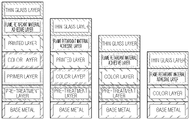
- FIG. 1 illustrates various modified examples of a thin glass layer-laminated printed steel sheet according to an aspect of the present disclosure.
- the present disclosure provides a thin glass layer-laminated printed steel sheet including a clearly visible printed layer printed on a steel sheet and having excellent flame retardancy.
- the present disclosure provides a thin glass layer-laminated printed steel sheet including: a printed steel sheet including a metal sheet and a printed layer on which a design or pattern having a resolution of 300 dpi or higher is printed, the printed layer being formed on a surface of the metal sheet; a transparent ultraviolet-curable adhesive layer containing a flame retardant material and having a thickness of 10 to 100 ⁇ m, the adhesive layer being formed on the printed steel sheet; and thin glass layer attached by the adhesive layer.
- the printed steel sheet is not particularly limited, and may preferably be applied to the present disclosure as long as it is a currently manufactured or commercially available printed steel sheet.
- the printed steel sheet may include a metal sheet and a printed layer on which a design or pattern is printed, the printed layer being formed on a surface of the metal sheet, and a resolution of the design or pattern may be 300 dpi or higher and may be 300 to 2,400 dpi.
- the printed steel sheet may be an inkjet-printed steel sheet.
- a design or pattern is printed by inkjet printing, it may be easy to print a full color having a resolution of 300 dpi or higher. Therefore, a fine difference in contrast, brilliant chroma, and a realistic color may be realized.
- a surface appearance similarly to that of a real natural material may be realized, and thus, an aesthetic decorative material may be obtained.
- the printed steel sheet may include a color layer, a primer layer, and/or a pre-treatment layer formed between the metal sheet and the printed layer.
- a color layer may serve to express a color of the printed steel sheet, and a thickness thereof may be 5 to 30 ⁇ m.
- a plasma treatment may be performed on the color layer in order to adhere to the printed layer.
- the primer layer may serve to enhance adhesion between the metal sheet and the color layer, and a thickness thereof may be 1 to 10 ⁇ m.
- the pre-treatment layer may be included between the metal sheet and the primer layer.
- the pre-treatment layer may serve to improve basic corrosion resistance of the metal sheet and to improve adhesion between the metal sheet and the primer layer, and a thickness thereof may be 0.1 to 2 ⁇ m.
- a transparent adhesive layer for laminating the thin glass layer may be formed on the printed layer of the printed steel sheet, and the adhesive layer may be formed by applying an ultraviolet-curable adhesive solution to the printed steel sheet and curing the ultraviolet-curable adhesive solution.
- the adhesive layer be formed of an ultraviolet-curable adhesive solution.
- a film adhesive or a thermosetting adhesive is used.
- the printed steel sheet in particular, the inkjet-printed steel sheet has a surface roughness of several to several tens of ⁇ m
- a film adhesive or a thermosetting adhesive is used for the printed steel sheet, aesthetic surface image clarity and flatness may not be obtained.
- a specific surface roughness due to ink droplets may be transferred to an adhesive film and glass as is, which may cause bending. Therefore, a surface flatness defect may occur.
- thermosetting adhesive in general, a solvent is contained in an adhesive paint, such a solvent may be vaporized and not escape and may remain in an adhesive coating film at the time of a heat treatment for curing, which may cause bubble generation. Therefore, in order not to transfer the surface roughness of the printed steel sheet to the glass, a solution type adhesive may be more suitable than a solid film adhesive, and better surface quality characteristics may be obtained when an ultraviolet-curable adhesive solution is used in comparison to use of a thermosetting adhesive. Therefore, in the present disclosure, an inkjet-printed steel sheet may be used as the printed steel sheet.
- the adhesive layer has excellent transparent properties because an image of the printed steel sheet should be transmitted and viewed as it is. Specifically, it is preferable that the adhesive layer has a high transmittance of about 85% or more in a wavelength band of 550 nm and has a yellowness index of 2 or less.
- the adhesive layer is formed to have a thickness of 10 to 100 ⁇ m.
- a thickness of the adhesive layer is less than 10 ⁇ m, a roughness of the inkjet-printed surface (printed layer) may not be offset, and thus, a problem may occur in the surface quality, that is, the image clarity.
- the thickness of the adhesive layer exceeds 100 ⁇ m, the adhesive layer becomes too thick, which may cause a problem in a color realization performance or curing efficiency, and in addition, a relatively large amount of adhesive solution is used, which may cause an increase in manufacturing cost.
- the adhesive layer may contain a flame retardant material to impart flame retardancy to the thin glass layer-laminated printed steel sheet of the present disclosure.
- the flame retardant material may be a nitrogen-phosphorus-based flame retardant material, and may be, for example, at least one selected from the group consisting of melamine phosphate, melamine pyrophosphate, melamine polyphosphate, ammonium phosphate, and ammonium polyphosphate, but is not limited thereto.
- an average particle size of the flame retardant material is 0.5 to 5 ⁇ m and preferably 1 to 4 ⁇ m.
- the flame retardant material may not be dispersed well in the adhesive layer, and when the average particle size exceeds 5 ⁇ m, curing efficiency when the adhesive is cured may be reduced.
- the flame retardant material is contained in an amount of 5 to 20 wt% and preferably 10 to 15 wt% based on the total weight of the adhesive layer.
- the content of the flame retardant material is less than 5 wt%, it is difficult to form a carbonized film for providing flame retardancy when the flame retardant material is burned, and thus, it may be difficult to sufficiently perform a role of blocking contact with air by the carbonized film.
- the content of the flame retardant material exceeds 20 wt%, ultraviolet curing efficiency is reduced, the pattern printed on the printed steel sheet is not clearly visible, and adhesion between the glass and the steel sheet is reduced.
- Thin glass layer having a thickness of 0.1 to 2 mm may be laminated on the transparent adhesive layer formed as described above.
- a material of the thin glass layer is not particularly limited, and for example, non-alkali borosilicate glass, soda lime glass, or tempered glass may preferably be applied.
- the thin glass layer is preferably thin glass layer that is freely flexible and has a thin thickness of 0.1 to 2 mm (thin sheet).
- the freely flexible thin glass layer may be laminated on the printed steel sheet, is light in weight, and has an excellent light transmittance, unlike the existing thick sheet glass.
- due to flexible properties thereof even after glass is attached, a feature that may be rounded may be obtained.
- the thickness of the thin glass layer is less than 0.1 mm, handling may be difficult, and a flatness may be reduced due to curvature of a surface or an external force at the time of lamination of the glass.
- the thickness of the thin glass layer exceeds 2 mm, the thin glass layer becomes thick, and thus, a pressure is not properly transmitted or a weight of the thin glass layer is increased, which is not suitable in terms of cost-effectiveness.
- a product may be defective by 80% or more when round processing is performed.
- the thin glass layer applied to the present disclosure should be capable of transmitting ultraviolet light and radiation in a visible wavelength region as well as a wavelength region narrower than the visible wavelength region. This is because the metal sheet and the thin glass layer are laminated with the adhesive layer interposed therebetween and the adhesive layer is cured by passing through an ultraviolet or radiation curing machine in the present disclosure.
- the thin glass layer-laminated printed steel sheet according to the present disclosure having the above-described configuration has a glossiness of 85% or more based on a 60 degree glossmeter and an image clarity of an SW of 30 or less and an LW of 10 or less based on an image clarity measurement device.
- a surface hardness thereof may be 9 H or more based on a pencil hardness.
- the present disclosure is characterized in that a resolution image of the printed steel sheet may be realized at an actual-image level, even though the thin glass layer and the adhesive layer are formed, because the value of the color density exceeds
- the thin glass layer-laminated printed steel sheet since the thin glass layer is laminated on the printed steel sheet having a resolution, high hardness, high image clarity, fouling resistance, and chemical resistance may be implemented according to glass characteristics, and since the thin glass layer is used, excellent interfacial adhesion and excellent coloring may be implemented, and further, flame retardancy may be excellent.
- the present disclosure provides a method for manufacturing a thin glass layer-laminated printed steel sheet.
- the present disclosure provides a method for manufacturing a thin glass layer-laminated printed steel sheet, the method including: preparing a printed steel sheet including a metal sheet and a printed layer on which a design or pattern having a resolution of 300 dpi or higher is printed, the printed layer being formed on a surface of the metal sheet; applying an ultraviolet-curable adhesive solution containing a flame retardant material to a surface of the prepared printed steel sheet to form an adhesive layer; attaching thin glass layer to the printed steel sheet to which the ultraviolet-curable adhesive solution containing the flame retardant material is applied; applying a pressure to the attached thin glass layer; and curing the ultraviolet-curable adhesive solution containing the flame retardant material by irradiation with ultraviolet light.
- the ultraviolet-curable adhesive solution may be applied using a separate application device such as a roll coater or a slot knife or may be manually applied by an operator with equipment such as a brush or a spray gun.
- the present disclosure is not limited thereto, and any of means known in the related art may be used as long as it is a means capable of entirely and evenly applying the adhesive solution to the printed steel sheet.
- the ultraviolet-curable adhesive solution is an ultraviolet-curable adhesive solution containing a flame retardant material, and may preferably be applied to the present disclosure as long as it is cured by ultraviolet light and has adhesive strength.
- an adhesive solution cured by radiation may also be used.
- the ultraviolet-curable adhesive solution containing the flame retardant material may contain a nitrogen-phosphorus-based flame retardant material; a polyester acrylate oligomer having six or more functional groups, a urethane acrylate oligomer having two or more functional groups, or a mixture thereof; and a photocurable monomer, a photoinitiator, or a mixture thereof, and may preferably contain 10 to 20 wt% of a nitrogen-phosphorus-based flame retardant material; 40 to 60 wt% of a polyester acrylate oligomer having six or more functional groups, a urethane acrylate oligomer having two or more functional groups, or a mixture thereof; and 30 to 40 wt% of a photocurable monomer, a photoinitiator, or a mixture thereof.
- the flame retardant material may have the characteristics of the flame retardant material described above.
- the polyester acrylate oligomer having six or more functional groups, the urethane acrylate oligomer having two or more functional groups, or the mixture thereof serves to adhere the thin glass layer to the printed steel sheet, when a content thereof is less than 40 wt% based on the total weight of the adhesive solution, adhesion may be deteriorated, and when the content thereof exceeds 60 wt%, a viscosity is increased, which may cause deterioration of the surface quality such as the inability of bubbles to escape from the adhesive layer.
- the photocurable monomer, the photoinitiator, or the mixture thereof serves to help the adhesive solution of the present disclosure to be cured by ultraviolet light.
- the photocurable monomer include TMPTA, THFA, PETA, IBOA, and a mixture of any one or more thereof.
- the photoinitiator include 2-hydroxy-2-methyl-1-phenyl-propane, oxy-phenyl-acetic acid 2-[2-oxo-2-phenyl-acetoxy-ethoxy]-ethyl ester, and a mixture thereof.
- the adhesive solution of the present disclosure may contain other additives.
- phosphoric acid acrylate (acid value 250) for improving adhesion with the steel sheet
- a polyether siloxane compound for improving adhesion with the glass
- a fluoroalkyl compound for improving denaturation resistance of the adhesive layer, or a mixture of any one or more thereof may be contained, but the present disclosure is not limited thereto.
- the ultraviolet-curable adhesive solution should be evenly applied to the entire area of the printed steel sheet. To this end, it is preferable that the ultraviolet-curable adhesive solution is applied to the entire region of the printed steel sheet to have a predetermined thickness, and for example, it is more preferable that the adhesive solution is applied in a certain amount at a predetermined interval. In the case in which the adhesive solution is applied at a predetermined interval, the adhesive solution may be spread evenly over the entire area of the printed steel sheet due to a pressure by attaching and pressing the thin glass layer, which may minimize waste of the adhesive solution.
- the ultraviolet-curable adhesive solution when the ultraviolet-curable adhesive solution is applied, it is preferable that a roll or bed capable of supporting the printed steel sheet is provided. In a case of a coiled steel sheet, it is preferable that a roll formed of rubber or metal is provided. In a case of a sheet material, it is preferable that a bed formed of plastic, metal, or wood is provided to support the entire surface of the sheet material. In a case in which the ultraviolet-curable adhesive solution containing the flame retardant material is applied on such a roll or bed, the adhesive solution may be more evenly applied.
- thin glass layer for example, thin glass layer having a thickness of 0.1 to 2 mm is attached thereto. Then, after attaching the thin glass layer, the thin glass layer is pressed by applying a pressure of 2 to 10 kgf. An appropriate pressure is applied to the thin glass layer, such that a thickness of the adhesive layer may be appropriately adjusted, and bubbles formed in the ultraviolet-curable adhesive solution containing the flame retardant material and the thin glass layer may be easily removed.
- the pressure applied to the thin glass layer is less than 2 kgf, bubbles remaining at the adhesive interface may be trapped due to a pressure drop, or the pressure is not transmitted as a whole, which may cause a defect in which an unattached portion is generated between the thin glass layer and the adhesive layer.
- the pressure exceeds 10 kgf, the thickness of the adhesive layer is decreased due to a high pressure, such that a rough surface of the printed layer is adhered as it is, which may cause a defect of image clarity, and the adhesive solution escapes out, which may cause fouling of a device. Therefore, it is preferable that the pressure is controlled to 2 to 10 kgf.
- a method of applying the pressure may be applied without limitation by the present disclosure as long as it is a glass pressing method commonly used in the related art.
- the thin glass layer may be pressed by a roll pressing method of applying a pressure using a lamination roll located upper and lower surfaces of the printed steel sheet.
- an attachment tool and a pressing tool used in the attachment and application of pressure to the thin glass layer may include a roll press including a lamination roll provided to be located on the upper and lower surfaces of the printed steel sheet, a thin glass layer withdrawal tool provided on an upper side of the roll press, and a member provided between the thin glass layer and the printed steel sheet on which the adhesive layer is formed to support the thin glass layer in a flat state.
- the lamination roll is made of a roll formed of a rubber material, and it is preferable that the pressing is performed while the lamination roll moves using a conveyor belt to move a press roll in a longitudinal direction of a base material when pressing the printed steel sheet and the thin glass layer.
- the lamination roll may include a lifting actuator and a pressure adjustment device so that a lift height and a pressure are controlled to adjust the thickness of the adhesive layer to be applied to the printed steel sheet.
- the member is provided at a corner of the thin glass layer in a width direction to keep the thin glass layer in a flat state.
- the member may be provided as a conveyor belt, a roller, or the like, but is not limited thereto, and any means capable of keeping the transparent thin glass layer flat may be used.
- the pressed thin glass layer-laminated printed steel sheet may be passed through an ultraviolet curing machine to cure the ultraviolet-curable adhesive solution containing the flame retardant material, thereby forming a coating film having a thickness of 10 to 100 ⁇ m.
- ultraviolet light to be irradiated may be in a wavelength range of 300 to 400 nm.
- the present disclosure is not limited thereto, and any of means known in the related art may be applied without limitation as long as it may be a means capable of curing the ultraviolet-curable adhesive solution.
- microbubbles in an edge portion may be additionally removed using a pressure reduction means such as a pressure reducer.
- An ultraviolet-curable adhesive solution containing a flame retardant material contained in a coater pan (10 wt% of melamine phosphate as a nitrogen-phosphorus-based flame retardant material, 12 wt% of a polyester acrylate oligomer (Miramer PS420, Miwon Specialty Chemical Co., Ltd., four functional groups, Mw 1,800), 20 wt% of phenoxyethyl acrylate (2-PEA), 20 wt% of tetrahydrofurfuryl acrylate (THFA), 20 wt% of isobornyl acrylate (IBOA), 10 parts by weight of hexanediol diacrylate (HDDA), 2 wt% of an photoinitiator Irgacure 184 (BASF SE), 3 wt% of an photoinitiator Irgacure 369 (BASF SE), 1 wt% of phosphoric acid acrylate (acid value 250), 1 wt% of
- a glass-laminated steel sheet was manufactured in the same manner as that of Example 1, except that an ultraviolet-curable adhesive solution containing 25 wt% of the flame retardant material, 12 wt% of the polyester acrylate oligomer (Miramer PS420, Miwon Specialty Chemical Co., Ltd, four functional groups, Mw 1,800), 15 wt% of the phenoxyethyl acrylate (2-PEA), 15 wt% of the tetrahydrofurfuryl acrylate (THFA), 15 wt% of the isobornyl acrylate (IBOA), 10 wt% of the hexanediol diacrylate (HDDA), 2 wt% of the photoinitiator Irgacure 184 (BASF SE), 3 wt% of the photoinitiator Irgacure 369 (BASF SE), 1 wt% of the phosphoric acid acrylate (acid value 250), 1 wt% of the polyether
- a glass-laminated steel sheet was manufactured in the same manner as that of Example 1, except that an ultraviolet-curable adhesive solution containing 3 wt% of the flame retardant material, 15 wt% of the polyester acrylate oligomer (Miramer PS420, Miwon Specialty Chemical Co., Ltd, four functional groups, Mw 1,800), 20 wt% of the phenoxyethyl acrylate (2-PEA), 22 wt% of the tetrahydrofurfuryl acrylate (THFA), 22 wt% of the isobornyl acrylate (IBOA), 10 wt% of the hexanediol diacrylate (HDDA), 2 wt% of the photoinitiator Irgacure 184 (BASF SE), 3 wt% of the photoinitiator Irgacure 369 (BASF SE), 1 wt% of the phosphoric acid acrylate (acid value 250), 1 wt% of the polyether
- a glass-laminated steel sheet was manufactured in the same manner as that of Example 1, except that a high gloss transparent adhesive solution (containing a high gloss clear polyester painter of PPG SSC Co., Ltd. and 15 wt% of a flame retardant material (melamine phosphate as a nitrogen-phosphorus-based flame retardant material) was used instead of the ultraviolet-curable adhesive solution, and the adhesive solution was cured by a thermal curing method to laminate the printed steel sheet and the glass in Example 1.
- a high gloss transparent adhesive solution containing a high gloss clear polyester painter of PPG SSC Co., Ltd. and 15 wt% of a flame retardant material (melamine phosphate as a nitrogen-phosphorus-based flame retardant material) was used instead of the ultraviolet-curable adhesive solution, and the adhesive solution was cured by a thermal curing method to laminate the printed steel sheet and the glass in Example 1.
- a glass-laminated steel sheet was manufactured in the same manner as that of Example 1, except that a flame retardant material was not contained in the ultraviolet-curable adhesive solution in Example 1.
- the glossiness was measured at a measurement angle of 60° using a glossmeter (BYK-Gardner Gmbh). The glossiness was expressed as a relative value based on a reflection of glass as 100.
- the image clarity was measured by irradiating a surface of a 1 ⁇ 10 cm specimen with light at an angle of 20° using an image clarity measurement device (Wavescan, BYK-Gardner Gmbh), 3,750 points were scanned, and a degree of unevenness and image clarity of the coating film were classified and marked as a grade of 0 (good) to 100 (bad).
- a measurement range was divided into a short wave (SW) of 0.1 to 1.2 mm and a long wave (LW) of 1.2 to 12 mm.
- the measured value of the image clarity was expressed as ⁇ when the SW was 20 or less and the LW was 5 or less, ⁇ when the SW was 21 to 30 and the LW was 6 to 15, ⁇ when the SW was 31 to 40 and the LW was 16 to 20, and X when the SW was 41 or more and the LW was 21 or more.
- the color density represents a ratio of a saturated state such as blackness or chroma. It was expressed as ⁇ when the value was greater than 1.6, ⁇ when the value was 1.3 to 1.6, and ⁇ when the value was less than 1.3.
- the adhesion was measured by a Lab. shear test in accordance with the ASTM D100-10 standard test method.
Landscapes
- Chemical & Material Sciences (AREA)
- Organic Chemistry (AREA)
- Health & Medical Sciences (AREA)
- Chemical Kinetics & Catalysis (AREA)
- Medicinal Chemistry (AREA)
- Polymers & Plastics (AREA)
- Laminated Bodies (AREA)
Abstract
Description
- The present disclosure relates to a thin glass layer-laminated printed steel sheet having a clearly visible pattern printed on a printed steel sheet and excellent flame retardancy, and a method for manufacturing the same.
- In general, a surface-treated steel sheet on which a pattern is printed has been used for exteriors of buildings, exteriors of home appliances, and the like, and has been used by controlling gloss through various clear coatings. Such a printed steel sheet is used to increase an aesthetic effect of a desired product or an interior effect of a building through having various images and shape designs on a surface thereof.
- In accordance with an increase in quality of life, consumers consider not only the function of a product, but also the appearance quality or design of the product as an important factor in choosing a product when purchasing home appliances, building materials, and the like. In response to the demands of consumers, in recent years, a color steel sheet coated with one color, a printed steel sheet having a texture together with an aesthetic appearance through implementing various patterns using ink, or the like, has emerged as a trend. As such, a color steel sheet or printed steel sheet having an excellent visual function of a surface appearance has been widely applied to fire doors, elevator interiors, high-end buildings, indoor interiors, home appliances, kitchens, furniture, or the like, in accordance with individualization and high quality. In particular, demand for a printed steel sheet is gradually increasing because various designs required by customers may be applied to the printed steel sheet and high-resolution and high-quality designs may be exhibited.
- However, in general, expanded polystyrene, urethane, glass wool, and the like, have been mainly used for the inside of a wall used for a building, and various inorganic materials such as ceramic boards, gypsum boards, and ceramic tiles have been widely used for a wall panel. Since expanded polystyrene is not flame retardant and may cause severe harm in the case of fire, regulations on the use of expanded polystyrene have been strengthened. Urethane has excellent thermal insulation properties and is flame retardant to some extent, and the use thereof is being expanded in the building and insulation market, but there are still problems with the spread of flames or the generation of toxic gas in the case of a fire. Therefore, development of a building wall or ceiling material having flame retardancy or nonflammability is required.
- In the related art, a related art document related to a building finishing material having flame retardancy or nonflammability has been proposed in
Korean Patent Laid-Open Publication No. 10-2018-0053082 - The present disclosure is proposed to solve the above-described problems in the related art, and an object of the present disclosure is to provide a thin glass layer-laminated printed steel sheet having excellent surface qualities such as high hardness, high gloss, and high image clarity and further having excellent flame retardancy by interposing a transparent adhesive layer between printed steel sheets on which various designs or patterns are printed to a thickness of 10 to 100 µm and laminating thin glass layer having a thickness of 0.1 to 2 mm thereon, and a method for manufacturing the same.
- According to an aspect of the present disclosure, a thin glass layer-laminated printed steel sheet includes: a printed steel sheet including a metal sheet and a printed layer on which a design or pattern having a resolution of 300 dpi or higher is printed, the printed layer being formed on a surface of the metal sheet; a transparent ultraviolet-curable adhesive layer containing a flame retardant material and having a thickness of 10 to 100 µm, the adhesive layer being formed on the printed steel sheet; and a thin glass layer attached by the adhesive layer.
- According to another aspect of the present disclosure, a method for manufacturing a thin glass layer-laminated printed steel sheet includes: preparing a printed steel sheet including a metal sheet and a printed layer on which a design or pattern having a resolution of 300 dpi or higher is printed, the printed layer being formed on a surface of the metal sheet; applying an ultraviolet-curable adhesive solution containing a flame retardant material to a surface of the prepared printed steel sheet to form an adhesive layer; attaching thin glass layer to the printed steel sheet to which the ultraviolet-curable adhesive solution containing the flame retardant material is applied; applying a pressure to the attached thin glass layer; and curing the ultraviolet-curable adhesive solution containing the flame retardant material by irradiation with ultraviolet light.
- As set forth above, a thin glass layer having an aesthetic roughness is laminated on a printed steel sheet, such that it is possible to provide a thin glass layer-laminated printed steel sheet having excellent surface qualities such as high hardness, high gloss, and high image clarity, and excellent optical properties that may implement various images on the printed steel sheet with high image clarity, may protect a printed layer, and may prevent discoloration, drop-out, and the like, and having excellent flame retardancy.
- FIG. 1 illustrates various modified examples of a thin glass layer-laminated printed steel sheet according to an aspect of the present disclosure.
- Hereinafter, preferred exemplary embodiments in the present disclosure will be described with reference to the accompanying drawings. However, exemplary embodiments in the present disclosure may be modified in several other forms, and the scope of the present disclosure is not limited to exemplary embodiments to be described below.
- The present disclosure provides a thin glass layer-laminated printed steel sheet including a clearly visible printed layer printed on a steel sheet and having excellent flame retardancy.
- Specifically, the present disclosure provides a thin glass layer-laminated printed steel sheet including: a printed steel sheet including a metal sheet and a printed layer on which a design or pattern having a resolution of 300 dpi or higher is printed, the printed layer being formed on a surface of the metal sheet; a transparent ultraviolet-curable adhesive layer containing a flame retardant material and having a thickness of 10 to 100 µm, the adhesive layer being formed on the printed steel sheet; and thin glass layer attached by the adhesive layer.
- The printed steel sheet is not particularly limited, and may preferably be applied to the present disclosure as long as it is a currently manufactured or commercially available printed steel sheet. In addition, the printed steel sheet may include a metal sheet and a printed layer on which a design or pattern is printed, the printed layer being formed on a surface of the metal sheet, and a resolution of the design or pattern may be 300 dpi or higher and may be 300 to 2,400 dpi.
- For example, the printed steel sheet may be an inkjet-printed steel sheet. In a case in which a design or pattern is printed by inkjet printing, it may be easy to print a full color having a resolution of 300 dpi or higher. Therefore, a fine difference in contrast, brilliant chroma, and a realistic color may be realized. In addition, according to the present disclosure, in a case in which thin glass layer is laminated on the inkjet-printed steel sheet, a surface appearance similarly to that of a real natural material may be realized, and thus, an aesthetic decorative material may be obtained.
- Furthermore, the printed steel sheet may include a color layer, a primer layer, and/or a pre-treatment layer formed between the metal sheet and the printed layer. In FIG. 1, a structure of a thin glass layer-laminated printed steel sheet according to the modified example is illustrated. The color layer may serve to express a color of the printed steel sheet, and a thickness thereof may be 5 to 30 µm. In addition, a plasma treatment may be performed on the color layer in order to adhere to the printed layer. Meanwhile, the primer layer may serve to enhance adhesion between the metal sheet and the color layer, and a thickness thereof may be 1 to 10 µm.
- In addition, the pre-treatment layer may be included between the metal sheet and the primer layer. The pre-treatment layer may serve to improve basic corrosion resistance of the metal sheet and to improve adhesion between the metal sheet and the primer layer, and a thickness thereof may be 0.1 to 2 µm.
- Meanwhile, a transparent adhesive layer for laminating the thin glass layer may be formed on the printed layer of the printed steel sheet, and the adhesive layer may be formed by applying an ultraviolet-curable adhesive solution to the printed steel sheet and curing the ultraviolet-curable adhesive solution.
- It is preferable that the adhesive layer be formed of an ultraviolet-curable adhesive solution. In the related art, in general, when glass is laminated to a building material, a film adhesive or a thermosetting adhesive is used. However, since the printed steel sheet, in particular, the inkjet-printed steel sheet has a surface roughness of several to several tens of µm, when a film adhesive or a thermosetting adhesive is used for the printed steel sheet, aesthetic surface image clarity and flatness may not be obtained. Specifically, in the case of the film adhesive to be attached to the inkjet-printed steel sheet, a specific surface roughness due to ink droplets may be transferred to an adhesive film and glass as is, which may cause bending. Therefore, a surface flatness defect may occur. In the case of the thermosetting adhesive, in general, a solvent is contained in an adhesive paint, such a solvent may be vaporized and not escape and may remain in an adhesive coating film at the time of a heat treatment for curing, which may cause bubble generation. Therefore, in order not to transfer the surface roughness of the printed steel sheet to the glass, a solution type adhesive may be more suitable than a solid film adhesive, and better surface quality characteristics may be obtained when an ultraviolet-curable adhesive solution is used in comparison to use of a thermosetting adhesive. Therefore, in the present disclosure, an inkjet-printed steel sheet may be used as the printed steel sheet.
- It is preferable that the adhesive layer has excellent transparent properties because an image of the printed steel sheet should be transmitted and viewed as it is. Specifically, it is preferable that the adhesive layer has a high transmittance of about 85% or more in a wavelength band of 550 nm and has a yellowness index of 2 or less.
- Meanwhile, it is preferable that the adhesive layer is formed to have a thickness of 10 to 100 µm. When the thickness of the adhesive layer is less than 10 µm, a roughness of the inkjet-printed surface (printed layer) may not be offset, and thus, a problem may occur in the surface quality, that is, the image clarity. On the other hand, when the thickness of the adhesive layer exceeds 100 µm, the adhesive layer becomes too thick, which may cause a problem in a color realization performance or curing efficiency, and in addition, a relatively large amount of adhesive solution is used, which may cause an increase in manufacturing cost.
- Furthermore, the adhesive layer may contain a flame retardant material to impart flame retardancy to the thin glass layer-laminated printed steel sheet of the present disclosure. In this case, the flame retardant material may be a nitrogen-phosphorus-based flame retardant material, and may be, for example, at least one selected from the group consisting of melamine phosphate, melamine pyrophosphate, melamine polyphosphate, ammonium phosphate, and ammonium polyphosphate, but is not limited thereto.
- In addition, an average particle size of the flame retardant material is 0.5 to 5 µm and preferably 1 to 4 µm. When the average particle size is less than 0.5 µm, the flame retardant material may not be dispersed well in the adhesive layer, and when the average particle size exceeds 5 µm, curing efficiency when the adhesive is cured may be reduced.
- In this case, the flame retardant material is contained in an amount of 5 to 20 wt% and preferably 10 to 15 wt% based on the total weight of the adhesive layer. When the content of the flame retardant material is less than 5 wt%, it is difficult to form a carbonized film for providing flame retardancy when the flame retardant material is burned, and thus, it may be difficult to sufficiently perform a role of blocking contact with air by the carbonized film. When the content of the flame retardant material exceeds 20 wt%, ultraviolet curing efficiency is reduced, the pattern printed on the printed steel sheet is not clearly visible, and adhesion between the glass and the steel sheet is reduced.
- Thin glass layer having a thickness of 0.1 to 2 mm may be laminated on the transparent adhesive layer formed as described above. A material of the thin glass layer is not particularly limited, and for example, non-alkali borosilicate glass, soda lime glass, or tempered glass may preferably be applied.
- The thin glass layer is preferably thin glass layer that is freely flexible and has a thin thickness of 0.1 to 2 mm (thin sheet). The freely flexible thin glass layer may be laminated on the printed steel sheet, is light in weight, and has an excellent light transmittance, unlike the existing thick sheet glass. In addition, due to flexible properties thereof, even after glass is attached, a feature that may be rounded may be obtained. Meanwhile, when the thickness of the thin glass layer is less than 0.1 mm, handling may be difficult, and a flatness may be reduced due to curvature of a surface or an external force at the time of lamination of the glass. On the other hand, when the thickness of the thin glass layer exceeds 2 mm, the thin glass layer becomes thick, and thus, a pressure is not properly transmitted or a weight of the thin glass layer is increased, which is not suitable in terms of cost-effectiveness. For example, when the thickness of the glass is 5 mm, a product may be defective by 80% or more when round processing is performed.
- In particular, the thin glass layer applied to the present disclosure should be capable of transmitting ultraviolet light and radiation in a visible wavelength region as well as a wavelength region narrower than the visible wavelength region. This is because the metal sheet and the thin glass layer are laminated with the adhesive layer interposed therebetween and the adhesive layer is cured by passing through an ultraviolet or radiation curing machine in the present disclosure.
- The thin glass layer-laminated printed steel sheet according to the present disclosure having the above-described configuration has a glossiness of 85% or more based on a 60 degree glossmeter and an image clarity of an SW of 30 or less and an LW of 10 or less based on an image clarity measurement device. In addition, a surface hardness thereof may be 9 H or more based on a pencil hardness.
- Meanwhile, as an optical property evaluated by measuring light in a region of 380 to 780 nm using a spectrophotometer, the thin glass layer-laminated printed steel sheet of the present disclosure may have an L value (lightness of white color) of 75 or more when a white point is evaluated (White Point Comparison), an HSL (H: Hue, S: Saturation, L: Lightness) value of more than 440,000 when the HSL value is evaluated based on a maximum chroma (Saturation=1) in color gamut volume evaluation (Gamut Volume, HSL Comparison), a value of a color density of more than 1.6 when the color density is evaluated (Dmax Comparison), and an absolute value of a color gamut volume of more than 200,000 when the absolute value of the color gamut volume is evaluated (Gamut Volume, Cubic Volume Comparison). In particular, the present disclosure is characterized in that a resolution image of the printed steel sheet may be realized at an actual-image level, even though the thin glass layer and the adhesive layer are formed, because the value of the color density exceeds 1.6 when the color density is evaluated.
- In the thin glass layer-laminated printed steel sheet according to an aspect of the present disclosure, since the thin glass layer is laminated on the printed steel sheet having a resolution, high hardness, high image clarity, fouling resistance, and chemical resistance may be implemented according to glass characteristics, and since the thin glass layer is used, excellent interfacial adhesion and excellent coloring may be implemented, and further, flame retardancy may be excellent.
- In addition, the present disclosure provides a method for manufacturing a thin glass layer-laminated printed steel sheet.
- Specifically, the present disclosure provides a method for manufacturing a thin glass layer-laminated printed steel sheet, the method including: preparing a printed steel sheet including a metal sheet and a printed layer on which a design or pattern having a resolution of 300 dpi or higher is printed, the printed layer being formed on a surface of the metal sheet; applying an ultraviolet-curable adhesive solution containing a flame retardant material to a surface of the prepared printed steel sheet to form an adhesive layer; attaching thin glass layer to the printed steel sheet to which the ultraviolet-curable adhesive solution containing the flame retardant material is applied; applying a pressure to the attached thin glass layer; and curing the ultraviolet-curable adhesive solution containing the flame retardant material by irradiation with ultraviolet light.
- The metal sheet and the printed steel sheet on which various designs having a resolution are prepared, and a transparent ultraviolet-curable adhesive solution is applied to the printed steel sheet. As a method of applying the ultraviolet-curable adhesive solution, the ultraviolet-curable adhesive solution may be applied using a separate application device such as a roll coater or a slot knife or may be manually applied by an operator with equipment such as a brush or a spray gun. However, the present disclosure is not limited thereto, and any of means known in the related art may be used as long as it is a means capable of entirely and evenly applying the adhesive solution to the printed steel sheet.
- In this case, the ultraviolet-curable adhesive solution is an ultraviolet-curable adhesive solution containing a flame retardant material, and may preferably be applied to the present disclosure as long as it is cured by ultraviolet light and has adhesive strength. In addition, an adhesive solution cured by radiation may also be used.
- For example, the ultraviolet-curable adhesive solution containing the flame retardant material may contain a nitrogen-phosphorus-based flame retardant material; a polyester acrylate oligomer having six or more functional groups, a urethane acrylate oligomer having two or more functional groups, or a mixture thereof; and a photocurable monomer, a photoinitiator, or a mixture thereof, and may preferably contain 10 to 20 wt% of a nitrogen-phosphorus-based flame retardant material; 40 to 60 wt% of a polyester acrylate oligomer having six or more functional groups, a urethane acrylate oligomer having two or more functional groups, or a mixture thereof; and 30 to 40 wt% of a photocurable monomer, a photoinitiator, or a mixture thereof.
- In the ultraviolet-curable adhesive solution containing the flame retardant material, the flame retardant material may have the characteristics of the flame retardant material described above.
- Furthermore, the polyester acrylate oligomer having six or more functional groups, the urethane acrylate oligomer having two or more functional groups, or the mixture thereof serves to adhere the thin glass layer to the printed steel sheet, when a content thereof is less than 40 wt% based on the total weight of the adhesive solution, adhesion may be deteriorated, and when the content thereof exceeds 60 wt%, a viscosity is increased, which may cause deterioration of the surface quality such as the inability of bubbles to escape from the adhesive layer.
- In addition, the photocurable monomer, the photoinitiator, or the mixture thereof serves to help the adhesive solution of the present disclosure to be cured by ultraviolet light. Examples of the photocurable monomer include TMPTA, THFA, PETA, IBOA, and a mixture of any one or more thereof. Examples of the photoinitiator include 2-hydroxy-2-methyl-1-phenyl-propane, oxy-phenyl-acetic acid 2-[2-oxo-2-phenyl-acetoxy-ethoxy]-ethyl ester, and a mixture thereof. In this case, when the content thereof is less than 30 wt% based on the total weight of the adhesive solution, the viscosity is increased, and thus, the adhesive strength and problems in application may occur, and when the content thereof exceeds 40 wt%, the viscosity is decreased and the solution at the adhesive interface flows out, which may cause a problem in surface quality of a product.
- Meanwhile, the adhesive solution of the present disclosure may contain other additives. For example, phosphoric acid acrylate (acid value 250) for improving adhesion with the steel sheet, a polyether siloxane compound for improving adhesion with the glass, a fluoroalkyl compound for improving denaturation resistance of the adhesive layer, or a mixture of any one or more thereof may be contained, but the present disclosure is not limited thereto.
- The ultraviolet-curable adhesive solution should be evenly applied to the entire area of the printed steel sheet. To this end, it is preferable that the ultraviolet-curable adhesive solution is applied to the entire region of the printed steel sheet to have a predetermined thickness, and for example, it is more preferable that the adhesive solution is applied in a certain amount at a predetermined interval. In the case in which the adhesive solution is applied at a predetermined interval, the adhesive solution may be spread evenly over the entire area of the printed steel sheet due to a pressure by attaching and pressing the thin glass layer, which may minimize waste of the adhesive solution.
- In addition, when the ultraviolet-curable adhesive solution is applied, it is preferable that a roll or bed capable of supporting the printed steel sheet is provided. In a case of a coiled steel sheet, it is preferable that a roll formed of rubber or metal is provided. In a case of a sheet material, it is preferable that a bed formed of plastic, metal, or wood is provided to support the entire surface of the sheet material. In a case in which the ultraviolet-curable adhesive solution containing the flame retardant material is applied on such a roll or bed, the adhesive solution may be more evenly applied.
- After applying the ultraviolet-curable adhesive solution to the printed steel sheet, thin glass layer, for example, thin glass layer having a thickness of 0.1 to 2 mm is attached thereto. Then, after attaching the thin glass layer, the thin glass layer is pressed by applying a pressure of 2 to 10 kgf. An appropriate pressure is applied to the thin glass layer, such that a thickness of the adhesive layer may be appropriately adjusted, and bubbles formed in the ultraviolet-curable adhesive solution containing the flame retardant material and the thin glass layer may be easily removed.
- When the pressure applied to the thin glass layer is less than 2 kgf, bubbles remaining at the adhesive interface may be trapped due to a pressure drop, or the pressure is not transmitted as a whole, which may cause a defect in which an unattached portion is generated between the thin glass layer and the adhesive layer. On the other hand, when the pressure exceeds 10 kgf, the thickness of the adhesive layer is decreased due to a high pressure, such that a rough surface of the printed layer is adhered as it is, which may cause a defect of image clarity, and the adhesive solution escapes out, which may cause fouling of a device. Therefore, it is preferable that the pressure is controlled to 2 to 10 kgf.
- A method of applying the pressure may be applied without limitation by the present disclosure as long as it is a glass pressing method commonly used in the related art. For example, the thin glass layer may be pressed by a roll pressing method of applying a pressure using a lamination roll located upper and lower surfaces of the printed steel sheet. In addition, an attachment tool and a pressing tool used in the attachment and application of pressure to the thin glass layer may include a roll press including a lamination roll provided to be located on the upper and lower surfaces of the printed steel sheet, a thin glass layer withdrawal tool provided on an upper side of the roll press, and a member provided between the thin glass layer and the printed steel sheet on which the adhesive layer is formed to support the thin glass layer in a flat state.
- It is preferable that the lamination roll is made of a roll formed of a rubber material, and it is preferable that the pressing is performed while the lamination roll moves using a conveyor belt to move a press roll in a longitudinal direction of a base material when pressing the printed steel sheet and the thin glass layer. In addition, the lamination roll may include a lifting actuator and a pressure adjustment device so that a lift height and a pressure are controlled to adjust the thickness of the adhesive layer to be applied to the printed steel sheet. In addition, the member is provided at a corner of the thin glass layer in a width direction to keep the thin glass layer in a flat state. The member may be provided as a conveyor belt, a roller, or the like, but is not limited thereto, and any means capable of keeping the transparent thin glass layer flat may be used.
- Thereafter, the pressed thin glass layer-laminated printed steel sheet may be passed through an ultraviolet curing machine to cure the ultraviolet-curable adhesive solution containing the flame retardant material, thereby forming a coating film having a thickness of 10 to 100 µm. In this case, ultraviolet light to be irradiated may be in a wavelength range of 300 to 400 nm. However, the present disclosure is not limited thereto, and any of means known in the related art may be applied without limitation as long as it may be a means capable of curing the ultraviolet-curable adhesive solution.
- In addition, during the curing with ultraviolet light, microbubbles in an edge portion may be additionally removed using a pressure reduction means such as a pressure reducer.
- Hereinafter, the present disclosure will be described in more detail with reference to specific Examples. The following Examples are only examples provided in order to assist in the understanding of the present disclosure, but the scope of the present disclosure is not limited thereto.
- An ultraviolet-curable adhesive solution containing a flame retardant material contained in a coater pan (10 wt% of melamine phosphate as a nitrogen-phosphorus-based flame retardant material, 12 wt% of a polyester acrylate oligomer (Miramer PS420, Miwon Specialty Chemical Co., Ltd., four functional groups, Mw 1,800), 20 wt% of phenoxyethyl acrylate (2-PEA), 20 wt% of tetrahydrofurfuryl acrylate (THFA), 20 wt% of isobornyl acrylate (IBOA), 10 parts by weight of hexanediol diacrylate (HDDA), 2 wt% of an photoinitiator Irgacure 184 (BASF SE), 3 wt% of an photoinitiator Irgacure 369 (BASF SE), 1 wt% of phosphoric acid acrylate (acid value 250), 1 wt% of a polyether siloxane compound, and 1 wt% of a fluoroalkyl compound) was coated to a coating roll, the adhesive solution was applied to an inkjet-printed steel sheet having a thickness of 1 mm on which a resolution pattern was printed to a thickness of 30 to 40 µm, and then, thin glass layer having a thickness of 400 µm and a light transmittance of 90% or more was attached thereto. Thereafter, a film was pressed at a pressure of 3 kg/f using a press roll to closely contact the adhesive solution to the film, and the film was passed through an ultraviolet curing machine to cure the adhesive solution, thereby manufacturing a glass-laminated steel sheet.
- A glass-laminated steel sheet was manufactured in the same manner as that of Example 1, except that an ultraviolet-curable adhesive solution containing 25 wt% of the flame retardant material, 12 wt% of the polyester acrylate oligomer (Miramer PS420, Miwon Specialty Chemical Co., Ltd, four functional groups, Mw 1,800), 15 wt% of the phenoxyethyl acrylate (2-PEA), 15 wt% of the tetrahydrofurfuryl acrylate (THFA), 15 wt% of the isobornyl acrylate (IBOA), 10 wt% of the hexanediol diacrylate (HDDA), 2 wt% of the photoinitiator Irgacure 184 (BASF SE), 3 wt% of the photoinitiator Irgacure 369 (BASF SE), 1 wt% of the phosphoric acid acrylate (acid value 250), 1 wt% of the polyether siloxane compound, and 1 wt% of the fluoroalkyl compound was used in Example 1.
- A glass-laminated steel sheet was manufactured in the same manner as that of Example 1, except that an ultraviolet-curable adhesive solution containing 3 wt% of the flame retardant material, 15 wt% of the polyester acrylate oligomer (Miramer PS420, Miwon Specialty Chemical Co., Ltd, four functional groups, Mw 1,800), 20 wt% of the phenoxyethyl acrylate (2-PEA), 22 wt% of the tetrahydrofurfuryl acrylate (THFA), 22 wt% of the isobornyl acrylate (IBOA), 10 wt% of the hexanediol diacrylate (HDDA), 2 wt% of the photoinitiator Irgacure 184 (BASF SE), 3 wt% of the photoinitiator Irgacure 369 (BASF SE), 1 wt% of the phosphoric acid acrylate (acid value 250), 1 wt% of the polyether siloxane compound, and 1 wt% of the fluoroalkyl compound was used in Example 1.
- A glass-laminated steel sheet was manufactured in the same manner as that of Example 1, except that a high gloss transparent adhesive solution (containing a high gloss clear polyester painter of PPG SSC Co., Ltd. and 15 wt% of a flame retardant material (melamine phosphate as a nitrogen-phosphorus-based flame retardant material) was used instead of the ultraviolet-curable adhesive solution, and the adhesive solution was cured by a thermal curing method to laminate the printed steel sheet and the glass in Example 1.
- A glass-laminated steel sheet was manufactured in the same manner as that of Example 1, except that a flame retardant material was not contained in the ultraviolet-curable adhesive solution in Example 1.
- The glossiness, the image clarity, the hardness, the fouling resistance, the chemical resistance, the processability, the optical properties, the adhesion, the clarity, and the flame retardancy of the glass-laminated steel sheets of Example 1, Comparative Examples 1 to 3, and Reference Example 1 were tested according to the following measurement methods. To compare the results, the results are summarized in Table 1.
- The glossiness was measured at a measurement angle of 60° using a glossmeter (BYK-Gardner Gmbh). The glossiness was expressed as a relative value based on a reflection of glass as 100.
- The image clarity was measured by irradiating a surface of a 1 × 10 cm specimen with light at an angle of 20° using an image clarity measurement device (Wavescan, BYK-Gardner Gmbh), 3,750 points were scanned, and a degree of unevenness and image clarity of the coating film were classified and marked as a grade of 0 (good) to 100 (bad). At this time, a measurement range was divided into a short wave (SW) of 0.1 to 1.2 mm and a long wave (LW) of 1.2 to 12 mm.
- The measured value of the image clarity was expressed as ⊚ when the SW was 20 or less and the LW was 5 or less, ∘ when the SW was 21 to 30 and the LW was 6 to 15, △ when the SW was 31 to 40 and the LW was 16 to 20, and X when the SW was 41 or more and the LW was 21 or more.
- After 880 sample colors were printed using a spectrophotometer, light in a range of 380 to 780 nm was measured for color measurement, and a color density was evaluated according to the following evaluation method. The results thereof are shown in Table 1.
- The color density represents a ratio of a saturated state such as blackness or chroma. It was expressed as ⊚ when the value was greater than 1.6, ∘ when the value was 1.3 to 1.6, and △ when the value was less than 1.3.
- The adhesion was measured by a Lab. shear test in accordance with the ASTM D100-10 standard test method.
- A color difference (using Macbeth 7000A model as a color-difference meter) before and after glass lamination was measured, and a color difference value before and after was determined as ∘ when it was 3.0 or less, △ when it was greater than 3.0 and 5.0 or less, and X when it was greater than 5.0.
- The glass-laminated steel sheet was heated in an oven at 750°C for 20 minutes, and it was determined as ∘ when a flame was not generated and X when a flame was generated.
[Table 1] Classification Example 1 Comparative Example 1 Comparative Example 2 Comparative Example 3 Comparative Example4 10 wt% of flame retardant material 25 wt% of flame retardant material 3 wt% of flame retardant material Thermal curing adhesion (15 wt% of flame retardant material) Containing no flame retardant material Glossiness 97 96 93 92 97 Image clarity SW ⊚ (12) ⊚ (17) ⊚ (13) ⊚ (14) ⊚ (15) LW ⊚ (3) ∘ (8) ⊚ (3) ∘ (7) ⊚ (4) Adhesion 2.1 Mpa 1.8 Mpa 2.3 Mpa 1.1 Mpa 2.3 Mpa Clarity ∘ △ ∘ X ∘ Flame retardancy ∘ ∘ X X X Color density ⊚ (1.61) o (1.52) ⊚ (1.63) △ (0.9) ⊚ (1.69) - As shown in Table 1, it could be confirmed that in the case of the glass-laminated steel sheet in which the ultraviolet-curable adhesive solution containing 15 wt% of the flame retardant material was used, the adhesion was excellent, and all of the glossiness, the clarity, and the flame retardancy were excellent. On the other hand, it could be confirmed that in the case in which the flame retardant material was excessively contained in an amount of 30 wt%, the flame retardancy was excellent, but the adhesion and the clearness were significantly reduced, and it could be confirmed that in the case in which the flame retardant material was contained in a small amount of 5 wt%, the adhesion was excellent, but the flame retardancy and the glossiness were significantly reduced.
- In addition, referring to Comparative Example 3, it could be confirmed that in the thermal curing adhesion, even when the content of the flame retardant material was within the range of the present disclosure, all of the glossiness, the adhesion, the clarity, the flame retardancy, and the color density were significantly lower than those of the present disclosure.
- Although exemplary embodiments in the present disclosure have been described in detail above, it will be apparent to those skilled in the art that the scope of the present disclosure is not limited thereto, but modifications and variations could be made without departing from the technical idea of the present disclosure described in the claims.
Claims (17)
- A thin glass layer-laminated printed steel sheet comprising:a printed steel sheet comprising a metal sheet and a printed layer on which a design or pattern having a resolution of 300 dpi or higher is printed, the printed layer being formed on a surface of the metal sheet;a transparent ultraviolet-curable adhesive layer comprising a flame retardant material and having a thickness of 10 to 100 µm, the adhesive layer being formed on the printed steel sheet; andthin glass layer attached by the adhesive layer.
- The thin glass layer-laminated printed steel sheet of claim 1, wherein a thickness of the thin glass layer is 0.1 to 2 mm.
- The thin glass layer-laminated printed steel sheet of claim 1, wherein the thin glass layer is non-alkali borosilicate glass, soda lime glass, or tempered glass.
- The thin glass layer-laminated printed steel sheet of claim 1, wherein the printed steel sheet further comprises at least one of a base color layer, a primer layer, and a pre-treatment layer formed between the metal sheet and the printed layer.
- The thin glass layer-laminated printed steel sheet of claim 1, wherein the printed steel sheet is an inkjet-printed steel sheet.
- The thin glass layer-laminated printed steel sheet of claim 1, wherein the resolution of the printed layer is 300 to 2,400 dpi.
- The thin glass layer-laminated printed steel sheet of claim 1, wherein an average particle size of the flame retardant material is 0.5 to 5 µm.
- The thin glass layer-laminated printed steel sheet of claim 1, wherein the flame retardant material is a nitrogen-phosphorus-based flame retardant material.
- The thin glass layer-laminated printed steel sheet of claim 8, wherein the nitrogen-phosphorus-based flame retardant material is at least one selected from the group consisting of melamine phosphate, melamine pyrophosphate, melamine polyphosphate, ammonium phosphate, and ammonium polyphosphate.
- The thin glass layer-laminated printed steel sheet of claim 1, wherein the flame retardant material is comprised in an amount of 10 to 20 wt% based on a total weight of the adhesive layer.
- The thin glass layer-laminated printed steel sheet of claim 1, wherein a color density evaluation (Dmax Comparison) value of the thin glass layer-laminated printed steel sheet obtained using a spectrophotometer exceeds 1.6.
- A method for manufacturing a thin glass layer-laminated printed steel sheet, the method comprising:preparing a printed steel sheet comprising a metal sheet and a printed layer on which a design or pattern having a resolution of 300 dpi or higher is printed, the printed layer being formed on a surface of the metal sheet;applying an ultraviolet-curable adhesive solution comprising a flame retardant material to a surface of the prepared printed steel sheet to form an adhesive layer;attaching thin glass layer to the printed steel sheet to which the ultraviolet-curable adhesive solution comprising the flame retardant material is applied;applying a pressure to the attached thin glass layer; andcuring the ultraviolet-curable adhesive solution comprising the flame retardant material by irradiation with ultraviolet light.
- The method for manufacturing a thin glass layer-laminated printed steel sheet of claim 12, wherein a thickness of the thin glass layer is 0.1 to 2 mm.
- The method for manufacturing a thin glass layer-laminated printed steel sheet of claim 12, wherein the pressure is 2 to 10 kgf.
- The method for manufacturing a thin glass layer-laminated printed steel sheet of claim 12, wherein a thickness of the adhesive layer after curing the ultraviolet-curable adhesive solution is 10 to 100 µm.
- The method for manufacturing a thin glass layer-laminated printed steel sheet of claim 12, wherein the ultraviolet-curable adhesive solution comprising the flame retardant material comprises:a nitrogen-phosphorus-based flame retardant material;a polyester acrylate oligomer having six or more functional groups, a urethane acrylate oligomer having two or more functional groups, or a mixture thereof; anda photocurable monomer, a photoinitiator, or a mixture thereof.
- The method for manufacturing a thin glass layer-laminated printed steel sheet of claim 12, wherein the ultraviolet-curable adhesive solution comprising the flame retardant material comprises:10 to 20 wt% of a nitrogen-phosphorus-based flame retardant material;40 to 60 wt% of a polyester acrylate oligomer having six or more functional groups, a urethane acrylate oligomer having two or more functional groups, or a mixture thereof; and30 to 40 wt% of a photocurable monomer, a photoinitiator, or a mixture thereof.
Applications Claiming Priority (2)
| Application Number | Priority Date | Filing Date | Title |
|---|---|---|---|
| KR1020190163733A KR102307896B1 (en) | 2019-12-10 | 2019-12-10 | Thin glass laminated printed steel plate having excellent flammability and manufacturing method thereof |
| PCT/KR2020/018047 WO2021118254A1 (en) | 2019-12-10 | 2020-12-10 | Thin glass-laminated printed steel plate having excellent flammability and manufacturing method thereof |
Publications (2)
| Publication Number | Publication Date |
|---|---|
| EP4074504A1 true EP4074504A1 (en) | 2022-10-19 |
| EP4074504A4 EP4074504A4 (en) | 2023-06-28 |
Family
ID=76330674
Family Applications (1)
| Application Number | Title | Priority Date | Filing Date |
|---|---|---|---|
| EP20898432.8A Pending EP4074504A4 (en) | 2019-12-10 | 2020-12-10 | Thin glass-laminated printed steel plate having excellent flammability and manufacturing method thereof |
Country Status (6)
| Country | Link |
|---|---|
| US (1) | US20220410537A1 (en) |
| EP (1) | EP4074504A4 (en) |
| JP (1) | JP7379708B2 (en) |
| KR (1) | KR102307896B1 (en) |
| CN (1) | CN114829134A (en) |
| WO (1) | WO2021118254A1 (en) |
Cited By (1)
| Publication number | Priority date | Publication date | Assignee | Title |
|---|---|---|---|---|
| EP3900927A4 (en) * | 2018-12-19 | 2022-02-16 | Posco | STEEL SHEET LAMINATED WITH THIN GLASS WITH EXCELLENT SURFACE QUALITY AND PROCESS FOR PRODUCTION THEREOF |
Family Cites Families (21)
| Publication number | Priority date | Publication date | Assignee | Title |
|---|---|---|---|---|
| JPS60191330U (en) * | 1984-05-25 | 1985-12-18 | 日本板硝子株式会社 | Insulation mat for flame retardant building materials |
| JP2001063016A (en) * | 1999-08-24 | 2001-03-13 | Canon Inc | Printing method and printing apparatus |
| JP2002060442A (en) * | 2000-08-18 | 2002-02-26 | Nippon Synthetic Chem Ind Co Ltd:The | UV curable resin composition and use thereof |
| JP4627117B2 (en) * | 2001-03-08 | 2011-02-09 | 電気化学工業株式会社 | Flame retardant curable resin composition and flame retardant curable adhesive composition |
| JP2002338906A (en) * | 2001-05-14 | 2002-11-27 | Sliontec Corp | Flame-retardant adhesive tape and method for producing the same |
| US20040069770A1 (en) * | 2002-10-11 | 2004-04-15 | Schott Corporation | Glass/metal laminate for appliances |
| EP1948735B1 (en) * | 2005-11-16 | 2011-01-26 | Basf Se | Flame retardant prepregs and laminates for printed circuit boards |
| DE102007015083A1 (en) * | 2007-03-29 | 2008-10-02 | Clariant International Limited | Flame-retardant adhesives and sealants |
| KR100964028B1 (en) * | 2008-02-21 | 2010-06-15 | 주식회사 케이엔더블유 | Metallic laminated glass of adhesive sheet method and manufacturing method thereof |
| JP5271770B2 (en) * | 2009-03-27 | 2013-08-21 | リケンテクノス株式会社 | Incombustible decorative sheet |
| CN102869499B (en) * | 2009-08-18 | 2015-12-16 | Lg电子株式会社 | For being attached to decorating film and the manufacture method thereof of household electrical appliance outer surface |
| KR101034766B1 (en) * | 2010-10-08 | 2011-06-13 | 김면수 | Photocurable resin composition and coating film formation method using the same |
| JP2012179892A (en) * | 2010-10-19 | 2012-09-20 | Nitto Denko Corp | Highly flame-retardant polymer member, flame-retardant article and flame-retarding method |
| CN102166859A (en) * | 2010-12-01 | 2011-08-31 | 吕孟龙 | Metal-reinforced composite decorative glass plate |
| US10099455B1 (en) * | 2011-05-02 | 2018-10-16 | Polymeric Ireland, LTD | Multifaceted coating system |
| KR101382038B1 (en) * | 2012-05-31 | 2014-04-04 | 주식회사 소포스 | Process Of Producing GlassPannel For Home Electronics Using UltraViolet Curing And The GlassPannel For Home Electronics |
| PL3095614T3 (en) * | 2015-05-22 | 2020-07-13 | Agfa Nv | Manufacturing of decorative surfaces by inkjet |
| KR101858796B1 (en) * | 2015-12-23 | 2018-05-18 | 주식회사 포스코 | Color ink composition for print steel plate having superior adhesion, method for producing print steel plate using the same, and print steel plate prepared thereby |
| KR101867287B1 (en) * | 2016-08-08 | 2018-08-02 | 주식회사 소포스 | Process Of Producing The MetalPannel Using UltraViolet Curing |
| KR101903122B1 (en) | 2016-11-11 | 2018-10-01 | 인천대학교 산학협력단 | Quasi non-flammable composite panel and Method for manufacturing the same |
| JP2019020052A (en) | 2017-07-18 | 2019-02-07 | Agc株式会社 | Laminate, refrigerator door, refrigerator |
-
2019
- 2019-12-10 KR KR1020190163733A patent/KR102307896B1/en active Active
-
2020
- 2020-12-10 JP JP2022534706A patent/JP7379708B2/en active Active
- 2020-12-10 WO PCT/KR2020/018047 patent/WO2021118254A1/en not_active Ceased
- 2020-12-10 EP EP20898432.8A patent/EP4074504A4/en active Pending
- 2020-12-10 CN CN202080086042.5A patent/CN114829134A/en active Pending
- 2020-12-10 US US17/783,902 patent/US20220410537A1/en not_active Abandoned
Cited By (2)
| Publication number | Priority date | Publication date | Assignee | Title |
|---|---|---|---|---|
| EP3900927A4 (en) * | 2018-12-19 | 2022-02-16 | Posco | STEEL SHEET LAMINATED WITH THIN GLASS WITH EXCELLENT SURFACE QUALITY AND PROCESS FOR PRODUCTION THEREOF |
| US12441085B2 (en) | 2018-12-19 | 2025-10-14 | Posco Co., Ltd | Thin glass-laminated printed steel sheet having excellent surface quality and method for manufacturing same |
Also Published As
| Publication number | Publication date |
|---|---|
| KR20210073181A (en) | 2021-06-18 |
| CN114829134A (en) | 2022-07-29 |
| JP2023505672A (en) | 2023-02-10 |
| EP4074504A4 (en) | 2023-06-28 |
| WO2021118254A1 (en) | 2021-06-17 |
| KR102307896B1 (en) | 2021-09-30 |
| JP7379708B2 (en) | 2023-11-14 |
| US20220410537A1 (en) | 2022-12-29 |
Similar Documents
| Publication | Publication Date | Title |
|---|---|---|
| CN111556805B (en) | Decorative material | |
| EP1228813B1 (en) | Surface covering having gloss in register and method of making | |
| JP6520128B2 (en) | Decorative sheet and decorative board | |
| JP4659752B2 (en) | Cosmetic material | |
| EP3969290A1 (en) | Inkjet printed film for decorative applications | |
| KR20180063079A (en) | Decorative sheet and veneer | |
| JP4867179B2 (en) | High gloss decorative sheet | |
| US20220410537A1 (en) | Thin glass layer-laminated printed steel sheet having excellent flame retardancy and manufacturing method thereof | |
| JP5985252B2 (en) | Ceramic-based decorative board and manufacturing method thereof | |
| JP5120309B2 (en) | Decorative sheet and decorative board using the same | |
| KR102285070B1 (en) | Thin glass laminated printed steel plate having excellent surface quality and manufacturing method thereof | |
| JP2016147410A (en) | Decorative sheet and method for producing decorative sheet | |
| JP2017035810A (en) | Decorative sheet, and manufacturing method of decorative sheet | |
| US12441085B2 (en) | Thin glass-laminated printed steel sheet having excellent surface quality and method for manufacturing same | |
| JP7497563B2 (en) | Decorative board and method for manufacturing decorative board | |
| JP5344077B2 (en) | Decorative sheet and decorative board using the same | |
| JP7275763B2 (en) | Decorative sheet with adhesive layer | |
| KR102167639B1 (en) | Incombustible coated steel sheet and manufacturing method thereof | |
| JP4922060B2 (en) | Decorative sheet | |
| KR101034766B1 (en) | Photocurable resin composition and coating film formation method using the same | |
| JP2022153820A (en) | Decorative laminate | |
| KR102217428B1 (en) | High gloss coating compoition and films made therefrom | |
| JP2013014146A (en) | Decorative sheet, and decorative plate using the same | |
| KR20200140506A (en) | Lightless whiteboard adhesive sheet usable for projection screens and manufacturing method of the same | |
| CN120005530A (en) | Pre-coated adhesive-backed pressed EB facing paper, preparation method and application |
Legal Events
| Date | Code | Title | Description |
|---|---|---|---|
| STAA | Information on the status of an ep patent application or granted ep patent |
Free format text: STATUS: THE INTERNATIONAL PUBLICATION HAS BEEN MADE |
|
| PUAI | Public reference made under article 153(3) epc to a published international application that has entered the european phase |
Free format text: ORIGINAL CODE: 0009012 |
|
| STAA | Information on the status of an ep patent application or granted ep patent |
Free format text: STATUS: REQUEST FOR EXAMINATION WAS MADE |
|
| 17P | Request for examination filed |
Effective date: 20220629 |
|
| AK | Designated contracting states |
Kind code of ref document: A1 Designated state(s): AL AT BE BG CH CY CZ DE DK EE ES FI FR GB GR HR HU IE IS IT LI LT LU LV MC MK MT NL NO PL PT RO RS SE SI SK SM TR |
|
| RIC1 | Information provided on ipc code assigned before grant |
Ipc: B32B 15/18 19680901ALI20230102BHEP Ipc: B32B 15/04 19680901ALI20230102BHEP Ipc: E04F 13/08 19680901ALI20230102BHEP Ipc: B44C 5/04 19680901ALI20230102BHEP Ipc: B44C 3/02 19680901ALI20230102BHEP Ipc: B44C 1/10 19680901ALI20230102BHEP Ipc: C08F 220/34 19740701ALI20230102BHEP Ipc: C08F 220/26 19740701ALI20230102BHEP Ipc: C08F 2/50 19740701ALI20230102BHEP Ipc: C09J 9/00 19900101ALI20230102BHEP Ipc: C09J 133/14 19900101ALI20230102BHEP Ipc: B32B 37/12 20060101ALI20230102BHEP Ipc: B32B 7/12 19680901ALI20230102BHEP Ipc: B32B 17/06 19680901AFI20230102BHEP |
|
| DAV | Request for validation of the european patent (deleted) | ||
| DAX | Request for extension of the european patent (deleted) | ||
| A4 | Supplementary search report drawn up and despatched |
Effective date: 20230531 |
|
| RIC1 | Information provided on ipc code assigned before grant |
Ipc: E04F 13/12 20060101ALI20230524BHEP Ipc: C09J 4/06 20060101ALI20230524BHEP Ipc: C08K 5/52 20060101ALI20230524BHEP Ipc: C08K 5/00 20060101ALI20230524BHEP Ipc: C08F 290/06 20060101ALI20230524BHEP Ipc: C08F 283/01 20060101ALI20230524BHEP Ipc: B32B 15/18 20060101ALI20230524BHEP Ipc: B32B 15/04 20060101ALI20230524BHEP Ipc: E04F 13/08 20060101ALI20230524BHEP Ipc: B44C 5/04 20060101ALI20230524BHEP Ipc: B44C 3/02 20060101ALI20230524BHEP Ipc: B44C 1/10 20060101ALI20230524BHEP Ipc: C08F 220/34 20060101ALI20230524BHEP Ipc: C08F 220/26 20060101ALI20230524BHEP Ipc: C08F 2/50 20060101ALI20230524BHEP Ipc: C09J 9/00 20060101ALI20230524BHEP Ipc: C09J 133/14 20060101ALI20230524BHEP Ipc: B32B 37/12 20060101ALI20230524BHEP Ipc: B32B 7/12 20060101ALI20230524BHEP Ipc: B32B 17/06 20060101AFI20230524BHEP |