EP4074448A1 - Pre-stressed steel sheet and method of manufacturing same - Google Patents
Pre-stressed steel sheet and method of manufacturing same Download PDFInfo
- Publication number
- EP4074448A1 EP4074448A1 EP20898262.9A EP20898262A EP4074448A1 EP 4074448 A1 EP4074448 A1 EP 4074448A1 EP 20898262 A EP20898262 A EP 20898262A EP 4074448 A1 EP4074448 A1 EP 4074448A1
- Authority
- EP
- European Patent Office
- Prior art keywords
- steel sheet
- weld line
- base material
- weld
- stressed steel
- Prior art date
- Legal status (The legal status is an assumption and is not a legal conclusion. Google has not performed a legal analysis and makes no representation as to the accuracy of the status listed.)
- Pending
Links
Images

Classifications
-
- B—PERFORMING OPERATIONS; TRANSPORTING
- B21—MECHANICAL METAL-WORKING WITHOUT ESSENTIALLY REMOVING MATERIAL; PUNCHING METAL
- B21D—WORKING OR PROCESSING OF SHEET METAL OR METAL TUBES, RODS OR PROFILES WITHOUT ESSENTIALLY REMOVING MATERIAL; PUNCHING METAL
- B21D1/00—Straightening, restoring form or removing local distortions of sheet metal or specific articles made therefrom; Stretching sheet metal combined with rolling
- B21D1/02—Straightening, restoring form or removing local distortions of sheet metal or specific articles made therefrom; Stretching sheet metal combined with rolling by rollers
-
- B—PERFORMING OPERATIONS; TRANSPORTING
- B23—MACHINE TOOLS; METAL-WORKING NOT OTHERWISE PROVIDED FOR
- B23K—SOLDERING OR UNSOLDERING; WELDING; CLADDING OR PLATING BY SOLDERING OR WELDING; CUTTING BY APPLYING HEAT LOCALLY, e.g. FLAME CUTTING; WORKING BY LASER BEAM
- B23K33/00—Specially-profiled edge portions of workpieces for making soldering or welding connections; Filling the seams formed thereby
- B23K33/002—Crimping or bending the workpieces at the joining area
-
- B—PERFORMING OPERATIONS; TRANSPORTING
- B21—MECHANICAL METAL-WORKING WITHOUT ESSENTIALLY REMOVING MATERIAL; PUNCHING METAL
- B21D—WORKING OR PROCESSING OF SHEET METAL OR METAL TUBES, RODS OR PROFILES WITHOUT ESSENTIALLY REMOVING MATERIAL; PUNCHING METAL
- B21D1/00—Straightening, restoring form or removing local distortions of sheet metal or specific articles made therefrom; Stretching sheet metal combined with rolling
-
- B—PERFORMING OPERATIONS; TRANSPORTING
- B23—MACHINE TOOLS; METAL-WORKING NOT OTHERWISE PROVIDED FOR
- B23K—SOLDERING OR UNSOLDERING; WELDING; CLADDING OR PLATING BY SOLDERING OR WELDING; CUTTING BY APPLYING HEAT LOCALLY, e.g. FLAME CUTTING; WORKING BY LASER BEAM
- B23K26/00—Working by laser beam, e.g. welding, cutting or boring
- B23K26/0093—Working by laser beam, e.g. welding, cutting or boring combined with mechanical machining or metal-working covered by other subclasses than B23K
-
- B—PERFORMING OPERATIONS; TRANSPORTING
- B23—MACHINE TOOLS; METAL-WORKING NOT OTHERWISE PROVIDED FOR
- B23K—SOLDERING OR UNSOLDERING; WELDING; CLADDING OR PLATING BY SOLDERING OR WELDING; CUTTING BY APPLYING HEAT LOCALLY, e.g. FLAME CUTTING; WORKING BY LASER BEAM
- B23K26/00—Working by laser beam, e.g. welding, cutting or boring
- B23K26/34—Laser welding for purposes other than joining
-
- B—PERFORMING OPERATIONS; TRANSPORTING
- B23—MACHINE TOOLS; METAL-WORKING NOT OTHERWISE PROVIDED FOR
- B23K—SOLDERING OR UNSOLDERING; WELDING; CLADDING OR PLATING BY SOLDERING OR WELDING; CUTTING BY APPLYING HEAT LOCALLY, e.g. FLAME CUTTING; WORKING BY LASER BEAM
- B23K26/00—Working by laser beam, e.g. welding, cutting or boring
- B23K26/60—Preliminary treatment
-
- B—PERFORMING OPERATIONS; TRANSPORTING
- B23—MACHINE TOOLS; METAL-WORKING NOT OTHERWISE PROVIDED FOR
- B23K—SOLDERING OR UNSOLDERING; WELDING; CLADDING OR PLATING BY SOLDERING OR WELDING; CUTTING BY APPLYING HEAT LOCALLY, e.g. FLAME CUTTING; WORKING BY LASER BEAM
- B23K31/00—Processes relevant to this subclass, specially adapted for particular articles or purposes, but not covered by any single one of main groups B23K1/00 - B23K28/00
- B23K31/003—Processes relevant to this subclass, specially adapted for particular articles or purposes, but not covered by any single one of main groups B23K1/00 - B23K28/00 relating to controlling of welding distortion
-
- B—PERFORMING OPERATIONS; TRANSPORTING
- B23—MACHINE TOOLS; METAL-WORKING NOT OTHERWISE PROVIDED FOR
- B23K—SOLDERING OR UNSOLDERING; WELDING; CLADDING OR PLATING BY SOLDERING OR WELDING; CUTTING BY APPLYING HEAT LOCALLY, e.g. FLAME CUTTING; WORKING BY LASER BEAM
- B23K9/00—Arc welding or cutting
- B23K9/04—Welding for other purposes than joining, e.g. built-up welding
- B23K9/042—Built-up welding on planar surfaces
-
- B—PERFORMING OPERATIONS; TRANSPORTING
- B23—MACHINE TOOLS; METAL-WORKING NOT OTHERWISE PROVIDED FOR
- B23K—SOLDERING OR UNSOLDERING; WELDING; CLADDING OR PLATING BY SOLDERING OR WELDING; CUTTING BY APPLYING HEAT LOCALLY, e.g. FLAME CUTTING; WORKING BY LASER BEAM
- B23K9/00—Arc welding or cutting
- B23K9/235—Preliminary treatment
-
- B—PERFORMING OPERATIONS; TRANSPORTING
- B32—LAYERED PRODUCTS
- B32B—LAYERED PRODUCTS, i.e. PRODUCTS BUILT-UP OF STRATA OF FLAT OR NON-FLAT, e.g. CELLULAR OR HONEYCOMB, FORM
- B32B15/00—Layered products comprising a layer of metal
- B32B15/01—Layered products comprising a layer of metal all layers being exclusively metallic
-
- B—PERFORMING OPERATIONS; TRANSPORTING
- B32—LAYERED PRODUCTS
- B32B—LAYERED PRODUCTS, i.e. PRODUCTS BUILT-UP OF STRATA OF FLAT OR NON-FLAT, e.g. CELLULAR OR HONEYCOMB, FORM
- B32B15/00—Layered products comprising a layer of metal
- B32B15/01—Layered products comprising a layer of metal all layers being exclusively metallic
- B32B15/011—Layered products comprising a layer of metal all layers being exclusively metallic all layers being formed of iron alloys or steels
-
- B—PERFORMING OPERATIONS; TRANSPORTING
- B32—LAYERED PRODUCTS
- B32B—LAYERED PRODUCTS, i.e. PRODUCTS BUILT-UP OF STRATA OF FLAT OR NON-FLAT, e.g. CELLULAR OR HONEYCOMB, FORM
- B32B15/00—Layered products comprising a layer of metal
- B32B15/01—Layered products comprising a layer of metal all layers being exclusively metallic
- B32B15/012—Layered products comprising a layer of metal all layers being exclusively metallic one layer being formed of an iron alloy or steel, another layer being formed of aluminium or an aluminium alloy
-
- B—PERFORMING OPERATIONS; TRANSPORTING
- B32—LAYERED PRODUCTS
- B32B—LAYERED PRODUCTS, i.e. PRODUCTS BUILT-UP OF STRATA OF FLAT OR NON-FLAT, e.g. CELLULAR OR HONEYCOMB, FORM
- B32B15/00—Layered products comprising a layer of metal
- B32B15/01—Layered products comprising a layer of metal all layers being exclusively metallic
- B32B15/013—Layered products comprising a layer of metal all layers being exclusively metallic one layer being formed of an iron alloy or steel, another layer being formed of a metal other than iron or aluminium
-
- B—PERFORMING OPERATIONS; TRANSPORTING
- B32—LAYERED PRODUCTS
- B32B—LAYERED PRODUCTS, i.e. PRODUCTS BUILT-UP OF STRATA OF FLAT OR NON-FLAT, e.g. CELLULAR OR HONEYCOMB, FORM
- B32B15/00—Layered products comprising a layer of metal
- B32B15/04—Layered products comprising a layer of metal comprising metal as the main or only constituent of a layer, which is next to another layer of the same or of a different material
-
- B—PERFORMING OPERATIONS; TRANSPORTING
- B32—LAYERED PRODUCTS
- B32B—LAYERED PRODUCTS, i.e. PRODUCTS BUILT-UP OF STRATA OF FLAT OR NON-FLAT, e.g. CELLULAR OR HONEYCOMB, FORM
- B32B15/00—Layered products comprising a layer of metal
- B32B15/18—Layered products comprising a layer of metal comprising iron or steel
-
- B—PERFORMING OPERATIONS; TRANSPORTING
- B32—LAYERED PRODUCTS
- B32B—LAYERED PRODUCTS, i.e. PRODUCTS BUILT-UP OF STRATA OF FLAT OR NON-FLAT, e.g. CELLULAR OR HONEYCOMB, FORM
- B32B3/00—Layered products comprising a layer with external or internal discontinuities or unevennesses, or a layer of non-planar shape; Layered products comprising a layer having particular features of form
-
- B—PERFORMING OPERATIONS; TRANSPORTING
- B32—LAYERED PRODUCTS
- B32B—LAYERED PRODUCTS, i.e. PRODUCTS BUILT-UP OF STRATA OF FLAT OR NON-FLAT, e.g. CELLULAR OR HONEYCOMB, FORM
- B32B3/00—Layered products comprising a layer with external or internal discontinuities or unevennesses, or a layer of non-planar shape; Layered products comprising a layer having particular features of form
- B32B3/02—Layered products comprising a layer with external or internal discontinuities or unevennesses, or a layer of non-planar shape; Layered products comprising a layer having particular features of form characterised by features of form at particular places, e.g. in edge regions
-
- B—PERFORMING OPERATIONS; TRANSPORTING
- B32—LAYERED PRODUCTS
- B32B—LAYERED PRODUCTS, i.e. PRODUCTS BUILT-UP OF STRATA OF FLAT OR NON-FLAT, e.g. CELLULAR OR HONEYCOMB, FORM
- B32B3/00—Layered products comprising a layer with external or internal discontinuities or unevennesses, or a layer of non-planar shape; Layered products comprising a layer having particular features of form
- B32B3/02—Layered products comprising a layer with external or internal discontinuities or unevennesses, or a layer of non-planar shape; Layered products comprising a layer having particular features of form characterised by features of form at particular places, e.g. in edge regions
- B32B3/08—Layered products comprising a layer with external or internal discontinuities or unevennesses, or a layer of non-planar shape; Layered products comprising a layer having particular features of form characterised by features of form at particular places, e.g. in edge regions characterised by added members at particular parts
-
- B—PERFORMING OPERATIONS; TRANSPORTING
- B32—LAYERED PRODUCTS
- B32B—LAYERED PRODUCTS, i.e. PRODUCTS BUILT-UP OF STRATA OF FLAT OR NON-FLAT, e.g. CELLULAR OR HONEYCOMB, FORM
- B32B3/00—Layered products comprising a layer with external or internal discontinuities or unevennesses, or a layer of non-planar shape; Layered products comprising a layer having particular features of form
- B32B3/10—Layered products comprising a layer with external or internal discontinuities or unevennesses, or a layer of non-planar shape; Layered products comprising a layer having particular features of form characterised by a discontinuous layer, i.e. formed of separate pieces of material
-
- B—PERFORMING OPERATIONS; TRANSPORTING
- B32—LAYERED PRODUCTS
- B32B—LAYERED PRODUCTS, i.e. PRODUCTS BUILT-UP OF STRATA OF FLAT OR NON-FLAT, e.g. CELLULAR OR HONEYCOMB, FORM
- B32B3/00—Layered products comprising a layer with external or internal discontinuities or unevennesses, or a layer of non-planar shape; Layered products comprising a layer having particular features of form
- B32B3/10—Layered products comprising a layer with external or internal discontinuities or unevennesses, or a layer of non-planar shape; Layered products comprising a layer having particular features of form characterised by a discontinuous layer, i.e. formed of separate pieces of material
- B32B3/14—Layered products comprising a layer with external or internal discontinuities or unevennesses, or a layer of non-planar shape; Layered products comprising a layer having particular features of form characterised by a discontinuous layer, i.e. formed of separate pieces of material characterised by a face layer formed of separate pieces of material which are juxtaposed side-by-side
-
- B—PERFORMING OPERATIONS; TRANSPORTING
- B32—LAYERED PRODUCTS
- B32B—LAYERED PRODUCTS, i.e. PRODUCTS BUILT-UP OF STRATA OF FLAT OR NON-FLAT, e.g. CELLULAR OR HONEYCOMB, FORM
- B32B3/00—Layered products comprising a layer with external or internal discontinuities or unevennesses, or a layer of non-planar shape; Layered products comprising a layer having particular features of form
- B32B3/26—Layered products comprising a layer with external or internal discontinuities or unevennesses, or a layer of non-planar shape; Layered products comprising a layer having particular features of form characterised by a particular shape of the outline of the cross-section of a continuous layer; characterised by a layer with cavities or internal voids ; characterised by an apertured layer
-
- B—PERFORMING OPERATIONS; TRANSPORTING
- B32—LAYERED PRODUCTS
- B32B—LAYERED PRODUCTS, i.e. PRODUCTS BUILT-UP OF STRATA OF FLAT OR NON-FLAT, e.g. CELLULAR OR HONEYCOMB, FORM
- B32B3/00—Layered products comprising a layer with external or internal discontinuities or unevennesses, or a layer of non-planar shape; Layered products comprising a layer having particular features of form
- B32B3/26—Layered products comprising a layer with external or internal discontinuities or unevennesses, or a layer of non-planar shape; Layered products comprising a layer having particular features of form characterised by a particular shape of the outline of the cross-section of a continuous layer; characterised by a layer with cavities or internal voids ; characterised by an apertured layer
- B32B3/263—Layered products comprising a layer with external or internal discontinuities or unevennesses, or a layer of non-planar shape; Layered products comprising a layer having particular features of form characterised by a particular shape of the outline of the cross-section of a continuous layer; characterised by a layer with cavities or internal voids ; characterised by an apertured layer characterised by a layer having non-uniform thickness
-
- B—PERFORMING OPERATIONS; TRANSPORTING
- B32—LAYERED PRODUCTS
- B32B—LAYERED PRODUCTS, i.e. PRODUCTS BUILT-UP OF STRATA OF FLAT OR NON-FLAT, e.g. CELLULAR OR HONEYCOMB, FORM
- B32B3/00—Layered products comprising a layer with external or internal discontinuities or unevennesses, or a layer of non-planar shape; Layered products comprising a layer having particular features of form
- B32B3/26—Layered products comprising a layer with external or internal discontinuities or unevennesses, or a layer of non-planar shape; Layered products comprising a layer having particular features of form characterised by a particular shape of the outline of the cross-section of a continuous layer; characterised by a layer with cavities or internal voids ; characterised by an apertured layer
- B32B3/30—Layered products comprising a layer with external or internal discontinuities or unevennesses, or a layer of non-planar shape; Layered products comprising a layer having particular features of form characterised by a particular shape of the outline of the cross-section of a continuous layer; characterised by a layer with cavities or internal voids ; characterised by an apertured layer characterised by a layer formed with recesses or projections, e.g. hollows, grooves, protuberances, ribs
-
- B—PERFORMING OPERATIONS; TRANSPORTING
- B23—MACHINE TOOLS; METAL-WORKING NOT OTHERWISE PROVIDED FOR
- B23K—SOLDERING OR UNSOLDERING; WELDING; CLADDING OR PLATING BY SOLDERING OR WELDING; CUTTING BY APPLYING HEAT LOCALLY, e.g. FLAME CUTTING; WORKING BY LASER BEAM
- B23K2101/00—Articles made by soldering, welding or cutting
- B23K2101/18—Sheet panels
-
- B—PERFORMING OPERATIONS; TRANSPORTING
- B23—MACHINE TOOLS; METAL-WORKING NOT OTHERWISE PROVIDED FOR
- B23K—SOLDERING OR UNSOLDERING; WELDING; CLADDING OR PLATING BY SOLDERING OR WELDING; CUTTING BY APPLYING HEAT LOCALLY, e.g. FLAME CUTTING; WORKING BY LASER BEAM
- B23K2101/00—Articles made by soldering, welding or cutting
- B23K2101/28—Beams
-
- B—PERFORMING OPERATIONS; TRANSPORTING
- B23—MACHINE TOOLS; METAL-WORKING NOT OTHERWISE PROVIDED FOR
- B23K—SOLDERING OR UNSOLDERING; WELDING; CLADDING OR PLATING BY SOLDERING OR WELDING; CUTTING BY APPLYING HEAT LOCALLY, e.g. FLAME CUTTING; WORKING BY LASER BEAM
- B23K2103/00—Materials to be soldered, welded or cut
- B23K2103/02—Iron or ferrous alloys
- B23K2103/04—Steel or steel alloys
-
- Y—GENERAL TAGGING OF NEW TECHNOLOGICAL DEVELOPMENTS; GENERAL TAGGING OF CROSS-SECTIONAL TECHNOLOGIES SPANNING OVER SEVERAL SECTIONS OF THE IPC; TECHNICAL SUBJECTS COVERED BY FORMER USPC CROSS-REFERENCE ART COLLECTIONS [XRACs] AND DIGESTS
- Y10—TECHNICAL SUBJECTS COVERED BY FORMER USPC
- Y10T—TECHNICAL SUBJECTS COVERED BY FORMER US CLASSIFICATION
- Y10T428/00—Stock material or miscellaneous articles
- Y10T428/12—All metal or with adjacent metals
- Y10T428/12306—Workpiece of parallel, nonfastened components [e.g., fagot, pile, etc.]
-
- Y—GENERAL TAGGING OF NEW TECHNOLOGICAL DEVELOPMENTS; GENERAL TAGGING OF CROSS-SECTIONAL TECHNOLOGIES SPANNING OVER SEVERAL SECTIONS OF THE IPC; TECHNICAL SUBJECTS COVERED BY FORMER USPC CROSS-REFERENCE ART COLLECTIONS [XRACs] AND DIGESTS
- Y10—TECHNICAL SUBJECTS COVERED BY FORMER USPC
- Y10T—TECHNICAL SUBJECTS COVERED BY FORMER US CLASSIFICATION
- Y10T428/00—Stock material or miscellaneous articles
- Y10T428/12—All metal or with adjacent metals
- Y10T428/12306—Workpiece of parallel, nonfastened components [e.g., fagot, pile, etc.]
- Y10T428/12319—Composite
-
- Y—GENERAL TAGGING OF NEW TECHNOLOGICAL DEVELOPMENTS; GENERAL TAGGING OF CROSS-SECTIONAL TECHNOLOGIES SPANNING OVER SEVERAL SECTIONS OF THE IPC; TECHNICAL SUBJECTS COVERED BY FORMER USPC CROSS-REFERENCE ART COLLECTIONS [XRACs] AND DIGESTS
- Y10—TECHNICAL SUBJECTS COVERED BY FORMER USPC
- Y10T—TECHNICAL SUBJECTS COVERED BY FORMER US CLASSIFICATION
- Y10T428/00—Stock material or miscellaneous articles
- Y10T428/12—All metal or with adjacent metals
- Y10T428/12389—All metal or with adjacent metals having variation in thickness
-
- Y—GENERAL TAGGING OF NEW TECHNOLOGICAL DEVELOPMENTS; GENERAL TAGGING OF CROSS-SECTIONAL TECHNOLOGIES SPANNING OVER SEVERAL SECTIONS OF THE IPC; TECHNICAL SUBJECTS COVERED BY FORMER USPC CROSS-REFERENCE ART COLLECTIONS [XRACs] AND DIGESTS
- Y10—TECHNICAL SUBJECTS COVERED BY FORMER USPC
- Y10T—TECHNICAL SUBJECTS COVERED BY FORMER US CLASSIFICATION
- Y10T428/00—Stock material or miscellaneous articles
- Y10T428/12—All metal or with adjacent metals
- Y10T428/12389—All metal or with adjacent metals having variation in thickness
- Y10T428/12396—Discontinuous surface component
-
- Y—GENERAL TAGGING OF NEW TECHNOLOGICAL DEVELOPMENTS; GENERAL TAGGING OF CROSS-SECTIONAL TECHNOLOGIES SPANNING OVER SEVERAL SECTIONS OF THE IPC; TECHNICAL SUBJECTS COVERED BY FORMER USPC CROSS-REFERENCE ART COLLECTIONS [XRACs] AND DIGESTS
- Y10—TECHNICAL SUBJECTS COVERED BY FORMER USPC
- Y10T—TECHNICAL SUBJECTS COVERED BY FORMER US CLASSIFICATION
- Y10T428/00—Stock material or miscellaneous articles
- Y10T428/12—All metal or with adjacent metals
- Y10T428/12493—Composite; i.e., plural, adjacent, spatially distinct metal components [e.g., layers, joint, etc.]
- Y10T428/12771—Transition metal-base component
- Y10T428/12806—Refractory [Group IVB, VB, or VIB] metal-base component
- Y10T428/12826—Group VIB metal-base component
- Y10T428/12847—Cr-base component
- Y10T428/12854—Next to Co-, Fe-, or Ni-base component
-
- Y—GENERAL TAGGING OF NEW TECHNOLOGICAL DEVELOPMENTS; GENERAL TAGGING OF CROSS-SECTIONAL TECHNOLOGIES SPANNING OVER SEVERAL SECTIONS OF THE IPC; TECHNICAL SUBJECTS COVERED BY FORMER USPC CROSS-REFERENCE ART COLLECTIONS [XRACs] AND DIGESTS
- Y10—TECHNICAL SUBJECTS COVERED BY FORMER USPC
- Y10T—TECHNICAL SUBJECTS COVERED BY FORMER US CLASSIFICATION
- Y10T428/00—Stock material or miscellaneous articles
- Y10T428/12—All metal or with adjacent metals
- Y10T428/12493—Composite; i.e., plural, adjacent, spatially distinct metal components [e.g., layers, joint, etc.]
- Y10T428/12771—Transition metal-base component
- Y10T428/12861—Group VIII or IB metal-base component
- Y10T428/12951—Fe-base component
-
- Y—GENERAL TAGGING OF NEW TECHNOLOGICAL DEVELOPMENTS; GENERAL TAGGING OF CROSS-SECTIONAL TECHNOLOGIES SPANNING OVER SEVERAL SECTIONS OF THE IPC; TECHNICAL SUBJECTS COVERED BY FORMER USPC CROSS-REFERENCE ART COLLECTIONS [XRACs] AND DIGESTS
- Y10—TECHNICAL SUBJECTS COVERED BY FORMER USPC
- Y10T—TECHNICAL SUBJECTS COVERED BY FORMER US CLASSIFICATION
- Y10T428/00—Stock material or miscellaneous articles
- Y10T428/12—All metal or with adjacent metals
- Y10T428/12493—Composite; i.e., plural, adjacent, spatially distinct metal components [e.g., layers, joint, etc.]
- Y10T428/12771—Transition metal-base component
- Y10T428/12861—Group VIII or IB metal-base component
- Y10T428/12951—Fe-base component
- Y10T428/12958—Next to Fe-base component
-
- Y—GENERAL TAGGING OF NEW TECHNOLOGICAL DEVELOPMENTS; GENERAL TAGGING OF CROSS-SECTIONAL TECHNOLOGIES SPANNING OVER SEVERAL SECTIONS OF THE IPC; TECHNICAL SUBJECTS COVERED BY FORMER USPC CROSS-REFERENCE ART COLLECTIONS [XRACs] AND DIGESTS
- Y10—TECHNICAL SUBJECTS COVERED BY FORMER USPC
- Y10T—TECHNICAL SUBJECTS COVERED BY FORMER US CLASSIFICATION
- Y10T428/00—Stock material or miscellaneous articles
- Y10T428/12—All metal or with adjacent metals
- Y10T428/12493—Composite; i.e., plural, adjacent, spatially distinct metal components [e.g., layers, joint, etc.]
- Y10T428/12771—Transition metal-base component
- Y10T428/12861—Group VIII or IB metal-base component
- Y10T428/12951—Fe-base component
- Y10T428/12958—Next to Fe-base component
- Y10T428/12965—Both containing 0.01-1.7% carbon [i.e., steel]
-
- Y—GENERAL TAGGING OF NEW TECHNOLOGICAL DEVELOPMENTS; GENERAL TAGGING OF CROSS-SECTIONAL TECHNOLOGIES SPANNING OVER SEVERAL SECTIONS OF THE IPC; TECHNICAL SUBJECTS COVERED BY FORMER USPC CROSS-REFERENCE ART COLLECTIONS [XRACs] AND DIGESTS
- Y10—TECHNICAL SUBJECTS COVERED BY FORMER USPC
- Y10T—TECHNICAL SUBJECTS COVERED BY FORMER US CLASSIFICATION
- Y10T428/00—Stock material or miscellaneous articles
- Y10T428/12—All metal or with adjacent metals
- Y10T428/12493—Composite; i.e., plural, adjacent, spatially distinct metal components [e.g., layers, joint, etc.]
- Y10T428/12771—Transition metal-base component
- Y10T428/12861—Group VIII or IB metal-base component
- Y10T428/12951—Fe-base component
- Y10T428/12972—Containing 0.01-1.7% carbon [i.e., steel]
-
- Y—GENERAL TAGGING OF NEW TECHNOLOGICAL DEVELOPMENTS; GENERAL TAGGING OF CROSS-SECTIONAL TECHNOLOGIES SPANNING OVER SEVERAL SECTIONS OF THE IPC; TECHNICAL SUBJECTS COVERED BY FORMER USPC CROSS-REFERENCE ART COLLECTIONS [XRACs] AND DIGESTS
- Y10—TECHNICAL SUBJECTS COVERED BY FORMER USPC
- Y10T—TECHNICAL SUBJECTS COVERED BY FORMER US CLASSIFICATION
- Y10T428/00—Stock material or miscellaneous articles
- Y10T428/12—All metal or with adjacent metals
- Y10T428/12493—Composite; i.e., plural, adjacent, spatially distinct metal components [e.g., layers, joint, etc.]
- Y10T428/12771—Transition metal-base component
- Y10T428/12861—Group VIII or IB metal-base component
- Y10T428/12951—Fe-base component
- Y10T428/12972—Containing 0.01-1.7% carbon [i.e., steel]
- Y10T428/12979—Containing more than 10% nonferrous elements [e.g., high alloy, stainless]
-
- Y—GENERAL TAGGING OF NEW TECHNOLOGICAL DEVELOPMENTS; GENERAL TAGGING OF CROSS-SECTIONAL TECHNOLOGIES SPANNING OVER SEVERAL SECTIONS OF THE IPC; TECHNICAL SUBJECTS COVERED BY FORMER USPC CROSS-REFERENCE ART COLLECTIONS [XRACs] AND DIGESTS
- Y10—TECHNICAL SUBJECTS COVERED BY FORMER USPC
- Y10T—TECHNICAL SUBJECTS COVERED BY FORMER US CLASSIFICATION
- Y10T428/00—Stock material or miscellaneous articles
- Y10T428/12—All metal or with adjacent metals
- Y10T428/12993—Surface feature [e.g., rough, mirror]
-
- Y—GENERAL TAGGING OF NEW TECHNOLOGICAL DEVELOPMENTS; GENERAL TAGGING OF CROSS-SECTIONAL TECHNOLOGIES SPANNING OVER SEVERAL SECTIONS OF THE IPC; TECHNICAL SUBJECTS COVERED BY FORMER USPC CROSS-REFERENCE ART COLLECTIONS [XRACs] AND DIGESTS
- Y10—TECHNICAL SUBJECTS COVERED BY FORMER USPC
- Y10T—TECHNICAL SUBJECTS COVERED BY FORMER US CLASSIFICATION
- Y10T428/00—Stock material or miscellaneous articles
- Y10T428/24—Structurally defined web or sheet [e.g., overall dimension, etc.]
- Y10T428/24942—Structurally defined web or sheet [e.g., overall dimension, etc.] including components having same physical characteristic in differing degree
-
- Y—GENERAL TAGGING OF NEW TECHNOLOGICAL DEVELOPMENTS; GENERAL TAGGING OF CROSS-SECTIONAL TECHNOLOGIES SPANNING OVER SEVERAL SECTIONS OF THE IPC; TECHNICAL SUBJECTS COVERED BY FORMER USPC CROSS-REFERENCE ART COLLECTIONS [XRACs] AND DIGESTS
- Y10—TECHNICAL SUBJECTS COVERED BY FORMER USPC
- Y10T—TECHNICAL SUBJECTS COVERED BY FORMER US CLASSIFICATION
- Y10T428/00—Stock material or miscellaneous articles
- Y10T428/24—Structurally defined web or sheet [e.g., overall dimension, etc.]
- Y10T428/24942—Structurally defined web or sheet [e.g., overall dimension, etc.] including components having same physical characteristic in differing degree
- Y10T428/2495—Thickness [relative or absolute]
-
- Y—GENERAL TAGGING OF NEW TECHNOLOGICAL DEVELOPMENTS; GENERAL TAGGING OF CROSS-SECTIONAL TECHNOLOGIES SPANNING OVER SEVERAL SECTIONS OF THE IPC; TECHNICAL SUBJECTS COVERED BY FORMER USPC CROSS-REFERENCE ART COLLECTIONS [XRACs] AND DIGESTS
- Y10—TECHNICAL SUBJECTS COVERED BY FORMER USPC
- Y10T—TECHNICAL SUBJECTS COVERED BY FORMER US CLASSIFICATION
- Y10T428/00—Stock material or miscellaneous articles
- Y10T428/24—Structurally defined web or sheet [e.g., overall dimension, etc.]
- Y10T428/24942—Structurally defined web or sheet [e.g., overall dimension, etc.] including components having same physical characteristic in differing degree
- Y10T428/2495—Thickness [relative or absolute]
- Y10T428/24967—Absolute thicknesses specified
-
- Y—GENERAL TAGGING OF NEW TECHNOLOGICAL DEVELOPMENTS; GENERAL TAGGING OF CROSS-SECTIONAL TECHNOLOGIES SPANNING OVER SEVERAL SECTIONS OF THE IPC; TECHNICAL SUBJECTS COVERED BY FORMER USPC CROSS-REFERENCE ART COLLECTIONS [XRACs] AND DIGESTS
- Y10—TECHNICAL SUBJECTS COVERED BY FORMER USPC
- Y10T—TECHNICAL SUBJECTS COVERED BY FORMER US CLASSIFICATION
- Y10T428/00—Stock material or miscellaneous articles
- Y10T428/26—Web or sheet containing structurally defined element or component, the element or component having a specified physical dimension
Definitions
- the present disclosure relates to a pre-stressed steel sheet and method of manufacturing the same.
- a welded member using a thin material may have a large amount of welding deformation, which has to be corrected through post-processing, and secondary geometrical discontinuity may occur during calibration. As a result, there may be a problem of lowering structural performance such as bending performance of the member.
- Patent Document 1 which relates to a technique for applying compressive stress by bonding steel to a high-strength steel beam.
- the technique disclosed in Patent Document 1 has the disadvantage of increasing the thickness of the structure as well as increasing costs through the use of additional steel.
- Patent Document 1 Korean Patent Registration No. 0473454
- An aspect of the present disclosure is to provide a pre-stressed steel sheet and a method of manufacturing the same.
- a pre-stressed steel sheet comprising: a base material; and a plurality of weld lines formed on the base material, wherein an average spacing between a weld line and an adjacent weld line among the plurality of weld lines is equal to or greater than five times a width of the weld lines and equal to or less than 1/2 times a width of the steel sheet.
- a method of manufacturing a pre-stressed steel sheet comprises: machining a groove in an area in which a weld line will be formed on a base material; forming the weld line on the groove in the base material; and correction rolling the base material on which the weld line is formed, wherein an average spacing between a weld line and an adjacent weld line among the plurality of weld lines is equal to or greater than five times a width of the weld lines and equal to or less than 1/2 times a width of the steel sheet.
- a pre-stressed steel sheet having improved bendability can be provided, and accordingly when the pre-stressed steel sheet is applied to a structural member such as a girder or beam, the bendability of a structure can be improved.
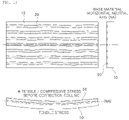
- FIG. 1 a schematic diagram of a pre-stressed steel sheet according to an embodiment of the present disclosure.
- a pre-stressed steel sheet according to an embodiment of the present disclosure will be described with reference to FIG. 1 .
- a pre-stressed steel sheet according to an embodiment of the present disclosure is characterized in that it has a base material 10 and a plurality of weld lines 20 formed on the base material 10. At this time, it is preferable that the weld line has higher strength than the base material.
- a compressive residual stress corresponding to the tensile residual stress generated by the contraction of the weld material is applied to the base material and at the same time, by increasing the strength of the steel sheet itself, it is possible to improve the deformation resistance against loads such as welding deformation and deflection of the steel sheet.
- the type of the base material is not particularly limited, and all weldable steel materials applied to structure, etc. in the art can be used, for example, general structural steel, carbon steel for classification, SUS for classification, carbon steel for building structure and carbon steel for Built-UP H-beam, etc. can be used.
- the thickness of the base material is not particularly limited, but, for example, the base material may have a thickness of 6 to 60 mm.
- the thickness of the base material is less than 6 mm, welding deformation may occur greatly during welding, and all stress may be lost during deformation correction through roller correction after welding.
- the thickness of the base material has a range of 6 to 60 mm.
- the lower limit of the thickness of the base material is more preferably 8mm, even more preferably 10mm, most preferably 12mm.
- the upper limit of the thickness of the base material is more preferably 40mm, more preferably 30mm, most preferably 25mm.
- An average spacing between a weld line and an adjacent weld line among the plurality of weld lines is equal to or greater than five times a width of the weld lines and equal to or less than 1/2 times a width of the steel sheet. If the above conditions are not satisfied, the residual compressive stress caused by the weld lines may not be sufficiently applied to the base material, and thus the possibility that the deflection resistance of the steel sheet may be lowered may increase.
- the number of weld lines is 2 ⁇ (L/W) or more.
- L is the length of the steel sheet and W is the width of the steel sheet.
- the weld line is preferably formed so as to be bilateral symmetry based on the width of the steel sheet. For example, if the number of weld lines is an even number, it is preferable to make it bilateral symmetrical about the center of the steel sheet based on the width direction of the steel sheet. If the number of the weld lines is an odd number, it is preferable to make it bilateral symmetrical based on the weld line, after the weld line is formed in the center based on the width direction of the steel sheet.
- the weld line has a thickness of up to 1/4t from the surface of the base material.
- t is the thickness of the steel sheet.
- the thickness of the weld line exceeds 1/4 t from the surface of the base material, the temperature gradient in the thickness direction becomes small, which can reduce the generation of residual stress. If the penetration depth is increased, the welding deformation may be larger, and a large cost may be incurred to correct the welding deformation in the thick plate by rolling.
- the shape of the weld line is not particularly limited, and for example, it may have a straight shape, a curved shape or a winding shape.
- FIG. 2 is a schematic diagram for comparing the amount of deflection between a pre-stressed steel sheet according to an embodiment of the present disclosure and a general steel sheet, when a load is applied.
- the pre-stressed steel sheet of the present disclosure not only reduces welding deformation as compared to a general steel sheet, but also improves bending performance, so that the amount of deflection when a load is applied can be reduced.
- the pre-stressed steel sheet of the present disclosure can be preferably applied to structural members such as girders and beams etc. that require excellent bending.
- a groove is machined in an area in which a weld line will be formed on a base material.
- the grooving may use various methods, for example, a method of rolling using a roll having projections formed thereon may be used. In the case of rolling using the roll having projections formed thereon, there is an advantage that a continuous process is possible. Meanwhile, in the present disclosure, the shape of the groove is not particularly limited, and the groove may only have a weldable shape so that a weld line can be formed.
- the weld line is formed on the groove in the base material.
- the welding method for forming the weld line is not particularly limited, and, for example, any one of SAW, FCAW, MAG welding, TIG welding, and laser welding may be used.
- the welding material may have the form of a round bar or wire, or may have a strip shape.
- the welding may be performed through one pass or multiple passes, or by a method of parallel welding with a plurality of welding materials.
- a bead height of the weld line be 1 to 2 mm. If the bead height of the weld line is less than 1 mm, there is a possibility that welding defects such as underfill may occur, and if the bead height of the weld line exceeds 2 mm, there is a possibility that a fracture by fatigue crack due to stress concentration may occur.
- polishing the surface of the steel sheet may be further included.
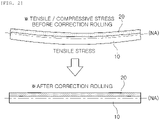
- FIG. 3 is a schematic diagram illustrating a state before and after correction rolling of a base material having a weld line formed thereon according to an embodiment of the present disclosure.
- both ends of the base material on which the weld line is formed are bent in the direction in which the weld line is formed due to compressive stress.
- the flatness of the steel sheet can be improved by correcting the warpage thereof through correction rolling.
- the correction rolling is preferably performed to the extent that the shape of the steel sheet is flattened, rather than applying a reduction force. If rolling force is applied, the compressive stress applied to the steel sheet may be reduced, and thus the effect to be obtained by the present disclosure may be reduced.
Landscapes
- Engineering & Computer Science (AREA)
- Mechanical Engineering (AREA)
- Physics & Mathematics (AREA)
- Plasma & Fusion (AREA)
- Optics & Photonics (AREA)
- Rod-Shaped Construction Members (AREA)
- Panels For Use In Building Construction (AREA)
- Straightening Metal Sheet-Like Bodies (AREA)
Abstract
Description
- The present disclosure relates to a pre-stressed steel sheet and method of manufacturing the same.
- With the development of high-strength materials, the use of thin materials for members having reduced thicknesses is increasing. However, a welded member using a thin material may have a large amount of welding deformation, which has to be corrected through post-processing, and secondary geometrical discontinuity may occur during calibration. As a result, there may be a problem of lowering structural performance such as bending performance of the member.
- In this situation, by providing the steel with higher strength and compression stress distribution in the upper or lower direction, that is, in one direction, based on the horizontal neutral axis in the thickness direction, the welding deformation problem is solved, and techniques to increase load resistance have been proposed so as to satisfy the improvement of bending performance required in the manufacturing of structures such as cantilever beams or girders of both ends support beams.
- Technology having this technological concept is already being applied a method providing tensile force known as pre-stress to a reinforced concrete structure using a stranded wire, but there are not many cases in which the technology is applied to a steel material such as a thick plate or a thin plate.
- However, as an example, there is provided Patent Document 1, which relates to a technique for applying compressive stress by bonding steel to a high-strength steel beam. However, the technique disclosed in Patent Document 1 has the disadvantage of increasing the thickness of the structure as well as increasing costs through the use of additional steel.
- Accordingly, there is a demand for the development of steel materials that can solve these problems while also solving the problem of welding deformation and improving bending performance.
- (Patent Document 1)
Korean Patent Registration No. 0473454 - An aspect of the present disclosure is to provide a pre-stressed steel sheet and a method of manufacturing the same.
- According to an aspect of the present disclosure, a pre-stressed steel sheet, comprising: a base material; and a plurality of weld lines formed on the base material, wherein an average spacing between a weld line and an adjacent weld line among the plurality of weld lines is equal to or greater than five times a width of the weld lines and equal to or less than 1/2 times a width of the steel sheet.
- According to another aspect of the present disclosure, A method of manufacturing a pre-stressed steel sheet comprises: machining a groove in an area in which a weld line will be formed on a base material; forming the weld line on the groove in the base material; and correction rolling the base material on which the weld line is formed, wherein an average spacing between a weld line and an adjacent weld line among the plurality of weld lines is equal to or greater than five times a width of the weld lines and equal to or less than 1/2 times a width of the steel sheet.
- According to an aspect of the present disclosure, a pre-stressed steel sheet having improved bendability can be provided, and accordingly when the pre-stressed steel sheet is applied to a structural member such as a girder or beam, the bendability of a structure can be improved.
-
-
FIG. 1 a schematic diagram of a pre-stressed steel sheet according to an embodiment of the present disclosure. -
FIG. 2 is a schematic diagram for comparing the amount of deflection between a pre-stressed steel sheet according to an embodiment of the present disclosure and a general steel sheet, when a load is applied. -
FIG. 3 is a schematic diagram illustrating a state before and after correction rolling of a base material having a weld line formed thereon according to an embodiment of the present disclosure. -
FIG. 1 a schematic diagram of a pre-stressed steel sheet according to an embodiment of the present disclosure. Hereinafter, a pre-stressed steel sheet according to an embodiment of the present disclosure will be described with reference toFIG. 1 . - A pre-stressed steel sheet according to an embodiment of the present disclosure is characterized in that it has a
base material 10 and a plurality ofweld lines 20 formed on thebase material 10. At this time, it is preferable that the weld line has higher strength than the base material. Through this, as shown inFIG. 1 , a compressive residual stress corresponding to the tensile residual stress generated by the contraction of the weld material is applied to the base material and at the same time, by increasing the strength of the steel sheet itself, it is possible to improve the deformation resistance against loads such as welding deformation and deflection of the steel sheet. - In the present disclosure, the type of the base material is not particularly limited, and all weldable steel materials applied to structure, etc. in the art can be used, for example, general structural steel, carbon steel for classification, SUS for classification, carbon steel for building structure and carbon steel for Built-UP H-beam, etc. can be used.
- In the present disclosure, the thickness of the base material is not particularly limited, but, for example, the base material may have a thickness of 6 to 60 mm. When the thickness of the base material is less than 6 mm, welding deformation may occur greatly during welding, and all stress may be lost during deformation correction through roller correction after welding. On the other hand, if it exceeds 60 mm, the possibility of cracks may occur during the process increases due to the number of welding times and the restraint of the base material. Therefore, it is preferable that the thickness of the base material has a range of 6 to 60 mm. The lower limit of the thickness of the base material is more preferably 8mm, even more preferably 10mm, most preferably 12mm. The upper limit of the thickness of the base material is more preferably 40mm, more preferably 30mm, most preferably 25mm.
- An average spacing between a weld line and an adjacent weld line among the plurality of weld lines is equal to or greater than five times a width of the weld lines and equal to or less than 1/2 times a width of the steel sheet. If the above conditions are not satisfied, the residual compressive stress caused by the weld lines may not be sufficiently applied to the base material, and thus the possibility that the deflection resistance of the steel sheet may be lowered may increase.
- It is preferable that the number of weld lines is 2×(L/W) or more. Here, L is the length of the steel sheet and W is the width of the steel sheet. When the number of weld lines is less than 2 × (L/W), the residual compressive stress caused by the weld lines may not be sufficiently applied to the base material, and thus the possibility that the deflection resistance of the steel sheet may be lowered may increase. In addition, in order to reduce mechanical properties deviation in the width direction, the weld line is preferably formed so as to be bilateral symmetry based on the width of the steel sheet. For example, if the number of weld lines is an even number, it is preferable to make it bilateral symmetrical about the center of the steel sheet based on the width direction of the steel sheet. If the number of the weld lines is an odd number, it is preferable to make it bilateral symmetrical based on the weld line, after the weld line is formed in the center based on the width direction of the steel sheet.
- Preferably, the weld line has a thickness of up to 1/4t from the surface of the base material. In this case, t is the thickness of the steel sheet. In this way, by securing the thickness of the weld line at a certain level, it is possible to improve the strength of the steel sheet and suppress the sagging of the steel sheet. When the thickness of the weld line exceeds 1/4 t from the surface of the base material, the temperature gradient in the thickness direction becomes small, which can reduce the generation of residual stress. If the penetration depth is increased, the welding deformation may be larger, and a large cost may be incurred to correct the welding deformation in the thick plate by rolling.
- In the present disclosure, the shape of the weld line is not particularly limited, and for example, it may have a straight shape, a curved shape or a winding shape.
-
FIG. 2 is a schematic diagram for comparing the amount of deflection between a pre-stressed steel sheet according to an embodiment of the present disclosure and a general steel sheet, when a load is applied. As shown inFIG. 2 , the pre-stressed steel sheet of the present disclosure not only reduces welding deformation as compared to a general steel sheet, but also improves bending performance, so that the amount of deflection when a load is applied can be reduced. Thereby, the pre-stressed steel sheet of the present disclosure can be preferably applied to structural members such as girders and beams etc. that require excellent bending. - Hereinafter, a method of manufacturing a pre-stressed steel sheet according to an embodiment of the present disclosure will be described.
- First, a groove is machined in an area in which a weld line will be formed on a base material. The grooving may use various methods, for example, a method of rolling using a roll having projections formed thereon may be used. In the case of rolling using the roll having projections formed thereon, there is an advantage that a continuous process is possible. Meanwhile, in the present disclosure, the shape of the groove is not particularly limited, and the groove may only have a weldable shape so that a weld line can be formed.
- Then, the weld line is formed on the groove in the base material. In the present disclosure, the welding method for forming the weld line is not particularly limited, and, for example, any one of SAW, FCAW, MAG welding, TIG welding, and laser welding may be used. In this case, when using a method such as SAW, FCAW, or MAG welding that can use a welding material, the welding material may have the form of a round bar or wire, or may have a strip shape. In addition, the welding may be performed through one pass or multiple passes, or by a method of parallel welding with a plurality of welding materials.
- When forming the weld line, it is preferable that a bead height of the weld line be 1 to 2 mm. If the bead height of the weld line is less than 1 mm, there is a possibility that welding defects such as underfill may occur, and if the bead height of the weld line exceeds 2 mm, there is a possibility that a fracture by fatigue crack due to stress concentration may occur.
- On the other hand, after forming the weld line, in order to remove the weld bead, polishing the surface of the steel sheet may be further included.
- Thereafter, the base material on which the weld line is formed is correction rolled.
FIG. 3 is a schematic diagram illustrating a state before and after correction rolling of a base material having a weld line formed thereon according to an embodiment of the present disclosure. As shown inFIG. 3 , before correction rolling, both ends of the base material on which the weld line is formed are bent in the direction in which the weld line is formed due to compressive stress. Accordingly, in the present disclosure, the flatness of the steel sheet can be improved by correcting the warpage thereof through correction rolling. At this time, the correction rolling is preferably performed to the extent that the shape of the steel sheet is flattened, rather than applying a reduction force. If rolling force is applied, the compressive stress applied to the steel sheet may be reduced, and thus the effect to be obtained by the present disclosure may be reduced. -
- 10: Base Material
- 20: Weld Lines
Claims (10)
- A pre-stressed steel sheet, comprising:a base material; anda plurality of weld lines formed on the base material,wherein an average spacing between a weld line and an adjacent weld line among the plurality of weld lines is equal to or greater than five times a width of the weld lines and equal to or less than 1/2 times a width of the steel sheet.
- The pre-stressed steel sheet according to claim 1,
wherein the weld line has higher strength than the base material. - The pre-stressed steel sheet according to claim 1,
wherein the base material has a thickness of 6 to 60 mm. - The pre-stressed steel sheet according to claim 1,
wherein the number of weld lines is 2×(L/W) or more, where L is the length of the steel sheet and W is the width of the steel sheet. - The pre-stressed steel sheet according to claim 1,wherein the weld line has a thickness of up to 1/4t from the surface of the base material,where, t is a thickness of the steel sheet.
- The pre-stressed steel sheet according to claim 1,
wherein the weld line has a straight shape, a curved shape or a winding shape. - A method of manufacturing a pre-stressed steel sheet comprising:machining a groove in an area in which a weld line will be formed on a base material;forming the weld line on the groove in the base material; andcorrection rolling the base material on which the weld line is formed,wherein an average spacing between a weld line and an adjacent weld line among the plurality of weld lines is equal to or greater than five times a width of the weld lines and equal to or less than 1/2 times a width of the steel sheet.
- The method according to claim 7,
wherein the machining the groove comprises rolling using a roll having projections formed thereon. - The method according to claim 7,
when forming the weld line, using any one of SAW, FCAW, MAG welding, TIG welding, and laser welding. - The method according to claim 7,
when forming the weld line, a bead height of the weld line is 1 to 2 mm.
Applications Claiming Priority (2)
| Application Number | Priority Date | Filing Date | Title |
|---|---|---|---|
| KR1020190164279A KR102200238B1 (en) | 2019-12-11 | 2019-12-11 | Pre-stressed steel sheet and method of manufacturing the same |
| PCT/KR2020/018088 WO2021118274A1 (en) | 2019-12-11 | 2020-12-10 | Pre-stressed steel sheet and method of manufacturing same |
Publications (2)
| Publication Number | Publication Date |
|---|---|
| EP4074448A1 true EP4074448A1 (en) | 2022-10-19 |
| EP4074448A4 EP4074448A4 (en) | 2023-01-18 |
Family
ID=74126880
Family Applications (1)
| Application Number | Title | Priority Date | Filing Date |
|---|---|---|---|
| EP20898262.9A Pending EP4074448A4 (en) | 2019-12-11 | 2020-12-10 | Pre-stressed steel sheet and method of manufacturing same |
Country Status (6)
| Country | Link |
|---|---|
| US (1) | US12220770B2 (en) |
| EP (1) | EP4074448A4 (en) |
| JP (1) | JP7488899B2 (en) |
| KR (1) | KR102200238B1 (en) |
| CN (1) | CN114761169B (en) |
| WO (1) | WO2021118274A1 (en) |
Family Cites Families (28)
| Publication number | Priority date | Publication date | Assignee | Title |
|---|---|---|---|---|
| DE3340031C2 (en) | 1983-11-05 | 1985-11-21 | Thyssen Stahl AG, 4100 Duisburg | Armored sheet metal and process for its manufacture |
| JPS6288521A (en) * | 1985-10-11 | 1987-04-23 | Kobe Steel Ltd | Toothed composite shaft body |
| JPH02104472A (en) * | 1988-10-14 | 1990-04-17 | Toshiba Corp | Method for build up welding |
| CN1053602C (en) | 1997-04-02 | 2000-06-21 | 袁奕琅 | Composite steel plate and its producing method |
| JP2004232376A (en) * | 2003-01-31 | 2004-08-19 | Jfe Engineering Kk | Prestressing method using thermal contraction by welding |
| EP2537626B1 (en) | 2004-05-18 | 2019-06-26 | Kawasaki Jukogyo Kabushiki Kaisha | Body structure for rolling stock |
| KR100473454B1 (en) | 2004-11-20 | 2005-03-14 | 강창구 | Production Method for Upper and Lower Side Fixed Pre-stress(ULPS) Steel Beam |
| JP4315951B2 (en) * | 2005-12-26 | 2009-08-19 | 株式会社神戸製鋼所 | Steel plate for welding |
| CN101400813A (en) | 2006-04-26 | 2009-04-01 | 株式会社神户制钢所 | Steel sheet with less weld buckling deformation, and process for producing the same |
| WO2011065578A1 (en) | 2009-11-25 | 2011-06-03 | Jfeスチール株式会社 | Welded steel pipe for linepipe with superior compressive strength and superior toughness, and process for producing same |
| JP2011131260A (en) | 2009-12-25 | 2011-07-07 | Jfe Steel Corp | Method for increasing fatigue strength of weld zone, and weld joint |
| US9649725B2 (en) | 2010-10-12 | 2017-05-16 | Nippon Steel & Sumitomo Metal Corporation | Laser welding method |
| JP5505369B2 (en) * | 2011-05-19 | 2014-05-28 | 新日鐵住金株式会社 | Laser welded joint with excellent joint strength and manufacturing method thereof |
| CN102390011B (en) | 2011-08-02 | 2014-07-09 | 罗键 | Integrated near-net-shape forming processing and manufacturing method for honeycomb runner cold plate |
| CN102398145B (en) | 2011-08-02 | 2014-07-09 | 罗键 | Whole near net-shape processing and manufacturing method of snake-shaped runner ice-making board |
| CN102500900A (en) | 2011-11-22 | 2012-06-20 | 西安优耐特容器制造有限公司 | Preparation method for dissimilar metal plate loose lining |
| KR101625378B1 (en) | 2014-11-27 | 2016-05-30 | 삼성중공업 주식회사 | System and method of optimizing modification cost for welding strain |
| DE102015103366B4 (en) | 2015-03-09 | 2025-12-24 | Faurecia Autositze Gmbh | Vehicle seat with two vehicle seat components |
| CN108778608B (en) * | 2016-03-15 | 2020-11-17 | 杰富意钢铁株式会社 | Lap joint laser welded joint, method for manufacturing welded joint, and automobile frame member |
| KR101801809B1 (en) | 2016-05-17 | 2017-12-28 | 삼성중공업 주식회사 | Device for applying pre-stress of tubular structure |
| JP6740805B2 (en) | 2016-08-23 | 2020-08-19 | 国立大学法人大阪大学 | Welding method, manufacturing method of welded joint, and welded joint |
| CN206163502U (en) | 2016-08-29 | 2017-05-10 | 上海摩帝尔金属结构科技有限公司 | Integration light -duty photovoltaic cell module of high rigidity and photovoltaic shutter |
| KR101798416B1 (en) | 2017-04-28 | 2017-11-16 | 주식회사 케이원레일 | Prestressed steel and its manufacturing method |
| CN107175421B (en) | 2017-07-06 | 2019-06-11 | 武汉理工大学 | A welding process for the end flange of a pre-stressed bimetal centrifugally cast composite pipe |
| KR101957337B1 (en) | 2017-09-27 | 2019-03-12 | 이문희 | Corrosion preventing panel inner contacting type steel pipe and water leak check hole forming apparatus for thereof |
| KR20190001799U (en) * | 2018-01-05 | 2019-07-15 | 한국조선해양 주식회사 | Jig for introducing prestress on steel plate |
| JP7110685B2 (en) | 2018-04-03 | 2022-08-02 | 日本製鉄株式会社 | Method for manufacturing press-formed product, press-formed product, and hot press-forming mold |
| KR101913069B1 (en) | 2018-04-19 | 2018-10-29 | 김연종 | Prestressed Steel-Concrete Composite Girder and Method for Fabricating thereof |
-
2019
- 2019-12-11 KR KR1020190164279A patent/KR102200238B1/en active Active
-
2020
- 2020-12-10 US US17/783,709 patent/US12220770B2/en active Active
- 2020-12-10 CN CN202080081416.4A patent/CN114761169B/en active Active
- 2020-12-10 JP JP2022535132A patent/JP7488899B2/en active Active
- 2020-12-10 WO PCT/KR2020/018088 patent/WO2021118274A1/en not_active Ceased
- 2020-12-10 EP EP20898262.9A patent/EP4074448A4/en active Pending
Also Published As
| Publication number | Publication date |
|---|---|
| US20230008459A1 (en) | 2023-01-12 |
| WO2021118274A1 (en) | 2021-06-17 |
| CN114761169B (en) | 2025-04-01 |
| KR102200238B1 (en) | 2021-01-07 |
| CN114761169A (en) | 2022-07-15 |
| EP4074448A4 (en) | 2023-01-18 |
| JP7488899B2 (en) | 2024-05-22 |
| JP2023506431A (en) | 2023-02-16 |
| US12220770B2 (en) | 2025-02-11 |
Similar Documents
| Publication | Publication Date | Title |
|---|---|---|
| US20140301776A1 (en) | Welding method and weld joint | |
| MX375237B (en) | Lap laser-welded joint, method for producing same, and automobile skeleton component | |
| US10293389B2 (en) | Metal sheet and method for its manufacture | |
| US12220770B2 (en) | Pre-stressed steel sheet | |
| KR101197884B1 (en) | Weld Structure | |
| CN110605464B (en) | Welding forming method for preventing wing plate of T-shaped steel from deforming | |
| JP2020153125A (en) | Rolled H-section steel and synthetic beams | |
| CN115383407B (en) | Machining and manufacturing method of wall-mounted cross crane beam | |
| JP2013139047A (en) | Weld joint part of steel member | |
| KR102485533B1 (en) | Rectangular Steel Pipe and Welding Method of Rectangular Steel Pipe | |
| CN113073569A (en) | Method for correcting integral torsional deformation of steel box girder bridge section | |
| US8584923B2 (en) | Joining method of high carbon steel for endless hot rolling and the apparatus therefor | |
| JP6879323B2 (en) | Manufacturing method of thick steel sheet with excellent fatigue characteristics | |
| JP2007332588A (en) | U-rib steel slab | |
| JP4797953B2 (en) | Welded joint with excellent fatigue strength | |
| RU2689823C1 (en) | Steel profile formed by laser welding and method of its production | |
| JP7115324B2 (en) | Steel member reinforcement structure and reinforcement method | |
| JP2020019059A (en) | Upset welding apparatus and upset welding method | |
| EP2796216B1 (en) | Band-shaped metal sheet | |
| KR102695874B1 (en) | Spliced girder and method of manufacturing same | |
| JPH11342401A (en) | Shape steel and its manufacturing method | |
| JP3255380U (en) | Welded structure of steel frame structure | |
| JP2016175119A (en) | Manufacturing method of pre-assembled welded H-section steel | |
| KR102947031B1 (en) | T-shaped joint welding structure that improves welding strength | |
| KR102666080B1 (en) | Method for determining the position of a heating zone for prevention of longitudinal bending deformation |
Legal Events
| Date | Code | Title | Description |
|---|---|---|---|
| STAA | Information on the status of an ep patent application or granted ep patent |
Free format text: STATUS: THE INTERNATIONAL PUBLICATION HAS BEEN MADE |
|
| PUAI | Public reference made under article 153(3) epc to a published international application that has entered the european phase |
Free format text: ORIGINAL CODE: 0009012 |
|
| STAA | Information on the status of an ep patent application or granted ep patent |
Free format text: STATUS: REQUEST FOR EXAMINATION WAS MADE |
|
| 17P | Request for examination filed |
Effective date: 20220630 |
|
| AK | Designated contracting states |
Kind code of ref document: A1 Designated state(s): AL AT BE BG CH CY CZ DE DK EE ES FI FR GB GR HR HU IE IS IT LI LT LU LV MC MK MT NL NO PL PT RO RS SE SI SK SM TR |
|
| A4 | Supplementary search report drawn up and despatched |
Effective date: 20221220 |
|
| RIC1 | Information provided on ipc code assigned before grant |
Ipc: B23Q 1/00 20060101ALI20221214BHEP Ipc: B23K 101/28 20060101ALI20221214BHEP Ipc: B23K 101/18 20060101ALI20221214BHEP Ipc: B23K 26/342 20140101ALI20221214BHEP Ipc: B23K 26/34 20140101ALI20221214BHEP Ipc: B21D 13/04 20060101ALI20221214BHEP Ipc: B21D 1/02 20060101ALI20221214BHEP Ipc: B23K 33/00 20060101ALI20221214BHEP Ipc: B23K 31/00 20060101ALI20221214BHEP Ipc: B23K 9/04 20060101AFI20221214BHEP |
|
| DAV | Request for validation of the european patent (deleted) | ||
| DAX | Request for extension of the european patent (deleted) |