EP4074091B1 - Synchronisierte anpassung einer virtuellen teilmenge eines einem dienst zugeordneten netzwerks - Google Patents
Synchronisierte anpassung einer virtuellen teilmenge eines einem dienst zugeordneten netzwerks Download PDFInfo
- Publication number
- EP4074091B1 EP4074091B1 EP20845191.4A EP20845191A EP4074091B1 EP 4074091 B1 EP4074091 B1 EP 4074091B1 EP 20845191 A EP20845191 A EP 20845191A EP 4074091 B1 EP4074091 B1 EP 4074091B1
- Authority
- EP
- European Patent Office
- Prior art keywords
- network
- modification
- network slice
- configuration parameter
- slice
- Prior art date
- Legal status (The legal status is an assumption and is not a legal conclusion. Google has not performed a legal analysis and makes no representation as to the accuracy of the status listed.)
- Active
Links
Images



Classifications
-
- H—ELECTRICITY
- H04—ELECTRIC COMMUNICATION TECHNIQUE
- H04W—WIRELESS COMMUNICATION NETWORKS
- H04W24/00—Supervisory, monitoring or testing arrangements
- H04W24/02—Arrangements for optimising operational condition
-
- H—ELECTRICITY
- H04—ELECTRIC COMMUNICATION TECHNIQUE
- H04L—TRANSMISSION OF DIGITAL INFORMATION, e.g. TELEGRAPHIC COMMUNICATION
- H04L41/00—Arrangements for maintenance, administration or management of data switching networks, e.g. of packet switching networks
- H04L41/12—Discovery or management of network topologies
- H04L41/122—Discovery or management of network topologies of virtualised topologies, e.g. software-defined networks [SDN] or network function virtualisation [NFV]
-
- H—ELECTRICITY
- H04—ELECTRIC COMMUNICATION TECHNIQUE
- H04L—TRANSMISSION OF DIGITAL INFORMATION, e.g. TELEGRAPHIC COMMUNICATION
- H04L41/00—Arrangements for maintenance, administration or management of data switching networks, e.g. of packet switching networks
- H04L41/08—Configuration management of networks or network elements
- H04L41/0803—Configuration setting
- H04L41/0823—Configuration setting characterised by the purposes of a change of settings, e.g. optimising configuration for enhancing reliability
Definitions
- This description concerns the field of telecommunications networks.
- the network slice concept is intended to support communication services for specific needs, specific users or specific terminals by applying suitable traffic management means.
- a network slice is defined from the customer's point of view by network parameter values that meet the requirements related to the service to be provided.
- the network slices deployed by an operator are not all composed of the same network parameter values, or even the same network parameters, knowing that the idea is to adapt the network slices to the usage requirements related to this network slice.
- a network slice thus makes it possible to satisfy user demand according to different functional, operational and performance criteria, such as throughput, latency, number of connected terminals, coverage, cost, etc.
- a slice of the network implemented related to loT services may need to manage a large number of terminal connections but a rather low throughput associated with each terminal.
- a service offered to a professional clientele requires rather advanced security and availability parameters.
- Each network slice, seen by such a user-client is therefore independent of the other slices (or “slices”).
- Each slice is therefore the equivalent of a virtual private network, and its adaptation has in theory no impact on the characteristics of the other slices.
- the independence of network slices is therefore one of the strengths of 5G because it allows the customer to see them, manage them, and adapt them one by one, depending on the service to which each is associated.
- a user typically a major account customer
- a global service or product e.g. an autonomous connected car
- it is generally made up of several different functional services, also called elementary services, and therefore requires several network slices with different characteristics to respond to each of these independent services.
- This disclosure improves the situation.
- a network slice also called network slice, network slice or slice
- a network slice also called network slice, network slice or slice
- a set of network slices linked in a set of services for example because linked to a global service or product, or linked to a customer, or linked to a type of service
- to automatically and quickly modify the configuration of a plurality of network slices of the set of network slices More precisely, it is not necessary to intervene individually on each of the linked network slices, which requires an adaptation of the configuration, by rebound.
- the method makes it possible to reduce the latency time for adapting network slices dependent on a network slice for which a configuration parameter has just been modified.
- Another advantage of the method is to reduce the costs associated with the resources implemented during a modification of a network slice. Indeed, generally speaking, when modifying a configuration parameter of a network slice, it is necessary to monitor the rebound consequences of this modification on the other network slices whatever they may be, then it is then necessary to calculate a modification of one or more other slices networks.
- the method of the present description advantageously only requires monitoring a modification of a configuration parameter of a first slice and then deducing the modification of a configuration parameter of a second slice, thus greatly reducing the monitoring resources and the adaptation calculation costs of the other network slices.
- configuration parameter (or parameter) is meant a variable participating in the specification of the network requirement of the elementary service to be provided (e.g. to a set of terminals), and therefore provided by the network slice.
- modification of a configuration parameter it is meant a modification of a value of a configuration parameter.
- modification of the at least one second configuration parameter of the at least one second network slice may be performed as soon as a first configuration parameter of a first network slice is modified.
- the synchronized modification of one or more network slice(s) following the modification of at least a first configuration parameter of a first network slice can be carried out without delay, thus reinforcing the latency reduction described above.
- each network slice can adapt its configuration parameters autonomously, that is to say without receiving a modification order from another network slice or exchange of information between network slices, since each network slice associated with a respective elementary service is able to detect any modification of configuration parameter(s) of network slice(s).
- the modification may comprise an identification of a predetermined modification rule associated with a modification of a first configuration parameter of a first network slice capable of being used to modify a second configuration parameter of a second network slice.
- predetermined modification rule it can be understood the way in which a configuration parameter, i.e. a value of a configuration parameter, of a network slice can be modified after the modification of another configuration parameter, i.e. a value of another parameter of another network slice.
- a predetermined modification rule comprises an association of a modification of a configuration parameter, i.e. a modification of a value of a configuration parameter, of a network slice with a modification of another configuration parameter, i.e. a modification of a value of another parameter, of another network slice.
- this association can be stored in a modification rule base.
- this modification rule base can be specific to each network slice or can be accessible for all network slices.
- the modification may be performed according to at least one predetermined modification rule that may be selected from at least one set of predetermined rules.
- the first configuration parameter may be selected from a quality of service (QoS), a security level, a service cost, a throughput, a latency, a number of connected objects, an activation/deactivation.
- QoS quality of service
- security level a security level
- service cost a service cost
- throughput a throughput
- latency a latency
- number of connected objects an activation/deactivation.
- activation/deactivation it can be understood the activation/deactivation of the network slice or another network slice.
- the activation/deactivation of the network slice is carried out on the network slices previously assigned/allocated.
- the resources allocated to a network slice assigned to an elementary service will remain on standby as long as the network slice is deactivated and will be put into operation when the network slice is activated, thus reducing the costs in terms of resource use (in particular energy costs) of the network slice.
- the modification can be carried out using at least one adaptation function among an arithmetic type function, a maximum, a minimum, a presence of conditions, a boolean type function.
- the adaptation function may correspond to a predetermined modification of another network slice of the telecommunications network based on a modification of a given slice, following one or more predetermined modification rules.
- a modification rule may identify the second parameter of the other network slice to be modified and the function adaptation rule can be given by another modification rule to define how the second parameter should be modified.
- the set of modification rules and/or adaptation functions between one or more of the first configuration parameters of a first network slice and one or more of the second configuration parameters of a second network slice constitutes a link, also called a dependency, between the first network slice and the second network slice.
- the modification may be performed using a one-way or two-way adaptation function.
- one or more second configuration parameters of the second network slice can be modified using the synchronized adaptation method of the present description according to a modification of one or more first configuration parameters of the first network slice, but not the reverse.
- a second modified configuration parameter of a second network slice is obtained by operating on a first modified configuration parameter of a first network slice a given adaptation function.
- a first modified configuration parameter of a first network slice is obtained by operating on a second modified configuration parameter of a second network slice the inverse function (in the mathematical sense) of the given adaptation function.
- a modification of a second configuration parameter of a second network slice causes the modification of a first configuration parameter of a first network slice according to the corresponding modification rule in the modification rule base.
- the bidirectional adaptation function may be defined by two different sets of predetermined modification rules, or by a single set of predetermined modification rules.
- connection By number of connections, it can be understood a number of terminals connected simultaneously to the network, or a number of objects (IOT for "internet of things") connected simultaneously to the network. It can also be understood any device connected simultaneously to the network.
- IOT Internet of things
- a network throughput request can be understood as a throughput required by one or more terminals.
- a set of network slices in a completely automated manner (i.e. without any manual intervention) as soon as a first configuration parameter of a first network slice (i.e. the expression of the need for a private virtual network) possibly following detection of a need for the first elementary service associated with this first network slice.
- a first configuration parameter of a first network slice i.e. the expression of the need for a private virtual network
- the same first network slice associated with a first elementary service of a set of services can be linked to several network slices (second, third, fourth... network slices) associated with other elementary services (second, third, fourth... elementary services) of the same set of services.
- the implementation of the synchronized adaptation method triggers, during a modification of a first configuration parameter of a first network slice, a modification of a second configuration parameter of a second network slice and, possibly, of a fourth configuration parameter of a fourth network slice.
- the modified parameters are not necessarily associated with slices that follow one another.
- the first modified configuration parameter triggering the modification of the second configuration parameter may be either the same or a first configuration parameter different from that triggering the modification of the fourth configuration parameter.
- modifying the second configuration parameter of the second network slice and/or modifying the fourth configuration parameter of the fourth network slice may trigger, by implementing the synchronized adaptation method of the present disclosure, a change to a third configuration parameter of the third network slice.
- the modification of the second configuration parameter and the modification of the fourth configuration parameter are triggered by two distinct first configuration parameters of the first network slice
- their modifications may trigger the modification of two distinct third configuration parameters of the third network slice.
- Another aspect of the present description relates to a device for synchronized adaptation of a virtual subset of a telecommunications network called a “network slice”, comprising a processing circuit configured for implementing the method.
- a computer program comprising program code instructions for executing the method.
- An aspect of the present disclosure also relates to a non-transitory recording medium readable by a synchronized adaptation device on which the code instructions of a computer program according to the present disclosure are stored.
- FIG. 1 schematically illustrates one or more terminals T1; T2; T N and associated access equipment in a telecommunications network R in one or more embodiments.
- terminal we can broadly understand any electronic or computer device that can be connected to the telecommunications network R, for example a server, a computer, a mobile phone, or other.
- the terminal 1 can itself be connected to other electronic or computer devices.
- a telecommunications network management device R may advantageously use network function virtualization to implement a plurality of slices on a single physical network infrastructure.
- Such a network slicing technique can thus enable the telecommunications network management device R to offer independent and "custom-made" virtual private networks, capable of providing optimized solutions for very varied needs with very diverse constraints in terms of functionalities and performance without reserving the physical network infrastructure in advance. This is why the network slices offering virtual private networks are defined according to an expression of network needs.
- the telecommunications network management device R may offer terminal 1 or a plurality of terminals T2; T N a first slice of the network TR1, a second slice of the network TR2 and a third slice of the network TR3 to access different services with different network parameters.
- this embodiment is not limiting and the telecommunications network management device R may offer a smaller number, for example only two slices, or a larger number of slices of the network.
- One or more slices of the network TR1, TR2, TR3 can thus be used by the terminals T1, T2, and T N.
- the terminals T1, T2, and T N can be connected simultaneously to all the network slices, or be connected partially, or be connected successively to each slice.
- terminal T1 may be connected 110 to network slice TR1 and be connected 120 to network slice TR3, but may not be connected to network slice TR2.
- Terminal T2 may be connected 130, for example, only to slice TR2.
- Each slice of the network TR1, TR2, TR3 can be adapted to provide an elementary network service of a global service (or global network service) for one or more terminals.
- FIG. 2 schematically illustrates the implementation of such a global service (eg by an Operator or a Major Account customer) and associated access equipment to a telecommunications network R according to a first embodiment.
- a global service eg by an Operator or a Major Account customer
- associated access equipment to a telecommunications network R according to a first embodiment.
- a global service to be provided for example for a set of terminals or for different terminals, can generally be defined by a set of specifications or requirements necessary for the proper functioning of this global service.
- the service can be implemented by a set of one or more elementary services 213; 215; 217 themselves comprising specific specifications or requirements.
- the set of elementary services 213; 215; 217 can make it possible to meet the need for the overall service to be provided.
- a network slice of the telecommunications network R can be configured by one or more parameters, called “configuration parameters”.
- a user e.g. operator, technician, service provider, customer, etc.
- a global service to be provided can use network function virtualization to implement a plurality of slices on a single physical network infrastructure (e.g. the telecommunications network R).
- the number of elementary services used in a global service is not limiting. Indeed, the number of elementary services, and therefore the number of network slices used dedicated to these elementary services, may be higher or lower, depending on the requirements or specifications of the global service to be provided.
- Each network slice can be parameterized by one or more respective configuration parameters.
- These configuration parameters can have initial values for the setup of the overall service.
- the network slices TR1, TR2, TR3 comprise at least one, advantageously several, configuration parameters (or configuration parameter values) which are different depending on the elementary service respectively provided or to be provided using the associated network slice.
- the network slice TR1 can be defined 223 by a number n of configuration parameters P TR1 (i), the network slice TR2 can be defined 225 by a number m of configuration parameters P TR2 (j), and the network slice TR3 can be defined 227 by a number q of configuration parameters P TR3 (q).
- the number of configuration parameters to set up a network slice can vary depending on the specifications or requirements of each elementary service, themselves meeting the specifications of the global service.
- a configuration parameter may relate to a service functionality of the network slice corresponding to a performance requirement of the elementary service, and thus a performance requirement of the associated network slice.
- a configuration parameter for a network slice can be chosen from the flow rate, the geographical coverage of the service, the number of possible connections, the security level, the latency, or even the quality of service.
- a configuration parameter may relate to a functional requirement of an elementary service (and therefore of the network slice associated with this elementary service).
- a configuration parameter corresponding to functional requirements of a network slice may be chosen from various requirements relating to the elementary service to be provided, such as the cost of the service for the user, or the energy consumption aspect.
- one or more predetermined modification rules can be defined in order to establish dependencies (or links) between the different network slices of the telecommunications network (R).
- one or more modification rules can be attached to a network slice.
- the set ⁇ Reg1-2 may correspond to the set of modification rules (for example in the form of adaptation functions) applicable on the second slice 225 when the first slice 223 is modified (i.e. a configuration parameter value of the first network slice is modified).
- the set ⁇ Reg2-1 may correspond to the set of modification rules applicable on the first slice 223 when the second slice 225 is modified.
- the set ⁇ Reg2-1 may correspond, for example, to modification rules in the form of inverse adaptation functions (in the mathematical sense) of the adaptation functions of the set ⁇ Reg1-2, or may correspond according to a possible alternative to different modification rules (and/or different adaptation functions).
- the modification rules (and/or adaptation functions) between two network slices may be bidirectional.
- the first network slice can be configured with also the set ⁇ Reg1-3 corresponding to the set of modification rules applicable on the third slice 227 when the first slice 223 is modified.
- a set ⁇ Reg1-3 of modification rules can be defined between the first network slice 223 and the third network slice 227.
- a modification of configuration parameters of the third network slice 227 does not result in a modification of configuration parameters of the first network slice 223.
- the modification rules (and/or the adaptation functions) between two network slices can be unidirectional.
- the third network slice can be called "slave", and the first network slice called "master”.
- a modification rule predetermined value of the set ⁇ Reg1-2 can be identified and used to modify the value of a second configuration parameter of the second network slice 225.
- the modification of a configuration parameter of a network slice can follow a need 260, predefined or not (for example a new need or an unforeseen need).
- the response to this need 260 may be an increase in throughput, a decrease in latency, or a new quality of service for a specific network slice.
- the response will be achieved by modifying the configuration of this network slice, here the network slice 223. It is understood that the modification of the configuration of the network slice 225 may for example meet this need if this proves to be more optimal.
- the parameterization of a second network slice can be modified without requiring manual intervention (e.g. by an operator, technician, user, etc.) via the expression of a new requirement 260.
- FIG. 3 illustrates an exemplary method for synchronized adaptation of one or more network slices in one or more embodiments.
- the predefined (or programmed) need can be, for example, a certain configuration of one or more network slices of a global service according to a predefined time slot, or a predefined time. Programming according to a predefined time slot or a predefined time can be directly implemented during the initial configuration of the network slices, or controlled remotely (eg via a server).
- one or more configuration parameters of one or more network slices associated with one or more elementary services of a global service can be modified, and their modification can lead to the synchronized adaptation of the other network slices associated with other elementary services of the same global service by means of one or more predetermined modification rules.
- the non-predefined need, or new need, or unforeseen need may be a need arising from the modification of the external environment (e.g. increase in the number of terminals, need for lower latency, or better quality of service).
- the modification 310 of a first configuration parameter may correspond to a value of the first configuration parameter transmitted, detected, or entered by a user (e.g. operator, global service user, etc.) for example.
- This modification may follow for example a network overload for a predetermined duration (as a result of a new need for example) as explained previously.
- first modified configuration parameter 310 and/or the modification of the first configuration parameter that is to say, for example, a modification function applied to the first configuration parameter to modify it or a modification value (the modification value may be an integer, decimal or real, positive or negative, etc.) added or multiplied to the initial value of the first configuration parameter, it may be possible to determine the second configuration parameter to be modified of the second network slice and to identify 315 a modification to be applied to the second configuration parameter of the second network slice as a function of the first configuration parameter of the first network slice (and in particular of the modification carried out on this first configuration parameter of the first network slice).
- the modification to be applied to the second configuration parameter of the second network slice is, in particular, a predetermined adaptation function of the second configuration parameter of the second network slice as a function of the first configuration parameter of the first slice, or at least one predetermined modification rule between the first configuration parameter, and at least one second configuration parameter.
- the predetermined modification rule may correspond to a dependency (or a link) between the first network slice and the second network slice, for example in the form of an adaptation function of a second configuration parameter of a second network slice as a function of a first parameter of a first configuration parameter of a first network slice, making it possible to determine both the second configuration parameter of the second network slice concerned by the modification and the modified value of this second configuration parameter.
- the second configuration parameter may correspond to a throughput parameter of a second network slice.
- the change in the throughput demand of the first network slice results in a change in the throughput of the second network slice by applying the synchronized adaptation method.
- the link between the two network slices corresponds to an adaptation function in which the throughput of the second network slice is a multiple (e.g. twice) of the throughput of the first network slice.
- the second network parameter may be of a different nature than the first network parameter. If the first configuration parameter corresponds to a throughput parameter of the first slice, the second configuration parameter may correspond to a latency or number of connected objects parameter of the second network slice.
- the predetermined modification rule can be used to define how a configuration parameter of a network slice should be modified from a modified configuration parameter of another network slice.
- the modification rule predetermined modification may include for example at least one arithmetic function, or a Boolean function, or a combination of the two.
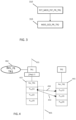
- FIG. 4 illustrates an example of synchronized adaptation between two network slices in one or more embodiments.
- Two network slices TR1 and TR2 associated with a respective elementary service can be defined by one or more respective configuration parameters 415; 445 (or defined respectively by a set of configuration parameters).
- the configuration of elementary services can include one or more predetermined modification rules defining the different links existing between the network slices.
- the set ⁇ Reg1-2 may correspond to the set of modification rules applicable on the second TR2 slice (e.g. on the value of a second parameter of the second network slice TR2) when the first TR1 slice is modified, for example when a value of a first configuration parameter of the first network slice is modified.
- modification rules may for example be in the form of adaptation functions.
- the configuration parameters (P TR ) of the first network slice and the second network slice may be, for example, a throughput (P TR1 (1) and P TR2 (1)), a latency (P TR1 (2) and P TR2 (2)), and a number of allowed connected objects (P TR1 (3) and P TR2 (3)).
- a value may, for example, be associated with it.
- the throughput value of a first parameter P TR1 (1) of configuration of the network slice TR1 can be increased from a value of 1 Mbit/sec to a value of 2 Mbits/second.
- the previous predetermined modification rule further includes a maximum throughput value for network slice TR2 not to be exceeded, for example 3 Mbits/second, then at the time of modification of the value P TR1 (1), the value P TR2 (1) multiplied by the factor T can be set to 3 Mbits/second instead of 4 Mbits/second.
- the modification of the configuration parameter P TR1 (1) can also lead to the modification of one or more configuration parameters of another network slice according to one or more modification rules belonging to different sets of modification rules (not shown in the figure). figure 4 ).
- the predetermined modification rule may be in the form of an adaptation function comprising one or more conditions. For example, if as required, the modification of the value of the flow parameter P TR1 (1) is greater than or less than a certain value, then the configuration parameter(s) of the network slice TR2 may be modified 450; 453 according to different values depending on the input conditions (eg higher or lower value).
- the set ⁇ Reg2-1 may comprise modification rules, for example in the form of adaptation functions, corresponding to the inverse of the adaptation functions of the set ⁇ Reg1-2, or comprise different modification rules, or even different adaptation functions.
- the modification rules of the set ⁇ Reg1-2 may relate to throughput and latency
- the modification rules of the set ⁇ Reg2-1 may relate to throughput, security, and cost.
- FIG. 5 illustrates an example of synchronized adaptation of a service between multiple network slices in one or more embodiments.
- network slices TR1, TR2, TR3, TR4 (associated with a respective elementary service) can be parameterized by one or more configuration parameters (or sets of one or more configuration parameters) for each network slice as described previously.
- All network slices enable the implementation of a global service.
- the configuration of elementary services can include one or more predetermined modification rules defining the links (or interactions) between the different network slices. Respective sets of modification rules can thus be attached to each network slice of the global service.
- the set ⁇ Reg1-2 may correspond to the set of applicable modification rules 510a on the second network slice TR2 when the first network slice TR1 is modified.
- the set ⁇ Reg2-1 may correspond to the set of applicable modification rules 510b on the first network slice TR1 when the second network slice TR2 is modified.
- the set ⁇ Reg1-3 may correspond to the set of applicable modification rules 520 on the third network slice TR3 when the first network slice TR1 is modified, etc.
- each network slice can also interact 550 with one or more other network slices through different sets of modification rules (not shown in the figure 5 ).
- the configuration parameters of the other network slices can be modified thanks to a cascade (or avalanche) effect.
- a modification of a configuration parameter of the network slice TR1 can allow, thanks to the modification rules at TR1), to modify the network slices TR3 and TR2.
- the configuration parameters of the TR2 and TR3 network slices can thus be modified automatically by following the predetermined rules and without manual intervention. These same TR2 and TR3 network slices will themselves, thanks to the sets of modification rules, allow the TR4 network slice to be modified 530; 540.
- TR1 configuration parameters of a single network slice
- TR2 3 other network slices
- TR3 TR4
- TR4 3 other network slices
- 550 links unidirectional or bidirectional
- FIG. 6 illustrates another example of synchronized adaptation between two network slices in one or more embodiments.
- Two network slices TR1 and TR2 associated with a respective elementary service can be defined by one or more respective configuration parameters 615; 630 (or defined respectively by a set of configuration parameters).
- a respective set of modification rules can be attached to each network slice as described previously in the figure 4 and the figure 5 .
- the network slice TR1 may further comprise interactions 643; 645 (unidirectional or bidirectional) with other network slices than the network slice TR2.
- the slice TR2 may further comprise an interaction 647 with another network slice than the network slice TR1. These interactions may be implemented via one or more respective modification rules, or different respective sets of modification rules attached to each network slice (not shown in the figure 6 ).
- the configuration parameters (P TR ) of the first network slice and the second network slice may be, for example, a flow rate P TR1 (1); P TR2 (1), a latency P TR1 (2); P TR2 (2), a number of connected objects allowed P TR1 (3); P TR2 (3), a degree (or level) of security P TR1 (4); P TR2 (4) or even a cost P TR1 (5); P TR2 (5).
- a value may, for example, be associated with it.
- a modification of a configuration parameter of the network slice TR1 may result in the modification of a configuration parameter of the network slice TR2.
- the modification of the configuration parameter P TR1 (1) of the TR1 slice can lead to the modification of the configuration parameter P TR2 (1) of the TR2 network slice.
- This same modification of a configuration parameter of the TR1 slice can also already lead to a modification of one or more configuration parameters of the same TR1 network slice, thus creating an interdependence between the configuration parameters.
- a change in the throughput value of the configuration parameter P TR1 (1) can mechanically lead to a change in the value of the latency parameter P TR1 (2) of the network slice TR1.
- increasing the throughput value of the configuration parameter P TR1 (1) can also mechanically lead to a modification of the parameter P TR1 (5) linked to the cost of the network slice TR1. Indeed, an increase in the throughput of a network slice can be accompanied by an increase in the cost of this network slice.
- the modified configuration parameters P TR1 (2) and P TR1 (5) resulting from the modification of the parameter P TR1 (1) can themselves lead to the modification of configuration parameters of other network slices via the different interactions (or links) 643 and 645.
- configuration parameters of the network slice TR2 may themselves include interdependencies.
- the modification of the configuration parameter P TR2 (2) may result in the modification of the configuration parameter P TR2 (3), itself resulting in the modification of a configuration parameter of another network slice 647.
- the increase in the flow rate P TR1 (1) of the network slice TR1 can lead to a decrease in the latency P TR1 (2) of the network slice TR1.
- This decrease in latency can lead to the application of a modification rule to the latency parameter P TR2 (2) corresponding for example to a maximum latency value not to be exceeded.
- This maximum value not to be exceeded can cause 633 a modification of the parameter P TR2 (3) corresponding to the number of connected objects allowed, for example, this number can be reduced.
- a hospital can manage its different network needs (e.g. communication) for different services through network slices (TR1, TR2, TR3, TR4): doctors on the move, remote interventions, connected medical equipment, etc.
- network slices TR1, TR2, TR3, TR4: doctors on the move, remote interventions, connected medical equipment, etc.
- the hospital network manager reacted immediately by re-evaluating the configuration of the network slice (TR1) associated with emergency personnel communication.
- other network slices can then be adapted by following the predetermined rules to anticipate upcoming operations in large numbers (e.g. possibly remotely), as well as to maintain flawless communication quality (e.g. in order to maintain communications with a large number of doctors).
- the user organizing the festival decides to adapt the parameters of the TR2 network slot to meet demand.
- the configuration parameters of the TR3 network slice can be modified in order to correctly ensure all payment operations.
- a network overload value (e.g. due to unforeseen need) can be estimated based on a number of simultaneous connections to the network or according to a number of network connection requests, or even according to a flow rate request by all festival-goers.
- This overload value may be compared to a threshold value or within a threshold value range. For example, if the estimated overload value is within a certain value range, one or more first configuration parameters of a first network slice may be determined as well as a modification of each identified parameter to respond to this overload.
- FIG. 7 illustrates a device for synchronized adaptation of network slices or slices of a telecommunications network in one or more embodiments.
- the adaptation device comprises a modifier of at least one second configuration parameter of at least one second slice dedicated to a second elementary service of a set of services as a function of at least one modification of a first configuration parameter of a first slice dedicated to a first elementary service of the set of services.
- figure 7 illustrates the case of a modifier implemented in a processing circuit 703 executing a program implementing a modification of a second configuration parameter.
- the synchronized adaptation device may comprise a memory 705 for storing instructions of a program.
- the memory 705 may further store data and information useful for implementing the method of the present disclosure.
- the memory 705 may store one or more modification rules (or sets of modification rules) attached to each network slice of the global service, for example in the form of an instruction code base.
- the program can be executed by a processing circuit 703 configured to implement the method of the present description.
- the synchronized adaptation device 700 may further comprise an input interface 707 for acquiring one or more data for modifying network slice configuration parameters.
- the synchronized adaptation device 700 may further comprise an output interface 709 for modifying network slice configuration parameters 711 for acquiring one or more data for modifying network slice configuration parameters of a telecommunications network.
- the method of the present description allows automatic and rapid adaptation of network slices associated with elementary services of the same set of services.
- this allows further gains in reactivity and reduction of errors.
- a set of services means a global service comprising several elementary services, or elementary services from the same customer or service provider, or elementary services of the same type.
Landscapes
- Engineering & Computer Science (AREA)
- Computer Networks & Wireless Communication (AREA)
- Signal Processing (AREA)
- Data Exchanges In Wide-Area Networks (AREA)
- Mobile Radio Communication Systems (AREA)
Claims (15)
- Verfahren zur synchronisierten Anpassung einer virtuellen Untereinheit eines Telekommunikationsnetzwerks (R), "Netzwerkscheibe" genannt, die einem elementaren Dienst einer Gruppe von Diensten zugeordnet ist, wobei ein globaler Dienst aus mehreren elementaren Diensten besteht, denen unterschiedliche Scheiben zugeordnet sind, wobei das Telekommunikationsnetzwerk (R) eine Vielzahl von Scheiben des Netzwerks (TR1, TR2, TR3) enthält, wobei die Scheiben (TR1, TR2, TR3) gemäß einer Vielzahl von Konfigurationsparametern (PTR1(i), PTR2(j), (PTR3(q)) parametriert sind, wobei das Verfahren mindestens enthält:- Ändern (315) mindestens eines zweiten Konfigurationsparameters mindestens einer zweiten Scheibe (TR2), wobei die zweite Scheibe (TR2) einem zweiten elementaren Dienst einer Gruppe von Diensten zugeordnet ist, abhängig von mindestens einer Änderung (310) eines ersten Konfigurationsparameters einer ersten Scheibe (TR1), die einem ersten elementaren Dienst der Gruppe von Diensten zugeordnet ist.
- Verfahren nach Anspruch 1, wobei die Änderung (315) des mindestens einen zweiten Konfigurationsparameters der mindestens einen zweiten Netzwerkscheibe (TR2) ausgeführt wird, sobald ein erster Konfigurationsparameter einer ersten Netzwerkscheibe (TR1) geändert wird.
- Verfahren nach einem der vorhergehenden Ansprüche, wobei das synchronisierte Anpassungsverfahren außerdem enthält:- eine Erkennung einer Änderung (310) eines ersten Konfigurationsparameters einer ersten Netzwerkscheibe (TR1), die einem ersten elementaren Dienst der Gruppe von Diensten zugeordnet ist, wobei die Erkennung die Änderung (315) des mindestens einen zweiten Konfigurationsparameters der mindestens einen zweiten Netzwerkscheibe (TR2) auslöst.
- Verfahren nach einem der vorhergehenden Ansprüche, wobei die Änderung (315) eine Identifizierung einer vorbestimmten Änderungsregel aufweist, die mit einer Änderung (310) eines ersten Konfigurationsparameters einer ersten Netzwerkscheibe (TR1) verbunden ist, die geeignet ist, verwendet zu werden, um einen zweiten Konfigurationsparameter einer zweiten Netzwerkscheibe (TR2) zu ändern.
- Verfahren nach einem der vorhergehenden Ansprüche, wobei das Verfahren außerdem aufweist:- Ändern mindestens eines dritten Konfigurationsparameters mindestens einer dritten Netzwerkscheibe (TR3), wobei die dritte Netzwerkscheibe (TR3) einem dritten elementaren Dienst der Gruppe von Diensten zugeordnet ist, abhängig von mindestens einer Änderung eines ersten Konfigurationsparameters einer ersten Netzwerkscheibe (TR1), der einem ersten elementaren Dienst der Gruppe von Diensten zugeordnet ist.
- Verfahren nach einem der vorhergehenden Ansprüche, wobei der erste Konfigurationsparameter unter einer Dienstqualität (QoS), einem Sicherheitsgrad, Dienstkosten, einer Übertragungsrate, einer Latenz, einer Anzahl von verbundenen Objekten, einer Aktivierung/Deaktivierung ausgewählt wird.
- Verfahren nach einem der vorhergehenden Ansprüche, wobei die Änderung unter Verwendung mindestens einer Anpassungsfunktion unter einer Funktion vom arithmetischen Typ, einem Maximum, einem Minimum, einem Vorhandensein von Bedingungen, einer Funktion vom Booleschen Typ ausgeführt wird.
- Verfahren nach einem der vorhergehenden Ansprüche, wobei die Änderung unter Verwendung einer unidirektionalen oder bidirektionalen Anpassungsfunktion ausgeführt wird.
- Verfahren nach Anspruch 8, wobei die bidirektionale Funktion durch zwei unterschiedliche Gruppen von vorbestimmten Änderungsregeln oder durch eine einzige Gruppe von vorbestimmten Änderungsregeln definiert wird.
- Vorrichtung (700) zur synchronisierten Anpassung einer virtuellen Untereinheit eines Telekommunikationsnetzwerks (R), "Netzwerkscheibe" genannt, die einem elementaren Dienst einer Gruppe von Diensten zugeordnet ist, wobei ein globaler Dienst aus mehreren elementaren Diensten besteht, denen unterschiedliche Scheiben zugeordnet sind, wobei das Telekommunikationsnetzwerk (R) eine Vielzahl von Scheiben des Netzwerks (TR1, TR2, TR3) enthält, wobei die Scheiben (TR1, TR2, TR3) gemäß einer Vielzahl von Konfigurationsparametern (PTR1(i), PTR2(j), PTR3(q)) parametriert sind, wobei die Anpassungsvorrichtung (700) einen Modifikator mindestens eines zweiten Konfigurationsparameters mindestens einer zweiten Scheibe (TR2) aufweist, wobei die zweite Scheibe (TR2) einem zweiten elementaren Dienst einer Gruppe von Diensten zugeordnet ist, abhängig von mindestens einer Änderung (310) eines ersten Konfigurationsparameters einer ersten Scheibe (TR1), die einem ersten elementaren Dienst der Gruppe von Diensten zugeordnet ist.
- Vorrichtung (700) nach Anspruch 10, wobei die Anpassungsvorrichtung (700) außerdem eine Eingangsschnittstelle (707) aufweist, um eine oder mehrere Änderungsdaten von Konfigurationsparametern von Netzwerkscheiben zu erfassen.
- Vorrichtung (700) nach einem der Ansprüche 10 oder 11, wobei die Anpassungsvorrichtung (700) außerdem eine Ausgangsschnittstelle (709) aufweist, um Konfigurationsparameter von Netzwerkscheiben zu ändern, um ein oder mehrere Änderungsdaten von Konfigurationsparametern von Netzwerkscheiben eines Telekommunikationsnetzwerks (R) zu erfassen.
- Vorrichtung (700) nach einem der Ansprüche 10 bis 12, wobei die Anpassungsvorrichtung (700) eine für die Durchführung der Schritte des Verfahrens nach einem der Ansprüche 1 bis 9 konfigurierte Verarbeitungsschaltung (703) aufweist, die den Modifikator implementiert.
- Computerprogramm, das Programmcodeanweisungen enthält, deren Ausführung durch eine Verarbeitungsschaltung einer Anpassungsvorrichtung die Vorrichtung konfiguriert, die Schritte des Verfahrens nach einem der Ansprüche 1 bis 9 durchzuführen.
- Nicht-transienter Speicherträger, lesbar von einer Vorrichtung zur synchronisierten Anpassung, auf dem Codeanweisungen eines Computerprogramms gespeichert sind, wobei die Codeanweisungen, wenn sie von einer Verarbeitungsschaltung der Vorrichtung zur synchronisierten Anpassung ausgeführt werden, die Vorrichtung zur synchronisierten Anpassung konfigurieren, die Schritte des Verfahrens nach einem der Ansprüche 1 bis 9 durchzuführen.
Applications Claiming Priority (2)
| Application Number | Priority Date | Filing Date | Title |
|---|---|---|---|
| FR1914422A FR3104876A1 (fr) | 2019-12-13 | 2019-12-13 | Adaptation synchronisée d’un sous-ensemble virtuel d’un réseau dédié à un service |
| PCT/FR2020/052415 WO2021116634A1 (fr) | 2019-12-13 | 2020-12-14 | Adaptation synchronisee d'un sous-ensemble virtuel d'un reseau dedie a un service |
Publications (3)
| Publication Number | Publication Date |
|---|---|
| EP4074091A1 EP4074091A1 (de) | 2022-10-19 |
| EP4074091B1 true EP4074091B1 (de) | 2025-01-29 |
| EP4074091C0 EP4074091C0 (de) | 2025-01-29 |
Family
ID=69903438
Family Applications (1)
| Application Number | Title | Priority Date | Filing Date |
|---|---|---|---|
| EP20845191.4A Active EP4074091B1 (de) | 2019-12-13 | 2020-12-14 | Synchronisierte anpassung einer virtuellen teilmenge eines einem dienst zugeordneten netzwerks |
Country Status (6)
| Country | Link |
|---|---|
| US (1) | US12137034B2 (de) |
| EP (1) | EP4074091B1 (de) |
| ES (1) | ES3022837T3 (de) |
| FR (1) | FR3104876A1 (de) |
| PL (1) | PL4074091T3 (de) |
| WO (1) | WO2021116634A1 (de) |
Families Citing this family (1)
| Publication number | Priority date | Publication date | Assignee | Title |
|---|---|---|---|---|
| US20220263722A1 (en) * | 2021-02-17 | 2022-08-18 | At&T Intellectual Property I, L.P. | Apparatuses and methods for facilitating automated interdomain communications analytics automation functionality and profiling |
Family Cites Families (4)
| Publication number | Priority date | Publication date | Assignee | Title |
|---|---|---|---|---|
| US10439958B2 (en) * | 2017-02-28 | 2019-10-08 | At&T Intellectual Property I, L.P. | Dynamically modifying service delivery parameters |
| CN110574489A (zh) * | 2017-04-27 | 2019-12-13 | 英特尔Ip公司 | 用于无线通信的增强网络切片管理 |
| EP3725036A1 (de) * | 2017-12-15 | 2020-10-21 | Nokia Technologies Oy | Verfahren zur steuerung der datenübertragung unter verwendung von netzwerkslices |
| CN111869171B (zh) * | 2018-03-20 | 2023-09-05 | 诺基亚通信公司 | 用于ip多媒体子系统(ims)域的网络切片管理 |
-
2019
- 2019-12-13 FR FR1914422A patent/FR3104876A1/fr not_active Withdrawn
-
2020
- 2020-12-14 EP EP20845191.4A patent/EP4074091B1/de active Active
- 2020-12-14 WO PCT/FR2020/052415 patent/WO2021116634A1/fr not_active Ceased
- 2020-12-14 US US17/784,606 patent/US12137034B2/en active Active
- 2020-12-14 PL PL20845191.4T patent/PL4074091T3/pl unknown
- 2020-12-14 ES ES20845191T patent/ES3022837T3/es active Active
Also Published As
| Publication number | Publication date |
|---|---|
| US20230135831A1 (en) | 2023-05-04 |
| ES3022837T3 (en) | 2025-05-29 |
| FR3104876A1 (fr) | 2021-06-18 |
| EP4074091A1 (de) | 2022-10-19 |
| US12137034B2 (en) | 2024-11-05 |
| EP4074091C0 (de) | 2025-01-29 |
| PL4074091T3 (pl) | 2025-06-02 |
| WO2021116634A1 (fr) | 2021-06-17 |
Similar Documents
| Publication | Publication Date | Title |
|---|---|---|
| US9197687B2 (en) | Prioritized blocking of on-demand requests | |
| EP3806402B1 (de) | Verfahren für rufzulassungssteuerung von slicen in einem virtuellen kommunikationsnetzwerk und von der überlastung zwischen den über die slicen bereitgestellten diensten | |
| EP3824389B1 (de) | Verfahren zur koordination mehrerer vorrichtungsverwaltungsserver | |
| WO2019130265A1 (fr) | Agent virtuel cognitif basé sur une plateforme cloud et utilisé dans un centre d'aide et interaction | |
| CN114073112A (zh) | 认知地控制数据传送 | |
| EP1995932B1 (de) | System und Verfahren zur Verarbeitung von Informationen über den Präsenzzustand mit verbesserter Zuverlässigkeit | |
| EP4074091B1 (de) | Synchronisierte anpassung einer virtuellen teilmenge eines einem dienst zugeordneten netzwerks | |
| US20160308991A1 (en) | Analytics system architecture | |
| US10631052B1 (en) | Streaming content based on rules for watching as a group | |
| US11048745B2 (en) | Cognitively identifying favorable photograph qualities | |
| FR3096204A3 (fr) | Plafonnement du rythme de transactions entrantes dans des échanges avec état entrants établis dans un environnement informatique distribué | |
| US11087382B2 (en) | Adapting digital order to venue service queue | |
| FR3037417A1 (fr) | Procede et systeme de determination d'une configuration de serveurs cible pour un deploiement d'une application logicielle | |
| US11676574B2 (en) | Duration based task monitoring of artificial intelligence voice response systems | |
| EP3888333B1 (de) | Aktivierung oder deaktivierung einer virtuellen unterbaugruppe eines bestimmten netzwerks zu einem dienst für ein terminal | |
| US10972656B2 (en) | Cognitively coaching a subject of a photograph | |
| EP2394393B1 (de) | Verfahren zum Verwalten von Datenstromaustauschvorgängen in einem selbstständigen Telekommunikationsnetz | |
| EP3881515B1 (de) | System zur formellesuberwachung von kommunikationen | |
| WO2019055459A1 (en) | SYSTEM AND METHOD FOR A GLOBAL TRADE EXCHANGE | |
| EP3854136B1 (de) | Verfahren zur neuzuweisung eines datenverarbeitenden peripherieservers | |
| EP3475847B1 (de) | Statistikserver zur optimierung von client-server-anfragen | |
| EP4113301B1 (de) | Berechnungsmethode am netzwerkrand unter verwendung eines generativen datenmodells | |
| US20230269652A1 (en) | Control of communication handovers based on criticality of running software programs | |
| US20190172086A1 (en) | Dynamic promotion rate based on location-based metrics | |
| EP2991332B1 (de) | Verfahren zur bestimmung der kommunikationsmomente in einem synchron-kommunikationsmodus |
Legal Events
| Date | Code | Title | Description |
|---|---|---|---|
| STAA | Information on the status of an ep patent application or granted ep patent |
Free format text: STATUS: UNKNOWN |
|
| STAA | Information on the status of an ep patent application or granted ep patent |
Free format text: STATUS: THE INTERNATIONAL PUBLICATION HAS BEEN MADE |
|
| PUAI | Public reference made under article 153(3) epc to a published international application that has entered the european phase |
Free format text: ORIGINAL CODE: 0009012 |
|
| STAA | Information on the status of an ep patent application or granted ep patent |
Free format text: STATUS: REQUEST FOR EXAMINATION WAS MADE |
|
| 17P | Request for examination filed |
Effective date: 20220707 |
|
| AK | Designated contracting states |
Kind code of ref document: A1 Designated state(s): AL AT BE BG CH CY CZ DE DK EE ES FI FR GB GR HR HU IE IS IT LI LT LU LV MC MK MT NL NO PL PT RO RS SE SI SK SM TR |
|
| DAV | Request for validation of the european patent (deleted) | ||
| DAX | Request for extension of the european patent (deleted) | ||
| RAP3 | Party data changed (applicant data changed or rights of an application transferred) |
Owner name: ORANGE |
|
| GRAP | Despatch of communication of intention to grant a patent |
Free format text: ORIGINAL CODE: EPIDOSNIGR1 |
|
| STAA | Information on the status of an ep patent application or granted ep patent |
Free format text: STATUS: GRANT OF PATENT IS INTENDED |
|
| INTG | Intention to grant announced |
Effective date: 20240722 |
|
| GRAS | Grant fee paid |
Free format text: ORIGINAL CODE: EPIDOSNIGR3 |
|
| GRAA | (expected) grant |
Free format text: ORIGINAL CODE: 0009210 |
|
| STAA | Information on the status of an ep patent application or granted ep patent |
Free format text: STATUS: THE PATENT HAS BEEN GRANTED |
|
| AK | Designated contracting states |
Kind code of ref document: B1 Designated state(s): AL AT BE BG CH CY CZ DE DK EE ES FI FR GB GR HR HU IE IS IT LI LT LU LV MC MK MT NL NO PL PT RO RS SE SI SK SM TR |
|
| REG | Reference to a national code |
Ref country code: GB Ref legal event code: FG4D Free format text: NOT ENGLISH |
|
| REG | Reference to a national code |
Ref country code: CH Ref legal event code: EP |
|
| REG | Reference to a national code |
Ref country code: DE Ref legal event code: R096 Ref document number: 602020045609 Country of ref document: DE |
|
| REG | Reference to a national code |
Ref country code: IE Ref legal event code: FG4D Free format text: LANGUAGE OF EP DOCUMENT: FRENCH |
|
| U01 | Request for unitary effect filed |
Effective date: 20250220 |
|
| U07 | Unitary effect registered |
Designated state(s): AT BE BG DE DK EE FI FR IT LT LU LV MT NL PT RO SE SI Effective date: 20250226 |
|
| REG | Reference to a national code |
Ref country code: ES Ref legal event code: FG2A Ref document number: 3022837 Country of ref document: ES Kind code of ref document: T3 Effective date: 20250529 |
|
| PG25 | Lapsed in a contracting state [announced via postgrant information from national office to epo] |
Ref country code: RS Free format text: LAPSE BECAUSE OF FAILURE TO SUBMIT A TRANSLATION OF THE DESCRIPTION OR TO PAY THE FEE WITHIN THE PRESCRIBED TIME-LIMIT Effective date: 20250429 |
|
| PG25 | Lapsed in a contracting state [announced via postgrant information from national office to epo] |
Ref country code: NO Free format text: LAPSE BECAUSE OF FAILURE TO SUBMIT A TRANSLATION OF THE DESCRIPTION OR TO PAY THE FEE WITHIN THE PRESCRIBED TIME-LIMIT Effective date: 20250429 Ref country code: IS Free format text: LAPSE BECAUSE OF FAILURE TO SUBMIT A TRANSLATION OF THE DESCRIPTION OR TO PAY THE FEE WITHIN THE PRESCRIBED TIME-LIMIT Effective date: 20250529 |
|
| PG25 | Lapsed in a contracting state [announced via postgrant information from national office to epo] |
Ref country code: HR Free format text: LAPSE BECAUSE OF FAILURE TO SUBMIT A TRANSLATION OF THE DESCRIPTION OR TO PAY THE FEE WITHIN THE PRESCRIBED TIME-LIMIT Effective date: 20250129 |
|
| REG | Reference to a national code |
Ref country code: GR Ref legal event code: EP Ref document number: 20250400866 Country of ref document: GR Effective date: 20250613 |
|
| PG25 | Lapsed in a contracting state [announced via postgrant information from national office to epo] |
Ref country code: SM Free format text: LAPSE BECAUSE OF FAILURE TO SUBMIT A TRANSLATION OF THE DESCRIPTION OR TO PAY THE FEE WITHIN THE PRESCRIBED TIME-LIMIT Effective date: 20250129 |
|
| PG25 | Lapsed in a contracting state [announced via postgrant information from national office to epo] |
Ref country code: SK Free format text: LAPSE BECAUSE OF FAILURE TO SUBMIT A TRANSLATION OF THE DESCRIPTION OR TO PAY THE FEE WITHIN THE PRESCRIBED TIME-LIMIT Effective date: 20250129 |
|
| PLBE | No opposition filed within time limit |
Free format text: ORIGINAL CODE: 0009261 |
|
| STAA | Information on the status of an ep patent application or granted ep patent |
Free format text: STATUS: NO OPPOSITION FILED WITHIN TIME LIMIT |
|
| U20 | Renewal fee for the european patent with unitary effect paid |
Year of fee payment: 6 Effective date: 20251119 |