EP4073860B1 - Festoxidzellenanordnung - Google Patents
Festoxidzellenanordnung Download PDFInfo
- Publication number
- EP4073860B1 EP4073860B1 EP20833720.4A EP20833720A EP4073860B1 EP 4073860 B1 EP4073860 B1 EP 4073860B1 EP 20833720 A EP20833720 A EP 20833720A EP 4073860 B1 EP4073860 B1 EP 4073860B1
- Authority
- EP
- European Patent Office
- Prior art keywords
- solid oxide
- oxide cell
- radiant heating
- heating element
- arrangement
- Prior art date
- Legal status (The legal status is an assumption and is not a legal conclusion. Google has not performed a legal analysis and makes no representation as to the accuracy of the status listed.)
- Active
Links
Images




Classifications
-
- H—ELECTRICITY
- H01—ELECTRIC ELEMENTS
- H01M—PROCESSES OR MEANS, e.g. BATTERIES, FOR THE DIRECT CONVERSION OF CHEMICAL ENERGY INTO ELECTRICAL ENERGY
- H01M8/00—Fuel cells; Manufacture thereof
- H01M8/04—Auxiliary arrangements, e.g. for control of pressure or for circulation of fluids
- H01M8/04007—Auxiliary arrangements, e.g. for control of pressure or for circulation of fluids related to heat exchange
- H01M8/04067—Heat exchange or temperature measuring elements, thermal insulation, e.g. heat pipes, heat pumps, fins
- H01M8/04074—Heat exchange unit structures specially adapted for fuel cell
-
- H—ELECTRICITY
- H01—ELECTRIC ELEMENTS
- H01M—PROCESSES OR MEANS, e.g. BATTERIES, FOR THE DIRECT CONVERSION OF CHEMICAL ENERGY INTO ELECTRICAL ENERGY
- H01M8/00—Fuel cells; Manufacture thereof
- H01M8/04—Auxiliary arrangements, e.g. for control of pressure or for circulation of fluids
- H01M8/04007—Auxiliary arrangements, e.g. for control of pressure or for circulation of fluids related to heat exchange
- H01M8/04037—Electrical heating
-
- C—CHEMISTRY; METALLURGY
- C25—ELECTROLYTIC OR ELECTROPHORETIC PROCESSES; APPARATUS THEREFOR
- C25B—ELECTROLYTIC OR ELECTROPHORETIC PROCESSES FOR THE PRODUCTION OF COMPOUNDS OR NON-METALS; APPARATUS THEREFOR
- C25B1/00—Electrolytic production of inorganic compounds or non-metals
- C25B1/01—Products
- C25B1/02—Hydrogen or oxygen
- C25B1/04—Hydrogen or oxygen by electrolysis of water
-
- C—CHEMISTRY; METALLURGY
- C25—ELECTROLYTIC OR ELECTROPHORETIC PROCESSES; APPARATUS THEREFOR
- C25B—ELECTROLYTIC OR ELECTROPHORETIC PROCESSES FOR THE PRODUCTION OF COMPOUNDS OR NON-METALS; APPARATUS THEREFOR
- C25B15/00—Operating or servicing cells
- C25B15/02—Process control or regulation
-
- C—CHEMISTRY; METALLURGY
- C25—ELECTROLYTIC OR ELECTROPHORETIC PROCESSES; APPARATUS THEREFOR
- C25B—ELECTROLYTIC OR ELECTROPHORETIC PROCESSES FOR THE PRODUCTION OF COMPOUNDS OR NON-METALS; APPARATUS THEREFOR
- C25B15/00—Operating or servicing cells
- C25B15/02—Process control or regulation
- C25B15/021—Process control or regulation of heating or cooling
-
- C—CHEMISTRY; METALLURGY
- C25—ELECTROLYTIC OR ELECTROPHORETIC PROCESSES; APPARATUS THEREFOR
- C25B—ELECTROLYTIC OR ELECTROPHORETIC PROCESSES FOR THE PRODUCTION OF COMPOUNDS OR NON-METALS; APPARATUS THEREFOR
- C25B9/00—Cells or assemblies of cells; Constructional parts of cells; Assemblies of constructional parts, e.g. electrode-diaphragm assemblies; Process-related cell features
-
- C—CHEMISTRY; METALLURGY
- C25—ELECTROLYTIC OR ELECTROPHORETIC PROCESSES; APPARATUS THEREFOR
- C25B—ELECTROLYTIC OR ELECTROPHORETIC PROCESSES FOR THE PRODUCTION OF COMPOUNDS OR NON-METALS; APPARATUS THEREFOR
- C25B9/00—Cells or assemblies of cells; Constructional parts of cells; Assemblies of constructional parts, e.g. electrode-diaphragm assemblies; Process-related cell features
- C25B9/70—Assemblies comprising two or more cells
-
- H—ELECTRICITY
- H01—ELECTRIC ELEMENTS
- H01M—PROCESSES OR MEANS, e.g. BATTERIES, FOR THE DIRECT CONVERSION OF CHEMICAL ENERGY INTO ELECTRICAL ENERGY
- H01M16/00—Structural combinations of different types of electrochemical generators
- H01M16/003—Structural combinations of different types of electrochemical generators of fuel cells with other electrochemical devices, e.g. capacitors, electrolysers
-
- H—ELECTRICITY
- H01—ELECTRIC ELEMENTS
- H01M—PROCESSES OR MEANS, e.g. BATTERIES, FOR THE DIRECT CONVERSION OF CHEMICAL ENERGY INTO ELECTRICAL ENERGY
- H01M8/00—Fuel cells; Manufacture thereof
- H01M8/10—Fuel cells with solid electrolytes
- H01M8/12—Fuel cells with solid electrolytes operating at high temperature, e.g. with stabilised ZrO2 electrolyte
- H01M8/124—Fuel cells with solid electrolytes operating at high temperature, e.g. with stabilised ZrO2 electrolyte characterised by the process of manufacturing or by the material of the electrolyte
- H01M8/1246—Fuel cells with solid electrolytes operating at high temperature, e.g. with stabilised ZrO2 electrolyte characterised by the process of manufacturing or by the material of the electrolyte the electrolyte consisting of oxides
-
- H—ELECTRICITY
- H01—ELECTRIC ELEMENTS
- H01M—PROCESSES OR MEANS, e.g. BATTERIES, FOR THE DIRECT CONVERSION OF CHEMICAL ENERGY INTO ELECTRICAL ENERGY
- H01M8/00—Fuel cells; Manufacture thereof
- H01M8/24—Grouping of fuel cells, e.g. stacking of fuel cells
- H01M8/241—Grouping of fuel cells, e.g. stacking of fuel cells with solid or matrix-supported electrolytes
- H01M8/2425—High-temperature cells with solid electrolytes
- H01M8/2432—Grouping of unit cells of planar configuration
-
- H—ELECTRICITY
- H01—ELECTRIC ELEMENTS
- H01M—PROCESSES OR MEANS, e.g. BATTERIES, FOR THE DIRECT CONVERSION OF CHEMICAL ENERGY INTO ELECTRICAL ENERGY
- H01M8/00—Fuel cells; Manufacture thereof
- H01M8/24—Grouping of fuel cells, e.g. stacking of fuel cells
- H01M8/249—Grouping of fuel cells, e.g. stacking of fuel cells comprising two or more groupings of fuel cells, e.g. modular assemblies
-
- H—ELECTRICITY
- H01—ELECTRIC ELEMENTS
- H01M—PROCESSES OR MEANS, e.g. BATTERIES, FOR THE DIRECT CONVERSION OF CHEMICAL ENERGY INTO ELECTRICAL ENERGY
- H01M8/00—Fuel cells; Manufacture thereof
- H01M8/10—Fuel cells with solid electrolytes
- H01M8/12—Fuel cells with solid electrolytes operating at high temperature, e.g. with stabilised ZrO2 electrolyte
- H01M2008/1293—Fuel cells with solid oxide electrolytes
-
- Y—GENERAL TAGGING OF NEW TECHNOLOGICAL DEVELOPMENTS; GENERAL TAGGING OF CROSS-SECTIONAL TECHNOLOGIES SPANNING OVER SEVERAL SECTIONS OF THE IPC; TECHNICAL SUBJECTS COVERED BY FORMER USPC CROSS-REFERENCE ART COLLECTIONS [XRACs] AND DIGESTS
- Y02—TECHNOLOGIES OR APPLICATIONS FOR MITIGATION OR ADAPTATION AGAINST CLIMATE CHANGE
- Y02E—REDUCTION OF GREENHOUSE GAS [GHG] EMISSIONS, RELATED TO ENERGY GENERATION, TRANSMISSION OR DISTRIBUTION
- Y02E60/00—Enabling technologies; Technologies with a potential or indirect contribution to GHG emissions mitigation
- Y02E60/30—Hydrogen technology
- Y02E60/50—Fuel cells
Definitions
- the invention relates to a solid oxide cell arrangement
- a solid oxide cell arrangement comprising a housing, the housing having a base plate, a cover and side walls, and solid oxide cell stacks, the solid oxide cell stacks being located on the base plate.
- Solid oxide cell (SOC) assemblies can include both high-temperature fuel cell (SOFC) assemblies and high-temperature electrolysis cell (SOEC) assemblies.
- High-temperature fuel cell systems convert various liquid and gaseous hydrocarbon-based fuels (natural gas, LPG) into electricity and heat.
- High-temperature electrolysis cell systems convert electrical energy into chemical energy.
- a solid oxide cell arrangement contains as a central unit at least one solid oxide cell stack in which, when used as a high-temperature fuel cell arrangement, gaseous hydrocarbon-based fuel or hydrogen supplied to an H2 electrode side of the solid oxide cell stack is reacted with air supplied to an O2 electrode side; when used as a high-temperature electrolysis cell arrangement, water vapor and/or carbon dioxide supplied to an H2 electrode side of the solid oxide cell stack is converted into oxygen and hydrogen or carbon monoxide.
- the operating temperature of solid oxide cell arrays is typically between 700 and 900 °C due to the material. When heating from room temperature, heat must be transported into the solid oxide cell stacks via conduction, convection, or radiation.
- the cell stacks in the high-temperature fuel cell arrangements can be arranged in rows as well as in rings or circles.
- a linear arrangement is known, for example, from the publication WO 2017/191353 A1 from which a stack arrangement of a high-temperature fuel cell system or electrolysis cell system is disclosed, wherein each cell in the cell system comprises an H2 electrode side, an O2 electrode side and an intermediate electrolyte, wherein the cell system comprises the cells in cell stacks.
- the arrangement comprises the Stacks arranged in a row arrangement, the stacks being arranged in at least two rows next to one another, and the arrangement comprising air inlet channels for supplying air to the stacks, the channels having air inlet ends which are conveyed to a sealed air inlet space formed between the stack rows with at least two sides of the air inlet space enclosed by the stacks themselves.
- the US 7,659,022 B2 describes an integrated fuel cell unit comprising an annular array of fuel cell stacks, an annular cathode recuperator, an annular anode recuperator, a reformer and an anode exhaust gas cooler, all integrated into a common housing structure.
- the WO 2015/118208 A1 discloses a mounting arrangement of solid oxide cells in a fuel cell system or in an electrolysis cell system.
- the assembly comprises the cells arranged in at least four angled at least one cell stack formations and at least one substantially planar attachment side of each of at least four angled stack formations, wherein the side comprises at least one geometrically deviating attachment surface structure in the otherwise substantially planar side between at least two corners of the at least four angled stack formations.
- the mounting arrangement further comprises at least one flow restriction structure for restricting air flows in the cell system to be mounted against the geometrically deviating attachment surface structure of each stack formation for securing at least one cell stack formation in the mounting arrangement, and an electrical insulation arranged for securing the flow restriction structure and the stack formation.
- the DE 42 17 892 C2 describes a power generation unit comprising a power supply module with a heat-insulating container that is internally divided to provide a stack chamber, a combustion chamber, and a heat exchanger chamber.
- the stack chamber contains at least one fuel cell stack.
- the individual cells are supplied accordingly, with the supplied media each being heated via the heat exchanger in the heat exchanger chamber.
- the direct current supplied by the fuel cells is converted into alternating current via a current regulator with a control device that regulates the entire generation of the power supply module.
- Process components such as electric gas preheaters or heat exchangers are positioned on the cell stacks to control temperature. Heat transfer occurs via convection or conduction.
- a heating arrangement for a fuel cell device consisting of a radiant heater and a convection heater has become known, with the radiant heater being located outside a fuel cell assembly and the convection heater being located inside the fuel cell assembly.
- the combination of two heating types is intended to enable uniform heat distribution and rapid heating while simultaneously avoiding thermal stress.
- a fuel cell system comprising at least one electrical resistance heating element has become known.
- Several resistance heating elements can be distributed in such a way as to ensure uniform heat distribution.
- a fuel cell system comprising a cell stack has become known, wherein the individual cells of the cell stack have an interconnect in thermal contact with the electrochemical part of the cells, via which heat can be supplied to them.
- interconnects are labor-intensive, time-consuming, and costly to establish. Interconnects also prevent stack maintenance/repair, for example, if one of the interconnects is defective and needs to be replaced. Likewise, galvanic isolation of the electrolysis and heating elements is required for the interconnects arranged in the stack, which also increases manufacturing costs.
- EP247783 discloses radiant heating elements for an electrolysis plant for the production of fluorides.
- the media are heated convectively via electric preheaters, and these hot gases, in turn, heat the solid oxide cell stack. Heating by moving fluids inevitably leads to heat losses, even if the best possible heat recovery is achieved.
- the escaping gases always have a higher temperature than when they enter the respective balance chamber. This results in unnecessary energy consumption, for example, during heating.
- Electric preheaters are also relatively expensive components.
- the piping Due to the higher media temperature, the piping must be designed larger. Furthermore, larger areas of the unit are exposed to high temperatures, which negatively impacts other functions, such as galvanic isolation, sensors, and power connections. In some design variants, heat losses are higher. For example, heat losses are increased when hot gases are routed along external walls.
- the present invention is based on the object of providing an arrangement for the efficient heating and operation of high-temperature solid oxide cell arrangements.
- the solid oxide cell arrangement is designed with a housing, solid oxide cell stacks, and at least one radiant heating element within the housing, via which radiant heat is emitted to the solid oxide cell stacks.
- Up to 90% of the electrical energy invested to raise the temperature of the cell stacks is used efficiently, compared to the previous 40%. This leads to a saving of at least 50% of the electrical energy invested (kWh) during heating. Heat losses are also significantly lower, as there are significantly fewer escaping gases with a higher temperature than the ambient temperature.
- the radiant heating element is designed as a heating tube or a heating plate, which can be suspended from above and/or attached to side walls and/or standing on the base plate or integrated into ceramic plates, it is possible to design and install the radiant heating element to suit the individual case in such a way that the best possible result, i.e., efficient heating, is achieved. This also allows for easy maintenance. If the radiant heating elements are integrated into a side wall, for example, removing or folding away the side wall provides access to both the radiant heating elements and the solid oxide cell stacks.
- the radiant heating element consists of several separately controllable segments with separate power connections for each radiant heating segment, it is possible to avoid thermal imbalances caused by local thermal influences.
- This approach is based on the physical relationship that the internal resistance of the ceramic cells decreases at higher temperatures.
- electrical power loss waste heat
- higher currents are present in branches with lower internal resistance.
- Each solid oxide cell stack series circuit is globally controllable via the current density and switching on of the associated radiant heater.
- a locally controllable solid oxide cell stack series circuit can be enhanced by locally varying heat input.
- the entire heating conductor can be divided into segments, each with a power connection, thereby increasing the performance of the solid oxide stack.
- the weakest link is the limiting factor. For example, if an area is subject to higher heat losses in SOEC operation, the voltage there rises to the permissible maximum value. The current is limited for the entire series circuit, and thus the H2 production. The warmer areas are not optimally utilized. With a With a With a segmented heater, the cooler areas can be specifically reheated, thus homogenizing the temperature of the solid oxide cell stack. The current intensity and H2 production can be increased because the cold cells are no longer limiting.
- the solid oxide cell stacks can be arranged in several rows next to each other in a solid oxide cell stack series connection, with each solid oxide cell stack being assigned a radiant heating element, the heating efficiency of the solid oxide stacks is further improved.
- the solid oxide cell stacks can thus be heated across their entire surface via the radiant heating elements.
- the heat emitted by the radiant heating elements is evenly distributed because each solid oxide cell stack is heated via the radiant heating elements, and there are no unheated sections. This also contributes to an extended service life.
- heat exchangers for the media supply are arranged inside the housing or externally on the flanges, the process heat is retained within the system.
- the heat from the escaping gases is used as efficiently as possible to preheat the incoming gases. This leads to an increase in system efficiency.
- the previously used electrical preheaters can be eliminated.
- At least two heat exchangers are required, one each for the O2 and H2 electrode sides. Utilizing the enthalpy flows of the escaping gases is therefore particularly important for the profitability of a system.
- Fig. 1 1 shows a solid oxide cell arrangement 1 in a housing 2.
- the solid oxide cell arrangement 1 consists of a solid oxide cell stack 31 with a radiant heating element 41 attached to the side of the housing 2.
- the radiant heating element 41 which is attached to the side of the housing 2, serves to heat the solid oxide cell stack 31.
- the lateral attachment provides good accessibility to the solid oxide cell stack 31 and/or to the radiant heating element 41.
- the radiant heating element 41 can be designed as a heating tube or as a heating plate, which can be suspended from above and/or attached to side walls and/or upright on the base plate or integrated into ceramic plates.
- the used air is removed via the media outlet on the O2 electrode side 81.
- the fuel gas is supplied via the media supply on the H2 electrode side 91. Excess fuel gas and water are removed via the media outlet on the H2 electrode side 101.
- FIG. 2 Two solid oxide cell stacks 31, 32 are arranged in a series connection of solid oxide cell stacks. Two radiant heating elements 41, 42 are used, each mounted on the side. For each cell stack 31, 32, there is a media supply on the O2 electrode side 71, 72 and the H2 electrode side 91, 92. The media is removed from the O2 electrode side 81 in one line; the media is removed from the H2 electrode side 101, 102 separately.
- Fig. 3 differs from Fig. 2 in that in addition to the two laterally mounted radiant heating elements 41, 43 there is also a centrally mounted radiant heating element 42.
- FIG. 4 Three solid oxide cell stacks 31, 32, 33 are interconnected. There is a radiant heating element 41 mounted on the side of the housing 2 and two radiant heating elements 42, 43 installed centrally. Media supply and removal are carried out separately for each cell stack.
- FIG. 5 The media flows through two cell stacks 3 together.
- Cell stacks 31, 32 and cell stacks 33, 34 each have a media supply on the O2 electrode side 71, 72 and a shared media outlet on the O2 electrode side 81.
- the media supply and outlet on the H2 electrode side are separate for each cell stack.
- each solid oxide cell stack 3 can be assigned a radiant heating element 4.
- individual radiant heating elements 4 can be installed either centrally between the individual rows of solid oxide cell stacks 3 and/or attached laterally as described above.
- the solid oxide cell stacks 3 can thus be arranged over their entire surface over the Radiant heating elements 4 are heated. Since the radiant heating elements 4 can consist of several separately controllable segments with separate power connections for the respective radiant heating segments, thermal imbalances can be avoided.
- FIG. 6-10 Flow diagrams of a solid oxide cell arrangement 1 are shown. The flow diagrams show various possibilities for combining the radiant heating element 4 with the heat exchanger 6.
- a radiant heating element 41 is combined with two heat exchangers 61, 62 in a solid oxide cell arrangement 1.
- a solid oxide cell stack 31 is heated by the radiant heating element 41.
- Heat exchangers are installed on the O2 electrode side 61 and a heat exchanger on the H2 electrode side 62.
- Air enters the solid oxide cell stack 31 via the media supply on the O2 electrode side 71.
- the used air is removed via the media outlet on the O2 electrode side 81.
- the fuel gas is supplied via the media supply on the H2 electrode side 91. Excess fuel gas and water are removed via the media outlet on the H2 electrode side 101.
- the heat exchanger on the O2 electrode side 61 heats the media supply on the O2 electrode side 71 via the media outlet on the O2 electrode side 81. Accordingly, the heat exchanger on the H2 electrode side 62 heats the media supply on the H2 electrode side 91 via the media outlet on the H2 electrode side 101. This increases the system efficiency.
- the heat exchangers 61, 62 can be mounted either directly in the housing 2 beneath the solid oxide cell stack 31 or flanged to the sides of the housing 2's inlets and outlets. By locating the heat exchangers 61, 62 directly in the housing 2, heat losses are minimized.
- the pipes are kept as short as possible, and all elements are housed in a single assembly within the thermally insulated housing 2.
- FIG. 7 is like in Fig. 6
- a radiant heating element 41 is combined with two heat exchangers 61, 62 in a solid oxide cell arrangement 1.
- a solid oxide cell stack 31 is heated by the radiant heating element 41. Only the media flow through the heat exchangers 61, 62 was varied.
- FIG. 8 There is a solid oxide cell arrangement 1 in which an additional convective, electric gas heater 51 has been installed on the media supply side on the H2 electrode side 91.
- a radiant heating element 41 is combined with three heat exchangers 61, 62, 63.
- the media discharge from the O2 electrode side 81 passes through two heat exchangers 61, 62 and thus heats both the media supply on the O2 electrode side 71 and the media supply on the H2 electrode side 91.
- Fig. 10 is like in Fig. 9 a radiant heating element 41 is combined with three heat exchangers 61, 62, 63.
- the O2 exhaust air stream which is discharged from the solid oxide cell stack 31, is divided into two partial streams.
- radiant heating elements 4 When combining radiant heating elements 4 with heat exchangers 6 in solid oxide cell arrangements 1, a multitude of further variants are possible. Both the number and position of radiant heating elements 4 for heating the solid oxide cell stacks 3 and the number and position of heat exchangers 6, as well as the media supply and removal on the electrode sides, can be varied; in the case of the media supply and removal, for example, they can be split.
- Fig. 11 consists of a flow diagram a) of a solid oxide cell arrangement with a radiant heating element 41, heat exchangers 61, 62 arranged centrally in the gas processing unit 11 and an electric preheater 51 and a flow diagram b) of an arrangement with only conventional, electric preheaters 51, 52 and heat exchangers 61, 62 arranged centrally in the gas processing unit 11.
- the two flow diagrams show how the technical system design for the operation of solid oxide cells changes when using radiant heating elements 4 with a central arrangement of the heat exchangers 6.
- Fig. 12 consists of a flow diagram a) of a solid oxide cell arrangement 1 with two separate radiant heating elements 41, 42, heat exchangers 61, 62 arranged decentrally in the cell stack module 12 and an electric preheater 51 and a flow diagram b) of an arrangement only with conventional, electric preheaters 51, 52 and heat exchangers 61, 62 arranged decentrally in the cell stack module 12.
- the two flow diagrams show how the technical system design for the operation of solid oxide cells changes when using radiant heating elements 4 with a decentralized arrangement of the heat exchangers 6.
- FIG. 11 A comparison of Figures 11 and 12 shows the differences in the technical system design for the operation of solid oxide cells with central and decentralized arrangement of the heat exchangers 6.
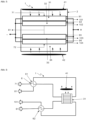
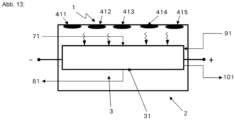
- Fig. 13 is a solid oxide cell arrangement 1 according to Figure 1
- the radiant heating element 41 consists of several radiant heating segments 411, 412, 413, 414, 415.
Landscapes
- Chemical & Material Sciences (AREA)
- Engineering & Computer Science (AREA)
- Electrochemistry (AREA)
- Chemical Kinetics & Catalysis (AREA)
- Manufacturing & Machinery (AREA)
- Sustainable Energy (AREA)
- Sustainable Development (AREA)
- General Chemical & Material Sciences (AREA)
- Life Sciences & Earth Sciences (AREA)
- Materials Engineering (AREA)
- Metallurgy (AREA)
- Organic Chemistry (AREA)
- Automation & Control Theory (AREA)
- Fuel Cell (AREA)
- Inorganic Chemistry (AREA)
- Magnetic Record Carriers (AREA)
- Primary Cells (AREA)
Description
- Die Erfindung betrifft eine Festoxidzellenanordnung mit einem Gehäuse, wobei das Gehäuse eine Bodenplatte, eine Abdeckung und Seitenwände aufweist, und Festoxidzellstapeln, wobei sich die Festoxidzellstapel auf der Bodenplatte befinden.
- Festoxidzellenanordnungen (SOC) können sowohl Hochtemperaturbrennstoffzellenanordnungen (SOFC) als auch Hochtemperaturelektrolysezellenanordnungen (SOEC) umfassen.
- Bei der Nutzung von Hochtemperaturbrennstoffzellenanordnungen werden verschiedene flüssige und gasförmige Brennstoffe auf Kohlenwasserstoffbasis (Erdgas, LPG) in Strom und Wärme umgewandelt. Bei Hochtemperaturelektrolysezellenanordnungen wird elektrische Energie in chemische Energie gewandelt.
- Eine Festoxidzellenanordnung enthält als zentrale Einheit zumindest einen Festoxidzellstapel, in dem bei der Nutzung als Hochtemperaturbrennstoffzellenanordnung an einer H2-Elektrodenseite des Festoxidzellstapels zugeführter gasförmiger Brennstoff auf Kohlenwasserstoffbasis oder Wasserstoff mit an einer O2-Elektrodenseite zugeführter Luft umgesetzt wird; bei der Nutzung als Hochtemperaturelektrolysezellenanordnung wird an einer H2-Elektrodenseite des Festoxidzellstapels zugeführter Wasserdampf und / oder Kohlenstoffdioxid zu Sauerstoff und Wasserstoff beziehungsweise Kohlenstoffmonoxid umgesetzt.
- Die Betriebstemperatur von Festoxidzellenanordnungen liegt üblicherweise materialbedingt bei Temperaturen von 700 bis 900 °C. Beim Aufheizen von Raumtemperatur muss Wärme über Leitungen, Konvektion oder Strahlung in die Festoxidzellstapel transportiert werden.
- Aus dem Stand der Technik sind unterschiedliche Anordnungen bekannt, um Festoxid-Brennstoffzellen zu betreiben.
- Die Zellstapel können in den Hochtemperaturbrennstoffzellenanordnungen sowohl reihenförmig als auch ring- beziehungsweise kreisförmig angeordnet werden.
- Eine lineare Anordnung ist beispielsweise aus der Druckschrift
WO 2017/191353 A1 bekannt, aus der eine Stapelanordnung eines Hochtemperatur-Brennstoffzellensystems oder Elektrolysezellensystems offenbart ist, wobei jede Zelle im Zellensystem eine H2-Elektrodenseite, eine O2-Elektrodenseite und einen dazwischenliegenden Elektrolyten umfasst, wobei das Zellensystem die Zellen in Zellstapeln umfasst. Die Anordnung umfasst die in Reihenanordnung angeordneten Stapel, wobei die Stapel mindestens in zwei Reihen nebeneinander angeordnet sind, und die Anordnung Lufteinführungskanäle zum Zuführen von Luft zu den Stapeln umfasst, wobei die Kanäle Lufteintrittsenden aufweisen, die zu einem abgedichteten Lufteinführungsraum gefördert werden, der zwischen den Stapelreihen mit mindestens zwei Seiten des von den Stapeln selbst umschlossenen Lufteinführungsraums gebildet ist. - Aus den Druckschriften
US 7,659,022 B2 ,WO 2015/118208 A1 undDE 42 17 892 C2 sind Zellstapel in radialer Anordnung bekannt. - Die
US 7,659,022 B2 beschreibt eine integrierte Brennstoffzelleneinheit, wobei diese eine ringförmige Anordnung von Brennstoffzellenstapeln, einen ringförmigen Kathodenrekuperator, einen ringförmigen Anodenrekuperator, einen Reformer und einen Anodenabgaskühler, die alle in eine gemeinsame Gehäusestruktur integriert sind, beinhaltet. - Die
WO 2015/118208 A1 offenbart eine Montageanordnung von Festoxidzellen in einem Brennstoffzellensystem oder in einem Elektrolysezellensystem. Die Baugruppe umfasst die Zellen, die mindestens bis zu vier abgewinkelte mindestens eine Zellstapelbildung und mindestens eine im Wesentlichen ebene Befestigungsseite jeder mindestens vier abgewinkelten Stapelbildung angeordnet sind, wobei die Seite mindestens eine geometrisch abweichende Befestigungsflächenstruktur in der ansonsten im Wesentlichen ebenen Seite zwischen mindestens zwei Ecken der mindestens vier abgewinkelten Stapelbildung umfasst. Die Montageanordnung umfasst ferner mindestens eine Strömungsbegrenzungsstruktur zum Begrenzen von Luftströmen in dem zu montierenden Zellsystem gegen die geometrisch abweichende Befestigungsflächenstruktur jeder Stapelformation zum Befestigen mindestens einer Zellstapelformation in der Montageanordnung, und eine elektrische Isolierung, die zur Befestigung der Strömungsbegrenzungsstruktur und der Stapelformation angeordnet ist. - Die
DE 42 17 892 C2 beschreibt eine Energieerzeugungseinheit aufweisend ein Energieversorgungsmodul mit einem wärmeisolierenden Behälter, der intern unterteilt ist, um eine Stapelkammer, eine Brennkammer und eine Wärmetauscherkammer bereitzustellen. Die Stapelkammer enthält mindestens einen Brennstoffzellenstapel. Die einzelnen Zellen werden entsprechend versorgt, wobei die zugeführten Medien jeweils über den Wärmetauscher in der Wärmetauscherkammer erwärmt werden. Die von den Brennstoffzellen zugeführte Gleichspannung wird über einen Stromregler mit einer Steuervorrichtung, die die gesamte Erzeugung des Energieversorgungsmoduls regelt, in Wechselstrom umgewandelt. - An die Zellstapelanordnungen werden zur Temperaturregelung verfahrenstechnische Komponenten wie elektrische Gasvorheizer oder Wärmetauscher positioniert. Die Wärmeübertragung findet über Konvektion oder Wärmeleitung statt.
- Aus der
WO 2012/131163 A1 ist eine Heizungsanordnung für einen Brennstoffzellvorrichtung bestehend aus einem Strahlungsheizer und einem Konvektionsheizer bekannt geworden, wobei der Strahlungsheizer außerhalb einer Brennstoffzellenanordnung und der Konvektionsheizer innerhalb der Brennstoffzellenanordnung vorgesehen ist. Die Kombination zweier Arten der Heizung soll eine gleichmäßige Wärmeverteilung sowie ein schnelles Aufheizen bei gleichzeitiger Vermeidung von thermischem Stress ermöglichen. - Aus der
US 2007/119638 A1 ist ein Brennstoffzellensystem umfassend mindestens einem elektrisches Widerstandsheizelement bekannt geworden. Mehrere Widerstandsheizelemente können dabei so verteilt sein, um eine gleichmäßige Wärmeverteilung herzustellen. - Aus der
EP 1 271 684 A2 ist ein Brennstoffzellensystem umfassend einen Zellstapel bekannt geworden, wobei die einzelnen Zellen des Zellstapels einen mit dem elektrochemischen Teil der Zellen in thermischen Kontakt stehenden Interconnect aufweisen, über welchen diesen Wärme zugeführt werden kann. Nachteilig an der Verwendung von Interconnects ist deren arbeits-, zeit- und kostenintensive Kontaktierung. Auch verhindern Interconnects eine Wartung/Reparatur von Stacks, beispielsweise in dem Fall, dass einer der Interconnects defekt ist und getauscht werden soll. Ebenso ist für die im Stack angeordneten Interconnects jeweils eine galvanische Trennung von Elektrolyse und Heizelement erforderlich, was ebenfalls die Herstellungskosten erhöht. -
EP247783 - Die Probleme im Stand der Technik sind im Wesentlichen, dass zum Betrieb der Festoxidzellenanordnung Temperaturen von üblicherweise (derzeit im Stand der Technik üblich) 700 bis 900 °C notwendig sind. Das Aufheizen erfolgt hierbei Festoxid-Elektrolysezellenanordnungen (SOEC und rSOC) über elektrische Vorheizer.
- Über elektrische Vorheizer werden die Medien konvektiv aufgeheizt und diese Heißgase erwärmen wiederum den Festoxidzellenstapel. Das Aufheizen durch bewegte Fluide führt zwangsläufig zu Wärmeverlusten, selbst wenn eine bestmögliche Wärmerückgewinnung erreicht wird. Die austretenden Gase haben immer eine höhere Temperatur als beim Eintritt in den jeweiligen Bilanzraum. Dadurch wird beispielsweise unnötig viel Energie beim Aufheizen verwendet.
- Zudem können einige Materialien in elektrischen Vorheizern bei bestimmten, meist wasserdampfhaltigen Atmosphären und im Hochtemperaturbereich Kontaminanten emittieren, welche die Leistungsfähigkeit der Festoxidzellenanordnungen negativ beeinflussen.
- Auch sind elektrische Vorheizer verhältnismäßig teure Baugruppen.
- Zudem werden sie zwischen Zellstapel und Wärmeübertrager integriert und verlängern dadurch die Rohrleitungen, was eine Erhöhung der Wärmeverluste bedingt.
- Aufgrund der höheren Medientemperatur müssen die Rohrleitungen größer ausgelegt werden. Des Weiteren sind im Aggregat größere Bereiche bei hohen Temperaturen, wodurch andere Funktionen negativ beeinflusst werden, z.B. galvanische Trennung, Sensorik, Leistungsanschlüsse, und bei einigen Konstruktionsvarianten Wärmeverluste höher ausfallen. So werden beispielsweise die Wärmeverluste erhöht, wenn Heißgase an Außenwänden entlanggeführt werden.
- Auch ist eine gute Zugänglichkeit zu den einzelnen Bauteilen für Instandhaltungsarbeiten, wie beispielsweise der Durchführung einer Wartung, oftmals nicht gegeben.
- Der vorliegenden Erfindung liegt die Aufgabe zugrunde, eine Anordnung zum effizienten Aufheizen und Betrieb von Hochtemperatur-Festoxidzellenanordnungen bereitzustellen.
- Die Komplexität und Bauteilanzahl einer Baugruppe bestimmt wesentlich die Kosten. Bei Anwendungen mit wenigen Kaltstarts pro Jahr, ist eine aufwändige Infrastruktur zum Aufheizen möglichst zu vermeiden. Mit möglichst nur einer wärmeerzeugenden Baugruppe sollen sowohl Festoxidzellstapel als auch Medienströme auf H2- und O2-Seite in die notwendigen Temperaturbereiche aufgeheizt werden.
- Gelöst wird diese Aufgabe mit einer Festoxidzellenanordnung gemäß Hauptanspruch sowie weiteren vorteilhaften Ausgestaltungsvarianten gemäß der Unteransprüche.
- Die Festoxidzellenanordnung ist mit einem Gehäuse, Festoxidzellstapeln und wenigstens einem Strahlungsheizungselement innerhalb des Gehäuses ausgebildet, über welches Strahlungswärme auf die Festoxidzellstapel abgegeben wird. Hierdurch sind keine elektrischen Vorheizer zur Erwärmung der Festoxidzellstapel mehr notwendig. Die erzwungene Konvektion zum Aufheizen entfällt somit und das Aufheizen ist deutlich effizienter. Bis zu 90 % der investierten Elektroenergie zur Temperaturerhöhung der Zellstapel anstatt von bisher nur etwa 40 % werden effizient genutzt. Dies führt zu einer Einsparung von mindestens 50 % der investierten Elektroenergie (kWh) beim Aufheizen. Die Wärmeverluste fallen zudem deutlich geringer aus, da deutlich weniger austretende Gase mit einer höheren Temperatur als die Umgebung vorliegen.
- Dadurch, dass das Strahlungsheizungselement als Heizrohr oder als Heizplatte ausgebildet ist, wobei dieses hängend von oben und / oder an Seitenwänden befestigt und / oder stehend auf der Bodenplatte oder in keramische Platten integriert sein kann, ist es möglich das Strahlungsheizungselement auf den Einzelfall zugeschnitten so auszubilden und zu montieren, dass ein bestmögliches Ergebnis, also ein effizientes Aufheizen, ermöglicht wird. Auch die Möglichkeit einer einfachen Wartung wird so gegeben. Sind die Strahlungsheizungselemente beispielsweise in einer Seitenwand integriert, so ist durch Abnahme oder Wegklappen der Seitenwand eine Zugänglichkeit sowohl zu den Strahlungsheizungselementen als auch den Festoxidzellstapeln gegeben.
- Dadurch, dass das Strahlungsheizungselement aus mehreren separat regelbaren Segmenten mit separaten Leistungsanschlüssen für die jeweiligen Strahlungsheizungssegmente besteht, wird es möglich thermische Ungleichgewichte durch lokale thermische Beeinflussung zu vermeiden. Grundlage für diesen Ansatz ist der physikalische Zusammenhang, dass bei höheren Temperaturen der Innenwiderstand der keramischen Zellen sinkt. Zusätzlich gilt die Gesetzmäßigkeit, dass die elektrische Verlustleistung (= Abwärme) durch die Stromdichte quadratische und durch den Innenwiderstand linear beeinflusst wird (PLoss = RI2). Außerdem gilt, dass in elektrischen Parallelschaltungen in Verzweigungen mit geringerem Innenwiderstand höhere Stromstärken anliegen. Auf Basis dieser Zusammenhänge können beispielsweise sowohl einzelne Festoxidzellreihenschaltungen eines elektrischen Netzwerkes (mittels Strahlungsheizungselementen) als auch Teile einer Festoxidreihenschaltung (mittels Strahlungsheizungssegmenten) je nach Bedarf / Betriebsart positiv beeinflusst werden. Hier ist eingrenzend zu erwähnen, dass durch die thermische Einflussnahme das vorherrschende Materialverhalten (Degradation) nicht verändert werden kann, aber deren Symptome deutlich abgeschwächt werden können.
- Jede Festoxidzellstapelreihenschaltung wird global regelbar über die Stromdichte und Zuschaltung der zugehörigen Strahlungsheizung.
- Durch einen lokal unterschiedlichen Wärmeeintrag kann eine lokal regelbare Festoxidzellstapelreihenschaltung aufgewertet werden. Dazu kann der gesamte Heizleiter in Segmente unterteilt werden und jeweils einen Leistungsanschluss erhalten, wodurch die Leistungsfähigkeit des Festoxidstapels gesteigert werden kann. Grundsätzlich ist zu erwähnen, dass in einer Reihenschaltung "das schwächste Glied" limitiert. Unterliegt beispielsweise im SOEC-Betrieb ein Bereich höheren Wärmeverlusten, so steigt dort die Spannung bis zum zulässigen Maximalwert. Die Stromstärke wird für die gesamte Reihenschaltung limitiert und damit die H2-Produktion. Die wärmeren Bereiche werden nicht optimal ausgenutzt. Mit einer segmentierten Heizung können die kühleren Bereiche gezielt nachgeheizt werden und so die Temperatur des Festoxidzellstapels homogenisiert werden. Die Stromstärke respektive die H2-Produktion kann erhöht werden, da die kalten Zellen nicht mehr limitieren.
- Da die Festoxidzellstapel in mehreren Reihen nebeneinander als Festoxidzellstapelreihenschaltung vorliegen können, wobei jedem Festoxidzellstapel ein Strahlungsheizungselement zugeordnet sein kann, wird die Effizienz des Aufheizens der Festoxidstapel weiter verbessert. Die Festoxidzellstapel können so über ihre gesamte Fläche über die Strahlungsheizungselemente aufgeheizt werden. Die von den Strahlungsheizungselementen abgegebene Wärme wird gleichmäßig verteilt, da jeder Festoxidzellstapel über die Strahlungsheizungselemente aufgeheizt wird und keine ungeheizten Abschnitte vorliegen. Dies trägt zudem zu einer verlängerten Lebensdauer bei.
- Wenn zusätzlich zu den Strahlungsheizungselementen Wärmeübertrager für die Medienzufuhr im Gehäuse oder außerhalb an den Flanschen angeordnet sind, wird die Prozesswärme im System gehalten. Die Wärme der austretenden Gase wird bestmöglich zum Vorwärmen der eintretenden Gase genutzt. Dies führt zu einer Steigerung des Systemwirkungsgrades. Die bisher eingesetzten elektrischen Vorheizer können entfallen. Es sind mindestens zwei Wärmeübertrager, je einer für O2- und H2-Elektrodenseite, erforderlich. Die Nutzung der Enthalpieströme der austretenden Gase ist somit von besonderer Bedeutung für die Profitabilität eines Systems.
- In einigen Anwendungsfällen ist daher die Integration von mehr als zwei Wärmeübertragern sinnvoll. Unter Betrachtung der nutzungsabhängigen Ausgestaltung sind verschiedene Möglichkeiten gegeben. Diese umfassen beispielsweise:
- Wärmeübertrager mit gleichem Medium auf beiden Wärmeübertragerseiten oder als Mischung von H2- und O2-Seite;
- dezentrale Anordnung vieler kleiner Wärmeübertrager oder die zentrale Anordnung von größeren Wärmeübertragern;
- Parallelschaltung oder Reihenschaltung mehrerer Wärmeübertrager.
- Relevant ist in diesem Zusammenhang die Kombination von Wärmeübertragern mit Strahlungsheizungselementen. Aus obigen Möglichkeiten kann eine Vielzahl von Varianten abgeleitet werden. Diese sind beispielsweise:
- Wärmeübertrager auf H2-Seite direkt unter den einzelnen Türmen der Zellstapelreihenschaltung positioniert (dezentrale Anordnung auf H2-Seite);
- Medienstrang O2-Seite wird zweistufig abgekühlt, zunächst mittels Wärmeübertrager auf O2-Seite und dann mittels Wärmeübertrager auf H2-Seite;
- Medienstrang O2-Seite wird aufgesplittet, so dass ein Teil des Massestroms die H2- und ein anderer die O2-Seite vorwärmt;
- Medienzufuhr O2-Seite von der Heizer zugewandten Festoxidzellstapelseite;
- Medienversorgung O2-Seite über separate metallische oder metall-keramische Baugruppen im Grundträger.
- Nachfolgend werden Ausführungsbeispiele der Erfindung anhand der beiliegenden Zeichnungen in der Abbildungsbeschreibung detailliert beschrieben, wobei diese die Erfindung erläutern soll und nicht beschränkend zu werten ist:
- Es zeigen:
- Abb. 1
- eine schematische Darstellung einer Festoxidzellenanordnung mit einem Festoxidzellstapel und einem seitlichen Strahlungsheizungselement in der Draufsicht;
- Abb. 2
- eine schematische Darstellung einer Festoxidzellenanordnung mit zwei Festoxidzellstapeln und zwei seitlichen Strahlungsheizungselementen in der Draufsicht;
- Abb. 3
- eine schematische Darstellung einer Festoxidzellenanordnung mit zwei Festoxidzellstapeln und drei sowohl seitlichen als auch mittigen Strahlungsheizungselementen in der Draufsicht;
- Abb. 4
- eine schematische Darstellung einer Festoxidzellenanordnung mit drei Festoxidzellstapeln und drei sowohl seitlichen als auch mittigen Strahlungsheizungselementen in der Draufsicht;
- Abb. 5
- eine schematische Darstellung einer Festoxidzellenanordnung mit vier Festoxidzellstapeln mit Durchströmung von je zwei Zellstapeln und zwei seitlichen Strahlungsheizungselementen in der Draufsicht;
- Abb. 6
- ein Fließbild einer Festoxidzellenanordnung mit einem Festoxidzellstapel und einem Strahlungsheizungselement in Kombination mit zwei Wärmeübertragern;
- Abb. 7
- ein Fließbild einer weiteren Ausgestaltung einer Festoxidzellenanordnung mit einem Festoxidzellstapel und einem Strahlungsheizungselement in Kombination mit zwei Wärmeübertragern;
- Abb. 8
- ein Fließbild einer Festoxidzellenanordnung mit einem Festoxidzellstapel, einem Strahlungsheizungselement in Kombination mit zwei Wärmeübertragern und einem zusätzlichen konvektiven, elektrischen Gasheizer auf H2-Medienseite;
- Abb. 9
- ein Fließbild einer Festoxidzellenanordnung mit einem Festoxidzellstapel und einem Strahlungsheizungselement in Kombination mit drei Wärmeübertragern;
- Abb. 10
- ein Fließbild einer Festoxidzellenanordnung mit einem Festoxidzellstapel und einem Strahlungsheizungselement in Kombination mit drei Wärmeübertragern und einem aufgeteilten Abluftstrom;
- Abb. 11
- einen Vergleich einer Festoxidzellenanordnung mit einem Strahlungsheizungselement, zentral angeordneten Wärmeübertragern und einem elektrischen Vorheizer mit einer Anordnung mit konventionellen, elektrischen Vorheizern und zentral angeordneten Wärmeübertragern anhand zweier Fließbilder (a, b);
- Abb. 12
- einen Vergleich einer Festoxidzellenanordnung mit separaten Strahlungsheizungselementen, dezentralen Wärmeübertragern und einem elektrischen Vorheizer mit einer Anordnung mit konventionellen, elektrischen Vorheizern und dezentralen Wärmeübertragern anhand zweier Fließbilder (a, b) und
- Abb. 13
- eine schematische Darstellung einer Festoxidzellenanordnung mit einem Festoxidzellstapel und einem seitlichen Strahlungsheizungselement aufgeteilt in Strahlungsheizungssegmente in der Draufsicht.
- In den nachfolgenden Abbildungsbeschreibungen sind funktionsgleiche Bauteile mit einheitlichen Bezugszeichen versehen.
- In
Abb. 1 ist eine Festoxidzellenanordnung 1 in einem Gehäuse 2 dargestellt. Die Festoxidzellenanordnung 1 besteht aus einem Festoxidzellstapel 31 mit einem seitlich an dem Gehäuse 2 angebrachten Strahlungsheizungselement 41. - Das Strahlungsheizungselement 41, das seitlich an das Gehäuse 2 angebracht ist, dient zur Aufheizung des Festoxidzellstapels 31. Durch die seitliche Anbringung ist eine gute Zugänglichkeit zu dem Festoxidzellstapel 31 und / oder zu dem Strahlungsheizungselement 41 gegeben. Das Strahlungsheizungselement 41 kann als Heizrohr oder als Heizplatte ausgebildet sein, wobei dieses hängend von oben und / oder an Seitenwänden befestigt und / oder stehend auf der Bodenplatte oder in keramische Platten integriert sein kann.
- Luft gelangt über die Medienzufuhr auf der O2 -Elektrodenseite 71 in den Festoxidzellstapel 31. Die verbrauchte Luft wird über die Medienabfuhr auf der O2-Elektrodenseite 81 abgeführt. Das Brenngas wird über die Medienzufuhr auf der H2-Elektrodenseite 91 zugeführt. Überschüssiges Brenngas und Wasser werden über die Medienabfuhr auf der H2-Elektrodenseite 101 abgeführt.
- In
Abb. 2 liegen zwei Festoxidzellstapel 31, 32 als Festoxidzellstapelreihenschaltung vor. Es werden zwei jeweils seitlich angebrachte Strahlungsheizungselemente 41, 42 verwendet. Es gibt pro Zellstapel 31, 32 jeweils eine Medienzufuhr auf der O2-Elektrodenseite 71, 72 und der H2-Elektrodenseite 91, 92. Die Medienabfuhr auf der O2-Elektrodenseite 81 erfolgt in einem Strang; die Medienabfuhr auf der H2-Elektrodenseite 101, 102 erfolgt jeweils separat. -
Abb. 3 unterscheidet sich vonAbb. 2 dadurch, dass es neben den zwei seitlich angebrachten Strahlungsheizungselementen 41, 43 noch ein mittig angebrachtes Strahlungsheizungselement 42 gibt. - In
Abb. 4 sind drei Festoxidzellstapel 31, 32, 33 miteinander verschaltet. Es gibt ein seitlich am Gehäuse 2 angebrachtes Strahlungsheizungselement 41 und zwei mittig installierte Strahlungsheizungselemente 42, 43. Medienzufuhr und -abfuhr erfolgen pro Zellstapel separat. - In
Abb. 5 werden je zwei Zellstapel 3 gemeinsam durchströmt. Die Zellstapel 31, 32 sowie die Zellstapel 33, 34 haben jeweils eine Medienzufuhr auf der O2-Elektrodenseite 71, 72 und eine gemeinsame Medienabfuhr auf der O2-Elektrodenseite 81. Die Medienzufuhr und -abfuhr auf der H2-Elektrodenseite erfolgen jeweils separat pro Zellstapel. Es gibt zwei seitlich angebrachte Strahlungsheizungselement 41, 42. - Wie in den obigen Ausführungsbeispielen zur Anordnung von Strahlungsheizungselementen 4 in Festoxidzellenanordnungen 1 beschrieben, kann jedem Festoxidzellstapel 3 ein Strahlungsheizungselement 4 zugeordnet sein. In solch einem Fall können einzelne Strahlungsheizungselemente 4 entweder mittig zwischen den einzelnen Reihen an Festoxidzellstapeln 3 installiert werden und / oder wie zuvor beschrieben seitlich angebracht sein. Die Festoxidzellstapel 3 können so über ihre gesamte Fläche über die Strahlungsheizungselemente 4 aufgeheizt werden. Da die Strahlungsheizungselemente 4 aus mehreren separat regelbaren Segmenten mit separaten Leistungsanschlüssen für die jeweiligen Strahlungsheizungssegmente bestehen können, können thermische Ungleichgewichte vermieden werden.
- In den
Abb. 6-10 sind Fließbilder einer Festoxidzellenanordnung 1 dargestellt. In den Fließbildern werden verschiedene Möglichkeiten der Kombination von Strahlungsheizungselement 4 mit Wärmetauscher 6 aufgezeigt. - In
Abb. 6 ist ein Strahlungsheizungselement 41 mit zwei Wärmeübertragern 61, 62 in einer Festoxidzellenanordnung 1 kombiniert. Ein Festoxidzellstapel 31 wird über das Strahlungsheizungselement 41 erwärmt. Es sind Wärmeübertrager auf der O2-Elektrodenseite 61 und ein Wärmeübertrager auf der H2-Elektrodenseite 62 installiert. Luft gelangt über die Medienzufuhr auf der O2 -Elektrodenseite 71 in den Festoxidzellstapel 31. Die verbrauchte Luft wird über die Medienabfuhr auf der O2-Elektrodenseite 81 abgeführt. Das Brenngas wird über die Medienzufuhr auf der H2-Elektrodenseite 91 zugeführt. Überschüssiges Brenngas und Wasser werden über die Medienabfuhr auf der H2-Elektrodenseite 101 abgeführt. - Mit dem Wärmeübertrager auf der O2-Elektrodenseite 61 wird die Medienzufuhr auf der O2 - Elektrodenseite 71 über die Medienabfuhr auf der O2-Elektrodenseite 81 erwärmt. Dementsprechend wird mit dem Wärmeübertrager auf der H2-Elektrodenseite 62 die Medienzufuhr auf der H2-Elektrodenseite 91 über die Medienabfuhr auf der H2-Elektrodenseite 101 aufgewärmt. Dies erhöht den Systemwirkungsgrad.
- Die Wärmeübertrager 61, 62 können entweder direkt im Gehäuse 2 unter dem Festoxidzellstapel 31 oder seitlich angeflanscht an die Ein- und Ausgänge des Gehäuses 2 angebracht werden. Durch die Unterbringung der Wärmeübertrager 61, 62 direkt im Gehäuse 2 werden die Wärmeverluste minimiert. Die Rohrleitungen sind möglichst kurz und alle Elemente sind in dem Gehäuse 2, welches wärmegedämmt ist, in einer Baugruppe untergebracht.
- In
Abb. 7 ist wie inAbb. 6 ein Strahlungsheizungselement 41 mit zwei Wärmeübertragern 61, 62 in einer Festoxidzellenanordnung 1 kombiniert. Ein Festoxidzellstapel 31 wird über das Strahlungsheizungselement 41 erwärmt. Lediglich die Medienstromführung durch die Wärmeübertrager 61, 62 wurde variiert. - In
Abb. 8 liegt eine Festoxidzellenanordnung 1 vor, in der auf der Seite der Medienzufuhr auf der H2-Elektrodenseite 91 ein zusätzlicher konvektiver, elektrischer Gasheizer 51 installiert wurde. - Die Installation solch eines konvektiven, elektrischen Gasheizers 5 ist bei allen Varianten der Kombination von Strahlungsheizungselementen 4 mit Wärmeübertragern 3 möglich, sollte gemäß der neuartigen Festoxidzellenanordnung 1 jedoch nicht mehr zwingend notwendig sein.
- In
Abb. 9 ist ein Strahlungsheizungselement 41 mit drei Wärmeübertragern 61, 62, 63 kombiniert. Die Medienabfuhr der O2-Elektrodenseite 81 durchläuft zwei Wärmeübertrager 61, 62 und heizt somit sowohl die Medienzufuhr auf der O2-Eleltrodenseite 71 als auch die Medienzufuhr auf der H2-Elektrodenseite 91 auf. - In
Abb. 10 ist wie inAbb. 9 ein Strahlungsheizungselement 41 mit drei Wärmeübertragern 61, 62, 63 kombiniert. Zusätzlich wurde hier der O2-Abluftstrom, der aus dem Festoxidzellstapel 31 herausgeleitet wird, in zwei Teilströme aufgeteilt. - Bei der Kombination von Strahlungsheizungselementen 4 mit Wärmeübertragern 6 in Festoxidzellenanordnungen 1 ist eine Vielzahl von weiteren Varianten möglich. Sowohl die Anzahl und Position an Strahlungsheizungselementen 4 zur Aufheizung der Festoxidzellstapel 3 als auch die Anzahl und Position an Wärmeübertragern 6 sowie zusätzlich die Medienzufuhr- und -abfuhr auf den Elektrodenseiten können variiert, im Fall der Medienzufuhr und -abfuhr beispielsweise aufgesplittet, werden.
-
Abb. 11 besteht aus einem Fließbild a) einer Festoxidzellenanordnung mit einem Strahlungsheizungselement 41, zentral in der Gasverarbeitungseinheit 11 angeordneten Wärmeübertragern 61, 62 und einem elektrischen Vorheizer 51 und einem Fließbild b) einer Anordnung nur mit konventionellen, elektrischen Vorheizern 51, 52 und zentral in der Gasverarbeitungseinheit 11 angeordneten Wärmeübertragern 61, 62. - Aus den beiden Fließbildern ist ersichtbar wie sich der technische Anlagenaufbau für den Betrieb von Festoxidzellen bei Anwendung von Strahlungsheizungselementen 4 bei zentraler Anordnung der Wärmeübertrager 6 verändert.
-
Abb. 12 besteht aus einem Fließbild a) einer Festoxidzellenanordnung 1 mit zwei separaten Strahlungsheizungselementen 41, 42, dezentral im Zellenstapelmodul 12 angeordneten Wärmeübertragern 61, 62 und einem elektrischen Vorheizer 51 und einem Fließbild b) einer Anordnung nur mit konventionellen, elektrischen Vorheizern 51, 52 und dezentral im Zellenstapelmodul 12 angeordneten Wärmeübertragern 61, 62. - Aus den beiden Fließbildern ist ersichtbar wie sich der technische Anlagenaufbau für den Betrieb von Festoxidzellen bei Anwendung von Strahlungsheizungselementen 4 bei dezentraler Anordnung der Wärmeübertrager 6 verändert.
- Aus dem Vergleich der Abbildungen 11 und 12 sind die Unterschiede des technischen Anlagenaufbaus für den Betrieb von Festoxidzellen bei zentraler und dezentraler Anordnung der Wärmeübertrager 6 ersichtlich.
- In
Abb. 13 ist eine Festoxidzellenanordnung 1 gemäßAbbildung 1 dargestellt. Das Strahlungsheizungselement 41 besteht hier aus mehreren Strahlungsheizungssegmenten 411, 412, 413, 414, 415. -
1 Festoxidzellenanordnung 71 Medienzufuhr O2-Elektrodenseite 1 72 Medienzufuhr O2-Elektrodenseite 2 2 Gehäuse 73 Medienzufuhr O2-Elektrodenseite 3 3 Festoxidzellstapel 81 Medienabfuhr O2-Elektrodenseite 1 31 Festoxidzellstapel 1 82 Medienabfuhr O2-Elektrodenseite 2 32 Festoxidzellstapel 2 83 Medienabfuhr O2-Elektrodenseite 3 33 Festoxidzellstapel 3 34 Festoxidzellstapel 4 91 Medienzufuhr H2-Elektrodenseite 1 92 Medienzufuhr H2-Elektrodenseite 2 4 Strahlungsheizungselement 93 Medienzufuhr H2-Elektrodenseite 3 41 Strahlungsheizungselement 1 411 Segment 1 von Strahlungsheizungselement 1 101 Medienabfuhr H2-Elektrodenseite 1 102 Medienabfuhr H2-Elektrodenseite 2 412 Segment 2 von Strahlungsheizungselement 1 103 Medienabfuhr H2-Elektrodenseite 3 413 Segment 3 von Strahlungsheizungselement 1 11 Gasverarbeitungseinheit 414 Segment 4 von Strahlungsheizungselement 1 12 Zellenstapelmodul 415 Segment 5 von Strahlungsheizungselement 1 42 Strahlungsheizungselement 2 43 Strahlungsheizungselement 3 5 konvektiver, elektrischer Gasheizer 51 konvektiver, elektrischer Gasheizer 1 52 konvektiver, elektrischer Gasheizer 2 6 Wärmeübertrager 61 Wärmeübertrager 1 62 Wärmeübertrager 2 63 Wärmeübertrager 3
Claims (7)
- Festoxidzellenanordnung (1) mit:- einem Gehäuse (2), wobei das Gehäuse (2) eine Bodenplatte, eine Abdeckung und Seitenwände aufweist;- Festoxidzellstapeln (3), wobei sich die Festoxidzellstapel (3) auf der Bodenplatte befinden;dadurch gekennzeichnet, dass- wenigstens ein Strahlungsheizungselement (4) innerhalb des Gehäuses (2) und Strahlungswärme auf die Festoxidzellstapel (3) abgebend angeordnet ist, und- das Strahlungsheizungselement (4) als Heizrohr oder als Heizplatte ausgebildet ist, und- das Strahlungsheizungselement (4) aus mehreren separat regelbaren Segmenten mit separaten Leistungsanschlüssen für die jeweiligen Strahlungsheizungssegmente besteht und dass die Festoxidzellenanordnung als Hochtemperaturelektrolysezellenanordnung (SOEC) ausgebildet ist.
- Festoxidzellenanordnung (1) nach Anspruch 1,
dadurch gekennzeichnet, dass
die Festoxidzellstapel (3) in mehreren Reihen nebeneinander als Festoxidzellstapelreihenschaltung vorliegen, wobei für jeden Festoxidzellstapel (3) ein Strahlungsheizungselement (4) zugeordnet ist. - Festoxidzellenanordnung (1) nach einem der vorangehenden Ansprüche,
dadurch gekennzeichnet, dass
zusätzlich zu den Strahlungsheizungselementen (4) Wärmeübertrager (6) im Gehäuse (2) oder außerhalb direkt an den Flanschen angeordnet sind. - Festoxidzellenanordnung (1) nach Anspruch 3,
dadurch gekennzeichnet, dass
sich durch die Kombination von Strahlungsheizungselement (4) mit Wärmeübertrager (6) der Systemwirkungsgrad erhöht. - Festoxidzellenanordnung (1) nach einem der Ansprüche 1 bis 4, dadurch gekennzeichnet, dass das Strahlungsheizelement (4) als Heizrohr oder als Heizplatte in eine der Seitenwände integriert ist.
- Festoxidzellenanordnung (1) nach Anspruch 1 bis 4, dadurch gekennzeichnet, dass das Strahlungsheizelement (4) als Heizrohr oder als Heizplatte hängend von oben, an Seitenwänden oder stehend auf der Bodenplatte befestigt ist.
- Festoxidzellenanordnung (1) nach Anspruch 1 bis 4, dadurch gekennzeichnet, dass das Strahlungsheizelement (4) als Heizrohr oder als Heizplatte in eine oder mehrere keramische Platten integriert ist.
Applications Claiming Priority (2)
| Application Number | Priority Date | Filing Date | Title |
|---|---|---|---|
| EP19214778 | 2019-12-10 | ||
| PCT/DE2020/101043 WO2021115538A1 (de) | 2019-12-10 | 2020-12-09 | Festoxidzellenanordnung |
Publications (3)
| Publication Number | Publication Date |
|---|---|
| EP4073860A1 EP4073860A1 (de) | 2022-10-19 |
| EP4073860B1 true EP4073860B1 (de) | 2025-03-19 |
| EP4073860C0 EP4073860C0 (de) | 2025-03-19 |
Family
ID=68848023
Family Applications (1)
| Application Number | Title | Priority Date | Filing Date |
|---|---|---|---|
| EP20833720.4A Active EP4073860B1 (de) | 2019-12-10 | 2020-12-09 | Festoxidzellenanordnung |
Country Status (5)
| Country | Link |
|---|---|
| US (1) | US20230052850A1 (de) |
| EP (1) | EP4073860B1 (de) |
| CN (1) | CN114946057A (de) |
| AU (1) | AU2020399915B2 (de) |
| WO (1) | WO2021115538A1 (de) |
Families Citing this family (5)
| Publication number | Priority date | Publication date | Assignee | Title |
|---|---|---|---|---|
| DE102022214300A1 (de) * | 2022-12-22 | 2024-06-27 | Robert Bosch Gesellschaft mit beschränkter Haftung | Vorheizer für eine Elektrolysevorrichtung |
| DE102022214304A1 (de) * | 2022-12-22 | 2024-06-27 | Robert Bosch Gesellschaft mit beschränkter Haftung | Vorheizer für eine Elektrolysevorrichtung |
| DE102023109509A1 (de) * | 2023-04-14 | 2024-10-17 | SIVONIC GmbH | Verringerung der Degradation zu einem Stack zusammengefügter Hochtemperatur-Festoxid-Zellen |
| FR3160708A1 (fr) * | 2024-03-29 | 2025-10-03 | Genvia | Ensemble modulaire pour systeme d’electrolyse d’oxyde solide |
| AT528535A1 (de) * | 2024-07-30 | 2026-02-15 | Avl List Gmbh | Elektrochemisches Zellensystem |
Citations (1)
| Publication number | Priority date | Publication date | Assignee | Title |
|---|---|---|---|---|
| EP2476783A1 (de) * | 2009-09-07 | 2012-07-18 | Toyo Tanso Co., Ltd. | Elektrolysevorrichtung |
Family Cites Families (14)
| Publication number | Priority date | Publication date | Assignee | Title |
|---|---|---|---|---|
| JPH0541241A (ja) | 1991-05-30 | 1993-02-19 | Fuji Electric Co Ltd | 固体電解質型燃料電池 |
| US6737182B2 (en) * | 2001-06-18 | 2004-05-18 | Delphi Technologies, Inc. | Heated interconnect |
| US8356682B2 (en) * | 2005-04-04 | 2013-01-22 | Delphi Technologies, Inc. | Fuel cell system using external heat sources for maintaining internal temperature |
| US7659022B2 (en) | 2006-08-14 | 2010-02-09 | Modine Manufacturing Company | Integrated solid oxide fuel cell and fuel processor |
| DE102007012763B4 (de) * | 2007-03-16 | 2014-04-10 | Staxera Gmbh | Gehäuse zum Aufnehmen zumindest eines Brennstoffzellenstapels und Brennstoffzellensystem mit einem solchen Gehäuse |
| WO2009148505A2 (en) * | 2008-05-30 | 2009-12-10 | Corning Incorporated | Solid oxide fuel cell systems |
| GB2469522A (en) * | 2009-04-17 | 2010-10-20 | Energy Conversion Technology As | Fuel cell apparatus and method for heating a fuel cell stack |
| FI20115307A7 (fi) * | 2011-03-31 | 2012-10-01 | Waertsilae Finland Oy | Lämmitysmenetelmä ja -järjestely korkean lämpötilan polttokennolaitteen kehittyneeksi lämmittämiseksi |
| CN105121708A (zh) * | 2013-03-11 | 2015-12-02 | 托普索公司 | 具有一体化加热器的固体氧化物电解池堆 |
| ES2649157T3 (es) | 2014-02-05 | 2018-01-10 | Elcogen Oy | Método y disposición de ensamblaje para un sistema de celda |
| DE102014108085A1 (de) * | 2014-06-06 | 2015-12-17 | Sunfire Gmbh | Elektrolyseverfahren |
| KR20190003665A (ko) | 2016-05-02 | 2019-01-09 | 콘비온 오와이 | 고온 연료 전지의 스택 로우 구조 및 방법 |
| CN106784925A (zh) * | 2017-01-16 | 2017-05-31 | 天津大学 | 一种无接触式质子交换膜燃料电池冷启动装置 |
| CN110016693A (zh) * | 2019-04-02 | 2019-07-16 | 贵州省六盘水双元铝业有限责任公司 | 一种电解槽温度调节装置 |
-
2020
- 2020-12-09 WO PCT/DE2020/101043 patent/WO2021115538A1/de not_active Ceased
- 2020-12-09 US US17/783,983 patent/US20230052850A1/en active Pending
- 2020-12-09 CN CN202080093026.9A patent/CN114946057A/zh active Pending
- 2020-12-09 AU AU2020399915A patent/AU2020399915B2/en active Active
- 2020-12-09 EP EP20833720.4A patent/EP4073860B1/de active Active
Patent Citations (1)
| Publication number | Priority date | Publication date | Assignee | Title |
|---|---|---|---|---|
| EP2476783A1 (de) * | 2009-09-07 | 2012-07-18 | Toyo Tanso Co., Ltd. | Elektrolysevorrichtung |
Also Published As
| Publication number | Publication date |
|---|---|
| CN114946057A (zh) | 2022-08-26 |
| EP4073860A1 (de) | 2022-10-19 |
| AU2020399915B2 (en) | 2023-12-21 |
| US20230052850A1 (en) | 2023-02-16 |
| WO2021115538A1 (de) | 2021-06-17 |
| AU2020399915A1 (en) | 2022-07-28 |
| EP4073860C0 (de) | 2025-03-19 |
Similar Documents
| Publication | Publication Date | Title |
|---|---|---|
| EP4073860A1 (de) | Festoxidzellenanordnung | |
| DE69713337T2 (de) | Festoxidbrennstoffzellengenerator mit auswechselbarem brennstoffzellenstapel von modularem aufbau | |
| DE69103455T2 (de) | Energiegewinnungssystem mit flachen Brennstoffzellen aus festen Elektrolyten. | |
| DE69224116T2 (de) | Festoxidbrennstoffzellensystem | |
| JP6124923B2 (ja) | 外熱式水素製造を備える高温水蒸気電解設備(htse) | |
| US20160380298A1 (en) | Fuel Cell Stack Arrangement | |
| EP2254182B1 (de) | Betriebsverfahren für eine in Reihe geschaltete Brennstoffzellenstapelmoduleinheit | |
| DE112011101295T5 (de) | Wärmemanagement in einem Brennstoffzellenstapel | |
| EP0704109B1 (de) | Hochtemperaturbrennstoffzellenanlage | |
| DE102019218600A1 (de) | Brennstoffzelle mit Heizeinheit dafür | |
| EP1371104B1 (de) | Brennstoffzelle mit integriertem wärmetauscher | |
| WO2009143929A1 (de) | Brennstoffzellensystem | |
| DE102005038928B4 (de) | Brennstoffzelle vom Pakettyp | |
| EP0486911B1 (de) | Anordnung zur Erzeugung von elektrischer Energie | |
| KR20240127987A (ko) | 고체 산화물 전기분해 전지 코어 플랜트 | |
| DE102005007180A1 (de) | Verfahren zum Betreiben von Brennstoffzellen für begrenzt wärmebelastbare Systeme und Brennstoffzellenstack zur Durchführung des Verfahrens | |
| WO2006136149A1 (de) | Heizgerät mit thermoelektrischer einrichtung | |
| EP0870343A1 (de) | Brennstoffzelleneinrichtung mit röhrenförmigen hochtemperatur-brennstoffzellen | |
| EP1933410B1 (de) | Wiederholeinheit für einen Brennstoffzellenstapel | |
| AT526798B1 (de) | Brennstoffzellengeneratormodul mit Brennstoffzellenstapelanordnung | |
| AT523315B1 (de) | Brennstoffzellensystem und Verfahren zum Betreiben eines Brennstoffzellensystems | |
| AT509041B1 (de) | Temperaturregelung von brennstoffzellensystemen | |
| DE19953404A1 (de) | Elektrochemischer Brennstoffzellenstapel | |
| DE102024210484A1 (de) | Elektrolysezelle und Elektrolyseuranlage | |
| DE19647417A1 (de) | Modulverschaltung von Brennstoffzellen |
Legal Events
| Date | Code | Title | Description |
|---|---|---|---|
| STAA | Information on the status of an ep patent application or granted ep patent |
Free format text: STATUS: UNKNOWN |
|
| STAA | Information on the status of an ep patent application or granted ep patent |
Free format text: STATUS: THE INTERNATIONAL PUBLICATION HAS BEEN MADE |
|
| PUAI | Public reference made under article 153(3) epc to a published international application that has entered the european phase |
Free format text: ORIGINAL CODE: 0009012 |
|
| STAA | Information on the status of an ep patent application or granted ep patent |
Free format text: STATUS: REQUEST FOR EXAMINATION WAS MADE |
|
| 17P | Request for examination filed |
Effective date: 20220708 |
|
| AK | Designated contracting states |
Kind code of ref document: A1 Designated state(s): AL AT BE BG CH CY CZ DE DK EE ES FI FR GB GR HR HU IE IS IT LI LT LU LV MC MK MT NL NO PL PT RO RS SE SI SK SM TR |
|
| DAV | Request for validation of the european patent (deleted) | ||
| DAX | Request for extension of the european patent (deleted) | ||
| P01 | Opt-out of the competence of the unified patent court (upc) registered |
Effective date: 20230512 |
|
| GRAP | Despatch of communication of intention to grant a patent |
Free format text: ORIGINAL CODE: EPIDOSNIGR1 |
|
| STAA | Information on the status of an ep patent application or granted ep patent |
Free format text: STATUS: GRANT OF PATENT IS INTENDED |
|
| INTG | Intention to grant announced |
Effective date: 20241010 |
|
| GRAS | Grant fee paid |
Free format text: ORIGINAL CODE: EPIDOSNIGR3 |
|
| GRAA | (expected) grant |
Free format text: ORIGINAL CODE: 0009210 |
|
| STAA | Information on the status of an ep patent application or granted ep patent |
Free format text: STATUS: THE PATENT HAS BEEN GRANTED |
|
| AK | Designated contracting states |
Kind code of ref document: B1 Designated state(s): AL AT BE BG CH CY CZ DE DK EE ES FI FR GB GR HR HU IE IS IT LI LT LU LV MC MK MT NL NO PL PT RO RS SE SI SK SM TR |
|
| REG | Reference to a national code |
Ref country code: GB Ref legal event code: FG4D Free format text: NOT ENGLISH |
|
| REG | Reference to a national code |
Ref country code: CH Ref legal event code: EP |
|
| REG | Reference to a national code |
Ref country code: DE Ref legal event code: R081 Ref document number: 502020010655 Country of ref document: DE Owner name: SUNFIRE GMBH, DE Free format text: FORMER OWNER: ANMELDERANGABEN UNKLAR / UNVOLLSTAENDIG, 80297 MUENCHEN, DE Ref country code: DE Ref legal event code: R081 Ref document number: 502020010655 Country of ref document: DE Owner name: SUNFIRE AG, DE Free format text: FORMER OWNER: ANMELDERANGABEN UNKLAR / UNVOLLSTAENDIG, 80297 MUENCHEN, DE |
|
| REG | Reference to a national code |
Ref country code: IE Ref legal event code: FG4D Free format text: LANGUAGE OF EP DOCUMENT: GERMAN |
|
| REG | Reference to a national code |
Ref country code: DE Ref legal event code: R096 Ref document number: 502020010655 Country of ref document: DE |
|
| REG | Reference to a national code |
Ref country code: DE Ref legal event code: R081 Ref document number: 502020010655 Country of ref document: DE Owner name: SUNFIRE AG, DE Free format text: FORMER OWNER: SUNFIRE GMBH, 01237 DRESDEN, DE |
|
| RAP4 | Party data changed (patent owner data changed or rights of a patent transferred) |
Owner name: SUNFIRE AG |
|
| U01 | Request for unitary effect filed |
Effective date: 20250416 |
|
| P04 | Withdrawal of opt-out of the competence of the unified patent court (upc) registered |
Free format text: CASE NUMBER: APP_19007/2025 Effective date: 20250421 |
|
| U07 | Unitary effect registered |
Designated state(s): AT BE BG DE DK EE FI FR IT LT LU LV MT NL PT RO SE SI Effective date: 20250424 |
|
| U1N | Appointed representative for the unitary patent procedure changed after the registration of the unitary effect |
Representative=s name: HAUCK PATENT- UND RECHTSANWAELTE PARTMBB; DE |
|
| PG25 | Lapsed in a contracting state [announced via postgrant information from national office to epo] |
Ref country code: RS Free format text: LAPSE BECAUSE OF FAILURE TO SUBMIT A TRANSLATION OF THE DESCRIPTION OR TO PAY THE FEE WITHIN THE PRESCRIBED TIME-LIMIT Effective date: 20250619 |
|
| PG25 | Lapsed in a contracting state [announced via postgrant information from national office to epo] |
Ref country code: NO Free format text: LAPSE BECAUSE OF FAILURE TO SUBMIT A TRANSLATION OF THE DESCRIPTION OR TO PAY THE FEE WITHIN THE PRESCRIBED TIME-LIMIT Effective date: 20250619 |
|
| PG25 | Lapsed in a contracting state [announced via postgrant information from national office to epo] |
Ref country code: HR Free format text: LAPSE BECAUSE OF FAILURE TO SUBMIT A TRANSLATION OF THE DESCRIPTION OR TO PAY THE FEE WITHIN THE PRESCRIBED TIME-LIMIT Effective date: 20250319 |
|
| PG25 | Lapsed in a contracting state [announced via postgrant information from national office to epo] |
Ref country code: GR Free format text: LAPSE BECAUSE OF FAILURE TO SUBMIT A TRANSLATION OF THE DESCRIPTION OR TO PAY THE FEE WITHIN THE PRESCRIBED TIME-LIMIT Effective date: 20250620 |
|
| PG25 | Lapsed in a contracting state [announced via postgrant information from national office to epo] |
Ref country code: SM Free format text: LAPSE BECAUSE OF FAILURE TO SUBMIT A TRANSLATION OF THE DESCRIPTION OR TO PAY THE FEE WITHIN THE PRESCRIBED TIME-LIMIT Effective date: 20250319 |
|
| PG25 | Lapsed in a contracting state [announced via postgrant information from national office to epo] |
Ref country code: ES Free format text: LAPSE BECAUSE OF FAILURE TO SUBMIT A TRANSLATION OF THE DESCRIPTION OR TO PAY THE FEE WITHIN THE PRESCRIBED TIME-LIMIT Effective date: 20250319 |
|
| PG25 | Lapsed in a contracting state [announced via postgrant information from national office to epo] |
Ref country code: PL Free format text: LAPSE BECAUSE OF FAILURE TO SUBMIT A TRANSLATION OF THE DESCRIPTION OR TO PAY THE FEE WITHIN THE PRESCRIBED TIME-LIMIT Effective date: 20250319 |
|
| PG25 | Lapsed in a contracting state [announced via postgrant information from national office to epo] |
Ref country code: CZ Free format text: LAPSE BECAUSE OF FAILURE TO SUBMIT A TRANSLATION OF THE DESCRIPTION OR TO PAY THE FEE WITHIN THE PRESCRIBED TIME-LIMIT Effective date: 20250319 |
|
| RAP4 | Party data changed (patent owner data changed or rights of a patent transferred) |
Owner name: SUNFIRE SE |
|
| U1H | Name or address of the proprietor changed after the registration of the unitary effect |
Owner name: SUNFIRE SE; DE |
|
| PG25 | Lapsed in a contracting state [announced via postgrant information from national office to epo] |
Ref country code: SK Free format text: LAPSE BECAUSE OF FAILURE TO SUBMIT A TRANSLATION OF THE DESCRIPTION OR TO PAY THE FEE WITHIN THE PRESCRIBED TIME-LIMIT Effective date: 20250319 |
|
| PG25 | Lapsed in a contracting state [announced via postgrant information from national office to epo] |
Ref country code: IS Free format text: LAPSE BECAUSE OF FAILURE TO SUBMIT A TRANSLATION OF THE DESCRIPTION OR TO PAY THE FEE WITHIN THE PRESCRIBED TIME-LIMIT Effective date: 20250719 |
|
| PLBE | No opposition filed within time limit |
Free format text: ORIGINAL CODE: 0009261 |
|
| STAA | Information on the status of an ep patent application or granted ep patent |
Free format text: STATUS: NO OPPOSITION FILED WITHIN TIME LIMIT |
|
| REG | Reference to a national code |
Ref country code: CH Ref legal event code: L10 Free format text: ST27 STATUS EVENT CODE: U-0-0-L10-L00 (AS PROVIDED BY THE NATIONAL OFFICE) Effective date: 20260128 |
|
| U20 | Renewal fee for the european patent with unitary effect paid |
Year of fee payment: 6 Effective date: 20251222 |
|
| 26N | No opposition filed |
Effective date: 20251222 |