EP4072990B1 - Articulated crane - Google Patents
Articulated crane Download PDFInfo
- Publication number
- EP4072990B1 EP4072990B1 EP20898165.4A EP20898165A EP4072990B1 EP 4072990 B1 EP4072990 B1 EP 4072990B1 EP 20898165 A EP20898165 A EP 20898165A EP 4072990 B1 EP4072990 B1 EP 4072990B1
- Authority
- EP
- European Patent Office
- Prior art keywords
- lifting
- crane
- main beam
- pillar
- link
- Prior art date
- Legal status (The legal status is an assumption and is not a legal conclusion. Google has not performed a legal analysis and makes no representation as to the accuracy of the status listed.)
- Active
Links
Images



Classifications
-
- B—PERFORMING OPERATIONS; TRANSPORTING
- B66—HOISTING; LIFTING; HAULING
- B66C—CRANES; LOAD-ENGAGING ELEMENTS OR DEVICES FOR CRANES, CAPSTANS, WINCHES, OR TACKLES
- B66C23/00—Cranes comprising essentially a beam, boom, or triangular structure acting as a cantilever and mounted for translatory of swinging movements in vertical or horizontal planes or a combination of such movements, e.g. jib-cranes, derricks, tower cranes
- B66C23/54—Cranes comprising essentially a beam, boom, or triangular structure acting as a cantilever and mounted for translatory of swinging movements in vertical or horizontal planes or a combination of such movements, e.g. jib-cranes, derricks, tower cranes with pneumatic or hydraulic motors, e.g. for actuating jib-cranes on tractors
- B66C23/545—Cranes comprising essentially a beam, boom, or triangular structure acting as a cantilever and mounted for translatory of swinging movements in vertical or horizontal planes or a combination of such movements, e.g. jib-cranes, derricks, tower cranes with pneumatic or hydraulic motors, e.g. for actuating jib-cranes on tractors with arrangements for avoiding dead centre problems during cylinder motion
-
- B—PERFORMING OPERATIONS; TRANSPORTING
- B66—HOISTING; LIFTING; HAULING
- B66C—CRANES; LOAD-ENGAGING ELEMENTS OR DEVICES FOR CRANES, CAPSTANS, WINCHES, OR TACKLES
- B66C23/00—Cranes comprising essentially a beam, boom, or triangular structure acting as a cantilever and mounted for translatory of swinging movements in vertical or horizontal planes or a combination of such movements, e.g. jib-cranes, derricks, tower cranes
- B66C23/18—Cranes comprising essentially a beam, boom, or triangular structure acting as a cantilever and mounted for translatory of swinging movements in vertical or horizontal planes or a combination of such movements, e.g. jib-cranes, derricks, tower cranes specially adapted for use in particular purposes
- B66C23/36—Cranes comprising essentially a beam, boom, or triangular structure acting as a cantilever and mounted for translatory of swinging movements in vertical or horizontal planes or a combination of such movements, e.g. jib-cranes, derricks, tower cranes specially adapted for use in particular purposes mounted on road or rail vehicles; Manually-movable jib-cranes for use in workshops; Floating cranes
- B66C23/42—Cranes comprising essentially a beam, boom, or triangular structure acting as a cantilever and mounted for translatory of swinging movements in vertical or horizontal planes or a combination of such movements, e.g. jib-cranes, derricks, tower cranes specially adapted for use in particular purposes mounted on road or rail vehicles; Manually-movable jib-cranes for use in workshops; Floating cranes with jibs of adjustable configuration, e.g. foldable
-
- B—PERFORMING OPERATIONS; TRANSPORTING
- B66—HOISTING; LIFTING; HAULING
- B66C—CRANES; LOAD-ENGAGING ELEMENTS OR DEVICES FOR CRANES, CAPSTANS, WINCHES, OR TACKLES
- B66C23/00—Cranes comprising essentially a beam, boom, or triangular structure acting as a cantilever and mounted for translatory of swinging movements in vertical or horizontal planes or a combination of such movements, e.g. jib-cranes, derricks, tower cranes
- B66C23/54—Cranes comprising essentially a beam, boom, or triangular structure acting as a cantilever and mounted for translatory of swinging movements in vertical or horizontal planes or a combination of such movements, e.g. jib-cranes, derricks, tower cranes with pneumatic or hydraulic motors, e.g. for actuating jib-cranes on tractors
-
- B—PERFORMING OPERATIONS; TRANSPORTING
- B66—HOISTING; LIFTING; HAULING
- B66C—CRANES; LOAD-ENGAGING ELEMENTS OR DEVICES FOR CRANES, CAPSTANS, WINCHES, OR TACKLES
- B66C23/00—Cranes comprising essentially a beam, boom, or triangular structure acting as a cantilever and mounted for translatory of swinging movements in vertical or horizontal planes or a combination of such movements, e.g. jib-cranes, derricks, tower cranes
- B66C23/62—Constructional features or details
- B66C23/64—Jibs
- B66C23/68—Jibs foldable or otherwise adjustable in configuration
-
- B—PERFORMING OPERATIONS; TRANSPORTING
- B60—VEHICLES IN GENERAL
- B60P—VEHICLES ADAPTED FOR LOAD TRANSPORTATION OR TO TRANSPORT, TO CARRY, OR TO COMPRISE SPECIAL LOADS OR OBJECTS
- B60P1/00—Vehicles predominantly for transporting loads and modified to facilitate loading, consolidating the load, or unloading
- B60P1/54—Vehicles predominantly for transporting loads and modified to facilitate loading, consolidating the load, or unloading using cranes for self-loading or self-unloading
-
- B—PERFORMING OPERATIONS; TRANSPORTING
- B60—VEHICLES IN GENERAL
- B60P—VEHICLES ADAPTED FOR LOAD TRANSPORTATION OR TO TRANSPORT, TO CARRY, OR TO COMPRISE SPECIAL LOADS OR OBJECTS
- B60P1/00—Vehicles predominantly for transporting loads and modified to facilitate loading, consolidating the load, or unloading
- B60P1/54—Vehicles predominantly for transporting loads and modified to facilitate loading, consolidating the load, or unloading using cranes for self-loading or self-unloading
- B60P1/5404—Vehicles predominantly for transporting loads and modified to facilitate loading, consolidating the load, or unloading using cranes for self-loading or self-unloading with a fixed base
- B60P1/5423—Vehicles predominantly for transporting loads and modified to facilitate loading, consolidating the load, or unloading using cranes for self-loading or self-unloading with a fixed base attached to the loading platform or similar
- B60P1/5433—Vehicles predominantly for transporting loads and modified to facilitate loading, consolidating the load, or unloading using cranes for self-loading or self-unloading with a fixed base attached to the loading platform or similar and having the first pivot on a vertical axis
-
- B—PERFORMING OPERATIONS; TRANSPORTING
- B66—HOISTING; LIFTING; HAULING
- B66C—CRANES; LOAD-ENGAGING ELEMENTS OR DEVICES FOR CRANES, CAPSTANS, WINCHES, OR TACKLES
- B66C2700/00—Cranes
- B66C2700/03—Cranes with arms or jibs; Multiple cranes
Definitions
- the invention relates to a crane construction arranged for lifting and moving a load hanging in the tip of the crane or for carrying and operating a tool arranged in the tip of the crane.
- a common feature of these cranes is that the movements of the lifting boom and the crane arm are controlled in a common center of rotation in the journaling of the lifting boom at the pillar.
- Another object of the invention is to provide an articulated crane, the design and composition of which result in an even crane tip speed when the crane arm is folded out and folded in, respectively.
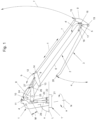
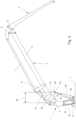
- FIGs. 1 to 5 illustrate some of the positions of the crane in motion between an almost extreme lowered position and an almost extreme upright position.
- the crane can be supported by an autonomous working platform or by a working platform that is included as part of a machine, e.g. as part of the frame of a vehicle.
- the crane can alternatively be mounted on the same vehicle upper part such as a cab, and can form part of the framework in vehicles with a rotatable upper part/cab.
- the working platform may be arranged rotatable about an imaginary mainly vertical axis, and may also be tiltable or rotatable in a vertical plane.
- angle adjusting device 10 controls the pivoting of the horizontal link 8 according to the double arrow b, the longitudinal displacement of the drawbar 7 according to the double arrow c, the pivoting of the knee link 9 according to the double arrow d and finally the crane arm 3 according to the double arrow e.
- the cylinder end of the lifting device is directly or indirectly pivotally journaled at the pillar 1 in a pivot point 22, while its piston rod end, via a pivot point 23, is articulately coupled to one end of a three-point pivotally journaled lifting yoke 24.
- the lifting yoke 24 is, at a central pivot point 25, rotatably journaled in the main beam 6 for pivoting around the pivot point 25 according to the double arrow g.
- the lifting yoke 24 is at its other end, at the pivot point 26, articulately connected to a first end of a strut 27, the second end of which is articulately connected to the horizontal link 8, more specifically at the pivot point 14.
- the strut 27 is of a fixed length, which means that the rotation of the lifting yoke 24 around the pivot point 25 slavishly follows the rotation of the horizontal link 8 around the pivot point 13.
- a connection 32 may, if applicable, be arranged for refilling or for emptying gas from the pillar 1 in order thus to adjust the gas pressure, primarily for balancing the dead weight of crane arm, or alternatively for balancing of a load hanging in the crane arm tip.
- Fig. 6 which is partially broken away, illustrates how the change in length of the lever ⁇ M depends on two coordinated rotations: the rotation of the pivot point 25 about the pivot point 4, and the rotation of the pivot point 23 around the pivot point 25.
- the pivot point 25 moves clockwise and anti-clockwise, respectively, along the periphery of a circle CL, the radius of which is the distance RL between the pivot points 4 and 25.
- the pivot point 23 is moved clockwise and counterclockwise, respectively, along the periphery of a circle CS, the radius of which is the distance RS between the pivot points 25 and 23.
- the change in length ⁇ M of the lever may amount to a maximum of the diameter of the circle CS, i.e. ⁇ M ⁇ 2RS.
- a limiting condition when dimensioning the crane is that in the fully retracted position of the crane arm with the lifting boom in a horizontal position (such as in transport position), the lifting point 23 of the lifting device must still be in front of a vertical line D through the pivot point 4, since otherwise a locked position is risked.
- the radius RS i.e. the distance between the pivot points 23 and 25 in the lifting yoke 24, shall thus be smaller than the distance RL between the pivot points 4 and 25 in the beam 6, i.e. RS ⁇ RL.
- RS preferably amounts to the order of 30-70 % of RL, and is at least in the order of 40-60 % of RL, and preferably constitutes about 50 % of RL.
- the crane arm tip 28 can be controlled to perform a substantially horizontal movement when folding out or folding in the crane arm 3. This is illustrated in Fig. 7 , in which a number of movement paths for the crane arm tip 28 are shown h1, h2, h3, h4 and h5 at different heights within the working area of the crane.
- Fig. 7 is a diagram illustrating the movement pattern of a crane with a geometry corresponding to the schematically shown crane in the exemplary embodiment. In this geometry these percentages are also calculated which in Fig. 7 indicate the lifting force resulting in the crane arm tip as part of the pressure force exerted by the lifting device 20 at different radial distances r1 - r5 from the inner pivot 4. Fig. 7 illustrates how the required torque can be equalized within the working range of the crane as a result of the proportionally varying length of the lever (and the associated torque arm).
- the pillar 1 is suitably formed with a convexly shaped guide surface 33 for forcibly guiding the lifting yoke 24 and the journaling of the lifting cylinder in the pivot point 23 during the movement of the crane arm out of an extremely raised or lowered position.
- a fixed position 34 may be formed as a recess in the underside of the beam 6 for receiving the horizontal link and the pivot point 23 in the extreme position.
- the crane described above can be adapted for many different applications, of which the following are just a few examples of the crane's usefulness of the crane:
Landscapes
- Engineering & Computer Science (AREA)
- Mechanical Engineering (AREA)
- Jib Cranes (AREA)
- Forklifts And Lifting Vehicles (AREA)
Description
- The invention relates to a crane construction arranged for lifting and moving a load hanging in the tip of the crane or for carrying and operating a tool arranged in the tip of the crane.
- Cranes of a similar type are usable and utilized in various areas of activity, such as in the forestry and agriculture, construction, environmental control, the shipping and harbour industry and the fishing industry, as well as in the manufacturing industry and in assembly workshops. For this purpose, the crane at its tip can support various tools such as gripping means, harvester heads, skewers and loops, etc. A crane according to the invention is also well suited for use in automation or in healthcare, e.g. for lifting and moving patients in slings.
- Another use of articulated cranes of a similar type is in the form of crane arms on forwarders, harvesters or on timber trucks and forestry tractors. Examples of older cranes intended for this use are given in
SE 521 258 SE 463 668 - The crane according to the present invention is of the type which comprises a lifting boom which at one end is pivotally journaled in a pillar (or stand), and which at the opposite end pivotally supports a crane arm. The lifting boom consists of a main beam and a parallel strut which are connected by means of links that allow both coordinated and relative pivoting movements between the lifting boom and the crane arm.
- Examples of known cranes of similar parallel strut construction that can be mentioned are the loading crane described in
WO 02/066360 A1 SE 531 467 C2 SE531467C2 claim 1. - A common feature of these cranes is that the movements of the lifting boom and the crane arm are controlled in a common center of rotation in the journaling of the lifting boom at the pillar.
- The object of the invention is to provide an alternatively designed articulated crane, the design and composition of which result in reduced power requirements and energy consumption.
- Another object of the invention is to provide an articulated crane, the design and composition of which result in an even crane tip speed when the crane arm is folded out and folded in, respectively.
- Another object of the invention is to provide an articulated crane which has a uniform crane tip speed when the crane arm is folded out and folded in, respectively, independent of lifting height within the working range of the crane arm.
- A further object of the invention is to provide an articulated crane, the design and composition of which result in a substantially horizontal crane tip movement when folding out and folding in the arm.
- Yet another object of the invention is to provide an articulated crane, the design and composition of which result in the lifting moment acting in the crane tip becoming substantially the same in the different angular positions of the crane arm, at a constant energy supply.
- Yet another object of the invention is to provide an articulated crane, the design and composition of which result in the speed of lifting and lowering movements, at a constant energy supply, remaining substantially the same in the different angular positions of the crane arm.
- One or more of these objects are fulfilled by an articulated crane comprising at least three parts articulately interconnected in a plane in the form of a pillar (or stand), a crane arm and a lifting boom inserted therebetween. The lifting boom is pivotally connected to the pillar via an inner joint and pivotally connected to the crane arm via an outer joint. The lifting boom is provided with a main beam and a parallel strut (or arm) pivoting parallel to the main beam, which via an inner link articulately connected between the parallel strut and the main beam, as well as an outer link articulately connected between the parallel strut and the main beam, together with the main beam form a parallel trapezoidal geometry, wherein the inner link, hereinafter referred to as the horizontal link, is arranged to be actuated by an angular adjusting device acting between the main beam and the horizontal link in order to adjust the angular position of the crane arm relative to the main beam in the outer joint by pivoting around its journaling point in the main beam, as well as via the parallel strut and the outer link, hereinafter referred to as the knee link, to set the angular position of the crane arm relative to the main beam in the outer joint. A lifting yoke is pivotally journaled in the main beam, which for lifting and lowering the lifting boom is actuated by a lifting device. The lifting yoke and the horizontal link are mutually interconnected via a strut of fixed length connected to both of them, whereby the lifting yoke and horizontal link slavishly follow each other in movements driven by the angle adjusting device.
- In the present invention, the lifting yoke is designed as a two-armed lever which at its one end is articulately coupled to the lifting device, and which at the opposite end is articulately coupled to said strut of fixed length, and is pivotally journaled in the main beam via a pivot point located between said ends which is separate from the journaling of the main beam in the pillar.
- With this composition, the angle of the knee joint between the main beam and the crane arm determines the length of the lever between the journaling point of the main beam in the pillar and the journaling point of the lifting device in the lifting yoke. In other words, the length of the lever is proportional to the angle of the knee joint, so that if the angle between the main beam and the crane arm increases or decreases, the length of the lever also increases or decreases in proportion thereto.
- An advantage and technical effect that is thereby gained is that the lifting torque in the crane tip becomes practically the same regardless of the knee joint angle at constant energy supply.
- An additional advantage and technical effect that is gained by the proportional relationship between knee joint angle and lever length is that the speed of movement of the crane tip remains substantially constant during folding out and folding in of the crane arm.
- In one embodiment of the invention, the lifting device is a hydraulic cylinder connected in parallel with a pneumatic or gas-hydraulic energy storage means. The energy storage means may comprise a pneumatic or gas-hydraulic cylinder which is journaled in the lifting yoke at the same journaling point as the lifting device.
- In other embodiments, and especially in applications with lower power requirements or in environments where hydraulic fluids should be avoided, angle adjusting devices and lifting devices may alternatively consist of pneumatic piston-cylinder units or of electric linear drive devices. Also in these embodiments, an energy storage means can advantageously be arranged to operate in parallel with the lifting device.
- In all these embodiments the energy storage means provides the advantage and technical effect that the loading moment when lowering the lifting boom can be used for compressing a gas volume to a working pressure which can be utilized when lifting the lifting boom in a later working operation.
- In one embodiment, the energy storage means comprises a sub-volume of the internal cavity of the pillar, which sub-volume is in fluid communication with a pneumatic or gas-hydraulic cylinder. Particularly in high load applications, this design allows gas volume and pressure to be dimensioned as needed without the volume of the pneumatic or gas hydraulic cylinder having to be oversized.
- In one embodiment, the pillar is provided with a connection for refilling or emptying gas from the internal gas volume of the pillar. In this way, the gas pressure can be adjusted for balancing the dead weight of the crane arm with a tool supported in the crane tip.
- In one embodiment of the invention, the energy storage means comprises an air or a gas hydraulic cylinder arranged on respective sides of a lifting device.
- In embodiments for lighter loads, an alternative energy storage means may comprise a torsion spring inserted in the pivot journaling between the pillar and the lifting boom.
- Several embodiments and detailed solutions appear below from the detailed description and the appended claims.
- Exemplary embodiments of the invention are explained in more detail below with reference to the accompanying drawings, of which
- Fig. 1
- shows the crane with the lifting boom lowered below a horizontal plane on which the crane rests,
- Fig. 2
- shows the crane with the lifting boom raised to a position almost parallel to the horizontal plane,
- Fig. 3
- shows the crane with the lifting boom raised and during pivoting forward of the crane arm,
- Fig. 4
- shows the crane with the lifting boom lowered to a position almost parallel to the horizontal plane and with the crane arm fully extended,
- Fig. 5
- shows the crane with the lifting boom raised to an almost vertical position,
- Fig. 6
- is a diagram showing potential change ΔM of the length of the lever M in different crane arm positions, and
- Fig. 7
- shows examples of the movement paths of the arm tip as well as lifting torques in different positions within the operative working area of the crane.
- It should initially be emphasized that the attached drawings are schematic and only intended to illustrate the inventive concept, so that no dimensions or angles can be deduced by measurement in the drawings.
- Thus,
Figs. 1 to 5 illustrate some of the positions of the crane in motion between an almost extreme lowered position and an almost extreme upright position. - With reference to the drawings
Figs. 1-5 , an articulated crane according to the invention comprises three mutually articulately interconnected parts, namely apillar 1, alifting boom 2 and acrane arm 3. Thelifting boom 2 is pivotally journaled in thepillar 1 via an inner pivot joint 4, and thecrane arm 3 is pivotally journaled in thelifting boom 2 via an outer pivot joint 5. The pivot joints 4 and 5 have pivot axes aligned in parallel, whereby the lifting boom and the crane arm are mutually movable in a common plane. When using the crane, this plane typically has a substantially vertical orientation. - The
pillar 1 can be attached to a working platform, which inFig. 1 is symbolically illustrated by the reference numeral 1'. In practice, this working platform can constitute a stationary or movable working platform, such as a structure included in a vehicle or the like. Hence, thepillar 1 may be rotatably arranged in the working platform around an axis N, as illustrated by the double arrow a inFig. 1 . Thepillar 1 is suitably arranged with an inclination α relative to the horizontal line L so that space is created in front of thepillar 1 for other movable elements in the crane described below. It is also conceivable that thepillar 1 is arranged in a controlled tiltable manner in directions other than the direction N. - In this context, it can be mentioned that the crane can be supported by an autonomous working platform or by a working platform that is included as part of a machine, e.g. as part of the frame of a vehicle. The crane can alternatively be mounted on the same vehicle upper part such as a cab, and can form part of the framework in vehicles with a rotatable upper part/cab. The working platform may be arranged rotatable about an imaginary mainly vertical axis, and may also be tiltable or rotatable in a vertical plane.
- The geometry of the crane can be changed by a horizontal link 8 being actuated by an
angle adjusting device 10 which is arranged to act between a main beam 6 included in the lifting boom and the horizontal link 8. Theangle adjusting device 10 is a pneumatically, hydraulically or electrically actuated linear actuator. In the exemplary embodiment, theangle adjuster 10 is realized in the form of a piston-cylinder unit 10. Theangle adjusting device 10 is arranged above the main beam 6, and is articulately connected with one end to the main beam 6 at apivot point 11, while its other end is articulately connected to the horizontal link 8 at acentral pivot point 12 of the horizontal link 8 pivotally journaled at three points. The horizontal link 8 is pivotally journaled at one end in the beam 6 at apivot point 13, and at the opposite end articulately connected to one end of adrawbar 7 at apivot point 14. Thedrawbar 7 is at its other end, at a pivot point 15, articulately connected to one end of aknee link 9 shaped like a yoke and pivotally journaled at three points. Theknee link 9 is pivotally coupled at a central pivot point 16 to the main beam 6 via astrut link 17 and thepivot point 18. Theknee link 9 is articulately connected at its other end with thecrane arm 3 at apivot point 19, which has an eccentric position with respect to the pivot 5 between thecrane arm 3 and the head beam 6. - It will be appreciated that the
angle adjusting device 10, by extension and retraction, respectively, controls the pivoting of the horizontal link 8 according to the double arrow b, the longitudinal displacement of thedrawbar 7 according to the double arrow c, the pivoting of theknee link 9 according to the double arrow d and finally thecrane arm 3 according to the double arrow e. - A linearly acting
lifting device 20 is arranged for lifting and lowering thelifting boom 2 relative to thepillar 1 during rotation in the joint 4 (see the double arrow f inFig. 1 ). The liftingdevice 20 can be articulately journaled directly in the pillar, or indirectly journaled next to the pillar, for example via afoot 21 belonging to the pillar. Thefoot 21 may alternatively be included in the above-mentioned working platform 1'. In the exemplary embodiment, the liftingdevice 20 consists of a piston-cylinder unit. In other applications, the lifting device may alternatively be an electric linear actuator. In the exemplary embodiment, the cylinder end of the lifting device is directly or indirectly pivotally journaled at thepillar 1 in apivot point 22, while its piston rod end, via apivot point 23, is articulately coupled to one end of a three-point pivotally journaled liftingyoke 24. The liftingyoke 24 is, at acentral pivot point 25, rotatably journaled in the main beam 6 for pivoting around thepivot point 25 according to the double arrow g. However, the liftingyoke 24 is at its other end, at thepivot point 26, articulately connected to a first end of astrut 27, the second end of which is articulately connected to the horizontal link 8, more specifically at thepivot point 14. Thestrut 27 is of a fixed length, which means that the rotation of the liftingyoke 24 around thepivot point 25 slavishly follows the rotation of the horizontal link 8 around thepivot point 13. - With reference to
Fig. 5 , it should also be illustrated that the path F of the force between thecrane arm tip 28 and thelifting device 20, in case of a hanging load, goes in the direction of the arrows via thecrane arm 3, theknee link 9, theparallel strut 7, thestrut 27 and the liftingyoke 24. More specifically, the horizontal link 8 forms a one-armed lever in which the acting force (10) and the resulting force (7) are located on the same side of thepivot point 13. On the other hand, the liftingyoke 24 forms a two-armed lever in which the acting force (20) and the resulting force (27) are located on opposite sides of thepivot point 25. The lengths of the levers are adapted so that theangle adjusting device 10 can balance the pressure torque of thelifting device 20 and control the movements of the crane arm in unloaded as well as in loaded condition. The coordination between the lifting device and the angle adjusting device can be done spontaneously or be forcibly controlled in a hydraulic control valve assembly during manual handling, and can in an automated process alternatively be carried out by a software-controlled processor unit. - Extra lifting force can be intermittently provided by means of an energy storage means which stores the potential energy of a load hanging in the
crane arm tip 28. For this purpose, a dampingcylinder 29 is connected to the liftingyoke 24, parallel to thelifting device 20. The damping cylinder and the lifting device may be journaled on a common shaft at thepivot point 23. The dampingcylinder 29 may consist of a pneumatic or gas-hydraulic piston-cylinder unit, the gas volume of which is compressed when lowering a load and expands when lifting the load. If applicable, the gas volume of the damping cylinder can be in direct fluid connection with aninternal gas volume 30 arranged in the pillar 1 (seeFig. 3 ). The connection may consist of aflexible pressure hose 31. Aconnection 32 may, if applicable, be arranged for refilling or for emptying gas from thepillar 1 in order thus to adjust the gas pressure, primarily for balancing the dead weight of crane arm, or alternatively for balancing of a load hanging in the crane arm tip. - In other words, the lifting
device 20 is arranged to act against the pivotally journaled liftingyoke 24, which means that the point of attack of the force is not fixed but is changed by theangle adjusting device 10 acting on the liftingyoke 24, via the horizontal link 8 and thestrut 27. This achieves a synchronization between lifting/lowering and folding out/folding in which changes the length of a lever M between the pivot points 4 and 23 proportional to the folding out and folding in of thecrane arm 3. The lever at thepivot point 23 follows a path m (seeFig. 5 ) and is located at the furthest point of the path, seen from the pivot joint 4, when thecrane arm 3 is maximally angled from the lifting boom 2 (seeFig. 4 ). As a result, the length of a torque arm starting from the pivot point 4 also changes in proportion to the folding of the crane arm. In this way, the force exerted by the liftingdevice 20, at a given load, can be utilized more or less uniformly in the different positions of the crane arm. -
Fig. 6 , which is partially broken away, illustrates how the change in length of the lever ΔM depends on two coordinated rotations: the rotation of thepivot point 25 about the pivot point 4, and the rotation of thepivot point 23 around thepivot point 25. When lowering or lifting the main beam 6, thepivot point 25 moves clockwise and anti-clockwise, respectively, along the periphery of a circle CL, the radius of which is the distance RL between the pivot points 4 and 25. When the crane arm is folded in or out, thepivot point 23 is moved clockwise and counterclockwise, respectively, along the periphery of a circle CS, the radius of which is the distance RS between the pivot points 25 and 23. The free-standing rotation CS' inFig. 6 demonstrates that the change in length ΔM of the lever may amount to a maximum of the diameter of the circle CS, i.e. ΔM ≤ 2RS. A limiting condition when dimensioning the crane is that in the fully retracted position of the crane arm with the lifting boom in a horizontal position (such as in transport position), thelifting point 23 of the lifting device must still be in front of a vertical line D through the pivot point 4, since otherwise a locked position is risked. The radius RS, i.e. the distance between the pivot points 23 and 25 in the liftingyoke 24, shall thus be smaller than the distance RL between the pivot points 4 and 25 in the beam 6, i.e. RS < RL. No generally applicable exact measurements for RS and RL should be given here as they are dependent on the application, but RS preferably amounts to the order of 30-70 % of RL, and is at least in the order of 40-60 % of RL, and preferably constitutes about 50 % of RL. - By coordinated operation of the
angle adjusting device 10 and thelifting device 20, thecrane arm tip 28 can be controlled to perform a substantially horizontal movement when folding out or folding in thecrane arm 3. This is illustrated inFig. 7 , in which a number of movement paths for thecrane arm tip 28 are shown h1, h2, h3, h4 and h5 at different heights within the working area of the crane. -
Fig. 7 is a diagram illustrating the movement pattern of a crane with a geometry corresponding to the schematically shown crane in the exemplary embodiment. In this geometry these percentages are also calculated which inFig. 7 indicate the lifting force resulting in the crane arm tip as part of the pressure force exerted by the liftingdevice 20 at different radial distances r1 - r5 from the inner pivot 4.Fig. 7 illustrates how the required torque can be equalized within the working range of the crane as a result of the proportionally varying length of the lever (and the associated torque arm). - It should be realized that each application requires adaptation of the geometry to achieve the desired crane arm movements and force distribution within the working area.
- It should be emphasized that several of the parts of the crane described above, in particular the horizontal link 8, the
knee link 9, thestrut link 17 and the liftingyoke 24, are in practice doubled and arranged one on each side of the main beam 6. - With reference to
Fig. 3 , it can also be mentioned that thepillar 1 is suitably formed with a convexly shapedguide surface 33 for forcibly guiding the liftingyoke 24 and the journaling of the lifting cylinder in thepivot point 23 during the movement of the crane arm out of an extremely raised or lowered position. A fixedposition 34 may be formed as a recess in the underside of the beam 6 for receiving the horizontal link and thepivot point 23 in the extreme position. - The crane described above can be adapted for many different applications, of which the following are just a few examples of the crane's usefulness of the crane:
- for use in the forest industry, the crane may, for example, be configured to support a forest harvesting unit or a timber gripper,
- for use in agriculture, environmental control and construction, the crane may, for example, be configured to support a brush cutter, a mower, a flushing nozzle or a blade or excavator bucket,
- for use in the transport, manufacturing or assembly industry, the crane may, for example, be configured to support a cage in a skylift, or a tool such as a gripper, a magnetic holder, a claw or lifting eye, or a machining tool such as a welding nozzle, spray nozzle, drilling machine etc.,
- for use in medical or dental care, the crane may, for example, be configured to support a lifting sling, stretcher or bunk, an instrument tray, etc.
- for use in the shipping, harbour and fishing industry, in the form of a crane for handling goods, equipment, fishing gear, etc.
Claims (7)
- A crane comprising at least three parts articulately interconnected in a plane in the form of a pillar (1), a crane arm (3) and a lifting boom (2) inserted therebetween,- wherein the lifting boom (2) has a main beam (6) which is pivotally connected to the pillar (1) via an inner joint (4) and is pivotally connected to the crane arm (3) via an outer joint (5),- wherein the lifting boom (2) comprises a parallel strut (7) pivoting parallel to the main beam (6), which via an inner link (8) pivotally coupled between the parallel strut (7) and the main beam (6), as well as an outer link (9) pivotally coupled between the parallel strut (7) and the main beam (6) together with the main beam (6) form a parallel trapezoidal geometry,- wherein the inner link, hereinafter referred to as the horizontal link (8), is arranged to be actuated by an angular adjusting device (10) acting between the main beam (6) and the horizontal link (8) so as to pivot about its pivot point (13) in the main beam (6), as well as via the parallel strut (7) and the outer link, hereinafter referred to as the knee link (9), to adjust the angular position of the crane arm (3) relative to the main beam (6) in the outer joint (5),- wherein a lifting yoke (24) is pivotally journaled in the main beam (6), which for lifting and lowering the lifting boom (2) is actuated by a lifting device (20),- wherein the horizontal link (8) and the lifting yoke (24) are mutually connected via a strut (27) of a fixed length articulately connected to both of them, whereby the lifting yoke (24) is slavishly brought along in the pivoting of the horizontal link (8) under the action of the angle adjusting device (10), characterized in- that the lifting yoke (24) forms a two-armed lever, which at one end is articulately connected to the lifting device (20) at a pivot point (23) and at an opposite end is articulately connected to the strut (27) at a pivot point (26), and is pivotally mounted in the main beam (6) via a pivot point (25) located between the pivot points (23) and (26), separate from the journaling (4) of the main beam (6) in the pillar (1).
- The crane according to claim 1, wherein a distance RS between the pivot points (23) and (25) is less than a distance RL between the pivot points (4) and (25), and the length M of a lever between the pivot points (4) and (23) varies according to the formula ΔM ≤ 2RS (RS < RL) proportional to the folding out (e) of the crane arm (3) from the lifting boom (2).
- The crane according to claim 2, wherein the length of RS is in the order of 30-70 % of RL, and is at least in the order of 40-60 % of RL, and preferably constitutes about 50 % of RL.
- The crane according to any one of the preceding claims, wherein the pillar (1) has a convex surface (33) facing the lifting yoke (24) effective for forcibly guiding the lifting yoke (24) when the crane arm is pivoted from an extreme position.
- The crane according to any one of the preceding claims, wherein a pneumatic or gas-hydraulic energy storage means (29) is articulately connected to the lifting yoke (24) and arranged to operate parallel to the lifting device (20).
- The crane according to claim 5, wherein the energy storage means (29) is arranged in fluid connection (31) with a gas-filled volume (30) in the interior of the pillar (1).
- The crane according to claim 6, wherein the pillar (1) comprises a connection (32) for refilling and emptying gas, respectively, from the volume (30) in the interior of the pillar.
Applications Claiming Priority (2)
| Application Number | Priority Date | Filing Date | Title |
|---|---|---|---|
| SE1930401A SE543971C2 (en) | 2019-12-12 | 2019-12-12 | Articulated LIFTING ARM |
| PCT/SE2020/051197 WO2021118446A1 (en) | 2019-12-12 | 2020-12-11 | Articulated crane |
Publications (4)
| Publication Number | Publication Date |
|---|---|
| EP4072990A1 EP4072990A1 (en) | 2022-10-19 |
| EP4072990A4 EP4072990A4 (en) | 2024-01-03 |
| EP4072990B1 true EP4072990B1 (en) | 2025-03-12 |
| EP4072990C0 EP4072990C0 (en) | 2025-03-12 |
Family
ID=76330615
Family Applications (1)
| Application Number | Title | Priority Date | Filing Date |
|---|---|---|---|
| EP20898165.4A Active EP4072990B1 (en) | 2019-12-12 | 2020-12-11 | Articulated crane |
Country Status (4)
| Country | Link |
|---|---|
| EP (1) | EP4072990B1 (en) |
| PL (1) | PL4072990T3 (en) |
| SE (1) | SE543971C2 (en) |
| WO (1) | WO2021118446A1 (en) |
Family Cites Families (8)
| Publication number | Priority date | Publication date | Assignee | Title |
|---|---|---|---|---|
| SE463668B (en) * | 1989-05-16 | 1991-01-07 | Motrac Gunnarson & Larsson Hb | CRANE |
| FI107328B (en) * | 1996-04-30 | 2001-07-13 | Risto Heikkilae | Loader |
| SE521258C2 (en) * | 1997-03-03 | 2003-10-14 | Motrac Ab | Two-arm system |
| FI20010346A0 (en) * | 2001-02-22 | 2001-02-22 | Risto Heikkilae | Loader |
| FI20055089A7 (en) * | 2005-02-23 | 2006-08-24 | Ponsse Oyj | Traveling crane |
| FI119636B (en) * | 2007-10-12 | 2009-01-30 | John Deere Forestry Oy | Crane construction and construction of an additional arm |
| EP2568084B1 (en) * | 2011-09-07 | 2014-01-08 | EPSILON Kran GmbH. | Telescopic crane arm |
| FI124684B (en) * | 2012-12-03 | 2014-12-15 | Ponsse Oyj | Crane |
-
2019
- 2019-12-12 SE SE1930401A patent/SE543971C2/en unknown
-
2020
- 2020-12-11 WO PCT/SE2020/051197 patent/WO2021118446A1/en not_active Ceased
- 2020-12-11 EP EP20898165.4A patent/EP4072990B1/en active Active
- 2020-12-11 PL PL20898165.4T patent/PL4072990T3/en unknown
Also Published As
| Publication number | Publication date |
|---|---|
| SE1930401A1 (en) | 2021-06-13 |
| EP4072990A1 (en) | 2022-10-19 |
| PL4072990T3 (en) | 2025-11-03 |
| EP4072990A4 (en) | 2024-01-03 |
| SE543971C2 (en) | 2021-10-12 |
| WO2021118446A1 (en) | 2021-06-17 |
| EP4072990C0 (en) | 2025-03-12 |
Similar Documents
| Publication | Publication Date | Title |
|---|---|---|
| CN101292072A (en) | Working mast, in particular for large manipulators and mobile concrete pumps | |
| US6695158B2 (en) | Crane with self-raising mast | |
| US8113363B2 (en) | Adjusting mechanism for a winch | |
| US8813600B2 (en) | Apparatus for moving a platform | |
| CA2909237C (en) | A hydraulic control system for controlling a moveable device | |
| EP4072990B1 (en) | Articulated crane | |
| US4364705A (en) | Loader mechanism | |
| CA1037433A (en) | Lever drive unit, particularly for lifting means | |
| ITMO20110048A1 (en) | SELF-PROPELLED OPERATING MACHINE WITH VARIABLE DRAWN AXLE | |
| WO1987007474A1 (en) | Forest machine with crane | |
| US4519741A (en) | Mobile yard crane for handling containers | |
| US5577878A (en) | Work machine | |
| RU2158207C1 (en) | Manipulator | |
| CN112456387A (en) | Loading mechanism based on forklift platform and forklift | |
| CA2828008C (en) | Rope shovel | |
| US20020060199A1 (en) | Boom arrangement for work machine | |
| EP2197779B1 (en) | Articulated mechanical arm | |
| FI119636B (en) | Crane construction and construction of an additional arm | |
| CN223892381U (en) | Bending telescopic arm device suitable for crop fork assembly | |
| RU2783604C1 (en) | Front loader with extended working area | |
| EP3099621B1 (en) | Lift crane with mast-raising mechanism | |
| RU2191740C1 (en) | Load-lifting machine boom arrangement | |
| RU2193518C1 (en) | Hydraulic crane-manipulator | |
| JP2023057882A (en) | Backward rotation restraint device | |
| WO2014017958A1 (en) | Balanced linkage |
Legal Events
| Date | Code | Title | Description |
|---|---|---|---|
| STAA | Information on the status of an ep patent application or granted ep patent |
Free format text: STATUS: THE INTERNATIONAL PUBLICATION HAS BEEN MADE |
|
| PUAI | Public reference made under article 153(3) epc to a published international application that has entered the european phase |
Free format text: ORIGINAL CODE: 0009012 |
|
| STAA | Information on the status of an ep patent application or granted ep patent |
Free format text: STATUS: REQUEST FOR EXAMINATION WAS MADE |
|
| 17P | Request for examination filed |
Effective date: 20220712 |
|
| AK | Designated contracting states |
Kind code of ref document: A1 Designated state(s): AL AT BE BG CH CY CZ DE DK EE ES FI FR GB GR HR HU IE IS IT LI LT LU LV MC MK MT NL NO PL PT RO RS SE SI SK SM TR |
|
| RAP1 | Party data changed (applicant data changed or rights of an application transferred) |
Owner name: LARSSON, SVEN Owner name: LARSSON, ROLF Owner name: VIRDENAES, HANS-GUNNAR |
|
| DAV | Request for validation of the european patent (deleted) | ||
| DAX | Request for extension of the european patent (deleted) | ||
| A4 | Supplementary search report drawn up and despatched |
Effective date: 20231204 |
|
| RIC1 | Information provided on ipc code assigned before grant |
Ipc: B66C 23/00 20060101ALI20231128BHEP Ipc: B60P 1/54 20060101ALI20231128BHEP Ipc: B66C 23/68 20060101ALI20231128BHEP Ipc: B66C 23/42 20060101AFI20231128BHEP |
|
| GRAP | Despatch of communication of intention to grant a patent |
Free format text: ORIGINAL CODE: EPIDOSNIGR1 |
|
| RIC1 | Information provided on ipc code assigned before grant |
Ipc: B66C 23/00 20060101ALI20241009BHEP Ipc: B60P 1/54 20060101ALI20241009BHEP Ipc: B66C 23/68 20060101ALI20241009BHEP Ipc: B66C 23/42 20060101AFI20241009BHEP |
|
| STAA | Information on the status of an ep patent application or granted ep patent |
Free format text: STATUS: GRANT OF PATENT IS INTENDED |
|
| INTG | Intention to grant announced |
Effective date: 20241114 |
|
| GRAS | Grant fee paid |
Free format text: ORIGINAL CODE: EPIDOSNIGR3 |
|
| GRAA | (expected) grant |
Free format text: ORIGINAL CODE: 0009210 |
|
| STAA | Information on the status of an ep patent application or granted ep patent |
Free format text: STATUS: THE PATENT HAS BEEN GRANTED |
|
| AK | Designated contracting states |
Kind code of ref document: B1 Designated state(s): AL AT BE BG CH CY CZ DE DK EE ES FI FR GB GR HR HU IE IS IT LI LT LU LV MC MK MT NL NO PL PT RO RS SE SI SK SM TR |
|
| REG | Reference to a national code |
Ref country code: GB Ref legal event code: FG4D |
|
| REG | Reference to a national code |
Ref country code: CH Ref legal event code: EP |
|
| REG | Reference to a national code |
Ref country code: IE Ref legal event code: FG4D |
|
| REG | Reference to a national code |
Ref country code: DE Ref legal event code: R096 Ref document number: 602020047748 Country of ref document: DE |
|
| U01 | Request for unitary effect filed |
Effective date: 20250410 |
|
| U07 | Unitary effect registered |
Designated state(s): AT BE BG DE DK EE FI FR IT LT LU LV MT NL PT RO SE SI Effective date: 20250416 |
|
| PG25 | Lapsed in a contracting state [announced via postgrant information from national office to epo] |
Ref country code: RS Free format text: LAPSE BECAUSE OF FAILURE TO SUBMIT A TRANSLATION OF THE DESCRIPTION OR TO PAY THE FEE WITHIN THE PRESCRIBED TIME-LIMIT Effective date: 20250612 |
|
| PG25 | Lapsed in a contracting state [announced via postgrant information from national office to epo] |
Ref country code: ES Free format text: LAPSE BECAUSE OF FAILURE TO SUBMIT A TRANSLATION OF THE DESCRIPTION OR TO PAY THE FEE WITHIN THE PRESCRIBED TIME-LIMIT Effective date: 20250312 |
|
| PG25 | Lapsed in a contracting state [announced via postgrant information from national office to epo] |
Ref country code: HR Free format text: LAPSE BECAUSE OF FAILURE TO SUBMIT A TRANSLATION OF THE DESCRIPTION OR TO PAY THE FEE WITHIN THE PRESCRIBED TIME-LIMIT Effective date: 20250312 |
|
| PG25 | Lapsed in a contracting state [announced via postgrant information from national office to epo] |
Ref country code: GR Free format text: LAPSE BECAUSE OF FAILURE TO SUBMIT A TRANSLATION OF THE DESCRIPTION OR TO PAY THE FEE WITHIN THE PRESCRIBED TIME-LIMIT Effective date: 20250613 |
|
| PG25 | Lapsed in a contracting state [announced via postgrant information from national office to epo] |
Ref country code: SM Free format text: LAPSE BECAUSE OF FAILURE TO SUBMIT A TRANSLATION OF THE DESCRIPTION OR TO PAY THE FEE WITHIN THE PRESCRIBED TIME-LIMIT Effective date: 20250312 |
|
| PG25 | Lapsed in a contracting state [announced via postgrant information from national office to epo] |
Ref country code: CZ Free format text: LAPSE BECAUSE OF FAILURE TO SUBMIT A TRANSLATION OF THE DESCRIPTION OR TO PAY THE FEE WITHIN THE PRESCRIBED TIME-LIMIT Effective date: 20250312 |
|
| PG25 | Lapsed in a contracting state [announced via postgrant information from national office to epo] |
Ref country code: SK Free format text: LAPSE BECAUSE OF FAILURE TO SUBMIT A TRANSLATION OF THE DESCRIPTION OR TO PAY THE FEE WITHIN THE PRESCRIBED TIME-LIMIT Effective date: 20250312 |
|
| PG25 | Lapsed in a contracting state [announced via postgrant information from national office to epo] |
Ref country code: IS Free format text: LAPSE BECAUSE OF FAILURE TO SUBMIT A TRANSLATION OF THE DESCRIPTION OR TO PAY THE FEE WITHIN THE PRESCRIBED TIME-LIMIT Effective date: 20250712 |
|
| PGFP | Annual fee paid to national office [announced via postgrant information from national office to epo] |
Ref country code: GB Payment date: 20251223 Year of fee payment: 6 |
|
| PGFP | Annual fee paid to national office [announced via postgrant information from national office to epo] |
Ref country code: NO Payment date: 20251223 Year of fee payment: 6 |
|
| PLBE | No opposition filed within time limit |
Free format text: ORIGINAL CODE: 0009261 |
|
| STAA | Information on the status of an ep patent application or granted ep patent |
Free format text: STATUS: NO OPPOSITION FILED WITHIN TIME LIMIT |
|
| REG | Reference to a national code |
Ref country code: CH Ref legal event code: L10 Free format text: ST27 STATUS EVENT CODE: U-0-0-L10-L00 (AS PROVIDED BY THE NATIONAL OFFICE) Effective date: 20260121 |
|
| PGFP | Annual fee paid to national office [announced via postgrant information from national office to epo] |
Ref country code: PL Payment date: 20251222 Year of fee payment: 6 |
|
| U20 | Renewal fee for the european patent with unitary effect paid |
Year of fee payment: 6 Effective date: 20251230 |
|
| 26N | No opposition filed |
Effective date: 20251215 |