EP4072907B1 - Ride vehicle restraint system with forced air system - Google Patents
Ride vehicle restraint system with forced air system Download PDFInfo
- Publication number
- EP4072907B1 EP4072907B1 EP20838810.8A EP20838810A EP4072907B1 EP 4072907 B1 EP4072907 B1 EP 4072907B1 EP 20838810 A EP20838810 A EP 20838810A EP 4072907 B1 EP4072907 B1 EP 4072907B1
- Authority
- EP
- European Patent Office
- Prior art keywords
- restraint
- ride vehicle
- air flow
- ride
- passenger
- Prior art date
- Legal status (The legal status is an assumption and is not a legal conclusion. Google has not performed a legal analysis and makes no representation as to the accuracy of the status listed.)
- Active
Links
Images


Classifications
-
- B—PERFORMING OPERATIONS; TRANSPORTING
- B60—VEHICLES IN GENERAL
- B60R—VEHICLES, VEHICLE FITTINGS, OR VEHICLE PARTS, NOT OTHERWISE PROVIDED FOR
- B60R22/00—Safety belts or body harnesses in vehicles
- B60R22/48—Control systems, alarms, or interlock systems, for the correct application of the belt or harness
-
- A—HUMAN NECESSITIES
- A63—SPORTS; GAMES; AMUSEMENTS
- A63G—MERRY-GO-ROUNDS; SWINGS; ROCKING-HORSES; CHUTES; SWITCHBACKS; SIMILAR DEVICES FOR PUBLIC AMUSEMENT
- A63G7/00—Up-and-down hill tracks; Switchbacks
-
- B—PERFORMING OPERATIONS; TRANSPORTING
- B60—VEHICLES IN GENERAL
- B60R—VEHICLES, VEHICLE FITTINGS, OR VEHICLE PARTS, NOT OTHERWISE PROVIDED FOR
- B60R22/00—Safety belts or body harnesses in vehicles
- B60R22/12—Construction of belts or harnesses
- B60R22/14—Construction of belts or harnesses incorporating enlarged restraint areas, e.g. vests, nets, crash pads, optionally for children
-
- A—HUMAN NECESSITIES
- A63—SPORTS; GAMES; AMUSEMENTS
- A63G—MERRY-GO-ROUNDS; SWINGS; ROCKING-HORSES; CHUTES; SWITCHBACKS; SIMILAR DEVICES FOR PUBLIC AMUSEMENT
- A63G31/00—Amusement arrangements
-
- B—PERFORMING OPERATIONS; TRANSPORTING
- B60—VEHICLES IN GENERAL
- B60R—VEHICLES, VEHICLE FITTINGS, OR VEHICLE PARTS, NOT OTHERWISE PROVIDED FOR
- B60R21/00—Arrangements or fittings on vehicles for protecting or preventing injuries to occupants or pedestrians in case of accidents or other traffic risks
- B60R21/02—Occupant safety arrangements or fittings, e.g. crash pads
-
- B—PERFORMING OPERATIONS; TRANSPORTING
- B60—VEHICLES IN GENERAL
- B60R—VEHICLES, VEHICLE FITTINGS, OR VEHICLE PARTS, NOT OTHERWISE PROVIDED FOR
- B60R21/00—Arrangements or fittings on vehicles for protecting or preventing injuries to occupants or pedestrians in case of accidents or other traffic risks
- B60R2021/0065—Type of vehicles
- B60R2021/0097—Amusement vehicles
-
- B—PERFORMING OPERATIONS; TRANSPORTING
- B60—VEHICLES IN GENERAL
- B60R—VEHICLES, VEHICLE FITTINGS, OR VEHICLE PARTS, NOT OTHERWISE PROVIDED FOR
- B60R21/00—Arrangements or fittings on vehicles for protecting or preventing injuries to occupants or pedestrians in case of accidents or other traffic risks
- B60R21/02—Occupant safety arrangements or fittings, e.g. crash pads
- B60R2021/0206—Self-supporting restraint systems, e.g. restraining arms, plates or the like
- B60R2021/022—Self-supporting restraint systems, e.g. restraining arms, plates or the like mounted on seats
Definitions
- the present disclosure relates generally to amusement park-style rides and, more specifically, to systems for securing passengers inside a ride vehicle of the amusement park-style rides.
- ride vehicles that carry passengers along a ride path, such as a track.
- ride path features such as turns, loops, twists, and so forth.
- ride path features such as turns, loops, twists, and so forth.
- ride path features such as turns, loops, twists, and so forth.
- ride path features such as turns, loops, twists, and so forth.
- ride path features such as turns, loops, twists, and so forth.
- ride path features such as turns, loops, twists, and so forth
- ride path features such as turns, loops, twists, and so forth
- ride path features such as turns, loops, twists, and so forth
- ride path features such as turns, loops, twists, and so forth.
- ride vehicles and amusement park-style attractions may include other features that enhance the ride vehicle experience for passengers.
- ride vehicles, ride paths, and/or other elements of the ride system may include lights, speakers, interactive elements, specialized environments, and/or other features that provide sensory stimulation for the passenger in the ride vehicle to enhance the ride experience.
- passengers enjoying the ride vehicle experience may respond differently to motion of the ride vehicle as it travels along the ride path.
- the particular motion, direction, speed, rotation, or other movement of the ride vehicle may cause passengers to experience different levels of enjoyment.
- a passenger may be susceptible to kinetosis induced by certain ride vehicle motions and/or other elements of the ride system experience.
- ride vehicle systems may include a forced air system configured to discharge an air flow toward passengers. It is now recognized that existing forced air systems may not be suitable for certain ride vehicle systems. Accordingly, there is a need for improved forced air systems for use with ride vehicles.
- US 6 224 491 B1 discloses a ride vehicle 1 comprising a seat 101 configured to accommodate a passenger; a restraint 105 configured to secure the passenger within the seat 101; and fans 107 located in a headrest to generate an air flow, and discharge the air flow toward the passenger.
- a ride vehicle system includes a ride vehicle including a seat configured to accommodate a passenger, a restraint system of the ride vehicle, where the restraint system includes a restraint configured to secure the passenger within the seat, and a forced air system of the ride vehicle, where the force air system is configured to generate an air flow, direct the air flow internally through the restraint, and discharge the air flow toward the passenger via a discharge port of the restraint.
- a method for providing an air flow to a ride vehicle passenger includes securing a passenger within a seat of a ride vehicle with a restraint of the ride vehicle, generating an air flow with a flow generating device of the ride vehicle, directing the air flow internally through the restraint of the ride vehicle, and discharging the air flow toward the passenger via a discharge port of the restraint.
- a ride vehicle for an amusement park ride includes a seat configured to accommodate a passenger, a restraint system of the ride vehicle having a restraint configured to secure the passenger within the seat, a forced air system of the ride vehicle, where the forced air system is integrated with the restraint and is configured to generate an air flow, direct the air flow internally through the restraint, and discharge the air flow toward a face of the passenger, and a controller configured to regulate operation of the forced air system to discharge the air flow toward the face of the passenger at a constant flow rate.
- first, second, etc. may be used herein to describe various elements, these elements should not be limited by these terms. These terms are only used to distinguish one element from another. For example, a first object could be termed a second object, and, similarly, a second object could be termed a first object, without departing from the scope of the present disclosure.
- Amusement parks include many rides that provide unique and entertaining experiences for patrons or guests. Amusement parks typically include a wide variety of rides to accommodate the thrill sensitivities and immersive experience desires of different guests.
- amusement park rides include one or more ride vehicles that follow a ride path, such as a track, through a series of features. Such features may include loops, twists, turns, drops, tunnels, and so forth.
- the ride vehicles may travel along the ride path at high speeds and may traverse along multiple non-linear paths.
- passengers riding inside the ride vehicles may experience forces that may move the passengers within the ride vehicle if not otherwise restrained.
- ride vehicles frequently include restraint systems configured to secure a passenger within the ride vehicle while the ride vehicle is operating and throughout a duration of the ride experience.
- Amusement park rides also frequently include other features, such as environmental systems and special effects, configured to provide a more immersive and thrilling experience for the passengers on the amusement park ride.
- amusement park rides including ride vehicles, ride vehicle seats, and environments along the ride path, may include a variety of sensory stimulation systems. These systems can include light emitting devices, sound emitting devices, vibrational systems, thermal systems, liquid (e.g., water) spray systems, or other systems configured to stimulate one or more senses of the ride passengers.
- present embodiments include a forced air system for an amusement park-style ride vehicle.
- the forced air system may be integrated with a restraint system of the ride vehicle and is configured to output a flow of air towards a ride passenger (e.g., a face of the passenger) secured in the ride vehicle via the restraint system.
- the forced air system may be configured to operate in one or more operating modes to provide one or more different effects for the ride passenger.
- the forced air system may output a constant air flow toward the passenger at a relatively low flow rate in order to mitigate inducement of kinetosis in passengers that may be susceptible to kinetosis during the amusement park ride experience.
- the forced air system may direct the constant air flow toward a face of the passenger to better achieve kinetosis mitigation.
- the forced air system may output an intermittent air flow discharged toward the passenger at a relatively elevated flow rate in order to induce a particular sensory effect (e.g., which may correlate with other effects or features of the amusement park ride experience).
- the forced air system may be integrated with the ride vehicle restraint system, such as a rigid restraint or a soft restraint.
- the ride vehicle may not include other structural components typically included with ride vehicles to support forced air systems.
- the disclosed embodiments do not include a separate hood disposed over a passenger or other supplemental structure dedicated to supporting the forced air system, thereby improving the aesthetics and functionality of the ride vehicle.
- the disclosed embodiments also enable the incorporation of forced air systems into ride vehicles that traditionally are unable to include forced air systems (e.g., due to the particular configuration of the ride vehicle or ride vehicle system).
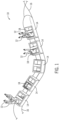
- FIG. 1 is a perspective view of an embodiment of a ride system 10.
- the ride system 10 may include one or more ride vehicles 14 that hold one or more passengers 12.
- multiple ride vehicles 14 may be coupled together (e.g., by a linkage).
- the ride vehicle 14 travels along a ride path 16 during operation of the ride system 10.
- the ride path 16 may be any surface on which the ride vehicle 14 travels.
- the ride path 16 may be defined by a track.
- the ride path 16 may or may not dictate the path traveled by the ride vehicle 14.
- the ride path 16 may control the movement (e.g., direction, speed, and/or orientation) of the ride vehicle 14 as it progresses along the ride path 16, similar to a train on tracks.
- another system may control the path taken by the ride vehicle 14 during operation of the ride system 10.
- the ride path 16 may be an open surface that allows the passengers 12 to control certain aspects of the movement of the ride vehicle 14 via an interface system of the ride vehicle 14.
- the ride system 10 may include any suitable number of ride vehicles 14, and each ride vehicle 14 may accommodate any suitable number of passengers 12.
- the ride vehicles 14 also include restraint systems 18 configured to secure the passengers 12 within the ride vehicles 14.
- Each ride vehicle 14 includes at least one restraint system 18, although, in some embodiments, the ride system 10 may include separate restraint systems 18 for each passenger 12.
- each ride vehicle 14 may include a number of restraint systems 18 equal to a total number of the passengers 12 that may ride in the ride vehicle 14 during the ride system 10 experience.
- the restraint system 18 may include a soft restraint that is configured to conform to a portion of a body, such as a torso front side, of the passenger 12 and/or a hard restraint that is configured to rigidly extend over the body of the passenger 12.
- the restraint system 18 also includes a forced air system integrated therein.
- the forced air system may be at least partially integrated with a hard restraint or a soft restraint of the restraint system 18.
- other components of the forced air system may be disposed at other portions of the ride vehicle 14, such as on a frame or body of the ride vehicle 14 and/or within a seat of the ride vehicle 14.
- the forced air system may be configured to operate in one or more modes in order to induce various effects in the passenger 12, such as to mitigate inducement of kinetosis in passengers 12.
- the embodiment of the ride system 10 illustrated in FIG. 1 is a simplified representation intended to provide context and facilitate discussion of the presently disclosed techniques.
- Other embodiments of the ride system 10, including the ride vehicle 14, the ride path 16, the restraint system 18, and so forth may include similar and/or different elements or configurations.
- the illustrated embodiment depicts the ride vehicles 14 traveling along the ride path 16 that is positioned beneath the ride vehicles 14, other embodiments of the ride system 10 may include ride vehicles 14 that are suspended from the ride path 16 positioned above the ride vehicles.
- the illustrated restraint system 18 is shown as including a bar or other restraint positioned across the lap or legs of the passengers 12, other embodiments of the restraint system 18 may include additional or alternative components configured to restrain or otherwise confine the passengers 12 to the ride vehicle 14 during the ride system 10 operation.
- FIG. 2 is perspective view of an embodiment of a seat 30 of the ride vehicle 14 that may accommodate one of the passengers 12.
- the seat 30 functions as the ride vehicle 14 and is separate from other ride vehicles 14 and/or seats 30, while in other embodiments, the seat 30 is one of multiple seats 30 within a common ride vehicle 14.
- the seat 30 includes an embodiment of the restraint system 18 configured to secure the passenger 12 within the seat 30 and/or within the ride vehicle 14.
- the restraint system 18 has a forced air system 32 (e.g., sensory stimulation system) integrated therein.
- a forced air system 32 e.g., sensory stimulation system
- the illustrated restraint system 18 includes a rigid restraint 34 (e.g., hard shell restraint) and a soft restraint 36 (e.g., soft shell restraint).
- the restraint system 18 may include either the rigid restraint 34 or the soft restraint 36.
- the rigid restraint 34 may include components that are generally fixed, rigid, inelastic, and/or inflexible.
- the components of the rigid restraint 34 may generally have a fixed geometry, such as components made from metal, plastic, a composite material, or other suitably rigid material.
- the components of the rigid restraint 34 When the restraint system 18 is in a locked or deployed configuration, the components of the rigid restraint 34 may be generally immovable and may thereby block or prevent undesirable movement of the passenger 12 within the seat 30 and/or within the ride vehicle 14.
- the rigid restraint 34 includes over-shoulder bars 38 that extend from a rear side 40 of the seat 30, over a seat back 42 of the seat 30, and across a front side of the passenger 12 positioned in the seat 30.
- the over-shoulder bars 38 may be pivotably coupled to the seat back 42, a component of the seat 30, or a component of the ride vehicle 14.
- the restraint system 18 may be configured to enable (e.g., via a locking system) selective rotation of the over-shoulder bars 38 relative to the seat 30.
- the rigid restraint 34 also includes a lap bar 44 coupled to distal ends of the over-shoulder bars 38.
- the over-shoulder bars 38 extend over the front side of the passenger 12 to position the lap bar 44 adjacent to the legs and waist of the passenger 12.
- the rigid restraint 34 may be locked and secured in the illustrated configuration. In this manner, the rigid restraint 34 may secure the passenger 12 within the seat 30.
- the over-shoulder bars 38 may retain a torso 46 of the passenger 12 substantially against the seat back 42, and the lap bar 44 may retain legs 48 of the passenger 12 substantially against a base 51 of the seat 30.
- the soft restraint 36 may be formed from a pliable material configured to be applied and secured against a body of the passenger 12.
- the soft restraint 36 may include a fabric, canvas, plastic, nylon, webbing, or other flexible material that may generally conform or contour to another object, such as the torso 46 of the passenger 12.
- the soft restraint 36 has a vest-like or U-shaped configuration that is configured to be positioned over and against the torso 46 of the passenger 12 when the passenger 12 is seated in the seat 30 and/or the ride vehicle 14.
- the soft restraint 36 may have other suitable configurations, such as a wrap, a sleeve, or other covering, that may cover a large surface area of the torso 46 and/or any other body part (e.g., arm, leg, hand, foot) of the passenger 12 that is not otherwise in contact with the seat 30 or the rigid restraint 34.
- suitable configurations such as a wrap, a sleeve, or other covering, that may cover a large surface area of the torso 46 and/or any other body part (e.g., arm, leg, hand, foot) of the passenger 12 that is not otherwise in contact with the seat 30 or the rigid restraint 34.
- the restraint system 18 also includes the forced air system 32 integrated therein. That is, the restraint system 18 may integrally include and/or form one or more components of the forced air system 32.
- the forced air system 32 is configured to generate and control an air flow 50 directed toward the passenger 12, such as toward a face 52 of the passenger 12.
- the forced air system 32 may operate to discharge the air flow 50 toward the face 52 of the passenger 12 to mitigate inducement of kinetosis in the passenger 12 and/or to create another sensory response and/or effect for the passenger 12.
- the forced air system 32 shown in the illustrated embodiment is integrated with the rigid restraint 34.
- the rigid restraint 34 includes discharge ports 54 coupled to and/or formed in the over-shoulder bars 38 of the rigid restraint 34.
- the discharge ports 54 are configured to (e.g., arranged, positioned, oriented, etc.) to receive the air flow 50 from within the over-shoulder bars 38 and output the air flow 50 toward the face 52 of the passenger 12.
- the discharge ports 54 may be nozzles 56 configured to accelerate the air flow 50 discharged toward the face 52 of the passenger 12.
- the discharge ports 54 may include holes 58 (e.g., apertures, openings, etc.) formed in the over-shoulder bars 38 and configured to discharge the air flow 50 toward the face 52.
- the discharge ports 54 are fluidly coupled to one or more conduits 60 (e.g., hoses, tubes, etc.) extending internally through the over-shoulder bars 38.
- the conduits 60 direct the air flow 50 therethrough and to the discharge ports 54.
- the conduits 60 may be disposed external to and may be fixed to the over-shoulder bars 38 or to another portion of the restraint system 18.
- the conduits 60 may be excluded from the forced air system 32, and the air flow 50 may be directed through an internal cavity 62 of the over-shoulder bars 38.
- the over-shoulder bars 38 may be hollow structures that are configured to receive the air flow 50 and direct the air flow 50 to the discharge ports 54 formed in or coupled to the over-shoulder bars 38.
- the air flow 50 discharged via the discharge ports 54 may be generated via a pump, blower, fan, compressor, or other flow generating device or system 64.
- the flow generating device 64 may be coupled to the seat 30, such as on the rear side 40 of the seat back 42 or an underside 66 of the base 51 of the seat 30.
- the flow generating device 64 may be disposed at other locations of the ride vehicle 14 in other embodiments.
- the air flow 50 generated by the flow generating device 64 is directed through an external conduit 68 (e.g., hose, pipe, tube, etc.) coupled to the flow generating device 64.
- the external conduit 68 directs the air flow 50 to the over-shoulder bars 38.
- the external conduit 68 may be fluidly coupled to the conduits 60 disposed within the over-shoulder bars 38 and/or to the internal cavities 62 of the over-shoulder bars 38 in order to enable supply of the air flow 50 to the discharge ports 54.
- the forced air system 32 is configured to generate the air flow 50 and direct the air flow 50 toward the face 52 of the passenger 12.
- the forced air system 32 is more seamlessly integrated within ride vehicle 14 and does not include other external, additional components typically incorporated in existing ride vehicles having forced air systems.
- the disclosed embodiments enable incorporation of the forced air system 32 with ride vehicles 14 that may be traditionally incompatible with providing forced air flows to passengers 12.
- the forced air system 32 is configured to direct the air flow 50 towards the face 52 of the passenger 12.
- the forced air system 32 is configured to generate a sensory effect in the passenger 12.
- the forced air system 32 may be configured to generate and discharge a constant, relatively low air flow 50 toward the face 52 of the passenger 12, which may be effective in mitigating or eliminating the inducement of kinetosis in the passenger 12 before, during, and/or after the passenger 12 experiences the amusement park ride experience in the ride vehicle 14.
- the discharge ports 54 may be positioned in any suitable location and/or orientation relative to the rigid restraint 34, an expected location of the face 52 of the passenger 12 when the passenger 12 is secured within the seat 30 via the rigid restraint 34, and so forth.
- the discharge ports 54 may be pivotable or otherwise adjustable to modify a direction of the air flow 50 discharged from the discharge ports 54.
- the forced air system 32 may also be configured to operate in a second operating mode, in which the forced air system 32 generates intermittent, higher velocity bursts of air flow 50 discharged towards the face 52 of the passenger 12. Such blasts of the air flow 50 may enhance the sensory experience for the passenger 12 during the amusement park ride experience. Indeed, the operation of the forced air system 32 in the second operating mode may be coordinated with other operations, features, or effects of the ride system 10.
- the soft restraint 36 includes sensory stimulation modules 70 configured generate one or more effects, forces, elements, stimulations, or sensations for the passenger 12.
- the sensory stimulation modules 70 may include vibrational motors or actuators, thermal generators or elements, aromatic elements, light emitters, controllers, power sources, sensors, or other components configured to provide the sensory sensations for the passenger 12. Operation of the forced air system 32 and the sensory stimulation modules 70 may be coordinated to provide a desired effect or experience for the passenger 12. It should be appreciated that operation of the forced air system 32 may also be coordinated with other aspects or characteristics of the ride system 10, such as environmental elements of the ride system 10.
- the forced air system 32 may be configured to operate in the first operating mode (e.g., to mitigate onset of kinetosis) as a baseline operating mode, and the forced air system 32 may intermittently operate in the second operating mode (e.g., to generate a coordinated sensory effect with the amusement park ride experience).
- the forced air system 32 may operate in the second operating mode at coordinated times that coincide with other features or elements of the amusement park ride experience, and the forced air system 32 may otherwise operate in the first operating mode when not operating in the second operating mode.
- the forced air system 32 may include additional components configured to control or regulate operation of the forced air system 32.
- the forced air system 32 may include a user input device 72 (e.g., a button, a switch, etc.) configured to the passenger 12 to enable, disable, or otherwise control the air flow 50 discharged by the forced air system 32. Additional control components are discussed in greater detail below.
- a user input device 72 e.g., a button, a switch, etc.
- FIG. 3 is a schematic of an embodiment of the seat 30 of the ride vehicle 14, illustrating the restraint system 18 having the forced air system 32 integrated with the soft restraint 36.
- the soft restraint 36 may be configured to be applied against the torso 46 and/or another body portion of the passenger 12 sitting in the seat 30 to secure the passenger 12 within the seat 30.
- the soft restraint 36 may be formed from a pliable material, such as fabric, rubber, a polymer, or any other suitable material.
- the restraint system 18 includes straps 80 coupled between the soft restraint 36 and the seat back 42 of the seat 30.
- the straps 80 may flexible belts that couple the soft restraint 36 to the seat 30 and enable the soft restraint 36 to be adjusted (e.g., deployed, retracted, etc.) relative to the passenger 12, such as during entry and exit of the passenger 12 from the ride vehicle 14.
- the straps 80 are formed from webbing or other woven material.
- the soft restraint 36 also includes components of the forced air system 32 integrated with the soft restraint 36.
- the discharge ports 54 of the forced air system 32 are integrated with lateral portions 82 of the soft restraint 36.
- the soft restraint 36 may be formed from a pliable material, and the discharge ports 54 may be nozzles 56 formed from a rigid material, such as plastic.
- the discharge ports 54 and the soft restraint 36 may be integrated with one another via an overmolding process or another suitable manufacturing technique.
- the illustrated soft restraint 36 also includes additional discharge ports 54, such as holes 58 or perforations, formed in a base portion 84 of the soft restraint 36.
- the holes 58 may be punched or cut from the material of the soft restraint 36 and, in certain embodiments, may be reinforced via rings, grommets, or other features configured to maintain a dimension or contour of the holes 58.
- the discharge ports 54 formed in the base portion 84 are arranged or oriented to direct the air flow 50 upward across the torso 46 of the passenger 12 and toward the face 52 of the passenger 12.
- Discharge ports 54 may also be formed on or coupled to the lap bar 44 (e.g., crossbar) of the restraint system 18.
- discharge ports 54 may be secured to a substructure (e.g., metallic substructure) of the lap bar 44.
- the discharge ports 54 integrated with the lap bar 44 are nozzles 56 oriented to direct the air flow 50 upward across the torso 46 of the passenger 12 and toward the face 52 of the passenger 12.
- the restraint system 18 may include discharge outlets 54 having other configurations, positions, orientations, and/or other arrangements relative to the components of the restraint system 18 (e.g., the rigid restraint 34, the soft restraint 36, the lap bar 44, or other component of the restraint system 18).
- the restraint system 18 may also include discharge outlets 54 of one type or multiple types in a variety of arrangements.
- the discharge ports 54 shown in FIG. 3 are configured to receive the air flow 50 from within the restraint system 18.
- the soft restraint 36 and/or the lap bar 44 may include one or more of the conduits 60 extending internally through the soft restraint 36 and fluidly coupled with the discharge outlets 54.
- the soft restraint 36 may include one or more internal cavities 86 (e.g., an internal bladder) formed or disposed therein and in fluid communication with the discharge outlets 54.
- the air flow 50 may be directed into the soft restraint 36 (e.g., to the conduits 60 and/or to the internal cavities 86) via the external conduit 68.
- the external conduit 68 may receive the air flow 50 generated by the flow generating device 64.
- the flow generating device 64 is integrated within the base 51 of the seat 30. In other embodiments, the flow generating device 64 may be disposed beneath the base 51 of the seat 30.
- the air flow 50 is discharged from the flow generating device 64 and into an internal conduit 88 extending through the base 51 of the seat 30.
- the internal conduit 88 may be fluidly coupled to the external conduit 68 in order to direct the air flow 50 therethrough.
- the internal conduit 88 may extend internally through the base 51 and the seat back 42 to direct the air flow 50 internally through the seat 30 to the soft restraint 36 or other component of the restraint system 18.
- the forced air system 32 my include fans or fan modules coupled to the restraint system 18 and/or the seat 30 to generate and direct the air flow 50 toward the face 52 of the passenger 12.
- the air flow 50 may be provided via one or more compressed air tanks located at a suitable position in the ride vehicle 14 (e.g., beneath the base 51 of the seat 30) and fluidly coupled to one or more components of the restraint system 18 (e.g., conduits 60, 68, 88).
- FIG. 4 is a perspective view of an embodiment of the ride system 10, illustrating the ride vehicle 14 and components of the forced air system 32 integrated with the ride vehicle 14.
- the present embodiment illustrates the flow generating device 64 disposed in the ride vehicle 14 separately from the seats 30.
- the flow generating device 64 may be one or more air compressors 100 (e.g., a variable speed compressor) disposed in a compartment, section, or other secluded area of the ride vehicle 14 that is isolated from the seats 30.
- the air compressor 100 may be fluidly coupled to the seats 30 and the restraint systems 18 via a conduit network 102, which may include embodiments of the conduits 60, external conduits 68, internal conduits 88, other suitable conduits, or any combination thereof.
- the conduit network 102 is configured to distribute the air flow 50 generated by the air compressor 100 to each of the restraint systems 18 to enable discharge of the air flow 50 towards each passenger 12 in the ride vehicle 14.
- FIG. 5 is a schematic of an embodiment of the ride system 10, illustrating components of the ride vehicle 14 and the seat 30 of the ride vehicle 14.
- the seat 30 includes the restraint system 18 having the rigid restraint 34 and/or the soft restraint 36 with components of the forced air system 32 integrated therein.
- the seat 30 may also include other elements that facilitate operation of the restraint system 18 and, more particularly, the forced air system 32. It should be appreciated that any of the components discussed below may be integrated with the rigid restraint 34, the soft restraint 36, other elements of the restraint system 18, the seat 30, other portions of the ride vehicle 14, or any combination thereof.
- the forced air system 32 may include a controller 120 configured to send control signals to other components of the forced air system 32 to regulate operation of the forced air system 32.
- the controller 120 may be communicatively coupled to the air compressor 100 (i.e., flow generating device 64) to control operation of the air compressor 100 and thereby control the air flow 50 discharged via the discharge ports 54.
- the forced air system 32 may include a valve 118 (e.g., solenoid valve), and the controller 120 may be communicatively coupled to the valve 118.
- the valve 118 is configured to regulate the air flow 50 generated by the flow generating device 64.
- valve 118 may be disposed along the conduit network 102 (e.g., disposed along any of the conduits 60, 68, 88 disclosed herein) and may be actuated to control the air flow 50 directed to the discharge ports 54 (e.g., to control a desired effect of the air flow 50 on the passenger 12).
- Some embodiments may include multiple valves 118, such as one valve 118 associated with first type of discharge ports 54 of the restraint system 18 and another valve 118 associated with a second type of discharge ports 54 of the restraint system 18.
- the controller 120 may send control signals to the one or more valves 118 to enable operation of the forced air system 32 in various operations modes, such as a constant air flow mode, an intermittent air flow mode, a first mode in which air flow 50 is discharged through a first type of discharge port 54 and/or a second mode in which air flow 50 is discharged through a second type of discharge port 54.
- one controller 120 is included in the forced air system 32, but in other embodiments, multiple controllers 120 may be utilized.
- the controller 120 may be integrated with the seat 30 or may be located in another portion of the ride vehicle 14. In other embodiments, the controller 120 may be located remote from the ride vehicle 14, such as at a base station of the ride system 10.
- the controller 120 includes a processor 122 and a memory 124.
- the processor 102 may be a microprocessor that executes software to control the flow generating device 64 (e.g., air compressor 100), the valve 118, and/or other components to generate and discharge the air flow 50 from the discharge ports 54 in a desired manner.
- the processor 122 may include multiple microprocessors, one or more "general-purpose" microprocessors, one or more special-purpose microprocessors, and/or one or more application specific integrated circuits (ASICs), field-programmable gate arrays (FPGAs), or some combination thereof.
- the processor 122 may include one or more reduced instruction set (RISC) processors.
- RISC reduced instruction set
- the memory 124 may include a volatile memory, such as random access memory (RAM), and/or a nonvolatile memory, such as read-only memory (ROM).
- the memory 104 may store a variety of information and may be used for various purposes.
- the memory 124 may store processor executable instructions, such as firmware or software, for the processor 122 to execute.
- the memory 124 may include ROM, flash memory, a hard drive, or any other suitable optical, magnetic, or solid-state storage medium, or a combination thereof.
- the memory 124 may store data, instructions, and any other suitable data.
- the processor 122 executes instructions stored on the memory 124 to generate and/or provide control signals to components of the forced air system 32.
- embodiments of the forced air system 32 may include one or more sensors 126, such as sensors integrated with the restraint system 18. However, other sensors 126 may be positioned elsewhere, such as within the seat 30.
- the sensors 126 are configured to collect feedback that may be used to further control operation of the forced air system 32.
- the sensors 126 may be configured to detect a presence or condition of the passenger 12, and the controller 120 may utilize the feedback to adjust operation of the forced air system 32.
- the sensors 126 may include pressure sensors (e.g., to detect the presence of the passenger 12 in the seat 30, to detect a pressure of the air flow 50 generated by the air compressor 100, etc.), temperature sensors (e.g., to detect a temperature of the passenger 12 or an environment surrounding the ride vehicle 14), position sensors (e.g., to detect a position of the ride vehicle 14 along the ride path 16), flow rate sensors to detect a flow rate of the air flow 50, accelerometers and/or gyroscopes to detect motion and/or orientation of the ride vehicle 14, or any other suitable sensor configured to collect and provide feedback for use in regulating operation of the forced air system 32.
- pressure sensors e.g., to detect the presence of the passenger 12 in the seat 30, to detect a pressure of the air flow 50 generated by the air compressor 100, etc.
- temperature sensors e.g., to detect a temperature of the passenger 12 or an environment surrounding the ride vehicle 14
- position sensors e.g., to detect a position of the ride vehicle 14 along the ride path 16
- the forced air system 32 may include one or more power sources 128, which are configured to provide electrical power to components of the forced air system 32, such as the flow generating device 64 (e.g., the air compressor 100), the valve 118, the controller 120, and so forth.
- the power sources 128 may be integrated into the ride vehicle 14 or another portion of the ride system 10.
- the power source 128 is a battery positioned within the ride vehicle 14.
- the power source 128 may be an electrical connection to another power supply external to the ride vehicle 14.
- the power source 128 may be electrically coupled to a bus bar of the ride system 10.
- the forced air system 32 may also include one or more input devices 130 (e.g., user input device 72).
- the input device 130 may be configured to receive feedback, via interaction of the passenger 12 or an operator of the ride vehicle 14 or ride system 10 with the input device 130, for use in further regulating operation of the forced air system 32.
- the input device 130 is a button or switch that the passenger 12 may toggle to activate and deactivate the forced air system 32.
- the input device 130 includes a dial, button, touchscreen, slider, or other component configured to enable an operator of the ride system 10 to adjust settings of the forced air system 32, such as a flow rate of the air flow 50 generated by the forced air system 32 or an operating mode of the forced air system 32.
- the forced air system 32 may also include communication circuitry 132 that enables communication with systems external to the ride vehicle 14.
- the communication circuitry 132 may be configured to communicate with a ride system controller 134 of the ride system 10 (e.g., a central system controller), such as via a wired connection or a wireless connection.
- the communication circuitry 132 may communicate various types of information to the ride system controller 134 for use in regulation of the ride system 10 operation.
- Types of information may include a number of passengers 12 in the ride vehicle 14, an identification of occupied and unoccupied seats 30 of the ride vehicle 14, data associated with operating parameters of the forced air system 32, a position of the ride vehicle 14 along the ride path 16, a speed or orientation of the ride vehicle 14, a position or state of the restraint systems 18, or any other suitable information.
- the ride system controller 134 includes a processor 136, which may be similar to the processor 122 discussed above, and a memory 138, which may be similar to the memory 124 discussed above. Based on information received from the communication circuitry 132, the ride system controller 134 may regulate operation of the ride system 10. For example, the ride system controller 134 may control the start time of the ride vehicle 14 experience, an end time of the ride vehicle 14 experience, the speed of the ride vehicle 14 on the ride path 16, and so forth. In some embodiments, the ride system controller 134 and the communication circuitry 132 may communicate with one another to coordinate operation of the forced air system 32 with other sensory systems of the ride system 10.
- the ride system controller 134 and the communication circuitry 132 may coordinate operation of the forced air system 32 to operate in a particular mode (e.g., constant air flow mode, intermittent air flow mode, etc.) when the ride vehicle 14 travels along a particular portion of the ride path 16 and/or to coincide with operation of other elements of the ride system 10 (e.g., the generation of a light/image display and/or sound output of the ride system 10).
- the forced air system 32 may be operated to simulate wind when the ride vehicle 14 is approaching a light display simulating a lightning storm.
- the forced air system 32 may also be operated to generate a constant, relatively low air flow across the face 52 of the passenger 12 to mitigate onset of kinetosis during one or more portions of the passenger 12 experience in the ride vehicle 14.
- inventions of the present disclosure are directed toward a ride vehicle restraint system having an integrated forced air system.
- the forced air system includes components integrated with the restraint system that are configured to direct an air flow through (e.g., internally through) the restraint system and discharge the air flow toward a passenger, such as towards a face of the passenger, secured in a ride vehicle via the restraint system.
- the forced air system may be operated to generate sensory effects coordinated with operation of a ride system and/or to mitigate effects or inducement of kinetosis during operation of the ride vehicle (e.g., by directing the air flow towards the face of the passenger).
Landscapes
- Engineering & Computer Science (AREA)
- Mechanical Engineering (AREA)
- Automation & Control Theory (AREA)
- Textile Engineering (AREA)
- Seats For Vehicles (AREA)
- Air-Conditioning For Vehicles (AREA)
- Air Bags (AREA)
Description
- The present disclosure relates generally to amusement park-style rides and, more specifically, to systems for securing passengers inside a ride vehicle of the amusement park-style rides.
- Many amusement park-style rides include ride vehicles that carry passengers along a ride path, such as a track. As the ride vehicle travels along the ride path, the ride vehicle may be subjected to a variety of ride path features, such as turns, loops, twists, and so forth, that are part of the ride path. Indeed, the motion or movement of the ride vehicle is affected by the ride path features. As the movement of the ride vehicle changes, the passengers inside the ride vehicle may be subjected to various forces. Accordingly, ride vehicles typically include a restraint system to secure passengers within the ride vehicle as the ride vehicle travels along the ride path.
- It is common for ride vehicles and amusement park-style attractions to include other features that enhance the ride vehicle experience for passengers. For example, ride vehicles, ride paths, and/or other elements of the ride system may include lights, speakers, interactive elements, specialized environments, and/or other features that provide sensory stimulation for the passenger in the ride vehicle to enhance the ride experience. Further, it will be appreciated that passengers enjoying the ride vehicle experience may respond differently to motion of the ride vehicle as it travels along the ride path. For example, the particular motion, direction, speed, rotation, or other movement of the ride vehicle may cause passengers to experience different levels of enjoyment. Indeed, in some instances, a passenger may be susceptible to kinetosis induced by certain ride vehicle motions and/or other elements of the ride system experience. To mitigate kinetosis, ride vehicle systems may include a forced air system configured to discharge an air flow toward passengers. It is now recognized that existing forced air systems may not be suitable for certain ride vehicle systems. Accordingly, there is a need for improved forced air systems for use with ride vehicles.
US 6 224 491 B1 discloses a ride vehicle 1 comprising a seat 101 configured to accommodate a passenger; a restraint 105 configured to secure the passenger within the seat 101; and fans 107 located in a headrest to generate an air flow, and discharge the air flow toward the passenger. - Certain embodiments commensurate in scope with the originally claimed subject matter are summarized below. These embodiments are not intended to limit the scope of the claimed subject matter, but rather these embodiments are intended only to provide a brief summary of possible forms of the subject matter. Indeed, the subject matter may encompass a variety of forms that may be similar to or different from the embodiments set forth below.
- In one embodiment, a ride vehicle system includes a ride vehicle including a seat configured to accommodate a passenger, a restraint system of the ride vehicle, where the restraint system includes a restraint configured to secure the passenger within the seat, and a forced air system of the ride vehicle, where the force air system is configured to generate an air flow, direct the air flow internally through the restraint, and discharge the air flow toward the passenger via a discharge port of the restraint.
- In another embodiment, a method for providing an air flow to a ride vehicle passenger includes securing a passenger within a seat of a ride vehicle with a restraint of the ride vehicle, generating an air flow with a flow generating device of the ride vehicle, directing the air flow internally through the restraint of the ride vehicle, and discharging the air flow toward the passenger via a discharge port of the restraint.
- In a further embodiment, a ride vehicle for an amusement park ride includes a seat configured to accommodate a passenger, a restraint system of the ride vehicle having a restraint configured to secure the passenger within the seat, a forced air system of the ride vehicle, where the forced air system is integrated with the restraint and is configured to generate an air flow, direct the air flow internally through the restraint, and discharge the air flow toward a face of the passenger, and a controller configured to regulate operation of the forced air system to discharge the air flow toward the face of the passenger at a constant flow rate.
- These and other features, aspects, and advantages of the present disclosure will become better understood when the following detailed description is read with reference to the accompanying drawings in which like characters represent like parts throughout the drawings, wherein:
-
FIG. 1 is a perspective view of an embodiment of a ride system, in accordance with aspects of the present disclosure; -
FIG. 2 is a perspective view of an embodiment of a ride vehicle seat of a ride vehicle, illustrating a forced air system integrated with a restraint system of the ride vehicle seat, in accordance with aspects of the present disclosure; -
FIG. 3 is a perspective view of an embodiment of a ride vehicle seat of a ride vehicle, illustrating a forced air system integrated with a restraint system of the ride vehicle seat, in accordance with aspects of the present disclosure; -
FIG. 4 is a perspective view of an embodiment of a ride system, illustrating a ride vehicle with ride vehicle seats and a forced air system integrated with the ride vehicle, in accordance with aspects of the present disclosure; and -
FIG. 5 is a schematic of an embodiment of a ride system, illustrating components of a forced air system integrated with a ride vehicle seat and a restraint system, in accordance with aspects of the present disclosure. - Reference will now be made in detail to specific embodiments illustrated in the accompanying drawings and figures. In the following detailed description, numerous specific details are set forth in order to provide a thorough understanding of the disclosure. However, it will be apparent to one of ordinary skill in the art that embodiments may be practiced without these specific details. In other instances, well-known methods, procedures, components, have not been described in detail so as not to unnecessarily obscure aspects of the embodiments.
- It will also be understood that, although the terms first, second, etc. may be used herein to describe various elements, these elements should not be limited by these terms. These terms are only used to distinguish one element from another. For example, a first object could be termed a second object, and, similarly, a second object could be termed a first object, without departing from the scope of the present disclosure.
- The terminology used herein is for the purpose of describing particular embodiments only and is not intended to be limiting. As used in the description and the appended claims, the singular forms "a," "an" and "the" are intended to include the plural forms as well, unless the context clearly indicates otherwise. It will also be understood that the term "and/or" as used herein refers to and encompasses any and possible combinations of one or more of the associated listed items. It will be further understood that the terms "includes," "including," "comprises" and/or "comprising," when used in this specification, specify the presence of stated features, integers, steps, operations, elements, and/or components, but do not preclude the presence or addition of one or more other features, integers, operations, elements, components, and/or groups thereof. Further, as used herein, the term "if' may be construed to mean "when" or "upon" or "in response to determining" or "in response to detecting," depending on the context.
- Amusement parks include many rides that provide unique and entertaining experiences for patrons or guests. Amusement parks typically include a wide variety of rides to accommodate the thrill sensitivities and immersive experience desires of different guests. In many instances, amusement park rides include one or more ride vehicles that follow a ride path, such as a track, through a series of features. Such features may include loops, twists, turns, drops, tunnels, and so forth. The ride vehicles may travel along the ride path at high speeds and may traverse along multiple non-linear paths. As a result, passengers riding inside the ride vehicles may experience forces that may move the passengers within the ride vehicle if not otherwise restrained. Accordingly, ride vehicles frequently include restraint systems configured to secure a passenger within the ride vehicle while the ride vehicle is operating and throughout a duration of the ride experience.
- Amusement park rides also frequently include other features, such as environmental systems and special effects, configured to provide a more immersive and thrilling experience for the passengers on the amusement park ride. For example, amusement park rides, including ride vehicles, ride vehicle seats, and environments along the ride path, may include a variety of sensory stimulation systems. These systems can include light emitting devices, sound emitting devices, vibrational systems, thermal systems, liquid (e.g., water) spray systems, or other systems configured to stimulate one or more senses of the ride passengers.
- As will be appreciated, different amusement park guests and ride vehicle passengers may respond differently to amusement park ride experiences. For example, different passengers may respond differently to different travel speeds, special effects, environmental elements, and so forth of an amusement park ride. In order to improve an amusement park ride experience for passengers, present embodiments include a forced air system for an amusement park-style ride vehicle. In particular, the forced air system may be integrated with a restraint system of the ride vehicle and is configured to output a flow of air towards a ride passenger (e.g., a face of the passenger) secured in the ride vehicle via the restraint system. The forced air system may be configured to operate in one or more operating modes to provide one or more different effects for the ride passenger. For example, in a first mode, the forced air system may output a constant air flow toward the passenger at a relatively low flow rate in order to mitigate inducement of kinetosis in passengers that may be susceptible to kinetosis during the amusement park ride experience. Specifically, the forced air system may direct the constant air flow toward a face of the passenger to better achieve kinetosis mitigation. In another mode, the forced air system may output an intermittent air flow discharged toward the passenger at a relatively elevated flow rate in order to induce a particular sensory effect (e.g., which may correlate with other effects or features of the amusement park ride experience).
- The forced air system may be integrated with the ride vehicle restraint system, such as a rigid restraint or a soft restraint. By integrating the forced air system with the ride vehicle restraint system, the ride vehicle may not include other structural components typically included with ride vehicles to support forced air systems. For example, the disclosed embodiments do not include a separate hood disposed over a passenger or other supplemental structure dedicated to supporting the forced air system, thereby improving the aesthetics and functionality of the ride vehicle. Indeed, the disclosed embodiments also enable the incorporation of forced air systems into ride vehicles that traditionally are unable to include forced air systems (e.g., due to the particular configuration of the ride vehicle or ride vehicle system).
- Turning now to the drawings,
FIG. 1 is a perspective view of an embodiment of aride system 10. Theride system 10 may include one ormore ride vehicles 14 that hold one ormore passengers 12. In some embodiments,multiple ride vehicles 14 may be coupled together (e.g., by a linkage). Theride vehicle 14 travels along aride path 16 during operation of theride system 10. Theride path 16 may be any surface on which theride vehicle 14 travels. For example, theride path 16 may be defined by a track. Theride path 16 may or may not dictate the path traveled by theride vehicle 14. In an embodiment, theride path 16 may control the movement (e.g., direction, speed, and/or orientation) of theride vehicle 14 as it progresses along theride path 16, similar to a train on tracks. In another embodiment, another system may control the path taken by theride vehicle 14 during operation of theride system 10. For example, theride path 16 may be an open surface that allows thepassengers 12 to control certain aspects of the movement of theride vehicle 14 via an interface system of theride vehicle 14. As will be appreciated, theride system 10 may include any suitable number ofride vehicles 14, and eachride vehicle 14 may accommodate any suitable number ofpassengers 12. - As illustrated, the
ride vehicles 14 also includerestraint systems 18 configured to secure thepassengers 12 within theride vehicles 14. Eachride vehicle 14 includes at least onerestraint system 18, although, in some embodiments, theride system 10 may includeseparate restraint systems 18 for eachpassenger 12. In other words, in an embodiment, eachride vehicle 14 may include a number ofrestraint systems 18 equal to a total number of thepassengers 12 that may ride in theride vehicle 14 during theride system 10 experience. Therestraint system 18 may include a soft restraint that is configured to conform to a portion of a body, such as a torso front side, of thepassenger 12 and/or a hard restraint that is configured to rigidly extend over the body of thepassenger 12. - As mentioned above, the
restraint system 18 also includes a forced air system integrated therein. For example, the forced air system may be at least partially integrated with a hard restraint or a soft restraint of therestraint system 18. In some embodiments, other components of the forced air system may be disposed at other portions of theride vehicle 14, such as on a frame or body of theride vehicle 14 and/or within a seat of theride vehicle 14. The forced air system may be configured to operate in one or more modes in order to induce various effects in thepassenger 12, such as to mitigate inducement of kinetosis inpassengers 12. - It should be appreciated that the embodiment of the
ride system 10 illustrated inFIG. 1 is a simplified representation intended to provide context and facilitate discussion of the presently disclosed techniques. Other embodiments of theride system 10, including theride vehicle 14, theride path 16, therestraint system 18, and so forth may include similar and/or different elements or configurations. For example, while the illustrated embodiment depicts theride vehicles 14 traveling along theride path 16 that is positioned beneath theride vehicles 14, other embodiments of theride system 10 may includeride vehicles 14 that are suspended from theride path 16 positioned above the ride vehicles. Additionally, while the illustratedrestraint system 18 is shown as including a bar or other restraint positioned across the lap or legs of thepassengers 12, other embodiments of therestraint system 18 may include additional or alternative components configured to restrain or otherwise confine thepassengers 12 to theride vehicle 14 during theride system 10 operation. -
FIG. 2 is perspective view of an embodiment of aseat 30 of theride vehicle 14 that may accommodate one of thepassengers 12. In some embodiments, theseat 30 functions as theride vehicle 14 and is separate fromother ride vehicles 14 and/orseats 30, while in other embodiments, theseat 30 is one ofmultiple seats 30 within acommon ride vehicle 14. As shown, theseat 30 includes an embodiment of therestraint system 18 configured to secure thepassenger 12 within theseat 30 and/or within theride vehicle 14. As shown, therestraint system 18 has a forced air system 32 (e.g., sensory stimulation system) integrated therein. These and other features will be discussed in further detail below. - The illustrated
restraint system 18 includes a rigid restraint 34 (e.g., hard shell restraint) and a soft restraint 36 (e.g., soft shell restraint). However, in other embodiments, therestraint system 18 may include either therigid restraint 34 or thesoft restraint 36. Therigid restraint 34 may include components that are generally fixed, rigid, inelastic, and/or inflexible. In other words, the components of therigid restraint 34 may generally have a fixed geometry, such as components made from metal, plastic, a composite material, or other suitably rigid material. When therestraint system 18 is in a locked or deployed configuration, the components of therigid restraint 34 may be generally immovable and may thereby block or prevent undesirable movement of thepassenger 12 within theseat 30 and/or within theride vehicle 14. - In the illustrated embodiment, the
rigid restraint 34 includesover-shoulder bars 38 that extend from arear side 40 of theseat 30, over a seat back 42 of theseat 30, and across a front side of thepassenger 12 positioned in theseat 30. To enable transition of theover-shoulder bars 38 between the deployed configuration shown and a retracted configuration, the over-shoulder bars 38 may be pivotably coupled to the seat back 42, a component of theseat 30, or a component of theride vehicle 14. Therestraint system 18 may be configured to enable (e.g., via a locking system) selective rotation of theover-shoulder bars 38 relative to theseat 30. Therigid restraint 34 also includes alap bar 44 coupled to distal ends of the over-shoulder bars 38. In the deployed configuration shown, the over-shoulder bars 38 extend over the front side of thepassenger 12 to position thelap bar 44 adjacent to the legs and waist of thepassenger 12. During operation of theride system 10, therigid restraint 34 may be locked and secured in the illustrated configuration. In this manner, therigid restraint 34 may secure thepassenger 12 within theseat 30. In particular, the over-shoulder bars 38 may retain atorso 46 of thepassenger 12 substantially against the seat back 42, and thelap bar 44 may retainlegs 48 of thepassenger 12 substantially against abase 51 of theseat 30. - The
soft restraint 36 may be formed from a pliable material configured to be applied and secured against a body of thepassenger 12. For example, thesoft restraint 36 may include a fabric, canvas, plastic, nylon, webbing, or other flexible material that may generally conform or contour to another object, such as thetorso 46 of thepassenger 12. In the illustrated embodiment, thesoft restraint 36 has a vest-like or U-shaped configuration that is configured to be positioned over and against thetorso 46 of thepassenger 12 when thepassenger 12 is seated in theseat 30 and/or theride vehicle 14. However, in other embodiments, thesoft restraint 36 may have other suitable configurations, such as a wrap, a sleeve, or other covering, that may cover a large surface area of thetorso 46 and/or any other body part (e.g., arm, leg, hand, foot) of thepassenger 12 that is not otherwise in contact with theseat 30 or therigid restraint 34. - The
restraint system 18 also includes the forcedair system 32 integrated therein. That is, therestraint system 18 may integrally include and/or form one or more components of the forcedair system 32. The forcedair system 32 is configured to generate and control anair flow 50 directed toward thepassenger 12, such as toward aface 52 of thepassenger 12. For example, the forcedair system 32 may operate to discharge theair flow 50 toward theface 52 of thepassenger 12 to mitigate inducement of kinetosis in thepassenger 12 and/or to create another sensory response and/or effect for thepassenger 12. - The forced
air system 32 shown in the illustrated embodiment is integrated with therigid restraint 34. In particular, therigid restraint 34 includesdischarge ports 54 coupled to and/or formed in the over-shoulder bars 38 of therigid restraint 34. Thedischarge ports 54 are configured to (e.g., arranged, positioned, oriented, etc.) to receive theair flow 50 from within the over-shoulder bars 38 and output theair flow 50 toward theface 52 of thepassenger 12. In some embodiments, thedischarge ports 54 may benozzles 56 configured to accelerate theair flow 50 discharged toward theface 52 of thepassenger 12. Additionally or alternatively, thedischarge ports 54 may include holes 58 (e.g., apertures, openings, etc.) formed in the over-shoulder bars 38 and configured to discharge theair flow 50 toward theface 52. - The
discharge ports 54 are fluidly coupled to one or more conduits 60 (e.g., hoses, tubes, etc.) extending internally through the over-shoulder bars 38. Theconduits 60 direct theair flow 50 therethrough and to thedischarge ports 54. In other embodiments, theconduits 60 may be disposed external to and may be fixed to the over-shoulder bars 38 or to another portion of therestraint system 18. In still further embodiments, theconduits 60 may be excluded from the forcedair system 32, and theair flow 50 may be directed through aninternal cavity 62 of the over-shoulder bars 38. In other words, the over-shoulder bars 38 may be hollow structures that are configured to receive theair flow 50 and direct theair flow 50 to thedischarge ports 54 formed in or coupled to the over-shoulder bars 38. - The
air flow 50 discharged via thedischarge ports 54 may be generated via a pump, blower, fan, compressor, or other flow generating device orsystem 64. For example, theflow generating device 64 may be coupled to theseat 30, such as on therear side 40 of the seat back 42 or anunderside 66 of thebase 51 of theseat 30. As discussed further below, theflow generating device 64 may be disposed at other locations of theride vehicle 14 in other embodiments. Theair flow 50 generated by theflow generating device 64 is directed through an external conduit 68 (e.g., hose, pipe, tube, etc.) coupled to theflow generating device 64. Theexternal conduit 68 directs theair flow 50 to the over-shoulder bars 38. For example, theexternal conduit 68 may be fluidly coupled to theconduits 60 disposed within the over-shoulder bars 38 and/or to theinternal cavities 62 of theover-shoulder bars 38 in order to enable supply of theair flow 50 to thedischarge ports 54. In this way, the forcedair system 32 is configured to generate theair flow 50 and direct theair flow 50 toward theface 52 of thepassenger 12. As components of the forcedair system 32 are integrated within therestraint system 18, the forcedair system 32 is more seamlessly integrated withinride vehicle 14 and does not include other external, additional components typically incorporated in existing ride vehicles having forced air systems. Indeed, the disclosed embodiments enable incorporation of the forcedair system 32 withride vehicles 14 that may be traditionally incompatible with providing forced air flows topassengers 12. - As mentioned above, the forced
air system 32 is configured to direct theair flow 50 towards theface 52 of thepassenger 12. As a result, the forcedair system 32 is configured to generate a sensory effect in thepassenger 12. For example, in one operating mode (e.g., a first operating mode), the forcedair system 32 may be configured to generate and discharge a constant, relativelylow air flow 50 toward theface 52 of thepassenger 12, which may be effective in mitigating or eliminating the inducement of kinetosis in thepassenger 12 before, during, and/or after thepassenger 12 experiences the amusement park ride experience in theride vehicle 14. To this end, thedischarge ports 54 may be positioned in any suitable location and/or orientation relative to therigid restraint 34, an expected location of theface 52 of thepassenger 12 when thepassenger 12 is secured within theseat 30 via therigid restraint 34, and so forth. In some embodiments, thedischarge ports 54 may be pivotable or otherwise adjustable to modify a direction of theair flow 50 discharged from thedischarge ports 54. - The forced
air system 32 may also be configured to operate in a second operating mode, in which the forcedair system 32 generates intermittent, higher velocity bursts ofair flow 50 discharged towards theface 52 of thepassenger 12. Such blasts of theair flow 50 may enhance the sensory experience for thepassenger 12 during the amusement park ride experience. Indeed, the operation of the forcedair system 32 in the second operating mode may be coordinated with other operations, features, or effects of theride system 10. For example, in the illustrated embodiment, thesoft restraint 36 includessensory stimulation modules 70 configured generate one or more effects, forces, elements, stimulations, or sensations for thepassenger 12. Thesensory stimulation modules 70 may include vibrational motors or actuators, thermal generators or elements, aromatic elements, light emitters, controllers, power sources, sensors, or other components configured to provide the sensory sensations for thepassenger 12. Operation of the forcedair system 32 and thesensory stimulation modules 70 may be coordinated to provide a desired effect or experience for thepassenger 12. It should be appreciated that operation of the forcedair system 32 may also be coordinated with other aspects or characteristics of theride system 10, such as environmental elements of theride system 10. - In some embodiments, the forced
air system 32 may be configured to operate in the first operating mode (e.g., to mitigate onset of kinetosis) as a baseline operating mode, and the forcedair system 32 may intermittently operate in the second operating mode (e.g., to generate a coordinated sensory effect with the amusement park ride experience). In other words, during the amusement park ride experience, the forcedair system 32 may operate in the second operating mode at coordinated times that coincide with other features or elements of the amusement park ride experience, and the forcedair system 32 may otherwise operate in the first operating mode when not operating in the second operating mode. To this end, the forcedair system 32 may include additional components configured to control or regulate operation of the forcedair system 32. In some embodiments, the forcedair system 32 may include a user input device 72 (e.g., a button, a switch, etc.) configured to thepassenger 12 to enable, disable, or otherwise control theair flow 50 discharged by the forcedair system 32. Additional control components are discussed in greater detail below. -
FIG. 3 is a schematic of an embodiment of theseat 30 of theride vehicle 14, illustrating therestraint system 18 having the forcedair system 32 integrated with thesoft restraint 36. As mentioned above, thesoft restraint 36 may be configured to be applied against thetorso 46 and/or another body portion of thepassenger 12 sitting in theseat 30 to secure thepassenger 12 within theseat 30. For example, thesoft restraint 36 may be formed from a pliable material, such as fabric, rubber, a polymer, or any other suitable material. Therestraint system 18 includesstraps 80 coupled between thesoft restraint 36 and the seat back 42 of theseat 30. Thestraps 80 may flexible belts that couple thesoft restraint 36 to theseat 30 and enable thesoft restraint 36 to be adjusted (e.g., deployed, retracted, etc.) relative to thepassenger 12, such as during entry and exit of thepassenger 12 from theride vehicle 14. In an embodiment, thestraps 80 are formed from webbing or other woven material. - The
soft restraint 36 also includes components of the forcedair system 32 integrated with thesoft restraint 36. In the illustrated embodiment, thedischarge ports 54 of the forcedair system 32 are integrated withlateral portions 82 of thesoft restraint 36. While thesoft restraint 36 may be formed from a pliable material, and thedischarge ports 54 may benozzles 56 formed from a rigid material, such as plastic. In some embodiments, thedischarge ports 54 and thesoft restraint 36 may be integrated with one another via an overmolding process or another suitable manufacturing technique. The illustratedsoft restraint 36 also includesadditional discharge ports 54, such asholes 58 or perforations, formed in abase portion 84 of thesoft restraint 36. Theholes 58 may be punched or cut from the material of thesoft restraint 36 and, in certain embodiments, may be reinforced via rings, grommets, or other features configured to maintain a dimension or contour of theholes 58. Further, thedischarge ports 54 formed in thebase portion 84 are arranged or oriented to direct theair flow 50 upward across thetorso 46 of thepassenger 12 and toward theface 52 of thepassenger 12.Discharge ports 54 may also be formed on or coupled to the lap bar 44 (e.g., crossbar) of therestraint system 18. For example, dischargeports 54 may be secured to a substructure (e.g., metallic substructure) of thelap bar 44. In the illustrated embodiment, thedischarge ports 54 integrated with thelap bar 44 arenozzles 56 oriented to direct theair flow 50 upward across thetorso 46 of thepassenger 12 and toward theface 52 of thepassenger 12. In other embodiments, therestraint system 18 may includedischarge outlets 54 having other configurations, positions, orientations, and/or other arrangements relative to the components of the restraint system 18 (e.g., therigid restraint 34, thesoft restraint 36, thelap bar 44, or other component of the restraint system 18). Indeed, therestraint system 18 may also includedischarge outlets 54 of one type or multiple types in a variety of arrangements. - As similarly discussed above, the
discharge ports 54 shown inFIG. 3 are configured to receive theair flow 50 from within therestraint system 18. Thesoft restraint 36 and/or thelap bar 44 may include one or more of theconduits 60 extending internally through thesoft restraint 36 and fluidly coupled with thedischarge outlets 54. Additionally or alternatively, thesoft restraint 36 may include one or more internal cavities 86 (e.g., an internal bladder) formed or disposed therein and in fluid communication with thedischarge outlets 54. In any case, theair flow 50 may be directed into the soft restraint 36 (e.g., to theconduits 60 and/or to the internal cavities 86) via theexternal conduit 68. - As mentioned above, the
external conduit 68 may receive theair flow 50 generated by theflow generating device 64. In the illustrated embodiment, theflow generating device 64 is integrated within thebase 51 of theseat 30. In other embodiments, theflow generating device 64 may be disposed beneath thebase 51 of theseat 30. Theair flow 50 is discharged from theflow generating device 64 and into aninternal conduit 88 extending through thebase 51 of theseat 30. Theinternal conduit 88 may be fluidly coupled to theexternal conduit 68 in order to direct theair flow 50 therethrough. However, in some embodiments, theinternal conduit 88 may extend internally through thebase 51 and the seat back 42 to direct theair flow 50 internally through theseat 30 to thesoft restraint 36 or other component of therestraint system 18. - Other components may also be utilized to generate the
air flow 50 and/or direct theair flow 50 toward theface 52 of thepassenger 12. For example, the forcedair system 32 my include fans or fan modules coupled to therestraint system 18 and/or theseat 30 to generate and direct theair flow 50 toward theface 52 of thepassenger 12. In some embodiments, theair flow 50 may be provided via one or more compressed air tanks located at a suitable position in the ride vehicle 14 (e.g., beneath thebase 51 of the seat 30) and fluidly coupled to one or more components of the restraint system 18 (e.g.,conduits -
FIG. 4 is a perspective view of an embodiment of theride system 10, illustrating theride vehicle 14 and components of the forcedair system 32 integrated with theride vehicle 14. In particular, the present embodiment illustrates theflow generating device 64 disposed in theride vehicle 14 separately from theseats 30. For example, theflow generating device 64 may be one or more air compressors 100 (e.g., a variable speed compressor) disposed in a compartment, section, or other secluded area of theride vehicle 14 that is isolated from theseats 30. Theair compressor 100 may be fluidly coupled to theseats 30 and therestraint systems 18 via aconduit network 102, which may include embodiments of theconduits 60,external conduits 68,internal conduits 88, other suitable conduits, or any combination thereof. Theconduit network 102 is configured to distribute theair flow 50 generated by theair compressor 100 to each of therestraint systems 18 to enable discharge of theair flow 50 towards eachpassenger 12 in theride vehicle 14. -
FIG. 5 is a schematic of an embodiment of theride system 10, illustrating components of theride vehicle 14 and theseat 30 of theride vehicle 14. As previously discussed, theseat 30 includes therestraint system 18 having therigid restraint 34 and/or thesoft restraint 36 with components of the forcedair system 32 integrated therein. Theseat 30 may also include other elements that facilitate operation of therestraint system 18 and, more particularly, the forcedair system 32. It should be appreciated that any of the components discussed below may be integrated with therigid restraint 34, thesoft restraint 36, other elements of therestraint system 18, theseat 30, other portions of theride vehicle 14, or any combination thereof. - The forced
air system 32 may include acontroller 120 configured to send control signals to other components of the forcedair system 32 to regulate operation of the forcedair system 32. For example, thecontroller 120 may be communicatively coupled to the air compressor 100 (i.e., flow generating device 64) to control operation of theair compressor 100 and thereby control theair flow 50 discharged via thedischarge ports 54. In some embodiments, the forcedair system 32 may include a valve 118 (e.g., solenoid valve), and thecontroller 120 may be communicatively coupled to thevalve 118. Thevalve 118 is configured to regulate theair flow 50 generated by theflow generating device 64. For example, thevalve 118 may be disposed along the conduit network 102 (e.g., disposed along any of theconduits air flow 50 directed to the discharge ports 54 (e.g., to control a desired effect of theair flow 50 on the passenger 12). Some embodiments may includemultiple valves 118, such as onevalve 118 associated with first type ofdischarge ports 54 of therestraint system 18 and anothervalve 118 associated with a second type ofdischarge ports 54 of therestraint system 18. Thecontroller 120 may send control signals to the one ormore valves 118 to enable operation of the forcedair system 32 in various operations modes, such as a constant air flow mode, an intermittent air flow mode, a first mode in whichair flow 50 is discharged through a first type ofdischarge port 54 and/or a second mode in whichair flow 50 is discharged through a second type ofdischarge port 54. In some embodiments, onecontroller 120 is included in the forcedair system 32, but in other embodiments,multiple controllers 120 may be utilized. - The
controller 120 may be integrated with theseat 30 or may be located in another portion of theride vehicle 14. In other embodiments, thecontroller 120 may be located remote from theride vehicle 14, such as at a base station of theride system 10. Thecontroller 120 includes aprocessor 122 and amemory 124. For example, theprocessor 102 may be a microprocessor that executes software to control the flow generating device 64 (e.g., air compressor 100), thevalve 118, and/or other components to generate and discharge theair flow 50 from thedischarge ports 54 in a desired manner. Theprocessor 122 may include multiple microprocessors, one or more "general-purpose" microprocessors, one or more special-purpose microprocessors, and/or one or more application specific integrated circuits (ASICs), field-programmable gate arrays (FPGAs), or some combination thereof. For example, theprocessor 122 may include one or more reduced instruction set (RISC) processors. - The
memory 124 may include a volatile memory, such as random access memory (RAM), and/or a nonvolatile memory, such as read-only memory (ROM). The memory 104 may store a variety of information and may be used for various purposes. For example, thememory 124 may store processor executable instructions, such as firmware or software, for theprocessor 122 to execute. Thememory 124 may include ROM, flash memory, a hard drive, or any other suitable optical, magnetic, or solid-state storage medium, or a combination thereof. Thememory 124 may store data, instructions, and any other suitable data. In operation, theprocessor 122 executes instructions stored on thememory 124 to generate and/or provide control signals to components of the forcedair system 32. - As shown, embodiments of the forced
air system 32 may include one ormore sensors 126, such as sensors integrated with therestraint system 18. However,other sensors 126 may be positioned elsewhere, such as within theseat 30. Thesensors 126 are configured to collect feedback that may be used to further control operation of the forcedair system 32. For example, thesensors 126 may be configured to detect a presence or condition of thepassenger 12, and thecontroller 120 may utilize the feedback to adjust operation of the forcedair system 32. Thesensors 126 may include pressure sensors (e.g., to detect the presence of thepassenger 12 in theseat 30, to detect a pressure of theair flow 50 generated by theair compressor 100, etc.), temperature sensors (e.g., to detect a temperature of thepassenger 12 or an environment surrounding the ride vehicle 14), position sensors (e.g., to detect a position of theride vehicle 14 along the ride path 16), flow rate sensors to detect a flow rate of theair flow 50, accelerometers and/or gyroscopes to detect motion and/or orientation of theride vehicle 14, or any other suitable sensor configured to collect and provide feedback for use in regulating operation of the forcedair system 32. - Further, the forced
air system 32 may include one ormore power sources 128, which are configured to provide electrical power to components of the forcedair system 32, such as the flow generating device 64 (e.g., the air compressor 100), thevalve 118, thecontroller 120, and so forth. Thepower sources 128 may be integrated into theride vehicle 14 or another portion of theride system 10. For example, in one embodiment, thepower source 128 is a battery positioned within theride vehicle 14. In another embodiment, thepower source 128 may be an electrical connection to another power supply external to theride vehicle 14. For example, thepower source 128 may be electrically coupled to a bus bar of theride system 10. - The forced
air system 32 may also include one or more input devices 130 (e.g., user input device 72). Theinput device 130 may be configured to receive feedback, via interaction of thepassenger 12 or an operator of theride vehicle 14 orride system 10 with theinput device 130, for use in further regulating operation of the forcedair system 32. For example, in one embodiment, theinput device 130 is a button or switch that thepassenger 12 may toggle to activate and deactivate the forcedair system 32. In another embodiment, theinput device 130 includes a dial, button, touchscreen, slider, or other component configured to enable an operator of theride system 10 to adjust settings of the forcedair system 32, such as a flow rate of theair flow 50 generated by the forcedair system 32 or an operating mode of the forcedair system 32. - As illustrated, the forced
air system 32 may also includecommunication circuitry 132 that enables communication with systems external to theride vehicle 14. For example, thecommunication circuitry 132 may be configured to communicate with aride system controller 134 of the ride system 10 (e.g., a central system controller), such as via a wired connection or a wireless connection. Thecommunication circuitry 132 may communicate various types of information to theride system controller 134 for use in regulation of theride system 10 operation. Types of information may include a number ofpassengers 12 in theride vehicle 14, an identification of occupied andunoccupied seats 30 of theride vehicle 14, data associated with operating parameters of the forcedair system 32, a position of theride vehicle 14 along theride path 16, a speed or orientation of theride vehicle 14, a position or state of therestraint systems 18, or any other suitable information. - The
ride system controller 134 includes aprocessor 136, which may be similar to theprocessor 122 discussed above, and amemory 138, which may be similar to thememory 124 discussed above. Based on information received from thecommunication circuitry 132, theride system controller 134 may regulate operation of theride system 10. For example, theride system controller 134 may control the start time of theride vehicle 14 experience, an end time of theride vehicle 14 experience, the speed of theride vehicle 14 on theride path 16, and so forth. In some embodiments, theride system controller 134 and thecommunication circuitry 132 may communicate with one another to coordinate operation of the forcedair system 32 with other sensory systems of theride system 10. For example, theride system controller 134 and thecommunication circuitry 132 may coordinate operation of the forcedair system 32 to operate in a particular mode (e.g., constant air flow mode, intermittent air flow mode, etc.) when theride vehicle 14 travels along a particular portion of theride path 16 and/or to coincide with operation of other elements of the ride system 10 (e.g., the generation of a light/image display and/or sound output of the ride system 10). In an embodiment, the forcedair system 32 may be operated to simulate wind when theride vehicle 14 is approaching a light display simulating a lightning storm. The forcedair system 32 may also be operated to generate a constant, relatively low air flow across theface 52 of thepassenger 12 to mitigate onset of kinetosis during one or more portions of thepassenger 12 experience in theride vehicle 14. - Accordingly, embodiments of the present disclosure are directed toward a ride vehicle restraint system having an integrated forced air system. The forced air system includes components integrated with the restraint system that are configured to direct an air flow through (e.g., internally through) the restraint system and discharge the air flow toward a passenger, such as towards a face of the passenger, secured in a ride vehicle via the restraint system. The forced air system may be operated to generate sensory effects coordinated with operation of a ride system and/or to mitigate effects or inducement of kinetosis during operation of the ride vehicle (e.g., by directing the air flow towards the face of the passenger). Indeed, by integrating the forced air system with the restraint system, supplemental or dedicated support structures traditionally included with ride vehicles to accommodate forced air systems may be eliminated and/or the forced air system may be incorporated with ride vehicles that would otherwise be unable to provide forced air flow for ride vehicle passengers. It should be appreciated that any and all of the features, elements, techniques, and/or components described herein may be used in any combination with one another.
Claims (12)
- A ride vehicle system (10), comprising:a ride vehicle (14) comprising a seat (30) configured to accommodate a passenger (12);a restraint system (18) of the ride vehicle (14), wherein the restraint system (18) comprises a restraint configured to secure the passenger (12) within the seat (30); anda forced air system (32) of the ride vehicle (14), wherein the forced air system (32) is configured to generate an air flow, direct the air flow internally through the restraint, and discharge the air flow toward the passenger (12) via a discharge port of the restraint.
- The ride vehicle system of claim 1, wherein the discharge port is configured to discharge the air flow toward a face of the passenger (12).
- The ride vehicle system (10) of claim 1, wherein the restraint comprises a rigid restraint configured to extend across a torso (46) of the passenger (12), and the rigid restraint comprises the discharge port, wherein optionally the discharge port comprises a nozzle coupled to the rigid restraint, an aperture formed in the rigid restraint, or both.
- The ride vehicle system (10) of claim 3, wherein the rigid restraint comprises:A) over-shoulder bars;
OrB) a hollow, rigid structure defining an internal cavity, the internal cavity is fluidly coupled to the discharge port, and the forced air system (32) is configured to direct the air flow through the internal cavity to the discharge port. - The ride vehicle system (10) of claim 2, wherein the forced air system (32) comprises a conduit fluidly coupled to the discharge port and extending internally through the rigid restraint, and the conduit is configured to direct the air flow therethrough.
- The ride vehicle system (10) of claim 1, wherein the restraint comprises a soft restraint configured to conform to a body of the passenger (12), the discharge port is coupled to the soft restraint, the soft restraint is formed from a first material, and the discharge port is formed from a second material, and the first and second material are different.
- The ride vehicle system (10) of claim 1, wherein the forced air system (32) comprises a compressor configured to generate the air flow and direct the air flow toward an internal portion of the restraint;
and optionally a valve fluidly coupled between the compressor and the internal portion of the restraint, and configured to regulate a flow rate of the air flow. - The ride vehicle system (10) of claim 1, wherein the forced air system (32) comprises a controller configured to operate the forced air system (32) in a first mode to provide a constant flow of the air flow at a first flow rate and to operate the forced air system (32) in a second mode to provide intermittent bursts of the air flow at a second flow rate, wherein the second flow rate is greater than the first flow rate.
- A method for providing an air flow to a ride vehicle passenger (12), the method comprising:securing the ride vehicle passenger (12) within a seat (30) of a ride vehicle (14) with a restraint of the ride vehicle;generating the air flow with a flow generating device of the ride vehicle (14); directing the air flow internally through the restraint of the ride vehicle (14);
anddischarging the air flow toward the ride vehicle passenger (12) via a discharge port of the restraint. - The method of claim 9, wherein discharging the air flow toward the ride vehicle passenger (12) via the discharge port of the restraint comprises:A) discharging the air flow toward a face of the ride vehicle passenger (12);
OrB) discharging a constant air flow toward a face of the ride vehicle passenger (12), discharging intermittent bursts of the air flow toward the face of the ride vehicle passenger (12), or both. - The method of claim 9, wherein directing the air flow internally through the restraint of the ride vehicle (14) comprises:A) directing the air flow through a conduit disposed within the restraint;
Or,B) directing the air flow through an internal cavity defined by a hollow structure of a rigid restraint. - The method of claim 9, generating the air flow with the flow generating device of the ride vehicle comprises generating the air flow with a compressor disposed in the ride vehicle (14).
Applications Claiming Priority (3)
| Application Number | Priority Date | Filing Date | Title |
|---|---|---|---|
| US201962947463P | 2019-12-12 | 2019-12-12 | |
| US17/118,297 US11535192B2 (en) | 2019-12-12 | 2020-12-10 | Ride vehicle restraint system with forced air system |
| PCT/US2020/064618 WO2021119496A1 (en) | 2019-12-12 | 2020-12-11 | Ride vehicle restraint system with forced air system |
Publications (2)
| Publication Number | Publication Date |
|---|---|
| EP4072907A1 EP4072907A1 (en) | 2022-10-19 |
| EP4072907B1 true EP4072907B1 (en) | 2023-09-13 |
Family
ID=76316607
Family Applications (1)
| Application Number | Title | Priority Date | Filing Date |
|---|---|---|---|
| EP20838810.8A Active EP4072907B1 (en) | 2019-12-12 | 2020-12-11 | Ride vehicle restraint system with forced air system |
Country Status (8)
| Country | Link |
|---|---|
| US (1) | US11535192B2 (en) |
| EP (1) | EP4072907B1 (en) |
| JP (1) | JP7634538B2 (en) |
| KR (1) | KR102908773B1 (en) |
| CN (1) | CN114787002B (en) |
| CA (1) | CA3158835A1 (en) |
| ES (1) | ES2966982T3 (en) |
| WO (1) | WO2021119496A1 (en) |
Families Citing this family (3)
| Publication number | Priority date | Publication date | Assignee | Title |
|---|---|---|---|---|
| US20240189734A1 (en) * | 2022-12-13 | 2024-06-13 | Universal City Studios Llc | Reactive show action equipment system |
| US12365307B2 (en) * | 2023-05-09 | 2025-07-22 | Ford Global Technologies, Llc | Restraint frame for vehicle seat |
| US12311865B1 (en) | 2024-02-27 | 2025-05-27 | Universal City Studios Llc | System and method for inflatable restraint for a ride vehicle |
Family Cites Families (17)
| Publication number | Priority date | Publication date | Assignee | Title |
|---|---|---|---|---|
| DE3823376A1 (en) * | 1988-07-09 | 1990-01-11 | Egbert Brosig | System for exposing the lower half of the face to fresh air as a stimulus for keeping the vehicle driver alert |
| US5192247A (en) | 1991-03-27 | 1993-03-09 | Universal City Studios, Inc. | Ride attraction |
| CA2139231A1 (en) * | 1992-06-29 | 1994-01-06 | Takatoshi Takemoto | Gaming machine chair |
| US5403238A (en) | 1993-08-19 | 1995-04-04 | The Walt Disney Company | Amusement park attraction |
| JPH1015250A (en) | 1996-06-28 | 1998-01-20 | Sega Enterp Ltd | Game equipment |
| JP3898404B2 (en) * | 1999-12-13 | 2007-03-28 | タカタ株式会社 | Air belt device |
| DE10016213C1 (en) * | 2000-03-31 | 2001-10-25 | Fab S A R L Freizeit Anlagen B | Restraint bar for securing a person in vehicles, especially for amusement rides |
| US20060135271A1 (en) | 2004-12-17 | 2006-06-22 | Casey Joseph F | Amusement ride vehicle with sensory stimulation effects |
| DE102008034633A1 (en) * | 2008-07-25 | 2010-01-28 | Daimler Ag | Seat belt for motor vehicle, particularly for other transport systems such as airplanes, is integrated or firmly connected with aerator, where seat belt comprises inlet, outlet and connecting ventilation channel |
| JP6094373B2 (en) * | 2012-10-29 | 2017-03-15 | 株式会社デンソー | Convection promotion device for vehicles |
| US9155390B2 (en) | 2013-03-15 | 2015-10-13 | Simex Inc. | Presentation viewing apparatus and method |
| US9307841B2 (en) * | 2014-09-11 | 2016-04-12 | Mediamation, Inc. | Systems and methods for fluid delivery in seat systems |
| JP2018093921A (en) * | 2016-12-08 | 2018-06-21 | トヨタ紡織株式会社 | Air conditioning sheet |
| CN106671931B (en) * | 2017-01-06 | 2019-07-09 | 北京新能源汽车股份有限公司 | Safety belt ventilation control device and car |
| US11040731B2 (en) | 2017-04-29 | 2021-06-22 | Universal Studios LLC | Passenger restraint with integrated lighting |
| US10821934B2 (en) | 2017-10-24 | 2020-11-03 | Universal City Studios Llc | Passenger restraint with integrated audio system |
| JP6655057B2 (en) * | 2017-11-30 | 2020-02-26 | 本田技研工業株式会社 | Vehicle air purification device |
-
2020
- 2020-12-10 US US17/118,297 patent/US11535192B2/en active Active
- 2020-12-11 CA CA3158835A patent/CA3158835A1/en active Pending
- 2020-12-11 ES ES20838810T patent/ES2966982T3/en active Active
- 2020-12-11 JP JP2022533432A patent/JP7634538B2/en active Active
- 2020-12-11 CN CN202080085613.3A patent/CN114787002B/en active Active
- 2020-12-11 EP EP20838810.8A patent/EP4072907B1/en active Active
- 2020-12-11 WO PCT/US2020/064618 patent/WO2021119496A1/en not_active Ceased
- 2020-12-11 KR KR1020227023491A patent/KR102908773B1/en active Active
Also Published As
| Publication number | Publication date |
|---|---|
| WO2021119496A1 (en) | 2021-06-17 |
| CN114787002A (en) | 2022-07-22 |
| CA3158835A1 (en) | 2021-06-17 |
| EP4072907A1 (en) | 2022-10-19 |
| KR102908773B1 (en) | 2026-01-06 |
| ES2966982T3 (en) | 2024-04-25 |
| JP7634538B2 (en) | 2025-02-21 |
| JP2023505765A (en) | 2023-02-13 |
| CN114787002B (en) | 2024-04-09 |
| US20210179013A1 (en) | 2021-06-17 |
| KR20220109465A (en) | 2022-08-04 |
| US11535192B2 (en) | 2022-12-27 |
Similar Documents
| Publication | Publication Date | Title |
|---|---|---|
| EP4072907B1 (en) | Ride vehicle restraint system with forced air system | |
| EP3890853B1 (en) | Ride vehicle restraint system | |
| EP3894033B1 (en) | Ride vehicle restraint system | |
| US6224491B1 (en) | Ride-type game machine | |
| JP4769820B2 (en) | Amusement ride vehicle with sensory stimulation effect | |
| HK40078147A (en) | Ride vehicle restraint system with forced air system | |
| HK40078147B (en) | Ride vehicle restraint system with forced air system | |
| CA3120602C (en) | Ride vehicle restraint system | |
| HK40058317A (en) | Ride vehicle restraint system | |
| HK40058317B (en) | Ride vehicle restraint system | |
| HK40058267A (en) | Ride vehicle restraint system | |
| HK40058267B (en) | Ride vehicle restraint system |
Legal Events
| Date | Code | Title | Description |
|---|---|---|---|
| STAA | Information on the status of an ep patent application or granted ep patent |
Free format text: STATUS: UNKNOWN |
|
| STAA | Information on the status of an ep patent application or granted ep patent |
Free format text: STATUS: THE INTERNATIONAL PUBLICATION HAS BEEN MADE |
|
| PUAI | Public reference made under article 153(3) epc to a published international application that has entered the european phase |
Free format text: ORIGINAL CODE: 0009012 |
|
| STAA | Information on the status of an ep patent application or granted ep patent |
Free format text: STATUS: REQUEST FOR EXAMINATION WAS MADE |
|
| 17P | Request for examination filed |
Effective date: 20220705 |
|
| AK | Designated contracting states |
Kind code of ref document: A1 Designated state(s): AL AT BE BG CH CY CZ DE DK EE ES FI FR GB GR HR HU IE IS IT LI LT LU LV MC MK MT NL NO PL PT RO RS SE SI SK SM TR |
|
| DAV | Request for validation of the european patent (deleted) | ||
| DAX | Request for extension of the european patent (deleted) | ||
| GRAP | Despatch of communication of intention to grant a patent |
Free format text: ORIGINAL CODE: EPIDOSNIGR1 |
|
| STAA | Information on the status of an ep patent application or granted ep patent |
Free format text: STATUS: GRANT OF PATENT IS INTENDED |
|
| INTG | Intention to grant announced |
Effective date: 20230418 |
|
| P01 | Opt-out of the competence of the unified patent court (upc) registered |
Effective date: 20230522 |
|
| GRAS | Grant fee paid |
Free format text: ORIGINAL CODE: EPIDOSNIGR3 |
|
| GRAA | (expected) grant |
Free format text: ORIGINAL CODE: 0009210 |
|
| STAA | Information on the status of an ep patent application or granted ep patent |
Free format text: STATUS: THE PATENT HAS BEEN GRANTED |
|
| AK | Designated contracting states |
Kind code of ref document: B1 Designated state(s): AL AT BE BG CH CY CZ DE DK EE ES FI FR GB GR HR HU IE IS IT LI LT LU LV MC MK MT NL NO PL PT RO RS SE SI SK SM TR |
|
| REG | Reference to a national code |
Ref country code: CH Ref legal event code: EP |
|
| REG | Reference to a national code |
Ref country code: DE Ref legal event code: R096 Ref document number: 602020017779 Country of ref document: DE |
|
| REG | Reference to a national code |
Ref country code: IE Ref legal event code: FG4D |
|
| REG | Reference to a national code |
Ref country code: LT Ref legal event code: MG9D |
|
| REG | Reference to a national code |
Ref country code: NL Ref legal event code: MP Effective date: 20230913 |
|
| PG25 | Lapsed in a contracting state [announced via postgrant information from national office to epo] |
Ref country code: GR Free format text: LAPSE BECAUSE OF FAILURE TO SUBMIT A TRANSLATION OF THE DESCRIPTION OR TO PAY THE FEE WITHIN THE PRESCRIBED TIME-LIMIT Effective date: 20231214 |
|
| PG25 | Lapsed in a contracting state [announced via postgrant information from national office to epo] |
Ref country code: SE Free format text: LAPSE BECAUSE OF FAILURE TO SUBMIT A TRANSLATION OF THE DESCRIPTION OR TO PAY THE FEE WITHIN THE PRESCRIBED TIME-LIMIT Effective date: 20230913 Ref country code: RS Free format text: LAPSE BECAUSE OF FAILURE TO SUBMIT A TRANSLATION OF THE DESCRIPTION OR TO PAY THE FEE WITHIN THE PRESCRIBED TIME-LIMIT Effective date: 20230913 Ref country code: NO Free format text: LAPSE BECAUSE OF FAILURE TO SUBMIT A TRANSLATION OF THE DESCRIPTION OR TO PAY THE FEE WITHIN THE PRESCRIBED TIME-LIMIT Effective date: 20231213 Ref country code: LV Free format text: LAPSE BECAUSE OF FAILURE TO SUBMIT A TRANSLATION OF THE DESCRIPTION OR TO PAY THE FEE WITHIN THE PRESCRIBED TIME-LIMIT Effective date: 20230913 Ref country code: LT Free format text: LAPSE BECAUSE OF FAILURE TO SUBMIT A TRANSLATION OF THE DESCRIPTION OR TO PAY THE FEE WITHIN THE PRESCRIBED TIME-LIMIT Effective date: 20230913 Ref country code: HR Free format text: LAPSE BECAUSE OF FAILURE TO SUBMIT A TRANSLATION OF THE DESCRIPTION OR TO PAY THE FEE WITHIN THE PRESCRIBED TIME-LIMIT Effective date: 20230913 Ref country code: GR Free format text: LAPSE BECAUSE OF FAILURE TO SUBMIT A TRANSLATION OF THE DESCRIPTION OR TO PAY THE FEE WITHIN THE PRESCRIBED TIME-LIMIT Effective date: 20231214 Ref country code: FI Free format text: LAPSE BECAUSE OF FAILURE TO SUBMIT A TRANSLATION OF THE DESCRIPTION OR TO PAY THE FEE WITHIN THE PRESCRIBED TIME-LIMIT Effective date: 20230913 |
|
| PG25 | Lapsed in a contracting state [announced via postgrant information from national office to epo] |
Ref country code: NL Free format text: LAPSE BECAUSE OF FAILURE TO SUBMIT A TRANSLATION OF THE DESCRIPTION OR TO PAY THE FEE WITHIN THE PRESCRIBED TIME-LIMIT Effective date: 20230913 |
|
| REG | Reference to a national code |
Ref country code: AT Ref legal event code: UEP Ref document number: 1610959 Country of ref document: AT Kind code of ref document: T Effective date: 20230913 |
|
| PG25 | Lapsed in a contracting state [announced via postgrant information from national office to epo] |
Ref country code: IS Free format text: LAPSE BECAUSE OF FAILURE TO SUBMIT A TRANSLATION OF THE DESCRIPTION OR TO PAY THE FEE WITHIN THE PRESCRIBED TIME-LIMIT Effective date: 20240113 |
|
| REG | Reference to a national code |
Ref country code: ES Ref legal event code: FG2A Ref document number: 2966982 Country of ref document: ES Kind code of ref document: T3 Effective date: 20240425 |
|
| PG25 | Lapsed in a contracting state [announced via postgrant information from national office to epo] |
Ref country code: SM Free format text: LAPSE BECAUSE OF FAILURE TO SUBMIT A TRANSLATION OF THE DESCRIPTION OR TO PAY THE FEE WITHIN THE PRESCRIBED TIME-LIMIT Effective date: 20230913 Ref country code: RO Free format text: LAPSE BECAUSE OF FAILURE TO SUBMIT A TRANSLATION OF THE DESCRIPTION OR TO PAY THE FEE WITHIN THE PRESCRIBED TIME-LIMIT Effective date: 20230913 Ref country code: IS Free format text: LAPSE BECAUSE OF FAILURE TO SUBMIT A TRANSLATION OF THE DESCRIPTION OR TO PAY THE FEE WITHIN THE PRESCRIBED TIME-LIMIT Effective date: 20240113 Ref country code: EE Free format text: LAPSE BECAUSE OF FAILURE TO SUBMIT A TRANSLATION OF THE DESCRIPTION OR TO PAY THE FEE WITHIN THE PRESCRIBED TIME-LIMIT Effective date: 20230913 Ref country code: CZ Free format text: LAPSE BECAUSE OF FAILURE TO SUBMIT A TRANSLATION OF THE DESCRIPTION OR TO PAY THE FEE WITHIN THE PRESCRIBED TIME-LIMIT Effective date: 20230913 Ref country code: SK Free format text: LAPSE BECAUSE OF FAILURE TO SUBMIT A TRANSLATION OF THE DESCRIPTION OR TO PAY THE FEE WITHIN THE PRESCRIBED TIME-LIMIT Effective date: 20230913 Ref country code: PT Free format text: LAPSE BECAUSE OF FAILURE TO SUBMIT A TRANSLATION OF THE DESCRIPTION OR TO PAY THE FEE WITHIN THE PRESCRIBED TIME-LIMIT Effective date: 20240115 |
|
| PG25 | Lapsed in a contracting state [announced via postgrant information from national office to epo] |
Ref country code: PL Free format text: LAPSE BECAUSE OF FAILURE TO SUBMIT A TRANSLATION OF THE DESCRIPTION OR TO PAY THE FEE WITHIN THE PRESCRIBED TIME-LIMIT Effective date: 20230913 |
|
| REG | Reference to a national code |
Ref country code: DE Ref legal event code: R097 Ref document number: 602020017779 Country of ref document: DE |
|
| PG25 | Lapsed in a contracting state [announced via postgrant information from national office to epo] |
Ref country code: DK Free format text: LAPSE BECAUSE OF FAILURE TO SUBMIT A TRANSLATION OF THE DESCRIPTION OR TO PAY THE FEE WITHIN THE PRESCRIBED TIME-LIMIT Effective date: 20230913 |
|
| PLBE | No opposition filed within time limit |
Free format text: ORIGINAL CODE: 0009261 |
|
| STAA | Information on the status of an ep patent application or granted ep patent |
Free format text: STATUS: NO OPPOSITION FILED WITHIN TIME LIMIT |
|
| PG25 | Lapsed in a contracting state [announced via postgrant information from national office to epo] |
Ref country code: DK Free format text: LAPSE BECAUSE OF FAILURE TO SUBMIT A TRANSLATION OF THE DESCRIPTION OR TO PAY THE FEE WITHIN THE PRESCRIBED TIME-LIMIT Effective date: 20230913 |
|
| 26N | No opposition filed |
Effective date: 20240614 |
|
| PG25 | Lapsed in a contracting state [announced via postgrant information from national office to epo] |
Ref country code: LU Free format text: LAPSE BECAUSE OF NON-PAYMENT OF DUE FEES Effective date: 20231211 |
|
| PG25 | Lapsed in a contracting state [announced via postgrant information from national office to epo] |
Ref country code: MC Free format text: LAPSE BECAUSE OF FAILURE TO SUBMIT A TRANSLATION OF THE DESCRIPTION OR TO PAY THE FEE WITHIN THE PRESCRIBED TIME-LIMIT Effective date: 20230913 |
|
| REG | Reference to a national code |
Ref country code: BE Ref legal event code: MM Effective date: 20231231 |
|
| PG25 | Lapsed in a contracting state [announced via postgrant information from national office to epo] |
Ref country code: MC Free format text: LAPSE BECAUSE OF FAILURE TO SUBMIT A TRANSLATION OF THE DESCRIPTION OR TO PAY THE FEE WITHIN THE PRESCRIBED TIME-LIMIT Effective date: 20230913 Ref country code: LU Free format text: LAPSE BECAUSE OF NON-PAYMENT OF DUE FEES Effective date: 20231211 |
|
| REG | Reference to a national code |
Ref country code: IE Ref legal event code: MM4A |
|
| PG25 | Lapsed in a contracting state [announced via postgrant information from national office to epo] |
Ref country code: IE Free format text: LAPSE BECAUSE OF NON-PAYMENT OF DUE FEES Effective date: 20231211 |
|
| PG25 | Lapsed in a contracting state [announced via postgrant information from national office to epo] |
Ref country code: BE Free format text: LAPSE BECAUSE OF NON-PAYMENT OF DUE FEES Effective date: 20231231 |
|
| PG25 | Lapsed in a contracting state [announced via postgrant information from national office to epo] |
Ref country code: SI Free format text: LAPSE BECAUSE OF FAILURE TO SUBMIT A TRANSLATION OF THE DESCRIPTION OR TO PAY THE FEE WITHIN THE PRESCRIBED TIME-LIMIT Effective date: 20230913 |
|
| PG25 | Lapsed in a contracting state [announced via postgrant information from national office to epo] |
Ref country code: SI Free format text: LAPSE BECAUSE OF FAILURE TO SUBMIT A TRANSLATION OF THE DESCRIPTION OR TO PAY THE FEE WITHIN THE PRESCRIBED TIME-LIMIT Effective date: 20230913 Ref country code: IE Free format text: LAPSE BECAUSE OF NON-PAYMENT OF DUE FEES Effective date: 20231211 Ref country code: BE Free format text: LAPSE BECAUSE OF NON-PAYMENT OF DUE FEES Effective date: 20231231 |
|
| PG25 | Lapsed in a contracting state [announced via postgrant information from national office to epo] |
Ref country code: BG Free format text: LAPSE BECAUSE OF FAILURE TO SUBMIT A TRANSLATION OF THE DESCRIPTION OR TO PAY THE FEE WITHIN THE PRESCRIBED TIME-LIMIT Effective date: 20230913 |
|
| PG25 | Lapsed in a contracting state [announced via postgrant information from national office to epo] |
Ref country code: BG Free format text: LAPSE BECAUSE OF FAILURE TO SUBMIT A TRANSLATION OF THE DESCRIPTION OR TO PAY THE FEE WITHIN THE PRESCRIBED TIME-LIMIT Effective date: 20230913 |
|
| PG25 | Lapsed in a contracting state [announced via postgrant information from national office to epo] |
Ref country code: CY Free format text: LAPSE BECAUSE OF FAILURE TO SUBMIT A TRANSLATION OF THE DESCRIPTION OR TO PAY THE FEE WITHIN THE PRESCRIBED TIME-LIMIT; INVALID AB INITIO Effective date: 20201211 |
|
| PG25 | Lapsed in a contracting state [announced via postgrant information from national office to epo] |
Ref country code: HU Free format text: LAPSE BECAUSE OF FAILURE TO SUBMIT A TRANSLATION OF THE DESCRIPTION OR TO PAY THE FEE WITHIN THE PRESCRIBED TIME-LIMIT; INVALID AB INITIO Effective date: 20201211 |
|
| PG25 | Lapsed in a contracting state [announced via postgrant information from national office to epo] |
Ref country code: TR Free format text: LAPSE BECAUSE OF FAILURE TO SUBMIT A TRANSLATION OF THE DESCRIPTION OR TO PAY THE FEE WITHIN THE PRESCRIBED TIME-LIMIT Effective date: 20230913 |
|
| REG | Reference to a national code |
Ref country code: CH Ref legal event code: U11 Free format text: ST27 STATUS EVENT CODE: U-0-0-U10-U11 (AS PROVIDED BY THE NATIONAL OFFICE) Effective date: 20260101 |
|
| PGFP | Annual fee paid to national office [announced via postgrant information from national office to epo] |
Ref country code: GB Payment date: 20251229 Year of fee payment: 6 |
|
| PGFP | Annual fee paid to national office [announced via postgrant information from national office to epo] |
Ref country code: AT Payment date: 20251230 Year of fee payment: 6 |
|
| PGFP | Annual fee paid to national office [announced via postgrant information from national office to epo] |
Ref country code: IT Payment date: 20251219 Year of fee payment: 6 |
|
| PGFP | Annual fee paid to national office [announced via postgrant information from national office to epo] |
Ref country code: FR Payment date: 20251226 Year of fee payment: 6 |
|
| PGFP | Annual fee paid to national office [announced via postgrant information from national office to epo] |
Ref country code: ES Payment date: 20260102 Year of fee payment: 6 |
|
| PGFP | Annual fee paid to national office [announced via postgrant information from national office to epo] |
Ref country code: DE Payment date: 20251229 Year of fee payment: 6 |
|
| PGFP | Annual fee paid to national office [announced via postgrant information from national office to epo] |
Ref country code: CH Payment date: 20260101 Year of fee payment: 6 |