EP4072839B1 - Method for producing gramophone records by injection moulding - Google Patents
Method for producing gramophone records by injection moulding Download PDFInfo
- Publication number
- EP4072839B1 EP4072839B1 EP20824701.5A EP20824701A EP4072839B1 EP 4072839 B1 EP4072839 B1 EP 4072839B1 EP 20824701 A EP20824701 A EP 20824701A EP 4072839 B1 EP4072839 B1 EP 4072839B1
- Authority
- EP
- European Patent Office
- Prior art keywords
- mould parts
- polymeric material
- isophthalic acid
- injection
- gramophone
- Prior art date
- Legal status (The legal status is an assumption and is not a legal conclusion. Google has not performed a legal analysis and makes no representation as to the accuracy of the status listed.)
- Active
Links
Images

Classifications
-
- B—PERFORMING OPERATIONS; TRANSPORTING
- B29—WORKING OF PLASTICS; WORKING OF SUBSTANCES IN A PLASTIC STATE IN GENERAL
- B29C—SHAPING OR JOINING OF PLASTICS; SHAPING OF MATERIAL IN A PLASTIC STATE, NOT OTHERWISE PROVIDED FOR; AFTER-TREATMENT OF THE SHAPED PRODUCTS, e.g. REPAIRING
- B29C45/00—Injection moulding, i.e. forcing the required volume of moulding material through a nozzle into a closed mould; Apparatus therefor
- B29C45/0001—Injection moulding, i.e. forcing the required volume of moulding material through a nozzle into a closed mould; Apparatus therefor characterised by the choice of material
-
- B—PERFORMING OPERATIONS; TRANSPORTING
- B29—WORKING OF PLASTICS; WORKING OF SUBSTANCES IN A PLASTIC STATE IN GENERAL
- B29D—PRODUCING PARTICULAR ARTICLES FROM PLASTICS OR FROM SUBSTANCES IN A PLASTIC STATE
- B29D17/00—Producing carriers of records containing fine grooves or impressions, e.g. disc records for needle playback, cylinder records; Producing record discs from master stencils
- B29D17/002—Producing phonograph records
-
- B—PERFORMING OPERATIONS; TRANSPORTING
- B29—WORKING OF PLASTICS; WORKING OF SUBSTANCES IN A PLASTIC STATE IN GENERAL
- B29C—SHAPING OR JOINING OF PLASTICS; SHAPING OF MATERIAL IN A PLASTIC STATE, NOT OTHERWISE PROVIDED FOR; AFTER-TREATMENT OF THE SHAPED PRODUCTS, e.g. REPAIRING
- B29C45/00—Injection moulding, i.e. forcing the required volume of moulding material through a nozzle into a closed mould; Apparatus therefor
- B29C45/0053—Injection moulding, i.e. forcing the required volume of moulding material through a nozzle into a closed mould; Apparatus therefor combined with a final operation, e.g. shaping
-
- B—PERFORMING OPERATIONS; TRANSPORTING
- B29—WORKING OF PLASTICS; WORKING OF SUBSTANCES IN A PLASTIC STATE IN GENERAL
- B29C—SHAPING OR JOINING OF PLASTICS; SHAPING OF MATERIAL IN A PLASTIC STATE, NOT OTHERWISE PROVIDED FOR; AFTER-TREATMENT OF THE SHAPED PRODUCTS, e.g. REPAIRING
- B29C45/00—Injection moulding, i.e. forcing the required volume of moulding material through a nozzle into a closed mould; Apparatus therefor
- B29C45/17—Component parts, details or accessories; Auxiliary operations
- B29C45/26—Moulds
- B29C45/263—Moulds with mould wall parts provided with fine grooves or impressions, e.g. for record discs
-
- B—PERFORMING OPERATIONS; TRANSPORTING
- B29—WORKING OF PLASTICS; WORKING OF SUBSTANCES IN A PLASTIC STATE IN GENERAL
- B29C—SHAPING OR JOINING OF PLASTICS; SHAPING OF MATERIAL IN A PLASTIC STATE, NOT OTHERWISE PROVIDED FOR; AFTER-TREATMENT OF THE SHAPED PRODUCTS, e.g. REPAIRING
- B29C45/00—Injection moulding, i.e. forcing the required volume of moulding material through a nozzle into a closed mould; Apparatus therefor
- B29C45/17—Component parts, details or accessories; Auxiliary operations
- B29C45/46—Means for plasticising or homogenising the moulding material or forcing it into the mould
- B29C45/56—Means for plasticising or homogenising the moulding material or forcing it into the mould using mould parts movable during or after injection, e.g. injection-compression moulding
- B29C45/561—Injection-compression moulding
-
- B—PERFORMING OPERATIONS; TRANSPORTING
- B29—WORKING OF PLASTICS; WORKING OF SUBSTANCES IN A PLASTIC STATE IN GENERAL
- B29C—SHAPING OR JOINING OF PLASTICS; SHAPING OF MATERIAL IN A PLASTIC STATE, NOT OTHERWISE PROVIDED FOR; AFTER-TREATMENT OF THE SHAPED PRODUCTS, e.g. REPAIRING
- B29C2795/00—Printing on articles made from plastics or substances in a plastic state
-
- B—PERFORMING OPERATIONS; TRANSPORTING
- B29—WORKING OF PLASTICS; WORKING OF SUBSTANCES IN A PLASTIC STATE IN GENERAL
- B29C—SHAPING OR JOINING OF PLASTICS; SHAPING OF MATERIAL IN A PLASTIC STATE, NOT OTHERWISE PROVIDED FOR; AFTER-TREATMENT OF THE SHAPED PRODUCTS, e.g. REPAIRING
- B29C2795/00—Printing on articles made from plastics or substances in a plastic state
- B29C2795/007—Printing on articles made from plastics or substances in a plastic state after shaping
-
- B—PERFORMING OPERATIONS; TRANSPORTING
- B29—WORKING OF PLASTICS; WORKING OF SUBSTANCES IN A PLASTIC STATE IN GENERAL
- B29C—SHAPING OR JOINING OF PLASTICS; SHAPING OF MATERIAL IN A PLASTIC STATE, NOT OTHERWISE PROVIDED FOR; AFTER-TREATMENT OF THE SHAPED PRODUCTS, e.g. REPAIRING
- B29C45/00—Injection moulding, i.e. forcing the required volume of moulding material through a nozzle into a closed mould; Apparatus therefor
- B29C45/17—Component parts, details or accessories; Auxiliary operations
- B29C45/20—Injection nozzles
- B29C45/23—Feed stopping equipment
-
- B—PERFORMING OPERATIONS; TRANSPORTING
- B29—WORKING OF PLASTICS; WORKING OF SUBSTANCES IN A PLASTIC STATE IN GENERAL
- B29K—INDEXING SCHEME ASSOCIATED WITH SUBCLASSES B29B, B29C OR B29D, RELATING TO MOULDING MATERIALS OR TO MATERIALS FOR MOULDS, REINFORCEMENTS, FILLERS OR PREFORMED PARTS, e.g. INSERTS
- B29K2067/00—Use of polyesters or derivatives thereof, as moulding material
- B29K2067/003—PET, i.e. poylethylene terephthalate
-
- B—PERFORMING OPERATIONS; TRANSPORTING
- B29—WORKING OF PLASTICS; WORKING OF SUBSTANCES IN A PLASTIC STATE IN GENERAL
- B29K—INDEXING SCHEME ASSOCIATED WITH SUBCLASSES B29B, B29C OR B29D, RELATING TO MOULDING MATERIALS OR TO MATERIALS FOR MOULDS, REINFORCEMENTS, FILLERS OR PREFORMED PARTS, e.g. INSERTS
- B29K2105/00—Condition, form or state of moulded material or of the material to be shaped
- B29K2105/0085—Copolymers
-
- B—PERFORMING OPERATIONS; TRANSPORTING
- B29—WORKING OF PLASTICS; WORKING OF SUBSTANCES IN A PLASTIC STATE IN GENERAL
- B29L—INDEXING SCHEME ASSOCIATED WITH SUBCLASS B29C, RELATING TO PARTICULAR ARTICLES
- B29L2017/00—Carriers for sound or information
- B29L2017/001—Carriers of records containing fine grooves or impressions, e.g. disc records for needle playback, cylinder records
- B29L2017/003—Records or discs
Definitions
- the invention relates to a method for producing gramophone records by injection moulding, comprising heating polymeric material to liquefy said material, supplying liquid polymeric material under pressure from a feed zone to a space between two moulding mould parts via a nozzle, in which method the liquid polymeric material is passed through a single passage located in one of the mould parts and forcing the polymeric material under pressure through the nozzle into said space.
- a gramophone record is a sound carrier that is played on a gramophone. It is a flat disc with a spiral groove on at least one side that runs from the edge to close to the centre and in which sound information is recorded in the form of small horizontal and / or vertical deviations from the spiral shape. These deviations are present to the left and right and to the bottom and can be scanned with a needle on the rotating disk and made audible.
- Such a gramophone record is known in the embodiment of a long-playing record, which is a vinyl record made of vinyl with a diameter of 30 cm (12 inches) which is provided with a spiral groove on each side.
- the known gramophone record is made by pressing a roll of PVC into a disc-shaped grooved plate.
- PVC as a material for a long-playing record has a health risk in the event of frequent contact, in connection with the carcinogenic material PVC.
- pressing a roll of PVC into a long-playing plate requires relatively much energy and the cycle time is relatively long.
- PET polyethylene terephthalate
- PET is a homopolymer that can be modified by copolymerization to modify the characteristics of the material such as mechanical and dimensional stability, melting point, clearness.
- PET glycol-modified can be injection moulded. It appeared that gramophone records produced according to this known process had poor characteristics with respect to appearance, wear and sound quality.
- An object of the invention is to provide a method for producing gramophone records with better characteristics than the gramophone records produced with the known method.
- the method according to the present invention is characterized in that polyethylene terephthalate isophthalic acid modified copolymer (PET-IPA-modified copolymer) is used as material for injection moulding, wherein the amount of the monopolymer isophthalic acid in the polyethylene terephthalate isophthalic acid modified copolymer is between 1,5 en 2,5 %, preferably this amount is about 1,8 %.
- PET-IPA-modified copolymer in which the modifier is isophthalic acid is advantageous for certain moulding applications, such as thermoforming, which, for example, is used to make tray or blister packaging.
- This known copolymer is also used for the production of bottles via stretch blow moulding. In the last application only a small amount of isophthalic acid is used in the copolymer. If only small amounts of comonomers are used, crystallization is slowed but not prevented entirely.
- PET-IPA-modified copolymer has a little "shear” dependent viscosity. PET-IPA-modified copolymer hardly has this advantage (other thermoplastics do). That is why PET-IPA-modified copolymer is difficult to process in injection moulding, especially in products with long / thin flow paths such as with an gramophone record.
- PET-IPA-modified copolymer is not a usual material for injection moulding and is difficult to inject in long and thin flow paths, it appeared after testing more than 45 different plastic materials that it has good properties for application as a gramophone record. It has a high wear resistance, clear appearance, and good sound quality due to high mechanical and dimensional stability.
- PET-IPA-modified copolymer appears to be optimal for application in an injection moulding process for producing gramophone records in case the amount of the monopolymer isophthalic acid in the polyethylene terephthalate isophthalic acid modified copolymer is between 1,5 en 2,5 %, preferably this amount is about 1,8 %.
- a polyethylene terephthalate isophthalic acid modified copolymer is easy to recycle and thus the record produced with this method is more sustainable than other known records.
- a process of molding records comprising introducing a solid crystallizable thermoplastic material comprising amorphous linear polyethylene terephthalate into a mold and heating the material in the mold under pressure until said material crystallizes and thereafter removing said record from the mold before cooling.
- a method of producing records by means of injection moulding is known in which the moulded material is a PET-IPA-modified copolymer wherein the amount of IPA is less than 10%.
- the material to be injected is heated to a temperature between 250 and 300 °C, preferably between 270 and 290 °C, before injecting the polymeric material into the space between the two mould parts.
- the mould parts are kept at a temperature between 40 and 60 °C during injection of the material into the space between the two mould parts.
- mould parts are kept at a distance between 1 and 5 mm from each other while injecting the polymeric material into the space between the two mould parts and immediately after injection these mould parts are moved against each other creating a mould cavity having a shape of a gramophone record (so called injection compression).
- injection compression a gramophone record
- the grooves in the mould parts are more difficult to fill so that the material should be more liquid (lower viscosity) which requires higher temperatures and thus more energy, or which requires another composition of the material that results in less sound quality of the gramophone record.
- the polymeric material is injected into the space between the two mould parts in a direction perpendicular or almost perpendicular to the moulding surfaces of the mould parts. This also contributes to avoid visible and during use audible transitions between parts of the record.
- a further embodiment of the method according to the invention is characterized in that in the middle part of the gramophone record a label is printed directly on the polyethylene terephthalate isophthalic acid modified copolymer material by means of a UV-printer. So, there is no separate label pressed on the record, as a result of which the record according to the invention can be recycled completely and the labelled part does not have to be cut out and handled separately as is the case with recycling known records.
- the gramophone record manufactured by the method according to the invention is thus easier to recycle and thus more sustainable.
- the invention also relates to a gramophone record produced with the method according to the invention.
- the invention is characterized in that it consists or consists essentially of a polyethylene terephthalate isophthalic acid modified copolymer, wherein the amount of the monopolymer isophthalic acid in the polyethylene terephthalate isophthalic acid modified copolymer is between 1,5 en 2,5%.
- An injection moulding device for injection moulding a gramophone record has a mould 1.
- this mould is schematically shown.
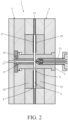
- the mould 1 is composed of two mould parts 3 and 5 with a space 7 in between. When the mould parts are in contact with each other the space 7 defines a mould cavity 8 (see figure 2 ) with the shape of a gramophone record.
- In the mould part 5 is an inset piece 9 for receiving an injection nozzle 11. Only the front part of the injection nozzle is shown.
- In the mould part 3 there is a central bush 15 in which an ejector 17 is displaceable for ejecting a remaining central injection piece which is not part of the gramophone record.
- a further ejector 19 is slidable over the bush for ejecting the gramophone record.
- the mould cavity 8 is bounded by two mirror parts 23 and 25 which are each provided with a pusher 27 and 29.
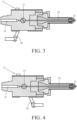
- the injection nozzle 11 is shown in detail in Figure 3 .
- the injection nozzle is provided with a nozzle piece 31 and an inlet opening 33 being part of a feed zone.
- a pouring channel 35 is present in the injection nozzle 11 between the inlet opening and the nozzle piece.
- the pouring channel 35 is completely straight and is closed by a rotatable valve 37. This valve can be adjusted by an arm 39.
- the injection nozzle 11 is shown with the valve 37 in the open position.
- moulding material (usually in the form of a granulate) of PET, with some additives to give the moulding material the optimum properties, is heated to a liquid state.
- the liquid material is injected under pressure into the space 7 between the mould parts 3 and 5 via a single passage 12, the material stream of the moulding material from the place where the moulding material melts into this space does not split into sub-streams which later come together again.
- the liquid material flows in one flow through the injection nozzle 11 into the space 7.
- the mould parts are at a distance of about 3 mm from each other, see figure 1 .
- these mould parts 3 and 5 are moved against each other creating a mould cavity 8 having a shape of a gramophone record, see figure 2 .
- the polymeric material 2 used for injection moulding is a polyethylene terephthalate isophthalic acid modified copolymer. Conventional additives for improvement can be added to this base polymeric material.
Landscapes
- Engineering & Computer Science (AREA)
- Mechanical Engineering (AREA)
- Manufacturing & Machinery (AREA)
- Injection Moulding Of Plastics Or The Like (AREA)
- Moulds For Moulding Plastics Or The Like (AREA)
- Processing And Handling Of Plastics And Other Materials For Molding In General (AREA)
Description
- The invention relates to a method for producing gramophone records by injection moulding, comprising heating polymeric material to liquefy said material, supplying liquid polymeric material under pressure from a feed zone to a space between two moulding mould parts via a nozzle, in which method the liquid polymeric material is passed through a single passage located in one of the mould parts and forcing the polymeric material under pressure through the nozzle into said space.
- A gramophone record is a sound carrier that is played on a gramophone. It is a flat disc with a spiral groove on at least one side that runs from the edge to close to the centre and in which sound information is recorded in the form of small horizontal and / or vertical deviations from the spiral shape. These deviations are present to the left and right and to the bottom and can be scanned with a needle on the rotating disk and made audible.
- Such a gramophone record is known in the embodiment of a long-playing record, which is a vinyl record made of vinyl with a diameter of 30 cm (12 inches) which is provided with a spiral groove on each side. The known gramophone record is made by pressing a roll of PVC into a disc-shaped grooved plate. PVC as a material for a long-playing record has a health risk in the event of frequent contact, in connection with the carcinogenic material PVC. Furthermore, pressing a roll of PVC into a long-playing plate requires relatively much energy and the cycle time is relatively long.
- From
GB 1 353 053 A - An object of the invention is to provide a method for producing gramophone records with better characteristics than the gramophone records produced with the known method. To this end the method according to the present invention is characterized in that polyethylene terephthalate isophthalic acid modified copolymer (PET-IPA-modified copolymer) is used as material for injection moulding, wherein the amount of the monopolymer isophthalic acid in the polyethylene terephthalate isophthalic acid modified copolymer is between 1,5 en 2,5 %, preferably this amount is about 1,8 %.
- It is known that PET-IPA-modified copolymer in which the modifier is isophthalic acid is advantageous for certain moulding applications, such as thermoforming, which, for example, is used to make tray or blister packaging. This known copolymer is also used for the production of bottles via stretch blow moulding. In the last application only a small amount of isophthalic acid is used in the copolymer. If only small amounts of comonomers are used, crystallization is slowed but not prevented entirely.
- During injection moulding, the liquid material encounters friction (shear) because it is pressed through different channels under high pressure. This makes plastics flow better (the viscosity drops). So if you e.g. injects faster, the melt flows more easily. However, PET-IPA-modified copolymer has a little "shear" dependent viscosity. PET-IPA-modified copolymer hardly has this advantage (other thermoplastics do). That is why PET-IPA-modified copolymer is difficult to process in injection moulding, especially in products with long / thin flow paths such as with an gramophone record.
- Although PET-IPA-modified copolymer is not a usual material for injection moulding and is difficult to inject in long and thin flow paths, it appeared after testing more than 45 different plastic materials that it has good properties for application as a gramophone record. It has a high wear resistance, clear appearance, and good sound quality due to high mechanical and dimensional stability.
- After comprehensive testing, the characteristics of PET-IPA-modified copolymer appears to be optimal for application in an injection moulding process for producing gramophone records in case the amount of the monopolymer isophthalic acid in the polyethylene terephthalate isophthalic acid modified copolymer is between 1,5 en 2,5 %, preferably this amount is about 1,8 %.
- Further, a polyethylene terephthalate isophthalic acid modified copolymer is easy to recycle and thus the record produced with this method is more sustainable than other known records.
- From
US 2 649 622 A a process of molding records is known comprising introducing a solid crystallizable thermoplastic material comprising amorphous linear polyethylene terephthalate into a mold and heating the material in the mold under pressure until said material crystallizes and thereafter removing said record from the mold before cooling. - From
DE 1936722 A1 a method of producing records by means of injection moulding is known in which the moulded material is a PET-IPA-modified copolymer wherein the amount of IPA is less than 10%. - To optimize the injection moulding manufacturing process the material to be injected is heated to a temperature between 250 and 300 °C, preferably between 270 and 290 °C, before injecting the polymeric material into the space between the two mould parts.
- To even more optimize the injection moulding manufacturing process the mould parts are kept at a temperature between 40 and 60 °C during injection of the material into the space between the two mould parts.
- In an embodiment of the method according to the invention mould parts are kept at a distance between 1 and 5 mm from each other while injecting the polymeric material into the space between the two mould parts and immediately after injection these mould parts are moved against each other creating a mould cavity having a shape of a gramophone record (so called injection compression). This method requires significant less energy (temperature, pressure) because there is less friction during injection due to the larger dimension of the flow space between the mould parts. In case the mould parts are in contact with each other during injection of the material in the closed cavity between these two mould parts, as is the case in the method according to
US 1 353 953 A , the grooves in the mould parts are more difficult to fill so that the material should be more liquid (lower viscosity) which requires higher temperatures and thus more energy, or which requires another composition of the material that results in less sound quality of the gramophone record. - In contradistinction to the learning of the state of the art document
US 1 353 953 A to inject the polyethylene terephthalate material with a nozzle having a passage of which at least a part is directed circumferentially, in the method according to the present invention the polymeric material is injected into the space between the two mould parts via one single nozzle provided with a straight pouring channel. It appeared that by injecting in this way visible and during use audible transitions between parts of the record are avoided. - Further, in contradistinction to the learning of the state of the art document
US 1 353 953 A in which the polyethylene terephthalate material injected into the cavity has a velocity component causing rotational movement of the material, in the method according to the present invention the polymeric material is injected into the space between the two mould parts in a direction perpendicular or almost perpendicular to the moulding surfaces of the mould parts. This also contributes to avoid visible and during use audible transitions between parts of the record. - A further embodiment of the method according to the invention is characterized in that in the middle part of the gramophone record a label is printed directly on the polyethylene terephthalate isophthalic acid modified copolymer material by means of a UV-printer. So, there is no separate label pressed on the record, as a result of which the record according to the invention can be recycled completely and the labelled part does not have to be cut out and handled separately as is the case with recycling known records. The gramophone record manufactured by the method according to the invention is thus easier to recycle and thus more sustainable.
- The invention also relates to a gramophone record produced with the method according to the invention. Regarding the gramophone record the invention is characterized in that it consists or consists essentially of a polyethylene terephthalate isophthalic acid modified copolymer, wherein the amount of the monopolymer isophthalic acid in the polyethylene terephthalate isophthalic acid modified copolymer is between 1,5 en 2,5%.
- The invention will be further elucidated below on the basis of drawings. These drawings show an embodiment of an injection moulding device for injection moulding a gramophone record according to the invention. In the drawings:
-
Figure 1 is a diagrammatically representation of a mould of an injection moulding device for manufacturing a gramophone record according to the invention with closed injection channel; -
Figur 2 -
Figure 3 is the injection nozzle of the injection moulding device with closed injection canal; and -
Figure 4 is the injection nozzle of the injection moulding device with open injection canal. - An injection moulding device for injection moulding a gramophone record has a
mould 1. Infigure 1 this mould is schematically shown. Themould 1 is composed of twomould parts space 7 in between. When the mould parts are in contact with each other thespace 7 defines a mould cavity 8 (seefigure 2 ) with the shape of a gramophone record. In themould part 5 is an inset piece 9 for receiving aninjection nozzle 11. Only the front part of the injection nozzle is shown. In themould part 3 there is acentral bush 15 in which anejector 17 is displaceable for ejecting a remaining central injection piece which is not part of the gramophone record. Afurther ejector 19 is slidable over the bush for ejecting the gramophone record. Between themould parts venting ring 21. Themould cavity 8 is bounded by twomirror parts pusher - The
injection nozzle 11 is shown in detail inFigure 3 . The injection nozzle is provided with anozzle piece 31 and aninlet opening 33 being part of a feed zone. A pouringchannel 35 is present in theinjection nozzle 11 between the inlet opening and the nozzle piece. The pouringchannel 35 is completely straight and is closed by arotatable valve 37. This valve can be adjusted by anarm 39. Infigure 4 theinjection nozzle 11 is shown with thevalve 37 in the open position. - When spraying a gramophone record, moulding material (usually in the form of a granulate) of PET, with some additives to give the moulding material the optimum properties, is heated to a liquid state. The liquid material is injected under pressure into the
space 7 between themould parts single passage 12, the material stream of the moulding material from the place where the moulding material melts into this space does not split into sub-streams which later come together again. The liquid material flows in one flow through theinjection nozzle 11 into thespace 7. While injecting the polymeric material into thespace 7 between the twomould parts figure 1 . Immediately after injection thesemould parts mould cavity 8 having a shape of a gramophone record, seefigure 2 . - The
polymeric material 2 used for injection moulding is a polyethylene terephthalate isophthalic acid modified copolymer. Conventional additives for improvement can be added to this base polymeric material. - Although the present invention is elucidated above on the basis of the given drawings, it should be noted that this invention is not limited whatsoever to the embodiments shown in the drawings. The invention also extends to all embodiments deviating from the embodiments shown in the drawings within the scope of the invention defined by the appended claims.
Claims (8)
- Method for producing gramophone records by injection moulding, comprising heating polymeric material to liquefy said material, supplying liquid polymeric material (2) under pressure from a feed zone (33) to a space (7) between two moulding mould parts (3, 5) via an injection nozzle (11), in which method the liquid polymeric material (2) is passed through a single passage (12) located in one of the mould parts (5) and forcing the polymeric material (2) under pressure through the injection nozzle (11) into said space (7), characterized in that polyethylene terephthalate isophthalic acid modified copolymer is used as said polymeric material (2), wherein the amount of the monopolymer isophthalic acid in the polyethylene terephthalate isophthalic acid modified copolymer is between 1,5 and 2,5 %.
- Method for producing gramophone records according to claim 1, characterized in that before injection the polymeric material (2) into the space between the two mould parts (3, 5) the polymeric material (2) is heated to a temperature between 250 and 300 °C.
- Method for producing gramophone records according to claims claim 1, or 2, characterized in that during injection the mould parts (3, 5) are kept at a temperature between 40 and 60 °C.
- Method for producing gramophone records according to any one of the preceding claims, characterized in that while injecting the polymeric material into the space (7) between the two mould parts (3, 5), these mould parts are at a distance between 1 and 5 mm from each other and that immediately after injection these mould parts (3, 5) are moved against each other creating a mould cavity (8) having a shape of a gramophone record.
- Method for producing gramophone records according to any one of the preceding claims, characterized in that the polymeric material (2) is injected into the space (7) between the two mould parts (3, 5) via one single injection nozzle (11) provided with a straight pouring channel (35).
- Method for producing gramophone records according to any one of the preceding claims, characterized in that the polymeric material (2) is injected into the space (7) between the two mould parts (3, 5) in a direction perpendicular or almost perpendicular to the moulding surfaces (4, 6) of the mould parts (3, 5).
- Method for producing gramophone records according to any one of the preceding claims, characterized in that in the middle part of the gramophone record a label is printed directly on the polyethylene terephthalate isophthalic acid modified copolymer material by means of a UV-printer.
- Gramophone record produced with the method according to one of the preceding claims, characterized in that the gramophone record consists or mainly consists of a polyethylene terephthalate isophthalic acid modified copolymer, wherein the amount of the monopolymer isophthalic acid in the polyethylene terephthalate isophthalic acid modified copolymer is between 1,5 and 2,5 %.
Priority Applications (1)
| Application Number | Priority Date | Filing Date | Title |
|---|---|---|---|
| HRP20240804TT HRP20240804T1 (en) | 2019-12-09 | 2020-12-07 | Method for producing gramophone records by injection moulding |
Applications Claiming Priority (2)
| Application Number | Priority Date | Filing Date | Title |
|---|---|---|---|
| NL2024410A NL2024410B1 (en) | 2019-12-09 | 2019-12-09 | Method for producing gramophone records by injection moulding |
| PCT/NL2020/050762 WO2021118344A1 (en) | 2019-12-09 | 2020-12-07 | Method for producing gramophone records by injection moulding |
Publications (2)
| Publication Number | Publication Date |
|---|---|
| EP4072839A1 EP4072839A1 (en) | 2022-10-19 |
| EP4072839B1 true EP4072839B1 (en) | 2024-03-13 |
Family
ID=69106157
Family Applications (1)
| Application Number | Title | Priority Date | Filing Date |
|---|---|---|---|
| EP20824701.5A Active EP4072839B1 (en) | 2019-12-09 | 2020-12-07 | Method for producing gramophone records by injection moulding |
Country Status (13)
| Country | Link |
|---|---|
| US (2) | US12350867B2 (en) |
| EP (1) | EP4072839B1 (en) |
| JP (2) | JP7700122B2 (en) |
| CA (1) | CA3201678A1 (en) |
| DK (1) | DK4072839T3 (en) |
| ES (1) | ES2980510T3 (en) |
| FI (1) | FI4072839T3 (en) |
| HR (1) | HRP20240804T1 (en) |
| MX (1) | MX2022007070A (en) |
| NL (1) | NL2024410B1 (en) |
| PL (1) | PL4072839T3 (en) |
| PT (1) | PT4072839T (en) |
| WO (1) | WO2021118344A1 (en) |
Citations (5)
| Publication number | Priority date | Publication date | Assignee | Title |
|---|---|---|---|---|
| US1353953A (en) | 1917-01-18 | 1920-09-28 | Owens Bottle Machine Company | Apparatus for gathering molten glass |
| US2649622A (en) | 1949-12-20 | 1953-08-25 | Du Pont | Process for molding synthetic linear polyesters |
| DE1936722A1 (en) | 1969-05-20 | 1970-11-26 | Algemene Kunstzijde Unie Nv | Record made of polyester |
| FR2079725A5 (en) | 1970-02-11 | 1971-11-12 | Materiel Appl Plastiques | Injection moulding gramophone records - by filling the mould before closure |
| DE4302384C2 (en) | 1992-01-28 | 1997-09-11 | Victor Company Of Japan | Plate and method of making the plate |
Family Cites Families (6)
| Publication number | Priority date | Publication date | Assignee | Title |
|---|---|---|---|---|
| DE1956504C3 (en) * | 1969-11-05 | 1974-02-07 | Ted Bildplatten Ag Aeg-Telefunkenteldec, Zug (Schweiz) | Stored Signal Carriers |
| NL7003203A (en) * | 1970-03-06 | 1971-09-08 | ||
| JPS57109619A (en) * | 1980-12-26 | 1982-07-08 | Teichiku Kk | Injection compression molding of record disk |
| JPH05170879A (en) * | 1991-12-25 | 1993-07-09 | Kanebo Ltd | Polyester disc base and its manufacture |
| KR0185765B1 (en) * | 1993-04-10 | 1999-04-15 | 가와다 미쓰구 | Optical information medium and method for fabricating same |
| US8883279B2 (en) * | 2010-09-30 | 2014-11-11 | Ticona Llc | Fluid-assisted injection molded articles and process |
-
2019
- 2019-12-09 NL NL2024410A patent/NL2024410B1/en not_active IP Right Cessation
-
2020
- 2020-12-07 PT PT208247015T patent/PT4072839T/en unknown
- 2020-12-07 ES ES20824701T patent/ES2980510T3/en active Active
- 2020-12-07 WO PCT/NL2020/050762 patent/WO2021118344A1/en not_active Ceased
- 2020-12-07 JP JP2022535620A patent/JP7700122B2/en active Active
- 2020-12-07 US US17/757,078 patent/US12350867B2/en active Active
- 2020-12-07 PL PL20824701.5T patent/PL4072839T3/en unknown
- 2020-12-07 DK DK20824701.5T patent/DK4072839T3/en active
- 2020-12-07 EP EP20824701.5A patent/EP4072839B1/en active Active
- 2020-12-07 FI FIEP20824701.5T patent/FI4072839T3/en active
- 2020-12-07 HR HRP20240804TT patent/HRP20240804T1/en unknown
- 2020-12-07 MX MX2022007070A patent/MX2022007070A/en unknown
- 2020-12-07 CA CA3201678A patent/CA3201678A1/en active Pending
-
2025
- 2025-06-18 JP JP2025102036A patent/JP2025129076A/en active Pending
- 2025-07-07 US US19/261,358 patent/US20250332770A1/en active Pending
Patent Citations (5)
| Publication number | Priority date | Publication date | Assignee | Title |
|---|---|---|---|---|
| US1353953A (en) | 1917-01-18 | 1920-09-28 | Owens Bottle Machine Company | Apparatus for gathering molten glass |
| US2649622A (en) | 1949-12-20 | 1953-08-25 | Du Pont | Process for molding synthetic linear polyesters |
| DE1936722A1 (en) | 1969-05-20 | 1970-11-26 | Algemene Kunstzijde Unie Nv | Record made of polyester |
| FR2079725A5 (en) | 1970-02-11 | 1971-11-12 | Materiel Appl Plastiques | Injection moulding gramophone records - by filling the mould before closure |
| DE4302384C2 (en) | 1992-01-28 | 1997-09-11 | Victor Company Of Japan | Plate and method of making the plate |
Non-Patent Citations (11)
| Title |
|---|
| "lsophthalic acid ", 10 January 2024 (2024-01-10), pages 1 - 2, XP093249492, Retrieved from the Internet <URL:https://en.wikipedia.org/wiki/Isophthalic_acid> [retrieved on 13122024] |
| ANONYMOUS: "LUXYCLEAR PET 702K ", LNDORAMA VENTURES (TECHNICAL DATASHEET ), 19 April 2023 (2023-04-19), pages 1 - 2, XP093249543 |
| ANONYMOUS: "Polyethylene terephthalate", WIKIPEDIA, 29 November 2024 (2024-11-29), pages 1 - 18, XP093249549, Retrieved from the Internet <URL:https://en.wikipedia.org/w/index.php?title=Polyethylene_terephthalate&oldid=1260220989> [retrieved on 20241210] |
| ANONYMOUS: "SKYPET CR BB", SK CHEMICALS TECHNICAL DATA SHEET ( SK-202202 ), 4 March 2022 (2022-03-04), pages 1 - 1, XP093249532, Retrieved from the Internet <URL:https://www.polychempremier.com/filesdirectserver/itp1/z_itp_24112021l2hn/SKYPETCRBBz-z309228346324.pdf> [retrieved on 20250212] |
| D10 - Analysis report of Indorama Ventures Polymers of PET material Luxyclear PET 702K (09), December 6, 2024, showing content of IPA |
| D11 - Analysis report of Mr. Helmut Erler of December 4, 2024 discussing performances of records produced using that material according to 07 and 09 |
| D12 - Decision T 279/89 |
| D13 - Decision T 2623/11 |
| D8 - Analysis report of Analytik Service Obernburg of PET material SkyPET CR-BB (07), May 17, 2024, showing content of IPA |
| SYMCONGROUP / GREEN VINYL RECORDS / GVR SOUND: "Sustainable record (LP) by Omroep Brabant (Booming Brabant) with English subtitles", 24 June 2016 (2016-06-24), XP093235669, Retrieved from the Internet <URL:https://www.youtube.com/watch?v=GQ19WovCQQ4> |
| WALTER HELLERICH , GÜNTHER HARSCH ,SIEGFRIED HAENLE: "Werkstoff-Führer Kunststoffe: Eigenschaften - Prüfungen - Kennwerte 7", 1 January 1996, MUENCHEN CARL HANSER VERLAG, DE , ISBN: 978-3-446-17617-1, article ANONYMOUS: "Passage ; Werkstofführer Kunststoffe", pages: 113 - 116, XP093249520, 023480 |
Also Published As
| Publication number | Publication date |
|---|---|
| WO2021118344A1 (en) | 2021-06-17 |
| DK4072839T3 (en) | 2024-06-17 |
| PT4072839T (en) | 2024-06-17 |
| US20250332770A1 (en) | 2025-10-30 |
| EP4072839A1 (en) | 2022-10-19 |
| US12350867B2 (en) | 2025-07-08 |
| US20230011470A1 (en) | 2023-01-12 |
| JP2023506782A (en) | 2023-02-20 |
| CA3201678A1 (en) | 2021-06-17 |
| FI4072839T3 (en) | 2024-06-07 |
| NL2024410B1 (en) | 2021-08-31 |
| JP7700122B2 (en) | 2025-06-30 |
| MX2022007070A (en) | 2022-09-27 |
| ES2980510T3 (en) | 2024-10-01 |
| HRP20240804T1 (en) | 2024-09-27 |
| JP2025129076A (en) | 2025-09-03 |
| PL4072839T3 (en) | 2024-08-26 |
Similar Documents
| Publication | Publication Date | Title |
|---|---|---|
| JP5848443B2 (en) | Method for substantially constant pressure injection molding of thin-walled parts | |
| JP2818606B2 (en) | Blank injection molding method and gate system | |
| JP2015520050A (en) | How to operate a high productivity injection molding machine | |
| CN111086153B (en) | Automobile thick-wall automobile logo and injection molding process | |
| CN110769994B (en) | Molded article having selectively variable core geometry and hot runner nozzle for making the same | |
| EP2735426B1 (en) | Method of manufacturing an injected and blown product | |
| CN206870278U (en) | Deep chamber thick-walled plastic part fretting map injection mold | |
| US12350867B2 (en) | Method for producing gramophone records by injection moulding | |
| CN104812550B (en) | The method of manufacture product such as dosing top cover | |
| CN104321182A (en) | Method for operating a high productivity injection molding machine | |
| JP2003513816A (en) | Resin pellets for injection molding | |
| EP2271473B1 (en) | Injection moulding process | |
| CN110901002A (en) | Injection molding method of perfume bottle cap | |
| CZ2001818A3 (en) | Shaping tool for information carrier disk blank, method of manufacturing blank and information carrier disk blank | |
| CN203779789U (en) | Bijection mold | |
| KR101568994B1 (en) | Injection molding having a under cut molding structure with under cut moding ring | |
| NL2035144B1 (en) | A method for producing a PET cap. | |
| US7959844B1 (en) | Plastic injection molding process | |
| JPH0333492B2 (en) | ||
| AU626152B2 (en) | Injection moulding of a preform and/or a container and a container of thermoplastic material | |
| CN105451960A (en) | Injection molded body, injection molding method, and injection molding die | |
| CN107571461A (en) | Injection mold | |
| GB2092942A (en) | A method of moulding a data carrying element | |
| JPH04290715A (en) | Injection mold for substrates for optical information recording media |
Legal Events
| Date | Code | Title | Description |
|---|---|---|---|
| REG | Reference to a national code |
Ref country code: HR Ref legal event code: TUEP Ref document number: P20240804T Country of ref document: HR |
|
| STAA | Information on the status of an ep patent application or granted ep patent |
Free format text: STATUS: UNKNOWN |
|
| STAA | Information on the status of an ep patent application or granted ep patent |
Free format text: STATUS: THE INTERNATIONAL PUBLICATION HAS BEEN MADE |
|
| PUAI | Public reference made under article 153(3) epc to a published international application that has entered the european phase |
Free format text: ORIGINAL CODE: 0009012 |
|
| STAA | Information on the status of an ep patent application or granted ep patent |
Free format text: STATUS: REQUEST FOR EXAMINATION WAS MADE |
|
| 17P | Request for examination filed |
Effective date: 20220711 |
|
| AK | Designated contracting states |
Kind code of ref document: A1 Designated state(s): AL AT BE BG CH CY CZ DE DK EE ES FI FR GB GR HR HU IE IS IT LI LT LU LV MC MK MT NL NO PL PT RO RS SE SI SK SM TR |
|
| DAV | Request for validation of the european patent (deleted) | ||
| DAX | Request for extension of the european patent (deleted) | ||
| GRAP | Despatch of communication of intention to grant a patent |
Free format text: ORIGINAL CODE: EPIDOSNIGR1 |
|
| STAA | Information on the status of an ep patent application or granted ep patent |
Free format text: STATUS: GRANT OF PATENT IS INTENDED |
|
| RIC1 | Information provided on ipc code assigned before grant |
Ipc: B29K 105/00 20060101ALI20231006BHEP Ipc: B29C 45/56 20060101ALI20231006BHEP Ipc: B29C 45/23 20060101ALI20231006BHEP Ipc: B29L 17/00 20060101ALI20231006BHEP Ipc: B29K 67/00 20060101ALI20231006BHEP Ipc: B29C 45/26 20060101ALI20231006BHEP Ipc: B29D 17/00 20060101AFI20231006BHEP |
|
| INTG | Intention to grant announced |
Effective date: 20231024 |
|
| GRAS | Grant fee paid |
Free format text: ORIGINAL CODE: EPIDOSNIGR3 |
|
| GRAA | (expected) grant |
Free format text: ORIGINAL CODE: 0009210 |
|
| STAA | Information on the status of an ep patent application or granted ep patent |
Free format text: STATUS: THE PATENT HAS BEEN GRANTED |
|
| AK | Designated contracting states |
Kind code of ref document: B1 Designated state(s): AL AT BE BG CH CY CZ DE DK EE ES FI FR GB GR HR HU IE IS IT LI LT LU LV MC MK MT NL NO PL PT RO RS SE SI SK SM TR |
|
| REG | Reference to a national code |
Ref country code: GB Ref legal event code: FG4D |
|
| REG | Reference to a national code |
Ref country code: CH Ref legal event code: EP |
|
| REG | Reference to a national code |
Ref country code: DE Ref legal event code: R096 Ref document number: 602020027310 Country of ref document: DE |
|
| REG | Reference to a national code |
Ref country code: IE Ref legal event code: FG4D |
|
| U01 | Request for unitary effect filed |
Effective date: 20240325 |
|
| REG | Reference to a national code |
Ref country code: FI Ref legal event code: FGE |
|
| REG | Reference to a national code |
Ref country code: PT Ref legal event code: SC4A Ref document number: 4072839 Country of ref document: PT Date of ref document: 20240617 Kind code of ref document: T Free format text: AVAILABILITY OF NATIONAL TRANSLATION Effective date: 20240606 Ref country code: DK Ref legal event code: T3 Effective date: 20240611 |
|
| REG | Reference to a national code |
Ref country code: SE Ref legal event code: TRGR |
|
| PG25 | Lapsed in a contracting state [announced via postgrant information from national office to epo] |
Ref country code: LT Free format text: LAPSE BECAUSE OF FAILURE TO SUBMIT A TRANSLATION OF THE DESCRIPTION OR TO PAY THE FEE WITHIN THE PRESCRIBED TIME-LIMIT Effective date: 20240313 |
|
| REG | Reference to a national code |
Ref country code: LT Ref legal event code: MG9D |
|
| PG25 | Lapsed in a contracting state [announced via postgrant information from national office to epo] |
Ref country code: GR Free format text: LAPSE BECAUSE OF FAILURE TO SUBMIT A TRANSLATION OF THE DESCRIPTION OR TO PAY THE FEE WITHIN THE PRESCRIBED TIME-LIMIT Effective date: 20240614 |
|
| PG25 | Lapsed in a contracting state [announced via postgrant information from national office to epo] |
Ref country code: RS Free format text: LAPSE BECAUSE OF FAILURE TO SUBMIT A TRANSLATION OF THE DESCRIPTION OR TO PAY THE FEE WITHIN THE PRESCRIBED TIME-LIMIT Effective date: 20240613 |
|
| REG | Reference to a national code |
Ref country code: NL Ref legal event code: FP |
|
| PG25 | Lapsed in a contracting state [announced via postgrant information from national office to epo] |
Ref country code: RS Free format text: LAPSE BECAUSE OF FAILURE TO SUBMIT A TRANSLATION OF THE DESCRIPTION OR TO PAY THE FEE WITHIN THE PRESCRIBED TIME-LIMIT Effective date: 20240613 Ref country code: NO Free format text: LAPSE BECAUSE OF FAILURE TO SUBMIT A TRANSLATION OF THE DESCRIPTION OR TO PAY THE FEE WITHIN THE PRESCRIBED TIME-LIMIT Effective date: 20240613 Ref country code: LT Free format text: LAPSE BECAUSE OF FAILURE TO SUBMIT A TRANSLATION OF THE DESCRIPTION OR TO PAY THE FEE WITHIN THE PRESCRIBED TIME-LIMIT Effective date: 20240313 Ref country code: GR Free format text: LAPSE BECAUSE OF FAILURE TO SUBMIT A TRANSLATION OF THE DESCRIPTION OR TO PAY THE FEE WITHIN THE PRESCRIBED TIME-LIMIT Effective date: 20240614 Ref country code: BG Free format text: LAPSE BECAUSE OF FAILURE TO SUBMIT A TRANSLATION OF THE DESCRIPTION OR TO PAY THE FEE WITHIN THE PRESCRIBED TIME-LIMIT Effective date: 20240313 |
|
| RAP2 | Party data changed (patent owner data changed or rights of a patent transferred) |
Owner name: GREEN VINYL RECORDS B.V. |
|
| PG25 | Lapsed in a contracting state [announced via postgrant information from national office to epo] |
Ref country code: LV Free format text: LAPSE BECAUSE OF FAILURE TO SUBMIT A TRANSLATION OF THE DESCRIPTION OR TO PAY THE FEE WITHIN THE PRESCRIBED TIME-LIMIT Effective date: 20240313 |
|
| REG | Reference to a national code |
Ref country code: HR Ref legal event code: PPPP Ref document number: P20240804T Country of ref document: HR Owner name: GREEN VINYL RECORDS B.V., NL |
|
| REG | Reference to a national code |
Ref country code: AT Ref legal event code: PC Ref document number: 1665372 Country of ref document: AT Kind code of ref document: T Owner name: GREEN VINYL RECORDS B.V., NL Effective date: 20240809 |
|
| REG | Reference to a national code |
Ref country code: HR Ref legal event code: T1PR Ref document number: P20240804 Country of ref document: HR |
|
| REG | Reference to a national code |
Ref country code: ES Ref legal event code: FG2A Ref document number: 2980510 Country of ref document: ES Kind code of ref document: T3 Effective date: 20241001 |
|
| PG25 | Lapsed in a contracting state [announced via postgrant information from national office to epo] |
Ref country code: IS Free format text: LAPSE BECAUSE OF FAILURE TO SUBMIT A TRANSLATION OF THE DESCRIPTION OR TO PAY THE FEE WITHIN THE PRESCRIBED TIME-LIMIT Effective date: 20240713 |
|
| PG25 | Lapsed in a contracting state [announced via postgrant information from national office to epo] |
Ref country code: SM Free format text: LAPSE BECAUSE OF FAILURE TO SUBMIT A TRANSLATION OF THE DESCRIPTION OR TO PAY THE FEE WITHIN THE PRESCRIBED TIME-LIMIT Effective date: 20240313 |
|
| PG25 | Lapsed in a contracting state [announced via postgrant information from national office to epo] |
Ref country code: EE Free format text: LAPSE BECAUSE OF FAILURE TO SUBMIT A TRANSLATION OF THE DESCRIPTION OR TO PAY THE FEE WITHIN THE PRESCRIBED TIME-LIMIT Effective date: 20240313 |
|
| PG25 | Lapsed in a contracting state [announced via postgrant information from national office to epo] |
Ref country code: SK Free format text: LAPSE BECAUSE OF FAILURE TO SUBMIT A TRANSLATION OF THE DESCRIPTION OR TO PAY THE FEE WITHIN THE PRESCRIBED TIME-LIMIT Effective date: 20240313 |
|
| PG25 | Lapsed in a contracting state [announced via postgrant information from national office to epo] |
Ref country code: SM Free format text: LAPSE BECAUSE OF FAILURE TO SUBMIT A TRANSLATION OF THE DESCRIPTION OR TO PAY THE FEE WITHIN THE PRESCRIBED TIME-LIMIT Effective date: 20240313 Ref country code: SK Free format text: LAPSE BECAUSE OF FAILURE TO SUBMIT A TRANSLATION OF THE DESCRIPTION OR TO PAY THE FEE WITHIN THE PRESCRIBED TIME-LIMIT Effective date: 20240313 Ref country code: RO Free format text: LAPSE BECAUSE OF FAILURE TO SUBMIT A TRANSLATION OF THE DESCRIPTION OR TO PAY THE FEE WITHIN THE PRESCRIBED TIME-LIMIT Effective date: 20240313 Ref country code: IS Free format text: LAPSE BECAUSE OF FAILURE TO SUBMIT A TRANSLATION OF THE DESCRIPTION OR TO PAY THE FEE WITHIN THE PRESCRIBED TIME-LIMIT Effective date: 20240713 Ref country code: EE Free format text: LAPSE BECAUSE OF FAILURE TO SUBMIT A TRANSLATION OF THE DESCRIPTION OR TO PAY THE FEE WITHIN THE PRESCRIBED TIME-LIMIT Effective date: 20240313 |
|
| PG25 | Lapsed in a contracting state [announced via postgrant information from national office to epo] |
Ref country code: IT Free format text: LAPSE BECAUSE OF FAILURE TO SUBMIT A TRANSLATION OF THE DESCRIPTION OR TO PAY THE FEE WITHIN THE PRESCRIBED TIME-LIMIT Effective date: 20240313 |
|
| REG | Reference to a national code |
Ref country code: DE Ref legal event code: R026 Ref document number: 602020027310 Country of ref document: DE |
|
| PLBI | Opposition filed |
Free format text: ORIGINAL CODE: 0009260 |
|
| PG25 | Lapsed in a contracting state [announced via postgrant information from national office to epo] |
Ref country code: IT Free format text: LAPSE BECAUSE OF FAILURE TO SUBMIT A TRANSLATION OF THE DESCRIPTION OR TO PAY THE FEE WITHIN THE PRESCRIBED TIME-LIMIT Effective date: 20240313 |
|
| PLAX | Notice of opposition and request to file observation + time limit sent |
Free format text: ORIGINAL CODE: EPIDOSNOBS2 |
|
| 26 | Opposition filed |
Opponent name: SONOPRESS GMBH Effective date: 20241213 |
|
| PG25 | Lapsed in a contracting state [announced via postgrant information from national office to epo] |
Ref country code: SI Free format text: LAPSE BECAUSE OF FAILURE TO SUBMIT A TRANSLATION OF THE DESCRIPTION OR TO PAY THE FEE WITHIN THE PRESCRIBED TIME-LIMIT Effective date: 20240313 |
|
| PLBB | Reply of patent proprietor to notice(s) of opposition received |
Free format text: ORIGINAL CODE: EPIDOSNOBS3 |
|
| REG | Reference to a national code |
Ref country code: HR Ref legal event code: PBON Ref document number: P20240804 Country of ref document: HR Effective date: 20241207 |
|
| U04 | Request for unitary effect rejected |
Effective date: 20250523 |
|
| PG25 | Lapsed in a contracting state [announced via postgrant information from national office to epo] |
Ref country code: MC Free format text: LAPSE BECAUSE OF FAILURE TO SUBMIT A TRANSLATION OF THE DESCRIPTION OR TO PAY THE FEE WITHIN THE PRESCRIBED TIME-LIMIT Effective date: 20240313 |
|
| PG25 | Lapsed in a contracting state [announced via postgrant information from national office to epo] |
Ref country code: FI Free format text: LAPSE BECAUSE OF NON-PAYMENT OF DUE FEES Effective date: 20241207 |
|
| REG | Reference to a national code |
Ref country code: DK Ref legal event code: EBP Effective date: 20241231 |
|
| PG25 | Lapsed in a contracting state [announced via postgrant information from national office to epo] |
Ref country code: CZ Free format text: LAPSE BECAUSE OF NON-PAYMENT OF DUE FEES Effective date: 20241207 |
|
| REG | Reference to a national code |
Ref country code: SE Ref legal event code: EUG |
|
| PG25 | Lapsed in a contracting state [announced via postgrant information from national office to epo] |
Ref country code: PT Free format text: LAPSE BECAUSE OF NON-PAYMENT OF DUE FEES Effective date: 20250908 |
|
| PG25 | Lapsed in a contracting state [announced via postgrant information from national office to epo] |
Ref country code: HR Free format text: LAPSE BECAUSE OF NON-PAYMENT OF DUE FEES Effective date: 20241207 |
|
| PG25 | Lapsed in a contracting state [announced via postgrant information from national office to epo] |
Ref country code: PT Free format text: LAPSE BECAUSE OF NON-PAYMENT OF DUE FEES Effective date: 20250908 |
|
| PGFP | Annual fee paid to national office [announced via postgrant information from national office to epo] |
Ref country code: PT Payment date: 20251119 Year of fee payment: 6 |
|
| PGRI | Patent reinstated in contracting state [announced from national office to epo] |
Ref country code: PT Effective date: 20251126 |
|
| REG | Reference to a national code |
Ref country code: CH Ref legal event code: U11 Free format text: ST27 STATUS EVENT CODE: U-0-0-U10-U11 (AS PROVIDED BY THE NATIONAL OFFICE) Effective date: 20260101 |
|
| PGFP | Annual fee paid to national office [announced via postgrant information from national office to epo] |
Ref country code: DE Payment date: 20251211 Year of fee payment: 6 |
|
| PGFP | Annual fee paid to national office [announced via postgrant information from national office to epo] |
Ref country code: GB Payment date: 20251219 Year of fee payment: 6 |
|
| PG25 | Lapsed in a contracting state [announced via postgrant information from national office to epo] |
Ref country code: DK Free format text: LAPSE BECAUSE OF NON-PAYMENT OF DUE FEES Effective date: 20241231 |
|
| PGFP | Annual fee paid to national office [announced via postgrant information from national office to epo] |
Ref country code: IT Payment date: 20251223 Year of fee payment: 6 |
|
| PGFP | Annual fee paid to national office [announced via postgrant information from national office to epo] |
Ref country code: LU Payment date: 20251219 Year of fee payment: 6 Ref country code: FR Payment date: 20251229 Year of fee payment: 6 Ref country code: NL Payment date: 20251219 Year of fee payment: 6 |
|
| PGFP | Annual fee paid to national office [announced via postgrant information from national office to epo] |
Ref country code: BE Payment date: 20251219 Year of fee payment: 6 |
|
| PGFP | Annual fee paid to national office [announced via postgrant information from national office to epo] |
Ref country code: IE Payment date: 20251219 Year of fee payment: 6 |
|
| REG | Reference to a national code |
Ref country code: ES Ref legal event code: FD2A Effective date: 20260126 |
|
| PG25 | Lapsed in a contracting state [announced via postgrant information from national office to epo] |
Ref country code: CY Free format text: LAPSE BECAUSE OF FAILURE TO SUBMIT A TRANSLATION OF THE DESCRIPTION OR TO PAY THE FEE WITHIN THE PRESCRIBED TIME-LIMIT; INVALID AB INITIO Effective date: 20201207 |
|
| PG25 | Lapsed in a contracting state [announced via postgrant information from national office to epo] |
Ref country code: ES Free format text: LAPSE BECAUSE OF NON-PAYMENT OF DUE FEES Effective date: 20241208 |
|
| PGFP | Annual fee paid to national office [announced via postgrant information from national office to epo] |
Ref country code: AT Payment date: 20251222 Year of fee payment: 6 |
|
| PGFP | Annual fee paid to national office [announced via postgrant information from national office to epo] |
Ref country code: CH Payment date: 20260101 Year of fee payment: 6 |