EP4071749A1 - Electric guitar body-structure and electric guitar - Google Patents
Electric guitar body-structure and electric guitar Download PDFInfo
- Publication number
- EP4071749A1 EP4071749A1 EP20896673.9A EP20896673A EP4071749A1 EP 4071749 A1 EP4071749 A1 EP 4071749A1 EP 20896673 A EP20896673 A EP 20896673A EP 4071749 A1 EP4071749 A1 EP 4071749A1
- Authority
- EP
- European Patent Office
- Prior art keywords
- chambers
- chamber
- electric guitar
- slit
- slits
- Prior art date
- Legal status (The legal status is an assumption and is not a legal conclusion. Google has not performed a legal analysis and makes no representation as to the accuracy of the status listed.)
- Granted
Links
Images

Classifications
-
- G—PHYSICS
- G10—MUSICAL INSTRUMENTS; ACOUSTICS
- G10D—STRINGED MUSICAL INSTRUMENTS; WIND MUSICAL INSTRUMENTS; ACCORDIONS OR CONCERTINAS; PERCUSSION MUSICAL INSTRUMENTS; AEOLIAN HARPS; SINGING-FLAME MUSICAL INSTRUMENTS; MUSICAL INSTRUMENTS NOT OTHERWISE PROVIDED FOR
- G10D1/00—General design of stringed musical instruments
- G10D1/04—Plucked or strummed string instruments, e.g. harps or lyres
- G10D1/05—Plucked or strummed string instruments, e.g. harps or lyres with fret boards or fingerboards
- G10D1/08—Guitars
- G10D1/085—Mechanical design of electric guitars
-
- G—PHYSICS
- G10—MUSICAL INSTRUMENTS; ACOUSTICS
- G10D—STRINGED MUSICAL INSTRUMENTS; WIND MUSICAL INSTRUMENTS; ACCORDIONS OR CONCERTINAS; PERCUSSION MUSICAL INSTRUMENTS; AEOLIAN HARPS; SINGING-FLAME MUSICAL INSTRUMENTS; MUSICAL INSTRUMENTS NOT OTHERWISE PROVIDED FOR
- G10D3/00—Details of, or accessories for, stringed musical instruments, e.g. slide-bars
- G10D3/02—Resonating means, horns or diaphragms
-
- G—PHYSICS
- G10—MUSICAL INSTRUMENTS; ACOUSTICS
- G10H—ELECTROPHONIC MUSICAL INSTRUMENTS; INSTRUMENTS IN WHICH THE TONES ARE GENERATED BY ELECTROMECHANICAL MEANS OR ELECTRONIC GENERATORS, OR IN WHICH THE TONES ARE SYNTHESISED FROM A DATA STORE
- G10H3/00—Instruments in which the tones are generated by electromechanical means
- G10H3/12—Instruments in which the tones are generated by electromechanical means using mechanical resonant generators, e.g. strings or percussive instruments, the tones of which are picked up by electromechanical transducers, the electrical signals being further manipulated or amplified and subsequently converted to sound by a loudspeaker or equivalent instrument
- G10H3/14—Instruments in which the tones are generated by electromechanical means using mechanical resonant generators, e.g. strings or percussive instruments, the tones of which are picked up by electromechanical transducers, the electrical signals being further manipulated or amplified and subsequently converted to sound by a loudspeaker or equivalent instrument using mechanically actuated vibrators with pick-up means
- G10H3/18—Instruments in which the tones are generated by electromechanical means using mechanical resonant generators, e.g. strings or percussive instruments, the tones of which are picked up by electromechanical transducers, the electrical signals being further manipulated or amplified and subsequently converted to sound by a loudspeaker or equivalent instrument using mechanically actuated vibrators with pick-up means using a string, e.g. electric guitar
Definitions
- the present invention relates to an electric guitar body-structure and an electric guitar.
- Patent Document 1 discloses a technique capable of producing a beautiful and reverberant sound by providing a plurality of grooves on the inner side of the body plate of the hollow body of a stringed instrument such as an acoustic guitar or a violin. A beautiful and reverberant sound is obtained by appropriately controlling the acoustic phenomenon of the body.
- Patent Document 1 Japanese Unexamined Patent Application, First Publication No. 2001-154662
- a plurality of chambers are provided in the interior of bodies of electric guitars and the like for weight reduction.
- the resonance frequencies of the plurality of chambers become substantially the same, giving rise to the necessary to control the acoustic phenomenon of the body. It is difficult to control the acoustic phenomenon of the body even if a plurality of grooves as in Patent Document 1 are provided on the inner surface of the chambers of the body of the electric guitar.
- the present invention has been made in view of the above circumstances, and has as its object to provide an electric guitar body-structure capable of controlling the acoustic phenomenon of a body having a plurality of chambers, and an electric guitar including the same.
- a first aspect of the present invention is an body structure of an electric guitar, including: a body including a first chamber and a second chamber formed spaced apart from each other, and a slit that connects the first chamber and the second chamber.
- a second aspect of the present invention is an electric guitar including the body structure.
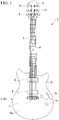
- an electric guitar 1 incudes a body structure 2, a neck 3, and strings 4.
- the neck 3 is connected to an end portion of the body structure 2 and extends in a direction away from the body structure 2 (upward direction in FIG. 1 ).
- a head 5 forming the distal end portion in the longitudinal direction of the neck 3 is provided with pegs 6 around which an end portion of each of the strings 4 is wound.
- the strings 4 are stretched along the longitudinal direction of the neck 3.
- the body structure 2 includes a body 20.
- the body 20 constitutes the entire body structure 2.
- a bridge 7, an electromagnetic pickup 8, controllers, and the like are attached to the body 20.
- the bridge 7, the electromagnetic pickup 8, and the controllers are exposed on a front side surface 20a (hereinafter referred to as the front surface 20a) of the body 20 facing the thickness direction of the body 20 (direction orthogonal to the paper surface in FIG. 1 ).
- each string 4 is fastened to the bridge 7.
- the electromagnetic pickup 8 is located between the neck 3 and the bridge 7 in the longitudinal direction of the neck 3.
- a plurality of the electromagnetic pickups 8 (two in the illustrated example) are arranged in the longitudinal direction of the neck 3.
- the controllers adjust the volume, tone, and the like of the acoustic signal output from the electromagnetic pickups 8.
- the controllers include two volume switches 9, a pickup selector 10 for switching the electromagnetic pickups 8 to be activated, and the like.
- the body 20 of the present embodiment has a top member 21 having a small thickness dimension and a back member 22 (see FIGS. 2 and 3 ) having a thickness dimension larger than that of the top member 21.
- the top member 21 and the back member 22 overlap with each other in the thickness direction of the body 20 to form the body 20.
- the front surface 20a of the body 20 from which the bridge 7 and the like are exposed is constituted by the top member 21.
- the body 20 has a plurality of chambers 24 (19 in the illustrated example) and slits 25.
- the plurality of chambers 24 are cavities formed for weight reduction of the body 20.
- the plurality of chambers 24 are formed at intervals from each other. Specifically, the plurality of chambers 24 are arranged in a direction orthogonal to the thickness direction of the body 20.
- the plurality of chambers 24 are formed in a region of the body 20 other than the region to which the neck 3, the bridge 7, the electromagnetic pickups 8, the controllers (see FIG. 1 ) and the like are attached, when viewed from the thickness direction of the body 20.
- the body 20 is also formed with holes and recess portions for accommodating the bridge 7, the electromagnetic pickups 8, and the controllers.
- the plurality of chambers 24 are each formed by being recessed from a front surface 22a of the back member 22 facing the top member 21.
- the plurality of chambers 24 become cavities that each do not open to the outside of the body 20 by superimposing the top member 21 on the front surface 22a of the back member 22.
- the slit 25 connects two chambers 24 (first chamber 24A and second chamber 24B) adjacent to each other among the plurality of chambers 24.
- the slit 25, similarly to the chambers 24, does not open to the outside of the body 20.
- the slit 25 extends in the arrangement direction of the two chambers 24.
- the direction in which the slit 25 extends may be parallel to the arrangement direction of the two chambers 24, or may be inclined thereto.
- the cross-sectional area of the slit 25 orthogonal to the arrangement direction of the two chambers 24 is smaller than each cross-sectional area of the two chambers 24 orthogonal to the arrangement direction of the two chambers 24.
- the cross-sectional area of each chamber 24 used for comparison with the cross-sectional area of the slit 25 may be, for example, the cross-sectional area of the chamber 24 at the maximum in the arrangement direction of the two chambers 24.
- the volume of the slit 25 is sufficiently smaller than the volume of each of the two chambers 24.
- the number of slits 25 connecting the two chambers 24 may be one or two or more (a plurality).
- the total cross-sectional area of the plurality of slits 25 is smaller than each cross-sectional area of the two chambers 24. Further, the total volume of the plurality of slits 25 is sufficiently small as compared with each volume of the two chambers 24.
- the slit 25 of the present embodiment is formed by being recessed from the front surface 22a of the back member 22.
- the depth dimension of the slit 25 is the same as the depth dimension of the chamber 24, but for example may be smaller than the depth dimension of the chamber 24.
- the slit 25 may be formed so as not to open to the front surface 22a of the back member 22, for example.
- the volumes of the two chambers 24 (first chamber 24 and second chamber 24) connected to each other by the slit 25 may be, for example, substantially the same.
- the fact that the volumes of the two chambers 24 are substantially the same means that, for example, the ratio of the volume of the second chamber 24 to the first chamber 24 is 70% or more and 130% or less.
- a new chamber 26 (hereinbelow referred to as a composite chamber 26) including the two chambers 24 and the slit 25 is formed.
- the volume of the composite chamber 26 is larger than the volume of each of the two chambers 24.
- 19 of the chambers 24 are lined up substantially along the edge of the back member 22 as seen from the front surface 22a side.
- the numbers 1, 2, ... 18 and 19 are attached in an approximately clockwise order from the chamber 24A located at the upper right of the back member 22 (body 20) to the chamber 24S located at the upper left.
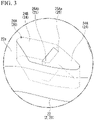
- the first and second chambers 24A and 24B located in the upper right portion of the back member 22 (body 20) in FIG. 2 are connected by two slits 25Aa and 25Ab as shown in FIGS. 2 and 3 .
- the composite chamber 26A including the first and second chambers 24A and 24B and the two slits 25Aa and 25Ab is formed.
- the two slits 25Aa and 25Ab are arranged in the width direction that is orthogonal to the arrangement direction of the first and second chambers 24A and 24B and to the thickness direction of the back member 22 (body 20). Further, the two slits 25Aa and 25Ab are located at both ends of the first and second chambers 24A and 24B in the width direction.
- the third and fourth chambers 24C and 24D are connected by one slit 25C.
- the composite chamber 26C including the third and fourth chambers 24C and 24D and the one slit 25C is formed.
- the one slit 25C is located in the middle of the third and fourth chambers 24C and 24D in the width direction orthogonal to the arrangement direction of the third and fourth chambers 24C and 24D and to the thickness direction of the back member 22 (body 20).
- the slit 25C may be located at an end portion of the third and fourth chambers 24C and 24D in the width direction, for example.
- the 10th chamber 24J is connected to the 9th chamber 241 and the 11th chamber 24K located on both sides thereof by slits 251 and 25J, respectively. That is, the 9th to 11th three chambers 241 to 24K are connected by the slits 251 and 25J. As a result, a composite chamber 26I including the 9th to 11th chambers 241 to 24K and the slits 251 and 25J is formed.
- the mode in which the 9th and 10th chambers 241 and 24J are connected by the slits 251 and the mode in which the 10th and 11th chambers 24J and 24K are connected by the slits 25J are each the same as the mode in which the first and second chambers 24A and 24B are connected by the slits 25Aa and 25Ab.
- the fifth, eighth, 14th and 17th chambers 24E, 24H, 24N, 24Q are not connected to other chambers 24.
- the volume of the composite chamber 26 which includes the two chambers 24 and the slit 25 is larger than the volume of each of the two chambers 24.
- the resonance frequency of the composite chamber 26 is lower than the resonance frequency of each of the two chambers 24. That is, by controlling the volumes of the chambers 24 and 26, it is possible to make the resonance frequencies of the plurality of chambers 24 and 26 formed in the body 20 different from each other. For example, although the resonance frequencies of two chambers 24 having substantially the same volume are approximately the same, by connecting these two chambers 24 with the slit 25, the number of chambers 24 having substantially the same resonance frequency can be reduced.
- the cross-sectional area of the slit 25 connecting the two chambers 24 is smaller than the cross-sectional area of each of the two chambers 24.
- the resonance frequency of the composite chamber 26 including the two chambers 24 and the slit 25 can be controlled by appropriately changing the number of the slits 25 connecting the two chambers 24. Thereby it is possible to control the acoustic phenomenon of the body 20.
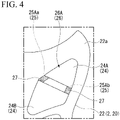
- the body structure 2 may have a sound absorbing material 27 housed in the slit 25, as shown for example in FIG. 4 .
- the sound absorbing material 27 is a member that absorbs sound, such as urethane foam.
- the resonance frequency of the composite chamber 26 including the two chambers 24 and the slit 25 connecting them can be controlled by the sound absorbing material 27.
- the acoustic phenomenon of the body 20 can be controlled.
- the cross-sectional area of the slit 25 may be the same as, for example, the cross-sectional area of each of the two chambers 24.
- the present invention can be applied to an electric guitar, particularly the body of an electric guitar. According to the present invention, it is possible to control the acoustic phenomenon of the body of an electric guitar having a plurality of chambers.
Landscapes
- Physics & Mathematics (AREA)
- Engineering & Computer Science (AREA)
- Acoustics & Sound (AREA)
- Multimedia (AREA)
- Stringed Musical Instruments (AREA)
- Electrophonic Musical Instruments (AREA)
Abstract
Description
- The present invention relates to an electric guitar body-structure and an electric guitar.
- Priority is claimed on
Japanese Patent Application No. 2019-220464, filed December 5, 2019 - Patent Document 1 discloses a technique capable of producing a beautiful and reverberant sound by providing a plurality of grooves on the inner side of the body plate of the hollow body of a stringed instrument such as an acoustic guitar or a violin. A beautiful and reverberant sound is obtained by appropriately controlling the acoustic phenomenon of the body.
- Patent Document 1:
Japanese Unexamined Patent Application, First Publication No. 2001-154662 - In some cases, a plurality of chambers (cavities) are provided in the interior of bodies of electric guitars and the like for weight reduction. However, if there are a plurality of chambers having substantially the same volume in this type of body, the resonance frequencies of the plurality of chambers become substantially the same, giving rise to the necessary to control the acoustic phenomenon of the body. It is difficult to control the acoustic phenomenon of the body even if a plurality of grooves as in Patent Document 1 are provided on the inner surface of the chambers of the body of the electric guitar.
- The present invention has been made in view of the above circumstances, and has as its object to provide an electric guitar body-structure capable of controlling the acoustic phenomenon of a body having a plurality of chambers, and an electric guitar including the same.
- A first aspect of the present invention is an body structure of an electric guitar, including: a body including a first chamber and a second chamber formed spaced apart from each other, and a slit that connects the first chamber and the second chamber.
- A second aspect of the present invention is an electric guitar including the body structure.
- According to the present invention, it is possible to control the acoustic phenomenon of the body of an electric guitar having a plurality of chambers.
-
-
FIG. 1 is a plan view of an electric guitar according to an embodiment of the present invention as viewed from the front side of the body. -
FIG. 2 is a plan view of a back member constituting the body of the electric guitar ofFIG. 1 as viewed from the front side thereof. -
FIG. 3 is an enlarged perspective view showing two chambers and slits in the back member ofFIG. 2 . -
FIG. 4 is an enlarged plan view showing main parts of an electric guitar body according to another embodiment of the present invention. - Hereinbelow, embodiments of the present invention will be described with reference to
FIGS. 1 to 3 . - As shown in
FIG. 1 , an electric guitar 1 according to the present embodiment incudes a body structure 2, aneck 3, andstrings 4. - The
neck 3 is connected to an end portion of the body structure 2 and extends in a direction away from the body structure 2 (upward direction inFIG. 1 ). Ahead 5 forming the distal end portion in the longitudinal direction of theneck 3 is provided withpegs 6 around which an end portion of each of thestrings 4 is wound. Thestrings 4 are stretched along the longitudinal direction of theneck 3. - The body structure 2 includes a body 20. In this embodiment, the body 20 constitutes the entire body structure 2. A
bridge 7, anelectromagnetic pickup 8, controllers, and the like are attached to the body 20. Thebridge 7, theelectromagnetic pickup 8, and the controllers are exposed on afront side surface 20a (hereinafter referred to as thefront surface 20a) of the body 20 facing the thickness direction of the body 20 (direction orthogonal to the paper surface inFIG. 1 ). - One end of each
string 4 is fastened to thebridge 7. Theelectromagnetic pickup 8 is located between theneck 3 and thebridge 7 in the longitudinal direction of theneck 3. A plurality of the electromagnetic pickups 8 (two in the illustrated example) are arranged in the longitudinal direction of theneck 3. The controllers adjust the volume, tone, and the like of the acoustic signal output from theelectromagnetic pickups 8. The controllers include twovolume switches 9, apickup selector 10 for switching theelectromagnetic pickups 8 to be activated, and the like. - The body 20 of the present embodiment has a
top member 21 having a small thickness dimension and a back member 22 (seeFIGS. 2 and3 ) having a thickness dimension larger than that of thetop member 21. Thetop member 21 and theback member 22 overlap with each other in the thickness direction of the body 20 to form the body 20. Thefront surface 20a of the body 20 from which thebridge 7 and the like are exposed is constituted by thetop member 21. - As shown in
FIGS. 2 and3 , the body 20 has a plurality of chambers 24 (19 in the illustrated example) and slits 25. - The plurality of
chambers 24 are cavities formed for weight reduction of the body 20. The plurality ofchambers 24 are formed at intervals from each other. Specifically, the plurality ofchambers 24 are arranged in a direction orthogonal to the thickness direction of the body 20. The plurality ofchambers 24 are formed in a region of the body 20 other than the region to which theneck 3, thebridge 7, theelectromagnetic pickups 8, the controllers (seeFIG. 1 ) and the like are attached, when viewed from the thickness direction of the body 20. Although not shown inFIG. 2 , the body 20 is also formed with holes and recess portions for accommodating thebridge 7, theelectromagnetic pickups 8, and the controllers. - In the present embodiment, the plurality of
chambers 24 are each formed by being recessed from afront surface 22a of theback member 22 facing thetop member 21. The plurality ofchambers 24 become cavities that each do not open to the outside of the body 20 by superimposing thetop member 21 on thefront surface 22a of theback member 22. - The
slit 25 connects two chambers 24 (first chamber 24A andsecond chamber 24B) adjacent to each other among the plurality ofchambers 24. Theslit 25, similarly to thechambers 24, does not open to the outside of the body 20. - The
slit 25 extends in the arrangement direction of the twochambers 24. The direction in which theslit 25 extends may be parallel to the arrangement direction of the twochambers 24, or may be inclined thereto. - The cross-sectional area of the
slit 25 orthogonal to the arrangement direction of the twochambers 24 is smaller than each cross-sectional area of the twochambers 24 orthogonal to the arrangement direction of the twochambers 24. The cross-sectional area of eachchamber 24 used for comparison with the cross-sectional area of theslit 25 may be, for example, the cross-sectional area of thechamber 24 at the maximum in the arrangement direction of the twochambers 24. - The volume of the
slit 25 is sufficiently smaller than the volume of each of the twochambers 24. - The number of
slits 25 connecting the twochambers 24 may be one or two or more (a plurality). When the number ofslits 25 is a plurality, the total cross-sectional area of the plurality ofslits 25 is smaller than each cross-sectional area of the twochambers 24. Further, the total volume of the plurality ofslits 25 is sufficiently small as compared with each volume of the twochambers 24. - Similar to the
chamber 24, theslit 25 of the present embodiment is formed by being recessed from thefront surface 22a of theback member 22. InFIG. 3 , the depth dimension of theslit 25 is the same as the depth dimension of thechamber 24, but for example may be smaller than the depth dimension of thechamber 24. Also, theslit 25 may be formed so as not to open to thefront surface 22a of theback member 22, for example. - The volumes of the two chambers 24 (
first chamber 24 and second chamber 24) connected to each other by theslit 25 may be, for example, substantially the same. The fact that the volumes of the twochambers 24 are substantially the same means that, for example, the ratio of the volume of thesecond chamber 24 to thefirst chamber 24 is 70% or more and 130% or less. - By connecting the two
chambers 24 to each other with theslit 25, a new chamber 26 (hereinbelow referred to as a composite chamber 26) including the twochambers 24 and theslit 25 is formed. The volume of thecomposite chamber 26 is larger than the volume of each of the twochambers 24. - The
aforementioned chambers 24 and theslit 25 will be described more specifically. - As shown in
FIG. 2 , 19 of the chambers 24 (24A to 24S) are lined up substantially along the edge of theback member 22 as seen from thefront surface 22a side. In the following description, the numbers 1, 2, ... 18 and 19 are attached in an approximately clockwise order from thechamber 24A located at the upper right of the back member 22 (body 20) to thechamber 24S located at the upper left. - The first and
second chambers FIG. 2 are connected by two slits 25Aa and 25Ab as shown inFIGS. 2 and3 . As a result, thecomposite chamber 26A including the first andsecond chambers second chambers second chambers - As shown in
FIG. 2 , a mode in which sixth andseventh chambers slit 25F to form acomposite chamber 26F, a mode in which 12th and13th chambers slit 25L to form acomposite chamber 26L, a mode in which 15th and16th chambers 24O and 24P are connected by a slit 25O to form a composite chamber 26O, and a mode in which 18th and19th chambers slit 25R to form acomposite chamber 26R are all the same as the mode in which the first andsecond chambers composite chamber 26A. - The third and
fourth chambers slit 25C. As a result, thecomposite chamber 26C including the third andfourth chambers slit 25C is formed. The oneslit 25C is located in the middle of the third andfourth chambers fourth chambers slit 25C may be located at an end portion of the third andfourth chambers - The
10th chamber 24J is connected to the9th chamber 241 and the11th chamber 24K located on both sides thereof byslits chambers 241 to 24K are connected by theslits 11th chambers 241 to 24K and theslits 10th chambers slits 251 and the mode in which the 10th and11th chambers slits 25J are each the same as the mode in which the first andsecond chambers - The fifth, eighth, 14th and
17th chambers other chambers 24. - As described above, according to the body structure 2 of the present embodiment and the electric guitar 1 including the body structure 2, by connecting the two
chambers 24 with theslit 25, the volume of thecomposite chamber 26 which includes the twochambers 24 and theslit 25 is larger than the volume of each of the twochambers 24. As a result, the resonance frequency of thecomposite chamber 26 is lower than the resonance frequency of each of the twochambers 24. That is, by controlling the volumes of thechambers chambers chambers 24 having substantially the same volume are approximately the same, by connecting these twochambers 24 with theslit 25, the number ofchambers 24 having substantially the same resonance frequency can be reduced. - This makes it possible to control the acoustic phenomenon of the body 20. Accordingly, even the body 20 of the electric guitar 1 having a plurality of weight-reducing
chambers 24 can generate a beautiful and reverberant sound. - Further, in the body structure 2 of the present embodiment, the cross-sectional area of the
slit 25 connecting the twochambers 24 is smaller than the cross-sectional area of each of the twochambers 24. As a result, it is possible to secure a chamber having a large volume (that is, the composite chamber 26) while suppressing a decrease in the rigidity of the body 20. - In the body structure 2 of the present embodiment, the resonance frequency of the
composite chamber 26 including the twochambers 24 and theslit 25 can be controlled by appropriately changing the number of theslits 25 connecting the twochambers 24. Thereby it is possible to control the acoustic phenomenon of the body 20. - Although the present invention has been described in detail above, the present invention is not limited to the above embodiments, and various modifications can be made without departing from the spirit of the present invention.
- In the present invention, the body structure 2 may have a
sound absorbing material 27 housed in theslit 25, as shown for example inFIG. 4 . Thesound absorbing material 27 is a member that absorbs sound, such as urethane foam. In such a configuration, the resonance frequency of thecomposite chamber 26 including the twochambers 24 and theslit 25 connecting them can be controlled by thesound absorbing material 27. Thereby, the acoustic phenomenon of the body 20 can be controlled. - In the present invention, the cross-sectional area of the
slit 25 may be the same as, for example, the cross-sectional area of each of the twochambers 24. - The present invention can be applied to an electric guitar, particularly the body of an electric guitar. According to the present invention, it is possible to control the acoustic phenomenon of the body of an electric guitar having a plurality of chambers.
-
- 1: Electric guitar
- 2: Body structure
- 20: Body
- 24: Chamber
- 25: Slit
- 27: Sound absorbing material
Claims (6)
- A body structure of an electric guitar, comprising:
a body comprising a first chamber and a second chamber formed spaced apart from each other, and a slit that connects the first chamber and the second chamber. - The electric guitar of the electric guitar according to claim 1, wherein a cross-sectional area of the slit that is orthogonal to an arrangement direction of the first chamber and the second chamber is smaller than a cross-sectional area of the first chamber and the second chamber that is orthogonal to the arrangement direction.
- The electric guitar of the electric guitar according to claim 1 or 2, wherein a ratio of a volume of the second chamber to a volume of the first chamber is 70% or more and 130% or less.
- The electric guitar of the electric guitar according to any one of claims 1 to 3, wherein the body comprises a plurality of the slits.
- The electric guitar of the electric guitar according to any one of claims 1 to 4, further comprising a sound absorbing material housed in the slit.
- An electric guitar comprising the body structure according to any one of claims 1 to 5.
Applications Claiming Priority (2)
| Application Number | Priority Date | Filing Date | Title |
|---|---|---|---|
| JP2019220464A JP7480499B2 (en) | 2019-12-05 | 2019-12-05 | Electric guitar body structure and electric guitar |
| PCT/JP2020/045271 WO2021112230A1 (en) | 2019-12-05 | 2020-12-04 | Electric guitar body-structure and electric guitar |
Publications (3)
| Publication Number | Publication Date |
|---|---|
| EP4071749A1 true EP4071749A1 (en) | 2022-10-12 |
| EP4071749A4 EP4071749A4 (en) | 2023-11-29 |
| EP4071749B1 EP4071749B1 (en) | 2024-11-20 |
Family
ID=76220156
Family Applications (1)
| Application Number | Title | Priority Date | Filing Date |
|---|---|---|---|
| EP20896673.9A Active EP4071749B1 (en) | 2019-12-05 | 2020-12-04 | Electric guitar body-structure and electric guitar |
Country Status (5)
| Country | Link |
|---|---|
| US (2) | US12626676B2 (en) |
| EP (1) | EP4071749B1 (en) |
| JP (2) | JP7480499B2 (en) |
| CN (1) | CN114616617B (en) |
| WO (1) | WO2021112230A1 (en) |
Families Citing this family (1)
| Publication number | Priority date | Publication date | Assignee | Title |
|---|---|---|---|---|
| USD1100029S1 (en) * | 2024-02-25 | 2025-10-28 | Weifang Hengyi Musical Instrument Co., Ltd | Electric guitar |
Family Cites Families (10)
| Publication number | Priority date | Publication date | Assignee | Title |
|---|---|---|---|---|
| US4290336A (en) * | 1979-03-28 | 1981-09-22 | Peavey Hartley D | Molded guitar structure and method of making same |
| US4334452A (en) * | 1980-07-11 | 1982-06-15 | Norlin Industries, Inc. | Plastic musical instrument body having structural insert |
| JP2001154662A (en) | 1999-11-29 | 2001-06-08 | Sumio Yamamoto | Body of stringed instrument |
| US20100031807A1 (en) | 2008-08-08 | 2010-02-11 | 117506 Canada Inc. | Chambered Electric Guitar |
| US7863507B2 (en) | 2008-10-27 | 2011-01-04 | Ayers Jeffrey L | Semi-hollow body for stringed instruments |
| US8648238B1 (en) * | 2012-08-02 | 2014-02-11 | James A Trabits | String instrument |
| US9911401B2 (en) * | 2014-12-09 | 2018-03-06 | Aero 3 Guitars | Electric guitar |
| US10424276B1 (en) * | 2018-03-19 | 2019-09-24 | Fender Musical Instruments Corporation | Stringed instrument resonance system |
| JP6771072B2 (en) | 2018-06-15 | 2020-10-21 | 日本碍子株式会社 | Electrolytes for electrochemical cells and electrochemical cells |
| US11030982B1 (en) * | 2019-11-26 | 2021-06-08 | Tajine Monjardo | Lightweight guitar body having prismatic effect and improved sound quality and method of producing thereof |
-
2019
- 2019-12-05 JP JP2019220464A patent/JP7480499B2/en active Active
-
2020
- 2020-12-04 EP EP20896673.9A patent/EP4071749B1/en active Active
- 2020-12-04 WO PCT/JP2020/045271 patent/WO2021112230A1/en not_active Ceased
- 2020-12-04 CN CN202080075262.8A patent/CN114616617B/en active Active
-
2022
- 2022-04-25 US US17/728,253 patent/US12626676B2/en active Active
-
2023
- 2023-08-29 US US18/457,430 patent/US12417754B2/en active Active
-
2024
- 2024-04-23 JP JP2024070002A patent/JP7663147B2/en active Active
Also Published As
| Publication number | Publication date |
|---|---|
| JP2024087013A (en) | 2024-06-28 |
| US12626676B2 (en) | 2026-05-12 |
| CN114616617B (en) | 2025-11-25 |
| JP2025061967A (en) | 2025-04-11 |
| US20230402022A1 (en) | 2023-12-14 |
| JP7480499B2 (en) | 2024-05-10 |
| CN114616617A (en) | 2022-06-10 |
| US12417754B2 (en) | 2025-09-16 |
| WO2021112230A1 (en) | 2021-06-10 |
| EP4071749A4 (en) | 2023-11-29 |
| JP7663147B2 (en) | 2025-04-16 |
| EP4071749B1 (en) | 2024-11-20 |
| JP2021089386A (en) | 2021-06-10 |
| US20220246115A1 (en) | 2022-08-04 |
Similar Documents
| Publication | Publication Date | Title |
|---|---|---|
| US6051764A (en) | Stringed musical instrument formed from bamboo plates | |
| JP7663147B2 (en) | Electric guitar body structure and electric guitar | |
| US906612A (en) | Stringed musical instrument. | |
| JP7860552B2 (en) | Body structure of electric guitar and electric guitar | |
| EP3543997B1 (en) | Body for stringed instrument and stringed instrument | |
| JP6485131B2 (en) | Musical instrument | |
| US10311837B1 (en) | Enhanced string instrument | |
| US6696627B2 (en) | Support structure for a stringed instrument | |
| US1273459A (en) | Soundboard. | |
| EP2817798B1 (en) | Keyboard instrument | |
| EP4050596B1 (en) | Stringed musical instrument | |
| DE19755855A1 (en) | Stringed instrument, e.g. guitar, lute, sitar or mandolin | |
| JP7279449B2 (en) | Musical instruments and boards for musical instruments | |
| US20210125586A1 (en) | Panel board for musical instrument | |
| Bethea | Divinity | |
| RU2692430C1 (en) | Method of extracting sound in a pneumatic tongue musical instrument and a voice plate of a sound-forming device of a pneumatic reed musical instrument for realizing the method | |
| JP2023139528A (en) | Tone plate percussion instrument and method for manufacturing tone plate percussion instrument | |
| US934413A (en) | Violin. | |
| BRPI0612163A2 (en) | flat plate musical instrument | |
| JP2017090861A (en) | Stringed instrument | |
| CA2780824A1 (en) | Melodeon with interchangeable pitch, electronic tone control or combination thereof | |
| DE102007002068A1 (en) | Stringed instrument e.g. plucked stringed instrument, for producing tone, has half-shell tapering in observation direction over larger part of its entire extension of end of hollow body, where direction runs perpendicular to strings | |
| WO2019087768A1 (en) | Musical instrument | |
| GB2370909A (en) | Improvements to guitars |
Legal Events
| Date | Code | Title | Description |
|---|---|---|---|
| STAA | Information on the status of an ep patent application or granted ep patent |
Free format text: STATUS: THE INTERNATIONAL PUBLICATION HAS BEEN MADE |
|
| PUAI | Public reference made under article 153(3) epc to a published international application that has entered the european phase |
Free format text: ORIGINAL CODE: 0009012 |
|
| STAA | Information on the status of an ep patent application or granted ep patent |
Free format text: STATUS: REQUEST FOR EXAMINATION WAS MADE |
|
| 17P | Request for examination filed |
Effective date: 20220504 |
|
| AK | Designated contracting states |
Kind code of ref document: A1 Designated state(s): AL AT BE BG CH CY CZ DE DK EE ES FI FR GB GR HR HU IE IS IT LI LT LU LV MC MK MT NL NO PL PT RO RS SE SI SK SM TR |
|
| DAV | Request for validation of the european patent (deleted) | ||
| DAX | Request for extension of the european patent (deleted) | ||
| A4 | Supplementary search report drawn up and despatched |
Effective date: 20231030 |
|
| RIC1 | Information provided on ipc code assigned before grant |
Ipc: G10D 1/08 20060101ALI20231024BHEP Ipc: G10H 3/18 20060101AFI20231024BHEP |
|
| STAA | Information on the status of an ep patent application or granted ep patent |
Free format text: STATUS: EXAMINATION IS IN PROGRESS |
|
| 17Q | First examination report despatched |
Effective date: 20240612 |
|
| GRAP | Despatch of communication of intention to grant a patent |
Free format text: ORIGINAL CODE: EPIDOSNIGR1 |
|
| STAA | Information on the status of an ep patent application or granted ep patent |
Free format text: STATUS: GRANT OF PATENT IS INTENDED |
|
| INTG | Intention to grant announced |
Effective date: 20240729 |
|
| GRAS | Grant fee paid |
Free format text: ORIGINAL CODE: EPIDOSNIGR3 |
|
| GRAA | (expected) grant |
Free format text: ORIGINAL CODE: 0009210 |
|
| STAA | Information on the status of an ep patent application or granted ep patent |
Free format text: STATUS: THE PATENT HAS BEEN GRANTED |
|
| AK | Designated contracting states |
Kind code of ref document: B1 Designated state(s): AL AT BE BG CH CY CZ DE DK EE ES FI FR GB GR HR HU IE IS IT LI LT LU LV MC MK MT NL NO PL PT RO RS SE SI SK SM TR |
|
| REG | Reference to a national code |
Ref country code: GB Ref legal event code: FG4D |
|
| REG | Reference to a national code |
Ref country code: CH Ref legal event code: EP |
|
| REG | Reference to a national code |
Ref country code: DE Ref legal event code: R096 Ref document number: 602020041857 Country of ref document: DE |
|
| REG | Reference to a national code |
Ref country code: IE Ref legal event code: FG4D |
|
| REG | Reference to a national code |
Ref country code: LT Ref legal event code: MG9D |
|
| REG | Reference to a national code |
Ref country code: NL Ref legal event code: MP Effective date: 20241120 |
|
| PG25 | Lapsed in a contracting state [announced via postgrant information from national office to epo] |
Ref country code: PT Free format text: LAPSE BECAUSE OF FAILURE TO SUBMIT A TRANSLATION OF THE DESCRIPTION OR TO PAY THE FEE WITHIN THE PRESCRIBED TIME-LIMIT Effective date: 20250320 Ref country code: IS Free format text: LAPSE BECAUSE OF FAILURE TO SUBMIT A TRANSLATION OF THE DESCRIPTION OR TO PAY THE FEE WITHIN THE PRESCRIBED TIME-LIMIT Effective date: 20250320 Ref country code: HR Free format text: LAPSE BECAUSE OF FAILURE TO SUBMIT A TRANSLATION OF THE DESCRIPTION OR TO PAY THE FEE WITHIN THE PRESCRIBED TIME-LIMIT Effective date: 20241120 |
|
| PG25 | Lapsed in a contracting state [announced via postgrant information from national office to epo] |
Ref country code: NL Free format text: LAPSE BECAUSE OF FAILURE TO SUBMIT A TRANSLATION OF THE DESCRIPTION OR TO PAY THE FEE WITHIN THE PRESCRIBED TIME-LIMIT Effective date: 20241120 Ref country code: FI Free format text: LAPSE BECAUSE OF FAILURE TO SUBMIT A TRANSLATION OF THE DESCRIPTION OR TO PAY THE FEE WITHIN THE PRESCRIBED TIME-LIMIT Effective date: 20241120 |
|
| REG | Reference to a national code |
Ref country code: AT Ref legal event code: MK05 Ref document number: 1744329 Country of ref document: AT Kind code of ref document: T Effective date: 20241120 |
|
| PG25 | Lapsed in a contracting state [announced via postgrant information from national office to epo] |
Ref country code: BG Free format text: LAPSE BECAUSE OF FAILURE TO SUBMIT A TRANSLATION OF THE DESCRIPTION OR TO PAY THE FEE WITHIN THE PRESCRIBED TIME-LIMIT Effective date: 20241120 |
|
| PG25 | Lapsed in a contracting state [announced via postgrant information from national office to epo] |
Ref country code: ES Free format text: LAPSE BECAUSE OF FAILURE TO SUBMIT A TRANSLATION OF THE DESCRIPTION OR TO PAY THE FEE WITHIN THE PRESCRIBED TIME-LIMIT Effective date: 20241120 |
|
| PG25 | Lapsed in a contracting state [announced via postgrant information from national office to epo] |
Ref country code: NO Free format text: LAPSE BECAUSE OF FAILURE TO SUBMIT A TRANSLATION OF THE DESCRIPTION OR TO PAY THE FEE WITHIN THE PRESCRIBED TIME-LIMIT Effective date: 20250220 |
|
| PG25 | Lapsed in a contracting state [announced via postgrant information from national office to epo] |
Ref country code: GR Free format text: LAPSE BECAUSE OF FAILURE TO SUBMIT A TRANSLATION OF THE DESCRIPTION OR TO PAY THE FEE WITHIN THE PRESCRIBED TIME-LIMIT Effective date: 20250221 Ref country code: AT Free format text: LAPSE BECAUSE OF FAILURE TO SUBMIT A TRANSLATION OF THE DESCRIPTION OR TO PAY THE FEE WITHIN THE PRESCRIBED TIME-LIMIT Effective date: 20241120 Ref country code: LV Free format text: LAPSE BECAUSE OF FAILURE TO SUBMIT A TRANSLATION OF THE DESCRIPTION OR TO PAY THE FEE WITHIN THE PRESCRIBED TIME-LIMIT Effective date: 20241120 |
|
| PG25 | Lapsed in a contracting state [announced via postgrant information from national office to epo] |
Ref country code: PL Free format text: LAPSE BECAUSE OF FAILURE TO SUBMIT A TRANSLATION OF THE DESCRIPTION OR TO PAY THE FEE WITHIN THE PRESCRIBED TIME-LIMIT Effective date: 20241120 |
|
| PG25 | Lapsed in a contracting state [announced via postgrant information from national office to epo] |
Ref country code: RS Free format text: LAPSE BECAUSE OF FAILURE TO SUBMIT A TRANSLATION OF THE DESCRIPTION OR TO PAY THE FEE WITHIN THE PRESCRIBED TIME-LIMIT Effective date: 20250220 |
|
| PG25 | Lapsed in a contracting state [announced via postgrant information from national office to epo] |
Ref country code: SM Free format text: LAPSE BECAUSE OF FAILURE TO SUBMIT A TRANSLATION OF THE DESCRIPTION OR TO PAY THE FEE WITHIN THE PRESCRIBED TIME-LIMIT Effective date: 20241120 |
|
| PG25 | Lapsed in a contracting state [announced via postgrant information from national office to epo] |
Ref country code: DK Free format text: LAPSE BECAUSE OF FAILURE TO SUBMIT A TRANSLATION OF THE DESCRIPTION OR TO PAY THE FEE WITHIN THE PRESCRIBED TIME-LIMIT Effective date: 20241120 |
|
| PG25 | Lapsed in a contracting state [announced via postgrant information from national office to epo] |
Ref country code: EE Free format text: LAPSE BECAUSE OF FAILURE TO SUBMIT A TRANSLATION OF THE DESCRIPTION OR TO PAY THE FEE WITHIN THE PRESCRIBED TIME-LIMIT Effective date: 20241120 |
|
| PG25 | Lapsed in a contracting state [announced via postgrant information from national office to epo] |
Ref country code: RO Free format text: LAPSE BECAUSE OF FAILURE TO SUBMIT A TRANSLATION OF THE DESCRIPTION OR TO PAY THE FEE WITHIN THE PRESCRIBED TIME-LIMIT Effective date: 20241120 |
|
| PG25 | Lapsed in a contracting state [announced via postgrant information from national office to epo] |
Ref country code: SK Free format text: LAPSE BECAUSE OF FAILURE TO SUBMIT A TRANSLATION OF THE DESCRIPTION OR TO PAY THE FEE WITHIN THE PRESCRIBED TIME-LIMIT Effective date: 20241120 |
|
| PG25 | Lapsed in a contracting state [announced via postgrant information from national office to epo] |
Ref country code: CZ Free format text: LAPSE BECAUSE OF FAILURE TO SUBMIT A TRANSLATION OF THE DESCRIPTION OR TO PAY THE FEE WITHIN THE PRESCRIBED TIME-LIMIT Effective date: 20241120 |
|
| PG25 | Lapsed in a contracting state [announced via postgrant information from national office to epo] |
Ref country code: IT Free format text: LAPSE BECAUSE OF FAILURE TO SUBMIT A TRANSLATION OF THE DESCRIPTION OR TO PAY THE FEE WITHIN THE PRESCRIBED TIME-LIMIT Effective date: 20241120 |
|
| REG | Reference to a national code |
Ref country code: CH Ref legal event code: PL |
|
| PG25 | Lapsed in a contracting state [announced via postgrant information from national office to epo] |
Ref country code: LU Free format text: LAPSE BECAUSE OF NON-PAYMENT OF DUE FEES Effective date: 20241204 |
|
| REG | Reference to a national code |
Ref country code: DE Ref legal event code: R097 Ref document number: 602020041857 Country of ref document: DE |
|
| PG25 | Lapsed in a contracting state [announced via postgrant information from national office to epo] |
Ref country code: SE Free format text: LAPSE BECAUSE OF FAILURE TO SUBMIT A TRANSLATION OF THE DESCRIPTION OR TO PAY THE FEE WITHIN THE PRESCRIBED TIME-LIMIT Effective date: 20241120 |
|
| PG25 | Lapsed in a contracting state [announced via postgrant information from national office to epo] |
Ref country code: MC Free format text: LAPSE BECAUSE OF FAILURE TO SUBMIT A TRANSLATION OF THE DESCRIPTION OR TO PAY THE FEE WITHIN THE PRESCRIBED TIME-LIMIT Effective date: 20241120 |
|
| PLBE | No opposition filed within time limit |
Free format text: ORIGINAL CODE: 0009261 |
|
| STAA | Information on the status of an ep patent application or granted ep patent |
Free format text: STATUS: NO OPPOSITION FILED WITHIN TIME LIMIT |
|
| REG | Reference to a national code |
Ref country code: BE Ref legal event code: MM Effective date: 20241231 |
|
| PG25 | Lapsed in a contracting state [announced via postgrant information from national office to epo] |
Ref country code: BE Free format text: LAPSE BECAUSE OF NON-PAYMENT OF DUE FEES Effective date: 20241231 |
|
| PG25 | Lapsed in a contracting state [announced via postgrant information from national office to epo] |
Ref country code: CH Free format text: LAPSE BECAUSE OF NON-PAYMENT OF DUE FEES Effective date: 20241231 |
|
| 26N | No opposition filed |
Effective date: 20250821 |
|
| PG25 | Lapsed in a contracting state [announced via postgrant information from national office to epo] |
Ref country code: IE Free format text: LAPSE BECAUSE OF NON-PAYMENT OF DUE FEES Effective date: 20241204 |
|
| PGFP | Annual fee paid to national office [announced via postgrant information from national office to epo] |
Ref country code: DE Payment date: 20251211 Year of fee payment: 6 |
|
| PGFP | Annual fee paid to national office [announced via postgrant information from national office to epo] |
Ref country code: GB Payment date: 20251219 Year of fee payment: 6 |
|
| PGFP | Annual fee paid to national office [announced via postgrant information from national office to epo] |
Ref country code: FR Payment date: 20251229 Year of fee payment: 6 |
|
| PG25 | Lapsed in a contracting state [announced via postgrant information from national office to epo] |
Ref country code: CY Free format text: LAPSE BECAUSE OF FAILURE TO SUBMIT A TRANSLATION OF THE DESCRIPTION OR TO PAY THE FEE WITHIN THE PRESCRIBED TIME-LIMIT; INVALID AB INITIO Effective date: 20201204 |