EP4071585A1 - Apparatus and method for generating an audio signal - Google Patents
Apparatus and method for generating an audio signal Download PDFInfo
- Publication number
- EP4071585A1 EP4071585A1 EP21167514.5A EP21167514A EP4071585A1 EP 4071585 A1 EP4071585 A1 EP 4071585A1 EP 21167514 A EP21167514 A EP 21167514A EP 4071585 A1 EP4071585 A1 EP 4071585A1
- Authority
- EP
- European Patent Office
- Prior art keywords
- audio
- image
- real world
- objects
- interaction
- Prior art date
- Legal status (The legal status is an assumption and is not a legal conclusion. Google has not performed a legal analysis and makes no representation as to the accuracy of the status listed.)
- Withdrawn
Links
Images


Classifications
-
- G—PHYSICS
- G06—COMPUTING OR CALCULATING; COUNTING
- G06F—ELECTRIC DIGITAL DATA PROCESSING
- G06F3/00—Input arrangements for transferring data to be processed into a form capable of being handled by the computer; Output arrangements for transferring data from processing unit to output unit, e.g. interface arrangements
- G06F3/16—Sound input; Sound output
-
- G—PHYSICS
- G06—COMPUTING OR CALCULATING; COUNTING
- G06F—ELECTRIC DIGITAL DATA PROCESSING
- G06F3/00—Input arrangements for transferring data to be processed into a form capable of being handled by the computer; Output arrangements for transferring data from processing unit to output unit, e.g. interface arrangements
- G06F3/01—Input arrangements or combined input and output arrangements for interaction between user and computer
- G06F3/011—Arrangements for interaction with the human body, e.g. for user immersion in virtual reality
-
- G—PHYSICS
- G06—COMPUTING OR CALCULATING; COUNTING
- G06F—ELECTRIC DIGITAL DATA PROCESSING
- G06F3/00—Input arrangements for transferring data to be processed into a form capable of being handled by the computer; Output arrangements for transferring data from processing unit to output unit, e.g. interface arrangements
- G06F3/16—Sound input; Sound output
- G06F3/167—Audio in a user interface, e.g. using voice commands for navigating, audio feedback
-
- G—PHYSICS
- G06—COMPUTING OR CALCULATING; COUNTING
- G06T—IMAGE DATA PROCESSING OR GENERATION, IN GENERAL
- G06T19/00—Manipulating three-dimensional [3D] models or images for computer graphics
- G06T19/006—Mixed reality
-
- G—PHYSICS
- G06—COMPUTING OR CALCULATING; COUNTING
- G06T—IMAGE DATA PROCESSING OR GENERATION, IN GENERAL
- G06T7/00—Image analysis
- G06T7/70—Determining position or orientation of objects or cameras
-
- G—PHYSICS
- G06—COMPUTING OR CALCULATING; COUNTING
- G06V—IMAGE OR VIDEO RECOGNITION OR UNDERSTANDING
- G06V10/00—Arrangements for image or video recognition or understanding
- G06V10/20—Image preprocessing
- G06V10/22—Image preprocessing by selection of a specific region containing or referencing a pattern; Locating or processing of specific regions to guide the detection or recognition
-
- G—PHYSICS
- G06—COMPUTING OR CALCULATING; COUNTING
- G06V—IMAGE OR VIDEO RECOGNITION OR UNDERSTANDING
- G06V20/00—Scenes; Scene-specific elements
- G06V20/20—Scenes; Scene-specific elements in augmented reality scenes
-
- G—PHYSICS
- G06—COMPUTING OR CALCULATING; COUNTING
- G06V—IMAGE OR VIDEO RECOGNITION OR UNDERSTANDING
- G06V20/00—Scenes; Scene-specific elements
- G06V20/40—Scenes; Scene-specific elements in video content
-
- G—PHYSICS
- G06—COMPUTING OR CALCULATING; COUNTING
- G06T—IMAGE DATA PROCESSING OR GENERATION, IN GENERAL
- G06T2207/00—Indexing scheme for image analysis or image enhancement
- G06T2207/10—Image acquisition modality
- G06T2207/10016—Video; Image sequence
Definitions
- the invention relates to an apparatus and method for generating an audio signal for interactions between virtual and real world scene objects, and in particular, but not exclusively, for generating an audio signal for Augmented Reality applications.
- VR Virtual Reality
- AR Augmented Reality
- MR Mixed Reality
- a number of standards are also under development by a number of standardization bodies. Such standardization activities are actively developing standards for the various aspects of VR/AR/MR systems including e.g. streaming, broadcasting, rendering, etc.
- VR applications tend to provide user experiences corresponding to the user being in a different world/ environment/ scene whereas AR (including Mixed Reality MR) applications tend to provide user experiences corresponding to the user being in the real local environment but with additional information or virtual objects or information being added.
- VR applications tend to provide a fully immersive synthetically generated world/ scene
- AR applications tend to provide a partially synthetic world/ scene which is overlaid the real scene in which the user is physically present.
- Augmented Reality/ AR will be used to denote both Augmented Reality and Mixed Reality (as well as some variations sometimes denoted Virtual Reality).
- augmented reality applications As an example, services and applications for augmented reality using handheld devices have become increasingly popular and software APIs (Application Programming Interfaces) and toolkits, such as ARKit (developed by Apple Inc.) and ARCore (developed by Google Inc.) have been introduced to support augmented reality applications on smart phones and tablets.
- software APIs Application Programming Interfaces
- toolkits such as ARKit (developed by Apple Inc.) and ARCore (developed by Google Inc.)
- ARKit developed by Apple Inc.
- ARCore developed by Google Inc.
- applications may for example generate a live video feed with graphic objects overlaying the live video.
- graphic objects may for example be used to position virtual objects so that they are perceived to be present in the real world scene.
- headsets and glasses have been developed where the real world scene may be viewed directly through AR glasses but with these also being capable of generating images that are seen by the user when looking through the glasses. This may also be used to present virtual images that are perceived to be part of the viewed real-world scene.
- Motion sensors are used to track the head movements and the presented virtual object may be adapted correspondingly to provide an impression of the virtual object being a real-world object viewed in the real world.
- the approaches are respectively known as pass-through and see-through and both may provide a novel and exciting user experience.
- some AR applications may provide a corresponding audio experience.
- audio may correspond to virtual objects. For example, if a virtual object is one that would generate a noise, the visual presentation of the object may be supplemented by a corresponding sound being generated. In some cases, a sound may also be generated to reflect an action for the virtual object.
- the sound is generated as a default sound by rendering a pre-recorded audio clip at appropriate times.
- the sound may in some cases be adapted to reflect the current environment, such as for example by adapting the perceived reverberation depending on the current environment, or may e.g. be processed to be perceived to arrive from a position corresponding to the perceived position of the virtual object in the real world. Often such positioning may be achieved by binaural processing to generate a suitable headphone audio output.
- an improved approach would be advantageous.
- an approach of generating an audio signal that allows improved operation, increased flexibility, reduced complexity, facilitated implementation, an improved audio experience, improved audio quality, reduced computational burden, improved suitability and/or performance for mixed/ augmented reality applications, improved user immersion, and/or improved performance and/or operation would be advantageous.
- the Invention seeks to preferably mitigate, alleviate or eliminate one or more of the above mentioned disadvantages singly or in any combination.
- an apparatus for generating an output audio signal comprising: a first receiver arranged to receive a real time image sequence of a real world scene from an image sensor, the real time image sequence comprising a sequence of image frames, each image frame comprising at least one of visual image data and depth image data; a second receiver arranged to receive a set of audio objects and metadata for audio objects of the set of audio objects, the metadata being indicative of links between audio objects of the set of audio objects and material characteristics; an image generator arranged to generate an output image sequence comprising an image object corresponding to a virtual scene object in the real world scene; a detector arranged to detect an interaction between the virtual scene object and a real world scene object of the real world scene; an estimator arranged to determine a material property for the real world scene object in response to image data of the sequence of image frames; a selector arranged to select a first audio object of the set of audio objects in response to the material property and the material characteristics linked to audio objects of the set of audio objects; and an output
- the invention may provide an improved user experience in many embodiments and may in particular in many embodiments provide an improved and more immersive Augmented Reality experience.
- the approach may in many embodiments be achieved while maintaining low complexity and/or implementation.
- the approach may be highly suitable for an AR system where audio and supporting metadata may be provided by a remote server.
- the approach may facilitate and/or support a system where a centralized server may provide support for a number of remote clients and may substantially facilitate implementation of the remote client.
- the approach may support a centralized generation and management of audio for enhancing an AR application and experience.
- the audio objects may be audio clips/ fragments/ etc. and may be represented in any suitable way.
- each audio object may represent a sound in a time interval.
- the time interval may not exceed 5 seconds, 10 seconds, or 20 seconds for any of the audio objects.
- the material characteristics may be material characteristics of real world objects.
- the output image sequence may comprise visual images.
- the estimator is arranged to: determine an interaction image region in at least one image frame of the sequence of image frames, the interaction image region being an image region of the at least one image frame in which the interaction occurs; and determine the material property for the scene object in response to image data of the interaction image region.
- This may provide a particularly efficient and/or advantageous material property estimation in many embodiments, and may specifically allow a more accurate material property estimation in many embodiments.
- the approach may provide an improved user experience as a result.
- the second receiver is arranged to receive the metadata from a remote server.
- the approach may provide a particularly efficient application where audio may be remotely, and possibly centrally, generated and managed while being effectively adapted locally to the appropriate current conditions.
- the metadata for at least some audio objects comprises indications of links between the at least some audio objects and material characteristics of real world scene objects and links between the at least some audio objects and material characteristics of virtual scene objects; and wherein the selector is arranged to select the first audio object in response to the material property and material characteristics of real world objects linked to the set of audio objects and in response to a material property of the virtual scene object and material characteristics of virtual scene objects linked to the set of audio objects.
- the selector is arranged to select the first audio object in response to a dynamic property of the virtual scene object.
- the detector is arranged to determine a property of the interaction and the selector is arranged to select the first audio object in response to the property of the interaction.
- the property of the interaction is at least one property selected from the group of: a speed of the interaction; a force of a collision between the virtual scene object and the real world scene object; an elasticity of a collision between the virtual scene object and the real world scene object; a duration of the interaction; and a direction of movement of the virtual scene object relative to the real world scene object.
- the selector is arranged to select the first audio object in response to an orientation of the virtual object relative to the real world scene object.
- the categorization/ classification may advantageously be achieved using a neural network.
- the apparatus further comprises an audio receiver for receiving an audio signal of real time audio captured in the real world scene, and wherein the estimator is arranged to determine the match indication in response to the audio signal.
- Such an approach may in many embodiments substantially improve the accuracy of the material property estimating leading to improved overall performance.
- the selector is arranged to select the first audio object as a default audio object if no audio object is detected for which a selection criterion is met.
- At least one image frame comprises depth image data and wherein the estimator is arranged to determine the material property for the real world scene object in response to a detection that at least part of an image region of the at least one image frame representing the real world scene object has a confidence level for depth image data that does not exceed a threshold.
- the image frame comprises visual image data and depth image data and the estimator is arranged to determine the real world scene object to have a metallic component in response to a detection that for at least part of the image region a brightness of the visual image data exceeds a threshold and a confidence level for depth image data does not exceed a threshold.
- a method of generating an output audio signal comprising: receiving a real time image sequence of a real world scene from an image sensor, the real time image sequence comprising a sequence of image frames, each image frame comprising at least one of visual image data and depth image data; receiving a set of audio objects and metadata for audio objects of the set of audio objects, the metadata being indicative of links between audio objects of the set of audio objects and material characteristics; generating an output image sequence comprising an image object corresponding to a virtual scene object in the real world scene; detecting an interaction between the virtual scene object and a real world scene object of the real world scene; determining a material property for the real world scene object in response to image data of the sequence of image frames; selecting a first audio object of the set of audio objects in response to the material property and the material characteristics linked to audio objects of the set of audio objects; and generating the output audio signal comprising the first audio object.
- Augmented reality experiences allowing a virtual information and objects to be presented to supplement a real-world environment are becoming increasingly popular and services are being developed to satisfy such a demand.
- the AR application may be provided locally to a viewer by e.g. a stand-alone device that does not use, or even have any access to, any remote AR server.
- an AR application may be based on data received from a remote or central server. For example, audio or graphic data may be provided to the AR device from a remote central server and may be locally processed to generate a desired AR experience.
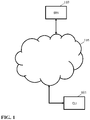
- FIG. 1 illustrates such an example of an AR system in which a remote AR client device 101 liaises with an AR server 103 e.g. via a network 105, such as the Internet.
- the server 103 may be arranged to simultaneously support a potentially large number of client devices 101.
- the AR server 103 may for example support an augmented experience by transmitting data defining elements of a virtual environment and objects to the client device 101.
- the data may specifically describe visual features and geometric properties of a number of virtual objects that may be used by the client device 101 to generate overlay graphics that can be presented to a user.
- the data may also include various information that can be presented to the user.
- the server 103 may provide audio data to the client device 103 that can be used to locally generate virtual sounds/ audio that may further enhance the user experience and specifically the immersion.
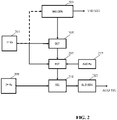
- FIG. 2 illustrates a device in accordance with some embodiments of the invention.
- the device may specifically be a client device 101 of FIG. 1 and will be described with reference to such an embodiment.
- the apparatus comprises a first receiver 201 which is arranged to receive image data from one or more images sensors.
- the image data from an image sensor specifically comprises a real time image sequence of frames/images of a real world scene.
- the frames may comprise visual image data from a visual image camera.
- the frames/ image data may comprise a real time sequence of visual images where each pixel represents a received light intensity from a view direction of the pixel.
- Each pixel may for example include a set of light brightness/ intensity values for a (possibly weighted) interval of the visible spectrum.
- the pixel values of the visual images may represent one or more brightness levels, such as e.g. a set of color channel brightness/ intensity values.
- the images may be RGB-images.
- a visual image may be a color image and/or an RGB image (and the references to visual image may in some embodiments be replaced by references to color image or RGB image).
- the image sensor may be a depth sensor providing a real-time sequence of depth-images/ frames.
- each pixel value may represent a depth/ distance to an object in a view direction of the pixel.
- each pixel value may be a disparity or depth value.
- a depth image may also be referred to as a depth map.
- the frames/ images received from the image sensor may be e.g. visual/color images, infrared images, depth images, radar images, multi-spectral images, sonar images, phase images, phase difference images, intensity images, coherence magnitude images, and/or confidence images.
- the sequency of images/ frames may thus be a two-dimensional structure of pixels comprising values representing a property of the real world in a view direction for the pixel.
- the apparatus will be arranged to process both visual and depth images and the first receiver 201 may be arranged to receive both a sequence of real-time visual images of the real-world scene and a sequence of real-time depth images of the real-world scene.
- the images may be combined visual-depth images and the first receiver 201 may be arranged to receive a sequence of real-time depth and visual images of the real-world scene.
- depth images may for example be generated using a dedicated depth camera such as an infrared ranging camera, or may e.g. be generated by disparity estimation based on e.g. two visual cameras with a known physical offset.
- a dedicated depth camera such as an infrared ranging camera
- the image sensor(s) are capturing a real world scene and thus the received images comprise a capture of this real world scene.
- the received images may be of a real world scene corresponding to the environment of the user.
- a user may wear an AR headset or glasses that also comprises one or more image sensors for capturing the real world scene in the direction that the viewer is looking.
- the apparatus further comprises an image generator 203 which is arranged to generate and output visual image sequence which comprises an image object representing a virtual scene object.
- the output visual image sequence may be presented to a user using a suitable display, such as a display (or displays) of and AR headset or AR glasses.
- a suitable display such as a display (or displays) of and AR headset or AR glasses.
- the image generator 203 may adapt the image object (e.g. orientation in image, position in image, view direction etc.) in response to changes in user pose (position and/or orientation) as e.g. provided by data received from suitable movement sensors.
- the presentation of the image object may be such that it provides the impression of a virtual object being present in the real world scene being viewed.
- the generated output visual image sequences may include only the virtual object (or the virtual objects in case more than one is included) and may e.g. be presented using see-through glasses allowing the real-world scene to be seen through the glasses. Such an approach is known as an AR see-through application.
- the output visual image sequence may be generated to also include a presentation of the real world scene as captured by the image sensors.
- the real-world scene may also (and only) be viewed via the generated images.
- Such an approach is known as an AR pass-through application.
- the image generator 203 may thus generate an image object such that it is perceived that a virtual scene object is added to the real-world scene.
- the virtual scene object may be moveable with respect to at least one real-world scene object, and typically the virtual scene object may be moveable with respect to the whole real-world scene.
- the virtual scene object may be moved as a function of a user action, a property of the real-world scene changing, a predetermined movement to create a predetermined effect etc.
- the apparatus further comprises a detector 205 which is arranged to detect an interaction between the virtual scene object and a real world scene object of the real world scene.
- the detector 205 may specifically detect that a collision or contact occurs between the virtual scene object and a real world scene object.
- Other possible interactions may for example be a detection of a proximity of the virtual scene object and the real world scene object, or a duration of contact which may be a time interval(s) in which we are sure that the virtual and real world object have touched each other.
- Another example of an interaction is when it rains in the real world and raindrops fall onto the virtual object.
- Another example is when an air-flow is generated in the real world and the air is flowing towards the virtual object.
- the detector 205 is coupled to an estimator 207 which is arranged to determine a material property for the scene object with which the virtual scene object has been detected to interact with.
- the material property may be an indication of the material of which the real time object is made (including material composition in case the object comprises different materials).
- the material property may for example be generated to indicate whether the real world object is made of one of a plurality of categories, such as e.g. whether it is made of wood, cloth, metal, plastic etc.
- the estimator 207 is arranged to determine the material property in response to the image data received from the image sensors, i.e. it is determined in response to data of the sequence of image frames received from the sensors.
- the sequence of image frames may comprise both depth and visual image data and the estimator 207 may be arranged to estimate the material property in response to both depth and visual image data.
- the estimator 207 may consider only visual data or depth data.
- the estimator 207 may for example be arranged to determine the material property by applying a color based segmentation to received visual images and to determine an image object that is considered to match the real time image object. It may then compare the average color to a set of predefined categories to find a category with a closest match. The material property of the real time image object may then be set to a material property associated with the closest category.
- the real world image object is determined to be predominantly brown, it may be estimated to be made from wood, if it is predominantly silver it may be estimated to be metal, if it is predominantly a bright primary color, it may be estimated to be plastic etc.
- the apparatus further comprises a second receiver 209, which is arranged to receive a number of audio objects as well as metadata for the audio objects.
- the audio objects may be a sound/ audio clips/ audio fragments and may specifically be an audio signal of a limited duration. It will be appreciated that any representation and format may be used by the audio objects to represent the sound.
- the audio objects may thus correspond to sounds that can be selected by the apparatus and rendered to provide a sound output when various actions occur.
- the apparatus comprises a selector 211 which is arranged to select an audio object out of the received audio objects when an interaction between the virtual scene object and a real world audio object is detected.
- the selected audio object is fed to an output circuit 213 which is arranged to generate an output audio signal comprising the first audio object.
- the output circuit 213 may render the selected audio object by generating an output audio signal which includes a rendering of the audio object.
- the output circuit 213 may, dependent on the format of the audio object, in some cases simply generate the output signal as the audio of the audio object, may in some embodiments include a decoding of the audio object, may generate the output audio signal to include a mix between various audio components (e.g. ambient sound, narrator audio, etc.) to be combined with the audio object, etc.. It will also be appreciated that the output circuit 213 may for example include Digital to Analog conversion and analog signal amplification in embodiments where the output circuit 213 may generate an analog output audio signal, e.g. to directly drive loudspeakers.
- various audio components e.g. ambient sound, narrator audio, etc.
- the output circuit 213 may for example include Digital to Analog conversion and analog signal amplification in embodiments where the output circuit 213 may generate an analog output audio signal, e.g. to directly drive loudspeakers.
- the output circuit 213 may include rendering processing of the audio object by, e.g., binaural processing with Head Related Impulse Responses (HRIRs), Head Related Transfer Functions (HRTFs) or Binaural Room Impulse Responses (BRIRs), or rendering to a loudspeaker configuration by, e.g., Vector Based Amplitude Panning (VBAP), and/or further acoustic simulation of, for example: occlusion, diffractions, reflections, reverberation, source extent, etc.
- the rendering processing may be configured such that the sound of the audio object is perceived to originate from the location of the detected interaction.
- the output circuit 213 may include a timing adaptation to control a timing of the rendering of the selected audio object, such as specifically a possibly variable delay. For example, a delay between a time of the 'visual' contact/ interaction and a time of rendering the sound may be included. The delay may for example be adjusted based on the speed of sound and the distance between the virtual object and the observer, e.g. to ensure that the generated sound is perceived simultaneously to the visual interaction. In some embodiments, such time adjustment may be performed at other parts of apparatus than the output circuit 213.
- the metadata received by the second receiver 209 includes metadata that is indicative of links between at least some of the audio objects and material characteristics.
- the metadata may for example for each audio object indicate a material of a real world object that it is linked with.
- the metadata may indicate that one audio object is linked to a real world object being made out of wood, that another audio object is linked to a real world object being made out of metal, that another audio object is linked to a real world object being made out of plastic, etc.
- the metadata may include other further links, such as e.g. a linking of audio objects to virtual scene objects, to material characteristics of virtual scene objects, types of interaction etc.
- the selector 211 is in response to the detector 205 detecting an interaction between the virtual scene object and a real world scene object arranged to select an audio object based on the estimated material property for the real world scene object and the metadata indicating a link between audio objects and material characteristics.
- the apparatus may generate an improved user experience in many embodiments and may in particular provide a more immersive and naturally sounding experience where the perceived audio may more closely reflect the interactions of the virtual scene object with real world objects. For example, rather than merely accompanying interactions, such as collisions, between virtual scene objects and real world objects with standardized audio, the apparatus may provide an audio output that more closely matches the visual perception of the user and may provide a closer correspondence between the visual and audio inputs perceived by the user. This may be achieved by the apparatus adapting and generating audio that more closely matches the interactions.
- the system may for example use recorded or synthesized multiple audio objects/ clips/ fragments provided for a virtual scene object.
- Each audio fragment may model the interaction with a specific class of real world objects that could occur in the scene.
- the apparatus may use a built in camera to classify e.g. the surface on which the virtual object is placed, and based on the classification result, the apparatus may play the correct audio fragment for the specific interaction.
- the second receiver 209 may be arranged to receive the audio objects and/or the metadata from an internal source. However, in many embodiments, the second receiver 209 may be arranged to receive the metadata, and often the audio objects, from a remote server, such as specifically the server 103 of FIG. 1 .
- a remote server may maintain a large library of audio objects corresponding to a variety of possible interactions between objects, and may further maintain metadata which includes e.g. data that defines the material property of the objects involved in the interaction, properties of the interaction, etc.
- the second receiver 209 may retrieve the metadata for all audio objects.
- the estimator 207 may estimate the material property of the real-world scene object and the selector 211 may evaluate the metadata to find a matching audio object. It may then proceed to control the second receiver 209 to retrieve the selected audio object from the server 103 and when received, the audio apparatus may generate the audio signal to include the received audio object.
- such an approach may be too slow for real-time operation and the second receiver 209 may in some embodiments retrieve a subset or possibly all audio objects from the remote server 103 and store them locally for fast retrieval.
- an analysis of the real world scene may be made on start-up, and/or at regular intervals, with the apparatus detecting as many objects as possible. The apparatus may then proceed to retrieve all audio objects for objects or materials corresponding to those detected in the real world scene, and/or corresponding to the virtual scene objects active or located nearby the user position.
- a user may e.g. at initialization provide an input of the real world scene (e.g. living room, sports arena etc.) and the apparatus may proceed to retrieve a set of audio objects that are stored in the apparatus as possible objects in such an environment.
- the approach may thus provide an efficient approach for allowing a central server to interact with remote device apparatuses to provide audio support for AR applications. It is appreciated that the central server as mentioned above could also be represented by a relatively local server, such as a 5G edge server.
- the virtual scene object is presented to the user such that it may be perceived to be present in the real world scene, and thus it is associated with a spatial (typically three dimensional) geometry/ shape in the real world scene.
- the detector 205 may be arranged to detect the interaction as a detection that a distance between the virtual scene object and the real world scene object in the three dimensional real world space is less than a given threshold, or specifically that they come into contact with each other. In some cases, further considerations may be taken into account, such as the speed at which the objects are moving towards each other etc.
- some toolkits developed to support AR applications provide 3D plane surface detection where via feature point tracking over time, planar regions are detected via the specific motion that a cluster of feature points follow over time.
- the detector 205 may be arranged to detect an interaction by tracking the shortest distance between any vertex in a bounding mesh of the virtual graphics scene object and any one of the planes detected: d t ⁇ min i ⁇ V min j ⁇ P dist x j t , x i t where i ⁇ V denotes vertex i from the set of all vertices V present in the bounding mesh of the virtual scene object, j ⁇ P is the plane for which the shortest distance is calculated and the function dist (x j (t), x i ( t )) evaluates this distance.
- both the virtual scene object bounding mesh and the image sensors are generally in motion which means that vertex positions in the mesh and positions on the detected planes, and hence also the final shortest distance d ( t ) , all vary with time.
- An interaction may be detected to have occurred if the distance is less than a threshold. Specifically, a collision may be detected to have occurred if the distance is less than a small threshold, or e.g. that it reaches zero.
- interaction and specifically a collusion, may be detected to have occurred when the minimum distance of a vertex to a plane has decreased to within a minimum threshold distance ⁇ collision and the instantaneous object speed v ( t ) exceeds a given minimum threshold v min : d t ⁇ ⁇ collision ⁇ v t > v min
- the estimator 207 may then proceed to determine the material property for the real world scene object with which the interaction has been detected to occur.
- the detection may be based on the estimator 207 determining an interaction image region in at least one of the input image frames, where the interaction image region is an image region of the image frame in which the interaction occurs.
- the estimator 207 may determine a two dimensional region in the image frame which includes the contact point between the objects detected by the detector 205. For example, the projection of the contact point on the two dimensional image frame may be determined and a region around this may be identified.
- the image region may for example be a predetermined shape which is centered around the projected contact point.
- the image region may be adapted to the image properties.
- the image region may be identified as a region around the projected contact point which meets a similarly criterion, such as that the visual properties and/or depth does not deviate from the properties of the projected contact point by more than a predetermined amount.
- the estimator 207 may then determine the material property for the scene object in response to image data of the interaction image region. For example, the color and texture variations may be compared to corresponding properties of a predetermined set of classes and the material property may be set to the property of the closest matching class.
- the image interaction region may be determined. This may be done by first projecting the nearest mesh point x i into the image using the camera view matrix and the camera projection matrix. The resulting 2D image point ( u i , v i ) is then used to determine a sub-image of fixed size, centered on ( u i , v i ), from the camera image.
- FIG. 3 illustrates an example of an image frame where a virtual scene object 301 in the form of a ball may interact with a real world scene object 303 in the form of a real world table resulting in a detection of an image region 305.
- the estimator 207 may in many embodiments be arranged to determine a match indication for the real world scene object to at least a first category/ class out of a plurality of object categories/ classes.
- the estimator 207 may for example have a number of properties stored for image regions corresponding to a specific material, such as color, texture variations, depth variations etc.
- the estimator 207 may determine corresponding properties for the image region and compare these to the stored properties for all the categories.
- a match indication may be determined to reflect how well the properties match, and the category may be selected as the category for which the match indication indicates a highest match.
- the material property for the real world scene object may then be selected as the stored property for the selected category or class.
- each of the categories/ classes is associated with one or more material properties, such as simply an indication of the material an object is made of, and the material property of the real world scene object is set to that stored for the selected category.
- the estimator 207 may use substantially more complex approaches for determining the material property for the real world scene object, and specifically to identify a class or category considered to most closely match the properties of the image region corresponding to the image region.
- the estimator 207 may comprise a neural network arranged to estimate the material property of the real-world scene object based on image data of the interaction image region.
- the neural network may specifically be used to identify a category or class for the real world scene object.
- an extracted (image) interaction region may have a much smaller size than the full image.
- the full image often has a size of 2K or 4K
- the interaction sub-image can have a constant smaller size of e.g. 256x256 pixels.
- a color image of e.g. 256x256 pixels may be represented as a tensor of dimensions 3x256x256 and fed into a trained classifier neural network.
- Output of the neural network may be a vector with for each pre-defined material class providing the probability that the image belongs to the given class.
- object (surface) classes may be particularly advantageous in many embodiments:
- Each of these classes may have specific color and texture statistics or may be differentiated due to their bounding geometry (e.g. table or cushion).
- images from the different object surfaces may be captured and manually annotated with a ground truth class label.
- Each block downscales the spatial resolution of the tensor with a factor 2 but doubles the number of channels.
- the approach may continue to connect these blocks until the tensor has resolution N-channelsx1x1. Two full connected layers may then be added followed by a sigmoid activation function.
- a default (neutral) interaction sound may be played, i.e. a default audio object may be selected if the estimator 207 is not able to sufficiently accurately determine the material of the real world scene object.
- the audio object/ sound file may be selected by the selector 211, such as specifically the audio object corresponding to the material that has the highest probability as determined by the categorization.
- the apparatus may further comprise an audio receiver 215 for receiving an audio signal of real time audio captured in the real world scene and the estimator 207 may be arranged to determine the match indication in response to the audio signal.
- material classification may be aided by audio-based classification, which records sounds in the physical space with a microphone. If interactions occur between physical objects, the resulting sound may give valuable information to the classification of the material or more specific properties. It may be used to provide better material classification, or provide further attributes of the material (solid/hollow, thin/thick, tensioned/slack, large/small).
- current and recent past environmental sound S env may be captured over a short time window (say 10 seconds) and may be fed into the material classifier.
- a short time window say 10 seconds
- a material classifier can be produced by collecting images and sounds for different materials.
- a more advanced neural network as discussed above would then concatenate pieces of the audio fragments with the captured images and use those as input for the trained network.
- the determination of the material property may be in response to depth image data, and specifically the estimator may be arranged to determine the material property for the real world scene object in response to a detection that at least part of an image region of the at least one image frame representing the real world scene object has a confidence level for depth image data that does not exceed a threshold.
- Depth estimates are often generated with confidence data that is indicative of the reliability of the generated depth values/ estimates.
- the confidence level may be determined to reflect how closely the image regions forming the basis for the disparity estimation match in the images.
- the confidence level may be generated to reflect the amount of infrared light that is received for a given pixel. If only a small amount of light is received, the distance estimation/ ranging process may not be as accurate as if a large amount of light is received.
- each pixel of a depth image/map may comprise both an estimated depth value as well as a confidence value/ level indicating how reliable the depth value for the pixel is considered to be.
- this depth confidence data may be taken into account when determined the material property. For example, some materials may be known to provide a reduced confidence level compared to other materials. For example, some materials may vary a lot in local visual appearance which may make disparity estimation less reliable.
- some materials may result in much reduced confidence due to the amount of light reflected back to the sensor being substantially reduced. This may for example be the case for materials which do not reflect but have a high absorption of infrared light. It may also be particularly the case for materials that exhibit specular reflection (e.g. a metal object) in which case very little infrared light is reflected back to the transmitter and sensor. Note that for an active depth sensor based on time-of-flight or structured light, the infrared light sensor (e.g. CMOS) is often co-located with the light transmitter/emitter.
- CMOS infrared light sensor
- the estimator 207 may for example detect that an area of the interaction image region has a low depth confidence but is quite bright. Such an area may be indicative of a highly reflective yet dispersive surface, such as a metallic surface.
- the image frame comprises visual image data and depth image data
- the estimator 207 may be arranged to determine the real world scene object to have a metallic component in response to a detection that for at least part of the image region a brightness of the visual image data exceeds a threshold and a confidence level for depth image data does not exceed a threshold.
- the metadata may be received from a remote source and may comprise links between audio objects and a material property for an object, which specifically may be the real world scene object.
- the metadata may comprise links to material properties of two objects, and indeed may differentiate between the virtual scene object and real world scene object.
- the selector 211 may select the audio object based on both the estimated material property of the real world scene object and also based on a material property of the virtual scene object.
- the virtual scene object may be a virtual object generated by the apparatus, the material this object is intended to be perceived to be made from will typically be known. In this case, the audio object may thus be selected to match both properties as closely as possible.
- the metadata for at least some audio object comprises indications of links between the at least some audio objects and material characteristics of real world scene objects and links between the at least some audio objects and material characteristics of virtual scene objects.
- the selector 211 may be arranged to select the audio object in response to the material property and material characteristics of real world objects linked to the set of audio objects and in response to a material property of the virtual scene object and material characteristics of virtual scene objects linked to the set of audio objects.
- the remote server 103 may provide a two dimensional structure linking audio objects to material properties.
- An example of such a structure is the following two dimensional look-up table: Detected real-world material Virtual object material Wood metal concrete unknown wood WoodOnWood WoodOnMetal WoodOnConcrete WoodOnUnknown metal Metal OnWood MetalOnMetal Metal OnConcrete MetalOnUnknown rubber RubberOnWood RubberOnMetal RubberOnConcrete RubberOnUnknown
- the metadata may provide links to other features and the selection of the audio object may take such additional features into account.
- a dynamic property of the virtual scene object may further be considered.
- the metadata may indicate that different audio objects are linked to different states/ properties of the virtual scene object.
- the states/ properties of the virtual scene object may change dynamically, and the selection may further take the current state/ property into account when finding a matching audio object.
- a deflated virtual ball generates a different sound than an inflated virtual ball.
- the virtual scene object of a ball may be included twice in the look-up table, once deflated and once inflated, with each being linked to a different audio object/ sound effect.
- Further attributes of the virtual object may influence the selection or generation of an appropriate sound effect.
- the orientation of the virtual object may cause different sound effects.
- the virtual scene object may for example have different types of surfaces, such as e.g. a cube having different surface properties for the different sides.
- the orientation of the virtual scene object may determine which surface collides with the real world scene object and the selection of the audio object may take the orientation into account.
- the look-up-table may comprise different entries for different orientations and thus selection of the audio object may include selecting the entry corresponding to the current orientation.
- Virtual scene objects may be represented by a mesh, where each face, or face group, is associated with an object orientation range, virtual material property, or subset of audio objects.
- the selection of the audio object may further be in response to a property of the interaction, such as specifically dependent on the type of interaction.
- the detector 205 may be arranged to determine a property of the interaction and the selector 211 may be arranged to select the first audio object in response to the property of the interaction.
- attributes of the interaction itself may influence the selection or generation of a sound effect.
- the speed or strength of an interaction may cause different sounds, as physical collisions may be non-linear with the intensity of the collision (e.g. bouncing balls, glass may break at certain collision intensity, etc.).
- Other examples are direction of collision, or non-collision interactions such as sliding/rubbing of a virtual object across a physical surface.
- the interaction property that is further considered for the selection of the audio object may be one or more of the following:
- the metadata may be provided in the form of a look-up-table which may be multidimensional depending on how many properties may/ should be taken into account when selecting the audio object.
- a look-up-table with the following dimensions may be provided:
- a metadata table may be provided which basically links two material types to each sound effect. However, there may be many sound effects for the same materials and even interaction type (material 1, material 2 and type of interaction). Based on this information, they may all be suitable for representing a certain interaction. One approach is to always pick the first, but the experience may be more compelling if a sound effect is chosen at random. For repetitive interactions, small differences in the audio makes it sound less artificial. The choice between sound clips can even be varied based on attributes of interaction that are not covered in the library's metadata (e.g. speed, or direction of impact, or the nth bounce of a ball).
- a specific approach of the apparatus of FIG. 2 is represented by the flow-diagram of FIG. 4 .
- a current video image I is analyzed to predict an image region where the interaction is likely to happen. This analysis may be based on the 3D position information of the virtual scene object/ graphics object G.
- the image part from the resulting spatial image region R in which the virtual scene object is likely to collide with a real world object of the real environment is then fed to a material classifier (the estimator 207) which determines a material class M.
- the estimator 207 determines a material class M.
- the approach may for example allow an application where a pre-recorded sound starts to play as soon as a collision between a virtual scene object and a real world scene object occurs.
- each virtual object may be given a material property and a single look-up table may be used as the basis for selecting the appropriate sound.
- An 'unknown' class may be used to still produce an approximately correct sound when the material classifier does not produce high enough probabilities for any of the pre-defined classes. For instance, a virtual rubber ball will make more or less the same sound when hitting different real-world surfaces.
- An AR Standard may provide syntax for a bitstream with audio-, visual- and metadata for virtual elements to augment specific physical areas.
- the Standard may allow the user to interact with these virtual elements in the physical environment.
- the Standard may provide means for transmitting many sound effect clips to the decoder with these not being rendered to the user unless they are triggered.
- a provided bitstream may include a metadata indicative of a multi-dimensional lookup table that assigns every sound effect clip to an entry in that lookup table.
- Each dimension of the table may correspond with an aspect of an interaction between a virtual element and a physical element.
- an interaction has aspects (e.g. detected by classification and/or logical algorithms) present in this lookup table that jointly identify a certain table entry, a sound effect clip associated with this table entry can be played at the position of the interaction between the physical and virtual element.
- the invention can be implemented in any suitable form including hardware, software, firmware or any combination of these.
- the invention may optionally be implemented at least partly as computer software running on one or more data processors and/or digital signal processors.
- the elements and components of an embodiment of the invention may be physically, functionally and logically implemented in any suitable way. Indeed, the functionality may be implemented in a single unit, in a plurality of units or as part of other functional units. As such, the invention may be implemented in a single unit or may be physically and functionally distributed between different units, circuits and processors.
Landscapes
- Engineering & Computer Science (AREA)
- Theoretical Computer Science (AREA)
- Physics & Mathematics (AREA)
- General Physics & Mathematics (AREA)
- General Engineering & Computer Science (AREA)
- Human Computer Interaction (AREA)
- Multimedia (AREA)
- Audiology, Speech & Language Pathology (AREA)
- Health & Medical Sciences (AREA)
- General Health & Medical Sciences (AREA)
- Software Systems (AREA)
- Computer Hardware Design (AREA)
- Computer Vision & Pattern Recognition (AREA)
- Computer Graphics (AREA)
- Processing Or Creating Images (AREA)
- User Interface Of Digital Computer (AREA)
Priority Applications (10)
| Application Number | Priority Date | Filing Date | Title |
|---|---|---|---|
| EP21167514.5A EP4071585A1 (en) | 2021-04-08 | 2021-04-08 | Apparatus and method for generating an audio signal |
| KR1020237038376A KR20230164187A (ko) | 2021-04-08 | 2022-03-29 | 오디오 신호를 생성하기 위한 장치 및 방법 |
| EP22712436.9A EP4320498B1 (en) | 2021-04-08 | 2022-03-29 | Apparatus and method for generating an audio signal |
| BR112023020318A BR112023020318A2 (pt) | 2021-04-08 | 2022-03-29 | Aparelho e método para gerar um sinal de saída de áudio, e sinal de áudio |
| CN202280027110.XA CN117120963A (zh) | 2021-04-08 | 2022-03-29 | 用于生成音频信号的装置和方法 |
| PL22712436.9T PL4320498T3 (pl) | 2021-04-08 | 2022-03-29 | Sposób i urządzenie do generowania sygnału audio |
| US18/285,657 US20240370223A1 (en) | 2021-04-08 | 2022-03-29 | Apparatus and method for generating an audio signal |
| JP2023561173A JP2024513082A (ja) | 2021-04-08 | 2022-03-29 | オーディオ信号を生成する装置及び方法 |
| ES22712436T ES3013574T3 (en) | 2021-04-08 | 2022-03-29 | Apparatus and method for generating an audio signal |
| PCT/EP2022/058273 WO2022214357A1 (en) | 2021-04-08 | 2022-03-29 | Apparatus and method for generating an audio signal |
Applications Claiming Priority (1)
| Application Number | Priority Date | Filing Date | Title |
|---|---|---|---|
| EP21167514.5A EP4071585A1 (en) | 2021-04-08 | 2021-04-08 | Apparatus and method for generating an audio signal |
Publications (1)
| Publication Number | Publication Date |
|---|---|
| EP4071585A1 true EP4071585A1 (en) | 2022-10-12 |
Family
ID=75438686
Family Applications (2)
| Application Number | Title | Priority Date | Filing Date |
|---|---|---|---|
| EP21167514.5A Withdrawn EP4071585A1 (en) | 2021-04-08 | 2021-04-08 | Apparatus and method for generating an audio signal |
| EP22712436.9A Active EP4320498B1 (en) | 2021-04-08 | 2022-03-29 | Apparatus and method for generating an audio signal |
Family Applications After (1)
| Application Number | Title | Priority Date | Filing Date |
|---|---|---|---|
| EP22712436.9A Active EP4320498B1 (en) | 2021-04-08 | 2022-03-29 | Apparatus and method for generating an audio signal |
Country Status (9)
| Country | Link |
|---|---|
| US (1) | US20240370223A1 (https=) |
| EP (2) | EP4071585A1 (https=) |
| JP (1) | JP2024513082A (https=) |
| KR (1) | KR20230164187A (https=) |
| CN (1) | CN117120963A (https=) |
| BR (1) | BR112023020318A2 (https=) |
| ES (1) | ES3013574T3 (https=) |
| PL (1) | PL4320498T3 (https=) |
| WO (1) | WO2022214357A1 (https=) |
Families Citing this family (2)
| Publication number | Priority date | Publication date | Assignee | Title |
|---|---|---|---|---|
| US20240242380A1 (en) * | 2023-01-13 | 2024-07-18 | Maya Heat Transfer Technologies Ltd. | System for generating an image dataset for training an artificial intelligence model for object recognition, and method of use thereof |
| WO2025263770A1 (ko) * | 2024-06-17 | 2025-12-26 | 삼성전자주식회사 | 비디오를 처리하기 위한 전자 장치 및 방법 |
Citations (2)
| Publication number | Priority date | Publication date | Assignee | Title |
|---|---|---|---|---|
| US20130236040A1 (en) * | 2012-03-08 | 2013-09-12 | Disney Enterprises, Inc. | Augmented reality (ar) audio with position and action triggered virtual sound effects |
| US20210082191A1 (en) * | 2018-02-15 | 2021-03-18 | Magic Leap, Inc. | Mixed reality musical instrument |
Family Cites Families (7)
| Publication number | Priority date | Publication date | Assignee | Title |
|---|---|---|---|---|
| US10395435B2 (en) * | 2016-04-04 | 2019-08-27 | Occipital, Inc. | System for multimedia spatial annotation, visualization, and recommendation |
| GB201800920D0 (en) * | 2018-01-19 | 2018-03-07 | Nokia Technologies Oy | Associated spatial audio playback |
| US10565797B2 (en) * | 2018-02-17 | 2020-02-18 | Varjo Technologies Oy | System and method of enhancing user's immersion in mixed reality mode of display apparatus |
| CN112514398B (zh) * | 2018-06-01 | 2023-07-14 | 诺基亚技术有限公司 | 用于针对全向内容而标记在覆盖物上的用户交互并将对背景的覆盖物分组的方法和装置 |
| US11651567B2 (en) * | 2018-12-13 | 2023-05-16 | Maxell, Ltd. | Display terminal, display control system and display control method |
| EP4158908A4 (en) * | 2020-05-29 | 2023-11-29 | Magic Leap, Inc. | SURFACE COLLISIONS |
| US20210405743A1 (en) * | 2020-06-26 | 2021-12-30 | Apple Inc. | Dynamic media item delivery |
-
2021
- 2021-04-08 EP EP21167514.5A patent/EP4071585A1/en not_active Withdrawn
-
2022
- 2022-03-29 US US18/285,657 patent/US20240370223A1/en active Pending
- 2022-03-29 ES ES22712436T patent/ES3013574T3/es active Active
- 2022-03-29 PL PL22712436.9T patent/PL4320498T3/pl unknown
- 2022-03-29 CN CN202280027110.XA patent/CN117120963A/zh active Pending
- 2022-03-29 KR KR1020237038376A patent/KR20230164187A/ko active Pending
- 2022-03-29 EP EP22712436.9A patent/EP4320498B1/en active Active
- 2022-03-29 WO PCT/EP2022/058273 patent/WO2022214357A1/en not_active Ceased
- 2022-03-29 BR BR112023020318A patent/BR112023020318A2/pt unknown
- 2022-03-29 JP JP2023561173A patent/JP2024513082A/ja active Pending
Patent Citations (2)
| Publication number | Priority date | Publication date | Assignee | Title |
|---|---|---|---|---|
| US20130236040A1 (en) * | 2012-03-08 | 2013-09-12 | Disney Enterprises, Inc. | Augmented reality (ar) audio with position and action triggered virtual sound effects |
| US20210082191A1 (en) * | 2018-02-15 | 2021-03-18 | Magic Leap, Inc. | Mixed reality musical instrument |
Also Published As
| Publication number | Publication date |
|---|---|
| JP2024513082A (ja) | 2024-03-21 |
| BR112023020318A2 (pt) | 2023-11-21 |
| KR20230164187A (ko) | 2023-12-01 |
| ES3013574T3 (en) | 2025-04-14 |
| CN117120963A (zh) | 2023-11-24 |
| EP4320498A1 (en) | 2024-02-14 |
| WO2022214357A1 (en) | 2022-10-13 |
| EP4320498C0 (en) | 2025-01-29 |
| US20240370223A1 (en) | 2024-11-07 |
| EP4320498B1 (en) | 2025-01-29 |
| PL4320498T3 (pl) | 2025-04-14 |
Similar Documents
| Publication | Publication Date | Title |
|---|---|---|
| US11217006B2 (en) | Methods and systems for performing 3D simulation based on a 2D video image | |
| US11412108B1 (en) | Object recognition techniques | |
| JP7472362B2 (ja) | 受信方法、端末及びプログラム | |
| US10074012B2 (en) | Sound and video object tracking | |
| US10855967B2 (en) | Image processing apparatus, image processing method, and storage medium | |
| US11200745B2 (en) | Systems, methods, and media for automatically triggering real-time visualization of physical environment in artificial reality | |
| US20130207962A1 (en) | User interactive kiosk with three-dimensional display | |
| US8624962B2 (en) | Systems and methods for simulating three-dimensional virtual interactions from two-dimensional camera images | |
| JP7527351B2 (ja) | シーンの画像キャプチャの品質を評価するための装置及び方法 | |
| US9201499B1 (en) | Object tracking in a 3-dimensional environment | |
| EP3811631A1 (en) | Apparatus and method for generating an image data stream | |
| CN112581627A (zh) | 用于体积视频的用户控制的虚拟摄像机的系统和装置 | |
| CN113795863B (zh) | 用于图像的深度图的处理 | |
| EP4320498B1 (en) | Apparatus and method for generating an audio signal | |
| US12165334B2 (en) | Systems and methods for dynamic image processing and segmentation | |
| JP2019534511A (ja) | 自由動作fvvアプリケーションのためのマルチレイヤuvマップに基づくテクスチャレンダリング | |
| WO2022061631A1 (en) | Optical tracking for small objects in immersive video | |
| CN116778058B (zh) | 一种智能展厅的智能交互系统 | |
| TW202239201A (zh) | 影像合成系統及其方法 | |
| EP4114008A1 (en) | Image generation | |
| TW202545178A (zh) | 影像資料信號 |
Legal Events
| Date | Code | Title | Description |
|---|---|---|---|
| PUAI | Public reference made under article 153(3) epc to a published international application that has entered the european phase |
Free format text: ORIGINAL CODE: 0009012 |
|
| STAA | Information on the status of an ep patent application or granted ep patent |
Free format text: STATUS: THE APPLICATION HAS BEEN PUBLISHED |
|
| AK | Designated contracting states |
Kind code of ref document: A1 Designated state(s): AL AT BE BG CH CY CZ DE DK EE ES FI FR GB GR HR HU IE IS IT LI LT LU LV MC MK MT NL NO PL PT RO RS SE SI SK SM TR |
|
| STAA | Information on the status of an ep patent application or granted ep patent |
Free format text: STATUS: THE APPLICATION IS DEEMED TO BE WITHDRAWN |
|
| 18D | Application deemed to be withdrawn |
Effective date: 20230413 |