EP4071186A1 - Ethylene/alpha-olefin copolymer having excellent electrical insulation property - Google Patents
Ethylene/alpha-olefin copolymer having excellent electrical insulation property Download PDFInfo
- Publication number
- EP4071186A1 EP4071186A1 EP21788446.9A EP21788446A EP4071186A1 EP 4071186 A1 EP4071186 A1 EP 4071186A1 EP 21788446 A EP21788446 A EP 21788446A EP 4071186 A1 EP4071186 A1 EP 4071186A1
- Authority
- EP
- European Patent Office
- Prior art keywords
- carbon atoms
- alpha
- ethylene
- olefin copolymer
- formula
- Prior art date
- Legal status (The legal status is an assumption and is not a legal conclusion. Google has not performed a legal analysis and makes no representation as to the accuracy of the status listed.)
- Granted
Links
Classifications
-
- C—CHEMISTRY; METALLURGY
- C08—ORGANIC MACROMOLECULAR COMPOUNDS; THEIR PREPARATION OR CHEMICAL WORKING-UP; COMPOSITIONS BASED THEREON
- C08F—MACROMOLECULAR COMPOUNDS OBTAINED BY REACTIONS ONLY INVOLVING CARBON-TO-CARBON UNSATURATED BONDS
- C08F210/00—Copolymers of unsaturated aliphatic hydrocarbons having only one carbon-to-carbon double bond
- C08F210/16—Copolymers of ethene with alpha-alkenes, e.g. EP rubbers
-
- C—CHEMISTRY; METALLURGY
- C08—ORGANIC MACROMOLECULAR COMPOUNDS; THEIR PREPARATION OR CHEMICAL WORKING-UP; COMPOSITIONS BASED THEREON
- C08K—Use of inorganic or non-macromolecular organic substances as compounding ingredients
- C08K5/00—Use of organic ingredients
- C08K5/04—Oxygen-containing compounds
- C08K5/14—Peroxides
-
- C—CHEMISTRY; METALLURGY
- C08—ORGANIC MACROMOLECULAR COMPOUNDS; THEIR PREPARATION OR CHEMICAL WORKING-UP; COMPOSITIONS BASED THEREON
- C08K—Use of inorganic or non-macromolecular organic substances as compounding ingredients
- C08K5/00—Use of organic ingredients
- C08K5/16—Nitrogen-containing compounds
- C08K5/34—Heterocyclic compounds having nitrogen in the ring
- C08K5/3467—Heterocyclic compounds having nitrogen in the ring having more than two nitrogen atoms in the ring
- C08K5/3477—Six-membered rings
- C08K5/3492—Triazines
- C08K5/34924—Triazines containing cyanurate groups; Tautomers thereof
-
- C—CHEMISTRY; METALLURGY
- C08—ORGANIC MACROMOLECULAR COMPOUNDS; THEIR PREPARATION OR CHEMICAL WORKING-UP; COMPOSITIONS BASED THEREON
- C08K—Use of inorganic or non-macromolecular organic substances as compounding ingredients
- C08K5/00—Use of organic ingredients
- C08K5/54—Silicon-containing compounds
- C08K5/541—Silicon-containing compounds containing oxygen
- C08K5/5425—Silicon-containing compounds containing oxygen containing at least one C=C bond
-
- H—ELECTRICITY
- H10—SEMICONDUCTOR DEVICES; ELECTRIC SOLID-STATE DEVICES NOT OTHERWISE PROVIDED FOR
- H10F—INORGANIC SEMICONDUCTOR DEVICES SENSITIVE TO INFRARED RADIATION, LIGHT, ELECTROMAGNETIC RADIATION OF SHORTER WAVELENGTH OR CORPUSCULAR RADIATION
- H10F19/00—Integrated devices, or assemblies of multiple devices, comprising at least one photovoltaic cell covered by group H10F10/00, e.g. photovoltaic modules
- H10F19/80—Encapsulations or containers for integrated devices, or assemblies of multiple devices, having photovoltaic cells
- H10F19/804—Materials of encapsulations
-
- C—CHEMISTRY; METALLURGY
- C08—ORGANIC MACROMOLECULAR COMPOUNDS; THEIR PREPARATION OR CHEMICAL WORKING-UP; COMPOSITIONS BASED THEREON
- C08F—MACROMOLECULAR COMPOUNDS OBTAINED BY REACTIONS ONLY INVOLVING CARBON-TO-CARBON UNSATURATED BONDS
- C08F2420/00—Metallocene catalysts
- C08F2420/02—Cp or analog bridged to a non-Cp X anionic donor
-
- C—CHEMISTRY; METALLURGY
- C08—ORGANIC MACROMOLECULAR COMPOUNDS; THEIR PREPARATION OR CHEMICAL WORKING-UP; COMPOSITIONS BASED THEREON
- C08F—MACROMOLECULAR COMPOUNDS OBTAINED BY REACTIONS ONLY INVOLVING CARBON-TO-CARBON UNSATURATED BONDS
- C08F2420/00—Metallocene catalysts
- C08F2420/06—Cp analog where at least one of the carbon atoms of the non-coordinating part of the condensed ring is replaced by a heteroatom
-
- C—CHEMISTRY; METALLURGY
- C08—ORGANIC MACROMOLECULAR COMPOUNDS; THEIR PREPARATION OR CHEMICAL WORKING-UP; COMPOSITIONS BASED THEREON
- C08F—MACROMOLECULAR COMPOUNDS OBTAINED BY REACTIONS ONLY INVOLVING CARBON-TO-CARBON UNSATURATED BONDS
- C08F4/00—Polymerisation catalysts
- C08F4/42—Metals; Metal hydrides; Metallo-organic compounds; Use thereof as catalyst precursors
- C08F4/44—Metals; Metal hydrides; Metallo-organic compounds; Use thereof as catalyst precursors selected from light metals, zinc, cadmium, mercury, copper, silver, gold, boron, gallium, indium, thallium, rare earths or actinides
- C08F4/60—Metals; Metal hydrides; Metallo-organic compounds; Use thereof as catalyst precursors selected from light metals, zinc, cadmium, mercury, copper, silver, gold, boron, gallium, indium, thallium, rare earths or actinides together with refractory metals, iron group metals, platinum group metals, manganese, rhenium technetium or compounds thereof
- C08F4/62—Refractory metals or compounds thereof
- C08F4/64—Titanium, zirconium, hafnium or compounds thereof
- C08F4/659—Component covered by group C08F4/64 containing a transition metal-carbon bond
- C08F4/65908—Component covered by group C08F4/64 containing a transition metal-carbon bond in combination with an ionising compound other than alumoxane, e.g. (C6F5)4B-X+
-
- Y—GENERAL TAGGING OF NEW TECHNOLOGICAL DEVELOPMENTS; GENERAL TAGGING OF CROSS-SECTIONAL TECHNOLOGIES SPANNING OVER SEVERAL SECTIONS OF THE IPC; TECHNICAL SUBJECTS COVERED BY FORMER USPC CROSS-REFERENCE ART COLLECTIONS [XRACs] AND DIGESTS
- Y02—TECHNOLOGIES OR APPLICATIONS FOR MITIGATION OR ADAPTATION AGAINST CLIMATE CHANGE
- Y02B—CLIMATE CHANGE MITIGATION TECHNOLOGIES RELATED TO BUILDINGS, e.g. HOUSING, HOUSE APPLIANCES OR RELATED END-USER APPLICATIONS
- Y02B10/00—Integration of renewable energy sources in buildings
- Y02B10/10—Photovoltaic [PV]
-
- Y—GENERAL TAGGING OF NEW TECHNOLOGICAL DEVELOPMENTS; GENERAL TAGGING OF CROSS-SECTIONAL TECHNOLOGIES SPANNING OVER SEVERAL SECTIONS OF THE IPC; TECHNICAL SUBJECTS COVERED BY FORMER USPC CROSS-REFERENCE ART COLLECTIONS [XRACs] AND DIGESTS
- Y02—TECHNOLOGIES OR APPLICATIONS FOR MITIGATION OR ADAPTATION AGAINST CLIMATE CHANGE
- Y02E—REDUCTION OF GREENHOUSE GAS [GHG] EMISSIONS, RELATED TO ENERGY GENERATION, TRANSMISSION OR DISTRIBUTION
- Y02E10/00—Energy generation through renewable energy sources
- Y02E10/50—Photovoltaic [PV] energy
Definitions
- the present invention relates to an ethylene/alpha-olefin copolymer having excellent volume resistance and light transmittance, and a method for preparing the same.
- solar cells receive attention as a clean energy generating means without fear of exhaustion.
- a module type is used.
- protection sheet for solar cell module surface side transparent protection member
- solar cell encapsulant/crystalline solar cell device/solar cell encapsulant/protection sheet for solar cell module back side protection member
- the solar cell encapsulant generally, an ethylene/vinyl acetate copolymer or ethylene/alpha-olefin copolymer, etc. is used.
- a light stabilizer is generally included as an additive considering the requirement on climate-resistance for a long time, and in addition, considering the adhesiveness of a transparent surface side protection member or a back side protection member represented by glass, a silane coupling agent is commonly included in the solar cell sealant.
- an ethylene/vinyl acetate copolymer is used as the constituent material of a solar cell encapsulant, it has been apprehended that components such as an acetic acid gas generated by the decomposition of the ethylene/vinyl acetate copolymer might influence a solar cell device.
- the increase of the scale of a power generation system such as a mega solar is conducted along with the recent dissemination of the power generation of the sunlight, and for the purpose of reducing transmission loss, there are moves to increase a voltage of a system voltage.
- a potential difference between a frame and cells increases in a solar cell module. That is, the frame of a solar cell module is generally grounded, and if the system voltage of a solar cell array is from 600 V to 1000 V, the potential difference between the frame and the cells becomes from 600 V to 1000 V just the same in a module with the highest voltage, and the power generation is maintained during the day in a high-voltage applied state.
- glass has lower electric resistance when compared with an encapsulant, and due to the interposition of the frame, a high voltage is generated between the glass and the cells. That is, under the circumstance of generating power during the day, in a module with series connection, a potential difference between the cells and the module, and the cells and glass side increases in succession from a grounded side, and at the greatest point, almost the same potential difference of the system voltage is maintained. In a solar cell module used in such a state, output is largely reduced, and an example of a module using a crystalline power generation device in which potential induced degradation (PID) phenomenon arising degradation is generated, has been reported. Accordingly, in order to solve the problems, a solar cell encapsulant which comes into direct contact with the solar cell device, having even higher volume intrinsic resistance is required.
- PID potential induced degradation
- volume resistance or specific resistance (p) known as electric resistance is defined as electric resistance between facing surfaces of 1 m 3 of a material, and it is important to obtain a molded article in which this volume resistance may be reproduced in a predetermined range in all application divisions and permanent.
- electric resistance is defined as electric resistance between facing surfaces of 1 m 3 of a material, and it is important to obtain a molded article in which this volume resistance may be reproduced in a predetermined range in all application divisions and permanent.
- p volume resistance or specific resistance (p) known as electric resistance
- the inner part of a conductor is heated to a high temperature (about 90°C) by heat generated by the passing of current, but the outer part of the conductor maintains room temperature.
- the conventional polyethylene shows marked drop of volume resistance near the inner conductor through the passing of current.
- Patent Document 1 Japanese Laid-open Patent No. 2010-258439
- An object of the present invention is to provide an ethylene/alpha-olefin copolymer accomplishing excellent volume resistance and light transmittance at once, and may be usefully utilized as an insulating material, and a method for preparing the same.
- the present invention provides an ethylene/alpha-olefin copolymer satisfying the following conditions (a) to (c):
- the ethylene/alpha-olefin copolymer satisfying all the conditions defined in the present invention has high volume resistance and excellent insulating properties, and accordingly, may be widely used for various uses in electric and electronic industrial fields, and particularly, if used in a solar cell module, PID phenomenon may be delayed as much as possible, high light transmittance may be shown, and excellent module efficiency may be accomplished.
- the ethylene/alpha-olefin copolymer of the present invention is characterized in satisfying the following conditions (a) to (c):
- the present invention relates to an ethylene/alpha-olefin copolymer showing high volume resistance and excellent electrical insulation, and since the ethylene/alpha-olefin copolymer of the present invention satisfies a specific range of a difference between a melting temperature measured by DSC and an elution temperature measured by CFC, high volume resistance and excellent light transmittance may be shown.
- the ethylene/alpha-olefin copolymer of the present invention is prepared by mixing and using transition metal compounds represented by Formula 1 and Formula 2 as a catalyst, as described later.
- transition metal compounds represented by Formula 1 and Formula 2 as a catalyst, as described later.
- the introduction of an alpha-olefin-based monomer into the transition metal compound represented by Formula 1 is difficult due to the structural characteristics of a catalyst, and a copolymer of a high-density region tends to be prepared, and since a large amount of alpha-olefin may be introduced into the transition metal compound represented by Formula 2, a polymer in a very low-density region (elastomer) may also be prepared. Accordingly, if each of the two transition metal compounds is used solely, copolymerization properties of mixing and introducing an alpha-olefin-based monomer are different.
- the ethylene/alpha-olefin copolymer of the present invention is a copolymer in which both a low-density region in which a large amount of an alpha-olefin-based monomer is mixed and introduced and a high-density region in which a small amount of an alpha-olefin-based monomer is mixed and introduced are present, and which shows a Tm - Te value of a constant value or more.
- the volume resistance may be rather degraded due to the low-crystalline region, and the light transmittance may also be degraded due to the high-crystalline region, and in the present invention, a suitable range of the Tm - Te value, capable of accomplishing both the volume resistance and light transmittance excellently, is derived, and an ethylene/alpha-olefin copolymer satisfying the value has been developed.
- the ethylene/alpha-olefin copolymer of the present invention is a polymer having a low density in a range of 0.85 to 0.89 g/cc, and particularly, the density may be 0.850 g/cc or more, 0.860 g/cc or more, or 0.870 g/cc or more, and 0.890 g/cc or less, or 0.880 g/cc or less. In this case, the density may mean a density measured according to ASTM D-792.
- the density of the ethylene/alpha-olefin copolymer is influenced by the type and amount of a monomer used for polymerization, a polymerization degree, etc., and is largely influenced by the amount of a comonomer in case of a copolymer. In this case, if the amount of the comonomer increases, an ethylene/alpha-olefin copolymer of a low density may be prepared, and the amount of the comonomer introduced into the copolymer may be dependent on the intrinsic copolymerization properties of a catalyst.
- the copolymer of the present invention is a copolymer prepared using the compounds represented by Formula 1 and Formula 2 as catalysts, and shows a low density as described above, and as a result, excellent processability may be shown.
- the melting temperature (Tm) having a maximum peak in a curve obtained by differential scanning calorimetry (DSC) and an elution temperature (Te) having a maximum peak in a curve obtained by cross-fractionation chromatography (CFC) satisfy Equation 1 below. 35 ° C ⁇ Tm ⁇ Te ⁇ 65 ° C
- the melting temperature means the maximum temperature of the highest peak in the DSC curve which is represented by heat flow with respect to temperature
- the elution temperature means the maximum temperature of the highest peak in the CFC elution curve which is represented by elution amount with respect to temperature (dC/dT).
- the cross-fractionation chromatography is a method of combining temperature rising elution fractionation (TREF) and gel filtration chromatography (GPC), and through this, the crystallinity distribution of an ethylene/alpha-olefin copolymer may be measured.
- a specimen solution of a high temperature in which an ethylene/alpha-olefin copolymer is completely dissolved in a solvent is injected into a column filled with an inert carrier, the temperature of the column is lowered to attach the specimen on the surface of the filler, and the temperature of the column is gradually elevated while flowing o-dichlorobenzene in the column.
- the concentration of an olefin-based copolymer eluted at each temperature is detected, and at the same time, the component eluted at each temperature is sent to GPC via online for each fraction to obtain a chromatogram, and after that, since the elution temperature is elevated according to the increase of the crystallinity of the eluted component, the crystallinity distribution of the ethylene/alpha-olefin copolymer may be found by obtaining the relation of the elution temperature and the elution amount (wt%) of the ethylene/alpha-olefin copolymer.
- the Tm - Te value is 35°C or less, the content of the high-crystalline region in the copolymer is low, and problems of degrading the volume resistance may arise, and if the Tm - Te value is 65°C or more, the crystalline distribution of the copolymer may be excessively broadened, and problems of deteriorating light transmittance due to the high-crystalline region and deteriorating volume resistance due to the low-crystalline region may arise.
- the ethylene/alpha-olefin copolymer of the present invention may have a melting temperature (Tm) having the maximum peak in a curve obtained by differential scanning calorimetry (DSC) of 40 to 90°C.
- Tm melting temperature
- the melting temperature may be 40°C or more, 50°C or more, 55°C or more, 60°C or more, 61°C or more, and 90°C or less, 80°C or less, 75°C or less, 70°C or less, 68°C or less.
- the ethylene/alpha-olefin copolymer of the present invention is characterized in satisfying the Tm - Te value represented by Equation 1, and at the same time having a density of 0.85 to 0.89 g/cc and a melting temperature (Tm) of 40 to 90°C.
- Tm melting temperature
- Equation 1 if the density or melting temperature (Tm) value deviate from the above-described ranges and are too high, problems of deteriorating light transmittance may arise, and if all conditions (a) to (c) defined in the present invention are satisfied, excellent volume resistance and light transmittance may be achieved at the same time, for example, may show physical properties suitable for the use in an encapsulant film of a solar cell.
- the elution temperature (Te) may be 10 to 50°C, particularly, 10°C or more, 15°C or more, 20°C or more, 25°C or more, and 50°C or less, 40°C or less, 35°C or less, 30°C or less.
- the ethylene/alpha-olefin copolymer of the present invention has narrow molecular weight distribution (MWD) of 1.5 to 2.5. More particularly, the molecular weight distribution may be 1.5 or more, 1.7 or more, 1.8 or more, 2.0 or more, and 2.5 or less, 2.4 or less, 2.3 or less, 2.2 or less.
- MWD molecular weight distribution
- the molecular weight of a polymer finally prepared may be influenced by the type of the catalyst. If two or more types of catalysts are mixed and used in polymerization reaction, and if the difference of the polymerization properties of the catalysts is large, there are problems of increasing the molecular weight distribution of a polymer.
- a suitable amount of hydrogen may be injected during polymerization reaction to prevent the generation of arbitrary ⁇ -hydride elimination reaction in a polymer chain and induce uniform termination reaction, and in this case, the weight average molecular weight and melt index of the copolymer tend to decrease according to the injection of hydrogen. Accordingly, appropriate catalyst type and hydrogen injection amount are determined in ranges for achieving both the intrinsic properties of a catalyst structure influencing the weight average molecular weight and the melt index and the reducing effects of molecular weight distribution according to the injection of hydrogen.
- the weight average molecular weight (Mw) and the number average molecular weight (Mn) are polystyrene converted molecular weights analyzed by gel permeation chromatography (GPC), and the molecular weight distribution may be calculated from a ratio of Mw/Mn.
- the ethylene/alpha-olefin copolymer of the present invention may have a weight average molecular weight (Mw) of 40,000 to 150,000 g/mol.
- Mw weight average molecular weight
- the weight average molecular weight may be 40,000 g/mol or more, 45,000 g/mol or more, 50,000 g/mol or more, and 150,000 g/mol or less, 130,000 g/mol or less, 100,000 g/mol or less, 90,000 g/mol or less, or 80,000 g/mol or less.
- the ethylene/alpha-olefin copolymer of the present invention has a melt index (MI, 190°C, 2.16 kg load conditions) of 1 to 100 dg/min.
- the melt index may be 1 dg/min or more, 2 dg/min or more, 3 dg/min or more, or 4 dg/min or more, and 100 dg/min or less, 50 dg/min or less, 20 dg/min or less, or 15 dg/min or less.
- melt index is less than 1 dg/min, a production rate may be reduced due to high load, and if the melt index is greater than 100 dg/min, film molding is difficult, and defects of unsuitable for the use as an encapsulant film may arise.
- the ethylene/alpha-olefin copolymer of the present invention is prepared by copolymerizing ethylene and an alpha-olefin-based monomer, and in this case, the alpha-olefin which means a moiety derived from an alpha-olefin-based monomer in the copolymer may be C4 to C20 alpha-olefin, particularly, propylene, 1-butene, 1-pentene, 4-methyl-1-pentene, 1-hexene, 1-heptene, 1-octene, 1-decene, 1-undecene, 1-dodecene, 1-tetradecene, 1-hexadecene, 1-eicosene, etc., and any one among them or mixtures of two or more thereof may be used.
- the alpha-olefin may be 1-butene, 1-hexene or 1-octene, preferably, 1-butene, 1-hexene, or a combination thereof.
- the alpha-olefin content may be suitably selected in the range satisfying the physical conditions, particularly, greater than 0 to 99 mol%, or 10 to 50 mol%, without limitation.
- the aforementioned ethylene/alpha-olefin copolymer of the present invention may be prepared by a preparation method including: a step of polymerizing ethylene and an alpha-olefin-based monomer in the presence of a catalyst composition including transition metal compounds represented by Formula 1 and Formula 2 below.
- R 1 is hydrogen; alkyl of 1 to 20 carbon atoms; cycloalkyl of 3 to 20 carbon atoms; alkenyl of 2 to 20 carbon atoms; alkoxy of 1 to 20 carbon atoms; aryl of 6 to 20 carbon atoms; arylalkoxy of 7 to 20 carbon atoms; alkylaryl of 7 to 20 carbon atoms; or arylalkyl of 7 to 20 carbon atoms, and more particularly, R 1 may be methyl, ethyl, propyl, butyl, isobutyl, t-butyl, isopropyl, cyclohexyl, benzyl, phenyl, methoxyphenyl, ethoxyphenyl, fluorophenyl, bromophenyl, chlorophenyl, dimethylphenyl or diethylphenyl.
- R 2 and R 3 are each independently hydrogen; halogen; alkyl of 1 to 20 carbon atoms; cycloalkyl of 3 to 20 carbon atoms; alkenyl of 2 to 20 carbon atoms; arylalkyl of 7 to 20 carbon atoms; alkylamido of 1 to 20 carbon atoms; or arylamido of 6 to 20 carbon atoms, and more particularly, R 2 and R 3 may be each independently hydrogen; alkyl of 1 to 20 carbon atoms; or arylalkyl of 7 to 20 carbon atoms.
- R 4 and R 5 may be the same or different, and may be each independently hydrogen; alkyl of 1 to 20 carbon atoms; cycloalkyl of 3 to 20 carbon atoms; aryl of 6 to 20 carbon atoms; or alkenyl of 2 to 20 carbon atoms, more particularly, alkyl of 1 to 6 carbon atoms. More particularly, R 4 and R 5 may be methyl, ethyl or propyl.
- R 6 to R 9 may be the same or different and may be each independently hydrogen; alkyl of 1 to 20 carbon atoms; cycloalkyl of 3 to 20 carbon atoms; aryl of 6 to 20 carbon atoms; or alkenyl of 2 to 20 carbon atoms. More particularly, R 6 to R 9 may be the same or different and may be each independently hydrogen or methyl.
- Two or more adjacent groups among R 6 to R 9 may be connected with each other to form an aliphatic ring of 5 to 20 carbon atoms or an aromatic ring of 6 to 20 carbon atoms, and the aliphatic ring or aromatic ring may be substituted with halogen, alkyl of 1 to 20 carbon atoms, alkenyl of 2 to 20 carbon atoms or aryl of 6 to 20 carbon atoms.
- Q 1 is Si, C, N, P or S, and more particularly, Q 1 may be Si.
- M 1 may be Ti, Hf or Zr.
- X 1 and X 2 may be the same or different and may be each independently hydrogen; halogen; alkyl of 1 to 20 carbon atoms; alkenyl of 2 to 20 carbon atoms; aryl of 6 to 20 carbon atoms; alkylaryl of 7 to 20 carbon atoms; arylalkyl of 7 to 20 carbon atoms; alkylamino of 1 to 20 carbon atoms; or arylamino of 6 to 20 carbon atoms.
- the compound represented by Formula 1 may be a compound represented by any one among the compounds below.
- the compounds may have various structures within the range defined in Formula 1.
- R 10 is hydrogen; alkyl of 1 to 20 carbon atoms; cycloalkyl of 3 to 20 carbon atoms; alkenyl of 2 to 20 carbon atoms; alkoxy of 1 to 20 carbon atoms; aryl of 6 to 20 carbon atoms; arylalkoxy of 7 to 20 carbon atoms; alkylaryl of 7 to 20 carbon atoms; or arylalkyl of 7 to 20 carbon atoms, and more particularly, R 10 may be hydrogen; alkyl of 1 to 20 carbon atoms or 1 to 12 carbon atoms; alkoxy of 1 to 20 carbon atoms; aryl of 6 to 20 carbon atoms; arylalkoxy of 7 to 20 carbon atoms; alkylaryl of 7 to 20 carbon atoms; or arylalkyl of 7 to 20 carbon atoms.
- R 11a to R 11e are each independently hydrogen; halogen; alkyl of 1 to 20 carbon atoms; cycloalkyl of 3 to 20 carbon atoms; alkenyl of 2 to 20 carbon atoms; alkoxy of 1 to 20 carbon atoms; or aryl of 6 to 20 carbon atoms, more particularly, hydrogen; halogen; alkyl of 1 to 12 carbon atoms; cycloalkyl of 3 to 12 carbon atoms; alkenyl of 2 to 12 carbon atoms; alkoxy of 1 to 12 carbon atoms; or phenyl.
- R 12 is hydrogen; halogen; alkyl of 1 to 20 carbon atoms; cycloalkyl of 3 to 20 carbon atoms; alkenyl of 2 to 20 carbon atoms; aryl of 6 to 20 carbon atoms; alkylaryl of 7 to 20 carbon atoms; arylalkyl of 7 to 20 carbon atoms; alkylamido of 1 to 20 carbon atoms; or arylamido of 6 to 20 carbon atoms, more particularly, hydrogen; halogen; alkyl of 1 to 12 carbon atoms; cycloalkyl of 3 to 12 carbon atoms; alkenyl of 2 to 12 carbon atoms; or phenyl.
- R 13 and R 14 are each independently hydrogen; alkyl of 1 to 20 carbon atoms; cycloalkyl of 3 to 20 carbon atoms; aryl of 6 to 20 carbon atoms; or alkenyl of 2 to 20 carbon atoms, more particularly, hydrogen; or alkyl of 1 to 12 carbon atoms.
- R 15 to R 18 are each independently hydrogen; alkyl of 1 to 20 carbon atoms; cycloalkyl of 3 to 20 carbon atoms; aryl of 6 to 20 carbon atoms; or alkenyl of 2 to 20 carbon atoms, more particularly, hydrogen; alkyl of 1 to 12 carbon atoms; or cycloalkyl of 3 to 12 carbon atoms, or hydrogen; or methyl.
- two or more adjacent groups among R 15 to R 18 may be connected with each other to form a ring.
- Q 2 is Si, C, N, P or S, and more particularly, Q may be Si.
- X 3 and X 4 are each independently hydrogen; halogen; alkyl of 1 to 20 carbon atoms; alkenyl of 2 to 20 carbon atoms; aryl of 6 to 20 carbon atoms; alkylaryl of 7 to 20 carbon atoms; arylalkyl of 7 to 20 carbon atoms; alkylamino of 1 to 20 carbon atoms; or arylamino of 6 to 20 carbon atoms, particularly, hydrogen; halogen; alkyl of 1 to 12 carbon atoms; cycloalkyl of 3 to 12 carbon atoms; or alkenyl of 2 to 12 carbon atoms, more particularly, hydrogen; or alkyl of 1 to 12 carbon atoms.
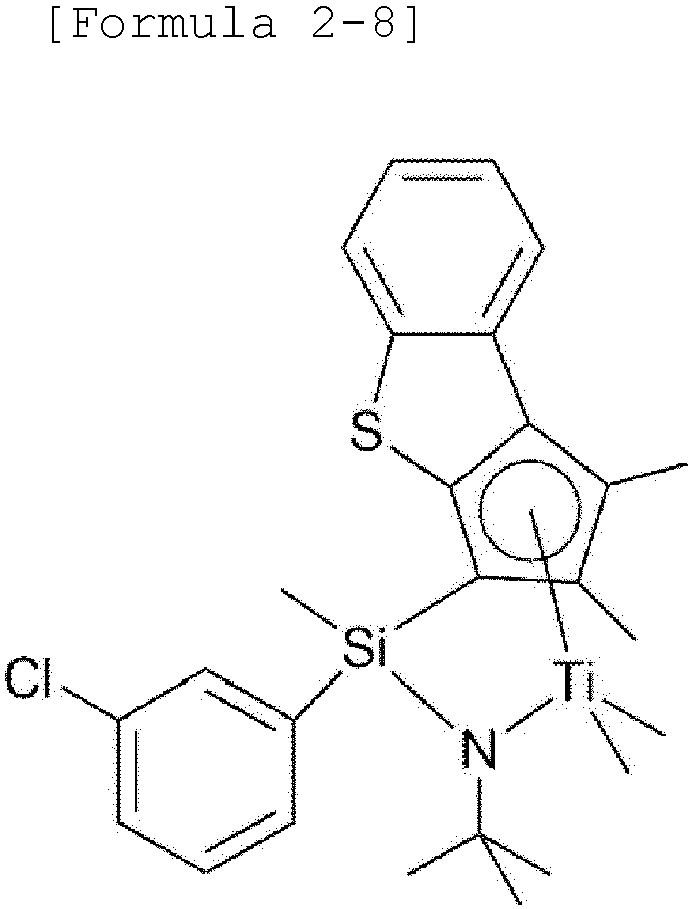
- the compound represented by Formula 2 may be any one among the compounds represented by the formulae below.
- the molar ratio of the transition metal compounds represented by Formula 1 and Formula 2 may be 1:0.5 to 1:8, 1:1 to 1:7, 1:1 to 1:5, 1:1 to 1:4, without limitation.
- the transition metal compounds represented by Formula 1 and Formula 2 used in the present invention have different mixing and introducing capacity of a comonomer, and through this, all conditions defined in the present invention are satisfied, and excellent volume resistance and light transmittance are shown.
- the polymerization reaction may be performed by continuously polymerizing ethylene and an alpha-olefin-based monomer by continuously injecting hydrogen in the presence of the catalyst composition, particularly, may be performed by injecting hydrogen in 5 to 100 cc/min.
- the hydrogen gas plays the role of restraining vigorous reaction of the transition metal compounds at the initiation point of polymerization and terminating polymerization reaction. Accordingly, by the use of the hydrogen gas and the control of the amount used, an ethylene/alpha-olefin copolymer having narrow molecular weight distribution may be effectively prepared.
- the hydrogen may be injected in 5 cc/min or more, 7 cc/min or more, or 10 cc/min or more, or 15 cc/min or more, or 19 cc/min or more, and 100 cc/min or less, or 50 cc/min or less, or 45 cc/min or less, or 35 cc/min or less, or 29 cc/min or less.
- the ethylene/alpha-olefin copolymer thus prepared may achieve the physical properties of the present invention.
- the hydrogen gas is injected in less than 5 cc/min, the termination of polymerization reaction is not uniformly carried out, and the preparation of an ethylene/alpha-olefin copolymer having desired physical properties may become difficult, and if injected in greater than 100 cc/min, termination reaction may occur too fast, and it is apprehended that an ethylene/alpha-olefin copolymer having a very low molecular weight may be prepared.
- the polymerization reaction may be performed at 100 to 200°C, and by controlling the polymerization temperature together with the injection amount of hydrogen, the crystallinity distribution and the molecular weight distribution in the ethylene/alpha-olefin copolymer may be controlled more advantageously.
- the polymerization reaction may be performed at 100 to 200°C, 120 to 180°C, 130 to 170°C, or 130 to 150°C, without limitation.
- a co-catalyst may be additionally used in the catalyst composition for activating the transition metal compounds represented by Formula 1 and/or Formula 2.
- the co-catalyst is an organometallic compound including a metal in group 13, and may particularly include one or more selected from Formula 3 to Formula 5 below. [Formula 3] - [Al(R 19 )-O] a -
- the compound of Formula 3 may be an alkylaluminoxane-based compound in which repeating units are combined in a linear, circular or network shape, and particular example may include methylaluminoxane (MAO), ethylaluminoxane, isobutylaluminoxane or tert-butylaluminoxane.
- MAO methylaluminoxane
- ethylaluminoxane isobutylaluminoxane or tert-butylaluminoxane.
- the compound of Formula 4 may include trimethylaluminum, triethylaluminum, triisobutylaluminum, tripropylaluminum, tributylaluminum, dimethylchloroaluminum, triisopropylaluminum, tri-s-butylaluminum, tricyclopentylaluminum, tripentylaluminum, triisopentylaluminum, trihexylaluminum, trioctylaluminum, ethyldimethylaluminum, methyldiethylaluminum, triphenylaluminum, tri-p-tolylaluminum, dimethylaluminummethoxide, dimethylaluminumethoxide, trimethylboron, triethylboron, triisobutylboron, tripropylboron, tributylboron, etc., particularly, trimethylaluminum, triethylaluminum or triiso
- the compound of Formula 5 may include a borate-based compound of a trisubstituted ammonium salt, a dialkyl ammonium salt or a trisubstituted phosphonium salt type. More particular examples include a borate-based compound of a trisubstituted ammonium salt type such as trimethylammonium tetraphenylborate, methyldioctadecylammonium tetraphenylborate, triethylammonium tetraphenylborate, tripropylammonium tetraphenylborate, tri(n-butyl)ammonium tetraphenylborate, methyltetradecylcyclooctadecylammonium tetraphenylborate, N,N-dimethylanilinium tetraphenylborate, N,N-diethylanilinium tetraphenylborate, N,N-
- the molecular weight distribution of the ethylene/alpha-olefin copolymer finally prepared may become more uniform, and polymerization activity may be improved.
- the co-catalyst may be used in a suitable amount so that the activation of the transition metal compounds of Formula 1 and/or Formula 2 may be sufficiently achieved.
- the transition metal compounds of Formula 1 and/or Formula 2 may be used in a supported type on a support.
- the weight ratio of the transition metals and the support may be 1:10 to 1:1,000, more particularly, 1:10 to 1:500. If the support and the transition metal compounds are included in a weight ratio in the above range, optimized type may be shown. In addition, if the co-catalyst is supported together by the support, the weight ratio of the co-catalyst and the support may be 1:1 to 1:100, more particularly, 1:1 to 1:50. If the co-catalyst and the support are included in the weight ratio, catalyst activity may be improved, and the microstructure of a polymer prepared may be optimized.
- silica, alumina, magnesia or mixtures thereof may be used as the support, or these materials may be used after drying at a high temperature to remove moisture at the surface and in a state including a hydroxyl group or siloxane group which has high reactivity at the surface.
- the dried support at a high temperature may further include an oxide, a carbonate, a sulfate or a nitrate component such as Na 2 O, K 2 CO 3 , BaSO 4 and Mg(NO 3 ) 2 .
- the drying temperature of the support is preferably, from 200 to 800°C, more preferably, from 300 to 600°C, most preferably, from 300 to 400°C. If the drying temperature of the support is less than 200°C, humidity is too high and moisture at the surface may react with the co-catalyst, and if the temperature is greater than 800°C, the pores at the surface of the support may be combined to decrease the surface area, and a large amount of the hydroxyl groups at the surface may be removed to remain only siloxane groups to decrease reaction sites with the co-catalyst, undesirably.
- the amount of the hydroxyl group at the surface of the support may preferably be 0.1 to 10 mmol/g, more preferably, 0.5 to 5 mmol/g.
- the amount of the hydroxyl group at the surface of the support may be controlled by the preparation method and conditions of the support, or drying conditions, for example, temperature, time, vacuum or spray drying.
- an organoaluminum compound may be further injected for removing moisture in a reactor during polymerization reaction, and the polymerization reaction may be performed in the presence thereof.
- organoaluminum compound may include trialkylaluminum, dialkylaluminum halide, alkyl aluminum dihalide, aluminum dialkyl hydride or alkyl aluminum sesqui halide, and more particular examples may include Al(C 2 H 5 ) 3 , Al(C 2 H 5 ) 2 H, Al(C 3 H 7 ) 3 , Al(C 3 H 7 ) 2 H, Al(i-C 4 H 9 ) 2 H, Al(C 8 H 17 ) 3 , Al(C 12 H 25 ) 3 , Al(C 2 H 5 )(C 12 H 25 ) 2 , Al(i-C 4 H 9 )(C 12 H 25 ) 2 , Al(i-C 4 H 9 ) 2 H, Al(i-C 4 H 9 ) 3 , (C 2 H 5 ) 3 ,
- a polymerization pressure may be about 1 to about 100 Kgf/cm 2 , preferably, about 1 to about 50 Kgf/cm 2 , more preferably, about 5 to about 30 Kgf/cm 2 .
- the transition metal compound may be injected after being dissolved or diluted in an aliphatic hydrocarbon solvent of 5 to 12 carbon atoms, for example, pentane, hexane, heptane, nonane, decane, and isomers thereof, an aromatic hydrocarbon solvent such as toluene and benzene, or a hydrocarbon solvent substituted with a chlorine atom such as dichloromethane and chlorobenzene.
- the solvent used is preferably used after treating with a small amount of alkyl aluminum to remove a small amount of water or air, which acts as a catalyst poison, and may be used by using a co-catalyst further.
- the ethylene/alpha-olefin copolymer of the present invention may be processed into a resin composition by including a crosslinking agent, a crosslinking auxiliary agent, a silane coupling agent, a light stabilizer, a UV absorbent, a thermal stabilizer, etc., and various additives known in this corresponding field may be suitably additionally included according to the use of a resin component applied in addition to the components.
- the ethylene/alpha-olefin copolymer may be utilized in various molded articles by molding by extrusion, etc.
- the ethylene/alpha-olefin copolymer may be used in various optoelectronic devices, for example, as an encapsulant for the encapsulation of a device in a solar cell, for example, may be used as an industrial material applied in a lamination process with heating, etc., without limitation.
- ligand compound prepared above (1.06 g, 3.22 mmol/1.0 eq) and 16.0 ml (0.2 M) of MTBE were put and stirred first.
- n-BuLi (2.64 ml, 6.60 mmol/2.05 eq, 2.5 M in THF) was added thereto at -40°C and reacted at room temperature overnight.
- MeMgBr (2.68 ml, 8.05 mmol/2.5 eq, 3.0 M in diethyl ether) was slowly added thereto dropwisely at -40°C, and TiCl 4 (2.68 ml, 3.22 mmol/1.0 eq, 1.0 M in toluene) was put in order, followed by reacting at room temperature overnight. After that, the reaction mixture was passed through celite using hexane for filtration. After dying the solvents, 1.07 g (82%) of a brown solid was obtained.
- the ligand compound of Formula 2-3 (4.26 g, 10.501 mmol) was put in 53 ml (0.2 M) of MTBE and stirred.
- n-BuLi (8.6 ml, 21.52 mmol, 2.05 eq, 2.5 M in hexane) was added thereto at -40°C and stirred at room temperature overnight.
- a stirred Li-complex THF solution was cannulated into a schlenk flask containing 8.1 ml (1.0 eq, 49.925 mmol) of dichloro (methyl) (phenyl)silane and 70 ml of THF at -78°C, followed by stirring at room temperature overnight. After stirring, drying in vacuum was carried out, and extraction with 100 ml of hexane was carried out.
- ligand compound prepared above (1.74 g, 4.14 mmol/1.0 eq) and 20.7 ml (0.2 M) of toluene were put and stirred.
- n-BuLi (3.48 ml, 8.7 mmol/2.1 eq, 2.5 M in hexane) was added thereto at -40°C and stirred at room temperature overnight.
- the compound above was synthesized according to a method described in Korean Laid-open Patent Publication No. 2015-0034653 and then, used.
- Ethylene/alpha-olefin copolymers were prepared by the same method as in Example 1 except for changing polymerization conditions as shown in Table 1 below.
- Table 1 Catalyst type Cat. Co-cat. Tibal C2 C6 Alpha-olefin Hydrogen Temp ⁇ mol/min mmol/mi n kg/h Type kg/h cc/min °C
- Preparation Example 1 Preparation Example 1+ Preparation Example 2-1 0.120 0.144 0.050 0.87 5.0 1-C4 0.95 23 130
- Example 2 Preparation Example 1+ Preparation Example 2-1 0.120 0.144 0.050 0.87 5.0 1-C4 0.90 27 130
- Example 3 Preparation Example 1+ Preparation Example 2-1 0.120 0.144 0.050 0.87 5.0 1-C4 0.90 20 130
- Example 4 Preparation Example 1+ Preparation Example 2-1 0.120 0.144 0.050 0.87 5.0 1-C4 0.85 24 130 Comparative Example 1 Comparative Preparation Example 1 0.700 2.100
- the temperature of the copolymer was elevated to 150°C, maintained for 5 minutes, decreased to -100°C, and elevated again, and a DSC curve was observed.
- the temperature elevating rate and decreasing rate were 10°C/min, respectively.
- the melting temperature was the maximum point of an endothermic peak during the second temperature elevation.
- the elution temperature was defined as a temperature corresponding to the maximum point in the peaks present after -20°C when drawing a graph of temperature vs. elution fraction.
- Mw weight average molecular weight
- Mn number average molecular weight
- an encapsulant film having an average thickness of 550 ⁇ m was manufactured at a low temperature to a degree not achieving high-temperature crosslinking (conditions of 100°C or less of extruder barrel temperature) using a micro extruder.
- Encapsulant films were manufactured by the same method as in Example 1 except for using the copolymers of Preparation Examples 2 to 4, and Comparative Preparation Examples 1 to 6 as samples, respectively.
- Measurement was conducted by applying a voltage of 1000 V for 60 seconds using Agilent 4339B High-resistance meter (product of Agilent Technologies K.K.) under temperature conditions of 23 ⁇ 1°C and humidity conditions of 50 ⁇ 3%.
- Light transmittance at 550 nm was measured using Shimadzu UV-3600 spectrophotometer.
- the ethylene/alpha-olefin copolymer of the present invention achieved both high volume resistance and high light transmittance in contrast to the ethylene/alpha-olefin copolymers of the Comparative Examples.
- Comparative Examples 1 and 2 showed large Tm - Te values of 65°C or more, and due to a low-crystalline region, volume resistance was degraded in contrast to the Examples, and due to a high-crystalline region, light transmittance was also low, and Comparative Examples 3 to 5 showed small Tm - Te values of 35°C or less, and due to a low-crystalline region, volume resistance was particularly lowered.
- Comparative Example 6 satisfied the range of Equation 1, but since the density and the Te value were too large, the light transmittance was particularly low.
- the ethylene/alpha-olefin copolymer satisfying the density, Tm, and Tm - Te value, defined in the present invention may achieve excellent levels of volume resistance and light transmittance without using a separate additive.
Landscapes
- Chemical & Material Sciences (AREA)
- Health & Medical Sciences (AREA)
- Chemical Kinetics & Catalysis (AREA)
- Medicinal Chemistry (AREA)
- Polymers & Plastics (AREA)
- Organic Chemistry (AREA)
- Transition And Organic Metals Composition Catalysts For Addition Polymerization (AREA)
- Addition Polymer Or Copolymer, Post-Treatments, Or Chemical Modifications (AREA)
Abstract
Description
- This application claims the benefit of
Korean Patent Application Nos. 2020-0046025, filed on April 16, 2020 2020-0103861, filed on August 19, 2020, in the Korean - The present invention relates to an ethylene/alpha-olefin copolymer having excellent volume resistance and light transmittance, and a method for preparing the same.
- As global environmental problems, energy problems, etc. get worse and worse, solar cells receive attention as a clean energy generating means without fear of exhaustion. If solar cells are used outside such as the roof of a building, generally, a module type is used. In order to obtain a crystalline solar cell module when manufacturing a solar cell module, protection sheet for solar cell module (surface side transparent protection member)/solar cell encapsulant/crystalline solar cell device/solar cell encapsulant/protection sheet for solar cell module (back side protection member) are stacked in order.
- As the solar cell encapsulant, generally, an ethylene/vinyl acetate copolymer or ethylene/alpha-olefin copolymer, etc. is used. In addition, in the solar cell encapsulant, a light stabilizer is generally included as an additive considering the requirement on climate-resistance for a long time, and in addition, considering the adhesiveness of a transparent surface side protection member or a back side protection member represented by glass, a silane coupling agent is commonly included in the solar cell sealant. However, if an ethylene/vinyl acetate copolymer is used as the constituent material of a solar cell encapsulant, it has been apprehended that components such as an acetic acid gas generated by the decomposition of the ethylene/vinyl acetate copolymer might influence a solar cell device.
- In addition, the increase of the scale of a power generation system such as a mega solar is conducted along with the recent dissemination of the power generation of the sunlight, and for the purpose of reducing transmission loss, there are moves to increase a voltage of a system voltage. As the system voltage increases, a potential difference between a frame and cells increases in a solar cell module. That is, the frame of a solar cell module is generally grounded, and if the system voltage of a solar cell array is from 600 V to 1000 V, the potential difference between the frame and the cells becomes from 600 V to 1000 V just the same in a module with the highest voltage, and the power generation is maintained during the day in a high-voltage applied state. In addition, glass has lower electric resistance when compared with an encapsulant, and due to the interposition of the frame, a high voltage is generated between the glass and the cells. That is, under the circumstance of generating power during the day, in a module with series connection, a potential difference between the cells and the module, and the cells and glass side increases in succession from a grounded side, and at the greatest point, almost the same potential difference of the system voltage is maintained. In a solar cell module used in such a state, output is largely reduced, and an example of a module using a crystalline power generation device in which potential induced degradation (PID) phenomenon arising degradation is generated, has been reported. Accordingly, in order to solve the problems, a solar cell encapsulant which comes into direct contact with the solar cell device, having even higher volume intrinsic resistance is required.
- Volume resistance or specific resistance (p) known as electric resistance is defined as electric resistance between facing surfaces of 1 m3 of a material, and it is important to obtain a molded article in which this volume resistance may be reproduced in a predetermined range in all application divisions and permanent. In an electric insulation material field for a high-voltage power cable, low-density polyethylene processed at a high pressure, crosslinked polyethylene, etc. are widely used due to excellent electric properties. One of the difficulties of the high-voltage power cable is the power loss shown during power transmission, and the reduction of the power loss could be attained by increasing the high-voltage properties, particularly, volume resistance of an insulating material. However, in the insulating material for a power cable, the inner part of a conductor is heated to a high temperature (about 90°C) by heat generated by the passing of current, but the outer part of the conductor maintains room temperature. The conventional polyethylene shows marked drop of volume resistance near the inner conductor through the passing of current.
- As described above, the development of an ethylene/alpha-olefin copolymer widely utilized as a material having excellent volume resistance and requiring high insulation such as a solar cell encapsulant is still required.
- (Patent Document 1)
Japanese Laid-open Patent No. 2010-258439 - An object of the present invention is to provide an ethylene/alpha-olefin copolymer accomplishing excellent volume resistance and light transmittance at once, and may be usefully utilized as an insulating material, and a method for preparing the same.
- To solve the above tasks, the present invention provides an ethylene/alpha-olefin copolymer satisfying the following conditions (a) to (c):
- (a) a density is 0.85 to 0.89 g/cc;
- (b) a melting temperature (Tm) having a maximum peak in a curve obtained by differential scanning calorimetry (DSC) is 40 to 90°C; and
- (c) the melting temperature (Tm) and an elution temperature (Te) having a maximum peak in a curve obtained by cross-fractionation chromatography (CFC) satisfy the following Equation 1:

- The ethylene/alpha-olefin copolymer satisfying all the conditions defined in the present invention, has high volume resistance and excellent insulating properties, and accordingly, may be widely used for various uses in electric and electronic industrial fields, and particularly, if used in a solar cell module, PID phenomenon may be delayed as much as possible, high light transmittance may be shown, and excellent module efficiency may be accomplished.
- Hereinafter, the present invention will be described in more detail to assist the understanding of the present invention.
- It will be understood that words or terms used in the present disclosure and claims shall not be interpreted as the meaning defined in commonly used dictionaries. It will be further understood that the words or terms should be interpreted as having a meaning that is consistent with their meaning in the context of the relevant art and the technical idea of the invention, based on the principle that an inventor may properly define the meaning of the words or terms to best explain the invention.
- The ethylene/alpha-olefin copolymer of the present invention is characterized in satisfying the following conditions (a) to (c):
- (a) a density is 0.85 to 0.89 g/cc;
- (b) a melting temperature (Tm) having a maximum peak in a curve obtained by differential scanning calorimetry (DSC) is 40 to 90°C; and
- (c) the melting temperature (Tm) and an elution temperature (Te) having a maximum peak in a curve obtained by cross-fractionation chromatography (CFC) satisfy Equation 1 below.

- The present invention relates to an ethylene/alpha-olefin copolymer showing high volume resistance and excellent electrical insulation, and since the ethylene/alpha-olefin copolymer of the present invention satisfies a specific range of a difference between a melting temperature measured by DSC and an elution temperature measured by CFC, high volume resistance and excellent light transmittance may be shown.
- Particularly, the ethylene/alpha-olefin copolymer of the present invention is prepared by mixing and using transition metal compounds represented by Formula 1 and Formula 2 as a catalyst, as described later. The introduction of an alpha-olefin-based monomer into the transition metal compound represented by Formula 1 is difficult due to the structural characteristics of a catalyst, and a copolymer of a high-density region tends to be prepared, and since a large amount of alpha-olefin may be introduced into the transition metal compound represented by Formula 2, a polymer in a very low-density region (elastomer) may also be prepared. Accordingly, if each of the two transition metal compounds is used solely, copolymerization properties of mixing and introducing an alpha-olefin-based monomer are different.
- The ethylene/alpha-olefin copolymer of the present invention, prepared by using the mixture composition as a catalyst, is a copolymer in which both a low-density region in which a large amount of an alpha-olefin-based monomer is mixed and introduced and a high-density region in which a small amount of an alpha-olefin-based monomer is mixed and introduced are present, and which shows a Tm - Te value of a constant value or more. This means that both a high-crystalline region and a low-crystalline region are included, and accordingly, crystallinity distribution is wide and a free volume is small. Accordingly, the charge mobility of a polymer is low, and volume resistance is high. In addition, if the Tm - Te value is too high, the volume resistance may be rather degraded due to the low-crystalline region, and the light transmittance may also be degraded due to the high-crystalline region, and in the present invention, a suitable range of the Tm - Te value, capable of accomplishing both the volume resistance and light transmittance excellently, is derived, and an ethylene/alpha-olefin copolymer satisfying the value has been developed.
- The ethylene/alpha-olefin copolymer of the present invention is a polymer having a low density in a range of 0.85 to 0.89 g/cc, and particularly, the density may be 0.850 g/cc or more, 0.860 g/cc or more, or 0.870 g/cc or more, and 0.890 g/cc or less, or 0.880 g/cc or less. In this case, the density may mean a density measured according to ASTM D-792.
- Generally, the density of the ethylene/alpha-olefin copolymer is influenced by the type and amount of a monomer used for polymerization, a polymerization degree, etc., and is largely influenced by the amount of a comonomer in case of a copolymer. In this case, if the amount of the comonomer increases, an ethylene/alpha-olefin copolymer of a low density may be prepared, and the amount of the comonomer introduced into the copolymer may be dependent on the intrinsic copolymerization properties of a catalyst.
- The copolymer of the present invention is a copolymer prepared using the compounds represented by Formula 1 and Formula 2 as catalysts, and shows a low density as described above, and as a result, excellent processability may be shown.
- In the ethylene/alpha-olefin copolymer of the present invention, the melting temperature (Tm) having a maximum peak in a curve obtained by differential scanning calorimetry (DSC) and an elution temperature (Te) having a maximum peak in a curve obtained by cross-fractionation chromatography (CFC) satisfy Equation 1 below.

- Here, the melting temperature means the maximum temperature of the highest peak in the DSC curve which is represented by heat flow with respect to temperature, and the elution temperature means the maximum temperature of the highest peak in the CFC elution curve which is represented by elution amount with respect to temperature (dC/dT).
- The cross-fractionation chromatography (CFC) is a method of combining temperature rising elution fractionation (TREF) and gel filtration chromatography (GPC), and through this, the crystallinity distribution of an ethylene/alpha-olefin copolymer may be measured. Particularly, a specimen solution of a high temperature, in which an ethylene/alpha-olefin copolymer is completely dissolved in a solvent is injected into a column filled with an inert carrier, the temperature of the column is lowered to attach the specimen on the surface of the filler, and the temperature of the column is gradually elevated while flowing o-dichlorobenzene in the column. The concentration of an olefin-based copolymer eluted at each temperature is detected, and at the same time, the component eluted at each temperature is sent to GPC via online for each fraction to obtain a chromatogram, and after that, since the elution temperature is elevated according to the increase of the crystallinity of the eluted component, the crystallinity distribution of the ethylene/alpha-olefin copolymer may be found by obtaining the relation of the elution temperature and the elution amount (wt%) of the ethylene/alpha-olefin copolymer.
- If the Tm - Te value is 35°C or less, the content of the high-crystalline region in the copolymer is low, and problems of degrading the volume resistance may arise, and if the Tm - Te value is 65°C or more, the crystalline distribution of the copolymer may be excessively broadened, and problems of deteriorating light transmittance due to the high-crystalline region and deteriorating volume resistance due to the low-crystalline region may arise.
- The ethylene/alpha-olefin copolymer of the present invention may have a melting temperature (Tm) having the maximum peak in a curve obtained by differential scanning calorimetry (DSC) of 40 to 90°C. Particularly, the melting temperature may be 40°C or more, 50°C or more, 55°C or more, 60°C or more, 61°C or more, and 90°C or less, 80°C or less, 75°C or less, 70°C or less, 68°C or less.
- As described above, the ethylene/alpha-olefin copolymer of the present invention is characterized in satisfying the Tm - Te value represented by Equation 1, and at the same time having a density of 0.85 to 0.89 g/cc and a melting temperature (Tm) of 40 to 90°C. Though satisfying Equation 1, if the density or melting temperature (Tm) value deviate from the above-described ranges and are too high, problems of deteriorating light transmittance may arise, and if all conditions (a) to (c) defined in the present invention are satisfied, excellent volume resistance and light transmittance may be achieved at the same time, for example, may show physical properties suitable for the use in an encapsulant film of a solar cell.
- In addition, the elution temperature (Te) may be 10 to 50°C, particularly, 10°C or more, 15°C or more, 20°C or more, 25°C or more, and 50°C or less, 40°C or less, 35°C or less, 30°C or less.
- The ethylene/alpha-olefin copolymer of the present invention has narrow molecular weight distribution (MWD) of 1.5 to 2.5. More particularly, the molecular weight distribution may be 1.5 or more, 1.7 or more, 1.8 or more, 2.0 or more, and 2.5 or less, 2.4 or less, 2.3 or less, 2.2 or less.
- Generally, if two or more types of monomers are polymerized, molecular weight distribution increases, and as a result, impact strength and mechanical properties are reduced, and there is possibility of generating blocking phenomenon, etc. Particularly, since the polymerization properties of a monomer are different according to the catalyst, the molecular weight of a polymer finally prepared may be influenced by the type of the catalyst. If two or more types of catalysts are mixed and used in polymerization reaction, and if the difference of the polymerization properties of the catalysts is large, there are problems of increasing the molecular weight distribution of a polymer.
- In order to reduce the molecular weight distribution to prevent the degradation of the crosslinking properties, impact strength, mechanical properties, etc. of a copolymer, a suitable amount of hydrogen may be injected during polymerization reaction to prevent the generation of arbitrary β-hydride elimination reaction in a polymer chain and induce uniform termination reaction, and in this case, the weight average molecular weight and melt index of the copolymer tend to decrease according to the injection of hydrogen. Accordingly, appropriate catalyst type and hydrogen injection amount are determined in ranges for achieving both the intrinsic properties of a catalyst structure influencing the weight average molecular weight and the melt index and the reducing effects of molecular weight distribution according to the injection of hydrogen.
- Considering the above-described points, in the present invention, since an optimized amount of hydrogen is injected while mixing a transition metal compound represented by Formula 1 and a transition metal compound represented by Formula 2 and using thereof as a catalyst, the above-described range of narrow molecular weight distribution may be shown, and high volume resistance and light transmittance may be shown while preventing the degradation of the crosslinking properties, impact strength, mechanical properties, etc.
- The weight average molecular weight (Mw) and the number average molecular weight (Mn) are polystyrene converted molecular weights analyzed by gel permeation chromatography (GPC), and the molecular weight distribution may be calculated from a ratio of Mw/Mn.
- In addition, the ethylene/alpha-olefin copolymer of the present invention may have a weight average molecular weight (Mw) of 40,000 to 150,000 g/mol. Particularly, the weight average molecular weight may be 40,000 g/mol or more, 45,000 g/mol or more, 50,000 g/mol or more, and 150,000 g/mol or less, 130,000 g/mol or less, 100,000 g/mol or less, 90,000 g/mol or less, or 80,000 g/mol or less.
- The ethylene/alpha-olefin copolymer of the present invention has a melt index (MI, 190°C, 2.16 kg load conditions) of 1 to 100 dg/min. Particularly, the melt index may be 1 dg/min or more, 2 dg/min or more, 3 dg/min or more, or 4 dg/min or more, and 100 dg/min or less, 50 dg/min or less, 20 dg/min or less, or 15 dg/min or less.
- If the melt index is less than 1 dg/min, a production rate may be reduced due to high load, and if the melt index is greater than 100 dg/min, film molding is difficult, and defects of unsuitable for the use as an encapsulant film may arise.
- The ethylene/alpha-olefin copolymer of the present invention is prepared by copolymerizing ethylene and an alpha-olefin-based monomer, and in this case, the alpha-olefin which means a moiety derived from an alpha-olefin-based monomer in the copolymer may be C4 to C20 alpha-olefin, particularly, propylene, 1-butene, 1-pentene, 4-methyl-1-pentene, 1-hexene, 1-heptene, 1-octene, 1-decene, 1-undecene, 1-dodecene, 1-tetradecene, 1-hexadecene, 1-eicosene, etc., and any one among them or mixtures of two or more thereof may be used.
- Among them, the alpha-olefin may be 1-butene, 1-hexene or 1-octene, preferably, 1-butene, 1-hexene, or a combination thereof.
- In addition, in the ethylene/alpha-olefin copolymer, the alpha-olefin content may be suitably selected in the range satisfying the physical conditions, particularly, greater than 0 to 99 mol%, or 10 to 50 mol%, without limitation.
- The aforementioned ethylene/alpha-olefin copolymer of the present invention may be prepared by a preparation method including: a step of polymerizing ethylene and an alpha-olefin-based monomer in the presence of a catalyst composition including transition metal compounds represented by Formula 1 and Formula 2 below.

- In Formula 1,
- R1 is hydrogen; alkyl of 1 to 20 carbon atoms; cycloalkyl of 3 to 20 carbon atoms; alkenyl of 2 to 20 carbon atoms; alkoxy of 1 to 20 carbon atoms; aryl of 6 to 20 carbon atoms; arylalkoxy of 7 to 20 carbon atoms; alkylaryl of 7 to 20 carbon atoms; or arylalkyl of 7 to 20 carbon atoms,
- R2 and R3 are each independently hydrogen; halogen; alkyl of 1 to 20 carbon atoms; cycloalkyl of 3 to 20 carbon atoms; alkenyl of 2 to 20 carbon atoms; arylalkyl of 7 to 20 carbon atoms; alkylamido of 1 to 20 carbon atoms; or arylamido of 6 to 20 carbon atoms,
- R4 and R5 are each independently hydrogen; alkyl of 1 to 20 carbon atoms; cycloalkyl of 3 to 20 carbon atoms; aryl of 6 to 20 carbon atoms; or alkenyl of 2 to 20 carbon atoms,
- R6 to R9 are each independently hydrogen; alkyl of 1 to 20 carbon atoms; cycloalkyl of 3 to 20 carbon atoms; aryl of 6 to 20 carbon atoms; or alkenyl of 2 to 20 carbon atoms,
- two or more adjacent groups among R6 to R9 may be connected with each other to form a ring,
- Q1 is Si, C, N, P or S,
- M1 is Ti, Hf or Zr, and
- X1 and X2 are each independently hydrogen; halogen; alkyl of 1 to 20 carbon atoms; alkenyl of 2 to 20 carbon atoms; aryl of 6 to 20 carbon atoms; alkylaryl of 7 to 20 carbon atoms; arylalkyl of 7 to 20 carbon atoms; alkylamino of 1 to 20 carbon atoms; or arylamino of 6 to 20 carbon atoms.

- In Formula 2,
- R10 is hydrogen; alkyl of 1 to 20 carbon atoms; cycloalkyl of 3 to 20 carbon atoms; alkenyl of 2 to 20 carbon atoms; alkoxy of 1 to 20 carbon atoms; aryl of 6 to 20 carbon atoms; arylalkoxy of 7 to 20 carbon atoms; alkylaryl of 7 to 20 carbon atoms; or arylalkyl of 7 to 20 carbon atoms,
- R11a to R11e are each independently hydrogen; halogen; alkyl of 1 to 20 carbon atoms; cycloalkyl of 3 to 20 carbon atoms; alkenyl of 2 to 20 carbon atoms; alkoxy of 1 to 20 carbon atoms; or aryl of 6 to 20 carbon atoms,
- R12 is hydrogen; halogen; alkyl of 1 to 20 carbon atoms; cycloalkyl of 3 to 20 carbon atoms; alkenyl of 2 to 20 carbon atoms; aryl of 6 to 20 carbon atoms; alkylaryl of 7 to 20 carbon atoms; arylalkyl of 7 to 20 carbon atoms; alkylamido of 1 to 20 carbon atoms; or arylamido of 6 to 20 carbon atoms,
- R13 and R14 are each independently hydrogen; alkyl of 1 to 20 carbon atoms; cycloalkyl of 3 to 20 carbon atoms; aryl of 6 to 20 carbon atoms; or alkenyl of 2 to 20 carbon atoms,
- R15 to R18 are each independently hydrogen; alkyl of 1 to 20 carbon atoms; cycloalkyl of 3 to 20 carbon atoms; aryl of 6 to 20 carbon atoms; or alkenyl of 2 to 20 carbon atoms,
- two or more adjacent groups among R15 to R18 may be connected with each other to form a ring,
- Q2 is Si, C, N, P or S,
- M2 is Ti, Hf or Zr, and
- X3 and X4 are each independently hydrogen; halogen; alkyl of 1 to 20 carbon atoms; alkenyl of 2 to 20 carbon atoms; aryl of 6 to 20 carbon atoms; alkylaryl of 7 to 20 carbon atoms; arylalkyl of 7 to 20 carbon atoms; alkylamino of 1 to 20 carbon atoms; or arylamino of 6 to 20 carbon atoms.
- Particularly, in Formula 1, R1 is hydrogen; alkyl of 1 to 20 carbon atoms; cycloalkyl of 3 to 20 carbon atoms; alkenyl of 2 to 20 carbon atoms; alkoxy of 1 to 20 carbon atoms; aryl of 6 to 20 carbon atoms; arylalkoxy of 7 to 20 carbon atoms; alkylaryl of 7 to 20 carbon atoms; or arylalkyl of 7 to 20 carbon atoms, and more particularly, R1 may be methyl, ethyl, propyl, butyl, isobutyl, t-butyl, isopropyl, cyclohexyl, benzyl, phenyl, methoxyphenyl, ethoxyphenyl, fluorophenyl, bromophenyl, chlorophenyl, dimethylphenyl or diethylphenyl.
- Particularly, in Formula 1, R2 and R3 are each independently hydrogen; halogen; alkyl of 1 to 20 carbon atoms; cycloalkyl of 3 to 20 carbon atoms; alkenyl of 2 to 20 carbon atoms; arylalkyl of 7 to 20 carbon atoms; alkylamido of 1 to 20 carbon atoms; or arylamido of 6 to 20 carbon atoms, and more particularly, R2 and R3 may be each independently hydrogen; alkyl of 1 to 20 carbon atoms; or arylalkyl of 7 to 20 carbon atoms.
- Particularly, in Formula 1, R4 and R5 may be the same or different, and may be each independently hydrogen; alkyl of 1 to 20 carbon atoms; cycloalkyl of 3 to 20 carbon atoms; aryl of 6 to 20 carbon atoms; or alkenyl of 2 to 20 carbon atoms, more particularly, alkyl of 1 to 6 carbon atoms. More particularly, R4 and R5 may be methyl, ethyl or propyl.
- Particularly, in Formula 1, R6 to R9 may be the same or different and may be each independently hydrogen; alkyl of 1 to 20 carbon atoms; cycloalkyl of 3 to 20 carbon atoms; aryl of 6 to 20 carbon atoms; or alkenyl of 2 to 20 carbon atoms. More particularly, R6 to R9 may be the same or different and may be each independently hydrogen or methyl.
- Two or more adjacent groups among R6 to R9 may be connected with each other to form an aliphatic ring of 5 to 20 carbon atoms or an aromatic ring of 6 to 20 carbon atoms, and the aliphatic ring or aromatic ring may be substituted with halogen, alkyl of 1 to 20 carbon atoms, alkenyl of 2 to 20 carbon atoms or aryl of 6 to 20 carbon atoms.
- Particularly, in Formula 1, Q1 is Si, C, N, P or S, and more particularly, Q1 may be Si.
- Particularly, in Formula 1, M1 may be Ti, Hf or Zr.
- Particularly, in Formula 1, X1 and X2 may be the same or different and may be each independently hydrogen; halogen; alkyl of 1 to 20 carbon atoms; alkenyl of 2 to 20 carbon atoms; aryl of 6 to 20 carbon atoms; alkylaryl of 7 to 20 carbon atoms; arylalkyl of 7 to 20 carbon atoms; alkylamino of 1 to 20 carbon atoms; or arylamino of 6 to 20 carbon atoms.
- In addition, the compound represented by Formula 1 may be a compound represented by any one among the compounds below.


- Besides, the compounds may have various structures within the range defined in Formula 1.
- In addition, in Formula 2, R10 is hydrogen; alkyl of 1 to 20 carbon atoms; cycloalkyl of 3 to 20 carbon atoms; alkenyl of 2 to 20 carbon atoms; alkoxy of 1 to 20 carbon atoms; aryl of 6 to 20 carbon atoms; arylalkoxy of 7 to 20 carbon atoms; alkylaryl of 7 to 20 carbon atoms; or arylalkyl of 7 to 20 carbon atoms, and more particularly, R10 may be hydrogen; alkyl of 1 to 20 carbon atoms or 1 to 12 carbon atoms; alkoxy of 1 to 20 carbon atoms; aryl of 6 to 20 carbon atoms; arylalkoxy of 7 to 20 carbon atoms; alkylaryl of 7 to 20 carbon atoms; or arylalkyl of 7 to 20 carbon atoms.
- Particularly, in Formula 2, R11a to R11e are each independently hydrogen; halogen; alkyl of 1 to 20 carbon atoms; cycloalkyl of 3 to 20 carbon atoms; alkenyl of 2 to 20 carbon atoms; alkoxy of 1 to 20 carbon atoms; or aryl of 6 to 20 carbon atoms, more particularly, hydrogen; halogen; alkyl of 1 to 12 carbon atoms; cycloalkyl of 3 to 12 carbon atoms; alkenyl of 2 to 12 carbon atoms; alkoxy of 1 to 12 carbon atoms; or phenyl.
- Particularly, in Formula 2, R12 is hydrogen; halogen; alkyl of 1 to 20 carbon atoms; cycloalkyl of 3 to 20 carbon atoms; alkenyl of 2 to 20 carbon atoms; aryl of 6 to 20 carbon atoms; alkylaryl of 7 to 20 carbon atoms; arylalkyl of 7 to 20 carbon atoms; alkylamido of 1 to 20 carbon atoms; or arylamido of 6 to 20 carbon atoms, more particularly, hydrogen; halogen; alkyl of 1 to 12 carbon atoms; cycloalkyl of 3 to 12 carbon atoms; alkenyl of 2 to 12 carbon atoms; or phenyl.
- Particularly, in Formula 2, R13 and R14 are each independently hydrogen; alkyl of 1 to 20 carbon atoms; cycloalkyl of 3 to 20 carbon atoms; aryl of 6 to 20 carbon atoms; or alkenyl of 2 to 20 carbon atoms, more particularly, hydrogen; or alkyl of 1 to 12 carbon atoms.
- Particularly, in Formula 2, R15 to R18 are each independently hydrogen; alkyl of 1 to 20 carbon atoms; cycloalkyl of 3 to 20 carbon atoms; aryl of 6 to 20 carbon atoms; or alkenyl of 2 to 20 carbon atoms, more particularly, hydrogen; alkyl of 1 to 12 carbon atoms; or cycloalkyl of 3 to 12 carbon atoms, or hydrogen; or methyl.
- Particularly, in Formula 2, two or more adjacent groups among R15 to R18 may be connected with each other to form a ring.
- Particularly, in Formula 2, Q2 is Si, C, N, P or S, and more particularly, Q may be Si.
- Particularly, in Formula 2, X3 and X4 are each independently hydrogen; halogen; alkyl of 1 to 20 carbon atoms; alkenyl of 2 to 20 carbon atoms; aryl of 6 to 20 carbon atoms; alkylaryl of 7 to 20 carbon atoms; arylalkyl of 7 to 20 carbon atoms; alkylamino of 1 to 20 carbon atoms; or arylamino of 6 to 20 carbon atoms, particularly, hydrogen; halogen; alkyl of 1 to 12 carbon atoms; cycloalkyl of 3 to 12 carbon atoms; or alkenyl of 2 to 12 carbon atoms, more particularly, hydrogen; or alkyl of 1 to 12 carbon atoms.
- In addition, the compound represented by Formula 2 may be any one among the compounds represented by the formulae below.




- The molar ratio of the transition metal compounds represented by Formula 1 and Formula 2 may be 1:0.5 to 1:8, 1:1 to 1:7, 1:1 to 1:5, 1:1 to 1:4, without limitation.
- As described above, the transition metal compounds represented by Formula 1 and Formula 2 used in the present invention have different mixing and introducing capacity of a comonomer, and through this, all conditions defined in the present invention are satisfied, and excellent volume resistance and light transmittance are shown.
- The polymerization reaction may be performed by continuously polymerizing ethylene and an alpha-olefin-based monomer by continuously injecting hydrogen in the presence of the catalyst composition, particularly, may be performed by injecting hydrogen in 5 to 100 cc/min.
- The hydrogen gas plays the role of restraining vigorous reaction of the transition metal compounds at the initiation point of polymerization and terminating polymerization reaction. Accordingly, by the use of the hydrogen gas and the control of the amount used, an ethylene/alpha-olefin copolymer having narrow molecular weight distribution may be effectively prepared.
- For example, the hydrogen may be injected in 5 cc/min or more, 7 cc/min or more, or 10 cc/min or more, or 15 cc/min or more, or 19 cc/min or more, and 100 cc/min or less, or 50 cc/min or less, or 45 cc/min or less, or 35 cc/min or less, or 29 cc/min or less. If injected in the above-described conditions, the ethylene/alpha-olefin copolymer thus prepared may achieve the physical properties of the present invention.
- If the hydrogen gas is injected in less than 5 cc/min, the termination of polymerization reaction is not uniformly carried out, and the preparation of an ethylene/alpha-olefin copolymer having desired physical properties may become difficult, and if injected in greater than 100 cc/min, termination reaction may occur too fast, and it is apprehended that an ethylene/alpha-olefin copolymer having a very low molecular weight may be prepared.
- In addition, the polymerization reaction may be performed at 100 to 200°C, and by controlling the polymerization temperature together with the injection amount of hydrogen, the crystallinity distribution and the molecular weight distribution in the ethylene/alpha-olefin copolymer may be controlled more advantageously. Particularly, the polymerization reaction may be performed at 100 to 200°C, 120 to 180°C, 130 to 170°C, or 130 to 150°C, without limitation.
- In the present invention, a co-catalyst may be additionally used in the catalyst composition for activating the transition metal compounds represented by Formula 1 and/or Formula 2. The co-catalyst is an organometallic compound including a metal in group 13, and may particularly include one or more selected from Formula 3 to Formula 5 below.
[Formula 3] - [Al(R19)-O]a-
- In Formula 3,
- each R19 is independently halogen radical; hydrocarbyl radical of 1 to 20 carbon atoms; or halogen-substituted hydrocarbyl radical of 1 to 20 carbon atoms, and
- a is an integer of 2 or more.
[Formula 4] D(R19)3
- In Formula 4,
- D is aluminum or boron, and
- each R19 is independently halogen radical; hydrocarbyl radical of 1 to 20 carbon atoms; or halogen-substituted hydrocarbyl radical of 1 to 20 carbon atoms.
[Formula 5] [L-H]+[Z(A)4]- or [L]+[Z(A)4]-
- In Formula 5,
- H is a hydrogen atom,
- Z is an element in group 13,
- each A is independently aryl of 6 to 20 carbon atoms, in which one or more hydrogen atoms may be substituted with substituents; or alkyl of 1 to 20 carbon atoms,
- the substituent is halogen; hydrocarbyl of 1 to 20 carbon atoms; alkoxy of 1 to 20 carbon atoms; or aryloxy of 6 to 20 carbon atoms,
- [L-H]+ is trimethylammonium; triethylammonium; tripropylammonium; tributylammonium; diethylammonium; trimethylphosphonium; or triphenylphosphonium, and
- [L]+ is N,N-diethylanilinium; or triphenylcarbonium.
- More particularly, the compound of Formula 3 may be an alkylaluminoxane-based compound in which repeating units are combined in a linear, circular or network shape, and particular example may include methylaluminoxane (MAO), ethylaluminoxane, isobutylaluminoxane or tert-butylaluminoxane.
- In addition, the compound of Formula 4 may include trimethylaluminum, triethylaluminum, triisobutylaluminum, tripropylaluminum, tributylaluminum, dimethylchloroaluminum, triisopropylaluminum, tri-s-butylaluminum, tricyclopentylaluminum, tripentylaluminum, triisopentylaluminum, trihexylaluminum, trioctylaluminum, ethyldimethylaluminum, methyldiethylaluminum, triphenylaluminum, tri-p-tolylaluminum, dimethylaluminummethoxide, dimethylaluminumethoxide, trimethylboron, triethylboron, triisobutylboron, tripropylboron, tributylboron, etc., particularly, trimethylaluminum, triethylaluminum or triisobutylaluminum, without limitation.
- In addition, the compound of Formula 5 may include a borate-based compound of a trisubstituted ammonium salt, a dialkyl ammonium salt or a trisubstituted phosphonium salt type. More particular examples include a borate-based compound of a trisubstituted ammonium salt type such as trimethylammonium tetraphenylborate, methyldioctadecylammonium tetraphenylborate, triethylammonium tetraphenylborate, tripropylammonium tetraphenylborate, tri(n-butyl)ammonium tetraphenylborate, methyltetradecylcyclooctadecylammonium tetraphenylborate, N,N-dimethylanilinium tetraphenylborate, N,N-diethylanilinium tetraphenylborate, N,N-dimethyl(2,4,6-trimethylanilinium)tetraphenylborate, trimethylammonium tetrakis(pentafluorophenyl)borate, methylditetradecylammonium tetrakis(pentaphenyl)borate, methyldioctadecylammonium tetrakis(pentafluorophenyl)borate, triethylammonium, tetrakis(pentafluorophenyl)borate, tripropylammoniumtetrakis(pentafluorophenyl)borate, tri(n-butyl)ammonium tetrakis(pentafluorophenyl)borate, tri(sec-butyl)ammoniumtetrakis(pentafluorophenyl)borate, N,N-dimethylanilinium tetrakis(pentafluorophenyl)borate, N,N-diethylaniliniumtetrakis(pentafluorophenyl)borate, N,N-dimethyl(2,4,6-trimethylanilinium)tetrakis(pentafluorophenyl)borate, trimethylammoniumtetrakis(2,3,4,6-tetrafluorophenyl)borate, triethylammonium tetrakis(2,3,4,6-tetrafluorophenyl)borate, tripropylammonium tetrakis(2,3,4,6-tetrafluorophenyl)borate, tri(n-butyl)ammonium tetrakis(2,3,4,6-,tetrafluorophenyl)borate, dimethyl(t-butyl)ammonium tetrakis(2,3,4,6-tetrafluorophenyl)borate, N,N-dimethylanilinium tetrakis(2,3,4,6-tetrafluorophenyl)borate, N,N-diethylanilinium tetrakis(2,3,4,6-tetrafluorophenyl)borate and N,N-dimethyl-(2,4,6-trimethylanilinium)tetrakis-(2,3,4,6-tetrafluorophenyl)borate; a borate-based compound of a dialkyl ammonium salt type such as dioctadecylammonium tetrakis(pentafluorophenyl)borate, ditetradecylammonium tetrakis(pentafluorophenyl)borate and dicyclohexylammonium tetrakis(pentafluorophenyl)borate; or a borate-based compound of a trisubstituted phosphonium salt type such as triphenylphosphonium tetrakis(pentafluorophenyl)borate, methyldioctadecylphosphonium tetrakis(pentafluorophenyl)borate and tri(2,6-, dimethylphenyl)phosphoniumtetrakis(pentafluorophenyl)borate, without limitation.
- By using such a co-catalyst, the molecular weight distribution of the ethylene/alpha-olefin copolymer finally prepared may become more uniform, and polymerization activity may be improved.
- The co-catalyst may be used in a suitable amount so that the activation of the transition metal compounds of Formula 1 and/or Formula 2 may be sufficiently achieved.
- In the present invention, the transition metal compounds of Formula 1 and/or Formula 2 may be used in a supported type on a support.
- In case where the transition metal compounds of Formula 1 and/or Formula 2 are supported by the support, the weight ratio of the transition metals and the support may be 1:10 to 1:1,000, more particularly, 1:10 to 1:500. If the support and the transition metal compounds are included in a weight ratio in the above range, optimized type may be shown. In addition, if the co-catalyst is supported together by the support, the weight ratio of the co-catalyst and the support may be 1:1 to 1:100, more particularly, 1:1 to 1:50. If the co-catalyst and the support are included in the weight ratio, catalyst activity may be improved, and the microstructure of a polymer prepared may be optimized.
- Meanwhile, silica, alumina, magnesia or mixtures thereof may be used as the support, or these materials may be used after drying at a high temperature to remove moisture at the surface and in a state including a hydroxyl group or siloxane group which has high reactivity at the surface. Also, the dried support at a high temperature may further include an oxide, a carbonate, a sulfate or a nitrate component such as Na2O, K2CO3, BaSO4 and Mg(NO3)2.
- The drying temperature of the support is preferably, from 200 to 800°C, more preferably, from 300 to 600°C, most preferably, from 300 to 400°C. If the drying temperature of the support is less than 200°C, humidity is too high and moisture at the surface may react with the co-catalyst, and if the temperature is greater than 800°C, the pores at the surface of the support may be combined to decrease the surface area, and a large amount of the hydroxyl groups at the surface may be removed to remain only siloxane groups to decrease reaction sites with the co-catalyst, undesirably.
- In addition, the amount of the hydroxyl group at the surface of the support may preferably be 0.1 to 10 mmol/g, more preferably, 0.5 to 5 mmol/g. The amount of the hydroxyl group at the surface of the support may be controlled by the preparation method and conditions of the support, or drying conditions, for example, temperature, time, vacuum or spray drying.
- In addition, an organoaluminum compound may be further injected for removing moisture in a reactor during polymerization reaction, and the polymerization reaction may be performed in the presence thereof. Particular examples of such organoaluminum compound may include trialkylaluminum, dialkylaluminum halide, alkyl aluminum dihalide, aluminum dialkyl hydride or alkyl aluminum sesqui halide, and more particular examples may include Al(C2H5)3, Al(C2H5)2H, Al(C3H7)3, Al(C3H7)2H, Al(i-C4H9)2H, Al(C8H17)3, Al(C12H25)3, Al(C2H5)(C12H25)2, Al(i-C4H9)(C12H25)2, Al(i-C4H9)2H, Al(i-C4H9)3, (C2H5)2AlCl, (i-C3H9)2AlCl, (C2H5)3A12Cl3, etc. Such organoaluminum compound may be continuously injected into a reactor, or may be injected in a ratio of about 0.1 to 10 mol per 1 kg of a reaction medium injected into the reactor for suitable removal of moisture.
- In addition, a polymerization pressure may be about 1 to about 100 Kgf/cm2, preferably, about 1 to about 50 Kgf/cm2, more preferably, about 5 to about 30 Kgf/cm2.
- Also, if the transition metal compound is used in a supported type by a support, the transition metal compound may be injected after being dissolved or diluted in an aliphatic hydrocarbon solvent of 5 to 12 carbon atoms, for example, pentane, hexane, heptane, nonane, decane, and isomers thereof, an aromatic hydrocarbon solvent such as toluene and benzene, or a hydrocarbon solvent substituted with a chlorine atom such as dichloromethane and chlorobenzene. The solvent used is preferably used after treating with a small amount of alkyl aluminum to remove a small amount of water or air, which acts as a catalyst poison, and may be used by using a co-catalyst further.
- The ethylene/alpha-olefin copolymer of the present invention may be processed into a resin composition by including a crosslinking agent, a crosslinking auxiliary agent, a silane coupling agent, a light stabilizer, a UV absorbent, a thermal stabilizer, etc., and various additives known in this corresponding field may be suitably additionally included according to the use of a resin component applied in addition to the components.
- In addition, the ethylene/alpha-olefin copolymer may be utilized in various molded articles by molding by extrusion, etc. Particularly, the ethylene/alpha-olefin copolymer may be used in various optoelectronic devices, for example, as an encapsulant for the encapsulation of a device in a solar cell, for example, may be used as an industrial material applied in a lamination process with heating, etc., without limitation.
- Hereinafter, the present invention will be explained in more detail referring to embodiments. However, the embodiments are provided only for illustration of the present invention, and the scope of the present invention is not limited thereto.
- To a 100 ml schlenk flask, 4.65 g (15.88 mmol) of the compound of Formula 3 was weighed and added, and 80 ml of THF was injected thereto. At room temperature, tBuNH2 (4 eq, 6.68 ml) was injected thereto and reacted at room temperature for 3 days. After finishing the reaction, THF was removed, and the resultant reaction product was filtered with hexane. After drying solvents, 4.50 g (86%) of a yellow liquid was obtained.
- 1H-NMR (in CDCl3, 500 MHz): 7.99 (d, 1H), 7.83 (d, 1H), 7.35 (dd, 1H), 7.24 (dd, 1H), 3.49 (s, 1H), 2.37 (s, 3H), 2.17 (s, 3H), 1.27 (s, 9H), 0.19 (s, 3H), -0.17 (s, 3H).
-

- To a 50 ml schlenk flask, the ligand compound prepared above (1.06 g, 3.22 mmol/1.0 eq) and 16.0 ml (0.2 M) of MTBE were put and stirred first. n-BuLi (2.64 ml, 6.60 mmol/2.05 eq, 2.5 M in THF) was added thereto at -40°C and reacted at room temperature overnight. After that, MeMgBr (2.68 ml, 8.05 mmol/2.5 eq, 3.0 M in diethyl ether) was slowly added thereto dropwisely at -40°C, and TiCl4 (2.68 ml, 3.22 mmol/1.0 eq, 1.0 M in toluene) was put in order, followed by reacting at room temperature overnight. After that, the reaction mixture was passed through celite using hexane for filtration. After dying the solvents, 1.07 g (82%) of a brown solid was obtained.
- 1H-NMR (in CDCl3, 500 MHz): 7.99 (d, 1H), 7.68 (d, 1H), 7.40 (dd, 1H), 7.30 (dd, 1H), 3.22 (s, 1H), 2.67 (s, 3H), 2.05 (s, 3H), 1.54 (s, 9H), 0.58 (s, 3H), 0.57 (s, 3H), 0.40 (s, 3H), -0.45 (s, 3H).
- To a 250 ml schlenk flask, 2.0 g (1.0 eq, 9.985 mmol) of 1,2-dimethyl-3H-benzo[b]cyclopenta[d]thiophene and 50 ml of THF were put, and 4.2 ml (1.05 eq, 10.484 mmol, 2.5 M in hexane) of n-BuLi was added thereto dropwisely at -30°C, followed by stirring at room temperature overnight. A stirred Li-complex THF solution was cannulated into a schlenk flask containing 2.46 g (1.2 eq, 11.982 mmol) of dichloro(o-tolylmethyl)silane and 30 ml of THF at -78°C, followed by stirring at room temperature overnight. After stirring, drying in vacuum was carried out and extraction with 100 ml of hexane was carried out.
- 4.0 g (1.0 eq, 10.0 mmol) of the chloro-1-(1,2-dimethyl-3H-benzo[b]cyclopenta[d]thiophene-3-yl)-1.1-(methyl)(2-methylphenyl)silane thus extracted was stirred in 10 ml of hexane, and at room temperature, 4.2 ml (4.0 eq, 40.0 mmol) of t-BuNH2 was injected and reacted at room temperature overnight. After the stirring, drying in vacuum was carried out, and extraction with 150 ml of hexane was carried out. After drying the solvents, 4.26 g (99%, dr = 1:0.83) of a sticky liquid was obtained.
- 1H-NMR(CDCl3, 500 MHz): δ 7.95(t, 2H), 7.70(d, 1H), 7.52(d, 1H), 7.47-7.44(m, 2H), 7.24-7.02(m, 9H), 6.97(t, 1H), 3.59(s, 1H), 3.58(s, 1H), 2.50(s, 3H), 2.44(s, 3H), 2.25(s, 3H), 2.16(s, 3H), 2.06(s, 3H), 1.56(s, 3H), 1.02(s, 9H), 0.95(s, 9H), -0.03(s, 3H), -0.11(s, 3H).
-
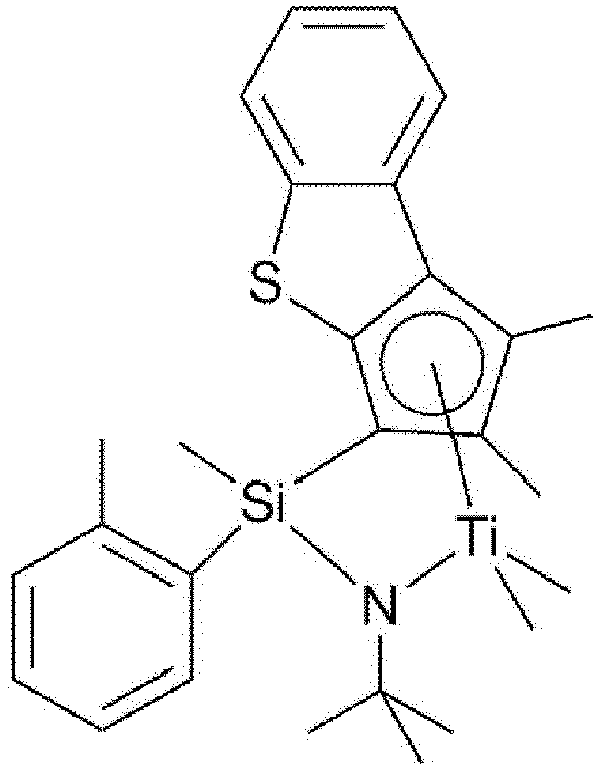
- To a 250 ml round bottom flask, the ligand compound of Formula 2-3 (4.26 g, 10.501 mmol) was put in 53 ml (0.2 M) of MTBE and stirred. n-BuLi (8.6 ml, 21.52 mmol, 2.05 eq, 2.5 M in hexane) was added thereto at -40°C and stirred at room temperature overnight.
- Then, MeMgBr (8.8 ml, 26.25 mmol, 2.5 eq, 3.0 M in diethyl ether) was slowly added thereto dropwisely at -40°C, and TiCl4 (10.50 ml, 10.50 mmol) was put in order, followed by stirring at room temperature overnight. After that, the reaction mixture was filtered using hexane. Then, DME (3.3 ml, 31.50 mmol) was added to the filtrate, and the resultant solution was filtered using hexane and then, concentrated to obtain 3.42 g (68%, dr = 1:0.68) of a yellow solid.
- 1H NMR(CDCl3, 500 MHz): δ 7.83(d, 1H), 7.80(d, 1H), 7.74(d, 1H), 7.71(d, 1H), 7.68(d, 1H), 7.37(d, 1H), 7.31-6.90(m, 9H), 6.84(t, 1H), 2.54(s, 3H), 2.47(s, 3H), 2.31(s, 3H), 2.20(s, 3H), 1.65(s, 9H), 1.63(s, 9H), 1.34(s, 3H), 1.00(s, 3H), 0.98(s, 3H), 0.81(s, 3H), 0.79(s, 3H), 0.68(s, 3H), 0.14(s, 3H), -0.03(s, 3H).
- To a 250 ml schlenk flask, 10 g (1.0 eq, 49.925 mmol) of 1,2-dimethyl-3H-benzo[b]cyclopenta[d]thiophene and 100 ml of THF were put, and 22 ml (1.1 eq, 54.918 mmol, 2.5 M in hexane) of n-BuLi was added thereto dropwisely at -30°C, followed by stirring at room temperature for 3 hours. A stirred Li-complex THF solution was cannulated into a schlenk flask containing 8.1 ml (1.0 eq, 49.925 mmol) of dichloro (methyl) (phenyl)silane and 70 ml of THF at -78°C, followed by stirring at room temperature overnight. After stirring, drying in vacuum was carried out, and extraction with 100 ml of hexane was carried out.
- After injecting 42 ml (8 eq, 399.4 mmol) of t-BuNH2 to 100 ml of the extracted chloro-1-(1,2-dimethyl-3H-benzo[b]cyclopenta[d]thiophene-3-yl)-1,1-(methyl)(phenyl)silane hexane solution at room temperature, stirring was performed at room temperature overnight. After stirring, drying in vacuum was carried out, and extraction with 150 ml of hexane was carried out. After drying the solvents, 13.36 g (68%, dr = 1:1) of a yellow solid was obtained.
- 1H NMR(CDCl3, 500 MHz): δ 7.93(t, 2H), 7.79(d,1H), 7.71(d,1H), 7.60(d, 2H), 7.48(d, 2H), 7.40-7.10(m, 10H, aromatic), 3.62(s, 1H), 3.60(s, 1H), 2.28(s, 6H), 2.09(s, 3H), 1.76(s, 3H), 1.12(s, 18H), 0.23(s, 3H), 0.13(s, 3H).
-

- To a 100 ml schlenk flask, 4.93 g (12.575 mmol, 1.0 eq) of the ligand compound of Formula 2-4 and 50 ml (0.2 M) of toluene were put, and 10.3 ml (25.779 mmol, 2.05 eq, 2.5 M in hexane) of n-BuLi was added thereto dropwisely at -30°C, followed by stirring at room temperature overnight. After stirring, 12.6 ml (37.725 mmol, 3.0 eq, 3.0 M in diethyl ether) of MeMgBr was added thereto dropwisely, and 13.2 ml (13.204 mmol, 1.05 eq, 1.0 M in toluene) of TiCl4 was put in order, followed by stirring at room temperature overnight. After stirring, the reaction product was dried in vacuum and extracted with 150 ml of hexane. The solvents were removed to 50 ml, and 4 ml (37.725 mmol, 3.0 eq) of DME was added dropwisely and stirred at room temperature overnight. After drying again in vacuum and extracting with 150 ml of hexane, 2.23 g (38%, dr = 1:0.5) of a brown solid was obtained.
- 1H NMR(CDCl3, 500 MHz): δ 7.98(d, 1H), 7.94(d, 1H), 7.71(t, 6H), 7.50-7.30(10H), 2.66(s, 3H), 2.61(s, 3H), 2.15(s, 3H), 1.62(s, 9H), 1.56(s, 9H), 1.53(s, 3H), 0.93(s, 3H), 0.31(s, 3H), 0.58(s, 3H), 0.51(s, 3H), -0.26(s, 3H), -0.39(s, 3H) .
- To a 100 ml schlenk flask, 2 g (1 eq, 9.99 mmol) of 1,2-dimethyl-3H-benzo[b]cyclopenta[d]thiophene and 50 ml of THF were put, and 4 ml (1 eq, 9.99 mmol, 2.5 M in hexane) of n-BuLi was added thereto dropwisely at -30°C, followed by stirring at room temperature overnight. A stirred Li-complex THF solution was cannulated into a schlenk flask containing 2.19 ml (1.0 eq, 9.99 mmol) of dichloro(2-ethylphenyl) (methyl) silane and 50 ml of THF at -78°C, followed by stirring at room temperature overnight. After stirring, drying in vacuum was carried out and extraction with 60 ml of hexane was carried out. After drying again in vacuum and washing with hexane, 3.83 g (99%, dr = 1:1) of an ivory solid was obtained.
- To a 100 ml round flask, 3.87 g (10.1 mmol) of chloro-1-(1,2-dimethyl-3H-benzo[b]cyclopenta[d]thiophene-3-yl)-1,1-(2-ethylphenyl)(methyl)silane was weighed and added, and 40 ml of hexane was injected thereto. At room temperature, t-BuNH2 (10 eq, 10.5 mL) was injected and reacted at room temperature for 2 days. After the reaction, hexane was removed, and filtering with hexane was carried out. After drying the solvents, 3.58 g (84.4%, dr = 1:0.8) of a yellow solid was obtained.
- 1H-NMR(CDCl3, 500 MHz): δ 7.98(t, 2H), 7.71(d, 1H), 7.55(d, 1H), 7.52(d, 1H), 7.48(d, 1H), 7.30(t, 1H), 7.26-7.22(m, 3H), 7.19(dd, 2H), 7.12-7.06(m, 3H), 7.00(t, 1H), 3.08-2.84(m, 4H) 3.05-2.84(m, 2H), 2.28(s, 3H), 2.20(s, 3H), 2.08(s, 3H), 1.62(s, 3H), 1.26-1.22(m, 6H), 1.06(s, 9H), 0.99(s, 9H), 0.05(s, 3H), -0.02(s, 3H).
-

- To a 50 ml vial, the ligand compound prepared above (1.74 g, 4.14 mmol/1.0 eq) and 20.7 ml (0.2 M) of toluene were put and stirred. n-BuLi (3.48 ml, 8.7 mmol/2.1 eq, 2.5 M in hexane) was added thereto at -40°C and stirred at room temperature overnight. Then, MeMgBr (4.14 ml, 12.42 mmol/3.0 eq, 3.0 M in diethyl ether) was slowly added thereto dropwisely at -40°C, and TiCl4DME (1.1 g, 4.14 mmol/1.0 eq) was put in order, followed by stirring at room temperature overnight. After drying the solvents, the reaction mixture was filtered using hexane. Then, DME (1.29 ml, 12.42 mmol/3 eq) was added to the filtrate and stirred at room temperature overnight. After drying the solvents, the resultant product was filtered using hexane to obtain 335 mg (16.3%, dr = 1:0.8) of a yellow solid.
- 1H NMR(CDCl3, 500 MHz): δ 7.90(d, 1H), 7.85(d, 1H), 7.74(d, 1H), 7.71(d, 1H), 7.40(d, 1H), 7.37(d, 1H), 7.27(d, 1H), 7.23(t, 2H), 7.17(t, 2H), 7.13(t, 2H), 7.06(t, 1H), 7.01(t, 1H), 6.86(t, 1H), 2.97-2.91(m, 2H), 2.90-2.82(m, 2H), 2.33(s, 3H), 2.22(s, 3H), 1.96(s, 3H), 1.68(s, 9H), 1.66(s, 9H), 1.38(s, 3H), 1.32(t, 3H), 1.24(t, 3H), 1.07(s, 3H), 0.88(s, 3H), 0.85(s, 3H), 0.72(s, 3H), 0.19(s, 3H), 0.01(s, 3H).
-

- The compound above was synthesized according to a method described in
Korean Laid-open Patent Publication No. 2015-0034653 - While injecting a hexane solvent in 5.0 kg/h and 1-butene in 0.95 kg/h, a 1.5 L continuous process reactor was pre-heated at 130°C. A triisobutylaluminum compound (0.050 mmol/min), a mixture (0.120 µmol/min) of the transition metal compounds obtained in Preparation Example 1 and Preparation Example 2-1 in a molar ratio of 3:7, and a dimethylanilinium tetrakis(pentafluorophenyl)borate co-catalyst (0.144 µmol/min) were put in the reactor at the same time. Then, into the reactor, ethylene (0.87 kg/h) and a hydrogen gas (23 cc/min) were injected and copolymerization reaction was continuously carried out while maintaining a pressure of 89 bar and 130°C for 60 minutes or more to prepare a copolymer. After drying for 12 hours or more in a vacuum oven, physical properties were measured.
- Ethylene/alpha-olefin copolymers were prepared by the same method as in Example 1 except for changing polymerization conditions as shown in Table 1 below.
[Table 1] Catalyst type Cat. Co-cat. Tibal C2 C6 Alpha-olefin Hydrogen Temp µmol/min mmol/mi n kg/h Type kg/h cc/min °C Example 1 Preparation Example 1+ Preparation Example 2-1 0.120 0.144 0.050 0.87 5.0 1-C4 0.95 23 130 Example 2 Preparation Example 1+ Preparation Example 2-1 0.120 0.144 0.050 0.87 5.0 1-C4 0.90 27 130 Example 3 Preparation Example 1+ Preparation Example 2-1 0.120 0.144 0.050 0.87 5.0 1-C4 0.90 20 130 Example 4 Preparation Example 1+ Preparation Example 2-1 0.120 0.144 0.050 0.87 5.0 1-C4 0.85 24 130 Comparative Example 1 Comparative Preparation Example 1 0.700 2.100 0.030 0.87 5.1 1-C8 1. 04 - 160 Comparative Example 2 Comparative Preparation Example 1 0.700 2.100 0.030 0.87 5.1 1-C8 1. 04 - 160 Comparative Example 3 Preparation Example 2-1 0.120 0.144 0.040 0.87 5.0 1-C4 0.70 23 130 Comparative Example 4 Preparation Example 2-2 0.125 0.147 0.045 0.87 5.0 1-C4 0.76 26 130 Comparative Example 5 Preparation Example 2-3 0.125 0.147 0.045 0.87 5.0 1-C4 0.76 26 130 Comparative Example 6 Preparation Example 1 0.120 0.144 0.045 0.87 5.0 1-C8 0.45 6 130 - With respect to the ethylene/alpha-olefin copolymers prepared in the Examples and Comparative Examples, physical properties were measured by the methods below and are shown in Table 2.
- Measurement was conducted according to ASTM D-792.
- Measurement was conducted according to ASTM D-1238 (condition E, 190°C, 2.16 kg load).
- By using a differential scanning calorimeter (DSC 6000) manufactured by PerkinElmer Co., under a nitrogen atmosphere, the temperature of the copolymer was elevated to 150°C, maintained for 5 minutes, decreased to -100°C, and elevated again, and a DSC curve was observed. In this case, the temperature elevating rate and decreasing rate were 10°C/min, respectively. In the measured DSC curve, the melting temperature was the maximum point of an endothermic peak during the second temperature elevation.
- By using a cross-fractionation chromatography (CFC) equipment of Polymer Char Co. and o-dichlorobenzene as a solvent, measurement was conducted in a range of -20 to 130°C. Particularly, a solution in which a copolymer sample was dissolved in an o-dichlorobenzene solvent at 130°C into a concentration of 5.0 mg/ml, was cooled to -20°C in a rate of 0.50°C/min, and while heating and elevating the temperature from -20°C to 130°C in an elevating rate of 1°C/min, the o-dichlorobenzene solvent was flown in a flow rate of 0.5 ml/min on a column, and the amount (wt%) of the polymer eluted was measured for each temperature. The elution temperature was defined as a temperature corresponding to the maximum point in the peaks present after -20°C when drawing a graph of temperature vs. elution fraction.
- A weight average molecular weight (Mw) and a number average molecular weight (Mn) were measured under analysis conditions of gel permeation chromatography (GPC) below with respect to the copolymers produced, and molecular weight distribution was calculated from the ratio of Mw/Mn.
- Column: Agilent Olexis
- Solvent: Trichlorobenzene
- Flow rate: 1.0 ml/min
- Specimen concentration: 1.0 mg/ml
- Injection amount: 200 µl
- column temperature: 160°C
- Detector: Agilent High Temperature RI detector
- Standard: Polystyrene (calibrated by cubic function)
- Data processing: Cirrus
- As described in Table 2, it was confirmed that the ethylene/alpha-olefin copolymers of the Examples according to the present invention satisfied all of the density, the Tm, and the Tm - Te value, defined in the present invention. On the contrary, Comparative Examples 1 and 2 showed large values of a Tm - Te value of 65°C or more, Comparative Examples 3 to 5 showed small values of 35°C or less and did not satisfy Equation 1 defined in the present invention, and Comparative Example 6 satisfied the range of Equation 1 but showed the density and the Tm value not corresponding to the definition of the present invention.
- To 500 g of the sample of Preparation Example 1, 1 phr (parts per hundred rubber) of t-butyl 1-(2-ethylhexyl)monoperoxycarbonate (TBEC), 0.5 phr of triallylisocyanurate (TAIC), and 0.2 phr of methacryloxypropyltrimethoxysilane (MEMO) were injected to prepare a composition for an encapsulant film. Then, soaking was performed at 40°C for 1 hour, and aging was performed for 15 hours.
- After that, an encapsulant film having an average thickness of 550 µm was manufactured at a low temperature to a degree not achieving high-temperature crosslinking (conditions of 100°C or less of extruder barrel temperature) using a micro extruder.
- Encapsulant films were manufactured by the same method as in Example 1 except for using the copolymers of Preparation Examples 2 to 4, and Comparative Preparation Examples 1 to 6 as samples, respectively.
- 6 g of the ethylene/alpha-olefin copolymer was put in a 0.5 T square frame, the front and back sides were covered with 3T steel sheets, and this was injected into a high temperature press. After continuously treating at 190°C with 25 N/cm2 (240 seconds), decompression/compression degassing six times, and at 190°C with 151 N/cm2 for 240 seconds, the temperature was decreased to 30°C by 15°C per minute. In this case, the pressure was kept to 151 N/cm2. By keeping 30°C, 151 N/cm2 for 300 seconds, the manufacture of a specimen was completed.
- With respect to the specimen thus manufactured, volume resistance and light transmittance were measured and shown in Table 3.
- Measurement was conducted by applying a voltage of 1000 V for 60 seconds using Agilent 4339B High-resistance meter (product of Agilent Technologies K.K.) under temperature conditions of 23±1°C and humidity conditions of 50±3%.
- Light transmittance at 550 nm was measured using Shimadzu UV-3600 spectrophotometer.
- Measurement mode: Transmittance
- Wavelength interval: 1 nm
- Measurement rate: Medium
- As shown in the table, it was confirmed that the ethylene/alpha-olefin copolymer of the present invention achieved both high volume resistance and high light transmittance in contrast to the ethylene/alpha-olefin copolymers of the Comparative Examples. Particularly, it was confirmed that Comparative Examples 1 and 2 showed large Tm - Te values of 65°C or more, and due to a low-crystalline region, volume resistance was degraded in contrast to the Examples, and due to a high-crystalline region, light transmittance was also low, and Comparative Examples 3 to 5 showed small Tm - Te values of 35°C or less, and due to a low-crystalline region, volume resistance was particularly lowered. In addition, Comparative Example 6 satisfied the range of Equation 1, but since the density and the Te value were too large, the light transmittance was particularly low.
- As described above, the ethylene/alpha-olefin copolymer satisfying the density, Tm, and Tm - Te value, defined in the present invention, may achieve excellent levels of volume resistance and light transmittance without using a separate additive.
| Density (g/cm3) | MI (dg/min) | Tm (°C) | Te (°C) | Tm - Te | Mw (g/mol) | MWD | |
| Example 1 | 0.875 | 14.3 | 62.8 | 26.5 | 36.3 | 57,000 | 2.02 |
| Example 2 | 0.876 | 20.0 | 64.2 | 27.2 | 37.0 | 51,000 | 2. 05 |
| Example 3 | 0.876 | 5.3 | 63.3 | 28.2 | 35.1 | 74,000 | 2.11 |
| Example 4 | 0.877 | 14.1 | 66.2 | 28.6 | 37.6 | 58,000 | 2. 05 |
| Comparative Example 1 | 0.873 | 5.2 | 90.2 | 23.8 | 66.4 | 75,000 | 2.63 |
| Comparative Example 2 | 0.872 | 5.0 | 86.1 | 20.6 | 65.5 | 76,000 | 2.51 |
| Comparative Example 3 | 0.878 | 5.0 | 61.2 | 27.9 | 33.3 | 76,000 | 2.05 |
| Comparative Example 4 | 0.877 | 5.8 | 60.7 | 27.0 | 33.7 | 78,000 | 2.06 |
| Comparative Example 5 | 0.878 | 5.6 | 62.0 | 28.5 | 33.5 | 77,000 | 2.04 |
| Comparative Example 6 | 0.900 | 6.4 | 97.8 | 59.8 | 38.0 | 67,000 | 2.18 |
| Volume resistance (Ω·cm) | Light transmittance (%) | |
| Example 1 | 1.2 × 10¹⁶ | 91.3 |
| Example 2 | 1.0 × 10¹⁶ | 91.5 |
| Example 3 | 7.1 × 10¹⁶ | 91.7 |
| Example 4 | 4.7 × 10¹⁶ | 91.6 |
| Comparative Example 1 | 5.0 × 10¹⁵ | 88.7 |
| Comparative Example 2 | 5.5 × 10¹⁵ | 89.1 |
| Comparative Example 3 | 7.0 × 10¹⁵ | 91.3 |
| Comparative Example 4 | 7.5 × 10¹⁵ | 91.4 |
| Comparative Example 5 | 7.0 × 10¹⁵ | 91.5 |
| Comparative Example 6 | 9.0 × 10¹⁵ | 88.3 |
Claims (7)
- An ethylene/alpha-olefin copolymer satisfying the following conditions (a) to (c):(a) a density is 0.85 to 0.89 g/cc;(b) a melting temperature (Tm) having a maximum peak in a curve obtained by differential scanning calorimetry (DSC) is 40 to 90°C; and(c) the melting temperature (Tm) and an elution temperature (Te) having a maximum peak in a curve obtained by cross-fractionation chromatography (CFC) satisfy the following Equation 1:

- The ethylene/alpha-olefin copolymer according to claim 1, which has a molecular weight distribution of 1.5 to 2.5.
- The ethylene/alpha-olefin copolymer according to claim 1, wherein the elution temperature (Te) is 10 to 50°C.
- The ethylene/alpha-olefin copolymer according to claim 1, which has a melt index of 1 to 100 dg/min.
- The ethylene/alpha-olefin copolymer according to claim 1, which has a weight average molecular weight of 40,000 to 150,000 g/mol.
- The ethylene/alpha-olefin copolymer according to claim 1, wherein the alpha-olefin comprises one or more selected from the group consisting of propylene, 1-butene, 1-pentene, 4-methyl-1-pentene, 1-hexene, 1-heptene, 1-octene, 1-decene, 1-undecene, 1-dodecene, 1-tetradecene, 1-hexadecene and 1-eicosene.
- The ethylene/alpha-olefin copolymer according to claim 1, wherein the alpha-olefin is comprised in greater than 0 mol% and 99 mol% or less with respect to the copolymer.
Applications Claiming Priority (3)
| Application Number | Priority Date | Filing Date | Title |
|---|---|---|---|
| KR20200046025 | 2020-04-16 | ||
| KR1020200103861A KR102348516B1 (en) | 2020-04-16 | 2020-08-19 | Ethylene/alpha-olefin copolymer having excellent electrical insulation |
| PCT/KR2021/004828 WO2021210958A1 (en) | 2020-04-16 | 2021-04-16 | Ethylene/alpha-olefin copolymer having excellent electrical insulation property |
Publications (3)
| Publication Number | Publication Date |
|---|---|
| EP4071186A1 true EP4071186A1 (en) | 2022-10-12 |
| EP4071186A4 EP4071186A4 (en) | 2022-11-16 |
| EP4071186B1 EP4071186B1 (en) | 2025-11-26 |
Family
ID=78084704
Family Applications (1)
| Application Number | Title | Priority Date | Filing Date |
|---|---|---|---|
| EP21788446.9A Active EP4071186B1 (en) | 2020-04-16 | 2021-04-16 | Ethylene/alpha-olefin copolymer with excellent electrical insulation |
Country Status (6)
| Country | Link |
|---|---|
| US (1) | US12528898B2 (en) |
| EP (1) | EP4071186B1 (en) |
| JP (1) | JP7523549B2 (en) |
| CN (1) | CN114981325B (en) |
| ES (1) | ES3056975T3 (en) |
| WO (1) | WO2021210958A1 (en) |
Family Cites Families (35)
| Publication number | Priority date | Publication date | Assignee | Title |
|---|---|---|---|---|
| NO315857B1 (en) | 1995-03-28 | 2003-11-03 | Japan Polyolefines Co Ltd | Ethylene <alpha> olefin copolymer, blend, film, laminated material, electrically insulating material and power cable containing this |
| MX2007011319A (en) | 2005-03-17 | 2007-11-08 | Dow Global Technologies Inc | Compositions of ethylene/alpha-olefin multi-block interpolymer suitable for films. |
| JP4923423B2 (en) | 2005-03-24 | 2012-04-25 | 東ソー株式会社 | Ethylene resin composition for extrusion lamination |
| WO2007034920A1 (en) | 2005-09-22 | 2007-03-29 | Mitsui Chemicals, Inc. | Ethylene polymer, thermoplastic resin composition comprising the polymer, and molded article |
| DE602006015081D1 (en) | 2005-10-31 | 2010-08-05 | Dow Global Technologies Inc | ELASTOMER COMPOSITION BASED ON PROPYLENE |
| KR100976131B1 (en) | 2007-01-10 | 2010-08-16 | 주식회사 엘지화학 | Method for producing a transition metal compound, a transition metal compound prepared by the method and a catalyst composition comprising the transition metal compound |
| JP2010258439A (en) | 2009-03-31 | 2010-11-11 | Japan Polyethylene Corp | Resin composition for solar cell encapsulant |
| KR101191126B1 (en) | 2009-09-01 | 2012-10-15 | 주식회사 엘지화학 | Encapsulant sheet, preparation method thereof, and photovoltaic module comprising the same |
| MY161007A (en) | 2010-10-08 | 2017-03-31 | Mitsui Chemicals Inc | Solar cell sealing material, and solar cell module |
| CN103189996B (en) * | 2010-11-02 | 2016-04-13 | 三井化学株式会社 | Encapsulating material for solar cell and solar module |
| WO2014104722A1 (en) * | 2012-12-24 | 2014-07-03 | 주식회사 엘지화학 | Encapsulation material film |
| KR101718184B1 (en) | 2012-12-24 | 2017-03-20 | 주식회사 엘지화학 | Resin composition |
| WO2015046705A1 (en) * | 2013-09-26 | 2015-04-02 | 주식회사 엘지화학 | Transition metal compound, catalyst composition containing same, and method for preparing polymer by using same |
| KR101642592B1 (en) | 2013-10-30 | 2016-07-25 | 주식회사 엘지화학 | Encapsulant film |
| US9605099B2 (en) | 2013-10-30 | 2017-03-28 | Lg Chem, Ltd. | Olefin resin |
| KR101637982B1 (en) | 2014-11-07 | 2016-07-11 | 주식회사 엘지화학 | Ligand compound, transition metal compound, and catalystic composition comprising the same |
| KR101800069B1 (en) | 2014-11-21 | 2017-11-21 | 주식회사 엘지화학 | Polypropylene-based composite |
| KR101792934B1 (en) * | 2015-03-26 | 2017-11-01 | 주식회사 엘지화학 | Olefin-based elastomer |
| JP2016213401A (en) | 2015-05-13 | 2016-12-15 | 株式会社ブリヂストン | Composition for producing sealing material for solar cell |
| WO2016186295A1 (en) | 2015-05-15 | 2016-11-24 | 주식회사 엘지화학 | Supported hybrid catalyst system, and method for preparing polyolefin by using same |
| KR102083001B1 (en) * | 2016-09-23 | 2020-02-28 | 주식회사 엘지화학 | Olefin based copolymer and preparation method thereof |
| KR102140690B1 (en) | 2016-11-14 | 2020-08-04 | 주식회사 엘지화학 | Ligand compound, transition metal compound, and catalystic composition comprising the same |
| KR102236921B1 (en) | 2016-11-16 | 2021-04-07 | 주식회사 엘지화학 | Catalystic composition comprising transition metal compound and alkylaluminoxane, preparing method for polymer using the same, and polymer prepared thereby |
| KR102209393B1 (en) | 2016-12-02 | 2021-01-28 | 주식회사 엘지화학 | Supported hybrid catalyst |
| KR20180071592A (en) | 2016-12-20 | 2018-06-28 | 한화케미칼 주식회사 | Polyolefin and preparing method thereof |
| KR102396057B1 (en) | 2017-05-31 | 2022-05-10 | 다우 글로벌 테크놀로지스 엘엘씨 | Non-polar ethylene-based composition containing triallyl phosphate for encapsulant film |
| KR102259746B1 (en) | 2017-12-26 | 2021-06-02 | 주식회사 엘지화학 | Olefin based polymer |
| KR102395103B1 (en) | 2017-12-27 | 2022-05-04 | 주식회사 엘지화학 | Method for preparing ethylene-alphaolefin copolymer |
| KR102342780B1 (en) | 2018-02-08 | 2021-12-23 | 주식회사 엘지화학 | Preparation method of supported hybrid metallocene catalyst |
| KR102419481B1 (en) * | 2019-02-20 | 2022-07-12 | 주식회사 엘지화학 | Olefin based polymer |
| EP3878875A4 (en) | 2019-08-28 | 2022-04-20 | LG Chem, Ltd. | OLEFIN COPOLYMER AND METHOD FOR PREPARING IT |
| WO2021040425A1 (en) * | 2019-08-28 | 2021-03-04 | 주식회사 엘지화학 | Polypropylene-based composite and method for producing same |
| WO2021071154A1 (en) * | 2019-10-11 | 2021-04-15 | 주식회사 엘지화학 | Polyethylene and preparation method therefor |
| EP4047051B1 (en) | 2020-04-16 | 2026-05-20 | Lg Chemical Ltd | Composition for an encapsulation film comprising an ethylene/alpha olefin copolymer and an encapsulation film comprising the same. |
| US20220340698A1 (en) * | 2020-04-16 | 2022-10-27 | Lg Chem, Ltd. | Composition for Encapsulant Film and Encapsulant Film Comprising the Same |
-
2021
- 2021-04-16 JP JP2022544402A patent/JP7523549B2/en active Active
- 2021-04-16 WO PCT/KR2021/004828 patent/WO2021210958A1/en not_active Ceased
- 2021-04-16 ES ES21788446T patent/ES3056975T3/en active Active
- 2021-04-16 EP EP21788446.9A patent/EP4071186B1/en active Active
- 2021-04-16 US US17/792,034 patent/US12528898B2/en active Active
- 2021-04-16 CN CN202180010196.0A patent/CN114981325B/en active Active
Also Published As
| Publication number | Publication date |
|---|---|
| CN114981325A (en) | 2022-08-30 |
| JP2023511917A (en) | 2023-03-23 |
| EP4071186B1 (en) | 2025-11-26 |
| US20230089406A1 (en) | 2023-03-23 |
| ES3056975T3 (en) | 2026-02-25 |
| CN114981325B (en) | 2022-12-13 |
| WO2021210958A1 (en) | 2021-10-21 |
| US12528898B2 (en) | 2026-01-20 |
| EP4071186A4 (en) | 2022-11-16 |
| JP7523549B2 (en) | 2024-07-26 |
Similar Documents
| Publication | Publication Date | Title |
|---|---|---|
| EP4006065B1 (en) | Composition for encapsulant film and encapsulant film comprising the same | |
| EP3988614B1 (en) | Composition for encapsulant film comprising ethylene/alpha-olefin copolymer and encapsulant film comprising the same | |
| KR102387101B1 (en) | A composition for an encapsulant film comprising ethylene/alpha-olefin copolymer and an encapsulant film comprising the same | |
| US12371554B2 (en) | Ethylene/alpha-olefin copolymer with excellent electrical insulation | |
| US12240926B2 (en) | Composition for encapsulant film comprising ethylene/alpha-olefin copolymer and encapsulant film comprising the same | |
| EP4047026B1 (en) | Ethylene/alpha-olefin copolymer with excellent electrical insulation | |
| KR102348516B1 (en) | Ethylene/alpha-olefin copolymer having excellent electrical insulation | |
| EP3988588B1 (en) | Ethylene/alpha-olefin copolymer having excellent electrical insulation | |
| US12371517B2 (en) | Ethylene/alpha-olefin copolymer with excellent electrical insulation | |
| EP4071186B1 (en) | Ethylene/alpha-olefin copolymer with excellent electrical insulation | |
| JP2023507315A (en) | Composition for sealing material film containing ethylene/α-olefin copolymer and sealing material film containing the same |
Legal Events
| Date | Code | Title | Description |
|---|---|---|---|
| STAA | Information on the status of an ep patent application or granted ep patent |
Free format text: STATUS: THE INTERNATIONAL PUBLICATION HAS BEEN MADE |
|
| PUAI | Public reference made under article 153(3) epc to a published international application that has entered the european phase |
Free format text: ORIGINAL CODE: 0009012 |
|
| STAA | Information on the status of an ep patent application or granted ep patent |
Free format text: STATUS: REQUEST FOR EXAMINATION WAS MADE |
|
| 17P | Request for examination filed |
Effective date: 20220705 |
|
| AK | Designated contracting states |
Kind code of ref document: A1 Designated state(s): AL AT BE BG CH CY CZ DE DK EE ES FI FR GB GR HR HU IE IS IT LI LT LU LV MC MK MT NL NO PL PT RO RS SE SI SK SM TR |
|
| A4 | Supplementary search report drawn up and despatched |
Effective date: 20221018 |
|
| RIC1 | Information provided on ipc code assigned before grant |
Ipc: C08K 5/5425 20060101ALI20221012BHEP Ipc: C08K 5/3492 20060101ALI20221012BHEP Ipc: C08K 5/14 20060101ALI20221012BHEP Ipc: H01L 31/048 20140101ALI20221012BHEP Ipc: C08F 4/649 20060101ALI20221012BHEP Ipc: C08F 2/38 20060101ALI20221012BHEP Ipc: C08F 4/646 20060101ALI20221012BHEP Ipc: C08F 4/6592 20060101ALI20221012BHEP Ipc: C08F 4/659 20060101ALI20221012BHEP Ipc: C08F 210/16 20060101AFI20221012BHEP |
|
| DAV | Request for validation of the european patent (deleted) | ||
| DAX | Request for extension of the european patent (deleted) | ||
| STAA | Information on the status of an ep patent application or granted ep patent |
Free format text: STATUS: EXAMINATION IS IN PROGRESS |
|
| 17Q | First examination report despatched |
Effective date: 20240126 |
|
| GRAP | Despatch of communication of intention to grant a patent |
Free format text: ORIGINAL CODE: EPIDOSNIGR1 |
|
| STAA | Information on the status of an ep patent application or granted ep patent |
Free format text: STATUS: GRANT OF PATENT IS INTENDED |
|
| RIC1 | Information provided on ipc code assigned before grant |
Ipc: C08F 210/16 20060101AFI20250624BHEP Ipc: C08K 5/5425 20060101ALI20250624BHEP Ipc: C08K 5/3492 20060101ALI20250624BHEP Ipc: C08K 5/14 20060101ALI20250624BHEP Ipc: C08F 4/649 20060101ALI20250624BHEP Ipc: C08F 2/38 20060101ALI20250624BHEP Ipc: C08F 4/646 20060101ALI20250624BHEP Ipc: C08F 4/6592 20060101ALI20250624BHEP Ipc: C08F 4/659 20060101ALI20250624BHEP Ipc: H10F 19/80 20250101ALI20250624BHEP |
|
| INTG | Intention to grant announced |
Effective date: 20250714 |
|
| P01 | Opt-out of the competence of the unified patent court (upc) registered |
Free format text: CASE NUMBER: UPC_APP_0872_4071186/2025 Effective date: 20250723 |
|
| GRAS | Grant fee paid |
Free format text: ORIGINAL CODE: EPIDOSNIGR3 |
|
| GRAA | (expected) grant |
Free format text: ORIGINAL CODE: 0009210 |
|
| STAA | Information on the status of an ep patent application or granted ep patent |
Free format text: STATUS: THE PATENT HAS BEEN GRANTED |
|
| AK | Designated contracting states |
Kind code of ref document: B1 Designated state(s): AL AT BE BG CH CY CZ DE DK EE ES FI FR GB GR HR HU IE IS IT LI LT LU LV MC MK MT NL NO PL PT RO RS SE SI SK SM TR |
|
| REG | Reference to a national code |
Ref country code: CH Ref legal event code: F10 Free format text: ST27 STATUS EVENT CODE: U-0-0-F10-F00 (AS PROVIDED BY THE NATIONAL OFFICE) Effective date: 20251126 Ref country code: GB Ref legal event code: FG4D |
|
| REG | Reference to a national code |
Ref country code: DE Ref legal event code: R096 Ref document number: 602021043159 Country of ref document: DE |
|
| REG | Reference to a national code |
Ref country code: IE Ref legal event code: FG4D |
|
| REG | Reference to a national code |
Ref country code: NL Ref legal event code: FP |
|
| REG | Reference to a national code |
Ref country code: ES Ref legal event code: FG2A Ref document number: 3056975 Country of ref document: ES Kind code of ref document: T3 Effective date: 20260225 |
|
| PGFP | Annual fee paid to national office [announced via postgrant information from national office to epo] |
Ref country code: GB Payment date: 20260324 Year of fee payment: 6 |
|
| REG | Reference to a national code |
Ref country code: LT Ref legal event code: MG9D |
|
| PG25 | Lapsed in a contracting state [announced via postgrant information from national office to epo] |
Ref country code: NO Free format text: LAPSE BECAUSE OF FAILURE TO SUBMIT A TRANSLATION OF THE DESCRIPTION OR TO PAY THE FEE WITHIN THE PRESCRIBED TIME-LIMIT Effective date: 20260226 |
|
| PG25 | Lapsed in a contracting state [announced via postgrant information from national office to epo] |
Ref country code: HR Free format text: LAPSE BECAUSE OF FAILURE TO SUBMIT A TRANSLATION OF THE DESCRIPTION OR TO PAY THE FEE WITHIN THE PRESCRIBED TIME-LIMIT Effective date: 20251126 Ref country code: AT Free format text: LAPSE BECAUSE OF FAILURE TO SUBMIT A TRANSLATION OF THE DESCRIPTION OR TO PAY THE FEE WITHIN THE PRESCRIBED TIME-LIMIT Effective date: 20251126 Ref country code: FI Free format text: LAPSE BECAUSE OF FAILURE TO SUBMIT A TRANSLATION OF THE DESCRIPTION OR TO PAY THE FEE WITHIN THE PRESCRIBED TIME-LIMIT Effective date: 20251126 |
|
| REG | Reference to a national code |
Ref country code: AT Ref legal event code: MK05 Ref document number: 1861032 Country of ref document: AT Kind code of ref document: T Effective date: 20251126 |
|
| PGFP | Annual fee paid to national office [announced via postgrant information from national office to epo] |
Ref country code: NL Payment date: 20260324 Year of fee payment: 6 |
|
| PG25 | Lapsed in a contracting state [announced via postgrant information from national office to epo] |
Ref country code: RS Free format text: LAPSE BECAUSE OF FAILURE TO SUBMIT A TRANSLATION OF THE DESCRIPTION OR TO PAY THE FEE WITHIN THE PRESCRIBED TIME-LIMIT Effective date: 20260226 |
|
| PG25 | Lapsed in a contracting state [announced via postgrant information from national office to epo] |
Ref country code: IS Free format text: LAPSE BECAUSE OF FAILURE TO SUBMIT A TRANSLATION OF THE DESCRIPTION OR TO PAY THE FEE WITHIN THE PRESCRIBED TIME-LIMIT Effective date: 20260326 |
|
| PGFP | Annual fee paid to national office [announced via postgrant information from national office to epo] |
Ref country code: FR Payment date: 20260323 Year of fee payment: 6 |
|
| PG25 | Lapsed in a contracting state [announced via postgrant information from national office to epo] |
Ref country code: PT Free format text: LAPSE BECAUSE OF FAILURE TO SUBMIT A TRANSLATION OF THE DESCRIPTION OR TO PAY THE FEE WITHIN THE PRESCRIBED TIME-LIMIT Effective date: 20260326 |
|
| PG25 | Lapsed in a contracting state [announced via postgrant information from national office to epo] |
Ref country code: PL Free format text: LAPSE BECAUSE OF FAILURE TO SUBMIT A TRANSLATION OF THE DESCRIPTION OR TO PAY THE FEE WITHIN THE PRESCRIBED TIME-LIMIT Effective date: 20251126 |
|
| PG25 | Lapsed in a contracting state [announced via postgrant information from national office to epo] |
Ref country code: LV Free format text: LAPSE BECAUSE OF FAILURE TO SUBMIT A TRANSLATION OF THE DESCRIPTION OR TO PAY THE FEE WITHIN THE PRESCRIBED TIME-LIMIT Effective date: 20251126 |
|
| PG25 | Lapsed in a contracting state [announced via postgrant information from national office to epo] |
Ref country code: BG Free format text: LAPSE BECAUSE OF FAILURE TO SUBMIT A TRANSLATION OF THE DESCRIPTION OR TO PAY THE FEE WITHIN THE PRESCRIBED TIME-LIMIT Effective date: 20251126 |