EP4071139A1 - Crystalline lofexidine hydrochloride - Google Patents
Crystalline lofexidine hydrochloride Download PDFInfo
- Publication number
- EP4071139A1 EP4071139A1 EP22170802.7A EP22170802A EP4071139A1 EP 4071139 A1 EP4071139 A1 EP 4071139A1 EP 22170802 A EP22170802 A EP 22170802A EP 4071139 A1 EP4071139 A1 EP 4071139A1
- Authority
- EP
- European Patent Office
- Prior art keywords
- volumes
- ethyl
- lofexidine
- dichlorophenoxy
- propionate
- Prior art date
- Legal status (The legal status is an assumption and is not a legal conclusion. Google has not performed a legal analysis and makes no representation as to the accuracy of the status listed.)
- Withdrawn
Links
- DWWHMKBNNNZGHF-UHFFFAOYSA-N 2-[1-(2,6-dichlorophenoxy)ethyl]-4,5-dihydro-1h-imidazole;hydron;chloride Chemical compound Cl.N=1CCNC=1C(C)OC1=C(Cl)C=CC=C1Cl DWWHMKBNNNZGHF-UHFFFAOYSA-N 0.000 title description 3
- 229960002058 lofexidine hydrochloride Drugs 0.000 title description 3
- 229960005209 lofexidine Drugs 0.000 claims abstract description 33
- KSMAGQUYOIHWFS-UHFFFAOYSA-N lofexidine Chemical compound N=1CCNC=1C(C)OC1=C(Cl)C=CC=C1Cl KSMAGQUYOIHWFS-UHFFFAOYSA-N 0.000 claims abstract description 33
- VEXZGXHMUGYJMC-UHFFFAOYSA-N Hydrochloric acid Chemical compound Cl VEXZGXHMUGYJMC-UHFFFAOYSA-N 0.000 claims description 13
- YXFVVABEGXRONW-UHFFFAOYSA-N Toluene Chemical compound CC1=CC=CC=C1 YXFVVABEGXRONW-UHFFFAOYSA-N 0.000 abstract description 87
- 238000000034 method Methods 0.000 abstract description 22
- UKCDLIBIFNZMCQ-UHFFFAOYSA-N ethyl 2-(2,6-dichlorophenoxy)propanoate Chemical compound CCOC(=O)C(C)OC1=C(Cl)C=CC=C1Cl UKCDLIBIFNZMCQ-UHFFFAOYSA-N 0.000 abstract description 20
- BWHMMNNQKKPAPP-UHFFFAOYSA-L potassium carbonate Chemical compound [K+].[K+].[O-]C([O-])=O BWHMMNNQKKPAPP-UHFFFAOYSA-L 0.000 abstract description 18
- VXUYXOFXAQZZMF-UHFFFAOYSA-N titanium(IV) isopropoxide Chemical compound CC(C)O[Ti](OC(C)C)(OC(C)C)OC(C)C VXUYXOFXAQZZMF-UHFFFAOYSA-N 0.000 abstract description 16
- 239000002904 solvent Substances 0.000 abstract description 15
- 230000015572 biosynthetic process Effects 0.000 abstract description 13
- HOLHYSJJBXSLMV-UHFFFAOYSA-N 2,6-dichlorophenol Chemical compound OC1=C(Cl)C=CC=C1Cl HOLHYSJJBXSLMV-UHFFFAOYSA-N 0.000 abstract description 12
- PIICEJLVQHRZGT-UHFFFAOYSA-N Ethylenediamine Chemical compound NCCN PIICEJLVQHRZGT-UHFFFAOYSA-N 0.000 abstract description 11
- OAAGDVLVOKMRCQ-UHFFFAOYSA-N 5-piperidin-4-yl-3-pyridin-4-yl-1,2,4-oxadiazole Chemical compound C1CNCCC1C1=NC(C=2C=CN=CC=2)=NO1 OAAGDVLVOKMRCQ-UHFFFAOYSA-N 0.000 abstract description 10
- 229910000027 potassium carbonate Inorganic materials 0.000 abstract description 10
- 239000010936 titanium Substances 0.000 abstract description 9
- 238000002360 preparation method Methods 0.000 abstract description 8
- 238000003786 synthesis reaction Methods 0.000 abstract description 8
- -1 titanium alkoxides Chemical class 0.000 abstract description 8
- QCQCHGYLTSGIGX-GHXANHINSA-N 4-[[(3ar,5ar,5br,7ar,9s,11ar,11br,13as)-5a,5b,8,8,11a-pentamethyl-3a-[(5-methylpyridine-3-carbonyl)amino]-2-oxo-1-propan-2-yl-4,5,6,7,7a,9,10,11,11b,12,13,13a-dodecahydro-3h-cyclopenta[a]chrysen-9-yl]oxy]-2,2-dimethyl-4-oxobutanoic acid Chemical compound N([C@@]12CC[C@@]3(C)[C@]4(C)CC[C@H]5C(C)(C)[C@@H](OC(=O)CC(C)(C)C(O)=O)CC[C@]5(C)[C@H]4CC[C@@H]3C1=C(C(C2)=O)C(C)C)C(=O)C1=CN=CC(C)=C1 QCQCHGYLTSGIGX-GHXANHINSA-N 0.000 abstract description 6
- 239000003880 polar aprotic solvent Substances 0.000 abstract description 6
- 229910052719 titanium Inorganic materials 0.000 abstract description 6
- 239000004480 active ingredient Substances 0.000 abstract description 3
- 239000003513 alkali Substances 0.000 abstract 1
- 150000005323 carbonate salts Chemical class 0.000 abstract 1
- 239000000243 solution Substances 0.000 description 33
- HEMHJVSKTPXQMS-UHFFFAOYSA-M Sodium hydroxide Chemical compound [OH-].[Na+] HEMHJVSKTPXQMS-UHFFFAOYSA-M 0.000 description 24
- 238000006243 chemical reaction Methods 0.000 description 24
- RTZKZFJDLAIYFH-UHFFFAOYSA-N Diethyl ether Chemical compound CCOCC RTZKZFJDLAIYFH-UHFFFAOYSA-N 0.000 description 21
- NTIZESTWPVYFNL-UHFFFAOYSA-N Methyl isobutyl ketone Chemical compound CC(C)CC(C)=O NTIZESTWPVYFNL-UHFFFAOYSA-N 0.000 description 19
- ZWEHNKRNPOVVGH-UHFFFAOYSA-N 2-Butanone Chemical compound CCC(C)=O ZWEHNKRNPOVVGH-UHFFFAOYSA-N 0.000 description 18
- 239000000725 suspension Substances 0.000 description 18
- 239000012071 phase Substances 0.000 description 16
- 239000000047 product Substances 0.000 description 16
- 239000012074 organic phase Substances 0.000 description 15
- VLKZOEOYAKHREP-UHFFFAOYSA-N n-Hexane Chemical compound CCCCCC VLKZOEOYAKHREP-UHFFFAOYSA-N 0.000 description 12
- 238000010992 reflux Methods 0.000 description 11
- FJDQFPXHSGXQBY-UHFFFAOYSA-L caesium carbonate Chemical compound [Cs+].[Cs+].[O-]C([O-])=O FJDQFPXHSGXQBY-UHFFFAOYSA-L 0.000 description 10
- 239000011541 reaction mixture Substances 0.000 description 10
- 239000007787 solid Substances 0.000 description 10
- IMNFDUFMRHMDMM-UHFFFAOYSA-N N-Heptane Chemical compound CCCCCCC IMNFDUFMRHMDMM-UHFFFAOYSA-N 0.000 description 8
- CDBYLPFSWZWCQE-UHFFFAOYSA-L Sodium Carbonate Chemical compound [Na+].[Na+].[O-]C([O-])=O CDBYLPFSWZWCQE-UHFFFAOYSA-L 0.000 description 8
- 239000008346 aqueous phase Substances 0.000 description 8
- 238000001704 evaporation Methods 0.000 description 8
- 230000008020 evaporation Effects 0.000 description 8
- FEWJPZIEWOKRBE-JCYAYHJZSA-N Dextrotartaric acid Chemical compound OC(=O)[C@H](O)[C@@H](O)C(O)=O FEWJPZIEWOKRBE-JCYAYHJZSA-N 0.000 description 7
- UIHCLUNTQKBZGK-UHFFFAOYSA-N Methyl isobutyl ketone Natural products CCC(C)C(C)=O UIHCLUNTQKBZGK-UHFFFAOYSA-N 0.000 description 7
- XBDQKXXYIPTUBI-UHFFFAOYSA-M Propionate Chemical compound CCC([O-])=O XBDQKXXYIPTUBI-UHFFFAOYSA-M 0.000 description 7
- 239000003153 chemical reaction reagent Substances 0.000 description 7
- 125000001495 ethyl group Chemical group [H]C([H])([H])C([H])([H])* 0.000 description 7
- 239000000203 mixture Substances 0.000 description 7
- XLYOFNOQVPJJNP-UHFFFAOYSA-N water Substances O XLYOFNOQVPJJNP-UHFFFAOYSA-N 0.000 description 7
- WEVYAHXRMPXWCK-UHFFFAOYSA-N Acetonitrile Chemical compound CC#N WEVYAHXRMPXWCK-UHFFFAOYSA-N 0.000 description 6
- XEKOWRVHYACXOJ-UHFFFAOYSA-N Ethyl acetate Chemical compound CCOC(C)=O XEKOWRVHYACXOJ-UHFFFAOYSA-N 0.000 description 6
- KFZMGEQAYNKOFK-UHFFFAOYSA-N Isopropanol Chemical compound CC(C)O KFZMGEQAYNKOFK-UHFFFAOYSA-N 0.000 description 6
- 150000003839 salts Chemical class 0.000 description 6
- JLTRXTDYQLMHGR-UHFFFAOYSA-N trimethylaluminium Chemical compound C[Al](C)C JLTRXTDYQLMHGR-UHFFFAOYSA-N 0.000 description 6
- LFQSCWFLJHTTHZ-UHFFFAOYSA-N Ethanol Chemical compound CCO LFQSCWFLJHTTHZ-UHFFFAOYSA-N 0.000 description 5
- 229910000024 caesium carbonate Inorganic materials 0.000 description 5
- 238000005160 1H NMR spectroscopy Methods 0.000 description 4
- FEWJPZIEWOKRBE-UHFFFAOYSA-N Tartaric acid Natural products [H+].[H+].[O-]C(=O)C(O)C(O)C([O-])=O FEWJPZIEWOKRBE-UHFFFAOYSA-N 0.000 description 4
- 239000007810 chemical reaction solvent Substances 0.000 description 4
- 238000002425 crystallisation Methods 0.000 description 4
- 238000000634 powder X-ray diffraction Methods 0.000 description 4
- 229910000029 sodium carbonate Inorganic materials 0.000 description 4
- 235000002906 tartaric acid Nutrition 0.000 description 4
- 239000011975 tartaric acid Substances 0.000 description 4
- 238000001665 trituration Methods 0.000 description 4
- CSCPPACGZOOCGX-UHFFFAOYSA-N Acetone Chemical compound CC(C)=O CSCPPACGZOOCGX-UHFFFAOYSA-N 0.000 description 3
- VEFUHMAEHCUBGQ-UHFFFAOYSA-N ClC1=C(OC2=NCCNC2C)C(Cl)=CC=C1 Chemical compound ClC1=C(OC2=NCCNC2C)C(Cl)=CC=C1 VEFUHMAEHCUBGQ-UHFFFAOYSA-N 0.000 description 3
- OKKJLVBELUTLKV-UHFFFAOYSA-N Methanol Chemical compound OC OKKJLVBELUTLKV-UHFFFAOYSA-N 0.000 description 3
- 239000005456 alcohol based solvent Substances 0.000 description 3
- 239000011260 aqueous acid Substances 0.000 description 3
- 239000002585 base Substances 0.000 description 3
- 230000015556 catabolic process Effects 0.000 description 3
- 238000006731 degradation reaction Methods 0.000 description 3
- 150000002170 ethers Chemical class 0.000 description 3
- 238000010438 heat treatment Methods 0.000 description 3
- 238000001556 precipitation Methods 0.000 description 3
- 238000000746 purification Methods 0.000 description 3
- 229940095064 tartrate Drugs 0.000 description 3
- 150000003608 titanium Chemical class 0.000 description 3
- IDAFCZRTKFHCGS-UHFFFAOYSA-N 2-(2,6-dichlorophenoxy)propanenitrile Chemical compound N#CC(C)OC1=C(Cl)C=CC=C1Cl IDAFCZRTKFHCGS-UHFFFAOYSA-N 0.000 description 2
- ZMXDDKWLCZADIW-UHFFFAOYSA-N N,N-Dimethylformamide Chemical compound CN(C)C=O ZMXDDKWLCZADIW-UHFFFAOYSA-N 0.000 description 2
- ZLMJMSJWJFRBEC-UHFFFAOYSA-N Potassium Chemical compound [K] ZLMJMSJWJFRBEC-UHFFFAOYSA-N 0.000 description 2
- FAPWRFPIFSIZLT-UHFFFAOYSA-M Sodium chloride Chemical compound [Na+].[Cl-] FAPWRFPIFSIZLT-UHFFFAOYSA-M 0.000 description 2
- WYURNTSHIVDZCO-UHFFFAOYSA-N Tetrahydrofuran Chemical compound C1CCOC1 WYURNTSHIVDZCO-UHFFFAOYSA-N 0.000 description 2
- HEDRZPFGACZZDS-MICDWDOJSA-N Trichloro(2H)methane Chemical compound [2H]C(Cl)(Cl)Cl HEDRZPFGACZZDS-MICDWDOJSA-N 0.000 description 2
- 239000012296 anti-solvent Substances 0.000 description 2
- 239000007864 aqueous solution Substances 0.000 description 2
- 229910052790 beryllium Inorganic materials 0.000 description 2
- ATBAMAFKBVZNFJ-UHFFFAOYSA-N beryllium atom Chemical compound [Be] ATBAMAFKBVZNFJ-UHFFFAOYSA-N 0.000 description 2
- 239000012455 biphasic mixture Substances 0.000 description 2
- 238000001816 cooling Methods 0.000 description 2
- AKPUJVVHYUHGKY-UHFFFAOYSA-N hydron;propan-2-ol;chloride Chemical compound Cl.CC(C)O AKPUJVVHYUHGKY-UHFFFAOYSA-N 0.000 description 2
- 150000002576 ketones Chemical class 0.000 description 2
- VNWKTOKETHGBQD-UHFFFAOYSA-N methane Chemical compound C VNWKTOKETHGBQD-UHFFFAOYSA-N 0.000 description 2
- BDAGIHXWWSANSR-UHFFFAOYSA-N methanoic acid Natural products OC=O BDAGIHXWWSANSR-UHFFFAOYSA-N 0.000 description 2
- 238000010534 nucleophilic substitution reaction Methods 0.000 description 2
- BDAWXSQJJCIFIK-UHFFFAOYSA-N potassium methoxide Chemical compound [K+].[O-]C BDAWXSQJJCIFIK-UHFFFAOYSA-N 0.000 description 2
- 230000005855 radiation Effects 0.000 description 2
- 238000009738 saturating Methods 0.000 description 2
- 239000011780 sodium chloride Substances 0.000 description 2
- 208000024891 symptom Diseases 0.000 description 2
- 238000004704 ultra performance liquid chromatography Methods 0.000 description 2
- 238000010626 work up procedure Methods 0.000 description 2
- SFLSHLFXELFNJZ-QMMMGPOBSA-N (-)-norepinephrine Chemical compound NC[C@H](O)C1=CC=C(O)C(O)=C1 SFLSHLFXELFNJZ-QMMMGPOBSA-N 0.000 description 1
- PYNYHMRMZOGVML-UHFFFAOYSA-N 2-bromopropanenitrile Chemical compound CC(Br)C#N PYNYHMRMZOGVML-UHFFFAOYSA-N 0.000 description 1
- OSWFIVFLDKOXQC-UHFFFAOYSA-N 4-(3-methoxyphenyl)aniline Chemical compound COC1=CC=CC(C=2C=CC(N)=CC=2)=C1 OSWFIVFLDKOXQC-UHFFFAOYSA-N 0.000 description 1
- BVKZGUZCCUSVTD-UHFFFAOYSA-L Carbonate Chemical compound [O-]C([O-])=O BVKZGUZCCUSVTD-UHFFFAOYSA-L 0.000 description 1
- GJSURZIOUXUGAL-UHFFFAOYSA-N Clonidine Chemical compound ClC1=CC=CC(Cl)=C1NC1=NCCN1 GJSURZIOUXUGAL-UHFFFAOYSA-N 0.000 description 1
- GSNUFIFRDBKVIE-UHFFFAOYSA-N DMF Natural products CC1=CC=C(C)O1 GSNUFIFRDBKVIE-UHFFFAOYSA-N 0.000 description 1
- 208000026251 Opioid-Related disease Diseases 0.000 description 1
- 239000002253 acid Substances 0.000 description 1
- 239000000384 adrenergic alpha-2 receptor agonist Substances 0.000 description 1
- 150000001335 aliphatic alkanes Chemical class 0.000 description 1
- 229910000288 alkali metal carbonate Inorganic materials 0.000 description 1
- 150000008041 alkali metal carbonates Chemical class 0.000 description 1
- AZDRQVAHHNSJOQ-UHFFFAOYSA-N alumane Chemical class [AlH3] AZDRQVAHHNSJOQ-UHFFFAOYSA-N 0.000 description 1
- 238000004458 analytical method Methods 0.000 description 1
- 230000003276 anti-hypertensive effect Effects 0.000 description 1
- 239000000010 aprotic solvent Substances 0.000 description 1
- 150000004945 aromatic hydrocarbons Chemical class 0.000 description 1
- 239000003637 basic solution Substances 0.000 description 1
- 150000004649 carbonic acid derivatives Chemical class 0.000 description 1
- 229960002896 clonidine Drugs 0.000 description 1
- 230000000052 comparative effect Effects 0.000 description 1
- 150000001875 compounds Chemical class 0.000 description 1
- 239000013078 crystal Substances 0.000 description 1
- 150000001924 cycloalkanes Chemical class 0.000 description 1
- 239000007857 degradation product Substances 0.000 description 1
- 238000004090 dissolution Methods 0.000 description 1
- 229940079593 drug Drugs 0.000 description 1
- 239000003814 drug Substances 0.000 description 1
- 239000003480 eluent Substances 0.000 description 1
- 235000019253 formic acid Nutrition 0.000 description 1
- 239000003517 fume Substances 0.000 description 1
- 208000013403 hyperactivity Diseases 0.000 description 1
- ZEIWWVGGEOHESL-UHFFFAOYSA-N methanol;titanium Chemical compound [Ti].OC.OC.OC.OC ZEIWWVGGEOHESL-UHFFFAOYSA-N 0.000 description 1
- 238000003541 multi-stage reaction Methods 0.000 description 1
- 239000012454 non-polar solvent Substances 0.000 description 1
- 230000002474 noradrenergic effect Effects 0.000 description 1
- 229960002748 norepinephrine Drugs 0.000 description 1
- SFLSHLFXELFNJZ-UHFFFAOYSA-N norepinephrine Natural products NCC(O)C1=CC=C(O)C(O)=C1 SFLSHLFXELFNJZ-UHFFFAOYSA-N 0.000 description 1
- 201000005040 opiate dependence Diseases 0.000 description 1
- 239000003960 organic solvent Substances 0.000 description 1
- RPDAUEIUDPHABB-UHFFFAOYSA-N potassium ethoxide Chemical compound [K+].CC[O-] RPDAUEIUDPHABB-UHFFFAOYSA-N 0.000 description 1
- 230000001376 precipitating effect Effects 0.000 description 1
- 230000035484 reaction time Effects 0.000 description 1
- 238000011084 recovery Methods 0.000 description 1
- 238000001228 spectrum Methods 0.000 description 1
- 238000001308 synthesis method Methods 0.000 description 1
- 150000003609 titanium compounds Chemical class 0.000 description 1
- JMXKSZRRTHPKDL-UHFFFAOYSA-N titanium ethoxide Chemical compound [Ti+4].CC[O-].CC[O-].CC[O-].CC[O-] JMXKSZRRTHPKDL-UHFFFAOYSA-N 0.000 description 1
- 230000001960 triggered effect Effects 0.000 description 1
- 238000003828 vacuum filtration Methods 0.000 description 1
Images

Classifications
-
- C—CHEMISTRY; METALLURGY
- C07—ORGANIC CHEMISTRY
- C07D—HETEROCYCLIC COMPOUNDS
- C07D233/00—Heterocyclic compounds containing 1,3-diazole or hydrogenated 1,3-diazole rings, not condensed with other rings
- C07D233/04—Heterocyclic compounds containing 1,3-diazole or hydrogenated 1,3-diazole rings, not condensed with other rings having one double bond between ring members or between a ring member and a non-ring member
- C07D233/20—Heterocyclic compounds containing 1,3-diazole or hydrogenated 1,3-diazole rings, not condensed with other rings having one double bond between ring members or between a ring member and a non-ring member with substituted hydrocarbon radicals, directly attached to ring carbon atoms
- C07D233/22—Radicals substituted by oxygen atoms
Definitions
- the present invention relates to a process for the preparation of lofexidine (I), the hydrochloride salt thereof (II), and the intermediate ethyl 2-(2,6-dichloro-phenoxy)propionate (III).
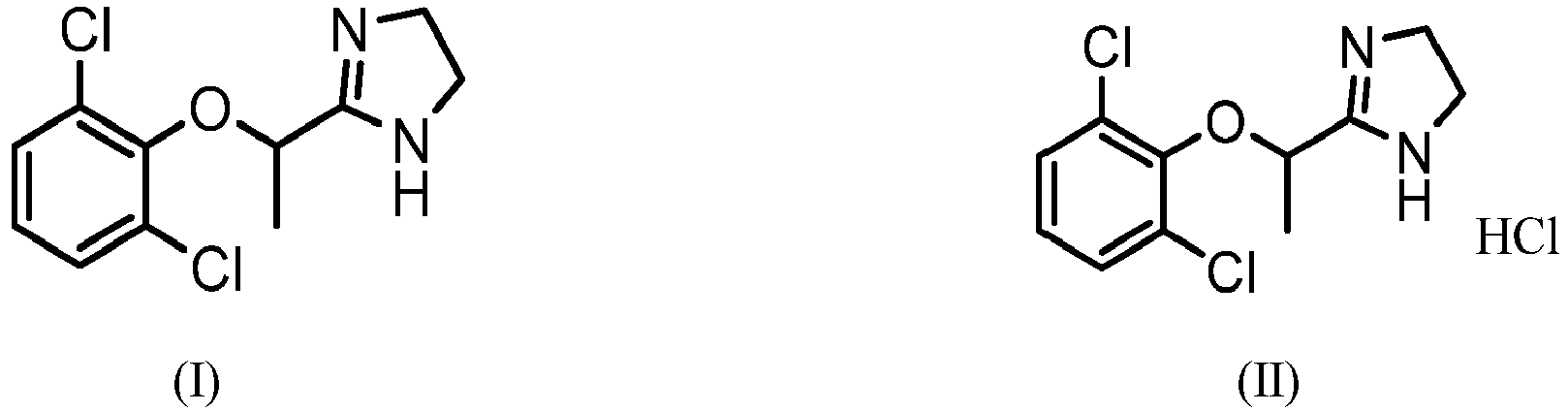
- Lofexidine is an antihypertensive medicament which is currently most commonly used to treat the physical and psychological symptoms of opioid dependence. Structurally similar to clonidine, it is an alpha 2 adrenergic receptor agonist which acts by reducing norepinephrine release and moderating the symptoms of noradrenergic hyperactivity triggered by opioid withdrawal. Lofexidine and the hydrochloride salt thereof are represented by formulae (I) and (II).
- US3966757 discloses a multi-step process for the preparation of lofexidine (I) and its hydrochloride (II) from 2,6-dichlorophenol and 2-bromopropionitrile, a very expensive reagent which is difficult to obtain, the reaction whereof gives rise to the formation of the intermediate 2-(2,6-dichlorophenoxy)propionitrile in a 70% yield which, following treatment with hydrochloric ethanol and ethylenediamine, gives the product with total yields below 50%. Said synthesis method is therefore inefficient and not cost-effective.
- WO2009003868 describes a different process which initially involves synthesis from the intermediate ethyl 2-(2,6-dichlorophenoxy)propionate (III), obtained in short times (1 h) and with quantitative yields (100%), by nucleophilic substitution from a haloethyl propionate through the use of carbonates such as caesium carbonate, in acetonitrile at room temperature. Ethyl 2-(2,6-dichloro-phenoxy)propionate (III) is then reacted in the presence of 2 equivalents of ethylenediamine and 2 equivalents of trimethylaluminum in toluene under reflux.
- this process provides lofexidine in short times and with high yields (> 90%), it is highly disadvantageous from the economic standpoint as it involves the use of caesium carbonate and trimethylaluminum, both of which reagents are expensive and difficult to obtain.
- trimethylaluminum which reacts violently with water, generating methane, makes the process difficult to apply on an industrial scale.
- Said method therefore presents formation/degradation kinetics that limit its industrialisation, requiring reaction times of a few minutes to isolate the product in useful yields.
- intermediate (III) is obtained by a nucleophilic substitution reaction from 2,6-dichlorophenol and ethyl 2-chloropropionate in the presence of potassium methoxide, using methyl ethyl ketone as solvent under reflux for 48 hours.
- the intermediate is obtained with a yield of 56%.
- the invention therefore relates to a process for the preparation of lofexidine base or hydrochloride which comprises:
- titanium alkoxide in toluene produces the active ingredient with high yields and cost-effectively, as titanium alkoxide is cheaper than trimethylaluminum.
- the process according to the invention is not only more cost-effective but also easily industrially scalable because it avoids the use of a pyrophoric reagent such as trimethylaluminum, replacing it with titanium alkoxide, and is highly selective in forming lofexidine (I) compatibly with large-scale implementation times, preventing its degradation to (5-(2,6-dichlorophenoxy)-6-methyl-1,2,3,6-tetrahydropyrazine).
- a pyrophoric reagent such as trimethylaluminum
- step a although potassium carbonate is less soluble in organic solvents than caesium carbonate, its use produces intermediate (III) with high yields (>90%) and more cost-effectively, as potassium carbonate is a much cheaper reagent than caesium carbonate and is widely available.
- the process according to the invention therefore yields both the intermediate ethyl 2-(2,6-dichlorophenoxy)propionate (III) and lofexidine (I) and the hydrochloride salt thereof (II) in a much more efficient, cost-effective and easily industrially scalable way.
- the preparation of ethyl 2-(2,6-dichlorophenoxy)propionate (III) comprises reacting 2,6-dichlorophenol in solid form, either melted or in solution in 2-20 volumes of reaction solvent, preferably in solution in 5-10 volumes, with ethyl 2-chloropropionate, either neat or in solution in up to 20 volumes of reaction solvent, preferably in the absence of solvent.
- reaction is conducted in a polar aprotic solvent such as acetone, DMF, methyl ethyl ketone or methyl isobutyl ketone, preferably methyl isobutyl ketone, which allows a fast work-up by adding water, which leads to the dissolution of inorganic salts allowing quantitative recovery of intermediate (III) in the organic phase.
- a polar aprotic solvent such as acetone, DMF, methyl ethyl ketone or methyl isobutyl ketone, preferably methyl isobutyl ketone
- the reaction is conducted in the presence of a carbonate, preferably selected from potassium carbonate and sodium carbonate, in stoichiometric amounts or higher, ranging between 1 and 5 equivalents, preferably between 1 and 2 equivalents.
- a carbonate preferably selected from potassium carbonate and sodium carbonate
- step a) is conducted as follows.
- the order in which the reagents are added may differ from that reported below.
- 1 mole of 2,6-dichlorophenol is reacted with 1-5 moles of potassium or sodium carbonate, preferably 1-1.4 moles, and with 1-5 moles of ethyl-2-chloropropionate, preferably 1-1.4 moles, in the presence of a polar aprotic solvent, preferably methyl isobutyl ketone, under reflux.
- a polar aprotic solvent preferably methyl isobutyl ketone
- the reaction mixture containing ethyl 2-(2,6-dichlorophenoxy)propionate (III) is brought to the temperature of 0-40°C, preferably 15-25°C, and water is added.
- the biphasic mixture is separated, and the organic phase is washed with basic solutions, saline and water.
- the mixture is concentrated to residue, under vacuum, at a temperature ranging between 25°C and 90°C, preferably at 40-50°C, and the resulting high-purity (> 95%) oil is used neat in the next step.
- Step b) is conducted by reacting ethyl 2-(2,6-dichlorophenoxy)propionate (III), either neat or in solution in the reaction solvent in 1-20 volumes, preferably 1-10 volumes, and ethylenediamine in amounts of 1-20 equivalents, preferably 1.2-2 equivalents, with respect to ethyl 2-(2,6-dichlorophenoxy)propionate (III), either neat or in solution in up to 20 volumes of reaction solvent, preferably 1-5 volumes.
- the reaction is conducted in apolar solvents such as THF, alkanes, cycloalkanes and aromatic hydrocarbons, preferably toluene, which allows a fast work-up by adding water to dissolve the inorganic salts and recover lofexidine (I) almost quantitatively in the organic phase.
- apolar solvents such as THF, alkanes, cycloalkanes and aromatic hydrocarbons, preferably toluene
- the reaction is conducted in the presence of tetravalent titanium alkoxides such as titanium methoxide, titanium ethoxide and titanium isopropoxide, preferably titanium isopropoxide, in stoichiometric amounts or higher, ranging between 1 and 5 equivalents, preferably between1.2 and 2 equivalents.
- tetravalent titanium alkoxides such as titanium methoxide, titanium ethoxide and titanium isopropoxide, preferably titanium isopropoxide
- Lofexidine hydrochloride (II) is obtained by dissolving or suspending the base in apolar alcohol-based solvents or mixtures of alcohol-based solvents and ethers under heating, saturating the system with HCl and isolating the product after cooling, and optionally adding an anti-solvent (ethers or ketones miscible with the solvent).
- step b) is conducted as follows.
- the order in which the reagents are added may differ from that reported below.
- ethyl 2-(2,6-dichlorophenoxy)propionate (III) is reacted with 1-2 moles of titanium isopropoxide, in particular 1.5 moles, and with 1-2 moles of ethylenediamine, in particular 1.5 moles, in the presence of an apolar solvent, preferably toluene, under heating, preferably at 110°C.
- an apolar solvent preferably toluene
- the reaction is controlled by UPLC analysis, typically using an ACQUITY UPLC ® BEH C18 column, 1.7 ⁇ m, 2.1 x 50 mm, with a water/acetonitrile/0.1% formic acid mixture as eluent phase.
- the reaction mixture containing lofexidine (I) is brought to the temperature of 0-40°C, preferably 15-25°C, and an aqueous solution of 1%-50%, preferably 30%, tartaric acid is added.
- the biphasic mixture containing the titanium compounds is dissolved by adding a 1%-35%, preferably 30%, aqueous solution of NaOH, the phases are separated, and the organic phase is washed with saline solutions and water.
- the mixture is concentrated to residue, under vacuum, at a temperature ranging between 25°C and 90°C, preferably at 40-50°C, and the resulting high-purity (> 95%) solid is used neat in the next step) or, if necessary, purified by crystallisation or trituration from aprotic solvents, preferably hexane, heptane, methyl isobutyl ketone or methyl ethyl ketone (XPRD in Figure 1 ).
- aprotic solvents preferably hexane, heptane, methyl isobutyl ketone or methyl ethyl ketone
- Lofexidine hydrochloride (II) is preferably obtained by dissolving the base in alcohol-based solvents, preferably isopropanol, under heating, saturating the system with HCl or a solution of HCl in alcohol and isolating the product after cooling, and optionally adding an anti-solvent (ethers or ketones, preferably diethyl ether).
- alcohol-based solvents preferably isopropanol
- the object of the invention is therefore the crystalline hydrochloride of lofexidine having the following peaks on the XRPD spectrum recorded under the following conditions: PAN Analytical X'Pert Pro 45 KVolt, 40 mA, PAN Analytical XRD X'Pert tube - LFF (Long fine focusing). Radiation: Cu target with 2 Beryllium windows. Range (2Theta): 2° - 50°). Pos. [°2 ⁇ ] Height [cts] FWHM Left [°2 ⁇ ] d-spacing [ ⁇ ] Rel. Int.
- Powdered K 2 CO 3 (59.3 g, 0.429 moles) and MIBK (150 ml, 3 volumes) are loaded at room temperature into a 100 mL reactor rendered inert with N 2 .
- a solution of 2,6-dichlorophenol (50 g, 0.307 moles) in MIBK (150 ml, 3 volumes) is added to the suspension.
- the suspension is stirred at room temperature for 10-15 minutes, and ethyl 2-chloropropionate (58.5 g, 54.6 ml, 0.429 moles) is then added slowly.
- the suspension is heated under reflux temperature (116°C) for 5 h.
- the reaction is complete after 5 h: >99% conversion to ethyl 2-(2,6-dichlorophenoxy)propionate.
- the suspension is left to stand at room temperature, and the salts are dissolved by adding H 2 O (150 ml, 3 volumes).
- the phases are separated and the aqueous phase is washed with MIBK (150 ml, 3 volumes).
- the combined organic phases are washed with a 5% solution of aqueous NaOH (100 ml, 2 volumes), then with H 2 O (200 ml, 4 volumes) and finally concentrated to an oily residue by complete evaporation of the solvent. Yield >90%. Purity >95%.
- Powdered K 2 CO 3 (59.3 g, 0.429 moles) and MIBK (150 ml, 3 volumes) are loaded at room temperature into a 100 mL reactor rendered inert with N 2 .
- a solution of 2,6-dichlorophenol (50 g, 0.307 moles) in MIBK (150 ml, 3 volumes) is added to the suspension.
- the suspension is stirred at room temperature for 10-15 minutes, and ethyl 2-chloropropionate (58.5 g, 54.6 ml, 0.429 moles) is then added slowly.
- the suspension is heated at the temperature of 60°C for 36 h.
- the reaction is complete after 36 h: >99% conversion to ethyl 2-(2,6-dichlorophenoxy) propionate.
- the suspension is left to stand at room temperature, and the salts are dissolved by adding H 2 O (150 ml, 3 volumes).
- the phases are separated and the aqueous phase is washed with MIBK (150 ml, 3 volumes).
- the combined organic phases are washed with a 5% solution of aqueous NaOH (100 ml, 2 volumes), then with H 2 O (200 ml, 4 volumes) and finally concentrated to an oily residue by complete evaporation of the solvent. Yield >90%. Purity >95%.
- Powdered K 2 CO 3 (59.3 g, 0.429 moles) and MIBK (150 ml, 3 volumes) are loaded at room temperature into a 100 mL reactor rendered inert with N 2 .
- a solution of 2,6-dichlorophenol (50 g, 0.307 moles) in MIBK (150 ml, 3 volumes) is added to the suspension.
- the suspension is stirred at room temperature for 10-15 minutes, and ethyl 2-chloropropionate (58.5 g, 54.6 ml, 0.429 moles) is then added slowly.
- the suspension is heated at the temperature of 80°C for 24 h.
- the reaction is complete after 24 h: >99% conversion to ethyl 2-(2,6-dichlorophenoxy) propionate.
- the suspension is left to stand at room temperature, and the salts are dissolved by adding H 2 O (150 ml, 3 volumes).
- the phases are separated and the aqueous phase is washed with MIBK (150 ml, 3 volumes).
- the combined organic phases are washed with a 5% solution of aqueous NaOH (100 ml, 2 volumes), then with H 2 O (200 ml, 4 volumes), and finally concentrated to an oily residue by complete evaporation of the solvent. Yield >90%. Purity >95%.
- the suspension is left to stand at room temperature, and the salts are dissolved by adding H 2 O (150 ml, 3 volumes).
- the phases are separated and the aqueous phase is washed with MIBK (150 ml, 3 volumes).
- the combined organic phases are washed with a 5% solution of aqueous NaOH (100 ml, 2 volumes), then with H 2 O (200 ml, 4 volumes), and finally concentrated to an oily residue by complete evaporation of the solvent. Yield >90%. Purity >95%.
- Toluene (32 ml, 6.4 volumes) is loaded at room temperature into a 100 mL reactor rendered inert with N 2 . The temperature is reduced to 0°C, and 2M trimethylaluminum in toluene (15.50 g, 38.49 mmols) is added. While maintaining said temperature, a solution of ethylenediamine (2.3 g, 38.40 mmols) in toluene (13.4 ml, 2.7 volumes) is added, exothermic reaction. At the end of the addition the mass is brought to RT, and stirred at said temperature for 1 h.
- the solution is diluted with ethyl acetate (40 ml, 8 volumes), the phases are separated, and the aqueous phase is washed with further ethyl acetate (40 ml, 8 volumes).
- the combined organic phases are washed with H 2 O (40 ml, 8 volumes), and finally concentrated to residue by complete evaporation of the solvent, until a yellowish-white solid is obtained. Yield >86%.
- Titanium isopropoxide (Ti(iOPr) 4 ) (5.4 g, 19 mmols) and toluene (30 ml, 6 volumes) are loaded at room temperature into a 100 mL reactor rendered inert with N 2 .
- a solution of ethylenediamine (1.15 g, 19 mmols) in toluene (15 ml, 3 volumes) is then added.
- the reaction mixture is stirred at room temperature for 1 h, and a solution of (+/) ethyl 2-(2,6-dichlorophenoxy) propionate (5 g, 19 mmols) in toluene (20 ml, 4 volumes) is then added.
- the reaction mixture is stirred under reflux, 110°C.
- the resulting product can be used neat for precipitation as hydrochloride, or further purified by crystallisation with heptane or hexane, or by trituration at room temperature with methyl isobutyl ketone or methyl ethyl ketone. Purification yield 75-90% and purity >99%.
- Titanium isopropoxide (Ti(iOPr) 4 ) (6.5 g, 22.8 mmols) and toluene (30 ml, 6 volumes) are loaded at room temperature into a 100 mL reactor rendered inert with N 2 .
- a solution of ethylenediamine (1.40 g, 22.8 mmols) in toluene (15 ml, 3 volumes) is then added.
- the reaction mixture is stirred at room temperature for 1 h, and a solution of (+/) ethyl 2-(2,6-dichlorophenoxy) propionate (5 g, 19 mmols) in toluene (20 ml, 4 volumes) is then added.
- the reaction mixture is stirred under reflux, 110°C.
- the reaction is complete after a total of 18 h: 98% conversion to lofexidine (I).
- the yellow-orange solution is diluted with 30% tartaric acid (50 ml, 10 volumes).
- the toluene phase is discarded, while the aqueous acid phase containing titanium salts and the product as tartrate is diluted by adding further toluene (50 ml, 10 volumes), and the product is extracted in organic phase by adding 30% NaOH until pH 12 is reached.
- the phases are separated and the aqueous phase is washed twice more with toluene (25 ml x 2; 2 x 5 volumes).
- the combined organic phases are washed with H 2 O (25 ml, 5 volumes), and finally concentrated to residue by complete evaporation of the solvent, until a yellowish-white solid is obtained. Yield >90%. Purity >95%.
- the resulting product can be used neat for precipitation as hydrochloride, or further purified by crystallisation with heptane or hexane, or by trituration at room temperature with methyl isobutyl ketone or methyl ethyl ketone. Purification yield 75-90% and purity >99%.
- Titanium isopropoxide (Ti(iOPr) 4 ) (32.4 g, 0.114 moles) and toluene (120 ml, 6 volumes) are loaded at room temperature into a 500 ml reactor rendered inert with N 2 .
- a solution of ethylenediamine (6.9 g, 0.114 moles) in toluene (54 ml, 3 volumes) is then added.
- the reaction mixture is stirred at room temperature for 1 h, and a solution of (+/) ethyl 2-(2,6-dichlorophenoxy) propionate (20 g, 0.076 moles) in toluene (80 ml, 4 volumes) is then added.
- the reaction mixture is stirred under reflux, 110°C.
- the reaction is complete after a total of 5 h: conversion >98% to give lofexidine (I).
- the yellow-orange solution is diluted with 30% tartaric acid (200 ml, 10 volumes).
- the toluene phase is discarded, while the aqueous acid phase containing titanium salts and the product as tartrate is diluted by adding further toluene (200 ml, 10 volumes), and the product is extracted in organic phase by adding 30% NaOH until pH 12 is reached.
- the phases are separated and the aqueous phase is washed twice more with toluene (100 ml x 2; 2 x 5 volumes).
- the combined organic phases are washed with H 2 O (100 ml, 5 volumes), and finally concentrated to residue by complete evaporation of the solvent, until a yellowish-white solid is obtained. Yield >90%. Purity >95%.
- the resulting product can be used neat for precipitation as hydrochloride, or further purified by crystallisation with heptane or hexane, or by trituration at room temperature with methyl isobutyl ketone or methyl ethyl ketone. Purification yield 75-90% and purity >99%.
- Lofexidine ( I ) is dissolved in a mixture of diethyl ether/ethanol (9:1, 4 volumes). 37% HCl (1.1 equiv) is added drop by drop to the solution. The resulting suspension is stirred at room temperature, and diethyl ether (4 volumes) is added after 10 min.. The white solid is filtered, washed with diethyl ether (2 volumes x 3 times) and air dried (yield > 90%).
- the diffractogram of lofexidine HCl ( II ) is shown in Figure 2 (diffractometer: PAN Analytical X'Pert Pro, 45 KVolt, 40 mA, equipped with PAN Analytical XRD X'Pert tube - LFF (Long fine focusing). Radiation: Cu target with 2 Beryllium windows. Range (2Theta): 2° - 50°).
- (+/-) lofexidine (I) is dissolved in isopropanol (4 volumes). Isopropanol HCl (4 volumes) is added drop by drop to the solution. The white solid is filtered and air dried (yield > 60%).
- Lofexidine (I) is dissolved in a mixture of diethyl ether/isopropanol (9:1, 10 volumes). 37% HCl (1.1 equiv) is added drop by drop to the solution. The resulting suspension is stirred at room temperature, and diethyl ether (10 volumes) is added after 10 min.
- Lofexidine ( I ) is dissolved in toluene (7 volumes). Isopropanol HCl is added drop by drop to the solution (until an acid pH is obtained). The white solid is filtered and air dried (yield > 70%).
Landscapes
- Chemical & Material Sciences (AREA)
- Organic Chemistry (AREA)
- Organic Low-Molecular-Weight Compounds And Preparation Thereof (AREA)
- Saccharide Compounds (AREA)
Abstract
Description
- The present invention relates to a process for the preparation of lofexidine (I), the hydrochloride salt thereof (II), and the intermediate ethyl 2-(2,6-dichloro-phenoxy)propionate (III).
- Lofexidine is an antihypertensive medicament which is currently most commonly used to treat the physical and psychological symptoms of opioid dependence. Structurally similar to clonidine, it is an alpha 2 adrenergic receptor agonist which acts by reducing norepinephrine release and moderating the symptoms of noradrenergic hyperactivity triggered by opioid withdrawal. Lofexidine and the hydrochloride salt thereof are represented by formulae (I) and (II).
- A limited number of synthesis strategies for the preparation of lofexidine (I) and the hydrochloride salt thereof (II) are known; they are mainly multi-step reactions wherein the product is always obtained with low yields starting with expensive reagents which are critical during use or difficult to obtain on the market.
-
US3966757 discloses a multi-step process for the preparation of lofexidine (I) and its hydrochloride (II) from 2,6-dichlorophenol and 2-bromopropionitrile, a very expensive reagent which is difficult to obtain, the reaction whereof gives rise to the formation of the intermediate 2-(2,6-dichlorophenoxy)propionitrile in a 70% yield which, following treatment with hydrochloric ethanol and ethylenediamine, gives the product with total yields below 50%. Said synthesis method is therefore inefficient and not cost-effective.
- The process described in Arzneimittel Forschung, 32 (II), 1982, 918-919, follows the same synthesis approach, the only difference being that the intermediate 2-(2,6-dichlorophenoxy)propionitrile is prepared from 2,6-dichlorophenol and 2-cloropropionitrile; in this case the active ingredient is obtained with a yield of 60%.

-
WO2009003868 describes a different process which initially involves synthesis from the intermediate ethyl 2-(2,6-dichlorophenoxy)propionate (III), obtained in short times (1 h) and with quantitative yields (100%), by nucleophilic substitution from a haloethyl propionate through the use of carbonates such as caesium carbonate, in acetonitrile at room temperature. Ethyl 2-(2,6-dichloro-phenoxy)propionate (III) is then reacted in the presence of 2 equivalents of ethylenediamine and 2 equivalents of trimethylaluminum in toluene under reflux. - Although, unlike the procedure previously described, this process provides lofexidine in short times and with high yields (> 90%), it is highly disadvantageous from the economic standpoint as it involves the use of caesium carbonate and trimethylaluminum, both of which reagents are expensive and difficult to obtain. The use of trimethylaluminum, which reacts violently with water, generating methane, makes the process difficult to apply on an industrial scale.


- When attempting to reproduce the process disclosed in
WO 2009003965 , the Applicant did not obtain a quantitative conversion to lofexidine (I), but found in the reaction mixture the product of degradation (5-(2,6-dichlorophenoxy)-6-methyl-1,2,3,6-tetrahydropyrazine) of formula:
- Said method therefore presents formation/degradation kinetics that limit its industrialisation, requiring reaction times of a few minutes to isolate the product in useful yields.
- Apart from the process described in
WO2009003868 , the other known processes for preparation of the intermediate ethyl 2-(2,6-dichlorophenoxy)propionate (III) always produce low yields, never exceeding 50-60%. - In
DE3149009 , intermediate (III) is obtained by a nucleophilic substitution reaction from 2,6-dichlorophenol and ethyl 2-chloropropionate in the presence of potassium methoxide, using methyl ethyl ketone as solvent under reflux for 48 hours. The intermediate is obtained with a yield of 56%. - In
US4443464 , ethyl 2-(2,6-dichlorophenoxy)propionate (III) is prepared by the same synthesis process, but using potassium ethoxide instead of potassium methoxide, and again provides low yields (56%). - It has been found that lofexidine (I) can be obtained with high yields and high purity, without the formation of degradation products, even at residence times long enough to allow the application of the process on an industrial scale (up to 18 hours under reflux), if the racemic intermediate ethyl 2-(2,6-dichlorophenoxy)propionate (III) is reacted with ethylenediamine in the presence of titanium isopropoxide in toluene.
- It has also been found that the racemic intermediate ethyl 2-(2,6-dichlorophenoxy)propionate (III) can be obtained with high yields and cost-effectively by starting with 2,6-dichlorophenol and ethyl 2-chloropropionate in the presence of potassium carbonate in a polar aprotic solvent.
- The invention therefore relates to a process for the preparation of lofexidine base or hydrochloride which comprises:
- a) reacting 2,6-dichlorophenol and ethyl 2-chloropropionate in a polar aprotic solvent in the presence of an alkali metal carbonate to give ethyl 2-(2,6-dichlorophenoxy)propionate of formula (III)

- b) reacting the compound of formula (III) with ethylenediamine in the presence of tetravalent titanium alkoxides, in an apolar solvent.
- The process according to the invention, shown in the scheme below, has various advantages over the known processes.

- The use of titanium alkoxide in toluene produces the active ingredient with high yields and cost-effectively, as titanium alkoxide is cheaper than trimethylaluminum.
- The process according to the invention is not only more cost-effective but also easily industrially scalable because it avoids the use of a pyrophoric reagent such as trimethylaluminum, replacing it with titanium alkoxide, and is highly selective in forming lofexidine (I) compatibly with large-scale implementation times, preventing its degradation to (5-(2,6-dichlorophenoxy)-6-methyl-1,2,3,6-tetrahydropyrazine).
- In step a), although potassium carbonate is less soluble in organic solvents than caesium carbonate, its use produces intermediate (III) with high yields (>90%) and more cost-effectively, as potassium carbonate is a much cheaper reagent than caesium carbonate and is widely available.
- The process according to the invention therefore yields both the intermediate ethyl 2-(2,6-dichlorophenoxy)propionate (III) and lofexidine (I) and the hydrochloride salt thereof (II) in a much more efficient, cost-effective and easily industrially scalable way.
- The preparation of ethyl 2-(2,6-dichlorophenoxy)propionate (III) comprises reacting 2,6-dichlorophenol in solid form, either melted or in solution in 2-20 volumes of reaction solvent, preferably in solution in 5-10 volumes, with ethyl 2-chloropropionate, either neat or in solution in up to 20 volumes of reaction solvent, preferably in the absence of solvent.
- The reaction is conducted in a polar aprotic solvent such as acetone, DMF, methyl ethyl ketone or methyl isobutyl ketone, preferably methyl isobutyl ketone, which allows a fast work-up by adding water, which leads to the dissolution of inorganic salts allowing quantitative recovery of intermediate (III) in the organic phase.
- The reaction is conducted in the presence of a carbonate, preferably selected from potassium carbonate and sodium carbonate, in stoichiometric amounts or higher, ranging between 1 and 5 equivalents, preferably between 1 and 2 equivalents.
- According to an optimised version, step a) is conducted as follows. The order in which the reagents are added may differ from that reported below.
- Typically, 1 mole of 2,6-dichlorophenol is reacted with 1-5 moles of potassium or sodium carbonate, preferably 1-1.4 moles, and with 1-5 moles of ethyl-2-chloropropionate, preferably 1-1.4 moles, in the presence of a polar aprotic solvent, preferably methyl isobutyl ketone, under reflux.
- When the reaction has terminated, the reaction mixture containing ethyl 2-(2,6-dichlorophenoxy)propionate (III) is brought to the temperature of 0-40°C, preferably 15-25°C, and water is added. The biphasic mixture is separated, and the organic phase is washed with basic solutions, saline and water. The mixture is concentrated to residue, under vacuum, at a temperature ranging between 25°C and 90°C, preferably at 40-50°C, and the resulting high-purity (> 95%) oil is used neat in the next step.
- The use of potassium and sodium carbonate, which are cheaper than caesium carbonate, combined with polar aprotic solvents at high temperatures, quantitatively promotes the formation of ethyl 2-(2,6-dichlorophenoxy)propionate (III) with high degrees of purity.
- Step b) is conducted by reacting ethyl 2-(2,6-dichlorophenoxy)propionate (III), either neat or in solution in the reaction solvent in 1-20 volumes, preferably 1-10 volumes, and ethylenediamine in amounts of 1-20 equivalents, preferably 1.2-2 equivalents, with respect to ethyl 2-(2,6-dichlorophenoxy)propionate (III), either neat or in solution in up to 20 volumes of reaction solvent, preferably 1-5 volumes.
- The reaction is conducted in apolar solvents such as THF, alkanes, cycloalkanes and aromatic hydrocarbons, preferably toluene, which allows a fast work-up by adding water to dissolve the inorganic salts and recover lofexidine (I) almost quantitatively in the organic phase.
- The reaction is conducted in the presence of tetravalent titanium alkoxides such as titanium methoxide, titanium ethoxide and titanium isopropoxide, preferably titanium isopropoxide, in stoichiometric amounts or higher, ranging between 1 and 5 equivalents, preferably between1.2 and 2 equivalents.
- Lofexidine hydrochloride (II) is obtained by dissolving or suspending the base in apolar alcohol-based solvents or mixtures of alcohol-based solvents and ethers under heating, saturating the system with HCl and isolating the product after cooling, and optionally adding an anti-solvent (ethers or ketones miscible with the solvent).
- According to an optimised version, step b) is conducted as follows. The order in which the reagents are added may differ from that reported below.
- Typically, 1 mole of ethyl 2-(2,6-dichlorophenoxy)propionate (III) is reacted with 1-2 moles of titanium isopropoxide, in particular 1.5 moles, and with 1-2 moles of ethylenediamine, in particular 1.5 moles, in the presence of an apolar solvent, preferably toluene, under heating, preferably at 110°C.
- The reaction is controlled by UPLC analysis, typically using an ACQUITY UPLC® BEH C18 column, 1.7 µm, 2.1 x 50 mm, with a water/acetonitrile/0.1% formic acid mixture as eluent phase.
- When the reaction has terminated, the reaction mixture containing lofexidine (I) is brought to the temperature of 0-40°C, preferably 15-25°C, and an aqueous solution of 1%-50%, preferably 30%, tartaric acid is added. The biphasic mixture containing the titanium compounds is dissolved by adding a 1%-35%, preferably 30%, aqueous solution of NaOH, the phases are separated, and the organic phase is washed with saline solutions and water.
- The mixture is concentrated to residue, under vacuum, at a temperature ranging between 25°C and 90°C, preferably at 40-50°C, and the resulting high-purity (> 95%) solid is used neat in the next step) or, if necessary, purified by crystallisation or trituration from aprotic solvents, preferably hexane, heptane, methyl isobutyl ketone or methyl ethyl ketone (XPRD in
Figure 1 ). - Lofexidine hydrochloride (II) is preferably obtained by dissolving the base in alcohol-based solvents, preferably isopropanol, under heating, saturating the system with HCl or a solution of HCl in alcohol and isolating the product after cooling, and optionally adding an anti-solvent (ethers or ketones, preferably diethyl ether). The X-ray diffractogram of the hydrochloride is shown in
Figure 2 . - During the lofexidine HCl (II) preparation process, it was found that even when the hydrochloride salt is precipitated from different mixtures of solvents, the resulting crystal presents a diffractogram not yet described in the literature, shown in
Figure 2 . - The object of the invention is therefore the crystalline hydrochloride of lofexidine having the following peaks on the XRPD spectrum recorded under the following conditions: PAN Analytical X'Pert Pro 45 KVolt, 40 mA, PAN Analytical XRD X'Pert tube - LFF (Long fine focusing). Radiation: Cu target with 2 Beryllium windows. Range (2Theta): 2° - 50°).
Pos. [°2θ] Height [cts] FWHM Left [°2θ] d-spacing [Å] Rel. Int. [%] 11.8725 553.95 0.1167 7.44816 80.87 13.5898 118.31 0.1596 6.51057 17.27 15.9615 133.40 0.1023 5.54811 19.47 19.5122 127.64 0.2079 4.54576 18.63 22.2457 155.02 0.1894 3.99298 22.63 22.6346 126.01 0.1374 3.92524 18.40 23.6493 75.81 0.1074 3.75908 11.07 24.0229 685.00 0.1569 3.70146 100.00 25.6996 97.69 0.1700 3.46363 14.26 26.6275 180.23 0.1808 3.34500 26.31 - The invention will now be illustrated in detail by the following examples.
- Powdered K2CO3 (59.3 g, 0.429 moles) and MIBK (150 ml, 3 volumes) are loaded at room temperature into a 100 mL reactor rendered inert with N2. A solution of 2,6-dichlorophenol (50 g, 0.307 moles) in MIBK (150 ml, 3 volumes) is added to the suspension. The suspension is stirred at room temperature for 10-15 minutes, and ethyl 2-chloropropionate (58.5 g, 54.6 ml, 0.429 moles) is then added slowly. The suspension is heated under reflux temperature (116°C) for 5 h. The reaction is complete after 5 h: >99% conversion to ethyl 2-(2,6-dichlorophenoxy)propionate. The suspension is left to stand at room temperature, and the salts are dissolved by adding H2O (150 ml, 3 volumes). The phases are separated and the aqueous phase is washed with MIBK (150 ml, 3 volumes). The combined organic phases are washed with a 5% solution of aqueous NaOH (100 ml, 2 volumes), then with H2O (200 ml, 4 volumes) and finally concentrated to an oily residue by complete evaporation of the solvent. Yield >90%. Purity >95%.
- Powdered K2CO3 (59.3 g, 0.429 moles) and MIBK (150 ml, 3 volumes) are loaded at room temperature into a 100 mL reactor rendered inert with N2. A solution of 2,6-dichlorophenol (50 g, 0.307 moles) in MIBK (150 ml, 3 volumes) is added to the suspension. The suspension is stirred at room temperature for 10-15 minutes, and ethyl 2-chloropropionate (58.5 g, 54.6 ml, 0.429 moles) is then added slowly. The suspension is heated at the temperature of 60°C for 36 h. The reaction is complete after 36 h: >99% conversion to ethyl 2-(2,6-dichlorophenoxy) propionate. The suspension is left to stand at room temperature, and the salts are dissolved by adding H2O (150 ml, 3 volumes). The phases are separated and the aqueous phase is washed with MIBK (150 ml, 3 volumes). The combined organic phases are washed with a 5% solution of aqueous NaOH (100 ml, 2 volumes), then with H2O (200 ml, 4 volumes) and finally concentrated to an oily residue by complete evaporation of the solvent. Yield >90%. Purity >95%.
- Powdered K2CO3 (59.3 g, 0.429 moles) and MIBK (150 ml, 3 volumes) are loaded at room temperature into a 100 mL reactor rendered inert with N2. A solution of 2,6-dichlorophenol (50 g, 0.307 moles) in MIBK (150 ml, 3 volumes) is added to the suspension. The suspension is stirred at room temperature for 10-15 minutes, and ethyl 2-chloropropionate (58.5 g, 54.6 ml, 0.429 moles) is then added slowly. The suspension is heated at the temperature of 80°C for 24 h. The reaction is complete after 24 h: >99% conversion to ethyl 2-(2,6-dichlorophenoxy) propionate. The suspension is left to stand at room temperature, and the salts are dissolved by adding H2O (150 ml, 3 volumes). The phases are separated and the aqueous phase is washed with MIBK (150 ml, 3 volumes). The combined organic phases are washed with a 5% solution of aqueous NaOH (100 ml, 2 volumes), then with H2O (200 ml, 4 volumes), and finally concentrated to an oily residue by complete evaporation of the solvent. Yield >90%. Purity >95%.
- Na2CO3 (45.47 g, 0.429 moles) and MIBK (150 ml, 3 volumes) are loaded at room temperature into a 100 mL reactor rendered inert with N2. A solution of 2,6-dichlorophenol (50 g, 0.307 moles) in MIBK (150 ml, 3 volumes) is added to the suspension. The suspension is stirred at room temperature for 10-15 minutes, and ethyl 2-chloropropionate (58.5 g, 54.6 ml, 0.429 moles) is then added slowly. The suspension is heated under reflux temperature (116°C) for 5 h. The reaction is complete after 5 h: >99% conversion to ethyl 2-(2,6-dichlorophenoxy) propionate. The suspension is left to stand at room temperature, and the salts are dissolved by adding H2O (150 ml, 3 volumes). The phases are separated and the aqueous phase is washed with MIBK (150 ml, 3 volumes). The combined organic phases are washed with a 5% solution of aqueous NaOH (100 ml, 2 volumes), then with H2O (200 ml, 4 volumes), and finally concentrated to an oily residue by complete evaporation of the solvent. Yield >90%. Purity >95%.
- Toluene (32 ml, 6.4 volumes) is loaded at room temperature into a 100 mL reactor rendered inert with N2. The temperature is reduced to 0°C, and 2M trimethylaluminum in toluene (15.50 g, 38.49 mmols) is added. While maintaining said temperature, a solution of ethylenediamine (2.3 g, 38.40 mmols) in toluene (13.4 ml, 2.7 volumes) is added, exothermic reaction. At the end of the addition the mass is brought to RT, and stirred at said temperature for 1 h. The solution is cooled again to 0°C, and a solution of (+/-) ethyl 2-(2,6-dichlorophenoxy) propionate (5 g, 19 mmols) in toluene (20 ml, 4 volumes) is added slowly. The reaction mixture is stirred under reflux, 110°C. When 95% conversion to 5-(2,6-dichlorophenoxy)-6-methyl-1,2,3,6-tetrahydropyrazine is observed with a residue of 5% (+/-) ethyl 2-(2,6-dichlorophenoxy)propionate (after about 3 hours), the yellow solution is again cooled to 0°C, MeOH (9 ml) is added very slowly and, when fume formation has ended, H2O (20 ml, 4 volumes) is added, again at 0°C, thus precipitating the aluminum salts, which are removed by vacuum filtration. The solution is diluted with ethyl acetate (40 ml, 8 volumes), the phases are separated, and the aqueous phase is washed with further ethyl acetate (40 ml, 8 volumes). The combined organic phases are washed with H2O (40 ml, 8 volumes), and finally concentrated to residue by complete evaporation of the solvent, until a yellowish-white solid is obtained. Yield >86%. Lofexidine (I) is not obtained, but a different product, with 95% purity, of formula

- Titanium isopropoxide (Ti(iOPr)4) (5.4 g, 19 mmols) and toluene (30 ml, 6 volumes) are loaded at room temperature into a 100 mL reactor rendered inert with N2. A solution of ethylenediamine (1.15 g, 19 mmols) in toluene (15 ml, 3 volumes) is then added. The reaction mixture is stirred at room temperature for 1 h, and a solution of (+/) ethyl
2-(2,6-dichlorophenoxy) propionate (5 g, 19 mmols) in toluene (20 ml, 4 volumes) is then added. The reaction mixture is stirred under reflux, 110°C. After 18 h under reflux, 97% conversion to lofexidine (I) is observed. The yellow-orange solution is diluted with 30% tartaric acid (50 ml, 10 volumes). The toluene phase is discarded, while the aqueous acid phase containing the titanium salts and the product as tartrate is diluted by adding further toluene (50 ml, 10 volumes), and the product is extracted in organic phase by adding 30% NaOH until pH 12 is reached. The phases are separated and the aqueous phase is washed twice more with toluene (25 ml x 2; 2 x 5 volumes). The combined organic phases are washed with H2O (25 ml, 5 volumes), and finally concentrated to residue by complete evaporation of the solvent, until a yellowish-white solid is obtained. - Yield >90%. Purity >95%.
- The resulting product can be used neat for precipitation as hydrochloride, or further purified by crystallisation with heptane or hexane, or by trituration at room temperature with methyl isobutyl ketone or methyl ethyl ketone. Purification yield 75-90% and purity >99%.
- 1H NMR (400 MHz, Chloroform-d) δ 7.31 (d, J = 8.1 Hz, 2H Arom), 7.01 (t, J = 8.1 Hz, 1H Arom), 5.16 (q + s (broad), J = 6.6 Hz, 2H, CH, NH), 3.65 (dd, J = 25.5, 8.6 Hz, 4H, CH2-CH2), 1.59 (d, J = 6.6 Hz, 3H, CH3).
- Titanium isopropoxide (Ti(iOPr)4) (6.5 g, 22.8 mmols) and toluene (30 ml, 6 volumes) are loaded at room temperature into a 100 mL reactor rendered inert with N2. A solution of ethylenediamine (1.40 g, 22.8 mmols) in toluene (15 ml, 3 volumes) is then added. The reaction mixture is stirred at room temperature for 1 h, and a solution of (+/) ethyl 2-(2,6-dichlorophenoxy) propionate (5 g, 19 mmols) in toluene (20 ml, 4 volumes) is then added. The reaction mixture is stirred under reflux, 110°C. The reaction is complete after a total of 18 h: 98% conversion to lofexidine (I). The yellow-orange solution is diluted with 30% tartaric acid (50 ml, 10 volumes). The toluene phase is discarded, while the aqueous acid phase containing titanium salts and the product as tartrate is diluted by adding further toluene (50 ml, 10 volumes), and the product is extracted in organic phase by adding 30% NaOH until pH 12 is reached. The phases are separated and the aqueous phase is washed twice more with toluene (25 ml x 2; 2 x 5 volumes). The combined organic phases are washed with H2O (25 ml, 5 volumes), and finally concentrated to residue by complete evaporation of the solvent, until a yellowish-white solid is obtained. Yield >90%. Purity >95%.
- The resulting product can be used neat for precipitation as hydrochloride, or further purified by crystallisation with heptane or hexane, or by trituration at room temperature with methyl isobutyl ketone or methyl ethyl ketone. Purification yield 75-90% and purity >99%.
- 1H NMR: Conforming to the structure of lofexidine (I)
- Titanium isopropoxide (Ti(iOPr)4) (32.4 g, 0.114 moles) and toluene (120 ml, 6 volumes) are loaded at room temperature into a 500 ml reactor rendered inert with N2. A solution of ethylenediamine (6.9 g, 0.114 moles) in toluene (54 ml, 3 volumes) is then added. The reaction mixture is stirred at room temperature for 1 h, and a solution of (+/) ethyl
2-(2,6-dichlorophenoxy) propionate (20 g, 0.076 moles) in toluene (80 ml, 4 volumes) is then added. The reaction mixture is stirred under reflux, 110°C. The reaction is complete after a total of 5 h: conversion >98% to give lofexidine (I). - The yellow-orange solution is diluted with 30% tartaric acid (200 ml, 10 volumes). The toluene phase is discarded, while the aqueous acid phase containing titanium salts and the product as tartrate is diluted by adding further toluene (200 ml, 10 volumes), and the product is extracted in organic phase by adding 30% NaOH until pH 12 is reached. The phases are separated and the aqueous phase is washed twice more with toluene (100 ml x 2; 2 x 5 volumes). The combined organic phases are washed with H2O (100 ml, 5 volumes), and finally concentrated to residue by complete evaporation of the solvent, until a yellowish-white solid is obtained. Yield >90%. Purity >95%.
- The resulting product can be used neat for precipitation as hydrochloride, or further purified by crystallisation with heptane or hexane, or by trituration at room temperature with methyl isobutyl ketone or methyl ethyl ketone. Purification yield 75-90% and purity >99%.
- 1H NMR: Conforming to the structure of lofexidine (I)
- Lofexidine (I) is dissolved in a mixture of diethyl ether/ethanol (9:1, 4 volumes). 37% HCl (1.1 equiv) is added drop by drop to the solution. The resulting suspension is stirred at room temperature, and diethyl ether (4 volumes) is added after 10 min.. The white solid is filtered, washed with diethyl ether (2 volumes x 3 times) and air dried (yield > 90%).
- The diffractogram of lofexidine HCl (II) is shown in
Figure 2 (diffractometer: PAN Analytical X'Pert Pro, 45 KVolt, 40 mA, equipped with PAN Analytical XRD X'Pert
tube - LFF (Long fine focusing). Radiation: Cu target with 2 Beryllium windows. Range (2Theta): 2° - 50°). - (+/-) lofexidine (I) is dissolved in isopropanol (4 volumes). Isopropanol HCl (4 volumes) is added drop by drop to the solution. The white solid is filtered and air dried (yield > 60%).
- XRPD: Conforming to the structure of lofexidine HCl (II).
- Lofexidine (I) is dissolved in a mixture of diethyl ether/isopropanol (9:1, 10 volumes). 37% HCl (1.1 equiv) is added drop by drop to the solution. The resulting suspension is stirred at room temperature, and diethyl ether (10 volumes) is added after 10 min.
- The white solid is filtered, washed with diethyl ether (5 volumes x 3 times) and air dried (yield > 90%).
- XRPD: Conforming to the structure of lofexidine HCl (II).
- Lofexidine (I) is dissolved in toluene (7 volumes). Isopropanol HCl is added drop by drop to the solution (until an acid pH is obtained). The white solid is filtered and air dried (yield > 70%).
- XRPD: Conforming to the structure of lofexidine HCl (II).
Claims (1)
- Lofexidine crystalline hydrochloride having the following XPRD peaks at the Cuα wavelength:
Pos. [°2θ] Height [cts] FWHM Left [°2θ] d-spacing [Å] Rel. Int. [%] 11.8725 553.95 0.1167 7.44816 80.87 13.5898 118.31 0.1596 6.51057 17.27 15.9615 133.40 0.1023 5.54811 19.47 19.5122 127.64 0.2079 4.54576 18.63 22.2457 155.02 0.1894 3.99298 22.63 22.6346 126.01 0.1374 3.92524 18.40 23.6493 75.81 0.1074 3.75908 11.07 24.0229 685.00 0.1569 3.70146 100.00 25.6996 97.69 0.1700 3.46363 14.26 26.6275 180.23 0.1808 3.34500 26.31
Applications Claiming Priority (3)
| Application Number | Priority Date | Filing Date | Title |
|---|---|---|---|
| IT102019000009777A IT201900009777A1 (en) | 2019-06-21 | 2019-06-21 | PROCESS FOR THE SYNTHESIS OF LOFEXIDINE |
| EP20736584.2A EP3986869B1 (en) | 2019-06-21 | 2020-06-19 | A process for the synthesis of lofexidine |
| PCT/EP2020/067105 WO2020254580A1 (en) | 2019-06-21 | 2020-06-19 | A process for the synthesis of lofexidine |
Related Parent Applications (2)
| Application Number | Title | Priority Date | Filing Date |
|---|---|---|---|
| EP20736584.2A Division EP3986869B1 (en) | 2019-06-21 | 2020-06-19 | A process for the synthesis of lofexidine |
| EP20736584.2A Division-Into EP3986869B1 (en) | 2019-06-21 | 2020-06-19 | A process for the synthesis of lofexidine |
Publications (1)
| Publication Number | Publication Date |
|---|---|
| EP4071139A1 true EP4071139A1 (en) | 2022-10-12 |
Family
ID=68138735
Family Applications (2)
| Application Number | Title | Priority Date | Filing Date |
|---|---|---|---|
| EP22170802.7A Withdrawn EP4071139A1 (en) | 2019-06-21 | 2020-06-19 | Crystalline lofexidine hydrochloride |
| EP20736584.2A Active EP3986869B1 (en) | 2019-06-21 | 2020-06-19 | A process for the synthesis of lofexidine |
Family Applications After (1)
| Application Number | Title | Priority Date | Filing Date |
|---|---|---|---|
| EP20736584.2A Active EP3986869B1 (en) | 2019-06-21 | 2020-06-19 | A process for the synthesis of lofexidine |
Country Status (6)
| Country | Link |
|---|---|
| US (1) | US11459303B2 (en) |
| EP (2) | EP4071139A1 (en) |
| ES (1) | ES2986690T3 (en) |
| IT (1) | IT201900009777A1 (en) |
| PT (1) | PT3986869T (en) |
| WO (1) | WO2020254580A1 (en) |
Citations (6)
| Publication number | Priority date | Publication date | Assignee | Title |
|---|---|---|---|---|
| US3966757A (en) | 1967-02-23 | 1976-06-29 | A. Nattermann & Cie Gmbh | Imidazoline derivatives and processes for the production thereof |
| DE3149009A1 (en) | 1981-12-10 | 1983-06-23 | A. Nattermann & Cie GmbH, 5000 Köln | (-) - 2- (1- (2,6-DICHLORPHENOXY) -ETHYL) -1,3-DIAZACYCLOPENT-2-EN, THE PRODUCTION AND THEIR USE IN PHARMACEUTICAL PREPARATIONS |
| US4443464A (en) | 1981-12-10 | 1984-04-17 | A. Nattermann & Cie Gmbh | (+)-2-[1-(2,6-Dichlorophenoxy)-ethyl]-1,3-diazacyclopent-2-ene and the method for the treatment of human beings suffering from nervous disarrangements, in particular migraine |
| WO2009003965A1 (en) | 2007-07-02 | 2009-01-08 | Ceva Vetem S.P.A. | Injectable veterinary composition with anti-prolactin activity |
| WO2009003868A2 (en) | 2007-07-02 | 2009-01-08 | F. Hoffmann-La Roche Ag | 2 -imidazolines having a good affinity to the trace amine associated receptors (taars) |
| WO2010016844A1 (en) * | 2008-08-08 | 2010-02-11 | Agean Llc | Lofexidine enantiomers for use as a treatment for cns disease and pathologies and its chiral synthesis |
-
2019
- 2019-06-21 IT IT102019000009777A patent/IT201900009777A1/en unknown
-
2020
- 2020-06-19 PT PT207365842T patent/PT3986869T/en unknown
- 2020-06-19 EP EP22170802.7A patent/EP4071139A1/en not_active Withdrawn
- 2020-06-19 US US17/617,598 patent/US11459303B2/en active Active
- 2020-06-19 WO PCT/EP2020/067105 patent/WO2020254580A1/en not_active Ceased
- 2020-06-19 ES ES20736584T patent/ES2986690T3/en active Active
- 2020-06-19 EP EP20736584.2A patent/EP3986869B1/en active Active
Patent Citations (6)
| Publication number | Priority date | Publication date | Assignee | Title |
|---|---|---|---|---|
| US3966757A (en) | 1967-02-23 | 1976-06-29 | A. Nattermann & Cie Gmbh | Imidazoline derivatives and processes for the production thereof |
| DE3149009A1 (en) | 1981-12-10 | 1983-06-23 | A. Nattermann & Cie GmbH, 5000 Köln | (-) - 2- (1- (2,6-DICHLORPHENOXY) -ETHYL) -1,3-DIAZACYCLOPENT-2-EN, THE PRODUCTION AND THEIR USE IN PHARMACEUTICAL PREPARATIONS |
| US4443464A (en) | 1981-12-10 | 1984-04-17 | A. Nattermann & Cie Gmbh | (+)-2-[1-(2,6-Dichlorophenoxy)-ethyl]-1,3-diazacyclopent-2-ene and the method for the treatment of human beings suffering from nervous disarrangements, in particular migraine |
| WO2009003965A1 (en) | 2007-07-02 | 2009-01-08 | Ceva Vetem S.P.A. | Injectable veterinary composition with anti-prolactin activity |
| WO2009003868A2 (en) | 2007-07-02 | 2009-01-08 | F. Hoffmann-La Roche Ag | 2 -imidazolines having a good affinity to the trace amine associated receptors (taars) |
| WO2010016844A1 (en) * | 2008-08-08 | 2010-02-11 | Agean Llc | Lofexidine enantiomers for use as a treatment for cns disease and pathologies and its chiral synthesis |
Also Published As
| Publication number | Publication date |
|---|---|
| US11459303B2 (en) | 2022-10-04 |
| ES2986690T3 (en) | 2024-11-12 |
| IT201900009777A1 (en) | 2020-12-21 |
| WO2020254580A1 (en) | 2020-12-24 |
| EP3986869B1 (en) | 2024-07-24 |
| PT3986869T (en) | 2024-08-29 |
| EP3986869A1 (en) | 2022-04-27 |
| US20220204455A1 (en) | 2022-06-30 |
Similar Documents
| Publication | Publication Date | Title |
|---|---|---|
| US11952341B2 (en) | Method of preparing high chiral purity lactam intermediate and brivaracetam | |
| US20020143211A1 (en) | Crystalline venlafaxine base and novel polymorphs of venlafaxine hydrochlorid, processes for preparing thereof | |
| EP2022777A2 (en) | A process for the preparation of cinacalcet | |
| US7728173B2 (en) | Processes for preparing venlafaxine and venlafaxine hydrochloride of form I | |
| WO2009139002A2 (en) | An improved process for the preparation of solifenacin and its pharmaceutically acceptable salts thereof | |
| EP3986869B1 (en) | A process for the synthesis of lofexidine | |
| EP1770084B1 (en) | Method for producing (z)-1-phenyl-1-diethylaminocarbonyl-2-aminomethyl cyclopropane hydrochloride | |
| US20120123128A1 (en) | Process for production of optically active nipecotamide | |
| EP1873151B1 (en) | Improved process for producing moxonidine | |
| EP3109236B1 (en) | Scalable process for the preparation of sorafenib tosylate ethanol solvate and sorafenib tosylate form iii | |
| JP3831954B2 (en) | Process for producing 4-hydroxy-2-pyrrolidone | |
| CN115819251A (en) | Preparation method of (1R) -1- [3- (difluoromethyl) -2-fluorophenyl ] ethylamine | |
| AU2009356897A1 (en) | Process for the preparation of O-desmethyl-venlafaxine and salts thereof | |
| CN107840823B (en) | Variable-scale process for preparing sorafenib tosylate ethanol solvate and sorafenib tosylate form III | |
| US6340773B1 (en) | Preparation of halogenated primary amines | |
| WO2003014067A1 (en) | PROCESS FOR PRODUCING ß-OXONITRILE COMPOUND OR ALKALI METAL SALT THEREOF | |
| EP2540717B1 (en) | Lamivudine oxalate and preparation method thereof | |
| EP1963309B1 (en) | Method for producing metal salts of losartan | |
| WO2023100110A1 (en) | Process for preparing brivaracetam | |
| KR100297802B1 (en) | Method for preparing 2- (3-trifluoromethyl) anilinonicotinic acid 2- (N-morpholine) ethyl. | |
| AU744361B2 (en) | Method for producing a 1-(3-cyclopentenyloxy- 4-alkoxyphenyl)-4- oxocyclohexanecarbonitrile | |
| CN113336753A (en) | Riociguat synthesis method | |
| CN120943782A (en) | Preparation method of pyrazole ether compound | |
| CN115197086A (en) | Preparation method of difluoro methoxy-containing m-diamide compound | |
| EP2829540A1 (en) | Synthesis of substituted aminopyridines |
Legal Events
| Date | Code | Title | Description |
|---|---|---|---|
| PUAI | Public reference made under article 153(3) epc to a published international application that has entered the european phase |
Free format text: ORIGINAL CODE: 0009012 |
|
| STAA | Information on the status of an ep patent application or granted ep patent |
Free format text: STATUS: THE APPLICATION HAS BEEN PUBLISHED |
|
| AC | Divisional application: reference to earlier application |
Ref document number: 3986869 Country of ref document: EP Kind code of ref document: P |
|
| AK | Designated contracting states |
Kind code of ref document: A1 Designated state(s): AL AT BE BG CH CY CZ DE DK EE ES FI FR GB GR HR HU IE IS IT LI LT LU LV MC MK MT NL NO PL PT RO RS SE SI SK SM TR |
|
| STAA | Information on the status of an ep patent application or granted ep patent |
Free format text: STATUS: THE APPLICATION IS DEEMED TO BE WITHDRAWN |
|
| 18D | Application deemed to be withdrawn |
Effective date: 20230413 |