EP4069862B1 - 2d-materialdetektor für die aktivitätsüberwachung von einzelnen lebenden mikro- und nanoorganismen - Google Patents
2d-materialdetektor für die aktivitätsüberwachung von einzelnen lebenden mikro- und nanoorganismen Download PDFInfo
- Publication number
- EP4069862B1 EP4069862B1 EP20790083.8A EP20790083A EP4069862B1 EP 4069862 B1 EP4069862 B1 EP 4069862B1 EP 20790083 A EP20790083 A EP 20790083A EP 4069862 B1 EP4069862 B1 EP 4069862B1
- Authority
- EP
- European Patent Office
- Prior art keywords
- suspended layer
- sensor assembly
- suspended
- layer
- motion
- Prior art date
- Legal status (The legal status is an assumption and is not a legal conclusion. Google has not performed a legal analysis and makes no representation as to the accuracy of the status listed.)
- Active
Links
Images


Classifications
-
- A—HUMAN NECESSITIES
- A61—MEDICAL OR VETERINARY SCIENCE; HYGIENE
- A61B—DIAGNOSIS; SURGERY; IDENTIFICATION
- A61B5/00—Measuring for diagnostic purposes; Identification of persons
- A61B5/0059—Measuring for diagnostic purposes; Identification of persons using light, e.g. diagnosis by transillumination, diascopy, fluorescence
- A61B5/0062—Arrangements for scanning
- A61B5/0066—Optical coherence imaging
-
- C—CHEMISTRY; METALLURGY
- C12—BIOCHEMISTRY; BEER; SPIRITS; WINE; VINEGAR; MICROBIOLOGY; ENZYMOLOGY; MUTATION OR GENETIC ENGINEERING
- C12Q—MEASURING OR TESTING PROCESSES INVOLVING ENZYMES, NUCLEIC ACIDS OR MICROORGANISMS; COMPOSITIONS OR TEST PAPERS THEREFOR; PROCESSES OF PREPARING SUCH COMPOSITIONS; CONDITION-RESPONSIVE CONTROL IN MICROBIOLOGICAL OR ENZYMOLOGICAL PROCESSES
- C12Q1/00—Measuring or testing processes involving enzymes, nucleic acids or microorganisms; Compositions therefor; Processes of preparing such compositions
- C12Q1/02—Measuring or testing processes involving enzymes, nucleic acids or microorganisms; Compositions therefor; Processes of preparing such compositions involving viable microorganisms
-
- G—PHYSICS
- G01—MEASURING; TESTING
- G01B—MEASURING LENGTH, THICKNESS OR SIMILAR LINEAR DIMENSIONS; MEASURING ANGLES; MEASURING AREAS; MEASURING IRREGULARITIES OF SURFACES OR CONTOURS
- G01B9/00—Measuring instruments characterised by the use of optical techniques
- G01B9/02—Interferometers
- G01B9/02015—Interferometers characterised by the beam path configuration
- G01B9/02027—Two or more interferometric channels or interferometers
-
- G—PHYSICS
- G01—MEASURING; TESTING
- G01B—MEASURING LENGTH, THICKNESS OR SIMILAR LINEAR DIMENSIONS; MEASURING ANGLES; MEASURING AREAS; MEASURING IRREGULARITIES OF SURFACES OR CONTOURS
- G01B9/00—Measuring instruments characterised by the use of optical techniques
- G01B9/02—Interferometers
- G01B9/0209—Low-coherence interferometers
- G01B9/02091—Tomographic interferometers, e.g. based on optical coherence
-
- G—PHYSICS
- G01—MEASURING; TESTING
- G01N—INVESTIGATING OR ANALYSING MATERIALS BY DETERMINING THEIR CHEMICAL OR PHYSICAL PROPERTIES
- G01N29/00—Investigating or analysing materials by the use of ultrasonic, sonic or infrasonic waves; Visualisation of the interior of objects by transmitting ultrasonic or sonic waves through the object
- G01N29/02—Analysing fluids
- G01N29/022—Fluid sensors based on microsensors, e.g. quartz crystal-microbalance [QCM], surface acoustic wave [SAW] devices, tuning forks, cantilevers, flexural plate wave [FPW] devices
-
- G—PHYSICS
- G01—MEASURING; TESTING
- G01N—INVESTIGATING OR ANALYSING MATERIALS BY DETERMINING THEIR CHEMICAL OR PHYSICAL PROPERTIES
- G01N29/00—Investigating or analysing materials by the use of ultrasonic, sonic or infrasonic waves; Visualisation of the interior of objects by transmitting ultrasonic or sonic waves through the object
- G01N29/02—Analysing fluids
- G01N29/036—Analysing fluids by measuring frequency or resonance of acoustic waves
-
- G—PHYSICS
- G01—MEASURING; TESTING
- G01N—INVESTIGATING OR ANALYSING MATERIALS BY DETERMINING THEIR CHEMICAL OR PHYSICAL PROPERTIES
- G01N33/00—Investigating or analysing materials by specific methods not covered by groups G01N1/00 - G01N31/00
- G01N33/48—Biological material, e.g. blood, urine; Haemocytometers
- G01N33/50—Chemical analysis of biological material, e.g. blood, urine; Testing involving biospecific ligand binding methods; Immunological testing
- G01N33/53—Immunoassay; Biospecific binding assay; Materials therefor
- G01N33/543—Immunoassay; Biospecific binding assay; Materials therefor with an insoluble carrier for immobilising immunochemicals
- G01N33/54366—Apparatus specially adapted for solid-phase testing
- G01N33/54373—Apparatus specially adapted for solid-phase testing involving physiochemical end-point determination, e.g. wave-guides, FETS, gratings
-
- G—PHYSICS
- G01—MEASURING; TESTING
- G01N—INVESTIGATING OR ANALYSING MATERIALS BY DETERMINING THEIR CHEMICAL OR PHYSICAL PROPERTIES
- G01N2291/00—Indexing codes associated with group G01N29/00
- G01N2291/02—Indexing codes associated with the analysed material
- G01N2291/024—Mixtures
- G01N2291/02466—Biological material, e.g. blood
-
- G—PHYSICS
- G01—MEASURING; TESTING
- G01N—INVESTIGATING OR ANALYSING MATERIALS BY DETERMINING THEIR CHEMICAL OR PHYSICAL PROPERTIES
- G01N2291/00—Indexing codes associated with group G01N29/00
- G01N2291/02—Indexing codes associated with the analysed material
- G01N2291/025—Change of phase or condition
- G01N2291/0255—(Bio)chemical reactions, e.g. on biosensors
-
- G—PHYSICS
- G01—MEASURING; TESTING
- G01N—INVESTIGATING OR ANALYSING MATERIALS BY DETERMINING THEIR CHEMICAL OR PHYSICAL PROPERTIES
- G01N2291/00—Indexing codes associated with group G01N29/00
- G01N2291/02—Indexing codes associated with the analysed material
- G01N2291/025—Change of phase or condition
- G01N2291/0256—Adsorption, desorption, surface mass change, e.g. on biosensors
Definitions
- the present invention is in the field of a motion detector adapted to detect activity of extremely small scale organisms, such as micro-organisms, such as bacteria and fungi, and even of viruses and genetic material, such as DNA and RNA.
- the motion detector is capable of detecting nano-motion, i.e. in the order of nanometers or less.
- the present invention is in the field of motion detector adapted to detect micro- or nanometer motion of small scale objects.
- motion detectors are typically provided with an oscillator.
- detectors having a flexible sample support in the form of a cantilever, or an optical fiber, or a piezoelectric system, capable of fluctuating, such as in US 2018/312898 A1 .
- the displacement of the cantilever, typically flexing thereof, can be measured quite accurately using e.g. an optical system, typically comprising a mirror a laser, and photodiodes, which is capable of measuring a deflection of the cantilever. Movement detection is limited to a nanoscale or larger scale motion.
- Detecting nanoscale vibrations as signature of life (www.pnas.org/cgi/doi/10.1073/pnas.1415348112 ) recites the use of an innovative nanoscale motion sensor in life-searching experiments in Earth-bound and interplanetary missions.
- the technique exploits the sensitivity of nanomechanical oscillators to transduce the small fluctuations that characterize living systems.
- the intensity of such movements is an indication of the viability of living specimens and conveys information related to their metabolic activity.
- the nanomotion detector can assess the viability of a vast range of biological specimens and that it could be the perfect complement to conventional chemical life-detection assays. Indeed, by combining chemical and dynamical measurements an unprecedented depth in the characterization of life in extreme and extraterrestrial environment may be achieved.
- MoS2 offers the highest responsivity among graphene, h-BN, and MoS2 devices and for the three commonly used visible laser wavelengths (633, 532, and 405 nm). Their results elucidate and graphically visualize the dependence of motion transduction responsivity upon 2D material type and number of layers, vacuum gap, oxide thickness, and detecting wavelength, thus providing design guidelines for constructing 2D nanomechanical systems with optimal optical motion readout.
- the prior art detectors and sensors are not sensitive enough. Typically they can not detect motion of a smaller living specimen, such as a single live bacterium or a virus. For certain application also a faster response is required such as revealing the status of the living organism in few seconds after a drug susceptibility test. Sometimes cost, size, multiplication, and complexity may be a challenge as well, in addition.
- the present invention therefore relates to an improved two-dimensional (2D) motion detector, which solves one or more of the above problems and drawbacks of the prior art, providing reliable results, without jeopardizing functionality and advantages.
- the invention is defined in the claims. It is an object of the invention to overcome one or more limitations of the prior art and provides a motion detector that is far more sensitive.
- the invention relates inter alia to a detector as defined in the claims, which can be used as a sensor, such as for metabolic activity of a sample, such as a single cell, a single bacterium, a single virus, or even a single biomolecule, by recording motion thereof.
- the detector comprises a suspended 2D material, e.g. a single layer of graphene, of MoS 2 , of hexagonal-BN, or any other atomically thin material, which may be a heterogeneous material.
- On the suspended material layer said single living matter may be provided, at micro- or nanoscale attached to its surface or in close proximity of its surface.
- the measurement means may be one from the group comprising a Fabry-Perot interferometer, a Michelson or an optical interferometer, a laser Doppler vibrometer, or one or more capacitor electrodes cooperating with the 2D material as the opposite electrode of the capacitor, or an imaging system for measuring the position of the living matter on the suspended material.
- the resistance of the 2D material (which can be chosen to be piezoresistive) is used to monitor activities of the living matter on top of the 2D material.
- the to be measured actuation of the sample is induced by the activity or fluctuations of the above single sample object of interest, changing physical/chemical properties of said suspended 2D material.
- the suspended material is carrying the living matter and typically also a solid, liquid, or viscous fluid that contains a controllable concentration of its favourable growth environment.
- the present detector may be used in methods to supply medicine, toxins, or radiation to the living matter and study the effect on their activity are described. It is found that motion of the said 2D material is directly related to the activity of the sample, such as the single living organism, that can in turn be used for, among others, drug susceptibility testing.
- This present detector may be used as stand-alone technology, that e.g. can make drug susceptibility testing available at point of care within seconds. It is particularly suited for life science and health applications.
- the present detector is validated in laboratory tests typically using E. coli strains.
- the detector was able to distinguish between living bacterium in a blank set-up, living bacterium being resistant to added antibiotic, and bacterium under stress (dying) being susceptible to added antibiotic (see below).
- the present detector provides a way to probe the motion of a small sample, such as a single live organism, while being alive, without intervening in their natural physiology or behaviour.
- the technology is simple and cost efficient, such as a point-of-care testing technique for drug susceptibility, for preventing overuse of drugs, and for testing bacterial resistance to antibiotics.
- the inert and carbonous nature of graphene makes it ideally suitable for combining with organic living materials.
- the impermeability of the suspended graphene helps to make sure that the cavity below the said suspended material remains filled with air, such that the mechanical stiffness of the said suspended material stays low and sensitive to motion of the living matter.
- the mechanical strength of 2D materials like graphene ensures that the living material doesn't tear the material apart, despite its thin nature.
- the present sensor assembly is dedicated for activity monitoring of a living microorganism or living nano-organism.
- the assembly is equally applicable to monitoring of other movement on nanoscale or picoscale.
- the sensor assembly comprises a 2D microscale motion detector, which is referred to as "microscale” as in plane dimensions thereof are in the low microscale, whereas a thickness typically is in the low nanoscale or even below a nm, the motion detector adapted to act as a sample receiver, such as for receiving the living organism, which organism may be provided in a liquid, such as in a droplet, comprising an inert suspended layer, onto which the living organism may be provided, and in view of the organism and optional liquid the layer is chemically and biologically inert, wherein the suspended layer is 1-5 atoms thick, at least one support for the suspended layer, which support may extend over the full boundary of the suspended layer, or may be provided at a part of the suspended layer, such as at two or more opposite edges, and a read-out system adapted for measuring alteration of the suspended
- the present invention relates to a chip comprising at least one 2D microscale motion detector according to the invention.
- the present 2D microscale motion detector can easily be integrated into a chip, or any other micro-electronic structure, and can be integrated by using typically used semiconductor technology. Therein electrical connections, controls, and even micro-fluidic elements can be introduced simply. So the present invention also relates to an electronic device comprising a sensor assembly or chip according to the invention, and at least two channels each individually in electrical connection with the read-out system, such as 5-200 channels, at least one readout line.
- the present invention relates to a method for operating the sensor assembly according to the invention, comprising providing a volume of liquid, the volume being ⁇ 10 ⁇ l, preferably ⁇ 2 ⁇ l, such as ⁇ 1 ⁇ l, the volume comprising a microorganism, or living cell constituent, or virus, and measuring motion of the microorganism, or living cell constituent, or virus, over time.
- Living cell constituents may relate to DNA, to RNA, to proteins, to enzymes, and so on, and fragments thereof, and combinations thereof. Also more than one organism, or cell constituent, or virus, can be measured accordingly. Examples of such measurements are given below.
- the present invention relates to a disposable sample stage comprising a 2D microscale motion detector adapted to act as a sample receiver, for receiving a volume of liquid, the volume being ⁇ 10 ⁇ l, comprising an inert suspended layer, wherein the suspended layer is 1-5 atoms thick, and at least one support for the suspended layer, and typically also a substrate on which the support may be provided.
- the present sensor assembly material of the suspended layer may be a two-dimensional crystal providing interlayer van der Waals interactions in a direction perpendicular to the layer surface, and is preferably selected from graphene, hexagonal-BN, black phosphorus, transition metal dichaclogenides, wherein the metal is preferably selected from Mo, W, Nb, and wherein the chalcogen is preferably selected from S, Se and Te, such as MoS 2 , NbSe 2 , and WSe 2 , and combinations thereof.
- the read-out system may be selected from a Fabry-Perot interferometer, a Michelson interferometer, an optical interferometer, a laser Doppler vibrometer, one or more capacitor electrodes, a piezoelectrical element, a piezoresistive element, an impedance analyser, and combinations thereof.
- alteration of the suspended layer changes at least one physical characteristics thereof selected from deflection, resonance frequency, reflection spectrum, transmission spectrum, optical adsorption, orientation of at least part of the suspended layer, optical interference, 2D crystal structure, electromagnetic properties, such as resistivity, conductivity, and combinations thereof.
- the read-out system may comprise a laser for providing light, an optical system for directing light from the laser to the sample, an optical system for directing reflected light from the sample to a photo detector, such as a photo diode, optionally an amplifier for amplifying detected light response, and a recorder for representing motion, such as an oscilloscope.
- the suspended layer may be 1-3 atoms thick, such as 2 atoms thick. It is found that a response for a thinner layer is better.
- the suspended layer may be 0.1-50 ⁇ m wide, such as 1-2 ⁇ m wide.
- the suspended layer may be 0.1-50 ⁇ m broad, such as 1-2 ⁇ m broad.
- the suspended layer may have a stiffness of ⁇ 10 N/m, preferably ⁇ 3 N/m, more preferably ⁇ 1 N/m, even more preferably ⁇ 0.2 N/m, such as ⁇ 0.1 N/m, and typically ⁇ 0.01 N/m.
- the stiffness can be measured using an AFM or STM, applying a force (N) to the layer, and measuring the (vertical) displacement of the layer, at the position of the force.
- the suspended layer may have a Youngs modulus of >100 GPa, such as >500 GPa (ASTM E1111).
- the suspended layer may have a weight of ⁇ 10 -15 kg, preferably ⁇ 10 -16 kg, such as ⁇ 10 -17 kg.
- the very small weight has amongst others as advantage that very small movements, of otherwise also very light objects, such as microorganism, can be measured very accurately.
- a cavity of > 100 nm height is provided, such as > 250 nm, such as 1000 nm.
- Such sub-micrometre cavities can be provided using semi-conductor technology, such as by using a mask, and wet- or dry-etching. Very well dimensioned cavities can be provided thereby.
- the cavity may be fully surrounded by the substrate, the at least one support, and the suspended layer, or partly surrounded thereby, such as for 50-90% of its boundary area.
- the cavity may be filled with a fluid, such as a gas or liquid.
- a fluid such as a gas or liquid.
- the gas may be an inert gas, such as nitrogen or a noble gas, whereas the liquid may be water, or a physiologically acceptable fluid.
- the at least one support may comprise an electrically insulating material, such as with an electrical conductivity ⁇ (20°C) of ⁇ 10 -3 S/m, preferably ⁇ 10 -6 S/m, such as silicon oxide, silicon nitride, and silicon carbide.
- electrical connections and the like can be provided, being in contact with the detector, and further being insulated.
- the at least one support may have a height of 20-1000 nm, preferably 100-500 nm, such as 200-300 nm.
- the suspended layer, the at least one support, and substrate are each individually non-toxic, and at least partly support organism activity, such as support appropriate cellular activity, including the facilitation of molecular and mechanical signalling systems, such as in order to optimise tissue regeneration, without eliciting any undesirable effects in those organisms, or inducing any undesirable local or systemic responses in the eventual host.
- organism activity such as support appropriate cellular activity, including the facilitation of molecular and mechanical signalling systems, such as in order to optimise tissue regeneration, without eliciting any undesirable effects in those organisms, or inducing any undesirable local or systemic responses in the eventual host.
- the present sensor assembly may further comprise a humidity chamber for receiving the suspended layer and a sample.
- a humidity chamber for receiving the suspended layer and a sample.
- the present sensor assembly may comprise an array of sample receivers, therewith providing the opportunity to perform a series of parallel and/or sequential experiments.
- the present sensor assembly may comprise a chip, such as mentioned above.
- a chemical may be added, wherein the chemical is preferably selected from pharmaceuticals or potential pharmaceuticals, such as anti-biotics, such as kanamycin, and chloramphenicol, and measuring a response of the microorganism, or living cell constituent, or virus, to the chemical over time. Examples thereof, and the response measured, are given below.
- the liquid may comprise at least one of nutrition for the microorganism or for the living cell constituent or for the virus, a physiological liquid, and a metabolic support compound.
- Figs. 1 and 2 show
- Figure 1 shows the sensor assembly 100 comprising a sample receiver 101 with inert 2D material layer 102 acting as the motion detector.
- the 2D material is suspended over a cavity 108 using at least one support 104.
- Such geometry can be obtained using semiconductor technology, such as by using a mask, and wet- or dry-etching.
- the sensor assembly also comprises a chip 109 that sits on a substrate 107.
- the substrate 107 may comprise an array of sample receivers 101 on top of an electrical device 110.
- a liquid droplet 111 is dispensed on top of the sample receiver 101.
- the droplet contains micro-organisms 105 and nutrition 112. Chemicals 113 can be added to the droplet to change the behaviour of the micro-organism.
- the micro-organism can be also adhered to the 2D material and its motion can be probed by a read-out system 103.
- Figure 2 shows a read-out system that can be used for monitoring the metabolic activity of micro-organisms.
- a red helium-neon laser 114 is directed through optical components 115 on the 2D material layer 102 which is placed in a controlled humidity chamber 116.
- the intensity of the reflected light from the chip 109 is altered by the motion of the micro-organism 105 in the liquid droplet 111 that in turn moves the suspended 2D material 102. This intensity is then measured by a photodiode 117 connected to an oscilloscope 118.
- a liquid droplet 111 containing micro-organism E.coli bacteria 105 and nutrition Lysogeny broth solution 112 has been dispensed on the sample receiver 101 comprising an array of single layer chemical vapour deposited graphene as the inert suspended layer 102.
- the motion is read out using the measurement system described in Figure 2 .
- the motion of the suspended layer is traced in a timeframe of a few seconds in the presence and absence of chemicals 113 and micro-organisms 105.
- Figure 3a shows the motion of the 2D material in the presence of the droplet 111 mixed with only the nutrition 112. This trace shows almost no fluctuations, indicating the absence of bacteria.
- Figure 3b shows the motion after adding bacteria 105. This trace shows large fluctuations associated with the metabolic activity of the bacteria.
- Figure 3c shows the motion after addition of Chloramphenicol antibiotic 113 that kills the bacteria. No fluctuations are observed as a result of no bacterial metabolic activity.
- Figure 3d Shows the variance of the time traces given in Figures 3a, 3b and 3c . It can be observed that the variance drops about three times after adding antibiotic to the droplet.
- a liquid droplet 111 containing micro-organism E. coli bacteria 105 and nutrition Lysogeny broth solution 112 has been dispensed on the sample receiver 101 comprising an array of silanized natural crystal exfoliated 10 nm few layer thick graphene as the suspended material 102.
- Figures 4a, 4b and 4c show the time traces of the suspended layer in a timeframe of twelve minutes.
- Figure 4a shows the motion of the suspended layer with adhered bacteria 105. This time trace shows large fluctuations associated with the metabolic activity of the bacteria.
- Figure 4b shows the motion after addition of Kanamycin antibiotic 113 to which the micro-organism is resistant. No change in the fluctuations is observed as a result antibiotic resistance.
- Figure 4c shows the motion after addition of Chloramphenicol (CM) antibiotic 113 that kills the bacteria. No fluctuations are observed as a result of no metabolic activity of the bacteria.
- Figure 4d Shows the variance of the time traces given in Figures 4a, 4b and 4c . It can be observed that the variance drops about hundred times after adding Chloramphenicol to the droplet. However, almost no change in the variance is observed after adding Kanamycin (Ka).
- Ka Kanamycin
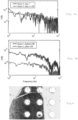
- Figure 5a-b show the amplitude spectra of the time traces associated with Figure 4a and Figure 4c .
- a tenfold decrease is observed in the average amplitude of the spectrum after adding Chloramphenicol antibiotic to the droplet containing E. coli bacteria.
- Figure 6 shows an optical microscope image of an array of silanized natural crystal exfoliated 10 nm few layer thick graphene as the suspended material in the presence of E. coli. Only few bacteria can be observed per drum.
Landscapes
- Health & Medical Sciences (AREA)
- Life Sciences & Earth Sciences (AREA)
- Chemical & Material Sciences (AREA)
- Physics & Mathematics (AREA)
- Immunology (AREA)
- Engineering & Computer Science (AREA)
- General Health & Medical Sciences (AREA)
- General Physics & Mathematics (AREA)
- Biochemistry (AREA)
- Analytical Chemistry (AREA)
- Molecular Biology (AREA)
- Pathology (AREA)
- Organic Chemistry (AREA)
- Biomedical Technology (AREA)
- Biotechnology (AREA)
- Hematology (AREA)
- Acoustics & Sound (AREA)
- Urology & Nephrology (AREA)
- Microbiology (AREA)
- Proteomics, Peptides & Aminoacids (AREA)
- Wood Science & Technology (AREA)
- Zoology (AREA)
- Biophysics (AREA)
- Nuclear Medicine, Radiotherapy & Molecular Imaging (AREA)
- Radiology & Medical Imaging (AREA)
- Bioinformatics & Cheminformatics (AREA)
- General Engineering & Computer Science (AREA)
- Genetics & Genomics (AREA)
- Cell Biology (AREA)
- Medicinal Chemistry (AREA)
- Food Science & Technology (AREA)
- Heart & Thoracic Surgery (AREA)
- Medical Informatics (AREA)
- Surgery (AREA)
- Animal Behavior & Ethology (AREA)
- Public Health (AREA)
- Veterinary Medicine (AREA)
- Apparatus Associated With Microorganisms And Enzymes (AREA)
- Measuring Or Testing Involving Enzymes Or Micro-Organisms (AREA)
Claims (15)
- Sensoranordnung (100) zur Aktivitätsüberwachung eines lebenden Mikroorganismus oder lebenden Nanoorganismus, umfassendeinen Probenempfänger (101) zum Aufnehmen eines Flüssigkeitsvolumens, wobei das Volumen < 10 µl ist, umfassend einen 2D-Mikroskalen-Bewegungsdetektor (102), wobei der Bewegungsdetektor eine inerte suspendierte Schicht (102) umfasst, wobei die suspendierte Schicht 1-5 Atome dick ist, mindestens einen Träger (104) für die suspendierte Schicht, undein Auslesesystem (103), das für die Messung der Veränderung der suspendierten Schicht konfiguriert ist.
- Sensoranordnung nach Anspruch 1, wobei das Material der aufgehängten Schicht ein zweidimensionaler Kristall ist, der Van-der-Waals-Wechselwirkungen zwischen den Schichten in einer Richtung senkrecht zur Schichtoberfläche bereitstellt, und vorzugsweise ausgewählt ist aus Graphen, hexagonalem BN, schwarzem Phosphor, Übergangsmetalldichalcogeniden, wobei das Metall vorzugsweise ausgewählt ist aus Mo, W, Nb, und wobei das Chalcogen vorzugsweise ausgewählt ist aus S, Se und Te, wie MoS2, NbSe2 und WSe2, und Kombinationen davon.
- Sensoranordnung nach einem der Ansprüche 1-2, wobei das Auslesesystem ausgewählt ist aus einem Fabry-Perot-Interferometer, einem Michelson-Interferometer, einem optischen Interferometer, einem Laser-Doppler-Vibrometer, einer oder mehreren Kondensatorelektroden, einem piezoelektrischen Element, einem piezoresistiven Element, einem Impedanzanalysator und Kombinationen davon, und/oder wobei die Veränderung der aufgehängten Schicht mindestens eine ihrer physikalischen Eigenschaften verändert, ausgewählt aus Ablenkung, Resonanzfrequenz, Reflexionsspektrum, Transmissionsspektrum, optischer Adsorption, Orientierung mindestens eines Teils der aufgehängten Schicht, optischer Interferenz, 2D-Kristallstruktur, elektromagnetischen Eigenschaften wie Widerstand, Leitfähigkeit und Kombinationen davon.
- Sensoranordnung nach Anspruch 3, wobei das Auslesesystem einen Laser zur Bereitstellung von Licht, ein optisches System zum Lenken des Lichts vom Laser auf die Probe, ein optisches System zum Lenken des von der Probe reflektierten Lichts auf einen Fotodetektor, wie z. B. eine Fotodiode, optional einen Verstärker zur Verstärkung der erfassten Lichtreaktion und ein Aufzeichnungsgerät zur Darstellung der Bewegung, wie z. B. ein Oszilloskop, umfasst.
- Sensoranordnung nach einem der Ansprüche 1-4, wobei die aufgehängte Schicht 1 bis 3 Atome dick ist, und/oder wobei die aufgehängte Schicht 0,1 bis 50 µm breit ist, wie 1 bis 2 µm breit, und/oder wobei die aufgehängte Schicht 0,1 bis 50 µm breit ist, wie 1 bis 2 µm breit.
- Sensoranordnung nach einem der Ansprüche 1-5, wobei die aufgehängte Schicht eine Steifigkeit von <10 N/m, wie < 1 N/m, aufweist und/oderwobei die aufgehängte Schicht einen Youngs-Modulus von > 100 GPa, wie >500 GPa (ASTM E1111), aufweist, und/oderwobei die suspendierte Schicht ein Gewicht von <10-15 kg, vorzugsweise <10-16 kg, wie <10-17 kg, aufweist, und/oderwobei unter der suspendierten Schicht ein Hohlraum (108) von > 100 nm Höhe, wie > 250 nm, vorgesehen ist, und/oderwobei der Hohlraum (108) mit einem Fluid, wie z.B. einem Gas oder einer Flüssigkeit, gefüllt ist, und/oderwobei der mindestens eine Träger (104) ein elektrisch isolierendes Material, wie mit einer elektrischen Leitfähigkeit σ (20°C) von <10-3 S/m, vorzugsweise <10-6 S/m, wie Siliziumoxid, Siliziumnitrid und Siliziumkarbid, aufweist, und/oderwobei der mindestens eine Träger (104) eine Höhe von 20-1000 nm, wie z.B. 100-300 nm, aufweist, und/oderwobei der mindestens eine Träger (104) auf einem Substrat (107), wie z.B. einem Siliziumsubstrat, vorgesehen ist, und/oderwobei die suspendierte Schicht (102), der mindestens eine Träger (104) und das Substrat (107) jeweils einzeln nicht toxisch sind und zumindest teilweise die Aktivität von Organismen unterstützen.
- Sensoranordnung nach einem der Ansprüche 1-5, ferner umfassend einer Feuchtigkeitskammer zur Aufnahme der suspendierten Schicht und einer Probe.
- Sensoranordnung nach einem der Ansprüche 1-7, die eine Anordnung von Probenempfängern umfasst.
- Chip (109) mit mindestens einem mikroskaligen 2D-Bewegungsdetektor nach einem der Ansprüche 1-8.
- Sensoranordnung mit einem Chip nach Anspruch 9.
- Elektronische Vorrichtung (110) umfassend einer Sensoranordnung (100) nach einem der Ansprüche 1-8 oder einem Chip (109) nach Anspruch 9 und mindestens zwei Kanälen (106), die jeweils einzeln mit dem Auslesesystem (103) elektrisch verbunden sind, beispielsweise 5 bis 200 Kanäle, und mindestens einer Ausleseleitung.
- Verfahren zum Betreiben der Sensoranordnung nach einem der Ansprüche 1-10, umfassend das Bereitstellen eines Flüssigkeitsvolumens, wobei das Volumen < 10 µl ist, und das Volumen einen Mikroorganismus oder einen lebenden Zellbestandteil oder ein Virus enthält, und das Messen der Bewegung des Mikroorganismus oder des lebenden Zellbestandteils oder des Virus über die Zeit.
- Verfahren nach Anspruch 12, wobei eine Chemikalie zugegeben wird, wobei die Chemikalie vorzugsweise aus Pharmazeutika oder potenziellen Pharmazeutika, wie Antibiotika, wie Kanamycin und Chloramphenicol, ausgewählt wird, und Messen einer Reaktion des Mikroorganismus oder des lebenden Zellbestandteils oder des Virus auf die Chemikalie über die Zeit.
- Verfahren nach Anspruch 12 oder 13, wobei die Flüssigkeit eine Komponente umfasst, die aus einer Nahrung für den Mikroorganismus oder für den lebenden Zellbestandteil oder für das Virus, einer physiologisch verträglichen Flüssigkeit und einer metabolischen Unterstützungsverbindung ausgewählt ist.
- Einweg-Probenbühne mit einem Probenempfänger zur Aufnahme eines Flüssigkeitsvolumens, wobei das Volumen < 10 µl ist, mit einem 2D-Mikroskalen-Bewegungsdetektor (102), wobei der Bewegungsdetektor eine inerte suspendierte Schicht (102) umfasst, wobei die suspendierte Schicht 1-5 Atome dick ist, und mit mindestens einem Träger (104) für die suspendierte Schicht.
Applications Claiming Priority (2)
| Application Number | Priority Date | Filing Date | Title |
|---|---|---|---|
| NL2024356A NL2024356B1 (en) | 2019-12-02 | 2019-12-02 | 2D material detector for activity monitoring of single living micro-organisms and nano-organisms |
| PCT/NL2020/050621 WO2021112666A1 (en) | 2019-12-02 | 2020-10-08 | 2d material detector for activity monitoring of single living micro-organisms and nano-organisms |
Publications (3)
| Publication Number | Publication Date |
|---|---|
| EP4069862A1 EP4069862A1 (de) | 2022-10-12 |
| EP4069862B1 true EP4069862B1 (de) | 2025-04-23 |
| EP4069862C0 EP4069862C0 (de) | 2025-04-23 |
Family
ID=69106151
Family Applications (1)
| Application Number | Title | Priority Date | Filing Date |
|---|---|---|---|
| EP20790083.8A Active EP4069862B1 (de) | 2019-12-02 | 2020-10-08 | 2d-materialdetektor für die aktivitätsüberwachung von einzelnen lebenden mikro- und nanoorganismen |
Country Status (4)
| Country | Link |
|---|---|
| US (1) | US12239413B2 (de) |
| EP (1) | EP4069862B1 (de) |
| NL (1) | NL2024356B1 (de) |
| WO (1) | WO2021112666A1 (de) |
Families Citing this family (4)
| Publication number | Priority date | Publication date | Assignee | Title |
|---|---|---|---|---|
| NL2024356B1 (en) | 2019-12-02 | 2021-08-31 | Univ Delft Tech | 2D material detector for activity monitoring of single living micro-organisms and nano-organisms |
| NL2029002B1 (en) * | 2021-08-19 | 2023-02-24 | Optics11 B V | Optical measurement of biological tissue. |
| NL2031130B1 (en) | 2022-03-02 | 2023-09-11 | Univ Delft Tech | Clinical sample preparation and handling for activity monitoring of single living micro- and nano-organism |
| NL2036088B1 (en) | 2023-10-20 | 2025-05-06 | Soundcell Ip B V | Apparatus and methods for simultaneous readout of nanomotion on suspended sheets with adhered micro- and nanoorganisms |
Family Cites Families (15)
| Publication number | Priority date | Publication date | Assignee | Title |
|---|---|---|---|---|
| US20050003396A1 (en) * | 2003-04-11 | 2005-01-06 | Mihrimah Ozkan | Biosensors having single reactant components immobilized over single electrodes and methods of making and using thereof |
| US20090124513A1 (en) * | 2007-04-20 | 2009-05-14 | Patricia Berg | Multiplex Biosensor |
| US8599383B2 (en) * | 2009-05-06 | 2013-12-03 | The Regents Of The University Of California | Optical cytometry |
| CA2772789C (en) * | 2009-09-18 | 2018-10-30 | President And Fellows Of Harvard College | Bare single-layer graphene membrane having a nanopore enabling high-sensitivity molecular detection and analysis |
| EP2348132B1 (de) * | 2010-01-21 | 2013-12-04 | Consejo Superior De Investigaciones Cientificas | Verfahren zur Bioanalyse von Nukleinsäuremolekülen in einer Probe und Biosensor für dessen Durchführung |
| WO2013019984A1 (en) * | 2011-08-02 | 2013-02-07 | The Regents Of The University Of California | Rapid, massively parallel single-cell drug response measurements via live cell interferometry |
| WO2013054311A1 (en) | 2011-10-14 | 2013-04-18 | Ecole Polytechnique Federale De Lausanne (Epfl) | Nanoscale motion detector |
| US10203295B2 (en) * | 2016-04-14 | 2019-02-12 | Lockheed Martin Corporation | Methods for in situ monitoring and control of defect formation or healing |
| US10802018B2 (en) * | 2014-11-04 | 2020-10-13 | The Trustees Of The University Of Pennsylvania | Multimodal biosensor |
| US10222372B2 (en) * | 2015-08-03 | 2019-03-05 | Arizona Board Of Regents On Behalf Of Arizona State University | Antibiotic susceptibility testing via plasmonic imaging and tracking |
| EP3545076A4 (de) * | 2016-11-22 | 2020-07-29 | Roswell Biotechnologies, Inc | Nukleinsäuresequenzierungsvorrichtung mit graphen |
| GB2560767A (en) * | 2017-03-24 | 2018-09-26 | Centrum Fur Angewandte Nanotechnologie Can Gmbh | Method for detecting an analyte based on the detection of a change of the mechanical properties of a freestanding nanoparticle composite material |
| WO2019103994A1 (en) * | 2017-11-27 | 2019-05-31 | The Government of the United State of America, as represented by the Secretary of the Navy | Substrates with independently tunable topographies and chemistries for quantifying surface-induced cell behavior |
| WO2020046191A1 (en) * | 2018-08-27 | 2020-03-05 | Zhen Zhang | Piezoresistive nanowire array for motion sensing |
| NL2024356B1 (en) | 2019-12-02 | 2021-08-31 | Univ Delft Tech | 2D material detector for activity monitoring of single living micro-organisms and nano-organisms |
-
2019
- 2019-12-02 NL NL2024356A patent/NL2024356B1/en active
-
2020
- 2020-10-08 EP EP20790083.8A patent/EP4069862B1/de active Active
- 2020-10-08 WO PCT/NL2020/050621 patent/WO2021112666A1/en not_active Ceased
-
2022
- 2022-06-02 US US17/830,702 patent/US12239413B2/en active Active
Also Published As
| Publication number | Publication date |
|---|---|
| NL2024356B1 (en) | 2021-08-31 |
| EP4069862A1 (de) | 2022-10-12 |
| WO2021112666A1 (en) | 2021-06-10 |
| US20220313091A1 (en) | 2022-10-06 |
| US12239413B2 (en) | 2025-03-04 |
| EP4069862C0 (de) | 2025-04-23 |
Similar Documents
| Publication | Publication Date | Title |
|---|---|---|
| US12239413B2 (en) | 2D material detector for activity monitoring of single living micro-organisms and nano-organisms | |
| Yoshikawa et al. | Two dimensional array of piezoresistive nanomechanical membrane-type surface stress sensor (MSS) with improved sensitivity | |
| US6051422A (en) | Hybrid biosensors | |
| Marszalek et al. | Stretching single polysaccharides and proteins using atomic force microscopy | |
| US7964144B1 (en) | MEMS biosensor with integrated impedance and mass-sensing capabilities | |
| DE60133380T2 (de) | Mikrophysiomessgerät | |
| US20150011428A1 (en) | Array of Sensors with Surface Modifications | |
| EP1325302A2 (de) | Aktiv-nems-arrays für biochemische analysen | |
| Hongbin et al. | Capacitive micromachined ultrasonic transducer (CMUT) based micro viscosity sensor | |
| EP1342789B1 (de) | Ausleger-Gerät und Verfahren zum Nachweis von Mikroorganismen | |
| WO2016133472A1 (en) | Multi-axis piezoresistive force sensor | |
| Patkar et al. | Microcantilever based dual mode biosensor for agricultural applications | |
| Huang et al. | A MEMS dielectric affinity glucose biosensor | |
| US20140364325A1 (en) | Array of Sensors Functionalized with Systematically Varying Receptor Materials | |
| Ku et al. | A real-time thermal self-elimination method for static mode operated freestanding piezoresistive microcantilever-based biosensors | |
| Prakash et al. | A CMOS capacitance sensor for cell adhesion characterization | |
| Sang et al. | PDMS micro-membrane capacitance-type surface stress biosensors for biomedical analyses | |
| NL2031130B1 (en) | Clinical sample preparation and handling for activity monitoring of single living micro- and nano-organism | |
| Vineetha et al. | Performance analysis of MEMS sensor for the detection of cholera and diarrhea | |
| Sacu et al. | Design of a basic piezoresistive microcantilever biosensor | |
| Tsouti et al. | Design and fabrication of a Si micromechanical capacitive array for DNA sensing | |
| NL2036088B1 (en) | Apparatus and methods for simultaneous readout of nanomotion on suspended sheets with adhered micro- and nanoorganisms | |
| Weldegiorgish | Enhancing Sensing in Nanoscale: Investigation of Smart Nanomechanical Cantilever Array | |
| Liu et al. | Integrated Piezoresistive Normal Force Sensors Fabricated Using Transfer Processes with Stiction Effect Temporary Handling | |
| Bharti et al. | Testing of Semiconductor Scaled Devices |
Legal Events
| Date | Code | Title | Description |
|---|---|---|---|
| STAA | Information on the status of an ep patent application or granted ep patent |
Free format text: STATUS: UNKNOWN |
|
| STAA | Information on the status of an ep patent application or granted ep patent |
Free format text: STATUS: THE INTERNATIONAL PUBLICATION HAS BEEN MADE |
|
| PUAI | Public reference made under article 153(3) epc to a published international application that has entered the european phase |
Free format text: ORIGINAL CODE: 0009012 |
|
| STAA | Information on the status of an ep patent application or granted ep patent |
Free format text: STATUS: REQUEST FOR EXAMINATION WAS MADE |
|
| 17P | Request for examination filed |
Effective date: 20220627 |
|
| AK | Designated contracting states |
Kind code of ref document: A1 Designated state(s): AL AT BE BG CH CY CZ DE DK EE ES FI FR GB GR HR HU IE IS IT LI LT LU LV MC MK MT NL NO PL PT RO RS SE SI SK SM TR |
|
| RAP1 | Party data changed (applicant data changed or rights of an application transferred) |
Owner name: SOUNDCELL HOLDING B.V. |
|
| DAV | Request for validation of the european patent (deleted) | ||
| DAX | Request for extension of the european patent (deleted) | ||
| STAA | Information on the status of an ep patent application or granted ep patent |
Free format text: STATUS: EXAMINATION IS IN PROGRESS |
|
| 17Q | First examination report despatched |
Effective date: 20230810 |
|
| GRAP | Despatch of communication of intention to grant a patent |
Free format text: ORIGINAL CODE: EPIDOSNIGR1 |
|
| STAA | Information on the status of an ep patent application or granted ep patent |
Free format text: STATUS: GRANT OF PATENT IS INTENDED |
|
| RIC1 | Information provided on ipc code assigned before grant |
Ipc: G01N 29/036 20060101ALI20241203BHEP Ipc: G01N 29/02 20060101ALI20241203BHEP Ipc: G01N 29/00 20060101ALI20241203BHEP Ipc: G01N 33/543 20060101ALI20241203BHEP Ipc: C12Q 1/02 20060101AFI20241203BHEP |
|
| INTG | Intention to grant announced |
Effective date: 20241212 |
|
| GRAS | Grant fee paid |
Free format text: ORIGINAL CODE: EPIDOSNIGR3 |
|
| GRAA | (expected) grant |
Free format text: ORIGINAL CODE: 0009210 |
|
| STAA | Information on the status of an ep patent application or granted ep patent |
Free format text: STATUS: THE PATENT HAS BEEN GRANTED |
|
| AK | Designated contracting states |
Kind code of ref document: B1 Designated state(s): AL AT BE BG CH CY CZ DE DK EE ES FI FR GB GR HR HU IE IS IT LI LT LU LV MC MK MT NL NO PL PT RO RS SE SI SK SM TR |
|
| REG | Reference to a national code |
Ref country code: GB Ref legal event code: FG4D |
|
| REG | Reference to a national code |
Ref country code: CH Ref legal event code: EP |
|
| REG | Reference to a national code |
Ref country code: DE Ref legal event code: R096 Ref document number: 602020050027 Country of ref document: DE |
|
| REG | Reference to a national code |
Ref country code: IE Ref legal event code: FG4D |
|
| U01 | Request for unitary effect filed |
Effective date: 20250430 |
|
| U07 | Unitary effect registered |
Designated state(s): AT BE BG DE DK EE FI FR IT LT LU LV MT NL PT RO SE SI Effective date: 20250508 |
|
| PG25 | Lapsed in a contracting state [announced via postgrant information from national office to epo] |
Ref country code: ES Free format text: LAPSE BECAUSE OF FAILURE TO SUBMIT A TRANSLATION OF THE DESCRIPTION OR TO PAY THE FEE WITHIN THE PRESCRIBED TIME-LIMIT Effective date: 20250423 |
|
| PG25 | Lapsed in a contracting state [announced via postgrant information from national office to epo] |
Ref country code: GR Free format text: LAPSE BECAUSE OF FAILURE TO SUBMIT A TRANSLATION OF THE DESCRIPTION OR TO PAY THE FEE WITHIN THE PRESCRIBED TIME-LIMIT Effective date: 20250724 Ref country code: NO Free format text: LAPSE BECAUSE OF FAILURE TO SUBMIT A TRANSLATION OF THE DESCRIPTION OR TO PAY THE FEE WITHIN THE PRESCRIBED TIME-LIMIT Effective date: 20250723 |
|
| PG25 | Lapsed in a contracting state [announced via postgrant information from national office to epo] |
Ref country code: PL Free format text: LAPSE BECAUSE OF FAILURE TO SUBMIT A TRANSLATION OF THE DESCRIPTION OR TO PAY THE FEE WITHIN THE PRESCRIBED TIME-LIMIT Effective date: 20250423 |
|
| PGFP | Annual fee paid to national office [announced via postgrant information from national office to epo] |
Ref country code: TR Payment date: 20250925 Year of fee payment: 6 |
|
| PG25 | Lapsed in a contracting state [announced via postgrant information from national office to epo] |
Ref country code: HR Free format text: LAPSE BECAUSE OF FAILURE TO SUBMIT A TRANSLATION OF THE DESCRIPTION OR TO PAY THE FEE WITHIN THE PRESCRIBED TIME-LIMIT Effective date: 20250423 |
|
| PG25 | Lapsed in a contracting state [announced via postgrant information from national office to epo] |
Ref country code: RS Free format text: LAPSE BECAUSE OF FAILURE TO SUBMIT A TRANSLATION OF THE DESCRIPTION OR TO PAY THE FEE WITHIN THE PRESCRIBED TIME-LIMIT Effective date: 20250723 |
|
| PG25 | Lapsed in a contracting state [announced via postgrant information from national office to epo] |
Ref country code: IS Free format text: LAPSE BECAUSE OF FAILURE TO SUBMIT A TRANSLATION OF THE DESCRIPTION OR TO PAY THE FEE WITHIN THE PRESCRIBED TIME-LIMIT Effective date: 20250823 |
|
| REG | Reference to a national code |
Ref country code: CH Ref legal event code: U11 Free format text: ST27 STATUS EVENT CODE: U-0-0-U10-U11 (AS PROVIDED BY THE NATIONAL OFFICE) Effective date: 20251101 |
|
| U20 | Renewal fee for the european patent with unitary effect paid |
Year of fee payment: 6 Effective date: 20251010 |
|
| PGFP | Annual fee paid to national office [announced via postgrant information from national office to epo] |
Ref country code: GB Payment date: 20251027 Year of fee payment: 6 |
|
| PG25 | Lapsed in a contracting state [announced via postgrant information from national office to epo] |
Ref country code: SM Free format text: LAPSE BECAUSE OF FAILURE TO SUBMIT A TRANSLATION OF THE DESCRIPTION OR TO PAY THE FEE WITHIN THE PRESCRIBED TIME-LIMIT Effective date: 20250423 |
|
| PGFP | Annual fee paid to national office [announced via postgrant information from national office to epo] |
Ref country code: CH Payment date: 20251101 Year of fee payment: 6 |
|
| PG25 | Lapsed in a contracting state [announced via postgrant information from national office to epo] |
Ref country code: CZ Free format text: LAPSE BECAUSE OF FAILURE TO SUBMIT A TRANSLATION OF THE DESCRIPTION OR TO PAY THE FEE WITHIN THE PRESCRIBED TIME-LIMIT Effective date: 20250423 |
|
| PG25 | Lapsed in a contracting state [announced via postgrant information from national office to epo] |
Ref country code: SK Free format text: LAPSE BECAUSE OF FAILURE TO SUBMIT A TRANSLATION OF THE DESCRIPTION OR TO PAY THE FEE WITHIN THE PRESCRIBED TIME-LIMIT Effective date: 20250423 |
|
| PLBE | No opposition filed within time limit |
Free format text: ORIGINAL CODE: 0009261 |
|
| STAA | Information on the status of an ep patent application or granted ep patent |
Free format text: STATUS: NO OPPOSITION FILED WITHIN TIME LIMIT |
|
| REG | Reference to a national code |
Ref country code: CH Ref legal event code: L10 Free format text: ST27 STATUS EVENT CODE: U-0-0-L10-L00 (AS PROVIDED BY THE NATIONAL OFFICE) Effective date: 20260304 |
|
| 26N | No opposition filed |
Effective date: 20260126 |