EP4069666B1 - Verfahren zur herstellung von ligninoligomeren - Google Patents
Verfahren zur herstellung von ligninoligomeren Download PDFInfo
- Publication number
- EP4069666B1 EP4069666B1 EP20816495.4A EP20816495A EP4069666B1 EP 4069666 B1 EP4069666 B1 EP 4069666B1 EP 20816495 A EP20816495 A EP 20816495A EP 4069666 B1 EP4069666 B1 EP 4069666B1
- Authority
- EP
- European Patent Office
- Prior art keywords
- lignin
- oligomer
- process according
- anyone
- catalyst
- Prior art date
- Legal status (The legal status is an assumption and is not a legal conclusion. Google has not performed a legal analysis and makes no representation as to the accuracy of the status listed.)
- Active
Links
Images








Classifications
-
- C—CHEMISTRY; METALLURGY
- C07—ORGANIC CHEMISTRY
- C07G—COMPOUNDS OF UNKNOWN CONSTITUTION
- C07G1/00—Low-molecular-weight derivatives of lignin
-
- C—CHEMISTRY; METALLURGY
- C07—ORGANIC CHEMISTRY
- C07C—ACYCLIC OR CARBOCYCLIC COMPOUNDS
- C07C37/00—Preparation of compounds having hydroxy or O-metal groups bound to a carbon atom of a six-membered aromatic ring
- C07C37/50—Preparation of compounds having hydroxy or O-metal groups bound to a carbon atom of a six-membered aromatic ring by reactions decreasing the number of carbon atoms
- C07C37/52—Preparation of compounds having hydroxy or O-metal groups bound to a carbon atom of a six-membered aromatic ring by reactions decreasing the number of carbon atoms by splitting polyaromatic compounds, e.g. polyphenolalkanes
- C07C37/54—Preparation of compounds having hydroxy or O-metal groups bound to a carbon atom of a six-membered aromatic ring by reactions decreasing the number of carbon atoms by splitting polyaromatic compounds, e.g. polyphenolalkanes by hydrolysis of lignin or sulfite waste liquor
Definitions
- the present invention relates a process for depolymerization of lignin comprising thermal treatment of an aqueous mixture having a pH of at least 9 comprising lignin, catalyst and primary alcohol in a non-oxidizing atmosphere at a temperature of at least 280°C.
- lignin valorization of lignin is of significant importance as it is the second largest renewable resource after cellulose. Additional interest arises as lignin is in principle readily available as by-product of the pulp industry and paper industry. Currently, lignin is simply burned and its energy is recovered and used to run the paper production process. Since paper industries are becoming more efficient and requires less energy consumption the news strategies of lignin valorization get considerable attention.
- lignin valorization has some obstacles and the known processes require several steps for lignin depolymerization and isolation. Moreover, harsh reaction conditions are required for lignin depolymerization, which make utilization of catalyzed reaction steps desirable. However, usually high sulfur content of lignin from the pulp & paper industry (around 2-3%) is challenging for catalyst lifetimes. Additionally, lignin depolymerization often results in formation of highly condensed lignin-species in the form of insoluble solid char-like residues. Besides the fact that such char-like solid residue decreases yield of desired products reactor clogging is a big problem for industrial applications which are to be avoided. Further, known methods do not result in a high yield of monoaromatic or oligomeric aromatic structures with low molecular mass of ⁇ 700 g/mol and/or narrow molecular size distribution.
- WO2017/048163 describes a complex multi-step process for bio-oil production from black liquor in the presence of an acidifying agent under H 2 or H 2 /CO pressure of 5-150 bar, at 180 to 240 °C for 10-120 minutes in the presence of a solid catalyst.
- the depolymerized lignin fraction is recovered by acidification till pH 4-5 followed by extraction.
- WO2017/078582 describes a catalytic process for conversion of lignin oil (of molecular weight average of 500 g/mol to 800 g/mol) to a hydrocarbon product by treatment of lignin oil under H 2 pressure of 30-160 bar, at 290 to 400°C and subsequent recovery of the hydrogenated products by gas/liquid phase separation.
- WO2014/168473 describes a process of lignin depolymerization in alkaline media in the presence of noble metal supported catalysts at 200-300°C without addition of alcohol to obtain phenolic compounds. The process is not high in yield of desired low molecular weight lignin species.
- WO2012/005677 describes a process of obtaining lignin with lower molecular weight, lower viscosity and higher purity by lowering pH of black liquor and treating black liquor at 150-200 °C for 1-60 min. However, molecular weight is just reduced from 4810 g/mol to 4050 g/mol.
- EP2975015 describes a process of lignin depolymerization at temperatures of 230 to 350 °C in the presence of a subgroup VI element catalyst with water and/or ethanol as solvent in the absence of a base. By this reaction a liquid product is obtained.
- WO2014/201325 describes a process for lignin depolymerization at temperatures below 220°C in the presence of a metaloxide catalyst with methanol as solvent in the absence of a base. By this reaction a depolymerized lignin oil is obtained which is further purified by extraction.
- This object is achieved by a process for depolymerization of lignin by thermal conversion of an aqueous mixture having a pH of at least 9 comprising lignin, catalyst and primary alcohol in a non-oxidizing atmosphere at a temperature of at least 280°C.
- the process for depolymerization of lignin according to the present invention may comprise the steps of:
- the lignin oligomer is obtained as a precipitate which can be easily separated from the reaction solution.
- the thermal conversion in step b) may be performed for a time until precipitation of lignin oligomer.
- the thermal conversion in step b) is performed for 3 to 7 h, more preferably 4 to 5 h, after precipitation of lignin oligomer starts.
- the obtained lignin oligomer precipitate may be filtered from the aqueous reaction solution.
- precipitation may be performed by cooling the aqueous mixture after thermal conversion. Cooling temperature may be between 50 °C and 15°C, more preferably between 40 and 20 °C.
- the temperature is cooled to below 20°C, more preferably below 15 °C but preferably the temperature is not cooled below 0°C.
- the obtained lignin oligomer is re-dissolvable in organic solvents, like e.g. alcohol, acetone, THF and/or DMSO.
- organic solvents like e.g. alcohol, acetone, THF and/or DMSO.
- Char-type lignin residues means insoluble, high molecular weight (> 5000 g/mol) highly condensed lignin-based material.
- the aqueous mixture in the process according to the present invention may comprise
- primary alcohol is required to reduce or avoid formation of char-type lignin residues during the thermal conversion.
- primary alcohol amount should not be too high to allow efficient product recovery by precipitation of the desired lignin oligomer.
- primary alcohol based on the total weight of the aqueous mixture, precipitation of desired lignin occurs without additional formation of char-type lignin residues.
- the lignin oligomer obtained by the process according to the present invention precipitates as a soft, rubbery type material that can be re-dissolved in alcohol (e.g. ethanol), acetone, THF, and/or DMSO after the aqueous reaction mixture has been removed.
- alcohol e.g. ethanol
- acetone e.g. acetone
- THF e.g. tetrahydrofuran
- DMSO e.g. DMSO
- the aqueous reaction solution and the precipitated lignin oligomer can be separated by e.g. decanting, centrifugation and/or filtration or other types of solids-removal technologies known in the art.
- the catalyst used in the process according to the present invention may be a heterogenous catalyst, preferably for deoxydehydration.
- the catalyst used in the process according to the present invention may be selected from the group consisting of Ru, Cu, Co, Ni, Pt, sulfides of said metals, oxides of said metals and mixtures thereof.
- a carbon and/or Al 2 O 3 and/or SiO 2 support may be used for the catalyst.
- Ru on a C-carrier, Ni-nanoparticles or Cu on an Al 2 O 3 /SiO 2 support are used according to the present invention.
- the catalyst may be recycled and reused in the process according to the present invention.
- the obtained precipitated lignin oligomer may be dissolved in organic solvents, like alcohol (e.g. ethanol), acetone, THF, and/or DMSO.
- organic solvents like alcohol (e.g. ethanol), acetone, THF, and/or DMSO.
- the catalyst included in the precipitate remains undissolved and may be separated by e.g. decanting, centrifugation and/or filtration or other types of solids-removal technologies known in the art.
- the catalyst after use in the process according to the present invention has a prolonged life-time compared to the same catalyst used in processes for lignin depolymerization known in the art.
- the primary alcohol used in the process according to the present invention preferably is a primary C1 to C4-alcohol and may be selected from the group consisting of MeOH, EtOH, n-Propanol, n-Butanol and mixtures thereof.
- EtOH is used as alcohol in the process according to the present invention.
- the process according to the present invention does not require aromatic solvents.
- no aromatic solvents are used in the process according to the present invention.
- the process according to the present invention does not require an extraction step and/or an adsorption step and/or an ion exchange step.
- the process according to the present invention does not comprise an acidification step.
- a base may be added to adjust pH of the aqueous solution to a pH of at least 9.
- the base which may be used for the process according to the present invention may be selected from the group consisting of NaOH, KOH, Ca(OH) 2 , Mg(OH) 2 and mixtures thereof.
- NaOH is used as a base according to the present invention.
- the non-oxidizing gas used in the process according to the present invention may be selected from the group consisting N 2 , argon and/or H 2 .
- the non-oxidizing gas is N 2 .
- the process according to the present invention is performed in the absence of hydrogen gas.
- N 2 -gas provides higher yields than H 2 -gas.
- the reaction is performed at a reaction pressure of 80 bar to 150 bar, more preferably 90 bar to 120 bar in the non-oxidizing atmosphere.
- the precipitated lignin oligomer is separated from the aqueous reaction solution by decanting, centrifugation and/or filtration, then the lignin oligomer is dissolved in a primary alcohol, e.g. ethanol, and subsequently the catalyst is separated by decanting, centrifugation and/or filtration, wherein the separated aqueous reaction solution comprising unreacted or partially depolymerized and deoxydehydrated lignin, base, and primary alcohol is reintroduced into step a).
- additional lignin equal to the mass of recovered product in the previous reaction cycle is added to the aqueous mixture in the new cycle.
- the separated catalyst may be reintroduced reintroduced into step a).
- Lignin is a high-molecular weight, aromatic compound found in plants comprising hydroxylated and methoxylated phenylpropene units like 4-hydroxycinnamic alcohol (p-cumaryl alcohol), co-niferyl alcohol and/or sinapyl alcohol, (so-called monolignols) units.
- the lignin according to the present invention may be obtained e.g. by the sulfate process (Kraft lignin), soda process and/or organosolv-process (Organosolv lignin).
- Processes to obtain lignin are e.g. described in US4507172 , CA2256923 , EP3156409 , WO2013/070130 , DE3901662 , WO2012/027767 and/or WO2006/038863 .
- Lignin may be also precipitated as lignin solid out of a Kraft pulp mill "black liquor” stream by acidification and filtration (e.g. by the Lignoboost process described in US20170355723 or equivalent approaches).
- this type of lignin is used according to the present invention and referred to as Kraft lignin.
- Black liquor is the aqueous basic solution of the Kraft-pulping process after separation of the cellulosic pulp. It comprises besides dissolved lignin inorganic cooking salts and degraded sugar components from the original biomass, like e.g. acetic acid, diverse sugar-acids, etc. ( Bajpai, Pratima. (2016). Biermann's Handbook of Pulp and Paper - Raw Material and Pulp Making, Volume 1 and 2 (3rd Edition) - 12.8.5 Green Liquor, Chemical Recovery. (pp. 332). Elsevier ).
- the lignin used, according to the present invention, as starting material may have an average molecular weight of 3000-6000 g/mol.
- the lignin used, according to the present invention, as starting material has a polydispersity of greater than 5.
- the lignin used for the process according to the present invention has an average molecular weight of 3000-6000 g/mol and has a polydispersity of greater than 5.
- the process according to the present invention provides lignin oligomers having a molecular weight of 250 to 750 g/mol, preferably 300 to 650 g/mol, more preferably 300 to 500 g/mol and/or having 2 to 10, preferably 2 to 6, more preferably 2 to 4 aromatic moieties.
- the process according to the present invention may provide low molecular weight lignin oligomers with very uniform size distribution of a polydispersity index (PDI) of below 3.
- PDI polydispersity index
- process according to the present invention provides lignin oligomers with a dispersity between 1 and 3, preferably 1.7 to 2.8, more preferably 1.5 to 2.6, most preferably 2.0 to 2.3.
- the process according to the present invention provides lignin oligomers having an oxygen content of less than 20 wt.-% based on the total weight of the lignin oligomers.
- the catalyst, base, primary alcohol and/or unconverted lignin in the aqueous mixture can be reintroduced in the process for depolymerization of lignin either in a batch or continuous process.
- reaction solution means the solution obtained after filtration of the precipitated lignin oligomer product.
- Said reaction solution comprises unreacted or partially depolymerized and partially deoxydehydrated lignin, base, and primary alcohol.
- the depolymerized lignin-oligomer produced in the process according to the present invention may be further converted to polymers.
- lignin-oligomer produced in the process according to the present invention may be modified chemically or directly used as e.g. cross-linker in different types of polymers.
- Said polymers may be selected from the group consisting of polyesters, polyurethanes, polyamides and mixtures thereof.
- the lignin oligomer may be also converted to e.g. biobased aromatics selected from the group consisting of toluene, benzene, xylenes and mixtures thereof.
- lignin oligomer composition obtainable by the above described process.
- lignin oligomer composition comprising lignin oligomers, wherein the lignin oligomers have a number average molar mass Mn of 350 to 680 g/mol, preferably 400 to 650 g/mol and a PDI of 1 to 3, preferably 1.7 to 2.8 , more preferably 1.5 to 2.6, most preferably 2.0 to 2.3.
- the O/C weight ratio in the lignin oligomer may be 0.13 to 0.28, preferably 0.15 to 0.21 and optionally the phenolic OH-content may be 1.0 to 2.0 mmol/g lignin oligomer.
- the proportion of the 1 H-NMR signals of aromatic C-H groups to the aliphatic CH-groups in the lignin oligomer is from 3:1 to 1:8 , more preferably 2:1 to 1:7.5, more preferably from 2:1 to 1:7, most preferably 1:1 to 1:7.
- the above described lignin oligomer composition may be obtainable or obtained according to the process as described above.
- Kraft-Lignin is prepared as described in US20170355723 and is used as a starting material for depolymerization reaction.
- the experiments for lignin depolymerization are carried out at a temperature range of 250-350°C in a 300 ml autoclave. 10 -25 wt.-% of lignin are dissolved in 1N NaOH aqueous solution and put in the autoclave. 0.02-0.26 wt.-% heterogeneous catalyst (Ru/C, Ni Nanoparticles, Cu/Al 2 O 3 , Ni/Al 2 O 3 ) are added. A certain amount of alcohol (MeOH, EtOH, 1-Hexanol, tert-Butyl alcohol, isopropyl alcohol) relative to the NaOH solution is added (0-45 wt.-%).
- Wt.-% is based on the total weight of the aqueous mixture.
- the autoclave is flushed with H 2 or N 2 . Then heating is started at a low speed of 80 to 120 rpm to homogenize the temperature. The reaction pressure is adjusted to 90 to 150 bar. After reaching the desired temperature, stirrer speed is adjusted to 2000 rpm. Reaction is performed for 0.5-12 h and then autoclave is cooled down to room temperature, depressurized and solid and liquid parts separated. After dissolution of the solid residue in an appropriate solvent (e.g. EtOH) the catalyst is separated by filtration. The obtained products are analyzed, usually by GPC, elemental analysis and IR-analysis.
- Elution temperature is 35°C
- flow rate is 0,5 ml/min.
- Elementary analysis is performed from freeze-dried samples to remove residual water and solvent.
- Elementary Analysis is performed using Elementar Microcube machines. One machine is devoted to measure sulfur content and the other one to measure the carbon, nitrogen and hydrogen values.
- Carbon, hydrogen, nitrogen and sulfur analysis is conducted by combustion followed by thermal conductivity and infrared detection of effluent gases. Sulfur effluent gases are adsorbed in hydrogen peroxide solution and resulting sulfuric acid is titrated with alkali base.
- the oxygen content was determined by considering proportional formula for organic compounds containing C, H and O.
- FT-IR spectra of Kraft lignin (starting material) and lignin oligomer (product) were recorded with Alpha-T Transmission FT-IR (MIR) Spectrometer equipped with universal sample module. Solid samples were deposited on a single ZnSe optical window and measured in spectral range of 600-4000 cm-1 in a transition mod.
- Kraft-Lignin was prepared as described in US20170355723 and was used as a starting material for depolymerization reaction.
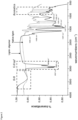
- IR analysis of Solid residue i.e. lignin oligomer shows similar aromatic bands to starting lignin and additionally a strong increase of aliphatic CH-signals and free aromatic OH bands ( Figure 2 ).
- Characteristic bands associated with lignin are summarized in Table 2.
- the bands related to aromatics C-H out of plane bending at 700-900 cm -1 and O-H stretching of hydroxyls more likely related to phenolic groups at 3000-3500 cm -1 are both present in starting lignin and lignin oligomer.
- the presence of three different bands for C-H out of plane bending at 867, 860, 811, 766, 750 cm -1 reveal that different substituents present in the aromatic rings.
- Table 3 shows elemental analysis of starting material (lignin) and the solid residue (lignin oligomers) obtained by the process according to the present invention and the not yet incompletely depolymerized and deoxydehydrated lignin fraction (filtrated reaction solution) that is still soluble in the aqueous reaction mixture (the filtrate).
- the depolymerized product In comparison with the native lignin that contains 64.3 wt.-% of C, 29.7 wt.-% of O and 6.0 wt.-% of H the depolymerized product (lignin oligomer) exhibits significant deoxydehydration giving 13.3 wt. % of O. In parallel, the quantity of H and C increased to 8 wt.-% and 78.7 wt.-% respectively. The decrease of oxygen content is attributed to the deoxydehydration reaction catalyzed by e.g. Ru/C catalyst.
- Ni NPs the amount of oxygen was higher than for Ru/C (see Table 10).
- Ni on alumina silica catalyst resulted in product with the same characteristics as the product received under standard conditions with Ru/C in terms of molar masses, dispersity and O/C ratio.
- the yield in this case was only 24% that is two times less than in case of Ru/C catalyst while the loading of Ni was ten times bigger in comparison with Ru.
- Example 1 To determine the effect of reaction time on product formation reaction time was monitored and product formation in Example 1 was analyzed by GPC and elementary analysis. No lignin oligomer precipitate was found within 0.5 h of depolymerization and 14 wt.-% lignin oligomer precipitate formed within 3 h (see Fig.3 ). Performing reaction for 6 h delivered significant yield of lignin oligomer precipitate (51 wt.-%). However, increase of depolymerization time to 12 h lead to slight additional product yield of 55 wt.-%. Comparison of GPC chromatogram and elementary analysis of products obtained after 3, 6 and 12 h show same product characteristics (see Fig. 3 (Yield over time) & Tables 13/14).
- the product was dissolved in EtOH and characterized by GPC and elemental analysis. Both products exhibited similar elemental composition.
- reaction solution (filtrate) obtained after first cycle of lignin conversion, together with recovered Ru/C catalyst were re-used for a second cycle.
- a new portion of lignin equal to the mass of recovered product in the first catalytic cycle was added.
- concentration of lignin was kept constant in first and second cycles.
- the reaction solution, containing the base and the alcohol and not yet precipitated lignin was recycled as well.
- Example 12 1 H-NMR spectra of the lignin oligomer obtained according to example 1 and the lignin starting material:
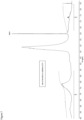
- Comparing the 1H-NMR spectra of the lignin oligomer (obtained according to example 1) relative to the starting lignin material shows less aromatic signals in the hydrogenated lignin oligomer sample.
- the proportion of C-H-aromatics signals to the C-H- aliphatic signals in the lignin oligomer sample is 1:7 ( Figure 6 ) compared to 2:1 in the lignin starting material ( Figure 7 ). In the range of 3.5 to 4 ppm a strong decrease of the CH 2 -OH and Aromatic-O-CH 3 is observed due to hydrogenation of the lignin oligomer.
- Exception is a quartett-signal, that can be attributed to residual reaction solvent Ethanol, which was not completely removed from the lignin oligomers.
- the corresponding triplett in the aliphatic region of the spectrum increases the integral over the aliphatic region relative to the aromatic region.
- Example 13 31 P-NMR spectra of the lignin oligomer obtained according to example 1 and the lignin starting material:
- 31 P-NMR Analysis 15 mg sample (lignin or lignin oligomer) were treated w/ 50 ⁇ l 2-Chlor-4,4,5,5-tetramehtyl-1,3,2-dioxaphospholan in 400 ⁇ l Pyridine and CDCl3 (1,6:1 v/v). Additionally, cyclohexanol as internal standard and Cr(III)-Acetylacetonat (as relaxation agent) were added in 150 ⁇ l Pyridine/CDCl3. The sample was analyzed as "quantitative 31P-NMR".
- the 31 P-NMR signals were attributed according to literature: J. Agric. Food Chem. Vol. 43, No. 6, 1995 - Granata and Argyropoulos ).
- the sample shows signals for aliphatic-OH, phenolic-OH and carboxylic acids. Syringyl. And Guaiacyl-rings can be distinguished. The total amount of aliphatic, phenoic and carboxylic OH were determined.
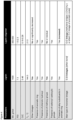
- Table 18 shows the differences in the signals between lignin (starting material, Figure 9 ) and lignin oligomer (product, Figure 8 ).
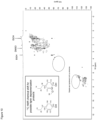
- 2D 1 H- 13 C HSQC NMR_of 'Lignin oligomer' product shows significant difference in comparison to the starting Kraft lignin.
- a major difference is the absence of x-correlation peaks in the region of ⁇ C / ⁇ H 50-90/3.0-4.5 ppm.
- These signals in Kraft-Lignin were associated to ⁇ -O-4, ⁇ - ⁇ and ⁇ -5 linkages. This indicates an almost quantitative cleavage of ether linkages under the applied reaction conditions and proving the lignin depolymerization.
- the signal associated with - OCH 3 group of aromatic cores ( ⁇ C / ⁇ H 56/3.8 ppm) is absent as well.
- the starting Kraft lignin ( Fig.1 ) displayed aromatics signals in the region of ⁇ C / ⁇ H 105-120/6.2-7.7, caused by the presence of electron withdrawing methoxy groups at the aromatic cores.
- the aromatic signals of the lignin oligomer are instead shifted to ⁇ C / ⁇ H 120-130/6.8-8.0, which is caused by the absence of electron withdrawing - OCH 3 groups attached to aromatic cores.
- Comparison of chemical shifts of the obtained lignin-oligomer and monomers resembling lignin repeating units (e.g. 4-propylphenol and 2-methoxy-4-propylphenol, inset in Fig 10 ) revealed significant similarity. The shifts of 4-propylphenol seem to fit best to the obtained structure.
- Example 15 (2D 1 H- 13 C HMBC NMR spectra of the lignin oligomer obtained according to example 1 and the lignin starting material):
- the hydrogenated lignin oligomer sample has a lower total-OH content than the starting materials. Both aliphatic-OH and aromatic OH are reduced relative to the starting material. Ethanol can be distinguished as residual solvent left in the sample. The content of carboxylic-OH does not rise significantly. However, methoxy groups are drastically reduced beyond detection limit. The ratio of aromatic CH to aliphatic CH is decreased significantly from 2:1 to 1:7.
Landscapes
- Chemical & Material Sciences (AREA)
- Organic Chemistry (AREA)
- Chemical Kinetics & Catalysis (AREA)
- Organic Low-Molecular-Weight Compounds And Preparation Thereof (AREA)
- Low-Molecular Organic Synthesis Reactions Using Catalysts (AREA)
- Compounds Of Unknown Constitution (AREA)
Claims (14)
- Verfahren zur Depolymerisation von Lignin, umfassend thermische Umwandlung eines wässrigen Gemischs mit einem pH-Wert von wenigstens 9, das Lignin, Katalysator und primären Alkohol umfasst, in einer nichtoxidierenden Atmosphäre bei einer Temperatur von wenigstens 280°C.
- Verfahren zur Depolymerisation von Lignin, umfassend die Schritte:(A) Bereitstellen eines wässrigen Gemischs, umfassend Lignin, Katalysator und primären Alkohol, mit einem pH-Wert von wenigstens 9 in einer nichtoxidierenden Atmosphäre,b) thermische Umwandlung des Lignins in dem wässrigen Gemisch bei einer Temperatur von wenigstens 280°C, undc) Erhalten von präzipitiertem Lignin-Oligomer.
- Verfahren gemäß einem der vorstehenden Ansprüche, wobei die thermische Umwandlung bei Schritt b) für 3 bis 7 h nach dem Beginn der Präzipitation von Lignin-Oligomer durchgeführt wird.
- Verfahren gemäß einem der vorstehenden Ansprüche, wobei das wässrige Gemisch umfasst:5 bis 25 Gew.-% Lignin,0,01 bis 1,0 Gew.-% Katalysator,1 bis 5 Gew.-% Base,5 bis 45 Gew.-% primären C1- bis C4-Alkohol,bezogen auf das Gesamtgewicht des wässrigen Gemischs.
- Verfahren gemäß einem der vorstehenden Ansprüche, wobei hydrothermische Umwandlung bei 80 bis 150 bar bei einer Reaktionstemperatur von 280 °C bis 400 °C durchgeführt wird.
- Verfahren gemäß einem der vorstehenden Ansprüche, wobei der Katalysator ausgewählt ist aus der Gruppe bestehend aus Ru, Cu, Co, Ni, Pt, Sulfiden der Metalle, Oxiden der Metalle und Gemischen davon.
- Verfahren gemäß einem der vorstehenden Ansprüche, wobei der primäre Alkohol ausgewählt ist aus der Gruppe bestehend aus MeOH, EtOH, n-Propanol, n-Butanol und Gemischen davon.
- Verfahren gemäß einem der vorstehenden Ansprüche, wobei das nichtoxidierende Gas N2, Argon und/oder H2 ist.
- Verfahren gemäß einem der vorstehenden Ansprüche, wobei das Verfahren Lignin-Oligomere mit einem Molekulargewicht von 250 bis 750 g/mol und/oder mit 2 bis 10 aromatischen Einheiten bereitstellt.
- Verfahren gemäß einem der vorstehenden Ansprüche, wobei das Verfahren präzipitierte Lignin-Oligomere mit einem Sauerstoffgehalt von weniger als 20 Gew.-%, bezogen auf das Gesamtgewicht der präzipitierte Lignin-Oligomere, bereitstellt.
- Verfahren gemäß einem der vorstehenden Ansprüche, wobei der Katalysator, die Base, der primäre Alkohol und/oder nicht umgewandeltes Lignin in einem Batch- oder einem kontinuierlichen Verfahren in das Verfahren zur Polymerisation wiedereingeführt werden kann.
- Verfahren gemäß einem der vorstehenden Ansprüche, wobei das depolymerisierte Lignin-Oligomer ferner zu Polymeren umgewandelt wird.
- Verfahren gemäß einem der vorstehenden Ansprüche, wobei das depolymerisierte Lignin-Oligomer ferner zu Polymeren ausgewählt aus der Gruppe bestehend aus Polyestern, Polyurethanen, Polyamiden und Gemischen davon umgewandelt wird.
- Verfahren gemäß einem der vorstehenden Ansprüche, wobei das depolymerisierte Lignin-Oligomer ferner zu Aromaten auf Biobasis ausgewählt aus der Gruppe bestehend aus Toluol, Benzol, Xylenen und Gemischen davon umgewandelt wird.
Applications Claiming Priority (2)
| Application Number | Priority Date | Filing Date | Title |
|---|---|---|---|
| EP19214133 | 2019-12-06 | ||
| PCT/EP2020/084673 WO2021110933A1 (en) | 2019-12-06 | 2020-12-04 | Method for preparation of lignin oligomers |
Publications (3)
| Publication Number | Publication Date |
|---|---|
| EP4069666A1 EP4069666A1 (de) | 2022-10-12 |
| EP4069666B1 true EP4069666B1 (de) | 2024-08-21 |
| EP4069666C0 EP4069666C0 (de) | 2024-08-21 |
Family
ID=68808182
Family Applications (1)
| Application Number | Title | Priority Date | Filing Date |
|---|---|---|---|
| EP20816495.4A Active EP4069666B1 (de) | 2019-12-06 | 2020-12-04 | Verfahren zur herstellung von ligninoligomeren |
Country Status (4)
| Country | Link |
|---|---|
| US (1) | US20230002433A1 (de) |
| EP (1) | EP4069666B1 (de) |
| CA (1) | CA3160485A1 (de) |
| WO (1) | WO2021110933A1 (de) |
Families Citing this family (2)
| Publication number | Priority date | Publication date | Assignee | Title |
|---|---|---|---|---|
| US20230416289A1 (en) * | 2022-06-23 | 2023-12-28 | Board Of Trustees Of Michigan State University | Methods for electroreductive lignin depolymerization |
| WO2025037051A1 (en) * | 2023-08-11 | 2025-02-20 | Aalto University Foundation Sr | A method for lignin depolymerisation and product thereof |
Family Cites Families (16)
| Publication number | Priority date | Publication date | Assignee | Title |
|---|---|---|---|---|
| US4507172A (en) | 1982-09-16 | 1985-03-26 | St. Regis Paper Company | Kraft pulping process |
| FI79359C (fi) | 1988-01-20 | 1989-12-11 | Kajaani Electronics | Foerfarande foer kontroll av ligninets upploesning vid alkaliska massakok. |
| CA2256923A1 (en) | 1998-12-23 | 2000-06-23 | Eco-Tec Limited | Kraft pulping process |
| SE0402437D0 (sv) | 2004-10-07 | 2004-10-07 | Stfi Packforsk Ab | Method for separating lignin from a lignin containing liquid/slurry |
| CN103080417A (zh) | 2010-07-07 | 2013-05-01 | 斯托拉恩索公司 | 由黑液制造沉淀木质素的方法和通过这种方法制造的沉淀木质素 |
| AT510346A1 (de) | 2010-09-02 | 2012-03-15 | Annikki Gmbh | Ligningewinnung |
| PT2776621T (pt) | 2011-11-11 | 2016-11-07 | Valmet Oy | Método para separação de lignina do licor negro envolvendo múltiplos passos de acidificação |
| CA2897545A1 (en) | 2013-01-08 | 2014-07-17 | Tianjin University | Use of catalyst of subgroup vi element for preparing organic chemical product from lignin |
| US20150322104A1 (en) | 2013-01-24 | 2015-11-12 | Panu Tikka | Method for producing high purity lignin |
| EP2984065A1 (de) | 2013-04-08 | 2016-02-17 | Stichting Dienst Landbouwkundig Onderzoek | Verfahren zur depolymerisation von lignin |
| WO2014201325A2 (en) | 2013-06-14 | 2014-12-18 | Yale University | Systems and methods for the depolymerization of a biopolymer |
| EP3108937A1 (de) * | 2015-06-24 | 2016-12-28 | Procter & Gamble International Operations SA | Verbrauchsgüterprodukt mit funktionalisiertem ligninoligomer |
| EP3350289B1 (de) | 2015-09-16 | 2020-05-06 | SCA Forest Products AB | Kontinuierliches verfahren zur herstellung von bioöl aus verbrauchter schwarzlauge |
| FI127125B (en) | 2015-10-13 | 2017-11-30 | Valmet Technologies Oy | A process for preparing solid lignin |
| LT3371279T (lt) | 2015-11-04 | 2020-02-25 | Sca Forest Products Ab | Angliavandenilių produkto iš lignino alyvos gamybos procesas |
| CN109485824A (zh) * | 2018-10-12 | 2019-03-19 | 华南理工大学 | 一种可循环加工的热固性木质素基聚氨酯弹性体及其制备方法 |
-
2020
- 2020-12-04 WO PCT/EP2020/084673 patent/WO2021110933A1/en not_active Ceased
- 2020-12-04 CA CA3160485A patent/CA3160485A1/en active Pending
- 2020-12-04 US US17/781,233 patent/US20230002433A1/en active Pending
- 2020-12-04 EP EP20816495.4A patent/EP4069666B1/de active Active
Also Published As
| Publication number | Publication date |
|---|---|
| EP4069666A1 (de) | 2022-10-12 |
| CA3160485A1 (en) | 2022-06-10 |
| US20230002433A1 (en) | 2023-01-05 |
| EP4069666C0 (de) | 2024-08-21 |
| WO2021110933A1 (en) | 2021-06-10 |
Similar Documents
| Publication | Publication Date | Title |
|---|---|---|
| Biswas et al. | Catalytic hydrothermal liquefaction of alkali lignin over activated bio-char supported bimetallic catalyst | |
| Abdelaziz et al. | Continuous catalytic depolymerisation and conversion of industrial kraft lignin into low-molecular-weight aromatics | |
| Wang et al. | Production of vanillin from lignin: The relationship between β-O-4 linkages and vanillin yield | |
| Rawat et al. | Molybdenum-catalyzed oxidative depolymerization of alkali lignin: Selective production of Vanillin | |
| Endres et al. | Polymerization by oxidative coupling. III. Mechanistic type in the copper–amine catalyzed polymerization of 2, 6‐dimethylphenol | |
| Wang et al. | Comparison of the pyrolysis behavior of pyrolytic lignin and milled wood lignin by using TG–FTIR analysis | |
| US9518076B2 (en) | Apparatus and process for preparing reactive lignin with high yield from plant biomass for production of fuels and chemicals | |
| Shen et al. | Understanding the structural changes and depolymerization of Eucalyptus lignin under mild conditions in aqueous AlCl 3 | |
| Du et al. | Ozone oxidation pretreatment of softwood kraft lignin: An effective and environmentally friendly approach to enhance fast pyrolysis product selectivity | |
| Zhou et al. | Two-step conversion of Kraft lignin to nylon precursors under mild conditions | |
| US20230002433A1 (en) | Method for preparation of lignin oligomers | |
| AU2015282666A1 (en) | Process for the preparation of ethylene glycol from sugars | |
| Xiang et al. | Co@ CoO: An efficient catalyst for the depolymerization and upgrading of lignocellulose to alkylcyclohexanols with cellulose intact | |
| Rinesch et al. | Cobalt-catalyzed oxidation of the β-O-4 bond in lignin and lignin model compounds | |
| EP2984065A1 (de) | Verfahren zur depolymerisation von lignin | |
| Wang et al. | Pyrolysis-assisted catalytic hydrogenolysis of softwood lignin at elevated temperatures for the high yield production of monomers | |
| KR20160147777A (ko) | 단쇄 폴리올의 합성 | |
| CN110511116A (zh) | 一种在双相体系界面全组分解聚原生生物质制备平台化合物的方法 | |
| Lui et al. | Hydrothermal depolymerization of different lignins: Insights into structures and reactivities | |
| Li et al. | Microwave-assisted depolymerization of lignin with synergic alkali catalysts and a transition metal catalyst in the aqueous system | |
| US2862035A (en) | Process for the fission of ethers | |
| Jiang et al. | Catalytic hydrogenative depolymerization of castor shells C-lignin to catechols over the mixed Pd/C+ Pd (OH) 2/C System | |
| Clemow et al. | Humic acids and methylated humic acids as models for reactions of brown coal with CO/H2O and with H2 | |
| Liu et al. | Improvement of hydrothermal gasification of alkaline lignin by oxidative treatment with molecular oxygen | |
| Li et al. | Investigating the depolymerization behavior of structurally modified kraft lignin in deep eutectic solvents |
Legal Events
| Date | Code | Title | Description |
|---|---|---|---|
| STAA | Information on the status of an ep patent application or granted ep patent |
Free format text: STATUS: UNKNOWN |
|
| STAA | Information on the status of an ep patent application or granted ep patent |
Free format text: STATUS: THE INTERNATIONAL PUBLICATION HAS BEEN MADE |
|
| PUAI | Public reference made under article 153(3) epc to a published international application that has entered the european phase |
Free format text: ORIGINAL CODE: 0009012 |
|
| STAA | Information on the status of an ep patent application or granted ep patent |
Free format text: STATUS: REQUEST FOR EXAMINATION WAS MADE |
|
| 17P | Request for examination filed |
Effective date: 20220706 |
|
| AK | Designated contracting states |
Kind code of ref document: A1 Designated state(s): AL AT BE BG CH CY CZ DE DK EE ES FI FR GB GR HR HU IE IS IT LI LT LU LV MC MK MT NL NO PL PT RO RS SE SI SK SM TR |
|
| DAV | Request for validation of the european patent (deleted) | ||
| DAX | Request for extension of the european patent (deleted) | ||
| GRAP | Despatch of communication of intention to grant a patent |
Free format text: ORIGINAL CODE: EPIDOSNIGR1 |
|
| STAA | Information on the status of an ep patent application or granted ep patent |
Free format text: STATUS: GRANT OF PATENT IS INTENDED |
|
| INTG | Intention to grant announced |
Effective date: 20240412 |
|
| GRAS | Grant fee paid |
Free format text: ORIGINAL CODE: EPIDOSNIGR3 |
|
| GRAA | (expected) grant |
Free format text: ORIGINAL CODE: 0009210 |
|
| STAA | Information on the status of an ep patent application or granted ep patent |
Free format text: STATUS: THE PATENT HAS BEEN GRANTED |
|
| AK | Designated contracting states |
Kind code of ref document: B1 Designated state(s): AL AT BE BG CH CY CZ DE DK EE ES FI FR GB GR HR HU IE IS IT LI LT LU LV MC MK MT NL NO PL PT RO RS SE SI SK SM TR |
|
| REG | Reference to a national code |
Ref country code: GB Ref legal event code: FG4D |
|
| REG | Reference to a national code |
Ref country code: CH Ref legal event code: EP |
|
| REG | Reference to a national code |
Ref country code: IE Ref legal event code: FG4D |
|
| REG | Reference to a national code |
Ref country code: DE Ref legal event code: R096 Ref document number: 602020036342 Country of ref document: DE |
|
| U01 | Request for unitary effect filed |
Effective date: 20240910 |
|
| U07 | Unitary effect registered |
Designated state(s): AT BE BG DE DK EE FI FR IT LT LU LV MT NL PT RO SE SI Effective date: 20240925 |
|
| U1N | Appointed representative for the unitary patent procedure changed after the registration of the unitary effect |
Representative=s name: BASF IP ASSOCIATION; DE |
|
| PG25 | Lapsed in a contracting state [announced via postgrant information from national office to epo] |
Ref country code: NO Free format text: LAPSE BECAUSE OF FAILURE TO SUBMIT A TRANSLATION OF THE DESCRIPTION OR TO PAY THE FEE WITHIN THE PRESCRIBED TIME-LIMIT Effective date: 20241121 |
|
| PG25 | Lapsed in a contracting state [announced via postgrant information from national office to epo] |
Ref country code: PL Free format text: LAPSE BECAUSE OF FAILURE TO SUBMIT A TRANSLATION OF THE DESCRIPTION OR TO PAY THE FEE WITHIN THE PRESCRIBED TIME-LIMIT Effective date: 20240821 Ref country code: GR Free format text: LAPSE BECAUSE OF FAILURE TO SUBMIT A TRANSLATION OF THE DESCRIPTION OR TO PAY THE FEE WITHIN THE PRESCRIBED TIME-LIMIT Effective date: 20241122 |
|
| PG25 | Lapsed in a contracting state [announced via postgrant information from national office to epo] |
Ref country code: IS Free format text: LAPSE BECAUSE OF FAILURE TO SUBMIT A TRANSLATION OF THE DESCRIPTION OR TO PAY THE FEE WITHIN THE PRESCRIBED TIME-LIMIT Effective date: 20241221 |
|
| PG25 | Lapsed in a contracting state [announced via postgrant information from national office to epo] |
Ref country code: HR Free format text: LAPSE BECAUSE OF FAILURE TO SUBMIT A TRANSLATION OF THE DESCRIPTION OR TO PAY THE FEE WITHIN THE PRESCRIBED TIME-LIMIT Effective date: 20240821 |
|
| PG25 | Lapsed in a contracting state [announced via postgrant information from national office to epo] |
Ref country code: ES Free format text: LAPSE BECAUSE OF FAILURE TO SUBMIT A TRANSLATION OF THE DESCRIPTION OR TO PAY THE FEE WITHIN THE PRESCRIBED TIME-LIMIT Effective date: 20240821 Ref country code: RS Free format text: LAPSE BECAUSE OF FAILURE TO SUBMIT A TRANSLATION OF THE DESCRIPTION OR TO PAY THE FEE WITHIN THE PRESCRIBED TIME-LIMIT Effective date: 20241121 |
|
| PG25 | Lapsed in a contracting state [announced via postgrant information from national office to epo] |
Ref country code: RS Free format text: LAPSE BECAUSE OF FAILURE TO SUBMIT A TRANSLATION OF THE DESCRIPTION OR TO PAY THE FEE WITHIN THE PRESCRIBED TIME-LIMIT Effective date: 20241121 Ref country code: PL Free format text: LAPSE BECAUSE OF FAILURE TO SUBMIT A TRANSLATION OF THE DESCRIPTION OR TO PAY THE FEE WITHIN THE PRESCRIBED TIME-LIMIT Effective date: 20240821 Ref country code: NO Free format text: LAPSE BECAUSE OF FAILURE TO SUBMIT A TRANSLATION OF THE DESCRIPTION OR TO PAY THE FEE WITHIN THE PRESCRIBED TIME-LIMIT Effective date: 20241121 Ref country code: IS Free format text: LAPSE BECAUSE OF FAILURE TO SUBMIT A TRANSLATION OF THE DESCRIPTION OR TO PAY THE FEE WITHIN THE PRESCRIBED TIME-LIMIT Effective date: 20241221 Ref country code: HR Free format text: LAPSE BECAUSE OF FAILURE TO SUBMIT A TRANSLATION OF THE DESCRIPTION OR TO PAY THE FEE WITHIN THE PRESCRIBED TIME-LIMIT Effective date: 20240821 Ref country code: GR Free format text: LAPSE BECAUSE OF FAILURE TO SUBMIT A TRANSLATION OF THE DESCRIPTION OR TO PAY THE FEE WITHIN THE PRESCRIBED TIME-LIMIT Effective date: 20241122 Ref country code: ES Free format text: LAPSE BECAUSE OF FAILURE TO SUBMIT A TRANSLATION OF THE DESCRIPTION OR TO PAY THE FEE WITHIN THE PRESCRIBED TIME-LIMIT Effective date: 20240821 |
|
| U20 | Renewal fee for the european patent with unitary effect paid |
Year of fee payment: 5 Effective date: 20250102 |
|
| PG25 | Lapsed in a contracting state [announced via postgrant information from national office to epo] |
Ref country code: SM Free format text: LAPSE BECAUSE OF FAILURE TO SUBMIT A TRANSLATION OF THE DESCRIPTION OR TO PAY THE FEE WITHIN THE PRESCRIBED TIME-LIMIT Effective date: 20240821 |
|
| PG25 | Lapsed in a contracting state [announced via postgrant information from national office to epo] |
Ref country code: CZ Free format text: LAPSE BECAUSE OF FAILURE TO SUBMIT A TRANSLATION OF THE DESCRIPTION OR TO PAY THE FEE WITHIN THE PRESCRIBED TIME-LIMIT Effective date: 20240821 |
|
| PG25 | Lapsed in a contracting state [announced via postgrant information from national office to epo] |
Ref country code: SK Free format text: LAPSE BECAUSE OF FAILURE TO SUBMIT A TRANSLATION OF THE DESCRIPTION OR TO PAY THE FEE WITHIN THE PRESCRIBED TIME-LIMIT Effective date: 20240821 |
|
| PLBE | No opposition filed within time limit |
Free format text: ORIGINAL CODE: 0009261 |
|
| STAA | Information on the status of an ep patent application or granted ep patent |
Free format text: STATUS: NO OPPOSITION FILED WITHIN TIME LIMIT |
|
| PG25 | Lapsed in a contracting state [announced via postgrant information from national office to epo] |
Ref country code: MC Free format text: LAPSE BECAUSE OF FAILURE TO SUBMIT A TRANSLATION OF THE DESCRIPTION OR TO PAY THE FEE WITHIN THE PRESCRIBED TIME-LIMIT Effective date: 20240821 |
|
| 26N | No opposition filed |
Effective date: 20250522 |
|
| REG | Reference to a national code |
Ref country code: CH Ref legal event code: PL |
|
| GBPC | Gb: european patent ceased through non-payment of renewal fee |
Effective date: 20241204 |
|
| PG25 | Lapsed in a contracting state [announced via postgrant information from national office to epo] |
Ref country code: GB Free format text: LAPSE BECAUSE OF NON-PAYMENT OF DUE FEES Effective date: 20241204 |
|
| PG25 | Lapsed in a contracting state [announced via postgrant information from national office to epo] |
Ref country code: CH Free format text: LAPSE BECAUSE OF NON-PAYMENT OF DUE FEES Effective date: 20241231 |
|
| PG25 | Lapsed in a contracting state [announced via postgrant information from national office to epo] |
Ref country code: IE Free format text: LAPSE BECAUSE OF NON-PAYMENT OF DUE FEES Effective date: 20241204 |
|
| U20 | Renewal fee for the european patent with unitary effect paid |
Year of fee payment: 6 Effective date: 20260102 |
|
| PG25 | Lapsed in a contracting state [announced via postgrant information from national office to epo] |
Ref country code: CY Free format text: LAPSE BECAUSE OF FAILURE TO SUBMIT A TRANSLATION OF THE DESCRIPTION OR TO PAY THE FEE WITHIN THE PRESCRIBED TIME-LIMIT; INVALID AB INITIO Effective date: 20201204 |