EP4068949B1 - Abfallbehälter für tierexkremente - Google Patents
Abfallbehälter für tierexkremente Download PDFInfo
- Publication number
- EP4068949B1 EP4068949B1 EP20828288.9A EP20828288A EP4068949B1 EP 4068949 B1 EP4068949 B1 EP 4068949B1 EP 20828288 A EP20828288 A EP 20828288A EP 4068949 B1 EP4068949 B1 EP 4068949B1
- Authority
- EP
- European Patent Office
- Prior art keywords
- liner
- sidewall
- housing
- base
- waste receptacle
- Prior art date
- Legal status (The legal status is an assumption and is not a legal conclusion. Google has not performed a legal analysis and makes no representation as to the accuracy of the status listed.)
- Active
Links
Images






Classifications
-
- A—HUMAN NECESSITIES
- A01—AGRICULTURE; FORESTRY; ANIMAL HUSBANDRY; HUNTING; TRAPPING; FISHING
- A01K—ANIMAL HUSBANDRY; AVICULTURE; APICULTURE; PISCICULTURE; FISHING; REARING OR BREEDING ANIMALS, NOT OTHERWISE PROVIDED FOR; NEW BREEDS OF ANIMALS
- A01K1/00—Housing animals; Equipment therefor
- A01K1/01—Removal of dung or urine ; Removal of manure from stables
- A01K1/0107—Cat trays; Dog urinals; Toilets for pets
- A01K1/0114—Litter boxes with screens for separating excrement from litter
-
- A—HUMAN NECESSITIES
- A01—AGRICULTURE; FORESTRY; ANIMAL HUSBANDRY; HUNTING; TRAPPING; FISHING
- A01K—ANIMAL HUSBANDRY; AVICULTURE; APICULTURE; PISCICULTURE; FISHING; REARING OR BREEDING ANIMALS, NOT OTHERWISE PROVIDED FOR; NEW BREEDS OF ANIMALS
- A01K1/00—Housing animals; Equipment therefor
- A01K1/01—Removal of dung or urine ; Removal of manure from stables
- A01K1/0107—Cat trays; Dog urinals; Toilets for pets
-
- A—HUMAN NECESSITIES
- A01—AGRICULTURE; FORESTRY; ANIMAL HUSBANDRY; HUNTING; TRAPPING; FISHING
- A01K—ANIMAL HUSBANDRY; AVICULTURE; APICULTURE; PISCICULTURE; FISHING; REARING OR BREEDING ANIMALS, NOT OTHERWISE PROVIDED FOR; NEW BREEDS OF ANIMALS
- A01K1/00—Housing animals; Equipment therefor
- A01K1/01—Removal of dung or urine ; Removal of manure from stables
- A01K1/0107—Cat trays; Dog urinals; Toilets for pets
- A01K1/011—Cat trays; Dog urinals; Toilets for pets with means for removing excrement
Definitions
- This disclosure pertains to a waste receptacle, particularly but not exclusively to a waste receptacle for domesticated animal waste, for example for waste from domestic cats.
- the following disclosure refers in detail to the management of waste from domestic felines, but it will be appreciated and should be borne in mind that this is merely one illustrative application of the teachings disclosed herein.
- Domestic cats tend to be categorised as being "indoor” or "outdoor” cats. Outdoor cats, as the name suggests, are typically able to go outdoors and are usually encouraged to defecate and urinate outside. Indoor cats, on the other hand, tend to spend most if not all of their time indoors and as a consequence usually urinate and defecate inside.
- a relatively shallow "litter tray” which comprises a - typically plastics - base with raised sidewalls in which an amount of absorbent litter is provided.
- An illustrative example of such a tray is the "42cm Cat Litter Tray” sold by Whitefurze Limited, Burnsall Road, Canley, Coventry CV5 6BT, United Kingdom (see: http://www.whitefurze.net/42-cm-cat-litter-tray.html ).
- the litter is intended to soak up liquid waste from the animal and is typically formulated to clump together so that used litter and any solid waste can readily be lifted from the tray for disposal.
- a slotted waste scoop is utilised for this purpose, the slots in the scoop allowing any unused litter to fall back into the tray.
- litter trays of this type can often be something of an eyesore, and to that end it would be preferable if a more aesthetically pleasing arrangement could be provided.
- a "litter box” Such boxes tend to have much higher sides than a litter tray, which helps contain litter in the box and also to provide a more secluded environment for the animal.
- the box will be provided with an access port, for example in one of the aforementioned sidewalls.
- Such boxes may also be provided with a lid and the access port may be provided in that lid.
- a lid may be omitted and the access port defined by the upstanding sidewalls of the box.
- litter boxes are the so called “Flip Litter Box”, the “Modkat Litter Box”, and the “Modkat XL Litter Box”, all of which are manufactured by ModProducts, LLC and can be viewed at http://modkat.eu . These boxes provide a more secluded space for the animal, and are significantly more aesthetically pleasing than a traditional litter tray.
- ModProducts LLC sell liners for the boxes listed above. These liners are sized to fit within the box and are supported by the sidewalls of the box to define a void in which litter is placed for the animal to use. In some instances the liners are held in place by connecting them to hooks that clip over the sidewalls of the box. In other instances the liners are held in place by a tension band (for example, a length of sprung steel) integrated into the liner.
- a tension band for example, a length of sprung steel
- the ModProducts boxes are more aesthetically pleasing than earlier offerings, and the liners do enhance cleanliness, but the issues associated with the scoop still remain.
- one of the sidewalls of the boxes is configured so that the handle of the scoop can be engaged with the sidewall so that the scoop hangs from the top of the sidewall, outside of the box. Whilst this is more convenient than having the scoop lying on the floor next to the box or stored elsewhere, the scoop is still on-show and accessible - which could be problematic if there are young children around, as it would not be desirable for those children to handle a soiled scoop.
- ModProduct boxes in particular with the liners for these boxes, is that if the liner should be lifted out of the box (as users tend to do when preparing to empty the liner of waste) then the liner loses its' generally open cuboid form and the unused litter and solid waste tend to pool in the bottom of the liner. This can make it hard for the user to extract clumped litter and solid waste from the liner with the scoop.
- US Patent No. 5121712 discloses an animal litter box liner of flexible, sheet-like material which is provided with holes of an appropriate size and location for allowing clean, dry litter to sift therethrough while simultaneously retaining clumps of urine-soiled litter and faeces within the liner as it is lifted from a litter pan.
- US Patent Publication no. 2012/103981 discloses a flexible bulk container that includes side walls coupled to a bottom wall.
- the side walls and the bottom wall generally enclose an interior space that is accessible through a top of the flexible bulk container for loading materials therein.
- a support structure includes elongate frame elements.
- Each of the frame elements may be attached to at least one of the side walls and is configured to support the at least one of the side walls generally upright so that the flexible bulk container is maintained in a generally open position.
- Each of the frame elements may be detachable from the respective at least one of the side walls.
- the flexible bulk containers and the support structures may be used in a waste management system for loading and sorting of bulk waste materials.
- US Patent Publication no. 2015/245588 discloses a 100% biodegradable/compostable pet litter system that is self-contained for proper care, maintenance and disposal of pet waste.
- the kit is designed to include a false floor system to allow contaminated litter to sift through the floor and away from the pet after each use.
- the kit contains a design for sealing and transporting along with disposable waste bags and scooper for solid waste removal.
- the kit contains storage for bags and scooper when not in use.
- the kit incorporates 100% biodegradable litter such as pine pellets, corn, paper or other biodegradable litter.
- the kit is manufactured from 100% biodegradable materials such a fiberboard or any material which can breakdown in a landfill in as little as 2 months but no longer than 12 months.
- a waste receptacle for animal excreta the waste receptacle being as defined in Claim 1.
- Preferred features of the waste receptacle are defined in the dependent claims.
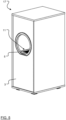
- Fig. 1 is a schematic perspective view of a waste receptacle 1.
- the waste receptacle comprises a housing that is (in this implementation) generally cuboid in form and includes a door panel 3 in which an access port 5 has been provided, so that an animal such as a cat can access an interior void 7 of the waste receptacle.
- the door panel 3 can be opened to enable a user to access the void defined by the receptacle 1.
- a liner 9 fits within the void 7, and can be accessed by an animal via the access port.
- the liner 9 defines a liner void that will typically contain a measure of litter material.
- the liner is self-supporting and comprises a resiliently deformable member that can be deformed to enable the liner to be inserted into and removed from the void. Once the liner has been inserted, the resiliently deformable member returns to its' original shape to hold the liner by means of friction against the internal walls of the receptacle.
- One such illustrative deformable member comprises a length of spring steel formed into a hoop and located inside an upper peripheral portion (as orientated in use) of the liner.
- Fig. 3 is a perspective view of another waste receptacle 4.
- This receptacle 4 differs from that of Figs. 1 and 2 in that the access port 5 is provided in a removable platform 11 that forms a top cover of the receptacle in use.
- the receptacle 44 of Fig. 2 is a top-entry waste receptacle, whereas the receptacle of Figs. 1 and 2 is a front- or side-entry waste receptacle.
- the platform 11 comprises a major portion 13 and a minor portion 15 that are, in this arrangement, hingedly coupled to one another so that the major portion can be pivoted - relative to the minor portion - between a closed position depicted in Fig. 3 where a pet owner's access to the liner 9 (other than via the access port 5) is obstructed and an open position depicted in Fig. 4 where access can be had to the liner 9.
- the liner 9 includes a resiliently deformable band inside an upper peripheral portion of the liner.
- the band is sized so that it bears, in its non-deformed state, against internal walls of the receptacle to keep the peripheral walls of the liner from collapsing.
- Fig. 5 is an illustrative perspective view of another waste receptacle 17.
- This receptacle 17 includes a platform 11 which is enclosed within the interior void defined by the receptacle 17.
- the receptacle in this instance, comprises a door panel 3 in which an access port 5 has been provided.
- the platform 11 includes a platform access port (not visible) so that an animal entering the receptacle can access a liner (also not visible) provided beneath the platform.
- the platform 11 could be of the type shown in Figs. 3 and 4 , or could simply comprise a planar body with a platform port provided in it. Access to the liner and platform by an owner is enabled by means of the aforementioned door panel 3, which can be opened.
- Fig. 6 is a schematic view of an illustrative liner 9, and fig. 7 is a schematic cross-sectional view along the line A-A of Fig. 7 .
- the liner may be manufactured of a variety of different materials, for example of a textile material, a plastics material or a textile/plastics mix, and is preferably waterproofed (either inherently or by application of a waterproof layer or component)).
- the liner comprises a base 19 (not visible in Fig. 6 ) and one or more sidewalls 21 that cooperate with the base 19 to form a receptacle for a measure of litter tray material (such as "AmazonBasics Cat Litter Wood Pellets" available from http://www.Amazon.co.uk ., or similar).
- the liner is open at an end remote from the base 19 (which end will be uppermost in use) so that an animal, for example a cat, can enter inside the liner to urinate or void its' bowels.
- a peripheral portion 23 of the liner sidewall 21 is folded over to provide a void within which a resiliently deformable retainer 25 is provided.
- the retainer 25, in this particular embodiment, comprises a hoop of resiliently deformable material (such a sprung steel, for example) that can be deformed to allow the liner to be fitted into a receptacle, whereupon the retainer returns to its non-deformed shape and bears upon internal walls of the receptacle to hold the liner in place in use.
- the retainer comprises a hoop. It will be apparent, however, that the retainer need not necessarily comprise a hoop. For example, a generally C-shaped length of resiliently deformable material may suffice to hold the liner in place in use. Other equivalent arrangements will be apparent to persons of skill in the art.
- the line 9 further comprises a pocket 27 provided on an external face of the sidewall 21 so that the pocket will lie between the liner sidewall 21 and an internal face of the receptacle when the liner is located in the receptacle.
- the pocket 27 is sized to accommodate a scoop 29 for removing pet waste and/or soiled litter from the liner.
- Figs. 10 and 11 show another form of liner where the peripheral edge portion 31 in the vicinity of the pocket is provided with a tab 33 that makes it easier for the user to pull the liner sidewall away from the receptacle.
- the tab may be configured to couple to the receptacle sidewall to secure the liner in position in use.
- the tab may carry one part of a two-part engagement mechanism, the other part being carried by the receptacle sidewall.
- Velcro TM or a pressstud alsowise known as a snap fastener could be utilised to secure the liner to the receptacle.
- Fig. 12 is an illustrative representation of the receptacle of Figs. 1 and 2 showing a pocket 27 provided in a sidewall of the liner 9.
- the liner 9 may be configured to couple with retaining clips 35.
- the clips 35 are configured to hook over the peripheral wall of the receptacle 3.
- the clips may be configured to engage with the receptacle wall (for example by means of a suitable coupling) or may be permanently attached thereto.
- the clips 35 include a peg 37 that can be mated with a complementary eyelet 39 in the liner to secure the liner to the peripheral wall of the receptacle.
- a peg 37 that can be mated with a complementary eyelet 39 in the liner to secure the liner to the peripheral wall of the receptacle.
- other two-part complementary attachment mechanisms may be employed instead of, or as well as, a peg and eyelet.
- a platform and liner support 41 is configured for attachment (for example by means of an adhesive or fixings such as screws) to an internal surface of the receptacle sidewalls.
- the receptacle is generally rectangular in plan view and a support 41 is affixed to each of the longer sidewalls.
- a support may also or alternatively be affixed to the shorter sidewalls.
- the support whilst it is preferred for the support to extend along substantially the entire length of the sidewalls, this may not be necessary, and the support may instead extend only over a part of the length of the sidewall.
- the support 41 comprises a ledge 43 that functions as a support for the platform 11.
- the ledge 43 extends inwardly into the receptacle when the support is affixed to the internal walls thereof.
- a first wall 45 extends generally perpendicularly from an edge of the ledge 43 that is proximate the sidewall of the receptacle when the support is installed, and a second wall 47 extends generally perpendicularly from an edge of the first wall 45 distal of said ledge 43.
- the ledge and first and second walls cooperate to form a cavity into which the resiliently deformable retainer 25 of a liner 9 can be fitted so that the liner is supported, in use, with its sidewall upstanding by the support 41. This arrangement makes it less likely for the liner sidewall to collapse during use.
- Figs. 19 and 20 illustrate, and reinforce, the fact - described above - that it is not essential for the platform and liner support 41 to extend along the entirety of a wall of the receptacle.
- the receptacle is generally rectangular in plan view and is provided with supports 41 that extend along the entire length of each shorter wall, and partway along the length of each longer wall.
- the receptacle may further comprise a platform retainer 49 that cooperates with a complementary formation 51 in - in this particular case - the minor portion 15 of the platform 11, to help retain the platform 11 in place.
- the complementary formation 51 comprises a generally rectangular recess and the platform retainer comprises a generally rectangular body that can fit within the recess.
- a recess is provided on either peripheral edge of the minor portion 15 of the platform 11 for cooperation with complementary formations on either side of the receptacle.
- the minor portion 15 of the platform can be slid along the ledge 43 of the platform and liner support 41 until the platform retainer 49 affixed to the sidewall of the receptacle locates in the complementary formation 51 provided in the minor portion 15 of the platform 11. Once so located, the platform is less likely to be dislodged, for example by means of a cat stepping onto it.
- FIG. 21 is a plan view of the scoop in which the scoop is substantially planar (and hence can easily be slid into a pocket provided on the outside of a liner).
- Fig. 22 is a perspective view of the scoop of Fig. 21 after it has been manipulated to form a three dimensional body.
- the scoop comprises a base portion 53 that is, in the preferred arrangement, perforated so that unsoiled litter can fall through the base and back into the liner. Peripheral lateral edges of the base 53 are coupled to respective first and second side panels 57, 59, in this instance by means of living hinges 61.
- First and second handle portions 63, 65 are coupled together, in this instance by a living hinge 67.
- a first end 69 of the first handle portion 63 is coupled via a living hinge 71 to a first end wall 73 that is coupled by another living hinge 75 to the first side panel 57.
- a first end 77 of the second handle portion 65 is coupled via a living hinge 79 to a second end wall 81 that is coupled by another living hinge 83 to the second side panel 59.
- bringing the two handle portions 63, 65 together causes the sidewalls 57, 59 to move relative to the base portion 53 towards one another and the two end walls 73, 81 to come together; thereby forming a three-dimensional scoop as shown in Fig. 22 .
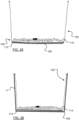
- a problem with existing liners 100 is that when the liner is lifted out of the receptacle, the base of the liner tends to sag. As a result, unused litter, soiled litter and animal excreta tend to pool in the bottom of the liner, making it difficult for the user to remove excreta and soiled litter with a scoop. It is also the case that the base of the liner can be prone to rucking by the animal in use.
- a liner 102 that includes a housing 104 for a base reinforcing member 112.
- the housing 104 comprises a base pocket 106 formed by coupling an additional base panel 108 to a primary base portion 110 of the liner 102.
- a reinforcing member 112 can be inserted into the base pocket to reduce the likelihood of the base sagging when the liner is removed from a receptacle. Since the reinforcing member can be removed from the base pocket, users are still able to turn the liner inside-out whilst cleaning it.
- Another advantage of this arrangement is that the reinforcing member helps to reduce the likelihood of the base 110 rucking whilst the receptacle is being used by an animal.
- the liner 102 may include a pocket for a scoop as in other embodiments described herein, and may - as shown in Fig. 26 - include a resiliently deformable retainer of the type that is elsewhere described herein.
- the liner may be configured to couple to clips, for example as with the liner depicted in Fig. 14 .
- FIG. 1 Another embodiment of a liner 114 is depicted schematically in Figs. 27 to 29 of the accompanying drawings.
- This liner 114 is particularly, but not exclusively, intended for use with waste receptacles 1 of the type shown in Figs. 1 and 2 .
- the liner 9 described above has a front wall 10 (as orientated in use) that is lower than a rear wall (not visible) of the liner so that an animal can clamber into the liner via the port 5 in the door 3. Whilst this arrangement functions adequately, the front wall of the liner can sometimes be caught by the animal as it clambers into the waste receptacle and pulled away from the depicted upright position. This raises the possibility of litter falling in between the liner and the door to the receptacle.
- the liner 114 depicted in Figs. 27 to 29 includes a front wall 116 (as orientated in use) that is substantially the same height as a rear wall 120 and interconnecting sidewalls 122.
- the front wall 116 includes an access port 124 that aligns with the access port 5 in the door 3 when the liner 114 is installed in a waste receptacle 1.
- the front wall 116 is comprised of an inner wall 126 that extends between respective interconnecting walls 122, and an outer wall 128 that is coupled to the inner wall around the periphery of the access port 124, towards the peripheral edge portion 31, and to the remainder of the liner at opposite lateral peripheries.
- the inner and outer walls 126, 128 co-operate to provide a housing for a front wall reinforcing member 130.
- the housing comprises a pocket 131 that opens towards a base wall 134 of the liner 114.
- the reinforcing member 130 in this embodiment, comprises a generally U-shaped outer frame 132 comprised of a head portion 134 and two leg portions 136 extending from respective ends of the head portion 134.
- a cross-brace 134 extends between the legs 136 of the U-shaped outer frame 132 and is generally parallel to the head portion 134.
- the cross-brace 134 is spaced from the head portion 134 of the U-shaped outer frame by a distance that is similar to the distance between the base 136 of the liner 114 and a lowermost (as orientated in use) portion of the access port 124.
- the legs of the U-shaped frame 132 extend from a point roughly adjacent the base of the liner 114 along respective lateral edges of the outer wall 128 and help to ensure that the front wall remains generally upright in use.
- the cross-brace will lie in the vicinity of the lowermost (as orientated in use) portion of the access port 123 and support the access port 124.
- the liner may include only the aforementioned housing for a front wall reinforcing member 130.
- the liner may, as shown in Figs. 27 to 29 , include both a housing for a front wall reinforcing member and a housing for a base reinforcing member 112 of the type shown in Figs. 24 to 26 .
- the U-shaped frame 132 and the base reinforcing member 112 may be configured so that the U-shaped frame 132 can be positively engaged with the base reinforcing member 112, for example snap-fitted into the base reinforcing member 112 so that the two components are coupled together. This arrangement provides additional support for the walls of the liner.
- the liner may also be provided with a pocket 27 for receiving a scoop, for example a pocket of the type described above in connection with Figs. 8 to 10 of the drawings.
- the platform and liner support need not necessarily be configured for use with a liner that includes a resiliently deformable member. It could, for example, comprise a plurality of hooks that are co-operable with eyes provided in the liner sidewall to support the liner.
Landscapes
- Life Sciences & Earth Sciences (AREA)
- Environmental Sciences (AREA)
- Zoology (AREA)
- Animal Husbandry (AREA)
- Biodiversity & Conservation Biology (AREA)
- Housing For Livestock And Birds (AREA)
Claims (14)
- Abfallbehälter (1, 4) für Tierexkremente, wobei der Abfallbehälter Folgendes umfasst:ein Gehäuse mit einer Basis und zumindest einer Seitenwand, die von der Basis aufsteht, um einen inneren Gehäusehohlraum (7) zu definieren; undeine Auskleidung (9), die in den inneren Gehäusehohlraum (7) einsetzbar ist, wobei die Gehäuseauskleidung (9) eine Auskleidungsbasis (19) und zumindest eine Auskleidungsseitenwand (21) aufweist, die in Verwendung stützbar ist, sodass sie im Allgemeinen von der Auskleidungsbasis (19) aufsteht, wobei die Auskleidungsbasis (19) und die zumindest eine Auskleidungsseitenwand (21) zusammenwirken, um einen inneren Auskleidungshohlraum für die Aufnahme von Tierstreu zu definieren;wobei das Gehäuse und die Auskleidung (9; 114) jeweils Zugangsöffnungen (5; 124) umfassen, die miteinander zusammenwirken, wenn die Auskleidung (9; 114) innerhalb des inneren Gehäusehohlraums (7) aufgenommen ist, um einem Tier zu ermöglichen, das Gehäuse zu betreten und auf Streu zuzugreifen, das innerhalb des Auskleidungshohlraums bereitgestellt ist,dadurch gekennzeichnet, dassdie zumindest eine Auskleidungsseitenwand (21) ferner eine Tasche (27) zur Aufbewahrung einer Streuschaufel (29) umfasst, wobei die Tasche (27) an einer Außenfläche der zumindest einen Auskleidungsseitenwand (21) bereitgestellt ist, die benachbart zu einer Innenfläche der zumindest einen Gehäuseseitenwand ist, wenn die Auskleidung (9; 114) in den inneren Gehäusehohlraum (7) eingesetzt ist.
- Abfallbehälter nach Anspruch 1, wobei die Auskleidung (9) konfiguriert ist, sodass die Tasche (27) zugänglich ist, indem zumindest ein Teil (31) der Auskleidungsseitenwand (21) weg von der Gehäuseseitenwand bewegt wird.
- Abfallbehälter nach Anspruch 2, wobei die Auskleidung (9) auf eine solche Weise konfiguriert ist, dass eine Streuschaufel (29), die in der Tasche aufbewahrt ist, normalerweise zumindest teilweise zwischen der Auskleidungsseitenwand (21) und der Gehäuseseitenwand verborgen ist, wobei die Streuschaufel (29) freigelegt wird, wenn zumindest Teil (31) der Auskleidungsseitenwand (21) in der Nähe der Tasche (27) weg von der Gehäuseseitenwand gezogen wird.
- Abfallbehälter nach einem vorhergehenden Anspruch, wobei die Auskleidungsbasis (19) ein Gehäuse (104) für ein Basisverstärkungselement (102) beinhaltet; wobei das Basisverstärkungselement (102), wenn es in dem Basisverstärkungselementgehäuse (104) aufgenommen ist, bedienbar ist, um die Auskleidungsbasis (19) in einer im Allgemeinen ebenen Konfiguration zu halten.
- Abfallbehälter nach Anspruch 4, wobei das Basisverstärkungselementgehäuse (104) eine Tasche umfasst, wobei die Tasche an zumindest einem Ende für die Aufnahme des Basisverstärkungselements (112) offen ist.
- Abfallbehälter nach Anspruch 4 oder 5, wobei das Basisverstärkungselement (112) einen im Allgemeinen ebenen Körper, zum Beispiel eine Schale, umfasst.
- Abfallbehälter nach einem vorhergehenden Anspruch, wobei die zumindest eine Auskleidungsseitenwand eine Auskleidungsvorderwand (116) umfasst, in der die Zugangsöffnung (118) bereitgestellt ist, wobei die Auskleidungsvorderwand ferner ein Gehäuse (131) für ein Vorderwandverstärkungselement (130) umfasst, wobei das Vorderwandverstärkungselement, wenn es in dem Vorderwandverstärkungselementgehäuse (131) aufgenommen ist, bedienbar ist, um die Vorderwand (116) der Auskleidung zu stützen.
- Abfallbehälter nach Anspruch 7, wobei das Vorderwandverstärkungselementgehäuse (131) eine Taschenöffnung zu der Auskleidungsbasis umfasst.
- Abfallbehälter nach Anspruch 7 oder 8, wobei das Vorderwandverstärkungselement (130) konfiguriert ist, um einen Abschnitt der Zugangsöffnung (124) nahe der Auskleidungsbasis zu stützen.
- Abfallbehälter nach einem der Ansprüche 7 bis 9, wenn von einem der Ansprüche 4 bis 6 abhängig, wobei das Vorderwandverstärkungselement (130) in der Lage ist, sich mit dem Basisverstärkungselement (112) zu verriegeln.
- Abfallbehälter nach einem vorhergehenden Anspruch, wobei die Behälterzugangsöffnung in einer Plattform (11) bereitgestellt ist, die abnehmbar durch eine Plattformstütze (41) stützbar ist, die an die Gehäuseseitenwand gekoppelt ist.
- Abfallbehälter nach Anspruch 11, wobei die Plattformstütze (41) bedienbar ist, um einen Abschnitt der Auskleidung (9) zu stützen, um die Aufrechterhaltung der zumindest einen Auskleidungsseitenwand in einer im Allgemeinen aufrechten Konfiguration zu unterstützen, wenn die Auskleidung in dem Behälter installiert ist.
- Abfallbehälter nach Anspruch 11 oder 12, ferner umfassend einen Plattformhalter, der an die Behälterseitenwand gekoppelt ist, wobei die Plattform eine Aufnahme für einen Plattformhalter umfasst, der mit dem Plattformhalter zusammenwirken kann, um zumindest einen Abschnitt der Plattform in Anlage an die Plattformstütze zu halten.
- Abfallbehälter nach einem vorhergehenden Anspruch, wobei sich die Tasche (27) zu einem Umfangsrand der Auskleidungsseitenwand (21) öffnet, der entfernt von der Auskleidungsbasis (19) ist.
Applications Claiming Priority (2)
| Application Number | Priority Date | Filing Date | Title |
|---|---|---|---|
| GB1917549.6A GB2589574B (en) | 2019-12-02 | 2019-12-02 | Waste receptacle |
| PCT/EP2020/083645 WO2021110551A1 (en) | 2019-12-02 | 2020-11-27 | Waste receptacle |
Publications (3)
| Publication Number | Publication Date |
|---|---|
| EP4068949A1 EP4068949A1 (de) | 2022-10-12 |
| EP4068949B1 true EP4068949B1 (de) | 2024-05-29 |
| EP4068949C0 EP4068949C0 (de) | 2024-05-29 |
Family
ID=69146969
Family Applications (1)
| Application Number | Title | Priority Date | Filing Date |
|---|---|---|---|
| EP20828288.9A Active EP4068949B1 (de) | 2019-12-02 | 2020-11-27 | Abfallbehälter für tierexkremente |
Country Status (4)
| Country | Link |
|---|---|
| US (1) | US12389871B2 (de) |
| EP (1) | EP4068949B1 (de) |
| GB (1) | GB2589574B (de) |
| WO (1) | WO2021110551A1 (de) |
Families Citing this family (4)
| Publication number | Priority date | Publication date | Assignee | Title |
|---|---|---|---|---|
| GB2605396A (en) * | 2021-03-30 | 2022-10-05 | Hebe Studio Ltd | Litter box liner |
| USD1014874S1 (en) * | 2021-05-21 | 2024-02-13 | Jiangsu Well Spring Pet Articles Co., Ltd. | Toilet for pet |
| US20240407321A1 (en) * | 2023-06-12 | 2024-12-12 | Kenneth Lewis Taylor, JR. | Lift to Sift Litter Box |
| US12414537B1 (en) | 2024-03-15 | 2025-09-16 | ModProducts, LLC | Litter box with removable liner |
Family Cites Families (16)
| Publication number | Priority date | Publication date | Assignee | Title |
|---|---|---|---|---|
| US4279217A (en) * | 1979-05-21 | 1981-07-21 | Behringer Rebecca K | Liner for a litter box |
| US5121712A (en) * | 1991-07-02 | 1992-06-16 | Alfa-Pet, Inc. | Animal litter box liner |
| US5134974A (en) * | 1991-09-09 | 1992-08-04 | Houser Raymond J | Portable cat litter case |
| US5775258A (en) * | 1996-07-12 | 1998-07-07 | Larsen; Knut H. | Sanitization system for cat litter boxes |
| US6109211A (en) * | 1998-11-20 | 2000-08-29 | Tomlinson; Lyla | Apparatus for preventing scattered cat litter |
| USD467041S1 (en) * | 2001-01-03 | 2002-12-10 | BLüCHER GMBH | Enclosure for cats |
| KR200298495Y1 (ko) * | 2002-09-10 | 2002-12-16 | 양동식 | 애완동물용 소변기 |
| US6824114B1 (en) * | 2003-12-03 | 2004-11-30 | Doskocil Manufacturing Company, Inc. | Litter scoop holder |
| JP4293944B2 (ja) * | 2004-05-31 | 2009-07-08 | 株式会社リッチェル | 愛玩動物用トイレ |
| US20090272327A1 (en) * | 2008-05-01 | 2009-11-05 | Rolf C. Hagen, Inc. | Cat litter box |
| CA2669995A1 (en) | 2009-06-22 | 2010-12-22 | Robert P. Warren | Support structure and waste/recycling disposal bag |
| US20150245588A1 (en) * | 2011-05-26 | 2015-09-03 | David Charles Perorazio | 100% Biodegradable/Compostable Pet Litter System or Kit |
| US20140076756A1 (en) * | 2012-09-20 | 2014-03-20 | Robert Sweetman | Scoop holder for holding a scoop device adapted to scoop cat litter from a cat litter box and method of manufacturing the scoop holder |
| US9713315B2 (en) * | 2013-11-02 | 2017-07-25 | Robert Sweetman | Reconfigurable cat litter box and method of manufacturing same |
| CN204104470U (zh) * | 2014-09-17 | 2015-01-21 | 赵宾 | 一种猫用宠物厕所 |
| US20220087211A1 (en) * | 2020-09-22 | 2022-03-24 | Ian Berk | Portable litter box |
-
2019
- 2019-12-02 GB GB1917549.6A patent/GB2589574B/en active Active
-
2020
- 2020-11-27 US US17/781,506 patent/US12389871B2/en active Active
- 2020-11-27 WO PCT/EP2020/083645 patent/WO2021110551A1/en not_active Ceased
- 2020-11-27 EP EP20828288.9A patent/EP4068949B1/de active Active
Also Published As
| Publication number | Publication date |
|---|---|
| WO2021110551A1 (en) | 2021-06-10 |
| US20230000050A1 (en) | 2023-01-05 |
| EP4068949A1 (de) | 2022-10-12 |
| GB2589574B (en) | 2023-11-08 |
| US12389871B2 (en) | 2025-08-19 |
| EP4068949C0 (de) | 2024-05-29 |
| GB2589574A (en) | 2021-06-09 |
| GB201917549D0 (en) | 2020-01-15 |
Similar Documents
| Publication | Publication Date | Title |
|---|---|---|
| EP4068949B1 (de) | Abfallbehälter für tierexkremente | |
| US5027748A (en) | Pet litter box | |
| US4711198A (en) | Throw away cat litter box | |
| US5094188A (en) | Pet litter box | |
| US6131534A (en) | Pet carrier | |
| US6659045B2 (en) | Multi purpose house for pets | |
| US8132537B2 (en) | Multi-compartment pet training system | |
| US4760816A (en) | Kitty litter | |
| US9661824B2 (en) | Disposable and biodegradable litter system for animals | |
| US7059272B2 (en) | Collapsible/expandable pet litter box and method of constructing same | |
| US7610877B2 (en) | Litter box containment system | |
| US20090205578A1 (en) | Wheeled Pet Carrier with Detachable Litter Box | |
| US20080060585A1 (en) | Integrated litter box containment system | |
| US20070234966A1 (en) | Cat litter box cabinet system | |
| US10849309B2 (en) | Combined pet litter box and cleaning sieve | |
| US4972800A (en) | Pet litter box | |
| EP4068950B1 (de) | Abfallbehälter für tierexkremente | |
| JPH09506504A (ja) | 軽量で使い捨ての猫砂箱 | |
| US7107934B1 (en) | Litter box apparatus | |
| US20220087211A1 (en) | Portable litter box | |
| US20080156276A1 (en) | Portable den | |
| CA2006054A1 (en) | Pet litter box | |
| US20220312722A1 (en) | Litter box liner | |
| JP2022154158A (ja) | 動物用トイレ及び動物用トイレセット | |
| JP2017070264A (ja) | ペット用トイレ |
Legal Events
| Date | Code | Title | Description |
|---|---|---|---|
| STAA | Information on the status of an ep patent application or granted ep patent |
Free format text: STATUS: UNKNOWN |
|
| STAA | Information on the status of an ep patent application or granted ep patent |
Free format text: STATUS: THE INTERNATIONAL PUBLICATION HAS BEEN MADE |
|
| PUAI | Public reference made under article 153(3) epc to a published international application that has entered the european phase |
Free format text: ORIGINAL CODE: 0009012 |
|
| STAA | Information on the status of an ep patent application or granted ep patent |
Free format text: STATUS: REQUEST FOR EXAMINATION WAS MADE |
|
| 17P | Request for examination filed |
Effective date: 20220704 |
|
| AK | Designated contracting states |
Kind code of ref document: A1 Designated state(s): AL AT BE BG CH CY CZ DE DK EE ES FI FR GB GR HR HU IE IS IT LI LT LU LV MC MK MT NL NO PL PT RO RS SE SI SK SM TR |
|
| DAV | Request for validation of the european patent (deleted) | ||
| DAX | Request for extension of the european patent (deleted) | ||
| STAA | Information on the status of an ep patent application or granted ep patent |
Free format text: STATUS: EXAMINATION IS IN PROGRESS |
|
| 17Q | First examination report despatched |
Effective date: 20230530 |
|
| GRAP | Despatch of communication of intention to grant a patent |
Free format text: ORIGINAL CODE: EPIDOSNIGR1 |
|
| STAA | Information on the status of an ep patent application or granted ep patent |
Free format text: STATUS: GRANT OF PATENT IS INTENDED |
|
| INTG | Intention to grant announced |
Effective date: 20231010 |
|
| GRAJ | Information related to disapproval of communication of intention to grant by the applicant or resumption of examination proceedings by the epo deleted |
Free format text: ORIGINAL CODE: EPIDOSDIGR1 |
|
| STAA | Information on the status of an ep patent application or granted ep patent |
Free format text: STATUS: EXAMINATION IS IN PROGRESS |
|
| GRAP | Despatch of communication of intention to grant a patent |
Free format text: ORIGINAL CODE: EPIDOSNIGR1 |
|
| STAA | Information on the status of an ep patent application or granted ep patent |
Free format text: STATUS: GRANT OF PATENT IS INTENDED |
|
| INTC | Intention to grant announced (deleted) | ||
| INTG | Intention to grant announced |
Effective date: 20240314 |
|
| GRAS | Grant fee paid |
Free format text: ORIGINAL CODE: EPIDOSNIGR3 |
|
| GRAA | (expected) grant |
Free format text: ORIGINAL CODE: 0009210 |
|
| STAA | Information on the status of an ep patent application or granted ep patent |
Free format text: STATUS: THE PATENT HAS BEEN GRANTED |
|
| AK | Designated contracting states |
Kind code of ref document: B1 Designated state(s): AL AT BE BG CH CY CZ DE DK EE ES FI FR GB GR HR HU IE IS IT LI LT LU LV MC MK MT NL NO PL PT RO RS SE SI SK SM TR |
|
| REG | Reference to a national code |
Ref country code: CH Ref legal event code: EP |
|
| REG | Reference to a national code |
Ref country code: IE Ref legal event code: FG4D |
|
| REG | Reference to a national code |
Ref country code: DE Ref legal event code: R096 Ref document number: 602020031769 Country of ref document: DE |
|
| U01 | Request for unitary effect filed |
Effective date: 20240604 |
|
| U07 | Unitary effect registered |
Designated state(s): AT BE BG DE DK EE FI FR IT LT LU LV MT NL PT SE SI Effective date: 20240618 |
|
| PG25 | Lapsed in a contracting state [announced via postgrant information from national office to epo] |
Ref country code: IS Free format text: LAPSE BECAUSE OF FAILURE TO SUBMIT A TRANSLATION OF THE DESCRIPTION OR TO PAY THE FEE WITHIN THE PRESCRIBED TIME-LIMIT Effective date: 20240929 |
|
| PG25 | Lapsed in a contracting state [announced via postgrant information from national office to epo] |
Ref country code: HR Free format text: LAPSE BECAUSE OF FAILURE TO SUBMIT A TRANSLATION OF THE DESCRIPTION OR TO PAY THE FEE WITHIN THE PRESCRIBED TIME-LIMIT Effective date: 20240529 |
|
| PG25 | Lapsed in a contracting state [announced via postgrant information from national office to epo] |
Ref country code: GR Free format text: LAPSE BECAUSE OF FAILURE TO SUBMIT A TRANSLATION OF THE DESCRIPTION OR TO PAY THE FEE WITHIN THE PRESCRIBED TIME-LIMIT Effective date: 20240830 |
|
| PG25 | Lapsed in a contracting state [announced via postgrant information from national office to epo] |
Ref country code: ES Free format text: LAPSE BECAUSE OF FAILURE TO SUBMIT A TRANSLATION OF THE DESCRIPTION OR TO PAY THE FEE WITHIN THE PRESCRIBED TIME-LIMIT Effective date: 20240529 |
|
| PG25 | Lapsed in a contracting state [announced via postgrant information from national office to epo] |
Ref country code: PL Free format text: LAPSE BECAUSE OF FAILURE TO SUBMIT A TRANSLATION OF THE DESCRIPTION OR TO PAY THE FEE WITHIN THE PRESCRIBED TIME-LIMIT Effective date: 20240529 |
|
| PG25 | Lapsed in a contracting state [announced via postgrant information from national office to epo] |
Ref country code: PL Free format text: LAPSE BECAUSE OF FAILURE TO SUBMIT A TRANSLATION OF THE DESCRIPTION OR TO PAY THE FEE WITHIN THE PRESCRIBED TIME-LIMIT Effective date: 20240529 Ref country code: NO Free format text: LAPSE BECAUSE OF FAILURE TO SUBMIT A TRANSLATION OF THE DESCRIPTION OR TO PAY THE FEE WITHIN THE PRESCRIBED TIME-LIMIT Effective date: 20240829 Ref country code: IS Free format text: LAPSE BECAUSE OF FAILURE TO SUBMIT A TRANSLATION OF THE DESCRIPTION OR TO PAY THE FEE WITHIN THE PRESCRIBED TIME-LIMIT Effective date: 20240929 Ref country code: HR Free format text: LAPSE BECAUSE OF FAILURE TO SUBMIT A TRANSLATION OF THE DESCRIPTION OR TO PAY THE FEE WITHIN THE PRESCRIBED TIME-LIMIT Effective date: 20240529 Ref country code: GR Free format text: LAPSE BECAUSE OF FAILURE TO SUBMIT A TRANSLATION OF THE DESCRIPTION OR TO PAY THE FEE WITHIN THE PRESCRIBED TIME-LIMIT Effective date: 20240830 Ref country code: ES Free format text: LAPSE BECAUSE OF FAILURE TO SUBMIT A TRANSLATION OF THE DESCRIPTION OR TO PAY THE FEE WITHIN THE PRESCRIBED TIME-LIMIT Effective date: 20240529 Ref country code: RS Free format text: LAPSE BECAUSE OF FAILURE TO SUBMIT A TRANSLATION OF THE DESCRIPTION OR TO PAY THE FEE WITHIN THE PRESCRIBED TIME-LIMIT Effective date: 20240829 |
|
| PG25 | Lapsed in a contracting state [announced via postgrant information from national office to epo] |
Ref country code: CZ Free format text: LAPSE BECAUSE OF FAILURE TO SUBMIT A TRANSLATION OF THE DESCRIPTION OR TO PAY THE FEE WITHIN THE PRESCRIBED TIME-LIMIT Effective date: 20240529 |
|
| PG25 | Lapsed in a contracting state [announced via postgrant information from national office to epo] |
Ref country code: RO Free format text: LAPSE BECAUSE OF FAILURE TO SUBMIT A TRANSLATION OF THE DESCRIPTION OR TO PAY THE FEE WITHIN THE PRESCRIBED TIME-LIMIT Effective date: 20240529 Ref country code: SK Free format text: LAPSE BECAUSE OF FAILURE TO SUBMIT A TRANSLATION OF THE DESCRIPTION OR TO PAY THE FEE WITHIN THE PRESCRIBED TIME-LIMIT Effective date: 20240529 |
|
| PG25 | Lapsed in a contracting state [announced via postgrant information from national office to epo] |
Ref country code: SM Free format text: LAPSE BECAUSE OF FAILURE TO SUBMIT A TRANSLATION OF THE DESCRIPTION OR TO PAY THE FEE WITHIN THE PRESCRIBED TIME-LIMIT Effective date: 20240529 |
|
| PG25 | Lapsed in a contracting state [announced via postgrant information from national office to epo] |
Ref country code: SM Free format text: LAPSE BECAUSE OF FAILURE TO SUBMIT A TRANSLATION OF THE DESCRIPTION OR TO PAY THE FEE WITHIN THE PRESCRIBED TIME-LIMIT Effective date: 20240529 Ref country code: SK Free format text: LAPSE BECAUSE OF FAILURE TO SUBMIT A TRANSLATION OF THE DESCRIPTION OR TO PAY THE FEE WITHIN THE PRESCRIBED TIME-LIMIT Effective date: 20240529 Ref country code: RO Free format text: LAPSE BECAUSE OF FAILURE TO SUBMIT A TRANSLATION OF THE DESCRIPTION OR TO PAY THE FEE WITHIN THE PRESCRIBED TIME-LIMIT Effective date: 20240529 Ref country code: CZ Free format text: LAPSE BECAUSE OF FAILURE TO SUBMIT A TRANSLATION OF THE DESCRIPTION OR TO PAY THE FEE WITHIN THE PRESCRIBED TIME-LIMIT Effective date: 20240529 |
|
| PLBE | No opposition filed within time limit |
Free format text: ORIGINAL CODE: 0009261 |
|
| STAA | Information on the status of an ep patent application or granted ep patent |
Free format text: STATUS: NO OPPOSITION FILED WITHIN TIME LIMIT |
|
| 26N | No opposition filed |
Effective date: 20250303 |
|
| REG | Reference to a national code |
Ref country code: CH Ref legal event code: PL |
|
| PG25 | Lapsed in a contracting state [announced via postgrant information from national office to epo] |
Ref country code: MC Free format text: LAPSE BECAUSE OF FAILURE TO SUBMIT A TRANSLATION OF THE DESCRIPTION OR TO PAY THE FEE WITHIN THE PRESCRIBED TIME-LIMIT Effective date: 20240529 |
|
| REG | Reference to a national code |
Ref country code: CH Ref legal event code: PL |
|
| U90 | Renewal fees not paid: noting of loss of rights |
Free format text: RENEWAL FEE NOT PAID FOR YEAR 05 Effective date: 20250620 |
|
| GBPC | Gb: european patent ceased through non-payment of renewal fee |
Effective date: 20241127 |
|
| PG25 | Lapsed in a contracting state [announced via postgrant information from national office to epo] |
Ref country code: CH Free format text: LAPSE BECAUSE OF NON-PAYMENT OF DUE FEES Effective date: 20241130 |
|
| U93 | Unitary patent lapsed |
Free format text: RENEWAL FEE NOT PAID Effective date: 20241130 |
|
| PG25 | Lapsed in a contracting state [announced via postgrant information from national office to epo] |
Ref country code: GB Free format text: LAPSE BECAUSE OF NON-PAYMENT OF DUE FEES Effective date: 20241127 |
|
| PG25 | Lapsed in a contracting state [announced via postgrant information from national office to epo] |
Ref country code: IE Free format text: LAPSE BECAUSE OF NON-PAYMENT OF DUE FEES Effective date: 20241127 |