EP4068565A1 - Power supply device and charging control method - Google Patents
Power supply device and charging control method Download PDFInfo
- Publication number
- EP4068565A1 EP4068565A1 EP19958177.8A EP19958177A EP4068565A1 EP 4068565 A1 EP4068565 A1 EP 4068565A1 EP 19958177 A EP19958177 A EP 19958177A EP 4068565 A1 EP4068565 A1 EP 4068565A1
- Authority
- EP
- European Patent Office
- Prior art keywords
- output
- voltage
- output voltage
- conversion circuit
- power supply
- Prior art date
- Legal status (The legal status is an assumption and is not a legal conclusion. Google has not performed a legal analysis and makes no representation as to the accuracy of the status listed.)
- Pending
Links
Images



Classifications
-
- H—ELECTRICITY
- H02—GENERATION; CONVERSION OR DISTRIBUTION OF ELECTRIC POWER
- H02M—APPARATUS FOR CONVERSION BETWEEN AC AND AC, BETWEEN AC AND DC, OR BETWEEN DC AND DC, AND FOR USE WITH MAINS OR SIMILAR POWER SUPPLY SYSTEMS; CONVERSION OF DC OR AC INPUT POWER INTO SURGE OUTPUT POWER; CONTROL OR REGULATION THEREOF
- H02M3/00—Conversion of DC power input into DC power output
- H02M3/01—Resonant DC/DC converters
-
- H—ELECTRICITY
- H02—GENERATION; CONVERSION OR DISTRIBUTION OF ELECTRIC POWER
- H02M—APPARATUS FOR CONVERSION BETWEEN AC AND AC, BETWEEN AC AND DC, OR BETWEEN DC AND DC, AND FOR USE WITH MAINS OR SIMILAR POWER SUPPLY SYSTEMS; CONVERSION OF DC OR AC INPUT POWER INTO SURGE OUTPUT POWER; CONTROL OR REGULATION THEREOF
- H02M1/00—Details of apparatus for conversion
- H02M1/0003—Details of control, feedback or regulation circuits
- H02M1/0009—Devices or circuits for detecting current in a converter
-
- H—ELECTRICITY
- H02—GENERATION; CONVERSION OR DISTRIBUTION OF ELECTRIC POWER
- H02M—APPARATUS FOR CONVERSION BETWEEN AC AND AC, BETWEEN AC AND DC, OR BETWEEN DC AND DC, AND FOR USE WITH MAINS OR SIMILAR POWER SUPPLY SYSTEMS; CONVERSION OF DC OR AC INPUT POWER INTO SURGE OUTPUT POWER; CONTROL OR REGULATION THEREOF
- H02M1/00—Details of apparatus for conversion
- H02M1/0067—Converter structures employing plural converter units, other than for parallel operation of the units on a single load
- H02M1/007—Plural converter units in cascade
-
- H—ELECTRICITY
- H02—GENERATION; CONVERSION OR DISTRIBUTION OF ELECTRIC POWER
- H02M—APPARATUS FOR CONVERSION BETWEEN AC AND AC, BETWEEN AC AND DC, OR BETWEEN DC AND DC, AND FOR USE WITH MAINS OR SIMILAR POWER SUPPLY SYSTEMS; CONVERSION OF DC OR AC INPUT POWER INTO SURGE OUTPUT POWER; CONTROL OR REGULATION THEREOF
- H02M1/00—Details of apparatus for conversion
- H02M1/42—Circuits or arrangements for compensating for or adjusting power factor in converters or inverters
- H02M1/4208—Arrangements for improving power factor of AC input
- H02M1/4225—Arrangements for improving power factor of AC input using a non-isolated boost converter
-
- H—ELECTRICITY
- H02—GENERATION; CONVERSION OR DISTRIBUTION OF ELECTRIC POWER
- H02M—APPARATUS FOR CONVERSION BETWEEN AC AND AC, BETWEEN AC AND DC, OR BETWEEN DC AND DC, AND FOR USE WITH MAINS OR SIMILAR POWER SUPPLY SYSTEMS; CONVERSION OF DC OR AC INPUT POWER INTO SURGE OUTPUT POWER; CONTROL OR REGULATION THEREOF
- H02M3/00—Conversion of DC power input into DC power output
- H02M3/22—Conversion of DC power input into DC power output with intermediate conversion into AC
- H02M3/24—Conversion of DC power input into DC power output with intermediate conversion into AC by static converters
- H02M3/28—Conversion of DC power input into DC power output with intermediate conversion into AC by static converters using discharge tubes with control electrode or semiconductor devices with control electrode to produce the intermediate AC
- H02M3/325—Conversion of DC power input into DC power output with intermediate conversion into AC by static converters using discharge tubes with control electrode or semiconductor devices with control electrode to produce the intermediate AC using devices of a triode or a transistor type requiring continuous application of a control signal
- H02M3/335—Conversion of DC power input into DC power output with intermediate conversion into AC by static converters using discharge tubes with control electrode or semiconductor devices with control electrode to produce the intermediate AC using devices of a triode or a transistor type requiring continuous application of a control signal using semiconductor devices only
- H02M3/33569—Conversion of DC power input into DC power output with intermediate conversion into AC by static converters using discharge tubes with control electrode or semiconductor devices with control electrode to produce the intermediate AC using devices of a triode or a transistor type requiring continuous application of a control signal using semiconductor devices only having several active switching elements
-
- H—ELECTRICITY
- H02—GENERATION; CONVERSION OR DISTRIBUTION OF ELECTRIC POWER
- H02M—APPARATUS FOR CONVERSION BETWEEN AC AND AC, BETWEEN AC AND DC, OR BETWEEN DC AND DC, AND FOR USE WITH MAINS OR SIMILAR POWER SUPPLY SYSTEMS; CONVERSION OF DC OR AC INPUT POWER INTO SURGE OUTPUT POWER; CONTROL OR REGULATION THEREOF
- H02M3/00—Conversion of DC power input into DC power output
- H02M3/22—Conversion of DC power input into DC power output with intermediate conversion into AC
- H02M3/24—Conversion of DC power input into DC power output with intermediate conversion into AC by static converters
- H02M3/28—Conversion of DC power input into DC power output with intermediate conversion into AC by static converters using discharge tubes with control electrode or semiconductor devices with control electrode to produce the intermediate AC
- H02M3/325—Conversion of DC power input into DC power output with intermediate conversion into AC by static converters using discharge tubes with control electrode or semiconductor devices with control electrode to produce the intermediate AC using devices of a triode or a transistor type requiring continuous application of a control signal
- H02M3/335—Conversion of DC power input into DC power output with intermediate conversion into AC by static converters using discharge tubes with control electrode or semiconductor devices with control electrode to produce the intermediate AC using devices of a triode or a transistor type requiring continuous application of a control signal using semiconductor devices only
- H02M3/33569—Conversion of DC power input into DC power output with intermediate conversion into AC by static converters using discharge tubes with control electrode or semiconductor devices with control electrode to produce the intermediate AC using devices of a triode or a transistor type requiring continuous application of a control signal using semiconductor devices only having several active switching elements
- H02M3/33571—Half-bridge at primary side of an isolation transformer
-
- H—ELECTRICITY
- H02—GENERATION; CONVERSION OR DISTRIBUTION OF ELECTRIC POWER
- H02J—ELECTRIC POWER NETWORKS; CIRCUIT ARRANGEMENTS OR SYSTEMS FOR SUPPLYING OR DISTRIBUTING ELECTRIC POWER; SYSTEMS FOR STORING ELECTRIC ENERGY
- H02J2207/00—Details of circuit arrangements for charging or discharging batteries or supplying loads from batteries
- H02J2207/20—Charging or discharging characterised by the power electronics converter
-
- H—ELECTRICITY
- H02—GENERATION; CONVERSION OR DISTRIBUTION OF ELECTRIC POWER
- H02J—ELECTRIC POWER NETWORKS; CIRCUIT ARRANGEMENTS OR SYSTEMS FOR SUPPLYING OR DISTRIBUTING ELECTRIC POWER; SYSTEMS FOR STORING ELECTRIC ENERGY
- H02J7/00—Circuit arrangements for charging or discharging batteries or for supplying loads from batteries
- H02J7/90—Regulation of charging or discharging current or voltage
Definitions
- the present disclosure relates to the field of charging technologies, and in particularly to a power supply device and a charging control method.
- Devices to be charged e.g. smartphones, mobile terminals or smart devices
- the devices to be charged tend to consume a lot of power and need to be charged frequently.
- power supply devices for example, power adapters
- user experience therefor is poor.
- the present disclosure provides a power supply device and a charging control method, and a power supply device of a small volume can be achieved.
- a power supply device which includes: a first-stage conversion circuit, configured to convert a received alternating current (AC) voltage to a pulsating direct current (DC) voltage, where a voltage value of the pulsating DC voltage is greater than a voltage value of the AC voltage; and a second-stage conversion circuit, connected to the first-stage conversion circuit, and configured to convert the pulsating DC voltage to output a constant DC voltage.
- a first-stage conversion circuit configured to convert a received alternating current (AC) voltage to a pulsating direct current (DC) voltage, where a voltage value of the pulsating DC voltage is greater than a voltage value of the AC voltage
- DC direct current
- the first-stage conversion circuit includes at least one filter capacitor, a capacity of the filter capacitor is smaller than a preset value.
- the second-stage conversion circuit includes a first switching unit and a transformer unit;
- the power supply device further includes: a first detection unit, connected to the transformer unit, and configured to detect at least one of an output voltage and an output current of the transformer unit; and a control unit, connected to the first detection unit and the first switching unit, individually; where the control unit is configured to output a control signal according to at least one of an output voltage value and an output current value detected by the first detection unit, to control on-off states of the first switching unit, to adjust the output voltage of the transformer unit and thereby adjust a voltage value of the constant DC voltage.
- control signal includes a pulse width modulated (PWM) signal and a pulse frequency modulated (PFM) signal; and the control unit is configured to output one of the PWM signal and the PFM signal according to at least one of the output voltage value and the output current value detected by the first detection unit, to adjust the output voltage of the transformer unit.
- PWM pulse width modulated
- PFM pulse frequency modulated
- control unit is configured to output one of the PWM signal and the PFM signal according to an output gain, to adjust the output voltage of the transformer unit, where the output gain is a ratio of the output voltage of the transformer unit to an inputted voltage of the transformer unit; or the output gain is a ratio of an output voltage of the second-stage conversion circuit to an output voltage of the first-stage conversion circuit.
- control unit is configured to output the PWM signal during a first charging phase to adjust the output voltage of the transformer unit, and configured to output the PFM signal during a second charging phase to adjust the output voltage of the transformer unit; where an output voltage of the power supply device during the first charging phase is lower than an output voltage of the power supply device during the second charging phase.
- control unit is configured to: output the PWM signal to adjust the output voltage of the transformer unit, in response to at least one of the output voltage of the transformer unit being smaller than a predetermined first voltage threshold, and the output current of the transformer unit being smaller than a predetermined first current threshold; output the PFM signal to adjust the output voltage of the transformer unit, in response to at least one of the output voltage of the transformer unit being greater than or equal to the first voltage threshold, and the output current of the transformer unit being greater than or equal to the first current threshold.
- the second-stage conversion circuit includes a first switching unit and a transformer unit;
- the power supply device further includes: a first detection unit, configured to detect at least one of an output voltage and an output current of the power supply device; and a control unit, connected to the first detection unit and the first switching unit, individually; where the control unit is configured to output a control signal according to at least one of an output voltage value and an output current value detected by the first detection unit, to control on-off states of the first switching unit, and adjust the output voltage of the transformer unit and thereby adjust a voltage value of the constant DC voltage.
- control unit is further configured to receive feedback information from a device to be charged connected to the power supply device, and control the control signal for the first switching unit according to the feedback information to adjust at least one of an output voltage and an output current of the power supply device.
- the feedback information includes at least one of a desired charging voltage of and a desired charging current of the device to be charged, and or the feedback information includes an adjustment command generated by the device to be charged based on at least one of the desired charging voltage and the desired charging current.
- the first-stage conversion circuit includes a second switching unit; where the power supply device further includes: a second detection unit, connected to the first-stage conversion circuit and the control unit, individually, where the second detection unit is configured to detect at least one of an output voltage and an output current of the first-stage conversion circuit; where the control unit is further configured to output a second control signal according to at least one of the output voltage and the output current of the first-stage conversion circuit, to control on-off states of the second switching unit and thereby adjust one of the output voltage and the output current of the first-stage conversion circuit.
- the power supply device further includes: a second detection unit, connected to the first-stage conversion circuit and the control unit, individually, where the second detection unit is configured to detect at least one of an output voltage and an output current of the first-stage conversion circuit; where the control unit is further configured to output a second control signal according to at least one of the output voltage and the output current of the first-stage conversion circuit, to control on-off states of the second switching unit and thereby adjust one of the output voltage and the output current
- the second control signal includes a PWM signal and a PFM signal; the control unit is configured to output one of the PWM signal or the PFM signal of the second control signal according to at least one of the output voltage and the output current of the first-stage conversion circuit, to adjust at least one of the output voltage and the output current of the first-stage conversion circuit and thereby make the output voltage of the first-stage conversion circuit be equal to a preset reference voltage.
- the capacitor includes at least one selected from the group consisting of: a film capacitor, a multilayer ceramic capacitor, a surface-mounted capacitor and an electrolytic capacitor.
- the first-stage conversion circuit includes a totem-pole boost circuit.
- the first-stage conversion circuit includes: a rectifier circuit and a boost circuit.
- the second-stage conversion circuit includes an inductor--inductor--capacitor (LLC) resonant converter.
- LLC inductor--inductor--capacitor
- a charging control method which is implemented by a power supply device and includes: converting, by a first-stage conversion circuit, a received AC voltage to a pulsating DC voltage, where a voltage value of the pulsating DC voltage is greater than a voltage value of the AC voltage; and converting, by a second-stage conversion circuit, the pulsating DC voltage to output a constant DC voltage.
- the first-stage conversion circuit includes at least one filter capacitor, a capacity of the filter capacitor is smaller than a preset value.
- the method further includes: detecting at least one of an output voltage and an output current of a transformer unit of the second-stage conversion circuit; outputting a control signal according to at least one of the output voltage and the output current value of the transformer unit, to control on-off states of a first switching unit of the second-stage conversion circuit, to adjust the output voltage of the transformer unit and thereby adjust a voltage value of the constant DC voltage.
- the control signal includes a PWM signal and a PFM signal; the outputting a control signal according to at least one of the output voltage and the output current of the transformer unit, to control on-off states of a first switching unit of the second-stage conversion circuit, and adjust the output voltage of the transformer unit and thereby adjust a voltage value of the constant DC voltage specifically includes: outputting the PWM signal or the PFM signal according to at least one of an output voltage value and an output current value of the transformer unit, to adjust the output voltage of the transformer unit.
- the outputting the PWM signal or the PFM signal according to at least one of an output voltage value and an output current value of the transformer unit, to adjust the output voltage of the transformer unit specifically includes: outputting the PWM signal or the PFM signal according to an output gain, to adjust the output voltage of the transformer unit; where the output gain is a ratio of the output voltage of the transformer unit to an inputted voltage of the transformer unit; or the output gain is a ratio of an output voltage of the second-stage conversion circuit to an output voltage of the first-stage conversion circuit.
- the outputting the PWM signal or the PFM signal according to at least one of an output voltage value and an output current value of the transformer unit, to adjust the output voltage of the transformer unit specifically includes: outputting the PWM signal during a first charging phase to adjust the output voltage of the transformer unit, and outputting the PFM signal during a second charging phase to adjust the output voltage of the transformer unit; where an output voltage of the power supply device during the first charging phase is smaller than an output voltage of the power supply device during the second charging phase.
- the outputting the PWM signal or the PFM signal according to at least of an output voltage value and an output current value of the transformer unit, to adjust the output voltage of the transformer unit specifically includes: outputting the PWM signal to adjust the output voltage of the transformer unit, in response to at least one of the output voltage of the transformer unit being smaller than a predetermined first voltage threshold, and the output current of the transformer unit being smaller than a predetermined first current threshold; outputting the PFM signal to adjust the output voltage of the transformer unit, in response to at least one of the output voltage of the transformer unit being greater than or equal to the first voltage threshold, and the output current of the transformer unit being greater than or equal to the first current threshold.
- the method further includes: detecting at least one of an output voltage and an output current of the power supply device; and outputting a control signal according to at least one of the output voltage and the output current of the power supply device, to control on-off states of a first switching unit of the second-stage conversion circuit, to adjust an output voltage of a transformer unit of the second-stage conversion circuit and thereby adjust a voltage value of the constant DC voltage.
- the method further include: receiving feedback information from a device to be charged connected to the power supply device; controlling the control signal for the first switching unit according to the feedback information to adjust at least one of an output voltage and an output current of the power supply device.
- the feedback information includes at least one a desired charging voltage of the device to be charged, and a desired charging current of the device to be charged, or the feedback information includes an adjustment command generated by the device to be charged according to at least one of the desired charging voltage and the desired charging current.
- the method further includes: detecting at least one of an output voltage and an output current of the first-stage conversion circuit; and outputting a second control signal according to at least one of the output voltage and the output current of the first-stage conversion circuit, to control on-off states of the second switching unit and thereby adjust at least one of the output voltage and the output current of the first-stage conversion circuit.
- the second control signal includes a PWM signal and a PFM signal; the outputting a second control signal according to at least one of the output voltage and the output current of the first-stage conversion circuit, to control on-off states of the second switching unit and thereby adjust at least one of the output voltage and the output current of the first-stage conversion circuit specifically includes: outputting one of the PWM signal and the PFM signal according to at least one of the output voltage and the output current of the first-stage conversion circuit, to adjust at least one of the output voltage and the output current of the first-stage conversion circuit and thereby make the output voltage of the first-stage conversion circuit be equal to a preset reference voltage.
- the power supply device provided in the embodiment of the present disclosure employs a two-stage architecture consisting of the first-stage conversion circuit and the second-stage conversion circuit. Since the first-stage conversion circuit boosts an inputted AC voltage, a variable bus voltage exists between the two-stage architecture, and energy storage function is achieved through variation of the bus voltage, thereby a large volume capacitor is not required to act as an energy storage element. Removing of the large volume capacitor can reduce a volume of the power supply device.
- connection is to be understood broadly, for example, as fixed connection, as removable connection, or as integrally connection; as mechanical connection, as electrical connection, or as communication connection; as direct connection, as indirect connection through an intermediate medium, as connection within two elements, or as interaction between two elements.
- connection is to be understood broadly, for example, as fixed connection, as removable connection, or as integrally connection; as mechanical connection, as electrical connection, or as communication connection; as direct connection, as indirect connection through an intermediate medium, as connection within two elements, or as interaction between two elements.
- first and second are merely used for descriptive purposes and are not intended to be construed as indicating or implying relative importance or implicitly specifying the number of technical features indicated. Thus, a feature qualified with “first” and “second” may explicitly or implicitly include one or more such features.
- a plurality of or multiple means at least two, e.g., two, three, etc., unless otherwise expressly and specifically limited.
- a term “and/or” is used to describe an association of related objects, and indicates that three relationships may exist, for example, "A and/or B" indicates the presence of A alone, B alone, and both A and B.
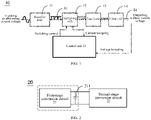
- FIG. 1 illustrate a schematic structural view of a power supply device in a related art according to an example.
- the power supply device 10 includes: a rectifier unit 11, a switching unit 12, a transformer 13, a filter unit 14, and a control unit 15.
- the rectifier unit 11 is used to rectify a received alternating current (AC) voltage (e.g., an commercial power provided by a grid) to output a pulsating direct current (DC) voltage indicated by a signal S1 as shown in FIG. 1 .
- AC alternating current
- DC direct current
- the switching unit 12, the transformer 13 and the filter unit further convert the pulsating DC voltage output from the rectifier unit 11, to output a constant DC voltage (as indicated by a signal S4).
- the control unit 15 samples a voltage output from the power supply device 10 and a current output from the switching unit 12, individually; and controls the switching unit 12 according to a voltage-sampling signal and a current-sampling signal, to control an output voltage and/or an output current of the power supply device 10.
- the rectifier unit 11 includes a large volume capacitor for energy storage. Since the large volume capacitor is usually a liquid electrolytic capacitor of a large volume, the power supply device 10 is large in volume and not portable, and user experience therefor is poor.
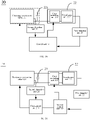
- FIG. 2 illustrates a schematic structural view of a power supply device according to an exemplary embodiment.
- the power supply device 20 includes: a first-stage conversion circuit 21 and a second-stage conversion circuit 22.
- the first-stage conversion circuit 21 may be, for example, a boost circuit, and is used to convert a received alternating current voltage (e.g., commercial power received from a grid) to a pulsating DC voltage of a voltage value greater than that of the alternating current voltage.
- a received alternating current voltage e.g., commercial power received from a grid
- a voltage value of the pulsating DC voltage output from the first-stage conversion circuit 21 for example is in a range from 390 volts (V) to 450 V.
- the second-stage conversion circuit 22 is connected to the first-stage conversion circuit 21, and is used to convert the pulsating DC voltage output from the first-stage conversion circuit 21 to output a constant DC voltage as an output voltage of the power supply device 20.
- the constant DC voltage output from the second-stage conversion circuit 22 is a constant DC voltage without a pulsating waveform, but a voltage value of the constant DC voltage is not unique, and different voltage values may be output in different charging scenarios or charging phases.
- the power supply device 20 provided in the embodiment of the present disclosure employs a two-stage architecture consisting of the first-stage conversion circuit and the second-stage conversion circuit.
- the first-stage conversion circuit boosts an inputted AC voltage, such that a variable bus voltage exists between the two-stage architecture, and energy storage function is achieved through variation of the bus voltage, thereby a large volume capacitor is not required to act as an energy storage element. Removing of the large volume capacitor can reduce a volume of the power supply device 20.
- the large volume capacitor typically is a liquid electrolytic capacitor, and the liquid electrolytic capacitor has a short service life and is prone to bursting. Removing of the liquid electrolytic capacitor may also improve a service life and safety of the power supply device 20.
- the first-stage conversion circuit 21 may further include at least one filter capacitor 211 with less filtering capability (e.g., a capacity thereof is less than a preset value or a volume thereof is less than a preset volume threshold).
- the filter capacitor 211 is used for filtering burr of the pulsating voltage output from the first-stage conversion circuit 21, to improve quality of an output current of the power supply device 20.
- the filter capacitor 211 may be, for example, a film capacitor, or a multilayer ceramic capacitor (MLCC), or a surface-mounted capacitor; or may also be an electrolytic capacitor with a capacity smaller than the preset value.
- a volume and/or a capacity of the filter capacitor 211 is/are small and therefore has/have no large impact on the volume of the power supply device.
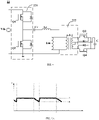
- FIG. 3A illustrates a schematic structural view of another power supply device according to an exemplary embodiment.
- the second-stage conversion circuit 22 may further include: a first switching unit 221 and a transformer 222.
- the power supply device 30 may further include a control unit 24 and a first detection unit 25.
- the first detection unit 25 is connected to the transformer 222, and is used to detect an output voltage and/or an output current of the transformer 222.
- the control unit 24 is connected to the first detection unit 25 and the first switching unit 221, individually; and is used to output a control signal according to the output voltage and/or the output current of the transformer 222 detected by the first detection unit 25, to control on-off states of the first switching unit 221, and adjust the output voltage of the transformer 222 and thereby adjust a voltage value of a constant DC voltage output by the power supply device 30.
- the detected output voltage and/or the output current may be a sampling signal(s) of the output voltage and/or the output current of the transformer 222.
- the transformer 222 may couple electrical energy from a primary side to a secondary side in an electromagnetic coupling manner. Electrical energy coupled to the secondary side may be drawn from electrical energy output from the first-stage conversion circuit 21. The manner in which the electrical energy is drawn may be controlled by the control unit 24 according to the detected output voltage and/or the output current of the transformer 222.
- the first detection unit 25 may further directly detect an output voltage and/or an output current of the power supply device 30.
- the control unit 24 may output a control signal according to the output voltage and/or the output current of the power supply device 30, to control the on-off states of the first switching unit 221, and adjust the output voltage of the transformer 222 and thereby adjust the voltage value of the constant DC voltage output by the power supply device 30.
- the output voltage and/or the output current may be sampling signal(s) of the output voltage and/or the output current of the power supply device 30.
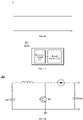
- the second-stage conversion circuit 22 may be implemented, for example, as an LLC resonant converter as shown in FIG. 4 .
- the first switching unit 221 includes Metal-Oxide-Semiconductor Field-Effect (MOS) transistors Q1 and Q2 before the transformer 222.
- the first switching unit 221 performs chopper modulation on the pulsating DC voltage output from the first-stage conversion circuit 21, to allow the modulated voltage to be transformed through the transformer 222.
- MOS transistors Q3 and Q4 in the LLC resonant converter as shown in FIG. 4 are also controlled by the control signal sent by the control unit 24.
- FIG. 5A illustrates a schematic view of a pulsating DC voltage according to an example.
- a large volume capacitor is not required to be used, and a voltage range of the pulsating DC voltage output from the first-stage conversion circuit is wide.
- the voltage range of the pulsating DC voltage (shown as dashed line A and dashed line B in FIG. 5A ) is, for example, between 390 V and 450 V.
- the constant DC voltage is shown in FIG. 5B .
- the constant DC voltage output from the second-stage conversion circuit 22 is a constant DC voltage without a pulsating waveform, but the value of the constant DC voltage is not unique, and different voltage values may be output in different charging scenarios or charging phases.
- the LLC resonant converter shown in FIG. 4 is merely exemplarily and is not intended to limit the present disclosure.
- a structure of the LLC resonant converter is well known to the skilled in the art and will not be described herein.
- the control unit 24 may be implemented, for example, as a micro control unit (MCU).
- MCU micro control unit
- the control signal output from the control unit 24 to the first switching unit 221 may be a Pulse Frequency Modulation (PFM) signal or a Pulse Width Modulation (PWM) signal, for controlling the on-off states of the first switching unit 221.
- PFM Pulse Frequency Modulation
- PWM Pulse Width Modulation
- a duty cycle of the PFM signal is kept constant, and the PFM signal is controlled by adjusting an interval (i.e., frequency) of the PFM signal.
- a frequency of the PWM signal is kept constant, and the PWM signal is controlled by adjusting a duty cycle (i.e., a signal width) of the PWM signal.
- the control unit 24 determines whether to output the PWM signal or to output the PFM signal according to the output voltage and/or the output current of the transformer 222, or according to the output voltage and/or the output current of the power supply device 30.
- the frequencies of Q1 and Q2 in the first switching unit 221 need to be set high in response to the output voltage and/or the output current of the power supply device 30 is low, such that an output gain of the power supply device 30 can be ensured.
- the output gain is a ratio of the output voltage of the power supply device 30 to an inputted voltage of the second-stage conversion circuit 22 (i.e., an output voltage of the first-stage conversion circuit).
- the control unit 24 in response to the output voltage of the transformer 222 is smaller than a preset first voltage threshold, and/or, in response to the output current of the transformer 222 is smaller than a preset first current threshold, the control unit 24 outputs the PWM signal, i.e. operates in the PWM mode.
- the control unit 24 In response to the output voltage of the transformer 222 is greater than or equal to the first voltage threshold, and/or, in response to the output current of the transformer 222 is greater than or equal to the first current threshold, the control unit 24 outputs the PFM signal, i.e., operates in a PFM mode.
- control unit 24 may also determine which control mode to use according to the output voltage and/or the output current of the power supply device 30. In response to the output voltage of the power supply device 30 is smaller than the preset first voltage threshold, and/or, in response to the output current of the power supply device 30 is smaller than the preset first current threshold, the control unit 24 outputs a PWM signal, i.e., operates in the PWM mode.
- control unit 24 In response to the output voltage of the power supply device 30 is greater than or equal to the first voltage threshold, and/or, in response to the output current of the power supply device 30 is greater than or equal to the first current threshold, the control unit 24 outputs a PFM signal, i.e. operating in the PFM mode.
- the above first voltage threshold and first current threshold can be set according to a battery charging condition of a device to be charged connected to the power supply device 30.
- a battery in the device to be charged being a two-cell series lithium battery for example
- a desired charging voltage of the device to be charged is 10 V
- the PWM mode described above may be used, in response to an output voltage of the power supply device is smaller than 10 V (e.g., 8 V or 9 V) at the beginning of charging.
- the PWM mode can be switched to the PFM mode, to control an inputted signal to adjust the output voltage and/or the output current of the power supply device 30.
- the control unit 24 is used to output the PWM signal during a first charging phase, to adjust the output voltage of the transformer 222, and is used to output the PFM signal during a second charging phase, to adjust the output voltage of the transformer 222.
- the output voltage of the power supply device 30 during the first charging phase is smaller than the output voltage of the power supply device 30 during the second charging phase.
- the first charging phase is, for example, a charging start stage, such as a trickle charging phase and/or a constant voltage charging phase.
- the second charging phase may be, for example, a subsequent constant current charging phase.
- the control unit 24 is used to output the PWM signal or PFM signal according to the output gain, to adjust the output voltage of the transformer 222.
- the output gain may, for example, be a ratio of the output voltage of the transformer 222 to the inputted voltage of the transformer 222, or, the output gain may be a ratio of the output voltage of the second-stage conversion circuit 22 to the output voltage of the first-stage conversion circuit 21.
- the output gain may, for example, also be a ratio of the output voltage of the power supply device 30 to the inputted voltage of the transformer 222.
- control unit 24 may further be used to receive feedback information from a device to be charged connected to the power supply device 30; and control the control signal inputted to the first switching unit 211 according to the feedback information, to adjust the output voltage and/or the output current of the power supply device 30.
- a duty cycle of the control signal inputted to the first switching unit 211 is adjusted according to the feedback information, to adjust the output voltage and/or the output current of the power supply device 30.
- a frequency of the control signal inputted to the first switching unit 211 is adjusted according to the feedback information, to adjust the output voltage and/or the output current of the power supply device 30.
- the feedback information may include, for example, a desired charging voltage and/or a desired charging current of the device to be charged.
- the feedback information may also include: an adjustment command generated by the device to be charged according to on the desired charging voltage and/or the desired charging current.
- the first-stage conversion circuit is used in a first-stage architecture to rectify and boost the AC voltage, thus a large volume capacitor (e.g., a liquid electrolytic capacitor) is not required.
- the PFM mode or the PWM mode can also be used to control an inputted signal of the switching unit in the first-stage conversion circuit to ensure stability of the output gain and output voltage of the first-stage conversion circuit.
- the first-stage conversion circuit 21 may include a second switching unit.
- the power supply device 30 may, for example, also include a second detection unit 26 as shown in FIG. 3A , for detecting the output voltage and/or the output current of the first-stage conversion circuit 21.
- the control unit 24 outputs a control signal according to the output voltage and/or the output current detected by the second detection unit 26, to control on-off states of the second switching unit adjust the output voltage and/or the output current of the first-stage conversion circuit 21.
- the first-stage conversion circuit 21 may, for example, include a rectifier circuit 211 and a boost circuit 212 as shown in FIG. 6A .
- the rectifier circuit 211 is used to rectify the received AC voltage.
- the rectifier circuit 211 may be, for example, a full-bridge rectifier circuit.
- the boost circuit 212 is used to boost the rectified DC voltage.
- the boost circuit 212 may be, for example, shown in FIG. 6B
- the second switching unit is, for example, a switching transistor S1 in the boost circuit 212 in FIG. 6B . It should be noted that the boost circuit shown in FIG. 6B is merely exemplarily and is not intended to limit the present disclosure.
- the first-stage conversion circuit 21 may also be implemented, for example, as a totem-pole boost circuit as shown in FIG. 6C .
- the second switching unit may, for example, include switching transistors S1 and S2 in FIG. 6C .
- totem-pole boost circuit shown in FIG. 6C is merely exemplarily and is not intended to limit the present disclosure.
- a structure of the totem-pole boost circuit is well known to the skilled in the art and will not be described herein.
- the control unit 24 is used to output the PWM signal or output the PFM signal according to the output voltage and/or the output current of the first-stage conversion circuit 21, to adjust the output voltage and/or the output current of the first-stage conversion circuit 21 and thereby make the output voltage of the first-stage conversion circuit 21 be equal to a preset reference voltage.
- FIG. 3B illustrates a schematic structural view of still another power supply device according to an exemplary embodiment.
- the power supply device 30' in FIG. 3B includes a first control unit 241 and a second control unit 242 for controlling the first-stage conversion circuit 21 and the second-stage conversion circuit 221 respectively.
- the second control unit 242 is used to determine and output a PWM signal or a PFM signal as a control signal output to the first switching unit 221 according to the output voltage and/or the output current of the transformer 222 or the power supply device 30', to adjust the output voltage of the transformer 222.
- the second control unit 242 may further be used to adjust an output voltage and/or an output current of the power supply device 30' according to received feedback information.
- the first control unit 241 is used to determine and output a PWM signal or a PFM signal as a control signal output to the second switching unit according to the output voltage and/or the output current of the first-stage conversion circuit 21, to adjust the output voltage and/or the output current of the first-stage conversion circuit 21 so that the output voltage of the first-stage conversion circuit 21 is equal to the preset reference voltage.
- the first control unit 241 and the second control unit 242 may communicate with each other.
- the first control unit 241 may send a message to the second control unit 242 to instruct the second control unit 242 to start operating.
- FIG. 7 illustrates a schematic structural view of even still another power supply device according to an example embodiment.
- a first-stage conversion circuit 21 is exemplified by a totem-pole boost circuit
- a second-stage conversion circuit 22 is exemplified by an LLC resonant converter.
- FIG. 8 is a flowchart of a charging control method according to an exemplary embodiment.
- the charging control method may be applied, for example, to the power supply device 20 or the power supply device 30 or the power supply device 30' described above.
- the charging control method 40 may begin from block S402 to block 404.
- a received AC voltage is converted by a first-stage conversion circuit to a pulsating DC voltage.
- a voltage value of the pulsating DC voltage is greater than a voltage value of the AC voltage.
- the pulsating DC voltage is converted by a second-stage conversion circuit to output a constant DC voltage.
- the first-stage conversion circuit includes at least one filter capacitor of a capacity less than a preset value.
- the charging control method 40 may further include blocks S406 and S408.
- a control signal is output according to the output voltage and/or the output current of the power supply device, to control on-off states of a first switching unit of the second-stage conversion circuit, and adjust an output voltage of a transformer unit of the second-stage conversion circuit and thereby adjust a voltage value of the constant DC voltage.
- block S408 may include block S4082, in which a PWM signal or a PFM signal is output according to the output voltage and/or the output current of the power supply device, to adjust the output voltage of the transformer unit.
- block 4082 may be implemented, for example, as follows: in response to the output voltage of the power supply device is smaller than a preset first voltage threshold, and/or the output current of the power supply device is smaller than a preset first current threshold, the PWM signal is output to adjust the output voltage of the transformer unit; in response to the output voltage of the power supply device is greater than or equal to the first voltage threshold, and/or the output current of the power supply device is greater than or equal to the first current threshold, the PFM signal is output to adjust the output voltage of the transformer unit.
- the charging control method 40 further include blocks S406' and S408'.
- a control signal is output according the output voltage and/or the output current of the transformer unit, to control on-off states of the first switching unit of the second-stage conversion circuit, and adjust the output voltage of the transformer unit and thereby adjust the voltage value of the constant DC voltage.
- block S408' may include block S4082'.
- a PWM signal or a PFM signal is output according to the output voltage and/or the output current of the transformer unit to adjust the output voltage of the transformer unit.
- block 4082' may, for example, be specifically implemented as follows: the PWM signal is output to adjust the output voltage of the transformer unit in response to the output voltage of the transformer unit is smaller than a preset first voltage threshold, and/or the output current of the transformer unit is smaller than a preset first current threshold; the PWM signal is output to adjust the output voltage of the transformer unit in response to the output voltage of the transformer unit is greater than or equal to the first voltage threshold, and/or the output current of the transformer unit is greater than or equal to the first current threshold.
- block 4082' may also, for example, be specifically implemented as follows: the output voltage of the transformer unit is adjusted through outputting the PWM signal during a first charging phase; and the output voltage of the transformer unit is adjusted through outputting the PFM signal during a second charging phase; where the output voltage of the power supply device during the first charging phase is smaller than the output voltage at the second charging phase.
- block 4082' may also, for example, be specifically implemented as follows: the output voltage of the transformer unit is adjusted through outputting the PWM signal or the PFM signal based on a output gain.
- the output gain is a ratio of the output voltage of the transformer unit to the inputted voltage of the transformer unit, or the output gain is a ratio of the output voltage of the second-stage conversion circuit to the output voltage of the first-stage conversion circuit.
- the charging control method 40 may further include blocks S410 and S412.
- block 410 feedback information of a device to be charged connected to the power supply device is received.
- block S412 a control signal that is a PFM signal or a PWM signal is controlled according to the feedback information to adjust the output voltage and/or the output current of the power supply device.
- the feedback information includes: a desired charging voltage and/or a desired charging current of the device to be charged, or, an adjustment command generated by the device to be charged according to the desired charging voltage and/or the desired charging current.
- the first-stage conversion circuit boosts the inputted AC voltage
- a variable bus voltage exists between the two-stage architecture formed by the first-stage conversion circuit and the second-stage conversion circuit, and energy storage function can be achieved by variation of the bus voltage, thus making it is not required for the power supply device performing the method to use a large volume capacitor as an energy storage element. Removing of the large volume capacitor can reduce the volume of the power supply device.
- FIG. 13 illustrates a flowchart of another charging control method illustrated according to an exemplary embodiment. Unlike the charging control method 40 shown in FIG. 8 , the charging control method 50 shown in FIG. 13 may further include blocks S502 and S504.
- a control signal is output based on the output voltage and/or the output current of the first-stage conversion circuit, to control on-off states of the second switching unit of the first-stage conversion circuit and adjust the output voltage and/or the output current of the first-stage conversion circuit.
- an input signal of the second switching unit is a pulse width modulated signal.
- block S504 may include block S5042.
- the output voltage and/or the output current of the first-stage conversion circuit is/are adjusted through outputting a PWM signal or a PFM signal based on the output voltage and/or the output current of the first-stage conversion circuit, so that the output voltage of the first-stage conversion circuit is equal to a preset reference voltage.
Landscapes
- Engineering & Computer Science (AREA)
- Power Engineering (AREA)
- Dc-Dc Converters (AREA)
Abstract
Description
- The present disclosure relates to the field of charging technologies, and in particularly to a power supply device and a charging control method.
- Devices to be charged (e.g. smartphones, mobile terminals or smart devices) are increasingly popular with consumers, but the devices to be charged tend to consume a lot of power and need to be charged frequently. However, at present, power supply devices (for example, power adapters) are large and not portable, and user experience therefor is poor.
- The above information provided in the Description of related art is intended merely to enhance the understanding of background of the present disclosure, and thus it may include information that does not constitute a prior art known to the skilled in the art.
- The present disclosure provides a power supply device and a charging control method, and a power supply device of a small volume can be achieved.
- Other features and advantages of the present disclosure will become apparent through following detailed description, or will be learned in part through practice of the present disclosure.
- According to one aspect of the present disclosure, a power supply device is provided, which includes: a first-stage conversion circuit, configured to convert a received alternating current (AC) voltage to a pulsating direct current (DC) voltage, where a voltage value of the pulsating DC voltage is greater than a voltage value of the AC voltage; and a second-stage conversion circuit, connected to the first-stage conversion circuit, and configured to convert the pulsating DC voltage to output a constant DC voltage.
- According to an embodiment of the present disclosure, the first-stage conversion circuit includes at least one filter capacitor, a capacity of the filter capacitor is smaller than a preset value.
- According to an embodiment of the present disclosure, the second-stage conversion circuit includes a first switching unit and a transformer unit; the power supply device further includes: a first detection unit, connected to the transformer unit, and configured to detect at least one of an output voltage and an output current of the transformer unit; and a control unit, connected to the first detection unit and the first switching unit, individually; where the control unit is configured to output a control signal according to at least one of an output voltage value and an output current value detected by the first detection unit, to control on-off states of the first switching unit, to adjust the output voltage of the transformer unit and thereby adjust a voltage value of the constant DC voltage.
- According to an embodiment of the present disclosure, the control signal includes a pulse width modulated (PWM) signal and a pulse frequency modulated (PFM) signal; and the control unit is configured to output one of the PWM signal and the PFM signal according to at least one of the output voltage value and the output current value detected by the first detection unit, to adjust the output voltage of the transformer unit.
- According to an embodiment of the present disclosure, the control unit is configured to output one of the PWM signal and the PFM signal according to an output gain, to adjust the output voltage of the transformer unit, where the output gain is a ratio of the output voltage of the transformer unit to an inputted voltage of the transformer unit; or the output gain is a ratio of an output voltage of the second-stage conversion circuit to an output voltage of the first-stage conversion circuit.
- According to an embodiment of the present disclosure, the control unit is configured to output the PWM signal during a first charging phase to adjust the output voltage of the transformer unit, and configured to output the PFM signal during a second charging phase to adjust the output voltage of the transformer unit; where an output voltage of the power supply device during the first charging phase is lower than an output voltage of the power supply device during the second charging phase.
- According to an embodiment of the present disclosure, the control unit is configured to: output the PWM signal to adjust the output voltage of the transformer unit, in response to at least one of the output voltage of the transformer unit being smaller than a predetermined first voltage threshold, and the output current of the transformer unit being smaller than a predetermined first current threshold; output the PFM signal to adjust the output voltage of the transformer unit, in response to at least one of the output voltage of the transformer unit being greater than or equal to the first voltage threshold, and the output current of the transformer unit being greater than or equal to the first current threshold.
- According to an embodiment of the present disclosure, the second-stage conversion circuit includes a first switching unit and a transformer unit; the power supply device further includes: a first detection unit, configured to detect at least one of an output voltage and an output current of the power supply device; and a control unit, connected to the first detection unit and the first switching unit, individually; where the control unit is configured to output a control signal according to at least one of an output voltage value and an output current value detected by the first detection unit, to control on-off states of the first switching unit, and adjust the output voltage of the transformer unit and thereby adjust a voltage value of the constant DC voltage.
- According to an embodiment of the present disclosure, the control unit is further configured to receive feedback information from a device to be charged connected to the power supply device, and control the control signal for the first switching unit according to the feedback information to adjust at least one of an output voltage and an output current of the power supply device.
- According to an embodiment of the present disclosure, the feedback information includes at least one of a desired charging voltage of and a desired charging current of the device to be charged, and or the feedback information includes an adjustment command generated by the device to be charged based on at least one of the desired charging voltage and the desired charging current.
- According to an embodiment of the present disclosure, the first-stage conversion circuit includes a second switching unit; where the power supply device further includes: a second detection unit, connected to the first-stage conversion circuit and the control unit, individually, where the second detection unit is configured to detect at least one of an output voltage and an output current of the first-stage conversion circuit; where the control unit is further configured to output a second control signal according to at least one of the output voltage and the output current of the first-stage conversion circuit, to control on-off states of the second switching unit and thereby adjust one of the output voltage and the output current of the first-stage conversion circuit.
- According to an embodiment of the present disclosure, the second control signal includes a PWM signal and a PFM signal; the control unit is configured to output one of the PWM signal or the PFM signal of the second control signal according to at least one of the output voltage and the output current of the first-stage conversion circuit, to adjust at least one of the output voltage and the output current of the first-stage conversion circuit and thereby make the output voltage of the first-stage conversion circuit be equal to a preset reference voltage.
- According to an embodiment of the present disclosure, the capacitor includes at least one selected from the group consisting of: a film capacitor, a multilayer ceramic capacitor, a surface-mounted capacitor and an electrolytic capacitor.
- According to an embodiment of the present disclosure, the first-stage conversion circuit includes a totem-pole boost circuit.
- According to an embodiment of the present disclosure, the first-stage conversion circuit includes: a rectifier circuit and a boost circuit.
- According to an embodiment of the present disclosure, the second-stage conversion circuit includes an inductor--inductor--capacitor (LLC) resonant converter.
- According to another aspect of the present disclosure, a charging control method is provided, which is implemented by a power supply device and includes: converting, by a first-stage conversion circuit, a received AC voltage to a pulsating DC voltage, where a voltage value of the pulsating DC voltage is greater than a voltage value of the AC voltage; and converting, by a second-stage conversion circuit, the pulsating DC voltage to output a constant DC voltage.
- According to an embodiment of the present disclosure, the first-stage conversion circuit includes at least one filter capacitor, a capacity of the filter capacitor is smaller than a preset value.
- According to an embodiment of the present disclosure, the method further includes: detecting at least one of an output voltage and an output current of a transformer unit of the second-stage conversion circuit; outputting a control signal according to at least one of the output voltage and the output current value of the transformer unit, to control on-off states of a first switching unit of the second-stage conversion circuit, to adjust the output voltage of the transformer unit and thereby adjust a voltage value of the constant DC voltage.
- According to an embodiment of the present disclosure, the control signal includes a PWM signal and a PFM signal; the outputting a control signal according to at least one of the output voltage and the output current of the transformer unit, to control on-off states of a first switching unit of the second-stage conversion circuit, and adjust the output voltage of the transformer unit and thereby adjust a voltage value of the constant DC voltage specifically includes: outputting the PWM signal or the PFM signal according to at least one of an output voltage value and an output current value of the transformer unit, to adjust the output voltage of the transformer unit.
- According to an embodiment of the present disclosure, the outputting the PWM signal or the PFM signal according to at least one of an output voltage value and an output current value of the transformer unit, to adjust the output voltage of the transformer unit specifically includes: outputting the PWM signal or the PFM signal according to an output gain, to adjust the output voltage of the transformer unit; where the output gain is a ratio of the output voltage of the transformer unit to an inputted voltage of the transformer unit; or the output gain is a ratio of an output voltage of the second-stage conversion circuit to an output voltage of the first-stage conversion circuit.
- According to an embodiment of the present disclosure, the outputting the PWM signal or the PFM signal according to at least one of an output voltage value and an output current value of the transformer unit, to adjust the output voltage of the transformer unit specifically includes: outputting the PWM signal during a first charging phase to adjust the output voltage of the transformer unit, and outputting the PFM signal during a second charging phase to adjust the output voltage of the transformer unit; where an output voltage of the power supply device during the first charging phase is smaller than an output voltage of the power supply device during the second charging phase.
- According to an embodiment of the present disclosure, the outputting the PWM signal or the PFM signal according to at least of an output voltage value and an output current value of the transformer unit, to adjust the output voltage of the transformer unit specifically includes: outputting the PWM signal to adjust the output voltage of the transformer unit, in response to at least one of the output voltage of the transformer unit being smaller than a predetermined first voltage threshold, and the output current of the transformer unit being smaller than a predetermined first current threshold; outputting the PFM signal to adjust the output voltage of the transformer unit, in response to at least one of the output voltage of the transformer unit being greater than or equal to the first voltage threshold, and the output current of the transformer unit being greater than or equal to the first current threshold.
- According to an embodiment of the present disclosure, the method further includes: detecting at least one of an output voltage and an output current of the power supply device; and outputting a control signal according to at least one of the output voltage and the output current of the power supply device, to control on-off states of a first switching unit of the second-stage conversion circuit, to adjust an output voltage of a transformer unit of the second-stage conversion circuit and thereby adjust a voltage value of the constant DC voltage.
- According to an embodiment of the present disclosure, the method further include: receiving feedback information from a device to be charged connected to the power supply device; controlling the control signal for the first switching unit according to the feedback information to adjust at least one of an output voltage and an output current of the power supply device.
- According to an embodiment of the present disclosure, the feedback information includes at least one a desired charging voltage of the device to be charged, and a desired charging current of the device to be charged, or the feedback information includes an adjustment command generated by the device to be charged according to at least one of the desired charging voltage and the desired charging current.
- According to an embodiment of the present disclosure, the method further includes: detecting at least one of an output voltage and an output current of the first-stage conversion circuit; and outputting a second control signal according to at least one of the output voltage and the output current of the first-stage conversion circuit, to control on-off states of the second switching unit and thereby adjust at least one of the output voltage and the output current of the first-stage conversion circuit.
- According to an embodiment of the present disclosure, the second control signal includes a PWM signal and a PFM signal; the outputting a second control signal according to at least one of the output voltage and the output current of the first-stage conversion circuit, to control on-off states of the second switching unit and thereby adjust at least one of the output voltage and the output current of the first-stage conversion circuit specifically includes: outputting one of the PWM signal and the PFM signal according to at least one of the output voltage and the output current of the first-stage conversion circuit, to adjust at least one of the output voltage and the output current of the first-stage conversion circuit and thereby make the output voltage of the first-stage conversion circuit be equal to a preset reference voltage.
- The power supply device provided in the embodiment of the present disclosure employs a two-stage architecture consisting of the first-stage conversion circuit and the second-stage conversion circuit. Since the first-stage conversion circuit boosts an inputted AC voltage, a variable bus voltage exists between the two-stage architecture, and energy storage function is achieved through variation of the bus voltage, thereby a large volume capacitor is not required to act as an energy storage element. Removing of the large volume capacitor can reduce a volume of the power supply device.
- It should be understood that the above general description and detailed description hereinafter are merely exemplary and are not intended to limit the present disclosure.
- The above objects and other objects, features and advantages of the present disclosure will become more apparent through a detailed description of exemplary embodiments of the present disclosure with reference to accompanying drawings.
-
FIG. 1 illustrates a schematic structural view of a power supply device in a related art according to an example. -
FIG. 2 illustrates a schematic structural view of a power supply device according to an exemplary embodiment. -
FIG. 3A illustrates a schematic structural view of another power supply device according to an exemplary embodiment. -
FIG. 3B illustrates a schematic structural view of still another power supply device according to an exemplary embodiment. -
FIG. 4 illustrates a circuit structure view of an LLC resonant converter according to an exemplary embodiment. -
FIG. 5A illustrates a schematic view of a pulsating DC voltage according to an example. -
FIG. 5B illustrates a schematic view of a constant DC voltage according to an example. -
FIG. 6A illustrates a schematic structural view of a boost circuit according to an exemplary embodiment. -
FIG. 6B illustrates a schematic view of a boost circuit according to an example embodiment. -
FIG. 6C illustrates a schematic view of a totem-pole boost circuit according to an example. -
FIG. 7 illustrates a schematic structural view of even still another power supply device according to an example embodiment. -
FIG. 8 illustrates a flowchart of a charging control method according to an exemplary embodiment. -
FIG. 9 illustrates a flowchart of another charging control method according to an exemplary embodiment. -
FIG. 10 illustrates a flowchart of still another charging control method according to an exemplary embodiment. -
FIG. 11 illustrates a flowchart of even still another charging control method according to an exemplary embodiment. -
FIG. 12 illustrates a flowchart of even still another charging control method according to an exemplary embodiment. -
FIG. 13 illustrates a flowchart of even still another charging control method according to an exemplary embodiment. -
FIG. 14 illustrates a flowchart of even still another charging control method according to an exemplary embodiment. - Exemplary embodiments will now be described more fully with reference to accompanying drawings. However, the exemplary embodiments can be implemented in a variety of forms and should not be construed as being limited to examples set forth herein. In contrast, providing these embodiments enables the present disclosure to be more comprehensive and complete and communicates conception of the exemplary embodiments in a comprehensive manner to the skilled in the art. The described features, structures, or characteristics may be combined in any suitable manner in one or more embodiments.
- Furthermore, the accompanying drawings are merely schematic illustrations of the present disclosure and are not necessarily drawn to scale. The same reference numbers in the accompanying drawings indicate the same or similar parts, and thus repetitive descriptions thereof will be omitted. Some of blocks shown in the accompanying drawings are functional entities and do not necessarily have to correspond to physically or logically separate entities. These functional entities may be implemented in software form, or may be implemented in one or more hardware modules or integrated circuits, or may be implemented in different networks and/or processor devices and/or microcontroller devices.
- In the present disclosure, unless otherwise expressly specified and limited, terms "connected" and "connection" are to be understood broadly, for example, as fixed connection, as removable connection, or as integrally connection; as mechanical connection, as electrical connection, or as communication connection; as direct connection, as indirect connection through an intermediate medium, as connection within two elements, or as interaction between two elements. For the skilled in the art, specific meanings of the above terms in the present disclosure can be understood according to specific conditions.
- In addition, terms "first" and "second" are merely used for descriptive purposes and are not intended to be construed as indicating or implying relative importance or implicitly specifying the number of technical features indicated. Thus, a feature qualified with "first" and "second" may explicitly or implicitly include one or more such features. In description of the present disclosure, "a plurality of or multiple" means at least two, e.g., two, three, etc., unless otherwise expressly and specifically limited. A term "and/or" is used to describe an association of related objects, and indicates that three relationships may exist, for example, "A and/or B" indicates the presence of A alone, B alone, and both A and B.
- As described above, current power supply devices are large since larger energy storage elements are required to store energy.
-
FIG. 1 illustrate a schematic structural view of a power supply device in a related art according to an example. As shown inFIG. 1 , thepower supply device 10 includes: arectifier unit 11, a switchingunit 12, atransformer 13, afilter unit 14, and acontrol unit 15. - Specifically, the
rectifier unit 11 is used to rectify a received alternating current (AC) voltage (e.g., an commercial power provided by a grid) to output a pulsating direct current (DC) voltage indicated by a signal S1 as shown inFIG. 1 . - The switching
unit 12, thetransformer 13 and the filter unit further convert the pulsating DC voltage output from therectifier unit 11, to output a constant DC voltage (as indicated by a signal S4). - The
control unit 15 samples a voltage output from thepower supply device 10 and a current output from the switchingunit 12, individually; and controls the switchingunit 12 according to a voltage-sampling signal and a current-sampling signal, to control an output voltage and/or an output current of thepower supply device 10. - As shown in
FIG. 1 , therectifier unit 11 includes a large volume capacitor for energy storage. Since the large volume capacitor is usually a liquid electrolytic capacitor of a large volume, thepower supply device 10 is large in volume and not portable, and user experience therefor is poor. - Power supply devices in exemplary embodiments of the present disclosure will be described in more detail hereinafter in combination with the accompanying drawings and the embodiments.
-
FIG. 2 illustrates a schematic structural view of a power supply device according to an exemplary embodiment. - Referring to
FIG. 2 , thepower supply device 20 includes: a first-stage conversion circuit 21 and a second-stage conversion circuit 22. - Specifically, the first-
stage conversion circuit 21 may be, for example, a boost circuit, and is used to convert a received alternating current voltage (e.g., commercial power received from a grid) to a pulsating DC voltage of a voltage value greater than that of the alternating current voltage. - A voltage value of the pulsating DC voltage output from the first-
stage conversion circuit 21 for example is in a range from 390 volts (V) to 450 V. - The second-
stage conversion circuit 22 is connected to the first-stage conversion circuit 21, and is used to convert the pulsating DC voltage output from the first-stage conversion circuit 21 to output a constant DC voltage as an output voltage of thepower supply device 20. - It should be understood by the skilled in the art that the constant DC voltage output from the second-
stage conversion circuit 22 is a constant DC voltage without a pulsating waveform, but a voltage value of the constant DC voltage is not unique, and different voltage values may be output in different charging scenarios or charging phases. - The
power supply device 20 provided in the embodiment of the present disclosure employs a two-stage architecture consisting of the first-stage conversion circuit and the second-stage conversion circuit. The first-stage conversion circuit boosts an inputted AC voltage, such that a variable bus voltage exists between the two-stage architecture, and energy storage function is achieved through variation of the bus voltage, thereby a large volume capacitor is not required to act as an energy storage element. Removing of the large volume capacitor can reduce a volume of thepower supply device 20. - In addition, as described above, the large volume capacitor typically is a liquid electrolytic capacitor, and the liquid electrolytic capacitor has a short service life and is prone to bursting. Removing of the liquid electrolytic capacitor may also improve a service life and safety of the
power supply device 20. - In some embodiments, the first-
stage conversion circuit 21 may further include at least onefilter capacitor 211 with less filtering capability (e.g., a capacity thereof is less than a preset value or a volume thereof is less than a preset volume threshold). Thefilter capacitor 211 is used for filtering burr of the pulsating voltage output from the first-stage conversion circuit 21, to improve quality of an output current of thepower supply device 20. Thefilter capacitor 211 may be, for example, a film capacitor, or a multilayer ceramic capacitor (MLCC), or a surface-mounted capacitor; or may also be an electrolytic capacitor with a capacity smaller than the preset value. A volume and/or a capacity of thefilter capacitor 211 is/are small and therefore has/have no large impact on the volume of the power supply device. -
FIG. 3A illustrates a schematic structural view of another power supply device according to an exemplary embodiment. - Different from the
power supply device 20 shown inFIG. 2 , for thepower supply device 30 shown inFIG. 3A , the second-stage conversion circuit 22 may further include: afirst switching unit 221 and atransformer 222. - The
power supply device 30 may further include acontrol unit 24 and afirst detection unit 25. Thefirst detection unit 25 is connected to thetransformer 222, and is used to detect an output voltage and/or an output current of thetransformer 222. Thecontrol unit 24 is connected to thefirst detection unit 25 and thefirst switching unit 221, individually; and is used to output a control signal according to the output voltage and/or the output current of thetransformer 222 detected by thefirst detection unit 25, to control on-off states of thefirst switching unit 221, and adjust the output voltage of thetransformer 222 and thereby adjust a voltage value of a constant DC voltage output by thepower supply device 30. - The detected output voltage and/or the output current may be a sampling signal(s) of the output voltage and/or the output current of the
transformer 222. - The
transformer 222 may couple electrical energy from a primary side to a secondary side in an electromagnetic coupling manner. Electrical energy coupled to the secondary side may be drawn from electrical energy output from the first-stage conversion circuit 21. The manner in which the electrical energy is drawn may be controlled by thecontrol unit 24 according to the detected output voltage and/or the output current of thetransformer 222. - In some embodiments, the
first detection unit 25 may further directly detect an output voltage and/or an output current of thepower supply device 30. Thecontrol unit 24 may output a control signal according to the output voltage and/or the output current of thepower supply device 30, to control the on-off states of thefirst switching unit 221, and adjust the output voltage of thetransformer 222 and thereby adjust the voltage value of the constant DC voltage output by thepower supply device 30. The output voltage and/or the output current may be sampling signal(s) of the output voltage and/or the output current of thepower supply device 30. - In some embodiments, the second-
stage conversion circuit 22 may be implemented, for example, as an LLC resonant converter as shown inFIG. 4 . Specifically, thefirst switching unit 221 includes Metal-Oxide-Semiconductor Field-Effect (MOS) transistors Q1 and Q2 before thetransformer 222. Thefirst switching unit 221 performs chopper modulation on the pulsating DC voltage output from the first-stage conversion circuit 21, to allow the modulated voltage to be transformed through thetransformer 222. In addition, MOS transistors Q3 and Q4 in the LLC resonant converter as shown inFIG. 4 are also controlled by the control signal sent by thecontrol unit 24. -
FIG. 5A illustrates a schematic view of a pulsating DC voltage according to an example. In the embodiment, a large volume capacitor is not required to be used, and a voltage range of the pulsating DC voltage output from the first-stage conversion circuit is wide. As shown inFIG. 5A , the voltage range of the pulsating DC voltage (shown as dashed line A and dashed line B inFIG. 5A ) is, for example, between 390 V and 450 V. The constant DC voltage is shown inFIG. 5B . As described above, the constant DC voltage output from the second-stage conversion circuit 22 is a constant DC voltage without a pulsating waveform, but the value of the constant DC voltage is not unique, and different voltage values may be output in different charging scenarios or charging phases. - It should be noted that the LLC resonant converter shown in
FIG. 4 is merely exemplarily and is not intended to limit the present disclosure. A structure of the LLC resonant converter is well known to the skilled in the art and will not be described herein. - The
control unit 24 may be implemented, for example, as a micro control unit (MCU). In order to enable thepower supply device 30 to output a constant DC voltage, the control signal output from thecontrol unit 24 to thefirst switching unit 221 may be a Pulse Frequency Modulation (PFM) signal or a Pulse Width Modulation (PWM) signal, for controlling the on-off states of thefirst switching unit 221. - Specifically, in response to the PFM signal is output, a duty cycle of the PFM signal is kept constant, and the PFM signal is controlled by adjusting an interval (i.e., frequency) of the PFM signal. In response to the PWM signal is output, a frequency of the PWM signal is kept constant, and the PWM signal is controlled by adjusting a duty cycle (i.e., a signal width) of the PWM signal.
- The
control unit 24 determines whether to output the PWM signal or to output the PFM signal according to the output voltage and/or the output current of thetransformer 222, or according to the output voltage and/or the output current of thepower supply device 30. - In general, the frequencies of Q1 and Q2 in the
first switching unit 221 need to be set high in response to the output voltage and/or the output current of thepower supply device 30 is low, such that an output gain of thepower supply device 30 can be ensured. The output gain is a ratio of the output voltage of thepower supply device 30 to an inputted voltage of the second-stage conversion circuit 22 (i.e., an output voltage of the first-stage conversion circuit). However, in a practical application, it is difficult to ensure that the frequencies of Q1 and Q2 in thefirst switching unit 221 can be pushed to a high frequency due to various factors (such as device performance, circuit loss, electromagnetic interference, Printed Circuit Board (PCB) layout, etc.), and it is required to limit maximum frequencies of the MOS transistors Q1 and Q2 while considering efficiency and heat generation. However, in order to achieve a desired output gain, an duty cycle of an inputted signal should be changed, so in this case, it is required to make thepower supply device 30 operate in a PWM mode (i.e., the PWM signal is output) to ensure the output gain of thepower supply device 30. - To ensure conversion efficiency (i.e. the output gain) of the
power supply device 30, in some embodiments, in response to the output voltage of thetransformer 222 is smaller than a preset first voltage threshold, and/or, in response to the output current of thetransformer 222 is smaller than a preset first current threshold, thecontrol unit 24 outputs the PWM signal, i.e. operates in the PWM mode. - In response to the output voltage of the
transformer 222 is greater than or equal to the first voltage threshold, and/or, in response to the output current of thetransformer 222 is greater than or equal to the first current threshold, thecontrol unit 24 outputs the PFM signal, i.e., operates in a PFM mode. - In some embodiments, as described above, the
control unit 24 may also determine which control mode to use according to the output voltage and/or the output current of thepower supply device 30. In response to the output voltage of thepower supply device 30 is smaller than the preset first voltage threshold, and/or, in response to the output current of thepower supply device 30 is smaller than the preset first current threshold, thecontrol unit 24 outputs a PWM signal, i.e., operates in the PWM mode. - In response to the output voltage of the
power supply device 30 is greater than or equal to the first voltage threshold, and/or, in response to the output current of thepower supply device 30 is greater than or equal to the first current threshold, thecontrol unit 24 outputs a PFM signal, i.e. operating in the PFM mode. - The above first voltage threshold and first current threshold can be set according to a battery charging condition of a device to be charged connected to the
power supply device 30. Taking a battery in the device to be charged being a two-cell series lithium battery for example, a desired charging voltage of the device to be charged is 10 V, the PWM mode described above may be used, in response to an output voltage of the power supply device is smaller than 10 V (e.g., 8 V or 9 V) at the beginning of charging. In response to the output voltage is 10 V, the PWM mode can be switched to the PFM mode, to control an inputted signal to adjust the output voltage and/or the output current of thepower supply device 30. - In some embodiments, the
control unit 24 is used to output the PWM signal during a first charging phase, to adjust the output voltage of thetransformer 222, and is used to output the PFM signal during a second charging phase, to adjust the output voltage of thetransformer 222. Specifically, the output voltage of thepower supply device 30 during the first charging phase is smaller than the output voltage of thepower supply device 30 during the second charging phase. The first charging phase is, for example, a charging start stage, such as a trickle charging phase and/or a constant voltage charging phase. The second charging phase may be, for example, a subsequent constant current charging phase. - In some embodiments, the
control unit 24 is used to output the PWM signal or PFM signal according to the output gain, to adjust the output voltage of thetransformer 222. Specifically, the output gain may, for example, be a ratio of the output voltage of thetransformer 222 to the inputted voltage of thetransformer 222, or, the output gain may be a ratio of the output voltage of the second-stage conversion circuit 22 to the output voltage of the first-stage conversion circuit 21. In addition, the output gain may, for example, also be a ratio of the output voltage of thepower supply device 30 to the inputted voltage of thetransformer 222. - In some embodiments, the
control unit 24 may further be used to receive feedback information from a device to be charged connected to thepower supply device 30; and control the control signal inputted to thefirst switching unit 211 according to the feedback information, to adjust the output voltage and/or the output current of thepower supply device 30. - For example, in response to the PWM mode is determined to be used (i.e., the PWM signal is output), a duty cycle of the control signal inputted to the
first switching unit 211 is adjusted according to the feedback information, to adjust the output voltage and/or the output current of thepower supply device 30. In response to the PFM mode is determined to be used(i.e., the PFM signal is output), a frequency of the control signal inputted to thefirst switching unit 211 is adjusted according to the feedback information, to adjust the output voltage and/or the output current of thepower supply device 30. - The feedback information may include, for example, a desired charging voltage and/or a desired charging current of the device to be charged. Alternatively, the feedback information may also include: an adjustment command generated by the device to be charged according to on the desired charging voltage and/or the desired charging current.
- In embodiments of the present disclosure, the first-stage conversion circuit is used in a first-stage architecture to rectify and boost the AC voltage, thus a large volume capacitor (e.g., a liquid electrolytic capacitor) is not required. However, since the output voltage of the first-stage conversion circuit is not constant, the PFM mode or the PWM mode can also be used to control an inputted signal of the switching unit in the first-stage conversion circuit to ensure stability of the output gain and output voltage of the first-stage conversion circuit.
- The first-
stage conversion circuit 21 may include a second switching unit. In addition, thepower supply device 30 may, for example, also include asecond detection unit 26 as shown inFIG. 3A , for detecting the output voltage and/or the output current of the first-stage conversion circuit 21. Thecontrol unit 24 outputs a control signal according to the output voltage and/or the output current detected by thesecond detection unit 26, to control on-off states of the second switching unit adjust the output voltage and/or the output current of the first-stage conversion circuit 21. - The first-
stage conversion circuit 21 may, for example, include arectifier circuit 211 and aboost circuit 212 as shown inFIG. 6A . Specifically, therectifier circuit 211 is used to rectify the received AC voltage. Therectifier circuit 211 may be, for example, a full-bridge rectifier circuit. Theboost circuit 212 is used to boost the rectified DC voltage. Theboost circuit 212 may be, for example, shown inFIG. 6B , and the second switching unit is, for example, a switching transistor S1 in theboost circuit 212 inFIG. 6B . It should be noted that the boost circuit shown inFIG. 6B is merely exemplarily and is not intended to limit the present disclosure. - The first-
stage conversion circuit 21 may also be implemented, for example, as a totem-pole boost circuit as shown inFIG. 6C . The second switching unit may, for example, include switching transistors S1 and S2 inFIG. 6C . - It should be noted that the totem-pole boost circuit shown in
FIG. 6C is merely exemplarily and is not intended to limit the present disclosure. A structure of the totem-pole boost circuit is well known to the skilled in the art and will not be described herein. - The
control unit 24 is used to output the PWM signal or output the PFM signal according to the output voltage and/or the output current of the first-stage conversion circuit 21, to adjust the output voltage and/or the output current of the first-stage conversion circuit 21 and thereby make the output voltage of the first-stage conversion circuit 21 be equal to a preset reference voltage. -
FIG. 3B illustrates a schematic structural view of still another power supply device according to an exemplary embodiment. Different from thepower supply device 30 shown inFIG. 3A , the power supply device 30' inFIG. 3B includes afirst control unit 241 and asecond control unit 242 for controlling the first-stage conversion circuit 21 and the second-stage conversion circuit 221 respectively. - The
second control unit 242 is used to determine and output a PWM signal or a PFM signal as a control signal output to thefirst switching unit 221 according to the output voltage and/or the output current of thetransformer 222 or the power supply device 30', to adjust the output voltage of thetransformer 222. Thesecond control unit 242 may further be used to adjust an output voltage and/or an output current of the power supply device 30' according to received feedback information. - The
first control unit 241 is used to determine and output a PWM signal or a PFM signal as a control signal output to the second switching unit according to the output voltage and/or the output current of the first-stage conversion circuit 21, to adjust the output voltage and/or the output current of the first-stage conversion circuit 21 so that the output voltage of the first-stage conversion circuit 21 is equal to the preset reference voltage. - The
first control unit 241 and thesecond control unit 242 may communicate with each other. For example, thefirst control unit 241 may send a message to thesecond control unit 242 to instruct thesecond control unit 242 to start operating. -
FIG. 7 illustrates a schematic structural view of even still another power supply device according to an example embodiment. In the power supply device as shown in FIG. 7A, a first-stage conversion circuit 21 is exemplified by a totem-pole boost circuit, and a second-stage conversion circuit 22 is exemplified by an LLC resonant converter. - The following are method embodiments of the present disclosure that can be applied to the device embodiments of the present disclosure. For details not in the method embodiments of the present disclosure, please refer to the device embodiments of the present disclosure.
-
FIG. 8 is a flowchart of a charging control method according to an exemplary embodiment. The charging control method may be applied, for example, to thepower supply device 20 or thepower supply device 30 or the power supply device 30' described above. - Referring to
FIG. 8 , the chargingcontrol method 40 may begin from block S402 to block 404. - In block S402, a received AC voltage is converted by a first-stage conversion circuit to a pulsating DC voltage.
- Specifically, a voltage value of the pulsating DC voltage is greater than a voltage value of the AC voltage.
- In block S404, the pulsating DC voltage is converted by a second-stage conversion circuit to output a constant DC voltage.
- In some embodiments, the first-stage conversion circuit includes at least one filter capacitor of a capacity less than a preset value.
- In some embodiments, as shown in
FIG. 9 , the chargingcontrol method 40 may further include blocks S406 and S408. - In block S406, an output voltage and/or an output current of the power supply device is/are detected.
- In block S408, a control signal is output according to the output voltage and/or the output current of the power supply device, to control on-off states of a first switching unit of the second-stage conversion circuit, and adjust an output voltage of a transformer unit of the second-stage conversion circuit and thereby adjust a voltage value of the constant DC voltage.
- In some embodiments, as shown in
FIG. 10 , block S408 may include block S4082, in which a PWM signal or a PFM signal is output according to the output voltage and/or the output current of the power supply device, to adjust the output voltage of the transformer unit. - In some embodiments,
block 4082 may be implemented, for example, as follows: in response to the output voltage of the power supply device is smaller than a preset first voltage threshold, and/or the output current of the power supply device is smaller than a preset first current threshold, the PWM signal is output to adjust the output voltage of the transformer unit; in response to the output voltage of the power supply device is greater than or equal to the first voltage threshold, and/or the output current of the power supply device is greater than or equal to the first current threshold, the PFM signal is output to adjust the output voltage of the transformer unit. - In some embodiments, as shown in
FIG. 11 , the chargingcontrol method 40 further include blocks S406' and S408'. - In block S406', an output voltage and/or an output current of the transformer unit of the second-stage conversion circuit is detected.
- In block S408', a control signal is output according the output voltage and/or the output current of the transformer unit, to control on-off states of the first switching unit of the second-stage conversion circuit, and adjust the output voltage of the transformer unit and thereby adjust the voltage value of the constant DC voltage.
- In some embodiments, as shown in
FIG. 12 , block S408' may include block S4082'. In block S4082', a PWM signal or a PFM signal is output according to the output voltage and/or the output current of the transformer unit to adjust the output voltage of the transformer unit. - In some embodiments, block 4082' may, for example, be specifically implemented as follows: the PWM signal is output to adjust the output voltage of the transformer unit in response to the output voltage of the transformer unit is smaller than a preset first voltage threshold, and/or the output current of the transformer unit is smaller than a preset first current threshold; the PWM signal is output to adjust the output voltage of the transformer unit in response to the output voltage of the transformer unit is greater than or equal to the first voltage threshold, and/or the output current of the transformer unit is greater than or equal to the first current threshold.
- In some embodiments, block 4082' may also, for example, be specifically implemented as follows: the output voltage of the transformer unit is adjusted through outputting the PWM signal during a first charging phase; and the output voltage of the transformer unit is adjusted through outputting the PFM signal during a second charging phase; where the output voltage of the power supply device during the first charging phase is smaller than the output voltage at the second charging phase.
- In some embodiments, block 4082' may also, for example, be specifically implemented as follows: the output voltage of the transformer unit is adjusted through outputting the PWM signal or the PFM signal based on a output gain. Specifically, the output gain is a ratio of the output voltage of the transformer unit to the inputted voltage of the transformer unit, or the output gain is a ratio of the output voltage of the second-stage conversion circuit to the output voltage of the first-stage conversion circuit.
- In some embodiments, as shown in
FIG. 9 orFIG. 11 , the chargingcontrol method 40 may further include blocks S410 and S412. Inblock 410, feedback information of a device to be charged connected to the power supply device is received. In block S412, a control signal that is a PFM signal or a PWM signal is controlled according to the feedback information to adjust the output voltage and/or the output current of the power supply device. - In some embodiments, the feedback information includes: a desired charging voltage and/or a desired charging current of the device to be charged, or, an adjustment command generated by the device to be charged according to the desired charging voltage and/or the desired charging current.
- With respect to the charging control method provided by embodiments of the present disclosure, because the first-stage conversion circuit boosts the inputted AC voltage, a variable bus voltage exists between the two-stage architecture formed by the first-stage conversion circuit and the second-stage conversion circuit, and energy storage function can be achieved by variation of the bus voltage, thus making it is not required for the power supply device performing the method to use a large volume capacitor as an energy storage element. Removing of the large volume capacitor can reduce the volume of the power supply device.
-
FIG. 13 illustrates a flowchart of another charging control method illustrated according to an exemplary embodiment. Unlike the chargingcontrol method 40 shown inFIG. 8 , the chargingcontrol method 50 shown inFIG. 13 may further include blocks S502 and S504. - In block S502, an output voltage and/or an output current of the first-stage conversion circuit is/are detected.
- In block S504, a control signal is output based on the output voltage and/or the output current of the first-stage conversion circuit, to control on-off states of the second switching unit of the first-stage conversion circuit and adjust the output voltage and/or the output current of the first-stage conversion circuit.
- In some embodiments, an input signal of the second switching unit is a pulse width modulated signal. As shown in
FIG. 14 , block S504 may include block S5042. In block S5042, the output voltage and/or the output current of the first-stage conversion circuit is/are adjusted through outputting a PWM signal or a PFM signal based on the output voltage and/or the output current of the first-stage conversion circuit, so that the output voltage of the first-stage conversion circuit is equal to a preset reference voltage. - It should be noted that the above accompanying drawings are merely a schematic illustration of a processes included in the methods according to exemplary embodiments of the present disclosure, and are not intended to be limited thereto. It is readily understood that the processes shown above in the accompanying drawings does not indicate or limit the temporal order of these processes. It is also readily understood that these processes may be performed, for example, synchronously or asynchronously in multiple modules.
- Exemplary embodiments of the present disclosure are specifically illustrated and described above. It should be understood that the present disclosure is not limited to detailed structures, arrangement manners, or implementation methods described herein; rather, the present disclosure is intended to cover a variety of modifications and equivalent arrangements included within the spirit and scope of the appended claims.
Claims (28)
- A power supply device, comprising:a first-stage conversion circuit, configured to convert a received alternating current (AC) voltage to a pulsating direct current (DC) voltage, wherein a voltage value of the pulsating DC voltage is greater than a voltage value of the AC voltage; anda second-stage conversion circuit, connected to the first-stage conversion circuit and configured to convert the pulsating DC voltage to output a constant DC voltage.
- The power supply device according to claim 1, wherein the first-stage conversion circuit comprises at least one filter capacitor, a capacity of the filter capacitor is smaller than a preset value.
- The power supply device according to claim 1, wherein the second-stage conversion circuit comprises a first switching unit and a transformer unit;
the power supply device further comprises:a first detection unit, connected to the transformer unit, and configured to detect at least one of an output voltage and an output current of the transformer unit; anda control unit, connected to the first detection unit and the first switching unit, individually;wherein the control unit is configured to output a control signal according to at least one of an output voltage value and an output current value detected by the first detection unit, to control on-off states of the first switching unit to adjust the output voltage of the transformer unit and thereby adjust a voltage value of the constant DC voltage. - The power supply device according to claim 3, wherein the control signal comprises a pulse width modulated (PWM) signal and a pulse frequency modulated (PFM) signal; and
the control unit is configured to output one of the PWM signal and the PFM signal according to at least one of the output voltage value and the output current value detected by the first detection unit, to adjust the output voltage of the transformer unit. - The power supply device according to claim 4, wherein the control unit is configured to output the PWM signal or the PFM signal, according to an output gain, to adjust the output voltage of the transformer unit;
wherein the output gain is a ratio of the output voltage of the transformer unit to an inputted voltage of the transformer unit, or the output gain is a ratio of an output voltage of the second-stage conversion circuit to an output voltage of the first-stage conversion circuit. - The power supply device according to claim 4, wherein the control unit is configured to output the PWM signal during a first charging phase to adjust the output voltage of the transformer unit, and configured to output the PFM signal during a second charging phase to adjust the output voltage of the transformer unit;
wherein an output voltage of the power supply device during the first charging phase is lower than an output voltage of the power supply device during the second charging phase. - The power supply device according to claim 4, wherein the control unit is configured to:output the PWM signal to adjust the output voltage of the transformer unit, in response to at least one of the output voltage of the transformer unit being smaller than a predetermined first voltage threshold, and the output current of the transformer unit being smaller than a predetermined first current threshold;output the PFM signal to adjust the output voltage of the transformer unit, in response to at least one of the output voltage of the transformer unit being greater than or equal to the first voltage threshold, and the output current of the transformer unit being greater than or equal to the first current threshold.
- The power supply device according to claim 1, wherein the second-stage conversion circuit comprises a first switching unit and a transformer unit;
wherein the power supply device further comprises:a first detection unit, configured to detect at least one of an output voltage and an output current of the power supply device; anda control unit, connected to the first detection unit and the first switching unit, individually;wherein the control unit is configured to output a control signal according to at least one of an output voltage value and an output current value detected by the first detection unit, to control on-off states of the first switching unit to adjust an output voltage of the transformer unit and thereby adjust a voltage value of the constant DC voltage. - The power supply device according to any one of claims 3 to 8, wherein the control unit is further configured to: receive feedback information from a device to be charged connected to the power supply device, and control the control signal for the first switching unit according to the feedback information to adjust at least one of an output voltage and an output current of the power supply device.
- The power supply device according to claim 9, wherein the feedback information comprises at least one of a desired charging voltage and a desired charging current of the device to be charged, or the feedback information comprises an adjustment command generated by the device to be charged based on at least one of the desired charging voltage and the desired charging current.
- The power supply device according to any one of claims 3 to 8, wherein the first-stage conversion circuit comprises a second switching unit;wherein the power supply device further comprises:a second detection unit, connected to the first-stage conversion circuit and the control unit, individually;wherein the second detection unit is configured to detect at least one of an output voltage and an output current of the first-stage conversion circuit;wherein the control unit is further configured to output a second control signal according to at least of the output voltage and the output current of the first-stage conversion circuit, to control on on-off states of the second switching unit and thereby adjust at least one of the output voltage and the output current of the first-stage conversion circuit.
- The power supply device according to claim 11, wherein the second control signal comprises a PWM signal and a PFM signal; the control unit is configured to output one of the PWM signal and the PFM signal of the second control signal according to at least one of the output voltage and the output current of the first-stage conversion circuit, to adjust at least one of the output voltage and the output current of the first-stage conversion circuit and thereby make the output voltage of the first-stage conversion circuit be equal to a preset reference voltage.
- The power supply device according to claim 2, wherein the capacitor comprises at least one selected from the group consisting of: a film capacitor, a multilayer ceramic capacitor, a surface-mounted capacitor, and an electrolytic capacitor.
- The power supply device according to any one of claims 1 to 8, wherein the first-stage conversion circuit comprises a totem-pole boost circuit.
- The power supply device according to any one of claims 1 to 8, wherein the first-stage conversion circuit comprises: a rectifier circuit and a boost circuit.
- The power supply device according to any one of claims 1 to 8, wherein the second-stage conversion circuit comprises an inductor-inductor-capacitor (LLC) resonant converter.
- A charging control method, implemented by a power supply device, comprising:converting, by a first-stage conversion circuit, a received AC voltage to a pulsating DC voltage, wherein a voltage value of the pulsating DC voltage is greater than a voltage value of the AC voltage; andconverting, by a second-stage conversion circuit, the pulsating DC voltage to output a constant DC voltage.
- The method according to claim 17, wherein the first-stage conversion circuit comprises at least one filter capacitor, a capacity of the filter capacitor is smaller than a preset value.
- The method according to claim 17, further comprising:detecting at least one of an output voltage and an output current of a transformer unit of the second-stage conversion circuit; andoutputting a control signal, according to the at least one of the output voltage and the output current of the transformer unit, to control on-off states of a first switching unit of the second-stage conversion circuit to adjust the output voltage of the transformer unit and thereby adjust a voltage value of the constant DC voltage.
- The method according to claim 19, wherein the control signal comprises a PWM signal and a PFM signal;
wherein the outputting a control signal according to the at least one of the output voltage and the output current of the transformer unit, to control on-off states of a first switching unit of the second-stage conversion circuit to adjust the output voltage of the transformer unit and thereby adjust a voltage value of the constant DC voltage specifically comprises:
outputting the PWM signal or the PFM signal according to at least one of an output voltage value and an output current value of the transformer unit, to adjust the output voltage of the transformer unit. - The method according to claim 20, wherein the outputting the PWM signal or the PFM signal according to at least one of an output voltage value and an output current value of the transformer unit, to adjust the output voltage of the transformer unit specifically comprises:outputting the PWM signal or the PFM signal according to an output gain, to adjust the output voltage of the transformer unit;wherein the output gain is a ratio of the output voltage of the transformer unit to an inputted voltage of the transformer unit, or the output gain is a ratio of an output voltage of the second-stage conversion circuit to an output voltage of the first-stage conversion circuit.
- The method according to claim 20, wherein the outputting the PWM signal or the PFM signal according to at least one of an output voltage value and an output current value of the transformer unit, to adjust the output voltage of the transformer unit specifically comprises:outputting the PWM signal during a first charging phase to adjust the output voltage of the transformer unit, andoutputting the PFM signal during a second charging phase to adjust the output voltage of the transformer unit;wherein an output voltage of the power supply device during the first charging phase is smaller than an output voltage of the power supply device during the second charging phase.
- The method according to claim 20, wherein the outputting the PWM signal or the PFM signal according to at least one of an output voltage value and an output current value of the transformer unit, to adjust the output voltage of the transformer unit specifically comprises:outputting the PWM signal to adjust the output voltage of the transformer unit, in response to at least one of the output voltage of the transformer unit being smaller than a predetermined first voltage threshold, and the output current of the transformer unit being smaller than a predetermined first current threshold;outputting the PFM signal to adjust the output voltage of the transformer unit, in response to at least one of the output voltage of the transformer unit being greater than or equal to the first voltage threshold, and the output current of the transformer unit being greater than or equal to the first current threshold.
- The method according to claim 17, further comprising:detecting at least one of an output voltage and an output current of the power supply device; andoutputting a control signal according to at least one of the output voltage and the output current of the power supply device, to control on-off states of a first switching unit of the second-stage conversion circuit, to adjust an output voltage of a transformer unit of the second-stage conversion circuit and thereby adjust a voltage value of the constant DC voltage.
- The method according to any one of claims 19 to 24, further comprising:receiving feedback information from a device to be charged connected to the power supply device; andcontrolling the control signal for the first switching unit according to the feedback information, to adjust at least one of an output voltage and an output current of the power supply device.
- The method according to claim 25, wherein the feedback information comprises at least one of a desired charging voltage a desired charging current of the device to be charged, or the feedback information comprises an adjustment command generated by the device to be charged according to at least one of the desired charging voltage and the desired charging current.
- The method according to any one of claims 19 to 24, further comprising:detecting at least one of an output voltage and an output current of the first-stage conversion circuit; andoutputting a second control signal according to at least one of the output voltage and the output current of the first-stage conversion circuit, to control on on-off states of the second switching unit and thereby adjust at least one of the output voltage and the output current of the first-stage conversion circuit.
- The method according to claim 27, wherein the second control signal comprises a PWM signal and a PFM signal; the outputting a second control signal according to at least one of the output voltage and the output current of the first-stage conversion circuit, to control on-off states of the second switching unit and thereby adjust at least one of the output voltage and the output current of the first-stage conversion circuit specifically comprises:
outputting one of the PWM signal and the PFM signal according to at least one of the output voltage and the output current of the first-stage conversion circuit, to adjust at least one of the output voltage and the output current of the first-stage conversion circuit and thereby make the output voltage of the first-stage conversion circuit be equal to a preset reference voltage.
Applications Claiming Priority (1)
| Application Number | Priority Date | Filing Date | Title |
|---|---|---|---|
| PCT/CN2019/130089 WO2021134288A1 (en) | 2019-12-30 | 2019-12-30 | Power supply device and charging control method |
Publications (2)
| Publication Number | Publication Date |
|---|---|
| EP4068565A1 true EP4068565A1 (en) | 2022-10-05 |
| EP4068565A4 EP4068565A4 (en) | 2023-04-26 |
Family
ID=76686197
Family Applications (1)
| Application Number | Title | Priority Date | Filing Date |
|---|---|---|---|
| EP19958177.8A Pending EP4068565A4 (en) | 2019-12-30 | 2019-12-30 | POWER SUPPLY DEVICE AND LOAD CONTROL METHOD |
Country Status (4)
| Country | Link |
|---|---|
| US (1) | US12021455B2 (en) |
| EP (1) | EP4068565A4 (en) |
| CN (1) | CN114902521B (en) |
| WO (1) | WO2021134288A1 (en) |
Families Citing this family (2)
| Publication number | Priority date | Publication date | Assignee | Title |
|---|---|---|---|---|
| CN113394989B (en) * | 2020-03-12 | 2023-08-08 | Oppo广东移动通信有限公司 | Power conversion device and charging control method |
| TWI854441B (en) * | 2023-01-10 | 2024-09-01 | 士林電機廠股份有限公司 | Two-stage voltage conversion system and method thereof |
Family Cites Families (19)
| Publication number | Priority date | Publication date | Assignee | Title |
|---|---|---|---|---|
| US7408795B2 (en) * | 2004-02-24 | 2008-08-05 | Vlt, Inc. | Energy storage and hold-up method and apparatus for high density power conversion |
| BRPI0909363A2 (en) * | 2008-03-10 | 2015-09-29 | Techtium Ltd | environmentally friendly power supply |
| CN101989818A (en) * | 2009-08-06 | 2011-03-23 | 台达电子工业股份有限公司 | Two-stage switching type power conversion circuit |
| JP5702786B2 (en) * | 2009-09-03 | 2015-04-15 | コーニンクレッカ フィリップス エヌ ヴェ | Charging circuit with current stabilization function |
| KR101228797B1 (en) * | 2011-05-30 | 2013-01-31 | 한국과학기술원 | Power supply |
| CN102638184A (en) * | 2012-04-27 | 2012-08-15 | 矽力杰半导体技术(杭州)有限公司 | High-efficiency alternating current-direct current voltage converting circuit |
| JP2014050308A (en) * | 2012-09-04 | 2014-03-17 | Ricoh Co Ltd | Switching regulator, and method of controlling the same |
| CN202949266U (en) * | 2012-12-04 | 2013-05-22 | 洛阳嘉盛电源科技有限公司 | Intelligent charger |
| CN105453380B (en) * | 2013-06-21 | 2018-09-21 | 通用汽车环球科技运作有限责任公司 | The device and method that battery for power grid to vehicle charges |
| GB2540570B (en) * | 2015-07-21 | 2019-04-03 | Dyson Technology Ltd | Battery charger |
| CN105141135B (en) * | 2015-08-31 | 2017-12-29 | 天津电气科学研究院有限公司 | The control method of multi-channel parallel full-bridge LLC converters in a kind of cascading power source system |
| US10879805B2 (en) * | 2015-09-22 | 2020-12-29 | Infineon Technologies Austria Ag | System and method for a switched-mode power supply having a transformer with a plurality of primary windings |
| CN205017081U (en) * | 2015-10-26 | 2016-02-03 | 厦门理工学院 | Soft switch charging device of LCC with power factor calibration function |
| ITUB20159679A1 (en) * | 2015-12-21 | 2017-06-21 | St Microelectronics Srl | A POWER CONTROL MODULE FOR AN ELECTRONIC CONVERTER, ITS INTEGRATED CIRCUIT, ELECTRONIC CONVERTER AND PROCEDURE |
| CN207518331U (en) * | 2017-11-14 | 2018-06-19 | 华南理工大学 | A kind of onboard charger based on LLC half bridge resonant |
| CN108390555B (en) * | 2018-04-24 | 2019-09-10 | 上海推拓科技有限公司 | PFWM control method for the Boost Switching Power Supply combined with bridge-type DC-DC conversion circuit |
| EP3651338A4 (en) * | 2018-09-11 | 2020-08-12 | Guangdong Oppo Mobile Telecommunications Corp., Ltd. | POWER SUPPLY DEVICE AND CHARGE CONTROL METHOD |
| WO2020123144A1 (en) * | 2018-12-13 | 2020-06-18 | Power Integrations, Inc. | Deadtime adjustment for a power converter |
| CN112448601A (en) * | 2020-11-12 | 2021-03-05 | Oppo广东移动通信有限公司 | Power supply device, circuit control method and power supply system |
-
2019
- 2019-12-30 WO PCT/CN2019/130089 patent/WO2021134288A1/en not_active Ceased
- 2019-12-30 CN CN201980102234.8A patent/CN114902521B/en active Active
- 2019-12-30 EP EP19958177.8A patent/EP4068565A4/en active Pending
-
2022
- 2022-06-16 US US17/842,046 patent/US12021455B2/en active Active
Also Published As
| Publication number | Publication date |
|---|---|
| EP4068565A4 (en) | 2023-04-26 |
| CN114902521A (en) | 2022-08-12 |
| US20220311347A1 (en) | 2022-09-29 |
| US12021455B2 (en) | 2024-06-25 |
| WO2021134288A1 (en) | 2021-07-08 |
| CN114902521B (en) | 2025-08-01 |
Similar Documents
| Publication | Publication Date | Title |
|---|---|---|
| US9667153B2 (en) | Switching power supply apparatus for generating control signal for lowering switching frequency of switching devices | |
| CN204290504U (en) | Power transmission system and power transmission device used in the power transmission system | |
| US8107262B2 (en) | Variable switching frequency type power supply | |
| US7443147B2 (en) | DC-DC converter with step-up and step-down control capable of varying the offset voltage of the PWM triangle | |
| US20150249483A1 (en) | Wireless power transmission system | |
| CN110995025A (en) | Switching power supply circuit | |
| US12160137B2 (en) | Online interactive uninterruptible power supply and method for control thereof | |
| CN108173299B (en) | Wireless power receiving device, and wireless power transmission device and rectifier using same | |
| CN110970957A (en) | Wireless charging method, electronic equipment, wireless charging device and wireless charging system | |
| US12549104B2 (en) | Power source supplying apparatus, circuit control method, and power supply system | |
| US12424922B2 (en) | Power supply device, circuit control method, and power supply system | |
| US12021455B2 (en) | Power supply device and charging control method | |
| JPWO2015033860A1 (en) | Power transmission device, wireless power transmission system, and power transmission discrimination method | |
| CN112803774A (en) | DC-DC conversion circuit, DC-DC converter, control method thereof and related equipment | |
| CN115360805B (en) | Wireless charging module, control circuit and electronic equipment | |
| US7710087B2 (en) | Power converter and power converting method | |
| JP2012005185A (en) | Non-contact power transmission and communication system | |
| US20250055305A1 (en) | Charging circuit, electronic device and charging system | |
| CN113922434B (en) | Power supply device and charging control method | |
| CN114421634A (en) | A wireless power transmission system and method | |
| CN118868647A (en) | Power supply circuit, power supply control method and electronic equipment | |
| CN110149052B (en) | A resonant circuit topology for battery charging | |
| CN220440568U (en) | Power supply circuit and power supply equipment | |
| CN112583081B (en) | A fast wireless charging circuit for batteries | |
| CN118117720A (en) | Charging method, device, equipment and medium based on resonance circuit |
Legal Events
| Date | Code | Title | Description |
|---|---|---|---|
| STAA | Information on the status of an ep patent application or granted ep patent |
Free format text: STATUS: THE INTERNATIONAL PUBLICATION HAS BEEN MADE |
|
| PUAI | Public reference made under article 153(3) epc to a published international application that has entered the european phase |
Free format text: ORIGINAL CODE: 0009012 |
|
| STAA | Information on the status of an ep patent application or granted ep patent |
Free format text: STATUS: REQUEST FOR EXAMINATION WAS MADE |
|
| 17P | Request for examination filed |
Effective date: 20220628 |
|
| AK | Designated contracting states |
Kind code of ref document: A1 Designated state(s): AL AT BE BG CH CY CZ DE DK EE ES FI FR GB GR HR HU IE IS IT LI LT LU LV MC MK MT NL NO PL PT RO RS SE SI SK SM TR |
|
| DAV | Request for validation of the european patent (deleted) | ||
| DAX | Request for extension of the european patent (deleted) | ||
| A4 | Supplementary search report drawn up and despatched |
Effective date: 20230324 |
|
| RIC1 | Information provided on ipc code assigned before grant |
Ipc: H02M 3/00 20060101ALI20230320BHEP Ipc: H02M 1/42 20070101ALI20230320BHEP Ipc: H02M 1/00 20060101ALI20230320BHEP Ipc: H02J 7/00 20060101ALI20230320BHEP Ipc: H02M 3/335 20060101ALI20230320BHEP Ipc: H02J 7/02 20160101AFI20230320BHEP |