EP4068472A1 - Heat transfer system with heat transfer fluid including liquid and gas components - Google Patents
Heat transfer system with heat transfer fluid including liquid and gas components Download PDFInfo
- Publication number
- EP4068472A1 EP4068472A1 EP21165708.5A EP21165708A EP4068472A1 EP 4068472 A1 EP4068472 A1 EP 4068472A1 EP 21165708 A EP21165708 A EP 21165708A EP 4068472 A1 EP4068472 A1 EP 4068472A1
- Authority
- EP
- European Patent Office
- Prior art keywords
- cooling medium
- fluid circulation
- circulation system
- heat transfer
- gas
- Prior art date
- Legal status (The legal status is an assumption and is not a legal conclusion. Google has not performed a legal analysis and makes no representation as to the accuracy of the status listed.)
- Pending
Links
- 238000012546 transfer Methods 0.000 title claims abstract description 89
- 239000007788 liquid Substances 0.000 title claims abstract description 64
- 239000013529 heat transfer fluid Substances 0.000 title 1
- 239000002826 coolant Substances 0.000 claims abstract description 148
- 239000012530 fluid Substances 0.000 claims abstract description 127
- 239000000203 mixture Substances 0.000 claims abstract description 5
- 238000000034 method Methods 0.000 claims description 33
- 239000006260 foam Substances 0.000 claims description 17
- 238000011144 upstream manufacturing Methods 0.000 claims description 13
- 238000001816 cooling Methods 0.000 claims description 4
- 239000004094 surface-active agent Substances 0.000 claims description 4
- 230000015572 biosynthetic process Effects 0.000 claims description 3
- 230000006870 function Effects 0.000 description 9
- 238000004891 communication Methods 0.000 description 6
- 230000009467 reduction Effects 0.000 description 5
- 239000013585 weight reducing agent Substances 0.000 description 4
- 230000009286 beneficial effect Effects 0.000 description 3
- 230000008901 benefit Effects 0.000 description 3
- LYCAIKOWRPUZTN-UHFFFAOYSA-N Ethylene glycol Chemical compound OCCO LYCAIKOWRPUZTN-UHFFFAOYSA-N 0.000 description 2
- 238000010276 construction Methods 0.000 description 2
- 230000004048 modification Effects 0.000 description 2
- 238000012986 modification Methods 0.000 description 2
- 238000012545 processing Methods 0.000 description 2
- 239000000654 additive Substances 0.000 description 1
- 230000004075 alteration Effects 0.000 description 1
- 239000004020 conductor Substances 0.000 description 1
- 239000000356 contaminant Substances 0.000 description 1
- 230000001419 dependent effect Effects 0.000 description 1
- 239000011888 foil Substances 0.000 description 1
- 239000000446 fuel Substances 0.000 description 1
- 230000005484 gravity Effects 0.000 description 1
- WGCNASOHLSPBMP-UHFFFAOYSA-N hydroxyacetaldehyde Natural products OCC=O WGCNASOHLSPBMP-UHFFFAOYSA-N 0.000 description 1
- 230000003137 locomotive effect Effects 0.000 description 1
- 239000000463 material Substances 0.000 description 1
- 238000005259 measurement Methods 0.000 description 1
- 230000007246 mechanism Effects 0.000 description 1
- 239000002184 metal Substances 0.000 description 1
- 230000003287 optical effect Effects 0.000 description 1
- 238000010248 power generation Methods 0.000 description 1
- 230000008569 process Effects 0.000 description 1
- 230000000630 rising effect Effects 0.000 description 1
- 239000007787 solid Substances 0.000 description 1
- XLYOFNOQVPJJNP-UHFFFAOYSA-N water Substances O XLYOFNOQVPJJNP-UHFFFAOYSA-N 0.000 description 1
Images


Classifications
-
- H—ELECTRICITY
- H01—ELECTRIC ELEMENTS
- H01M—PROCESSES OR MEANS, e.g. BATTERIES, FOR THE DIRECT CONVERSION OF CHEMICAL ENERGY INTO ELECTRICAL ENERGY
- H01M10/00—Secondary cells; Manufacture thereof
- H01M10/60—Heating or cooling; Temperature control
- H01M10/65—Means for temperature control structurally associated with the cells
- H01M10/656—Means for temperature control structurally associated with the cells characterised by the type of heat-exchange fluid
-
- H—ELECTRICITY
- H01—ELECTRIC ELEMENTS
- H01M—PROCESSES OR MEANS, e.g. BATTERIES, FOR THE DIRECT CONVERSION OF CHEMICAL ENERGY INTO ELECTRICAL ENERGY
- H01M10/00—Secondary cells; Manufacture thereof
- H01M10/60—Heating or cooling; Temperature control
- H01M10/61—Types of temperature control
- H01M10/613—Cooling or keeping cold
-
- H—ELECTRICITY
- H01—ELECTRIC ELEMENTS
- H01M—PROCESSES OR MEANS, e.g. BATTERIES, FOR THE DIRECT CONVERSION OF CHEMICAL ENERGY INTO ELECTRICAL ENERGY
- H01M10/00—Secondary cells; Manufacture thereof
- H01M10/60—Heating or cooling; Temperature control
- H01M10/65—Means for temperature control structurally associated with the cells
- H01M10/655—Solid structures for heat exchange or heat conduction
-
- H—ELECTRICITY
- H01—ELECTRIC ELEMENTS
- H01M—PROCESSES OR MEANS, e.g. BATTERIES, FOR THE DIRECT CONVERSION OF CHEMICAL ENERGY INTO ELECTRICAL ENERGY
- H01M10/00—Secondary cells; Manufacture thereof
- H01M10/60—Heating or cooling; Temperature control
- H01M10/65—Means for temperature control structurally associated with the cells
- H01M10/656—Means for temperature control structurally associated with the cells characterised by the type of heat-exchange fluid
- H01M10/6561—Gases
- H01M10/6563—Gases with forced flow, e.g. by blowers
-
- H—ELECTRICITY
- H01—ELECTRIC ELEMENTS
- H01M—PROCESSES OR MEANS, e.g. BATTERIES, FOR THE DIRECT CONVERSION OF CHEMICAL ENERGY INTO ELECTRICAL ENERGY
- H01M10/00—Secondary cells; Manufacture thereof
- H01M10/60—Heating or cooling; Temperature control
- H01M10/65—Means for temperature control structurally associated with the cells
- H01M10/656—Means for temperature control structurally associated with the cells characterised by the type of heat-exchange fluid
- H01M10/6567—Liquids
- H01M10/6568—Liquids characterised by flow circuits, e.g. loops, located externally to the cells or cell casings
-
- H—ELECTRICITY
- H01—ELECTRIC ELEMENTS
- H01M—PROCESSES OR MEANS, e.g. BATTERIES, FOR THE DIRECT CONVERSION OF CHEMICAL ENERGY INTO ELECTRICAL ENERGY
- H01M50/00—Constructional details or processes of manufacture of the non-active parts of electrochemical cells other than fuel cells, e.g. hybrid cells
- H01M50/20—Mountings; Secondary casings or frames; Racks, modules or packs; Suspension devices; Shock absorbers; Transport or carrying devices; Holders
- H01M50/204—Racks, modules or packs for multiple batteries or multiple cells
-
- H—ELECTRICITY
- H01—ELECTRIC ELEMENTS
- H01M—PROCESSES OR MEANS, e.g. BATTERIES, FOR THE DIRECT CONVERSION OF CHEMICAL ENERGY INTO ELECTRICAL ENERGY
- H01M50/00—Constructional details or processes of manufacture of the non-active parts of electrochemical cells other than fuel cells, e.g. hybrid cells
- H01M50/20—Mountings; Secondary casings or frames; Racks, modules or packs; Suspension devices; Shock absorbers; Transport or carrying devices; Holders
- H01M50/204—Racks, modules or packs for multiple batteries or multiple cells
- H01M50/207—Racks, modules or packs for multiple batteries or multiple cells characterised by their shape
- H01M50/211—Racks, modules or packs for multiple batteries or multiple cells characterised by their shape adapted for pouch cells
-
- Y—GENERAL TAGGING OF NEW TECHNOLOGICAL DEVELOPMENTS; GENERAL TAGGING OF CROSS-SECTIONAL TECHNOLOGIES SPANNING OVER SEVERAL SECTIONS OF THE IPC; TECHNICAL SUBJECTS COVERED BY FORMER USPC CROSS-REFERENCE ART COLLECTIONS [XRACs] AND DIGESTS
- Y02—TECHNOLOGIES OR APPLICATIONS FOR MITIGATION OR ADAPTATION AGAINST CLIMATE CHANGE
- Y02E—REDUCTION OF GREENHOUSE GAS [GHG] EMISSIONS, RELATED TO ENERGY GENERATION, TRANSMISSION OR DISTRIBUTION
- Y02E60/00—Enabling technologies; Technologies with a potential or indirect contribution to GHG emissions mitigation
- Y02E60/10—Energy storage using batteries
-
- Y—GENERAL TAGGING OF NEW TECHNOLOGICAL DEVELOPMENTS; GENERAL TAGGING OF CROSS-SECTIONAL TECHNOLOGIES SPANNING OVER SEVERAL SECTIONS OF THE IPC; TECHNICAL SUBJECTS COVERED BY FORMER USPC CROSS-REFERENCE ART COLLECTIONS [XRACs] AND DIGESTS
- Y02—TECHNOLOGIES OR APPLICATIONS FOR MITIGATION OR ADAPTATION AGAINST CLIMATE CHANGE
- Y02E—REDUCTION OF GREENHOUSE GAS [GHG] EMISSIONS, RELATED TO ENERGY GENERATION, TRANSMISSION OR DISTRIBUTION
- Y02E60/00—Enabling technologies; Technologies with a potential or indirect contribution to GHG emissions mitigation
- Y02E60/30—Hydrogen technology
- Y02E60/50—Fuel cells
Definitions
- Various electrochemical cells such as batteries, are used to provide power to electrical devices when needed. Similar to other electrochemical cells, as current is delivered to or drawn from the batteries, most batteries will generate heat. If the heat that is generated is not dissipated the battery will rise in temperature. Batteries typically have an effective operating temperature range, and if the battery exceeds the maximum operating temperature, the battery can become ineffective or even fail. In some cases, after a slight rise in temperature, a battery may be able to dissipate heat to its surroundings through a simple heat sink or without any thermal management. In other cases, a more specific heat transfer system is needed to dissipate heat that is generated by the battery.
- the systems and methods utilize a cooling medium that includes a liquid component and a gas component.
- the present disclosure provides a heat transfer system comprising:
- the gas component within the heat exchange section of the fluid circulation system, the gas component forms at least 50% by volume of the cooling medium.
- At least a portion of the liquid component and gas component of the cooling medium form a foam.
- the heat exchange section of the fluid circulation system includes enclosed fluid conduits that extend through the electrochemical cell unit.
- the liquid component of the cooling medium includes at least one of a surfactant and a foam suppressant.
- the gas inlet is one of a plurality of gas inlets disposed upstream of the heat exchange section.
- the gas inlet is disposed under the electrochemical cell unit and the gas outlet is disposed above the electrochemical cell unit such that buoyancy of the gas component causes the gas component to rise through the electrochemical cell unit.
- the fluid circulation system further comprises a secondary circuit extending from the gas outlet to the gas inlet so as to recirculate the gas component about the fluid circulation system.
- the cooling medium includes the liquid component and the gas component throughout the fluid circulation system.
- the pump is configured to circulate the liquid component and gas component of the cooling medium as a mixture about the fluid circulation system.
- the disclosure provides a method of cooling an electrochemical cell unit, the method comprising:
- circulating the cooling medium maintains, within the heat exchange section of the fluid circulation system, the gas component of the cooling medium in a ratio of at least 50 % by volume.
- circulating the cooling medium includes maintaining the cooling medium in the form of a foam throughout the fluid circulation system.
- circulating the cooling medium includes circulating conveying the foam through a pump.
- the fluid circulation system comprises a primary circuit including the heat exchange section, wherein the liquid component of the cooling medium is confined to the primary circuit, and wherein circulating the cooling medium includes injecting the gas component into the primary circuit.
- injecting the gas component into the primary circuit drives the liquid component through the fluid circulation system.
- the gas component is injected into the primary circuit at a location that is beneath the electrochemical cell unit such that buoyancy of the gas component causes the gas component to rise through the electrochemical cell unit.
- the method further includes collecting the gas component through an outlet of the primary circuit.
- Example systems and methods are described herein. It should be understood that the words “example” and “exemplary” are used herein to mean “serving as an example, instance, or illustration.” Any embodiment or feature described herein as being an “example” or “exemplary” is not necessarily to be construed as preferred or advantageous over other embodiments or features.
- first, second, etc. are used herein merely as labels, and are not intended to impose ordinal, positional, or hierarchical requirements on the items to which these terms refer. Moreover, reference to, e.g., a “second” item does not require or preclude the existence of, e.g., a "first” or lower-numbered item, and/or, e.g., a "third" or higher-numbered item.
- a system, apparatus, device, structure, article, element, component, or hardware "configured to” perform a specified function is indeed capable of performing the specified function without any alteration, rather than merely having potential to perform the specified function after further modification.
- the system, apparatus, structure, article, element, component, or hardware "configured to” perform a specified function is specifically selected, created, implemented, utilized, programmed, and/or designed for the purpose of performing the specified function.
- "configured to” denotes existing characteristics of a system, apparatus, structure, article, element, component, or hardware which enable the system, apparatus, structure, article, element, component, or hardware to perform the specified function without further modification.
- a system, apparatus, structure, article, element, component, or hardware described as being “configured to” perform a particular function may additionally or alternatively be described as being “adapted to” and/or as being “operative to” perform that function.
- the systems and methods described herein are adapted for heat transfer systems that use a cooling medium which includes a liquid component and a gas component.
- the cooling medium is circulated through a fluid circulation system that includes a heat exchange section in thermal contact with a heat-generating electrical component. Accordingly, the cooling medium absorbs energy from the electrical component to maintain the electrical component within a desired temperature range.
- the electrical component of the heat transfer system is an electrochemical cell unit including one or more electrochemical cells.
- the electrical component is a battery pack that includes a plurality of batteries.
- the electrical component is another type of electrochemical cell, such as a fuel cell.
- the heat transfer system includes another type of electrical component, such as a motor or a computer.
- the heat transfer system is part of a vehicle.
- the heat transfer system is associated with electrochemical cells and/or motors in a car, truck, locomotive, boat, or plane.
- the heat transfer system is part of a stationary system such as a power storage or power generation system.
- the heat transfer system is part of another system that includes a heat-generating electrical component.
- a cooling medium that includes both a liquid component and a gas component can provide several advantages.
- the inclusion of the gas component as part of the cooling medium reduces of the weight of the cooling medium that is circulated through the fluid circulation system.
- the entire heat transfer system may have a reduced weight compared to conventional heat transfer systems.
- This weight reduction may be advantageous in various types of systems.
- vehicles that use large electrical components, such as batteries or motors may obtain a performance advantage by having a reduced weight of the heat transfer system.
- the reduced weight of the cooling medium and heat transfer system can either be beneficial by reducing the overall weight of the vehicle, thereby improving maneuverability or efficiency.
- the reduction of weight of the cooling medium and heat transfer system can allow the vehicle to add additional beneficial components while maintaining the overall weight of the vehicle.
- additional battery cells may be added while maintaining the weight of a battery pack.
- weight reduction may be advantageous.
- the position of the heat transfer system can cause the weight reduction to be beneficial.
- the reduction in weight is advantageous for the structural integrity of the supporting construction.
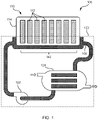
- FIG. 1 shows a heat transfer system 100 that includes an electrochemical cell unit 110 comprising an electrochemical cell 112.
- the heat transfer system 100 also includes a fluid circulation system 120 including one or more fluid paths for circulating a cooling medium 102 that is disposed within the fluid circulation system 120 and dispersed throughout the fluid paths.
- the fluid circulation system 120 includes a heat exchange section 142 that is in thermal contact with the electrochemical cell unit 110 such that heat generated within the electrochemical cell unit 110 may be transferred to the cooling medium 102 within the fluid circulation system 120.
- the cooling medium 102 comprises two phases, including a liquid component and a gas component.
- the electrochemical cell unit 110 During operation of the electrochemical cell unit 110, as current is either delivered to or drawn from the electrochemical cell 112, some energy may be converted to heat within the electrochemical cell 112 or neighboring electrochemical cells 112. As a result, the electrochemical cell 112 may rise in temperature. A temperature difference between the electrochemical cell 112 and the cooling medium 102 within the heat exchange section 142 may cause energy to be dissipated from the electrochemical cell 112 to the cooling medium 102. Likewise, the cooling medium 102 adjacent to other electrochemical cells 112 of the electrochemical cell unit 110 may similarly absorb heat from the other respective electrochemical cells 112.
- the heat transfer system 100 may also include a pump 122 configured to circulate the cooling medium 102 through the fluid circulation system 120.
- the fluid circulation system 120 may be in the form of a loop with the pump 122 arranged in the loop to circulate all of the cooling medium 102 around the loop of the fluid circulation system 120.
- the pump 122 may have a different configuration, and operate to circulate the cooling medium 102 in another manner, as described in various embodiments below.
- the term pump includes any device that uses energy to move a fluid.
- the pump can be formed by any actuator or mechanism that moves fluid, such as rotary, piston or other pumps.
- the heat transfer system 100 may be configured without a pump.
- the cooling medium 102 may circulate through the fluid circulation system 120 as a result of variations in temperature and convection, for example by thermo-syphoning.
- the heat transfer system 100 may also include a heat exchanger 124 within the fluid circulation system 120.
- the heat exchanger 124 may be configured to remove energy from the cooling medium 102 that was absorbed from the electrochemical cell unit 110 within the heat exchange section 142 of the fluid circulation system 120.
- another fluid may run through the heat exchanger 124 to absorb heat from the cooling medium 102.
- the heat exchanger may be constructed as a parallel flow, counter flow, or cross flow heat exchanger.
- the heat exchanger may be a radiator and the second fluid that is used to cool the cooling medium 102 may be air.
- the second fluid may be a liquid coolant that is cooled in yet another heat exchanger.
- the heat exchanger 124 may include interposed passages that hold the cooling medium 102 and the second fluid.
- the heat exchanger may have a simpler construction, such as a first plate with a passage that holds the cooling medium 102 and a second plate with a passage that holds the second fluid. Other configurations are also possible.
- the heat transfer system 100 may include other structures to absorb energy from the cooling medium 102, in addition to or instead of a heat exchanger.
- a heat sink may be used to reduce the temperature of the cooling medium 102.
- the electrochemical cell unit may include a plurality of electrochemical cells.
- the electrochemical cell unit 110 includes a number of electrochemical cells 112 that are electrically connected and disposed in a single housing 114 that forms the electrochemical cell unit 110.
- the electrochemical cell unit 110 may be a battery pack that includes a plurality of battery cells that are disposed within a battery pack housing.
- the electrochemical cell unit 110 may include a single electrochemical cell, such as a single battery or other type of cell.
- the ratio of the gas component and the liquid component of the cooling medium 102 may vary over a range of values. Furthermore, as explained in more detail below, the ratio of the gas component to the liquid component may vary within the fluid circulation system 100. For example, in some embodiments, in certain areas of the fluid circulation system 120, the gas component may form a higher percentage of the cooling medium 102 than in other areas of the fluid circulation system 120.
- the gas component may form at least 50% by volume of the cooling medium 102. Further in some embodiments the gas component may form at least 75% by volume of the cooling medium 102, or at least 80% of the cooling medium, or at least 90% of the cooling medium. Moreover, the weight of the gas component of the cooling medium is not substantial. Accordingly, the replacement of a liquid with the gas component of the cooling medium results in a substantially direct reduction in weight of the system. Thus, a system where 80% of the cooling medium is gas may have a reduction in weight of about 80% compared to a system where the cooling medium is entirely liquid. Of course, in other embodiments, the gas component may form a smaller percentage of the cooling medium within the heat exchange section 142 of the fluid circulation system 120.
- the term foam includes bubbles of gas that are dispersed in a liquid.
- the foam is stable for at least 10 seconds, for example at least 30 seconds, for example at least 1 minute.
- the foam moves collectively through the heat exchange section, such that the velocity of the gas component in the heat exchange section is substantially equal to the velocity of the liquid component in the heat exchange section.
- the bubbles of gas and the liquid surrounding the bubbles substantially move together through the fluid circulation system.
- the velocity of the liquid component through the center of a conduit of the fluid circulation system is at least 80% of the velocity of the gas component through the center of the same conduit.
- the bubbles of the gas component move through the liquid component, and the liquid component moves at a slower velocity.
- the liquid component of the cooling medium includes one or more liquid coolants.
- the liquid component of the cooling medium may include a water-based coolant.
- a coolant may include glycol or other additives.
- the liquid component of the cooling medium may alternatively be an oil-based coolant.
- the liquid coolants of the cooling medium may include various mixtures of components, as would be understood by those of ordinary skill in the art.
- the liquid component of the cooling medium includes at least one of a surfactant and a foam suppressant.
- the liquid component of the cooling medium includes concentrations of both surfactants and foam suppressants to influence various characteristics of the cooling medium, such as bubble size, viscosity, and others.
- the heat exchange section of the fluid circulation system includes fluid conduits extending through the electrochemical cell unit that are electrically isolated from the electrochemical cell.
- FIG. 2 shows a more detailed embodiment of an electrochemical cell unit with such a configuration.
- the electrochemical cell unit shown in FIG. 2 is configured as a battery pack 210 including a plurality of battery cells 212.
- batteries 210 including a plurality of battery cells 212.
- units having the same configuration as shown in FIG. 2 with other types of electrochemical cells are also possible.
- the battery pack 210 may include a housing 214 that holds the battery cells 212 and a plurality of enclosed fluid conduits 244 of the fluid circulation system 220.
- the fluid conduits 244 that run through the battery pack 210 may be defined by enclosed conduit walls 246, such as pipes.
- the battery cells 212 are isolated from the cooling medium 202 inside the fluid conduits 244.
- the internal electrical connections 218 between the battery cells 212 and the external connections 216 of the battery pack 210 are also isolated from the cooling medium 202.
- the conduit walls 246 may be formed of a thermally conductive material, such as metal, so that energy from the battery cells can be readily transferred to the cooling medium 202 disposed in the fluid circulation system 220.
- the electrical connections may include any conductive structure to transfer current from one battery cell to another.
- the electrical connections may include tabs that act as a terminal for each of the battery cells, which are connected to one another by wires or conductive bars. Other electrical connections are also possible.
- the battery cells 212 are pouch cells.
- the casing of the battery cells 212 may be in the form of a pouch formed of a flexible material, such as a foil.
- Tabs that form the terminals for the battery cells 212 may be connected to the electrodes within the casing and extend out of the casing for electrical connection to other battery cells 212. Further, the tabs may be sealed where they pass through the cell casing.
- the battery cells may be prism cells or cylindrical cells.
- the fluid circulation system of the embodiment of FIG. 2 extends through the electrochemical cell unit
- the fluid circulation system may be positioned entirely outside of the housing of the electrochemical cell unit.
- the heat exchange section of the fluid circulation system may be positioned adjacent to, but outside of, the electrochemical cell unit.
- the housing of the electrochemical cell unit may provide passages through the middle of the unit to allow the cooling medium to flow near different areas of the electrochemical cell unit.
- FIG. 3 illustrates another embodiment of a heat transfer system according to the disclosure.
- the heat transfer system 300 illustrated in FIG. 3 is part of an electric vehicle 390 and includes an electrochemical cell unit in the form of a battery pack 310.
- similar heat transfer systems may also include other types of electrochemical cell units and may be included in other types of machines or apparatuses as previously described.
- the battery pack 310 shown in FIG. 3 includes a plurality of battery cells 312 held in a housing 314.
- the heat transfer system 300 includes a fluid circulation system 320 that contains a cooling medium 302 including both a liquid component and a gas component.
- the liquid component and gas component of the cooling medium 302 are mixed within a heat exchange section 342 of the fluid circulation system 320.
- the fluid circulation system 320 includes a plurality of conduits 344 defined by discrete conduit walls 346 that extend through the electrochemical cell unit 310. Accordingly, the cooling medium 302 is held in the fluid conduits 344 and is in thermal communication with the electrochemical cells 312 within a heat exchange section 342 of the fluid circulation system 520.
- the fluid circulation system 320 of the embodiment of heat transfer system 300 shown in FIG. 3 has a primary circuit 340 that includes the heat exchange section 342 and a return path 348 that recycles the cooling medium 302.
- the liquid component of the cooling medium 302 may be confined to the primary circuit 340.
- the gas component of the cooling medium 302 may be introduced upstream of the heat exchange section 342 and then extracted from the primary circuit 340 downstream of the heat exchange section 342.
- the cooling medium 302 may contain both the liquid component and the gas component within the heat exchange section 342, the two components can be separated in other parts of the fluid circulation system.
- the fluid circulation system 320 of heat transfer system 300 shown in FIG. 3 may include a gas inlet 364 into the primary circuit 340 positioned upstream of the heat exchange section 342 and a gas outlet 366 from the primary circuit 340 downstream of the heat exchange section.
- the gas inlet is one of a plurality of gas inlets disposed upstream of the heat exchange section.
- the primary circuit 340 may include a plurality of gas inlets 364 coupled to a gas line 362 in order to inject the gas component of the cooling medium 302 at various locations of the primary circuit 340 that are upstream of the heat exchange section 342.
- the use of multiple gas inlets 364 may allow the gas component to be injected into the primary circuit 340 at locations that allow the gas component to be dispersed throughout the battery pack 310.
- one or more gas component may be located to inject bubbles of the gas component between each of the battery cells 312.
- the use of multiple gas inlets 364 may also aid in dispersing the gas component within the liquid component.
- the use of multiple gas inlets 364 can help form smaller bubbles of the gas component within the liquid component of the cooling medium 302.
- the fluid circulation system 320 may also include gas inlets 364 for the gas component of the cooling medium 302 that are within the heat exchange section 342 of the primary circuit 340.
- the gas component of the cooling medium 302 may be injected into the primary circuit 340 of the fluid circulation system both upstream of and within the heat exchange section 342.
- the use of gas inlets 364 within the heat exchange section 342 can help promote the distribution of gas throughout the heat exchange section 342.
- gas inlets 364 may be placed within the heat exchange section at locations where gas bubbles would not travel or where a gas bubble might otherwise become stagnant, such as in a corner.
- the fluid circulation system 320 may include gas inlets 364 that are only located within the heat exchange section 342 of the primary circuit 340.
- the gas inlet may be disposed under the electrochemical cell and the gas outlet may be disposed above the electrochemical cell such that buoyancy of the gas component causes the gas component to rise through the electrochemical cell unit.
- the gas inlets 364 of the fluid circulation system 320 of the embodiment shown in FIG. 3 are positioned beneath the battery cells 312 of battery pack 310. Accordingly, as the gas component of the cooling medium is injected into the primary circuit 340, gas bubbles will form and rise through the liquid component.
- the gas component may be delivered into the primary circuit from the gas line 362 using a pump 322. The gas bubbles will continue to rise because of their buoyancy until they reach the surface of the liquid component.
- a gas outlet 366 positioned at the top of the battery pack 310 and above the surface of the liquid component of the cooling medium 302 can be used to collect the gas component that has been injected into the primary circuit 340.
- the rising of the gas bubbles may cause the liquid component of the cooling medium 302 to also rise through the battery pack 310.
- the liquid component may then drain back toward bottom of the battery pack 310 through a return path 348 due to gravity.
- the gas pump 322 is sufficient to circulate the gas component of the cooling medium 302 about the fluid circulation system 320.
- the heat transfer system 300 may include both liquid and gas pumps to move the different components of the cooling medium 302 when they are separated.
- the flow of bubbles of the gas component through the liquid component of the cooling medium may result in turbulence and increased mixing of the cooling medium within the fluid circulation system.
- This increased mixing can increase the heat transfer from the electrochemical cell unit to the cooling medium, thereby raising the efficiency of the heat transfer system.
- This efficiency increase of the heat transfer between the electrochemical cell unit and the cooling medium can make the heat transfer system of the disclosure attractive even in situations where weight reduction is not a significant consideration.
- the fluid circulation system of the system may include a secondary circuit extending from the gas outlet to the gas inlet so as to recirculate the gas component about the fluid circulation system.
- heat transfer system 300 may include a secondary circuit 360 that extends from the top of the battery pack 310 where the gas component is collected through the gas outlet 366 to the gas line 362 where the gas component is injected into the liquid component of the cooling medium 302 through the gas inlets 364.
- the secondary circuit 360 may further include the gas pump 322 to drive the gas component into the primary circuit 340.
- the use of the secondary circuit 360 can allow the gas component to be recirculated through the battery pack, rather than being exhausted.
- the gas component of the cooling medium may be air that is captured from the surrounding environment. Accordingly, such an embodiment may include an air intake upstream of the gas inlet to the primary circuit and the gas outlet may be exhausted from the system without the need to recycle the air with a secondary circuit. Moreover, in some embodiments, the air intake may be connected to one or more filters to dry the air and remove undesired contaminants. Still in other embodiments, the gas component of the fluid circulation system may be a stored or generated gas that is not recycled, but allowed to escape into the surrounding environment.
- the heat transfer system 300 may also include a heat exchanger 324 to absorb energy from the cooling medium 302.
- the battery pack 310 may sit on a heat exchanger 324 in the form of a plate with a coolant running through the heat exchanger.
- the position of the heat exchanger 324 at the bottom of the battery pack allows the liquid component of the cooling medium 302 that has recirculated through the return path 348 to be cooled before it is driven back through the heat exchange section 342 of the fluid circulation system 320, where it cools the battery cells 312.
- the heat transfer system may include a controller configured to carry out methods of operating the heat transfer system as described below.
- the heat transfer system 300 shown in FIG. 3 , includes a controller 380 that is configured to send control signals to the gas pump 322 in order to operate the gas pump so as to circulate the cooling medium 302 through the fluid circulation system 320.
- the controller 380 may include a non-transitory computer-readable medium with program instructions stored thereon for performing the method of the disclosure.
- the controller 380 may include at least one memory 382, at least one processor 384, and/or a network interface 386. Additionally or alternatively, in other embodiments, the controller 380 may include a different type of computing device operable to carry out the program instructions.
- the controller may include an application specific integrated circuit (ASIC) that performs processor operations, or a field-programmable gate array (FPGA).
- ASIC application specific integrated circuit
- FPGA field-programmable gate array
- controller 380 of heat transfer system 300 may be physically disposed within the electric vehicle 390, as shown in FIG. 3 , in other embodiments, at least some portion of the controller 380 may be physically separated from the rest of the electric vehicle 390. For example, in some embodiments, one or more parts of the controller 380 may be remote from the electric vehicle 390 and communicate with the rest of the electric vehicle via the network interface 386. Further, in some embodiments, the controller 380 may be a client device, i.e., a device actively operated by the user, while in other embodiments, the controller 380 may be a server device, e.g., a device that provides computational services to a client device. Moreover, other types of computational platforms are also possible in embodiments of the disclosure.
- the memory 382 may be a computer-usable memory, such as random access memory (RAM), read-only memory (ROM), non-volatile memory such as flash memory, a solid state drive, a hard-disk drive, an optical memory device, and/or a magnetic storage device.
- the processor 384 of controller 380 includes computer processing elements, e.g., a central processing unit (CPU), a digital signal processor (DSP), or a network processor.
- the processor 384 may include register memory that temporarily stores instructions being executed and corresponding data and/or cache memory that temporarily stores performed instructions.
- the memory 382 stores program instructions that are executable by the processor 384 for carrying out the methods and operations of the disclosure, as described herein.
- the network interface 386 provides a communications medium, such as, but not limited to, a digital and/or an analog communication medium, between the controller 380 and other computing systems or devices.
- the network interface may operate via a wireless connection, such as IEEE 802.11 or BLUETOOTH, while in other embodiments, the network interface 386 may operate via a physical wired connection, such as an Ethernet connection. Still in other embodiments, the network interface 386 may communicate using another convention.
- the controller 380 may receive sensor values from various sensors, and adapt the control signals sent to the gas pump 322 based on the values from the sensors. For example, the controller 380 may receive temperature values from a temperature sensor 388 and use a feedback loop to send control signals to the pump 322 based on the value received from the temperature sensor 388. Further, the controller 380 may receive values corresponding to the current flowing into or out of the battery pack 310 from an ammeter, and adjust control signals based on the received value from the ammeter.
- the cooling medium includes the liquid component and the gas component throughout the fluid circulation system.
- Heat transfer system 400 includes an electrochemical cell unit 410 with a plurality of electrochemical cells 412.
- the system also includes a fluid circulation system 420 with both the liquid component and gas component of the cooling medium 402 dispersed throughout the system.
- the fluid circulation system has a plurality of conduits 444 formed by discrete conduit walls 446 extending through the electrochemical cell unit 410 such that the cooling medium 402 held in the fluid conduits 444 is in thermal communication with the electrochemical cells 412 within a heat exchange section 442 of the fluid circulation system 420.
- heat transfer system 400 illustrated in FIG. 4 is part of an electric vehicle 490 and includes an electrochemical cell unit in the form of a battery pack 410, similar heat transfer systems may also include other types of electrochemical cell units and may be included in other types of machines or apparatuses as previously described.
- the heat transfer system 400 may include a pump 422 configured to propel the cooling medium, including both the liquid component and the gas component, about the fluid circulation system 420.
- the cooling medium 402 may be in the form of a foam, as described above, that is driven through the paths of the fluid circulation system 420 by pump 422.
- the pump 422 may help generate the foam by separating the gas component into discrete bubbles within the liquid component.
- the heat transfer system 400 may also include a heat exchanger 424 that reduces the temperature of the cooling medium 402 as it circulates through the fluid circulation system 420.
- the heat exchanger 424 may be positioned upstream of the pump, as shown in FIG. 4 , or it may be positioned downstream.
- the heat exchanger may include several sections that are positioned both upstream and downstream of the pump.
- the electrochemical cell unit 410 shown in FIG. 4 may be a battery pack or other type of unit, and the apparatus 490 may be an electric vehicle or another machine or apparatus.
- the heat transfer system 400 may also include a controller 480 having any of the features and configurations described above with respect to the controller shown in FIG. 3 , such as a processor 482, a memory 484 and a communication interface 486.
- the heat transfer system 400 may include a mixer configured to promote bubble formation within the cooling medium.
- the fluid circulation system 420 may include a reservoir 428 where the cooling medium 402 collects.
- a mixer 426 may be associated with the reservoir 428 and operate to form discrete bubbles of the gas component in the cooling medium 402.
- the mixer 426 may be configured as a pump, as shown in FIG. 4 .
- the mixer 426 may be configured as an agitator including an impeller or a shaking component. Other configurations are also possible.
- the embodiment shown in FIG. 4 includes a reservoir 428 in connection with the mixer 426, in other embodiments, the mixer may be positioned in another location, such as within a conduit of the fluid circulation system.
- heat exchanger 424, pump 422, reservoir 428, and mixer 426 are all shown outside of the housing 414 of the electrochemical cell unit 410, in other embodiments, some or all of these components may be part of the electrochemical cell unit and disposed within the housing.
- the electrochemical cell unit 410 shown in FIG. 4 may be a battery pack or other type of unit, and the apparatus 490 may be an electric vehicle or another machine or apparatus.
- the heat transfer system 400 may also include a controller 480 having any of the features and configurations described above with respect to the controller shown in FIG. 3 , such as a processor 482, a memory 484 and a communication interface 486.
- the disclosure provides an electric vehicle including a heat transfer system that includes a battery pack including a plurality of battery cells.
- the heat transfer system also includes a fluid circulation system including a heat exchange section in thermal contact with the battery pack.
- a cooling medium is disposed in the fluid circulation system, and, within the heat exchange section of the fluid circulation system, the cooling medium comprises a mixture including a liquid component and a gas component.
- a pump is configured to circulate the cooling medium through the fluid circulation system.
- the heat transfer system may include any of the various features of the heat transfer systems described above.
- the disclosure provides a heat transfer system comprising an electrochemical cell unit including an electrochemical cell, and a fluid circulation system.
- the fluid circulation system includes a primary circuit that extends through the electrochemical cell unit.
- the fluid circulation system also includes a secondary circuit that extends from a gas outlet from the primary circuit that is downstream of the electrochemical cell to a gas inlet into the primary circuit that is upstream of the electrochemical cell.
- the disclosure provides a method of cooling an electrochemical cell unit.
- FIG. 5 illustrates an embodiment of such a method 500.
- the method 500 may be performed using any of the heat transfer systems, 100, 300, or 400 shown in FIGS. 1 , 3 , and 4 , or alternative configurations thereof.
- the method 500 may involve providing a heat exchange section of a fluid circulation system in thermal contact with and electrically isolated from a plurality of electrochemical cells within electrochemical cell unit.
- the method may also involve circulating a cooling medium through the fluid circulation system so as to transfer energy from the electrochemical cell unit to the cooling medium, wherein, within the heat transfer section of the fluid circulation system, the cooling medium includes a liquid component and a gas component.
- circulating the cooling medium at block 504 may maintain, within the heat exchange section of the fluid circulation system, the gas component of the cooling medium in a ratio of at least 50 % by volume.
- the controller 380 may send operating signals to the gas pump 322 in order to inject a sufficient volume of the gas component into the primary circuit 340 of the fluid circulation system 320 to maintain the gas component of the cooling medium 302 in a ratio of at least 50% by volume.
- the heat exchange system 400 shown in FIG.
- the controller 480 may send control signals to the mixer 426 or pump 422 to generate desired foam properties of the cooling medium 402 and move the cooling medium 402 through the electrochemical cell unit 410 in a manner that maintains a majority of the cooling medium as gas within the heat exchange section the fluid circulation system 420.
Landscapes
- Chemical & Material Sciences (AREA)
- Chemical Kinetics & Catalysis (AREA)
- Electrochemistry (AREA)
- General Chemical & Material Sciences (AREA)
- Engineering & Computer Science (AREA)
- Manufacturing & Machinery (AREA)
- Secondary Cells (AREA)
Abstract
Description
- Various electrochemical cells, such as batteries, are used to provide power to electrical devices when needed. Similar to other electrochemical cells, as current is delivered to or drawn from the batteries, most batteries will generate heat. If the heat that is generated is not dissipated the battery will rise in temperature. Batteries typically have an effective operating temperature range, and if the battery exceeds the maximum operating temperature, the battery can become ineffective or even fail. In some cases, after a slight rise in temperature, a battery may be able to dissipate heat to its surroundings through a simple heat sink or without any thermal management. In other cases, a more specific heat transfer system is needed to dissipate heat that is generated by the battery.
- Many heat transfer systems circulate a fluid to cool components that generate heat. These systems can be both complex and heavy. Accordingly, it can be particularly important that the thermal management of heat-generating components is carried out using efficient heat transfer systems.
- Aspects of the invention are recited in the independent claims and preferred features are recited in the dependent claims.
- These as well as other aspects, advantages, and alternatives, will become apparent to those of ordinary skill in the art by reading the following detailed description.
- The accompanying drawings are included to provide a further understanding of the systems and methods of the disclosure, and are incorporated in and constitute a part of this specification. The drawings are not necessarily to scale, and sizes of various elements may be distorted for clarity. The drawings illustrate one or more embodiment(s) of the disclosure, and together with the description serve to explain the principles and operation of the disclosure.
-
FIG. 1 is a schematic plan view of a heat transfer system according to an embodiment of the disclosure; -
FIG. 2 is a schematic plan view of an electrochemical cell unit according to an embodiment of the disclosure; -
FIG. 3 is a schematic plan view of a heat transfer system according to another embodiment of the disclosure; -
FIG. 4 is a schematic plan view of a heat transfer system according to yet another embodiment of the disclosure; and -
FIG. 5 is a flow chart of a method according to an embodiment of the disclosure. - Disclosed herein are systems and methods for the thermal management of electrochemical cells. Beneficially, the systems and methods utilize a cooling medium that includes a liquid component and a gas component.
- Thus, in a first aspect, the present disclosure provides a heat transfer system comprising:
- an electrochemical cell unit comprising a plurality of electrochemical cells;
- a fluid circulation system electrically isolated from the electrochemical cell unit and comprising a heat exchange section in thermal contact with the electrochemical cell unit;
- a cooling medium disposed in the fluid circulation system, wherein, within the heat exchange section of the fluid circulation system, the cooling medium includes a liquid component and a gas component; and
- a pump configured to circulate the cooling medium through the fluid circulation system.
- In some embodiments of the heat transfer system, within the heat exchange section of the fluid circulation system, the gas component forms at least 50% by volume of the cooling medium.
- In some embodiments of the heat transfer system, within the heat exchange section of the fluid circulation system, at least a portion of the liquid component and gas component of the cooling medium form a foam.
- In some embodiments of the heat transfer system the heat exchange section of the fluid circulation system includes enclosed fluid conduits that extend through the electrochemical cell unit.
- In some embodiments of the heat transfer system the liquid component of the cooling medium includes at least one of a surfactant and a foam suppressant.
- In some embodiments of the heat transfer system the fluid circulation system comprises:
- a primary circuit including the heat exchange section, wherein the liquid component of the cooling medium is confined to the primary circuit,
- a gas inlet in the primary circuit that is upstream of the heat exchange section; and a gas outlet in the primary circuit that is downstream of the heat exchange section.
- In some embodiments of the heat transfer system the gas inlet is one of a plurality of gas inlets disposed upstream of the heat exchange section.
- In some embodiments of the heat transfer system the gas inlet is disposed under the electrochemical cell unit and the gas outlet is disposed above the electrochemical cell unit such that buoyancy of the gas component causes the gas component to rise through the electrochemical cell unit.
- In some embodiments of the heat transfer system the fluid circulation system further comprises a secondary circuit extending from the gas outlet to the gas inlet so as to recirculate the gas component about the fluid circulation system.
- In some embodiments of the heat transfer system the cooling medium includes the liquid component and the gas component throughout the fluid circulation system.
- In some embodiments of the heat transfer system the pump is configured to circulate the liquid component and gas component of the cooling medium as a mixture about the fluid circulation system.
- In some embodiments of the heat transfer system the further comprising a mixer configured to promote bubble formation within the cooling medium.
- In another aspect, the disclosure provides a method of cooling an electrochemical cell unit, the method comprising:
- providing a heat exchange section of a fluid circulation system in thermal contact with and electrically isolated from a plurality of electrochemical cells within an electrochemical cell unit; and
- circulating a cooling medium through the fluid circulation system so as to transfer energy from the electrochemical cell unit to the cooling medium, wherein, within the heat transfer section of the fluid circulation system, the cooling medium includes a liquid coolant and a gas.
- In some embodiments of the method, circulating the cooling medium maintains, within the heat exchange section of the fluid circulation system, the gas component of the cooling medium in a ratio of at least 50 % by volume.
- In some embodiments of the method, circulating the cooling medium includes maintaining the cooling medium in the form of a foam throughout the fluid circulation system.
- In some embodiments of the method, circulating the cooling medium includes circulating conveying the foam through a pump.
- In some embodiments of the method, the fluid circulation system comprises a primary circuit including the heat exchange section,
wherein the liquid component of the cooling medium is confined to the primary circuit, and
wherein circulating the cooling medium includes injecting the gas component into the primary circuit. - In some embodiments of the method, injecting the gas component into the primary circuit drives the liquid component through the fluid circulation system.
- In some embodiments of the method, the gas component is injected into the primary circuit at a location that is beneath the electrochemical cell unit such that buoyancy of the gas component causes the gas component to rise through the electrochemical cell unit.
- In some embodiments the method further includes collecting the gas component through an outlet of the primary circuit.
- Example systems and methods are described herein. It should be understood that the words "example" and "exemplary" are used herein to mean "serving as an example, instance, or illustration." Any embodiment or feature described herein as being an "example" or "exemplary" is not necessarily to be construed as preferred or advantageous over other embodiments or features. In the following detailed description, reference is made to the accompanying figures, which form a part thereof. In the figures, similar symbols typically identify similar components, unless context dictates otherwise. Other embodiments may be utilized, and other changes may be made, without departing from the scope of the subject matter presented herein.
- The example embodiments described herein are not meant to be limiting. It will be readily understood that the aspects of the present disclosure, as generally described herein, and illustrated in the figures, can be arranged, substituted, combined, separated, and designed in a wide variety of different configurations, all of which are explicitly contemplated herein.
- As used herein, with respect to measurements, "about" means +/- 5 %.
- Unless otherwise indicated, the terms "first," "second," etc. are used herein merely as labels, and are not intended to impose ordinal, positional, or hierarchical requirements on the items to which these terms refer. Moreover, reference to, e.g., a "second" item does not require or preclude the existence of, e.g., a "first" or lower-numbered item, and/or, e.g., a "third" or higher-numbered item.
- Reference herein to "one embodiment" or "one example" means that one or more feature, structure, or characteristic described in connection with the example is included in at least one implementation. The phrases "one embodiment" or "one example" in various places in the specification may or may not be referring to the same example.
- As used herein, a system, apparatus, device, structure, article, element, component, or hardware "configured to" perform a specified function is indeed capable of performing the specified function without any alteration, rather than merely having potential to perform the specified function after further modification. In other words, the system, apparatus, structure, article, element, component, or hardware "configured to" perform a specified function is specifically selected, created, implemented, utilized, programmed, and/or designed for the purpose of performing the specified function. As used herein, "configured to" denotes existing characteristics of a system, apparatus, structure, article, element, component, or hardware which enable the system, apparatus, structure, article, element, component, or hardware to perform the specified function without further modification. For purposes of this disclosure, a system, apparatus, structure, article, element, component, or hardware described as being "configured to" perform a particular function may additionally or alternatively be described as being "adapted to" and/or as being "operative to" perform that function.
- In the following description, numerous specific details are set forth to provide a thorough understanding of the disclosed concepts, which may be practiced without some or all of these particulars. In other instances, details of known devices and/or processes have been omitted to avoid unnecessarily obscuring the disclosure. While some concepts will be described in conjunction with specific examples, it will be understood that these examples are not intended to be limiting.
- The systems and methods described herein are adapted for heat transfer systems that use a cooling medium which includes a liquid component and a gas component. The cooling medium is circulated through a fluid circulation system that includes a heat exchange section in thermal contact with a heat-generating electrical component. Accordingly, the cooling medium absorbs energy from the electrical component to maintain the electrical component within a desired temperature range.
- In some embodiments, the electrical component of the heat transfer system is an electrochemical cell unit including one or more electrochemical cells. For instance, in some embodiments, the electrical component is a battery pack that includes a plurality of batteries. In other embodiments, the electrical component is another type of electrochemical cell, such as a fuel cell. Still, in other embodiments the heat transfer system includes another type of electrical component, such as a motor or a computer.
- In some embodiments, the heat transfer system is part of a vehicle. For example, in some embodiments, the heat transfer system is associated with electrochemical cells and/or motors in a car, truck, locomotive, boat, or plane. In other embodiments, the heat transfer system is part of a stationary system such as a power storage or power generation system. Still, in other embodiments, the heat transfer system is part of another system that includes a heat-generating electrical component.
- The use of a cooling medium that includes both a liquid component and a gas component can provide several advantages. For example, the inclusion of the gas component as part of the cooling medium reduces of the weight of the cooling medium that is circulated through the fluid circulation system. As a result, the entire heat transfer system may have a reduced weight compared to conventional heat transfer systems. This weight reduction may be advantageous in various types of systems. For instance, vehicles that use large electrical components, such as batteries or motors, may obtain a performance advantage by having a reduced weight of the heat transfer system. The reduced weight of the cooling medium and heat transfer system can either be beneficial by reducing the overall weight of the vehicle, thereby improving maneuverability or efficiency. Alternatively, the reduction of weight of the cooling medium and heat transfer system can allow the vehicle to add additional beneficial components while maintaining the overall weight of the vehicle. For example, with the reduction in weight of the cooling medium, additional battery cells may be added while maintaining the weight of a battery pack.
- In addition to vehicles, there are other instances where weight reduction may be advantageous. For example, the position of the heat transfer system can cause the weight reduction to be beneficial. For instance, in elevated positions, such as wind turbines or electrical systems at the top of buildings, the reduction in weight is advantageous for the structural integrity of the supporting construction.
- With reference to the Figures,
FIG. 1 shows aheat transfer system 100 that includes anelectrochemical cell unit 110 comprising anelectrochemical cell 112. Theheat transfer system 100 also includes afluid circulation system 120 including one or more fluid paths for circulating a cooling medium 102 that is disposed within thefluid circulation system 120 and dispersed throughout the fluid paths. Thefluid circulation system 120 includes aheat exchange section 142 that is in thermal contact with theelectrochemical cell unit 110 such that heat generated within theelectrochemical cell unit 110 may be transferred to thecooling medium 102 within thefluid circulation system 120. Within theheat exchange section 142 of thefluid circulation system 120, the cooling medium 102 comprises two phases, including a liquid component and a gas component. - During operation of the
electrochemical cell unit 110, as current is either delivered to or drawn from theelectrochemical cell 112, some energy may be converted to heat within theelectrochemical cell 112 or neighboringelectrochemical cells 112. As a result, theelectrochemical cell 112 may rise in temperature. A temperature difference between theelectrochemical cell 112 and thecooling medium 102 within theheat exchange section 142 may cause energy to be dissipated from theelectrochemical cell 112 to thecooling medium 102. Likewise, the cooling medium 102 adjacent to otherelectrochemical cells 112 of theelectrochemical cell unit 110 may similarly absorb heat from the other respectiveelectrochemical cells 112. - The
heat transfer system 100 may also include apump 122 configured to circulate the cooling medium 102 through thefluid circulation system 120. In some embodiments, as in the embodiment shown inFIG. 1 , thefluid circulation system 120 may be in the form of a loop with thepump 122 arranged in the loop to circulate all of the cooling medium 102 around the loop of thefluid circulation system 120. In other embodiments, thepump 122 may have a different configuration, and operate to circulate the cooling medium 102 in another manner, as described in various embodiments below. - The term pump, as used herein, includes any device that uses energy to move a fluid. For example, the pump can be formed by any actuator or mechanism that moves fluid, such as rotary, piston or other pumps. Still, in other embodiments, the
heat transfer system 100 may be configured without a pump. For example, in some embodiments, the cooling medium 102 may circulate through thefluid circulation system 120 as a result of variations in temperature and convection, for example by thermo-syphoning. - In some embodiments, the
heat transfer system 100 may also include aheat exchanger 124 within thefluid circulation system 120. Theheat exchanger 124 may be configured to remove energy from the cooling medium 102 that was absorbed from theelectrochemical cell unit 110 within theheat exchange section 142 of thefluid circulation system 120. To promote cooling of the cooling medium 102 within theheat exchanger 124, another fluid may run through theheat exchanger 124 to absorb heat from the coolingmedium 102. The heat exchanger may be constructed as a parallel flow, counter flow, or cross flow heat exchanger. As an example, in some embodiments, the heat exchanger may be a radiator and the second fluid that is used to cool the cooling medium 102 may be air. In other embodiments, the second fluid may be a liquid coolant that is cooled in yet another heat exchanger. In some embodiments, theheat exchanger 124 may include interposed passages that hold thecooling medium 102 and the second fluid. In other embodiments, the heat exchanger may have a simpler construction, such as a first plate with a passage that holds the cooling medium 102 and a second plate with a passage that holds the second fluid. Other configurations are also possible. - Still, in other embodiments the
heat transfer system 100 may include other structures to absorb energy from the cooling medium 102, in addition to or instead of a heat exchanger. For example, in some embodiments, a heat sink may be used to reduce the temperature of thecooling medium 102. - In some embodiments, the electrochemical cell unit may include a plurality of electrochemical cells. For example, in the embodiment shown in
FIG. 1 , theelectrochemical cell unit 110 includes a number ofelectrochemical cells 112 that are electrically connected and disposed in asingle housing 114 that forms theelectrochemical cell unit 110. As an example, in some embodiments, theelectrochemical cell unit 110 may be a battery pack that includes a plurality of battery cells that are disposed within a battery pack housing. In other embodiments, theelectrochemical cell unit 110 may include a single electrochemical cell, such as a single battery or other type of cell. - In various embodiments of the
heat transfer system 100, the ratio of the gas component and the liquid component of the cooling medium 102 may vary over a range of values. Furthermore, as explained in more detail below, the ratio of the gas component to the liquid component may vary within thefluid circulation system 100. For example, in some embodiments, in certain areas of thefluid circulation system 120, the gas component may form a higher percentage of the cooling medium 102 than in other areas of thefluid circulation system 120. - In some embodiments, within the
heat exchange section 142 of thefluid circulation system 120, the gas component may form at least 50% by volume of thecooling medium 102. Further in some embodiments the gas component may form at least 75% by volume of the cooling medium 102, or at least 80% of the cooling medium, or at least 90% of the cooling medium. Moreover, the weight of the gas component of the cooling medium is not substantial. Accordingly, the replacement of a liquid with the gas component of the cooling medium results in a substantially direct reduction in weight of the system. Thus, a system where 80% of the cooling medium is gas may have a reduction in weight of about 80% compared to a system where the cooling medium is entirely liquid. Of course, in other embodiments, the gas component may form a smaller percentage of the cooling medium within theheat exchange section 142 of thefluid circulation system 120. - In some embodiments, within the heat exchange section of the fluid circulation system, at least a portion of the liquid component and gas component of the cooling medium form a foam. The term foam, as used herein, includes bubbles of gas that are dispersed in a liquid. In some embodiments the foam is stable for at least 10 seconds, for example at least 30 seconds, for example at least 1 minute. In some embodiments, the foam moves collectively through the heat exchange section, such that the velocity of the gas component in the heat exchange section is substantially equal to the velocity of the liquid component in the heat exchange section. In other words, in some embodiments, the bubbles of gas and the liquid surrounding the bubbles substantially move together through the fluid circulation system. For example, in some embodiments, the velocity of the liquid component through the center of a conduit of the fluid circulation system is at least 80% of the velocity of the gas component through the center of the same conduit. In other embodiments, the bubbles of the gas component move through the liquid component, and the liquid component moves at a slower velocity.
- In some embodiments, the liquid component of the cooling medium includes one or more liquid coolants. For example, the liquid component of the cooling medium may include a water-based coolant. Such a coolant may include glycol or other additives. Likewise, the liquid component of the cooling medium may alternatively be an oil-based coolant. The liquid coolants of the cooling medium may include various mixtures of components, as would be understood by those of ordinary skill in the art.
- In some embodiments, the liquid component of the cooling medium includes at least one of a surfactant and a foam suppressant. For example, in some embodiments, the liquid component of the cooling medium includes concentrations of both surfactants and foam suppressants to influence various characteristics of the cooling medium, such as bubble size, viscosity, and others.
- In some embodiments, the heat exchange section of the fluid circulation system includes fluid conduits extending through the electrochemical cell unit that are electrically isolated from the electrochemical cell.
FIG. 2 shows a more detailed embodiment of an electrochemical cell unit with such a configuration. The electrochemical cell unit shown inFIG. 2 is configured as abattery pack 210 including a plurality ofbattery cells 212. However, units having the same configuration as shown inFIG. 2 with other types of electrochemical cells are also possible. - The
battery pack 210, shown inFIG. 2 , may include ahousing 214 that holds thebattery cells 212 and a plurality of enclosedfluid conduits 244 of thefluid circulation system 220. For example, thefluid conduits 244 that run through thebattery pack 210 may be defined byenclosed conduit walls 246, such as pipes. Accordingly, thebattery cells 212 are isolated from the cooling medium 202 inside thefluid conduits 244. Likewise, the internalelectrical connections 218 between thebattery cells 212 and theexternal connections 216 of thebattery pack 210 are also isolated from the coolingmedium 202. Theconduit walls 246 may be formed of a thermally conductive material, such as metal, so that energy from the battery cells can be readily transferred to the cooling medium 202 disposed in thefluid circulation system 220. - The electrical connections may include any conductive structure to transfer current from one battery cell to another. For example, the electrical connections may include tabs that act as a terminal for each of the battery cells, which are connected to one another by wires or conductive bars. Other electrical connections are also possible.
- In some embodiments, the
battery cells 212 are pouch cells. For example, the casing of thebattery cells 212 may be in the form of a pouch formed of a flexible material, such as a foil. Tabs that form the terminals for thebattery cells 212 may be connected to the electrodes within the casing and extend out of the casing for electrical connection toother battery cells 212. Further, the tabs may be sealed where they pass through the cell casing. In other embodiments, the battery cells may be prism cells or cylindrical cells. - While the fluid circulation system of the embodiment of
FIG. 2 extends through the electrochemical cell unit, in other embodiments, the fluid circulation system may be positioned entirely outside of the housing of the electrochemical cell unit. For example, in some embodiments, the heat exchange section of the fluid circulation system may be positioned adjacent to, but outside of, the electrochemical cell unit. Further still, in some embodiments, the housing of the electrochemical cell unit may provide passages through the middle of the unit to allow the cooling medium to flow near different areas of the electrochemical cell unit. -
FIG. 3 illustrates another embodiment of a heat transfer system according to the disclosure. Theheat transfer system 300 illustrated inFIG. 3 is part of anelectric vehicle 390 and includes an electrochemical cell unit in the form of abattery pack 310. However, similar heat transfer systems may also include other types of electrochemical cell units and may be included in other types of machines or apparatuses as previously described. - The
battery pack 310 shown inFIG. 3 includes a plurality ofbattery cells 312 held in ahousing 314. Theheat transfer system 300 includes afluid circulation system 320 that contains a cooling medium 302 including both a liquid component and a gas component. In particular, the liquid component and gas component of the cooling medium 302 are mixed within aheat exchange section 342 of thefluid circulation system 320. - The
fluid circulation system 320 includes a plurality ofconduits 344 defined bydiscrete conduit walls 346 that extend through theelectrochemical cell unit 310. Accordingly, the cooling medium 302 is held in thefluid conduits 344 and is in thermal communication with theelectrochemical cells 312 within aheat exchange section 342 of the fluid circulation system 520. - The
fluid circulation system 320 of the embodiment ofheat transfer system 300 shown inFIG. 3 has aprimary circuit 340 that includes theheat exchange section 342 and areturn path 348 that recycles the coolingmedium 302. As shown inFIG. 3 , the liquid component of the cooling medium 302 may be confined to theprimary circuit 340. In contrast, the gas component of the cooling medium 302 may be introduced upstream of theheat exchange section 342 and then extracted from theprimary circuit 340 downstream of theheat exchange section 342. Accordingly, while the cooling medium 302 may contain both the liquid component and the gas component within theheat exchange section 342, the two components can be separated in other parts of the fluid circulation system. For example, thefluid circulation system 320 ofheat transfer system 300 shown inFIG. 3 , may include agas inlet 364 into theprimary circuit 340 positioned upstream of theheat exchange section 342 and agas outlet 366 from theprimary circuit 340 downstream of the heat exchange section. - In some embodiments, the gas inlet is one of a plurality of gas inlets disposed upstream of the heat exchange section. For example, the
primary circuit 340 may include a plurality ofgas inlets 364 coupled to agas line 362 in order to inject the gas component of the cooling medium 302 at various locations of theprimary circuit 340 that are upstream of theheat exchange section 342. The use ofmultiple gas inlets 364 may allow the gas component to be injected into theprimary circuit 340 at locations that allow the gas component to be dispersed throughout thebattery pack 310. For example, one or more gas component may be located to inject bubbles of the gas component between each of thebattery cells 312. Moreover, the use ofmultiple gas inlets 364 may also aid in dispersing the gas component within the liquid component. For example, the use ofmultiple gas inlets 364 can help form smaller bubbles of the gas component within the liquid component of thecooling medium 302. - In some embodiments, the
fluid circulation system 320 may also includegas inlets 364 for the gas component of the cooling medium 302 that are within theheat exchange section 342 of theprimary circuit 340. For example, in some embodiments, the gas component of the cooling medium 302 may be injected into theprimary circuit 340 of the fluid circulation system both upstream of and within theheat exchange section 342. The use ofgas inlets 364 within theheat exchange section 342 can help promote the distribution of gas throughout theheat exchange section 342. For example, in some embodiments,gas inlets 364 may be placed within the heat exchange section at locations where gas bubbles would not travel or where a gas bubble might otherwise become stagnant, such as in a corner. Alternatively, in some embodiments, thefluid circulation system 320 may includegas inlets 364 that are only located within theheat exchange section 342 of theprimary circuit 340. - In some embodiments, the gas inlet may be disposed under the electrochemical cell and the gas outlet may be disposed above the electrochemical cell such that buoyancy of the gas component causes the gas component to rise through the electrochemical cell unit. For example, the
gas inlets 364 of thefluid circulation system 320 of the embodiment shown inFIG. 3 are positioned beneath thebattery cells 312 ofbattery pack 310. Accordingly, as the gas component of the cooling medium is injected into theprimary circuit 340, gas bubbles will form and rise through the liquid component. For example, the gas component may be delivered into the primary circuit from thegas line 362 using apump 322. The gas bubbles will continue to rise because of their buoyancy until they reach the surface of the liquid component. Agas outlet 366 positioned at the top of thebattery pack 310 and above the surface of the liquid component of the cooling medium 302 can be used to collect the gas component that has been injected into theprimary circuit 340. - Further, in some embodiments, the rising of the gas bubbles may cause the liquid component of the cooling medium 302 to also rise through the
battery pack 310. The liquid component may then drain back toward bottom of thebattery pack 310 through areturn path 348 due to gravity. Accordingly, in some embodiments, thegas pump 322 is sufficient to circulate the gas component of the cooling medium 302 about thefluid circulation system 320. In other embodiments, theheat transfer system 300 may include both liquid and gas pumps to move the different components of the cooling medium 302 when they are separated. - In embodiments of the heat transfer system, the flow of bubbles of the gas component through the liquid component of the cooling medium, may result in turbulence and increased mixing of the cooling medium within the fluid circulation system. This increased mixing can increase the heat transfer from the electrochemical cell unit to the cooling medium, thereby raising the efficiency of the heat transfer system. This efficiency increase of the heat transfer between the electrochemical cell unit and the cooling medium can make the heat transfer system of the disclosure attractive even in situations where weight reduction is not a significant consideration.
- In some embodiments, the fluid circulation system of the system may include a secondary circuit extending from the gas outlet to the gas inlet so as to recirculate the gas component about the fluid circulation system. For example,
heat transfer system 300 may include asecondary circuit 360 that extends from the top of thebattery pack 310 where the gas component is collected through thegas outlet 366 to thegas line 362 where the gas component is injected into the liquid component of the cooling medium 302 through thegas inlets 364. Thesecondary circuit 360 may further include thegas pump 322 to drive the gas component into theprimary circuit 340. The use of thesecondary circuit 360 can allow the gas component to be recirculated through the battery pack, rather than being exhausted. - In other embodiments, the gas component of the cooling medium may be air that is captured from the surrounding environment. Accordingly, such an embodiment may include an air intake upstream of the gas inlet to the primary circuit and the gas outlet may be exhausted from the system without the need to recycle the air with a secondary circuit. Moreover, in some embodiments, the air intake may be connected to one or more filters to dry the air and remove undesired contaminants. Still in other embodiments, the gas component of the fluid circulation system may be a stored or generated gas that is not recycled, but allowed to escape into the surrounding environment.
- The
heat transfer system 300 may also include aheat exchanger 324 to absorb energy from the coolingmedium 302. For example, thebattery pack 310 may sit on aheat exchanger 324 in the form of a plate with a coolant running through the heat exchanger. The position of theheat exchanger 324 at the bottom of the battery pack allows the liquid component of the cooling medium 302 that has recirculated through thereturn path 348 to be cooled before it is driven back through theheat exchange section 342 of thefluid circulation system 320, where it cools thebattery cells 312. - In some embodiments, the heat transfer system may include a controller configured to carry out methods of operating the heat transfer system as described below. For example, the
heat transfer system 300, shown inFIG. 3 , includes acontroller 380 that is configured to send control signals to thegas pump 322 in order to operate the gas pump so as to circulate the cooling medium 302 through thefluid circulation system 320. - The
controller 380 may include a non-transitory computer-readable medium with program instructions stored thereon for performing the method of the disclosure. In some embodiments, thecontroller 380 may include at least onememory 382, at least oneprocessor 384, and/or anetwork interface 386. Additionally or alternatively, in other embodiments, thecontroller 380 may include a different type of computing device operable to carry out the program instructions. For example, in some embodiments, the controller may include an application specific integrated circuit (ASIC) that performs processor operations, or a field-programmable gate array (FPGA). - While
controller 380 ofheat transfer system 300 may be physically disposed within theelectric vehicle 390, as shown inFIG. 3 , in other embodiments, at least some portion of thecontroller 380 may be physically separated from the rest of theelectric vehicle 390. For example, in some embodiments, one or more parts of thecontroller 380 may be remote from theelectric vehicle 390 and communicate with the rest of the electric vehicle via thenetwork interface 386. Further, in some embodiments, thecontroller 380 may be a client device, i.e., a device actively operated by the user, while in other embodiments, thecontroller 380 may be a server device, e.g., a device that provides computational services to a client device. Moreover, other types of computational platforms are also possible in embodiments of the disclosure. - The
memory 382 may be a computer-usable memory, such as random access memory (RAM), read-only memory (ROM), non-volatile memory such as flash memory, a solid state drive, a hard-disk drive, an optical memory device, and/or a magnetic storage device. - The
processor 384 ofcontroller 380 includes computer processing elements, e.g., a central processing unit (CPU), a digital signal processor (DSP), or a network processor. In some embodiments, theprocessor 384 may include register memory that temporarily stores instructions being executed and corresponding data and/or cache memory that temporarily stores performed instructions. In certain embodiments, thememory 382 stores program instructions that are executable by theprocessor 384 for carrying out the methods and operations of the disclosure, as described herein. - The
network interface 386 provides a communications medium, such as, but not limited to, a digital and/or an analog communication medium, between thecontroller 380 and other computing systems or devices. In some embodiments, the network interface may operate via a wireless connection, such as IEEE 802.11 or BLUETOOTH, while in other embodiments, thenetwork interface 386 may operate via a physical wired connection, such as an Ethernet connection. Still in other embodiments, thenetwork interface 386 may communicate using another convention. - In some embodiments, the
controller 380 may receive sensor values from various sensors, and adapt the control signals sent to thegas pump 322 based on the values from the sensors. For example, thecontroller 380 may receive temperature values from atemperature sensor 388 and use a feedback loop to send control signals to thepump 322 based on the value received from thetemperature sensor 388. Further, thecontroller 380 may receive values corresponding to the current flowing into or out of thebattery pack 310 from an ammeter, and adjust control signals based on the received value from the ammeter. - In some embodiments of the heat transfer system, the cooling medium includes the liquid component and the gas component throughout the fluid circulation system. Such a system is shown, for example, in
FIG. 4 .Heat transfer system 400 includes anelectrochemical cell unit 410 with a plurality ofelectrochemical cells 412. The system also includes afluid circulation system 420 with both the liquid component and gas component of the cooling medium 402 dispersed throughout the system. The fluid circulation system has a plurality ofconduits 444 formed bydiscrete conduit walls 446 extending through theelectrochemical cell unit 410 such that the cooling medium 402 held in thefluid conduits 444 is in thermal communication with theelectrochemical cells 412 within a heat exchange section 442 of thefluid circulation system 420. - While the
heat transfer system 400 illustrated inFIG. 4 is part of anelectric vehicle 490 and includes an electrochemical cell unit in the form of abattery pack 410, similar heat transfer systems may also include other types of electrochemical cell units and may be included in other types of machines or apparatuses as previously described. - The
heat transfer system 400 may include apump 422 configured to propel the cooling medium, including both the liquid component and the gas component, about thefluid circulation system 420. For example, the cooling medium 402 may be in the form of a foam, as described above, that is driven through the paths of thefluid circulation system 420 bypump 422. Moreover, in some embodiments, thepump 422 may help generate the foam by separating the gas component into discrete bubbles within the liquid component. - Further, the
heat transfer system 400 may also include aheat exchanger 424 that reduces the temperature of the cooling medium 402 as it circulates through thefluid circulation system 420. Theheat exchanger 424 may be positioned upstream of the pump, as shown inFIG. 4 , or it may be positioned downstream. Moreover, in some embodiments, the heat exchanger may include several sections that are positioned both upstream and downstream of the pump. - Similar to the electrochemical cell unit shown in
FIG. 3 , theelectrochemical cell unit 410 shown inFIG. 4 may be a battery pack or other type of unit, and theapparatus 490 may be an electric vehicle or another machine or apparatus. Moreover, theheat transfer system 400 may also include acontroller 480 having any of the features and configurations described above with respect to the controller shown inFIG. 3 , such as aprocessor 482, amemory 484 and acommunication interface 486. - In some embodiments, the
heat transfer system 400 may include a mixer configured to promote bubble formation within the cooling medium. For example, in some embodiments, thefluid circulation system 420 may include areservoir 428 where the cooling medium 402 collects. Amixer 426 may be associated with thereservoir 428 and operate to form discrete bubbles of the gas component in thecooling medium 402. In some embodiments, themixer 426 may be configured as a pump, as shown inFIG. 4 . In other embodiments themixer 426 may be configured as an agitator including an impeller or a shaking component. Other configurations are also possible. Further, while the embodiment shown inFIG. 4 includes areservoir 428 in connection with themixer 426, in other embodiments, the mixer may be positioned in another location, such as within a conduit of the fluid circulation system. - While the
heat exchanger 424, pump 422,reservoir 428, andmixer 426 are all shown outside of thehousing 414 of theelectrochemical cell unit 410, in other embodiments, some or all of these components may be part of the electrochemical cell unit and disposed within the housing. - Similar to the electrochemical cell unit shown in
FIG. 3 , theelectrochemical cell unit 410 shown inFIG. 4 may be a battery pack or other type of unit, and theapparatus 490 may be an electric vehicle or another machine or apparatus. Moreover, theheat transfer system 400 may also include acontroller 480 having any of the features and configurations described above with respect to the controller shown inFIG. 3 , such as aprocessor 482, amemory 484 and acommunication interface 486. - In another aspect, the disclosure provides an electric vehicle including a heat transfer system that includes a battery pack including a plurality of battery cells. The heat transfer system also includes a fluid circulation system including a heat exchange section in thermal contact with the battery pack. A cooling medium is disposed in the fluid circulation system, and, within the heat exchange section of the fluid circulation system, the cooling medium comprises a mixture including a liquid component and a gas component. A pump is configured to circulate the cooling medium through the fluid circulation system. The heat transfer system may include any of the various features of the heat transfer systems described above.
- In another aspect, the disclosure provides a heat transfer system comprising an electrochemical cell unit including an electrochemical cell, and a fluid circulation system. The fluid circulation system includes a primary circuit that extends through the electrochemical cell unit. The fluid circulation system also includes a secondary circuit that extends from a gas outlet from the primary circuit that is downstream of the electrochemical cell to a gas inlet into the primary circuit that is upstream of the electrochemical cell.
- In another aspect, the disclosure provides a method of cooling an electrochemical cell unit.
FIG. 5 illustrates an embodiment of such amethod 500. In various embodiments, themethod 500 may be performed using any of the heat transfer systems, 100, 300, or 400 shown inFIGS. 1 ,3 , and4 , or alternative configurations thereof. As shown atblock 502, themethod 500 may involve providing a heat exchange section of a fluid circulation system in thermal contact with and electrically isolated from a plurality of electrochemical cells within electrochemical cell unit. Further, as shown atblock 504, the method may also involve circulating a cooling medium through the fluid circulation system so as to transfer energy from the electrochemical cell unit to the cooling medium, wherein, within the heat transfer section of the fluid circulation system, the cooling medium includes a liquid component and a gas component. - In some embodiments of the
method 500, circulating the cooling medium atblock 504 may maintain, within the heat exchange section of the fluid circulation system, the gas component of the cooling medium in a ratio of at least 50 % by volume. For example, in embodiments utilizing theheat exchange system 300 shown inFIG. 3 , thecontroller 380 may send operating signals to thegas pump 322 in order to inject a sufficient volume of the gas component into theprimary circuit 340 of thefluid circulation system 320 to maintain the gas component of the cooling medium 302 in a ratio of at least 50% by volume. Further, in embodiments utilizing theheat exchange system 400, shown inFIG. 4 , thecontroller 480 may send control signals to themixer 426 or pump 422 to generate desired foam properties of the cooling medium 402 and move the cooling medium 402 through theelectrochemical cell unit 410 in a manner that maintains a majority of the cooling medium as gas within the heat exchange section thefluid circulation system 420. - The above detailed description describes various features and functions of the disclosed systems, devices, and methods with reference to the accompanying Figures. In the Figures, similar symbols typically identify similar components, unless context dictates otherwise. The illustrative embodiments described in the detailed description, Figures, and claims are not meant to be limiting. Other embodiments can be utilized, and other changes can be made, without departing from the scope of the subject matter presented herein. It will be readily understood that the aspects of the present disclosure, as generally described herein, and illustrated in the Figures, can be arranged, substituted, combined, separated, and designed in a wide variety of different configurations, all of which are explicitly contemplated herein.
- While various aspects and embodiments have been disclosed herein, other aspects and embodiments will be apparent to those skilled in the art. The various aspects and embodiments disclosed herein are for purposes of illustration and are not intended to be limiting, with the true scope of the invention being indicated by the following claims.
Claims (15)
- A heat transfer system comprising:an electrochemical cell unit comprising a plurality of electrochemical cells;a fluid circulation system electrically isolated from the electrochemical cell unit and comprising a heat exchange section in thermal contact with the electrochemical cell unit;a cooling medium disposed in the fluid circulation system, wherein, within the heat exchange section of the fluid circulation system, the cooling medium includes a liquid component and a gas component; anda pump configured to circulate the cooling medium through the fluid circulation system.
- The heat transfer system according to claim 1, wherein, within the heat exchange section of the fluid circulation system, the gas component forms at least 50% by volume of the cooling medium, or
wherein, within the heat exchange section of the fluid circulation system, at least a portion of the liquid component and gas component of the cooling medium form a foam. - The heat transfer system according to claim 1 or claim 2, wherein the heat exchange section of the fluid circulation system includes enclosed fluid conduits that extend through the electrochemical cell unit.
- The heat transfer system according to any of claims 1 to 3, wherein the liquid component of the cooling medium includes at least one of a surfactant and a foam suppressant.
- The heat transfer system according to any of claims 1 to 4, wherein the fluid circulation system comprises:a primary circuit including the heat exchange section, wherein the liquid component of the cooling medium is confined to the primary circuit,a gas inlet in the primary circuit that is upstream of the heat exchange section; anda gas outlet in the primary circuit that is downstream of the heat exchange section.
- The heat transfer system according to claim 5, wherein the gas inlet is one of a plurality of gas inlets disposed upstream of the heat exchange section, or
wherein the gas inlet is disposed under the electrochemical cell and the gas outlet is disposed above the electrochemical cell such that buoyancy of the gas component causes the gas component to rise through the electrochemical cell unit, or
wherein the fluid circulation system further comprises a secondary circuit extending from the gas outlet to the gas inlet so as to recirculate the gas component about the fluid circulation system. - The heat transfer system according to any of claims 1 to 6, wherein the cooling medium includes the liquid component and the gas component throughout the fluid circulation system.
- The heat transfer system according to claim 7, wherein the pump is configured to circulate the liquid component and gas component of the cooling medium as a mixture about the fluid circulation system.
- The heat transfer system according to claim 7, further comprising a mixer configured to promote bubble formation within the cooling medium.
- A method of cooling an electrochemical cell unit, the method comprising:providing a heat exchange section of a fluid circulation system in thermal contact with and electrically isolated from a plurality of electrochemical cells within an electrochemical cell unit; andcirculating a cooling medium through the fluid circulation system so as to transfer energy from the electrochemical cell unit to the cooling medium, wherein, within the heat transfer section of the fluid circulation system, the cooling medium includes a liquid coolant and a gas.
- The method according to claim 10, wherein circulating the cooling medium maintains, within the heat exchange section of the fluid circulation system, the gas component of the cooling medium in a ratio of at least 50% by volume, or
wherein circulating the cooling medium includes maintaining the cooling medium in the form of a foam throughout the fluid circulation system, optionally wherein circulating the cooling medium includes circulating the foam through a pump. - The method according to claim 10 or claim 11, wherein the fluid circulation system comprises a primary circuit including the heat exchange section,
wherein the liquid component of the cooling medium is confined to the primary circuit, and
wherein circulating the cooling medium includes injecting the gas component into the primary circuit. - The method according to claim 12, wherein injecting the gas component into the primary circuit drives the liquid component through the fluid circulation system.
- The method according to claim 13, wherein the gas component is injected into the primary circuit at a location that is beneath the electrochemical cell unit such that buoyancy of the gas component causes the gas component to rise through the electrochemical cell unit.
- The method according to claim 14, further comprising collecting the gas component through an outlet of the primary circuit.
Priority Applications (6)
| Application Number | Priority Date | Filing Date | Title |
|---|---|---|---|
| EP21165708.5A EP4068472A1 (en) | 2021-03-29 | 2021-03-29 | Heat transfer system with heat transfer fluid including liquid and gas components |
| PCT/IB2022/052781 WO2022208268A1 (en) | 2021-03-29 | 2022-03-25 | Heat transfer system with heat transfer fluid including liquid and gas components |
| CN202280038718.2A CN117397091A (en) | 2021-03-29 | 2022-03-25 | Heat transfer system with heat transfer fluid including a liquid component and a gaseous component |
| KR1020237037233A KR20230163510A (en) | 2021-03-29 | 2022-03-25 | Heat transfer system with heat transfer fluid containing liquid and gaseous components |
| US18/284,858 US20240186616A1 (en) | 2021-03-29 | 2022-03-25 | Heat Transfer System with Heat Transfer Fluid Including Liquid and Gas Components |
| JP2023559981A JP2024511639A (en) | 2021-03-29 | 2022-03-25 | Heat transfer system using heat transfer fluid containing liquid and gas components |
Applications Claiming Priority (1)
| Application Number | Priority Date | Filing Date | Title |
|---|---|---|---|
| EP21165708.5A EP4068472A1 (en) | 2021-03-29 | 2021-03-29 | Heat transfer system with heat transfer fluid including liquid and gas components |
Publications (1)
| Publication Number | Publication Date |
|---|---|
| EP4068472A1 true EP4068472A1 (en) | 2022-10-05 |
Family
ID=75277930
Family Applications (1)
| Application Number | Title | Priority Date | Filing Date |
|---|---|---|---|
| EP21165708.5A Pending EP4068472A1 (en) | 2021-03-29 | 2021-03-29 | Heat transfer system with heat transfer fluid including liquid and gas components |
Country Status (6)
| Country | Link |
|---|---|
| US (1) | US20240186616A1 (en) |
| EP (1) | EP4068472A1 (en) |
| JP (1) | JP2024511639A (en) |
| KR (1) | KR20230163510A (en) |
| CN (1) | CN117397091A (en) |
| WO (1) | WO2022208268A1 (en) |
Citations (2)
| Publication number | Priority date | Publication date | Assignee | Title |
|---|---|---|---|---|
| US20160285145A1 (en) * | 2013-12-11 | 2016-09-29 | Bayerische Motoren Werke Aktiengesellschaft | Cooling Element |
| US20170138651A1 (en) * | 2014-06-26 | 2017-05-18 | Valeo Klimasysteme Gmbh | Branching means for a refrigerant flow of a refrigerant circuit |
Family Cites Families (2)
| Publication number | Priority date | Publication date | Assignee | Title |
|---|---|---|---|---|
| US4578324A (en) * | 1984-10-05 | 1986-03-25 | Ford Aerospace & Communications Corporation | Active cooling system for electrochemical cells |
| JP5482768B2 (en) * | 2011-11-28 | 2014-05-07 | Jfeエンジニアリング株式会社 | Cladding hydrate having latent heat storage performance, apparatus for manufacturing the same, latent heat storage medium, and processing apparatus for increasing latent heat storage amount of clathrate hydrate |
-
2021
- 2021-03-29 EP EP21165708.5A patent/EP4068472A1/en active Pending
-
2022
- 2022-03-25 KR KR1020237037233A patent/KR20230163510A/en active Pending
- 2022-03-25 CN CN202280038718.2A patent/CN117397091A/en active Pending
- 2022-03-25 US US18/284,858 patent/US20240186616A1/en active Pending
- 2022-03-25 WO PCT/IB2022/052781 patent/WO2022208268A1/en not_active Ceased
- 2022-03-25 JP JP2023559981A patent/JP2024511639A/en active Pending
Patent Citations (2)
| Publication number | Priority date | Publication date | Assignee | Title |
|---|---|---|---|---|
| US20160285145A1 (en) * | 2013-12-11 | 2016-09-29 | Bayerische Motoren Werke Aktiengesellschaft | Cooling Element |
| US20170138651A1 (en) * | 2014-06-26 | 2017-05-18 | Valeo Klimasysteme Gmbh | Branching means for a refrigerant flow of a refrigerant circuit |
Also Published As
| Publication number | Publication date |
|---|---|
| CN117397091A (en) | 2024-01-12 |
| WO2022208268A1 (en) | 2022-10-06 |
| JP2024511639A (en) | 2024-03-14 |
| KR20230163510A (en) | 2023-11-30 |
| US20240186616A1 (en) | 2024-06-06 |
Similar Documents
| Publication | Publication Date | Title |
|---|---|---|
| CN109314442B (en) | Rotary Electric Machines for Vehicles | |
| US11180044B2 (en) | Electric vehicle cooling system | |
| JP4442628B2 (en) | Power supply device and vehicle | |
| US8552683B2 (en) | Charging apparatus | |
| JP4788674B2 (en) | Power supply | |
| CN105609675B (en) | Traction battery assembly with thermal device | |
| EP2432106A1 (en) | Electric vehicle, and method for cooling vehicular dc/dc-converter | |
| US20150004459A1 (en) | Battery pack | |
| KR20190013489A (en) | Battery cooling system | |
| CN110014999A (en) | The charging station for being used to be powered on station of cooling device with underground | |
| JP2009016076A (en) | Cover member and power supply device including the cover member | |
| US20240213564A1 (en) | Heat Transfer System with Heat Transfer Fluid Including Liquid and Gas Components | |
| US9865886B2 (en) | Coolable battery system, method for cooling a battery and automobile comprising a coolable battery system | |
| JPH07312805A (en) | Vehicle-mounted charger | |
| US20240186616A1 (en) | Heat Transfer System with Heat Transfer Fluid Including Liquid and Gas Components | |
| US20240194972A1 (en) | Heat transfer system with heat transfer fluid including liquid and gas components | |
| JP7347460B2 (en) | batteries and vehicles | |
| CN222981793U (en) | Electronic component modules, energy storage devices and energy storage systems | |
| CN221188182U (en) | A lithium battery charger for vehicle | |
| JP2012239337A (en) | Electronic power conversion system | |
| JP2022133874A (en) | battery | |
| JP2015065056A (en) | Battery system | |
| CN222936809U (en) | Temperature control device, vehicle lubrication system and vehicle | |
| JP2017212131A (en) | Fuel cell system | |
| KR20220010940A (en) | Air-cooled battery heat management system using water cooling |
Legal Events
| Date | Code | Title | Description |
|---|---|---|---|
| PUAI | Public reference made under article 153(3) epc to a published international application that has entered the european phase |
Free format text: ORIGINAL CODE: 0009012 |
|
| STAA | Information on the status of an ep patent application or granted ep patent |
Free format text: STATUS: THE APPLICATION HAS BEEN PUBLISHED |
|
| AK | Designated contracting states |
Kind code of ref document: A1 Designated state(s): AL AT BE BG CH CY CZ DE DK EE ES FI FR GB GR HR HU IE IS IT LI LT LU LV MC MK MT NL NO PL PT RO RS SE SI SK SM TR |
|
| STAA | Information on the status of an ep patent application or granted ep patent |
Free format text: STATUS: REQUEST FOR EXAMINATION WAS MADE |
|
| 17P | Request for examination filed |
Effective date: 20230404 |
|
| RBV | Designated contracting states (corrected) |
Designated state(s): AL AT BE BG CH CY CZ DE DK EE ES FI FR GB GR HR HU IE IS IT LI LT LU LV MC MK MT NL NO PL PT RO RS SE SI SK SM TR |
|
| STAA | Information on the status of an ep patent application or granted ep patent |
Free format text: STATUS: EXAMINATION IS IN PROGRESS |
|
| 17Q | First examination report despatched |
Effective date: 20250224 |