EP4068147A1 - Technique for more efficiently displaying text in virtual image generation system - Google Patents
Technique for more efficiently displaying text in virtual image generation system Download PDFInfo
- Publication number
- EP4068147A1 EP4068147A1 EP22174139.0A EP22174139A EP4068147A1 EP 4068147 A1 EP4068147 A1 EP 4068147A1 EP 22174139 A EP22174139 A EP 22174139A EP 4068147 A1 EP4068147 A1 EP 4068147A1
- Authority
- EP
- European Patent Office
- Prior art keywords
- end user
- textual message
- interest
- item
- text region
- Prior art date
- Legal status (The legal status is an assumption and is not a legal conclusion. Google has not performed a legal analysis and makes no representation as to the accuracy of the status listed.)
- Granted
Links
Images









Classifications
-
- G—PHYSICS
- G02—OPTICS
- G02B—OPTICAL ELEMENTS, SYSTEMS OR APPARATUS
- G02B27/00—Optical systems or apparatus not provided for by any of the groups G02B1/00 - G02B26/00, G02B30/00
- G02B27/01—Head-up displays
- G02B27/017—Head mounted
- G02B27/0172—Head mounted characterised by optical features
-
- G—PHYSICS
- G06—COMPUTING OR CALCULATING; COUNTING
- G06F—ELECTRIC DIGITAL DATA PROCESSING
- G06F1/00—Details not covered by groups G06F3/00 - G06F13/00 and G06F21/00
- G06F1/16—Constructional details or arrangements
- G06F1/1613—Constructional details or arrangements for portable computers
- G06F1/163—Wearable computers, e.g. on a belt
-
- G—PHYSICS
- G06—COMPUTING OR CALCULATING; COUNTING
- G06F—ELECTRIC DIGITAL DATA PROCESSING
- G06F1/00—Details not covered by groups G06F3/00 - G06F13/00 and G06F21/00
- G06F1/16—Constructional details or arrangements
- G06F1/1613—Constructional details or arrangements for portable computers
- G06F1/1633—Constructional details or arrangements of portable computers not specific to the type of enclosures covered by groups G06F1/1615 - G06F1/1626
- G06F1/1684—Constructional details or arrangements related to integrated I/O peripherals not covered by groups G06F1/1635 - G06F1/1675
- G06F1/1686—Constructional details or arrangements related to integrated I/O peripherals not covered by groups G06F1/1635 - G06F1/1675 the I/O peripheral being an integrated camera
-
- G—PHYSICS
- G06—COMPUTING OR CALCULATING; COUNTING
- G06F—ELECTRIC DIGITAL DATA PROCESSING
- G06F3/00—Input arrangements for transferring data to be processed into a form capable of being handled by the computer; Output arrangements for transferring data from processing unit to output unit, e.g. interface arrangements
- G06F3/01—Input arrangements or combined input and output arrangements for interaction between user and computer
- G06F3/011—Arrangements for interaction with the human body, e.g. for user immersion in virtual reality
-
- G—PHYSICS
- G06—COMPUTING OR CALCULATING; COUNTING
- G06F—ELECTRIC DIGITAL DATA PROCESSING
- G06F3/00—Input arrangements for transferring data to be processed into a form capable of being handled by the computer; Output arrangements for transferring data from processing unit to output unit, e.g. interface arrangements
- G06F3/01—Input arrangements or combined input and output arrangements for interaction between user and computer
- G06F3/017—Gesture based interaction, e.g. based on a set of recognized hand gestures
-
- G—PHYSICS
- G06—COMPUTING OR CALCULATING; COUNTING
- G06F—ELECTRIC DIGITAL DATA PROCESSING
- G06F3/00—Input arrangements for transferring data to be processed into a form capable of being handled by the computer; Output arrangements for transferring data from processing unit to output unit, e.g. interface arrangements
- G06F3/01—Input arrangements or combined input and output arrangements for interaction between user and computer
- G06F3/03—Arrangements for converting the position or the displacement of a member into a coded form
- G06F3/0304—Detection arrangements using opto-electronic means
-
- G—PHYSICS
- G06—COMPUTING OR CALCULATING; COUNTING
- G06F—ELECTRIC DIGITAL DATA PROCESSING
- G06F40/00—Handling natural language data
- G06F40/10—Text processing
- G06F40/103—Formatting, i.e. changing of presentation of documents
-
- G—PHYSICS
- G06—COMPUTING OR CALCULATING; COUNTING
- G06T—IMAGE DATA PROCESSING OR GENERATION, IN GENERAL
- G06T11/00—Two-dimensional [2D] image generation
- G06T11/60—Creating or editing images; Combining images with text
-
- G—PHYSICS
- G06—COMPUTING OR CALCULATING; COUNTING
- G06T—IMAGE DATA PROCESSING OR GENERATION, IN GENERAL
- G06T19/00—Manipulating three-dimensional [3D] models or images for computer graphics
-
- G—PHYSICS
- G06—COMPUTING OR CALCULATING; COUNTING
- G06T—IMAGE DATA PROCESSING OR GENERATION, IN GENERAL
- G06T19/00—Manipulating three-dimensional [3D] models or images for computer graphics
- G06T19/006—Mixed reality
-
- G—PHYSICS
- G06—COMPUTING OR CALCULATING; COUNTING
- G06T—IMAGE DATA PROCESSING OR GENERATION, IN GENERAL
- G06T7/00—Image analysis
- G06T7/20—Analysis of motion
-
- G—PHYSICS
- G06—COMPUTING OR CALCULATING; COUNTING
- G06T—IMAGE DATA PROCESSING OR GENERATION, IN GENERAL
- G06T7/00—Image analysis
- G06T7/60—Analysis of geometric attributes
-
- G—PHYSICS
- G06—COMPUTING OR CALCULATING; COUNTING
- G06V—IMAGE OR VIDEO RECOGNITION OR UNDERSTANDING
- G06V10/00—Arrangements for image or video recognition or understanding
- G06V10/40—Extraction of image or video features
- G06V10/42—Global feature extraction by analysis of the whole pattern, e.g. using frequency domain transformations or autocorrelation
-
- G—PHYSICS
- G06—COMPUTING OR CALCULATING; COUNTING
- G06V—IMAGE OR VIDEO RECOGNITION OR UNDERSTANDING
- G06V10/00—Arrangements for image or video recognition or understanding
- G06V10/40—Extraction of image or video features
- G06V10/60—Extraction of image or video features relating to illumination properties, e.g. using a reflectance or lighting model
-
- G—PHYSICS
- G06—COMPUTING OR CALCULATING; COUNTING
- G06V—IMAGE OR VIDEO RECOGNITION OR UNDERSTANDING
- G06V20/00—Scenes; Scene-specific elements
- G06V20/20—Scenes; Scene-specific elements in augmented reality scenes
-
- G—PHYSICS
- G06—COMPUTING OR CALCULATING; COUNTING
- G06V—IMAGE OR VIDEO RECOGNITION OR UNDERSTANDING
- G06V30/00—Character recognition; Recognising digital ink; Document-oriented image-based pattern recognition
- G06V30/40—Document-oriented image-based pattern recognition
-
- G—PHYSICS
- G06—COMPUTING OR CALCULATING; COUNTING
- G06V—IMAGE OR VIDEO RECOGNITION OR UNDERSTANDING
- G06V40/00—Recognition of biometric, human-related or animal-related patterns in image or video data
- G06V40/20—Movements or behaviour, e.g. gesture recognition
-
- G—PHYSICS
- G02—OPTICS
- G02B—OPTICAL ELEMENTS, SYSTEMS OR APPARATUS
- G02B27/00—Optical systems or apparatus not provided for by any of the groups G02B1/00 - G02B26/00, G02B30/00
- G02B27/01—Head-up displays
- G02B27/0101—Head-up displays characterised by optical features
- G02B2027/014—Head-up displays characterised by optical features comprising information/image processing systems
-
- G—PHYSICS
- G02—OPTICS
- G02B—OPTICAL ELEMENTS, SYSTEMS OR APPARATUS
- G02B27/00—Optical systems or apparatus not provided for by any of the groups G02B1/00 - G02B26/00, G02B30/00
- G02B27/01—Head-up displays
- G02B27/0101—Head-up displays characterised by optical features
- G02B2027/0141—Head-up displays characterised by optical features characterised by the informative content of the display
-
- G—PHYSICS
- G02—OPTICS
- G02B—OPTICAL ELEMENTS, SYSTEMS OR APPARATUS
- G02B27/00—Optical systems or apparatus not provided for by any of the groups G02B1/00 - G02B26/00, G02B30/00
- G02B27/01—Head-up displays
- G02B27/017—Head mounted
- G02B2027/0178—Eyeglass type
-
- G—PHYSICS
- G06—COMPUTING OR CALCULATING; COUNTING
- G06T—IMAGE DATA PROCESSING OR GENERATION, IN GENERAL
- G06T2207/00—Indexing scheme for image analysis or image enhancement
- G06T2207/20—Special algorithmic details
- G06T2207/20112—Image segmentation details
-
- G—PHYSICS
- G06—COMPUTING OR CALCULATING; COUNTING
- G06T—IMAGE DATA PROCESSING OR GENERATION, IN GENERAL
- G06T2219/00—Indexing scheme for manipulating 3D models or images for computer graphics
- G06T2219/004—Annotating, labelling
Definitions
- an augmented reality scene 4 is depicted wherein a user of an AR technology sees a real-world park-like setting 6 featuring people, trees, buildings in the background, and a concrete platform 8.
- the end user of the AR technology also perceives that he "sees" a robot statue 10 standing upon the real-world platform 8, and a cartoon-like avatar character 12 flying by which seems to be a personification of a bumble bee, even though these elements 10, 12 do not exist in the real world.
- the human visual perception system is very complex, and producing a VR or AR technology that facilitates a comfortable, natural-feeling, rich presentation of virtual image elements amongst other virtual or real-world imagery elements is challenging.
- VR and AR systems typically employ head-worn displays (or helmet-mounted displays, or smart glasses) that are at least loosely coupled to a user's head, and thus move when the end user's head moves. If the end user's head motions are detected by the display system, the data being displayed can be updated to take the change in head pose (i.e., the orientation and/or location of user's head) into account.
- head-worn displays or helmet-mounted displays, or smart glasses
- Head-worn displays that enable AR (i.e., the concurrent viewing of real and virtual elements) can have several different types of configurations.
- a video see-through display a camera captures elements of a real scene
- a computing system superimposes virtual elements onto the captured real scene
- a non-transparent display presents the composite image to the eyes.
- Another configuration is often referred to as an "optical see-through” display, in which the end user can see through transparent (or semi-transparent) elements in the display system to view directly the light from real objects in the environment.
- the transparent element often referred to as a "combiner,” superimposes light from the display over the end user's view of the real world.
- a descriptive message e.g., "coffee, decaf, soy”
- a descriptive message e.g., strawberry flavored danish
- a descriptive message e.g., strawberry, pineapple, mango smoothie
- the virtual image generation system may optionally comprise at least one sensor configured for sensing a gestural command from the end user, in which case, the control system may be configured for controlling the streaming of the textual message based on the gestural command (e.g., a head movement or finger or hand movement of the end user).
- the gestural command e.g., a head movement or finger or hand movement of the end user.
- Virtual objects also referred to herein as virtual tags or tag or call outs, may take any of a large variety of forms, basically any variety of data, information, concept, or logical construct capable of being represented as an image.
- Non-limiting examples of virtual objects may include: a virtual text object, a virtual numeric object, a virtual alphanumeric object, a virtual tag object, a virtual field object, a virtual chart object, a virtual map object, a virtual instrumentation object, or a virtual visual representation of a physical object.
- streaming a textual message within a text region associated with an actual object facilitates the display of the textual message in a smaller area, thereby providing compactness in displaying the textual message and thereby reducing any clutter of the three-dimensional scene, providing brevity, interactivity, and quickness of display.
- the augmented reality system 100 comprises a frame structure 102 worn by an end user 50, a display system 104 carried by the frame structure 102, such that the display system 104 is positioned in front of the eyes 52 of the end user 50, and a speaker 106 carried by the frame structure 102, such that the speaker 106 is positioned adjacent the ear canal of the end user 50 (optionally, another speaker (not shown) is positioned adjacent the other ear canal of the end user 50 to provide for stereo/shapeable sound control).
- the display system 104 is designed to present the eyes 52 of the end user 50 with photo-based radiation patterns that can be comfortably perceived as augmentations to physical reality, with high-levels of image quality and three-dimensional perception, as well as being capable of presenting two-dimensional content.
- the display system 104 presents a sequence of frames at high frequency that provides the perception of a single coherent scene.
- the display system 104 may further comprise a scanning device 116 that scans the optical fiber(s) 112 in a predetermined pattern in response to control signals.
- a frame 118 of pixel information or data specifies pixel information or data to present an image, for example, an image of one or more virtual objects, according to one illustrated embodiment.
- the frame 118 is schematically illustrated with cells 120a-120m divided into horizontal rows or lines 122a-122n. Each cell 120 of the frame 118 may specify values for each of a plurality of colors for the respective pixel to which the cell 120 corresponds and/or intensities.
- the augmented reality system 100 further comprises one or more sensors (not shown) mounted to the frame structure 102 for detecting the position and movement of the head 54 of the end user 50 and/or the eye position and inter-ocular distance of the end user 50.
- sensors may include image capture devices (such as cameras), microphones, inertial measurement units, accelerometers, compasses, GPS units, radio devices, and/or gyros).
- the forward facing camera(s) 128 may, for example, be employed to detect or infer a center of attention of the end user 50, for example, based at least in part on an orientation of the head 54 of the end user 50. Orientation may be detected in any direction (e.g., up/down, left, right with respect to the reference frame of the end user 50).
- the augmented reality system 100 further comprises a control subsystem that may take any of a large variety of forms.
- the control subsystem includes a number of controllers, for instance one or more microcontrollers, microprocessors or central processing units (CPUs), digital signal processors, graphics processing units (GPUs), other integrated circuit controllers, such as application specific integrated circuits (ASICs), programmable gate arrays (PGAs), for instance field PGAs (FPGAs), and/or programmable logic controllers (PLUs).
- controllers for instance one or more microcontrollers, microprocessors or central processing units (CPUs), digital signal processors, graphics processing units (GPUs), other integrated circuit controllers, such as application specific integrated circuits (ASICs), programmable gate arrays (PGAs), for instance field PGAs (FPGAs), and/or programmable logic controllers (PLUs).
- the augmented reality system 100 comprises a central processing unit (CPU) 132, a graphics processing unit (GPU) 134, and one or more frame buffers 136.
- the CPU 132 controls overall operation, while the GPU 134 renders frames (i.e., translating a three-dimensional scene into a two-dimensional image) from three-dimensional data stored in the remote data repository 150 and stores these frames in the frame buffer(s) 136.
- one or more additional integrated circuits may control the reading into and/or reading out of frames from the frame buffer(s) 136 and operation of the scanning device of the display system 104. Reading into and/or out of the frame buffer(s) 146 may employ dynamic addressing, for instance, where frames are over-rendered.
- the various processing components of the augmented reality system 100 may be physically contained in a distributed system.
- the augmented reality system 100 comprises a local processing and data module 144 operatively coupled, such as by a wired lead or wireless connectivity 146, to the display system 104 and sensors.
- the local processing and data module 144 may be mounted in a variety of configurations, such as fixedly attached to the frame structure 102 ( Fig. 5a ), fixedly attached to a helmet or hat 56 ( Fig. 5b ), embedded in headphones, removably attached to the torso 58 of the end user 50 ( Fig.
- a text region 200 may be spatially associated with an object of interest, and in this case, the cup of coffee 22a, e.g., a cup of coffee that may be physical or may be a picture on a menu.
- the text region 200 takes the form of a rectangular box located immediately above the object of interest 22a, although in alternative embodiments, the text region 200 may take any suitable shape.
- the text region 200 is visible to the end user 50.
- the textual message 202 has been described as being streamed within the text region 200 in a manner such that at least one of the words in the textual message 202 cannot be seen by the end user 50, the textual message 202 may be streamed within the text region 200, such that at least two of the words are displayed at a time, but only one of the displayed words is emphasized.
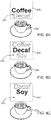
- the words “coffee,” “decaf,” and “soy” can then be displayed one above the other in the text region 200, with the word “decaf” being emphasized with a relatively high brightness intensity, and the words “coffee” and “soy” being deemphasized with a relatively low brightness intensity ( Fig. 8b ); and the words “decaf” and “soy” can then be displayed one above the other in the text region 200, with the word “soy” being emphasized with a relatively high brightness intensity, and the word “decaf” being deemphasized with a relatively low brightness intensity ( Fig. 8c ).
- the augmented reality system 100 displays a gesture reference object 206 adjacent the object of interest 22a that allows a gestural command from the end user 50 to be sensed.
- the angular position of an anatomical part of the end user 50 relative to the gesture reference object 206 is sensed.
- the anatomical part of the end user 50 that gestures is the head 54 of the end user 50, and thus, the direction in which the head 54 of the end user 50 is pointed relative to the gesture reference object 206 is sensed.
- a gesture reference object 206 is not displayed to the end user 50, but rather an invisible gesture reference is incorporated into the same coordinate system as the object of interest 22a. In this case, the direction in which the head 54 of the end user 50 is pointed relative to the gesture reference is sensed.
- the annular ring 206 can be divided into further concentric rings if the number of words in the textual message is greater than three or may not be divided at all if the number of words in the textual message equals two (i.e., the inner and outer edges of the annular ring 206 will respectively trigger the display of the two words). It can also be appreciated that scanning the head 54 from the outside to the inside of the annular ring 206 streams the textual message 202 forward, and scanning the head 54 from the inside to the outside of the annular ring 206 streams the textual message 202 in reverse.
- the CPU 132 also instructs the GPU 134 to generate virtual image data from the point of the view of the end user 50, and in this embodiment, rendering two-dimensional virtual image data from a three-dimensional virtual scene (step 304).
- the virtual image data may be generated based on predictive head positions in order to minimize any latency issues, e.g., by rendering and warping the virtual image data.
- the CPU 132 detects blinking of the eyes 52 of the end user 50 via the user orientation detection module 130 (step 332), and pauses streaming of the textual message 202 when the eyes 52 are closed, and continues streaming of the textual message 202 when the eyes 52 are opened (step 334).
Landscapes
- Engineering & Computer Science (AREA)
- Theoretical Computer Science (AREA)
- Physics & Mathematics (AREA)
- General Physics & Mathematics (AREA)
- General Engineering & Computer Science (AREA)
- Human Computer Interaction (AREA)
- Computer Hardware Design (AREA)
- Computer Vision & Pattern Recognition (AREA)
- Multimedia (AREA)
- Software Systems (AREA)
- Computer Graphics (AREA)
- General Health & Medical Sciences (AREA)
- Health & Medical Sciences (AREA)
- Artificial Intelligence (AREA)
- Optics & Photonics (AREA)
- Audiology, Speech & Language Pathology (AREA)
- Computational Linguistics (AREA)
- Geometry (AREA)
- Psychiatry (AREA)
- Social Psychology (AREA)
- User Interface Of Digital Computer (AREA)
- Processing Or Creating Images (AREA)
- Controls And Circuits For Display Device (AREA)
Abstract
Description
- The invention generally relates to systems and methods configured to facilitate interactive virtual and augmented reality environments for one or more users.
- Modern computing and display technologies have facilitated the development of systems for so-called "virtual reality" or "augmented reality" experiences, wherein digitally reproduced images or portions thereof are presented to a user in a manner where they seem to be, or may be perceived as, real. A virtual reality (VR) scenario typically involves presentation of digital or virtual image information without transparency to other actual real-world visual input, whereas an augmented reality (AR) scenario typically involves presentation of digital or virtual image information as an augmentation to visualization of the actual world around the end user.
- For example, referring to
Fig. 1 , an augmentedreality scene 4 is depicted wherein a user of an AR technology sees a real-world park-like setting 6 featuring people, trees, buildings in the background, and aconcrete platform 8. In addition to these items, the end user of the AR technology also perceives that he "sees" arobot statue 10 standing upon the real-world platform 8, and a cartoon-like avatar character 12 flying by which seems to be a personification of a bumble bee, even though theseelements - VR and AR systems typically employ head-worn displays (or helmet-mounted displays, or smart glasses) that are at least loosely coupled to a user's head, and thus move when the end user's head moves. If the end user's head motions are detected by the display system, the data being displayed can be updated to take the change in head pose (i.e., the orientation and/or location of user's head) into account.
- As an example, if a user wearing a head-worn display views a virtual representation of a three-dimensional (3D) object on the display and walks around the area where the 3D object appears, that 3D object can be re-rendered for each viewpoint, giving the end user the perception that he or she is walking around an object that occupies real space. If the head-worn display is used to present multiple objects within a virtual space (for instance, a rich virtual world), measurements of head pose can be used to re-render the scene to match the end user's dynamically changing head location and orientation and provide an increased sense of immersion in the virtual space.
- Head-worn displays that enable AR (i.e., the concurrent viewing of real and virtual elements) can have several different types of configurations. In one such configuration, often referred to as a "video see-through" display, a camera captures elements of a real scene, a computing system superimposes virtual elements onto the captured real scene, and a non-transparent display presents the composite image to the eyes. Another configuration is often referred to as an "optical see-through" display, in which the end user can see through transparent (or semi-transparent) elements in the display system to view directly the light from real objects in the environment. The transparent element, often referred to as a "combiner," superimposes light from the display over the end user's view of the real world.
- In certain VR and AR systems, it is desirable to display text adjacent an object presently viewed by a user. For example, if the end user enters a coffee shop and views a cup of
coffee 22a, a danish 22b, and asmoothie 22c displayed on an actual orvirtual menu 20, as illustrated inFig. 2 , it may be desirable to textually display a descriptive message (e.g., "coffee, decaf, soy") adjacent the cup ofcoffee 22a, a descriptive message (e.g., strawberry flavored danish) adjacent the danish 22b, and a descriptive message (e.g., strawberry, pineapple, mango smoothie) adjacent thesmoothie 22c to facilitate the end user's decision as to whether to order the cup ofcoffee 22a, the danish 22b, and/or thesmoothie 22c, which may involve ordering it via conventional communication with the vendor or electronically ordering it via verbal or non-verbal cues provided by the end user through the VR and AR system. The documentsUS 2013/278631 A1 andUS 2014/253437 A1 disclose examples of AR devices with the function of providing informational text to the user in relation to the scene that is observed by the user. While textually displaying descriptive messages adjacent actual or virtual objects to which the messages pertain works well in theory, the resolution of present-day display technology is limited in that fine print cannot be resolved, and therefore a large area is needed to display the coarse print, thereby potentially cluttering the three-dimensional scene viewed by the end user. - There, thus, is a need to more efficiently display a message adjacent a virtual or actual objects in a virtual reality or augmented reality system.
- In accordance with a first embodiment of the inventions, a method of operating a virtual image generation system comprises allowing an end user to visualize a three-dimensional scene, spatially associating a text region (which may be displayed) within the field of view of the user, generating a textual message, and streaming the textual message within the text region. In one method, the textual message is streamed within the text region only one word at a time. In another method, the textual message is displayed in the textual region at least two words at a time while emphasizing only one of the displayed words. Emphasizing the one word may comprise displaying the one word with a brightness intensity more than the remaining displayed word or words, or the text region may be a three-dimensional text region, in which case, the one word may be displayed in a foreground of the three-dimensional text region, and the remaining displayed word or words may be displayed in a background of the three-dimensional text region.
- One method further comprises allowing the end user to visualize an object of interest in the three-dimensional scene, in which case, the text region may be spatially associated with the object of interest, and the textual image may identify at least one characteristic of the object of interest (e.g., by identifying a name of the object of interest). If the object of interest is movable, spatially associating the text region with the object of interest may comprise linking the text region with the object of interest, such that text region moves in coordination with movement of the object of interest. The method optionally comprise displaying a text region indicator adjacent the object of interest, sensing a focal point of the end user, and activating the text region (e.g., by making the text region visually appear) when the focal point of the end user is coincident with the text region indicator. If the object of interest is a virtual object, allowing the end user to visualize the virtual object may comprise displaying the virtual object to the end user. If the object of interest is an actual object, allowing the end user to visualize the actual object may comprise allowing the end user to visualize directly light from the actual object.
- The method may optionally comprise sensing a gestural command from the end user (e.g., a head movement or finger or hand movement), in which case, streaming the textual message may be controlled by the gestural command. For example, streaming of the textual message may be initiated or ceased in response to the gestural command. Or, the timing of each word of the textual message may be controlled in response to the gestural command. Or, the streaming speed of the textual message may be increased or decreased in response to the gestural command. Or, the direction of the streaming of the textual message may be changed in response to the gestural command.
- One method further comprises associating a gesture reference with the object of interest, in which case, sensing the gestural command from the end user may comprise detecting an angular position of an anatomical part of the end user (e.g., a head or finger or hand) relative to a gesture reference. The gesture reference may be displayed as a gesture reference object adjacent the object of interest, and may be separate and distinct from the object of interest or may be object of interest, itself. In one embodiment, the gesture reference is an annular ring surrounding the object of interest.
- The method may optionally comprise sensing blinking of the eyes of the end user, in which case, streaming of the textual message pauses when the eyes of the end user are closed, and continues when the eyes of the end user are opened. The method may further optionally comprise identifying a focal plane in which the object of interest is disposed, and adjusting the streaming speed of the textual message based on the identified focal plane. Optionally, streaming the textual message may comprise varying pauses between words of the textual message. The method may further optionally comprise generating a pattern of audible tones that respectively correspond temporally with words in the textual message as they are streamed.
- In accordance with a second embodiment of the inventions, a virtual image generation system for use by an end user is provided. The virtual image generation system comprises a display system configured for allowing the end user to visualize a three-dimensional scene. In one embodiment, the display system is configured for being positioned in front of the eyes of the end user. In another embodiment, the display system includes a projection subsystem and a partially transparent display surface, in which case, the projection subsystem may be configured for projecting the frame onto the partially transparent display surface, and the partially transparent display surface may be configured for being position in the field of view between the eyes of the end user and an ambient environment. In another embodiment, the virtual image generation system further comprises a frame structure configured for being worn by the end user, in which case, the frame structure carries the display system.
- The virtual image generation system further comprises a control system (e.g., one that comprises a graphics control subsystem unit (GPU)) configured for spatially associating a text region (which may be displayed to the end user) within a field of view of the end user. The control system is further configured for generating a textual message, and instructing the display system to stream the textual message within the text region. In one embodiment, the display system is configured for streaming the textual message within the text region by displaying the textual message only one word at a time. In another embodiment, the display system is configured for streaming the textual message within the text region by displaying the textual message at least two words at a time while emphasizing only one of the at least two displayed words. Emphasizing the one word may comprise displaying the one word with a brightness intensity more than the remaining displayed word or words, or the text region may be a three-dimensional text region, in which case, the one word may be displayed in a foreground of the three-dimensional text region, and the remaining displayed word or words may be displayed in a background of the three-dimensional text region.
- In one embodiment, the display system is configured for allowing the end user to visualize an object of interest in the three-dimensional scene, the control system is configured for spatially associating the text region with the object of interest, and the textual image identifies at least one characteristic of the object of interest. If the object of interest is a virtual object, the display system may be configured for displaying the virtual object to the end user. If the object of interest is an actual object, the display system may be configured for allowing the end user to visualize directly light from the actual object. If the object of interest is movable, spatially associating the text region with the object of interest may comprise linking the text region with the object of interest, such that text region moves in coordination with movement of the object of interest. In an optional embodiment, the virtual image generation system further comprises one or more sensors configured for sensing a focal point of the end user, and the control system is configured for instructing the display system to display a text region indicator adjacent the object of interest, and activating the text region (e.g., by making the text region visually appear) when the focal point of the end user is coincident with the text region indicator.
- The virtual image generation system may optionally comprise at least one sensor configured for sensing a gestural command from the end user, in which case, the control system may be configured for controlling the streaming of the textual message based on the gestural command (e.g., a head movement or finger or hand movement of the end user).
- For example, the control system may be configured for instructing the display system to initiate or cease streaming the textual message in response to the gestural command. Or, the control system may be configured for controlling the timing of each word of the textual message in response to the gestural command. Or, the control system may be configured for increasing or decreasing the streaming speed of the textual message in response to the gestural command. Or, the control system may be configured for changing the direction of the streaming of the textual message in response to the gestural command.
- In one embodiment, the control system is further configured for associating a gesture reference with the object of interest, in which case, the sensor(s) will be configured for sensing the gestural command from the end user by detecting an angular position of an anatomical part of the end user (e.g., a head, finger, or hand) relative to a gesture reference. The control system may be further configured for instructing the display system to display the gesture reference as a gesture reference object adjacent the object of interest. The gesture reference may be separate and distinct from the object of interest or may be object of interest, itself. In one embodiment, the gesture reference is an annular ring surrounding the object of interest.
- In an optional embodiment, the virtual image generation system further comprises one or more sensors configured for sensing blinking of the eyes of the end user, in which case, the control system may be configured for pausing the streaming of the textual message when the eyes of the end user are closed, and continue the streaming of the textual message when the eyes of the end user are opened. In another optional embodiment, the control system is further configured for identifying a focal plane in which the object of interest is disposed, and adjusting the streaming speed of the textual message based on the identified focal plane. In still another optional embodiment, the control system is configured for streaming the textual message by varying pauses between words of the textual message. In yet another optional embodiment, the virtual image generation system further comprises one or more speakers, in which case, the control system may be configured for instructing the speaker(s) to generate a pattern of audible tones that respectively correspond temporally with words in the textual message as they are streamed.
- Additional and other objects, features, and advantages of the invention are described in the detail description, figures and claims.
- The drawings illustrate the design and utility of the embodiments of the invention, in which similar elements are referred to by common reference numerals. In order to better appreciate how the above-recited and other advantages and objects of the inventions are obtained, a more particular description of the inventions briefly described above will be rendered by reference to specific embodiments thereof, which are illustrated in the accompanying drawings. Understanding that these drawings depict only typical embodiments of the invention and are not therefore to be considered limiting of its scope, the invention will be described and explained with additional specificity and detail through the use of the accompanying drawings in which:
-
Fig. 1 is a picture of a three-dimensional augmented reality scene that can be displayed to an end user by a prior art augmented reality generation device; -
Fig. 2 is a plan view of a conventional coffee menu; -
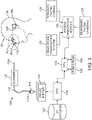
Fig. 3 is a block diagram of an augmented reality system constructed in accordance with one embodiment of the inventions; -
Fig. 4 is a plan view of an exemplary frame generated by the augmented reality system ofFig. 3 ; -
Fig. 5a is a view of one technique that can be used to wear the augmented reality system ofFig. 3 ; -
Fig. 5b is a view of another technique that can be used to wear the augmented reality system ofFig. 3 ; -
Fig. 5c is a view of still another one technique that can be used to wear the augmented reality system ofFig. 3 ; -
Fig. 5d is a view of yet another one technique that can be used to wear the augmented reality system ofFig. 3 ; -
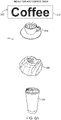
Figs. 6a-6c are plan views of a coffee menu, wherein the augmented reality system ofFig. 3 streams a textual message within a text region adjacent an object of interest in accordance with one technique of the inventions; -
Figs. 7a-7b are plan views of a coffee menu, wherein the augmented reality system ofFig. 3 activates the text region adjacent the object of interest; -
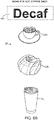
Figs. 8a-8c are plan views of an object of interest on the coffee menu, wherein the augmented reality system ofFig. 3 streams a textual message within a text region adjacent an object of interest in accordance with another technique of the inventions; -
Figs. 9a-9c are plan views of an object of interest on the coffee menu, wherein the augmented reality system ofFig. 3 streams a textual message within a text region adjacent an object of interest in accordance with still another technique of the inventions; -
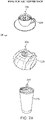
Figs. 10a-10c are plan views of a coffee menu, wherein the augmented reality system ofFig. 3 streams a textual message within a text region adjacent an object of interest in accordance with yet another technique of the inventions; -
Figs. 11a-11b are plan views of a coffee menu, wherein the augmented reality system ofFig. 3 controls the streaming of the textual message in response to head movements by the end user in accordance with one technique of the inventions; -
Figs. 12a-12c are plan views of a coffee menu, wherein the augmented reality system ofFig. 3 controls the streaming of the textual message in response to head movements by the end user in accordance with another technique of the inventions; and -
Fig. 13 is a flow diagram illustrated a method of operating the augmented reality system ofFig. 3 to stream and control a textual message adjacent an object of interest in an ambient three-dimensional scene. - The description that follows relates to display systems and methods to be used in augmented reality systems. However, it is to be understood that the while the invention lends itself well to applications in augmented reality, the invention, in its broadest aspects, may not be so limited.
- Referring to
Fig. 3 , one embodiment of anaugmented reality system 100 constructed in accordance with inventions will now be described. Theaugmented reality system 100 provides images of virtual objects intermixed with actual objects in a field of view of anend user 50. Theaugmented reality system 100, and the various techniques taught herein, may be employed in applications other than augmented reality. For example, various techniques may be applied to any projection or display system. Or, the various techniques described herein may be applied to pico projectors where movement may be made by an end user's hand rather than the head. Thus, while often described herein in terms of an augmented reality system, the teachings should not be limited to such systems of such uses. - There are two fundamental approaches when operating the
augmented reality system 100. A first approach employs one or more imagers (e.g., cameras) to capture images of the ambient environment. Theaugmented reality system 100 inter-mixes the virtual images into the data representing the images of the ambient environment. A second approach employs one or more at least partially transparent surfaces through which the ambient environment can be seen and on to which theaugmented reality system 100 produces images of virtual objects. - The
augmented reality system 100, and the various techniques taught herein, may be employed in applications other than augmented reality systems. For example, various techniques may be applied to any projection or display system. For example, the various techniques described herein may be applied to pico projectors where movement may be made by an end user's hand rather than the head. Thus, while often described herein in terms of an augmented reality system or virtual reality system, the teachings should not be limited to such systems of such uses. - At least for augmented reality applications, it may be desirable to spatially position various virtual objects relative to respective actual objects in a field of view of the
end user 50. Virtual objects, also referred to herein as virtual tags or tag or call outs, may take any of a large variety of forms, basically any variety of data, information, concept, or logical construct capable of being represented as an image. Non-limiting examples of virtual objects may include: a virtual text object, a virtual numeric object, a virtual alphanumeric object, a virtual tag object, a virtual field object, a virtual chart object, a virtual map object, a virtual instrumentation object, or a virtual visual representation of a physical object. - More pertinent to the inventions, the
augmented reality system 100 spatially associates text regions with actual objects in the three-dimensional scene, generates a textual message in selected ones of text regions to identify at least one characteristic of respective actual object(s), and streams the textual message(s) within the selected text region(s). In one embodiment, one text region at a time is selected for streaming and display of the textual message, and in particular, the text region associated with the actual object at which the end user is currently looking is selected. Advantageously, streaming a textual message within a text region associated with an actual object facilitates the display of the textual message in a smaller area, thereby providing compactness in displaying the textual message and thereby reducing any clutter of the three-dimensional scene, providing brevity, interactivity, and quickness of display. - Although the textual message is described as being streamed in a text region associated with an actual object in an augmented reality system, it should be appreciated that a textual message can be streamed in a text region associated with a virtual object in an augmented reality system or a virtual reality system. Furthermore, a textual message can be streamed in a text region associated with an actual object in a visual system other than an augmented reality system, e.g., wherein the end user simply looks through a transparent medium that only displays textual messages (i.e., no virtual objects are displayed) adjacent actual objects.
- To this end, the
augmented reality system 100 comprises aframe structure 102 worn by anend user 50, adisplay system 104 carried by theframe structure 102, such that thedisplay system 104 is positioned in front of theeyes 52 of theend user 50, and aspeaker 106 carried by theframe structure 102, such that thespeaker 106 is positioned adjacent the ear canal of the end user 50 (optionally, another speaker (not shown) is positioned adjacent the other ear canal of theend user 50 to provide for stereo/shapeable sound control). Thedisplay system 104 is designed to present theeyes 52 of theend user 50 with photo-based radiation patterns that can be comfortably perceived as augmentations to physical reality, with high-levels of image quality and three-dimensional perception, as well as being capable of presenting two-dimensional content. Thedisplay system 104 presents a sequence of frames at high frequency that provides the perception of a single coherent scene. - In the illustrated embodiment, the
display system 104 comprises aprojection subsystem 108 and a partiallytransparent display surface 110 on which theprojection subsystem 108 projects images. Thedisplay surface 110 is positioned in the end user's 50 field of view between theeyes 52 of theend user 50 and an ambient environment. In the illustrated embodiment, theprojection subsystem 108 includes one or more optical fibers 112 (e.g. single mode optical fiber), each of which has oneend 112a into which light is received and anotherend 112b from which light is provided to the partiallytransparent display surface 110. Theprojection subsystem 108 may also include one or morelight sources 114 that produces the light (e.g., emits light of different colors in defined patterns), and communicatively couples the light to theother end 112a of the optical fiber(s) 112. The light source(s) 114 may take any of a large variety of forms, for instance, a set of RGB lasers (e.g., laser diodes capable of outputting red, green, and blue light) operable to respectively produce red, green, and blue coherent collimated light according to defined pixel patterns specified in respective frames of pixel information or data. Laser light provides high color saturation and are highly energy efficient. - The
display system 104 may further comprise ascanning device 116 that scans the optical fiber(s) 112 in a predetermined pattern in response to control signals. For example, referring toFig. 3 , aframe 118 of pixel information or data specifies pixel information or data to present an image, for example, an image of one or more virtual objects, according to one illustrated embodiment. Theframe 118 is schematically illustrated withcells 120a-120m divided into horizontal rows orlines 122a-122n. Eachcell 120 of theframe 118 may specify values for each of a plurality of colors for the respective pixel to which thecell 120 corresponds and/or intensities. For instance, theframe 118 may specify one or more values for red 124a, one or more values for green 124b, and one or more values for blue 124c for each pixel. The values 124 may be specified as binary representations for each of the colors, for instance, a respective 4-bit number for each color. Eachcell 120 of theframe 118 may additionally include avalue 124d that specifies an amplitude. It should be appreciated that although thedisplay system 104 has been described as being implemented with a scanning fiber technology, it should be appreciated that thedisplay system 104 may be based on any display technology, e.g., liquid crystal displays (LCD), digital light processing (DLP) displays, etc. - Referring back to
Fig. 3 , theaugmented reality system 100 further comprises one or more sensors (not shown) mounted to theframe structure 102 for detecting the position and movement of thehead 54 of theend user 50 and/or the eye position and inter-ocular distance of theend user 50. Such sensor(s) may include image capture devices (such as cameras), microphones, inertial measurement units, accelerometers, compasses, GPS units, radio devices, and/or gyros). - For example, in one embodiment, the
augmented reality system 100 comprises a head worntransducer system 126 that includes one or more inertial transducers to capture inertial measures indicative of movement of thehead 54 of theend user 50. Such may be used to sense, measure, or collect information about the head movements of theend user 50. For instance, such may be used to detect measurement movements, speeds, acceleration, and/or positions of thehead 54 of theend user 50. - The
augmented reality system 100 further comprises one or moreforward facing cameras 128, which may be used to capture information about the environment in which theend user 50 is located. The forward facing camera(s) 128 may be used to capture information indicative of distance and orientation of theend user 50 with respect to that environment and specific objects in that environment. When head worn, the forward facing camera(s) 128 is particularly suited to capture information indicative of distance and orientation of thehead 54 of theend user 50 with respect to the environment in which theend user 50 is located and specific objects in that environment. The forward facing camera(s) 128 may, for example, be employed to detect head movement, speed, and/or acceleration of head movements. The forward facing camera(s) 128 may, for example, be employed to detect or infer a center of attention of theend user 50, for example, based at least in part on an orientation of thehead 54 of theend user 50. Orientation may be detected in any direction (e.g., up/down, left, right with respect to the reference frame of the end user 50). - The
augmented reality system 100 further comprises a pair of rearward facingcameras 129 to track movement, blinking, and depth of focus of theeyes 52 of theend user 50. Such eye tracking information may, for example, be discerned by projecting light at the end user's eyes, and detecting the return or reflection of at least some of that projected light. Theaugmented reality system 100 further comprises a userorientation detection module 130. Theuser orientation module 130 detects the instantaneous position of thehead 54 of theend user 50 and may predict the position of thehead 54 of theend user 50 based on position data received from the sensor(s). Significantly, detecting the instantaneous position of thehead 54 of theend user 50 facilitates determination of the specific actual object that theend user 50 is looking at, thereby providing an indication of the specific textual message to be generated for that actual object and further providing an indication of the textual region in which the textual message is to be streamed. Theuser orientation module 130 also tracks theeyes 52 of theend user 50 based on the tracking data received from the sensor(s). - The
augmented reality system 100 further comprises a control subsystem that may take any of a large variety of forms. The control subsystem includes a number of controllers, for instance one or more microcontrollers, microprocessors or central processing units (CPUs), digital signal processors, graphics processing units (GPUs), other integrated circuit controllers, such as application specific integrated circuits (ASICs), programmable gate arrays (PGAs), for instance field PGAs (FPGAs), and/or programmable logic controllers (PLUs). - In the illustrated embodiment, the
augmented reality system 100 comprises a central processing unit (CPU) 132, a graphics processing unit (GPU) 134, and one ormore frame buffers 136. TheCPU 132 controls overall operation, while theGPU 134 renders frames (i.e., translating a three-dimensional scene into a two-dimensional image) from three-dimensional data stored in theremote data repository 150 and stores these frames in the frame buffer(s) 136. While not illustrated, one or more additional integrated circuits may control the reading into and/or reading out of frames from the frame buffer(s) 136 and operation of the scanning device of thedisplay system 104. Reading into and/or out of the frame buffer(s) 146 may employ dynamic addressing, for instance, where frames are over-rendered. Theaugmented reality system 100 further comprises a read only memory (ROM) 138 and a random access memory (RAM) 140. Theaugmented reality system 100 further comprises a three-dimensional data base 142 from which theGPU 134 can access three-dimensional data of one or more scenes for rendering frames. - The various processing components of the
augmented reality system 100 may be physically contained in a distributed system. For example, as illustrated inFigs. 5a-5d , theaugmented reality system 100 comprises a local processing anddata module 144 operatively coupled, such as by a wired lead orwireless connectivity 146, to thedisplay system 104 and sensors. The local processing anddata module 144 may be mounted in a variety of configurations, such as fixedly attached to the frame structure 102 (Fig. 5a ), fixedly attached to a helmet or hat 56 (Fig. 5b ), embedded in headphones, removably attached to thetorso 58 of the end user 50 (Fig. 5c ), or removably attached to thehip 60 of theend user 50 in a belt-coupling style configuration (Fig. 5d ). Theaugmented reality system 100 further comprises aremote processing module 148 andremote data repository 150 operatively coupled, such as by a wired lead orwireless connectivity data module 144, such that theseremote modules data module 144. - The local processing and
data module 144 may comprise a power-efficient processor or controller, as well as digital memory, such as flash memory, both of which may be utilized to assist in the processing, caching, and storage of data captured from the sensors and/or acquired and/or processed using theremote processing module 148 and/orremote data repository 150, possibly for passage to thedisplay system 104 after such processing or retrieval. Theremote processing module 148 may comprise one or more relatively powerful processors or controllers configured to analyze and process data and/or image information. Theremote data repository 150 may comprise a relatively large-scale digital data storage facility, which may be available through the internet or other networking configuration in a "cloud" resource configuration. In one embodiment, all data is stored and all computation is performed in the local processing anddata module 144, allowing fully autonomous use from any remote modules. - The
couplings Figs. 5a-5d . Thus, the particular choice of wired or wireless communications should not be considered limiting. - In the illustrated embodiment, the
user orientation module 130 is contained in the local processing anddata module 144, whileCPU 132 andGPU 134 are contained in theremote processing module 148, although in alternative embodiments, theCPU 132, GPU 124, or portions thereof may be contained in the local processing anddata module 144. The3D database 142 can be associated with theremote data repository 150. - As briefly discussed above, the
augmented reality system 100 spatially associates a text region adjacent one of the actual objects, generates a textual message that identifies at least one characteristic of the actual object, and streams the textual message within the text region. For example, referring toFigs. 6a-6c , atext region 200 may be spatially associated with an object of interest, and in this case, the cup ofcoffee 22a, e.g., a cup of coffee that may be physical or may be a picture on a menu. In the illustrated embodiment, thetext region 200 takes the form of a rectangular box located immediately above the object ofinterest 22a, although in alternative embodiments, thetext region 200 may take any suitable shape. In the illustrated embodiment, thetext region 200 is visible to theend user 50. Alternatively, thetext region 200 may be invisible to theend user 50. In one embodiment, thetext region 200 is linked to the object ofinterest 22a, such that thetext region 200 moves in coordination with movement of the object ofinterest 22a (e.g., the menu is moved). That is, if the object ofinterest 22a moves within the three-dimensional scene, thetext region 200 will move with the object ofinterest 22a. - The
augmented reality system 100 streams atextual message 202, e.g., "coffee, decaf, soy," in thetext region 200. As there shown, thetextual message 202 is streamed, such that the word "coffee" is first displayed in the text region 200 (Fig. 6a ), then the word "decaf' is displayed in the text region 200 (Fig. 6b ), and lastly the word "soy" is displayed in the text region 200 (Fig. 6c ). Thetextual message 202 can be streamed in a continuous loop, such that the words "coffee," "decaf," and "soy" are repeatedly displayed in series in the text region 200 (i.e., "coffee," "decaf," "soy," "coffee," "decaf," "soy," etc.). - In an optional embodiment, the
text region 200 may be selectively activated by theend user 50. In particular, thetext region 200 may be in a default inactive state, wherein it is invisible to the end user, and then activated to allow thetext region 200 to be viewed by theend user 50. For example, as illustrated inFigs. 7a-7b , theaugmented reality system 100 may display a text region indicator 204 (in this case, an arrow) adjacent the objects ofinterest 22a-22c (Fig. 7a ), sense a focal point of theend user 50, and activate thetext region 200 when the focal point of theend user 50 is coincident with the text region indicator 204 (in this case, when theend user 50 is focused on the object ofinterest 22a) (Fig. 7b ). - Although the
textual message 202 is described as being displayed one word at a time, it should be appreciated that thetextual message 202 can be displayed more than one word at a time. For example, this may be useful when more than two adjacent words in thetextual message 202 are short enough, such that they can be simultaneously displayed together in thetext region 200. - Although the
textual message 202 has been described as being streamed within thetext region 200 in a manner such that at least one of the words in thetextual message 202 cannot be seen by theend user 50, thetextual message 202 may be streamed within thetext region 200, such that at least two of the words are displayed at a time, but only one of the displayed words is emphasized. - For example, two or more words of the
textual message 202 may be simultaneously displayed, while emphasizing one of the words by displaying it with a brightness intensity more than the other currently displayed words. For example, as shown inFigs. 8a-8c , the words "coffee" and "decaf" can first be displayed one above the other in thetext region 200, with the word "coffee" being emphasized with a relatively high brightness intensity, and the word "decaf' being deemphasized with a relatively low brightness intensity (Fig. 8a ); the words "coffee," "decaf," and "soy" can then be displayed one above the other in thetext region 200, with the word "decaf" being emphasized with a relatively high brightness intensity, and the words "coffee" and "soy" being deemphasized with a relatively low brightness intensity (Fig. 8b ); and the words "decaf" and "soy" can then be displayed one above the other in thetext region 200, with the word "soy" being emphasized with a relatively high brightness intensity, and the word "decaf" being deemphasized with a relatively low brightness intensity (Fig. 8c ). - As another example, a three-dimensional text region may be spatially associated with the object of
interest 22a, in which case, one of the words in thetextual message 202 may be emphasized by displaying it in the foreground of the text region 200', and another word or words of thetextual message 202 may be deemphasized by displaying it in the background of text region 200'. For example, as shown inFigs. 9a-9c , the words "coffee," "decaf," and "soy" can first be displayed one behind the other in the text region 200', with the word "coffee" being emphasized by displaying it the foreground, and the words "decaf" and "soy" being deemphasized by displaying them in the background (Fig. 9a ); the words "decaf' and "soy" are then displayed one behind the other in the text region 200', with the word "decaf' being emphasized by displaying it in the foreground, and the word "soy" being deemphasized by displaying it in the background (Fig. 9b ); and the word "soy" is then displayed alone in the text region 200' (Fig. 9c ). - The
textual message 202 can alternatively be streamed in a continuous loop, such that the words "coffee," "decaf," and "soy" are repeatedly displayed in series in the text region 200'. In this case, as shown inFigs. 10a-10c , the words "coffee," "decaf," and "soy" can first be displayed one behind the other in the text region 200', with the word "coffee" being emphasized by displaying it the foreground, and the words "decaf" and "soy" being deemphasized by displaying them in the background (Fig. 10a ); the words "decaf," "soy," and "coffee" are then displayed one behind the other in the text region 200', with the word "decaf' being emphasized by displaying it in the foreground, and the words "soy" and "coffee" being deemphasized by displaying them in the background (Fig. 10b ); and the words "soy," "coffee," and "decaf" are then displayed one behind the other in the text region 200', with the word "soy" being emphasized by displaying it in the foreground, and the words "coffee" and "soy" being deemphasized by displaying them in the background (Fig. 10c ). - Notably, the reordering of the words of the
textual message 202 in the text region 200' may be performed discretely (i.e., the words discretely appear and disappear from the ordered sequence) or may be performed continuously (i.e., the words continuously move from the background into the foreground). Furthermore, while words of thetextual message 202 have been described as being emphasized or de-emphasized in a text region by displaying the words of thetextual message 202 with different brightness intensities or at different depths, the words of thetextual message 202 may be emphasized or de-emphasized by displaying one of the words with bigger letters than those of the remaining words of thetextual message 202 or displaying one of the words as being solid or opaque and the remaining words of thetextual message 202 as being transparent or translucent. - Referring to
Fig. 11a-11b , theaugmented reality system 100 displays agesture reference object 206 adjacent the object ofinterest 22a that allows a gestural command from theend user 50 to be sensed. In particular, the angular position of an anatomical part of theend user 50 relative to thegesture reference object 206 is sensed. In the illustrated embodiment, the anatomical part of theend user 50 that gestures is thehead 54 of theend user 50, and thus, the direction in which thehead 54 of theend user 50 is pointed relative to thegesture reference object 206 is sensed. In alternative embodiments, agesture reference object 206 is not displayed to theend user 50, but rather an invisible gesture reference is incorporated into the same coordinate system as the object ofinterest 22a. In this case, the direction in which thehead 54 of theend user 50 is pointed relative to the gesture reference is sensed. - In the illustrated embodiment, the
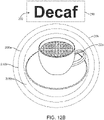
gesture reference object 206 takes the form of an annular ring that completely encircles the object ofinterest 22a. Pointing thehead 54 of theend user 50 at a portion of theannular ring 206 controls the streaming of thetextual message 202. For example, when theend user 50 scans his or herhead 54 across theannular ring 206, streaming of thetextual message 202 may be initiated when thehead 54 is pointed at oneside 208a of theannular ring 206; e.g., thepoint 210a on theleft side 208a of the annular ring 206 (Fig. 11a ), and terminated when thehead 54 is pointed at the opposite side of theannular ring 206; e.g., thepoint 210b on theright side 208b of the annular ring 206 (Fig. 11b ). It should be appreciated that although the scan direction is illustrated inFigs. 11a-11b as being left to right, the scan can be similarly applied to theannular ring 206 with different directions (including, top to bottom, bottom to top, and right to left) to initiate and then cease streaming of thetextual message 202. - As another example, when the
end user 50 scans his or her head across theannular ring 206, the timing of each word in thetextual message 202 may be controlled. For example, as shown inFig. 12a-12c , theannular ring 206 can be divided into a plurality of concentric rings, and in this case, twoconcentric rings end user 50 scans his or herhead 54 from the outside to the inside of theannular ring 206, as thehead 54 scans across theouter edge 212a of theannular ring 206, the word "coffee" will be displayed in the text region 200 (Fig. 12a ); as thehead 54 scans across theinterface 212b between theconcentric rings Fig. 12b ); and as thehead 54 scans across theinner edge 212c of theannular ring 206, the word "soy" will be displayed in the text region 200 (Fig. 12c ). - In contrast, when the
end user 50 scans his or herhead 54 from the inside to the outside of theannular ring 206, as thehead 54 scans across theinner edge 212c of theannular ring 206, the word "soy" will be displayed in the text region 200 (Fig. 12c ); as thehead 54 scans across theinterface 212b between theconcentric rings Fig. 12b ); and as thehead 54 scans across theouter edge 212a of theannular ring 206, the word "coffee" will be displayed in the text region 200 (Fig. 12a ). - It can be appreciated that the
annular ring 206 can be divided into further concentric rings if the number of words in the textual message is greater than three or may not be divided at all if the number of words in the textual message equals two (i.e., the inner and outer edges of theannular ring 206 will respectively trigger the display of the two words). It can also be appreciated that scanning thehead 54 from the outside to the inside of theannular ring 206 streams thetextual message 202 forward, and scanning thehead 54 from the inside to the outside of theannular ring 206 streams thetextual message 202 in reverse. It can also be appreciated that the streaming speed of thetextual message 202 is increased by scanning thehead 54 across theannular ring 206 relatively quickly, and decreased by scanning thehead 54 across theannular ring 206 relatively slowly. In the illustrated embodiment, the streaming speed adjustment is a function of thehead 54 scanning across theedges interface 212b that trigger the display of the different words of thetextual message 202. Alternatively, irrespective of whether or not theannular ring 206 includes concentric rings, the streaming speed adjustment can simply be a function of the speed at which thehead 54 scans theannular ring 206. For example, with reference back toFigs. 11a-11b , scanning thehead 54 across the left side of theannular ring 206 quickly will cause thetextual message 202 to be streamed relatively quickly, and scanning thehead 54 across the left side of theannular ring 206 slowly will cause thetextual message 202 to be streamed relatively slowly. - It should be noted that although the
gesture reference object 206 in the illustrated embodiment is separate and distinct from the object ofinterest 22a, in alternative embodiments, thegesture reference object 206 can be the actual object, itself. Although in the illustrated embodiment, the gestural command is performed by thehead 54 of theend user 50, it should be appreciated that other anatomical parts of theend user 50 can be used to issue a command; for example, the direction that the finger or hand of theend user 50 is pointed relative to theannular ring 206 may be sensed. - The
augmented reality system 100 may facilitate the reading and comprehension of the streaming textual message in any one of a variety manners. In one embodiment, for textual messages with a relatively large number of words, theaugmented reality system 100 may vary the pauses between the words of the textual message, such that some pairs of adjacent words have relatively short pauses between them, and other adjacent pairs of words have relatively long pauses between them. For example, the textual message may be divided into five-word groups, with relatively short pauses being placed between words in each group, and relatively long pauses being placed between the five-word groups. - In another embodiment, the
augmented reality system 100 may sense blinking of theeyes 52 of theend user 50, such that streaming of thetextual message 202 pauses when theeyes 52 of theend user 50 are closed, and continues when theeyes 52 of theend user 50 are opened. In still another embodiment, theaugmented reality system 100 adjusts the streaming speed of the textual message based on the distance between theend user 50 and the actual object at which theend user 50 is looking. For example, the focal plane in which the actual object is disposed may be identified, and the streaming speed of the textual message may be set to be relatively fast if the focal plane is relatively close to theend user 50, and set to be relatively slow if the focal plane is relatively far from theend user 50. In yet another embodiment, theaugmented reality system 100 generates a pattern of audible tones (which may differ or be the same amongst each other) that respectively correspond temporally with the words in the textual message as they are streamed. For example, as each word is displayed to theend user 50, theaugmented reality system 100 generates and transmits an audible tone to theend user 50. - Having described the structure and function of the
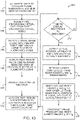
augmented reality system 100, onemethod 300 performed by theaugmented reality system 100 to steam textual messages to theend user 50 will now be described with respect toFig. 13 . First, theaugmented reality system 100 allows theend user 50 to visualize the three-dimensional scene in an ambient environment, e.g., a coffee shop (step 302). This can be accomplished, e.g., in a "video see-through" display, in which theCPU 132 directs theforward facing cameras 128 to capture image data of the three-dimensional scene, and directs thedisplay system 104 to display the captured image data to theend user 50; or an "optical see-through" display, in which the end user is simply allowed to view directly the light from the three-dimensional scene. - The
CPU 132 also instructs theGPU 134 to generate virtual image data from the point of the view of theend user 50, and in this embodiment, rendering two-dimensional virtual image data from a three-dimensional virtual scene (step 304). In one embodiment, the virtual image data may be generated based on predictive head positions in order to minimize any latency issues, e.g., by rendering and warping the virtual image data. - The
CPU 132 then instructs thedisplay system 104 to display the virtual image data as a virtual image to theend user 50 that, along with the ambient three-dimensional scene, creates a three-dimensional augmented scene (step 306). TheCPU 132 also instructs thedisplay system 104 to displaytext region indicators 204 adjacent selected ones of the objects ofinterest 22 in the three-dimensional augmented scene (step 308). TheCPU 132 then senses the focal point of theend user 50 via the via the user orientation detection module 130 (step 310), and, when the focal point of theend user 50 is coincident with one of thetext region indicators 204, activates thetext region 200 corresponding to that onetext region indicator 204 by instructing thedisplay system 104 to display thetext region 200 adjacent the corresponding object ofinterest 22a (step 312). - Next, the
CPU 132 associates a gesture reference with the object ofinterest 22a corresponding to the activated text region 200 (step 314), and optionally instructs thedisplay system 104 to display the gesture reference as agesture reference object 206 adjacent the object ofinterest 22a (step 316). TheCPU 132 then detects the angular position of thehead 54 of theend user 50 relative togesture reference object 206 via the user orientation detection module 130 (step 318). When thehead 54 of theend user 50 is pointed at thegesture reference object 206, theCPU 132 then generates the particulartextual message 202 associated with the object ofinterest 22a corresponding to the activated text region 200 (step 320), and instructs thedisplay system 104 to initiate streaming of thetextual message 202 within the activated text region 200 (step 322). Optionally, theCPU 132 identifies a focal plane in which the object ofinterest 22a is disposed via the user orientation detection module 130 (step 324), and adjusts the streaming speed of the textual message based on the identified focal plane (e.g., the farther the focal plane is from theend user 50, the slower the streaming speed, and the shorter the focal plane is from theend user 50, the faster the streaming speed) (step 326). - The
CPU 132 then detects angular position/velocity of thehead 54 of theend user 50 relative to the gesture reference object 206 (e.g., where thehead 54 is pointed on thegesture reference object 206 or how quickly thehead 54 scans the gesture reference object 206) via the user orientation detection module 130 (step 328). TheCPU 132 controls the streaming of the textual message 202 (e.g., speed, forward/reverse, etc.) based on the detected angular position/velocity of thehead 54 of the end user 50 (step 330). TheCPU 132 detects blinking of theeyes 52 of theend user 50 via the user orientation detection module 130 (step 332), and pauses streaming of thetextual message 202 when theeyes 52 are closed, and continues streaming of thetextual message 202 when theeyes 52 are opened (step 334). - Although the generating and streaming of a textual message has been described in the context of an augmented reality system, it should be appreciated that the textual message may be streamed adjacent an actual object of interest with or without displaying virtual objects. For example, a system can simply be used to stream textual messages adjacent actual objects of interest in an ambient three-dimensional scene. It should also be appreciated that although the textual messages have been described herein as being streamed in the context of simply providing labeling of objects of interest using the most brief amount of text, textual messages can also be used in virtual image generation systems to medium text use (e.g., infographic paragraph) and long text use (e.g., book chapter) cases.
- In the foregoing specification, the invention has been described with reference to specific embodiments thereof. It will, however, be evident that various modifications and changes may be made thereto without departing from the broader scope of the invention. For example, the above-described process flows are described with reference to a particular ordering of process actions. However, the ordering of many of the described process actions may be changed without affecting the scope or operation of the invention. The specification and drawings are, accordingly, to be regarded in an illustrative rather than restrictive sense.
- The invention may relate to one of more of the following items, alone or in combination:
-
Item 1. A method of operating a virtual image generation system, the method comprising:- allowing an end user to visualize a three-dimensional scene;
- spatially associating a text region within a field of view of the user;
- generating a textual message; and
- streaming the textual message within the text region.
-
Item 2. The method ofclaim 1, wherein streaming the textual message within the text region comprises displaying the textual message only one word at a time. -
Item 3. The method ofitem 1, wherein streaming the textual message within the text region comprises displaying the textual message at least two words at a time while emphasizing only one of the at least two displayed words. -
Item 4. The method ofitem 3, wherein emphasizing the only one word comprises displaying the one word with a brightness intensity more than the remaining word or words of the at least two displayed words. -
Item 5. The method ofitem 3, wherein the text region is a three-dimensional text region, and wherein emphasizing the only one word comprises displaying the one word in a foreground of the three-dimensional text region, and displaying the remaining word or words of the at least two displayed words in a background of the three-dimensional text region. -
Item 6. The method ofitem 1, further comprising sensing a gestural command from the end user, wherein streaming the textual message is controlled by the gestural command. -
Item 7. The method ofitem 6, wherein streaming the textual message is initiated or ceased in response to the gestural command. -
Item 8. The method ofitem 6, wherein the timing of each word of the textual message is controlled in response to the gestural command. -
Item 9. The method ofitem 6, wherein the streaming speed of the textual message is increased or decreased in response to the gestural command. -
Item 10. The method ofitem 6, wherein the direction of the streaming of the textual message is changed in response to the gestural command. -
Item 11. The method ofitem 6, wherein the gestural command is a head movement of the end user. -
Item 12. The method ofitem 6, wherein the gestural command is a finger or hand movement of the end user. -
Item 13. The method ofitem 1, further comprising allowing the end user to visualize an object of interest in the three-dimensional scene, wherein the text region is spatially associated with the object of interest, and the textual image identifies at least one characteristic of the object of interest. - Item 14. The method of
item 13, wherein the object of interest is a virtual object. -
Item 15. The method ofitem 13, wherein allowing the end user to visualize the virtual object comprises displaying the virtual object to the end user. - Item 16. The method of
item 13, wherein the object of interest is an actual object. - Item 17. The method of item 16, wherein allowing the end user to visualize the actual object comprises allowing the end user to visualize directly light from the actual object.
-
Item 18. The method ofitem 13, wherein the object of interest is movable, and wherein spatially associating the text region with the object of interest comprises linking the text region with the object of interest, such that text region moves in coordination with movement of the object of interest. -
Item 19. The method ofitem 13, wherein the textual message identifies a name of the object of interest. -
Item 20. The method ofitem 13, further comprising associating a gesture reference with the object of interest, wherein sensing the gestural command from the end user comprises detecting an angular position of an anatomical part of the end user relative to a gesture reference. - Item 21. The method of
item 20, further comprising displaying the gesture reference as a gesture reference object adjacent the object of interest. -
Item 22. The method ofitem 20, wherein the anatomical part of the end user is a head of the end user. -
Item 23. The method ofitem 22, wherein the anatomical part of the end user is a finger or hand of the end user. -
Item 24. The method ofitem 20, wherein the gesture reference is separate and distinct from the object of interest. -
Item 25. The method ofitem 24, wherein the gesture reference is an annular ring surrounding the object of interest. -
Item 26. The method ofitem 20, wherein the gesture reference is the object of interest. - Item 27. The method of
item 13, further comprising:- identifying a focal plane in which the object of interest is disposed; and
- adjusting the streaming speed of the textual message based on the identified focal plane.
-
Item 28. The method ofitem 13, further comprising:- displaying a text region indicator adjacent the object of interest;
- sensing a focal point of the end user; and
- activating the text region when the focal point of the end user is coincident with the text region indicator.
- Item 29. The method of
item 28, wherein the text region visually appears when activated. -
Item 30. The method ofitem 1, further comprising sensing blinking of the eyes of the end user, wherein the streaming of the textual message pauses when the eyes of the end user are closed, and continues when the eyes of the end user are opened. - Item 31. The method of
item 1, wherein streaming the textual message comprises varying pauses between words of the textual message. - Item 32. The method of
item 1, further comprising generating a pattern of audible tones that respectively correspond temporally with words in the textual message as they are streamed. -
Item 33. The method ofitem 1, further comprising displaying the text region to the end user. -
Item 34. A virtual image generation system for use by an end user, comprising:- a display system configured for allowing the end user to visualize a three-dimensional scene; and
- a control system configured for spatially associating a text region with a field of view of the end user, generating a textual message, and instructing the display system to stream the textual message within the text region.
-
Item 35. The virtual image generation system ofitem 34, wherein the display system is configured for being positioned in front of the eyes of the end user. - Item 36. The virtual image generation system of
item 34, wherein the display system includes a projection subsystem and a partially transparent display surface, the projection subsystem configured for projecting the frame onto the partially transparent display surface, and the partially transparent display surface configured for being position in the field of view between the eyes of the end user and an ambient environment. - Item 37. The virtual image generation system of
item 34, further comprising a frame structure configured for being worn by the end user, the frame structure carrying the display system. - Item 38. The virtual image generation system of
item 34, wherein the control subsystem comprises a graphics control subsystem unit (GPU). - Item 39. The virtual image generation system of
item 34, wherein the display system is configured for streaming the textual message within the text region by displaying the textual message only one word at a time. - Item 40. The virtual image generation system of
item 34, wherein the display system is configured for streaming the textual message within the text region by displaying the textual message at least two words at a time while emphasizing only one of the at least two displayed words. - Item 41. The virtual image generation system of item 40, wherein the display system is configured for emphasizing the only one word by displaying the one word with a brightness intensity more than the remaining word or words of the at least two words.
- Item 42. The virtual image generation system of item 40, wherein the text region is a three-dimensional text region, and wherein the display system is configured for emphasizing the only one word by displaying the one word in a foreground of the three-dimensional text region, and displaying the remaining word or words of the at least two words in a background of the three-dimensional text region.
- Item 43. The virtual image generation system of
item 34, further comprising at least one sensor configured for sensing a gestural command from the end user, wherein the control system is configured for controlling the streaming of the textual message based on the gestural command. - Item 44. The virtual image generation system of item 43, wherein the control system is configured for instructing the display system to initiate or cease streaming the textual message in response to the gestural command.
- Item 45. The virtual image generation system of item 43, wherein the control system is configured for controlling the timing of each word of the textual message in response to the gestural command.
-
Item 46. The virtual image generation system of item 43, wherein the control system is configured for increasing or decreasing the streaming speed of the textual message in response to the gestural command. - Item 47. The virtual image generation system of item 43, wherein the control system is configured for changing the direction of the streaming of the textual message in response to the gestural command.
- Item 48. The virtual image generation system of item 43, wherein the gestural command is a head movement of the end user.
- Item 49. The virtual image generation system of item 43, wherein the gestural command is a finger or hand movement of the end user.
-
Item 50. The virtual image generation system of item 43, wherein the display system is configured for allowing the end user to visualize an object of interest in the three-dimensional scene, the control system is configured for spatially associating the text region with the object of interest, and the textual image identifies at least one characteristic of the object of interest. - Item 51. The virtual image generation system of
item 50, wherein the object of interest is a virtual object. -
Item 52. The virtual image generation system of item 51, wherein the display system is configured for allowing the end user to visualize the virtual object by displaying the virtual object to the end user. - Item 53. The virtual image generation system of
item 50, wherein the object of interest is an actual object. -
Item 54. The virtual image generation system of item 53, wherein the display system is configured for allowing the end user to visualize the actual object by allowing the end user to visualize directly light from the actual object. - Item 55. The virtual image generation system of
item 50, wherein the object of interest is movable, and wherein control system is configured for spatially associating the text region with the object of interest by linking the text region with the object of interest, such that text region moves in coordination with movement of the object of interest. - Item 56. The virtual image generation system of
item 50, wherein the textual message identifies the object of interest. - Item 57. The virtual image generation system of
item 50, wherein the control system is further configured for associating a gesture reference with the object of interest, wherein the one or more sensors are configured for sensing the gestural command from the end user by detecting an angular position of an anatomical part of the end user relative to a gesture reference. -
Item 58. The virtual image generation system of item 57, wherein the control system is further configured for instructing the display system to display the gesture reference as a gesture reference object adjacent the object of interest. - Item 59. The virtual image generation system of item 57, wherein the anatomical part of the end user is a head of the end user.
-
Item 60. The virtual image generation system of item 57, wherein the anatomical part of the end user is a finger or hand of the end user. - Item 61. The virtual image generation system of item 57, wherein the gesture reference is separate and distinct from the object of interest.
- Item 62. The virtual image generation system of item 61, wherein the gesture reference is an annular ring surrounding the object of interest.
- Item 63. The virtual image generation system of item 57, wherein the gesture reference is the object of interest.
- Item 64. The virtual image generation system of
item 50, wherein the control system is further configured for identifying a focal plane in which the object of interest is disposed, and adjusting the streaming speed of the textual message based on the identified focal plane. - Item 65. The virtual image generation system of
item 50, further comprising one or more sensors configured for sensing a focal point of the end user, wherein the control system is configured for instructing the display system to display a text region indicator adjacent the object of interest, and activating the text region when the focal point of the end user is coincident with the text region indicator. - Item 66. The virtual image generation system of item 65, wherein the text region visually appears when activated.
- Item 67. The virtual image generation system of
item 34, further comprising one or more sensors configured for sensing blinking of the eyes of the end user, wherein the control system is configured for pausing the streaming of the textual message when the eyes of the end user are closed, and continue the streaming of the textual message when the eyes of the end user are opened. - Item 68. The virtual image generation system of
item 34, wherein the control system is configured for streaming the textual message by varying pauses between words of the textual message. - Item 69. The virtual image generation system of
item 34, further comprising one or more speakers, wherein the control system is configured for instructing the one or more speakers to generate a pattern of audible tones that respectively correspond temporally with words in the textual message as they are streamed. - Item 70. The virtual image generation system of
item 34, wherein the display system is configured for displaying the text region to the end user.
Claims (10)
- A method of operating a virtual image generation system (100), the method comprising:spatially associating a text region (200) to a real object of interest (20, 22) in a field of view of a user (50);generating a gesture reference (20, 22, 206) associated with the real object of interest (20, 22);generating a textual message (202) that identifies at least one characteristic of the real object of interest (20, 22);streaming the textual message (202) within the text region (200), wherein the streaming of the textual message (202) pauses when eyes (52) of the user (50) are closed;sensing a gestural command from the user (50) relating to the gesture reference (20, 22, 206); andcontrolling the streaming of the textual message (202) in response to the gestural command.
- The method of claim 1, further comprising displaying the gesture reference (206) as a gesture reference object (206) adjacent the real object of interest (20, 22).
- The method of claim 1, wherein the gesture reference (206) is separate and distinct from the real object of interest (20, 22).
- The method of claim 1, wherein the gestural command involves an anatomical part of the user (50),wherein the gesture reference is an annular ring (206) surrounding the real object of interest (20, 22), the gesture reference (206) comprising a plurality of regions (208a, 208b), and said plurality of regions (208a, 208b) are different from each other,wherein a first side (208a) of the annular ring forms one of the plurality of regions, and a second side (208b) of the annular ring opposite of the first side of the annular ring forms another one of the plurality of regions, andwherein the annular ring (206) comprises a plurality of concentric rings (206a, 206b), and an interface (212b) between two adjacent ones of the concentric rings (206a, 206b) forms one of the plurality of regions.
- The method of claim 4, wherein an inner or outer edge (212a, 212c) of the annular ring (206) forms another one of the different regions.
- The method of claim 1, wherein the gesture reference (20, 22, 206) is the real object of interest (20, 22).
- The method of claim 4 or 5, wherein the streaming of the textual message (202) is controlled in response to the gestural command by initiating the streaming of the textual message (202) when the anatomical part of the user (50) is pointed at one region of the gesture reference (206), and terminating the streaming of the textual message (202) when the anatomical part of the user (50) is pointed at another one of the plurality of regions of the gesture reference (206).
- The method of any of claims 4, 5 or 7, wherein the streaming of the textual message (202) is controlled in response to the gestural command by displaying at least one word of the textual message (202) when the anatomical part of the user (50) is pointed at one region of the gesture reference (206), and displaying at least another word of the textual message (202) when the anatomical part of the user (50) is pointed at another one of the plurality of regions of the gesture reference (206).
- The method of any of claims 1-8, wherein the gestural commands are sensed from the user (50) as the anatomical part of the user (50) is scanned across the gesture reference (206).
- The method of any of claims 1-9, wherein one or more sensors are configured for sensing the gestural command from the user as the anatomical part of the user (50) is scanned across the gesture reference (206).
Applications Claiming Priority (3)
| Application Number | Priority Date | Filing Date | Title |
|---|---|---|---|
| US201562187062P | 2015-06-30 | 2015-06-30 | |
| EP16818805.0A EP3317858B1 (en) | 2015-06-30 | 2016-06-30 | Technique for more efficiently displaying text in virtual image generation system |
| PCT/US2016/040449 WO2017004397A1 (en) | 2015-06-30 | 2016-06-30 | Technique for more efficiently displaying text in virtual image generation system |
Related Parent Applications (2)
| Application Number | Title | Priority Date | Filing Date |
|---|---|---|---|
| EP16818805.0A Division EP3317858B1 (en) | 2015-06-30 | 2016-06-30 | Technique for more efficiently displaying text in virtual image generation system |
| EP16818805.0A Division-Into EP3317858B1 (en) | 2015-06-30 | 2016-06-30 | Technique for more efficiently displaying text in virtual image generation system |
Publications (2)
| Publication Number | Publication Date |
|---|---|
| EP4068147A1 true EP4068147A1 (en) | 2022-10-05 |
| EP4068147B1 EP4068147B1 (en) | 2026-01-21 |
Family
ID=57609274
Family Applications (2)
| Application Number | Title | Priority Date | Filing Date |
|---|---|---|---|
| EP22174139.0A Active EP4068147B1 (en) | 2015-06-30 | 2016-06-30 | Technique for more efficiently displaying text in virtual image generation system |
| EP16818805.0A Active EP3317858B1 (en) | 2015-06-30 | 2016-06-30 | Technique for more efficiently displaying text in virtual image generation system |
Family Applications After (1)
| Application Number | Title | Priority Date | Filing Date |
|---|---|---|---|
| EP16818805.0A Active EP3317858B1 (en) | 2015-06-30 | 2016-06-30 | Technique for more efficiently displaying text in virtual image generation system |
Country Status (9)
| Country | Link |
|---|---|
| US (1) | US9978182B2 (en) |
| EP (2) | EP4068147B1 (en) |
| JP (2) | JP6770536B2 (en) |
| KR (2) | KR102601682B1 (en) |
| CN (1) | CN107710284B (en) |
| AU (1) | AU2016288213B2 (en) |
| CA (1) | CA2989939C (en) |
| IL (1) | IL256304B (en) |
| WO (1) | WO2017004397A1 (en) |
Families Citing this family (16)
| Publication number | Priority date | Publication date | Assignee | Title |
|---|---|---|---|---|
| AU2016288213B2 (en) * | 2015-06-30 | 2021-06-24 | Magic Leap, Inc. | Technique for more efficiently displaying text in virtual image generation system |
| KR20170046415A (en) * | 2015-10-21 | 2017-05-02 | 엘지전자 주식회사 | Mobile terminal and method for controlling the same |
| IT201700101360A1 (en) * | 2017-09-11 | 2019-03-11 | Erre Quadro Srl | Method for the analysis of digital documents |
| US10721510B2 (en) | 2018-05-17 | 2020-07-21 | At&T Intellectual Property I, L.P. | Directing user focus in 360 video consumption |
| US10482653B1 (en) | 2018-05-22 | 2019-11-19 | At&T Intellectual Property I, L.P. | System for active-focus prediction in 360 video |
| US10827225B2 (en) | 2018-06-01 | 2020-11-03 | AT&T Intellectual Propety I, L.P. | Navigation for 360-degree video streaming |
| US10885689B2 (en) * | 2018-07-06 | 2021-01-05 | General Electric Company | System and method for augmented reality overlay |
| US11141645B2 (en) | 2018-09-11 | 2021-10-12 | Real Shot Inc. | Athletic ball game using smart glasses |
| US11103763B2 (en) | 2018-09-11 | 2021-08-31 | Real Shot Inc. | Basketball shooting game using smart glasses |
| JP2022051982A (en) * | 2019-02-15 | 2022-04-04 | ソニーグループ株式会社 | Information processor and information processing method |
| KR102705789B1 (en) | 2019-09-23 | 2024-09-12 | 애플 인크. | Rendering computer-generated real-world text |
| WO2021228200A1 (en) * | 2020-05-13 | 2021-11-18 | 贝壳技术有限公司 | Method for realizing interaction in three-dimensional space scene, apparatus and device |
| CN112053450B (en) * | 2020-09-10 | 2024-07-16 | 脸萌有限公司 | Text display method, device, electronic device and storage medium |
| US11017609B1 (en) * | 2020-11-24 | 2021-05-25 | Horizon Group USA, INC | System and method for generating augmented reality objects |
| CN116212361B (en) * | 2021-12-06 | 2024-04-16 | 广州视享科技有限公司 | Virtual object display method and device and head-mounted display device |
| CN114529698A (en) * | 2022-02-21 | 2022-05-24 | 厦门知本家科技有限公司 | System and method for quickly generating text modeling based on virtual house type |
Citations (3)
| Publication number | Priority date | Publication date | Assignee | Title |
|---|---|---|---|---|
| EP2628134A1 (en) * | 2010-10-13 | 2013-08-21 | Qualcomm Incorporated | Text-based 3d augmented reality |
| US20130278631A1 (en) | 2010-02-28 | 2013-10-24 | Osterhout Group, Inc. | 3d positioning of augmented reality information |
| US20140253437A1 (en) | 2011-07-22 | 2014-09-11 | Benjamin I. Vaught | Automatic Text Scrolling On A Display Device |
Family Cites Families (23)
| Publication number | Priority date | Publication date | Assignee | Title |
|---|---|---|---|---|
| US6603491B2 (en) * | 2000-05-26 | 2003-08-05 | Jerome H. Lemelson | System and methods for controlling automatic scrolling of information on a display or screen |
| JP2004038503A (en) * | 2002-07-02 | 2004-02-05 | Nihon Brain Ware Co Ltd | Information processor and computer-readable storage medium |
| US9715899B2 (en) * | 2006-01-19 | 2017-07-25 | Elizabeth T. Guckenberger | Intellimarks universal parallel processes and devices for user controlled presentation customizations of content playback intervals, skips, sequencing, loops, rates, zooms, warpings, distortions, and synchronized fusions |
| US7773097B2 (en) * | 2006-10-05 | 2010-08-10 | Posit Science Corporation | Visual emphasis for cognitive training exercises |
| KR101583802B1 (en) * | 2009-02-02 | 2016-01-08 | 엘지전자 주식회사 | Control method of mobile terminal and mobile terminal |
| KR101659091B1 (en) * | 2010-08-31 | 2016-09-22 | 삼성전자주식회사 | Device and method for creating text collage message |
| JP5660573B2 (en) | 2011-01-18 | 2015-01-28 | 国立大学法人 鹿児島大学 | Display control apparatus, display control method, program, and recording medium |
| WO2012105792A2 (en) * | 2011-02-01 | 2012-08-09 | 주식회사 가온웍스 | System and method for providing a service for sending a text message by using a background image based on prediction information on a field of interest |
| JP5724543B2 (en) | 2011-03-31 | 2015-05-27 | ソニー株式会社 | Terminal device, object control method, and program |
| JP5765019B2 (en) | 2011-03-31 | 2015-08-19 | ソニー株式会社 | Display control apparatus, display control method, and program |
| US20120327116A1 (en) * | 2011-06-23 | 2012-12-27 | Microsoft Corporation | Total field of view classification for head-mounted display |
| US9323325B2 (en) * | 2011-08-30 | 2016-04-26 | Microsoft Technology Licensing, Llc | Enhancing an object of interest in a see-through, mixed reality display device |
| US8953889B1 (en) | 2011-09-14 | 2015-02-10 | Rawles Llc | Object datastore in an augmented reality environment |
| US9165381B2 (en) * | 2012-05-31 | 2015-10-20 | Microsoft Technology Licensing, Llc | Augmented books in a mixed reality environment |
| US20140189586A1 (en) * | 2012-12-28 | 2014-07-03 | Spritz Technology Llc | Methods and systems for displaying text using rsvp |
| US9483109B2 (en) | 2012-07-12 | 2016-11-01 | Spritz Technology, Inc. | Methods and systems for displaying text using RSVP |
| US9530232B2 (en) * | 2012-09-04 | 2016-12-27 | Qualcomm Incorporated | Augmented reality surface segmentation |
| JP5962403B2 (en) | 2012-10-01 | 2016-08-03 | ソニー株式会社 | Information processing apparatus, display control method, and program |
| JP6021592B2 (en) * | 2012-11-06 | 2016-11-09 | 任天堂株式会社 | Information processing program, information processing apparatus, information processing system, and information processing method |
| KR102271198B1 (en) * | 2013-03-15 | 2021-06-29 | 매직 립, 인코포레이티드 | Display system and method |
| US9195391B2 (en) * | 2013-04-19 | 2015-11-24 | International Business Machines Corporation | Touch sensitive data entry using a continuous gesture |
| JP5877824B2 (en) * | 2013-09-20 | 2016-03-08 | ヤフー株式会社 | Information processing system, information processing method, and information processing program |
| AU2016288213B2 (en) | 2015-06-30 | 2021-06-24 | Magic Leap, Inc. | Technique for more efficiently displaying text in virtual image generation system |
-
2016
- 2016-06-30 AU AU2016288213A patent/AU2016288213B2/en active Active
- 2016-06-30 JP JP2017567724A patent/JP6770536B2/en active Active
- 2016-06-30 WO PCT/US2016/040449 patent/WO2017004397A1/en not_active Ceased
- 2016-06-30 EP EP22174139.0A patent/EP4068147B1/en active Active
- 2016-06-30 US US15/198,983 patent/US9978182B2/en active Active
- 2016-06-30 KR KR1020227019944A patent/KR102601682B1/en active Active
- 2016-06-30 CA CA2989939A patent/CA2989939C/en active Active
- 2016-06-30 CN CN201680037173.8A patent/CN107710284B/en active Active
- 2016-06-30 EP EP16818805.0A patent/EP3317858B1/en active Active
- 2016-06-30 KR KR1020187002842A patent/KR102410449B1/en active Active
-
2017
- 2017-12-13 IL IL256304A patent/IL256304B/en unknown
-
2020
- 2020-09-25 JP JP2020161013A patent/JP7036879B2/en active Active
Patent Citations (3)
| Publication number | Priority date | Publication date | Assignee | Title |
|---|---|---|---|---|
| US20130278631A1 (en) | 2010-02-28 | 2013-10-24 | Osterhout Group, Inc. | 3d positioning of augmented reality information |
| EP2628134A1 (en) * | 2010-10-13 | 2013-08-21 | Qualcomm Incorporated | Text-based 3d augmented reality |
| US20140253437A1 (en) | 2011-07-22 | 2014-09-11 | Benjamin I. Vaught | Automatic Text Scrolling On A Display Device |
Also Published As
| Publication number | Publication date |
|---|---|
| NZ738277A (en) | 2021-05-28 |
| EP3317858A1 (en) | 2018-05-09 |
| US9978182B2 (en) | 2018-05-22 |
| US20170032575A1 (en) | 2017-02-02 |
| KR102601682B1 (en) | 2023-11-13 |
| JP6770536B2 (en) | 2020-10-14 |
| JP2021002394A (en) | 2021-01-07 |
| EP3317858B1 (en) | 2022-07-06 |
| CA2989939A1 (en) | 2017-01-05 |
| CA2989939C (en) | 2022-05-31 |
| WO2017004397A1 (en) | 2017-01-05 |
| KR20220086706A (en) | 2022-06-23 |
| IL256304A (en) | 2018-02-28 |
| AU2016288213A1 (en) | 2018-01-04 |
| AU2016288213B2 (en) | 2021-06-24 |
| JP2018527649A (en) | 2018-09-20 |
| EP4068147B1 (en) | 2026-01-21 |
| EP3317858A4 (en) | 2018-07-04 |
| CN107710284B (en) | 2021-11-23 |
| KR102410449B1 (en) | 2022-06-16 |
| CN107710284A (en) | 2018-02-16 |
| IL256304B (en) | 2022-02-01 |
| JP7036879B2 (en) | 2022-03-15 |
| KR20180021885A (en) | 2018-03-05 |
Similar Documents
| Publication | Publication Date | Title |
|---|---|---|
| EP4068147B1 (en) | Technique for more efficiently displaying text in virtual image generation system | |
| US12080261B2 (en) | Computer vision and mapping for audio | |
| US11257285B2 (en) | Direct light compensation technique for augmented reality system | |
| US20240296633A1 (en) | Augmented reality experiences using speech and text captions | |
| US9710130B2 (en) | User focus controlled directional user input | |
| CN119987551A (en) | Representation of messages in a three-dimensional environment | |
| KR20230022239A (en) | Augmented reality experience enhancements | |
| US20240420382A1 (en) | Curated contextual overlays for augmented reality experiences | |
| NZ738277B2 (en) | Technique for more efficiently displaying text in virtual image generation system |
Legal Events
| Date | Code | Title | Description |
|---|---|---|---|
| PUAI | Public reference made under article 153(3) epc to a published international application that has entered the european phase |
Free format text: ORIGINAL CODE: 0009012 |
|
| STAA | Information on the status of an ep patent application or granted ep patent |
Free format text: STATUS: THE APPLICATION HAS BEEN PUBLISHED |
|
| AC | Divisional application: reference to earlier application |
Ref document number: 3317858 Country of ref document: EP Kind code of ref document: P |
|
| AK | Designated contracting states |
Kind code of ref document: A1 Designated state(s): AL AT BE BG CH CY CZ DE DK EE ES FI FR GB GR HR HU IE IS IT LI LT LU LV MC MK MT NL NO PL PT RO RS SE SI SK SM TR |
|
| STAA | Information on the status of an ep patent application or granted ep patent |
Free format text: STATUS: REQUEST FOR EXAMINATION WAS MADE |
|
| 17P | Request for examination filed |
Effective date: 20230404 |
|
| RBV | Designated contracting states (corrected) |
Designated state(s): AL AT BE BG CH CY CZ DE DK EE ES FI FR GB GR HR HU IE IS IT LI LT LU LV MC MK MT NL NO PL PT RO RS SE SI SK SM TR |
|
| P01 | Opt-out of the competence of the unified patent court (upc) registered |
Effective date: 20230607 |
|
| GRAP | Despatch of communication of intention to grant a patent |
Free format text: ORIGINAL CODE: EPIDOSNIGR1 |
|
| STAA | Information on the status of an ep patent application or granted ep patent |
Free format text: STATUS: GRANT OF PATENT IS INTENDED |
|
| RIC1 | Information provided on ipc code assigned before grant |
Ipc: G06F 40/103 20200101AFI20250723BHEP Ipc: G06T 15/00 20110101ALI20250723BHEP Ipc: G06F 3/01 20060101ALI20250723BHEP Ipc: G02B 27/01 20060101ALI20250723BHEP Ipc: G06F 1/16 20060101ALI20250723BHEP Ipc: G06T 19/00 20110101ALI20250723BHEP Ipc: G06V 20/20 20220101ALI20250723BHEP Ipc: G06F 3/03 20060101ALI20250723BHEP |
|
| INTG | Intention to grant announced |
Effective date: 20250821 |
|
| GRAS | Grant fee paid |
Free format text: ORIGINAL CODE: EPIDOSNIGR3 |
|
| GRAA | (expected) grant |
Free format text: ORIGINAL CODE: 0009210 |
|
| STAA | Information on the status of an ep patent application or granted ep patent |
Free format text: STATUS: THE PATENT HAS BEEN GRANTED |
|
| AC | Divisional application: reference to earlier application |
Ref document number: 3317858 Country of ref document: EP Kind code of ref document: P |
|
| AK | Designated contracting states |
Kind code of ref document: B1 Designated state(s): AL AT BE BG CH CY CZ DE DK EE ES FI FR GB GR HR HU IE IS IT LI LT LU LV MC MK MT NL NO PL PT RO RS SE SI SK SM TR |
|
| REG | Reference to a national code |
Ref country code: CH Ref legal event code: F10 Free format text: ST27 STATUS EVENT CODE: U-0-0-F10-F00 (AS PROVIDED BY THE NATIONAL OFFICE) Effective date: 20260121 |
|
| REG | Reference to a national code |
Ref country code: DE Ref legal event code: R096 Ref document number: 602016094608 Country of ref document: DE |
|
| REG | Reference to a national code |
Ref country code: IE Ref legal event code: FG4D Ref country code: NL Ref legal event code: FP |