EP4068024A1 - Bedienerzentrisches system zur lösung von anormalen situationen in einer anlage - Google Patents
Bedienerzentrisches system zur lösung von anormalen situationen in einer anlage Download PDFInfo
- Publication number
- EP4068024A1 EP4068024A1 EP21165565.9A EP21165565A EP4068024A1 EP 4068024 A1 EP4068024 A1 EP 4068024A1 EP 21165565 A EP21165565 A EP 21165565A EP 4068024 A1 EP4068024 A1 EP 4068024A1
- Authority
- EP
- European Patent Office
- Prior art keywords
- components
- signals
- assistance system
- event
- monitored signals
- Prior art date
- Legal status (The legal status is an assumption and is not a legal conclusion. Google has not performed a legal analysis and makes no representation as to the accuracy of the status listed.)
- Pending
Links
- 230000002159 abnormal effect Effects 0.000 title claims abstract description 39
- 230000009471 action Effects 0.000 claims abstract description 47
- 238000012544 monitoring process Methods 0.000 claims abstract description 19
- 238000011156 evaluation Methods 0.000 claims abstract description 12
- 230000002776 aggregation Effects 0.000 claims abstract description 7
- 238000004220 aggregation Methods 0.000 claims abstract description 7
- 238000000034 method Methods 0.000 claims description 18
- 238000003860 storage Methods 0.000 claims description 7
- 238000010586 diagram Methods 0.000 claims description 6
- 230000000694 effects Effects 0.000 claims description 5
- 230000001537 neural effect Effects 0.000 claims description 5
- 238000012549 training Methods 0.000 claims description 5
- 208000018910 keratinopathic ichthyosis Diseases 0.000 claims description 4
- 238000006243 chemical reaction Methods 0.000 claims description 3
- 238000004590 computer program Methods 0.000 claims description 3
- 238000012423 maintenance Methods 0.000 claims description 3
- 230000008439 repair process Effects 0.000 claims description 3
- 238000004891 communication Methods 0.000 claims description 2
- 238000012545 processing Methods 0.000 claims description 2
- 238000004519 manufacturing process Methods 0.000 abstract description 5
- 238000003745 diagnosis Methods 0.000 abstract description 2
- 238000013500 data storage Methods 0.000 description 8
- 238000012800 visualization Methods 0.000 description 6
- 230000003993 interaction Effects 0.000 description 5
- 238000013021 overheating Methods 0.000 description 5
- 230000008569 process Effects 0.000 description 5
- 238000012552 review Methods 0.000 description 4
- 230000001149 cognitive effect Effects 0.000 description 3
- 230000003247 decreasing effect Effects 0.000 description 3
- 230000001419 dependent effect Effects 0.000 description 3
- 230000000007 visual effect Effects 0.000 description 3
- 241000282412 Homo Species 0.000 description 2
- 230000008901 benefit Effects 0.000 description 2
- 239000012141 concentrate Substances 0.000 description 2
- 238000013461 design Methods 0.000 description 2
- 238000005265 energy consumption Methods 0.000 description 2
- 239000012530 fluid Substances 0.000 description 2
- 230000006870 function Effects 0.000 description 2
- 230000002452 interceptive effect Effects 0.000 description 2
- 230000010076 replication Effects 0.000 description 2
- 230000001133 acceleration Effects 0.000 description 1
- 230000004931 aggregating effect Effects 0.000 description 1
- 238000004458 analytical method Methods 0.000 description 1
- 238000013459 approach Methods 0.000 description 1
- 230000015556 catabolic process Effects 0.000 description 1
- 230000001364 causal effect Effects 0.000 description 1
- 230000008859 change Effects 0.000 description 1
- 230000001427 coherent effect Effects 0.000 description 1
- 230000006835 compression Effects 0.000 description 1
- 238000007906 compression Methods 0.000 description 1
- 230000009193 crawling Effects 0.000 description 1
- 238000013523 data management Methods 0.000 description 1
- 238000006731 degradation reaction Methods 0.000 description 1
- 230000006872 improvement Effects 0.000 description 1
- 230000007774 longterm Effects 0.000 description 1
- 230000007257 malfunction Effects 0.000 description 1
- 238000007726 management method Methods 0.000 description 1
- 230000007246 mechanism Effects 0.000 description 1
- 230000003340 mental effect Effects 0.000 description 1
- 230000000644 propagated effect Effects 0.000 description 1
- 238000000926 separation method Methods 0.000 description 1
- 238000012546 transfer Methods 0.000 description 1
Images


Classifications
-
- G—PHYSICS
- G05—CONTROLLING; REGULATING
- G05B—CONTROL OR REGULATING SYSTEMS IN GENERAL; FUNCTIONAL ELEMENTS OF SUCH SYSTEMS; MONITORING OR TESTING ARRANGEMENTS FOR SUCH SYSTEMS OR ELEMENTS
- G05B19/00—Programme-control systems
- G05B19/02—Programme-control systems electric
- G05B19/418—Total factory control, i.e. centrally controlling a plurality of machines, e.g. direct or distributed numerical control [DNC], flexible manufacturing systems [FMS], integrated manufacturing systems [IMS] or computer integrated manufacturing [CIM]
- G05B19/4184—Total factory control, i.e. centrally controlling a plurality of machines, e.g. direct or distributed numerical control [DNC], flexible manufacturing systems [FMS], integrated manufacturing systems [IMS] or computer integrated manufacturing [CIM] characterised by fault tolerance, reliability of production system
-
- G—PHYSICS
- G05—CONTROLLING; REGULATING
- G05B—CONTROL OR REGULATING SYSTEMS IN GENERAL; FUNCTIONAL ELEMENTS OF SUCH SYSTEMS; MONITORING OR TESTING ARRANGEMENTS FOR SUCH SYSTEMS OR ELEMENTS
- G05B23/00—Testing or monitoring of control systems or parts thereof
- G05B23/02—Electric testing or monitoring
- G05B23/0205—Electric testing or monitoring by means of a monitoring system capable of detecting and responding to faults
- G05B23/0218—Electric testing or monitoring by means of a monitoring system capable of detecting and responding to faults characterised by the fault detection method dealing with either existing or incipient faults
- G05B23/0224—Process history based detection method, e.g. whereby history implies the availability of large amounts of data
- G05B23/024—Quantitative history assessment, e.g. mathematical relationships between available data; Functions therefor; Principal component analysis [PCA]; Partial least square [PLS]; Statistical classifiers, e.g. Bayesian networks, linear regression or correlation analysis; Neural networks
-
- G—PHYSICS
- G05—CONTROLLING; REGULATING
- G05B—CONTROL OR REGULATING SYSTEMS IN GENERAL; FUNCTIONAL ELEMENTS OF SUCH SYSTEMS; MONITORING OR TESTING ARRANGEMENTS FOR SUCH SYSTEMS OR ELEMENTS
- G05B2219/00—Program-control systems
- G05B2219/30—Nc systems
- G05B2219/34—Director, elements to supervisory
- G05B2219/34465—Safety, control of correct operation, abnormal states
Definitions
- the invention relates to the field of industrial plants and/or industrial processes, particularly for diagnosis and assistance in the plants.
- the invention further relates to a method, a use, a program element, and to a computer-readable storage medium.
- the assistance system comprises a plant topology repository, comprising the components of the plant and relations between the components; a monitoring subsystem, configured for monitoring signals from the components and for monitoring (and/or capturing, storing, recording) a related event, as a key for the monitored signals; an aggregation subsystem, configured for storing a plurality of the monitored signals and the related events, wherein at least one of the events is the abnormal situation; an identification subsystem, configured for comparing currently monitored signals to stored monitored signals and the (or: their) related event; and an evaluation subsystem, configured for outputting a predefined action, if the currently monitored signals match to the event that is the abnormal situation.
- the assistance system may run on any computing platform.
- the assistance system may comprise special hardware and/or software parts, e.g. graphic acceleration machines, an FPGA (Field-Programmable Gate Array), an ANN (Artificial Neural Net), and/or other parts.
- the industrial plant may also be named as a system, a process, a plurality of subsystems, etc.
- the industrial plant, system or process may comprise a plurality of components, for instance one or more of a vessel, a valve, a motor, a heater, a control element, a pump, gearbox, separator, and/or further components.
- Components may comprise one or more sub-components and/or subsystems.
- the abnormal situation may be any situation of the plant, which is of interest to any person of the service personnel, the operator, the manufacturer, and/or for any stakeholder of the plant.
- Abnormal situation may comprise safety-critical situations, situations of particularly high or low energy consumption, of particularly high or low output, and/or situations with particularly "positive” or “negative” connotation, e.g. situations in which the plant or process is run particularly efficiently or also dangerous situations and/or situations that require attention, maintenance, and/or any other action.
- the plant topology repository may comprise topology information.
- the plant topology repository may be a graphically and/or textually representable, e.g. by a graphical editor, a description language, e.g. XML (Extensible Markup Language), HTML (Hyper-Text Markup Language), a proprietary description language, and/or by further formats.
- the components may carry attributes, e.g. geometrical, mechanical, electrical, and/or other attributes.
- the relations may comprise functional and/or other relations of any kind; examples may comprise "100 W in heater A increase the temperature in vessel B for 1.2 degrees", or "on-signal of control element C opens valve D", etc.
- the signals from the components may be any signal accessible from this component. Examples may comprise a current, an internal state that is accessible via a component's pin, a temperature, a flow, an audio and/or video signal from this component, a combination of signals, and/or a sequence of signal(s).
- the input data sources may describe a state of the system.
- the input data sources may be unified, e.g. by a special architecture, and be "wrapped" around existing and established data storage systems.
- the event may be an alarm, a critical situation, a situation of particularly high or low energy consumption, of particularly high or low output, a situation with particularly "positive” or “negative” connotation, and/or any situation that is considered as "interesting".
- the event may be attributed with a number, e.g. with a degree of severity or criticality (e.g. of an alarm), a KPI (Key Performance Indicator), or another attribute and/or "judgment" of the situation.
- the monitoring subsystem may comprise sensors of any kind, e.g. for current, temperature, noise (microphone), pictures of videos (camera), etc.
- the (individual) components and/or subsystems may create stand-alone views, and/or combined of pre-processed annotations and/or models, whose signals may be sensed together with the "direct” captions. Reference and enhance views, and/or and annotations from other components and subsystems may be added.
- the event may be a "name" or "key” for the monitored signals.
- An example may comprise events like "Overheating of E”, “Slightly decreased flow in F”, “Malfunction of valve G”, “Temperature greater than 100°C in boiler H”, etc.
- the event may comprise a combination of signals, and/or a sequence of signal(s), which have led to this (e.g.) alarm.
- the aggregation subsystem may store a plurality of the monitored signals and the related events.
- the abnormal situation may be a selected event.
- the aggregation subsystem may be designed for dealing with a plurality of abnormal situations.
- the storing may include one or multiple models or databases with references for their lookups. Additional stateful information may be generated (e.g. "on the fly") and needs to be persisted (e.g. later on) for efficiency and reliability.
- the resulting plurality of events may be a list of identified and selected actions, their outcome and feedback provided by humans and other systems.
- the identification subsystem may compare currently monitored signals to the list of stored monitored signals and the related event. Based on this, the identification subsystem may identify if one of the stored events matches to the currently monitored signals, and to which one. Particularly, if the currently monitored signals match to the abnormal situation, i.e. the predefined situation of interest.
- the evaluation subsystem In cases when the currently monitored signals match to the event that is the abnormal situation, the evaluation subsystem outputs a predefined action.
- the evaluation subsystem may, additionally, be configured for evaluating - e.g. aggregating, prioritizing, cross-checking (e.g. with values and/or decisions of the past) - the results of the identification subsystem.
- the assistance system may advantageously contribute to identify an abnormal situation and may assist in reacting on this identified abnormal situation. Furthermore, because the assistance system may recognize the abnormal situation, it may help to avoid "over-information", e.g. by setting no alarm of any kind in a normal situation that does not require any particular attention, thus disburdening the service personnel and helping them to concentrate on relevant situations. This is particularly advantageous, because recognizing abnormal situations in complex industrial plants and/or industrial processes may be a challenging task for the experts involved. Since data orchestration and federation is already a challenging task in the case of homogenous data sources and applications with a common governance structure, this may be even more difficult for plants and industrial facilities, where a large bunch of different sources and systems exist. Moreover, at least some of them may be designed for automated operation with limited overhead capacities. The assistance systems may contribute to help human operators to extract relevant information from this large landscape of information. The assistance system may be "wrapped" around existing and established data storage systems with minimal overhead.
- the assistance systems may, further, comprise optional caching and/or replication to serve data-intensive applications on the one side, while customizing state-of-the-art data storage systems for support applications in an industrial context.
- the signals comprise current, temperature, video, noise and other audio, annotations, and/or further loggable signals of the components, and/or the events comprise alarms, named situations, quality measures, and/or further key performance indicators, KPIs.
- any named situations may be stored as "events", e.g. as a key some signal-patterns. This may contribute to a high flexibility and adaptability of the assistance system.
- the monitored signals and/or the related events are monitored by means of an Open Platform Communications Unified Architecture, OPC UA.
- OPC UA Open Platform Communications Unified Architecture
- This may advantageously contribute to extract relevant information from a large "landscape" of different data sources and formats. This may comprise that al some components may be internally composed of several (sub)components or subsystems that each may require specific data and/or may interact with third party services.
- the assistance system's data storage system thus, may act as a unifier of different data sources, and as a focus that may help to concentrate on relevant data. On the other side, it may hide "unnecessary" or "not relevant" data (i.e. in some contexts), and may further provide a kind of global index for data tracing and to reference contexts and situations.
- the plant topology repository is a piping and instrumentation diagram, P&ID, and/or uses a P&ID semantic.
- the P&ID may be displayed graphically and/or by textual means.
- the predefined action comprises to highlight the components involved in the abnormal situation. For instance, in case of a graphically displayed P&ID, the components involved, the root-cause and all intermediate events that may have led to the alarm/anomaly of interest may be identified and highlighted on a screen, thus functioning as a topological root cause analyser.
- the predefined action comprises to display the signals involved in the abnormal situation.
- This may comprise timing diagrams of signals, audio and/or video records, and/or further information of interest. This may be combined with and/or embedded in the P&ID, for instance by "clicking" on a component.
- the predefined action comprises at least one of:
- the predefined action is attributed with a confidence score, an amount of executions, and/or a quality measure. Based on this, the service personnel may faster and/or easier decide which one of the solution strategies to take. Furthermore, the confidence score may be changed and/or the quality measure of the predefined action is evaluated and optionally stored, e.g. by different design of some parts of the plants and/or based on experience when running the plant.
- the assistance system further comprises a simulator, configured for simulating effects of the predefined action.
- a simulator configured for simulating effects of the predefined action. This "What-If Simulator" may advantageously enable users to simulate actions and foresee consequences before actually implementing an action.
- the assistance system further comprises an event annotation system, configured for annotate textual, graphical, and/or other kind of notes to an event.
- This "Event Notebook” may be implemented as a “canvas”, which may be populated with interesting analytical notes, snapshots or other graphical elements that are visualized as part of the DCS (Distributed Control System).
- the assistance system further comprises an event journal, configured for storing dependencies between at least two components and/or their signals. For instance, alarms and other events of significance may be presented on a timeline. Dependencies between nodes may be visualized with graphical lines, thus decreasing the service personnel's cognitive workload of perceiving cause and effect relationships.
- the assistance system further comprises a knowledge extractor, configured for searching information about the components.
- the information may comprise, e.g., technical details, such as type, year of manufacturing, power consumption, and/or component specifics, like maximum flow of pumps or valves.
- This "Knowledge Extractor” may be implemented as a unified search interface that enables users to find relevant information from across multiple data sources.
- the identification subsystem comprises an ANN-based (ANN: artificial neural net) matching engine, configured for comparing and/or matching currently monitored signals to stored monitored signals and the (or their) related events.
- the ANN may, further, contribute to a "pre-section” or “compression” of the data to be compared (and/or inspected for comparison), thus improving the performance of the assistance system.
- An aspect relates to a use of an assistance system as described above and/or below for detecting and/or for analysing an event and/or an abnormal situation in an industrial plant.
- An aspect relates to a method for outputting a predefined action in reaction of an abnormal situation in an industrial plant, the method comprising the steps of:
- An aspect relates to a program element for executing the method described above and/or below, when running the program element on a processing unit of an assistance system as described above and/or below.
- An aspect relates to a computer-readable storage medium where a computer program or a computer program product as described above is stored on.
- An aspect relates to a method for training an artificial neural net, ANN, for comparing currently monitored signals to stored monitored signals and a related event, the method comprising the steps of:
- Fig. 1 shows schematically an assistance system 100 for analysing an abnormal situation in an industrial plant.
- the industrial plant, system or process comprises components of the plant, for instance one or more of a vessel, a valve, a motor, a heater, a control element, and/or further components.
- the assistance system 100 comprises a plant topology repository 110.
- the plant topology repository 110 holds and/or displays the components of the plant and relations between the components.
- the assistance system 100 further comprises a monitoring subsystem 120, configured for monitoring signals from the components and for monitoring a related event. The event may function as a key for the monitored signals.
- the assistance system 100 further comprises an aggregation subsystem 130, which is configured for storing a plurality of the monitored signals and the related events. At least one of the events is the abnormal situation.
- the assistance system 100 further comprises an identification subsystem 140.
- the identification subsystem 140 uses currently monitored signals and compares them to stored monitored signals and the related event. The comparing may be done by a pattern matching machine, where the signals are stored, e.g., as a sequence of a plurality of signals of a predefined length.
- an event "Overheating of E" may comprise signals of a duration of 17 minutes showing signals (sometimes called "states") from a valve, e.g. its degree of opening, a heater, e.g. its current, and a vessel E, e.g.
- the comparing may be done by an ANN, which is trained for this situation.
- the training may be performed by inputting several sequences labelled “Overheating of vessel E” and other sequences labelled "normal".
- the assistance system 100 further comprises an evaluation subsystem 150.
- the evaluation subsystem 150 may recognise a critical situation, e.g. the above example "Overheating of E". If the currently monitored signals match to the event that is the abnormal situation (e.g. of this example), the evaluation subsystem 150 may, based on this, output a predefined action, e.g. a message "adding fluid by opening second valve".
- the predefined action may comprise a confidence level, e.g. "75 %”. Additionally or as an alternative, further actions may be taken, e.g. displaying an infrared picture of vessel E.
- Fig. 2 shows a flow diagram 200 according to an embodiment.
- a step 202 signals from components of the industrial plant are monitored.
- a related event is monitored (or sensed otherwise), which may function as a key for the related monitored signals.
- the monitored signals can be accessed by the name of this event.
- the event may be any situation of interest within the plant.
- a step 204 a plurality of the monitored signals and the related events is stored, wherein at least one of the events is the abnormal situation. For instance, the abnormal situation "Overheating of E" can, then, be accessed by its name and/or by matched by the stored sequence of signals.
- a step 206 currently monitored signals are compared to stored monitored signals and the related event.
- the comparison means may be algorithmic means, an ANN, and/or further means.
- a predefined action is output, if the currently monitored signals match to the event that is the abnormal situation. Taking the above example, the predefined action may be a message "adding fluid by opening second valve; confidence level: 75 %".
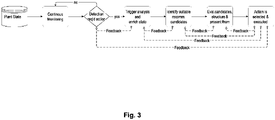
- Fig. 3 shows a flow for an Action Recommender according to an embodiment. This figure illustrates the situation for a fully automated system, i.e. when the system triggers all necessary steps from monitoring to presentation on its own. The system may foresee that users are able to opt-in at the different stages and, then, directly trigger the chain from there.
- the system and method comprises three high-level aspects:
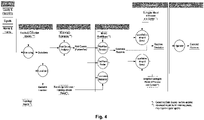
- Fig. 4 shows an example of a flow and generation of data between different stages according to an embodiment, with detailed subsystems for the individual stages.
- a first aspect of Fig. 4 is an abstraction of the input state.
- Plants and similar industrial facilities may consist of many different subsystems that collect and store data.
- An assistance system or recommendation system has advantageously access to live data, which may be called “signals" (because they can be sensed like - or as - electrical signals). These "signals", for example, may continuously monitor state(s) of one or more components.
- the assistance system or recommendation system may react accordingly (e.g. by outputting a recommendation and/or another predefined action).
- the assistance system may further be able to access historic states, for example in the evaluation of action to predict its usefulness.
- the system may access a consistent, connected, integrated and reliable view of the plant, e.g. by using an OPC UA architecture.
- examples of data sources (“signals”) representing its state may be electrical, acoustical and/or other sensed signals, and/or logs. They may comprise “evaluations”, such as alarms, events, quality and system KPIs.
- topology and engineering information may be used to link individual items to build a meaningful context. At least some of these sources are digital and can be accessed via interfaces of general standards such as OPC UA.
- the assistance system may be based upon these interfaces and may provide ways to define and contextualize the plant state.
- Custom models build by recommendation systems, such as a topology understanding may be used as interfaces to enhance and customize the system's outcome and/or its context.
- An implementation may, e.g., use a light-weighted wrapper around existing interfaces with a delegation and federation pattern in its simplest form. More advanced forms may, for example, support high-volume crawling of historic states use state-of-the-art storage systems to replicate and aggregate data from these sources.
- a second aspect of Fig. 4 is the so-called "Storage for Stage-Specific Information".
- Such an assistance or recommender system may comprise several subsystems or components that are associated with the different stages, as depicted in Fig. 4 .
- Each of the stages may be specialized to gather, derive and enhance the current view.
- the components may build their own models or collection of references in order to perform their task more efficiently.
- two modes of operation may be foreseen.
- the first mode may be called "interface mode", where components themselves takes care of the data management.
- interface mode where components themselves takes care of the data management.
- a proper interface to access the data may be used in order to provide a unifying wrapper for the consistent view.
- the second mode may be called "delegation mode", where a (central) data storage system may take care of the management.
- the generation of ID and references is automatically done, so that the component may delegate the data and queries to that system.
- Such as system may be realized with readily available storage systems.
- a third aspect of Fig. 4 is considers the use of the provided recommendations, their usefulness, triggers and feedback from users.
- An assistance system or recommendation system may have means to monitor their performance and adjust their output accordingly.
- Another source of information may be an interaction with (human) users that can provide valuable insight into intermediate and the overall results. Neglecting these insights may lead to quality degradation and even rejection of the recommendation system by the users, whereas integrating these feedbacks may advantageously lead to better acceptance and improvement of the overall system.
- information on presented recommendations may be gathered and, by this way, be provided as a method to derive (via monitoring of state and actions) the usefulness and/or confidence of a selected action.
- the information may be stored in readily available data storage systems.
- This may then be used for updating models and/or for building reference systems by individual system parts.
- feedback by users and other manual interaction may be collected, stored, and/or used by the system.
- the information may, e.g., be linked to the view in the component or the predefined action of the assistance system.
- the design of the system may allow to build complete data traces.
- a feedback from the users may, thus, not only be processed by the component it was given to, but also propagated to other, e.g. previous, components with automatic inference of their used reference view.
- the realization may be done in an interface or a delegation way.
- the advantages comprise not only to cope with homogenous data sources and application with a common governance structure.
- al some plants and industrial facilities may use a large bunch of different sources and systems and most of them only designed for the automated operation with limited overhead capacities.
- Applications like recommendation or assistance systems for human operators face the challenge to extract relevant information from this large landscape while being internally composed of several components or subsystems that themselves require specific data and interact with third party services.
- This assistance system may also serve as a unifier of different data sources, a focus that emphasizes relevant data and hides unnecessary data and a global index for data tracing and to reference contexts and situations all at once.
- this solution may be "wrapped" around existing and established data storage systems with minimal overhead and optional caching and/or replication to serve data-intensive applications on the one side, while customizing state-of-the-art data storage systems for support applications in an industrial context.
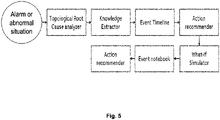
- Fig. 5 shows a exemplary workflow of a use case according to an embodiment. It should be noted that the components sketched in Fig. 5 may comprise further connections among each other. Also, they need not to be used in a serial way; for instance, "back-arrows" and loops may occur when using these components.
- Fig. 6 shows a partial visualization of a 6-part system according to an embodiment.
- the system (toolkit) shown in Fig. 5 and Fig. 6 encompasses following parts:
- This approach may lead to advantages like Less time spent on problem solving, easy to use workspace making access to vital informant quicker, faster resolution of operational issues and less undesired side effects, thus leading to lower cognitive load of, e.g., service personnel, which is required during problems analysis and decision making, thus freeing up mental capacity for other tasks.
Landscapes
- Engineering & Computer Science (AREA)
- Physics & Mathematics (AREA)
- General Physics & Mathematics (AREA)
- Automation & Control Theory (AREA)
- General Engineering & Computer Science (AREA)
- Manufacturing & Machinery (AREA)
- Quality & Reliability (AREA)
- Artificial Intelligence (AREA)
- Evolutionary Computation (AREA)
- Mathematical Physics (AREA)
- Testing And Monitoring For Control Systems (AREA)
Priority Applications (5)
| Application Number | Priority Date | Filing Date | Title |
|---|---|---|---|
| EP21165565.9A EP4068024A1 (de) | 2021-03-29 | 2021-03-29 | Bedienerzentrisches system zur lösung von anormalen situationen in einer anlage |
| CA3213662A CA3213662A1 (en) | 2021-03-29 | 2022-03-29 | Operator centric system for resolution of abnormal situations in a plant |
| CN202280026533.XA CN117157602A (zh) | 2021-03-29 | 2022-03-29 | 用于解决厂房中的异常情况的操作员中心系统 |
| PCT/EP2022/058302 WO2022207653A1 (en) | 2021-03-29 | 2022-03-29 | Operator centric system for resolution of abnormal situations in a plant |
| US18/475,681 US20240019849A1 (en) | 2021-03-29 | 2023-09-27 | Operator Centric System for Resolution of Abnormal Situations in a Plant |
Applications Claiming Priority (1)
| Application Number | Priority Date | Filing Date | Title |
|---|---|---|---|
| EP21165565.9A EP4068024A1 (de) | 2021-03-29 | 2021-03-29 | Bedienerzentrisches system zur lösung von anormalen situationen in einer anlage |
Publications (1)
| Publication Number | Publication Date |
|---|---|
| EP4068024A1 true EP4068024A1 (de) | 2022-10-05 |
Family
ID=75277850
Family Applications (1)
| Application Number | Title | Priority Date | Filing Date |
|---|---|---|---|
| EP21165565.9A Pending EP4068024A1 (de) | 2021-03-29 | 2021-03-29 | Bedienerzentrisches system zur lösung von anormalen situationen in einer anlage |
Country Status (5)
| Country | Link |
|---|---|
| US (1) | US20240019849A1 (de) |
| EP (1) | EP4068024A1 (de) |
| CN (1) | CN117157602A (de) |
| CA (1) | CA3213662A1 (de) |
| WO (1) | WO2022207653A1 (de) |
Families Citing this family (3)
| Publication number | Priority date | Publication date | Assignee | Title |
|---|---|---|---|---|
| EP4246262B1 (de) * | 2022-03-18 | 2025-09-10 | Siemens Aktiengesellschaft | Verfahren und vorrichtung zur überwachung eines zustands einer komponente einer verfahrenstechnischen anlage |
| EP4653964A1 (de) * | 2024-05-22 | 2025-11-26 | Abb Schweiz Ag | Verfahren zur steuerung eines subsystems einer industrieanlage |
| CN119848746B (zh) * | 2025-03-19 | 2025-06-20 | 云天软件科技有限公司 | 一种基于多系统集成的智慧园区管理方法及系统 |
Citations (3)
| Publication number | Priority date | Publication date | Assignee | Title |
|---|---|---|---|---|
| WO2019195532A1 (en) * | 2018-04-04 | 2019-10-10 | Schneider Electric USA, Inc. | Systems and methods for intelligent alarm grouping |
| US20190339688A1 (en) * | 2016-05-09 | 2019-11-07 | Strong Force Iot Portfolio 2016, Llc | Methods and systems for data collection, learning, and streaming of machine signals for analytics and maintenance using the industrial internet of things |
| US20200293032A1 (en) * | 2019-03-13 | 2020-09-17 | General Electric Company | Extremely fast substation asset monitoring system and method |
-
2021
- 2021-03-29 EP EP21165565.9A patent/EP4068024A1/de active Pending
-
2022
- 2022-03-29 WO PCT/EP2022/058302 patent/WO2022207653A1/en not_active Ceased
- 2022-03-29 CA CA3213662A patent/CA3213662A1/en active Pending
- 2022-03-29 CN CN202280026533.XA patent/CN117157602A/zh active Pending
-
2023
- 2023-09-27 US US18/475,681 patent/US20240019849A1/en active Pending
Patent Citations (3)
| Publication number | Priority date | Publication date | Assignee | Title |
|---|---|---|---|---|
| US20190339688A1 (en) * | 2016-05-09 | 2019-11-07 | Strong Force Iot Portfolio 2016, Llc | Methods and systems for data collection, learning, and streaming of machine signals for analytics and maintenance using the industrial internet of things |
| WO2019195532A1 (en) * | 2018-04-04 | 2019-10-10 | Schneider Electric USA, Inc. | Systems and methods for intelligent alarm grouping |
| US20200293032A1 (en) * | 2019-03-13 | 2020-09-17 | General Electric Company | Extremely fast substation asset monitoring system and method |
Non-Patent Citations (1)
| Title |
|---|
| SINGH VIVEK KUMAR ET AL: "A Cyber-Physical Anomaly Detection for Wide-Area Protection Using Machine Learning", IEEE TRANSACTIONS ON SMART GRID, IEEE, USA, vol. 12, no. 4, 17 March 2021 (2021-03-17), pages 3514 - 3526, XP011861459, ISSN: 1949-3053, [retrieved on 20210618], DOI: 10.1109/TSG.2021.3066316 * |
Also Published As
| Publication number | Publication date |
|---|---|
| CA3213662A1 (en) | 2022-10-06 |
| US20240019849A1 (en) | 2024-01-18 |
| WO2022207653A1 (en) | 2022-10-06 |
| CN117157602A (zh) | 2023-12-01 |
Similar Documents
| Publication | Publication Date | Title |
|---|---|---|
| US20240019849A1 (en) | Operator Centric System for Resolution of Abnormal Situations in a Plant | |
| US10970634B2 (en) | Methods and systems for capturing analytic model authoring knowledge | |
| US10545492B2 (en) | Selective online and offline access to searchable industrial automation data | |
| US20180129959A1 (en) | Methods and systems for programmatically selecting predictive model parameters | |
| US6934696B1 (en) | Custom rule system and method for expert systems | |
| US20180137424A1 (en) | Methods and systems for identifying gaps in predictive model ontology | |
| Roda et al. | An ontology-based framework to support intelligent data analysis of sensor measurements | |
| Gröger et al. | The data-driven factory-leveraging big industrial data for agile, learning and human-centric manufacturing | |
| RU2683415C1 (ru) | Генерация событий с использованием контекстной информации на интеллектуальном программируемом логическом контроллере | |
| EP3335083B1 (de) | Reichhaltige kontextualisierung von automatisierungsdaten | |
| US20160132538A1 (en) | Crawler for discovering control system data in an industrial automation environment | |
| JP2016057803A (ja) | 異常検知手順開発装置および異常検知手順開発方法 | |
| Maalej et al. | Collecting and processing interaction data for recommendation systems | |
| CN116882978B (zh) | 一种基于产品信息框架的深海潜水器运维保障系统 | |
| Prasad et al. | Market guide for aiops platforms | |
| Musulin et al. | A knowledge-driven approach for process supervision in chemical plants | |
| Patel et al. | AssetOpsBench: Benchmarking AI Agents for Task Automation in Industrial Asset Operations and Maintenance | |
| Butt et al. | Towards Ontology Driven Provenance in Scientific Workflow Engine. | |
| Gill et al. | Integrating Ontology Design with the CRISP-DM in the Context of Cyber-Physical Systems Maintenance | |
| WO2024063787A1 (en) | Asset structure behavior learning and inference management system | |
| Hartwell | Zephyr: a Data-Centric Framework for Predictive Maintenance of Wind Turbines | |
| JP4414298B2 (ja) | 不具合事例登録検索装置 | |
| Vitale et al. | Harnessing Generative AI for Interactive System Failure Diagnostics: A User-Centric Approach to Streamlined Problem Solving and Maintenance | |
| Hamdani et al. | Enhancing Data Integration and Decision-Making in Smart Manufacturing Through Knowledge Graph-Based Management | |
| Hamdani et al. | Enhancing Data Integration and Decision-Making in Smart Manufacturing Through Knowledge Graph-Based Management of Heterogeneous Data |
Legal Events
| Date | Code | Title | Description |
|---|---|---|---|
| PUAI | Public reference made under article 153(3) epc to a published international application that has entered the european phase |
Free format text: ORIGINAL CODE: 0009012 |
|
| STAA | Information on the status of an ep patent application or granted ep patent |
Free format text: STATUS: THE APPLICATION HAS BEEN PUBLISHED |
|
| AK | Designated contracting states |
Kind code of ref document: A1 Designated state(s): AL AT BE BG CH CY CZ DE DK EE ES FI FR GB GR HR HU IE IS IT LI LT LU LV MC MK MT NL NO PL PT RO RS SE SI SK SM TR |
|
| STAA | Information on the status of an ep patent application or granted ep patent |
Free format text: STATUS: REQUEST FOR EXAMINATION WAS MADE |
|
| 17P | Request for examination filed |
Effective date: 20230328 |
|
| RBV | Designated contracting states (corrected) |
Designated state(s): AL AT BE BG CH CY CZ DE DK EE ES FI FR GB GR HR HU IE IS IT LI LT LU LV MC MK MT NL NO PL PT RO RS SE SI SK SM TR |
|
| STAA | Information on the status of an ep patent application or granted ep patent |
Free format text: STATUS: EXAMINATION IS IN PROGRESS |
|
| 17Q | First examination report despatched |
Effective date: 20240223 |