EP4067396A1 - Copolymer, determination device, and carrier for determination - Google Patents
Copolymer, determination device, and carrier for determination Download PDFInfo
- Publication number
- EP4067396A1 EP4067396A1 EP20891558.7A EP20891558A EP4067396A1 EP 4067396 A1 EP4067396 A1 EP 4067396A1 EP 20891558 A EP20891558 A EP 20891558A EP 4067396 A1 EP4067396 A1 EP 4067396A1
- Authority
- EP
- European Patent Office
- Prior art keywords
- polymer
- substance
- formula
- measurement
- polymer film
- Prior art date
- Legal status (The legal status is an assumption and is not a legal conclusion. Google has not performed a legal analysis and makes no representation as to the accuracy of the status listed.)
- Withdrawn
Links
- 229920001577 copolymer Polymers 0.000 title claims abstract description 28
- 150000001875 compounds Chemical class 0.000 claims abstract description 30
- 125000004435 hydrogen atom Chemical group [H]* 0.000 claims abstract description 11
- 125000002496 methyl group Chemical group [H]C([H])([H])* 0.000 claims abstract description 9
- 125000000217 alkyl group Chemical group 0.000 claims abstract description 8
- 229910052799 carbon Inorganic materials 0.000 claims abstract description 8
- 125000004432 carbon atom Chemical group C* 0.000 claims abstract description 8
- 229920006254 polymer film Polymers 0.000 claims description 64
- 238000005259 measurement Methods 0.000 claims description 56
- 125000005022 dithioester group Chemical group 0.000 claims description 2
- 125000003396 thiol group Chemical group [H]S* 0.000 claims description 2
- 229920000642 polymer Polymers 0.000 description 89
- 239000000126 substance Substances 0.000 description 88
- 238000001514 detection method Methods 0.000 description 55
- 239000000758 substrate Substances 0.000 description 46
- 238000001179 sorption measurement Methods 0.000 description 43
- JKNCOURZONDCGV-UHFFFAOYSA-N 2-(dimethylamino)ethyl 2-methylprop-2-enoate Chemical group CN(C)CCOC(=O)C(C)=C JKNCOURZONDCGV-UHFFFAOYSA-N 0.000 description 24
- 238000006116 polymerization reaction Methods 0.000 description 23
- 238000000034 method Methods 0.000 description 19
- 210000002966 serum Anatomy 0.000 description 18
- 239000000523 sample Substances 0.000 description 16
- 238000006243 chemical reaction Methods 0.000 description 15
- 238000011156 evaluation Methods 0.000 description 14
- OKKJLVBELUTLKV-UHFFFAOYSA-N Methanol Chemical compound OC OKKJLVBELUTLKV-UHFFFAOYSA-N 0.000 description 12
- 239000010931 gold Substances 0.000 description 12
- 239000000178 monomer Substances 0.000 description 10
- 239000002904 solvent Substances 0.000 description 10
- 239000000243 solution Substances 0.000 description 9
- 238000002198 surface plasmon resonance spectroscopy Methods 0.000 description 9
- 210000002700 urine Anatomy 0.000 description 9
- LMDZBCPBFSXMTL-UHFFFAOYSA-N 1-ethyl-3-(3-dimethylaminopropyl)carbodiimide Chemical compound CCN=C=NCCCN(C)C LMDZBCPBFSXMTL-UHFFFAOYSA-N 0.000 description 8
- 230000008859 change Effects 0.000 description 8
- 238000005227 gel permeation chromatography Methods 0.000 description 8
- 230000007062 hydrolysis Effects 0.000 description 8
- 238000006460 hydrolysis reaction Methods 0.000 description 8
- 229910021589 Copper(I) bromide Inorganic materials 0.000 description 7
- ROFVEXUMMXZLPA-UHFFFAOYSA-N Bipyridyl Chemical group N1=CC=CC=C1C1=CC=CC=N1 ROFVEXUMMXZLPA-UHFFFAOYSA-N 0.000 description 6
- 238000005481 NMR spectroscopy Methods 0.000 description 6
- 239000003153 chemical reaction reagent Substances 0.000 description 6
- GVJXGCIPWAVXJP-UHFFFAOYSA-N 2,5-dioxo-1-oxoniopyrrolidine-3-sulfonate Chemical compound ON1C(=O)CC(S(O)(=O)=O)C1=O GVJXGCIPWAVXJP-UHFFFAOYSA-N 0.000 description 4
- 238000002965 ELISA Methods 0.000 description 4
- NKNDPYCGAZPOFS-UHFFFAOYSA-M copper(i) bromide Chemical compound Br[Cu] NKNDPYCGAZPOFS-UHFFFAOYSA-M 0.000 description 4
- 238000010586 diagram Methods 0.000 description 4
- PCHJSUWPFVWCPO-UHFFFAOYSA-N gold Chemical compound [Au] PCHJSUWPFVWCPO-UHFFFAOYSA-N 0.000 description 4
- 229910052737 gold Inorganic materials 0.000 description 4
- AMXOYNBUYSYVKV-UHFFFAOYSA-M lithium bromide Chemical compound [Li+].[Br-] AMXOYNBUYSYVKV-UHFFFAOYSA-M 0.000 description 4
- BASFCYQUMIYNBI-UHFFFAOYSA-N platinum Chemical compound [Pt] BASFCYQUMIYNBI-UHFFFAOYSA-N 0.000 description 4
- 239000003505 polymerization initiator Substances 0.000 description 4
- 230000001902 propagating effect Effects 0.000 description 4
- 239000012146 running buffer Substances 0.000 description 4
- 239000013076 target substance Substances 0.000 description 4
- XLYOFNOQVPJJNP-UHFFFAOYSA-N water Substances O XLYOFNOQVPJJNP-UHFFFAOYSA-N 0.000 description 4
- -1 2-methyl-1-oxo-2-propen-1-yl Chemical group 0.000 description 3
- HEMHJVSKTPXQMS-UHFFFAOYSA-M Sodium hydroxide Chemical compound [OH-].[Na+] HEMHJVSKTPXQMS-UHFFFAOYSA-M 0.000 description 3
- 238000004458 analytical method Methods 0.000 description 3
- 230000015572 biosynthetic process Effects 0.000 description 3
- 239000002981 blocking agent Substances 0.000 description 3
- 239000000470 constituent Substances 0.000 description 3
- 239000013078 crystal Substances 0.000 description 3
- 238000006911 enzymatic reaction Methods 0.000 description 3
- 239000007788 liquid Substances 0.000 description 3
- 239000000463 material Substances 0.000 description 3
- 238000003380 quartz crystal microbalance Methods 0.000 description 3
- 210000004243 sweat Anatomy 0.000 description 3
- PXBWWYBXPGZCHC-UHFFFAOYSA-N 2-[2-(2-bromo-2-methylpropanoyl)oxyethyldisulfanyl]ethyl 2-bromo-2-methylpropanoate Chemical compound CC(C)(Br)C(=O)OCCSSCCOC(=O)C(C)(C)Br PXBWWYBXPGZCHC-UHFFFAOYSA-N 0.000 description 2
- NIXOWILDQLNWCW-UHFFFAOYSA-M Acrylate Chemical compound [O-]C(=O)C=C NIXOWILDQLNWCW-UHFFFAOYSA-M 0.000 description 2
- RYGMFSIKBFXOCR-UHFFFAOYSA-N Copper Chemical compound [Cu] RYGMFSIKBFXOCR-UHFFFAOYSA-N 0.000 description 2
- 108020004414 DNA Proteins 0.000 description 2
- 108090000790 Enzymes Proteins 0.000 description 2
- 102000004190 Enzymes Human genes 0.000 description 2
- XLYOFNOQVPJJNP-ZSJDYOACSA-N Heavy water Chemical compound [2H]O[2H] XLYOFNOQVPJJNP-ZSJDYOACSA-N 0.000 description 2
- VYPSYNLAJGMNEJ-UHFFFAOYSA-N Silicium dioxide Chemical compound O=[Si]=O VYPSYNLAJGMNEJ-UHFFFAOYSA-N 0.000 description 2
- BQCADISMDOOEFD-UHFFFAOYSA-N Silver Chemical compound [Ag] BQCADISMDOOEFD-UHFFFAOYSA-N 0.000 description 2
- 230000004913 activation Effects 0.000 description 2
- 229910052782 aluminium Inorganic materials 0.000 description 2
- XAGFODPZIPBFFR-UHFFFAOYSA-N aluminium Chemical compound [Al] XAGFODPZIPBFFR-UHFFFAOYSA-N 0.000 description 2
- 239000000427 antigen Substances 0.000 description 2
- 108091007433 antigens Proteins 0.000 description 2
- 102000036639 antigens Human genes 0.000 description 2
- 239000007864 aqueous solution Substances 0.000 description 2
- 239000012298 atmosphere Substances 0.000 description 2
- 125000003178 carboxy group Chemical group [H]OC(*)=O 0.000 description 2
- 229910052802 copper Inorganic materials 0.000 description 2
- 239000010949 copper Substances 0.000 description 2
- 238000004090 dissolution Methods 0.000 description 2
- 230000000694 effects Effects 0.000 description 2
- 230000002708 enhancing effect Effects 0.000 description 2
- 125000004185 ester group Chemical group 0.000 description 2
- 238000002347 injection Methods 0.000 description 2
- 239000007924 injection Substances 0.000 description 2
- 229910052751 metal Inorganic materials 0.000 description 2
- 239000002184 metal Substances 0.000 description 2
- 239000012046 mixed solvent Substances 0.000 description 2
- 238000012986 modification Methods 0.000 description 2
- 230000004048 modification Effects 0.000 description 2
- 239000012299 nitrogen atmosphere Substances 0.000 description 2
- 229910052697 platinum Inorganic materials 0.000 description 2
- 108090000623 proteins and genes Proteins 0.000 description 2
- 102000004169 proteins and genes Human genes 0.000 description 2
- 229910052709 silver Inorganic materials 0.000 description 2
- 239000004332 silver Substances 0.000 description 2
- 238000010897 surface acoustic wave method Methods 0.000 description 2
- 238000003786 synthesis reaction Methods 0.000 description 2
- CSWRCKVZMMKVDC-UHFFFAOYSA-N 3-[dimethyl-[2-(2-methylprop-2-enoyloxy)ethyl]azaniumyl]propanoate Chemical compound CC(=C)C(=O)OCC[N+](C)(C)CCC([O-])=O CSWRCKVZMMKVDC-UHFFFAOYSA-N 0.000 description 1
- WSMQKESQZFQMFW-UHFFFAOYSA-N 5-methyl-pyrazole-3-carboxylic acid Chemical compound CC1=CC(C(O)=O)=NN1 WSMQKESQZFQMFW-UHFFFAOYSA-N 0.000 description 1
- WIYVVIUBKNTNKG-UHFFFAOYSA-N 6,7-dimethoxy-3,4-dihydronaphthalene-2-carboxylic acid Chemical compound C1CC(C(O)=O)=CC2=C1C=C(OC)C(OC)=C2 WIYVVIUBKNTNKG-UHFFFAOYSA-N 0.000 description 1
- 108091023037 Aptamer Proteins 0.000 description 1
- 241000252506 Characiformes Species 0.000 description 1
- VYZAMTAEIAYCRO-UHFFFAOYSA-N Chromium Chemical compound [Cr] VYZAMTAEIAYCRO-UHFFFAOYSA-N 0.000 description 1
- SJIXRGNQPBQWMK-UHFFFAOYSA-N DEAEMA Natural products CCN(CC)CCOC(=O)C(C)=C SJIXRGNQPBQWMK-UHFFFAOYSA-N 0.000 description 1
- 239000004698 Polyethylene Substances 0.000 description 1
- 239000004743 Polypropylene Substances 0.000 description 1
- XBDQKXXYIPTUBI-UHFFFAOYSA-M Propionate Chemical compound CCC([O-])=O XBDQKXXYIPTUBI-UHFFFAOYSA-M 0.000 description 1
- 238000001069 Raman spectroscopy Methods 0.000 description 1
- GWEVSGVZZGPLCZ-UHFFFAOYSA-N Titan oxide Chemical compound O=[Ti]=O GWEVSGVZZGPLCZ-UHFFFAOYSA-N 0.000 description 1
- RTAQQCXQSZGOHL-UHFFFAOYSA-N Titanium Chemical compound [Ti] RTAQQCXQSZGOHL-UHFFFAOYSA-N 0.000 description 1
- 238000009825 accumulation Methods 0.000 description 1
- 150000001412 amines Chemical group 0.000 description 1
- 125000003277 amino group Chemical group 0.000 description 1
- 239000012472 biological sample Substances 0.000 description 1
- 229920001400 block copolymer Polymers 0.000 description 1
- 210000004369 blood Anatomy 0.000 description 1
- 239000008280 blood Substances 0.000 description 1
- 210000001124 body fluid Anatomy 0.000 description 1
- 239000010839 body fluid Substances 0.000 description 1
- 239000000872 buffer Substances 0.000 description 1
- 239000003054 catalyst Substances 0.000 description 1
- 239000000919 ceramic Substances 0.000 description 1
- 229910052804 chromium Inorganic materials 0.000 description 1
- 239000011651 chromium Substances 0.000 description 1
- 238000004140 cleaning Methods 0.000 description 1
- 238000007334 copolymerization reaction Methods 0.000 description 1
- 238000000354 decomposition reaction Methods 0.000 description 1
- 125000002147 dimethylamino group Chemical group [H]C([H])([H])N(*)C([H])([H])[H] 0.000 description 1
- 238000007599 discharging Methods 0.000 description 1
- 238000001035 drying Methods 0.000 description 1
- 230000005674 electromagnetic induction Effects 0.000 description 1
- 125000001495 ethyl group Chemical group [H]C([H])([H])C([H])([H])* 0.000 description 1
- 230000005669 field effect Effects 0.000 description 1
- 125000000524 functional group Chemical group 0.000 description 1
- 239000007789 gas Substances 0.000 description 1
- 239000011521 glass Substances 0.000 description 1
- 229920000578 graft copolymer Polymers 0.000 description 1
- 238000010559 graft polymerization reaction Methods 0.000 description 1
- 229910010272 inorganic material Inorganic materials 0.000 description 1
- 239000011147 inorganic material Substances 0.000 description 1
- 230000003993 interaction Effects 0.000 description 1
- 230000009878 intermolecular interaction Effects 0.000 description 1
- 239000010410 layer Substances 0.000 description 1
- 239000003446 ligand Substances 0.000 description 1
- 238000004519 manufacturing process Methods 0.000 description 1
- 238000000691 measurement method Methods 0.000 description 1
- 239000007769 metal material Substances 0.000 description 1
- 239000000203 mixture Substances 0.000 description 1
- 239000002245 particle Substances 0.000 description 1
- 210000002381 plasma Anatomy 0.000 description 1
- 239000004033 plastic Substances 0.000 description 1
- 229920003023 plastic Polymers 0.000 description 1
- 229920000573 polyethylene Polymers 0.000 description 1
- 239000002685 polymerization catalyst Substances 0.000 description 1
- 229920001155 polypropylene Polymers 0.000 description 1
- 239000000843 powder Substances 0.000 description 1
- 238000002360 preparation method Methods 0.000 description 1
- 108090000765 processed proteins & peptides Proteins 0.000 description 1
- 230000005855 radiation Effects 0.000 description 1
- 238000010526 radical polymerization reaction Methods 0.000 description 1
- 229920005604 random copolymer Polymers 0.000 description 1
- 238000006479 redox reaction Methods 0.000 description 1
- 210000003296 saliva Anatomy 0.000 description 1
- 239000000377 silicon dioxide Substances 0.000 description 1
- 239000002356 single layer Substances 0.000 description 1
- KZNICNPSHKQLFF-UHFFFAOYSA-N succinimide Chemical group O=C1CCC(=O)N1 KZNICNPSHKQLFF-UHFFFAOYSA-N 0.000 description 1
- 230000001629 suppression Effects 0.000 description 1
- 210000001138 tear Anatomy 0.000 description 1
- 150000003512 tertiary amines Chemical class 0.000 description 1
- 229910052719 titanium Inorganic materials 0.000 description 1
- 239000010936 titanium Substances 0.000 description 1
- OGIDPMRJRNCKJF-UHFFFAOYSA-N titanium oxide Inorganic materials [Ti]=O OGIDPMRJRNCKJF-UHFFFAOYSA-N 0.000 description 1
Images




Classifications
-
- C—CHEMISTRY; METALLURGY
- C08—ORGANIC MACROMOLECULAR COMPOUNDS; THEIR PREPARATION OR CHEMICAL WORKING-UP; COMPOSITIONS BASED THEREON
- C08F—MACROMOLECULAR COMPOUNDS OBTAINED BY REACTIONS ONLY INVOLVING CARBON-TO-CARBON UNSATURATED BONDS
- C08F220/00—Copolymers of compounds having one or more unsaturated aliphatic radicals, each having only one carbon-to-carbon double bond, and only one being terminated by only one carboxyl radical or a salt, anhydride ester, amide, imide or nitrile thereof
- C08F220/02—Monocarboxylic acids having less than ten carbon atoms; Derivatives thereof
- C08F220/10—Esters
- C08F220/34—Esters containing nitrogen, e.g. N,N-dimethylaminoethyl (meth)acrylate
-
- C—CHEMISTRY; METALLURGY
- C08—ORGANIC MACROMOLECULAR COMPOUNDS; THEIR PREPARATION OR CHEMICAL WORKING-UP; COMPOSITIONS BASED THEREON
- C08F—MACROMOLECULAR COMPOUNDS OBTAINED BY REACTIONS ONLY INVOLVING CARBON-TO-CARBON UNSATURATED BONDS
- C08F220/00—Copolymers of compounds having one or more unsaturated aliphatic radicals, each having only one carbon-to-carbon double bond, and only one being terminated by only one carboxyl radical or a salt, anhydride ester, amide, imide or nitrile thereof
- C08F220/02—Monocarboxylic acids having less than ten carbon atoms; Derivatives thereof
- C08F220/10—Esters
- C08F220/34—Esters containing nitrogen, e.g. N,N-dimethylaminoethyl (meth)acrylate
- C08F220/36—Esters containing nitrogen, e.g. N,N-dimethylaminoethyl (meth)acrylate containing oxygen in addition to the carboxy oxygen, e.g. 2-N-morpholinoethyl (meth)acrylate or 2-isocyanatoethyl (meth)acrylate
- C08F220/365—Esters containing nitrogen, e.g. N,N-dimethylaminoethyl (meth)acrylate containing oxygen in addition to the carboxy oxygen, e.g. 2-N-morpholinoethyl (meth)acrylate or 2-isocyanatoethyl (meth)acrylate containing further carboxylic moieties
-
- C—CHEMISTRY; METALLURGY
- C08—ORGANIC MACROMOLECULAR COMPOUNDS; THEIR PREPARATION OR CHEMICAL WORKING-UP; COMPOSITIONS BASED THEREON
- C08F—MACROMOLECULAR COMPOUNDS OBTAINED BY REACTIONS ONLY INVOLVING CARBON-TO-CARBON UNSATURATED BONDS
- C08F222/00—Copolymers of compounds having one or more unsaturated aliphatic radicals, each having only one carbon-to-carbon double bond, and at least one being terminated by a carboxyl radical and containing at least one other carboxyl radical in the molecule; Salts, anhydrides, esters, amides, imides, or nitriles thereof
- C08F222/10—Esters
- C08F222/1006—Esters of polyhydric alcohols or polyhydric phenols
-
- C—CHEMISTRY; METALLURGY
- C08—ORGANIC MACROMOLECULAR COMPOUNDS; THEIR PREPARATION OR CHEMICAL WORKING-UP; COMPOSITIONS BASED THEREON
- C08F—MACROMOLECULAR COMPOUNDS OBTAINED BY REACTIONS ONLY INVOLVING CARBON-TO-CARBON UNSATURATED BONDS
- C08F8/00—Chemical modification by after-treatment
- C08F8/12—Hydrolysis
-
- C—CHEMISTRY; METALLURGY
- C08—ORGANIC MACROMOLECULAR COMPOUNDS; THEIR PREPARATION OR CHEMICAL WORKING-UP; COMPOSITIONS BASED THEREON
- C08J—WORKING-UP; GENERAL PROCESSES OF COMPOUNDING; AFTER-TREATMENT NOT COVERED BY SUBCLASSES C08B, C08C, C08F, C08G or C08H
- C08J5/00—Manufacture of articles or shaped materials containing macromolecular substances
- C08J5/18—Manufacture of films or sheets
-
- C—CHEMISTRY; METALLURGY
- C09—DYES; PAINTS; POLISHES; NATURAL RESINS; ADHESIVES; COMPOSITIONS NOT OTHERWISE PROVIDED FOR; APPLICATIONS OF MATERIALS NOT OTHERWISE PROVIDED FOR
- C09D—COATING COMPOSITIONS, e.g. PAINTS, VARNISHES OR LACQUERS; FILLING PASTES; CHEMICAL PAINT OR INK REMOVERS; INKS; CORRECTING FLUIDS; WOODSTAINS; PASTES OR SOLIDS FOR COLOURING OR PRINTING; USE OF MATERIALS THEREFOR
- C09D133/00—Coating compositions based on homopolymers or copolymers of compounds having one or more unsaturated aliphatic radicals, each having only one carbon-to-carbon double bond, and at least one being terminated by only one carboxyl radical, or of salts, anhydrides, esters, amides, imides, or nitriles thereof; Coating compositions based on derivatives of such polymers
- C09D133/04—Homopolymers or copolymers of esters
- C09D133/14—Homopolymers or copolymers of esters of esters containing halogen, nitrogen, sulfur or oxygen atoms in addition to the carboxy oxygen
-
- G—PHYSICS
- G01—MEASURING; TESTING
- G01N—INVESTIGATING OR ANALYSING MATERIALS BY DETERMINING THEIR CHEMICAL OR PHYSICAL PROPERTIES
- G01N29/00—Investigating or analysing materials by the use of ultrasonic, sonic or infrasonic waves; Visualisation of the interior of objects by transmitting ultrasonic or sonic waves through the object
- G01N29/02—Analysing fluids
- G01N29/022—Fluid sensors based on microsensors, e.g. quartz crystal-microbalance [QCM], surface acoustic wave [SAW] devices, tuning forks, cantilevers, flexural plate wave [FPW] devices
-
- G—PHYSICS
- G01—MEASURING; TESTING
- G01N—INVESTIGATING OR ANALYSING MATERIALS BY DETERMINING THEIR CHEMICAL OR PHYSICAL PROPERTIES
- G01N33/00—Investigating or analysing materials by specific methods not covered by groups G01N1/00 - G01N31/00
- G01N33/48—Biological material, e.g. blood, urine; Haemocytometers
- G01N33/50—Chemical analysis of biological material, e.g. blood, urine; Testing involving biospecific ligand binding methods; Immunological testing
- G01N33/53—Immunoassay; Biospecific binding assay; Materials therefor
- G01N33/543—Immunoassay; Biospecific binding assay; Materials therefor with an insoluble carrier for immobilising immunochemicals
- G01N33/54393—Improving reaction conditions or stability, e.g. by coating or irradiation of surface, by reduction of non-specific binding, by promotion of specific binding
-
- C—CHEMISTRY; METALLURGY
- C08—ORGANIC MACROMOLECULAR COMPOUNDS; THEIR PREPARATION OR CHEMICAL WORKING-UP; COMPOSITIONS BASED THEREON
- C08F—MACROMOLECULAR COMPOUNDS OBTAINED BY REACTIONS ONLY INVOLVING CARBON-TO-CARBON UNSATURATED BONDS
- C08F2438/00—Living radical polymerisation
- C08F2438/01—Atom Transfer Radical Polymerization [ATRP] or reverse ATRP
-
- C—CHEMISTRY; METALLURGY
- C08—ORGANIC MACROMOLECULAR COMPOUNDS; THEIR PREPARATION OR CHEMICAL WORKING-UP; COMPOSITIONS BASED THEREON
- C08J—WORKING-UP; GENERAL PROCESSES OF COMPOUNDING; AFTER-TREATMENT NOT COVERED BY SUBCLASSES C08B, C08C, C08F, C08G or C08H
- C08J2333/00—Characterised by the use of homopolymers or copolymers of compounds having one or more unsaturated aliphatic radicals, each having only one carbon-to-carbon double bond, and only one being terminated by only one carboxyl radical, or of salts, anhydrides, esters, amides, imides, or nitriles thereof; Derivatives of such polymers
- C08J2333/04—Characterised by the use of homopolymers or copolymers of compounds having one or more unsaturated aliphatic radicals, each having only one carbon-to-carbon double bond, and only one being terminated by only one carboxyl radical, or of salts, anhydrides, esters, amides, imides, or nitriles thereof; Derivatives of such polymers esters
- C08J2333/14—Characterised by the use of homopolymers or copolymers of compounds having one or more unsaturated aliphatic radicals, each having only one carbon-to-carbon double bond, and only one being terminated by only one carboxyl radical, or of salts, anhydrides, esters, amides, imides, or nitriles thereof; Derivatives of such polymers esters of esters containing halogen, nitrogen, sulfur, or oxygen atoms in addition to the carboxy oxygen
-
- G—PHYSICS
- G01—MEASURING; TESTING
- G01N—INVESTIGATING OR ANALYSING MATERIALS BY DETERMINING THEIR CHEMICAL OR PHYSICAL PROPERTIES
- G01N2291/00—Indexing codes associated with group G01N29/00
- G01N2291/02—Indexing codes associated with the analysed material
- G01N2291/025—Change of phase or condition
- G01N2291/0255—(Bio)chemical reactions, e.g. on biosensors
-
- G—PHYSICS
- G01—MEASURING; TESTING
- G01N—INVESTIGATING OR ANALYSING MATERIALS BY DETERMINING THEIR CHEMICAL OR PHYSICAL PROPERTIES
- G01N2291/00—Indexing codes associated with group G01N29/00
- G01N2291/02—Indexing codes associated with the analysed material
- G01N2291/025—Change of phase or condition
- G01N2291/0256—Adsorption, desorption, surface mass change, e.g. on biosensors
Definitions
- the present disclosure relates to a copolymer that forms a polymer film used in a measuring device, a measuring device provided with a polymer film, and a carrier for measurement.
- Patent Document 1 discloses a surface acoustic wave sensor as an example of a measuring device for measuring the concentration of a target measurement substance (e.g., a biomolecule).
- a measuring device includes a detection unit, in which a substance (e.g., an antibody) that interacts with a target measurement substance contained in a sample is fixed.
- a polymer film is often formed on the detection unit for the purpose of reducing non-specific adsorption of substances other than the target measurement substance contained in the sample.
- Patent Document 1 JP 2008-286606 A
- the polymer film mentioned above has a non-specific adsorption property that differs depending on the application of the polymer film, such as the type of the target measurement substance, the measurement precision, and the measurement method.
- a copolymer according to an embodiment is a copolymer of a compound represented by Formula (1) and a compound represented by Formula (2): where in Formula (1),
- a polymer film having a different non-specific adsorption property can be produced.
- FIG. 1 illustrates a schematic view of a sensor 2 of a measuring device 100 according to the present embodiment.
- the measuring device 100 can target and detect a specific substance (first substance) in a measurement target (sample).
- the measurement target include biological samples, such as blood samples including serum and plasma, and body fluids including sweat, urine, tears, and saliva.
- the first substance 5 is, for example, a substance in a living organism. Examples of the substance in a living organism include proteins, DNAs, and substrates for enzymatic reaction.
- the measuring device 100 is provided with the sensor 2 that can detect the first substance and a control device 6 that can control the measuring device 100.
- the sensor 2 may be a sensor that utilizes, for example, acoustic waves, Quartz Crystal Microbalance (QCM), Surface Plasmon Resonance (SPR), or Field Effect Transistors (FETs). That is, the sensor 2 may be any as long as it is one that is able to convert an electrical signal to and from an acoustic wave, QCM, SPR, or FET.
- the sensor 2 according to an embodiment is a sensor that utilizes acoustic waves. That is, by using the sensor 2, the measuring device 100 according to an embodiment can detect the change in the acoustic wave based on the presence of the first substance as a change in the electrical signal.
- the sensor 2 may be produced by a known method.
- the sensor 2 includes an external terminal 21.
- the sensor 2 can be electrically connected, through the external terminal 21, to the control device 6 that controls the measuring device 100. That is, the sensor 2 and the control device 6 can input and output electrical signals from and to each other through the external terminal 21.
- the control device 6 can, for example, detect the first substance based on an electrical signal input from the sensor 2.
- the control device 6 may, for example, calculate the concentration of the first substance contained in the sample.
- the control device 6 may, for example, identify the first substance.
- the control device 6 and the external terminal 21 may be produced using a known technique.
- the configuration of electrical connection between the sensor 2 and the control device 6 is not limited to the external terminal 21.
- the sensor 2 and the control device 6 may be electrically connected by electromagnetic induction.
- the sensor 2 may be a disposable cartridge. This makes it unnecessary to clean the sensor 2 after measurement, and the effect on the measurement result due to insufficient cleaning can be eliminated.
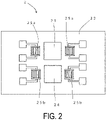
- FIG. 2 illustrates a plan view of the sensor 2.
- the sensor 2 is provided with a substrate 22, a detection unit 23 disposed on the substrate 22, and a pair of first inter digital transducer (IDT) electrodes 25a arranged on the substrate 22 sandwiching the detection unit 23.
- the substrate 22 can support the first IDT electrodes 25a and the like.
- the substrate 22 is a piezoelectric substrate.
- the substrate 22 may be a substrate containing a metal such as gold, silver, copper, platinum, and aluminum, or a piezoelectric single crystal such as lithium tantalate and crystal.
- the substrate 22 is a piezoelectric substrate containing crystal.
- a substance (second substance) that reacts with the first substance 5 is fixed to the detection unit 23.
- the first substance contained in the sample can react with the second substance fixed to the detection unit 23 in the detection unit 23.
- the detection unit 23 can change the propagation characteristics of acoustic waves of the substrate 22.
- the detection unit 23 can, for example, change the weight applied to the substrate 22 or the viscosity of a liquid in contact with a surface of the substrate 22 by the reaction between the first substance and the second substance. Accordingly, the phase, amplitude, period, or the like of the acoustic waves propagating in the substrate 22 changes.
- the sensor 2 can detect a change in the surface acoustic waves corresponds to the concentration of the first substance. The details of the detection unit 23 will be described later.
- the pair of first IDT electrodes 25a can generate acoustic waves between the pair of first IDT electrodes 25a.
- the acoustic waves propagating at the surface of the substrate 22 may be referred to as surface automatic waves (SAWs).
- SAWs surface automatic waves
- an electrical signal is input from one of the pair of first IDT electrodes 25a.
- the input electrical signal is converted to an acoustic wave propagating towards the detection unit 23, which is then emitted from the one IDT electrode 25a.
- the emitted acoustic wave passes through the detection unit 23.
- the other IDT electrode 25a can receive the acoustic wave that has passed through the detection unit 23.
- the received acoustic wave is converted to an electrical signal.
- the pair of first IDT electrodes 25a may be formed of a metal material such as gold, chromium, or titanium.
- the pair of first IDT electrodes 25a may be single-layer electrodes including a single material, or multi-layer electrodes including a plurality of materials.
- the sensor 2 may have two or more groups of the detection unit 23 and the pair of IDT electrodes 25a.
- each group in the measuring device 100 may detect a different type of target substance.
- the measuring device 100 may, for example, detect the same type of target substance using a plurality of the groups and compare the detection results from each of the groups.
- the sensor 2 may have a reference unit 24 disposed on the substrate 22. Additionally, the sensor 2 may include a pair of second IDT electrodes 25b disposed on the substrate 22 sandwiching the reference unit 24.
- an electrical signal is input from one of the pair of first IDT electrodes 25b. The input electrical signal is converted to an acoustic wave propagating towards the reference unit 24, which is then emitted from the one IDT electrode 25b. The emitted acoustic wave passes through the reference unit 24.
- the other IDT electrode 25b can receive the acoustic wave that has passed through the reference unit 24. The received acoustic wave is converted to an electrical signal.
- the reference unit 24 can function as a control of the detection unit 23. Specifically, unlike in the detection unit 23, the second substance is not fixed to the reference unit 24. That is, the reaction between the first substance and the second substance does not occur in the reference unit 24.
- the measuring device 100 can use a reference signal, which is an electrical signal based on an acoustic wave that has passed through the reference unit 24, as a reference to detect the first substance based on a detection signal, which is an electrical signal based on an acoustic wave that has passed through the detection unit 23. Specifically, if a sample contains the first substance, the first material reacts with the second substance, generating a difference between the detection signal and the reference signal.
- the measuring device 100 can detect the first substance by calculating the difference between the detection signal and the reference signal.
- the measuring device 100 can detect a change in the reaction between the first substance and the second substance by detecting a change in the difference between the detection signal and the reference signal.
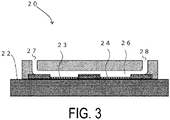
- FIG. 3 illustrates a cross-sectional view of the sensor 2 along line A-A at a cross-sectional plane in FIG. 1 .
- the sensor 2 further includes a flow path member 26.
- the flow path member 26 can function as a passage of sample.
- the flow path member 26 includes a supply port 27 for supplying a sample and a discharge port 28 for discharging the sample, the supply port 27 and the discharge port 28 both opening on the upper surface of the flow path member 26.
- the sensor 2 when a sample supplied from the supply port 27 reaches the detection unit 23, detection of the first substance occurs in the detection unit 23; then, the sample is discharged from the discharge port 28.
- FIG. 4 illustrates a conceptual diagram of a polymer film 1 included in the detection unit 23.
- the polymer film 1 containing a polymer 3 is fixed to the substrate 22.
- the substance (second substance 4) that reacts with the first substance 5 is fixed to the polymer film 1.
- the polymer film 1 is a film adjusted to have a high specific adsorption property. That is, the polymer film 1 is a film adjusted to have a reduced non-specific adsorption.
- the non-specific adsorption property of the polymer film 1 can be adjusted by changing the proportions of a first structural unit and a second structural unit contained in the polymer film 1. The adjustment method will be described later.
- the reaction between the first substance 5 and the second substance 4 may be a reaction that results in a change in the output from the sensor 2.
- a reaction may be, for example, a redox reaction, an enzymatic reaction, an antigen-antibody reaction, or a reaction in which the first substance 5 and the second substance 4 are bonded by chemical adsorption, intermolecular interaction, or ionic interaction, etc.
- the reaction between the first substance 5 and the second substance 4 may be a reaction that generates a new substance (third substance) by an enzymatic reaction or the like.
- the second substance 4 fixed to the detection unit 23 may be selected as appropriate in accordance with the first substance 5.
- the second substance 4 may be an antibody, peptide, or aptamer.
- the second substance 4 may be an antigen.
- the second substance 4 may be an enzyme.
- the measuring device 100 may indirectly detect the first substance 5, which is the target.
- a substance similar to the first substance 5 may be fixed to the detection unit 23 as the second substance 4. That is, for example, antibodies whose antigens are the first substance 5 may be reacted with the first substance 5 in advance, and the unreacted antibodies may be reacted with the fixed second substance 4.
- the measuring device 100 can, for example, calculate the amount of the first substance 5 indirectly from the amount of antibodies detected, as long as the amount of the antibodies is known.
- the polymer 3 constitutes the polymer film 1.
- an example of the polymer 3 of the present disclosure hereinafter, abbreviated as "polymer of the present embodiment" will be described.
- the polymer according to the present embodiment is a copolymer of a compound represented by Formula (1) below and a compound represented by Formula (2) below. where in Formula (1),
- Examples of the compound represented by Formula (1) include N-(carboxymethyl)-N,N-dimethyl-2-[(2-methyl-1-oxo-2-propen-1-yl)-oxy]etanaminium (CBMA1) and 2-carboxy-N,N-dimethyl-N-[2'-(methacryloyl)oxyethyl]etanaminium (CBMA2,3-[[2-(methacryloyloxy)ethyl]dimethylammonio]propionate).
- the compound represented by Formula (1) may be a commercially available product, or may be a compound obtained by synthesis.
- Examples of the compound represented by Formula (2) include N,N-dimethylaminoethyl(meth)acrylate, N,N-diethylaminoethyl(meth)acrylate, and N,N-diisopropylaminoethyl(meth)acrylate.
- the compound represented by Formula (2) may be a commercially available product, or may be a compound obtained by synthesis.
- a polymer film having a different non-specific adsorption property can be produced from the polymer of the present embodiment.
- the zwitterionic structure in the structure illustrated in Formula (1) allows the polymer of the present embodiment to suppress non-specific adsorption.
- the dimethylamino group in the structure illustrated in Formula (2) allows the polymer of the present embodiment to promote non-specific adsorption.
- the proportion of structural units derived from the compound represented by Formula (2) contained in the copolymer described above may be 5 mol% or less, or 2 mol% or less, from the perspective of suppressing non-specific adsorption.
- the proportion of structural units derived from the compound represented by Formula (2) contained in the copolymer described above may be 20 mol% or greater, from the perspective of actively enhancing the non-specific adsorption property.
- the proportion of structural units derived from the compound represented by Formula (2) contained in the copolymer described above may also be 35 mol% or greater, or 50 mol% or greater.
- the polymer of the present embodiment can also be expressed as including a first structural unit represented by Formula (3) below and a second structural unit (DMAEMA unit) represented by Formula (4) below.
- the first structural unit is a structural unit derived from the compound represented by Formula (1) above.
- the second structural unit is a structural unit derived from the compound represented by Formula (2) above. where in Formula (3),
- the polymer of the present embodiment may have an active ester group at the end of a portion of the side chains of the first structural unit represented by Formula (3).
- the active ester group include a succinimide group.
- At least one end of the main chain of the polymer of the present embodiment may have a thiol group or a dithioester group from the perspective of easily fixing the end to the polymer film fixed to the substrate 22 (measurement substrate 12).
- n/(m + n) ⁇ 100 may be 5 or less, or may be 2 or less.
- n/(m + n) ⁇ 100 may be 20 or greater, or 35 or greater.
- a weight average molecular weight of the polymer of the present embodiment may be 3000 or greater, or 5000 or greater, from the perspective of film formation density.
- the weight average molecular weight of the polymer of the present embodiment may also be 100000 or less, or 70000 or less.
- the polymer of the present embodiment may be a random copolymer, a block copolymer, or a graft copolymer.
- the weight average molecular weight of the polymer of the present embodiment may be 20000 or greater, from the perspective of suppressing the amount of non-specific adsorption in serum. Furthermore, the weight average molecular weight of the polymer of the present embodiment may be 30000 or less. In addition to the weight average molecular weight of the polymer of the present embodiment being within the range described above, when the proportion of structural units derived from the compound represented by Formula (2) contained in the polymer of the present embodiment is 7 mol% or less (or 5 mol% or less, or 3 mol% or less), the amount of non-specific adsorption in serum can be further suppressed.
- the weight average molecular weight of the polymer of the present embodiment may be 2000 or greater, or 5000 or greater, from the perspective of suppressing the amount of non-specific adsorption in sweat or urine. Furthermore, the weight average molecular weight of the polymer of the present embodiment may be 20000 or less, or 10000 or less. In addition to the weight average molecular weight of the polymer of the present embodiment being within the range described above, when the proportion of structural units derived from the compound represented by Formula (2) contained in the polymer of the present embodiment is 7 mol% or less (or 5 mol% or less, or 3 mol% or less), the amount of non-specific adsorption in sweat or urine can be further suppressed.
- a number average molecular weight or the weight average molecular weight of the polymer of the present embodiment can be determined by a known technique such as gel permeation chromatography (GPC).
- the copolymer of a compound represented by Formula (1) above and a compound represented by Formula (2) above can be identified by a known organic analysis technique.
- the copolymer may be identified by Nuclear Magnetic Resonance (NMR).
- NMR Nuclear Magnetic Resonance
- the copolymer may be identified using a gas chromatograph.
- the copolymer may be identified using a liquid chromatograph.
- the copolymer may be identified by laser Raman spectroscopy analysis. That is, when identifying the copolymer, devices capable of carrying out these techniques may be used.
- the identification technique and device are not limited to the techniques and devices described above as long as the copolymer can be identified.
- the polymer of the present embodiment can be produced by a known polymerization method such as radical polymerization.
- a known polymerization method such as radical polymerization.
- the compound represented by Formula (1) and the compound represented by Formula (2) are dissolved in a solvent.
- polymerization reaction is performed by adding a polymerization catalyst and a polymerization initiator.
- the polymerization conditions such as the polymerization time, the polymerization temperature, and the polymerization solvent can be selected as appropriate depending on the type of the monomer, the amount to be used, the ratio to be used, and the like.
- Examples of a method of fixing the polymer 3 to the substrate 22 include a method of applying a polymer solution, obtained by dissolving the polymer 3 in a solvent, on the substrate 22 and drying, graft polymerization by radiation or ultraviolet light, and chemical reaction with a functional group of the substrate 22. By these methods, a polymer film 1 including the polymer 3 is formed on the substrate 22.
- Examples of a method of fixing the second substance 4 to the polymer 3 include a method of covalently bonding the second substance 4 to the carboxyl groups of the polymer 3.
- the polymer 3 is reacted with N-hydroxysulfosuccinimide (NHS) and 1-ethyl-3-(3-dimethylaminopropyl)carbodiimide (EDC) (NHS/EDC activation).
- NHS N-hydroxysulfosuccinimide
- EDC 1-ethyl-3-(3-dimethylaminopropyl)carbodiimide
- the carboxyl groups contained in the polymer 3 are replaced by the NHS ester groups.
- the NHS/EDC activation of the polymer 3 may be performed before the polymer 3 is fixed to the substrate 22, or may be performed after the polymer 3 to is fixed the substrate 22.
- FIG. 5 illustrates an overall configuration of a carrier for measurement 11 according to the present embodiment.
- the carrier for measurement 11 include a plate for ELISA (enzyme-linked immunosorbent assay).
- the carrier for measurement 11 includes a detection region 31 and a non-detection region 32 on a surface of a measurement substrate 12, in which the detection region 31 specifically captures a target substance (first substance 5) contained in a sample while the non-detection region 32 non-selectively adsorbs a blocking agent and the like.
- a polymer film 1A is fixed to the detection region 31 while a polymer film 1B is fixed to the non-detection region 32.
- a second substance 4 that reacts with the first substance 5 is fixed to the polymer film 1A. Furthermore, the polymer film 1A is adjusted to have a low non-specific adsorption property.
- FIG. 6 conceptually illustrates a polymer film formed in the non-detection region 32.
- the second substance 4 is not fixed to the polymer film 1B, and only a polymer film 1 containing the polymer 3 is fixed to a surface of the measurement substrate 12.
- the polymer film 1B is a film adjusted to have a high non-specific adsorption property. That is, two types of polymer films 1A and 1B containing the same structural units (first and second structural units) but having different non-specific adsorption properties are formed on one carrier for measurement 11.
- a desired second substance 4 is fixed to the polymer film 1A in the detection region 31.
- the non-detection region 32 is treated with a blocking agent, which is non-specifically adsorbed to the polymer film 1B in the non-detection region 32.
- a first substance 5 which is the target substance contained in the sample, reacts with the second substance 4, and the reaction is detected by a detection reagent.
- the detection reagent include a redox substance, a fluorescent substance, an enzyme, and a dye compound.
- the polymer film 1B in the non-detection region 32 is treated with the blocking agent, resulting in effective suppression of non-specific adsorption.
- the application of the polymer film 1B is not limited to the description above, and the polymer film 1B may be used to actively enhance the non-specific adsorption property.
- the measurement substrate 12 may be, for example: a metal such as gold, silver, copper, platinum, and aluminum; a plastic such as polyethylene and polypropylene; or an inorganic material such as titanium oxide, silica, glass, and ceramic.
- the measurement substrate 12 is not limited to these examples.
- a shape of the measurement substrate 12 may be, for example, the shape of a plate, the shape of a particle, the shape of a micro structure, or the shape of a microtiter plate.
- the shape of the measurement substrate 12 is not limited to these examples.
- a measurement kit including the measurement substrate 12 to which the polymer films 1A and 1B are fixed, the second substance 4, and the detection reagent is also included in the scope of the present disclosure.
- the second substance 4 may be fixed to the polymer film 1 in advance during the production of the product, or may be fixed to the polymer film 1 by the user prior to measurement.
- the measurement kit according to the present embodiment may include another reagent or instrument.
- a constituent in addition to the second substance 4 and the detection reagent may be provided.
- a buffer or the like may be provided.
- a plurality of different reagents in the measurement kit according to the present embodiment may be mixed in an appropriate volume and/or form, or may be provided in separate containers.
- the measurement kit according to the present embodiment may include instructions that describes, for example, a procedure for achieving detection of the reaction between the first substance 5 and the second substance 4.
- the instructions may be written or printed on paper or other media, or may be attached to readable discs, such as magnetic tapes and computers, or may be attached to electronic media such as CD-ROMs.
- a solvent (methanol and water) used for polymerization of polymer was deoxidized in advance.
- the monomers used were 3-[[2-(methacryloyloxy)ethyl]dimethylammoni]propionate (CBMA2, available from Tokyo Chemical Industry Co., Ltd.) and 2-(dimethylamino)ethyl methacrylate (DMAEMA, available from Tokyo Chemical Industry Co., Ltd.).
- CBMA2 3-[[2-(methacryloyloxy)ethyl]dimethylammoni]propionate
- DMAEMA 2-(dimethylamino)ethyl methacrylate
- Polymerization was performed at room temperature under a nitrogen atmosphere and stopped by opening the polymerization solution to the atmosphere; a portion of the polymerization solution was diluted and subjected to GPC measurement of molecular weight. The result of weight average molecular weight (Mw) measured was 38100. Thereafter, the obtained polymer solution was diluted with an appropriate solvent at an arbitrary multiplication factor and then applied onto an Au substrate. Then, the Au substrate was washed and dried, and a polymer film (polymer film 1) was formed.
- the GPC measurement was carried out under the following measurement conditions. A sample was diluted with a 10 mM LiBr aqueous solution to approximately 0.1 mass% and dispersed in an ultrasonic disperser.
- FIG. 7 illustrates a graph plotted by taking the proportion (%) of the DMAEMA units (second structural units) in the polymer prepared in Example 1 on the horizontal axis and the amount of polymer film formed (RU) on the Au substrate on the vertical axis.
- the proportion (%) of the DMAEMA units was calculated based on Formula (A) below.
- the amount of polymer film formed (RU) was measured by a SPR apparatus T-200 (available from GE Healthcare). Amount of DMAEMA added/(Amount of CBMA2 added + Amount of DMAEMA added) ... (A)
- the polymer film was formed using a sensor chip of a SIA kit Au (available from GE Healthcare).
- the sensor chip was then washed with, for example, a piranha solution, and placed in the SPR apparatus.
- an arbitrary polymer solution was injected at an appropriate flow rate over a desired time. The difference in the signal before and after the injection was taken as the amount of polymer film formed.
- Human serum was brought into contact with the polymer film on the Au substrate prepared in Example 1 to measure the amount of non-specific adsorption of serum constituents.
- the amount of non-specific adsorption of serum (RU) was measured by a SPR apparatus T-200 (available from GE Healthcare).
- the sensor chip with the polymer film formed was placed in the SPR apparatus; then, human serum was injected at an appropriate flow rate over a desired time. Thereafter, only a running buffer was run at the same flow rate over the same time as with the human serum. The difference in the signal before injecting the human serum and after running the running buffer was taken as the amount of non-specific adsorption of serum.
- the measurement results are presented in FIG. 8 .
- the lower the proportion of the DMAEMA units (second structural units) in the polymer the more the amount of non-specific adsorption of serum was suppressed. Therefore, it was found that a polymer having a different non-specific adsorption property can be synthesized based on the proportions of CBMA2 and DMAEMA during the copolymerization of CBMA2 and DMAEMA, and that by using the polymer, the non-specific adsorption property of a polymer film can be adjusted.
- Powders of CBMA2 polymer were dissolved in a 100 mM NaOH to a concentration of 20 mg/mL, and hydrolysis was performed. The hydrolysis was performed at room temperature. The hydrolysis times were 0, 3, 5, and 20 hours. After the completion of hydrolysis, the amounts of DMAEMA in the polymers were measured. The measurement results are presented in FIG. 9 .
- the amount of DMAEMA units in the polymer may be adjusted based on the hydrolysis time of the CBMA2 polymer. That is, it was found that by adjusting the hydrolysis time of the CBMA2 polymer, the proportions of the first structural units and the second structural units in the polymer 3 constituting the polymer film 1 can be adjusted, and the non-specific adsorption property of the polymer film 1 can be adjusted.
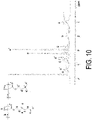
- Example 1 The polymers prepared in Example 1 and Evaluation Example 2 were measured using NMR spectroscopy under the following measurement conditions, and the ratios of CBMA2 to DMAEMA were calculated.
- FIG. 10 An example of the evaluation results by NMR spectroscopy is presented in FIG. 10 .
- the polymerization conditions for obtaining a polymer having a desired molecular weight were examined.
- a solvent (methanol and water) used for polymerization of polymer was deoxidized in advance.
- CBMA2 was used as a monomer.
- the monomer was dissolved in the solvent (mixed solvent of methanol and water). After the dissolution, copper (I) bromide (CuBr) and 2,2'-bipyridyl (bpy) were added and dissolved to give the molar ratios [monomer:copper (I) bromide:2,2'-bipyridyl] presented in Table 1.
- BiBOEDS bis[2-(2'-bromoisobutyryloxy)ethyl]disulfide
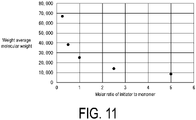
- the examination results are presented in Table 1 and FIG. 11 .
- the vertical axis in FIG. 11 indicates the weight average molecular weight of polymer, while the horizontal axis indicates the molar ratio of BiBOEDS to CBMA2.
- the number average molecular weight (Mn) and the weight average molecular weight (Mw) were measured by gel permeation chromatography (GPC) under the same conditions as in Example 1.
- Evaluation Example 5 Evaluation of amount of non-specific adsorption of serum or urine due to changes in molecular weight of polymer
- polymerization was performed to give polymers having a weight average molecular weight of approximately 10000, approximately 20000, approximately 35000, and approximately 60000.
- Polymerization was performed in the same procedure as in Example 1 except that the amounts of monomer (CBMA2 and DMAEMA), CuBr, bby and BiBOEDS charged were prepared.
- polymerization was performed to give a proportion of the DMAEMA units (second structural units) in polymer to be from 2 to 3%.
- the weight average molecular weights of the polymerized polymers were measured by GPC.
- polymer films polymer films (polymer films 1) were formed on Au substrates in the same procedure as in Example 1.
- the proportions of the DMAEMA units (second structural units) in polymers were calculated by the method described in Evaluation Example 3.
- Measurement targets human serum or human urine
- the amounts of non-specific adsorption of the target measurement constituent were measured.
- the amounts of non-specific adsorption (RU) were measured by a SPR apparatus T-200 (available from GE Healthcare). Sensor chips with polymer films formed were placed in the SPR apparatus, and the measurement targets were then injected at an appropriate flow rate over a desired time. Thereafter, only running buffers were run at the same flow rate over the same time as with the measurement targets. The differences in the signals before injecting the measurement targets and after running the running buffers were taken as the amounts of non-specific adsorption.
- the measurement results are presented in FIG. 12 .
- Mw weight average molecular weight of polymers in polymer film, predicted based on the weight average molecular weight of polymerized polymer.
- the polymerized polymers use BiBOEDS having a disulfide bond as the polymerization initiator; as such, when a polymer film is formed on an Au substrate, the polymer is decomposed into two by the reaction between gold and a BiBOEDS-derived disulfide bond. Since the molecular weights of the two polymers after the decomposition (polymers in polymer film) were substantially the same, the value obtained by dividing the weight average molecular weight of the polymerized polymer by 2 was taken as the weight average molecular weight (Mw) of the polymers in polymer film.
- the amount of non-specific adsorption of urine was suppressed when the weight average molecular weight of the polymer was approximately 20000 or less; the lower the weight average molecular weight, the more the amount of non-specific adsorption of urine was suppressed.
- the measurement target was serum
- the amount of non-specific adsorption of serum was suppressed when the weight average molecular weight of the polymer was 20000 or greater. From Evaluation Example 5, it was found that the range of weight average molecular weight of the polymer that can suppress the amount of non-specific adsorption differs depending on the measurement target.
- the present disclosure can be used in a measuring device or a measuring plate provided with a detection unit in which a polymer film is formed.
Landscapes
- Chemical & Material Sciences (AREA)
- Health & Medical Sciences (AREA)
- Life Sciences & Earth Sciences (AREA)
- Chemical Kinetics & Catalysis (AREA)
- Medicinal Chemistry (AREA)
- Organic Chemistry (AREA)
- Engineering & Computer Science (AREA)
- Immunology (AREA)
- Polymers & Plastics (AREA)
- Physics & Mathematics (AREA)
- General Health & Medical Sciences (AREA)
- Analytical Chemistry (AREA)
- Biochemistry (AREA)
- General Physics & Mathematics (AREA)
- Pathology (AREA)
- Manufacturing & Machinery (AREA)
- Acoustics & Sound (AREA)
- Materials Engineering (AREA)
- Biomedical Technology (AREA)
- Hematology (AREA)
- Molecular Biology (AREA)
- Urology & Nephrology (AREA)
- General Chemical & Material Sciences (AREA)
- Biotechnology (AREA)
- Cell Biology (AREA)
- Microbiology (AREA)
- Food Science & Technology (AREA)
- Wood Science & Technology (AREA)
- Addition Polymer Or Copolymer, Post-Treatments, Or Chemical Modifications (AREA)
Abstract
Description
- The present disclosure relates to a copolymer that forms a polymer film used in a measuring device, a measuring device provided with a polymer film, and a carrier for measurement.
-
Patent Document 1 discloses a surface acoustic wave sensor as an example of a measuring device for measuring the concentration of a target measurement substance (e.g., a biomolecule). Such a measuring device includes a detection unit, in which a substance (e.g., an antibody) that interacts with a target measurement substance contained in a sample is fixed. A polymer film is often formed on the detection unit for the purpose of reducing non-specific adsorption of substances other than the target measurement substance contained in the sample. - Patent Document 1:
JP 2008-286606 A - It is desirable that the polymer film mentioned above has a non-specific adsorption property that differs depending on the application of the polymer film, such as the type of the target measurement substance, the measurement precision, and the measurement method.
- A copolymer according to an embodiment is a copolymer of a compound represented by Formula (1) and a compound represented by Formula (2):


- R1 is a hydrogen atom or a methyl group,
- R2 and R3 are each independently a hydrogen atom or an alkyl group having from 1 to 4 carbon atom(s), and
- x and y are each independently an integer from 1 to 4

- R4 is a hydrogen atom or a methyl group,
- R5 and R6 are each independently an alkyl group having from 1 to 4 carbon atom(s), and
- z is an integer from 1 to 4.
- According to the present disclosure, a polymer film having a different non-specific adsorption property can be produced.
-
-
FIG. 1 is a schematic view illustrating an example of a measuring device according to 10. -
FIG. 2 is a plan view illustrating a sensor provided in the measuring device. -
FIG. 3 is a cross-sectional view along the line A-A of the sensor of the measuring device illustrated inFIG. 1 . -
FIG. 4 is a conceptual diagram illustrating a polymer provided in adetection unit 23 illustrated inFIG. 1 . -
FIG. 5 is a plan view illustrating an example of a carrier for measurement according to the present disclosure. -
FIG. 6 is a conceptual diagram illustrating a polymer film formed in a non-detection region of the carrier for measurement. -
FIG. 7 is a graph illustrating a relationship between a proportion of DMAEMA units in the polymer prepared in Example 1 and an amount of polymer film formed. -
FIG. 8 is a graph illustrating a relationship between a proportion of DMAEMA units in the polymer prepared in Example 1 and an amount of non-specific adsorption of serum. -
FIG. 9 is a graph illustrating a relationship between a proportion of DMAEMA units contained in the polymer and a hydrolysis time. -
FIG. 10 is a diagram illustrating an analysis result of polymer by NMR spectroscopy. -
FIG. 11 is a graph illustrating an examination result of the polymerization conditions in Evaluation Example 4. -
FIG. 12 is a graph illustrating a relationship between a molecular weight of polymer and an amount of non-specific adsorption of serum or urine. - Hereinafter, a sensor provided in a measuring device according to an embodiment will be described using drawings when appropriate.
FIG. 1 illustrates a schematic view of asensor 2 of ameasuring device 100 according to the present embodiment. - The
measuring device 100 can target and detect a specific substance (first substance) in a measurement target (sample). Examples of the measurement target include biological samples, such as blood samples including serum and plasma, and body fluids including sweat, urine, tears, and saliva. Thefirst substance 5 is, for example, a substance in a living organism. Examples of the substance in a living organism include proteins, DNAs, and substrates for enzymatic reaction. Themeasuring device 100 is provided with thesensor 2 that can detect the first substance and acontrol device 6 that can control themeasuring device 100. - The
sensor 2 may be a sensor that utilizes, for example, acoustic waves, Quartz Crystal Microbalance (QCM), Surface Plasmon Resonance (SPR), or Field Effect Transistors (FETs). That is, thesensor 2 may be any as long as it is one that is able to convert an electrical signal to and from an acoustic wave, QCM, SPR, or FET. Thesensor 2 according to an embodiment is a sensor that utilizes acoustic waves. That is, by using thesensor 2, themeasuring device 100 according to an embodiment can detect the change in the acoustic wave based on the presence of the first substance as a change in the electrical signal. Thesensor 2 may be produced by a known method. - In the
measuring device 100 according to the present embodiment, thesensor 2 includes anexternal terminal 21. Thesensor 2 can be electrically connected, through theexternal terminal 21, to thecontrol device 6 that controls themeasuring device 100. That is, thesensor 2 and thecontrol device 6 can input and output electrical signals from and to each other through theexternal terminal 21. As such, thecontrol device 6 can, for example, detect the first substance based on an electrical signal input from thesensor 2. Thecontrol device 6 may, for example, calculate the concentration of the first substance contained in the sample. Alternatively, thecontrol device 6 may, for example, identify the first substance. Thecontrol device 6 and theexternal terminal 21 may be produced using a known technique. In addition, the configuration of electrical connection between thesensor 2 and thecontrol device 6 is not limited to theexternal terminal 21. For example, as long as thesensor 2 and thecontrol device 6 can be electrically connected, thesensor 2 and thecontrol device 6 do not need to be physically connected through a terminal or the like. For example, thesensor 2 and thecontrol device 6 may be electrically connected by electromagnetic induction. - The
sensor 2 may be a disposable cartridge. This makes it unnecessary to clean thesensor 2 after measurement, and the effect on the measurement result due to insufficient cleaning can be eliminated. -
FIG. 2 illustrates a plan view of thesensor 2. Thesensor 2 is provided with asubstrate 22, adetection unit 23 disposed on thesubstrate 22, and a pair of first inter digital transducer (IDT) electrodes 25a arranged on thesubstrate 22 sandwiching thedetection unit 23. Thesubstrate 22 can support the first IDT electrodes 25a and the like. - The
substrate 22 is a piezoelectric substrate. For example, thesubstrate 22 may be a substrate containing a metal such as gold, silver, copper, platinum, and aluminum, or a piezoelectric single crystal such as lithium tantalate and crystal. In the present embodiment, thesubstrate 22 is a piezoelectric substrate containing crystal. - A substance (second substance) that reacts with the
first substance 5 is fixed to thedetection unit 23. Thus, the first substance contained in the sample can react with the second substance fixed to thedetection unit 23 in thedetection unit 23. By the reaction between the first substance and the second substance, thedetection unit 23 can change the propagation characteristics of acoustic waves of thesubstrate 22. Specifically, thedetection unit 23 can, for example, change the weight applied to thesubstrate 22 or the viscosity of a liquid in contact with a surface of thesubstrate 22 by the reaction between the first substance and the second substance. Accordingly, the phase, amplitude, period, or the like of the acoustic waves propagating in thesubstrate 22 changes. Thus, thesensor 2 can detect a change in the surface acoustic waves corresponds to the concentration of the first substance. The details of thedetection unit 23 will be described later. - The pair of first IDT electrodes 25a can generate acoustic waves between the pair of first IDT electrodes 25a. Of the acoustic waves generated, the acoustic waves propagating at the surface of the
substrate 22 may be referred to as surface automatic waves (SAWs). In themeasuring device 100 according to an embodiment, an electrical signal is input from one of the pair of first IDT electrodes 25a. The input electrical signal is converted to an acoustic wave propagating towards thedetection unit 23, which is then emitted from the one IDT electrode 25a. The emitted acoustic wave passes through thedetection unit 23. The other IDT electrode 25a can receive the acoustic wave that has passed through thedetection unit 23. The received acoustic wave is converted to an electrical signal. The pair of first IDT electrodes 25a may be formed of a metal material such as gold, chromium, or titanium. In addition, the pair of first IDT electrodes 25a may be single-layer electrodes including a single material, or multi-layer electrodes including a plurality of materials. - The
sensor 2 may have two or more groups of thedetection unit 23 and the pair of IDT electrodes 25a. In this case, for example, each group in themeasuring device 100 may detect a different type of target substance. Alternatively, the measuringdevice 100 may, for example, detect the same type of target substance using a plurality of the groups and compare the detection results from each of the groups. - The
sensor 2 may have areference unit 24 disposed on thesubstrate 22. Additionally, thesensor 2 may include a pair of second IDT electrodes 25b disposed on thesubstrate 22 sandwiching thereference unit 24. In themeasuring device 100 according to an embodiment, an electrical signal is input from one of the pair of first IDT electrodes 25b. The input electrical signal is converted to an acoustic wave propagating towards thereference unit 24, which is then emitted from the one IDT electrode 25b. The emitted acoustic wave passes through thereference unit 24. The other IDT electrode 25b can receive the acoustic wave that has passed through thereference unit 24. The received acoustic wave is converted to an electrical signal. - The
reference unit 24 can function as a control of thedetection unit 23. Specifically, unlike in thedetection unit 23, the second substance is not fixed to thereference unit 24. That is, the reaction between the first substance and the second substance does not occur in thereference unit 24. Thus, the measuringdevice 100 can use a reference signal, which is an electrical signal based on an acoustic wave that has passed through thereference unit 24, as a reference to detect the first substance based on a detection signal, which is an electrical signal based on an acoustic wave that has passed through thedetection unit 23. Specifically, if a sample contains the first substance, the first material reacts with the second substance, generating a difference between the detection signal and the reference signal. Thus, for example, the measuringdevice 100 can detect the first substance by calculating the difference between the detection signal and the reference signal. In addition, for example, the measuringdevice 100 can detect a change in the reaction between the first substance and the second substance by detecting a change in the difference between the detection signal and the reference signal. -
FIG. 3 illustrates a cross-sectional view of thesensor 2 along line A-A at a cross-sectional plane inFIG. 1 . Thesensor 2 further includes aflow path member 26. Theflow path member 26 can function as a passage of sample. Theflow path member 26 includes asupply port 27 for supplying a sample and adischarge port 28 for discharging the sample, thesupply port 27 and thedischarge port 28 both opening on the upper surface of theflow path member 26. In thesensor 2, when a sample supplied from thesupply port 27 reaches thedetection unit 23, detection of the first substance occurs in thedetection unit 23; then, the sample is discharged from thedischarge port 28. -
FIG. 4 illustrates a conceptual diagram of apolymer film 1 included in thedetection unit 23. In thedetection unit 23, thepolymer film 1 containing apolymer 3 is fixed to thesubstrate 22. Furthermore, the substance (second substance 4) that reacts with thefirst substance 5 is fixed to thepolymer film 1. - The
polymer film 1 is a film adjusted to have a high specific adsorption property. That is, thepolymer film 1 is a film adjusted to have a reduced non-specific adsorption. The non-specific adsorption property of thepolymer film 1 can be adjusted by changing the proportions of a first structural unit and a second structural unit contained in thepolymer film 1. The adjustment method will be described later. - The reaction between the
first substance 5 and thesecond substance 4 may be a reaction that results in a change in the output from thesensor 2. Such a reaction may be, for example, a redox reaction, an enzymatic reaction, an antigen-antibody reaction, or a reaction in which thefirst substance 5 and thesecond substance 4 are bonded by chemical adsorption, intermolecular interaction, or ionic interaction, etc. Alternatively, the reaction between thefirst substance 5 and thesecond substance 4 may be a reaction that generates a new substance (third substance) by an enzymatic reaction or the like. - The
second substance 4 fixed to thedetection unit 23 may be selected as appropriate in accordance with thefirst substance 5. For example, when thefirst substance 5 is a specific protein, DNA, or cell in a sample, thesecond substance 4 may be an antibody, peptide, or aptamer. Also, for example, when thefirst substance 5 is an antibody, thesecond substance 4 may be an antigen. Also, for example, when thefirst substance 5 is a substrate, thesecond substance 4 may be an enzyme. - The measuring
device 100 may indirectly detect thefirst substance 5, which is the target. For example, a substance similar to thefirst substance 5 may be fixed to thedetection unit 23 as thesecond substance 4. That is, for example, antibodies whose antigens are thefirst substance 5 may be reacted with thefirst substance 5 in advance, and the unreacted antibodies may be reacted with the fixedsecond substance 4. In this case, the measuringdevice 100 can, for example, calculate the amount of thefirst substance 5 indirectly from the amount of antibodies detected, as long as the amount of the antibodies is known. - The
polymer 3 constitutes thepolymer film 1. Hereinafter, an example of thepolymer 3 of the present disclosure (hereinafter, abbreviated as "polymer of the present embodiment") will be described. - The polymer according to the present embodiment is a copolymer of a compound represented by Formula (1) below and a compound represented by Formula (2) below.

- R1 is a hydrogen atom or a methyl group,
- R2 and R3 are each independently a hydrogen atom or an alkyl group having from 1 to 4 carbon atom(s), and
- x and y are each independently an integer from 1 to 4

- R4 is a hydrogen atom or a methyl group,
- R5 and R6 are each independently an alkyl group having from 1 to 4 carbon atom(s), and
- z is an integer from 1 to 4.
- Examples of the compound represented by Formula (1) include N-(carboxymethyl)-N,N-dimethyl-2-[(2-methyl-1-oxo-2-propen-1-yl)-oxy]etanaminium (CBMA1) and 2-carboxy-N,N-dimethyl-N-[2'-(methacryloyl)oxyethyl]etanaminium (CBMA2,3-[[2-(methacryloyloxy)ethyl]dimethylammonio]propionate). The compound represented by Formula (1) may be a commercially available product, or may be a compound obtained by synthesis.
- Examples of the compound represented by Formula (2) include N,N-dimethylaminoethyl(meth)acrylate, N,N-diethylaminoethyl(meth)acrylate, and N,N-diisopropylaminoethyl(meth)acrylate. The compound represented by Formula (2) may be a commercially available product, or may be a compound obtained by synthesis.
- A polymer film having a different non-specific adsorption property can be produced from the polymer of the present embodiment. Here, the zwitterionic structure in the structure illustrated in Formula (1) allows the polymer of the present embodiment to suppress non-specific adsorption. Furthermore, the dimethylamino group in the structure illustrated in Formula (2) allows the polymer of the present embodiment to promote non-specific adsorption. Thus, by adjusting the proportions of the two structures in the polymer of the embodiment, the non-specific adsorption property of the polymer as a polymer film can be adjusted.
- When the polymer of the present embodiment is used in a measuring device such as a biosensor, the proportion of structural units derived from the compound represented by Formula (2) contained in the copolymer described above may be 5 mol% or less, or 2 mol% or less, from the perspective of suppressing non-specific adsorption.
- When the polymer of the present embodiment is used in a non-detection region of a carrier for measurement such as an ELISA plate, the proportion of structural units derived from the compound represented by Formula (2) contained in the copolymer described above may be 20 mol% or greater, from the perspective of actively enhancing the non-specific adsorption property. The proportion of structural units derived from the compound represented by Formula (2) contained in the copolymer described above may also be 35 mol% or greater, or 50 mol% or greater.
- Furthermore, the polymer of the present embodiment can also be expressed as including a first structural unit represented by Formula (3) below and a second structural unit (DMAEMA unit) represented by Formula (4) below. The first structural unit is a structural unit derived from the compound represented by Formula (1) above. The second structural unit is a structural unit derived from the compound represented by Formula (2) above.

- R1, R2, R3, x, and y are the same as those of Formula (1) above, and
- m is from 1 to 500

- R4, R5, R6, and z are the same as those of Formula (2) above, and
- n is from 1 to 500.
- The polymer of the present embodiment may have an active ester group at the end of a portion of the side chains of the first structural unit represented by Formula (3). Examples of the active ester group include a succinimide group.
- At least one end of the main chain of the polymer of the present embodiment may have a thiol group or a dithioester group from the perspective of easily fixing the end to the polymer film fixed to the substrate 22 (measurement substrate 12).
- When the polymer of the present embodiment is used in a measuring device such as a biosensor, m and n of Formulas (3) and (4) may satisfy the following relationship, from the perspective of suppressing non-specific adsorption. That is, n/(m + n) × 100 may be 5 or less, or may be 2 or less.
- When the polymer of the present embodiment is used in a non-detection region of a carrier for measurement such as an ELISA plate, m and n of Formulas (3) and (4) may satisfy the following relationship, from the perspective of actively enhancing the non-specific adsorption property. That is, n/(m + n) × 100 may be 20 or greater, or 35 or greater.
- A weight average molecular weight of the polymer of the present embodiment may be 3000 or greater, or 5000 or greater, from the perspective of film formation density. The weight average molecular weight of the polymer of the present embodiment may also be 100000 or less, or 70000 or less. Furthermore, the polymer of the present embodiment may be a random copolymer, a block copolymer, or a graft copolymer.
- The weight average molecular weight of the polymer of the present embodiment may be 20000 or greater, from the perspective of suppressing the amount of non-specific adsorption in serum. Furthermore, the weight average molecular weight of the polymer of the present embodiment may be 30000 or less. In addition to the weight average molecular weight of the polymer of the present embodiment being within the range described above, when the proportion of structural units derived from the compound represented by Formula (2) contained in the polymer of the present embodiment is 7 mol% or less (or 5 mol% or less, or 3 mol% or less), the amount of non-specific adsorption in serum can be further suppressed.
- The weight average molecular weight of the polymer of the present embodiment may be 2000 or greater, or 5000 or greater, from the perspective of suppressing the amount of non-specific adsorption in sweat or urine. Furthermore, the weight average molecular weight of the polymer of the present embodiment may be 20000 or less, or 10000 or less. In addition to the weight average molecular weight of the polymer of the present embodiment being within the range described above, when the proportion of structural units derived from the compound represented by Formula (2) contained in the polymer of the present embodiment is 7 mol% or less (or 5 mol% or less, or 3 mol% or less), the amount of non-specific adsorption in sweat or urine can be further suppressed.
- A number average molecular weight or the weight average molecular weight of the polymer of the present embodiment can be determined by a known technique such as gel permeation chromatography (GPC).
- The copolymer of a compound represented by Formula (1) above and a compound represented by Formula (2) above can be identified by a known organic analysis technique. For example, the copolymer may be identified by Nuclear Magnetic Resonance (NMR). Alternatively, for example, the copolymer may be identified using a gas chromatograph. Alternatively, for example, the copolymer may be identified using a liquid chromatograph. Alternatively, for example, the copolymer may be identified by laser Raman spectroscopy analysis. That is, when identifying the copolymer, devices capable of carrying out these techniques may be used. The identification technique and device are not limited to the techniques and devices described above as long as the copolymer can be identified.
- The polymer of the present embodiment can be produced by a known polymerization method such as radical polymerization. For example, the compound represented by Formula (1) and the compound represented by Formula (2) are dissolved in a solvent. Then, polymerization reaction is performed by adding a polymerization catalyst and a polymerization initiator. The polymerization conditions such as the polymerization time, the polymerization temperature, and the polymerization solvent can be selected as appropriate depending on the type of the monomer, the amount to be used, the ratio to be used, and the like.
- Examples of a method of fixing the
polymer 3 to thesubstrate 22 include a method of applying a polymer solution, obtained by dissolving thepolymer 3 in a solvent, on thesubstrate 22 and drying, graft polymerization by radiation or ultraviolet light, and chemical reaction with a functional group of thesubstrate 22. By these methods, apolymer film 1 including thepolymer 3 is formed on thesubstrate 22. - Examples of a method of fixing the
second substance 4 to the polymer 3 (polymer film 1) include a method of covalently bonding thesecond substance 4 to the carboxyl groups of thepolymer 3. For example, thepolymer 3 is reacted with N-hydroxysulfosuccinimide (NHS) and 1-ethyl-3-(3-dimethylaminopropyl)carbodiimide (EDC) (NHS/EDC activation). Then, the carboxyl groups contained in thepolymer 3 are replaced by the NHS ester groups. By reacting the amino groups of thesecond substance 4 with the activated NHS ester groups, thesecond substance 4 is fixed to the polymer 3 (polymer film 1). The NHS/EDC activation of thepolymer 3 may be performed before thepolymer 3 is fixed to thesubstrate 22, or may be performed after thepolymer 3 to is fixed thesubstrate 22. - Next, a carrier for measurement according to an embodiment will be described using drawings when appropriate. For convenience of description, members having the same functions as those described in the embodiment above are denoted by the same reference signs, and descriptions thereof will not be repeated.
FIG. 5 illustrates an overall configuration of a carrier formeasurement 11 according to the present embodiment. Examples of the carrier formeasurement 11 include a plate for ELISA (enzyme-linked immunosorbent assay). - The carrier for
measurement 11 includes adetection region 31 and anon-detection region 32 on a surface of ameasurement substrate 12, in which thedetection region 31 specifically captures a target substance (first substance 5) contained in a sample while thenon-detection region 32 non-selectively adsorbs a blocking agent and the like. Apolymer film 1A is fixed to thedetection region 31 while apolymer film 1B is fixed to thenon-detection region 32. - Similar to the
polymer film 1 described inEmbodiment 1, asecond substance 4 that reacts with thefirst substance 5 is fixed to thepolymer film 1A. Furthermore, thepolymer film 1A is adjusted to have a low non-specific adsorption property. -
FIG. 6 conceptually illustrates a polymer film formed in thenon-detection region 32. Thesecond substance 4 is not fixed to thepolymer film 1B, and only apolymer film 1 containing thepolymer 3 is fixed to a surface of themeasurement substrate 12. Thepolymer film 1B is a film adjusted to have a high non-specific adsorption property. That is, two types ofpolymer films measurement 11. - First, a desired
second substance 4 is fixed to thepolymer film 1A in thedetection region 31. Then, thenon-detection region 32 is treated with a blocking agent, which is non-specifically adsorbed to thepolymer film 1B in thenon-detection region 32. - Thereafter, by bringing a sample into contact with the
detection region 31, afirst substance 5, which is the target substance contained in the sample, reacts with thesecond substance 4, and the reaction is detected by a detection reagent. Examples of the detection reagent include a redox substance, a fluorescent substance, an enzyme, and a dye compound. Thepolymer film 1B in thenon-detection region 32 is treated with the blocking agent, resulting in effective suppression of non-specific adsorption. - The application of the
polymer film 1B is not limited to the description above, and thepolymer film 1B may be used to actively enhance the non-specific adsorption property. - The
measurement substrate 12 may be, for example: a metal such as gold, silver, copper, platinum, and aluminum; a plastic such as polyethylene and polypropylene; or an inorganic material such as titanium oxide, silica, glass, and ceramic. Themeasurement substrate 12 is not limited to these examples. - A shape of the
measurement substrate 12 may be, for example, the shape of a plate, the shape of a particle, the shape of a micro structure, or the shape of a microtiter plate. The shape of themeasurement substrate 12 is not limited to these examples. - A measurement kit including the
measurement substrate 12 to which thepolymer films second substance 4, and the detection reagent is also included in the scope of the present disclosure. Thesecond substance 4 may be fixed to thepolymer film 1 in advance during the production of the product, or may be fixed to thepolymer film 1 by the user prior to measurement. - The measurement kit according to the present embodiment may include another reagent or instrument. For example, a constituent in addition to the
second substance 4 and the detection reagent may be provided. Further, a buffer or the like may be provided. Also, a plurality of different reagents in the measurement kit according to the present embodiment may be mixed in an appropriate volume and/or form, or may be provided in separate containers. Furthermore, the measurement kit according to the present embodiment may include instructions that describes, for example, a procedure for achieving detection of the reaction between thefirst substance 5 and thesecond substance 4. The instructions may be written or printed on paper or other media, or may be attached to readable discs, such as magnetic tapes and computers, or may be attached to electronic media such as CD-ROMs. - The invention according to the present disclosure has been described above based on drawings and examples. However, the invention according to the present disclosure is not limited to the embodiments described above. That is, the invention according to the present disclosure can be variously modified within the scope indicated by the present disclosure, and an embodiment obtained by appropriately combining the technical means disclosed in different embodiments is also within the technical scope of the invention according to the present disclosure. That is, it should be noted that those skilled in the art can easily make various variations or modifications based on the present disclosure. It should also be noted that these variations or modifications are within the scope of the present disclosure.
- In the following examples, "%" means "mass%" unless otherwise specified.
- A solvent (methanol and water) used for polymerization of polymer was deoxidized in advance. The monomers used were 3-[[2-(methacryloyloxy)ethyl]dimethylammoni]propionate (CBMA2, available from Tokyo Chemical Industry Co., Ltd.) and 2-(dimethylamino)ethyl methacrylate (DMAEMA, available from Tokyo Chemical Industry Co., Ltd.). The monomers were dissolved in the solvent (mixed solvent of methanol and water) to an arbitrary ratio of the monomers. After the dissolution, copper (I) bromide, serving as a catalyst, and 2,2'-bipyridyl, serving as a ligand, were added to the mixture and dissolved to give the following molar ratio: monomers:2,2'-bipyridyl:copper (I) bromide = 100:6:1. Finally, bis[2-(2'-bromoisobutyryloxy)ethyl] disulfide was added as a polymerization initiator in an amount of 0.5 mol% with respect to the amount of the monomers to carry out polymerization. Polymerization was performed at room temperature under a nitrogen atmosphere and stopped by opening the polymerization solution to the atmosphere; a portion of the polymerization solution was diluted and subjected to GPC measurement of molecular weight. The result of weight average molecular weight (Mw) measured was 38100. Thereafter, the obtained polymer solution was diluted with an appropriate solvent at an arbitrary multiplication factor and then applied onto an Au substrate. Then, the Au substrate was washed and dried, and a polymer film (polymer film 1) was formed.
- The GPC measurement was carried out under the following measurement conditions. A sample was diluted with a 10 mM LiBr aqueous solution to approximately 0.1 mass% and dispersed in an ultrasonic disperser.
- Device: High Performance Liquid Chromatograph LC-20, available from Shimadzu Corporation
- Column performance: Mw 20000000 to
Mw 100 - Column: TSKgel G4000PWXL
- Measuring solvent: LiBr 10 mM aqueous solution
- Detector: RID-10A
- Column temperature: 40°C
- Flow rate: 1.0 mL/min
- Injection volume: 100 µL
-
FIG. 7 illustrates a graph plotted by taking the proportion (%) of the DMAEMA units (second structural units) in the polymer prepared in Example 1 on the horizontal axis and the amount of polymer film formed (RU) on the Au substrate on the vertical axis. The proportion (%) of the DMAEMA units was calculated based on Formula (A) below. The amount of polymer film formed (RU) was measured by a SPR apparatus T-200 (available from GE Healthcare). Amount of DMAEMA added/(Amount of CBMA2 added + Amount of DMAEMA added) ... (A) - The polymer film was formed using a sensor chip of a SIA kit Au (available from GE Healthcare). The sensor chip was then washed with, for example, a piranha solution, and placed in the SPR apparatus. Next, an arbitrary polymer solution was injected at an appropriate flow rate over a desired time. The difference in the signal before and after the injection was taken as the amount of polymer film formed.
- Human serum was brought into contact with the polymer film on the Au substrate prepared in Example 1 to measure the amount of non-specific adsorption of serum constituents. The amount of non-specific adsorption of serum (RU) was measured by a SPR apparatus T-200 (available from GE Healthcare). The sensor chip with the polymer film formed was placed in the SPR apparatus; then, human serum was injected at an appropriate flow rate over a desired time. Thereafter, only a running buffer was run at the same flow rate over the same time as with the human serum. The difference in the signal before injecting the human serum and after running the running buffer was taken as the amount of non-specific adsorption of serum. The measurement results are presented in
FIG. 8 . - As illustrated in
FIG. 8 , the lower the proportion of the DMAEMA units (second structural units) in the polymer, the more the amount of non-specific adsorption of serum was suppressed. Therefore, it was found that a polymer having a different non-specific adsorption property can be synthesized based on the proportions of CBMA2 and DMAEMA during the copolymerization of CBMA2 and DMAEMA, and that by using the polymer, the non-specific adsorption property of a polymer film can be adjusted. - Powders of CBMA2 polymer were dissolved in a 100 mM NaOH to a concentration of 20 mg/mL, and hydrolysis was performed. The hydrolysis was performed at room temperature. The hydrolysis times were 0, 3, 5, and 20 hours. After the completion of hydrolysis, the amounts of DMAEMA in the polymers were measured. The measurement results are presented in
FIG. 9 . - As illustrated in
FIG. 9 , it was found that the amount of DMAEMA units in the polymer may be adjusted based on the hydrolysis time of the CBMA2 polymer. That is, it was found that by adjusting the hydrolysis time of the CBMA2 polymer, the proportions of the first structural units and the second structural units in thepolymer 3 constituting thepolymer film 1 can be adjusted, and the non-specific adsorption property of thepolymer film 1 can be adjusted. - The polymers prepared in Example 1 and Evaluation Example 2 were measured using NMR spectroscopy under the following measurement conditions, and the ratios of CBMA2 to DMAEMA were calculated.
- Measuring device:
ADVANCE III HD 400, available from Bruker BioSpin K.K. - Measurement conditions: Solvent: Heavy water
- Temperature: 30°C
- Criteria: H2O peak is 4.70 ppm
- Accumulation: 300 times
- Method of calculating ratio of CBMA2 to DMAEMA:
The ratios of CBMA2 to DMAEMA were calculated based on the ratios of a peak area near 3.2 ppm derived from protons bonded to the methyl group of the quaternary amine in the CBMA2 units to a peak area near 2.9 ppm derived from protons bonded to the methyl group of the tertiary amine in the DMAEMA units. - An example of the evaluation results by NMR spectroscopy is presented in
FIG. 10 . InFIG. 10 , the ratio of CBMA2 to DMAEMA of the polymer measured was 4 to 6 (CBMA2/DMAEMA = 4/6). - The polymerization conditions for obtaining a polymer having a desired molecular weight were examined. A solvent (methanol and water) used for polymerization of polymer was deoxidized in advance. CBMA2 was used as a monomer. The monomer was dissolved in the solvent (mixed solvent of methanol and water). After the dissolution, copper (I) bromide (CuBr) and 2,2'-bipyridyl (bpy) were added and dissolved to give the molar ratios [monomer:copper (I) bromide:2,2'-bipyridyl] presented in Table 1. Finally, as a polymerization initiator, bis[2-(2'-bromoisobutyryloxy)ethyl]disulfide (BiBOEDS) was added to give the molar ratios presented in Table 1, and polymerization was performed for 6 hours. The polymerization was performed at room temperature under a nitrogen atmosphere and stopped by opening the polymerization solutions to the atmosphere; a portion of the polymerization solutions were diluted and subjected to GPC measurement for molecular weight under the same conditions as in Example 1.
[Table 1] CBMA2 bpy CuBr BiBEDS Polymer molecular weight Mn Mw 100 3 0.5 0.25 40,200 66,900 100 6 1 0.5 22,800 38,100 100 12 2 1 15,500 25,100 100 30 5 2.5 8,200 13,900 100 60 10 5 5,300 8,400 - The examination results are presented in Table 1 and
FIG. 11 . The vertical axis inFIG. 11 indicates the weight average molecular weight of polymer, while the horizontal axis indicates the molar ratio of BiBOEDS to CBMA2. The number average molecular weight (Mn) and the weight average molecular weight (Mw) were measured by gel permeation chromatography (GPC) under the same conditions as in Example 1. - Based on the examination results of polymerization conditions for polymer in Evaluation Example 4, polymerization was performed to give polymers having a weight average molecular weight of approximately 10000, approximately 20000, approximately 35000, and approximately 60000. Polymerization was performed in the same procedure as in Example 1 except that the amounts of monomer (CBMA2 and DMAEMA), CuBr, bby and BiBOEDS charged were prepared. In addition, polymerization was performed to give a proportion of the DMAEMA units (second structural units) in polymer to be from 2 to 3%. The weight average molecular weights of the polymerized polymers were measured by GPC. Then, polymer films (polymer films 1) were formed on Au substrates in the same procedure as in Example 1. The proportions of the DMAEMA units (second structural units) in polymers were calculated by the method described in Evaluation Example 3.
- Measurement targets (human serum or human urine) were brought into contact with the polymer films on the Au substrates produced, and the amounts of non-specific adsorption of the target measurement constituent were measured. The amounts of non-specific adsorption (RU) were measured by a SPR apparatus T-200 (available from GE Healthcare). Sensor chips with polymer films formed were placed in the SPR apparatus, and the measurement targets were then injected at an appropriate flow rate over a desired time. Thereafter, only running buffers were run at the same flow rate over the same time as with the measurement targets. The differences in the signals before injecting the measurement targets and after running the running buffers were taken as the amounts of non-specific adsorption. The measurement results are presented in
FIG. 12 . The horizontal axis inFIG. 12 is the weight average molecular weight (Mw) of polymers in polymer film, predicted based on the weight average molecular weight of polymerized polymer. The polymerized polymers use BiBOEDS having a disulfide bond as the polymerization initiator; as such, when a polymer film is formed on an Au substrate, the polymer is decomposed into two by the reaction between gold and a BiBOEDS-derived disulfide bond. Since the molecular weights of the two polymers after the decomposition (polymers in polymer film) were substantially the same, the value obtained by dividing the weight average molecular weight of the polymerized polymer by 2 was taken as the weight average molecular weight (Mw) of the polymers in polymer film. - As illustrated in
FIG. 12 , when the measurement target was urine, the amount of non-specific adsorption of urine was suppressed when the weight average molecular weight of the polymer was approximately 20000 or less; the lower the weight average molecular weight, the more the amount of non-specific adsorption of urine was suppressed. Meanwhile, when the measurement target was serum, the amount of non-specific adsorption of serum was suppressed when the weight average molecular weight of the polymer was 20000 or greater. From Evaluation Example 5, it was found that the range of weight average molecular weight of the polymer that can suppress the amount of non-specific adsorption differs depending on the measurement target. - From the above examples and evaluation examples, it has been demonstrated that a polymer film having a different non-specific adsorption property can be produced using the copolymer of a compound represented by Formula (1) above and a compound represented by Formula (2).
- The present disclosure can be used in a measuring device or a measuring plate provided with a detection unit in which a polymer film is formed.
-
- 1, 1A, 1B Polymer film
- 2 Sensor
- 3 Polymer
- 4 Second substance
- 5 First substance
- 6 Control device
- 11 Carrier for measurement
- 12 Measurement substrate
- 21 External terminal
- 22 Substrate
- 23 Detection unit
- 24 Reference unit
- 25a First IDT electrode
- 25b Second IDT electrode
- 26 Flow path member
- 27 Supply port
- 28 Discharge port
- 31 Detection region
- 32 Non-detection region
- 100 Measuring device
Claims (8)
- A copolymer of a compound represented by Formula (1) and a compound represented by Formula (2):
 where in Formula (1),R1 is a hydrogen atom or a methyl group,R2 and R3 are each independently a hydrogen atom or an alkyl group having from 1 to 4 carbon atom(s), andx and y are each independently an integer from 1 to 4,
 R4 is a hydrogen atom or a methyl group,R5 and R6 are each independently an alkyl group having from 1 to 4 carbon atom(s), andz is an integer from 1 to 4.
 - The copolymer according to claim 1, containing a proportion of a structural unit derived from the compound represented by Formula (2) of 5 mol% or less.
- The copolymer according to claim 1, containing a proportion of a structural unit derived from the compound represented by Formula (2) of 20 mol% or greater.
- The copolymer according to claim 2, having a weight average molecular weight of 2000 or greater and 20000 or less.
- The copolymer according to claim 2, having a weight average molecular weight of 20000 or greater.
- The copolymer according to any one of claims 2 to 5, wherein at least one end of the copolymer contains a thiol group or a dithioester group.
- A measuring device comprising a polymer film containing the copolymer according to any one of claims 1 to 6.
- A carrier for measurement comprising a polymer film containing the copolymer according to any one of claims 1 to 6.
Applications Claiming Priority (2)
| Application Number | Priority Date | Filing Date | Title |
|---|---|---|---|
| JP2019215690 | 2019-11-28 | ||
| PCT/JP2020/043728 WO2021106899A1 (en) | 2019-11-28 | 2020-11-25 | Copolymer, determination device, and carrier for determination |
Publications (2)
| Publication Number | Publication Date |
|---|---|
| EP4067396A1 true EP4067396A1 (en) | 2022-10-05 |
| EP4067396A4 EP4067396A4 (en) | 2024-01-10 |
Family
ID=76130546
Family Applications (1)
| Application Number | Title | Priority Date | Filing Date |
|---|---|---|---|
| EP20891558.7A Withdrawn EP4067396A4 (en) | 2019-11-28 | 2020-11-25 | COPOLYMER, DETERMINATION DEVICE AND DETERMINATION SUPPORT |
Country Status (5)
| Country | Link |
|---|---|
| US (1) | US20230030958A1 (en) |
| EP (1) | EP4067396A4 (en) |
| JP (1) | JP7443396B2 (en) |
| CN (1) | CN114981326B (en) |
| WO (1) | WO2021106899A1 (en) |
Families Citing this family (2)
| Publication number | Priority date | Publication date | Assignee | Title |
|---|---|---|---|---|
| WO2023189138A1 (en) * | 2022-03-30 | 2023-10-05 | 京セラ株式会社 | Optical devices and biosensor |
| CN116948097B (en) * | 2022-04-13 | 2026-03-10 | 杭州柏医健康科技有限公司 | Zwitterionic polymer for implantable biosensor and preparation method and application thereof |
Family Cites Families (13)
| Publication number | Priority date | Publication date | Assignee | Title |
|---|---|---|---|---|
| US3836537A (en) * | 1970-10-07 | 1974-09-17 | Minnesota Mining & Mfg | Zwitterionic polymer hairsetting compositions and method of using same |
| JP2006321829A (en) * | 2005-05-17 | 2006-11-30 | Kazuhiko Ishihara | Copolymer and method for producing the same |
| MX2009007101A (en) * | 2006-12-29 | 2009-12-01 | Univ Washington | Dual-functional nonfouling surfaces and materials. |
| JP4933956B2 (en) | 2007-05-16 | 2012-05-16 | 日本無線株式会社 | A surface acoustic wave sensor and a biomolecule measuring apparatus including the surface acoustic wave sensor. |
| US8232344B2 (en) * | 2007-06-27 | 2012-07-31 | Canon Kabushiki Kaisha | Structure, target substance-detecting element and target substance-detecting kit |
| US7943370B2 (en) * | 2007-08-23 | 2011-05-17 | Canon Kabushiki Kaisha | Structure, target substance detection element and target substance detection kit |
| JP6417818B2 (en) * | 2014-09-19 | 2018-11-07 | 日産化学株式会社 | Sterilized coating membrane |
| WO2017183733A1 (en) * | 2016-04-22 | 2017-10-26 | 和光純薬工業株式会社 | Non-specific adsorption inhibitor for western blotting methods, reagent for western blotting methods and blocking method |
| MX2019015216A (en) * | 2017-06-29 | 2020-02-05 | Unilever Nv | Composition for purification of turbid water. |
| JP2019038869A (en) * | 2017-08-22 | 2019-03-14 | 東洋インキScホールディングス株式会社 | Aqueous conductive dispersion, biosensor and method for producing biosensor |
| JP2019084519A (en) * | 2017-11-10 | 2019-06-06 | 東洋インキScホールディングス株式会社 | Aqueous conductive dispersion, method for producing aqueous conductive dispersion, biosensor, and method for producing biosensor |
| CN108504150B (en) * | 2018-03-22 | 2020-03-17 | 天津大学 | Antifogging coating based on zwitterionic polyelectrolyte copolymer and preparation method thereof |
| JP7179281B2 (en) * | 2018-09-14 | 2022-11-29 | アオイ電子株式会社 | Nanotweezers, Nanotweezers Intermediate, Tweezers Kit, Method for Producing Nanotweezers, and Method for Producing Nanotweezers Intermediate |
-
2020
- 2020-11-25 JP JP2021561435A patent/JP7443396B2/en active Active
- 2020-11-25 WO PCT/JP2020/043728 patent/WO2021106899A1/en not_active Ceased
- 2020-11-25 EP EP20891558.7A patent/EP4067396A4/en not_active Withdrawn
- 2020-11-25 US US17/779,526 patent/US20230030958A1/en not_active Abandoned
- 2020-11-25 CN CN202080081997.1A patent/CN114981326B/en active Active
Also Published As
| Publication number | Publication date |
|---|---|
| WO2021106899A1 (en) | 2021-06-03 |
| JP7443396B2 (en) | 2024-03-05 |
| EP4067396A4 (en) | 2024-01-10 |
| JPWO2021106899A1 (en) | 2021-06-03 |
| US20230030958A1 (en) | 2023-02-02 |
| CN114981326A (en) | 2022-08-30 |
| CN114981326B (en) | 2023-12-22 |
Similar Documents
| Publication | Publication Date | Title |
|---|---|---|
| Lin et al. | Determination of albumin concentration by MIP-QCM sensor | |
| JP5383115B2 (en) | Structure, target substance detection element, and target substance detection kit | |
| US10830727B2 (en) | Electrode and use thereof | |
| US12352746B2 (en) | Peptide-comprising electrode | |
| EP4067396A1 (en) | Copolymer, determination device, and carrier for determination | |
| Hartz et al. | Lateral field excited quartz crystal microbalances for biosensing applications | |
| GODbER et al. | Direct quantification of analyte concentration by resonant acoustic profiling | |
| Sunayama et al. | Simultaneous detection of two tumor marker proteins using dual-colored signaling molecularly imprinted polymers prepared via multi-step post-imprinting modifications | |
| Corso et al. | Real-time detection of mesothelin in pancreatic cancer cell line supernatant using an acoustic wave immunosensor | |
| EP1696235B1 (en) | Biosensor | |
| Lee et al. | Love wave SAW biosensors for detection of antigen-antibody binding and comparison with SPR biosensor | |
| Sriondee et al. | Real-time kinetic analysis and detection of glycated hemoglobin A1c using a quartz crystal microbalance-based aptasensor | |
| JP7333462B2 (en) | Copolymer, method for producing same, measuring device and carrier for measurement | |
| JP7855063B2 (en) | Copolymers, polymer membranes, measuring devices, and measuring carriers | |
| WO2023210671A1 (en) | Copolymer, polymer film, measuring device, and support for measurement | |
| Ortiz et al. | Amperometric detection of antibodies in serum: performance of self-assembled cyclodextrin/cellulose polymer interfaces as antigen carriers | |
| US20040018532A1 (en) | Electronic sensor device | |
| JP3996605B2 (en) | Immobilization method, biosensor and test method | |
| JP2006321829A (en) | Copolymer and method for producing the same | |
| Madhu | Chapter-11 Surface Plasmon Resonance (SPR) | |
| Cheng | USING SHEAR HORIZONTAL SURFACEACOUSTIC WAVE BIOSENSOR TO ANALYZE THE LAYER OF BIOMATERIAL AND DIFFERENTIATE THE SIZE OF BIO-RELATED PARTICLE | |
| JP4278469B2 (en) | Method for measuring immunologically active substance | |
| Bukovic et al. | Engineering thermoresponsive biointerfaces using graft-to strategies: connecting polymer architecture to temperature-dependent surface wettability | |
| JP2024095317A (en) | Method for detecting target substance and cartridge for detection | |
| McCann et al. | Novel transducer configurations for bulk acoustic wave sensors |
Legal Events
| Date | Code | Title | Description |
|---|---|---|---|
| STAA | Information on the status of an ep patent application or granted ep patent |
Free format text: STATUS: THE INTERNATIONAL PUBLICATION HAS BEEN MADE |
|
| PUAI | Public reference made under article 153(3) epc to a published international application that has entered the european phase |
Free format text: ORIGINAL CODE: 0009012 |
|
| STAA | Information on the status of an ep patent application or granted ep patent |
Free format text: STATUS: REQUEST FOR EXAMINATION WAS MADE |
|
| 17P | Request for examination filed |
Effective date: 20220527 |
|
| AK | Designated contracting states |
Kind code of ref document: A1 Designated state(s): AL AT BE BG CH CY CZ DE DK EE ES FI FR GB GR HR HU IE IS IT LI LT LU LV MC MK MT NL NO PL PT RO RS SE SI SK SM TR |
|
| DAV | Request for validation of the european patent (deleted) | ||
| DAX | Request for extension of the european patent (deleted) | ||
| P01 | Opt-out of the competence of the unified patent court (upc) registered |
Effective date: 20230505 |
|
| A4 | Supplementary search report drawn up and despatched |
Effective date: 20231211 |
|
| RIC1 | Information provided on ipc code assigned before grant |
Ipc: G01N 33/50 20060101ALI20231205BHEP Ipc: C08F 8/12 20060101ALI20231205BHEP Ipc: G01N 29/02 20060101ALI20231205BHEP Ipc: C08F 220/36 20060101AFI20231205BHEP |
|
| STAA | Information on the status of an ep patent application or granted ep patent |
Free format text: STATUS: THE APPLICATION IS DEEMED TO BE WITHDRAWN |
|
| 18D | Application deemed to be withdrawn |
Effective date: 20240706 |