EP4067279A1 - Self-sanitizing passenger contact component for elevator, escalator or moving walkway - Google Patents
Self-sanitizing passenger contact component for elevator, escalator or moving walkway Download PDFInfo
- Publication number
- EP4067279A1 EP4067279A1 EP21210087.9A EP21210087A EP4067279A1 EP 4067279 A1 EP4067279 A1 EP 4067279A1 EP 21210087 A EP21210087 A EP 21210087A EP 4067279 A1 EP4067279 A1 EP 4067279A1
- Authority
- EP
- European Patent Office
- Prior art keywords
- functional groups
- contact component
- uncoated
- sanitizing
- self
- Prior art date
- Legal status (The legal status is an assumption and is not a legal conclusion. Google has not performed a legal analysis and makes no representation as to the accuracy of the status listed.)
- Pending
Links
Images


Classifications
-
- B—PERFORMING OPERATIONS; TRANSPORTING
- B66—HOISTING; LIFTING; HAULING
- B66B—ELEVATORS; ESCALATORS OR MOVING WALKWAYS
- B66B1/00—Control systems of elevators in general
- B66B1/34—Details, e.g. call counting devices, data transmission from car to control system, devices giving information to the control system
- B66B1/46—Adaptations of switches or switchgear
- B66B1/461—Adaptations of switches or switchgear characterised by their shape or profile
- B66B1/462—Mechanical or piezoelectric input devices
-
- C—CHEMISTRY; METALLURGY
- C08—ORGANIC MACROMOLECULAR COMPOUNDS; THEIR PREPARATION OR CHEMICAL WORKING-UP; COMPOSITIONS BASED THEREON
- C08L—COMPOSITIONS OF MACROMOLECULAR COMPOUNDS
- C08L53/00—Compositions of block copolymers containing at least one sequence of a polymer obtained by reactions only involving carbon-to-carbon unsaturated bonds; Compositions of derivatives of such polymers
- C08L53/005—Modified block copolymers
-
- B—PERFORMING OPERATIONS; TRANSPORTING
- B66—HOISTING; LIFTING; HAULING
- B66B—ELEVATORS; ESCALATORS OR MOVING WALKWAYS
- B66B31/00—Accessories for escalators, or moving walkways, e.g. for sterilising or cleaning
-
- A—HUMAN NECESSITIES
- A61—MEDICAL OR VETERINARY SCIENCE; HYGIENE
- A61L—METHODS OR APPARATUS FOR STERILISING MATERIALS OR OBJECTS IN GENERAL; DISINFECTION, STERILISATION OR DEODORISATION OF AIR; CHEMICAL ASPECTS OF BANDAGES, DRESSINGS, ABSORBENT PADS OR SURGICAL ARTICLES; MATERIALS FOR BANDAGES, DRESSINGS, ABSORBENT PADS OR SURGICAL ARTICLES
- A61L2/00—Disinfection or sterilisation of materials or objects, in general; Accessories therefor
- A61L2/02—Disinfection or sterilisation of materials or objects, in general; Accessories therefor using physical processes
- A61L2/08—Radiation
- A61L2/088—Radiation using photocatalysts or photosensitisers
-
- B—PERFORMING OPERATIONS; TRANSPORTING
- B66—HOISTING; LIFTING; HAULING
- B66B—ELEVATORS; ESCALATORS OR MOVING WALKWAYS
- B66B23/00—Component parts of escalators or moving walkways
- B66B23/22—Balustrades
- B66B23/24—Handrails
-
- C—CHEMISTRY; METALLURGY
- C08—ORGANIC MACROMOLECULAR COMPOUNDS; THEIR PREPARATION OR CHEMICAL WORKING-UP; COMPOSITIONS BASED THEREON
- C08F—MACROMOLECULAR COMPOUNDS OBTAINED BY REACTIONS ONLY INVOLVING CARBON-TO-CARBON UNSATURATED BONDS
- C08F212/00—Copolymers of compounds having one or more unsaturated aliphatic radicals, each having only one carbon-to-carbon double bond, and at least one being terminated by an aromatic carbocyclic ring
- C08F212/02—Monomers containing only one unsaturated aliphatic radical
- C08F212/04—Monomers containing only one unsaturated aliphatic radical containing one ring
- C08F212/14—Monomers containing only one unsaturated aliphatic radical containing one ring substituted by heteroatoms or groups containing heteroatoms
- C08F212/26—Nitrogen
-
- C—CHEMISTRY; METALLURGY
- C08—ORGANIC MACROMOLECULAR COMPOUNDS; THEIR PREPARATION OR CHEMICAL WORKING-UP; COMPOSITIONS BASED THEREON
- C08F—MACROMOLECULAR COMPOUNDS OBTAINED BY REACTIONS ONLY INVOLVING CARBON-TO-CARBON UNSATURATED BONDS
- C08F212/00—Copolymers of compounds having one or more unsaturated aliphatic radicals, each having only one carbon-to-carbon double bond, and at least one being terminated by an aromatic carbocyclic ring
- C08F212/02—Monomers containing only one unsaturated aliphatic radical
- C08F212/04—Monomers containing only one unsaturated aliphatic radical containing one ring
- C08F212/14—Monomers containing only one unsaturated aliphatic radical containing one ring substituted by heteroatoms or groups containing heteroatoms
- C08F212/30—Sulfur
-
- C—CHEMISTRY; METALLURGY
- C08—ORGANIC MACROMOLECULAR COMPOUNDS; THEIR PREPARATION OR CHEMICAL WORKING-UP; COMPOSITIONS BASED THEREON
- C08K—Use of inorganic or non-macromolecular organic substances as compounding ingredients
- C08K5/00—Use of organic ingredients
- C08K5/0008—Organic ingredients according to more than one of the "one dot" groups of C08K5/01 - C08K5/59
- C08K5/0058—Biocides
-
- A—HUMAN NECESSITIES
- A61—MEDICAL OR VETERINARY SCIENCE; HYGIENE
- A61L—METHODS OR APPARATUS FOR STERILISING MATERIALS OR OBJECTS IN GENERAL; DISINFECTION, STERILISATION OR DEODORISATION OF AIR; CHEMICAL ASPECTS OF BANDAGES, DRESSINGS, ABSORBENT PADS OR SURGICAL ARTICLES; MATERIALS FOR BANDAGES, DRESSINGS, ABSORBENT PADS OR SURGICAL ARTICLES
- A61L2101/00—Chemical composition of materials used in disinfecting, sterilising or deodorising
- A61L2101/32—Organic compounds
- A61L2101/46—Macromolecular compounds
- A61L2101/48—Macromolecular compounds obtained by reactions only involving carbon-to-carbon unsaturated bonds
-
- A—HUMAN NECESSITIES
- A61—MEDICAL OR VETERINARY SCIENCE; HYGIENE
- A61L—METHODS OR APPARATUS FOR STERILISING MATERIALS OR OBJECTS IN GENERAL; DISINFECTION, STERILISATION OR DEODORISATION OF AIR; CHEMICAL ASPECTS OF BANDAGES, DRESSINGS, ABSORBENT PADS OR SURGICAL ARTICLES; MATERIALS FOR BANDAGES, DRESSINGS, ABSORBENT PADS OR SURGICAL ARTICLES
- A61L2103/00—Materials or objects being the target of disinfection or sterilisation
- A61L2103/75—Room floors or walls
Definitions
- an elevator, escalator or moving walkway comprising an uncoated passenger contact component comprising a self-sanitizing polymer composition.
- the self-sanitizing polymer composition may include a polymer with a plurality of covalently bound biocidal functional groups.
- the plurality of covalently bound biocidal functional groups may include photosensitizing functional groups.
- the photosensitizing functional groups may include a porphyrin or phthalocyanine derivative.
- the self-sanitizing polymer composition may include a polymer with a plurality of covalently bound biocidal functional groups.
- the plurality of covalently bound biocidal functional groups may include anionic functional groups.
- the anionic functional groups may include sulfinate anions, sulfonate anions, phosphonate anions, or a combination thereof.
- the self-sanitizing polymer composition comprises a polymer with a plurality of covalently bound biocidal functional groups.
- the plurality of covalently bound biocidal functional group includes anionic functional groups.
- the anionic functional groups Upon exposure to ambient moisture, the anionic functional groups create a sudden and drastic change in pH on the uncoated passenger contact component which promotes destruction of a pathogen.
- Exemplary anionic functional groups include a sulfinate anion, a sulfonate anion, and a phosphonate anion.
- the self-sanitizing polymer may include different types of anionic functional groups.
- the anionic functional group may be present in an amount of at least 20 mol%.
Landscapes
- Chemical & Material Sciences (AREA)
- Health & Medical Sciences (AREA)
- Chemical Kinetics & Catalysis (AREA)
- Medicinal Chemistry (AREA)
- Polymers & Plastics (AREA)
- Organic Chemistry (AREA)
- Engineering & Computer Science (AREA)
- Life Sciences & Earth Sciences (AREA)
- Automation & Control Theory (AREA)
- Animal Behavior & Ethology (AREA)
- Public Health (AREA)
- Veterinary Medicine (AREA)
- Biodiversity & Conservation Biology (AREA)
- General Health & Medical Sciences (AREA)
- Epidemiology (AREA)
- Mechanical Engineering (AREA)
- Computer Networks & Wireless Communication (AREA)
- Agricultural Chemicals And Associated Chemicals (AREA)
- Compositions Of Macromolecular Compounds (AREA)
Abstract
Description
- Exemplary embodiments pertain to the art of elevator, escalator, and/or moving walkway surfaces.
- A variety of processes and solutions have been proposed and are being used to help prevent the spread of communicable diseases due to passengers' interaction with fixtures and buttons of an elevator, escalator, and/or moving walkway. These include use of disinfecting chemicals and ultra-violet (UV) light that typically treat contact surfaces. While effective, improvements are sought.
- Disclosed is an uncoated passenger contact component including a self-sanitizing polymer composition wherein the contact surface (or the passenger contact component) is part of an elevator, escalator, or moving walkway (e.g. an elevator, escalator, or moving walkway as disclosed herein).
- Also disclosed is an elevator, escalator or moving walkway comprising an uncoated passenger contact component comprising a self-sanitizing polymer composition.
- In addition to one or more of the features described above, or as an alternative to any of the foregoing embodiments, the self-sanitizing polymer composition may include a polymer with a plurality of covalently bound biocidal functional groups.
- In addition to one or more of the features described above, or as an alternative to any of the foregoing embodiments, the plurality of covalently bound biocidal functional groups may include photosensitizing functional groups. The photosensitizing functional groups may include a porphyrin or phthalocyanine derivative.
- In addition to one or more of the features described above, or as an alternative to any of the foregoing embodiments, the plurality of covalently bound biocidal functional groups may include anionic functional groups. The anionic functional groups may include sulfinate anions, sulfonate anions, phosphonate anions, or a combination thereof.
- In addition to one or more of the features described above, or as an alternative to any of the foregoing embodiments, the uncoated passenger contact component may be a control button, a control panel, a support rail, a destination entry device, or a combination of the foregoing.
- In addition to one or more of the features described above, or as an alternative to any of the foregoing embodiments, the self-sanitizing polymer composition may include a self-sanitizing polymer having a glass transition temperature (Tg) greater than 45°C and less than or equal to 250°C.
- In addition to one or more of the features described above, or as an alternative to any of the foregoing embodiments, the (self-sanitizing) polymer may be a block copolymer or the self-sanitizing polymer composition may comprise a block copolymer. The (self-sanitizing) polymer may be a thermoplastic elastomer or the self-sanitizing polymer composition may comprise a thermoplastic elastomer. The (self-sanitizing) polymer may be a styrenic polymer or the self-sanitizing polymer composition may comprise a styrenic polymer.
- Also disclosed is an elevator including an uncoated passenger contact component (e.g. an uncoated passenger contact component as disclosed herein) including a self-sanitizing polymer composition (e.g. a self-sanitizing polymer composition as herein described).
- In addition to one or more of the features described above, or as an alternative to any of the foregoing embodiments, the self-sanitizing polymer composition may include a polymer with a plurality of covalently bound biocidal functional groups.
- In addition to one or more of the features described above, or as an alternative to any of the foregoing embodiments, the plurality of covalently bound biocidal functional groups may include photosensitizing functional groups. The photosensitizing functional groups may include a porphyrin or phthalocyanine derivative.
- In addition to one or more of the features described above, or as an alternative to any of the foregoing embodiments, the plurality of covalently bound biocidal functional groups may include anionic functional groups. The anionic functional groups may include sulfinate anions, sulfonate anions, phosphonate anions, or a combination thereof.
- Also disclosed is an escalator or moving walkway comprising an uncoated passenger contact component (e.g. an uncoated passenger contact component as disclosed herein) comprising a self-sanitizing polymer composition (e.g. a self-sanitizing polymer composition as herein described).
- In some embodiments, the self-sanitizing polymer composition comprises a polymer with a plurality of covalently bound biocidal functional groups.
- In some embodiments, the plurality of covalently bound biocidal functional groups comprise photosensitizing functional groups, anionic functional groups, or a combination thereof.
- The following descriptions should not be considered limiting in any way. With reference to the accompanying drawings, like elements are numbered alike:
-
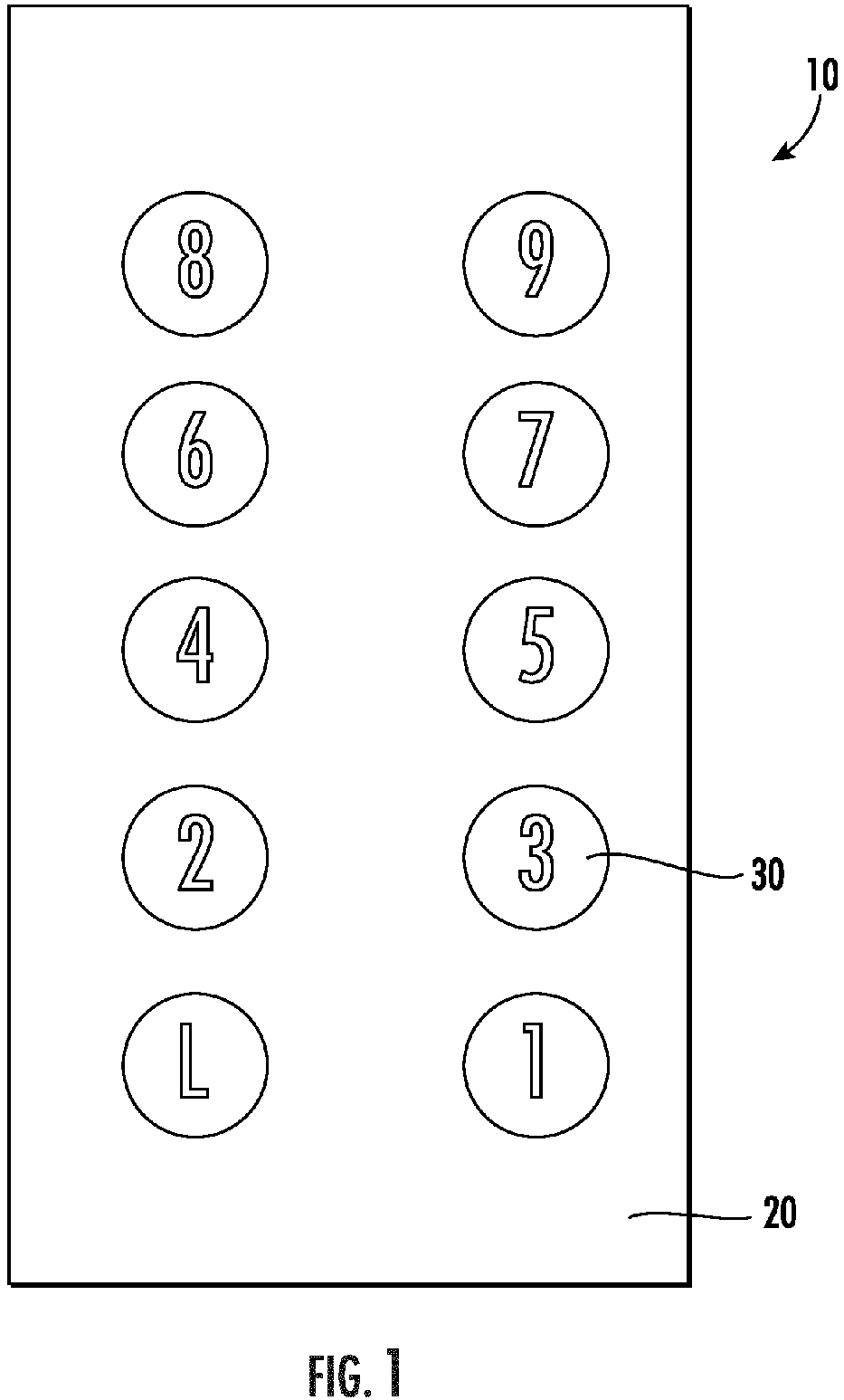
FIG. 1 shows an elevator control panel; -
FIG. 2 shows an elevator request panel; -
FIG. 3 shows an escalator having a passenger contact component; and -
FIG. 4 shows a moving walkway or escalator passenger contact component. - A detailed description of one or more embodiments of the disclosed apparatus and method are presented herein by way of exemplification and not limitation with reference to the Figures.
- Current solutions to sanitizing passenger contact components of an elevator, escalator or moving walkway include contacting the surfaces with disinfecting chemicals, bathing the contact surfaces with ultraviolet light, coating the surfaces with a biocidal coating, or including a biocidal additive in a composition. These solutions all suffer from drawbacks. Contacting the surfaces with disinfecting chemicals is labor intensive and subject to human error. Bathing the contact surfaces with ultraviolet light requires the installation of equipment and can be labor intensive. Additionally, repeated applications of ultraviolet light can have a negative effect on the materials used to form the contact surface. Biocidal coatings are subject to wear through and will eventually disappear from the most often touched surfaces. Biocidal additives are similarly worn off of the contact surface. A more long-lived solution is desired.
- This need is addressed by an uncoated passenger contact component formed from a self-sanitizing polymer composition. An uncoated passenger contact component is defined as having no coating applied to the surface formed from the self-sanitizing polymer composition. The self-sanitizing polymer composition includes a self-sanitizing polymer that has a plurality of covalently bound biocidal functional groups. The covalently bound biocidal functional groups may include photosensitizing groups, anionic functional groups, or a combination thereof. The self-sanitizing polymer may have a glass transition temperature (Tg) greater than 45°C and less than or equal to 250°C. Alternatively, when the self-sanitizing polymer comprises a thermoplastic elastomer the glass transition temperature (Tg) may be below 0°C.
- . The self-sanitizing polymer may be a thermoplastic or a thermoset. The self-sanitizing polymer may be a block copolymer. The self-sanitizing polymer may be a thermoplastic elastomer. The self-sanitizing polymer may be a styrenic polymer such as polystyrene, copolymers including polystyrene subunits and mixtures such as polycarbonate/acrylonitrile-butadiene-styrene polymer (PC/ABS).
- In some embodiments, the plurality of covalently bound biocidal functional group includes photosensitizing functional groups. The photosensitizing groups, when exposed to visible light, generates singlet oxygen which leads to the destruction of pathogens present on the surface. By covalently bonding the photosensitizing group to the polymer, there is no need for a component of the composition to migrate to the surface and no potential for the photosensitizing group to be worn off. Exemplary photosensitizing groups include porphyrin, phthalocyanine, and phthalocyanine derivatives. The photosensitizing groups may be present in an amount greater than or equal to 0.5 weight percent (wt%), or greater than or equal to 1 wt%, based on the total weight of the self-sanitizing polymer. Polymers having a phthalocyanine or phthalocyanine derivative covalently bound to the polymer are disclosed in
U.S. Patent No. 8,741,264 , which is incorporated by reference herein in its entirety. - In some embodiments, the plurality of covalently bound biocidal functional group includes anionic functional groups. Upon exposure to ambient moisture, the anionic functional groups create a sudden and drastic change in pH on the uncoated passenger contact component which promotes destruction of a pathogen. Exemplary anionic functional groups include a sulfinate anion, a sulfonate anion, and a phosphonate anion. The self-sanitizing polymer may include different types of anionic functional groups. The anionic functional group may be present in an amount of at least 20 mol%. Exemplary self-sanitizing polymers that have a covalently bound anionic functional group are described in "Inherently self-sterilizing charged multiblock polymers that kill drug-resistant microbes in minutes" by Peddinti et al. and published in .
- In some embodiments, the self-sanitizing polymer is a multiblock copolymer having anionic functional groups located on a midblock in sufficient quantity to result in anti-microbial activity. One example is a TESET polymer having at least 20 mol%, or at least 40 mol%, or at least 50 mol% of a sulfonate anionic functional group. TESET is an acronym for a pentablock copolymer also known as poly[t-butylstyrene-b-(ethylene-alt-propylene)-b-(styrenesulfonate)-b-(ethylene-alt-propylene)-b-t-butylstyrene]. Other multiblock copolymers include the TST triblock copolymer (poly(p-tert-butylstyrene-b-styrene-b-p-tert-butylstyrene)) in which the midblock is sulfonated in an amount of at least 20mol%, or at least 40 mol%.
- In addition to the self-sanitizing polymer, the self-sanitizing polymer composition may further include pigments, dyes, surfactants, molding additives, viscosity modifiers, or other additives known in the art for injection molded or extruded polymer compositions.
- The uncoated passenger contact component may be formed from a self-sanitizing polymer composition by injection molding, extrusion, compression molding, vacuum molding or other molding technique known in the art as suitable for polymer compositions. Because the biocidal activity of the polymer is due to a covalently bound terminal group there is little concern about destroying or deactivating the biocidal activity when forming the contact surface.
- Turning now to the Figures,
FIG. 1 shows anelevator control panel 10 having apanel plate 20 andcontrol buttons 30. The panel plate, control buttons or both can be considered a passenger contact component and formed from the self-sanitizing polymer. -
FIG. 2 shows anelevator request panel 40 having apanel plate 50 andelevator request buttons 60. The panel plate and elevator request buttons can be considered passenger contact components. -
FIG. 3 shows anescalator 70 having ahandrail 80 which is a passenger contact component. -
FIG. 4 shows a moving walkway or escalatorpassenger contact component 90. - The terminology used herein is for the purpose of describing particular embodiments only and is not intended to be limiting of the present disclosure. As used herein, the singular forms "a", "an" and "the" are intended to include the plural forms as well, unless the context clearly indicates otherwise. It will be further understood that the terms "comprises" and/or "comprising," when used in this specification, specify the presence of stated features, integers, steps, operations, elements, and/or components, but do not preclude the presence or addition of one or more other features, integers, steps, operations, element components, and/or groups thereof.
- While the present disclosure has been described with reference to an exemplary embodiment or embodiments, it will be understood by those skilled in the art that various changes may be made and equivalents may be substituted for elements thereof without departing from the scope of the present disclosure. In addition, many modifications may be made to adapt a particular situation or material to the teachings of the present disclosure without departing from the essential scope thereof. Therefore, it is intended that the present disclosure not be limited to the particular embodiment disclosed as the best mode contemplated for carrying out this present disclosure, but that the present disclosure will include all embodiments falling within the scope of the claims.
- Certain embodiments of the present disclosure are as follows:
- 1. An uncoated passenger contact component comprising a self-sanitizing polymer composition, wherein the passenger contact component is part of an elevator, escalator or moving walkway.
- 2. The uncoated passenger contact component of embodiment 1, wherein the self-sanitizing polymer composition comprises a polymer with a plurality of covalently bound biocidal functional groups.
- 3. The uncoated passenger contact component of
embodiment 2, wherein the plurality of covalently bound biocidal functional groups comprise photosensitizing functional groups. - 4. The uncoated passenger contact component of
embodiment 3, wherein the photosensitizing functional groups comprise a porphyrin or phthalocyanine derivative. - 5. The uncoated passenger contact component of
embodiment 2, wherein the plurality of covalently bound functional groups comprise anionic functional groups. - 6. The uncoated passenger contact component of
embodiment 5, wherein the anionic functional groups comprise sulfinate anions, sulfonate anions, phosphonate anions, or a combination thereof. - 7. The uncoated passenger contact component of
embodiment 2, wherein the polymer is a block copolymer. - 8. The uncoated passenger contact component of
embodiment 2, wherein the polymer is a thermoplastic elastomer. - 9. The uncoated passenger contact component of
embodiment 2, wherein the polymer is a styrenic polymer. - 10. The uncoated passenger contact component of embodiment 1, wherein the uncoated passenger contact component is a control button, a control panel, a support rail, a destination entry device, or a combination of the foregoing.
- 11. The uncoated passenger contact component of embodiment 1, wherein the self-sanitizing polymer composition includes a self-sanitizing polymer having a glass transition temperature (Tg) greater than 45°C and less than or equal to 250°C.
- 12. An elevator comprising an uncoated passenger contact component comprising a self-sanitizing polymer composition.
- 13. The elevator of embodiment 12, wherein the self-sanitizing polymer composition comprises a polymer with a plurality of covalently bound biocidal functional groups.
- 14. The elevator of embodiment 13, wherein the plurality of covalently bound biocidal functional groups comprise photosensitizing functional groups.
- 15. The elevator of embodiment 14, wherein the photosensitizing functional groups comprise a porphyrin or phthalocyanine derivative.
- 16. The elevator of embodiment 13, wherein the plurality of covalently bound biocidal functional groups comprise anionic functional groups.
- 17. The uncoated elevator of embodiment 16, wherein the anionic functional groups comprise sulfinate anions, sulfonate anions, phosphonate anions, or a combination thereof.
- 18. An escalator or moving walkway comprising an uncoated passenger contact component comprising a self-sanitizing polymer composition.
- 19. The escalator or moving walkway of embodiment 18, wherein the self-sanitizing polymer composition comprises a polymer with a plurality of covalently bound biocidal functional groups.
- 20. The escalator or moving walkway of embodiment 18, wherein the plurality of covalently bound biocidal functional groups comprise photosensitizing functional groups, anionic functional groups, or a combination thereof.
Claims (15)
- An uncoated passenger contact component comprising a self-sanitizing polymer composition, wherein the passenger contact component is part of an elevator, escalator or moving walkway.
- The uncoated passenger contact component of claim 1, wherein the self-sanitizing polymer composition comprises a polymer with a plurality of covalently bound biocidal functional groups.
- The uncoated passenger contact component of claim 2, wherein the plurality of covalently bound biocidal functional groups comprise photosensitizing functional groups.
- The uncoated passenger contact component of claim 3, wherein the photosensitizing functional groups comprise a porphyrin or phthalocyanine derivative.
- The uncoated passenger contact component of any one of claims 2-4, wherein the plurality of covalently bound biocidal functional groups comprise anionic functional groups.
- The uncoated passenger contact component of claim 5, wherein the anionic functional groups comprise sulfinate anions, sulfonate anions, phosphonate anions, or a combination thereof.
- The uncoated passenger contact component of any one of claims 2-6, wherein the polymer is a block copolymer.
- The uncoated passenger contact component of any one of claims 2-7, wherein the polymer is a thermoplastic elastomer.
- The uncoated passenger contact component of any one of claims 2-8, wherein the polymer is a styrenic polymer.
- The uncoated passenger contact component of any one of the preceding claims, wherein the uncoated passenger contact component is a control button, a control panel, a support rail, a destination entry device, or a combination of the foregoing.
- The uncoated passenger contact component of any one of the preceding claims, wherein the self-sanitizing polymer composition includes a self-sanitizing polymer having a glass transition temperature (Tg) greater than 45°C and less than or equal to 250°C.
- An elevator, escalator or moving walkway comprising an uncoated passenger contact component comprising a self-sanitizing polymer composition.
- The elevator, escalator or moving walkway of claim 12, wherein the self-sanitizing polymer composition comprises a polymer with a plurality of covalently bound biocidal functional groups.
- The elevator, escalator or moving walkway of claim 13, wherein the plurality of covalently bound biocidal functional groups comprise photosensitizing functional groups, optionally wherein the photosensitizing functional groups comprise a porphyrin or phthalocyanine derivative.
- The elevator, escalator or moving walkway of claim 13 or claim 14, wherein the plurality of covalently bound biocidal functional groups comprise anionic functional groups, optionally wherein the anionic functional groups comprise sulfinate anions, sulfonate anions, phosphonate anions, or a combination thereof.
Applications Claiming Priority (1)
| Application Number | Priority Date | Filing Date | Title |
|---|---|---|---|
| US17/219,935 US20220315752A1 (en) | 2021-04-01 | 2021-04-01 | Self-sanitizing passenger contact component for elevator, escalator or moving walkway |
Publications (1)
| Publication Number | Publication Date |
|---|---|
| EP4067279A1 true EP4067279A1 (en) | 2022-10-05 |
Family
ID=78789649
Family Applications (1)
| Application Number | Title | Priority Date | Filing Date |
|---|---|---|---|
| EP21210087.9A Pending EP4067279A1 (en) | 2021-04-01 | 2021-11-24 | Self-sanitizing passenger contact component for elevator, escalator or moving walkway |
Country Status (3)
| Country | Link |
|---|---|
| US (1) | US20220315752A1 (en) |
| EP (1) | EP4067279A1 (en) |
| CN (1) | CN115196478A (en) |
Citations (3)
| Publication number | Priority date | Publication date | Assignee | Title |
|---|---|---|---|---|
| US8741264B2 (en) | 2005-06-29 | 2014-06-03 | Molteni Therapeutics S.R.L. | Self-sterilizing products |
| CN204607355U (en) * | 2015-05-18 | 2015-09-02 | 上海扶联电梯配件有限公司 | A kind of antimicrobial form rubber handrail band |
| US20200384730A1 (en) * | 2019-05-21 | 2020-12-10 | Dennis Hackemeyer | Button covers and buttons with bioactive materials |
Family Cites Families (8)
| Publication number | Priority date | Publication date | Assignee | Title |
|---|---|---|---|---|
| JP2001089060A (en) * | 1999-09-17 | 2001-04-03 | Hitachi Building Systems Co Ltd | Passenger conveyor cleaning equipment |
| ES2298663T3 (en) * | 2003-10-30 | 2008-05-16 | Inventio Ag | CLEANING UNIT TO CLEAN A TRANSPORTATION DEVICE, TRANSPORTATION DEVICE WITH A CLEANING UNIT AND PROCEDURE TO PERFORM A CLEANING SEQUENCE TO CLEAN THE TRANSPORTATION DEVICE. |
| WO2008015445A2 (en) * | 2006-08-04 | 2008-02-07 | Ucl Business Plc | Computer devices and accessories |
| KR20070060067A (en) * | 2007-01-02 | 2007-06-12 | 오티스 엘리베이터 컴파니 | Sterilized Elevator Passenger Interface |
| FR3020370A1 (en) * | 2014-04-24 | 2015-10-30 | Commissariat Energie Atomique | PROCESS FOR IMPREGNATING A POLYMERIC SUBSTRATE BY A PHOTOCATALYTIC ELEMENT |
| US20160205925A1 (en) * | 2015-01-15 | 2016-07-21 | Ariel-University Research And Development Company Ltd. | Antimicrobial compositions made of a thermoplastic polymer and a photosensitizer |
| CN107400362A (en) * | 2016-05-18 | 2017-11-28 | 上海阶明软管有限公司 | A kind of disposable medical silica gel menifold with self disinfection function |
| CN207986482U (en) * | 2018-02-08 | 2018-10-19 | 复旦大学附属儿科医院 | A kind of ultraviolet light sterilizing device for elevator armrest for exempting from charging |
-
2021
- 2021-04-01 US US17/219,935 patent/US20220315752A1/en not_active Abandoned
- 2021-11-18 CN CN202111367922.2A patent/CN115196478A/en active Pending
- 2021-11-24 EP EP21210087.9A patent/EP4067279A1/en active Pending
Patent Citations (3)
| Publication number | Priority date | Publication date | Assignee | Title |
|---|---|---|---|---|
| US8741264B2 (en) | 2005-06-29 | 2014-06-03 | Molteni Therapeutics S.R.L. | Self-sterilizing products |
| CN204607355U (en) * | 2015-05-18 | 2015-09-02 | 上海扶联电梯配件有限公司 | A kind of antimicrobial form rubber handrail band |
| US20200384730A1 (en) * | 2019-05-21 | 2020-12-10 | Dennis Hackemeyer | Button covers and buttons with bioactive materials |
Non-Patent Citations (2)
| Title |
|---|
| BAILEY MARY PAGE: "A FAST-ACTING, DURABLE SELF-DISINFECTING POLYMER", CHEMICAL ENGINEERING, NOVEMBER 2020, 1 November 2020 (2020-11-01), XP055915838, Retrieved from the Internet <URL:https://www.chemengonline.com/fast-acting-durable-self-disinfecting-polymer/> [retrieved on 20220426] * |
| PEDDINTI BHARADWAJA S. T. ET AL: "Inherently self-sterilizing charged multiblock polymers that kill drug-resistant microbes in minutes", MATER. HORIZ., vol. 6, no. 10, 18 November 2019 (2019-11-18), pages 2056 - 2062, XP055915248, ISSN: 2051-6347, Retrieved from the Internet <URL:http://pubs.rsc.org/en/content/articlepdf/2019/MH/C9MH00726A> DOI: 10.1039/C9MH00726A * |
Also Published As
| Publication number | Publication date |
|---|---|
| US20220315752A1 (en) | 2022-10-06 |
| CN115196478A (en) | 2022-10-18 |
Similar Documents
| Publication | Publication Date | Title |
|---|---|---|
| US4500339A (en) | Adherent controlled release microbiocides containing hydrolyzable silanes | |
| DE2910010C2 (en) | Use of a liquid organopolysiloxane composition to reduce the surface tackiness of an organopolysiloxane gel or fat | |
| ES2064792T3 (en) | DIENO POLYMERS AND COPOLYMERS FINISHED BY REACTION WITH N-ALKYL- AND N-ARYL-IMINES. | |
| ATE273326T1 (en) | METHOD FOR PRODUCING POLYMERS BY CONTROLLED RADICAL POLYMERIZATION WITH XANTHATES | |
| ATE546169T1 (en) | POLYMER COMPOSITIONS CONTAINING BIOACTIVE AGENT, MEDICAL ARTICLES AND METHODS | |
| DE60115001D1 (en) | AQUEOUS POLYMERIC COMPOSITION AS A COATING AGENT | |
| DE59610087D1 (en) | Process for modifying dispersion powder compositions | |
| AR009127A1 (en) | PREPARATION PROCEDURE FOR MALONA METHYLIDENE NANOPARTICLES, PARTICLES THAT EVENTUALLY CONTAIN ONE OR MORE BIOLOGICALLY ACTIVE MOLECULES AND PHARMACEUTICAL COMPOSITIONS CONTAINING THEM | |
| ATE354332T1 (en) | NOVEL PHOTOSTABILIZERS, UV ABSORBERS, AND METHOD FOR PHOTOSTABILIZING A SUN PROTECTION COMPOSITION | |
| DE50103340D1 (en) | METHOD FOR PRODUCING CAPSULES CONTAINING ACTIVE SUBSTANCES WITH ULTRA-THIN WALL LAYER | |
| ATE230771T1 (en) | HYDROPHILATION OF HYDROPHOBIC POLYMERS | |
| ATE161855T1 (en) | ANTIMICROBIAL POLYMERS AND COMPOSITIONS CONTAINING THESE POLYMERS | |
| ATE218846T1 (en) | POLYMER COMBINATION FOR HAIR TREATMENT PRODUCTS | |
| ATE365183T1 (en) | POSITIVELY CHARGED AMPHIPHILE BLOCK COPOLYMER AS A DRUG CARRIER AND COMPLEX THEREOF WITH A NEGATIVELY CHARGED DRUG | |
| ES2183918T3 (en) | METACRYLATE RESIN BLENDS. | |
| US20220315752A1 (en) | Self-sanitizing passenger contact component for elevator, escalator or moving walkway | |
| DE19921904A1 (en) | Preparation of antimicrobial polymer for medical and hygiene articles, varnishes, paints and coatings comprises polymerizing monomers that have been functionalized by a quat. amino group | |
| EP1183282A1 (en) | Method of producing inherently microbicidal polymer surfaces | |
| DE60034876D1 (en) | DIELECTRIC FILMS OF ORGANOHYDRIDOSILOXAN RESINS | |
| BR0301704B1 (en) | pigments treated with organo sulfonic compounds. | |
| ES2026314A6 (en) | Povidone-iodine neonatal ophthalmic antimicrobial prophylactic agent | |
| ATE144997T1 (en) | AQUEOUS POLYMER DISPERSIONS CONTAINING ORGANIC COMPOUNDS WITH CARBONATE AND CARBONYL GROUPS, AND PAINTING AND COATING SYSTEMS PRODUCED THEREBY | |
| FR2819801B1 (en) | SIZED GLASS WIRES, SIZING COMPOSITION AND COMPOSITES COMPRISING SAID WIRES | |
| DE19921894A1 (en) | Production of antimicrobial coatings on polymer substrates, e.g. hygiene products and medical articles, involves immobilizing antimicrobial polymer on the substrate surface, e.g. by plasma treatment | |
| DE59801451D1 (en) | WATER-SOLUBLE, WATER-SOFTENING BUILDER |
Legal Events
| Date | Code | Title | Description |
|---|---|---|---|
| PUAI | Public reference made under article 153(3) epc to a published international application that has entered the european phase |
Free format text: ORIGINAL CODE: 0009012 |
|
| STAA | Information on the status of an ep patent application or granted ep patent |
Free format text: STATUS: THE APPLICATION HAS BEEN PUBLISHED |
|
| AK | Designated contracting states |
Kind code of ref document: A1 Designated state(s): AL AT BE BG CH CY CZ DE DK EE ES FI FR GB GR HR HU IE IS IT LI LT LU LV MC MK MT NL NO PL PT RO RS SE SI SK SM TR |
|
| STAA | Information on the status of an ep patent application or granted ep patent |
Free format text: STATUS: REQUEST FOR EXAMINATION WAS MADE |
|
| 17P | Request for examination filed |
Effective date: 20230330 |
|
| RBV | Designated contracting states (corrected) |
Designated state(s): AL AT BE BG CH CY CZ DE DK EE ES FI FR GB GR HR HU IE IS IT LI LT LU LV MC MK MT NL NO PL PT RO RS SE SI SK SM TR |