EP4067129B1 - An air conditioning system - Google Patents
An air conditioning system Download PDFInfo
- Publication number
- EP4067129B1 EP4067129B1 EP21166482.6A EP21166482A EP4067129B1 EP 4067129 B1 EP4067129 B1 EP 4067129B1 EP 21166482 A EP21166482 A EP 21166482A EP 4067129 B1 EP4067129 B1 EP 4067129B1
- Authority
- EP
- European Patent Office
- Prior art keywords
- sensor
- heat
- air conditioning
- heat exchanger
- conditioning system
- Prior art date
- Legal status (The legal status is an assumption and is not a legal conclusion. Google has not performed a legal analysis and makes no representation as to the accuracy of the status listed.)
- Active
Links
Images


Classifications
-
- B—PERFORMING OPERATIONS; TRANSPORTING
- B60—VEHICLES IN GENERAL
- B60H—ARRANGEMENTS OF HEATING, COOLING, VENTILATING OR OTHER AIR-TREATING DEVICES SPECIALLY ADAPTED FOR PASSENGER OR GOODS SPACES OF VEHICLES
- B60H1/00—Heating, cooling or ventilating devices
- B60H1/00507—Details, e.g. mounting arrangements, desaeration devices
- B60H1/00514—Details of air conditioning housings
- B60H1/00521—Mounting or fastening of components in housings, e.g. heat exchangers, fans, electronic regulators
-
- B—PERFORMING OPERATIONS; TRANSPORTING
- B60—VEHICLES IN GENERAL
- B60H—ARRANGEMENTS OF HEATING, COOLING, VENTILATING OR OTHER AIR-TREATING DEVICES SPECIALLY ADAPTED FOR PASSENGER OR GOODS SPACES OF VEHICLES
- B60H1/00—Heating, cooling or ventilating devices
- B60H1/00642—Control systems or circuits; Control members or indication devices for heating, cooling or ventilating devices
- B60H1/00735—Control systems or circuits characterised by their input, i.e. by the detection, measurement or calculation of particular conditions, e.g. signal treatment, dynamic models
- B60H1/00792—Arrangement of detectors
-
- G—PHYSICS
- G01—MEASURING; TESTING
- G01K—MEASURING TEMPERATURE; MEASURING QUANTITY OF HEAT; THERMALLY-SENSITIVE ELEMENTS NOT OTHERWISE PROVIDED FOR
- G01K2201/00—Application of thermometers in air-conditioning systems
- G01K2201/02—Application of thermometers in air-conditioning systems in vehicles
Definitions
- the invention relates to an air conditioning system.
- the invention relates to the air conditioning system for a motor vehicle.
- HVAC Heating, ventilating and/or air conditioning systems
- the HVAC consists of a blower and a housing comprising an evaporator, a heating element and several air nozzles with flaps for throttling or closing the air flow.
- the evaporator airflow temperature is controlled by an evaporator temperature sensor, which also prevents the evaporator from being frozen.
- the sensor position is close to the evaporator.
- the measured temperature indicates the temperature of air just having passed the evaporator.
- Other thermal impacts influencing that measured value have to be avoided, specifically the influence of adjacent heating elements such as a standard heater core, a PTC, an inner condenser and the like.
- heating elements exchange heat from a coolant medium to an airflow passing by thereafter to be blown into the passenger cabin.
- Optional second heat exchangers for example PTC heaters, are used to shorten the time period before an air conditioning system, with a coolant - based heat exchanger only, may provide warmth.
- Modern heating, ventilating and air conditioning systems for electrically driven vehicles may include for example high - voltage positive thermal coefficient heaters (HV - PTCs) and heat exchangers using refrigerants (R134a, R1234yf, R744, etc.) instead of coolant for heat pump systems.
- HV - PTCs high - voltage positive thermal coefficient heaters
- R134a, R1234yf, R744, etc. refrigerants
- Some prior art sensors relate to a temperature sensor of an air conditioning system for detecting the temperature of the evaporator surface.
- the device is fixed with a clamp mechanism and attached to evaporator tubes.
- the sensing tip dives into the evaporator fins.
- this clamping method bears the risk of damaging the evaporator during installation.
- the evaporator surface temperature is measured, but not the temperature of the airflow having passed the evaporator.
- JP H09 193650 A relate to a method to position the sensor on the surface of the evaporator and alternatively close to the evaporator to sense the airflow temperature.
- An inserted temperature sensor senses the surface temperature of the evaporator when inserted between the fins of the evaporator and attached to the surfaces of the fins. If the sensor is fixed separated from the evaporator it will sense the temperature of the airflow having passed through the evaporator.
- the air conditioning housing has a mounting hole through which a sensor coupling part is coupled inside the vehicle air conditioning apparatus, thereby allowing selectively mounting of an inserted or integrated temperature sensor device.
- the insertion method has the risk of damaging the evaporator during installation in case of placing the senor between the fins of the evaporator.
- the resulting temperature may be influenced by heat radiation of adjacent heat sources like PTCs, inner condenser, heater core and the like.
- the present invention aims to resolve the described problem.
- the object of the invention is an air conditioning system for a motor vehicle according to claim 1 and its dependent claims but also relates to a motor vehicle according to claim 7.
- HVACs Heating, ventilating and/or air conditioning systems
- An HVAC consists of a blower and a housing comprising an evaporator including a sensor either measuring its surface temperature or measuring the temperature of a passed airflow, at least one heating element, a variety of flaps regulating internally the airflow volume and / or airflow direction and several air outlet nozzles with flaps to throttle or to close the airflow into the passenger cabin.
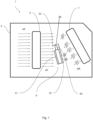
- Fig. 1 shows an air conditioning system 1 (further referred to as "system") for a motor vehicle comprising a housing 3 for the first fluid AF.
- the direction of flow of the first fluid AF is presented in the figures by respective arrows.
- the housing 3 comprises a first fluid inlet, and at least one first fluid outlet.
- the inlet at the outlet are not shown in figures for the sake of clarity.
- the housing 3 may be made of any material (e.g. synthetic material such as plastic, etc.) or by any technique (e.g. plastic welding) which would provide a fluid- tight connection of the housing 3 between the inlet and the outlet.
- the housing 3 comprises at least one port 3a in its structure.
- the port 3a may be in the form of an opening.
- the port 3a may also comprise fixing means, collar and other additional features, depending on the type of the device received therein.
- the system 1 comprises a first heat exchanger 5.
- the first heat exchanger 5 may be configured to cool down the first fluid AF flowing through the housing 3.
- the first heat exchanger may be an evaporator.
- the heat exchanger 5 is configured to heat exchange with the first fluid AF.
- the system 1 further comprises at least one second heat exchanger 7 configured to generate a heat radiation HR.
- the second heat exchanger may increase the temperature of the first fluid AF by means of heat radiation HR.
- the possible heat radiation directions are presented in figures by respective arrows.
- the second heat exchanger 7 is located downstream to the first heat exchanger 5.
- the second heat exchanger 7 may be, for example, a heater core.
- the second heat exchanger 7 may be aligned parallel to the first heat exchanger 5.
- the second heat exchanger 7 may be inclined with respect to the first heat exchanger 5, as shown in Fig.1 .
- the inclination between the heat exchangers 5, 7 allows to decrease a packaging, i.e. it allows to reduce the overall size of the system 1.
- the system comprises at least one temperature sensor 9 configured to be fixed to the port 3a so that at least a portion of the sensor 9 is located between the first heat exchanger 5 and the second heat exchanger 7.
- the "sensor” may be defined as a device which detects or measures a physical property and records, indicates, or otherwise responds to it Therefore the sensor 9 further comprises at least one sensitive portion 95 being at least partially isolated form the heat radiation HR generated by the heating element 7. Further, the sensor comprises a casing 97.
- the sensor 9 is strictly related to the operational mode of the first heat exchanger, especially when the first heat exchanger is the evaporator.
- a key function of the sensor 9 is to prevent the first heat exchanger 5 from being frozen.
- the sensor 9 detects the temperature downstream of the first heat exchanger 5 and before the first fluid AF flows to the second heat exchanger 7.
- the sensor 9 allows also to control the AC system and enhance its efficiency.
- the sensor 9 is capable of avoiding the impact of thermal radiation HR of adjacent heat sources such as the second heat exchanger 7 and thereby sensing reliably the temperature of the first fluid AF airflow having passed the first heat exchanger 5.
- the sensor 9 may comprise an opening 33 configured to provide a contact between the first fluid AF and the sensitive portion 95.
- the opening 33 may be formed in the casing 97.
- the sensor 9 further comprises a protrusion 31 integrally formed therewith configured to shift the sensitive portion 95 towards an intended measurement point with respect to the housing 3. It is preferred to measure the parameters of the first fluid AF as close as possible to exchanger 5 ("coldest point"), but with certain distance to avoid problems like water drops on the sensitive parts. That area the measurement is of most reliance.
- the sensitive portion 95 is thermally connected with first fluid AF and may be thermally insulated from the heat radiation HR.
- Terms such as thermally connected/ insulated refer to the ability of first fluid AF or the heat radiation HR to cool down or heat the sensor 9.
Landscapes
- Physics & Mathematics (AREA)
- Thermal Sciences (AREA)
- Engineering & Computer Science (AREA)
- Mechanical Engineering (AREA)
- Air-Conditioning For Vehicles (AREA)
Description
- The invention relates to an air conditioning system. In particular, the invention relates to the air conditioning system for a motor vehicle.
- Heating, ventilating and/or air conditioning systems (HVAC) are regulating individually the air flow and air temperature to passenger compartment areas, especially to foot, body and windscreen air outlets and/or individually to the driver seat or front passenger seat and/or rear passenger seats. The HVAC consists of a blower and a housing comprising an evaporator, a heating element and several air nozzles with flaps for throttling or closing the air flow.
- For high efficiency and control of the AC system, the evaporator airflow temperature is controlled by an evaporator temperature sensor, which also prevents the evaporator from being frozen.
- The sensor position is close to the evaporator. The measured temperature indicates the temperature of air just having passed the evaporator. Other thermal impacts influencing that measured value have to be avoided, specifically the influence of adjacent heating elements such as a standard heater core, a PTC, an inner condenser and the like.
- Current sensor architectures and positions may not be able to avoid sufficiently the influence of heat radiation causing, especially at low air flow rates, malfunction of the AC-system or a frozen evaporator.
- Commonly known heating elements exchange heat from a coolant medium to an airflow passing by thereafter to be blown into the passenger cabin. Optional second heat exchangers, for example PTC heaters, are used to shorten the time period before an air conditioning system, with a coolant - based heat exchanger only, may provide warmth.
- Modern heating, ventilating and air conditioning systems for electrically driven vehicles may include for example high - voltage positive thermal coefficient heaters (HV - PTCs) and heat exchangers using refrigerants (R134a, R1234yf, R744, etc.) instead of coolant for heat pump systems.
- Those heaters are being operated on a higher temperature level compared to conventional coolant - based heater cores, thereby influencing adjacent components including the evaporator sensor.
- Some prior art sensors relate to a temperature sensor of an air conditioning system for detecting the temperature of the evaporator surface. The device is fixed with a clamp mechanism and attached to evaporator tubes. The sensing tip dives into the evaporator fins. Disadvantageously this clamping method bears the risk of damaging the evaporator during installation. In addition, the evaporator surface temperature is measured, but not the temperature of the airflow having passed the evaporator.
- Other prior art sensors, as disclosed in
JP H09 193650 A - In case of installing the sensor capable of measuring the temperature of air having passed the evaporator, the resulting temperature may be influenced by heat radiation of adjacent heat sources like PTCs, inner condenser, heater core and the like.
- The present invention aims to resolve the described problem.
- The object of the invention is an air conditioning system for a motor vehicle according to
claim 1 and its dependent claims but also relates to a motor vehicle according toclaim 7. - Examples of the invention will be apparent from and described in detail with reference to the accompanying drawings, in which:
-
Fig. 1 shows a schematic view of the air conditioning system. -
Fig. 2 shows another schematic view of the air conditioning system wherein the sensor comprises a heat shield. -
Fig. 3 shows the standalone sensor of either ofFigs 1 or2 comprising additional coating. - Heating, ventilating and/or air conditioning systems (HVACs) are regulating individually the airflow and air temperature to passenger compartment areas. An HVAC consists of a blower and a housing comprising an evaporator including a sensor either measuring its surface temperature or measuring the temperature of a passed airflow, at least one heating element, a variety of flaps regulating internally the airflow volume and / or airflow direction and several air outlet nozzles with flaps to throttle or to close the airflow into the passenger cabin.
-
Fig. 1 shows an air conditioning system 1 (further referred to as "system") for a motor vehicle comprising ahousing 3 for the first fluid AF. The direction of flow of the first fluid AF is presented in the figures by respective arrows. Thehousing 3 comprises a first fluid inlet, and at least one first fluid outlet. The inlet at the outlet are not shown in figures for the sake of clarity. Thehousing 3 may be made of any material (e.g. synthetic material such as plastic, etc.) or by any technique (e.g. plastic welding) which would provide a fluid- tight connection of thehousing 3 between the inlet and the outlet. - The
housing 3 comprises at least one port 3a in its structure. The port 3a may be in the form of an opening. The port 3a may also comprise fixing means, collar and other additional features, depending on the type of the device received therein. - The
system 1 comprises afirst heat exchanger 5. Thefirst heat exchanger 5 may be configured to cool down the first fluid AF flowing through thehousing 3. For example, the first heat exchanger may be an evaporator. Generally, theheat exchanger 5 is configured to heat exchange with the first fluid AF. - The
system 1 further comprises at least onesecond heat exchanger 7 configured to generate a heat radiation HR. In other words, the second heat exchanger may increase the temperature of the first fluid AF by means of heat radiation HR. The possible heat radiation directions are presented in figures by respective arrows. Thesecond heat exchanger 7 is located downstream to thefirst heat exchanger 5. - The
second heat exchanger 7 may be, for example, a heater core. Thesecond heat exchanger 7 may be aligned parallel to thefirst heat exchanger 5. Alternatively, thesecond heat exchanger 7 may be inclined with respect to thefirst heat exchanger 5, as shown inFig.1 . The inclination between theheat exchangers system 1. - As further shown in
Fig. 1 , the system comprises at least onetemperature sensor 9 configured to be fixed to the port 3a so that at least a portion of thesensor 9 is located between thefirst heat exchanger 5 and thesecond heat exchanger 7. The "sensor" may be defined as a device which detects or measures a physical property and records, indicates, or otherwise responds to it Therefore thesensor 9 further comprises at least onesensitive portion 95 being at least partially isolated form the heat radiation HR generated by theheating element 7. Further, the sensor comprises acasing 97. - The
sensor 9 is strictly related to the operational mode of the first heat exchanger, especially when the first heat exchanger is the evaporator. - A key function of the
sensor 9 is to prevent thefirst heat exchanger 5 from being frozen. - In such cases the airflow into the passenger cabin would be reduced or in the worst case blocked.
- The
sensor 9 detects the temperature downstream of thefirst heat exchanger 5 and before the first fluid AF flows to thesecond heat exchanger 7. Thesensor 9 allows also to control the AC system and enhance its efficiency. - The
sensor 9 is capable of avoiding the impact of thermal radiation HR of adjacent heat sources such as thesecond heat exchanger 7 and thereby sensing reliably the temperature of the first fluid AF airflow having passed thefirst heat exchanger 5. - The
sensor 9 may comprise anopening 33 configured to provide a contact between the first fluid AF and thesensitive portion 95. Theopening 33 may be formed in thecasing 97. - The
sensor 9 further comprises aprotrusion 31 integrally formed therewith configured to shift thesensitive portion 95 towards an intended measurement point with respect to thehousing 3. It is preferred to measure the parameters of the first fluid AF as close as possible to exchanger 5 ("coldest point"), but with certain distance to avoid problems like water drops on the sensitive parts. That area the measurement is of most reliance. - The
casing 97 integrally formed with theprotrusion 31 is configured to at least partially insulate theprotrusion 31 with thesensor 9 from the heat radiation HR. - Therefore, the
sensitive portion 95 is thermally connected with first fluid AF and may be thermally insulated from the heat radiation HR. Terms such as thermally connected/ insulated refer to the ability of first fluid AF or the heat radiation HR to cool down or heat thesensor 9. -
Fig. 2 showssystem 1 in which thesensor 9 comprises aheat shield 991 which may be fixed directly to thesensitive portion 95 or to thecasing 97. Theheat shield 991 may be in a form of protrusion distanced from thecasing 97 and close to thesensitive portion 95 ,e.g. in parallel configuration. Theheat shield 991 may be configured to limit and/ or reflect at least a portion of the heat radiation HR by forming additional gap. The gap allows to deflect the portion of heat radiation HR earlier and to capture or deflect the residual heat radiation by the portion of thecasing 97 located in the vicinity of said gap. Other forms ofheat shield 991 are also envisaged. -
Fig. 3 shows astandalone sensor 9. In this embodiment, thesensitive portion 95 may be coated with a heatresistive coating material 9951. Additionally or alternatively, a portion of thecasing 97 facing thesecond heat exchanger 7 is coated with a heatresistive coating material 995. Thecoating material 995 may either substitute thecasing 97 and/or theheat shield 991 or it may be used as additional heat resistant means to any combination of thecasing 97 with theheat shield 991.
Claims (7)
- An air conditioning system (1) for a motor vehicle comprising: a housing (3) for a first fluid (AF), wherein the housing (3) comprises at least one port (3a) in its structure, a first heat exchanger (5) configured to heat exchange with the first fluid (AF), at least one second heat exchanger (7) configured to generate a heat radiation (HR), and at least one temperature sensor (9) configured to be fixed to the port (3a) so that at least a portion of the sensor (9) is located between the first heat exchanger (5) and the second heat exchanger (7), wherein the sensor (9) further comprises at least one sensitive portion (95) being thermally exposed to the first fluid (AF), wherein the sensor (9) further comprises a protrusion (31) integrally formed therewith configured to shift the sensitive portion (95) towards an intended measurement point of the housing (3), characterized in that the at least one sensitive portion (95) is at least partially isolated from the heat radiation (HR) generated by the second heat exchanger (7), and wherein the sensor (9) comprises
a casing (97) integrally formed with the protrusion (31) configured to at least partially insulate the protrusion (31) with the sensor (9) from the heat radiation (HR) - The air conditioning system (1) according to claim 1, wherein the sensor (9) comprises a heat shield (991) fixed to the casing (97) configured to limit at least a portion of the heat radiation (HR) from reaching the sensitive portion (95), wherein the heat shield (991) is in a form of protrusion distanced from the casing (97).
- The air conditioning system (1) according to claim 1 or 2, wherein a portion of the casing (97) facing the second heat exchanger (7) is coated with a heat resistive coating material (995).
- The air conditioning system (1) according to any of the preceding claims, wherein the sensor (9) comprises an opening (33) configured to provide a contact between the first fluid (AF) and the sensitive portion (95).
- The air conditioning system (1) according to any of the preceding claims, wherein the sensitive portion (95) is thermally insulated from the heat radiation (HR).
- The air conditioning system (1) according to any of the preceding claims, wherein a portion of the sensitive portion (95) is coated with a heat resistive coating material (9951).
- A motor vehicle comprising at least one air conditioning system (1) according to any of the preceding claims.
Priority Applications (2)
| Application Number | Priority Date | Filing Date | Title |
|---|---|---|---|
| EP21166482.6A EP4067129B1 (en) | 2021-03-31 | 2021-03-31 | An air conditioning system |
| PCT/EP2022/058633 WO2022207829A1 (en) | 2021-03-31 | 2022-03-31 | An air conditioning system |
Applications Claiming Priority (1)
| Application Number | Priority Date | Filing Date | Title |
|---|---|---|---|
| EP21166482.6A EP4067129B1 (en) | 2021-03-31 | 2021-03-31 | An air conditioning system |
Publications (2)
| Publication Number | Publication Date |
|---|---|
| EP4067129A1 EP4067129A1 (en) | 2022-10-05 |
| EP4067129B1 true EP4067129B1 (en) | 2025-01-22 |
Family
ID=75362359
Family Applications (1)
| Application Number | Title | Priority Date | Filing Date |
|---|---|---|---|
| EP21166482.6A Active EP4067129B1 (en) | 2021-03-31 | 2021-03-31 | An air conditioning system |
Country Status (2)
| Country | Link |
|---|---|
| EP (1) | EP4067129B1 (en) |
| WO (1) | WO2022207829A1 (en) |
Citations (1)
| Publication number | Priority date | Publication date | Assignee | Title |
|---|---|---|---|---|
| JPS4928561U (en) * | 1972-06-13 | 1974-03-12 |
Family Cites Families (5)
| Publication number | Priority date | Publication date | Assignee | Title |
|---|---|---|---|---|
| JP3341563B2 (en) * | 1996-01-19 | 2002-11-05 | 株式会社デンソー | Sensor mounting structure |
| KR100942083B1 (en) * | 2003-05-30 | 2010-02-12 | 한라공조주식회사 | Evaporator Temperature Sensors in Air Conditioners |
| DE102012219962B3 (en) * | 2012-10-31 | 2014-04-03 | Eberspächer Climate Control Systems GmbH & Co. KG | Temperature sensor arrangement for heat exchanger of vehicle heater, has sensor unit that is provided with assembly stop portion in transition region between mounting portion and detecting portion |
| KR102011731B1 (en) * | 2013-08-20 | 2019-08-19 | 한온시스템 주식회사 | Air conditioner for vehicle |
| CN111024267A (en) * | 2019-10-31 | 2020-04-17 | 北京宇航系统工程研究所 | Multi-direction integrated heat flow sensor |
-
2021
- 2021-03-31 EP EP21166482.6A patent/EP4067129B1/en active Active
-
2022
- 2022-03-31 WO PCT/EP2022/058633 patent/WO2022207829A1/en not_active Ceased
Patent Citations (1)
| Publication number | Priority date | Publication date | Assignee | Title |
|---|---|---|---|---|
| JPS4928561U (en) * | 1972-06-13 | 1974-03-12 |
Also Published As
| Publication number | Publication date |
|---|---|
| WO2022207829A1 (en) | 2022-10-06 |
| EP4067129A1 (en) | 2022-10-05 |
Similar Documents
| Publication | Publication Date | Title |
|---|---|---|
| JP4858305B2 (en) | Humidity detection device and vehicle air conditioner | |
| US7958740B2 (en) | Vehicular air-conditioner | |
| KR101494202B1 (en) | External camera device for vehicles, as well as a vehicle with such an external camera device for recording at least one legally stipulated field of view | |
| US8641490B2 (en) | Vehicle air recirculation control device | |
| CN101121375A (en) | Vehicle Air Conditioning System | |
| JP6357322B2 (en) | Automotive air conditioner | |
| CN106029410B (en) | Vehicular air conditioner | |
| US6766654B2 (en) | Air conditioning system for a motor vehicle | |
| US6928237B2 (en) | Fluid heating apparatus | |
| EP1800920B1 (en) | Air-conditioning system for a vehicle | |
| EP4067129B1 (en) | An air conditioning system | |
| JP2009040242A (en) | TECHNICAL FIELD The present invention relates to a vehicle air conditioner. | |
| JP4858353B2 (en) | Air conditioner for vehicles | |
| CN101133306A (en) | Temperature sensor and device for air conditioning of a motor vehicle interior | |
| JPH11254954A (en) | Air conditioner for electric vehicle | |
| KR101186078B1 (en) | Air Conditioner for a Car | |
| JP3949291B2 (en) | Air conditioner for electric vehicles | |
| EP4470806A1 (en) | Vehicle air-conditioning device | |
| JP2005059755A (en) | Air conditioning control device for vehicles | |
| KR20080041876A (en) | Combined structure of water temperature sensor of air conditioner | |
| JP3467111B2 (en) | Electric vehicle air conditioner | |
| KR101236717B1 (en) | Combination structure of water temp sensor forair conditioner | |
| JP2018165591A (en) | Vehicular air conditioner | |
| JP3794082B2 (en) | Hot water heater | |
| KR101309202B1 (en) | Water temperature measuring sensor means of an automobile air conditioner |
Legal Events
| Date | Code | Title | Description |
|---|---|---|---|
| PUAI | Public reference made under article 153(3) epc to a published international application that has entered the european phase |
Free format text: ORIGINAL CODE: 0009012 |
|
| STAA | Information on the status of an ep patent application or granted ep patent |
Free format text: STATUS: THE APPLICATION HAS BEEN PUBLISHED |
|
| AK | Designated contracting states |
Kind code of ref document: A1 Designated state(s): AL AT BE BG CH CY CZ DE DK EE ES FI FR GB GR HR HU IE IS IT LI LT LU LV MC MK MT NL NO PL PT RO RS SE SI SK SM TR |
|
| STAA | Information on the status of an ep patent application or granted ep patent |
Free format text: STATUS: REQUEST FOR EXAMINATION WAS MADE |
|
| 17P | Request for examination filed |
Effective date: 20230405 |
|
| RBV | Designated contracting states (corrected) |
Designated state(s): AL AT BE BG CH CY CZ DE DK EE ES FI FR GB GR HR HU IE IS IT LI LT LU LV MC MK MT NL NO PL PT RO RS SE SI SK SM TR |
|
| P01 | Opt-out of the competence of the unified patent court (upc) registered |
Effective date: 20230629 |
|
| STAA | Information on the status of an ep patent application or granted ep patent |
Free format text: STATUS: EXAMINATION IS IN PROGRESS |
|
| 17Q | First examination report despatched |
Effective date: 20230822 |
|
| GRAP | Despatch of communication of intention to grant a patent |
Free format text: ORIGINAL CODE: EPIDOSNIGR1 |
|
| STAA | Information on the status of an ep patent application or granted ep patent |
Free format text: STATUS: GRANT OF PATENT IS INTENDED |
|
| INTG | Intention to grant announced |
Effective date: 20240801 |
|
| GRAS | Grant fee paid |
Free format text: ORIGINAL CODE: EPIDOSNIGR3 |
|
| GRAA | (expected) grant |
Free format text: ORIGINAL CODE: 0009210 |
|
| STAA | Information on the status of an ep patent application or granted ep patent |
Free format text: STATUS: THE PATENT HAS BEEN GRANTED |
|
| AK | Designated contracting states |
Kind code of ref document: B1 Designated state(s): AL AT BE BG CH CY CZ DE DK EE ES FI FR GB GR HR HU IE IS IT LI LT LU LV MC MK MT NL NO PL PT RO RS SE SI SK SM TR |
|
| REG | Reference to a national code |
Ref country code: GB Ref legal event code: FG4D |
|
| REG | Reference to a national code |
Ref country code: CH Ref legal event code: EP |
|
| REG | Reference to a national code |
Ref country code: IE Ref legal event code: FG4D |
|
| REG | Reference to a national code |
Ref country code: DE Ref legal event code: R096 Ref document number: 602021025045 Country of ref document: DE |
|
| REG | Reference to a national code |
Ref country code: NL Ref legal event code: MP Effective date: 20250122 |
|
| PG25 | Lapsed in a contracting state [announced via postgrant information from national office to epo] |
Ref country code: NL Free format text: LAPSE BECAUSE OF FAILURE TO SUBMIT A TRANSLATION OF THE DESCRIPTION OR TO PAY THE FEE WITHIN THE PRESCRIBED TIME-LIMIT Effective date: 20250122 |
|
| PG25 | Lapsed in a contracting state [announced via postgrant information from national office to epo] |
Ref country code: RS Free format text: LAPSE BECAUSE OF FAILURE TO SUBMIT A TRANSLATION OF THE DESCRIPTION OR TO PAY THE FEE WITHIN THE PRESCRIBED TIME-LIMIT Effective date: 20250422 |
|
| PG25 | Lapsed in a contracting state [announced via postgrant information from national office to epo] |
Ref country code: FI Free format text: LAPSE BECAUSE OF FAILURE TO SUBMIT A TRANSLATION OF THE DESCRIPTION OR TO PAY THE FEE WITHIN THE PRESCRIBED TIME-LIMIT Effective date: 20250122 |
|
| PG25 | Lapsed in a contracting state [announced via postgrant information from national office to epo] |
Ref country code: PL Free format text: LAPSE BECAUSE OF FAILURE TO SUBMIT A TRANSLATION OF THE DESCRIPTION OR TO PAY THE FEE WITHIN THE PRESCRIBED TIME-LIMIT Effective date: 20250122 |
|
| PG25 | Lapsed in a contracting state [announced via postgrant information from national office to epo] |
Ref country code: ES Free format text: LAPSE BECAUSE OF FAILURE TO SUBMIT A TRANSLATION OF THE DESCRIPTION OR TO PAY THE FEE WITHIN THE PRESCRIBED TIME-LIMIT Effective date: 20250122 |
|
| REG | Reference to a national code |
Ref country code: LT Ref legal event code: MG9D |
|
| PG25 | Lapsed in a contracting state [announced via postgrant information from national office to epo] |
Ref country code: NO Free format text: LAPSE BECAUSE OF FAILURE TO SUBMIT A TRANSLATION OF THE DESCRIPTION OR TO PAY THE FEE WITHIN THE PRESCRIBED TIME-LIMIT Effective date: 20250422 Ref country code: IS Free format text: LAPSE BECAUSE OF FAILURE TO SUBMIT A TRANSLATION OF THE DESCRIPTION OR TO PAY THE FEE WITHIN THE PRESCRIBED TIME-LIMIT Effective date: 20250522 |
|
| REG | Reference to a national code |
Ref country code: AT Ref legal event code: MK05 Ref document number: 1761216 Country of ref document: AT Kind code of ref document: T Effective date: 20250122 |
|
| PG25 | Lapsed in a contracting state [announced via postgrant information from national office to epo] |
Ref country code: HR Free format text: LAPSE BECAUSE OF FAILURE TO SUBMIT A TRANSLATION OF THE DESCRIPTION OR TO PAY THE FEE WITHIN THE PRESCRIBED TIME-LIMIT Effective date: 20250122 |
|
| PG25 | Lapsed in a contracting state [announced via postgrant information from national office to epo] |
Ref country code: PT Free format text: LAPSE BECAUSE OF FAILURE TO SUBMIT A TRANSLATION OF THE DESCRIPTION OR TO PAY THE FEE WITHIN THE PRESCRIBED TIME-LIMIT Effective date: 20250522 Ref country code: LV Free format text: LAPSE BECAUSE OF FAILURE TO SUBMIT A TRANSLATION OF THE DESCRIPTION OR TO PAY THE FEE WITHIN THE PRESCRIBED TIME-LIMIT Effective date: 20250122 |
|
| PG25 | Lapsed in a contracting state [announced via postgrant information from national office to epo] |
Ref country code: GR Free format text: LAPSE BECAUSE OF FAILURE TO SUBMIT A TRANSLATION OF THE DESCRIPTION OR TO PAY THE FEE WITHIN THE PRESCRIBED TIME-LIMIT Effective date: 20250423 Ref country code: BG Free format text: LAPSE BECAUSE OF FAILURE TO SUBMIT A TRANSLATION OF THE DESCRIPTION OR TO PAY THE FEE WITHIN THE PRESCRIBED TIME-LIMIT Effective date: 20250122 |
|
| PG25 | Lapsed in a contracting state [announced via postgrant information from national office to epo] |
Ref country code: AT Free format text: LAPSE BECAUSE OF FAILURE TO SUBMIT A TRANSLATION OF THE DESCRIPTION OR TO PAY THE FEE WITHIN THE PRESCRIBED TIME-LIMIT Effective date: 20250122 |
|
| PG25 | Lapsed in a contracting state [announced via postgrant information from national office to epo] |
Ref country code: SE Free format text: LAPSE BECAUSE OF FAILURE TO SUBMIT A TRANSLATION OF THE DESCRIPTION OR TO PAY THE FEE WITHIN THE PRESCRIBED TIME-LIMIT Effective date: 20250122 |
|
| PG25 | Lapsed in a contracting state [announced via postgrant information from national office to epo] |
Ref country code: SM Free format text: LAPSE BECAUSE OF FAILURE TO SUBMIT A TRANSLATION OF THE DESCRIPTION OR TO PAY THE FEE WITHIN THE PRESCRIBED TIME-LIMIT Effective date: 20250122 |
|
| PG25 | Lapsed in a contracting state [announced via postgrant information from national office to epo] |
Ref country code: DK Free format text: LAPSE BECAUSE OF FAILURE TO SUBMIT A TRANSLATION OF THE DESCRIPTION OR TO PAY THE FEE WITHIN THE PRESCRIBED TIME-LIMIT Effective date: 20250122 |
|
| PG25 | Lapsed in a contracting state [announced via postgrant information from national office to epo] |
Ref country code: MC Free format text: LAPSE BECAUSE OF FAILURE TO SUBMIT A TRANSLATION OF THE DESCRIPTION OR TO PAY THE FEE WITHIN THE PRESCRIBED TIME-LIMIT Effective date: 20250122 |
|
| PG25 | Lapsed in a contracting state [announced via postgrant information from national office to epo] |
Ref country code: IT Free format text: LAPSE BECAUSE OF FAILURE TO SUBMIT A TRANSLATION OF THE DESCRIPTION OR TO PAY THE FEE WITHIN THE PRESCRIBED TIME-LIMIT Effective date: 20250122 |
|
| PG25 | Lapsed in a contracting state [announced via postgrant information from national office to epo] |
Ref country code: CZ Free format text: LAPSE BECAUSE OF FAILURE TO SUBMIT A TRANSLATION OF THE DESCRIPTION OR TO PAY THE FEE WITHIN THE PRESCRIBED TIME-LIMIT Effective date: 20250122 Ref country code: EE Free format text: LAPSE BECAUSE OF FAILURE TO SUBMIT A TRANSLATION OF THE DESCRIPTION OR TO PAY THE FEE WITHIN THE PRESCRIBED TIME-LIMIT Effective date: 20250122 |
|
| REG | Reference to a national code |
Ref country code: DE Ref legal event code: R097 Ref document number: 602021025045 Country of ref document: DE |
|
| PG25 | Lapsed in a contracting state [announced via postgrant information from national office to epo] |
Ref country code: RO Free format text: LAPSE BECAUSE OF FAILURE TO SUBMIT A TRANSLATION OF THE DESCRIPTION OR TO PAY THE FEE WITHIN THE PRESCRIBED TIME-LIMIT Effective date: 20250122 |
|
| REG | Reference to a national code |
Ref country code: CH Ref legal event code: H13 Free format text: ST27 STATUS EVENT CODE: U-0-0-H10-H13 (AS PROVIDED BY THE NATIONAL OFFICE) Effective date: 20251024 |
|
| PG25 | Lapsed in a contracting state [announced via postgrant information from national office to epo] |
Ref country code: SK Free format text: LAPSE BECAUSE OF FAILURE TO SUBMIT A TRANSLATION OF THE DESCRIPTION OR TO PAY THE FEE WITHIN THE PRESCRIBED TIME-LIMIT Effective date: 20250122 |
|
| PG25 | Lapsed in a contracting state [announced via postgrant information from national office to epo] |
Ref country code: LU Free format text: LAPSE BECAUSE OF NON-PAYMENT OF DUE FEES Effective date: 20250331 |
|
| PLBE | No opposition filed within time limit |
Free format text: ORIGINAL CODE: 0009261 |
|
| STAA | Information on the status of an ep patent application or granted ep patent |
Free format text: STATUS: NO OPPOSITION FILED WITHIN TIME LIMIT |
|
| REG | Reference to a national code |
Ref country code: BE Ref legal event code: MM Effective date: 20250331 |
|
| GBPC | Gb: european patent ceased through non-payment of renewal fee |
Effective date: 20250422 |
|
| 26N | No opposition filed |
Effective date: 20251023 |
|
| PG25 | Lapsed in a contracting state [announced via postgrant information from national office to epo] |
Ref country code: GB Free format text: LAPSE BECAUSE OF NON-PAYMENT OF DUE FEES Effective date: 20250422 |
|
| PG25 | Lapsed in a contracting state [announced via postgrant information from national office to epo] |
Ref country code: BE Free format text: LAPSE BECAUSE OF NON-PAYMENT OF DUE FEES Effective date: 20250331 |
|
| PG25 | Lapsed in a contracting state [announced via postgrant information from national office to epo] |
Ref country code: CH Free format text: LAPSE BECAUSE OF NON-PAYMENT OF DUE FEES Effective date: 20250331 |
|
| PG25 | Lapsed in a contracting state [announced via postgrant information from national office to epo] |
Ref country code: IE Free format text: LAPSE BECAUSE OF NON-PAYMENT OF DUE FEES Effective date: 20250331 |
|
| PGFP | Annual fee paid to national office [announced via postgrant information from national office to epo] |
Ref country code: DE Payment date: 20260313 Year of fee payment: 6 |
|
| PGFP | Annual fee paid to national office [announced via postgrant information from national office to epo] |
Ref country code: FR Payment date: 20260331 Year of fee payment: 6 |