EP4066865A1 - Passive emanator, especially a fragrance emanator, and liquid composition for a passive emanator - Google Patents
Passive emanator, especially a fragrance emanator, and liquid composition for a passive emanator Download PDFInfo
- Publication number
- EP4066865A1 EP4066865A1 EP21166548.4A EP21166548A EP4066865A1 EP 4066865 A1 EP4066865 A1 EP 4066865A1 EP 21166548 A EP21166548 A EP 21166548A EP 4066865 A1 EP4066865 A1 EP 4066865A1
- Authority
- EP
- European Patent Office
- Prior art keywords
- liquid composition
- emanator
- membrane
- solvent
- passive
- Prior art date
- Legal status (The legal status is an assumption and is not a legal conclusion. Google has not performed a legal analysis and makes no representation as to the accuracy of the status listed.)
- Withdrawn
Links
- 239000000203 mixture Substances 0.000 title claims abstract description 102
- 239000007788 liquid Substances 0.000 title claims abstract description 71
- 239000003205 fragrance Substances 0.000 title claims abstract description 30
- 239000012528 membrane Substances 0.000 claims abstract description 39
- 239000002904 solvent Substances 0.000 claims abstract description 29
- 239000000077 insect repellent Substances 0.000 claims abstract description 10
- 229920006395 saturated elastomer Polymers 0.000 claims abstract description 5
- QCAHUFWKIQLBNB-UHFFFAOYSA-N 3-(3-methoxypropoxy)propan-1-ol Chemical group COCCCOCCCO QCAHUFWKIQLBNB-UHFFFAOYSA-N 0.000 claims description 18
- VATRWWPJWVCZTA-UHFFFAOYSA-N 3-oxo-n-[2-(trifluoromethyl)phenyl]butanamide Chemical group CC(=O)CC(=O)NC1=CC=CC=C1C(F)(F)F VATRWWPJWVCZTA-UHFFFAOYSA-N 0.000 claims description 6
- 239000004698 Polyethylene Substances 0.000 claims description 6
- 239000004743 Polypropylene Substances 0.000 claims description 6
- 229920000573 polyethylene Polymers 0.000 claims description 6
- 229920001155 polypropylene Polymers 0.000 claims description 6
- -1 polypropylene Polymers 0.000 claims description 4
- 230000002209 hydrophobic effect Effects 0.000 claims description 2
- 238000001704 evaporation Methods 0.000 description 17
- 230000008020 evaporation Effects 0.000 description 16
- 230000004580 weight loss Effects 0.000 description 9
- 239000007787 solid Substances 0.000 description 8
- 239000000126 substance Substances 0.000 description 5
- 239000002386 air freshener Substances 0.000 description 4
- 239000004480 active ingredient Substances 0.000 description 3
- 125000001931 aliphatic group Chemical group 0.000 description 2
- DKPFZGUDAPQIHT-UHFFFAOYSA-N butyl acetate Chemical compound CCCCOC(C)=O DKPFZGUDAPQIHT-UHFFFAOYSA-N 0.000 description 2
- 229930195733 hydrocarbon Natural products 0.000 description 2
- 150000002430 hydrocarbons Chemical class 0.000 description 2
- WGYZMNBUZFHYRX-UHFFFAOYSA-N 1-(1-methoxypropan-2-yloxy)propan-2-ol Chemical compound COCC(C)OCC(C)O WGYZMNBUZFHYRX-UHFFFAOYSA-N 0.000 description 1
- IDQBJILTOGBZCR-UHFFFAOYSA-N 1-butoxypropan-1-ol Chemical compound CCCCOC(O)CC IDQBJILTOGBZCR-UHFFFAOYSA-N 0.000 description 1
- RWNUSVWFHDHRCJ-UHFFFAOYSA-N 1-butoxypropan-2-ol Chemical compound CCCCOCC(C)O RWNUSVWFHDHRCJ-UHFFFAOYSA-N 0.000 description 1
- LHENQXAPVKABON-UHFFFAOYSA-N 1-methoxypropan-1-ol Chemical compound CCC(O)OC LHENQXAPVKABON-UHFFFAOYSA-N 0.000 description 1
- ARXJGSRGQADJSQ-UHFFFAOYSA-N 1-methoxypropan-2-ol Chemical compound COCC(C)O ARXJGSRGQADJSQ-UHFFFAOYSA-N 0.000 description 1
- LRZPQLZONWIQOJ-UHFFFAOYSA-N 10-(2-methylprop-2-enoyloxy)decyl 2-methylprop-2-enoate Chemical compound CC(=C)C(=O)OCCCCCCCCCCOC(=O)C(C)=C LRZPQLZONWIQOJ-UHFFFAOYSA-N 0.000 description 1
- CUDYYMUUJHLCGZ-UHFFFAOYSA-N 2-(2-methoxypropoxy)propan-1-ol Chemical compound COC(C)COC(C)CO CUDYYMUUJHLCGZ-UHFFFAOYSA-N 0.000 description 1
- 150000001338 aliphatic hydrocarbons Chemical class 0.000 description 1
- 230000001747 exhibiting effect Effects 0.000 description 1
- 239000004615 ingredient Substances 0.000 description 1
- 239000007791 liquid phase Substances 0.000 description 1
- 239000000463 material Substances 0.000 description 1
- 239000003208 petroleum Substances 0.000 description 1
- 238000005303 weighing Methods 0.000 description 1
Images
Classifications
-
- A—HUMAN NECESSITIES
- A61—MEDICAL OR VETERINARY SCIENCE; HYGIENE
- A61L—METHODS OR APPARATUS FOR STERILISING MATERIALS OR OBJECTS IN GENERAL; DISINFECTION, STERILISATION OR DEODORISATION OF AIR; CHEMICAL ASPECTS OF BANDAGES, DRESSINGS, ABSORBENT PADS OR SURGICAL ARTICLES; MATERIALS FOR BANDAGES, DRESSINGS, ABSORBENT PADS OR SURGICAL ARTICLES
- A61L9/00—Disinfection, sterilisation or deodorisation of air
- A61L9/015—Disinfection, sterilisation or deodorisation of air using gaseous or vaporous substances, e.g. ozone
- A61L9/04—Disinfection, sterilisation or deodorisation of air using gaseous or vaporous substances, e.g. ozone using substances evaporated in the air without heating
- A61L9/12—Apparatus, e.g. holders, therefor
- A61L9/127—Apparatus, e.g. holders, therefor comprising a wick
-
- A—HUMAN NECESSITIES
- A01—AGRICULTURE; FORESTRY; ANIMAL HUSBANDRY; HUNTING; TRAPPING; FISHING
- A01M—CATCHING, TRAPPING OR SCARING OF ANIMALS; APPARATUS FOR THE DESTRUCTION OF NOXIOUS ANIMALS OR NOXIOUS PLANTS
- A01M29/00—Scaring or repelling devices, e.g. bird-scaring apparatus
- A01M29/12—Scaring or repelling devices, e.g. bird-scaring apparatus using odoriferous substances, e.g. aromas, pheromones or chemical agents
-
- A—HUMAN NECESSITIES
- A01—AGRICULTURE; FORESTRY; ANIMAL HUSBANDRY; HUNTING; TRAPPING; FISHING
- A01N—PRESERVATION OF BODIES OF HUMANS OR ANIMALS OR PLANTS OR PARTS THEREOF; BIOCIDES, e.g. AS DISINFECTANTS, AS PESTICIDES OR AS HERBICIDES; PEST REPELLANTS OR ATTRACTANTS; PLANT GROWTH REGULATORS
- A01N25/00—Biocides, pest repellants or attractants, or plant growth regulators, characterised by their forms, or by their non-active ingredients or by their methods of application, e.g. seed treatment or sequential application; Substances for reducing the noxious effect of the active ingredients to organisms other than pests
- A01N25/18—Vapour or smoke emitting compositions with delayed or sustained release
-
- A—HUMAN NECESSITIES
- A01—AGRICULTURE; FORESTRY; ANIMAL HUSBANDRY; HUNTING; TRAPPING; FISHING
- A01P—BIOCIDAL, PEST REPELLANT, PEST ATTRACTANT OR PLANT GROWTH REGULATORY ACTIVITY OF CHEMICAL COMPOUNDS OR PREPARATIONS
- A01P17/00—Pest repellants
-
- A—HUMAN NECESSITIES
- A61—MEDICAL OR VETERINARY SCIENCE; HYGIENE
- A61L—METHODS OR APPARATUS FOR STERILISING MATERIALS OR OBJECTS IN GENERAL; DISINFECTION, STERILISATION OR DEODORISATION OF AIR; CHEMICAL ASPECTS OF BANDAGES, DRESSINGS, ABSORBENT PADS OR SURGICAL ARTICLES; MATERIALS FOR BANDAGES, DRESSINGS, ABSORBENT PADS OR SURGICAL ARTICLES
- A61L9/00—Disinfection, sterilisation or deodorisation of air
- A61L9/015—Disinfection, sterilisation or deodorisation of air using gaseous or vaporous substances, e.g. ozone
- A61L9/04—Disinfection, sterilisation or deodorisation of air using gaseous or vaporous substances, e.g. ozone using substances evaporated in the air without heating
- A61L9/12—Apparatus, e.g. holders, therefor
- A61L9/122—Apparatus, e.g. holders, therefor comprising a fan
-
- A—HUMAN NECESSITIES
- A61—MEDICAL OR VETERINARY SCIENCE; HYGIENE
- A61L—METHODS OR APPARATUS FOR STERILISING MATERIALS OR OBJECTS IN GENERAL; DISINFECTION, STERILISATION OR DEODORISATION OF AIR; CHEMICAL ASPECTS OF BANDAGES, DRESSINGS, ABSORBENT PADS OR SURGICAL ARTICLES; MATERIALS FOR BANDAGES, DRESSINGS, ABSORBENT PADS OR SURGICAL ARTICLES
- A61L2209/00—Aspects relating to disinfection, sterilisation or deodorisation of air
- A61L2209/10—Apparatus features
- A61L2209/13—Dispensing or storing means for active compounds
- A61L2209/131—Semi-permeable membranes
-
- A—HUMAN NECESSITIES
- A61—MEDICAL OR VETERINARY SCIENCE; HYGIENE
- A61L—METHODS OR APPARATUS FOR STERILISING MATERIALS OR OBJECTS IN GENERAL; DISINFECTION, STERILISATION OR DEODORISATION OF AIR; CHEMICAL ASPECTS OF BANDAGES, DRESSINGS, ABSORBENT PADS OR SURGICAL ARTICLES; MATERIALS FOR BANDAGES, DRESSINGS, ABSORBENT PADS OR SURGICAL ARTICLES
- A61L2209/00—Aspects relating to disinfection, sterilisation or deodorisation of air
- A61L2209/10—Apparatus features
- A61L2209/13—Dispensing or storing means for active compounds
- A61L2209/135—Vaporisers for active components
Definitions
- the present invention relates to controlled rate release devices for volatile materials, specifically liquids comprising a fragrance or an insect repellent.
- the invention relates to air fresheners operating on the principle of liquid phase transfer of a liquid fragrance composition through a porous membrane.
- Air fresheners are known for the purpose of emanating odorising or deodorising active ingredients into the environment, such as a room in a house. Passive and active air fresheners are available. The latter emit the active ingredients at certain intervals, whereas the former rely on evaporation of volatile ingredients, e.g. at room temperature without the need of an external source of energy aiding the release of the active ingredients.
- the passive emanator comprises a container including a liquid composition to be evaporated and emanated from the emanator via surrounding air, a porous wick emerged in the liquid composition, and a porous membrane arranged above a level of the liquid composition, wherein the membrane is in contact with the wick such that the membrane is saturated with the liquid composition via the wick and an outer surface of the membrane is in contact with the surrounding air.
- Such a passive system will deliver continuous, consistent fragrance emanation during the lifetime of the composition by employing a wick and a membrane (such as a pad) which can be incorporated into the container to deliver a substantially linear weight loss of the composition over an extended period of time of the composition life time.
- the wick is emerged in the composition and directs the composition to the membrane via capillary action to keep it saturated as long as the composition is not exhausted.
- the outer surface of the membrane is in contact with surrounding air and thus emanates the composition to it in a uniform manner over time.
- the membrane covers the liquid composition such that the outer surface of the membrane is as big as the surface of the composition facing the surrounding air.
- the outer surface of the membrane which is in contact with the surrounding air is the sole surface from which the composition evaporates.
- the liquid composition comprises first and second solvents and a fragrance or an insect repellent.
- the first and second solvents can e.g. be chosen from:
- the first solvent is Dipropylene Glycol Dimethyl Ether (DMM) and the second solvent is Dipropylene Glycol Monomethyl Ether (DPM).
- DMM Dipropylene Glycol Dimethyl Ether
- DPM Dipropylene Glycol Monomethyl Ether
- first and second solvents e.g. 10. and 7; as well as 10. and 8.
- the first solvent is present in the liquid composition between 5% and 15% by weight
- the second solvent is present in the liquid composition between 30% and 70% by weight
- the fragrance or insect repellent is present in the liquid composition between 20% and 40% by weight, based on the total weight of the composition.
- the weight ratio between DMM and DPM is between 1:5 and 1:7, preferably 1:6, and most preferably 1:6.4.
- the inventors have found out that such ratio very well supports an extended period of time of about 45-60 days during which the composition evaporates at a substantially uniform rate.
- the wick and the membrane can comprise polypropylene (PP) and/or polyethylene (PE) fibres and are preferably hydrophobic such that a saturation of the membrane with only the composition is secured.
- PP polypropylene
- PE polyethylene
- the passive emanator can further comprise a fan, wherein an airflow generated by the fan is directed at the membrane.
- the fan is operable at different speeds.
- the fan supports emanation of the evaporated composition into the surrounding air and the reach of the emanator can be increased. Furthermore, choosing different fan speeds supports the selection of different emanation rates.
- the container, the wick, the membrane and the fan are incorporated into a housing, wherein the housing has at least one inlet opening for attracting air and at least one outlet opening for directing the airflow generated by the fan to the environment.
- a liquid composition suitable for a passive emanator comprises first and second solvents, wherein the first solvent is Dipropylene Glycol Dimethyl Ether (DMM) and the second solvent is Dipropylene Glycol Monomethyl Ether (DPM), and wherein the DMM and DPM are present in the liquid composition at a weight ratio between 1:5 and 1:7, preferably 1:6, and most preferably 1:6.4.
- DDM Dipropylene Glycol Dimethyl Ether
- DPM Dipropylene Glycol Monomethyl Ether
- the liquid composition can further comprise a fragrance or an insect repellent.
- the fragrance or the insect repellent can be present in the liquid composition between 20% and 60% by weight, based on the total weight of the composition.
- the first solvent is present in the liquid composition between 5% and 15% by weight
- the second solvent is present in the liquid composition between 30% and 70% by weight, based on the total weight of the composition.
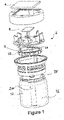
- FIG. 1 shows a passive emanator according to the invention.
- the figure shows an example of a passive emanator.
- the passive emanator 2 comprises a solar panel 4, a drive circuit 6, an electromagnet 8, a fan 10, at least one magnet 14 and a container 12 containing a volatile liquid composition.
- the solar panel 4 is coupled to the drive circuit 6 which is connected to the electromagnet 8.
- the fan 10 is coupled to the at least one magnet 14.
- the fan 10 is located proximate to the electromagnet 8 so that the magnetic field generated by the electromagnet is sufficiently strong to attract or repel the at least one magnet 14.
- the fan 10 is located proximate to the container 12 so that the fan increases airflow and distribution of the volatile substance is increased.
- the drive circuit is configured to receive power from the solar panel 4.
- the power received from the solar panel may be stored by the drive circuit using, for example, a battery.
- the power received from the solar panel 4 is used to drive the electromagnet 8 and the current driven through the electromagnet generates a magnetic field.
- the magnetic field can be altered by varying the magnitude and direction of the current.
- the poles of the electromagnet 8 may be switched by changing the direction of the current.
- the container 12 includes a liquid composition 16 to be evaporated by the emanator 2.
- a wick 20 is emerged in the liquid composition 16 and is in contact with a membrane 18, which can be a pad comprising PE and/or PP fibres. Also, the wick may comprise PE and/or PP fibres.
- the wick 20 attracts the liquid composition 16 by capillary action and saturates the membrane 18 with the liquid composition 16.
- the liquid composition 16 comprises a first solvent (Dipropylene Glycol Dimethyl Ether, DMM) and a second solvent (Dipropylene Glycol Monomethyl Ether, DPM).
- the DMM and DPM are present in the liquid composition at a weight ratio between 1:5 and 1:7, preferably 1:6, and most preferably 1:6.4.
- the liquid composition 16 further comprises a fragrance, which is present in the liquid composition between 20% and 40% by weight, based on the total weight of the composition.
- the airflow generated by the fan 10 is directed at the membrane 18 so that the evaporating liquid composition 16 compromising the fragrance is distributed to the surrounding air through outlet openings of the emanator 2.
- the fan 10 can be operated at different speeds such that the emanation rate of the emanator 2 can be adjusted as desired.
- the liquid composition may comprise a third solvent (here: a relatively small amount of Isopar M (EU)).
- a third solvent here: a relatively small amount of Isopar M (EU)
- the following graphic shows the typical weight loss behaviour of a liquid composition over time according to the examples given above. A comparison of the behaviour with and without wick and membrane is made.
- the upper solid graph represents the liquid composition which is evaporated over time without a wick and membrane. The liquid composition is in direct contact with surrounding air.
- the second solid graph below the upper solid graph represents the same liquid composition which is now evaporated including the wick and the membrane such that the liquid composition is evaporated via an outer surface of the membrane.
- the second solid graph shows a better linear approximation of weight loss of the liquid composition over an extended period of time as compared to the upper solid graph. This means that the liquid composition has a more uniform fragrance emanation rate when a wick and a membrane are employed.
- the graphic also includes dotted graphs showing the linearised upper and second solid graphs. It is evident that the upper solid graph (without wick and membrane) deviates more from the respective linearised graph than the second solid graph (with wick and membrane).
- the following concluding graphic shows weight loss curves over time (here: over 25 days) related to a passive emanator including a liquid composition according to the invention and comprising a fragrance in two different fragrance concentrations (referred to as “Min” respectively "Max”) as well as a fan for distributing the fragrance.
- a passive emanator including a liquid composition according to the invention and comprising a fragrance in two different fragrance concentrations (referred to as “Min” respectively "Max”) as well as a fan for distributing the fragrance.
- Min fragrance in two different fragrance concentrations
- the liquid compositions can be any of the liquid compositions as disclosed earlier in this description and is preferably a liquid composition comprising DMM and DPM, wherein the weight ratio between DMM and DPM is between 1:5 and 1:7, preferably 1:6, and most preferably 1:6.4.
- the first curve relates to the liquid composition including the fragrance in a low concentration with the fan in operation.
- the second curve (“Max") relates to the liquid composition including the fragrance in a high concentration with the fan in operation.
- both first and second curves show a substantially linear weight loss behaviour over time. It can also be seen that the fragrance load has an influence on the steepness of the (substantially linear) weight loss curve.
- the curve can also be influenced with regard to its steepness. Weighing in one or both of said parameters and selecting them accordingly, a desired weight loss behaviour of the liquid composition over time can be achieved.
- the third curve (“Off") relates to the passive emanator including the liquid composition and comprising the fragrance with the fan switched off.
- the weight loss over time is substantially linear but has much less steepness - which means that significantly less fragrance is distributed to e.g. a room as compared to the situation with the fan switched on (activated fan).
- the curves start to plateau towards the end of life (beyond 25 days or many more days, not shown here) of the liquid composition and there are no visible residues in the container of the passive emanator at the end of life.
Landscapes
- Life Sciences & Earth Sciences (AREA)
- Health & Medical Sciences (AREA)
- General Health & Medical Sciences (AREA)
- Engineering & Computer Science (AREA)
- Environmental Sciences (AREA)
- Zoology (AREA)
- Wood Science & Technology (AREA)
- Pest Control & Pesticides (AREA)
- Public Health (AREA)
- Epidemiology (AREA)
- Toxicology (AREA)
- Animal Behavior & Ethology (AREA)
- Plant Pathology (AREA)
- Veterinary Medicine (AREA)
- Chemical & Material Sciences (AREA)
- Chemical Kinetics & Catalysis (AREA)
- Agronomy & Crop Science (AREA)
- General Chemical & Material Sciences (AREA)
- Dentistry (AREA)
- Birds (AREA)
- Insects & Arthropods (AREA)
- Disinfection, Sterilisation Or Deodorisation Of Air (AREA)
Abstract
A passive emanator 2 and a liquid composition 16 for a passive emanator 2 are described. The passive emanator 2, especially for a fragrance, comprises a container 12 including a liquid composition 16 to be evaporated and emanated from the emanator via surrounding air, a porous wick 20 emerged in the liquid composition 16, and a porous membrane 18 arranged above a level of the liquid composition 16, wherein the membrane 18 is in contact with the wick 20 such that the membrane 18 is saturated with the liquid composition 16 via the wick 20 and an outer surface of the membrane 18 is in contact with the surrounding air. The liquid composition 16 includes a first solvent (especially DMM), a second solvent (especially DPM) and a fragrance or an insect repellent. In an embodiment, the DMM and DPM are present in the liquid composition 16 at a weight ratio between 1:5 and 1:7, preferably 1:6, and most preferably 1:6.4.
Description
- The present invention relates to controlled rate release devices for volatile materials, specifically liquids comprising a fragrance or an insect repellent. In particular, the invention relates to air fresheners operating on the principle of liquid phase transfer of a liquid fragrance composition through a porous membrane.
- Air fresheners are known for the purpose of emanating odorising or deodorising active ingredients into the environment, such as a room in a house. Passive and active air fresheners are available. The latter emit the active ingredients at certain intervals, whereas the former rely on evaporation of volatile ingredients, e.g. at room temperature without the need of an external source of energy aiding the release of the active ingredients.
- Many prior art passive air fresheners initially deliver a large amount of fragrance and subsequently deliver progressively less fragrance. The initial large dose is often "too much" and therefore objectionable, while the later dose is "not enough" and sometimes even not perceivable anymore.
- It is an object of the invention to disclose an improved passive emanator. In particular, it is an object of the invention to provide a passive emanator exhibiting delivery of a fragrance at a uniform rate over an extended period of time.
- In a first aspect of the invention, the passive emanator comprises a container including a liquid composition to be evaporated and emanated from the emanator via surrounding air, a porous wick emerged in the liquid composition, and a porous membrane arranged above a level of the liquid composition, wherein the membrane is in contact with the wick such that the membrane is saturated with the liquid composition via the wick and an outer surface of the membrane is in contact with the surrounding air.
- Such a passive system will deliver continuous, consistent fragrance emanation during the lifetime of the composition by employing a wick and a membrane (such as a pad) which can be incorporated into the container to deliver a substantially linear weight loss of the composition over an extended period of time of the composition life time. The wick is emerged in the composition and directs the composition to the membrane via capillary action to keep it saturated as long as the composition is not exhausted. The outer surface of the membrane is in contact with surrounding air and thus emanates the composition to it in a uniform manner over time.
- In a preferred embodiment, the membrane covers the liquid composition such that the outer surface of the membrane is as big as the surface of the composition facing the surrounding air. In this embodiment, the outer surface of the membrane which is in contact with the surrounding air is the sole surface from which the composition evaporates. As there is no evaporation "leakage" from the composition below and factoring in the wick which keeps the membrane saturated, this embodiment will deliver an improved uniform emanation by supporting a linear weight loss of the composition over an extended period of time.
- In another embodiment, the liquid composition comprises first and second solvents and a fragrance or an insect repellent.
- The first and second solvents can e.g. be chosen from:
- 1. Isopar M®, a mixture of C11-15 iso-alkanes obtainable from Exxon having a flashpoint of 79°C and an evaporation rate of <1.
- 2. Isopar L®, a mixture of C11-15 iso-alkanes obtainable from Exxon having a flashpoint of 67°C and an evaporation rate of 3.
- 3. Isopar P®, a mixture of C13-16 iso-alkanes obtainable from Exxon having a flashpoint of 109°C and an evaporation rate of <1.
- 4. Norpar 12®, a mixture of aliphatic hydrocarbons derived from petroleum obtainable from Exxon having a flashpoint of >66°C and an evaporation rate of 1.
- 5. Exxsol D60®, a mixture of aliphatic cycloparaffinic hydrocarbons obtainable from Exxon having a flashpoint of 63°C and an evaporation rate of 2.5.
- 6. Exxsol D80®, a mixture of aliphatic cycloparaffinic hydrocarbons obtainable from Exxon having a flashpoint of 75°C and an evaporation rate of <1.
- 7. Dowanol PnB®, 3-butoxypropan-2-ol obtainable from Dow Chemicals having a flashpoint of 63°C and an evaporation rate of 7.
- 8. Dowanol PM®, propylene glycol monomethyl ether obtainable from Dow Chemicals having a flashpoint of 31°C and an evaporation rate of 70.
- 9. Dowanol DPM®, dipropylene glycol methyl ether obtainable from Dow Chemicals having a flashpoint of 75°C and an evaporation rate of 3.
- 10. Proglyde DMM®, dipropylene glycol dimethyl ether obtainable from Dow Chemicals having a flashpoint of 65°C and an evaporation rate of 80.
- The above evaporation rates are relative to n-butylacetate having an evaporation rate of 100; the figure for Proglyde DMM® was calculated as the molecular weight x vapour pressure (mm Hg at 20°C). A high flashpoint generally gives a low evaporation rate.
- Preferably, the first solvent is Dipropylene Glycol Dimethyl Ether (DMM) and the second solvent is Dipropylene Glycol Monomethyl Ether (DPM). The inventors have found out that including DMM in the composition aids the desired uniform evaporation because of its high vapour pressure, which introduces an overall higher vapour pressure into the DMM / DPM mix.
- Other suitable combinations of first and second solvents relative to the listing above are e.g. 10. and 7; as well as 10. and 8.
- Preferably, the first solvent is present in the liquid composition between 5% and 15% by weight, the second solvent is present in the liquid composition between 30% and 70% by weight and the fragrance or insect repellent is present in the liquid composition between 20% and 40% by weight, based on the total weight of the composition.
- In another embodiment, the weight ratio between DMM and DPM is between 1:5 and 1:7, preferably 1:6, and most preferably 1:6.4. The inventors have found out that such ratio very well supports an extended period of time of about 45-60 days during which the composition evaporates at a substantially uniform rate.
- The wick and the membrane can comprise polypropylene (PP) and/or polyethylene (PE) fibres and are preferably hydrophobic such that a saturation of the membrane with only the composition is secured.
- The passive emanator can further comprise a fan, wherein an airflow generated by the fan is directed at the membrane. Preferably, the fan is operable at different speeds. In this embodiment, the fan supports emanation of the evaporated composition into the surrounding air and the reach of the emanator can be increased. Furthermore, choosing different fan speeds supports the selection of different emanation rates.
- In another embodiment, the container, the wick, the membrane and the fan are incorporated into a housing, wherein the housing has at least one inlet opening for attracting air and at least one outlet opening for directing the airflow generated by the fan to the environment.
- In another aspect of the invention, a liquid composition suitable for a passive emanator is disclosed. The liquid composition comprises first and second solvents, wherein the first solvent is Dipropylene Glycol Dimethyl Ether (DMM) and the second solvent is Dipropylene Glycol Monomethyl Ether (DPM), and wherein the DMM and DPM are present in the liquid composition at a weight ratio between 1:5 and 1:7, preferably 1:6, and most preferably 1:6.4.
- The liquid composition can further comprise a fragrance or an insect repellent.
- The fragrance or the insect repellent can be present in the liquid composition between 20% and 60% by weight, based on the total weight of the composition.
- Preferably, the first solvent is present in the liquid composition between 5% and 15% by weight, and the second solvent is present in the liquid composition between 30% and 70% by weight, based on the total weight of the composition.
- In the following, the invention is described in more detail.
- The figure,
Figure 1 , shows a passive emanator according to the invention. - The figure shows an example of a passive emanator. The
passive emanator 2 comprises asolar panel 4, a drive circuit 6, anelectromagnet 8, afan 10, at least onemagnet 14 and acontainer 12 containing a volatile liquid composition. - The
solar panel 4 is coupled to the drive circuit 6 which is connected to theelectromagnet 8. Thefan 10 is coupled to the at least onemagnet 14. Thefan 10 is located proximate to theelectromagnet 8 so that the magnetic field generated by the electromagnet is sufficiently strong to attract or repel the at least onemagnet 14. Thefan 10 is located proximate to thecontainer 12 so that the fan increases airflow and distribution of the volatile substance is increased. - In the example illustrated in the figure, the drive circuit is configured to receive power from the
solar panel 4. The power received from the solar panel may be stored by the drive circuit using, for example, a battery. The power received from thesolar panel 4 is used to drive theelectromagnet 8 and the current driven through the electromagnet generates a magnetic field. The magnetic field can be altered by varying the magnitude and direction of the current. For example, the poles of theelectromagnet 8 may be switched by changing the direction of the current. - The
container 12 includes aliquid composition 16 to be evaporated by theemanator 2. A wick 20 is emerged in theliquid composition 16 and is in contact with amembrane 18, which can be a pad comprising PE and/or PP fibres. Also, the wick may comprise PE and/or PP fibres. - The wick 20 attracts the
liquid composition 16 by capillary action and saturates themembrane 18 with theliquid composition 16. - The
liquid composition 16 comprises a first solvent (Dipropylene Glycol Dimethyl Ether, DMM) and a second solvent (Dipropylene Glycol Monomethyl Ether, DPM). The DMM and DPM are present in the liquid composition at a weight ratio between 1:5 and 1:7, preferably 1:6, and most preferably 1:6.4. Theliquid composition 16 further comprises a fragrance, which is present in the liquid composition between 20% and 40% by weight, based on the total weight of the composition. - The airflow generated by the
fan 10 is directed at themembrane 18 so that the evaporatingliquid composition 16 compromising the fragrance is distributed to the surrounding air through outlet openings of theemanator 2. - The
fan 10 can be operated at different speeds such that the emanation rate of theemanator 2 can be adjusted as desired. - Examples of five liquid compositions suitable for use with an emanator as shown before are:
Weight% DMM 10 6 8.11 9.45 8.10 DPM 64 38.4 51.9 60.45 51.82 Isopar M (EU) 0 0 0 0.10 0.08 Fragrance 26 55.6 39.9 30 40 - As is shown in the table above, the liquid composition may comprise a third solvent (here: a relatively small amount of Isopar M (EU)).
- The following graphic shows the typical weight loss behaviour of a liquid composition over time according to the examples given above. A comparison of the behaviour with and without wick and membrane is made. The upper solid graph represents the liquid composition which is evaporated over time without a wick and membrane. The liquid composition is in direct contact with surrounding air.
- The second solid graph below the upper solid graph represents the same liquid composition which is now evaporated including the wick and the membrane such that the liquid composition is evaporated via an outer surface of the membrane.
- It can be seen that the second solid graph shows a better linear approximation of weight loss of the liquid composition over an extended period of time as compared to the upper solid graph. This means that the liquid composition has a more uniform fragrance emanation rate when a wick and a membrane are employed.
- For illustration, the graphic also includes dotted graphs showing the linearised upper and second solid graphs. It is evident that the upper solid graph (without wick and membrane) deviates more from the respective linearised graph than the second solid graph (with wick and membrane).

- The following concluding graphic shows weight loss curves over time (here: over 25 days) related to a passive emanator including a liquid composition according to the invention and comprising a fragrance in two different fragrance concentrations (referred to as "Min" respectively "Max") as well as a fan for distributing the fragrance. The situation with active fan (see the first and second curves of the graphic) and with inactive fan ("Off", see third curve, at the bottom of the graphic) are described.
- The liquid compositions can be any of the liquid compositions as disclosed earlier in this description and is preferably a liquid composition comprising DMM and DPM, wherein the weight ratio between DMM and DPM is between 1:5 and 1:7, preferably 1:6, and most preferably 1:6.4.
- The first curve ("Min") relates to the liquid composition including the fragrance in a low concentration with the fan in operation.
- The second curve ("Max") relates to the liquid composition including the fragrance in a high concentration with the fan in operation.
- As can be seen, both first and second curves show a substantially linear weight loss behaviour over time. It can also be seen that the fragrance load has an influence on the steepness of the (substantially linear) weight loss curve. By changing the air flow from the fan directed at the liquid composition, the curve can also be influenced with regard to its steepness. Weighing in one or both of said parameters and selecting them accordingly, a desired weight loss behaviour of the liquid composition over time can be achieved.
- The third curve ("Off") relates to the passive emanator including the liquid composition and comprising the fragrance with the fan switched off. As can be seen, the weight loss over time is substantially linear but has much less steepness - which means that significantly less fragrance is distributed to e.g. a room as compared to the situation with the fan switched on (activated fan).
- The curves start to plateau towards the end of life (beyond 25 days or many more days, not shown here) of the liquid composition and there are no visible residues in the container of the passive emanator at the end of life.

Claims (15)
- A passive emanator (2), especially for a fragrance, comprising:A container (12) including a liquid composition (16) to be evaporated and emanated from the emanator (2) via surrounding air;A porous wick (20) emerged in the liquid composition (16); andA porous membrane (18) arranged above a level of the liquid composition (16), whereinthe membrane (18) is in contact with the wick (20) such that the membrane (18) is saturated with the liquid composition (16) via the wick (20), andan outer surface of the membrane (18) is in contact with the surrounding air.
- The passive emanator (2) according to Claim 1, wherein the membrane (18) covers the liquid composition (16).
- The passive emanator (2) according to Claim 1 or 2, wherein the liquid composition (16) comprises:A first solvent;A second solvent; andA fragrance or an insect repellent.
- The passive emanator (2) according to Claim 3, whereinThe first solvent is Dipropylene Glycol Dimethyl Ether (DMM); andThe second solvent is Dipropylene Glycol Monomethyl Ether (DPM).
- The passive emanator (2) according to Claim 4, whereinThe first solvent is present in the liquid composition between 5% and 15% by weight, based on the total weight of the composition;The second solvent is present in the liquid composition between 30% and 70% by weight, based on the total weight of the composition; andThe fragrance or insect repellent is present in the liquid composition between 20% and 60% by weight, based on the total weight of the composition.
- The passive emanator (2) according to claim 4 or 5, wherein the weight ratio between DMM and DPM is between 1:5 and 1:7, preferably 1:6, and most preferably 1:6.4.
- The passive emanator (2) according to any of Claims 1 to 6, wherein the wick (20) and the membrane (18) comprise polypropylene (PP) and/or polyethylene (PE) fibres.
- The passive emanator (2) according to any of Claims 1 to 7, wherein the wick (20) and the membrane (18) are hydrophobic.
- The passive emanator (2) according to any of claims 1 to 8, further comprising a fan (10), wherein an airflow generated by the fan (10) is directed at the membrane.
- The passive emanator (2) according to claim 9, wherein the fan (10) is operable at different speeds.
- The passive emanator (2) according to Claim 9 or 10, wherein the container (12), the wick (20), the membrane (18) and the fan (10) are incorporated into a housing, wherein the housing has at least one inlet opening for attracting air and at least one outlet opening for directing the airflow generated by the fan (10) to the environment.
- A liquid composition (16) for, but not exclusively for, a passive emanator (2) according to any of claims 1 or 2, comprisingA first solvent; andA second solvent, wherein
the first solvent is Dipropylene Glycol Dimethyl Ether (DMM) and the second solvent is Dipropylene Glycol Monomethyl Ether (DPM), and wherein the DMM and DPM are present in the liquid composition at a weight ratio between 1:5 and 1:7, preferably 1:6, and most preferably 1:6.4. - The liquid composition (16) according to Claim 12, further comprising a fragrance or an insect repellent.
- The liquid composition (16) according to Claim 13, wherein the fragrance or the insect repellent are present in the liquid composition between 20% and 60% by weight, based on the total weight of the composition.
- The liquid composition (16) according to any of the claims 12 to 14, wherein between 5% and 15% by weight of the first solvent, based on the total weight of the composition, and between 30% and 70% by weight of the second solvent, based on the total weight of the composition, are present in the liquid composition.
Priority Applications (5)
| Application Number | Priority Date | Filing Date | Title |
|---|---|---|---|
| EP21166548.4A EP4066865A1 (en) | 2021-04-01 | 2021-04-01 | Passive emanator, especially a fragrance emanator, and liquid composition for a passive emanator |
| CN202280026891.0A CN117120107B (en) | 2021-04-01 | 2022-03-23 | Passive radiator |
| PCT/GB2022/050728 WO2022208053A1 (en) | 2021-04-01 | 2022-03-23 | Passive emanator, especially a fragrance emanator |
| US18/552,748 US20240165290A1 (en) | 2021-04-01 | 2022-03-23 | Passive emanator, especially a fragrance emanator |
| EP22713018.4A EP4313180B1 (en) | 2021-04-01 | 2022-03-23 | Passive emanator, especially a fragrance emanator |
Applications Claiming Priority (1)
| Application Number | Priority Date | Filing Date | Title |
|---|---|---|---|
| EP21166548.4A EP4066865A1 (en) | 2021-04-01 | 2021-04-01 | Passive emanator, especially a fragrance emanator, and liquid composition for a passive emanator |
Publications (1)
| Publication Number | Publication Date |
|---|---|
| EP4066865A1 true EP4066865A1 (en) | 2022-10-05 |
Family
ID=75362407
Family Applications (1)
| Application Number | Title | Priority Date | Filing Date |
|---|---|---|---|
| EP21166548.4A Withdrawn EP4066865A1 (en) | 2021-04-01 | 2021-04-01 | Passive emanator, especially a fragrance emanator, and liquid composition for a passive emanator |
Country Status (1)
| Country | Link |
|---|---|
| EP (1) | EP4066865A1 (en) |
Citations (8)
| Publication number | Priority date | Publication date | Assignee | Title |
|---|---|---|---|---|
| GB2181649A (en) * | 1985-10-15 | 1987-04-29 | Bristol Myers Co | Air freshener dispenser |
| US20050152935A1 (en) * | 2000-01-31 | 2005-07-14 | Reckitt Benckiser (Uk) Limited | Method for controlling evaporation of liquid air freshener and insecticidal compositions |
| US20050199742A1 (en) * | 2002-04-06 | 2005-09-15 | Huib Maat | Microporous membrane air freshening device |
| JP2006176700A (en) * | 2004-12-24 | 2006-07-06 | Tokuyama Corp | Cleaning composition |
| GB2423930A (en) * | 2005-03-11 | 2006-09-13 | Reckitt Benckiser | Emanation or fragrancing device |
| US20070257130A1 (en) * | 2003-06-02 | 2007-11-08 | Reckitt Benckiser (Uk) Limited | Apparatus for Emitting a Chemical Agent |
| CN106350260A (en) * | 2016-08-26 | 2017-01-25 | 湖南集能新材料科技有限公司 | Water-base micro-emulsion rubber imprint cleaning agent for (aircraft carrier) airplane runways |
| US20210030913A1 (en) * | 2018-04-10 | 2021-02-04 | Scentsticks Limited | Device for dispensing a volatile liquid |
-
2021
- 2021-04-01 EP EP21166548.4A patent/EP4066865A1/en not_active Withdrawn
Patent Citations (8)
| Publication number | Priority date | Publication date | Assignee | Title |
|---|---|---|---|---|
| GB2181649A (en) * | 1985-10-15 | 1987-04-29 | Bristol Myers Co | Air freshener dispenser |
| US20050152935A1 (en) * | 2000-01-31 | 2005-07-14 | Reckitt Benckiser (Uk) Limited | Method for controlling evaporation of liquid air freshener and insecticidal compositions |
| US20050199742A1 (en) * | 2002-04-06 | 2005-09-15 | Huib Maat | Microporous membrane air freshening device |
| US20070257130A1 (en) * | 2003-06-02 | 2007-11-08 | Reckitt Benckiser (Uk) Limited | Apparatus for Emitting a Chemical Agent |
| JP2006176700A (en) * | 2004-12-24 | 2006-07-06 | Tokuyama Corp | Cleaning composition |
| GB2423930A (en) * | 2005-03-11 | 2006-09-13 | Reckitt Benckiser | Emanation or fragrancing device |
| CN106350260A (en) * | 2016-08-26 | 2017-01-25 | 湖南集能新材料科技有限公司 | Water-base micro-emulsion rubber imprint cleaning agent for (aircraft carrier) airplane runways |
| US20210030913A1 (en) * | 2018-04-10 | 2021-02-04 | Scentsticks Limited | Device for dispensing a volatile liquid |
Similar Documents
| Publication | Publication Date | Title |
|---|---|---|
| US7215878B2 (en) | Chip that comprises an active agent and an integrated heating element | |
| EP1262100B1 (en) | Fan type chemicals diffusing device | |
| US6697571B2 (en) | Method and apparatus for selective positioning a wick material in a vapor-dispensing device | |
| EP0462605A2 (en) | Fragrance dispensing composition with controlled evaporation rate and air fragrance dispenser for dispensing same | |
| EP3122388A1 (en) | Volatile material dispenser and method of emitting a volatile material | |
| US20150060565A1 (en) | Passive volatile dispensing device | |
| KR20070120143A (en) | Powered systems for delivering volatiles and methods for releasing volatiles into the atmosphere using them | |
| JPH0823851A (en) | Battery type insecticide vaporization device and insecticide vaporization method | |
| EP4313180B1 (en) | Passive emanator, especially a fragrance emanator | |
| JP6681457B2 (en) | Chemical volatilization device and chemical volatilization method | |
| CN1231266C (en) | Liquid air freshener or insecticide composition and use thereof | |
| CN1116796C (en) | Insecticide formulations | |
| WO2004035097A1 (en) | Method of disinfecting, freshening and scenting the air using essential oils and/or the active principles thereof | |
| MXPA04004482A (en) | Method of disinfecting and scenting the air using essential oils. | |
| JP5279680B2 (en) | Chemical volatilization body and chemical volatilization method using the same | |
| JP5517884B2 (en) | Pest control equipment | |
| JP7349907B2 (en) | Microbial suppression method and microbial suppression system | |
| JP4974317B2 (en) | Volatile substance carrier | |
| JPH0640828A (en) | Insecticidal composition | |
| WO2005002632A1 (en) | Fragrance fluid composition for fragrant deodorizing device | |
| JPS6066754A (en) | Method and apparatus for dissipating volatile air treating liquid | |
| HK1067868B (en) | Method of disinfecting and scenting the air using essential oils | |
| HK1140103B (en) | Fan type chemicals diffusing apparatus | |
| HK1235625A1 (en) | Device and method for vaporizing/discharging chemical agent |
Legal Events
| Date | Code | Title | Description |
|---|---|---|---|
| PUAI | Public reference made under article 153(3) epc to a published international application that has entered the european phase |
Free format text: ORIGINAL CODE: 0009012 |
|
| STAA | Information on the status of an ep patent application or granted ep patent |
Free format text: STATUS: THE APPLICATION HAS BEEN PUBLISHED |
|
| AK | Designated contracting states |
Kind code of ref document: A1 Designated state(s): AL AT BE BG CH CY CZ DE DK EE ES FI FR GB GR HR HU IE IS IT LI LT LU LV MC MK MT NL NO PL PT RO RS SE SI SK SM TR |
|
| STAA | Information on the status of an ep patent application or granted ep patent |
Free format text: STATUS: THE APPLICATION IS DEEMED TO BE WITHDRAWN |
|
| 18D | Application deemed to be withdrawn |
Effective date: 20230406 |