EP4065177B1 - Sterilizer - Google Patents
Sterilizer Download PDFInfo
- Publication number
- EP4065177B1 EP4065177B1 EP21701020.6A EP21701020A EP4065177B1 EP 4065177 B1 EP4065177 B1 EP 4065177B1 EP 21701020 A EP21701020 A EP 21701020A EP 4065177 B1 EP4065177 B1 EP 4065177B1
- Authority
- EP
- European Patent Office
- Prior art keywords
- sterilization
- class
- sterilizer
- cycle
- steam
- Prior art date
- Legal status (The legal status is an assumption and is not a legal conclusion. Google has not performed a legal analysis and makes no representation as to the accuracy of the status listed.)
- Active
Links
Images







Classifications
-
- A—HUMAN NECESSITIES
- A61—MEDICAL OR VETERINARY SCIENCE; HYGIENE
- A61L—METHODS OR APPARATUS FOR STERILISING MATERIALS OR OBJECTS IN GENERAL; DISINFECTION, STERILISATION OR DEODORISATION OF AIR; CHEMICAL ASPECTS OF BANDAGES, DRESSINGS, ABSORBENT PADS OR SURGICAL ARTICLES; MATERIALS FOR BANDAGES, DRESSINGS, ABSORBENT PADS OR SURGICAL ARTICLES
- A61L2/00—Disinfection or sterilisation of materials or objects, in general; Accessories therefor
- A61L2/02—Disinfection or sterilisation of materials or objects, in general; Accessories therefor using physical processes
- A61L2/04—Heat
- A61L2/06—Hot gas
- A61L2/07—Steam
-
- A—HUMAN NECESSITIES
- A61—MEDICAL OR VETERINARY SCIENCE; HYGIENE
- A61L—METHODS OR APPARATUS FOR STERILISING MATERIALS OR OBJECTS IN GENERAL; DISINFECTION, STERILISATION OR DEODORISATION OF AIR; CHEMICAL ASPECTS OF BANDAGES, DRESSINGS, ABSORBENT PADS OR SURGICAL ARTICLES; MATERIALS FOR BANDAGES, DRESSINGS, ABSORBENT PADS OR SURGICAL ARTICLES
- A61L2/00—Disinfection or sterilisation of materials or objects, in general; Accessories therefor
- A61L2/24—Apparatus using programmed or automatic operation
-
- A—HUMAN NECESSITIES
- A61—MEDICAL OR VETERINARY SCIENCE; HYGIENE
- A61L—METHODS OR APPARATUS FOR STERILISING MATERIALS OR OBJECTS IN GENERAL; DISINFECTION, STERILISATION OR DEODORISATION OF AIR; CHEMICAL ASPECTS OF BANDAGES, DRESSINGS, ABSORBENT PADS OR SURGICAL ARTICLES; MATERIALS FOR BANDAGES, DRESSINGS, ABSORBENT PADS OR SURGICAL ARTICLES
- A61L2202/00—Aspects relating to methods or apparatus for disinfecting or sterilising materials or objects
- A61L2202/10—Apparatus features
- A61L2202/12—Apparatus for isolating biocidal substances from the environment
- A61L2202/122—Chambers for sterilisation
-
- A—HUMAN NECESSITIES
- A61—MEDICAL OR VETERINARY SCIENCE; HYGIENE
- A61L—METHODS OR APPARATUS FOR STERILISING MATERIALS OR OBJECTS IN GENERAL; DISINFECTION, STERILISATION OR DEODORISATION OF AIR; CHEMICAL ASPECTS OF BANDAGES, DRESSINGS, ABSORBENT PADS OR SURGICAL ARTICLES; MATERIALS FOR BANDAGES, DRESSINGS, ABSORBENT PADS OR SURGICAL ARTICLES
- A61L2202/00—Aspects relating to methods or apparatus for disinfecting or sterilising materials or objects
- A61L2202/10—Apparatus features
- A61L2202/14—Means for controlling sterilisation processes, data processing, presentation and storage means, e.g. sensors, controllers, programs
Definitions
- the device includes at least one air removal system.
- the air removal system is configured to provide air removal from the sterilization chamber.
- the at least one air removal system may feature at least one of a steam pulsing system and a vacuum system.
- the sterilization chamber may include at least one inlet for at least one of steam and water.
- the sterilization chamber may include at least one outlet for at least one of air and steam.
- the air removal system features a steam pulsing system
- the steam pulsing system may be connected to the at least one inlet for steam and/or water of the sterilization chamber.
- the steam pulsing system may include water, which may be stored in a water tank, a water pump and a water heater.
- the air removal system features a vacuum system
- the vacuum system may be connected to the at least one valve of the sterilization chamber.
- the at least one program for providing B class sterilization is locked and the at least one air removal system is configured to provide air removal from the sterilization chamber sufficient for S class sterilization.
- the device may provide only S class sterilization.
- the device is configured to a second state wherein the at least one program for B class sterilization cycle is unlocked.
- the at least one air removal system is configured to provide air removal sufficient for producing B class sterilization.
- the device may provide S class sterilization or B class sterilization.
- the device may provide only B class sterilization.
- the sterilization device further includes at least one controller for controlling the sterilization cycles of the sterilization device.
- the sterilization device may further include at least one of a means for measuring pressure, a means for measuring temperature and a means for measuring time.
- the sterilization device may further feature at least one of a means for controlling pressure, a means for controlling temperature and a means for controlling time.
- the sterilization device may include at least one control for controlling the steam pulsing system.
- the sterilization device may include at least one control for controlling the vacuum system.
- the plurality of sterilization cycle programs may further include at least one N class sterilization cycle.
- At least one of the at least one S class sterilization cycle program and the at least one B class sterilization cycle program may be in a locked state. In a first state the sterilization device may provide sterilization using the at least one N class sterilization cycle program and the at least one S class sterilization cycle program is locked and unavailable for use by a user and the at least one B class sterilization cycle program is locked and unavailable for use by a user.
- the at least one S class sterilization cycle program may be unlocked and available for use by a user and the sterilization device may provide sterilization using either the at least one N class sterilization cycle program or the at least one S class sterilization cycle program and the at least one B class sterilization cycle program is locked and unavailable for use by a user.
- the sterilization device may provide sterilization using either the at least one N class sterilization cycle program or the at least one S class sterilization cycle program or the at least one B class sterilization cycle program.
- the at last one B class sterilization cycle program may be unlocked and available for use by a user and the sterilization device may provide sterilization using either the at least one N class sterilization cycle program or the at least one B class sterilization cycle program and the at least one S class sterilization cycle program is locked and unavailable for use by a user.
- a further aspect is a sterilization system.
- the sterilization system includes a sterilization device and a code for unlocking at least one B class sterilization cycle of the sterilization device.
- the sterilization device includes a sterilization chamber for accommodating at least one item for sterilization.
- the sterilization device includes a means for powering the device.
- the sterilization device includes a means for providing a sterilization medium for sterilizing the at least one item.
- the sterilization device includes a plurality of sterilization cycle programs.
- the plurality of sterilization cycle programs includes at least one S class sterilization cycle program and at least one B class sterilization cycle program.
- the at least one B class sterilization cycle program is in a locked state.
- the sterilization device provides S class sterilization and is adaptable to unlock and provide B class sterilization.
- the sterilization device includes at least one controller for controlling the at least one sterilization cycle of the sterilization device.
- the sterilization device may include at least one of a steam pulsing system and a vacuum system to provide air removal from the sterilization chamber.
- a still further aspect, which is not part of the claimed invention, is a sterilization system featuring a sterilization device.
- the device includes a sterilization chamber for accommodating at least one item for sterilization, a means for powering the device, a means for providing a sterilization medium for sterilizing the at least one item and a plurality of sterilization cycle programs.
- the plurality of sterilization cycle programs may include at least one N class sterilization cycle program, at least one S class sterilization cycle program in a locked state and at least one B class sterilization cycle program in a locked state.
- the sterilization device may provide N class sterilization and is adaptable to unlock and provide S class sterilization and B class sterilization.
- the sterilization system may include a code for unlocking the at least one locked S class sterilization cycle and a code for unlocking the at least one locked B class sterilization cycle.
- the sterilization device may include a passive steam air removal system and at least one of a steam pulsing system and a vacuum system to provide air removal from the sterilization chamber.
- An aspect is a method of sterilization.
- the method features providing a sterilization device of the present invention.
- the sterilization device is in a first state, wherein the at least one B class sterilization cycle program is locked.
- the method includes placing at least one item in the sterilization chamber and running at least one S class sterilization cycle for sterilizing the at least one item.
- An aspect is an additional method of sterilization.
- the method features providing a sterilization device of the present invention.
- the method includes placing at least one item in the sterilization chamber and selecting an S class sterilization cycle or a B class sterilization cycle.
- the method further includes running the selected class sterilization cycle for sterilizing the at least one item.
- a still further aspect is a method of converting a sterilization device for providing S class sterilization into a sterilization device for providing B class sterilization.
- the method includes providing a sterilization device of the present invention.
- the sterilization device is in a first state, wherein the at least one B class sterilization cycle program is locked.
- the method includes inputting a code for unlocking the at least one B class sterilization cycle program for providing the sterilization device with at least one available B class sterilization cycle program and for converting the sterilization device from a first state wherein the at least one B class sterilization cycle is locked into a second state wherein the at least one B class sterilization cycle program is unlocked.
- the method includes providing a sterilization device of the present invention.
- the sterilization device is in a first state, wherein the at least one B class sterilization cycle program is locked.
- the method includes unlocking the at least one B class sterilization cycle program to provide at least one available B class sterilization cycle program. Unlocking may feature inputting a code.
- the method includes placing at least one item in the sterilization chamber and running at least one B class sterilization cycle for sterilizing the at least one item.
- the method may include selecting a B class sterilization cycle.
- An aspect is a method of sterilization using a sterilization device which features at least one N class sterilization cycle program, at least one S class sterilization cycle program and at least one B class sterilization cycle program.
- the method includes providing a sterilization device of the present invention, wherein the sterilization device incudes a plurality of sterilization cycle programs, which feature at least one N class sterilization cycle program, at least one S class sterilization cycle program and at least one B class sterilization cycle program.
- the method includes placing at least one item in the sterilization chamber.
- the method includes selecting one of an N class sterilization cycle, an S class sterilization cycle or a B class sterilization cycle and running the selected class sterilization cycle to sterilize the at least one item.
- the at least one B class sterilization cycle program is in a locked state.
- the method may include unlocking the at least one B class sterilization cycle program to provide at least one available B class sterilization cycle program.
- the method may include running at least one B class sterilization cycle for sterilizing the at least one item.
- the present invention is of a sterilization device.
- the sterilization device is configured to provide at least one S class sterilization cycle and at least one B class sterilization cycle.
- the sterilization device provides S Class sterilization and may be adaptable to provide B class sterilization.
- the present invention is of a sterilization device which is configured to provide at least one N class sterilization cycle, at least one S class sterilization cycle and at least one B class sterilization cycle.
- the present invention provides a sterilization system featuring a sterilization device and a key for unlocking B class sterilization cycles of the sterilization device.
- the present invention provides a method of converting a sterilization device to a B Class sterilization device.
- the present invention provides a method of sterilization.
- the device and system of the present invention have many advantages.
- the invention ensures that a user is not limited to use of only one class of sterilization from a single sterilizer.
- the invention provides a user with the option of converting a same S Type sterilizer to a B sterilizer at a future date.
- the invention provides a user with the option of converting a same N Type sterilizer to an S Type sterilizer and/or a B Type sterilizer.
- the invention also provides a way of reducing waste caused by throwing out of redundant S Type sterilizers and redundant N Type sterilizers.
- the invention may also enable a user to choose between S Type and B Type sterilization with a single sterilizer.
- the invention may also facilitate a user having the choice of using an N Type, S Type or B Type sterilization with a single sterilizer.
- the terms 'locked' and 'locked state' may include, but are not limited to a state where a sterilization program or cycle is configured so that it cannot be used by a user without being unlocked in a suitable way.
- the unlocking may be by a suitable key.
- the term 'available' may include, but is not limited to a state where the cycle is configured such that it can be used and run by a user.
- the term includes the state where the cycle is not locked.
- the terms 'adapting' and 'adapted' may include, but are not limited to upgrading and reconfiguring of the sterilizer.
- the terms may include any suitable method of adapting, such as but not limited to using physical and/or software means.
- the term 'distribution system' may include, but is not limited to any suitable means for providing a material from a first location to a second location.
- the term includes providing a material from one part of a system to another part of a system.
- 'sterilization chamber' may include, but is not limited to a compartment where sterilization may be carried out.
- connection' may include, but is not limited to direct and indirect attachment.
- the sterilizer features a plurality of states.
- a first state the sterilizer is provided wherein the B Class sterilization cycles are unavailable for use by a user and the user can only use the sterilizer in this first state for S Class sterilization.
- the B Class sterilization cycle programs are in a dormant or locked state.
- the sterilizer 10 may be adapted to a second state wherein the B Class sterilization cycles are available for use.
- the sterilizer 10 includes at least one system for providing sterilization conditions to the sterilization chamber 12.
- the at least one system for providing sterilization conditions to the sterilization chamber may include a heating device 16 for providing heat to the sterilization chamber 12.
- the heating device may be any suitable heating device.
- One non-limiting example of a suitable heating device is an electrical jacket heater for heating the sterilization chamber.
- the heating device 16 may be configured so that it surrounds the sterilization chamber 12 or may be positioned in any other suitable way so that it provides uniform heat to the sterilization chamber.
- the heating device may provide heat of a temperature greater than about 100 °C. In some embodiments, the heating device may provide a temperature of greater than about 120 °C.
- the at least one system for providing sterilization conditions to the sterilization chamber may include a means 18 for providing steam 20 to the sterilization chamber 12.
- the means 18 for providing steam 20 to the sterilization chamber may be positioned externally from the sterilization chamber 12.
- the means 18 for providing steam 20 to the sterilization chamber 12 may include a steam supply 20 or a source of suitable water 22 for conversion to steam 20.
- the water 22 may be stored in a reservoir 24.
- the sterilizer 10 may be connectable to an external water source, such as a water tap.
- a suitable water pump 26 may pump the water.
- the means 18 for providing steam 20 to the sterilization chamber 12 may be suitably connected to at least one steam inlet 28 of the sterilization chamber 12 to provide steam 20 into the chamber 12.
- the steam 20 may be produced by a steam generator 30, such as but not limited to an electrical pipe water heating system 30.
- the resulting steam 20 may be provided to the sterilization chamber by a steam distribution channel 32, such as, but not limited to a tubing 32 via a steam valve, which may be upstream 34 and which may be connected to the inlet port 28 of the sterilization chamber 12.
- the water pump 26 may facilitate providing the steam to the sterilization chamber 12 for sterilization of the contents of the sterilization chamber 12.
- the water pump 26 may provide water to the steam generator 30 and the steam may flow from the steam generator 30 to the sterilization chamber 12.
- the water pump 26 may be controlled by a pump control 27 to provide control of steam pulsing.
- the means 18 for providing steam 20 to the sterilization chamber may be configured as a steam pulsing system 46, which may feature the water pump 26 and the water heating system as shown in Figure 2b .
- the means 18 for providing steam 20 to the sterilization chamber 12 may be positioned in the sterilization chamber 12.
- the means 18 for providing steam 20 may not need a water pump 26 and may produce and provide the steam by a water source and a heating system.
- the at least one system for providing sterilization conditions to the sterilization chamber may include means for active air removal 40 from the sterilization chamber 12.
- the sterilization chamber 12 may include at least one outlet 36 for releasing air and/or steam.
- the sterilizer 10 of the present invention has a means for sufficient active air removal for Class S sterilization 42 and the sterilizer 10 has an additional means for sufficient active air removal for Class B sterilization 44.
- the means for sufficient air removal for Class S sterilization 42 may include a means for providing steam pulsing 46 to the sterilization chamber 12 as described hereinabove and in Figure 2b and may include the means 18 for providing steam 20 to the sterilization chamber configured as a steam pulsing system 46.
- the means for sufficient air removal for Class B sterilization 44 may include a vacuum system 48, such as but not limited to a vacuum pump 48 connected in a suitable way to the sterilization chamber 12.
- the vacuum system 48 such as the vacuum pump 48 is connected to the sterilization chamber 12 with a valve 50.
- the vacuum system 48 may include any device or component for providing a sufficient vacuum.
- An additional non-limiting example of a suitable vacuum system 48 is a water pump.
- the sterilizer has a means which can be operated to provide sufficient air removal for both Class S and Class B sterilization.
- the same means may be operated differently with different conditions depending on the Class of sterilization to be achieved.
- the means may be a vacuum system 48, such as a vacuum pump 48, which can be operated using conditions for providing Class S sterilization 42 and which can be operated using different parameters for Class B sterilization 44.
- the sterilizer device includes means 18 for providing steam 20 to the sterilization chamber, which in one non-limiting example may be a steam pulsing system 46.
- the function of the steam pulsing system and its operation is to provide steam for sterilization without the need for the steam pulsing system to be controlled to remove a certain amount of air to result in the desired Class of sterilization.
- the means to provide sufficient air removal for both Class S and Class B sterilization may be a steam pulser 46, which can be operated using conditions for providing Class S sterilization and which can be operated using different parameters for Class B sterilization.
- the means may include a combination of a vacuum system 48, such as a vacuum pump 48 and a steam pulser 46 which can be operated using respective conditions for Class S 42 or Class B 44 sterilization.
- the sterilizer 10 includes a control 60.
- the figure shows one non-limiting arrangement of the features of the control.
- the device may include any suitable arrangement and order of the control components.
- the control may include a switch 62 to start and stop the sterilization device.
- the control may include a suitable keyboard 64.
- the control may include power controlling means 66.
- the control may include a clock 68 for measuring time.
- the control may include a timer 70 for setting the time of the sterilization cycle.
- the control may include a screen 72 and a display 74.
- the control 60 includes different programs 76 of sterilization cycle.
- the programs may be provided as part of a menu 78.
- the programs 76 may be preset and/or may be programmable.
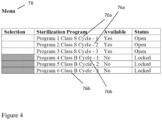
- Figure 4 shows a schematic view of exemplary programs of an exemplary sterilizer according to an aspect of the present invention.
- the control 60 includes at least one program 76a for a S Class sterilization cycle 42.
- the at least one program for S Class sterilization may include any suitable number of programs 76a.
- the control 60 includes at least one program 76b for a B Class sterilization cycle 44.
- the at least one program 76b for B Class sterilization may include any suitable number of programs 76b.
- the sterilization device 10 may include at least two B Class sterilization cycle programs 76b.
- Non-limiting examples of B Class sterilization cycle programs 76b may include a 121 °C B Class cycle and a 134 °C B Class cycle. As previously described, in a first state the at least one program 76b for a B Class sterilization cycle may be unavailable to a user.
- the sterilizer may include the components for providing B Class sterilization, but in this state the B Class sterilization cycle program 76b may be locked in any suitable way to prevent a user from accessing or using a B Class sterilization cycle.
- a user may purchase the sterilizer device of the present invention with the device configured to run S Class sterilization and with the B Class sterilization programs in a locked, unusable state. In such a state, the user can only run Class S sterilization.
- the sterilizer device may be adaptable to provide the option of a B Class sterilization program to the user.
- the sterilizer may be adapted, such that the locked B Class sterilization cycle program may be opened with a suitable key resulting in the sterilizer in a second state wherein a B Class sterilization cycle can be run by a user.
- a suitable key is a code.
- the code is inputted using the keyboard or the code may be inputted remotely.
- the code may be given to a user in any suitable way, such as, but not limited to by electronic mail, postal delivery, phone, verbally, over the WWW (IoT) network and combinations thereof.
- the code may be a unique code, which is configured to be different for each device.
- the code may be any suitable code, such as, but not limited to a QR code, a barcode, a 2D code, a sequence of a suitable number of numbers or, letters, or symbols or combinations thereof. Opening of the locked B Class sterilization cycle and selection of a B Class sterilization cycle may activate the means and parameters sufficient for air removal for Class B sterilization as described above. In one embodiment, unlocking of the B Class sterilization cycles may circumvent the sterilizer S Class sterilization system to only provide a user with options of B Class sterilization cycles 76b as shown schematically in Figure 5a .
- unlocking of the B Class sterilization cycles may provide a user with options of operating either a S Class sterilization cycle 76a or a B Class sterilization cycle 76b as shown schematically in Figure 5b .
- a user may select which type of sterilization, S Class or B Class to run on an item to be sterilized in the sterilizer device.
- the sterilizer may be provided with both S Class and B Class sterilization classes in an unlocked state and with no need to unlock the sterilizer to provide B Class sterilization.
- a user may select either a S Class sterilization cycle 76a or a B Class sterilization cycle 76b as shown schematically in Figure 5b .
- the locked sterilization class may be unlocked once and may then remain unlocked.
- the at least one B Class sterilization cycles 76b may be relockable.
- the unlocking of the at least one B Class sterilization cycle 76b may be for a specific time duration after which the B Class sterilization cycles relock 76b.
- the at least one B Class sterilization cycle 76b may be locked remotely.
- Such a relockable sterilizer may be suitable for a subscription payment scheme for use of the B Class Sterilization cycles.
- the at least one B Class sterilization cycle once unlocked may be made unavailable. Unavailability of B Class sterilization may result from a selection choice in a sterilization cycle menu, such as but not limited to selecting an S Class sterilization menu.
- the controller 60 may include means for controlling the sterilization cycles of the sterilization device.
- the controller may include a heating control 80 for controlling the temperature provided to the chamber.
- the device may include at least one thermometer 82 for measuring the temperature.
- the controller may include a control 84 for controlling the production of steam.
- the controller may include a means for controlling pulsing of steam 86 provided to the incubation chamber.
- the controller may control the water pump to control pulsing of steam, which may be by controlling the pump control 27.
- the controller may include a means for controlling pressure 88.
- the controller may include a pressure measuring device 90.
- the controller may include a means for controlling the time of a sterilization cycle 92.
- the controller may include a means for opening and closing steam inlets 94 for allowing steam into the incubation chamber.
- the controller may include a means for controlling operation and parameters of a vacuum system, such as a vacuum pump 96.
- the controller may include means for closing and opening steam and air outlets of the
- the sterilizer includes a power supply 100 and electrical connections for powering the sterilization device 10 and its components.
- the power supply 100 may be any suitable power supply that supplies power.
- the sterilizer may include a safety valve 102.
- the sterilizer may be constructed from materials suitable for Class S sterilization conditions and suitable for Class B sterilization conditions.
- the sterilizer may be configured to provide three classes of sterilization cycle, Class N, Class S and Class B.
- the three class sterilizer may have four states.
- a first state sterilization cycles/s of Class N may be available to a user.
- the sterilization cycles of Class S and Class B may be locked in any suitable way as described herein for Class B, such as with a lock, which can be opened with a suitable key.
- a different key may unlock each of the locked classes.
- Class S sterilization cycle/s may be unlocked providing a user with unlocked and available sterilization cycles of Class N and Class S.
- Class S and Class B sterilization cycles may be unlocked to provide a user with unlocked and available sterilization cycles of Class N, Class S and Class B.
- Class B sterilization cycles may be unlocked providing a user with unlocked and available Class N and Class B sterilization cycles.
- the three class sterilizer may be provided with Class N, Class S and Class B sterilization cycles, which are available to a user on selection of the desired class of sterilization.
- the three class sterilizer may feature substantially the same components as the two class S and B sterilizer 10 described hereinabove. To avoid repetition the components of the sterilizer 10 which provide Class S and Class B sterilization will not be described again.
- Class N sterilization may be provided by gravity displacement of air using steam.
- the means 18 for providing steam 20 to the sterilization chamber 12, which is available in the previously described two class S and B sterilizer can provide steam to the sterilization chamber for passive air removal facilitating Class N sterilization conditions.
- the sterilization device In a first state, the sterilization device may be configured to only provide passive air removal for Class N sterilization and the conditions and components for providing Class S and Class B are not activated.
- Unlocking Class S sterilization cycles may feature opening and making available to the sterilization device air removal by steam pulsing or by a vacuum system, such as a vacuum pump configured with parameters for Class S sterilization as previously described.
- Unlocking Class B sterilization cycles may feature opening and making available to the sterilization device air removal by steam pulsing or a vacuum system, such as a vacuum pump configured with parameters for Class B sterilization as previously described.
- the sterilizer may be constructed from materials suitable for Class N sterilization conditions, Class S sterilization conditions and Class B sterilization conditions.
- the sterilizer of the present invention may be suitable for a variety of sterilization applications. Non limiting examples include sterilization of instruments used in medical clinics and all types of dental clinic.
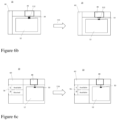
- the present invention provides a sterilization system as shown schematically in Figure 6a .
- the system features a sterilization device 10 as described hereinabove and in Figures 1-4 .
- the device may be a device configured to provide Class S sterilization and Class B sterilization, wherein in a first state the Class B sterilization cycles are locked and unavailable for use.
- the sterilization system includes a key 110 for unlocking at least one Class B sterilization cycle of the sterilizer 10.
- the key 110 may be a code.
- the code may be inputted by a user using the sterilizer keyboard 64 or by any suitable method.
- the code may include software commands to open Class B sterilization cycles.
- the code may include software commands to lock Class S sterilization cycles.
- the key may be a physical key.
- Use of the key with the sterilizer device may facilitate physical connection to the sterilization chamber of any necessary opening or activation of means for active air removal sufficient for Class B sterilization.
- the physical key may also cause disconnection from the sterilization chamber of the means for active air removal sufficient for Class S sterilization.
- Figure 6b shows schematically a non-limiting example of a sterilizer of the present invention including a vacuum system, such as, but not limited to a vacuum pump to provide Class B sterilization.
- the vacuum system, such as the vacuum pump 48 may include at least one valve 112, which may be provided closed and which may be configured to prevent air removal of the sterilization chamber by the vacuum system, such as the vacuum pump.
- the vacuum system such as the vacuum pump may be connected to at least one additional valve 50 to provide control of the air evacuation.
- Adapting 116 the sterilizer by use of the key 110 may cause opening of the valve 112 on the vacuum system, such as the vacuum pump to allow sufficient air removal from the sterilization chamber and control by valve 50 to provide Class B sterilization.
- the key may cause opening and/or closing of any suitable inlet or outlet for facilitating unblocked access of the air removal system to the sterilization chamber for sufficient air removal to provide the target class of sterilization on selection of that sterilization class.
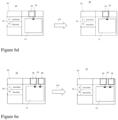
- a sterilizer may include a vacuum system, such as a vacuum pump 48 configured to provide Class B sterilization, wherein the vacuum system, such as a vacuum pump does not include the at least one valve 112 as described for Figure 6b .
- the sterilizer may be adapted to unblock Class B sterilization cycles by employing the code 110.
- the code 110 may facilitate use of Class B sterilization cycles by providing commands of a suitable sequence, order and parameters for sufficient air removal by the vacuum system, such as the vacuum pump to provide Class B sterilization.
- the sterilizer may include a steam pulser 46, which can be configured to provide both Class S and Class B sterilization.
- the sterilizer with blocked Class B sterilization cycles may be adapted 116 to facilitate Class B sterilization by employing the code 110, which provides commands, including commands to the steam pulser 46 of a suitable sequence, order and parameters for sufficient air removal to provide Class B sterilization.
- a sterilizer with blocked Class B sterilization cycles may include both a vacuum system, such as a vacuum pump 48 and a steam pulser 46 to provide both Class S and Class B sterilization.
- the sterilizer may be adapted 116 to unblock the Class B sterilization cycles by use of the code 110 which provides commands to facilitate Class B sterilization.
- Commands may include commands to the relevant air removal system such as to at least one of the steam pulser and the vacuum system, such as the vacuum pump of a suitable sequence, order and parameters for sufficient air removal to provide Class B sterilization.
- the system may include a sterilization device configured to provide Class N, Class S and Class B sterilization, wherein at least one of the Class S and Class B sterilization cycles are locked.
- the system may include two keys 110, a first key for unlocking Class S sterilization cycles and a second key for unlocking Class B sterilization cycles.
- the key for unlocking Class B sterilization cycles may work as described for the key for unlocking Class B sterilization cycles in a Class S and Class B sterilizer.
- Use of the key for unlocking Class S sterilization cycles may facilitate physical connection and/or commands to the sterilization chamber of any necessary opening or activation of means or conditions for active air removal sufficient for Class S sterilization.
- the present invention provides a method of converting a convertible Class S sterilizer of the present invention to a Class B sterilizer.
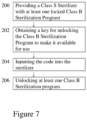
- Figure 7 shows a flow chart of an exemplary method of converting an exemplary convertible Class S sterilizer to a Class B sterilizer according to an aspect of the present invention.
- the method features providing a Class S sterilizer of the present invention 200, which is upgradeable to a sterilizer providing Class B sterilization.
- the sterilizer includes at least one Class B sterilization cycle program which is locked and which in its Class B locked state cannot be used by a user for Class B sterilization. A user can only use the upgradeable Class S sterilizer in this Class B locked state for a Class S sterilization cycle.
- the method includes a user obtaining a key for unlocking at least one Class B program 202.
- the key may be obtained by purchasing it from a suitable source, such as, but not limited to the manufacturer of the sterilizer.
- the key may be any suitable key, which may include a code.
- the method features the user inputting the code into the sterilizer device 204. Inputting may be by any suitable way, such as, but not limited to typing the code using a keyboard of the sterilizer.
- the code may work in any suitable way, such as by software commands to unlock the Class B sterilization cycles. Unlocking may include at least one of activating Class B sterilization cycle programs and physical connection of means for providing conditions for Class B sterilization to the sterilization chamber 206, as described hereinabove. Once the Class B sterilization cycle is unlocked, the sterilizer is configured to provide Class B sterilization, which is available for a user to run a Class B sterilization cycle.
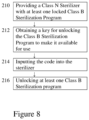
- Figure 8 shows schematically a flow chart of an exemplary method, which is not part of the claimed invention, of converting an exemplary sterilizer providing N Class sterilization to a sterilizer providing B Class sterilization.
- the method features providing a Class N sterilizer of the present invention 210, which is upgradeable to a sterilizer providing Class B sterilization.
- the sterilizer includes at least one Class B sterilization cycle program which is locked and which in its Class B locked state cannot be used by a user for Class B sterilization. A user can only use the upgradeable Class N sterilizer in this Class B locked state for a Class N sterilization cycle.
- the method includes a user obtaining a key for unlocking the at least one Class B program 212.
Landscapes
- Health & Medical Sciences (AREA)
- Epidemiology (AREA)
- Life Sciences & Earth Sciences (AREA)
- Animal Behavior & Ethology (AREA)
- General Health & Medical Sciences (AREA)
- Public Health (AREA)
- Veterinary Medicine (AREA)
- Apparatus For Disinfection Or Sterilisation (AREA)
- Storage Of Fruits Or Vegetables (AREA)
Description
- This application claims priority to
U.S. Provisional Patent Application Ser. No. 62,964,690 filed on January 23, 2020 - The present invention relates to a sterilization device, a sterilization system and a method of sterilization.
- Sterilization is carried out routinely in many industries and on diverse items, such as those related to the medical and food industries. Items to be sterilized can be placed in the sterilization chamber of a sterilization device and a sterilization cycle can be run using a suitable sterilization medium, such as for example steam and heat.
- Sterilization cycles in steam sterilizers can be classified based on the performance of the cycle as Class B, Class N and Class S. These cycles differ in the way in which air is removed, the types of load they can sterilize and whether the items can be wrapped during sterilization. All three types remove air from the sterilization chamber, however the methods to attain this are different. Class N sterilizers use passive air removal from the sterilizer. Class S sterilizers use active air removal by for example steam pulsing and Class B sterilizers use active air removal by for example using a vacuum pump. Class N sterilization cycles are suitable for unwrapped solid items, whilst Class B is used for wrapped or unwrapped solid or hollow items. Class S sterilization cycles are suitable only for the types of load specified by the sterilizer manufacturer. Although Class B has the widest range of applications, it is typically more expensive and may take longer than a Class S sterilization cycle.
- The guidelines regarding which type of sterilization cycle should be used for which type of item differ by country. In America, Class S sterilization is within the recommended guidelines for certain end uses and this type of sterilizer is typically used in for example tabletop sterilizers in dentistry and medical clinics. However, in view of the possibility that government guidelines may change, and/or a potential future need by a user for optimal sterilization on a wider variety of type of object, there may be a widespread need to replace Class N sterilizers with Class S or Class B sterilizers and Class S sterilizers with Class B sterilizers. Currently, a Class N or a Class S sterilizer may meet the needs of a user. The user may like to continue to use a machine that he is familiar with, as well as it typically being cheaper for him to run than a higher class sterilizer, such as a Class B sterilizer. As such the user may want to switch to a Class B sterilizer only when, or if it is necessary. Such a user may be averse to the expense of having to replace the Class N or Class S sterilizer at this future time with a costly Class B sterilizer.
DE 19715583 to Flecher Pierre Dr is directed to a medical steriliser and describes a single unit, wherein the three commercial CEN standard types 'B', 'N' and 'S' are combined and freely available to a user. - It would therefore be desirable to have a sterilizer which provides more than one class of sterilization. It would be useful to have a Class N or Class S sterilization device and wherein the same sterilizer can be adapted to provide Class B sterilization. It would further be advantageous to have a Class N or Class S sterilizer, which could be easily configured to provide Class B sterilization. It would be beneficial if the upgrade is significantly cheaper than replacing the Class N sterilizer or Class S sterilizer with a Class B sterilizer. It would be further environmentally desirable to provide an upgradable sterilizer, obviating the need to discard a redundant Class N or Class S sterilizer. The present invention provides such a system, device and method of use thereof.
- The invention is set out in the appended set of claims.
- The invention may have several aspects. One aspect is a sterilization device according to
claim 1. The sterilization device includes a sterilization chamber for accommodating at least one item for sterilization. The sterilization device includes a power means for powering the device. The sterilization device includes a means for providing a sterilization medium for sterilizing the at least one item. The sterilization device includes a plurality of sterilization cycle programs. The plurality of sterilization cycle programs includes at least one S class sterilization cycle program and at least one B class sterilization cycle program. The at least one S class sterilization programs may be for sterilization of at least one item as defined by the manufacturer of the sterilization device. The at least one B class sterilization programs may be for sterilization of items for which Class S may be sufficient, in addition to items for which Class S is not adequate for sterilization, such as but not limited to at least one of a solid product, a porous product, a lumen device, a single-wrapped product, a multiple-layer product and a non-wrapped product. According to the invention, in a first state the sterilization device provides sterilization using the at least one S class sterilization cycle program and the at least one B class sterilization cycle program is locked and unavailable for use by a user. The sterilization device includes a second state wherein the sterilization device provides the at least one B Class sterilization cycle program unlocked and available for use by a user. The sterilization medium is steam for steam sterilization. The sterilization chamber may include at least one inlet for steam. The sterilization chamber may include at least one valve configured for connection to a vacuum system. - According to the invention, the at least one locked B class sterilization cycle program is configured to be unlocked with a code. The code may be provided separately from the sterilization device. According to the invention, the device includes a keyboard for inputting the or the code code may be inputted remotely.
- In various embodiments of the sterilization device, the device includes at least one air removal system. The air removal system is configured to provide air removal from the sterilization chamber. The at least one air removal system may feature at least one of a steam pulsing system and a vacuum system. The sterilization chamber may include at least one inlet for at least one of steam and water. The sterilization chamber may include at least one outlet for at least one of air and steam. In an embodiment wherein the air removal system features a steam pulsing system, the steam pulsing system may be connected to the at least one inlet for steam and/or water of the sterilization chamber. The steam pulsing system may include water, which may be stored in a water tank, a water pump and a water heater. In an embodiment wherein the air removal system features a vacuum system, the vacuum system may be connected to the at least one valve of the sterilization chamber.
- In various embodiments of the sterilization device, when the device is in a first state, the at least one program for providing B class sterilization is locked and the at least one air removal system is configured to provide air removal from the sterilization chamber sufficient for S class sterilization. The device may provide only S class sterilization.
- In various embodiments the device is configured to a second state wherein the at least one program for B class sterilization cycle is unlocked. The at least one air removal system is configured to provide air removal sufficient for producing B class sterilization. The device may provide S class sterilization or B class sterilization. The device may provide only B class sterilization.
- According to the invention, the sterilization device further includes at least one controller for controlling the sterilization cycles of the sterilization device. The sterilization device may further include at least one of a means for measuring pressure, a means for measuring temperature and a means for measuring time. The sterilization device may further feature at least one of a means for controlling pressure, a means for controlling temperature and a means for controlling time. The sterilization device may include at least one control for controlling the steam pulsing system. The sterilization device may include at least one control for controlling the vacuum system.
- In various embodiments of the sterilization device, which are not part of the claimed invention, the plurality of sterilization cycle programs may further include at least one N class sterilization cycle. At least one of the at least one S class sterilization cycle program and the at least one B class sterilization cycle program may be in a locked state. In a first state the sterilization device may provide sterilization using the at least one N class sterilization cycle program and the at least one S class sterilization cycle program is locked and unavailable for use by a user and the at least one B class sterilization cycle program is locked and unavailable for use by a user. In a second state, the at least one S class sterilization cycle program may be unlocked and available for use by a user and the sterilization device may provide sterilization using either the at least one N class sterilization cycle program or the at least one S class sterilization cycle program and the at least one B class sterilization cycle program is locked and unavailable for use by a user. In a third state the sterilization device may provide sterilization using either the at least one N class sterilization cycle program or the at least one S class sterilization cycle program or the at least one B class sterilization cycle program. In a fourth state the at last one B class sterilization cycle program may be unlocked and available for use by a user and the sterilization device may provide sterilization using either the at least one N class sterilization cycle program or the at least one B class sterilization cycle program and the at least one S class sterilization cycle program is locked and unavailable for use by a user.
- A further aspect is a sterilization system. The sterilization system includes a sterilization device and a code for unlocking at least one B class sterilization cycle of the sterilization device. The sterilization device includes a sterilization chamber for accommodating at least one item for sterilization. The sterilization device includes a means for powering the device. The sterilization device includes a means for providing a sterilization medium for sterilizing the at least one item. The sterilization device includes a plurality of sterilization cycle programs. The plurality of sterilization cycle programs includes at least one S class sterilization cycle program and at least one B class sterilization cycle program. The at least one B class sterilization cycle program is in a locked state. The sterilization device provides S class sterilization and is adaptable to unlock and provide B class sterilization.
- In various embodiments of the sterilization system, the sterilization device includes at least one controller for controlling the at least one sterilization cycle of the sterilization device. The sterilization device may include at least one of a steam pulsing system and a vacuum system to provide air removal from the sterilization chamber.
- A still further aspect, which is not part of the claimed invention, is a sterilization system featuring a sterilization device. The device includes a sterilization chamber for accommodating at least one item for sterilization, a means for powering the device, a means for providing a sterilization medium for sterilizing the at least one item and a plurality of sterilization cycle programs. The plurality of sterilization cycle programs may include at least one N class sterilization cycle program, at least one S class sterilization cycle program in a locked state and at least one B class sterilization cycle program in a locked state. The sterilization device may provide N class sterilization and is adaptable to unlock and provide S class sterilization and B class sterilization. The sterilization system may include a code for unlocking the at least one locked S class sterilization cycle and a code for unlocking the at least one locked B class sterilization cycle. The sterilization device may include a passive steam air removal system and at least one of a steam pulsing system and a vacuum system to provide air removal from the sterilization chamber.
- An aspect is a method of sterilization. The method features providing a sterilization device of the present invention. The sterilization device is in a first state, wherein the at least one B class sterilization cycle program is locked. The method includes placing at least one item in the sterilization chamber and running at least one S class sterilization cycle for sterilizing the at least one item.
- An aspect is an additional method of sterilization. The method features providing a sterilization device of the present invention. The method includes placing at least one item in the sterilization chamber and selecting an S class sterilization cycle or a B class sterilization cycle. The method further includes running the selected class sterilization cycle for sterilizing the at least one item.
- A still further aspect is a method of converting a sterilization device for providing S class sterilization into a sterilization device for providing B class sterilization. The method includes providing a sterilization device of the present invention. The sterilization device is in a first state, wherein the at least one B class sterilization cycle program is locked. The method includes inputting a code for unlocking the at least one B class sterilization cycle program for providing the sterilization device with at least one available B class sterilization cycle program and for converting the sterilization device from a first state wherein the at least one B class sterilization cycle is locked into a second state wherein the at least one B class sterilization cycle program is unlocked.
- Another aspect is a further method of sterilization. The method includes providing a sterilization device of the present invention. The sterilization device is in a first state, wherein the at least one B class sterilization cycle program is locked. The method includes unlocking the at least one B class sterilization cycle program to provide at least one available B class sterilization cycle program. Unlocking may feature inputting a code. The method includes placing at least one item in the sterilization chamber and running at least one B class sterilization cycle for sterilizing the at least one item. The method may include selecting a B class sterilization cycle.
- An aspect is a method of sterilization using a sterilization device which features at least one N class sterilization cycle program, at least one S class sterilization cycle program and at least one B class sterilization cycle program. The method includes providing a sterilization device of the present invention, wherein the sterilization device incudes a plurality of sterilization cycle programs, which feature at least one N class sterilization cycle program, at least one S class sterilization cycle program and at least one B class sterilization cycle program. The method includes placing at least one item in the sterilization chamber. The method includes selecting one of an N class sterilization cycle, an S class sterilization cycle or a B class sterilization cycle and running the selected class sterilization cycle to sterilize the at least one item. According to the invention, the at least one B class sterilization cycle program is in a locked state. The method may include unlocking the at least one B class sterilization cycle program to provide at least one available B class sterilization cycle program. The method may include running at least one B class sterilization cycle for sterilizing the at least one item.
- The various features of the invention will best be appreciated by simultaneous reference to the description which follows and the accompanying drawings, which are not drawn to scale and in which:
-
FIG. 1 shows a schematic view of an exemplary sterilizer according to an aspect of the present invention; -
FIGs 2a and2b show schematic views of at least part of an exemplary system for providing sterilization conditions to a sterilizer of the present invention; -
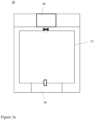
FIGs 3a and3b show schematic views of an exemplary sterilizer according to an aspect of the present invention; -
FIG. 4 shows a schematic view of exemplary programs of an exemplary sterilizer according to an aspect of the present invention; -
FIGs 5a and 5b shows schematic views of exemplary programs of an exemplary sterilizer with an unlocked Class B sterilization cycle program according to an aspect of the present invention; -
FIGs 6a-6e show schematic views of an exemplary sterilizer system according to an aspect of the present invention; -
FIG. 7 shows a flow chart of an exemplary method of converting an exemplary Class S convertible sterilizer to a Class B sterilizer according to an aspect of the present invention; -
FIG. 8 shows a flow chart of an exemplary method of converting an exemplary Class N convertible sterilizer to a Class B sterilizer according to an aspect of the present invention; -
FIG. 9 shows a flow chart of an exemplary method of use of an exemplary sterilizer according to an aspect of the present invention; -
FIG. 10 shows a flow chart of an exemplary method of use of an exemplary sterilizer according to an aspect of the present invention; and -
FIG. 11 shows a flow chart of an exemplary method of use of an exemplary sterilizer according to an aspect of the present invention. - In one aspect the present invention is of a sterilization device. The sterilization device is configured to provide at least one S class sterilization cycle and at least one B class sterilization cycle. The sterilization device provides S Class sterilization and may be adaptable to provide B class sterilization. In an additional aspect the present invention is of a sterilization device which is configured to provide at least one N class sterilization cycle, at least one S class sterilization cycle and at least one B class sterilization cycle. In a further aspect, the present invention provides a sterilization system featuring a sterilization device and a key for unlocking B class sterilization cycles of the sterilization device. In a further aspect, the present invention provides a method of converting a sterilization device to a B Class sterilization device. Furthermore, the present invention provides a method of sterilization.
- The device and system of the present invention have many advantages. The invention ensures that a user is not limited to use of only one class of sterilization from a single sterilizer. The invention provides a user with the option of converting a same S Type sterilizer to a B sterilizer at a future date. The invention provides a user with the option of converting a same N Type sterilizer to an S Type sterilizer and/or a B Type sterilizer. The invention also provides a way of reducing waste caused by throwing out of redundant S Type sterilizers and redundant N Type sterilizers. The invention may also enable a user to choose between S Type and B Type sterilization with a single sterilizer. The invention may also facilitate a user having the choice of using an N Type, S Type or B Type sterilization with a single sterilizer.
- As used herein the terms 'Class' and 'Type' may be used interchangeably.
- As used herein the terms 'locked' and 'locked state' may include, but are not limited to a state where a sterilization program or cycle is configured so that it cannot be used by a user without being unlocked in a suitable way. The unlocking may be by a suitable key.
- As used herein the term 'available' may include, but is not limited to a state where the cycle is configured such that it can be used and run by a user. The term includes the state where the cycle is not locked.
- As used herein the terms 'adapting' and 'adapted' may include, but are not limited to upgrading and reconfiguring of the sterilizer. The terms may include any suitable method of adapting, such as but not limited to using physical and/or software means.
- As used herein the term 'distribution system' may include, but is not limited to any suitable means for providing a material from a first location to a second location. The term includes providing a material from one part of a system to another part of a system.
- As used herein the term 'sterilization chamber' may include, but is not limited to a compartment where sterilization may be carried out.
- As used herein the term 'connection' may include, but is not limited to direct and indirect attachment.
- As used herein the term 'inlet' may include, but is not limited to a means of entry. The term may include any suitable means of entry, such as, but not limited to vents, ducts, pipes, flues and openings.
- As used herein the term 'outlet' may include, but is not limited to a means of exit. The term may include an opening or passage configured for letting something out. The term may include vents, pipes, ducts and exits for expelling something.
- As used herein the term 'channel' may include, but is not limited to a passage or a structure, which provides a passage or pathway for a material, such as a gas, vapor or liquid to flow along. The term may include a channel made from a material resistant to the material it is carrying. The term may include a channel for a separated passage of a material.
- As used herein the term 'sterilization device' may include, but is not limited to a sterilizer, which features a sterilization chamber. The sterilizer may provide the sterilization chamber with sterilization conditions, materials, and other means for facilitating a sterilization process and sterilization of items in the sterilization chamber.
- As used herein the term 'sterilization' may include, but is not limited to elimination, killing, removal or deactivation of biological agents, such as, but not limited to microorganisms, pathogens, bacteria, viruses, fungi, spore forms and prions from a specified region. Sterilization may be performed using a sterilization process and may run for longer than is required to provide a sterility assurance level. The term may include a process providing a sterility assurance level of at least 10-6.
- As used herein the term 'disinfection' may include, but is not limited to a process to destroy microorganisms on a specified region. The term includes a method, which is less effective than sterilization at killing microorganisms and may not kill all microorganisms on a specified area, such as resistant bacterial spores.
- As used herein the term 'sterilization cycle' may include, but is not limited to at least one stage of a sterilization procedure. The sterilization cycle may include all the stages of the sterilization procedure or only at least one stage.
- As used herein the terms 'a' and 'an' may mean 'one' or 'more than one'.
- As used herein the terms 'comprising', 'including', 'containing', 'featuring', 'having' and any forms of the terms thereof are inclusive and open ended and do not exclude additional, elements or methods steps, which are not recited.
- The principles and operation of a system and device, such as a sterilizer, as well as methods of use thereof according to the present invention may be better understood with reference to the figures. The figures show non-limiting aspects of the present invention.
-
Figure 1 shows a schematic view of anexemplary sterilizer 10 according to an aspect of the present invention. Thesterilizer 10 is configured as a sterilizer for providing S Class sterilization. Non-limiting examples ofsuitable sterilizers 10 for providing S Class sterilization include steam sterilizers and tabletop autoclaves. Thesterilizer 10 is also configured as a sterilizer for providing B Class sterilization. The sterilizer may be a two class sterilizer providing S Class and B Class sterilization cycles. - In one aspect, the sterilizer features a plurality of states. In a first state, the sterilizer is provided wherein the B Class sterilization cycles are unavailable for use by a user and the user can only use the sterilizer in this first state for S Class sterilization. In this first state, the B Class sterilization cycle programs are in a dormant or locked state. The
sterilizer 10 may be adapted to a second state wherein the B Class sterilization cycles are available for use. - The
sterilization device 10 features asterilization chamber 12. Thesterilization chamber 12 may be any suitable sterilization chamber and may be constructed from any suitable material, such as, but not limited to stainless steel or polycarbonate. Thesterilization chamber 12 may be of any suitable size and shape for sterilizing at least one item.Figure 1 shows an example of a square shapedsterilization chamber 12, however this is not intended to be limiting. Thesterilization chamber 12 may be a single chamber or may include multiple chambers or multiple sub compartments. Thesterilization chamber 12 may include anysuitable door 14, which can be closed during a sterilization cycle. The door may include any opening and closing mechanism. Thesterilizer 10 may include any suitable shelving or racks for placement of items to be sterilized. - The
sterilizer 10 includes at least one system for providing sterilization conditions to thesterilization chamber 12. The at least one system for providing sterilization conditions to the sterilization chamber may include aheating device 16 for providing heat to thesterilization chamber 12. The heating device may be any suitable heating device. One non-limiting example of a suitable heating device is an electrical jacket heater for heating the sterilization chamber. Theheating device 16 may be configured so that it surrounds thesterilization chamber 12 or may be positioned in any other suitable way so that it provides uniform heat to the sterilization chamber. The heating device may provide heat of a temperature greater than about 100 °C. In some embodiments, the heating device may provide a temperature of greater than about 120 °C. - The at least one system for providing sterilization conditions to the sterilization chamber may include a
means 18 for providingsteam 20 to thesterilization chamber 12. The means 18 for providingsteam 20 to the sterilization chamber may be positioned externally from thesterilization chamber 12. As shown schematically inFigure 2a , themeans 18 for providingsteam 20 to thesterilization chamber 12 may include asteam supply 20 or a source ofsuitable water 22 for conversion to steam 20. Thewater 22 may be stored in areservoir 24. In some embodiments, thesterilizer 10 may be connectable to an external water source, such as a water tap. Asuitable water pump 26 may pump the water. The means 18 for providingsteam 20 to thesterilization chamber 12 may be suitably connected to at least onesteam inlet 28 of thesterilization chamber 12 to providesteam 20 into thechamber 12. In one non-limiting embodiment, thesteam 20 may be produced by asteam generator 30, such as but not limited to an electrical pipewater heating system 30. The resultingsteam 20 may be provided to the sterilization chamber by asteam distribution channel 32, such as, but not limited to atubing 32 via a steam valve, which may be upstream 34 and which may be connected to theinlet port 28 of thesterilization chamber 12. Thewater pump 26 may facilitate providing the steam to thesterilization chamber 12 for sterilization of the contents of thesterilization chamber 12. Thewater pump 26 may provide water to thesteam generator 30 and the steam may flow from thesteam generator 30 to thesterilization chamber 12. Thewater pump 26 may be controlled by apump control 27 to provide control of steam pulsing. As such, themeans 18 for providingsteam 20 to the sterilization chamber may be configured as asteam pulsing system 46, which may feature thewater pump 26 and the water heating system as shown inFigure 2b . - In an alternative example, which is not shown in
Figure 1 , themeans 18 for providingsteam 20 to thesterilization chamber 12 may be positioned in thesterilization chamber 12. In such an example, themeans 18 for providingsteam 20 may not need awater pump 26 and may produce and provide the steam by a water source and a heating system. - As shown schematically in
Figure 1 , the at least one system for providing sterilization conditions to the sterilization chamber may include means foractive air removal 40 from thesterilization chamber 12. Thesterilization chamber 12 may include at least oneoutlet 36 for releasing air and/or steam. In one embodiment shown inFigure 1 , thesterilizer 10 of the present invention has a means for sufficient active air removal forClass S sterilization 42 and thesterilizer 10 has an additional means for sufficient active air removal forClass B sterilization 44. The means for sufficient air removal forClass S sterilization 42 may include a means for providing steam pulsing 46 to thesterilization chamber 12 as described hereinabove and inFigure 2b and may include themeans 18 for providingsteam 20 to the sterilization chamber configured as asteam pulsing system 46. The means for sufficient air removal forClass B sterilization 44 may include avacuum system 48, such as but not limited to avacuum pump 48 connected in a suitable way to thesterilization chamber 12. In one non-limiting embodiment, thevacuum system 48, such as thevacuum pump 48 is connected to thesterilization chamber 12 with avalve 50. Thevacuum system 48 may include any device or component for providing a sufficient vacuum. An additional non-limiting example of asuitable vacuum system 48 is a water pump. - In an alternative embodiment, shown schematically in
Figure 3a andFigure 3b , the sterilizer has a means which can be operated to provide sufficient air removal for both Class S and Class B sterilization. The same means may be operated differently with different conditions depending on the Class of sterilization to be achieved. In one non-limiting example shown inFigure 3a , the means may be avacuum system 48, such as avacuum pump 48, which can be operated using conditions for providingClass S sterilization 42 and which can be operated using different parameters forClass B sterilization 44. In such an example, the sterilizer device includes means 18 for providingsteam 20 to the sterilization chamber, which in one non-limiting example may be asteam pulsing system 46. However, in this example the function of the steam pulsing system and its operation, is to provide steam for sterilization without the need for the steam pulsing system to be controlled to remove a certain amount of air to result in the desired Class of sterilization. In an alternative non-limiting example, shown schematically inFigure 3b , the means to provide sufficient air removal for both Class S and Class B sterilization may be asteam pulser 46, which can be operated using conditions for providing Class S sterilization and which can be operated using different parameters for Class B sterilization. In a further non-limiting example, the means may include a combination of avacuum system 48, such as avacuum pump 48 and asteam pulser 46 which can be operated using respective conditions forClass S 42 orClass B 44 sterilization. - As shown schematically in
Figure 1 , thesterilizer 10 includes acontrol 60. The figure shows one non-limiting arrangement of the features of the control. The device may include any suitable arrangement and order of the control components. The control may include aswitch 62 to start and stop the sterilization device. The control may include asuitable keyboard 64. The control may include power controlling means 66. The control may include a clock 68 for measuring time. The control may include atimer 70 for setting the time of the sterilization cycle. The control may include ascreen 72 and adisplay 74. - The
control 60 includesdifferent programs 76 of sterilization cycle. The programs may be provided as part of amenu 78. Theprograms 76 may be preset and/or may be programmable.Figure 4 shows a schematic view of exemplary programs of an exemplary sterilizer according to an aspect of the present invention. Thecontrol 60 includes at least oneprogram 76a for a SClass sterilization cycle 42. The at least one program for S Class sterilization may include any suitable number ofprograms 76a. Thecontrol 60 includes at least oneprogram 76b for a BClass sterilization cycle 44. The at least oneprogram 76b for B Class sterilization may include any suitable number ofprograms 76b. In one non-limiting example, thesterilization device 10 may include at least two B Classsterilization cycle programs 76b. Non-limiting examples of B Classsterilization cycle programs 76b may include a 121 °C B Class cycle and a 134 °C B Class cycle. As previously described, in a first state the at least oneprogram 76b for a B Class sterilization cycle may be unavailable to a user. The sterilizer may include the components for providing B Class sterilization, but in this state the B Classsterilization cycle program 76b may be locked in any suitable way to prevent a user from accessing or using a B Class sterilization cycle. Typically, a user may purchase the sterilizer device of the present invention with the device configured to run S Class sterilization and with the B Class sterilization programs in a locked, unusable state. In such a state, the user can only run Class S sterilization. The sterilizer device may be adaptable to provide the option of a B Class sterilization program to the user. The sterilizer may be adapted, such that the locked B Class sterilization cycle program may be opened with a suitable key resulting in the sterilizer in a second state wherein a B Class sterilization cycle can be run by a user. When a user does not have a key to unlock the B Class sterilization cycles, the B Class sterilization will not be available for use to the user. According to the invention, a suitable key is a code. The code is inputted using the keyboard or the code may be inputted remotely. The code may be given to a user in any suitable way, such as, but not limited to by electronic mail, postal delivery, phone, verbally, over the WWW (IoT) network and combinations thereof. The code may be a unique code, which is configured to be different for each device. The code may be any suitable code, such as, but not limited to a QR code, a barcode, a 2D code, a sequence of a suitable number of numbers or, letters, or symbols or combinations thereof. Opening of the locked B Class sterilization cycle and selection of a B Class sterilization cycle may activate the means and parameters sufficient for air removal for Class B sterilization as described above. In one embodiment, unlocking of the B Class sterilization cycles may circumvent the sterilizer S Class sterilization system to only provide a user with options of B Class sterilization cycles 76b as shown schematically inFigure 5a . In an alternative embodiment, unlocking of the B Class sterilization cycles may provide a user with options of operating either a SClass sterilization cycle 76a or a BClass sterilization cycle 76b as shown schematically inFigure 5b . In such an embodiment, a user may select which type of sterilization, S Class or B Class to run on an item to be sterilized in the sterilizer device. In a further alternative embodiment, the sterilizer may be provided with both S Class and B Class sterilization classes in an unlocked state and with no need to unlock the sterilizer to provide B Class sterilization. In such an embodiment a user may select either a SClass sterilization cycle 76a or a BClass sterilization cycle 76b as shown schematically inFigure 5b . - In some embodiments, the locked sterilization class may be unlocked once and may then remain unlocked. In one embodiment, the at least one B
Class sterilization cycles 76b may be relockable. In one non-limiting example, the unlocking of the at least one BClass sterilization cycle 76b may be for a specific time duration after which the B Class sterilization cycles relock 76b. Alternatively, the at least one BClass sterilization cycle 76b may be locked remotely. Such a relockable sterilizer may be suitable for a subscription payment scheme for use of the B Class Sterilization cycles. In one embodiment, the at least one B Class sterilization cycle once unlocked may be made unavailable. Unavailability of B Class sterilization may result from a selection choice in a sterilization cycle menu, such as but not limited to selecting an S Class sterilization menu. - The
controller 60 may include means for controlling the sterilization cycles of the sterilization device. The controller may include aheating control 80 for controlling the temperature provided to the chamber. The device may include at least onethermometer 82 for measuring the temperature. The controller may include acontrol 84 for controlling the production of steam. The controller may include a means for controlling pulsing of steam 86 provided to the incubation chamber. The controller may control the water pump to control pulsing of steam, which may be by controlling thepump control 27. The controller may include a means for controllingpressure 88. The controller may include apressure measuring device 90. The controller may include a means for controlling the time of asterilization cycle 92. The controller may include a means for opening andclosing steam inlets 94 for allowing steam into the incubation chamber. The controller may include a means for controlling operation and parameters of a vacuum system, such as avacuum pump 96. The controller may include means for closing and opening steam and air outlets of the sterilization chamber. - The sterilizer includes a
power supply 100 and electrical connections for powering thesterilization device 10 and its components. Thepower supply 100 may be any suitable power supply that supplies power. The sterilizer may include asafety valve 102. - The sterilizer may be constructed from materials suitable for Class S sterilization conditions and suitable for Class B sterilization conditions.
- In one non-limiting embodiment, which is not part of the claimed invention, the sterilizer may be configured to provide three classes of sterilization cycle, Class N, Class S and Class B. In such an embodiment, the three class sterilizer may have four states. In a first state, sterilization cycles/s of Class N may be available to a user. The sterilization cycles of Class S and Class B may be locked in any suitable way as described herein for Class B, such as with a lock, which can be opened with a suitable key. In one non-limiting example a different key may unlock each of the locked classes. In a second state, Class S sterilization cycle/s may be unlocked providing a user with unlocked and available sterilization cycles of Class N and Class S. In a third state, Class S and Class B sterilization cycles may be unlocked to provide a user with unlocked and available sterilization cycles of Class N, Class S and Class B. In a fourth state, Class B sterilization cycles may be unlocked providing a user with unlocked and available Class N and Class B sterilization cycles. In one non-limiting embodiment, the three class sterilizer may be provided with Class N, Class S and Class B sterilization cycles, which are available to a user on selection of the desired class of sterilization.
- The three class sterilizer may feature substantially the same components as the two class S and
B sterilizer 10 described hereinabove. To avoid repetition the components of thesterilizer 10 which provide Class S and Class B sterilization will not be described again. In the three class sterilizer, Class N sterilization may be provided by gravity displacement of air using steam. Referring toFigure 1 , themeans 18 for providingsteam 20 to thesterilization chamber 12, which is available in the previously described two class S and B sterilizer can provide steam to the sterilization chamber for passive air removal facilitating Class N sterilization conditions. In a first state, the sterilization device may be configured to only provide passive air removal for Class N sterilization and the conditions and components for providing Class S and Class B are not activated. They can be locked or they can be open and available only on selection of that Class and the resulting reconfiguration of the device, such as unlocking or activating the conditions relating to the selected class of sterilization cycle. Unlocking Class S sterilization cycles may feature opening and making available to the sterilization device air removal by steam pulsing or by a vacuum system, such as a vacuum pump configured with parameters for Class S sterilization as previously described. Unlocking Class B sterilization cycles may feature opening and making available to the sterilization device air removal by steam pulsing or a vacuum system, such as a vacuum pump configured with parameters for Class B sterilization as previously described. The sterilizer may be constructed from materials suitable for Class N sterilization conditions, Class S sterilization conditions and Class B sterilization conditions. - The sterilizer of the present invention may be suitable for a variety of sterilization applications. Non limiting examples include sterilization of instruments used in medical clinics and all types of dental clinic.
- The present invention provides a sterilization system as shown schematically in
Figure 6a . The system features asterilization device 10 as described hereinabove and inFigures 1-4 . The device may be a device configured to provide Class S sterilization and Class B sterilization, wherein in a first state the Class B sterilization cycles are locked and unavailable for use. The sterilization system includes a key 110 for unlocking at least one Class B sterilization cycle of thesterilizer 10. In one non-limiting example the key 110 may be a code. The code may be inputted by a user using thesterilizer keyboard 64 or by any suitable method. The code may include software commands to open Class B sterilization cycles. In one non-limiting example, the code may include software commands to lock Class S sterilization cycles. In an alternative non-limiting embodiment, the key may be a physical key. Use of the key with the sterilizer device may facilitate physical connection to the sterilization chamber of any necessary opening or activation of means for active air removal sufficient for Class B sterilization. The physical key may also cause disconnection from the sterilization chamber of the means for active air removal sufficient for Class S sterilization.Figure 6b shows schematically a non-limiting example of a sterilizer of the present invention including a vacuum system, such as, but not limited to a vacuum pump to provide Class B sterilization. The vacuum system, such as thevacuum pump 48 may include at least onevalve 112, which may be provided closed and which may be configured to prevent air removal of the sterilization chamber by the vacuum system, such as the vacuum pump. The vacuum system, such as the vacuum pump may be connected to at least oneadditional valve 50 to provide control of the air evacuation. Adapting 116 the sterilizer by use of the key 110 may cause opening of thevalve 112 on the vacuum system, such as the vacuum pump to allow sufficient air removal from the sterilization chamber and control byvalve 50 to provide Class B sterilization. In one embodiment, the key may cause opening and/or closing of any suitable inlet or outlet for facilitating unblocked access of the air removal system to the sterilization chamber for sufficient air removal to provide the target class of sterilization on selection of that sterilization class. In an alternative embodiment as shown schematically inFigure 6c , a sterilizer may include a vacuum system, such as avacuum pump 48 configured to provide Class B sterilization, wherein the vacuum system, such as a vacuum pump does not include the at least onevalve 112 as described forFigure 6b . The sterilizer may be adapted to unblock Class B sterilization cycles by employing thecode 110. Thecode 110 may facilitate use of Class B sterilization cycles by providing commands of a suitable sequence, order and parameters for sufficient air removal by the vacuum system, such as the vacuum pump to provide Class B sterilization. In one embodiment as shown schematically inFigure 6d , the sterilizer may include asteam pulser 46, which can be configured to provide both Class S and Class B sterilization. The sterilizer with blocked Class B sterilization cycles may be adapted 116 to facilitate Class B sterilization by employing thecode 110, which provides commands, including commands to thesteam pulser 46 of a suitable sequence, order and parameters for sufficient air removal to provide Class B sterilization. In some embodiments as shown schematically inFigure 6e , a sterilizer with blocked Class B sterilization cycles may include both a vacuum system, such as avacuum pump 48 and asteam pulser 46 to provide both Class S and Class B sterilization. The sterilizer may be adapted 116 to unblock the Class B sterilization cycles by use of thecode 110 which provides commands to facilitate Class B sterilization. Commands may include commands to the relevant air removal system such as to at least one of the steam pulser and the vacuum system, such as the vacuum pump of a suitable sequence, order and parameters for sufficient air removal to provide Class B sterilization. - In one non-limiting embodiment, which is not part of the claimed invention, the system may include a sterilization device configured to provide Class N, Class S and Class B sterilization, wherein at least one of the Class S and Class B sterilization cycles are locked. The system may include two
keys 110, a first key for unlocking Class S sterilization cycles and a second key for unlocking Class B sterilization cycles. The key for unlocking Class B sterilization cycles may work as described for the key for unlocking Class B sterilization cycles in a Class S and Class B sterilizer. Use of the key for unlocking Class S sterilization cycles may facilitate physical connection and/or commands to the sterilization chamber of any necessary opening or activation of means or conditions for active air removal sufficient for Class S sterilization. - The present invention provides a method of converting a convertible Class S sterilizer of the present invention to a Class B sterilizer.
Figure 7 shows a flow chart of an exemplary method of converting an exemplary convertible Class S sterilizer to a Class B sterilizer according to an aspect of the present invention. The method features providing a Class S sterilizer of thepresent invention 200, which is upgradeable to a sterilizer providing Class B sterilization. The sterilizer includes at least one Class B sterilization cycle program which is locked and which in its Class B locked state cannot be used by a user for Class B sterilization. A user can only use the upgradeable Class S sterilizer in this Class B locked state for a Class S sterilization cycle. The method includes a user obtaining a key for unlocking at least oneClass B program 202. The key may be obtained by purchasing it from a suitable source, such as, but not limited to the manufacturer of the sterilizer. The key may be any suitable key, which may include a code. The method features the user inputting the code into thesterilizer device 204. Inputting may be by any suitable way, such as, but not limited to typing the code using a keyboard of the sterilizer. The code may work in any suitable way, such as by software commands to unlock the Class B sterilization cycles. Unlocking may include at least one of activating Class B sterilization cycle programs and physical connection of means for providing conditions for Class B sterilization to thesterilization chamber 206, as described hereinabove. Once the Class B sterilization cycle is unlocked, the sterilizer is configured to provide Class B sterilization, which is available for a user to run a Class B sterilization cycle. -
Figure 8 shows schematically a flow chart of an exemplary method, which is not part of the claimed invention, of converting an exemplary sterilizer providing N Class sterilization to a sterilizer providing B Class sterilization. The method features providing a Class N sterilizer of thepresent invention 210, which is upgradeable to a sterilizer providing Class B sterilization. The sterilizer includes at least one Class B sterilization cycle program which is locked and which in its Class B locked state cannot be used by a user for Class B sterilization. A user can only use the upgradeable Class N sterilizer in this Class B locked state for a Class N sterilization cycle. The method includes a user obtaining a key for unlocking the at least oneClass B program 212. In an embodiment wherein the key is a code, the method features the code being inputted into thesterilizer 214. Inputting the code may be by any suitable method. Inputting the code facilitates unlocking at least one Class B Sterilization program so that it is available for use by auser 216. - The present invention provides a method of sterilizing at least one item as shown schematically in the flow chart of
Figure 9 . The method includes providing a sterilizer of the present invention, the sterilizer providing Class S sterilization cycles, which are available for use by a user and the sterilizer including at least one Class B sterilization cycle, which is locked and unavailable for use by auser 220. The method includes a user inserting at least one item to be sterilized in thesterilizer 222. The at least one item to be sterilized is an item specified for suitability to be sterilized by a Class S sterilization cycle. The user selects a ClassS sterilization program 224. The user runs thesterilization cycle 226 and the sterilizer works to provide the sterilization chamber with the Class S sterilization conditions 228. The Class S sterilization cycle sterilizes the at least oneitem 230. The order of the steps is not meant to be limiting and any suitable order may be used. - In an alternative embodiment, the present invention provides a method of sterilizing at least one item as shown schematically in the flow chart of
Figure 10 . The method includes providing a sterilizer of the present invention, the sterilizer providing Class S sterilization cycles, which are available for use by a user and the sterilizer including at least one Class B sterilization cycle, which is locked and unavailable for use by auser 250. A user may unlock the sterilizer of thepresent invention 252 for enabling Class B sterilization as described hereinabove and inFigure 7 . Unlocking may be achieved by inputting a code into thesterilizer 254, which may be done using the sterilizer keyboard. A user may insert at least one item to be sterilized into thesterilization chamber 256. The at least one item may be an item for which the Class S sterilization cycle was not recommended as being sufficient for sterilization of that item and wherein Class B sterilization is needed for sterilization of that item. The user selects a Class B sterilization cycle from theprogram options 258. The user runs the ClassB sterilization program 260. The sterilizer provides the incubation chamber with the Class B sterilization conditions and the at least one item is sterilized under theseconditions 262. The order of the steps is not meant to be limiting and any suitable order may be used. - In a further embodiment, the present invention provides a method of sterilizing at least one item as shown schematically in the flow chart of
Figure 11 . The method includes providing a sterilizer of the present invention, the sterilizer providing at least one Class S sterilization cycle, which is available for use by a user and the sterilizer providing at least one Class B sterilization cycle, which is available for use by auser 280. The method includes a user inserting at least one item to be sterilized 282 in the sterilizer. The user selects a Class S or ClassB sterilization cycle 284. Selection may depend on the item to be sterilized and which class of sterilization is needed for sterilization of that item. In one non-limiting example, the sterilization device may automatically select which class of sterilization is needed. The user runs thesterilization cycle 286 and the sterilizer works to provide the incubation chamber with the sterilization conditions of the selected class ofsterilization 288. The selected sterilization class sterilizes the at least oneitem 290. The order of the steps is not meant to be limiting and any suitable order may be used. - Reference is made to the following example, which together with the above descriptions illustrates the invention in a non-limiting fashion.
- A dentist purchases a sterilizer of the present invention which provides S Class sterilization and is upgradeable to provide B Class sterilization. She uses the standard mode of the sterilizer for sterilizing dental equipment specified as being suitable for S Class sterilization. The dentist expands her practice and some equipment of her associate cannot be sterilized by S Class sterilization. She does not want to buy a B Class sterilizer. Instead, the dentist buys the code for converting the S Class sterilizer of the present invention to a sterilizer that can provide B Class sterilization. She inputs the code and the B Class sterilization programs are unlocked and available to use. She has upgraded the sterilizer, which can now sufficiently sterilize all the equipment of her clinic.
- One skilled in the art can appreciate from the foregoing description that the broad systems, devices and techniques of the aspects of the present invention can be implemented in a variety of forms. Therefore, while the aspects of this invention have been described in connection with particular examples thereof, the true scope of the aspects of the invention should not be so limited since other modifications will become apparent to the skilled practitioner upon a study of the specification, and following claims.
Claims (10)
- A sterilization device (10) comprising:a sterilization chamber (12) for accommodating at least one item for sterilization;a power means (100) for powering the device;a means for providing a sterilization medium (18) for sterilizing the at least one item;wherein the sterilization medium is steam for steam sterilization;
and
a plurality of sterilization cycle programs (76) comprising:at least one S class sterilization cycle program (76a); andat least one B class sterilization cycle program (76b);the sterilization device (10) comprises a controller (60) for controlling the sterilization cycles of the sterilization device (10)and characterised in that,in a first state the sterilization device (10) provides sterilization using the at least one S class sterilization cycle program (76a) and the at least one B class sterilization cycle program (76b) is locked and unavailable for use by a user;in a second state the sterilization device (10) provides the at least one B Class sterilization cycle program unlocked and available for use by a user;wherein the at least one locked B class sterilization cycle program is configured to be unlocked with a code; andwherein the sterilization device (10) comprises a keyboard for inputting the code into the controller (60) or the code can be inputted remotely. - The sterilization device of claim 1, wherein the device (10) comprises at least one air removal system (40) and wherein the air removal system (40) is configured to provide air removal from the sterilization chamber (12) and wherein the at least one air removal system (40) comprises a steam pulsing system (46) comprising water, a water pump and a water heater and wherein the sterilization chamber comprises:at least one inlet (28) for at least one of steam and water; andat least one outlet (36) for at least one of air and steam; andwherein the steam pulsing system is connected to the at least one inlet (28) of the sterilization chamber (12).
- The sterilization device of claim 1, wherein the device (10) comprises at least one air removal system (40) and wherein the air removal system is configured to provide air removal from the sterilization chamber (12) and wherein the at least one air removal system (40) comprises a vacuum system (48) and wherein the sterilization chamber (12) comprises at least one valve (50) and the vacuum system (48) is connected to the at least one valve (50).
- A sterilization system comprising:the sterilization device (10) of claim 1, wherein the at least one B class sterilization cycle program (76b) is in a locked state and cannot be run in a locked state and wherein the sterilization device (10) provides S class sterilization and is adaptable to unlock and provide B class sterilization; anda code (110) for unlocking the at least one locked B class sterilization cycle.
- A method of sterilization, the method comprising:providing a device (10) of claim 1;placing at least one item in the sterilization chamber (12); andrunning at least one S class sterilization cycle (76a) for sterilizing the at least one item.
- A method of converting a sterilization device (10) for providing S class sterilization into a sterilization device (10) for providing B class sterilization, the method comprising:providing a device (10) of claim 1, wherein the device (10) is in a first state; andinputting a code (110) for unlocking the at least one B class sterilization cycle program (76b) for providing the sterilization device (10) with at least one available B class sterilization cycle program (76b) and for converting the sterilization device (10) from a first state wherein the at least one B class sterilization cycle (76b) is locked into a second state wherein the at least one B class sterilization cycle program (76b) is unlocked.
- A method of sterilization, the method comprising:providing a device (10) of claim 1, wherein the device (10) is in a first state and the at least one B class sterilization cycle program (76b) is locked;unlocking the at least one B class sterilization cycle program (76b) to provide at least one available B class sterilization cycle program (76b);placing at least one item in the sterilization chamber (12); andrunning at least one B class sterilization cycle (76b) for sterilizing the at least one item.
- The sterilization device (10) of claim 1, wherein the plurality of sterilization cycle programs (76) further comprises at least one N class sterilization cycle program; and
wherein in a first state the sterilization device (10) provides sterilization using the at least one N class sterilization cycle program and the at least one B class sterilization cycle program (76b) is locked and unavailable for use by a user. - The sterilization system of claim 4wherein the plurality of sterilization cycle programs (76) of the sterilization device (10) further comprises at least one N class sterilization cycle andwherein the sterilization device (10) provides N class sterilization and is adaptable to unlock and provide B class sterilization.
- The sterilization system of claim 9,
wherein the sterilization device comprises a passive steam air removal system and at least one of a steam pulsing system (46) and a vacuum system (48) to provide air removal from the sterilization chamber (12).
Applications Claiming Priority (2)
| Application Number | Priority Date | Filing Date | Title |
|---|---|---|---|
| US202062964690P | 2020-01-23 | 2020-01-23 | |
| PCT/IB2021/050322 WO2021148920A1 (en) | 2020-01-23 | 2021-01-17 | Sterilizer |
Publications (3)
| Publication Number | Publication Date |
|---|---|
| EP4065177A1 EP4065177A1 (en) | 2022-10-05 |
| EP4065177C0 EP4065177C0 (en) | 2025-06-25 |
| EP4065177B1 true EP4065177B1 (en) | 2025-06-25 |
Family
ID=74191820
Family Applications (1)
| Application Number | Title | Priority Date | Filing Date |
|---|---|---|---|
| EP21701020.6A Active EP4065177B1 (en) | 2020-01-23 | 2021-01-17 | Sterilizer |
Country Status (9)
| Country | Link |
|---|---|
| US (1) | US20220354981A1 (en) |
| EP (1) | EP4065177B1 (en) |
| JP (1) | JP2023511831A (en) |
| CN (1) | CN115003339A (en) |
| AU (1) | AU2021210214A1 (en) |
| CA (1) | CA3165446A1 (en) |
| HU (1) | HUE072843T2 (en) |
| IL (1) | IL293884B1 (en) |
| WO (1) | WO2021148920A1 (en) |
Family Cites Families (2)
| Publication number | Priority date | Publication date | Assignee | Title |
|---|---|---|---|---|
| DE19715583A1 (en) * | 1997-04-15 | 1998-10-22 | Pierre Dr Flecher | Low pressure especially microwave plasma steriliser |
| CN101524293A (en) * | 2009-01-04 | 2009-09-09 | 付枫 | Disposable turbine dental drill hand machine and tool for mounting and dismounting machine needle thereof |
-
2021
- 2021-01-17 US US17/791,236 patent/US20220354981A1/en active Pending
- 2021-01-17 CA CA3165446A patent/CA3165446A1/en active Pending
- 2021-01-17 AU AU2021210214A patent/AU2021210214A1/en active Pending
- 2021-01-17 JP JP2022538814A patent/JP2023511831A/en active Pending
- 2021-01-17 IL IL293884A patent/IL293884B1/en unknown
- 2021-01-17 EP EP21701020.6A patent/EP4065177B1/en active Active
- 2021-01-17 CN CN202180010430.XA patent/CN115003339A/en active Pending
- 2021-01-17 HU HUE21701020A patent/HUE072843T2/en unknown
- 2021-01-17 WO PCT/IB2021/050322 patent/WO2021148920A1/en not_active Ceased
Also Published As
| Publication number | Publication date |
|---|---|
| WO2021148920A1 (en) | 2021-07-29 |
| EP4065177C0 (en) | 2025-06-25 |
| CA3165446A1 (en) | 2021-07-29 |
| EP4065177A1 (en) | 2022-10-05 |
| AU2021210214A1 (en) | 2022-07-14 |
| CN115003339A (en) | 2022-09-02 |
| JP2023511831A (en) | 2023-03-23 |
| IL293884A (en) | 2022-08-01 |
| US20220354981A1 (en) | 2022-11-10 |
| HUE072843T2 (en) | 2025-12-28 |
| IL293884B1 (en) | 2026-02-01 |
Similar Documents
| Publication | Publication Date | Title |
|---|---|---|
| US6203756B1 (en) | Integrated cleaning sterilization process | |
| US6187266B1 (en) | Integrated cleaning/sterilization process with lumen devices | |
| EP0923951B1 (en) | Container for cleaning or sterilizing lumen devices | |
| US8940245B2 (en) | Apparatus and method for sterilizing items | |
| US6596232B1 (en) | Device processing apparatus and method having positive pressure with two partitions to minimize leakage | |
| EP2763704B1 (en) | Steam sterilizer | |
| US6015529A (en) | Tray/container system for cleaning/sterilization processes | |
| CA2915476C (en) | Aseptic manipulation system and object-introducing method for aseptic manipulation system | |
| EP3100747B1 (en) | Sterilized work system | |
| US8945468B2 (en) | Apparatus and method for sterilizing items | |
| TW201832785A (en) | Sterilization system with independent vacuum chamber | |
| CN110025807A (en) | For cleaning, sterilizing, the process and equipment of disinfection or their combination | |
| US20220354981A1 (en) | Sterilizer | |
| US6685895B1 (en) | Method and apparatus for processing device with reduced occlusion | |
| KR20180000848A (en) | Ethylene oxide gas sterilizer | |
| JP6958022B2 (en) | Decontamination equipment and decontamination method | |
| KR101846251B1 (en) | Method Using Low Temperature Sterilizer Having Chamber of Which Volume Is Variable | |
| EP1186307B1 (en) | Method for processing device with fluid submersion | |
| EP3650050A1 (en) | Modular cycle sterilization process | |
| KR20240154314A (en) | Sterilization device and sterilization method using it | |
| CA3254745A1 (en) | Hydrogene peroxide and steam sterilizer | |
| JPH0373152A (en) | Gas sterilizer | |
| Amann et al. | Low-temperature sterilization processes | |
| KR20100114663A (en) | Multifunctional sterilizer | |
| MXPA98006874A (en) | Multip compartment sterilization system |
Legal Events
| Date | Code | Title | Description |
|---|---|---|---|
| STAA | Information on the status of an ep patent application or granted ep patent |
Free format text: STATUS: UNKNOWN |
|
| STAA | Information on the status of an ep patent application or granted ep patent |
Free format text: STATUS: THE INTERNATIONAL PUBLICATION HAS BEEN MADE |
|
| PUAI | Public reference made under article 153(3) epc to a published international application that has entered the european phase |
Free format text: ORIGINAL CODE: 0009012 |
|
| STAA | Information on the status of an ep patent application or granted ep patent |
Free format text: STATUS: REQUEST FOR EXAMINATION WAS MADE |
|
| 17P | Request for examination filed |
Effective date: 20220629 |
|
| AK | Designated contracting states |
Kind code of ref document: A1 Designated state(s): AL AT BE BG CH CY CZ DE DK EE ES FI FR GB GR HR HU IE IS IT LI LT LU LV MC MK MT NL NO PL PT RO RS SE SI SK SM TR |
|
| DAV | Request for validation of the european patent (deleted) | ||
| DAX | Request for extension of the european patent (deleted) | ||
| STAA | Information on the status of an ep patent application or granted ep patent |
Free format text: STATUS: EXAMINATION IS IN PROGRESS |
|
| 17Q | First examination report despatched |
Effective date: 20230623 |
|
| GRAP | Despatch of communication of intention to grant a patent |
Free format text: ORIGINAL CODE: EPIDOSNIGR1 |
|
| STAA | Information on the status of an ep patent application or granted ep patent |
Free format text: STATUS: GRANT OF PATENT IS INTENDED |
|
| INTG | Intention to grant announced |
Effective date: 20250210 |
|
| GRAS | Grant fee paid |
Free format text: ORIGINAL CODE: EPIDOSNIGR3 |
|
| GRAA | (expected) grant |
Free format text: ORIGINAL CODE: 0009210 |
|
| STAA | Information on the status of an ep patent application or granted ep patent |
Free format text: STATUS: THE PATENT HAS BEEN GRANTED |
|
| AK | Designated contracting states |
Kind code of ref document: B1 Designated state(s): AL AT BE BG CH CY CZ DE DK EE ES FI FR GB GR HR HU IE IS IT LI LT LU LV MC MK MT NL NO PL PT RO RS SE SI SK SM TR |
|
| REG | Reference to a national code |
Ref country code: GB Ref legal event code: FG4D |
|
| REG | Reference to a national code |
Ref country code: CH Ref legal event code: EP |
|
| REG | Reference to a national code |
Ref country code: DE Ref legal event code: R096 Ref document number: 602021032772 Country of ref document: DE |
|
| REG | Reference to a national code |
Ref country code: CH Ref legal event code: EP |
|
| REG | Reference to a national code |
Ref country code: IE Ref legal event code: FG4D |
|
| U01 | Request for unitary effect filed |
Effective date: 20250711 |
|
| U07 | Unitary effect registered |
Designated state(s): AT BE BG DE DK EE FI FR IT LT LU LV MT NL PT RO SE SI Effective date: 20250718 |
|
| PG25 | Lapsed in a contracting state [announced via postgrant information from national office to epo] |
Ref country code: NO Free format text: LAPSE BECAUSE OF FAILURE TO SUBMIT A TRANSLATION OF THE DESCRIPTION OR TO PAY THE FEE WITHIN THE PRESCRIBED TIME-LIMIT Effective date: 20250925 Ref country code: GR Free format text: LAPSE BECAUSE OF FAILURE TO SUBMIT A TRANSLATION OF THE DESCRIPTION OR TO PAY THE FEE WITHIN THE PRESCRIBED TIME-LIMIT Effective date: 20250926 |
|
| PG25 | Lapsed in a contracting state [announced via postgrant information from national office to epo] |
Ref country code: HR Free format text: LAPSE BECAUSE OF FAILURE TO SUBMIT A TRANSLATION OF THE DESCRIPTION OR TO PAY THE FEE WITHIN THE PRESCRIBED TIME-LIMIT Effective date: 20250625 |
|
| PG25 | Lapsed in a contracting state [announced via postgrant information from national office to epo] |
Ref country code: RS Free format text: LAPSE BECAUSE OF FAILURE TO SUBMIT A TRANSLATION OF THE DESCRIPTION OR TO PAY THE FEE WITHIN THE PRESCRIBED TIME-LIMIT Effective date: 20250925 |
|
| REG | Reference to a national code |
Ref country code: HU Ref legal event code: AG4A Ref document number: E072843 Country of ref document: HU |
|
| PG25 | Lapsed in a contracting state [announced via postgrant information from national office to epo] |
Ref country code: IS Free format text: LAPSE BECAUSE OF FAILURE TO SUBMIT A TRANSLATION OF THE DESCRIPTION OR TO PAY THE FEE WITHIN THE PRESCRIBED TIME-LIMIT Effective date: 20251025 |
|
| PG25 | Lapsed in a contracting state [announced via postgrant information from national office to epo] |
Ref country code: SM Free format text: LAPSE BECAUSE OF FAILURE TO SUBMIT A TRANSLATION OF THE DESCRIPTION OR TO PAY THE FEE WITHIN THE PRESCRIBED TIME-LIMIT Effective date: 20250625 |
|
| PG25 | Lapsed in a contracting state [announced via postgrant information from national office to epo] |
Ref country code: CZ Free format text: LAPSE BECAUSE OF FAILURE TO SUBMIT A TRANSLATION OF THE DESCRIPTION OR TO PAY THE FEE WITHIN THE PRESCRIBED TIME-LIMIT Effective date: 20250625 |
|
| PG25 | Lapsed in a contracting state [announced via postgrant information from national office to epo] |
Ref country code: PL Free format text: LAPSE BECAUSE OF FAILURE TO SUBMIT A TRANSLATION OF THE DESCRIPTION OR TO PAY THE FEE WITHIN THE PRESCRIBED TIME-LIMIT Effective date: 20250625 |
|
| PG25 | Lapsed in a contracting state [announced via postgrant information from national office to epo] |
Ref country code: SK Free format text: LAPSE BECAUSE OF FAILURE TO SUBMIT A TRANSLATION OF THE DESCRIPTION OR TO PAY THE FEE WITHIN THE PRESCRIBED TIME-LIMIT Effective date: 20250625 |
|
| PG25 | Lapsed in a contracting state [announced via postgrant information from national office to epo] |
Ref country code: ES Free format text: LAPSE BECAUSE OF FAILURE TO SUBMIT A TRANSLATION OF THE DESCRIPTION OR TO PAY THE FEE WITHIN THE PRESCRIBED TIME-LIMIT Effective date: 20250625 |
|
| PGFP | Annual fee paid to national office [announced via postgrant information from national office to epo] |
Ref country code: HU Payment date: 20260109 Year of fee payment: 6 |
|
| U20 | Renewal fee for the european patent with unitary effect paid |
Year of fee payment: 6 Effective date: 20260118 |
|
| PGFP | Annual fee paid to national office [announced via postgrant information from national office to epo] |
Ref country code: GB Payment date: 20260121 Year of fee payment: 6 |
|
| PLBE | No opposition filed within time limit |
Free format text: ORIGINAL CODE: 0009261 |
|
| STAA | Information on the status of an ep patent application or granted ep patent |
Free format text: STATUS: NO OPPOSITION FILED WITHIN TIME LIMIT |
|
| REG | Reference to a national code |
Ref country code: CH Ref legal event code: L10 Free format text: ST27 STATUS EVENT CODE: U-0-0-L10-L00 (AS PROVIDED BY THE NATIONAL OFFICE) Effective date: 20260507 |