EP4064487B1 - Electrically insulating touch protection device and connection assembly with such a touch protection device - Google Patents
Electrically insulating touch protection device and connection assembly with such a touch protection device Download PDFInfo
- Publication number
- EP4064487B1 EP4064487B1 EP22164599.7A EP22164599A EP4064487B1 EP 4064487 B1 EP4064487 B1 EP 4064487B1 EP 22164599 A EP22164599 A EP 22164599A EP 4064487 B1 EP4064487 B1 EP 4064487B1
- Authority
- EP
- European Patent Office
- Prior art keywords
- insulating tube
- housing
- segment
- protection device
- touch protection
- Prior art date
- Legal status (The legal status is an assumption and is not a legal conclusion. Google has not performed a legal analysis and makes no representation as to the accuracy of the status listed.)
- Active
Links
Images


Classifications
-
- H—ELECTRICITY
- H02—GENERATION; CONVERSION OR DISTRIBUTION OF ELECTRIC POWER
- H02G—INSTALLATION OF ELECTRIC CABLES OR LINES, OR OF COMBINED OPTICAL AND ELECTRIC CABLES OR LINES
- H02G15/00—Cable fittings
- H02G15/02—Cable terminations
- H02G15/04—Cable-end sealings
-
- H—ELECTRICITY
- H01—ELECTRIC ELEMENTS
- H01R—ELECTRICALLY-CONDUCTIVE CONNECTIONS; STRUCTURAL ASSOCIATIONS OF A PLURALITY OF MUTUALLY-INSULATED ELECTRICAL CONNECTING ELEMENTS; COUPLING DEVICES; CURRENT COLLECTORS
- H01R4/00—Electrically-conductive connections between two or more conductive members in direct contact, i.e. touching one another; Means for effecting or maintaining such contact; Electrically-conductive connections having two or more spaced connecting locations for conductors and using contact members penetrating insulation
- H01R4/70—Insulation of connections
-
- H—ELECTRICITY
- H01—ELECTRIC ELEMENTS
- H01R—ELECTRICALLY-CONDUCTIVE CONNECTIONS; STRUCTURAL ASSOCIATIONS OF A PLURALITY OF MUTUALLY-INSULATED ELECTRICAL CONNECTING ELEMENTS; COUPLING DEVICES; CURRENT COLLECTORS
- H01R13/00—Details of coupling devices of the kinds covered by groups H01R12/70 or H01R24/00 - H01R33/00
- H01R13/46—Bases; Cases
- H01R13/516—Means for holding or embracing insulating body, e.g. casing, hoods
-
- H—ELECTRICITY
- H01—ELECTRIC ELEMENTS
- H01M—PROCESSES OR MEANS, e.g. BATTERIES, FOR THE DIRECT CONVERSION OF CHEMICAL ENERGY INTO ELECTRICAL ENERGY
- H01M50/00—Constructional details or processes of manufacture of the non-active parts of electrochemical cells other than fuel cells, e.g. hybrid cells
- H01M50/50—Current conducting connections for cells or batteries
- H01M50/502—Interconnectors for connecting terminals of adjacent batteries; Interconnectors for connecting cells outside a battery casing
-
- H—ELECTRICITY
- H01—ELECTRIC ELEMENTS
- H01R—ELECTRICALLY-CONDUCTIVE CONNECTIONS; STRUCTURAL ASSOCIATIONS OF A PLURALITY OF MUTUALLY-INSULATED ELECTRICAL CONNECTING ELEMENTS; COUPLING DEVICES; CURRENT COLLECTORS
- H01R13/00—Details of coupling devices of the kinds covered by groups H01R12/70 or H01R24/00 - H01R33/00
- H01R13/44—Means for preventing access to live contacts
-
- H—ELECTRICITY
- H01—ELECTRIC ELEMENTS
- H01R—ELECTRICALLY-CONDUCTIVE CONNECTIONS; STRUCTURAL ASSOCIATIONS OF A PLURALITY OF MUTUALLY-INSULATED ELECTRICAL CONNECTING ELEMENTS; COUPLING DEVICES; CURRENT COLLECTORS
- H01R13/00—Details of coupling devices of the kinds covered by groups H01R12/70 or H01R24/00 - H01R33/00
- H01R13/46—Bases; Cases
- H01R13/502—Bases; Cases composed of different pieces
-
- H—ELECTRICITY
- H01—ELECTRIC ELEMENTS
- H01R—ELECTRICALLY-CONDUCTIVE CONNECTIONS; STRUCTURAL ASSOCIATIONS OF A PLURALITY OF MUTUALLY-INSULATED ELECTRICAL CONNECTING ELEMENTS; COUPLING DEVICES; CURRENT COLLECTORS
- H01R13/00—Details of coupling devices of the kinds covered by groups H01R12/70 or H01R24/00 - H01R33/00
- H01R13/46—Bases; Cases
- H01R13/502—Bases; Cases composed of different pieces
- H01R13/512—Bases; Cases composed of different pieces assembled by screw or screws
-
- H—ELECTRICITY
- H01—ELECTRIC ELEMENTS
- H01R—ELECTRICALLY-CONDUCTIVE CONNECTIONS; STRUCTURAL ASSOCIATIONS OF A PLURALITY OF MUTUALLY-INSULATED ELECTRICAL CONNECTING ELEMENTS; COUPLING DEVICES; CURRENT COLLECTORS
- H01R13/00—Details of coupling devices of the kinds covered by groups H01R12/70 or H01R24/00 - H01R33/00
- H01R13/62—Means for facilitating engagement or disengagement of coupling parts or for holding them in engagement
- H01R13/629—Additional means for facilitating engagement or disengagement of coupling parts, e.g. aligning or guiding means, levers, gas pressure electrical locking indicators, manufacturing tolerances
-
- H—ELECTRICITY
- H01—ELECTRIC ELEMENTS
- H01R—ELECTRICALLY-CONDUCTIVE CONNECTIONS; STRUCTURAL ASSOCIATIONS OF A PLURALITY OF MUTUALLY-INSULATED ELECTRICAL CONNECTING ELEMENTS; COUPLING DEVICES; CURRENT COLLECTORS
- H01R13/00—Details of coupling devices of the kinds covered by groups H01R12/70 or H01R24/00 - H01R33/00
- H01R13/62—Means for facilitating engagement or disengagement of coupling parts or for holding them in engagement
- H01R13/639—Additional means for holding or locking coupling parts together, after engagement, e.g. separate keylock, retainer strap
-
- H—ELECTRICITY
- H01—ELECTRIC ELEMENTS
- H01R—ELECTRICALLY-CONDUCTIVE CONNECTIONS; STRUCTURAL ASSOCIATIONS OF A PLURALITY OF MUTUALLY-INSULATED ELECTRICAL CONNECTING ELEMENTS; COUPLING DEVICES; CURRENT COLLECTORS
- H01R13/00—Details of coupling devices of the kinds covered by groups H01R12/70 or H01R24/00 - H01R33/00
- H01R13/64—Means for preventing incorrect coupling
- H01R13/641—Means for preventing incorrect coupling by indicating incorrect coupling; by indicating correct or full engagement
-
- H—ELECTRICITY
- H01—ELECTRIC ELEMENTS
- H01R—ELECTRICALLY-CONDUCTIVE CONNECTIONS; STRUCTURAL ASSOCIATIONS OF A PLURALITY OF MUTUALLY-INSULATED ELECTRICAL CONNECTING ELEMENTS; COUPLING DEVICES; CURRENT COLLECTORS
- H01R4/00—Electrically-conductive connections between two or more conductive members in direct contact, i.e. touching one another; Means for effecting or maintaining such contact; Electrically-conductive connections having two or more spaced connecting locations for conductors and using contact members penetrating insulation
- H01R4/24—Connections using contact members penetrating or cutting insulation or cable strands
- H01R4/2416—Connections using contact members penetrating or cutting insulation or cable strands the contact members having insulation-cutting edges, e.g. of tuning fork type
- H01R4/242—Connections using contact members penetrating or cutting insulation or cable strands the contact members having insulation-cutting edges, e.g. of tuning fork type the contact members being plates having a single slot
- H01R4/2437—Curved plates
- H01R4/2441—Curved plates tube-shaped
-
- H—ELECTRICITY
- H01—ELECTRIC ELEMENTS
- H01R—ELECTRICALLY-CONDUCTIVE CONNECTIONS; STRUCTURAL ASSOCIATIONS OF A PLURALITY OF MUTUALLY-INSULATED ELECTRICAL CONNECTING ELEMENTS; COUPLING DEVICES; CURRENT COLLECTORS
- H01R11/00—Individual connecting elements providing two or more spaced connecting locations for conductive members which are, or may be, thereby interconnected, e.g. end pieces for wires or cables supported by the wire or cable and having means for facilitating electrical connection to some other wire, terminal, or conductive member, blocks of binding posts
- H01R11/11—End pieces or tapping pieces for wires, supported by the wire and for facilitating electrical connection to some other wire, terminal or conductive member
- H01R11/26—End pieces terminating in a screw clamp, screw or nut
Definitions
- the present invention is advantageous because the end section may be inserted with the first segment into the insulating tube and may be mounted with the second segment onto the insulating tube at the same time.
- the second segment may be placed at the same time when the first segment is inserted or when the first segment has already been inserted into the insulating tube.
- the insulating tube and the housing may thus be connected and are suitable in the connected state to jointly surround the end of the electrical conductor on all sides and protect against unintentional touching.
- the insulating tube is further suitable to act as a touch protection for the remainder of the electrical conductor.
- the insulating tube remains visible in part from outside housing, in particular at the end section of the housing. This enables visual monitoring to verify whether the insulating tube and the housing have been properly connected and whether this condition continues to exits, respectively. The risk of undetected incorrect assembly and/or failure is thus reduced so that the touch protection device according to the invention provides increased level of safety.
- the invention may be further improved by the following embodiments which are advantageous by themselves and which may be combined with one another at random.
- the housing may be formed from two housing halves that may preferably be joined according to a further possible embodiment of the touch protection device.
- the two housing halves may each jointly form the end section and the receiving section of the housing.
- one of the two housing halves may comprise the first segment of the end section and the other of the two housing halves may comprise the second segment of the end section.
- the first segment may continue the receiving section of one housing half in a semitubular manner and the second segment may continue the receiving section of the other housing half in a semitubular manner, where an inner diameter of the second segment is greater than an outer diameter of the first segment.
- a free end of the projection is then visible from the outside. In particular, it may be verified by visual inspection in this manner whether the projection in fact protrudes properly through the passage opening.
- the positive-fit element configured as a projection and arranged on the first segment of the first housing half may function as one of the latching elements already described above and be configured to be complementary to a latching element arranged on the second segment of the second housing half.
- the projection may be configured to be flattened on a side facing away from the second housing half. This creates a bearing surface for the associated latching element of the second housing half, which is formed, for example, by a claw-shaped latching hook or a pair of claw-shaped latching hooks which, when the housing halves are joined, engage around the free end of the projection and latch onto the bearing surface.
- the touch protection device may comprise a radial lock according to a further possible embodiment.
- the radial lock may be configured as a locking element that is configured to be complementary to the positive-fit element of the first segment.
- the radial lock may be disposed, for example, on the second segment of the end section and lock the insulating tube, preferably in the radial direction, on the first segment. In other words, the radial lock prevents the insulating tube from being removed unintentionally from the first segment in the radial direction.
- the insulating tube may accordingly have two passage openings and the end section of the housing two projections.
- the two passage openings are arranged on oppositely disposed sides of the insulating tube and the two projections extend in opposite directions from the end section, in particular away from the first segment of the end section.
- each of the two projections penetrates only one passage opening of the insulating tube.
- the insulating tube may consequently not be removed from the housing simply by sliding it. Instead, the insulating tube must be widened at the end region in order to be able to be removed from the housing. This reduces the likelihood of unintentional detachment of the insulating tube from the housing.
- the insulating tube is stretched at least in part over the first segment of the end section.
- the outer diameter of the first segment may at least slightly exceed the inner diameter of the insulating tube. This results in a frictionally-engaged connection between the insulating tube and the first segment of the end section.
- This frictionally-engaged connection may be used in addition or as an alternative to the positive-fit connection described above to attach the insulating tube to the housing.
- Positive-fit element 48a configured as a projection 50 may furthermore comprise a free end 66, where free end 66 comprises a latching bead 68. Latching bead 68 runs around free end 66 at least in sections and thereby gives projection 50 a mushroom-like shape.
- the radial lock may also be implemented by a separate locking clip (not shown) which is mounted on free end 66 of projection 50.
- the locking clip may provide a stop surface that points towards insulating tube 4 and that is in particular larger than the cross-sectional area of passage opening 54 and thereby prevents insulating tube 4 from being removed from projection 50 over the locking clip.
- pairs of positive-fit elements 48a, 48b may be arranged distributed over the circumference, preferably uniformly, on end section 18 of housing 6 and on insulating tube 4. Pairs of positive-fit elements 48a, 48b may also be distributed with non-uniform spacing over the circumference as long as the angular distances between positive-fit elements 48a of housing 6 correspond to the angular distances between positive-fit elements 48b of insulating tube 4.
- electrical conductor 8 is shown as a round conductor 76.
- electrical conductor 8 may be an electrically conductive braid 74 with a round cross-sectional area.
- shape of electrical conductor 8 is not restricted thereto and may be adapted to the respective application.
- connection assembly 2 comprises an attachment element, such as a screw 84.
- Screw 84 is optionally made of a metal material and may comprise an electrically insulating protective cap 86 which, together with touch protection device 1, prevents the electrically conductive components of connection assembly 2 from being touched unintentionally.
- end 12 of electrical conductor 8 is placed into receiving section 32 of first housing half 24a (see Figure 3 ).
- first housing half 24a may of course also be placed on end 12 of electrical conductor 8.
- end region 10 of insulating tube 4 is widened, for example, manually or with a special tool, and drawn over first segment 21 of first housing half 24a.
- first segment 21 of first housing half 24a may also be inserted together with electrical conductor 8 into widened end region 10 of insulating tube 4. It is important there that positive-fit elements 48a, 48b are aligned in pairs. End region 10 of insulating tube 4 is then relaxed so that positive-fit elements 48a, 48b engage in pairs (see Figure 4 ).
- housing 6 in one piece or integrally.
- first segment 21 would there be inserted in longitudinal direction 34 into insulating tube 4 and at the same time second segment 22 would be mounted onto insulating tube 4 in longitudinal direction 34 while wall 46 of insulating tube 4 would slide in a direction opposite to longitudinal direction 34 into gap 36.
- first segment 21 of housing 6 formed integrally may comprise pin-shaped projection 50, preferably on a side facing away from second segment 22.
- projection 50 may extend away from second segment 22 in radial direction 60.
- Passage opening 54 is accordingly formed on insulating tube 4.
Landscapes
- Chemical & Material Sciences (AREA)
- Chemical Kinetics & Catalysis (AREA)
- Electrochemistry (AREA)
- General Chemical & Material Sciences (AREA)
- Details Of Connecting Devices For Male And Female Coupling (AREA)
- Insulating Bodies (AREA)
- Cable Accessories (AREA)
- Connector Housings Or Holding Contact Members (AREA)
- Processing Of Terminals (AREA)
Description
- The present invention relates to an electrically insulating touch protection device for an end of an electrical conductor, in particular an elongate electrical conductor. The present invention also relates to a connection assembly with such a touch protection device, for example, but not exclusively, for high-voltage applications in the automotive and energy-related fields.
- For reasons of electrical safety, electrical conductors that connect electrical units, such as battery modules in automotive engineering and energy technology for the purpose of power transmission, are generally provided with a touch protection. For better manufacturability, the touch protection there often consists of several individual parts connected to one another. These individual parts each surround the electrical conductor in sections and are often plugged to, pressed into and/or otherwise connected to one another in an overlapping manner during the assembly of the touch protection. As explained hereafter, this is disadvantageous. Such a touch protection is disclosed in
DE202019106641U1 . - The overlap typically results in a blind assembly, which makes it difficult to verify the flawlessness of the connection immediately or indirectly after installation. For example, a touch protection, the individual parts of which have been plugged together incorrectly, in particular not completely, may remain undetected during an outgoing inspection. Furthermore, the flawless continuation of the connection cannot be verified beyond any doubt. During maintenance of the touch protection, it could possibly be overlooked that the individual parts of the touch protection have come loose in the course of use and are about to detach. Under certain circumstances, all of this may result in the failure of the touch protection and therefore represents a safety risk.
- Accordingly, the present invention is based on the object of improving the safety of touch protection devices and connection assemblies.
- This object is satisfied by a touch protection device of the type mentioned at the outset with an insulating tube made of expandable material and with a housing which is configured to receive the end of the electrical conductor, where the housing comprises an end section, which points towards the insulating tube, with a first segment and a second segment, where the first segment is configured to be insertable into the insulating tube and the second segment to be placeable onto the insulating tube, wherein insulating tube is stretched at least in part over the first segment of the end section.
- The present invention is advantageous because the end section may be inserted with the first segment into the insulating tube and may be mounted with the second segment onto the insulating tube at the same time. In other words, the second segment may be placed at the same time when the first segment is inserted or when the first segment has already been inserted into the insulating tube.
- The insulating tube and the housing may thus be connected and are suitable in the connected state to jointly surround the end of the electrical conductor on all sides and protect against unintentional touching. The insulating tube is further suitable to act as a touch protection for the remainder of the electrical conductor.
- Above all, by inserting and placing the end section in segments, the insulating tube remains visible in part from outside housing, in particular at the end section of the housing. This enables visual monitoring to verify whether the insulating tube and the housing have been properly connected and whether this condition continues to exits, respectively. The risk of undetected incorrect assembly and/or failure is thus reduced so that the touch protection device according to the invention provides increased level of safety.
- The underlying object may also be satisfied by a connection assembly with a touch protection device according to the invention and with an electrical conductor, where the end of the electrical conductor is disposed in the insulating tube and in the housing of the touch protection device, and where the first segment of the end section is inserted into the insulating tube and the second segment of the end section is placed onto the insulating tube.
- The connection assembly according to the invention likewise benefits from the advantages already mentioned. In particular, the insulating tube surrounds at least in part the first segment from the outside. The exact positioning of the insulating tube in relation to the housing may therefore be verified by way of a visual inspection. This increases the safety of the connection assembly according to the invention.
- The invention may be further improved by the following embodiments which are advantageous by themselves and which may be combined with one another at random.
- According to a possible embodiment of the touch protection device, the end section of the housing may be configured in the form of a sleeve and divided into two parts. For this purpose, the first segment and the second segment may be arranged with respect to the insulating tube consecutively in the circumferential direction. Furthermore, the first segment and the second segment may be separated from one another by a gap, in particular by a gap that extends with respect to the insulating tube in the longitudinal direction. The gap is used to lead the wall of the insulating tube through in the circumferential direction between the first segment and the second segment.
- The housing preferably comprises two gaps, where the insulating tube extends through one of the two gaps from outside the housing to the inside and through the other of the two gaps from inside the housing to the outside again. As a result, the wall of the insulating tube may be closed in the circumferential direction, i.e. configured without slits or discontinuations.
- In general, the housing may have any desired even number of gaps which are distributed in the circumferential direction on the end section of the housing and each separate an even number of segments of the end section from one another in pairs. The wall of the insulating tube in the circumferential direction accordingly runs through the gaps alternately from outside the housing to the inside and from inside the housing to the outside.
- The insulating tube is advantageously configured separately, so as to be drawn onto the electrical conductor. In particular, the insulating tube may be put over or elastically drawn over the electrical conductor from the end of the electrical conductor. The insulating tube may there receive the electrical conductor subject to play or with a precise fit. This means that an inner diameter of the insulating tube is preferably greater than or equal to an outer diameter of the electrical conductor. As a result, the insulating tube and the electrical conductor remain movable relative to one another for locally limited mechanical stress compensation motions. The resulting connection assembly is then less rigid and is consequently easier to handle during installation.
- Alternatively, the insulating tube and the electrical conductor may also be connected to one another by way of a force fit in that the inner diameter of the insulating tube is selected to be at least slightly smaller than the outer diameter of the electrical conductor.
- The insulating tube is made of elastically expandable material, for example, silicone, at least at one end region. In particular, the entire insulating tube may be made from this material as a soft component. The insulating tube may optionally be configured as a heat protection tube in that a glass fiber mesh is incorporated into the material of the insulating tube.
- The housing is preferably made of material that is dimensionally stable at least in comparison to the end region of the insulating tube. Furthermore, the housing may have a receiving section which surrounds the end of the electrical conductor in a shell-like manner. The end section and the receiving section of the housing may be arranged in the longitudinal direction next to one another and be shaped to be monolithic. The end of the electrical conductor may there project from the end region of the insulating tube and be received in the receiving section of the housing.
- In order to facilitate the reception of the end of the electrical conductor in the housing, the housing may be formed from two housing halves that may preferably be joined according to a further possible embodiment of the touch protection device. In the joined state, the two housing halves may each jointly form the end section and the receiving section of the housing. In particular, one of the two housing halves may comprise the first segment of the end section and the other of the two housing halves may comprise the second segment of the end section. More precisely, the first segment may continue the receiving section of one housing half in a semitubular manner and the second segment may continue the receiving section of the other housing half in a semitubular manner, where an inner diameter of the second segment is greater than an outer diameter of the first segment.
- The two housing halves may be present as separate components before being joined or may be connected to one another in a pivotable manner by way of a hinge.
- According to a further possible embodiment of the touch protection device, the two housing halves may each comprise latching elements that are mutually complementary. The two housing halves may be latched to one another by way of the latching elements. Alternatively, the two housing halves may be screwed, adhesively bonded and/or welded together.
- To establish a positive-fit connection which prevents a relative motion between the housing and the insulating tube in the longitudinal direction, the end section of the housing and the insulating tube may each comprise positive-fit elements that are mutually complementary. In other words, one positive-fit element each is arranged on the end section of the housing and one associated positive-fit element is arranged on the insulating tube. More precisely, the positive-fit element of the end section is arranged on the first segment of the first housing half.
- One of the positive-fit elements is preferably configured as a projection, in particular a pin-shaped, mandrel-shaped, or dome-shaped projection, and another of the positive-fit elements is configured as a receptacle that is complementary to the projection. This results in a comparatively simple geometry of the positive-fit elements.
- The positive-fit connection between the housing and the insulating tube may be verified particularly easily after assembly if the positive-fit element configured as a receptacle is disposed in the end region of the insulating tube and is configured as a passage opening. The passage opening may there extend from the inside of the insulating tube to the outside. The positive-fit element configured as a projection may accordingly be disposed on the first segment of the end section. In particular, the projection may project from the first segment with respect to the insulating tube in the radial direction, point outwardly and protrude through the passage opening.
- A free end of the projection is then visible from the outside. In particular, it may be verified by visual inspection in this manner whether the projection in fact protrudes properly through the passage opening.
- In order to prevent stress peaks from occurring in the material of the insulating tube, the passage opening may be configured as a circular hole. Optionally, the cross section of the passage opening may correspond to the projection.
- The free end of the projection may optionally comprise a latching bead. The latching bead may run around the free end of the projection at least in sections and thereby, for example, prevent the insulating tube from slipping off the projection.
- Additionally or alternatively, the projection may be chamfered. In other words, the free end of the projection may have a chamfer which is directed towards the insulating tube and serves as an insertion chamfer when the first segment is inserted into the insulating tube.
- The positive-fit element configured as a projection and arranged on the first segment of the first housing half may function as one of the latching elements already described above and be configured to be complementary to a latching element arranged on the second segment of the second housing half. For this purpose, the projection may be configured to be flattened on a side facing away from the second housing half. This creates a bearing surface for the associated latching element of the second housing half, which is formed, for example, by a claw-shaped latching hook or a pair of claw-shaped latching hooks which, when the housing halves are joined, engage around the free end of the projection and latch onto the bearing surface.
- This results in a partial functional integration in the relevant element (i.e. latching element and positive-fit element), which contributes to saving installation space.
- In order to lock the positive-fit connection between the insulating tube and the housing, the touch protection device may comprise a radial lock according to a further possible embodiment. The radial lock may be configured as a locking element that is configured to be complementary to the positive-fit element of the first segment. The radial lock may be disposed, for example, on the second segment of the end section and lock the insulating tube, preferably in the radial direction, on the first segment. In other words, the radial lock prevents the insulating tube from being removed unintentionally from the first segment in the radial direction.
- In order to obtain further functional integration, at least one of the latching elements on the second segment of the second housing half may serve as a locking element and thereby form the radial lock. For example, the pair of claw-shaped latching hooks just described may fulfill the function of the radial lock. The latching bead on the free end of the projection advantageously supports the radial lock by preventing the pair of claw-shaped latching hooks from being inadvertently deflected or slipping off in the radial direction.
- Alternatively, the touch protection device may also comprise a separate locking clip as a locking element which is configured to be mounted on the free end of the projection and which assumes the function of the radial lock. In the attached state, the locking clip may provide a stop surface which points towards the insulating tube and which is in particular larger than the cross-sectional area of the passage opening. As a result, the locking clip also prevents the insulating tube from being removed unintentionally from the first segment.
- In order to strengthen the positive-fit connection between the housing and the insulating tube, several pairs of positive positive-fit elements may be distributed on the insulating tube and the end section of the housing. The pairs of positive-fit elements may be distributed uniformly or non-uniformly in particular over the circumference of the touch protection device. In general, the angular distances between the individual positive-fit elements of the housing should correspond to the angular distances between the individual positive-fit elements of the insulating tube in order to enable the positive-fit elements associated with one another to engage with one another. Optionally, the length distances between the individual positive-fit elements of the housing may also correspond to the length distances between the individual positive-fit elements of the insulating tube.
- For example, two pairs of positive-fit elements may be disposed to be diametrically opposite, i.e. the respective angular distances are 180°. The insulating tube may accordingly have two passage openings and the end section of the housing two projections. The two passage openings are arranged on oppositely disposed sides of the insulating tube and the two projections extend in opposite directions from the end section, in particular away from the first segment of the end section. Advantageously, each of the two projections penetrates only one passage opening of the insulating tube. In this embodiment, the insulating tube may consequently not be removed from the housing simply by sliding it. Instead, the insulating tube must be widened at the end region in order to be able to be removed from the housing. This reduces the likelihood of unintentional detachment of the insulating tube from the housing.
- Conversely, the insulating tube in this embodiment must be widened at the end region manually or using a special tool in order to be able to be slipped over the first segment of the end section during assembly. The end region of the insulating tube may then be relaxed.
- The insulating tube is stretched at least in part over the first segment of the end section. In other words, the outer diameter of the first segment may at least slightly exceed the inner diameter of the insulating tube. This results in a frictionally-engaged connection between the insulating tube and the first segment of the end section. This frictionally-engaged connection may be used in addition or as an alternative to the positive-fit connection described above to attach the insulating tube to the housing.
- A further frictionally-engaged connection may optionally be created in that the insulating tube is pressed between the first segment and the second segment of the end section. This is useful, for example, as an additional measure for attaching the insulating tube to the housing when the housing is formed from the two housing halves. To enlarge the pressing surfaces, the two housing halves, in particular the first segment and the second segment, may comprise jaw sections which overlap in the radial direction and between which the gaps extend and the wall of the insulating tube is pressed together.
- As an alternative to the embodiment with two housing halves, it is also conceivable to configure the housing in one piece or integrally. As part of the assembly, the first segment would there be inserted in the longitudinal direction into the insulating tube and at the same time the second segment would be mounted onto the insulating tube in the longitudinal direction while the wall of the insulating tube would slide into the gap in a direction opposite the longitudinal direction.
- In order to prevent the insulating tube from being pulled out unintentionally from the integrally formed housing, the positive-fit connection already mentioned above may also be established between the insulating tube and the integrally formed housing. For example, the first segment of the integrally formed housing may comprise the pin-shaped, mandrel-shaped, or dome-shaped projection for this purpose. In this case, the projection is preferably disposed on a side of the first segment facing away from the second segment. In particular, the projection may extend in the radial direction away from the second segment. The respective passage opening is optionally formed on the insulating tube.
- As part of the assembly of this embodiment, the insulating tube and the housing may initially be aligned relative to one another in such a way that the passage opening and the projection are aligned in the longitudinal direction. The insulating tube on its side which is aligned with the projection in the longitudinal direction may subsequently on one side be stretched in the radial direction so that the projection does not hinder the insertion of the first segment into the insulating tube. The first segment may then be inserted into the insulating tube until the passage opening is aligned with the projection in the radial direction. Finally, the insulating tube with the passage opening may be mounted on the projection in order to thereby obtain the positive-fit connection.
- In the embodiment with an integrally formed housing, the positive-fit connection between the insulating tube and housing may optionally be locked with the locking clip already described above.
- In addition or as an alternative to the positive-fit and frictionally-engaged connections already described, the connection assembly may also comprise a further similarly configured housing which is arranged at the opposite end of the electrical conductor. In this embodiment, the insulating tube may be held between the housing and the further housing to lock it in position in the longitudinal direction.
- According to a possible embodiment of the connection assembly, the electrical conductor may be configured as a round conductor, preferably a round conductor made of electrically conductive braid. This makes it possible to bend the electrical conductor freely when the connection assembly is installed and thereby to adapt the profile of the connection assembly to the geometric environmental conditions. The shape and choice of material of the electrical conductor, however, is not restricted thereto and may be adapted to the respective application.
- According to a further possible embodiment of the connection assembly, the end of the electrical conductor may be configured as a battery contact. In other words, a contact element may be attached to the electrical conductor and be configured to be connected to a battery, in particular to a traction battery or a battery module of an electric vehicle. The present invention may then be used directly in battery applications.
- To attach the contact element, the connection assembly may comprise an attachment element, for example, a screw. For reasons of strength, the screw is preferably made of metal material. Furthermore, the screw may comprise an electrically insulating protective cap which, together with the touch protection device, prevents the electrically conductive components of the connection assembly from being touched unintentionally.
- The invention shall be explained hereafter in more detail with reference to the drawings on the basis of several embodiments, the different features of which may be combined with one another as required in accordance with the above remarks. Similar, identical, and functionally identical elements in the drawings are provided with the same reference numerals to the extent as appropriate,
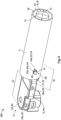
where - Fig. 1
- shows a schematic perspective exploded view of a connection assembly with an electrical conductor and a touch protection device according to an exemplary embodiment;
- Fig. 2
- shows a schematic perspective view of a first assembly step of the connection assembly from
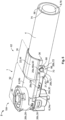
Figure 1 ; - Fig. 3
- shows a schematic perspective view of a second assembly step of the connection assembly from
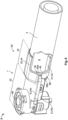
Figure 1 ; - Fig. 4
- shows a schematic perspective view of a third assembly step of the connection assembly from
Figure 1 ; - Fig. 5
- shows a schematic perspective view of a fourth assembly step of the connection assembly from
Figure 1 ; and - Fig. 6
- shows a schematic perspective view of the connection assembly from
Figure 5 as a partial section. - The schematic structure of a touch protection device 1 according to the invention and a
connection assembly 2 according to the invention of an exemplary embodiment shall be described hereafter with reference toFigures 1 to 6 . - As may be seen from
Figure 1 , touch protection device 1 in the exemplary embodiment may comprise an insulatingtube 4 and a housing 6.Connection assembly 2 in turn comprises touch protection device 1 and a preferably elongateelectrical conductor 8. - Insulating
tube 4 is advantageously configured separately so that it may be drawn ontoelectrical conductor 8. In particular, insulatingtube 4 may be slipped overelectrical conductor 8 from one end ofelectrical conductor 8. Insulatingtube 4 may there receiveelectrical conductor 8 subject to play.In other words, aninner diameter 14 of insulatingtube 4 is greater than anouter diameter 16 ofelectrical conductor 8. This is shown most clearly inFigure 4 . - Alternatively, insulating
tube 4 may also receiveelectrical conductor 8 with an exact fit wheninner diameter 14 of insulatingtube 4 corresponds toouter diameter 16 ofelectrical conductor 8. Alternatively, insulatingtube 4 andelectrical conductor 8 may further be connected to one another by way of a force fit in thatinner diameter 14 of insulatingtube 4 is selected to be at least slightly smaller thanouter diameter 16 ofelectrical conductor 8. - Insulating
tube 4 and housing 6 are each made of electrically insulating materials. Insulatingtube 4 is further made of expandable elastic material, for example, silicone, at least at oneend region 10 of insulatingtube 4. In particular, entire insulatingtube 4 may be made from this material as a soft component and is stretchable compared to housing 6. Insulatingtube 4 may optionally be configured to be heat-resistant. For this purpose, glass fiber mesh may be incorporated into the material of insulatingtube 4. - Housing 6 is made of a material which is dimensionally stable at least in comparison to end
region 10 of insulatingtube 4. Furthermore, housing 6 is configured to receiveend 12 ofelectrical conductor 8. In particular, end 12 ofelectrical conductor 8 may project fromend region 10 of insulatingtube 4 and be received in housing 6. For this purpose, housing 6 may comprise a receivingsection 32 which surroundsend 12 ofelectrical conductor 8 in a shell-like manner (seeFigure 3 ). - As may also be seen from
Figure 1 , housing 6 has a preferably sleeve-shapedend section 18 pointing to insulatingtube 4 and comprising a first segment 21 and a second segment 22 with respect to insulatingtube 4 following first segment 21 incircumferential direction 20.End section 18 and receivingsection 32 of housing 6 may be arranged with respect to insulatingtube 4 next to one another inlongitudinal direction 34 and be shaped to be monolithic. - First segment 21 may be inserted into insulating
tube 4 and second segment 22 is configured such that it may be placed onto insulatingtube 4. In other words, second segment 22 may be placed at the same time as first segment 21 is inserted or when first segment 21 has already been inserted into insulatingtube 4. - First segment 21 and second segment 22 together form
end section 18 of housing 6 and are each separated from one another by agap 36 extending inlongitudinal direction 34. Housing 6 comprises, for example, twogaps 36, wherewall 46 of insulatingtube 4 extends incircumferential direction 20 through one of twogaps 36 from outside housing 6 to the inside and through the other of twogaps 36 from inside housing 6 to the outside.Wall 46 of insulatingtube 4 respectively is lead through between first segment 21 and second segment 22. - It is also conceivable that housing 6 comprises any even number of gaps that are distributed in
circumferential direction 20 atend section 18 of housing 6 and each separate an even number of segments formingend section 18 of housing 6 from one another.Wall 46 of insulatingtube 4 then alternately extends incircumferential direction 20 through one of the gaps from outside housing 6 to the inside and through the gap adjacent incircumferential direction 20 from inside housing 6 to the outside. In particular, insulatingtube 4 is lead through between two adjacent segments incircumferential direction 20. - In the exemplary embodiment shown, housing 6 is formed from two housing halves 24a, 24b, where one of two housing halves 24a comprises first segment 21 and the other of two housing halves 24b comprises second segment 22. Furthermore, two housing halves 24a, 24b each together form
end section 18 and receivingsection 32 of housing 6. - First segment 21 continues receiving
section 32 of first housing half 24a in a semitubular manner. Second segment 22 accordingly continues receivingsection 32 of second housing half 24b in a semitubular manner, where aninner diameter 40 of second segment 22 is greater than anouter diameter 38 of first segment 21. - In particular, first segment 21 forms a circumferential segment 42 of
end section 18 which surroundselectrical conductor 8 in part from the outside incircumferential direction 20 and is in turn surrounded on the outside by insulatingtube 4. Second segment 22 forms a remaining segment 44 ofend section 18 which surrounds insulatingtube 4 at least in part from the outside. Remaining segment 24 there supplements circumferential segment 42 towardend section 18 of housing 6. - Housing halves 24a, 24b are configured to be joined. In the embodiment shown in
Figure 1 , housing halves 24a, 24b each comprisejaw sections radial direction 60 when housing halves 24a, 24b are joined.Gaps 36 each run betweenjaw sections - Furthermore, housing halves 24a, 24b are each shown in
Figure 1 as separate components, but may also be connected to one another in a pivotable manner by way of a hinge. In addition, two housing halves 24a, 24b comprise latchingelements tabs 28 as latchingelements 26a. Second housing half 24b comprises latchingwindows 30 that are complementary thereto as latchingelements 26b, into which latchingtabs 28 hook in a latching manner (seeFigure 5 ). Alternatively or additionally, housing halves 24a, 24b may be screwed, adhesively bonded, and/or welded together. - As may also be seen from
Figure 1 ,end section 18 of housing 6 and insulatingtube 4 each comprise mutually complementary positive-fit elements 48a, 48b for establishing a positive-fit connection. One of positive-fit elements 48a is preferably configured as aprojection 50 and another of positive-fit elements 48a is configured as a receptacle that is complementary to projection 52. Unlike the pin shape shown inFigure 1 ,projection 50 may also be configured in the shape of a mandrel or a dome. - Positive-fit element 48b configured as a receptacle 52 is disposed on insulating
tube 4, preferably inend region 10 of insulatingtube 4, and is formed by a passage opening 52. Passage opening 54 extends as a circular hole from inside 56 of insulatingtube 4 to the outside. Optionally, passage opening 54 may correspond in its the cross section to the projection. - Positive-
fit element 48a configured as aprojection 50 is accordingly disposed on first segment 21 ofend section 18 of housing 6.Projection 50 projects from first segment 21 perpendicular tolongitudinal direction 34 inradial direction 60 and protrudes through passage opening 54 so that a relative displacement inlongitudinal direction 34 between insulatingtube 4 and first segment 21 is prevented (seeFigures 4 and5 ). In particular,projection 50penetrates insulating tube 4 only once. - Positive-
fit element 48a configured as aprojection 50 may furthermore comprise afree end 66, wherefree end 66 comprises a latchingbead 68. Latchingbead 68 runs aroundfree end 66 at least in sections and thereby gives projection 50 a mushroom-like shape. -
Projection 50 may also serve as a latchingelement 26a on first housing half 24a. For this purpose,projection 50 may be configured to be flattened on a side facing away from second housing half 24b. This creates a bearingsurface 70 for associated latchingelement 26b of second housing half 24b which is formed, for example, by a claw-shapedlatching hook 72 or a pair of claw-shaped latching hooks 72 which, when housing halves 24a, 24b are joined, engage aroundfree end 66 ofprojection 50 and latch onto bearing surface. 70 (seeFigure 5 ). - The pair of claw-shaped latching hooks 72 also fulfills a function of a radial lock which locks insulating
tube 4 inradial direction 60 on first segment 21. In other words, the pair of claw-shaped latching hooks 72 prevents insulatingtube 4 from being removed unintentionally inradial direction 60 from first segment 21. Latchingbead 68 onfree end 66 ofprojection 50 again advantageously prevents the pair of claw-shaped latching hooks 72 from unintentionally deflecting or slipping off inradial direction 60 and thereby additionally supports the radial lock. - Alternatively, the radial lock may also be implemented by a separate locking clip (not shown) which is mounted on
free end 66 ofprojection 50. In the mounted state, the locking clip may provide a stop surface that points towards insulatingtube 4 and that is in particular larger than the cross-sectional area of passage opening 54 and thereby prevents insulatingtube 4 from being removed fromprojection 50 over the locking clip. - As may be seen from
Figure 1 , several pairs of positive-fit elements 48a, 48b may be arranged distributed over the circumference, preferably uniformly, onend section 18 of housing 6 and on insulatingtube 4. Pairs of positive-fit elements 48a, 48b may also be distributed with non-uniform spacing over the circumference as long as the angular distances between positive-fit elements 48a of housing 6 correspond to the angular distances between positive-fit elements 48b of insulatingtube 4. - In the exemplary embodiment shown, two pairs of positive-
fit elements 48a, 48b are disposed diametrically opposite one another. In particular, first housing half 24a comprises twoprojections 50 which project from first segment 21 in opposite directions. Accordingly, insulatingtube 4 comprises two passage openings 54 which are arranged on radially oppositely disposed sides of insulatingtube 4. - In
Figures 1 to 6 ,electrical conductor 8 is shown as a round conductor 76. In particular,electrical conductor 8 may be an electricallyconductive braid 74 with a round cross-sectional area. However, the shape ofelectrical conductor 8 is not restricted thereto and may be adapted to the respective application. - In the exemplary embodiment shown, end 12 of
electrical conductor 8 is configured as a battery contact 80. In other words, a contact element 82 is attached to end 12 ofelectrical conductor 8 and configured to be connected to a battery, in particular to a traction battery or a battery module of an electric vehicle. - To attach contact element 82 to the battery,
connection assembly 2 comprises an attachment element, such as ascrew 84.Screw 84 is optionally made of a metal material and may comprise an electrically insulatingprotective cap 86 which, together with touch protection device 1, prevents the electrically conductive components ofconnection assembly 2 from being touched unintentionally. - The assembly of the exemplary embodiment shown of connecting
arrangement 2 may be carried out as follows:
In afirst assembly step 101, insulatingtube 4 is drawn overend 12 ofelectrical conductor 8 ontoelectrical conductor 8 and positioned spaced fromend 12 of electrical conductor 8 (seeFigure 2 ). - In a
second assembly step 102, end 12 ofelectrical conductor 8 is placed into receivingsection 32 of first housing half 24a (seeFigure 3 ). Alternatively, first housing half 24a may of course also be placed onend 12 ofelectrical conductor 8. - In a
third assembly step 103,end region 10 of insulatingtube 4 is widened, for example, manually or with a special tool, and drawn over first segment 21 of first housing half 24a. Alternatively, first segment 21 of first housing half 24a may also be inserted together withelectrical conductor 8 into widenedend region 10 of insulatingtube 4. It is important there that positive-fit elements 48a, 48b are aligned in pairs.End region 10 of insulatingtube 4 is then relaxed so that positive-fit elements 48a, 48b engage in pairs (seeFigure 4 ). - In a
fourth assembly step 104, second housing half 24b is joined with first housing half 24a so that latchingelements end region 10 of insulatingtube 4, wherepart 88 of insulatingtube 4 remains visible (seeFigure 5 ). -
Free end 66 ofprojection 50 may optionally be chamfered. In other words,free end 66 may have a chamfer (not shown) which is directed towards insulatingtube 4 and contributes to endregion 10 of insulatingtube 4 expanding by itself inthird assembly step 103 when first segment 21 is inserted. - As a result of
third assembly step 103,end region 10 of insulatingtube 4 is stretched over first segment 21 ofend section 18 so that first segment 21 and insulatingtube 4 enter into a frictionally-engaged connection. - Furthermore, insulating
tube 4 may be pressed between first segment 21 and second segment 22 ofend section 18. In particular,jaw sections tube 4 to create a further frictionally-engaged connection (seeFigure 6 ). - As an alternative embodiment not shown in the figures, it is also conceivable to manufacture housing 6 in one piece or integrally. As part of the assembly, first segment 21 would there be inserted in
longitudinal direction 34 into insulatingtube 4 and at the same time second segment 22 would be mounted onto insulatingtube 4 inlongitudinal direction 34 whilewall 46 of insulatingtube 4 would slide in a direction opposite tolongitudinal direction 34 intogap 36. - For establishing the positive-fit connection already mentioned above, first segment 21 of housing 6 formed integrally may comprise pin-shaped
projection 50, preferably on a side facing away from second segment 22. In particular,projection 50 may extend away from second segment 22 inradial direction 60. Passage opening 54 is accordingly formed on insulatingtube 4. - As part of the assembly of this embodiment, insulating
tube 4 and housing 6 may initially be aligned relative to one another in such a way that passage opening 54 andprojection 50 are aligned inlongitudinal direction 34. Insulatingtube 4 on its side inlongitudinal direction 34 which is aligned withprojection 50 may subsequently be stretched on one side inradial direction 60 so thatprojection 50 does not hinder the insertion of first segment 21 into insulatingtube 4. First segment 21 may then be inserted into insulatingtube 4 until passage opening 54 is aligned with projection 54 inradial direction 60. Finally, insulatingtube 4 with passage opening 54 may be mounted onprojection 50 to thereby obtain the positive-fit connection. - In the embodiment with an integrally formed housing 6, the positive-fit connection between insulating
tube 4 and housing 6 may optionally be locked with the locking clip already described above. - In addition or as an alternative to the positive-fit and frictionally-engaged connections already described, the connection assembly may also comprise a further similarly configured housing which is arranged at the oppositely disposed other end of the electrical conductor. The insulating tube may be held between the housing and the further housing to lock it in position in the longitudinal direction.
-
- 1
- touch protection device
- 2
- connection assembly
- 4
- insulating tube
- 6
- housing
- 8
- conductor
- 10
- end region
- 12
- end
- 14
- inner diameter
- 16
- outer diameter
- 18
- end section
- 20
- circumferential direction
- 21
- first segment
- 22
- second segment
- 24a, 24b
- housing half
- 26a, 26b
- latching element
- 28
- latching tab
- 30
- latching window
- 32
- receiving section
- 34
- longitudinal direction
- 36
- gap
- 38
- outer diameter
- 40
- inner diameter
- 42
- circumferential segment
- 44
- remaining segment
- 46
- wall
- 48a, 48b
- positive-fit element
- 50
- projection
- 52
- receptacle
- 54
- passage opening
- 56
- interior
- 58a, 58b
- jaw section
- 60
- radial direction
- 62
- state
- 64
- cross section
- 66
- free end
- 68
- latching bead
- 70
- bearing surface
- 72
- latching hook
- 74
- braid
- 76
- round conductor
- 80
- battery contact
- 82
- contact element
- 84
- screw
- 86
- protective cap
- 88
- part
- 101
- first assembly step
- 102
- second assembly step
- 103
- third assembly step
- 104
- fourth assembly step
Claims (14)
- Electrically insulating touch protection device (1) for an end (12) of an electrical conductor (8) with an insulating tube (4) made of expandable material and with a housing (6) which is configured to receive said end (12) of said electrical conductor (8), wherein said housing (6) comprises an end section (18), which points towards said insulating tube (4) in longitudinal direction, with a first segment (21) and a second segment (22), wherein said first segment (21) is inserted into said insulating tube (4) in the longitudinal direction and said second segment (22) is placed onto said insulating tube (4), wherein said insulating tube (4) is stretched at least in part over said first segment (21) of said end section (18).
- Touch protection device (1) according to claim 1, wherein said first segment (21) and said second segment (22) are separated from one another by a gap (36).
- Touch protection device (1) according to claim 2, wherein said housing (6) comprises two gaps (36), wherein said insulating tube (4) extends through one of said two gaps (36) from outside said housing (6) to the inside and through the other of said two gaps (36) from inside said housing (6) to the outside.
- Touch protection device (1) according to one of the claims 1 to 3, wherein said housing (6) is formed from two housing halves (24a, 24b), wherein one of said two housing halves (24a) comprises said first segment (21) of said end section (18) of said housing (6), and wherein the other of said two housing halves (24b) comprises said second segment (22) of said end section (18) of said housing (6).
- Touch protection device (1) according to claim 4, wherein said two housing halves (24a, 24b) each comprise mutually complementary latching elements (26a, 26b).
- Touch protection device (1) according to one of the claims 1 to 5, wherein said end section (18) of said housing (6) and said insulating tube (4) each comprise mutually complementary positive-fit elements (48a, 48b).
- Touch protection device (1) according to claim 6, wherein one of said positive-fit elements (48a) is configured as a projection (50) and another of said positive-fit elements (48b) is configured as a receptacle (52) that is complementary to said projection (50).
- Touch protection device (1) according to claim 7, wherein said positive-fit element (48b) configured as a receptacle (52) is disposed on said insulating tube (4) and is configured as a passage opening (54).
- Touch protection device (1) according to claim 7 or 8, wherein said positive-fit element (48a) configured as a projection (50) comprises a free end (66), and wherein said free end (66) comprises a latching bead (68).
- Touch protection device (1) according to one of the claims 1 to 9, wherein said second segment (22) of said end section (18) comprises a radial lock which locks said insulating tube (4) on said first segment (21).
- Touch protection device (1) according to claims 5 and 10, wherein at least one of said latching elements (26b) is arranged on said second segment (22) and forms said radial lock.
- Touch protection device (1) according to one of the claims 6 to 11, wherein several pairs of positive-fit elements (48a, 48b) are distributed on said end section (18) of said housing (6) and said insulating tube (4).
- Connection assembly (2) with a touch protection device (1) according to one of the claims 1 to 12 and with an electrical conductor (8), wherein said end (12) of said electrical conductor (8) is disposed in said insulating tube (4) and in said housing (6) of said touch protection device (1), wherein said first segment (21) of said end section (18) is inserted into said insulating tube (4) and said second segment (22) of said end section (18) is mounted on said insulating tube (4).
- Connection assembly (2) according to claim 13, wherein said end (12) of said electrical conductor (8) is configured as a battery contact (80).
Applications Claiming Priority (1)
| Application Number | Priority Date | Filing Date | Title |
|---|---|---|---|
| DE102021107713.3A DE102021107713A1 (en) | 2021-03-26 | 2021-03-26 | ELECTRICALLY ISOLATED TOUCH PROTECTION DEVICE AND CONNECTION ARRANGEMENT WITH SUCH SUCH TOUCH PROTECTION DEVICE |
Publications (2)
| Publication Number | Publication Date |
|---|---|
| EP4064487A1 EP4064487A1 (en) | 2022-09-28 |
| EP4064487B1 true EP4064487B1 (en) | 2025-04-16 |
Family
ID=80953334
Family Applications (1)
| Application Number | Title | Priority Date | Filing Date |
|---|---|---|---|
| EP22164599.7A Active EP4064487B1 (en) | 2021-03-26 | 2022-03-28 | Electrically insulating touch protection device and connection assembly with such a touch protection device |
Country Status (6)
| Country | Link |
|---|---|
| US (1) | US12212093B2 (en) |
| EP (1) | EP4064487B1 (en) |
| JP (1) | JP7401584B2 (en) |
| KR (1) | KR102731963B1 (en) |
| CN (1) | CN115133320B (en) |
| DE (1) | DE102021107713A1 (en) |
Families Citing this family (1)
| Publication number | Priority date | Publication date | Assignee | Title |
|---|---|---|---|---|
| DE102020119321A1 (en) * | 2020-07-22 | 2022-01-27 | Te Connectivity Germany Gmbh | Electrical plug connection as well as electrical connectors and mating connectors |
Family Cites Families (17)
| Publication number | Priority date | Publication date | Assignee | Title |
|---|---|---|---|---|
| US6321126B1 (en) * | 1998-12-07 | 2001-11-20 | Advanced Bionics Corporation | Implantable connector |
| JP2001257016A (en) | 2000-03-09 | 2001-09-21 | Sumitomo Wiring Syst Ltd | Structure to prevent incorrect connection of booster cable |
| JP2003077940A (en) * | 2001-09-06 | 2003-03-14 | Sony Corp | Device transfer method, device array method using the same, and image display device manufacturing method |
| US7218510B2 (en) * | 2001-11-08 | 2007-05-15 | Apple Computer, Inc. | Computer controlled display device |
| US7303422B2 (en) * | 2003-06-04 | 2007-12-04 | Neurostream Technologies | Implantable modular, multi-channel connector system for nerve signal sensing and electrical stimulation applications |
| DE102004038123B4 (en) * | 2004-08-05 | 2006-06-08 | Tyco Electronics Amp Gmbh | Electrical plug and electrical plug receptacle |
| DE202009015571U1 (en) | 2009-11-14 | 2011-03-24 | Wieland Electric Gmbh | Electrical connector |
| FR2957463B1 (en) * | 2010-03-09 | 2012-09-28 | Bontaz Centre Sa | ELECTRICAL CONNECTION DEVICE SEALED THROUGH A WALL |
| US10312700B2 (en) * | 2012-12-21 | 2019-06-04 | Nathan R. Roberts | Storage and charging station system for portable electronic devices |
| DE102014115859A1 (en) * | 2014-10-30 | 2016-05-04 | Albert-Ludwigs-Universität Freiburg | Implantable connector |
| JP6240640B2 (en) | 2015-09-14 | 2017-11-29 | 矢崎総業株式会社 | Wire harness and method of manufacturing wire harness |
| DE102016109882A1 (en) * | 2016-05-30 | 2017-11-30 | Rema Lipprandt Gmbh & Co. Kg | Quick disconnectable electrical connector and method for contacting an electrical contact element with an electrical conductor |
| JP6704806B2 (en) * | 2016-07-01 | 2020-06-03 | ホシデン株式会社 | Connector module and vehicle-mounted camera using the same |
| US11645952B2 (en) * | 2016-09-19 | 2023-05-09 | Peter W. Cheung | Apparatus and system for a universally mountable digit-roll display unit |
| DE102017210425A1 (en) * | 2017-06-21 | 2018-12-27 | Te Connectivity Germany Gmbh | module connector |
| EP3767750B1 (en) | 2019-07-16 | 2022-03-02 | Rosenberger Hochfrequenztechnik GmbH & Co. KG | Electric connector, insulated safety element and method for mounting an electrical connector |
| DE202019106641U1 (en) * | 2019-11-28 | 2020-01-15 | Te Connectivity Germany Gmbh | Arrangement for attaching an insulator sleeve to an electrical conductor |
-
2021
- 2021-03-26 DE DE102021107713.3A patent/DE102021107713A1/en active Pending
-
2022
- 2022-03-23 CN CN202210291191.6A patent/CN115133320B/en active Active
- 2022-03-23 JP JP2022046553A patent/JP7401584B2/en active Active
- 2022-03-25 US US17/704,908 patent/US12212093B2/en active Active
- 2022-03-25 KR KR1020220037312A patent/KR102731963B1/en active Active
- 2022-03-28 EP EP22164599.7A patent/EP4064487B1/en active Active
Also Published As
| Publication number | Publication date |
|---|---|
| DE102021107713A1 (en) | 2022-09-29 |
| EP4064487A1 (en) | 2022-09-28 |
| KR20220134480A (en) | 2022-10-05 |
| US20220311172A1 (en) | 2022-09-29 |
| KR102731963B1 (en) | 2024-11-18 |
| JP2022151797A (en) | 2022-10-07 |
| US12212093B2 (en) | 2025-01-28 |
| CN115133320A (en) | 2022-09-30 |
| JP7401584B2 (en) | 2023-12-19 |
| CN115133320B (en) | 2026-04-10 |
Similar Documents
| Publication | Publication Date | Title |
|---|---|---|
| US8747157B2 (en) | Connector | |
| EP2681808B1 (en) | Connector with housing having spacer including a pair of projections | |
| EP3107155B1 (en) | Electrical connector system with shielding sleeve and method thereof | |
| EP2415128B1 (en) | Coaxial connector with inner shielding arrangement and method of assembling one | |
| CN110770982A (en) | Electrical plug with protective conductor contact and protective conductor connector element integrally formed to ground outer portion | |
| EP4064487A1 (en) | Electrically insulating touch protection device and connection assembly with such a touch protection device | |
| US20230027106A1 (en) | Wire harness | |
| KR102865226B1 (en) | Securing sleeve with positive locking elements | |
| CN112825399B (en) | Crimping connector and crimping method for crimping assemblies with retaining shoulders | |
| JP7551471B2 (en) | Apparatus for attaching insulating sleeves to electrical conductors | |
| US6475037B1 (en) | Contact element made of sheet-metal material | |
| US20240186748A1 (en) | Connector, mating connector, and connector system | |
| US12500366B2 (en) | Electrical plug connector and method for assembling an electrical plug connector | |
| WO2019170558A1 (en) | Sealing unit for a conductor and electrical connector | |
| US8506329B2 (en) | Method and system for a connector alignment insert | |
| CN211062930U (en) | Insulator | |
| KR102657454B1 (en) | Right angle type connector | |
| CN220306557U (en) | Female connector | |
| CN106205903A (en) | A kind of electric automobile copper bar insulation protection structure and a kind of electric automobile | |
| JPH10172663A (en) | Connector | |
| CN220306558U (en) | Male connector | |
| KR100797221B1 (en) | Shield connector with excellent electrical contact reliability | |
| CN117080811A (en) | Via hole connector |
Legal Events
| Date | Code | Title | Description |
|---|---|---|---|
| PUAI | Public reference made under article 153(3) epc to a published international application that has entered the european phase |
Free format text: ORIGINAL CODE: 0009012 |
|
| STAA | Information on the status of an ep patent application or granted ep patent |
Free format text: STATUS: THE APPLICATION HAS BEEN PUBLISHED |
|
| AK | Designated contracting states |
Kind code of ref document: A1 Designated state(s): AL AT BE BG CH CY CZ DE DK EE ES FI FR GB GR HR HU IE IS IT LI LT LU LV MC MK MT NL NO PL PT RO RS SE SI SK SM TR |
|
| STAA | Information on the status of an ep patent application or granted ep patent |
Free format text: STATUS: REQUEST FOR EXAMINATION WAS MADE |
|
| 17P | Request for examination filed |
Effective date: 20230328 |
|
| RBV | Designated contracting states (corrected) |
Designated state(s): AL AT BE BG CH CY CZ DE DK EE ES FI FR GB GR HR HU IE IS IT LI LT LU LV MC MK MT NL NO PL PT RO RS SE SI SK SM TR |
|
| GRAP | Despatch of communication of intention to grant a patent |
Free format text: ORIGINAL CODE: EPIDOSNIGR1 |
|
| STAA | Information on the status of an ep patent application or granted ep patent |
Free format text: STATUS: GRANT OF PATENT IS INTENDED |
|
| INTG | Intention to grant announced |
Effective date: 20241126 |
|
| GRAS | Grant fee paid |
Free format text: ORIGINAL CODE: EPIDOSNIGR3 |
|
| GRAA | (expected) grant |
Free format text: ORIGINAL CODE: 0009210 |
|
| STAA | Information on the status of an ep patent application or granted ep patent |
Free format text: STATUS: THE PATENT HAS BEEN GRANTED |
|
| AK | Designated contracting states |
Kind code of ref document: B1 Designated state(s): AL AT BE BG CH CY CZ DE DK EE ES FI FR GB GR HR HU IE IS IT LI LT LU LV MC MK MT NL NO PL PT RO RS SE SI SK SM TR |
|
| REG | Reference to a national code |
Ref country code: GB Ref legal event code: FG4D |
|
| REG | Reference to a national code |
Ref country code: CH Ref legal event code: EP Ref country code: DE Ref legal event code: R096 Ref document number: 602022013095 Country of ref document: DE |
|
| REG | Reference to a national code |
Ref country code: IE Ref legal event code: FG4D |
|
| REG | Reference to a national code |
Ref country code: NL Ref legal event code: MP Effective date: 20250416 |
|
| PG25 | Lapsed in a contracting state [announced via postgrant information from national office to epo] |
Ref country code: NL Free format text: LAPSE BECAUSE OF FAILURE TO SUBMIT A TRANSLATION OF THE DESCRIPTION OR TO PAY THE FEE WITHIN THE PRESCRIBED TIME-LIMIT Effective date: 20250416 |
|
| REG | Reference to a national code |
Ref country code: AT Ref legal event code: MK05 Ref document number: 1786475 Country of ref document: AT Kind code of ref document: T Effective date: 20250416 |
|
| PG25 | Lapsed in a contracting state [announced via postgrant information from national office to epo] |
Ref country code: FI Free format text: LAPSE BECAUSE OF FAILURE TO SUBMIT A TRANSLATION OF THE DESCRIPTION OR TO PAY THE FEE WITHIN THE PRESCRIBED TIME-LIMIT Effective date: 20250416 Ref country code: PT Free format text: LAPSE BECAUSE OF FAILURE TO SUBMIT A TRANSLATION OF THE DESCRIPTION OR TO PAY THE FEE WITHIN THE PRESCRIBED TIME-LIMIT Effective date: 20250818 Ref country code: ES Free format text: LAPSE BECAUSE OF FAILURE TO SUBMIT A TRANSLATION OF THE DESCRIPTION OR TO PAY THE FEE WITHIN THE PRESCRIBED TIME-LIMIT Effective date: 20250416 |
|
| REG | Reference to a national code |
Ref country code: LT Ref legal event code: MG9D |
|
| PG25 | Lapsed in a contracting state [announced via postgrant information from national office to epo] |
Ref country code: NO Free format text: LAPSE BECAUSE OF FAILURE TO SUBMIT A TRANSLATION OF THE DESCRIPTION OR TO PAY THE FEE WITHIN THE PRESCRIBED TIME-LIMIT Effective date: 20250716 Ref country code: GR Free format text: LAPSE BECAUSE OF FAILURE TO SUBMIT A TRANSLATION OF THE DESCRIPTION OR TO PAY THE FEE WITHIN THE PRESCRIBED TIME-LIMIT Effective date: 20250717 |
|
| PG25 | Lapsed in a contracting state [announced via postgrant information from national office to epo] |
Ref country code: PL Free format text: LAPSE BECAUSE OF FAILURE TO SUBMIT A TRANSLATION OF THE DESCRIPTION OR TO PAY THE FEE WITHIN THE PRESCRIBED TIME-LIMIT Effective date: 20250416 |
|
| PG25 | Lapsed in a contracting state [announced via postgrant information from national office to epo] |
Ref country code: BG Free format text: LAPSE BECAUSE OF FAILURE TO SUBMIT A TRANSLATION OF THE DESCRIPTION OR TO PAY THE FEE WITHIN THE PRESCRIBED TIME-LIMIT Effective date: 20250416 |
|
| PG25 | Lapsed in a contracting state [announced via postgrant information from national office to epo] |
Ref country code: HR Free format text: LAPSE BECAUSE OF FAILURE TO SUBMIT A TRANSLATION OF THE DESCRIPTION OR TO PAY THE FEE WITHIN THE PRESCRIBED TIME-LIMIT Effective date: 20250416 |
|
| PG25 | Lapsed in a contracting state [announced via postgrant information from national office to epo] |
Ref country code: AT Free format text: LAPSE BECAUSE OF FAILURE TO SUBMIT A TRANSLATION OF THE DESCRIPTION OR TO PAY THE FEE WITHIN THE PRESCRIBED TIME-LIMIT Effective date: 20250416 |
|
| PG25 | Lapsed in a contracting state [announced via postgrant information from national office to epo] |
Ref country code: RS Free format text: LAPSE BECAUSE OF FAILURE TO SUBMIT A TRANSLATION OF THE DESCRIPTION OR TO PAY THE FEE WITHIN THE PRESCRIBED TIME-LIMIT Effective date: 20250716 |
|
| PG25 | Lapsed in a contracting state [announced via postgrant information from national office to epo] |
Ref country code: IS Free format text: LAPSE BECAUSE OF FAILURE TO SUBMIT A TRANSLATION OF THE DESCRIPTION OR TO PAY THE FEE WITHIN THE PRESCRIBED TIME-LIMIT Effective date: 20250816 |
|
| PG25 | Lapsed in a contracting state [announced via postgrant information from national office to epo] |
Ref country code: LV Free format text: LAPSE BECAUSE OF FAILURE TO SUBMIT A TRANSLATION OF THE DESCRIPTION OR TO PAY THE FEE WITHIN THE PRESCRIBED TIME-LIMIT Effective date: 20250416 |
|
| PG25 | Lapsed in a contracting state [announced via postgrant information from national office to epo] |
Ref country code: DK Free format text: LAPSE BECAUSE OF FAILURE TO SUBMIT A TRANSLATION OF THE DESCRIPTION OR TO PAY THE FEE WITHIN THE PRESCRIBED TIME-LIMIT Effective date: 20250416 Ref country code: SM Free format text: LAPSE BECAUSE OF FAILURE TO SUBMIT A TRANSLATION OF THE DESCRIPTION OR TO PAY THE FEE WITHIN THE PRESCRIBED TIME-LIMIT Effective date: 20250416 |
|
| PGFP | Annual fee paid to national office [announced via postgrant information from national office to epo] |
Ref country code: FR Payment date: 20251231 Year of fee payment: 5 |
|
| REG | Reference to a national code |
Ref country code: DE Ref legal event code: R097 Ref document number: 602022013095 Country of ref document: DE |
|
| PG25 | Lapsed in a contracting state [announced via postgrant information from national office to epo] |
Ref country code: CZ Free format text: LAPSE BECAUSE OF FAILURE TO SUBMIT A TRANSLATION OF THE DESCRIPTION OR TO PAY THE FEE WITHIN THE PRESCRIBED TIME-LIMIT Effective date: 20250416 |
|
| PG25 | Lapsed in a contracting state [announced via postgrant information from national office to epo] |
Ref country code: EE Free format text: LAPSE BECAUSE OF FAILURE TO SUBMIT A TRANSLATION OF THE DESCRIPTION OR TO PAY THE FEE WITHIN THE PRESCRIBED TIME-LIMIT Effective date: 20250416 |
|
| PG25 | Lapsed in a contracting state [announced via postgrant information from national office to epo] |
Ref country code: SK Free format text: LAPSE BECAUSE OF FAILURE TO SUBMIT A TRANSLATION OF THE DESCRIPTION OR TO PAY THE FEE WITHIN THE PRESCRIBED TIME-LIMIT Effective date: 20250416 |
|
| PLBE | No opposition filed within time limit |
Free format text: ORIGINAL CODE: 0009261 |
|
| STAA | Information on the status of an ep patent application or granted ep patent |
Free format text: STATUS: NO OPPOSITION FILED WITHIN TIME LIMIT |
|
| REG | Reference to a national code |
Ref country code: CH Ref legal event code: L10 Free format text: ST27 STATUS EVENT CODE: U-0-0-L10-L00 (AS PROVIDED BY THE NATIONAL OFFICE) Effective date: 20260225 |
|
| 26N | No opposition filed |
Effective date: 20260119 |
|
| PGFP | Annual fee paid to national office [announced via postgrant information from national office to epo] |
Ref country code: DE Payment date: 20260102 Year of fee payment: 5 |
|
| PGFP | Annual fee paid to national office [announced via postgrant information from national office to epo] |
Ref country code: IT Payment date: 20260220 Year of fee payment: 5 |