EP4064479B1 - Caisson de supportage, armoire électrique de raccordement comprenant un tel caisson de supportage et procédé d assemblage d'une telle armoire électrique - Google Patents
Caisson de supportage, armoire électrique de raccordement comprenant un tel caisson de supportage et procédé d assemblage d'une telle armoire électrique Download PDFInfo
- Publication number
- EP4064479B1 EP4064479B1 EP22164364.6A EP22164364A EP4064479B1 EP 4064479 B1 EP4064479 B1 EP 4064479B1 EP 22164364 A EP22164364 A EP 22164364A EP 4064479 B1 EP4064479 B1 EP 4064479B1
- Authority
- EP
- European Patent Office
- Prior art keywords
- box
- frame
- framework
- electrical
- support box
- Prior art date
- Legal status (The legal status is an assumption and is not a legal conclusion. Google has not performed a legal analysis and makes no representation as to the accuracy of the status listed.)
- Active
Links
Images





Classifications
-
- H—ELECTRICITY
- H02—GENERATION; CONVERSION OR DISTRIBUTION OF ELECTRIC POWER
- H02B—BOARDS, SUBSTATIONS OR SWITCHING ARRANGEMENTS FOR THE SUPPLY OR DISTRIBUTION OF ELECTRIC POWER
- H02B1/00—Frameworks, boards, panels, desks, casings; Details of substations or switching arrangements
- H02B1/26—Casings; Parts thereof or accessories therefor
- H02B1/30—Cabinet-type casings; Parts thereof or accessories therefor
- H02B1/32—Mounting of devices therein
- H02B1/34—Racks
-
- H—ELECTRICITY
- H02—GENERATION; CONVERSION OR DISTRIBUTION OF ELECTRIC POWER
- H02B—BOARDS, SUBSTATIONS OR SWITCHING ARRANGEMENTS FOR THE SUPPLY OR DISTRIBUTION OF ELECTRIC POWER
- H02B1/00—Frameworks, boards, panels, desks, casings; Details of substations or switching arrangements
- H02B1/26—Casings; Parts thereof or accessories therefor
- H02B1/30—Cabinet-type casings; Parts thereof or accessories therefor
- H02B1/32—Mounting of devices therein
- H02B1/34—Racks
- H02B1/36—Racks with withdrawable units
-
- H—ELECTRICITY
- H02—GENERATION; CONVERSION OR DISTRIBUTION OF ELECTRIC POWER
- H02B—BOARDS, SUBSTATIONS OR SWITCHING ARRANGEMENTS FOR THE SUPPLY OR DISTRIBUTION OF ELECTRIC POWER
- H02B1/00—Frameworks, boards, panels, desks, casings; Details of substations or switching arrangements
- H02B1/26—Casings; Parts thereof or accessories therefor
- H02B1/30—Cabinet-type casings; Parts thereof or accessories therefor
-
- H—ELECTRICITY
- H02—GENERATION; CONVERSION OR DISTRIBUTION OF ELECTRIC POWER
- H02B—BOARDS, SUBSTATIONS OR SWITCHING ARRANGEMENTS FOR THE SUPPLY OR DISTRIBUTION OF ELECTRIC POWER
- H02B1/00—Frameworks, boards, panels, desks, casings; Details of substations or switching arrangements
- H02B1/01—Frameworks
- H02B1/012—Details of mechanical connections
-
- H—ELECTRICITY
- H02—GENERATION; CONVERSION OR DISTRIBUTION OF ELECTRIC POWER
- H02B—BOARDS, SUBSTATIONS OR SWITCHING ARRANGEMENTS FOR THE SUPPLY OR DISTRIBUTION OF ELECTRIC POWER
- H02B1/00—Frameworks, boards, panels, desks, casings; Details of substations or switching arrangements
- H02B1/015—Boards, panels, desks; Parts thereof or accessories therefor
- H02B1/04—Mounting thereon of switches or of other devices in general, the switch or device having, or being without, casing
- H02B1/052—Mounting on rails
-
- H—ELECTRICITY
- H02—GENERATION; CONVERSION OR DISTRIBUTION OF ELECTRIC POWER
- H02B—BOARDS, SUBSTATIONS OR SWITCHING ARRANGEMENTS FOR THE SUPPLY OR DISTRIBUTION OF ELECTRIC POWER
- H02B1/00—Frameworks, boards, panels, desks, casings; Details of substations or switching arrangements
- H02B1/26—Casings; Parts thereof or accessories therefor
- H02B1/30—Cabinet-type casings; Parts thereof or accessories therefor
- H02B1/32—Mounting of devices therein
-
- H—ELECTRICITY
- H02—GENERATION; CONVERSION OR DISTRIBUTION OF ELECTRIC POWER
- H02B—BOARDS, SUBSTATIONS OR SWITCHING ARRANGEMENTS FOR THE SUPPLY OR DISTRIBUTION OF ELECTRIC POWER
- H02B3/00—Apparatus specially adapted for the manufacture, assembly, or maintenance of boards or switchgear
-
- H—ELECTRICITY
- H05—ELECTRIC TECHNIQUES NOT OTHERWISE PROVIDED FOR
- H05K—PRINTED CIRCUITS; CASINGS OR CONSTRUCTIONAL DETAILS OF ELECTRIC APPARATUS; MANUFACTURE OF ASSEMBLAGES OF ELECTRICAL COMPONENTS
- H05K7/00—Constructional details common to different types of electric apparatus
- H05K7/14—Mounting supporting structure in casing or on frame or rack
- H05K7/1422—Printed circuit boards receptacles, e.g. stacked structures, electronic circuit modules or box like frames
- H05K7/1427—Housings
- H05K7/1432—Housings specially adapted for power drive units or power converters
-
- H—ELECTRICITY
- H05—ELECTRIC TECHNIQUES NOT OTHERWISE PROVIDED FOR
- H05K—PRINTED CIRCUITS; CASINGS OR CONSTRUCTIONAL DETAILS OF ELECTRIC APPARATUS; MANUFACTURE OF ASSEMBLAGES OF ELECTRICAL COMPONENTS
- H05K7/00—Constructional details common to different types of electric apparatus
- H05K7/14—Mounting supporting structure in casing or on frame or rack
- H05K7/1485—Servers; Data center rooms, e.g. 19-inch computer racks
- H05K7/1488—Cabinets therefor, e.g. chassis or racks or mechanical interfaces between blades and support structures
- H05K7/1489—Cabinets therefor, e.g. chassis or racks or mechanical interfaces between blades and support structures characterized by the mounting of blades therein, e.g. brackets, rails, trays
Definitions
- the present invention relates to a support box for an electrical connection cabinet, an electrical connection cabinet comprising such a support box and a method of assembling such an electrical cabinet.
- control drawers In the field of industrial electrical cabinets, it is known to install one or more control drawers in an electrical connection cabinet.
- These control drawers include electronic elements, and in particular circuit breakers, which make it possible to connect the electrical cabinet to electrical loads and to provide electrical power to these electrical loads.
- a control drawer is connected, on the one hand, to a source of electricity, such as for example a busbar, via upstream connectors, and, on the other hand, to a load electrical, via downstream connectors.
- a source of electricity such as for example a busbar
- control drawers can be movable in an electrical connection cabinet between an operating position in which the upstream and downstream connectors are connected respectively to the source of electricity and to the electrical load, and an disconnected position in which the upstream and downstream connectors are not connected.
- this mobility is ensured by rolling a drawer on a support plate attached directly to a frame of the electrical cabinet.
- the document WO-A-2019/192689 describes a cabinet comprising compartments each adapted to receive a plug-in module. These compartments are formed by a base, a roof, at least one side wall and a bottom, and are assembled to a frame of the cabinet by screwing. These compartments are not suitable for installation in a cabinet with a deformed frame, because they cannot compensate for defects in the frame. When these compartments are installed in a cabinet with a distorted frame, the modules may become complex or impossible to insert and remove from the compartments.
- the invention seeks to remedy more particularly by proposing an improved device for fixing at least one control drawer in an electrical connection cabinet.
- the members for fixing the armature on the framework of the electrical cabinet comprise elastically deformable and one-piece fixing lugs with the horizontal plates, the members for fixing the armature on the framework of the electrical cabinet
- the electrical cabinet comprises elastically deformable load-response tabs, in one piece with vertical walls and the support box further comprises at least one centering pin, configured to vertically center the box relative to a post of the framework of the cabinet, each centering pin being placed in a positioning hole of a fixing bracket.
- the support box comprises means for guiding at least one control drawer whose positioning is not constrained by the positioning of the framework of the electrical connection cabinet because the box ensures effective positioning of the functional elements, regardless of any possible deformation of the electrical cabinet framework.
- the fixing members as well as the centering pin make it possible to effectively compensate for any deformation of the framework of the electrical cabinet.
- This electrical connection cabinet induces the same advantages as those mentioned above regarding the support box of the invention.
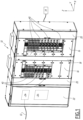
- FIG. 10 An electrical cabinet 10 is shown in figures 1 And 2 .
- This electrical cabinet is intended to be integrated into a partially represented electrical network.
- This electrical network comprises on the one hand, upstream of the electrical cabinet 10, power cables 12 coming for example from a transformer station and on the other hand, downstream of the electrical cabinet, one or more electrical charges 14.
- the electrical cabinet 10 is a connection cabinet configured to connect the electrical loads 14 to the power cables 12.
- the power cable 12 delivers a main electrical supply to the electrical cabinet 10, preferably with a voltage of 400V three-phase with neutral, preferably at a frequency of 50Hz.
- the power cable 12 delivers a three-phase current without neutral, or a single-phase current.
- the power supply is delivered at a frequency of 60Hz and at a different voltage, for example 1000V.
- the electrical loads 14 can for example be electric motors, such as three-phase motors, electricity distribution networks, or even controllable electrical loads, such as batteries or photovoltaic panels.
- the orientation of the axes X, Y and Z is fixedly linked to the orientation of the electrical cabinet 10.
- the orientation of the electrical cabinet 10 described in this presentation corresponds to its mounted configuration. It is therefore understood that the orientation of the X, Y and Z axes varies when the orientation of the electrical cabinet 10 varies.
- the Z axis may not be vertical when the cabinet 10 is not in the mounted configuration, for example when it is being transported.
- the qualifiers “top”, “bottom” and “vertical” used in the rest of the presentation are understood relative to the Z axis.
- the plane formed by the X and Y axes is horizontal.
- the qualifier “horizontal” used in the rest of the presentation applies to all element contained in a plane parallel to the plane formed by the axes and “rear” are understood relative to the Y axis, and relative to the orientations shown in the figures.
- the electrical cabinet 10 comprises several columns 16, juxtaposed along the X axis.
- the electrical cabinet 10 comprises at least one connection column 16.
- the electrical cabinet 10 comprises two connection columns 16.
- Each connection column 16 allows the electrical connection of one or more loads electrics 14 to the electrical cabinet 10 and makes it possible to control the electrical loads 14 which are connected there.
- connection column 16 comprises functional elements 17, as detailed below.
- the electrical cabinet 10 also comprises at least one electrical distribution column 18.
- Each electrical distribution column 18 connects one or two connection columns 16 to the power cable 12.
- each electrical distribution column 18 comprises a set of power bars, not shown, to make this connection.
- the electrical cabinet 10 also comprises at least one wiring column 20.
- Each wiring column 20 comprises electrical cables, not shown, which connect a connection column 16 to one or more electrical loads 14.
- a column cabling 20 is associated with each connection column 16.
- the electrical cabinet 10 also comprises a main column 22, which comprises, for example, a circuit breaker 24 making it possible to cut off the power supply coming from the power cable 12 and an industrial computer 26 or a connection module to an industrial computer .
- a main column 22 comprises, for example, a circuit breaker 24 making it possible to cut off the power supply coming from the power cable 12 and an industrial computer 26 or a connection module to an industrial computer .
- the electrical cabinet 10 comprises a framework 28.
- the framework 28 forms a structure of the electrical cabinet 10 and supports the functional elements 17.
- the framework 28 in practice comprises horizontal crosspieces 30, arranged at the upper and lower ends of the electrical cabinet 10 and parallel to the plane formed by the axes X and Y, and vertical posts 32, which extend along parallel axes to the Z axis and which connect the horizontal crosspieces 30.
- the framework 28 is of parallelepiped shape.
- Fixing holes 34 are provided on the vertical posts 32.
- the functional elements 17 of the connection columns 16 of the electrical cabinet 10 are, in practice, elements making it possible to ensure the proper functioning of the cabinet.
- the functional elements 17 are grouped into functional modules 40, seven of which are represented in the figure 1 , distributed over two connection columns 16.
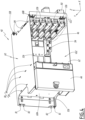
- a functional module 40 comprising a control-command drawer 42, a protection unit 44, two connection units 46, a computer bus section 48 and an input-output unit 50 is shown in the Figure 3 .
- the protection unit 44 a connection unit 46 and an input-output unit are shown.
- Each control drawer 42 allows the electrical connection and possibly the control and/or monitoring of an electrical load 14. Thus, the electric current coming from the power cable 12 is redirected towards the electrical loads 14 through the drawers control-command 42.
- a functional module 40 comprises one or more drawers, preferably between one and six drawers.
- the height of the drawer measured parallel to the Z axis, can vary, as can be seen in the figure 1 .
- each control drawer 42 is movable in translation in a connection column 16, between a plugged-in position in which the drawer is connected on the one hand to the power cable 12 and on the other hand to the electrical load 14 which it supplies, and an unplugged position, in which the drawer is connected neither to the power cable nor to the electrical load.
- Drawer 42 is shown in the plugged-in position on the Figure 3 .
- Each protection unit 44 is configured to electrically protect one or more control drawers 42 as well as the electrical loads 14 which are connected to these drawers, in particular in the event of failure of an electrical load 14, such as for example a short- circuit.
- the protection units 44 are, for example, circuit breakers arranged upstream of the control-command drawers 42 and which make it possible to interrupt the electric current supplying the electrical loads 14 via the control-command units 42 in the event of an emergency. 'incident.
- the protection units 44 control the electricity supply to the control drawers 42 and are arranged between the drawers 42 and an electrical distribution column 18.
- the protection unit 44 of a functional module 40 protects all the control drawers 42 of this functional module.
- the protection unit 44 of a functional module 40 is common to all the control drawers 42 of this functional module.
- each protection unit 44 comprises fixed upstream connectors 52.
- this drawer When a control drawer 42 is in the plugged-in position, this drawer is plugged into the fixed upstream connectors 52, so as to be electrically connected to the unit protection 44.
- a drawer When a drawer is in the disconnected position, it is distant from the upstream fixed connectors 52.
- connection unit 46 is associated with a control drawer 42.
- a functional module 40 includes as many connection units 46 as drawers 42.
- connection unit 46 is configured so that an electrical load 14 is connected to it and to supply this electrical load with electrical energy, from a control drawer 42.
- a connection unit 46 is arranged intermediately , and connected, between a drawer 42 and an electrical load 14.
- connection unit 46 extends partly outside the functional module 40, towards the adjacent wiring column 20.
- connection unit 46 the wiring necessary for connecting an electrical load 14 to a connection unit 46 is carried out in the wiring column 20, rather than in the connection column 16, which is advantageous. Indeed, the available space being greater in the wiring column 20, this connection is thus facilitated.
- a large number of connection cables can be arranged in a cabling column 20, for example up to a hundred cables.
- each connection unit 46 comprises fixed downstream connectors 54.
- the drawer When a control drawer 42 is in the plugged-in position, the drawer is plugged into the fixed downstream connectors 54 so as to be electrically connected to the connection unit. connection 46.
- connection 46 When a drawer is in the disconnected position, it is distant from the downstream fixed connectors 54.
- Connecting the control drawer 42 to fixed upstream 52 and downstream 54 connectors is advantageous, because this makes it possible to easily connect or disconnect the drawer, simply by moving the drawer in the functional module 40.
- the computer bus section 48 of a functional module 40 connects each control drawer 42 to the industrial computer 26, so as to allow the exchange of data, such as operating instructions or measurements carried out by sensors , between the drawers and the industrial computer.
- the computer bus section 48 is an electronic card which extends vertically and which carries electronic circuits as well as electrical power supply tracks, not shown.
- Each input-output unit 50 makes it possible to connect on the one hand a control-command drawer 42 of a functional module 40 to the computer bus section 48 of this functional module, and on the other hand, thanks to connectors of inputs-outputs 56, the electrical cabinet 10 has sensors arranged near the electrical load 14 and/or auxiliary functions of the electrical load 14 and/or control members, via the section of computer bus 48.
- the sensors arranged near the electrical load 14 are for example operating sensors of the electrical load 14, such as speed sensors when the electrical load is a motor, or temperature sensors.
- the auxiliary functions of the electrical load 14 are for example actuators acting on the electrical load, or even a heating circuit, making it possible to maintain the charge electrical above a minimum temperature.
- the control elements are for example emergency stopping devices for the electrical load 14.
- connection of the sensors and/or auxiliary functions of the electrical load 14 to the input-output connectors 56 is carried out in the wiring column 20 adjacent to the input-output unit 50, because this unit extends outside the functional module 40, as is visible in the figures 3 And 4 .
- Each input-output unit 50 is associated with a control-command drawer 42.
- a functional module 40 includes as many input-output units 50 as drawers 42.
- connection between an input-output unit 50 and a control-command drawer 42 is made using mobile contacts, not shown. These mobile contacts are configured to establish this connection as soon as the drawer is moved to the plugged-in position, so that no specific connection operation is necessary to establish this connection.
- the computer bus section 48 is advantageous because it makes it possible to centralize all the connections and all data exchanges between the industrial computer 26, the control drawers 42 and the electrical loads 14 in an electronic card, which facilitates the implementation of these connections and reduces the quantity of cables that must be installed in the electrical cabinet 10.
- each control drawer of a functional module 40 also communicates information with the protection unit 44 of the functional module, via a non-visible mobile contact.
- each functional module 40 comprises a support box 60, which supports all the functional elements 17 of this functional module 40.
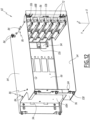
- the support box 60 of a functional module 40 comprises a frame 62 of parallelepiped shape, which defines an internal volume V62.
- the reinforcement 62 is mounted in the framework 28 of the connection column 16, as visible in the figure 2 .
- the plates 64, the bottom 66 and the walls 68A and 68B are made of metal, for example of steel having undergone a surface treatment, such as a steel coated with zinc, called “electro-galvanized”, or of galvanized steel.
- the support box 60 further comprises at least one pair of guide rails 70 in translation of a control drawer 42, preferably six pairs of guide rails 70.
- each pair of guide rails 70 comprises two rails 72 which are configured to allow the insertion of a control drawer 42 in the electrical cabinet 10, so that the drawer is movable in translation between its position disconnected and its connected position, parallel to the Y axis.
- Each pair of rails 70 is arranged so that a control drawer 42 inserted in this pair of rails is horizontal.
- the drawer 42 includes for example casters, not shown, allowing it to roll in the rails 72 of a pair of rails 70.
- each vertical wall 68A and 68B supports one of the two rails 72 of each pair of rails 70.
- the rails 72 extend along the depth axis Y of the electrical cabinet 10 and are horizontal. Thus, the control drawers 42 are also horizontal when they are inserted in the electrical cabinet 10.
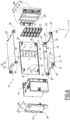
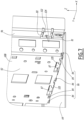
- a first embodiment of the box 60 is shown in figures 2 to 9 .
- the protection unit 44 is fixed to the left wall 68A, inside the volume V62.
- the rails 72 located on the left of the box 60 are fixed on the protection unit 44.
- the rails 72 located on the left of the box 60 are still supported by the vertical wall 68A, since the protection unit 44 is itself fixed to this vertical wall.
- each plate 64 of the frame 62 comprises a main web 74, horizontal, and a border 76, perpendicular to the main web and parallel to the bottom 66 of the frame.
- each edge 76 positioning holes 77 and fixing holes 78 are provided, the axes of which are parallel to the Y axis.
- each plate 64 comprises several members for fixing the frame 62 on the frame 28 of the electrical cabinet 10, which in the example are fixing lugs 80.
- the fixing lugs 80 of a horizontal plate 64 are integral with this plate. They are perpendicular to the main web 74 and to the edge 76, so as to be parallel to the vertical walls 68A and 68B in the mounted configuration of the box 60, and extend from the main web 74 of a horizontal plate in the direction of the another horizontal plate of the frame 62.
- each horizontal plate 64 comprises four fixing lugs 80, each fixing lug being configured to be fixed to a vertical post 32 of the frame 28.
- each fixing lug 80 comprises a positioning hole 81 and a fixing hole 82, the axes of which are parallel to the axis X.
- each horizontal plate 64 is, in the mounted configuration of the box in the framework, fixed to four vertical posts 32.
- fixing lugs 80 are elastically deformable, so as to accommodate dimensional variations in the spacing of the vertical posts 32, as detailed below.
- Each horizontal plate 64 further comprises lugs 84, arranged on the main web 74.
- the lugs 84 form protrusions, which extend from the main web 74 into the volume V62 of the box 62.
- the lugs 84 are in one piece with the main web 74 and are formed by cutting then localized stamping of the main web.
- each positioning guide 86 comprises two adjacent rows of lugs 84, each row comprising at least two lugs 84 aligned according to an axis parallel to the Y axis.
- Each horizontal plate 64 also includes positioning fingers 87, preferably two fingers 87.
- the positioning fingers 87 of a horizontal plate 64 extend perpendicular to the main web 74 of this plate, so as to be parallel to the walls 68A and 68B in the mounted configuration of the box 60 and are directed, starting from the web of a horizontal plate 64, towards the other horizontal plate of the frame.
- the bottom 66 of the frame 62 of the box 60 is fixed to the edges 76 of the two horizontal plates 64.
- the bottom 66 comprises positioning holes 88 and fixing holes 89, respectively aligned with the positioning holes 77 and with the fixing holes 78 of the edges 76 of the horizontal plates.
- the bottom 66 further comprises notches 90, in the example four notches 90, allowing the vertical walls 68A and 68B to be positioned.
- the bottom 66 further comprises fixing holes 118, in the example four fixing holes 118, making it possible to fix the vertical walls 68A and 68B.
- the bottom 66 further comprises openings 91.
- the rear of the drawer is located opposite an opening 91, which makes it possible to extract the air from the drawer 42 through the opening 91, so as to ensure cooling of the drawer.
- the fixed upstream connectors 52 and the fixed downstream connectors 54 of a functional module 40 are arranged on either side of the openings 91, along the transverse axis Y.
- the walls 68A and 68B of the frame 62 of the box 60 each comprise a main panel 92, a rear edge 94 and a front edge 96.
- Each wall 68A and 68B further comprises projections 97, preferably two projections 97.
- Each projection 97 extends from the main panel 92 towards the rear of the box 60, in the extension of the main panel.
- each wall 68A and 68B is perpendicular to the main panel 92, that is to say that the rear edge is parallel to the bottom 66 of the box.
- each wall 68A and 68B is parallel to the main panel 92, but offset, along an axis parallel to the axis X, from the main panel.
- a strip 95 parallel to the rear edge 94, connects the main panel 92 and the front edge 96.
- An edge 99 extends the front edge 96, opposite the strip 95, this edge being parallel to the strip 95.
- each wall 68A and 68B is provided at least one fixing hole 98, preferably two fixing holes 98.
- each wall 68A and 68B On the front edge 96 of each wall 68A and 68B is provided at least one positioning hole 100, preferably two positioning holes 100.
- each wall 68A and 68B also comprises at least one load-response tab 102, preferably two load-response tabs 102.
- the load-response tabs 102 also constitute fixing members of the frame 62 on the frame 28 of the electrical cabinet 10.
- Each load transfer tab 102 is delimited by a U-shaped notch 103 cut in the rim 96.
- Each tab 102 has flexibility perpendicular to the plane of the rim 96.
- a fixing hole 104 is provided on each load recovery tab 102.
- the walls 68A and 68B do not include a front edge 96 and the positioning hole(s) 100 as well as the load recovery tabs 102 are provided on the main panel 92.
- the walls 68A and 68B do not include a load recovery tab 102.
- the wall 68B further comprises positioning fingers 105, preferably four positioning fingers 105, respectively provided on the upper and lower edges of the main web 74.
- Each wall 68A and 68B is fixed on the one hand to the bottom 66 of the box 60 and on the other hand to the frame 28 of the electrical cabinet 10.
- each wall 68A and 68B is held by the horizontal plates 64, being located in a positioning guide 86 of each horizontal plate.
- each positioning guide 86 is configured to position a wall 68A or 68B relative to the horizontal plate 64 comprising this positioning guide.
- the wall 68A, to which the protection unit 44 is fixed, is held differently by the positioning guides 86.
- a first row of lugs 84 is arranged to the left of the wall 68A and a second row of lugs 84 is arranged to the right of the protection unit 44, so as to surround both the wall 68A and the protection unit 44.
- the two rows of lugs 84 holding the vertical wall 68A are spaced apart, along the axis the protection unit 44 and the two rows of lugs 84 holding the vertical wall 68B are spaced apart, along the axis X, by a distance substantially equal to the thickness of the wall 68B.
- the protection unit 44 comprises two grooves, arranged on an upper face and on a lower face of the protection unit and which extend along an axis parallel to the Y axis. , configured to each receive a row of lugs 84 of a horizontal plate 64.
- the wall 68A and the protection unit 44 are guided by the positioning guides 86 but the two rows of lugs 84 forming these positioning guides are spaced apart, along the X axis, by a distance less than the sum of the thickness of the wall 68A and the thickness of the protection unit 44.
- the fixing of the bottom 66 on the horizontal plates 64 and of the walls 68A and 68B on the bottom 66 is carried out using screws 106 and centering pins 108.
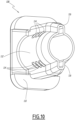
- a centering pin 108 is illustrated alone in the Figure 10 .
- the centering pin 108 comprises a head 110 and a body 112, on which several groups of notches 114 are provided.
- each centering pin 108 comprises at least two groups of notches 114.
- each pin includes four groups of three notches. To the Figure 10 , only two groups of notches 114 are visible. Within a group, the different notches 114 are positioned at different distances from the head 110 of the centering pin 108.
- the body 112 of each centering pin 108 also includes two ribs 116 which gives this body a non-circular section , adapted to the shape of the positioning holes as well as the shape of the fixing holes 34 of the vertical posts 32.
- the centering pins 108 are made of composite material, more preferably of fiber-reinforced polyamide.
- the box 60 is assembled directly in the electrical cabinet 10, on the frame 28.
- the horizontal plates 64 are first positioned relative to the vertical posts 32 of the frame 28 then fixed to the vertical posts, during a first assembly step. For this, the positioning holes 81 of the fixing lugs 80 of the horizontal plates 64 are aligned with the fixing holes 34 of the vertical posts, then centering pins 108 are arranged in the positioning holes 81, so as to extend in the fixing holes 34 of the vertical posts 32 and to align, or center, the horizontal plates 64 relative to the vertical posts. When a centering pin 108 is in place on a vertical post 32, two notches 114 of the pin are in contact with the post, so as to maintain the horizontal plates 64 relative to this post.
- the centering pins 108 make it possible to position the horizontal plates 64 vertically relative to the framework 28, without constraining the horizontal positioning of the plates. Indeed, among the multiple pairs of notches 114 of a centering pin, only one pair of notches fixes the centering pin on a vertical post, depending on the spacing between the head 110 of the positioning pin and the post 32 In addition, the positioning of the horizontal plates 64 defines the positioning of the box 60, because the other elements of the frame 62 are positioned relative to the horizontal plates. The centering pins 108 therefore make it possible to pre-position the box 60.
- the pre-positioning of the support box 60 on the framework 28 by the centering pins 108 is ensured independently of the distance separating the box from a vertical post 32 at the level of this pawn, as long as this distance is less than the distance measured between the head 110 of the pawn and the pair of notches 114 furthest from the head 110.
- centering pins 108 make it possible to adapt to a clearance between the support box 60 and the vertical posts 32 of the framework 28.
- centering pins 108 make it possible, on the one hand, to facilitate the assembly of the support box 60 and, on the other hand, to facilitate the mounting of the support box 60 in the framework 28.
- the bottom 66 is assembled with the horizontal plates 64 during a second assembly step.
- the bottom 66 is positioned relative to the horizontal plates 64, thanks to several centering pins 108, in the example thanks to four centering pins.
- each centering pin 108 is pre-mounted in a positioning hole 88 in the bottom 66, so that the head 110 of the pin is in contact with the bottom 66 and the body 112 of the pin extends to the through the positioning hole 88.
- screws 106 are inserted into the fixing holes 89 of the bottom 66 and into the fixing holes 78 of the edges 76, so as to fix the bottom 66 on the edges 76.
- each vertical wall 68A and 68B is positioned.
- each vertical wall 68A and 68B is slid, in a translational movement along an axis parallel to the axis Y, between the horizontal plates 64, until its rear edge 94 comes into contact with the bottom 66 and until the projections 97 of the main panel 92 penetrate the notches 90 of the bottom 66.
- each vertical wall 68A and 68B is guided by two positioning guides 86, namely a positioning guide provided on each horizontal plate 64.
- the positioning fingers 87 of the horizontal plates 64 and the positioning fingers 105 of the vertical walls are complementary in shape and in contact when the vertical walls are positioned relative to the plates 64 and the bottom 66, of so as to help in the correct positioning of the vertical walls.
- the protection unit 44 is mounted on the vertical wall 68A prior to the third step. Thus, it is the assembly of the vertical wall 68A and the protection unit 44 which is guided between the positioning guides 86 located on the left of the figures 3 , 4 And 6 .
- the fixing holes 104 of the load carrying lugs 102 of the vertical walls 68A and 68B are aligned with the fixing holes 82 of the fixing lugs 80 of the horizontal plates 64.
- Centering pins 108 are then arranged in the positioning holes 100, so as to extend into the fixing holes 34 of the vertical posts 32 and to participate in the alignment of the box 60 relative to the vertical posts.
- the frame 62 is assembled and the box 60 is positioned relative to the frame 28.
- the box 60 When the assembly of the frame 62 is completed, the box 60 is rigid, that is to say it cannot be deformed when normal use forces are applied to it. Indeed, any force exerted on a first element among the assembly consisting of the two plates 64, the bottom 66 and the two walls 68A and 68B is transmitted to the other elements of this assembly in a manner to prevent deformation of the first element.
- This rigidity comes in particular from the fact that the assembly of the frame 62 prevents any relative movement between the plates 64, the bottom 66 and the walls 68A and 68B.
- the presence of the bottom 66 prevents the structure formed of the horizontal plates 64 and the vertical walls 68 from being deformed into a non-rectangular parallelogram, that is to say so that the vertical walls 68 are no longer perpendicular to the horizontal plates. 64.
- the box 60 is advantageous for the box 60 to be rigid, because this rigidity guarantees reliable and precise positioning of the functional elements 17, as well as the rails 72. This reliable and precise positioning is useful, for example to allow the control drawers to roll normally in the rails 72 and to allow the drawers to be plugged into the fixed upstream 52 and downstream 54 connectors.
- the rigidity of the box 60 is all the more advantageous as the framework 28 of the electrical cabinet 10 may have defects, so that the posts 32 are not perfectly vertical. This rigidity helps compensate for these defects.
- the fixing of the horizontal plates 64, the bottom 66 and the vertical walls 68A and 68B is carried out only using screws 106 and does not require the use of complex fixing operations, such as for example welding.
- the frame 62 of the box 60 is therefore simple to assemble.
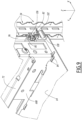
- the front of the box 60 is fixed on the vertical posts using screws 106, which are mounted through the fixing holes 104 of the load-bearing tabs 102 of the vertical walls 68A and 68B, through the fixing holes 82 of the fixing lugs 80 of the horizontal plates 64 and through the fixing holes 34 of the vertical posts 32.
- the rear of the box 60 is fixed on the vertical posts using screws 106, which are mounted through the fixing holes 82 of the fixing lugs 80 of the horizontal plates 64 and through the fixing holes 34 of the vertical posts 32.
- This fixing step is better visible at the Figure 9 .
- the box 60 is fixed to the frame 28 using screws 106, via the fixing lugs 80 and the load-bearing lugs 102.
- identical screws 106 are used to assemble the frame 62, to fix the rails 72 to the vertical walls 68A and 68B and to fix the box 60 to the vertical posts 32.
- This method of fixing is particularly advantageous, because the fixing lugs 80 and the load-bearing lugs 102 are elastically deformable, which makes it possible to compensate for any possible deformation of the framework 28.
- the width between two vertical posts increases so as to be greater than the width of the box 60.
- the fixing lugs 80 and the load-bearing lugs 102 will deform when tightening the screws 106, until they are pressed against the posts 32 of the frame, without this deformation affecting the other elements of the frame.
- frame 62 of box 60 which is rigid.
- the frame 62 of the box is not deformed and the fixing lugs 80 and 102 are deformed so as to compensate for the deformations of the box. framework 28.
- the box 60 is suspended from the framework 28 by the fixing lugs 80 and 102.
- the box 60 can be installed in a frame 28 whose posts 32 are deformed inwards or outwards, without the box 60 being deformed.
- the mounting of a functional module 40 on the framework 28 is therefore carried out by adapting to possible defects in the framework 28.
- the weight of a functional module 40 is transmitted to the frame 28 of the electrical cabinet 10, on the front of the box, via the fixing lugs 80, in the example four lugs, load recovery tabs 102, in the example four tabs, and centering pins 108, in the example two pins, arranged in the positioning holes 100 of the front edge 96 of the vertical walls 68A and 68B and on the rear of the box via the fixing lugs 80, in the example four lugs.
- the rails 72 are fixed to the vertical walls 68A and 68B using screws 106.
- each rail 72 is fixed to a vertical wall using two screws 106.
- the fifth assembly step is carried out between the third and fourth assembly steps, that is to say before fixing the box on the vertical posts.
- the rails 72 are fixed to the vertical walls 68A and 68B before the third assembly step, that is to say before the assembly of the vertical walls in the box.
- the box 60 After installation of the support box 60 on the frame 28 of the electrical cabinet 10, the box 60 is equipped, during a second phase or operation of the assembly process, with the functional elements 17, such as the drawers control-command 42, so as to form a functional module 40.
- the functional elements 17, such as the drawers control-command 42 so as to form a functional module 40.
- control drawers 42, the connection units 46 and the input-output units 50 are installed in the box 60 after fixing the box on the frame 28.
- the computer bus section 48 is installed in the box 60 either before or after fixing the box on the framework of the electrical cabinet.
- the support box 60 does not have a preferred orientation, so that it can be turned up and down before being installed in a connection column 16.
- the plates 64 remain horizontal, the vertical wall 68A is placed on the right of the box 60 and the vertical plate 68B is placed on the left of the box. This reversal affects neither the installation of the support box 60 in a connection column 16, nor the operation of the functional module 40 comprising this box.
- the functional elements 17 do not have a preferred orientation and are configured so that they can also be returned.
- the protection unit 44 is installed in the box 60 after the assembly of the frame 62.
- the wall 68A is held alone between the positioning guides 86, without the protection unit 44 participating in this holding.
- the vertical wall 68A is slid between the horizontal plates 64 while being guided by a positioning guide 86 of each horizontal plate 64.
- the lugs 84 surrounding the wall 68A form two rows which are as far apart from each other, along the axis that is to say spaced apart by a distance substantially equal to the thickness of the vertical wall 68A.
- the fixing lugs 80 at the rear of the box 60 are not in one piece with the horizontal plates 64 but are in one piece with the bottom 66 of the frame 62.
Landscapes
- Engineering & Computer Science (AREA)
- Power Engineering (AREA)
- Microelectronics & Electronic Packaging (AREA)
- Computer Hardware Design (AREA)
- General Engineering & Computer Science (AREA)
- Manufacturing & Machinery (AREA)
- Patch Boards (AREA)
- Drawers Of Furniture (AREA)
Applications Claiming Priority (1)
| Application Number | Priority Date | Filing Date | Title |
|---|---|---|---|
| FR2103095A FR3121290B1 (fr) | 2021-03-26 | 2021-03-26 | Caisson de supportage, armoire électrique de raccordement comprenant un tel caisson de supportage et procédé d’assemblage d’une telle armoire électrique |
Publications (2)
| Publication Number | Publication Date |
|---|---|
| EP4064479A1 EP4064479A1 (fr) | 2022-09-28 |
| EP4064479B1 true EP4064479B1 (fr) | 2023-12-13 |
Family
ID=76375179
Family Applications (1)
| Application Number | Title | Priority Date | Filing Date |
|---|---|---|---|
| EP22164364.6A Active EP4064479B1 (fr) | 2021-03-26 | 2022-03-25 | Caisson de supportage, armoire électrique de raccordement comprenant un tel caisson de supportage et procédé d assemblage d'une telle armoire électrique |
Country Status (7)
| Country | Link |
|---|---|
| US (1) | US11996679B2 (pl) |
| EP (1) | EP4064479B1 (pl) |
| CN (1) | CN115133413A (pl) |
| ES (1) | ES2974782T3 (pl) |
| FR (1) | FR3121290B1 (pl) |
| PL (1) | PL4064479T3 (pl) |
| WO (1) | WO2022200586A1 (pl) |
Families Citing this family (1)
| Publication number | Priority date | Publication date | Assignee | Title |
|---|---|---|---|---|
| FR3121314B1 (fr) * | 2021-03-26 | 2025-03-07 | Schneider Electric Ind Sas | Jeu de modules de raccordement externe pour armoire électrique de raccordement et armoire électrique de raccordement comprenant au moins un tel module de raccordement externe |
Family Cites Families (8)
| Publication number | Priority date | Publication date | Assignee | Title |
|---|---|---|---|---|
| DE1515561A1 (de) * | 1965-05-21 | 1969-07-03 | Continental Elektro Ind Ag | Schalt- und Verteilungsanlage |
| US6398041B1 (en) * | 1999-12-03 | 2002-06-04 | Hewlett-Packard Company | Snap system for retaining slide mounted rack system into multiple racks without tools |
| US6600656B1 (en) * | 2002-04-10 | 2003-07-29 | Sun Microsystems, Inc. | System structure for fast service access in a rack/cabinet |
| CN100352118C (zh) * | 2002-05-23 | 2007-11-28 | 通道系统集团公司 | 机柜及其组装方法 |
| TWM259213U (en) * | 2004-06-28 | 2005-03-11 | Tatung Co | Fixing sheet of sliding rail |
| CN102017344A (zh) * | 2008-05-07 | 2011-04-13 | 伊顿公司 | 用于电气开关设备的盒匣阵列 |
| CN111903023B (zh) * | 2018-04-04 | 2024-09-06 | Abb瑞士股份有限公司 | 用于模块的滑入式隔室 |
| RU2741065C1 (ru) * | 2020-06-16 | 2021-01-22 | Валерий Валерьевич Камаев | Электрический шкаф с выдвижным модулем |
-
2021
- 2021-03-26 FR FR2103095A patent/FR3121290B1/fr not_active Expired - Fee Related
-
2022
- 2022-03-23 US US17/701,754 patent/US11996679B2/en active Active
- 2022-03-25 WO PCT/EP2022/057949 patent/WO2022200586A1/fr not_active Ceased
- 2022-03-25 PL PL22164364.6T patent/PL4064479T3/pl unknown
- 2022-03-25 EP EP22164364.6A patent/EP4064479B1/fr active Active
- 2022-03-25 ES ES22164364T patent/ES2974782T3/es active Active
- 2022-03-28 CN CN202210312273.4A patent/CN115133413A/zh active Pending
Also Published As
| Publication number | Publication date |
|---|---|
| CN115133413A (zh) | 2022-09-30 |
| FR3121290B1 (fr) | 2024-03-29 |
| FR3121290A1 (fr) | 2022-09-30 |
| PL4064479T3 (pl) | 2024-04-29 |
| WO2022200586A1 (fr) | 2022-09-29 |
| ES2974782T3 (es) | 2024-07-01 |
| EP4064479A1 (fr) | 2022-09-28 |
| US11996679B2 (en) | 2024-05-28 |
| US20220311222A1 (en) | 2022-09-29 |
Similar Documents
| Publication | Publication Date | Title |
|---|---|---|
| CA3167190C (fr) | Procede d'installation d'un module de commutation dans une armoire electrique, kit d'installation et module de commutation correspondants | |
| EP2930803B1 (fr) | Ensemble de positionnement de tiroirs pour un tableau electrique, tableau electrique comprenant un tel ensemble et procede de montage de cet ensemble | |
| EP4064479B1 (fr) | Caisson de supportage, armoire électrique de raccordement comprenant un tel caisson de supportage et procédé d assemblage d'une telle armoire électrique | |
| EP0944145B1 (fr) | Installation de distribution basse tension | |
| EP2299552B1 (fr) | Coffret destiné à recevoir un appareillage électrique basse tension associé à une cellule électrique moyenne tension | |
| CA1186388A (fr) | Module electronique enfichable dans un connecteur de bus | |
| EP3323175A1 (fr) | Dispositif de connexion électrique raccordable à plusieurs câbles avec protection contre les dommages par corps étrangers | |
| EP0351279B1 (fr) | Procédé pour l'installation, sur un support, d'au moins un appareillage électrique. | |
| EP0425393A1 (fr) | Dispositif pour la réalisation d'ensembles pour la commande et la protection de circuits électriques basse tension | |
| WO2010106027A1 (fr) | Boitier,raccord electrique incorporant ce boitier et vehicule incorporant ce raccord | |
| EP3703091A1 (fr) | Dispositif de commutation électrique pour véhicule ferroviaire et véhicule ferroviaire comportant un tel dispositif | |
| FR3121315A1 (fr) | Module fonctionnel pour armoire électrique de raccordement et armoire électrique de raccordement comprenant un tel module fonctionnel | |
| EP0584331A1 (en) | Distribution board with rear electrical access. | |
| EP1014414B1 (fr) | Appareil électrique tel un disjoncteur ou un interrupteur modulaire | |
| EP4537435B1 (fr) | Armoire électrique de raccordement | |
| EP4277054A1 (fr) | Dispositif de distribution de courant et tableau électrique comprenant un tel dispositif | |
| EP4277053B1 (fr) | Dispositif d'interconnexion et tableau électrique comprenant un tel dispositif | |
| US20060118320A1 (en) | Alignment arrangement for a circuit breaker cradle | |
| EP4277055A1 (fr) | Dispositif d'interconnexion et tableau électrique comprenant un tel dispositif | |
| EP4277044A1 (fr) | Dispositif d'interconnexion et tableau électrique comprenant un tel dispositif | |
| EP1641094B1 (fr) | Coffret de raccordement de câbles conducteurs | |
| FR3154246A1 (fr) | Système de distribution de courant et ensemble d’alimentation électrique comprenant un tel système de distribution | |
| FR3135361A1 (fr) | Dispositif de distribution de courant et tableau électrique comprenant un tel dispositif | |
| EP0070223B1 (fr) | Dispositif de connexion électrique multiple | |
| EP1638179A1 (fr) | Ensemble formant transformateur haute tension/basse tension, poste de transformation et méthode de fabrication et/ou de maintenance d'un tel poste |
Legal Events
| Date | Code | Title | Description |
|---|---|---|---|
| PUAI | Public reference made under article 153(3) epc to a published international application that has entered the european phase |
Free format text: ORIGINAL CODE: 0009012 |
|
| STAA | Information on the status of an ep patent application or granted ep patent |
Free format text: STATUS: THE APPLICATION HAS BEEN PUBLISHED |
|
| AK | Designated contracting states |
Kind code of ref document: A1 Designated state(s): AL AT BE BG CH CY CZ DE DK EE ES FI FR GB GR HR HU IE IS IT LI LT LU LV MC MK MT NL NO PL PT RO RS SE SI SK SM TR |
|
| STAA | Information on the status of an ep patent application or granted ep patent |
Free format text: STATUS: REQUEST FOR EXAMINATION WAS MADE |
|
| 17P | Request for examination filed |
Effective date: 20230228 |
|
| RBV | Designated contracting states (corrected) |
Designated state(s): AL AT BE BG CH CY CZ DE DK EE ES FI FR GB GR HR HU IE IS IT LI LT LU LV MC MK MT NL NO PL PT RO RS SE SI SK SM TR |
|
| GRAP | Despatch of communication of intention to grant a patent |
Free format text: ORIGINAL CODE: EPIDOSNIGR1 |
|
| STAA | Information on the status of an ep patent application or granted ep patent |
Free format text: STATUS: GRANT OF PATENT IS INTENDED |
|
| RIC1 | Information provided on ipc code assigned before grant |
Ipc: H02B 1/01 20060101ALI20230703BHEP Ipc: H02B 1/34 20060101ALI20230703BHEP Ipc: H02B 1/36 20060101AFI20230703BHEP |
|
| INTG | Intention to grant announced |
Effective date: 20230731 |
|
| GRAS | Grant fee paid |
Free format text: ORIGINAL CODE: EPIDOSNIGR3 |
|
| GRAA | (expected) grant |
Free format text: ORIGINAL CODE: 0009210 |
|
| STAA | Information on the status of an ep patent application or granted ep patent |
Free format text: STATUS: THE PATENT HAS BEEN GRANTED |
|
| AK | Designated contracting states |
Kind code of ref document: B1 Designated state(s): AL AT BE BG CH CY CZ DE DK EE ES FI FR GB GR HR HU IE IS IT LI LT LU LV MC MK MT NL NO PL PT RO RS SE SI SK SM TR |
|
| REG | Reference to a national code |
Ref country code: GB Ref legal event code: FG4D Free format text: NOT ENGLISH |
|
| REG | Reference to a national code |
Ref country code: CH Ref legal event code: EP |
|
| REG | Reference to a national code |
Ref country code: DE Ref legal event code: R096 Ref document number: 602022001260 Country of ref document: DE |
|
| REG | Reference to a national code |
Ref country code: IE Ref legal event code: FG4D Free format text: LANGUAGE OF EP DOCUMENT: FRENCH |
|
| REG | Reference to a national code |
Ref country code: SE Ref legal event code: TRGR |
|
| PG25 | Lapsed in a contracting state [announced via postgrant information from national office to epo] |
Ref country code: GR Free format text: LAPSE BECAUSE OF FAILURE TO SUBMIT A TRANSLATION OF THE DESCRIPTION OR TO PAY THE FEE WITHIN THE PRESCRIBED TIME-LIMIT Effective date: 20240314 |
|
| REG | Reference to a national code |
Ref country code: LT Ref legal event code: MG9D |
|
| PG25 | Lapsed in a contracting state [announced via postgrant information from national office to epo] |
Ref country code: LT Free format text: LAPSE BECAUSE OF FAILURE TO SUBMIT A TRANSLATION OF THE DESCRIPTION OR TO PAY THE FEE WITHIN THE PRESCRIBED TIME-LIMIT Effective date: 20231213 |
|
| REG | Reference to a national code |
Ref country code: NL Ref legal event code: MP Effective date: 20231213 |
|
| PG25 | Lapsed in a contracting state [announced via postgrant information from national office to epo] |
Ref country code: LT Free format text: LAPSE BECAUSE OF FAILURE TO SUBMIT A TRANSLATION OF THE DESCRIPTION OR TO PAY THE FEE WITHIN THE PRESCRIBED TIME-LIMIT Effective date: 20231213 Ref country code: GR Free format text: LAPSE BECAUSE OF FAILURE TO SUBMIT A TRANSLATION OF THE DESCRIPTION OR TO PAY THE FEE WITHIN THE PRESCRIBED TIME-LIMIT Effective date: 20240314 Ref country code: BG Free format text: LAPSE BECAUSE OF FAILURE TO SUBMIT A TRANSLATION OF THE DESCRIPTION OR TO PAY THE FEE WITHIN THE PRESCRIBED TIME-LIMIT Effective date: 20240313 |
|
| REG | Reference to a national code |
Ref country code: AT Ref legal event code: MK05 Ref document number: 1641291 Country of ref document: AT Kind code of ref document: T Effective date: 20231213 |
|
| PG25 | Lapsed in a contracting state [announced via postgrant information from national office to epo] |
Ref country code: NL Free format text: LAPSE BECAUSE OF FAILURE TO SUBMIT A TRANSLATION OF THE DESCRIPTION OR TO PAY THE FEE WITHIN THE PRESCRIBED TIME-LIMIT Effective date: 20231213 |
|
| PG25 | Lapsed in a contracting state [announced via postgrant information from national office to epo] |
Ref country code: RS Free format text: LAPSE BECAUSE OF FAILURE TO SUBMIT A TRANSLATION OF THE DESCRIPTION OR TO PAY THE FEE WITHIN THE PRESCRIBED TIME-LIMIT Effective date: 20231213 Ref country code: NO Free format text: LAPSE BECAUSE OF FAILURE TO SUBMIT A TRANSLATION OF THE DESCRIPTION OR TO PAY THE FEE WITHIN THE PRESCRIBED TIME-LIMIT Effective date: 20240313 Ref country code: NL Free format text: LAPSE BECAUSE OF FAILURE TO SUBMIT A TRANSLATION OF THE DESCRIPTION OR TO PAY THE FEE WITHIN THE PRESCRIBED TIME-LIMIT Effective date: 20231213 Ref country code: LV Free format text: LAPSE BECAUSE OF FAILURE TO SUBMIT A TRANSLATION OF THE DESCRIPTION OR TO PAY THE FEE WITHIN THE PRESCRIBED TIME-LIMIT Effective date: 20231213 Ref country code: HR Free format text: LAPSE BECAUSE OF FAILURE TO SUBMIT A TRANSLATION OF THE DESCRIPTION OR TO PAY THE FEE WITHIN THE PRESCRIBED TIME-LIMIT Effective date: 20231213 |
|
| PG25 | Lapsed in a contracting state [announced via postgrant information from national office to epo] |
Ref country code: IS Free format text: LAPSE BECAUSE OF FAILURE TO SUBMIT A TRANSLATION OF THE DESCRIPTION OR TO PAY THE FEE WITHIN THE PRESCRIBED TIME-LIMIT Effective date: 20240413 |
|
| REG | Reference to a national code |
Ref country code: ES Ref legal event code: FG2A Ref document number: 2974782 Country of ref document: ES Kind code of ref document: T3 Effective date: 20240701 |
|
| PG25 | Lapsed in a contracting state [announced via postgrant information from national office to epo] |
Ref country code: AT Free format text: LAPSE BECAUSE OF FAILURE TO SUBMIT A TRANSLATION OF THE DESCRIPTION OR TO PAY THE FEE WITHIN THE PRESCRIBED TIME-LIMIT Effective date: 20231213 Ref country code: CZ Free format text: LAPSE BECAUSE OF FAILURE TO SUBMIT A TRANSLATION OF THE DESCRIPTION OR TO PAY THE FEE WITHIN THE PRESCRIBED TIME-LIMIT Effective date: 20231213 |
|
| PG25 | Lapsed in a contracting state [announced via postgrant information from national office to epo] |
Ref country code: SK Free format text: LAPSE BECAUSE OF FAILURE TO SUBMIT A TRANSLATION OF THE DESCRIPTION OR TO PAY THE FEE WITHIN THE PRESCRIBED TIME-LIMIT Effective date: 20231213 |
|
| PG25 | Lapsed in a contracting state [announced via postgrant information from national office to epo] |
Ref country code: SM Free format text: LAPSE BECAUSE OF FAILURE TO SUBMIT A TRANSLATION OF THE DESCRIPTION OR TO PAY THE FEE WITHIN THE PRESCRIBED TIME-LIMIT Effective date: 20231213 Ref country code: SK Free format text: LAPSE BECAUSE OF FAILURE TO SUBMIT A TRANSLATION OF THE DESCRIPTION OR TO PAY THE FEE WITHIN THE PRESCRIBED TIME-LIMIT Effective date: 20231213 Ref country code: RO Free format text: LAPSE BECAUSE OF FAILURE TO SUBMIT A TRANSLATION OF THE DESCRIPTION OR TO PAY THE FEE WITHIN THE PRESCRIBED TIME-LIMIT Effective date: 20231213 Ref country code: IS Free format text: LAPSE BECAUSE OF FAILURE TO SUBMIT A TRANSLATION OF THE DESCRIPTION OR TO PAY THE FEE WITHIN THE PRESCRIBED TIME-LIMIT Effective date: 20240413 Ref country code: EE Free format text: LAPSE BECAUSE OF FAILURE TO SUBMIT A TRANSLATION OF THE DESCRIPTION OR TO PAY THE FEE WITHIN THE PRESCRIBED TIME-LIMIT Effective date: 20231213 Ref country code: CZ Free format text: LAPSE BECAUSE OF FAILURE TO SUBMIT A TRANSLATION OF THE DESCRIPTION OR TO PAY THE FEE WITHIN THE PRESCRIBED TIME-LIMIT Effective date: 20231213 Ref country code: AT Free format text: LAPSE BECAUSE OF FAILURE TO SUBMIT A TRANSLATION OF THE DESCRIPTION OR TO PAY THE FEE WITHIN THE PRESCRIBED TIME-LIMIT Effective date: 20231213 |
|
| PG25 | Lapsed in a contracting state [announced via postgrant information from national office to epo] |
Ref country code: PT Free format text: LAPSE BECAUSE OF FAILURE TO SUBMIT A TRANSLATION OF THE DESCRIPTION OR TO PAY THE FEE WITHIN THE PRESCRIBED TIME-LIMIT Effective date: 20240415 |
|
| PG25 | Lapsed in a contracting state [announced via postgrant information from national office to epo] |
Ref country code: PT Free format text: LAPSE BECAUSE OF FAILURE TO SUBMIT A TRANSLATION OF THE DESCRIPTION OR TO PAY THE FEE WITHIN THE PRESCRIBED TIME-LIMIT Effective date: 20240415 |
|
| REG | Reference to a national code |
Ref country code: DE Ref legal event code: R097 Ref document number: 602022001260 Country of ref document: DE |
|
| PG25 | Lapsed in a contracting state [announced via postgrant information from national office to epo] |
Ref country code: DK Free format text: LAPSE BECAUSE OF FAILURE TO SUBMIT A TRANSLATION OF THE DESCRIPTION OR TO PAY THE FEE WITHIN THE PRESCRIBED TIME-LIMIT Effective date: 20231213 |
|
| PLBE | No opposition filed within time limit |
Free format text: ORIGINAL CODE: 0009261 |
|
| STAA | Information on the status of an ep patent application or granted ep patent |
Free format text: STATUS: NO OPPOSITION FILED WITHIN TIME LIMIT |
|
| PG25 | Lapsed in a contracting state [announced via postgrant information from national office to epo] |
Ref country code: SI Free format text: LAPSE BECAUSE OF FAILURE TO SUBMIT A TRANSLATION OF THE DESCRIPTION OR TO PAY THE FEE WITHIN THE PRESCRIBED TIME-LIMIT Effective date: 20231213 |
|
| PG25 | Lapsed in a contracting state [announced via postgrant information from national office to epo] |
Ref country code: SI Free format text: LAPSE BECAUSE OF FAILURE TO SUBMIT A TRANSLATION OF THE DESCRIPTION OR TO PAY THE FEE WITHIN THE PRESCRIBED TIME-LIMIT Effective date: 20231213 Ref country code: DK Free format text: LAPSE BECAUSE OF FAILURE TO SUBMIT A TRANSLATION OF THE DESCRIPTION OR TO PAY THE FEE WITHIN THE PRESCRIBED TIME-LIMIT Effective date: 20231213 |
|
| PG25 | Lapsed in a contracting state [announced via postgrant information from national office to epo] |
Ref country code: LU Free format text: LAPSE BECAUSE OF NON-PAYMENT OF DUE FEES Effective date: 20240325 |
|
| 26N | No opposition filed |
Effective date: 20240916 |
|
| PG25 | Lapsed in a contracting state [announced via postgrant information from national office to epo] |
Ref country code: MC Free format text: LAPSE BECAUSE OF FAILURE TO SUBMIT A TRANSLATION OF THE DESCRIPTION OR TO PAY THE FEE WITHIN THE PRESCRIBED TIME-LIMIT Effective date: 20231213 |
|
| PG25 | Lapsed in a contracting state [announced via postgrant information from national office to epo] |
Ref country code: MC Free format text: LAPSE BECAUSE OF FAILURE TO SUBMIT A TRANSLATION OF THE DESCRIPTION OR TO PAY THE FEE WITHIN THE PRESCRIBED TIME-LIMIT Effective date: 20231213 Ref country code: LU Free format text: LAPSE BECAUSE OF NON-PAYMENT OF DUE FEES Effective date: 20240325 |
|
| REG | Reference to a national code |
Ref country code: BE Ref legal event code: MM Effective date: 20240331 |
|
| PG25 | Lapsed in a contracting state [announced via postgrant information from national office to epo] |
Ref country code: BE Free format text: LAPSE BECAUSE OF NON-PAYMENT OF DUE FEES Effective date: 20240331 |
|
| PG25 | Lapsed in a contracting state [announced via postgrant information from national office to epo] |
Ref country code: IE Free format text: LAPSE BECAUSE OF NON-PAYMENT OF DUE FEES Effective date: 20240325 |
|
| PG25 | Lapsed in a contracting state [announced via postgrant information from national office to epo] |
Ref country code: IE Free format text: LAPSE BECAUSE OF NON-PAYMENT OF DUE FEES Effective date: 20240325 Ref country code: BE Free format text: LAPSE BECAUSE OF NON-PAYMENT OF DUE FEES Effective date: 20240331 |
|
| PGFP | Annual fee paid to national office [announced via postgrant information from national office to epo] |
Ref country code: PL Payment date: 20250319 Year of fee payment: 4 |
|
| PGFP | Annual fee paid to national office [announced via postgrant information from national office to epo] |
Ref country code: ES Payment date: 20250417 Year of fee payment: 4 |
|
| PG25 | Lapsed in a contracting state [announced via postgrant information from national office to epo] |
Ref country code: CY Free format text: LAPSE BECAUSE OF FAILURE TO SUBMIT A TRANSLATION OF THE DESCRIPTION OR TO PAY THE FEE WITHIN THE PRESCRIBED TIME-LIMIT; INVALID AB INITIO Effective date: 20220325 |
|
| PG25 | Lapsed in a contracting state [announced via postgrant information from national office to epo] |
Ref country code: FI Free format text: LAPSE BECAUSE OF FAILURE TO SUBMIT A TRANSLATION OF THE DESCRIPTION OR TO PAY THE FEE WITHIN THE PRESCRIBED TIME-LIMIT Effective date: 20231213 |
|
| REG | Reference to a national code |
Ref country code: CH Ref legal event code: H13 Free format text: ST27 STATUS EVENT CODE: U-0-0-H10-H13 (AS PROVIDED BY THE NATIONAL OFFICE) Effective date: 20251024 |
|
| PG25 | Lapsed in a contracting state [announced via postgrant information from national office to epo] |
Ref country code: CH Free format text: LAPSE BECAUSE OF NON-PAYMENT OF DUE FEES Effective date: 20250331 |
|
| PGFP | Annual fee paid to national office [announced via postgrant information from national office to epo] |
Ref country code: SE Payment date: 20260324 Year of fee payment: 5 |
|
| PGFP | Annual fee paid to national office [announced via postgrant information from national office to epo] |
Ref country code: GB Payment date: 20260324 Year of fee payment: 5 |
|
| PGFP | Annual fee paid to national office [announced via postgrant information from national office to epo] |
Ref country code: DE Payment date: 20260326 Year of fee payment: 5 |
|
| PGFP | Annual fee paid to national office [announced via postgrant information from national office to epo] |
Ref country code: IT Payment date: 20260320 Year of fee payment: 5 |
|
| PGFP | Annual fee paid to national office [announced via postgrant information from national office to epo] |
Ref country code: FR Payment date: 20260323 Year of fee payment: 5 |
|
| PGFP | Annual fee paid to national office [announced via postgrant information from national office to epo] |
Ref country code: TR Payment date: 20260313 Year of fee payment: 5 |