EP4064402A2 - Batteriezelle, batterie und elektronische vorrichtung - Google Patents
Batteriezelle, batterie und elektronische vorrichtung Download PDFInfo
- Publication number
- EP4064402A2 EP4064402A2 EP22162595.7A EP22162595A EP4064402A2 EP 4064402 A2 EP4064402 A2 EP 4064402A2 EP 22162595 A EP22162595 A EP 22162595A EP 4064402 A2 EP4064402 A2 EP 4064402A2
- Authority
- EP
- European Patent Office
- Prior art keywords
- tab
- tab units
- bonding pieces
- units
- battery cell
- Prior art date
- Legal status (The legal status is an assumption and is not a legal conclusion. Google has not performed a legal analysis and makes no representation as to the accuracy of the status listed.)
- Pending
Links
- 238000004806 packaging method and process Methods 0.000 claims abstract description 23
- 239000000853 adhesive Substances 0.000 claims description 15
- 230000001070 adhesive effect Effects 0.000 claims description 15
- 239000007788 liquid Substances 0.000 description 12
- 238000000576 coating method Methods 0.000 description 2
- 238000000034 method Methods 0.000 description 2
- 239000011149 active material Substances 0.000 description 1
- 239000013543 active substance Substances 0.000 description 1
- XAGFODPZIPBFFR-UHFFFAOYSA-N aluminium Chemical compound [Al] XAGFODPZIPBFFR-UHFFFAOYSA-N 0.000 description 1
- 229910052782 aluminium Inorganic materials 0.000 description 1
- 238000005452 bending Methods 0.000 description 1
- 230000009286 beneficial effect Effects 0.000 description 1
- 230000015572 biosynthetic process Effects 0.000 description 1
- 238000004146 energy storage Methods 0.000 description 1
- 239000002985 plastic film Substances 0.000 description 1
- 229920006255 plastic film Polymers 0.000 description 1
- 238000010408 sweeping Methods 0.000 description 1
- 238000004804 winding Methods 0.000 description 1
Images

Classifications
-
- H—ELECTRICITY
- H01—ELECTRIC ELEMENTS
- H01M—PROCESSES OR MEANS, e.g. BATTERIES, FOR THE DIRECT CONVERSION OF CHEMICAL ENERGY INTO ELECTRICAL ENERGY
- H01M10/00—Secondary cells; Manufacture thereof
- H01M10/05—Accumulators with non-aqueous electrolyte
- H01M10/052—Li-accumulators
- H01M10/0525—Rocking-chair batteries, i.e. batteries with lithium insertion or intercalation in both electrodes; Lithium-ion batteries
-
- H—ELECTRICITY
- H01—ELECTRIC ELEMENTS
- H01M—PROCESSES OR MEANS, e.g. BATTERIES, FOR THE DIRECT CONVERSION OF CHEMICAL ENERGY INTO ELECTRICAL ENERGY
- H01M10/00—Secondary cells; Manufacture thereof
- H01M10/04—Construction or manufacture in general
- H01M10/0431—Cells with wound or folded electrodes
-
- H—ELECTRICITY
- H01—ELECTRIC ELEMENTS
- H01M—PROCESSES OR MEANS, e.g. BATTERIES, FOR THE DIRECT CONVERSION OF CHEMICAL ENERGY INTO ELECTRICAL ENERGY
- H01M10/00—Secondary cells; Manufacture thereof
- H01M10/05—Accumulators with non-aqueous electrolyte
- H01M10/058—Construction or manufacture
- H01M10/0587—Construction or manufacture of accumulators having only wound construction elements, i.e. wound positive electrodes, wound negative electrodes and wound separators
-
- H—ELECTRICITY
- H01—ELECTRIC ELEMENTS
- H01M—PROCESSES OR MEANS, e.g. BATTERIES, FOR THE DIRECT CONVERSION OF CHEMICAL ENERGY INTO ELECTRICAL ENERGY
- H01M4/00—Electrodes
- H01M4/02—Electrodes composed of, or comprising, active material
- H01M4/64—Carriers or collectors
- H01M4/70—Carriers or collectors characterised by shape or form
-
- H—ELECTRICITY
- H01—ELECTRIC ELEMENTS
- H01M—PROCESSES OR MEANS, e.g. BATTERIES, FOR THE DIRECT CONVERSION OF CHEMICAL ENERGY INTO ELECTRICAL ENERGY
- H01M50/00—Constructional details or processes of manufacture of the non-active parts of electrochemical cells other than fuel cells, e.g. hybrid cells
- H01M50/50—Current conducting connections for cells or batteries
- H01M50/528—Fixed electrical connections, i.e. not intended for disconnection
-
- H—ELECTRICITY
- H01—ELECTRIC ELEMENTS
- H01M—PROCESSES OR MEANS, e.g. BATTERIES, FOR THE DIRECT CONVERSION OF CHEMICAL ENERGY INTO ELECTRICAL ENERGY
- H01M50/00—Constructional details or processes of manufacture of the non-active parts of electrochemical cells other than fuel cells, e.g. hybrid cells
- H01M50/50—Current conducting connections for cells or batteries
- H01M50/531—Electrode connections inside a battery casing
-
- H—ELECTRICITY
- H01—ELECTRIC ELEMENTS
- H01M—PROCESSES OR MEANS, e.g. BATTERIES, FOR THE DIRECT CONVERSION OF CHEMICAL ENERGY INTO ELECTRICAL ENERGY
- H01M50/00—Constructional details or processes of manufacture of the non-active parts of electrochemical cells other than fuel cells, e.g. hybrid cells
- H01M50/50—Current conducting connections for cells or batteries
- H01M50/531—Electrode connections inside a battery casing
- H01M50/533—Electrode connections inside a battery casing characterised by the shape of the leads or tabs
-
- H—ELECTRICITY
- H01—ELECTRIC ELEMENTS
- H01M—PROCESSES OR MEANS, e.g. BATTERIES, FOR THE DIRECT CONVERSION OF CHEMICAL ENERGY INTO ELECTRICAL ENERGY
- H01M50/00—Constructional details or processes of manufacture of the non-active parts of electrochemical cells other than fuel cells, e.g. hybrid cells
- H01M50/50—Current conducting connections for cells or batteries
- H01M50/531—Electrode connections inside a battery casing
- H01M50/538—Connection of several leads or tabs of wound or folded electrode stacks
-
- H—ELECTRICITY
- H01—ELECTRIC ELEMENTS
- H01M—PROCESSES OR MEANS, e.g. BATTERIES, FOR THE DIRECT CONVERSION OF CHEMICAL ENERGY INTO ELECTRICAL ENERGY
- H01M50/00—Constructional details or processes of manufacture of the non-active parts of electrochemical cells other than fuel cells, e.g. hybrid cells
- H01M50/50—Current conducting connections for cells or batteries
- H01M50/543—Terminals
- H01M50/547—Terminals characterised by the disposition of the terminals on the cells
Definitions
- This application relates to the technical field of energy storage devices, and in particular, to a battery cell, a battery, and an electronic device.
- the coating process may cause the edge of the electrode plate to be relatively thin, and cause the head position of a finished battery cell to be relatively thin. Consequently, the force exerted on the battery cell is uneven in a formation process, and the head position of the battery cell expands greatly during cycles, and is at risk of being too thick. In addition, after a tab of the battery cell breaks off, the tab comes into contact with other active substances or materials, tending to cause a short circuit.
- An objective of this application is to provide a battery cell, a battery, and an electronic device to limit expansion of a head position of a battery cell and reduce the risk of short circuit caused by breakage of a tab.
- an embodiment of this application provides a battery cell, including an electrode assembly, a tab, a packaging bag, and a conductive piece. Both the electrode assembly and the tab are accommodated in the packaging bag.
- the tab includes a plurality of tab units. The plurality of tab units are stacked. A first end of each of the plurality of tab units is electrically connected to the electrode assembly. A second end of each of the plurality of tab units is connected to the conductive piece. The conductive piece protrudes from the packaging bag.
- the battery cell includes a plurality of bonding pieces.
- the plurality of bonding pieces are accommodated in the packaging bag. At least one of the bonding pieces are configured to bond between two adjacent of the plurality of tab units.
- two adjacent of the plurality of tab units may be bonded together to limit the head position of the battery cell and hinder the battery cell from expanding to an excessive size at the head position during cycles. In addition, this may also reduce the risk of tab breakage and the risk of a short circuit caused by the tab breakage.
- the plurality of tab units include a connecting section and a collecting section connected to the connecting section.
- the plurality of bonding pieces are disposed on the connecting section.
- the connecting section is connected to the electrode assembly.
- the collecting section is connected to the conductive piece.
- the collecting section may make the tab occupy a smaller space in the battery cell, and improve the space efficiency of the battery cell.
- At least one of the bonding pieces protrudes from both sides of a corresponding tab unit.
- a range of a distance c between two ends of one of the plurality of bonding pieces is: 4 mm ⁇ c ⁇ 15 mm.
- a range of a length b of one of the plurality of bonding pieces is: 0.5 mm ⁇ b ⁇ 1.5 mm.
- a range of a thickness d of one of the plurality of bonding pieces is: 25 ⁇ m ⁇ d ⁇ 50 ⁇ m.
- a gap is provided between one of the plurality of bonding pieces and the electrode assembly to hinder the bonding pieces from increasing the thickness of the electrode assembly and from affecting the energy density of the battery cell.
- the plurality of the bonding pieces are disposed around the plurality of tab units.
- the electrode assembly includes a first electrode plate, a separator, and a second electrode plate.
- the conductive piece includes a first conductive piece and a second conductive piece.
- the plurality of tab units include a plurality of first tab units and a plurality of second tab units. A first end of each of the plurality of first tab units is connected to the first electrode plate. A second end of each of the plurality of first tab units is connected to the first conductive piece.
- the first conductive piece protrudes from the packaging bag.
- a first end of each of the second tab units is connected to the second electrode plate.
- a second end of each of the second tab units is connected to the second conductive piece.
- the second conductive piece protrudes from the packaging bag.
- the plurality of bonding pieces include a plurality of first bonding pieces and a plurality of second bonding pieces. At least one of the first bonding pieces is configured to bond between two adjacent of the plurality of first tab units, and at least one of the second bonding pieces is configured to bond between two adjacent of the plurality of second tab units.
- the first electrode plate, the separator, and the second electrode plate are sequentially stacked and wound into a jelly-roll structure.
- the plurality of first tab units are stacked, and the plurality of second tab units are stacked.
- the electrode assembly comprises a plurality of first electrode plates, a plurality of separators, and a plurality of second electrode plates.
- the plurality of first electrode plates, the plurality of separators, and the plurality of second electrode plates are alternately stacked.
- One of the first tab units is connected to one of the plurality of first electrode plates.
- One of the second tab units is connected to one of the plurality of second electrode plates.
- the plurality of first tab units are stacked, and the plurality of second tab units are stacked.
- each of the first bonding pieces is adhesive bar, the plurality of first bonding pieces are integrally formed to make a first adhesive strip.
- a range of a vertical distance e from the first adhesive strip to a side of the collecting section and away from the connecting section is: 0.5 mm ⁇ e ⁇ 1.5 mm.
- each of the first bonding pieces is adhesive dot, and each of the first bonding pieces bonds to two opposite surfaces of one of the first tab units, so as to bond two adjacent of the plurality of first tab units together.
- Another embodiment of this application further provides a battery, including the battery cell.
- Another embodiment of this application further provides an electronic device, including the battery and a load.
- the battery is configured to supply power to the load.
- At least one of the bonding pieces is disposed to bond two adjacent of the plurality of tab units to limit the head position of the battery cell and hinder the battery cell from expanding to an excessive size during cycles.
- the two adjacent of the plurality of tab units are bonded by one of the bonding pieces, thereby reducing the risk of a short circuit caused by breakage of the tab units.
- a direction or a positional relationship indicated by the terms such as “upper”, “lower”, “in”, “out”, “vertical”, and “horizontal” used herein is a direction or positional relationship based on the illustration in the drawings, and is merely intended for ease or brevity of describing this application, but does not indicate or imply that the indicated device or component must be located in the specified direction or constructed or operated in the specified direction. Therefore, such terms are not to be understood as a limitation on this application.
- the terms “first” and “second” are merely used for descriptive purposes, but shall not be construed as indicating or implying relative importance.
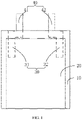
- FIG. 1 is a schematic plan view of a battery cell 100 according to this application; and FIG. 2 is a schematic plan view of the battery cell 100 without a packaging bag 10.
- the battery cell 100 includes a packaging bag 10, an electrode assembly 20, a tab, a conductive piece 40, and a plurality of bonding pieces 50.
- the electrode assembly 20, the tab, and the plurality of bonding pieces 50 are all accommodated in the packaging bag 10.
- the tab includes a plurality of tab units 30.
- the plurality of tab units 30 are stacked. A first end of each of the plurality of tab units 30 is electrically connected to the electrode assembly 20.
- a second end of each of the plurality of tab units 30 is connected to the conductive piece 40.
- the conductive piece 40 protrudes from the packaging bag 10. At least one of the bonding pieces 50 is configured to bond between two adjacent of the plurality of tab units 30.
- two adjacent of the plurality of tab units 30 may be bonded together to limit the head position of the battery cell 100 and hinder the battery cell 100 from expanding to an excessive size at the head position during cycles. In addition, this may also reduce the risk of tab breakage and the risk of a short circuit caused by the tab breakage.
- the head position of the battery cell 100 means an end of the electrode assembly 20, where the end is connected to the plurality of tab units 30. Excessive size means that the head position of the battery cell 100 expands and becomes thicker than the specified thickness of the battery cell 100.
- the plurality of bonding pieces 50 may be disposed around the plurality of tab units 30 instead.
- the plurality of bonding pieces 50 are disposed at a lateral portion of two adjacent of the plurality of tab units 30 to bond the two adjacent of the plurality of tab units 30.
- the packaging bag 10 may be an aluminum plastic film.
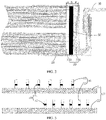
- the plurality of tab units 30 include a connecting section 310 and a collecting section 320 connected to the connecting section 310.
- the plurality of bonding pieces 50 are disposed on the connecting section 310.
- the connecting section 310 is connected to the electrode assembly 20.
- the collecting section 320 is connected to the conductive piece 40.
- the collecting section 320 may be formed by squeezing and furling the second end of each of the plurality of tab units 30 after the plurality of tab units 30 are stacked and aligned.
- the plurality of tab units 30 further include a bend section.
- One end of the collecting section 320 is connected to the connecting section 310.
- the other end of the collecting section 320 is connected to the bend section.
- the bend section is connected to the conductive piece 40. It needs to be noted that the bend section may be formed by bending the plurality of tab units 30 together after tab units are squeezed and furled.
- the battery cell 100 may be a stacked cell or a jelly-roll cell.
- the electrode assembly 20 includes a first electrode plate 21, a separator, and a second electrode plate 22.
- the plurality of tab units 30 include a plurality of first tab units 31 and a plurality of second tab units 32.
- the conductive piece 40 includes a first conductive piece 41 and a second conductive piece 42.
- a first end of each of the plurality of first tab units 31 is connected to the first electrode plate 21.
- a second end of each of the plurality of first tab units 31 is connected to the first conductive piece 41.
- the first conductive piece 41 protrudes from the packaging bag 10.
- a first end of each of the plurality of second tab units 32 is connected to the second electrode plate 22.
- a second end of each of the plurality of second tab units 32 is connected to the second conductive piece 42.
- the second conductive piece 42 protrudes from the packaging bag 10.
- the plurality of bonding pieces 50 include a plurality of first bonding pieces 51 and a plurality of second bonding pieces 52. At least one of the first bonding pieces 51 is configured to bond between two adjacent of the plurality of first tab units 31, and the second bonding pieces 52 are configured to bond between two adjacent of the plurality of second tab units 32.
- the polarities of the plurality of first tab units 31 are opposite to the polarities of the plurality of second tab units 32.
- the plurality of first tab units 31 are positive tabs
- the plurality of second tab units 32 are negative tabs.
- the plurality of first tab units 31 are disposed on the first electrode plate 21, and the plurality of second tab units 32 are disposed on the second electrode plate 22.
- the first electrode plate 21, the separator, and the second electrode plate 22 are sequentially stacked and wound into a jelly-roll structure. After winding, the plurality of first tab units 31 are stacked, and the plurality of second tab units 32 are stacked.
- the electrode assembly comprises a plurality of first electrode plates 21, a plurality of separators, and a plurality of second electrode plates 22.
- the plurality of first electrode plates 21, the plurality of separators, and the plurality of second electrode plates 22 are alternately stacked.
- One of the plurality of first tab units 31 is connected to one of the plurality of first electrode plates 21.
- One of the plurality of second tab units 32 is connected to one of the plurality of second electrode plates 22. After stacking, the plurality of first tab units 31 are stacked, and the plurality of second tab units 32 are stacked.
- both the plurality of first tab units 31 and the plurality of second tab units 32 include the connecting section 310 and the collecting section 320.
- the bonding pieces 50 may be liquid bonding pieces or non-liquid bonding pieces. If the bonding pieces 50 are liquid bonding pieces, the liquid bonding pieces may be dripped onto the connecting section 310 after the electrode plates are stacked or wound. If the bonding pieces 50 are non-liquid bonding pieces, the bonding pieces 50 may bond to the plurality of tab units before the electrode plates are stacked or wound.
- the bonding pieces 50 are non-liquid bonding pieces.
- both the first bonding piece 51 and the second bonding piece 52 are adhesive dots.
- the first bonding piece 51 bonds to two opposite surfaces of one of the plurality of first tab units 31 to bond two adjacent of the plurality of first tab units 31 together.
- the second bonding piece 52 bonds to two opposite surfaces of one of the plurality of second tab units 32 to bond two adjacent of the plurality of second tab units 32 together.
- the bonding pieces 50 is liquid bonding pieces, and both the first bonding piece 51 and the second bonding piece 52 are adhesive bars.
- a plurality of first bonding pieces 51 are integrally formed to make a first adhesive strip.
- a plurality of second bonding pieces 52 are integrally formed to make a second adhesive strip.
- a through hole may be provided on the connecting section.
- a first through hole is provided at the same position of each of the plurality of first tab units 31, and a second through hole is provided at the same position of each of the plurality of second tab units 32.
- the first bonding piece 51 is dripped to the first through hole
- the second bonding piece 52 is dripped to the second through hole.
- the first bonding piece 51 bonds two adjacent of the plurality of first tab units 31 through the first through hole.
- the second bonding piece 52 bonds two adjacent of the plurality of second tab units 32 through the second through hole.
- the bonding pieces 50 may bond a part of adjacent tab units, or bond all adjacent tab units.
- adhesive dots may be affixed to two opposite surfaces of a part of the plurality of first tab units 31.
- the dosage of the liquid bonding pieces is controlled to hinder the bonding pieces from being dripped onto all of the plurality of first tab units 31.
- adhesive dots are affixed to two opposite surfaces of each of the plurality of first tab units 31.
- the dosage of the liquid bonding pieces is controlled to ensure that the bonding pieces are dripped onto all of the plurality of first tab units.
- the head position of the battery cell 100 can be constrained.
- a gap is provided between one of the plurality of bonding pieces 50 and the electrode assembly 20.
- the distance a between one of the plurality of first bonding piece 51 and the first electrode plate 21 is greater than 0, and the distance between one of the second bonding piece 52 and the second electrode plate 22 is greater than 0.
- At least one of the plurality of bonding pieces 50 protrudes from both sides of a corresponding tab unit. At least one of the plurality of first bonding piece 51 protrudes from both sides of the corresponding first tab unit 31, and at least one of the plurality of second bonding piece 52 protrudes from both sides of the corresponding second tab unit 32.
- the plurality of bonding pieces 50 may hinder protruding from both sides of the corresponding tab unit.
- the plurality of first bonding piece 51 bonds to two opposite surfaces of the plurality of first tab units 31, and the width of the plurality of first bonding piece 51 is less than the width of the plurality of first tab unit 31, as long as the plurality of first bonding piece 51 can bond together the two first tab units 31 adjacent to the first bonding piece.
- the structures of the plurality of second bonding piece 52 are similar to the structures of the plurality of first bonding piece 51, and are not described in detail here.
- the range of the length b of one of the plurality of first bonding piece 51 is: 0.5 mm ⁇ b ⁇ 1.5 mm.
- the range of the distance c between two ends of one of the plurality of first bonding piece is: 4 mm ⁇ c ⁇ 15 mm.
- the thickness d of one of the first plurality of bonding piece 51 is adjusted adaptively depending on the thickness of the first electrode plate 21, and the range of the thickness d of one of the plurality of first bonding piece 51 is: 25 ⁇ m ⁇ d ⁇ 50 ⁇ m.
- the range of the vertical distance e from the first adhesive strip to a side of the collecting section 320 and away from the connecting section 310 is: 0.5 mm ⁇ e ⁇ 1.5 mm.
- the structures of the plurality of second bonding piece 52 are similar to the structures of the plurality of first bonding piece 51, and are not described in detail here.
- This application further provides a battery, including the battery cell 100.
- This application further provides an electronic device, including the battery and a load.
- the battery is configured to supply power to the load.
- the electronic device may be an electronic vehicle, a sweeping robot, a mobile phone, a tablet, or the like.
- the plurality of bonding pieces 50 are disposed to bond two adjacent of the plurality of tab units to limit the head position of the battery cell and hinder the battery cell 100 from expanding to an excessive size during cycles.
- the two adjacent of the plurality of tab units are bonded by the bonding pieces, thereby reducing the risk of a short circuit caused by breakage of the tab units.
Landscapes
- Chemical & Material Sciences (AREA)
- Chemical Kinetics & Catalysis (AREA)
- Electrochemistry (AREA)
- General Chemical & Material Sciences (AREA)
- Engineering & Computer Science (AREA)
- Manufacturing & Machinery (AREA)
- Materials Engineering (AREA)
- Connection Of Batteries Or Terminals (AREA)
Applications Claiming Priority (1)
| Application Number | Priority Date | Filing Date | Title |
|---|---|---|---|
| CN202120624743.1U CN214477799U (zh) | 2021-03-26 | 2021-03-26 | 电芯、电池及用电设备 |
Publications (2)
| Publication Number | Publication Date |
|---|---|
| EP4064402A2 true EP4064402A2 (de) | 2022-09-28 |
| EP4064402A3 EP4064402A3 (de) | 2022-10-05 |
Family
ID=78175277
Family Applications (1)
| Application Number | Title | Priority Date | Filing Date |
|---|---|---|---|
| EP22162595.7A Pending EP4064402A3 (de) | 2021-03-26 | 2022-03-16 | Batteriezelle, batterie und elektronische vorrichtung |
Country Status (2)
| Country | Link |
|---|---|
| EP (1) | EP4064402A3 (de) |
| CN (1) | CN214477799U (de) |
Families Citing this family (1)
| Publication number | Priority date | Publication date | Assignee | Title |
|---|---|---|---|---|
| CN216251029U (zh) * | 2021-11-12 | 2022-04-08 | 宁德时代新能源科技股份有限公司 | 一种电芯、电池及用电装置 |
Family Cites Families (4)
| Publication number | Priority date | Publication date | Assignee | Title |
|---|---|---|---|---|
| KR100515832B1 (ko) * | 2003-04-24 | 2005-09-21 | 삼성에스디아이 주식회사 | 이차전지의 전극 조립체 |
| US9929393B2 (en) * | 2015-09-30 | 2018-03-27 | Apple Inc. | Wound battery cells with notches accommodating electrode connections |
| CN208173683U (zh) * | 2018-04-24 | 2018-11-30 | 宁德新能源科技有限公司 | 卷绕电芯及电池 |
| CN111326699B (zh) * | 2019-08-14 | 2021-11-09 | 宁德时代新能源科技股份有限公司 | 二次电池 |
-
2021
- 2021-03-26 CN CN202120624743.1U patent/CN214477799U/zh active Active
-
2022
- 2022-03-16 EP EP22162595.7A patent/EP4064402A3/de active Pending
Also Published As
| Publication number | Publication date |
|---|---|
| EP4064402A3 (de) | 2022-10-05 |
| CN214477799U (zh) | 2021-10-22 |
Similar Documents
| Publication | Publication Date | Title |
|---|---|---|
| KR101199125B1 (ko) | 벤딩영역을 갖는 전극조립체 및 이를 포함하는 이차전지 | |
| US20110086262A1 (en) | Rechargeable battery | |
| US20160099454A1 (en) | Flexible electrochemical device including electrically connected electrode assemblies | |
| US10665395B2 (en) | Power storage device | |
| US11881588B2 (en) | Secondary battery and battery module | |
| US20170207438A1 (en) | Secondary battery | |
| EP3703160B1 (de) | Sekundärbatterie | |
| EP3883033B1 (de) | Sekundärbatterie und batteriemodul | |
| CN111226338B (zh) | 电极组件和包括该电极组件的二次电池和二次电池模块 | |
| CN109155386A (zh) | 蓄电设备 | |
| US10658648B2 (en) | Electrode assembly including electrode plates with coupled additional taps formed thereon | |
| CN109196705A (zh) | 蓄电设备 | |
| CN218602678U (zh) | 连接片、电池模组及电池包 | |
| EP4064402A2 (de) | Batteriezelle, batterie und elektronische vorrichtung | |
| JP2025539144A (ja) | 電気化学装置及び電気使用装置 | |
| JP6466296B2 (ja) | 電池及び電池製造方法 | |
| KR102765832B1 (ko) | 축전 장치 | |
| CN111630699B (zh) | 二次电池 | |
| US12444794B2 (en) | Secondary battery and method of manufacturing the same | |
| CN117791053A (zh) | 电芯及用电设备 | |
| EP3675203B1 (de) | Sekundärbatterie und batteriemodul | |
| EP4318749A1 (de) | Batteriezelle und elektrische vorrichtung | |
| US9478792B2 (en) | Electrode assembly, and rechargeable battery | |
| CN113471637B (zh) | 电池、电池模组及电子装置 | |
| CN113632313A (zh) | 电化学装置及电子装置 |
Legal Events
| Date | Code | Title | Description |
|---|---|---|---|
| PUAI | Public reference made under article 153(3) epc to a published international application that has entered the european phase |
Free format text: ORIGINAL CODE: 0009012 |
|
| STAA | Information on the status of an ep patent application or granted ep patent |
Free format text: STATUS: REQUEST FOR EXAMINATION WAS MADE |
|
| PUAL | Search report despatched |
Free format text: ORIGINAL CODE: 0009013 |
|
| 17P | Request for examination filed |
Effective date: 20220316 |
|
| AK | Designated contracting states |
Kind code of ref document: A2 Designated state(s): AL AT BE BG CH CY CZ DE DK EE ES FI FR GB GR HR HU IE IS IT LI LT LU LV MC MK MT NL NO PL PT RO RS SE SI SK SM TR |
|
| AK | Designated contracting states |
Kind code of ref document: A3 Designated state(s): AL AT BE BG CH CY CZ DE DK EE ES FI FR GB GR HR HU IE IS IT LI LT LU LV MC MK MT NL NO PL PT RO RS SE SI SK SM TR |
|
| RIC1 | Information provided on ipc code assigned before grant |
Ipc: H01M 4/70 20060101ALI20220829BHEP Ipc: H01M 50/531 20210101ALI20220829BHEP Ipc: H01M 10/0587 20100101ALI20220829BHEP Ipc: H01M 50/547 20210101ALI20220829BHEP Ipc: H01M 50/538 20210101ALI20220829BHEP Ipc: H01M 50/533 20210101ALI20220829BHEP Ipc: H01M 50/528 20210101ALI20220829BHEP Ipc: H01M 10/0525 20100101ALI20220829BHEP Ipc: H01M 10/04 20060101AFI20220829BHEP |