EP4064209B1 - Verfahren und system zum drapieren eines dreidimensionalen kleidungsstücks auf einem dreidimensionalen menschlichen körper - Google Patents
Verfahren und system zum drapieren eines dreidimensionalen kleidungsstücks auf einem dreidimensionalen menschlichen körper Download PDFInfo
- Publication number
- EP4064209B1 EP4064209B1 EP21217893.3A EP21217893A EP4064209B1 EP 4064209 B1 EP4064209 B1 EP 4064209B1 EP 21217893 A EP21217893 A EP 21217893A EP 4064209 B1 EP4064209 B1 EP 4064209B1
- Authority
- EP
- European Patent Office
- Prior art keywords
- garment
- training data
- loss
- vertices
- human body
- Prior art date
- Legal status (The legal status is an assumption and is not a legal conclusion. Google has not performed a legal analysis and makes no representation as to the accuracy of the status listed.)
- Active
Links
Images





Classifications
-
- G—PHYSICS
- G06—COMPUTING OR CALCULATING; COUNTING
- G06T—IMAGE DATA PROCESSING OR GENERATION, IN GENERAL
- G06T19/00—Manipulating 3D models or images for computer graphics
-
- H—ELECTRICITY
- H04—ELECTRIC COMMUNICATION TECHNIQUE
- H04N—PICTORIAL COMMUNICATION, e.g. TELEVISION
- H04N13/00—Stereoscopic video systems; Multi-view video systems; Details thereof
- H04N13/20—Image signal generators
- H04N13/275—Image signal generators from 3D object models, e.g. computer-generated stereoscopic image signals
-
- G—PHYSICS
- G06—COMPUTING OR CALCULATING; COUNTING
- G06T—IMAGE DATA PROCESSING OR GENERATION, IN GENERAL
- G06T7/00—Image analysis
- G06T7/60—Analysis of geometric attributes
-
- G—PHYSICS
- G06—COMPUTING OR CALCULATING; COUNTING
- G06T—IMAGE DATA PROCESSING OR GENERATION, IN GENERAL
- G06T7/00—Image analysis
- G06T7/70—Determining position or orientation of objects or cameras
- G06T7/73—Determining position or orientation of objects or cameras using feature-based methods
- G06T7/75—Determining position or orientation of objects or cameras using feature-based methods involving models
-
- H—ELECTRICITY
- H04—ELECTRIC COMMUNICATION TECHNIQUE
- H04N—PICTORIAL COMMUNICATION, e.g. TELEVISION
- H04N13/00—Stereoscopic video systems; Multi-view video systems; Details thereof
- H04N13/20—Image signal generators
- H04N13/282—Image signal generators for generating image signals corresponding to three or more geometrical viewpoints, e.g. multi-view systems
-
- G—PHYSICS
- G06—COMPUTING OR CALCULATING; COUNTING
- G06T—IMAGE DATA PROCESSING OR GENERATION, IN GENERAL
- G06T2207/00—Indexing scheme for image analysis or image enhancement
- G06T2207/20—Special algorithmic details
- G06T2207/20081—Training; Learning
-
- G—PHYSICS
- G06—COMPUTING OR CALCULATING; COUNTING
- G06T—IMAGE DATA PROCESSING OR GENERATION, IN GENERAL
- G06T2207/00—Indexing scheme for image analysis or image enhancement
- G06T2207/20—Special algorithmic details
- G06T2207/20084—Artificial neural networks [ANN]
-
- G—PHYSICS
- G06—COMPUTING OR CALCULATING; COUNTING
- G06T—IMAGE DATA PROCESSING OR GENERATION, IN GENERAL
- G06T2207/00—Indexing scheme for image analysis or image enhancement
- G06T2207/30—Subject of image; Context of image processing
- G06T2207/30196—Human being; Person
-
- G—PHYSICS
- G06—COMPUTING OR CALCULATING; COUNTING
- G06T—IMAGE DATA PROCESSING OR GENERATION, IN GENERAL
- G06T2210/00—Indexing scheme for image generation or computer graphics
- G06T2210/16—Cloth
-
- G—PHYSICS
- G06—COMPUTING OR CALCULATING; COUNTING
- G06T—IMAGE DATA PROCESSING OR GENERATION, IN GENERAL
- G06T2210/00—Indexing scheme for image generation or computer graphics
- G06T2210/21—Collision detection, intersection
Definitions
- the disclosure herein generally relates to 3D garments, and, more particularly, to method and system for draping a 3D garment on a 3D human body.
- online shopping provides customer to shop from the comfort of the home and get access to a wide range of the latest products.
- online shopping has one major limitation which does not enable buyers to try clothes physically, resulting in a high return / exchange rate due to the cloth fitting issues.
- the concept of virtual try-on helps to resolve such limitation and allow buyers to visualize any garment on its 3D avatar as if they are wearing it. Further, the two important factors that a buyer considers while deciding to purchase the garments are its fitting and appearance.
- a person can infer a garment's fitness by looking at the wrinkles in various poses and the gap between the body and the garment in the rendered image or video.
- PBS Physics-Based Simulation
- draping of garments on the human body is affected by three important factors that includes a human body shape, a human body pose and a garment style (e.g., long t-shirt, short t-shirt).
- a garment style e.g., long t-shirt, short t-shirt.
- learning based methods have gained much attention due to speed and less manual intervention.
- the garment deformation is the function of the body shape and its pose which keeps the body shape fixed for draping.
- the garments also varies in its style, e.g., the t-shirt can have different variations along its length or sleeve length. Due to these variations, different garment styles deform differently on different body shapes and body poses. Therefore, the models trained on the single garment style have restricted use that do not consider different garment styles in their modeling process tends to produce over-smooth results.
- TailorNet Predicting Clothing in 3D as a Function of Human Pose, Shape and Garment Style
- CVPR IEEE/CVF CONFERENCE ON COMPUTER VISION AND PATTERN RECOGNITION
- Embodiments herein provides a method and system for draping a 3D garment on a 3D human body.
- the method disclosed enables predicting accurately 3D skinned garment images for draping the 3D human body.
- the proposed method is an efficient deep neural network alternatively referred as a deep draper network that predicts fast and accurate 3D skinned garments.
- the system includes a Training phase, and an Inference phase.
- Training phase the deep draper network is pretrained with a multi-layer perceptron model and a multiview rendering model.
- the deep draper network is a single unified garment deformation mode trained using a plurality of losses for accurate fitness.
- the coupling of geometric loss with the perceptual loss efficiently learns the garment deformation's in high-frequency geometry with realistic wrinkles and folds for accurate prediction of the 3D garments.
- the perceptual loss in the image space is obtained by a differential rendering layer.
- the method receives a plurality of human body inputs to create a 3D human body using a SMPL model.
- the SMPL model fetches the body shape coefficient and estimates the body measurement for the subject for fitness, wrinkles and folds.
- the 3D skinned garments are constructed for the man utilizing the trained deep draper network.
- FIG. 1 through FIG. 16 where similar reference characters denote corresponding features consistently throughout the figures, there are shown preferred embodiments and these embodiments are described in the context of the following exemplary system and/or method.
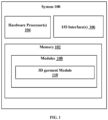
- FIG. 1 illustrates an exemplary block diagram of a system (alternatively referred as deep draper 3D garment system), in accordance with some embodiments of the present disclosure.
- the deep draper 3D garment system 100 includes processor (s) 104, communication interface (s), alternatively referred as or input/output (I/O) interface(s) 106, and one or more data storage devices or memory 102 operatively coupled to the processor (s) 104.
- the system 100, with the processor(s) is configured to execute functions of one or more functional blocks of the system 100.
- the processor (s) 104 can be one or more hardware processors 104.
- the one or more hardware processors 104 can be implemented as one or more microprocessors, microcomputers, microcontrollers, digital signal processors, central processing units, state machines, logic circuitries, and/or any devices that manipulate signals based on operational instructions.
- the processor(s) 104 is configured to fetch and execute computer-readable instructions stored in the memory.
- the system 100 can be implemented in a variety of computing systems, such as laptop computers, notebooks, 10 hand-held devices, workstations, mainframe computers, servers, a network cloud, and the like.
- the I/O interface(s) 106 can include a variety of software and hardware interfaces, for example, a web interface, a graphical user interface, and the like and can facilitate multiple communications within a wide variety of networks N/W and protocol types, including wired networks, for example, LAN, cable, etc., and wireless networks, such as WLAN, cellular, or satellite.
- the I/O interface (s) 106 can include one or more ports for connecting a number of devices (nodes) of the system 100 to one another or to another server.
- the memory 102 may include any computer-readable medium known in the art including, for example, volatile memory, such as static random access memory (SRAM) and dynamic random access memory (DRAM), and/or non-volatile memory, such as read only memory (ROM), erasable programmable ROM, flash memories, hard disks, optical disks, and magnetic tapes.
- volatile memory such as static random access memory (SRAM) and dynamic random access memory (DRAM)
- non-volatile memory such as read only memory (ROM), erasable programmable ROM, flash memories, hard disks, optical disks, and magnetic tapes.
- the memory 102 comprises a 3D garment module 110.
- the modules 108 can be an Integrated Circuit (IC) (not shown), external to the memory 102, implemented using a Field-Programmable Gate Array (FPGA) or an Application-Specific Integrated Circuit (ASIC).
- IC Integrated Circuit
- FPGA Field-Programmable Gate Array
- ASIC Application-Specific Integrated Circuit
- the names (or expressions or terms) of the modules of functional block within the modules 108 referred herein, are used for explanation and are not construed to be limitation(s).
- the modules 108 includes the 3D garment module 110 for processing of a plurality of human body inputs received from one or more external sources.
- FIG. 2 illustrates a high level overview of draping 3D garments on a human body using a deep draper network using the system of FIG. 1 , in accordance with some embodiments of the present disclosure.
- the FIG.2 includes a plurality of components comprising an SMPL which processes a one or more human body inputs, multi-layer perceptron, a multi view rendering, a VGG19 network, and a garment skinning function.
- the system receives the plurality of human body inputs from the one or more subjects and these inputs are further processed using the SMPL to generate a skeleton of the said human body.
- the multi perceptron obtains the plurality of human body inputs to generate a garment vertex offsets for the subject, which is further fetched as an input to a garment skinning function.
- the multi view rendering module fetches the inputs from the garment skinning function to generate a multi view of 3D skinned garment images to exploit correlation between each high frequency garment in 3D with its corresponding a front view rendered image, a back view rendered image, a right view rendered image, a left view rendered image, and a top view rendered image.
- These multi views of the 3D skinned garment images are fetched by a VGG19 network as an input to predict garment intermediate features.
- the multi-layer perceptron updates the deep draper network based on the plurality of losses.
- the memory 102 may comprises information pertaining to input(s)/output(s) of each step performed by the processor(s) 104 of the system 100 and methods of the present disclosure. Functions of the components of system 100, for time series prediction of target variable, are explained in conjunction with FIG.2 through FIG. 16 providing flow diagram, architectural overviews, and performance analysis of the system 100.
- FIG. 3 is a flow diagram illustrating a method for draping 3D garments on the human body using the system of FIG.1 , in accordance with some embodiments of the present disclosure.
- the system 100 comprises one or more data storage devices or the memory 102 operatively coupled to the processor(s) 104 and is configured to store instructions for execution of steps of the method 300 by the processor(s) or one or more hardware processors 104.
- the steps of the method 300 of the present disclosure will now be explained with reference to the components or blocks of the system 100 as depicted in FIG. 1 and FIG.2 and the steps of flow diagram as depicted in FIG.3 .
- the one or more hardware processors 104 receiving a plurality of human body inputs which includes data representation of a subject.
- the subject requests realistic 3D garments (T-shirt) to be draped with accurate fitness predicting 3D skinned garments (T-shirt) to drape the subject's body.
- the system initially receives the plurality of human body inputs to predict 3D garments for the human body.
- the plurality of human body inputs includes the subject's (i) a body shape ( ⁇ ), (ii) a body measurements ( ⁇ ), (iii) a body pose ( ⁇ ), and (iv) a garment style coefficients ( ⁇ ).
- the body measurements coefficients include a [ ⁇ 1 , ⁇ 2 ] where, a first coefficient of the body measurement is ⁇ 1 and a second coefficient of the body measurement is ⁇ 2 .
- the one or more hardware processors 104 creating using a SMPL model, a 3D human body of the subject based on the body shape ( ⁇ ), and the body pose ( ⁇ ) from the plurality of human body inputs.
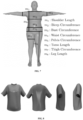
- the SMPL model processes the plurality of human body inputs to create the 3D human body for predicting the 3D skinned garments (T-shirt) ( FIG.4 ) as depicted in the example.
- the SMPL model represents the 3D human body as a function of the body pose and the body shape.
- the function T b (.) adds the body pose and the body shape dependent deformations B p (.) and B s (.) respectively to the base template mesh vertices V ⁇ R n * 3 in a T-pose ( FIG. 5 ).
- the final SMPL model is obtained by applying the garment skinning function to the updated mesh vertices.
- the SMPL model is the function of the body shape parameters / coefficients ⁇ as described in Equation 1.
- the garment mesh vertices are defined as the subset of the SMPL model mesh vertices.
- the garment skinning function is invertible, and can obtain the un-posed garment deformation from the simulated garment (.) as shown in Equation 5.
- O W ⁇ 1 IT b ⁇ ⁇ ⁇ G ⁇ ⁇ O
- the garment vertices are the function of the vertex offsets O.
- the rows of the matrix G ( ⁇ , ⁇ , O) represents the vertices of the ground truth simulated garment.
- the one or more hardware processors 104 predicting using a trained multi-layer perceptron model, via the one or more hardware processors, a garment vertices offsets based on the plurality of human body inputs.
- the SMPL model takes a PCA shape coefficient, ⁇ ⁇ R 10 to compute the body measurements ( ⁇ ).
- the body measurements ⁇ [ m 1 , m 2 , m 3 , m 4 , m 5 , m 6 ] affects the T-shirt fitting.
- the trained multi-layer perceptron model predicts the garment vertices offsets.
- the notation ' ⁇ ' represents model parameters to train the deep draper network.
- the one or more hardware processors 104 constructing using a garment skinning function, a 3D skinned garments for the subject using the garment vertex offset.
- the one or more hardware processors 104 draping using a trained deep draper network, the 3D skinned garments for the 3D human body of the subject based on (i) the garment vertices offsets, and (iii) a plurality of pre-defined ground truth garment intermediate features obtained from the trained deep draper network, wherein the deep draper network is trained based on a plurality of losses.
- the deep draper network is trained to predict the 3D skinned garments (referring to the example of T-shirt) to be draped on the 3D human body. Training the deep draper network comprises the following steps,
- the geometric data loss includes a geometric loss predicted for each garment vertex offset with its ground truth offset, and a cosine similarity loss predicted for the garment vertex normal with its ground truth vertex normal.
- the body garment collision loss ensures to predict the deformations are free from the body garment collisions, utilizing a body garment collision penalty. Specifically, for each predicted garment vertex say i th vertex g i ⁇ , the nearest 3D body vertex is found (say j th vertex) V j with its associated normal n j .
- the perceptual loss, ⁇ (.) is a differential rendering function, wherein using the rendering function of the multiview garment rendering model, the front view rendered garment image is computed based on the predicted garment vertices ( ⁇ ), the texture ( T ⁇ ), the garment mesh faces (F), a front camera ( C front ) and a front light ( L front ).
- the perceptual loss similarity PL(.) between the two images is the weighted L1-loss between their intermediate feature maps.
- ( ⁇ l ) denote the l th layer feature map and ⁇ l is the weightage of the l th layer.
- the perceptual loss in Equation 16 forces the network to predict garment vertex texture (predicted vertex normals via normal mapping) to be consistent with the ground truth vertex texture in the images space. It is to be noted that defining the notation, is the quantities without the over-hat is the ground-truth, while with the over-hat is the network predicted. In the first component of the summation in the Eq.
- the image content loss is the average L1 distance between the ground truth with its respective predicted rendered multi view images.
- the image content loss is the average distance between the predicted front view rendered garment images with its corresponding ground truth images
- l con front I G ⁇ , T , front ⁇ I G ⁇ , T ⁇ , front 1 + I G , T , front ⁇ I G , T ⁇ , front 1
- the total content loss is collected l con which is the sum of a front view content loss, a back view content loss, a left view content loss, a right view content loss, and a top content loss in Equation 19,
- L con l con front + l con back + l con left + l con right + l con top
- the total loss l total to train the deep draper network is the combination of the geometric loss, the perceptual loss, the body garment collision loss, and the image content loss.
- the deep draper network is trained using the plurality of losses with the trainable parameters of the MLP, the weights of the VGG19 network. Further, the sample intermediate front and the back view rendering results of a normal mapped skinned t-shirt are shown in FIG.9 . It shows that the method disclosed learns both the low frequency and high-frequency geometry (wrinkles and folds) as training progresses.
- the deep draper network can output temporally consistent 3D garment deformation because jointly the unified model is learned to predict the 3D garment as a function of body pose, body shape, body measurements, and garment style.
- FIG.9 illustrates an example 3D skinned garment images (T-shirt) representing a ground truth vertex normal mapped on a ground truth vertices with wrinkles and folds, in accordance with some embodiments of the present disclosure.
- the first column shows the ground-truth i.e., ground-truth vertex normal mapped on the ground-truth t-shirt vertices followed by the garment skinning and the rendering, while the remaining columns shows the Gpredicted normal mapped on the predicted garment vertices followed by the skinning and the rendering.
- the first and the second row shows the front view and the back view rendering as the training of the deep draper network progress.
- FIG. 10 illustrates an example 3D garment (T-shirt) experimental results of the deep draper network plotted with varying human body inputs in comparison with an existing technique using the system of FIG. 1 , in accordance with some embodiments of the present disclosure.
- the figure depicts the referred example to predict 3D garment images (T-shirt) using the deep draper network performing quantitative analysis with the existing method (TailorNet) method in different pose variations.
- the visual results of the (TailorNet) are sensitive to the number of mixture components used for the final prediction of the 3D skinned garment images.
- Table 1 show the comparison in the mean per vertex error. While it may seem the difference is small however a small improvement in the mean per-vertex error has a significant impact on visual and fitment results as shown in the figure.
- Table 1 Quantitative Result (T-shirt, female) Method Mean per vertex error in nm TailorNet 12.32 Deep Draper network 12.11 Furthermore, the method disclosed significantly improves memory efficiency and inference time. Referring now to Table 2 which shows the comparison of execution time and model size with TailorNet. The method takes ⁇ 10 ⁇ lesser memory space and run ⁇ 23 ⁇ faster on GPU and ⁇ 11 ⁇ faster on CPU, than the TailorNet.
- the implementation details, the trained deep draper network with batch size 32 and use Adam optimizer.
- the method disclosed has MPL into three hidden layers, predicting vertex offset and its unit normal, the output dimension of the MLP is the 6 times K (K is the number of the garment vertices). Further, an L2-normalization layer is applied to transform the network predicted normals to unit normals.
- the pre-trained VGG19 network is used for an image classification task on ImageNet dataset and freeze its weights.
- the differential renderer has set the rasterizer image size to 64 ⁇ 64, blur radius to 0.0 and the faces per pixel to 1. Initially, learning rate is set to 1 e - 4 and reduce it by a factor of 0.1 after every 100 epochs up-to 1 e - 7.
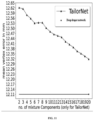
- FIG.11 illustrates graphical representation of varying human body inputs versus mean vertex error using the system of FIG.1 , in accordance with some embodiments of the present disclosure.
- the figure depicts the Single Model vs. Mixture Model Comparison: TailorNet follow a mixture model approach to model the high-frequency geometry of the deformed 3D garment. It learns each mixture component, i.e., the body shape and the garment style-specific deformation model separately and combined them using an RBF Kernel. In contrast to the learning separate shape style specific garment deformation models, the trained single unified network jointly models the factor of variations in the body shape, the body pose, the body measurements, and the garment style. The sensitivity evaluation of the TailorNet the number of mixture components and the results are average over 20 runs.
- the effect of different number of mixture components on visual appearance is shown in the FIG.11 . Since, the mixture component are the body shape and the garment style specific, removing some of the mixture components affects the visual results of the TailorNet.
- the disclosed method is the single unified model; hence the number of mixture components on the horizontal axis is only for the TailorNet.
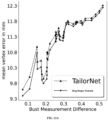
- FIG.12A illustrates graphical representation of the human body inputs with varying bust measurement plotted for mean vertex error using the system of FIG.1 , in accordance with some embodiments of the present disclosure.
- Fitment Analysis is performed and compared with the method disclosed with the TailorNet in the context of garment fitting. Similar, to the body measurements shown in FIG.7 , computing the ground truth garments measurement. Specifically, the bust, the waist, and the hip circumference of both the garment are computed with the respective body parts.
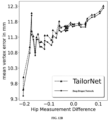
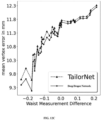
- FIG.12B and FIG.12C the result shows the mean per-vertex error against the difference in the respective measurements of the garment and the body.
- the negative value on the x-axis indicates the garment is tight (e.g., garment measurement on the bust is smaller than the bust measurement of the naked body) at the respective body parts (bust, waist, or hip).
- the method consistently outperforms the TailorNet for both loose and tight-fitting garments.
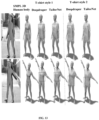
- FIG.14 illustrates the multi view of the 3D skinned garment images predicting accurate fitment for the human body using the system of FIG.1 , in accordance with some embodiments of the present disclosure.
- the disclosed method is computed and compared with the TailorNet on frames.
- the body shape and the pose parameters for each frame are extracted.
- the body shape, the body pose, and the body measurements are entirely unknown and in the wild setting ( FIG.13 ) shows that the deep draper network results are better than the TailorNet in terms of visual equivalence of fitting and rendering (see the red box).
- the trained model on the static poses produces temporally consistent 3D clothing animation.
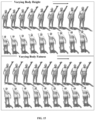
- FIG. 15 illustrates the multi view of the 3D skinned garment images representing the effect of wrinkles, folds and overall fitment as the human body varies in height and fatness using the system of FIG.1 , in accordance with some embodiments of the present disclosure.
- Sample qualitative results highlights the differences using the bounding box.
- TailorNet predicts a bulge around the stomach, while the proposed disclosure predicts accurate fold and wrinkles.
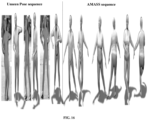
- the model on the pose sequence of the different unseen AMASS dataset The figure demonstrates that proposed disclosure produces visually plausible fitment and rendering even on an unseen pose sequence.
- the overall fitment of the final predicted 3D garment image as the function of human height, keeping the fatness of the human body fixed and human body fatness keeping the height fixed.
- FIG. 16 illustrates experimental results of the 3D skinned garment images of the unseen pose sequence, in accordance with some embodiments of the present disclosure.
- the body measurements ⁇ [ m 4, m 5, m 7, m 8]. Only these measurements affect the deformation of the pants. All the settings remain the same as for the t-shirt garment.
- the quantitative comparison with the TailorNet is shown in Table 3.
- the qualitative results on unseen human body shape and poses are shown in the FIG. 16 .
- Table 3 Quantitative Result (Pant Female) Method Mean per vertex error in nm TailorNet 4.8 Deep draper network 4.6 Based on Equation 20, the effect of different loss component represents the Ablation study for fitting and multi view rendering of garment images.
- Table 4 represents the result of the ablation study where it is evident that the usage of both the geometric losses and perceptual losses provides accurate results.
- the proposed single unified garment deformation model learns the shared space of variations in the body shape, the body pose, and the garment style, yielding realistic rendering in terms of wrinkles and folds on the output garment.
- the body measurement along with the body shape provides better fitment, unlike the existing methods.
- the deep draper network significantly improved the final draping of the 3D garment over the 3D human body compared with the state-of-the-art methods.
- the method is smaller size, faster inference which makes the deep draper network memory efficient and computationally cheaper, suitable for portable devices and web-based applications.
- the hardware device can be any kind of device which can be programmed including e.g. any kind of computer like a server or a personal computer, or the like, or any combination thereof.
- the device may also include means which could be e.g. hardware means like e.g. an application-specific integrated circuit (ASIC), a field-programmable gate array (FPGA), or a combination of hardware and software means, e.g.
- ASIC application-specific integrated circuit
- FPGA field-programmable gate array
- the means can include both hardware means and software means.
- the method embodiments described herein could be implemented in hardware and software.
- the device may also include software means.
- the embodiments may be implemented on different hardware devices, e.g. using a plurality of CPUs.
- the embodiments herein can comprise hardware and software elements.
- the embodiments that are implemented in software include but are not limited to, firmware, resident software, microcode, etc.
- the functions performed by various components described herein may be implemented in other components or combinations of other components.
- a computer-usable or computer readable medium can be any apparatus that can comprise, store, communicate, propagate, or transport the program for use by or in connection with the instruction execution system, apparatus, or device.
- a computer-readable storage medium refers to any type of physical memory on which information or data readable by a processor may be stored.
- a computer-readable storage medium may store instructions for execution by one or more processors, including instructions for causing the processor(s) to perform steps or stages consistent with the embodiments described herein.
- the term "computer-readable medium” should be understood to include tangible items and exclude carrier waves and transient signals, i.e., be non-transitory. Examples include random access memory (RAM), read-only memory (ROM), volatile memory, nonvolatile memory, hard drives, CD ROMs, DVDs, flash drives, disks, and any other known physical storage media.
Landscapes
- Engineering & Computer Science (AREA)
- Physics & Mathematics (AREA)
- General Physics & Mathematics (AREA)
- Theoretical Computer Science (AREA)
- Multimedia (AREA)
- Computer Vision & Pattern Recognition (AREA)
- Signal Processing (AREA)
- Geometry (AREA)
- Computer Graphics (AREA)
- Computer Hardware Design (AREA)
- General Engineering & Computer Science (AREA)
- Software Systems (AREA)
- Processing Or Creating Images (AREA)
Claims (15)
- Prozessorimplementiertes Verfahren zum Drapieren eines 3D-Kleidungsstücks auf einem digitalen menschlichen 3D-Körper, wobei das Verfahren umfasst:Empfangen, über einen oder mehrere Hardwareprozessoren, einer Mehrzahl von menschlichen Körpereingaben, die eine Datendarstellung eines Subjekts beinhalten;Erstellen, unter Verwendung eines SMPL-Körpermodells (SMPL = skinned multi person linear), über den einen oder die mehreren Hardwareprozessoren, eines digitalen menschlichen 3D-Körpers des Subjekts basierend auf einer Körperform β und einer Körperpose θ, aus der Mehrzahl von menschlichen Körpereingaben, wobei das SMPL-Körpermodell den menschlichen 3D-Körper als eine Funktion der Körperpose und Körperform ausgibt und eine lineare Funktion T b (β, θ) umfasst, die von der Körperpose und Körperform abhängige Verformungen hinzufügt;Vorhersagen, unter Verwendung eines mehrschichtigen Perzeptronmodells, über den einen oder die mehreren Hardwareprozessoren, von Kleidungsstückscheitelpunktversätzen Ô basierend auf der Mehrzahl von menschlichen Körpereingaben und Kleidungsstückstilkoeffizienten, wobei die Kleidungsstücknetzscheitelpunkte als eine Teilmenge der SMPL-Modellnetzscheitelpunkte definiert sind;Konstruieren, unter Verwendung einer Kleidungsstückentkleidungsfunktion, über den einen oder die mehreren Hardwareprozessoren, eines entkleideten 3D-Kleidungsstücks für das Subjekt unter Verwendung der Kleidungsstückscheitelpunktversätze Ö , wobei die Kleidungsstückentkleidungsfunktion durch die Gleichung
 wobeiW eine Kleidungsstückentkleidungsfunktion ist,J(.) eine Skelettgelenkvorhersagefunktion ist,
 wobei I eine Indikatormatrix ist, deren Element imn anzeigt, dass der m-te Kleidungsstückscheitelpunkt mit dem n-ten SMPL-Körperscheitelpunkt assoziiert ist, wenn er gleich 1 ist,w die Mischgewichte der Skelettgelenkvorhersagefunktion J(.) sind;Drapieren, unter Verwendung eines trainierten tiefen neuronalen Netzwerks, über den einen oder die mehreren Hardwareprozessoren, des konstruierten enthäuteten 3D-Kleidungsstücks für den SMPL-erzeugten digitalen menschlichen 3D-Körper des Subjekts basierend auf (i) den Kleidungsstückscheitelpunktversätzen und(ii) einer Mehrzahl von vordefinierten Ground-Truth-Kleidungsstückzwischenmerkmalen, die als eine Ausgabe eines VGG 19-Netzwerks erhalten werden, das mit vorderen, hinteren, rechten, linken und oberen gerenderten Bildern des enthäuteten 3D-Kleidungsstücks eingegeben wird, wobei das tiefe neuronale Netzwerk basierend auf einer Mehrzahl von Verlusten für eine genaue Eignung trainiert wird;und visuelles Rendern des resultierenden drapierten 3D-Kleidungsstücks auf dem digitalen menschlichen 3D-Körper des Subjekts.
 - Prozessorimplementiertes Verfahren nach Anspruch 1, wobei die Mehrzahl von menschlichen Körpereingaben zusätzlich die Körpermessungen des Subjekts (α) bezogen auf die Größe des Subjekts beinhalten.
- Prozessorimplementiertes Verfahren nach Anspruch 1, wobei das Trainieren des tiefen neuronalen Netzwerks umfasst:Konstruieren einer Mehrzahl von Trainingsdateneingaben für das tiefe neuronale Netzwerk von einem oder mehreren Subjekten, wobei die Mehrzahl von Trainingsdateneingaben (i) Trainingsdatenkörpermessungen (α), (ii) eine Trainingsdatenkörperform (β), (iii) eine Trainingsdatenkörperpose (θ) und (iv) Trainingsdatenkleidungsstückstilkoeffizienten (γ) beinhalten.Vorhersagen, unter Verwendung eines mehrschichtigen Perzeptronmodells, der Kleidungsstückscheitelpunktversätze ( Ô ) und einer Kleidungsstückscheitelpunktnormalen basierend auf der Mehrzahl von Trainingsdateneingaben und einem trainierten Modellparameter, wobei jede Trainingsdatenkörperform einen ersten Körperkoeffizienten und einen zweiten Koeffizienten beinhaltet;Vorhersagen der Bilder des entkleideten 3D-Kleidungsstücks durch Anwenden (i) der Kleidungsstückentkleidungsfunktion auf die Kleidungsstückscheitelpunktversätze, (ii) der Trainingsdatenkörperpose, (iii) der Trainingsdatenkörperform, (iv) der Trainingsdatenkörpermessungen und (v) der Trainingsdatenkleidungsstückstilkoeffizienten;Zuweisen einer Textur (T̂ ) zu jedem vorhergesagten verschobenen 3D-entkleideten Kleidungsstückscheitelpunkt als eine Funktion seiner Einheitstexturnormalen
 Aktualisieren des mehrschichtigen Perzeptronmodells des tiefen neuronalen Netzwerks basierend auf der Mehrzahl von Verlusten, umfassend (i) einen perzeptuellen Verlust, (ii) einen geometrischen Datenverlust, (iii) einen Körperkleidungsstückkollisionsverlust und (iii) einen Bildinhaltsverlust.
 - Prozessorimplementiertes Verfahren nach Anspruch 3, wobei der geometrische Datenverlust (i) einen geometrischen Verlust, der für jeden Kleidungsstückscheitelpunktversatz mit seinem Ground-Truth-Versatz vorhergesagt wird, und (ii) einen Kosinusähnlichkeitsverlust, der für die Kleidungsstückscheitelpunktnormale mit ihrer Ground-Truth-Scheitelpunktnormalen vorhergesagt wird, beinhaltet.
- Prozessorimplementiertes Verfahren nach Anspruch 3, wobei, unter Verwendung einer Rendering-Funktion des Mehransichts-Kleidungsstückrendering-Modells, das in der Vorderansicht gerenderte Kleidungsstückbild basierend auf den vorhergesagten Kleidungsstückscheitelpunkten ( Ĝ ), der Textur ( T̂ ), den Kleidungsstücknetzflächen (F), einer Vorderkamera ( Cvorne ) und einem Vorderlicht ( Lvorne ) berechnet wird.
- Prozessorimplementiertes Verfahren nach Anspruch 1, wobei der perzeptuelle Verlust des in der Vorderansicht gerenderten Kleidungsstückbildes basierend auf der perzeptuellen Ähnlichkeit zwischen dem in der Vorderansicht gerenderten Kleidungsstückbild und der Grundwahrheit der in der Vorderansicht gerenderten Kleidungsstückbilder berechnet wird.
- Prozessorimplementiertes Verfahren nach Anspruch 1, wobei ein gesamter perzeptueller Verlust für das in der Vorderansicht gerenderte Bild die Summe eines vorhergesagten Kleidungsstückscheitelpunkts des in der Vorderansicht gerenderten Kleidungsstückbildes und der Grundwahrheit der Kleidungsstückscheitelpunkte ist.
- Prozessorimplementiertes Verfahren nach Anspruch 1, wobei ein gesamter perzeptueller Verlust für mehrere Ansichten die Summe eines Vorderlichts, einer Hintergrundbeleuchtung, einer rechten Beleuchtung, einer linken Beleuchtung und einer oberen Beleuchtung ist.
- Prozessorimplementiertes Verfahren nach Anspruch 1, wobei ein gesamter Verlust für das tiefe neuronale Netzwerk eine Summe von (i) dem geometrischen Verlust multipliziert mit der entsprechenden geometrischen Gewichtskomponente, (ii) einem Kosinusähnlichkeitsverlust multipliziert mit seiner entsprechenden Kosinusähnlichkeitsgewichtskomponente, (iii) dem Regularisierungsverlust multipliziert mit der entsprechenden Regularisierungsgewichtskomponente, (iv) einem Perzeptronverlust multipliziert mit der entsprechenden Perzeptrongewichtskomponente, (v) einem Körperkleidungsstückkollisionsverlust multipliziert mit seiner entsprechenden Körperkleidungsstückkollisionsgewichtskomponente und (vi) dem Inhaltsverlust multipliziert mit einer entsprechenden Inhaltsgewichtsverlustkomponente ist.
- System zum Drapieren eines 3D-Kleidungsstücks auf einem digitalen menschlichen 3D-Körper, wobei das System umfasst:einen Speicher, der Anweisungen speichert;eine oder mehrere Kommunikationsschnittstellen; undeinen oder mehrere Hardwareprozessoren, die über die eine oder die mehreren Kommunikationsschnittstellen mit dem Speicher gekoppelt sind, wobei der eine oder die mehreren Hardwareprozessoren durch die Anweisungen konfiguriert sind zum:Empfangen einer Mehrzahl von menschlichen Körpereingaben, die eine Datendarstellung eines Subjekts beinhalten;Erstellen, unter Verwendung eines SMPL-Körpermodells (SMPL = skinned multi person linear), eines digitalen menschlichen 3D-Körpers des Subjekts basierend auf einer Körperform (β) und einer Körperpose (θ) aus der Mehrzahl von menschlichen Körpereingaben, wobei das SMPL-Körpermodell den menschlichen 3D-Körper des einen oder der mehreren digitalen Menschen als eine Funktion der Körperpose und Körperform ausgibt und eine lineare Funktion T b (β, θ) umfasst, die von der Körperpose und Körperform abhängige Verformungen hinzufügt;Vorhersagen, unter Verwendung eines mehrschichtigen Perzeptronmodells, von Kleidungsstückscheitelpunktversätzen Ô basierend auf der Mehrzahl von menschlichen Körpereingaben und Kleidungsstückstilkoeffizienten, wobei die Kleidungsstücknetzscheitelpunkte als eine Teilmenge der SMPL-Modellnetzscheitelpunkte definiert sind;Konstruieren, unter Verwendung einer Kleidungsstückentkleidungsfunktion, eines entkleideten 3D-Kleidungsstücks für das Subjekt unter Verwendung der Kleidungsstückscheitelpunktversätze Ô , wobei die Kleidungsstückentkleidungsfunktion durch die Gleichung
 definiert ist, wobeiW eine Kleidungsstückentkleidungsfunktion ist,J(.) eine Skelettgelenkvorhersagefunktion ist,
 wobei I eine Indikatormatrix ist, deren Element imn anzeigt, dass der m-te Kleidungsstückscheitelpunkt mit dem n-ten SMPL-Körperscheitelpunkt assoziiert ist, wenn er gleich 1 ist,w die Mischgewichte der Skelettgelenkvorhersagefunktion J(.) sind;Drapieren, unter Verwendung eines trainierten tiefen neuronalen Netzwerks, des konstruierten entkleideten 3D-Kleidungsstücks für den SMPL-erzeugten digitalen menschlichen 3D-Körper des Subjekts basierend auf (i) den Kleidungsstückscheitelpunktversätzen und (ii) einer Mehrzahl von vordefinierten Ground-Truth-Kleidungsstückzwischenmerkmalen, die als eine Ausgabe eines VGG 19-Netzwerks erhalten werden, das mit vorderen, hinteren, rechten, linken und oberen gerenderten Bildern des entkleideten 3D-Kleidungsstücks eingegeben wird, wobei das tiefe neuronale Netzwerk basierend auf einer Mehrzahl von Verlusten für eine genaue Eignung trainiert wird;und visuelles Rendern des resultierenden drapierten 3D-Kleidungsstücks auf dem digitalen menschlichen 3D-Körper des Subjekts.
 - System nach Anspruch 10, wobei die Mehrzahl von menschlichen Körpereingaben zusätzlich die Körpermessungen des Subjekts (α) bezogen auf die Größe des Subjekts beinhalten.
- System nach Anspruch 10, wobei das Trainieren des tiefen neuronalen Netzwerks umfasst: Konstruieren einer Mehrzahl von Trainingsdateneingaben für das tiefe neuronale Netzwerk von einem oder mehreren Subjekten, wobei die Mehrzahl von Trainingsdateneingaben (i) die Trainingsdatenkörpermessungen (α), (ii) die Trainingsdatenkörperform (β), (iii) die Trainingsdatenkörperpose (θ) und (iv) die Trainingsdatenkleidungsstückstilkoeffizienten (γ) beinhalten.Vorhersagen, unter Verwendung eines mehrschichtigen Perzeptronmodells, der Kleidungsstückscheitelpunktversätze ( Ô ) und einer Kleidungsstückscheitelpunktnormalen basierend auf der Mehrzahl von Trainingsdateneingaben und einem trainierten Modellparameter, wobei jede Trainingsdatenkörperform einen ersten Körperkoeffizienten und einen zweiten Koeffizienten beinhaltet;Vorhersagen der Bilder des entkleideten 3D-Kleidungsstücks durch Anwenden (i) der Kleidungsstückentkleidungsfunktion auf die Kleidungsstückscheitelpunktversätze, (ii) der Trainingsdatenkörperpose, (iii) der Trainingsdatenkörperform, (iv) der Trainingsdatenkörpermessungen und (v) der Trainingsdatenkleidungsstückstilkoeffizienten;Zuweisen einer Textur (T̂ ) zu jedem vorhergesagten verschobenen 3D-entkleideten Kleidungsstückscheitelpunkt als eine Funktion seiner Einheitstexturnormalen
 Aktualisieren des mehrschichtigen Perzeptronmodells des tiefen neuronalen Netzwerks basierend auf der Mehrzahl von Verlusten, umfassend (i) einen perzeptuellen Verlust, (ii) einen geometrischen Datenverlust, (iii) einen Körperkleidungsstückkollisionsverlust und (iii) einen Bildinhaltsverlust.
 - Ein oder mehrere nichtflüchtige maschinenlesbare Informationsspeichermedien, die eine oder mehrere Anweisungen umfassen, die, wenn sie von einem oder mehreren Hardwareprozessoren ausgeführt werden, bewirken:Empfangen einer Mehrzahl von menschlichen Körpereingaben, die eine Datendarstellung eines Subjekts beinhalten;Erstellen, unter Verwendung eines SMPL-Körpermodells (SMPL = skinned multi person linear), eines digitalen menschlichen 3D-Körpers des Subjekts basierend auf einer Körperform β und einer Körperpose θ aus der Mehrzahl von menschlichen Körpereingaben, wobei das SMPL-Körpermodell den menschlichen 3D-Körper als eine Funktion der Körperpose und Körperform ausgibt und eine lineare Funktion T b (β, θ) umfasst, die von der Körperpose und Körperform abhängige Verformungen hinzufügt;Vorhersagen, unter Verwendung eines mehrschichtigen Perzeptronmodells, von Kleidungsstückscheitelpunktversätzen Ô basierend auf der Mehrzahl von menschlichen Körpereingaben und Kleidungsstückstilkoeffizienten, wobei die Kleidungsstücknetzscheitelpunkte als eine Teilmenge der SMPL-Modellnetzscheitelpunkte definiert sind;Konstruieren, unter Verwendung einer Kleidungsstückentkleidungsfunktion, eines entkleideten 3D-Kleidungsstücks für das Subjekt unter Verwendung der Kleidungsstückscheitelpunktversätze Ô , wobei die Kleidungsstückentkleidungsfunktion durch die Gleichung
 wo,J(.) eine Skelettgelenkvorhersagefunktion ist,
 wobei I eine Indikatormatrix ist, deren Element imn anzeigt, dass der m-te Kleidungsstückscheitelpunkt mit dem n-ten SMPL-Körperscheitelpunkt assoziiert ist, wenn er gleich 1 ist,w die Mischgewichte der Skelettgelenkvorhersagefunktion J(.) sind; undDrapieren, unter Verwendung eines trainierten tiefen neuronalen Netzwerks, des konstruierten entkleideten 3D-Kleidungsstücks für den SMPL-erzeugten digitalen menschlichen 3D-Körper des Subjekts basierend auf (i) den Kleidungsstückscheitelpunktversätzen und (iii) einer Mehrzahl von vordefinierten Ground-Truth-Kleidungsstückzwischenmerkmalen, die als eine Ausgabe eines VGG 19-Netzwerks erhalten werden, das mit vorderen, hinteren, rechten, linken und oberen gerenderten Bildern des entkleideten 3D-Kleidungsstücks eingegeben wird, wobei das tiefe neuronale Netzwerk basierend auf einer Mehrzahl von Verlusten für eine genaue Eignung trainiert wird;und visuelles Rendern des resultierenden drapierten 3D-Kleidungsstücks auf dem digitalen menschlichen 3D-Körper des Subjekts.
 - Ein oder mehrere nichtflüchtige maschinenlesbare Informationsspeichermedien nach Anspruch 13, wobei das Trainieren des tiefen neuronalen Netzwerks umfasst:Konstruieren einer Mehrzahl von Trainingsdateneingaben für das tiefe neuronale Netzwerk von einem oder mehreren Subjekten, wobei die Mehrzahl von Trainingsdateneingaben (i) Trainingsdatenkörpermessungen (α), (ii) eine Trainingsdatenkörperform (β), (iii) eine Trainingsdatenkörperpose (θ) und (iv) Trainingsdatenkleidungsstückstilkoeffizienten (γ) beinhalten.Vorhersagen, unter Verwendung eines mehrschichtigen Perzeptronmodells, der Kleidungsstückscheitelpunktversätze ( Ô ) und einer Kleidungsstückscheitelpunktnormalen basierend auf der Mehrzahl von Trainingsdateneingaben und einem trainierten Modellparameter, wobei jede Trainingsdatenkörperform einen ersten Körperkoeffizienten und einen zweiten Koeffizienten beinhaltet;Vorhersagen der Bilder des entkleideten 3D-Kleidungsstücks durch Anwenden (i) der Kleidungsstückentkleidungsfunktion auf die Kleidungsstückscheitelpunktversätze, (ii) der Trainingsdatenkörperpose, (iii) der Trainingsdatenkörperform, (iv) der Trainingsdatenkörpermessungen und (v) der Trainingsdatenkleidungsstückstilkoeffizienten;Zuweisen einer Textur (T̂ ) zu jedem vorhergesagten verschobenen 3D-entkleideten Kleidungsstückscheitelpunkt als eine Funktion seiner Einheitstexturnormalen
 Aktualisieren des mehrschichtigen Perzeptronmodells des tiefen neuronalen Netzwerks basierend auf der Mehrzahl von Verlusten, umfassend (i) einen perzeptuellen Verlust, (ii) einen geometrischen Datenverlust, (iii) einen Körperkleidungsstückkollisionsverlust und (iii) einen Bildinhaltsverlust.
 - Ein oder mehrere nichtflüchtige maschinenlesbare Informationsspeichermedien nach Anspruch 14, wobei der geometrische Datenverlust (i) einen geometrischen Verlust, der für jeden Kleidungsstückscheitelpunktversatz mit seinem Ground-Truth-Versatz vorhergesagt wird, und (ii) einen Kosinusähnlichkeitsverlust, der für die Kleidungsstückscheitelpunktnormale mit ihrer Ground-Truth-Scheitelpunktnormalen vorhergesagt wird, beinhaltet.
Applications Claiming Priority (1)
| Application Number | Priority Date | Filing Date | Title |
|---|---|---|---|
| IN202121013169 | 2021-03-25 |
Publications (3)
| Publication Number | Publication Date |
|---|---|
| EP4064209A1 EP4064209A1 (de) | 2022-09-28 |
| EP4064209B1 true EP4064209B1 (de) | 2025-01-29 |
| EP4064209C0 EP4064209C0 (de) | 2025-01-29 |
Family
ID=79024870
Family Applications (1)
| Application Number | Title | Priority Date | Filing Date |
|---|---|---|---|
| EP21217893.3A Active EP4064209B1 (de) | 2021-03-25 | 2021-12-28 | Verfahren und system zum drapieren eines dreidimensionalen kleidungsstücks auf einem dreidimensionalen menschlichen körper |
Country Status (2)
| Country | Link |
|---|---|
| US (1) | US11778162B2 (de) |
| EP (1) | EP4064209B1 (de) |
Families Citing this family (5)
| Publication number | Priority date | Publication date | Assignee | Title |
|---|---|---|---|---|
| US12333760B1 (en) * | 2019-03-22 | 2025-06-17 | Bertec Corporation | System for estimating a three dimensional pose of one or more persons in a scene |
| US11869163B1 (en) * | 2021-09-17 | 2024-01-09 | Amazon Technologies, Inc. | Virtual garment draping using machine learning |
| CN116863078B (zh) * | 2023-07-14 | 2025-04-04 | 中国电信股份有限公司技术创新中心 | 三维人体模型重建方法、装置、电子设备和可读介质 |
| US20250037343A1 (en) * | 2023-07-26 | 2025-01-30 | Google Llc | Guided Multimodal Virtual Try-On |
| WO2025078549A1 (en) | 2023-10-10 | 2025-04-17 | Lotfi Reza | Method, system and hub for design, customization, virtual try-on and production of clothes and shoes in the absence of the customer |
Family Cites Families (3)
| Publication number | Priority date | Publication date | Assignee | Title |
|---|---|---|---|---|
| EP2327061A4 (de) | 2008-08-15 | 2016-11-16 | Univ Brown | Verfahren und vorrichtung zur schätzung von körperformen |
| US11250639B2 (en) * | 2018-12-19 | 2022-02-15 | Seddi, Inc. | Learning-based animation of clothing for virtual try-on |
| RU2019125602A (ru) * | 2019-08-13 | 2021-02-15 | Общество С Ограниченной Ответственностью "Тексел" | Комплексная система и способ для дистанционного выбора одежды |
-
2021
- 2021-12-28 EP EP21217893.3A patent/EP4064209B1/de active Active
- 2021-12-29 US US17/646,330 patent/US11778162B2/en active Active
Non-Patent Citations (1)
| Title |
|---|
| KAREN SIMONYAN ET AL: "Very Deep Convolutional Networks for Large-Scale Image Recognition", 10 April 2015 (2015-04-10), XP055658302, Retrieved from the Internet <URL:https://arxiv.org/pdf/1409.1556.pdf> [retrieved on 20200115] * |
Also Published As
| Publication number | Publication date |
|---|---|
| EP4064209A1 (de) | 2022-09-28 |
| EP4064209C0 (de) | 2025-01-29 |
| US20220368882A1 (en) | 2022-11-17 |
| US11778162B2 (en) | 2023-10-03 |
Similar Documents
| Publication | Publication Date | Title |
|---|---|---|
| EP4064209B1 (de) | Verfahren und system zum drapieren eines dreidimensionalen kleidungsstücks auf einem dreidimensionalen menschlichen körper | |
| US11443480B2 (en) | Method and system for remote clothing selection | |
| Zhao et al. | Unpaired image-to-image translation using adversarial consistency loss | |
| US12118602B2 (en) | Recommendation system, method and computer program product based on a user's physical features | |
| US10489683B1 (en) | Methods and systems for automatic generation of massive training data sets from 3D models for training deep learning networks | |
| US20250308060A1 (en) | Inverting Neural Radiance Fields for Pose Estimation | |
| US10679046B1 (en) | Machine learning systems and methods of estimating body shape from images | |
| Deng et al. | Flashtex: Fast relightable mesh texturing with lightcontrolnet | |
| US20230126829A1 (en) | Point-based modeling of human clothing | |
| Ye et al. | DPNet: Detail-preserving network for high quality monocular depth estimation | |
| US11507781B2 (en) | Methods and systems for automatic generation of massive training data sets from 3D models for training deep learning networks | |
| CN110084874A (zh) | 对于三维模型的图像风格迁移 | |
| US11200689B1 (en) | Detailed 3D estimation from a single image | |
| Dibra et al. | Shape from selfies: Human body shape estimation using cca regression forests | |
| AU2009281762A1 (en) | Method and apparatus for estimating body shape | |
| EP4350631A2 (de) | Vorrichtung und verfahren mit zweidimensionaler szenenrekonstruktion für dynamischen dreidimensionalen raum | |
| US11978144B2 (en) | Resolving garment collisions using neural networks | |
| US11836221B2 (en) | Systems and methods for refined object estimation from image data | |
| CN118823202A (zh) | 一种智能穿搭app | |
| US20240193727A1 (en) | Method and apparatus with frame image reconstruction | |
| CN117670695A (zh) | 一种用于改善遮挡问题的循环外观流虚拟试衣方法 | |
| Dong et al. | Exploiting dual-correlation for multi-frame time-of-flight denoising | |
| Chen et al. | CS-VITON: a realistic virtual try-on network based on clothing region alignment and SPM | |
| CN116095515B (zh) | 静态图像的动态显示方法、装置及存储介质 | |
| KR20240040893A (ko) | 3d 아바타를 이용한 가상피팅 서비스 제공 시스템 |
Legal Events
| Date | Code | Title | Description |
|---|---|---|---|
| PUAI | Public reference made under article 153(3) epc to a published international application that has entered the european phase |
Free format text: ORIGINAL CODE: 0009012 |
|
| STAA | Information on the status of an ep patent application or granted ep patent |
Free format text: STATUS: THE APPLICATION HAS BEEN PUBLISHED |
|
| AK | Designated contracting states |
Kind code of ref document: A1 Designated state(s): AL AT BE BG CH CY CZ DE DK EE ES FI FR GB GR HR HU IE IS IT LI LT LU LV MC MK MT NL NO PL PT RO RS SE SI SK SM TR |
|
| STAA | Information on the status of an ep patent application or granted ep patent |
Free format text: STATUS: REQUEST FOR EXAMINATION WAS MADE |
|
| 17P | Request for examination filed |
Effective date: 20220930 |
|
| RBV | Designated contracting states (corrected) |
Designated state(s): AL AT BE BG CH CY CZ DE DK EE ES FI FR GB GR HR HU IE IS IT LI LT LU LV MC MK MT NL NO PL PT RO RS SE SI SK SM TR |
|
| STAA | Information on the status of an ep patent application or granted ep patent |
Free format text: STATUS: EXAMINATION IS IN PROGRESS |
|
| 17Q | First examination report despatched |
Effective date: 20230907 |
|
| GRAP | Despatch of communication of intention to grant a patent |
Free format text: ORIGINAL CODE: EPIDOSNIGR1 |
|
| STAA | Information on the status of an ep patent application or granted ep patent |
Free format text: STATUS: GRANT OF PATENT IS INTENDED |
|
| INTG | Intention to grant announced |
Effective date: 20240904 |
|
| GRAS | Grant fee paid |
Free format text: ORIGINAL CODE: EPIDOSNIGR3 |
|
| GRAA | (expected) grant |
Free format text: ORIGINAL CODE: 0009210 |
|
| STAA | Information on the status of an ep patent application or granted ep patent |
Free format text: STATUS: THE PATENT HAS BEEN GRANTED |
|
| AK | Designated contracting states |
Kind code of ref document: B1 Designated state(s): AL AT BE BG CH CY CZ DE DK EE ES FI FR GB GR HR HU IE IS IT LI LT LU LV MC MK MT NL NO PL PT RO RS SE SI SK SM TR |
|
| REG | Reference to a national code |
Ref country code: GB Ref legal event code: FG4D |
|
| REG | Reference to a national code |
Ref country code: CH Ref legal event code: EP |
|
| REG | Reference to a national code |
Ref country code: DE Ref legal event code: R096 Ref document number: 602021025353 Country of ref document: DE |
|
| REG | Reference to a national code |
Ref country code: IE Ref legal event code: FG4D |
|
| U01 | Request for unitary effect filed |
Effective date: 20250129 |
|
| U07 | Unitary effect registered |
Designated state(s): AT BE BG DE DK EE FI FR IT LT LU LV MT NL PT RO SE SI Effective date: 20250205 |
|
| PG25 | Lapsed in a contracting state [announced via postgrant information from national office to epo] |
Ref country code: RS Free format text: LAPSE BECAUSE OF FAILURE TO SUBMIT A TRANSLATION OF THE DESCRIPTION OR TO PAY THE FEE WITHIN THE PRESCRIBED TIME-LIMIT Effective date: 20250429 |
|
| PG25 | Lapsed in a contracting state [announced via postgrant information from national office to epo] |
Ref country code: PL Free format text: LAPSE BECAUSE OF FAILURE TO SUBMIT A TRANSLATION OF THE DESCRIPTION OR TO PAY THE FEE WITHIN THE PRESCRIBED TIME-LIMIT Effective date: 20250129 |
|
| PG25 | Lapsed in a contracting state [announced via postgrant information from national office to epo] |
Ref country code: ES Free format text: LAPSE BECAUSE OF FAILURE TO SUBMIT A TRANSLATION OF THE DESCRIPTION OR TO PAY THE FEE WITHIN THE PRESCRIBED TIME-LIMIT Effective date: 20250129 |
|
| PG25 | Lapsed in a contracting state [announced via postgrant information from national office to epo] |
Ref country code: IS Free format text: LAPSE BECAUSE OF FAILURE TO SUBMIT A TRANSLATION OF THE DESCRIPTION OR TO PAY THE FEE WITHIN THE PRESCRIBED TIME-LIMIT Effective date: 20250529 Ref country code: NO Free format text: LAPSE BECAUSE OF FAILURE TO SUBMIT A TRANSLATION OF THE DESCRIPTION OR TO PAY THE FEE WITHIN THE PRESCRIBED TIME-LIMIT Effective date: 20250429 |
|
| PG25 | Lapsed in a contracting state [announced via postgrant information from national office to epo] |
Ref country code: HR Free format text: LAPSE BECAUSE OF FAILURE TO SUBMIT A TRANSLATION OF THE DESCRIPTION OR TO PAY THE FEE WITHIN THE PRESCRIBED TIME-LIMIT Effective date: 20250129 |
|
| PG25 | Lapsed in a contracting state [announced via postgrant information from national office to epo] |
Ref country code: GR Free format text: LAPSE BECAUSE OF FAILURE TO SUBMIT A TRANSLATION OF THE DESCRIPTION OR TO PAY THE FEE WITHIN THE PRESCRIBED TIME-LIMIT Effective date: 20250430 |
|
| PG25 | Lapsed in a contracting state [announced via postgrant information from national office to epo] |
Ref country code: SM Free format text: LAPSE BECAUSE OF FAILURE TO SUBMIT A TRANSLATION OF THE DESCRIPTION OR TO PAY THE FEE WITHIN THE PRESCRIBED TIME-LIMIT Effective date: 20250129 |
|
| PG25 | Lapsed in a contracting state [announced via postgrant information from national office to epo] |
Ref country code: CZ Free format text: LAPSE BECAUSE OF FAILURE TO SUBMIT A TRANSLATION OF THE DESCRIPTION OR TO PAY THE FEE WITHIN THE PRESCRIBED TIME-LIMIT Effective date: 20250129 |
|
| PG25 | Lapsed in a contracting state [announced via postgrant information from national office to epo] |
Ref country code: SK Free format text: LAPSE BECAUSE OF FAILURE TO SUBMIT A TRANSLATION OF THE DESCRIPTION OR TO PAY THE FEE WITHIN THE PRESCRIBED TIME-LIMIT Effective date: 20250129 |
|
| PLBE | No opposition filed within time limit |
Free format text: ORIGINAL CODE: 0009261 |
|
| STAA | Information on the status of an ep patent application or granted ep patent |
Free format text: STATUS: NO OPPOSITION FILED WITHIN TIME LIMIT |
|
| REG | Reference to a national code |
Ref country code: CH Ref legal event code: L10 Free format text: ST27 STATUS EVENT CODE: U-0-0-L10-L00 (AS PROVIDED BY THE NATIONAL OFFICE) Effective date: 20251210 |
|
| REG | Reference to a national code |
Ref country code: CH Ref legal event code: U11 Free format text: ST27 STATUS EVENT CODE: U-0-0-U10-U11 (AS PROVIDED BY THE NATIONAL OFFICE) Effective date: 20260101 |
|
| 26N | No opposition filed |
Effective date: 20251030 |
|
| PGFP | Annual fee paid to national office [announced via postgrant information from national office to epo] |
Ref country code: GB Payment date: 20251223 Year of fee payment: 5 |
|
| U20 | Renewal fee for the european patent with unitary effect paid |
Year of fee payment: 5 Effective date: 20251225 |