EP4064154A1 - System und verfahren zur unterstützten modellierung von fertigungsabläufen - Google Patents
System und verfahren zur unterstützten modellierung von fertigungsabläufen Download PDFInfo
- Publication number
- EP4064154A1 EP4064154A1 EP21164859.7A EP21164859A EP4064154A1 EP 4064154 A1 EP4064154 A1 EP 4064154A1 EP 21164859 A EP21164859 A EP 21164859A EP 4064154 A1 EP4064154 A1 EP 4064154A1
- Authority
- EP
- European Patent Office
- Prior art keywords
- manufacturing
- mwf
- automatically
- node
- decision
- Prior art date
- Legal status (The legal status is an assumption and is not a legal conclusion. Google has not performed a legal analysis and makes no representation as to the accuracy of the status listed.)
- Pending
Links
Images


Classifications
-
- G—PHYSICS
- G06—COMPUTING OR CALCULATING; COUNTING
- G06Q—INFORMATION AND COMMUNICATION TECHNOLOGY [ICT] SPECIALLY ADAPTED FOR ADMINISTRATIVE, COMMERCIAL, FINANCIAL, MANAGERIAL OR SUPERVISORY PURPOSES; SYSTEMS OR METHODS SPECIALLY ADAPTED FOR ADMINISTRATIVE, COMMERCIAL, FINANCIAL, MANAGERIAL OR SUPERVISORY PURPOSES, NOT OTHERWISE PROVIDED FOR
- G06Q10/00—Administration; Management
- G06Q10/06—Resources, workflows, human or project management; Enterprise or organisation planning; Enterprise or organisation modelling
-
- G—PHYSICS
- G05—CONTROLLING; REGULATING
- G05B—CONTROL OR REGULATING SYSTEMS IN GENERAL; FUNCTIONAL ELEMENTS OF SUCH SYSTEMS; MONITORING OR TESTING ARRANGEMENTS FOR SUCH SYSTEMS OR ELEMENTS
- G05B19/00—Program-control systems
- G05B19/02—Program-control systems electric
- G05B19/18—Numerical control [NC], i.e. automatically operating machines, in particular machine tools, e.g. in a manufacturing environment, so as to execute positioning, movement or co-ordinated operations by means of program data in numerical form
- G05B19/4155—Numerical control [NC], i.e. automatically operating machines, in particular machine tools, e.g. in a manufacturing environment, so as to execute positioning, movement or co-ordinated operations by means of program data in numerical form characterised by program execution, i.e. part program or machine function execution, e.g. selection of a program
-
- G—PHYSICS
- G06—COMPUTING OR CALCULATING; COUNTING
- G06T—IMAGE DATA PROCESSING OR GENERATION, IN GENERAL
- G06T11/00—Two-dimensional [2D] image generation
- G06T11/60—Creating or editing images; Combining images with text
-
- G—PHYSICS
- G06—COMPUTING OR CALCULATING; COUNTING
- G06F—ELECTRIC DIGITAL DATA PROCESSING
- G06F9/00—Arrangements for program control, e.g. control units
- G06F9/06—Arrangements for program control, e.g. control units using stored programs, i.e. using an internal store of processing equipment to receive or retain programs
- G06F9/44—Arrangements for executing specific programs
- G06F9/451—Execution arrangements for user interfaces
-
- G—PHYSICS
- G06—COMPUTING OR CALCULATING; COUNTING
- G06N—COMPUTING ARRANGEMENTS BASED ON SPECIFIC COMPUTATIONAL MODELS
- G06N20/00—Machine learning
-
- G—PHYSICS
- G05—CONTROLLING; REGULATING
- G05B—CONTROL OR REGULATING SYSTEMS IN GENERAL; FUNCTIONAL ELEMENTS OF SUCH SYSTEMS; MONITORING OR TESTING ARRANGEMENTS FOR SUCH SYSTEMS OR ELEMENTS
- G05B2219/00—Program-control systems
- G05B2219/30—Nc systems
- G05B2219/31—From computer integrated manufacturing till monitoring
- G05B2219/31449—Monitor workflow, to optimize business, industrial processes
Definitions
- the invention relates to a method and system for assisted modeling of manufacturing workflow. More generally, the present invention relates to Manufacturing Operations Management (MOM) systems.
- MOM Manufacturing Operations Management
- MOM systems can be defined as "a functional layer of information technology that links business planning and shop floor control systems to deliver to manufacturing an achievable and realistic production plan". While Manufacturing Execution Systems (MES) is mainly focused on the "Production" pillar, MOM is intended to have a broader support of all four categories defined in ISA95, namely Production, Maintenance, Quality, and Inventory.
- MES Manufacturing Execution Systems
- a typical MOM system consists of a set of applications that must be integrated and coordinated to provide a complete set of MOM functionalities that are required for the target industry.
- Workflows are generally used to model and execute plant and business processes, leading to better coordination between people, applications and processes.
- MES processes can be very well described through workflows, i.e. diagrams that represent with a precise graphic syntax the set of actions that must be carried out and the relationships between them (action “A” must precede action “B", action “A” can follow action “B” or action “C”, etc.).
- workflows i.e. diagrams that represent with a precise graphic syntax the set of actions that must be carried out and the relationships between them (action “A” must precede action “B", action “A” can follow action “B” or action “C”, etc.).
- BPMN Business Process Model and Notation
- workflows can be large and complex, and their modeling can be time consuming and error prone.
- An autocomplete search field presents items which match the user textual input as they type. As the user types in more text into the search field, the list of matching items is narrowed down.
- specific industry libraries exist and provide some sets of workflow actions for their specific industry sector.
- An objective of the present invention is therefore to provide a method and a system that are able to assist a user in modeling manufacturing workflows.
- the present invention proposes to search for similarities within manufacturing workflows and to use said similarities for developing a system capable of assisting or automatically creating workflows. Indeed, the Applicant noticed that recurring patterns for similar manufacturing processes in the same industrial or even cross-industry niche can be found. These patterns can act as a guide in a creative process of a manufacturing workflow, so that the system according to the invention can support users creating a new manufacturing workflow by proposing for instance missing steps, or can automatically or semi-automatically complete the definition of manufacturing workflow.
- a method for automatically assisting a user in a creation of a manufacturing workflow (hereafter WF) for manufacturing a product, the method comprising the following steps:
- the MWF is an abstracted WF that can be created directly from scratch or derived from an existing WF.
- the graphical user input might also enable a user to create a MWF that does not exist yet in the library.
- the MWF is a WF, substantially, deprived of all detailed elements that make said WF local and particular.
- the MWF is thus a graphical representation of a real manufacturing WF. Said graphical representation is a schema, or structure, or form of an existing real manufacturing WF, but cleansed of any detail specific to the existing manufacturing WF, i.e.
- a MWF is therefore not directly executable in a MES or MOM system and needs to be instantiated, i.e. each node of the MWF might be associated to a manufacturing operation.
- the MWF describes the structure of the workflow.
- the present invention proposes to create a MWF library that comprises several MWF, wherein each MWF is associated to at least one industrial domain and at least one set of semantic tags.
- the semantic tags can be used to label the MWF.
- Some MWF of the library might be created from scratch by a user and stored in said library.
- a MWF or the library is automatically created by abstracting an existing manufacturing WF of a MES system.
- the process of abstracting an existing manufacturing WF from a MES system comprises preferentially:
- a system e.g. a computing system, configured for automatically assisting a user in a creation of a manufacturing WF for manufacturing a product, the system comprising:
- the method according to the invention comprises automatically modifying a MWF in response to a modification of the pattern or sequence of manufacturing operations of a manufacturing WF created from said MWF so that the sequence of interconnected nodes of the modified MWF matches the pattern or sequence of manufacturing operations of the modified manufacturing WF, and automatically updating another manufacturing WF that has also been created from said MWF, so that the sequence of interconnected nodes of the modified MWF matches the pattern or sequence of manufacturing operations of the updated another manufacturing WF.
- the updated another manufacturing WF might be then automatically sent to a MES system for enabling a production according to the updated manufacturing workflow.
- the present invention concerns also a non-transitory machine-readable medium storing instructions executable by a processing unit to cause a computing system to perform the steps of the claimed method.
- FIG. 1 schematically describes the steps of the method according to the invention and Figure 2 provides a preferred embodiment of a system 200 for automatically assisting a user in a creation of a manufacturing WF according to the invention.
- the system 200 is typically a computing system and comprises a processing unit 210 comprises one or several processors and optionally a memory, an interface 211 (e.g. a screen), and a MWF library 212.
- the processing unit preferentially comprises at least one pattern recognition algorithm for determining a pattern of a manufacturing WF and might be optionally configured for using machine learning techniques, notably for the auto-suggestion process.
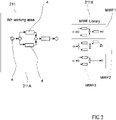
- the interface 211 comprises notably an editing area 211A configured for receiving a graphical user input and a display box 211B configured for displaying one or several MWFs and for enabling a user to select one of the displayed MWFs.
- FIG. 3 illustrates in more details the interface 211.
- the editing area 211A enables a user to design or create or edit a manufacturing WF by providing a graphical input, for instance nodes 4, and selecting for each node a manufacturing operation which can be suggested to the user by the system according to the invention.
- the graphical input might be selected by the user in a graphical input list and then added to the editing area 211A using for instance a click and drop functionality of the system according to the invention.
- the processing unit 210 through its connection to the interface 211 and to the library 212 is able to automatically recognize the graphical inputs of the user in the editing area 211A and is configured for automatically searching MWFs in the library 212 that might correspond to the manufacturing WF in current creation in the editing area.
- the display box 211B for displaying one or several MWF, e.g. MWF1, MWF2, MWF3 (see Fig. 3 ). It provides preferentially in real time suggestions of MWFs for completing said manufacturing WF that is in current creation in the editing area 211. Any change in the editing area 211A might result in a change of the list of MWF displayed in the display box 211B.
- the suggestions of MWFs in the display box 211B enables the user to select one of the displayed MWF, wherein the system then automatically completes the manufacturing WF so that it becomes identical to the selected MWF. This concept optimizes and speed up the modeling phase of manufacturing WF.
- the system 200 might be connected, via its processing unit 210, to a MES system 231 of a production site 230.
- Said production site 230 may comprise one or several production lines 232 as well as other resources for the production of products by said production line 232, like equipment and/or material 233, and personnel.
- the MES is configured for managing the production of a product by means of the production line 232 and according to a manufacturing workflow defined in a database of the MES system 231.
- FIG. 4 Such a manufacturing workflow is presented in box 4A of Fig. 4 .
- a corresponding MWF is presented in box 4B.
- the present invention proposes to use an abstracting process 4C for abstracting existing manufacturing WFs stored in the database of the MES for automatically creating MWF.
- Figure 4 presents a simple example of an abstraction process 4C according to the invention.
- the system according to the invention automatically select a manufacturing WF in the MES database.
- a manufacturing WF might also be added in the editing area 211A as input for the abstraction process.
- the manufacturing WF defines a sequence of manufacturing operations starting with a first manufacturing operation 411 and ending with a last manufacturing operation 414, and comprising between said first and last manufacturing operation and connected to the latter a pattern of manufacturing operations comprising decisional manufacturing operations 412 and activity manufacturing operation 413, i.e. manufacturing operations involving an action.
- the different manufacturing operations are connected to each other by arrows 410 describing the flow of manufacturing operations, i.e. the sequence according to which they have to be completed or performed when starting from the first manufacturing operation 411 for reaching the last manufacturing operation 414.
- the manufacturing workflow is preferentially defined for an industrial domain, e.g. pharma, automotive, etc.
- the system according to the invention is configured for determining said industrial domain from information related to the workflow and/or from information provided by a user, and to automatically create a set of semantic tags for said manufacturing WF.
- the semantic tags might be determined from the manufacturing operations of said manufacturing WF, for instance from the used resources.
- a result of the abstraction process according to the invention is shown in box 4B.
- the system according to the invention automatically creates, from a WF of the MES database or from a WF input by a user in the editing area 211A a MWF that is a graphical representation of the existing, real manufacturing WF.
- the system according to the invention automatically creates a starting node 421 for the first manufacturing operation 411 and an end node 424 for the last manufacturing operation 414. These two nodes are then connected to each other by a pattern of nodes that models the pattern of manufacturing operations of the existing WF.
- This pattern of nodes is represented by a sequence of interconnected nodes, wherein a decisional manufacturing operation 412 is represented by a decision node 422 and an activity manufacturing operation 413 is represented by an activity node 423.
- the interconnection between the nodes is represented by the arrows 420 so as to model the pattern of manufacturing operations and the exact flow of manufacturing operations.
- the sequence of decision nodes and activity nodes from the starting node to the end node matches the sequence of manufacturing operations from the first manufacturing operation to the last manufacturing operation.
- the difference between the manufacturing WF and its associated MFW is that the latter is free of an information regarding operations that have to be performed and/or resources that have to be used or decision to be taken. It only comprises the structural and organized sequence of the WF and its logic. At the end, the MFW is stored in the library if it does not already exist.
- an advantage of the present invention is that MWF defined for a specific industrial domain might be used also for another industrial domain. Therefore, the quantity of data that needs to be stored in the library for representing all possible workflows is strongly decreased. Indeed, the same MWF, i.e. graphical representation, might be used for different industrial applications. Then the implementation of the MWF simply requires an instantiation of each node of the MWF.
- the system creates or updates in its library, and at the same time that it proceeds to said abstraction process, and for each node of the MWF, a list of manufacturing operations involving an action for each activity node and a list of manufacturing operations involving a decision for each decision node.
- the system is configured for storing the manufacturing operation that corresponds to this node in the manufacturing WF.
- Such lists of manufacturing operations are then stored in the library for each node of each MWF, and for each industrial domain wherein said MWF can be applied to.
- Manufacturing operations involving an action are for instance: assembling, testing, painting, soldering, cutting, classifying, imaging, drying, dispatching, packaging, measuring, inspecting, printing, etc.
- Manufacturing operations involving a decision are for instance: measuring a delay and determining whether the delay is greater or smaller than a predefined value, counting a number of products and determining whether said number is greater or smaller than a predefined number of products, measuring a value for a physical quantity and determining whether it falls within a predefined interval or is greater or smaller than a predefined value, determining whether there is any issue, etc.
- the decision is related to a yes or no answer, and depending on the answer, the flow of operations will follow a different sequence of subsequent manufacturing operations, e.g. a first sequence if the response is yes, and a second sequence if the response is no.
- the system 200 receives a graphical user input in an editing area 211A.
- the graphical user input is typically a graphical element, e.g. a node, added to a drawn in said editing area 211A.
- the graphical user input comprises at least a starting node 411.
- the user can provide additional graphical elements, i.e. additional nodes, like a connection of said starting node with at least one first decision or first activity node.
- the graphical user input may further comprise an information regarding an industrial domain and/or a semantic tag in connection with the manufacturing WF to be created.
- the system 200 automatically selects in the MWF library one or several MWFs.
- the selection is a function of the received graphical user input, that is, the system automatically determines which MWFs from its library comprises the exact sequence of nodes that are inputted in the editing area by the user. Additionally, and preferentially, if the user provided a semantic tag and/or an industrial domain, the system will automatically limit its search for MWFs to MWFs applying to said semantic tag and/or industrial domain.
- the selected MWFs provided in the display box 211B are characterized by a graphical pattern starting with the graphical user input, i.e.
- the selected MWFs comprise additionally a WF ending node and a sequence of interconnected decision and/or activity nodes connecting the WF starting node to the WF ending node.
- the different MWFs that have been found by the system in its library present each a different sequence of said interconnected decision and/or activity nodes, making it possible to complete the graphical user input with different sequences of manufacturing operations, and therefore flows of manufacturing operations from the starting node to the end node.
- the system automatically displays in the display box 211B the MWFs that have been selected or found in the MWF library in response to the graphical user input.
- the system receives a selection of one of the displayed MWF.
- the user may select the MWF by clicking on the latter.
- a click and drop process might be implemented, for moving the user selected MWF from the display box to the input boy.
- selecting a MWF in the display box automatically shows in the editing area, e.g. in a highlighted manner, the additional nodes that are required for making the sequence of nodes shown in the editing area identical to the sequence of nodes of the selected MWF. If the selection of the MWF is the validated by the user (e.g. using a double click functionality), then the input graphical user is automatically completed.
- the system automatically displays the selected MWF in the editing area.
- the system automatically completes the graphical user input with any additional node that is required for making the sequence of nodes in the editing area identical to the sequence of nodes of the selected MWF.
- the selected MWF is thus imported in the editing area.
- the system creates a manufacturing WF from the MWF displayed in the editing area.
- This creation can be fully automatic, or semi-automatic. It is fully automatic when the system is able to determine all manufacturing operations that have to be associated to each node.
- the system might use the information provided by the user in the graphical user input, in particular information related to the semantic tag and/or industrial domain for automatically associating to each node manufacturing operations according to the list of manufacturing operations stored in the library. In particular, machine learning techniques might be used for this process.
- the system might also provide an auto-suggestion process for assisting the user in associating each node of the MWF displayed in the editing area to a manufacturing operation.
- the system displays in the display box the list of manufacturing operations that are associated to each node of the MWF as stored in the library, and, if provided by the user, the displayed list(s) is a function of the industrial domain and/or semantic tag.
- the created manufacturing WF can be automatically transferred or sent by the system 200 to the MES system, wherein the latter automatically manages the production of the product according to the received manufacturing WF.
- the system 200 according to the invention comprises or is connected to at least one detection system configured for automatically detecting a manufacturing event (e.g. failure, bottleneck, congestion, etc.) in the production of said product that requires a modification of the manufacturing WF defined for said product.
- a manufacturing event e.g. failure, bottleneck, congestion, etc.
- the system 200 in response to said event, might be configured for automatically modifying the currently used manufacturing WF that led to said event in function of detection data provided by the detection system.
- any modification of a manufacturing WF that has been created from a MWW of the library may trigger an automatic modification of the MWF for created a modified MWF, so that the sequence of interconnected nodes of the MWF and the pattern or sequence of manufacturing operations of the modified manufacturing WF matches with each other.
- a MWF - let's call it "initial MWF" - of the library is modified, e.g.
- the system in response to said event or in response to a user modification, said modification resulting in a modified MWF, then the system is configured for automatically modifying any manufacturing WF that has been created from the initial MWF - let's call it "initial manufacturing WF" -, so that said initial manufacturing WF be replaced by a modified manufacturing WF automatically created by the system according to the invention from the modified MWF.
- the newly created modified manufacturing WF can be automatically sent to the MES system that was using the initial manufacturing WF, wherein it automatically triggers a replacement of the latter by the newly created modified manufacturing WF.
- the present invention advantageously provides a system and method capable of assisting a user in the creation of a manufacturing WF.
- the proposed solution enables to optimize the WF modeling activity, to decrease error in the creation of WF and thus potential failures in the production.
Landscapes
- Engineering & Computer Science (AREA)
- Theoretical Computer Science (AREA)
- Physics & Mathematics (AREA)
- General Physics & Mathematics (AREA)
- Software Systems (AREA)
- Business, Economics & Management (AREA)
- Human Computer Interaction (AREA)
- Strategic Management (AREA)
- Human Resources & Organizations (AREA)
- Entrepreneurship & Innovation (AREA)
- Economics (AREA)
- General Engineering & Computer Science (AREA)
- Manufacturing & Machinery (AREA)
- Automation & Control Theory (AREA)
- Game Theory and Decision Science (AREA)
- Artificial Intelligence (AREA)
- Medical Informatics (AREA)
- Development Economics (AREA)
- Evolutionary Computation (AREA)
- Educational Administration (AREA)
- Data Mining & Analysis (AREA)
- Mathematical Physics (AREA)
- Computing Systems (AREA)
- Marketing (AREA)
- Computer Vision & Pattern Recognition (AREA)
- Operations Research (AREA)
- Quality & Reliability (AREA)
- Tourism & Hospitality (AREA)
- General Business, Economics & Management (AREA)
- Management, Administration, Business Operations System, And Electronic Commerce (AREA)
- General Factory Administration (AREA)
Priority Applications (3)
| Application Number | Priority Date | Filing Date | Title |
|---|---|---|---|
| EP21164859.7A EP4064154A1 (de) | 2021-03-25 | 2021-03-25 | System und verfahren zur unterstützten modellierung von fertigungsabläufen |
| CN202210294804.1A CN115131468A (zh) | 2021-03-25 | 2022-03-24 | 用于制造工作流的辅助建模的系统和方法 |
| US17/704,232 US12298740B2 (en) | 2021-03-25 | 2022-03-25 | System and method for assisted modeling of manufacturing workflows |
Applications Claiming Priority (1)
| Application Number | Priority Date | Filing Date | Title |
|---|---|---|---|
| EP21164859.7A EP4064154A1 (de) | 2021-03-25 | 2021-03-25 | System und verfahren zur unterstützten modellierung von fertigungsabläufen |
Publications (1)
| Publication Number | Publication Date |
|---|---|
| EP4064154A1 true EP4064154A1 (de) | 2022-09-28 |
Family
ID=75223157
Family Applications (1)
| Application Number | Title | Priority Date | Filing Date |
|---|---|---|---|
| EP21164859.7A Pending EP4064154A1 (de) | 2021-03-25 | 2021-03-25 | System und verfahren zur unterstützten modellierung von fertigungsabläufen |
Country Status (3)
| Country | Link |
|---|---|
| US (1) | US12298740B2 (de) |
| EP (1) | EP4064154A1 (de) |
| CN (1) | CN115131468A (de) |
Families Citing this family (1)
| Publication number | Priority date | Publication date | Assignee | Title |
|---|---|---|---|---|
| CN121300764A (zh) * | 2024-07-09 | 2026-01-09 | 北京字跳网络技术有限公司 | 创建应用的方法、装置、设备和存储介质 |
Citations (2)
| Publication number | Priority date | Publication date | Assignee | Title |
|---|---|---|---|---|
| US20090281865A1 (en) * | 2008-05-08 | 2009-11-12 | Todor Stoitsev | Method and system to manage a business process |
| US20200348969A1 (en) * | 2019-05-02 | 2020-11-05 | Autodesk, Inc. | Techniques for workflow analysis and design task optimization |
Family Cites Families (7)
| Publication number | Priority date | Publication date | Assignee | Title |
|---|---|---|---|---|
| US20060074735A1 (en) * | 2004-10-01 | 2006-04-06 | Microsoft Corporation | Ink-enabled workflow authoring |
| US20080065448A1 (en) * | 2006-09-08 | 2008-03-13 | Clairvoyance Corporation | Methods and apparatus for identifying workflow graphs using an iterative analysis of empirical data |
| TW201009688A (en) * | 2008-08-20 | 2010-03-01 | Clevest Solutions Inc | Method and system of editing workflow logic and screens with a GUI tool |
| EP2808784B1 (de) * | 2013-05-30 | 2017-11-29 | Siemens Aktiengesellschaft | System und Verfahren zur Erzeugung einer graphischen Benutzeroberfläche in einem Produktionsleitsystem (MES) |
| US10295979B2 (en) * | 2015-09-15 | 2019-05-21 | Applied Materials, Inc. | Scheduling in manufacturing environments |
| US10565537B1 (en) * | 2017-06-14 | 2020-02-18 | William Spencer Askew | Systems, methods, and apparatuses for optimizing outcomes in a multi-factor system |
| US12183452B2 (en) * | 2019-11-25 | 2024-12-31 | GE Precision Healthcare LLC | Algorithm orchestration of workflows to facilitate healthcare imaging diagnostics |
-
2021
- 2021-03-25 EP EP21164859.7A patent/EP4064154A1/de active Pending
-
2022
- 2022-03-24 CN CN202210294804.1A patent/CN115131468A/zh active Pending
- 2022-03-25 US US17/704,232 patent/US12298740B2/en active Active
Patent Citations (2)
| Publication number | Priority date | Publication date | Assignee | Title |
|---|---|---|---|---|
| US20090281865A1 (en) * | 2008-05-08 | 2009-11-12 | Todor Stoitsev | Method and system to manage a business process |
| US20200348969A1 (en) * | 2019-05-02 | 2020-11-05 | Autodesk, Inc. | Techniques for workflow analysis and design task optimization |
Non-Patent Citations (3)
| Title |
|---|
| DIJKMAN REMCO ET AL: "Graph Matching Algorithms for Business Process Model Similarity Search", 8 September 2009, ICIAP: INTERNATIONAL CONFERENCE ON IMAGE ANALYSIS AND PROCESSING, 17TH INTERNATIONAL CONFERENCE, NAPLES, ITALY, SEPTEMBER 9-13, 2013. PROCEEDINGS; [LECTURE NOTES IN COMPUTER SCIENCE; LECT.NOTES COMPUTER], SPRINGER, BERLIN, HEIDELBERG, PAGE(S) 48 - 63, ISBN: 978-3-642-17318-9, XP047398370 * |
| MADHUSUDAN T ET AL: "A case-based reasoning framework for workflow model management", DATA & KNOWLEDGE ENGINEERING, ELSEVIER BV, NL, vol. 50, no. 1, 1 July 2004 (2004-07-01), pages 87 - 115, XP026976541, ISSN: 0169-023X, [retrieved on 20040610] * |
| WIEGANDT DAVID LUIS ET AL: "Graph n-grams for Scientific Workflow Similarity Search", 31 January 2016 (2016-01-31), XP055827071, Retrieved from the Internet <URL:www.researchgate.net/publication/307590266> [retrieved on 20210722] * |
Also Published As
| Publication number | Publication date |
|---|---|
| US20220334559A1 (en) | 2022-10-20 |
| CN115131468A (zh) | 2022-09-30 |
| US12298740B2 (en) | 2025-05-13 |
Similar Documents
| Publication | Publication Date | Title |
|---|---|---|
| US9596124B2 (en) | Assistance device of network system | |
| Li et al. | Recent development of knowledge-based systems, methods and tools for one-of-a-kind production | |
| KR100971009B1 (ko) | 제품 재생 관리 시스템 | |
| US11715167B2 (en) | Graphical representation of a complex task | |
| US12321777B2 (en) | Automatic workflow generation and optimization | |
| CN114168565B (zh) | 业务规则模型的回溯测试方法、装置、系统及决策引擎 | |
| Claeys et al. | Intelligent authoring and management system for assembly instructions | |
| JP6853134B2 (ja) | 生産支援システム、及び生産支援方法 | |
| US12299427B1 (en) | Generating degree of development of structured processes using automatically calibrated queries | |
| US11816617B2 (en) | Business process modeling recommendation engine | |
| CN115087996A (zh) | 工业车间机器学习系统 | |
| von Enzberg et al. | Implementation and transfer of predictive analytics for smart maintenance: A case study | |
| US12298740B2 (en) | System and method for assisted modeling of manufacturing workflows | |
| CN117422519B (zh) | 信息处理方法、装置、存储介质及电子设备 | |
| US20210142237A1 (en) | Management system | |
| WO2025026910A1 (en) | Automatically identifying critical objects supplied to an industrial plant | |
| CN114118661B (zh) | 用于半自动生成生产模块的机器可读技能描述的方法和系统 | |
| Karhunen et al. | Supporting Design Reuse in Engineer-to-Order Context: A Systematic Literature Review | |
| KR20060010007A (ko) | 일정관리를 위한 제조공정 모델링 방법 | |
| EP4703901A1 (de) | Verfahren zur kontextuellen visualisierung und reinigung eines wissensgraphen | |
| US20250335341A1 (en) | Navigation augmented testing | |
| Wang et al. | A Dynamic Decision Support Framework Integrating Objective and Subjective Knowledge | |
| Ahmad et al. | An interactive framework to develop and align business process models | |
| Martens et al. | Leveraging MLOps: Developing a Sequential Classification System for RFQ Documents in Electrical Engineering | |
| CN116128428A (zh) | 一种业务需求的实现方法、装置、设备及介质 |
Legal Events
| Date | Code | Title | Description |
|---|---|---|---|
| PUAI | Public reference made under article 153(3) epc to a published international application that has entered the european phase |
Free format text: ORIGINAL CODE: 0009012 |
|
| STAA | Information on the status of an ep patent application or granted ep patent |
Free format text: STATUS: THE APPLICATION HAS BEEN PUBLISHED |
|
| AK | Designated contracting states |
Kind code of ref document: A1 Designated state(s): AL AT BE BG CH CY CZ DE DK EE ES FI FR GB GR HR HU IE IS IT LI LT LU LV MC MK MT NL NO PL PT RO RS SE SI SK SM TR |
|
| STAA | Information on the status of an ep patent application or granted ep patent |
Free format text: STATUS: REQUEST FOR EXAMINATION WAS MADE |
|
| 17P | Request for examination filed |
Effective date: 20230217 |
|
| RBV | Designated contracting states (corrected) |
Designated state(s): AL AT BE BG CH CY CZ DE DK EE ES FI FR GB GR HR HU IE IS IT LI LT LU LV MC MK MT NL NO PL PT RO RS SE SI SK SM TR |
|
| STAA | Information on the status of an ep patent application or granted ep patent |
Free format text: STATUS: EXAMINATION IS IN PROGRESS |
|
| 17Q | First examination report despatched |
Effective date: 20250624 |