EP4064080B1 - Verfahren und system zum schutz von ressourcen basierend auf arbeitsnachweisen - Google Patents
Verfahren und system zum schutz von ressourcen basierend auf arbeitsnachweisen Download PDFInfo
- Publication number
- EP4064080B1 EP4064080B1 EP21199841.4A EP21199841A EP4064080B1 EP 4064080 B1 EP4064080 B1 EP 4064080B1 EP 21199841 A EP21199841 A EP 21199841A EP 4064080 B1 EP4064080 B1 EP 4064080B1
- Authority
- EP
- European Patent Office
- Prior art keywords
- request generator
- culture
- nodes
- beu
- credit score
- Prior art date
- Legal status (The legal status is an assumption and is not a legal conclusion. Google has not performed a legal analysis and makes no representation as to the accuracy of the status listed.)
- Active
Links
Images





Classifications
-
- G—PHYSICS
- G06—COMPUTING OR CALCULATING; COUNTING
- G06F—ELECTRIC DIGITAL DATA PROCESSING
- G06F21/00—Security arrangements for protecting computers, components thereof, programs or data against unauthorised activity
- G06F21/30—Authentication, i.e. establishing the identity or authorisation of security principals
- G06F21/31—User authentication
-
- G—PHYSICS
- G06—COMPUTING OR CALCULATING; COUNTING
- G06Q—INFORMATION AND COMMUNICATION TECHNOLOGY [ICT] SPECIALLY ADAPTED FOR ADMINISTRATIVE, COMMERCIAL, FINANCIAL, MANAGERIAL OR SUPERVISORY PURPOSES; SYSTEMS OR METHODS SPECIALLY ADAPTED FOR ADMINISTRATIVE, COMMERCIAL, FINANCIAL, MANAGERIAL OR SUPERVISORY PURPOSES, NOT OTHERWISE PROVIDED FOR
- G06Q10/00—Administration; Management
- G06Q10/06—Resources, workflows, human or project management; Enterprise or organisation planning; Enterprise or organisation modelling
- G06Q10/063—Operations research, analysis or management
- G06Q10/0631—Resource planning, allocation, distributing or scheduling for enterprises or organisations
- G06Q10/06313—Resource planning in a project environment
-
- G—PHYSICS
- G06—COMPUTING OR CALCULATING; COUNTING
- G06Q—INFORMATION AND COMMUNICATION TECHNOLOGY [ICT] SPECIALLY ADAPTED FOR ADMINISTRATIVE, COMMERCIAL, FINANCIAL, MANAGERIAL OR SUPERVISORY PURPOSES; SYSTEMS OR METHODS SPECIALLY ADAPTED FOR ADMINISTRATIVE, COMMERCIAL, FINANCIAL, MANAGERIAL OR SUPERVISORY PURPOSES, NOT OTHERWISE PROVIDED FOR
- G06Q30/00—Commerce
- G06Q30/01—Customer relationship services
- G06Q30/015—Providing customer assistance, e.g. assisting a customer within a business location or via helpdesk
- G06Q30/016—After-sales
-
- G—PHYSICS
- G06—COMPUTING OR CALCULATING; COUNTING
- G06Q—INFORMATION AND COMMUNICATION TECHNOLOGY [ICT] SPECIALLY ADAPTED FOR ADMINISTRATIVE, COMMERCIAL, FINANCIAL, MANAGERIAL OR SUPERVISORY PURPOSES; SYSTEMS OR METHODS SPECIALLY ADAPTED FOR ADMINISTRATIVE, COMMERCIAL, FINANCIAL, MANAGERIAL OR SUPERVISORY PURPOSES, NOT OTHERWISE PROVIDED FOR
- G06Q30/00—Commerce
- G06Q30/02—Marketing; Price estimation or determination; Fundraising
-
- G—PHYSICS
- G06—COMPUTING OR CALCULATING; COUNTING
- G06Q—INFORMATION AND COMMUNICATION TECHNOLOGY [ICT] SPECIALLY ADAPTED FOR ADMINISTRATIVE, COMMERCIAL, FINANCIAL, MANAGERIAL OR SUPERVISORY PURPOSES; SYSTEMS OR METHODS SPECIALLY ADAPTED FOR ADMINISTRATIVE, COMMERCIAL, FINANCIAL, MANAGERIAL OR SUPERVISORY PURPOSES, NOT OTHERWISE PROVIDED FOR
- G06Q30/00—Commerce
- G06Q30/02—Marketing; Price estimation or determination; Fundraising
- G06Q30/0281—Customer communication at a business location, e.g. providing product or service information, consulting
-
- G—PHYSICS
- G06—COMPUTING OR CALCULATING; COUNTING
- G06Q—INFORMATION AND COMMUNICATION TECHNOLOGY [ICT] SPECIALLY ADAPTED FOR ADMINISTRATIVE, COMMERCIAL, FINANCIAL, MANAGERIAL OR SUPERVISORY PURPOSES; SYSTEMS OR METHODS SPECIALLY ADAPTED FOR ADMINISTRATIVE, COMMERCIAL, FINANCIAL, MANAGERIAL OR SUPERVISORY PURPOSES, NOT OTHERWISE PROVIDED FOR
- G06Q50/00—Information and communication technology [ICT] specially adapted for implementation of business processes of specific business sectors, e.g. utilities or tourism
- G06Q50/02—Agriculture; Fishing; Forestry; Mining
-
- G—PHYSICS
- G06—COMPUTING OR CALCULATING; COUNTING
- G06Q—INFORMATION AND COMMUNICATION TECHNOLOGY [ICT] SPECIALLY ADAPTED FOR ADMINISTRATIVE, COMMERCIAL, FINANCIAL, MANAGERIAL OR SUPERVISORY PURPOSES; SYSTEMS OR METHODS SPECIALLY ADAPTED FOR ADMINISTRATIVE, COMMERCIAL, FINANCIAL, MANAGERIAL OR SUPERVISORY PURPOSES, NOT OTHERWISE PROVIDED FOR
- G06Q50/00—Information and communication technology [ICT] specially adapted for implementation of business processes of specific business sectors, e.g. utilities or tourism
- G06Q50/10—Services
-
- H—ELECTRICITY
- H04—ELECTRIC COMMUNICATION TECHNIQUE
- H04L—TRANSMISSION OF DIGITAL INFORMATION, e.g. TELEGRAPHIC COMMUNICATION
- H04L63/00—Network architectures or network communication protocols for network security
- H04L63/08—Network architectures or network communication protocols for network security for authentication of entities
-
- G—PHYSICS
- G06—COMPUTING OR CALCULATING; COUNTING
- G06F—ELECTRIC DIGITAL DATA PROCESSING
- G06F2221/00—Indexing scheme relating to security arrangements for protecting computers, components thereof, programs or data against unauthorised activity
- G06F2221/21—Indexing scheme relating to G06F21/00 and subgroups addressing additional information or applications relating to security arrangements for protecting computers, components thereof, programs or data against unauthorised activity
- G06F2221/2111—Location-sensitive, e.g. geographical location, GPS
-
- G—PHYSICS
- G06—COMPUTING OR CALCULATING; COUNTING
- G06F—ELECTRIC DIGITAL DATA PROCESSING
- G06F2221/00—Indexing scheme relating to security arrangements for protecting computers, components thereof, programs or data against unauthorised activity
- G06F2221/21—Indexing scheme relating to G06F21/00 and subgroups addressing additional information or applications relating to security arrangements for protecting computers, components thereof, programs or data against unauthorised activity
- G06F2221/2113—Multi-level security, e.g. mandatory access control
-
- G—PHYSICS
- G06—COMPUTING OR CALCULATING; COUNTING
- G06F—ELECTRIC DIGITAL DATA PROCESSING
- G06F2221/00—Indexing scheme relating to security arrangements for protecting computers, components thereof, programs or data against unauthorised activity
- G06F2221/21—Indexing scheme relating to G06F21/00 and subgroups addressing additional information or applications relating to security arrangements for protecting computers, components thereof, programs or data against unauthorised activity
- G06F2221/2139—Recurrent verification
-
- H—ELECTRICITY
- H04—ELECTRIC COMMUNICATION TECHNIQUE
- H04L—TRANSMISSION OF DIGITAL INFORMATION, e.g. TELEGRAPHIC COMMUNICATION
- H04L2463/00—Additional details relating to network architectures or network communication protocols for network security covered by H04L63/00
- H04L2463/082—Additional details relating to network architectures or network communication protocols for network security covered by H04L63/00 applying multi-factor authentication
Definitions
- the embodiments herein generally relate to resource management and, more particularly, to a method and system for Proof of Work (POW) based protection of resources.
- POW Proof of Work
- the method comprises monitoring a behavior of said user during a monitoring period to identify automatically a deviation from a behavioral pattern indicative of repetitive behavior of a user, automatically generating a security question responded to by an indication of said deviation, receiving a user input inputted by a user in response to a presentation of said security question and said deviation, and authenticating, after said monitoring period, an access to a resource according to a match between said user input and said deviation ( Abstract ) .
- Embodiments of the present disclosure present technological improvements as solutions to one or more of the above-mentioned technical problems recognized by the inventors in conventional systems.
- a method for Proof of Work (POW) based protection of resources as defined in claim 1.
- a system for Proof of Work (POW) based protection of resources comprises a memory storing instructions; one or more Input/Output (I/O) interfaces; and one or more hardware processors coupled to the memory via the one or more I/O interfaces, wherein the one or more hardware processors are configured by the instructions to receive a request from a request generator for resource usage related to a service provided by an entity to Basic Emergent Users (BEUs), wherein the BEUs are registered with the entity for the service as defined in claim 6.
- BEUs Basic Emergent Users
- one or more non-transitory machine-readable information storage mediums comprising one or more instructions, which when executed by one or more hardware processors causes a method for Proof of Work (POW) based protection of resources as defined in claim 11.
- POW Proof of Work
- entities such as organizations and companies provide various services to end users, wherein these services can be availed by the end user via free usage of resources offered by the entity.
- a typical example of such service is a toll free communication to provide consultation to the end user, where the 'consultation' is a service while the 'resource' is the ⁇ toll free communication network' of the entity.
- the resource usage may be free of cost to the customer, but the actual cost is bore by the entity.
- controlled access of the resource or protection of resource usage is necessary.
- the end users are Basic Emergent Users (BEUs) having very minimal knowledge of technology usage, maximum part of the controlled access mechanism is expected to be performed in background with minimal checks experienced by the BEU during actual usage of resources.
- BEUs Basic Emergent Users
- maximum part of the controlled access mechanism is expected to be performed in background with minimal checks experienced by the BEU during actual usage of resources.
- the approach used for authorizing or authenticating the end user should be such that the BEU is not burdened with need to understand the technology such as
- Embodiments of the present disclosure provide a method and system for Proof of Work (POW) based protection of resources.
- the method includes using the POW for work done by BEUs in physical world and mapping it to digital world to generate crypto currency in terms of credit score.
- a BEU who is an end user, is eligible or authorized to use a resource of an entity to get a desired service only if accumulated credit score is above a credit threshold.
- the method makes gaining points to improve the credit score challenging, by relying on percentage of compliance achieved by the BEU through actual work in accordance with a Work Protocol (WP) set by the entity.
- WP Work Protocol
- the method adds another level of check by authenticating the authorized user prior to allowing resource usage.
- the authentication is based on a set of questions posed to the end user with increasing difficulty.
- the set of question are derived based on a culture graph generated for BEUs registered with the entity.
- the method enables increasing a cost function, which refers to the challenge or difficulty any end user faces in improving the credit score to be eligible for reuse of the resource, if the end user is non-compliant with respect to the WP.
- the cost function is measured in terms of decrease in credit score for every failed attempt.
- the method enables increasing a usability function, which refers to challenge or difficulty faced by end user (spam/ fake user) in answering successive questions with increased level of toughness and is measured in terms of toughness level of each question.
- the usability function and the cost function the method discourages any repeated attempts by invalid or fake end users.
- equivalent credit score is deducted from the user account.
- credit score deduction enables keeping a check on unnecessary, or over usage of the free resource offered to the BEU or end user.
- FIGS. 1 through 5B where similar reference characters denote corresponding features consistently throughout the figures, there are shown preferred embodiments and these embodiments are described in the context of the following exemplary system and/or method.
- FIG. 1 is a functional block diagram of a system for Proof of Work (POW) based protection of resources., in accordance with some embodiments of the present disclosure.
- POW Proof of Work
- the system 100 includes a processor(s) 104, communication interface device(s), alternatively referred as input/output (I/O) interface(s) 106, one or more data storage devices or a memory 102 operatively coupled to the processor(s) 104 and a set of sensors 110 deployed in a plurality of regions serviced by an entity.
- the system 100 with one or more hardware processors is configured to execute functions of one or more functional blocks of the system 100.
- the processor(s) 104 can be one or more hardware processors 104.
- the one or more hardware processors 104 can be implemented as one or more microprocessors, microcomputers, microcontrollers, digital signal processors, central processing units, state machines, logic circuitries, and/or any devices that manipulate signals based on operational instructions.
- the one or more hardware processors 104 are configured to fetch and execute computer-readable instructions stored in the memory 102.
- the system 100 can be implemented in a variety of computing systems including laptop computers, notebooks, hand-held devices such as mobile phones, workstations, mainframe computers, servers, and the like.
- the I/O interface(s) 106 can include a variety of software and hardware interfaces, for example, a web interface, a graphical user interface to display the generated target images and the like and can facilitate multiple communications within a wide variety of networks N/W and protocol types, including wired networks, for example, LAN, cable, etc., and wireless networks, such as WLAN, cellular and the like.
- the I/O interface (s) 106 can include one or more ports for connecting to a number of external devices or to another server or devices.
- the memory 102 may include any computer-readable medium known in the art including, for example, volatile memory, such as static random access memory (SRAM) and dynamic random access memory (DRAM), and/or non-volatile memory, such as read only memory (ROM), erasable programmable ROM, flash memories, hard disks, optical disks, and magnetic tapes.
- volatile memory such as static random access memory (SRAM) and dynamic random access memory (DRAM)
- DRAM dynamic random access memory
- non-volatile memory such as read only memory (ROM), erasable programmable ROM, flash memories, hard disks, optical disks, and magnetic tapes.
- the set of sensors 110 collect metadata associated with each a plurality of nodes of a Compliance Protocol (CP) and a Work Protocol (WP), further explained in conjunction with FIG. 3A and 3B .
- CP Compliance Protocol
- WP Work Protocol
- the memory 102 includes a database 108 that stores the CPs recorded corresponding a plurality of request generators and WPs corresponding to a plurality registered BEUs of the entity.
- the database 108 may also store the collected metadata and the like.
- the memory 102 may comprise information pertaining to input(s)/output(s) of each step performed by the processor(s) 104 of the system100 and methods of the present disclosure.
- the database 108 may be external (not shown) to the system 100 and coupled to the system via the I/O interface 106. Functions of the components of the system 100 are explained in conjunction with flow diagram of FIGS. 2A through 4 and example culture graph generation of FIG. 5A and 5B .
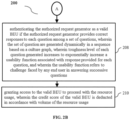
- FIGS. 2A and 2B depict a flow diagram of a method for Proof of Work (POW) based protection of resources, using the system of FIG. 1 , in accordance with some embodiments of the present disclosure.
- POW Proof of Work
- the system 100 comprises one or more data storage devices or the memory 102 operatively coupled to the processor(s) 104 and is configured to store instructions for execution of steps of the method 200 by the processor(s) or one or more hardware processors 104.
- the steps of the method 200 of the present disclosure will now be explained with reference to the components or blocks of the system 100 as depicted in FIG. 1 and the steps of flow diagram as depicted in FIGS. 2A through 5B .
- process steps, method steps, techniques or the like may be described in a sequential order, such processes, methods, and techniques may be configured to work in alternate orders. In other words, any sequence or order of steps that may be described does not necessarily indicate a requirement that the steps to be performed in that order.
- the steps of processes described herein may be performed in any order practical. Further, some steps may be performed simultaneously.
- the steps of method 200 is explained are explained with a use case example.
- the use case refers an entity, which may be a Digital farming based company that supplies agro-related products to its consumers, herein farmers who fall in category of the BEUs.
- the company may provide a service such as agro-consultation to its consumers (farmers), wherein the company may set up toll free numbers to avail consultation services.
- the toll free set up requires communication network resources of the company and the cost of network usage (resource usage) is bore by the company.
- the company intends to ensure that only true/valid consumers use the service via the toll free number or an IVR service (requiring communication network resources of the entity), and at the same time even control the valid user to avoid over usage or careless usage of the free resource.
- the method 200 disclosed herein enables authorizing and authenticating an end user, interchangeably referred as request generator, using Proof of Work (POW) based approach before granting the access to use the IVR service.
- POW Proof of Work
- the entity charges the end user by deducting a digital currency generated for the end user. The monetary loss factor forces the end user to utilize the free service more carefully/cautiously.
- the one or more hardware processors 104 receive a request from a request generator for resource usage related to a service provided by an entity to BEUs, wherein the BEUs are registered with the entity for the service consultation.
- the service id IVR consultation service while the BEUs are the farmers.
- the request may be generated via any end devices, such a personal digital assistants or smart phones.
- the one or more hardware processors 104 record a source ID indicative of origin of the request.
- the source ID for the example above could be a registered mobile number of the BEU, a Unique identification ID of the request generator or any other identification that can enable authorization process for the request generator.
- the request generator can provide any of the one or more IDs that are identified by the system 100 for an authorization process.
- the one or more hardware processors 104 initiate the authorization process to authorize the request generator as a registered BEU.
- the request generator is classified as an authorized request generator if a credit score associated the source ID is above a credit threshold.
- the credit score for each of a plurality of source IDs associated with a plurality of request generators is precomputed and updated at a predefined frequency by the system 100 as a continuous background process.
- the credit score is based on a protocol compliance function that compares a) the Compliance Protocol (CP) executed by the request generator with b) the Work Protocol (WP) that is set by the entity for the request generator.
- CP Compliance Protocol
- WP Work Protocol
- the WP and the CP are directed graphs comprising a) a plurality of nodes with each node associated with a predefined function, and b) a plurality of edges connecting the plurality of nodes to form a plurality of sequences of nodes with each of the plurality of sequences representing a unique execution flow of one or more predefined functions.
- a sample CP is 'steps' a farmer has followed during farming in accordance with a previous consultation received during previous call to the IVR service of the entity.
- the sample WP refers to expected steps the farmer has to follow in accordance with the instructions.
- the CP can be derived from the response of the farmer to set of WP based questions.
- Natural Language processing techniques can be used to derive the directed graph from responses of farmers to the as directed graph which is a sequence of nodes connected via directed edges. This enables to record sequence of steps the farmer has followed as a tree-like data structure to be compared with similarly generated tree-like data structure for the WP.
- the CP is the POW end user (BEU/ farmer) submits to the system 100, which is then compared with the expected work to be done as defined in the WP.
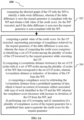
- FIG. 3A is a flow diagram illustrating a method 300 for credit score computation for Proof of Work (POW) based protection of resources, using the system of FIG. 1 , in accordance with some embodiments of the present disclosure.
- POW Proof of Work
- Steps of computing the credit score based on the protocol compliance function comprises:
- the method 300 further comprises collecting metadata associated with each of the plurality of nodes of the WP and the plurality of nodes of the CP.
- the collected metadata enables cross checking whether each of the plurality of nodes of the CP execute actions in accordance with predefined function associated with a corresponding node of the WP.
- the metadata is recorded by the entity using the set of sensors 110 deployed to track a plurality of actual actions performed by the request generator.
- the set of sensors 110 can be proxy sensors that provide satellite images, hyperspectral sensing, call log data, gyro data, accelerometer data collected from sensors on end devices used by the farmer such as smart phones.
- the metadata collected enables to have a physical check on actual work done. For example, say the farmer is advised to water the crop and spray pesticides at a given frequency.
- CP In response farmer provides to the questions posed to check compliance with the WP, the farmer may agree to performing all required actions.
- collected meta data such as satellite images, hyperspectral imagery, location of farmer identified from GPS on the smart phones and the like can provide insights.
- the GPS data can provide information on whether the farmers was present at the farm site and duration of his presence. Increase in green zones and moisture presence detection from hyperspectral imaging data are indicative of result of actions performed by the farmer.
- the generation of CP is explained below:
- the WP can be a Plantation Advisory and Compliance.
- the Plantation Advisory consists of the sequence of steps the farmer has to take from land preparation, to seed preparation, nursery preparation, vegetation to harvesting. These are then also checked for compliance via a participatory systems aided by mobile phone based sensors (namely, comprising of GPS, Gyro sensor and usage of keypads/touch pads on the phone).
- the protocol compliance function reduces the credit score in accordance with a preset criterion to exponentially increases the cost function for the request generator for every repeated attempt of the authorization process, post failure of a previous attempt of the authorization process.
- the cost function refers to challenge faced by the WP non-compliant end user in improving the credit score to be eligible for reuse of the resource.
- the cost function is measured in terms of decrease in credit score for every failed attempt.
- the usability function is measured in terms of toughness level of each question faced by any end user in answering successive questions. For example, say the percentage of the credit score deduction may double for every repeated attempt, thus costing the request generator to lose his credit score at faster rate if he is non-compliant repeatedly. This also forces the BEU (farmer) to follow the WP.
- FIG. 3B depicts example Work Protocol (WP) and Compliance Protocol (CP) for computing the credit score, in accordance with some embodiments of the present disclosure. Steps of generation of the WP for a sample farmer scenario are provided below:
- the CP and the WP are depicted as a directed graph, wherein the directed graph formed by nodes (B,A,C,D,E) is the WP representing a tree structure, while the directed graph generated from predefined functions reported by the farmer is the CP.
- the CP is generated in accordance with method 300 and based on meta data obtained for the farmer, corresponding to predefined functions.
- the CP is the directed graph of the CP represented by (B,A,C,E), which is a linked list.
- Lev distance Lev [( B,A,D,C,E) - (B,A,C,E)] -> 1 (difference of one node as D node was not captured in actions recorded for the farmer)
- the one or more hardware processors 104 authenticate the authorized request generator as a valid BEU a response to each question among a set of questions provided by the authorized request generator is correct.
- the set of question are generated dynamically in a sequence based on a culture graph, wherein toughness level of each question generated increases to exponentially increase a usability function associated with response provided for each question.
- the usability function refers to challenge faced by any end user in answering successive questions.
- FIG. 4 is a flow diagram illustrating a method 400 for generating a set of questions based on a culture graph for Proof of Work (POW) based protection of resources, using the system of FIG. 1 , in accordance with some embodiments of the present disclosure.
- POW Proof of Work
- Steps of dynamically generating the set of questions based on the culture graph comprises:
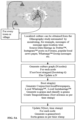
- FIG. 5B depicts the culture graph generation based on sample geo-levels, in accordance with some embodiments of the present disclosure.
- FIG. 5B depicts the operating structure and logic of the dynamic "what you know" question bank for a particular level of geography.
- the information bank structure is divided into the administrative structures of State (St) containing Districts (Di) containing Talukas (Ta) containing Villages (Vi) containing Clusters.
- Various information sources such as NewsPapers, WhatsApp messages, Websites, Twitter are accessed at a regular interval of 1 day.
- This collected corpus is then analyzed, as depicted in FIG. 5A , using Natural Language Processing techniques such as N-gram (ex. tri gram for popular phrases) to construct a corpus of the tuple ⁇ WHatYouKnow, LifeStamp, Location (Cluster/Village/Taluka/District/State) ⁇ .
- N-gram ex. tri gram for popular phrases
- the UserID is tagged to the structure of the Information at every unit ⁇ village, taluka, district, state) so that appropriate level Question can be posed by randomly selected from the corpus of question which is getting continuously generated and updated.
- the one or more hardware processors 104 grant access to the valid BEU to proceed with the resource usage, wherein the credit score of the valid BEU is deducted in accordance with volume of the resource usage.
- this keeps a check on careless, over usage of the resource even for the authorized and authenticated end user (registered valid BEU).
- the method and system disclosed herein provides a two level check for protection of resources using the usability function and the cost function.
- the usability function is based on the culture function (c), which makes resource usage easy for the authentic user and hard to use for the external attacker.
- the cost function based on the protocol compliance function is skewed in favor of the authorized user and hard for the external attacker, thus the fake user will lose credit points for every failed attempt with exponential deduction in credit score, and in turn exponentially increasing cost of reuse of the resource for the fake user.
- the method and system disclosed herein provide the resource protection in two dimensions of usability and cost, wherein for the valid BEU the system is high on the usability scale and security scale at the same time difficult for the external attacker, invalid user or a fake consumer.
- the method disclosed also exploits natural limits of resources to generate WPs and culture graphs. For example, for BEUs that are farmers, time consideration based on agricultural seasons as a sub-unit of cost of acquisition, a sort of upper limit imposed by laws of Nature.
- the set of Seasons For example, every year has few seasons - namely, Summer, Winter, Rain ⁇ Spring ⁇ , referred as the set of Seasons. This is a finite set. That is the number of elements in this set is finite and countable.
- the max value is 3 elements (3 seasons).
- a BEU can take Zero/None agriculture work or all work, in the seasons. In some seasons such as Winter, he can take 2 crops. Each crop is called a cycle. Hence 2 cycles in Winter. Since the set of Seasons is finite and countable.
- the set of AgriCycle (AC) is also finite and countable.
- the number of max elements in this set is thus 4.
- a BEU inherits a geography in which agri cultivation happens - say state of Bengal.
- the soil type in this region is fixed - Sandy, Loomy. That is a fixed countable set.
- SoilType ST Clay , Sandy , .. / / Finite Set
- the WP for a given userId is finite and countable. That is there is an upper limit to the WP value.
- 40 is the maximum units for the set UID: TOC x AC, as a measure of Natural Limits.
- the hardware device can be any kind of device which can be programmed including e.g. any kind of computer like a server or a personal computer, or the like, or any combination thereof.
- the device may also include means which could be e.g. hardware means like e.g. an applicationspecific integrated circuit (ASIC), a field-programmable gate array (FPGA), or a combination of hardware and software means, e.g.
- ASIC applicationspecific integrated circuit
- FPGA field-programmable gate array
- the means can include both hardware means, and software means.
- the method embodiments described herein could be implemented in hardware and software.
- the device may also include software means.
- the embodiments may be implemented on different hardware devices, e.g. using a plurality of CPUs.
- the embodiments herein can comprise hardware and software elements.
- the embodiments that are implemented in software include but are not limited to, firmware, resident software, microcode, etc.
- the functions performed by various components described herein may be implemented in other components or combinations of other components.
- a computerusable or computer readable medium can be any apparatus that can comprise, store, communicate, propagate, or transport the program for use by or in connection with the instruction execution system, apparatus, or device.
- a computer-readable storage medium refers to any type of physical memory on which information or data readable by a processor may be stored.
- a computer-readable storage medium may store instructions for execution by one or more processors, including instructions for causing the processor(s) to perform steps or stages consistent with the embodiments described herein.
- the term "computer-readable medium” should be understood to include tangible items and exclude carrier waves and transient signals, i.e., be non-transitory. Examples include random access memory (RAM), read-only memory (ROM), volatile memory, nonvolatile memory, hard drives, CD ROMs, DVDs, flash drives, disks, and any other known physical storage media.
Landscapes
- Business, Economics & Management (AREA)
- Engineering & Computer Science (AREA)
- Strategic Management (AREA)
- Human Resources & Organizations (AREA)
- Theoretical Computer Science (AREA)
- Economics (AREA)
- General Physics & Mathematics (AREA)
- Physics & Mathematics (AREA)
- Marketing (AREA)
- Development Economics (AREA)
- General Business, Economics & Management (AREA)
- Finance (AREA)
- Accounting & Taxation (AREA)
- Entrepreneurship & Innovation (AREA)
- Tourism & Hospitality (AREA)
- Game Theory and Decision Science (AREA)
- Computer Security & Cryptography (AREA)
- Life Sciences & Earth Sciences (AREA)
- Primary Health Care (AREA)
- Health & Medical Sciences (AREA)
- General Health & Medical Sciences (AREA)
- General Engineering & Computer Science (AREA)
- Computer Hardware Design (AREA)
- Biodiversity & Conservation Biology (AREA)
- Educational Administration (AREA)
- Operations Research (AREA)
- Quality & Reliability (AREA)
- Marine Sciences & Fisheries (AREA)
- Mining & Mineral Resources (AREA)
- Animal Husbandry (AREA)
- Computing Systems (AREA)
- Agronomy & Crop Science (AREA)
- Computer Networks & Wireless Communication (AREA)
- Signal Processing (AREA)
- Software Systems (AREA)
- Management, Administration, Business Operations System, And Electronic Commerce (AREA)
Claims (11)
- Prozessorimplementiertes Verfahren zum Proof of Work (POW)-basierten Schutz von Ressourcen, wobei das Verfahren (200) Folgendes umfasst:Empfangen (202), über einen oder mehrere Hardwareprozessoren, einer Anforderung zur Ressourcennutzung in Bezug auf einen Dienst, der von einer Entität für grundlegende aufstrebende Benutzer (Basic Emergent Users, BEUs) bereitgestellt wird, von einem Anforderungsgenerator, wobei die BEUs bei der Entität für den Dienst registriert sind;Aufzeichnen (204), über den einen oder die mehreren Hardwareprozessoren, einer Quell-ID, die den Ursprung der Anforderung angibt;Initiieren (206), über den einen oder die mehreren Hardwareprozessoren, eines Autorisierungsprozesses, um den Anforderungsgenerator als einen registrierten BEU zu autorisieren,wobei der Anforderungsgenerator als ein autorisierter Anforderungsgenerator klassifiziert wird, wenn ein Kredit-Score, der der Quell-ID zugeordnet ist, über einem Kreditschwellenwert liegt,wobei der Kredit-Score für jede einer Mehrzahl von Quell-IDs, die einer Mehrzahl von Anforderungsgeneratoren zugeordnet sind, vorberechnet und mit einer vordefinierten Häufigkeit aktualisiert wird, basierend auf einer Protokollkonformitätsfunktion, die a) ein Konformitätsprotokoll (CP), das von dem Anforderungsgenerator ausgeführt wird, mit b) einem Arbeitsprotokoll (WP), das von der Entität für den Anforderungsgenerator eingestellt wird, vergleicht, wobei unter Verwendung des POW die Arbeit, die von der BEU in der physischen Welt gemäß dem WP geleistet wird, und die Abbildung auf die digitale Welt, um den Kredit-Score und Metadaten wie Satellitenbilder, hyperspektrale Bilder, den Standort des BEU zu erzeugen, von der Entität unter Verwendung eines Satzes von Sensoren (110) aufgezeichnet wird, die eingesetzt werden, um die tatsächliche Arbeit, die von dem BEU geleistet wird, zu verfolgen, undwobei jedes des CP und des WP ein gerichteter Graph ist, umfassend a) eine Mehrzahl von Knoten, wobei jeder Knoten einer vordefinierten Funktion zugeordnet ist, und b) eine Mehrzahl von Kanten, die die Mehrzahl von Knoten verbinden, um eine Mehrzahl von Sequenzen von Knoten zu bilden, wobei jede der Mehrzahl von Sequenzen einen eindeutigen Ausführungsablauf einer oder mehrerer vordefinierter Funktionen darstellt;Authentifizieren (208), über den einen oder die mehreren Hardwareprozessoren, des autorisierten Anforderungsgenerators als eine gültige BEU, wenn eine Antwort auf jede Frage aus einem Satz von Fragen, die von dem autorisierten Anforderungsgenerator bereitgestellt werden, korrekt ist, wobei der Satz von Fragen dynamisch in einer Sequenz erzeugt wird, indem dynamisch ein Kulturgraph aus einer lokalisierten Kultur für den Anforderungsgenerator basierend auf einem aktuellen Standort des Anforderungsgenerators erzeugt wird, und der Kulturgraph a) dem Korpus entspricht, der mit der lokalisierten Kultur um den aktuellen Standort herum in Beziehung steht, und b) einen Satz von konzentrischen Kreisen umfasst, die basierend auf Geo-Ebenen um den aktuellen Standort herum markiert sind, und in den konzentrischen Kreisen des Kulturgraphs innerste bis äußerste Geo-Ebenen gemäß zunehmender Landfläche einschließen, gefolgt von Abfragen des Anforderungsgenerators mit Fragen, die um die lokalisierte Kultur herum auf jeder der Geo-Ebenen gebildet werden, wobei jede nachfolgende Frage sich auf einen Korpus verengt, der der nächsten innersten Geo-Ebene entspricht, um die Verwendbarkeitsfunktion für einen ungültigen BEU zu erhöhen, um korrekt auf jede nachfolgende Frage zu antworten, wobei ein Härtegrad jeder erzeugten Frage zunimmt, um die Verwendbarkeitsfunktion, die der Antwort zugeordnet ist, die für jede Frage bereitgestellt wird, exponentiell zu erhöhen, und die Verwendbarkeitsfunktion in Bezug auf den Härtegrad jeder Frage, der ein Endbenutzer bei der Beantwortung nachfolgender Fragen gegenübersteht, gemessen wird; undGewähren (210), über den einen oder die mehreren Hardwareprozessoren, von Zugriff auf den gültigen BEU, um mit der Ressourcennutzung fortzufahren, wobei der Kredit-Score des gültigen BEU gemäß einem Volumen der Ressourcennutzung abgezogen wird.
- Verfahren nach Anspruch 1, wobei der Schritt des Vorberechnens des Kredit-Scores basierend auf der Protokollkonformitätsfunktion Folgendes umfasst:Vergleichen (302) des gerichteten Graphen des WP mit dem CP, um eine Delta-Arbeitsdifferenz zu identifizieren, wobei, wenn die Delta-Differenz null ist, der Anforderungsgenerator ein WP-konformer Endbenutzer ist und einen vollen Wert des Kredit-Scores für den ausgeführten CP erhält, und wenn die Delta-Differenz nicht null ist, der Anforderungsgenerator ein WP-nichtkonformer Endbenutzer ist; undBerechnen (304) eines Teilwerts des Kredit-Scores für den ausgeführten CP, der einen Prozentsatz der Konformität darstellt, die durch den Anforderungsgenerator erreicht wird, wenn die Delta-Differenz nicht null ist, wobei die Schritte des Berechnens des Teilwerts des Kredit-Scores Folgendes umfassen:a) Identifizieren eines Satzes von CP-Knoten unter der Mehrzahl von Knoten des CP, die durch den Anforderungsgenerator durchlaufen werden, während der CP ausgeführt wird;b) Berechnen einer Levenshtein-Distanz zwischen i) dem Satz von CP-Knoten und ii) einem Satz von WP-Knoten unter der Mehrzahl von Knoten des WP, die dem Satz von CP-Knoten entsprechen, wobei die Levenshtein-Distanz eine Abweichung des CP von dem WP angibt;c) Berechnen eines Konformitäts-Scores durch Subtrahieren der Levenshtein-Distanz von einem vordefinierten Zeitbetrag, der auf einem Kontext einer Wirtschaftskultur basiert, die mit einem Arbeitstyp assoziiert ist, der in dem WP und dem CP identifiziert wird, wobei der Konformitäts-Score mit zunehmender Abweichung des CP von dem WP abnimmt; undd) Durchführen eines von i) Mitteln und ii) Summieren einer Mehrzahl von Konformitäts-Scores des Anforderungsgenerators für eine vordefinierte Zeitspanne, um den Kredit-Score für den Anforderungsgenerator zu erzeugen.
- Verfahren nach Anspruch 2, wobei das Verfahren ferner das Sammeln von Metadaten umfasst, die jedem der Mehrzahl von Knoten des CP und der Mehrzahl von Knoten des WP zugeordnet sind, wobei die gesammelten Metadaten eine gegenseitige Prüfung ermöglichen, ob jeder der Mehrzahl von Knoten des CP Aktionen gemäß einer vordefinierten Funktion ausführt, die einem entsprechenden Knoten des WP zugeordnet ist, und wobei die Metadaten von der Entität unter Verwendung eines Satzes von Sensoren aufgezeichnet werden, die eingesetzt werden, um eine Mehrzahl von tatsächlichen Aktionen zu verfolgen, die von dem Anforderungsgenerator durchgeführt werden.
- Verfahren nach Anspruch 2, wobei die Protokollkonformitätsfunktion den Kredit-Score gemäß einem voreingestellten Kriterium reduziert, um eine Kostenfunktion für den Anforderungsgenerator für jeden wiederholten Versuch des Autorisierungsprozesses nach dem Fehlschlagen eines vorherigen Versuchs des Autorisierungsprozesses exponentiell zu erhöhen, und wobei die Kostenfunktion in Form einer Abnahme des Kredit-Scores für jeden fehlgeschlagenen Versuch gemessen wird.
- Verfahren nach Anspruch 1, wobei die Schritte des dynamischen Erzeugens des Satzes von Fragen basierend auf einem Kulturgraphen Folgendes umfassen:Erhalten (402) einer lokalisierten Kultur und Erzeugen des Korpus für jede einer Mehrzahl von Regionen, die von der Entität bedient werden, basierend auf Ethnographie-Parametern für die Mehrzahl von Regionen, die durch Überwachen von Hashtag-Nachrichten und Nachrichten von der Mehrzahl von Regionen erhalten werden;wobei sich die innersten bis äußersten Geo-Ebenen gemäß der zunehmenden Landfläche auf geografische Regionen von Dorf, Taluka, Bezirk und Staat beziehen.
- System (100) zum Proof of Work (POW)-basierten Schutz von Ressourcen, wobei das System (100) Folgendes umfasst:einen Speicher (102), der Anweisungen speichert;eine oder mehrere Eingabe/Ausgabe (I/O)-Schnittstellen (106); undeinen oder mehrere Hardwareprozessoren (104), die über die eine oder die mehreren I/O-Schnittstellen (106) mit dem Speicher (102) gekoppelt sind, wobei der eine oder die mehreren Hardwareprozessoren (104) durch die Anweisungen konfiguriert sind zum:Empfangen einer Anforderung von einem Anforderungsgenerator zur Ressourcennutzung in Bezug auf einen Dienst, der von einer Entität für grundlegende aufstrebende Benutzer (Basic Emergent Users, BEUs) bereitgestellt wird, wobei die BEUs bei der Entität für den Dienst registriert sind;Aufzeichnen einer Quell-ID, die den Ursprung der Anforderung angibt;Initiieren eines Autorisierungsprozesses, um den Anforderungsgenerator als eine registrierte BEU zu autorisieren,wobei der Anforderungsgenerator als ein autorisierter Anforderungsgenerator klassifiziert wird, wenn ein Kredit-Score, der der Quell-ID zugeordnet ist, über einem Kreditschwellenwert liegt,wobei der Kredit-Score für jede einer Mehrzahl von Quell-IDs, die einer Mehrzahl von Anforderungsgeneratoren zugeordnet sind, vorberechnet und mit einer vordefinierten Häufigkeit aktualisiert wird, basierend auf einer Protokollkonformitätsfunktion, die a) ein Konformitätsprotokoll (CP), das von dem Anforderungsgenerator ausgeführt wird, mit b) einem Arbeitsprotokoll (WP), das von der Entität für den Anforderungsgenerator eingestellt wird, vergleicht, wobei unter Verwendung des POW die Arbeit, die von der BEU in der physischen Welt gemäß dem WP geleistet wird, und die Abbildung auf die digitale Welt, um den Kredit-Score und Metadaten wie Satellitenbilder, hyperspektrale Bilder, den Standort des BEU zu erzeugen, von der Entität unter Verwendung eines Satzes von Sensoren (110) aufgezeichnet wird, die eingesetzt werden, um die tatsächliche Arbeit, die von der BEU geleistet wird, zu verfolgen; undwobei jedes des CP und des WP ein gerichteter Graph ist, umfassend a) eine Mehrzahl von Knoten, wobei jeder Knoten einer vordefinierten Funktion zugeordnet ist, und b) eine Mehrzahl von Kanten, die die Mehrzahl von Knoten verbinden, um eine Mehrzahl von Sequenzen von Knoten zu bilden, wobei jede der Mehrzahl von Sequenzen einen eindeutigen Ausführungsablauf einer oder mehrerer vordefinierter Funktionen darstellt;Authentifizieren des autorisierten Anforderungsgenerators als eine gültige BEU, wenn eine Antwort auf jede Frage aus einem Satz von Fragen, die von dem autorisierten Anforderungsgenerator bereitgestellt werden, korrekt ist, wobei der Satz von Fragen dynamisch in einer Sequenz erzeugt wird, indem ein Kulturgraph aus einer lokalisierten Kultur für den Anforderungsgenerator basierend auf einem aktuellen Standort des Anforderungsgenerators dynamisch erzeugt wird, und der Kulturgraph a) dem Korpus entspricht, der mit der lokalisierten Kultur um den aktuellen Standort herum in Beziehung steht, und b) einen Satz von konzentrischen Kreisen umfasst, die basierend auf Geo-Ebenen um den aktuellen Standort herum markiert sind, und in den konzentrischen Kreisen des Kulturgraphs innerste bis äußerste Geo-Ebenen gemäß zunehmender Landfläche einschließen, gefolgt von Abfragen des Anforderungsgenerators mit Fragen, die um die lokalisierte Kultur herum auf jeder der Geo-Ebenen gebildet werden, wobei jede nachfolgende Frage sich auf einen Korpus verengt, der der nächsten innersten Geo-Ebene entspricht, um die Verwendbarkeitsfunktion für einen ungültigen BEU zu erhöhen, um korrekt auf jede nachfolgende Frage zu antworten, wobei die Härtestufe jeder erzeugten Frage zunimmt, um eine Verwendbarkeitsfunktion, die der für jede Frage bereitgestellten Antwort zugeordnet ist, exponentiell zu erhöhen, und die Verwendbarkeitsfunktion in Bezug auf die Härtestufe jeder Frage, der ein Endbenutzer bei der Beantwortung nachfolgender Fragen gegenübersteht, gemessen wird; undGewähren von Zugriff auf den gültigen BEU, um mit der Ressourcennutzung fortzufahren, wobei der Kredit-Score des gültigen BEU gemäß einem Volumen der Ressourcennutzung abgezogen wird.
- System nach Anspruch 6, wobei der eine oder die mehreren Hardwareprozessoren (104) konfiguriert sind, um den Kredit-Score basierend auf der Protokollkonformitätsfunktion zu berechnen durch:Vergleichen des gerichteten Graphen des WP mit dem CP, um eine Delta-Arbeitsdifferenz zu identifizieren, wobei, wenn die Delta-Differenz null ist, der Anforderungsgenerator ein WP-konformer Endbenutzer ist und einen vollen Wert des Kredit-Scores für den ausgeführten CP erhält, und wenn die Delta-Differenz nicht null ist, der Anforderungsgenerator ein WP-nichtkonformer Endbenutzer ist; undBerechnen eines Teilwerts des Kredit-Scores für den ausgeführten CP, der einen Prozentsatz der Konformität darstellt, die durch den Anforderungsgenerator erreicht wird, wenn die Delta-Differenz nicht null ist, wobei die Schritte des Berechnens des Teilwerts des Kredit-Scores Folgendes umfassen:a) Identifizieren eines Satzes von CP-Knoten unter der Mehrzahl von Knoten des CP, die durch den Anforderungsgenerator durchlaufen werden, während der CP ausgeführt wird;b) Berechnen einer Levenshtein-Distanz zwischen i) dem Satz von CP-Knoten und ii) einem Satz von WP-Knoten unter der Mehrzahl von Knoten des CP, die dem Satz von CP-Knoten entsprechen, wobei die Levenshtein-Distanz eine Abweichung des CP von dem WP angibt;c) Berechnen eines Konformitäts-Scores durch Subtrahieren der Levenshtein-Distanz von einem vordefinierten Zeitbetrag, der auf einem Kontext einer Wirtschaftskultur basiert, die mit einem Arbeitstyp assoziiert ist, der in dem WP und dem CP identifiziert wird, wobei der Konformitäts-Score mit zunehmender Abweichung des CP von dem WP abnimmt; undd) Durchführen eines von i) Mitteln und ii) Summieren einer Mehrzahl von Konformitäts-Scores des Anforderungsgenerators für eine vordefinierte Zeitspanne, um den Kredit-Score für den Anforderungsgenerator zu erzeugen.
- System nach Anspruch 7, wobei der eine oder die mehreren Hardwareprozessoren (104) ferner konfiguriert sind, um Metadaten zu sammeln, die jedem der Mehrzahl von Knoten des CP und der Mehrzahl von Knoten des WP zugeordnet sind, wobei die gesammelten Metadaten eine gegenseitige Prüfung ermöglichen, ob jeder der Mehrzahl von Knoten des CP Aktionen gemäß einer vordefinierten Funktion ausführt, die einem entsprechenden Knoten des WP zugeordnet ist, und wobei die Metadaten von der Entität unter Verwendung eines Satzes von Sensoren aufgezeichnet werden, die eingesetzt werden, um tatsächliche Aktionen zu verfolgen, die von dem Anforderungsgenerator durchgeführt werden.
- System nach Anspruch 7, wobei die Protokollkonformitätsfunktion den Kredit-Score gemäß einem voreingestellten Kriterium reduziert, um eine Kostenfunktion für den Anforderungsgenerator für jeden wiederholten Versuch des Autorisierungsprozesses nach dem Fehlschlagen eines vorherigen Versuchs des Autorisierungsprozesses exponentiell zu erhöhen, und wobei die Kostenfunktion in Form einer Abnahme des Kredit-Scores für jeden fehlgeschlagenen Versuch gemessen wird.
- System nach Anspruch 6, wobei der eine oder die mehreren Hardwareprozessoren (104) ferner konfiguriert sind, um den Satz von Fragen basierend auf einem Kulturgraphen dynamisch zu erzeugen durch:Erhalten einer lokalisierten Kultur und Erzeugen eines Korpus für jede einer Mehrzahl von Regionen, die von der Entität bedient werden, basierend auf Ethnographie-Parametern für die Mehrzahl von Regionen, die durch Überwachen von Hashtag-Nachrichten und Nachrichten von der Mehrzahl von Regionen erhalten werden;dynamisches Erzeugen des Kulturgraphen aus der lokalisierten Kultur für den Anforderungsgenerator basierend auf einem aktuellen Standort des Anforderungsgenerators, wobei der Kulturgraph a) dem Korpus in Bezug auf die lokalisierte Kultur um den aktuellen Standort entspricht und b) einen Satz von konzentrischen Kreisen umfasst, die basierend auf Geo-Ebenen um den aktuellen Standort markiert sind, und wobei sich innerste bis äußerste GeoEbenen gemäß der zunehmenden Landfläche auf geografische Regionen von Dorf, Taluka, Bezirk und Staat beziehen; undAbfragen des Anforderungsgenerators mit Fragen, die um die lokalisierte Kultur herum auf jeder der Geo-Ebenen gebildet werden, wobei sich jede nachfolgende Frage auf den Korpus entsprechend der nächsten innersten Ebene verengt, um die Verwendbarkeitsfunktion für einen ungültigen BEU zu erhöhen, um auf jede nachfolgende Frage korrekt zu antworten.
- Ein oder mehrere nichtflüchtige maschinenlesbare Informationsspeichermedien, die eine oder mehrere Anweisungen umfassen, die, wenn sie von einem oder mehreren Hardwareprozessoren ausgeführt werden, Folgendes bewirken:Empfangen einer Anforderung zur Ressourcennutzung in Bezug auf einen Dienst, der von einer Entität für grundlegende aufstrebende Benutzer (Basic Emergent Users, BEUs) bereitgestellt wird, von einem Anforderungsgenerator, wobei die BEUs bei der Entität für den Dienst registriert sind;Aufzeichnen einer Quell-ID, die den Ursprung der Anforderung angibt;Initiieren eines Autorisierungsprozesses, um den Anforderungsgenerator als einen registrierten BEU zu autorisieren,wobei der Anforderungsgenerator als ein autorisierter Anforderungsgenerator klassifiziert wird, wenn ein Kredit-Score, der der Quell-ID zugeordnet ist, über einem Kreditschwellenwert liegt,wobei der Kredit-Score für jede einer Mehrzahl von Quell-IDs, die einer Mehrzahl von Anforderungsgeneratoren zugeordnet sind, vorberechnet und mit einer vordefinierten Häufigkeit aktualisiert wird, basierend auf einer Protokollkonformitätsfunktion, die a) ein Konformitätsprotokoll (CP), das von dem Anforderungsgenerator ausgeführt wird, mit b) einem Arbeitsprotokoll (WP), das von der Entität für den Anforderungsgenerator eingestellt wird, vergleicht, wobei unter Verwendung des POW die Arbeit, die von der BEU in der physischen Welt gemäß dem WP geleistet wird, und die Abbildung auf die digitale Welt, um den Kredit-Score und Metadaten wie Satellitenbilder, hyperspektrale Bilder, den Standort der BEU zu erzeugen, von der Entität unter Verwendung eines Satzes von Sensoren (110) aufgezeichnet wird, die eingesetzt werden, um die tatsächliche Arbeit, die von der BEU geleistet wird, zu verfolgen, undwobei jedes des CP und des WP ein gerichteter Graph ist, umfassend a) eine Mehrzahl von Knoten, wobei jeder Knoten einer vordefinierten Funktion zugeordnet ist, und b) eine Mehrzahl von Kanten, die die Mehrzahl von Knoten verbinden, um eine Mehrzahl von Sequenzen von Knoten zu bilden, wobei jede der Mehrzahl von Sequenzen einen eindeutigen Ausführungsablauf einer oder mehrerer vordefinierter Funktionen darstellt;Authentifizieren des autorisierten Anforderungsgenerators als eine gültige BEU, wenn eine Antwort auf jede Frage unter einem Satz von Fragen, die von dem autorisierten Anforderungsgenerator bereitgestellt werden, korrekt ist, wobei der Satz von Fragen in einer Sequenz dynamisch erzeugt wird, indem ein Kulturgraph aus einer lokalisierten Kultur für den Anforderungsgenerator basierend auf einem aktuellen Standort des Anforderungsgenerators dynamisch erzeugt wird, und der Kulturgraph a) dem Korpus entspricht, der mit der lokalisierten Kultur um den aktuellen Standort herum in Beziehung steht, und b) einen Satz von konzentrischen Kreisen umfasst, die basierend auf Geo-Ebenen um den aktuellen Standort herum markiert sind, und in den konzentrischen Kreisen des Kulturgraphs innerste bis äußerste Geo-Ebenen gemäß zunehmender Landfläche enthalten, gefolgt von Abfragen des Anforderungsgenerators mit Fragen, die um die lokalisierte Kultur herum auf jeder der Geo-Ebenen gebildet werden, wobei jede nachfolgende Frage sich auf einen Korpus verengt, der der nächsten innersten Geo-Ebene entspricht, um die Verwendbarkeitsfunktion für eine ungültige BEU zu erhöhen, um auf jede nachfolgende Frage korrekt zu antworten, wobei ein Härtegrad jeder erzeugten Frage zunimmt, um eine Verwendbarkeitsfunktion, die der für jede Frage bereitgestellten Antwort zugeordnet ist, exponentiell zu erhöhen, und die Verwendbarkeitsfunktion in Bezug auf den Härtegrad jeder Frage, der ein Endbenutzer bei der Beantwortung nachfolgender Fragen gegenübersteht, gemessen wird; undGewähren von Zugriff auf die gültige BEU, um mit der Ressourcennutzung fortzufahren, wobei der Kredit-Score der gültigen BEU gemäß einem Volumen der Ressourcennutzung abgezogen wird.
Applications Claiming Priority (1)
| Application Number | Priority Date | Filing Date | Title |
|---|---|---|---|
| IN202121013170 | 2021-03-25 |
Publications (3)
| Publication Number | Publication Date |
|---|---|
| EP4064080A1 EP4064080A1 (de) | 2022-09-28 |
| EP4064080B1 true EP4064080B1 (de) | 2024-09-11 |
| EP4064080C0 EP4064080C0 (de) | 2024-09-11 |
Family
ID=78293864
Family Applications (1)
| Application Number | Title | Priority Date | Filing Date |
|---|---|---|---|
| EP21199841.4A Active EP4064080B1 (de) | 2021-03-25 | 2021-09-29 | Verfahren und system zum schutz von ressourcen basierend auf arbeitsnachweisen |
Country Status (2)
| Country | Link |
|---|---|
| US (1) | US11645596B2 (de) |
| EP (1) | EP4064080B1 (de) |
Families Citing this family (1)
| Publication number | Priority date | Publication date | Assignee | Title |
|---|---|---|---|---|
| US20250045301A1 (en) * | 2023-08-01 | 2025-02-06 | Paypal, Inc. | Systems and methods for classifying substructure in graph data |
Family Cites Families (12)
| Publication number | Priority date | Publication date | Assignee | Title |
|---|---|---|---|---|
| US6950820B2 (en) * | 2001-02-23 | 2005-09-27 | International Business Machines Corporation | Maintaining consistency of a global resource in a distributed peer process environment |
| US7600255B1 (en) | 2004-04-14 | 2009-10-06 | Cisco Technology, Inc. | Preventing network denial of service attacks using an accumulated proof-of-work approach |
| US20100030712A1 (en) * | 2008-07-29 | 2010-02-04 | TransAct Communications, Inc. | Guided process/procedure and knowledge and resource scripting system, toolbox and method |
| US8255393B1 (en) | 2009-08-07 | 2012-08-28 | Google Inc. | User location reputation system |
| US8635290B2 (en) | 2009-09-11 | 2014-01-21 | Telenav, Inc. | Communication system with temporal and spatial anti-spam mechanism and method of operation thereof |
| US9226159B1 (en) | 2012-03-12 | 2015-12-29 | Trend Micro Inc. | Telephone call challenge to block spam |
| US20140189799A1 (en) * | 2012-12-28 | 2014-07-03 | Gemalto Sa | Multi-factor authorization for authorizing a third-party application to use a resource |
| US9253198B2 (en) | 2013-10-29 | 2016-02-02 | Mapquest, Inc. | Systems and methods for geolocation-based authentication and authorization |
| US9444804B2 (en) * | 2013-11-25 | 2016-09-13 | Roy S. Melzer | Dynamic security question generation |
| EP3114829B1 (de) | 2014-03-07 | 2020-05-27 | Dialogtech Inc. | System zur abschreckung vor telefonbetrug für gebührenfreie und kostenpflichtige nummern |
| US9621563B2 (en) | 2015-03-27 | 2017-04-11 | International Business Machines Corporation | Geographical location authentication |
| US11599624B2 (en) * | 2019-06-05 | 2023-03-07 | Throughputer, Inc. | Graphic pattern-based passcode generation and authentication |
-
2021
- 2021-09-29 EP EP21199841.4A patent/EP4064080B1/de active Active
- 2021-10-04 US US17/449,841 patent/US11645596B2/en active Active
Also Published As
| Publication number | Publication date |
|---|---|
| US20220351108A1 (en) | 2022-11-03 |
| EP4064080A1 (de) | 2022-09-28 |
| US11645596B2 (en) | 2023-05-09 |
| EP4064080C0 (de) | 2024-09-11 |
Similar Documents
| Publication | Publication Date | Title |
|---|---|---|
| US11710128B2 (en) | Mobile device based identity verification | |
| Leukfeldt et al. | Applying routine activity theory to cybercrime: A theoretical and empirical analysis | |
| CN113034145B (zh) | 用户异常加密数字资产交易类别判断方法、装置 | |
| US11823197B2 (en) | Authenticating based on user behavioral transaction patterns | |
| CN104836781B (zh) | 区分访问用户身份的方法及装置 | |
| Guerra et al. | Assessing the relationship between lifestyle routine activities theory and online victimization using panel data | |
| US10063535B2 (en) | User authentication based on personal access history | |
| CN109063966A (zh) | 风险账户的识别方法和装置 | |
| Metwalley et al. | Unsupervised detection of web trackers | |
| US12282922B2 (en) | Authenticating based on behavioral transactional patterns | |
| Kigerl | Behind the scenes of the underworld: hierarchical clustering of two leaked carding forum databases | |
| Jardine | The trouble with (supply-side) counts: the potential and limitations of counting sites, vendors or products as a metric for threat trends on the Dark Web | |
| US7562071B2 (en) | Exponential noise distribution to optimize database privacy and output utility | |
| Skračić et al. | Authentication approach using one-time challenge generation based on user behavior patterns captured in transactional data sets | |
| Wilner et al. | On the social science of ransomware: Technology, security, and society | |
| US20170006421A1 (en) | Social Networking Interface | |
| Irakleous et al. | An experimental comparison of secret‐based user authentication technologies | |
| US11645596B2 (en) | Method and system for proof of work (POW) based protection of resources | |
| Sonowal et al. | A model to detect fake profile on Instagram using rule-based approach | |
| Zhang et al. | Your actions tell where you are: Uncovering Twitter users in a metropolitan area | |
| US20160127324A1 (en) | Privacy protected internet networks, subnetworks and sub-subnetworks | |
| CN107231358A (zh) | 一种问卷数据采集方法、服务器及移动终端 | |
| Singh et al. | An analytical model for identifying suspected users on Twitter | |
| Mohsen et al. | Security‐centric ranking algorithm and two privacy scores to mitigate intrusive apps | |
| Salazar et al. | WITH GREAT DATA, COMES GREAT RESPONSIBILITY: UNIVERSITY STUDENTS'PERCEPTIONS ON DATA PRIVACY. |
Legal Events
| Date | Code | Title | Description |
|---|---|---|---|
| PUAI | Public reference made under article 153(3) epc to a published international application that has entered the european phase |
Free format text: ORIGINAL CODE: 0009012 |
|
| STAA | Information on the status of an ep patent application or granted ep patent |
Free format text: STATUS: REQUEST FOR EXAMINATION WAS MADE |
|
| 17P | Request for examination filed |
Effective date: 20220809 |
|
| AK | Designated contracting states |
Kind code of ref document: A1 Designated state(s): AL AT BE BG CH CY CZ DE DK EE ES FI FR GB GR HR HU IE IS IT LI LT LU LV MC MK MT NL NO PL PT RO RS SE SI SK SM TR |
|
| GRAP | Despatch of communication of intention to grant a patent |
Free format text: ORIGINAL CODE: EPIDOSNIGR1 |
|
| STAA | Information on the status of an ep patent application or granted ep patent |
Free format text: STATUS: GRANT OF PATENT IS INTENDED |
|
| RIC1 | Information provided on ipc code assigned before grant |
Ipc: G06Q 50/10 20120101ALI20240605BHEP Ipc: G06Q 50/02 20120101ALI20240605BHEP Ipc: G06Q 30/02 20120101ALI20240605BHEP Ipc: G06Q 30/016 20230101ALI20240605BHEP Ipc: H04L 9/40 20220101ALI20240605BHEP Ipc: G06Q 90/00 20060101ALI20240605BHEP Ipc: G06F 21/31 20130101AFI20240605BHEP |
|
| GRAS | Grant fee paid |
Free format text: ORIGINAL CODE: EPIDOSNIGR3 |
|
| INTG | Intention to grant announced |
Effective date: 20240710 |
|
| GRAA | (expected) grant |
Free format text: ORIGINAL CODE: 0009210 |
|
| STAA | Information on the status of an ep patent application or granted ep patent |
Free format text: STATUS: THE PATENT HAS BEEN GRANTED |
|
| AK | Designated contracting states |
Kind code of ref document: B1 Designated state(s): AL AT BE BG CH CY CZ DE DK EE ES FI FR GB GR HR HU IE IS IT LI LT LU LV MC MK MT NL NO PL PT RO RS SE SI SK SM TR |
|
| REG | Reference to a national code |
Ref country code: GB Ref legal event code: FG4D |
|
| REG | Reference to a national code |
Ref country code: CH Ref legal event code: EP |
|
| REG | Reference to a national code |
Ref country code: DE Ref legal event code: R096 Ref document number: 602021018578 Country of ref document: DE |
|
| REG | Reference to a national code |
Ref country code: IE Ref legal event code: FG4D |
|
| U01 | Request for unitary effect filed |
Effective date: 20240911 |
|
| U07 | Unitary effect registered |
Designated state(s): AT BE BG DE DK EE FI FR IT LT LU LV MT NL PT RO SE SI Effective date: 20240930 |
|
| U20 | Renewal fee for the european patent with unitary effect paid |
Year of fee payment: 4 Effective date: 20240926 |
|
| PG25 | Lapsed in a contracting state [announced via postgrant information from national office to epo] |
Ref country code: NO Free format text: LAPSE BECAUSE OF FAILURE TO SUBMIT A TRANSLATION OF THE DESCRIPTION OR TO PAY THE FEE WITHIN THE PRESCRIBED TIME-LIMIT Effective date: 20241211 |
|
| PG25 | Lapsed in a contracting state [announced via postgrant information from national office to epo] |
Ref country code: GR Free format text: LAPSE BECAUSE OF FAILURE TO SUBMIT A TRANSLATION OF THE DESCRIPTION OR TO PAY THE FEE WITHIN THE PRESCRIBED TIME-LIMIT Effective date: 20241212 |
|
| PG25 | Lapsed in a contracting state [announced via postgrant information from national office to epo] |
Ref country code: HR Free format text: LAPSE BECAUSE OF FAILURE TO SUBMIT A TRANSLATION OF THE DESCRIPTION OR TO PAY THE FEE WITHIN THE PRESCRIBED TIME-LIMIT Effective date: 20240911 |
|
| PG25 | Lapsed in a contracting state [announced via postgrant information from national office to epo] |
Ref country code: RS Free format text: LAPSE BECAUSE OF FAILURE TO SUBMIT A TRANSLATION OF THE DESCRIPTION OR TO PAY THE FEE WITHIN THE PRESCRIBED TIME-LIMIT Effective date: 20241211 Ref country code: ES Free format text: LAPSE BECAUSE OF FAILURE TO SUBMIT A TRANSLATION OF THE DESCRIPTION OR TO PAY THE FEE WITHIN THE PRESCRIBED TIME-LIMIT Effective date: 20240911 |
|
| PG25 | Lapsed in a contracting state [announced via postgrant information from national office to epo] |
Ref country code: RS Free format text: LAPSE BECAUSE OF FAILURE TO SUBMIT A TRANSLATION OF THE DESCRIPTION OR TO PAY THE FEE WITHIN THE PRESCRIBED TIME-LIMIT Effective date: 20241211 Ref country code: NO Free format text: LAPSE BECAUSE OF FAILURE TO SUBMIT A TRANSLATION OF THE DESCRIPTION OR TO PAY THE FEE WITHIN THE PRESCRIBED TIME-LIMIT Effective date: 20241211 Ref country code: HR Free format text: LAPSE BECAUSE OF FAILURE TO SUBMIT A TRANSLATION OF THE DESCRIPTION OR TO PAY THE FEE WITHIN THE PRESCRIBED TIME-LIMIT Effective date: 20240911 Ref country code: GR Free format text: LAPSE BECAUSE OF FAILURE TO SUBMIT A TRANSLATION OF THE DESCRIPTION OR TO PAY THE FEE WITHIN THE PRESCRIBED TIME-LIMIT Effective date: 20241212 Ref country code: ES Free format text: LAPSE BECAUSE OF FAILURE TO SUBMIT A TRANSLATION OF THE DESCRIPTION OR TO PAY THE FEE WITHIN THE PRESCRIBED TIME-LIMIT Effective date: 20240911 |
|
| PG25 | Lapsed in a contracting state [announced via postgrant information from national office to epo] |
Ref country code: IS Free format text: LAPSE BECAUSE OF FAILURE TO SUBMIT A TRANSLATION OF THE DESCRIPTION OR TO PAY THE FEE WITHIN THE PRESCRIBED TIME-LIMIT Effective date: 20250111 |
|
| PG25 | Lapsed in a contracting state [announced via postgrant information from national office to epo] |
Ref country code: SM Free format text: LAPSE BECAUSE OF FAILURE TO SUBMIT A TRANSLATION OF THE DESCRIPTION OR TO PAY THE FEE WITHIN THE PRESCRIBED TIME-LIMIT Effective date: 20240911 |
|
| PG25 | Lapsed in a contracting state [announced via postgrant information from national office to epo] |
Ref country code: PL Free format text: LAPSE BECAUSE OF FAILURE TO SUBMIT A TRANSLATION OF THE DESCRIPTION OR TO PAY THE FEE WITHIN THE PRESCRIBED TIME-LIMIT Effective date: 20240911 Ref country code: CZ Free format text: LAPSE BECAUSE OF FAILURE TO SUBMIT A TRANSLATION OF THE DESCRIPTION OR TO PAY THE FEE WITHIN THE PRESCRIBED TIME-LIMIT Effective date: 20240911 |
|
| PG25 | Lapsed in a contracting state [announced via postgrant information from national office to epo] |
Ref country code: SK Free format text: LAPSE BECAUSE OF FAILURE TO SUBMIT A TRANSLATION OF THE DESCRIPTION OR TO PAY THE FEE WITHIN THE PRESCRIBED TIME-LIMIT Effective date: 20240911 |
|
| PG25 | Lapsed in a contracting state [announced via postgrant information from national office to epo] |
Ref country code: MC Free format text: LAPSE BECAUSE OF FAILURE TO SUBMIT A TRANSLATION OF THE DESCRIPTION OR TO PAY THE FEE WITHIN THE PRESCRIBED TIME-LIMIT Effective date: 20240911 |
|
| PLBE | No opposition filed within time limit |
Free format text: ORIGINAL CODE: 0009261 |
|
| STAA | Information on the status of an ep patent application or granted ep patent |
Free format text: STATUS: NO OPPOSITION FILED WITHIN TIME LIMIT |
|
| PG25 | Lapsed in a contracting state [announced via postgrant information from national office to epo] |
Ref country code: IE Free format text: LAPSE BECAUSE OF NON-PAYMENT OF DUE FEES Effective date: 20240929 |
|
| 26N | No opposition filed |
Effective date: 20250612 |
|
| REG | Reference to a national code |
Ref country code: CH Ref legal event code: U11 Free format text: ST27 STATUS EVENT CODE: U-0-0-U10-U11 (AS PROVIDED BY THE NATIONAL OFFICE) Effective date: 20251001 |
|
| PGFP | Annual fee paid to national office [announced via postgrant information from national office to epo] |
Ref country code: GB Payment date: 20250923 Year of fee payment: 5 |
|
| U20 | Renewal fee for the european patent with unitary effect paid |
Year of fee payment: 5 Effective date: 20250925 |
|
| PGFP | Annual fee paid to national office [announced via postgrant information from national office to epo] |
Ref country code: CH Payment date: 20251001 Year of fee payment: 5 |
|
| PG25 | Lapsed in a contracting state [announced via postgrant information from national office to epo] |
Ref country code: CY Free format text: LAPSE BECAUSE OF FAILURE TO SUBMIT A TRANSLATION OF THE DESCRIPTION OR TO PAY THE FEE WITHIN THE PRESCRIBED TIME-LIMIT; INVALID AB INITIO Effective date: 20210929 |
|
| PG25 | Lapsed in a contracting state [announced via postgrant information from national office to epo] |
Ref country code: HU Free format text: LAPSE BECAUSE OF FAILURE TO SUBMIT A TRANSLATION OF THE DESCRIPTION OR TO PAY THE FEE WITHIN THE PRESCRIBED TIME-LIMIT; INVALID AB INITIO Effective date: 20210929 |