EP4063375A1 - Rare earth complex - Google Patents
Rare earth complex Download PDFInfo
- Publication number
- EP4063375A1 EP4063375A1 EP20905993.0A EP20905993A EP4063375A1 EP 4063375 A1 EP4063375 A1 EP 4063375A1 EP 20905993 A EP20905993 A EP 20905993A EP 4063375 A1 EP4063375 A1 EP 4063375A1
- Authority
- EP
- European Patent Office
- Prior art keywords
- rare earth
- ions
- iii
- hfa
- ligand
- Prior art date
- Legal status (The legal status is an assumption and is not a legal conclusion. Google has not performed a legal analysis and makes no representation as to the accuracy of the status listed.)
- Pending
Links
Images



Classifications
-
- C—CHEMISTRY; METALLURGY
- C07—ORGANIC CHEMISTRY
- C07F—ACYCLIC, CARBOCYCLIC OR HETEROCYCLIC COMPOUNDS CONTAINING ELEMENTS OTHER THAN CARBON, HYDROGEN, HALOGEN, OXYGEN, NITROGEN, SULFUR, SELENIUM OR TELLURIUM
- C07F9/00—Compounds containing elements of Groups 5 or 15 of the Periodic Table
- C07F9/02—Phosphorus compounds
- C07F9/28—Phosphorus compounds with one or more P—C bonds
- C07F9/50—Organo-phosphines
- C07F9/53—Organo-phosphine oxides; Organo-phosphine thioxides
- C07F9/5345—Complexes or chelates of phosphine-oxides or thioxides with metallic compounds or metals
-
- C—CHEMISTRY; METALLURGY
- C09—DYES; PAINTS; POLISHES; NATURAL RESINS; ADHESIVES; COMPOSITIONS NOT OTHERWISE PROVIDED FOR; APPLICATIONS OF MATERIALS NOT OTHERWISE PROVIDED FOR
- C09K—MATERIALS FOR MISCELLANEOUS APPLICATIONS, NOT PROVIDED FOR ELSEWHERE
- C09K11/00—Luminescent materials, e.g. electroluminescent or chemiluminescent
- C09K11/06—Luminescent materials, e.g. electroluminescent or chemiluminescent containing organic luminescent materials
-
- C—CHEMISTRY; METALLURGY
- C09—DYES; PAINTS; POLISHES; NATURAL RESINS; ADHESIVES; COMPOSITIONS NOT OTHERWISE PROVIDED FOR; APPLICATIONS OF MATERIALS NOT OTHERWISE PROVIDED FOR
- C09K—MATERIALS FOR MISCELLANEOUS APPLICATIONS, NOT PROVIDED FOR ELSEWHERE
- C09K2211/00—Chemical nature of organic luminescent or tenebrescent compounds
- C09K2211/10—Non-macromolecular compounds
- C09K2211/1003—Carbocyclic compounds
- C09K2211/1007—Non-condensed systems
-
- C—CHEMISTRY; METALLURGY
- C09—DYES; PAINTS; POLISHES; NATURAL RESINS; ADHESIVES; COMPOSITIONS NOT OTHERWISE PROVIDED FOR; APPLICATIONS OF MATERIALS NOT OTHERWISE PROVIDED FOR
- C09K—MATERIALS FOR MISCELLANEOUS APPLICATIONS, NOT PROVIDED FOR ELSEWHERE
- C09K2211/00—Chemical nature of organic luminescent or tenebrescent compounds
- C09K2211/10—Non-macromolecular compounds
- C09K2211/1003—Carbocyclic compounds
- C09K2211/1011—Condensed systems
-
- C—CHEMISTRY; METALLURGY
- C09—DYES; PAINTS; POLISHES; NATURAL RESINS; ADHESIVES; COMPOSITIONS NOT OTHERWISE PROVIDED FOR; APPLICATIONS OF MATERIALS NOT OTHERWISE PROVIDED FOR
- C09K—MATERIALS FOR MISCELLANEOUS APPLICATIONS, NOT PROVIDED FOR ELSEWHERE
- C09K2211/00—Chemical nature of organic luminescent or tenebrescent compounds
- C09K2211/10—Non-macromolecular compounds
- C09K2211/1003—Carbocyclic compounds
- C09K2211/1014—Carbocyclic compounds bridged by heteroatoms, e.g. N, P, Si or B
-
- C—CHEMISTRY; METALLURGY
- C09—DYES; PAINTS; POLISHES; NATURAL RESINS; ADHESIVES; COMPOSITIONS NOT OTHERWISE PROVIDED FOR; APPLICATIONS OF MATERIALS NOT OTHERWISE PROVIDED FOR
- C09K—MATERIALS FOR MISCELLANEOUS APPLICATIONS, NOT PROVIDED FOR ELSEWHERE
- C09K2211/00—Chemical nature of organic luminescent or tenebrescent compounds
- C09K2211/18—Metal complexes
- C09K2211/182—Metal complexes of the rare earth metals, i.e. Sc, Y or lanthanide
Definitions
- the present invention relates to a luminescent rare earth complex.
- An organic fluorescent dye having a condensed polycyclic aromatic ring such as perylene has been known (for example, Patent Literature 1).
- the organic dye can provide not only a high emission quantum yield but also various functions, and from these aspects, the organic dye is expected to be applied to various fields as an organic light-emitting material.
- Patent Literature 1 Japanese Unexamined Patent Publication No. 2017-523124
- An aspect of the present invention provides an organic light-emitting material having high heat resistance.
- An aspect of the present invention relates to a rare earth complex (rare earth compound) comprising: one or a plurality of rare earth ions; and a ligand forming a coordinate bond with the rare earth ions. At least a part of the rare earth ions are at least one kind selected from the group consisting of lutetium(III) ions, yttrium(III) ions, and gadolinium(III) ions.
- the ligand comprises a residue obtained by removing one or more hydrogen atoms from a fluorescent condensed polycyclic aromatic compound.
- the rare earth complex having a lutetium(III) ion, a yttrium(III) ion, and a gadolinium(III) ion is generally difficult to exhibit intensive fluorescence emitting property.
- a rare earth complex emitting intensive fluorescent light while having high heat resistance can be formed by combining these rare earth ions and a ligand having a fluorescent condensed polycyclic aromatic group.
- an organic light-emitting material having high heat resistance.
- the rare earth complex according to an aspect of the present invention can emit intensive light even in a solid or a high-concentration solution.
- the rare earth complex according to an aspect of the present invention can emit intensive blue light.
- the rare earth complex according to an aspect of the present invention can exhibit luminescence properties varying depending on temperatures.
- a rare earth complex has one or a plurality of rare earth ions and a ligand coordinated with the rare earth ions. At least a part of the rare earth ions are at least one kind selected from the group consisting of lutetium (Lu)(III) ions, yttrium (Y)(III) ions, and gadolinium (Gd)(III) ions.
- the rare earth complex may have one or more Lu(III).
- the rare earth complex may have at least one kind of rare earth ion selected from the group consisting of a lutetium (Lu)(III) ion, a yttrium (Y)(III) ion, and a gadolinium (Gd)(III) ion, and a trivalent rare earth ion other than these ions.
- the trivalent rare earth ion may be, for example, a europium (Eu), neodymium (Nd), ytterbium (Yb), or terbium (Tb) ion.
- the ligand includes a residue obtained by removing one or more hydrogen atoms from a fluorescent condensed polycyclic aromatic compound.
- the condensed polycyclic aromatic compound is a blue light-emitting compound
- the rare earth complex can emit intensive blue light.
- the ligand may be a compound having a residue of the condensed polycyclic aromatic compound and a coordinating group forming a coordinate bond with the rare earth ion.
- the coordinating group may be bonded directly to a condensed polycyclic aromatic group derived from the condensed polycyclic aromatic compound.
- Examples of the fluorescent condensed polycyclic aromatic compound include a compound represented by the following formula (1), (2), or (3):
- R 1 represents a hydrogen atom, a halogen atom, a cyano group, an amino group which may have a substituent, or an aryl group which may have a substituent (for example, a phenyl group).
- a plurality of R's in the same molecule may be the same as or different from each other.
- R 1 may be a hydrogen atom.
- Some of the plurality of R's may be an aryl group which may have a substituent, and the remaining R's may be a hydrogen atom.
- a substituent which the amino group or the aryl group has may be, for example, a halogen atom.
- the residue derived from the condensed polycyclic aromatic compound of formula (1) may be a monovalent group represented by formula (1-1) below, a divalent group represented by formula (1-2) below, or a divalent group represented by formula (1-3) below.
- ⁇ represents a bond.
- the coordinating group may be bonded to the position of ⁇ .
- An example of the coordinating group is a phosphine oxide group.
- Specific examples of the ligand having a phosphine oxide group include a monodentate phosphine oxide ligand represented by formula (10) below and a bidentate phosphine oxide ligand represented by formula (11) below.
- Z 1 represents a monovalent residue derived from the condensed polycyclic aromatic compound
- Z 2 represents a divalent residue derived from the condensed polycyclic aromatic compound.
- the rare earth complex may include two rare earth ions. Each of two phosphine oxide groups of the phosphine oxide ligand of formula (11) may form a coordinate bond with one rare earth ion.
- R 10 represents an aryl group which may have a substituent.
- a plurality of R 10 s in one molecule may be the same as or different from each other.
- the aryl group for R 10 can be a residue obtained by removing one hydrogen atom from the aromatic compound.
- R 10 is an aryl group different from the condensed polycyclic aromatic group in Z 1 and Z 2 .
- the number of carbon atoms of the aryl group is, for example, 6 to 14.
- aryl group examples include a residue obtained by removing one hydrogen atom from substituted or unsubstituted benzene, substituted or unsubstituted naphthalene, substituted or unsubstituted anthracene, or substituted or unsubstituted phenanthrene.
- R 10 may be a substituted or unsubstituted phenyl group.
- a substituent which the aryl group has may be a halogen atom.
- Examples of the monodentate phosphine oxide ligand represented by formula (10) include a phosphine oxide compound represented by formula (20) below.
- Examples of the bidentate phosphine oxide ligand represented by formula (11) include a phosphine oxide compound represented by formula (21) or (22) below.
- R 1 and R 10 in formulae (20), (21), and (22) each have the same meaning as R 1 in formula (1) and R 10 in formulae (10) and (11).
- the rare earth complex according to an embodiment may further have a ligand other than the ligand having the residue derived from the condensed polycyclic aromatic compound.
- the rare earth complex may further have a diketone ligand represented by formula (30) below.
- the rare earth complex including the diketone ligand represented by formula (30) may have further more excellent properties from the viewpoint of enhanced emission or the like.
- R 21 , R 22 , and R 23 each independently represent a hydrogen atom, an alkyl group, an alkyl halide group, an aryl group, or a heteroaryl group.
- the aryl group described herein may be an aryl group different from a condensed polycyclic aromatic group derived from the fluorescent condensed polycyclic aromatic compound.
- the rare earth complex having the diketone ligand of formula (30) is represented, for example, by formula (I) or (II) below.
- Ln 1 (III) in formula (I) represents a Lu(III) ion, a Y(III) ion, or a Gd(III) ion.
- Ln 2 (III) represents a Lu(III) ion, a Y(III) ion, or a Gd(III) ion
- Ln 3 (III) represents a Lu(III) ion, a Y(III) ion, or a Gd(III) ion, or a trivalent rare earth ion other than these ions.
- Other symbols in formulae (I) and (II) have the same meaning as described above.
- the rare earth complex may be a compound that has a plurality of rare earth ions and a plurality of bidentate ligands derived from a fluorescent condensed polycyclic aromatic compound and has a repeating structure formed by alternately arranging the rare earth ions and the bidentate ligands.
- the rare earth complex having the repeating structure is represented, for example, by formula (III) below.
- Ln 4 in formula (III) represents a Lu(III) ion, a Y(III) ion, or a Gd(III) ion.
- n represents the number of repetitions. Other symbols have the same meaning as described above.
- the rare earth complex according to the embodiment described above can be produced according to an ordinary synthesis method. Examples of the synthesis method will be shown in Examples described below.
- a luminescent body including the rare earth complex according to the present embodiment can show high-luminance light emission such as blue light emission.
- N-bromosuccinimide (NBS, 564 mg, 3.2 mmol) was dissolved in super dehydrated tetrahydrofuran (THF, 40 ml) to obtain an NBS solution.
- Perylene 800 mg, 3.2 mmol was added to super dehydrated THF (50 ml) and dispersed.
- the NBS solution 40 ml was added dropwise to the obtained dispersion liquid, and the dispersion liquid was refluxed for 24 hours at 50°C to react perylene with NBS. After completing the reaction, powder was obtained by reprecipitation from a mixed solvent of THF and H 2 O.
- NBS (2.82 mg, 15.8 mmol) was dissolved in super dehydrated THF (90 ml) to obtain an NBS solution.
- Perylene 500 mg, 2.0 mmol was added to super dehydrated THF (30 ml) and dispersed.
- the NBS solution (90 ml) was added dropwise to the obtained dispersion liquid, and the dispersion liquid was refluxed for 18 hours at 70°C to react perylene with NBS.
- powder was obtained by reprecipitation from a mixed solvent of THF and H 2 O. The obtained powder was washed with hexane and dried to obtain a solid of the product (3,9-dibromoperylene) (yield constant 59%, yield 480 mg).
- Lu 2 (hfa) 6 (dpper) 2 was synthesized (yield constant 72%, yield 51 mg) by the same method as in the synthesis of Lu(hfa) 3 (pdpo) 2 , except that dpper was used instead of pdpo.
- FIG. 1 shows the photoabsorption spectra of pdpo, dpper, Lu(hfa) 3 (pdpo) 2 , and Lu 2 (hfa) 6 (dpper) 2 in a dichloromethane solution.
- FIG. 1 shows the photoabsorption spectra of pdpo, dpper, Lu(hfa) 3 (pdpo) 2 , and Lu 2 (hfa) 6 (dpper) 2 .
- a new absorption band near 300 nm which is considered to be derived from hexafluoroacetone (hfa), was observed.
- the emission spectra of pdpo, dpper, Lu(hfa) 3 (pdpo) 2 , and Lu 2 (hfa) 6 (dpper) 2 in a solution were measured at an excitation light of 400 nm and a fluorescence wavelength of 420 to 800 nm.
- dichloromethane was used in the case of pdpo and dpper, and toluene was used in the case of Lu(hfa) 3 (pdpo) 2 and Lu 2 (hfa) 6 (dpper) 2 .
- Table 1 shows measurement results of an emission lifetime ⁇ and an emission quantum yield ⁇ of Lu(hfa) 3 (pdpo) 2 and Lu 2 (hfa) 6 (dpper) 2 and k r and k nr calculated therefrom.
- the emission lifetime ⁇ and the emission quantum yield ⁇ were measured at each excitation light of 390 nm and 420 nm in a toluene solution at 25°C.
- Lu 2 (hfa) 6 (dpper) 2 was evaluated by thermogravimetric analysis.
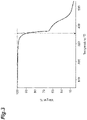
- FIG. 3 shows a measurement result of thermogravimetric analysis. The pyrolysis temperature was 360°C, and it was confirmed that Lu 2 (hfa) 6 (dpper) 2 had very high heat resistance.
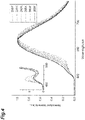
- the emission spectrum of Lu 2 (hfa) 6 (dpper) 2 in a dichloromethane solution was measured at an excitation light of 400 nm and a fluorescence wavelength of 420 to 780 nm while changing a temperature from 200 K to 300 K.
- FIG. 4 shows the emission spectrum of Lu 2 (hfa) 6 (dpper) 2 at 200 K to 300 K. It was confirmed that the luminescence properties of Lu 2 (hfa) 6 (dpper) 2 varied depending on temperatures.
- 2,6-Dibromo-9,10-diphenylanthracene 500 mg, 1.02 mmol
- potassium acetate 333 mg, 1.8 mmol
- palladium(II) acetate about 3 mg
- diphenylphosphine 0.5 ml, 2.04 mmol
- H 2 O 120 ml
- the obtained precipitate was dispersed in dichloromethane (100 ml), a 30% hydrogen peroxide solution (2 ml) was added thereto, and the dispersion liquid was stirred at 0°C for 5 hours. Thereafter, the product was extracted with dichloroethane and saturated saline. The solvent was distilled from the dichloroethane layer, and the obtained powder was recrystallized in a mixed solvent of dichloromethane and methanol to obtain yellow crystals of dpDPA (yield 210 mg, yield constant 28%).
- bpDPA (5 mg, 0.01 mmol) was dissolved in dichloromethane (0.5 ml).
- Lu(hfa) 3 (H 2 O) 2 (7 mg, 0.01 mmol) was dissolved in methanol (0.5 ml).
- the solution of bpDPA was put in a micro tube, and the solution of Lu(hfa) 3 (H 2 O) 3 was slowly stacked on the solution of bpDPA.
- the micro tube was covered with a lid and left to stand still at room temperature, needle-shaped crystals of [Lu(hfa) 3 (bpDPA)] n were precipitated on the wall surface of the micro tube.
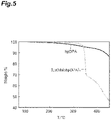
- FIG. 5 shows a measurement result of thermogravimetric analysis.
- Lu 2 (hfa) 6 (dpper) 2 showed a pyrolysis temperature exceeding 340°C and had high heat resistance.
- FIG. 6 shows the photoabsorption and emission spectra of bpDPA and [Lu(hfa) 3 (bpDPA)] n . It was confirmed that [Lu(hfa) 3 (bpDPA)] n exhibited improved chromatic purity as compared to bpPDA.
- Table 2 shows measurement results of the emission lifetime ⁇ and the emission quantum yield ⁇ of bpDPA and [Lu(hfa) 3 (bpDPA)] n and k r and k nr calculated therefrom.
- the emission quantum yield ⁇ was measured by an excitation light of 380 nm in an argon atmosphere.
- Table 2 also shows a full width at half maximum (FWHM) of the peak band in the emission spectrum. It was confirmed that [Lu(hfa) 3 (bpDPA)] n exhibited improved luminance efficiency as compared to bpPDA.
Landscapes
- Chemical & Material Sciences (AREA)
- Organic Chemistry (AREA)
- Health & Medical Sciences (AREA)
- Life Sciences & Earth Sciences (AREA)
- Biochemistry (AREA)
- General Health & Medical Sciences (AREA)
- Molecular Biology (AREA)
- Engineering & Computer Science (AREA)
- Materials Engineering (AREA)
- Organic Low-Molecular-Weight Compounds And Preparation Thereof (AREA)
Abstract
Description
- The present invention relates to a luminescent rare earth complex.
- An organic fluorescent dye having a condensed polycyclic aromatic ring such as perylene has been known (for example, Patent Literature 1). The organic dye can provide not only a high emission quantum yield but also various functions, and from these aspects, the organic dye is expected to be applied to various fields as an organic light-emitting material.
- Patent Literature 1:
Japanese Unexamined Patent Publication No. 2017-523124 - An aspect of the present invention provides an organic light-emitting material having high heat resistance.
- An aspect of the present invention relates to a rare earth complex (rare earth compound) comprising: one or a plurality of rare earth ions; and a ligand forming a coordinate bond with the rare earth ions. At least a part of the rare earth ions are at least one kind selected from the group consisting of lutetium(III) ions, yttrium(III) ions, and gadolinium(III) ions. The ligand comprises a residue obtained by removing one or more hydrogen atoms from a fluorescent condensed polycyclic aromatic compound.
- There is a tendency that the rare earth complex having a lutetium(III) ion, a yttrium(III) ion, and a gadolinium(III) ion is generally difficult to exhibit intensive fluorescence emitting property. However, according to the finding of the present inventors, a rare earth complex emitting intensive fluorescent light while having high heat resistance can be formed by combining these rare earth ions and a ligand having a fluorescent condensed polycyclic aromatic group.
- According to an aspect of the present invention, there is provided an organic light-emitting material having high heat resistance. The rare earth complex according to an aspect of the present invention can emit intensive light even in a solid or a high-concentration solution. The rare earth complex according to an aspect of the present invention can emit intensive blue light. The rare earth complex according to an aspect of the present invention can exhibit luminescence properties varying depending on temperatures.
-
-
FIG. 1 shows photoabsorption spectra of a ligand and a lutetium complex. -
FIG. 2 shows emission spectra of the ligand and the lutetium complex. -
FIG. 3 is a graph showing a result of thermogravimetric analysis of the lutetium complex. -
FIG. 4 shows an emission spectrum of the lutetium complex at 200 to 300 K. -
FIG. 5 is a graph showing a result of thermogravimetric analysis of the ligand and the lutetium complex. -
FIG. 6 shows photoabsorption and emission spectra of the ligand and the lutetium complex. - Hereinafter, some embodiments of the present invention will be described in detail. However, the present invention is not limited to the following embodiments.
- A rare earth complex according to an embodiment has one or a plurality of rare earth ions and a ligand coordinated with the rare earth ions. At least a part of the rare earth ions are at least one kind selected from the group consisting of lutetium (Lu)(III) ions, yttrium (Y)(III) ions, and gadolinium (Gd)(III) ions. The rare earth complex may have one or more Lu(III). The rare earth complex may have at least one kind of rare earth ion selected from the group consisting of a lutetium (Lu)(III) ion, a yttrium (Y)(III) ion, and a gadolinium (Gd)(III) ion, and a trivalent rare earth ion other than these ions. The trivalent rare earth ion may be, for example, a europium (Eu), neodymium (Nd), ytterbium (Yb), or terbium (Tb) ion.
- The ligand includes a residue obtained by removing one or more hydrogen atoms from a fluorescent condensed polycyclic aromatic compound. For example, when the condensed polycyclic aromatic compound is a blue light-emitting compound, the rare earth complex can emit intensive blue light. The ligand may be a compound having a residue of the condensed polycyclic aromatic compound and a coordinating group forming a coordinate bond with the rare earth ion. The coordinating group may be bonded directly to a condensed polycyclic aromatic group derived from the condensed polycyclic aromatic compound.
- Examples of the fluorescent condensed polycyclic aromatic compound include a compound represented by the following formula (1), (2), or (3):


- In these Formulae, R1 represents a hydrogen atom, a halogen atom, a cyano group, an amino group which may have a substituent, or an aryl group which may have a substituent (for example, a phenyl group). A plurality of R's in the same molecule may be the same as or different from each other. R1 may be a hydrogen atom. Some of the plurality of R's may be an aryl group which may have a substituent, and the remaining R's may be a hydrogen atom. A substituent which the amino group or the aryl group has may be, for example, a halogen atom.
- For example, the residue derived from the condensed polycyclic aromatic compound of formula (1) may be a monovalent group represented by formula (1-1) below, a divalent group represented by formula (1-2) below, or a divalent group represented by formula (1-3) below. In formulae (1-1), (1-2), and (1-3), ∗ represents a bond. The coordinating group may be bonded to the position of ∗.


- An example of the coordinating group is a phosphine oxide group. Specific examples of the ligand having a phosphine oxide group include a monodentate phosphine oxide ligand represented by formula (10) below and a bidentate phosphine oxide ligand represented by formula (11) below.


- In formulae (10) and (11), Z1 represents a monovalent residue derived from the condensed polycyclic aromatic compound, and Z2 represents a divalent residue derived from the condensed polycyclic aromatic compound. In a case where the ligand is the bidentate phosphine oxide ligand represented by formula (11), the rare earth complex may include two rare earth ions. Each of two phosphine oxide groups of the phosphine oxide ligand of formula (11) may form a coordinate bond with one rare earth ion.
- R10 represents an aryl group which may have a substituent. A plurality of R10s in one molecule may be the same as or different from each other. The aryl group for R10 can be a residue obtained by removing one hydrogen atom from the aromatic compound. Generally, R10 is an aryl group different from the condensed polycyclic aromatic group in Z1 and Z2. The number of carbon atoms of the aryl group is, for example, 6 to 14. Specific examples of the aryl group include a residue obtained by removing one hydrogen atom from substituted or unsubstituted benzene, substituted or unsubstituted naphthalene, substituted or unsubstituted anthracene, or substituted or unsubstituted phenanthrene. Particularly, R10 may be a substituted or unsubstituted phenyl group. A substituent which the aryl group has may be a halogen atom.
- Examples of the monodentate phosphine oxide ligand represented by formula (10) include a phosphine oxide compound represented by formula (20) below. Examples of the bidentate phosphine oxide ligand represented by formula (11) include a phosphine oxide compound represented by formula (21) or (22) below. R1 and R10 in formulae (20), (21), and (22) each have the same meaning as R1 in formula (1) and R10 in formulae (10) and (11).


- The rare earth complex according to an embodiment may further have a ligand other than the ligand having the residue derived from the condensed polycyclic aromatic compound. For example, the rare earth complex may further have a diketone ligand represented by formula (30) below. The rare earth complex including the diketone ligand represented by formula (30) may have further more excellent properties from the viewpoint of enhanced emission or the like.

- In formula (30), R21, R22, and R23 each independently represent a hydrogen atom, an alkyl group, an alkyl halide group, an aryl group, or a heteroaryl group. The aryl group described herein may be an aryl group different from a condensed polycyclic aromatic group derived from the fluorescent condensed polycyclic aromatic compound.
- The rare earth complex having the diketone ligand of formula (30) is represented, for example, by formula (I) or (II) below.


- Ln1(III) in formula (I) represents a Lu(III) ion, a Y(III) ion, or a Gd(III) ion. In formula (II), Ln2(III) represents a Lu(III) ion, a Y(III) ion, or a Gd(III) ion, and Ln3(III) represents a Lu(III) ion, a Y(III) ion, or a Gd(III) ion, or a trivalent rare earth ion other than these ions. Other symbols in formulae (I) and (II) have the same meaning as described above.
- The rare earth complex may be a compound that has a plurality of rare earth ions and a plurality of bidentate ligands derived from a fluorescent condensed polycyclic aromatic compound and has a repeating structure formed by alternately arranging the rare earth ions and the bidentate ligands. The rare earth complex having the repeating structure is represented, for example, by formula (III) below.

- Ln4 in formula (III) represents a Lu(III) ion, a Y(III) ion, or a Gd(III) ion. n represents the number of repetitions. Other symbols have the same meaning as described above.
- The rare earth complex according to the embodiment described above can be produced according to an ordinary synthesis method. Examples of the synthesis method will be shown in Examples described below.
- A luminescent body including the rare earth complex according to the present embodiment can show high-luminance light emission such as blue light emission.
- Hereinafter, the present invention will be described in more detail by means of Examples. However, the present invention is not limited to these Examples.
-

- N-bromosuccinimide (NBS, 564 mg, 3.2 mmol) was dissolved in super dehydrated tetrahydrofuran (THF, 40 ml) to obtain an NBS solution. Perylene (800 mg, 3.2 mmol) was added to super dehydrated THF (50 ml) and dispersed. The NBS solution (40 ml) was added dropwise to the obtained dispersion liquid, and the dispersion liquid was refluxed for 24 hours at 50°C to react perylene with NBS. After completing the reaction, powder was obtained by reprecipitation from a mixed solvent of THF and H2O. The obtained powder was washed with hexane and dried to obtain a solid of the product (3-bromoperylene) (yield constant 40%, yield 425 mg).
1H NMR (400 MHz, CDCl3/TMS) δ/ppm = 7.48 (t, 2H), 7.58 (t, 1H), 7.70 (d, 2H), 7.76 (d, 1H), 8.00 (d, 1H), 8.08 (d, 1H), 8.16 (d, 1H), 8.20 (d, 1H), 8.23 (d, 1H) - 3-Bromoperylene (2.0 g, 6.1 mmol), potassium acetate (710 mg, 7.3 mmol), and palladium(II) acetate (13.5 mg, 0.06 mmol) were dissolved in super dehydrated dimethyl acetamide (100 ml, 100°C) to prepare a reaction solution. Diphenylphosphine (1.2 ml, 6.1 mmol) was added dropwise to this reaction solution, and the reaction solution was refluxed for 24 hours at 100°C. Subsequently, the reaction solution was added to H2O (400 ml), and the produced precipitate was extracted with dichloromethane and saturated saline. The solvent was distilled from the dichloromethane layer by an evaporator. The residual solid was dissolved in chloroform (80 ml), a 30% hydrogen peroxide solution (15 ml) was added to the solution, and the solution was stirred at 0°C for 3 hours. Thereafter, the product was extracted from the solution with chloroform and saturated saline. The solvent was distilled from the chloroform layer, and the residue was purified by column chromatography (mobile phase: ethyl acetate) to obtain a solid of the product (pdpo) (yield constant 10%, yield 292 mg).
- 1H NMR (400 MHz, CDCl3) δ/ppm = 7.40-7.59 (m, 9H), 7.71-7.79 (m, 7H), 8.07 (dd, 1H), 8.22 (t, 3H), 8.48 (d, 1H)
- ESI-MS: m/z calcd for C32H22OP [M+H+] = 453.13; found: 453.14
-
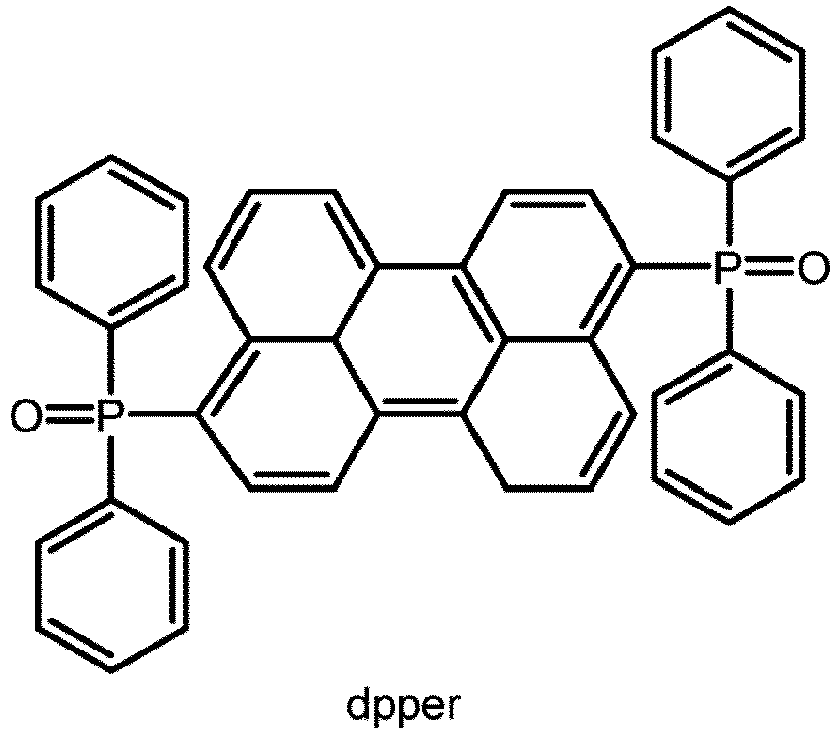
- NBS (2.82 mg, 15.8 mmol) was dissolved in super dehydrated THF (90 ml) to obtain an NBS solution. Perylene (500 mg, 2.0 mmol) was added to super dehydrated THF (30 ml) and dispersed. The NBS solution (90 ml) was added dropwise to the obtained dispersion liquid, and the dispersion liquid was refluxed for 18 hours at 70°C to react perylene with NBS. After completing the reaction, powder was obtained by reprecipitation from a mixed solvent of THF and H2O. The obtained powder was washed with hexane and dried to obtain a solid of the product (3,9-dibromoperylene) (yield constant 59%, yield 480 mg).
1H NMR (400 MHz, CDCl3) δ/ppm = 7.56-7.61 (m, 2H), 7.76 (dd, 11.2 Hz, 2H), 7.98 (dd, 2H), 8.10 (d, 2H), 8.22 (dd, 2H) - A solid of dpper was obtained (yield constant 7%, yield 32 mg) by the same method as in the synthesis of pdpo, except that 3,9-dibromoperylene was used.
- 1H NMR (400 MHz, CDCl3) δ/ppm = 7.47-7.51 (m, 11H), 7.58 (t, 4H), 7.72 (dd, 9H), 8.09 (t, 2H), 8.25 (t, 2H), 8.52 (d, 1H), 8.59 (d, 1H)
- ESI-MS: m/z calcd for C44H31O2P2[M+H+] = 653.17; found: 653.18.
-

- Lutetium acetate tetrahydrate (2.0 g, 4.7 mol) was dissolved in H2O (30 ml). Hexafluoroacetylacetone (hfa) (2.9 g, 14 mmol) was added dropwise to the obtained solution. The pH of the solution was adjusted to 7 with 30% ammonia water, and the solution was stirred for 3 hours at room temperature. The precipitated product was taken out by suction filtration and washed with chloroform, and powder of the product (Lu(hfa)3(H2O)2) was recovered (yield constant 74%, yield 2.9 g).
- pdpo (90 mg, 0.2 mmol) was dissolved in dichloromethane (60 ml). Lu(hfa)3(H2O)2(124 mg, 0.15 mmol) was added to the obtained solution, and the solution was stirred at room temperature for 6 hours. Thereafter, the precipitated product was taken out by filtration, and crystals of the product were obtained (yield constant 83%, yield 140 mg) by recrystallization from a mixed solvent of dichloromethane/hexane = 1 : 4.
ESI-MS: m/z calcd for C74H44F12LuO6P2[M-hfa]+ = 1493.18; found: 1493.26 -

- Lu2(hfa)6(dpper)2 was synthesized (yield constant 72%, yield 51 mg) by the same method as in the synthesis of Lu(hfa)3(pdpo)2, except that dpper was used instead of pdpo.
ESI-MS: m/z calcd for C113H65F30Lu2O14P4[M-hfa]+ = 2689.17; found: 2689.29 - The photoabsorption spectra of pdpo, dpper, Lu(hfa)3(pdpo)2, and Lu2(hfa)6(dpper)2 in a dichloromethane solution were measured.
FIG. 1 shows the photoabsorption spectra of pdpo, dpper, Lu(hfa)3(pdpo)2, and Lu2(hfa)6(dpper)2. In the absorption spectrum of Lu(hfa)3(pdpo)2, in addition to the same absorption band as that of pdpo, a new absorption band near 300 nm, which is considered to be derived from hexafluoroacetone (hfa), was observed. In the photoabsorption spectrum of Lu2(hfa)6(dpper)2, the absorption band near 460 nm derived from dpper in the longest wavelength region was shifted to the long wavelength side as compared to the absorption band of the dpper simple substance, and this suggests that both dppers interact with each other in the complex. - The emission spectra of pdpo, dpper, Lu(hfa)3(pdpo)2, and Lu2(hfa)6(dpper)2 in a solution were measured at an excitation light of 400 nm and a fluorescence wavelength of 420 to 800 nm. As the solvent, dichloromethane was used in the case of pdpo and dpper, and toluene was used in the case of Lu(hfa)3(pdpo)2 and Lu2(hfa)6(dpper)2.
FIG. 2 shows the emission spectra of pdpo, dpper, Lu(hfa)3(pdpo)2, and Lu2(hfa)6(dpper)2 in a solution. In the emission spectrum of pdpo, the emission peak was observed at 471 nm and 497 nm, and these peaks are considered to correspond to transition of 0→0 and transition of 0→1, respectively. In the emission spectrum of dpper, a larger emission peak than that in pdpo was observed at 468 nm and 497 nm. The solution of Lu(hfa)3(pdpo)2 emitted intensive blue light, and the emission spectrum thereof was almost the same as the emission spectrum of pdpo. This suggests that the interaction between pdpo coordinated with the rare earth ion and another ligand is small. In the emission spectrum of Lu2(hfa)6(dpper)2, a broad emission band was newly observed at the long wavelength side. The absorption band shift from dpper to Lu2(hfa)6(dpper)2 was 900 cm-1; on the other hand, the emission band shift was 5000 cm-1. This suggests that the integrated structure of dpper existing around the rare earth ion greatly changes due to light excitation. - Table 1 shows measurement results of an emission lifetime τ and an emission quantum yield Φ of Lu(hfa)3(pdpo)2 and Lu2(hfa)6(dpper)2 and kr and knr calculated therefrom. The emission lifetime τ and the emission quantum yield Φ were measured at each excitation light of 390 nm and 420 nm in a toluene solution at 25°C.
Table 1 Solvent τ [ns]a Φ [%] kr [s-1] knr [s-1] Lu(hfa)3(pdpo)2 Toluene 4.2 46 1.1×10⁸ 1.3×10⁸ Lu2(hfa)6(dpper)2 Toluene 44 18 4.1×10⁶ 1.9×10⁷ - When about 10 mg of crystals of Lu2(hfa)6(dpper)2 was irradiated with an excitation light of 365 nm, intensive light emission was confirmed. On the other hand, in the case of irradiating the solid of dpper with excitation light, light emission was not confirmed.
- Lu2(hfa)6(dpper)2 was evaluated by thermogravimetric analysis.
FIG. 3 shows a measurement result of thermogravimetric analysis. The pyrolysis temperature was 360°C, and it was confirmed that Lu2(hfa)6(dpper)2 had very high heat resistance. - The emission spectrum of Lu2(hfa)6(dpper)2 in a dichloromethane solution was measured at an excitation light of 400 nm and a fluorescence wavelength of 420 to 780 nm while changing a temperature from 200 K to 300 K.
FIG. 4 shows the emission spectrum of Lu2(hfa)6(dpper)2 at 200 K to 300 K. It was confirmed that the luminescence properties of Lu2(hfa)6(dpper)2 varied depending on temperatures. -

- 2,6-Dibromo-9,10-diphenylanthracene (500 mg, 1.02 mmol), potassium acetate (333 mg, 1.8 mmol), and palladium(II) acetate (about 3 mg) were added to dehydrated dimethyl acetamide (15 ml) and dissolved in dimethyl acetamide by heating at 100°C to prepare a reaction solution. When diphenylphosphine (0.5 ml, 2.04 mmol) was added dropwise to this reaction solution, and the reaction solution was refluxed for 24 hours at 100°C, precipitate was produced in the reaction solution. The reaction solution was air-cooled, then H2O (120 ml) was added thereto, and precipitate was recovered. The obtained precipitate was dispersed in dichloromethane (100 ml), a 30% hydrogen peroxide solution (2 ml) was added thereto, and the dispersion liquid was stirred at 0°C for 5 hours. Thereafter, the product was extracted with dichloroethane and saturated saline. The solvent was distilled from the dichloroethane layer, and the obtained powder was recrystallized in a mixed solvent of dichloromethane and methanol to obtain yellow crystals of dpDPA (yield 210 mg, yield constant 28%).
- 1H NMR (400 MHz, CDCl3) δ/ppm = 7.29-7.61 (m, 32H), 7.79 (d, 11.6 Hz, 2H), 7.91 (d, 16.0 Hz, 2H)
- ESI-MS: m/z calcd for C50H37O2P2[M+H]+ = 731.22; found: 731.23
- Elemental analysis (%): C50H36O2P2 calcd for C 82.18, H 4.97. found: C 82.40, H 4.76.
-

- bpDPA (5 mg, 0.01 mmol) was dissolved in dichloromethane (0.5 ml). Lu(hfa)3(H2O)2(7 mg, 0.01 mmol) was dissolved in methanol (0.5 ml). The solution of bpDPA was put in a micro tube, and the solution of Lu(hfa)3(H2O)3 was slowly stacked on the solution of bpDPA. When the micro tube was covered with a lid and left to stand still at room temperature, needle-shaped crystals of [Lu(hfa)3(bpDPA)]n were precipitated on the wall surface of the micro tube.
Elemental analysis (%): C65H39F18O8P2Lu calcd for C 51.13, H 2.57. found: C 50.82, H 2.44 FT-IR (ATR) = 1655(st, C=O), 1249(st, C-F), 1169(st, P=O) cm-1 - bpDPA and [Lu(hfa)3(bpDPA)]n were evaluated by thermogravimetric analysis.
FIG. 5 shows a measurement result of thermogravimetric analysis. Lu2(hfa)6(dpper)2 showed a pyrolysis temperature exceeding 340°C and had high heat resistance. - The photoabsorption and emission spectra of bpDPA and [Lu(hfa)3(bpDPA)]n were measured using samples diluted 3000 times with KBr.
FIG. 6 shows the photoabsorption and emission spectra of bpDPA and [Lu(hfa)3(bpDPA)]n. It was confirmed that [Lu(hfa)3(bpDPA)]n exhibited improved chromatic purity as compared to bpPDA. - Table 2 shows measurement results of the emission lifetime τ and the emission quantum yield Φ of bpDPA and [Lu(hfa)3(bpDPA)]n and kr and knr calculated therefrom. The emission quantum yield Φ was measured by an excitation light of 380 nm in an argon atmosphere. Table 2 also shows a full width at half maximum (FWHM) of the peak band in the emission spectrum. It was confirmed that [Lu(hfa)3(bpDPA)]n exhibited improved luminance efficiency as compared to bpPDA.
Table 2 FWHM [nm] τ [ns] Φ [%] kr [s-1] knr [s-1] bpPDA 77 4.5 18 4.0×10⁷ 1.8×10⁸ [Lu(hfa)3bpDPA)]n 50 3.6 25 6.9×10⁷ 2.1×10⁸
Claims (6)
- A rare earth complex comprising:one or a plurality of rare earth ions; anda ligand forming a coordinate bond with the rare earth ions, whereinat least a part of the rare earth ions are at least one kind selected from the group consisting of lutetium(III) ions, yttrium(III) ions, and gadolinium(III) ions, andthe ligand comprises a residue obtained by removing one or more hydrogen atoms from a fluorescent condensed polycyclic aromatic compound.
- The rare earth complex according to claim 1, wherein the condensed polycyclic aromatic compound is a blue light-emitting compound.
- The rare earth complex according to claim 1 or 2, wherein the condensed polycyclic aromatic compound is a compound represented by the following formula (1), (2), or (3):


- The rare earth complex according to any one of claims 1 to 3, wherein the rare earth complex has a plurality of the rare earth ions and a plurality of the ligands that are bidentate and comprise the residue obtained by removing one or more hydrogen atoms from the condensed polycyclic aromatic compound, and
a repeating structure is formed by alternately arranging the rare earth ions and the bidentate ligands. - The rare earth complex according to any one of claims 1 to 4, wherein the ligand is a phosphine oxide ligand comprising a residue obtained by removing one or more hydrogen atoms from the condensed polycyclic aromatic compound and a phosphine oxide group bonded to the residue.
- A luminescent body comprising the rare earth complex according to any one of claims 1 to 5.
Applications Claiming Priority (2)
| Application Number | Priority Date | Filing Date | Title |
|---|---|---|---|
| JP2019234712 | 2019-12-25 | ||
| PCT/JP2020/048239 WO2021132373A1 (en) | 2019-12-25 | 2020-12-23 | Rare earth complex |
Publications (2)
| Publication Number | Publication Date |
|---|---|
| EP4063375A1 true EP4063375A1 (en) | 2022-09-28 |
| EP4063375A4 EP4063375A4 (en) | 2023-12-20 |
Family
ID=76574245
Family Applications (1)
| Application Number | Title | Priority Date | Filing Date |
|---|---|---|---|
| EP20905993.0A Pending EP4063375A4 (en) | 2019-12-25 | 2020-12-23 | RARE EARTH ELEMENT COMPLEX |
Country Status (4)
| Country | Link |
|---|---|
| US (1) | US12606738B2 (en) |
| EP (1) | EP4063375A4 (en) |
| JP (1) | JP7688398B2 (en) |
| WO (1) | WO2021132373A1 (en) |
Family Cites Families (11)
| Publication number | Priority date | Publication date | Assignee | Title |
|---|---|---|---|---|
| JP2007210945A (en) * | 2006-02-09 | 2007-08-23 | Nichia Chem Ind Ltd | Lanthanoid complexes and room temperature phosphorescent materials |
| JP2007269780A (en) * | 2006-03-08 | 2007-10-18 | Nissan Chem Ind Ltd | Phosphonic acid-diketone composite rare earth metal complex |
| US9187505B2 (en) * | 2011-08-02 | 2015-11-17 | Rockwood Lithium GmbH | Homoleptic rare earth triaryl complexes |
| CN102807592B (en) * | 2012-08-23 | 2015-02-04 | 四川省新材料研究中心 | Series cyclic rare-earth complexes for inducing movement of double emission spectra by aggregation and preparation method thereof |
| WO2015169935A1 (en) | 2014-05-09 | 2015-11-12 | Basf Se | Cyanated perylene compounds |
| JP2016166139A (en) | 2015-03-09 | 2016-09-15 | 国立大学法人北海道大学 | Rare earth complex and light emitting device |
| WO2017191795A1 (en) * | 2016-05-02 | 2017-11-09 | 国立大学法人北海道大学 | Rare-earth complex polymer |
| CN110382511B (en) * | 2017-02-27 | 2022-05-31 | 国立大学法人北海道大学 | Phosphine oxide compound, rare earth complex, and light-emitting material |
| CN110337441B (en) * | 2017-02-27 | 2022-09-06 | 国立大学法人北海道大学 | Rare earth complex and light-emitting element |
| US20220089942A1 (en) * | 2018-12-25 | 2022-03-24 | National University Corporation Hokkaido University | Rare earth compound, phosphine oxide compound, and luminescent body |
| CN113727850B (en) * | 2019-04-26 | 2023-09-12 | 国立大学法人北海道大学 | Rare earth complex, rare earth complex solution, luminescent molded article, method of manufacturing luminescent article, luminescent sheet and agricultural plastic greenhouse |
-
2020
- 2020-12-23 JP JP2021567564A patent/JP7688398B2/en active Active
- 2020-12-23 US US17/788,530 patent/US12606738B2/en active Active
- 2020-12-23 EP EP20905993.0A patent/EP4063375A4/en active Pending
- 2020-12-23 WO PCT/JP2020/048239 patent/WO2021132373A1/en not_active Ceased
Also Published As
| Publication number | Publication date |
|---|---|
| WO2021132373A1 (en) | 2021-07-01 |
| US20230089029A1 (en) | 2023-03-23 |
| JPWO2021132373A1 (en) | 2021-07-01 |
| EP4063375A4 (en) | 2023-12-20 |
| JP7688398B2 (en) | 2025-06-04 |
| US12606738B2 (en) | 2026-04-21 |
Similar Documents
| Publication | Publication Date | Title |
|---|---|---|
| Zhu et al. | A new TPE-based tetrapodal ligand and its Ln (III) complexes: Multi-stimuli responsive AIE (aggregation-induced emission)/ILCT (intraligand charge transfer)-bifunctional photoluminescence and NIR emission sensitization | |
| EP1963346B1 (en) | Organometallic complex and light-emitting element, light-emitting device and electronic device using the same | |
| EP2007780B1 (en) | Light-emitting material | |
| JP2013147450A (en) | Metal complex and light-emitting element including the metal complex | |
| EP3587429A1 (en) | Rare earth complex and light emitting element | |
| CN115286649A (en) | Aryl boron nitrogen compound with narrow band emission and preparation and application thereof | |
| Wei et al. | Synthesis and characterization of phosphorescent isomeric iridium complexes with a rigid cyclometalating ligand | |
| US12606738B2 (en) | Rare earth complex | |
| JP6842096B2 (en) | An iridium complex having a phenyltriazole ligand and a luminescent material using the compound | |
| CN110382511B (en) | Phosphine oxide compound, rare earth complex, and light-emitting material | |
| EP3904359A1 (en) | Rare earth compound, phosphine oxide compound, and luminescent body | |
| An et al. | Synthesis, bright luminescence and crystal structure of a novel neutral europium complex | |
| JP2011068580A (en) | Light-emitting substance | |
| Bao et al. | Synthesis and characterization a novel europium (III)-β-diketonate complex with carbazole and triphenylamine moieties | |
| Graf et al. | Synthesis and structural characterization of bis-cyclometalated compounds [Ir (dFppy) 2 (Me4phen)] PF6 and [Ir (dF (CF3) ppy) 2 (Me4phen)] PF6 | |
| JP7274134B2 (en) | Rare earth compounds, light emitters, light emitting devices, wavelength conversion materials and security materials | |
| KR101602448B1 (en) | new platinum complex and organic light electroluminescent device containing the same | |
| EP3822277B1 (en) | Rare-earth complex, light-emitting material, light-emitting object, light-emitting device, interlayer for laminated glass, laminated glass, windshield for vehicle, wavelength conversion material, and security material | |
| US12534666B2 (en) | Blue phosphorescent material, production method thereof, and photophysical properties thereof | |
| JP5924691B2 (en) | Metal complex, light emitting element, display device | |
| KR20090078288A (en) | Mononuclear organometallic complex for luminescence | |
| JP5765764B2 (en) | Metal complex, light emitting element, display device | |
| KR100699506B1 (en) | Aromatic Dimethylridine Compounds Containing Fluorine | |
| Bahari et al. | KETOHYDRAZONE COMPLEXES AS POTENTIAL EMITTING MATERIAL IN OLED | |
| Cho | Synthesis and Characterization of New Luminescent Lanthanide Complexes |
Legal Events
| Date | Code | Title | Description |
|---|---|---|---|
| STAA | Information on the status of an ep patent application or granted ep patent |
Free format text: STATUS: THE INTERNATIONAL PUBLICATION HAS BEEN MADE |
|
| PUAI | Public reference made under article 153(3) epc to a published international application that has entered the european phase |
Free format text: ORIGINAL CODE: 0009012 |
|
| STAA | Information on the status of an ep patent application or granted ep patent |
Free format text: STATUS: REQUEST FOR EXAMINATION WAS MADE |
|
| 17P | Request for examination filed |
Effective date: 20220623 |
|
| AK | Designated contracting states |
Kind code of ref document: A1 Designated state(s): AL AT BE BG CH CY CZ DE DK EE ES FI FR GB GR HR HU IE IS IT LI LT LU LV MC MK MT NL NO PL PT RO RS SE SI SK SM TR |
|
| DAV | Request for validation of the european patent (deleted) | ||
| DAX | Request for extension of the european patent (deleted) | ||
| A4 | Supplementary search report drawn up and despatched |
Effective date: 20231121 |
|
| RIC1 | Information provided on ipc code assigned before grant |
Ipc: C09K 11/06 20060101ALI20231115BHEP Ipc: C09K 9/02 20060101ALI20231115BHEP Ipc: C07F 9/53 20060101AFI20231115BHEP |