EP4062534B1 - An electronic circuit that generates a high-impedance load and an associated method - Google Patents
An electronic circuit that generates a high-impedance load and an associated method Download PDFInfo
- Publication number
- EP4062534B1 EP4062534B1 EP20807517.6A EP20807517A EP4062534B1 EP 4062534 B1 EP4062534 B1 EP 4062534B1 EP 20807517 A EP20807517 A EP 20807517A EP 4062534 B1 EP4062534 B1 EP 4062534B1
- Authority
- EP
- European Patent Office
- Prior art keywords
- node
- bias
- voltage
- switching element
- stage
- Prior art date
- Legal status (The legal status is an assumption and is not a legal conclusion. Google has not performed a legal analysis and makes no representation as to the accuracy of the status listed.)
- Active
Links
Images

Classifications
-
- H—ELECTRICITY
- H03—ELECTRONIC CIRCUITRY
- H03H—IMPEDANCE NETWORKS, e.g. RESONANT CIRCUITS; RESONATORS
- H03H11/00—Networks using active elements
- H03H11/02—Multiple-port networks
- H03H11/28—Impedance matching networks
-
- H—ELECTRICITY
- H03—ELECTRONIC CIRCUITRY
- H03H—IMPEDANCE NETWORKS, e.g. RESONANT CIRCUITS; RESONATORS
- H03H11/00—Networks using active elements
- H03H11/02—Multiple-port networks
- H03H11/24—Frequency-independent attenuators
- H03H11/245—Frequency-independent attenuators using field-effect transistor
-
- H—ELECTRICITY
- H03—ELECTRONIC CIRCUITRY
- H03H—IMPEDANCE NETWORKS, e.g. RESONANT CIRCUITS; RESONATORS
- H03H11/00—Networks using active elements
- H03H11/02—Multiple-port networks
-
- H—ELECTRICITY
- H02—GENERATION; CONVERSION OR DISTRIBUTION OF ELECTRIC POWER
- H02J—ELECTRIC POWER NETWORKS; CIRCUIT ARRANGEMENTS OR SYSTEMS FOR SUPPLYING OR DISTRIBUTING ELECTRIC POWER; SYSTEMS FOR STORING ELECTRIC ENERGY
- H02J7/00—Circuit arrangements for charging or discharging batteries or for supplying loads from batteries
- H02J7/865—Battery or charger load switching, e.g. concurrent charging and load supply
-
- H—ELECTRICITY
- H02—GENERATION; CONVERSION OR DISTRIBUTION OF ELECTRIC POWER
- H02J—ELECTRIC POWER NETWORKS; CIRCUIT ARRANGEMENTS OR SYSTEMS FOR SUPPLYING OR DISTRIBUTING ELECTRIC POWER; SYSTEMS FOR STORING ELECTRIC ENERGY
- H02J7/00—Circuit arrangements for charging or discharging batteries or for supplying loads from batteries
- H02J7/90—Regulation of charging or discharging current or voltage
- H02J7/92—Regulation of charging or discharging current or voltage with prioritisation of loads or sources
-
- H—ELECTRICITY
- H02—GENERATION; CONVERSION OR DISTRIBUTION OF ELECTRIC POWER
- H02J—ELECTRIC POWER NETWORKS; CIRCUIT ARRANGEMENTS OR SYSTEMS FOR SUPPLYING OR DISTRIBUTING ELECTRIC POWER; SYSTEMS FOR STORING ELECTRIC ENERGY
- H02J2207/00—Details of circuit arrangements for charging or discharging batteries or supplying loads from batteries
- H02J2207/50—Charging of capacitors, supercapacitors, ultra-capacitors or double layer capacitors
-
- H—ELECTRICITY
- H02—GENERATION; CONVERSION OR DISTRIBUTION OF ELECTRIC POWER
- H02J—ELECTRIC POWER NETWORKS; CIRCUIT ARRANGEMENTS OR SYSTEMS FOR SUPPLYING OR DISTRIBUTING ELECTRIC POWER; SYSTEMS FOR STORING ELECTRIC ENERGY
- H02J7/00—Circuit arrangements for charging or discharging batteries or for supplying loads from batteries
- H02J7/34—Parallel operation in networks using both storage and other DC sources, e.g. providing buffering
- H02J7/345—Parallel operation in networks using both storage and other DC sources, e.g. providing buffering using capacitors as storage or buffering devices
Definitions
- This invention relates to an electronic circuit that generates a high-impedance load, e.g., for interfacing with sensor circuits, and it relates to a method of operating such an electronic circuit, specifically an integrated semiconductor circuit, to establish a high-impedance load.
- Such highly resistive elements find use in analogue filtering, bias and grounding circuits and as terminating elements in high-impedance input stages.
- Important requirements of a high-impedance terminating element that forms part of an input stage for sensors may include:
- On-chip options include:
- a more suitable solution may be to use subthreshold characteristics of MOSFET (Metal-Oxide-Semiconductor Field-Effect Transistor) devices, or to utilise the exponential current-voltage relationship of a diode or BJT (Bipolar Junction Transistor), to enable the implementation of circuit elements that behave as extremely high-impedance devices, without sacrificing silicon real estate typically required for implementing large resistances using passive elements.
- MOSFET Metal-Oxide-Semiconductor Field-Effect Transistor
- BJT Bipolar Junction Transistor
- the Applicant desires a high-impedance electronic circuit which addresses or ameliorates at least some of these issues.
- D1 discloses a circuit which has a resistor whose first end part is connected with a control end to a power tube of a power amplifier.
- a collecting electrode is connected with a base electrode of a first NPN type triode.
- the first end part of an emitter and transistor are connected together.
- a first terminal of the transistor is connected to ground.
- a second terminal of a bias capacitor is respectively connected with the first NPN type triode base electrode and a second NPN type triode base electrode.
- a second end part of the emitter and the transistor are connected to ground.
- the invention provides an electronic circuit configured to present a high-impedance load between a load point and a reference point (further referred to as the high-impedance electronic circuit), the high-impedance electronic circuit including:
- transfer of voltage may comprise transfer of charge to establish a particular voltage, but for simplicity of explanation, this is referred to as “transfer of voltage”.
- the capacitive element (C) may be a capacitor.
- the capacitor may be a transistor-implemented capacitor.
- the capacitive element (C) may be parasitic capacitive present in another component of the electronic circuit.
- the capacitive element may be a non-transistor charge-carrying element.
- the first and second elements (D 1 , D 2 ) may be MOSFETs or BJTs.
- the first and second elements (D 1 , D 2 ) may have identical voltage-current relationships or may have related (e.g., proportional or scaled) voltage-current relationships.
- high-impedance may be to look at conventional impedance elements that the electronic circuit, in accordance with the invention, may replace.
- Such conventional impedance elements may be on-chip resistors, e.g., polysilicon resistors, which presently are often in the region of 10-100 k ⁇ and exceptionally as high as 100-1000 k ⁇ . Accordingly, for the purposes of this specification, high impedance may be at least 1 M ⁇ , may be at least 10 M ⁇ , may be at least 100 M ⁇ , and may be at least 1 G ⁇ .
- the high-impedance load may present a resistive load only or may present a combination of a resistive and reactive load.
- the transfer stage duration T XFR may be calculated to be sufficiently long for effective voltage transfer between the first node (A) and the second node (B), but not too long to unreasonably influence discharge of the capacitive element (C) or the bias point of the second element (D 2 ) that will usually be a transistor.
- the transfer duration T XFR may be calculated to transfer the voltage V D (t) between the first node (A) and the second node (B) using the second switching element (S 2 ) and to keep the capacitive element (C) charged to ensure that the bias point voltage on the second node (B) of the second element (D 2 ) remains above ground potential (0 V).
- Switching elements may be referred to merely as switches, for brevity.
- the first switch (S 1 ) remains open.
- the timing control logic may be configured to implement an idle stage for a duration of T IDLE , depending on the exact implementation of timing signals, before commencing the next charging stage.
- the idling stage may be optional and T IDLE may be zero.
- the timing control logic may be configured to repeat the charging stage, discharging stage, and transfer stage periodically or intermittently.
- the timing control logic may be configured to repeat the charging stage, discharging stage and transfer stage at a frequency depending on the load voltage v L .
- the timing control logic may be configured to keep a ratio v L / i L constant in order to establish a constant real impedance.
- the voltage source point may be a power supply point or rail.
- the resistive element may limit an inrush of current to the capacitive element (C).
- the electronic circuit may be, or may be implemented by, or may form part of, an integrated circuit.
- the invention extends to a method of generating a high-impedance load between a load point and a reference point (further referred to as the high-impedance electronic circuit), the method comprising: providing an a high-impedance electronic circuit including:
- the method defined above may be implemented by the electronic circuit defined above.
- This invention proposes that the above-mentioned characteristics of non-linear elements (e.g., MOS transistors, diodes and BJTs) can be used to create high-impedance terminating elements.
- An aspect of this invention pertains to the method with which such a high-impedance element can be biased in an appropriate region of operation to yield the intended results.
- the present invention builds on the phenomenon explained in Equation (1) and FIG. 1 by noting that, if the calculation is rewritten in terms of the diode current i D (t), it can be shown that i D t ⁇ mV T C t for currents much larger than I 0 . This is significant since the result shows that for a capacitor discharging through a forward-biased diode, the diode current only depends on the total nodal capacitance C and time t.
- the current through the MOS transistor follows the expression i D t ⁇ nV T e ⁇ V t nV T C t where n is a technology constant, V T is the thermal voltage, V t is the MOS transistor's threshold voltage and C represents the nodal capacitance.
- Equation (4) yields an unexpected insight that it is possible to set the discharge current, and consequently the operating point of the device or circuit, by choosing only C and an appropriate t.
- the present invention discloses that the characteristics described above, resulting in Equation (4), may be used in a unique way to establish a well-controlled bias point for a device to serve as a high-impedance element.
- the device has four terminals comprising a gate (G), drain (D), source (S) and bulk (B).
- G gate
- D drain
- S source
- B bulk
- the discharging device is used to establish I BIAS , the same device cannot be used to act as a high-impedance circuit element by itself.
- FIG. 3 illustrates an example electronic circuit 100 configured to generate a high-impedance load, in accordance with the invention.
- the electronic circuit 100 may be configured in light of conclusions made from Equation (4) to implement a high-impedance element or load.
- the reference point is illustrated as a ground point.
- This example illustrates the electronic circuit 100 using an active element (D 1 ) with a non-linear voltage-to-current relationship in the form of an NMOS transistor, but other implementations are practicable (see below).
- the electronic circuit 100 may comprise three conceptual sections, each serving a particular purpose during various stages of operation.
- Sections 1 and 2 may be considered a biasing portion of the circuit 100 while the third section is the load-presenting section.
- the first section of the electronic circuit 100 comprises three main elements:
- FIG. 4 shows a graph 200 illustrating the different stages of circuit operation that enables D 2 in FIG. 3 to act as a high-impedance element as described above.
- the timing signals that close S 1 and S 2 are also indicated.
- the first variation from the circuit shown in FIG. 3 is that the two NMOS transistors may be implemented using bipolar junction devices (BJTs) and adapting the circuit for the necessary changes in behaviour, such as the continued presence of base currents, as shown in FIG. 5 as electronic device 300, in accordance with the invention.
- BJTs bipolar junction devices
- Such adaptation may require adding capacitance in addition to any existing parasitic capacitance to node B for sustaining these currents while maintaining the nodal voltage.
- the second variation from the circuit shown in FIG. 3 is that the transistors, either MOS or BJT devices or combination thereof, may be implemented by either n-type or p-type devices by adapting the circuit and associated polarities accordingly.
- the frequency f can be changed by changing the respective durations of each stage accordingly.
- the circuit of FIG. 3 may be adapted so that device D 1 is geometrically different from device D 2 so that the ultimate current through D 2 is a scaled version of the current through D 1 .
- D 1 is geometrically different from device D 2 so that the ultimate current through D 2 is a scaled version of the current through D 1 .
- geometrical adaptations to the devices may be made to compensate or fine-tune the current of the high impedance terminating element D 2 for different applications.
- the emitter area can be scaled to the same effect.
- T DCH may be adapted in isolation by appropriately adjusting the switching signals of S 1 and S 2 .
- the frequency f may also be dynamically adapted, thereby implicitly changing T DCH to accommodate for changes in v L and consequently R EFF shown in Fig. 3 in order to keep the value of R EFF relatively constant.
- circuit 100, 300, 400 can be fabricated using cost-effective, industry standard manufacturing processes such as silicon-based CMOS (complementary metal-oxide-semiconductor).
- CMOS complementary metal-oxide-semiconductor
- the circuit 100, 300, 400 finds application in read-out circuits of passive infrared (PIR) sensors and other sensors.
- PIR passive infrared
- the invention as described provides a new way to create a high-impedance terminating element that fulfils the requirements for such a circuit 100, 300, 400 as part of a sensor circuit front-end.
- the circuit 100, 300, 400 and method described enables a highly dynamic and adaptable solution that can form part of modern-day high-performance integrated circuits in a cost-effective way.
Landscapes
- Engineering & Computer Science (AREA)
- Power Engineering (AREA)
- Networks Using Active Elements (AREA)
- Electronic Switches (AREA)
- Semiconductor Integrated Circuits (AREA)
- Logic Circuits (AREA)
Description
- This invention relates to an electronic circuit that generates a high-impedance load, e.g., for interfacing with sensor circuits, and it relates to a method of operating such an electronic circuit, specifically an integrated semiconductor circuit, to establish a high-impedance load.
- It may be required to create very high resistive on-chip impedances as part of a semiconductor integrated circuit, while attempting to minimise silicon surface area (for example in order to remain cost effective). Such highly resistive elements find use in analogue filtering, bias and grounding circuits and as terminating elements in high-impedance input stages.
- An example of this is in sensor applications, where a sensor element that converts a physical parameter to an electrical signal often has a very high output impedance. In order to preserve what is usually a small signal as best as possible, the input stage of a circuit connected to such a sensor would have to present a very high, yet finite, input impedance to prevent charge build-up while not presenting unwanted loading effects to the sensor. These charge build-up and loading effects can be detrimental to correct sensor operation. A practical example is pyro-ceramic elements used in passive infrared (PIR) sensors. The same holds for thermopiles, biological sensors, gas detectors and various other sensors in general.
- Important requirements of a high-impedance terminating element that forms part of an input stage for sensors may include:
- a predictable, well-established operating point - its current and voltage - and a means to establish and control this operating point;
- predictable temperature stability within a generally applicable temperature range;
- repeatability (chip-to-chip and wafer-to-wafer);
- relative insensitivity to process variations;
- not affecting the sensor and the sensing circuit's analogue inputs in a negative way;
- the device and its operation should be sufficiently robust to be implementable in standard manufacturing processes; and
- it should use a reasonable silicon area for implementation to remain cost effective.
- For electronic circuits, and integrated circuits specifically, there are several solutions that one could consider. On-chip options include:
- using low-doped sheet resistors, such as high resistive polysilicon resistors, but these present the following challenges:
- ∘ they are extremely process parameter and temperature dependent;
- ∘ the large areas result in large parasitic capacitances that degrade the already small signals that elements such as sensors typically generate; and
- ∘ the large areas required for implementation has a high cost implication;
- using time-continuous current mirrors that depend on bias resistors for reference currents, but these are unsuitable for pico-Ampere currents required to present very high impedances; or
- using switched capacitor circuits to limit current draw from the sensor while preventing charge build-up.
- A more suitable solution may be to use subthreshold characteristics of MOSFET (Metal-Oxide-Semiconductor Field-Effect Transistor) devices, or to utilise the exponential current-voltage relationship of a diode or BJT (Bipolar Junction Transistor), to enable the implementation of circuit elements that behave as extremely high-impedance devices, without sacrificing silicon real estate typically required for implementing large resistances using passive elements. However, it is complex and therefore not common to accurately and repeatably bias such elements.
- The Applicant desires a high-impedance electronic circuit which addresses or ameliorates at least some of these issues.
- In a prior art work by Hellen [1], it is shown that a circuit comprising a capacitor and a diode as shown in
FIG. 1 has a time-dependent voltage behaviour shown in Equation (1),
FIG. 1 showing capacitive discharge through the diode. - The Applicant is further aware of
CN107171647 (D1 ). D1 discloses a circuit which has a resistor whose first end part is connected with a control end to a power tube of a power amplifier. A collecting electrode is connected with a base electrode of a first NPN type triode. The first end part of an emitter and transistor are connected together. A first terminal of the transistor is connected to ground. A second terminal of a bias capacitor is respectively connected with the first NPN type triode base electrode and a second NPN type triode base electrode. A second end part of the emitter and the transistor are connected to ground. - Accordingly, the invention provides an electronic circuit configured to present a high-impedance load between a load point and a reference point (further referred to as the high-impedance electronic circuit), the high-impedance electronic circuit including:
- a capacitive element (C) provided between a first node (Node A) and the reference point;
- a first element (D1), being either a diode or a diode connected transistor, having a non-linear voltage-to-current relationship connected in parallel with the capacitive element (C) between the first node (A) and the reference point;
- a first switching element (S1) provided in series between the first node (A) and a voltage source point;
- a second switching element (S2) provided between the first node (A) and a second node (Node B); and
- a second element (D2), being a transistor, having a non-linear voltage-to-current relationship connected between the second switching element (S2), the load point, and the reference point; and
- timing control logic configured to control the first switching element (S1) and the second switching element (S2) to bias the second element (D2) and that operates in at least three stages comprising:
- a charging stage wherein the first switching element (S1) is closed and the second switching element (S2) is open for a charging duration (TCH ) to enable the capacitive element (C) to charge a nodal voltage vD (t) at the first node (A) to a pre-defined initial voltage threshold Vi ;
- a discharge stage wherein the first switching element (S1) is open and the second switching element (S2) is open for a discharge duration (TDCH ) to enable discharging of the capacitive element (C) through the first element (D1) such that a current through the first element (D1) reaches a pre-defined bias current (IBIAS ) and/or the nodal voltage vD(t=TCH+TDCH) equals a predefined bias voltage (VBIAS ); and
- a transfer stage in which the second switching element (S2) is closed for a transfer duration (TXFR ) to connect the first node (A) and the second node (B), thereby to apply or transfer the bias voltage (VBIAS ) to a contact of the second element (D2) connected to the second node (B) to bias the second element (D2) according to the bias voltage (VBIAS );
- wherein the timing control logic is configured to open the second switching element (S2) after the transfer stage, the second element (D2) being biased to present the high-impedance load between the load point and the reference point.
- The stages may be repeated, re-ordered, or extended, as desired. Strictly speaking, "transfer of voltage" may comprise transfer of charge to establish a particular voltage, but for simplicity of explanation, this is referred to as "transfer of voltage".
- The capacitive element (C) may be a capacitor. The capacitor may be a transistor-implemented capacitor. The capacitive element (C) may be parasitic capacitive present in another component of the electronic circuit. The capacitive element may be a non-transistor charge-carrying element.
- The first and second elements (D1, D2) may be MOSFETs or BJTs. The first and second elements (D1, D2) may have identical voltage-current relationships or may have related (e.g., proportional or scaled) voltage-current relationships.
- According to Wikipedia (https://en.wikipedia.org/wiki/High_impedance, accessed 15 November 2019), "Numerical definitions of "high impedance" vary by application." It may therefore be difficult to define an exact numerical range. An important application of the present invention may be in the processing of signals generated by sensors (referred to as sensor signals). In such case, one definition of "high impedance" may be in terms of effect: so as not to degrade the sensor signal to an unusable signal.
- Another way of defining "high-impedance" may be to look at conventional impedance elements that the electronic circuit, in accordance with the invention, may replace. Such conventional impedance elements may be on-chip resistors, e.g., polysilicon resistors, which presently are often in the region of 10-100 kΩ and exceptionally as high as 100-1000 kΩ. Accordingly, for the purposes of this specification, high impedance may be at least 1 MΩ, may be at least 10 MΩ, may be at least 100 MΩ, and may be at least 1 GΩ.
- The high-impedance load may present a resistive load only or may present a combination of a resistive and reactive load.
- The transfer stage duration TXFR may be calculated to be sufficiently long for effective voltage transfer between the first node (A) and the second node (B), but not too long to unreasonably influence discharge of the capacitive element (C) or the bias point of the second element (D2) that will usually be a transistor. The transfer duration TXFR may be calculated to transfer the voltage VD(t) between the first node (A) and the second node (B) using the second switching element (S2) and to keep the capacitive element (C) charged to ensure that the bias point voltage on the second node (B) of the second element (D2) remains above ground potential (0 V).
- Switching elements may be referred to merely as switches, for brevity. During the transfer stage, the first switch (S1) remains open.
- The timing control logic may be configured to implement an idle stage for a duration of TIDLE, depending on the exact implementation of timing signals, before commencing the next charging stage. The idling stage may be optional and TIDLE may be zero.
- The timing control logic may be configured to repeat the charging stage, discharging stage, and transfer stage periodically or intermittently. The timing control logic may be configured to repeat the charging stage, discharging stage and transfer stage at a frequency depending on the load voltage vL. The timing control logic may be configured to keep a ratio vL /iL constant in order to establish a constant real impedance.
- The voltage source point may be a power supply point or rail.
- There may be a resistive element in series with the first switching element (S1). The resistive element may limit an inrush of current to the capacitive element (C).
- The electronic circuit may be, or may be implemented by, or may form part of, an integrated circuit.
- The invention extends to a method of generating a high-impedance load between a load point and a reference point (further referred to as the high-impedance electronic circuit), the method comprising:
providing an a high-impedance electronic circuit including: - a capacitive element (C) provided between a first node (Node A) and the reference point;
- a first element (D1), being either a diode or a diode connected transistor, having a non-linear voltage-to-current relationship connected in parallel with the capacitive element (C) between the first node (A) and the reference point;
- a first switching element (S1) provided in series between the first node (A) and a voltage source point;
- a second switching element (S2) provided between the first node (A) and a second node (Node B); and
- a second element (D2), being a transistor, having a non-linear voltage-to-current relationship connected between the second switching element (S2), the load point, and the reference point; and
- timing control logic configured to actuate the first switching element (S1) and the second switching element (S2) to bias the second element (D2) and that operates in at least three stages comprising:
- charging the capacitive element (C), during a charging stage wherein the first switching element (S1) is closed and the second switching element (S2) is open for a charging duration (TCH ), to a nodal voltage vD (t) at the first node (A) to a pre-defined initial voltage threshold Vi ;
- discharging the capacitive element (C), during a discharge stage wherein the first switching element (S1) is open and the second switching element (S2) is open for a discharge duration (TDCH ), through the first element (D1) such that a current through the first element (D1) reaches a pre-defined bias current (IBIAS ) and/or the nodal voltage vD(t=TCH +TDCH ) equals a pre-defined bias voltage (VBIAS );
- transferring the bias voltage (VBIAS ), during a transfer stage in which the second switching element (S2) is closed for a transfer duration (TXFR ) to connect the first node (A) and the second node (B), to a contact of the second element (D2) connected to the second node (B) to bias the second element (D2) according to the bias voltage (VBIAS ); and
- opening the second switching element (S2) after the transfer stage, the second element (D2) being biased to present the high-impedance load between the load point and the reference point.
- The method defined above may be implemented by the electronic circuit defined above.
- The invention will now be further described, by way of example, with reference to the accompanying diagrammatic drawings.
- In the drawings:
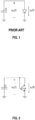
- FIG. 1
- shows a schematic circuit diagram of a PRIOR ART circuit, showing capacitive discharge through a diode, of Reference [1];
- FIG. 2
- shows a schematic circuit diagram with the diode in
FIG. 1 replaced with a transistor; - FIG. 3
- shows a schematic circuit diagram of an electronic circuit configured to generate a high-impedance load, in accordance with the invention;
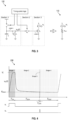
- FIG. 4
- shows a graph of various stages of operation of the electronic circuit of
FIG. 3 and timing signals on switches; - FIG. 5
- shows a schematic circuit diagram of another embodiment of an electronic circuit configured to generate a high-impedance load, in accordance with the invention; and
- FIG. 6
- shows a schematic circuit diagram of a further embodiment of an electronic circuit configured to generate a high-impedance load, in accordance with the invention.
- The present invention will be described first with reference to some enabling theory and then with reference to a practical implementation of that theory.
- This invention proposes that the above-mentioned characteristics of non-linear elements (e.g., MOS transistors, diodes and BJTs) can be used to create high-impedance terminating elements. An aspect of this invention pertains to the method with which such a high-impedance element can be biased in an appropriate region of operation to yield the intended results.
- The present invention builds on the phenomenon explained in Equation (1) and
FIG. 1 by noting that, if the calculation is rewritten in terms of the diode current iD(t), it can be shown that
- This result can be extended to MOS transistors by analysing the circuit in
FIG. 2 , where the diode ofFIG. 1 is replaced by a diode-connected NMOS (n-type MOS) transistor. - It can be shown that, where the term t/C and the nodal voltage vD (t) (from Equation (1)) are appropriately constrained, the current through the MOS transistor follows the expression

- To generalise both cases, Equations (2) and (3) can be rewritten and interpreted as

- The present invention discloses that the characteristics described above, resulting in Equation (4), may be used in a unique way to establish a well-controlled bias point for a device to serve as a high-impedance element.
- This can be illustrated using a typical field effect transistor, such as an NMOS transistor, as would normally be available to a circuit designer implementing a design using a CMOS fabrication process. The device has four terminals comprising a gate (G), drain (D), source (S) and bulk (B). In strong inversion operation, the gate-source voltage VGS > Vt, while with subthreshold operation it is required that VGS < Vt. It is known that in the subthreshold region the device has a significantly higher output impedance between the drain-source terminal than in strong inversion.
- Referring again to the circuit in
FIG. 2 , the capacitor may start with an initial voltage Vi at t = 0 that is well above the threshold voltage Vt of the device. Since VGS = VDS > Vt, the device starts in strong inversion and within a very short time; the device discharges so that VGS drops below Vt. In a typical 0.35 µm CMOS process, given a reasonable value for C, this happens within a few hundred nanoseconds or less. Once VGS is lower than Vt, the transistor enters its subthreshold region of operation and the rate of discharge becomes significantly slower. From Equation (3), generalised as Equation (4), the magnitude of the current becomes dependent only on time t, the nodal capacitance C and a technology or device constant k. - By using Equation (4) and choosing a target MOS element bias current IBIAS (which may be considered as iD (t=TCH +TDCH )) while selecting C, it is possible to determine the required discharge time TDCH so that iD(t=TCH+TDCH) = IBIAS and conversely it is possible to determine a C value for a predefined TDCH, given that an initial voltage was present on the node so that vD(t=TCH) = Vi.
- Since the discharging device is used to establish IBIAS, the same device cannot be used to act as a high-impedance circuit element by itself. However, the gate-source voltage VGS of the transistor associated with the current iD(t=TCH+TDCH) can now be used to replicate the bias point of the transistor by "copying" the gate voltage to another, second, MOS transistor. If the second transistor is sized the same, and operating under the same conditions on its terminals, the second transistor can be employed as the intended high-impedance circuit element by considering the behaviour between its drain and source terminal. Since it is known from Gray [2] for subthreshold operation that


- Similar behaviour can be expected from a bipolar junction transistor (BJT). Equation (2) can be adapted for a BJT by including the forward current gain term β where iC = βiB and noting that the total current is iD = (β + 1)iB, while the small signal output impedance of a BJT can be approximated as

- Turning now to a practical or technical implementation of the above theory,
FIG. 3 illustrates an exampleelectronic circuit 100 configured to generate a high-impedance load, in accordance with the invention. Theelectronic circuit 100 may be configured in light of conclusions made from Equation (4) to implement a high-impedance element or load. In the drawings, the reference point is illustrated as a ground point. - This example illustrates the
electronic circuit 100 using an active element (D1) with a non-linear voltage-to-current relationship in the form of an NMOS transistor, but other implementations are practicable (see below). Theelectronic circuit 100 may comprise three conceptual sections, each serving a particular purpose during various stages of operation. - 1. A first section (Section 1) of the
electronic circuit 100 that generates a voltage signal that can be used to bias a transistor in subthreshold or low current region depending on the required load impedance ΔvLlΔiL or load current bias point iL. - 2. A second section (Section 2) of the
electronic circuit 100 that transfers the bias point voltage signal on node A of the first section of the circuit to node B of the third section. - 3. A third section (Section 3) of the
electronic circuit 100 containing the element that utilises the transferred voltage signal to bias a transistor in a way to establish a high-impedance load as seen from the behaviour of vL (which is the voltage at the load point) and iL .Section 3, after the transfer stage, presents a high-impedance load, as represented by REFF incircuit 110. -
Sections circuit 100 while the third section is the load-presenting section. - During design, a circuit designer must choose the target current setpoint IBIAS for transistor D1 or required small-signal impedance using Equations (4) and/or (6) and then derive values for the capacitance C and the discharge duration TDCH.
- The first section of the
electronic circuit 100 comprises three main elements: - an element which is an active element such as a transistor or diode, D1 in
FIG. 3 , either n-type or p-type depending on the exact circuit implementation; - a capacitive element (C), typically a capacitor and the parasitic capacitance on node A in
FIG. 3 , and - a switching element, S1 in
FIG. 3 , that can connect and disconnect the capacitive element from a power source so that an initial voltage can be set or established on the node. -
FIG. 4 shows agraph 200 illustrating the different stages of circuit operation that enables D2 inFIG. 3 to act as a high-impedance element as described above. The timing signals that close S1 and S2 are also indicated. - The four stages of the circuit operation in
FIG. 4 can be explained as: - 1. Stage 1 (charging): During this
stage 1, a switch S1 connects the charge storing node to a charging source, usually a power supply rail and possibly through a resistive element to limit the inrush current to the storage element, while switch S2 is open. The charging stage duration TCH should be long enough to ensure that the nodal voltage vD (t) reaches a level sufficiently high so that Equation (2) is valid for a diode or bipolar transistor or Equation (3) for a diode-connected MOS device. Although a small current will flow through the discharge element, the NMOS transistor D1 inFIG. 3 , it should be negligible compared to the charging current flowing through S1. Once a sufficient initial voltage vD(t=TCH) = Vi is reached, the switch S1 opens, where TCH marks the duration of the charging stage and the next stage commences. - 2. Stage 2 (discharge) During this
stage 2, S1 and S2 are both open and vD(t=TCH) = Vi is the initial voltage on node A at the onset of the discharge stage. The first part of the circuit now follows the behaviour of general Equation (4) with the charge stored on node A discharging through the element, the diode-connected NMOS D1 inFIG. 3 . Depending on the parameters the designer chose, the duration of this stage should be TDCH at which the current through D1 will reach the target value of IBIAS with a nodal voltage vD(t=TCH+TDCH) = VBIAS. - 3. Stage 3 (transfer): At the end of the discharge stage, switch S2 closes in order to transfer the voltage on node A, VBIAS, to node B. Ideally, the voltage on node B is now equal to the voltage on node A and will persist after S2 opens, although this may take plural repetitions to occur. For the example in
FIG. 3 VBIAS would now be present on the gate of D2 and thereby bias the device according to Equations (5) and (6) to act as the intended high-impedance circuit element, e.g., between its drain and source terminals. The duration of this stage 3 TXFR, with S2 being closed, should be sufficiently long for effective voltage transfer between nodes A and B, but not too long to unreasonably influence the discharge circuit and bias point. The transfer stage ends when switch S2 opens. A total node capacitance on node B should be high enough to retain this voltage and inhibit discharge (and voltage drop/change) during the time when S2 is open. - 4. Stage 4 (idle stage): After the bias point was transferred to the load device D2, the system may enter an optional
idle stage 4 for a duration of TIDLE, depending on the exact implementation of the timing signals, before commencing the next charging stage. For most cases, TIDLE will likely be zero. This stage may be optional. - 5. Repeating the process to establish and maintain bias: In order to establish and maintain the bias point the three stages above need to be repeated periodically or intermittently to maintain an accurate VBIAS, especially when using bipolar devices with non-negligible base currents influencing the setpoint on node B. In addition, when first establishing the bias point, node B may require multiple cycles of charge transfer from node A before settling on or around the intended bias voltage VBIAS, due to the capacitance ratio of node A to node B. The initial condition of each of the repeating cycles is vD(t=TCH) = Vi that therefore allows vD(t=TCH+TOCH ) = VBIAS to settle after multiple cycles allowing a stable high-impedance operating point to be applied to D2. The timing control logic may be configured to repeat the charging stage, discharging stage, and transfer.
- Other variations of the
electronic device 100 are possible, as illustrated inFIGs 5-6 . The first variation from the circuit shown inFIG. 3 is that the two NMOS transistors may be implemented using bipolar junction devices (BJTs) and adapting the circuit for the necessary changes in behaviour, such as the continued presence of base currents, as shown inFIG. 5 aselectronic device 300, in accordance with the invention. Such adaptation may require adding capacitance in addition to any existing parasitic capacitance to node B for sustaining these currents while maintaining the nodal voltage. - The second variation from the circuit shown in
FIG. 3 is that the transistors, either MOS or BJT devices or combination thereof, may be implemented by either n-type or p-type devices by adapting the circuit and associated polarities accordingly. - While the method of circuit operation described in the preceding section focuses on using the discharge time TDCH as the determining factor when interpreting Equation (4), it should be noted that Equation (4) can also be amended to express IBIAS, the bias current through D1 as on t = TCH + TDCH in terms of frequency as

- The circuit of
FIG. 3 , and similar circuits in general, may be adapted so that device D1 is geometrically different from device D2 so that the ultimate current through D2 is a scaled version of the current through D1. For example, suppose forFIG. 3 the (W/L)-ratio of D2 over D1 is 2, then D2 would conduct approximately twice the current for given VBIAS than D1 - that is, iL = 2lBIAS. In this way, geometrical adaptations to the devices may be made to compensate or fine-tune the current of the high impedance terminating element D2 for different applications. For BJTs, the emitter area can be scaled to the same effect. - While D2 presents a very high small-signal impedance for a given operating bias point, such an impedance is non-linear as the voltage vL on the drain (for field-effect transistors) or collector (for bipolar transistors) of D2 changes. In another variation it is possible to dynamically compensate for this by adapting TDCH in absolute terms as illustrated in diagram 400 in
FIG. 6 . For a fixed repeating period of TTOTAL= TCH+ TDCH + TXFR + TIDLE = 1/f, TDCH may be adapted in isolation by appropriately adjusting the switching signals of S1 and S2. The frequency f may also be dynamically adapted, thereby implicitly changing TDCH to accommodate for changes in vL and consequently REFF shown inFig. 3 in order to keep the value of REFF relatively constant. - The Applicant believes that the invention as exemplified is advantageous in that the
circuit circuit - The invention as described provides a new way to create a high-impedance terminating element that fulfils the requirements for such a
circuit circuit -
- [1] Hellen, E. H., "Verifying the diode-capacitor circuit voltage delay", American Journal of Physics, Vol. 71, no. 8, 10 July 2003.
- [2] Grey, P. R., et al, "Analysis and design of analog integrated circuits", 4th edition, John Wiley and Sons, Inc., 2001.
Claims (12)
- An electronic circuit configured to present a high-impedance load between a load point and a reference point, further referred to as the high-impedance electronic circuit, the high-impedance electronic circuit including:a capacitive element (C) provided between a first node (Node A) and the reference point;a first element (D1), being either a diode or a diode connected transistor, having a non-linear voltage-to-current relationship connected in parallel with the capacitive element (C) between the first node (A) and the reference point;a first switching element (S1) provided in series between the first node (A) and a voltage source point;a second switching element (S2) provided between the first node (A) and a second node (Node B); anda second element (D2), being a transistor, having a non-linear voltage-to-current relationship connected between the second switching element (S2), the load point, and the reference point; andtiming control logic configured to control the first switching element (S1) and the second switching element (S2) to bias the second element (D2) to operate in at least three stages comprising:a charging stage wherein the first switching element (S1) is closed and the second switching element (S2) is open for a charging duration (TCH ) to enable the capacitive element (C) to charge a nodal voltage vD (t) at the first node (A) to a pre-defined initial voltage threshold Vi ;a discharge stage wherein the first switching element (S1) is open and the second switching element (S2) is open for a discharge duration (TDCH ) to enable discharging of the capacitive element (C) through the first element (D1) such that a current through the first element (D1) reaches a pre-defined bias current (IBIAS ) and/or the nodal voltage vD(t=TCH+TDCH ) equals a predefined bias voltage (VBIAS ); anda transfer stage in which the first switching element (S1) is open and the second switching element (S2) is closed for a transfer duration (TXFR ) to connect the first node (A) and the second node (B), thereby to apply or transfer the bias voltage (VBIAS ) to a contact of the second element (D2) connected to the second node (B) to bias the second element (D2) according to the bias voltage (VBIAS );wherein the timing control logic is configured to open the second switching element (S2) after the transfer stage, the second element (D2) being biased to present the high-impedance load between the load point and the reference point.
- The electronic circuit as claimed in claim 1, in which:the first and second elements (D1, D2) are MOSFETs, Metal-Oxide-Semiconductor Field-Effect Transistors;the first and second elements (D1, D2) are BJTs, Bipolar Junction Transistors;the first element (D1) is a BJT and the second element (D2) is a MOSFET; orthe first element (D1) is a diode and the second element (D2) is a BJT.
- The electronic circuit as claimed in any one of claims 1-2, in which the first and second elements (D1, D2) have proportional voltage-current relationships.
- The electronic circuit as claimed in any one of claims 1-3, in which the transfer duration (TXFR ) is calculated to transfer the voltage VD(t) between the first node (A) and the second node (B) using the second switching element (S2) and to keep the capacitive element (C) charged to ensure that the bias point voltage on the second node (B) of the second element (D2) remains above ground potential (0 V).
- The electronic circuit as claimed in any one of claims 1-4, in which the timing control logic is configured to repeat the charging stage, discharging stage, and transfer stage periodically or intermittently.
- The electronic circuit as claimed in claim 5, in which the timing control logic is configured to repeat the charging stage, discharging stage and transfer stage at a frequency depending on the load voltage vL .
- The electronic circuit as claimed in claim 6, in which the timing control logic is configured to keep a ratio vL /iL constant in order to establish a constant real impedance, wherein iL is the load current.
- The electronic circuit as claimed in any one of claims 1-7, which is, or which forms part of, an Integrated Circuit (IC).
- A method of generating a high-impedance load between a load point and a reference point, further referred to as the high-impedance electronic circuit, the method comprising:
providing a high-impedance electronic circuit including:a capacitive element (C) provided between a first node (Node A) and the reference point;a first element (D1), being either a diode or a diode connected transistor, having a non-linear voltage-to-current relationship connected in parallel with the capacitive element (C) between the first node (A) and the reference point;a first switching element (S1) provided in series between the first node (A) and a voltage source point;a second switching element (S2) provided between the first node (A) and a second node (Node B); anda second element (D2), being a transistor, having a non-linear voltage-to-current relationship connected between the second switching element (S2), the load point, and the reference point; andtiming control logic configured to actuate the first switching element (S1) and the second switching element (S2) to bias the second element (D2) in at least three stages comprising:charging the capacitive element (C), during a charging stage wherein the first switching element (S1) is closed and the second switching element (S2) is open for a charging duration (TCH ), to a nodal voltage vD (t) at the first node (A) to a pre-defined initial voltage threshold Vi;discharging the capacitive element (C), during a discharge stage wherein the first switching element (S1) is open and the second switching element (S2) is open for a discharge duration (TDCH ), through the first element (D1) such that a current through the first element (D1) reaches a pre-defined bias current (IBIAS ) and/or the nodal voltage vD(t=TCH+TDCH) equals a pre-defined bias voltage (VBIAS );transferring the bias voltage (VBIAS), during a transfer stage in which the first switching element (S1) is open and the second switching element (S2) is closed for a transfer duration (TXFR ) to connect the first node (A) and the second node (B), to a contact of the second element (D2) connected to the second node (B) to bias the second element (D2) according to the bias voltage (VBIAS ); andopening the second switching element (S2) after the transfer stage, the second element (D2) being biased to present the high-impedance load between the load point and the reference point. - The method as claimed in claim 9, in which the charging stage, discharging stage, and transfer stage are repeated periodically or intermittently.
- The method as claimed in claim 10, in which the charging stage, discharging stage, and transfer stage are repeated at a frequency depending on the load voltage VL.
- The method as claimed in claim 11, which includes keeping a ratio vL /iL constant in order to establish a constant real impedance, wherein iL is the load current.
Applications Claiming Priority (2)
| Application Number | Priority Date | Filing Date | Title |
|---|---|---|---|
| NL2024412A NL2024412B1 (en) | 2019-12-10 | 2019-12-10 | An Electronic Circuit that Generates a High-Impedance Load and an Associated Method |
| PCT/IB2020/060645 WO2021116795A1 (en) | 2019-12-10 | 2020-11-12 | An electronic circuit that generates a high-impedance load and an associated method |
Publications (2)
| Publication Number | Publication Date |
|---|---|
| EP4062534A1 EP4062534A1 (en) | 2022-09-28 |
| EP4062534B1 true EP4062534B1 (en) | 2025-03-26 |
Family
ID=70155238
Family Applications (1)
| Application Number | Title | Priority Date | Filing Date |
|---|---|---|---|
| EP20807517.6A Active EP4062534B1 (en) | 2019-12-10 | 2020-11-12 | An electronic circuit that generates a high-impedance load and an associated method |
Country Status (8)
| Country | Link |
|---|---|
| US (1) | US11979127B2 (en) |
| EP (1) | EP4062534B1 (en) |
| JP (1) | JP7620018B2 (en) |
| CN (1) | CN112953459B (en) |
| NL (1) | NL2024412B1 (en) |
| TW (1) | TWI900509B (en) |
| WO (1) | WO2021116795A1 (en) |
| ZA (1) | ZA202206309B (en) |
Family Cites Families (21)
| Publication number | Priority date | Publication date | Assignee | Title |
|---|---|---|---|---|
| US4433914A (en) * | 1979-09-14 | 1984-02-28 | Vivitar Corporation | Exposure meter |
| US4495458A (en) * | 1982-09-30 | 1985-01-22 | Tektronix | Termination for high impedance attenuator |
| JPS60167513A (en) * | 1984-02-10 | 1985-08-30 | Hitachi Ltd | Equivalent resistance circuit |
| USRE34462E (en) * | 1986-02-07 | 1993-11-30 | Astec International, Ltd. | Start circuit for generation of pulse width modulated switching pulses for switch mode power supplies |
| US4887199A (en) * | 1986-02-07 | 1989-12-12 | Astec International Limited | Start circuit for generation of pulse width modulated switching pulses for switch mode power supplies |
| JPS6444884A (en) * | 1987-08-13 | 1989-02-17 | Matsushita Electric Works Ltd | Direction detecting type pyroelectric sensor |
| US4868482A (en) * | 1987-10-05 | 1989-09-19 | Western Digital Corporation | CMOS integrated circuit having precision resistor elements |
| US5410274A (en) * | 1992-09-16 | 1995-04-25 | Hughes Aircraft Company | Single-ended and differential amplifiers with high feedback input impedance and low distortion |
| US5663675A (en) * | 1995-06-07 | 1997-09-02 | American Microsystems, Inc. | Multiple stage tracking filter using a self-calibrating RC oscillator circuit |
| JPH10308529A (en) * | 1997-05-09 | 1998-11-17 | Matsushita Electric Works Ltd | Semiconductor relay |
| US5966005A (en) * | 1997-12-18 | 1999-10-12 | Asahi Corporation | Low voltage self cascode current mirror |
| JPH11264761A (en) * | 1998-03-18 | 1999-09-28 | Honda Motor Co Ltd | Optical sensor circuit and image sensor using the same |
| US7504841B2 (en) * | 2005-05-17 | 2009-03-17 | Analog Devices, Inc. | High-impedance attenuator |
| US8174315B1 (en) * | 2009-04-27 | 2012-05-08 | Triquint Semiconductor, Inc. | Method and circuit for transforming the impedance of a load |
| US8416008B2 (en) * | 2011-01-20 | 2013-04-09 | Advanced Energy Industries, Inc. | Impedance-matching network using BJT switches in variable-reactance circuits |
| US9793802B2 (en) * | 2011-05-18 | 2017-10-17 | Robert Bosch Gmbh | MEMS capacitive sensor biasing circuit including an integrated inductor |
| CN202282743U (en) * | 2011-09-29 | 2012-06-20 | 南京博兰得电子科技有限公司 | Resonant converter control device |
| US8797016B2 (en) * | 2011-11-09 | 2014-08-05 | Saher Waseem | Apparatus and method for power extraction from high impedance sources |
| TW201322628A (en) * | 2011-11-24 | 2013-06-01 | Asmedia Technology Inc | Voltage multiplying circuit, signal switch and resistance adjusting method thereof |
| US10056901B2 (en) * | 2016-02-11 | 2018-08-21 | Skyworks Solutions, Inc. | Impedance control in radio-frequency switches |
| CN107171647B (en) * | 2017-06-23 | 2023-05-05 | 广东工业大学 | Adaptive Bias Circuit and Wireless Transmission System with Low Loss and Temperature Compensation |
-
2019
- 2019-12-10 NL NL2024412A patent/NL2024412B1/en active
-
2020
- 2020-11-12 WO PCT/IB2020/060645 patent/WO2021116795A1/en not_active Ceased
- 2020-11-12 US US17/783,181 patent/US11979127B2/en active Active
- 2020-11-12 EP EP20807517.6A patent/EP4062534B1/en active Active
- 2020-11-12 JP JP2022535509A patent/JP7620018B2/en active Active
- 2020-12-09 CN CN202011430958.6A patent/CN112953459B/en active Active
- 2020-12-10 TW TW109143581A patent/TWI900509B/en active
-
2022
- 2022-06-07 ZA ZA2022/06309A patent/ZA202206309B/en unknown
Also Published As
| Publication number | Publication date |
|---|---|
| CN112953459B (en) | 2025-08-19 |
| JP7620018B2 (en) | 2025-01-22 |
| US20230011971A1 (en) | 2023-01-12 |
| CN112953459A (en) | 2021-06-11 |
| TWI900509B (en) | 2025-10-11 |
| US11979127B2 (en) | 2024-05-07 |
| EP4062534A1 (en) | 2022-09-28 |
| TW202143642A (en) | 2021-11-16 |
| ZA202206309B (en) | 2023-02-22 |
| JP2023506448A (en) | 2023-02-16 |
| NL2024412B1 (en) | 2021-08-31 |
| WO2021116795A1 (en) | 2021-06-17 |
Similar Documents
| Publication | Publication Date | Title |
|---|---|---|
| CN104423410B (en) | Signal generating circuit and temperature sensor | |
| JP2572697B2 (en) | Low impedance overvoltage protection circuit | |
| US4890052A (en) | Temperature constant current reference | |
| US10078016B2 (en) | On-die temperature sensor for integrated circuit | |
| US20150185746A1 (en) | Bandgap reference voltage generating circuit | |
| CN112787640B (en) | Reference generator using FET devices with different gate operating functions | |
| CN102594311A (en) | Semiconductor device including power-on reset circuit | |
| JP2004146576A (en) | Semiconductor temperature measuring circuit | |
| US4567363A (en) | Switched capacitor transresistance amplifier | |
| EP4062534B1 (en) | An electronic circuit that generates a high-impedance load and an associated method | |
| JP6666716B2 (en) | Temperature detection circuit and circuit device using the same | |
| US4728828A (en) | Switched capacitor transresistance amplifier | |
| US12231115B2 (en) | Threshold detector of a power on reset circuit with improved accuracy for switching levels over temperature variations | |
| HK40079549B (en) | An electronic circuit that generates a high-impedance load and an associated method | |
| HK40079549A (en) | An electronic circuit that generates a high-impedance load and an associated method | |
| US6480038B1 (en) | Bipolar comparator | |
| JP2005172796A (en) | Current-voltage conversion circuit | |
| JP3519326B2 (en) | Current mirror circuit | |
| CN111337154B (en) | Temperature sensors and integrated circuits | |
| US20030218496A1 (en) | Very small current generating ciruit | |
| GB2259376A (en) | Voltage and current reference source | |
| JPS59215121A (en) | Buffer circuit | |
| JPS6284609A (en) | Differential amplifier | |
| KR20240046721A (en) | signal processing circuit | |
| TW200530595A (en) | Current/charge-voltage converter and reset method |
Legal Events
| Date | Code | Title | Description |
|---|---|---|---|
| STAA | Information on the status of an ep patent application or granted ep patent |
Free format text: STATUS: UNKNOWN |
|
| STAA | Information on the status of an ep patent application or granted ep patent |
Free format text: STATUS: THE INTERNATIONAL PUBLICATION HAS BEEN MADE |
|
| PUAI | Public reference made under article 153(3) epc to a published international application that has entered the european phase |
Free format text: ORIGINAL CODE: 0009012 |
|
| STAA | Information on the status of an ep patent application or granted ep patent |
Free format text: STATUS: REQUEST FOR EXAMINATION WAS MADE |
|
| 17P | Request for examination filed |
Effective date: 20220622 |
|
| AK | Designated contracting states |
Kind code of ref document: A1 Designated state(s): AL AT BE BG CH CY CZ DE DK EE ES FI FR GB GR HR HU IE IS IT LI LT LU LV MC MK MT NL NO PL PT RO RS SE SI SK SM TR |
|
| DAV | Request for validation of the european patent (deleted) | ||
| DAX | Request for extension of the european patent (deleted) | ||
| REG | Reference to a national code |
Ref country code: HK Ref legal event code: DE Ref document number: 40079549 Country of ref document: HK |
|
| GRAP | Despatch of communication of intention to grant a patent |
Free format text: ORIGINAL CODE: EPIDOSNIGR1 |
|
| STAA | Information on the status of an ep patent application or granted ep patent |
Free format text: STATUS: GRANT OF PATENT IS INTENDED |
|
| INTG | Intention to grant announced |
Effective date: 20240708 |
|
| GRAJ | Information related to disapproval of communication of intention to grant by the applicant or resumption of examination proceedings by the epo deleted |
Free format text: ORIGINAL CODE: EPIDOSDIGR1 |
|
| STAA | Information on the status of an ep patent application or granted ep patent |
Free format text: STATUS: REQUEST FOR EXAMINATION WAS MADE |
|
| STAA | Information on the status of an ep patent application or granted ep patent |
Free format text: STATUS: EXAMINATION IS IN PROGRESS |
|
| INTC | Intention to grant announced (deleted) | ||
| 17Q | First examination report despatched |
Effective date: 20240918 |
|
| GRAP | Despatch of communication of intention to grant a patent |
Free format text: ORIGINAL CODE: EPIDOSNIGR1 |
|
| STAA | Information on the status of an ep patent application or granted ep patent |
Free format text: STATUS: GRANT OF PATENT IS INTENDED |
|
| INTG | Intention to grant announced |
Effective date: 20241028 |
|
| RAP1 | Party data changed (applicant data changed or rights of an application transferred) |
Owner name: INSIAVA SENSOR ICS (PTY) LTD. |
|
| GRAS | Grant fee paid |
Free format text: ORIGINAL CODE: EPIDOSNIGR3 |
|
| GRAA | (expected) grant |
Free format text: ORIGINAL CODE: 0009210 |
|
| STAA | Information on the status of an ep patent application or granted ep patent |
Free format text: STATUS: THE PATENT HAS BEEN GRANTED |
|
| P01 | Opt-out of the competence of the unified patent court (upc) registered |
Free format text: CASE NUMBER: APP_5394/2025 Effective date: 20250131 |
|
| AK | Designated contracting states |
Kind code of ref document: B1 Designated state(s): AL AT BE BG CH CY CZ DE DK EE ES FI FR GB GR HR HU IE IS IT LI LT LU LV MC MK MT NL NO PL PT RO RS SE SI SK SM TR |
|
| REG | Reference to a national code |
Ref country code: GB Ref legal event code: FG4D |
|
| REG | Reference to a national code |
Ref country code: CH Ref legal event code: EP |
|
| REG | Reference to a national code |
Ref country code: DE Ref legal event code: R096 Ref document number: 602020048412 Country of ref document: DE |
|
| REG | Reference to a national code |
Ref country code: IE Ref legal event code: FG4D |
|
| PG25 | Lapsed in a contracting state [announced via postgrant information from national office to epo] |
Ref country code: RS Free format text: LAPSE BECAUSE OF FAILURE TO SUBMIT A TRANSLATION OF THE DESCRIPTION OR TO PAY THE FEE WITHIN THE PRESCRIBED TIME-LIMIT Effective date: 20250626 |
|
| PG25 | Lapsed in a contracting state [announced via postgrant information from national office to epo] |
Ref country code: FI Free format text: LAPSE BECAUSE OF FAILURE TO SUBMIT A TRANSLATION OF THE DESCRIPTION OR TO PAY THE FEE WITHIN THE PRESCRIBED TIME-LIMIT Effective date: 20250326 |
|
| REG | Reference to a national code |
Ref country code: LT Ref legal event code: MG9D |
|
| PG25 | Lapsed in a contracting state [announced via postgrant information from national office to epo] |
Ref country code: NO Free format text: LAPSE BECAUSE OF FAILURE TO SUBMIT A TRANSLATION OF THE DESCRIPTION OR TO PAY THE FEE WITHIN THE PRESCRIBED TIME-LIMIT Effective date: 20250626 |
|
| PG25 | Lapsed in a contracting state [announced via postgrant information from national office to epo] |
Ref country code: HR Free format text: LAPSE BECAUSE OF FAILURE TO SUBMIT A TRANSLATION OF THE DESCRIPTION OR TO PAY THE FEE WITHIN THE PRESCRIBED TIME-LIMIT Effective date: 20250326 |
|
| PG25 | Lapsed in a contracting state [announced via postgrant information from national office to epo] |
Ref country code: LV Free format text: LAPSE BECAUSE OF FAILURE TO SUBMIT A TRANSLATION OF THE DESCRIPTION OR TO PAY THE FEE WITHIN THE PRESCRIBED TIME-LIMIT Effective date: 20250326 |
|
| PG25 | Lapsed in a contracting state [announced via postgrant information from national office to epo] |
Ref country code: GR Free format text: LAPSE BECAUSE OF FAILURE TO SUBMIT A TRANSLATION OF THE DESCRIPTION OR TO PAY THE FEE WITHIN THE PRESCRIBED TIME-LIMIT Effective date: 20250627 Ref country code: BG Free format text: LAPSE BECAUSE OF FAILURE TO SUBMIT A TRANSLATION OF THE DESCRIPTION OR TO PAY THE FEE WITHIN THE PRESCRIBED TIME-LIMIT Effective date: 20250326 |
|
| REG | Reference to a national code |
Ref country code: NL Ref legal event code: MP Effective date: 20250326 |
|
| PG25 | Lapsed in a contracting state [announced via postgrant information from national office to epo] |
Ref country code: NL Free format text: LAPSE BECAUSE OF FAILURE TO SUBMIT A TRANSLATION OF THE DESCRIPTION OR TO PAY THE FEE WITHIN THE PRESCRIBED TIME-LIMIT Effective date: 20250326 |
|
| PG25 | Lapsed in a contracting state [announced via postgrant information from national office to epo] |
Ref country code: SE Free format text: LAPSE BECAUSE OF FAILURE TO SUBMIT A TRANSLATION OF THE DESCRIPTION OR TO PAY THE FEE WITHIN THE PRESCRIBED TIME-LIMIT Effective date: 20250326 |
|
| REG | Reference to a national code |
Ref country code: AT Ref legal event code: MK05 Ref document number: 1779982 Country of ref document: AT Kind code of ref document: T Effective date: 20250326 |
|
| PG25 | Lapsed in a contracting state [announced via postgrant information from national office to epo] |
Ref country code: SM Free format text: LAPSE BECAUSE OF FAILURE TO SUBMIT A TRANSLATION OF THE DESCRIPTION OR TO PAY THE FEE WITHIN THE PRESCRIBED TIME-LIMIT Effective date: 20250326 |
|
| PG25 | Lapsed in a contracting state [announced via postgrant information from national office to epo] |
Ref country code: PT Free format text: LAPSE BECAUSE OF FAILURE TO SUBMIT A TRANSLATION OF THE DESCRIPTION OR TO PAY THE FEE WITHIN THE PRESCRIBED TIME-LIMIT Effective date: 20250728 Ref country code: ES Free format text: LAPSE BECAUSE OF FAILURE TO SUBMIT A TRANSLATION OF THE DESCRIPTION OR TO PAY THE FEE WITHIN THE PRESCRIBED TIME-LIMIT Effective date: 20250326 |
|
| PG25 | Lapsed in a contracting state [announced via postgrant information from national office to epo] |
Ref country code: PL Free format text: LAPSE BECAUSE OF FAILURE TO SUBMIT A TRANSLATION OF THE DESCRIPTION OR TO PAY THE FEE WITHIN THE PRESCRIBED TIME-LIMIT Effective date: 20250326 |
|
| PG25 | Lapsed in a contracting state [announced via postgrant information from national office to epo] |
Ref country code: AT Free format text: LAPSE BECAUSE OF FAILURE TO SUBMIT A TRANSLATION OF THE DESCRIPTION OR TO PAY THE FEE WITHIN THE PRESCRIBED TIME-LIMIT Effective date: 20250326 |
|
| PG25 | Lapsed in a contracting state [announced via postgrant information from national office to epo] |
Ref country code: EE Free format text: LAPSE BECAUSE OF FAILURE TO SUBMIT A TRANSLATION OF THE DESCRIPTION OR TO PAY THE FEE WITHIN THE PRESCRIBED TIME-LIMIT Effective date: 20250326 |
|
| PG25 | Lapsed in a contracting state [announced via postgrant information from national office to epo] |
Ref country code: RO Free format text: LAPSE BECAUSE OF FAILURE TO SUBMIT A TRANSLATION OF THE DESCRIPTION OR TO PAY THE FEE WITHIN THE PRESCRIBED TIME-LIMIT Effective date: 20250326 |
|
| PG25 | Lapsed in a contracting state [announced via postgrant information from national office to epo] |
Ref country code: SK Free format text: LAPSE BECAUSE OF FAILURE TO SUBMIT A TRANSLATION OF THE DESCRIPTION OR TO PAY THE FEE WITHIN THE PRESCRIBED TIME-LIMIT Effective date: 20250326 |
|
| PG25 | Lapsed in a contracting state [announced via postgrant information from national office to epo] |
Ref country code: IS Free format text: LAPSE BECAUSE OF FAILURE TO SUBMIT A TRANSLATION OF THE DESCRIPTION OR TO PAY THE FEE WITHIN THE PRESCRIBED TIME-LIMIT Effective date: 20250726 |
|
| REG | Reference to a national code |
Ref country code: DE Ref legal event code: R097 Ref document number: 602020048412 Country of ref document: DE |
|
| PGFP | Annual fee paid to national office [announced via postgrant information from national office to epo] |
Ref country code: DE Payment date: 20251111 Year of fee payment: 6 |
|
| PGFP | Annual fee paid to national office [announced via postgrant information from national office to epo] |
Ref country code: GB Payment date: 20251113 Year of fee payment: 6 |
|
| PG25 | Lapsed in a contracting state [announced via postgrant information from national office to epo] |
Ref country code: DK Free format text: LAPSE BECAUSE OF FAILURE TO SUBMIT A TRANSLATION OF THE DESCRIPTION OR TO PAY THE FEE WITHIN THE PRESCRIBED TIME-LIMIT Effective date: 20250326 |
|
| PGFP | Annual fee paid to national office [announced via postgrant information from national office to epo] |
Ref country code: IT Payment date: 20251126 Year of fee payment: 6 |
|
| PGFP | Annual fee paid to national office [announced via postgrant information from national office to epo] |
Ref country code: FR Payment date: 20251124 Year of fee payment: 6 |
|
| PG25 | Lapsed in a contracting state [announced via postgrant information from national office to epo] |
Ref country code: CZ Free format text: LAPSE BECAUSE OF FAILURE TO SUBMIT A TRANSLATION OF THE DESCRIPTION OR TO PAY THE FEE WITHIN THE PRESCRIBED TIME-LIMIT Effective date: 20250326 |
|
| PLBE | No opposition filed within time limit |
Free format text: ORIGINAL CODE: 0009261 |
|
| STAA | Information on the status of an ep patent application or granted ep patent |
Free format text: STATUS: NO OPPOSITION FILED WITHIN TIME LIMIT |
|
| REG | Reference to a national code |
Ref country code: CH Ref legal event code: L10 Free format text: ST27 STATUS EVENT CODE: U-0-0-L10-L00 (AS PROVIDED BY THE NATIONAL OFFICE) Effective date: 20260211 |
|
| 26N | No opposition filed |
Effective date: 20260105 |