EP4060893B1 - System for operating a variable frequency independent speed motor in an extended speed range - Google Patents
System for operating a variable frequency independent speed motor in an extended speed range Download PDFInfo
- Publication number
- EP4060893B1 EP4060893B1 EP22160209.7A EP22160209A EP4060893B1 EP 4060893 B1 EP4060893 B1 EP 4060893B1 EP 22160209 A EP22160209 A EP 22160209A EP 4060893 B1 EP4060893 B1 EP 4060893B1
- Authority
- EP
- European Patent Office
- Prior art keywords
- frequency
- power
- power conditioner
- power signal
- generate
- Prior art date
- Legal status (The legal status is an assumption and is not a legal conclusion. Google has not performed a legal analysis and makes no representation as to the accuracy of the status listed.)
- Active
Links
Images




Classifications
-
- H—ELECTRICITY
- H02—GENERATION; CONVERSION OR DISTRIBUTION OF ELECTRIC POWER
- H02P—CONTROL OR REGULATION OF ELECTRIC MOTORS, ELECTRIC GENERATORS OR DYNAMO-ELECTRIC CONVERTERS; CONTROLLING TRANSFORMERS, REACTORS OR CHOKE COILS
- H02P27/00—Arrangements or methods for the control of AC motors characterised by the kind of supply voltage
- H02P27/04—Arrangements or methods for the control of AC motors characterised by the kind of supply voltage using variable-frequency supply voltage, e.g. inverter or converter supply voltage
- H02P27/05—Arrangements or methods for the control of AC motors characterised by the kind of supply voltage using variable-frequency supply voltage, e.g. inverter or converter supply voltage using AC supply for both the rotor and the stator circuits, the frequency of supply to at least one circuit being variable
-
- H—ELECTRICITY
- H02—GENERATION; CONVERSION OR DISTRIBUTION OF ELECTRIC POWER
- H02P—CONTROL OR REGULATION OF ELECTRIC MOTORS, ELECTRIC GENERATORS OR DYNAMO-ELECTRIC CONVERTERS; CONTROLLING TRANSFORMERS, REACTORS OR CHOKE COILS
- H02P27/00—Arrangements or methods for the control of AC motors characterised by the kind of supply voltage
- H02P27/04—Arrangements or methods for the control of AC motors characterised by the kind of supply voltage using variable-frequency supply voltage, e.g. inverter or converter supply voltage
-
- H—ELECTRICITY
- H02—GENERATION; CONVERSION OR DISTRIBUTION OF ELECTRIC POWER
- H02P—CONTROL OR REGULATION OF ELECTRIC MOTORS, ELECTRIC GENERATORS OR DYNAMO-ELECTRIC CONVERTERS; CONTROLLING TRANSFORMERS, REACTORS OR CHOKE COILS
- H02P9/00—Arrangements for controlling electric generators for the purpose of obtaining a desired output
- H02P9/14—Arrangements for controlling electric generators for the purpose of obtaining a desired output by variation of field
-
- H—ELECTRICITY
- H02—GENERATION; CONVERSION OR DISTRIBUTION OF ELECTRIC POWER
- H02J—ELECTRIC POWER NETWORKS; CIRCUIT ARRANGEMENTS OR SYSTEMS FOR SUPPLYING OR DISTRIBUTING ELECTRIC POWER; SYSTEMS FOR STORING ELECTRIC ENERGY
- H02J7/00—Circuit arrangements for charging or discharging batteries or for supplying loads from batteries
- H02J7/14—Circuit arrangements for charging or discharging batteries or for supplying loads from batteries for charging batteries from dynamo-electric generators driven at varying speed, e.g. on vehicle
-
- H—ELECTRICITY
- H02—GENERATION; CONVERSION OR DISTRIBUTION OF ELECTRIC POWER
- H02P—CONTROL OR REGULATION OF ELECTRIC MOTORS, ELECTRIC GENERATORS OR DYNAMO-ELECTRIC CONVERTERS; CONTROLLING TRANSFORMERS, REACTORS OR CHOKE COILS
- H02P3/00—Arrangements for stopping or slowing electric motors, generators, or dynamo-electric converters
- H02P3/06—Arrangements for stopping or slowing electric motors, generators, or dynamo-electric converters for stopping or slowing an individual dynamo-electric motor or dynamo-electric converter
- H02P3/18—Arrangements for stopping or slowing electric motors, generators, or dynamo-electric converters for stopping or slowing an individual dynamo-electric motor or dynamo-electric converter for stopping or slowing an AC motor
-
- H—ELECTRICITY
- H02—GENERATION; CONVERSION OR DISTRIBUTION OF ELECTRIC POWER
- H02P—CONTROL OR REGULATION OF ELECTRIC MOTORS, ELECTRIC GENERATORS OR DYNAMO-ELECTRIC CONVERTERS; CONTROLLING TRANSFORMERS, REACTORS OR CHOKE COILS
- H02P6/00—Arrangements for controlling synchronous motors or other dynamo-electric motors using electronic commutation dependent on the rotor position; Electronic commutators therefor
- H02P6/14—Electronic commutators
- H02P6/16—Circuit arrangements for detecting position
-
- H—ELECTRICITY
- H02—GENERATION; CONVERSION OR DISTRIBUTION OF ELECTRIC POWER
- H02P—CONTROL OR REGULATION OF ELECTRIC MOTORS, ELECTRIC GENERATORS OR DYNAMO-ELECTRIC CONVERTERS; CONTROLLING TRANSFORMERS, REACTORS OR CHOKE COILS
- H02P9/00—Arrangements for controlling electric generators for the purpose of obtaining a desired output
- H02P9/007—Control circuits for doubly fed generators
-
- H—ELECTRICITY
- H02—GENERATION; CONVERSION OR DISTRIBUTION OF ELECTRIC POWER
- H02P—CONTROL OR REGULATION OF ELECTRIC MOTORS, ELECTRIC GENERATORS OR DYNAMO-ELECTRIC CONVERTERS; CONTROLLING TRANSFORMERS, REACTORS OR CHOKE COILS
- H02P9/00—Arrangements for controlling electric generators for the purpose of obtaining a desired output
- H02P9/42—Arrangements for controlling electric generators for the purpose of obtaining a desired output to obtain desired frequency without varying speed of the generator
Definitions
- This disclosure is generally related to the field of operating a variable frequency independent speed (VFIS) motor-generator and, in particular, to operating a VFIS motor-generator in an extended speed range for both driving and regenerative modes.
- VFIS variable frequency independent speed
- Power conditioners may be coupled with synchronous and nonsynchronous motor-generators to perform the functions of driving the motor-generator with an alternating current (AC) power signal while in a driving mode and converting regenerative AC power into a direct current (DC) power signal while in a regenerative mode.
- AC alternating current
- DC direct current
- Power conditioners may be limited to a finite operational frequency range while operating in a driving mode.
- the rotation of a motor shaft may also be limited to the operational frequency range of the power conditioner.
- the limited frequency range may be undesirable, particularly in applications where temporary high rotations per minute (RPMs) are likely, such as an aircraft taking off, a race car sprinting, or a ship changing direction.
- RPMs temporary high rotations per minute
- Power conditioners may also be limited in the frequencies that regenerative power can be harvested while in a regenerative mode. For example, when the RPMs drop below a minimum regenerative frequency, a frequency of a regenerative power signal may be too low to perform an effective power conversion. Hydraulic braking may be used instead of regeneration which may cause the energy produced by a back-driven load to dissipate as heat rather than storing it in a usable form. Other disadvantages may exist.
- CN 111 262 394 A in accordance with its abstract, describes a brushless doubly-fed motor based on a high-frequency rotary transformer. With the motor adopted, highly-integrated light brushless operation of a system is realized.
- a rotor iron core winding (2) is arranged on a rotating shaft; a stator iron core and winding (1) is fixed on a motor shell, is concentric with the rotor iron core winding (2) and is connected with the rotating shaft through a bearing; a stator side inverter (5) is connected with the stator iron core and winding (1); a secondary side winding iron core (4) is arranged at the other end of the rotating shaft; the primary side winding iron core (3) and the secondary side winding iron core (4) are concentric but not contact with each other; a primary side inverter (6) is connected with the primary side winding iron core (3); a secondary side inverter (7) is connected with the rotor core winding (2) and the secondary side winding core (4).
- the first power conditioner While in a driving mode within a second region in which the shaft frequency is greater than the minimum regeneration frequency and less than the maximum operational frequency of the first power conditioner, the first power conditioner is configured to generate a variable frequency AC power signal and the second power conditioner is configured to generate a direct current (DC) power signal.
- DC direct current
- a system a variable frequency independent speed (VFIS) motor-generator having a stator with a set of stator windings, a rotor with a set of rotor windings, and a high-frequency transformer having a set of primary windings on the stator and a set of secondary windings on the rotor, wherein the set of secondary windings are coupled to the set of rotor windings; a first power conditioner coupled to the set of stator windings; and a second power conditioner, distinct from the first power conditioner, coupled to the set of primary windings.
- VFIS variable frequency independent speed
- the first power conditioner While in a driving mode within a second region in which the shaft frequency is greater than the minimum regeneration frequency, the first power conditioner is configured to generate a variable frequency AC power signal between a minimum regeneration frequency and a maximum operational frequency of the first power conditioner and the second power conditioner is configured to generate a variable frequency AC power signal having a negative 3-phase sequence.
- a system a variable frequency independent speed (VFIS) motor-generator having a stator with a set of stator windings, a rotor with a set of rotor windings, and a high-frequency transformer having a set of primary windings on the stator and a set of secondary windings on the rotor, wherein the set of secondary windings are coupled to the set of rotor windings; a first power conditioner coupled to the set of stator windings; and a second power conditioner, distinct from the first power conditioner, coupled to the set of primary windings.
- VFIS variable frequency independent speed
- the first power conditioner is configured to generate a first power signal that induces a first rotating magnetic field at the set of stator windings while the first power conditioner is in a driving mode.
- the second power conditioner is configured to generate a second power signal that induces a second rotating magnetic field at the set of rotor windings.
- the shaft speed is based on the difference between a first frequency corresponding to the frequency of the first power signal and a second frequency corresponding to the frequency of the second power signal.
- the first power conditioner While in a driving mode within a first region in which the shaft frequency is less than the maximum operational frequency of the first power conditioner, the first power conditioner is configured to generate a variable frequency AC power signal between zero and the maximum operational frequency of the first power conditioner, and the second power conditioner is configured to generate a DC power signal.
- the first power conditioner While in a driving mode within a second region in which the shaft frequency is more than the maximum operational frequency of the first power conditioner and less than the maximum shaft frequency, the first power conditioner is configured to generate a variable frequency AC power signal and the second power conditioner is configured to generate a variable frequency AC power signal having a negative 3-phase sequence.
- the system 100 may include the VFIS motor-generator 102, a first power conditioner 104, a second power conditioner 106, a battery 108, and a charger 110.
- the charger 110 may be configured to connect to a power source 112.
- the VFIS motor-generator 102 may be coupled to a torque load 114, such as a propulsion system, a surface control actuator, another type of actuation device, or the like.
- the system 100 may be incorporated into a vehicle 160, such as an aircraft, automobile, ship, or another type of motorized vehicle.
- the VFIS motor-generator 102 may include any type of motor designed to actively drive both a set of rotor windings and a set of stator windings. By changing a frequency and/or direction of a field generated at the rotor windings, the VFIS motor-generator 102 may achieve a rotational frequency that is independent from a frequency of a power signal used to drive its windings.
- the VFIS motor-generator 102 may also be back-driven and used as a generator for regenerative power applications.
- the VFIS motor-generator may be a 3-phase motor.
- the battery 108 may include any device for storing electrical charge.
- the battery 108 includes a lead-acid battery, a lithium-ion battery, a rechargeable alkaline battery, a capacitor, a super-capacitor, another type of electrical charge storage device, or combinations thereof.
- the battery 108 may include multiple cells, e.g., a battery pack.
- the battery 108 may be charged by regenerative power received from the first power conditioner 104 and/or the second power conditioner 106 or by the charger 110.
- the charger 110 may be configured to connect to the power source 112.
- the power source 112 may be external to and/or remote from the vehicle 160.
- the power source 112 may be a ground-based power supply.
- the power source 112 may be a car charging station or a consumer electrical outlet.
- the power source 112 may be incorporated within the vehicle 160.
- the power source 112 could be an on-board power generation system.
- the first power conditioner 104 and the second power conditioner 106 may be able to effectively combine their output power signals to operate the VFIS motor-generator 102 in a frequency range that extends past the individual capabilities of either the first power conditioner 104 or the second power conditioner 106, when taken alone. Further, during regeneration, the first power conditioner 104 and the second power conditioner 106 may be able to effectively combine their output power signals to operate in a regenerative power mode outside of the regenerative capability range of either the first power conditioner 104 or the second power conditioner 106. This extended speed range is further described herein.
- FIG. 2 an example of a system 100 for operating a VFIS motor-generator in an extended speed range is depicted.
- FIG. 2 may provide more detail showing how the first power conditioner 104 and the second power conditioner 106 are coupled to the VFIS motor-generator 102.
- the VFIS motor-generator 102 may include a stator 216 and a rotor 220.
- the stator 216 may have a set of stator windings 218.
- the rotor 220 may have a set of rotor windings 222.
- the VFIS motor-generator 102 may further include a high-frequency transformer 224 having a set of primary windings 226 on the stator 216 and a set of secondary windings 228 on the rotor 220.
- the set of secondary windings 228 may be connected to the set of rotor windings 222.
- the first power conditioner 104 may be configured to generate a power signal for driving the set of stator windings 218.
- the power signal may induce a first rotating magnetic field 230 at the set of stator windings 218.
- the second power conditioner 106 may be configured to generate a power signal for driving the set of rotor windings 222.
- the power signal generated by the second power conditioner 106 may be transmitted to the set of rotor windings 222 via the high-frequency transformer 224 and may induce a second rotating magnetic field 232 at the set of rotor windings 222.
- the combination of the first rotating magnetic field 230 and the second rotating magnetic field 232 may cause a shaft 250 of the VFIS motor-generator 102 to rotate.
- Frequencies of the first rotating magnetic field 230 and the second rotating magnetic field 232 may be additive and/or subtractive when applied to the shaft 250. In FIG. 2 , they are shown as being additive with both the first rotating magnetic field 230 and the second rotating magnetic field 232 rotating in the same direction.
- a power signal generated by the second power conditioner 106 that causes the second rotating magnetic field 232 to rotate in the same direction as the shaft 250 is referred to as having a positive frequency (or a positive 3-phase sequence) and a power signal generated by the second power conditioner 106 that causes the second rotating magnetic field 232 to rotate in an opposite direction than the shaft is referred to as having a negative frequency (or a negative 3-phase sequence).
- a speed of the shaft 250 (also referred to herein as a shaft frequency) may be based on a difference between the frequency of the power signal generated by the first power conditioner 104 and the frequency of the power signal generated by the second power conditioner 106.
- the VFIS motor-generator may include multiple pole pairs.
- the shaft frequency may be the difference between the two power signals divided by the number of pole pairs.
- a shaft frequency may be lower than a frequency that would be produced by the first rotating magnetic field 230 alone.
- the shaft frequency may correspond to a frequency of the first rotating magnetic field 230.
- the shaft frequency may be greater than a frequency that would be produced by the first rotating magnetic field 230 alone. This may enable the VFIS motor-generator 102 to be operated at a frequency (having a shaft frequency) that is higher than an operational bandwidth of either the first power conditioner 104 or the second power conditioner 106 when taken alone.
- the frequency capacity of the shaft may be doubled as compared to a system that may have a single power conditioner.
- a frequency the second rotating magnetic field 232 may be greater than a frequency of the rotating shaft 250. This may enable regeneration to occur even at shaft speeds that are below a minimum regeneration frequency of the first power conditioner 104.
- the first power conditioner 104 and the second power conditioner 106 may control their respective output power signals based on signals measured within the VFIS motor-generator 102 signals.
- the system 100 may include an encoder 234 that may communicate a shaft phase 236 and a shaft frequency 238 to both the first power conditioner 104 and the second power conditioner 106.
- a first voltage 240 and a first current 242 of a power signal present on the set of stator windings 218 may be measured and provided to the first power conditioner.
- a second voltage 244 and a second current 246 present on the set of primary windings 226 of the high-frequency transformer 224 may be measured and provided to the second power conditioner 106.
- the first power signal 302 may have a first frequency 304 and the second power signal 306 may have a second frequency 308.
- the functional relationship 300 may be a two-directional function. In a first direction, which may be associated with a driving mode, the first power signal 302 in combination with the second power signal 306 may determine the shaft speed 312. In a second direction, which may be associated with a regenerative mode, the shaft speed 312 in combination with the second power signal 306 may determine the first power signal 302.
- the functional relationship 300 may include a difference 314 between the first frequency 304 and the second frequency 308.
- the difference 314 may be divided at a multiplier 316 by a number of pole pairs 310 to resulting in a shaft frequency 311.
- the shaft frequency may be multiplied by 60 seconds (i.e., one minute), which would result in the shaft speed equaling the shaft frequency 311 multiplied by 60 and dividing the result by the number of pole pairs 310. Without the factor 60 seconds, the shaft frequency 311 may be in the unit of revolutions/second.
- the first frequency 304 may be the result of an algebraic sum of the shaft frequency 311 and the second frequency 308.
- the shaft frequency 311 may be the result of the shaft speed 312 multiplied at the multiplier 316 by the number of pole pairs 310. In both cases, either driving or regenerative, the relationship may be mathematically the same.
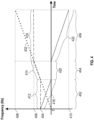
- FIG. 4 a graph depicting an example of relationships between power signals and a shaft frequency 402 is depicted.
- the shaft frequency 402 is depicted as continuously increasing over time. However, this is for descriptive purposes. In practice, the shaft frequency 402 may vary depending on a stage of usage of the VFIS motor-generator 102 (e.g., a stage of a flight mission profile, such as taxi, takeoff, climb, cruise, descent, etc.).
- FIG. 4 shows several different threshold frequencies including a minimum regeneration frequency 404, a maximum operational frequency 406 of the first power conditioner 104, a maximum shaft frequency 408 of the VFIS motor-generator 102, and a maximum negative 3-phase sequence operational frequency of the second power conditioner 106 (depicted as a minimum operational frequency 410 in FIG. 4 ).
- the absolute values of the maximum operational frequency 406 and the minimum operational frequency 410 may be equal because the maximum achievable frequency of both the power conditioners 104, 106 may be limited by the same types of the semiconductor devices.
- the minimum regeneration frequency 404 represents a threshold level for regenerative power to be effectively harvested from shaft rotation.
- the operational frequencies 404, 406, 408, 410 may represent frequency thresholds that mark the boundaries of the design parameters of their respective components.
- the shaft frequency 402 of the VFIS motor-generator 102 may be operated at frequencies that exceed the maximum operational frequency 406 of the first power conditioner 104. Different stages of operations may be utilized as the shaft frequency 402 increases.
- Operation of the system 100 may be divided into three regions 452, 454, 456 based on a shaft frequency 402, which may run from 0 to the maximum shaft frequency 408 (which may equal twice the maximum operational frequency 406 of the first power conditioner 104, if both the power conditioners 104, 106 have the same maximum operational frequency).
- the shaft frequency 402 may range from 0 to the minimum regeneration frequency 404.
- the power conditioners 104, 106 may operate in a driving mode (with the first power conditioner 104 powering the set of stator windings 218) or a regeneration mode (with the first power conditioner 104 receiving power from the set of stator windings 218).
- the driving mode may be referred to as a pseudo-sub-synchronous mode.
- the shaft frequency 402 may be lower than a constant frequency AC power signal 412 generated by the first power conditioner 104 (which may be held constant at the minimum regeneration frequency 404), hence the term "sub" is used for this mode.
- the shaft frequency 402 may still synchronize with the combined frequency effect of the constant frequency AC power signal 412 of the first power conditioner 104 and a variable frequency AC power signal 418 generated by the second power conditioner 106. Therefore, it may be referred to as "pseudo-sub" synchronous mode.
- the second power conditioner 106 may operate at a positive sequence with a frequency anywhere from 0 to the minimum regeneration frequency 404.
Landscapes
- Engineering & Computer Science (AREA)
- Power Engineering (AREA)
- Electric Propulsion And Braking For Vehicles (AREA)
- Control Of Eletrric Generators (AREA)
- Control Of Ac Motors In General (AREA)
- Control Of Electric Motors In General (AREA)
Description
- This disclosure is generally related to the field of operating a variable frequency independent speed (VFIS) motor-generator and, in particular, to operating a VFIS motor-generator in an extended speed range for both driving and regenerative modes.
- Power conditioners may be coupled with synchronous and nonsynchronous motor-generators to perform the functions of driving the motor-generator with an alternating current (AC) power signal while in a driving mode and converting regenerative AC power into a direct current (DC) power signal while in a regenerative mode.
- Power conditioners may be limited to a finite operational frequency range while operating in a driving mode. When implemented with a typical synchronous or asynchronous motor, the rotation of a motor shaft may also be limited to the operational frequency range of the power conditioner. The limited frequency range may be undesirable, particularly in applications where temporary high rotations per minute (RPMs) are likely, such as an aircraft taking off, a race car sprinting, or a ship changing direction.
- Power conditioners may also be limited in the frequencies that regenerative power can be harvested while in a regenerative mode. For example, when the RPMs drop below a minimum regenerative frequency, a frequency of a regenerative power signal may be too low to perform an effective power conversion. Hydraulic braking may be used instead of regeneration which may cause the energy produced by a back-driven load to dissipate as heat rather than storing it in a usable form. Other disadvantages may exist.
-
CN 111 262 394 A , in accordance with its abstract, describes a brushless doubly-fed motor based on a high-frequency rotary transformer. With the motor adopted, highly-integrated light brushless operation of a system is realized. A rotor iron core winding (2) is arranged on a rotating shaft; a stator iron core and winding (1) is fixed on a motor shell, is concentric with the rotor iron core winding (2) and is connected with the rotating shaft through a bearing; a stator side inverter (5) is connected with the stator iron core and winding (1); a secondary side winding iron core (4) is arranged at the other end of the rotating shaft; the primary side winding iron core (3) and the secondary side winding iron core (4) are concentric but not contact with each other; a primary side inverter (6) is connected with the primary side winding iron core (3); a secondary side inverter (7) is connected with the rotor core winding (2) and the secondary side winding core (4). Through the electromagnetic coupling of the transformer, a secondary side generates high-frequency voltage output, and the high-frequency voltage output is demodulated into low-frequency slip frequency voltage required by a motor rotor through a secondary side low-frequency alternating-current inverter (7-2), so that variable-speed constant-frequency operation of the motor is realized. - According to
claim 1, there is provided a system comprising: a variable frequency independent speed (VFIS) motor-generator having a stator with a set of stator windings, a rotor with a set of rotor windings, and a high-frequency transformer having a set of primary windings on the stator and a set of secondary windings on the rotor, wherein the set of secondary windings are coupled to the set of rotor windings; a first power conditioner coupled to the set of stator windings; and a second power conditioner, distinct from the first power conditioner, coupled to the set of primary windings. The first power conditioner is configured to generate a first power signal that induces a first rotating magnetic field at the set of stator windings while the first power conditioner is in a driving mode. The second power conditioner is configured to generate a second power signal that induces a second rotating magnetic field at the set of rotor windings. The shaft speed is based on the difference between a first frequency corresponding to the frequency of the first power signal and a second frequency corresponding to the frequency of the second power signal. - While in a driving mode within a first region in which the shaft frequency is that is less than the minimum regeneration frequency, the first power conditioner is configured to generate a constant frequency alternating current (AC) power signal and the second power conditioner is configured to generate a variable frequency AC power signal having a positive 3-phase sequence.
- While in a driving mode within a second region in which the shaft frequency is greater than the minimum regeneration frequency and less than the maximum operational frequency of the first power conditioner, the first power conditioner is configured to generate a variable frequency AC power signal and the second power conditioner is configured to generate a direct current (DC) power signal.
- While in a driving mode within a third region in which the shaft frequency is greater than the maximum operational frequency, the first power conditioner is configured to generate a constant frequency AC power signal between a minimum regeneration frequency and a maximum operational frequency of the first power conditioner and the second power conditioner is configured to generate a variable frequency AC power signal having a negative 3-phase sequence.
- According to claim 5, there is provided a system a variable frequency independent speed (VFIS) motor-generator having a stator with a set of stator windings, a rotor with a set of rotor windings, and a high-frequency transformer having a set of primary windings on the stator and a set of secondary windings on the rotor, wherein the set of secondary windings are coupled to the set of rotor windings; a first power conditioner coupled to the set of stator windings; and a second power conditioner, distinct from the first power conditioner, coupled to the set of primary windings. The first power conditioner is configured to generate a first power signal that induces a first rotating magnetic field at the set of stator windings while the first power conditioner is in a driving mode. The second power conditioner is configured to generate a second power signal that induces a second rotating magnetic field at the set of rotor windings. The shaft speed is based on the difference between a first frequency corresponding to the frequency of the first power signal and a second frequency corresponding to the frequency of the second power signal.
- While in a driving mode within a first region in which the shaft frequency is less than the minimum regeneration frequency, the first power conditioner is configured to generate a constant frequency alternating current (AC) power signal and the second power conditioner is configured to generate a variable frequency AC power signal having a positive 3-phase sequence.
- While in a driving mode within a second region in which the shaft frequency is greater than the minimum regeneration frequency, the first power conditioner is configured to generate a variable frequency AC power signal between a minimum regeneration frequency and a maximum operational frequency of the first power conditioner and the second power conditioner is configured to generate a variable frequency AC power signal having a negative 3-phase sequence.
- According to claim 8, there is provided a system a variable frequency independent speed (VFIS) motor-generator having a stator with a set of stator windings, a rotor with a set of rotor windings, and a high-frequency transformer having a set of primary windings on the stator and a set of secondary windings on the rotor, wherein the set of secondary windings are coupled to the set of rotor windings; a first power conditioner coupled to the set of stator windings; and a second power conditioner, distinct from the first power conditioner, coupled to the set of primary windings. The first power conditioner is configured to generate a first power signal that induces a first rotating magnetic field at the set of stator windings while the first power conditioner is in a driving mode. The second power conditioner is configured to generate a second power signal that induces a second rotating magnetic field at the set of rotor windings. The shaft speed is based on the difference between a first frequency corresponding to the frequency of the first power signal and a second frequency corresponding to the frequency of the second power signal.
- While in a driving mode within a first region in which the shaft frequency is less than the maximum operational frequency of the first power conditioner, the first power conditioner is configured to generate a variable frequency AC power signal between zero and the maximum operational frequency of the first power conditioner, and the second power conditioner is configured to generate a DC power signal.
- While in a driving mode within a second region in which the shaft frequency is more than the maximum operational frequency of the first power conditioner and less than the maximum shaft frequency, the first power conditioner is configured to generate a variable frequency AC power signal and the second power conditioner is configured to generate a variable frequency AC power signal having a negative 3-phase sequence.
-
-
FIG. 1 is a schematic diagram depicting an example of a system for operating a VFIS motor-generator in an extended speed range. -
FIG. 2 is a schematic diagram depicting an example of a system for operating a VFIS motor-generator in an extended speed range. -
FIG. 3 is a functional diagram depicting an example of relations between power signals and a shaft speed. -
FIG. 4 is a graph depicting an example of relations between power signals and a shaft speed. -
FIG. 5 is a graph depicting an example of relations between power signals and a shaft speed. -
FIG. 6 is a graph depicting an example of relations between power signals and a shaft speed. -
FIG. 7 is a schematic diagram depicting an example of a power conditioner. -
FIG. 8 is a graph depicting an example of relations between power signals and a shaft speed. -
FIG. 9 is a flow chart depicting an example of a method for operating a VFIS motor-generator in an extended speed range. - While the disclosure is susceptible to various modifications and alternative forms, specific examples have been shown by way of example in the drawings and will be described in detail herein. However, it should be understood that the disclosure is not intended to be limited to the particular forms disclosed. Rather, the intention is to cover all modifications, equivalents and alternatives falling within the scope of the disclosure.
- Referring to
FIG. 1 , an example of asystem 100 for operating a VFIS motor-generator 102 in an extended speed range is depicted. Thesystem 100 may include the VFIS motor-generator 102, afirst power conditioner 104, asecond power conditioner 106, abattery 108, and acharger 110. Thecharger 110 may be configured to connect to apower source 112. The VFIS motor-generator 102 may be coupled to atorque load 114, such as a propulsion system, a surface control actuator, another type of actuation device, or the like. Thesystem 100 may be incorporated into avehicle 160, such as an aircraft, automobile, ship, or another type of motorized vehicle. - The VFIS motor-
generator 102 may include any type of motor designed to actively drive both a set of rotor windings and a set of stator windings. By changing a frequency and/or direction of a field generated at the rotor windings, the VFIS motor-generator 102 may achieve a rotational frequency that is independent from a frequency of a power signal used to drive its windings. The VFIS motor-generator 102 may also be back-driven and used as a generator for regenerative power applications. The VFIS motor-generator may be a 3-phase motor. An example of a VFIS motor-generate usable with the descriptions provided herein in described further inUS Patent No. 10,547,269, issued on January 28, 2020 - The
first power conditioner 104 and thesecond power conditioner 106 may include circuitry and devices for converting power signals. For example, when in a driving mode, a DC power signal from thebattery 108 may be converted into AC power signals for driving the VFIS motor-generator 102. When in a regenerative mode, an AC power signal generated by the VFIS motor-generator 102 may be converted into a DC power signal for charging thebattery 108. Thefirst power conditioner 104 and thesecond power conditioner 106 are further described herein. - The
battery 108 may include any device for storing electrical charge. In some examples, thebattery 108 includes a lead-acid battery, a lithium-ion battery, a rechargeable alkaline battery, a capacitor, a super-capacitor, another type of electrical charge storage device, or combinations thereof. Further, thebattery 108 may include multiple cells, e.g., a battery pack. During operation, thebattery 108 may be charged by regenerative power received from thefirst power conditioner 104 and/or thesecond power conditioner 106 or by thecharger 110. - The
charger 110 may be configured to connect to thepower source 112. Thepower source 112 may be external to and/or remote from thevehicle 160. For example, in cases where the vehicle is an aircraft, thepower source 112 may be a ground-based power supply. In other examples, in cases where the vehicle is an automobile, thepower source 112 may be a car charging station or a consumer electrical outlet. In some cases, thepower source 112 may be incorporated within thevehicle 160. For example, in the case of a ship, thepower source 112 could be an on-board power generation system. - Because the VFIS motor-
generator 102 may be driven by two power signals (a first power signal to drive a set of rotor windings and a second power signal to drive a set of stator windings) thefirst power conditioner 104 and thesecond power conditioner 106 may be able to effectively combine their output power signals to operate the VFIS motor-generator 102 in a frequency range that extends past the individual capabilities of either thefirst power conditioner 104 or thesecond power conditioner 106, when taken alone. Further, during regeneration, thefirst power conditioner 104 and thesecond power conditioner 106 may be able to effectively combine their output power signals to operate in a regenerative power mode outside of the regenerative capability range of either thefirst power conditioner 104 or thesecond power conditioner 106. This extended speed range is further described herein. - Referring to
FIG. 2 , an example of asystem 100 for operating a VFIS motor-generator in an extended speed range is depicted.FIG. 2 may provide more detail showing how thefirst power conditioner 104 and thesecond power conditioner 106 are coupled to the VFIS motor-generator 102. - The VFIS motor-
generator 102 may include astator 216 and arotor 220. Thestator 216 may have a set ofstator windings 218. Therotor 220 may have a set ofrotor windings 222. The VFIS motor-generator 102 may further include a high-frequency transformer 224 having a set ofprimary windings 226 on thestator 216 and a set ofsecondary windings 228 on therotor 220. The set ofsecondary windings 228 may be connected to the set ofrotor windings 222. - While in a driving mode, the
first power conditioner 104 may be configured to generate a power signal for driving the set ofstator windings 218. The power signal may induce a first rotatingmagnetic field 230 at the set ofstator windings 218. Thesecond power conditioner 106 may be configured to generate a power signal for driving the set ofrotor windings 222. The power signal generated by thesecond power conditioner 106 may be transmitted to the set ofrotor windings 222 via the high-frequency transformer 224 and may induce a second rotatingmagnetic field 232 at the set ofrotor windings 222. The combination of the first rotatingmagnetic field 230 and the second rotatingmagnetic field 232 may cause ashaft 250 of the VFIS motor-generator 102 to rotate. - Frequencies of the first rotating
magnetic field 230 and the second rotatingmagnetic field 232 may be additive and/or subtractive when applied to theshaft 250. InFIG. 2 , they are shown as being additive with both the first rotatingmagnetic field 230 and the second rotatingmagnetic field 232 rotating in the same direction. As used herein, a power signal generated by thesecond power conditioner 106 that causes the second rotatingmagnetic field 232 to rotate in the same direction as theshaft 250 is referred to as having a positive frequency (or a positive 3-phase sequence) and a power signal generated by thesecond power conditioner 106 that causes the second rotatingmagnetic field 232 to rotate in an opposite direction than the shaft is referred to as having a negative frequency (or a negative 3-phase sequence). Thus, a speed of the shaft 250 (also referred to herein as a shaft frequency) may be based on a difference between the frequency of the power signal generated by thefirst power conditioner 104 and the frequency of the power signal generated by thesecond power conditioner 106. In some cases, the VFIS motor-generator may include multiple pole pairs. In that case, the shaft frequency may be the difference between the two power signals divided by the number of pole pairs. - By applying a positive 3-phase sequence AC power signal to the set of
rotor windings 222, a shaft frequency may be lower than a frequency that would be produced by the first rotatingmagnetic field 230 alone. By applying a DC power signal to the set ofrotor windings 222, the shaft frequency may correspond to a frequency of the first rotatingmagnetic field 230. By applying a negative 3-phase sequence AC power signal to the set ofrotor windings 222, the shaft frequency may be greater than a frequency that would be produced by the first rotatingmagnetic field 230 alone. This may enable the VFIS motor-generator 102 to be operated at a frequency (having a shaft frequency) that is higher than an operational bandwidth of either thefirst power conditioner 104 or thesecond power conditioner 106 when taken alone. In some cases, when thefirst power conditioner 104 and thesecond power conditioner 106 have a same operational frequency range, the frequency capacity of the shaft may be doubled as compared to a system that may have a single power conditioner. - While in a regeneration mode, the
shaft 250 may be driven (or reverse-driven) by thetorque load 114. Rotation of theshaft 250 may result in rotation of therotor 220, which may generate a regenerative AC power signal at the set ofstator windings 218. Thefirst power conditioner 104 may convert the regenerative AC power signal into a DC power signal that may be used to charge thebattery 108. During regeneration, thesecond power conditioner 106 may generate a power signal for driving the set ofrotor windings 222. As with the driving mode, when in the regenerative mode, the set ofrotor windings 222 may be driven with a positive sequence 3-phase AC signal, a DC signal, or a negative sequence 3-phase AC signal. Because the second rotatingmagnetic field 232 rotates relative to a speed of theshaft 250, a frequency the second rotatingmagnetic field 232 may be greater than a frequency of therotating shaft 250. This may enable regeneration to occur even at shaft speeds that are below a minimum regeneration frequency of thefirst power conditioner 104. - The
first power conditioner 104 and thesecond power conditioner 106 may control their respective output power signals based on signals measured within the VFIS motor-generator 102 signals. For example, thesystem 100 may include anencoder 234 that may communicate ashaft phase 236 and ashaft frequency 238 to both thefirst power conditioner 104 and thesecond power conditioner 106. Afirst voltage 240 and a first current 242 of a power signal present on the set ofstator windings 218 may be measured and provided to the first power conditioner. Asecond voltage 244 and a second current 246 present on the set ofprimary windings 226 of the high-frequency transformer 224 may be measured and provided to thesecond power conditioner 106. - Referring to
FIG. 3 , an example of arelationship 300 between afirst power signal 302, asecond power signal 306, and ashaft speed 312 is depicted. Thefirst power signal 302 may have afirst frequency 304 and thesecond power signal 306 may have asecond frequency 308. Thefunctional relationship 300 may be a two-directional function. In a first direction, which may be associated with a driving mode, thefirst power signal 302 in combination with thesecond power signal 306 may determine theshaft speed 312. In a second direction, which may be associated with a regenerative mode, theshaft speed 312 in combination with thesecond power signal 306 may determine thefirst power signal 302. - In the first direction, the
functional relationship 300 may include adifference 314 between thefirst frequency 304 and thesecond frequency 308. Thedifference 314 may be divided at amultiplier 316 by a number of pole pairs 310 to resulting in ashaft frequency 311. In some examples, if the shaft speed has the units RPM (revolutions per minute), then the shaft frequency may be multiplied by 60 seconds (i.e., one minute), which would result in the shaft speed equaling theshaft frequency 311 multiplied by 60 and dividing the result by the number of pole pairs 310. Without the factor 60 seconds, theshaft frequency 311 may be in the unit of revolutions/second. - In the second direction, the
first frequency 304 may be the result of an algebraic sum of theshaft frequency 311 and thesecond frequency 308. Theshaft frequency 311 may be the result of theshaft speed 312 multiplied at themultiplier 316 by the number of pole pairs 310. In both cases, either driving or regenerative, the relationship may be mathematically the same. - Referring to
FIG. 4 , a graph depicting an example of relationships between power signals and ashaft frequency 402 is depicted. InFIG. 4 , and subsequent figures, theshaft frequency 402 is depicted as continuously increasing over time. However, this is for descriptive purposes. In practice, theshaft frequency 402 may vary depending on a stage of usage of the VFIS motor-generator 102 (e.g., a stage of a flight mission profile, such as taxi, takeoff, climb, cruise, descent, etc.). -
FIG. 4 shows several different threshold frequencies including aminimum regeneration frequency 404, a maximumoperational frequency 406 of thefirst power conditioner 104, amaximum shaft frequency 408 of the VFIS motor-generator 102, and a maximum negative 3-phase sequence operational frequency of the second power conditioner 106 (depicted as a minimumoperational frequency 410 inFIG. 4 ). In many applications, the absolute values of the maximumoperational frequency 406 and the minimumoperational frequency 410 may be equal because the maximum achievable frequency of both thepower conditioners minimum regeneration frequency 404 represents a threshold level for regenerative power to be effectively harvested from shaft rotation. At this frequency, typical existing motor-generator regeneration processes may cease power harvesting operations, and the vehicle braking process may rely on other mechanisms, for example, hydraulic braking, which may dissipate the shaft energy as heat. Theoperational frequencies FIG. 4 , theshaft frequency 402 of the VFIS motor-generator 102 may be operated at frequencies that exceed the maximumoperational frequency 406 of thefirst power conditioner 104. Different stages of operations may be utilized as theshaft frequency 402 increases. - Operation of the
system 100 may be divided into threeregions shaft frequency 402, which may run from 0 to the maximum shaft frequency 408 (which may equal twice the maximumoperational frequency 406 of thefirst power conditioner 104, if both thepower conditioners - In a
first region 452, theshaft frequency 402 may range from 0 to theminimum regeneration frequency 404. Within thefirst region 452, thepower conditioners first power conditioner 104 powering the set of stator windings 218) or a regeneration mode (with thefirst power conditioner 104 receiving power from the set of stator windings 218). - In the
first region 452, the driving mode may be referred to as a pseudo-sub-synchronous mode. In this mode, theshaft frequency 402 may be lower than a constant frequencyAC power signal 412 generated by the first power conditioner 104 (which may be held constant at the minimum regeneration frequency 404), hence the term "sub" is used for this mode. Yet, theshaft frequency 402 may still synchronize with the combined frequency effect of the constant frequencyAC power signal 412 of thefirst power conditioner 104 and a variable frequencyAC power signal 418 generated by thesecond power conditioner 106. Therefore, it may be referred to as "pseudo-sub" synchronous mode. Thesecond power conditioner 106 may operate at a positive sequence with a frequency anywhere from 0 to theminimum regeneration frequency 404. - In a first driving sub-mode shown in
FIG. 4 , in thefirst region 452, thefirst power conditioner 104 may generate the constant frequencyAC power signal 412. The constant frequencyAC power signal 412 may be equal to theminimum regeneration frequency 404 as shown. In some cases, the constant frequencyAC power signal 412 may be slightly higher than theminimum regeneration frequency 404. Thesecond power conditioner 106 may generate the variable frequencyAC power signal 418 having a positive 3-phase sequence. Theshaft frequency 402 can smoothly increase from 0 to the minimum regen frequency (e.g., as part of a starting process) with the help of thesecond power conditioner 106 while thefirst power conditioner 104 produces the constant frequencyAC power signal 412. Based on the functional relationship described with reference toFIG. 3 , the variable frequencyAC power signal 418 may be decreased as theshaft frequency 402 increases in order to maintain the constant frequencyAC power signal 412 at or above theminimum regeneration frequency 404. The assistance provided by thesecond power conditioner 106 by generating the variableAC power signal 418 represents an advantage over systems that rely on only a single power conditioner. - In a second driving sub-mode, an operational frequency between 0 and the
minimum regeneration frequency 404 may be chosen. The variable frequencyAC power signal 418 may be selected based on the functional relationship described with respect toFIG. 3 to enable theshaft frequency 402 to equal the chosen frequency. In other words, theshaft frequency 402 need not increase over time, as shown inFIG. 4 , but may be selected to be a constant speed between 0 and theminimum regeneration frequency 404. The same concept may apply to each of theregions shaft frequency 402 may increase over time as depicted inFIG. 4 or may be chosen as a constant frequency within the applicable region. - In the
first region 452, the regeneration mode may be referred to as an extended regeneration mode. In this mode when theshaft frequency 402 changes from theminimum regeneration frequency 404 to 0 (e.g., braking until a complete stop), a frequency of a signal received at thefirst power conditioner 104 may remain at or slightly higher than theminimum regeneration frequency 404 by changing the variable frequencyAC power signal 418 of thesecond power conditioner 106 from 0 to theminimum regeneration frequency 404. This concept repeats throughFIGS. 5 and6 and is further described with reference toFIG. 8 . - By maintaining the constant frequency
AC power signal 412 at a frequency that equals or exceeds theminimum regeneration frequency 404, thesystem 100 may be operated in a way that enables power regeneration at any time, even when theshaft frequency 402, alone, is too low to enable regenerative power to be harvested. - In a
second region 454, theshaft frequency 402 may be greater than theminimum regeneration frequency 404 and less than the maximumoperational frequency 406 of thefirst power conditioner 104. During a driving mode in this region, thefirst power conditioner 104 may generate a variable frequencyAC power signal 414. The term variable frequency, as used herein, means that the frequency may fall anywhere between an upper limit (e.g., the maximum operational frequency 406) and a lower limit (e.g., the minimum regeneration frequency 404) and/or may increase or decrease along with theshaft frequency 402. Thesecond power conditioner 106 may generate aDC power signal 420. In this state, the set ofrotor windings 222 may operate as a constant magnetic field and the VFIS motor-generator 102 may emulate a typical synchronous motor. - During a regeneration mode in the
second region 454, theshaft frequency 402 may change from the maximumoperational frequency 406 of thefirst power conditioner 104 to theminimum regeneration frequency 404 due to a braking. The frequency of the variable frequency AC power signal 414 (which in the case of regeneration may be produced by rotation of theshaft 250 by the load 114) may correspond to theshaft frequency 402 and thesecond power conditioner 106 may continually produce theDC power signal 420. As described with reference to thefirst region 452, in thesecond region 454, during either the driving mode or the regeneration mode, sub-modes such as continuously changing speed operation (changing ) or fixed speed operation are applicable. - In a
third region 456, theshaft frequency 402 may be greater than the maximumoperational frequency 406 of thefirst power conditioner 104 and less than the maximum shaft frequency 408 (or two times the maximum operational frequency 406). In this region, a range of theshaft frequency 402 is considered to be extended because it is greater than the maximumoperational frequency 406 of the first power conditioner. In a driving mode, thethird region 456 may be referred to as a pseudo-super synchronous mode. In this mode, theshaft frequency 402 may be higher than the operational frequencies of either of thepower conditioners AC power signal 416 and a variable frequencyAC power signal 422, the mode may be referred to as "pseudo-super". In the pseudo-super-synchronous mode, thefirst power conditioner 104 may generate a constant frequencyAC power signal 416, which may be at its maximumoperational frequency 406 as shown inFIG. 4 , or may be somewhere between theminimum regeneration frequency 404 and the maximumoperational frequency 406. Thesecond power conditioner 106 may generate a variable frequencyAC power signal 422 having a negative 3-phase sequence. Based on the functional relationship described inFIG. 3 the negative 3-phase sequence may be additive with the constant frequencyAC power signal 416, enabling the shaft to be operated at a frequency that is higher than the maximumoperational frequency 406 of thefirst power conditioner 104. Thus, by having two power conditioners attached to a VFIS motor-generator 102, thesystem 100 may have an extended speed range. - For a regeneration mode in the
third region 456, theshaft frequency 402 may change from themaximum shaft frequency 408 to the maximumoperational frequency 406 due to a vehicle braking process. The frequency of the constant frequency AC power signal 416 (which in the case of regeneration may be produced by rotation of theshaft 250 by the load 114) may correspond to theshaft frequency 402 and thesecond power conditioner 106 may produce the variable frequencyAC power signal 422 having a negative 3-phase sequence in order to extend the range of theshaft speed 402. As described previously, in thethird region 456, during either the driving mode or the regeneration mode, sub-modes such as continuously changing speed operation (changing ) or fixed speed operation are applicable. - Referring to
FIG. 5 , a graph depicts an example of relationships between power signals and ashaft frequency 402. UnlikeFIG. 4 , the example ofFIG. 5 may include tworegions FIG. 4 . Thesecond region 454 described with reference toFIG. 4 , where the VFIS motor-generator 102 is operated as a typical synchronous motor, may be omitted. - In the
first region 552, theshaft frequency 402 may be less than theminimum regeneration frequency 404. As described with respect to thefirst region 452, in thefirst region 552 during a driving mode, thepower conditioners first power conditioner 104 may generate a constant frequencyAC power signal 412 that is equal to theminimum regeneration frequency 404, as shown, or in some cases the constant frequencyAC power signal 412 may be slightly higher than theminimum regeneration frequency 404. Thesecond power conditioner 106 may generate a variable frequencyAC power signal 418 having a positive 3-phase sequence. The variable frequencyAC power signal 418 may be decreased as theshaft frequency 402 increases in order to maintain the constant frequencyAC power signal 412 at or above theminimum regeneration frequency 404. In this way, the example ofFIG. 5 is similar to the example ofFIG. 4 . In a second driving sub-mode, an operational frequency between 0 and theminimum regeneration frequency 404 may be chosen. The variable frequencyAC power signal 418 may be selected based on the functional relationship described with respect toFIG. 3 to enable theshaft frequency 402 to equal the chosen frequency. This regeneration sub-mode is further described with reference toFIG. 8 . - In a
second region 554, theshaft frequency 402 may be greater than aminimum regeneration frequency 404 and no greater than themaximum shaft speed 408. In this region, a range of theshaft frequency 402 is considered to be extended because it is greater than the maximumoperational frequency 406 of the first power conditioner. In a driving mode, thethird region 456 may be referred to as a pseudo-super synchronous mode. Thefirst power conditioner 104 may generate a constant frequencyAC power signal 502 that may fall between theminimum regeneration frequency 404 and the maximumoperational frequency 406 of thefirst power conditioner 104. Thesecond power conditioner 106 may generate a variable frequencyAC power signal 504 having a negative 3-phase sequence while theshaft frequency 402 is greater than theminimum regeneration frequency 404. - For a regeneration mode in the
second region 554, theshaft frequency 402 may change from themaximum shaft frequency 408 to the maximumoperational frequency 406 due to a vehicle braking process. The frequency of the constant frequency AC power signal 416 (which in the case of regeneration may be produced by rotation of theshaft 250 by the load 114) may correspond to theshaft frequency 402 and thesecond power conditioner 106 may produce the variable frequencyAC power signal 422 having a negative 3-phase sequence in order to extend the range of theshaft speed 402. As described previously, in thethird region 456, during either the driving mode or the regeneration mode, sub-modes such as continuously changing speed operation (changing ) or fixed speed operation are applicable. - The resulting
shaft frequency 402 described inFIG. 5 may be the same as inFIG. 4 . However, by operating in this way, demand on each of thepower conditioners - Referring to
FIG. 6 , a graph depicts an example of relationships between power signals and ashaft frequency 402. In afirst region 652, theshaft frequency 402 may range from 0 to the maximumoperational frequency 406 of thefirst power conditioner 104. The VFIS motor-generator 102 may be operated as a synchronous motor until thefirst power conditioner 104 reaches its maximumoperational frequency 406. - In a driving mode, while the
shaft frequency 402 is less than the maximumoperational frequency 406 of thefirst power conditioner 104, thefirst power conditioner 104 may generate a constant frequencyAC power signal 602 between theminimum regeneration frequency 404 and a maximumoperational frequency 406 of thefirst power conditioner 104. Thesecond power conditioner 106 may generate aDC power signal 604 in order to generate a constant magnetic force and operate the VFIS motor-generator 102 as a synchronous motor. - During a regeneration mode in the
first region 652, theshaft frequency 402 may change from the maximumoperational frequency 406 of thefirst power conditioner 104 to theminimum regeneration frequency 404 due to a braking. The frequency of the variable frequency AC power signal 414 (which in the case of regeneration may be produced by rotation of theshaft 250 by the load 114) may correspond to theshaft frequency 402 and thesecond power conditioner 106 may continually produce theDC power signal 420. As previously described, during either the driving mode or the regeneration mode, sub-modes such as continuously changing speed operation (changing ) or fixed speed operation may be applicable. - In a
second region 654, theshaft frequency 402 may be greater than the maximumoperational frequency 406 of thefirst power conditioner 104, and less than the maximum shaft frequency 408 (or two times the maximum operational frequency 406). In this region, a range of theshaft frequency 402 is considered to be extended because it is greater than the maximumoperational frequency 406 of the first power conditioner. In a driving mode, thesecond region 454 may be referred to as a pseudo-super synchronous mode. In this mode, theshaft frequency 402 may be higher than the operational frequencies of either of thepower conditioners first power conditioner 104 may generate a constant frequencyAC power signal 416 and thesecond power conditioner 106 may generate a variable frequencyAC power signal 422 having a negative 3-phase sequence. Based on the functional relationship described inFIG. 3 the negative 3-phase sequence may be additive with the constant frequencyAC power signal 416, enabling the shaft to be operated at a frequency that is higher than the maximumoperational frequency 406 of thefirst power conditioner 104. - For a regeneration mode in the
second region 654, theshaft frequency 402 may change from themaximum shaft frequency 408 to the maximumoperational frequency 406 due to a vehicle braking process. The frequency of the constant frequency AC power signal 416 (which in the case of regeneration may be produced by rotation of theshaft 250 by the load 114) may correspond to theshaft frequency 402 and thesecond power conditioner 106 may produce the variable frequencyAC power signal 422 having a negative 3-phase sequence in order to extend the range of theshaft speed 402. As described previously, in thesecond region 654, during either the driving mode or the regeneration mode, sub-modes such as continuously changing speed operation (changing ) or fixed speed operation are also applicable. - The example of
FIG. 6 may enable the operation of the VFIS motor-generator 102 in an extended shaft frequency mode but may be limited in the ability to produce regenerative power when theshaft frequency 402 is lower than theminimum regeneration frequency 404. While some examples are provided inFIGS. 4-6 , the application is not intended to be limited only to these operations. Other possible operations of thefirst power conditioner 104 and thesecond power conditioner 106 are possible. - Referring to
FIG. 7 , an example of apower conditioner 700 is depicted. Thepower conditioner 700 may describe thefirst power conditioner 104, thesecond power conditioner 106, or both. - The
power conditioner 700 may be configured to operate in a drivingmode 702 or in aregenerative mode 704. While in the drivingmode 702, thepower conditioner 700 may include at least oneinverter 710 which may generate anAC power signal 706 for driving a set of windings. Thepower conditioner 700 may also be configured to operate in aregenerative mode 704. While in theregenerative mode 704, thepower conditioner 700 may include at least onerectifier 712 for generating aDC power signal 708 for charging a battery (e.g., the battery 108). -
FIG. 8 is a graph depicting an example of relations between power signals and a shaft speed. InFIG. 8 , ashaft frequency 802 may be back-driven (e.g., in a regenerative mode) to produce a constant frequencyAC power signal 804. WhileFIGS. 4 and5 may be associated with either a driving mode or a regeneration mode, the example ofFIG. 8 is described with respect to regeneration at ashaft frequency 802 that is below theminimum regeneration frequency 404. In this case, thefirst power conditioner 104 may operate in theregenerative mode 704 and thesecond power conditioner 106 may generate a variable frequencyAC power signal 418 having a positive 3-phase sequence. A combination of the variable frequencyAC power signal 418 and theshaft frequency 802 may produce the constant frequencyAC power signal 804, which may be greater than or equal to theminimum regeneration frequency 404. The constant frequencyAC power signal 804 may be present at the set ofstator windings 218 and may be used to produce a power signal to charge thebattery 108 ofFIG. 2 . - Referring to
FIG. 9 , a flow chart depicting an example of amethod 900 for operating a VFIS motor-generator in an extended speed range is depicted. Themethod 900 may include providing a first power signal at a set of stator windings of a VFIS motor-generator, where the set of stator windings is coupled to a first power conditioner, at 902. For example, in a driving mode, thefirst power signal 302 may be provided by thefirst power conditioner 104 to the set ofstator windings 218. In a regenerative mode, thefirst power signal 302 may be generated by turning theshaft 250 and, thereby, causing an interaction between themagnetic fields - The
method 900 may further include generating a second power signal at a second power conditioner for driving a set of rotor windings of the VFIS motor-generator, where a shaft speed of the VFIS motor-generator is a difference between a first frequency of the first power signal and a second frequency of the second power signal divided by a number of pole pairs of the VFIS motor-generator, at 904. For example, thesecond power conditioner 106 may generate thesecond power signal 306.
Claims (10)
- A system (100) comprising:a variable frequency independent speed (VFIS) motor-generator (102) having a stator (216) with a set of stator windings (218), a rotor (220) with a set of rotor windings (222), and a high-frequency transformer (224) having a set of primary windings (226) on the stator (216) and a set of secondary windings (228) on the rotor (220), wherein the set of secondary windings (228) are coupled to the set of rotor windings (222);a first power conditioner (104) coupled to the set of stator windings (218); anda second power conditioner (106), distinct from the first power conditioner (104), coupled to the set of primary windings (226); and wherein:the first power conditioner (104) is configured to generate a first power signal (302) that induces a first rotating magnetic field (230) at the set of stator windings (218) while the first power conditioner (104) is in a driving mode (702);the second power conditioner (104) is configured to generate a second power signal (306) that induces a second rotating magnetic field (232) at the set of rotor windings (222);the shaft speed (312) is based on the difference (314) between a first frequency (304) corresponding to the frequency of the first power signal (302) and a second frequency (308) corresponding to the frequency of the second power signal (306);characterised in that:while in a driving mode (702) within a first region (452) in which the shaft frequency (402) is that is less than the minimum regeneration frequency (404), the first power conditioner (104) is configured to generate a constant frequency alternating current (AC) power signal (412) and the second power conditioner (106) is configured to generate a variable frequency AC power signal (418) having a positive 3-phase sequence;while in a driving mode (702) within a second region (454) in which the shaft frequency (402) is greater than the minimum regeneration frequency (404) and less than the maximum operational frequency (406) of the first power conditioner (104), the first power conditioner (104) is configured to generate a variable frequency AC power signal (414) and the second power conditioner (106) is configured to generate a direct current (DC) power signal (420); andwhile in a driving mode within a third region (456) in which the shaft frequency (402) is greater than the maximum operational frequency (406), the first power conditioner (104) is configured to generate a constant frequency AC power signal (416) between a minimum regeneration frequency (404) and a maximum operational frequency (406) of the first power conditioner (104) and the second power conditioner (106) is configured to generate a variable frequency AC power signal (422) having a negative 3-phase sequence.
- The system (100) of claim 1, wherein:
while in a regenerative mode (704) within the first region (452), the first power conditioner (104) is configured to generate a DC power signal (708), the second power conditioner (106) is configured to generate a variable frequency AC power signal (418) having a positive 3-phase sequence, and the variable frequency AC power signal (418) added to the shaft frequency (802) is greater than or equal to the minimum regeneration frequency (404). - The system (100) of any claim 1 or 2, wherein:
while in a regenerative mode (704) within the second region (454), the first power conditioner (104) is configured to generate a DC power signal (708), and the second power conditioner (106) is configured to generate a DC power signal (420). - The system (100) of any one of claims 1-3, wherein:
while in a regenerative mode (704) within the third region (456), the first power conditioner (104) is configured to generate a DC power signal (708), and the second power conditioner (106) is configured to generate a variable frequency AC power signal (422) having a negative 3-phase sequence. - A system (100) comprising:a variable frequency independent speed (VFIS) motor-generator (102) having a stator (216) with a set of stator windings (218), a rotor (220) with a set of rotor windings (222), and a high-frequency transformer (224) having a set of primary windings (226) on the stator (216) and a set of secondary windings (228) on the rotor (220), wherein the set of secondary windings (228) are coupled to the set of rotor windings (222);a first power conditioner (104) coupled to the set of stator windings (218); anda second power conditioner (106), distinct from the first power conditioner (104), coupled to the set of primary windings (226); and wherein:the first power conditioner (104) is configured to generate a first power signal (302) that induces a first rotating magnetic field (230) at the set of stator windings (218) while the first power conditioner (104) is in a driving mode (702),the second power conditioner (104) is configured to generate a second power signal (306) that induces a second rotating magnetic field (232) at the set of rotor windings (222), andthe shaft speed (312) is based on the difference (314) between a first frequency (304) corresponding to the frequency of the first power signal (302) and a second frequency (308) corresponding to the frequency of the second power signal (306);characterised in that:while in a driving mode (702) within a first region (452) in which the shaft frequency (402) is less than the minimum regeneration frequency (404), the first power conditioner (104) is configured to generate a constant frequency alternating current (AC) power signal (412) and the second power conditioner (106) is configured to generate a variable frequency AC power signal (418) having a positive 3-phase sequence; andwhile in a driving mode (702) within a second region (554) in which the shaft frequency (402) is greater than the minimum regeneration frequency (404), the first power conditioner (104) is configured to generate a variable frequency AC power signal (502) between a minimum regeneration frequency (404) and a maximum operational frequency (406) of the first power conditioner (104) and the second power conditioner (106) is configured to generate a variable frequency AC power signal (504) having a negative 3-phase sequence.
- The system (100) of claim 5, wherein:
while in a regenerative mode (704) in the first region, the first power conditioner (104) is configured to generate a DC power signal (708), the second power conditioner (106) is configured to generate a variable frequency AC power signal (418) having a positive 3-phase sequence, and the variable frequency AC power signal (418) added to the shaft frequency (802) is greater than or equal to the minimum regeneration frequency (404). - The system (100) of claim 5 or 6, wherein:
while in a regenerative mode (704) within the second region, the first power conditioner (104) is configured to generate a DC power signal (708) and the second power conditioner (106) is configured to generate a variable frequency AC power signal (422) having a negative 3-phase sequence. - A system (100) comprising:a variable frequency independent speed (VFIS) motor-generator (102) having a stator (216) with a set of stator windings (218), a rotor (220) with a set of rotor windings (222), and a high-frequency transformer (224) having a set of primary windings (226) on the stator (216) and a set of secondary windings (228) on the rotor (220), wherein the set of secondary windings (228) are coupled to the set of rotor windings (222);a first power conditioner (104) coupled to the set of stator windings (218); anda second power conditioner (106), distinct from the first power conditioner (104), coupled to the set of primary windings (226); and wherein:the first power conditioner (104) is configured to generate a first power signal (302) that induces a first rotating magnetic field (230) at the set of stator windings (218) while the first power conditioner (104) is in a driving mode (702),the second power conditioner (104) is configured to generate a second power signal (306) that induces a second rotating magnetic field (232) at the set of rotor windings (222), andthe shaft speed (312) is based on the difference (314) between a first frequency (304) corresponding to the frequency of the first power signal (302) and a second frequency (308) corresponding to the frequency of the second power signal (306);characterised in that:while in a driving mode (702) within a first region (652) in which the shaft frequency (402) is less than the maximum operational frequency (406) of the first power conditioner (104), the first power conditioner (104) is configured to generate a variable frequency AC power signal (602) between zero and the maximum operational frequency (406) of the first power conditioner (104), and the second power conditioner (106) is configured to generate a DC power signal (604); andwhile in a driving mode (702) within a second region (654) in which the shaft frequency (402) is more than the maximum operational frequency (406) of the first power conditioner (104) and less than the maximum shaft frequency (408), the first power conditioner (104) is configured to generate a variable frequency AC power signal (416) and the second power conditioner (106) is configured to generate a variable frequency AC power signal (422) having a negative 3-phase sequence.
- The system (100) of claim 8, wherein:
while in a regenerative mode (704) in the first region (652), the first power conditioner (104) is configured to generate a DC power signal (708) and the second power conditioner (106) is configured to generate a DC power signal (604) . - The system (100) of claim 8 or 9, wherein:
while in a regenerative mode (704) in the second region (654), the first power conditioner (104) is configured to generate a DC power signal (708) and the second power conditioner (106) is configured to generate a variable frequency AC power signal (422).
Applications Claiming Priority (1)
| Application Number | Priority Date | Filing Date | Title |
|---|---|---|---|
| US202163161077P | 2021-03-15 | 2021-03-15 |
Publications (2)
| Publication Number | Publication Date |
|---|---|
| EP4060893A1 EP4060893A1 (en) | 2022-09-21 |
| EP4060893B1 true EP4060893B1 (en) | 2025-01-08 |
Family
ID=80628458
Family Applications (1)
| Application Number | Title | Priority Date | Filing Date |
|---|---|---|---|
| EP22160209.7A Active EP4060893B1 (en) | 2021-03-15 | 2022-03-04 | System for operating a variable frequency independent speed motor in an extended speed range |
Country Status (6)
| Country | Link |
|---|---|
| US (1) | US11848634B2 (en) |
| EP (1) | EP4060893B1 (en) |
| JP (1) | JP2022141608A (en) |
| KR (1) | KR20220128943A (en) |
| CN (1) | CN115085629A (en) |
| CA (1) | CA3145956C (en) |
Family Cites Families (9)
| Publication number | Priority date | Publication date | Assignee | Title |
|---|---|---|---|---|
| JPH09205797A (en) * | 1996-01-25 | 1997-08-05 | Takao Kawabata | Variable speed drive of AC motor |
| US8760094B2 (en) | 2011-12-09 | 2014-06-24 | The Boeing Company | Power system protection |
| US9136782B2 (en) | 2013-07-02 | 2015-09-15 | The Boeing Company | Motor control for stability and power supply protection |
| US9130494B2 (en) | 2013-09-26 | 2015-09-08 | The Boeing Company | Electric motor phase control system |
| US11267574B2 (en) | 2013-10-28 | 2022-03-08 | The Boeing Company | Aircraft with electric motor and rechargeable power source |
| US10378452B1 (en) * | 2018-02-26 | 2019-08-13 | The Boeing Company | Hybrid turbine jet engines and methods of operating the same |
| US10547269B2 (en) * | 2018-05-17 | 2020-01-28 | The Boeing Company | Variable frequency independent speed motor |
| US10622931B1 (en) | 2018-12-10 | 2020-04-14 | Boeing Company, The | Negative-slope voltage-frequency for starting a variable frequency independent speed motor and speed control |
| CN111262394B (en) | 2020-03-05 | 2021-06-25 | 东南大学 | A brushless doubly-fed motor based on a high-frequency resolver |
-
2022
- 2022-01-17 CA CA3145956A patent/CA3145956C/en active Active
- 2022-02-10 US US17/668,564 patent/US11848634B2/en active Active
- 2022-02-16 KR KR1020220019867A patent/KR20220128943A/en active Pending
- 2022-03-04 EP EP22160209.7A patent/EP4060893B1/en active Active
- 2022-03-14 JP JP2022038896A patent/JP2022141608A/en active Pending
- 2022-03-15 CN CN202210255025.0A patent/CN115085629A/en active Pending
Also Published As
| Publication number | Publication date |
|---|---|
| CA3145956A1 (en) | 2022-09-15 |
| US11848634B2 (en) | 2023-12-19 |
| KR20220128943A (en) | 2022-09-22 |
| CA3145956C (en) | 2025-10-14 |
| CN115085629A (en) | 2022-09-20 |
| US20220294373A1 (en) | 2022-09-15 |
| JP2022141608A (en) | 2022-09-29 |
| EP4060893A1 (en) | 2022-09-21 |
Similar Documents
| Publication | Publication Date | Title |
|---|---|---|
| US10350984B2 (en) | Induction motor-permanent magnet generator tandem configuration starter-generator for hybrid vehicles | |
| US7148649B2 (en) | Hybrid-electric vehicle having a matched reactance machine | |
| EP2179879B1 (en) | Power transmission device | |
| US7937194B2 (en) | System and method for reducing wheel slip and wheel locking in an electric vehicle | |
| EP2416475B1 (en) | Electric power generating system with boost converter/synchronous active filter | |
| US6462429B1 (en) | Induction motor/generator system | |
| US9580065B2 (en) | Dual-structured electric drive and power system for hybrid vehicles | |
| US7071581B2 (en) | Uninterruptible power supply system using a slip-ring, wound-rotor-type induction machine and a method for flywheel energy storage | |
| US12391124B2 (en) | Hybrid-electric propulsion architecture and method for dissipating electrical energy in such an architecture | |
| EP3509209B1 (en) | Independent speed variable frequency based electrified propulsion system architecture | |
| JP2004364352A (en) | Electric motor, driving method thereof, and automobile | |
| JP2005073467A (en) | Hybrid mobile system | |
| EP4060893B1 (en) | System for operating a variable frequency independent speed motor in an extended speed range | |
| JP6305364B2 (en) | Rotating electrical machine system | |
| JPH089510A (en) | Hybrid power supply for electric vehicle | |
| CN106451963A (en) | Magnetic field modulation motor and electronically controlled continuously variable transmission | |
| EP0820894A2 (en) | Non-step transmission and vehicle using it | |
| WO2014016728A2 (en) | Induction motor-permanent magnet generator tandem configuration starter-generator for hybrid vehicles | |
| US20250112520A1 (en) | Doubly fed induction machine for series hybrid applications | |
| RU2615564C1 (en) | Wind turbine plant | |
| RU157032U1 (en) | COMBINED ENERGY INSTALLATION OF VEHICLE | |
| EP1311744A1 (en) | Energy conversion system and method for operating the same | |
| EP4194244A1 (en) | Electric drive assembly and electric vehicle | |
| RU2624772C2 (en) | Turbogenerator unit of three-phase currents of two different frequencies | |
| MD1632Z (en) | Electric transmission for hybrid vehicle |
Legal Events
| Date | Code | Title | Description |
|---|---|---|---|
| PUAI | Public reference made under article 153(3) epc to a published international application that has entered the european phase |
Free format text: ORIGINAL CODE: 0009012 |
|
| STAA | Information on the status of an ep patent application or granted ep patent |
Free format text: STATUS: THE APPLICATION HAS BEEN PUBLISHED |
|
| AK | Designated contracting states |
Kind code of ref document: A1 Designated state(s): AL AT BE BG CH CY CZ DE DK EE ES FI FR GB GR HR HU IE IS IT LI LT LU LV MC MK MT NL NO PL PT RO RS SE SI SK SM TR |
|
| STAA | Information on the status of an ep patent application or granted ep patent |
Free format text: STATUS: REQUEST FOR EXAMINATION WAS MADE |
|
| 17P | Request for examination filed |
Effective date: 20230209 |
|
| RBV | Designated contracting states (corrected) |
Designated state(s): AL AT BE BG CH CY CZ DE DK EE ES FI FR GB GR HR HU IE IS IT LI LT LU LV MC MK MT NL NO PL PT RO RS SE SI SK SM TR |
|
| RAP3 | Party data changed (applicant data changed or rights of an application transferred) |
Owner name: THE BOEING COMPANY |
|
| GRAP | Despatch of communication of intention to grant a patent |
Free format text: ORIGINAL CODE: EPIDOSNIGR1 |
|
| STAA | Information on the status of an ep patent application or granted ep patent |
Free format text: STATUS: GRANT OF PATENT IS INTENDED |
|
| INTG | Intention to grant announced |
Effective date: 20240319 |
|
| P01 | Opt-out of the competence of the unified patent court (upc) registered |
Effective date: 20240402 |
|
| GRAJ | Information related to disapproval of communication of intention to grant by the applicant or resumption of examination proceedings by the epo deleted |
Free format text: ORIGINAL CODE: EPIDOSDIGR1 |
|
| STAA | Information on the status of an ep patent application or granted ep patent |
Free format text: STATUS: REQUEST FOR EXAMINATION WAS MADE |
|
| INTC | Intention to grant announced (deleted) | ||
| GRAP | Despatch of communication of intention to grant a patent |
Free format text: ORIGINAL CODE: EPIDOSNIGR1 |
|
| STAA | Information on the status of an ep patent application or granted ep patent |
Free format text: STATUS: GRANT OF PATENT IS INTENDED |
|
| INTG | Intention to grant announced |
Effective date: 20240801 |
|
| GRAS | Grant fee paid |
Free format text: ORIGINAL CODE: EPIDOSNIGR3 |
|
| GRAA | (expected) grant |
Free format text: ORIGINAL CODE: 0009210 |
|
| STAA | Information on the status of an ep patent application or granted ep patent |
Free format text: STATUS: THE PATENT HAS BEEN GRANTED |
|
| AK | Designated contracting states |
Kind code of ref document: B1 Designated state(s): AL AT BE BG CH CY CZ DE DK EE ES FI FR GB GR HR HU IE IS IT LI LT LU LV MC MK MT NL NO PL PT RO RS SE SI SK SM TR |
|
| REG | Reference to a national code |
Ref country code: GB Ref legal event code: FG4D |
|
| REG | Reference to a national code |
Ref country code: CH Ref legal event code: EP |
|
| REG | Reference to a national code |
Ref country code: DE Ref legal event code: R096 Ref document number: 602022009460 Country of ref document: DE |
|
| REG | Reference to a national code |
Ref country code: IE Ref legal event code: FG4D |
|
| PGFP | Annual fee paid to national office [announced via postgrant information from national office to epo] |
Ref country code: AT Payment date: 20250417 Year of fee payment: 4 |
|
| REG | Reference to a national code |
Ref country code: LT Ref legal event code: MG9D |
|
| REG | Reference to a national code |
Ref country code: NL Ref legal event code: MP Effective date: 20250108 |
|
| REG | Reference to a national code |
Ref country code: AT Ref legal event code: MK05 Ref document number: 1758983 Country of ref document: AT Kind code of ref document: T Effective date: 20250108 |
|
| PG25 | Lapsed in a contracting state [announced via postgrant information from national office to epo] |
Ref country code: NL Free format text: LAPSE BECAUSE OF FAILURE TO SUBMIT A TRANSLATION OF THE DESCRIPTION OR TO PAY THE FEE WITHIN THE PRESCRIBED TIME-LIMIT Effective date: 20250108 |
|
| PG25 | Lapsed in a contracting state [announced via postgrant information from national office to epo] |
Ref country code: RS Free format text: LAPSE BECAUSE OF FAILURE TO SUBMIT A TRANSLATION OF THE DESCRIPTION OR TO PAY THE FEE WITHIN THE PRESCRIBED TIME-LIMIT Effective date: 20250408 |
|
| PG25 | Lapsed in a contracting state [announced via postgrant information from national office to epo] |
Ref country code: PL Free format text: LAPSE BECAUSE OF FAILURE TO SUBMIT A TRANSLATION OF THE DESCRIPTION OR TO PAY THE FEE WITHIN THE PRESCRIBED TIME-LIMIT Effective date: 20250108 |
|
| PG25 | Lapsed in a contracting state [announced via postgrant information from national office to epo] |
Ref country code: ES Free format text: LAPSE BECAUSE OF FAILURE TO SUBMIT A TRANSLATION OF THE DESCRIPTION OR TO PAY THE FEE WITHIN THE PRESCRIBED TIME-LIMIT Effective date: 20250108 |
|
| PG25 | Lapsed in a contracting state [announced via postgrant information from national office to epo] |
Ref country code: NO Free format text: LAPSE BECAUSE OF FAILURE TO SUBMIT A TRANSLATION OF THE DESCRIPTION OR TO PAY THE FEE WITHIN THE PRESCRIBED TIME-LIMIT Effective date: 20250408 Ref country code: IS Free format text: LAPSE BECAUSE OF FAILURE TO SUBMIT A TRANSLATION OF THE DESCRIPTION OR TO PAY THE FEE WITHIN THE PRESCRIBED TIME-LIMIT Effective date: 20250508 |
|
| PG25 | Lapsed in a contracting state [announced via postgrant information from national office to epo] |
Ref country code: HR Free format text: LAPSE BECAUSE OF FAILURE TO SUBMIT A TRANSLATION OF THE DESCRIPTION OR TO PAY THE FEE WITHIN THE PRESCRIBED TIME-LIMIT Effective date: 20250108 |
|
| PG25 | Lapsed in a contracting state [announced via postgrant information from national office to epo] |
Ref country code: LV Free format text: LAPSE BECAUSE OF FAILURE TO SUBMIT A TRANSLATION OF THE DESCRIPTION OR TO PAY THE FEE WITHIN THE PRESCRIBED TIME-LIMIT Effective date: 20250108 Ref country code: PT Free format text: LAPSE BECAUSE OF FAILURE TO SUBMIT A TRANSLATION OF THE DESCRIPTION OR TO PAY THE FEE WITHIN THE PRESCRIBED TIME-LIMIT Effective date: 20250508 |
|
| PG25 | Lapsed in a contracting state [announced via postgrant information from national office to epo] |
Ref country code: BG Free format text: LAPSE BECAUSE OF FAILURE TO SUBMIT A TRANSLATION OF THE DESCRIPTION OR TO PAY THE FEE WITHIN THE PRESCRIBED TIME-LIMIT Effective date: 20250108 Ref country code: GR Free format text: LAPSE BECAUSE OF FAILURE TO SUBMIT A TRANSLATION OF THE DESCRIPTION OR TO PAY THE FEE WITHIN THE PRESCRIBED TIME-LIMIT Effective date: 20250409 |
|
| PG25 | Lapsed in a contracting state [announced via postgrant information from national office to epo] |
Ref country code: AT Free format text: LAPSE BECAUSE OF FAILURE TO SUBMIT A TRANSLATION OF THE DESCRIPTION OR TO PAY THE FEE WITHIN THE PRESCRIBED TIME-LIMIT Effective date: 20250108 |
|
| PG25 | Lapsed in a contracting state [announced via postgrant information from national office to epo] |
Ref country code: SE Free format text: LAPSE BECAUSE OF FAILURE TO SUBMIT A TRANSLATION OF THE DESCRIPTION OR TO PAY THE FEE WITHIN THE PRESCRIBED TIME-LIMIT Effective date: 20250108 |
|
| PG25 | Lapsed in a contracting state [announced via postgrant information from national office to epo] |
Ref country code: SM Free format text: LAPSE BECAUSE OF FAILURE TO SUBMIT A TRANSLATION OF THE DESCRIPTION OR TO PAY THE FEE WITHIN THE PRESCRIBED TIME-LIMIT Effective date: 20250108 |
|
| REG | Reference to a national code |
Ref country code: DE Ref legal event code: R097 Ref document number: 602022009460 Country of ref document: DE |
|
| PG25 | Lapsed in a contracting state [announced via postgrant information from national office to epo] |
Ref country code: DK Free format text: LAPSE BECAUSE OF FAILURE TO SUBMIT A TRANSLATION OF THE DESCRIPTION OR TO PAY THE FEE WITHIN THE PRESCRIBED TIME-LIMIT Effective date: 20250108 |
|
| PG25 | Lapsed in a contracting state [announced via postgrant information from national office to epo] |
Ref country code: MC Free format text: LAPSE BECAUSE OF FAILURE TO SUBMIT A TRANSLATION OF THE DESCRIPTION OR TO PAY THE FEE WITHIN THE PRESCRIBED TIME-LIMIT Effective date: 20250108 |
|
| PG25 | Lapsed in a contracting state [announced via postgrant information from national office to epo] |
Ref country code: CZ Free format text: LAPSE BECAUSE OF FAILURE TO SUBMIT A TRANSLATION OF THE DESCRIPTION OR TO PAY THE FEE WITHIN THE PRESCRIBED TIME-LIMIT Effective date: 20250108 Ref country code: EE Free format text: LAPSE BECAUSE OF FAILURE TO SUBMIT A TRANSLATION OF THE DESCRIPTION OR TO PAY THE FEE WITHIN THE PRESCRIBED TIME-LIMIT Effective date: 20250108 |
|
| REG | Reference to a national code |
Ref country code: CH Ref legal event code: H13 Free format text: ST27 STATUS EVENT CODE: U-0-0-H10-H13 (AS PROVIDED BY THE NATIONAL OFFICE) Effective date: 20251023 |
|
| PG25 | Lapsed in a contracting state [announced via postgrant information from national office to epo] |
Ref country code: RO Free format text: LAPSE BECAUSE OF FAILURE TO SUBMIT A TRANSLATION OF THE DESCRIPTION OR TO PAY THE FEE WITHIN THE PRESCRIBED TIME-LIMIT Effective date: 20250108 |
|
| PG25 | Lapsed in a contracting state [announced via postgrant information from national office to epo] |
Ref country code: SK Free format text: LAPSE BECAUSE OF FAILURE TO SUBMIT A TRANSLATION OF THE DESCRIPTION OR TO PAY THE FEE WITHIN THE PRESCRIBED TIME-LIMIT Effective date: 20250108 |
|
| PLBE | No opposition filed within time limit |
Free format text: ORIGINAL CODE: 0009261 |
|
| STAA | Information on the status of an ep patent application or granted ep patent |
Free format text: STATUS: NO OPPOSITION FILED WITHIN TIME LIMIT |
|
| PG25 | Lapsed in a contracting state [announced via postgrant information from national office to epo] |
Ref country code: LU Free format text: LAPSE BECAUSE OF NON-PAYMENT OF DUE FEES Effective date: 20250304 |
|
| REG | Reference to a national code |
Ref country code: BE Ref legal event code: MM Effective date: 20250331 |
|
| 26N | No opposition filed |
Effective date: 20251009 |
|
| PG25 | Lapsed in a contracting state [announced via postgrant information from national office to epo] |
Ref country code: BE Free format text: LAPSE BECAUSE OF NON-PAYMENT OF DUE FEES Effective date: 20250331 |
|
| PG25 | Lapsed in a contracting state [announced via postgrant information from national office to epo] |
Ref country code: CH Free format text: LAPSE BECAUSE OF NON-PAYMENT OF DUE FEES Effective date: 20250331 |
|
| PG25 | Lapsed in a contracting state [announced via postgrant information from national office to epo] |
Ref country code: IE Free format text: LAPSE BECAUSE OF NON-PAYMENT OF DUE FEES Effective date: 20250304 |
|
| PG25 | Lapsed in a contracting state [announced via postgrant information from national office to epo] |
Ref country code: IT Free format text: LAPSE BECAUSE OF FAILURE TO SUBMIT A TRANSLATION OF THE DESCRIPTION OR TO PAY THE FEE WITHIN THE PRESCRIBED TIME-LIMIT Effective date: 20250108 |
|
| PGFP | Annual fee paid to national office [announced via postgrant information from national office to epo] |
Ref country code: GB Payment date: 20260327 Year of fee payment: 5 |
|
| PGFP | Annual fee paid to national office [announced via postgrant information from national office to epo] |
Ref country code: DE Payment date: 20260327 Year of fee payment: 5 |
|
| PGFP | Annual fee paid to national office [announced via postgrant information from national office to epo] |
Ref country code: FR Payment date: 20260325 Year of fee payment: 5 |