EP4060778A1 - Device for manufacturing electrode - Google Patents
Device for manufacturing electrode Download PDFInfo
- Publication number
- EP4060778A1 EP4060778A1 EP22159220.7A EP22159220A EP4060778A1 EP 4060778 A1 EP4060778 A1 EP 4060778A1 EP 22159220 A EP22159220 A EP 22159220A EP 4060778 A1 EP4060778 A1 EP 4060778A1
- Authority
- EP
- European Patent Office
- Prior art keywords
- electrode
- support unit
- dust removal
- manufacturing device
- unit
- Prior art date
- Legal status (The legal status is an assumption and is not a legal conclusion. Google has not performed a legal analysis and makes no representation as to the accuracy of the status listed.)
- Withdrawn
Links
Images






Classifications
-
- H—ELECTRICITY
- H01—ELECTRIC ELEMENTS
- H01M—PROCESSES OR MEANS, e.g. BATTERIES, FOR THE DIRECT CONVERSION OF CHEMICAL ENERGY INTO ELECTRICAL ENERGY
- H01M10/00—Secondary cells; Manufacture thereof
- H01M10/04—Construction or manufacture in general
- H01M10/0404—Machines for assembling batteries
-
- B—PERFORMING OPERATIONS; TRANSPORTING
- B23—MACHINE TOOLS; METAL-WORKING NOT OTHERWISE PROVIDED FOR
- B23K—SOLDERING OR UNSOLDERING; WELDING; CLADDING OR PLATING BY SOLDERING OR WELDING; CUTTING BY APPLYING HEAT LOCALLY, e.g. FLAME CUTTING; WORKING BY LASER BEAM
- B23K26/00—Working by laser beam, e.g. welding, cutting or boring
- B23K26/36—Removing material
- B23K26/38—Removing material by boring or cutting
-
- B—PERFORMING OPERATIONS; TRANSPORTING
- B08—CLEANING
- B08B—CLEANING IN GENERAL; PREVENTION OF FOULING IN GENERAL
- B08B5/00—Cleaning by methods involving the use of air flow or gas flow
- B08B5/04—Cleaning by suction, with or without auxiliary action
-
- B—PERFORMING OPERATIONS; TRANSPORTING
- B23—MACHINE TOOLS; METAL-WORKING NOT OTHERWISE PROVIDED FOR
- B23K—SOLDERING OR UNSOLDERING; WELDING; CLADDING OR PLATING BY SOLDERING OR WELDING; CUTTING BY APPLYING HEAT LOCALLY, e.g. FLAME CUTTING; WORKING BY LASER BEAM
- B23K26/00—Working by laser beam, e.g. welding, cutting or boring
- B23K26/02—Positioning or observing the workpiece, e.g. with respect to the point of impact; Aligning, aiming or focusing the laser beam
- B23K26/06—Shaping the laser beam, e.g. by masks or multi-focusing
- B23K26/062—Shaping the laser beam, e.g. by masks or multi-focusing by direct control of the laser beam
- B23K26/0622—Shaping the laser beam, e.g. by masks or multi-focusing by direct control of the laser beam by shaping pulses
-
- B—PERFORMING OPERATIONS; TRANSPORTING
- B23—MACHINE TOOLS; METAL-WORKING NOT OTHERWISE PROVIDED FOR
- B23K—SOLDERING OR UNSOLDERING; WELDING; CLADDING OR PLATING BY SOLDERING OR WELDING; CUTTING BY APPLYING HEAT LOCALLY, e.g. FLAME CUTTING; WORKING BY LASER BEAM
- B23K26/00—Working by laser beam, e.g. welding, cutting or boring
- B23K26/08—Devices involving relative movement between laser beam and workpiece
- B23K26/083—Devices involving movement of the workpiece in at least one axial direction
- B23K26/0838—Devices involving movement of the workpiece in at least one axial direction by using an endless conveyor belt
- B23K26/0846—Devices involving movement of the workpiece in at least one axial direction by using an endless conveyor belt for moving elongated workpieces longitudinally, e.g. wire or strip material
-
- B—PERFORMING OPERATIONS; TRANSPORTING
- B23—MACHINE TOOLS; METAL-WORKING NOT OTHERWISE PROVIDED FOR
- B23K—SOLDERING OR UNSOLDERING; WELDING; CLADDING OR PLATING BY SOLDERING OR WELDING; CUTTING BY APPLYING HEAT LOCALLY, e.g. FLAME CUTTING; WORKING BY LASER BEAM
- B23K26/00—Working by laser beam, e.g. welding, cutting or boring
- B23K26/14—Working by laser beam, e.g. welding, cutting or boring using a fluid stream, e.g. a jet of gas, in conjunction with the laser beam; Nozzles therefor
- B23K26/142—Working by laser beam, e.g. welding, cutting or boring using a fluid stream, e.g. a jet of gas, in conjunction with the laser beam; Nozzles therefor for the removal of by-products
-
- B—PERFORMING OPERATIONS; TRANSPORTING
- B23—MACHINE TOOLS; METAL-WORKING NOT OTHERWISE PROVIDED FOR
- B23K—SOLDERING OR UNSOLDERING; WELDING; CLADDING OR PLATING BY SOLDERING OR WELDING; CUTTING BY APPLYING HEAT LOCALLY, e.g. FLAME CUTTING; WORKING BY LASER BEAM
- B23K26/00—Working by laser beam, e.g. welding, cutting or boring
- B23K26/14—Working by laser beam, e.g. welding, cutting or boring using a fluid stream, e.g. a jet of gas, in conjunction with the laser beam; Nozzles therefor
- B23K26/1462—Nozzles; Features related to nozzles
- B23K26/1464—Supply to, or discharge from, nozzles of media, e.g. gas, powder, wire
-
- B—PERFORMING OPERATIONS; TRANSPORTING
- B23—MACHINE TOOLS; METAL-WORKING NOT OTHERWISE PROVIDED FOR
- B23K—SOLDERING OR UNSOLDERING; WELDING; CLADDING OR PLATING BY SOLDERING OR WELDING; CUTTING BY APPLYING HEAT LOCALLY, e.g. FLAME CUTTING; WORKING BY LASER BEAM
- B23K26/00—Working by laser beam, e.g. welding, cutting or boring
- B23K26/16—Removal of by-products, e.g. particles or vapours produced during treatment of a workpiece
-
- B—PERFORMING OPERATIONS; TRANSPORTING
- B23—MACHINE TOOLS; METAL-WORKING NOT OTHERWISE PROVIDED FOR
- B23K—SOLDERING OR UNSOLDERING; WELDING; CLADDING OR PLATING BY SOLDERING OR WELDING; CUTTING BY APPLYING HEAT LOCALLY, e.g. FLAME CUTTING; WORKING BY LASER BEAM
- B23K26/00—Working by laser beam, e.g. welding, cutting or boring
- B23K26/36—Removing material
- B23K26/38—Removing material by boring or cutting
- B23K26/382—Removing material by boring or cutting by boring
- B23K26/384—Removing material by boring or cutting by boring of specially shaped holes
-
- B—PERFORMING OPERATIONS; TRANSPORTING
- B23—MACHINE TOOLS; METAL-WORKING NOT OTHERWISE PROVIDED FOR
- B23K—SOLDERING OR UNSOLDERING; WELDING; CLADDING OR PLATING BY SOLDERING OR WELDING; CUTTING BY APPLYING HEAT LOCALLY, e.g. FLAME CUTTING; WORKING BY LASER BEAM
- B23K26/00—Working by laser beam, e.g. welding, cutting or boring
- B23K26/36—Removing material
- B23K26/40—Removing material taking account of the properties of the material involved
-
- B—PERFORMING OPERATIONS; TRANSPORTING
- B23—MACHINE TOOLS; METAL-WORKING NOT OTHERWISE PROVIDED FOR
- B23K—SOLDERING OR UNSOLDERING; WELDING; CLADDING OR PLATING BY SOLDERING OR WELDING; CUTTING BY APPLYING HEAT LOCALLY, e.g. FLAME CUTTING; WORKING BY LASER BEAM
- B23K37/00—Auxiliary devices or processes, not specially adapted for a procedure covered by only one of the other main groups of this subclass
- B23K37/04—Auxiliary devices or processes, not specially adapted for a procedure covered by only one of the other main groups of this subclass for holding or positioning work
- B23K37/0408—Auxiliary devices or processes, not specially adapted for a procedure covered by only one of the other main groups of this subclass for holding or positioning work for planar work
-
- B—PERFORMING OPERATIONS; TRANSPORTING
- B23—MACHINE TOOLS; METAL-WORKING NOT OTHERWISE PROVIDED FOR
- B23K—SOLDERING OR UNSOLDERING; WELDING; CLADDING OR PLATING BY SOLDERING OR WELDING; CUTTING BY APPLYING HEAT LOCALLY, e.g. FLAME CUTTING; WORKING BY LASER BEAM
- B23K37/00—Auxiliary devices or processes, not specially adapted for a procedure covered by only one of the other main groups of this subclass
- B23K37/04—Auxiliary devices or processes, not specially adapted for a procedure covered by only one of the other main groups of this subclass for holding or positioning work
- B23K37/0426—Fixtures for other work
- B23K37/0435—Clamps
- B23K37/0443—Jigs
-
- H—ELECTRICITY
- H01—ELECTRIC ELEMENTS
- H01M—PROCESSES OR MEANS, e.g. BATTERIES, FOR THE DIRECT CONVERSION OF CHEMICAL ENERGY INTO ELECTRICAL ENERGY
- H01M50/00—Constructional details or processes of manufacture of the non-active parts of electrochemical cells other than fuel cells, e.g. hybrid cells
- H01M50/50—Current conducting connections for cells or batteries
- H01M50/531—Electrode connections inside a battery casing
- H01M50/533—Electrode connections inside a battery casing characterised by the shape of the leads or tabs
-
- B—PERFORMING OPERATIONS; TRANSPORTING
- B23—MACHINE TOOLS; METAL-WORKING NOT OTHERWISE PROVIDED FOR
- B23K—SOLDERING OR UNSOLDERING; WELDING; CLADDING OR PLATING BY SOLDERING OR WELDING; CUTTING BY APPLYING HEAT LOCALLY, e.g. FLAME CUTTING; WORKING BY LASER BEAM
- B23K2101/00—Articles made by soldering, welding or cutting
- B23K2101/16—Bands or sheets of indefinite length
-
- B—PERFORMING OPERATIONS; TRANSPORTING
- B23—MACHINE TOOLS; METAL-WORKING NOT OTHERWISE PROVIDED FOR
- B23K—SOLDERING OR UNSOLDERING; WELDING; CLADDING OR PLATING BY SOLDERING OR WELDING; CUTTING BY APPLYING HEAT LOCALLY, e.g. FLAME CUTTING; WORKING BY LASER BEAM
- B23K2101/00—Articles made by soldering, welding or cutting
- B23K2101/34—Coated articles ; Surface treated articles
-
- B—PERFORMING OPERATIONS; TRANSPORTING
- B23—MACHINE TOOLS; METAL-WORKING NOT OTHERWISE PROVIDED FOR
- B23K—SOLDERING OR UNSOLDERING; WELDING; CLADDING OR PLATING BY SOLDERING OR WELDING; CUTTING BY APPLYING HEAT LOCALLY, e.g. FLAME CUTTING; WORKING BY LASER BEAM
- B23K2101/00—Articles made by soldering, welding or cutting
- B23K2101/36—Electric or electronic devices
- B23K2101/38—Conductors
-
- B—PERFORMING OPERATIONS; TRANSPORTING
- B23—MACHINE TOOLS; METAL-WORKING NOT OTHERWISE PROVIDED FOR
- B23K—SOLDERING OR UNSOLDERING; WELDING; CLADDING OR PLATING BY SOLDERING OR WELDING; CUTTING BY APPLYING HEAT LOCALLY, e.g. FLAME CUTTING; WORKING BY LASER BEAM
- B23K2103/00—Materials to be soldered, welded or cut
- B23K2103/08—Non-ferrous metals or alloys
- B23K2103/10—Aluminium or alloys thereof
Definitions
- One or more embodiments relate to an electrode manufacturing device and an electrode manufacturing method, and more particularly, to an electrode manufacturing device for performing an electrode notching process of forming an electrode tab by shearing an uncoated portion of an electrode of a secondary battery with a laser beam.
- a notching system which is one of the devices for manufacturing a secondary battery, is a device for forming an electrode tab by shearing an uncoated portion of an electrode in the form of a sheet, and includes an unwinder that unwinds an electrode wound in a roll shape, a notching unit that shears a polymer electrode into an electrode shape using a press machine or a laser beam notching device, a vision inspection unit that inspects whether the sheared polymer electrode is sheared normally, and a rewinder that rewinds the sheared polymer electrode into a roll.
- the notching unit there is a method of forming electrode tabs at regular intervals by aligning a unprocessed electrode below a punch of a press machine, then lowering the punch to shear a uncoated portion to which an active material of the electrode is not applied to a certain shape, and a method of shearing the electrode tab at regular intervals by irradiating a laser beam to the uncoated portion of the electrode from above the electrode.
- one surface of the electrode may be supported in a pattern shape in order to shear a pattern shape of the electrode tab.
- defects such as scratches may occur on the electrode due to the contact between a support unit and the electrode.
- the electrode tab may be improperly cut due to the accumulation of foreign materials on the electrode or the vibration of the electrode during shearing.
- One or more embodiments include an electrode manufacturing device in which product defects and an increase in manufacturing cost, which may occur due to excessive adsorption and friction between an electrode and a support unit, are effectively prevented by supporting the electrode in a non-contact manner in a laser beam notching process.
- One or more embodiments include an electrode manufacturing device in which laser beam interference that may be generated by dust and scrap is minimized by adjusting a discharge path of dust and scrap generated by a laser beam notch ing process.
- an electrode manufacturing device includes: a first support unit having a plate shape extending along a plane and injecting a first pressurized fluid in a 1 st -1 st direction perpendicular to the plane; a second support unit having a plate shape extending along one plane, disposed to face the first support unit at a certain distance, and injecting a second pressurized fluid in a 1 st -2 nd direction opposite to the 1 st -1 st direction; a transfer unit configured to transfer a sheet-shaped electrode in a direction of gravity and dispose a first area of the electrode between the first support unit and the second support unit; and a laser beam notching unit configured to notch and cut a portion of a second area of the electrode by irradiating a laser beam to the electrode in the 1 st -1 st direction.
- the certain distance between the first support unit and the second support unit may be 0.01 mm or more and 1 mm or less.
- Pressure applied to a first surface of the electrode by the first support unit may be 0.001 Mpa or more and 0.3 Mpa or less, and pressure applied to a second surface of the electrode by the second support unit may be 0.001 Mpa or more and 0.3 Mpa or less.
- the first support unit may include one or more injection portions for injecting the first pressurized fluid
- the second support unit may include one or more injection portions for injecting the second pressurized fluid
- the one or more injection portions provided in the first support unit may be provided in plurality, and may be arranged to have uniform intervals on one plane of the first support unit disposed to face the electrode, and the one or more injection portions provided in the second support unit may be provided in plurality, and may be disposed to have uniform intervals on one plane of the second support unit disposed to face the electrode.
- the one or more injection portions provided in the first support unit may be provided as one, and may include an orifice structure
- the one or more injection portions provided in the second support unit may be provided as one, and may include an orifice structure.
- At least one of the first support unit and the second support unit may include a porous plate.
- the electrode manufacturing device may further include: a first fluid pressurizing unit configured to adjust pressure of the first pressurized fluid and a second fluid pressurizing unit configured to adjust pressure of the second pressurized fluid.
- the electrode manufacturing device may further include: a dust removal unit configured to apply suction pressure to remove dust generated from the process of notching and cutting the electrode using the laser beam.
- the dust removal unit may include a first dust removal device and a second dust removal device disposed to face each other with the electrode therebetween.
- the first dust removal device may include a 1 st -1 st dust removal device including a suction port disposed on one side of the electrode and a 1 st -2 nd dust removal device including a suction port disposed on the other side of the electrode.
- a direction of a 1 st -1 st fluid flow generated by 1 st -1 st suction pressure in the 1 st -1 st dust removal device may be different from the 1 st -1 st direction, and a direction of a 2 nd -1 st fluid flow generated by 2 nd -1 st suction pressure in the1 st -2 nd dust removal device may be different from the 1 st -1 st direction.
- the second dust removal device may include a 2 nd -1 st dust removal device including a suction port disposed on one side of the electrode and a 2 nd -2 nd dust removal device including a suction port disposed on the other side of the electrode.
- a direction of a 1 st -1 st fluid flow generated by 2 nd -1 st suction pressure in the 2 nd -1 st dust removal device may be different from the 1 st -2 nd direction, and a direction of a 2 nd -1 st fluid flow generated by 2 nd -2 nd suction pressure in the 2 nd -2 nd dust removal device may be different from the 1 st -2 nd direction.
- the electrode manufacturing device may further include: a first suction pressure-adjusting unit configured to adjust suction pressure of the first dust removal device and a second suction pressure-adjusting unit configured to adjust suction pressure of the second dust removal device.
- the electrode manufacturing device may further include: a scrap removal unit disposed below the first support unit and the second support unit in the direction of gravity, and sucking scrap falling by gravity and discharging the scrap to the outside.
- the scrap removal unit may include: a first scrap removal area and a second scrap removal area respectively disposed at upper and lower portions in the direction of gravity; and a pump configured to apply suction pressure to the first scrap removal area and the second scrap removal area.
- a third fluid flow in the direction of gravity is formed in the first scrap removal area by third suction pressure, and a fourth fluid flow in a direction different from the direction of gravity may be formed in the second scrap removal area by fourth suction pressure.
- the fourth suction pressure may exceed the third suction pressure.
- the transfer unit may move the electrode at a speed of 1250 mm/s or more and 6000 mm/s or less.
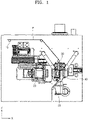
- FIG. 1 is a plan view of an electrode manufacturing device according to an embodiment.
- FIG. 2 is a schematic view of an electrode manufacturing device according to an embodiment.
- FIG. 3 is a schematic view of an electrode according to an embodiment.
- an electrode manufacturing device 1 may include a transfer unit 10, a laser beam notching unit 20, an electrode support unit 30, a dust removal unit 40, and a scrap removal unit 50.
- an electrode E to be processed is prepared by applying an active material to a metal current collector formed of a thin metal plate.
- the electrode E coated with the active material on the metal current collector is formed in a sheet shape in the form of a long thin plate.
- the metal current collector may be a metal such as aluminum
- the active material may be a positive electrode active material or a negative electrode active material used in a secondary battery, but other known materials may be used as the metal current collector or the active material.
- the transfer unit 10 supports the transfer of the sheet-shaped electrode E. To this end, the transfer unit 10 guides and supports the electrode E between a supply unit and a recovery unit (not shown), and may include a plurality of wheels or rollers for this purpose. For example, the transfer unit 10 may transfer the electrode E so that a laser beam notching process is performed when the sheet-shaped electrode E is continuously supplied by the supply unit and the recovery unit is accurately seated at a processing position. For example, the transfer unit 10 may intermittently supply/recover the electrode E between the supply unit and the recovery unit.
- the electrode E continuously moves at a certain speed, for example, at a speed of 1250 mm/s or more and 6000 mm/s or less, according to a laser beam output irradiated by the laser beam notching unit 20 to be described below.
- the transfer unit 10 may include a plurality of rollers, for example, first to fifth rollers 11 to 15, disposed on an upper surface or a lower surface of the sheet-shaped electrode E.
- the transfer unit 10 may include the first roller 11 to the third roller 13 disposed on the electrode support unit 30 to transfer the electrode E wound from the supply portion to the electrode support unit 30, and the fourth roller 14 and a fifth roller 15 disposed below the electrode support unit 30 to transfer the electrode E to the recovery unit.
- the third roller 13 and the fourth roller 14 disposed with the electrode support unit 30 therebetween may be disposed to be apart from each other in a direction of gravity (a -Z direction).
- the electrode E may pass through the electrode support unit 30 in the direction of gravity (the -Z direction) by rotation of the third roller 13 and the fourth roller 14.
- a first area E1 of the electrode shown in FIG. 3 may be supported by the electrode support unit 30, and laser beam processing may be performed on a second area E2 of the electrode by the laser beam notching unit 20.
- the laser beam notching unit 20 outputs and irradiates a laser beam L for cutting the electrode E.
- the laser beam notching unit 20 may irradiate the laser beam L in a direction perpendicular to one plane of the electrode E, for example, a 1 st -1 st direction (a +X direction).
- the laser beam notching unit 20 may irradiate the laser beam L toward the remaining area except for the first area E1 of the electrode shown in FIG. 3 supported by the electrode support unit 30, that is, the second area E2 of the electrode.
- the laser beam L may move along a predetermined line M to be cut and cut a portion of the second area E2 of the electrode.
- the laser beam notching unit 20 may be configured to output an IR pulse-type fiber laser beam having a high energy density.
- a laser beam having power of 200 W or more and 300 W or less, a frequency of 200 kHz band, and a depth of focus of 0.8 mm may be output, but a laser beam having a high energy density of a small wavelength may be used instead, and the disclosure is not limited thereto.
- the electrode support unit 30 may support the electrode E moving in the direction of gravity (the -Z direction) while the laser beam notching process is in progress.
- the electrode support unit 30 according to an example needs to accurately support the electrode E while not hindering the movement of the continuously moving electrode E.
- an electrode support unit supporting a continuously moving electrode E supports the electrode E in a contact manner in a horizontal direction perpendicular to the direction of gravity (the -Z direction)
- excessive adsorption and friction between the electrode E and the electrode support unit occurs, which results in product defects.
- the electrode E moves in another direction perpendicular to the direction of gravity (the -Z direction)
- there is a problem in that a focus position of a laser beam is inaccurate due to sagging and vibration of the electrode E due to gravity.
- the electrode support unit 30 may include a first support unit 31 and a second support unit 32 disposed to face each other and injecting a pressurized fluid in opposite directions.
- the electrode E may be disposed between the first support unit 31 and the second support unit 32 to be supported in a non-contact manner.
- the first support unit 31 has a plate shape extending along one plane (a YZ plane), and may inject a first pressurized fluid F1 in the 1 st -1 st direction (the +X direction) perpendicular to the one plane (the YZ plane).
- the second support unit 32 may have a plate shape extending along the one plane (the YZ plane).
- the second support unit 32 may be disposed to face the first support unit 31 with a certain interval therebetween, and may inject a second pressurized fluid F2 in the 1 st -2 nd direction (the -X direction) opposite to the 1 st -1 st direction (the +X direction).
- a second pressurized fluid F2 in the 1 st -2 nd direction (the -X direction) opposite to the 1 st -1 st direction (the +X direction).
- the dust removal unit 40 may suck and remove dust B generated by a process of notching and cutting the electrode E using the laser beam L.
- the dust B may be a foreign material having a diameter of 20 ⁇ m or less and floating around the electrode E.
- the disclosure is not limited thereto, and in the process of notching and cutting the electrode E using the laser beam L, any foreign material disposed around the electrode E may be defined as the dust B.
- the dust removal unit 40 may include a first dust removal device 41 and a second dust removal device 42 disposed to face each other with the electrode E therebetween.
- the disclosure is not limited thereto, and any one of the first dust removal device 41 and the second dust removal device 42 may be disposed.
- the first dust removal device 41 may be disposed between the laser beam notching unit 20 and the first support unit 31 to face one surface of the electrode E to absorb the dust B.
- the second dust removal device 42 is disposed to face the first dust removal device 41, and may be disposed to face the other surface of the electrode E to absorb the dust B.
- the disclosure is not limited thereto, and according to another example, the first dust removal device 41 may be disposed to face one side of the electrode E disposed perpendicular to one surface of the electrode E to absorb the dust B.
- the second dust removal device 42 may be disposed to face the other side of the electrode E to absorb the dust B.
- the dust removal unit 40 is disposed adjacent to the electrode E, and may suck the dust B floating near the electrode E and discharge the dust B to the outside.
- the dust removal unit 40 may form suction pressure to suck the dust B.
- the electrode E vibrates by the suction pressure formed by the dust removal unit 40, and a focus position of a laser beam may be inaccurate.
- the dust removal unit 40 may form suction pressure to have a certain angle with the first pressurized fluid F1 and the second pressurized fluid F2. Detailed descriptions of of a path of the suction pressure using the dust removal unit 40, the first pressurized fluid F1, and the second pressurized fluid F2 are provided below with reference to FIG. 7 .
- the scrap removal unit 50 may separate and discharge the scrap S generated by the process of notching and cutting.
- the scrap S has a diameter exceeding 20 ⁇ m, and may be a foreign material separated from the electrode E.
- the disclosure is not limited thereto, and any foreign material falling by gravity in the process of notching and cutting the electrode E using the laser beam L may be defined as the scrap S.
- the scrap removal unit 50 is disposed below the first support unit 31 and the second support unit 32 in the direction of gravity (the -Z direction), and may suck the scrap S falling by gravity and discharge the scrap S to the outside.
- the scrap removal unit 50 may form suction pressure to suck the scrap S.
- the electrode E vibrates by the suction pressure formed by the scrap removal unit 50, and the focus position of the laser beam may be inaccurate.
- the scrap removal unit 50 may include a first scrap removal area 51, a second scrap removal area 52, and a pump 53. Detailed descriptions of the first scrap removal area 51, the second scrap removal area 52, and the pump 53 are provided below with reference to FIG. 8 .
- FIG. 4 is a partial schematic view of an electrode manufacturing device according to an embodiment.
- the electrode support unit 30 may include the first support unit 31 and the second support unit 32 disposed to face each other and injecting a pressurized fluid in opposite directions, a first fluid pressurizing unit 33 that applies pressure to the first pressurized fluid F1 injected from the first support unit 31, and a second fluid pressurizing unit 34 that applies pressure to the second pressurized fluid F2 injected from the second support unit 32.
- the first support unit 31 has a plate shape extending along one plane (the YZ plane), and may inject the first pressurized fluid F1 in the 1 st -1 st direction (the +X direction) perpendicular to the one plane (the YZ plane).
- the first support unit 31 may be a porous plate capable of injecting the first pressurized fluid F1.
- the first support unit 31 may include one or more injection portions 311 (see FIG. 6 ) for injecting the first pressurized fluid F1.
- the first support unit 31 may have a height h corresponding to a height k1 of the first area E1 of the electrode E shown in FIG. 3 in the direction of gravity (the -Z direction).
- the first pressurized fluid F1 may be clean dry air (CDA), but the disclosure is not limited thereto.
- any fluid that supports the first area E1 of the electrode E may be used.
- the first support unit 31 may be disposed to be apart from the electrode E in the 1 st -1 st direction (the +X direction) with a first distance D1 therebetween.
- the first distance D1 may be 0.01 mm or more and 1 mm or less.
- the disclosure is not limited thereto, and the first distance D1 may be changed according to a change in the type and weight of the electrode E.
- the first pressurized fluid F1 injected from the first support unit 31 may apply certain pressure to the first area E1 of the electrode in the 1 st -1 st direction (the +X direction).
- first pressure applied to the first area E1 of the electrode E by the first pressurized fluid F1 may be, for example, 0.001 Mpa or more and 0.3 Mpa or less.
- the disclosure is not limited thereto, and the first fluid pressurizing unit 33 may change the first pressure by adjusting a flow rate of the first pressurized fluid F1 according to a change in the type and weight of the electrode E.
- the second support unit 32 has a plate shape extending along one plane (the YZ plane), and may inject the second pressurized fluid F2 in the 1 st -2 nd direction (the -X direction) perpendicular to the one plane (the YZ plane).
- the second support unit 32 may be a porous plate capable of injecting the second pressurized fluid F2.
- the second support unit 32 may include one or more injection portions for injecting the second pressurized fluid F2.
- the second support unit 32 is disposed to face the first support unit 31, and may have a height corresponding to the height h of the first support unit 31.
- the second pressurized fluid F2 may be CDA, but the disclosure is not limited thereto.
- any fluid that supports the first area E1 of the electrode E may be used.
- the second support unit 32 may be disposed to be apart from the electrode E in the 1 st -2 nd direction (the -X direction) with a second distance D2 therebetween.
- the second interval D2 may be 0.01 mm or more and 1 mm or less.
- the disclosure is not limited thereto, and the second distance D2 may be changed according to a change in the type and weight of the electrode E.
- the second pressurized fluid F2 injected from the second support unit 32 may apply certain pressure to the first area E1 of the electrode in the 1 st -2 nd direction (the -X direction).
- second pressure applied to the first area E1 of the electrode by the second pressurized fluid F2 may be, for example, 0.001 Mpa or more and 0.3 Mpa or less.
- the disclosure is not limited thereto, and the second fluid pressurizing unit 34 may change the second pressure by adjusting a flow rate of the second pressurized fluid F2 according to a change in the type and weight of the electrode E.
- the first area E1 of the electrode E may be supported in a non-contact manner by injecting the first pressurized fluid F1 and the second pressurized fluid F2. Accordingly, product defects and an increase in manufacturing cost that may occur due to excessive adsorption and friction between the electrode E and the electrode support unit 30 may be effectively prevented.
- FIG. 5A is a graph illustrating vibration of the electrode E supported by an electrode support unit according to a comparative example.
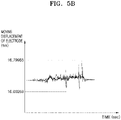
- FIG. 5B is a graph illustrating vibration of the electrode E supported by an electrode support unit according to Example 1.
- FIG. 5C is a graph illustrating vibration of the electrode E supported by an electrode support unit according to Example 2.
- the electrode M an aluminum foil having a thickness of 20 micrometers is used as the electrode M.
- the electrode M moves in a direction of gravity at a speed of 1500 mm/s.
- the first support unit 31 disposed to face one surface of the electrode M is disposed to be apart from one surface of the electrode E in the 1 st -1 st direction (the +X direction) with the first distance D1 of 0.35 mm therebetween, and blows air as a pressurized fluid.
- First pressure of 0.04 Mpa is applied to one surface of the electrode M by the first support unit 31.
- the second support unit 32 disposed to face the other surface of the electrode M is disposed to be apart from one surface of the electrode E in the 2 nd -2 nd direction (the +X direction) with the second distance D2 of 0.35 mm therebetween, and blows air as a pressurized fluid.
- the second pressure of 0.04 Mpa is applied to the other surface of the electrode M by the second support unit 32.
- Example 2 is the same as Example 1 except that the first pressure and the second pressure applied by the first support unit 31 and the second support unit 32 are 0.06 Mpa.
- the Comparative example is the same as Example 1 except that the first pressure and the second pressure applied by the first support unit 31 and the second support unit 32 are 0 Mpa.
- the electrode M supported on the electrode support unit 30 according to Example 1 has a maximum displacement (Max) of 16.62803 mm and a minimum displacement (Min) of 15.94159 mm in one direction (an X direction) perpendicular to one plane. Accordingly, it can be seen that a difference (Max-Min) between the maximum displacement (Max) and the minimum displacement (Min) of an electrode, that is, an electrode M, is 0.68644 mm.
- the electrode M supported on the electrode support unit 30 according to Example 2 has a maximum displacement (Max) of 16.79985 mm and a minimum displacement (Min) of 16.00269 mm in one direction (the X direction) perpendicular to one plane. Accordingly, it can be seen that a difference (Max-Min) between the maximum displacement (Max) and the minimum displacement (Min) of an electrode, that is, the electrode M, is 0.79716mm.
- the electrode M supported on the electrode support unit 30 according to the Comparative example has a maximum displacement (Max) of 17.740931 mm and a minimum displacement (Min) of 16.66041 mm in one direction (the X direction) perpendicular to one plane. Accordingly, it can be seen that a difference (Max-Min) between the maximum displacement (Max) and the minimum displacement (Min) of an electrode M, that is, the electrode M, is 1.08052 mm.
- FIG. 6 is a plan view of a first support unit according to an embodiment.
- FIG. 7A is a plan view of a first support unit according to another embodiment.
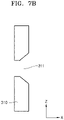
- FIG. 7B is a side cross-sectional view of the first support unit shown in FIG. 7A .
- the first support unit 31 may include the one or more injection portions 311 for injecting the first pressurized fluid F1. Because the first support unit 31 and the second support unit 32 may be provided in a shape corresponding to each other, the first support unit 31 is mainly described here for convenience of description.
- the one or more injection portions 311 may be disposed on one plane 310 of the first support unit 31 facing the electrode E. The number of injection portions 311 may be determined depending on the types of the injection portions 311.
- first pressure applied to the first area E1 of the electrode by the first pressurized fluid F1 may be, for example, 0.006 Mpa or more and 0.3 Mpa or less.
- the first pressure applied to the first area E1 of the electrode E by the first pressurized fluid F1 may be, for example, 0.001 Mpa or more and 0.1 Mpa or less.
- the disclosure is not limited thereto, and when the injection portion 311 has an orifice structure as shown in FIGS. 7A and 7B , the injection portion 311 may have a single structure. Uniform pressure may be applied to the first area E1 of the electrode E by the first pressurized fluid F1 discharged from the injection portion 311 provided in the orifice structure.
- the first pressure applied to the first area E1 of the electrode E by the first pressurized fluid F1 may be, for example, 0.001 Mpa or more and 0.18 Mpa or less.
- FIG. 8 is a partial schematic view of an electrode manufacturing device according to an embodiment.
- the electrode E supported by the first support unit 31 and the second support unit 32 may be notched and cut by the laser beam L. Because the dust B generated by the notching and cutting process may be relatively light compared to the scrap S, the dust B may remain floating around the electrode E. In this case, interference of the laser beam L or a defect in the electrode E may occur due to the dust B floating around the electrode E. In order to remove the dust B floating around the electrode E, the first dust removal device 41 and the second dust removal device 42 may be disposed.
- the first dust removal device 41 may include a 1 st -1 st dust removal device 411, a 1 st -2 nd dust removal device 412, a first dust discharge unit 413 discharging the sucked dust B to the outside, and a first suction pressure-adjusting unit 414.
- the 1 st -1 st dust removal device 411 may be disposed to include a suction port disposed on one side of the electrode E. In this case, the dust B floating near the electrode E may be sucked by 1 st -1 st suction pressure generated by the 1 st -1 st dust removal device 411.
- the 1 st -1 st fluid flow H1 may be formed in a direction different from the 1 st -1 st direction (the +X direction).
- the 1 st -1 st fluid flow H1 may have a certain angle ⁇ with respect to the 1 st -1 st direction (the +X direction), for example, an angle greater than 0 degrees and less than 90 degrees.
- the vibration of the electrode E may be minimized.
- the 1 st -2 nd dust removal device 412 may be disposed to include a suction port disposed on the other side of the electrode E.
- the dust B floating near the electrode E may be sucked by 1 st -2 nd suction pressure generated by the 1 st -2 nd dust removal device 412.
- a 1 st -2 nd fluid flow H2 is generated by the 1 st -2 nd suction pressure, and the electrode E vibrates by the 1 st -2 nd fluid flow H2, and thus, the focus position of the laser beam L may be inaccurate.
- the dust B sucked in by the 1 st -1 st dust removal device 411 and the 1 st -2 nd dust removal device 412 may be discharged to the outside through the first dust discharge unit 413.
- the first suction pressure adjusting unit 414 may adjust the 1 st -1 st suction pressure and the 1 st -2 nd suction pressure respectively applied to the 1 st -1 st dust removal device 411 and the 1 st -2 nd dust removal device 412 according to the size and weight of the dust B.
- the second dust removal device 42 may include a 2 nd -1 st dust removal device 421, a 2 nd -2 nd dust removal device 422, a second dust discharge unit 423 discharging the sucked dust B to the outside, and a second suction pressure-adjusting unit 424.
- the 2 nd -1 st dust removal device 421, in which a 2 nd -1 st fluid flow H3 is generated by 2 nd -1 st suction pressure, and the 2 nd -2 nd dust removal device 422, in which a 2 nd -2 nd fluid flow H4 is generated by the 2 nd -2 nd suction pressure, are disposed to face each other with the 1 st -1 st dust removal device 411 and the 1 st -2 nd dust removal device 412.
- the 2 nd -1 st dust removal device 421 and the 2 nd -2 nd dust removal device 422 are substantially the same as the 1 st -1 st dust removal device 411 and the 1 st -2 nd dust removal device 412 except for being disposed to face the other surface of the electrode E. Therefore, the description thereof is omitted here for convenience of description.
- the dust B sucked in by the 2 nd -1 st dust removal device 421 and the 2 nd -2 nd dust removal device 422 may be discharged to the outside through the second dust discharge unit 423.
- the second suction pressure adjusting unit 424 may adjust the 2 nd -1 st suction pressure and the 2 nd -2 nd suction pressure respectively applied to the 2 nd -1 st dust removal device 421 and the 2 nd -2 nd dust removal device 422 according to the size and weight of the dust B.
- FIG. 9 is a partial schematic view of an electrode manufacturing device according to an embodiment.
- the electrode E may be supported by the first support unit 31 and the second support unit 32 in the direction of gravity (the -Z direction).
- the electrode E supported by the first support unit 31 and the second support unit 32 may be notched and cut by the laser beam L.
- the scrap S generated by the notching and cutting process may freely fall in the direction of gravity (the -Z direction).
- certain third suction pressure is formed in the first scrap removal area 51 located at an upper portion of the scrap removal unit 50 in the direction of gravity (the -Z direction) to suck the free falling scrap S. Accordingly, the scrap S that freely falls in the direction of gravity (the -Z direction) may be collected so as not to scatter to the outside.
- the first scrap removal area 51 may be disposed below the laser beam notching unit 20 corresponding to a processing area.
- a third fluid flow W1 is generated by the third suction pressure generated in the first scrap removal area 51, and the electrode E vibrates by the third fluid flow W 1 , so that the focus position of the laser beam L may be inaccurate.
- the third fluid flow W 1 may be formed in the direction of gravity (the -Z direction).
- the size of the third suction pressure for preventing scattering of the scrap S and collecting the scrap S may be formed to be relatively small, and accordingly, the vibration of the electrode E may be minimized.
- certain fourth suction pressure is formed in the second scrap removal area 52 located below the first scrap removal area 51 in a direction different from the direction of gravity (the -Z direction), so that the scrap S collected in the first scrap removal area 51 may be discharged to the outside.
- the fourth fluid flow W 2 may be formed in a direction different from the direction of gravity (the -Z direction), for example, a rotational direction such as a clockwise direction or a counterclockwise direction.
- the fourth suction pressure may be greater than the third suction pressure.
- An electrode manufacturing device may effectively prevent product defects and an increase in manufacturing cost, which may occur due to excessive adsorption and friction between an electrode and a support unit, by supporting the electrode in a non-contact manner in a laser beam notching process.
- an electrode manufacturing device may effectively prevent product defects by adjusting a discharge path of dust and scrap generated by a laser beam notching process to minimize laser beam interference that may be generated by the dust and scrap.
Landscapes
- Engineering & Computer Science (AREA)
- Physics & Mathematics (AREA)
- Optics & Photonics (AREA)
- Mechanical Engineering (AREA)
- Plasma & Fusion (AREA)
- Chemical & Material Sciences (AREA)
- Chemical Kinetics & Catalysis (AREA)
- Electrochemistry (AREA)
- General Chemical & Material Sciences (AREA)
- Manufacturing & Machinery (AREA)
- Battery Electrode And Active Subsutance (AREA)
Abstract
Description
- This application is based on and claims priority under 35 U.S.C. §119 to
Korean Patent Applications No. 10-2021-0035187, filed on March 18, 2021 10-2021-0066981, filed on May 25, 2021 10-2022-0006460, filed on January 17, 2022 - One or more embodiments relate to an electrode manufacturing device and an electrode manufacturing method, and more particularly, to an electrode manufacturing device for performing an electrode notching process of forming an electrode tab by shearing an uncoated portion of an electrode of a secondary battery with a laser beam.
- A notching system, which is one of the devices for manufacturing a secondary battery, is a device for forming an electrode tab by shearing an uncoated portion of an electrode in the form of a sheet, and includes an unwinder that unwinds an electrode wound in a roll shape, a notching unit that shears a polymer electrode into an electrode shape using a press machine or a laser beam notching device, a vision inspection unit that inspects whether the sheared polymer electrode is sheared normally, and a rewinder that rewinds the sheared polymer electrode into a roll.
- In the notching unit, there is a method of forming electrode tabs at regular intervals by aligning a unprocessed electrode below a punch of a press machine, then lowering the punch to shear a uncoated portion to which an active material of the electrode is not applied to a certain shape, and a method of shearing the electrode tab at regular intervals by irradiating a laser beam to the uncoated portion of the electrode from above the electrode.
- Among these notching methods, in the method of shearing the electrode tab by irradiating a laser beam to a sheet-shaped electrode, one surface of the electrode may be supported in a pattern shape in order to shear a pattern shape of the electrode tab. However, in the shearing process, defects such as scratches may occur on the electrode due to the contact between a support unit and the electrode. In addition, in the notching method using a laser beam, the electrode tab may be improperly cut due to the accumulation of foreign materials on the electrode or the vibration of the electrode during shearing.
- One or more embodiments include an electrode manufacturing device in which product defects and an increase in manufacturing cost, which may occur due to excessive adsorption and friction between an electrode and a support unit, are effectively prevented by supporting the electrode in a non-contact manner in a laser beam notching process.
- One or more embodiments include an electrode manufacturing device in which laser beam interference that may be generated by dust and scrap is minimized by adjusting a discharge path of dust and scrap generated by a laser beam notch ing process.
- Additional aspects will be set forth in part in the description which follows and, in part, will be apparent from the description, or may be learned by practice of the presented embodiments of the disclosure.
- According to one or more embodiments, an electrode manufacturing device includes: a first support unit having a plate shape extending along a plane and injecting a first pressurized fluid in a 1st-1st direction perpendicular to the plane; a second support unit having a plate shape extending along one plane, disposed to face the first support unit at a certain distance, and injecting a second pressurized fluid in a 1st-2nd direction opposite to the 1st-1st direction; a transfer unit configured to transfer a sheet-shaped electrode in a direction of gravity and dispose a first area of the electrode between the first support unit and the second support unit; and a laser beam notching unit configured to notch and cut a portion of a second area of the electrode by irradiating a laser beam to the electrode in the 1st-1st direction.
- The certain distance between the first support unit and the second support unit may be 0.01 mm or more and 1 mm or less.
- Pressure applied to a first surface of the electrode by the first support unit may be 0.001 Mpa or more and 0.3 Mpa or less, and pressure applied to a second surface of the electrode by the second support unit may be 0.001 Mpa or more and 0.3 Mpa or less.
- The first support unit may include one or more injection portions for injecting the first pressurized fluid, and the second support unit may include one or more injection portions for injecting the second pressurized fluid.
- The one or more injection portions provided in the first support unit may be provided in plurality, and may be arranged to have uniform intervals on one plane of the first support unit disposed to face the electrode, and the one or more injection portions provided in the second support unit may be provided in plurality, and may be disposed to have uniform intervals on one plane of the second support unit disposed to face the electrode.
- The one or more injection portions provided in the first support unit may be provided as one, and may include an orifice structure, and the one or more injection portions provided in the second support unit may be provided as one, and may include an orifice structure.
- At least one of the first support unit and the second support unit may include a porous plate.
- The electrode manufacturing device may further include: a first fluid pressurizing unit configured to adjust pressure of the first pressurized fluid and a second fluid pressurizing unit configured to adjust pressure of the second pressurized fluid.
- The electrode manufacturing device may further include: a dust removal unit configured to apply suction pressure to remove dust generated from the process of notching and cutting the electrode using the laser beam.
- The dust removal unit may include a first dust removal device and a second dust removal device disposed to face each other with the electrode therebetween.
- The first dust removal device may include a 1st-1st dust removal device including a suction port disposed on one side of the electrode and a 1st-2nd dust removal device including a suction port disposed on the other side of the electrode.
- A direction of a 1st-1st fluid flow generated by 1st-1st suction pressure in the 1st-1st dust removal device may be different from the 1st-1st direction, and a direction of a 2nd-1st fluid flow generated by 2nd-1st suction pressure in the1st-2nd dust removal device may be different from the 1st-1st direction.
- The second dust removal device may include a 2nd-1st dust removal device including a suction port disposed on one side of the electrode and a 2nd-2nd dust removal device including a suction port disposed on the other side of the electrode.
- A direction of a 1st-1st fluid flow generated by 2nd-1st suction pressure in the 2nd-1st dust removal device may be different from the 1st-2nd direction, and a direction of a 2nd-1st fluid flow generated by 2nd-2nd suction pressure in the 2nd-2nd dust removal device may be different from the 1st-2nd direction.
- The electrode manufacturing device may further include: a first suction pressure-adjusting unit configured to adjust suction pressure of the first dust removal device and a second suction pressure-adjusting unit configured to adjust suction pressure of the second dust removal device.
- The electrode manufacturing device may further include: a scrap removal unit disposed below the first support unit and the second support unit in the direction of gravity, and sucking scrap falling by gravity and discharging the scrap to the outside.
- The scrap removal unit may include: a first scrap removal area and a second scrap removal area respectively disposed at upper and lower portions in the direction of gravity; and a pump configured to apply suction pressure to the first scrap removal area and the second scrap removal area.
- A third fluid flow in the direction of gravity is formed in the first scrap removal area by third suction pressure, and a fourth fluid flow in a direction different from the direction of gravity may be formed in the second scrap removal area by fourth suction pressure.
- The fourth suction pressure may exceed the third suction pressure.
- The transfer unit may move the electrode at a speed of 1250 mm/s or more and 6000 mm/s or less.
- The above and other aspects, features, and advantages of certain embodiments of the disclosure will be more apparent from the following description taken in conjunction with the accompanying drawings, in which:
-
FIG. 1 is a plan view of an electrode manufacturing device according to an embodiment; -
FIG. 2 is a schematic view of an electrode manufacturing device according to an embodiment; -
FIG. 3 is a schematic view of an electrode according to an embodiment; -
FIG. 4 is a partial schematic view of an electrode manufacturing device according to an embodiment; -
FIG. 5A is a graph illustrating vibration of an electrode supported by an electrode support unit according to a comparative example; -
FIG. 5B is a graph illustrating vibration of an electrode supported by an electrode support unit according to Example 1; -
FIG. 5C is a graph illustrating vibration of an electrode supported by an electrode support unit according to Example 2; -
FIG. 6 is a plan view of a first support unit according to an embodiment; -
FIG. 7A is a plan view of a first support unit according to another embodiment; -
FIG. 7B is a side cross-sectional view of the first support unit shown inFIG. 7A ; -
FIG. 8 is a partial schematic view of an electrode manufacturing device according to an embodiment; and -
FIG. 9 is a partial schematic view of an electrode manufacturing device according to an embodiment. - Reference will now be made in detail to embodiments, examples of which are illustrated in the accompanying drawings, wherein like reference numerals refer to like elements throughout. In this regard, the present embodiments may have different forms and should not be construed as being limited to the descriptions set forth herein. Accordingly, the embodiments are merely described below, by referring to the figures, to explain aspects of the present description. As used herein, the term "and/or" includes any and all combinations of one or more of the associated listed items. Expressions such as "at least one of," when preceding a list of elements, modify the entire list of elements and do not modify the individual elements of the list.
- Hereinafter, embodiments will be described in detail with reference to the accompanying drawings. The same reference numerals refer to the same elements throughout. In the drawings, the sizes of constituent elements may be exaggerated for clarity.
- It will be understood that, although the terms first, second, etc. may be used herein to describe various elements, these elements should not be limited by these terms. These terms are only used to distinguish one element from another. Thus, a first element, component, region, layer or section discussed below could be termed a second element, component, region, layer or section without departing from the teachings of the disclosure. As used herein, the term "and/or" includes any and all combinations of one or more of the associated listed items.
-
FIG. 1 is a plan view of an electrode manufacturing device according to an embodiment.FIG. 2 is a schematic view of an electrode manufacturing device according to an embodiment.FIG. 3 is a schematic view of an electrode according to an embodiment. - Referring to
FIGS. 1 to 3 , an electrode manufacturing device 1 according to an example may include atransfer unit 10, a laserbeam notching unit 20, anelectrode support unit 30, adust removal unit 40, and ascrap removal unit 50. In the disclosure, an electrode E to be processed is prepared by applying an active material to a metal current collector formed of a thin metal plate. The electrode E coated with the active material on the metal current collector is formed in a sheet shape in the form of a long thin plate. For example, the metal current collector may be a metal such as aluminum, and the active material may be a positive electrode active material or a negative electrode active material used in a secondary battery, but other known materials may be used as the metal current collector or the active material. - The
transfer unit 10 supports the transfer of the sheet-shaped electrode E. To this end, thetransfer unit 10 guides and supports the electrode E between a supply unit and a recovery unit (not shown), and may include a plurality of wheels or rollers for this purpose. For example, thetransfer unit 10 may transfer the electrode E so that a laser beam notching process is performed when the sheet-shaped electrode E is continuously supplied by the supply unit and the recovery unit is accurately seated at a processing position. For example, thetransfer unit 10 may intermittently supply/recover the electrode E between the supply unit and the recovery unit. However, in the disclosure, a description will be focused on a method in which the electrode E continuously moves at a certain speed, for example, at a speed of 1250 mm/s or more and 6000 mm/s or less, according to a laser beam output irradiated by the laserbeam notching unit 20 to be described below. - According to an example, the
transfer unit 10 may include a plurality of rollers, for example, first tofifth rollers 11 to 15, disposed on an upper surface or a lower surface of the sheet-shaped electrode E. For example, thetransfer unit 10 may include thefirst roller 11 to thethird roller 13 disposed on theelectrode support unit 30 to transfer the electrode E wound from the supply portion to theelectrode support unit 30, and thefourth roller 14 and afifth roller 15 disposed below theelectrode support unit 30 to transfer the electrode E to the recovery unit. In this case, thethird roller 13 and thefourth roller 14 disposed with theelectrode support unit 30 therebetween may be disposed to be apart from each other in a direction of gravity (a -Z direction). Accordingly, the electrode E may pass through theelectrode support unit 30 in the direction of gravity (the -Z direction) by rotation of thethird roller 13 and thefourth roller 14. At this time, a first area E1 of the electrode shown inFIG. 3 may be supported by theelectrode support unit 30, and laser beam processing may be performed on a second area E2 of the electrode by the laserbeam notching unit 20. - The laser
beam notching unit 20 outputs and irradiates a laser beam L for cutting the electrode E. The laserbeam notching unit 20 according to an example may irradiate the laser beam L in a direction perpendicular to one plane of the electrode E, for example, a 1st-1st direction (a +X direction). In this case, the laserbeam notching unit 20 may irradiate the laser beam L toward the remaining area except for the first area E1 of the electrode shown inFIG. 3 supported by theelectrode support unit 30, that is, the second area E2 of the electrode. In this case, the laser beam L may move along a predetermined line M to be cut and cut a portion of the second area E2 of the electrode. - The laser
beam notching unit 20 according to an example may be configured to output an IR pulse-type fiber laser beam having a high energy density. At this time, a laser beam having power of 200 W or more and 300 W or less, a frequency of 200 kHz band, and a depth of focus of 0.8 mm may be output, but a laser beam having a high energy density of a small wavelength may be used instead, and the disclosure is not limited thereto. - The
electrode support unit 30 may support the electrode E moving in the direction of gravity (the -Z direction) while the laser beam notching process is in progress. Theelectrode support unit 30 according to an example needs to accurately support the electrode E while not hindering the movement of the continuously moving electrode E. In the prior art, because an electrode support unit supporting a continuously moving electrode E supports the electrode E in a contact manner in a horizontal direction perpendicular to the direction of gravity (the -Z direction), excessive adsorption and friction between the electrode E and the electrode support unit occurs, which results in product defects. In addition, when the electrode E moves in another direction perpendicular to the direction of gravity (the -Z direction), there is a problem in that a focus position of a laser beam is inaccurate due to sagging and vibration of the electrode E due to gravity. - The
electrode support unit 30 according to an example may include afirst support unit 31 and asecond support unit 32 disposed to face each other and injecting a pressurized fluid in opposite directions. In this case, the electrode E may be disposed between thefirst support unit 31 and thesecond support unit 32 to be supported in a non-contact manner. For example, thefirst support unit 31 has a plate shape extending along one plane (a YZ plane), and may inject a first pressurized fluid F1 in the 1st-1st direction (the +X direction) perpendicular to the one plane (the YZ plane). In addition, thesecond support unit 32 may have a plate shape extending along the one plane (the YZ plane). At this time, thesecond support unit 32 may be disposed to face thefirst support unit 31 with a certain interval therebetween, and may inject a second pressurized fluid F2 in the 1st-2nd direction (the -X direction) opposite to the 1st-1st direction (the +X direction). Detailed descriptions of thefirst support unit 31 and thesecond support unit 32 are provided below with reference toFIGS. 4 to 7B . - The
dust removal unit 40 may suck and remove dust B generated by a process of notching and cutting the electrode E using the laser beam L. For example, the dust B may be a foreign material having a diameter of 20 µm or less and floating around the electrode E. However, the disclosure is not limited thereto, and in the process of notching and cutting the electrode E using the laser beam L, any foreign material disposed around the electrode E may be defined as the dust B. - For example, the
dust removal unit 40 may include a firstdust removal device 41 and a seconddust removal device 42 disposed to face each other with the electrode E therebetween. However, the disclosure is not limited thereto, and any one of the firstdust removal device 41 and the seconddust removal device 42 may be disposed. - According to an example, the first
dust removal device 41 may be disposed between the laserbeam notching unit 20 and thefirst support unit 31 to face one surface of the electrode E to absorb the dust B. In addition, the seconddust removal device 42 is disposed to face the firstdust removal device 41, and may be disposed to face the other surface of the electrode E to absorb the dust B. However, the disclosure is not limited thereto, and according to another example, the firstdust removal device 41 may be disposed to face one side of the electrode E disposed perpendicular to one surface of the electrode E to absorb the dust B. In addition, the seconddust removal device 42 may be disposed to face the other side of the electrode E to absorb the dust B. - According to an example, the
dust removal unit 40 is disposed adjacent to the electrode E, and may suck the dust B floating near the electrode E and discharge the dust B to the outside. Thedust removal unit 40 according to an example may form suction pressure to suck the dust B. At this time, the electrode E vibrates by the suction pressure formed by thedust removal unit 40, and a focus position of a laser beam may be inaccurate. In order to solve this problem, thedust removal unit 40 according to an example may form suction pressure to have a certain angle with the first pressurized fluid F1 and the second pressurized fluid F2. Detailed descriptions of of a path of the suction pressure using thedust removal unit 40, the first pressurized fluid F1, and the second pressurized fluid F2 are provided below with reference toFIG. 7 . - The
scrap removal unit 50 may separate and discharge the scrap S generated by the process of notching and cutting. For example, the scrap S has a diameter exceeding 20 µm, and may be a foreign material separated from the electrode E. However, the disclosure is not limited thereto, and any foreign material falling by gravity in the process of notching and cutting the electrode E using the laser beam L may be defined as the scrap S. - For example, the
scrap removal unit 50 is disposed below thefirst support unit 31 and thesecond support unit 32 in the direction of gravity (the -Z direction), and may suck the scrap S falling by gravity and discharge the scrap S to the outside. Thescrap removal unit 50 according to an example may form suction pressure to suck the scrap S. At this time, the electrode E vibrates by the suction pressure formed by thescrap removal unit 50, and the focus position of the laser beam may be inaccurate. To solve this problem, thescrap removal unit 50 according to an example may include a firstscrap removal area 51, a secondscrap removal area 52, and apump 53. Detailed descriptions of the firstscrap removal area 51, the secondscrap removal area 52, and thepump 53 are provided below with reference toFIG. 8 . -
FIG. 4 is a partial schematic view of an electrode manufacturing device according to an embodiment. - Referring to
FIG. 4 , theelectrode support unit 30 may include thefirst support unit 31 and thesecond support unit 32 disposed to face each other and injecting a pressurized fluid in opposite directions, a firstfluid pressurizing unit 33 that applies pressure to the first pressurized fluid F1 injected from thefirst support unit 31, and a secondfluid pressurizing unit 34 that applies pressure to the second pressurized fluid F2 injected from thesecond support unit 32. - The
first support unit 31 has a plate shape extending along one plane (the YZ plane), and may inject the first pressurized fluid F1 in the 1st-1st direction (the +X direction) perpendicular to the one plane (the YZ plane). For example, thefirst support unit 31 may be a porous plate capable of injecting the first pressurized fluid F1. As another example, thefirst support unit 31 may include one or more injection portions 311 (seeFIG. 6 ) for injecting the first pressurized fluid F1. Thefirst support unit 31 may have a height h corresponding to a height k1 of the first area E1 of the electrode E shown inFIG. 3 in the direction of gravity (the -Z direction). For example, the first pressurized fluid F1 may be clean dry air (CDA), but the disclosure is not limited thereto. As the first pressurized fluid F1, any fluid that supports the first area E1 of the electrode E may be used. - The
first support unit 31 according to an example may be disposed to be apart from the electrode E in the 1st-1st direction (the +X direction) with a first distance D1 therebetween. For example, the first distance D1 may be 0.01 mm or more and 1 mm or less. However, the disclosure is not limited thereto, and the first distance D1 may be changed according to a change in the type and weight of the electrode E. In addition, the first pressurized fluid F1 injected from thefirst support unit 31 may apply certain pressure to the first area E1 of the electrode in the 1st-1st direction (the +X direction). For example, first pressure applied to the first area E1 of the electrode E by the first pressurized fluid F1 may be, for example, 0.001 Mpa or more and 0.3 Mpa or less. However, the disclosure is not limited thereto, and the firstfluid pressurizing unit 33 may change the first pressure by adjusting a flow rate of the first pressurized fluid F1 according to a change in the type and weight of the electrode E. - The
second support unit 32 has a plate shape extending along one plane (the YZ plane), and may inject the second pressurized fluid F2 in the 1st-2nd direction (the -X direction) perpendicular to the one plane (the YZ plane). For example, thesecond support unit 32 may be a porous plate capable of injecting the second pressurized fluid F2. As another example, thesecond support unit 32 may include one or more injection portions for injecting the second pressurized fluid F2. Thesecond support unit 32 is disposed to face thefirst support unit 31, and may have a height corresponding to the height h of thefirst support unit 31. For example, the second pressurized fluid F2 may be CDA, but the disclosure is not limited thereto. As the second pressurized fluid F2, any fluid that supports the first area E1 of the electrode E may be used. - The
second support unit 32 according to an example may be disposed to be apart from the electrode E in the 1st-2nd direction (the -X direction) with a second distance D2 therebetween. For example, the second interval D2 may be 0.01 mm or more and 1 mm or less. However, the disclosure is not limited thereto, and the second distance D2 may be changed according to a change in the type and weight of the electrode E. In addition, the second pressurized fluid F2 injected from thesecond support unit 32 may apply certain pressure to the first area E1 of the electrode in the 1st-2nd direction (the -X direction). For example, second pressure applied to the first area E1 of the electrode by the second pressurized fluid F2 may be, for example, 0.001 Mpa or more and 0.3 Mpa or less. However, the disclosure is not limited thereto, and the secondfluid pressurizing unit 34 may change the second pressure by adjusting a flow rate of the second pressurized fluid F2 according to a change in the type and weight of the electrode E. - As described above, in a direction corresponding to each other of the
first support unit 31 and thesecond support unit 32, for example, in the 1st-1st direction (the +X direction) and the 1st-2nd direction (-X direction), the first area E1 of the electrode E may be supported in a non-contact manner by injecting the first pressurized fluid F1 and the second pressurized fluid F2. Accordingly, product defects and an increase in manufacturing cost that may occur due to excessive adsorption and friction between the electrode E and theelectrode support unit 30 may be effectively prevented. -
FIG. 5A is a graph illustrating vibration of the electrode E supported by an electrode support unit according to a comparative example.FIG. 5B is a graph illustrating vibration of the electrode E supported by an electrode support unit according to Example 1.FIG. 5C is a graph illustrating vibration of the electrode E supported by an electrode support unit according to Example 2. - As the electrode M, an aluminum foil having a thickness of 20 micrometers is used. The electrode M moves in a direction of gravity at a speed of 1500 mm/s. The
first support unit 31 disposed to face one surface of the electrode M is disposed to be apart from one surface of the electrode E in the 1st-1st direction (the +X direction) with the first distance D1 of 0.35 mm therebetween, and blows air as a pressurized fluid. First pressure of 0.04 Mpa is applied to one surface of the electrode M by thefirst support unit 31. Thesecond support unit 32 disposed to face the other surface of the electrode M is disposed to be apart from one surface of the electrode E in the 2nd-2nd direction (the +X direction) with the second distance D2 of 0.35 mm therebetween, and blows air as a pressurized fluid. The second pressure of 0.04 Mpa is applied to the other surface of the electrode M by thesecond support unit 32. - Example 2 is the same as Example 1 except that the first pressure and the second pressure applied by the
first support unit 31 and thesecond support unit 32 are 0.06 Mpa. - The Comparative example is the same as Example 1 except that the first pressure and the second pressure applied by the
first support unit 31 and thesecond support unit 32 are 0 Mpa. - Referring to
FIG. 5A , the electrode M supported on theelectrode support unit 30 according to Example 1 has a maximum displacement (Max) of 16.62803 mm and a minimum displacement (Min) of 15.94159 mm in one direction (an X direction) perpendicular to one plane. Accordingly, it can be seen that a difference (Max-Min) between the maximum displacement (Max) and the minimum displacement (Min) of an electrode, that is, an electrode M, is 0.68644 mm. - Referring to
FIG. 5B , the electrode M supported on theelectrode support unit 30 according to Example 2 has a maximum displacement (Max) of 16.79985 mm and a minimum displacement (Min) of 16.00269 mm in one direction (the X direction) perpendicular to one plane. Accordingly, it can be seen that a difference (Max-Min) between the maximum displacement (Max) and the minimum displacement (Min) of an electrode, that is, the electrode M, is 0.79716mm. - Referring to
FIG. 5C , the electrode M supported on theelectrode support unit 30 according to the Comparative example has a maximum displacement (Max) of 17.740931 mm and a minimum displacement (Min) of 16.66041 mm in one direction (the X direction) perpendicular to one plane. Accordingly, it can be seen that a difference (Max-Min) between the maximum displacement (Max) and the minimum displacement (Min) of an electrode M, that is, the electrode M, is 1.08052 mm. - Referring to
FIGS. 5A to 5C , when disposing thefirst support unit 31 and thesecond support unit 32 at the same distances (D1 and D2) as one surface and the other surface of the electrode M, it can be seen that the vibration of the electrode M is reduced in a section in which the first pressure and the second pressure are 0.02 Mpa or more and 0.04 Mpa, respectively. -
FIG. 6 is a plan view of a first support unit according to an embodiment.FIG. 7A is a plan view of a first support unit according to another embodiment.FIG. 7B is a side cross-sectional view of the first support unit shown inFIG. 7A . - Referring to
FIG. 2 andFIG. 6 , thefirst support unit 31 may include the one ormore injection portions 311 for injecting the first pressurized fluid F1. Because thefirst support unit 31 and thesecond support unit 32 may be provided in a shape corresponding to each other, thefirst support unit 31 is mainly described here for convenience of description. For example, the one ormore injection portions 311 may be disposed on oneplane 310 of thefirst support unit 31 facing the electrode E. The number ofinjection portions 311 may be determined depending on the types of theinjection portions 311. For example, when aninjection portion 311 is provided with a nozzle structure capable of injecting a high-pressure fluid and the first pressurized fluid F1 is uniformly injected from theinjection portion 311, a plurality ofinjection portions 311 may be provided to have uniform intervals on the oneplane 310 of thefirst support unit 31. For example, when the diameter of the one ormore injection portions 311 is less than 0.01 mm, first pressure applied to the first area E1 of the electrode by the first pressurized fluid F1 may be, for example, 0.006 Mpa or more and 0.3 Mpa or less. In addition, when the diameter of the one ormore injection portions 311 is 0.01 mm or more, the first pressure applied to the first area E1 of the electrode E by the first pressurized fluid F1 may be, for example, 0.001 Mpa or more and 0.1 Mpa or less. - However, the disclosure is not limited thereto, and when the
injection portion 311 has an orifice structure as shown inFIGS. 7A and7B , theinjection portion 311 may have a single structure. Uniform pressure may be applied to the first area E1 of the electrode E by the first pressurized fluid F1 discharged from theinjection portion 311 provided in the orifice structure. For example, the first pressure applied to the first area E1 of the electrode E by the first pressurized fluid F1 may be, for example, 0.001 Mpa or more and 0.18 Mpa or less. -
FIG. 8 is a partial schematic view of an electrode manufacturing device according to an embodiment. - Referring to
FIGS. 2 and8 , according to an example, the electrode E supported by thefirst support unit 31 and thesecond support unit 32 may be notched and cut by the laser beam L. Because the dust B generated by the notching and cutting process may be relatively light compared to the scrap S, the dust B may remain floating around the electrode E. In this case, interference of the laser beam L or a defect in the electrode E may occur due to the dust B floating around the electrode E. In order to remove the dust B floating around the electrode E, the firstdust removal device 41 and the seconddust removal device 42 may be disposed. - For example, the first
dust removal device 41 may include a 1st-1stdust removal device 411, a 1st-2nddust removal device 412, a firstdust discharge unit 413 discharging the sucked dust B to the outside, and a first suction pressure-adjustingunit 414. According to an example, the 1st-1stdust removal device 411 may be disposed to include a suction port disposed on one side of the electrode E. In this case, the dust B floating near the electrode E may be sucked by 1st-1st suction pressure generated by the 1st-1stdust removal device 411. In addition, at this time, a 1st-1st fluid flow H1 is generated by the 1st-1st suction pressure, and the electrode E vibrates by the 1st-1st fluid flow H1, and thus, a focus position of the laser beam L may be inaccurate. In order to prevent a situation in which the electrode E vibrates, the 1st-1st fluid flow H1 may be formed in a direction different from the 1st-1st direction (the +X direction). For example, the 1st-1st fluid flow H1 may have a certain angle θ with respect to the 1st-1st direction (the +X direction), for example, an angle greater than 0 degrees and less than 90 degrees. As described above, because the 1st-1st fluid flow H1 is formed in a direction different from the 1st-1st direction (the +X direction), the vibration of the electrode E may be minimized. - According to an example, the 1st-2nd
dust removal device 412 may be disposed to include a suction port disposed on the other side of the electrode E. In this case, the dust B floating near the electrode E may be sucked by 1st-2nd suction pressure generated by the 1st-2nddust removal device 412. In addition, at this time, a 1st-2nd fluid flow H2 is generated by the 1st-2nd suction pressure, and the electrode E vibrates by the 1st-2nd fluid flow H2, and thus, the focus position of the laser beam L may be inaccurate. Because the 1st-2nd fluid flow H2 formed in a direction different from the 1st-1st direction (the +X direction) to prevent a situation in which the electrode E vibrates is substantially the same as the 1st-1st fluid flow H1, a description thereof will be omitted. The dust B sucked in by the 1st-1stdust removal device 411 and the 1st-2nddust removal device 412 may be discharged to the outside through the firstdust discharge unit 413. In this case, the first suctionpressure adjusting unit 414 may adjust the 1st-1st suction pressure and the 1st-2nd suction pressure respectively applied to the 1st-1stdust removal device 411 and the 1st-2nddust removal device 412 according to the size and weight of the dust B. - For example, the second
dust removal device 42 may include a 2nd-1stdust removal device 421, a 2nd-2nddust removal device 422, a seconddust discharge unit 423 discharging the sucked dust B to the outside, and a second suction pressure-adjustingunit 424. According to an example, the 2nd-1stdust removal device 421, in which a 2nd-1st fluid flow H3 is generated by 2nd-1st suction pressure, and the 2nd-2nddust removal device 422, in which a 2nd-2nd fluid flow H4 is generated by the 2nd-2nd suction pressure, are disposed to face each other with the 1st-1stdust removal device 411 and the 1st-2nddust removal device 412. The 2nd-1stdust removal device 421 and the 2nd-2nddust removal device 422 are substantially the same as the 1st-1stdust removal device 411 and the 1st-2nddust removal device 412 except for being disposed to face the other surface of the electrode E. Therefore, the description thereof is omitted here for convenience of description. The dust B sucked in by the 2nd-1stdust removal device 421 and the 2nd-2nddust removal device 422 may be discharged to the outside through the seconddust discharge unit 423. In this case, the second suctionpressure adjusting unit 424 may adjust the 2nd-1st suction pressure and the 2nd-2nd suction pressure respectively applied to the 2nd-1stdust removal device 421 and the 2nd-2nddust removal device 422 according to the size and weight of the dust B. -
FIG. 9 is a partial schematic view of an electrode manufacturing device according to an embodiment. - Referring to
FIGS. 2 and9 , the electrode E according to an example may be supported by thefirst support unit 31 and thesecond support unit 32 in the direction of gravity (the -Z direction). The electrode E supported by thefirst support unit 31 and thesecond support unit 32 may be notched and cut by the laser beam L. The scrap S generated by the notching and cutting process may freely fall in the direction of gravity (the -Z direction). - According to an example, certain third suction pressure is formed in the first
scrap removal area 51 located at an upper portion of thescrap removal unit 50 in the direction of gravity (the -Z direction) to suck the free falling scrap S. Accordingly, the scrap S that freely falls in the direction of gravity (the -Z direction) may be collected so as not to scatter to the outside. - For example, the first
scrap removal area 51 may be disposed below the laserbeam notching unit 20 corresponding to a processing area. At this time, a third fluid flow W1 is generated by the third suction pressure generated in the firstscrap removal area 51, and the electrode E vibrates by the third fluid flow W1, so that the focus position of the laser beam L may be inaccurate. In order to prevent a situation in which the electrode E vibrates, the third fluid flow W1 may be formed in the direction of gravity (the -Z direction). In addition, because the scrap S according to an embodiment is freely falling by gravity, the size of the third suction pressure for preventing scattering of the scrap S and collecting the scrap S may be formed to be relatively small, and accordingly, the vibration of the electrode E may be minimized. - According to an example, certain fourth suction pressure is formed in the second
scrap removal area 52 located below the firstscrap removal area 51 in a direction different from the direction of gravity (the -Z direction), so that the scrap S collected in the firstscrap removal area 51 may be discharged to the outside. - For example, because the second
scrap removal area 52 is disposed below the firstscrap removal area 51, there is no fear that the electrode E vibrates by a fourth fluid flow W2 generated by the fourth suction pressure. Accordingly, the fourth fluid flow W2 may be formed in a direction different from the direction of gravity (the -Z direction), for example, a rotational direction such as a clockwise direction or a counterclockwise direction. In addition, in the secondscrap removal area 52, in order to minimize the time that the scrap S collected in the firstscrap removal area 51 remains in the processing area, the fourth suction pressure may be greater than the third suction pressure. - An electrode manufacturing device according to an embodiment may effectively prevent product defects and an increase in manufacturing cost, which may occur due to excessive adsorption and friction between an electrode and a support unit, by supporting the electrode in a non-contact manner in a laser beam notching process.
- In addition, an electrode manufacturing device according to an embodiment may effectively prevent product defects by adjusting a discharge path of dust and scrap generated by a laser beam notching process to minimize laser beam interference that may be generated by the dust and scrap.
- It should be understood that embodiments described herein should be considered in a descriptive sense only and not for purposes of limitation. Descriptions of features or aspects within each embodiment should typically be considered as available for other similar features or aspects in other embodiments. While one or more embodiments have been described with reference to the figures, it will be understood by those of ordinary skill in the art that various changes in form and details may be made therein without departing from the spirit and scope of the disclosure as defined by the following claims.
Claims (20)
- An electrode manufacturing device comprising:a first support unit having a plate shape extending along a plane and configured to inject a first pressurized fluid in a 1st-1st direction perpendicular to the plane;a second support unit having a plate shape extending along one plane, disposed to face the first support unit at a certain distance, and configured to inject a second pressurized fluid in a 1st-2nd direction opposite to the 1st-1st direction;a transfer unit configured to transfer an electrode having a sheet-shape in a direction of gravity and dispose a first area of the electrode between the first support unit and the second support unit; anda laser beam notching unit configured to notch and cut a portion of a second area of the electrode by irradiating a laser beam to the electrode in the 1st-1st direction.
- The electrode manufacturing device of claim 1, wherein the certain distance between the first support unit and the second support unit is 0.01 mm or more and 1 mm or less.
- The electrode manufacturing device of claim 1, wherein pressure applied to a first surface of the electrode by the first support unit is 0.001 Mpa or more and 0.3 Mpa or less, and pressure applied to a second surface of the electrode by the second support unit is 0.001 Mpa or more and 0.3 Mpa or less.
- The electrode manufacturing device of claim 1, wherein the first support unit includes one or more injection portions injecting the first pressurized fluid , and
the second support unit includes one or more injection portions injecting the second pressurized fluid. - The electrode manufacturing device of claim 4, wherein the one or more injection portions provided in the first support unit are provided in plurality, and are arranged to have uniform intervals on one plane of the first support unit disposed to face the electrode, and
the one or more injection portions provided in the second support unit are provided in plurality, and are arranged to have uniform intervals on one plane of the second support unit disposed to face the electrode. - The electrode manufacturing device of claim 4, wherein the one or more injection portions provided in the first support unit are provided as one, and include an orifice structure, and
the one or more injection portions provided in the second support unit are provided as one, and include an orifice structure. - The electrode manufacturing device of claim 4, wherein at least one of the first support unit and the second support unit includes a porous plate.
- The electrode manufacturing device of claim 1, further comprising:
a first fluid pressurizing unit configured to adjust pressure of the first pressurized fluid and a second fluid pressurizing unit configured to adjust pressure of the second pressurized fluid. - The electrode manufacturing device of claim 1, further comprising:
a dust removal unit configured to apply suction pressure to remove dust generated from the process of notching and cutting the electrode using the laser beam. - The electrode manufacturing device of claim 9, wherein the dust removal unit includes a first dust removal device and a second dust removal device disposed to face each other with the electrode therebetween.
- The electrode manufacturing device of claim 10, wherein the first dust removal device includes a 1st-1st dust removal device including a suction port disposed on one side of the electrode and a 1st-2nd dust removal device including a suction port disposed on the other side of the electrode.
- The electrode manufacturing device of claim 11, wherein a direction of a 1st-1st fluid flow generated by 1st-1st suction pressure in the 1st-1st dust removal device is different from the 1st-1st direction, and
a direction of a 2nd-1st fluid flow generated by 2nd-1st suction pressure in the1st-2nd dust removal device is different from the 1st-1st direction. - The electrode manufacturing device of claim 10, wherein the second dust removal device includes a 2nd-1st dust removal device including a suction port disposed on one side of the electrode and a 2nd-2nd dust removal device including a suction port disposed on the other side of the electrode.
- The electrode manufacturing device of claim 13, wherein a direction of a 1st-1st fluid flow generated by 2nd-1st suction pressure in the 2nd-1st dust removal device is different from the 1st-2nd direction, and
a direction of a 2nd-1st fluid flow generated by 2nd-2nd suction pressure in the 2nd-2nd dust removal device is different from the 1st-2nd direction. - The electrode manufacturing device of claim 10, further comprising:
a first suction pressure-adjusting unit configured to adjust suction pressure of the first dust removal device and a second suction pressure-adjusting unit configured to adjust suction pressure of the second dust removal device. - The electrode manufacturing device of claim 1, further comprising:
a scrap removal unit disposed below the first support unit and the second support unit in the direction of gravity, and configured to suck scrap falling by gravity and discharge the scrap to the outside. - The electrode manufacturing device of claim 16, wherein the scrap removal unit comprises:a first scrap removal area and a second scrap removal area respectively disposed at upper and lower portions of the scrap removal unit in the direction of gravity; anda pump configured to apply suction pressure to the first scrap removal area and the second scrap removal area.
- The electrode manufacturing device of claim 17, wherein a third fluid flow in the direction of gravity is formed in the first scrap removal area by third suction pressure, and
a fourth fluid flow in a direction different from the direction of gravity is formed in the second scrap removal area by fourth suction pressure. - The electrode manufacturing device of claim 18, wherein the fourth suction pressure exceeds the third suction pressure.
- The electrode manufacturing device of claim 1, wherein the transfer unit moves the electrode at a speed of 1250 mm/s or more and 6000 mm/s or less.
Applications Claiming Priority (3)
| Application Number | Priority Date | Filing Date | Title |
|---|---|---|---|
| KR20210035187 | 2021-03-18 | ||
| KR20210066981 | 2021-05-25 | ||
| KR1020220006460A KR102605703B1 (en) | 2021-03-18 | 2022-01-17 | Device for manufacturing electrode |
Publications (1)
| Publication Number | Publication Date |
|---|---|
| EP4060778A1 true EP4060778A1 (en) | 2022-09-21 |
Family
ID=80595439
Family Applications (1)
| Application Number | Title | Priority Date | Filing Date |
|---|---|---|---|
| EP22159220.7A Withdrawn EP4060778A1 (en) | 2021-03-18 | 2022-02-28 | Device for manufacturing electrode |
Country Status (2)
| Country | Link |
|---|---|
| US (1) | US20220297237A1 (en) |
| EP (1) | EP4060778A1 (en) |
Families Citing this family (5)
| Publication number | Priority date | Publication date | Assignee | Title |
|---|---|---|---|---|
| JP7696323B2 (en) * | 2022-12-23 | 2025-06-20 | プライムプラネットエナジー&ソリューションズ株式会社 | Laser Processing Method |
| KR102903317B1 (en) * | 2023-01-16 | 2025-12-23 | 유일에너테크(주) | System for producing electrodes of battery |
| WO2024196024A1 (en) * | 2023-03-17 | 2024-09-26 | 주식회사 엘지에너지솔루션 | Device for collecting foreign substances generated during laser notching, and method for collecting foreign substances by using same |
| CN117564459B (en) * | 2024-01-12 | 2024-05-10 | 蔚来电池科技(安徽)有限公司 | Dust removal device for pole piece cutting equipment and pole piece cutting equipment |
| CN117548857B (en) * | 2024-01-12 | 2024-05-10 | 蔚来电池科技(安徽)有限公司 | Dust collection device for pole piece slitting equipment and pole piece slitting equipment |
Citations (4)
| Publication number | Priority date | Publication date | Assignee | Title |
|---|---|---|---|---|
| KR20160109384A (en) * | 2015-03-11 | 2016-09-21 | 주식회사 엘지화학 | Electrode Tab Fabricating Apparatus with Improved Dimensional Stability and Method for Fabricating Electrode Tab Utilizing the Same |
| KR20180004582A (en) * | 2016-07-04 | 2018-01-12 | 주식회사 엘지화학 | Device for Manufacturing Electrode Comprising Pattern Zig and Scrap Outlet Portion |
| KR101958881B1 (en) * | 2018-12-06 | 2019-03-15 | (주)하나기술 | Electrode notching system for secondary battery |
| KR20200133942A (en) * | 2019-05-21 | 2020-12-01 | 주식회사 디이엔티 | Electrode notching device |
-
2022
- 2022-02-28 EP EP22159220.7A patent/EP4060778A1/en not_active Withdrawn
- 2022-03-16 US US17/695,929 patent/US20220297237A1/en not_active Abandoned
Patent Citations (4)
| Publication number | Priority date | Publication date | Assignee | Title |
|---|---|---|---|---|
| KR20160109384A (en) * | 2015-03-11 | 2016-09-21 | 주식회사 엘지화학 | Electrode Tab Fabricating Apparatus with Improved Dimensional Stability and Method for Fabricating Electrode Tab Utilizing the Same |
| KR20180004582A (en) * | 2016-07-04 | 2018-01-12 | 주식회사 엘지화학 | Device for Manufacturing Electrode Comprising Pattern Zig and Scrap Outlet Portion |
| KR101958881B1 (en) * | 2018-12-06 | 2019-03-15 | (주)하나기술 | Electrode notching system for secondary battery |
| KR20200133942A (en) * | 2019-05-21 | 2020-12-01 | 주식회사 디이엔티 | Electrode notching device |
Also Published As
| Publication number | Publication date |
|---|---|
| US20220297237A1 (en) | 2022-09-22 |
Similar Documents
| Publication | Publication Date | Title |
|---|---|---|
| EP4060778A1 (en) | Device for manufacturing electrode | |
| KR102605703B1 (en) | Device for manufacturing electrode | |
| JP5827456B2 (en) | Slitting machine | |
| US9427824B2 (en) | Laser processing system and method of use | |
| KR101700113B1 (en) | Electrode Notching Processing Apparatus for Electrode of Secondary Battery | |
| JP5965094B1 (en) | Material splitting method, splitting mechanism and splitting device | |
| CN112133881A (en) | Method for manufacturing battery electrodes | |
| CN101821065A (en) | Apparatus for holding sheet-like material during at least one separation process | |
| US20230150068A1 (en) | LASER NOTCING MACHINE SCRAP DRAlNAGE CONVEYOR AND SCRAP DRAlNAGE METHOD | |
| KR20180074320A (en) | Apparatus for trimming side | |
| KR20230084777A (en) | Electrode manufacturing device used for laser notching of electrodes | |
| CN112955275A (en) | Method for cutting continuous battery electrode material to manufacture battery electrode and battery electrode | |
| US20240006648A1 (en) | Device for manufacturing electrode | |
| US11839933B2 (en) | Laser processing apparatus | |
| US9688474B2 (en) | Metal belt for laser materials processing | |
| EP4309810B1 (en) | Foreign matter removal device | |
| KR102721136B1 (en) | Device for manufacturing electrode and method for operating the same | |
| JP2015042423A (en) | Cutting machine, slitter machine equipped with the same, and film cutting method | |
| KR102707645B1 (en) | Device for manufacturing electrode | |
| US20230216018A1 (en) | Method and system for manufacturing electrode | |
| KR20210138233A (en) | Method for manufacturing electrode current collector for battery | |
| CN116096527A (en) | Cutting device, and lamination apparatus and lamination method for secondary battery including the same | |
| JP2025533693A (en) | Notching system and notching method | |
| KR20140034155A (en) | Method and device for producing a component from a film | |
| KR20210066529A (en) | Manufacturing method an anode for lithium metal battery |
Legal Events
| Date | Code | Title | Description |
|---|---|---|---|
| PUAI | Public reference made under article 153(3) epc to a published international application that has entered the european phase |
Free format text: ORIGINAL CODE: 0009012 |
|
| STAA | Information on the status of an ep patent application or granted ep patent |
Free format text: STATUS: REQUEST FOR EXAMINATION WAS MADE |
|
| 17P | Request for examination filed |
Effective date: 20220228 |
|
| AK | Designated contracting states |
Kind code of ref document: A1 Designated state(s): AL AT BE BG CH CY CZ DE DK EE ES FI FR GB GR HR HU IE IS IT LI LT LU LV MC MK MT NL NO PL PT RO RS SE SI SK SM TR |
|
| RIC1 | Information provided on ipc code assigned before grant |
Ipc: B23K 103/10 20060101ALI20241211BHEP Ipc: B23K 101/38 20060101ALI20241211BHEP Ipc: B23K 101/34 20060101ALI20241211BHEP Ipc: B23K 101/16 20060101ALI20241211BHEP Ipc: B23K 37/04 20060101ALI20241211BHEP Ipc: B23K 26/40 20140101ALI20241211BHEP Ipc: B23K 26/384 20140101ALI20241211BHEP Ipc: B23K 26/38 20140101ALI20241211BHEP Ipc: B23K 26/16 20060101ALI20241211BHEP Ipc: B23K 26/08 20140101ALI20241211BHEP Ipc: B23K 26/0622 20140101ALI20241211BHEP Ipc: B23K 26/364 20140101ALI20241211BHEP Ipc: H01M 10/04 20060101AFI20241211BHEP |
|
| GRAP | Despatch of communication of intention to grant a patent |
Free format text: ORIGINAL CODE: EPIDOSNIGR1 |
|
| STAA | Information on the status of an ep patent application or granted ep patent |
Free format text: STATUS: GRANT OF PATENT IS INTENDED |
|
| INTG | Intention to grant announced |
Effective date: 20250120 |
|
| STAA | Information on the status of an ep patent application or granted ep patent |
Free format text: STATUS: THE APPLICATION IS DEEMED TO BE WITHDRAWN |
|
| 18D | Application deemed to be withdrawn |
Effective date: 20250521 |