EP4057768B1 - Transmission rate configuration method and apparatus - Google Patents
Transmission rate configuration method and apparatus Download PDFInfo
- Publication number
- EP4057768B1 EP4057768B1 EP20897744.7A EP20897744A EP4057768B1 EP 4057768 B1 EP4057768 B1 EP 4057768B1 EP 20897744 A EP20897744 A EP 20897744A EP 4057768 B1 EP4057768 B1 EP 4057768B1
- Authority
- EP
- European Patent Office
- Prior art keywords
- data stream
- service
- transmission rate
- access point
- rate
- Prior art date
- Legal status (The legal status is an assumption and is not a legal conclusion. Google has not performed a legal analysis and makes no representation as to the accuracy of the status listed.)
- Active
Links
Images


Classifications
-
- H—ELECTRICITY
- H04—ELECTRIC COMMUNICATION TECHNIQUE
- H04L—TRANSMISSION OF DIGITAL INFORMATION, e.g. TELEGRAPHIC COMMUNICATION
- H04L43/00—Arrangements for monitoring or testing data switching networks
- H04L43/08—Monitoring or testing based on specific metrics, e.g. QoS, energy consumption or environmental parameters
- H04L43/0876—Network utilisation, e.g. volume of load or congestion level
- H04L43/0894—Packet rate
-
- H—ELECTRICITY
- H04—ELECTRIC COMMUNICATION TECHNIQUE
- H04L—TRANSMISSION OF DIGITAL INFORMATION, e.g. TELEGRAPHIC COMMUNICATION
- H04L41/00—Arrangements for maintenance, administration or management of data switching networks, e.g. of packet switching networks
- H04L41/08—Configuration management of networks or network elements
- H04L41/0803—Configuration setting
- H04L41/0823—Configuration setting characterised by the purposes of a change of settings, e.g. optimising configuration for enhancing reliability
-
- H—ELECTRICITY
- H04—ELECTRIC COMMUNICATION TECHNIQUE
- H04L—TRANSMISSION OF DIGITAL INFORMATION, e.g. TELEGRAPHIC COMMUNICATION
- H04L41/00—Arrangements for maintenance, administration or management of data switching networks, e.g. of packet switching networks
-
- H—ELECTRICITY
- H04—ELECTRIC COMMUNICATION TECHNIQUE
- H04L—TRANSMISSION OF DIGITAL INFORMATION, e.g. TELEGRAPHIC COMMUNICATION
- H04L41/00—Arrangements for maintenance, administration or management of data switching networks, e.g. of packet switching networks
- H04L41/08—Configuration management of networks or network elements
- H04L41/0803—Configuration setting
- H04L41/0806—Configuration setting for initial configuration or provisioning, e.g. plug-and-play
-
- H—ELECTRICITY
- H04—ELECTRIC COMMUNICATION TECHNIQUE
- H04L—TRANSMISSION OF DIGITAL INFORMATION, e.g. TELEGRAPHIC COMMUNICATION
- H04L41/00—Arrangements for maintenance, administration or management of data switching networks, e.g. of packet switching networks
- H04L41/50—Network service management, e.g. ensuring proper service fulfilment according to agreements
- H04L41/5041—Network service management, e.g. ensuring proper service fulfilment according to agreements characterised by the time relationship between creation and deployment of a service
- H04L41/5054—Automatic deployment of services triggered by the service manager, e.g. service implementation by automatic configuration of network components
-
- H—ELECTRICITY
- H04—ELECTRIC COMMUNICATION TECHNIQUE
- H04L—TRANSMISSION OF DIGITAL INFORMATION, e.g. TELEGRAPHIC COMMUNICATION
- H04L47/00—Traffic control in data switching networks
- H04L47/10—Flow control; Congestion control
- H04L47/22—Traffic shaping
-
- H—ELECTRICITY
- H04—ELECTRIC COMMUNICATION TECHNIQUE
- H04L—TRANSMISSION OF DIGITAL INFORMATION, e.g. TELEGRAPHIC COMMUNICATION
- H04L47/00—Traffic control in data switching networks
- H04L47/10—Flow control; Congestion control
- H04L47/22—Traffic shaping
- H04L47/225—Determination of shaping rate, e.g. using a moving window
-
- H—ELECTRICITY
- H04—ELECTRIC COMMUNICATION TECHNIQUE
- H04L—TRANSMISSION OF DIGITAL INFORMATION, e.g. TELEGRAPHIC COMMUNICATION
- H04L47/00—Traffic control in data switching networks
- H04L47/10—Flow control; Congestion control
- H04L47/24—Traffic characterised by specific attributes, e.g. priority or QoS
-
- H—ELECTRICITY
- H04—ELECTRIC COMMUNICATION TECHNIQUE
- H04W—WIRELESS COMMUNICATION NETWORKS
- H04W28/00—Network traffic management; Network resource management
- H04W28/02—Traffic management, e.g. flow control or congestion control
- H04W28/0252—Traffic management, e.g. flow control or congestion control per individual bearer or channel
- H04W28/0257—Traffic management, e.g. flow control or congestion control per individual bearer or channel the individual bearer or channel having a maximum bit rate or a bit rate guarantee
-
- H—ELECTRICITY
- H04—ELECTRIC COMMUNICATION TECHNIQUE
- H04W—WIRELESS COMMUNICATION NETWORKS
- H04W28/00—Network traffic management; Network resource management
- H04W28/02—Traffic management, e.g. flow control or congestion control
- H04W28/0268—Traffic management, e.g. flow control or congestion control using specific QoS parameters for wireless networks, e.g. QoS class identifier [QCI] or guaranteed bit rate [GBR]
-
- H—ELECTRICITY
- H04—ELECTRIC COMMUNICATION TECHNIQUE
- H04W—WIRELESS COMMUNICATION NETWORKS
- H04W72/00—Local resource management
- H04W72/50—Allocation or scheduling criteria for wireless resources
- H04W72/54—Allocation or scheduling criteria for wireless resources based on quality criteria
- H04W72/543—Allocation or scheduling criteria for wireless resources based on quality criteria based on requested quality, e.g. QoS
-
- H—ELECTRICITY
- H04—ELECTRIC COMMUNICATION TECHNIQUE
- H04L—TRANSMISSION OF DIGITAL INFORMATION, e.g. TELEGRAPHIC COMMUNICATION
- H04L1/00—Arrangements for detecting or preventing errors in the information received
- H04L1/0001—Systems modifying transmission characteristics according to link quality, e.g. power backoff
- H04L1/0002—Systems modifying transmission characteristics according to link quality, e.g. power backoff by adapting the transmission rate
- H04L1/0003—Systems modifying transmission characteristics according to link quality, e.g. power backoff by adapting the transmission rate by switching between different modulation schemes
-
- H—ELECTRICITY
- H04—ELECTRIC COMMUNICATION TECHNIQUE
- H04L—TRANSMISSION OF DIGITAL INFORMATION, e.g. TELEGRAPHIC COMMUNICATION
- H04L1/00—Arrangements for detecting or preventing errors in the information received
- H04L1/0001—Systems modifying transmission characteristics according to link quality, e.g. power backoff
- H04L1/0009—Systems modifying transmission characteristics according to link quality, e.g. power backoff by adapting the channel coding
-
- H—ELECTRICITY
- H04—ELECTRIC COMMUNICATION TECHNIQUE
- H04L—TRANSMISSION OF DIGITAL INFORMATION, e.g. TELEGRAPHIC COMMUNICATION
- H04L41/00—Arrangements for maintenance, administration or management of data switching networks, e.g. of packet switching networks
- H04L41/14—Network analysis or design
- H04L41/145—Network analysis or design involving simulating, designing, planning or modelling of a network
-
- H—ELECTRICITY
- H04—ELECTRIC COMMUNICATION TECHNIQUE
- H04L—TRANSMISSION OF DIGITAL INFORMATION, e.g. TELEGRAPHIC COMMUNICATION
- H04L41/00—Arrangements for maintenance, administration or management of data switching networks, e.g. of packet switching networks
- H04L41/16—Arrangements for maintenance, administration or management of data switching networks, e.g. of packet switching networks using machine learning or artificial intelligence
-
- H—ELECTRICITY
- H04—ELECTRIC COMMUNICATION TECHNIQUE
- H04L—TRANSMISSION OF DIGITAL INFORMATION, e.g. TELEGRAPHIC COMMUNICATION
- H04L41/00—Arrangements for maintenance, administration or management of data switching networks, e.g. of packet switching networks
- H04L41/50—Network service management, e.g. ensuring proper service fulfilment according to agreements
- H04L41/5003—Managing SLA; Interaction between SLA and QoS
- H04L41/5019—Ensuring fulfilment of SLA
-
- H—ELECTRICITY
- H04—ELECTRIC COMMUNICATION TECHNIQUE
- H04L—TRANSMISSION OF DIGITAL INFORMATION, e.g. TELEGRAPHIC COMMUNICATION
- H04L43/00—Arrangements for monitoring or testing data switching networks
- H04L43/08—Monitoring or testing based on specific metrics, e.g. QoS, energy consumption or environmental parameters
- H04L43/0823—Errors, e.g. transmission errors
-
- H—ELECTRICITY
- H04—ELECTRIC COMMUNICATION TECHNIQUE
- H04L—TRANSMISSION OF DIGITAL INFORMATION, e.g. TELEGRAPHIC COMMUNICATION
- H04L43/00—Arrangements for monitoring or testing data switching networks
- H04L43/08—Monitoring or testing based on specific metrics, e.g. QoS, energy consumption or environmental parameters
- H04L43/0852—Delays
-
- H—ELECTRICITY
- H04—ELECTRIC COMMUNICATION TECHNIQUE
- H04L—TRANSMISSION OF DIGITAL INFORMATION, e.g. TELEGRAPHIC COMMUNICATION
- H04L43/00—Arrangements for monitoring or testing data switching networks
- H04L43/16—Threshold monitoring
-
- H—ELECTRICITY
- H04—ELECTRIC COMMUNICATION TECHNIQUE
- H04W—WIRELESS COMMUNICATION NETWORKS
- H04W84/00—Network topologies
- H04W84/02—Hierarchically pre-organised networks, e.g. paging networks, cellular networks, WLAN [Wireless Local Area Network] or WLL [Wireless Local Loop]
- H04W84/10—Small scale networks; Flat hierarchical networks
- H04W84/12—WLAN [Wireless Local Area Networks]
Definitions
- This application relates to the field of communication technologies, and in particular, to a transmission rate configuration method and an apparatus.
- a WIFI signal may be provided by an access point (AP, for example, an access hotspot), for accessing the Internet by a terminal device (or may be referred to as a station (STA)) that has a WIFI communication function, such as a mobile phone or a tablet computer.
- AP access point
- STA station
- WIFI communication function such as a mobile phone or a tablet computer
- a gateway device when determining a transmission rate of a data stream, a gateway device is not concerned about a service type of a service to which the data stream belongs, for example, chooses to configure transmission rates for data streams of different services in a throughput maximizing manner.
- the transmission rate is used to guarantee that the data stream can obtain a data transmission guarantee during transmission, for example, obtain guarantees in terms of a latency, bandwidth, and a packet loss rate (PLR).
- PLR packet loss rate
- WO 2016/209266 A1 discloses a transceiver which communicates multicast frames to a plurality of client devices in a multicast group.
- a controller determines that a predetermined time has passed since the transceiver most recently sent a unicast transmission to one of the plurality of client devices.
- the controller computes a data rate for the one of the plurality of client devices based on the transmission of the unicast frame to the one of the plurality of client devices.
- US 2008/049615 A1 discloses a system for shaping data packet traffic on a packet network including at least one data packet rate shaper in communication with at least one Internet gateway for shaping the rates of transmission of the data packets through the packet network based on network performance data transmitted by the at least one customer access node to the Internet gateway.
- CN 106 850 125 B discloses MAC layer data packet retransmission mechanism optimization towards Cellular Networks and WLAN combination networks according to the network state information of Cellular Networks and WLAN.
- US 2017/251392 A1 discloses an access point that determines transmission rates of the data frames.
- the transmission rate for example, MCS (Modulation and Coding Scheme) can be used.
- MCS Modulation and Coding Scheme
- This application provides a transmission rate configuration method and an apparatus, to improve flexibility of downlink transmission rate configuration of an access point, so that a downlink data transmission process meets requirements of different services.
- the technical improvement is achieved by the solution provided in accordance with the claims.
- the invention provides a transmission rate configuration method performed by an access point as defined in claim 1.
- the invention provides a communications apparatus as defined in claim 6.
- Preferred embodiments are defined in the dependent claims.
- beneficial effects of the second aspect and the possible designs of the second aspect refer to descriptions of the beneficial effects of the method according to any one of the first aspect and the possible designs of the first aspect.
- this application proposes a transmission rate configuration method, to improve flexibility of downlink data transmission rate configuration, so that a downlink data transmission process meets transmission rate requirements of different services.
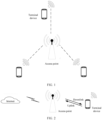
- the transmission rate configuration method provided in the embodiments of this application may be used in a communications system including an access point and at least one terminal device.
- the access point may be configured to provide a WIFI signal.
- the terminal device in the communications system shown in FIG. 1 may communicate with a communications device outside the communications system shown in FIG. 1 .
- the terminal device may access the Internet by using the access point.
- a plurality of terminal devices shown in FIG. 1 may communicate with each other by using the access point.
- the access point in this application may be a device that can provide a WIFI signal, such as an AP, customer premises equipment (customer premises equipment, CPE), or a gateway.
- the access point may be alternatively a device that can provide a WIFI hotspot, for example, a mobile terminal that can access a mobile network and provide a WIFI hotspot.
- the access point may be implemented by a chip or a chip system.
- the terminal device may include a mobile phone, a tablet computer, a wearable device (such as a smartwatch) having a wireless communication function, a vehicle-mounted device, or the like.
- An example embodiment of the terminal device includes but is not limited to an electronic device in which iOS ® , Android ® , Microsoft ® , or another operating system is installed.
- the electronic device may alternatively be, for example, a laptop (laptop) having a touch-sensitive surface (for example, a touch panel).
- the terminal device may be alternatively a device, such as a desktop computer, that has a WIFI network access capability.
- the terminal device may be a wireless terminal.
- the terminal device may be implemented by a chip or a chip system.
- the access point may be configured to provide a WIFI network (or referred to as a WIFI hotspot), and the terminal device may be configured to search for and access the WIFI network. It should be understood that in this application, there is no limitation that the terminal device can fall within a coverage area of a WIFI network provided by only one access point; and/or in this application, there is no limitation that a coverage area of a WIFI network provided by the access point includes only one terminal device.
- a signal sent by an access point to a terminal device may be referred to as a downlink signal in this application, and a downlink signal sending process may be referred to as downlink sending.
- the downlink signal may be used to carry signaling and/or data that are/is sent to the terminal device.
- the signaling may be referred to as downlink signaling, and the data may be referred to as downlink data.
- a signal sent by the terminal device to the access point may be referred to as an uplink signal in this application.
- the uplink signal may be used to carry signaling and/or data that are/is sent by the terminal device.
- the signaling may be referred to as uplink signaling, and the data may be referred to as uplink data.
- an access point when sending downlink data streams to a plurality of terminal devices (respectively marked as an STA 1, an STA 2, ..., and STA n), an access point provided in this embodiment of this application may allocate the data streams to different STA queues based on differentiated services code points (differentiated services code point, DSCP) of services to which the data streams belong.
- DSCP differentiated services code point
- Each STA queue corresponds to a value of one DSCP.
- different data streams may be represented by using traffic identifiers (traffic identifier, tid), for example, a tid 1, a tid 2, ... in FIG. 3 .
- the access point may place, by using a scheduling module (or scheduler), downlink data in a tid queue into a Wi-Fi multimedia (WIFI multi-media, WMM) queue corresponding to the tid queue, for waiting for sending.
- WMM queues are classified into four priority queues in ascending order of priorities: an AC-voice (AC-VO) stream, an AC-video (AC-VI) stream, an AC-best effort (AC-BE) stream, and an AC-background (AC-BK) stream, and it is guaranteed that a packet in a higher-priority queue has a higher channel preemption capability.
- the access point may further configure a transmission rate related to a downlink data sending process, for sending downlink data.
- the transmission rate is a parameter such as a modulation and coding scheme (modulation and coding scheme, MCS) rate configuration, a guard interval (guard interval, GI), bandwidth (bandwidth, BW), the number of spatial streams (number of spatial streams, NSS), an aggregation degree of an aggregate media access control (media access control, MAC) service data unit (MAC service data unit, MSDU) (A-MSDU), an aggregation degree of an aggregate MAC protocol data unit (MAC protocol data unit, MPDU) (A-MPDU), or a number of times configuration in a scheduling or retransmission policy that is based on a service set identifier (service set identifier, SSID) and a terminal device.
- MCS modulation and coding scheme
- GI guard interval
- BW bandwidth
- NSS the number of spatial streams
- NSS the number of spatial streams
- a transmission rate configuration method provided in an embodiment of this application may include the following steps:
- the access point may configure, based on a service characteristic of the data stream, the transmission rate used when the data stream is sent. Therefore, the configured transmission rate meets a requirement of the service to which the data stream belongs, thereby improving flexibility of a transmission rate configuration process.
- the access point may configure the transmission rate of the data stream based on the service type of the service to which the data stream belongs, so that a data stream transmission process meets a transmission latency requirement, a throughput requirement, a packet loss rate requirement, and/or the like of the service to which the data stream belongs.
- the access point may identify, based on a packet of the data stream, the service type of the service to which the data stream belongs. For example, the access point may obtain a service identifier carried in the packet of the data stream, to determine the service to which the data stream belongs, to further determine the service type of the service.
- the packet of the data stream may carry a source IP address of the data stream, the source IP address is, for example, an address of a server that provides the service, and the access point may query the service type of the service based on the source IP address.
- the packet of the data stream may alternatively carry indication information of the service type, such as a service type identifier.
- the access point may alternatively identify, based on a traffic model of the data stream, the service type of the service to which the data stream belongs. For example, specific distribution rules exist in terms of a peak value, a traffic average value, and a traffic fluctuation status of a data stream of a specific service type.
- the access point may compare a data stream from a network with distribution rules of a stored traffic model to determine whether the data stream is a data stream that has specific distribution rules; and when recognizing that these rules exist in the data stream, the access point can recognize that a service to which the data stream belongs is a service of the specific type.
- the access point may alternatively determine, in another manner in the conventional technology, the service type of the service to which the data stream belongs.
- the transmission latency requirement, the throughput requirement, the packet loss rate requirement, and/or the like of the service type may be represented as a correspondence between the service type and the transmission latency requirement, the throughput requirement, the packet loss rate requirement, and/or the like.
- the service type and the service requirement may be preconfigured in the access point, or may be obtained by the access point from the terminal device or a network side.
- the access point may store a correspondence between the service type and the service requirement of the service. After recognizing the service type of the data stream, the access point may determine, based on the correspondence, the service requirement of the service to which the data stream belongs.
- Table 1 Service type Service requirement Firs-type service Low latency (not higher than a first latency threshold) Download service Low packet loss rate N th -type service High throughput ... ...
- Table 1 shows only some possible correspondences between service types and service requirements by using examples. It should not be understood that the correspondence between the service type and the service requirement of the service is limited to only those shown in Table 1, and it also should not be understood that a service type and a service requirement to which this application is applicable are limited to those shown in Table 1.
- the correspondence between the service type and the service requirement may be alternatively expressed as a correspondence between a service of a specific type and a transmission latency and a throughput, a correspondence between a service of a specific type and a throughput and a packet loss rate, a correspondence between a service of a specific type and a transmission latency and a packet loss rate, or a correspondence between a service of a specific type and a transmission latency, a throughput, and a packet loss rate.
- different types of services may have a same service requirement for a transmission latency, a throughput, or a packet loss rate.
- different requirements may be proposed for specific values of transmission latencies (or throughputs or packet loss rates) of a plurality of types of services that have transmission latency (or throughput or packet loss rate) requirements.
- both a K th -type service and an L th -type service require low latencies, but a transmission latency required by the K th -type service is not higher than 30 milliseconds (ms), and the L th -type service requires that a transmission latency should not be higher than 50 ms.
- first-type service the "N th -type service”, or the like in Table 1 may be replaced with a specific service type, such as an online game service, a download service, a video service, or a VR service.
- the access point may send the data stream by using a relatively low sending rate, so that a packet loss rate is reduced by reducing a sending rate, to reduce a transmission latency.
- the access point may determine a first transmission rate based on the service type of the data stream. The transmission rate corresponding to the first transmission rate is not greater than a first rate threshold. Subsequently, the data stream may be sent by using the transmission rate.
- the first transmission rate is not greater than an average value of transmission rates at which the access point transmits data streams.
- the access point may configure a relatively small MCS rate (for example, an MCS rate less than or equal to an MCS rate average value).
- the first-type service may include a real-time online service such as multiplayer online battle arena (multiplayer online battle arena, MOBA), or Player Unknown's Battlegrounds, or red packet grabbing, or another service that has a relatively high transmission latency requirement.
- a real-time online service such as multiplayer online battle arena (multiplayer online battle arena, MOBA), or Player Unknown's Battlegrounds, or red packet grabbing, or another service that has a relatively high transmission latency requirement.
- Rates of data streams of these services are relatively small and usually do not exceed 2 megabits per second (Mbps).
- Mbps megabits per second
- these services usually have relatively high data transmission latency requirements.
- a packet loss rate in a data transmission process may be reduced by reducing a sending rate, to reduce a transmission latency.
- the access point may reduce a packet loss rate in downlink transmission by using a relatively high transmission rate, so that packet retransmissions are reduced by reducing packet losses, to obtain stable high-rate download experience.
- the access point may determine a second transmission rate.
- the transmission rate corresponding to the second transmission rate is not less than a second rate threshold.
- the second transmission rate is not less than the average value of transmission rates at which the access point transmits data streams.
- the second transmission rate may include a relatively large MCS rate.
- the access point may configure a relatively large MCS rate (for example, an MCS rate greater than or equal to the MCS rate average value).
- the access point may alternatively store a correspondence between the service type and the transmission rate, so that after determining the service type of the service to which the data stream belongs, the access point can determine the transmission rate of the data stream based on the correspondence, without determining, based on the service type, the service requirement of the service to which the data stream belongs.
- the access point configures the transmission rate of the data stream based on the service type of the service to which the data stream belongs and information about traffic of the data stream (that is, a rate of the data stream).
- the traffic information of the data stream may be used to describe a traffic model of the data stream, to reflect a characteristic of the data stream. For example, the traffic information may reflect average traffic of the data stream, a traffic peak value, or whether burst traffic exists.
- the access point After receiving the data stream, the access point determines the traffic information of the data stream. When the access point determines that a relatively large traffic burst exists in the data stream, and the service to which the data stream belongs is a second-type service, the access point configures the transmission rate of the data stream based on the average traffic of the data stream.
- the access point configures the transmission rate of the data stream to be not lower than x times of the average traffic of the data stream, where x is greater than 1. Therefore, the access point can provide a smooth air interface transmission rate for the service, thereby avoiding a packet loss caused by a transmission rate selection change due to air interface fluctuation, improving an anti-interference capability in downlink data transmission, and guaranteeing good experience of the service.
- x is greater than n.
- the access point may perform traffic shaping on the data stream, so that traffic fluctuation of the data stream is smoother, to reduce a traffic burst occurrence probability. Therefore, an anti-interference capability in downlink data transmission is further improved.
- a data stream existing before traffic shaping includes a plurality of traffic peak values, and each traffic peak value is traffic at a peak of the data stream. Therefore, traffic fluctuation is relatively large. After the traffic shaping, the traffic fluctuation of the data stream is alleviated.
- the access point may determine a third transmission rate based on average traffic of the data stream.
- the third transmission rate may be x times of the average traffic of the data stream, and x is greater than 1.
- the access point may send, to the terminal device based on the third transmission rate, a data stream obtained after the traffic shaping.
- a traffic shaping method refer to a manner in the conventional technology. This is not specifically limited in this application.
- the access point may alternatively store a correspondence between the service type, the traffic information of the data stream, and the transmission rate, so that after determining the service type of the service to which the data stream belongs and the traffic information, the access point may determine the transmission rate of the data stream based on the correspondence.
- the access point may further obtain a communication status parameter of the access point and a receive end, and configure, with reference to the service type of the service to which the data stream belongs and/or the traffic information of the data stream, the transmission rate used when the data stream is sent to the receive end.
- the receive end may include the terminal device that receives the data stream, for example, the terminal device shown in FIG. 2 .
- a most appropriate communication parameter may be selected based on the service type and the traffic information of the downlink data stream and a communication status of the access point and the receive end, to implement flexible configuration.
- the access point may obtain the communication status parameter in real time, and determine, based on the communication status parameter obtained in real time, a real-time configuration used to send the data stream to the receive end, to implement dynamic transmission rate configuration.
- the communication status parameter may include a part or all of communication parameters such as an interference duty cycle, an air interface bit error rate, an air interface retransmission rate, a service concurrency parameter (used to indicate how many downlink service data streams are concurrent), or an air interface rate of the receive end.
- communication parameters such as an interference duty cycle, an air interface bit error rate, an air interface retransmission rate, a service concurrency parameter (used to indicate how many downlink service data streams are concurrent), or an air interface rate of the receive end.
- the access point may determine, based on the service type of the data stream and the communication status parameter, a parameter such as an MCS rate configuration, an aggregation degree of an A-MSDU, an aggregation degree of an A-MPDU, resource application and allocation rules of the terminal device, a queue allocation rule of WMM, or a number of times configuration in a scheduling or retransmission policy that is based on an SSID and the terminal.
- the access point may determine an optimal transmission rate for data streams of a same type, to send the data streams.
- the access point may configure the transmission rate of the data stream based on a correspondence between the service type, the communication status parameter and/or the transmission rate. Specifically, after recognizing the service type of the data stream and/or obtaining the communication status parameter, the access point may determine, based on the correspondence, the service requirement of the service to which the data stream belongs.
- the correspondence between the service type, the communication status parameter, and/or the transmission rate may be shown in Table 2.
- An interference duty cycle is lower than an interference duty cycle threshold Transmission rate #1
- An interference duty cycle is not lower than the interference duty cycle threshold Transmission rate #2
- HTTP download service An air interface retransmission rate is lower than an air interface retransmission rate threshold Transmission rate #3
- An air interface retransmission rate is not lower than the air interface retransmission rate threshold Transmission rate #4 N th -type service
- An air interface rate of a receive end is not lower than an air interface rate threshold Transmission rate #4
- An air interface rate of a receive end is lower than the air interface rate threshold Transmission rate #5 ... ...
- the access point when the access point recognizes that an interference duty cycle of an interference channel is greater than the interference duty cycle threshold, indicating that signal interference of the interference channel is relatively strong, the access point may allocate an idle channel to a data stream on the interference channel, to switch the data stream from the interference channel to the idle channel for sending, thereby improving an anti-interference capability in downlink data transmission.
- the access point when the access point recognizes that an interference duty cycle of a channel 3 reaches the interference duty cycle threshold, such as 40%, the access point may switch a to-be-transmitted data stream on the channel 3 to an idle channel (such as a channel 4) for transmission.
- the access point when the transmission rate #1 is used, the access point transmits the data stream by using the interference channel. If the access point determines that the interference duty cycle of the interference channel is not lower than the interference duty cycle threshold, indicating that interference of the interference channel is relatively severe, the access point switches to an idle channel corresponding to the transmission rate #2, to transmit the data stream.
- the access point may determine respective transmission priority parameters of the plurality of data streams based on respective transmission latency requirements of services to which the plurality of data streams belong.
- to-be-transmitted data streams of the access point include a data stream A of a real-time online game service and another data stream B.
- the access point may improve a forwarding priority of the data stream A.
- the access point may configure a queue allocation rule of WMM to place the data stream A into a higher-priority WMM queue.
- the access point may determine a transmission rate parameter, such as the MCS rate configuration, the aggregation degree of the A-MSDU, the aggregation degree of the A-MPDU, the resource application and allocation rules of the terminal device, the queue allocation rule of the WMM, or the number of times configuration in the scheduling or retransmission policy that is based on the SSID and the terminal, based on the service type of the data stream and the communication status parameter by using an artificial intelligence (artificial intelligence, Al) algorithm such as a neural network model.
- an artificial intelligence artificial intelligence
- the access point may further determine the transmission rate parameter based on the service type of the data stream, the traffic information of the data stream, and/or the communication status parameter. For example, when the traffic information of the data stream meets a specific condition, the transmission rate parameter of the data stream is determined based on the correspondence shown in Table 2.
- the specific condition met by the traffic information of the data stream is, for example, that the average traffic of the data stream is not lower than a traffic threshold, or that a traffic burst exists (or does not exist) in the data stream.
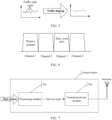
- the access point includes a processing module 701 and a communications module 702.
- the processing module 701 may include a processor, for example, may be implemented by using an architecture of a CPU and/or an NPU.
- the processing module 701 may be configured to implement functions, such as data stream feature extraction, of the access point.
- the communications module 702 may be implemented by a scheduling module, a modem (modem), or the like.
- the communications module 702 may be configured to perform communication configuration and send/receive a radio frequency signal by using an antenna.
- the processor may also be referred to as a system on chip (system on chip, SOC).
- the communications module 702 may be referred to as a WIFI module.
- the processing module may be implemented by a processing circuit such as a processing chip or a programmable logic controller (programmable logic controller, PLC).
- PLC programmable logic controller
- the communications module may be implemented by an interface circuit such as a PLC, or another medium.
- the processing module 701 determines a service type of a data stream, and the processing module 701 indicates the service type of the data stream to the communications module 702, so that the communications module 702 configures a transmission rate of the data stream based on the service type of the data stream, and sends the data stream, to meet a data transmission requirement of a service to which the data stream belongs.
- the communications module 702 may configure the transmission rate of the data stream as a first transmission rate.
- the first transmission rate is not greater than a first rate threshold.
- a transmission latency required by the first-type service is not higher than a latency threshold.
- the communications module 702 may configure the transmission rate of the data stream as a second transmission rate.
- the second transmission rate is not less than a second rate threshold.
- processing module 701 obtains traffic information of the data stream, and the processing module 701 sends the traffic information of the data stream to the communications module 702, so that the communications module 702 configures the transmission rate of the data stream based on the service type and the traffic information of the data stream.
- the communications module 702 configures the transmission rate of the data stream to be not less than x times of the average traffic of the data stream, where x is greater than 1.
- a packet loss rate required by the second-type service is not higher than a packet loss rate threshold, and n is greater than 1. For example, x is greater than n.
- the processing module 701 may further perform traffic shaping on the data stream.
- the communications module 702 may obtain a communication status parameter of the access point and a receive end of the data stream, so that the processing module 701 or the communications module 702 configures the transmission rate of the data stream based on the service type of the service to which the data stream belongs, the traffic information of the data stream, and the communication status parameter.
- the communications module 702 may alternatively determine a transmission rate parameter of the data stream according to the method provided in this application, and the communications module 702 sends the data stream based on the parameter.
- the communications apparatus may further include an AI module 703, configured to: when the downlink data stream needs to be sent, determine, by using an AI algorithm such as a neural network, the transmission rate parameter of the data stream based on the communication status parameter obtained by the communications module 702 and the service type of the service to which the data stream belongs and/or the traffic information of the data stream that are/is obtained by the processing module 701, and send the transmission rate parameter of the data stream to the communications module 702, so that the communications module 702 configures the transmission rate of the data stream.
- an AI algorithm such as a neural network
- the communications module may obtain the communication status parameter in real time, and send the communication status parameter obtained in real time to the AI module, so that the AI module determines, based on the communication status parameter obtained in real time, a real-time configuration used to send the data stream to the receive end, to implement dynamic transmission rate configuration.
- the communications apparatus may alternatively include a structure shown in FIG. 9 .
- a communications apparatus 900 may include a processor 901, a memory 902, and a transceiver 903.
- the processor 901 may be configured to: process a communication protocol and communication data, control a second terminal apparatus, execute a software program, process data of the software program, and the like.
- the memory 902 may be configured to store the program and data, and the processor 901 may perform, based on the program, the method performed by the second terminal apparatus in the embodiments of this application.
- the transceiver 903 may include a radio frequency unit and an antenna.
- the radio frequency unit may be configured to: perform conversion between a baseband signal and a radio frequency signal, and process the radio frequency signal.
- the antenna may be configured to send and receive a radio frequency signal in a form of an electromagnetic wave.
- the communications apparatus 900 may include the processor 901, the memory 902, the transceiver 903, and the antenna.
- the communications module 702 may have a structure shown in the transceiver 903, that is, the communications module 702 includes the radio frequency unit and the antenna. Alternatively, the communications module 702 may include the foregoing radio frequency unit.
- the foregoing processing module 701 and/or the AI module 703 may include the processor 901, or include the processor 901 and the memory 902.
- the transceiver 903 may be configured to perform the steps performed by the communications module 702.
- the processor 901 invokes the program stored in the memory 902, to perform the foregoing steps performed by the processing module 701 and/or the AI module 703.
- the processor 901 may determine a service type of a data stream, and the processor 901 indicates the service type of the data stream to the transceiver 903, so that the transceiver 903 configures a transmission rate of the data stream based on the service type of the data stream, and sends the data stream, to meet a data transmission requirement of a service to which the data stream belongs.
- the transceiver 903 may configure the transmission rate of the data stream as a first transmission rate.
- the first transmission rate is not greater than a first rate threshold.
- a transmission latency required by the first-type service is not higher than a latency threshold.
- the transceiver 903 may configure the transmission rate of the data stream as a second transmission rate.
- the second transmission rate is not less than a second rate threshold.
- the processor 901 may obtain traffic information of the data stream, and the processor 901 sends the traffic information of the data stream to the transceiver 903, so that the transceiver 903 configures the transmission rate of the data stream based on the service type and the traffic information of the data stream.
- the transceiver 903 may configure the transmission rate of the data stream to be not less than x times of the average traffic of the data stream, where x is greater than 1.
- a packet loss rate required by the second-type service is not higher than a packet loss rate threshold, and n is greater than 1. For example, x is greater than n.
- the processor 901 may further perform traffic shaping on the data stream.
- the transceiver 903 may obtain a communication status parameter of the access point and a receive end of the data stream, so that the processor 901 or the transceiver 903 configures the transmission rate of the data stream based on the service type of the service to which the data stream belongs, the traffic information of the data stream, and the communication status parameter.
- the transceiver 903 may alternatively determine a transmission rate parameter of the data stream according to the method provided in this application, and the transceiver 903 sends the data stream based on the parameter.
- the communications apparatus may alternatively include a chip.
- the chip includes the processor 901.
- the chip may be further coupled to any one or more components in the memory 902 and/or the transceiver 903, or the chip may further constitute a chip system with the memory 902 and/or the transceiver 903.
- an embodiment of this application further provides a computer-readable storage medium.
- the computer-readable storage medium stores a computer program.
- the program is executed by a processor, the computer is enabled to perform the method performed by the access node in any one of the foregoing method embodiments or the possible implementations of the method embodiments.
- this application further provides a computer program product not covered by the claimed invention.
- the computer program product When the computer program product is invoked and executed by a computer, the computer may be enabled to implement the method performed by the access node in any one of the foregoing method embodiments or the possible implementations of the method embodiments.
- the chip may include a processor.
- the chip may further include a memory (or a storage module) and/or a transceiver (or a communications module), or the chip is coupled to a memory (or a storage module) and/or a transceiver (or a communications module).
- the transceiver (or the communications module) may be configured to support the chip in wired and/or wireless communication, and the memory (or the storage module) may be configured to store a program.
- the processor invokes the program to implement the method performed by the access node in any one of the foregoing method embodiments or the possible implementations of the method embodiments.
- the chip system may include the chip, or may include the chip and another discrete component, such as a memory (or a storage module) and/or a transceiver (or a communications module).
- this application further provides a communications system, that is not covered by the claimed invention.
- the communications system may include the foregoing access point.
- the communications system may be configured to implement the method in any one of the foregoing method embodiments and possible implementations of the method embodiments.
- the communications system has a structure shown in FIG. 1 or FIG. 2 .
- These computer program instructions may be provided for a general-purpose computer, a dedicated computer, an embedded processor, or a processor of another programmable data processing device to generate a machine, so that the instructions executed by a computer or the processor of the another programmable data processing device generate an apparatus for implementing a specific function in one or more processes in the flowcharts and/or in one or more blocks in the block diagrams.
- These computer program instructions may alternatively be stored in a computer-readable memory that can instruct the computer or the another programmable data processing device to work in a specific manner, so that the instructions stored in the computer-readable memory generate an artifact that includes an instruction apparatus.
- the instruction apparatus implements a specific function in one or more processes in the flowcharts and/or in one or more blocks in the block diagrams.
- These computer program instructions may alternatively be loaded onto the computer or the other programmable data processing device, so that a series of operations and steps are performed on the computer or the another programmable device, to generate computer-implemented processing. Therefore, the instructions executed on the computer or the other programmable device provide steps for implementing a specific function in one or more processes in the flowcharts and/or in one or more blocks in the block diagrams.
Landscapes
- Engineering & Computer Science (AREA)
- Computer Networks & Wireless Communication (AREA)
- Signal Processing (AREA)
- Environmental & Geological Engineering (AREA)
- Quality & Reliability (AREA)
- Mobile Radio Communication Systems (AREA)
Description
- This application relates to the field of communication technologies, and in particular, to a transmission rate configuration method and an apparatus.
- In current wireless fidelity (WIFI) network communication, a WIFI signal may be provided by an access point (AP, for example, an access hotspot), for accessing the Internet by a terminal device (or may be referred to as a station (STA)) that has a WIFI communication function, such as a mobile phone or a tablet computer.
- Currently, when determining a transmission rate of a data stream, a gateway device is not concerned about a service type of a service to which the data stream belongs, for example, chooses to configure transmission rates for data streams of different services in a throughput maximizing manner. The transmission rate is used to guarantee that the data stream can obtain a data transmission guarantee during transmission, for example, obtain guarantees in terms of a latency, bandwidth, and a packet loss rate (PLR).
- However, with continuous extension of a service type, a throughput is no longer an only concerned indicator in a service data transmission process. Therefore, if a transmission rate is configured based on a throughput or another single principle, data transmission guarantee requirements of different services cannot be met. Therefore, an existing transmission rate configuration manner of the gateway device needs to be improved.
-
WO 2016/209266 A1 discloses a transceiver which communicates multicast frames to a plurality of client devices in a multicast group. A controller determines that a predetermined time has passed since the transceiver most recently sent a unicast transmission to one of the plurality of client devices. The controller computes a data rate for the one of the plurality of client devices based on the transmission of the unicast frame to the one of the plurality of client devices. -
US 2008/049615 A1 discloses a system for shaping data packet traffic on a packet network including at least one data packet rate shaper in communication with at least one Internet gateway for shaping the rates of transmission of the data packets through the packet network based on network performance data transmitted by the at least one customer access node to the Internet gateway. -
CN 106 850 125 B discloses MAC layer data packet retransmission mechanism optimization towards Cellular Networks and WLAN combination networks according to the network state information of Cellular Networks and WLAN. -
US 2017/251392 A1 discloses an access point that determines transmission rates of the data frames. As the transmission rate, for example, MCS (Modulation and Coding Scheme) can be used. - This application provides a transmission rate configuration method and an apparatus, to improve flexibility of downlink transmission rate configuration of an access point, so that a downlink data transmission process meets requirements of different services. The technical improvement is achieved by the solution provided in accordance with the claims.
- The following aspects are useful for understanding the present disclosure.
- According to a first aspect, the invention provides a transmission rate configuration method performed by an access point as defined in
claim 1. - According to a second aspect, the invention provides a communications apparatus as defined in claim 6. Preferred embodiments are defined in the dependent claims.
- For beneficial effects of the second aspect and the possible designs of the second aspect, refer to descriptions of the beneficial effects of the method according to any one of the first aspect and the possible designs of the first aspect.
-
-
FIG. 1 is a schematic architectural diagram of a wireless communications system according to an embodiment of this application; -
FIG. 2 is a schematic architectural diagram of another wireless communications system according to an embodiment of this application; -
FIG. 3 is a schematic diagram of a structure of an access point according to an embodiment of this application; -
FIG. 4 is a schematic flowchart of a communication method according to an embodiment of this application; -
FIG. 5 is a schematic diagram of a traffic shaping effect according to an embodiment of this application; -
FIG. 6 is a schematic diagram of a channel selection effect according to an embodiment of this application; -
FIG. 7 is a schematic diagram of a structure of a channel apparatus according to an embodiment of this application; -
FIG. 8 is a schematic diagram of a structure of another channel apparatus according to an embodiment of this application; and -
FIG. 9 is a schematic diagram of a structure of another channel apparatus according to an embodiment of this application. - To resolve a problem, in the conventional technology, that a transmission rate configuration process of an access point in a downlink data sending process is not flexible enough, this application proposes a transmission rate configuration method, to improve flexibility of downlink data transmission rate configuration, so that a downlink data transmission process meets transmission rate requirements of different services.
- As shown in
FIG. 1 , the transmission rate configuration method provided in the embodiments of this application may be used in a communications system including an access point and at least one terminal device. The access point may be configured to provide a WIFI signal. By using the access point, the terminal device in the communications system shown inFIG. 1 may communicate with a communications device outside the communications system shown inFIG. 1 . For example, the terminal device may access the Internet by using the access point. In addition, a plurality of terminal devices shown inFIG. 1 may communicate with each other by using the access point. - For example, the access point in this application may be a device that can provide a WIFI signal, such as an AP, customer premises equipment (customer premises equipment, CPE), or a gateway. The access point may be alternatively a device that can provide a WIFI hotspot, for example, a mobile terminal that can access a mobile network and provide a WIFI hotspot. For example, the access point may be implemented by a chip or a chip system.
- The terminal device may include a mobile phone, a tablet computer, a wearable device (such as a smartwatch) having a wireless communication function, a vehicle-mounted device, or the like. An example embodiment of the terminal device includes but is not limited to an electronic device in which iOS®, Android®, Microsoft®, or another operating system is installed. The electronic device may alternatively be, for example, a laptop (laptop) having a touch-sensitive surface (for example, a touch panel). It should be further understood that, in some other embodiments of this application, the terminal device may be alternatively a device, such as a desktop computer, that has a WIFI network access capability. For example, the terminal device may be a wireless terminal. For example, the terminal device may be implemented by a chip or a chip system.
- It should be understood that the access point may be configured to provide a WIFI network (or referred to as a WIFI hotspot), and the terminal device may be configured to search for and access the WIFI network. It should be understood that in this application, there is no limitation that the terminal device can fall within a coverage area of a WIFI network provided by only one access point; and/or in this application, there is no limitation that a coverage area of a WIFI network provided by the access point includes only one terminal device.
- As shown in
FIG. 2 , a signal sent by an access point to a terminal device may be referred to as a downlink signal in this application, and a downlink signal sending process may be referred to as downlink sending. The downlink signal may be used to carry signaling and/or data that are/is sent to the terminal device. The signaling may be referred to as downlink signaling, and the data may be referred to as downlink data. In addition, a signal sent by the terminal device to the access point may be referred to as an uplink signal in this application. The uplink signal may be used to carry signaling and/or data that are/is sent by the terminal device. The signaling may be referred to as uplink signaling, and the data may be referred to as uplink data. - As shown in
FIG. 3 , when sending downlink data streams to a plurality of terminal devices (respectively marked as anSTA 1, anSTA 2, ..., and STA n), an access point provided in this embodiment of this application may allocate the data streams to different STA queues based on differentiated services code points (differentiated services code point, DSCP) of services to which the data streams belong. Each STA queue corresponds to a value of one DSCP. For example, different data streams may be represented by using traffic identifiers (traffic identifier, tid), for example, atid 1, atid 2, ... inFIG. 3 . - In addition, the access point may place, by using a scheduling module (or scheduler), downlink data in a tid queue into a Wi-Fi multimedia (WIFI multi-media, WMM) queue corresponding to the tid queue, for waiting for sending. For access category (access category, AC) data streams, WMM queues are classified into four priority queues in ascending order of priorities: an AC-voice (AC-VO) stream, an AC-video (AC-VI) stream, an AC-best effort (AC-BE) stream, and an AC-background (AC-BK) stream, and it is guaranteed that a packet in a higher-priority queue has a higher channel preemption capability. The access point may further configure a transmission rate related to a downlink data sending process, for sending downlink data. The transmission rate is a parameter such as a modulation and coding scheme (modulation and coding scheme, MCS) rate configuration, a guard interval (guard interval, GI), bandwidth (bandwidth, BW), the number of spatial streams (number of spatial streams, NSS), an aggregation degree of an aggregate media access control (media access control, MAC) service data unit (MAC service data unit, MSDU) (A-MSDU), an aggregation degree of an aggregate MAC protocol data unit (MAC protocol data unit, MPDU) (A-MPDU), or a number of times configuration in a scheduling or retransmission policy that is based on a service set identifier (service set identifier, SSID) and a terminal device. It should be understood that in this application, downlink transmission rate may be configured in of the access point.
- As shown in
FIG. 4 , a transmission rate configuration method provided in an embodiment of this application may include the following steps: - S101: An access point determines a service type of a service to which a data stream belongs.
The data stream may be a downlink data stream that is sent to the access point and that needs to be sent by the access point to a terminal device. The service type may be used to represent a type of the service to which the data stream belongs. For example, the service type may include a video service, an online game service, a download service, a virtual reality (virtual reality, VR) service, and/or a low-latency service. - S102: The access point configures a transmission rate of the data stream based on the service type of the service to which the data stream belongs. Accordingly, the access point can send the data stream to the terminal device based on the configured transmission rate.
- In the foregoing method, the access point may configure, based on a service characteristic of the data stream, the transmission rate used when the data stream is sent. Therefore, the configured transmission rate meets a requirement of the service to which the data stream belongs, thereby improving flexibility of a transmission rate configuration process.
- It should be understood that, the access point may configure the transmission rate of the data stream based on the service type of the service to which the data stream belongs, so that a data stream transmission process meets a transmission latency requirement, a throughput requirement, a packet loss rate requirement, and/or the like of the service to which the data stream belongs.
- For example, the access point may identify, based on a packet of the data stream, the service type of the service to which the data stream belongs. For example, the access point may obtain a service identifier carried in the packet of the data stream, to determine the service to which the data stream belongs, to further determine the service type of the service. For another example, the packet of the data stream may carry a source IP address of the data stream, the source IP address is, for example, an address of a server that provides the service, and the access point may query the service type of the service based on the source IP address. In addition, the packet of the data stream may alternatively carry indication information of the service type, such as a service type identifier.
- In addition, the access point may alternatively identify, based on a traffic model of the data stream, the service type of the service to which the data stream belongs. For example, specific distribution rules exist in terms of a peak value, a traffic average value, and a traffic fluctuation status of a data stream of a specific service type. The access point may compare a data stream from a network with distribution rules of a stored traffic model to determine whether the data stream is a data stream that has specific distribution rules; and when recognizing that these rules exist in the data stream, the access point can recognize that a service to which the data stream belongs is a service of the specific type.
- In addition, it should be understood that in this application, the access point may alternatively determine, in another manner in the conventional technology, the service type of the service to which the data stream belongs.
- For example, the transmission latency requirement, the throughput requirement, the packet loss rate requirement, and/or the like of the service type may be represented as a correspondence between the service type and the transmission latency requirement, the throughput requirement, the packet loss rate requirement, and/or the like. The service type and the service requirement may be preconfigured in the access point, or may be obtained by the access point from the terminal device or a network side.
- As shown in Table 1, the access point may store a correspondence between the service type and the service requirement of the service. After recognizing the service type of the data stream, the access point may determine, based on the correspondence, the service requirement of the service to which the data stream belongs.
Table 1 Service type Service requirement Firs-type service Low latency (not higher than a first latency threshold) Download service Low packet loss rate Nth-type service High throughput ... ... - It should be understood that, Table 1 shows only some possible correspondences between service types and service requirements by using examples. It should not be understood that the correspondence between the service type and the service requirement of the service is limited to only those shown in Table 1, and it also should not be understood that a service type and a service requirement to which this application is applicable are limited to those shown in Table 1. For example, based on a requirement of an actual service, the correspondence between the service type and the service requirement may be alternatively expressed as a correspondence between a service of a specific type and a transmission latency and a throughput, a correspondence between a service of a specific type and a throughput and a packet loss rate, a correspondence between a service of a specific type and a transmission latency and a packet loss rate, or a correspondence between a service of a specific type and a transmission latency, a throughput, and a packet loss rate.
- In addition, in this application, different types of services may have a same service requirement for a transmission latency, a throughput, or a packet loss rate. In this application, different requirements may be proposed for specific values of transmission latencies (or throughputs or packet loss rates) of a plurality of types of services that have transmission latency (or throughput or packet loss rate) requirements. For example, both a Kth-type service and an Lth-type service require low latencies, but a transmission latency required by the Kth-type service is not higher than 30 milliseconds (ms), and the Lth-type service requires that a transmission latency should not be higher than 50 ms.
- It should be understood that the "first-type service", the "Nth-type service", or the like in Table 1 may be replaced with a specific service type, such as an online game service, a download service, a video service, or a VR service.
- For example, if the access point determines that the service to which the data stream belongs is the first-type service shown in Table 1, where it may be learned from Table 1 that, the first-type service has a relatively high transmission latency requirement (for example, a transmission latency required by the service type is not higher than 30 milliseconds (ms)), the access point may send the data stream by using a relatively low sending rate, so that a packet loss rate is reduced by reducing a sending rate, to reduce a transmission latency. In this example, the access point may determine a first transmission rate based on the service type of the data stream. The transmission rate corresponding to the first transmission rate is not greater than a first rate threshold. Subsequently, the data stream may be sent by using the transmission rate. For example, the first transmission rate is not greater than an average value of transmission rates at which the access point transmits data streams. Specifically, when configuring the first rate threshold, the access point may configure a relatively small MCS rate (for example, an MCS rate less than or equal to an MCS rate average value).
- For example, the first-type service may include a real-time online service such as multiplayer online battle arena (multiplayer online battle arena, MOBA), or Player Unknown's Battlegrounds, or red packet grabbing, or another service that has a relatively high transmission latency requirement. Rates of data streams of these services are relatively small and usually do not exceed 2 megabits per second (Mbps). However, these services usually have relatively high data transmission latency requirements. When a data transmission latency is excessively high, service experience is severely affected. Therefore, for this type of service, a packet loss rate in a data transmission process may be reduced by reducing a sending rate, to reduce a transmission latency.
- In another example, if the access point determines that the service to which the data stream belongs is a download service, for example, a hypertext transfer protocol (hypertext transfer protocol, HTTP) download service, a download service of another protocol type, or another service that requires a relatively high throughput, the access point may reduce a packet loss rate in downlink transmission by using a relatively high transmission rate, so that packet retransmissions are reduced by reducing packet losses, to obtain stable high-rate download experience. In this example, the access point may determine a second transmission rate. The transmission rate corresponding to the second transmission rate is not less than a second rate threshold. For example, the second transmission rate is not less than the average value of transmission rates at which the access point transmits data streams. Specifically, the second transmission rate may include a relatively large MCS rate. Specifically, when configuring the second transmission rate, the access point may configure a relatively large MCS rate (for example, an MCS rate greater than or equal to the MCS rate average value).
- In addition, the access point may alternatively store a correspondence between the service type and the transmission rate, so that after determining the service type of the service to which the data stream belongs, the access point can determine the transmission rate of the data stream based on the correspondence, without determining, based on the service type, the service requirement of the service to which the data stream belongs.
- In the claimed invention, in implementation of S102, the access point configures the transmission rate of the data stream based on the service type of the service to which the data stream belongs and information about traffic of the data stream (that is, a rate of the data stream). The traffic information of the data stream may be used to describe a traffic model of the data stream, to reflect a characteristic of the data stream. For example, the traffic information may reflect average traffic of the data stream, a traffic peak value, or whether burst traffic exists.
- After receiving the data stream, the access point determines the traffic information of the data stream. When the access point determines that a relatively large traffic burst exists in the data stream, and the service to which the data stream belongs is a second-type service, the access point configures the transmission rate of the data stream based on the average traffic of the data stream. The traffic burst means that one or more traffic peak values of the data stream each are not lower than n times of the average traffic of the data stream, and n is greater than 1, for example, n=1.5, 2, 3, ....
- The access point configures the transmission rate of the data stream to be not lower than x times of the average traffic of the data stream, where x is greater than 1. Therefore, the access point can provide a smooth air interface transmission rate for the service, thereby avoiding a packet loss caused by a transmission rate selection change due to air interface fluctuation, improving an anti-interference capability in downlink data transmission, and guaranteeing good experience of the service. Specifically, x is greater than n.
- In addition, in this example, because the traffic burst exists in the data stream, and traffic fluctuation is relatively large, the access point may perform traffic shaping on the data stream, so that traffic fluctuation of the data stream is smoother, to reduce a traffic burst occurrence probability. Therefore, an anti-interference capability in downlink data transmission is further improved. As shown in
FIG. 5 , in this application, a data stream existing before traffic shaping includes a plurality of traffic peak values, and each traffic peak value is traffic at a peak of the data stream. Therefore, traffic fluctuation is relatively large. After the traffic shaping, the traffic fluctuation of the data stream is alleviated. - For example, for a service that has relatively large traffic and usually has a traffic burst in a data stream, such as a 4K high-definition video service, an interactive personality TV (IPTV) service, and/or a VR service, after receiving a data stream of this type of service, the access point may determine a third transmission rate based on average traffic of the data stream. The third transmission rate may be x times of the average traffic of the data stream, and x is greater than 1. Then, the access point may send, to the terminal device based on the third transmission rate, a data stream obtained after the traffic shaping. For a traffic shaping method, refer to a manner in the conventional technology. This is not specifically limited in this application.
- In addition, the access point may alternatively store a correspondence between the service type, the traffic information of the data stream, and the transmission rate, so that after determining the service type of the service to which the data stream belongs and the traffic information, the access point may determine the transmission rate of the data stream based on the correspondence.
- For example, in this application, the access point may further obtain a communication status parameter of the access point and a receive end, and configure, with reference to the service type of the service to which the data stream belongs and/or the traffic information of the data stream, the transmission rate used when the data stream is sent to the receive end. The receive end may include the terminal device that receives the data stream, for example, the terminal device shown in
FIG. 2 . In this method, a most appropriate communication parameter may be selected based on the service type and the traffic information of the downlink data stream and a communication status of the access point and the receive end, to implement flexible configuration. For example, the access point may obtain the communication status parameter in real time, and determine, based on the communication status parameter obtained in real time, a real-time configuration used to send the data stream to the receive end, to implement dynamic transmission rate configuration. - The communication status parameter may include a part or all of communication parameters such as an interference duty cycle, an air interface bit error rate, an air interface retransmission rate, a service concurrency parameter (used to indicate how many downlink service data streams are concurrent), or an air interface rate of the receive end.
- The access point may determine, based on the service type of the data stream and the communication status parameter, a parameter such as an MCS rate configuration, an aggregation degree of an A-MSDU, an aggregation degree of an A-MPDU, resource application and allocation rules of the terminal device, a queue allocation rule of WMM, or a number of times configuration in a scheduling or retransmission policy that is based on an SSID and the terminal. The access point may determine an optimal transmission rate for data streams of a same type, to send the data streams.
- In a possible example, the access point may configure the transmission rate of the data stream based on a correspondence between the service type, the communication status parameter and/or the transmission rate. Specifically, after recognizing the service type of the data stream and/or obtaining the communication status parameter, the access point may determine, based on the correspondence, the service requirement of the service to which the data stream belongs. The correspondence between the service type, the communication status parameter, and/or the transmission rate may be shown in Table 2.
Table 2 Service type Communication status parameter Transmission rate Firs-type service An interference duty cycle is lower than an interference duty cycle threshold Transmission rate # 1An interference duty cycle is not lower than the interference duty cycle threshold Transmission rate # 2HTTP download service An air interface retransmission rate is lower than an air interface retransmission rate threshold Transmission rate # 3An air interface retransmission rate is not lower than the air interface retransmission rate threshold Transmission rate #4 Nth-type service An air interface rate of a receive end is not lower than an air interface rate threshold Transmission rate # 4An air interface rate of a receive end is lower than the air interface rate threshold Transmission rate #5 ... ... - In a specific example, when the access point recognizes that an interference duty cycle of an interference channel is greater than the interference duty cycle threshold, indicating that signal interference of the interference channel is relatively strong, the access point may allocate an idle channel to a data stream on the interference channel, to switch the data stream from the interference channel to the idle channel for sending, thereby improving an anti-interference capability in downlink data transmission. As shown in
FIG. 6 , when the access point recognizes that an interference duty cycle of achannel 3 reaches the interference duty cycle threshold, such as 40%, the access point may switch a to-be-transmitted data stream on thechannel 3 to an idle channel (such as a channel 4) for transmission. For example, as shown in Table 2, when thetransmission rate # 1 is used, the access point transmits the data stream by using the interference channel. If the access point determines that the interference duty cycle of the interference channel is not lower than the interference duty cycle threshold, indicating that interference of the interference channel is relatively severe, the access point switches to an idle channel corresponding to thetransmission rate # 2, to transmit the data stream. - In another specific example, when the access point recognizes that a plurality of concurrent to-be-sent data streams exist, the access point may determine respective transmission priority parameters of the plurality of data streams based on respective transmission latency requirements of services to which the plurality of data streams belong. For example, to-be-transmitted data streams of the access point include a data stream A of a real-time online game service and another data stream B. To reduce a transmission latency of the data stream A, the access point may improve a forwarding priority of the data stream A. For example, the access point may configure a queue allocation rule of WMM to place the data stream A into a higher-priority WMM queue.
- In another example, after obtaining the service type of the data stream and/or the communication status parameter, the access point may determine a transmission rate parameter, such as the MCS rate configuration, the aggregation degree of the A-MSDU, the aggregation degree of the A-MPDU, the resource application and allocation rules of the terminal device, the queue allocation rule of the WMM, or the number of times configuration in the scheduling or retransmission policy that is based on the SSID and the terminal, based on the service type of the data stream and the communication status parameter by using an artificial intelligence (artificial intelligence, Al) algorithm such as a neural network model.
- In addition, based on a service transmission requirement, the access point may further determine the transmission rate parameter based on the service type of the data stream, the traffic information of the data stream, and/or the communication status parameter. For example, when the traffic information of the data stream meets a specific condition, the transmission rate parameter of the data stream is determined based on the correspondence shown in Table 2. The specific condition met by the traffic information of the data stream is, for example, that the average traffic of the data stream is not lower than a traffic threshold, or that a traffic burst exists (or does not exist) in the data stream.
- When the access point provided in this application is implemented, a possible structure of the access point may be shown in
FIG. 7 . It may be learned fromFIG. 7 that, the access point includes aprocessing module 701 and acommunications module 702. Theprocessing module 701 may include a processor, for example, may be implemented by using an architecture of a CPU and/or an NPU. Theprocessing module 701 may be configured to implement functions, such as data stream feature extraction, of the access point. Thecommunications module 702 may be implemented by a scheduling module, a modem (modem), or the like. Thecommunications module 702 may be configured to perform communication configuration and send/receive a radio frequency signal by using an antenna. In this application, the processor may also be referred to as a system on chip (system on chip, SOC). Thecommunications module 702 may be referred to as a WIFI module. For example, the processing module may be implemented by a processing circuit such as a processing chip or a programmable logic controller (programmable logic controller, PLC). The communications module may be implemented by an interface circuit such as a PLC, or another medium. - Specifically, in this application, the
processing module 701 determines a service type of a data stream, and theprocessing module 701 indicates the service type of the data stream to thecommunications module 702, so that thecommunications module 702 configures a transmission rate of the data stream based on the service type of the data stream, and sends the data stream, to meet a data transmission requirement of a service to which the data stream belongs. - In a possible example, when the service type is used to indicate that the service to which the data stream belongs is a first-type service, the
communications module 702 may configure the transmission rate of the data stream as a first transmission rate. The first transmission rate is not greater than a first rate threshold. A transmission latency required by the first-type service is not higher than a latency threshold. - In another possible example, when the service type is used to indicate that the service to which the data stream belongs is an HTTP download service, the
communications module 702 may configure the transmission rate of the data stream as a second transmission rate. The second transmission rate is not less than a second rate threshold. - In addition, the
processing module 701 obtains traffic information of the data stream, and theprocessing module 701 sends the traffic information of the data stream to thecommunications module 702, so that thecommunications module 702 configures the transmission rate of the data stream based on the service type and the traffic information of the data stream. - Specifically, in the claimed invention, when the service type is used to indicate that the service to which the data stream belongs is a second-type service, and the traffic information is used to indicate that a traffic peak value of the data stream is not lower than n times of average traffic of the data stream, the
communications module 702 configures the transmission rate of the data stream to be not less than x times of the average traffic of the data stream, where x is greater than 1. A packet loss rate required by the second-type service is not higher than a packet loss rate threshold, and n is greater than 1. For example, x is greater than n. - In this example, the
processing module 701 may further perform traffic shaping on the data stream. - In addition, the
communications module 702 may obtain a communication status parameter of the access point and a receive end of the data stream, so that theprocessing module 701 or thecommunications module 702 configures the transmission rate of the data stream based on the service type of the service to which the data stream belongs, the traffic information of the data stream, and the communication status parameter. - It should be understood that, in this application, the
communications module 702 may alternatively determine a transmission rate parameter of the data stream according to the method provided in this application, and thecommunications module 702 sends the data stream based on the parameter. - For example, as shown in
FIG. 8 , the communications apparatus may further include anAI module 703, configured to: when the downlink data stream needs to be sent, determine, by using an AI algorithm such as a neural network, the transmission rate parameter of the data stream based on the communication status parameter obtained by thecommunications module 702 and the service type of the service to which the data stream belongs and/or the traffic information of the data stream that are/is obtained by theprocessing module 701, and send the transmission rate parameter of the data stream to thecommunications module 702, so that thecommunications module 702 configures the transmission rate of the data stream. For example, the communications module may obtain the communication status parameter in real time, and send the communication status parameter obtained in real time to the AI module, so that the AI module determines, based on the communication status parameter obtained in real time, a real-time configuration used to send the data stream to the receive end, to implement dynamic transmission rate configuration. - In addition, in an embodiment that is not covered by the claimed invention, the communications apparatus may alternatively include a structure shown in
FIG. 9 . As shown inFIG. 9 , acommunications apparatus 900 may include aprocessor 901, amemory 902, and atransceiver 903. - The
processor 901 may be configured to: process a communication protocol and communication data, control a second terminal apparatus, execute a software program, process data of the software program, and the like. Thememory 902 may be configured to store the program and data, and theprocessor 901 may perform, based on the program, the method performed by the second terminal apparatus in the embodiments of this application. - The
transceiver 903 may include a radio frequency unit and an antenna. The radio frequency unit may be configured to: perform conversion between a baseband signal and a radio frequency signal, and process the radio frequency signal. The antenna may be configured to send and receive a radio frequency signal in a form of an electromagnetic wave. In addition, only the radio frequency unit may be considered as thetransceiver 903. In this case, thecommunications apparatus 900 may include theprocessor 901, thememory 902, thetransceiver 903, and the antenna. - It should be understood that the
communications module 702 may have a structure shown in thetransceiver 903, that is, thecommunications module 702 includes the radio frequency unit and the antenna. Alternatively, thecommunications module 702 may include the foregoing radio frequency unit. The foregoingprocessing module 701 and/or theAI module 703 may include theprocessor 901, or include theprocessor 901 and thememory 902. - When performing the method shown in the embodiments of this application, the
transceiver 903 may be configured to perform the steps performed by thecommunications module 702. Theprocessor 901 invokes the program stored in thememory 902, to perform the foregoing steps performed by theprocessing module 701 and/or theAI module 703. - Specifically, the
processor 901 may determine a service type of a data stream, and theprocessor 901 indicates the service type of the data stream to thetransceiver 903, so that thetransceiver 903 configures a transmission rate of the data stream based on the service type of the data stream, and sends the data stream, to meet a data transmission requirement of a service to which the data stream belongs. - In a possible example, when the service type is used to indicate that the service to which the data stream belongs is a first-type service, the
transceiver 903 may configure the transmission rate of the data stream as a first transmission rate. The first transmission rate is not greater than a first rate threshold. A transmission latency required by the first-type service is not higher than a latency threshold. - In another possible example, when the service type is used to indicate that the service to which the data stream belongs is an HTTP download service, the
transceiver 903 may configure the transmission rate of the data stream as a second transmission rate. The second transmission rate is not less than a second rate threshold. - In addition, the
processor 901 may obtain traffic information of the data stream, and theprocessor 901 sends the traffic information of the data stream to thetransceiver 903, so that thetransceiver 903 configures the transmission rate of the data stream based on the service type and the traffic information of the data stream. - Specifically, when the service type is used to indicate that the service to which the data stream belongs is a second-type service, and the traffic information is used to indicate that a traffic peak value of the data stream is not lower than n times of average traffic of the data stream, the
transceiver 903 may configure the transmission rate of the data stream to be not less than x times of the average traffic of the data stream, where x is greater than 1. A packet loss rate required by the second-type service is not higher than a packet loss rate threshold, and n is greater than 1. For example, x is greater than n. - In this example, the
processor 901 may further perform traffic shaping on the data stream. - In addition, the
transceiver 903 may obtain a communication status parameter of the access point and a receive end of the data stream, so that theprocessor 901 or thetransceiver 903 configures the transmission rate of the data stream based on the service type of the service to which the data stream belongs, the traffic information of the data stream, and the communication status parameter. - It should be understood that, in this application, the
transceiver 903 may alternatively determine a transmission rate parameter of the data stream according to the method provided in this application, and thetransceiver 903 sends the data stream based on the parameter. - It should be understood that the communications apparatus may alternatively include a chip. For example, the chip includes the
processor 901. In addition, the chip may be further coupled to any one or more components in thememory 902 and/or thetransceiver 903, or the chip may further constitute a chip system with thememory 902 and/or thetransceiver 903. - Based on a same concept as that of the foregoing method embodiments, an embodiment of this application, not covered by the claimed invention, further provides a computer-readable storage medium. The computer-readable storage medium stores a computer program. When the program is executed by a processor, the computer is enabled to perform the method performed by the access node in any one of the foregoing method embodiments or the possible implementations of the method embodiments.
- Based on a same concept as the foregoing method embodiments, this application further provides a computer program product not covered by the claimed invention. When the computer program product is invoked and executed by a computer, the computer may be enabled to implement the method performed by the access node in any one of the foregoing method embodiments or the possible implementations of the method embodiments.
- Based on a same concept as that of the foregoing method embodiments, this application further provides a chip or a chip system, that are not covered by the claimed invention. The chip may include a processor. The chip may further include a memory (or a storage module) and/or a transceiver (or a communications module), or the chip is coupled to a memory (or a storage module) and/or a transceiver (or a communications module). The transceiver (or the communications module) may be configured to support the chip in wired and/or wireless communication, and the memory (or the storage module) may be configured to store a program. The processor invokes the program to implement the method performed by the access node in any one of the foregoing method embodiments or the possible implementations of the method embodiments. The chip system may include the chip, or may include the chip and another discrete component, such as a memory (or a storage module) and/or a transceiver (or a communications module).
- Based on a same concept as that of the foregoing method embodiments, this application further provides a communications system, that is not covered by the claimed invention. The communications system may include the foregoing access point. The communications system may be configured to implement the method in any one of the foregoing method embodiments and possible implementations of the method embodiments. For example, the communications system has a structure shown in
FIG. 1 or FIG. 2 . - The embodiments of this application are described with reference to the flowcharts and/or block diagrams of the method, the apparatus, and the computer program product according to the embodiments. It should be understood that computer program instructions may be used to implement each process and/or each block in the flowcharts and/or the block diagrams and a combination of a process and/or a block in the flowcharts and/or the block diagrams. These computer program instructions may be provided for a general-purpose computer, a dedicated computer, an embedded processor, or a processor of another programmable data processing device to generate a machine, so that the instructions executed by a computer or the processor of the another programmable data processing device generate an apparatus for implementing a specific function in one or more processes in the flowcharts and/or in one or more blocks in the block diagrams.
- These computer program instructions may alternatively be stored in a computer-readable memory that can instruct the computer or the another programmable data processing device to work in a specific manner, so that the instructions stored in the computer-readable memory generate an artifact that includes an instruction apparatus. The instruction apparatus implements a specific function in one or more processes in the flowcharts and/or in one or more blocks in the block diagrams.
- These computer program instructions may alternatively be loaded onto the computer or the other programmable data processing device, so that a series of operations and steps are performed on the computer or the another programmable device, to generate computer-implemented processing. Therefore, the instructions executed on the computer or the other programmable device provide steps for implementing a specific function in one or more processes in the flowcharts and/or in one or more blocks in the block diagrams.
Claims (10)
- A transmission rate configuration method, comprising:determining (S101), by an access point, a service type of a service to which a data stream belongs, in downlink data transmission; andconfiguring (S102), by the access point, a transmission rate of the data stream based on the service type and traffic information of the data stream,characterized in that:the service type is used to indicate that the service to which the data stream belongs is of a type of service for which a packet loss rate required is not higher than a packet loss rate threshold; and the traffic information is used to indicate that a traffic peak value of the data stream is not lower than n times of average traffic of the data stream, and n is greater than 1; andthe configuring, by the access point, the transmission rate of the data stream based on the service type and traffic information of the data stream comprises:
configuring, by the access point based on the service type and the traffic information of the data stream, the transmission rate of the data stream to be not less than x times of the average traffic of the data stream, wherein x is greater than 1. - The method according to claim 1, wherein the method further comprises:
performing, by the access point, traffic shaping on the data stream. - The method according to claim 1 or 2, wherein the method further comprises:obtaining, by the access point, a communication status parameter of the access point and a receive end of the data stream; andthe configuring, by the access point, a transmission rate of the data stream comprisesconfiguring, by the access point, the transmission rate of the data stream based on the service type, the traffic information and the communication status parameter; orconfiguring, by the access point, the transmission rate of the data stream based on the service type, a traffic model of the data stream, and the communication status parameter.
- The method according to claim 3, wherein the communication status parameter comprises a part or all of the following parameters:an air interface bit error rate;an air interface retransmission rate; oran air interface rate of the receive end.
- The method according to any one of claims 1 to 4, wherein the configuring, by the access point, a transmission rate of the data stream further comprises:determining, by the access point, a transmission rate parameter of the data stream based on the service type, whereinthe transmission rate parameter of the data stream comprises a part or all of the following parameters:a modulation and coding scheme, MCS, rate configuration;an aggregation degree of an aggregate media access control service data unit, A-MSDU;an aggregation degree of an aggregate media access control protocol data unit, A-MPDU; ora queue allocation rule of Wi-Fi multimedia, WMM.
- A communications apparatus for an access point, comprising:a processing module (701), configured to determine a service type of a service to which a data stream belongs, in downlink data transmission; anda communications module (702), configured to configure a transmission rate of the data stream based on the service type and traffic information of the data stream,characterized in thatthe service type is used to indicate that the service to which the data stream belongs is of a type of service for which a packet loss rate required is not higher than a packet loss rate threshold; the traffic information is used to indicate that a traffic peak value of the data stream is not lower than n times of average traffic of the data stream, and n is greater than 1; andthe communications module (702) is specifically configured to:
configure, based on the service type and the traffic information of the data stream, the transmission rate of the data stream to be not less than x times of the average traffic of the data stream, wherein x is greater than 1. - The communications apparatus according to claim 6, wherein the processing module (701) is further configured to:
perform traffic shaping on the data stream. - The communications apparatus according to claim 6 or 7, wherein the communications module (702) is further configured to:obtain a communication status parameter of the communications apparatus and a receive end of the data stream; andthe communications module (702) is further configured to:configure the transmission rate of the data stream based on the service type, the traffic information and the communication status parameter; orconfigure the transmission rate of the data stream based on the service type, a traffic model of the data stream, and the communication status parameter.
- The communications apparatus according to claim 8, wherein the communication status parameter comprises a part or all of the following parameters:an air interface bit error rate;an air interface retransmission rate; oran air interface rate of the receive end.
- The communications apparatus according to any one of claims 6 to 9, wherein the communications module is further configured to:determine a transmission rate parameter of the data stream based on the service type, whereinthe transmission rate parameter of the data stream comprises a part or all of the following parameters:a modulation and coding scheme, MCS, rate configuration;an aggregation degree of an aggregate media access control service data unit, A-MSDU;an aggregation degree of an aggregate media access control protocol data unit, A-MPDU; ora queue allocation rule of Wi-Fi multimedia, WMM.
Applications Claiming Priority (2)
| Application Number | Priority Date | Filing Date | Title |
|---|---|---|---|
| CN201911267103.3A CN112953749A (en) | 2019-12-11 | 2019-12-11 | Transmission rate configuration method and device |
| PCT/CN2020/116630 WO2021114807A1 (en) | 2019-12-11 | 2020-09-21 | Transmission rate configuration method and apparatus |
Publications (3)
| Publication Number | Publication Date |
|---|---|
| EP4057768A1 EP4057768A1 (en) | 2022-09-14 |
| EP4057768A4 EP4057768A4 (en) | 2023-01-04 |
| EP4057768B1 true EP4057768B1 (en) | 2024-11-06 |
Family
ID=76233943
Family Applications (1)
| Application Number | Title | Priority Date | Filing Date |
|---|---|---|---|
| EP20897744.7A Active EP4057768B1 (en) | 2019-12-11 | 2020-09-21 | Transmission rate configuration method and apparatus |
Country Status (6)
| Country | Link |
|---|---|
| US (1) | US20220304000A1 (en) |
| EP (1) | EP4057768B1 (en) |
| CN (1) | CN112953749A (en) |
| ES (1) | ES2999034T3 (en) |
| PT (1) | PT4057768T (en) |
| WO (1) | WO2021114807A1 (en) |
Families Citing this family (6)
| Publication number | Priority date | Publication date | Assignee | Title |
|---|---|---|---|---|
| US12348305B2 (en) * | 2021-11-14 | 2025-07-01 | Microsoft Technology Licensing, Llc | Multidimensional service differentiation for WiFi traffic |
| CN114710804A (en) * | 2022-03-31 | 2022-07-05 | 维沃移动通信有限公司 | Data transmission adjusting method and device, electronic equipment and readable storage medium |
| CN114786017A (en) * | 2022-04-06 | 2022-07-22 | 广州市香港科大霍英东研究院 | Video streaming transmission method based on wireless camera and wireless camera |
| CN117354252A (en) * | 2022-06-29 | 2024-01-05 | 中兴通讯股份有限公司 | A data transmission processing method, device, storage medium and electronic device |
| CN116436860A (en) * | 2023-04-19 | 2023-07-14 | 四川大学 | Data transmission rate control method, base station and data gateway in communication system |
| CN121283957A (en) * | 2024-07-05 | 2026-01-06 | 华为技术有限公司 | Traffic shaping method and device |
Family Cites Families (19)
| Publication number | Priority date | Publication date | Assignee | Title |
|---|---|---|---|---|
| US7808918B2 (en) * | 2006-08-22 | 2010-10-05 | Embarq Holdings Company, Llc | System and method for dynamically shaping network traffic |
| CN101971666B (en) * | 2008-01-14 | 2014-06-25 | 发尔泰公司 | Service differentiation and service level agreements for wireless access clients |
| KR101167523B1 (en) * | 2008-01-17 | 2012-07-20 | 노키아 코포레이션 | Adaptive multi-rate codec bit rate control in a wireless system |
| US8792382B2 (en) * | 2008-12-17 | 2014-07-29 | Centurylink Intellectual Property Llc | System and method for tracking a line rate utilization |
| KR20140092935A (en) * | 2011-08-18 | 2014-07-24 | 브이아이디 스케일, 인크. | Methods and systems for packet differentiation |
| CN102802214A (en) * | 2012-08-16 | 2012-11-28 | 中兴通讯股份有限公司 | System and method for rate self-adaptation based on WLAN (Wireless Local Area Network) |
| CN104283699A (en) * | 2013-07-01 | 2015-01-14 | 中兴通讯股份有限公司 | Method and device for determining service types |
| KR101772598B1 (en) * | 2013-09-20 | 2017-08-29 | 콘비다 와이어리스, 엘엘씨 | Mobile network operator(mno) control of wifi qos based on traffic detection and dscp mapping in trusted wlan access and networks |
| CN103796324B (en) * | 2014-03-06 | 2017-06-06 | 京信通信系统(中国)有限公司 | A kind of bandwidth allocation apparatus and method |
| EP3269174B1 (en) * | 2015-06-26 | 2020-03-04 | Hewlett-Packard Enterprise Development LP | Transmissions of unicast frames to client devices |
| US10250444B2 (en) * | 2015-07-02 | 2019-04-02 | Perspecta Labs Inc. | Hybrid SDN/legacy policy enforcement |
| CN111741494B (en) * | 2015-07-14 | 2023-01-10 | Oppo广东移动通信有限公司 | Data transmission method, sending equipment and receiving equipment |
| CN106850125B (en) * | 2015-12-03 | 2019-11-08 | 上海无线通信研究中心 | Optimization method of MAC layer data packet retransmission mechanism for cellular network and WLAN converged networking |
| US10536946B2 (en) * | 2015-12-08 | 2020-01-14 | Huawei Technologies Co., Ltd. | Method and system for performing network slicing in a radio access network |
| JP6422903B2 (en) * | 2016-02-25 | 2018-11-14 | 株式会社東芝 | Wireless communication apparatus and wireless communication method |
| CN107426721A (en) * | 2016-05-24 | 2017-12-01 | 中国移动通信集团广东有限公司 | A kind of wireless network resource regulates and controls method and device |
| US10660110B2 (en) * | 2016-06-11 | 2020-05-19 | Apple Inc. | Adaptive throughput and bandwidth for enhanced category of mobile devices |
| CN108834223B (en) * | 2018-06-22 | 2020-12-08 | 中国联合网络通信集团有限公司 | A method and electronic device for switching WiFi frequency bands |
| US20200100143A1 (en) * | 2018-09-20 | 2020-03-26 | Cisco Technology, Inc. | Traffic shaping methods and apparatus for providing wireless contention reduction and airtime fairness for multimedia traffic flows in a wireless network |
-
2019
- 2019-12-11 CN CN201911267103.3A patent/CN112953749A/en active Pending
-
2020
- 2020-09-21 WO PCT/CN2020/116630 patent/WO2021114807A1/en not_active Ceased
- 2020-09-21 PT PT208977447T patent/PT4057768T/en unknown
- 2020-09-21 EP EP20897744.7A patent/EP4057768B1/en active Active
- 2020-09-21 ES ES20897744T patent/ES2999034T3/en active Active
-
2022
- 2022-06-10 US US17/837,342 patent/US20220304000A1/en not_active Abandoned
Also Published As
| Publication number | Publication date |
|---|---|
| EP4057768A4 (en) | 2023-01-04 |
| WO2021114807A1 (en) | 2021-06-17 |
| CN112953749A (en) | 2021-06-11 |
| ES2999034T3 (en) | 2025-02-24 |
| PT4057768T (en) | 2024-12-24 |
| US20220304000A1 (en) | 2022-09-22 |
| EP4057768A1 (en) | 2022-09-14 |
Similar Documents
| Publication | Publication Date | Title |
|---|---|---|
| US20220304000A1 (en) | Transmission rate configuration method and apparatus | |
| US11825558B2 (en) | Wireless communication method using enhanced distributed channel access, and wireless communication terminal using same | |
| Yang et al. | Survey and perspective on extremely high throughput (EHT) WLAN—IEEE 802.11 be | |
| US6049549A (en) | Adaptive media control | |
| WO2019141082A1 (en) | Wireless communication method and wireless access device, network planning device, and terminal device | |
| US12289753B2 (en) | Delay-aware bandwidth scheduling for wireless communication network | |
| CN102014500B (en) | Method for efficiently allocating bandwidths in wireless access network | |
| JP2005277862A (en) | Wireless communication system and base station apparatus thereof | |
| GB2607877A (en) | Communication methods for latency sensitive streams and multilink apparatus | |
| KR20230144638A (en) | Sharing RTA traffic and EDCA TXOP | |
| US20250142543A1 (en) | Data transmission method and related apparatus | |
| CN101742573B (en) | Radio resource management method and system | |
| Rezende et al. | An adaptive network slicing for LTE radio access networks | |
| Maqhat et al. | Performance analysis of fair scheduler for A-MSDU aggregation in IEEE802. 11n wireless networks | |
| CN105472658A (en) | Business flow deleting method and device | |
| CN118042312B (en) | A method and system for allocating time slots for downlink transmission in an optical and wireless converged network | |
| Lu et al. | Practical latency-aware scheduling for low-latency elephant VR flows in Wi-Fi networks | |
| CN103327565A (en) | Method and device for connection control of terminal | |
| CN115334617B (en) | Method, device and storage medium for data transmission by establishing access point | |
| KR100778346B1 (en) | Cross layer optimization based media access control device and method | |
| US20260067226A1 (en) | Enhancements for low latency support in next generation wlans | |
| US20250331018A1 (en) | Dynamic txop in wireless networks | |
| US20250203446A1 (en) | Peer-to-peer resource management for wlan | |
| US20250142404A1 (en) | Buffer status report for peer-to-peer communications | |
| US20250211635A1 (en) | Peer-to-peer communication in wireless networks |
Legal Events
| Date | Code | Title | Description |
|---|---|---|---|
| STAA | Information on the status of an ep patent application or granted ep patent |
Free format text: STATUS: THE INTERNATIONAL PUBLICATION HAS BEEN MADE |
|
| PUAI | Public reference made under article 153(3) epc to a published international application that has entered the european phase |
Free format text: ORIGINAL CODE: 0009012 |
|
| STAA | Information on the status of an ep patent application or granted ep patent |
Free format text: STATUS: REQUEST FOR EXAMINATION WAS MADE |
|
| 17P | Request for examination filed |
Effective date: 20220610 |
|
| AK | Designated contracting states |
Kind code of ref document: A1 Designated state(s): AL AT BE BG CH CY CZ DE DK EE ES FI FR GB GR HR HU IE IS IT LI LT LU LV MC MK MT NL NO PL PT RO RS SE SI SK SM TR |
|
| REG | Reference to a national code |
Ref country code: DE Ref legal event code: R079 Ipc: H04L0041080600 Ref country code: DE Ref legal event code: R079 Ref document number: 602020041077 Country of ref document: DE Free format text: PREVIOUS MAIN CLASS: H04W0084120000 Ipc: H04L0041080600 |
|
| A4 | Supplementary search report drawn up and despatched |
Effective date: 20221205 |
|
| RIC1 | Information provided on ipc code assigned before grant |
Ipc: H04L 43/16 20220101ALN20221129BHEP Ipc: H04L 43/0852 20220101ALN20221129BHEP Ipc: H04L 43/0823 20220101ALN20221129BHEP Ipc: H04L 41/16 20220101ALN20221129BHEP Ipc: H04L 41/14 20220101ALN20221129BHEP Ipc: H04L 41/5019 20220101ALN20221129BHEP Ipc: H04W 84/12 20090101ALN20221129BHEP Ipc: H04L 41/5054 20220101ALI20221129BHEP Ipc: H04L 43/0894 20220101ALI20221129BHEP Ipc: H04L 47/24 20220101ALI20221129BHEP Ipc: H04L 47/22 20220101ALI20221129BHEP Ipc: H04L 41/0806 20220101AFI20221129BHEP |
|
| DAV | Request for validation of the european patent (deleted) | ||
| DAX | Request for extension of the european patent (deleted) | ||
| GRAP | Despatch of communication of intention to grant a patent |
Free format text: ORIGINAL CODE: EPIDOSNIGR1 |
|
| STAA | Information on the status of an ep patent application or granted ep patent |
Free format text: STATUS: GRANT OF PATENT IS INTENDED |
|
| RIC1 | Information provided on ipc code assigned before grant |
Ipc: H04L 43/16 20220101ALN20240429BHEP Ipc: H04L 43/0852 20220101ALN20240429BHEP Ipc: H04L 43/0823 20220101ALN20240429BHEP Ipc: H04L 41/16 20220101ALN20240429BHEP Ipc: H04L 41/14 20220101ALN20240429BHEP Ipc: H04L 41/5019 20220101ALN20240429BHEP Ipc: H04W 84/12 20090101ALN20240429BHEP Ipc: H04L 41/00 20220101ALI20240429BHEP Ipc: H04L 41/5054 20220101ALI20240429BHEP Ipc: H04L 43/0894 20220101ALI20240429BHEP Ipc: H04L 47/24 20220101ALI20240429BHEP Ipc: H04L 47/22 20220101ALI20240429BHEP Ipc: H04L 41/0806 20220101AFI20240429BHEP |
|
| INTG | Intention to grant announced |
Effective date: 20240516 |
|
| GRAS | Grant fee paid |
Free format text: ORIGINAL CODE: EPIDOSNIGR3 |
|
| GRAA | (expected) grant |
Free format text: ORIGINAL CODE: 0009210 |
|
| STAA | Information on the status of an ep patent application or granted ep patent |
Free format text: STATUS: THE PATENT HAS BEEN GRANTED |
|
| AK | Designated contracting states |
Kind code of ref document: B1 Designated state(s): AL AT BE BG CH CY CZ DE DK EE ES FI FR GB GR HR HU IE IS IT LI LT LU LV MC MK MT NL NO PL PT RO RS SE SI SK SM TR |
|
| REG | Reference to a national code |
Ref country code: GB Ref legal event code: FG4D |
|
| REG | Reference to a national code |
Ref country code: CH Ref legal event code: EP |
|
| REG | Reference to a national code |
Ref country code: DE Ref legal event code: R096 Ref document number: 602020041077 Country of ref document: DE |
|
| REG | Reference to a national code |
Ref country code: IE Ref legal event code: FG4D |
|
| REG | Reference to a national code |
Ref country code: PT Ref legal event code: SC4A Ref document number: 4057768 Country of ref document: PT Date of ref document: 20241224 Kind code of ref document: T Free format text: AVAILABILITY OF NATIONAL TRANSLATION Effective date: 20241216 |
|
| REG | Reference to a national code |
Ref country code: ES Ref legal event code: FG2A Ref document number: 2999034 Country of ref document: ES Kind code of ref document: T3 Effective date: 20250224 |
|
| REG | Reference to a national code |
Ref country code: LT Ref legal event code: MG9D |
|
| REG | Reference to a national code |
Ref country code: NL Ref legal event code: MP Effective date: 20241106 |
|
| PG25 | Lapsed in a contracting state [announced via postgrant information from national office to epo] |
Ref country code: IS Free format text: LAPSE BECAUSE OF FAILURE TO SUBMIT A TRANSLATION OF THE DESCRIPTION OR TO PAY THE FEE WITHIN THE PRESCRIBED TIME-LIMIT Effective date: 20250306 Ref country code: HR Free format text: LAPSE BECAUSE OF FAILURE TO SUBMIT A TRANSLATION OF THE DESCRIPTION OR TO PAY THE FEE WITHIN THE PRESCRIBED TIME-LIMIT Effective date: 20241106 |
|
| PG25 | Lapsed in a contracting state [announced via postgrant information from national office to epo] |
Ref country code: FI Free format text: LAPSE BECAUSE OF FAILURE TO SUBMIT A TRANSLATION OF THE DESCRIPTION OR TO PAY THE FEE WITHIN THE PRESCRIBED TIME-LIMIT Effective date: 20241106 Ref country code: NL Free format text: LAPSE BECAUSE OF FAILURE TO SUBMIT A TRANSLATION OF THE DESCRIPTION OR TO PAY THE FEE WITHIN THE PRESCRIBED TIME-LIMIT Effective date: 20241106 |
|
| REG | Reference to a national code |
Ref country code: AT Ref legal event code: MK05 Ref document number: 1740611 Country of ref document: AT Kind code of ref document: T Effective date: 20241106 |
|
| PG25 | Lapsed in a contracting state [announced via postgrant information from national office to epo] |
Ref country code: BG Free format text: LAPSE BECAUSE OF FAILURE TO SUBMIT A TRANSLATION OF THE DESCRIPTION OR TO PAY THE FEE WITHIN THE PRESCRIBED TIME-LIMIT Effective date: 20241106 |
|
| PG25 | Lapsed in a contracting state [announced via postgrant information from national office to epo] |
Ref country code: NO Free format text: LAPSE BECAUSE OF FAILURE TO SUBMIT A TRANSLATION OF THE DESCRIPTION OR TO PAY THE FEE WITHIN THE PRESCRIBED TIME-LIMIT Effective date: 20250206 |
|
| PG25 | Lapsed in a contracting state [announced via postgrant information from national office to epo] |
Ref country code: AT Free format text: LAPSE BECAUSE OF FAILURE TO SUBMIT A TRANSLATION OF THE DESCRIPTION OR TO PAY THE FEE WITHIN THE PRESCRIBED TIME-LIMIT Effective date: 20241106 Ref country code: LV Free format text: LAPSE BECAUSE OF FAILURE TO SUBMIT A TRANSLATION OF THE DESCRIPTION OR TO PAY THE FEE WITHIN THE PRESCRIBED TIME-LIMIT Effective date: 20241106 Ref country code: GR Free format text: LAPSE BECAUSE OF FAILURE TO SUBMIT A TRANSLATION OF THE DESCRIPTION OR TO PAY THE FEE WITHIN THE PRESCRIBED TIME-LIMIT Effective date: 20250207 |
|
| PG25 | Lapsed in a contracting state [announced via postgrant information from national office to epo] |
Ref country code: PL Free format text: LAPSE BECAUSE OF FAILURE TO SUBMIT A TRANSLATION OF THE DESCRIPTION OR TO PAY THE FEE WITHIN THE PRESCRIBED TIME-LIMIT Effective date: 20241106 |
|
| PG25 | Lapsed in a contracting state [announced via postgrant information from national office to epo] |
Ref country code: RS Free format text: LAPSE BECAUSE OF FAILURE TO SUBMIT A TRANSLATION OF THE DESCRIPTION OR TO PAY THE FEE WITHIN THE PRESCRIBED TIME-LIMIT Effective date: 20250206 |
|
| PG25 | Lapsed in a contracting state [announced via postgrant information from national office to epo] |
Ref country code: SM Free format text: LAPSE BECAUSE OF FAILURE TO SUBMIT A TRANSLATION OF THE DESCRIPTION OR TO PAY THE FEE WITHIN THE PRESCRIBED TIME-LIMIT Effective date: 20241106 |
|
| PG25 | Lapsed in a contracting state [announced via postgrant information from national office to epo] |
Ref country code: DK Free format text: LAPSE BECAUSE OF FAILURE TO SUBMIT A TRANSLATION OF THE DESCRIPTION OR TO PAY THE FEE WITHIN THE PRESCRIBED TIME-LIMIT Effective date: 20241106 |
|
| PG25 | Lapsed in a contracting state [announced via postgrant information from national office to epo] |
Ref country code: EE Free format text: LAPSE BECAUSE OF FAILURE TO SUBMIT A TRANSLATION OF THE DESCRIPTION OR TO PAY THE FEE WITHIN THE PRESCRIBED TIME-LIMIT Effective date: 20241106 |
|
| PG25 | Lapsed in a contracting state [announced via postgrant information from national office to epo] |
Ref country code: RO Free format text: LAPSE BECAUSE OF FAILURE TO SUBMIT A TRANSLATION OF THE DESCRIPTION OR TO PAY THE FEE WITHIN THE PRESCRIBED TIME-LIMIT Effective date: 20241106 |
|
| PG25 | Lapsed in a contracting state [announced via postgrant information from national office to epo] |
Ref country code: SK Free format text: LAPSE BECAUSE OF FAILURE TO SUBMIT A TRANSLATION OF THE DESCRIPTION OR TO PAY THE FEE WITHIN THE PRESCRIBED TIME-LIMIT Effective date: 20241106 |
|
| PG25 | Lapsed in a contracting state [announced via postgrant information from national office to epo] |
Ref country code: CZ Free format text: LAPSE BECAUSE OF FAILURE TO SUBMIT A TRANSLATION OF THE DESCRIPTION OR TO PAY THE FEE WITHIN THE PRESCRIBED TIME-LIMIT Effective date: 20241106 |
|
| PG25 | Lapsed in a contracting state [announced via postgrant information from national office to epo] |
Ref country code: IT Free format text: LAPSE BECAUSE OF FAILURE TO SUBMIT A TRANSLATION OF THE DESCRIPTION OR TO PAY THE FEE WITHIN THE PRESCRIBED TIME-LIMIT Effective date: 20241106 |
|
| REG | Reference to a national code |
Ref country code: DE Ref legal event code: R097 Ref document number: 602020041077 Country of ref document: DE |
|
| PG25 | Lapsed in a contracting state [announced via postgrant information from national office to epo] |
Ref country code: SE Free format text: LAPSE BECAUSE OF FAILURE TO SUBMIT A TRANSLATION OF THE DESCRIPTION OR TO PAY THE FEE WITHIN THE PRESCRIBED TIME-LIMIT Effective date: 20241106 |
|
| PLBE | No opposition filed within time limit |
Free format text: ORIGINAL CODE: 0009261 |
|
| STAA | Information on the status of an ep patent application or granted ep patent |
Free format text: STATUS: NO OPPOSITION FILED WITHIN TIME LIMIT |
|
| PGFP | Annual fee paid to national office [announced via postgrant information from national office to epo] |
Ref country code: PT Payment date: 20250918 Year of fee payment: 6 |
|
| 26N | No opposition filed |
Effective date: 20250807 |
|
| PGFP | Annual fee paid to national office [announced via postgrant information from national office to epo] |
Ref country code: ES Payment date: 20251015 Year of fee payment: 6 |
|
| REG | Reference to a national code |
Ref country code: CH Ref legal event code: H13 Free format text: ST27 STATUS EVENT CODE: U-0-0-H10-H13 (AS PROVIDED BY THE NATIONAL OFFICE) Effective date: 20260504 |