EP4056870A1 - Speed reducer - Google Patents
Speed reducer Download PDFInfo
- Publication number
- EP4056870A1 EP4056870A1 EP22160330.1A EP22160330A EP4056870A1 EP 4056870 A1 EP4056870 A1 EP 4056870A1 EP 22160330 A EP22160330 A EP 22160330A EP 4056870 A1 EP4056870 A1 EP 4056870A1
- Authority
- EP
- European Patent Office
- Prior art keywords
- speed reducer
- display unit
- notification information
- display
- casing
- Prior art date
- Legal status (The legal status is an assumption and is not a legal conclusion. Google has not performed a legal analysis and makes no representation as to the accuracy of the status listed.)
- Withdrawn
Links
Images





Classifications
-
- F—MECHANICAL ENGINEERING; LIGHTING; HEATING; WEAPONS; BLASTING
- F16—ENGINEERING ELEMENTS AND UNITS; GENERAL MEASURES FOR PRODUCING AND MAINTAINING EFFECTIVE FUNCTIONING OF MACHINES OR INSTALLATIONS; THERMAL INSULATION IN GENERAL
- F16H—GEARING
- F16H1/00—Toothed gearings for conveying rotary motion
- F16H1/28—Toothed gearings for conveying rotary motion with gears having orbital motion
-
- B—PERFORMING OPERATIONS; TRANSPORTING
- B60—VEHICLES IN GENERAL
- B60Q—ARRANGEMENT OF SIGNALLING OR LIGHTING DEVICES, THE MOUNTING OR SUPPORTING THEREOF OR CIRCUITS THEREFOR, FOR VEHICLES IN GENERAL
- B60Q1/00—Arrangement of optical signalling or lighting devices, the mounting or supporting thereof or circuits therefor
- B60Q1/26—Arrangement of optical signalling or lighting devices, the mounting or supporting thereof or circuits therefor the devices being primarily intended to indicate the vehicle, or parts thereof, or to give signals, to other traffic
- B60Q1/50—Arrangement of optical signalling or lighting devices, the mounting or supporting thereof or circuits therefor the devices being primarily intended to indicate the vehicle, or parts thereof, or to give signals, to other traffic for indicating other intentions or conditions, e.g. request for waiting or overtaking
-
- F—MECHANICAL ENGINEERING; LIGHTING; HEATING; WEAPONS; BLASTING
- F16—ENGINEERING ELEMENTS AND UNITS; GENERAL MEASURES FOR PRODUCING AND MAINTAINING EFFECTIVE FUNCTIONING OF MACHINES OR INSTALLATIONS; THERMAL INSULATION IN GENERAL
- F16H—GEARING
- F16H57/00—General details of gearing
- F16H57/02—Gearboxes; Mounting gearing therein
-
- F—MECHANICAL ENGINEERING; LIGHTING; HEATING; WEAPONS; BLASTING
- F16—ENGINEERING ELEMENTS AND UNITS; GENERAL MEASURES FOR PRODUCING AND MAINTAINING EFFECTIVE FUNCTIONING OF MACHINES OR INSTALLATIONS; THERMAL INSULATION IN GENERAL
- F16H—GEARING
- F16H1/00—Toothed gearings for conveying rotary motion
- F16H1/28—Toothed gearings for conveying rotary motion with gears having orbital motion
- F16H1/32—Toothed gearings for conveying rotary motion with gears having orbital motion in which the central axis of the gearing lies inside the periphery of an orbital gear
-
- F—MECHANICAL ENGINEERING; LIGHTING; HEATING; WEAPONS; BLASTING
- F16—ENGINEERING ELEMENTS AND UNITS; GENERAL MEASURES FOR PRODUCING AND MAINTAINING EFFECTIVE FUNCTIONING OF MACHINES OR INSTALLATIONS; THERMAL INSULATION IN GENERAL
- F16H—GEARING
- F16H57/00—General details of gearing
- F16H57/08—General details of gearing of gearings with members having orbital motion
-
- G—PHYSICS
- G09—EDUCATION; CRYPTOGRAPHY; DISPLAY; ADVERTISING; SEALS
- G09F—DISPLAYING; ADVERTISING; SIGNS; LABELS OR NAME-PLATES; SEALS
- G09F13/00—Illuminated signs; Luminous advertising
- G09F13/04—Signs, boards or panels, illuminated from behind the insignia
-
- G—PHYSICS
- G09—EDUCATION; CRYPTOGRAPHY; DISPLAY; ADVERTISING; SEALS
- G09F—DISPLAYING; ADVERTISING; SIGNS; LABELS OR NAME-PLATES; SEALS
- G09F21/00—Mobile visual advertising
- G09F21/04—Mobile visual advertising by land vehicles
-
- G—PHYSICS
- G09—EDUCATION; CRYPTOGRAPHY; DISPLAY; ADVERTISING; SEALS
- G09F—DISPLAYING; ADVERTISING; SIGNS; LABELS OR NAME-PLATES; SEALS
- G09F9/00—Indicating arrangements for variable information in which the information is built-up on a support by selection or combination of individual elements
- G09F9/30—Indicating arrangements for variable information in which the information is built-up on a support by selection or combination of individual elements in which the desired character or characters are formed by combining individual elements
- G09F9/33—Indicating arrangements for variable information in which the information is built-up on a support by selection or combination of individual elements in which the desired character or characters are formed by combining individual elements being semiconductor devices, e.g. diodes
-
- F—MECHANICAL ENGINEERING; LIGHTING; HEATING; WEAPONS; BLASTING
- F16—ENGINEERING ELEMENTS AND UNITS; GENERAL MEASURES FOR PRODUCING AND MAINTAINING EFFECTIVE FUNCTIONING OF MACHINES OR INSTALLATIONS; THERMAL INSULATION IN GENERAL
- F16H—GEARING
- F16H1/00—Toothed gearings for conveying rotary motion
- F16H1/28—Toothed gearings for conveying rotary motion with gears having orbital motion
- F16H1/32—Toothed gearings for conveying rotary motion with gears having orbital motion in which the central axis of the gearing lies inside the periphery of an orbital gear
- F16H2001/323—Toothed gearings for conveying rotary motion with gears having orbital motion in which the central axis of the gearing lies inside the periphery of an orbital gear comprising eccentric crankshafts driving or driven by a gearing
-
- F—MECHANICAL ENGINEERING; LIGHTING; HEATING; WEAPONS; BLASTING
- F16—ENGINEERING ELEMENTS AND UNITS; GENERAL MEASURES FOR PRODUCING AND MAINTAINING EFFECTIVE FUNCTIONING OF MACHINES OR INSTALLATIONS; THERMAL INSULATION IN GENERAL
- F16H—GEARING
- F16H1/00—Toothed gearings for conveying rotary motion
- F16H1/28—Toothed gearings for conveying rotary motion with gears having orbital motion
- F16H1/32—Toothed gearings for conveying rotary motion with gears having orbital motion in which the central axis of the gearing lies inside the periphery of an orbital gear
- F16H2001/325—Toothed gearings for conveying rotary motion with gears having orbital motion in which the central axis of the gearing lies inside the periphery of an orbital gear comprising a carrier with pins guiding at least one orbital gear with circular holes
-
- F—MECHANICAL ENGINEERING; LIGHTING; HEATING; WEAPONS; BLASTING
- F16—ENGINEERING ELEMENTS AND UNITS; GENERAL MEASURES FOR PRODUCING AND MAINTAINING EFFECTIVE FUNCTIONING OF MACHINES OR INSTALLATIONS; THERMAL INSULATION IN GENERAL
- F16H—GEARING
- F16H1/00—Toothed gearings for conveying rotary motion
- F16H1/28—Toothed gearings for conveying rotary motion with gears having orbital motion
- F16H1/32—Toothed gearings for conveying rotary motion with gears having orbital motion in which the central axis of the gearing lies inside the periphery of an orbital gear
- F16H2001/327—Toothed gearings for conveying rotary motion with gears having orbital motion in which the central axis of the gearing lies inside the periphery of an orbital gear with the orbital gear having internal gear teeth
-
- F—MECHANICAL ENGINEERING; LIGHTING; HEATING; WEAPONS; BLASTING
- F16—ENGINEERING ELEMENTS AND UNITS; GENERAL MEASURES FOR PRODUCING AND MAINTAINING EFFECTIVE FUNCTIONING OF MACHINES OR INSTALLATIONS; THERMAL INSULATION IN GENERAL
- F16H—GEARING
- F16H57/00—General details of gearing
- F16H57/08—General details of gearing of gearings with members having orbital motion
- F16H2057/085—Bearings for orbital gears
-
- F—MECHANICAL ENGINEERING; LIGHTING; HEATING; WEAPONS; BLASTING
- F16—ENGINEERING ELEMENTS AND UNITS; GENERAL MEASURES FOR PRODUCING AND MAINTAINING EFFECTIVE FUNCTIONING OF MACHINES OR INSTALLATIONS; THERMAL INSULATION IN GENERAL
- F16H—GEARING
- F16H59/00—Control inputs to control units of change-speed- or reversing-gearings for conveying rotary motion
- F16H59/48—Inputs being a function of acceleration
-
- F—MECHANICAL ENGINEERING; LIGHTING; HEATING; WEAPONS; BLASTING
- F16—ENGINEERING ELEMENTS AND UNITS; GENERAL MEASURES FOR PRODUCING AND MAINTAINING EFFECTIVE FUNCTIONING OF MACHINES OR INSTALLATIONS; THERMAL INSULATION IN GENERAL
- F16H—GEARING
- F16H61/00—Control functions within control units of change-speed- or reversing-gearings for conveying rotary motion ; Control of exclusively fluid gearing, friction gearing, gearings with endless flexible members or other particular types of gearing
- F16H61/02—Control functions within control units of change-speed- or reversing-gearings for conveying rotary motion ; Control of exclusively fluid gearing, friction gearing, gearings with endless flexible members or other particular types of gearing characterised by the signals used
- F16H61/0202—Control functions within control units of change-speed- or reversing-gearings for conveying rotary motion ; Control of exclusively fluid gearing, friction gearing, gearings with endless flexible members or other particular types of gearing characterised by the signals used the signals being electric
- F16H61/0204—Control functions within control units of change-speed- or reversing-gearings for conveying rotary motion ; Control of exclusively fluid gearing, friction gearing, gearings with endless flexible members or other particular types of gearing characterised by the signals used the signals being electric for gearshift control, e.g. control functions for performing shifting or generation of shift signal
- F16H61/0213—Control functions within control units of change-speed- or reversing-gearings for conveying rotary motion ; Control of exclusively fluid gearing, friction gearing, gearings with endless flexible members or other particular types of gearing characterised by the signals used the signals being electric for gearshift control, e.g. control functions for performing shifting or generation of shift signal characterised by the method for generating shift signals
Definitions
- the present invention relates to a speed reducer.
- rotary advertising lights for vehicles are known as disclosed in, for example, Patent Literature 1.
- a motor and a speed reducer are contained in a case.
- the case is surrounded by an annular fluorescent lamp.
- the central part of the cylindrical rotary advertising light is fixedly attached.
- the rotary advertising light externally surrounds the motor, speed reducer and fluorescent lamp.
- the rotary advertising light is externally covered by a transparent outer cylinder.
- Such rotary advertising lights for vehicles can rotate to produce advertising effects.
- Patent Literature 1 Japanese Patent Application Publication No. S63-081388
- the present invention is made in view of the above, and an object of the present invention is to provide a speed reducer that can be easily checked by observing its appearance.
- the above-described speed reducers can be easily inspected by observing their appearance.
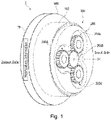
- Fig. 1 is a perspective view of a speed reducer 1 relating to a first embodiment.
- the speed reducer 1 is provided at a connection portion (joint portion) between arms that are rotatably connected together in industrial robots, for example.
- the speed reducer 1 reduces a drive torque inputted thereto from a motor serving as a power source (not shown) and outputs the reduced torque.
- the speed reducer 1 includes a casing 100 and a speed reduction mechanism 200.
- the casing 100 includes a body portion 102 and a flange portion 104.
- the flange portion 104 is shaped such that it extends outward in the radial direction from the body portion 102.
- the simple term “axial direction” refers to the direction extending along the axis O1 of the body portion 102.
- the term “radial direction” refers to the direction intersecting the axis O1 when viewed in the axial direction.
- the term “circumferential direction” refers to the direction extending around the axis O1.
- the term “input side” refers to the side of the speed reducer 1 connected to a drive source.
- output side refers to the side of the speed reducer 1 connected to a mechanical part such as an arm receiving the output from the speed reducer 1.
- the drive source is an example of a first member
- the mechanical part such as an arm is an example of a second member.
- the speed reducer 1 is configured to work between the first member and the second member and to change the number of rotations at a predetermined ratio and transmit a resulting driving force.
- the body portion 102 is an example of a first cylinder.
- the body portion 102 is shaped like a cylinder extending along the axis O1.
- the body portion 102 is open at the input side.
- the speed reduction mechanism 200 is housed rotatably.
- the body portion 102 has at the output side the flange portion 104 integrated therewith.
- the speed reducer 1 has, on the input side thereof, a plurality of (for example, three) transmission gears 200A and a single input gear 200B such that the gears are exposed.
- the display unit 70 is a display device shaped such that it can be attached onto the surface of the casing 100.
- the display unit 70 is, for example, a display device with a thickness of approximately 1 mm using an ultra-thin organic EL display or a sheet-type LED lighting device.
- the display unit 70 may be formed on the entire circumferential surface of the flange portion 104 but acceptable as long as it is formed on at least part of the circumferential surface, for example.
- the circumferential surface is the surface of the flange portion 104 that is exposed in the radial direction.
- Fig. 2 is a sectional view showing the configuration of the speed reducer 1 relating to the first embodiment.
- Fig. 3 is a sectional view taken along the line III-III in Fig. 2 .
- the input gear 200B corresponds to an input shaft 8.
- a crankshaft 10A is resultantly rotated.
- the crankshaft 10A has eccentric portions 10a and 10b.
- first and second oscillating gears 14 and 16 oscillatorily rotate. In this way, the speed reducer 1 can reduce rotation input thereto and output the reduced rotation.
- the speed reducer 1 includes an external cylinder 2 corresponding to the body portion 102 (the first cylinder), a carrier 4, which is an example second cylinder, the input shaft 8, a plurality of (for example, three) crankshafts 10A, the first oscillating gear 14, the second oscillating gear 16, and a plurality of (for example, three) transmission gears 20.
- the transmission gears 20 correspond to the transmission gears 200A in Fig. 1 .
- the external cylinder 2 is substantially shaped like a circular cylinder and constitutes the outer surface of the speed reducer 1.
- the external cylinder 2 has on the inner circumferential surface thereof a plurality of pin grooves 2b.
- the pin grooves 2b extend in the axial direction of the external cylinder 2.
- the pin grooves 2b have a semicircular sectional shape when cut along a plane orthogonal to the axial direction.
- the pin grooves 2b are arranged at equal intervals and next to each other in the circumferential direction on the inner circumferential surface of the external cylinder 2.
- the external cylinder 2 has a plurality of internal tooth pins 3.
- the internal tooth pins 3 are attached in the pin grooves 2b. More specifically, the internal-tooth pins 3 are fitted in the corresponding pin grooves 2b and retained therein such that they extend in the axial direction of the external cylinder 2. In this manner, the internal tooth pins 3 are arranged on the external cylinder 2 next to each other in the circumferential direction and at equal intervals.
- the internal tooth pins 3 mesh with first external teeth 14a of the first oscillating gear 14 and second external teeth 16a of the second oscillating gear 16.
- the carrier 4 is housed within the external cylinder 2 while being aligned with the external cylinder 2.
- the carrier 4 is rotatable relative to the external cylinder 2 (casing 100) about the same axis. More specifically, while being positioned inside the external cylinder 2 in the radial direction, the carrier 4 is supported via a pair of main bearings 6 such that the carrier 4 is rotatable relative to the external cylinder 2.
- the main bearings 6 are spaced apart from each other in the axial direction.
- the carrier 4 includes a base portion and an end plate 4b.
- the base portion includes a base plate 4a and a plurality of (for example, three) shaft portions 4c.
- the base plate 4a is arranged within the external cylinder 2 near one of the ends of the external cylinder 2 in the axial direction.
- the base plate 4a has a circular through-hole 4d at the center thereof in the radial direction.
- a plurality of (for example, three) crankshaft mounting holes 4e (hereinafter referred to simply as “the mounting holes 4e") are formed next to each other at equal intervals in the circumferential direction centered on the through hole 4d.
- the end plate 4b is spaced away from the base plate 4a in the axial direction and positioned in the external cylinder 2 near the other end of the external cylinder 2 in the axial direction.
- the end plate 4b has a through-hole 4f at the center thereof in the radial direction.
- a plurality of (for example, three) crankshaft mounting holes 4g (hereinafter referred to simply as “the mounting holes 4g") are formed next to each other at equal intervals in the circumferential direction centered around the through hole 4f.
- the mounting holes 4g are positioned such that they face the mounting holes 4e formed in the base plate 4a in the axial direction.
- a closed space is defined by the inner surfaces of the end and base plates 4b and 4a and the inner circumferential surface of the external cylinder 2.
- the three shaft portions 4c are integrated with the base plate 4a and extend linearly from the principal (inner) surface of the base plate 4a toward the end plate 4b.
- the three shaft portions 4c are arranged next to each other in the circumferential direction at equal intervals (see Fig. 3 ).
- the shaft portions 4c are fastened to the end plate 4b with bolts 4h (see Fig. 2 ). In this manner, the base plate 4a, shaft portions 4c and end plate 4b together constitute a single integral piece.
- the input shaft 8 serves as an input part for receiving a driving force input thereto from a driving motor (not shown).
- the input shaft 8 runs through the through hole 4f formed in the end plate 4b and the through hole 4d formed in the base plate 4a.
- the input shaft 8 is arranged such that its central axis is aligned with the central axis of the external cylinder 2 and the carrier 4.
- the input shaft 8 is rotatable about an axis.
- An input gear 8a is provided on the outer circumferential surface of the front end of the input shaft 8.
- the three crankshafts 10A are arranged, within the external cylinder 2, next to each other in the circumferential direction at equal intervals around the input shaft 8 (see Fig. 3 ).
- Each crankshaft 10A is supported by first and second crank bearings 12a and 12b such that it is rotatable about an axis relative to the carrier 4 (see Fig. 2 ). More specifically, the first crank bearing 12a is mounted on a portion of each crankshaft 10A that is at a predetermined distance from one of the ends of the crankshaft 10A in the axial direction inwardly.
- the first crank bearings 12a are mounted in the mounting holes 4e in the base plate 4a.
- the second crank bearing 12b is attached to the other end of each crankshaft 410 in the axial direction.
- crank bearings 12b are mounted in the mounting holes 4g in the end plate 4b. In this manner, the crankshafts 10A are rotatably supported by the base plate 4a and the end plate 4b.
- first and second crank bearings 12a and 12b may be simply referred to as the crank bearings 12a and 12b.
- Each crankshaft 10A includes a shaft body 12c, and a first eccentric portion 10a and a second eccentric portion 10b formed integrally with the shaft body 12c.
- the first and second eccentric portions 10a and 10b are provided on the shaft body 12c next to each other in the axial direction between the crank bearings 12a and 12b.
- the first and second eccentric portions 10a and 10b are shaped like a circular cylinder.
- the first and second eccentric portions 10a and 10b project radially outward from the shaft body 12c while being eccentrically arranged relative to the central axis of the shaft body 12c.
- the first and second eccentric portions 10a and 10b are offset from the central axis by predetermined amounts, while being arranged with a phase difference of a predetermined angle therebetween.
- each crankshaft 10A specifically, the portion mounted in the mounting hole 4e in the base plate 4a has a mating portion 10c to which the transmission gear 20 is mounted.
- the mating portion 10c is located outside the mounting hole 4e in the axial direction.
- the speed reducer 1 relating to the present embodiment is not limited to the case shown in Fig. 2 .
- the crankshafts 10A may be oriented oppositely in the axial direction.
- the mating portions 10c may be arranged outside the mounting holes 4g formed in the end plate 4b in the axial direction.
- the speed reducer 1 can be configured in a reverse assembly.
- the first oscillating gear 14 is disposed in the closed space within the external cylinder 2.
- the first oscillating gear 14 is mounted onto the first eccentric portion 10a of each crankshaft 10A via a first roller bearing 18a. As each crankshaft 10A rotates, the first eccentric portion 10a eccentrically rotates. The eccentric rotation results in the first oscillating gear 14 oscillatorily rotating while meshing with the internal tooth pins 3.
- the first oscillating gear 14 is sized such that it is slightly smaller than the inner diameter of the external cylinder 2.
- the first oscillating gear 14 has first external teeth 14a, a central through hole 14b, a plurality of (for example, three) first eccentric portion insertion holes 14c, and a plurality of (for example, three) shaft portion insertion holes 14d.
- the first external teeth 14a are shaped like smooth and continuous waves along the entire circumference of the first oscillating gear 14.
- the central through hole 14b is formed at the center of the first oscillating gear 14 in the radial direction.
- the central through hole 14b receives therein the input shaft 8 with a clearance therebetween.
- the three first eccentric portion insertion holes 14c are arranged around the central through hole 14b and arranged at equal intervals next to each other in the circumferential direction centered on the central through hole 14b.
- the first eccentric portions 10a of the crankshafts 10A are inserted in the first eccentric portion insertion holes 14c, via the first rolling bearings 18a interposed therebetween.
- the first roller bearings 18a are located between the inner wall of the first eccentric portion insertion holes 14c and the first eccentric portions 10a.
- the three shaft portion insertion holes 14d are provided in the first oscillating gear 14 and arranged at equal intervals next to each other in the circumferential direction around the central through hole 14b.
- the shaft portion insertion holes 14d are positioned between the first eccentric portion insertion holes 14c in the circumferential direction.
- the shaft portion insertion holes 14d receive therein the corresponding shaft portions 4c with a clearance therebetween.
- the second oscillating gear 16 is disposed in the closed space inside the external cylinder 2.
- the second oscillating gear 16 is mounted onto the second eccentric portion 10b of each crankshaft 10A via a second roller bearing 18b.
- the first and second oscillating gears 14 and 16 are next to each other in the axial direction correspondingly to the first and second eccentric portions 10a and 10b.
- the second eccentric portion 10b eccentrically rotates.
- the eccentric rotation results in the second oscillating gear 16 oscillatorily rotating while meshing with the internal tooth pins 3.
- the second oscillating gear 16 is sized such that it is slightly smaller than the inner diameter of the external cylinder 2 and configured in the same manner as the first oscillating gear 14.
- the second oscillating gear 16 has second external teeth 16a, a central through hole 16b, a plurality of (for example, three) second eccentric portion insertion holes 16c, and a plurality of (for example, three) shaft portion insertion holes 16d.
- These constituents are designed in the same manner as the first external teeth 14a, the central through hole 14b, the first eccentric portion insertion holes 14c, and the shaft portion insertion holes 14d of the first oscillating gear 14.
- the second eccentric portions 10b of the crankshafts 10A are inserted in the second eccentric portion insertion holes 16c, via the second rolling bearings 18b interposed therebetween.
- the second roller bearings 18b are located between the inner wall of the second eccentric portion insertion holes 16c and the second eccentric portions 10b.
- Each transmission gear 20 transmits the rotation of the input gear 8a to the corresponding one of the crankshafts 10A.
- Each transmission gear 20 is fitted onto the mating portion 10c of the shaft body 12c of the corresponding crankshaft 10A.
- Each transmission gear 20 is rotatable integrally with the crankshaft 10A around the same axis as the crankshaft 10A.
- Each transmission gear 20 has external teeth 20a meshing with the input gear 8a.
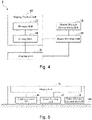
- Fig. 4 is a block diagram showing an example functional configuration of the speed reducer 1 relating to the first embodiment.
- the speed reducer 1 includes a display unit 70, a display control unit 60, a power storage unit 30 and a power feeding unit 40.
- the display unit 70 is configured to display notification information.
- the notification information is, for example, information notified to a user of the speed reducer 1 or a mechanism using the speed reducer 1 when seen by the user.
- the notification information is, for example, static information indicating the manufacturer or advertisement of the speed reducer 1, or dynamic information indicating the state of the speed reducer 1 or a mechanism connected to the speed reducer 1.
- the static information is information that does not change over a period of time during which the speed reducer 1 is in use.
- the dynamic information is information that changes over a period of time during which the speed reducer 1 is in use.
- the dynamic information is information related to the temperature of the speed reducer 1, the load on the speed reducer 1, the temperature and load of the mechanism connected to the speed reducer 1, and the distance between the speed reducer 1 and the target object.
- the target object is an object that is placed in the vicinity of the speed reducer 1, such as a person.
- Advertisement information is, for example, information regarding the manufacturer's sales promotion (e.g., information about an exhibition), information about a new type of the speed reducer 1, or amusing videos.
- the display control unit 60 includes a storage unit 22 and a drive unit 24.
- the storage unit 22 is, for example, RAM or flash memory, and configured to store notification information.
- the drive unit 24 is configured to read the notification information stored in the storage unit 22 and sends to the display unit 70 a signal based on the notification information, so that the display unit 70 is operated.
- the display unit 70 starts or stops displaying the notification information, changes the contents of the notification information, changes the manner such as the color and size in which the notification information is displayed, and changes where the notification information is displayed.
- the power storage unit 30 includes a battery for storing self-generated power or power supplied thereto from outside the speed reducer 1.
- the battery can be a capacitor (including an electric double-layer capacitor) or rechargeable battery (e.g., a lithium-ion battery, a solid-state lithium-ion battery, an air battery, etc.).
- the power feeding unit 40 is configured to feed the power stored in the power storage unit 30 to the display unit 70 and the display control unit 60.
- the power storage unit 30 When configured to generate power on its own, the power storage unit 30 converts the energy present in the environment surrounding the speed reducer 1 (the ambient environment) into electric power (so-called energy harvesting).
- the power storage unit 30 feeds power to be used to operate the display unit 70, the display control unit 60, and the power feeding unit 40.
- the power storage unit 30 may generate power based on at least one selected from the group consisting of the temperature, the humidity, the radio waves such as Wi-Fi, and the electromagnetic waves, vibrations, sound, light, and fluid or powder flows (wind, waves, etc.) originating from the surroundings of the speed reducer 1.
- the electromagnetic waves include radiation and cosmic rays, as well as electromagnetic noise from electric motors and the like.
- the sound includes ultrasonic waves.
- the light includes visible light, infrared light, and ultraviolet light.
- the power storage unit 30 When configured to generate power on its own, the power storage unit 30 is configured to be capable of efficiently absorbing such energy. For example, when configured to absorb light to generate power, the power storage unit 30 is attached onto the exposed surface of the speed reducer 1.
- Fig. 5 shows, for example, how the display unit 70 and other units are mounted in the first embodiment.
- the display unit 70 is placed on the exterior of the speed reducer 1, so that the notification information is externally exposed through the surface of the speed reducer 1.
- the display control unit 60, power storage unit 30, and power feeding unit 40 are interposed between the display unit 70 and the surface of the flange portion 104.
- the speed reducer 1 relating to the present embodiment includes the casing 100 and the carrier 4 rotatable relative to the casing 100.
- the speed reducer 1 further includes the speed reduction mechanism 200 and the display unit 70.
- the speed reduction mechanism 200 is provided in the casing 100 and configured to reduce the rotation input thereto from a drive source and outputs the reduced rotation, and the display unit 70 is shaped such that it can be attached onto the surface of the casing 100 and configured to display the notification information. Since the above-described speed reducer 1 can display the notification information on its surface, the speed reducer 1 can be easily checked by observing its appearance.
- the speed reducer 1 relating to the present embodiment includes the speed reduction mechanism 200 and the display unit 70 for displaying the notification information.
- the speed reduction mechanism 200 is a gear device for changing the number of rotations at a predetermined ratio and transmitting a driving force between a first member and a second member.
- the speed reduction mechanism 200 includes an eccentric portion (10a, 10b), an oscillating gear (14, 16) having an insertion hole (14c, 16c) through which the eccentric portion is inserted and teeth (14a, 16a), a first cylinder (2, 102) mountable on one of the first and second members, and a second cylinder (4) mountable on the other of the first and second members.
- the first cylinder (2, 102) has internal teeth (3) meshing with the teeth of the oscillating gear.
- the second cylinder (4) is positioned inside the first cylinder in the radial direction while holding the oscillating gear.
- the first and second cylinders are concentrically rotatable relative to each other when acted upon by oscillation of the oscillating gear caused by rotation of the eccentric portion.
- the display unit (70) is shaped such that it can be attached onto the surface of the casing 100. Since the speed reducer 1 has the above-described features, the notification information is displayed on the surface of the speed reducer 1. Accordingly, the speed reducer 1 can be easily checked by observing its appearance.
- the display unit 70 is configured to output information.
- the present embodiment is not limited to such.
- a speaker for outputting the information using sound, a projector for projecting the information using light, or other output units can be used as long as they can stimulate the perception of the user.
- the display unit 70 may be formed on at least part of the surface of the casing 100 so as to extend circumferentially along the surface of the casing 100.
- the casing 100 may include the body portion 102 and the flange portion 104.
- the body portion 102 is shaped cylindrically, and the flange portion 104 is shaped such that the flange portion 104 projects outwardly in the radial direction from the body portion 102.
- the display unit 70 may be formed on at least part of the surface of the flange portion 104.
- the notification information can be displayed on the flange portion 104, which constitutes the external edge of the speed reducer 1. Accordingly, the speed reducer 1 can be easily checked by observing its appearance.
- the notification information is related to the manufacturer or advertisement for the speed reducer 1. Accordingly, the speed reducer 1 allows a user to easily check the manufacturer or advertisement for the speed reducer 1 by observing its appearance. Furthermore, the speed reducer 1 can save the user from confusing the manufacturer of the speed reducer 1 with other speed reducer manufacturers.
- Fig. 6 is a front view showing the flange portion 104 of the speed reducer 1 relating to the first embodiment in the axial direction.
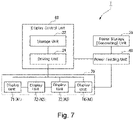
- Fig. 7 is a block diagram showing another example of the speed reducer 1 relating to the first embodiment.
- the display unit 70 is formed over the entire circumferential surface of the flange portion 104 and is divided into a plurality of display areas A1, A2, A3 and A4.
- the display areas A1, A2, A3 and A4 are obtained by dividing the flange portion 104 into four regions of the same area in the circumferential direction.
- the display unit 70 includes a display unit 71 corresponding to the display area A1, a display unit 72 corresponding to the display area A2, a display unit 73 corresponding to the display area A3, and a display unit 74 corresponding to the display area A4.
- the display unit 70 can control what is displayed on the display units 71 to 74 under the control of the drive unit 24.
- Controlling what is displayed on the display units 71 to 74 includes, for example, controlling the respective display units 71 to 74 to start or suspend displaying the notification information, controlling whether or not the notification information is displayed on the respective display units 71 to 74, controlling the display units 71 to 74 to display the notification information of different contents, controlling the display units 71 to 74 to display the notification information in different manners such as different colors and sizes, and controlling the display units 71 to 74 to display the notification information at different positions.
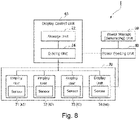
- Fig. 8 is a block diagram showing another example of the speed reducer 1 relating to the first embodiment.
- the speed reducer 1 may control what is displayed on the display units 71 to 74 based on sensor inputs, or based on user inputs.
- the display units 71 to 74 may have sensors corresponding to the display areas A1, A2, A3 and A4. The sensors are, for example, configured to detect how or whether the user touches the corresponding display areas or how bright the corresponding display areas are.
- the display unit 70 may control the display units 71 to 74 such that the notification information is displayed on the display area where the user's touch is detected but not displayed on the display area where the user's touch is not detected.
- the display unit 70 may control the display units 71 to 74 such that the notification information is displayed in any of the display areas if the sensors detect that the display area is brighter than a threshold value but not displayed in any of the display areas if the sensors detect that the display area is not brighter than the threshold value.
- the display areas may be provided respectively on a plurality of speed reducers 1.
- an industrial robot or the like may have a pair of rotatably coupled arms and the arms have a plurality of joints.
- the joints may each have the speed reducer 1
- each speed reducer 1 may have the display unit 70.
- Each speed reducer 1 may perform short-range wireless communication with the display control unit 60 so that the speed reducers 1 may collaborate with each other when displaying the notification information.
- the display unit 70 can change the contents of the notification information. This allows the speed reducer 1 to change what the user is notified of. Furthermore, according to the present embodiment, the display unit 70 can change which one of the display areas is to display the notification information. This makes it possible to display the notification information in the display area exposed to the user, for example. Accordingly, the speed reducer 1 can be easily checked by observing its appearance.
- the speed reducer 1 of the present embodiment includes a power generation unit (power storage unit 30) for generating power used to operate the display unit 70, no additional wirings are needed to attach the display unit 70 to the speed reducer 1.
- a power generation unit power storage unit 30
- the display unit 70 is formed on the drive source or on an external mechanism such as an arm to which the rotation output from the carrier 4 is input.
- the external mechanism is connected to the carrier (transmitting unit) 4, but the present embodiment is not limited to such.
- the carrier 4 is fixedly attached to the flange portion 104, it may be the rotation of the flange portion 104 that is transmitted to the external mechanism.
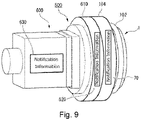
- Fig. 9 is a perspective view showing an example of an actuator 500 including the speed reducer 1 relating to the second embodiment and a motor 600 serving as the drive source.
- the motor 600 is connected to the speed reducer 1.
- the speed reducer 1 outputs and transmits the rotation of the motor 600.
- the motor 600 includes a casing 610.
- a display unit 620 is formed on a portion of the casing 610 that is connected to the speed reducer 1.
- a display unit 630 is formed on the side surface of the casing 610.
- Fig. 10 is a block diagram showing the functional configuration of the speed reducer 1 relating to the second embodiment.
- the power feeding unit 40 feeds power to be used to operate display units 620 and 630.
- the display control unit 60 drives the display units 620 and 630 on the motor 600, so that the display units 620 and 630 can display the notification information.
- the power feeding unit 40 may include the power storage unit 30, but the present embodiment is not limited to such.
- the power feeding unit 40 may distribute power from a motor power supply unit 640 to the display unit 70, the display control unit 60, and the display units 620 and 630.
- the motor power supply unit 640 serves as a power supply unit for controlling the power used to drive the motor 600.
- the display units 620 and 630 can be provided on the motor 600 or arm connected to the speed reducer 1. Accordingly, the second embodiment can provide an increased display area. As configured in the above manner, the speed reducer 1 relating to the second embodiment and the motor 600 can be more easily checked by observing their appearance.
- the display unit 70 can be operated using the power fed from the motor power supply unit 640, which is configured to control the driving power for the motor 600.
- the second embodiment thus can eliminate the need of providing power generators and additional power sources for the display unit 70.
- the display control unit 60 may control what is displayed on the display units 70, 620 and 630.
- the display control unit 60 may change whether or not the notification information is displayed, the contents of the notification information based on, for example, where the display units are positioned, how bright the display units are, and how the user touches the display units.
- the display control unit 60 may control the display units to display red when the temperature of the speed reducer 1 or motor 600 is higher than a predetermined value and to display blue when the temperature of the speed reducer 1 or motor 600 is lower than a predetermined value.
- the display control unit 60 may control the display units to display different colors in predetermined units (for example, in 10-degree increments).
- the display unit 70 of the speed reducer 1 is configured to display, as the notification information, information related to the temperature and load on the speed reducer 1.
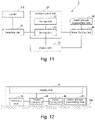
- Fig. 11 is a block diagram showing an example configuration of the speed reducer 1 relating to the third embodiment.
- the speed reducer 1 relating to the third embodiment has a detecting unit 50 for detecting information related to the temperature or load on the speed reducer 1.
- Fig. 12 shows, for example, how the display unit 70 and other units are mounted in the third embodiment.
- the detecting unit 50 is provided on the flange portion 104 of the speed reducer 1 and is a temperature sensor for detecting the temperature of the flange portion 104.
- the detecting unit 50 sends a signal corresponding to the detected temperature to the drive unit 24.
- the drive unit 24 operates the display unit 70 based on the signal sent thereto, so that the display unit 70 can display the temperature of the speed reducer 1.
- the detecting unit 50 may be a vibration sensor for detecting whether the flange portion 104 vibrates.
- the vibration of the flange portion 104 is indicative of the load on the speed reducer 1, for example.
- the detecting unit 50 sends a signal corresponding to the detected vibration to the drive unit 24.
- the drive unit 24 operates the display unit 70 based on the signal sent thereto, so that the display unit 70 can display the load on the speed reducer 1.
- the drive unit 24 may control the display unit 70 to display the temperature and load on the speed reducer 1 in numerical values.
- the present embodiment is not limited to such, and the temperature and load on the speed reducer 1 may be displayed in colors.
- the display control unit 60 may control the display unit 70 to display red when the load on the speed reducer 1 or motor 600 is higher than a predetermined value and to display blue when the load on the speed reducer 1 or motor 600 is lower than a predetermined value.
- the display control unit 60 may control the display unit 70 to display yellow when the load on the speed reducer 1 or motor 600 is within the range between these predetermined values or to display different colors depending on the ranges. Furthermore, the display control unit 60 may convert the load on the speed reducer 1 and motor 600 into a threat level, and different threat levels may be displayed in different colors. Furthermore, the display control unit 60 may control the display unit 70 to display the likelihood of failures determined by the temperature and load on the speed reducer 1 and motor 600. In this case, the display control unit 60 may control the display unit 70 to change the color indicative of the likelihood of failures in the order of blue, yellow and green as the likelihood of failures increases.
- Fig. 13 is a block diagram showing an example configuration of the speed reducer 1 relating to the third embodiment.
- the detecting unit 50 detects information related to the temperature and load on the motor 600.
- the display unit 70 may display, as the notification information, information related to the temperature and load on the motor 600, which is an external mechanism connected to the speed reducer 1.
- the speed reducer 1 may display notification information relating to the motor 600, in addition to the notification information related to the speed reducer 1.
- the speed reducer 1 may display notification information related to the motor 600, in place of the notification information related to the speed reducer 1.
- the detecting unit 50 may detect information regarding the distance between the speed reducer 1 and a target object.
- the display unit 70 may display, as the notification information, information related to the distance between the speed reducer 1 and the target object.
- the detecting unit 50 may be a distance or proximity sensor such as a camera device for producing information related to the distance.
- the speed reducer 1 may display the distance detected by the distance sensor, for example. In this case, when the distance sensor detects a distance equal to or less than a predetermined value, the speed reducer 1 may display information related to warning or output sound. For example, the speed reducer 1 may display information related to warning or output sound when a proximity sensor detects a person.
- any distance sensors can be used as long as they can measure the distance between the speed reducer 1 and the target object.
- the distance sensor may use infrared rays, ultrasonic waves, laser or any known techniques.
- Any proximity sensors can be used as long as they can detect a person is within a predetermined range from the speed reducer 1.
- any known proximity sensors such as induction-, capacitance- and magnetic-type proximity sensors can be used.
- the speed reducer 1 relating to the third embodiment can display information related to the temperature and load on the speed reducer 1, and information related to the temperature and load on the external mechanism such as the motor 600 and arms.
- the speed reducer 1 can be thus easily checked and allow the user to check information related to its temperature and load.
- the speed reducer 1 relating to the third embodiment can display the information related to the distance between the speed reducer 1 and the target object. Accordingly, the speed reducer 1 can be further easily checked by observing its appearance.
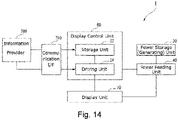
- Fig. 14 is a block diagram showing an example configuration of a speed reducer 1 relating to a fourth embodiment.
- the speed reducer 1 relating to the fourth embodiment is communicatively connected to an information provider 700 via, for example, a communication network.
- the speed reducer 1 includes a communication interface (I/F) 710 for communicating with the information provider 700.
- the information provider 700 is an information server managed by the manufacturer of the speed reducer 1, the maintenance company of the speed reducer 1, or the purchaser or user of the speed reducer 1.
- the communication interface 710 is a Network Interface Card (NIC) or wireless communication module.
- the communication network is, for example, the Internet, Wide Area Network (WAN), or Local Area Network (LAN), cellular network, etc.
- the speed reducer 1 may update the notification information stored in the storage unit 22 based on instructions sent from the information provider. Furthermore, the speed reducer 1 may control the drive unit 24 to change the notification information to be displayed, based on instructions sent from the information provider.
- the speed reducer 1 relating to the fourth embodiment may transmit, via the communication interface 710, information related to the temperature and load on the speed reducer 1 and motor 600 to the information provider 700.
- the storage unit 22 may store notification information corresponding to the information related to the temperature and load on the speed reducer 1 and the motor 600 sent from the information provider 700, and the display unit 70 may display the stored notification information.
- the speed reducer 1 can send the information related to the temperature and load on the speed reducer 1 and motor 600 transmitted from the information provider 700, to the terminal owned by the manufacturer of the speed reducer 1, the maintenance company of the speed reducer 1, or the purchaser or user of the speed reducer 1 for the purposes of feedback.
- a speed reducer including:
Landscapes
- Engineering & Computer Science (AREA)
- General Engineering & Computer Science (AREA)
- Mechanical Engineering (AREA)
- Physics & Mathematics (AREA)
- General Physics & Mathematics (AREA)
- Theoretical Computer Science (AREA)
- Business, Economics & Management (AREA)
- Accounting & Taxation (AREA)
- Marketing (AREA)
- Retarders (AREA)
- General Details Of Gearings (AREA)
- Soil Working Implements (AREA)
- Valve Device For Special Equipments (AREA)
- Gear Transmission (AREA)
- Friction Gearing (AREA)
Abstract
Description
- The present invention relates to a speed reducer.
- In the conventional art, rotary advertising lights for vehicles are known as disclosed in, for example,
Patent Literature 1. In the disclosed rotary advertising light for vehicles, a motor and a speed reducer are contained in a case. The case is surrounded by an annular fluorescent lamp. At the upper end of the main shaft of the speed reducer, the central part of the cylindrical rotary advertising light is fixedly attached. The rotary advertising light externally surrounds the motor, speed reducer and fluorescent lamp. The rotary advertising light is externally covered by a transparent outer cylinder. Such rotary advertising lights for vehicles can rotate to produce advertising effects. - Patent Literature 1:
Japanese Patent Application Publication No. S63-081388 - The above-described rotary advertising lights for vehicles use speed reducers. When speed reducers are mounted on a variety of devices, it is often difficult to check the speed reducers by observing their appearances.
- The present invention is made in view of the above, and an object of the present invention is to provide a speed reducer that can be easily checked by observing its appearance.
- (1) One aspect of the present invention provides a speed reducer including a casing, a speed reduction mechanism provided in the casing, where the speed reduction mechanism is configured to reduce rotation input thereto from a drive source and output the reduced rotation, and a display unit shaped such that the display unit is attached onto a surface of the casing, where the display unit is configured to display notification information. The speed reduction mechanism includes a transmitting unit rotatably provided on the casing.
- (2) In the above speed reducer, the display unit may be formed on at least part of the surface of the casing so as to extend circumferentially along the surface of the casing.
- (3) In the above speed reducer, the casing may include a body portion having a cylindrical shape, and a flange portion shaped such that the flange portion projects outward in a radial direction from the body portion. The display unit may be formed on at least part of a surface of the flange portion.
- (4) In the above speed reducer, the display unit may be formed on the drive source or on an external mechanism to which rotation output from the transmitting unit is input.
- (5) In the above speed reducer, the notification information may be related to a manufacturer or advertisement of the speed reducer.
- (6) In the above speed reducer, the notification information may be related to a temperature of the speed reducer.
- (7) In the above speed reducer, the notification information may be related to a load on the speed reducer.
- (8) In the above speed reducer, the notification information may be related to a temperature of the external mechanism.
- (9) In the above speed reducer, the notification information may be related to a load on the external mechanism.
- (10) In the above speed reducer, the notification information may be related to a distance between the speed reducer and a target object.
- (11) In the above speed reducer, the display unit may change contents of the notification information.
- (12) In the above speed reducer, the display unit may change regions in which the notification information is displayed.
- (13) The above speed reducer may include a power generating unit for generating power to be used to operate the display unit.
- (14) In the above speed reducer, the display unit may be operated using power from a power supply unit for controlling power to drive the drive source.
- (15) One aspect of the present invention provides a speed reducer including a speed reduction mechanism for changing the number of rotations at a predetermined ratio and transmitting a driving force between a first member and a second member, where the speed reduction mechanism is a gear device, and a display unit for displaying notification information. The speed reduction mechanism includes an eccentric portion, an oscillating gear having an insertion hole into which the eccentric portion is inserted, where the oscillating gear has teeth, a first cylinder mountable on one of the first and second members, and a second cylinder mountable on the other of the first and second members. The first cylinder has internal teeth meshing with the teeth of the oscillating gear. The second cylinder is positioned inside the first cylinder in the radial direction while holding the oscillating gear. The first and second cylinders are concentrically rotatable relative to each other when acted upon by oscillation of the oscillating gear caused by rotation of the eccentric portion. The display unit is shaped such that the display unit is attached onto a surface of the first cylinder.
- (16) One aspect of the present invention provides a speed reducer including a first cylinder having a body portion and a flange portion, where the body portion is shaped cylindrically, and the flange portion is shaped such that the flange portion projects outward in a radial direction from the body portion, a speed reduction mechanism for changing the number of rotations at a predetermined ratio and transmitting a driving force between a first member and a second member, where the speed reduction mechanism is a gear device, and a display unit attached onto at least part of a surface of the flange portion so as to extend circumferentially along the surface of the flange portion, where the display unit is configured to display manufacturer or advertising information for the speed reducer. The speed reduction mechanism includes an eccentric portion, and an oscillating gear having an insertion hole into which the eccentric portion is inserted, where the oscillating gear has teeth. The first cylinder is mountable on one of the first and second members and has internal teeth meshing with the teeth of the oscillating gear. The speed reduction mechanism further includes a second cylinder mountable on the other of the first and second members. The second cylinder is positioned inside the first cylinder in the radial direction while holding the oscillating gear. The first and second cylinders are concentrically rotatable relative to each other when acted upon by oscillation of the oscillating gear caused by rotation of the eccentric portion.
- The above-described speed reducers can be easily inspected by observing their appearance.
-
-
Fig. 1 is a perspective view showing an example of a speed reducer relating to a first embodiment. -
Fig. 2 is a sectional view of the speed reducer relating to the first embodiment. -
Fig. 3 is a sectional view taken along the line III-III inFig. 2 . -
Fig. 4 is a block diagram showing an example functional configuration of the speed reducer relating to the first embodiment. -
Fig. 5 shows, for example, how a display unit and other units are mounted in the first embodiment. -
Fig. 6 is a front view showing a flange portion of the speed reducer relating to the first embodiment in an axial direction. -
Fig. 7 is a block diagram showing another example of the speed reducer relating to the first embodiment. -
Fig. 8 is a block diagram showing another example of the speed reducer relating to the first embodiment. -
Fig. 9 is a perspective view showing an example of an actuator including a speed reducer relating to a second embodiment and a motor serving as a drive source. -
Fig. 10 is a block diagram showing the functional configuration of the speed reducer relating to the second embodiment. -
Fig. 11 is a block diagram showing an example configuration of a speed reducer relating to a third embodiment. -
Fig. 12 shows, for example, how a display unit and other units are mounted in the third embodiment. -
Fig. 13 is a block diagram showing an example configuration of the speed reducer relating to the third embodiment. -
Fig. 14 is a block diagram showing an example configuration of a speed reducer relating to a fourth embodiment. - The following now describes in detail a speed reducer and a display device for a speed reducer relating to embodiments of the present invention with reference to the drawings. In the following description of the embodiments, which may have corresponding elements, such corresponding elements will be denoted by the same reference numerals in all of the embodiments and may not be repeatedly described. In the following description, such terms as "parallel," "orthogonal," "center" and "coaxial" may appear to describe relative or absolute positions. These terms are not only strictly used but also allow some tolerances and relative differences in angle and distance as long as the same effects can be still produced.
-
Fig. 1 is a perspective view of aspeed reducer 1 relating to a first embodiment. Thespeed reducer 1 is provided at a connection portion (joint portion) between arms that are rotatably connected together in industrial robots, for example. Thespeed reducer 1 reduces a drive torque inputted thereto from a motor serving as a power source (not shown) and outputs the reduced torque. - The
speed reducer 1 includes acasing 100 and aspeed reduction mechanism 200. Thecasing 100 includes abody portion 102 and aflange portion 104. Theflange portion 104 is shaped such that it extends outward in the radial direction from thebody portion 102. In the description of the embodiment, the simple term "axial direction" refers to the direction extending along the axis O1 of thebody portion 102. The term "radial direction" refers to the direction intersecting the axis O1 when viewed in the axial direction. The term "circumferential direction" refers to the direction extending around the axis O1. The term "input side" refers to the side of thespeed reducer 1 connected to a drive source. The term "output side" refers to the side of thespeed reducer 1 connected to a mechanical part such as an arm receiving the output from thespeed reducer 1. The drive source is an example of a first member, and the mechanical part such as an arm is an example of a second member. Thespeed reducer 1 is configured to work between the first member and the second member and to change the number of rotations at a predetermined ratio and transmit a resulting driving force. - The
body portion 102 is an example of a first cylinder. Thebody portion 102 is shaped like a cylinder extending along the axis O1. Thebody portion 102 is open at the input side. In the opening of thebody portion 102, thespeed reduction mechanism 200 is housed rotatably. Thebody portion 102 has at the output side theflange portion 104 integrated therewith. Thespeed reducer 1 has, on the input side thereof, a plurality of (for example, three) transmission gears 200A and asingle input gear 200B such that the gears are exposed. - To the
flange portion 104, adisplay unit 70 is attached. Thedisplay unit 70 is a display device shaped such that it can be attached onto the surface of thecasing 100. Thedisplay unit 70 is, for example, a display device with a thickness of approximately 1 mm using an ultra-thin organic EL display or a sheet-type LED lighting device. Thedisplay unit 70 may be formed on the entire circumferential surface of theflange portion 104 but acceptable as long as it is formed on at least part of the circumferential surface, for example. The circumferential surface is the surface of theflange portion 104 that is exposed in the radial direction. -
Fig. 2 is a sectional view showing the configuration of thespeed reducer 1 relating to the first embodiment.Fig. 3 is a sectional view taken along the line III-III inFig. 2 . In thespeed reducer 1 relating to the present embodiment, theinput gear 200B corresponds to aninput shaft 8. As theinput shaft 8 is rotated, acrankshaft 10A is resultantly rotated. Thecrankshaft 10A haseccentric portions eccentric portions speed reducer 1 can reduce rotation input thereto and output the reduced rotation. - As shown in
Figs. 2 and3 , thespeed reducer 1 includes anexternal cylinder 2 corresponding to the body portion 102 (the first cylinder), a carrier 4, which is an example second cylinder, theinput shaft 8, a plurality of (for example, three)crankshafts 10A, the first oscillatinggear 14, the secondoscillating gear 16, and a plurality of (for example, three) transmission gears 20. The transmission gears 20 correspond to the transmission gears 200A inFig. 1 . - The
external cylinder 2 is substantially shaped like a circular cylinder and constitutes the outer surface of thespeed reducer 1. Theexternal cylinder 2 has on the inner circumferential surface thereof a plurality ofpin grooves 2b. Thepin grooves 2b extend in the axial direction of theexternal cylinder 2. Thepin grooves 2b have a semicircular sectional shape when cut along a plane orthogonal to the axial direction. Thepin grooves 2b are arranged at equal intervals and next to each other in the circumferential direction on the inner circumferential surface of theexternal cylinder 2. - The
external cylinder 2 has a plurality of internal tooth pins 3. The internal tooth pins 3 are attached in thepin grooves 2b. More specifically, the internal-tooth pins 3 are fitted in thecorresponding pin grooves 2b and retained therein such that they extend in the axial direction of theexternal cylinder 2. In this manner, the internal tooth pins 3 are arranged on theexternal cylinder 2 next to each other in the circumferential direction and at equal intervals. The internal tooth pins 3 mesh with firstexternal teeth 14a of the first oscillatinggear 14 and secondexternal teeth 16a of the secondoscillating gear 16. - The carrier 4 is housed within the
external cylinder 2 while being aligned with theexternal cylinder 2. The carrier 4 is rotatable relative to the external cylinder 2 (casing 100) about the same axis. More specifically, while being positioned inside theexternal cylinder 2 in the radial direction, the carrier 4 is supported via a pair ofmain bearings 6 such that the carrier 4 is rotatable relative to theexternal cylinder 2. Themain bearings 6 are spaced apart from each other in the axial direction. - The carrier 4 includes a base portion and an
end plate 4b. The base portion includes abase plate 4a and a plurality of (for example, three)shaft portions 4c. - The
base plate 4a is arranged within theexternal cylinder 2 near one of the ends of theexternal cylinder 2 in the axial direction. Thebase plate 4a has a circular through-hole 4d at the center thereof in the radial direction. Around the throughhole 4d, a plurality of (for example, three)crankshaft mounting holes 4e (hereinafter referred to simply as "the mountingholes 4e") are formed next to each other at equal intervals in the circumferential direction centered on the throughhole 4d. - The
end plate 4b is spaced away from thebase plate 4a in the axial direction and positioned in theexternal cylinder 2 near the other end of theexternal cylinder 2 in the axial direction. Theend plate 4b has a through-hole 4f at the center thereof in the radial direction. Around the throughhole 4f, a plurality of (for example, three)crankshaft mounting holes 4g (hereinafter referred to simply as "the mountingholes 4g") are formed next to each other at equal intervals in the circumferential direction centered around the throughhole 4f. The mountingholes 4g are positioned such that they face the mountingholes 4e formed in thebase plate 4a in the axial direction. Inside theexternal cylinder 2, a closed space is defined by the inner surfaces of the end andbase plates external cylinder 2. - The three
shaft portions 4c are integrated with thebase plate 4a and extend linearly from the principal (inner) surface of thebase plate 4a toward theend plate 4b. The threeshaft portions 4c are arranged next to each other in the circumferential direction at equal intervals (seeFig. 3 ). Theshaft portions 4c are fastened to theend plate 4b withbolts 4h (seeFig. 2 ). In this manner, thebase plate 4a,shaft portions 4c andend plate 4b together constitute a single integral piece. - The
input shaft 8 serves as an input part for receiving a driving force input thereto from a driving motor (not shown). Theinput shaft 8 runs through the throughhole 4f formed in theend plate 4b and the throughhole 4d formed in thebase plate 4a. Theinput shaft 8 is arranged such that its central axis is aligned with the central axis of theexternal cylinder 2 and the carrier 4. Theinput shaft 8 is rotatable about an axis. Aninput gear 8a is provided on the outer circumferential surface of the front end of theinput shaft 8. - The three
crankshafts 10A are arranged, within theexternal cylinder 2, next to each other in the circumferential direction at equal intervals around the input shaft 8 (seeFig. 3 ). Eachcrankshaft 10A is supported by first and second crankbearings Fig. 2 ). More specifically, the first crankbearing 12a is mounted on a portion of eachcrankshaft 10A that is at a predetermined distance from one of the ends of thecrankshaft 10A in the axial direction inwardly. Thefirst crank bearings 12a are mounted in the mountingholes 4e in thebase plate 4a. The second crank bearing 12b is attached to the other end of each crankshaft 410 in the axial direction. Thesecond crank bearings 12b are mounted in the mountingholes 4g in theend plate 4b. In this manner, thecrankshafts 10A are rotatably supported by thebase plate 4a and theend plate 4b. In the following description, the first and second crankbearings crank bearings - Each
crankshaft 10A includes ashaft body 12c, and a firsteccentric portion 10a and a secondeccentric portion 10b formed integrally with theshaft body 12c. The first and secondeccentric portions shaft body 12c next to each other in the axial direction between thecrank bearings eccentric portions eccentric portions shaft body 12c while being eccentrically arranged relative to the central axis of theshaft body 12c. The first and secondeccentric portions - One of the ends of each
crankshaft 10A, specifically, the portion mounted in the mountinghole 4e in thebase plate 4a has amating portion 10c to which thetransmission gear 20 is mounted. Themating portion 10c is located outside the mountinghole 4e in the axial direction. Thespeed reducer 1 relating to the present embodiment is not limited to the case shown inFig. 2 . For example, thecrankshafts 10A may be oriented oppositely in the axial direction. In this case, themating portions 10c may be arranged outside the mountingholes 4g formed in theend plate 4b in the axial direction. In other words, thespeed reducer 1 can be configured in a reverse assembly. - The first
oscillating gear 14 is disposed in the closed space within theexternal cylinder 2. The firstoscillating gear 14 is mounted onto the firsteccentric portion 10a of eachcrankshaft 10A via afirst roller bearing 18a. As eachcrankshaft 10A rotates, the firsteccentric portion 10a eccentrically rotates. The eccentric rotation results in the first oscillatinggear 14 oscillatorily rotating while meshing with the internal tooth pins 3. - The first
oscillating gear 14 is sized such that it is slightly smaller than the inner diameter of theexternal cylinder 2. The firstoscillating gear 14 has firstexternal teeth 14a, a central throughhole 14b, a plurality of (for example, three) first eccentricportion insertion holes 14c, and a plurality of (for example, three) shaftportion insertion holes 14d. The firstexternal teeth 14a are shaped like smooth and continuous waves along the entire circumference of the first oscillatinggear 14. - The central through
hole 14b is formed at the center of the first oscillatinggear 14 in the radial direction. The central throughhole 14b receives therein theinput shaft 8 with a clearance therebetween. - The three first eccentric
portion insertion holes 14c are arranged around the central throughhole 14b and arranged at equal intervals next to each other in the circumferential direction centered on the central throughhole 14b. The firsteccentric portions 10a of thecrankshafts 10A are inserted in the first eccentricportion insertion holes 14c, via thefirst rolling bearings 18a interposed therebetween. Thefirst roller bearings 18a are located between the inner wall of the first eccentricportion insertion holes 14c and the firsteccentric portions 10a. - The three shaft
portion insertion holes 14d are provided in the first oscillatinggear 14 and arranged at equal intervals next to each other in the circumferential direction around the central throughhole 14b. The shaftportion insertion holes 14d are positioned between the first eccentricportion insertion holes 14c in the circumferential direction. The shaftportion insertion holes 14d receive therein the correspondingshaft portions 4c with a clearance therebetween. - The second
oscillating gear 16 is disposed in the closed space inside theexternal cylinder 2. The secondoscillating gear 16 is mounted onto the secondeccentric portion 10b of eachcrankshaft 10A via asecond roller bearing 18b. The first and second oscillating gears 14 and 16 are next to each other in the axial direction correspondingly to the first and secondeccentric portions crankshaft 10A rotates, the secondeccentric portion 10b eccentrically rotates. The eccentric rotation results in the secondoscillating gear 16 oscillatorily rotating while meshing with the internal tooth pins 3. - The second
oscillating gear 16 is sized such that it is slightly smaller than the inner diameter of theexternal cylinder 2 and configured in the same manner as the first oscillatinggear 14. In other words, the secondoscillating gear 16 has secondexternal teeth 16a, a central throughhole 16b, a plurality of (for example, three) second eccentricportion insertion holes 16c, and a plurality of (for example, three) shaftportion insertion holes 16d. These constituents are designed in the same manner as the firstexternal teeth 14a, the central throughhole 14b, the first eccentricportion insertion holes 14c, and the shaftportion insertion holes 14d of the first oscillatinggear 14. The secondeccentric portions 10b of thecrankshafts 10A are inserted in the second eccentricportion insertion holes 16c, via the second rollingbearings 18b interposed therebetween. Thesecond roller bearings 18b are located between the inner wall of the second eccentricportion insertion holes 16c and the secondeccentric portions 10b. - Each
transmission gear 20 transmits the rotation of theinput gear 8a to the corresponding one of thecrankshafts 10A. Eachtransmission gear 20 is fitted onto themating portion 10c of theshaft body 12c of thecorresponding crankshaft 10A. Eachtransmission gear 20 is rotatable integrally with thecrankshaft 10A around the same axis as thecrankshaft 10A. Eachtransmission gear 20 hasexternal teeth 20a meshing with theinput gear 8a. -
Fig. 4 is a block diagram showing an example functional configuration of thespeed reducer 1 relating to the first embodiment. Thespeed reducer 1 includes adisplay unit 70, adisplay control unit 60, apower storage unit 30 and apower feeding unit 40. Thedisplay unit 70 is configured to display notification information. The notification information is, for example, information notified to a user of thespeed reducer 1 or a mechanism using thespeed reducer 1 when seen by the user. The notification information is, for example, static information indicating the manufacturer or advertisement of thespeed reducer 1, or dynamic information indicating the state of thespeed reducer 1 or a mechanism connected to thespeed reducer 1. The static information is information that does not change over a period of time during which thespeed reducer 1 is in use. The dynamic information is information that changes over a period of time during which thespeed reducer 1 is in use. For example, the dynamic information is information related to the temperature of thespeed reducer 1, the load on thespeed reducer 1, the temperature and load of the mechanism connected to thespeed reducer 1, and the distance between thespeed reducer 1 and the target object. The target object is an object that is placed in the vicinity of thespeed reducer 1, such as a person. Advertisement information is, for example, information regarding the manufacturer's sales promotion (e.g., information about an exhibition), information about a new type of thespeed reducer 1, or amusing videos. - The
display control unit 60 includes astorage unit 22 and adrive unit 24. Thestorage unit 22 is, for example, RAM or flash memory, and configured to store notification information. Thedrive unit 24 is configured to read the notification information stored in thestorage unit 22 and sends to the display unit 70 a signal based on the notification information, so that thedisplay unit 70 is operated. When thedisplay unit 70 is operated, for example, thedisplay unit 70 starts or stops displaying the notification information, changes the contents of the notification information, changes the manner such as the color and size in which the notification information is displayed, and changes where the notification information is displayed. - The
power storage unit 30 includes a battery for storing self-generated power or power supplied thereto from outside thespeed reducer 1. The battery can be a capacitor (including an electric double-layer capacitor) or rechargeable battery (e.g., a lithium-ion battery, a solid-state lithium-ion battery, an air battery, etc.). Thepower feeding unit 40 is configured to feed the power stored in thepower storage unit 30 to thedisplay unit 70 and thedisplay control unit 60. - When configured to generate power on its own, the
power storage unit 30 converts the energy present in the environment surrounding the speed reducer 1 (the ambient environment) into electric power (so-called energy harvesting). Thepower storage unit 30 feeds power to be used to operate thedisplay unit 70, thedisplay control unit 60, and thepower feeding unit 40. Thepower storage unit 30 may generate power based on at least one selected from the group consisting of the temperature, the humidity, the radio waves such as Wi-Fi, and the electromagnetic waves, vibrations, sound, light, and fluid or powder flows (wind, waves, etc.) originating from the surroundings of thespeed reducer 1. The electromagnetic waves include radiation and cosmic rays, as well as electromagnetic noise from electric motors and the like. The sound includes ultrasonic waves. The light includes visible light, infrared light, and ultraviolet light. When configured to generate power on its own, thepower storage unit 30 is configured to be capable of efficiently absorbing such energy. For example, when configured to absorb light to generate power, thepower storage unit 30 is attached onto the exposed surface of thespeed reducer 1. -
Fig. 5 shows, for example, how thedisplay unit 70 and other units are mounted in the first embodiment. Thedisplay unit 70 is placed on the exterior of thespeed reducer 1, so that the notification information is externally exposed through the surface of thespeed reducer 1. Thedisplay control unit 60,power storage unit 30, andpower feeding unit 40 are interposed between thedisplay unit 70 and the surface of theflange portion 104. - The
speed reducer 1 relating to the present embodiment includes thecasing 100 and the carrier 4 rotatable relative to thecasing 100. Thespeed reducer 1 further includes thespeed reduction mechanism 200 and thedisplay unit 70. Thespeed reduction mechanism 200 is provided in thecasing 100 and configured to reduce the rotation input thereto from a drive source and outputs the reduced rotation, and thedisplay unit 70 is shaped such that it can be attached onto the surface of thecasing 100 and configured to display the notification information. Since the above-describedspeed reducer 1 can display the notification information on its surface, thespeed reducer 1 can be easily checked by observing its appearance. - The
speed reducer 1 relating to the present embodiment includes thespeed reduction mechanism 200 and thedisplay unit 70 for displaying the notification information. Thespeed reduction mechanism 200 is a gear device for changing the number of rotations at a predetermined ratio and transmitting a driving force between a first member and a second member. Thespeed reduction mechanism 200 includes an eccentric portion (10a, 10b), an oscillating gear (14, 16) having an insertion hole (14c, 16c) through which the eccentric portion is inserted and teeth (14a, 16a), a first cylinder (2, 102) mountable on one of the first and second members, and a second cylinder (4) mountable on the other of the first and second members. The first cylinder (2, 102) has internal teeth (3) meshing with the teeth of the oscillating gear. The second cylinder (4) is positioned inside the first cylinder in the radial direction while holding the oscillating gear. The first and second cylinders are concentrically rotatable relative to each other when acted upon by oscillation of the oscillating gear caused by rotation of the eccentric portion. The display unit (70) is shaped such that it can be attached onto the surface of thecasing 100. Since thespeed reducer 1 has the above-described features, the notification information is displayed on the surface of thespeed reducer 1. Accordingly, thespeed reducer 1 can be easily checked by observing its appearance. - In the present embodiment, the
display unit 70 is configured to output information. The present embodiment, however, is not limited to such. For example, a speaker for outputting the information using sound, a projector for projecting the information using light, or other output units can be used as long as they can stimulate the perception of the user. - In the
speed reducer 1 relating to the present embodiment, thedisplay unit 70 may be formed on at least part of the surface of thecasing 100 so as to extend circumferentially along the surface of thecasing 100. Furthermore, thecasing 100 may include thebody portion 102 and theflange portion 104. Thebody portion 102 is shaped cylindrically, and theflange portion 104 is shaped such that theflange portion 104 projects outwardly in the radial direction from thebody portion 102. Thedisplay unit 70 may be formed on at least part of the surface of theflange portion 104. According to thespeed reducer 1 described above, the notification information can be displayed on theflange portion 104, which constitutes the external edge of thespeed reducer 1. Accordingly, thespeed reducer 1 can be easily checked by observing its appearance. - According to the
speed reducer 1 of the present embodiment, the notification information is related to the manufacturer or advertisement for thespeed reducer 1. Accordingly, thespeed reducer 1 allows a user to easily check the manufacturer or advertisement for thespeed reducer 1 by observing its appearance. Furthermore, thespeed reducer 1 can save the user from confusing the manufacturer of thespeed reducer 1 with other speed reducer manufacturers. -
Fig. 6 is a front view showing theflange portion 104 of thespeed reducer 1 relating to the first embodiment in the axial direction.Fig. 7 is a block diagram showing another example of thespeed reducer 1 relating to the first embodiment. Thedisplay unit 70 is formed over the entire circumferential surface of theflange portion 104 and is divided into a plurality of display areas A1, A2, A3 and A4. The display areas A1, A2, A3 and A4 are obtained by dividing theflange portion 104 into four regions of the same area in the circumferential direction. Thedisplay unit 70 includes adisplay unit 71 corresponding to the display area A1, adisplay unit 72 corresponding to the display area A2, adisplay unit 73 corresponding to the display area A3, and adisplay unit 74 corresponding to the display area A4. Thedisplay unit 70 can control what is displayed on thedisplay units 71 to 74 under the control of thedrive unit 24. Controlling what is displayed on thedisplay units 71 to 74 includes, for example, controlling therespective display units 71 to 74 to start or suspend displaying the notification information, controlling whether or not the notification information is displayed on therespective display units 71 to 74, controlling thedisplay units 71 to 74 to display the notification information of different contents, controlling thedisplay units 71 to 74 to display the notification information in different manners such as different colors and sizes, and controlling thedisplay units 71 to 74 to display the notification information at different positions. -
Fig. 8 is a block diagram showing another example of thespeed reducer 1 relating to the first embodiment. Thespeed reducer 1 may control what is displayed on thedisplay units 71 to 74 based on sensor inputs, or based on user inputs. Thedisplay units 71 to 74 may have sensors corresponding to the display areas A1, A2, A3 and A4. The sensors are, for example, configured to detect how or whether the user touches the corresponding display areas or how bright the corresponding display areas are. Thedisplay unit 70 may control thedisplay units 71 to 74 such that the notification information is displayed on the display area where the user's touch is detected but not displayed on the display area where the user's touch is not detected. Thedisplay unit 70 may control thedisplay units 71 to 74 such that the notification information is displayed in any of the display areas if the sensors detect that the display area is brighter than a threshold value but not displayed in any of the display areas if the sensors detect that the display area is not brighter than the threshold value. - Here, the display areas may be provided respectively on a plurality of
speed reducers 1. For example, an industrial robot or the like may have a pair of rotatably coupled arms and the arms have a plurality of joints. In this case, the joints may each have thespeed reducer 1, and eachspeed reducer 1 may have thedisplay unit 70. Eachspeed reducer 1 may perform short-range wireless communication with thedisplay control unit 60 so that thespeed reducers 1 may collaborate with each other when displaying the notification information. - According to the
speed reducer 1 of the present embodiment, thedisplay unit 70 can change the contents of the notification information. This allows thespeed reducer 1 to change what the user is notified of. Furthermore, according to the present embodiment, thedisplay unit 70 can change which one of the display areas is to display the notification information. This makes it possible to display the notification information in the display area exposed to the user, for example. Accordingly, thespeed reducer 1 can be easily checked by observing its appearance. - Since the
speed reducer 1 of the present embodiment includes a power generation unit (power storage unit 30) for generating power used to operate thedisplay unit 70, no additional wirings are needed to attach thedisplay unit 70 to thespeed reducer 1. - The following describes a second embodiment. In the
speed reducer 1 of the second embodiment, thedisplay unit 70 is formed on the drive source or on an external mechanism such as an arm to which the rotation output from the carrier 4 is input. The external mechanism is connected to the carrier (transmitting unit) 4, but the present embodiment is not limited to such. For example, if the carrier 4 is fixedly attached to theflange portion 104, it may be the rotation of theflange portion 104 that is transmitted to the external mechanism.Fig. 9 is a perspective view showing an example of anactuator 500 including thespeed reducer 1 relating to the second embodiment and amotor 600 serving as the drive source. Themotor 600 is connected to thespeed reducer 1. Thespeed reducer 1 outputs and transmits the rotation of themotor 600. Themotor 600 includes acasing 610. Adisplay unit 620 is formed on a portion of thecasing 610 that is connected to thespeed reducer 1. Adisplay unit 630 is formed on the side surface of thecasing 610. -
Fig. 10 is a block diagram showing the functional configuration of thespeed reducer 1 relating to the second embodiment. Thepower feeding unit 40 feeds power to be used to operatedisplay units display control unit 60 drives thedisplay units motor 600, so that thedisplay units power feeding unit 40 may include thepower storage unit 30, but the present embodiment is not limited to such. For example, thepower feeding unit 40 may distribute power from a motorpower supply unit 640 to thedisplay unit 70, thedisplay control unit 60, and thedisplay units power supply unit 640 serves as a power supply unit for controlling the power used to drive themotor 600. - According to the second embodiment, in addition to the
display unit 70 of thespeed reducer 1, thedisplay units motor 600 or arm connected to thespeed reducer 1. Accordingly, the second embodiment can provide an increased display area. As configured in the above manner, thespeed reducer 1 relating to the second embodiment and themotor 600 can be more easily checked by observing their appearance. - According to the second embodiment, the
display unit 70 can be operated using the power fed from the motorpower supply unit 640, which is configured to control the driving power for themotor 600. The second embodiment thus can eliminate the need of providing power generators and additional power sources for thedisplay unit 70. - The
display control unit 60 may control what is displayed on thedisplay units display control unit 60 may change whether or not the notification information is displayed, the contents of the notification information based on, for example, where the display units are positioned, how bright the display units are, and how the user touches the display units. For example, thedisplay control unit 60 may control the display units to display red when the temperature of thespeed reducer 1 ormotor 600 is higher than a predetermined value and to display blue when the temperature of thespeed reducer 1 ormotor 600 is lower than a predetermined value. Furthermore, thedisplay control unit 60 may control the display units to display different colors in predetermined units (for example, in 10-degree increments). - The following describes a third embodiment. In the third embodiment, the
display unit 70 of thespeed reducer 1 is configured to display, as the notification information, information related to the temperature and load on thespeed reducer 1.Fig. 11 is a block diagram showing an example configuration of thespeed reducer 1 relating to the third embodiment. Thespeed reducer 1 relating to the third embodiment has a detectingunit 50 for detecting information related to the temperature or load on thespeed reducer 1. -
Fig. 12 shows, for example, how thedisplay unit 70 and other units are mounted in the third embodiment. The detectingunit 50 is provided on theflange portion 104 of thespeed reducer 1 and is a temperature sensor for detecting the temperature of theflange portion 104. The detectingunit 50 sends a signal corresponding to the detected temperature to thedrive unit 24. Thedrive unit 24 operates thedisplay unit 70 based on the signal sent thereto, so that thedisplay unit 70 can display the temperature of thespeed reducer 1. The detectingunit 50 may be a vibration sensor for detecting whether theflange portion 104 vibrates. The vibration of theflange portion 104 is indicative of the load on thespeed reducer 1, for example. The detectingunit 50 sends a signal corresponding to the detected vibration to thedrive unit 24. Thedrive unit 24 operates thedisplay unit 70 based on the signal sent thereto, so that thedisplay unit 70 can display the load on thespeed reducer 1. Thedrive unit 24 may control thedisplay unit 70 to display the temperature and load on thespeed reducer 1 in numerical values. The present embodiment, however, is not limited to such, and the temperature and load on thespeed reducer 1 may be displayed in colors. For example, thedisplay control unit 60 may control thedisplay unit 70 to display red when the load on thespeed reducer 1 ormotor 600 is higher than a predetermined value and to display blue when the load on thespeed reducer 1 ormotor 600 is lower than a predetermined value. In addition, thedisplay control unit 60 may control thedisplay unit 70 to display yellow when the load on thespeed reducer 1 ormotor 600 is within the range between these predetermined values or to display different colors depending on the ranges. Furthermore, thedisplay control unit 60 may convert the load on thespeed reducer 1 andmotor 600 into a threat level, and different threat levels may be displayed in different colors. Furthermore, thedisplay control unit 60 may control thedisplay unit 70 to display the likelihood of failures determined by the temperature and load on thespeed reducer 1 andmotor 600. In this case, thedisplay control unit 60 may control thedisplay unit 70 to change the color indicative of the likelihood of failures in the order of blue, yellow and green as the likelihood of failures increases. -
Fig. 13 is a block diagram showing an example configuration of thespeed reducer 1 relating to the third embodiment. According to thespeed reducer 1 relating to the third embodiment, the detectingunit 50 detects information related to the temperature and load on themotor 600. In thespeed reducer 1, thedisplay unit 70 may display, as the notification information, information related to the temperature and load on themotor 600, which is an external mechanism connected to thespeed reducer 1. Furthermore, thespeed reducer 1 may display notification information relating to themotor 600, in addition to the notification information related to thespeed reducer 1. In addition, thespeed reducer 1 may display notification information related to themotor 600, in place of the notification information related to thespeed reducer 1. - Furthermore, the detecting
unit 50 may detect information regarding the distance between thespeed reducer 1 and a target object. In thespeed reducer 1, thedisplay unit 70 may display, as the notification information, information related to the distance between thespeed reducer 1 and the target object. In this case, the detectingunit 50 may be a distance or proximity sensor such as a camera device for producing information related to the distance. Thespeed reducer 1 may display the distance detected by the distance sensor, for example. In this case, when the distance sensor detects a distance equal to or less than a predetermined value, thespeed reducer 1 may display information related to warning or output sound. For example, thespeed reducer 1 may display information related to warning or output sound when a proximity sensor detects a person. Any distance sensors can be used as long as they can measure the distance between thespeed reducer 1 and the target object. For example, the distance sensor may use infrared rays, ultrasonic waves, laser or any known techniques. Any proximity sensors can be used as long as they can detect a person is within a predetermined range from thespeed reducer 1. For example, any known proximity sensors such as induction-, capacitance- and magnetic-type proximity sensors can be used. - The
speed reducer 1 relating to the third embodiment can display information related to the temperature and load on thespeed reducer 1, and information related to the temperature and load on the external mechanism such as themotor 600 and arms. Thespeed reducer 1 can be thus easily checked and allow the user to check information related to its temperature and load. Furthermore, thespeed reducer 1 relating to the third embodiment can display the information related to the distance between thespeed reducer 1 and the target object. Accordingly, thespeed reducer 1 can be further easily checked by observing its appearance. - The following describes a fourth embodiment.
Fig. 14 is a block diagram showing an example configuration of aspeed reducer 1 relating to a fourth embodiment. Thespeed reducer 1 relating to the fourth embodiment is communicatively connected to aninformation provider 700 via, for example, a communication network. Thespeed reducer 1 includes a communication interface (I/F) 710 for communicating with theinformation provider 700. Theinformation provider 700 is an information server managed by the manufacturer of thespeed reducer 1, the maintenance company of thespeed reducer 1, or the purchaser or user of thespeed reducer 1. Thecommunication interface 710 is a Network Interface Card (NIC) or wireless communication module. The communication network is, for example, the Internet, Wide Area Network (WAN), or Local Area Network (LAN), cellular network, etc. Thespeed reducer 1 may update the notification information stored in thestorage unit 22 based on instructions sent from the information provider. Furthermore, thespeed reducer 1 may control thedrive unit 24 to change the notification information to be displayed, based on instructions sent from the information provider. - Furthermore, the
speed reducer 1 relating to the fourth embodiment may transmit, via thecommunication interface 710, information related to the temperature and load on thespeed reducer 1 andmotor 600 to theinformation provider 700. In thespeed reducer 1, thestorage unit 22 may store notification information corresponding to the information related to the temperature and load on thespeed reducer 1 and themotor 600 sent from theinformation provider 700, and thedisplay unit 70 may display the stored notification information. In addition, thespeed reducer 1 can send the information related to the temperature and load on thespeed reducer 1 andmotor 600 transmitted from theinformation provider 700, to the terminal owned by the manufacturer of thespeed reducer 1, the maintenance company of thespeed reducer 1, or the purchaser or user of thespeed reducer 1 for the purposes of feedback. - In the above, the embodiments of the present invention have been described in detail, but the present invention is not limited to the above and may encompass a variety of design modifications within the purport of the present invention.
- The present invention also relates to the following clause:
A speed reducer including: - a first cylinder having a body portion and a flange portion, the body portion being shaped cylindrically, the flange portion being shaped such that the flange portion projects outward in a radial direction from the body portion;
- a speed reduction mechanism for changing the number of rotations at a predetermined ratio and transmitting a driving force between a first member and a second member, the speed reduction mechanism being a gear device; and
- a display unit attached onto at least part of a surface of the flange portion so as to extend circumferentially along the surface of the flange portion , the display unit being configured to display manufacturer or advertising information for the speed reducer,
- wherein the speed reduction mechanism includes:
- an eccentric portion; and
- an oscillating gear having an insertion hole into which the eccentric portion is inserted, the oscillating gear having teeth,
- wherein the first cylinder is mountable on one of the first and second members and has internal teeth meshing with the teeth of the oscillating gear,
- wherein the speed reduction mechanism further includes
- a second cylinder mountable on the other of the first and second members,
- wherein the second cylinder is positioned inside the first cylinder in the radial direction while holding the oscillating gear, and
- wherein the first and second cylinders are concentrically rotatable relative to each other when acted upon by oscillation of the oscillating gear caused by rotation of the eccentric portion.
-
- 1...speed reducer
- 70,620,630...display unit
- 60...display control unit
- 22...storage unit
- 24...driving unit
- 30...power storage unit
- 40...power feeding unit
- 100...casing
- 102...body portion
- 104...flange portion
- 110...carrier
- 600...motor
- 640...motor power supply unit
- 700...information provider
- 710...communication interface
Claims (15)
- A speed reducer (1) comprising:a casing (100);a speed reduction mechanism (200) provided in the casing (100), the speed reduction mechanism (200) being configured to reduce rotation input thereto from a drive source (600) and output the reduced rotation; anda display unit (70) shaped such that the display unit (70) is attached onto a surface of the casing (100), the display unit (70) being configured to display notification information,wherein the speed reduction mechanism (200) includes a transmitting unit rotatably provided on the casing (100).
- The speed reducer (1) of claim 1, wherein the display unit (70) is formed on at least part of the surface of the casing (100) so as to extend circumferentially along the surface of the casing (100).
- The speed reducer (1) of one of claims 1 and 2,wherein the casing (100) includes:a body portion (102) having a cylindrical shape; anda flange portion (104) shaped such that the flange portion (104) projects outward in a radial direction from the body portion (102), andwherein the display unit (70) is formed on at least part of a surface of the flange portion (104).
- The speed reducer (1) of any one of claims 1 to 3, wherein the display unit (70) is formed on the drive source (600) or on an external mechanism to which rotation output from the transmitting unit is input.
- The speed reducer (1) of any one of claims 1 to 4, wherein the notification information is related to a manufacturer or advertisement of the speed reducer (1).
- The speed reducer (1) of any one of claims 1 to 4, wherein the notification information is related to a temperature of the speed reducer (1).
- The speed reducer (1) of any one of claims 1 to 4, wherein the notification information is related to a load on the speed reducer (1).
- The speed reducer (1) of claim 4, wherein the notification information is related to a temperature of the external mechanism.
- The speed reducer (1) of claim 4, wherein the notification information is related to a load on the external mechanism.
- The speed reducer (1) of claim 4, wherein the notification information is related to a distance between the speed reducer (1) and a target object.
- The speed reducer (1) of any one of claims 1 to 9, wherein the display unit (70) changes contents of the notification information.
- The speed reducer (1) of any one of claims 1 to 9, wherein the display unit (70) changes regions in which the notification information is displayed.
- The speed reducer (1) of any one of claims 1 to 11, comprising a power generating unit (30) for generating power to be used to operate the display unit (70).
- The speed reducer (1) of any one of claims 1 to 11, wherein the display unit (70) is operated using power from a power supply unit (640) for controlling power to drive the drive source (600).
- A speed reducer (1) comprising:a speed reduction mechanism (200) for changing the number of rotations at a predetermined ratio and transmitting a driving force between a first member and a second member, the speed reduction mechanism (200) being a gear device; anda display unit (70) for displaying notification information,wherein the speed reduction mechanism (200) includes:an eccentric portion (10a, 10b);an oscillating gear (14, 16) having an insertion hole (14c, 16c) into which the eccentric portion (10a, 10b) is inserted, the oscillating gear (14, 16) having teeth (14a, 16a);a first cylinder (2, 102) mountable on one of the first and second members; anda second cylinder (4) mountable on the other of the first and second members,wherein the first cylinder (2, 102) has internal teeth (3) meshing with the teeth (14a, 16a) of the oscillating gear (14, 16),wherein the second cylinder (4) is positioned inside the first cylinder (2, 102) in the radial direction while holding the oscillating gear (14, 16),wherein the first and second cylinders (2, 102, 4) are concentrically rotatable relative to each other when acted upon by oscillation of the oscillating gear (14, 16) caused by rotation of the eccentric portion (10a, 10b), andwherein the display unit (70) is shaped such that the display unit (70) is attached onto a surface of the first cylinder (2, 102).
Applications Claiming Priority (1)
| Application Number | Priority Date | Filing Date | Title |
|---|---|---|---|
| JP2021039010A JP7623167B2 (en) | 2021-03-11 | 2021-03-11 | Gearbox |
Publications (1)
| Publication Number | Publication Date |
|---|---|
| EP4056870A1 true EP4056870A1 (en) | 2022-09-14 |
Family
ID=80685189
Family Applications (1)
| Application Number | Title | Priority Date | Filing Date |
|---|---|---|---|
| EP22160330.1A Withdrawn EP4056870A1 (en) | 2021-03-11 | 2022-03-04 | Speed reducer |
Country Status (6)
| Country | Link |
|---|---|
| US (1) | US20220289106A1 (en) |
| EP (1) | EP4056870A1 (en) |
| JP (1) | JP7623167B2 (en) |
| KR (1) | KR20220127750A (en) |
| CN (1) | CN115076299A (en) |
| TW (1) | TW202238549A (en) |
Families Citing this family (1)
| Publication number | Priority date | Publication date | Assignee | Title |
|---|---|---|---|---|
| JP2024048708A (en) * | 2022-09-28 | 2024-04-09 | ナブテスコ株式会社 | transmission |
Citations (7)
| Publication number | Priority date | Publication date | Assignee | Title |
|---|---|---|---|---|
| JPS6381388A (en) | 1986-09-25 | 1988-04-12 | 北條 秀次郎 | Rotary advertising lamp for vehicle |
| EP1662138A1 (en) * | 2003-08-12 | 2006-05-31 | Nabtesco Corporation | Speed reducer for use in yaw drive apparatus for wind power generation apparatus, and yaw drive method and apparatus for wind power generation apparatus using the speed reducer |
| JP2009185986A (en) * | 2008-02-08 | 2009-08-20 | Nabtesco Corp | Eccentric oscillating gear unit |
| EP2439426A1 (en) * | 2009-06-15 | 2012-04-11 | Nabtesco Corporation | Eccentric rocking type gear device and assembling method for crank shaft in eccentric rocking type gear device |
| EP3550177A1 (en) * | 2016-11-30 | 2019-10-09 | BYD Company Limited | Planetary speed reducer with small tooth difference, in-vehicle display, and vehicle |
| CN110725901A (en) * | 2019-09-12 | 2020-01-24 | 珠海格力电器股份有限公司 | RV reducer for displaying meshing logarithm of cycloid teeth and pin teeth and display method |
| CN111536208A (en) * | 2020-07-09 | 2020-08-14 | 江苏国茂减速机股份有限公司 | A planetary gear reducer |
Family Cites Families (9)
| Publication number | Priority date | Publication date | Assignee | Title |
|---|---|---|---|---|
| JPS573056Y2 (en) * | 1976-09-20 | 1982-01-20 | ||
| JPS63135045U (en) * | 1987-02-26 | 1988-09-05 | ||
| JPH072118A (en) * | 1993-06-15 | 1995-01-06 | Yazaki Corp | Rotational position display device for rotating body |
| DE102008013059B4 (en) * | 2008-03-06 | 2017-12-14 | Sew-Eurodrive Gmbh & Co Kg | System with gearbox |
| DE102017106926B4 (en) * | 2017-03-30 | 2019-02-07 | Zollern Gmbh & Co. Kg | Display device for the visual inspection of a liquid level, in particular in a transmission |
| KR101939789B1 (en) * | 2018-07-13 | 2019-04-11 | (주)엠에스정밀 | Clutch overheating prevention system of construction vehicle |
| JP7344674B2 (en) * | 2019-05-24 | 2023-09-14 | ナブテスコ株式会社 | Decelerator |
| DE102019210795A1 (en) * | 2019-07-22 | 2021-01-28 | Zf Friedrichshafen Ag | Stress wave transmission and method for stress wave transmission |
| CN110930768A (en) * | 2019-12-31 | 2020-03-27 | 华域视觉科技(上海)有限公司 | Driving assistance system |
-
2021
- 2021-03-11 JP JP2021039010A patent/JP7623167B2/en active Active
-
2022
- 2022-03-04 EP EP22160330.1A patent/EP4056870A1/en not_active Withdrawn
- 2022-03-04 KR KR1020220028056A patent/KR20220127750A/en active Pending
- 2022-03-04 US US17/687,367 patent/US20220289106A1/en not_active Abandoned
- 2022-03-07 TW TW111108193A patent/TW202238549A/en unknown
- 2022-03-09 CN CN202210221946.5A patent/CN115076299A/en active Pending
Patent Citations (7)
| Publication number | Priority date | Publication date | Assignee | Title |
|---|---|---|---|---|
| JPS6381388A (en) | 1986-09-25 | 1988-04-12 | 北條 秀次郎 | Rotary advertising lamp for vehicle |
| EP1662138A1 (en) * | 2003-08-12 | 2006-05-31 | Nabtesco Corporation | Speed reducer for use in yaw drive apparatus for wind power generation apparatus, and yaw drive method and apparatus for wind power generation apparatus using the speed reducer |
| JP2009185986A (en) * | 2008-02-08 | 2009-08-20 | Nabtesco Corp | Eccentric oscillating gear unit |
| EP2439426A1 (en) * | 2009-06-15 | 2012-04-11 | Nabtesco Corporation | Eccentric rocking type gear device and assembling method for crank shaft in eccentric rocking type gear device |
| EP3550177A1 (en) * | 2016-11-30 | 2019-10-09 | BYD Company Limited | Planetary speed reducer with small tooth difference, in-vehicle display, and vehicle |
| CN110725901A (en) * | 2019-09-12 | 2020-01-24 | 珠海格力电器股份有限公司 | RV reducer for displaying meshing logarithm of cycloid teeth and pin teeth and display method |
| CN111536208A (en) * | 2020-07-09 | 2020-08-14 | 江苏国茂减速机股份有限公司 | A planetary gear reducer |
Also Published As
| Publication number | Publication date |
|---|---|
| KR20220127750A (en) | 2022-09-20 |
| JP2022138887A (en) | 2022-09-26 |
| TW202238549A (en) | 2022-10-01 |
| US20220289106A1 (en) | 2022-09-15 |
| JP7623167B2 (en) | 2025-01-28 |
| CN115076299A (en) | 2022-09-20 |
Similar Documents
| Publication | Publication Date | Title |
|---|---|---|
| US20160069449A1 (en) | Thin-type gear motor and muscle force assisting device using thin-type gear motor | |
| US9689466B2 (en) | Gear motor including reduction mechanism | |
| JP5348182B2 (en) | Motor with reduction gear | |
| US20170106543A1 (en) | Joint mechanism for humanoid robot | |
| US20100199796A1 (en) | Gear device and turning portion structure of industrial robot using the gear device | |
| EP2597333B1 (en) | Speed change gear device | |
| US20120176007A1 (en) | Electric machine device, actuator using the same, motor, robot, and robot hand | |
| US7942779B2 (en) | Turning portion structure of industrial robot | |
| CN211351948U (en) | Electric Actuator | |
| EP4056870A1 (en) | Speed reducer | |
| EP2381130A2 (en) | Speed change gear | |
| TW201518624A (en) | Hollow strain wave gearing unit | |
| CN111075912B (en) | Cycloidal-pin gear speed-reducing electric steering engine | |
| TWI679357B (en) | Reduction unit and design method of reduction unit | |
| US20170095934A1 (en) | Humanoid robot joint mechanism | |
| CN107664176A (en) | Geared system | |
| JP6824783B2 (en) | Drive device with motor | |
| JP2020010568A (en) | Geared motor and robot equipped with this geared motor | |
| JP6634250B2 (en) | Rocking device | |
| JP6709666B2 (en) | Gear device | |
| JP4831319B2 (en) | Motor with reduction gear | |
| JP2017015190A (en) | Reduction gear | |
| US20210123506A1 (en) | Speed reducer | |
| JP4851826B2 (en) | Inscribed rocking mesh planetary gear reducer | |
| CN224169847U (en) | RV (constant velocity modulation) speed reduction module for smart hand joint of humanoid robot |
Legal Events
| Date | Code | Title | Description |
|---|---|---|---|
| PUAI | Public reference made under article 153(3) epc to a published international application that has entered the european phase |
Free format text: ORIGINAL CODE: 0009012 |
|
| STAA | Information on the status of an ep patent application or granted ep patent |
Free format text: STATUS: THE APPLICATION HAS BEEN PUBLISHED |
|
| AK | Designated contracting states |
Kind code of ref document: A1 Designated state(s): AL AT BE BG CH CY CZ DE DK EE ES FI FR GB GR HR HU IE IS IT LI LT LU LV MC MK MT NL NO PL PT RO RS SE SI SK SM TR |
|
| STAA | Information on the status of an ep patent application or granted ep patent |
Free format text: STATUS: REQUEST FOR EXAMINATION WAS MADE |
|
| 17P | Request for examination filed |
Effective date: 20230228 |
|
| RBV | Designated contracting states (corrected) |
Designated state(s): AL AT BE BG CH CY CZ DE DK EE ES FI FR GB GR HR HU IE IS IT LI LT LU LV MC MK MT NL NO PL PT RO RS SE SI SK SM TR |
|
| P01 | Opt-out of the competence of the unified patent court (upc) registered |
Effective date: 20230523 |
|
| STAA | Information on the status of an ep patent application or granted ep patent |
Free format text: STATUS: THE APPLICATION HAS BEEN WITHDRAWN |
|
| 18W | Application withdrawn |
Effective date: 20231229 |